

Think tank keeps ’26 growth forecast for PHL
By Justine Xyrah Garcia
AMID rising concerns that the Philippines’s economic growth could lose steam this year as tensions in the Middle East drag on, the Asean+3 Macroeconomic Research Office (Amro) said the country is still on track to expand within the government’s target range.
On Monday, Amro retained its gross domestic product (GDP) growth forecast for the Philippines at 5.3 percent this year, while projecting a 5.8-percent expansion in 2027. These projections assume Brent crude oil prices stay

above $90 per barrel through June before easing to around $80 per barrel in the second half of the year. Even so, this outlook is stronger than Amro’s projection for the broader Asean+3 region, which is expected to grow at 4 percent in both 2026 and 2027.
The Philippines’s growth forecasts also remain within the Cabinet-level Development Budget Coordination Committee (DBCC) target of 5 to 6 percent for 2026 and 5.5 to 6.5 percent for next year.
According to Allen Ng, head of Amro’s Regional Surveillance
group, “strong momentum in growth” is cushioning the economy from geopolitical headwinds, even as the Philippines relies on the Middle East for about 98 percent of its oil and gas imports.
“A lot of things have happened between January and now. I think there was strong momentum in growth in the Philippines prior to the escalation of the conflict,” Ng said during the launch of the 2026 report on the Asean+3 Regional Economic Outlook (AREO).
Ng noted that domestic demand was the primary engine of the country’s strong growth momentum this year prior to the Middle
East tensions. Based on the most recent Business Expectations Survey conducted by the Bangko Sentral ng Pilipinas (BSP), the confidence index of firms jumped to 8.2 percent in February from 0.9 a month earlier due to higher income and sales “supported by stronger demand for goods and services.”
Respondent firms also attributed the renewed confidence to “improved investor confidence on the back of higher public infrastructure spending and sustained governance reforms.” On the consumer side, the BSP




By Andrea E. San Juan @andreasanjuan
EVENas the Bangko Sentral ng Pilipinas (BSP) is seen to adopt a neutral stance this year given that inflation forecast still settles within the central bank’s target band, a regional economic think tank warned that sustained rise in global energy prices could create a “growth-inflation tradeoff” which could jolt policy calibration across the Southeast Asia region.
By Reine Juvierre S. Alberto @reine_alberto
THE Philippines is poised to manufacture hybrid electric vehicles (HEV) as Mitsubishi Motors Corp. (MMC) plans to set up a dedicated production facility at its existing plant in Santa Rosa, Laguna.
“This kind of investment becomes more valuable during times of uncertainty, as it will create more job opportunities for Filipinos, while propelling the nation into a more sustainable and technological future,” the Department of Finance said in a statement.
This development bodes well for the country to reduce its reliance on oil importation and cut its carbon emissions by producing HEVs locally.
“This is a landmark investment that will redefine the future of our automotive industry. And the even more exciting possibility is that we could be an exporter of hybrid cars,” Finance Secretary Frederick D. Go was quoted in a statement as saying. The planned investment comes after a meeting between MMC President and Chief Executive Officer Takao Kato and Ferdinand R. Marcos
REPORTS of a 45day ceasefire to the conflict between the United States and Iran threw in support for the Philippine peso, with the local currency finishing strong for the second straight trading day.
Data from the Bankers Association of the Philippines (BAP) showed the local currency closed at P60.05 per $1 on Monday, stronger by 11 centavos than its previous finish of P60.16 on Wednesday, April 1. Chinabank’s Group Chief Economist Domini S. Velasquez explained the trading session on April 6 started with the Philippine peso at 60.595 following “heightened” geopolitical tensions over the long weekend, par-
ticularly after US President Donald Trump threatened potential strikes on Iran’s power plants and bridges. However, Velasquez said:
“Sentiment shifted after reports of a 45-day ceasefire, which triggered a rally in global financial markets.”
The Chinabank’s group chief economist said this resulted in the decline of oil prices alongside the US dollar, providing support for the peso to appreciate. Jonathan L. Ravelas, senior adviser at Reyes Tacandong & Co., shared the same sentiment, saying: “Local players focused on reports of intensified diplomatic efforts to secure a potential ceasefire

in the Iran conflict.”
Citing “sources” who are familiar with discussions, Ravelas said US allies are said to be pushing for a “lastminute deal” with Iran.
“Traders latched onto any headline that could shift market sentiment after the war darkened the nearterm outlook and stoked inflation concerns,” added Ravelas.
This backdrop, he said, supported the peso. As such, Ravelas said: “We expect USD/PHP to trade within a 60.00-60.75 range.”
Philippine Institute for Development Studies (PIDS) Senior Research Fellow John Paolo Rivera said the latest development on the local currency “likely reflects a mix of dollar weakness, improved risk sentiment, and short-term inflows, alongside support from remittances.”
Analysts said, however, that they remain cautious on the peso as it is still expected to stay volatile in the near term, given the ongoing geopolitical tensions which have been weighing on the local currency.
“Peso movements are likely to stay volatile in the near term, with direction heavily influenced by developments in geopolitical tensions—particularly any signs of escalation or de-escalation,” added Velasquez.
Rivera said: “External factors, especially global interest rates, oil prices, and geopolitical risks will continue to drive movements, with downside risks if oil prices stay elevated.”
Within the trading session, the peso’s weakest level was at P60.595 against the greenback while its best was at P60. Andrea E. San Juan
DPWH completes Phase 1 of Edsa rehab 2 mos earlier
By Lorenz S. Marasigan
THEDepartment of Public Works and Highways (DPWH) said on Monday it has completed the first phase of the Edsa Rehabilitation Project more than two months ahead of schedule, with the government now moving to bid out the second phase of the landmark road project this month.
Public Works Secretary Vince Dizon said work on the Phase 1 corridor from Roxas Boulevard to Orense Street in Makati City is substantially complete despite the aggressive timeline set under the revised rehabilitation plan.
Continued from A16
are going into luxury hotels, especially in Asia, Kenya and South Africa, and Mexico, for destinations “to at-
Masaya tayo kasi practically ‘yung ating daanan ng sasakyan for Phase 1 mula Roxas Boulevard, Edsa hanggang Orense ay tapos na. Halos two months ahead of schedule tayo dito. Hindi natin kinompromiso ‘yung quality nito at mararamdaman ‘to ng mga
tract more high-income arrivals.” Leechiu Property Consultants had earlier projected P250 billion worth of investments in the Philippines mainly to construct luxury and mid-scale hotel segments.
More regulation of Airbnbs AIRLINES are also bringing to offer more upper-scale

motorista natin. Ngayong Abril, magpapa-bid na tayo ng Phase 2. [We’re glad because practically the entire length of what vehicles will pass for Phase 1 from Roxas Boulevard, Edsa until Orense is now finished. Nearly two months ahead of schedule. We didn’t compromise quality and our motorists will feel this. This April, we’re bidding out the Phase 2],” Dizon said.
Dizon said Edsa “was really in a bad state” and described the early completion as proof that the government can rehabilitate the country’s busiest highway without sacrificing workmanship.
“This is proof that we can improve Edsa in a phase and quality like this,” he added.
Remaining works under Phase 1 include sidewalk and bike lane expansion and road lane markings.
flight options and services to accommodate those within the first-class income income segment. For instance, Singapore Airlines, Qatar Airways, Emirates, and Air France offer premium luxury options such as private suites, gourmet dining, in-flight bathrooms, personal sleep wear, among others.
Meanwhile, the increasing popularity of short term rentals (e.g. Airbnb, Vrbo, Booking, Homestay) has given rise to more regulations of this segment of the accommodation industry.
In cities such as Los Angeles, New York and Las Vegas, “STR regulations include property licensing limits on number of guests and total rental days. as well as hosts mandated to
The Edsa rehabilitation was restructured from an earlier plan that called for a two-year, P17billion overhaul using traditional asphalt.
Under the revised program, the DPWH cut the timetable to eight months across two phases and reduced the cost to P6 billion—savings of P11 billion— by limiting reblocking to selected areas and adopting Stone Mastic Asphalt (SMA), a newer pavement technology that promises greater durability and reduced lane-by-lane disruption during construction.
Phase 1 covered the stretch from Roxas Boulevard to Orense Street in Makati.
Phase 2, which covers the remaining Edsa corridor from Orense to Monumento in Caloocan City, is set to be auctioned this month.
reside in property temporarily leased to tourists,” said Hadebe.
In Japan, short-term rentals in residential districts in Kyoto “are only allowed during off-peak winter months [January 15-March 15 each year], with rentals banned during peak inbound travel seasons.”
Airbnb has over 24,000 active listings in Metro Manila alone yet many are officially registered by local goverments as personal homes, thus enabling its owners to escape the payment of busines taxes.
Despite talks with Airbnb, the Department of Tourism has not been able to have these listed properties accredited as it does with hotels and resorts.
should be tracked.
across the region,” Amro noted.
Zooming in on the Philippines, the think tank’s report showed that the Bangko Sentral ng Pilipinas (BSP) is expected to shift to a neutral or wait-and-see stance in 2026 from an accommodative monetary policy stance in 2025.
In 2025, the BSP delivered five consecutive quarter-point rate cuts, particularly from April 2025 to December 2025.
In its first monetary policy meeting for 2026, the Monetary Board, the highest policy-making body of the BSP, decided to reduce the Target Reverse Repurchase (RRP) rate by 25 basis points to 4.25 percent.
Ahead of the upcoming April 2026 policy meeting, however, the BSP decided to hold an offcycle policy meeting on March 26,2026 just to keep the policy rate unchanged at 4.25 percent.
BSP Governor Eli M. Remolona Jr. said one of the objectives of the off-cycle meeting was to “reassure” markets that the central bank is assessing the situation constantly.
The central bank chief underscored, however, that while the monetary board sees upside risks to inflation, it had noted that these risks are “largely supplydriven,” for which monetary policy has “limited effectiveness.”
In the view of Dong He, Chief economist at Amro, the BSP may no longer have the space to cut rates at the moment because of the upside risks to inflation.
“So the policy advice is really to probably wait and see and see how long the shock would last,” added He.
The think tank’s economic outlook puts the Philippines’s headline inflation at an average 3.9 percent this year, still within the BSP’s 2 to 4 percent target band.
Looking ahead, however, He underscored that it is the persistence of the supply shocks that
said in its Consumer Expectations Survey report that household spending on goods and services on the first quarter of 2026 is expected to be “more upbeat,” following the uptick in consumers’ confidence from 40.7 in the third quarter of 2025 to 43.7 percent in the fourth quarter.
“What we have seen is that if the Iran conflict has not occurred, the growth could have been higher for the case of the Philippines,” Ng added.
In terms of inflation, Amro revised upward its Philippine full-year forecast to 3.9 percent from 3.2 percent previously.
While this is higher than the region’s projected 1.4-percent inflation this year, it still falls within the government’s 2 to 4 percent target band.
“Inflation is to rise to 3.9 percent in 2026, not double digit. But risks are clearly tilted to the downside if oil prices rise further and disruption becomes more prolonged,” Ng explained.
The economist emphasized that the government’s priority should be to prevent a “supply-driven shock from becoming broader and more persistent.”
“That means staying alert for second round effects, with monetary policy remaining cautious, and fiscal policy focused on timely, well-targeted support for the most exposed sectors and households,” he also said.
Higher impact on inflation
MEANWHILE , Amro Chief Economist Dong He said persistent oil price shocks are expected to weigh more on inflation across the region than on growth.
“A $10 oil price shock would reduce the region’s GDP by 0.1 percentage point but it would increase inflation by about 0.3 to 0.4 percentage points. The inflation impact is a little higher,” He explained.
“If the persistence is longer than expected, then of course we see continued inflationary pressures. The Central bank may need to react because it has an inflation target range of 1 percent plus and minus around the 3 percent target. So if it goes out of the range, there may be a need to review, particularly if the shock is expected to last longer and then the Central Bank may need to tighten,” the Amro chief economist underscored.
“That’s the framework that’s in place,” added He. Amro pointed out that the monetary policy environment remains “complex, with the combination of external headwinds, geopolitical uncertainty, and the potential for supply-driven price pressures sharpening the tradeoffs that central banks face.”
While the rate cuts implemented in 2025 were “effective” in cushioning growth against external headwinds, the think tank said the near-term outlook involves weaker external demand alongside the possibility of higher energy-driven inflation—which it said is “a combination that, should it materialize, would call for careful judgement about the nature of the inflationary pressure.”
“A supply-driven price shock that remains confined to energy and related components would call for a different policy response than one where price pressures become broad-based,” added Amro.
The think tank underscored that effective policy calibration rests on a “strong understanding” of the nature, persistence, and spillover potential of the shocks affecting each economy—placing a premium on continued investment in surveillance capacity and analytical frameworks.
“Taken together, the policy challenge for Asean+3 in 2026 is to navigate a period of elevated uncertainty while keeping the capacity to respond to shocks intact,” Amro noted further.
Amro noted that if Brent crude rises above $100 per barrel for the rest of the year, headline inflation in the Asean+3 region could reach 2.2 percent. If tensions ease and oil prices settle at around $70 to $80 per barrel, inflation could moderate to 1.1 percent. He noted that the impact will vary across economies depending on their energy mix, reliance on Middle East supply routes such as the Strait of Hormuz, and their starting economic conditions before the conflict.
The Philippines, he noted, remains heavily dependent on Middle Eastern oil, leaving inflation already near the upper end of the government’s target band.
“Any further increase might create more pressure from the policy side. When we analyze the impact on individual economies, I think all economies have some vulnerabilities. But as a whole, I think many economies still have a lot of policy space to deal with,” He said.
In February, inflation accelerated to a 13-month high of 2.4 percent, driven by faster increases in food and non-alcoholic beverage prices. The Philippine Statistics Authority (PSA) is set to release the March inflation data on April 7.
in the country as the Fintech industry pushes for “broader access, stronger digital infrastructure, and more inclusive financial services for every Filipino.”
The Fintech industry group said it continues to lead key industry initiatives from “advancing open finance frameworks and accelerating digital payments adoption to enabling public-private partnerships that expand access for underserved and unbanked communities.”
The FinTech Alliance said it was the first digital industry organization to have adopted an industry-led Code of Conduct and Code of Ethics, ensuring industry players’ strict compliance with laws and regulations.
Currently, the industry group represents over 150 corporate members, accounting for more than 95 percent of retail digital financial transaction volume, FinTech Alliance PH said.

Plunder charges prepared vs Escudero, Romualdez
By Joel R. San Juan | @jrsanjuan1573
OMBUDSMAN Jesus
Crispin
Remulla on Monday said plunder charges are being prepared for filing next month against former Speaker and Leyte Rep. Martin Romualdez and former Senate President Francis Escudero.
At a press briefing, Remulla said the plunder charges stemmed from the anomalous flood control projects and other line items in the 2024 and 2025 national budgets.
“ We are just tying up many things that have to be there for us to make a case out of it. But, the former Senate President and the former Speaker will be subjected to a case of plunder very soon,” Remulla said.
It’s actually the way that the budget was passed upon by the two Houses and how many things happened to have been implemented because of it,” he pointed out.
W hen asked when the charges
Cops intensify anti-crime operations in Zamboanga
THE police in the Zamboanga peninsula may yet land as among the regional police commands with the biggest haul of law offenders and value of seized contrabands during the first quarter of the year.
F or one, it arrested 3,114 offenders, from illegal drugs and smuggling to illegal gambling and possession of unregistered firearms.
T he Police Regional Office IX reported that illegal gambling bettors turned in the highest number of arrests, with 1,829, more than half of total arrests across the country’s southwesternmost peninsula.
T he 592 wanted persons who were arrested were second, followed with those engaged in illegal drugs, at 492.
Others arrested were for cigarette smuggling at 136 persons, and 59 others were caught selling or in possession of illegal firearms.
Fi fty-three others involved in insurgency surrendered.
Smuggled cigarettes accounted for having the biggest value in seized contrabands, at P147,520,409.44. Confiscated methamphetamine hydrochloride of shabu and marijuana from illegal drug traders and users were valued at P18,246,196, with shabu accounting for P18,052,432.60.
B et money confiscated during 279 anti-gambling operations amounted to P377,237.
A t otal of 795 weapons of various made and caliber were also recovered from those arrested during 372 operations in the campaign against loose firearms.
“ Our goal is not only to enforce the law, but to ensure that our service is felt by the people, quickly, honestly, and with genuine concern. Together with the community, we will continue t o build a safer and more secure Region 9,” said Police Regional Director, Brigadier General Edwin A Quilates. Manuel Cayon
would likely be filed, Remulla said: “Within the month of May.”
T he Ombudsman said that they have been connecting all the information gathered from the testimonies of witnesses in the Senate in connection with the floodcontrol scandal in order to come up with a case of plunder against Romualdez and Escudero.
“ You’ll get it later when we explain the facts. Actually, you have heard the stories from witnesses who testified before the Senate and if you will think about it there was a conspiracy to commit plunder,” Remulla noted.
“ I think we have put everything together. You can put it together. It doesn’t take a genius to do it,” he added.
R emulla added that several other legislators and individuals are likely to be included in the plunder case, particularly those from the Department of Budget and Management (DBM).
Oral arguments RELATEDLY, the Supreme Court is scheduled to hold oral arguments on Tuesday on the four consolidated petitions questioning specific provisions relating to unprogrammed funds and Special Accounts in the General Fund in the 2024, 2025, and 2026 General Appropriation acts (GAA).
T he petitioners (legislators, taxpayers, and concerned citizens) seek to nullify various adjustments made by the Bicameral Conference Committees that inflated the national budget for three consecutive years.
T he adjustments assailed by the petitioners involve unprogrammed appropriations and special accounts in the GAA.
I n GR 271059 and 271347,
former Albay First District Rep. Edcel C. Lagman, Camarines Sur Rep. Gabriel H. Bordado, Jr., Basilan Rep. Mujiv S. Hataman, Sen. Aquilino Pimentel III, and Davao del Sur Rep. Pantaleon Alvarez seek to declare as unconstitutional the bicameral insertion of P449.5 billion in the 2024 national budget.
I n GR E-02472, the group Filipinos for Peace, Justice, and Progress Movement Inc. (FPJPM) assails the amendments allegedly made to the Special Accounts in the General Fund and other appropriations in the 2025 national budget.
FPJPM also said that the 2025 national budget increased the line-item appropriation for the Department of Public Works and Highways’ Special Road Fund from P16.756 billion to P34.748 billion.
In GR E-04036, Caloocan Second District Rep. Edgar R. Erice and Mamamayang Liberal Party-list Rep. Leila de Lima question the constitutionality of unprogrammed appropriations in the 2026 GAA.
Erice’s and de Lima’s petition seeks to declare as null and void for being unconstitutional the 2026 GAA provisions that allow for unprogrammed appropriations.
Remulla sacks all Metro Manila fire inspectors
By Jonathan L. Mayuga @jonlmayuga
ALL 902 fire inspectors in Metro Manila have been relieved as of April 6, Secretary of the Interior and Local Government (SILG) Juanito Victor Remulla said.
R emulla told reporters in a news conference in Quezon City on Monday that the decision came after he learned that, despite a stern warning, the fire inspectors failed to mend their ways and continued their illegal activities. “ When we directed them to wear body cams, what happened is, the transactions happened via cellphone,” a disgusted Remulla said.
R emulla said the erring fire inspectors continue their illegal activities even after the Departmet of the Interior and Local Government has relieved them and filed charges against some Bureau of Fire Protection (BFP) officials for alleged graft and corruption involving the purchase of firetrucks.
ARANKING official of the National Task Force to End Local Communist Armed Conflict (NTF-Elcac) on Monday said the “impassioned defense” of the National Democratic Front (NDF) in Negros of the more than 40 extra-judicial killings perpetrated by the New People’s Army (NPA) since last year revealed more about the practice of “spy-tagging” than it intended to conceal. In attempting to dismiss ‘spytagging’ as a fabrication, NDFNegros inadvertently described the very process it sought to deny. It explained how individuals suspected of being government informants were subjected to ‘investigation,’ how accusations were ‘triangulated,’ and how those deemed guilty may face punishment under what it called ‘revolutionary justice,’” the NTF-Elcac executive director, Undersecretary Ernesto Torres Jr., said.
Torres also said communities across the country have long understood what happens next
“ Yes, they have body cams, but what happened? The transactions take place using cellphones. They just wouldn’t stop. Sawang - sawa na ako sa kanila. They are out!” he said.
T he DILG chief confided that the latest report he received was 10 complaints, despite the stern warning issued by his office to the fire inspectors. He said the BFP will obtain replacements from the provinces to ensure fire inspection activities are not hampered.
We will get from the provinces to replace them,” he said.
W hile saying not all 902 fire inspectors are bad, he said some of them may eventually be brought back in upon clearing their names.
M eanwhile, Remulla said the delivery of fire trucks has been delayed owing to the anti-corruption investigation within the BFP.
He said the crackdown on the irregularities within the organization, which he described as “organized crime,” af-
fected the procurement process. Part of this is my fault. I admit it. My crackdown on the BFP resulted in a delay in the procurement of fire trucks. We are just starting that now,” he said.
He said the procurement of fire trucks is expected to begin this year, despite challenges and disruptions brought by ongoing reforms. In an earlier news conference, he said that this year, the departmetnt is eyeing the procurement of 300 fire engines and another 300 the following year.
To recall, Remulla has relieved former BFP chief Fire Director Jesus Fernandez in connection with the alleged irregularities in the purchase of fire trucks.
He is now facing criminal and administrative charges before the Office of the Ombudsman over alleged P14.752 million in kickbacks in ambulance deals.
Fire Chief Supt. Wilberto Rico Neil Ang Kwan Tiu assumed the post as BFP officer-in-charge in March.
when tagged by the NPA by such accusation.
Intimidation, coercion, and in many tragic cases, execution. Calling this process ‘revolutionary justice’ does not make it justice because it merely attempts to wrap violence in ideological language,” Torres noted.
To be clear, the Geneva Conventions also do not authorize armed groups to conduct secret investigations, pronounce guilt, and execute civilians without transparent proceedings or recognized judicial safeguards, he added.
E ven in armed conflict, individuals accused of espionage or other offenses are entitled to due process before a regularly constituted court that respects fundamental guarantees of fairness. What the NDF describes is not such a system. It is an internal mechanism where the accuser, investigator, judge, and executioner belong to the same armed organization. To portray such a system as ‘compliant with humanitarian
PNP to track down peddlers of fake news
By Rex Anthony Naval
THE National Police (PNP) chief, Gen. Jose Melencio Nartatez Jr. on Monday expressed the service’s commitment to support the national government in the fight against energy-related disinformation amid the series of oil price hikes in the past weeks.
I n pursuit of the fake news sources, Nartatez said the PNP has intensified efforts to combat the spread of fake news and even reports of deliberate attempts to mislead the public on the status of the Middle East conflict in terms of oil supply and its economic impact that could trigger unwarranted panic among the public.
“ The situation in the Middle East is a serious matter and any attempt to exploit it to trigger unwarranted panic among our kababayan must be addressed and dealt with. We will not allow this,” the PNP chief noted. He added that misinformation about energy security, supply, and pricing can mislead communities and
erode public confidence, adding that the Anti-Cybercrime Group has been tasked to intensify monitoring the social media accounts that are being used for disinformation drives.
T he Presidential Communications Office earlier warned the public against spreading fake news related to the current energy crisis amid the ongoing conflict in the Middle East.
It stressed that any attempt to mislead the public about energy security, supply, or pricing to sow confusion will be treated as a serious offense.
Nartatez said criminal charges will be filed against individuals found responsible for spreading harmful disinformation. He also said local police units are now using their social media accounts to counter fake news. N artatez also explained that this strategy is aimed at swiftly discrediting false reports and preventing their spread online.
H e also reminded the public to be responsible in what they see particularly on social media.
DILG to public: Refrain from ‘offensive behavior’
SECRETARY of the Interior and Local Government (SILG) Juanito
Victor Remulla on Monday warned rowdy individuals that policemen and barangay watchmen will hit the streets to arrest them for offensive behavior.
R emulla said drinking in public, singing videoke, catcalling women, and the like would not be tolerated, starting in Metro Manila, as the Marcos administration implements the safe cities initiative.
D rinking in public, Remulla said, is prohibited under the Anti-Public Intoxication Act. The law prohibits drinking a lcohol in the streets, on sidewalks, and in public spaces. Violators face arrest, as public drinking is identified as a major source of conflict, crime, and sexual harassment, he added.
A side from drinking, the police and barangay watchmen will also be directed to go after street gambling like cara y cruz Soon, he said, the safe cities initiative will be implemented in every city a nd town in the country.
A s part of the safe cities initiative, Remulla is urging the police and barangays to deploy personnel in every school to deter crime and make the people feel safe during school hours.
Every school should have one policeman or barangay tanod to protect t he children,” he said.
H e noted that before, children would go to school on their own. “Now, we have parents bringing their kids
to school and waiting for them to go home,” he said in Filipino.
A ccording to Remulla, the crime rate has gone down in the country, but there are still reports in newspapers indicating there’s still a problem w ith criminality, and he wants the National Police (PNP) and even barangay enforcers or watchmen to be o n their toes.
T hose who would not do their job, he said, would be facing criminal and administrative charges for dereliction of duty.
R emulla said that, along with drinking in public, the use of loud music and v ideoke singing is likewise prohibited as it often leads to misunderstandings between neighbors.
The DILG chief said loud music and singing videoke cause public annoyance and disturb the peace, whether i n resorts or communities, preventing others from resting or sleeping, even during the wee hours.
“ If you don’t want to sleep, you should let others sleep,” he said. Meanwhile, Remulla urged local governments (LGUs) to prohibit halfnaked male bystanders from roaming around communities.
S ome LGUs, he admitted, have already started implementing it, but urged others to pass a city or municipal ordinance prohibiting such public behavior and implement it by arresting the rowdy individuals or groups that violate the law. Jonathan L. Mayuga
law’ is not a legal argument but an attempt to legitimize violence through rhetoric,” the NTF-Elcac official said.
T orres said the premise underlying the statement must be rejected outright.
“ The Philippines has only one legitimate government: the Republic of the Philippines. And it has only one system of law that governs the country: the rule of law established by the Constitution,” he added. He also said that no armed group, political party, or self-proclaimed revolutionary authority has the legal power to arrest, try, or execute civilians outside that constitutional framework.
Justice in a democratic society does not come from the ‘barrel of a gun’ or from the highly questionable verdict of a clandestine committee. It comes from courts of law that operate under the Constitution and are bound by due process and the protection of human rights,” Torres added.
Rex Anthony Naval
MALACAÑANG said the Philippines’ diplomatic ties with the US remain strong despite the talks of the Department of Foreign Affairs and Department of Energy with Iran last week for the safe passage of Philippine-bound ships in the Strait of Hormuz.
P alace Press Officer Claire Castro made the assurance in a press briefing last Monday.
C iting the report of DFA Secretary Theresa P. Lazaro, Cstro said the country continues to maintain friendly r elations with the US.
L azaro and Energy Secretary Sharon S. Garin were able to secure the commitment of Tehran that it will allow t he “safe, unhindered, and expeditious” passage of Philippine-flagged vessels and the protection of Filipino seafarers in the Strait of Hormuz.
We spoke with Secretary Tess herself, and what Secretary Tess Lazaro of the DFA said is that we don’t see any issues with our ally, the US, because they are aware of our current [oil supply] situation and are comparing it to our importing oil from
Russia,” Castro said in Filipino. L ast month, Petron Corporation confirmed the arrival of 2.48 million barrels of crude oil from Russia to ensure its inventory will last until June. P resident Marcos earlier said that the Philippines is currently seeking non-Middle East sources for petroleum products such as Japan, South Korea, Malaysia, and Russia to ensure the country’s energy security during the Middle East conflict. Castro welcomed Iran’s commitment for
Coconut producers push 7% biodiesel blend Economy
By Ada Pelonia
THE government should implement a staggered increase in the biodiesel mandate to 7 percent to mitigate surging diesel costs wrought by the Middle East war, according to the United Coconut Association of the Philippines (Ucap).
I n a letter to President Marcos, sent through Philippine Coconut Authority (PCA) Administrator Dexter Buted, Ucap Chairman Marco Reyes urged the government to resume the implementation of the 4 percent biodiesel blend (B4), which had been suspended owing to soaring copra prices last year. E very three months, he said the blend should then be increased by 1 percent, such as B5 and B6, until it reaches B7. Th e proposal comes as diesel
prices skyrocketed to P145 to P150 per liter, owing to disruptions in the Strait of Hormuz, and the domestic coconut supply recovers from a previous crunch brought by the lingering effects of El Niño.
C omparatively, however, he noted that the price of coco methyl ester (CME) or biodiesel stood at P135 to P136 per liter.
U nder the Biofuels Act of 2006 or Republic Act 9367, all liquid fuels for motors and engines sold in the country
should be blended with biofuels.
Bad news is that the conflict in the Middle East does not show any sign of being resolved soon. In fact, indications point to greater escalation and a worsening global economic situation at least for the next 6 months,” Reyes said.
W ith the war poised to stretch in that timeframe, he expects further increases in fuel cost, tightness in fuel supply, food shortages, power outages, and continued depreciation of the peso against the dollar.
“Good news is that the harvest and supply of coconut [...] has already recovered from the previous effects of the El Niño event, which made supply extremely tight, and prices at historic highs,” Reyes said.
T his resulted in declining coconut oil prices, he added, with the premium price of coconut oil over palm kernel oil dropping to near-historic levels of $50 per metric ton (MT), from as high as $2,000 per MT in early 2025.
We are entering another crisis. This time, it could even be worse than the previous pandemic in terms of
economic disaster,” Reyes said.
He then stressed that expanding the domestic biodiesel mandate to 7 percent would help minimize the country’s reliance on imported diesel.
“ This is still slight, but meaningful due to the positive multiplier effects in the economy of using locally available alternative [like the] CME,” Reyes said.
Furthermore, he noted that such a move would reduce US dollar outflow and boost the foreign exchange reserve, while developing local manufacturing industry operations, including all allied industries (agriculture, logistics, storage) and downstream economic multipliers.
I n terms of environmental and health benefits, he said that a higher CME blend will lower particulate emissions, improve efficiency and mileage of diesel engines, reduce carbon emissions, lower vehicle operating costs, and lessen respiratory health burden.
“ This will boost the coconut industry value chain, from the farmers to the processors and supporting industries,” Reyes said.
The Attractiveness of Intrapreneurship
By Henry J. Schumacher
AFEW months ago I wrote about how entrepreneurs try to achieve their goals and admitted that I did not achieve to become an entrepreneur. Today, I want to write about the fact that I was a happy intrapreneur throughout my business life and share with you how successful intrapreneurship can be.
I n this process, it may make sense to look at some realities of entrepreneurship: starting your own business is hard, with plenty of uncertainty and worry. B ut instead of convincing yourself that you need to make a great leap towards your entrepreneur dream, you can actually start right where you are.
I f you want to be a self-made person, you can start by thinking of ways to improve the skills you’ve got right now. You can do that by looking around you in your current place of work and asking yourself: “What skills would I need to enhance this place?”
You can become an entrepreneur within your current place of work with
By Jonathan L. Mayuga
HELPING farmers achieve financial stability would spur rural development and keep the local economy afloat, Agrarian Reform Secretary Conrado Estrella III said.
Why do we need to help our farmers? When farmers have stable income, they can spend on basic goods and services. That means more opportunities for businesses and
just a shift of mindset. Why not use your time to think about business ideas you’ve got in your head?
W hy not use that time to search for a better way of doing things. If you would do something different if you ran the place, test it out in this place. Try out your meeting facilitation skills, your negotiating skills or your managerial skills right where you are. Build a mindset of productivity and growth; think about what annoys you today. That’s all an entrepreneur is, he is someone who solves problems. You can do that right now. Build a mindset of finding problems and solving them.
If you’re a manager, figure out how to build an environment where people feel good about innovation.
If you’re a team member, figure out a way to add more value to your team. Practice your presentation skills, practice your ability to teach, practice everything and anything you will need to be a successful entrepreneur.
The beauty of a 9–5 is that you have space to create and prove value. If you can do that, well you’re pretty

much set. Use the time to build your way of working. A nd here’s the thing. Use it all to add incredible value to the place you work right now. Find the problem and work on building something that will successfully solve it. Practice being an entrepreneur right where you are, that’s an intrapreneur. It’s a shift in mindset.
You want to get better at creating ideas? Start every morning off by writing down three random ideas. Whether that be wings for pigs, drones that cut trees or pencil holders that smile at you. It doesn’t matter, the point is to get your brain thinking in different ways. Build your creative
‘Help farmers to keep
livelihoods in the community. In the end, everyone benefits, and the local economy continues to grow,” he said. W hile saying that the Comprehensive Agrarian Reform Program (CARP) is not a quick fix to rural problems, he said it continues to open doors of opportunity for farmers—especially Agrarian Reform
Beneficiaries (ARBs).
O ne of the biggest changes brought by CARP is giving farmers ownership of family-sized farm lots—something many of them never imagined they would have.
“ Today, many farmers are now landowners. On top of that, under the administration of President
muscle. Work like you are working for yourself but instead stay right where you are. There is no question that your bosses, your colleagues, your employees will feel the changes going on in you and how you improve your performance!
B ecoming an intrapreneur gives you time, takes on zero risk and it might be just enough to scratch your entrepreneurial itch. Looking at my own career, I enjoyed my entrepreneurial life as an intrapreneur. I was happy—and so were my employers.
I n other words: while improving yourself, it also makes your company happy. It ends up putting more value in you and your work. Providing exceptional work does not just mean making your employer, your co-workers and yourself happy, it increases the value of your work. And if you consider leaving your employer, you will receive good offers.
In conclusion, intrapreneurship is successful!! I look forward to your responses; you can reach me at hjschumacher59@gmail.com
NO PLANS FOR LABOR DAY WAGE INCREASE, SAYS DOLE
By Justine Xyrah Garcia
DESPITE rising oil prices continuing to pinch workers’ pockets, the Department of Labor and Employment (Dole) said it is not considering a nationwide wage hike ahead of Labor Day.
Now, to the question of whether there will be an announcement on May 1 about a wage increase, our answer is this: there will be no national wage increase,” said the Dole officer-in-charge, Undersecretary Ernesto Bitonio, in an interview.
Th e statement came as labor groups intensified calls for relief, warning that current wages are no longer keeping in pace with the rising cost of living.
R ecently, the Trade Union Congress of the Philippines (TUCP) party-list group called on President Marcos to consider granting a P5,000 monthly wage subsidy to minimum wage earners nationwide.
Bitonio, however, explained that any wage adjustments this year will still go through the regional tripartite wages and productivity boards (RTWPBs), following the mandated timeline for periodic reviews.
He added that the National Capital Region (NCR) is scheduled first for review this 2026, noting that the ongoing Middle East conflict and its impact on workers’ purchasing power will be “surely” factored into any wage adjustment deliberations.
“ Wage boards have a set schedule and conduct year-round monitoring. They track price increases, inflation, macroeconomic conditions, as well as regional factors. All of these are taken into account,” he said.
B itonio added that an acrossthe-board wage increase would only be viable if mandated by law, stressing that the current mechanism for setting minimum wages remains in place.
He also encouraged plant-level negotiations between workers and employers as an alternative avenue for wage adjustments.
local economy afloat’
Marcos, the government has condoned all unpaid amortizations of ARBs for the lands awarded to them under CARP, including penalties and surcharges,” Estrella said.
He said CARP has also become a key driver in bringing essential support services to rural communities.
E strella cited the farm-to-market
Affiliate dominance seen in retail power market
RBy Bless Aubrey Ogerio
ETAIL electricity suppliers (RES) linked to power genera-
tion companies may have builtin advantages that make it harder for independent players to compete, findings presented by the Philippine Competition Commission (PCC) indicate.
Th e issue was raised during a strategic policy dialogue between the PCC and the Independent Electricity Market Operator of the Philippines (Iemop), where initial results of a market study on competition and switching barriers in the retail electricity market were discussed.
Supervening event
HOWEVER, Federation of Free Workers (FFW) Vice President Julius P. Cainglet pointed out that Dole does not need to wait for the scheduled review for the RTWPBs to act.
W hile wage increases are generally limited to once a year, the Wage Rationalization Act of 1989 allows exemptions to this restriction in cases of a “supervening event.”
C ainglet said the definition of such an event remains unclear, adding that it is incumbent upon the department to make that determination. It should come from Dole itself, from the [National Wages and Productivity Commission], declaring that there is a supervening event due to the economic crisis brought about by soaring oil prices,” Cainglet told the BusinessMirror.
M eanwhile, in a separate statement, the Sentro ng mga Nagkakaisa at Progresibong Manggagawa (Sentro) expressed dismay over what it described as Dole’s continued bias toward employers.
S entro said that as workers grapple with surging prices, the government appears more focused on justifying the absence of a nationwide wage hike, effectively shifting the responsibility to regional wage boards.
“ Perhaps the [undersecretary] should try living the life of a minimum wage earner—even for just a day. He might then understand why workers are demanding a real wage increase —and why he seems to be in the wrong job if he cannot see it,” Sentro Secretary-General Josua Mata said. Cu rrently, the daily minimum wage in Metro Manila stands at P695, the highest in the country, while the lowest is in the Bangsamoro Autonomous Region in Muslim Mindanao (BARMM) at P411. Data from independent think tank IBON Foundation showed that as of January, the average daily nominal wage rate stood at P503, which is P750 short of the estimated P1,253 family living wage.
store and sell their produce at the right time and at fair prices.
roads and bridges that now connect previously isolated villages to markets and nearby towns.
These roads and bridges make travel easier and faster for farmers. They can now transport their products at a lower cost while keeping their goods fresh, allowing them to sell at better prices. This improves trade and economic activity in rural areas.”
T he program also provides communal irrigation systems so farmers can plant year-round, as well as post-harvest facilities such as solar dryers and warehouses to help them
I n addition, CARP supports ARBs through livelihood programs that help them increase their income, farm machinery and equipment that make farming more efficient, and modern agricultural technologies that improve the quality of their harvests. For a long time, many small farmers were left behind. CARP is helping correct that by giving them land, support services, and opportunities to improve their lives,” Estrella said.
“ We are laying the groundwork today so that future generations of farmers can enjoy better opportunities and a stronger rural economy,” he added.
“ If generators would prioritize supplying electricity through bilateral contracts, spot market, and retail supply agreement with their affiliate retailer, independent retailers would be left with residual supply,” the study noted.
The PCC said this dynamic could limit competition in the market, adding that existing policies on vertical integration between generation and retail supply may need to be reviewed.
The study examined the implementation of the retail competition and open access (Rcoa) program, which allows qualified consumers to choose their electricity supplier under the Electric Power Industry Reform Act (Epira). Findings showed that vertically integrated companies, or those with both generation and retail supply businesses, may prioritize selling electricity through bilateral contracts, the spot market, or retail agreements with affiliated suppliers.
The study also identified barriers affecting consumers’ ability to switch suppliers, which include limited awareness of the switching process, such as technical and documentation requirements, as well as delays in securing and installing retail metering systems.
It also pointed to a high level of “affiliate switching,” where customers transfer between suppliers under the same parent company, which is an outcome that, according to the commission, may not reflect genuine competition.
To improve market conditions, the commission recommended measures that would make it easier for independent retailers to enter and compete, intending to expand consumer choice.
Iemop, which operates the Wholesale Electricity Spot Market (WESM),
said it is preparing for a broader participation in the retail market as the minimum consumption threshold for contestable customers is set to drop from 500 kilowatts (kW) to 100 kW by June this year.
The move is expected to bring more consumers into the program and increase switching activity.
In anticipation, Iemop said it is upgrading its central registration system to streamline processes, including the rollout of an electronic platform to handle switching requirements as more participants enter the market. Both the PCC and Iemop said they are exploring areas of collaboration, including sharing data and research, as well as expanding public awareness of electricity choice programs available to eligible consumers.


Editor: Angel R. Calso
Airstrikes on Iran kill more than 25 as new ceasefire proposal is shared
By Jon Gambrell, David Rising & Samy Magdy The Associated Press
DUBAI, United Arab Emirates— Israel and the United States carried out a wave of attacks on Iran on Monday, killing more than 25 people, and Iran responded with missile fire on Israel and its Gulf Arab neighbors. US President Donald Trump’s deadline for Tehran to reopen the Strait of Hormuz loomed as mediators circulated a new ceasefire proposal.
Explosions rang out in Tehran and low-flying jets could be heard for hours as the capital was pounded. Thick black smoke rose near the city’s Azadi Square after one airstrike hit the grounds of the Sharif University of Technology.
Among those killed in one of the attacks on Tehran was the head of intelligence for Iran’s paramilitary Revolutionary Guard, Maj. Gen. Majid Khademi, according to Iranian state media and Israel’s defense minister.
Iranian missiles hit the northern Israeli city of Haifa, where four people were found dead in the rubble of a residential building.
Kuwait, the United Arab Emirates and Saudi Arabia all activated their air defenses to intercept incoming Iranian missiles and drones, as Tehran kept up the pressure on its Gulf neighbors. Iran’s regular attacks on regional energy infrastructure and its stranglehold on the Strait of Hormuz, through which a fifth of the world’s oil is shipped in peacetime, has sent global energy prices soaring.
Under pressure at home as consumers are growing increasingly concerned, Trump gave Tehran a deadline that expires Monday night Washington time, saying if no deal was reached to reopen the strait, the US would hit Iran’s power plants and other infrastructure targets and set the country “back to the stone ages.”
“Tuesday will be Power Plant Day, and Bridge Day, all wrapped up in one, in Iran,” he threatened in a social media post, adding that if Iran did not open the strait “you’ll be living in Hell.”
In an effort to stop the fighting,
Egyptian, Pakistani and Turkish mediators have sent Iran and the US a proposal calling for a 45-day ceasefire and the reopening of the Strait of Hormuz to give time to try and find a way to end the war, two Mideast officials have told The Associated Press. Iran and the US have not responded to the proposal, sent late Sunday night to both Iranian Foreign Minister Abbas Araghchi and US Mideast envoy Steve Witkoff, the officials said. The officials spoke on condition of anonymity to discuss the private negotiations. Trump’s deadline to open Hormuz strait looms but no signs of Tehran backing off EUROPEAN Council President António Costa called for diplomacy to be given a chance, writing on X that “any targeting of civilian infrastructure, namely energy facilities, is illegal and unacceptable.”
“Escalation will not achieve a ceasefire and peace,” he said. “Only negotiations will, namely the ongoing efforts led by regional partners.”
Trump has at times demanded that Iran reopen the strait or face a significant escalation in bombing from the US while at other times said it was not up to Washington to force the waterway open or even that the war could end without it being reopened.
He has also given multiple deadlines to Iran on the issue, and after the threat he posted Sunday he later posted a single line saying “Tuesday, 8:00 P.M. Eastern Time!” It was not clear whether that meant he had extended the deadline another day.
Tehran has shown no signs of

backing down from its stranglehold on shipping through the strait, which was fully open before Israel and the US attacked Iran on Feb. 28 to start the war.
Following Trump’s expletivelaced posts on Easter Sunday, Iran’s parliamentary Speaker Mohammad Bagher Qalibaf called the threats of targeting Iran’s infrastructure “reckless.”
“You won’t gain anything through war crimes,” Qalibaf wrote on X. “The only real solution is respecting the rights of the Iranian people and ending this dangerous game.”
Brent crude oil, the international standard, rose to $109 in early Monday spot trading, some 50% higher than it was when the war started.
Iran has let some vessels through the strait since the war began, but none belonging to the US, Israel or countries perceived as helping them. Some have paid Iran for passage and the overall flow of traffic is down more than 90% over the same period last year.
Airstrikes kill more than 25 across Iran
ONE of Monday’s morning airstrikes targeted Tehran’s Sharif University of Technology, where Iranian media reported damage to the buildings as well as a natural gas distribution site next to the campus.
It wasn’t immediately clear what had been targeted on the grounds of the university, which is empty of students as the war has forced all schools into the country into online classes. However, multiple countries over the years have sanctioned the university for its work with the military,
particularly on Iran’s ballistic missile program, which is controlled by the country’s paramilitary Revolutionary Guard.
Following the confirmation that the Guard’s intelligence chief had been killed in one strike, Israeli Defense Minister Israel Katz vowed to keep targeting top-ranking Iranian officials. “Iran’s leaders live with a sense of being targeted,” Katz said. “We will continue to hunt them down one by one.”
A strike near Eslamshar, southwest of Tehran, killed at least 15 people, authorities said. Five others were killed when a residential area in the city of Qom was hit, and six more were killed in strikes on other cities, the state-run IRAN daily newspaper reported.
Three more people were killed when an airstrike hit a home in Tehran, Iranian state television reported.
War’s death toll in the thousands MORE than 1,900 people have been killed in Iran since the war began, but its government has not updated the toll for days.
In Lebanon, which Israel has invaded by ground, more than 1,400 people have been killed and more than 1 million people have been displaced. Eleven Israeli soldiers have died there while targeting Iranian-backed Hezbollah militants.
In Gulf Arab states and the occupied West Bank, more than two dozen people have died, while 23 have been reported dead in Israel and 13 US service members have been killed.
Rising reported from Bangkok and Magdy from Cairo.
Pope Leo XIV urges peace in first Easter Mass as Christians mark subdued celebration in Jerusalem, Gaza and Tehran
By Colleen Barry & Paolo Santalucia The Associated Press
VATICAN CITY—Pope Leo XIV celebrated his first Easter Mass as pontiff with a call Sunday to lay down arms and seek peace to global conflicts through dialogue, but he departed from a tradition of listing the world’s woes by name in the Urbi et Orbi blessing from the loggia of St. Peter’s Basilica.
Leo, the first US-born pope, emphasized Easter’s message of hope as a celebration of Jesus’ resurrection after being crucified.
“Let us allow our hearts to be transformed by his immense love for us! Let those who have weapons lay them down! Let those who have the power to unleash wars choose peace! Not a peace imposed by
force, but through dialogue! Not with the desire to dominate others, but to encounter them!” the pope implored.
With the US-Israeli war on Iran in its second month and Russia’s ongoing campaign in Ukraine, Leo acknowledged a sense of indifference “to the deaths of thousands of people...to the repercussions of hatred and division that conflicts sow... to the economic and social consequences they produce.’’
Without mentioning the wars by name, Leo quoted his predecessor, Pope Francis, who during his last public appearance from the same loggia last Easter reminded the faithful of the “great thirst for death, for killing, we witness each day.’’ Francis, weakened by a long illness, died the next day on Easter Monday.
The Urbi et Orbi blessing, Latin for “to the city and the world,’’ has traditionally
included a litany of the world’s woes. Leo followed that formula during his Christmas blessing. There was no immediate explanation for the shift.
Earlier, Leo addressed some 50,000 faithful from an open-air altar in St. Peter’s Square flanked with white roses, while the steps leading down to the piazza where the faithful gathered were filled with spring perennials, symbolically resonating with the pope’s words. He implored the faithful in his homily to keep their hope in the face of death, which lurks “in the abuses that crush the weakest among us, because of the idolatry of profit that plunders the earth’s resources, because of the violence of war that kills and destroys.’’
Speaking from the loggia, the pope announced a prayer vigil for peace April 11 in the basilica.
Small shifts in traditions LEO greeted the global faithful in 10 languages, including Arabic, Chinese and Latin, reviving a practice that his predecessor Pope Francis had let lapse. Before retreating into the basilica, Leo stepped forward out of the loggia’s shadow and waved to the cheering crowd below. He later greeted people in the piazza from the popemobile that took him all the way down Via della Conciliazione toward the Tiber River and back.
During the marathon that is Holy Week, Leo also reclaimed the tradition of washing priests’ feet on Holy Thursday, a gesture of encouragement toward clergy, after Francis had chosen a more inclusive path, traveling to prisons and homes for the disabled to wash the feet of women, non-Christians and prisoners.
RESCUE workers search for victims at the site of an Israeli airstrike that hit a crowded neighborhood south of Beirut, Lebanon, Sunday, April 5, 2026. AP/HUSSEIN MALLA

Tuesday, April 7, 2026
Doctors warn: Israel targeting Lebanon health care system, as it ravaged Gaza’s
By Isabel Debre The Associated Press
SIDON, Lebanon—Two years ago, Dr. Mohammed Ziara watched Israel ravage Gaza’s health care system, shelling hospitals, striking ambulances and forcing patients to evacuate.
Now Ziara—along with other medical workers, human rights groups and many civilians—warns that the same scenario is unfolding in Lebanon. Israel is pushing deep into the southern part of the country in its campaign against the Iran-backed group Hezbollah, a powerful militant force and political party that long has exercised de facto control over much of Lebanon’s Shiite community.
To describe its strategy in this war, the Israeli military invokes the devastation it wrought in Gaza after the Hamas-led Oct. 7, 2023, attacks. Israeli warplanes dropped leaflets over Beirut last month warning that after “great success in Gaza, a new reality is coming to Lebanon, too.”
“I’ve lived this before,” Ziara, a burn surgeon from Gaza City, told The Associated Press on Thursday at the government hospital in the Lebanese port city of Sidon. “I cannot go back to Gaza now,” Ziara said. “But I can be here, in Lebanon.”
As it did with Hamas in Gaza, Israel accuses Hezbollah of hiding in and operating from civilian areas, and using hospitals and ambulances for military purposes. Israel has increasingly targeted first responders and medical centers, forcing several hospitals to evacuate.
“I was besieged in a hospital,” Ziara said of his work in Gaza. “I lost my brother in an airstrike. I feel what these people feel.”
An Israeli offensive threatens a health system, again SINCE the war between Israel and Hezbollah reignited on March 2, Israeli airstrikes have killed at least 54 health professionals as of Sunday, according to the Lebanese health ministry.
Israel has carried out 152 attacks against emergency medical workers and ambulances, and forced the closure of six hospitals and 49 health clinics through attacks or threats, the ministry says.
In Sidon, Ziara and his team from U.K.-based nonprofit Interburns have set up the Lebanese public health system’s first specialized burn unit—a critical resource in this crisis-stricken country where the war between Israel and Hezbollah has already killed 1,461 people and wounded 4,430, according to the ministry. Israel claims to have killed hundreds of Hezbollah operatives in the latest bombardment and ground invasion.
The Israeli military argues that Hezbollah’s use of medical facilities makes them legitimate military targets under international law. It does not offer evidence to support its claims.
Hezbollah denies conducting militant activities within civilian sites. Although the group’s presence in residential areas is well-documented, there has been no independent verification of its use of hospitals for military purposes. Interburns, which trains local medics in burn care around the world, began building up the unit at Sidon Government Hospital during the 2024 IsraelHezbollah war. Lebanese authorities asked the team to return when the war reignited last month.
As the first city just north of Israel’s evacuation zone that covers nearly all southern Lebanon, Sidon takes more wounded people every day.
The rising toll of rescue work
KAMAL FAKIH , 27, hates when people ask him what happened on March 17.
It’s not that it pains him to recall the Israeli airstrike. It’s that he doesn’t remember anything at all. He regained consciousness a day later at the hospital in Sidon, his body burned and lacerated by shrapnel.
Once stabilized, Fakih tried to connect with the paramedic who pulled him and his friend Hassan from the burning rubble, hoping to hear his account and thank him for saving their lives. But by the time Fakih got his contact, Muhammad Tafili was already dead, killed with a fellow paramedic in an Israeli airstrike on ambulances in the southeastern village of Kfar Tebnit on March 28, according to Lebanon’s health ministry.
That same day, Israeli attacks killed seven other medics across four additional villages, the World Health Organization said. Among the dead was a medic targeted while responding to an Israeli airstrike that killed three journalists working for pro-Hezbollah TV channels. Footage of the incident shows two strikes in quick succession—the first hitting journalists in their car, the second crashing into paramedics as they rushed to the rescue.
Israel’s military accused the two medics, and two of the three journalists killed, of being Hezbollah operatives. Its claim alarmed watchdogs that witnessed its similar justifications for killing more than 260 journalists and 1,700 health workers in Gaza, according to the United Nations humanitarian agency.
Although Lebanese medical workers and journalists were killed during the 2024 war with Hezbollah, “this time is different,” said Ramzi Kaiss, the Lebanon researcher at Human Rights Watch.
He pointed to a startling promise by Israeli Defense Minister Israel Katz last week that, to protect its border towns from Hezbollah rockets, Israel would flatten all the houses in southern Lebanon “in accordance with the model used in Rafah and Beit Hanoun in Gaza”—two cities that Israel almost entirely razed in its offensive against Hamas in the enclave.
“There’s a new kind of brazenness in declaring an intent to commit unlawful attacks,” Kaiss said. “It appears impunity has emboldened the Israeli military.”
Hospitals in the line of fire
SWEEPING Israeli evacuation orders in recent weeks have sent over 1 million Lebanese flocking north. As the south came under heavy bombardment, clinics shuttered or suspended operations. Nabih Berri Hospital was swamped by an influx of casualties. To make room, it evacuated dozens of patients.
Such transfers involve coordination with the Lebanese army, health ministry and U.N. peacekeeping force—a game of telephone, doctors say, that creates potentially life-threatening delays. Admitting patients isn’t easy either; the Sidon burn unit must discharge a patient to free up a bed.
But the referrals keep coming, straining a health system already crippled by economic collapse.
See “Israeli,” A11
US gas price hike to push March inflation data higher, complicating Fed rate cuts
By Vince Golle and Craig Stirling
THE sudden increase in US gasoline prices felt by American consumers is set to be on full display in key inflation data due out this coming week.
Economists are penciling in a 1% increase in the consumer price index for March—the sharpest one-month advance since 2022—after the Iran war pushed gas prices at the pump up by about $1 per gallon.
At the same time, the core CPI, excluding energy and food, probably rose 0.3% from a month earlier, according to a Bloomberg survey ahead of the Bureau of Labor Statistics report due Friday. Oil prices have been roiled by five weeks of conflict, climbing to almost $120 a barrel last month as key Middle East energy assets came under attack and Iran effectively closed the critical Strait of Hormuz, creating what the International Energy Agency called the biggest supply disruption in the history of the market.
OPEC+ warned on Sunday that damage to Middle East energy assets will have a prolonged impact on oil supply even after the Iran war ends, as it approved a symbolic increase in output quotas for next month.
A day ahead of the CPI, the Federal Reserve’s preferred gauge of inflation will offer a snapshot of pre-war price pressures. Economists see the socalled core personal consumption expenditures—PCE—price index, which excludes food and energy, having risen by 0.4% for a third month in February, suggesting progress toward tamer inflation was stalling even before the conflict.
Combined with signs of stabilization in the US labor market, stubborn price pressures along with new inflation risks stemming from war in the Middle East help explain why the Fed may struggle to lower interest rates this year.
“March’s gangbuster payrolls print and lower unemployment rate certainly don’t boost the case for the Fed to resume cutting rates anytime soon. Data this coming week also won’t likely make the case for rate reductions,” said Bloomberg economists Anna Wong, Stuart Paul, Eliza Winger, Chris G. Collins, Alex Tanzi and Troy Durie.
The mid-week release of minutes from the central bank’s March policy meeting may shed light on officials’ concerns about inflation or the potential economic impacts stemming from the Iran conflict and related disruptions to energy and other commodity flows.
In addition to the PCE price data, the Bureau of Economic Analysis’ report will include figures on personal spending as well as incomes. Economists expect a modest increase in inflationadjusted spending.
Other reports in the coming week include the Institute for Supply Management’s March services activity index, due on Monday. And on Friday, the University of Michigan will issue
its preliminary April consumer sentiment index.
In Canada, the March labor force survey will offer a first look at how surging energy costs may be filtering through to job growth and unemployment.
Economists expect the jobless rate to tick up to 6.8%.
Elsewhere, central banks from Poland to India and New Zealand may keep policy steady as they monitor events in the Middle East, while inflation gauges from China to Latin America will point to the impact on living costs.
Asia ASIA gets three rate decisions this week, with the focus falling on how authorities assess risks to prices and growth from the Middle East conflict.
The Reserve Bank of New Zealand is expected to hold its cash rate at 2.25% on Wednesday for a second straight meeting after Governor Anna Breman said she won’t rush into raising the benchmark in response to the Iran war.
Pricing in the overnight swaps market shows traders see a roughly 58% chance of an increase by the meeting in July, though economists see a longer hold.
On the same day, India’s Reserve Bank is forecast to keep its repurchase rate steady at 5.25%, while on Friday, the Bank of Korea—in the final meeting of Governor Rhee Chang Yong’s tenure—is all but certain to keep settings unchanged as well.
Data highlights include inflation updates from the Philippines, Thailand and Taiwan. China’s key inflation gauges for March, due Friday, will likely reflect the impact of soaring energy costs.
Consumer inflation may accelerate again after picking up to the fastest pace in three years in February. Likewise, factory-gate deflation may narrow further after registering the slowest clip in more than a year in the previous month.
Japan releases wage data for February on Wednesday, with a focus on the inflation-adjusted gauge after it turned positive in January for the first time in more than a year.
Singapore releases retail sales figures for February on Monday, and New Zealand’s manufacturing PMI for March is due Friday.
Europe, Middle East, Africa
MULTIPLE euro-region industrial reports will draw attention, although their focus on February—before war began in the Middle East—may limit their utility for investors.
German factory orders on Wednesday, followed by production and export numbers on Thursday, will offer a glimpse of manufacturing in Europe’s
biggest economy at a time when the flow of defense-focused stimulus is building.
Those two days will also feature French export numbers and Spanish production data, followed by Italian factory statistics on Friday.
Appearances by euro-zone central bankers and Bank of England policymakers will be sparse during a week shortened by the Easter holiday.
Inflation numbers from several economies will draw attention, highlighting how the energy squeeze in the Gulf is impacting consumers. Last week’s euro-zone reading showed the biggest jump since 2022.
Reporting from the Nordics are Sweden on Tuesday and Norway on Friday, both of which may have experienced accelerating price growth.
Hungary’s inflation on Wednesday is also seen quickening notably above 2%, in a report arriving just days before the country’s highly anticipated election.
On Thursday, Egypt’s consumer-price growth is expected to show another uptick from the 13.4% level in February, after energy costs soared and the pound fell to a record low.
Week ahead for EMEA
A NUMBER of monetary decisions are scheduled:
On Tuesday, Romania’s central bank is expected to keep its rate at 6.5%, the highest in the European Union.
Kenya will probably maintain its benchmark at 8.75% on Wednesday as officials gauge the impact of the Iran war. That’s after easing policy with 10 cuts—a cumulative reduction of 425 basis points—since August 2024.
Polish policymakers are set to keep borrowing costs steady on Thursday after pushing through with a cut in March, as they shift to wait-and-see mode.
Serbia’s central bank, which has held its rate steady since 2024, will reveal its latest decision the same day.
Latin America
CENTRAL banks and March consumer price reports from some of the region’s big economies take center stage, offering a glimpse of the Iran war’s expected inflation shock.
The early consensus sees consumer price pressure rising in all four economies reporting in the coming week—Brazil, Chile, Colombia and Mexico.
Colombia watchers will be eager to pore over the minutes of BanRep’s latest meeting, at which where policymakers delivered a second straight 100 basis-point hike.
The split decision—four board members backed the hike, two voted for a 50-basispoint cut, and one wanted no change—pushed the key rate up to 11.25% and prompted Finance Minister German Avila to walk out in protest.
Analysts surveyed by Bloomberg now see a terminal rate of 12% for Colombia and don’t expect any easing until the third quarter of 2027. With assistance from Beril Akman, Brian Fowler, Laura Dhillon Kane, Monique Vanek, Robert Jameson, Mark Evans, Piotr Skolimowski and David Herbling/Bloomberg
Russian attack kills 3 in Odesa while Ukraine targets Russian oil infrastructure, officials say
By Derek Gatopoulos The Associated Press
KYIV, Ukraine—A Russian drone attack on Ukraine’s southern port city of Odesa killed two women and a toddler, authorities said Monday, while Ukrainian long-range drones targeted Russia’s key Black Sea port for oil exports.
The nighttime attack on Odesa heavily damaged an apartment block, killing the women and a 2-year-old child, officials said. Rescuers working under floodlights pulled four people from the rubble. Eleven people were hospitalized, including a pregnant woman and two children—the youngest less than a year old, Ukrainian President Volodymyr Zelenskyy said in a post on X. Russia has pounded civilian areas of Ukraine since it invaded its neighbor just over four years ago, killing more than 15,000 people, according to the United Nations. It has also taken aim at Ukraine’s power grid, and the Russia over -
night barrages also hit energy infrastructure in the Chernihiv, Sumy, Kharkiv and Dnipro regions, Zelenskyy said.
More than 300,000 households were without electricity in the northern Chernihiv region after distribution facilities were damaged in attacks, according to the regional power utility.
Over the past week, Russia has launched at Ukraine more than 2,800 attack drones, nearly 1,350 powerful glide bombs and more than 40 missiles of various types, according to Zelenskyy.
Zelenskyy expressed concern in a weekend interview with The Associated Press that the Iran war is draining stockpiles of weapons that Ukraine needs to defend itself, especially American-made Patriot air defense systems that can stop missiles.
Zelenskyy said Monday that the country’s partners “need to strengthen air defense together

so that the interception rate of drones and missiles continues to increase.”
With US-led peace efforts stalled, Zelenskyy added: “Russia has no intention of stopping” its invasion.
Ukraine has fought back by developing its own long-range drones, which now reach targets some 1,500 kilometers (900 miles) inside Russia.
Ukraine has used them recently to hammer Russian oil facilities as
Moscow looks to boost its exports after the Trump administration gave it a temporary waiver from sanctions to ease supply constraints. Kyiv officials complain that Russia will use the additional revenue on new weapons to hit Ukraine harder.
Russia’s Defense Ministry said that air defenses downed 50 Ukrainian drones overnight.
Krasnodar Gov. Veniamin Kondratyev said that eight people, including two children, were injured in a series of Ukrainian drone attacks on Novorossiisk, one of Russia’s largest Black Sea ports. The attack damaged six apartment buildings and two private houses, he said.
Unconfirmed media reports said the drones targeted the Sheskharis oil terminal at the Black Sea port.
Last week, Ukraine’s drones struck oil facilities in the Gulf of Finland, in northwest Russia.
Hungary’s Orbán has long annoyed EU, now some hope he faces defeat
By Sam Mcneil & Justin Spike
The Associated Press
BUDAPEST, Hungary—Hungary ‘s elections on April 12 will have profound aftershocks as many in the European Union hope for the defeat of

nationalist Prime Minister Viktor Orbán, who is widely seen as endangering the future of the 27-nation bloc.
Orbán, the EU’s longest-serving leader, has trailed in the polls. His 16-year grip on power has tested the EU system of governance meant to ensure peace through economic and political integration after the ravages of the world wars. His rival Péter Magyar told the Associated Press he would repair Hungary’s relationship with the EU if elected.
The EU is grappling with enormous threats: the rise of right-wing populism, conflicts in Ukraine and the Middle East, Russian sabotage efforts, Chinese economic expansion and a White House that is upending decades of transatlantic cooperation.
But Orbán’s vetoes have limited EU responses. Lawmakers and analysts say he has used his right of veto and a deep understanding of how the bloc disperses funding to members to entrench his power and gain outsize influence by blocking decision-making to extract concessions.
“He entered a club, read the rules, figured out how he can rig the rules, and then started to be a free rider and blackmail all of the other club members,” said Dániel Hegedűs, deputy director with the Berlinbased Institute for European Politics. “The question is, how long will the club members tolerate it?”
Optimism for Hungary turned into frustration
IT didn’t start that way. After the Cold War, Hungary joined the EU along with nine other countries in 2004 in the bloc’s largest expansion ever. There was widespread optimism for
Hungary, said Jim Townsend, a fellow at the Center for a New American Security.
But after economic crises, Orbán came to power by promising prosperity to the rich and poor alike, said Gábor Scheiring, a former Hungarian lawmaker now teaching at Georgetown University in Qatar. He also built bonds with conservative politicians across the bloc.
Orbán began vilifying the EU, often comparing Brussels to the Soviet Union, even while receiving massive amounts of EU money, and resisting pressure to reverse democratic backsliding.
From 2014 until 2022, “Hungary was one of the biggest beneficiaries of EU funds,” Scheiring said. “Orbán could navigate the EU system really well: get all the money and get away with his political shenanigans.”
The EU grew frustrated with Orbán’s failures to ensure judicial independence and media freedom and to rein in corruption. It began freezing billions in funding to Budapest in 2022 over breaches of ruleof-law standards.
After Russia’s full-scale invasion of Ukraine in 2022, Orbán frequently used his veto power to stymie efforts to support Kyiv and sanction Moscow. His closeness with Russian President Vladimir Putin was noted.
Last month, when Orbán reneged on a deal struck in December to provide Ukraine with a 90-billion euro ($104-billion) loan, the famously amiable European Council President Antonio Costa was visibly irked: “Nobody can blackmail the European Union institutions,” he said.
Orbán exposes EU ‘design flaw’ AS many see it, a thorn in the EU’s side is that major decisions require unanimity

among its members. Critics say it has kept the bloc from taking stronger actions on other critical issues like the war in Gaza.
An internal European Parliament report shows that Orbán has vetoed far more than any other leader in the EU’s history, said Daniel Freund, a German lawmaker.
“It’s staggering. No one else even comes close,” Freund said. “This is the biggest design flaw in the EU that he has exposed.”
Orbán’s vetoes have led to calls to reform the bloc’s foundational treaties to buttress against future authoritarians—or Orbán himself, if he wins the election.
There are ways to do that, but each has limitations.
The EU could reduce the number of issues that require a unanimous vote.
That would allow measures to pass with a simple majority of the 27 national leaders representing roughly two-thirds of the bloc’s population.
Hegedűs said the European Commission “could play even more hardball” by crafting sanctions to address specific breaches of EU rules.
Some politicians have even proposed invoking Article 7 of the Treaty of the EU, a legal measure that could revoke Hungary’s voting rights in the bloc.
That would require the agreement of all the EU’s other leaders, however, and Slovak Prime Minister Robert Fico has said he would veto such a measure.
The EU could pressure Hungary in defense funding THERE are other tools the EU could use.
The European Commission has not approved Hungary’s bid to draw some 16 billion euros ($18.4 billion) as part of an
EU program to boost members’ defense capabilities. The 18 other countries that submitted plans to use the funds have been approved.
If Orbán is reelected, the EU could use that funding as a bargaining chip to extract concessions such as lifting his veto of the 90 billion euros to Ukraine, Hegedűs said. But there’s no guarantee he won’t find other policies to veto once Hungary gets the money.
“What will the EU offer in two to three or four months when the next strategic decision will come and Orbán will block again?” Hegedűs said.
Orbán inspires a look at how the EU accepts members ORBÁN’S conduct has prompted a reexamination of how the EU accepts new members and monitors current ones.
The ongoing negotiations with Moldova, Montenegro and Ukraine to join the EU are increasingly shaped by the tumultuous experience with Hungary.
In February, European Commissioner for Enlargement Marta Kos said the 12 countries including Hungary that joined the EU from 2004-2007 “led to a new era of stability for our continent and an impressive level of economic convergence.”
But without naming Hungary or any other nation, Kos said a lesson learned from 2004 is that “we need to have safeguards that ensure new members stick to the rules.”
“If countries go backwards on our fundamentals, such as democracy and rule of law, the safeguards must bite,” the commissioner said, adding: “No Trojan horses.”
McNeil reported from Brussels.

www.businessmirror.com.ph
Hybrid EVs. . .
Continued from A1
Jr. at Malacañan Palace on Monday, where the company reaffirmed its commitment to expand operations in the Philippines.
MMC is also exploring the possibility of exporting vehicles produced from its Laguna plant, the DOF added.
According to the DOF, the Board of Investments is currently finalizing the Electric Vehicle Incentives Strategy program, which will be endorsed to the Fiscal Incentives Review Board and approved by the President.
The DOF said the initiative aims to accelerate investments and strengthen the country’s position as an emerging hub for electric vehicle manufacturing.
It added that the project will support the localization of advanced hybrid vehicle production, contributing to the government’s push for cleaner transport systems and highervalue manufacturing activities.
The World
The move is also aligned with the Electric Vehicle Industry Development Act and positions the country for a transition to full electrification as battery costs decline and renewable energy capacity expands, the DOF added.
Last month, Philippine Parts Makers Association President Ferdi Raquelsantos said higher fuel costs may prompt motorists to consider electric vehicles as a more practical alternative to conventional gasoline-and dieselpowered cars.
“Definitely there will be a surge in EV sales as people will realize the great benefits of driving EVs,” he said.
Beyond fuel savings, he noted that drivers who try electric vehicles often discover advantages in performance and ease of use.
“What’s more exciting is that when new drivers experience the drive handling of EVs, they will see other benefits like the ease of driving and the agility it provides in acceleration and less foot braking due to regenerative braking that automatically slows down the vehicle when you release your foot on the accelerator pedal.” Israel. . .
“The health system is on its knees,” Ziara said, as the hospital was plunged into darkness until backup generators kicked in 10 minutes later, a result of Lebanon’s longrunning electricity crisis. “Now front-line hospitals are lacking staff and supplies. They’re overwhelmed.”
Civilians search for answers
LEBANESE civilians say that Israeli bombs can come without warning and hit indiscriminately, leading to a growing feeling that Palestinians in Gaza know well—that nowhere is safe.
Mohammad Qubaisi, 53, said his neighborhood of Zuqaq al-Blat in central
Pope Leo. . .
Continued from A7
The 70-year-old pontiff also became the first pope in decades to carry the light wooden cross for the entire 14 stations during the Way of the Cross on Good Friday.
Christians in the Holy Land
mark a subdued Easter
TRADITIONAL ceremonies at the Church of the Holy Sepulcher, revered by Christians as the traditional site of Jesus’ crucifixion and resurrection, were scaled back under an agreement with Israeli police. Authorities have put limits on the sizes of public gatherings due to ongoing missile attacks.
The restrictions also dampened the recent Muslim holy month of Ramadan and Eid al-Fitr holiday, as well as the current weeklong Jewish festival of Passover. On Sunday, the Jewish priestly blessing at the Western Wall—normally attended by tens of thousands—was limited to just 50 people.
The restrictions have strained relations between Israeli authorities and Christian leaders. Police last week prevented two of the church’s top religious leaders, including Latin Patriarch Pierbattista Pizzaballa, from celebrating Palm Sunday at the Church of the Holy Sepulcher.
Gaza’s tiny Palestinian CHRISTIAN community celebrates first Easter
Beirut had not received Israeli evacuation guidance before March 18, when Israeli munitions slammed into his seventh-floor apartment.
Carrying his wife from the smoldering ruins, he shouted for his sons. His eldest, Adam, called to him. But he couldn’t hear Jad.
Qubaisi ran back into the skin-searing steam to search for his 15-year-old. When he woke up at the hospital hours later, his face raw with second-degree burns, he knew his son was gone.
The Israeli military said it was targeting Hezbollah. Qubaisi pushed back.
“These are civilian buildings, not military targets. They hit us and we still don’t know why,” he said from the Sidon hospital. “We were sleeping safely in our home, and look what happened to us.”
since ceasefire AT the Holy Family church in Gaza City, Catholics young and old gathered for a traditional Easter Mass. Singing, they formed a queue in the aisle, waiting for their chance to kiss a sketch of Jesus held by a member of the clergy who wiped the glass frame between turns.
“There is great joy, especially after the ceasefire and after nearly three years of suffering and being unable to celebrate all the holy holidays,” said George Anton from Gaza City. “People are somewhat relieved and more stable.”
Armenian Christians try to show normalcy by celebrating in Iran
ARMENIAN Christians observed Easter at a church in Iran’s capital on Sunday, striving to maintain a sense of normalcy five weeks into the war.
Families embraced and children exchanged painted eggs at the St. Sarkis Cathedral in central Tehran. Iran’s capital has been targeted by daily airstrikes since the United States and Israel launched the war on Feb. 28.
Barry reported from Milan. Associated Press journalists Josef Federman in Jerusalem, Wafaa Shurafa in Deir al-Balah, Gaza Strip, and Bassem Mroue in Tehran, Iran, contributed to this report.

Lebanon’s political elites are using displacement and humanitarian crisis to delay elections again
By Jasmin Lilian Diab
Lebanese American University
LEBANON was meant to be preparing for key parliamentary elections in May 2026. Then came the return of war.
Two days after the US and Israel launched their military operation in Iran on Feb. 28, Hezbollah and Israel resumed their own full-scale hostilities. That marked the final collapse of a much-violated ceasefire that for a little over a year had barely kept a lid on fighting. With Israel’s full-scale bombardment of the country and invasion of southern Lebanon again underway, the Lebanese parliament on March 9 postponed scheduled elections by extending its own mandate by two years.
Its justification was a now familiar one: war, instability and a security situation deemed incompatible with democratic process. As conflict escalates across the region and further destabilizes Lebanon with the possibility of long-term Israeli occupation, officials insist that elections are simply not feasible.
But this is not the first time Lebanese elections have been postponed.
Since 2013, the Lebanese government has delayed parliamentary elections multiple times, citing among other factors the war in neighboring Syria, political deadlock and disputes over electoral law. Each delay has been framed as temporary, necessary and exceptional. Yet taken together, they reveal a pattern: Elections in Lebanon seem to be always approaching—and continually postponed.
This is not simply a story of crisis interrupting democracy. It is a story of how crisis is used to govern it.
Crisis as justification and opportunity
THERE is little question that the latest postponement of elections comes amid trying conditions—airstrikes, displacement and mounting insecurity—that make the logistics of an election extremely difficult.
Indeed, on its face the parliament’s decision appears pragmatic. Elections require mobility, stability and functioning institutions, all of which are currently under strain.
But arguments for postponement obscure an important reality: Political crises in Lebanon have contributed to a self-fulfilling logic that protects the political status quo.
The extension of parliament’s term was announced by Speaker Nabih Berri, a central figure
in the country’s political order since Lebanon’s civil war ended in 1990. That order has long been defined by power-sharing among entrenched elites, as well as a system widely criticized for enabling corruption, patronage and institutional paralysis.
The current system was formalized in the Taif Agreement, which formally ended Lebanon’s devastating 15-year civil war. The accord distributed power along sectarian lines, with key state positions allocated to religious communities. While intended to ensure representation, it instead entrenched elite bargaining and veto power, making consensus both necessary and perpetually elusive.
Over time, this has produced a political system defined less by governance than by managed deadlock – where institutional paralysis is not incidental but built into the system itself. This fragility is compounded by the interplay of domestic and external forces, including the significant political and military role of Hezbollah. Emerging out of the Lebanese civil war and the broader context of Israeli occupation in the 1980s, Hezbollah developed as an armed resistance movement and later consolidated its position as both a political actor and a military force operating alongside the state, complicating the already tenuous balance of power.
This fragility is further reflected in repeated institutional deadlock, including prolonged presidential vacuums like between 2014 and 2016. Then, Hezbollah and its allies blocked consensus over a candidate, leaving the country without a head of state for over two years.
The politics of delay WITHIN Lebanon’s fractured political context, postponing elections has serious consequences. Fundamentally, it changes when and how political accountability happens in ways that benefit those already in power. In Lebanon, elections increasingly function as deferred events: always anticipated but continually postponed.
This prolongs the tenure of a political class that has faced sustained public anger since the 2019 uprising, when mass protests erupted across the country over economic mismanagement, corruption and deepening inequality. The movement forced the resignation of the government and exposed the fragility of the state’s political and economic order.
While this challenges individual leaders and the broader system of governance, it did not translate into sustained structural reform
or a meaningful reconfiguration of power. Instead, the post-2019 period has been marked by deepening economic collapse, institutional paralysis and repeated political deadlock that has included prolonged delays in government formation.
Election delays also narrow the space for political alternatives. New parties, independent candidates and reformist movements rely on electoral cycles to gain visibility and legitimacy. Postponing elections thus also defers possibilities for political transformation.
Finally, postponement reinforces a system in which accountability is continually suspended. Without elections, there is no formal mechanism through which citizens can register discontent or enact change.
In this sense, delay is not simply a byproduct of instability. It is a political outcome with clear beneficiaries in power, both within the Lebanese state and among actors such as Hezbollah, whose influence is often reinforced in periods of internal and external crisis.
Crucially, elections are never canceled outright. They are deferred, extended, rescheduled. While the promise of democratic participation remains, its realization is continually pushed into the future.
Displacement and exclusion
THE current crisis also raises deeper questions about who is able to participate in Lebanon’s political life. Escalating violence in the south has displaced thousands, disrupting livelihoods, mobility and access to basic services. Participation in elections becomes not only difficult but, for many, secondary to survival.
This dynamic is not new. Periods of conflict in south Lebanon, from the prolonged Israeli occupation prior to 2000 to the 2006 Israel-Hezbollah war, have repeatedly disrupted electoral participation, displacing communities and reshaping who is able to vote, where, and under what conditions. Electoral processes have, at times, proceeded despite such disruptions, but often in ways that marginalize those most affected by violence.
This follows a broader pattern in which those most affected by crises in Lebanon are also those least able to shape the country’s political outcomes.
Lebanon’s electoral system has long been marked by exclusion: from diaspora voters who face logistical and administrative barriers to those displaced—entirely excluded from the political process.
Today, renewed conflict, including Israeli military operations in the south, intensifies these constraints.
The postponement of elections, then, is marked by both genuine logistical constraints and facilitating the interests of entrenched political elites.
It also risks deepening existing inequalities. Large segments of the population, particularly those in the majority-Shiite south, will face disproportionate barriers to participation as displacement, insecurity and the destruction of infrastructure make voter registration, campaigning and access to polling stations significantly more difficult.
These are the same communities whose political representation is most directly shaped by cycles of violence, displacement and uncertainty.
Why elections still matter ALL this does not mean that elections no longer matter in Lebanon. On the contrary, their repeated deferral points to their continued importance. But it also highlights the fragile nature of democratic processes within a system shaped by entrenched power and persistent instability.
At the same time, there are ongoing, if uneven, efforts to reckon with this paralysis. Reform-oriented political actors and segments of civil society have continued to push for electoral transparency, diaspora participation in elections and institutional reform.
International actors, including the International Monetary Fund and the European Union, have also tied financial assistance and recovery frameworks to governance reforms, including calls for credible and timely elections. Yet these pressures have so far yielded limited structural change, often absorbed into the same status quo they seek to transform. Meanwhile, the escalation of violence in the south and the persistent possibility of expanded military confrontation continues to reshape the conditions under which any future election might take place.
In Lebanon, democracy is not suspended in times of crisis but stretched. And in that stretching, the distance between citizens and political change continues to grow. That will only continue unless emerging pressures, both domestic and international, are able to create forms of genuine accountability.
This article is republished from The Conversation under a Creative Commons license.

Ombudsman to provide VP’s certified SALNs for impeachment; won’t attend April 14 hearing
By Joel R. San Juan @jrsanjuan1573

OMBUDSMAN Jesus Crispin
Remulla said his office will provide the House of Representatives’ Committee on Justice the certified true copies of the Statement of Assets, Liabilities, and Net Worth (SALN) in connection with its ongoing impeachment proceedings against Vice President Sara Duterte.
Remulla, however, said he would not attend the hearing scheduled on April 14, 2026 despite being required by committee.
“We received a subpoena from the House about the SALN. We have accepted it and we will provide them with the SALN of Vice President Sara Duterte,” Remulla said at a press briefing. He added that the custodian of the SALN will be the one to bring the copies of Duterte’s SALNs.
2024 rose by over 1,000 percent.
A petition has been filed by a group of lawyers before the Supreme Court seeking to declare as void the subpoenas issued by the committee last March 25.
The petition accused the committee of turning its proceedings into “case-building” and “fishing expedition” by approving the issuance of subpoenas addressed to individuals and entities requiring submission of documents and testimony of witnesses.
Remulla demands SALNs of solons; warns to cite house SecGen for contempt
MEANWHILE , Remulla has warned to cite House Secretary General Cheloy Garafil for contempt for her continued inaction over the subpoena he issued, asking for the copies of SALNs of all congressmen, secretary generals and deputy secretary generals over the past 10 years.
poena tomorrow and I hope they do not make the mistake of rejecting us because we will no longer tolerate their non-compliance,”
the Ombudsman stressed.
The House Committee on Justice has directed the Office of the Ombudsman to submit official records of Vice President Duterte’s SALNs as part of the ongoing impeachment proceedings against her in Congress.
Ortega V of La Union. As part of its preparations for the impeachment proceedings, the Committee also directed the House of Representatives Sergeant-at-Arms Ret. Brig. Gen. Ferdinand Melchor C. Dela Cruz to ensure the protection of Ramil L. Madriaga based on the petition of Akbayan Rep. Chel Diokno
“The custodian of the SALN will be the one to deliver it and not me personally. I am not the one who has custody of the documents but the custodian officer. The custodian will bring them since he has the one who has personal knowledge about the documents being sought,” Remulla stressed. Remulla made the statement in response to the subpoena testificandum et duces tecum issued by the House justice committee on Monday. The subpoena requires Remulla to appear before the committee on April 14 and to bring with him the certified true copies of Duterte’s SALN from 2022 to 2025, and 2007 to 2013.
‘Kadiwa stores must expand to bring affordable food to warimpacted Pinoys’
By Butch Fernandez @butchfBM
ENATOR Sherwin Win Gatchalian
Son Monday urged the Department of Agriculture (DA) to expand the deployment of Kadiwa stores to provide affordable food items to vulnerable sectors affected by the Middle East conflict.
The expansion, he said, should cover geographically isolated and disadvantaged areas (GIDAs) to ensure that vulnerable groups, such as senior citizens, solo parents, PWDs, and beneficiaries of the Pantawid Pamilyang Pilipino Program (4Ps) have access to essential food items. He noted that the DA itself has projected a spike in food prices due to rising fuel costs.
Gatchalian’s call is among the proposals put forward by the Senate PROTECT Committee, which he chairs.
“Every Filipino should have access to affordable essentials, not just in Metro Manila but also in the remotest communities, because all of us are affected by the crisis in the Middle East,” the senator said, speaking mostly in Filipino.
One of the programs the senator wants expanded is the Rice for All Program, through which the government buys palay from farmers and sells rice at more affordable prices, as a key component of the Kadiwa ng Pangulo project. “Expanding the program’s footprint will also directly support the local agricultural economy by providing more farmers with a guaranteed market for their produce,” he added.
As the prolonged conflict in the Middle East continues to strain agriculture and fishery inputs, Sen. Francis “Kiko” Pangilinan stressed that the P10-billion Presidential Assistance to Farmers and Fisherfolk supports only 4.18 million of the country’s 10.76 million food producers registered under the DA-Registry System for Basic Sectors in Agriculture (DA-RSBSA), leaving about 60% still uncovered.
“Our farmers and fishermen are frontliner food soldiers in this crisis. They need to be
See “Kadiwa,” A13
The Vice President SALNs were sought in light of the allegations in the impeachment complaints that her net worth from 2008 to
The subpoenas orders the National Bureau of Investigation (NBI) to produce certified copies of all records from its investigation into Duterte’s public threats against President Ferdinand Marcos Jr., First Lady Liza Araneta-Marcos, and former Speaker Martin Romualdez; requires witnesses and documents from the Commission on Audit (COA), Philippine Statistics Authority (PSA), as well as the testimony of kidnap-for-ransom accused Ramil Madriaga.
The subpoena also compels the Office of the Ombudsman to submit Duterte’s Statements of Assets, Liabilities and Net Worth (SALNs) for the periods 2007 to 2013, 2016 to 2022, and 2022 to 2025 or the years when Duterte served as a local official in Davao City up to her current position as vice president.
The Ombudsman is seeking the SALNs of all solons after several House members were implicated in the multi-billion anomalous floodcontrol projects of the government.
Remulla said he had already spoken with Garafil two weeks ago about his demand for the SALNs of House members but the latter has yet to comply with what they agreed upon.
“The problem is that if the Secretary General does not provide the SALNs, it is as if she is saying that we cannot file civil forfeiture cases. They cannot frustrate the ends of justice. I’m warning the secretary general: Do not do this again. We will cite you for contempt and we will suspend you, if not remove you from office,” Remulla said.
Remulla pointed out that it is the duty of the House to provide the Ombudsman with the requested documents as it is also his duty to comply with their subpoena.
“So, we will issue another sub -
Japan-Philippines cargo route revived for housing materials
By Bless Aubrey Ogerio
ANEW shipping route link-
ing Sendai in Japan to the Philippines is expected to improve the movement of construction materials, as logistics firms expand capacity to support growing demand for prefabricated housing in the region.
Global logistics provider DP World said the weekly JP8 service operated by CMA CGM strengthens cargo connectivity between Japan and Philippine ports, particularly Manila and Batangas, which serve as key entry points for housing materials used in manufacturing.
The service, which began operations on March 18, marks the first regular international shipping connection between Sendai and the Philippines in eight years.
It is expected to support supply chains tied to Japanese homebuilder Ichijo Komuten Co. Ltd., which pro -
AMID rising fuel prices, the local government unit (LGU) of Marikina City will roll out “libreng sakay”services using eco-friendly, solar-powered E-jeeps to help residents with their everyday commutes. Para makatulong sa araw-araw na biyahe ngatingmgakababayan,maglulunsadtayong libreng sakay gamit ang mga solar-powered at rechargeableE-jeeps,” Mayor Maan Teodoro said during Monday’s flag-raising ceremony at City Hall. According to the mayor, the Marikina LGU will deploy six E-jeeps to make transport services more convenient and accessible to the people of Marikina. Mayor Maan said each E-jeep
duces prefabricated housing components in the Philippines for export back to Japan.
According to DP World, the route allows more direct and consistent movement of materials, reducing transit time and improving reliability for shipments between the two countries.
“By combining our global network with deep local expertise, we are delivering solutions that are efficient, reliable and tailored to their needs,” said Glen Hilton, DP World Asia Pacific chief executive officer.
Hilton added that the service enhances access to terminals at Manila South Harbour and Batangas, which are operated by Asian Terminals Inc., and are positioned as key gateways for international cargo.
“Together, we are enabling a more seamless flow of materials that supports Ichijo’s growth and delivery timelines,” he said.
The new route is also seen supporting the broader logistics chain tied to Ichijo’s Philippine operations, including its local manufacturing arm House Research Development and Nihon Sangyo, which handles procurement and distribution within the group.
DP World said its integrated logistics network, which covers port operations, inland transport and marine services, aims to improve cargo movement from port to production facilities and onward to export markets.
In Japan, the company also supports domestic cargo movement to regional ports, helping maintain continuity across both origin and destination points.
Per DP World, the development comes as demand for prefabricated housing continues to grow across the Asia-Pacific region, increasing the need for more efficient and predictable supply chain links.

The Committee issued a subpoena, which was dated March 31, 2026, to Ombudsman Remulla to attend its hearing on April 14, 2026 at 10:00 a.m. at the House of Representatives in Quezon City.
Remulla was directed to submit the “Certified True Copies of the SALN for the years 2022 – 2025 inclusive, 2007 – 2013 inclusive, and 2016 – 2022 inclusive.
The Committee will use the said documents to determine if the Vice President has accurately filled up her SALN “from the time she started public service until the present.”
The directive is in connection to the impeachment complaints filed by Reverend Father Joel Saballa and others, endorsed by Mamamayang Liberal (ML) Party-list Rep. Leila M. de Lima, as well as a separate complaint by Atty. Nathaniel G. Cabrera endorsed by Manila Rep. Bienvenido M. Abante Jr. and Deputy Speaker Paolo P.
“In view of the credible threats to the life of Mr. Madriaga arising from his participation in these proceedings, the Committee hereby granted the Petition,” the Committee said.
Madriaga is currently detained at the Bureau of Jail Management and Penology (BJMP) facility in Camp Bagong Diwa, Taguig City. It has determined “to be a material and indispensable witness in the ongoing impeachment proceedings” against Duterte.
The Committee has ordered “the augmentation of Mr. Madriaga’s existing security detail by the National Bureau of Investigation [NBI],” as well as “the provision of adequate and sufficient security during his transport to and from the hearings of the Committee on Justice.”
Copies of the order will be furnished to jail authorities, a Manila trial court, and the witness’ legal counsel, signaling coordinated security arrangements. With Samuel P. Medenilla
Diesel soars by nearly ₧20/ liter as oil firms hike prices again effective April 7
By Lenie Lectura @llectura
PUMP prices are still going up.
On late Monday, oil firms separately announced their price adjustments. Petron is implementing a P4.90 per liter hike in gasoline, P18.8 per liter increase in diesel, and P8.10 per liter for kerosene.
For Shell, gasoline prices will go up by P5.90 per liter, P9.10 per liter for kerosene, and P19.80 per liter for diesel.
Jetti Petroleum is going to hike diesel price by P18.60 per liter and gasoline by P5.40 per liter.
Other oil firms are expected to announce their price adjustment soon.
The price adjustment takes effect on Tuesday, April 7, for Petron and Shell.
Jetti, meanwhile, decided to implement the price hike on April 10. “We believe the delayed implementation will help cushion the impact of the significant increase, particularly on diesel,” said Jetti president Leo Bellas. Seaoil is increasing the price of its gasoline products by P4.90 per liter, diesel by P17.95 per liter and kerosene by P8.10 per liter. Prices of petroleum products are still on the rise brought about by ongoing US-Israeli war with Iran.
As of late Monday afternoon,
Cebu logs 44% crime drop, zero shootings during Holy Week ‘26
By Carmel Pedroza
CEBU CITY — The Cebu Police Provincial Office (PPO) reported a 44.24 percent reduction in crime incidents and zero shooting cases during the observance of Holy Week 2026, reflecting improved peace and order across the province.
Police data showed that total crime cases dropped from 495 incidents recorded from April 13–20, 2025 to 276 incidents during March 29–April 5, 2026, a decrease of 219 cases. Authorities said both Peace and Order Indicators and Public Safety Indicators posted significant declines, signaling strengthened security conditions during one of the year’s busiest periods. Among the eight focus crimes, cases of physical injuries fell sharply
from 10 to three. Incidents of murder and rape were each reduced by half, from two cases to one. Robbery cases remained unchanged at three, while theft slightly increased from four to five cases. Notably, police recorded no incidents of shooting, carnapping, or homicide during the period.
Police Col. Abubakar Udang Mangelen Jr., Cebu PPO provincial director, attributed the peaceful observance to intensified police operations, heightened visibility, and strong public cooperation.
“The peaceful observance of Holy Week in Cebu Province, marked by zero shooting incidents and a significant reduction in crime, reflects the unwavering commitment of our personnel and the invaluable cooperation of our stakeholders and the
See “Cebu,” A13
See “Diesel,” A13
Magnitude 5.4 quake jolts Cebu; officials report minor incidents, no major damage
By Carmel Pedroza
CEBU CITY— A magnitude 5.4
earthquake struck northern Cebu on Monday afternoon, April 6, prompting local officials to reassure residents as authorities continued monitoring for damage and aftershocks.
According to the Philippine Institute of Volcanology and Seismology (PHIVOLCS), the updated earthquake information placed the latest tremor at magnitude 5.1 (earlier reported at magnitude 5.4), recorded at 3:22 p.m. with a depth of 11 kilometers. Its epicenter was located about 12 kilometers southeast of Bogo City.
The quake registered stronger ground shaking in parts of northern Cebu, reaching Intensity V in City of Bogo and Medellin. Nearby areas such as Sogod and Villaba experienced Intensity IV, while moderate shaking was felt across several areas, including Cebu City, Mandaue City, Bantayan, Liloan, Toledo City, and Tudela.
In Bogo City, Mayor Mayel Martinez went live on Facebook shortly after the quake to calm residents, saying the broadcast was meant to reassure the public amid the shaking.
She reported that two individuals fainted during the incident, including one minor, while assessments of possible dam -
Caap moves to build national SAF policy, targeting up to 80% aviation emissions cuts
By Lorenz S. Marasigan @lorenzmarasigan
THE Civil Aviation Authority of the Philippines (Caap) is moving forward with efforts to develop a national policy framework for sustainable aviation fuel (SAF), as the agency seeks to cut aviation carbon emissions by up to 80 percent while maintaining compatibility with existing jet fuel systems.
“We reaffirm our commitment in making SAF adoption more viable and accessible, leveraging collaboration between government, industry, and private partners to shape a sustainable and forward-looking Philippine aviation sector,” Caap Director Raul L. Del Rosario said.
Caap, together with industry stakeholders, recently held the 2026 Sustainable Aviation Fuel Policy Development Workshop at the National Aviation Academy of the Philippines
in Pasay City, bringing together representatives from government, airlines, and the private sector to map out the country’s SAF transition roadmap.
The workshop tackled key enablers for SAF adoption, including feedstock availability, production technology, regulatory support, capacity-building, and investment and financing opportunities.
Airline participation was also on the agenda as the industry weighs the commercial and operational implications of shifting to cleaner fuel alternatives.
Del Rosario noted that the Philippines is seen as “well-positioned” for the SAF transition, given its robust agricultural sector.
Waste materials from rice and coconut production — two of the country’s dominant crops — are among the feedstocks that can be processed into aviation-grade fuel, potentially giving local producers a role in the emerging SAF supply chain.
Marcos declines to order release of ICI report, cites independence of Ombudsman and DOJ
By Samuel P. Medenilla @sam_medenilla
PRESIDENT Ferdinand Marcos Jr. will not issue an order to release to the public the 1,000-page final accomplishment report of the Independent Commission for Infrastructure (ICI), which has already been submitted to the Office of the Ombudsman and the Department of Justice (DOJ), according to Malacañang.
Instead, Palace Press Officer Claire Castro said the Chief E-xecutive will leave it to the both government offices to decide if they will allow the public to access the said report.
“That’s up to them,” she said in Filipino when asked if the DOJ and Ombudsman are allowed to share to the public the ICI report.
She noted the President cannot order the Ombudsman since it is an independent constitutional body, while the DOJ already has the authority to release the report even
Diesel. . .
Continued from A12
the Department of Energy (DOE) did not provide the price range for the new round of pump price hikes as well as fuel inventory details. It said last week that the safe passage of Manila-linked shipment in the Strait of Hormuz will not immediately bring down fuel prices in the country. Instead, DOE Secretary Sharon Garin said this development will ensure continuity of supply and stability. Fuel inventory was supposed to last an
Cebu. . .
Continued from A12
public,” Mangelen said. The Provincial Government of Cebu also commended the police for strategic security measures, including the deployment of personnel in churches, transport terminals, tourist destinations, and major roads.
age were still ongoing.
As a precaution, local government employees were sent home, and authorities continued to monitor a series of aftershocks.
Meanwhile, Cebu City Mayor Nestor Archival said initial reports indicated the situation remained “manageable,” with no major damage recorded as of posting.
Although he was not in the city at the time, Archival said he was closely coordinating with the Cebu City Disaster Risk Reduction and Management Office and other agencies.
He added that Acting Mayor Tomas Osmeña was overseeing response efforts on the ground.
City teams have been deployed to conduct inspections and ensure public safety, with continuous coordination for real-time updates.
Both local leaders urged residents to remain calm but vigilant.
Authorities reminded the public to check for structural damage in buildings, stay in open areas when outdoors, and be cautious of possible aftershocks.
Ang atong kaluwasan mao ang pinaka-importante [Our safety is of utmost importance],”Archival said, calling on Cebuanos to look out for one another, especially children and senior citizens, as the situation continues to be assessed.
PHIVOLCS reported that the quake was widely felt across parts of Central and Eastern Visayas.
The strongest shaking, measured at Intensity IV, was recorded in San Francisco town in Camotes Island, Cebu, as well as in Hilongos and Villaba in Leyte province.
Moderate shaking at Intensity III was experienced in several areas, including Cebu City, Lapu-Lapu City, and Talisay.
Other locations that reported similar intensity were Liloan town, Cebu, and Isabel, Baybay, and Carigara towns in Leyte province, and Ormoc City, Abuyog, and Hinundayan towns in Southern Leyte
without any directive from the Chief Executive.
Marcos created the ICI through Executive Order No. 94 to assist in gathering pieces of evidence related to the anomalous flood control projects.
Last week, the fact-finding panel finally ended its six-month operations after successfully referring nine cases to the Ombudsman and 66 individuals to the DOJ. It also submitted its accomplishment report to the Ombudsman and DOJ.
Castro issued the statement after the President’s sister, Senator Imelda “Imee” R. Marcos, criticized why the ICI report was not made public.
DOJ earlier said it opted to restrict access to some parts of the ICI report since it contained confidential information as well as pieces of evidence, which must still be vetted.
It also said it is cautious in releasing to public parts of the report since it can affect their preliminary investigations.
average of 50.94 days as of March 27, up from 45.10 days as of March 20. Senate committee on energy vice chairman Sherwin Gatchalian suggested fuel rationing “because we can’t start rationing only when our fuel or crude is almost gone.”
“Right now, on the average, if we look at all petroleum products, on the average 50 days… We should make the 50 days, if possible, to 80 or 90 days…Part of my preliminary report is that we should implement this kind of rationing so that we can extend it from 50 days. If possible, make it 120 days, so much the better,” Gatchalian said.
Officials highlighted that close coordination among law enforcement agencies, local government units, and communities played a crucial role in maintaining order during the religious and travel peak.
The Cebu PPO said it will sustain intensified operations and community engagement efforts to further strengthen public safety, in line with its commitment to deliver responsive and reliable police service across the province.
By Claudeth Mocon-Ciriaco @claudethmc3
THE Department of Education (DepEd) on Monday highlighted its commitment to providing immediate employment to overseas Filipino worker (OFW) teachers and their families who were forced to return home due to the ongoing crisis in the Middle East.
Not only the DepEd is providing employment, Education Secretary Juan Edgardo “Sonny” Angara said that they also give educational support for repatriated workers and their children during the inter-agency Bagong Pilipinas Bayanihan Para sa Balikbayang Manggagawa National Reintegration Network and Job Fair.
Central to these efforts is the Sa Pinas, Ikaw ang Ma’am at Sir (SPIMS) Program. Since 2014, SPIMS has successfully helped 11,056 licensed teachers transition from overseas employment back into Philippine public school classrooms.
“Sa ilalim ng pamumuno ni Pangulong Bongbong Marcos, hindi namin kayo hahayaangmag-isangharapinangmgahamongito habangsinisikapnaminggawingmassimple, mas mabilis, at mas madaling maabot ang prosesongSPIMS,” Angara said.
According to the Department of Migrant Workers (DMW), the program’s comprehensive approach—which includes employment financial assistance to 8,047 teachers and online refresher courses for 521 others—has established SPIMS as the government’s most successful reintegration program for OFWs.
During the fair, DepEd also provided
Continued from A12
armed with timely livelihood assistance so they can continue to tend to the farms, sail out for that precious catch, and help ensure there’s food on everyone’s table,” the senator said, partly in Filipino.
Given the 60% gap, Pangilinan suggested apportioning some of the funds appropriated under the FY 2026 General Appropriations Act, including P63.845billion Protective Services for Individuals and Families in Difficult Circumstances (PSIFDC), P21.283 billion TUPAD, and other emergency cash aid programs to the rest of those registered under the DA-RSBSA.
TUPAD (Tulong Panghanapbuhay sa Ating Disadvantaged/Displaced Workers) is DOLE’s short - term, community - based emergency employment program for disadvantaged, displaced, underemployed, and seasonal workers.
“As it is, there are many who are not on the registry. As it is, most of them have been struggling even before the crisis in the Middle East happened. If we help ensure their livelihood, we also ensure the food supply of the entire nation,” said the chairman of the Senate Committee on Agriculture, Food, and Agrarian Reform.
Pangilinan also called for tighter interagency coordination and cooperation to expand assistance coverage, urging agencies such as the Department of Social Welfare and Development (DSWD, which handles Protective Services), DOLE (which handles TUPAD), Department of the Interior and Local Government (DILG), Department of Agriculture (DA), and Department of Agrarian Reform (DAR) to streamline aid delivery.
on-site registration for Accreditation and Equivalency (A&E) tests for OFWs who wish to pursue higher education or training for better job opportunities, and Philippine Educational Placement Test (PEPT) for their children.
DepEd also facilitated access to the Senior High School Voucher Program for learners who will continue in private schools, the Teacher Education Scholarship Program offering 720 slots for qualified family members of OFWs, and review incentive packages for returning OFWs preparing for the professional teacher licensure exam.
During the Balik Turo: A Hero’s Journey Home showcase, current teachers from across the country shared their stories of returning home to serve Filipino learners after being displaced.
For Teacher I Aylene Lara, who previously taught in Thailand, reintegration represents
more than just a career move but a path toward healing the strain of family separation.
“I didn’t want to work abroad for a very long time because it’s not easy. First time ko nalayo sa pamilya pero kailangan kasi sa hirap ng buhay. My father died while I was away, and that is a hurt I will always carry with me,” she said. Now teaching at Calero Integrated School in Liloan, Cebu, Lara credits the SPIMS program and the DepEd Schools Division Office along with her school principal and co-teachers for her smooth transition.
IyongsimplengpangarapkonamakapagsuotngunipormengDepEd,namakapagturo sa mga kabataang Pilipino at makapagturo sa Pilipinas, natupad because of the SPIMS program. Isang karangalan at utang na loob koponanatupadangdreamkoatgumanda angbuhayngpamilyako,” Lara added.
province, along with Esperanza town in Masbate province Slight shaking at Intensity II was noted in Carcar City, San Fernando, Argao, and Asturias towns in Cebu, as well as in Iloilo City and Roxas City in Iloilo province. Other affected areas included parts of Biliran and Negros Occidental. Weak shaking at Intensity I was reported in more distant areas, including the towns of Aroroy and Cataingan in Masbate, Tapaz town in Capiz, Jordan town in Guimaras, cities of Bacolod and Sipalay in Negros Occidental, Borongan City in Eastern Samar, Passi City in Iloilo, and Gandara town in Samar province.
DepEd fast-tracks jobs, support for repatriated OFW teachers through
Similarly, Teacher III Veronica Dungog, who taught in the United Arab Emirates for four years before being displaced by the pandemic, saw her fears of unemployment vanish through SPIMS. “Through SPIMS, na-assureakonamakakapagturoako.Within a year, I was deployed and I’m grateful na teacher na uli ako sa ating bansa,” said Dungog, who now teaches at West Crame Elementary School in San Juan City, Metro Manila. Beyond providing employment, the SPIMS program also addresses national teacher shortages and strengthens workforce resilience by tapping into the global exposure of returning OFWs.
While elevating local teaching quality the program also fosters family stability by allowing educators to thrive professionally without leaving their loved ones. Tuesday, April 7,

Kadiwa. . .
SPIMS program
The hidden hunger: Why the oil shock is a food crisis for marginalized Pinoys
WHEN global oil prices spike, the immediate public outcry is almost always centered on the gas pump. We see headlines about transport groups threatening strikes, tricycle fares rising, and the general anxiety of motorists. Yet, a crucial, more insidious crisis is unfolding quietly in the kitchens of the poorest Filipino families. As a recent policy note from the Philippine Institute for Development Studies (PIDS) warns, the true casualty of the current global oil shock is not the commuter’s wallet, but the dinner table of the marginalized. (Read the BusinessMirror story: “Poorest Pinoys to be hit hardest by oil shock at dinner table: PIDS,” April 1, 2026).
The PIDS report, authored by senior research fellow Adoracion M. Navarro, serves as a sobering reminder that inflation is never a neutral phenomenon. While the middle and upper classes may grumble about the cost of filling up their SUVs, for the poorest decile of our population, the shock is existential. With 64.1 percent of their meager income already swallowed by food expenses, these families have zero margin for error. When fuel costs ripple through the supply chain—raising the price of diesel for delivery trucks, electricity for cold storage, and fertilizer for farms—the cost of basic staples like rice, vegetables, and meat inevitably climbs.
This is what economists call “second-round effects,” but for the average Filipino family, it is simply called hunger.
The PIDS study correctly identifies that any increase in food prices is “inherently regressive.” It hits the poor hardest because food is their primary expenditure. Unlike the wealthy, who can absorb price hikes by cutting back on leisure or luxury goods, the poor have no such flexibility. When food prices rise, they do not simply “adjust”; they skip meals, lower the nutritional quality of their diet, or fall deeper into debt.
The government’s response to such crises has historically been reactive. Universal fuel subsidies, while politically popular, are fundamentally flawed. They act as a blanket measure that inevitably benefits the car-owning middle and upper classes far more than the jeepney driver or the farm laborer. As PIDS aptly puts it, the central policy problem is not the pump price itself, but the “distributional asymmetry” of the crisis.
Policymakers must pivot away from the obsession with aggregate economic indicators—GDP growth and headline inflation rates—which often mask the suffering of those at the bottom. A growing economy means very little if the most vulnerable are being priced out of their next meal.
The solutions are clear, though they require political courage. We need targeted, direct support for the poorest households—not through inefficient price caps or broad subsidies, but through direct income support and food vouchers that ensure the most vulnerable can maintain their caloric intake. Furthermore, the government must aggressively stabilize the food supply chain by reducing transport costs for agricultural goods and supporting local producers so they are less reliant on imported, fuel-dependent inputs. We cannot afford to view the oil shock merely as a transport issue. It is a food security issue. If the state continues to focus on the noise at the gas station while ignoring the silence of empty plates, it will fail in its most fundamental duty: protecting the basic survival of its people. We must stop subsidizing the lifestyle of the few and start securing the survival of the many.
Opinion


AJohn Mangun
OUTSIDE THE BOX
by Manuel
III, published April 1st.
Mr. Quezon highlights several incidents where people have cut back energy use, particularly in transportation. He points to tourism to Baguio City had previously “fallen off a cliff,” and local officials noted that Holy Week visits were down 50 percent from previous years. He then lifts the rock, exposing the worms of potential governmentimposed usage restrictions. Until the situation stabilizes, he writes “priorities will have to be established. Who gets gas or diesel—buses and tricycles, ambulances and police cars, cargo trucks and trains, modest private vehicles, in that order? Who gets told to leave it at home?”
The term “demand destruction” refers to a permanent or sustained decline in consumer demand in response to persistently high prices. Classical economists understood that high prices suppress consumption, but the specific term entered the vocabulary in the 1970s oil crisis era which sent prices spiking. Analysts needed shorthand for something they were observing across industries; not just reduced consumption, but consumption that did not bounce back.
The word “destruction” carries a precise implication: demand does not return when prices fall, because the behavioral or structural change is already locked in.
The term “demand destruction” refers to a permanent or sustained decline in consumer demand in response to persistently high prices. Classical economists understood that high prices suppress consumption, but the specific term entered the vocabulary in the 1970s oil crisis era which sent prices spiking. Analysts needed shorthand for something they were observing across industries; not just reduced consumption, but consumption that did not bounce back.
Changing human behavior is like maneuvering a giant supertanker. It takes a long and difficult effort to change course, but inertia works both ways as the new course holds just as persistently as the old.
Demand destruction is not always driven by price. Streaming killed the record store. Formal hats for men vanished in the 1960s without a replacement product. The demand simply stopped, pulled under by shifting norms. In each case, the supply still existed. The price was not prohibi-
Chinese bonds near inflection point as inflation path shifts
CT. Anthony C. Cabangon
Lourdes M. Fernandez
Jennifer A. Ng Vittorio V. Vitug
Lorenzo M. Lomibao Jr., Gerard S. Ramos Lyn B. Resurreccion, Dennis D. Estopace Angel R. Calso, Dionisio L. Pelayo Ruben M. Cruz Jr.
Eduardo A. Davad Nonilon G. Reyes
D. Edgard A. Cabangon Benjamin V. Ramos Aldwin Maralit Tolosa
Rolando M. Manangan
BusinessMirror is published daily by the Philippine Business Daily Mirror Publishing, Inc., with offices on the 3rd floor of Dominga Building III 2113 Chino Roces Avenue corner De La Rosa Street, Makati City, Philippines. Tel. Nos. (Editorial) 817-9467; 813-0725. Fax line: 813-7025. (Advertising Sales) 893-2019; 817-1351, 817-2807. (Circulation) 893-1662; 814-0134 to 36. E-mail: news.businessmirror@gmail.com www.businessmirror.com.ph


By Iris Ouyang & Shulun Huang
HINESE bonds may be reaching a historic turning point, with yields climbing from record low levels as deflationary pressures ease and expectations for monetary loosening recede.
The benchmark 10-year yield has the potential to finally break out of its recent narrow trading range and rise toward 2 percent or even higher this year from around 1.8 percent now, some analysts say. Meanwhile, the yield spread between five-year and 30-year notes, a measure of inflation expectations and supply pressure, has reached its widest in about four years and the gap may increase.
Sentiment in the largest emerging debt market has shifted after a slew of upbeat data, from a surprise growth rebound to slower factory-gate price declines, cast fresh doubts on the deflation-driven narrative that has dominated trading in recent years. As nations around the world adjust to the new reality of elevated oil prices caused by the war in Iran, some analysts even suggest the rise in Chinese yields may have broader repercussions across developing-nation bonds.
“The deflation trade has reached an inflection point,” said Lynn Song, chief economist for Greater China at ING Bank. “It is not a normal situation for an economy expected to grow around 4 percent for the next decade to have
10-year yields under 2 percent.”
Some local brokerages are even more aggressive in calling for sharper gains in yields. Kaiyuan Securities Co., for one, sees the benchmark yield returning to a range of 2 percent to 3 percent later this year as inflation gains momentum.
Signs of repricing intensified last month, when the inflation-sensitive 30-year yield briefly hit the highest since September 2024, after data showed a consumer price uptick and moderating factory deflation, as well as an expanding export boom and stronger retail sales. China’s interest-rate swap market is also flashing signals of reduced expectations for further policy easing by the People’s Bank of China.
The brighter outlook for the world’s No. 2 economy has prompted global banks including Goldman Sachs Group Inc. and Australia & New Zealand Banking Group Ltd. to withdraw or scale back forecasts for a PBOC rate cut this year. Some of these banks also revised up their inflation forecasts for China following the oil shock resulting from the
Middle East conflict.
The shift in bond markets hasn’t been confined to China, with the average yield on emerging-market local-currency bonds climbing to the highest in almost two years in March.
Energy importing nations saw a big selloff, with bond yields jumping by 50-100 basis points in Poland, South Africa and Thailand. If the upward trend in Chinese yields intensifies, it may result in implications for other markets.
Adam Marden, co-portfolio manager for Dynamic Global Bond Strategy at T. Rowe Price, argues that “the disinflationary impulse” from China, which has helped suppress global inflation in recent years, is now fading. With rising oil prices adding to inflationary pressures, he sees a higher probability of higher yields alongside flatter yield curves globally, which could create a more challenging situation for central banks.
To be sure, any so-called “reflation trade” for bonds faces challenges such as the possibility of a quick end to the Iran war that may significantly ease oil prices, as well as renewed weakness in China’s domestic demand. Morgan Stanley, for one, said China’s inflation rebound is “unlikely to be sustained” and expects its producer price index to slip back into mild deflation in 2027. In addition, while Chinese gov-
tive. The desire simply left and did not return.
The only question now is whether the destruction will be temporary and reactionary or sustained and systemic.
Home delivery habits formed during Covid lockdowns, yet supermarkets remain in business. The 1970s were supposed to have permanently destroyed American car culture. They did not as SUV demand exploded in the 1990s when oil prices fell. Much of what looked like destruction was demand suppression. The common thread in every reversal is the same—the behavioral change was driven by fear or price rather than by values or structure. When the fear passed, the habit passed with it. But will the Oil Crisis of 2026 be different?
The Philippines was already turning before this crisis. The fuel shock may simply be the moment the new heading becomes permanent.
The Philippines sources 98 percent of its crude from the Middle East, with no strategic reserve worth mentioning. When prices stay elevated long enough, Filipino households See “Mangun,” A15
ernment bonds have emerged as a shelter for investors during the Iran war and there are even expectations for it to become a reserve asset, they have suffered four consecutive years of foreign outflows. Whether there’s a sustained return of international investors to the market would help determine if it reaches an inflection point. But for now, there’s a growing view among analysts, including those from Citigroup Inc. and Huatai Securities Co., that China’s producer price index will return to positive territory soon. Bloomberg Economics expects this week’s PPI data for March to mark the first inflationary reading since September 2022. There are signs that the momentum is building, with companies from chemicals producers to the country’s top liquor maker announcing price hikes. Meanwhile, China’s property market is showing some stabilization after a years-long slump, with activity rebounding in major cities in March.
“China’s rising inflation will likely be a turning point for the bond market,” said Jeffrey Zhang, a strategist at Credit Agricole CIB. “The ongoing curve re-steepening trend will likely quicken if upcoming inflation indicators suggest that price pressures from the oil shock outweigh demand concerns.” With assistance from Marcus Wong/Bloomberg
LLOW me to call your attention to the Philippine Daily Inquirer column “Demand destruction”
L. Quezon
On NASA’s moon mission, the biggest headache has been the toilet
By Loren Grush
AS NASA’s Artemis II astronauts make their way to the moon this weekend, their test flight has gone surprisingly well without any major issues, save for one piece of technology giving the crew some grief: the toilet.
The Lockheed Martin-built Orion crew capsule that’s carrying the Artemis II crew to the moon is equipped with what’s known as the Universal Waste Management System for the astronauts to use during the 10-day mission. It’s roughly the same space toilet that’s used on the International Space Station.
But getting the complicated piece of equipment to work properly during the flight has become a recurring issue.
The UWMS comes equipped with a funnel and hose for urination, and there is a seat with a hole for bowel movements. Since the astronauts are in microgravity, the toilet relies on air flow that pulls waste into the toilet and ensures the capsule stays clean. The astronauts can also use footstraps and handles to stay in position.
On Artemis II’s first flight day, the toilet indicated an issue right after the crew got to space. Mission specialist Christina Koch, who proudly declared herself the “space plumber,” was able to get the toilet working again with some help from Mission Control.
It turned out to be a problem with the toilet’s pump, which needed extra water to be wet enough and primed for use.
“Once we figured out that we didn’t put enough water in, we put more in there, made sure that it was essentially primed—the pump was primed—and then the toilet came right back up,” said Judd Frieling, the ascent flight director for Artemis II. Not so fast.
The toilet once again started acting up. Unlike on the International Space Station, where wastewater is contained, treated and recycled in a closed loop system, the wastewater on the Artemis II mission is periodically dumped overboard throughout the mission. During these dumps, gleaming particles stream across the window of Orion, as seen by video taken by the crew.
One of those wastewater dumps stopped prematurely. NASA suspected that a buildup of ice may have been blocking the vent nozzle that allows the wastewater to drain out into space.
As NASA troubleshot the issue, the agency determined that the crew shouldn’t use the toilet for urination to be safe.
“Copy, we are ‘no go’ for toilet,” Koch acknowledged at one point. The problem is there’s only so much room for urine to collect.
“The urine tank that is in the ve-
. . Continued from A14
do not gradually adjust—they stop entirely. The family that skipped Baguio this Holy Week may start to forget that the trip was ever routine. Each small adjustment hardens quietly into habit and eventually habit settles as the new normal. What makes Philippine demand destruction potentially systemic rather than cyclical is the income profile.
South Korean President Lee Jae Myung urged citizens last week to “save every drop of fuel.” But South Korea conserves from a position of relative wealth. Filipinos conserve from the edge of poverty. Behavioral change locks in faster and deeper as there is no discretionary cushion to absorb a return to old habits. When a household drops a consumption pattern not by choice but by necessity, something shifts that does not shift back. It stops being a sacrifice and starts being just the way things are.
Opinion

WThe Lockheed Martin-built Orion crew capsule that’s carrying the Artemis II crew to the moon is equipped with what’s known as the Universal Waste Management System for the astronauts to use during the 10-day mission. It’s roughly the same space toilet that’s used on the International Space Station.
hicle is only about the size of a small, like your office trash can,” Debbie Korth, NASA’s Orion deputy program manager, said during a news conference. “So we want to make sure we can empty it out before we put anything else in there.”
However, the crew was still “go” for bowel movements, as those waste materials are collected in water-tight bags. And as a backup for urination, the crew could still use what are known as Collapsible Contingency Urinals, which are long tube-like containers that are designed to control the flow of liquids.
“We can do a lot of extraordinary things in space right now, but nailing this capability is one that we need to certainly work on,” NASA Administrator Jared Isaacman said Sunday on CNN’s State of the Union.
Solar rays
ICY toilet issues have happened before in space.
The crew of the Space Shuttle mission STS-41-D in 1984 famously had to use backup bags when their toilet went down. The culprit turned out to be a buildup of ice that jutted out from the toilet’s vent. The crew got rid of it be using the Shuttle’s robotic arm to knock it away, but that didn’t save them from using bags for a good portion of the mission.
To fix the Artemis II issue, NASA decided to warm things up. The agency positioned Orion so that the toilet vent would “bake” in the sun for a few hours and melt some of the ice. That seemed to do the trick. The crew conducted a few wastewater dumps to test if the plan worked, with one showing limited flow at first.
But finally late on Saturday, the crew got some good news from Mission Control.
“Breaking news,” a communicator in NASA’s Johnson Space Center said to the crew. “We have results on the discussions down here for the tank venting, and at this time, you are ‘go’ for all types of uses of the toilet.” Bloomberg
This is not necessarily collapse. But it is not merely suppression either. It is a country learning to want less.
The crisis will pass. The habits it leaves behind may not and that is where the real danger sits. Not in the price spike, but in what comes after. A government managing a suppression event hands out subsidies and waits for normal to return. A government facing actual destruction needs to rebuild its fiscal models, rethink where it is building and why, and accept that the consumption base it planned around no longer exists.
The Philippines is doing the first. It may be living the second. A government that spends the entire emergency handing out fuel subsidies and waiting for behavior to normalize will find itself, when the smoke clears, managing an economy that has already moved on without it.
Atty. Jomel N. Manaig
TAX LAW FOR BUSINESS
ITH the resumption of audit activities, the BIR now moves to solidify its audit activities by issuing RMC No. 24-2026. This specific RMC clarifies the application of RMC No. 5-2024 (as well as RMC No. 38-2024), otherwise known as the tax on cross-border services.
As a quick recap of the tax on cross-border services, this was precipitated by the promulgation of the Aces Philippines case. In this case, the Supreme Court upheld the taxability of services conducted by a nonresident foreign corporation on the basis that integral activities of its service were actually performed in the Philippines. Even though the infrastructure needed to perform the service is in the Philippines and is owned by a domestic corporation, it was found that the infrastructure was constructed primarily to serve the system of the non-resident foreign corporation.
The BIR capitalized on the Supreme Court case and issued RMC No. 5-2024. It expanded the application of the Aces Philippines case to include other cross-border services under the theory that taxation is proper if economic benefits are received by non-resident foreign corporations from activities in the Philippines. This is now more commonly referred to as the “benefits-received theory.” Nonetheless, aspects of RMC No.
5-2024 pointed to the supposed benefits received by the domestic clients (i.e. use, application, or utilization within the Philippines) from the services of the non-resident foreign corporation. This rapidly evolved into a criterion, if not the main criteria, to tax non-resident service providers engaged in cross-border services. Instead of applying the benefits-received theory to non-resident foreign corporations, the focus is shifted to its supposed application to domestic clients. And this shift has been reflected and made apparent in actual audits being conducted by revenue officers.
After roughly two years and two months since the debut of RMC No. 5-2024, the BIR issued RMC No. 24-2026 to supposedly address the inconsistencies and defects in the application of the tax on cross-border services. However, were the issues really addressed?
In my humble opinion, RMC No. 24-2026 is a mixed bag. It tried to adjust the legal basis of the tax on cross-border services to more closely
reflect the theoretical foundation laid down by the Supreme Court. However, it failed to categorically abandon the erroneous principles that sprang from the initial application of the tax.
The clarification issued by the BIR pointed heavily to the expansion of the situs of taxation of services to include the place where the benefit is received by the non-resident service provider. More specifically, it signifies the inflow of economic benefits to the non-resident service provider.
While this is a pleasant development, RMC No. 24-2026 still did not expressly abandon nor acknowledged the non-application of the erroneous criteria (i.e. receipt of benefit by the domestic client) for the imposition of the tax on crossborder services.
If the proper application of the tax on cross-border services is truly the goal, then why not erase all vestiges of its misapplication? If certainty is what is being sought, then why not remove all uncertainties? The lack of a categorical abandonment of flawed basis or acknowledgment of erroneous application leaves a sliver of possible resurgence or even continuation of the issues sought to be avoided.
Also, while RMC No. 24-2026 signaled for the use of specific audit tools or guidelines by revenue officers, the same tools or guidelines appear to also have similar inconsistencies. In line with the clarifications, the BIR is mandating its revenue officers to use a specific checklist to evaluate the taxability of cross-border services. The checklist contains Yes or No questions which
will justify the imposition of the tax if all the answers are yes. However, the checklist includes a question which states: “The economic benefit is enjoyed by the Philippine entity in the Philippines.” Again, if the application of the benefits-received theory pertains to nonresident service provider, then why is the BIR still insisting on looking at the economic benefit enjoyed by the domestic client? Are we looking at a future justification for the misapplication of the tax?
Despite the apparent issues in RMC No. 24-2026, I must give credit where credit is due. In the same mandatory checklist to be used by revenue officers, another question popped out for me: “activities in the Philippines are so integral that the service transaction cannot be accomplished/completed without such activities.” Simply put, the tax on cross-border services would only apply if there are activities in the Philippines. In other words, if there are no activities in the Philippines, then the tax on cross-border services is not applicable. If there is anything that we should be thankful for in all of this, then this crystal-clear principle should be it.
The author is a partner of Du-Baladad and Associates Law Offices (BDB Law) (www.bdblaw. com.ph).
The article is for general information only and is not intended, nor should be construed as a substitute for tax, legal, or financial advice on any specific matter. Applicability of this article to any actual or particular tax or legal issue should be supported, therefore, by a professional study or advice. If you have any comments or questions concerning the article, you may e-mail the author at jomel.manaig@ bdblaw.com.ph or call 8403-2001 local 140.
OPEC+ makes symbolic oil hike, sees long supply hit from war
By Fiona MacDonald, Grant Smith & Salma El Wardany
OPEC+ warned that damage to Middle East energy assets will have a prolonged impact on oil supply even after the Iran war ends, as it approved a symbolic increase in output quotas for next month.
“Restoring damaged energy assets to full capacity is both costly and takes a long time,” the group’s ministerial monitoring committee said in a statement after meeting on Sunday. Any action that jeopardizes security of supply, whether that’s an attack on infrastructure or disruption of export routes, increases market volatility and weakens OPEC+’s efforts, it said.
Key producers led by Saudi Arabia and Russia agreed to increase targets for May by about 206,000 barrels a day during a video conference. With oil exports from the Persian Gulf throttled by the war and top regional producers forced to curtail supplies, such a move by the group is theoretical. Yet it may signal their intention to revive output once hostilities ease.
Oil prices have been roiled by five weeks of conflict, climbing to almost $120 a barrel last month as key Gulf energy assets came under attack and Iran effectively closed the critical
Strait of Hormuz, creating what the International Energy Agency called the biggest supply disruption in the history of the market.
“The real story is not OPEC+ policy, it is the Strait of Hormuz,” said Jorge Leon, head of geopolitical analysis at Rystad Energy. “In a market where up to a fifth of global oil flows through Hormuz, disruptions there largely outweigh any incremental increase the group can announce.”
Benchmark Brent futures settled near $109 last week after US President Donald Trump vowed an escalation in the war, which could prolong disruptions to energy flows through the vital waterway. He subsequently threatened to unleash “all hell” on Iran, saying the time left on a 10-day deadline for it to make a peace deal with the US was running out.
OPEC actions
BEFORE the conflict erupted, eight major nations from the Organization
of the Petroleum Exporting Countries and its partners had been gradually restoring supply halted back in 2023. They held production steady for the first three months of this year, then on March 1—a day after the initial US and Israeli strikes on Iran—they agreed to a 206,000-barrel-a-day increase for April.
“We will monitor the situation and take all necessary measures to balance the market,” Russian Deputy Prime Minister Alexander Novak said in an interview with state television channel Rossiya 24 on Sunday. “The market is clearly unbalanced. This has a significant impact on demand globally, not only in the energy markets, but also in the economy and the final supply.”
Producers around the Persian Gulf have cut oil output by about 10 million barrels a day, equivalent to roughly 10 percent of global supplies, the IEA said in mid-March. With Hormuz largely off-limits, Saudi Arabia has rerouted some shipments to a terminal on its Red Sea coast, while the United Arab Emirates has ramped up exports from a port at Fujairah.
The OPEC+ monitoring committee commended those efforts, saying they contributed to reducing market volatility.
Nevertheless, those diversions can’t make up for the vast quantities of oil normally shipped through Hormuz where, despite tentative signs of a slight pickup in recent days, traffic remains at a trickle. Tehran is exerting considerable control over the chokepoint, setting up a tolling system and giving preferential treatment to vessels from countries it deems friendly.
The OPEC+ producers discussed the “closure of certain maritime transportation routes” on Sunday, Russia’s Novak said after the meeting. “That has a significant impact on volatility.” Russia itself is also facing supply disruptions, with Ukraine continuing to target the country’s energy infrastructure and major export terminals.
With the 206,000-barrel increment for May now ratified, OPEC+ will have formally restored roughly half of a second tranche of production shuttered since 2023, leaving members with another 827,000 a day of these layers left to restart. The wider 22-nation OPEC+ coalition has, at least on paper, another set of output curbs dating back to 2022. With assistance from Ben Bartenstein, Nayla Razzouk and Olga Tanas/Bloomberg
Ships with Qatar LNG attempt first Hormuz exit since war
By Stephen Stapczynski & Weilun Soon
TWO tankers carrying liquefied natural gas from Qatar appear to be attempting to exit the Persian Gulf via the Strait of Hormuz, with the move being closely monitored as a successful transit would mark the first exports to buyers outside of the region since the war started.
The Al Daayen and Rasheeda, which each loaded LNG from Qatar’s export plant in late-February, have now slowed and pulled back slightly after earlier heading eastward toward the opening of the strait near Oman, according to ship-tracking data compiled by Bloomberg. It isn’t immediately clear from the data at this stage if the tankers will abandon the journey.
The Al Daayen is signaling China, the data shows, Qatar’s largest LNG buyer. Still, destinations are not
The Al Daayen and Rasheeda, which each loaded LNG from Qatar’s export plant in lateFebruary, have now slowed and pulled back slightly after earlier heading eastward toward the opening of the strait near Oman, according to ship-tracking data compiled by Bloomberg. It isn’t immediately clear from the data at this stage if the tankers will abandon the journey.
final and vessels may change their indicated port of call at any time. So far, no loaded LNG tanker have passed through Hormuz since the US and Israel began strikes on Iran in late February.
The effective closure of the key waterway near Iran and the Arabian Peninsula has choked off energy sup-
plies to global markets, disrupting about a fifth of the world’s supply of LNG. A tanker, which appeared to not be carrying a shipment, passed through the strait over the weekend.
Qatar has delivered two LNG shipments to Kuwait over the past few weeks, according to ship-tracking data compiled by Kpler. These supplies were likely loading from Qatar’s storage tanks, and don’t require traversing Hormuz.
Tracking vessel movements around the Persian Gulf can be an inexact science because of the potential for electronic interference with ship signals and the intentional disablement of transponders by pilots sailing through risky zones. Seapeak manages Al Daayen, and Nakilat owns Rasheeda, according to shipdatabase Equasis. Neither company immediately responded to a request for comment. The potential pass through Hor-
muz may be a shot in the arm for Qatar, which supplied nearly a fifth of all LNG last year, even as the country’s Ras Laffan export plant has been shut for over a month due to Iranian attacks. This could allow Qatar to send more shipments that are already loaded and waiting within the Persian Gulf, or offload fuel from storage. QatarEnergy, which operates Ras Laffan—the world’s largest LNG export plant—didn’t immediately respond to a request for comment. Iran has choked off transit through the waterway since US and Israeli strikes began, while allowing passage to its own ships or those it’s approved. So far, no known Qatarlinked energy vessels have gone through the strait. In recent days, Tehran appears to have permitted the passage of vessels associated with countries seen as close to the US, including from France and Japan. With assistance from Sing Yee Ong /Bloomberg
A16
Tuesday, April 7, 2026
2nd Front Page
BusinessMirror
FINTECH POISED TO ‘DEEPEN’ REGULATORY ENGAGEMENT
By Andrea E. San Juan @andreasanjuan
THE newly elected Board of Trustees of FinTech Alliance PH, the country’s major industry group of digital finance players, is set to “deepen” regulatory engagement and further position the Philippines as a “leading fintech hub” in Southeast Asia.
In a statement on Monday, FinTech Alliance PH announced its newly elected Board of Trustees which consists of top leaders from banking, fintech, payments, digital lending, insurtech, and emerging technologies.
“With its new board, FinTech Alliance.PH is set to deepen regulatory engagement, accelerate innovation across its network, and further position the Philippines as a leading fintech hub in Southeast Asia,” the industry group said.
Members of the 2026 Board include:
n Oscar Enrico A. Reyes Jr., President & CEO, GXchange, Inc. (GCash)
n Angelo S. Madrid, President, Maya Philippines
n Martha Elaine A. Borja, Advisor, Maribank Philippines, Inc.
n Lawrence Y. Ferrer, President, CIS Bayad Center n Zdenek Jankovsky, Chief
Business Development Officer, Home Credit Philippines
n Christian G. Lauron, Financial Services Organization Leader, SGV & Co/Ernst & Young n Deanno J. Basas, President, Atram Trust Corporation
n JJ Disney, Managing Partner, Disini Law Office
n Imelda Tiongson, Independent Director, Pru Life UK n Manish Bhai, Founder & CEO, Uno Digital Bank
n Griselda G. Santos, FinTech Alliance
n Wei Zhou, Chief Executive Officer, Coins.ph n Corporate Secretary: Atty. Aiken Larisa Serzo, Partner, Disini & Disini Law Office
Meanwhile, the group of digital finance players said Lito Villanueva, Executive Vice President and Chief Innovation and Inclusion Officer of RCBC, continues as Chairman. Villanueva stressed that the strength of FinTech Alliance PH “lies in bringing together leaders who are not only shaping their organizations, but collectively defining the future of finance in the Philippines.”
As such, the chairman of the industry group said this Board reflects the “depth and dynamism” of the digital ecosystem See “Fintech,” A2
Palace sets meeting on fuel caps and ‘Bayanihan 3’ bill
By Samuel P. Medenilla @sam_medenilla
WITHthe Middle East crisis now lasting for over a month, President Ferdinand Marcos Jr. will meet with economic managers to discuss new measures to mitigate the economic impact of the regional conflict including setting purchase limits on fuel and the passage of the “Bayanihan 3” bill, according to Malacañang.
Palace Press Office Claire Castro said the chief executive will attend a meeting with members of the Development Budget Coordination Committee (DBCC) and the Unified Package for Livelihoods, Industry, Food, and Transport (UPLIFT) Committee on Tuesday.
Among the highlights of the discussion, she said, will be DBCC submitting its recommendation to the President on the Republic Act (RA) No. 12316, which grants him the power to temporarily suspend or
reduce the excise tax on petroleum products.
Members of the DBCC, which include the Department of Budget and Management (DBM), Department of Finance (DOF), Department of Economy, Planning, and Development (DEPDev) and the Office of the President, met last week to formulate the recommendation, which includes the potential impact of the RA 12316 on government revenues.
Senator Panfilo “Ping” M. Lacson said the government can lose as

8 big buyers to get Mindoro onions
EBy Ada Pelonia
IGHT institutional buyers are interested in sourcing up to 16 metric tons (MT) of onions every month from Mindoro, a major producer of the crop reeling from a decline in farmgate prices, the Department of Agriculture (DA) said. In a virtual market matching conducted by the agency, buyers said their required supply of red onions ranges from 5 to 16 MT per month, which the DA said presents a significant opportunity for Mindoro farmers to access the institutional market directly. Among the key agreements reached was to empower farmer co -
operatives and associations (FCAs) to set farmgate pickup and delivery prices, ensuring fair pricing and higher income.
Deliveries are targeted for major markets, such as Cavite and Metro Manila, using Kadiwa trucks to reduce transportation costs. The DA said farmers’ market access was further strengthened as the New Las Piñas Market committed to providing priority selling space, enabling direct selling. For Rustom Gonzaga, Market Specialist III of DA Agribusiness and Marketing Assistance Division (AMAD) Mimaropa: “The goal of this initiative is to directly link our farmers to the market—not only to
address current supply needs, but also to build long-term and profitable partnerships.”
Meanwhile, DA-Mimaropa Regional Executive Director Christopher Bañas guaranteed the agency’s continued and strengthened support for farmers in the region.
“Our role does not end with linking farmers to the market. Our agency ensures sustained guidance to cooperatives and associations so that agreements are fulfilled and each transaction becomes successful—for the real benefit of our farmers,” he said.
The DA stressed that the stated demand reflects initial expressions of interest from buyers and re -
mains subject to final agreements between farmers and institutional buyers. Details on volume, pricing, and delivery schedules are still being finalized, it added. According to the agency, the institutional buyers included Walter Mart Supermarket, Robinsons Supermarket, Nutri-Asia, Vikings Group, Blue McKay Food Manufacturing, Agro-Digital PH, Bernabe Market, and New Las Piñas Market, among others. Beyond onions, the DA said the meeting also enabled multicommodity partnerships, with some of the buyers expressing interest in other farm products such as garlic, bell pepper, ginger, and calamansi.
much as P200 billion of revenue if it suspends excise tax on petroleum products until next year.
Castro said the President will approve the recommendations of the DBCC if it will benefit the public.
“If he sees that the recommendation is correct and in line with the [interest of the] people and our country, the President will quickly approve it,” she said in Filipino.
The President is also set to meet with the UPLIFT Committee to discuss the country’s oil supply and how to mitigate the effect of its rising price on vulnerable sectors amid the ongoing Middle East armed conflict. Global pump prices soared after the United States and Israel attacked Iran last February.
Created by the President through his Executive Order No. 110, the UPLIFT Committee aims to “ensure the stability of domestic energy supply, the uninterrupted delivery of essential services, the continuity of economic activity, and the welfare of the citizens” amid the ongoing Middle East crisis.
Castro said the Committee will talk about the proposed purchase limit to ensure the country’s fuel supply amid the ongoing Middle East crisis as well as the Bayanihan
3 bill in Congress.
The piece of legislation currently has several versions in the House of Representatives and the Senate, which provides a package of assistance to the public to help them cope with high fuel prices including the distribution of financial aid, which will be funded either by a wealth tax or a windfall from Value Added Tax collections.
“I will remind them about that [bill] because it is good to be included [in the UPLIFT] discussion...We did say that the President is open to all of their suggestions,” Castro said. During the UPLIFT meeting, she said the Department of Foreign Affairs will also present the details of its talk with Iran for the safe passage of Philippine-bound ships in the Strait of Hormuz.
The Marcos administration initially estimated that the conflict in the Middle East, which started on February 28, 2026 will only last for four to five weeks.
However, last week , US President Donald Trump said the conflict can last for another two or three weeks, prompting the Marcos administration to consider new options to ensure the country’s energy security during the prolonged tension.
Fitch unit : Fuel costs push short-haul travel
By Ma. Stella F. Arnaldo Special to the BusinessMirror
AGLOBAL think tank sees the Middle East conflict as short-lived, enabling the tourism industry to recover in many destinations already affected by the crisis.
However, with the current increase in jet fuel prices, travelers will be staying closer to home, exploring the nearby countries in their region, rather than going long haul, according to BMI Research, a Fitch Solutions company.
In a recent webinar titled “Tourism Key Themes For 2026: Navigating Arrivals Growth, Demand Shifts And Strategic Adaptation,” BMI Tourism Analyst Linda Hadebe said, “Increased fuel costs will definitely impact flight ticket prices and demand will increasingly shift towards destinations, which are closer to travelers in order to continue to underscore travel demand.”
This is especially true for those in the low- to middle-income brackets.
She added, “We are already seeing strong preference for travel, especially among the young-adult population [20-39 years old] having a desire for better experiences, as opposed to just spending on items, while stronger purchasing power among the middle-aged population [40-65 years] will also underpin continued demand for discretionary categories such as travel and hospitality.”
Earlier, the private-sector led World Travel & Tourism Council estimated the loss of some $600 million a day in international visitor spending due to the escalating Middle East conflict. This has spawned an energy crisis that has left many tourism businesses in the Philippines on the edge as guest and event cancelations mount.
(See, “PHL tourism faces headwinds as fuel prices surge, flights cut,” in the BusinessMirror, March 29, 2026.)
Growth in luxury tourism THROUGH all this, the luxury travel market will remain resilient with tourists choosing personalized flight offerings, hospitality accommodations, and experiences.
“Over 2026, high-income households will support the luxury tourism sector through continued discretionary spending, while middle- and lowincome households become more cautious in their spending patterns. A key trend that we expect to see in 2026 is a change in traveler behavior, which will
Second,
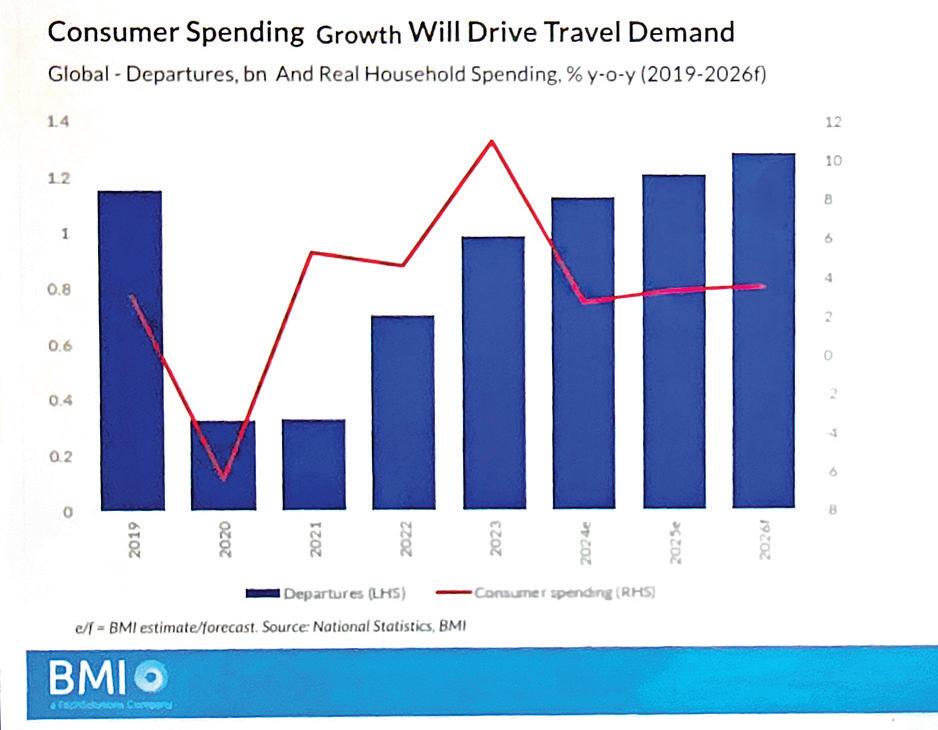
Editor: Jennifer A. Ng
SEC to OFWs: Steer clear of Zild’s investment deals

By VG Cabuag @villygc
THE Securities and Exchange Commission (SEC) has warned the public against dealing with Zild Telecommunication Repair Services, which targets mainly overseas Filipino workers (OFWs).
SEC said in an advisory that Zild, owned by Joan de Jesus Manlapig, is not registered to solicit investments from the public.
Based on information received, Zild has been enticing the public, particularly OFWs, to invest money

Hon Hai’s quarterly sales meet estimates on solid AI demand
H“While assuming that the entity may be engaged in a legitimate telecommunications repair related business, such appearance does not confer authority to solicit investments from the public.”
Zild’s offer constitutes the sale of securities in the form of an investment contract, which exists when there is an investment of money in a common enterprise with a reasonable expectation of profits derived from the efforts of others.
amounting to as much as P450,000 with a guaranteed return of 30 percent monthly within a short period of 30 to 45 days.
“Such representations are indicative of a fraudulent investment scheme,” the SEC said.
These securities are required to be registered with the SEC, and the persons offering or selling them must be properly licensed.
Based on the records of the agency, Zild is not registered as a corporation or partnership, and is operating without the necessary license
or authority to solicit, accept or take investments from the public, nor to issue investment contracts or any forms of securities.
“The commission reiterates that promises of high returns in a short period of time are hallmarks of fraudulent investment schemes which pay existing investors from funds contributed by new investors rather than from legitimate business operations.”
It warned that all persons who act as salesmen, brokers, dealers, agents, representatives, promoters, recruiters, influencers, endorsers, abetters and enablers of Zild in soliciting or recruiting investors may be held criminally liable.
It carries a fine of P5 million, imprisonment of up to 21 years, or both.
Piki told to explain Prime Infra deal
THE controlling shareholders of the Lopez family led by Eugenio Lopez III said they want Federico “Piki” Lopez, First Gen Corp.’s president and CEO, to explain his dealings with Enrique K. Razon’s Prime Infrastructure Capital Inc. In a statement, the group that controls 71 percent of the company said they want to know why First Gen sold majority control of gas assets to Prime Infrastructure then bought a 40-percent minority stake in Prime’s hydropower business only to bring it down to 33 percent. “Why did he give up control of our gas assets, our crown jewels? On hydropower, why reduce to 33 percent the 40 percent minority stake which carried effective veto power? Why not 33 plus one share to keep that veto? This is a significant blunder akin to the Meralco sell-out fiasco
Piki engineered and masterminded without consulting the family.”
The Lopez majority has asked why Piki did not tell them in advance about these projects for transparency and corporate governance purposes. These transactions almost equal the equity of First Gen and need shareholder approval.
“Why put the transaction under ‘other matters’ and then call for an executive session,” they asked. “Piki acts like a king without accountability. In reality, he is a salaried corporate officer equivalent to a professional manager with one qualifying share who is in power by the majority’s tolerance.” “Because of Piki’s opaque one-man rule, we are blind to where the group is headed. The blunders he made, like giving up full control and the reduction in our stake to 33 percent, are his but it is us and the
public shareholders who will suffer. Piki must go and we will fight tooth and nail to get him out.”
First Gen entered into a multibillion peso deal with Prime Infra that started late last year.
Prime Infra last year acquired a 60 percent controlling stake in First Gen’s natural gas business for P50 billion.
First Gen, meanwhile, last month moved to acquire a 33-percent to 40-percent stake in Prime Infra’s pumped storage hydropower portfolio for about P61.9 billion to P75 billion.
“First Gen expects its partnership with the Prime Infra Group to help sustain its growth, while reaffirming a declaration made 10 years ago by the Lopez Group to avoid coal investments and pursue First Gen’s transition into
St. Luke’s unveils O-arm surgical imaging system

ST. Luke’s Medical Center has rolled out the O-arm surgical imaging system in its hospital in Quezon City, which should benefit patients undergoing orthopedic or spine surgery.
Dennis P. Serrano, president and CEO of St. Luke’s Medical Center, said the new equipment elevates the level of surgery that the hospital can do for orthopedics, for spine and for neurosurgery.
“St Luke’s is lucky to be one of the few, less than a handful, of hospitals in the country to have the O Arm in our operating rooms, and Quezon City was prioritized for this, mainly because of the volume, and mainly because of the need for for an imaging system for our for our patients.”
Joselito L. Lazaga, head of the the hospital’s Institute of Orthopedic Surgery and Sports Medicine, said the new system is like a CT (computerized tomography) scan, but better.
“We’re bringing that technology in a mobile form that we can use
real time in the operating room. So the arm can produce a 2d or 3d image that allows us to see beyond the surgical field,” he said.
“So, imagine you’re doing surgery, and you’re able to see what’s beneath you, what you can see. So that in in doing orthopedic surgeries wherein we put implants, you can be guided safely to the direction and orientation of where your implants will be placed.”
With this system, overall, allows doctors to do surgery safer with better outcome, and with better success rates for our patients, he said.
“The radiation dose is much smaller compared to your regular CT (scan)… it was just refined by this company to be able to produce 3d images of the spine or of any bone to make visualization much better. So based on that visualization, we can improve accuracy precision in placing implants close to the spinal cord,” Lazaga said.
The said system has been refined
in terms of the processing, the scanning, it provides good visualization.
“It provides high resolution images in such a small amount of time compared to the previous generation. So in a way, in a way, this machine is more or less the gold standard of trying to put in accuracy and precision as the forefront for spine surgery.”
Mikhail Lew P. Ver, orthopedic surgeon, spine surgery in St. Luke’s QC, said the hospital is pushing itself to become a “robot capital,” and not just in the Philippines, but in Southeast Asia.
“That’s why I am proud to say that, at least for the Philippines, having this type of technology, it makes us at par worldwide, even in first world countries. That’s what I tell patients who, those who can afford, who can say, ‘I want to go here to Singapore. I want to go to Korea, to Japan, do surgeries for this’. What we can proudly say is that they don’t have to go anywhere, and we can provide it here.” VG Cabuag
a 100-percent renewable energy company in the future,” the company said in a statement. VG Cabuag
ON Hai Precision Industry Co. reported a 29.7-percent rise in quarterly sales, a sign of sustained AI demand during the first weeks of war in the Middle East.
Revenue for the three months ending in March grew to NT$2.13 trillion ($66.5 billion), while analysts on average were looking for NT$2.14 trillion.
That’s as concerns about a rush to build power-guzzling data centers are growing in the face of escalating conflict in the Middle East, which is putting pressure on global shipping routes and gas prices.
“Hon Hai—the world’s largest electronics manufacturer—will likely strengthen its sales growth this year as AI server rack shipments continue to expand. The Taiwanese company’s deep vertical integration and global presence offer an edge amid increasing server complexity and demand for localized production. Further upside is possible from a surge in ASIC-based server projects, followed by the Vera Rubin platform deployment in 2H.”
The Taiwanese company in
March projected strong sales growth in 2026, fueled by sustained AI momentum. Chairman Young Liu warned about uncertainty around the business environment stemming from the Middle East crisis, however.
Sales in the current quarter are expected to continue to grow quarter-on-quarter and year-on-year, although “it remains necessary to monitor the impact of the volatile global political and economic situation,” the company said in a statement on Sunday.
Hon Hai has established itself as a key AI hardware player by assembling servers that house Nvidia accelerators. That’s as Alphabet Inc., Amazon.com Inc., Meta Platforms Inc. and Microsoft Corp. are earmarking about $650 billion on AI spending this year, even while warnings about overcapacity and questions about how to monetize the technology linger.
The Taiwanese company also derives a large portion of revenue from assembling Apple Inc.’s iPhones and MacBooks, and is in position to benefit from a strong reception for the latest iPhone 17. Bloomberg News
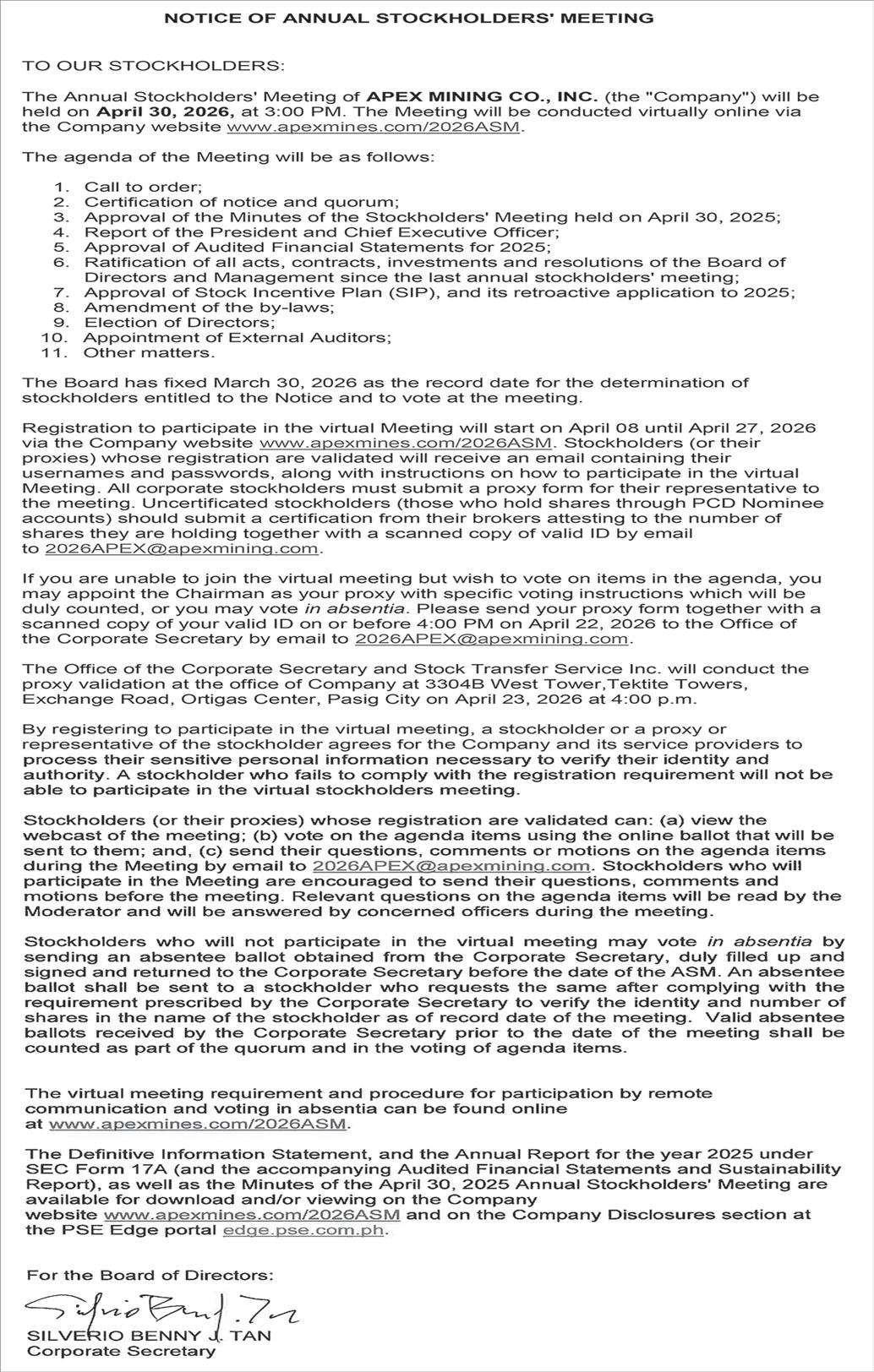
Banking&Finance
T-bill yields rise on bets inflation rose faster

By Reine Juvierre Alberto @reine_alberto
THE Bureau of the Treasury (BTR) opened the second quarter’s Treasury bill (T-bill) auction with another partial award as yields moved sideways on expectations of faster inflation due to rising oil prices.
On Monday, the BTr’s auction committee fully awarded the P9-billion offerings for the 91-day and 182day T-bills, while partially awarding the 364-day securities at P4.8 billion. In total, the Treasury raised a
total of P22.8 billion, which was short of its programmed borrowing of P27 billion. Still, the overall auction was 1.4 times oversubscribed, as total tenders reached P50.203 billion.
Reasons debt can ruin relationships

HAVE you ever wondered why it makes you feel good to give a loved one an expensive gift without expecting anything in return; yet it makes you feel horrible when you lend them money and they fail to repay you as they promised, even if it was just a small sum of money?
First is that people coexist in two distinct worlds: one is where social norms prevail and the other is where market norms govern.
In social norms, you are more than happy to offer expensive gifts without complaining and expecting anything in return. After all, your relationship with them is far more important than money; therefore, reciprocity is not anticipated. Making the recipient happy, through giving them an expensive gift, is the main focus in social norms and not the present’s monetary value.
Extending a loan to your loved ones, on the other hand, becomes a market norm as your connection shifts from emotional to transactional. Since the balance owed—rather than the relationship—is now the main focus of market rules, you expect the debt to be paid in this situation.
Selling products or services within your circle is typically regarded as tricky for the same reasons.
Whether through a loan or a sale, the money you receive from your closest friends and family may be the simplest to obtain, though it may also be the costliest. This explains why conflicts occur when social norms and market norms get mixed up.
Second is that lending to loved ones is influenced by the cognitive bias known as the sunk cost fallacy.
The closer you are to someone, the greater your sunk cost is for the reason that you expended more resources to them, including your time, emotions, effort, and, of course, money.
Loans between friends and family usually have very low interest rates or none at all. Consequently, you lose both the money and your relationship’s confidence when borrowed funds are not returned as agreed.
In contrast to financial institutions like banks, the borrower must meet specific credit rating requirements or present collateral in order to be granted a loan from them. For banks, the risk is limited to the outstanding loan; however, there are additional risks for relatives and friends. If the debt fails to be settled on time, you will feel exploited as the lender. While your loved-one, as the borrower, will feel coerced by you to repay the owing money, especially when their financial obligations accumulate. They
This is the fourth consecutive Tbill auction where the Treasury made a partial award as yields continued to increase following the escalation of the Middle East war on February 28, 2026.
Michael L. Ricafort, chief economist at the Rizal Commercial Banking Corp. (RCBC), said the rise in T-bill yields was driven by rising inflation expectations, as the ongoing conflict in the Middle East continue to push oil prices higher.
Ricafort believes the US war of attrition could lead to additional attacks on oil, energy, electricity or other infrastructure in Iran and in other Middle Eastern countries that could further reduce supplies, longer conflict, higher prices, higher interest rates and slower economic growth.
Higher local pump prices could
By Justine Xyrah Garcia
THE World Bank has greenlit a $600-million loan for the Philippines, betting that stronger basic education will help build a more competitive workforce and sustain long-term economic growth.
drive inflation beyond the 2-percent to 4-percent target range of the Bangko Sentral ng Pilipinas (BSP), he added.
That, in turn, could lead to monetary tightening to fulfill the price stability mandate of the central bank; though tempered or mitigated by non-monetary measures by the government to temper inflation and inflation expectations, Ricafort said.
T-bill yields
ONLY the average yield on the 91-day T-bill declined during the auction, slipping by 1.9 basis points from the 5.004 percent recorded in the previous auction on March 23.
The Treasury accepted yields from as low as 4.898 percent to as high as 5.025 percent. Bids for the tenor reached P26.660 billion, or nearly
According to Zafer Mustafaoğlu, World Bank Division Director for the Philippines, Malaysia, and Brunei, the program is designed to strengthen foundational skills seen as critical to sustaining growth and job creation.
three times the P9-billion offer, which was fully awarded.
Meanwhile, yields for the 182-day T-bills stood at an average of 5.080 percent, as rates varied from a low of 5.014 percent to a high of 5.199 percent. This was higher by 4.8 basis points compared to the previous rate of 5.032 percent. The security attracted P16.552 billion in bids, about 1.8 times the P9billion offer, likewise awarded in full.
The 364-day T-bill posted an average yield of 5.204 percent, up by 3.8 basis points from the previous 5.166 percent. Accepted rates ranged from 5.148 percent to 5.250 percent.
However, demand for the one-year tenor was weaker at P6.991 billion, below the P9-billion offer, resulting in a partial award.
The T-bills, except for the 364-day
fined as the inability to read and understand a simple, age-appropriate text by age 10.
tenor, fetched lower average rates than the secondary market benchmark rates.
Based on Philippine Bloomberg Valuation (PHP BVAL) rates, yields for comparable tenors stood at 4.990 percent for three-month, 5.125 percent for six-month and 5.180 percent for one-year securities. The Treasury aims to raise as much as P248 billion from the domestic debt market through the auction of T-bills and Treasury bonds this month. The tack forms part of the government’s full-year borrowing program of P2.682 trillion, with a 77:23 financing mix in favor of domestic sources. The national government’s outstanding debt rose to P18.159 trillion as of the end of February 2026, up by 0.14 percent from P18.133 trillion a month earlier.
It will also back ongoing efforts to digitalize systems and decentralize programs of the DepEd, the World Bank said.
may therefore shun you as soon as you demand payment.
Get-togethers and holiday feasts with friends or family will suddenly come with a lot of baggage. Meals will taste stale whenever your gaze met. Every remark spoken will seem like it was intended to hurt your feelings and eventually animosity for one another will develop.
With all of this in mind, should you still loan money to your loved ones?
It is up to you to decide.
If you find yourself in a similar circumstance, keep the following advice in mind. Lend out money that you are prepared to lose. Avoid lending funds that you will require in the next few days or weeks. Think of the money you lend to them as a gift. That is to say, you won’t be expecting them to pay you back anymore.
Another alternative is to put your agreement in writing, include the loan date and the anticipated repayment date. Since people are emotional beings, this advice is not infallible. If you prepare an agreement and ask them to sign it, some of them might take offense.
If you suspect that a friend or family member asking for money has a serious problem, such as gambling, substance abuse, or shopping addiction, you should reconsider. Giving them money could only aggravate these undesirable behaviors.
It is assumed that lending money to friends and relatives fell solely on their shoulders whereas in actuality, both the lender and the borrower share the burden as lending money to your intimate group carries significant risks.
While the government has already established a legal way for resolving this difficult state of affairs through small claims court, you would not want to pursue that route and irreparably damage your connection with the person you care about.
Sometimes you have to say no in order to keep your relationship intact. You set boundaries, particularly for people who intend to use your generosity and goodwill. And then give them a thorough explanation of why you have decided not to lend them money.
Helping a loved one should not be a burden to them, but rather an inspiration to attain their own financial independence.
Rosemarie Gases is a Registered Financial Planner of RFP Philippines. The views and opinions she expressed herein do not necessarily represent the BusinessMirror. To learn more about personal financial planning, attend the 115th RFP program this March 2026. Email info@rfp.ph or visit rfp.ph to learn more about the program.
The multilateral lender said on Monday its Board of Executive Directors approved the loan (about P36.049 billion at current exchange rates) for the “Project for Learning Upgrade Support and Decentralization,” or “Plus-D.” According to the World Bank, the project will be implemented through the Department of Education (DepEd) and is expected to improve learning outcomes in public schools nationwide.
“For the Philippines, sustaining growth and creating more jobs will depend on strong human capital— a workforce with solid foundational skills in literacy and numeracy,” Mustafaoğlu said.
“This effort is about giving every Filipino child a fair start, ensuring they can build the skills that underpin lifelong learning and future success in the labor market.”
In 2022, the bank estimated that 90.9 percent of Filipino children were experiencing “learning poverty,” de-
Learning deprivation—the share of children who fail to reach minimum reading proficiency by the end of primary school—was similarly high at 90.4 percent.
The bank said the Plus-D will focus on strengthening early-grade literacy and numeracy, alongside efforts to recover learning losses and tighten how student performance is assessed and used in classrooms.
At the implementation level, the project will channel support toward improving teacher capability and school leadership, while expanding access to learning materials, including for learners with disabilities and Indigenous communities.
Funding will be directed to DepEd’s 10 regional offices and more than 11,100 schools to accelerate learning recovery in elementary levels and improve the quality of junior high school education, it added. According to the multilateral lender, the program is expected to reach around 21 million learners from kindergarten to Grade 10, including those under alternative learning programs, as well as about 777,000 teachers. Plus-D will also cover roughly 59,000 school heads and 300 education personnel through training and capacitybuilding initiatives.
Agencies accelerated fund disbursements BIR clears up tax perks in education programs
THE Bureau of Internal Revenue (BIR) has clarified the tax perks for private sector partnerships in education programs to simplify access to incentives.
Internal Revenue Commissioner Charlito Martin R. Mendoza issued Revenue Memorandum Circular 232026 to provide clearer guidelines following concerns from taxpayers over what they deem as gaps in compliance requirements and procedures.
The tax incentives cover initiatives under laws such as the Adopt-a-School Act of 1998, the Enterprise-Based Education and Training Framework Act (Ebet), and relevant provisions of the Tax Code.
According to the BIR, only enterprises duly registered with the Technical Education and Skills Development Authority may implement EBET programs and qualify for related incentives, and such incentives are not extended to academic institutions.
The BIR said enterprises may claim an “additional deduction” equivalent to 50 percent on top of actual training expenses—bringing the total deductible amount to 150 percent—until the effectivity of the EBET Act until December 31, 2027.
Starting January 1, 2028, the additional deduction will increase to 75 percent, subject to a cap of five percent of total direct labor expenses or P25
THE Government Service Insurance System (GSIS) will distribute over P19 billion in refunds to its members and pensioners under its loan moratorium program.
A statement released by the staterun fund manager read that it will release the loan refunds to around 1.37
million annually, whichever is lower.
Further, only training expenses actually incurred and shouldered by the enterprise may be claimed as deductions. Expenses subsidized by third parties, such as scholarships funded by TESDA or other donors, are not eligible for tax deductions.
For Adopt-a-School initiatives involving both public school personnel and enterprise staff, the BIR said incentives may still be availed, provided that the staff are clearly among the intended and actual recipients of the training or assistance.
However, only expenses attributable to public school personnel are entitled to additional deductions.
The BIR said the circular aligns incentive rules with broader efforts to strengthen workforce development, improve access to education and encourage industry participation in training and skills development.
“With the issuance of RMC No. 23-2026, we are making it simpler and faster for the private sector to access the tax incentives they earn by supporting Philippine education,” Mendoza said.
“By streamlining these procedures, the BIR reaffirms its commitment to a transparent and efficient tax system that empowers our partners to invest in the Filipino workforce and contribute to our national development,” he added. Reine Juvierre S. Alberto
CASH utilization of the national government increased to 83 percent as of the end of February, as agencies accelerated fund disbursements to expedite the implementation of their programs and projects.
Latest data from the Department of Budget and Management (DBM) showed that the notices of cash allocation (NCAs) utilization rate improved from 42.2 percent in end-January and from 83 percent in the same period last year.
NCA is a disbursement authority issued by the DBM to cover the cash requirements of the operations, programs and projects of government agencies. A higher NCA utilization rate indicates that agencies are more efficient in disbursing funds and implementing their respective plans.
The DBM has released a total of P700.220 billion in cash allocations as of end-February, slightly lower by 1.49 percent than the P710.855 billion disbursed a year earlier. Of the amount, P608.907 billion had been utilized, while P91.312 billion remains unused.
Broken down, line departments were able to use P373.841 billion out of the P456.708 billion in NCAs released to them in the first two months of this year. This is equivalent to an 81.9 per-
cent NCA utilization rate, which was higher than the 76 percent recorded in the same period last year.
The Department of Education (DepEd) received the largest allocation at P122.788 billion among line agencies, followed by the Department of Public Works and Highways (DPWH) with P61.192 billion and the Department of Social Welfare and Development (DSWD) with P57.355 billion.
DepEd utilized 89.1 percent of its allocation, while DPWH and DSWD posted utilization rates of 91.5 percent and 60.2 percent, respectively. In terms of utilization efficiency, the Commission on Elections posted the highest rate at 96.5 percent, followed by the Commission on Audit at 95.6 percent and the Department of Tourism at 94.3 percent.
Moreover, NCAs released as budgetary support to governmentowned and -controlled corporations reached P11.192 billion as of endFebruary, of which 77.7 percent were used up.
Local government units (LGUs), meanwhile, utilized 97.4 percent of the P232.319 billion in NCAs allocated to them.
DBM data showed the government released 63.5 percent or P4.311 trillion of this year’s P6.793 trillion national budget as of endFebruary. Reine Juvierre S. Alberto
Art BusinessMirror
Meneline Wong: ‘A woman’s strength is not always loud’

ALL signs point to another hit solo exhibition for Meneline Wong, an accomplished abstractionist and practicing medical doctor. Ongoing at Conrad Manila’s Gallery C is her show, 40th installment of the hotel’s “Of Art and Wine Series,” mounted in celebration of International Women’s Month in March.
The exhibit features 20 mixed media artworks that showcase the remarkable evolution of Wong’s signature flow art. What used to be flat paintings during her breakout in the art scene nearly a decade ago have taken body as three-dimensional artworks, rising above the canvas while maintaining their luminous movements. There persists a strong sense of power in each one, but none more so than the artist’s compelling speech during the exhibit’s recent opening, which challenged the prevailing struggles of women.

“For so long, women have been confined within narrow definitions,” said Wong, specifying “weaker sex,” “too emotional,” and “lacking courage.” These labels, however, “do not reflect who women are,” but are merely “limitations imposed by a world that has not taken the time to truly see them.”
She believes looking closer and deeper would pave the way for true understanding. Wong, an obstetrician-gynaecologist, then drew a parallel between a key facet of her artwork—creases, which is also the namesake of her show—and society’s general view of women. While the creases and folds in her artworks may seem like flaws, she maintains that they are not.
“The creases I made are intentional, and in many ways they are just like women,” she said, “because a woman’s life is not simply shaped by circumstances. It is shaped by choice.”
As such, every crease reflects women’s decision “to endure, to adapt, to rise, to keep going.” She called it “marks of experience,” which “tell stories of struggle, of sacrifice, of silent battles fought and endured—isn’t that what being a woman often is?”
Following the idea, Wong posits that these creases, these perceived imperfections, do not “diminish” women. Rather, they “define” them.
“They transform something ordinary into something powerful,” she said. “In the same way, a woman’s strength is not always loud. It does not always demand attention. It lives quietly, in resilience, in endurance, in the courage to keep going even when no one is watching.”
Wong drives the point home by saying that “strength is not the absence of weakness. But the courage to embrace it, to learn from them, to rise beyond.”
The intensity in the words of Wong carries over into her art. Creases presents the first woman to win in the prestigious national art competitions of GSIS
and Robinsons Land at her best. Wong’s waves of colorful paint crash and crumple onto each other, creating kinetic impressions from static pieces. We see this in artworks, such as Strength in Bloom I and Love Made Visible I, where the artist’s creases dance on backgrounds of blue and red, respectively.
Present in the opening as well as a guest of honor was Susane Tiausus. The managing director of Art Lounge Manila, the representing gallery of Wong, she said in her speech that the hallmark of true artists is the ability of their artworks to evoke some sort of emotion. Tiausus added that Wong’s deliver on that end as the artist “does not hesitate to really express what she has inside,” reflecting her “passionate” and “competitive” nature.
“Try to look into her artworks and see what she’s really trying to tell you—the story, the emotions,” she said.
With how impassioned Wong visually and verbally articulates her feelings, it does not take much to get the message.
Young artists stage animal-themed dance on accountability
INSPIRED by the musical suite Carnival of the Animals, a 45-minute allegorical dance will be presented by up-andcoming Filipino artists through the use of animal archetypes, mirrors and masks to examine contemporary Philippine sociopolitical realities and culminate in a call for accountability.
BPAD in Motion: Panagutin is set to be staged by dance majors from the De La Salle-College of Saint Benilde School of Arts, Culture and Performance Bachelor in Performing Arts major in Dance (BPAD) Program.
It aims to translate collective memory and historical trauma into accessible performance narratives which will resonate with diverse audiences, as well as provoke civic reflection and public discourse on power and justice.
It positions dance as a form of social critique and moral resistance by embodying

corruption, conscience, courage and resilience through political symbolism

embedded in animals.
Directed by former Ballet Philippines soloist Nina Anonas, the production integrates classical music, contemporary popular sound, protest songs, and indigenous sonic textures into a cohesive musical structure.
Featured in the show are choreographies by Anonas, BPAD program chairperson and Benilde Experimental Dance artistic director Mycs Villoso, former BP principal dancer Christine Crame, Benilde’s Center for Deaf Esteem and Formation and School of Deaf Education and Applied Studies (SDEAS) Deaf performing arts trainer Myra Medrana, and Benilde faculty Miriam Madamba. Likewise showcased are creations of Alice Reyes Dance Philippines (ARDP) Foundation Inc. school principal Richardson Yadao, who will also play the role of a Babaylan or a pre-colonial Filipino shaman; ARDP artist Monica Amanda Gana, and
BPAD students Genesis Arabe and Ibarra Immanuel Toledo. This production cements BPAD’s role as a politically conscious program with various works which explore Filipino culture, resist colonial influences, highlight kapwa (shared identity), and confront societal oppression through provocative and visually compelling performances.
The event is mounted by students from the Production and Stage Management class in collaboration with the Production and Design Program, Music Production Program, SDEAS Silent Steps. BPAD in Motion: Panagutin is scheduled at 1 pm, 4 pm, and 7 pm on Friday, April 10, 2026. Shows will be held at the 6F Blackbox of the Benilde Design + Arts Campus.
Tickets are available at P350 for the general public and P300 for Benildeans. Interested viewers can reserve their slots at tinyurl.com/BPADInMotionPanagutin.

and to look on the bright side of life. The vibe you release will determine what you receive in return. Take the high road; spread joy, positive suggestions and hands-on help, and something good will transpire. ★★★
LEO (July 23-Aug. 22): A quick reaction will lead to damage control. When in doubt, ask questions. Take control, and use your imagination. Overreacting will set you back, but gathering information and making a calm and calculated decision will lead to victory. Choose your battles wisely and your friends for who they are and what they stand for.
VIRGO (Aug. 23-Sept. 22): Emotions will surface over commitment issues, shared expenses and a lack of equality within meaningful relationships if you aren’t willing to compromise. Focus on what you can do to even out the playing field and to bring about positive change. Keep your rhetoric simple, truthful and easy to understand. Sticking to detail and being precise will simplify matters. ★★
LIBRA (Sept. 23-Oct. 22): Choose to socialize, network and get to know newcomers in your life better. Listen more, and you’ll gain insight into what others want and what you will receive in return. Let your intuition guide you and pioneer your way forward using what’s available. Integrate new technology into your pursuits, and protect your prospects, investments and physical well-being.
SCORPIO (Oct. 23-Nov. 21): Let your mind, intelligence and awareness lead the way. Walk away from pushy people looking to derail your confidence. Put your heart and soul into doing the best job possible, and you’ll rise above anyone who tries to compete with you. Choose to expand your skills, experience and qualifications, and shoot for the stars. ★★★
SAGITTARIUS (Nov. 22-Dec. 21): You’ll have to step outside your comfort zone if you meet with opposition. Recognize when someone is exaggerating and push back with innovative solutions, and you’ll change the dynamics regarding how others perceive you. Keep life simple, show kindness, dedication and loyalty, and proceed with the intent to live up to your promises. ★★★
CAPRICORN (Dec. 22-Jan. 19): Put emotions aside and recognize what’s factual and what’s fictional. Someone will try to take advantage of you or separate you from your cash if you are too accommodating. Be the one asking the questions and scouring the internet for better alternatives. It’s OK to change course midstream if something alerts you to do so. Follow your instincts. 3★★★
AQUARIUS (Jan. 20-Feb. 18): TStop, look around you, assess your situation and don’t fear making a reverse maneuver. A simpler alternative is within reach if you are rational and willing to compromise. Refuse to let emotions lead you down a path that has few advantages. Leverage comes from maturity, communication and the ability to see all sides of a situation. ★★★★
PISCES (Feb. 19-March 20): Collect your thoughts before sharing. You have plenty to gain if you research and map out a path forward that is dedicated to a beneficial outcome. It’s best to undersell yourself and to surprise everyone by going over and above the call of duty. Avoid temptation, indulgence and letting others dictate what your next move is. ★★
BIRTHDAY BABY: You are impatient, emotional and persistent. You are excessive and demonstrative.


GAZINI GANADOS BRINGS IDENTITY, ADVOCACY TO MISS GRAND INTERNATIONAL ALL STARS
BEAUTY queen and Sparkle artist Gazini Ganados sees her return to the international pageant stage as a calling, entering Miss Grand International (MGI) All Stars with a deeper and more personal sense of purpose.
More than a comeback, Gazini’s journey represents growth. Once known for her advocacy in elderly care, her mission has grown alongside her life experience, leading her to embrace and amplify her identity as a Filipina-Palestinian woman. This personal truth now fuels her voice and aligns powerfully with the Miss Grand International All Stars’ global advocacy: to stop war and violence.
Gazini is the fourth candidate from the Philippines to compete in the inaugural MGI All Stars, set to be held in Thailand starting May 18 to 30.
“For me, this is no longer just about competition. This is a calling,” Gazini shares.
After meeting her Palestinian father following her Miss Universe journey, Gazini experienced firsthand how conflict and violence affect families, identities, and generations. The emotional toll on her loved ones became a defining moment, transforming her purpose from personal ambition to collective representation. Through MGI All Stars, she aims to humanize the stories behind conflict and use her platform to amplify voices often unheard on the global stage.
As a Filipina raised with compassion, resilience, and community at her core, Gazini brings with her the Filipino spirit of empathy and strength. As a Palestinian by blood, she carries the weight of remembrance and hope. Together, these identities allow her to stand as a representation, uniting cultures through shared humanity rather than division.
Gazini emphasizes that she wants her MGI run to be remembered as a meaningful reign. “This time, I’m showing up fully—mentally, physically and emotionally prepared. I’m not here just to wear a crown. I’m here to stand for something bigger than myself.”
Beyond pageantry, Gazini has also stepped into acting. She has explored the fantasy genre through Encantadia Chronicles: Sang’gre, where she plays one of the ancient KambalDiwa. While she is open to taking on any genre, Gazini is especially drawn to actionpacked roles, fueled by her love for adrenaline and physically challenging activities.

By Lindsey Bahr The Associated Press
MIXED reviews didn’t dissuade mass audiences from buying tickets to The Super Mario Galaxy Movie, which scored the biggest opening of the year for a
movie. The Illumination and Nintendo co-production earned $130.9 million over the weekend and a massive $190.1 million in its first five days in North American theaters, according to studio estimates on Sunday.
Universal Pictures released the sequel globally on Wednesday, capitalizing on kids’
the

Big steps
Nicole Laurel Asensio

THE music world is all fired up with the recent release of SB19’s new album, Wakas at Simula (The End and The Beginning). In a nutshell, this much awaited 24-track release serves as a closure of the group’s formative era in music and the commencement of a new imperial rebirth.
Two of the most talked-about tracks are the eagerly anticipated collaboration of the phenomenal boy group with hot Taiwanese sensation Jolin and the amazing Japanese boy band Be:FIRST.
Released globally on all major streaming platforms, the wonderful collaboration of Jolin and SB19 is titled “EMOJI,” and the music video we saw was more than a surge of adrenaline as far as vocals and performance levels are concerned.
Jolin said she was so impressed with SB19’s unique energy and it was quite a challenge to find an emoji that would best describe her experience working with the most popular Philippine boy group. “SB19’s passion for music is commendable and the kind of energy the boys have is infectious, as I was swept off my feet and touched deeply by this wonderful energy
when we shot the music video.”
SB19 also collaborated with Be:FIRST for the single “ToyFriend” and the song debuted on Billboard Japan Top Download Songs chart at No. 6.
“Just the opportunity to perform and collaborate with big names from the Asian region is already a big blessing for any artist or group. And the experience of singing and performing with Jolin and Be:FIRST signals the beginning of many more plans in the future for SB19,” shared Stell.
For his part, Justin feels that this new album is a huge step forward for the P-pop group. “We always aim to evolve while we create, and this new album is a testament of who we are as artists, and a manifestation of who we’d like to showcase to the world.”
The big dream of SB19—that one day, P-pop would stand side by side with artists from around the world in every major global music event—is finally happening as SB19 is about to make history by being the first P-pop group to perform at the Lollapalooza festival in Chicago and with these new songs and collaborations in their latest album, SB19 continues to raise the Philippine flag as it surges ahead in the global music scene, one big step at a time.
NICOLE LAUREL ASENSIO: BEYOND GRATEFUL
THERE is a resurgence of the jazz classics, specifically jazz influences in contemporary music in the Philippines, and artist Nicole Laurel Asensio is sharing her immense musical talent when she performs in these venues where the younger crowd gathers over classic cocktails and suave standards.

overall, although when it came to families attending there were slightly more moms (52 percent) than dads.
“These kind of audience reaction scores just point to a ridiculously strong run, not only throughout the
“I’d like to think that this is the unexpected renaissance of the jazz age influence, especially to artists like me who have developed a romance with jazz all these years. It’s the old meeting the new and the music being created is truly amazing,” she shared.
Nicole headlines the very first jazz night at Got Soul MNL at the Burgos Circle in Bonifacio Global City tomorrow, April 8, and she says it will be the first of a series. “It’s going to be smooth, soulful, syrupysweet as genuine jazz songs should be.”
As an artist whose range is impeccable, Nicole will also have a special show on April 10, billed as Shaken Not Stirred at 78 Salcedo, a repeat of the sold-out show at the 78-45-33 jazz bar where she sang songs from unforgettable James Bond films.
Nicole’s molar-to-molar smiles these days are also due to a new milestone in her already luminous career as an artist. She has been appointed as the first-ever Philippine brand ambassador for music of Shure Microphone, a partner brand of JB Music in its goal of making local artists be seen and heard on a wider and bigger spectrum.
Shure is celebrating its 100th year as a brand and it is also JB Music’s 50th year of supporting Philippine performing artists that makes it more special for Nicole to be given this huge honor.
“I’m humbled by all these beautiful things happening to me and my career. These are big steps forward that I will continue to nurture and take care of. I always follow my heart and trust my instincts— whether I create, collaborate or perform. I simply allow music to take me where I can be at my best and happiest. And I tell myself to always be grateful,” she intoned.
spring, but likely into the summer as well,” said Jim Orr, Universal’s president of domestic distribution. The Super Mario Galaxy Movie will open in Japan later this month.
Last year, the first weekend in April hosted the launch of another video game blockbuster, A Minecraft Movie, which had a bigger three-day debut ($162.8 million) but didn’t have a Project Hail Mary in a strong second place, meaning the weekend overall is still up around 5 percent.
As expected, The Super Mario Galaxy Movie ended the two-week reign of the Ryan Gosling-led sci-fi hit Project Hail Mary, which landed in second its third weekend in theaters where it added $30.7 million, bringing its running domestic total to $217.2 million. Worldwide, it’s made $420.7 million to date.
Third place went to A24’s provocative new movie The Drama, starring Zendaya and Robert Pattinson, which made an estimated $14.4 million from 3,087 theaters. The film’s stars have been on a massive and charming press blitz to promote their R-rated movie about a engaged couple grappling with an unnerving revelation, which cost a reported $28 million to produce. The reveal has drummed up a fair amount of cultural discourse. While reviews have been more positive than not (82 percent on Rotten Tomatoes), it got a less promising B CinemaScore. Hoppers and Reminders of Him rounded out the top five. And the box office outlook looks bright overall, up around 30 percent from last year.
“There’s no better opening act for a great summer than a huge month of April powered by a mega blockbuster, like the The Super Mario Galaxy Movie,” said Paul Dergarabedian, comscore’s head of marketplace trends.
PHOTO FROM GAZINI GANADOS AND MISS GRAND INTERNATIONAL
LBC Express achieves TAPA FSR 2023 Level C Certification, strengthening commitment to secure warehousing
LBC Express, the Philippines’ leading logistics and money services provider, has been formally awarded by the Transported Asset Protection Association (TAPA) for achieving the TAPA Facility Security Requirements (FSR) 2023, Single Site Level C certification, marking a significant milestone in the company’s ongoing efforts to elevate security standards across its operations.
The certification covers Secure Warehousing, excluding IT and cybersecurity, and underscores LBC Express’ adherence to globally recognized best practices in facility security, risk mitigation, and loss prevention. TAPA FSR certification is awarded only to organizations that meet stringent international benchmarks designed to safeguard assets throughout Concentrix

the supply chain.
“This recognition from TAPA validates the work we’ve been consistently investing in—building secure, disciplined, and resilient operations that our customers can rely on,” said Rene Fuentes, Chairman and Chief Operating Officer of LBC Express.
“Security is not just a compliance requirement for us; it is a core promise.
Achieving TAPA FSR 2023 Level C reinforces our commitment to protecting the shipments entrusted to us, every step of the way.”
The TAPA FSR framework is globally respected for setting minimum security standards for logistics facilities handling high-value or theft-sensitive goods. LBC Express’ successful certification reflects
strong governance, robust physical security controls, and disciplined operational processes within its warehousing environment.
This achievement is part of LBC Express’ broader strategy to continuously enhance operational excellence, strengthen customer trust, and align its facilities with international logistics and security standards. As the company continues to expand its network and capabilities, security remains a foundational pillar of its service promise.
With over seven decades of service, LBC Express remains committed to delivering reliable, secure, and world-class logistics solutions, connecting Filipinos to opportunities, locally and globally.
Powering the future: The women leading MGEN’s energy transformation
IN an industry long dominated by men in hard hats and corner offices, a quiet transformation is taking place at Meralco PowerGen Corporation (MGEN). Across its operations—from control rooms and solar sites to the boardrooms shaping energy transition strategies—women are stepping into more visible and influential roles, helping redefine what the future of Philippine energy can be. Among them are three professionals at different stages of their careers, each contributing in her own way to this evolving landscape.
colleagues, I learned to embrace it. It shaped me into a leader—someone who has grown from fear and uncertainty into confidence and pride.”
What drives her is the knowledge that her work keeps the lights on for millions of Filipino families, from homes to hospitals. It is a responsibility she carries with both humility and determination.
by the industry. It’s about proving that leadership is defined by capability, not gender.”
While engineers keep the plants running, Atty. Maan Ballesteros ensures that the legal and governance frameworks supporting those operations remain strong and responsive.
LEADERS from government, technology, and multiple industries convened on March 24, 2026, for Filipinnovation-powered by Concentrix, an exclusive business summit advancing national dialogue on digital transformation and cyberresilience in the domestic market.
Now in its second year, the Concentrix-hosted summit carried the theme “Transformation Protecting the Country’s Digital Future.” It brought together leaders across aviation, energy, real estate, retail, education, insurance, financial services, logistics, communications, and technology to address cybersecurity as a critical foundation for sustainable growth and national resilience.
In his opening remarks, Department of Information and Communications Technology (DICT) Undersecretary for Strategic Initiatives and Industry and Competency Development Leandro Aguirre emphasized the importance of public-private collaboration, stating, “If we approach cybersecurity as a shared responsibility, through capacity-building, through policies that encourage responsible behavior, and through collaboration, then we can build and sustain a digital environment that is not only innovative, but also secure, resilient, and worthy of the trust of the Filipino people.”
The summit showcased digital solutions including the Concentrix iX Suite of AI-powered applications that supercharge performance and outcomes, and Concentrix CyberProtect, which provides comprehensive threat protection. Event exclusive partner and cloud-based AI and CX solutions leader Genesys also shared insights on the future of customer experience. “Winning in CX is about connecting data, AI, and systems—combining speed, empathy, and context seamlessly together — this is experience orchestration,” said Ashok Sankaran, Director of Partner and Alliances – APAC, Genesys. Keynote speaker Donald Lim, head of Cybersecurity Council of the Philippines, President of the Management

Department of Information and Communications Technology Undersecretary for Strategic Initiatives and Industry and Competency Development Leandro Aguirre.
Association of the Philippines and President of DITO CME Holdings, underscored the need for comprehensive, longterm cybersecurity strategies amid a rapidly evolving threat landscape. A fireside chat with leaders from the aviation and energy sectors further highlighted how cyber risks now impact not only systems and data, but also operations, customer trust, and national stability. Across discussions, a clear consensus emerged: cybersecurity must be embedded at the core of business strategy, driven at all levels, and strengthened through public-private collaboration.
In closing, Amit Jagga, EVP and Chief Business Officer of Concentrix Philippines, highlighted the shift from reactive security to resilience by design and collective responsibility: “Protecting our digital future requires action across industries and sectors, because trust is the currency of the digital economy, and cybersecurity is what protects it,” he concluded.



In the Control Room
Engr. Cristine Albarando
MGEN Thermal Cebu Control Room
Engineer
Cristine Albarando arrives at the plant 20 to 30 minutes before her shift, a routine she has maintained since becoming MGEN Thermal Cebu’s lone female control room engineer. While she spends the first few minutes casually catching up with colleagues, she is already inside the control room ten minutes before her shift begins, preparing for the day ahead.
Her work starts with a toolbox meeting to review plant issues and planned activities. She then checks the Distributed Control System (DCS) monitors, reviews system parameters, and studies the previous shift’s logbook. The rest of her day revolves around coordination—following up with maintenance teams, assigning tasks to operators, and flagging anything that could affect plant performance.
Engineering was not always part of her plan. Encouraged by her father, she pursued the field without fully understanding what working in a power facility entailed. It was only later that the magnitude of her responsibility became clear.
“This experience has changed my perspective,” she shares. “At first, I had doubts because I understood the weight of the role. But with the trust of management and the support of my


Before leading MGEN’s Bulacan Solar Plant, Jennylene Baluyot had to prove she belonged in a field where she was often the only woman on site. Over time, what sustained her was seeing the direct impact of her work—how plant performance translated into reliable energy for businesses, communities, and everyday life.
Her day begins with data. She reviews generation targets, checks alarms, and assesses inverter performance and any issues from the previous shift. She then heads out for a site walk-through, verifying system reports against actual conditions, inspecting modules, equipment, and even the effect of weather on output. These observations often shape immediate priorities.
High-pressure situations are part of the role. When a significant portion of the plant went offline during peak solar hours due to an inverter issue, the response required both speed and precision. She led efforts to isolate the affected section, restore operations where possible, and assign clear roles to her team.
“Leadership under pressure isn’t about having all the answers instantly,” she explains. “It’s about staying calm, making informed decisions based on available data, and trusting your team.”
Her journey has strengthened her resilience and confidence, while reinforcing the importance of listening and empowering others. “Being a woman leading an entire plant means breaking expectations both my own and those set
Her work spans contracts, regulatory strategy, and corporate governance across MGEN’s portfolio, including thermal, natural gas, and renewable energy assets. Operating at the intersection of business, policy, and risk, her role requires both strategic insight and adaptability.
Her path to law was not linear. Although medicine was the expected route growing up, she chose a direction that better aligned with her strengths. Today, her work carries significant impact across the organization.
“Legal strategy doesn’t exist in a vacuum,” she says. “It requires knowing when to seek input, being open to different perspectives, and understanding the strengths of others. A strategy is only as effective as the people who implement it.”
She also recognizes how her perspective as a woman shapes her approach. By listening carefully, asking the right questions, and reading situations beyond the surface, she is able to build strategies that are both practical and responsive.
Building what comes next
For all three women, their roles are part of a broader transformation—not only within MGEN, but across the Philippine energy sector.
For Baluyot, leading a solar plant demonstrates that women can excel in roles once considered out of reach. Her presence signals that competence, resilience, and empathy can coexist in leadership. She hopes more women will see that they belong in the field—and that they can lead in their own way.
Ballesteros, meanwhile, shapes the structures that allow progress to happen responsibly, while mentoring others to think strategically and act with confidence. Her advice is both simple and empowering: “Creativity, humility, persistence—these have no gender. Protect your self-worth, and you can achieve anything.”
Albarando echoes this call to action.
“To any girl who thinks this world wasn’t made for her, I would say: it was waiting for you to redesign it. Our perspective and resilience are exactly what the future of energy needs. Step in, take up space, and know that you are lighting the path for those who will follow.”
Together, these women are not only helping drive MGEN’s energy transformation—they are expanding what is possible for women in the industry. Through their leadership, they are powering a more inclusive and sustainable future, proving that progress is strongest when diverse voices are part of the journey.
GIGIL is the only indie ad agency in Campaign Brief Asia’s Top 10 Most Awarded Agencies
GIGIL is the only Asian independent agency in the Top 10 of Campaign Brief Asia’s Most Awarded Agencies of 2025, securing its rank alongside the largest global network agencies.
Over the last three years, GIGIL has moved up the Campaign Brief Asia Rankings from #14 to #12, and ultimately to #7, marking its strongest regional showing yet.
With wins at Cannes Lions, British D&AD, and other major global shows such as London International Awards, Clios, Thai ADFEST, Spikes Asia, Korean MAD STARS, Australian AWARD Awards, and The Work, the agency amassed a total of 2,545 points overall.
Mandaue Foam Home Store’s “Steal,” RC Cola’s “Miracle,” and Grab’s “Summer” are GIGIL’s standout films, all of which won trophies at Cannes. GIGIL was also named Philippine
Agency of the Year, landing on top of the country’s creative rankings also in 2023 and 2024.
GIGIL Founding Partners Badong Abesamis and Herbert Hernandez also ranked as the top Creative Directors in the Philippines and 7th overall in Asia The Campaign Brief Asia Creative Rankings tabulate the wins of an ad agency the past two years at 12 of the biggest and most reputable creative shows in the world: Cannes Lions, D&AD, The One Show, Clio Awards, London International Awards, the New York Festivals, AWARD Awards, Spikes Asia, ONE Asia, the ADFEST, MAD STARS, and Campaign Brief’s The Work.
Just a little over seven years since it was established, GIGIL has risen to become one of Asia’s most influential creative agencies today that build clients’ businesses.
43rd St. Teresa of Calcutta Awards launched

JCI Manila, in partnership with the AY Foundation, officially launched the 43rd St. Teresa of Calcutta Awards (STCA) on March 26, 2026 at Hexagon Lounge, marking the start of a nationwide search for Filipinos dedicated to changing lives and serving the poorest communities.
The STCA is one of the country’s most established humanitarian recognitions, honoring individuals whose work reflects compassion in action. Inspired by the legacy of Mother Teresa, the award recognizes those who serve not for recognition, but out of a genuine commitment to uplift others.
The search is open to individuals whose work embodies selfless service. Nominees may include:
• Educators serving underserved or remote communities
• Healthcare workers supporting vulnerable populations
• Individuals dedicating their lives to humanitarian causes
The STCA seeks individuals whose actions demonstrate consistent and meaningful service, often without public recognition.
Now in its 43rd year, the STCA continues to affirm that acts of compassion remain a powerful force for nation-building. By recognizing these individuals, JCI Manila and the AY Foundation aim to inspire more Filipinos, especially the youth, to take part in creating lasting social impact.
JCI Manila invites the public to participate in this nationwide search for modern-day heroes.
The Saint Teresa of Calcutta Award honors individuals who have:
• Dedicated at least 25 years to serving the less fortunate in the Philippines
• Served humbly and selflessly without seeking recognition
• Lived with integrity and simplicity, following the example of Saint Teresa of Calcutta • Self-nominations are not allowed Nomination deadline is July 24, 2026. Nominations can be submitted via mail or deliver to Saint Teresa of Calcutta Award Committee, Aquiza corner Grey Street, Ermita, Manila, Philippines
•Tel: (632) 525-6792
• Fax: (632) 525-2631
• Email: official.43rd.stca@gmail.com For more information, visit: https://web. facebook.com/STCAward https://linktr.ee/ official.43rd.stca
Control Room Engr. Cristine Albarando is the lone female control room engineer across MGEN Thermal sites
Engr. Jennylene Baluyot, Site Manager at MGEN Renewables Bulacan Solar Plant, leads one of the Philippines’ major renewable energy facilities
Leading at Sunrise Engr. Jennylene Baluyot MGEN Renewables Bulacan Solar Site Manager
‘Cannot be AI’d’: Tailors age out as demand for custom fits, secondhand revivals surges
By Anne D’innocenzio AP Retail Writer
NEW YORK—Hunched over a sewing machine, Kil Bae is hemming a dress inside his Manhattan tailor shop when a new customer stops by with a vintage Tommy Hilfiger jacket he wants taken in.
The modeling agent paid $20 at a thrift store for his reversible bomber style that’s plaid on one side and red on the other. He’s willing to spend $280 to have it slimmed down. Alteration requests with such a price disparity would have seemed odd a few years ago, the tailor says, but are helping to keep the bobbins bobbing at his one-man shop, 85 Custom Tailor.
Bae carefully examines the cotton jacket before moving in to pin it, circling the customer like a sculptor with a chisel. He started training as a tailor at age 17, in his native South Korea. Now 63, he’s part of a shrinking breed in the US, where professional sewers, dressmakers and tailors are aging out of the workforce as their services find fresh demand.
Shoppers who grew up on disposable fast fashion are enlisting tailors and seamstresses to give off-the-rack purchases a custom fit or personal flair, to revive secondhand finds or to extend the lives of their wardrobes, according to fashion industry experts. Weight-loss drugs like Zepbound and Wegovy mean more Americans are seeking adjusted waistbands, tapered sleeves and other
types of resizing, Bae said.
“I recommend this job to young people because this one cannot be AI’d,” Bae said, noting artificial intelligence is automating pattern making but so far can’t replicate a tailor’s handiwork. “Different bodies. Different shape. They cannot copy like this. If I close this door, I can go out and find another one.”
But like engraving, repairing musical instruments and many other skilled trades, creating and fitting garments to individual specifications hasn’t attracted enough entry-level workers over the years to replace the professionals retiring their pincushions after decades of performing their craft.
An aging occupation
THE US Bureau of Labor Statistics estimated almost two years ago there were fewer than 17,000 tailors, custom sewers and dressmakers working in business establishments nationwide, a 30% decline from a decade earlier.
Including self-employed individuals and people working in private households, the median age for all sewers, dressmakers and tailors was 54 last year, 12 years older than the median for
the entire employed population, according to the bureau.
The income that a proficiency with needle and thread commands relative to the skills needed and the physical toll of bending over detailed work for hours likely discourages teenagers and young adults from heeding Bae’s advice, fashion industry experts said.
The mean annual wage tailors, dressmakers and custom sewers earned as of May 2024 was $44,050 a year, compared to $68,000 for all workers, according to BLS calculations.
“Most of fashion training is really aimed at mass production, not spending time in a shop handmaking a garment,” said Scott Carnz, the provost of LIM College, a forprofit college that offers degrees in disciplines from the business side of fashion. “The work is also tedious.”
Online job postings for tailors, dressmakers and sewers have remained fairly stable, according to Cory Stahle, an economist with the research arm of jobs site Indeed. Between February 2020 and the end of the same month this year, advertised openings decreased by roughly 2%, while postings for both marketing and software jobs declined by nearly 30%, he said.
“There is a kind of a craftsmanship...that I think is an important piece that we can’t ignore,” Stahle, who focuses on the US labor market, said.
America’s skilled sewers
IMMIGRANTS with and without permanent legal status, refugees and naturalized citizens have powered America’s garment industry for well over a century.
An analysis of recent census data by the Migration Policy Institute found about 40% of tailors, dressmakers and sewers

were foreign-born, according to Julia Gelatt, associate director of the nonpartisan think tank’s US Immigration Policy Program. The biggest shares came from Mexico, South Korea, Vietnam and China, she said.
To address a worsening labor shortage, the fashion industry is looking to create a new generation of master tailors.
Nordstrom, North America’s largest employer of tailors and alteration specialists, teamed up with New York’s Fashion Institute of Technology to launch a nineweek program in advanced sewing and alteration techniques.
“Customarily, tailoring has never been part of the American skill set,” said FIT instructor and Broadway costume builder Michael Harrell, who teaches the course.
Retailers see a growing market
THE fashion institute received 200 applications for the inaugural cohort of 15 students, who started in October and received certificates of completion in February, said Jacqueline Jenkins, the executive director of the school’s
Center for Continuing and Professional Studies.
The hands-on training was designed to prepare participants to work at Nordstrom. The luxury department store chain employs 1,500 people to provide tailoring and alternations, from hemming jeans and repairing rips to fitting suits and reworking evening gowns.
Ten members of the first class were hired or are in the process of being hired, Marco Esquivel, Nordstrom’s director of alterations, said.
“We owe it to the broader industry to ensure that this is an art form that exists for years and years to come and continues to serve customers both within our walls as well as outside,” Esquivel said.
Meanwhile, other retailers are expanding their tailoring services because of demand.
Brooks Brothers, a luxury brand that has made custom men’s clothes since the 1800s, tested a similar service for women at five stores last year. This year, it expanded bespoke women’s tailoring to 40 more stores. Prices start
at $165 for shirts and $1,398 for suits, the company said.
No one to take over
BACK at 85 Custom Tailor, Bae asked more than once if the customer with the Tommy Hilfiger jacket was certain he wanted to proceed with the alterations. Jonathan Reiss, 33, was sure. He said he planned to wear the jacket often.
“I think I fell victim to buying cheap stuff, and then you realize it just falls apart or shrinks or it just doesn’t last long,” Reiss said.
Bae has a son who’s a year older than Reiss. He tried to persuade him to go into tailoring. The son used to work with computers and then opened a bagel shop.
“Young people. They just want to find a job in computers,” Bae said. “I think that’s too boring. I think this is very interesting. Every time, I am drawing in my head. I am like an artist.”
Bae trained under his older sister and brother at their custom apparel shop about 93 miles (150 kilometers) from Seoul. After five years, he moved to South Korea’s capital to work on custom orders and samples for various companies. He moved to the New York City area, where he worked as a pattern maker for Ralph Lauren, Donna Karan and other designer brands.
He opened his own shop in Connecticut in 2011, but the Covid-19 pandemic forced him to close after a decade. He reopened in his current location a year later. He uses three different sewing machines: a basic one, another for heavy materials like denim and leather, and an overlock machine, which cuts, trims, and finishes fabric edges simultaneously.
Bae said he intends to keep working as long as his hands stay steady enough.
“I’m always learning,” he said.
A prophet’s sacred stick helps fuel a violent struggle for political power in South Sudan
By Rodney Muhumuza The Associated Press
JUBA, South Sudan—A South Sudanese prophet—as the story goes—wielded a sacred stick during a tribal battle in 1878 and summoned a deadly thunderbolt that struck down rival fighters. That stick is known as Ngundeng Bong’s dang, and not only has its reputation as a magical and dangerous weapon lived on, but it also plays a role in the latest cycle of violence in the world’s youngest nation. The dang has emerged as a contentious relic in the quarrel between South Sudan President Salva Kiir and opposition leader Riek Machar, who took ownership of the stick years ago. Machar is believed by his followers to be the gap-toothed, left-handed man who would become president in fulfillment of Ngundeng’s prophecy. While that sustains Machar’s struggle, it also makes him a target for his opponents. Kiir and Machar are from different ethnic groups. Kiir is Dinka, the country’s largest group, while Machar—like Ngundeng—is Nuer, the second largest. Fighting exploded along ethnic lines when Kiir and Machar disagreed in 2013. Kiir claimed Machar was plotting a coup. Machar then launched a rebellion that became a deadly civil war in which an estimated 400,000 people were killed. Machar returned as Kiir’s deputy following a 2018 peace deal
that has collapsed.
Now fighting has escalated so badly that authorities are ordering civilians to evacuate rebelheld towns. That’s despite the fact that Machar is under house arrest and accused of treason. A South Sudanese general was recently filmed urging government troops to “spare no lives.”
Some rebels, including a militia known as the White Army, believe they are fighting to fulfill Ngundeng’s words and finally install Machar as president.
Spiritual motives influence many fighting
DOUGLAS H. JOHNSON , the British-American historian who brought the dang back to South Sudan, compares the stick’s authority to a parliamentary speaker’s mace, needed for official business to proceed.
Machar is said to keep the dang as a religious object, using it to galvanize political support, according to Johnson and others who spoke to The Associated Press.
“Very much of the conflict is linked to spirituality,” said Mawal Marko, an independent researcher in Juba. “Most of the people fighting, especially the eastern Nuer, you find so many fighting in the name of Ngundeng.”
South Sudanese mythology abounds with cruelty, and the fight between Kiir and Machar is the latest installment of the hatred Ngundeng himself witnessed and
later sought to stop: Dinka against Nuer, Nuer against Dinka.
Ngundeng’s prophecies were expressed in songs that even today some people play on the internet, searching for revelations about their country’s fate. There can be disagreement on the literal meaning of Ngundeng’s words.
“If we look at a prophecy progressively, there is always room for doubt,” said Christopher Tounsel, a historian of greater Sudan who teaches at the University of Washington, speaking of Ngundeng’s prophecies.
“That’s the most powerful thing: What people think and what they feel. That is the thing that can be the most impactful— not what it is, but what people
perceive to be.”
How the sacred stick changed hands
NGUNDENG , who died in 1906, is believed to have predicted his country’s independence. He foresaw violence. And he is said to have prophesied about a messianic Nuer leader for South Sudan who lacked the facial marks of his tribe, was left-handed and gap-toothed, and had been with a white woman. Machar is said to check those boxes.
“We know it can have power,” said Alex Miskin of the Rift Valley Institute think tank, speaking of Ngundeng’s dang. “Can (Machar) speak power into that stick? That is something I don’t know.”

“Who has the stick and what is the story may make some people a bit frightened” of Machar, said Miskin.
The dang was fashioned from the root of a tamarind tree and decorated with copper wire. It is about 110 centimeters (three and a half feet) long. One end of it broke during the 1878 battle won by the Nuer. Afterward, Ngundeng would say the dang was broken; there’s no account of him using it so successfully again.
The dang was inherited by Ngundeng’s son, who was shot dead trying to use it against colonial troops. He is said to have cried when he raised the stick and nothing happened.
Collected as a trophy, the stick was presumed lost forever until it was discovered in the British town of Bournemouth by Johnson, a prominent South Sudan specialist. He bought the relic and sought to return it to South Sudan, which didn’t have a museum.
Machar, as the highest-ranking Nuer leader in a government then at the cusp of independence from Sudan, received the dang in the South Sudan capital of Juba in 2009. A white ox was slaughtered in a ritual overseen by Machar, who was photographed holding the dang aloft.
Where the dang is today
THE dang’s return was seen as a national event. Kiir welcomed its arrival in a statement that warned
the dang should not be used to wage war.
While serving as the vice president, Machar kept the dang in his house and showed it off to visiting Nuer leaders, said Johnson. “In a way, he was using this as a cultural object, something of interest to the Nuer rather than to South Sudan, to bring in other people as part of his coalition,” he said.
Johnson recalled that the dang looked ordinary in an umbrella stand when he first saw it. But if Machar has the stick, it wouldn’t be surprising that Kiir “would be worried that it was out of the control of the government,” he said. The AP was unable to reach Machar for comment. His spokesman, Puok Both Baluang, said that freeing Machar would be “synonymous with the release of peace.” Despite his detention, the 73-year-old Machar remains a formidable opponent for Kiir, who has governed without an electoral mandate for 15 years. Authorities say elections will be held in December. But a vote without Machar on the ballot and which returns Kiir as president would be seen as disenfranchising the Nuer.
Their military rivalry began in the bush in the 1990s, when Machar led a breakaway unit that drew accusations of treachery against him during the long war for independence. Amid the split, forces loyal to Machar carried out a massacre that targeted the Dinka, angering Kiir and others.
‘Magnifico’ of a weekend for PHL boxers in US ring

By Josef Ramos
AS VEGAS, Nevada—
LMark “Magnifico” Magsayo put on a show in his debut as a lightweight and needed only five rounds not only to dispose of Feargal “Fearless” McCrory but to cap a weekend of victories by his fellow Filipino boxers in the US. A fter fighting for years in the featherweight and super featherweight class and see himself spiraling downwards, Magsayo muscled up to 135 pounds and the initial result was a fifth-round technical knockout victory over the Irish boxer in their non-title co-main event fight here at the UFC Meta Apex here on Sunday (Monday morning in Manila).

My performance was terrific because we applied everything that we trained for,” Magsayo told BusinessMirror during victory celebration at the Knuckleheads
Boxing Gym. “This is my division and I really feel it.”
B ut what really sunk in following Magsayo’s rousing victory was the equally rousing victories by International Boxing Federation (IBF) minimum weight champion Pedro Taduran and upcoming Jimwell Pacquiao. Taduran, 29, showed who’s boss after he knocked out Mexican challenger Gustavo Perez Alvarez in the seventh-round for a successful third defense of his IBF belt at the Pechanga Resort and Casino last Friday (Saturday in Manila) in Temecula, California.
L ast Friday on the same Pechanga ring, Jimwel Pacquiao—or Manny Pacquiao Jr.— notched his first in two professional fights with a secondround knockout of American Darrick Gates in a lightweight four-rounder.
M agsayo was prepared not to disappoint. I watched his fights and he loves to get inside. So, my trainer-coach
Bolts need to tackle, shackle TNT’s tall Bol
MERALCO shoots for a share of second place when the Bolts take on streaking Bol Manute Bol and the TNT Tropang 5G squad on Tuesday in Season 50 Philippine Basketball Association Commissioner’s Cup action at the Ninoy Aquino Stadium.
The Bolts, coming off a bounceback 118-105 win over Titan Ultra, are hoping to cut down to size TNT’s celebrated 7-foot-3 import in the 7:30 p.m. game with a collective defensive effort that gave them three wins against one loss.
NLEX is running second at 4-1 wonlost behind solo leader Rain or Shine (4-0).
“Bol Bol is a special talent, so the guys have their hands full,” Meralco head coach Luigi Trillo told the BusinessMirror on Monday. “They recovered from the first game loss and won two, that is exactly how good they are now.” Bol, son of the late 7-foot-6 National Basketball Association star, is averaging 37.3 points, 15.5 rebounds and 2.7 blocks in three games, transforming the Sudanese-American into a nightmare match up in the wing position because of his versatility and shooting. Seven-foot Meralco import Marvin Jones is set to match Bol with his 21.3 points, 13.2 rebounds and 2.5 assists averages, with locals Chris Banchero, Chris Newsome, rookie Jason Brickman, CJ Cansino and Bong Quinto hoping to provide firepower to contain Bol.
T NT is sporting a 2-1 wincard and is set to activate big man Kelly Williams for Jio Jalalon. Despite the adjustments and back-toback wins against NLEX, 103-97, and San Miguel Beer, 118-92, team manager Jojo Lastimosa remained cautious. Meralco is always a tough opponent. They play hard and plays within a system,” Lastimosa said. “With the addition of Jim Brickman at the point, they now have a guy who can run the team and have Newsome and Banchero be scorers.” Josef Ramos
The birth of Air
Adamson gals
AMarvin [Somodio] told me to focus on my straight and timely jabs making him an easy target,” the 30-year-old fighter from Tagbilaran City said.
R eferee Robert Hoyle stopped the fight upon the request of McCrory’s trainer with only 21 seconds remaining in the seventh round.
M agsayo’s powerful right straight forced McCrory to lose his balance and a perfect left hook into the midsection did the

33-year-old southpaw in fight. M agsayo, now fighting under new promoter Zuffa Promotions owned by UFC boss Dana White, struggled as featherweight and super featherweight that made him lose his World Boxing Council featherweight belt--he improved to 29-2 won-lost with 19 knockouts while McCrory fell to 17-2 with nine knockouts. I nternational matchmaker Sean Gibbons, who serves as Magsayo’s
personal adviser and endorser to Zuffa Promotions, said that White was incredibly happy about his ward’s lightweight debut. They are so happy about the excitement that Mark brought to Zuffa and they promised to give him another exciting next fight that will lead him to a world title opportunity,” Gibbons said. “Dana White is thankful to have an exciting fighter like Mark Magsayo in Zuffa.”
Eala, Filipinas banner PSA’s March honor roll
TENNIS star Alex Eala and the women’s football team continued setting milestones as gymnast Eldrew Yulo started to make his mark in seniors play to headline a stellar campaign for Philippine bets in the last two months.
E ala fueled her rise to a career-high 29 in the Women’s Tennis Association (WTA) rankings in mid-March with strong performances in well-attended WTA1000 tournaments in Dubai and
Qatar, WTA500 in Abu Dhabi, a strong debut at Indian Wells, and a celebrated return at the Miami Open.
at Indian Wells, considered as “the fifth Grand Slam.”
D eep into Women’s Month, the Filipinas went to work towards their goal of booking a return trip to the FIFA Women’s World Cup via the Asian Football Confederation Women’s Asian Cup pathway.
A nd the Filipina booters cleared their path to next year’s global showpiece set in Brazil with a 2-0 victory over Uzbekistan in the Play-in of the Asian meet in Gold Coast, Australia.
They banked on two lovely passes from Jael Marie Guy that Angie Beard
(47th minute) and Jaclyn Sawicki (52nd) converted to get the job done. Yulo, younger brother of Paris Olympics double gold medalist Carlos Yulo, heralded his arrival in seniors gymnastics with a gold medal at the FIG Artistic Gymnastics World Cup Series in Antalya, Turkey.
The 18-year-old Yulo scored 14.100 to top the floor exercise in his seniors debut that came on the heels of his two-bronze feat at the World Juniors Championships at home.
first to end the inning. A lonzo, the reigning Best Pitcher, tossed a completegame three-hit shutout while benefiting from an errorfree defense—a Master of Arts in Physical Education major also struck out six UP batters.

For their brilliance, Eala, the Filipinas and Eldrew Yulo bannered the Philippine Sportswriters Association’s monthly achievers roll for February and March 2026.
T he 20-year-old phenom highlighted this two-month gig with a 6-1,7-6 (5) upset of Italian No. 8 Jasmine Paolini in the Round of 16 in Dubai and a Last 16 finish
Free PBA tickets for Ninoy games
IN celebration of the Philippine Basketball Association’s (PBA) 51st anniversary, tickets will be given for free for Wednesday’s doubleheader bannered by the Rain or Shine and San Miguel Beer Commissioner’s Cup game at the Ninoy Aquino Stadium.
PBA fans can avail themselves of the special promo on a first come, first served basis.
B esides free tickets, live audience will also have a chance to receive basketball, t-shirts and other freebies courtesy of the league’s sponsors.
The PBA played its first official games on April 9, 1975, at the Araneta Coliseum, giving birth to the oldest professional league in Asia.
D uring its golden anniversary last season, the league had a similar free admission offer for fans born on the year the PBA was founded (1975) at the Rizal Memorial Coliseum.
T he unbeaten Elasto Painters (40) tangle with the surging Beermen (3-2) in a match up pitting two of the conference’s title contenders set at 7:30 p.m.



Lshowdown looms
ISA SARINES appeared on track to a commanding lead in the premier girls’ 15-18 division, but a late meltdown turned the tournament into a gripping sibling duel.
The rising standout struggled down the stretch, limping home with a 79 after a costly closing run and what was once a sizable advantage was reduced to a two-shot lead in the International Container Terminal Services Inc. Mount Malarayat Junior Professional Golf Tournament (JPGT) Championship in Lipa City on Monday. Fresh off a dominant run in the 1114 category last year, Sarines appeared firmly in control, standing on the parfour 16th with a comfortable five-shot cushion over twin sister Mona Sarines.
But the momentum suddenly shifted. L isa Sarines stumbled with a
double bogey on No. 16, then dropped two more shots on the next hole as the rising
Sarines twins
MARK “MAGNIFICO” MAGSAYO impresses in his first fight as a lightweight. JOSEF RAMOS
HOT and windy conditions take their toll over Lisa Sarines. JPGT PHOTO