Recession risk could blunt impact of high oil price
THE threat of recession could mitigate the impact of high oil prices due to output cuts on Philippine inflation, according to local economists.
O il-producing countries such as Saudi Arabia and Iraq announced that they will cut oil production by a total of 1 million barrels per day starting in May 2023 until the end of the year.
S audi Arabia alone is expected to account for the reduction of 500,000 barrels a day during the period. Reports said this accounts for less than 5 percent of the country’s average
production per day as of 2022. It will likely increase oil and commodity prices in the future, but I don’t think the worries over a global recession will subside soon so that oil and commodity price increases may not be sustained,” University of Asia and the Pacific (UA&P) economist Peter Lee U told the BusinessMirror on Monday.
A teneo de Manila University Department of Economics Chairperson Alvin P. Ang agreed and said that in the short term, especially if the 6-percent increase in oil prices is sustained, this could feed into inflation.
H owever, Ang said actual demand is slowing. He added that countries like the United States still have “strategic reserves” that could cushion the impact on global pump prices.
Nonetheless, certain economists such as University of the Philippines Diliman School of Economics head of research Renato E. Reside Jr. believe there will be an impact on the country’s inflation rate and growth prospects.
It’s going to feed further into current inflation and inflation expectations. It is a threat to both inflation and growth, not just in the second
quarter. This may also affect the trajectory of future policy rate increases both in the US and here,” Reside said.

However, one good news is that Overseas Filipino Workers (OFWs) in the Middle East who are employed in “essential professions” could benefit from the increase in oil prices. The OFWs from oil rich countries will benefit. Other OFWs are in essential professions,” Reside said. “They are employed in countries that will become richer since they sell oil to the rest of the world.”

MANUFACTURING GROWS AT SLOWEST IN 7 MOS
By Cai U. Ordinario @caiordinario

THE country’s
B ased on the latest Purchasing Managers’ Index (PMI) report, the Philippines’s PMI slowed to 52.5 in March. This remains above the 50-mark that indicates the manufacturing sector continues to expand.
H owever, S&P data showed the country’s PMI is slightly slower compared to 52.7 in February 2023 and 53.2 level posted in March 2022.
“ Operating conditions improved at the slowest pace in seven months, partly due to the softer rise in production and stocks of purchases, and with a second month of job shedding weighing on the headline index,” Maryam Baluch, Economist at S&P Global Market Intelligence, said.
T he report said the upturn in production was largely underpinned by the strong upturn in new orders. Firms noted that a stronger demand environment, new projects and a broader clientele helped boost sales.


However, the data showed that foreign demand increased at a slower pace, leading the data for March to see a slower increase.
A ccording to the report, goods producers raised their purchasing activity in March in order to support growth in new orders and mitigate against future hikes in costs.
However, the pace of growth eased from January’s recent high as high input prices deterred some goods producers.
Despite a slight slowdown, March data revealed pressures on inflation and supply chains easing.
Operating expenses rose at the slowest pace in 27 months, while the incidence of delays was among the weakest since the current sequence of deterioration in vendor performance began in August 2019. Business confidence across the sector remained upbeat, as strong demand conditions buoyed optimism in the outlook for future output,” Baluch said.
By Malou Talosig-Bartolome
THE European Commission may have secured the jobs of 50,000 Filipino seafarers, but there are still risks the maritime industry must address and which may affect around 90,000 more Filipino seafarers in the next three years.
W hile the Philippine government obtained the conditional nod of the Europeans, “ambulance chasing” in the Philippines and decarbonization of ships will likely affect the job prospects for Filipino seafarers and the Philippine economy as well.
O f the 2 million seafarers all over the world, the Philippines account for 14.4 percent.
A lthough it is still the number 1 supplier of seafarers all over the world, this percentage is already lower than the 20 percent share the Philippines enjoyed for the past years.
“As you can see, there has been a decline in the number of Filipino seafarers and ambulance chasing is one of those reasons,” Helio Vicente, Senior Manager for Policy and Employment Affairs of the International Chamber of Shipping, said
ERC to Meralco, SMC power units: Don’t end PSAs yet
By Lenie Lectura @llectura
in a press conference initiated by the Department of Migrant Workers (DMW).
V icente said they expect a further shortfall of supply of 90,000 Filipino seafarers in the next three years.
“ In our latest report published in 2021, we expect a shortfall of around 90,000 by around 2026. So the industry must significantly increase training and recruitment levels to avoid shortage of labor supply in 2026,” he said.
A mbulance chasing in the maritime industry refers to the practice of Filipino lawyers or their agents who actively pursue seafarers who have been victims of accidents or have labor problems, prodding them to file civil suits and get the biggest settlement possible.
Francesco Gargiulo, chief executive officer of International Maritime Employers’ Council (IMEC), quoted a study by an international group of protection and indemnity insurance that showed shipowners have paid US$34 million (P1.7 billion) to Filipino seafarers after losing cases in Philippine lower courts over a period of time.
See “Ambulance,” A2
THE Energy Regulatory Commission (ERC) has ordered the Manila Electric Company (Meralco) and two units of San Miguel Global Power Holdings Corp. to not terminate their power supply agreements (PSAs) until the parties can fully comply with the ERC rules and until the agency has acted on
their joint application.
The applicants are reminded to refrain from taking any action implementing any termination until the Commission has acted on any appropriate pleading that may be filed by the applicants seeking specific reliefs relative to the notice of termination,” said the ERC in its seven-page order promulgated last March 30 and posted on its website on Monday.


Continued on A5 PESO EXCHANGE RATES n US 54.3180 n JAPAN 0.4075 n UK 66.9741 n HK 6.9198 n CHINA 7.9014 n SINGAPORE 40.8099 n AUSTRALIA 36.2953 n EU 58.9296 n KOREA 0.0416 n SAUDI ARABIA 14.4674 Source: BSP (April 3, 2023)
manufacturing sector continued to be in expansion mode but registered its slowest growth in seven months, according to the latest report from Standard & Poor’s (S&P) Global.
‘AMBULANCE CHASING, NOT EMSA, IMPERILS JOBS OF SEAFARERS’
See “ERC,” A2
Continued on A5 THAILAND’S POLITICAL HOPEFULS REGISTER FOR MAY 14 ELECTION THE WORLD ›› A15 w
ROTARY CLUB OF MANILA JOURNALISM AWARDS 2006 National Newspaper of the Year 2011 National Newspaper of the Year 2013 Business Newspaper of the Year 2017 Business Newspaper of the Year 2019 Business Newspaper of the Year 2021 Pro Patria Award PHILIPPINE STATISTICS AUTHORITY 2018 Data Champion EJAP JOURNALISM AWARDS BUSINESS NEWS SOURCE OF THE YEAR (2017, 2018, 2019, 2020, 2021) DEPARTMENT OF SCIENCE AND TECHNOLOGY 2018 BANTOG MEDIA AWARDS n Tuesday, April 4, 2023 Vol. 18 No. 171
P25.00 nationwide | 2 sections 26 pages | BusinessMirror
CARVERS AT WORK (From left) Women woodcarvers are busy with their craft at the Angels Woodworks workshop in Paete, Laguna, proclaimed “the Carving Capital of the Philippines” in 2005 by President Gloria Macapagal-Arroyo: Proprietor Cristina Dela Rosa, 63, puts a hole in the eyes of an unfinished Virgin dela Rosa; Lourdes Maldecantos, 54, puts finishing touches to an image of Jesus Christ; Merlina Hedia, 71, cleans an oversize image of the Virgin Mary. BERNARD TESTA
Palace bares locations of 4 additional sites for EDCA
By Samuel P. Medenilla @sam_medenilla
I n a statement on Monday, the Presidential Communications Office (PCO) disclosed the new EDCA sites will be located at the Naval
Continued from A1
T he PSA between Meralco and Excellent Energy Resources Inc. (EERI) involving 1,200 megawatts (MW) of gas-generated capacity starting December 2024 and another PSA between Meralco and Masinloc Power Partners Co. Ltd. involving 600MW of capacity for delivery starting May 2025 were terminated on the ground that the longstop dates lapsed on September 23, 2021 and September 17, 2021, respectively.
T he longstop date exists in all PSAs. This serves as a security for all power generators. It is a period in
Base Camilo Osias in Sta. Ana, Cagayan; Lal-lo Airport in Lal-lo, Cagayan; Camp Melchor Dela Cruz in Gamu, Isabela and Balabac Island
which the ERC is supposed to approve or disapprove the application of the distribution utility and the power supplier for the implementation of their PSA. Once the longstop date is over, the power supplier has the right to terminate the PSA by providing a written notice of such termination to the DU. Neither any of them shall be held liable.
B ased on ERC records, the longstop dates for both PSAs have lapsed and the ERC has not issued a final approval on their joint applications seeking approval of their PSAs. Meralco and EERI filed their joint application last March 24, 2021; the joint application of Meralco and MPPCL was filed on March 18, 2021. Meralco received the notice of
in Palawan. The four new sites will be in addition to the five existing EDCA locations located in Cebu, Cagayan De Oro, Nueva Ecija, Palawan and Pampanga.
PCO Secretary Cheloy VelicariaGarafil said the Armed Forces of the Philippines (AFP) has already inspected and assessed the new EDCA sites.
C iting the earlier statement of the Department of National Defense (DND), she said the new EDCA sites will be “used as storage and warehouse facilities for military logistics,” and not as American military bases.
T he announcement comes days before the conduct of the Balikatan
termination from San Miguel Global Power on March 17, 2023. The PSAs were supposed to be terminated starting April 1.
B ased on ERC records, Meralco filed an “urgent manifestation” on March 20.
T he Commission finds that Meralco, after having received the notice of termination, did not provide any information in the instant urgent manifestation on whether it had accepted or disputed the notice of termination; any extensions or requests for extension of the longstop date provided under the PSA; any event or action that occurred prompting EERI or MPPCL to issue such notice of termination; any other actions or measures of due diligence Meralco
PBBM to attend King Charles’s coronation
PRESIDENT Ferdinand R.
exercises of Filipino and American troops from April 24 to 27, 2023.
I n February, President Ferdinand R. Marcos Jr. authorized the grant to the United States military of access to the additional EDCA sites to help “defend the country’s eastern coast,” and to also serve as staging areas for the country’s disaster response initiatives.
He said the national government has already secured the approval of the local government units (LGU) where the new EDCA sites will be located.
S ome of the LGUs initially opposed hosting the EDCA sites since it may put their constituents at risk to potential attacks.
had conducted upon receiving the notice of termination.
“ The Commission must emphasize that the urgent manifestation did not contain any prayer for relief from the Commission. Should the applicants seek any specific relief from the commission, they may file a joint motion pursuant to pertinent provisions of the Revised Rules of Practice and Procedure [RRPP] of the commission. Otherwise, the commission shall proceed with its evaluation of the joint application in due course,” the ERC said.
T he agency reminded Meralco, EERI, and MPPCL that any termination of PSA, which the ERC said is “a contract imbued with public interest,” could not take effect without its prior approval.
W hile the ERC took note of the Meralco’s urgent manifestation, the utility firm was directed to submit within 15 days from receipt of the ERC order the various information that are necessary to support the urgent manifestation.
Moreover, the ERC told Meralco, EERI, and MPPCL to be guided by the agency’s RRPP in its consideration of appropriate pleadings that they might want to pursue relative to the notice of termination and joint application.
W hen Meralco received the notice of termination, it said that it will exhaust all options in order to replace the capacity under the terminated PSAs that underwent competitive selection process (CSP) in February 2021.
M eanwhile, Meralco said it has secured commitment for additional de-loading capacity under the Interruptible Load Program (ILP) in preparation for the summer months when electricity demand peaks.
M eralco said it is set to gain an additional 56MW of de-loading capacity, as pledged by Ayala Property Management Corporation (APMC). This would bring the real estate firm’s total commitment to 144 MW from 88 MW and expand the distribution utility’s ILP capacity to 616 MW from 560 MW currently.
T he ILP is an energy demandside management program through which large-load customers are asked to use their generator sets or reduce their operations, instead of drawing power from the grid, to spare households from power interruptions during instances of Red Alert or when supply is insufficient to meet the demand.
A t present, 117 companies across the Meralco franchise area are part of the ILP.
“ Electricity consumption historically rises during the dry months because of the increased use of cooling appliances. That’s why we, in Meralco, continue to share a wealth of energy efficiency tips, not only to help our customers better manage their power consumption, but also to encourage its adoption as a way of life,” Meralco Spokesperson and First Vice President for Corporate Communications Joe Zaldarriaga said.
Meralco, in coordination with the Department of Energy and industry stakeholders, assures its 7.6 million customers of its relentless efforts to deliver sufficient, reliable, and stable electricity service not just during the dry months but all year long.
Marcos, Jr. is set to fly to London next month to attend the coronation of King Charles III.
In a brief statement on Monday, the Presidential Communications Office (PCO) confirmed Marcos and First Lady Louise Araneta-Marcos have accepted the invitation to attend the coronation of Charles III and The Queen Consort at Westminster Abbey on May 6.
T he symbolic religious event, wherein the King is crowned to formalize his title and power, is expected to draw world leaders, diplomats, politicians and royals from all over the world.
The President and the First Lady have also accepted the invitation to a Reception at Buckingham Palace in advance of the coronation on May 5, said PCO Secretary Cheloy Velicaria-Garafil.
A mbassador Teodoro L. Locsin Jr. earlier announced the attendance of the President to the coronation.
L ocsin said he will not attend the event since the invitation was only for the President and his spouse.
He also disclosed the President will have to immediately leave the United Kingdom after the event since he will attend the Association of Southeast Asian (Asean) Summit. Samuel P. Medenilla
W hen appealed before the Supreme Court, most of these cases were overturned. However, shipowners were only able to recover US$29,000 (P1.4 million).
By the time the seafarers were asked to restitute the money, the seafarers were found to be indigent. That meant the compensation they were supposed to have received never went to them,” Gargiulo said.
T hus, the IMEC CEO said ambulance chasing is “much bigger” than the audit of the European Maritime Safety Agency (EMSA).
‘Single biggest’ issue
“AMBULANCE chasing is the single biggest issue the maritime industry in the Philippines is facing,” Gargiulo said.
“ It’s the reason why a number of our maritime employers have shifted their manpower source away from the Philippines, and perhaps less qualified manpower sources. It’s very frustrating,”
S hipowners are now looking at other “unconventional sources” of seafarers such as in Africa, because they don’t want to spend more money in litigation “that goes to the pockets of predatory lawyers.”
T he International Transport Workers’ Federation (ITF), which represents seafarers’ unions all over the world, said “there are systems in place” available even for Filipino seafarers where they can address labor problems, compen -
sation and other benefit claims.
L ast year, the ITF recovered US$30 million (P1.5 billion) worth of assistance to seafarers worldwide who are members of the union.
Decarbonization
ASIDE from ambulance chasing, job prospects for Filipinos will be affected with the plan of the maritime industry to decarbonize ships.
T he shipping industry accounts fpr 3 percent of global pollution.
T he International Maritime Organization has given the maritime industry until 2050 to retrofit or buy new ships which do not emit carbon dioxide. However, the European Union has an earlier target of 2030.
The seafarers landscape will be very different from what it is today. With decarbonization, seafarers will be required to develop new skills, to handle alternative fuels. If you are looking at ammonia, for example, there’s toxicity there that needs to be addressed. Flammability issues when it comes to hydrogen and so on,” Vicente explained. Industry estimates that 800,000 seafarers will need to retrain in the mid 2030s for decarbonization. I nternational shipowners said they are confident that under the leadership of President Ferdinand “Bongbong” Marcos Jr. and DMW Secretary Susan “Toots” Ople, the Philippine maritime industry can address these issues as well.
H e attributed the increased use of business jets by Philippine companies and HNWI to the transport option’s flexibility and convenience. “When you fly on a business jet, you fly according to your schedule, not the airline’s. You can also fly to smaller airports that are more convenient in terms of their location to the city and the ease with which you clear customs and immigration,” he explained.
Moore also cited the pandemic itself as a reason more Filipinos started taking business jets: “There are fewer touch points—you come in contact with fewer people—and you have more control over who boards the aircraft.”
Flights in Asia seen rising by 25 percent
LASTLY, he added, there are also some routes that commercial carriers have yet to restore, as such, VistaJet’s fleet makes these destinations more accessible.
M oore expressed optimism that despite the recovery of traditional commercial carriers, business aviation will continue to perform strongly, especially
in Asia. “Once you fly on a business jet, it is very hard to fly commercially ever again. Also, airlines have yet to fully restore their international networks and may never, with the same level of flight frequency as they did before.”
H e added, business aircraft owners are also seeing the cost efficiency in leasing VistaJet’s aircraft. “[They] are realizing that it makes more sense to sign up for our subscription program where they have access to a fleet of aircraft and have an aircraft when and where they need it. If you own your own aircraft it is a hassle because you have all these people you need to employ and manage: pilots, cabin crew, flight schedulers, etc. Aircraft owners are switching to VistaJet because it is a more cost efficient and hassle-free way to fly private.”
V istaJet is targeting a 25-percent increase in its flights in Asia this year. “We are confident of hitting that target as we see the strong demand for private aviation in this region,” said Moore. About 10 percent of VistaJet’s flights come from Asia.
ERC
BusinessMirror www.businessmirror.com.ph Tuesday, April 4, 2023 A2 News Ambulance...Continued from A1 Business jets...Continued from A18
MALACAÑANG finally announced the locations of the four additional Enhanced Defense Cooperation Agreement (EDCA) sites in Luzon.
The Nation
Senators back MUP pension reform drive
By Butch Fernandez @butchfBM
THE Department of National Defense (DND) said on Monday that it recognizes the concerns of soldiers and retirees regarding the military and uniformed personnel (MUP) pension system and appealed for understanding as options for reforms are being carefully evaluated.
We would like to give our assurance to our stakeholders that the government will always look after the welfare and livelihood of our men and women in uniform,” said DND Officer-in-Charge Carlito Galvez Jr.
Proposed reforms to the MUP pension system are still currently being studied, while we also conduct consultations with active and retired uniformed personnel regarding the matter,” he added.
F inance Secretary Benjamin Diokno last week warned of a “fiscal collapse” in the military’s pension system unless it is revised or change, given that its funding is totally being shouldered by the government sans contribution from the retirees and pensioners.
Remedial legislation
SEN. Jinggoy Estrada, backed by fellow senators, is pushing the urgent passage of remedial legislation embodying timely reforms to protect “against fiscal hemorrhage” that the current pension system for MUP retirees is causing government coffers. “ Indeed, we are facing a ballooning pension requirement without viable funding sources,” the senator warned, reminding that “the MUP pensions are way higher than the budgetary requirement for the base pay of active soldiers and policemen.”
T he senator clarified that “it is for this reason that we have laid down a proposal to provide a mechanism for our government to balance and sustain financial flexibility, while also guaranteeing our men and women in uniform that the State can and will continue to provide suitable benefits and remu-
By Lorenz S. Marasigan @lorenzmarasigan
BRUTEFORCE attacks—online strikes that take control of corporate resources from unsuspecting employees—against organizations in the Philippines and the greater Southeast Asia have dropped in 2022, according to Kaspersky.
B ased on its latest telemetry report, Kaspersky blocked at total of 75.86 million Remote Desktop Protocol (RDP) Bruteforce attacks against remote workers in Southeast Asia in 2022.
T his represents a 49-percent dip from the 149 million Bruteforce attacks in 2021.
C loser to home, Kaspersky blocked 2.41 million Bruteforce attacks against companies in the Philippines in 2022, a 54.7-percent
By Roderick L. Abad @rodrik_28
Contributor
NOT complacent about its achievement to bring down criminality and strengthen the organization’s core values, the Muntinlupa City Police Station will mobilize its full force and visibility this Holy Week with the posting of nearly 500 law enforcers well-trained to perform their duties in a more honest and rapid manner.
According to Muntinlupa City Police Station Chief Col. Angel Garcillano, they are committed to maintain the
neration to them as there is a need to ensure and maintain a viable pension system.”
Estrada added his remedial legislation, embodied in Senate Bill No. 284 “seeks to provide a unified system for separation, retirement, and pension of the MUP services was filed in July last year.”
He noted that similar bills were likewise introduced by Senators Sonny Angara and Bong Revilla Jr., noting that “these measures are pending in the Committee on National Defense and Security and will be taken up when we resume our plenary work next month.”
Moreover, Estrada reminded that “still on the table is the bill rationalizing the disability pension of veterans and we have just concluded the period of interpellation before we went on recess two weeks ago.”
He added: “Inuna po namin ito dahil sa ganang amin, may pangangailangan ang reporma sa pension ng mga beteranong may tinamong kapansanan in the line of duty.”
Secretary Diokno announced last week that President Ferdinand R. Marcos Jr. has approved decreasing the contributions of government to the pool of funds for the pension of MUP, among other reforms to avoid a fiscal collapse.
A t a news conference in Malacañang, Diokno disclosed that Marcos decided to finally address the significant burden on government finances of pension to these state employees.
For this year alone, Diokno said the government would spend more than P120 billion (roughly $2.21 billion at current exchange rates) to fund the pension of those serving under several state institutions. The latter are: the Armed Forces of the Philippines; the Bureau of Jail Management and Penology; the Bureau of Fire Protection; the Philippine National Police; the Philippine Public Safety College; the Philippine Coast Guard; and, the Bureau of Corrections.
It’s not sustainable. I said, if this goes on, there will be a fiscal collapse,” Diokno told reporters.
With Rene Acosta
decline from 5.32 million attacks the year prior.
“From almost 150 million Bruteforce attacks against companies here in 2021, last year witnessed just half of them. It’s a good sign at first glance. In part, this was influenced by shifting to either a pure face-to-face or a hybrid remote environment, which means there are fewer remote workers in the region as compared to the peak of the pandemic in 2022 and 2021,” said Yeo Siang Tiong, General Manager for Southeast Asia at Kaspersky.
R DP is Microsoft’s proprietary protocol, providing a user with a graphical interface to connect to another computer through a network. RDP is widely used by both system administrators and less-technical users to control servers and other PCs remotely.
R DP bruteforce attacks involve
safety of the public and tourists in the entire duration of the last part of Lent this week.
“So far in our city, the peace and order situation is very relatively peaceful, considering that we have minor cases of crimes involving person and property,” he told the BusinessMirror in a sideline interview during the recent Honest Cops Awards rites led by the Aclan Group of Companies (AGC).
In fact, the head of Muntinlupa’s police force bared that they only received reports on petty offenses like theft, which grew by 10 percent on the average from January to February 2023.
Remulla tags Rep. Teves as ‘executive producer’ in Degamo murder case
By Rene Acosta @reneacostaBM & Joel R. San Juan @jrsanjuan1573
THE government is nearing the end of its quest for justice for murdered Negros Oriental Governor Roel Degamo and eight others following the arrest of another suspect who was a security escort of Rep. Arnolfo “Arnie” Teves.
“ We are now at the tail end of our quest for justice,” said Interior and Local Government Secretary Benhur Abalos Jr. during a news briefing on Monday by members of the Task Force Degamo, which included the Justice and Defense departments on the latest developments in the case of Degamo and eight others.
T he victims were killed last month by gunmen who broke into the compound of the late governor in Pamplona, Negros Oriental. Eighteen others were also injured during the attack, which the government has blamed on Teves as the alleged mastermind. The Negros Oriental lawmaker, however, denied the allegation.
During the briefing, Abalos said the last suspect in the killing, Marvin Halaman Miranda, had been arrested by the government and he is currently
under the custody of the National Bureau of Investigation (NBI).
Miranda, he said is a long time security escort and bodyguard of Teves, and based on the confessions of all the other arrested suspects, was the one who recruited them and provided logistics for the killing of Degamo.
A balos said Miranda was previously arrested on charges of illegal possession of firearms and pleaded to a lesser offense for which he was convicted on June 29, 2020. He was ordered jailed for one up to two years.
T he head of the Task Force Degamo said they have already accounted all of the suspects in the killing with Miranda’s arrest. All of the suspects are currently the NBI’s custody.
Justice Secretary Jesus Crispin Remulla said all of the suspects are facing charges that include multiple murder and would also be charged with illegal possession of firearms. He said, two charges, including murder are also being readied against Teves.
During the same briefing, Abalos said that the government has seized seven firearms, improvised explosive devices and bomb components in the two properties owned by Teves’ younger brother, former Governor Henry Pryde Teves.
T he weapons, buried 10 feet below the ground and recovered with the use of backhoes, were seized during a weeklong search by authorities for firearms.
One of the firearms taken was a sniper rifle registered under the name of Rep. Teves.
A balos said the government also recovered burned identification cards of some suspects.
With evidence on hand, pursuit of justice is within our sight,” Abalos said.
In a separate interview with reporters, Remulla on Monday tagged Rep. Teves as the possible mastermind behind the killing of Degamo.
The ‘executive producer’ and ‘casting director’
IN a separate interview with reporters, Remulla on Monday tagged Rep. Teves as the possible mastermind behind the killing of Degamo.
R emulla made the statement after confirming the arrest of military reservist Miranda, who is allegedly one of the masterminds in the Degamo slay case.
I n an interview with reporters, Remulla referred to Miranda as “casting director” in the plot to kill Degamo, while Teves acted as
“executive producer.”
“Like in a movie, he [Miranda] is the director and casting director… while Congressman Teves is the executive producer,” Remulla said. Miranda, according to Remulla, was allegedly the one who recruited people to carry out the plan to assassinate Degamo.
He was the one who recruited people and he also participated in the planning,” the DOJ chief alleged. Remulla disclosed last Friday that one of the masterminds in the gruesome crime has been arrested by the NBI while fleeing Negros Oriental.
He, however, did not name the person arrested as he was still undergoing debriefing by the NBI.
W hen asked if Miranda is being considered to be placed under the Witness Protection Program (WPP), Remulla said it was still too early to discuss such a possibility because he is still undergoing investigation by the NBI.
“I don’t know what he has told our investigators so far. I don’t have his statements with me. If he has already issued a statement, I have no idea,” Remulla said. Miranda was scheduled to undergo inquest proceedings before the Department of Justice on Monday.
Issuance of IRR on inclusive education for learners with disabilities pushed
SEN. Sherwin T. Gatchalian on Monday pressed concerned government authorities to ensure the implementation of an inclusive education system, as provided under the law, for learners with disabilities.
T he government must commit to fully and effectively implement the law on inclusive education for learners with disabilities, the senator stressed, invoking Republic Act No. 11650 or Instituting a Policy of Inclusion and Services for Learners with Disabilities in Support of Inclusive Education Act, sponsoring timely passage of the enabling law during the 18th Congress.
Citing the 2022 Country Report
the testing of various usernames and passwords of employees until cybercriminals gain access to corporate resources. RDP is a popular remote desktop protocol used to access workstations or servers.
A successful attack allows an attacker to gain remote access to the targeted host computer.
Despite the decline in attacks, Tiong said companies and organizations should not take this as “a sign to be complacent.”
“ It is, however, too early for businesses to proclaim total safety from Bruteforce attacks. Looking at the wider threat landscape, our experts see more modern ransomware groups exploiting RDP to gain initial access to the enterprise they are targeting. It’s a red flag that security teams should pay close attention to,” Yeo said.
Nevertheless, he raised the alarming increase in rape cases from three to eight during the two periods in review, mostly involving minors victimized by their parents or cohabitants.
With the absence of high-profile cases for the long period of time, he emphasized that criminality rate has remained low and manageable in general.
To avoid lawlessness as Filipino Christians recall the events leading up to Jesus’ death by crucifixion and resurrection, Garcillano said that 490 police personnel would be deployed all throughout Muntinlupa, especially in checkpoint areas, particularly in borders from the
on Human Rights Practices in the Philippines by the US State Department, the lawmaker lamented that the law was “not effectively enforced and that many barriers remain, including architectural barriers that made attendance difficult for persons with disabilities.”
He noted that stakeholders and advocates have also lamented the non-issuance of the law’s Implementing Rules and Regulations (IRR) after more than a year since it was passed. Gatchalian stressed the urgency of issuing the law’s IRR since it will provide the minimum services and conditions in the admissions systems and policies of all schools, including
A recent Kaspersky report unmasked the most popular techniques for gaining initial access among ransomware groups. Exploiting external remote services came up as the most common for the ransomware groups analyzed.
T hese ransomware groups were operating as Ransomware as a Service (RaaS), which use valid accounts, stolen credentials or Bruteforcing to get into a victim’s networks.
A best practice for protecting against RDP-related attacks is to “hide” it behind a VPN and properly configure it. It is also very important to use strong passwords, Yeo explained.
K aspersky offers several solutions for these kinds of attacks, including the recently unveiled Kaspersky Extended Detection and Response (XDR) platform.
cities of Taguig and San Pedro in Laguna.
“ Our containment ring, which means there are those guarding the checkpoints in our boundaries and police visibility in the inner barangays. Somehow, it’s very difficult for them [felons] to initiate or execute their criminal activities,” he said.
Adding to this is the program of Southern Police District, led by Director Brig. Gen. John Kraft, on the positioning of patrol guards from time-to-time in economic sites, including pawnshops and logistics hubs; transport terminals and major thoroughfares; as well as places of convergence like churches.
the provision of assistive devices, facilities and infrastructure in the admission process, and other forms of reasonable accommodation.
At the same time, the senator said a US Department of State Report also noted that the government “lacked a clear system” for informing parents of children with disabilities of their educational rights and did not have a well-defined procedure for reporting discrimination in education.
Gatchalian stressed that in order to ensure the progressive realization of the objectives of RA 11650, the crafting of a multi-year roadmap is required to guide government agencies and private stakeholders.
Senate
THE Senate is poised to mount an inquiry into the “tragic condition” of the state-run National Center for Mental Health (NCMH), acting on Resolution 562 authored by Sen. Raffy Tulfo.
A s filed, the Tulfo Resolution sought to “investigate the tragic condition of the patients” at the NCMH facilities that were reported, “not receiving the specialized care and treatment they deserve because of the hospital’s poor facilities.”
I n filing Resolution 562, the Senate Committee on Health was directed to conduct an inquiry on the condition of the facilities in the NCMH to ensure that patients receive proper care, as well as “address the reported corruption in its management.”
Tulfo earlier conducted a surprise ocular inspection at the NCMH after receiving a tip from a concerned netizen that the mental health patients in said hospital are “being treated unjustly or even worse than animals.”
“Nakakalungkot na makita ang kalunos-lunos na kalagayan ng ilang mga pasyente sa NCMH,” he said, adding: “Kung mahina ang iyong sikmura, tiyak na masusuka ka sa sobrang baho ng kanilang ward. Daig pa ang amoy ng kulungan ng baboy.”
M oreover, the lawmaker lamented that patients were made to sleep on the floor “without banig, kumot o unan ,” noting that the patients are cramped like sardines. “Nagsisiksikan na parang mga sardinas at sobrang init na mis -
He reminded that the law provides that the multi-year roadmap should contain the current policy, practices, gaps, and challenges affecting the early and basic education of learners with disabilities. It shall set detailed targets and outcomes for a minimum period of five years.
A s enacted into law, the senator reminded that it mandates the establishment of at least one Inclusive Learning Resource Center (ILRC) for Learners with Disabilities in every city and municipality. These ILRCs are mandated to implement inclusive education programs and deliver free support services to learners with disabilities. Butch Fernandez
tulang pugon dahil walang ventilation at kulang sa electric fan,” the senator recalled.
Tulfo recalled that he first visited Pavilion 8 or the Female Ward that, he recalled, “smelled of patients’ feces and urine, which was made even awful by the smell of garbage dumped outside.”
R ecalling the visit, the senator recommended to the NCMH chief to “use humidifier, automatic round-the-clock disinfectant spray, and clean the room at least two times a day.”
Tulfo also visited Pavilion 4 or the Forensic Ward housing patients with pending cases, noting the cramped pavilion with no ventilation, save for the two ceiling fans, housing roughly 50 patients, but its capacity is only up to 10 pax.
I n filing the resolution, Tulfo sought to identify the root causes of the problems and lapses in the facilities and operations of NCMH, as well as assess the quality of care, treatment, and support provided to patients in the hospital.
A member of the Senate Committee on Health, the lawmaker, likewise, also stressed the need to “hold accountable those responsible for corruption or any lapses, negligence, or violations of laws, rules, and regulations governing mental health care services.
Tulfo observed that there was one abandoned pavilion in NCMH, and its construction was not finished despite a budget of P60 million.
Butch Fernandez
www.businessmirror.com.ph Editor: Vittorio V. Vitug • Tuesday, April 4, 2023 A3 BusinessMirror
Kaspersky reports decline in bruteforce attacks in ’22
resolution calls for probe into ‘tragic condition’ of NCMH facilities Muntinlupa on alert for ‘Semana Santa’ with deployment of close to 500 cops
Vittorio V. Vitug
Filipino exporters bag $50.65-M export sales from Dubai food expo
By Andrea E. San Juan @andreasanjuan
We’re extremely proud that our homegrown manufacturers and exporters exceeded our target generated sales and trade buyers,” CITEM Executive Director Edward L. Fereira said.
With this, Fereira said CITEM would continue to strengthen the Philippines’s presence in the Middle East and Africa (MEA) by promoting Philippine food products and ingredients, especially halal food products. He added that the export promotions arm of DTI would continue supporting Filipino exhibitors in international trade shows.
According to CITEM, Gulfood is the largest annual food and beveragesourcing event in the world, with 48 percent of exhibitors using the expo as an “entry point” into the market.
By Jovee Marie N. Dela Cruz @joveemarie
consumers’ behavior and influence in our bid to bring Filipino food to the mainstream market,” Fereira said.
T he Philippine participation in Gulfood is part of the country’s efforts to boost its food exports and help local micro, small, and medium enterprises (MSMEs) expand their global market, CITEM noted.
Meanwhile, CITEM said the 16th edition of IFEX Philippines, the country’s major international food trade show, would run from May 26 to 28,2023 at the World Trade Center in Pasay City.
In an earlier statement, the export promotions arm of DTI said this would also help Philippine exports expand markets overseas.
LAWMAKERS are pushing for the establishment of a P10billion fund to finance the treatment and care of indigent cancer patients.
Davao City Rep. Paolo Duterte, Benguet Rep. Eric Yap and ACTCIS Party-list Rep. Edvic Yap said their House Bill (HB) 7687 aims to strengthen the existing cancer assistance fund mandated under the National Integrated Cancer Control Act or the Republic Act 11215.
with the Department of Social Welfare and Development, the Department of Health [DOH], and the Department of the Interior and Local Government [DILG],” the bill said. Following the creation of the Fund and the initial appropriation of P10 billion, the national government shall subsequently include the necessary amount to continue and carry out its objectives in the annual budget of the Department of Health (DOH), according to the bill.
“ The Philippines generated $50.65 million export sales, surpassing its target by over 300 percent, in the world’s largest annual food and beverage expo, Gulfood 2023 at the Dubai World Trade Center in Dubai, United Arab Emirates [UAE],” CITEM said in a statement.
Under the FOODPhilippines’s banner, CITEM noted, 18 food exporters showcased premium halal-certified, high-value and innovative food prod-
ucts, namely, fresh and processed fruits and vegetables, processed marine products, ethnic and gourmet products, nonalcoholic beverages, confectionery, biscuits, and pastries, and other food and beverage categories.
Moreover, the food exporters generated 400 trade buyer inquiries in this year’s expo, maintaining strong relations with regular buyers, while also establishing leads with new prospects.
Citing data from the Business Research Company, CITEM said the global halal food market value increased to $1.5 billion in 2023 and is expected to grow to $2.5 billion in 2027.
A s the Philippines continues to tap the large population of Filipinos in the United Arab Emirates, Fereira said the Philippines’s participation in Gulfood is critical to increasing the country’s share of the halal food market.
We take advantage of the Filipino
T his food trade show, CITEM said, is expected to gather more than 500 exhibitors who will “showcase a wide and diverse range of products,” including beverages, fine food and specialties, fruits and vegetables, biscuits and confectioneries, snacks and crispy savory food products, meat and poultry, dairy products, cereals, grains and starch, seafood and marine products, organic and natural products, raw materials and food ingredients, and equipment and services.
Daza calls on govt to come up with options to address nurses’ shortage
ASENIOR deputy minority leader on Monday called on the government to provide comprehensive solutions in addressing the shortage of nurses in the country.
Rep. Paul R. Daza of Northern Samar stressed the need to look at
the system as a whole, including standards and licensing.

It’s time for comprehensive solutions, including reforms in the licensure system, if we want to solve our shortage of nurses. Of course, it’s an economic issue—salaries abroad are definitely higher—but
our nurses will stay for the right reasons,” he said.
C iting data, Daza said Philippine nursing schools produce about 80,000 nurses annually and about 19,000 of these choose to work abroad.
“It has long been accepted that this emigration is rooted in the quest for higher income,” he said.
“At the heart of the problem is really the search for a better life for their families. However, the solutions should be all encompassing. For one, nurses will prefer staying here in the Philippines with the right motivations, outside of higher salaries,” Daza added.
Daza also noted the low passing rate of nurses in the country’s board exams.
“For example, only 54.84 percent of examinees successfully hurdled from the licensure exam for nurses from 2017 to 2022 [PRC],” he said.
“
It seems that this number alone shows a glaring disparity in how nursing schools train future
nurses and what the health sector requires—or it could be that even the examination system must be revisited. We need to increase passing rate and find alternative ways of licensing,” Daza added. It will be recalled that the Northern Samar representative, through a privilege speech last March 22, pushed for the review and possibly revamp of board exam policies which are seen as antistudent, anti-poor, and arbitrary.
A 50 percent to 60 percent passing rate shows a lot. This means the system is not inclusive. It leaves half of the examinees feeling dejected, depriving them of the chance to practice their profession in a timelier manner,” Daza said.
T he lawmaker called on the Commission on Higher Education (CHED), the Professional Regulation Commission (PRC), and its Board of Nursing to review the curricula of BS Nursing as well as the continuing education and retooling programs.
Jovee Marie N. Dela Cruz
Lawmakers said despite the enactment of RA 11215 and the creation of this assistance fund, cancer patients from low-income households continue to bear the financial burden of their medical care and treatment.
Under the bill, their proposed P10-billion Cancer Medicine and Treatment Fund will be administered by the Philippine Health Insurance Corporation (PhilHealth) through its accredited government hospitals.
“ The program shall be limited to indigent and underprivileged cancer patient beneficiaries to be identified by PhilHealth in close coordination
A study done by the University of the Philippines Manila’s Institute of Human Genetics found that 189 of every 100,000 Filipinos are afflicted with cancer. In comparison, four Filipinos die of cancer every hour, or 96 cancer patients every day. C ancer, which affects all age groups, is now the second leading cause of mortality in the country after diseases of the heart and the vascular system, according to the UP study. In 2020, over 150,000 new cases and 90,000 deaths were recorded. During the first half of 2021, over 27,000 deaths from cancer were recorded by the Philippine Statistics Authority (PSA) or 9 percent of the total deaths during this period.
How do companies create a culture that innovates?
people are looking for a more supportive work environment.
L et’s look at five things when we think of Culture 2.0:
The ability to support our whole selves, not just work selves.

Psychological safety
Flexibility, which could be a hybrid workplace among many other things.
Availability of right tools people need to do their jobs, and Benefits that support people, be it a daycare, mental health support, or even executive coaching.
I n this context, can you explain the difference between AI and generative AI?
By Henry J. Schumacher
IN your experience, how are Millen-
nial and Gen Z workers looking at technology in the workplace?
W hat we see is that young workers increasingly expect flexible working hours and say that the ability to work remotely is important to them. We have seen companies use the phrase “cloud-based” workers or hubs. As technology, tools, mindsets, and working environments are evolving, what do you think about the future of the workplace? What will the future of work look like?
“Workplace 2.0” is about to revolutionize companies. How can they harness younger, tech-savvy talent—their ideas, their energy, and their ability to break through siloes? And what role should artificial intelligence (AI) play in the workplace now and in the future?
What is your advice on hiring the best tech talent today?
It comes to three things:
Knowing what you need in the role. As AI gets more popular, I think there will be a lot of new roles created, and that’s where companies should know what they really want out of the role.
Meeting candidates where they are, engaging with them where they are and asking what they really want out of the role, knowing that it is a two-way street, and Finding people on social media. People tend to get creative on social media, and that is where I have hired some of the best talent in the past.
Given the need for mentoring the next generation, how do we successfully create a culture that innovates?
L et’s consider this new kind of culture “Culture 2.0.” Gone are the days of an Instagram workplace or a Disney workplace, where employees were rewarded with ice cream bars or nap pods. We are in an era now where
A I is just a system trying to do human-like tasks. For instance, whenever you use Google Photos or Amazon Photos and search for an image, the image being brought up is not generative AI, it is just computer vision. There are many kinds of AI: computer vision, natural language processing, linear regression like predicting house prices. However, it is not generative. It is looking at the past data and predicting the next thing.
Generative AI, while only a subset of AI, is reducing the effort it takes to execute in terms of time, people, money, and resources. Companies that take on the role of becoming more tech-focused will give themselves a competitive advantage moving forward.
I also see AI becoming more personalized. Right now, ChatGPT is being used on individuals. But over time, AI will be more verticalized and exposed to different industries, and then personalized to each person. I think then we will all have our own AI co-pilots and assistants in different industries.
How do we manage and involve our organization, business, and teams through rapid change? How do we advise them?
I n the era of so much operational activity, it’s important to think about scale. You have to start small, with perhaps one team or one project, but the vision should always be to scale it out.What is the North Star that teams or companies are working toward? From there, setting up goals where people are being led toward a purpose while getting more digital along the way.
In conclusion, we have no choice but to create a culture that innovates!
I would appreciate your feedback on this complex topic on Workplace 2.0 and Culture 2.0; you can contact me at hjschumacher59@gmail.com
A4 BusinessMirror www.businessmirror.com.ph Economy Tuesday, April 4, 2023 • Editor:
THE Center for International Trade Expositions and Missions (CITEM), the export promotions arm of the Department of Trade and Industry (DTI), reported on Monday that 18 Filipino food exporters were able to bag over $50 million export sales from the annual food and beverage expo at the Dubai World Trade Center.
Rep. Duterte, 2 other lawmakers, push creation of P10-billion fund for indigent cancer patients
PHL, US Special Operations Forces cap military exercise
By Rene Acosta @reneacostaBM
THE Philippine Army’s First Scout Ranger Regiment (FSRR) and the 1st Special Forces Group (Airborne) of the US Army capped over the weekend Exercise SOCPAC Piston (ESP) 23-2 at Camp Pablo Tecson in San Miguel, Bulacan.
E SP, formerly called Exercise Balance Piston, is an annual bilateral exercise that focuses on cross-training and bolstering the interoperability of Philippine Army Special Operations Forces and US Special Operations Command Pacific.
A total of 25 personnel from the 21st Scout Ranger (SR) Company, SR School, and Scout Sniper Platoon of the FSRR and their counterparts from the Special Forces Operational Detachment Alpha 1316, Bravo Company, 1st Battalion, 1st Special Forces Group (Airborne), US Army trained sideby-side in sniper operations and target interdiction in jungle and urban environments.
The ESP was just among the series of military training between Filipino and American troops, which included the Balikatan, which will start next
month and will be joined by more than 17,000 soldiers.
Meanwhile, Army troops and their counterparts from the US Army Pacific fired the AT-4 84mm anti-tank weapon during the weekend as part of the ongoing Exercise Salaknib in Nueva Ecija.
The live fire exercise marked the first time the Philippine Army and US Army Pacific soldiers used the anti-tank weapon in a combined training scenario.
The AT-4 84mm anti-tank is a shoulder-borne weapon used by frontline troops to hit targets such as light tanks and armored personnel carriers that are within the line of sight.
Army spokesman Col. Xerxes Trinidad said the exercise provided an opportunity for Philippine Army soldiers to receive professional development and training on the use of the effective anti-tank weapons system. Salaknib, which means shield in Ilocano, is an annual combined exercise geared at bolstering interoperability between the Philippine Army and the US Army Pacific. Its first phase will conclude on April 4, 2023 while its second phase is scheduled for the third quarter of 2023.
IPOPHL reports record-high 48,259 IP applications in ’22
By Andrea E. San Juan @andreasanjuan
THE Intellectual Property Office of the Philippines (IPOPHL) reported on Monday that the volume of intellectual property (IP) applications in 2022 registered a new record high with 48,259, a 2 percent increase from the previous record-high of 47,328 in 2019.
T he amount of filings in 2022 is also higher than the 46, 558 in 2021, IPOPHL said.
I ndividually, the agency said trademark and patent filings as well as copyright registrations, achieved “all time-highs.”
I POPHL Director General Rowel S. Barba said the “strong uptake” in 2022 IP filings shows “how aggressive businesses are in seizing opportunities in the more upbeat economy and the digitalization of business interactions as intensified by the pandemic.”
Moreover, Barba noted the uptrend in the IP filings can be attributed to more Filipinos beginning to see the “competitive value of having
De Vera says CHED to work with Marina on reforms listed by EU for Pinoy seafarers
By Claudeth Mocon-Ciriaco @claudethmc3
COMMISSION on Higher Education (CHED) chairperson Prospero De Vera III on Monday described the decision of the European Union (EU) to extend the recognition of the Philippines’ seafarer training and certification system as “a victory” following a rigorous review process.
This is a huge victory for the country. Now, after so many years, we finally get a note that our compliance efforts are recognized by the EU,” de Vera stressed.
T he decision by the European Commission (EC) to continue the recognition of the Philippines’ compliance with the Standards of Training, Certification, and Watchkeeping (STCW) Convention will avert job losses for roughly 50,000 Filipino seafarers, de Vera said.
EU’s assessment of the measures taken by the Philippines in relation to the findings of the European Maritime Safety Agency (EMSA) gained positive response, saying that Philippines’ measures demonstrated concrete progress and improvement regarding the compliance with the requirements of the STCW Convention.
“CHED under my watch has partnered with Marina [Maritime Industry Authority] to aggressively
address the findings on the STCW compliance. Initiatives on curricular reforms, examination and assessment, shipboard training, and capacity-building training for CHED, Marina and Maritime HEIs [higher education institutions] were undertaken,” the CHED chief said.
He added that a five-year moratorium on the opening of new maritime programs was imposed to make sure the review of all maritime schools could be undertaken “before we add new ones.”
Since 2006, the EU and the EC have raised the Philippines’ compliance to STCW standards in 2021, warning they may withdraw their recognition of Filipino seafarers’ certificates unless serious measures were undertaken by Philippine authorities.
From 2006 to 2010, 2012, 2013, 2014 and 2017, the country’s highest recorded shortcomings were 76. In 2020, we were able to reduce the findings to 9.
De Vera also noted that the “victory” was achieved because President Ferdinand R. Marcos Jr. prioritized the resolution of this issue by tackling it in at least two cabinet meetings and instructed CHED, Marina, Department of Transportation (DOTr) and other agencies to work together to address all compliance issues.
Recession risk could blunt impact of high oil price
continued from a1
A ng is also confident that production cuts in the Middle East will not lead to reduced employment for Filipinos.
He said Middle Eastern countries saw high profits in the past two years—buffer enough to continue employing OFWs.
Meanwhile, deVere Group CEO Nigel Green expressed concern that the jump in oil prices could lead to greater monetary tightening or at least maintain high interest rates longer to keep inflation at bay but “hinder economic growth.”
Green said in a statement that when costs increase, investors should increasingly be looking at a company’s and a sector’s ability
to maintain margin. The surprise oil output reduction poses a threat to the global economy. However, as ever, where there is volatility, there is opportunity for investors who seek advice,” Green said.
Moody’s Analytics expects the country’s inflation print for March to be slower at 8.4 percent. The Philippine Statistics Authority (PSA) will announce the latest inflation numbers on Wednesday, April 5.
Moody’s said the March inflation data will be slower than the 8.6 percent posted in February. However, the forecast of Moody’s is still much higher than the 4 percent posted in March 2022. Cai U. Ordinario
a degree of control over their most prized assets: the product of their minds, their IPs.”
“More businesses and entrepreneurs are integrating IP into their strategies for success not despite the pandemic and other economic and environmental challenges in our midst but because of them,” Barba said.
A s to the breakdown of IP applications, IPOPHL divulged that the lion’s share of 2022 filings were trademark applications—an indicator for business starts with the introduction of new brands. Trademark filings, it noted, reached 41,235 and grew by 4 percent year-on-year.
Of this, 25,253 or 61 percent were by residents and 39 percent of 15,982 by non-residents.
IPOPHL said bulk of trademark filings were in pharmaceutical, health and cosmetic products, with an 18.4 percent share, followed by agricultural products and services, with 16.6 percent and scientific research, information and communication technology with 14.9 percent.
Meanwhile, applications for patents, which indicate the “appetite
to bring possibly commercially viable inventions to market,” booked the “fastest growth” as volumes expanded 9.3 percent to 4,403, IPOPHL noted. Non-residents accounted for 89 percent or 3,918, while 11 percent or 485 were by residents. I n terms of sectors, IPOPHL said top patent applications were in pharmaceuticals with 28.9 percent; organic fine chemistry with 12.1 percent; and digital communications with 8.3 percent.
F or utility models (UMs)—a patent-like IP right to protect innovations, IPOPHL revealed that the filings declined to 1,386 from 1,615. Residents accounted for 95 percent with 1,315 counts.
A ccording to IPOPHL, most UMs filed were in fields of food chemistry with 44.6 percent; other special machines with 8.8 percent; and basic materials chemistry with 4.9 percent.
A s for Industrial Designs (ID)— an IP for protecting the three-dimensional look of a product, its filings fell to 1,235 from 1,265 with non-residents at about 55 percent
MOA SEEKS TO NURTURE SAMAR AS A VIABLE INVESTMENT DESTINATION
T he President, he said, also went to Brussels last December to discuss the issue of Filipino seafarers with European authorities.
“ We thank Transportation Secretary Jaime Bautista and Marina for preparing the detailed compliance report with all the voluminous attachments so the EU can see that we are serious in answering the observations,” de Vera said.
T he EU lauded the Philippine authorities including CHED for their efforts to comply with the STCW requirements and stated the need to continue a steady improvement in the areas indicated in the EU Report.
CHED is ready to work with Marina and the maritime HEIs to fully implement the needed reforms based on the areas identified by the EU in its letter to guarantee that our graduates continue to be hired in international vessels,” de Vera added.
H e stressed that these reforms include areas in monitoring, supervision and evaluation of training and assessment; examination and assessment of competence; program and course design and approval; availability and use of training facilities and simulators; and on-board training.
THE Board of Investments (BOI) announced on Monday it has recently inked an agreement with the Province of Samar to enhance coordination for investment facilitation, investor services, and promotion.
Under the memorandum of agreement (MOA), the investment promotion agency said the Province of Samar will provide BOI with updated rules, regulations, guidelines and policies for obtaining business permits, investment-related information such as priority areas, investment projects, and other opportunities.
Moreover, the province will create a green lane for BOI-registered entities.
BOI said it would provide technical assistance to Samar through consultations, workshops, seminars, or capacity development, if needed.
According to the investment promotion agency, it will also promote the province as an ideal investment destination by providing “prospective” investors on priority areas and incentive pursuant to the Local Investments and Incentives Code.
Trade Undersecretary and BOI Managing Head Ceferino S. Rodolfo deemed the partnership as “more than fulfilling,” saying new businesses are “not only confined to metropolitan cities, but are distributed nationwide.”
Rodolfo also noted that in order for a specific location to be “investor appealing,” it must have an established infrastructure such as airport, sea-
port, and highways, among others, sufficient and low-cost power, access to manpower resources and stable telecommunications providers.
Fu rther, BOI said Rodolfo expressed optimism of what Samar has to offer, noting that the province is the Philippines’s third largest and seventh most populous island, which also boasts of its “intact” natural resources, including agriculture, fishery, and forestry.
T he investment promotion agency noted that Rodolfo suggested that the province explore iron and steel business, as well as power for sustainability, particularly renewable energy facilities, which he believes will be “truly beneficial” to the province.
For the Province of Samar, Governor Sharee Ann T. Tan expressed her gratitude to the BOI. According to the agency, Tan identified the needs of prospective investors eyeing Samar.
In fact, BOI Governor Katrina Therese Lim-Dy recognized the governor’s “innovative” urban development plans for the province.
Tan also assured possible investors in Samar that they would be safe and welcomed as the province is working to overcome its challenges, BOI noted.
Meanwhile Rodolfo said the investment promotion agency will arrange a meeting with “at least 10” conglomerates from various sectors to engage in dialogue with the Province of Samar for possible collaboration projects, as a first step towards implementing the MOA. Andrea E. San Juan
Manufacturing grows at slowest in 7 mos
Based on the data, inflationary pressures eased as greater demand for inputs, higher prices for energy and material scarcity continued to drive operating expenses.
T hat said, S&P said the rate of input price inflation was the slowest since December 2020, and softer than the historical average.
T he pace of charge inflation also eased from February and was solid overall, as some firms mentioned that increased competition resulted in less marked upticks in selling prices.
Filipino manufacturers remained strongly optimistic, with more than half of the respondents predicting growth in output in the year ahead. That said, the degree of confidence
was below the historical trend,” the report stated.
L ast week, higher consumer demand for various products and services as well as the reopening of the economy made businesses in the country optimistic about the next 12 months, according to the Bangko Sentral ng Pilipinas (BSP).
Based on the data, business confidence for the next 12 months rose to 61.9 percent from 46.2 percent in the last quarter of 2022.
However, the optimism of businesses was not as high as the 69.8 percent level recorded in the first quarter of 2022, as businesses expect more borrowings and higher inflation at least for the first quarter of 2023 and in the near-term.
or 678 of filers.
I POPHL said the top industries for ID applications were in means of transport or hoisting, with 19.7 percent; packages and containers for the transport or handling of goods with 8.7 percent; and furnishing with 8.3 percent.
Meanwhile, IPOPHL said copyright registrations in 2022 grew by 3,706, a 73-percent jump from 2,141 in 2021, as “creators scramble to find better ways to protect their copyright in online and physical markets.”
C opyright registrations serve to “strengthen” authors’ proof of ownership over their copyright, IPOPHL said.
T he agency noted that copyright registrations for 2022 were mainly driven by books, pamphlets, articles, e-books, audio books, comics, novels and other writings with 36 percent; followed by literary, scholarly, scientific and artistic works with 19.7 percent; and drawings, paintings, architectural works, sculpture, engraving, prints, lithography or other works of art, models or designs for works of art, with 8.6 percent.
SoCot Catholic diocese requests dialog with gov over mining ban
By Manuel T. Cayon @awimailbox Mindanao Bureau Chief
DAVAO CITY—The prelate of the Diocese of Marbel has called on South Cotabato Governor Reynaldo S. Tamayo Jr. to hold a public dialogue on the Appellate Court decision that alleged it had overturned the province’s open pit mining ban.
In a letter dated March 16, Bishop Cerilo Allan U. Casicas of the Diocese of Marbel said the diocese “recently received information that the Court of Appeals has already rendered a decision on the appeal against the Koronadal Regional Trial Court’s upholding of the open-pit mining ban as a valid exercise of the police power by the province.”
“We respectfully request the governor’s good office to enlighten us on what their plan of action is regarding this decision,” Casicas said. The diocese said that days after its request, “unverified photos of the first page of the CA decision appeared in various social media posts.”
The CA also ruled on August 22 last year that while it validated South Cotabato’s open pit mining ban, it said its application was limited to small-scale mining operations only.
The Legal Rights and Natural Resources Center (LRC) said the provincial government may still appeal the CA decision.
continued from a1
Other reasons cited by the BSP for the rise in optimism were the increased business activities and sustained economic recovery as well as expansion and new business opportunities in health care, manufacturing, and construction subsectors.
I n terms of inflation expectations, businesses said they expect inflation to breach the upper end of the national government’s 2 to 4 percent target for 2023 and 2024.
B usinesses expect inflation for the first and second quarters of 2023 to average 7 percent and 6.9 percent, respectively. However, in the next 12 months, inflation is expected to be lower at 6.6 percent.
“This is not the end of the line for the open pit mining ban. Certainly the provincial government on behalf of their constituencies has the duty to appeal the CA decision precisely as the decision recognizes their police powers,” said lawyer Rolly Francis C. Peoro, direct legal services coordinator of LRC.
“The regulatory role granted to local governments is very much part of the national level of mineral and resource governance laws, and hence cannot be limited to just small-scale mining projects. Gov. Tamayo is in prime position to push back against this curtailment of the autonomy granted by the Local Government Code to local chief executives defending their constituents’ right to a balanced and healthful ecology,” Peoro added.
www.businessmirror.com.ph Tuesday, April 4, 2023 A5 BusinessMirror
News

ESTABLISHMENT / ADDRESS No. NAME OF FOREIGN NATIONAL , POSITION AND BRIEF DESCRIPTION QUALIFICATION AND SALARY RANGE ESTABLISHMENT / ADDRESS No. NAME OF FOREIGN NATIONAL , POSITION AND BRIEF DESCRIPTION QUALIFICATION AND SALARY RANGE BusinessMirror A6 www.businessmirror.com.ph Tuesday, April 4, 2023 ESTABLISHMENT / ADDRESS No. NAME OF FOREIGN NATIONAL , POSITION AND BRIEF DESCRIPTION QUALIFICATION AND SALARY RANGE 786 RABIA TRADING INC. L 14 & 16 B18 Unit E, Bf Resort Drive Bf Resort Village, Talon Dos, City Of Las Piñas 1. ALI, ZUBAIR Marketing Manager Brief Job Description: Evaluating and optimizing marketing and pricing strategies, analyzing marketing trends, and preparing forecasts generating new business leads increasing brand awareness and market share coordinating marketing strategies with the sales, financial, public, relations, and production departments Basic Qualification: A bachelor’s degree in marketing, finance business administration or similar a master’s degree in a relevant field will be advantageous at least two years of exp. as a marketing manager. Proficiency in electronic marketing automation software such as Hubspot marketing and bitrix 24 extensive knowledge of marketing and branding superb leadership communication and collaboration skills strong time management and organizational abilities Urdu and English speaker. Salary Range: Php 30,000 - Php 59,999 2. ALI, TALHA Sales Manager Brief Job Description: Managing organizational sales by developing a business plan that covers sales, revenue, and expense control meeting planned sales goals setting individual sales targets with the sales team tracking sales goals and reporting results as necessary overseeing the activities and performance of the sales team coordinating with marketing on lead generation and the ongoing training of your salespeople Basic Qualification: Bachelor’s degree in business or related field experience in planning and implementing sales strategies experience in customer relationship management experience managing and directing a sales team excellent written and verbal communication skills dedication to providing great customer service ability to lead a sales team Urdu and English speaker. Salary Range: Php 30,000 - Php 59,999 ACCIONA AGUA, S.A. PHILIPPINES BRANCH 15f Tower 2, Insular Life Corporate Center, Insular Life Dr., Fcc, Alabang, City Of Muntinlupa 3. DOPICO ESPIÑEIRA, JUAN Electrical Commissioning Specialist Brief Job Description: Lead & perform commissioning activities for the company’s projects. Basic Qualification: Bachelor’s degree. At least 5 years’ experience in the construction industry, specifically installation, maintenance & commissioning of different electrical systems. Salary Range: Php 150,000 - Php 499,999 ALASKA MILK CORPORATION Corinthian Plaza Bldg., P. De Roxas, San Lorenzo, City Of Makati 4. SIU, KIN YEUNG Country Manager Frieslandcampina - Professional Brief Job Description: Setting up a true business to business (b2b) foodservice organization within an existing opco, making use of local, regional and global services. Basic Qualification: At least 15 years of solid experience of sales, entrepreneurial and commercial skills, winning, mentality, agility and resourcefulness. Salary Range: Php 150,000 - Php 499,999 AMAZON OPERATION SERVICES PHILIPPINES, INC. B21 Three E-com Moa Complex, Harbour Drive Cor. Bay Shore, Brgy. 076, Pasay City 5. NEDUNURI, SHILPI HR Manager Brief Job Description: Responsible for HR leader for Philippines customer service operations. Basic Qualification: Bachelor’s degree required in HR or related filed more than 15 years in HR leadership role and worked in BPO or customer service industries. Salary Range: Php 150,000 - Php 499,999 AMDOCS PHILIPPINES INC. 23rd, 25th, And 26th Floors Eco Tower, 32nd St. Cor. 9th Ave. Bonifacio Global City, Fort Bonifacio, City Of Taguig 6. LAVRE, ABHISHEK Information Security Team Lead Brief Job Description: Assist in providing analysis, oversight and reporting of adherence to governance program. Assist in the development and presentation of education and training materials. Basic Qualification: Bachelor’s degree in IT with 6-7 years on experience in Information Security Management Ecosystem. Salary Range: Php 150,000 - Php 499,999 7. PATEL, ANJALI Solution Integration & Implementation Team Lead Brief Job Description: Responsible for communicating the Amdocs Solution using various methods (presentation and demos). Basic Qualification: Bachelor’s degree in Computer Science with wide knowledge of relevant products. Salary Range: Php 150,000 - Php 499,999 BLUESTONE GROUP PTY LIMITED (BLUESTONE SERVICING) Unit 1,2,3 & 4 23/f Zuellig Bldg., Makati Ave. Cor. Paseo De Roxas, Urdaneta, City Of Makati 8. RODHAM, CLAIRE Group Head Of Servicing Brief Job Description: Responsible for leading the Servicing and Collections Business Units across all Bluestone’s geographies with direct reports and functional teams spread across Bluestone’s offices in Manila, Australia & in New Zealand. Basic Qualification: Extensive (10+ years) senior management experience in an operations/call center or operations environment within financial services. Salary Range: Php 500,000 and above C’EST LA VIE EVENT MANAGEMENT INC. 230, Narra Street, Marikina Heights, City Of Marikina 9. CAI, ZHIPAN Key Accounts Specialist Consultant Brief Job Description: Oversee the relationships of the company with Chinese clients; responsible for obtaining and maintaining long-term key customers by comprehending their requirements. Basic Qualification: Can develop strong positive relationships with executive and management contacts; able to speak and communicate using mandarin. Salary Range: Php 30,000 - Php 59,999 10. CHEN, GUIDE Key Accounts Specialist Consultant Brief Job Description: Oversee the relationships of the company with Chinese clients; responsible for obtaining and maintaining long-term key customers by comprehending their requirements. Basic Qualification: Can develop strong positive relationships with executive and management contacts; able to speak and communicate using mandarin. Salary Range: Php 30,000 - Php 59,999 11. HUANG, YONGJIAN Key Accounts Specialist Consultant Brief Job Description: Oversee the relationships of the company with Chinese clients; responsible for obtaining and maintaining long-term key customers by comprehending their requirements. Basic Qualification: Can develop strong positive relationships with executive and management contacts; able to speak and communicate using mandarin. Salary Range: Php 30,000 - Php 59,999 12. XU, ZHENQI Key Accounts Specialist Consultant Brief Job Description: Oversee the relationships of the company with the Chinese clients. Responsible for obtaining and maintaining long term key customers by comprehending their requirements. Basic Qualification: BS in Finance Management graduate. Proficient in Chinese-Mandarin Language, with excellent communication skills. Salary Range: Php 30,000 - Php 59,999 13. YANG, CHENGZHOU Key Accounts Specialist Consultant Brief Job Description: Oversee the relationships of the company with Chinese clients; responsible for obtaining and maintaining long-term key customers by comprehending their requirements. Basic Qualification: Can develop strong positive relationships with executive and management contacts; able to speak and communicate using mandarin. Salary Range: Php 30,000 - Php 59,999 CEBGO, INC. Cebu Pacific Bldg., Domestic Rd., Barangay 191, Pasay City 14. ZAW MOE HTET Pilot Brief Job Description: Operates an ATR aircraft for commercial flight. Basic Qualification: Licensed pilot. Salary Range: Php 90,000 - Php 149,999 CHINA HARBOUR ENGINEERING COMPANY 5/f Unit 2ecbo05005, Tower B, Two E-com Center, Bayshore Ave. St., Moa Complex, Barangay 76, Pasay City 15. LI, XIAOBO Mandarin Deck Officer Brief Job Description: Able to steer the company to the most profitable direction while also implementing its vision, mission and long term goals. Basic Qualification: Able to steer the company to the most profitable direction while also implementing its vision, mission and long term goals. Salary Range: Php 30,000 - Php 59,999 16. LI, ZHANYONG Mandarin Deck Officer Brief Job Description: Able to steer the company to the most profitable direction while also implementing its vision, mission and long term goals. Basic Qualification: Familiarity, knowledge and awareness on machinery and heavy equipment use by company. Demonstrable experience in developing strategic business plan. Salary Range: Php 30,000 - Php 59,999 17. YANG, QUANSHU Mandarin Deck Officer Brief Job Description: Able to steer the company to the most profitable direction while also implementing its vision, mission and long term goals. Basic Qualification: Familiarity, knowledge and awareness on machinery and heavy equipment use by company. Demonstrable experience in developing strategic business plan. Salary Range: Php 30,000 - Php 59,999 18. YAO, MIAOLING Mandarin Deck Officer Brief Job Description: Able to steer the company to the most profitable direction while also implementing its vision, mission and long term goals. Basic Qualification: Familiarity, knowledge and awareness on machinery and heavy equipment use by company. Demonstrable experience in developing strategic business plan. Salary Range: Php 30,000 - Php 59,999 19. LIU, JIN Mandarin Safety Officer Brief Job Description: Able to steer the company to the most profitable direction while also implementing its vision, mission and long term goals. Basic Qualification: Familiarity, knowledge and awareness on machinery and heavy equipment use by company. Demonstrable experience in developing strategic business plan. Salary Range: Php 30,000 - Php 59,999 20. ZHOU, HENGSHENG Mandarin Safety Officer Brief Job Description: Able to steer the company to the most profitable direction while also implementing its vision, mission and long term goals. Basic Qualification: Familiarity, knowledge and awareness on machinery and heavy equipment use by company. Demonstrable experience in developing strategic business plan. Salary Range: Php 30,000 - Php 59,999 21. WU, WEIZHONG Mandarin Site Officer Brief Job Description: Able to steer the company to the most profitable direction while also implementing its vision, mission and long term goals. Basic Qualification: Familiarity, knowledge and awareness on machinery and heavy equipment use by company. Demonstrable experience in developing strategic business plan. Salary Range: Php 30,000 - Php 59,999 22. YAN, MIAOJUN Mandarin Site Officer Brief Job Description: Able to steer the company to the most profitable direction while also implementing its vision, mission and long term goals. Basic Qualification: Familiarity, knowledge and awareness on machinery and heavy equipment use by company. Demonstrable experience in developing strategic business plan. Salary Range: Php 30,000 - Php 59,999 CINATECH LIMITED CORP. 10-1 One Global Place 25th St., Cor. 5th Ave., Bgc, Fort Bonifacio, City Of Taguig 23. CHEN, WEIJIE Business Development Officer Brief Job Description: Responsible for identifying opportunities for business growth and optimizing marketing strategies. Basic Qualification: 18-55 y/o, good organizational skills and proficient in relevant computer applications. Salary Range: Php 30,000 - Php 59,999 24. CHEN, XINHUAN Business Development Officer Brief Job Description: Responsible for identifying opportunities for business growth and optimizing marketing strategies. Basic Qualification: 18-55 y/o, good organizational skills and proficient in relevant computer applications. Salary Range: Php 30,000 - Php 59,999 25. HUANG, RONGYU Business Development Officer Brief Job Description: Responsible for identifying opportunities for business growth and optimizing marketing strategies. Basic Qualification: 18-55 y/o, good organizational skills and proficient in relevant computer applications. Salary Range: Php 30,000 - Php 59,999 26. LI, JINGFANG Business Development Officer Brief Job Description: Responsible for identifying opportunities for business growth and optimizing marketing strategies. Basic Qualification: 18-55 y/o, good organizational skills and proficient in relevant computer applications. Salary Range: Php 30,000 - Php 59,999 27. SU, ZHIJIE Business Development Officer Brief Job Description: Responsible for identifying opportunities for business growth and optimizing marketing strategies. Basic Qualification: 18-55 y/o, good organizational skills and proficient in relevant computer applications. Salary Range: Php 30,000 - Php 59,999 28. YU, QINGWEI Business Development Officer Brief Job Description: Responsible for identifying opportunities for business growth and optimizing marketing strategies. Basic Qualification: 18-55 y/o, good organizational skills and proficient in relevant computer applications. Salary Range: Php 30,000 - Php 59,999 DIGIDO FINANCE CORP. (UNAPAY, AND UNACASH) Unit 3&4 15th Floor & Unit 4&5 16/f Ibp Tower, Jade Drive, Ortigas Center, San Antonio, City Of Pasig 29. TAUBE, ANDREI Head Of Back Office Brief Job Description: Participation in the development of the international platform focused on the international markets from scratch. Basic Qualification: Must be excellent in written and verbal Russian. Salary Range: Php 90,000 - Php 149,999 EASTERN GOLD CORPORATION 503, Nueva St., Barangay 289, Binondo, City Of Manila 30. HUANG, WEI Marketing And Sales Agent Brief Job Description: Researches and develops various marketing strategies for products and services and implements marketing plans and works to meet sales quotas. Basic Qualification: Can contribute information, ideas, and research to help develop marketing strategies; can help to detail, design, and implement marketing plans for each product or service being offered. Salary Range: Php 30,000 - Php 59,999 FLY ASIAN INTERNATIONAL CORPORATION Eighty One Bldg. Newport City, Vab St. Newport Blvd., Barangay 183, Pasay City 31. XU, MINGSHUN Marketing Consultant (mandarin Speaking Clients) Brief Job Description: *Studying company profile and operations to understand its marketing needs. * Implementing a marketing strategy according to objectives and budget. Basic Qualification: *Preferably 6 months experience with the above position. *Can multi-task and keen on details. *Any nationality who can speak and write Chinese fluently. Salary Range: Php 30,000 - Php 59,999 GREAT EARTH FOOD INDUSTRIAL INCORPORATED Rm 1212 State Center Bldg., 333 Juan Luna St., 027, Barangay 287, Binondo, City Of Manila 32. ZHANG, JIANQIANG Machine Feeder Brief Job Description: Responsible for the unloading of the finished goods from machine. Basic Qualification: With good verbal and written communication. Salary Range: Php 30,000 - Php 59,999 HWA LUN CORPORATION Unit 1606 B, Sunjoy Bldg., Barangay 271, San Nicolas, City Of Manila
ESTABLISHMENT / ADDRESS No. NAME OF FOREIGN NATIONAL , POSITION AND BRIEF DESCRIPTION QUALIFICATION AND SALARY RANGE ESTABLISHMENT / ADDRESS No. NAME OF FOREIGN NATIONAL POSITION AND BRIEF DESCRIPTION QUALIFICATION AND SALARY RANGE ESTABLISHMENT / ADDRESS No. NAME OF FOREIGN NATIONAL , POSITION AND BRIEF DESCRIPTION QUALIFICATION AND SALARY RANGE BusinessMirror A7 www.businessmirror.com.ph Tuesday, April 4, 2023 33. HU, DIE Chinese Project Supervisor Brief Job Description: Work with project managers to create a project plan and outline the resources need to complete each phase of the project. Basic Qualification: Management degree holder. Salary Range: Php 30,000 - Php 59,999 J-NA ALLOUT TECHNOLOGY SOLUTIONS CORP. 3/f Lipams Bldg., #48 President Avenue, B. F. Homes, City Of Parañaque 34. IMANUELO EL ZEDEKIA Indonesian Customer Service Representative Brief Job Description: Provide product/services, information, answer questions and resolve emerging problems. Basic Qualification: Graduate of 4 year bachelor’s degree with critical thinking and problem solving skills. Salary Range: Php 60,000 - Php 89,999 LUFTHANSA SERVICES PHILIPPINES, INC. 8th Floor Aeon Center, Northgate Cyberzone, Alabang, City Of Muntinlupa 35. KIM, SIWON Customer Service Consultant Brief Job Description: Assist customer with all travel related services & customer enquiries (inbound & Outbound). Basic Qualification: Must be fluent in Korean & English language. Salary Range: Php 60,000 - Php 89,999 MAIDEHAO TRADING, CORP. Unit 1202 & 1203 The Finance Centre, 26th Corner 9th Ave., Bgc, Fort Bonifacio, City Of Taguig 36. CHENG, XUEBING Chinese Marketing Manager Brief Job Description: Evaluating and optimizing marketing and pricing strategies. Basic Qualification: Business admin. such as managing staff and delegating task. Salary Range: Php 30,000 - Php 59,999 37. LI, HONG Chinese Marketing Manager Brief Job Description: Evaluating and optimizing marketing and pricing strategies. Basic Qualification: Business admin. such as managing staff and delegating task. Salary Range: Php 30,000 - Php 59,999 38. WANG, BIHONG Chinese Marketing Manager Brief Job Description: Evaluating and optimizing marketing and pricing strategies. Basic Qualification: Business admin. such as managing staff and delegating task. Salary Range: Php 30,000 - Php 59,999 39. ZHOU, YAPIN Chinese Marketing Manager Brief Job Description: Evaluating and optimizing marketing and pricing strategies. Basic Qualification: Business admin. such as managing staff and delegating task. Salary Range: Php 30,000 - Php 59,999 MIN SHIANG CORP. 165 & 167, Almond Nut Street Marikina East Subd., San Roque, City Of Marikina 40. CHENG, CHI-WEI Research And Development Manager Brief Job Description: Responsible for overseeing of r&d employees/staff. Basic Qualification: Excellent communication skills. Salary Range: Php 30,000 - Php 59,999 MINDSCAPE CREATIVES INC. 20/f Bdo Tower, Valero 8741 Paseo De Roxas, Bel-air, City Of Makati 41. LE THI THANH TUYEN Mandarin Customer Service Brief Job Description: Maintains customer records by updating account information. Basic Qualification: Can speak Mandarin. Salary Range: Php 30,000 - Php 59,999 MOA CLOUDZONE CORP. 4th-11th Flr. Nexgen Tower, C4 Rd. Edsa Ext., Barangay 76, Pasay City 42. QIN, HUAYONG Chinese Customer Service Representative Brief Job Description: Managing incoming calls and customer service inquiries. Basic Qualification: Able to speak, read, and write Chinese language. Salary Range: Php 30,000 - Php 59,999 43. TANG, WEIJIA Chinese Customer Service Representative Brief Job Description: Managing incoming calls and customer service inquiries Basic Qualification: Able to speak, read, and write Chinese language. Salary Range: Php 30,000 - Php 59,999 44. WANG, MINGQUAN Chinese Customer Service Representative Brief Job Description: Customer support and data base services. Basic Qualification: Knowledgeable in computer application with good verbal and written communication skills. Salary Range: Php 30,000 - Php 59,999 45. WEI, CHENGSHAN Chinese Customer Service Representative Brief Job Description: Managing incoming calls and customer service inquiries. Basic Qualification: Able to speak, read, and write Chinese language. Salary Range: Php 30,000 - Php 59,999 46. WEI, DALI Chinese Customer Service Representative Brief Job Description: Managing incoming calls and customer service inquiries. Basic Qualification: Able to speak, read, and write Chinese language. Salary Range: Php 30,000 - Php 59,999 47. WENG, RUINIAN Chinese Customer Service Representative Brief Job Description: Managing incoming calls and customer service inquiries. Basic Qualification: Able to speak, read, and write Chinese language. Salary Range: Php 30,000 - Php 59,999 48. YANG, KEFAN Chinese Customer Service Representative Brief Job Description: Managing incoming calls and customer service inquiries. Basic Qualification: Able to speak, read, and write Chinese language. Salary Range: Php 30,000 - Php 59,999 49. YAO, WUSHAN Chinese Customer Service Representative Brief Job Description: Managing incoming calls and customer service inquiries. Basic Qualification: Able to speak, read, and write Chinese language. Salary Range: Php 30,000 - Php 59,999 50. YI, KAIMING Chinese Customer Service Representative Brief Job Description: Managing incoming calls and customer service inquiries. Basic Qualification: Able to speak, read, and write Chinese language. Salary Range: Php 30,000 - Php 59,999 51. YU, LIN Chinese Customer Service Representative Brief Job Description: Managing incoming calls and customer service inquiries. Basic Qualification: Able to speak, read, and write Chinese language. Salary Range: Php 30,000 - Php 59,999 52. YUE, XIAOMA Chinese Customer Service Representative Brief Job Description: Managing incoming calls and customer service inquiries. Basic Qualification: Able to speak, read, and write Chinese language. Salary Range: Php 30,000 - Php 59,999 53. ZHAO, JIANGBO Chinese Customer Service Representative Brief Job Description: Managing incoming calls and customer service inquiries. Basic Qualification: Able to speak, read, and write Chinese language. Salary Range: Php 30,000 - Php 59,999 54. ZHOU, JIANSHUN Chinese Customer Service Representative Brief Job Description: Managing incoming calls and customer service inquiries. Basic Qualification: Able to speak, read, and write Chinese language. Salary Range: Php 30,000 - Php 59,999 55. ZHU, MOHAN Chinese Customer Service Representative Brief Job Description: Managing incoming calls and customer service inquiries. Basic Qualification: Able to speak, read, and write Chinese language. Salary Range: Php 30,000 - Php 59,999 56. ZOU, DIDI Chinese Customer Service Representative Brief Job Description: Managing incoming calls and customer service inquiries. Basic Qualification: Able to speak, read, and write Chinese language. Salary Range: Php 30,000 - Php 59,999 57. CHEN, JINWEI Customer Service Representative - Mandarin Speaking Brief Job Description: Managing incoming calls and customer service inquiries. Identifying and assessing customer’ needs to achieve satisfaction. Handle customer complaints, provide appropriate solutions and alternatives within the time limits and make follow-ups to ensure resolution of complaints. Follow communication procedures, guidelines and policies. Basic Qualification: Finished at least a Secondary Education or College Undergraduate Preferably with 6-months to 1-year Customer or Sales Experience. Fluent in Vietnamese. Salary Range: Php 30,000 - Php 59,999 58. DU, YUNCHUAN Customer Service Representative - Mandarin Speaking Brief Job Description: Managing incoming calls and customer service inquiries. Identifying and assessing customer’ needs to achieve satisfaction. Handle customer complaints, provide appropriate solutions and alternatives within the time limits and make follow-ups to ensure resolution of complaints. Follow communication procedures, guidelines and policies. Basic Qualification: Finished at least a Secondary Education or College Undergraduate Preferably with 6-months to 1-year Customer or Sales Experience. Fluent in Vietnamese. Salary Range: Php 30,000 - Php 59,999 59. SU, XIAOLIN Customer Service Representative - Mandarin Speaking Brief Job Description: Managing incoming calls and customer service inquiries. Identifying and assessing customer’ needs to achieve satisfaction. Handle customer complaints, provide appropriate solutions and alternatives within the time limits and make follow-ups to ensure resolution of complaints. Follow communication procedures, guidelines and policies. Basic Qualification: Finished at least a Secondary Education or College Undergraduate Preferably with 6-months to 1-year Customer or Sales Experience. Fluent in Vietnamese. Salary Range: Php 30,000 - Php 59,999 60. WAN, JUN Customer Service Representative - Mandarin Speaking Brief Job Description: Managing incoming calls and customer service inquiries. Identifying and assessing customer’ needs to achieve satisfaction. Handle customer complaints, provide appropriate solutions and alternatives within the time limits and make follow-ups to ensure resolution of complaints. Follow communication procedures, guidelines and policies. Basic Qualification: Finished at least a Secondary Education or College Undergraduate Preferably with 6-months to 1-year Customer or Sales Experience. Fluent in Vietnamese. Salary Range: Php 30,000 - Php 59,999 61. XU, XUEMEI Customer Service Representative - Mandarin Speaking Brief Job Description: Managing incoming calls and customer service inquiries. Identifying and assessing customer’ needs to achieve satisfaction. Handle customer complaints, provide appropriate solutions and alternatives within the time limits and make follow-ups to ensure resolution of complaints. Follow communication procedures, guidelines and policies. Basic Qualification: Finished at least a Secondary Education or College Undergraduate Preferably with 6-months to 1-year Customer or Sales Experience. Fluent in Vietnamese. Salary Range: Php 30,000 - Php 59,999 62. NGUYEN THANH TOAN Customer Service Representative - Vietnamese Speaking Brief Job Description: Managing incoming calls and customer service inquiries. Identifying and assessing customers’ needs to achieve satisfaction. Handle customer complaints, provide appropriate solutions and alternatives within the time limits, and make follow-ups to ensure the resolution of complaints. Follow communication procedures, guidelines, and policies. Basic Qualification: Finished at least a Secondary Education or College Undergraduate Preferably with 6-months to 1-year Customer or Sales Experience. Fluent in Vietnamese. Salary Range: Php 30,000 - Php 59,999 63. PHAM TRONG VU Customer Service Representative - Vietnamese Speaking Brief Job Description: Managing incoming calls and customer service inquiries. Identifying and assessing customer’ needs to achieve satisfaction. Handle customer complaints, provide appropriate solutions and alternatives within the time limits and make follow-ups to ensure resolution of complaints. Follow communication procedures, guidelines and policies. Basic Qualification: Finished at least a Secondary Education or College Undergraduate Preferably with 6-months to 1-year Customer or Sales Experience. Fluent in Vietnamese. Salary Range: Php 30,000 - Php 59,999 64. PHONG PHAT DIN Customer Service Representative - Vietnamese Speaking Brief Job Description: Managing incoming calls and customer service inquiries. Identifying and assessing customer’ needs to achieve satisfaction. Handle customer complaints, provide appropriate solutions and alternatives within the time limits and make follow-ups to ensure resolution of complaints. Follow communication procedures, guidelines and policies. Basic Qualification: Finished at least a Secondary Education or College Undergraduate Preferably with 6-months to 1-year Customer or Sales Experience. Fluent in Vietnamese. Salary Range: Php 30,000 - Php 59,999 65. TRAN HOANG DANG Customer Service Representative - Vietnamese Speaking Brief Job Description: Managing incoming calls and customer service inquiries. Identifying and assessing customer’ needs to achieve satisfaction. Handle customer complaints, provide appropriate solutions and alternatives within the time limits and make follow-ups to ensure resolution of complaints. Follow communication procedures, guidelines and policies. Basic Qualification: Finished at least a Secondary Education or College Undergraduate Preferably with 6-months to 1-year Customer or Sales Experience. Fluent in Vietnamese. Salary Range: Php 30,000 - Php 59,999 66. JACKY CHANG KIAN HUI Customer Service Representative-Malaysian Speaking Brief Job Description: Manage incoming calls and customer service inquiries. Basic Qualification: Fluent in Malaysian language. Salary Range: Php 30,000 - Php 59,999 67. CHEIN YU KYWIN Customer Service Representative-mandarin Speaking Brief Job Description: Manage incoming calls and customer service inquiries. Basic Qualification: Fluent in Mandarin. Salary Range: Php 30,000 - Php 59,999 68. KYWAN A Customer Service Representative-mandarin Speaking Brief Job Description: Manage incoming calls and customer service inquiries. Basic Qualification: Fluent in Mandarin. Salary Range: Php 30,000 - Php 59,999 69. SAI HLA THAUNG Customer Service Representative-mandarin Speaking Brief Job Description: Manage incoming calls and customer service inquiries. Basic Qualification: Fluent in Mandarin. Salary Range: Php 30,000 - Php 59,999 70. HA VAN THUONG Customer Service Representative-Vietnamese Speaking Brief Job Description: Manage incoming calls and customer service inquiries. Basic Qualification: Fluent in Vietnamese language. Salary Range: Php 30,000 - Php 59,999 71. NGUYEN NGOC TUYEN Customer Service Representative-Vietnamese Speaking Brief Job Description: Manage incoming calls and customer service inquiries. Basic Qualification: Manage incoming calls and customer service inquiries. Salary Range: Php 30,000 - Php 59,999 72. TRINH VAN SAU Customer Service Representative-Vietnamese Speaking Brief Job Description: Manage incoming calls and customer service inquiries. Basic Qualification: Fluent in Vietnamese language. Salary Range: Php 30,000 - Php 59,999 73. VI THUY QUYEN Customer Service Representative-Vietnamese Speaking Brief Job Description: Manage incoming calls and customer service inquiries. Basic Qualification: Fluent in Vietnamese language. Salary Range: Php 30,000 - Php 59,999 74. STEFANI Indonesian Customer Service Representative Brief Job Description: Managing incoming calls and customer service inquiries Basic Qualification: Able to speak, read, and write Chinese language. Salary Range: Php 30,000 - Php 59,999 75. WILLIS Indonesian Customer Service Representative Brief Job Description: Managing incoming calls and customer service inquiries. Basic Qualification: Able to speak, read, and write Chinese language. Salary Range: Php 30,000 - Php 59,999 76. TAN KOK KENT Malaysian Customer Service Representative Brief Job Description: Managing incoming calls and customer service inquiries Basic Qualification: Able to speak, read, and write Chinese language. Salary Range: Php 30,000 - Php 59,999 77. TAY KAR HUAT Malaysian Customer Service Representative Brief Job Description: Managing incoming calls and customer service inquiries Basic Qualification: Able to speak, read, and write Chinese language. Salary Range: Php 30,000 - Php 59,999 78. LUONG VAN TUYEN Vietnamese Customer Service Representative Brief Job Description: Managing incoming calls and customer service inquiries Basic Qualification: Able to speak, read, and write Chinese language. Salary Range: Php 30,000 - Php 59,999 79. SUNG, THI CAI Vietnamese Customer Service Representative Brief Job Description: Managing incoming calls and customer service inquiries Basic Qualification: Able to speak, read, and write Chinese language. Salary Range: Php 30,000 - Php 59,999 80. THAI THANH TUAN Vietnamese Customer Service Representative Brief Job Description: Managing incoming calls and customer service inquiries Basic Qualification: Able to speak, read, and write Chinese language. Salary Range: Php 30,000 - Php 59,999 81. TRAN THE HA Vietnamese Customer Service Representative Brief Job Description: Managing incoming calls and customer service inquiries Basic Qualification: Able to speak, read, and write Chinese language. Salary Range: Php 30,000 - Php 59,999 82. TRAN THI HANH Vietnamese Customer Service Representative Brief Job Description: Managing incoming calls and customer service inquiries Basic Qualification: Able to speak, read, and write Chinese language. Salary Range: Php 30,000 - Php 59,999 83. TRAN VAN HUNG Vietnamese Customer Service Representative Brief Job Description: Managing incoming calls and customer service inquiries Basic Qualification: Able to speak, read, and write Chinese language. Salary Range: Php 30,000 - Php 59,999 84. TRUONG DONG TUYET Vietnamese Customer Service Representative Brief Job Description: Managing incoming calls and customer service inquiries Basic Qualification: Able to speak, read, and write Chinese language. Salary Range: Php 30,000 - Php 59,999 85. TRUONG, THI HOANG Vietnamese Customer Service Representative Brief Job Description: Managing incoming calls and customer service inquiries Basic Qualification: Able to speak, read, and write Chinese language. Salary Range: Php 30,000 - Php 59,999 86. VI THI THU PHUONG Vietnamese Customer Service Representative Brief Job Description: Managing incoming calls and customer service inquiries Basic Qualification: Able to speak, read, and write Chinese language. Salary Range: Php 30,000 - Php 59,999 87. VI, VAN DINH Vietnamese Customer Service Representative Brief Job Description: Managing incoming calls and customer service inquiries Basic Qualification: Able to speak, read, and write Chinese language. Salary Range: Php 30,000 - Php 59,999
ESTABLISHMENT / ADDRESS No. NAME OF FOREIGN NATIONAL , POSITION AND BRIEF DESCRIPTION QUALIFICATION AND SALARY RANGE ESTABLISHMENT / ADDRESS No. NAME OF FOREIGN NATIONAL POSITION AND BRIEF DESCRIPTION QUALIFICATION AND SALARY RANGE ESTABLISHMENT / ADDRESS No. NAME OF FOREIGN NATIONAL , POSITION AND BRIEF DESCRIPTION QUALIFICATION AND SALARY RANGE BusinessMirror A6 www.businessmirror.com.ph Tuesday, April 4, 2023 88. VO NGOC LAN VY Vietnamese Customer Service Representative Brief Job Description: Managing incoming calls and customer service inquiries Basic Qualification: Able to speak, read, and write Chinese language. Salary Range: Php 30,000 - Php 59,999 NEW ORIENTAL CLUB88 CORPORATION 1331 Pearl Plaza Bldg., Quirino Ave., Tambo, City Of Parañaque 89. LEI, YANG Chinese Customer Service Brief Job Description: Customer Support and Data Base Services. Basic Qualification: Knowledgeable in computer application with good verbal and written communication skills. Salary Range: Php 30,000 - Php 59,999 90. LI, JUN Chinese Customer Service Brief Job Description: Customer support and data base services. Basic Qualification: Knowledgeable in computer application with good verbal and written communication skills. Salary Range: Php 30,000 - Php 59,999 91. MA, LINGJUAN Chinese Customer Service Brief Job Description: Customer Support and Data Base Services. Basic Qualification: Knowledgeable in computer application with good verbal and written communication skills. Salary Range: Php 30,000 - Php 59,999 92. SI, JIAO Chinese Customer Service Brief Job Description: Customer Support and Data Base Services. Basic Qualification: Knowledgeable in computer application with good verbal and written communication skills. Salary Range: Php 30,000 - Php 59,999 93. WANG, CHANGXUN Chinese Customer Service Brief Job Description: Customer support and data base services. Basic Qualification: Knowledgeable in computer application with good verbal and written communication skills. Salary Range: Php 30,000 - Php 59,999 94. YANG, GUO Chinese Customer Service Brief Job Description: Customer support and data base services. Basic Qualification: Knowledgeable in computer application with good verbal and written communication skills. Salary Range: Php 30,000 - Php 59,999 95. YANG, SHUE Chinese Customer Service Brief Job Description: Customer support and data base services. Basic Qualification: Knowledgeable in computer application with good verbal and written communication skills. Salary Range: Php 30,000 - Php 59,999 96. ZANG, WENZHE Chinese Customer Service Brief Job Description: Customer support and data base services. Basic Qualification: Knowledgeable in computer application with good verbal and written communication skills. Salary Range: Php 30,000 - Php 59,999 97. ZHANG, ENQIAO Chinese Customer Service Brief Job Description: Customer support and data base services. Basic Qualification: Knowledgeable in computer application with good verbal and written communication skills. Salary Range: Php 30,000 - Php 59,999 98. DA SILVA ARAUJO, NOEMI Customer Service Representative Brief Job Description: Customer Support and Data Base Services. Basic Qualification: Knowledgeable in computer application with good verbal and written communication skills. Salary Range: Php 30,000 - Php 59,999 99. KELDIBEK KYZY, MALIKA Customer Service Representative Brief Job Description: Customer support and data base services. Basic Qualification: Knowledgeable in computer application with good verbal and written communication skills. Salary Range: Php 30,000 - Php 59,999 100. RODRIGUES DE ARAUJO, JESSICA Customer Service Representative Brief Job Description: Customer Support and Data Base Services. Basic Qualification: Knowledgeable in computer application with good verbal and written communication skills. Salary Range: Php 30,000 - Php 59,999 101. SHAFI, CHAUDHARY MUHAMMAD Customer Service Representative Brief Job Description: Customer support and database services. Basic Qualification: Knowledgeable in computer application with good verbal and written communication skills. Salary Range: Php 30,000 - Php 59,999 102. SUVANBEKOVA, ZHIBEK Customer Service Representative Brief Job Description: Customer support and data base services Basic Qualification: Knowledgeable in computer application with good verbal and written communication skills. Salary Range: Php 30,000 - Php 59,999 103. ADHIE SAPRIYO Indonesian Customer Service Brief Job Description: Customer support and data base services Basic Qualification: Knowledgeable in computer application with good verbal and written communication skills. Salary Range: Php 30,000 - Php 59,999 104. ADI SURIYA Indonesian Customer Service Brief Job Description: Customer support and data base services. Basic Qualification: Knowledgeable in computer application with good verbal and written communication skills. Salary Range: Php 30,000 - Php 59,999 105. ANDI Indonesian Customer Service Brief Job Description: Customer support and data base services. Basic Qualification: Knowledgeable in computer application with good verbal and written communication skills. Salary Range: Php 30,000 - Php 59,999 106. ANGELICA VALERO Indonesian Customer Service Brief Job Description: Customer support and data base services. Basic Qualification: Knowledgeable in computer application with good verbal and written communication skills. Salary Range: Php 30,000 - Php 59,999 107. ANGELINE Indonesian Customer Service Brief Job Description: Customer support and data base services. Basic Qualification: Knowledgeable in computer application with good verbal and written communication skills. Salary Range: Php 30,000 - Php 59,999 108. ARIES THIO Indonesian Customer Service Brief Job Description: Customer support and data base services. Basic Qualification: Knowledgeable in computer application with good verbal and written communication skills. Salary Range: Php 30,000 - Php 59,999 109. BERNADUS KHABATO YUNUS Indonesian Customer Service Brief Job Description: Customer Support and Data Base Services. Basic Qualification: Knowledgeable in computer application with good verbal and written communication skills. Salary Range: Php 30,000 - Php 59,999 110. BILLY NATANAEL LEPA Indonesian Customer Service Brief Job Description: Customer support and database services. Basic Qualification: Knowledgeable in computer application with good verbal and written communication skills. Salary Range: Php 30,000 - Php 59,999 111. BUDIANTO Indonesian Customer Service Brief Job Description: Customer support and database services. Basic Qualification: Knowledgeable in computer application with good verbal and written communication skills. Salary Range: Php 30,000 - Php 59,999 112. CHRISTERMAN Indonesian Customer Service Brief Job Description: Customer support and database services. Basic Qualification: Knowledgeable in computer application with good verbal and written communication skills. Salary Range: Php 30,000 - Php 59,999 113. CHRISTINA Indonesian Customer Service Brief Job Description: Customer support and data base services. Basic Qualification: Knowledgeable in computer application with good verbal and written communication skills. Salary Range: Php 30,000 - Php 59,999 114. DEDEK ARIANTO SEMBIRING Indonesian Customer Service Brief Job Description: Customer Support and Data Base Services. Basic Qualification: Knowledgeable in computer application with good verbal and written communication skills. Salary Range: Php 30,000 - Php 59,999 115. EDWARD NEHE Indonesian Customer Service Brief Job Description: Customer support and data base services. Basic Qualification: Knowledgeable in computer application with good verbal and written communication skills. Salary Range: Php 30,000 - Php 59,999 116. EDY KURNIAWAN Indonesian Customer Service Brief Job Description: Customer support and data base services. Basic Qualification: Knowledgeable in computer application with good verbal and written communication skills. Salary Range: Php 30,000 - Php 59,999 117. EDY SAPUTRA Indonesian Customer Service Brief Job Description: Customer support and data base services. Basic Qualification: Knowledgeable in computer application with good verbal and written communication skills. Salary Range: Php 30,000 - Php 59,999 118. ERICK WENSTON Indonesian Customer Service Brief Job Description: Customer support and data base services. Basic Qualification: Knowledgeable in computer application with good verbal and written communication skills. Salary Range: Php 30,000 - Php 59,999 119. ERIZA RIAN SYAHREZA PARINDURI Indonesian Customer Service Brief Job Description: Customer support and data base services. Basic Qualification: Knowledgeable in computer application with good verbal and written communication skills. Salary Range: Php 30,000 - Php 59,999 120. FAJAR MOHAMMAD EDRIE Indonesian Customer Service Brief Job Description: Customer support and database services. Basic Qualification: Knowledgeable in computer application with good verbal and written communication skills. Salary Range: Php 30,000 - Php 59,999 121. FEBRIYAN USMAN Indonesian Customer Service Brief Job Description: Customer support and data base services. Basic Qualification: Knowledgeable in computer application with good verbal and written communication skills. Salary Range: Php 30,000 - Php 59,999 122. FEBRIYANTO Indonesian Customer Service Brief Job Description: Customer support and data base services. Basic Qualification: Knowledgeable in computer application with good verbal and written communication skills. Salary Range: Php 30,000 - Php 59,999 123. HERY Indonesian Customer Service Brief Job Description: Customer support and data base services. Basic Qualification: Knowledgeable in computer application with good verbal and written communication skills. Salary Range: Php 30,000 - Php 59,999 124. HI TONO Indonesian Customer Service Brief Job Description: Customer support and database services. Basic Qualification: Knowledgeable in computer application with good verbal and written communication skills. Salary Range: Php 30,000 - Php 59,999 125. IWAN SUBANDRIYO Indonesian Customer Service Brief Job Description: Customer support and data base services. Basic Qualification: Knowledgeable in computer application with good verbal and written communication skills. Salary Range: Php 30,000 - Php 59,999 126. JIMMY LILEM Indonesian Customer Service Brief Job Description: Customer support and data base services. Basic Qualification: Knowledgeable in computer application with good verbal and written communication skills. Salary Range: Php 30,000 - Php 59,999 127. LANDI PALIT Indonesian Customer Service Brief Job Description: Customer support and data base services. Basic Qualification: Knowledgeable in computer application with good verbal and written communication skills. Salary Range: Php 30,000 - Php 59,999 128. LANDIKO MUSTOFA Indonesian Customer Service Brief Job Description: Customer support and data base services. Basic Qualification: Knowledgeable in computer application with good verbal and written communication skills. Salary Range: Php 30,000 - Php 59,999 129. MACHAEL Indonesian Customer Service Brief Job Description: Customer support and data base services. Basic Qualification: Knowledgeable in computer application with good verbal and written communication skills. Salary Range: Php 30,000 - Php 59,999 130. MAHFIRA IZANI MAULANA Indonesian Customer Service Brief Job Description: Customer support and data base services. Basic Qualification: Knowledgeable in computer application with good verbal and written communication skills. Salary Range: Php 30,000 - Php 59,999 131. MALIK IRFANDI Indonesian Customer Service Brief Job Description: Customer support and data base services. Basic Qualification: Knowledgeable in computer application with good verbal and written communication skills. Salary Range: Php 30,000 - Php 59,999 132. MAULANA IQBAL PRAMUDYA Indonesian Customer Service Brief Job Description: Customer support and data base services. Basic Qualification: Knowledgeable in computer application with good verbal and written communication skills. Salary Range: Php 30,000 - Php 59,999 133. MINDY Indonesian Customer Service Brief Job Description: Customer support and data base services. Basic Qualification: Knowledgeable in computer application with good verbal and written communication skills. Salary Range: Php 30,000 - Php 59,999 134. MUHAMAD RIFKI NUR MADJID Indonesian Customer Service Brief Job Description: Customer support and database services. Basic Qualification: Knowledgeable in computer application with good verbal and written communication skills. Salary Range: Php 30,000 - Php 59,999 135. MUHAMMAD RIZKY Indonesian Customer Service Brief Job Description: Customer support and database services. Basic Qualification: Knowledgeable in computer application with good verbal and written communication skills. Salary Range: Php 30,000 - Php 59,999 136. NUR SUMIATI Indonesian Customer Service Brief Job Description: Customer support and database services. Basic Qualification: Knowledgeable in computer application with good verbal and written communication skills. Salary Range: Php 30,000 - Php 59,999 137. PLORENSIUS RIAN Indonesian Customer Service Brief Job Description: Customer support and database services. Basic Qualification: Knowledgeable in computer application with good verbal and written communication skills. Salary Range: Php 30,000 - Php 59,999 138. PUTERI FIRSTANTI Indonesian Customer Service Brief Job Description: Customer support and data base services. Basic Qualification: Knowledgeable in computer application with good verbal and written communication skills. Salary Range: Php 30,000 - Php 59,999
ESTABLISHMENT / ADDRESS No. NAME OF FOREIGN NATIONAL , POSITION AND BRIEF DESCRIPTION QUALIFICATION AND SALARY RANGE ESTABLISHMENT / ADDRESS No. NAME OF FOREIGN NATIONAL POSITION AND BRIEF DESCRIPTION QUALIFICATION AND SALARY RANGE ESTABLISHMENT / ADDRESS No. NAME OF FOREIGN NATIONAL , POSITION AND BRIEF DESCRIPTION QUALIFICATION AND SALARY RANGE BusinessMirror A9 www.businessmirror.com.ph Tuesday, April 4, 2023 139. RAFLY ABDUL AZIZ Indonesian Customer Service Brief Job Description: Customer support and data base services. Basic Qualification: Knowledgeable in computer application with good verbal and written communication skills. Salary Range: Php 30,000 - Php 59,999 140. RAYMON MAYMANDO Indonesian Customer Service Brief Job Description: Customer support and data base services. Basic Qualification: Knowledgeable in computer application with good verbal and written communication skills. Salary Range: Php 30,000 - Php 59,999 141. RICKY CHANDRA WIJAYA Indonesian Customer Service Brief Job Description: Customer support and data base services. Basic Qualification: Knowledgeable in computer application with good verbal and written communication skills. Salary Range: Php 30,000 - Php 59,999 142. ROBIN LIE SANJAYA Indonesian Customer Service Brief Job Description: Customer support and data base services. Basic Qualification: Knowledgeable in computer application with good verbal and written communication skills. Salary Range: Php 30,000 - Php 59,999 143. RUDI Indonesian Customer Service Brief Job Description: Customer support and database services. Basic Qualification: Knowledgeable in computer application with good verbal and written communication skills. Salary Range: Php 30,000 - Php 59,999 144. SAHAT PARULIAN ALFONSIUS GEA Indonesian Customer Service Brief Job Description: Customer support and data base services. Basic Qualification: Knowledgeable in computer application with good verbal and written communication skills. Salary Range: Php 30,000 - Php 59,999 145. SOU HATSUMOTO Indonesian Customer Service Brief Job Description: Customer support and data base services. Basic Qualification: Knowledgeable in computer application with good verbal and written communication skills. Salary Range: Php 30,000 - Php 59,999 146. STEVEN POEA Indonesian Customer Service Brief Job Description: Customer support and data base services. Basic Qualification: Knowledgeable in computer application with good verbal and written communication skills. Salary Range: Php 30,000 - Php 59,999 147. SUDOMO Indonesian Customer Service Brief Job Description: Customer support and data base services. Basic Qualification: Knowledgeable in computer application with good verbal and written communication skills. Salary Range: Php 30,000 - Php 59,999 148. SUFIA Indonesian Customer Service Brief Job Description: Customer support and data base services. Basic Qualification: Knowledgeable in computer application with good verbal and written communication skills. Salary Range: Php 30,000 - Php 59,999 149. SUKI ANDREW WIJAYA Indonesian Customer Service Brief Job Description: Customer support and data base services. Basic Qualification: Knowledgeable in computer application with good verbal and written communication skills. Salary Range: Php 30,000 - Php 59,999 150. TJHIN BUI FIN Indonesian Customer Service Brief Job Description: Customer support and data base services. Basic Qualification: Knowledgeable in computer application with good verbal and written communication skills. Salary Range: Php 30,000 - Php 59,999 151. VALENTINA Indonesian Customer Service Brief Job Description: Customer support and data base services. Basic Qualification: Knowledgeable in computer application with good verbal and written communication skills. Salary Range: Php 30,000 - Php 59,999 152. WILLSON Indonesian Customer Service Brief Job Description: Customer support and database services. Basic Qualification: Knowledgeable in computer application with good verbal and written communication skills. Salary Range: Php 30,000 - Php 59,999 153. YULIUS WONGSO Indonesian Customer Service Brief Job Description: Customer support and data base services. Basic Qualification: Knowledgeable in computer application with good verbal and written communication skills. Salary Range: Php 30,000 - Php 59,999 154. ZOWI JOCELLIN SEN Indonesian Customer Service Brief Job Description: Customer Support and Data Base Services. Basic Qualification: Knowledgeable in computer application with good verbal and written communication skills. Salary Range: Php 30,000 - Php 59,999 155. CHARRISH BELAWAN Malaysian Customer Service Brief Job Description: Customer support and data base services. Basic Qualification: Knowledgeable in computer application with good verbal and written communication skills. Salary Range: Php 30,000 - Php 59,999 156. LIM HENG LEANG Malaysian Customer Service Brief Job Description: Customer support and data base services. Basic Qualification: Knowledgeable in computer application with good verbal and written communication skills. Salary Range: Php 30,000 - Php 59,999 157. NURJIDAH BINTI MOHAMAD Malaysian Customer Service Brief Job Description: Customer support and data base services. Basic Qualification: Knowledgeable in computer application with good verbal and written communication skills. Salary Range: Php 30,000 - Php 59,999 158. WONG POH HON Malaysian Customer Service Brief Job Description: Customer support and data base services. Basic Qualification: Knowledgeable in computer application with good verbal and written communication skills. Salary Range: Php 30,000 - Php 59,999 159. SOE MIN LAY Myanmari Customer Service Brief Job Description: Customer support and database services. Basic Qualification: Knowledgeable in computer application with good verbal and written communication skills. Salary Range: Php 30,000 - Php 59,999 160. WIN MOE KYAW Myanmari Customer Service Brief Job Description: Customer support and data base services. Basic Qualification: Knowledgeable in computer application with good verbal and written communication skills. Salary Range: Php 30,000 - Php 59,999 161. YIN MON AYE Myanmari Customer Service Brief Job Description: Customer support and database services. Basic Qualification: Knowledgeable in computer application with good verbal and written communication skills. Salary Range: Php 30,000 - Php 59,999 162. BUI DUC HUYNH Vietnamese Customer Service Brief Job Description: Customer support and data base services. Basic Qualification: Knowledgeable in computer application with good verbal and written communication skills. Salary Range: Php 30,000 - Php 59,999 163. BUI THI NU Vietnamese Customer Service Brief Job Description: Customer support and database services. Basic Qualification: Knowledgeable in computer application with good verbal and written communication skills. Salary Range: Php 30,000 - Php 59,999 164. BUI THI TUOI Vietnamese Customer Service Brief Job Description: Customer Support and Data Base Services. Basic Qualification: Knowledgeable in computer application with good verbal and written communication skills. Salary Range: Php 30,000 - Php 59,999 165. BUI THUY TRANG Vietnamese Customer Service Brief Job Description: Customer support and database services. Basic Qualification: Knowledgeable in computer application with good verbal and written communication skills. Salary Range: Php 30,000 - Php 59,999 166. CAM VAN TIEN Vietnamese Customer Service Brief Job Description: Customer Support and Data Base Services. Basic Qualification: Knowledgeable in computer application with good verbal and written communication skills. Salary Range: Php 30,000 - Php 59,999 167. CAO THI HOAI Vietnamese Customer Service Brief Job Description: Customer support and data base services. Basic Qualification: Knowledgeable in computer application with good verbal and written communication skills. Salary Range: Php 30,000 - Php 59,999 168. CHU A SANG Vietnamese Customer Service Brief Job Description: Customer support and data base services. Basic Qualification: Knowledgeable in computer application with good verbal and written communication skills. Salary Range: Php 30,000 - Php 59,999 169. CHU QUANG CUONG Vietnamese Customer Service Brief Job Description: Customer Support and Data Base Services. Basic Qualification: Knowledgeable in computer application with good verbal and written communication skills. Salary Range: Php 30,000 - Php 59,999 170. CHU VAN DIEM Vietnamese Customer Service Brief Job Description: Customer Support and Data Base Services. Basic Qualification: Knowledgeable in computer application with good verbal and written communication skills. Salary Range: Php 30,000 - Php 59,999 171. CHU VAN HO Vietnamese Customer Service Brief Job Description: Customer support and database services. Basic Qualification: Knowledgeable in computer application with good verbal and written communication skills. Salary Range: Php 30,000 - Php 59,999 172. DANG QUANG TIEN Vietnamese Customer Service Brief Job Description: Customer support and data base services. Basic Qualification: Knowledgeable in computer application with good verbal and written communication skills. Salary Range: Php 30,000 - Php 59,999 173. DANG THANH HAI Vietnamese Customer Service Brief Job Description: Customer Support and Data Base Services. Basic Qualification: Knowledgeable in computer application with good verbal and written communication skills. Salary Range: Php 30,000 - Php 59,999 174. DANG TUAN DAT Vietnamese Customer Service Brief Job Description: Customer support and data base services. Basic Qualification: Knowledgeable in computer application with good verbal and written communication skills. Salary Range: Php 30,000 - Php 59,999 175. DANG VAN NAM Vietnamese Customer Service Brief Job Description: Customer support and database services. Basic Qualification: Knowledgeable in computer application with good verbal and written communication skills. Salary Range: Php 30,000 - Php 59,999 176. DAO THI PHUONG THAO Vietnamese Customer Service Brief Job Description: Customer support and data base services. Basic Qualification: Knowledgeable in computer application with good verbal and written communication skills. Salary Range: Php 30,000 - Php 59,999 177. DAO THI QUYNH Vietnamese Customer Service Brief Job Description: Customer Support and Data Base Services. Basic Qualification: Knowledgeable in computer application with good verbal and written communication skills. Salary Range: Php 30,000 - Php 59,999 178. DAO THI YEN VINH Vietnamese Customer Service Brief Job Description: Customer support and data base services. Basic Qualification: Knowledgeable in computer application with good verbal and written communication skills. Salary Range: Php 30,000 - Php 59,999 179. DINH CONG TAM Vietnamese Customer Service Brief Job Description: Customer Support and Data Base Services. Basic Qualification: Knowledgeable in computer application with good verbal and written communication skills. Salary Range: Php 30,000 - Php 59,999 180. DINH TRONG DONG Vietnamese Customer Service Brief Job Description: Customer Support and Data Base Services. Basic Qualification: Knowledgeable in computer application with good verbal and written communication skills. Salary Range: Php 30,000 - Php 59,999 181. DINH VAN HOANG Vietnamese Customer Service Brief Job Description: Customer support and data base services Basic Qualification: Knowledgeable in computer application with good verbal and written communication skills. Salary Range: Php 30,000 - Php 59,999 182. DO DUC HAI Vietnamese Customer Service Brief Job Description: Customer support and database services. Basic Qualification: Knowledgeable in computer application with good verbal and written communication skills. Salary Range: Php 30,000 - Php 59,999 183. DO VAN HA Vietnamese Customer Service Brief Job Description: Customer Support and Data Base Services. Basic Qualification: Knowledgeable in computer application with good verbal and written communication skills. Salary Range: Php 30,000 - Php 59,999 184. DOAN DUC BAO Vietnamese Customer Service Brief Job Description: Customer support and database services. Basic Qualification: Knowledgeable in computer application with good verbal and written communication skills. Salary Range: Php 30,000 - Php 59,999 185. DUNG NHAN AI Vietnamese Customer Service Brief Job Description: Customer Support and Data Base Services. Basic Qualification: Knowledgeable in computer application with good verbal and written communication skills. Salary Range: Php 30,000 - Php 59,999 186. HOANG DUC KHANH Vietnamese Customer Service Brief Job Description: Customer support and database services. Basic Qualification: Knowledgeable in computer application with good verbal and written communication skills. Salary Range: Php 30,000 - Php 59,999 187. HOANG DUC THINH Vietnamese Customer Service Brief Job Description: Customer support and database services. Basic Qualification: Knowledgeable in computer application with good verbal and written communication skills. Salary Range: Php 30,000 - Php 59,999 188. HOANG DUC TUYEN Vietnamese Customer Service Brief Job Description: Customer support and database services. Basic Qualification: Knowledgeable in computer application with good verbal and written communication skills. Salary Range: Php 30,000 - Php 59,999 189. HOANG MY DUYEN Vietnamese Customer Service Brief Job Description: Customer support and database services Basic Qualification: Knowledgeable in computer application with good verbal and written communication skills. Salary Range: Php 30,000 - Php 59,999 190. HOANG NGOC TRUNG Vietnamese Customer Service Brief Job Description: Customer support and database services. Basic Qualification: Knowledgeable in computer application with good verbal and written communication skills. Salary Range: Php 30,000 - Php 59,999
ESTABLISHMENT / ADDRESS No. NAME OF FOREIGN NATIONAL , POSITION AND BRIEF DESCRIPTION QUALIFICATION AND SALARY RANGE ESTABLISHMENT / ADDRESS No. NAME OF FOREIGN NATIONAL POSITION AND BRIEF DESCRIPTION QUALIFICATION AND SALARY RANGE ESTABLISHMENT / ADDRESS No. NAME OF FOREIGN NATIONAL , POSITION AND BRIEF DESCRIPTION QUALIFICATION AND SALARY RANGE BusinessMirror A6 www.businessmirror.com.ph A10 Tuesday, April 4, 2023 191. HOANG THI HUONG Vietnamese Customer Service Brief Job Description: Customer support and database services. Basic Qualification: Knowledgeable in computer application with good verbal and written communication skills. Salary Range: Php 30,000 - Php 59,999 192. HOANG THI LAN Vietnamese Customer Service Brief Job Description: Customer support and database services. Basic Qualification: Knowledgeable in computer application with good verbal and written communication skills. Salary Range: Php 30,000 - Php 59,999 193. HOANG THI LINH Vietnamese Customer Service Brief Job Description: Customer support and database services. Basic Qualification: Knowledgeable in computer application with good verbal and written communication skills. Salary Range: Php 30,000 - Php 59,999 194. HOANG THI NGOC Vietnamese Customer Service Brief Job Description: Customer Support and Data Base Services. Basic Qualification: Knowledgeable in computer application with good verbal and written communication skills. Salary Range: Php 30,000 - Php 59,999 195. HOANG THI PHUONG NGA Vietnamese Customer Service Brief Job Description: Customer support and data base services. Basic Qualification: Knowledgeable in computer application with good verbal and written communication skills. Salary Range: Php 30,000 - Php 59,999 196. HOANG THI TY Vietnamese Customer Service Brief Job Description: Customer support and data base services. Basic Qualification: Knowledgeable in computer application with good verbal and written communication skills. Salary Range: Php 30,000 - Php 59,999 197. HOANG THU DIEM Vietnamese Customer Service Brief Job Description: Customer support and data base services. Basic Qualification: Knowledgeable in computer application with good verbal and written communication skills. Salary Range: Php 30,000 - Php 59,999 198. HOANG VAN CUONG Vietnamese Customer Service Brief Job Description: Customer support and database services. Basic Qualification: Knowledgeable in computer application with good verbal and written communication skills. Salary Range: Php 30,000 - Php 59,999 199. HOANG VAN LOI Vietnamese Customer Service Brief Job Description: Customer support and data base services. Basic Qualification: Knowledgeable in computer application with good verbal and written communication skills. Salary Range: Php 30,000 - Php 59,999 200. HOANG VAN NAM Vietnamese Customer Service Brief Job Description: Customer Support and Data Base Services. Basic Qualification: Knowledgeable in computer application with good verbal and written communication skills. Salary Range: Php 30,000 - Php 59,999 201. HOANG VAN NAM Vietnamese Customer Service Brief Job Description: Customer Support and Data Base Services. Basic Qualification: Knowledgeable in computer application with good verbal and written communication skills. Salary Range: Php 30,000 - Php 59,999 202. HOANG XUAN BAC Vietnamese Customer Service Brief Job Description: Customer support and database services. Basic Qualification: Knowledgeable in computer application with good verbal and written communication skills. Salary Range: Php 30,000 - Php 59,999 203. HOANG XUAN HUNG Vietnamese Customer Service Brief Job Description: Customer support and data base services. Basic Qualification: Knowledgeable in computer application with good verbal and written communication skills. Salary Range: Php 30,000 - Php 59,999 204. HOONG CHOI CA Vietnamese Customer Service Brief Job Description: Customer Support and Data Base Services. Basic Qualification: Knowledgeable in computer application with good verbal and written communication skills. Salary Range: Php 30,000 - Php 59,999 205. HUYNH HUE NGAN Vietnamese Customer Service Brief Job Description: Customer support and data base services. Basic Qualification: Knowledgeable in computer application with good verbal and written communication skills. Salary Range: Php 30,000 - Php 59,999 206. LAM CAM TIEN Vietnamese Customer Service Brief Job Description: Customer support and data base services. Basic Qualification: Knowledgeable in computer application with good verbal and written communication skills. Salary Range: Php 30,000 - Php 59,999 207. LAM VAN TUAN Vietnamese Customer Service Brief Job Description: Customer support and data base services. Basic Qualification: Knowledgeable in computer application with good verbal and written communication skills. Salary Range: Php 30,000 - Php 59,999 208. LANG KIM NGAN Vietnamese Customer Service Brief Job Description: Customer Support and Data Base Services. Basic Qualification: Knowledgeable in computer application with good verbal and written communication skills. Salary Range: Php 30,000 - Php 59,999 209. LE HUYNH LONG Vietnamese Customer Service Brief Job Description: Customer support and data base services. Basic Qualification: Knowledgeable in computer application with good verbal and written communication skills. Salary Range: Php 30,000 - Php 59,999 210. LE MINH CHAU Vietnamese Customer Service Brief Job Description: Customer support and data base services. Basic Qualification: Knowledgeable in computer application with good verbal and written communication skills. Salary Range: Php 30,000 - Php 59,999 211. LE MINH HIEU Vietnamese Customer Service Brief Job Description: Customer Support and Data Base Services. Basic Qualification: Knowledgeable in computer application with good verbal and written communication skills. Salary Range: Php 30,000 - Php 59,999 212. LE NGOC HUNG Vietnamese Customer Service Brief Job Description: Customer support and data base services. Basic Qualification: Knowledgeable in computer application with good verbal and written communication skills. Salary Range: Php 30,000 - Php 59,999 213. LE THI HANH Vietnamese Customer Service Brief Job Description: Customer support and data base services. Basic Qualification: Knowledgeable in computer application with good verbal and written communication skills. Salary Range: Php 30,000 - Php 59,999 214. LE THI NGOC THUY Vietnamese Customer Service Brief Job Description: Customer support and database services. Basic Qualification: Knowledgeable in computer application with good verbal and written communication skills. Salary Range: Php 30,000 - Php 59,999 215. LE THI QUYNH HUONG Vietnamese Customer Service Brief Job Description: Customer support and database services. Basic Qualification: Knowledgeable in computer application with good verbal and written communication skills. Salary Range: Php 30,000 - Php 59,999 216. LE VAN BAO KHANH Vietnamese Customer Service Brief Job Description: Customer support and data base services. Basic Qualification: Knowledgeable in computer application with good verbal and written communication skills. Salary Range: Php 30,000 - Php 59,999 217. LE VAN DUNG Vietnamese Customer Service Brief Job Description: Customer support and data base services. Basic Qualification: Knowledgeable in computer application with good verbal and written communication skills. Salary Range: Php 30,000 - Php 59,999 218. LE VAN DUNG Vietnamese Customer Service Brief Job Description: Customer support and data base services. Basic Qualification: Knowledgeable in computer application with good verbal and written communication skills. Salary Range: Php 30,000 - Php 59,999 219. LE VAN LOC Vietnamese Customer Service Brief Job Description: Customer Support and Data Base Services. Basic Qualification: Knowledgeable in computer application with good verbal and written communication skills. Salary Range: Php 30,000 - Php 59,999 220. LE VAN QUANG Vietnamese Customer Service Brief Job Description: Customer support and data base services. Basic Qualification: Knowledgeable in computer application with good verbal and written communication skills. Salary Range: Php 30,000 - Php 59,999 221. LE VAN TAO Vietnamese Customer Service Brief Job Description: Customer Support and Data Base Services. Basic Qualification: Knowledgeable in computer application with good verbal and written communication skills. Salary Range: Php 30,000 - Php 59,999 222. LE VAN TIEN Vietnamese Customer Service Brief Job Description: Customer support and data base services. Basic Qualification: Knowledgeable in computer application with good verbal and written communication skills. Salary Range: Php 30,000 - Php 59,999 223. LE VU VUONG Vietnamese Customer Service Brief Job Description: Customer support and database services. Basic Qualification: Knowledgeable in computer application with good verbal and written communication skills. Salary Range: Php 30,000 - Php 59,999 224. LUONG GIANG NAM Vietnamese Customer Service Brief Job Description: Customer support and data base services. Basic Qualification: Knowledgeable in computer application with good verbal and written communication skills. Salary Range: Php 30,000 - Php 59,999 225. LUONG VAN VAN Vietnamese Customer Service Brief Job Description: Customer Support and Data Base Services. Basic Qualification: Knowledgeable in computer application with good verbal and written communication skills. Salary Range: Php 30,000 - Php 59,999 226. LUONG VAN XUAN Vietnamese Customer Service Brief Job Description: Customer support and data base services. Basic Qualification: Knowledgeable in computer application with good verbal and written communication skills. Salary Range: Php 30,000 - Php 59,999 227. LUU THI VINH Vietnamese Customer Service Brief Job Description: Customer Support and Data Base Services. Basic Qualification: Knowledgeable in computer application with good verbal and written communication skills. Salary Range: Php 30,000 - Php 59,999 228. LUU XUAN TRANG Vietnamese Customer Service Brief Job Description: Customer support and database services. Basic Qualification: Knowledgeable in computer application with good verbal and written communication skills. Salary Range: Php 30,000 - Php 59,999 229. MA TIEU LAM Vietnamese Customer Service Brief Job Description: Customer support and database services. Basic Qualification: Knowledgeable in computer application with good verbal and written communication skills. Salary Range: Php 30,000 - Php 59,999 230. MACH ANH NGOC Vietnamese Customer Service Brief Job Description: Customer support and data base services. Basic Qualification: Knowledgeable in computer application with good verbal and written communication skills. Salary Range: Php 30,000 - Php 59,999 231. MAI THI HONG CHINH Vietnamese Customer Service Brief Job Description: Customer support and database services Basic Qualification: Knowledgeable in computer application with good verbal and written communication skills. Salary Range: Php 30,000 - Php 59,999 232. MINH THI GIANG Vietnamese Customer Service Brief Job Description: Customer Support and Data Base Services. Basic Qualification: Knowledgeable in computer application with good verbal and written communication skills. Salary Range: Php 30,000 - Php 59,999 233. NGO CHI HAI Vietnamese Customer Service Brief Job Description: Customer support and database services Basic Qualification: Knowledgeable in computer application with good verbal and written communication skills. Salary Range: Php 30,000 - Php 59,999 234. NGO TRI KHUONG Vietnamese Customer Service Brief Job Description: Customer support and database services Basic Qualification: Knowledgeable in computer application with good verbal and written communication skills. Salary Range: Php 30,000 - Php 59,999 235. NGO VAN SON Vietnamese Customer Service Brief Job Description: Customer Support and Data Base Services. Basic Qualification: Knowledgeable in computer application with good verbal and written communication skills. Salary Range: Php 30,000 - Php 59,999 236. NGUYEN DANH VIET Vietnamese Customer Service Brief Job Description: Customer support and database services Basic Qualification: Knowledgeable in computer application with good verbal and written communication skills. Salary Range: Php 30,000 - Php 59,999 237. NGUYEN DINH THIEN Vietnamese Customer Service Brief Job Description: Customer Support and Data Base Services. Basic Qualification: Knowledgeable in computer application with good verbal and written communication skills. Salary Range: Php 30,000 - Php 59,999 238. NGUYEN DUC HOANG Vietnamese Customer Service Brief Job Description: Customer Support and Data Base Services. Basic Qualification: Knowledgeable in computer application with good verbal and written communication skills. Salary Range: Php 30,000 - Php 59,999 239. NGUYEN DUY QUY Vietnamese Customer Service Brief Job Description: Customer support and data base services. Basic Qualification: Knowledgeable in computer application with good verbal and written communication skills. Salary Range: Php 30,000 - Php 59,999 240. NGUYEN HA NY NY Vietnamese Customer Service Brief Job Description: Customer support and database services. Basic Qualification: Knowledgeable in computer application with good verbal and written communication skills. Salary Range: Php 30,000 - Php 59,999 241. NGUYEN HUU NAM Vietnamese Customer Service Brief Job Description: Customer support and data base services. Basic Qualification: Knowledgeable in computer application with good verbal and written communication skills. Salary Range: Php 30,000 - Php 59,999 242. NGUYEN HUU NHAN Vietnamese Customer Service Brief Job Description: Customer support and database services. Basic Qualification: Knowledgeable in computer application with good verbal and written communication skills. Salary Range: Php 30,000 - Php 59,999 243. NGUYEN HUU QUY Vietnamese Customer Service Brief Job Description: Customer support and database services. Basic Qualification: Knowledgeable in computer application with good verbal and written communication skills. Salary Range: Php 30,000 - Php 59,999 244. NGUYEN HUU THANH Vietnamese Customer Service Brief Job Description: Customer support and data base services. Basic Qualification: Knowledgeable in computer application with good verbal and written communication skills. Salary Range: Php 30,000 - Php 59,999
ESTABLISHMENT / ADDRESS No. NAME OF FOREIGN NATIONAL , POSITION AND BRIEF DESCRIPTION QUALIFICATION AND SALARY RANGE ESTABLISHMENT / ADDRESS No. NAME OF FOREIGN NATIONAL POSITION AND BRIEF DESCRIPTION QUALIFICATION AND SALARY RANGE ESTABLISHMENT / ADDRESS No. NAME OF FOREIGN NATIONAL , POSITION AND BRIEF DESCRIPTION QUALIFICATION AND SALARY RANGE BusinessMirror A11 www.businessmirror.com.ph Tuesday, April 4, 2023 245. NGUYEN HUU TRI Vietnamese Customer Service Brief Job Description: Customer support and data base services. Basic Qualification: Knowledgeable in computer application with good verbal and written communication skills. Salary Range: Php 30,000 - Php 59,999 246. NGUYEN QUANG NINH Vietnamese Customer Service Brief Job Description: Customer support and data base services. Basic Qualification: Knowledgeable in computer application with good verbal and written communication skills. Salary Range: Php 30,000 - Php 59,999 247. NGUYEN THAI SON Vietnamese Customer Service Brief Job Description: Customer support and data base services. Basic Qualification: Knowledgeable in computer application with good verbal and written communication skills. Salary Range: Php 30,000 - Php 59,999 248. NGUYEN THANH ANH Vietnamese Customer Service Brief Job Description: Customer support and data base services. Basic Qualification: Knowledgeable in computer application with good verbal and written communication skills. Salary Range: Php 30,000 - Php 59,999 249. NGUYEN THI BICH Vietnamese Customer Service Brief Job Description: Customer support and data base services. Basic Qualification: Knowledgeable in computer application with good verbal and written communication skills. Salary Range: Php 30,000 - Php 59,999 250. NGUYEN THI HAI YEN Vietnamese Customer Service Brief Job Description: Customer support and data base services. Basic Qualification: Knowledgeable in computer application with good verbal and written communication skills. Salary Range: Php 30,000 - Php 59,999 251. NGUYEN THI HUYEN Vietnamese Customer Service Brief Job Description: Customer support and data base services. Basic Qualification: Knowledgeable in computer application with good verbal and written communication skills. Salary Range: Php 30,000 - Php 59,999 252. NGUYEN THI LIEN Vietnamese Customer Service Brief Job Description: Customer support and data base services. Basic Qualification: Knowledgeable in computer application with good verbal and written communication skills. Salary Range: Php 30,000 - Php 59,999 253. NGUYEN THI PHUONG MINH Vietnamese Customer Service Brief Job Description: Customer support and data base services. Basic Qualification: Knowledgeable in computer application with good verbal and written communication skills. Salary Range: Php 30,000 - Php 59,999 254. NGUYEN THI PHUONG THAO Vietnamese Customer Service Brief Job Description: Customer support and data base services. Basic Qualification: Knowledgeable in computer application with good verbal and written communication skills. Salary Range: Php 30,000 - Php 59,999 255. NGUYEN THI QUYNH NHU Vietnamese Customer Service Brief Job Description: Customer support and data base services. Basic Qualification: Knowledgeable in computer application with good verbal and written communication skills. Salary Range: Php 30,000 - Php 59,999 256. NGUYEN THI SUONG Vietnamese Customer Service Brief Job Description: Customer support and data base services. Basic Qualification: Knowledgeable in computer application with good verbal and written communication skills. Salary Range: Php 30,000 - Php 59,999 257. NGUYEN THI THANH HUYEN Vietnamese Customer Service Brief Job Description: Customer support and data base services. Basic Qualification: Knowledgeable in computer application with good verbal and written communication skills. Salary Range: Php 30,000 - Php 59,999 258. NGUYEN THI THU HUYNH Vietnamese Customer Service Brief Job Description: Customer support and data base services. Basic Qualification: Knowledgeable in computer application with good verbal and written communication skills. Salary Range: Php 30,000 - Php 59,999 259. NGUYEN THI TINH NHI Vietnamese Customer Service Brief Job Description: Customer support and data base services. Basic Qualification: Knowledgeable in computer application with good verbal and written communication skills. Salary Range: Php 30,000 - Php 59,999 260. NGUYEN THUA QUAN Vietnamese Customer Service Brief Job Description: Customer support and data base services. Basic Qualification: Knowledgeable in computer application with good verbal and written communication skills. Salary Range: Php 30,000 - Php 59,999 261. NGUYEN THUY TAM NHU Vietnamese Customer Service Brief Job Description: Customer Support and Data Base Services. Basic Qualification: Knowledgeable in computer application with good verbal and written communication skills. Salary Range: Php 30,000 - Php 59,999 262. NGUYEN TIEN DANH Vietnamese Customer Service Brief Job Description: Customer support and data base services. Basic Qualification: Knowledgeable in computer application with good verbal and written communication skills. Salary Range: Php 30,000 - Php 59,999 263. NGUYEN TRAN MAI PHUONG Vietnamese Customer Service Brief Job Description: Customer support and data base services. Basic Qualification: Knowledgeable in computer application with good verbal and written communication skills. Salary Range: Php 30,000 - Php 59,999 264. NGUYEN TRONG THAI Vietnamese Customer Service Brief Job Description: Customer support and database services. Basic Qualification: Knowledgeable in computer application with good verbal and written communication skills. Salary Range: Php 30,000 - Php 59,999 265. NGUYEN TU ANH Vietnamese Customer Service Brief Job Description: Customer support and database services. Basic Qualification: Knowledgeable in computer application with good verbal and written communication skills. Salary Range: Php 30,000 - Php 59,999 266. NGUYEN VAN AI Vietnamese Customer Service Brief Job Description: Customer support and data base services. Basic Qualification: Knowledgeable in computer application with good verbal and written communication skills. Salary Range: Php 30,000 - Php 59,999 267. NGUYEN VAN GIAP Vietnamese Customer Service Brief Job Description: Customer support and data base services. Basic Qualification: Knowledgeable in computer application with good verbal and written communication skills. Salary Range: Php 30,000 - Php 59,999 268. NGUYEN VAN HIEN Vietnamese Customer Service Brief Job Description: Customer support and data base services. Basic Qualification: Knowledgeable in computer application with good verbal and written communication skills. Salary Range: Php 30,000 - Php 59,999 269. NGUYEN VAN NGOC Vietnamese Customer Service Brief Job Description: Customer support and data base services. Basic Qualification: Knowledgeable in computer application with good verbal and written communication skills. Salary Range: Php 30,000 - Php 59,999 270. NGUYEN VAN QUAN Vietnamese Customer Service Brief Job Description: Customer support and data base services. Basic Qualification: Knowledgeable in computer application with good verbal and written communication skills. Salary Range: Php 30,000 - Php 59,999 271. NGUYEN VIET HOC Vietnamese Customer Service Brief Job Description: Customer support and data base services. Basic Qualification: Knowledgeable in computer application with good verbal and written communication skills. Salary Range: Php 30,000 - Php 59,999 272. NGUYEN XUAN BAC Vietnamese Customer Service Brief Job Description: Customer support and data base services. Basic Qualification: Knowledgeable in computer application with good verbal and written communication skills. Salary Range: Php 30,000 - Php 59,999 273. NGUYEN XUAN GIAP Vietnamese Customer Service Brief Job Description: Customer support and data base services. Basic Qualification: Knowledgeable in computer application with good verbal and written communication skills. Salary Range: Php 30,000 - Php 59,999 274. NGUYEN XUAN TAI Vietnamese Customer Service Brief Job Description: Customer support and data base services. Basic Qualification: Knowledgeable in computer application with good verbal and written communication skills. Salary Range: Php 30,000 - Php 59,999 275. NGUYEN XUAN VAN Vietnamese Customer Service Brief Job Description: Customer support and database services. Basic Qualification: Knowledgeable in computer application with good verbal and written communication skills. Salary Range: Php 30,000 - Php 59,999 276. PHAM CONG DUC Vietnamese Customer Service Brief Job Description: Customer Support and Data Base Services. Basic Qualification: Knowledgeable in computer application with good verbal and written communication skills. Salary Range: Php 30,000 - Php 59,999 277. PHAM DUY QUANG Vietnamese Customer Service Brief Job Description: Customer support and database services. Basic Qualification: Knowledgeable in computer application with good verbal and written communication skills. Salary Range: Php 30,000 - Php 59,999 278. PHAM NGOC HOA Vietnamese Customer Service Brief Job Description: Customer support and data base services. Basic Qualification: Knowledgeable in computer application with good verbal and written communication skills. Salary Range: Php 30,000 - Php 59,999 279. PHAM THI HA Vietnamese Customer Service Brief Job Description: Customer support and data base services. Basic Qualification: Knowledgeable in computer application with good verbal and written communication skills. Salary Range: Php 30,000 - Php 59,999 280. PHAM VIET THUAN Vietnamese Customer Service Brief Job Description: Customer support and data base services. Basic Qualification: Knowledgeable in computer application with good verbal and written communication skills. Salary Range: Php 30,000 - Php 59,999 281. PHAN DINH ANH Vietnamese Customer Service Brief Job Description: Customer support and data base services. Basic Qualification: Knowledgeable in computer application with good verbal and written communication skills. Salary Range: Php 30,000 - Php 59,999 282. PHAN THI HA MY Vietnamese Customer Service Brief Job Description: Customer support and database services. Basic Qualification: Knowledgeable in computer application with good verbal and written communication skills. Salary Range: Php 30,000 - Php 59,999 283. PHAN TRAN NHAT NHI Vietnamese Customer Service Brief Job Description: Customer support and data base services. Basic Qualification: Knowledgeable in computer application with good verbal and written communication skills. Salary Range: Php 60,000 - Php 89,999 284. PHAN VAN TRUONG Vietnamese Customer Service Brief Job Description: Customer support and data base services. Basic Qualification: Knowledgeable in computer application with good verbal and written communication skills. Salary Range: Php 30,000 - Php 59,999 285. PHAN XUAN CUONG Vietnamese Customer Service Brief Job Description: Customer support and data base services. Basic Qualification: Knowledgeable in computer application with good verbal and written communication skills. Salary Range: Php 30,000 - Php 59,999 286. THAI THANH SON Vietnamese Customer Service Brief Job Description: Customer support and database services. Basic Qualification: Knowledgeable in computer application with good verbal and written communication skills. Salary Range: Php 30,000 - Php 59,999 287. THONG COOC KIN Vietnamese Customer Service Brief Job Description: Customer support and data base services. Basic Qualification: Knowledgeable in computer application with good verbal and written communication skills. Salary Range: Php 30,000 - Php 59,999 288. THONG COOC VAN Vietnamese Customer Service Brief Job Description: Customer support and data base services. Basic Qualification: Knowledgeable in computer application with good verbal and written communication skills. Salary Range: Php 30,000 - Php 59,999 289. THONG VAN KIU Vietnamese Customer Service Brief Job Description: Customer support and data base services. Basic Qualification: Knowledgeable in computer application with good verbal and written communication skills. Salary Range: Php 30,000 - Php 59,999 290. TRAN CONG NGUYEN Vietnamese Customer Service Brief Job Description: Customer support and database services. Basic Qualification: Knowledgeable in computer application with good verbal and written communication skills. Salary Range: Php 30,000 - Php 59,999 291. TRAN DANH HOAN Vietnamese Customer Service Brief Job Description: Customer support and data base services. Basic Qualification: Knowledgeable in computer application with good verbal and written communication skills. Salary Range: Php 30,000 - Php 59,999 292. TRAN HUU DAO Vietnamese Customer Service Brief Job Description: Customer support and data base services. Basic Qualification: Knowledgeable in computer application with good verbal and written communication skills. Salary Range: Php 30,000 - Php 59,999 293. TRAN THI ANH DIEU Vietnamese Customer Service Brief Job Description: Customer support and data base services. Basic Qualification: Knowledgeable in computer application with good verbal and written communication skills. Salary Range: Php 30,000 - Php 59,999 294. TRAN THI CAM NANG Vietnamese Customer Service Brief Job Description: Customer support and data base services. Basic Qualification: Knowledgeable in computer application with good verbal and written communication skills. Salary Range: Php 30,000 - Php 59,999 295. TRAN THI HUYEN NHUNG Vietnamese Customer Service Brief Job Description: Customer support and data base services. Basic Qualification: Knowledgeable in computer application with good verbal and written communication skills. Salary Range: Php 30,000 - Php 59,999 296. TRAN THI NGOC THUY Vietnamese Customer Service Brief Job Description: Customer support and data base services. Basic Qualification: Knowledgeable in computer application with good verbal and written communication skills. Salary Range: Php 30,000 - Php 59,999 297. TRAN THI THU Vietnamese Customer Service Brief Job Description: Customer support and data base services. Basic Qualification: Knowledgeable in computer application with good verbal and written communication skills. Salary Range: Php 30,000 - Php 59,999 298. TRAN THI THU THAO Vietnamese Customer Service Brief Job Description: Customer support and data base services. Basic Qualification: Knowledgeable in computer application with good verbal and written communication skills. Salary Range: Php 30,000 - Php 59,999
ESTABLISHMENT / ADDRESS No. NAME OF FOREIGN NATIONAL , POSITION AND BRIEF DESCRIPTION QUALIFICATION AND SALARY RANGE ESTABLISHMENT / ADDRESS No. NAME OF FOREIGN NATIONAL POSITION AND BRIEF DESCRIPTION QUALIFICATION AND SALARY RANGE ESTABLISHMENT / ADDRESS No. NAME OF FOREIGN NATIONAL , POSITION AND BRIEF DESCRIPTION QUALIFICATION AND SALARY RANGE BusinessMirror A6 www.businessmirror.com.ph A12 Tuesday, April 4, 2023 299. TRAN THO NAM Vietnamese Customer Service Brief Job Description: Customer support and data base services. Basic Qualification: Knowledgeable in computer application with good verbal and written communication skills. Salary Range: Php 30,000 - Php 59,999 300. TRAN TRUNG HIEU Vietnamese Customer Service Brief Job Description: Customer support and data base services. Basic Qualification: Knowledgeable in computer application with good verbal and written communication skills. Salary Range: Php 30,000 - Php 59,999 301. TRAN VAN DAT Vietnamese Customer Service Brief Job Description: Customer support and data base services. Basic Qualification: Knowledgeable in computer application with good verbal and written communication skills. Salary Range: Php 30,000 - Php 59,999 302. TRAN VAN GIANG Vietnamese Customer Service Brief Job Description: Customer support and data base services. Basic Qualification: Knowledgeable in computer application with good verbal and written communication skills. Salary Range: Php 30,000 - Php 59,999 303. TRINH HUU TUYEN Vietnamese Customer Service Brief Job Description: Customer support and database services. Basic Qualification: Knowledgeable in computer application with good verbal and written communication skills. Salary Range: Php 30,000 - Php 59,999 304. TRINH VAN HAI Vietnamese Customer Service Brief Job Description: Customer support and database services. Basic Qualification: Knowledgeable in computer application with good verbal and written communication skills. Salary Range: Php 30,000 - Php 59,999 305. TRUONG LA HOAN Vietnamese Customer Service Brief Job Description: Customer support and database services. Basic Qualification: Knowledgeable in computer application with good verbal and written communication skills. Salary Range: Php 30,000 - Php 59,999 306. TRUONG THI LAM Vietnamese Customer Service Brief Job Description: Customer Support and Data Base Services. Basic Qualification: Knowledgeable in computer application with good verbal and written communication skills. Salary Range: Php 30,000 - Php 59,999 307. TRUONG THI TAM Vietnamese Customer Service Brief Job Description: Customer support and data base services. Basic Qualification: Knowledgeable in computer application with good verbal and written communication skills. Salary Range: Php 30,000 - Php 59,999 308. TRUONG VAN HAO Vietnamese Customer Service Brief Job Description: Customer support and data base services. Basic Qualification: Knowledgeable in computer application with good verbal and written communication skills. Salary Range: Php 30,000 - Php 59,999 309. TRUONG VAN TRUONG Vietnamese Customer Service Brief Job Description: Customer support and database services. Basic Qualification: Knowledgeable in computer application with good verbal and written communication skills. Salary Range: Php 30,000 - Php 59,999 310. TSAN GIA HUY Vietnamese Customer Service Brief Job Description: Customer support and data base services. Basic Qualification: Knowledgeable in computer application with good verbal and written communication skills. Salary Range: Php 30,000 - Php 59,999 311. VI VAN DAO Vietnamese Customer Service Brief Job Description: Customer support and data base services. Basic Qualification: Knowledgeable in computer application with good verbal and written communication skills. Salary Range: Php 30,000 - Php 59,999 312. VO THI HOAI THU Vietnamese Customer Service Brief Job Description: Customer support and data base services. Basic Qualification: Knowledgeable in computer application with good verbal and written communication skills. Salary Range: Php 30,000 - Php 59,999 313. VO THI NHAM Vietnamese Customer Service Brief Job Description: Customer support and data base services. Basic Qualification: Knowledgeable in computer application with good verbal and written communication skills. Salary Range: Php 30,000 - Php 59,999 314. VO VAN DIEP Vietnamese Customer Service Brief Job Description: Customer support and data base services. Basic Qualification: Knowledgeable in computer application with good verbal and written communication skills. Salary Range: Php 30,000 - Php 59,999 315. VONG A HUNG Vietnamese Customer Service Brief Job Description: Customer support and data base services. Basic Qualification: Knowledgeable in computer application with good verbal and written communication skills. Salary Range: Php 30,000 - Php 59,999 316. VONG A SENH Vietnamese Customer Service Brief Job Description: Customer support and data base services. Basic Qualification: Knowledgeable in computer application with good verbal and written communication skills. Salary Range: Php 30,000 - Php 59,999 317. VU THANH DAT Vietnamese Customer Service Brief Job Description: Customer Support and Data Base Services. Basic Qualification: Knowledgeable in computer application with good verbal and written communication skills. Salary Range: Php 30,000 - Php 59,999 318. NGUYEN, HOANG NAM Vietnamese Customer Service Brief Job Description: Customer support and database services. Basic Qualification: Knowledgeable in computer application with good verbal and written communication skills. Salary Range: Php 30,000 - Php 59,999 319. LY VAN KHU Vietnamese Customer Service Brief Job Description: Customer support and data base services. Basic Qualification: Knowledgeable in computer application with good verbal and written communication skills. Salary Range: Php 30,000 - Php 59,999 NOCMAKATI, INC. 8,9,10,11,12,14,15,16,17,18 & 19 Floors, Century Diamond Center, Poblacion, City Of Makati Level 3, Mall Podium, Alphaland Makati Place,, Ayala Avenue Extension Cor Malugay St., Bel-air, City Of Makati 320. VINSEN WIJAYA Indonesian Customer Service Representative Brief Job Description: Managing calls and customer services. Basic Qualification: Fluent in Indonesian and English. Salary Range: Php 30,000 - Php 59,999 321. YOSEP Indonesian Customer Service Representative Brief Job Description: Managing calls and customer services. Basic Qualification: Fluent in Indonesian and English. Salary Range: Php 30,000 - Php 59,999 322. CHOI, GIWON Korean Customer Service Representative Brief Job Description: Manage calls and customer services. Basic Qualification: Fluent in Korean and English. Salary Range: Php 30,000 - Php 59,999 323. CHOI, SEOKJUN Korean Customer Service Representative Brief Job Description: Manage calls and customer services. Basic Qualification: Fluent in Korean and English. Salary Range: Php 30,000 - Php 59,999 324. HWANG, SEONGMIN Korean Customer Service Representative Brief Job Description: Manage calls and customer services. Basic Qualification: Fluent in Korean and English. Salary Range: Php 30,000 - Php 59,999 325. JANG, WOOSUNG Korean Customer Service Representative Brief Job Description: Managing calls and customer services. Basic Qualification: Fluent in Korean and English. Salary Range: Php 30,000 - Php 59,999 326. KIM, JONGHA Korean Customer Service Representative Brief Job Description: Manage calls and customer services. Basic Qualification: Fluent in Korean and English. Salary Range: Php 30,000 - Php 59,999 327. LEE, DOHYUN Korean Customer Service Representative Brief Job Description: Managing calls and customer services. Basic Qualification: Fluent in Korean and English. Salary Range: Php 30,000 - Php 59,999 328. LEE, SEJUN Korean Customer Service Representative Brief Job Description: Managing calls and customer services. Basic Qualification: Fluent in Korean and English. Salary Range: Php 30,000 - Php 59,999 329. SHIN, DAEKYU Korean Customer Service Representative Brief Job Description: Managing calls and customer services. Basic Qualification: Fluent in Korean and English. Salary Range: Php 30,000 - Php 59,999 330. SUNG, YOONKYUNG Korean Customer Service Representative Brief Job Description: Manage calls and customer services. Basic Qualification: Fluent in Korean and English. Salary Range: Php 30,000 - Php 59,999 331. AKKHARASIRISAKUN, ADITHEP Thai Customer Service Representative Brief Job Description: Managing calls and customer services. Basic Qualification: Fluent in Thai and English. Salary Range: Php 30,000 - Php 59,999 332. INCHAI, MONTITA Thai Customer Service Representative Brief Job Description: Managing calls and customer services. Basic Qualification: Fluent in Thai and English. Salary Range: Php 30,000 - Php 59,999 333. KINAWANG, JUREERAT Thai Customer Service Representative Brief Job Description: Managing calls and customer services. Basic Qualification: Fluent in Thai and English. Salary Range: Php 30,000 - Php 59,999 334. MONGKOLKAVIN, SOPAKA Thai Customer Service Representative Brief Job Description: Managing calls and customer services. Basic Qualification: Fluent in Thai and English. Salary Range: Php 30,000 - Php 59,999 335. PACHARAMANO, CHAMAIPORN Thai Customer Service Representative Brief Job Description: Managing calls and customer services. Basic Qualification: Fluent in Thai and English. Salary Range: Php 30,000 - Php 59,999 336. PANPOL, THITINAT Thai Customer Service Representative Brief Job Description: Managing calls and customer services. Basic Qualification: Fluent in Thai and English. Salary Range: Php 30,000 - Php 59,999 337. SAEJUNG, THANAREE Thai Customer Service Representative Brief Job Description: Managing calls and customer services. Basic Qualification: Fluent in Vietnamese and English. Salary Range: Php 30,000 - Php 59,999 338. SEEBOONWONG, ATITAYA Thai Customer Service Representative Brief Job Description: Managing calls and customer services. Basic Qualification: Fluent in Thai and English. Salary Range: Php 30,000 - Php 59,999 339. SIRISRISETTHA, SIRIPHATCHAI Thai Customer Service Representative Brief Job Description: Managing calls and customer services. Basic Qualification: Fluent in Thai and English. Salary Range: Php 30,000 - Php 59,999 340. WARAPO, YANISA Thai Customer Service Representative Brief Job Description: Managing calls and customer services. Basic Qualification: Fluent in Thai and English. Salary Range: Php 30,000 - Php 59,999 341. WONGKAEW, WARUNYA Thai Customer Service Representative Brief Job Description: Managing calls and customer services. Basic Qualification: Fluent in Thai and English. Salary Range: Php 30,000 - Php 59,999 342. HUA CAM LUAN Vietnamese Customer Service Representative Brief Job Description: Managing calls and customer services. Basic Qualification: Fluent in Vietnamese and English. Salary Range: Php 30,000 - Php 59,999 343. HUA VAN LOI Vietnamese Customer Service Representative Brief Job Description: Managing calls and customer services. Basic Qualification: Fluent in Vietnamese and English. Salary Range: Php 30,000 - Php 59,999 344. LE KHAC QUYET Vietnamese Customer Service Representative Brief Job Description: Managing calls and customer services. Basic Qualification: Fluent in Vietnamese and English. Salary Range: Php 30,000 - Php 59,999 345. LU THE VINH Vietnamese Customer Service Representative Brief Job Description: Managing calls and customer services. Basic Qualification: Fluent in Vietnamese and English. Salary Range: Php 30,000 - Php 59,999 346. NGUYEN CONG DUC TRONG Vietnamese Customer Service Representative Brief Job Description: Managing calls and customer services. Basic Qualification: Fluent in Vietnamese and English. Salary Range: Php 30,000 - Php 59,999 347. NGUYEN VAN PHUONG Vietnamese Customer Service Representative Brief Job Description: Managing calls and customer services. Basic Qualification: Fluent in Vietnamese and English. Salary Range: Php 30,000 - Php 59,999 348. PHAN CONG TRONG Vietnamese Customer Service Representative Brief Job Description: Managing calls and customer services. Basic Qualification: Fluent in Vietnamese and English. Salary Range: Php 30,000 - Php 59,999 349. TRAN NGUYEN HOANG GIANG Vietnamese Customer Service Representative Brief Job Description: Managing calls and customer services. Basic Qualification: Fluent in Vietnamese and English. Salary Range: Php 30,000 - Php 59,999 350. VU QUOC BAO Vietnamese Customer Service Representative Brief Job Description: Managing calls and customer services. Basic Qualification: Fluent in Vietnamese and English. Salary Range: Php 30,000 - Php 59,999 OAMPI INC. 21/f Robinsons Summit Center, 6783 Ayala Ave., Bel-air, City Of Makati 351. SALYMBAYEV, BAYTUR Russian Customer Service Representative Brief Job Description: To respond and resolve customer service and technical support concerns via chat and email. Basic Qualification: To maintain clients internal and external knowledge bases. Perform other task as required. Salary Range: Php 60,000 - Php 89,999 ORICA SINGAPORE PTE LTD Level 11, Tower 2, Rockwell Business Center, Ortigas Avenue, City Of Pasig 352. HALECA, JOSE MANUEL People Services Coordinator - Portuguese Brief Job Description: To provide first-level advice and support on key foundation and transactional activities (employee lifecycle, policies and procedures, HR systems) to the HR team, Line Managers and Employees. Basic Qualification: Proficient in Portuguese, Strong administration skills, Intermediate-Advance Excel Skills, Ability to work with electronic processes and systems with extensive experience working with SAP SuccessFactors, An understanding of HR Policies & Procedures, An understanding of HR, payroll, and superannuation/pensionrelated legislation and statutory requirements., 1 -3 years of experience in a customer service or Admin role, preferably an HR related position, Graduate qualifications in HR or Business Studies, an advantage, but not essential, Excellent communication skills – both written and verbal Salary Range: Php 60,000 - Php 89,999 POWERCHINA PHILIPPINES CORPORATION Unit 2101 21/f Bdo Equitable Tower, 8751 Paseo De Roxas, Bel-air, City Of Makati 353. YANG, YANJIE Chinese Equipment Installation Specialist Brief Job Description: Organizing and administrating the strategies and programs of the company and setting up machineries and equipment. Basic Qualification: Fluent in Mandarin and English. Salary Range: Php 30,000 - Php 59,999 SKY DRAGON GLOBAL TECHNOLOGIES CORP. 2f-5f, Unit 710 Shaw Blvd., Global Link Center, Wack-wack Greenhills, City Of Mandaluyong 354. GAN YAW EE Customer Service Representative Brief Job Description: Customer relations service provider. Basic Qualification: Fluent in Mandarin both verbal and written. Salary Range: Php 30,000 - Php 59,999 355. GU, SANGMO Customer Service Representative Brief Job Description: Customer relations service provider. Basic Qualification: Fluent in Mandarin both verbal and written. Salary Range: Php 30,000 - Php 59,999 356. HUANG, YU Customer Service Representative Brief Job Description: Customer relations service provider. Basic Qualification: Fluent in Mandarin both verbal and written. Salary Range: Php 30,000 - Php 59,999

ESTABLISHMENT / ADDRESS No. NAME OF FOREIGN NATIONAL , POSITION AND BRIEF DESCRIPTION QUALIFICATION AND SALARY RANGE ESTABLISHMENT / ADDRESS No. NAME OF FOREIGN NATIONAL POSITION AND BRIEF DESCRIPTION QUALIFICATION AND SALARY RANGE ESTABLISHMENT / ADDRESS No. NAME OF FOREIGN NATIONAL , POSITION AND BRIEF DESCRIPTION QUALIFICATION AND SALARY RANGE BusinessMirror A13 www.businessmirror.com.ph Tuesday, April 4, 2023 357. LIU, HUAN Customer Service Representative Brief Job Description: Customer relations service provider. Basic Qualification: Fluent in Mandarin both verbal and written. Salary Range: Php 30,000 - Php 59,999 358. SHANG, JINWEI Customer Service Representative Brief Job Description: Customer relations service provider. Basic Qualification: Fluent in Mandarin both verbal and written. Salary Range: Php 30,000 - Php 59,999 359. TOO WEI KANG Customer Service Representative Brief Job Description: Customer relations service provider. Basic Qualification: Fluent in Mandarin both verbal and written. Salary Range: Php 30,000 - Php 59,999 360. WANG, SHICHAO Customer Service Representative Brief Job Description: Customer relations service provider. Basic Qualification: Fluent in Mandarin both verbal and written. Salary Range: Php 30,000 - Php 59,999 361. WANG, ZHENHE Customer Service Representative Brief Job Description: Customer relations service provider. Basic Qualification: Fluent in Mandarin both verbal and written. Salary Range: Php 30,000 - Php 59,999 362. YOU, WANLIN Customer Service Representative Brief Job Description: Customer relations service provider. Basic Qualification: Fluent in Mandarin both verbal and written. Salary Range: Php 30,000 - Php 59,999 SUNWORLD INDUSTRIAL GROUP CORP. 524 Rm 307-a Enterprise Bldg., Quintin Paredes St. 027, Barangay 289, Binondo, City Of Manila 363. CHEN, LISHUANG Warehouse Controller Brief Job Description: Coordinate with purchaser for the parts and materials needed. Basic Qualification: Familiar with warehouse management applications including MS word and excel. Salary Range: Php 30,000 - Php 59,999 TETRAULT MABUHAY CHIROPRACTIC CLINIC, INC. 5/f Sm Megamall, Bldg. E.j. B. Vargas, Wack-wack Greenhills, City Of Mandaluyong 364. CHUNG, MICHAEL M C Chiropractic Consultant Brief Job Description: Adjust and treat misaligned bone using spine manipulation. Basic Qualification: Graduated as Doctor of Chiropractic. Salary Range: Php 150,000 - Php 499,999 TIGER RESORT, LEISURE AND ENTERTAINMENT, INC. Okada Manila, New Seaside Drive, Entertainment City, Tambo, City Of Parañaque 365. LEE, DOYOUNG Executive Host, Premium Marketing Business Development Brief Job Description: Responsible for maintaining and enhancing relationships with premium players and monitoring sales performances and handle guests’ claims and issues. Basic Qualification: Must have lived, studied, and worked in Korea for at least 10 years and is accustomed to its culture; and must naturally speak and write Korean language. Salary Range: Php 150,000 - Php 499,999 366. KAMURA, SUMIRE Vice President - Corporate Management & Administration Brief Job Description: Lead the company’s thrust in building corporate management that prioritizes the organization’s overall development. Basic Qualification: Must have a Master’s Degree in business, marketing, or economics from an international institution; and Must have at least ten years of Senior Management role in a 5-Star International Casino. Salary Range: Php 150,000 - Php 499,999 WISHLAND SOFTWARE TECHNOLOGY INC. 28/f Techzone Condo Corp., 213 Buendia Ave., San Antonio, City Of Makati 367. CAO, KAIDI Chinese Language Research Analyst Brief Job Description: Conduct research on products and services as specified. Basic Qualification: Proficient in speaking, reading and writing in Chinese. Salary Range: Php 30,000 - Php 59,999 368. CHENG, CONG Chinese Language Research Analyst Brief Job Description: Conduct research on products and services as specified. Basic Qualification: Proficient in speaking, reading and writing in Chinese. Salary Range: Php 30,000 - Php 59,999 369. HE, HAIBO Chinese Language Research Analyst Brief Job Description: Conduct research on products and services as specified. Basic Qualification: Proficient in speaking, reading and writing in Chinese. Salary Range: Php 30,000 - Php 59,999 370. HU, MANLING Chinese Language Research Analyst Brief Job Description: Conduct research on products and services as specified. Basic Qualification: Proficient in speaking, reading and writing in Chinese. Salary Range: Php 30,000 - Php 59,999 371. LI, YONGJUN Chinese Language Research Analyst Brief Job Description: Conduct research on products and services as specified. Basic Qualification: Proficient in speaking, reading and writing in Chinese. Salary Range: Php 30,000 - Php 59,999 372. LIU, BIAO Chinese Language Research Analyst Brief Job Description: Conduct research on products and services as specified. Basic Qualification: Proficient in speaking, reading and writing in Chinese. Salary Range: Php 30,000 - Php 59,999 373. LIU, BIZHAO Chinese Language Research Analyst Brief Job Description: Conduct research on products and services as specified. Basic Qualification: Proficient in speaking, reading and writing in Chinese. Salary Range: Php 30,000 - Php 59,999 374. PENG, KAI Chinese Language Research Analyst Brief Job Description: Conduct research on products and services as specified. Basic Qualification: Proficient in speaking, reading and writing in Chinese. Salary Range: Php 30,000 - Php 59,999 375. SHEN, CANXIN Chinese Language Research Analyst Brief Job Description: Conduct research on products and services as specified. Basic Qualification: Proficient in speaking, reading and writing in Chinese. Salary Range: Php 30,000 - Php 59,999 376. WANG, HEPING Chinese Language Research Analyst Brief Job Description: Conduct research on products and services as specified. Basic Qualification: Excellent in Chinese language. Salary Range: Php 30,000 - Php 59,999 377. XIANG, JUAN Chinese Language Research Analyst Brief Job Description: Conduct research on products and services as specified. Basic Qualification: Excellent in Chinese language. Salary Range: Php 30,000 - Php 59,999 378. YANG, HONG Chinese Language Research Analyst Brief Job Description: Conduct research on products and services as specified. Basic Qualification: Excellent in Chinese language. Salary Range: Php 30,000 - Php 59,999 379. YANG, LING Chinese Language Research Analyst Brief Job Description: Conduct research on products and services as specified. Basic Qualification: Excellent in Chinese language. Salary Range: Php 30,000 - Php 59,999 380. ZHANG, CAILIANG Chinese Language Research Analyst Brief Job Description: Conduct research on products and services as specified. Basic Qualification: Excellent in Chinese language. Salary Range: Php 30,000 - Php 59,999 381. ZHANG, HUIJIE Chinese Language Research Analyst Brief Job Description: Conduct research on products and services as specified. Basic Qualification: Excellent in Chinese language. Salary Range: Php 30,000 - Php 59,999 382. ZHANG, XIAOMING Chinese Language Research Analyst Brief Job Description: Conduct research on products and services as specified. Basic Qualification: Excellent in Chinese language. Salary Range: Php 30,000 - Php 59,999 383. ZHENG, JIE Chinese Language Research Analyst Brief Job Description: Conduct research on products and services as specified. Basic Qualification: Excellent in Chinese language. Salary Range: Php 30,000 - Php 59,999 384. RUDY HARTONO Indonesian Language Support Service Brief Job Description: Provide support services and resolves the issues. Basic Qualification: Excellent in Indonesian language. Salary Range: Php 30,000 - Php 59,999 ZAPPORT SERVICES, INC. 22/f & 36/f Burgundy Corporate Tower, 252 Sen. Gil J. Puyat Ave., Pio Del Pilar, City Of Makati Unit Aro1-03 B,c,m,n,o,p,q 28th/f & 14/f U-c, B, Ar03, Ar02, Q,p,o,g,h,i,j01,02,03, K&l, Burgundy Corporate Tower 252 Sen. Gil Puyat Ave., Pio Del Pilar, City Of Makati 385. ALDIN NUSAYAKTI Indonesian - Speaking Customer Service Officer Brief Job Description: Prepares Indonesian written reports on a daily operation of call center activities, performing customer oriented telephone activities and various background operation duties. Basic Qualification: Proven experience providing on a daily operations of call center activities performing customer-oriented telephone activities and various background operation duties. Salary Range: Php 30,000 - Php 59,999 386. ELSA WULANDARI Indonesian - Speaking Customer Service Officer Brief Job Description: Prepares Indonesian written reports on a daily operation of call center activities, performing customer oriented telephone activities and various background operation duties. Basic Qualification: Proven experience providing on a daily operations of call center activities performing customer-oriented telephone activities and various background operation duties. Salary Range: Php 30,000 - Php 59,999 387. IVANDA DESIANTO Indonesian - Speaking Customer Service Officer Brief Job Description: Prepares Indonesian written reports on a daily operation of call center activities, performing customer oriented telephone activities and various background operation duties. Basic Qualification: Proven experience providing on a daily operations of call center activities performing customer-oriented telephone activities and various background operation duties. Salary Range: Php 30,000 - Php 59,999 388. MEILAN HARDINA WOWOR Indonesian - Speaking Customer Service Officer Brief Job Description: Prepares Indonesian written reports on a daily operation of call center activities, performing customer oriented telephone activities and various background operation duties. Basic Qualification: Proven experience providing on a daily operations of call center activities performing customer-oriented telephone activities and various background operation duties. Salary Range: Php 30,000 - Php 59,999 389. MOCH DEFFLI ARYA WIGUNA Indonesian - Speaking Customer Service Officer Brief Job Description: Prepares Indonesian written reports on a daily operation of call center activities, performing customer oriented telephone activities and various background operation duties. Basic Qualification: Proven experience providing on a daily operations of call center activities performing customer-oriented telephone activities and various background operation duties. Salary Range: Php 30,000 - Php 59,999 390. NEMITTA RANI KAWALO Indonesian - Speaking Customer Service Officer Brief Job Description: Prepares Indonesian written reports on a daily operation of call center activities, performing customer oriented telephone activities and various background operation duties. Basic Qualification: Proven experience providing on a daily operations of call center activities performing customer-oriented telephone activities and various background operation duties. Salary Range: Php 30,000 - Php 59,999 391. PUTRI NURBALQIES NURHIDAYAT Indonesian - Speaking Customer Service Officer Brief Job Description: Prepares Indonesian written reports on a daily operation of call center activities, performing customer oriented telephone activities and various background operation duties. Basic Qualification: Proven experience providing on a daily operations of call center activities performing customer-oriented telephone activities and various background operation duties. Salary Range: Php 30,000 - Php 59,999 392. RAGIL DARSULANTO Indonesian - Speaking Customer Service Officer Brief Job Description: Prepares Indonesian written reports on a daily operation of call center activities, performing customer oriented telephone activities and various background operation duties. Basic Qualification: Proven experience providing on a daily operations of call center activities performing customer-oriented telephone activities and various background operation duties. Salary Range: Php 30,000 - Php 59,999 393. RIZAL NUR RAMADHAN Indonesian - Speaking Customer Service Officer Brief Job Description: Prepares Indonesian written reports on a daily operation of call center activities, performing customer oriented telephone activities and various background operation duties. Basic Qualification: Proven experience providing on a daily operations of call center activities performing customer-oriented telephone activities and various background operation duties. Salary Range: Php 30,000 - Php 59,999 394. ULFHA AULIA ROHMAH Indonesian - Speaking Customer Service Officer Brief Job Description: Prepares Indonesian written reports on a daily operation of call center activities, performing customer oriented telephone activities and various background operation duties. Basic Qualification: Proven experience providing on a daily operations of call center activities performing customer-oriented telephone activities and various background operation duties. Salary Range: Php 30,000 - Php 59,999 395. EDWIN PERMANA Indonesian-speaking Customer Service Officer Brief Job Description: Prepares Indonesian written reports on a daily operation of call center activities, performing customer oriented telephone activities and various background operation duties. Basic Qualification: Proven experience providing on a daily operations of call center activities performing customer-oriented telephone activities and various background operation duties. Salary Range: Php 30,000 - Php 59,999 396. ELVINA KATALIA BORU HUTASOIT Indonesian-speaking Customer Service Officer Brief Job Description: Prepares Indonesian written reports on a daily operation of call center activities, performing customer oriented telephone activities and various background operation duties. Basic Qualification: Proven experience providing on a daily operations of call center activities performing customer-oriented telephone activities and various background operation duties. Salary Range: Php 30,000 - Php 59,999 397. KRISTINA Indonesian-speaking Customer Service Officer Brief Job Description: Prepares Indonesian written reports on a daily operation of call center activities, performing customer oriented telephone activities and various background operation duties. Basic Qualification: Proven experience providing on a daily operations of call center activities performing customer-oriented telephone activities and various background operation duties. Salary Range: Php 30,000 - Php 59,999 398. LUU THI HOA Vietnamese-speaking Customer Service Officer Brief Job Description: Prepares Vietnamese written reports on a daily operation of call center activities, performing customer oriented telephone activities and various background operation duties. Basic Qualification: Proven experience providing on a daily operations of call center activities performing customer-oriented telephone activities and various background operation duties. Salary Range: Php 30,000 - Php 59,999 *Date Generated: Apr 3, 2023 In the ad material of Notice of Filing of Application for Alien Employment Permits published on Apr. 1, 2023, the position of YANG, HAO under the company NEO INCORPORATED, should have been read as CHINESE SPEAKING GRAPHIC DESIGNER and not as published. Any person in the Philippines who is competent, able and willing to perform the services for which the foreign national is desired may file an objection at DOLE National Capital Region located at DOLE-NCR Building, 967 Maligaya St., Malate Manila, within 30 days after this publication. Please inform DOLE National Capital Region if you have any information on criminal offense committed by the foreign nationals.
Saudi Arabia, other oil giants announce surprise output cuts
Oil surges 8% after Opec+ jolts market with surprise output cut
By Yongchang Chin & Alex Longley
OIL surged at the week’s open after Opec+ unexpectedly announced crude output cuts that threaten to tighten the market, delivering a fresh inflationary jolt to the world economy and irking the White House.
West Texas Intermediate soared as much as 8 percent, the biggest intraday move in more than a year, and traded at $79.81 a barrel at 11:20 a.m. in Singapore time, while in wider markets the dollar advanced with Treasury yields.
The White House said the Opec+ decision was ill-advised, while adding the US would work with producers and consumers with a focus on gasoline prices. Last year, President Joe Biden ordered an unprecedented release from the nation’s strategic crude reserves after Russia invasion of Ukraine.
Higher oil prices would help fill Russian President Vladimir Putin’s coffers as his country wages war on Ukraine and force Americans and others to pay even more at the pump amid worldwide inflation.
It was also likely to further strain ties with the United States, which has called on Saudi Arabia and other allies to increase production as it tries to bring prices down and squeeze Russia’s finances.
The production cuts alone could push US gasoline prices up by roughly 26 cents per gallon, in addition to the usual increase that comes when refineries change the gasoline blend during the summer driving season, said Kevin Book, managing director of Clearview Energy Partners LLC. The Energy Department calculates the seasonal increase at an average of 32 cents per gallon, Book said.
So with an average US price now at roughly $3.50 per gallon of regular, according to AAA, that could mean gasoline over $4 per gallon during the summer.
However, Book said there are a number of complex variables in oil and gas prices. The size of each country’s production cut depends on the baseline production number it is using, so the cut might not be 1.15 million. It also could take much of the year for the cuts to take effect. Demand could fall if the US enters a recession caused by the banking crisis. But it also could increase during the summer as more people travel.
Even though the production cut is only about 1 percent of the roughly 100 million barrels of oil the world uses per day, the impact on prices could be big, Book said.
“It’s a big deal because of the way oil prices work,” he said. “You are in a market that is relatively balanced. You take a small amount away, depending on what demand does, you could have a very significant price response.”
Saudi Arabia announced the biggest cut among Opec members at 500,000 barrels per day. The cuts are in addition to a reduction announced last October that infuriated the Biden administration.
The Saudi Energy Ministry described the move as a “precautionary measure” aimed at stabilizing the oil market. The cuts represent less than 5 percent of Saudi Arabia’s average production of 11.5 million barrels per day in 2022.
Iraq said it would reduce production by 211,000 barrels per day, the United Arab Emirates by 144,000, Kuwait by 128,000, Kazakhstan by 78,000, Algeria by 48,000 and Oman by 40,000. The announcements were carried by each country’s state media.
Russia’s Deputy Prime Minister Alexander Novak meanwhile said Moscow would extend a voluntary cut of 500,000 until the end of the year, according to remarks carried by the state news agency Tass. Russia had announced the unilateral reduction in February after Western countries imposed price caps.
All are members of the socalled Opec+ group of oil exporting countries, which includes the original Organization of the Petroleum Exporting Countries as well as Russia and other major producers. There was no immediate statement from Opec itself.
The cuts announced in October—of some 2 million barrels a day—had come on the eve of US midterm elections in which soaring prices were a major issue. President Joe Biden vowed at the time that there would be “consequences” and Democratic lawmakers called for freezing cooperation with the Saudis.

Both the US and Saudi Arabia denied any political motives in the dispute.
Since those cuts, oil prices have trended down. Brent crude, a global benchmark, was trading around $80 a barrel at the end of last week, down from around $95 in early October, when the earlier cuts were agreed.
Analysts Giacomo Romeo and Lloyd Byrne at Jefferies said in a research note that the new cuts should allow for “material” reductions to Opec inventory earlier than expected and could validate recent warnings from some traders and analysts that demand for oil is weakening.
Kristian Coates Ulrichsen, a Gulf expert at Rice University’s Baker Institute for Public Policy, said the Saudis are determined to keep oil prices high enough to fund ambitious mega-projects linked to Crown Prince Mohammed bin Salman’s Vision 2030 plan to overhaul the economy.
“This domestic interest takes precedence in Saudi decision-
making over relationships with international partners and is likely to remain a point of friction in US-Saudi relations for the foreseeable future,” he said.
Saudi Arabia’s state-run oil giant Aramco recently announced record profits of $161 billion from last year. Profits rose 46.5 percent when compared to the company’s 2021 results of $110 billion. Aramco said it hoped to boost production to 13 million barrels a day by 2027.
The decades-long US-Saudi alliance has come under growing strain in recent years following the 2018 killing of Saudi dissident Jamal Khashoggi, a US-based journalist, and Saudi Arabia’s war with the Iran-backed Houthi rebels in Yemen.
As a candidate for president, Biden had vowed to make Saudi Arabia a “pariah” over the Khashoggi killing, but as oil prices rose after his inauguration he backed off. He visited the kingdom last July in a bid to patch up relations, drawing criticism for sharing a fistbump with Crown Prince Mohammed.
Saudi Arabia has denied siding with Russia in the Ukraine war, even as it has cultivated closer ties with both Moscow and Beijing in recent years. Last week, Aramco announced billions of dollars of investment in China’s downstream petrochemicals industry.
Finland prime minister ousted, conservatives win tight vote
By Jari Tanner
The Associated Press
HELSINKI — Finland’s main conservative party claimed victory in parliamentary elections Sunday in a tight three-way race that saw right-wing populists take second place, leaving Prime Minister Sanna Marin’s Social Democratic Party in third, dashing her hopes for reelection.
The center-right National Coalition Party (NCP) claimed victory with all of the votes counted, coming out on top at 20.8 percent.
They were followed by right-wing populist party The Finns with 20.1 percent, while the Social Democrats garnered 19.9 percent.
With the top three parties each getting around 20 percent of the vote, no party is in position to form a government alone. Over 2,400 candidates from 22 parties were vying for the 200 seats in the Nordic country’s parliament.
“Based on this result, talks over forming a new government to Finland will be initiated under the leadership of the National Coalition Party,” said the party’s elated leader Petteri Orpo, as he claimed victory surrounded by supporters gathered in a restaurant in the capital, Helsinki.

Marin, who at age 37 is one of Europe’s youngest leaders, has received international praise for her vocal support of Ukraine and her prominent role, along with President
Sauli Niinistö, in advocating for Finland’s successful application to join Nato.
The 53-year-old Orpo, Finland’s former finance minister and likely new prime minister, assured Ukraine that the Nordic country’s solidarity with Kyiv would remain strong during his tenure.
“First to Ukraine: we stand by you, with you,” Orpo told the Associated Press at NCP’s victory event. “We cannot accept this terrible war. And we will do all that is needed to help Ukraine, Ukrainian people because they fight for us. This is clear.”
“And the message to [Russian President Vladimir] Putin is: go away from Ukraine because you will lose,” Orpo said.
Finland, which shares a long border with Russia, cleared the last hurdles of becoming a Nato member earlier in the week as alliance members Turkey and Hungary signed off the country’s membership bid.
NCP’s share of votes translates into 48 seats in the Eduskunta, Finland’s Parliament, while The Finns, a nationalist party running largely on an anti-immigration and antiEuropean Union agenda, is to get 46 seats
The Organization of Petroleum Exporting Countries and allies including Russia pledged on Sunday to make the cuts from next month that will exceed 1 million barrels a day, with Saudi Arabia leading the way with 500,000 barrels. Traders had expected Opec+ to hold output steady. The shock move came outside the group’s scheduled timetable for reviewing the market and members’ supply.
The decision’s impact was quickly felt across the global oil market. Goldman Sachs Group Inc. lifted price forecasts for this year and next, key timespreads surged higher in an indication of expectations of tighter supply, and a usually quiet Asian trading session saw hundreds of thousands of contracts change hands. US gasoline futures also surged, underscoring the inflationary risks.
“This measure does send a pretty strong signal to the market that they’re going to support prices,” Daniel Hynes, senior commodity strategist at Australia & New Zealand Banking Group Ltd., told Bloomberg TV, adding that the chance of crude hitting $100 again “certainly has increased.”
Ahead of the surprise intervention, crude capped its worst first-quarter drop since 2020 as banking sector turmoil and risks of recession in the US combined to hurt prices. Still, many market watchers have said they expect a revival in the second half, underpinned by rising demand in China after Covid Zero ended.
Fed’s task COSTLIER crude prices threaten to spur still-elevated inflation, complicating the task facing central banks including the Federal Reserve to tame persistent price pressures. The Fed raised interest rates again last month, and officials are next scheduled to meet in May to set monetary policy.
News of the cuts overshadowed relief for the market from an agreement between Iraq’s semi-autonomous Kurdistan region and the federal government to resume oil exports through Turkey this week. The interruption to supply had helped WTI to rally more than 9 percent last week.
The Opec+ “move has the potential to push the market into a deficit in the second quarter, versus earlier expectations of a surplus,” said Vandana Hari, the founder of Vanda Insights in Singapore. Still, higher prices may curtail some demand, as well as exacerbate the stubborn inflation that central banks are trying to combat, adding to recessionary risks, she added. With assistance from Rob Verdonck and Elizabeth Low/Bloomberg
South Korea, US and Japan hold anti-North Korea submarine drill
By Hyung-Jin Kim The Associated Press
SEOUL, South Korea—The South Korean, US and Japanese navies began their first anti-submarine drills in six months on Monday to boost their coordination against increasing North Korean missile threats, South Korea’s military said.
Photographs in North Korea’s state media last week showed about 10 capsuleshaped, red-tipped warheads called “Hwasan (volcano)-31” with different serial numbers. A poster on a nearby wall listed eight kinds of short-range weapons that can carry the “Hwasan-31” warhead. The previous test flights of those weapons show they are capable of striking key targets in South Korea, including US military bases there.
and Marin’s Social Democrats 43 seats, respectively.
Observers say the result means a power shift in Finland’s political scene, as the nation is now likely to get a new centerright government with nationalist tones. The government will replace the center-left Cabinet by Marin, a highly popular prime minister at home and abroad since 2019.
Government formation talks led by the NCP are expected to start in the coming days with goal of putting together a Cabinet enjoying a majority at the Parliament.
“I trust the Finnish tradition of negotiating with all parties, and trying to find the best possible majority government for Finland,” Orpo told the AP.
“And you know what is important for us? It’s that we are an active member of the European Union. We build up Nato-Finland, and we fix our economy. We boost our economic growth and create new jobs. These are the crucial, main, important issues we have to write into the government program,” he said.
The positions of Marin’s party on the Finnish economy emerged as a main campaign theme and were challenged by conservatives, who remain critical of the Social Democrats’ economic policies and are unlikely to partner with them.
The two-day drills come as North Korea’s recent unveiling of a type of battlefield nuclear warhead prompted worries the country may conduct first nuclear test since 2017.
The maritime exercises in international waters off South Korea’s southern island of Jeju involved the nuclear-powered USS Nimitz aircraft carrier and naval destroyers from South Korea, the US and Japan, South Korea’s Defense Ministry said in a statement.
The training was arranged to improve the three countries’ capacities to respond to underwater security threats posed by North Korea’s advancing submarine-launched ballistic missiles and other assets, the statement said. It said the three countries were to detect and track unmanned South Korean and US underwater vehicles posing as enemy submarines and other assets.
Submarine-launched missiles by North Korea are serious security threats to the United States and its allies because it’s harder to spot such launches in advance. In recent year, the North has been testing sophisticated underwater-launched ballistic missiles and pushing to build bigger submarines including a nuclear-powered one.
Last month, North Korea performed a barrage of missile tests in response to the earlier South Korea-US bilateral military drills. The weapons tested included a nuclear-capable underwater drone and a submarine-launched cruise missile, which suggest North Korea is trying to diversify its kinds of underwater weapons.
Some observers say the warhead’s unveiling may be a prelude to a nuclear test as North Korea’s last two tests in 2016 and 2017 followed the disclosures of other warheads. If it does conduct a nuclear test, it would be its seventh detonation overall and the first since September 2017. Foreign experts debate whether North Korea has functioning nuclear-armed missiles. But South Korea’s defense minister, Lee Jong-Sup, recently said the North’s technology to build miniaturized warheads to be mounted on advanced short-range missiles was believed to have made considerable progress.
North Korea could carry out new missile tests in response to the South Korea-USJapan drills because it views such training as a security threat. North Korean leader Kim Jong Un called recent South Korea-US exercises “reckless military provocations” that disregarded North Korea’s “patience and warning.”
In remarks carried in the Defense Ministry statement, Rear Adm. Kim Inho, chief of the South Korean forces involved in the trilateral drills, said: “We’ll decisively respond to and neutralize any type of provocation by North Korea.”
In addition to anti-submarine drills, the three countries will practice humanitarian search-and-rescue operations, including saving people who fall into the water and treating emergency patients. It would be the three countries’ first such training in seven years, the Defense Ministry statement said.
BusinessMirror Tuesday, April 4, 2023 A14 Editor: Angel R. Calso • www.businessmirror.com.ph The World
DUBAI, United Arab Emirates— Saudi Arabia and other major oil producers on Sunday announced surprise cuts totaling up to 1.15 million barrels per day from May until the end of the year, a move that could raise prices worldwide.
SAUDI ARAMCO engineers walk in front of a gas turbine generator at Khurais oil field during a tour for journalists, 150 kilometers east-northeast of Riyadh, Saudi Arabia on June 28, 2021. Saudi Arabia said Sunday, April 2, 2023, it will cut oil production by 500,000 barrels per day from May until the end of 2023. AP/AMR NABIL
Kostya Manenkov and David Keyton in Helsinki contributed to this report.
NATIONAL Coalition Chairman Petteri Orpo celebrates at the party’s parliament election wake after seeing the results of the advance votes in Helsinki, Finland, on Sunday, April 2, 2023. A general election in Finland was expected to result in a close finish by three political parties Sunday, with Prime Minister Sanna Marin’s Social Democrats fighting to secure a second term running the government. ANTTI AIMO-KOIVISTO/LEHTIKUVA VIA AP
RUSSIAN investigators work at the site of an explosion at a cafe in St. Petersburg, Russia, on Sunday, April 2, 2023. An explosion tore through a cafe in the Russian city of St. Petersburg on Sunday, and preliminary reports suggested a prominent military blogger was killed and more than a dozen people were injured. AP

Russian cafe explosion kills prominent military blogger
AN explosion tore through a cafe in Russia’s second-largest city Sunday, killing a well-known military blogger and strident supporter of the war in Ukraine. Some reports said a bomb was embedded in a bust of the blogger that was given to him as a gift.
Russian officials said Vladlen Tatarsky was killed as he was leading a discussion at the cafe on the bank of the Neva River in the historic heart of St. Petersburg. Some 30 people were wounded in the blast, Russia’s Health Ministry reported.
Russian media and military bloggers said Tatarsky was meeting with members of the public when a woman presented him with a box containing a bust of him that apparently blew up. A patriotic Russian group that organized the event said it had taken security precautions but acknowledged that those measures “proved insufficient.”
In remarks recorded on video, a witness said that a woman who identified herself as Nastya asked questions and exchanged remarks with Tatarsky during the discussion.
The witness, Alisa Smotrova, quoted Nastya as saying she had made a bust of the blogger but that guards asked her to leave it at the door, suspecting it could be a bomb. Nastya and Tatarsky joked and laughed. She then went to the door, grabbed the bust and presented it to Tatarsky.
He reportedly put the bust on a nearby table, and the explosion followed. Smotrova described people running in panic, some hurt by shattered glass and covered in blood.
Russia’s Interfax news agency reported that a St. Petersburg woman, Darya Tryopova, was arrested on suspicion of involvement in the bombing. It said that she had been previously detained for taking part in anti-war rallies.
A video posted on Russian messaging app channels showed the cafe after the explosion. Tables and chairs were broken and stained by blood, and shards of glass littered the floor.
Russian media said investigators were looking at the bust as the possible source of the blast but have not ruled out the possibility that an explosive device was planted in the cafe before the event.
Russia’s Investigative Committee, the state’s top criminal investigation agency, opened a probe on charges of murder.
No one publicly claimed responsibility, but military bloggers and patriotic commentators immediately pointed a finger at Ukraine and compared the bombing to the killing last August of Darya Dugina, a nationalist TV commentator. She was killed when a remotely controlled explosive device planted in her SUV blew up as she was driving on the outskirts of Moscow.
Russian authorities blamed Ukraine’s military intelligence for Dugina’s death, but Kyiv denied involvement.
Reacting to the latest incident, Russian Foreign Ministry spokeswoman Maria Zakharova said Tatarsky’s activities “have won him the hatred of the Kyiv regime” and noted that he and other Russian military bloggers long have faced Ukrainian threats.
Dugina’s father, Alexander Dugin, a nationalist philosopher and political theorist who strongly supports the invasion of Ukraine, hailed Tatarsky as an “immortal” hero who died to save the Russian people.
“There must be no talks with the terrorists other than about their unconditional surrender,” Dugin said. “A victory parade must take place in Kyiv.”
Since the fighting in Ukraine began February 24, 2022, Ukrainian authorities have refrained from claiming responsibility for various fires, explosions and apparent assassinations in Russia. At the same time, officials in Kyiv have jubilantly greeted such events and insisted on Ukraine’s right to launch attacks in Russia.
A top Ukrainian government official cast the explosion that killed Tatarsky as part of internal turmoil.
“Spiders are eating each other in a jar,” Ukrainian presidential adviser Mykhailo Podolyak wrote in English on Twitter. “Question of when domestic terrorism would become an instrument of internal political fight was a matter of time.”
Tatarsky, who had filed regular reports from Ukraine, was the pen name for Maxim Fomin, who had accumulated more than 560,000 followers on his Telegram messaging app channel.
Born in the Donbas, Ukraine’s industrial heartland, Tatarsky worked as a coal miner before starting a furniture business. When he ran into financial difficulties, he robbed a bank and was sentenced to prison. He fled from custody after a Russia-backed separatist rebellion engulfed the Donbas in 2014, weeks after Moscow’s annexation of Ukraine’s Crimean Peninsula. Then he joined separatist rebels and fought on the front line before turning to blogging.
Tatarsky was known for his blustery pronouncements and ardent pro-war rhetoric.
After the Kremlin’s annexation of four regions of Ukraine last year that most of the world rejected as illegal, Tatarsky posted a video in which he vowed: “That’s it. We’ll defeat everybody, kill everybody, rob everybody we need to. It will all be the way we like it. God be with you.”
Military bloggers have played an increasingly prominent and influential role in the flow of information about Russia’s invasion of Ukraine. They have almost universally championed the goals of the campaign but at times criticize Russian military strategy and tactical decisions.
At the same time, the Kremlin has squelched alternative voices opposing the war by shutting down news outlets, limiting the public’s access to information and jailing critics. AP
The World Thailand’s political hopefuls register for May 14 election
By Jerry Harmer The Associated Press
BANGKOK—Hundreds of wouldbe lawmakers in Thailand on Monday began the official registration process for the upcoming general election, a vote that will pit supporters of an exiled prime minister against the conservative political establishment and its allies in the military.
Dressed in T-shirts and jackets in their party colors, and backed by groups of noisy supporters, the political hopefuls pushed their way past a throng of journalists to cram into a Bangkok stadium and complete the paperwork to qualify for the May 14 election.
Underscoring the political tensions, four protesters under the watchful eyes of two-dozen police officers held up signs demanding changes to Article 112 of the constitution, which carries harsh penalties for defaming the country’s monarch.
Calls for reform of the law have increased in recent years but remain a major taboo in a country where the royal family has traditionally been seen as untouchable.
Prayuth Chan-ocha, the in -
cumbent prime minister, recently joined a new party, the United Thai Nation Party, and needs its slate of candidates to perform strongly to bolster his bid to recapture the top spot. He first became prime minister in 2014 when as the army commander he led a coup that ousted the elected government of Yingluck Shinawatra. Her brother Thaksin Shinawatra, a billionaire populist, was ousted as prime minister in an earlier coup in 2006. He remains in self-exile to avoid serving time for a criminal conviction he says was politically motivated.
Paetongtarn Shinawatra, Thaksin’s daughter, and her Pheu Thai Party have a huge lead, according to opinion polls. But Thailand’s electoral system means contend -
ers have to win by a wide margin to be sure of forming the government and claiming the prime minister’s position.
“I believe the strong point of Pheu Thai is the party itself, not me. The party popularity is ahead of myself,” Paetongtarn said. “I believe the people choose the party because of our policy. That’s our strong point.”
Polls show the leader of the Move Forward Party, Pita Limjaroenrat, leading Paetongtarn in the capital, Bangkok. The party has a progressive agenda that’s popular with younger voters. But its politics alienate it from mainstream conservative Thai policies, lessening its chances of joining a governing coalition.

Completing the roster of heavyweights was Prawit Wongsuwan, who served as deputy prime min -
ister under Prayuth. He now heads Palang Pracharath, the largest party in the outgoing governing coalition. He’s seen as a formidable political operator, though both he and his party appear to be extremely unpopular with voters, according to recent opinion polls. Up for grabs are 400 directly elected seats while a further 100 seats are decided by proportional representation. The prime minister’s position is chosen in the weeks following the polls through a combined vote of the lower house and the 250-strong appointed Senate. The inclusion of the Senate is seen by many as controversial because, though nominally independent, its members have a record of voting as a bloc in favor of a conservative agenda.
Pension protests raise tension between police, demonstrators
By Elaine Ganley
The Associated Press
PARIS—French authorities see the police as protectors who are ensuring that citizens can peacefully protest President Emmanuel Macron’s contentious retirement age increase. But to human rights advocates and demonstrators who were clubbed or tear-gassed, officers have overstepped their mission.
In the months since mass protests against the proposed pension changes began roiling France, some law enforcement officers have been accused of resorting to gratuitous violence. A man in Paris lost a testicle to an officer’s club, and a police grenade took the thumb of a woman in Rouen. A railroad worker hit by grenade fragments lost an eye.
“Where is your humanity?” a woman shouted at officers who knocked an apparently homeless man to the ground in Paris, kicked him and used vulgar language while ordering him to get up and go. In a video posted on Twitter, another passerby helped the man to his feet at the scene last month near the Place de la Bastille.
The violence adds to the anger in the streets and complicates efforts to invite dialogue between the government and labor unions, which are planning an 11th round of mass demonstrations Thursday.
The protests, which began in January, gained momentum after Macron’s decision last month to push a bill to raise the retirement age through the lower house of parliament without a vote. The common French reference to law enforcement officers as “forces of order” has been turned on its head. Now the question
is whether police represent force or order.
Jarred by the bad publicity, authorities have shifted to damage control by offering accolades for security forces.

“There is no police violence,” Interior Minister Gerald Darmanin said Wednesday on RTL radio while condemning “individual acts” of officers who use disproportionate force. “Can’t we occasionally thank the forces of order?” he pleaded.
The concerns about police brutality have reverberated beyond France. Amnesty International, the International Federation of Human Rights and the Council of Europe—the continent’s main human rights body—were among the organizations that cited excessive police violence during what has been a largely peaceful protest movement.
French police are sent into demonstrations with weapons that are prohibited in most European countries, including stun grenades and rubber bullets, according to Sebastian Roche, an expert on security forces with France’s National Center for Scientific Research.
Demonstrations and potentially mutilating weapons are a combustible combination, Roche said, because “the temptation will be very big to use these armaments” especially when police come under a cascade of objects hurled at them, including Molotov cocktails.
The strategy is “at once very violent” and in some aspects illegal, Roche said, citing cases in which demonstrators were detained en masse and then released without charges the next morning. Lawyers’ and magistrates’ associations have said such practices are an abuse of the law.
Jonas Cardoso, a 20-year-old student, was among more than 100 people detained during
a March 23 protest in Paris.
“I spent hours in a cell for four people with nine other protesters. I slept on the floor,” he told The Associated Press. Cardoso denied any wrongdoing and was released without charges.
Worse, Cardoso said, is that violence may beget more violence.
“If the government doesn’t listen to us, the violence will rise. Our worst fear is that someone will die while protesting,” the young man said.
Videos of police brutality posted on social media largely fail to capture the presence of black-clad ultra-leftists or anarchists who have infiltrated the protest marches, destroyed property and attacked police officers.
“There are troublemakers, often extreme left, who want to take down the state and kill police and ultimately take over the institutions,” Darmanin said after a protest in March that turned especially violent.
The ranks of these provocateurs have grown, bolstered by opportunists and some leftist students. The intruders work in small, highly mobile groups, appearing and disappearing in formations known as
black blocs.
Black blocs are not a new phenomenon, but they represent a danger to police. In one dramatic video posted on social networks, an officer is seen crashing to the ground after being hit with a paving stone. Colleagues dragged him away.
Violence by and against police is not limited to Paris, or to protests over Macron’s retirement plan.
Gendarmes and militants opposed to an artificial water basin recently clashed in rural France. Four people—two gendarmes and two protesters—were hospitalized in serious condition.
According to French policing rules, the use of force “must be absolutely necessary, strictly proportionate and graduated.”
“Of course, the police response is proportionate,” Paris Police Chief Laurent Nunez insisted in a television interview. Police intervene only when black blocs move into action, he said.
T he Associated Press writers Jade Le Deley and Lori Hinnant in Paris contributed to this report.
BusinessMirror Tuesday, April 4, 2023 www.businessmirror.com.ph A15
PAETONGTARN SHINAWATRA , Pheu Thai party’s top politician and youngest daughter of exiled former deposed Thai leader Thaksin Shinawatra, arrives for the registration of constituency candidates competing in upcoming general election, at the Thailand-Japan Youth Center stadium in Bangkok, Thailand, on Monday, April 3, 2023. Thailand’s general election is scheduled on May 14. AP/SAKCHAI LALIT
editorial
PHL is the manning capital of the world

THe Philippines is the world’s largest supplier of seafarers. About 400,000 Filipino seafarers are on board merchant shipping vessels at any given time around the world. Industry estimates said Filipino sea-based workers account for more than 25 percent of 1.5 million mariners worldwide, making the country the manning capital of the world.
An audit conducted by the European Maritime Safety Agency (EMSA), however, indicated that the Philippines has not been complying with international maritime safety standards. The findings threatened the jobs of more than 50,000 Filipino seafarers deployed in European Union member-states. In December 2021, the European Commission warned that it would withdraw recognition of Philippine-issued certificates unless measures were taken to address training and other procedures.

In March 2022, the Maritime Industry Authority submitted to a visiting delegation of the European Union the country’s response to the EMSA report on our system of maritime education, training and certification. On top of the actions that authorities have implemented, the Philippines committed to undertake additional corrective measures to ensure the continued improvement of the country’s maritime training system.
President Marcos said the concern over the seafarer certificates had been a problem for sea-based workers for more than a decade, and was among the issues he discussed with European Commission President Ursula von der Leyen when he visited Brussels in December. He assured von der Leyen that concerned Philippine agencies are working together to ensure that the country finally pass the standards for seafaring set by the European Union.
A monumental crisis for the Philippine manning sector was averted on Friday when the EU Commission Directorate General for Mobility and Transport declared the Philippines compliant with international maritime standards, securing the jobs of 50,000 Filipino seafarers in EU-flagged vessels.
The official statement read: “Today, the European Commission has decided to continue recognizing certificates for seafarers issued by the Philippines, one of the world’s largest maritime labor supply countries. In December 2021, following a detailed assessment of the training and certification system in place, the Commission had informed the Philippines that recognition of their seafarer certificates would be withdrawn unless serious measures were taken, including the compliance with the International Convention on Standards of Training, Certification and Watchkeeping for seafarers (STCW). Since then, the Philippines has made serious efforts to comply with the requirements, in particular in key areas like the monitoring, supervision and evaluation of training and assessment.”
Commissioner for Transport Adina Vălean said: “We appreciate the constructive cooperation with the Philippine authorities and welcome their efforts to improve the system for training and certifying seafarers. The Philippines provide a significant and valued part of the European and global shipping industry’s maritime workforce—indeed, with roughly 50,000 Filipino masters and officers currently working on EU-flagged ships. The Philippines can count on our technical support to further improve the implementation and oversight of minimum education, training and certification requirements, as well as living and working conditions.”
Vălean said “the Commission intends to provide the Philippines with technical assistance to further improve its education, training and certification system for seafarers, as was also discussed between President Ursula von der Leyen and President Ferdinand Marcos Jr., in the margins of the EU-Asean summit last December.”
President Marcos on Sunday welcomed the European Commission’s announcement that it will continue to recognize certificates of seafarers issued by the Philippines, allowing Filipinos to continue working on EU-flagged vessels.
Reaffirming his administration’s promise to prioritize the local maritime industry and provide all the necessary support, the President said the government will do everything to address outstanding issues confronting the industry in an effort to preserve the country’s position as the manning capital of the world.
Filipino seafarers remitted $6.54 billion in 2021, according to Bangko Sentral ng Pilipinas data. At a time when most countries in the world are facing sharp growth slowdowns, the Philippines badly needs the sea-based sector’s dollar remittances.
Tourism renaissance
Manny B. Villar


THE EnTrEprEnEur
TH e Holy Week for Christians is a time to recall the events leading to Jesus’ death by crucifixion and his resurrection. Millions of Filipinos this week will troop to various churches for the traditional Visita Iglesia. This is the time for the renewal of faith.
This week also provides an opportunity for family reunions and is a time to visit famous tourism places in Metro Manila and the provinces that were restricted in the last few years, when Covid-19 curbs impeded travel. Philippine tourism will experience a renaissance this week, which is good news for our small entrepreneurs and the general economy. The Holy Week gives our fellow Filipinos a valid excuse for revenge travel after three years of being cooped up in their homes as the pan-
demic raged until early last year. I don’t blame our kababayans. This is the time of the year to renew bonds with their loved ones and relatives, and one of the best ways of enjoying the homecoming is spending the days or nights on a beach, mountain and spring resorts, or simply in their ancestral homes.
I can imagine the droves of tourists and vacationers swarming around provincial bus stations, ports and airports to get their ride to the provinces. The Civil Aviation Au-
thority of the Philippines expected two million air travelers going to and from various provinces starting Sunday to observe the Holy Week in their hometowns.
The prospect for Philippine tourism, indeed, is looking up. Our international visitor arrivals in the first quarter of 2023 jumped over 10 times to 1.32 million from just 102,031 in the same period last year.
Foreign visitors, per the Department of Tourism data, accounted for 1.227 million, while visiting overseas Filipino workers represented 105,568. The arrivals soared as more nations lifted their border restrictions and the Philippines reopened its top destinations to local and foreign travelers.
South Korea, according to the same DOT figures, continued to drive Philippine tourism with 346,192 arrivals in the first three months of 2023, or 26 percent of the total visitor traffic.
The United States accounted for 241,334 or 18.1 percent of the total arrivals, while Canada and Australia contributed 66,699 and 63,468, or 5
percent and 4.8 percent, respectively. Visitor arrivals in the Philippines hit 2.65 million in 2022, exceeding the DOT’s target of 1.7 million by nearly 1 million. Tourism revenues jumped 2,466 percent to P208.96 billion, or $3.68 billion, from 2021.
The resurgence of the travel sector is one major economic driver that directly generates jobs. Higher occupancy rates, for one, mean increased spending for the hotel or resort establishment. This same hotel will raise its food expenditure and buy from local farmers and fishermen. The farmers, in turn, will beef up their income and spend the money on fertilizer or clothes.
Host communities benefit a lot from increased tourism activities. Both foreign and local travelers often buy souvenirs, which in turn create secondary employment. Sales of the local sari-sari stores operating in the nearby beach resort or diving destination will have higher sales. Boatmen, too, will increase their income as tourists hire their motorized bancas for island hopping.
See “Villar,” A17
Economics, government, and society: Who’s the boss?
John Mangun
OuTSIDE THE BOX
The first 20 years or so of the 18th century saw the creation of the Kingdom of Great Britain and the South Sea Bubble. Peter the Great founded Saint Petersburg and transformed the Tsardom of Russia into a European power. The US went from “Sea to Shining Sea” with the Louisiana Purchase.
The 19th century opened with the first steam locomotive beginning operation. Latin American colonies freed themselves from Spain and Portugal as the Mexican War of Independence started. On the other side of the world, the British East India Company established Singapore. The first two decades of the 20th century gave us 11 million military and seven million civilian deaths in World War One of which WW2 was a result. But that same period brought us air conditioning, radio, an affordable automobile, kiss-proof lipstick, and submachine guns. I do not have to mention what the past 20 years has been like. We lived
it. However, the greatest “event” that has occurred in the past 20 years and changes the future may be society itself.
There are three primary dynamics of human endeavor: economics and “the markets” (commodities, assets, etc.), government (leaders and policies) and society and “social issues”. We focus predominantly on the first two. We often think that money and politics are stronger and therefore move society.
Therefore, society reacts and is secondary to, rather than leading, economics and government. But what if that is not true? What if it is changes in our society, even subtle and slow, that is actually pushing the other two?
We are told that poor and less educated people have more children. Yet for the US in 2019, women with graduate college degrees had the highest birthrate, whereas women with high school diploma had the lowest birthrate. In Spain, the childlessness rate for women aged 40–44
The US and the West saw three social movements—civil rights, the environment, and women’s rights—that changed economies and governance in the 1970s, unleashing forces that continue to shape our world today. But you could not see it by looking at economies and governance back then. The market and government did not lead those changes; social forces changed the market and government.
in 2011 was 22 percent, but historically throughout the 20th century it was 10 percent.
The US and the West saw three social movements—civil rights, the environment, and women’s rights—that changed economies and governance in the 1970s, unleashing forces that continue to shape our world today. But you could not see it by looking at economies and governance back then. The market and government did not lead those changes; social forces changed the market and government.
Economies in the West have unraveled in the 21st century with the “Global” Debt Crisis, and now a “Global” Banking Crisis, but not so much in our region. Along with bad economies and government, the West has seen an unraveling of their social fabric. You cannot find a region with the
high level of political and economic stability except ours. You cannot find a region with the high level of social stability except ours.Note carefully: the following information does not reflect my opinion or approval or disapproval of these social changes. It only shows the profound changes that have occurred.
In the US, 78 percent of adults in 2007 identified as “Christian” with 16 percent as having “No religion.”
In 2021, “Christian identity” fell to 63 percent and those without religion increased to 29 percent. “Other religions” remained unchanged. In England, 70 percent say they have “No Religion” today from 25 percent in 2011. These exhibit definite social change.
More examples. In 2000, 70 percent of Americans said Patriotism was “very important” to them. In 2022, that dropped to 38 percent. A global survey in 2014 and 2021 on the “Acceptance of Homosexuality” saw Argentina increase by 23 percent and South Korea by 34 percent. Conversely, acceptance decreased 16 percent in South Africa and by 21 percent in Turkey. Again, vast social change in a brief time.
Are societal changes driving – and signal – the insecurity and instability that characterize the economics and government?
E-mail me at mangun@gmail.com. Follow me on Twitter @mangunonmarkets. PSE

www.news.businessmirror@gmail.com
Tuesday, April 4, 2023 • Editor: Angel R. Calso Opinion BusinessMirror A16
THere seems to be something in the human condition that there are immense global events at the turn of the century that determines the future.
stock-market information and technical analysis provided by AAA Southeast Equities Inc.
A broader look at today’s business Publisher Editor in Chief Associate Editor News Editor Senior Editors Online Editor Creative Director Chief Photographer Chairman of the Board President Advertising Sales Manager Group Circulation Manager T. Anthony C. Cabangon Lourdes M. Fernandez Jennifer A. Ng Vittorio V. Vitug Lorenzo M. Lomibao Jr., Gerard S. Ramos Lyn B. Resurreccion, Dennis D. Estopace Angel R. Calso Ruben M. Cruz Jr. Eduardo A. Davad Nonilon G. Reyes D. Edgard A. Cabangon Benjamin V. Ramos Aldwin Maralit Tolosa Rolando M. Manangan BusinessMirror is published daily by the Philippine Business Daily Mirror Publishing, Inc., with offices on the 3rd floor of Dominga Building III 2113 Chino Roces Avenue corner De La Rosa Street, Makati City, Philippines. Tel. Nos. (Editorial) 817-9467; 813-0725. Fax line: 813-7025. (Advertising Sales) 893-2019; 817-1351, 817-2807. (Circulation) 893-1662; 814-0134 to 36. E-mail: news.businessmirror@gmail.com www.news.businessmirror@gmail.com Printed by brown madonna Press, Inc.–Sun Valley Drive KM-15, South Superhighway, Parañaque, Metro Manila Ambassador Antonio L. Cabangon Chua Founder Since 2005 ✝ MEMBER OF
BusinessMirror
Trump faces setbacks in other probes as NY case proceeds
By Eric Tucker | The Associated Press
WASHINGTON—Former President Donald Trump faces the most urgent legal challenge of his life this week in New York, where he’s set to be arraigned Tuesday on charges arising from hush money payments during his 2016 campaign.
But as much of the attention will be on the courthouse in lower Manhattan, investigations from Atlanta to Washington will press forward, underscoring the broad range of peril he confronts as he seeks to reclaim the presidency.
The vulnerability Trump faces in Washington alone has become clear over the past month, as judges in a succession of sealed rulings have turned aside the Trump team’s efforts to block grand jury testimony — including from his own lawyer and his former vice president — from witnesses who were, or still are, close to him and who could conceivably offer direct insight into key events.
The rulings directing advisers and aides to testify don’t suggest that the Justice Department is close to bringing criminal charges, nor do they guarantee that prosecutors can secure testimony valuable to a potential prosecution. But they’re nonetheless a key, closed-door win for the government as it investigates whether classified documents were criminally mishandled at Trump’s Florida home and the possible obstruction of that probe, as well as efforts by Trump and his allies to undo the results of the 2020 presidential election.
“I do think when you’re talking about an attempted insurrection and the kinds of issues that we’re talking about there, there’s going to be a lot of arguments on DOJ’s side” to get the testimony, said Randall Eliason, a former federal prosecutor and a George Washington University law professor.
Meanwhile, the district attorney in Atlanta is continuing to investigate attempts by Trump and his allies to undo his election loss in Georgia. A special grand jury in February said it believed “one or more witnesses” committed perjury and urged local prosecutors to bring charges.
The former president never testified before the special grand jury, meaning he is not among those who could have perjured themselves. But the report doesn’t foreclose the possibility of other charges, and the case still poses particular challenges for Trump, in part because his actions in Georgia were so public.
Overall, the number of sealed disputes over the scope of grand jury testimony is unusual but perhaps befitting for hugely consequential probes like one concerning a former president. It also stands in contrast to the last special counsel investigation involving Trump, when he was president and when Robert Mueller and his team of prosecutors sought to determine whether Trump’s 2016 campaign had colluded with Russia to tip the election.
In that probe, a lawyer inside the White House, Ty Cobb, facilitated voluntary interviews of White House staff—without subpoenas—in hopes that cooperation would hasten the investigation toward conclusion.
“If I could figure out a way to cooperate and still preserve executive privilege, it would speed things up, which in my judgment ... was imperative to the president and to the country,” Cobb said in a recent interview. “We were able to accelerate getting them all of the information.”
Trump in that investigation was protected by the power of his office and by Justice Department legal opinions that say a sitting president cannot be indicted. No longer president, Trump has lost that shield, raising the stakes of his criminal exposure. And as prosecutors have sought to question people close to him—whether to better understand Trump’s state of mind and possible
The vulnerability Trump faces in Washington alone has become clear over the past month, as judges in a succession of sealed rulings have turned aside the Trump team’s efforts to block grand jury testimony—including from his own lawyer and his former vice president—from witnesses who were, or still are, close to him and who could conceivably offer direct insight into key events.
defenses, or to gather potentially damaging testimony—Trump’s lawyers have repeatedly objected, often in vain.
Perhaps the most vivid example came last month when the then-chief judge of the D.C. federal court ordered that Trump’s lawyer, M. Evan Corcoran, had to give more grand jury testimony in the Mar-a-Lago investigation. He had invoked attorney-client privilege in an earlier appearance before the grand jury in declining to answer more questions, but prosecutors pressed for more testimony. They cited what’s known as the crime-fraud exception to attorney client privilege, which allows prosecutors to compel testimony from a lawyer if they can convince a judge that a client was using legal services in furtherance of a crime. US District Judge Beryl Howell ruled that Corcoran had to return before the grand jury, and he was in court a week later.
Another instance came last week when a different federal judge, James Boasberg, ruled that former Vice President Mike Pence had to give some testimony in a Justice Department special counsel probe into efforts to undo the election.
The decision rejected the Trump team’s arguments of executive privilege, though Boasberg did give Pence a victory by accepting his lawyers’ arguments that, for constitutional reasons, he could not be questioned about his actions on Jan. 6, 2021, when a mob of Trump’s supporters stormed the US Capitol as Republican Pence was presiding over a joint session of Congress to certify Democrat Joe Biden’s victory.
A Trump spokesman did not respond to a request for comment on this story but responded to the ruling in the Pence matter in a statement saying that the Justice Department “is continuously stepping far outside the standard norms in attempting to destroy the long accepted, long held, Constitutionally based standards of attorney-client privilege and executive privilege.”
Other former Trump aides, including Stephen Miller and former national security adviser Robert O’Brien, have also recently been ordered by a judge to offer testimony despite Trump team objections of executive privilege.
The ability of Justice Department prosecutors in multiple instances to convince judges that there’s a basis to secure the testimony is significant to the extent that it shows that “there’s a there there” with respect to the investigations, Eliason said.
But he cautioned from reading too much into it, given that the threshold for prevailing in a fight over executive privilege or attorney-client is lower than the burden needed to win a criminal case at trial.
“It’s a far cry from being able to prove guilt beyond a reasonable doubt in a contested trial,” Eliason said. “It would be quite a leap to go from there and be able to say that they’ve got a criminal case locked up.”
The BIR priority programs for 2023
atty. rodel C. unciano
Tax Law for Business
THe Bureau of Internal Revenue (BIR) has recently issued its priority programs and projects for the calendar year 2023, which intend to ensure efficiency of the BIR’s effort to improve tax administration and generate revenues. I have summarized some significant BIR programs in the pipeline that every taxpayer should be aware of.
On the taxpayer audit and enforcement, the BIR has set to utilize a full range of audit and enforcement to ensure that taxpayers, who deliberately evade or avoid paying tax, will meet their obligations. To this end, one measure being considered is to emphasize to taxpayers the criminal nature of tax evasion in order to have a maximum deterrent effect on taxpayers.
The Operations Group of the BIR will also enhance the implementation and enforcement of the oplan kandado program, leading to the temporary closure of business establishments under investigation. To my mind, the implementation of oplan kandado should be exercised with extreme caution as closure of a business establishment will not only affect the business entity under investigation but also the people it serves and the people under its employ. Thus, this should be resorted to as last recourse because of its possible impact on the country’s economy.
Also on enforcement, the BIR has set to intensify collection of delin-
On the taxpayer audit and enforcement, the BIR has set to utilize a full range of audit and enforcement to ensure that taxpayers, who deliberately evade or avoid paying tax, will meet their obligations. To this end, one measure being considered is to emphasize to taxpayers the criminal nature of tax evasion in order to have a maximum deterrent effect on taxpayers.
quent accounts through the establishment of accurate inventory and profile of delinquent accounts and through the employment of appropriate summary remedies. While the objective is laudable, the employment of summary remedies should also be exercised carefully because just like the enforcement of oplan kandado, this measure is anti-business if taxpayers are not accorded due process.
One good measure being intensified in regard to enforcement is the program on Run After Fake Transactions, in which case, the BIR has set to identify and file civil, criminal and administrative cases against sellers and users of commercial invoices/receipts used to support fake transactions and to evade payment of internal revenue taxes. Likewise, the BIR will suspend or cancel the Certificate of Accreditation of Tax Practitioners and initiate administrative complaints for the suspension or revocation of professional licenses of CPAs engaged in fake transactions.
On taxpayer service program, the BIR is set to deliver efficient,
courteous and timely services to encourage taxpayers to file tax returns and pay correct taxes on time. For this purpose, notable measure is the proposed dissemination of information, education and communication materials to taxpayers using social media platforms such as Facebook, youTube and Twitter.
Also, the BIR is set to intensify external linkages with other government agencies and private institutions relative to the conduct of tax information and awareness campaigns. The BIR has also set to review, streamline, and standardize processes for taxpayer service, compliance on reportorial requirements, update of zonal values, VAT refund and taxpayer segmentation. This is consistent with the President’s directives of promoting ease of paying taxes.
On administration and support services, the BIR has set to ensure the highest standards of financial integrity and policies and procedures in the recruitment and promotion processes. One notable measure is the BIR’s proposal to revisit the plan-
$100 oil to tighter markets: Here’s what analysts see after Opec+ shock cut
By Yongchang Chin | Bloomberg Opinion

THe decision by the Organization of Petroleum exporting Countries and its allies to slash its oil output came as a huge surprise to the market, given earlier rhetoric from group leader Saudi Arabia that it would stand pat on production. The move has brought concerns around inflationary pressures back to the fore, adding to worries that higher prices and an aggressive monetary tightening by central banks could tip the global economy into recession.
The White House has described the Opec+ decision as ill-advised under current market conditions, and added that the US will work with producers and consumers to manage gasoline prices for Americans.
Here’s what analysts are saying about the shock Opec+ production change:
Goldman Sachs Group Inc.
“OPEC+ has very significant pricing power relative to the past,” analysts including Daan Struyven and Callum Bruce said. “Today’s surprise cut is consistent with their new doctrine to act pre-emptively because they can without significant losses in market share.”
This, combined with the extension of the Russian production cuts, led the Wall Street giant to raise its Brent oil forecast to $95 a barrel for December this year from $90 earlier, and to $100 for December 2024 from $95.
Unlike during the previous Opec+ cut in October, the momentum for global oil demand is positive amid a strong recovery in China and resilient refining margins, Goldman added.
Bank of America Corp.
“A N y unexpected 1 million barrel per day change in supply or demand con-
Continued from A16
Our tourism potential is big—we have one of the finest beaches in the world. The worldbeachguide.com—an England-based website that rates beach spots around the world— ranked two Philippine beaches
The White House has described the Opec+ decision as ill-advised under current market conditions, and added that the US will work with producers and consumers to manage gasoline prices for Americans.
tilla of personnel to address the needs of District Offices and the national office, establish a turnaround time for the recruitment process, fill-up non-entry level positions through the promotion of qualified employees and to fill-up entry level positions. Hopefully, this will result to a speedier processing of transactions in various offices of the BIR.
On transparency and integrity program, the BIR will establish a Quality Management System for BIR’s Business Registration Process for both individual and non-individual taxpayers through the adoption of International Organization Standard (ISO) 9001:2015 QMS. It will also standardize reward system and create new awards and incentives for BIR employees.
On digital transformation, the BIR will transform itself into a data-driven organization through a digitally empowered and resilient workforce utilizing reliable, scalable, and robust digital technologies and infrastructure to innovate BIR services and elevate taxpayer service. Let us all support the programs of the BIR for our own benefit as taxpayers and for the benefit of our country as a whole.
The author is a partner of Du-Baladad and Associates Law Offices (BDB Law), a member-firm of WTS Global. The article is for general information only and is not intended, nor should be construed as a substitute for tax, legal or financial advice on any specific matter. Applicability of this article to any actual or particular tax or legal issue should be supported therefore by a professional study or advice. If you have any comments or questions concerning the article, you may e-mail the author at rodel.unciano@ bdblaw.com.ph or call 8403-2001 local 140.
commodities research.
The eight countries planning to shave production do have the capacity to do so, he added. “So we are talking north of one million barrels a day that can be an actual reality,” Dhar said. “People should be paying attention to these cuts because they can actually be realized.”
ditions over the course of a year can impact prices between $20 and $25 per barrel,” said Francisco Blanch, head of commodity and derivatives research at Bank of America.
“Opec is no longer afraid of a major US shale oil supply response if Brent crude oil prices trade above $80 per barrel, so cutting volumes to push oil prices higher does not carry the same risks it did five years ago,” he said.
Still, it’s unclear how much of the planned cuts will result in actual volume reductions, given that Opec has historically failed to fully implement agreed cuts, he said. BofA maintains its Brent forecast of over $90 a barrel in the second half of the year.
Citigroup Inc.
“OPEC+ resumed its recently-abandoned decision to become the ‘central bankers’ of oil,” Citi analysts including Ed Morse and Francesco Martoccia said.
“Given extremely low managed money positioning, low open interest and high volatility, the markets can expect a price overshoot just as Fed tightening and banking turmoil led prices to fall two weeks ago far more than balances warranted.”
RBC Capital Markets LLC
T HE surprise cut by Opec+ could result in an actual reduction of about
among the “Top 100 beaches on Earth 2023.” It listed the Hidden Beach in El Nido, Palawan in fourth spot and Boracay’s White Beach in 19th.
The positive ranking is a clear endorsement of the two Philippine destinations to European travelers, who are partial to Thailand and Indonesia in this part of the world.
700,000 barrels a day in output despite the headline figure being around 1.65 million barrels a day, according to RBC analysts including Helima Croft and Christopher Louney.
Still, the move can be read as a signal that Saudi Arabia and its Opec partners will seek to short-circuit further macro selloffs. The Saudis have expressed clear concerns about aggressive Federal Reserve action, macro uncertainty, and what’s been seen as an overly bearish bias in the market, they said.
ANZ Group Holdings Ltd.
T HE probability of reaching $100 before the end of the year “certainly has increased following these measures,” said Daniel Hynes, ANZ’s senior commodity strategist, on Bloomberg Television.
“Like the rest of the market I was quite surprised by the move,” he said. “This measure does send a pretty strong signal to the market that they’re going to support prices.”
Commonwealth Bank of Australia Ltd.
T HE announced cuts from Opec+ will amount to “about 1.1% of global supply in the next two months and about 1.6% of global supply in the back half of this year,” said Vivek Dhar, Commonwealth Bank of Australia’s director of mining and energy
Boracay has retained its charm despite its closure in 2018, when former president Rodrigo Duterte described the island resort as a cesspool because of poor sewerage and overdevelopment. It remains a popular destination where tourists can enjoy wind surfing and snorkeling, and comb the beach and its white powdery sand. Tourism is one sector that every
Skandinaviska Enskilda Banken
AB I T ’S “easy to cut when there is limited risk for loss of market share to US shale oil as growth there slows,” said Bjarne Schieldrop, SEB’s chief commodities analyst. “More market power to Opec+ and higher oil prices is the natural consequence of fading US shale oil growth.”
The cuts will help to drive Brent faster back to the $100 per barrel level as global jet fuel demand revives, he said.
“We have previously argued that Opec has a lot of ‘dry powder’ in terms of yet unused potential for further production cuts,” Schieldrop said. “This still holds true even after the latest cuts. The consequence is that there is limited downside price risk.”
Vanda Insights
“THE move has the potential to push the market into a deficit in the second quarter, versus earlier expectations of a surplus,” said Vandana Hari, Singapore-based founder of oil consulting firm Vanda Insights.
“Higher prices may curtail some demand for crude as well as exacerbate the stubborn inflation that central banks are trying to combat, adding to recessionary risks,” she added. With assistance from Natalia Kniazhevich, Alex Longley and Elizabeth Low / Bloomberg.
government should develop to allow seamless travel to our tourist destinations. Tourism connects cultures, and stimulates the local and regional economy. More importantly, it fosters inclusive growth.
For comments, send e-mail to mbv_secretariat@vistaland.com.ph or visit www.mannyvillar. com.ph
Tuesday, April 4, 2023 Opinion A17 BusinessMirror www.news.businessmirror@gmail.com
Villar. . .
A18 Tuesday, April 4, 2023
Asean states must work more closely to meet SDGs
GREATER regional cooperation among members of the Association of Southeast Asian Nations (Asean) is needed to attain the Sustainable Development Goals (SDGs), according to the National Economic and Development Authority (Neda).
D uring the recent 2nd Asean Ministerial Dialogue on Accelerating Actions to Achieve the SDGs, Neda Secretary Arsenio M. Balisacan said this regional cooperation should start with the establishment of robust and resilient ecosystems for research and development as well as innovation.
“ It is pivotal to foster resilient communities by supporting R&D and innovation for a healthy, inclusive, sustainable region. Collaborating to rethink and redesign existing systems, institutions, and communities, with health and well-being at their core, is a necessity,” he said.
B alisacan emphasized the importance of persistent implementation of the Asean Vision 2025 on Disaster Management. He further suggested the member states adopt a whole-ofAsean anticipatory approach to enhance disaster resilience and promote regional prosperity.
“ We must prioritize efforts to develop a comprehensive disaster communications master plan. Complementary to this must be our continued strengthening and exploring partnerships with the private sector, local communities, civil society organizations, and regional networks,” he emphasizes.
B alisacan underscored the significance of advancing multisectoral collaborations.
ASEAN countries, he said, should prioritize the development of partnerships that go beyond individual industries and sectors.
T he Neda Secretary said the region can achieve this by engaging diverse stakeholders and implementing mechanisms that enable efficient communication, coordination, and collaboration.
T he country’s chief economist also stressed the critical role of monitoring, reporting and evaluating SDG efforts.
T he Asean Centre for Sustainable Development Studies and Dialogue plays an active role in collaborating with its member states’ relevant national statistical agencies to enhance the collection and reporting of data on the progress of SDGs.
B alisacan also emphasized the significance of regional collaboration within Asean and proposed the establishment of multiple intergovernmental entities to strengthen the dedication towards achieving the SDGs.
H e also recommended that national development planning agencies, such as Neda, should function as an information and monitoring clearing house or hub for SDGs.
A s the country’s socioeconomic planning agency, Neda leads the formulation of the Philippine Development Plan (PDP) 2023-2028. This plan is a comprehensive guide for the country to attain significant social and economic progress measured through indicators aligned with the SDGs. Cai U. Ordinario
Business jets’ use in PHL exceeds pre-Covid stats
S ANDOVAL: “The law is really outdated, truth be told. And there are a lot of provisions in it that are not applicable already in modern times. So we fully support this observation and we also appreciate the revision is already in Congress.”

TOUGHER penalties for violators of immigration rules and updated visa rules are among the revisions being pushed by the Bureau of Immigration (BI) in the proposed modernization of the Philippine Immigration Act (PIA).
B I spokesperson Dana Krizia Sandoval disclosed in an interview with PTV on Monday that they support the ongoing move in Congress to update existing immigration rules.
“
By Ma. Stella F. Arnaldo @akosistellaBM Special to the BusinessMirror
I n an email to the BusinessMirror , VistaJet chief commercial officer Ian Moore said, “Compared to 2019, pre-Covid, we were up 55 percent as of the end of 2022, in terms of number of flights to and from the Philippines. If we compare 2022 to 2021, we are up 376 percent.”
T he most popular Philippine routes, according to him, are from Manila to Hong Kong and Singapore, followed by Jakarta and Kuala Lumpur. “Even though popular VistaJet flights from the Philippines tend to be to other parts of East Asia, we do get some flights from the Philippines to North America and Europe. We also have people from North America and Europe flying into Asia, and Ma -
nila is sometimes one of the stops on their itinerary as they travel to various points in Asia,” he said.
I nternational property consultant Knight Frank reported 13,936 HNWI, or those who have a million dollars or more, in the Philippines
in 2021. This is projected to rise to about 19,000 by 2025.
‘Flexible and convenient’
VISTAJET is a unit of Dubai-based Vista Global Holding, which provides worldwide business flight services. The Group recently reported a 50-percent increase in revenue last year versus 2021, driven by a 74-percent growth in VistaJet’s Program membership gross hours sold in 2022. Another Vista brand, XO, offers smaller-size business jets like Cessna Citations, that can be booked on a per-seat basis. VistaJet
operates larger aircraft such as the Bombardier Challenger and Bombardier Global, which are booked in their entirety.
M oore noted that the Asian region, including the Philippines, has seen a tremendous growth in business aviation, such that the latter “recovered from the pandemic much faster than commercial aviation. There is a lot of pent-up demand for travel especially in this part of the world. We are positioning more aircraft in the region to meet the demand.”
See “Business jets,” A2


SC affirms ruling that BGC is part of Taguig
By Joel R. San Juan @jrsanjuan1573
THE Supreme Court has affirmed with finality its 2021 decision which held that the disputed 729-hectare Bonifacio Global City complex and several other barangays in Makati are actually part of Taguig City.
In a two-page resolution, the SC’s Special Third Division denied the motion for reconsideration filed by the Makati City government seeking the reversal of its December 1, 2021 ruling favoring the Taguig City government in the territorial dispute case.
Acting on petitioner’s omnibus motion for reconsideration of the decision promulgated on December 1, 2021, which denied the petition
for review on certiorari, the Court resolves to deny the motion with finality, the basic issues therein raised having been duly considered and passed upon by the Court in the aforesaid decision,” the resolution read.
The SC, in its 2021 decision, also made permanent the writ of preliminary injunction issued on August 2, 1994 by the Regional Trial Court of Pasig City, enjoining the Makati City government “from exercising jurisdiction over, making improvements on, or otherwise treating as part of its territory” Parcels 3 and 4, Psu 2031, comprising Fort Bonifacio, including the so-called Inner Fort comprising of Barangays Pembo, Comembo, Cembo, South Cembo, West Rembo,
East Rembo and Pitogo.
T he Philippine Army headquarters, Navy installation, Marines’ headquarters, Consular area, Jusmag area, Heritage Park, Libingan ng mga Bayani, AFP Officers Village and the so-called six villages are situated in the said areas.
Considering the historical evidence adduced, cadastral surveys submitted, and the contemporaneous acts of lawful authorities, we find that Taguig presented evidence that is more convincing and worthier of belief than proffered by Makati. Consequently, we rule that Taguig has a superior claim to the disputed areas,” the SC said in denying the petition filed by Makati City Hall seeking reversal of the Court of Appeals decision which denied its appeal
to overturn the Pasig RTC ruling on the ground of forum shopping.
T he Taguig City government welcomed the SC’s final ruling on the issue, saying the end of the dispute between the two cities marks the start of “a new chapter for Taguig and its people.”
In a way Taguig is not the only victor in this legal contest. In a bigger sense, with both parties putting their trust in the legal system, it is the rule of law which prevailed,” it said.
We will work even harder to expand and improve the services we run for our constituents, by introducing new programs and projects. We have the resources to bring about a transformative, lively, and caring city,” it added.
The law is really outdated, truth be told. And there are a lot of provisions in it that are not applicable already in modern times. So we fully support this observation and we also appreciate the revision is already in Congress,” Sandoval said. S he said they hope lawmakers will impose heavier sanctions for “aliens” who violate immigration laws, as well as include measures to prevent the new modus operandi of human traffickers.
BI also wants new visa issuance rules and improved salaries of BI personnel.
Many parts of the [immigration] law...need to be updated, and this is really an opportunity to modernize the bureau through the passing of this new law,” Sandoval said.
T he PIA, also known as Commonwealth Act No. 613, was passed way back in 1940. It has since then undergone several amendments.
Holy week preparations MEANWHILE , Sandoval said they are already making preparations for the surge in the number of passengers during the long weekend as the nation marks Holy Week.
“
We are under heightened alert this Holy Week . . . because we consider it a peak season [for travelers],” Sandoval said.
S he said they added 155 additional immigration officers to augment their existing manpower during the Holy Week.
“And apart from that, there is another batch of 36 immigration officers who recently finished their course at Philippine immigration Academy. So they will be immediately deployed in our airports, just in time for the Holy Week, to help with our manpower [needs],” Sandoval said.
BI also said it will issue immigration traffic updates in its social media account on possible congestion in their immigration area to serve as guidance for passengers. S amuel P. Medenilla

BI seeks stiff penalties for immigration violators
MORE Filipino executives and high net worth individuals (HNWI) are traveling by business jets these days, especially to nearby countries in Southeast Asia.
Cabin of a VistaJet Global 7500
VistaJet Global 600
VistaJet chief commercial officer Ian Moore
Editor: Jennifer A. Ng
Tuesday, April 4, 2023
FDC earnings down by 6% on higher ’22 income tax
By VG Cabuag @villygc
The company said its provision for income tax more than doubled in 2022 due to the one-time tax benefit by the Corporate Recovery and Tax Incentives for Enterprises Act or the Create law. Revenues and other income rose by 13 percent to P71.1 billion resulting from a recovery across all of its major businesses.
“We are pleased with the steady recovery and improvement of each of our businesses towards last year’s second half. This gives us confidence that the trend will continue in 2023
with the support of a healthy macroeconomic environment,” FDC President and CEO Josephine GotianunYap said. Banking and financial services led by EastWest Bank accounted for 42 percent of FDC’s bottom line in 2022, contributing a net income of P4.4 billion to the Filinvest Group. This was followed by the property business, composed of the real estate and hospitality segments, which posted a combined P3.5 billion or 33 percent of total.
The power subsidiary contributed P2.2 billion in net income or 21
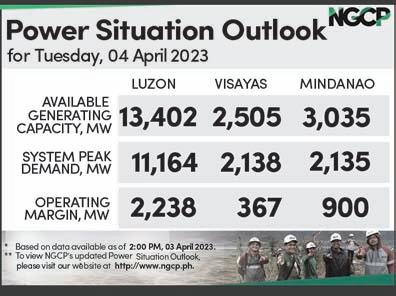
percent of the total, while the balance of 4 percent came from other businesses.
FDC’s real estate business, composed of listed subsidiary Filinvest Land Inc. and Filinvest Alabang Inc., contributed a combined P4.9 billion in net income before tax to the group, 15 percent higher than the P4.3 billion in the previous year. Revenues from the residential segment rose by 11 percent to P13.3 billion as a result of construction progress.
The company said mall and rental revenues saw an improvement of 15 percent to P6.7 billion with the gradual reduction of rental concessions, reinstatement of escalation rates and increased mall occupancy levels. Net income after tax from the real estate business hit P4.1 billion.
Power subsidiary FDC Utilities Inc. (FDCUI) had a net income of P2.2 billion in 2022, a 6 percent improvement from the previous year. The net income growth was on the back of revenues that rose by 37 percent to P12.9 billion.
The company’s 405-megawatt
coal plant in Misamis Oriental in Mindanao services a diverse customer base composed of 14 mostly triple A distribution cooperatives from the region. The company also has solar energy solutions through a 60:40 joint venture with Engie Services, one of the largest power generators and distributors in the world.
The company has interests in water through FDC Water Utilities Inc., a wholly owned subsidiary of FDCUI.

Hotel operations under Filinvest Hospitality Corp., meanwhile, saw a rebound in revenues of 60 percent to P1.9 billion in 2022 buoyed by the steady resurgence of tourism. Average room rates increased across the seven properties while occupancy rates were higher for Crimson Boracay as well as Quest in Cebu and Tagaytay.
The company’s portfolio has approximately 1,800 rooms across seven hotels in seven cities and five regions under the Crimson and Quest brands. The company only recently added Timberland Highlands Resort in Rizal in its portfolio.
B1
ACEN unveils plan to hit net-zero goal
ACEN Corp. the listed energy company of conglomerate Ayala Corp., released on Monday its “Net Zero” roadmap, which includes near-term emission reduction targets.
“As part of its transition plan, ACEN aims to deliver reductionled decarbonization by 2040, with an interim target for 2030, and a Net Zero status by 2050,” ACEN said in a disclosure to the stock exchange.
ACEN President Eric Francia said the power firm will continue to explore opportunities to further accelerate these targets in the future.
“We are pleased to share our progress on our commitment to achieve Net Zero GHG emissions by 2050, including reaching our long-term decarbonization goals by 2040, with clear milestones providing an accountable and transparent framework for measuring progress.
The entire organization and the board fully support this initiative. Our climate ambition is well aligned with our vision to reach 20 GW of renewables by 2030,” he said.
These targets are aligned with the greenhouse gas (GHG) protocol and the latest climate-science and long-term targets that are consistent with the deep decarbonization of the power sector.
ACEN claimed that it is the first energy company in Southeast Asia to take this critical step towards achieving net zero.
ACEN is targeting to achieve a 100-percent renewable energy portfolio by 2025. It currently owns a generation portfolio of 4,030 MW of net attributable capacity based on ownership stake, with 98 percent coming from renewable technologies across the Asia Pacific.
In November 2022, it completed the full divestment of its South Luzon Thermal Energy Corp.’s 246MW coal plant using the Energy Transition Mechanism framework. Under the mechanism, the coal plant will be retired by 2040, reducing its technical operating lifetime by half, and transitioned to a cleaner technology. The transaction, which generated P7.2 billion in proceeds for ACEN, will be reinvested into renewable energy projects. Lenie Lectura

BusinessMirror
Companies
Filinvest Development Corp. (FDC), the holding firm of the Gotianun Group, on Monday said it recorded an attributable income of P5.7 billion last year, down by 6 percent from the previous year’s P6.06 billion.
Electronic-KYC mode now part of BSP rules
 By Cai U. Ordinario @caiordinario
announced last Monday.
The new rules set out the requirements for the use of digital identification and verification as part of the customer onboarding process of BSP-supervised financial institutions (BSFIs).
“The policy enhancements promote seamless remote identity verification by leveraging on the use of technology and existing e-KYC systems. [The] e-KYC is one of the key enablers to promote innovation and digital transformation aimed at advancing our financial inclusion agenda,” Bangko Sentral Governor Felipe M. Medalla was quoted in a statement as saying.
The country’s central bank said
PNB inks deal with PUP for talent recruitment
the enhanced rules highlight that the Philippine Identification System (PhilSys)-enabled e-KYC to be launched by the PSA is an acceptable system for KYC under Republic Act 11055 or the PhilSys Act and its revised implementing rules and regulations.
“PhilSys-enabled e-KYC shall be allowed subject to PSA’s applicable guidelines and full implementation of the authentication procedures/ methods and other related systems under the PhilSys,” the BSP said.
The central bank said that BSFIs with existing e-KYC systems are given one year to comply with the prescribed e-KYC requirements.
Meanwhile, BSFIs that intend to
shift to an e-KYC system are expected to comply with the provisions of the new Circular before the implementation of the system.
Last month, the PSA reported that it has printed over 60 million PhilIDs and ePhilIDs. As of 15 March 2023, a total of 60.33 million IDs have been printed, PSA data revealed.
Of this number, some 33.55 million are PhilIDs dispatched for delivery to registered persons while 26.78 million are ePhilIDs printed at registration centers.
To ensure that more registered persons receive their national ID for their use in transactions, the PSA continues to push the Philippine Postal Corp. (Post Office) to
speed up the delivery of dispatched PhilIDs. The PSA also asked its staff in field offices to proactively distribute printed ePhilIDs through plaza-type and house-to-house distribution.
The PSA is also implementing the downloading of password-protected ePhilIDs via mobile devices, which registered persons may access once they receive an SMS notification from the PSA.
Both the PhilID and ePhilID bear a QR code that can be used for easier identity verification and authentication, as opposed to more traditional methods involving handwritten signatures which can be easily forged.
BDO to support Japanese bank’s clients in PHL
PUBLICLY - L ISTED BDO
Unibank Inc. announced last Monday that it has partnered with Hyakujushi Bank Ltd. (HBL), a leading regional bank based in the Kagawa Prefecture, to serve the Japanese bank’s clients in the country.
In a disclosure to the Philippine Stock Exchange (PSE), BDO said under a Memorandum of Understanding (MOU) between the two banks, the lender will provide banking support services to HBL clients.
BDO explained that HBL customers must have existing operations or plan to build or expand their businesses in the country.
For the past 10 years, BDO has
sealed partnerships with several Japanese regional banks strategically-situated in various prefectures of Japan, the world’s third largest economy, according to BDO.
With 132 branches including satellite offices and commercial banking services, HBL is the 16th Japanese bank that BDO has partnered with.
HBL was incorporated in 1878 and has 60,000 corporate clients, mostly located in the industrial zones. HBL expects to grow its roster of customers in the Philippines with new investments and business matching deals.
BDO has the country’s largest distribution network, with over 1,600
consolidated operating branches and more than 4,600 ATMs nationwide, and has 16 international offices in Asia, Europe, North America and the Middle East. The country’s largest bank in terms of total assets also offers digital banking solutions.
Last month, Moody’s Investor Service (Moody’s) affirmed the “Baa2” local and foreign deposit rating for BDO on the back of expectations that it will benefit from the country’s pandemic recovery.
In a statement, Moody’s said it affirmed BDO’s Baa2/P-2 long-term (LT) and short-term (ST) local and foreign currency bank deposit ratings as well as Baa2 foreign currency
State pension’s provident fund hits ₧35B
PHILIPPINE National Bank (PSE: PNB) announced it is collaborating with the Polytechnic University of the Philippines (PUP) as part of its efforts to sustain a strong workforce through partnerships with the academe.
The lender said PNB Chairman Federico C. Pascual, together with the bank’s human resource team, met with PUP President Manuel M. Muhi last March 17 at the PUP Santa Mesa campus to discuss how the two institutions can work together to provide graduating students of the coeducational state university with potential employment opportunities.
“We are happy to partner with PUP and be able to help promising graduates carve a rewarding career in the field of banking and finance,” Pascual was quoted in a statement as saying. “PNB is a place where young talents can explore many opportunities for learning and growth.”
According to the PNB executive, he considers the initiative as “is in
line with our thrust on sustainability as we ensure a steady pool of fresh and high-potential talents who can help us push our strategy and accomplish our business objectives.”
The lender cited a dot-com survey of 550 companies revealed that PUP is the top school most companies prefer to get fresh graduates from.
Respondent-companies said that PUP graduates, in general, are very hard-working, often going the extra mile in their job.
Muhi underscored the importance of having a good start after graduation for students.
“PUP is glad to help find the right match between our pool of graduating students and the hiring requirements of PNB,” he said. “This partnership with a stable and esteemed institution like PNB is part of our continued guidance and support to our students—even after college life. Our hope is for them to become productive and responsible citizens who can contribute to society.”
SOCIAL Security System (SSS) President and Chief Executive Officer Rolando L. Macasaet announced over the weekend that the total member savings collection from the Workers’ Investment and Savings Program, or “Wisp,” has reached P35.84 billion from 4.9 million SSS members in its second year of implementation.

Macasaet was quoted in a statement as saying that the savings collection under the “Wisp” has more than doubled since the start of the program in 2021.
The SSS chief explained that from January to December 2021, the pension fund manager initially collected P15.48 billion. In 2022, the savings collection grew by 31 percent to P20.4 billion which brought the total “Wisp” contributions to P35.84 billion.
Moreover, members contributing to the “Wisp” also grew to 4.9 million contributing members, up by 33 percent from 3.7 million members in 2021.
The “Wisp” is a mandatory provident fund scheme managed by SSS that serves as another savings for private-sector workers and other individual paying members, which was launched in January 2021. “It promotes the principle of Work, ‘Save, Invest and Prosper’ so that members can have a better retirement
package aside from their regular SSS benefit,” the statement read.
Added earnings
THE SSS said its “Wisp” is one of the key provisions under Republic Act 11199 or the Social Security Act of 2018. “It is a safe, convenient, principal-protected and tax-free individual retirement savings plan which will supplement a member’s savings from their regular Social Security program.”

“Under the WISP, each contributing member will have an account wherein SSS will place their contributions and investment earnings,” Macasaet said. “Not only are they saving for their retirement, but their contributions are also earning through the program.”
Qualified are those private-sector employees, self-employed individuals, overseas Filipino workers (OFWs) and voluntary members who have no final claim and have contributions in the regular SSS program and have a Monthly Salary Credit (MSC) that exceeds P20,000.
Members pay their “Wisp” contributions together with their regular SSS contributions.
Investment vehicle
ASIDE from serving as a savings scheme,
Cryptocurrency chaos: Cautious consideration
FOR quite some time now, I had been very keen to write an article about why people should not put money into cryptocurrencies. But I was told to hold off on it a bit considering that crypto was all the rage during that time and some popular financial planners were even endorsing it. Now that this foolishness has unraveled and I have finally been permitted to write about it, let us start tearing it apart. The other week, a friend told me that despite the ups and downs of cryptocurrencies, the returns are still quite high. Bitcoin for example is said to have a return of 4,686 percent in the past five years. Despite this astronomical returns on cryptocurrencies, why am I still skeptical about it? Why am I not willing to put a single cent on it and why do I speak so negatively about it? Here’re why.
1. Incredibly volatile. The value of crypto currencies can fluctuate wildly in a matter of hours or days, making them very risky. This volatility can also make it difficult to use cryptocurrencies as a form of
currency, as the value may change significantly between the time of purchase and the time of payment.
2. Lack of regulation. Cryptocurrencies operate outside of traditional financial systems, which means that they are not subject to the same level of oversight and regulation. This can make them a popular choice for illegal activities, such as money laundering and illegal drug sales. The problem of the lack of regulation is highlighted in the current debacle such as the recent crash involving Terra Luna, FTX, etc.
3. Issues of security. Cryptocurrency exchanges and wallets have been hacked in the past and instances of hacking continue to persist even today, resulting in the
loss of millions of dollars’ worth of digital currency. The decentralized nature of cryptocurrencies makes it difficult to recover lost or stolen funds and there is no government or financial institution to compensate for these losses. What is worst is that there is no way of knowing if it is a real hack or an insider’s hack just passed off to make it seem like an external hack just to steal money from gullible people who put money into this. Further, there is just too many alleged “hacks” and “mistakes” that has happened in crypto transactions. Late last year, I read that a crypto exchange mistakenly sent about $400 million to the wrong recipient. Mistakes such as this are commonly reported in the crypto space; makes you think how on earth can you trust these people with your money.
4. Environmental issues. Cryptocurrencies are energy-intensive. The process of “mining” for cryptocurrencies requires a significant amount of computing power and energy. This can lead to a signifi-
cant environmental impact, and it has been estimated that the energy consumption of Bitcoin alone could be enough to power a small country.
5. Association with illegal activities. Cryptocurrencies has been used in money laundering, tax evasion, and the financing of terrorism among others. Binance, the world’s largest crypto exchange, is currently under investigation by the US Justice Department because of this issue.
6. Issue with the underlying technology. The blockchain is still relatively new and untested. While it has the potential to revolutionize the way we store, share and utilize data, it is still unclear how well it will perform on a large scale and how secure it will be in the long term.
7. Associated with scams. With the increasing popularity of cryptocurrencies, a number of fraudulent schemes have emerged, such as Ponzi schemes, which promise high returns on investments but are actually designed to take advantage of investors. Some would even argue, and I agree with this and perhaps I will expound
Macasaet elaborated that the program also functions as an investment vehicle for SSS members. The SSS pools the contributions collected from the program and invests them in the capital markets. Earnings realized from the “Wisp” will be distributed proportionately based on the member’s contributions.
Members can check their “Wisp” contribution online through their My.SSS account. They can log in on their online account. Go to the Inquiry tab and click on Contributions to view their contributions in the WISP as well as their contributions in the regular Social Security program and WISP Plus.
According to Macasaet, the “Wisp” had a good start with a 6.39 percent return on investment (ROI) in 2021 and an estimated 3.4 percent ROI in 2022.
The SSS chief further explained that the “Wisp” outperformed the balance fund market benchmarks, which were 0.15 percent and -1.25 percent in 2021 and 2022, respectively.
“This indicates that members’ savings invested in ‘Wisp’ will generate decent earnings, which will be added to their total contributions,” Macasaet said. “Consequently, when they retire, they will receive higher benefits from the program.”
more on this in another article, that today’s cryptocurrencies itself is one giant Ponzi scheme.
8. No intrinsic value. Somebody once wisely said that the intrinsic value of cryptocurrencies is the price that the last idiot is willing to pay for it—this is undoubtedly true. There is no fundamental basis as to how much it is really worth. A lot more could be said about this and I will deal with it in the next article.
In conclusion, while the underlying technology in cryptocurrencies, the blockchain, have the potential to revolutionize certain things in the future, cryptocurrencies itself are not worth putting money into because of the above-mentioned reasons.
More on this on part of two of this series.
Zigfred Diaz is a Cebu-based registered financial planner of RFP Philippines. Aside from practicing law, he is a licensed environmental planner, realestate broker and appraiser. To learn more about personal-financial planning, attend the 101st RFP program in April 2023. To inquire, e-mail info@rfp.
or text 0917-6248110.
senior unsecured rating. The credit watchdog also said BDO’s (P)Baa2/(P)P-2 foreign currency senior unsecured mediumterm note (MTN) and other ST program ratings, and Baa2 Baseline Credit Assessment (BCA) and Adjusted BCA were also affirmed.
In February, BDO said its net income increased to P57.1 billion in 2022, a 33 percent growth from the P42.8 billion it posted in 2021. BDO said this was driven by robust growth across its core businesses. Gross customer loans grew 9 percent year-on-year while total deposits rose 14 percent due to the reopening of the economy. Cai U. Ordinario
SSS places funds under SECB TAMG
THE Social Security System (SSS), the government’s social insurance program for the country’s private sector workers and their families, has awarded the Trust and Asset Management Group (TAMG) of Security Bank Corp. (PSE: SECB) with a fund management contract, the lender announced last Monday.
The country’s tenth-largest bank in terms of assets said its TAMG will manage two mandates with a total “asset under management” of P2.5 billion for a period of three years. This comes after a three-month rigorous bidding process, participated in by various local fund managers in the Philippines, a statement by the SECB read.
Since 2019, the SSS has tapped reputable partners in the fund management industry to enhance the investment portfolio return and consequently extend the actuarial life of the SSS Fund, according to the lender.
“We’re very thankful for the confidence and trust that Social Security System has given to us at Security Bank. Being able to manage funds for one of the largest government institutions in the country is an opportunity we are very proud of,” SECB Vice-President Carmela T. Lim was quoted in the statement as saying.
Lim, who is also division head of sales and client acquisition of the TAMG, added that through this partnership, the lender “can extend our promise of ‘better banking’ not only to [the] SSS but also to its members, through prudent fund management.”
The P2.5 billion that will be managed by the TAMG consists of P1.5 billion “balanced fund” mandate and P1 billion “pure fixed income fund” mandate, SECB explained.
The bank said its TAMG offers a wide array of investment and trust services for its clients, including Unit Investment Trust Funds (UITF), retirement funds, investment management accounts, escrow agency accounts and corporate and pre-need trusts.
The SSS is the country’s largest pension fund institution that addresses the basic needs of the private sector workers and their families by protecting them from the hazards of disability, sickness, old age, and death by providing for other benefits in case of unemployment, maternity and work injury.
BusinessMirror Editor: Dennis D. Estopace • Tuesday, April 4, 2023 B3 www.news.businessmirror@gmail.com Banking&Finance
THE electronic Know-Your-Customer (e-KYC) to be launched by the Philippine Statistics Authority (PSA) is now part of the latest amendments to the Bangko Sentral ng Pilipinas (BSP) customer due diligence (CDD) regulations.
ph
The Monetary Board approved the amendments to BSP’s CDD to include guidelines on e-KYC using digital identity (ID) systems, the BSP
personAl fInAnce
Atty. Zigfred Diaz
This March 17, 2023, photo shows (left) Polytechnic University of the Philippines President Manuel M. Muhi and Philippine National Bank (PsE: PNB) Chairman Federico C. Pascual after signing a partnership for recruitment of new college graduates for potential career opportunities at PNB.
Photo courtesy oF PhiliPPine national Bank
Visitors �lock to see David sculpture a�ter Florida uproar
BY TRISHA THOMAS The Associated Press
FLORENCE, Italy—Visitors flocked to see Michelangelo’s David sculpture in Florence on Tuesday, following an uproar over a Florida school’s decision to force the resignation of the principal over complaints about a lesson featuring the Renaissance masterpiece.

Tourists, many of them Americans on spring break or studying abroad, posed for selfies in front of the giant marble statue, which features the Biblical David, naked with a sling over his shoulder and a rock in his hand, ready for battle with Goliath.
Florence’s Galleria dell’Accademia, which houses the sculpture, reopened on Tuesday after its weekly Monday closure, and both tourists and locals alike couldn’t get over the controversy.
“It’s part of history,” said Isabele Joles from Ohio, who is studying French and Italian art with her school group. “I don’t understand how you can say it’s porn.”
She and other visitors were reacting to the decision by Tallahassee Classical School board to pressure Principal Hope Carrasquilla to resign last week after an image of the David was shown to a sixth-grade art class.
Carrasquilla believes the board targeted her after three parents complained because they weren’t notified in advance that a nude image would be shown, while a third called the iconic statue, which is considered the height of Renaissance sculpture, pornographic. The school has a policy requiring parents to be notified in advance about “controversial” topics being taught.
Over the weekend, both Florence’s mayor and the museum director voiced incredulity over the ruckus and issued invitations for the ousted principal and the school community to come and see the sculpture for themselves.
“We are talking about the roots of Western culture, and David is the height, the height of beauty,” museum director Cecilie Hollberg said in an interview Tuesday, as tourists brushed past her snapping selfies with the statue. The controversy wasn’t only a topic of conversation in Florence. On Monday night in Tallahassee, a large crowd showed up for a school board meeting with public comment on the issue of the David statue controversy lasting over an hour, the Tallahassee Democrat reported. Some parents and teachers criticized the board and even asked chairman Barney Bishop to step aside.
“Given the dissatisfaction of all these parents with
reported. The five trustees are elected by themselves, not the parents, and serve three-year-terms. New Principal Cara Wynn told the school board that nine students had left the school since the David controversy began, but that three had enrolled. Tallahassee Classical is a charter school. While it is taxpayer-funded and tuition-free, it operates almost entirely independently of the local school district and is sought out by parents seeking an alternative to the public school curriculum. About 400 students from kindergarten through 12th grade attend the three-year-old institution, which is now on its third principal. It follows a curriculum designed by Hillsdale College, a conservative Christian school in Michigan frequently consulted by Florida Gov. Ron
value. Florida encourages instruction on the classics and classical art, and would not prohibit its use in instruction,” the department said in a statement. “The matter at the Tallahassee Classical School is between the school and an employee, and is not the effect of state rule or law.”
At the museum on Tuesday, tourist Brian Stapley from Seattle Washington said he was sad for the school’s children. “It’s one of the most incredible parts of our history,” he said as he waited on line to get into the museum. “I feel incredibly sorry for the children that don’t get to see it.”
■ Terry Spencer in Fort Lauderdale, Florida and Nicole Winfield in Rome contributed to the report.
‘Quarantine’ artist showcases artworks in Newport
BY RODERICK L. ABAD Contributor
ARTISTESPACE recently showcased
Enigma, the first solo exhibit of artist Patrick Henry “Dennis” Naval, featuring his 35 paintings and five sculptures at The Grove in Newport Mall of Newport World Resorts, Pasay City. The exhibit was on view until March 24.
His expressionism showcased was the culmination of the body of works he created during the Covid-19 lockdown. In an interview, Naval recalled that he rediscovered art as a sanctuary—
the escape and peace he was longing for amid the global health crisis.
“I am a quarantine artist. I just started two years ago. Then, I was quite surprised that I could produce these kinds of paintings. The feedback from my friends was very encouraging. What I did was explore more, with the guidance of ArtisteSpace,” he said.
According to Naval, he was told by ArtisteSpace Inc. managing director Anton V. Magpantay that the maturity of an artist comes out past 50. He said:
“I’m fortunate that I have now achieved such.”
Sharing some common friends, Naval and Magpantay met and talked
last September 2022. Seeing his masterpieces, the latter easily became a believer in his artistry and convinced him to showcase his creations to the public.
“When I saw his artworks, I saw the potential. I told him, you’re a global artist. Don’t represent only the Philippines because the idea for artwork is very universal,” Magpantay advised the artist.
Heeding the advice, Naval translated his daily personal encounter with ordinary people to modern art using acrylics, oil, soft pastel, watercolor, or any material he could get his hands on.
His unconventional expression of traditional life is apparent in his signature style which he described as rendering “exaggerated eyes and hands just to show emotions.” This is particularly evident in his “Abuelo,” “Inday” and “Q Ave” series, as well as in his metal sculptures. Part of the proceeds from the artworks sold will go to the alternative learning program KLIKme.
“For us to grow, we need to give,” said Naval, who is currently the chief executive officer and design director of PHCN Architectural Designers Den.
“I’m thankful that I’m not at the stage of building up myself [as an artist].”
CELEBRITIES BORN ON THIS
DAY: Robert Downey Jr., 58; David Cross, 59; Christine Lahti, 73; Craig T. Nelson, 79.


HAPPY BIRTHDAY: Speed things up quickly, and you’ll feel at home. Don’t worry about whether others can keep up; it’s OK to be first. After all, you are a pioneer. Dream about your goals, and in no time, you will manifest what you envision. Be true to yourself, and don’t stop until you reach your destination. Open the door when opportunity knocks. Your numbers are 4, 11, 23, 26, 33, 41, 47.
ARIES (March 21-April 19): Don’t let decisions linger on when time is crucial. Look, analyze and make things happen that brighten your day and enhance the lives of loved ones. Use insight and experience to help others, and you’ll gain perspective regarding your life. ★★★
TAURUS (April 20-May 20): A sloppy job won’t cut it; if you want to advance, give your all and promote what you achieve. It’s up to you to do your best. Rely on your intuition, not unverified information that comes from unfamiliar sources.
GEMINI (May 21-June 20): Don’t be fooled by fictitious information. Go directly to the source to avoid getting caught in someone’s lies or scams. Do your research, ask questions and focus on what’s best for you. Create opportunities instead of
CANCER (June 21-July 22): Your eagerness will require you to hone your skills to fit the application to which you want to apply them. Don’t complicate matters; a one-step solution will have just as profound of an effect. Trust in what you know
LEO (July 23-Aug. 22): Be careful; what you say and do might influence your position or reputation. Keep your plans simple and look for opportunities for personal and professional growth. A place you find special will turn into a good
VIRGO (Aug. 23-Sept. 22): Take the initiative and try something new. The people you encounter will offer interesting thoughts that encourage you to speed up the process of achieving success. It’s up to you to take what’s rightfully yours. Update your image and demonstrate your skills.
LIBRA (Sept. 23-Oct. 22): Pay attention to what’s happening at home. Understanding the dynamics of a situation and the people involved will help you stifle difficulties before they become hard to manage. Stick to basics and don’t overreact, and everything will unfold as planned. ★★★

SCORPIO (Oct. 23-Nov. 21): Contracts, investments and putting your energy into getting the biggest bang for your buck will bring high returns. A change is in sight if you use your ingenuity to develop a formula that fits your style and budget and offers the desired results.
★★★
SAGITTARIUS (Nov. 22-Dec. 21): Choose a path that satisfies your needs. Let go of the past and stop following; leading is your thing. Look for opportunities you feel heartfelt about, and you’ll meet individuals who share your concerns. Do your part and pay your dues. ★★★★
CAPRICORN (Dec. 22-Jan. 19): Put more time and effort into your home, family and finances. Set up your lifestyle to fit your budget and ease stress. Don’t try to keep up with someone who is misleading. Set a standard of living that works for you. ★★★★★
AQUARIUS (Jan. 20-Feb. 18): Relationships will undergo changes you need to address. If you let others decide things for you, it will not be satisfactory. Specify what’s important to you and make it happen. Take control instead of being controlled. ★★★
PISCES (Feb. 19-March 20): Fix up your space. The better the flow, the less stress and easier it is to manifest what you want your life to be like moving forward. Changing how you earn your living will turn out better than anticipated.
BIRTHDAY BABY:
You are inventive, nurturing and optimistic. You are sensitive and kind.
‘going through hoops’ BY JESS RUCKS
B4 Tuesday, April 4, 2023 • Editor: Gerard S. Ramos www.businessmirror.com.ph Art BusinessMirror ACROSS 1 ___ up (get loose before a game) 5 Ogre who loves Fiona 10 Fedora, for one 13 Notion 14 Everycity, USA 16 Space oddity, briefly 17 Baller known for speed? 19 Isle of ___ 20 CPR pro 21 Massages 22 Estrogen producer 24 Bro’s kin 25 Garment that may say “When I said ‘I do’ I didn’t mean the dishes” 27 Baller known for hitting the books? 32 Schitt’s Creek character Rose 33 Chooses 34 Greek god of love 36 Life of Pi director Lee 37 Brown eyes or curly hair 38 Regret 39 Bank claim 41 Environmentalist Brockovich 42 Small steak 44 Baller known for dribbling from sideline to sideline? 47 Factions 48 So last year 49 See 18-Down 51 Baby bears 53 Nintendo Switch precursor 56 Apple pie ___ mode 57 People who put group success before their own, or what 17-, 27and 44-Across have become? 61 “Madness” mo. 62 Walked confidently 63 ___ mater 64 Make a request 65 Recess rebuttal 66 Kill it, at a drag show DOWN 1 Eve, for 2-Down 2 First husband? 3 Sit on a bench, perhaps 4 Yoga pad 5 Other half 6 Cilantro or sage 7 Seating divisions 8 Historical period 9 White-wine aperitif 10 Our fallibility 11 In the distance 12 Best Play award, say 15 Decorate 18 With 49-Across, Mexican painter known for her self-portraits 23 Show of hands 24 California’s Big ___ 25 Performing in a play 26 Flea, e.g. 27 ___ boom 28 Striped predator of the sea 29 Martial arts legend Chuck 30 Noted Auto-Tuned rapper 31 Like a basketball 32 Prefix for “adjusted” 35 The Who’s “I Can ___ for Miles” 37 Class struggle? 40 Christmas, in French 42 Oral Roberts University’s OK city 43 Not good 45 Many kilt wearers 46 Stemmed glass 49 ___ Sutra 50 “Sadly...” 51 “Stop dawdling!” 52 Hairstyle such as a topknot 53 With skill 54 Cookbook writer Rombauer 55 “Goodness me!” 58 GPS guess 59 Spot for a shot 60 “___ queen!” Solution to today’s puzzle:
Universal Crossword • Edited by David Steinberg/Anna Gundlach
The
★★★
TODAY’S HOROSCOPE By Eugenia Last
VISITORS stand in front of Michelangelo’s David sculpture in the Accademia Gallery in Florence, Italy, on March 28, 2023. AP
Pop icon Leslie Cheung’s legacy endures 20 years after death
 By Kanis Leung The Associated Press
HONG KONG—Fans of late Canto-pop icon Leslie Cheung, one of the first singers to come out as gay in Hong Kong, flocked to the city this week to commemorate their idol’s death 20 years ago—revisiting his legacy of pioneering work made during a socially conservative time. Cheung, who was 46 when he died, was a superstar known for his singing, dancing and acting during the heyday of Hong Kong’s entertainment industry in the 1980s and 1990s. His supporters, who span across Asia, fondly remembered his normbreaking works and called him “ahead of time.”
The 20th anniversary of Cheung’s death on Saturday drew crowds of both local fans and supporters from mainland China to visit exhibitions about him in Hong Kong. Even the government included concerts and film screenings about him in the city’s first pop culture festival, which is slated to officially kick off in three weeks.
Outside of the official exhibits, a steady stream of fans visited the Mandarin Oriental Hotel, where Cheung had killed himself. The narrow strip of pavement next to the hotel was completely covered by a sea of flowers, cards, origami and posters.
The local reminiscences of Cheung prove the late celebrity remains a popular icon across generations of Hong Kongers and reflects the desire for reviving the city’s cultural influence, said Anthony Fung, professor of the school of journalism and communication at the Chinese University of Hong Kong.
“After so many years, we hardly find any new icons, new superstars who could reach that level of importance,” he said.
Cheung, who was affectionately known as Gor Gor—“big brother” in Cantonese—produced many hits that even non-Cantonese speaking music lovers in other parts of Asia could sing along to. Those include “Monica,” “Sleepless Nights Restless Heart” and “Chase.” He also starred in classic films including John Woo’s A Better Tomorrow, Wong Kar-wai’s Happy Together, Stanley Kwan’s Rouge and Chen Kaige’s Farewell My Concubine.
But behind all of his success, Cheung suffered from depression. He jumped to his death from the Mandarin Oriental Hotel in central Hong Kong on April 1 in 2003, sending shockwaves across the city. His death came as his hometown was battling the SARS epidemic, which ultimately killed hundreds and crippled the local economy.
“We really miss him. His songs and films take us
KATE VALDEZ TOPBILLS ‘DREAMWALKER,’ AN ACTIONFANTASY ADAPTATION
GMA actress Kate Valdez gets the biggest break in her acting career as she grabs the coveted lead role in Dreamwalker by Filipino-American pop culture blogger Mikey Sutton. This new project is a live-action television multi-series adaptation of the chart-topping young adult Fil-Am action-fantasy graphic novel of the same title. It is based on an original concept by Sutton with his Manila-based artistic director Noel Layon Flores. Launching the title for the regional market, London/ Singapore-based international content investment studio 108 Media will produce Dreamwalker, to be directed by Mikhail Red (Birdshot, Eerie), fresh from the box office and critical success of Deleter at the Metro Manila Film Festival 2022. Completing the creative dream team are the 2022 Content Asia Award Best Director winner Treb Monteras II (Cinemalaya’s Respeto) as showrunner/director, and Los Angeles-based genre maven Kaitlyn Fae Fajilan as headwriter. The Dreamwalker graphic novel is about a monsterslaying vlogger which has reached the top of the local Filipino comics charts with 108 Media emerging as the eventual winner of the option to produce a premium series adaptation for regional and international audiences in mid-2023 towards an early Q2 2024 delivery.
Executive producers for the series are Justin Deimen, president of 108 Media; Treb Monteras II; Kirstie Contrevida, creative producer for 108 Media; Abhi Rastogi, CEO of 108 Media; and Michael Sutton.
The company also recently secured a majority stake in one of Asia’s top scripted production companies Revolution Media and purchased management control of one of the UK’s
FANS gather during an event commemorating the 20th anniversary of the death of Canto-pop singer Leslie Cheung at a shopping mall in Hong Kong, Friday, March 31, 2023. AP
More plot twists, characters in drama ‘Abot Kamay na Pangarap’
THE surprises never stop as GMA Network’s trending and popular series Abot Kamay na Pangarap welcomes new cast members and offers more exciting twists every afternoon. The soap is headlined by Carmina Villarroel as Lyneth, Richard Yap as Doc RJ, and Jillian Ward as Doc Analyn.
Seasoned artists Dina Bonnevie as Giselle, the intimidating elder sister of Doc RJ; Leo Martinez as Pepe, Doc RJ’s wealthy yet simple estranged father; and Allen Dizon as Doc Henry, the real father of Zoey, are the newest cast members who add spice to the lives of Doc Analyn, Doc RJ, and Lyneth.

While Doc RJ is away to continue his treatment abroad, Giselle temporarily acts as the CEO of APEX Medical Hospital. As the story continues to unfold, Giselle’s character remains an enigma. Is she really a friend or foe of Analyn?
back to the wonderful time of Hong Kong which is not the same as nowadays. We’ll miss it,” said Justin Cho, a fan from the city who came with his friend to lay flowers at the hotel in honor of the actor.
Hong Kong fan Connie Leung, a retiree now in her 60s, recalled her disbelief when she first heard about the news of his death from a former colleague. “I said, ‘Don’t make such a joke on April Fools’ Day,’” she said.
She said Cheung’s songs never became outdated and his fashion tastes, including his iconic long hair, were modern—even by today’s standards.
Chris Choi, Cheung’s concert choreographer in the 2000s, said the late superstar broke through many gender boundaries by introducing “unisex” ideas, some of which were risky at the time. Among his stage costumes, for example, were seashell culottes and red high heels.
“It told people art has no boundaries,” he said.
Cheung also broke through the city’s cultural status quo by boldly revealing his gay relationship in a conservative local society at the time— a decision
that could have ruined his career but has earned him a lot of respect from the gay community, Fung said. The breakthrough was about the plurality of culture that he celebrated, he said.
“He actually crossed through the boundary, make a noise and influence on the culture of Hong Kong,” Fung said. Cheung’s work not only inspired older generations of fans but also those who were just toddlers when he died.
University student Justin Jiang said he was only 3 years old when Cheung died, but he later became a fan in high school after learning more about Cheung’s personality and charisma from his legacy of works. This week, the 22-year-old, who lives in neighboring Guangzhou, visited Hong Kong with a friend to pay tribute to his idol.
He praised Cheung’s boldness in expressing his views and breaking through a society strongly influenced by gender stereotypes years ago.
“Gor Gor is very courageous and this is worth learning for us,” he said. n
Alfred Vargas feels like a renewed actor

Giselle also favors Doc Zoey (Kazel Kinouchi) without knowing that she is an illegitimate child of Doc RJ after Moira (Pinky Amador) secretly cheated on him.
How will Analyn face the harsh treatment of Giselle?

When will Doc RJ return and expose the truth that Moira was the one who put his life in danger? How far can Doc Henry go to convince Doc Analyn in transferring to his hospital?
Recently, viewers also witnessed the special participation of Gabby Eigenmann as Benny, the arrogant celebrity chef; Jamir Zabarte as Darwin, the gay son of Benny; and Archie Alemania as Lando, the bomber who threatened APEX Medical Hospital.
Completing the star-studded cast are Dominic Ochoa, Chuckie Dreyfus, Denise Barbacena, Wilma Doesnt, Ariel Villasanta, Dexter Doria, Jeff Moses, Alexandra Mendez, and John Vic de Guzman.
Abot Kamay na Pangarap is made possible under the supervision of GMA SVP for entertainment group Lilybeth
G. Rasonable, with esteemed director LA Madridejos at the helm. It airs Mondays to Saturdays at 2:30 pm on GMA (www.gmanetwork.com). Viewers abroad can also catch the program via GMA Pinoy TV.
THIS Holy Week, Alfred Vargas plans to set aside a few days in prayer and solitude, to quietly reflect on his beautiful life, the challenges that he has successfully handled, and the many blessings he continues to receive.
“I feel the need to always have some quiet time in my life, to take a breather, to pause. This Holy Week is a perfect time to do that, a good time for reflection and contemplation. I’m glad that I’m off to a good start for this year, and we have just wrapped up principal photography for our film Pieta,” he said.
Pieta is the new movie of Vargas where he wears two hats, one as producer and the other as lead actor.
“I feel very privileged to be able to convince our National Artist Nora Aunor to do this movie. For a time, I was silently praying for her to regain her health so she could continue making movies. When the timing was right, I went to her house to offer this project to her, and I was so elated when she said yes and gave her commitment. Para akong umakyat ng ligaw sa kanya,” he shared.
Aunor plays Vargas’s almost blind, Alzheimer’s stricken mother whose life changes when her son is finally released from prison after being wrongly accused of a crime. The movie also stars the acclaimed actress-director Gina Alajar. “Not only do I get this rare opportunity to work with Ate Guy but having Ms.
Gina on board certainly adds premium to the project, which is from the screenplay of the award-winning Jerry Gracio.”

Vargas admitted that he had butterflies in his tummy during the first day of shooting. “I was
star struck. I suddenly had so many thoughts and emotions running at the same time in my system. But I quickly snapped out of it and stayed calm so I could be focused and remain at the core of my character. This kind of project does not come too often in an actor’s life, so I constantly reminded myself to seize every moment and enjoy the process. This movie certainly renewed me as an actor.” He added, “I had to read and reread the script so I would be prepared every time I go to the set. I had to know my lines and dialogues by heart. I had to always be at my best and in my character because I had to keep pace and be at par with my superb coactors. It was not a breeze since I have to also keep the production in check, because every peso that I invested in this project came from hard work and I have to keep up with the times and learn the ropes of contemporary movie production.”
Vargas is glad that they have finished shooting because the summer heat can be unbearable. “We shot in the cornfields of Central Luzon, and I cannot imagine doing it these days when the sun is scorching hot. I made sure that everyone was hydrated and fed well during out-of-town location shoots.”
Family remains Vargas’s top priority. He spends more time with his wife and their children, and he finds time to exercise, too. “My kids are growing up fast and quality time spent with them is important. I also have to keep fit, not only because I have to look good as an actor, but I have to be health-conscious in order to continue making the most out of life.”
When the film is ready to be screened, Vargas plans to bring it to the international festival circuit first before it is exhibited locally. “We will make sure that Pieta will be a worthy showcase of Filipino talent in filmmaking,” he promised.
B5 Editor: Gerard S. Ramos • Tuesday, April 4, 2023 www.businessmirror.com.ph
BusinessMirror
Show
FROM left: Alfred Vargas, Nora Aunor and Gina Alajar on the set of Pieta.
CARMINA VILLARROEL and Jillian Ward in Abot Kamay na Pangarap.
mWell, DMW sign partnership to champion global healthcare for OFWs


METRO Pacific Investments Corporation’s mWell, the Philippines’ first fully integrated and fully digital health and wellness app, enables the delivery of healthcare services to Overseas Filipino Workers(OFWs) and their families via a partnership with the Department of Migrant Workers.
Breaking barriers through digital healthcare, mWell will provide over 1.8 million OFWs with 24/7 access to family doctors, specialists, and mind health experts.Wherever they may be in the world, they may choose from hundreds of highly-trained Filipino partner-doctors on the mWell app—internal medicine specialists, cardiologists, endocrinologists, ophthalmologists, and more. In just a few taps, they can consult right away withFilipino-speaking doctors, 24/7 or book an appointment at their convenience.
“mWell was born because of our strong sense of commitment to bring accessible and affordable healthcare closer to every Filipino anywhere in the world. Our partnership with the Department of Migrant Workers allows us to give back to our OFWs by providing them worldclass service that they truly deserve,” said mWell President and CEO and MPIC Chief Finance, Risk and Sustainability Officer Chaye Cabal-Revilla.
“Ang dream ko rin kasi, pag may
nararamdaman ang isang OFW, syempre ang gusto nya, ang makakausap nya
Pilipino,” said Migrant Workers Secretary Susan Ople during the partnership agreement signing ceremony with mWell.
“Partnerships with the private sector are particularly important. Government can only do so much. You have to also reach out and draw in as many private sector partners as possible not for anything else but to make the OFW na at his or her greatest need, hindi sila nag-iisa
That’s why we appreciate the partnership through the MOA that we signed with mWell so that they will have an app and yung OFW in Hong Kong, in Bahrain, in Saudi or in Europe and even aboard ships can contact doctors through the app. Just the knowledge na may sasagot speaking the same language, ang laking bagay na‘nun. Technology and partners like mWell, and of course the expertise of our doctors—these are the ingredients of what an essential public service program will be all about. Government cannot do it alone. But it’s the aspiration to do what’s best for the OFWs–that aspiration is the glue that binds this partnership together,” Ople added. As the only health and wellness app that provides a fully digital experience, mWell offers OFWs a seamless end-to-end journey– from booking a video consult or
Want to learn Ikebana? Slots are now open for Ikebana Workshop Batch 4 at Sunshine Place in Makati City
seeing a doctor right away (with only three minutes of waiting time) and paying for the consultation. Their own digital medical ID empowers them to easily access their records stored in mWell’s secure platform. They may also send their families the health pass as a gift, allowing them to consult with mWell partner-doctors.
Beyond telemedicine services, mWell offers OFWs a guide to achieving a healthy physical lifestyle for long-term health. They may track their wellness level using the mWellness Score. This exclusive feature, developed in partnership with an award-winning team of doctors and data scientists, allows app users to monitor physical activity, step count, and sleep— for free! mWell also offers customized fitness and nutrition programs developed by Olympians and exercise physiologists.
To stay healthy while away from their families, migrant workers may try out calorie-controlled recipes created by dietitians and nutritionists. Affordable insurance plans for the OFWs and their loved ones, home care services, emergency services and medicine delivery for their families in the Philippines can be easily availed on the mWell e-shop. Download the mWell PH app from the Apple App Store or Google Play Store and register. Follow mWell on Facebook and mwellph on Instagram for more updates.
SUNSHINE Place is pleased to announce that slots are now open for the Introduction to Ikebana Workshop Batch 4. Workshop Batch 4 will be conducted every Saturday starting April 15, 2023. The workshop consists of Part 1 for Beginners which is scheduled from 2 pm to 3 pm and Part 3 from 10 am to 12 noon.
Participants to the Beginners Part 1 workshop will learn the basics of Japanese art of flower arrangement-upright Moribana style, basic slanting and Variation #4 with movements, basic Nageire Style and combination of Moribana and Nageire Arrangements.
On the other hand, the Workshop Part 3 is a follow-up to the Introduction to Ikebana



Workshop Beginners Part 1. It will be a demonstration/workshop covering a review of basic and other additional variations both for Moribana, Nageire and selected topics on advance Ikebana lessons. This workshop is only open to students who have completed Beginners Part 1. The lecture-demonstration will be conducted by Marc Tomas, former president of Ikebana International Manila Chapter 108. He is also a member of Sogetsu Potential Manila Chapter.
The workshop will be in person and with limited slots.
For inquiries and enrollment, please call us at 0917-515-5656 or email Sunshine Place at hello@sunshineplaceph.com
Watch Out for Emerging Trends and Exciting Flavors at the 15th Philippine Food Expo at SMX Pasay City
BRACE yourselves for the return of the only All-Filipino Food & Beverage expo in the country! Supporting local growers and entrepreneurs while featuring native delicacies and gourmet offerings, the Philippine Food Expo makes a much-awaited comeback with its 15th edition this April 28 to 30, 2023 at the SMX Convention Center, Pasay City.
Organized by the Philippine Food Processors and Exporters Organization, (Philfoodex) Inc., the three-day exhibition will bring together over 300 micro, small, medium and large exporters involved in food manufacturing, growing, export, equipment, packaging, ingredients, additives, and allied services and industries.

Guzman, DMW Undersecretary for Licensing and Adjudication Bernard Olalia, DMW Assistant Secretary for the National Reintegration Center for OFWs Venecio Legaspi and DMW Assistant Secretary for Finance and Internal Management/ Administration Violeta Illescas. Seated from left to right are mWell Business Development Head Tisha Quinitio, mWell President and CEO and MPIC Chief Finance, Risk and Sustainability Officer Chaye Cabal-Revilla, DMW Secretary Susan Ople, DMW Undersecretary for Finance and Internal Management/Administration Maria Anthonette C. Velasco-Allones.
DOST successfully launches first ever iSCENE in Cauayan City
THE Department of Science and Technology (DOST) successfully launched the first ever International Smart City Exposition and Networking Engagement 2023 (iSCENE 2023) in Cauayan City, Isabela on March 23, 2023 at the Isabela Convention Center.
iSCENE was organized in the Philippines to serve as a platform to bring local chief executives, government leaders, industries and business players together for knowledge-sharing, connection and network-building for the promotion and implementation of innovative solutions that would be instrumental for the creation of smarter and sustainable communities in the country.
Cauayan City is the first Smart and
Sustainable community in the country established by then DOST Region 2 Director, Engr. Sancho A. Mabborang, who is now the agency’s undersecretary for regional operations.
This initiative is one of the focused endeavors of DOST Secretary Dr. Renato U. Solidum Jr. It is a collaboration between the city of Cauayan, the DOST and Isabela State University with the hope of advancing science technology and innovation (STI) in other cities and municipalities around the Philippines.
The theme for the three-day event was “Building Smarter and Sustainable Cities and Communities in the Philippines.”
During the occasion, a Memorandum of Understanding (MOU) was signed by

DOST, Department of the Interior and Local Government (DILG), Department of Information, Communications and Technology (DICT) and the Development Academy of the Philippines (DAP), for the development of smart and sustainable communities.
The MOU is one of the keys to achieving long-term solutions to a comprehensive and synergistic researchdriven framework and roadmap. This will spur dynamic collaboration among government institutions, academe, the commercial sector, civil society and other instrumentalities for smart and sustainable communities.
The activity is one of the effective platforms of the agency to promote a holistic and collaborative regional and national development that will further recognize the efforts and commitments of communities in their transformation to becoming smart and sustainable communities based on the roadmap and defined milestone indicators.
The keynote speakers were Solidum and Mabborang, others who delivered their speeches on the first day were Cauayan City Mayor Caesar S. Dy Jr., Philippine Ambassador to Switzerland, Bernard Faustino M. Dy; Dr. Enrico C. Paringit of DOST-PCIEERD; Dominic Wilhelm, executive director, United Cities in South Africa. Delivering her speech virtually was Sen. Pia S. Cayetano who spoke on legislation on smart and sustainable communities.
Dr. Ricmar P. Aquino, president of the Isabela State University introduced Dr, Solidum Jr.
Home-grown medium and small enterprises born out during the quarantine period will also exhibit their products and produce for the first time in this unique gastronomic event. As Philfoodex president Ruben See enthuses, “Exhibitors are putting their best foot, and best food, forward as we try to regain our global competitiveness in the post-pandemic era.”
Co-presented by the Department of Agriculture, the 15th Philippine Food Expo is in conjunction with the culminating activity of the Filipino Food Month, an annual celebration of the country’s rich culinary treasures and traditions. Get a taste of the regional flavors our country has to offer while also learning new recipes and skills through the series of simultaneous cooking demos, beverage preparations, and technical seminars that await visitors of the event.
Spicing up the expo is the Culinary Challenge competition where participants can flaunt their expertise in the following categories: Food Styling and Photography, Philippine Regional Table Setting, Kitchen
Masters, PINASarap Breakfast, Healthy Pasta, Modern Filipino Dessert, and Mystery Ingredient. Over 30 schools will be engaging in friendly competition to showcase the skills of their respective students and faculty members – future frontliners of our food service and tourism industries.
Experience all these flavorful affairs at the 15th Philippine Food Expo–a mustvisit event for everyone, from the everyday Filipino consumer to international traders and importers of food products. The three-day event will be open to the public from 10am to 7pm. Pre-register now to get your event pass at a discounted rate.
The 15th Philippine Food Expo is in cooperation with the Department of Trade and Industry, PHILEXPORT, Inc, and UnionBank of the Philippines.
For more information, visit www. phillippinefoodexpo.ph, follow its social media channels, or contact event manager Cut Unlimited at direct lines (02) 8 363 5192 / 8 363 4900 / 8 362 2266 or cut.eventsph@gmail. com. #philippinefoodexpo2023.
Tuesday, April 4, 2023 B6
MWELL leaders and DMW officers witness the signing of the partnership agreement bringing global healthcare to OFWs. At the back from left to right are mWell Operations Head Lorraine Macapagal, mWell Chief Commercial and Marketing Officer Gary Dujali, DMW Assistant Secretary for Policy and Internal Cooperation Mario Perpetuo Socorro Zinampan, DMW Assistant Secretary for Licensing and Adjudication Francisco Ron De
WTCMM WELCOMES CHINA TRADE COUNCIL. World Trade Center Metro Manila Chairman and CEO Pamela Pascual (right) welcomed representatives from the China Council for the Promotion of International Trade (CCPIT) Tianjin Sub-Council led by their Vice Chairman Yan Yingxia (left) during a courtesy visit to the WTCMM headquarters in Pasay City. The WTCMM will assist in the council’s mission to help companies from Tianjin, China to explore future cooperation between Tianjin and the Philippines through co-hosting promotional trade missions to both countries and B2B meetings. CCPIT is affiliated with China’s Ministry of Commerce and World Trade Center Tianjin.
US, Europe wrangle over green subsidies to avoid a trade war
By Bryce Baschuk, Alberto Nardelli & Eric Martin
AS European Commission Pres -
ident Ursula von der Leyen sat
in the Oval Office last month she gushed before the cameras about the US Inflation Reduction Act. “It’s great that there’s such a massive investment in wind and clean technologies now,” she said of America’s green awakening.
It wasn’t until the press shuffled out that von der Leyen shifted to a much sterner message, according to people familiar with the meeting. Europe’s executive chief warned President Joe Biden that the law’s bias against European companies was unacceptable, and anything short of a pragmatic fix would become a major irritant in the transatlantic relationship.
The US and EU are negotiating a limited critical minerals deal that may put a salve on those simmering tensions but Washington’s protectionist agenda is still causing anxiety in Brussels, where the US needs help pressuring China. Meanwhile, the Biden administration remains frustrated with what it views as the EU’s rigid adherence to a rules-based trading system that’s no longer fit for purpose.
“Europe was genuinely surprised that the Biden administration didn’t revert back to the pre-Trump days,” said Kelly Ann Shaw, a partner at law firm Hogan Lovells who served on the Trump administration’s trade and economic team. “They missed the memo that the politics on trade have changed.”
If the US and EU can bridge their gaps on trade, they may preserve the west’s economic bulwark against China’s rise and Russia’s expansionism. But if talks flounder, a new transatlantic trade war could undercut a mainstay of the world economic order and create lasting headwinds for global growth.
Building bridges
SINCE entering office, Biden has made a considerable attempt to repair a transatlantic relationship that frayed during his predecessor’s costly trade wars.
Biden and von der Leyen forged an important 2021 ceasefire in a longrunning dispute over illegal subsidies given to Airbus SE and Boeing Co., and both sides shelved duties on about
$11.5 billion of each other’s exports.
The peace agreement established a baseline level of trust between US Trade Representative Katherine Tai and her European counterpart, EU Trade Commissioner Valdis Dombrovskis.
The truce also provided a critical foundation to confront back-to-back shocks that highlighted a dangerous over-reliance on authoritarian nations—China’s draconian Covid controls that temporarily shut off much of its economy from the world, followed by Russia’s invasion of Ukraine.
War in Europe
VLADIMIR PUTIN’S war forced Europe to quickly reorient its energy policy to reduce Russia’s economic leverage, and Beijing’s Covid rules encouraged America to diversify its supply chains outside of China.
Early on, there was common purpose: The EU and US cooperated to impose stiff economic penalties aimed at crippling Putin’s war machine and developed a new energy alliance that turned Europe into the top buyer of US liquefied natural gas.
While leaders on both sides of the Atlantic welcomed this new era of bonhomie after years of tariff skirmishes, their unified front against Russia masked some profound differences over each other’s approaches to trade.
Beyond the more pleasant tone, the Biden administration remains fixated on China and shows far less interest in discussing ways to enhance transatlantic trade cooperation, according to an EU official who declined to be identified due to the private nature of the discussions.
Green subsidy push
OVER the past year, political leaders in both Brussels and Washington have embraced generous state aid grants and tax credits to help slow the pace of climate change.
These green industrial policies are billed as a rare win-win-win scenario that can simultaneously promote manufacturing jobs in key electoral districts, counterbalance China and reduce carbon emissions.
The proliferation of western environmental subsidies is driving a broader shift in the global market for green goods, and governments are expected to increase their collective clean energy investments by 61 percent to $2.1 trillion by 2030, according to the International Energy Agency.
The urgency comes after China displaced Europe, Japan and the US as the top manufacturer of key climatechange technologies and inputs like solar panels, wind turbines and rare earth minerals.
The IRA aims to challenge China’s dominance in green technologies and revolutionize America’s clean energy marketplace by providing $369 billion in tax credits and other incentives— though the final figure could end up being far greater.
The European Commission responded to the US subsidy program with its own Net Zero Industry Act, which eases access to EU state aid for clean technology investments.
“The Europeans realized that the size of the benefits the US was offering was so large, it would become a huge incentive for European companies to come here and that would undercut Europe’s manufacturing base,” said Bill Reinsch, who served as a top Commerce official in the Clinton administration. “The way this is evolving, we are both doing the same thing.”
A different tone
THE US law irked many in Brussels where EU officials worried the massive American subsidies would unfairly distort the market for green goods, lead to an exodus of European clean energy investment, and encourage a global subsidy race.
Europe was also concerned that the law’s critical minerals rules would create an unhealthy competition between the US and EU for scarce goods located outside of China, which would paradoxically force European companies to become more reliant on Chinese inputs than ever before.
The EU briefly considered filing a World Trade Organization dispute over the US law’s discriminatory provisions but ultimately decided that a public display of disunity would undermine the broader cause of cooperation against Russia.
“The overall reason that the EU and US are trying to have a civilized disagreement is the war in Ukraine,” said former EU Trade Commissioner Cecilia Malmstrom. “Any obvious cleavage or big disagreement will be used by Putin and that is not a good idea.”
Let’s make a deal
THE proposed critical minerals deal aims to alleviate these concerns by setting new transatlantic terms aimed at reducing dependence on China for
raw materials. In return, the US will provide EU companies with greater access to some of the Inflation Reduction Act’s subsidies and tax credits.
Ultimately, the US wants to create a club of like-minded countries that agree to reduce their dependence on China for raw materials like lithium, cobalt, nickel and magnesium, which are key ingredients for electric motors and batteries. The US and Japan signed a similar agreement in March.
Reducing Europe’s over-reliance on China for key raw materials is a clear priority for Brussels because the EU currently sources some 98 percent of its rare earth supplies from China. “If we want to be independent, we urgently have to strengthen and diversify our supply chains with likeminded partners,” von der Leyen told European lawmakers in March.
China’s charm offensive
THE critical minerals deal may be a positive step, but the US Treasury Department’s green subsidy guidelines won’t address all of the EU’s concerns.
There also remains a lingering fear in Europe that if Donald Trump is reelected he’ll pivot back to a more combative approach. That’s a point of tension that China is keen to exploit as it works to drive a deeper wedge between the US and Europe.
Over the past decade, and particularly during the Trump administration, China made significant inroads into the European marketplace and strengthened its relationships with Germany, France and the Netherlands.
Last year, Chinese President Xi Jinping hosted German Chancellor Olaf Scholz and a powerhouse delegation of German executives from BASF SE, Deutsche Bank AG and BioNTech SE to underscore Beijing’s close ties with Europe’s largest economy.
Also due to visit Beijing this year are several European heads of state— including Spain’s Pedro Sanchez and France’s Emmanuel Macron, who will travel with von der Leyen. The EU’s foreign policy chief, Josep Borrell, is also hoping to travel to China soon.
Xi knows that China’s $6.8 trillion consumer marketplace is a critical destination for European exports of cars, pharmaceuticals and machinery. German automakers Volkswagen AG, Mercedes-Benz AG and Bayerische Motoren Werke AG have built dozens of factories in China and all three manufacturers now sell more vehicles
in China than any other market.
These companies are acutely aware that there’s a big risk they could someday be at the mercy of sudden changes in China’s rules and standards.
Economic coercion
EUROPE has no plans to completely cut off trade relations with China, but it recognizes the need to minimize its dependencies and strike a more assertive tone, particularly following Beijing’s efforts to penalize Lithuania for its outreach to Taiwan.
In 2021, Lithuania opened a de facto Taiwan mission in Vilnius, which provoked a backlash from Beijing. China downgraded diplomatic ties and restricted Lithuanian trade, which resulted in a 75 percent drop in Lithuanian exports to China.
But China’s strategy largely backfired as Lithuania and other victims of Beijing’s economic tactics appealed to the EU and US for help. Last week, von der Leyen outlined a new instrument to control European investments abroad in critical sectors.
“We need to ensure that our companies’ capital, expertise, and knowledge are not used to enhance the military and intelligence capabilities of those who are also systemic rivals,” she said.
Global steel agreement
THE US is also hoping to garner EU support for new trade tools to penalize Beijing’s non-market economy practices—like its massive state subsidies for the steel and aluminum sector.
That’s why the US and the EU are negotiating a potential agreement to “drive decarbonization while also limiting anti-competitive and nonmarket practices” from countries like China, USTR’s Tai told US lawmakers in March.
In December, Tai proposed the creation of a club of nations that would agree to raise tariffs on imports of foreign steel and aluminum produced by carbon intensive practices—a move that’s ostensibly aimed at China.
The US and EU hope to conclude the Global Arrangement on Sustainable Steel and Aluminum before the expiration of a bilateral tariff truce in October. Otherwise, it could trigger a trade war relapse and automatically restore Trump-era tariffs on more than $10 billion of transatlantic exports—like Harley Davidson motorcycles and French wine—as soon as January 1.
“If there isn’t more of a move from now to October to a meeting of the minds, I think you’ll see more interest from the executive and congressional level to move forward with unilateral action from the US,” said Todd Tucker, director of industrial policy and trade at the Roosevelt Institute, a New Yorkbased liberal think tank. The US has “absolutely” been frustrated by the lack of concern from allies about China overcapacity, he said.
CBAM exemption
WHILE the EU supports the overarching idea of increasing transatlantic cooperation on developing green technologies, Brussels has s erious reservations about Biden’s steel deal.
EU officials say the US proposal is controversial because it asks Brussels to exclude US steel and aluminum exports from Europe’s carbon border tax system—a massive regulatory initiative that raises costs on imports of goods produced by countries with looser climate-protection rules. The US envisions a bilateral exemption to the carbon levy that supersedes the EU’s framework, and in the future could be open to other nations that join the arrangements.
US officials want the exclusion because they’re concerned the EU’s carbon border tax will unfairly raise costs on exports of American industrial products—including steel, aluminum, cement and fertilizers.
But EU officials say the deal, as proposed, will violate WTO rules and preserve the US’ ability to impose tariffs at a later date, leaving Europe at the whim of future administrations.
The stakes are massive for getting this right. The US-EU trade relationship is arguably the world’s most influential democratic alliance. Bilateral trade between America and Europe accounts for 42 percent of the global gross domestic product and directly employs nearly 10 million workers at foreign affiliates on both sides of the Atlantic.
If the US and EU can get on the same page, it could persuade other Group of Seven allies to embrace a new economic order that forces China to play by their rules. “A US that’s allied with Europe seeing eye to eye on China is a much more serious proposition for China,” said Wendy Cutler, a vice president at the Washington-based Asia Society. With assistance from Jorge Valero and Gabrielle Coppola/Bloomberg
NEW YORK, CITY OF TRUMP’S DREAMS, POISED TO DELIVER HIS COMEUPPANCE
By Matt Sedensky AP National Writer
NEW YORK—His name has been plastered on this city’s tabloids, bolted to its buildings and cemented to a special breed of brash New York confidence.
Now, with Donald Trump due to return to the place that put him on the map, the city he loved is poised to deliver his comeuppance. Rejected by its voters, ostracized by its protesters and now rebuked by its jurors, the people of New York have one more thing on which to splash Trump’s name: Indictment No. 71543-23.
“He wanted to be in Manhattan. He loved Manhattan. He had a connection to Manhattan,” says Barbara Res, a longtime employee of the former president who was a vice president at the Trump Organization.
“I don’t know that he has accepted it and I don’t know that he believes it, but New York turned on him.”
None of Trump’s romances have lasted longer than his courtship of New York.
No place else could match his blend of ostentatious and outlandish. His love of the city going unrequited is Shakespearean enough, but Trump took it a step further, rising to the presidency only to become a hometown antihero.
Trump was born and raised in Queens to a real estate developer father whose projects were largely in Queens and Brooklyn. But the younger Trump ached to cross the East River and make his name in Manhattan. He gained
a foothold with his transformation of the rundown Commodore Hotel into a glittering Grand Hyatt and ensured a spotlight on himself by appearing at the side of politicians and celebrities, popping up at Studio 54 and other hot spots and coaxing near-constant media coverage.
By the greed-is-good 1980s, he was a New York fixture. And in a city that prides itself as the center of the world, Trump saw himself as king.
“Trump grew up with a great deal of resentment toward others who he thought had more fame, wealth, or popularity,” says David Greenberg, a Rutgers University professor who wrote “Republic of Spin: An Inside History of the American Presidency.”
“Making it in Manhattan—building Trump Tower and becoming a fixture of the Manhattan social scene in the 1980s—meant a lot to him.”
The feeling was never truly mutual, though. Trump left a trail of unpaid bills, jilted workers and everyday New Yorkers who saw through his shameless self-promotion.
He may have been a singular character, but in a city of 8 million stories, his was just another one.
So, for years, Trump’s life here continued as the city raced on around him. Marriages came and went. Skyscrapers rose. Bankruptcies were filed. Trump flickered in and out of fame’s upper echelon.
He may never have been a common New Yorker, packed in the subway on the morning commute or grabbing a hot dog from a street
vendor, but for many he remained a benign, if outsized, presence.
That began changing with years of bizarre, racially-fueled lies about Barack Obama’s birthplace, and by the time he descended the golden escalator at Trump Tower on June 16, 2015, to announce his presidential bid, many in his hometown had little patience for the vitriol he spewed.
Rockefeller Center played host to a weekly “Saturday Night Live” that made him a mockery, and at a Waldorf-Astoria gala, he elicited groans. In vast swaths of the city, distaste for Trump turned to hatred. Even among Republicans, many saw him
as believable as a Gucci bag on Canal Street. Trump won the state’s Republican primary, but couldn’t convince GOP voters in Manhattan.
“He’s no longer just this TV show charlatan. People see this man is actually going to lead the country and the world in the wrong direction,” says Christina Greer, a political scientist at Fordham University.
On Election Night 2016, tears flowed at the Javits Center, where Hillary Clinton’s victory party never materialized, while giddy supporters of Trump reveled in his surprise win across town in a Hilton ballroom. New Yorkers’ rebuke of their native son meant nothing. His face was projected unto the face of the
Empire State Building as locals digested the fact that he would be president.
In the days that followed, a curious parade of politicians and celebrities journeyed to Trump Tower to meet the president-elect and, for weeks after, predictions about his presidency were rampant.
Among the musings of observers was speculation of a commuter president shuttling between New York and Washington. When word emerged that his wife and young son wouldn’t immediately move to the White House, it gave credence to the idea that Trump could never fully part with the city that made him.
But Trump continued being Trump, his presidency gave way to one controversy and broken norm after another, and New York become a capital of the resistance, giving birth to persistent mass protests.
The city of his dreams was no longer a place he could call home.
“New York has gone to hell,” he said as Election Day 2020 neared.
When the ballots were counted, Manhattan had seven times as many supporters of Joe Biden than those for Trump, and this time the Electoral College followed. When Trump’s presidency ended and he left Washington after the violent insurrection he incited, it was clear New York would be inhospitable.
Like droves of New Yorkers before him, he retired to Florida.
When he returns north now, he spends most of his time at his club in Bedminster,
New Jersey. The man who long tried to eschew his bridge-and-tunnel past is again separated from Manhattan by a river.
On his first return to Manhattan after leaving office, the New York Post reported a single person waited outside Trump Tower to catch a glimpse. Even protesters couldn’t be bothered with him anymore.

His rebuke came from New Yorkers taking part in a rite-of-passage for city dwellers, jury duty, and if it fit the mold of prior grand juries, it brought together a quintessential Manhattan cross-section, from neighborhoods, incomes and backgrounds different enough to ensure a cast of characters fit for TV.
With word of Trump’s indictment now out, the story of his deteriorating romance with New York is gaining a sense of finality. Even the Post, part of the Rupert Murdoch media empire that helped Trump win the White House to begin with, has abandoned him. The paper that once documented his affair with a screaming “Best Sex I’ve Ever Had” headline beside Trump’s smirking face, last week called him “deranged” on a front page on which he was branded “Bat Hit Crazy” in huge letters.
Trump once bragged he could shoot someone in the middle of Fifth Avenue and remain popular. Today, he could hand out fifties in New York and still not win the support of most locals.
BusinessMirror Tuesday, April 4, 2023 www.businessmirror.com.ph • Editor: Angel R. Calso B7 World
Features
T he Associated Press writer Bobby Caina Calvan contributed to this report.
PROTESTERS gather outside Trump Tower on March 31, 2023, in New York. Former President Donald Trump was indicted by a Manhattan grand jury the day before, a historic reckoning after years of investigations into his personal, political and business dealings and an abrupt jolt to his bid to retake the White House. AP/BRYAN WOOLSTON
B8 Tuesday, april 4, 2023
mirror_sports@yahoo.com.ph
Editor: Jun Lomibao
MENTOR VS. MENTEE
Laure week’s best collegiate player in UAAP
EYA LAURE churned out a golden performance for University of Santo Tomas (UST) as the Golden Tigresses entered Lent with back-to-back victories in University Athletic Association of the Philippines (UAAP) women’s volleyball action.
O n Palm Sunday, the Españabased team leaned on Laure’s seasonhigh 29 points to help UST blemish De La Salle University’s erstwhile unbeaten record.
The veteran hitter picked her spots carefully against the Lady Spikers, finishing with 45 percent efficiency to tow UST to 2-0 won-lost for the week and 7-3 overall.
A gainst University of the East earlier in the week, Laure finished with 17 points to carry the Golden Tigresses back to the win column.
L aure’s high octane performance netted her the Collegiate Press Corps UAAP Player of the Week presented by the San Miguel Corp. and Philippine Sports Commission for the period March 29 to April 2.
Torrecampo, Bona shine in Valle Verde
MARISTELLA TORRECAMPO hardly showed the effects of a long layoff by posting another two-title romp as Kendrick Bona shone in the boys’ side of the Palawan PawnshopPalawan Express Pera Padala (PPS-PEPP) Valle Verde Country Club National Juniors Tennis Championships in Pasig City over the weekend.

Torrecampo kept sharpening her skills during the Visayan swing of the country’s longest talent-search and produced another stellar play, dropping just four games in three matches on her way to clinching the girls’ 12-under crown via a 6-1, 6-1 win over Ayi Gonzaga.
The rising star from Los Baños then crushed Ave Policarpio, 6-0, 6-0, in the 14-under finals to duplicate her two-title feat in the Rep. Len AlonteNaguiat leg at home last February.
B ona, meanwhile, held off Tristan Licayan, 6-3, 6-3, to claim the 16-under trophy and share Most Valuable Player honors with Torrecampo in the Group 1 tournament presented by Dunlop and held under the Palawan Pawnshop junior tennis program put up by president and CEO Bobby Castro.
Q uezon City’s Mateo Rivas and Chloe Mercado bagged the 18-under titles with Rivas turning back Ivan Manila, 6-4, 6-1, and Mercado surviving doubles partner Jana Diaz, 7-5, 7-5.
Unranked Novak Brazal of Pasig City pulled off a shock 7-5, 7-5 win over the top-seeded Licayan in the 14-under finals.
D iaz, from Bacoor, Cavite, later repelled Mercado, 7-6(5), 6-4, to pocket the 16-under title, while club bet and second seed Alexandre Coyiuto upended No. 1 Gabrio Serillo, 6-4. 6-0, to clinch the boys’ 12-under diadem of the weeklong event backed by ProtekTODO, PalawanPay, the Unified Tennis Philippines and Universal Tennis Rating.
I n a duel of unranked bets, Gabriel Vitaliano, also from Quezon City, clipped Valle Verde’s Victoria Hosaka, 4-0, 4-1, to snare the 10-under unisex crown.
M anila and Vince Serna toppled Bona and Alfonso Infante, 8-3, while Jeannieross Barcia and Kaye Mustaza routed Diaz and Mercado, 8-1, in the 18-under doubles finals.
Zachary Morales and Ynigo Naredo trounced siblings Aaron and Alexandre Coyiuto, 8-3, while Ronielle Oliveros and Torrecampo downed Gonzaga and Erynne Ong, 8-5, to share the 14-under doubles crowns.
Tyronne Caro and Naeem Serillo edged Kian Cansana and Hosaka, 8-7(4), for the 10-under unisex doubles plum.
The nationwide circuit heads back to Cebu after the Holy Week for the Tuburan stop from April 13 to 17 featuring another nine-division category in juniors and the Legends 35 and 45 men’s singles and the 40s and 50s men’s doubles.
For registration and details, contact tournament organizer Bobby Mangunay at 0915-4046464.
By Joseph Ramos
TIM CONE and Jojo
Lastimosa shared so
many years together as coach and player at Alaska where they won nine championships together highlighted with a grand slam in 1996.
N ow they’re on opposite sides of the court with Lastimosa coaching TNT against Cone’s Barangay Ginebra San Miguel in the Philippine Basketball Association (PBA) Governors’ Cup Finals that start on Easter Sunday.
Game 1 is set at 6 p.m. at the Smart Araneta Coliseum and although they’ll surely be fighting tooth and nail, animosity is the least that could shatter what used to be one of the league’s most lethal coachplayer relationship.
“ I’m proud of what he has done,” Cone told reporters during the preFinals news conference Monday at the Novotel in Cubao. “It’s the very first time…after all these years.”
I f it’s “been there, done that, doing this” for Cone—who’s gotten
two grand slams and a league record 25 PBA titles, Lastimosa’s a rookie calling the shots from the bench for a team that, like Ginebra, is top notch in the league.
A nd Cone, who had Lastimosa as his go-to guy from the time he first coached Alaska in 1989, acknowledged that his heart sort of feels a pinch.
I don’t think I’ve never been so close to an opposition coach, not even to Chot [Reyes],” Cone told the news conference also attended by PBA Chairman and TNT governor Ricky Vargas and Commissioner Willie Marcial, as well as Ginebra governor Alfrancis Chua and the key players from both protagonists.

The history’s so intense as a player and as my assistant coach,” said Cone, who admitted he’s that close with Lastimosa, even their wives. “It’s a close relationship although we don’t see each other most of the time.”
B oth sides have at least a week to burn in practice amid Lent. Ginebra got to the Finals first by sweeping San Miguel Beer, while TNT needed four
games to eliminate Meralco.
L astimosa said there’s no pressure facing Cone not as a player, but this time as a coach.
“
To be honest, I am seeing myself going up to Alaska with Tim on my side,” Lastimosa said. “I’m always comfortable with him. We’ve been together as a player and as a coach.”
It’s like coming home,” he said. “There is no animosity between us.”
Ginebra is the defending Governors’ Cup champion and is seeking a follow up on its conquest in the Commissioner’s Cup.
Cone said the hunger to win plays a major role in the series.
“ Every win is bitter sweet and there’s a lot of hunger on both teams,” he said. “Once you taste it, you want more of it
Blu Girls shut out opponents in World Cup Asian qualifier
By Eddie Alinea
THE national women’s softball team-popularly called Blu Girls—shut out Hong Kong and host South Korea to kick off their campaign in Sunday in the Asia Cup—a qualifier for the XVII World Baseball Softball Confederation (WBSC) Women’s Softball World Cup—at the LNG Sports in Incheon.
The Blu Girls had Hong Kong at t he palms of their hands for a troublefree 7-0 victory in only five innings on Sunday morning.
The Blu Girls returned to the field in the afternoon and, although outhit by the South Koreans, worked behind their stingy infield defense for a 2-0 triumph ending to share the early lead with highly-touted China.
C hina was the runner-up the last time the tournament was played three years ago in Jakarta ahead of bronze medalist Chinese Taipei.
The hosts’ losing pitcher Korea’s Ju Hyo Ju limited the Filipinas to only three hits in their seven-inning collision, but could only blame her teammates for the loss in what could jeopardize their bid to finish at least with a bronze medal to make it to the World Cup. Her Blu
Girls counterpart at the mound, Mary Ann Antolihao, on the other hand, surrendered five connections of the 29 Koreans she faced besides allowing three to the bags.
B ut thanks to her teammates who showed their superiority defending and intangibles, she still came out winner.
E merging as the Philippines’ brightest star for the day was centerfielder Cristy Joy Roa, who not only drove in the Blu Girls’ second and insurance run at the bottom sixth onning, but also made a crucial perfect throw from center to gun down at home plate what could’ve been a tying run ending the fifth frame.
T he Koreans consoled themselves by winning their first assignment for the day—a mighty 10-0 blanking of Thailand in only four innings.
The world No. 30 Philippines and No. 35 Korea fought toe-to-toe for five innings until the Filipinas broke the ice in the bottom fifth and the tie on a base-on-ball freebie given to leftfielder Krishma Cantor, who scored from first on a double to left by rightfielder Alaiza Talisik. Blu
Girl lead-off hitter and shortstop Ma. Angelu Gabriel greeted the enemies with a single at the start of the pivotal sixth, sacrificed to second by Mary Joy Maguad and leisurely scooted home on another two-base-hit by Arianne Vallesteros.
C antor, Gabriel, Talisik and Vallesteros are all members of the “10-peat” University Athletic Association of the Philippines champions Adamson University Lady Falcons. “ We had a 50-50 chance to win before the start of the game, but in the game today, we should have emerged winners, but blew our chance,” head of delegation Kim Eunyoung said.
K orea has American Robert Scott Cranford as assistant coach and several of its players had been sent to the US for training and exposure.
C hinese Taipai and China also won both their opening day assignments— Taiwan beat India, 11-0, and Hong Kong, 10-0 and China clobbered India, 21-0.
and the hunger grows.”
L astimosa said Cone has influences on his coaching principle but stressed that a player’s character comes to play over talent.
G inebra import Justin Brownlee, Lastimosa acknowledged, is a lethal opponent, but expressed confidence his reinforcement, Rondae HollisJefferson, is up to the task.
Rondae is going to be a great equalizer for us, that will be the answer to Brownlee’s magic,” Lastimosa said.
B oth teams met only once this conference with TNT winning, 114105, in the eliminations last March 16. The Gin Kings, however, are going after their 16th triumph in the Governors’ Cup, a title TNT has never won.
The second-generation sports star emerged as the unanimous choice among print and online journalists covering the beat.
L aure edged teammate Detdet Pepito for the award as well as former Player of the Week winner Angel Canino of De La Salle.
ar Eastern University’s Chenie Tagaod, National University’s Bella Belen and Adamson University’s Kate Santiago were the other nominees. egular Final Four will ensue following the Lady Spikers’ loss to the I just focused on making those hits, those spikes,” Laure said on their victory over De La Salle witnessed by more than 8,000 fans at the Big Dome. “We needed to cover, we needed to work hard.”
ST dominated De La Salle in spiking, 63-40, and limited their opponents to only six blocks—all in the second set which the Lady Spikers won. We searched for that victory and luckily, the girls did the right things,” head coach Kungfu Reyes said. “But then again, there were still lapses that we need to correct.”
fter De La Salle leveled at 1-1, UST growled louder in the third set. e Golden Tigresses pulled away from a 14-14 count behind Milena Alessandrini with Laure providing the finishing touches. aure and Alessandrini then joined forces with Regina Jurado to break the Lady Spikers’ backs in the fourth set and prevent a potential automatic Finals berth for the Lady Spikers.
Alessandrini had 20 points and nine excellent receptions, rookie Jurado made 12 points and 12 digs and libero Bernadett Pepito had 25 digs and 11 excellent receptions. Angel Canino was the lone Lady Spiker in double figures with 13 points on 12 of 45 spikes.
Thea Gagate added nine points while Fifi Sharma, Jolina Dela Cruz and Jyne Soreño got eight points apiece for De La Salle.
UST takes on Ateneo on April 15 while De La Salle plays the next day against University of the Philippines both at the PhilSports Arena in Pasig City.
GO EYA! Eya Laure proudly makes the No. 1 sign as University of Santo Tomas deals De La Salle University its first loss in Season 85, 25-19, 14-25, 25-18, 25-12, at the Smart Araneta Coliseum Sunday.

Astrolabio fights Australian for WBO crown
VINCENT ASTROLABIO fights
Australian Jason Moloney on May 13 for the vacant World Boxing Organization (WBO) bantamweight title with the venue still to be determined.
The International Boxing Federation earlier arranged a title for Astrolabio against Puerto Rico’s Emmanuel Rodriguez but his handler, MP Promotions president
Sean Gibbons, confirmed to BusinessMirror that the 25-yearold fighter from General Santos City will fight Rodriguez instead.
Gibbons didn’t state a reason for the change in opponent.
A strolabio holds an 18-3 win-loss record with 13 knockouts. He scored his latest victory over Russia’s Nikolai Potapov via a sixth-round knockout last December 17 in Las Vegas.
He also beat former world champion Guillermo Rigondeaux of Cuba via unanimous decision February last year in Dubai. Moloney, on the other hand, 25-2 won-lost with 19 knockouts.
The Astrolabio-Moloney bout is an ESPN co-feature for the Janibek Alimkhanuly-Steven Butler main event for the WBO middleweight belt. Josef Ramos
Sports BusinessMirror
COMMISSIONER Willie Marcial (white polo) addresses the pre-Finals press conference with (seated from left) Ginebra import Justin Brownlee, head coach Tim Cone and team governor Alfrancis Chua, league chairman and TNT governor Ricky Vargas, head coach Jojo Lastimosa and import Rondae HollisJefferson; and (standing from left) Gin Kings Japeth Aguilar, Christian Standhardinger, Stanley Pringle, Jamie Malonzo, Scottie Thompson and rookie Jeremiah Grey and Tropang Giga Kelly Williams, Roger Pogoy, Mikey Williams and Calvin Oftana.
MARISTELLA TORRECAMPO (second from left) and John Kendrick Bona (second from right) share Most Valuable Player honors in Valle Verde. With them are Valle Verde Country Club sports manager Roger Silong (left) and president Rodolfo Lozada.
