
BSP resets BOP projection; sees wider gap in ’26-’27
By Andrea E. San Juan @andreasanjuan
ELEVATED geopolitical ten sions, particularly in the Middle East, could push deeper the country’s overall bal ance of payments (BOP) position into deficit in 2026 and 2027.
A month into the Middle East conflict which caused oil price shocks globally, the Bangko Sen tral ng Pilipinas (BSP) reported it has adjusted its forecast for the country’s balance of payments—a measure of the country’s economic transactions with the rest of the world.
“The Philippine balance of pay

OUTSTANDING
Latest data from the Bureau of the Treasury (BTr) showed that the debt stock inched up by 0.14 percent from P18.133 trillion a month earlier.
The increase developed on the back of “continued prioritization” of domestic borrowings to shield the government’s debt position from “unfavorable external devel opments,” the BTr said.
“The modest uptick underscores the government’s stable and well m anaged debt position amid evolving global financial condi tions,” it added. Year on year, the outstanding debt jumped by 9.19 percent, or P1.527 trillion, from P16.632 tril lion.
According to Michael L. Rica fort, chief economist at Rizal Commercial Banking Corp., the latest debt figure does not yet ful ly capture the impact of the Mid dle East war that began on Febru ary 28, even as the government had already frontloaded some if its borrowings during the start of the year.
“The [national government] debt would have been higher had
it not been for the underspending since the latter part of 2025 due to the anomalous flood control projects,” Ricafort said.
Domestic, external debts OF the total outstanding debt, 68.7 percent, or P12.479 trillion, came from domestic sources, while 31.3 percent, or P5.680 tril lion, was owed to external credi tors.
“The [national government] maintains a prudent debt profile that minimizes vulnerability to foreign exchange fluctuations,” the Treasury said. On one hand, domestic debt grew by 1.25 percent from P12.324 trillion at end January, following the issuance of P158.14 billion in government securities. Meanwhile, the Treasury said the impact of currency move ments on foreign currency de nominated domestic securities remained minimal, trimming valuations by P3.75 billion. Domestic debt expanded by 11.19 percent, or P1.255 trillion, year on year from P11.223 trillion.
By Bless Aubrey Ogerio @blessogerio
Tpercent or $3.7 billion from the previous year. The increase came as US ex ports to the Philippines slipped slightly to $9.1 billion, down 1.1 percent or $98.4 million from 2024. Imports from the Philippines, meanwhile, climbed to $17.8 bil lion in 2025, a 25.4 percent or $3.6 billion increase year on year. The total two way goods trade between the two countries reached about $26.9 billion for the year. Despite the widening defi cit, the Philippines remained
ments is projected to remain under pressure over 2026–2027 amid a challenging global environ ment and structural constraints,” the Philippines’s central bank un derscored.
“Global growth remains be low prepandemic trends, while world trade momentum is ex pected to weaken as tariff‑related front‑loading unwinds,” BSP said.
At the same time, it pointed out that elevated geopolitical ten sions, particularly in the Middle East, adds “downside risks mainly through higher energy prices and episodic risk‑off sentiment.”
“These external conditions shape the overall balance of pay
ments outlook primarily through cost and confidence channels rather than abrupt volume con tractions,” BSP underscored.
As such, BSP laid out its 2026 2027 BOP Forecast as of March 2026 which showed that the coun try’s overall BOP position for this year will be at a $7.8 billion deficit while 2027 will see an even wider gap with $8.5 billion deficit. Prior to the Middle East con flict, BSP projected the country’s BOP to widen to a $5.9 billion defi cit this year.
In the January to February 2026 period, the country’s BOP posted an overall deficit of $2.7 billion after the Philippines post
ed a $2.28 billion BOP gap in Feb ruary, the widest in 10 months or since April 2025. In 2025, the Philippines’s BOP swung to a deficit of $5.7 billion, a reversal of the $609 m illion sur plus posted in 2024. As to the composition of the BOP, the current account deficit is projected to widen to a $20.3 bil lion deficit this year and $21.9 bil lion deficit in 2027. Meanwhile, financing inflows would help manage, but do not fully offset, current





By Andrea E. San Juan @andreasanjuan
AFTER its five d ay losing streak against the green back, the Philippine peso strengthened by more than half a peso on Wednesday, closing at P60.16 per dollar as global oil prices tumbled after US President Donald Trump signaled a “potential end” to the Middle East conflict.
Data from the Bankers Asso ciation of the Philippines (BAP) showed the local currency closed at P60.16 per $1, stronger by 58 centavos than its previous finish of P60.748 on Tuesday. The peso rebounded a day after hitting an all time low of P60.748 against the dollar. Citing a report by Bloomberg,
Jonathan L. Ravelas, senior adviser at Reyes Tacandong & Co. attribut ed the peso’s rebound to the price of oil sliding below $100 on “opti mism over Iran war resolution.”
“Oil tumbled after President Don ald Trump signaled a potential end to the Iran war, with Brent crude falling below $100,” the Bloomberg report said, as quoted by Ravelas.
Philippine Institute for Devel opment Studies (PIDS) Senior Re search Fellow John Paolo Rivera told the BusinessMirror, however, that this was likely a “technical cor rection rather than a shift in fun damentals.”
“Main drivers are profit taking and position unwinding, where mar ket participants reduce dollar hold ings after the peso became oversold following its recent slide past 60,”
Rivera told this newspaper.
The senior research fellow for the state run think tank said there may have also been some easing in global risk sentiment or stabilization in oil prices, which reduced pressure on emerging market currencies.
On the domestic front, Rivera said: “Dollar inflows such as remit tances, exporter conversions, or corporate transactions could have provided support.”
Michael L. Ricafort, chief econo mist at Rizal Commercial Banking Corporation (RCBC), meanwhile, at tributed the stronger local currency to the seasonal increase in OFW re mittances and conversion to pesos to finance holiday related spending around the country ahead of the long Holy Week holiday weekend. He also noted the peso may
have strengthened largely due to “Trump’s latest signals that the US war on Iran could end within 2 to 3 weeks and would leave it to other nations to resolve issues with the Strait of Hormuz.”
On the domestic side, Ricafort said Philippine fuel inventories increased to 51 days (from the previous 45 days) after the recent purchases of Russian crude oil and other fuel pur chases from other countries. The peso rebounded
By Reine Juvierre S. Alberto @reine_alberto
a mid-tier trading partner for the US, ranking as its 39th largest goods export market in 2025.
In services trade, the US also posted a larger deficit, which widened to $4.5 billion in 2025, up 16.1 percent or $627 million from 2024.
US services exports to the Philippines rose to $5.2 billion, an increase of 8.7 percent or $417 million, while services imports from the country climbed faster at $9.7 billion, up 12 percent or $1 billion. Total US services trade with the Philippines was estimated at $15 billion.
The Philippines ranked as the 34th largest US services export market in 2024, according to the report.
Beyond trade figures, the USTR report also cited a range of what it described as technical and regulatory barriers affecting trade flows.
These include standards related to vehicles, labeling requirements for meat and poultry products, as well as import permit systems, cold chain rules, and sanitary and phytosanitary regulations.
The report also raised concerns over what it described as limited measures against market-distorting practices, saying this affects efforts to ensure a “fair and secure trading relationship” between the two countries.
It further noted that the Philippines is not part of an agreement on reciprocal trade with the US that includes commitments addressing such distortions, and is also not participating in the Global Forum on Steel Excess Capacity, an initiative focused on addressing global overcapacity in the steel sector and improving market conditions.
DFA, DOE meet Iran envoy on PHL-bound oil’s passage
By Samuel Medenilla & Malou Talosig Bartolome
THEPhilippines’ top diplomatic and energy officials met Iranian Ambassador to Manila Yousef Esmaeilzadeh following the instruction of President Ferdinand Marcos Jr. to request the safe passage of Philippine-bound oil shipment in the Strait of Hormuz.
Foreign Affairs Secretary Ma. Theresa Lazaro posted on X that she and Energy Secretary Sharon Garin “discussed key avenues for cooperation” with the Iranian envoy.
“Building on the momentum of our Political Consultations last November 2025, we are committed to deepening our cooperation across all fronts, particularly energy cooperation,” Lazaro posted on her X account.
Meanwhile, Malacañang Palace said Iranian ambassador to the Philippines Yousef Esmaeilzadeh has conveyed Tehran’s willingness to grant Manila’s request for safe passage for Philippine-bound ships in Hormuz to help address the country’s efforts to
secure more petroleum supply amid the Middle East crisis.
Palace Press Office Claire Castro issued the statement, citing the report from the Department of Foreign Affairs and the Department of Energy after Lazaro and Garin met with Esmaeilzadeh on Wednesday.
“Amb. Esmaeilzadeh noted that they have been awaiting our outreach and reaffirmed their strong willingness to assist the Philippines with our specific requests,” Castro said, citing the DFA and DOE report.
Lazaro has requested for Iran to designate as a “non-hostile country” and ensure safe passage for Philippine-flagged vessels and oil ship -

ments to the Strait of Hormuz, which is currently tightly guarded by Iran after it was attacked by the United States and Israel on February 28.
“This is vital for the protection of our seafarers and our energy supply. DOE is finalizing the necessary details for immediate transmission,” Castro said.
Since the armed conflict started in the Middle East, Iran has attacked at least 18 ships which were passing through the Strait of Hormuz.
The limited movement of ships in the waterway, where a fifth of the world’s oil supply passes through, has resulted in a surge in global pump prices.
Lazaro is set to meet again with Esmaeilzadeh on Thursday, ex-
pecting the country’s request will be approved at the highest level in Tehran.
Castro is optimistic the request will be granted since Lazaro’s and Garin’s discussions with Esmaeilzadeh were “exceptionally warm and open.”
“Given their stated readiness to cooperate, we are highly optimistic about a favorable outcome,” the Presidential Communications Office undersecretary said.
“Sec Lazaro and Sec. Garin reported this immediately to the President,” she added.
President Ferdinand Marcos had directed DFA earlier this week to initiate the high- level meeting with Iran to help the country address its energy security amid the ongoing Middle East crisis.
MBC backs targeted aid, warns vs fuel tax suspension
a three-month low.
For Dimerco, businesses should prepare for continued volatility in logistics by planning shipments earlier, maintaining more flexible forecasts and coordinating closely with freight forwarders to secure capacity.
Meanwhile, portfolio flows benefit from easing financial conditions but will remain sensitive to shifts in global risk sentiment,” added the BSP.
Overall, however, the BSP said the outlook points to an “orderly but gradual adjustment,” with uncertainty and sentiment pressures transmitted mainly through uptick in prices rather than sharp volume contraction.
“External sustainability hinges on stable financing, resilient nontrade inflows, and adequate foreign exchange buffers. The country’s gross international reserves remain sufficient in providing cushion against external shocks over the forecast horizon,” BSP said.
The company also advised firms to diversify shipping routes and carriers, consider multimodal transport options such as sea-air combinations for time-sensitive cargo, and avoid reliance on a single airline to manage risks linked to disruptions.
Meanwhile, the central bank said the country’s gross international reserves remain “sufficient” in providing cushion against external shocks over the forecast horizon.
“The BSP notes that these baseline projections reflect rapidly evolving external developments, particularly related to the Middle East conflict. The forecasts will be continuously reassessed as new and relevant information becomes available,” said the BSP.
Experts earlier sounded the alarm that a weaker peso, coupled with elevated oil prices due to Middle East tensions, could inflate the country’s import bill which can widen the country’s “external imbalances.”
(See:https://businessmirror. com.ph/2026/03/21/weakpeso-expensive-oil-to-widenbalance-of-payments-deficit/)
Debt to increase further
On the other hand, foreign debt dipped by 2.21 percent from P5.809 trillion in end-January due to “favorable” foreign exchange rate movements, which reduced the peso value of US dollar- and third currency-denominated obligations by P136.43 billion.
These valuation gains more than offset net external loan availment worth P7.78 billion, the Treasury added. Compared to a year ago, external debt still increased by 5.03 percent from P5.408 trillion.
Guaranteed obligations
MEANWHILE , governmentguaranteed obligations rose by 10.11 percent to P379.98 billion as of end-February from P345.08 billion in January.
This was driven by new guarantees extended to the Power Sector Assets and Liabilities Management (PSALM) Corporation, partly offset by net repayments and favorable currency movements, the Treasury said. Year-on-year, guaranteed obligations grew by 11.40 percent from P341.11 billion.
WITH the Philippine peso recently weakening to above P60 against the US dollar, Ricafort said this could raise the peso equivalent of the country’s foreign debt.
The government may also hedge its borrowings amid geopolitical risks, particularly the Middle East conflict, which could lead to higher inflation and interest rates globally.
Ricafort also noted that catchup spending to compensate for delayed infrastructure projects last year could widen the budget deficit and require additional borrowing.
“Higher inflation could increase government expenditures, widen the budget deficit, and fundamentally lead to more NG borrowings and outstanding debt, going forward,” Ricafort added.
The government’s debt, measured against the size of its gross domestic product (GDP), settled at its highest level in 10 years at 63.2 percent at the end of 2025. Based on budget documents, the outstanding debt is projected to reach P19.057 trillion at the end of 2026.
The government will borrow a total of P2.682 trillion this year, following a 77:23 financing mix, in favor of domestic sources.
broad subsidy, which could keep demand elevated despite supply constraints linked to the current geopolitical situation.
“Perhaps most importantly, suspending excise taxes has the same effect as a broad fuel subsidy that will maintain demand levels higher than they otherwise would be, at a time when supply is in question,” the group said.
President Ferdinand Marcos Jr. signed into law Republic Act 12316, granting him authority until Dec. 31, 2028 to suspend or reduce excise taxes on petroleum products for up to three months to mitigate the impact of rising oil prices.
Instead, the MBC urged the government to use the crisis to accelerate infrastructure and efficiency reforms, particularly those that could reduce the cost of goods, especially food. These include investments in cold storage, port upgrades and logistics improvements. The group also highlighted the potential of technology to improve efficiency, citing the use of empty returning trucks to transport goods and cut delivery costs.
MBC proposed institutionalizing such practices through a National Logistics Digital Backbone, a platform where delivery trucks can report unused capacity to enable backhaul operations.
“This could be institutionalized through a National Logistics Digital Backbone—a government-sanctioned platform where every delivery truck must report empty capacity, creating a ‘Grab for Logistics’ that lowers food prices permanently,” it said. Such reforms, for the group, would require sustained funding, warning that foregone revenues from excise taxes could limit the government’s ability to support these initiatives. Bless Aubrey Ogerio
media serves truth, life, and human dignity.
The program concluded with a Holy Week recollection led by Fr. Buenafe, providing participants a moment of prayer and spiritual renewal. In his reflection, Fr. Buenafe invited the participants into a deeper encounter with God’s mercy, saying: “Let us be overwhelmed by God’s mercy and love. Lent is a beautiful invitation to open our hearts and truly see how deeply God loves us... May we use this time of grace to become more worthy of His sacrifice. He died for our sins, so why not surrender our sins to Him?”
During the gathering, Giannina Eunice A. Cabangon and Dannica Nicole A. Cabangon, daughters of the late Chairman D. Edgard A. Cabangon, were introduced as new members of the Board of Trustees, reflecting continuity of leadership rooted in faith, service, and commitment to Catholic media values. The Catholic Mass Media Awards remains committed to recognizing media works that uphold truth, integrity, and human development, as it journeys through a season of reflection, renewal, and faith formation.
Legislator backs passage of autism assistance bill
TO mark the World Autism Awareness Day on April 2, a lawmaker is calling for urgent congressional action on the proposed Autism Assistance Act, citing persistent gaps in government support for Filipinos with Autism Spectrum Disorder (ASD)
Q uezon City Rep. Patrick Michael Vargas emphasized the need to institutionalize a nationwide system that would strengthen both healthcare and education services for individuals with autism, noting that many Filipino families remain ill-equipped to manage the condition due to limited access to specialized support.
U nder House Bill 3771, the Department of Health would be tasked to roll out a Global Autism Assistance Program, which includes funding support for NGOs and local service providers, as well as the implementation of a “Teach the Teachers” initiative aimed at training educators and healthcare workers in the provinces on updated interventions, therapies, and care approaches for ASD.
“ Every Filipino deserves to be treated and served well, much more those who need our support and protection,” Vargas said. “Autism remains a developmental disability that is not yet fully understood in our country, and it is the government’s duty to ensure that these families do not struggle alone,” he added.
The lawmaker stressed that autism remains widely misunderstood in the country, making government intervention critical to ensure inclusive and adequate care.
Data cited by experts show that ASD affects an estimated 3 to 6 out of every 1,000 children, while roughly one in 500 Filipinos—around 200,000 individuals nationwide—are believed to be living with the condition.
T he bill is currently pending in the House Committee on Health with funding proposed to be integrated into the annual budget of the Department of Health.
Jovee Marie N. dela Cruz
BOC seizes P38.7-M illegal drugs in March
By Andrea E. San Juan @andreasanjuan
THE Bureau of Customs’ antidrug operations in March yielded P38.7 million worth of illegal drugs from inbound parcels, the agency said. Cu stoms Commissioner Ariel F. Nepomuceno led the inspection and turnover of various seized illegal drugs at the Bureau of Customs–Ninoy Aquino International Airport (BOC–Naia). The seized contraband had an estimated value of over P38 million. These were seized at various warehouses in Pasay City.
I n March 2026, BOC said several inbound parcels were flagged due to “suspicious” x-ray images, leading to the interception of illegal drugs concealed in various shipments.
A total of 5,691 grams of methamphetamine hydrochloride, or shabu, with an estimated value of P38,698,800, was recovered,” the BOC noted.
From January to March 2026, BOC-Naia recorded an estimated P955.888 million worth of antidrug operations.
District Collector Yasmin ObillosMapa emphasized the importance of “sustained coordination and strict monitoring” of inbound shipments, noting that the “successful interceptions” were made possible through strengthened risk profiling and the vigilance of frontline personnel.
“ Anchored on intensified border protection and sustained inter-agency cooperation, the BOC’s nationwide anti-drug campaign has resulted in the seizure of P1.865 billion worth of illegal drugs from January 1 to March 29, 2026,” BOC also noted.
DOJ: P611 million from flood control mess now with BTr
By Joel R. San Juan | @jrsanjuan1573
THE Department of Justice (DOJ) on Wednesday said at least P611 million has been returned or assigned to the Bureau of Treasury as restitution from three former officials of the Department of Public Works and Highways (DPWH) and a private contractor who have been implicated in the multi-billion flood control scandal but later discharged as state witnesses.
B ulk of the P611 million turned over to the government through the DOJ came from former Public Works undersecretary Roberto Bernardo which amounted to P290 million.
P. Opulencia, (P120,002,000); and Sally Santos of Syms Construction Trading, (P20 million). This amount has since increased to P611 million. This covers not just the amount surrendered already through restitution with the department, but also those which were previously assigned by Undersecretary Bernardo specifically to the department,” Martinez said.
B ernardo’s P290 million include frozen assets which could not be liquidated before.
But then after evaluation, after consideration of all the values of these assets, it was determined to be at P611 million.
Sandiganbayan junks Co’s coaccused plea to post bail
THE Sandiganbayan Sixth Division has affirmed its resolution issued last month denying the petition of nine coaccused of resigned Party-list Rep. Zaldy Co of Ako Bicol in the malversation case to post bail.
I n a 27-page resolution, the antigraft court’s Sixth Division held that most of the arguments raised by the accused in their respective motions for reconsideration of its March 10 resolution were rehash of their previous arguments.
The Court had already addressed them in the assailed resolution, or considered the same, and found them to be without merit. It is unnecessary to discuss them anew,” the antigraft court said.
I n its March 10 resolution, the Sandiganbayan held that the prosecution was able to prove the evidence of guilt against the accused is strong which warrants their continued detention pending the resolution of the case.
Cayco, DPWH accountan; Dennis Abagon, DPWH officer in charge of the Quality Assurance and Hydrology Division and BAC regular member;MontrexisTamayo,DPWHMimaropa (Mindoro, Marinduque, Romblon and Palawan) Planning and Design Division officer-incharge; and Juliet Calvo, DPWH Maintenance Division chief.
T he malversation case filed against them by the Office of the Ombudsman stemmed from the P289.5 million allegedly anomalous project in Naujan, Oriental Mindoro undertaken by Sunwest Corporation, the construction company being linked to the family of Co. T he project involves the construction of a road dike along Mag-Asawang Tubig River.
As of today, a total of P611,381,500 have been recovered as part of the people’s money and they have been returned to the DOJ and deposited to the Bureau of Treasury,” Justice Secretary Fredderick Vida said.
M eanwhile, Vida assured that the Justice department’s investigations on the flood control scandal are proceeding smoothly despite the various issues confronting the country.
D OJ spokesman Polo Martinez explained that the total amount surrendered to the government was previously pegged at P360 million, which came from Bernardo, former DPWH Bulacan First District Engineer Henry C. Alcantara (P181,379,500;) DPWH Regional Director Gerard
The DOJ is expected to come out with a resolution soon to the plunder cases filed against Sen. Jinggoy Estrada, former Public Works secretary Manuel Bonoan and former Sen. Ramon Revilla Jr. T he resolutions will be forwarded to the Office of the Ombudsman for action.
US undertakes largest post WWII recovery operations in Subic Bay
By Malou Talosig-Bartolome @maloutalosig
THE United States has launched its largest and most complex underwater mission ever to recover the remains of missing American servicemen from World War II, an official of the US Defense Department said.
K elly McCaig, director of the Defense POW-MIA (prisoner of war-missiong in action) Accounting Agency (DPAA), announced during a virtual press briefing that divers began excavation in February at the wreck of the Oryoku Maru, a Japanese transport ship sunk in Subic Bay in December 1944.
The vessel carried more than 2,500 Allied prisoners of war, including hundreds of Americans.
“ We estimate there might be over 250 missing Americans in the hold of the ship,” McCaig said, noting that the Armed Forces (AFP) have been instrumental in supporting the excavation.
Oryoku Maru was bombed by US aircraft unaware it carried POWs.
Su rvivors later recalled suffocating conditions in the ship’s holds, where dozens died of suffocation or violence.
A rchival records show that after the sinking, survivors were held at Olongapo Naval Station’s tennis courts with little food or water before being forced on a brutal march north.
Advanced technology
USING advanced underwater vehicles, DPAA created a three-dimensional image of the wreck to guide divers in their excavation.
McCaig said artificial intelligence is also being used to analyze wartime aerial imagery, while DNA identification laboratories in Delaware are helping confirm remains degraded by decades of being under seawater.
He emphasized the “extraordinary” support of the Philippine government, noting that DPAA teams are also active in Leyte, Luzon, and Mindoro.
One of the major challenges, he added, is safely removing unexploded ordnance around the site.
McCaig highlighted renewed cooperation with China, which resumed work with DPAA in January 2024 following the Xi-Biden summit in San Francisco.
Since then, joint field activities have been conducted in Hunan, Guangxi, and Liaoning provinces, leading to the identification of a World War II Flying Tiger pilot.
Despite geopolitical tensions, McCaig described the mission as a “humanitarian carve-out” that continues regardless of political differences.
B eyond Subic Bay, DPAA continues missions across the Pacific, including the Solomon Islands, Micronesia, and Palau.
McCaig stressed that the work is not only military but also humanitarian.
“ It is a tool of diplomacy and a humanitarian one that binds allies, strengthens partners, and reconciles with former enemies,” he said.
House seeks enhanced security for Madriaga
By Jovee Marie N. Dela Cruz @joveemarie
SECURITY concerns surrounding Ramil Madriaga have taken on heightened importance in the impeachment proceedings against Vice President Sara Duterte, with a House Justice committee member saying his testimony is now directly tied to crucial portions of the complaint. Lanao del Sur Rep. Zia Alonto Adiong said the committee is expecting not only subpoenaed documents in the next hearing but also a detailed report from the National Bureau of Investigation (NBI) on how it is handling Madriaga’s situation, particularly his security.
L awmakers have already approved a request to strengthen protection for Madriaga, whose participation, Adiong stressed, is “consequential” to the panel’s evaluation of Articles 3 and 4 of the impeachment complaint.
The lawmaker underscored that the issue has moved beyond general
concerns on witness safety, as Madriaga’s testimony is now considered material to determining key allegations being weighed by the committee.
W ith this, the House panel is expecting the NBI to submit an update in response to the earlier resolution seeking enhanced security measures for the witness.
The next hearing, scheduled after Holy Week, is expected to bring in both documents and witnesses subpoenaed by the committee, with lawmakers anticipating that critical records will already be available by then.
No excuse
BUKIDNON Rep. Jonathan Keith Flores, meanwhile, said the House cannot halt impeachment proceedings against Duterte despite the ongoing energy crisis, stressing that the Constitution leaves no room for delay.
F lores, vice chairman of the House Committee on Justice, rejected proposals to suspend the process amid
tensions in the Middle East affecting global energy supply, saying the chamber is bound by strict constitutional timelines.
He noted that the Supreme Court had previously called out the House for failing to meet such timelines, underscoring the need to proceed without interruption.
F lores also dismissed claims that Congress cannot multitask, pointing out that only a small group of lawmakers is directly involved in the impeachment proceedings while the rest continue legislative work.
D espite acknowledging strong opposition in Mindanao, including within his own district, Flores maintained that supporting the impeachment process is a constitutional obligation – even if politically difficult.
He emphasized that membership in the prosecution panel is not optional, but part of lawmakers’ duties once designated, adding that they cannot simply withdraw from the process.
Denied were the petitions for bail filed by accused Gerald Pacanan, Department of Public Works and Highways regional director; Gene Ryan Altea, DPWH assistant regional director; Ruben D.S. Santos, DPWH assistant regional director; Dominic Serrano, DPWH chief, Construction Division and Bids and Awards Committee (BAC) chairperson; Felisardo Casuno, DPWH project engineer; Lerma
W hen the project was inspected, it was discovered that the materials used were allegedly substandard, there were also deficiencies in documentation supporting progress billings and that several payments were approved despite missing records and in some instances, identical photographs were reused to justify separate billings.
The Sandiganbayan reiterated that the denial of the accused’ motions for bail is not a prejudgment of their guilt.
The Court merely determined the weight of evidence for the purposes of bail,” the Sandiganbayan pointed out. Joel R. San Juan
DILG tells LGUs to keep Holy Week traffic moving
By Jonathan L. Mayuga @jonlmayuga
THE Department of the Interior and Local Government (DILG) on Tuesday underscored the important role of local governments (LGUs) in keeping major roads clear and passable this Holy Week, when millions travel as part of the yearly pilgrimage.
Speaking at a news conference with Public Works Secretary Vivencio Dizon, Transportation Secretary Giovanni Lopez, and the National Police (PNP) Chief, Gen. Jose Melencio Nartatez Jr., Interior and Local Government Secretary Juan Victor Remulla underscored that LGUs are in the best position to enforce road clearing within their jurisdictions.
“ They are the number one when it comes to that. Case in point, Mayor Benjie Magalong [of Baguio City]. He has assured that Kennon Road will be obstruction-free,” he said, noting that local chief executives can take the lead in ensuring smoother traffic flow for travelers,” Remulla says.
The DILG said clearing obstructions means faster travel, fewer delays, and safer roads for Filipinos this Holy Week.
T he PNP expressed full support for the initiative, with Nartatez saying police units nationwide are mobilized to clear obstructions and remove illegally parked vehicles using available resources.
T he PNP will deploy 98,636 personnel, supported by 37,050 force multipliers and 12,507 augmentation units, and will coordinate
closely with barangay officials to enforce the zero-obstruction policy.
A mong those targeted for removal are illegally parked vehicles, protruding structures along roads, obstructions near school zones, agricultural products being sun-dried on highways, and other factors that contribute to traffic congestion.
T he DILG said the effort is ultimately about making travel more manageable for ordinary Filipinos, especially families heading home or visiting loved ones this Semana Santa, by ensuring roads remain open, safe, and accessible.
Safety first: If you drink, don’t drive, or swim REMULLA also reminded those who will go to beaches and resorts to spend time with family and loved ones, to put safety first, and avoid swimming under the influence of alcohol.
R emulla emphasized that many Holy Week tragedies are preventable, noting that alcohol-related incidents remain a major risk in beach areas.
Just a reminder to all those who will travel, the number one cause of fatalities during Holy Week is public intoxication in beach areas,” he said, citing eight drowning incidents recorded last year.
R emulla clarified that authorities will not be punitive, but will instead focus on guidance and prevention. They will be told that when drinking, not to swim. They’ll not be arrested,” he said.
Passenger traffic at seaports breaches 800K mark at noon Wednesday–PPA
By Lorenz S. Marasigan @lorenzmarasigan
PASSENGER traffic at seaports reached 874,232 as of noon on Holy Wednesday, April 1, already equivalent to roughly a third of the 2.41 million total recorded across the entire Semana Santa period last year, data from the Philippine Ports Authority (PPA) showed. The running tally, which covers Palm Sunday through the midday cut-off on Holy Wednesday, trails the comparable four-day-plus figure from 2025, when the same stretch logged higher daily volumes. The PPA had projected total Holy
Week passenger volume – Palm Sunday through Easter Sunday on April 5—to reach 2.46 million, a modest 1.70-percent increase from last year. PPA General Manager Jay Santiago attributed the tempered growth to slower economic momentum and cautious household spending, “which may limit discretionary travel.” T he official end of the school year on March 31, he added, gave families more flexibility to spread out travel before, during, or after the peak period. Ports expected to see the heaviest traffic include the Iloilo River Wharf, Batangas, Calapan, Jordan, and Bacolod.
DOE, DOJ activate anti-hoarding task force Economy
THE
By Lenie Lectura | @llectura
Department
of
Energy
(DOE)—Department of Justice (DOJ) Task Force will reconvene to jointly enforce the newly-issued operating guidelines against hoarding in the downstream oil industry during a State of National Energy Emergency (SNEE).
Both agencies will receive and act on reports of suspected hoarding, determine violations, and initiate administrative and criminal actions against offenders.
The DOE will also closely coordinate with the Department of Trade and Industry, the National Police (PNP), National Bureau of Investigation, Bureau of Fire Protection (BFP), and local governments to strengthen nationwide monitoring and enforcement and ensure that fuel remains accessible to the public.
The guidelines provide clear definitions of prohibited acts and hoarding indicators; preventive measures, such
as temporary fuel purchase limits when necessary and tighter regulation of container-based transactions; enhanced monitoring through the Emergency Petroleum Monitoring System (EPMS) to track inventory levels, supply movements, and fuel distribution; and defined enforcement procedures, including the issuance of show cause orders and timelines for evaluation and case action.
A ccording to the DOE, these measures are temporary, targeted, and proportionate to the requirements of the SNEE, and are designed to preserve supply stability while remaining consistent with the coun-
try’s market-based downstream oil industry framework.
“ These guidelines are meant to ensure that petroleum products continue to move where they are needed, when they are needed, and at a level that protects consumers, supports economic activity, and upholds public order amid the impact of the Middle East conflict on global oil markets,” Energy Secretary Sharon S. Garin said in a statement.
The guidelines take effect immediately and shall remain in force for the duration of the declared State of National Energy Emergency, unless sooner revoked by the DOE.
DPWH eases procurement of construction materials
By Lorenz S. Marasigan @lorenzmarasigan
THE Department of Public Works and Highways (DPWH) said on Wednesday it has issued interim guidelines allowing its implementing offices to use supplier-canvassed prices as reference for construction materials whose costs are no longer accurately reflected in official price data, as geopolitical tensions in the Middle East continue to drive up fuel and petroleum prices worldwide.
Recent developments in the global oil market arising from geopolitical tensions between Iran, Israel, and the United States of America have resulted in abrupt increases in fuel and petroleum prices, consequently affecting both the delivered cost of construction materials and the operating cost of construction equipment,” Department Order 43, Series of 2026, signed by Public Works Secretary Vivencio Dizon, reads.
The department added that “certain prices reflected in the latest” Construction Materials Price Data (CMPD), “as well as the Prescribed
Equipment Rental Rates [PERR], may no longer reasonably represent prevailing market conditions,” hence the issuance of the interim policy.
The order directs implementing offices (IOs) to continue using the (CMPD) as the primary reference for cost estimates, but grants them flexibility to deviate from it when prevailing market prices have significantly moved away from official figures.
Under the new guidelines, any IO that opts to use canvassed market prices instead of the CMPD must secure at least three “current, independent, and verifiable supplier quotations” for each affected construction material, reflecting prices within or near the project site.
T he canvass documents must clearly indicate the date of canvassing, material specifications, unit of measure, value-added tax inclusion or exclusion, and applicable delivery conditions.
T he adopted canvassed price must also be benchmarked against authoritative data—specifically the Philippine Statistics Authority (PSA) Construction Materials Wholesale Price Index (CMWPI) or price reposi-
tories maintained by the Department of Trade and Industry (DTI), such as E-Presyo or the Online Price Monitoring System (OPMS).
A c anvassed price may only be officially adopted when it is “demonstrably consistent with prevailing market movements as reflected in the applicable PSA indices or DTI price data.”
The order states that “the CMPD price shall serve as the floor price” in all cases – meaning canvassed prices cannot fall below what the official price data prescribes.
For construction equipment, the DPWH said IOs should continue using the PERR under DO 125, Series of 2025, which is based on the Association of Carriers and Equipment Lessors (Acel) Equipment Guidebook, Edition 27.
The standard rates remain applicable as long as prevailing diesel prices in the project locality do not exceed the maximum fuel price assumption in the Acel guidebook.
The order states that “the fuel price considered for operated hour rental rates is P90 per liter, considering remote areas and projection for the next
DTI flags appliance safety after fire surge
By Bless Aubrey Ogerio
THE Department of Trade and Industry (DTI) is urging consumers to check for the Philippine Standard (PS) mark or Import Commodity Clearance (ICC) sticker when purchasing appliances and electronics, as fire incidents linked to faulty electrical wirings remain a major concern.
C iting data from the Bureau of Fire Protection (BFP), the agency said more than 7,000 fire incidents recorded in 2025 were blamed on electrical issues, making it the leading cause of fires nationwide.
To address this, the DTI, through its attached agency the Bureau of Philippine Standards (BPS), continues to enforce product safety regulations covering a wide range of household items.
At present, 25 types of household appliances, 25 lighting and wiring devices, and two categories of consumer electronics are subject to mandatory standards under existing rules.
T hese regulations are implemented through Department Administrative Order (DAO) 18-3 and DAO 22-1, which require manufacturers and importers to comply with Philippine National Standards (PNS) before products can be sold in the local market.
A s of March 2026, the DTI said 1,698 manufacturers are registered as PS license holders, indicating compliance with required safety and quality standards.
P roducts bearing the PS mark or ICC sticker have undergone testing and certification to ensure they meet safety requirements.
T he PS mark is issued to manufacturers whose facilities and products pass inspections and audits, while the ICC sticker is granted to importers on a per shipment basis after goods are tested and verified.
I n total, the BPS regulates 113 product categories that require compliance with national standards. These include commonly used items such as electric fans, refrigerators, and extension cords, which must secure either a PS license or ICC certification prior to distribution.
T he agency warned that the use of substandard or uncertified appliances increases the risk of fire, particularly during warmer months when electricity consumption tends to rise.
B eyond checking certification marks, the DTI also reminded consumers to observe basic electrical safety practices, including avoiding the overloading of outlets and regularly inspecting wires and connections for signs of wear or damage.
five years, in coordination with the DPWH Bureau of Equipment [BOE].”
If diesel prices in the area surpass that threshold, IOs are authorized to compute alternative equipment rental rates using the dry rental computation method prescribed by the BOE, “taking into consideration the actual prevailing fuel price in the project locality as canvassed.”
The order requires the heads of all IOs to execute a Certification of Compliance attesting that material prices in their cost estimates “are consistent with the benchmark price derived from the applicable PSA index, and DTI price data,” and disclosing whether operated or dry rental rates were applied.
Certified true copies of these certifications, along with all supporting canvass documents, must be consolidated by each IO and periodically submitted to the Bureau of Construction BOC for monitoring and evaluation purposes.
T he guidelines distinguish among three categories of projects. First, those still under cost estimation must immediately adopt updated and validated price references.
S econd, those already advertised for procurement must proceed with existing rules, but may undergo revalidation and reprogramming if bidding fails due to an insufficient Approved Budget for the Contract (ABC) arising from updated market prices.
L astly, for projects already under “contract perfection” – meaning a Resolution or Notice of Award has already been issued – the order states that “any increase in construction costs arising from fuel price volatility shall be addressed through price escalation claims during project implementation,” consistent with the Government Procurement Law and its Implementing Rules (IRR). The department warned that “failure to comply with the Department Order may subject the concerned personnel to appropriate administrative action, in accordance with existing laws and regulations.”
The DPWH said the guidelines are temporary, noting they “shall remain subject to periodic review and may be revoked upon stabilization of market conditions and the issuance of updated CMPD.”
DOE fast tracks net metering applications
THE Department of Energy (DOE) has moved to fast-track net metering applications, requiring distribution utilities (DUs) and electric cooperatives (ECs) to process within 10 working days, and three working days for local governments (LGUs).
Net metering is a program under Republic Act 9513, or the Renewable Energy Act of 2008, which allows qualified consumers with renewable energy systems of up to 100 kilowatts (kW) to export excess electricity to the grid in exchange for credits on their monthly electricity bills.
B y cutting approval times and speeding up interconnection, the DOE seeks to help more households, commercial establishments, and other qualified end-users move more quickly from application to actual bill savings.
Th is takes effect immediately and shall remain in force for the duration of the declared State of National Energy Emergency, unless sooner revoked by the DOE.

Legislator
pushes faster development of alternative energy sources, oil reserve
By Jovee Marie N. Dela Cruz @joveemarie
THE chairman of the House Ways and Means committee is urging the government to accelerate the development of alternative energy sources and establish a national petroleum reserve to shield the Philippines from volatile oil prices and supply disruptions.
Marikina Rep. Romero Quimbo, the panel chairman, said the ongoing oil crisis triggered by the war in the Middle East should serve as a “wake-up call,” noting that the country’s heavy dependence on imported petroleum leaves it highly vulnerable to geopolitical shocks beyond its control.
A mong the options being explored is the faster development of indigenous energy sources such as geothermal and natural gas.
We need to be able to fast-track these alternative sources of energy because this how we are [going] to thrive or survive this,” Quimbo said.
A longside the shift to alternative energy, Quimbo is also pushing for the creation of a national fuel reserve to strengthen the country’s preparedness for future crises.
“ We also need to stockpile petroleum, with reserves owned by the government, so we can ensure supply, procure it at lower cost, and set it aside for any emergency,” Quimbo said.
He expressed hope that both measures would be taken up before Congress adjourns its First Regular Session in early June.
Earlier, Speaker Faustino G. Dy III has expanded to 13 the number of House committees tasked to craft a coordinated legislative response to the oil price crisis, with joint hearings set to begin on April 8, even during the session break.
P resident Marcos earlier signed Executive Order 110, s. 2026, which declares a State of National Energy Emergency.
P rior to the issuance of EO 110, DUs and ECs had 20 working days to complete the processing of net metering applications, while the prescribed period for LGU approvals varied per permit.
Now, DUs and ECs are tasked to complete the processing of applications, including technical rectifications, within a non-extendible period of 10 working days, while LGUs are required to act on all net metering-related permits within three working days.
T he DOE, the Department of the Interior and Local Government (DILG), and the Department of Public Works and Highways (DPWH) earlier signed Joint Memorandum Circular 001, s. 2026, which established a streamlined net metering approval process, adopting a “no additional requirements” policy for covered permits, and provided for deemed approval in cases of inaction within the prescribed periods.
“ Every unnecessary delay in net metering is a delay in savings for Filipino consumers,” said Energy Secretary Sharon Garin. By accelerating net metering approvals, the agency aims to enable qualified consumers to install rooftop solar systems sooner, begin reducing their dependence on grid-supplied electricity, and realize savings on their monthly power bills at the soonest possible time.
The DOE said it will continue to coordinate closely with the DILG, DPWH, Energy Regulatory Commission, National Electrification Administration, DUs, ECs, and local governments to ensure consistent nationwide implementation of the streamlined process. Lenie Lectura
D y said the hearings aim to ensure close coordination with the Executive branch and produce concrete, actionable solutions.
M oreover, Quimbo said the expanded multi-committee body was formalized following an initial emergency meeting called by the Speaker with key House leaders.
“ The sole purpose is to have an orchestrated and unified response from the House to urgently address the oil price crisis,” he said.
I nitially involving five key committees—on Ways and Means, on Labor, on Agriculture and Food, on Energy, and on Foreign Affairs”the effort was broadened to include 13 committees: on Energy, on Agriculture, on Aquaculture and Fisheries, on Foreign Affairs, on Ways and Means, on Labor, on Transportation, on Information and Communications Technology, on Economic Affairs, on Social Services, on Trade and Industry, on Overseas Workers Affairs, and on Appropriations.
Q uimbo said the group has been tasked to consolidate data and fast-track legislation, including possible funding support such as a supplemental budget. The task is to gather enough information so we can pass the necessary legislation, whether in the form of a supplemental budget or other measures,” he explained. He emphasized that the House is pursuing a two-pronged strategy focused on immediate assistance and long-term resilience. First, we need to provide support to affected sectors. Second, we must build stronger resilience so the country can better withstand similar crises in the future,” he said.
Q uimbo stressed that while the crisis is driven by external forces, it demands decisive domestic action.
Palace: DPWH to continue probe into ghost flood control projects after ICI’s abolition
By Samuel P. Medenilla

T@sam_medenilla
HE Department of Pub -
lic Works and Highways (DPWH) will continue the government fact-finding operations against anomalous flood control projects following the recent abolition of the Independent Commission for Infrastructure (ICI), according to Malacañang.
Palace Press Officer Claire Castro made the assurance in a television interview last Wednesday
Expect 45,000 daily passenger volume during the Holy Week travel rush–BI
Tafter the ICI formally ended its six-month operations on March 31, 2026, after fulfilling its factfinding mandate on problematic public works.
“The DPWH is also assigned to look into and investigate other ghost projects or other anomalous flood control projects. They must file a case if any more [pieces of] evidence [of wrongdoing] is found,” she said in Filipino.
Last January, DPWH said it is expected to complete the inspection and audit of 416 flood control
projects during the first quarter of the year.
President Ferdinand Marcos created the ICI through his Executive Order No. 94, which he issued last September, to help in gathering proof related to overpriced, substandard, and “ghost” or nonexistent flood control projects.
It then submitted the said pieces of evidence to government investigating bodies, including the Office of the Ombudsman and the Department of Justice (DOJ), which will formally file cases be -
fore the courts or the Sandiganbayan against the erring individuals or parties.
Since its creation, the ICI has referred nine cases to the Ombudsman and 66 individuals to the DOJ. It also assisted in the freezing of 6,692 bank accounts.
The Presidential Communications Office Undersecretary issued the statement when asked about the remark made by Davao Representative Paolo Z. Duterte that Marcos has failed to address the rise in the prices of basic commodities and cor -
Lawmaker proposes scheduled power switch-offs to prevent summer blackouts, backs EV adoption
By Jovee Marie N. Dela Cruz @joveemarie
Ain an estimated 145 megawatts of energy savings.
“The more electric vehicles on our roads, the more fuel we save,” he said.
ruption in the government.
In a separate radio interview last Wednesday, Castro said the President has now included fighting government corruption among the legacy of his administration together with reforms in agriculture, health and education.
“The president, of course, wants, first and foremost, to hold those responsible accountable for corruption. The president has started that now. He wants it to continue even after his term is over,” Castro said in Filipino.
She also belied the claims of Duterte that the Marcos administration is not doing anything to address the surge in the prices of basic goods and services amid the ongoing Middle East crisis, which resulted in higher global pump prices.
“We admit that it (price of oil) is high, but the President is taking action. He is looking for supply and ordering government agencies to take action to alleviate the impact of the increase in the price of petroleum products,” Castro said.
DOE issues guidelines for deputized agencies to boost nationwide fuel station monitoring, ensure fair pricing
By Lenie Lectura @llectura
By Joel R. San Juan @jrsanjuan1573
HE Bureau of Immigra -
tion (BI) on Wednesday
said it has placed all its personnel on full force as it expects a daily passenger volume of 45,000 in the country’s major airports during the Holy Week travel rush.
BI Commissioner Joel Anthony Viado said its “all hands on deck” during the Holy Week for immigration officers, with additional frontline personnel deployed and support units mobilized to ensure smooth and efficient processing of passengers.
“We are expecting heavy passenger volume throughout the Holy Week period, with a possibility of daily departures reaching up to 45,000. All our officers are on full alert to ensure that operations remain orderly and efficient,” Viado stressed.
Viado stressed the need for passengers to arrive at the airport at least three hours before their scheduled flight due to expected congestion and to avoid missing their flights.
“This is the peak of the Holy Week exodus. We expect some queues at the airports because of the sheer number of travelers, but we commit to full deployment for a manageable airport experience for passengers,” Viado stated.
“Arriving early and completing all requirements ahead of time will help ensure a hasslefree journey,” he added.
Viado also issued a warning against scammers taking advantage of the travel surge by operating fraudulent websites that charge fees for the government’s electronic travel declaration system or eTravel.
Viado emphasized that registration in the eTravel platform is completely free of charge.
“The eTravel registration process is absolutely free. We strongly advise the public to register only through the official government website at etravel.gov.ph,” he said.
The BI chief urged travelers to be vigilant against fake websites and online entities that require payment.
“These are clear cases of fraud. The public should not fall victim to these schemes, especially during the holiday rush,” Viado warned.
LAWMAKER has proposed scheduled power switchoffs similar to the annual “Earth Hour” observance to help prevent blackouts and ease pressure on the country’s thin electricity reserves during the peak summer months.
Manila Rep. Rolando Valeriano, a member of the House Committee on Energy, said the initiative could be implemented in April and May, when power demand is expected to surge.
Valeriano cited last Saturday’s Earth Hour, which he said resulted
“Tactical energy savings like this can help us avoid relying on power barges that use bunker fuel,” he said.
The lawmaker also pushed for measures to accelerate the shift to electric vehicles (EVs) as part of broader energy-saving efforts.
He urged the Land Transportation Franchising and Regulatory Board (LTFRB) and the Land Transportation Office (LTO) to fast-track regulatory approvals for new fleets of electric taxis.
Valeriano added that the Bureau of Customs should expedite the release of imported electric vehicles.
To support the transition, he also proposed additional government subsidies and debt restructuring for operators of electric jeepneys.
He further recommended a three-month deferment on loan payments of transport network vehicle service (TNVS) operators, with repayments to be made in installments.
Valeriano said these combined measures could help stabilize energy demand while supporting the transport sector amid rising fuel and power costs.
Cebu eyes implementation of maritime, aviation relief measures as fuel prices climb
By Carmel Pedroza
EBU CITY— Authorities in
CCebu are rolling out a broad package of discounts and fee suspensions for both the maritime and aviation sectors, as surging fuel prices continue to strain transport operators and drive up costs for passengers and cargo.
The Cebu Port Authority (CPA) is implementing significant discounts on port charges, while the MactanCebu International Airport Authority (MCIAA) is preparing a parallel relief program for airlines.
CPA announced that, beginning April 18, 2026, it will enforce a twomonth package of cost-mitigating measures under Memorandum Circular No. 4, s. 2026, following approval by the Cebu Port Commission on March 26.
The key interventions include a 40% discount on berthing fees for domestic vessels, a 40% discount on anchorage fees within CPA jurisdiction, the suspension of passenger terminal fees across all CPA-operated ports, the suspension of RoRo wharfage fees for cargo vehicles transporting agricultural goods, and the waiver of
select permits and harbor-related charges.
These measures aim to cushion shipping companies from escalating fuel costs, which have already translated into higher passenger fares and cargo rates.
Regulatory support from maritime authorities
THE CPA’s actions are reinforced by broader policy interventions from the Maritime Industry Authority (MARINA), which has proposed additional regulatory relief measures.
According to a presentation by MARINA Regional Office VII representative Jose Cabatingan III, these include the suspension of certain MARINA fees and charges, discounts on selected regulatory fees, and a reduction of the Annual Tonnage Fee (ATF).
MARINA is also pushing for a “Service Contracting Program,” similar to government public transport subsidy schemes, aimed at stabilizing operations in the domestic shipping industry.
Airline industry to follow with incentives PARALLEL relief is being lined
up for the aviation sector, with MCIAA set to grant airlines a three-month deferment of fees and charges, including landing, takeoff, and parking fees.
The move is intended to help airlines manage rising jet fuel costs and maintain route viability, particularly for domestic and regional flights serving Cebu.
An MCIAA representative said the proposal is still subject to approval by the MCIAA Board, with implementation being eyed in May.
Officials warn that without intervention, sustained increases in fuel prices could disrupt supply chains, drive up commodity prices, and weaken Cebu’s trade competitiveness.
CPA General Manager Francisco Comendador III acknowledged that the port authority will absorb part of the financial burden but emphasized the urgency of supporting stakeholders.
“Our priority is to ease the burden on our stakeholders and the riding public,” he said, noting that the relief measures may be extended if fuel prices remain unstable.
PNP: Everything under control despite Maguindanao del Sur roadside blast
PHILIPPINE National Police (PNP)
chief Gen. Jose Melencio Nartatez
Jr. on Wednesday assured the public that everything is under control following the reported roadside explosive incident in Barangay Sapakan, Rajah Buayan, Maguindanao del Sur this April 1.
“Initial reports from responding personnel of the Rajah Buayan Municipal Police Station indicate that no one was hurt in the incident. While there was minor damage to a police mobile unit, all personnel are safe and accounted for,” he added.
Nartatez also said police immediately responded upon receiving the report and have since secured the area.
“Coordination with the Armed Forces of the Philippines, particularly the 34th Infantry Battalion, is ongoing, while our post-explosion and canine unit is conducting a thorough investigation to determine the nature and source of the explosion,” the PNP chief said.
Aside from this, Nartatez said they have intensified checkpoint operations and visibility patrols in the area to prevent any
related incidents and to ensure the safety of the community.
He also urged the public to remain calm and vigilant as there is no indication of a wider threat, and authorities are on top of the situation.
“We encourage everyone to report any suspicious activities to the nearest police station. Rest assured, the PNP remains committed to protecting lives and maintaining peace and order at all times,” Nartatez. Rex Anthony Naval
THE Department of Energy (DOE) has crafted guidelines for deputized agencies that will help strengthen field monitoring at fuel retail stations.
In a statement, the DOE has deputized local government units (LGUs), the Philippine National Police (PNP), the National Electrification Administration (NEA), and the National Power Corporation (NPC) to assist in fuel station monitoring and inspection activities nationwide.
The deputized agencies are directed to coordinate closely with the DOE in the conduct of inspections, properly identify themselves and clearly communicate the purpose of their visit, observe fuel inventory levels, daily sales, and dispensing practices, verify unusual or bulk purchases when necessary, and document their observations for submission to the DOE for evaluation and appropriate action.
The DOE did not release a copy of the guidelines.
“By establishing clear protocols for deputized agencies, the DOE aims to uphold fuel quality and fair practices, while maintaining normal station operations without disruption to the public,” it said. The guidelines also recognize the legitimate fuel requirements of essential sectors, including hospitals, transport, agriculture, telecommunications, and government services. Fuel purchases for valid operational needs remain allowed, subject to proper verification, to ensure that monitoring measures do not impede critical services and economic activity.
All inspection findings shall be submitted to the DOE, which remains the lead agency for monitoring, evaluation, and enforcement.
Deputized agencies may also assist, upon DOE endorsement, in carrying out enforcement actions, including the implementation of cease-and-desist Orders, and are directed to report any observed discrepancies in fuel pricing for verification and appropriate action.
DMW warns OFWs: Scammers posing as embassy staff offer ‘priority’ repatriation flights for fees
THE Department of Migrant Workers (DMW) has warned overseas Filipino workers (OFW) against scammers who are pretending to be involved in the ongoing government repatriation efforts in the conflict-hit Middle East.
In an advisory posted in its social media account, the agency disclosed the modus of the said scammers, who pretend to be personnel from the embassy, involved offering OFWs “priority” or “assured” flights for an exorbitant processing fee.
DMW reiterated that the Philippine government repatriates OFWs and other Filipino citizens for free.
It urged OFWs, who are seeking repatriation, to contact DMW One Repatriation Command Center in its hotline: 13388-2450 24/7 or email at repat@dmw.gov.ph.
THE Department of National Defense (DND), along with all its attached agencies, will remain vigilant even as the majority of Filipinos are now starting to go about with their Holy Week holidays, its chief said on Wednesday.
“They also not just trust random messages on Facebook, WhatsApp, or text [related to government repatriation],” DMW said.
As of Monday, DMW said it already repatriated 3,248 Filipinos from the Middle East since the conflict in the region after the United States and Israel attacked Iran last month.
An additional 99 Filipinos returned home the following day via Gulf Air Flight 154.
DMW said more OFWs are expected to return home this week via commercial flights and two chartered flights. Samuel P. Medenilla
The may also visit the official pages or call the hotlines of the following government offices: DMW’s Migrant Workers Offices, Overseas Workers Welfare Administration, Department of Foreign Affairs, and embassy/consulate.
Likewise, Teodoro said the DND is joining all Filipino Christian brothers and sisters in observing Holy Week—a sacred time
“During this solemn season, the DND and its attached bureaus will continue to be vigilant against all threats, whether natural or man-made, to ensure the safety and wellbeing of our people,” DND Secretary Gilberto Teodoro Jr. said in a statement.

Editor: Angel R. Calso
Iran hits tanker off Qatar coast, Kuwait airport; confirms US ceasefire proposal
By Jon Gambrell & David Rising The Associated Press
DUBAI, United Arab Emirates—Iran hit a tanker off the coast of Qatar and Kuwait International Airport early Wednesday as Tehran remained unrelenting in its attacks on its Gulf Arab neighbors, while acknowledging for the first time that Washington had been in direct contact about a possible ceasefire.
Israel sounded warnings of incoming fire from both Yemen and Iran, while launching its own attacks in Lebanon that killed at least five people.
With no sign of the war abating and more than 3,000 lives already lost, US President Donald Trump suggested it could be over within two weeks even as he moved to bring thousands more troops to the region.
No signs of Iran relinquishing grip on Strait of Hormuz shipping
TRUMP has been under growing pressure to end the war as Iran’s grip on shipping through the Strait of Hormuz and its attacks on regional energy infrastructure have sent gas prices skyrocketing to their highest level since 2022 and caused broad stock market fluctuations.
Iran throttled ship traffic through the strait, which leads from the Persian Gulf to the open ocean, after it was attacked by the US and Israel on Feb. 28. In peacetime, a fifth of the world’s oil transits the strait and the spot price of Brent crude, the international standard, is up more than 40% since the start of the war, trading at more than $104 a barrel.
The US has presented Iran with a 15-point plan aimed at bringing about a ceasefire, which includes a demand for the strait to be reopened. Iran’s own five-point response includes it retaining sovereignty over the waterway, and Trump on Tuesday suggested that the war could be brought to an end even with Iran still controlling the strait.
The US “will not have anything to do with” what happens in the Strait of Hormuz, instead telling reporters that the responsibility for keeping the vital waterway open would belong with countries that rely on it.
“That’s not for us. That’ll be for
Santos...
Continued from A15
The present crisis, in his view, marks a fourth phase defined less by geology than by politics and capital. Unlike Saudi Arabia, the US has no state oil company that the president can order to ramp up output. Any significant production increase would have to come from hun dreds of privately owned and publicly traded firms reacting to market prices and regulatory signals.
At what he calls a “Goldilocks” range of roughly $80 to $100 per barrel, he be lieves US shale could add several million barrels a day within about a year. The rigs, pipelines and rock formations exist. He sees the binding constraints instead in the availability of skilled workers, pressure from investors to avoid overex pansion and bottlenecks in midstream infrastructure.
Many workers with experience on drilling rigs and fracturing crews have lived through multiple boom‑bust cycles and are reluctant to return to a sector that may shed jobs again if prices fall. Shareholders, after years of weak re turns, have pushed management teams to prioritize dividends and debt reduc tion over aggressive volume growth. Ex port capacity is another limiting factor. The US is now broadly self‑sufficient in crude, so additional barrels would need to leave via Gulf Coast terminals, some of which are still under construction. Even with political support, Mills estimated that accelerating those projects would take 12 to 18 months.
If the market is short two or three million barrels a day for that length of time, he warned, prices are likely to stay high and political discontent is likely to deepen.
France. That’ll be for whoever’s using the strait,” Trump said. It was not clear why Trump brought up France, since Europe receives very little oil shipped through the strait, with most going to Asian countries. The president plans a prime-time address on Wednesday.
Push for diplomatic solution showing little signs of progress
TRUMP, who has vacillated between insisting there is progress in diplomatic talks with Iran and threatening to widen the war, added that the US is “finishing the job” in Iran and predicted it will be “maybe two weeks, maybe a couple of days longer to do the job.”
Trump has warned that if a ceasefire is not reached “shortly,” and if the strait is not reopened, the US would broaden its offensive, including by attacking the Kharg Island oil export hub and possibly desalination plants.
Thousands of Marines and paratroopers have been ordered to the region in possible preparation for an assault in Kharg, though to reach the island by ship would mean transiting the Strait of Hormuz and the Persian Gulf, which Iran has threatened to mine.
In an interview with pan-Arab broadcaster Al Jazeera, Iranian Foreign Minister Abbas Araghchi acknowledged receiving direct messages from US Mideast envoy Steve Witkoff. He insisted, however, that there were no direct negotiations and said Iran has no faith that talks with the US could yield any results, saying “the trust level is at zero.”
He warned against any attempt to launch a ground offensive, saying “we are waiting for them.”
“We know very well how to defend ourselves,” Araghchi said.
Iran hits tanker off Qatar’s coast and attacks other Gulf states EARLY Wednesday a tanker off the coast of Qatar was hit with a projectile, the British military’s United Kingdom Maritime Trade Operations center said. The crew was reportedly unharmed. A fully-loaded Kuwaiti oil tanker came under attack off Dubai the day before, one of more than 20 ships attacked by Iran during the war. Bahrain sounded two alerts for incoming missiles, and said an Iranian attack had caused a fire at a
As the conversation ranged from New York to Nigeria, Brazil and Beijing, a recurrent theme was that oil shocks reshuffle geopolitical relationships in ways that persist long after the im mediate crisis. Mills sees Russia as an obvious short‑term beneficiary. Shut out from many Western buyers by sanctions after its invasion of Ukraine, Moscow has redirected crude and products to Asia, particularly India. While labels and routes can change, he noted, oil and rev enue streams remain fungible. Over the longer term, however, Russia now faces significant constraints because Western oil‑field service firms have withdrawn and its harder‑to‑reach reserves, includ ing in the Arctic, require sophisticated technology and expertise that are now more difficult to access. He expects most medium‑term gains to flow to producers outside Russia and the Persian Gulf. He pointed to off shore South America, West Africa and newly productive fields off Israel and Egypt as regions that offer physically accessible reserves even if they sit near conflict zones. In his view, investors are already treating these areas as attractive mid‑term bets. China, he said, presents a more com plex picture. In recent years Beijing has quietly built a strategic petroleum re serve that he estimates now exceeds one billion barrels, buying extra crude when prices were low and thereby helping to support global demand. At the same time, China has become the dominant refiner of many critical minerals and the leading producer of aluminum and batteries. Higher oil and gas prices hurt China’s economy as a fuel importer, but Mills argued that they also widen the margin for burning cheap domestic coal to produce energy‑intensive exports like aluminum; he said that coal‑to‑metals
business facility.
In Kuwait, the state-run KUNA news agency said a drone had hit a fuel tank at Kuwait International Airport, sparking a “large fire” that crews were working to control.
Two drones were also intercepted in Saudi Arabia, which has come under repeated Iranian attack, and air raid sirens sounded in Israel though there were no immediate reports of damage or casualties.
Israel hits Iranian fentanyl plant and kills 5 in strikes on Beirut IN Iran, Israel said it had hit a plant producing fentanyl, a powerful synthetic opioid, to allegedly be used in a chemical weapons program. Iran acknowledged the strike on Tofigh Daru factory, but insisted it only supplied “hospital drugs” used for medical purposes.
The strike happened Tuesday, both the Israelis and the Iranians said.
Hospitals extensively use fentanyl to treat severe pain. But a small amount of the drug can be fatal. Both Israel and the United States have alleged in recent years that Iran was experimenting with fentanyl in munitions.
In Beirut, at least five people were killed in an Israeli strike on a Beirut neighborhood. Lebanon’s Health Ministry said another 21 people were wounded.
Israel invaded southern Lebanon after the Iran-linked Hezbollah militant group began launching missiles into northern Israel days after the outbreak of the wider war. Many Lebanese fear another prolonged military occupation.
More than 1,200 people have been killed in Lebanon and more than 1 million displaced, according to authorities. Ten Israeli soldiers have also died there.
In Iran, authorities say more than 1,900 people have been killed, while 19 have been reported dead in Israel. Since the Iran war began, 13 US service members have been killed and 348 wounded, six seriously, according to US Central Command. More than two dozen people have died in Gulf states and the occupied West Bank.
Rising reported from Bangkok. AP writer Giovanna Dell’Orto in Miami, Florida contributed to this report.
arbitrage has, if anything, improved. China now controls a large majority of refining capacity for key battery materi als, he added, estimating that 70 to 90 percent of refined inputs for lithium‑ion batteries come from Chinese plants. While Beijing could attempt to use that position strategically, he suggested that the more immediate shift is in Western thinking. Policymakers who were already uneasy about supply dependencies exposed dur ing the pandemic are now more likely to frame energy and minerals in terms of choke points and conflict scenarios. Mills also expects this mindset to bleed into climate policy. He argued that, in most markets, electricity from solar panels plus grid‑scale batteries still costs more than power from natural gas, despite frequent claims of parity. Yet in a world where energy can be weapon ized, he thinks some governments will treat renewables less as a pure climate measure and more as a hedge against gas supply shocks. From that perspec tive, solar combined with storage can be a reasonable political hedge even if the underlying economics are not yet compelling, a shift that would further entrench China’s advantage in solar manufacturing. Threaded through his analysis is a concern for countries far from Washing ton and Wall Street. Mills relayed the account of a reporter covering Africa who described gasoline prices in Nigeria roughly doubling since the conflict be gan, intensifying pressure on households already living close to subsistence. He argued that poorer countries are more vulnerable to high energy costs than rich ones. Cheap energy alone does not erase poverty, he said, but he does not believe poverty can be reduced without it.
See “Santos,” A10
Thursday-Friday, April 2-3, 2026 | www.businessmirror.com.ph
‘Go get your own oil’: Trump lashes out at allies as Strait of Hormuz crisis deepens
By Jon Gambrell, Mike Corder & Darlene Superville The Associated Press
DUBAI, United Arab Emirates— President Donald Trump lashed out Tuesday at allies who have been unwilling to do more to support the US war effort against Iran, telling them to “go get your own oil” and saying it was not America’s job to secure the Strait of Hormuz.
The president said the military could end its offensive in two to three weeks and that the US “will not have anything to do with” what happens next in the strait that has been closed by the Islamic Republic. Instead, he told reporters, the responsibility for keeping the vital waterway open will rest with countries that rely on it.
There’s “no reason for us to do this,” Trump said after signing an executive order that seeks to restrict mail-in voting. “That’s not for us. That’ll be for France. That’ll be for whoever’s using the strait.”
The White House said Trump would deliver a prime-time address Wednesday evening to update the public on the war.
In other developments, the closure of the strait sent average US gas prices past $4 a gallon, and US strikes hit the central city of Isfahan, sending a massive fireball into the sky. Tehran attacked a fully loaded Kuwaiti oil tanker in the Persian Gulf.
The attacks showed the intensity of the war more than a month after the US and Israel launched it. The conflict has left more than 3,000 dead and caused major disruptions to the world’s supply of oil and natural gas, roiling global markets and pushing up the cost of many basic goods.
Trump, whose comments have vacillated between talk that diplomatic progress is being made with Iran and threats to widen the war, had earlier shared footage of the attack on Isfahan.
Fuel prices rise, rattling global markets
IRAN’S stranglehold on the strait, the waterway leading out of the Persian Gulf through which a fifth of the world’s oil is transported during peacetime, has driven up global oil prices, as have Tehran’s attacks on regional energy infrastructure.
Spot prices of Brent crude, the international standard, hovered around $107 a barrel Tuesday, up more than 45% since the war started Feb. 28.
In a social media post, Trump directed blame at US allies such as the United Kingdom and France that have refused to enter a war with no clear endgame that they were not consulted on.
“You’ll have to start learning how to fight for yourself, the U.S.A. won’t be there to help you anymore, just like you weren’t there for us. Iran has been, essentially, decimated. The hard part is done. Go get your own oil!” Trump wrote. He singled out France for not letting planes fly over French territory while taking military supplies to Israel.
France has allowed the US Air
Santos...
Continued from A9
He linked that view to comments he attributes to the current US energy secretary, whom he portrays as acutely aware of how high energy costs re inforce inequality. That perspective underpins his criticism of what he sees as largely symbolic climate measures— targets and bans that sound ambitious but, in his view, lack credible plans for preserving affordability and reliability.
Mills stressed that he is not opposed in principle to wind, solar or electric vehicles. His argument is that it is risky to focus on the growing share of clean technologies while neglecting where the remaining 90‑plus percent of global energy still comes from. In his view, de‑risking the system requires not just larger strategic reserves but also a broader base of oil and gas production in regions that are difficult to choke off, including parts of the US, South America and offshore Africa.

Force to use the Istres base in southern France because it had guarantees that planes landing there would not be involved in carrying out strikes.
Allies have refused to get involved SPAIN , which has emerged as Europe’s loudest critic of the war, said Monday that it had closed its airspace for US planes involved in the conflict.
Italy recently refused to allow US military assets to use the Sigonella air base in Sicily for an operation linked to the offensive, an official with knowledge of the matter said, confirming a local press report. The official spoke on condition of anonymity because they were not authorized to speak publicly.
Italian Defense Minister Guido Crosetto wrote on X that Italy is still allowing the US to use its bases, adding that there has been no cooling of relations between the two countries.
Journalist kidnapped in Iraq
AN American journalist was kidnapped Tuesday in Baghdad, and Iraqi security forces are pursuing her captors, Iraqi officials said. The journalist was identified as freelancer Shelly Kittleson by Al-Monitor, one of the news outlets she worked for.
A US official blamed the Iranian-backed Iraqi militia Kataib Hezbollah.
Two cars were involved in the kidnapping, one of which crashed, and a person inside was apprehended. The journalist was then transferred to a second car that fled the scene, according to two Iraqi security officials who spoke on condition of anonymity because they were not authorized to speak publicly about the case.
Dylan Johnson, US assistant secretary of state for public affairs, said on X that the State Department had “fulfilled our duty to warn this individual of threats against them.”
In a statement, Al-Monitor said it stands by her “vital reporting.” Kittleson has been a longtime freelancer in the region, reporting extensively from Syria and Iraq.
Another aircraft carrier deploys to Middle East
THE aircraft carrier USS George H. W. Bush deployed Tuesday from Norfolk, Virginia, and is slated to head to the Middle East, two US officials said. They spoke on condition
That prescription, more drilling, more pipelines, more liquefied‑natu ral‑gas terminals, runs directly against the priorities of many climate advocates and researchers, who warn that new fossil infrastructure locks in emissions that the atmosphere cannot absorb.
Mills counters that the alternative is a world in which wealthier countries eventually decarbonize on their own timelines while poorer nations are left to absorb both climate damage and en ergy scarcity.
Asked whether governments should have anticipated this crisis, he sounded resigned. He said strategic planners have spent decades gaming out varia tions of this scenario: conflict involving Iran, closure of the Strait of Hormuz and a scramble for supply. Yet policymaking in real time always involves decisions under pressure, with incomplete infor mation and competing demands.
of anonymity to discuss sensitive military plans.
It would be the third carrier sent out to support the Iran war, along with the USS Gerald R. Ford, which is now undergoing repairs, and the USS Abraham Lincoln, which arrived in the region in January. Trump warned this week that if a ceasefire is not reached “shortly,” and if the strait is not reopened, the US would broaden its offensive, including by attacking the Kharg Island oil export hub and possibly desalination plants.
Speaking at the Pentagon, Defense Secretary Pete Hegseth would not say if US ground forces would enter the war. “We don’t want to have to do more militarily than we have to,” he said.
A ground invasion could alienate Iranians who despise the ruling theocracy and who rose up in mass protests that were crushed earlier this year. Some could see it as an attack on Iran itself and rally around the flag. Since the Iran war began, 13 US service members have been killed and 348 wounded, six seriously, according to a formal count provided Tuesday by Capt. Tim Hawkins, spokesman for US Central Command. Iran hits oil tanker as Israel strikes Iran and Lebanon THE Israeli military said early Wednesday that it had killed a senior Hezbollah commander and another senior leader in two separate strikes in the Beirut area.
Military officials said they launched strikes targeting what they described as Hezbollah infrastructure in the Lebanese capital. Defense Minister Israel Katz said Israel plans to control the area south of the Litani River—some 20 miles (about 30 kilometers) north of the border. Israel invaded southern Lebanon after Hezbollah began launching missiles into northern Israel days after the outbreak of the wider war. Many Lebanese fear another prolonged military occupation.
Corder reported from The Hague, Netherlands, and Superville from Washington. David Rising in Bangkok, Abby Sewell and Sally Abou AlJoud in Beirut, Sylvie Corbet in Paris, AmirHussein Radjy in Cairo, Qassim AbdulZahra in Baghdad, Giada Zampano in Rome, Giovanna Dell’Orto in Miami and Konstantin Toropin in Washington contributed to this report.
Mills is skeptical that officials can ever foresee all outcomes. At the same time, he suggested that no one should be surprised that tensions with Iran have produced an effectively closed Hormuz. To him, that chain of events was both forecast and foreseeable. The Manhattan Institute briefing where he made many of these points was hosted as part of a US Foreign Press Center program on the nation al‑security dimensions of American energy policy. The photograph of the Big Inch crews, men in work shirts and brimmed hats guiding a pipe into the earth, comes from another moment when the world raced to secure fuel in wartime. Then, the answer was to lay more steel, faster, in harder places. Mills’s contention is that, despite de cades of talk about digital clouds and green transitions, the basic physics and politics of energy have not shifted as much as many assume. What he calls “energy sanity,” in this telling, is less a new doctrine than a willingness to plan around those constraints rather than wish them away. In the fourth age of oil he describes, he says advantage will go to those who acknowledge that reality and build around it.
ISRAELI security forces and rescue teams inspect a site struck by an Iranian missile in Petah Tikva, Israel, Tuesday, March 31, 2026. AP PHOTO/OHAD ZWIGENBERG
Ukraine’s drone strikes on key Russian ports slash oil exports, cost Kremlin over $1 billion
By Julian Lee
CRIPPLING drone strikes on key Russian ports sent the nation’s oil flows tumbling to the lowest in more than a year and dented funding for the Kremlin’s war chest. Baltic shipments were the lowest since Moscow’s forces invaded Ukraine in 2022.
Repeated attacks on the oil export terminals at Primorsk and Ust-Luga set storage tanks ablaze and halted loading activities for much of last week, cutting flows through the ports to about a third of the previous week’s level and reducing Moscow’s oil income by more than $1 billion.
The attacks came just as the Kremlin had been cashing in on the war in the Middle East, boosting exports into a market that has seen prices for its crude more than double in a month. Ukraine shows no sign of easing up, despite pressure from some of its international partners to do so as global oil flows are hammered by the effective closure of the Strait of Hormuz.
Weekly crude flows from Russia slumped by 1.75 million barrels a day to 2.32 million last week, but the impact on four-week average shipments was more muted, with shipments in the 28 days to March 29 falling by 280,000 barrels a day to average 3.31 million, the lowest in two months.
The slump in crude flows coincided with a surge in deliveries from tankers previously stranded at sea with Russian cargoes. The amount of crude arriving in India surged to almost 1.7 million barrels a day this month, up from about 1.1 million barrels a day in February after the US issued waivers permitting purchases of Russian oil loaded onto tankers before March 12.
That’s started to drain the stockpile of Russian crude at sea, which reached a high of about 140 million barrels in January. By Sunday, the amount on the water had fallen back below 120 million barrels, with deliveries outpacing shipments.
Russia has also found new buyers for its oil, with the Philippines taking two cargoes of Pacific-loading ESPO crude, its first Russian lots since 2021,
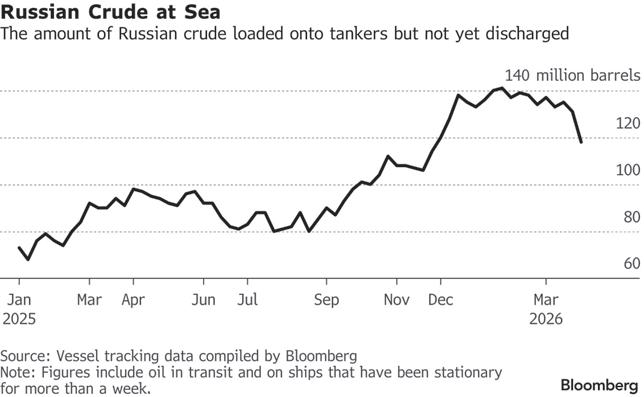
tracking data show.
Separately, oil tankers hauling Moscow’s oil are increasingly avoiding the North Sea and the English Channel after the UK said it would interdict and board Russian shadow fleet vessels in its waters. That’s sending ships heading to and from Russia’s Baltic ports around the north of Scotland, adding about two days, or 25%, to a journey between the Baltic and the Mediterranean compared with the more common route passing between England and France.
Crude shipments
A TOTAL of 22 tankers loaded 16.23 million barrels of Russian crude in the week to March 29, vessel-tracking data and port-agent reports show. The volume was down sharply from 28.5 million barrels on 37 ships the previous week.
On a daily average basis, shipments in the week to March 29 slumped to 2.32 million barrels a day, a drop of about 1.75 million barrels a day to the lowest since February 2025.
The drop was driven by multiple Ukrainian drone strikes on Primorsk and Ust-Luga that halted shipments for much of the week. Combined exports from the two ports were the lowest in data going back to the start of 2022.
An apparent four-day gap in loading operations at the Pacific port of Kozmino suggests maintenance work may have temporarily halted ship -


ments there.
The flows are volatile, affected by weather, maintenance work, sanctions and the timing of shipments. There was one shipment of Kazakhstan’s Kebco grade from Novorossiysk and one from Ust-Luga during the week.
Export value ON a four-week average basis, the gross value of Moscow’s exports edged up to $1.79 billion a week in the 28 days to March 29 from $1.7 billion in the period to March 22. That took it to the highest since May 2024, with higher prices more than offsetting the drop in flows.
Urals prices rose for a fourth week, driven higher by the conflict in the Middle East, which further boosted global benchmarks, and an easing of the discounts Moscow had previously been forced to offer to move additional cargoes into China, as buyers returned for the nation’s crude.
Using this measure, the export prices of Russia’s Urals from the Baltic rose by about $11.30 to $73.24 a barrel and a similar increase took Black Sea cargoes to $71.53. The price of Pacific ESPO crude increased by $9.50 to average $84.19 a barrel. Delivered prices in India were also up, rising by $14.80 to $97.69 a barrel. All prices are according to numbers from Argus Media.
On a weekly basis, the value of exports averaged about $1.44 billion in
the 7 days to March 29, down by $1 billion from the previous week. The slump in flows was only partly offset by higher prices, with Urals rising by about $4.50 a barrel compared with the week to March 22, while Pacificloading ESPO fell by $3.60 a barrel.
Flows by destination
OBSERVED shipments to Russia’s Asian customers, including those showing no final destination, fell to 3.08 million barrels a day in the 28 days to March 29, following the drop in overall shipments. While the amount of Russian crude on tankers showing destinations in China and India continues to show sharp declines in the most recent weeks, the volume on vessels yet to show a final destination has soared, allowing for much of that pattern to be reversed in time. Tankers frequently show interim destinations, such as Suez or Port Sudan, until they are well across the Arabian Sea, while some never show a final calling point, even after mooring to discharge.
Flows on tankers signaling Chinese ports stood at 1.04 million barrels a day in the four weeks to March 29, down from a revised 1.16 million barrels a day for the period to March 22. The amount destined for India fell to 620,000 barrels a day from a revised 910,000 barrels a day in the earlier period.
The Philippines has taken its first cargoes of Russia’s ESPO crude since 2021, with one tanker having offloaded and a second waiting to discharge.
But there is the equivalent of 1.35 million barrels a day on vessels yet to show a final destination. Of that, about 1.22 million barrels a day is on ships from Russia’s western ports showing their destination as Port Said or the Suez Canal, or those from Pacific ports with no clear delivery point, and a further 130,000 barrels a day is on tankers yet to signal any destination.
Flows to Turkey in the four weeks to March 29 slipped to about 130,000 barrels a day from about 140,000 barrels a day in the period to March 22.
With assistance from Sherry Su/ Bloomberg

Delayed Trump-Xi summit gives fresh grievances room to grow
By Nectar Gan
EVERY week that passes without a face-to-face meeting between Donald Trump and Xi Jinping gives fresh grievances time to accumulate. That growing list is testing both sides’ ability to keep ties steady between the world’s top economies.
In the past few days, China has launched retaliatory probes into US trade practices, while a bipartisan group of American senators visited Taiwan to press for more spending to deter a Chinese invasion of the chip hub. As Trump’s war in Iran continues to disrupt global commerce crucial to China’s growth, Beijing on Tuesday issued a joint call with Pakistan for an immediate ceasefire.
As those tensions build ahead of a much-anticipated leaders’ summit delayed to mid-May, the White House has signaled its intent to keep things on track.
Press Secretary Karoline Leavitt on Monday said that cabinet officials will travel to China in the coming weeks, a move that could reassure Beijing after officials previously signaled dissatisfaction with Washington’s last-minute preparations.
Such visits would build on trade talks
Treasury Secretary Scott Bessent and Trade Representative Jamieson Greer held recently with Chinese Vice Premier He Lifeng in Paris. Any visit to Beijing of Secretary of State Marco Rubio, who has been twice sanctioned by China, could be considered another olive branch from both sides.
“The relationship between the US and China has been remarkably stable in the months since the Busan meeting,” said Joe Mazur, senior analyst at consulting firm Trivium China, referring to the October summit that sealed a tariff truce. “The longer the two leaders go without talking, the more risk of a return to the ugliest days of the trade war.”
For its part, Beijing has shown commitment to the summit by emphasizing the “irreplaceable” role of head-of-state diplomacy. Hours before the probes into US trade practices were announced, China’s commerce minister urged Greer to avoid “vicious competition” and implement the consensus reached at the last leaders’ meeting in South Korea.
The conflict in the Middle East now appears to be the biggest source of un -
certainty. When Trump delayed his visit to China, he cited the need to stay in Washington to focus on US military operations in Iran. The war is now in its second month, although Trump told reporters Tuesday he foresaw the US will “leave” Iran within two to three weeks. Even before the president’s comments, Greer downplayed the prospect that the conflict could delay talks further, saying preparations for the summit are on track.
“The Chinese want stability. We want stability. I actually see a positive agenda with China going forward,” Greer told Bloomberg Surveillance earlier on the same day. Asked if he needed to meet his Chinese counterparts again before the summit, he said it would not be necessary, contrary to Leavitt’s suggestion the day before.
Trump and Xi are expected to meet four times this year, including at two leaders’ summits both nations are hosting in the final months of 2026. Any further delay in the Republican leader’s trip to Beijing—the first by a US president in nearly a decade—would take the momentum out of that schedule.
“It would be diplomatically awkward for President Trump to delay the summit a second time, and delaying again could also disrupt the cadence of meetings potentially taking place later in the year,” said Brian Hart, deputy director of the China Power Project at the Center for Strategic and International Studies. “That would potentially undermine the relative stability achieved in Busan.”
Taiwan remains a flashpoint, with Xi this week inviting the chairwoman of the island’s main opposition party to China for the first time in a decade. That meeting will give the Chinese leader a chance to press Cheng Li-wun over a special military budget President Lai Ching-te is trying to pass, in part to buy more weapons from Washington.
Chinese officials are wary of further US arms sales, an issue Xi raised directly with Trump in a February phone call during which he urged the US to proceed with “utmost caution.” The Chinese Communist Party considers the self-ruled island its own territory despite never having ruled it. With assistance from Martin Ritchie, Kate Sullivan and Annmarie Hordern/ Bloomberg


‘Surge in local pork prices could crimp sales’
HBy Ada Pelonia @adapelonia
OG raisers said the retail price of pork is unlikely to breach P500 per kilogram even with the expected spike in animal feed costs due to the Middle East conflict.
They made this pronouncement after the Department of Agriculture (DA) said retail pork prices could soar to as much as P588 per kilo should the surge in oil prices driven by escalating tensions in the Persian Gulf persist through August. However, the DA said this is a “worst-case scenario.” National Federation of Hog Farmers Inc. (NatFed) Vice Chairman Alfred Ng said a significant hike in pork prices would make it unpalatable to consumers, thus causing raisers to incur losses.
“Anything more than P480 per kilo (retail price) will be bad for the producers,
as consumers will not be able to afford pork and may shift to other protein sources,” Ng told the BusinessMirror.
He said even if feed costs jump by 50 percent, “which is unlikely,” the production cost would increase to P230 per kilo, from the current P180 per kilo. The liveweight price would settle at a range of P270 to P280 per kilo.
“If the margins of traders and vendors are increased to P160 from the current P120 pesos per kilo, the price of kasim will only be P400 and liempo about P450, so the P558 to P588 (per kilo retail price) could be a bit exaggerated.”
He noted that feed costs have inched up by 2.5 percent to P1 per kilo or P50 per bag compared to the pre-conflict price.
For Pork Producers of the Philippines (ProPork) President Eric Harina, the DA’s projected price was “too much, even if it’s the worst-case scenario.”
“Even with the rising cost of fuel, our farmgate prices haven’t made a significant impact to increase prices of meat, even with an increase in prices of commercial feeds of P1 to P2 per kilo,” Harina told this newspaper.
“We oppose significant hikes in meat prices as they will impact consumption and sales.”
The DA recently acknowledged that its “extreme” projections anchored on surging oil prices are “unlikely,” allaying concerns over a potential spike in food prices.
Agriculture Secretary Francisco Tiu Laurel Jr. said the “worst-case scenarios,” assuming that crude oil prices average $200 per barrel for six months, presented to the Senate were based on “extreme assumptions” and excluded mitigating measures.
“The prices presented assumed the full impact of soaring crude,” he said. “They did not factor in government action, which we
will undertake to protect Filipinos from an oil shock.”
The DA said rising geopolitical tensions in the Middle East have fueled concerns about energy supply disruptions, particularly in the Strait of Hormuz, a critical chokepoint for oil and fertilizer trade.
Still, the DA said the government is aiming to cushion the impact of the potential fallout, citing the Department of Energy’s (DOE) move of securing additional crude supply from non-traditional sources, including Russia, to diversify import channels.
The DA chief also said the Fertilizer and Pesticide Authority (FPA) is authorized to make emergency purchases, while statelinked firms such as Planters Products Inc. can boost imports of the farm input.
The agency said it is also exploring alternatives, such as organic fertilizers, including chicken manure, to reduce dependence on petroleum-based inputs.
PHL rice, corn stocks higher in March–PSA report
THE country’s rice stocks rose by 16.5 percent in March on the back of an increase in the inventories of households, commercial entities and the National Food Authority (NFA).
Data from the Philippine Statistics
Authority (PSA) showed that the country’s rice inventory expanded to 1.88 million metric tons (MMT) as of March 1, from the 1.61 MMT recorded last year. However, the state statistics agency noted that last month’s stock inventory
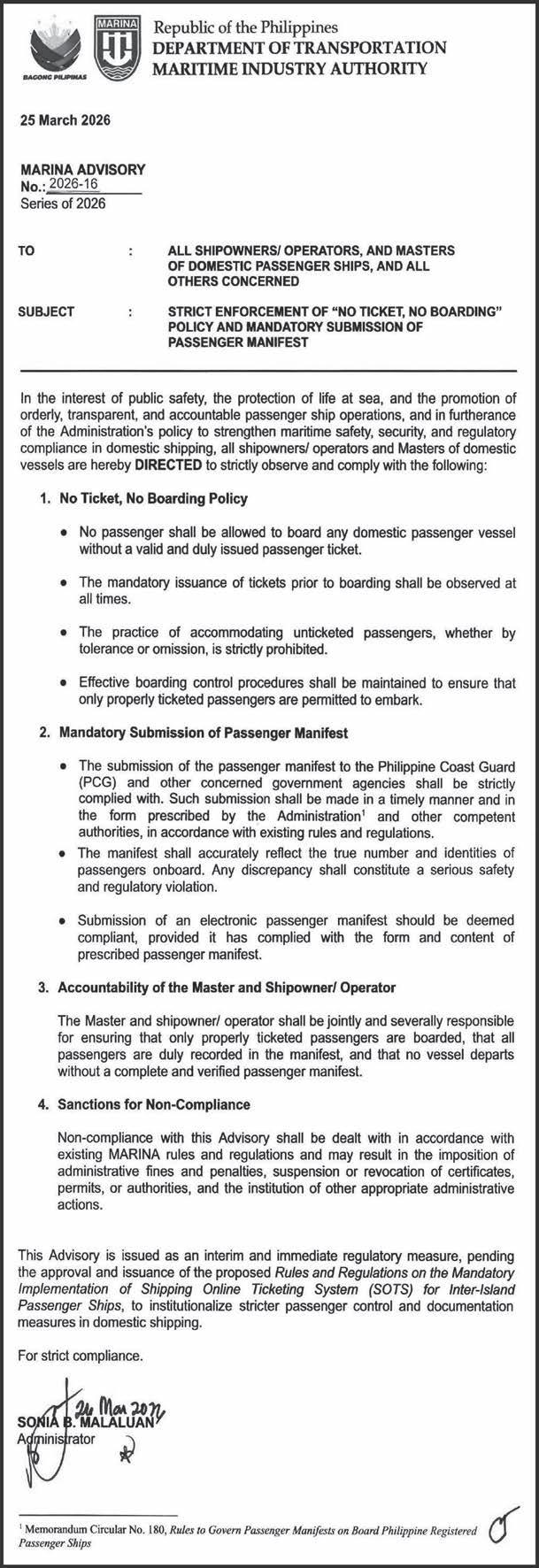
fell by 11.1 percent from the 2.11 MMT recorded in February.
Meanwhile, the PSA said 48.4 percent or 908,720 metric tons (MT) was held by households, while 30.1 percent or some 564,220 MT of rice was stored by commercial entities.
The agency added that rice stocks in the NFA warehouses as of March 1 reached 404,390 MT, accounting for 21.5 percent of total inventory during the reference month.
“This month’s rice stocks inventories registered annual increases from the NFA depositories by 34.9 percent, from the households by 15.9 percent, and from the commercial sector by 6.9 percent.”
“In comparison to the February 2026 rice stocks levels, decrements were noted from the commercial sector by 28.7 percent and in the NFA depositories by 4.1 percent. Meanwhile, rice stocks inventory from the
households increased by 1.0 percent.”
In the same report, the state statistics agency said total corn inventory as of March 1 jumped by 26.4 percent to 465,860 MT from 368,510 MT last year.
The latest total corn inventory, however, dropped by 18.7 percent on a monthly basis from the 573,040 MT registered in February.
“From the same month of the previous year’s level, corn stocks inventory recorded annual increases from the households by 31.0 percent and from the commercial sector by 25.6 percent.”
“Relative to the inventory level in February 2026, the volume of corn stocks from the commercial sector registered a month-on-month decrease of 20.5 percent and from the households by 6.9 percent.”
PSA data showed that the corn stocks in commercial entities reached 396,540 MT, while corn stocks in households were at 69,320 MT. Ada Pelonia
McCormick acquires Unilever food arm in $44.8-B merger
UNILEVER Plc agreed to combine its food business with spice maker McCormick & Co. in a $44.8 billion deal that will create a global seasonings, sauces and condiments company.
Under the agreement, McCormick will pay $15.7 billion in cash and the equivalent of $29.1 billion in shares for most of Unilever’s food business. That will leave Unilever and its shareholders with 65 percent of a combined entity that owns brands like French’s mustard and Hellmann’s mayonnaise.
The deal is the biggest in the histories of both companies and will help recast Unilever as a global leader in beauty, personal and home care while turning McCormick into a leading competitor in the global packaged food business. Investor reaction to the highly ambitious move by both companies was underwhelming.
McCormick, which is worth $14.4 billion, fell as much as 10 percent in US trading. As of the last close, the stock has fallen 21 percent this year. Shares of Unilever, which has a market value of about £99 billion ($131 billion), closed down 7.3 percent in London, extending its decline since the start of the year to nearly 14 percent.
“We are unimpressed,” James Edwardes Jones from RBC Capital Markets, who has had a sell rating on Unilever for a year, wrote in a note. It’s not clear why Unilever is disposing of a food business it owns, which is dominated by two strong brands— Hellmann’s mayonnaise and Knorr stock cubes—for part ownership of a sprawling food business, he added.
While the deal will leave Unilever as a pure-play home and personal care business, “this does not strike us as a smooth way of bringing it about,” he said.
The combined company will be highly levered, and with only a primary US listing in New York initially, it will likely face significant selling pressure from domestic European holders of Unilever stock, according to Callum Elliott, an analyst at Bernstein. This will weigh on investor sentiment over the next 12 months, he said, as “Unilever shareholders debate whether they really want to be holders of this new combined food entity.”
Big food
UNILEVER has been selling food for nearly 100 years. In addition to global brands like Hellmann’s and Knorr, it owns smaller regional products like Maille Dijon mustard and Marmite spread. In recent years, big food businesses like Unilever have been struggling as less wealthy consumers pull back on spending or choose cheaper store brands. The popularity of GLP-1 weight-loss drugs also means users are eating less or choosing fresher food. Unilever Chief Executive Officer Fernando Fernandez has made it clear that going forward he sees beauty, personal care and wellbeing—not food—as the keys to future growth. On Tuesday, Fernandez said the McCormick deal was another step in “sharpening” the company’s portfolio and will help turn it into a €39 billion ($45 billion) “pureplay” business focused on health, wellness, home and personal care. The combined food company will be called McCormick and will have revenue of about $20 billion across herbs, spices, seasonings, cooking aids, condiment and sauces. McCormick CEO Brendan Foley will remain in his position at the existing company headquarters in Hunt Valley, Maryland. Bloomberg News
Govt creates task force to address impact of crisis on food security
By Butch Fernandez @butchfBM
THE chairman of the Senate
agriculture committee said the Agri-Agra Team has organized a
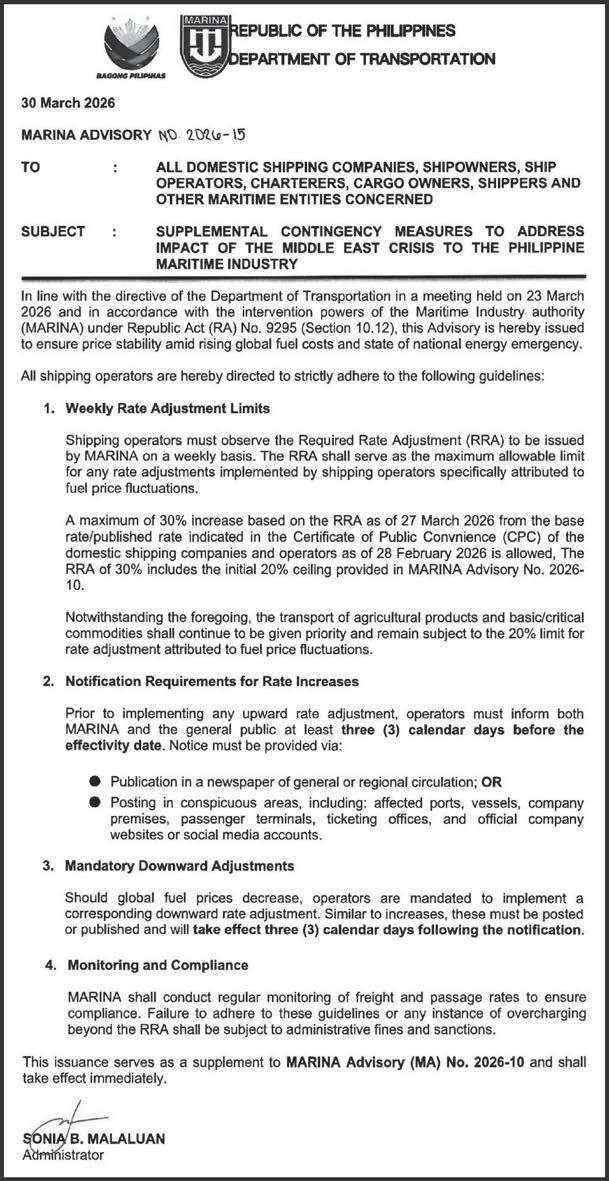
dedicated task force to closely monitor and respond to the ongoing crisis in the Middle East, with a focus on mitigating its impact on the nation’s food security and overall economy.
The Agri-Agra Team is composed of the Department of Agriculture (DA), the Department of Agrarian Reform (DAR), representatives from the Senate and Congress, and local government units (LGUs) to address challenges in the agriculture and fisheries sectors and their impact on consumers.
Senator Francis Pangilinan, as chairman of the Senate Committee on Agriculture, Food, and Agrarian Reform, has actively collaborated with the Agri-Agra Team for his policy and legislative agenda, a series of long-term and sustainable measures that aims to cushion the impact of global crises on the country’s food ecosystem—from the agricultural workers down to household consumers.
“The DA, DAR, and lawmakers from both chambers involved in agriculture, fisheries, and agrarian reform met to pave the way for a task force to collectively monitor the situation, form an ad hoc committee, crisis committee, and Agri-Agra Team to track the forms of relief, ayuda, assistance, for our food security concerns,” Pangilinan said after his meeting with the team last March 31.
He also said there is a current proposal for a “bayanihan-type” supplemental budget to address the looming energy and food crisis because of the Middle East conflict.
A “bayanihan-type” budget refers to a special, accelerated financial appropriations patterned after the Bayanihan to Heal as One Act and the Bayanihan to Recover as One Act, both passed during the Covid-19 pandemic, to provide rapid and flexible funding to address the crisis.
Included in the proposed supplemental budget are provisions on additional interventions to ease the burden of the current crisis on Filipinos.
Pangilinan said fuel costs account for 80 percent of fisheries production, while
prices of fertilizers and feeds have also significantly increased because of the massive jump in the prices of petroleum products.
“That means all of these have a direct impact on the prices of food. So, how do we support our food producers? How do we support farmers, fishers, jeepney drivers and other sectors affected by this crisis?,” he asked, partly in Filipino. “Sa pamamagitan ng dagdag na budget ay magagawa natin ‘yan [With an additional budget, we can do all that].” Meanwhile, he also warned that those who abuse the current crisis by selling overpriced products can be duly charged with profiteering, stressing that the DA and the Department of Trade and Industry (DTI) are currently monitoring prices in local markets.
During the Tuesday meeting, the team discussed the status of the country’s top commodities—sugar, onion, pork, chicken, egg, fisheries, and rice—as well as concerns about the use of biofertilizers, debt moratoriums, biofuels, price monitoring and accessibility and warehouse congestion.
Among the meeting’s attendees were Agriculture Secretary Francisco Tiu Laurel Jr., DAR Secretary Conrad Estrella, House Committee on Agrarian Reform chairman Rep. Leah Bulut-Begtang, House Committee on Agriculture chairman Rep. Mark Enverga, and House Committee on Food Security chairman Rep. Adrian Salceda.
Aside from his work with the Agri-Agra Team, Pangilinan previously urged the government to expand fuel subsidies for farmers and fishers, noting that higher fuel prices directly reduce their already thin margins.
He also pushed for the suspension of fuel excise taxes amid the Middle East conflict, while also working to pass legislative measures such as the renationalization of agricultural extension services, the strengthening of agriculture cooperatives, and the creation of the Congressional Commission on Agriculture, Fisheries, and Food Security.
CHINA came, competed and conquered with host Tagaytay City and the Philippines emerging as co-big winners in the 45th Asian Cycling Confederation (ACC) Track Cycling Championships and 14th Asian Para Track Cycling Championships that ended Tuesday.
The Philippines—and specifically the Tagaytay CT Velodrome—now have its own niche in the global track cycling map,” said Abraham “Bambol” Tolentino on Wednesday, the day after the championships concluded with China running away with a dominant 18 gold medal haul and Uzbekistan scooping 17 golds to rule the para cycling competitions with a flourish.
T he Tagaytay CT Velodrome will turn only a year old from its inauguration in June last year but made one gigantic pedal to be on the world cycling map following the hosting of the Asian championships which featured close to 600 worldclass athletes—many from top tier— from 16 nations.
We are now in the company of the global destinations for competitions and training in the track community and the next big step is to continue the momentum, not only in hosting international events but to go full throttle on developing our very own track cyclists,” Tolentino said.
Tolentino, also the president of the Philippine Olympic Committee, tempered expectations by declaring the country’s track program is “starting from scratch” but stressed that this year’s continental championships are expected to trigger enthusiasm for the discipline—both athletes, public and sponsors.
It’s a long 31 years between hostings—1995 at the now gone Amoranto Velodrome and 2026 here at the Tagaytay CT Velodrome— it’s historic,” added Tolentino as he thanked the Philippine Sports Commission, MVP Sports Foundation, Sports Plus PH, Toyota and Peak for supporting the event.
Tolentino underscored the bronze medal clinched by Patrick Gerard Lee in para men elite scratch race and the new national record in the flying 200 meters registered by Zedrick Ivan Honorica point to a bright future for Philippine track cycling.
Editor: Jun Lomibao
China rules as Tagaytay, PHL emerge big winners


Yes, a Filipino rider can in track cycling,” said Tolentino, who rewarded both with cash bonuses before the championships closed on Tuesday. U p next for the Tagaytay CT Velodrome?
Taduran makes 3rd title defense in US debut vs Mexican fighter
By Josef Ramos
AS VEGAS, Nevada—Pedro
LTaduran makes his US debut as he defends his International Boxing Federation (IBF) minimum weight crown against Mexico’s Gustavo Perez Alvarez on Friday at the Pechanga Resort and Casino in Temecula, California.
“ I want to make a good impression here in the US because this is the first time I’m defending my title here,” the 29-year-old from Libon (Albay) told BusinessMirror on Tuesday while shadow boxing at promoter Sean Gibbons’s Knucklehead Gym here.
Taduran, a two-time world champion, and trainer-coach Carl Peñalosa will take a three-hour drive with Gibbons, former world champion Jerwin Ancajas and trainer Joven Jimenez for the fight in California.
It’s a list—from completing track equipment to regularly hosting local, national, inter-club and international championships,” he said. “This was a dream that came to reality, and we’ll continue to
progress on that reality.”
N o less than ACC president Dató Amarjit Singh Gill showered Tagaytay City and Tolentino with accolade for hosting the event that also drew praises from athletes, coaches and team managers for the successful championships—both on the sporting aspect and the city’s hospitality.
C hina, meanwhile, was way up the medals race after the smoke of competitions cleared with its haul of 18
of the 44 gold medals that were at stake with its juggernaut also clinching 10 silvers and one bronze.
PSI holds online seminar for Tour athletes, officials
THE MPTC Tour of Luzon 2026 strengthens its commitment to athlete development and race excellence through a collaboration with the Philippine Sports Institute (PSI) through a five-leg webinar series designed for participating cyclists and coaches starting on April 6. The webinar will focus on the practical strategies to enhance training, race day performance and recovery, which provides the additional layer of support for the participating teams,” said Pearl Managuelod, Institute Director of the Philippine Sports Institute.
A s the Philippine Sports Commission’s (PSC) sports science and training arm, PSI delivers programs designed to empower coaches, enhance high-performance development and support the holistic well-being of athletes.
Taduran, 29, packs a 19-4-1 windraw-loss record whikle Perez Alvarez, 27, owns a 16-1 win-loss record with five knockouts and is coming off an eight-fight winning streak. G ibbons, meanwhile, confirmed that Hall of Famer Manny Pacquiao will be at ringside for his son Jimwell’s fight against former bareknuckle fighter Derrick Gates in a four-round lightweight bout in the undercard of the Taduran-Perez event. Mark Magsayo, meanwhile, fights as a lighweight against Irsh New Yorkbased southpaw Feargal McCrory of Ireland on Sunday (Monday in Manila) in a non-title 10-round fight at the Mega Apex Arena in Nevada.
Gibbons expects Magsayo to score an impressive win against the 33-yearold McCrory, dubbed by the fans as “Fearless McCrory” who is sporting a 17-1 win-loss card with nine knockouts.
Taduran is making his third title defense after winning his rematch with former champion, Japanese Ginjiro Shigeoka, via split decision last May in Osaka before scoring a unanimous decision over compatriot Christian Balunan last October in San Andres, Manila. My body is cooperating and I’m comfortable with my weight now comfortable after dieting a few days,” Taduran said. “I’ve scouted my opponent and he’s very tactical, but I will be ready.”

ULAANBAATAR, Mongolia—Lin
Yu-ting comfortably won her first international bout since the 2024 Paris Olympics at the Asian championships on Tuesday after World Boxing said she passed a gene test. Taiwan’s first Olympic boxing champion beat Thananya Somnuek of Thailand, 5-0, in the round of 16 in the 60-kilogram division. That earned Lin a quarterfinal against division favorite Ayaka Taguchi of Japan.
The 30-year-old Lin wasn’t cleared to compete at the Asian titles until less than two weeks ago. World Boxing took over as the


sport’s Olympic-level governing body last year, and it implemented a sex eligibility policy last August requiring all fighters to take a one-time genetic test designed to identify the presence of a Y chromosome.
Two-time world champion Lin qualified for the Asian championships in December by defeating compatriot Wu Shih-yi, a 60kg bronze medalist at the Paris Olympics. But World Boxing didn’t confirm Lin’s eligibility until March
Japan—still trending by showcasing track bikes that cost P7 million apiece—ran second with 7-7-10 gold-silver-bronze, followed by South Korea with 5-9-7, Kazakhstan 4-5-2 and Chinese Taipei with 3-4-5.
H ong Kong China and Uzbekistan got three gold medals each and Malaysia has two, India and Singapore got one silver apiece and Indonesia two bronzes to make the count—the rest didn’t medal.
U zbekitan complimented its 17 gold medals—out of the 48 events—with 10 silvers and seven bronzes to dominate the para cycling competitions over Malaysia (9-6-2), South Korea (9-1-3), Japan (7-2-3) and United Arab Emirates (3-5-2).
‘Justin Time’ for Beermen Justin Patton delivers 24 points and 17 rebounds in his debut on Tuesday night to power San Miguel Beer past the Macau Black Knights, 110-94, in the Philippine Basketball Association Season 50 Commissioner’s Cup at the Ninoy Aquino Stadium. The Beermen improve to 2-2 won-lost while the Black Knights drop to 0-5. Patton is a replacement for Marcus Lee. PBA IMAGES
JUNIOR golf shifts into high gear next week as the Junior Philippine Golf Tour (JPGT) launches its summer circuit featuring the same two-series format for Luzon and Visayas-Mindanao contenders. A ll eyes are set on the prestigious North vs South Elite Junior Finals later this year where the best of each region will again battle for supremacy.
I n a key move aimed at maximizing participation and performance, the organizing Pilipinas Golf Tournaments Inc. scheduled the entire tour during the summer months. Th is adjustment allows studentathletes to fully commit to competition without the burden of missing school—a major challenge in previous editions when tournaments were held during the academic year.
The shift also addresses persistent weather concerns—last year, several legs were disrupted or postponed due to the rainy season, affecting momentum and overall scheduling. The dual-series format kicks off simultaneously with the Luzon leg opening April 6 to 8 at Mt. Malarayat in Lipa City, while the Visayas-Mindanao campaign is set April 8 to 10 at Mactan Island in Cebu. The Vis-Min series continues from April 13 to 15 at Alta Vista, also in Cebu, while Luzon players head to Summit Point in Lipa City from April 14 to 16.
We are very glad that the PSC, through PSI, extends this kind of partnership with us. We are continuously evolving,” said Arrey Perez, MPTC Tour of Luzon CEO and Chief Organizer. “Year in and year out, we see new partners, upgrading not only the actual race but also the holistic safety and well-being of the athletes.” E ach session runs for up to 75 minutes and the topics include the Physiological Demands of Competing in Heat and Humidity, Hydration and Nutrition Strategies for Maximum Performance, Training Load Management and Recovery for Multi-stage Races, Mental Toughness and Team Communication and Anti-Doping. The initiative marks the beginning of a broader collaboration between the MPTC Tour of Luzon 2026 and the PSI, which extends beyond the virtual sessions into comprehensive on-ground support in all 14 stages of the race set April 29 to May 13.
Services include sports programs featuring hydration monitoring, individualized fueling plans, and education aligned with anti-doping standards, as well as sports psychology support through daily consultations and athlete care.
I n addition, sports physiotherapy services are provided, including injury prevention screening, recovery treatments and coordination with the medical team.
W ith this collaboration, the MPTC Tour of Luzon 2026 reinforces its vision of delivering a premier cycling competition while fostering a safer, more advanced, and athletecentered sporting environment in the Philippines.

The tour then moves north to Baguio with John Hay Golf Club hosting the
Economic hardship and silent suffering: The unseen toll on Pinoy mental health
THE statistics are not just numbers; they are a reflection of a deepening societal wound. According to the National Capital Region Police Office (NCRPO), suicide cases in Metro Manila have nearly tripled in the first three months of 2026 compared to the same period last year. With 111 cases recorded from January 1 to March 23, versus just 38 in 2025, the trajectory is unmistakable and alarming.
Sen. Sherwin Gatchalian is right to sound the alarm. His call for the intensified rollout of comprehensive mental health programs is not merely a political suggestion; it is a moral imperative. As a nation, we must confront the uncomfortable truth that our current mechanisms for mental health support are failing to keep pace with the escalating despair gripping our citizens. (Read the BusinessMirror story: “Rising suicides prompt Gatchalian to push for more effective mental health programs,” March 30, 2026).
The senator’s remarks link this crisis to the external pressures weighing heavily on Filipino households—specifically, the global oil crisis triggered by the war in the Middle East. While the connection between economic hardship and mental health is complex, it is undeniable. When the cost of transportation, food, and electricity spikes simultaneously, the invisible burden on the average Filipino becomes overwhelming. For many, the anxiety of making ends meet evolves into a sense of hopelessness that, without intervention, can become fatal.
It is crucial to note that the Philippines is not starting from scratch. Republic Act 11036, or the Mental Health Act, was a landmark piece of legislation that promised to integrate mental health services into the national healthcare system. Under the 2026 national budget, P742.6 million has been allocated for its implementation. While this appropriation is a step in the right direction, the tripling of suicide cases begs a difficult question: Where is the money going, and why is it not translating into saved lives?
Money alone is insufficient without accessibility. For most Filipinos, mental health care remains a luxury. There is a severe shortage of psychiatrists, psychologists, and guidance counselors, particularly in public schools and rural health units. The stigma surrounding mental health also remains a formidable barrier; many suffer in silence, fearing judgment from their communities or families.
Gatchalian’s call for an “intensified rollout” must translate into tangible actions. First, we need to bridge the gap between appropriations and actual ground-level services. The Department of Health must ensure that every local government unit has a functioning mental health desk and that the National Mental Health Crisis Hotline is adequately staffed and widely publicized. Second, we must invest in capacity-building—training general practitioners and barangay health workers to identify early warning signs of depression and suicidal ideation. Finally, we must bolster school-based mental health programs to catch at-risk youth before they slip through the cracks.
The data from the NCRPO is a warning shot. It tells us that the silent pandemic of mental distress is claiming more lives than we are willing to acknowledge. In times of national crisis—be it economic, geopolitical, or social—the strength of a nation is measured not just by its economic resilience, but by its compassion for its most vulnerable.
Every number represents a father, a mother, a sibling, or a friend who felt they had no other option. We owe it to them, and to the countless others currently struggling in silence, to ensure that our mental health programs are not just items on a budget line, but accessible lifelines. The time for incremental progress has passed. We need a full-scale, compassionate, and urgent mobilization to save lives.
BusinessMirror
T. Anthony C. Cabangon
M. Fernandez Jennifer A. Ng Vittorio V. Vitug Lorenzo M. Lomibao Jr., Gerard S. Ramos Lyn B. Resurreccion, Dennis D. Estopace Angel R. Calso, Dionisio L. Pelayo Ruben M. Cruz Jr.
Eduardo A. Davad Nonilon G. Reyes D. Edgard A. Cabangon Benjamin V. Ramos Aldwin Maralit Tolosa Rolando M. Manangan
BusinessMirror is published daily by the Philippine Business Daily Mirror Publishing, Inc., with offices on the 3rd floor of Dominga Building III 2113 Chino Roces Avenue corner De La Rosa Street, Makati City, Philippines. Tel. Nos. (Editorial) 817-9467; 813-0725. Fax line: 813-7025. (Advertising Sales) 893-2019; 817-1351, 817-2807. (Circulation) 893-1662; 814-0134 to 36. E-mail: news.businessmirror@gmail.com www.businessmirror.com.ph


Child of greed. Child of fear

EJohn Mangun
OUTSIDE THE BOX
VERYONE loves a good story, especially when it involves getting rich while sitting in front of your computer. For the last few years, the “digital gold” crowd has shouted that Bitcoin is the ultimate hedge against a crumbling world. They told us that the old ways were dead. They said that gold is just a heavy, yellow rock for dinosaurs who do not understand the future.
Well, the future has arrived, and it looks a lot like the past. Take a long, hard look at the numbers because the math does not read posts on social media.
From its pandemic-crash lows, Bitcoin delivered multiples that turned small positions into life-changing money, at least on paper, at least for those who held through drawdowns of 70 to 80 percent without flinching. Gold plodded along while Bitcoin soared.
On March 28, 2024, one Bitcoin would cost you US$70,843. On that same day, a kilogram of gold was priced at US$71,780. They are neck and neck, with the crypto crowd screaming that the future belongs to digital scarcity and the old guard
clinging to shiny metal.
Fast forward one year to March 28, 2025. Bitcoin moved up to US$84,134. All good. “We told you so. Gold is dead money. Bitcoin is the new reserve asset.” But gold climbed to US$99,189. The gap started to widen.
And then Bitcoin soared dramatically to an intraday high of $125,617 on October 5, 2025, on a wave of excitement, only to come crashing back down with a 47 percent collapse from its high in several months, which the 2020-to-now return figure quietly buries. The people who bought at $100,000 following the headlines are not celebrating long-term outperformance. They are waiting for a recovery that may or may not arrive before they need the money.
Now, look at where we stand on March 28, 2026. Bitcoin has tumbled back down to $66,880. If you bought in two years ago, you are now underwater. Meanwhile, that “boring” kilogram of gold is sitting at US$144,478. While Bitcoin lost its luster, gold doubled its value. Certainly, gold has recently come down from its January 2026 intraday high but has never fallen with a BTC similar percentage drop nor in so short a time period. We live in a world that is increasingly messy. Between the Strait of Hormuz remaining a constant choke point for global trade and inflation stubbornly refusing to stay in its cage, the “store of value” argument is no longer academic. It is a matter of survival for your capital. When the lights go out or the tankers stop moving, do you want to own a string of digital code that relies on a functioning power grid and a stable internet, or do you want the one thing that has been recognized as wealth for millennia?
The problem with the modern investor is that we get blinded by the flashing green lights of a bull run and forget that markets are prone to periods of madness. Bitcoin is the child of greed. It thrives when money is cheap and everyone is looking for a “shoot the moon” trade. Gold is the child of fear. It protects you when the adults in the room start making mistakes —
Sunflower as symbol of empowerment for UP women athletes

‘W
E are as strong as men!”
A strong statement by Gabby Calope of the Women’s Football Team of the University of the Philippines (UP) Fighting Maroons during the Fourth Sunflower Run-Walk-Parade that was held last March 21, 2026.
The event was first held in 2023 with the theme “Pagpugay sa Kababaihan, Pag-asa Para sa Kabataan” as part of the Women’s Month celebration of the UP Community.
The sunflower is fast becoming UP’s second symbol, after the Oblation.
Sunflowers have historically served as a potent symbol of women’s rights by representing empowerment, enlightenment, growth, and the pursuit of equality.

The powerful drumbeats of the UP Varsity Pep Drummers reverberated around the academic oval as participants carried the giant sun-
flower lanterns as tribute to female UP athletes.
The parade was attended by UP female athletes from badminton, basketball, beach volleyball, chess, football, and swimming, as well as Filipiniana dance troupe along with varsity pep squad and pep drummers.
Member universities of the University Athletic Association of the Philippines (UAAP) compete in 20 sports, which have Men’s and Women’s divisions, with the exception of baseball, in which only men participate, and softball, which is for women only.
Since 1938, UP women’s teams
were champions for 22 seasons in swimming, 12 in judo, 10 in badminton, eight in volleyball, seven in basketball, six in table tennis, six in fencing, four in softball, two in chess, two in taekwondo kyorugi, one in football, and one in taekwondo poomsae.
Softball is only played in the women’s division that started in 1953. UP won the championship four times: Seasons 58 (1995–96), 59 (1996–97), 64 (2001–02) and 70 (2007–08).
In badminton, UP was champion for 10 seasons: Seasons 58 to 63 (1995–2001), 77 to 79 (2014-17) and 87 (2024-25).
In judo, UP won the championship 12 times: Seasons 58 (1995–96), 59 (1996–97), 60 (1997–98), 62 to 65(1999–2003), 67(2004–05), and 69 to 72 (2006–10).
In women’s basketball, UP won the championship seven times: Seasons 39 (1976–77], 40 (1977–78), 41 (1978–79), 43 (1980–81), 44 (1981–82), 45 (1982–83), and 46 (1983–84). UP Men’ Basketball team won four championships in 1939, 1986, 2022, 2024.
In women’s volleyball, UP was champion eight times: Seasons 1 (1938–39), 10 (1947–48), 12 (1949–
which, if you have watched our local policymakers or global trade leaders lately, is most of the time. After decades watching the global markets and the Philippine Stock Exchange, I have seen every “next big thing” come and go. I have seen “guaranteed” winners turn into tax write-offs. The irresistible temptation of 100 percent gains in a week is hard to resist, but capital preservation is the only game that matters in the long run. If you cannot protect what you have, you can never have enough. Unlike for most traded assets, gold has no counterparty risk thereby not relying on an issuer’s promise to pay. In a period of global instability and rising fuel costs, the Bangko Sentral ng Pilipinas (BSP) has revised its 2026 average inflation forecast upward to 5.1 percent from an earlier 3.6 percent projection, significantly breaching the government’s 2 to 4 percent target range. Gold does exactly what it is supposed to do. It holds its ground. The comparison of BTC versus gold trading is not to pick a winner. Bitcoin is not dead. Do not sell your house to buy gold. There is a place for a position based on “greed” and a spot motivated by “fear” in every portfolio.
E-mail me at mangun@gmail.com. Follow me on Twitter @mangunonmarkets. PSE stock-market information and technical analysis provided by AAA Southeast Equities Inc.
50), 14 (1951–52), 25 (1962–63), 40 (1977–78), 42 (1979–80) and 45 (1982–83). In table tennis, UP was champion six times: Seasons 60 to 63 ((1997–2001), 74 (2011–12), 76 (2013–14). In fencing, UP was champion six times: Seasons 59 (1996-97), 63-67 (2000–2005).
In volleyball, women teams first played during the first season (193839) while the m en’s team first played eight seasons later (1946-47). UP won during said first season. In basketball, women teams first played in Season 13 (1950-51) wherein UP first won in Season 39 (1976–77). UP women athletes had winning streaks in badminton for six seasons (1995–2000), swimming for five seasons (2009–2013), fencing for five seasons (2000–2004), basketball for four seasons (1980–1983), judo for four seasons (1999–2002 and 2006–2009) and table tennis for four seasons (1997–2000). For Season 88, UP Fencing Women’s Team’s overall ranking is 1st runner-up with gold medals in Foil team, individual foil (Marina “Nana” Carbonell) and individual epee (Jennina See “Gorecho,” A15
Dennis Gorecho
US IPO prospects in limbo as war dents optimism ahead of SpaceX
By Bailey Lipschultz, Anthony Hughes & Natalia Kniazhevich
THE companies that typically make up the backbone of the US initial public offering market are eyeing the Iran war for signs volatility could boil over and wreck their plans. For banks, there’s a ray of hope—that SpaceX’s potential blockbuster listing could still go ahead, and make their whole year.
After a first quarter marked by stop-and-start activity for IPOs, talk has turned to the implications of the raging conflict and the lingering effect of artificial intelligence scares. No wonder many listing candidates are sitting on their hands as a possible IPO for billionaire Elon Musk’s rocket company, which could come as soon as June and dwarf every other debut, takes shape.
“The situation in Iran has thrown a wrench into things and AI disruption has been pronounced this year,” said Evan Riley, Americas head of equity capital markets at BNP Paribas SA. “You’ve had some hiccups in terms of withdrawn deals—you’ll see the complexion of IPOs change a bit.”
“But if you have mega IPOs come then that changes the entire year because you can easily have a full year of IPO volume in one deal,” he said in an interview.
Musk’s company is expected to submit a confidential filing any day now, and is targeting a deal which could bring in as much as $75 billion, Bloomberg News has reported.
A range of industrials firms are positioned to test investor appetite for a sector seen as relatively insulated from the pressure on consumers from the war. Indoor air quality firm Madison Air Solutions Corp., which is expected to seek at least $2 billion, and drone maker Aevex Corp. both filed publicly in recent weeks for IPOs. Others are being advised by bankers to stay ready in the weeks before financial results go stale in mid-May.
Activity in April will be critical for the second quarter as bankers seek to deliver on promises that this would prove to be a banner year. US IPO volume in the first three months of 2026 marked the best first quarter since 2021, with a weighted-average drop of roughly 3 percent outpacing about a more than 7 percent decline for the benchmark S&P 500 Index, data compiled by Bloomberg show.
Still, seven of the companies behind the quarter’s 10 largest deals are trading below their IPO price, with a median decline of 28 percent, the data show.
The choppy performances and an uncertain backdrop have forced management teams to accept that while conditions aren’t perfect for an IPO, further waiting may not provide the clarity some are hoping
continued from A14
Mendoza). UP won gold in Epee team and bronze in Saber team. UP also ranked second in tennis and third in badminton.
The women’s swimming team has been champions for 22 seasons: Seasons 2 (1939–40), 3 (1940–41), 10 (1947–48), 27 (1964–65), 28 (1965–66), 29 (1966–67), 51 (1988–89), 54 (1991–92), 56 (1993–94), 57 (1994–95), 58 (1995–96), 60 (1997–98), 61 (1998–99), 62 (1999–00), 72 (2009–10), 73 (2010–11), 74 (2011–12), 75 (2012–13), 76 (2013–14), 79 (2016–17) 86 (2023–24) and 88 (2025-26).
Quendy Fernandez led the team in Season 88 to cap their 22nd championship title.
UP’s medal haul in swimming comprised of 12 gold medals, seven silver, and six bronze finishes. Of the gold medals, seven were from individual events and five were from team events. All the silver and bronze medals were from individual categories. Gold medalists in the individual swimming events include Fernandez in backstroke, (50m, 100m,
The fourth age of oil
By Troi Santos First of two parts
ON Monday, March 30, the Manhattan Institute convened an on‑the‑record briefing in New York for members of the US Foreign Press Center (FPC) on how US energy dominance has become a core strategic pillar in the 2025 National Security Strategy, led by institute scholars Mark P. Mills and Ken Girardin. The session, organized in cooperation with the US State Department, highlighted America’s role in oil, gas, coal and nuclear energy production, and what that posture means for US power and global energy markets.
for, bankers say.
“Issuers that paused a couple weeks ago may need to confront similar dynamics in early April,” said John Kolz, global head of ECM at Barclays Plc. “Do you have to take a little bit of a leap of faith and rely on a robust process to find long-term investors even with the chaos we’re dealing with?”
“Nobody should be letting perfect be the enemy of good enough,” he said in an interview. “In this environment, good enough may be the best we can hope for.”
Over the past 12 years, the second quarter has historically been the most active, Bloomberg data show.
“The forward calendar still looks constructive,” said David Bauer, head of equity capital markets at JPMorgan Chase & Co. There’s a healthy pipeline of IPOs across sectors, particularly financials, industrials and technology, he added.
Slowdown in March
DESPITE the optimism, volatility has already chilled a handful of planned US IPOs this year. Clear Street Group Inc. and Blackstone Inc.-backed Liftoff Mobile Inc. both paused listing plans in February just before they were due to price. The relative slowdown in March listing activity suggests the market may not get back to full strength while the conflict remains underway.
Michal Katz, head of investment and corporate banking at Mizuho Americas, said the market for IPOs will remain largely stalled amid the uncertainty.
“Once we get the two sides coming to the table and beginning to put together a framework for resolution, we should be able to get some stabilization,” Katz said.
What matters most, she said, is the ability for investors to gauge the range of potential scenarios, particularly around energy markets and oil price stability, which remain closely tied to geopolitical developments involving Iran.
Even as the two sides disagree over the state of negotiations, US officials are sticking to the line that the conflict will end within weeks rather than months.
“There’s an expectation that a settlement could come any time and you want to be ready for it,” said Rob Stowe, head of Americas ECM for Barclays. Bloomberg
200m) and freestyle (50m) along with Thanya Dela Cruz in breaststroke (50m, 100m).
Silver medalists are Yana Villanueva (800 m) and Atasha Dela Torre(50m and 100m) in free style; Nikki Sarmiento (50m) and Aubrey Tom (200m) in butterfly; Kate Dequiña in backstroke (100m), and CY Delos Santos in breaststroke (50m). Bronze medalists are Fernandez in individual medley (200m); Dela Cruz (50m); and Tom (400m) in freestyle; Tom (100m) in butterfly; Delos Santos (100m) in breaststroke; and Kate Dequiña (50m) in backstroke. UP women’s swimming team also dominated the relay team event, specifically in the medley (4x50m, 4x100m) and freestyle (4x50m, 4 x100m 4 x 200m).
Tom received the Rookie of the Year award after winning one gold in team event along with one silver, and two bronze medals in individual events.
Peyups is the moniker of the University of the Philippines. Atty. Dennis R. Gorecho heads the Seafarers’ Division of the Sapalo Velez Bundang Bulilan Law Offices. For comments, e-mail info@sapalovelez. com, or call 0908-8665786.
Tucked inside the briefing packets was a black-and-white photograph of crews lowering the Big Inch pipeline into a trench in 1942, steel hanging from crawler cranes like a bridge in mid-air. The wartime pipe had once helped keep Allied armies moving across the Atlantic. It was meant as a prop, but it worked more as a mirror. Eight decades later, as missiles and mines menace tankers in the Strait of Hormuz, a familiar question hangs over global politics and markets: when it comes to oil, how fast can the world really reroute history in steel?
That question framed the Manhattan roundtable with Mills, a physicist by training and longtime energy analyst who has spent years arguing that wealthy countries overestimate how quickly they can detach their economies from hydrocarbons. For years, the prevailing view was that the world was easing into a post-oil era, with electric vehicles multiplying on the roads, wind farms lining coasts and climate targets written into law. The shock to flows through a single shallow, easily blockaded waterway suggested instead that progress toward delinkage has been far more modest than the rhetoric implied.
Mills told participants that traders had assumed an oil risk premium of roughly five dollars a barrel, a level he considers unrealistically low for anyone familiar with the geopolitics of supply. The recent jump in that premium, he argued, has exposed how fragile the system remains when physical infrastructure is still built around fossil fuels while political language has shifted toward transition.
Over roughly two decades, he noted, governments in Europe and North America have spent what he estimates is on the order of $10 trillion to $20 trillion trying to reduce their dependence on oil and other fossil fuels.
The hope, amplified by technology advocates and climate campaigners, was that efficiency gains, renewable power and large-scale batteries would gradually bend the curve of oil demand downward. From his perspective, the longer-term shape of that curve still looks stubbornly flat.
He pointed to global per-capita oil use since 2000, which he puts at only about 1.8 percent below its level at the turn of the century, a shift he describes as negligible. Over the same period, total oil consumption has expanded so much that the increase alone roughly equals twice the current oil use of the entire European Union. Mills often frames this as the world having had to supply the equivalent of two new EUs’ worth of oil since Y2K, a shorthand he uses to capture the scale involved.
Part of the misunderstanding, he argued, lies in how energy statistics are presented. Agencies usually total primary energy, oil, gas, coal, nuclear and renewables, as slices of a pie chart, with oil’s share now around one-third. On paper, that slice can seem modest. Mills argues that this framing obscures the degree to which almost every product and service remains linked to oil: not only fuels like gasoline and jet fuel, but the diesel that moves container ships and freight trains, petrochemical inputs for plastics, fertilizers and synthetic fibers, and the heavy equipment that constructs the wind farms and data centers meant to anchor a cleaner system.
Transportation, he said, is where the dependence is most obvious. By his count, between 95 and 97 percent of all movement of goods and people still relies on oil. Electric vehicles, despite large subsidies and constant attention, make up only about 3.5 percent of the global light-duty fleet in his estimate. After hundreds of billions
A war‑choked Strait of Hormuz has shattered the illusion that the world was “delinking” from fossil fuels. Energy analyst Mark P. Mills argues that the crisis is forcing a return to what he calls “energy sanity.”
of dollars in incentives from China and Western governments, he still considers EVs a statistical rounding error in the worldwide vehicle stock.
Even in a scenario where half of all passenger vehicles eventually become fully electric, a future he calls ambitious but not implausible, Mills calculates that global oil demand would fall by only 8 to 10 percent. He views that reduction as meaningful but far short of what would be required to make oil obsolete, and he rejects claims that Tesla or Chinese battery manufacturers are on the verge of displacing the oil industry. In his telling, cheaper electric miles might instead ease pressure on constrained oil supplies, freeing up more barrels for uses where energy density and other physical limits leave few alternatives.
That perspective, he argued, has not only distorted global charts but has also seeped into statutes and investment plans in individual jurisdictions. In places like New York, policymakers pledged steep emissions cuts on tight timetables on the assumption that rapid de-linkage was within reach.
New York’s climate statute, modeled on international agreements dating back to Kyoto, calls for a 40 percent reduction in greenhouse-gas emissions below 1990 levels by 2030. On paper, Mills and other analysts once viewed the targets as both ambitious and achievable. In practice, they now say the timetable is increasingly out of step with on-the-ground constraints.
Girardin, the Manhattan Institute fellow who joined Mills at the briefing, noted that New York’s own history distorts that 1990 baseline. In the decades since, the state has deindustrialized much of its upstate economy, tightened vehicle standards and almost completely removed coal from its power generation. Those trends produced early, relatively easy emissions cuts. Girardin argued that what remains will have to come from harder steps: rapidly electrifying heating and transport, building costly offshore wind projects and closing gas-fired plants even as demand for electricity from data centers and electric vehicles increases.
He and others at the table see no realistic path for New York to reach its 2030 targets without resorting to extreme, politically impossible measures. Statewide emissions, after years of decline, have flattened. Efforts to replace aging gas plants have stalled because regulators have largely blocked any new infrastructure tied to fossil fuels, even when proposed facilities would operate more efficiently than those they would displace.
For Mills, New York encapsulates a wider pattern. Nearly every country has adopted sweeping climate promises, he noted, but very few have met them. He said that among nations with Kyoto - style commitments, only Monaco and one small African country had clearly met their targets, according to his tally. The rest, in his view, are watching ambitious goals run into physical and political constraints. Those constraints, he warned, are about to be tested in ways that originate far from Albany.
Mills often reminds audiences that oil has a dual identity: it is both a physical commodity and a financial instrument. Traders focus on futures curves and risk premiums, while consumers fixate on pump prices. Beneath those numbers, he said, sits a network of hard infrastructure, straits, canals, pipelines and export terminals, through which the molecules themselves must move.
He described the Strait of Hormuz, the narrow channel between
Oman and Iran, as one of the most critical of these choke points. At its narrowest, it is only about 21 nautical miles across, yet in normal times it carries roughly 15 million barrels of oil a day, along with large volumes of refined products and liquefied natural gas. When conflict made transit through Hormuz too dangerous or impossible, he argued, it was as if a major artery of the world economy had been pinched.
The resulting strain shows up in price spikes. Mills estimates that oil would need to reach around $175 a barrel, once adjusted for inflation and the size of today’s global economy, to match the depth of the last major price shock. But for Mills, t ime is the more important variable.
A combination of emergency stock releases, shifts back to coal and aggressive fuel rationing, he argues, might buy two or three months before the world hits outright physical shortages. At the point where the barrels are simply not there, price ceases to be the main constraint and parts of the system begin to seize.
He expects the first cuts to fall on discretionary uses: vacation travel, cruise itineraries and long- d istance trips that households and businesses can postpone. Mills estimates that 10 to 15 percent of global oil demand is highly sensitive to price and can drop quickly, which could free up about five million barrels a day at today’s levels and buy another month of breathing room. Beyond that, further reductions grow harder because the remaining demand is tied to what societies consider essential, from agriculture and emergency services to freight and daily commuting.
The resulting political and social pressure, in his view, would not be distributed evenly. In Europe and Japan, where high fuel taxes already push pump prices to the equivalent of $9 or $10 a gallon, another dollar or two would hurt but would not be unprecedented. In the United States, where prices have hovered closer to $3 or $4, he says a jump to $6 a gallon could prove politically explosive. In poorer, fuel-i mporting countries such as Nigeria and Pakistan, similar shocks can be economically destabilizing, as governments are forced to choose between budget-bu sting subsidies and unrest.
The shock is even sharper in the Philippines, which imports almost all of its oil and relies heavily on the Middle East. By the government’s own count and external estimates, roughly 90 percent of Philippine crude comes from Gulf suppliers such as Saudi Arabia, the United Arab Emirates, Iraq and Kuwait, leaving the archipelago among the most exposed in Asia when Hormuz slows or shuts. As a result, Manila has been hit hard by the latest price spike: fuel prices have climbed toward record highs in peso terms, jeepney fares have been raised in several regions, and transport groups have warned of more strikes as drivers struggle to absorb higher diesel costs.
On March 24, President Ferdinand Marcos Jr. declared a national energy emergency, after his energy secretary said existing fuel stocks would cover only a few weeks of demand. The order gives officials broad authority to secure additional imports, police hoarding and potential price manipulation, and treat fuel alongside food and medicine as a strategic good— underscoring how a distant closure of the Strait of Hormuz can quickly become a domestic security issue for a US treaty ally in the Western Pacific. From there, Mills stressed, higher oil prices reach far beyond filling stations. More expensive bunker fuel raises the cost of shipping everything from smartphones to wheat. Tight global gas markets
push natural - g as prices higher, prompting countries like Japan and India to restart coal plants that had been sidelined for climate reasons. Petrochemical feedstocks such as ethylene become more expensive, with the impact filtering into consumer goods months later. Even if the fighting ended quickly, he expects elevated prices and disrupted supply chains to linger for a year or more. If seaborne shipments become too risky or expensive, Mills sees the main alternative as looking much like the Big Inch photograph in the briefing packet. He noted that builders were installing pipelines at around 10 miles per day half a century ago and believes that current techniques can move even faster. As one example, he cited a Saudi pipeline completed in the early 1980s that already carries about five million barrels a day from the Gulf coast across the peninsula to the Red Sea, bypassing Hormuz altogether. In his view, expanding that line or constructing parallel routes could partly reduce choke - point risk within months rather than years. He acknowledged that pipelines are still vulnerable to attack or sabotage. Even so, he argued, they tend to present smaller, more dispersed targets than slow, exposed tankers and can be repaired comparatively quickly. Buried segments can be isolated automatically when pressure drops, limiting spills and fire. No system is invulnerable, but he contends that pipelines are far harder to disable than ships and that building or replacing tanker fleets takes far longer. For producers in the Gulf who depend on Asian customers, he sees a strong incentive to diversify routes. If large buyers such as India, Pakistan and China come to view Gulf oil as permanently hostage to regional conflict, he expects them to be willing to pay a premium for supplies from elsewhere, deepwater fields in Brazil and Guyana, offshore West Africa or even Canadian oil sands. In that light, an extra $10 or $15 per barrel could be an acceptable insurance cost to avoid Hormuz. That shift would be as much about politics as engineering. In the US, fights over proposed pipelines have become stand-i ns for broader arguments over climate policy and Indigenous rights. A long- d iscussed project to move North Slope oil from Alaska toward Asian markets has alternated between progress and gridlock, slowed by environmental reviews and litigation. In Canada, a major pipeline from Alberta to the Pacific coast took years to complete amid opposition in British Columbia, and only now is an associated liquefied-n atural- gas export terminal approaching operation.
Mills believes the current crisis sharply improves the chances that such projects move ahead. Japan’s prime minister has already raised the prospect of importing more oil from Alaska and, in his view, distances and geography make that route attractive. The open question is whether governments move quickly enough to translate those incentives into steel on the ground. If Middle Eastern supplies remain constrained, some in the room asked whether the US could act as a swing producer, stepping into a role Saudi Arabia has often played. Mills placed that question at the heart of what he calls a fourth age of oil. He described the first oil age, from the late 19th century through World War II, as an era when the US produced most of the world’s oil and wielded outsized influence over allies and adversaries. The second age, stretching from the postwar boom through the early 2000s, saw the country become a net importer and steadily more reliant on Opec and other foreign producers. The shale revolution, unlocking oil and gas from tight rock using horizontal drilling and hydraulic fracturing, heralded a third age in which the United States surged back as a leading producer and resumed exporting crude. See “Santos,” A9
Thursday-Friday, April 2-3, 2026
LOGISTICS DELAYS MOUNT AS FUEL RISKS RISE, SAYS DIMERCO
By Bless Aubrey Ogerio @blessogerio
THE Philippines’ decla -
ration of a national energy emergency underscores rising risks to logistics and supply chains as fuel prices increase and global supply uncertainty deepens, according to a report by global logistics firm Dimerco.
In its Asia Pacific Freight Report for April 2026, the company said disruptions linked to oil supply concerns, particularly in the Middle East, are beginning to affect transport operations in the country and across the region.
“Airlines have already suspended some international flights, with authorities warning that grounding aircraft remains a possibility if fuel shortages worsen,” the report noted.
Dimerco said import-reliant logistics services such as airfreight and trucking are expected to face higher surcharges, reduced service frequency and longer delivery times if supply disruptions persist.
Southeast Asian governments are reportedly weighing fuel rationing and energy-saving measures as oil prices climb. In the Philippines, conservation efforts are already being implemented alongside moves to secure alternative fuel sources.
Operational pressures are also being compounded by local conditions, including congestion at
the Port of Manila and trucking limitations that continue to slow cargo movement.
Scheduled holidays, including the Lenten break from April 2 to 4 and the Day of Valor on April 9, are also expected to affect logistics operations.
For April, air freight conditions in the Philippines show mixed trends: capacity remains soft and rates are stable for shipments within Asia, while tighter space and higher rates are seen on routes to Europe.
Cargo bound for the United States East and West Coast is experiencing backlogs, with prices also moving upward. In ocean freight, capacity to Asian destinations remains soft with rising rates, while shipments to Europe and the US are entering an upward pricing cycle despite improving space availability.
On a broader scale, global manufacturing data continues to indicate expansion, although momentum is slowing as demand weakens and cost pressures remain elevated. Delivery times are lengthening, and business sentiment has become more cautious amid ongoing uncertainty, warned Dimerco.
On Wednesday, S&P Global Market Intelligence reported that the country’s Manufacturing Purchasing Managers’ Index eased to 51.3 in March, down from 54.6 in February, marking
BusinessMirror
S&P: Manufacturing slows as ME crisis dents confidence
By Bless Aubrey Ogerio @blessogerio
PHILIPPINE
manufacturing growth lost momentum in March as customer uncertainty linked to the conflict in the Middle East weighed on demand, disrupted export orders, and slowed overall business activity, according to Standard & Poor’s (S&P) Market Intelligence.
The Philippines Manufacturing Purchasing Managers’ Index (PMI) eased to 51.3 in March, a three-month low, from 54.6 in February.
While the reading still indicated a fourth consecutive month of expansion, S&P said the pace of growth slowed sharply from the previous month’s strong performance.
The report pointed to weaker customer confidence as the main driver of the slowdown, as concerns over the Middle East conflict spilled into global markets and affected demand conditions.
S&P Global Market Intelligence economist Maryam Baluch said uncertainty among clients trans -

lated into softer activity across factories.
“Filipino manufacturers are exposed to shocks in oil and fuel prices rippling through global markets, as signaled via notable hikes in costs and charges, and softer demand conditions,” Baluch said.
She added that the conflict has heightened risks for oil supply, with most of the Philippines’ fuel imports coming from Gulf countries now affected by the war. This, she said, has contributed to higher costs, slower output growth, and weaker demand.
Baluch noted that purchasing activity stalled in March, while both production growth and job
creation eased. She warned that the conflict’s duration will play a key role in shaping the sector’s near-term outlook as inflation pressures continue to affect pricing power and sales.
Further, the report also showed that higher fuel and gas prices, along with material shortages, led to worsening supplier delivery times and renewed increases in operating costs. Inflationary pressures were described as historically strong for the month.
The Bangko Sentral ng Pilipinas (BSP) earlier projected March 2026 inflation to range between 3.1 percent and 3.9 percent. Inflation stood at 2.4 percent in February 2026, its highest in 13 months, and 1.8 percent in March 2025.
New order growth also slowed after a strong increase in February, reflecting weaker overall demand. Export orders were particularly affected, returning to contraction for the first time since December.
S&P said the decline in new export sales was modest but signaled a clear pullback in foreign demand, with firms citing reduced orders from overseas clients amid geopolitical uncertainty.
Despite the slowdown in sentiment-driven demand, Philippine exports reached $14.47 billion in January to February 2026, up 8.3 percent from a year earlier, accord-
ing to the Philippine Statistics Authority. This marked the highest level for the period since 1991. Production growth followed the same pattern, moderating after February’s sharp expansion as firms responded to softer orders and higher input costs linked to global disruptions.
Manufacturers also largely paused purchasing activity in March, with the index slipping just below the 50.0 threshold, ending three months of expansion. The pause helped ease supply chain pressure, although delivery delays persisted due to fuel costs and material shortages. As inputs became harder to secure on time, firms drew down inventories for the first time in four months, while employment continued to grow but at its slowest pace in the current expansion cycle. Backlogs of work rose more quickly, reflecting delays in completing orders due to supply constraints. Despite weaker momentum, manufacturers remained cautiously optimistic. S&P said sentiment improved to a four-month high in March, with firms expecting demand conditions to recover over the next 12 months.
“Firms were hopeful that demand conditions will improve, which will help drive growth,” it said.

THE Catholic Mass Media Awards (CMMA) held its Judges and Board of Trustees Orientation, Mission Revisioning, and Holy Week Recollection on March 30, 2026, at the Arzobispado de Manila along Arsobispo St., Intramuros, Manila, bringing together Board of Trustees and this year’s panel of judges for a day of formation, reflection, and spiritual preparation for the Lenten season. The program opened by revisiting CMMA’s Mission and Vision, reaffirming its commitment to reward and honor media works and practitioners that enhance total human development and contribute to a media landscape that up -
lifts dignity, promotes truth, and supports holistic Filipino development.
Rev. Fr. Joselito “Jojo” Buenafe, CMMA Executive Director, underscored the importance of grounding the day in God’s guidance and the organization’s mission, reminding attendees that every evaluation and decision must remain faithful to CMMA’s guiding principles. The Judges Orientation followed, facilitated by CMMA Judges Coordinator, Rev. Fr. Hans Magdurulang. He highlighted the purpose of the formation, stating that it aims “to align, refresh, and deepen our understanding of CMMA’s mission while guiding how
we judge media works responsibly and effectively.” He further emphasized CMMA’s evaluative framework of “Faith-Guided, Fair, and ForwardLooking Judging,” noting that judges are called not to measure religiosity, but to discern values, impact, and integrity in media works. He stressed that the process is anchored on fairness, transparency, and accountability while maintaining openness and discernment. Fr. Magdurulang added that CMMA judging requires a balance of faith and freedom, conviction and openness, and tradition and context, with a focus on how
Editor: Jennifer A. Ng
B1
Thursday-Friday, April 2-3, 2026
SM Prime to spend ₧6B on retail, lifestyle hub in Manila
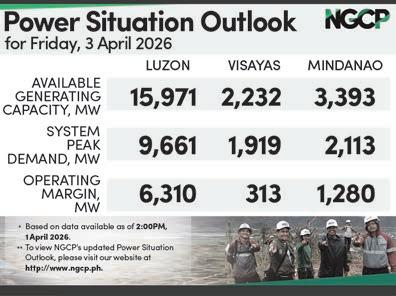
S‘SMEs

By VG Cabuag @villygc
M Prime Holdings Inc. is investing more than P6 billion to redevelop SM Harrison Plaza on the former Harrison Plaza Complex in Manila, which is slated to open next year.
The project forms part of SM Prime’s P150-billion mall investment program for 2026 to 2030, which includes the major redevelopment of 16 existing malls and the construction of 12 to 15 new lifestyle malls.
rate nature-inspired architectural elements alongside open layouts, community spaces and green areas designed to support cultural and social activities,” Steven T. Tan, president of SM Supermalls, said.
Tan said the mall will complement SM Prime’s existing mall portfolio by deepening its footprint in Manila’s cultural and entertainment district.
rial Sports Complex, the Cultural Center of the Philippines Complex, and Manila Bay.
Its tenant mix will balance global brands with local retailers, reflecting Malate’s character.
Tan expects the project to generate thousands of jobs during construction and long-term operations and to contribute to broader urban renewal in Manila’s city center.
unable to access big cold chain facilities’
LBy Ada Pelonia @adapelonia

Once completed, SM Harrison Plaza will have an estimated gross floor area of more than 200,000 square meters, comparable to flagship developments, such as SM City Davao and SM City Clark.
“The development will incorpo -
The original mall, which opened in 1976 as the country’s first modern one-stop shopping destination, ceased operations on December 31, 2019, and was demolished in late 2021.
The development is expected to function as a mixed-use retail and lifestyle hub, extending the company’s reach to office workers, residents and students across Malate and Ermita.
SM Harrison Plaza is also seen as a draw for both foreign and local tourists, given its proximity to several hotels and nearby attractions such as Manila Zoo, Rizal Memo -
He said the company expects to have 115 malls by 2030 or four to five malls per year, as SM expands its footprint outside of Luzon and Metro Manila.
Tan also said the company is aiming to open 100 malls by 2027 or 2028, and will launch one flagship or premier mall per year through 2030, as it expands its reach in the Visayas and Mindanao.
Platform aims to hasten AI adoption
INFOBIP Ltd., an artificial intelligence (AI) firm tapped by many local companies, on Wednesday released its platform called AgentOS, designed to help businesses automate customer interactions and manage communications.
The new system is building on the company’s recently introduced AI Agents that power autonomous customer communications.
The rollout coincides with Infobip’s 20th anniversary and reflects a broader push among Southeast Asian companies to adopt AI-driven tools to improve customer experience and operational performance.
Ongpin to exit from MBC
MAKATI Business Club (MBC) Executive Director Rafael “Apa” Ongpin has resigned and will step down effective April 30, with a transition already underway to ensure continuity of operations, according to the group.
In a statement on Wednesday, the MBC said Ongpin will go on terminal leave from April 1 until the end of the month.
During this period, MBC deputy executive director Michelle Dee will serve as officer-in-charge, while the Secretariat continues to run ongoing programs and dayto-day work.
The business group did not disclose the reason for his resignation.
“We thank Apa for his service and contributions to the Makati Business Club during his tenure. His leadership supported MBC’s efforts in advancing its mission and strengthening engagement with members and partners on key business and economic issues.”
MBC said its Board of Trustees has begun transition planning to maintain leadership stability as the organization prepares for Ongpin’s departure.
Ongpin is the son of Jaime V. Ongpin, one of MBC’s founding members. He previously worked in media before moving into corporate roles with Transnational Diversified Group, ABS-CBN, PhilWeb Corp., and Alphaland Corp. He is also president of Quicksilver Satcom Ventures and has been involved in several entrepreneurial ventures. Bless Aubrey Ogerio
Infobip continues to expand its presence in the Philippines, supporting local enterprises in modernizing customer communications. Its clients include SM Supermalls, Cebu Pacific, Security Bank and PLDT, which leverages Infobip’s platform to enhance customer interactions across its nationwide network.
“While interest in AI adoption is rising across Southeast Asia, many enterprises struggle to move AI projects into production because of siloed systems and integration challenges.
AgentOS addresses these challenges by providing a unified platform where AI agents coordinate
customer communications across channels such as SMS, messaging apps, email, and voice,” Guray Ozturk, head of customer growth, said.
AgentOS represents the company’s evolution from a communications platform to an AI-driven system that enables businesses to move beyond traditional campaigns toward automated, goal-driven customer engagement. The platform also incorporates a human-in-the-loop model, allowing AI to manage automation at scale while human specialists oversee complex interactions and continuously refine system performance to
ensure reliability and compliance.
“AgentOS enables enterprises to operationalize AI across the entire customer journey. By bringing together data, channels, and automation in one environment, businesses can move from reactive workflows to intelligent and autonomous engagement,” Ozturk said.
Infobip is a global cloud communications platform that provides omnichannel tools for businesses to engage with their customers. Headquartered in London and founded in 2006 in Croatia, it is recognized as a leader in the communications platform as a service industry. VG Cabuag
UP, Converge raise data center competency for IT leads
ANGELES City—The country’s premier university, the University of the Philippines (UP), in partnership with leading fiber broadband and technology provider Converge ICT Solutions Inc., is training the information technology leads of UP campuses nationwide at the newly-inaugurated Converge Data Center in Angeles City, Pampanga, concretizing the collaboration between the two institutions under their memorandum of understanding signed on September 29, 2025.
The three-day program covers data center operations, server infrastructure, cloud and artificial intelligence technologies, cybersecurity, and sustainable technology practices. It is structured around the UP Data Center Staff Competency Framework—a nine-domain professional development framework the UP Office of the Vice President for Digital Transformation (UP OVPDx) released in November 2025 to professionalize IT operations across the UP System.
“The training directly addresses at least six of the framework’s nine domains—from governance and compliance to emergency response and business continuity,” said Prof. Peter Sy, vice president for digital transformation, University of the Philippines System.
The Converge Angeles Data Center, inaugurated last March 20, is the Converge Group’s largest facility—a Tier III-certified complex designed for continuous uptime even under infrastruc -
ture stress. UP participants are touring its Security Operations Center, Data Command Center, Uninterruptible Power Supply and Battery Room, Power House, and Satellite Earth Station. Each of these operational spaces corresponds to domains in the Competency Framework, which draws on the EPI Data Centre Competence Framework, Uptime Institute Management & Operations standards, and ISO/IEC 22237. Technical specifications are aligned to ANSI/TIA-942-C.
“The program offers something rarer than a signed agreement: a working model. Institutional IT partnerships typically stall between intent and execution—between the MOU and the measurable outcome. Here, UP personnel are not in a seminar room reviewing slides about data centers—they are standing inside one. That distinction is what separates digital transformation policy from operational readiness,” Sy pointed out.
“This training is proof that the UP-Converge partnership is not a ceremonial exercise,” said Sy. “Our people are inside a working data center, learning from the engineers, executives, and professionals who operate it every day. That is how we build real institutional capability—not through frameworks on paper, but through practice.”
Organized under the Converge University with support from the Converge Corporate Communications and Public Relations (CCPR)
team, senior Converge executives led the training sessions together with outside experts, with support from global technology leaders H3C and Dell Philippines.
“Converge is committed to building digital capability not just within our company but across institutions that shape the country’s future,” said Converge VP and CCPR Head Jay-Anne Encarnado.
“Working with UP—the national university—allows us to contribute directly to the next generation of Filipino technology leaders.”
While deepening the UP–Converge MOU collaboration, the immersion also advances two priorities under UP President Angelo A. Jimenez’s Strategic Plan 2023–2029—Flagship Program No. 6 (Active and Collaborative Partnerships) and No. 10 (Digital Transformation).
It contributes to the UP OVPDx’s mandate of system-wide upskilling, structured around the Data Center Staff Competency Framework—an IT governance instrument aligned with ISO/IEC 38500 principles, that positions industry partnerships as essential to building institutional capacity in an increasingly digital higher education environment.
Anchored in the framework, the immersion delivered concrete, measurable outcomes such as completed role-based certifications, established refresher training cycles, initiated paired skill audits and compliance reviews, and a regularly updated documentation system.
OGISTICAL hurdles are limiting the access of small and medium enterprises (SMEs) to large cold chain systems that have been put up by the government and the private sector, according to climate-tech startup Polar Cold.
Industry leaders have been touting the continuous growth of the cold chain sector in the country driven by the increasing demand for quality and safe food.
For Polar Cold founders Jonathan Harvey and Joe Khoo, ensuring the quality of fresh produce in the country has become a challenge, as infrastructure gaps and logistical issues disconnect the cold chain from farm to table.
Despite being a cornerstone in the food supply chain, they said SMEs are underserved by the local chain industry.
“The government has actually put a lot of money into building cold rooms and large companies are still building cold chains,” Khoo told the BusinessMirror in an interview.
“Unfortunately, all these cold rooms are still the traditional model,” he added, noting that these are extremely large and are “far away” from retailers and consumers.
Harvey noted that investments have been poured into 1,000- to 10,000-pallet positions called “big warehouses,” built in industrial areas. With these warehouses erected on the outskirts, he noted that accessibility becomes a concern for SMEs, which are regarded as the backbone of the country’s economy.
“These (big warehouses) are being built where you have space, in the industrial areas, outside of the city center. Where do SMEs actually take place? In the center of the city, where you don’t have space,” Harvey told this newspaper.
“Traveling to these mega sites is complicated--it takes time, it takes

cost, and it’s not really designed for small, smaller businesses.”
Khoo said Polar Cold deviates from these traditional cold chain infrastructures. “We are thinking of the micro sides that benefit the small players within the city.” The cold chain startup has set up a “decentralized” network of containerized, modular cold rooms through a rental model, placing cold storage within the proximity of SMEs.
“For some of the customers, having control of this logistic process means more to them than having a cold space that is far away, and they can’t access,” Khoo said.
Backed by Singapore-based initiative BLOCK71, Harvey said this allowed them to expand Polar Cold into the Philippines, enabling them to establish their initial sites in Mandaluyong and Quezon City. Currently, he said 15 of their cold rooms are being rented out, which they aim to grow to at least 100 by yearend.
He also noted that around 10 to 20 companies across the food and pharmaceutical industries reach out to them on a daily basis, most of which are based in Metro Manila.
“If you extrapolate this out across the wider urban areas of the Philippines, we can see that this is an underserved space for the country.”
Grab submits list of drivers, riders for fuel aid program
GRAB Philippines said on Wednesday it has submitted to relevant government agencies a “comprehensive list” of its driver-, rider-, and delivery-partners for inclusion in the fuel assistance program being rolled out by the government.
In a statement, the ride-hailing and delivery giant said it had completed the submission following continued coordination with concerned agencies, covering all three categories of partners on its platform.
It did not disclose how many names were included in the list.
The Department of Social Welfare and Development (DSWD) had chided Grab and inDrive for “filtering” their initially submitted list, calling it a “concealment.”
The government’s fuel subsidy program covers transport network vehicle service (TNVS) operators and drivers, among other public utility vehicle categories. The Land Transportation Franchising and Regulatory Board (LTFRB) coordinated with the Department of Information and Communications Technology (DICT) for the identification of beneficiaries from ride-
hailing services and delivery services. An estimated P2.5 billion has been collectively allotted for the fuel subsidy program, with more than 245,000 drivers expected to benefit.
President Ferdinand Marcos Jr. has since approved the release of an additional P1.38 billion, with nationwide distribution set to begin on April 6. Grab said it has also established on-ground appeals mechanisms led by its own staff and driver-volunteers to assist partners who were left out of the initial submission.
The company said the effort is meant to serve driver-, delivery-, and rider-partners regardless of platform affiliation, covering query resolution, data gathering for revalidation, and facilitation of endorsement for succeeding batch submissions. Drivers on the official list who missed the initial distribution are assured of a special payout, with additional dates to be announced.
“Grab will continue to abide by subsequent guidance and updates from the relevant agencies, as we share the government’s objective of seeing that public support is distributed fairly, responsibly, and to those who are truly eligible.” Lorenz S. Marasigan
Banking&Finance
Remittances one factor in higher Feb liquidity
By Andrea Louise San Juan
AS bank lending skipped higher in February, domes-
tic liquidity surged because money is flowing into the system, thanks to remittances, government spending and bank deposits, according to an analyst.
“What we’re seeing is a modest rebound, not a credit boom,” Jonathan L. Ravelas, senior adviser at Reyes Tacandong & Co., said.
Ravelas spoke after preliminary data from the Bangko Sentral ng Pilipinas (BSP) showed that loans from universal and commercial banks grew by 9.5 percent year-onyear in February from 9.3 percent in January. According to Ravelas, lending picked up slightly in February “as corporates caught up on delayed financing and borrowers began accepting that high rates will stay for now, while banks remain liquid and willing to lend.”
Outstanding loans from universal and commercial banks (UKBs) to businesses and individual consumers reached P14.269 trillion as of February.
The outstanding loans to residents increased by 10.1 percent in February from 9.9 percent in January, while outstanding loans to nonresidents fell by 13.2 percent from a 10.4-percent decline in the same period.
Loans meant to fund business activities expanded by 8.6 percent in February from 8.2 percent in January.
Lending rose for the following key industries: electricity, gas, steam, and air-conditioning supply (23.5 percent); real estate activities (9.0 percent); wholesale and retail trade, and repair of motor vehicles and motorcycles (8.2 percent); transportation and storage (19.3 percent); and water supply, sewerage, and waste management and remediation activities (26.0 percent).
Meanwhile, consumer loans to residents grew at a slower rate of 20.8 percent from 21.3 percent due to the modest slowdown in credit card and motor vehicle loans.
The BSP said it monitors bank loans because they are a key transmission channel of monetary policy.
M3
THE amount of money circulating in the economy, grew by 10.3 per-
Tcent year-on-year to P19.8 trillion in February, preliminary data from the BSP showed.
Historical data from BSP showed that this is the fastest growth of M3 since November 2020 when the pace of the growth of domestic liquidity was at 10.5 percent.
According to Ravelas, M3 surged because “money is flowing into the system—from remittances, government spending, and bank deposits— but much of it is sitting idle, not aggressively spent.”
M3 is a broad measure of money supply that includes currency in circulation, bank deposits, and other financial assets that are easily convertible to cash.
As a driver of money supply, claims on the domestic sector, which includes private and government entities in the country, rose by 11 percent year-on-year in February from 10 percent in January, the BSP said.
Claims on a sector represent that sector’s liabilities to depository corporations (e.g., banks and the central bank). Claims on the private sector alone grew by 10.6 percent in February as in the previous month, driven by the continued expansion in bank lending to nonfinancial private corporations and households.
Net claims on the central government increased by 12.4 percent in February from 8.9 percent in the previous month, driven mainly by its higher borrowings.
Net foreign assets (NFAs) in peso terms rose by 7.4 percent year-onyear in February from 10.2 percent in January. NFAs represent the difference between claims on nonresidents and liabilities to nonresidents of depository corporations.
NFAs of the BSP increased by 4.1 percent. Similarly, NFAs of banks grew primarily on account of lower foreign currency-denominated bills payable, the central bank noted. The BSP said it will continue to ensure that domestic liquidity conditions remain consistent with its price and financial stability objectives.
Looking ahead, Ravelas said “oildriven inflation risks from the Middle East conflict mean loan growth will likely stay in the high-single digits this year, with plenty of liquidity in the system—but confidence will determine whether that money actually turns into growth.”
to nearly ₧500B
HE Bureau of Internal Revenue (BIR) targets a collection higher than last year’s goal in April—typically the strongest month for tax collections, according to a memorandum issued by Internal Revenue Commissioner Charlito Martin R. Mendoza.
The BIR’s collection target for April of P499.104 billion is based on the Budget of Expenditures and Sources of Financing (BESF) approved by the Development Budget Coordination Committee (DBCC). The official revenue target of the BIR is in compliance with the Attrition Act of 2005.
Year-on-year, the target for April is higher by 15.54 percent from the revised target of P431.946 billion.
April typically generates one of the highest monthly revenues for the BIR as annual taxes are settled during the month. The deadline for filing the annual income tax return is also on April 15 each year.
Nearly half, or P228.479 billion, of the BIR’s target in April will come from taxes on net income and profit, higher by 10.77 percent than last year’s target of P206.258 billion.
The BIR also seeks to gener -
BOC exceeds March take despite war’s disruption

By Reine Juvierre Alberto @reine_alberto
THE Bureau of Customs (BOC) collected P84.426 billion in revenues in March, exceeding its target for the month, despite the Middle East war that dampened usual trade activities.
Customs Commissioner Ariel F. Nepomuceno told the BusinessMirror that the volume of importations declined in March and cargo ships cancelled their trips to Philippine ports.
“But we made sure that we efficiently collect what must be paid to the government,” Nepomuceno added.
Preliminary figures issued by the
ate P177.898 billion in valueadded tax during the month and P31.301 billion in percentage taxes. Excise taxes are estimated at P30.691 billion, with other taxes projected at P22.784 billion.
Meanwhile, the emerging collection goal for April stands at P409.601 billion. The emerging goal serves as the operational benchmark for agency performance measurement, cash management, budget execution, and mandated reporting to stakeholders, unless instructed otherwise by the DBCC or the Department of Budget and Management.
For the 2025 full-year target, the BIR aims to collect P3.579 trillion, 10.74-percent higher than last year’s revised target of P3.232 trillion. Of the total, P3.456 trillion will come from BIR operations composed of existing and new measures, while P114.457 billion will be sourced from non-BIR operations.
Data showed that from January to February, the BIR’s collections rose 2.97 percent to P530.055 billion from P514.748 billion in the same period last year. Reine Juvierre S. Alberto
BOC last Wednesday showed the Bureau surpassed its P83.237-billion target for the month by P1.190 billion or 1.4 percent.
Compared to last year, the BOC’s revenue collection is also higher by 5.1 percent or P4.067 billion than the P80.359 billion generated in March 2025.
From January to March this year, the BOC has collected a total of
P239.173 billion, up by 3.37 percent from the P231.378 billion it raised in the same period last year.
For 2026, the BOC’s collection target is set at P1.003 trillion by the Development Budget Coordination Committee.
This is lower than the earlier goal of P1.013 trillion on expectations of slower economic growth, but higher by 5.66 percent than last year’s P958.714 billion target.
The government aims to collect a total of P4.824 trillion this year, higher by 6.72 percent than last year’s target of P4.520 trillion.
Nepomuceno said the BOC’s strong performance directly contributes to improved public services, infrastructure funding and support for social programs that benefit Filipinos.
“Every peso we collect goes directly to programs that improve the lives of our fellow citizens. This is the true measure of our service—a
government that is compassionate, accountable, and delivers real benefits to the people,” Nepomuceno was quoted in a statement as saying. Nepomuceno also commended all Collection Districts and Ports nationwide for their role in ensuring the smooth flow of trade and achieving the bureau’s target for the month. He expressed his “deepest appreciation” to BOC District Collectors, port personnel, and all BOC employees across the country.
“Your hard work, discipline, and commitment to honest service made this accomplishment possible. This is a shared victory for every Customs officer who continues to uphold our mandate with integrity,” Nepomuceno said.
The BOC expects to maintain momentum through its “Integrity, Accountability, and Modernization” program, ensuring transparent, efficient and people-centered customs service.
What associations can learn from foundations
IN a recent “Association Matters” podcast of the Philippine Council of Associations and Association Executives, I had the pleasure of speaking with Shem Jose Garcia, chairman of the League of Corporate Foundations. Our conversation explored an intriguing premise: “What can associations learn from foundations about creating meaningful impact?”
As the discussion unfolded, it became clear that, while associations and foundations operate in different ecosystems, they share a common aspiration: to create value beyond their organizations. The interview led to several practical insights that association leaders may find highly relevant in strengthening their own impact strategies.
One of Shem’s most compelling points is deceptively simple: organizations create the greatest impact when they build on their core expertise. Corporate foundations, he explained, are most effective when their social initiatives align with what their parent companies already know how to do well.
For example, his organization, the Vivant Foundation of Vivant Corp., focuses on energy and water—areas where the company already has tech-
ASTUDY by experts from the De La Salle University has tagged G-Xchange Inc. as a “megacorporation” or “megacorp,” describing how the firm’s GCash platform exerts its dominance in the country’s digital economy and how it shapes the cultural and economic conditions of everyday exchange.
The research scrutinized GCash not only as a financial service but as how such a fintech platform “embed themselves into everyday transactional cultures of exchange and sociality where poor rural infrastructure, weak institutions, and barriers to financial account ownership have historically limited financial inclusion.”
According to authors Cheryll Ruth R. Soriano and Marinel Eurlyne M. Mamac, they drew from a platform biography of the development of GCash and traced “how GCash evolved from its SMS remittancebased foundations into a sprawling constellation of services.”
According to the study, the GCash operator, like its global counterparts, has expanded “far beyond a singlepurpose” fintech through partnerships, acquisitions, and internal ventures that generate new streams of data.
“While this expansion is often celebrated as advancing financial


nical expertise. Rather than spreading resources thinly across many causes, the foundation has invested in electrifying off-grid schools using solar power, directly leveraging the company’s engineering knowledge and renewable energy experience.
This principle, Shem said, applies similarly to associations. Members of the Philippine Institute of Certified Public Accountants, for example, often volunteer their accounting expertise in initiatives such as nonprofit certification processes through the Philippine Council for NGO Certification on top of the association’s professional development programs. Through these efforts, the profession’s technical knowledge becomes a powerful contribution to governance and accountability in the nonprofit sector.
The lesson for associations is clear: the most meaningful community contributions often come from what members already do best.
inclusion—particularly through government partnerships and sachetized services that reach lowerincome users—it simultaneously creates new forms of differential access and reconfigures Filipino users as a broadfield of borrowers, shoppers, gamers, jobseekers, and even “environmental advocates” within its super app ecosystem,” the authors said.
The study also zoomed in on the “tension” arising from the expansion of GCash. It noted that the mobile wallet app “consolidates itself as both cultural infrastructure and economic sphere, embedding deeply in Filipino everyday life while reorganizing financial and commercial practices around an extensible, conglomerate model of platform capitalism.”
In the Philippines, the study pointed out that such expansions are framed as a public good: the GCash operator is lauded as a “champion” of financial inclusion and welfare distribution, and government partnerships are further encouraged by having reached a “critical mass” of users. However, “what is distinctive is not simply its range of services but its integration of user attention, behavior, and data into a centralized, privately-owned system,” the study emphasized.
Citing previous studies, this re-
Another key takeaway from our conversation is the importance of measuring impact thoughtfully, but not obsessively, through numbers alone.
Shem noted that increasing sustainability reporting requirements, including those encouraged by the Philippine Securities and Exchange Commission, have pushed organizations to quantify outcomes more rigorously. While metrics are essential, he cautioned against reducing impact evaluation to a purely numerical exercise.
Foundations learned this lesson, decades ago. While quantitative indicators such as the number of beneficiaries or projects completed, provide useful benchmarks, they rarely capture the full story. Qualitative insights, such as personal narratives and community feedback, often reveal deeper lessons about how programs actually change lives and how they can be improved.
Finally, Shem emphasized that communicating impact requires understanding your audience. Different stakeholders require different approaches. Financial institutions or grant funders may expect detailed metrics and technical reporting. But for broader audiences, including the
search paper underscored that such platforms demand critical reflection on their power and macroeconomic implications, noting that super apps are often rewarded with escalating valuations and even state endorsement.
“Through partnerships with small and large businesses, collaborations with government, and the strategic upgrading of its technological infrastructure, GCash has positioned itself to scale and dominate a wide range of everyday transactions that underpin the Philippine economy,” the paper noted. This includes not only routine payments but also practices of borrowing and short-term credit that formalize and platformize longstanding monetary practices of “reciprocity and redistribution.”
“The expansion of these services underscores the consequences of megacorps taking over the provision of everyday financial needs, including borrowing to make ends meet, which have historically relied on social relations of trust, obligation, and mutual aid,” added the study.
Further, the paper pointed out that GCash illustrates how colonialera elites retool their power by embedding themselves in both physical and digital infrastructures of daily
media and the public, stories often resonate more than spreadsheets. He illustrated this through Vivant Foundation’s solar electrification project in an off-grid island community. The installation enabled the local school to establish a computer laboratory for the first time. Years later, students from that once-isolated community are now pursuing careers in information technology. Such individual stories bring impact to life in ways that statistics alone cannot.
For associations seeking to strengthen their societal contribution, these lessons are both practical and timely: (a) focus on your expertise; (b) measure impact with both rigor and context; and, (c) communicate through stories that connect with people.
As our podcast conversation revealed, foundations may operate in a different sector, but the principles behind meaningful impact are remarkably universal.
Octavio Peralta is founder and volunteer CEO of the Philippine Council of Associations and Association Executives, the “association of associations.” The views he expressed herein do not necessarily reflect those of the BusinessMirror. E-mail: bobby@ pcaae.org.
life, of course, in partnership with global capital.
Crucially, GCash’s ownership by the Ayala Corp. “underscores how the Philippine digital economy remains intertwined with long-standing elite capital.”
“Emerging from a landed family conglomerate that has historically dominated real estate, banking, telecommunications, and utilities Ayala’s control of GCash extends this dominance into the infrastructures of everyday finance,” the study noted.
“In the Philippines, where the government pursues a ‘test and learn’ approach that leaves technological innovation largely in the hands of the market, these findings force the country to confront urgent questions about who governs financial super apps, how megacorps consolidate their dominance, and what this concentration of power means for the country’s digital economy,” the authors said. The authors neither disclosed their relationship with Ayala Corp. or with G-Xchange nor their stake in these companies.
The study titled “From SMS-based remittance toolkit to super-app: Platformed finance and the case of GCash” was published last Monday on the open research website by Sage Publications
Octavio Peralta
A ssociation World
Health&Fitness
Taguig City has lowest stunting rate in Metro Manila, says NNC
By Claudeth Mocon-Ciriaco
NUTRITION programs in Taguig City focus on early intervention, particularly during pregnancy and a child’s early years.
These include the First 1,000 Days program, which promotes proper nutrition and maternal care, as well as dietary supplementation for pregnant and lactating women and for children at risk of malnutrition.
No wonder, Taguig recorded the lowest stunting rate in Metro Manila among children aged zero to five, based on data from the National Nutrition Council (NNC).
Data from Operation Timbang Plus showed
Taguig at 0.20 percent stunting prevalence, significantly lower than the 7.82 percent national average.
Consistent progress
THE figure highlights the city’s consistent progress in reducing child malnutrition, a result of long-running, community-based nutrition programs and targeted interventions for mothers and children.
Over the past decade, under the leadership of Mayor Lani Cayetano, Taguig has recorded a sharp decline in stunting prevalence – from 9.69 percent in 2015 to 0.35 percent in 2019, the equivalent to a 97 percent reduction in five years.
Nutrition education, regular monitoring, and barangay-level services have helped ensure that children receive timely support.
Taguig’s efforts have earned national recognition, including the highest award—Nutrition Honor Award—along with multiple CROWN Awards and Green Banner Awards for excellence in nutrition program implementation.
With the lowest recorded rates in the region, Taguig continues to build on its nutrition programs to keep children healthy from their earliest years.
Modern aesthetics redefine self-care, confidence—experts
By Rory Visco Contributor
IN the high-stakes world of modern professionals, the hallmark of success is no longer just a sharp suit or a prestigious title. Executives and entrepreneurs are increasingly recognizing that a glowing complexion and refined features are deliberate investments in personal development rather than mere vanity. As the lines between professional presence and personal well-being blur, the aesthetics industry is shifting its focus, from “fixing” flaws to “regenerating the self.” Beauty as freedom
FOR Dr. Marjorie Lalaine “Marj” Salazar, cofounder and Chief Executive Officer of Elyse Aesthetics, the philosophy of “Beauty Set Free” lies at the core of her practice.
“True beauty is letting your inner beauty come out,” she shared in a one-on-one interview with BusinessMirror during the launch of Elyse’s second branch in Quezon City. “It is like coming home to yourself—your best self.”
This approach moves away from the “antiaging” narrative and instead focuses on renewal and the possibilities of a new chapter.
This commitment to authenticity and selfworth is deeply personal for the founders. Having faced hardships and skin struggles that affected her own self-esteem, Dr. Salazar, alongside co-founder, Chief Operating Officer, and lead cosmetic surgeon Dr. Anne Caoile, built a clinic culture rooted in restoration and integrity. Their focus remains on internal growth, not just for patients, but for their team, believing that a happy, welltrained staff translates directly into a premium patient experience.
Expanding the vision THIS mission recently reached a new milestone

SDR. Marj Salazar and Dr. Anne Caoile
with the opening of Elyse Aesthetics’ second branch along Timog Avenue in Quezon City.
Following the success of its first branch in Greenhills, San Juan, the new location offers a full suite of non-surgical treatments designed for busy professionals, including baby Botox, face lifting, and body contouring.
What sets Elyse apart is its focus on the “masstige” segment, delivering luxury-grade services at price points accessible to the working and middle classes. Patients can expect personalized consultations, with treatment plans tailored to their lifestyle and individual needs to ensure results that harmonize with natural features.
Among its highlights is the clinic’s flagship technology, “Elyse Skin Regen,” a multimodal program that combines biostimulation and medical-grade LED phototherapy to renew and firm the skin.
Equally important is its “integrity-driven” approach to care. The clinic emphasizes full transparency in the techniques and products
By Justine Xyrah Garcia
KINCARE can quickly start to feel excessive, especially in the middle of summer, when heat, oil, and breakouts are already harder to manage. Not every routine needs to be layered or complicated. Sometimes, it’s just about finding a few products that do their job and sticking to them.
That’s the direction Resuron is taking. Instead of bBuilding around a multi-step system, the brand focuses on a tighter routine built on consistency.
In an earlier interview with B usiness M irror , Resuron Philippines Corporation Vice President Marion Navarro said she and her husband approached skincare the way they would medicine.
Formulation and testing
BOTH come from the pharmaceutical field, so they focus heavily on formulation and testing. They also work with dermatologists, chemists, and pharmacists, sourcing ingredients from abroad and locally, all backed by clinical data.
“We don’t promise three-day miracles,” Navarro said. “Skin adapts. With consistent use, you’ll see results, slowly but surely.”
For a little over a month, I used the Sum’r (read as Summer) set, designed for younger skin dealing with oil, breakouts, and uneven tone. The routine is straightforward: a clarifying soap, a toning mist, and a milk serum.
The results weren’t instant, but they were noticeable—and, more importantly, consistent. Dark spots
that had been sitting on my skin for months started to fade. Breakouts, especially the usual ones that come around during my period, cleared up faster than they normally would. My skin looked more even, less oily, and generally healthier.
Routine
PART of that comes down to how the routine is built.
The clarifying soap does most of the work upfront.
With salicylic acid helping keep pores clear and a mix of acids working in the background, it lines up with how my breakouts became more manageable and my skin texture gradually improved.
It also gives a mild exfoliating effect, which likely helped with both the smoother texture and the gradual fading of dark spots. Just something to keep in mind— since it’s doing that extra work on the skin, make sure you rinse everything off properly before putting on makeup, so nothing clings or applies unevenly.
Despite that, it doesn’t feel harsh. It cleans thoroughly without leaving the skin tight or stripped, which makes it easy to use daily.
Balanced THE toning mist feels like the step that keeps everything balanced. Throughout the day, my skin stayed less oily, which lines up with ingredients like niacinamide and potassium azeloyl diglycinate (PAD), both known for helping regulate oil production.
At the same time, centella asiatica (CICA) helps calm the skin, which is useful after cleansing or when irritation kicks in.

HEALTHWAY Medical Network (HMN) earned two prestigious titles—Patient Care Initiative of the Year and Public–Private Healthcare Partnership of the Year—at the recently concluded Healthcare Asia Awards 2026 in Singapore.
used, ensuring that patients receive safe, highquality results they can trust.
Be summer-ready with safe, radiant skin AS the dry season approaches, many are looking forward to enjoying the country’s beaches with family and friends. However, prolonged sun exposure can leave the skin dry, dull, and prone to hyperpigmentation. To stay confident and protected while enjoying the outdoors, Drs. Salazar and Caoile recommend a proactive approach to skin health.
“Hydration is key,” Dr. Salazar emphasized. “Exposure to sun and salt can severely dehydrate the skin. Treatments like Elyse Skin Regen, with its biostimulation and deep hydration components, help the skin retain moisture. This not only keeps it glowing but also reduces the risk of future wrinkles and sunspots.”
Dr. Caoile, meanwhile, highlighted the importance of recognizing the uniqueness of Filipino skin. Western-standard treatments may not always be the best fit, especially for those frequently exposed to outdoor conditions. “Using technologies and products specifically suited for Asian skin ensures better results, particularly for procedures like laser resurfacing or injectables,” she explained.
Both experts underscored that skin care is not one-size-fits-all but requires a customized approach. “Whether you are dealing with oily skin and acne scars or dry, sensitive patches, your regimen should be tailored to your needs. Addressing these concerns before and after a beach trip helps maintain healthy, resilient skin,” they said.
Ultimately, modern aesthetics is about empowering individuals to feel “free to be who they truly are.” By investing in skin health and confidence, professionals are not just enhancing their appearance; they are embracing who they are becoming.
The milk serum is where I noticed the biggest difference in tone. The gradual fading of dark spots makes sense with alpha arbutin in the formula, while niacinamide supports overall skin repair and evenness.
Sodium hyaluronate helps keep the skin hydrated without feeling heavy, which probably explains why my skin looked healthier and more “alive” over time.
UV protection
IT also comes with added claims of protection against UV and blue light—something I appreciated, especially with how much time spend in front of a screen.
What also works in its favor is how easy it is to follow. The steps are printed at the back of the product itself, and with only three steps, it’s practical for everyday use, especially if you don’t have time for a long routine. That said, it’s not without a few drawbacks. The products are quite fragrant, especially the mist, which may not be for everyone. It didn’t stop me from using it, but it’s something you notice right away.
There was also a point, around the third to fourth week, when my skin felt a bit drier after the last step. It’s hard to say if that was due to shifting weather or just my skin adjusting, but it did improve as the days got warmer.
As for redness, I didn’t see much change, at least not yet. But to be fair, the brand doesn’t position itself as a quick fix.
Resuron isn’t trying to overwhelm with steps or promise overnight results. It keeps things simple— and proves that less can be better.
As an integrated healthcare provider in the Philippines and a key pillar of Ayala Healthcare Holdings, Inc. (AC Health), HMN provides a full spectrum of services through its expansive network. This includes over 15 Healthway Multi-Specialty Centers, five general hospitals, an ambulatory center, and the country’s first dedicated cancer facility, Healthway Cancer Care Hospital (HCCH).
HMN was represented at the awards by President and Chief Executive Officer Jef Peeters and HCCH Chief Operating Officer Dr. Manuel Francisco Roxas.
Patient Care Initiative Award
HEALTHWAY’S coordinated cancer care program at HCCH was recognized for its holistic, patient-centered approach. Launched in May 2025, HCCH Cares is a facility-wide, end-to-end patient navigation program, the first of its kind in the country, designed to guide patients and their families through every step of care.
The HCCH Cares initiative addresses a critical pain point in oncology by relieving patients of the overwhelming burden of self-coordinating their medical journey. Through a seamless integrated system, patients benefit from weekly tele-navigation check-ins dedicated to consistent symptom monitoring and care coordination.
This model ensures smooth transitions by facilitating all necessary appointments and streamlining movement between various medical services. Furthermore, the program provides direct access to vital resources, bridging the gap between hospital expertise and essential community-based support systems.
“HCCH Cares reflects our belief that cancer care must be more coordinated, more human, and more complete,” said Dr. Roxas.
“At HCCH, we are building a new standard of care, one that supports patients not only through treatment, but across the full journey, with multidisciplinary expertise, seamless navigation, and stronger quality-of-life support,” he continued.
Central to this award-winning approach is HCCH’s
By Rizal Raoul S. Reyes Contributor
IN a decisive move to protect the welfare of the elderly, the Senate recently approved a measure to establish the Philippine Geriatric Center (PGC).
The specialized tertiary hospital is designed to be the bedrock of healthcare for senior citizens, addressing the unique challenges of the country’s rapidly growing aging population.
The chamber passed Senate Bill 1509 with a unanimous vote of 23-0-0, signaling a powerful legislative commitment to “age-friendly” governance.
Senator Risa Hontiveros, the measure’s proponent, emphasized that while increased life expectancy is a triumph, it brings complex health demands that the current system is ill-equipped to handle.
The PGC will focus on the “geriatric syndrome,” managing overlapping conditions like dementia, arthritis, and diabetes that require integrated care rather than fragmented specialist visits.
Severe drought
CURRENTLY, the Philippines faces a severe drought of geriatricians. The PGC is mandated to be a teaching and training hospital, creating a pipeline of experts dedicated to elder care.
Unlike standard hospitals, the PGC will feature barrier-free designs and dedicated memory care units, ensuring that the environment itself aids in the healing and safety of older patients.
The bill will not only focus on a patient-friendly structure, it seeks to institutionalize a comprehensive and integrated geriatric care system under the Department of Health (DOH).
The future hospital will offer holistic services
Quality of Life and Survivorship department which was founded on the belief that better cancer care must extend beyond treatment alone. Integrated into HCCH’s multidisciplinary model of care, the department addresses the extensive needs of the cancer journey, providing holistic support that spans symptom management and physical rehabilitation to daily functional care, emotional well-being, and the essential process of rebuilding life well beyond treatment.
Public–Private Healthcare Partnership HMN’s second award recognized its successful collaboration with the Valenzuela City government. This partnership upgraded the Valenzuela Emergency Hospital and established a state-of-the-art Ambulatory Care Centre, significantly expanding access to life-saving dialysis. By ensuring essential care was within reach, the initiative successfully reduced wait times and travel costs for residents with chronic kidney disease.
The success of this partnership has already become a scalable template for regional healthcare. HMN recently entered a similar PPP arrangement with the Iloilo Provincial Government to establish 13 dialysis centers across the province. Furthermore, the Healthway-Valenzuela partnership is set to expand soon with an Ambulatory Surgical Centre offering outpatient surgery and chemotherapy services.
Peeters said the partnership demonstrates the impact of aligned public and private sector efforts.
“This recognition affirms the power of publicprivate collaboration in transforming healthcare delivery for every Filipino. Our partnership with the Valenzuela City Government demonstrates what is possible when shared purpose meets strong execution—expanding access to high-quality, life-saving ambulatory care for more Filipinos,” said Peeters.
“We are deeply grateful for the trust of our government partners and remain committed to building sustainable healthcare systems that serve communities with compassion, efficiency, and excellence,” he added.
Held in late March 2026 at Marina Bay Sands in Singapore, the Healthcare Asia Awards celebrate exceptional medical innovations and recognize outstanding providers across the region for their contributions to patient care and industry excellence.
covering medical, diagnostic, rehabilitative, wellness, and long-term care. It will also function as a research hub on aging-related diseases to improve national health outcomes.
Specialized units
THERE will be specialized units for end-of-life services to ensure patients pass with dignity. Meanwhile, it will establish a National Geriatric Health Registry to track the health of senior patients.
To ensure no senior is left behind, the PGC will be fully integrated into the Universal Health Care (UHC) system. Indigent and low-income senior citizens will receive prioritized medical services to alleviate the financial burden of aging.
The DOH is tasked with completing the construction and operationalization of the center within five to seven years of the law’s effectiveness. Funding will be sourced through the DOH’s current appropriations and the annual General Appropriations Act (GAA). By establishing the PGC, the Philippines moves closer to a healthcare system that does not just add years to life but adds quality of life to those years.
Consolidated measure
SENATE Bill 1509, also known as the Philippine Geriatric Center Act, is a consolidated measure with several primary authors and co-authors.
Senator Mark A. Villar is the main author listed for the bill (SBN-1509), which was prepared and submitted jointly by the Committees on Health and Demography, Ways and Means, and Finance.
The bill is the result of substituting and consolidating several earlier bills filed by various senators. Hontiveros served as the sponsor of the measure on the floor and is also a primary author.
Editor: Anne Ruth Dela Cruz
Envoys&Expats
PHL-SoKor leverage labor ties for Friendship Week
THE Embassy of the Republic of Korea (South Korea) and the Department of Migrant Workers (DMW) recently co-hosted the ROKPhilippines Friendship Week on Labor Cooperation.
Despite strained resources due to efforts to ensure the safety of overseas Filipino workers amid the current situation in the Middle East, the DMW expressed strong interest in actively pursuing the event on March 24. It also served as a meaningful followup to South Korean president Lee Jae Myung’s recent state visit to the Philippines, which provided an opportunity to further strengthen peopleto-people exchanges and broaden the foundation of friendship and cooperation between the two countries, according to the embassy. The Friendship Week was organized to mark more than two decades of cooperation between the ROK and the Philippines in the field of labor since the introduction of Korea’s Employment Permit System (EPS) in 2004. The Philippines was the first sending country to dispatch workers to Korea under the system in August
2004, and has cumulatively sent more than 100,000 workers to date.
In his congratulatory remarks, Ambassador Lee Sang-hwa noted that Filipino workers in the ROK, through their dedication and diligence, have enhanced the image of the Philippines in Korean society. He also cited the Korean leader’s meeting early last month, during his state visit, with Ariel Galac—a Filipino worker who suffered an unfortunate accident while working in the ROK. The president further explained the Korean government’s efforts to uphold the human rights and safety of all workers in Korea, including foreign workers.
In his opening remarks, Secretary Hans Leo J. Cacdac of DMW stated that since the establishment of diplomatic relations in 1949, ROKPhilippines relations have developed into a multi-layered partnership that benefits the peoples of both countries.

He also noted that the 70,000-plus Filipino workers currently employed in various sectors in his country, including manufacturing and agriculture, serve as “bridges of friendship between [the ROK] and the Philippines.”
Some 300 participants, including government officials from both countries and Filipino migrant workers, attended the event held at the DMW headquarters. The embassy organized cultural performances, including Kpop Demon Hunters and samulnori (traditional percussion performance), as well as opportunities to enjoy a va-
riety of Korean foods, which provided Filipino migrant workers and other Filipinos the chance to experience Korean culture firsthand. Booths were also set up for visitors to try on hanbok and take part in traditional Korean games such as jegichagi (traditional Korean kicking game), and ttakjichigi (popular Korean children’s game).
The ROK’s Embassy said it will continue to strengthen communication with the Philippine government, particularly through DMW, to further expand labor cooperation, which remains one of the key pillars of both countries’ bilateral ties.
Vietnam, PHL celebrate 50 years of friendship with cultural exhibit
THE Embassy of Vietnam opened on March 25 the “Colors of Vietnam” exhibit as part of the series of activities to celebrate the socialist republic’s five decades of diplomatic ties with the Philippines this 2026.
The exhibit features photographs of Vietnam’s most scenic destinations, vibrant culture, and cityscapes emblematic of the country’s economic development.
Ambassador Lai Thai Binh said the initiative reflects Hanoi’s commitment to further improve cultural understanding between the two Asean states, describing it as a powerful tool to bridge their peoples and create opportunities for more beneficial collaborations.

“Culture and people-to-people are powerful tools to deepen mutual understanding, strengthen friendship, and open new doors for cooperation between governments, businesses, and communities,” Lai said. “When people know each other better, trust grows and opportunities for tourism, trade, and investment become more abundant and fruitful.” The exhibit showcases photographs taken by Vu Duy Bội, Nguyễn Tiến Quảng, Trần Cao Báo Long, Ngô Th Hồng Loan, Hoàng Thế Nhiệm, Nguyễn Văn Tâm, Nguyễn Thanh Tùng, Vũ Bích Hà of the Ho Chi Minh City’s Association of Photography. Ties between Vietnam and the Philippines were formally established on July 12, 1976, and have been el-
Australia and Phils. strengthen maritime cooperation through vessel search training
AUSTRALIA and the Philippines are taking their maritime partnership into new areas of cooperation as for the first time, the Australian Border Force delivered vessel search training for Philippine Coast Guard officers in Sydney. The course enhanced the Philippine Coast Guard’s capability to conduct safe, lawful and effective vessel search procedures. As “Strategic Partners,” both countries are working together
and
and
evated into a strategic partnership in 2015.
Strategic partners
AS the growing Vietnam-Philippines relations enter their fifth decade in July, Lai said Hanoi will further deepen its engagement with Manila, including the facilitation of high-level visits in the future.
“We are committed to working closely with our Philippine friends
to organize more meaningful activities, [as we] foresee mutual visits at all levels: from high-level delegation to students, artists and business delegations, and to deliver more practical benefits to the people of both countries,” he said.
Beyond Vietnam’s position as Asean co-member, Secretary of Foreign Affairs Ma. Theresa Lazaro earlier said the Philippine government regards its neighbor as an important bilateral partner in its push to “derisk the Philippines’ future” amid complex economic and geopolitical shifts across the world.
“We are de-risking our future through strategic partnerships with Japan, Vietnam, South Korea, Australia, and India,” Lazaro revealed in a recent forum. “These are not merely symbolic titles; they are engines for technology transfer, defense cooperation, and economic resilience.”
“These partners serve as our ‘force multipliers’ in an increasingly volatile region,” she added. By Joyce Ann L. Rocamora/PNA

Phil. Embassy engages Thai youth in ‘Ambassador for a Day’ project

TIn her remarks, Ambassador Millicent Cruz Paredes highlighted that the Philippines has celebrated NWM every March since 1988, in line with the global observance of International Women’s Day on March 8. She underscored that the 2023–2028 theme “WE for Gender Equality and an Inclusive Society” serves as both a positive affirmation and a call to action to advance gender equality.
Paredes also emphasized the Philippines’ longstanding leadership in promoting women’s rights globally. She cited the country’s advocacy for the inclusion of gender equality in the Universal Declaration of Human Rights or UDHR, its key role in the drafting of the Convention on the Elimination of All Forms of Discrimination Against Women or CEDAW, its strong performance in the Global Gender Gap Index, and its leadership in advancing the Women, Peace and Security Agenda, among others. Embassy personnel wore purple to show their support for gender equality and women’s empowerment, as they marked the official launch of
EXPAT SPOTLIGHT
the National Women’s Month celebration and its #PurpleFridays campaign.
Two Thai youth participants of the “Ambassador for a Day” project: Palmmily Harong from Kasetsart University and Steven Amakram from King Mongkut’s Institute of Technology Ladkrabang joined the launch. The students served as “youth shadows” of Paredes throughout the day as they learned about the embassy’s functions and operations, while gaining insights into Philippine diplomacy, culture, and traditions. They also enjoyed a Filipino lunch at Kalamansi Kafe Thong Lo, performed the Philippine folk dance tinikling, and tasted Filipino merienda with embassy personnel.
Prior to these, the two Thai youth attended diplomatic events, which included a reception hosted by the ambassadors of Peru and Australia, and the Asia-Pacific Regional Commemoration of International Women’s Day jointly convened by United Nations Economic and Social Commission for Asia and the Pacific, or UNESCAP and UN Women at the United Nations Conference Centre on March 6. The embassy said the activities reflected the Philippines’ commitment to advancing gender equality and empowering the next generation of leaders.
A stopover leads this Canadian to Samar’s emerging eco-tourism site
AS a break from his trip from Calbayog to Tacloban, teacher Baris Devrim, 42, from Calgary, Canada, stopped in Catbalogan after learning about a waterfall from hotel ads and asking the city hall about visiting.
Devrim’s travel pause turned into trekking to a multi-level waterfall, swimming in a natural blue pool, and visiting Catbalogan City’s emerging eco-tourism site.
Inquiring about the falls, he visited the Catbalogan City Tourism, Culture, Arts and Information Office (CTCAIO) on February 27. It assigned a tourist receptionist to Baris, coordinated with San Andres Barangay, and arranged a local guide for the trip.
“I wanted [a break from] the long trip from Calbayog to Tacloban, so I chose to stay here for a short stop,” the Canadian said. He rode in a motorcycle from his hotel to Barangay San Andres, then trekked more than 30 minutes to Bangon Falls in late February. The trail passed through mud, rocks, water pipes, and makeshift roads to reach the scenic pools above.
Beauty to behold
SEEING the body of water, Devrim found a “very beautiful color [of bright blue]… and a big natural pool!” He found a “refreshing swim [away] from the hot sun,” and called the site a “calm, peaceful waterfall surrounded by [a] beautiful jungle.”
The teacher noted that the trail was slippery, and that large pipes lined portions of the path. The city tourism office explained that they are part of the city’s drinking water system, since Bangon Falls serves as a major source for the Kulador Surface Water Treatment Plant of the Catbalogan Water District. Devrim said guides were neces-

sary for the visit: “Without their assistance, I would not have gone to the waterfall because I simply don’t know how, and without a guide, I wouldn’t have found it on my own because there is no sign or visible trail.”
Before leaving, he urged responsible travel: “Bring water, a hat, and sturdy shoes. Don’t leave any trash behind! Let’s keep the environment clean for everyone.” He also described Catbalogan as “a good stopover for anyone who wants to visit the waterfalls and caves in the region.”
Sustainable tourism
CTCAIO head Ador Hurtado said the city identified Bangon Falls as a tourism site and started training community stakeholders. This included a coordination meeting with San Andres barangay officials and the City Environment Office to discuss eco-tourism and proposed legislation for environmental fees.
Hurtado said the site attracts visitors, but the city has yet to come up with official statistics.
The City Government of Catbalogan, led by Mayor Dexter Uy and supported by the Catbalogan City Tourism Council, promotes sustainable tourism and is planning infrastructure and support facilities. Aaron A. Cotejar/PIA Samar
Lai Thai Binh and his spouse Thuy Nguyen (sixth and seventh from left) open the “Colors of Vietnam” exhibit. JOYCE ROCAMORA
INAUGURAL NORDIC
M. Herrera Lim (left)
Mellbin of Denmark (third from left, onward), Ambassador Saija Nurminen of Finland, Ambassador Christian Halaas Lyster of Norway, Ambassador Anna Ferry of Sweden, and Honorary Consulate General of Iceland Elizabeth Sy in a toast during the inaugural
on
THE Philippines’ mission in Bangkok joins the 2026 National Women’s Month through the #PurpleFridays campaign.
ROK embassy officials, including Ambassador Lee Sang-hwa (seated, third from left) and overseas Filipino workers.
BARIS DEVRIM poses at Bangon Falls, a stunning multi-level waterfall. CTCAIO
Safe, smooth Holy Week 2026: MIAS pushes for road safety in support of AAP’s mission
As the country prepares for the Holy Week 2026 travel rush, the Manila International Auto Show (MIAS) is reinforcing its commitment to road safety by supporting the advocacy of the Automobile Association Philippines (AAP).
With thousands of motorists expected to head to provinces and religious sites, MIAS underscores the importance of responsible driving, vehicle readiness, and safety awareness, values that align closely with AAP’s enduring mission: “To promote road safety, motor sport, green mobility and to champion the interests of our members.”
As one of the country’s leading automotive platforms, MIAS promotes a culture of safety by highlighting advanced driver-assistance systems (ADAS), preventive maintenance, and responsible car ownership—especially during peak travel seasons like Holy Week.
The Manila International Auto Show returns on April 9 to 12, 2026, from 10 am to 9 pm at the World Trade Center Metro Manila, with the Philippine Trade Training Center joining as a new official venue, adding over 3,000 square meters of exhibition space.
The expanded edition will feature its signature Mobility Marathon, Car Club Display, MIAS – Petron Custom & Classic Car Competition, The Truck Zone, Test Drive Avenue, and Die-Cast Car Collection Exhibit. The event beneficiary for MIAS 2026 is ABS-CBN Foundation Inc.,

supporting its community-driven initiatives. In line with this advocacy, the AAP President, Augustus D. Ferreria, emphasized the importance of preparation and discipline among motorists: “As we observe Holy Week, we encourage all motorists to make safety their top priority. Before heading out, ensure your vehicle is in proper condition, plan your routes carefully, and allow ample time for travel. Road safety is a shared responsibility. Responsible driving, patience, and preparedness are key to preventing road crashes and ensuring a safe, peaceful, and meaningful holiday for everyone.”

Reinforcing this message, MIAS encourages motorists to remember MIAS before hitting the road this Holy Week: M – Maintain your vehicle.
Conduct a full vehicle inspection prior to travel. Follow the standard BLOWBAGETS checklist to ensure everything is road-ready. I – Inspect thoroughly.
Check all essential systems—brakes, tires, fluids, lights, and engine condition—to prevent avoidable breakdowns.
– Avoid distractions.
A
Stay focused on the road. Put mobile devices away, observe speed limits, and practice defensive driving at all times.
S
– Secure everyone’s safety. Ensure all passengers wear seatbelts, plan routes ahead, and prioritize rest before long drives.
While BLOWBAGETS remains the standard vehicle inspection guide for Filipino motorists, MIAS reinforces that safety goes beyond mechanical checks. Discipline, preparedness, and responsible driving ultimately make every journey safe and smooth.
By echoing AAP’s mission, MIAS calls on motorists to remain disciplined, responsible, and safety-conscious throughout the holiday travel period. Technology may enhance the driving experience, but discipline and attentiveness remain the most critical safety features on the road. Passengers, meanwhile, play a vital role by assisting with navigation and ensuring that all occupants wear seat belts at all times.
MIAS emphasizes that road safety is a shared responsibility, especially during peak travel periods when congestion is inevitable.
Through education and advocacy, MIAS reaffirms its commitment to safer highways for all Filipinos, ensuring every Holy Week journey is safe and smooth.
A whimsical Easter
Soiree at Winford Manila
STEP into a wonderland adventure filled with color, fun, and festive charm this Sunday, April 5, 2026, as Winford Resort & Casino Manila brings you an Easter Soiree at Winford Ballroom, from 2 pm to 5 pm. Witness this enchanting Easter celebration designed for families, friends, and guests of all ages. Enjoy exciting games, charming themed activities and loot bags, and delightful treats thoughtfully curated for joyous, memorable moments together.
For only P2,199.00 inclusive of two tickets for both kid and adult, you can relish the snack buffet, free-flowing refreshments, kids painting station, DIY pouch and bag design, inflatable pool area, face painting corner, fun photo booths, DIY pen beads booth, kinetic sand play area, entertainment and magic show, and egg picking activities!
You can also get a chance to win an overnight stay for two at the major raffle! Hurry and reserve your tickets for a delightful Easter Sunday celebration with the whole family.
For inquiries, call (02) 8528-3600 local 5035, 0917-6278653, or email reservations@winfordmanila.com.
About Winford Resort & Casino Manila
Winford Resort & Casino Manila is a premier entertainment and leisure destination located in the business and tourism area of Santa Cruz, Manila. Known for its sophisticated accommodations, high-stakes gaming experience, and delightful dining indulgence, Winford Manila continues to create winning moments by blending rich culture with modern facilities and exceptional customer service for casino-goers and hotel guests. Visit www.winfordmanila.com for more information, call (02) 85283600 for inquiries, or email info@winfordmanila.com. Follow its official Facebook and Instagram for latest news and updates on special events and promotions. Media: Therese Ann Edwards |Public Relations Manager therese.dizon@winfordmanila.com | 0917-5615723
A feast for the eyes: How ‘Hapag ng Kulay’ turns Filipino flavors into fine art

MG Philippines launches 2026 Holy Week Motorist Assistance Program
IN line with its commitment in delivering exceptional customer care and promoting road safety, MG Philippines announces the rollout of its 2026 Holy Week Motorist Assistance Program, scheduled from April 2 to 5, 2026 (Maundy Thursday to Easter Sunday).
During this peak travel period, selected MG dealerships nationwide will remain operational, staffed with a full-service team ready to address customer needs. MG owners may avail of a comprehensive range of services, including:
• Preventive Maintenance Service (PMS)
• FREE 36-Point Vehicle Inspection
• On-site technical support and assistance
These initiatives are designed to ensure that MG vehicles remain in optimal condition for long-distance travel, providing customers with added confidence and peace of mind throughout the Holy Week break.
In addition to dealership support, MG Philippines will deploy motorist assistance stations in select locations along major thoroughfares. These stations will be strategically positioned to assist MG customers who may require immediate roadside support while traveling to and from their destinations.
Through this nationwide effort, MG Philippines reinforces its dedication to delivering reliable aftersales support and ensuring that every journey remains safe and

uninterrupted.
As families and individuals take this time for reflection and travel, MG Philippines encourages all motorists to prioritize safety by conducting pre-trip vehicle checks, observing traffic regulations, and practicing responsible driving at all times.
MG Philippines remains steadfast in its commitment to customer care—placing the safety, convenience, and well-being of its customers at the forefront, especially during one of the busiest travel seasons of the year.
Globe, Ayala Foundation advance ethical AI, digital entrepreneurship in Mindanao

FOLLOWING Safer Internet Day 2026
in February, Globe, in partnership with the Ayala Foundation, launched Project Pastil at the University of Southern Mindanao in Kabacan, Cotabato Province, bringing digital responsibility closer to students in Mindanao.
The initiative takes its name from pastil, a simple yet nutritious rice meal and a familiar go-to food for students. Just as pastil helps fill stomachs, Project Pastil aims to “feed” young minds, especially in underserved areas, by equipping them with digital literacy, ethical AI awareness, and leadership skills to navigate the online world safely.
Anchored on the theme “Ako, Ikaw, Tayo: Konektado at Protektado Laban sa OSAEC at CSAEM,” the program turns the call for collective action against Online Sexual Abuse and Exploitation of Children into tangible support for students, empowering them to build a safer and more responsible digital community.
The University of Southern Mindanao, a premier public institution established in 1952 and granted university status in 1978, has long been recognized for its programs in science, technology, agriculture, and industry. Beyond academics, the university has been actively promoting digital inclusion through hackathons, ICT workshops, and youth leadership programs.
The collaboration with Globe and the Ayala Foundation complements these efforts by providing students with handson experience in navigating technology safely and responsibly.
The launch featured Globe’s Digital Thumbprint Program (DTP), now in its 10th year, which equips students with practical knowledge on online safety, data privacy, cybersecurity, and critical
thinking, while emphasizing the ethical use of artificial intelligence.
Facilitated by Zandra Louise Daraug, Business Development Expert for North Cotabato, the session engaged 40 student leaders and underserved learners, providing them with tools to use digital platforms safely and responsibly in both academic and community settings.
Project Pastil was also introduced as a new tech-driven Globe Ambassador Program for Mindanao. Selected students, recognized for their highlevel academic performance but facing financial constraints, received Globe SIM cards and pre-loved 5G smartphones installed with GlobeOne, GCash, and Globe Benta applications. The program offers structured, parttime opportunities that combine realworld exposure with income-generating potential, all while ensuring students continue to prioritize their studies and leadership responsibilities.
“Through Globe DTP and Project Pastil, we aim to empower deserving student leaders with the capacity to use AI responsibly and to equip them with practical skills and an entrepreneurial mindset. With structured incentives coupled with real-world exposure, we help them build confidence, digital proficiency, and career readiness, while ensuring academics and leadership growth remain their top priorities,” said Andrene Buctuan, Area Operations Head for North Cotabato and Maguindanao. Kiss Ekong, Assistant Vice President for Territory Business, added, “Access to technology is just the beginning. By equipping students with knowledge and responsibility, we create safer online communities and open opportunities for inclusive growth. The impact of these student leaders will ripple through their schools and communities, helping Mindanao thrive in the digital age.”
Maria Leida Donque, Office of Student Affairs Director at USM, shared: “We are very thankful to Globe Telecom and Ayala Foundation for the Project Pastil initiative. This program greatly helps students, especially those with special needs, by providing this livelihood support while also teaching responsibility and financial independence. As OSA Director, I am truly grateful for this meaningful partnership that empowers our students and supports their journey toward success.”
Through the partnership with the Ayala Foundation and the engagement of Brigadang Ayala volunteers, Globe demonstrates that digital inclusion is not only about connectivity but also about empowerment, responsibility, and opportunity. Project Pastil reflects a commitment to preparing the next generation of Filipino leaders to navigate the digital world safely, ethically, and confidently.
For more information about Globe, visit www.globe.com.ph.
Students at the University of Southern Mindanao take part in Project Pastil, a Globe program, in collaboration with Ayala Foundation, that reinforces safe internet practices, ethical AI skills, and digital entrepreneurship in Mindanao.
Life
Editor: Gerard S. Ramos • Thursday-Friday, April 2-3, 2026
Among the voids: The mysteries of the faith

traditions. The German theologian Rudolf Otto is a favorite reference with the Latin phrase he is said to have formulated: “Mysterium tremendum et fascinans.” With our cursory knowledge of the language, we recognize in the phrase the kind of mystery that is a mix of the elevating and the terrifying. We also see in the phrase that which fascinates and enraptures. Pushing the discourse on mysteries, it offers the human being a short leap to experiences containing a heady potion of complexity and contradictions, to conditions difficult to document.
A short episode in the Netflix series Mysteries of the Faith, however, documents some of the most popular “unknowables” in modern-day Christianity. This particular episode is part of the four-part series released in 2023, which discusses the social history and legends (the avid Christians may quietly balk at the term) behind Christendom’s sacred relics. These include mysterious objects like the “Crown of Thorns,” the Shroud of Turin and the Holy Face in Manoppello, among many others.
In what appears to be an abridged version, the program opens with the case of a local magistrate who incurs the ire of what the report identified as the “Mafia.” The man is Rosario Livatino. Aware of the danger that comes with his position, he continues to perform his official duties, sans bodyguards. He bravely drives alone. It is on one of these days that he gets ambushed. During his funeral, something extraordinary happens: The Vatican sends one of her Cardinals and declares the murdered bureaucrat a “Blessed.” The honor for Livatino does not end there; a relic is created from his blood-stained shirt.
Presently, the relic of the magistrate is being brought around, a symbol that is as much gore as is a guide to living the good, brave and holy life.
The next scenes bring us to two different places. The first one is the commune where the “Sanctuario
del Volto Santo” or the Shrine of the Holy Face can be found. The story mentions a pilgrim bringing to Manoppello a thin veil made of byssus, a material known as “sea silk and made from filaments secreted by bivalve mollusks.” An avid photographer does a thorough study of the veil on which a beardless, benign-looking man can be seen, and declares how he sees“paint” on the veil. Those from Manoppello are not happy with the comment. With more people doubting the Veil of Manoppello, how can this devotion go on?
Years ago, Pope Benedict arrived at Manoppello by helicopter. He entered the church and was shown kneeling in front of the framed veil on which a face could be seen. It is the image of a youngish-looking man. No reflection of the swarthy (sometimes) and beautiful (always) face of the Jesus we love to imagine. The Pope did not issue a statement; he stood there as if holding a secret that other believers also held.
More complications would attend the Shroud of Turin. The church in which the Shroud is kept has been visited by two Popes in succession: Pope Benedict in 2010 and Pope Francis in 2013. The provenance of the Shroud is easily debunked by science when experts pronounce the textile on which a Christ-like image is imprinted as dating to Medieval times. The two popes, however, would contribute indelible images and words of authority.
With the Shroud stretched almost from end to end above the altar, two popes kneeling in succession before it could be mystification. But the Popes have words. Benedict describes the shroud as “an icon written in blood; Francis affirms: “I, too, place myself with you before the Holy Shroud.” The said Pope would even be quoted as saying: “It (the Shroud) is as if it were releasing a powerful energy.” To believers, no
amount of scientific testing would matter at all.
As if the imprint of the Face of Jesus Christ himself is not enough, David Harewood, who narrates the episode, asks us, with all the candor, to behold one of the holiest, if not the most important, artifacts in Christian epic, which is the Holy Crown of Thorns. This, as the narration goes, is not a mere copy but actually that crown of thorns that the Roman soldiers placed on Jesus Christ’s head.
The crown was, all this time, in the Notre Dame Cathedral in Paris. When the famous—and sacred—landmark was almost gutted down to the ground by a massive fire, it was only then that a significant number of people learned or were reminded the Savior’s crown of thorns had always been in that gothic cathedral for 800 long years. A very human accident, the fire of 2019, if it destroyed the crown, would have gone down in Christian history as the most despised. The irony of it all was that immediately after the fire in Notre Dame was controlled, the donation from those who supported the rebuilding of the famous landmark easily reached billions.
Here is where the necessary cynic comes into the picture: Is this really the crown of thorns that mocked the kingship of Christ?
Spread all over the discussion and debates online are words calling out both the experts and the devotees articulating the miracles as “delusional.”
There are also calls that sound frantic and nearly helpless for the viewers to be more skeptical. But faith operates on another level, in another ecosystem. Commenting on the phenomenon of mysteries and miracles, Dr. Peter Howard, a Mariologist, says, “Faith is about engaging with everything that we can’t know about reality.”
Maybe’s, happiness and endings: An I-Parent reflection
AS we enter the sacred rhythm of the Holy Week, there is a natural invitation to slow down. For Roman Catholics, this is a time of remembrance, reflection and renewal— walking through the solemnity of Good Friday toward the hope of Easter Sunday. For many families, it also brings a rare and welcome pause: a few days when schedules loosen, schoolwork rests, and we are given space to simply be together. In this quiet opening, there is room for both relaxation and reflection.
And perhaps, more importantly, we are reminded to return to our I-Parent. In my past articles over the years, I have often spoken about the I-Parent as the version of ourselves that is rooted in awareness, intention and inner fullness. It is the parent who leads not from exhaustion or obligation, but from a place of clarity and wholeness. Yet, the truth is that we cannot pour from an empty cup. The constant giving—of time, attention, patience—requires replenishment. Even a few hours intentionally carved out to step back, to breathe, to reflect, can refill what daily life quietly drains. When we nurture the I-Parent, we do not take away from our families; we strengthen what we are able to give them.
It was in one of these moments of pause that I found myself recalling Maybe Happy Ending, a Broadway musical I had the chance to watch not too long ago. The story is deceptively simple: two obsolete helper robots, Oliver and Claire, find themselves navigating companionship in a world


Yasser Marta takes on the most special role of his career
THIS Holy Week, Sparkle artist Yasser Marta is playing Jesus in a special stage production of Barangay Lourdes North West Angeles of Siete Palabras, described as a journey of faith and sacrifice, a reenactment of the final days of the central figure of Christianity.
More than physical characteristics alone, I feel that some of Yasser’s qualities make him fit to play Jesus. Although it has not been very long since I met him and shared many interesting and deep conversations with him, Yasser strikes me as kind and gentle. When he opens up about his dreams in this industry, and the people and things that matter to him, he is so genuinely empathetic and nurturing, always reflecting inner grace and character. He is a beautiful person outside, and certainly more beautiful inside.
A few minutes after he was confirmed to play Jesus, Yasser sent me a message that he was very happy to get the chance to play a once-in-a-lifetime role, even if it’s not something for film or television. He then admitted that he was both exhilarated and half-terrified. “My main goal is to portray him as realistically as I can, since everyone knows who he was. When the production curtains rise, I hope the audience sees someone with an open heart, truthful, a sense of compassion since Jesus personified all these qualities.”
At a time when the world is in chaos, when countries and leaders are asserting superiority over one another, and self love has expanded into several disturbing definitions, Yasser feels that the story about the final days of a man highly regarded by many might be able to remind people about the very basics of what the man represented: kindness, compassion, selflessness, and love.
“When I started to read and research about him, and watch some materials about him and the life he lived, and why many people, especially Filipinos, revered him and observe Holy Week, I began to understand the qualities he had, and I kept all these in my heart so I’d be able to portray him the best way that I can. There were times during rehearsals that I felt somehow unworthy to play Jesus, but I already accepted the responsibility and I keep telling myself: What actor wouldn’t want to play this role? I know that it is a very difficult role but it is also a very humbling opportunity for me as an actor,” Yasser said.
The experience of playing Jesus also gave Yasser a chance to look deeper at comparative religions while managing to keep his own spiritual belief system.
“I’d say that playing this role is quite liberating. If I can be as truthful as I want to be, I’d admit that I see it as a journey that I am still on. I guess that is the mystery, complexity of faith more than religion—why many of us are still searching, and understanding, and learning. I was raised as Muslim, and taking on this role of Jesus sparked a curiosity to understand the differences in people’s belief system, the divisions, the different factions, and I honestly find it to be not simple and quite interesting. It awakened something deeper in me, and helped me broaden my understanding of other religions, and my own faith as well, which is very much my own, something very personal, and not one that I would impose on others.”
Yasser Marta told me that after playing Jesus, he is reminded of his humanity, which he said makes him look at humility in a very different perspective. “People are all different, and faith is something more than religion and beliefs and traditions. It is defined by who we are, what we say, how we think and what we do.”
Not only this Holy Week, let us always try our best to speak good words, think good thoughts, and do good deeds.

that has long moved on without them. Designed to serve yet left behind, they begin to discover something profoundly human—connection, memory, and even love. There were moments in the play that lingered with me. The quiet awkwardness of their first interactions—tentative, uncertain, almost childlike—felt familiar. How often do we approach relationships, even in adulthood, with the same guarded curiosity? There was also the tender unfolding of their bond, shaped not by grand gestures, but by shared presence. And perhaps most striking was being given the choice to keep or erase one’s memories for fear of eventual separation and hurt. In their simplicity, these two robots mirrored us—our longing to be seen, our fear of loss, and our
fragile hold on time. From that experience, I found myself reflecting on three words: Maybe’s, Happiness, and Endings. The “maybe’s” took me back to the crossroads of my own life. The uncertain moments of youth, when decisions felt both overwhelming and full of possibility. Which university? Which path? Which version of myself would I choose to become? At the time, every choice carried doubt. And yet, looking back now, there is a quiet recognition of providence. The “maybe’s” did not paralyze me—they shaped me. They led me, step by uncertain step, to where I was meant to be. Today, I feel lucky to have that feeling of home with myself. As much as people tell me that I like to control things, I have always let my maybe’s breathe and allow life’s possibilities to flow. So, I embrace uncertainty as my playground. Happiness, too, reveals itself differently across the seasons of our lives. What once brought elation may soften into something quieter, more grounded. The thrill of achievement may give way to the comfort of presence. And increasingly, I find that happiness is less about peaks and more about depth. My most awaited moments are the genuine laughter shared with people who truly know me, the unguarded moments that cannot be manufactured. It is in these authentic connections that happiness becomes not fleeting but enduring. In a world today where people are led to “masked” lives for the eyes of social media, attention and
accolades become equated with happiness. I have seen a lot of this across ages, and I believe it has caused more mental health issues to people and other ill effects especially to our impressionable youth.
And then, there are the endings. Perhaps the most difficult of all to accept. There have been moments in life when we have held on tightly, hoping to preserve something we knew, deep down, was nearing its close. A season, a relationship, a phase of life. Perhaps the hardest for me was to accept the end of my immediate family in my early 30s, when I was also building a family of my own. But I realized much later that… endings often arrive not as sudden closures, but as quiet realizations. And yet, they are also what give meaning to what came before. Without endings, we would not learn to cherish and know better.
As Maybe Happy Ending suggests, the idea of a perfectly wrapped conclusion is something we all yearn for. A neat resolution, a lasting joy. But the truth is, endings are rarely certain, and happiness is rarely fixed. Perhaps the invitation is not to seek a guaranteed “happy ending,” but to embrace the uncertainty of the “maybe.”
Because in the end, the only happiness that truly matters is the one we define for ourselves—shaped by our choices, grounded in our values, and lived out in the present moment. And maybe, just maybe, that is enough.
Advanced Happy Easter, everyone!
B7
YASSER MATA as Jesus in a special stage production of Siete Palabras.



IText & photos by
Randy S. Peregrino
SUZU once again commanded attention at the 47th Bangkok International Motor Show 2026, showcasing a full lineup of passenger vehicles and exclusive custom creations.
Under the concept “The One & Only with Yuu Chan,” Tri Petch Isuzu Sales Co., Ltd. presented 15 models, led by 10 standard variants of the D‑MAX pickup and mu‑X SUV. This year’s theme, “Isuzu Trusted Buddy,” reinforces the brand’s image as a dependable companion for every journey.
Taking center stage were the new DMAX V‑Cross 4x4 “The One & Only” and the mu‑X “The Next Peak” RS 4WD— both debuting the 2.2‑liter Ddi Maxforce engine paired with a four‑wheel‑drive system, symbolizing Isuzu’s next leap in performance and trust.
THE ONE & ONLY
THE DMAX V‑Cross 4x4 3.0 Ddi Maxforce M A/T in Gray Opaque embodies the spirit of a modern off‑road pickup. Powered by a 3.0‑liter Maxforce engine delivering 190 hp and 450 N m of torque, it combines brute strength with refined control.
Terrain Command enables seamless four‑wheel drive engagement, supported by E‑Diff Lock and Rough Terrain Mode for enhanced capability. Comfort is elevated by Electric Power Steering, while confidence is reinforced with a 360‑degree Surround View Camera and a comprehensive ADAS package featuring 17 safety systems. Under the New V‑Cross Package, bold
exterior styling is defined by a multi‑layer grille, sharp headlamps, multifunctional daylight units, LED taillights, and 18‑inch Metal Claw alloy wheels. Inside, sporty refinement comes alive with two‑tone COOLMAX seats, ergonomic support, and an eight‑way power driver’s seat. Rugged yet premium, the V‑Cross 4x4 delivers toughness, technology, and comfort for Filipino drivers who demand versatility on and off the road.
THE NEXT PEAK
THE mu‑X 2.2 Ddi Maxforce RS in Dolomite White Pearl redefines the premium SUV experience with sporty flair. Powered by a 2.2‑liter Maxforce engine delivering 163 hp and 400 N m of torque, it pairs smooth acceleration with an eight‑speed automatic transmission, Rev Tronic mode, and paddle shifters. Ride quality is enhanced by STIFF FLEX suspension, which provides stability and reduced vibrations, while ADAS with a 3D Imaging Stereo Camera provides advanced safety.
Its bold exterior features dynamic lines, a Black Diamond grille with an RS emblem, Fighter Jet‑style bumper, and 20‑inch RS wheels. Inside, COOLMAX two‑tone seats with lime green RS accents offer ergonomic comfort, complemented by an eight‑way power driver’s seat. Rugged yet refined, the mu‑X RS delivers performance, safety, and style—crafted for Filipino drivers seeking premium toughness with sporty sophistication.
THE ELECTRIFYING D-MAX EV DEBUTING in Bohemian Silver Metallic, the D‑MAX EV marks a milestone as the
Motorists heading to Ninoy Aquino International Airport (Naia) Terminal 3 from the Skyway can now save about 15 to 25 minutes following the opening of a new off-ramp linking the NAIA Expressway directly to the terminal. Nathaniel Barretto said that President Marcos, Jr. led the opening of the Andrews Avenue off-ramp, which is intended to ease congestion on a key approach to the airport by allowing vehicles to bypass a

and sold in Europe. Equipped with a dual‑motor system delivering 130 kW and 325 Nm of torque, it accelerates from 0–62 mph in 10.1 seconds with a top speed beyond 80 mph. Efficiency is enhanced by Eco Mode and four regenerative braking levels, allowing drivers to tailor performance and maximize range.
A robust 66.9 kWh battery provides 263 km WLTC range, with charging flexibility via 11 kW AC or 50 kW DC fast charging, reaching 20 80 percent in just an hour. True to Isuzu’s DNA, it boasts over 1,000 kg payload, 3.5‑ton towing, and 4x4 geometry with 210 mm ground clearance and 600 mm wading depth. Rugged, capable, and electrified, the D‑MAX EV redefines durability for a new era of sustainable pickups.
EXCLUSIVE AND CUSTOMIZED MODELS
THE D‑MAX Hi‑Lander 2.2 Ddi Maxforce Z in Elbrus Gray Opaque embodies Isuzu’s trusted DNA with a sporty high‑rider stance.
Powered by the new 2.2‑liter Maxforce engine delivering 163 hp and 400 N m of torque, it offers strong performance, fuel efficiency, and support for B20 biodiesel. Its bold exterior features a multi‑layer grille, sharp headlamps, LED taillights, and 18‑inch alloy wheels. Inside, COOLMAX sport seats, an 8‑inch infotainment display with wireless Apple CarPlay and Android Auto, a 7‑inch MID, and USB‑C ports elevate comfort and connectivity. Rugged yet refined, the Hi‑Lander is built for Filipino drivers seeking durability with modern style.

area had been causing delays of as much as 30 minutes over a one-kilometer stretch due to heavy vehicle density. The project includes a 320-meter, two-lane off-ramp along Andrews Avenue in Pasay City, along with road widening works at the at-grade section near the Circulo del Mundo Rotonda. It was completed in 12 months, faster than the original 36-month estimate, following coordination among construction teams, contractors, regulators and government agencies, including the Pasay City government, the Department of Transportation (DOTr) and the Toll Regulatory Board (TRB). Department of Public Works and Highways (DPWH) Secretary Vince Dizon said the project forms part of the Marcos administration’s push to expand public-private partnerships for transport infrastructure. “The President has made clear that we must work hand in hand with the private sector to deliver projects that ease the burden of daily travel for our kababayans,” Dizon said. With Ang’s perennial hands-on approach, the public continues to enjoy comfort and safety with every SMCsponsored activity.
in Dolomite White Pearl is a sporty high‑rider pickup powered by the new 2.2‑liter Ddi Maxforce engine, delivering 163 hp and 400 N m of torque with an eight‑speed automatic and Rev Tronic mode. Its bold “X Package” design features a dark‑tone grille with Garnet Red accents, Stylish Red Line headlamps, LED taillights, and 18‑inch gloss black alloy wheels. Sporty details include integrated bumpers, Aerodynamic Sport Bar, and Uptown Vibe decals. Inside, premium flair comes with a black synthetic leather dashboard, COOLMAX leather seats, Piano Black accents, and an 8‑inch touchscreen for modern connectivity.
Among the showstoppers, the D‑MAX Spacecab 2.2 Ddi Maxforce prototype stands out as a purpose‑built race car for the “Isuzu Challenge Thailand 2026.” Developed to showcase Isuzu’s motorsport heritage, it delivers enhanced performance and a bold racing image. Under the hood, the finely tuned 2.2‑liter Maxforce engine produces 285 hp and 507 N m of torque, paired with a BK Racing clutch and rear limited‑slip differential. Handling is sharpened by Penske 2‑way suspension and custom leaf springs, while braking confidence comes from Neotech EVO‑R systems with 6‑pot front and 4‑pot rear calipers.
The race‑ready stance is completed by 18‑inch forged wheels with Aerodiscs, wrapped in Toyo Proxes Sport 2 tires. Aerodynamics are inspired by GT race cars, featuring a full Tera Engineering aero kit, an adjustable rear spoiler, a diffuser, and wide fenders. Inside, the cabin is stripped for competition,
AT
I MISSED the unveiling of the Toyota RAV4 HEV, the new Urban Cruiser BEV and the bZ4X BEV at the Alabang Town Center in Muntinlupa City on March 25-29. Family matters butted in. But I was told it was a super-successful event—as all Toyota events usually are. Guests explored the Go Beyond Zero event display and participated in fun activities, with prizes at stake, and learned more about Toyota’s new Hybrid Electric Vehicle (HEV) and Battery Electric Vehicle (BEV). In his pre-event post, Benjo Villavieja, Mixie Flavier’s newly-minted writer, wrote that the all-new RAV4 HEV and new Urban Cruiser BEV were displayed at the first leg of the Toyota Gazoo Racing Philippine Cup at Riverpark General Trias, Cavite, a couple weeks back, Benjie also bared that Lexus showcased its LM 350h 7-seater and RX 350h Executive in the same event at the Corte De Las Palmas area in Alabang Center.
“Toyota is committed to answering the different needs of our customers. The addition of the all-new RAV4 HEV and new Urban Cruiser BEV is part of our multi-pathway approach in providing different electrified EV options for the diverse mobility needs of our customers.” said Elijah Marcial, TMP
racing seats, harnesses, safety nets, and fire suppression. Innovation is elevated with Isuzu Challenge Technology—an advanced telemetry system recording real‑time driving and engine data, a first in one‑make racing.
Also, there was the mu‑X Hot Rod Limited Edition in Dolomite White Pearl. It is a bold collaboration with Bangkok Hot Rod Custom Show, produced in only 100 units. Based on the mu‑X “The Next Peak” 2.2 Ddi Maxforce Active, it blends aggressive sportiness with premium styling under the “Premium Tough” concept. A 19‑piece body kit integrates front and rear bumpers, fender flares, and side accessories, complemented by custom HOT ROD decals. Riding on Lenso MX‑FIDEL dual‑ring wheels with RT07 camo‑pattern tires, it delivers distinctive flair and versatile performance. Inside, sporty refinement meets premium comfort, embodying the bold spirit of Hot Rod culture.
Last, the D MAX V‑Cross HAMER in Inishmore Gray Opaque redefines off‑road toughness under the “Premium Tough” concept. Based on the V‑Cross 3.0 Ddi Maxforce M A/T, it is fully outfitted with HAMER gear, including Atlas Bull Bar, Nova Rear Bar, and Conquest Rock Slider steps. Protection comes via a Bash Plate guard, while visibility is boosted by 7‑inch LED Luminos spotlights and Ruby roof lights. Utility is maximized with a Flat Roof Rack, Titan Bed Rack, Adventure Box, and H‑Mat liner. HAMER H4X suspension and Black Rhino “Rival” 17‑inch alloy wheels complete its aggressive, adventure‑ready stance.
first vice president for vehicle sales operations. The RAV4 HEV comes in the LTD and ADV variants. Both variants offer the E-Four AWD system, which utilizes hybrid dual electric motors, perfect for people looking for an efficient yet high-performance electrified compact SUV for the everyday ride. The all-new RAV4 ADV HEV starts at P2,183,000, the LTD variant at P2,499,000 and
TOYOTA
ALABANG