
El Niño in H2 to worsen ME war impact on farms
By Ada Pelonia @adapelonia
THE looming El Niño in the second half of 2026 threatens to exacerbate the Middle East war’s impact on the global agriculture sector, according to BMI. BMI, a unit of Fitch Solutions, made the pronouncement after a recent forecast of the National Oceanic and Atmospheric Administration (NOAA) for the El NiñoSouthern Oscillation (ENSO).
The NOAA expects El Niño to emerge with a 62-percent probability over June to August 2026

and persist until the end of the year. It also assigns a 33-percent likelihood of a “strong” El Niño to develop in the fourth quarter of 2026.
“An El Niño occurring in H2 2026 would raise drought and flood risks in several major economies, with impacts varying depending on local conditions,” BMI said in its latest report.
On average, the research firm said the last three El Niño events to occur in the reference period have “more than doubled” the share of cropland exposed to droughts in Colombia and Indonesia, while it “nearly doubled” in
Australia, Bangladesh, Peru, Thailand, Vietnam, and others.
It added that El Niño also increases the risk to more droughtexposed cropland in markets such as Egypt, Spain, and South Africa.
“Agriculture accounts for a substantial share of national income and employment in many of the affected markets, implying higher risks to economic growth in Q4 2026 and in 2027,” BMI said.
Meanwhile, the research firm warned that further risks would rise under an El Niño scenario in the second half of 2026, as elevated input costs brought by the war could coincide with drought-and
flood-related output losses.
“The US-Iran war is heightening agricultural price risks by introducing a cost shock that could overlap with weather-related production stress if El Niño materialises,” BMI said.
It explained that disruption to transit through the Strait of Hormuz has placed pressure on fertilizer, fuel, and freight costs via higher war-risk premia, rerouting, and tighter delivery schedules.
“If crop prices do not rise enough to offset these higher input and shipping costs, producer margins will be squeezed, raising



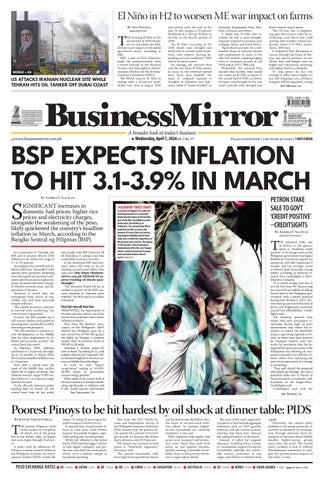
SIGNIFICANT
increases in domestic fuel prices, higher rice prices and electricity charges, alongside the weakening of the peso, likely quickened the country’s headline inflation in March, according to the Bangko Sentral ng Pilipinas (BSP).
In a statement on Tuesday, the BSP said it projects March 2026 inflation to be within the range of 3.1 to 3.9 percent.
According to the central bank, inflation risks have “intensified” with upward price pressures stemming from the significant increase in domestic petroleum prices, higher rice prices, increased electricity charges in Meralco-serviced areas, and depreciation of the peso.
However, it noted that the anticipated lower prices of vegetables, fish, and meat may help temper inflation.
“But upside pressures continue to warrant close monitoring,” the central bank emphasized.
As such, the BSP pointed out it will remain vigilant and guided by incoming data, specifically on inflation and growth prospects.
“We will continue to monitor recent developments in the Middle East for their implications on inflation and economic activity,” the central bank also noted.
In February 2026, inflation quickened to 2.4 percent, the highest in 13 months. In March 2025, the country’s headline inflation was at 1.8 percent. Even after a month since the onset of the Middle East conflict which led to higher oil prices, this inflation forecast range of BSP settles within its 2 to 4 percent target band for the year.
At the off-cycle monetary policy meeting held on March 26, the central bank kept its key policy
rate steady, with BSP Governor Eli M. Remolona Jr. saying a rate hike would delay economic recovery.
In the meantime, BSP said monetary policy will zoom in on addressing second-round effects that may arise. (See: https://businessmirror.com.ph/2026/03/31/experts-tracking-oil-shocks-passthrough/)
“The Monetary Board will act as needed in pursuit of the BSP’s primary mandate to maintain price stability,” the BSP said in an earlier statement.
Peso hits new all-time low MEANWHILE, the depreciation of the peso was also cited as one of the factors that could have led to faster inflation in March.
Data from the Bankers’ Association of the Philippines (BAP) showed the Philippine peso hit a new record low of P60.748 against the dollar on Tuesday, 5 centavos weaker than its previous finish of P60.69 on Monday.
Jonathan L. Ravelas, senior adviser at Reyes Tacandong & Co., said volatile oil prices and “sustained” dollar demand weighed on the local currency as Middle East risks linger. As such, he said: “Expect range-bound trading at 60.60060.900 levels, as uncertainty around energy persists.”
When asked if the current level of the local currency is already contributing significantly to inflation and if this would warrant intervention
‘KALBARYO’ TAKES SHAPE
A resident of Makati City adds the finishing touches to a tarpaulin depicting the Agony in the Garden one of the life-size biblical scenes featured in The Kalbaryo in Poblacion. The annual Holy Week tradition vividly recreates the journey of Jesus Christ to Calvary, drawing the faithful and visitors alike into a reflective experience of His passion and sacrifice. The Agony in the Garden, which took place immediately after the Last Supper, marks a pivotal moment of prayer and surrender before Christ’s arrest. NONIE REYES

said. PIDS explained that higher fuel prices raise transport and production costs, which then push food prices up and squeeze incomes, quickly pushing vulnerable households closer to the poverty threshold as wages adjust slowly.
The state think tank urged policymakers to look beyond aggregate indicators such as GDP growth, inflation, and the current account, warning that these may “obscure the unequal burden” of the shock. Instead, it called for targeted measures, including direct income or consumption support for poorer households, subsidies for vulnerable sectors, protection of real wages, and efforts
By Andrea E. San Juan @andreasanjuan
THE potential stake sale in Petron to the government is “modestly credit positive” in the longer-term as the Philippine government has higher likelihood of financial support for operations and debt repayment if needed, and has stronger access to diverse bank financing, among others, according to financial research firm CreditSights, a FitchSolutions Company.
“It is worth noting that this is not the first time Mr. Ramon Ang has raised the possibility of selling Petron back to the Philippine government, with a similar proposal having been floated in 2021, likewise during a period of elevated oil prices and heightened sensitivity around fuel affordability,” CreditSights said.
The financial research firm thinks that such discussions resurfacing during high oil price environment may reflect his intention to reduce the possibility of price caps being imposed on Petron, as there have been protests by transport workers and comments by lawmakers that the deregulated oil price structure in the Philippines was allowing oil companies to benefit over ordinary citizens, rather than indicating any near-term expectation of a change in ownership.
“That said, should the proposed sale indeed go through, we view a potential stake sale in Petron to the government as modestly credit-positive in the longer-term,” CreditSights said.
CreditSights said with the
By Andrea E. San Juan
By Justine Xyrah Garcia
the likelihood of lower fertiliser application and weaker yields,” BMI said.
“This would intensify food price inflation and worsen food insecurity, especially in import-dependent and climate-vulnerable markets.”
In the Philippines, the state weather agency Pagasa recently issued an El Niño watch after model forecasts suggest an increasing probability of the dry spell conditions occurring as early as July this year.
Price cap on rice mulled as cooking gas costs ₧110 more
By Samuel P. Medenilla & Lenie Lectura
Mbiking tours; farm visits and community-based tourism activities; staycations; wellness and nature escapes within nearby areas; immerse yourself in food culture and discover local cuisines; purchase local products to support micro, small, and medium enterprises.”
The agency also reminded travelers to book only with accredited tourism businesses, a list of which is available at https://tinyurl.com/mr2zynn3 Travelers are reminded to remain mindful of local customs, to care for the environment, and to adopt energy-saving measures at the accommodations or destinations to which they will be heading.
For urgent concerns, the DOT may be reached through its Hotline 151TOUR (151-8687), Mobile no. 0954253-3215, Facebook, and email touristassistance@tourism.gov.ph
EASURES to ensure the country’s food and energy security amid the war in the Middle East, including a new executive order for the implementation of price cap for imported rice and a study on the impact of excise tax suspension, were tackled at the latest meeting of the Unified Package for Livelihoods, Industry, Food, and Transport (UPLIFT) Committee, according to President Ferdinand Marcos Jr. In a video message, the chief executive said he will soon act on the recommendation of the National Price Coordinating Council on the proposed price cap of the Department Agriculture (DA).
“The National Price Coordinating Council has recommended a price cap of P50 per kilo for imported wellmilled rice and we will issue an Executive Order to implement this as soon as possible,” Marcos said. Relatedly, the price of cooking gas in the country is going up by P10 per kilogram (kg), or P110 for an 11-kilogram cylinder, an official of the LPG Marketers Association (LPGMA) said Tuesday.
LPGMA President Arnel Ty said the
first LPG price hike is due April 1 for P5 per kg or P55 per 11kg cylinder and another upward adjustment is set on April 7 for the same amount. “We already implemented a P20 increase recently due to the increasing freight cost or what we call the shipping cost. That and the new contract price are the factors that led to the increase,”
Ty said.
LPG prices in Visayas and Mindanao are more expensive due to higher transportation cost. “It is ranging from P100 to P150 per cylinder more expensive than the ones sold in Luzon,” said Ty.
After the increase, the standard retail price of LPG would range from P1,350 to P1,400 per tank in Luzon and around P1,600 per tank in Visayas and Mindanao.
Ty said the country’s LPG supply will last until mid-May this year.
Profiteering in rice
DA made the rice price cap proposal after getting reports that some rice retailers are selling imported rice over the “reasonable” price of P45 per kg to P48 per kg in 36 major Metro Manila markets.
The incidents of “profiteering” happened with the surge in pump prices after the United States and Israel at-

tacked Iran last month.
“When the price of oil goes up, the price of food follows. That’s what we don’t want to happen,” Marcos said.
Marcos said the Development Budget Coordination Council (DBCC) is set to meet this week to show their study on the possible impact of the Republic Act 12316, which gave the president the power to suspend or reduce the excise tax on petroleum products.
The President has certified as urgent RA 12316 to help the government reduce the price of oil amid the Middle East crisis.
To ensure fresh agricultural and marine products remain accessible to consumers, the government has expanded its P20 rice program, now implemented in 627 centers nationwide.
It will also start distributing fuel subsidies to 40,000 farmers and fuel vouchers to almost 100,000 fisherfolks.
Palace Press Officer Claire Castro said the President also wants to extend the price freeze imposed by the Department of Trade and Industry (DTI) on 205 manufactured basic necessities
Diplomats…
Armed with a stronger deterrent, they argue, the Philippines must pursue a modus vivendi with Beijing. “An attitude that looks at the WPS issue as a zero‑sum game will not produce a result beneficial to Philippine in terests,” the paper emphasizes. To break the deadlock, they propose re suming talks over Reed Bank’s oil and gas reserves through a joint venture where a Filipino company owns 60 percent of vot ing shares, while the Chinese firm holds 40 percent plus an additional 20 percent in non‑voting preferred stock. “Out‑of‑the‑box and difficult solutions are proposed and they will require careful consideration and a change of mindset in both our leaders and people,” the paper underscores. (See related story: https://businessmirror.com.
and prime commodities.
Petroleum purchase
MARCOS also announced government efforts to increase the country’s supply of petroleum products after the Department of Budget and Management (DBM) released P20 billion for its procurement.
He said the Philippine National Oil Company Exploration Corporation (PNOC-EC) ordered 1.04 million barrels of diesel. “There are also 142,000 barrels [delivered] this week. The rest will arrive in April.”
He efforts to assist public utility vehicle drivers with a P2.5billion fuel subsidy program.
“More than 256,000 transport workers in Metro Manila have already received P5,000 cash assistance. There is still P1.28 billion to be given. Nationwide distribution will begin on April 6,” Marcos said.
The UPLIFT meeting also tackled government efforts to repatriate Filipinos in the Middle East.
As of Monday, the Department of Migrant Workers said it brought home a total of 3,248 Filipinos from the conflict-hit region.
ph/2026/03/31/ex-diplomats-proposereed-bank-oil-venture-with-china/)
The release of the white paper comes just days after Manila and Beijing resumed bilateral consultations in Quanzhou, Fujian Province on March 27–28. The meetings, described by the DFA as “candid and productive” and by China as “frank and constructive,” revived oil and gas talks nearly four years after they collapsed in 2022. (See related story: https://businessmirror.com.ph/2026/03/30/phl-china-scsdialogue-tackles-energy-and-oil/)
Ultimately, the retired diplomats caution that Philippine survival depends on adopt ing a truly independent foreign policy and a gradual shift toward non‑alignment.
Pointing to Ukraine’s devastation, they stress: “The major lesson is the need to re main non‑involved in a direct conflict be tween two world powers.” They add that US focus could easily shift to conflicts in the Middle East or Europe, leaving the Philippines vulnerable.
from the BSP, Ravelas explained to the BusinessMirror: “Transmission effect of peso depreciation is small at 0.04 percent for every 1 peso depreciation.”
Philippine Institute for Development Studies (PIDS) Senior Research Fellow John Paolo R. Rivera said BSP may intervene, but “likely only to smooth excessive volatility, not defend a specific level like 61.”
“Since the drivers are largely external, intervention can help stabilize shortterm movements but cannot fully reverse the trend. BSP typically steps in only if movements become disorderly than based on a specific exchange rate threshold,” added Rivera.
Chinabank’s Group Chief Economist Domini S. Velasquez said in a Viber message:
“The Philippine peso remains under pressure amid escalating tensions in the Middle East, with heightened uncertainty driving investors toward the US dollar as a safe-haven asset.”
In recent days, Velasquez said the currency’s weakness appears “largely sentiment-driven, as risk-off flows continue to favor the US dollar.”
“Fundamentally, an expanding trade deficit—driven in part by higher oil prices—could further dampen the peso. However, a clear sign of de-escalation in the conflict could prompt a correction. Should tensions escalate further, downward pressure on the currency is likely to persist in the near term,” added Velasquez.
Michael L. Ricafort, chief economist at Rizal Commercial Banking Corporation (RCBC) said the depreciation of the peso could be attributed to “the continued attacks by Iran in the Middle East on some energy assets/infrastructure such as a Kuwaiti tanker in Dubai.”
Further, Iran was said to be pushing the Houthis to prepare for a renewed campaign against Red Sea shipping should US attacks escalate, Ricafort noted. The Philippine peso weakened for the fifth straight trading day on Tuesday. Within the trading session, its weakest level was at P60.75 against the greenback while its strongest level was at P60.58. Remolona said during the off-cycle meeting that the central bank is not intervening heavily in the foreign exchange market.
“[In] the foreign exchange market so far, we don’t intervene to maintain a level for the peso. We intervene largely to dampen the swings...[of] the peso that are inflationary,” Remolona said. The central bank governor noted, however, that the BSP has “thresholds” that would determine if the exchange rate becomes inflationary.
“That will then add to our projection of inflation, and that will help decide whether to hike or not. It will also help decide to what extent we should intervene,” added Remolona.
government takeover of the country’s sole refinery: There

is “higher likelihood” of financial support for operations and debt repayment if needed, stronger access to diverse bank financing, resulting in lower funding costs and improved liquidity; and the Philippine Government’s stronger credit rating (Baa2/ BBB+/BBB) relative to San Miguel Corporation. (SMC) (unrated but which is considered BB/BB- by CreditSights).
The research firm also said it expects Petron to be considered “strategically important” to the Philippine government if the deal goes through, given

Petron operates the country’s sole refinery supplying 35 percent to 40 percent of total domestic fuel needs. Meanwhile, CreditSights said the deal could be “slightly credit negative” in the near-term due to fuel regime changes (e.g. fuel price caps or export curbs) which could weigh on its working capital, execution uncertainties, and “potential incurrence” of large strategic capex obligations to ensure Philippine self-sufficiency. Still, the firm maintained these risks are outweighed by the “above positives.”
“SMC currently owns a 71.8-percent stake in Petron, and can sell up to a 35.8- percent stake to the government to before triggering a Change of Control (Coc),” said CreditSights. As such, the financial research firm maintains its “Outperform recommendation” on Petron.
“Petron’s sole c.2028 perp trades at G+ 394. We continue to think the perp offers attractive carry till its first call date in 2.5 years, with room for modest spread tightening relative to BB-/B+ peers including SMC Global Power, Medco Energi, and ReNew Power,” CreditSights explained.
“We see low non-call risk for the perp, underpinned by strong parental support from the domestically well-reputed SMC, timely $ perp redemption track record across SMC and its group entities, and sturdy credit outlook supported by marketlinked fuel pricing mechanisms in the Philippines/Malaysia and low capex,” it also noted.
Cops launch manhunt for killers of policeman
THE National Police (PNP) on Tuesday launched a manhunt for the gunmen behind the killing of a police corporal and his companion in Lanao del Sur.
The PNP said directives have been issued to ground commanders, particularly in the Police Regional Office in the Bangsamoro Autonomous Region in Muslim Mindanao (BARMM), to identify and arrest the perpetrators.
“We strongly condemn this senseless and cowardly ambush. We will not let this pass, and the Philippine National Police will respond with the full force of the law,” Gen. Jose Melencio Nartatez Jr., PNP chief, said in a statement.
Nartatez added that the PNP is coordinating with the military to strengthen security measures across BARMM to prevent further violence in the region.
Police identified one of the victims as Cpl Walid Buleg Sangcopan. He had a civilian companion. They were riding a gray Toyota Innova when gunmen attacked them along a secluded highway in barangay Paglamatan, Saguiaran, Lanao del Sur, before dawn on Saturday.
The incident occurred just hours after a separate deadly ambush in Shariff Aguak, Maguindanao del Sur, which left five police personnel dead and three others wounded.
The PNP said the Maguindanao ambush could be linked to a local terror group, following recent police operations that led to the neutralization of several of its members in previous months.
Nartatez said operations are in full swing to track down those behind the two attacks.
Rex Anthony Naval with PNA
Senator to BIR: Complete implementation of EOPT a must
By Butch Fernandez @butchfBM

ASENATOR on Tuesday re -
minded the Bureau of Internal Revenue that “fully and effectively” implementing the Ease of Paying Taxes (EOPT) Act should be its priority.
Sen. Sherwin Gatchalian issued the reminder ahead of the April 15 deadline for the filing annual income tax returns (ITRs).
Gatchalian said compliance particularly for small taxpayers, including micro, small, and medium enterprises (MSMEs), should be made simpler.
“ Isinulong natin ang EOPT dahil ang pagpapasimple ng proseso ng pagbabayad ng buwis ay susi sa pagpapalakas ng koleksyon ng kita ng pamahalaan [We pushed the [passage of the] EOPT [law]
because simplifying the process of paying taxes is key to boosting collection and government revenue],” said Gatchalian, principal author of the law and chairman of the Senate Committee on Finance.
The EOPT law mandates the streamlining of tax filing by introducing a file-and-pay-anywhere system and enabling most transactions to be completed online.
Signed into law in January 2024, the measure classifies taxpayers into micro, medium, and large categories based on gross sales, allowing for a more responsive tax system tailored to each segment. It also mandates a shift to an invoice-based system to simplify registration and expedite the processing of value-added tax (VAT) refunds.
Business groups, govt align on measures to shield consumers
KEY business organizations have expressed support for the government’s efforts to cushion the impact of rising global oil prices stemming from the ongoing Middle East crisis.
In a joint statement, major industry groups said they are committed to work closely with the Marcos administration to protect Filipino consumers and sustain economic stability as energy market uncertainties persist.
The statement followed a high-level dialog convened by Finance Secretary Frederick D. Go to map out a “whole of nation” approach in addressing the energy emergency.
“Unity is our greatest strength in navigating global instability,” the groups said, as they reaffirmed their commitment to continued dialog with the government.
The groups, including the Federation of Filipino-Chinese Chambers of Commerce and Industry, Inc., Federation of Philippine Industries, Makati Business
Asean members start talks on transfer of convicts pact
By Joel R. San Juan @jrsanjuan1573
REPRESENTATIVES
from the Philippines and several member states of the Association of Southeast Asian Nations (Asean) have commenced the negotiations for the signing of a treaty on the transfer of sentenced persons (TTSP)
This was announced by the Department of Justice (DOJ), which hosted the first meeting of the technical working group on TTSP from March 25 to 27 in Manila.
Aside from the Philippines, those who participated in the meeting were delegations from Cambodia, Indonesia, Lao PDR, Malaysia, Timor-Leste, and Vietnam.
The meeting was opened by
Chief State Counsel Dennis Arvin L. Chan while Assistant Chief State Counsel Mildred B. Alvor chaired the meeting.
Senior State Counsel Grace L. Estrada headed the Philippine delegation
The DOJ said the delegates engaged in “substantive and productive” discussions on the respective legal systems and domestic frameworks of participating states and concluded the first reading of the draft treaty.
Under the proposed TTSP, sentenced persons who are citizens of like-minded Asean member states, including Filipinos, may be transferred to their home countries to serve the remainder of their sentences. The DOJ said this mechanism is
envisioned to promote social reintegration and rehabilitation by allowing persons deprived of liberty to remain closer to their families and within familiar cultural and social environments.
At present, the Philippines has existing bilateral TSP agreements in force with the Hong Kong Special Administrative Region, Spain, and Thailand.
A recently signed agreement with the United Arab Emirates is pending concurrence by the Senate, while agreements with Canada and the United Kingdom have yet to enter into force.
The DOJ said a number of issues which have yet to be settled have been scheduled for further deliberation in subsequent meetings.
DOJ extends visas of stranded foreigners
USTICE Secretary Fredderick
JVida has extended for another month the validity of visas of foreigners who remain stranded in the country owing to the ongoing conflict in the Middle East.
At a press briefing, Vida said he has signed Department Order 219 directing the Bureau of Immigration (BI) to extend the visa relief for affected foreign nationals until May 1, 2026.
It may be recalled that on March
Energy
9, Vida issued Department Order 159 granting visa relief to foreign nationals affected by the mass cancellation of outbound flights from the country to Middle East and other affected areas.
Covered by the order are foreign nationals whose valid stay expired on February 28, 2026 onwards.
This means foreign nationals affected by the Middle East conflict can still validly stay in the
country until May 1.
“The Bureau of Immigration is hereby directed to implement the Department Order accordingly,” the department order read.
Covered by the relief are temporary visitors or tourists whose authorized stay expired during the disruption, and foreign nationals who were scheduled to depart but were unable to do so due to flight cancellations.
Vida clarified that both depart -
ment orders cover all states or regions affected by the ongoing conflict, specifically those within the Gulf Region. Foreign nationals applying for visa relief are required to present the original boarding pass, confirmed flight itinerary or e-ticket as proof of prior scheduled travel, booking reference, notification of cancellation or rebooking, certification from the airline and other relevant documents. Joel R. San Juan
emergency exposes vulnerability, highlights need to shift to
By Jonathan L. Mayuga @jonlmayuga
THE Philippines’ declaration of a national energy emergency under Executive Order 110 has exposed the country’s heavy dependence on imported fossil fuels, which leaves it vulnerable to global supply disruptions and fuel price fluctuations, a Philippine-based nongovernment organization said.
Nevertheless, the Institute for Climate and Sustainable Cities (ICSC) said the situation offers an opportunity to transform the country’s energy system with locally driven, fit-for-purpose solutions through the shift to renewable energy.
Club, Management Association of the Philippines, and the Philippine Chamber of Commerce and Industry, cited the need for a coordinated response to mitigate the economic impact of volatile oil prices.
During the discussions, both government and private-sector stakeholders identified several priority measures to stabilize supply and prices.
Among these is the exploration of government-to-government oil procurement with non-traditional partners such as Russia, Indonesia, and India to ensure supply security.
Business leaders also underscored the importance of maintaining stable interest rates and reducing non-fuel costs to prevent spikes in the prices of basic commodities.
Targeted subsidies for vulnerable transport sectors, including jeepney and bus operators, were
While ICSC says it acknowledges the decisive leadership and whole-of-government effort embodied in President Marcos’ issuance of EO 110. These measures are necessary to allow the use of government resources to stabilize supply, but was quick to say such
is not enough.
“The effects of the crisis brought by the US-Israel war on Iran will be felt long after the situation in the area is resolved, and its lessons must compel us to pursue structural reforms that reduce this perennial vulnerability to global instability and give Filipinos greater control over their energy future,” ICSC said.
ICSC advances climate, energy, and low-carbon solutions to enable fair and climate-resilient development at the national and international levels.
According to ICSC, the Philippines’ power system was shielded in part from past fuel crises because of early government investments in RE resources such as geothermal and hydropower, which continue to benefit the system today.
“With the addition of solar, wind, pumped storage hydro, and battery energy storage systems since the enactment of the Renewable Energy Act in 2008, the coun -
renewables–group
try is in a stronger position than ever to deploy local solutions and reduce dependence on imported fuels,” it said.
ISCS proposed to strengthen the country’s energy resilience to future shocks and disruptions through several measures across sectors, such as the adoption of alternative work arrangements and short-term demand-side measures.
“These must all be fused into a comprehensive national program on energy efficiency and conservation, and system transformation,” it said.
Among the proposals on the transportation sector is to accelerate electric vehicle adoption for public fleets and expand mass transit to reduce oil demand.
Meanwhile, it proposes shortterm interventions to stabilize prices, which are quick fixes that have unsustainable effects as they leave the structural imbalance embedded: fuel costs which drive electricity price increases, are fully and automatically passed on to
consumers, instead of risks being shared across the rest of the sector or, more importantly, on those that can control the risk when fuel is procured. Every external shock is, therefore, transmitted directly to households and businesses, placing sustained pressure on both.
“Authorities should review pricing mechanisms to ensure that generators, suppliers, and utilities share in fuel price risks, that efficiency improvements are incentivized, and that consumers are not fully and immediately exposed to sudden price spikes,” it added. ICSC said the government can help keep electricity costs fair and predictable by sharing risks from fuel price fluctuations and preventing sudden spikes in bills. Consistent, fair and firm oversight of energy markets and enforcement of competition rules will ensure that consumers are adequately protected while the power system remains reliable.
LTFRB to drivers: Practice discipline, restraint
By Lorenz S. Marasigan @lorenzmarasigan
THE Land Transportation Franchising and Regulatory Board (LTFRB) on Tuesday called on public utility vehicle (PUV) drivers and private motorists alike to practice discipline and restraint on the road as the Semana Santa exodus gets underway, warning that road rage incidents will only ruin what should be a time for rest and reflection.
LTFRB Chairman Vigor D.
Mendoza II reminded PUV drivers that they bear responsibility for passenger safety and must exercise maximum restraint to avoid unnecessary altercations.
“Learn from the lessons of road rage incidents in the past. Wala itong naibubungang maganda at sisirain lang nito ang araw ninyo. Hindi kabawasan sa pagkatao at pagka-lalaki ang pagpapasensya para sa kapakanan ng ating pamily a,” he said. He also took a pointed jab at the financial cost of losing one’s
temper: “Mataas na ang presyo ng diesel at gasolina, huwag na ninyong dagdagan ng gastos sa pang-piyansa.”
The LTFRB has already granted special permits to nearly 1,300 passenger buses to accommodate the anticipated surge in commuters, partly driven by high petroleum prices pushing more travelers toward public transport.
Mendoza has also directed all LTFRB regional directors to step up inspections of passenger buses and other PUVs for the holiday period, covering not only vehicle
roadworthiness but also the mental and physical fitness of drivers. Transport companies and operators were, likewise, urged to take an active role in reminding their drivers to follow road safety rules, including anti-road rage measures.
“Remember that Holy Week is also a time for reflection. And one of the best ways to observe Semana Santa is to exercise discipline and self-control in times of any incident that challenges your character,” said Mendoza.
‘Expect spike in seafood prices during Holy Week’
By Jonathan L. Mayuga @jonlmayuga
PRICES of fish may further increase during the Holy Week, not only because of high demand, but also because of the oil price shock that “drastically increased” the production cost in the fish trade, according to a national federation of fishermen’s organizations, on Tuesday.
“The government’s failure to address the oil crisis will also affect consumers, especially Filipino Catholics who abstain from meat during Holy Week. There were reports that retail prices of fish have already increased by 20 percent over the weekend,” Fernando Hicap, national chairperson of the Pambansang Lakas ng Kilusang Mamamalakaya ng Pilipinas, said.
Hicap, however, clarified that the high retail price of seafood does not reflect the farmgate price, as fish traders procure it from small fishermen at very low prices.
He lamented that while the fuel cost of fishermen has increased by 120 percent, prices of their produce remain depressed due
to “control and underpricing” of fish traders.
For instance, the retail price of blue crab (alimasag) in Manila Bay is around P500-P600 per kilo, while its farm gate price is as low as P180-P200 per kilo.
The fishers’ group said that it is monitoring the prices of fish in major fish ports in Manila Bay, including the Navotas Fisheries Port Complex, and the Bulungan Seafood Market in Parañaque.
Earlier, Pamalakaya said small fishermen in the Ilocos Region have complained of the spike in the production costs because of the oil price hike and warned that without government support, many fishermen may eventually decide to stop fishing.
Tarlac-NE expressway link seen to lower transport costs
RESIDENT Marcos Jr. on
PTuesday presided over the opening of the Central Luzon Link Expressway (CLLEX) link that connects Tarlac and Cabantuan City in Nueva Ecija, and announced that the newly-opened road will be toll free until December.
“It’s free for now,” the chief executive said in Filipino at the opening of the CLLEX Contract Package 4 at the town of Aliaga in Nueva Ecija.
The inaugurated segment of the CLLEX is expected to benefit around
11,500 motorists daily. It extends the expressway from the San Juan interchange in Aliaga, Nueva Ecija, to the Cabanatuan exit.
Public Works Secretary Vivencio B. Dizon said they are currently looking for a private company to operate and maintain that segment of the CLLEX.
“It’s hard for the government to maintain and operate [such an expressway]. So PPP [public private partnership] is really needed. But until that happens, [the passage in the said segment is] free,” Dizon
told reporters in Filipino.
Marcos said the opening of the new part of CLLEX will not only result in faster travel time for motorists, but also lower logistics expenses amid the Middle East crisis.
“As long as the journey is faster, the cost of consumption is reduced and the price of the product that our trucks carry will not increase. That’s the big impact here,” he explained.
He said it will also contribute to lowering of rice prices since Nueva Ecija is known as the country’s
“Rice Granary.”
“This will help reduce transport costs and thus, by reducing transport costs, the price of rice will remain stable,” Marcos said.
Funded by the Japan International Cooperation Agency (Jica) through an official development assistance (ODA), the P10-billion four-lane CLLEX is the first eastwest highway in Luzon, Marcos said.
With the opening of its new segment, Phase 1 of the 29.2-kilometer CLLEX is now complete.
Samuel P. Medenilla
CL devt council endorses ₧197.64 billion budget for ‘27
By Henry Empeño
IBA, Zambales—The Central Luzon Regional Development Council (RDC III) has approved the Fiscal Year 2027 Tier 2 budget amounting to P197.64 billion proposed by 32 regional line agencies of the national government and 12 state universities and colleges in the region.
Zambales Gov. Hermogenes Ebdane Jr., who chairs RDC III, said the council approved the budget proposals during a full-council meeting on March 23, and following meticulous consultations with concerned parties.
The Tier 2 programs and projects are expected to accelerate inclusive economic growth,
strengthen social services, enhance governance systems, promote environmental sustainability, and modernize infrastructure across Central Luzon.
Ebdane said the final budget proposals hewed closely to the Central Luzon Regional Development Plan (CL-RDP) for 2023-2028, which was recently updated, and reflected regional aspirations for an efficient, more inclusive, and progressive development program.
“We didn’t just approve the budget; we set the direction for growth,” Ebdane said, adding that he has emphasized that regional priorities must be lean, responsive, and high-impact.
“Our goal is not just to spend but invest wisely, efficiently, and

equitably when it matters the most,” he added.
Among the important budget items approved by RDC III are those from the economic development sector that covered regional thrust to ensure food security, promote trade and investments, modernize agriculture and agribusiness, revitalize industry and services sectors, and advance research and development, technology, and innovation.
Meanwhile, proposals from the environment sector pushed for key interventions in ecosystem protection, environmental management, natural resources governance, and climate-resilient development.
A key item adopted under this sector is the five-year strategic roadmap developed by the Department of Environment and Natural Resources-Biodiversity Management Bureau (DENR-BMB) for the commercialization of Banaba (Lagerstroemia speciosa), a flowering tree known for medicinal properties.
This project “presents significant opportunities for rural enterprise development, biodiversity conservation, and inclusive growth in local communities,” proponents said.
RDC III also approved budget proposals previously vetted by its Social Development Committee chaired by Pampanga Governor Lilia G. Pineda, which pressed for priority programs in education, health, employment, housing, and social protection.
In the March 23 meeting, RDC III also signified support to DILG’s Local Government Code of 1991 Review and Amendment Program (ReVamP) and the BSP’s Paleng-QR PH Plus Program; designated the DOST III and DTI III as regional representatives to the 2026 Presidential Filipinnovation Awards National Selection Committee; and reconstituted the Regional Land Use Committee (RLUC III) as a special committee under RDC III to strengthen land use and spatial planning coordination.
Worst-case scenarios based on ‘extreme assumptions’
TBy Ada Pelonia @adapelonia
HE Department of Agriculture (DA) allayed concerns over a potential spike in food prices, citing “extreme” projections anchored on surging oil prices are “unlikely.”
Agriculture Secretary Francisco Tiu Laurel Jr. said the “worst-case scenarios,” assuming that crude oil prices average $200 per barrel for six months, presented to the Senate were based on “extreme assumptions” and excluded mitigating measures.
“The prices presented assumed the full impact of soaring crude,” Tiu Laurel said. “They did not factor in government action, which we will undertake to protect Filipinos from an oil shock.”
The DA said rising geopolitical tensions in the Middle East have fueled concerns about energy supply disruptions, particularly in the Strait of Hormuz, a critical chokepoint for oil and fertilizer trade.
This, as roughly 30 percent of global urea trade and around 20 percent of ammonia and phosphate flows pass through the strait.
Still, the DA stressed that the government is moving to cushion potential fallout.
For one, it cited the Department of Energy (DOE) securing additional crude supply from non-traditional sources, including Russia, helping diversify import channels.
On the agriculture side, Tiu Laurel said the Fertilizer and Pesticide Authority (FPA) is authorized to make emergency purchases.
State-linked firms such as Planters Products Inc. (PPI) can boost imports of the farm input, he added. In October, PPI imported a total of 120,000 bags of 14-14-14 complete fertilizer from Vietnam.
The DA said it is also exploring alternatives, such as organic fertilizers, including chicken manure, to reduce dependence on petroleum-based inputs.
Despite the global uncertainty, the agency noted that domestic indicators remain stable.
“Food prices have held broadly steady, while pork inventories are adequate and broiler production is exceeding demand, easing farmgate prices.”
While risks remain if oil prices stay elevated, Tiu Laurel said current conditions suggest that the sector is better positioned to absorb shocks than initial projections imply.
Meanwhile, he warned against profiteering amid the energy crisis, warning traders and suppliers against unjustified price hikes and hoarding.
“We are ready to apply the full force of the law against anyone who seeks to exploit the situation,” Tiu Laurel said.
DA to distribute cash aid, fuel support for farmers, fishermen
By Carmel Pedroza
CEBU CITY—The national government will soon roll out cash assistance and fuel subsidies to support farmers and fishermen grappling with the effects of rising fuel prices, as part of a broader effort to protect livelihoods and stabilize food production.
Under the Presidential Assistance to Farmers and Fisherfolk (PAFF) program, the Department of Agriculture (DA) is set to distribute P10 billion in cash aid this April to registered beneficiaries.
The initiative aims to help offset increasing operational expenses, particularly those linked to fuel.
At the same time, fuel subsidies will be distributed to ease the burden on farmers and fishermen who rely on diesel-powered equipment and fishing vessels.
Melquiades Ibarra, chief administrative officer of DA in Central Visayas (DA-7), said they are now only waiting for the guidelines to be released in order to determine the exact date of the distribution and the exact amount the beneficiaries would receive for Cebu and Bohol provinces.
Ibarra shared, based on the database from DA-7, there are a total of 314,481 registered farmers in the region.
Despite these interventions, the continued increase in fuel prices is placing significant strain on the agriculture sector.
Higher gasoline and diesel costs are driving up transportation expenses, making it more costly to move goods from farms to markets.
For fishermen, the impact is immediate, as fuel is a primary component of daily fishing operations. The ripple effects are also being felt in farm inputs.
Rising fuel prices contribute to higher fertilizer costs, further increasing production expenses for farmers.
DA said these price movements are being closely monitored, with regular updates available through the Fertilizer and Pesticide Authority (FPA).
Looking ahead, the agency noted that the direction of food prices—including rice, vegetables, and fish—will depend largely on global developments, particularly in the Middle East.
Prolonged conflict in the region could keep fuel prices elevated, leading to sustained increases in logistics costs and potentially higher prices for agricultural commodities.
A5 Wednesday, April 1, 2026
Marcos orders DFA to initiate talks with Iran to secure oil supply routes
By Samuel P. Medenilla @sam_medenilla
PRESIDENT
Ferdinand Marcos
Jr. ordered the Department of Foreign Affairs (DFA) to initiate a high level meeting with Iran for the safe passage of Philippine-bound ships in the Strait of Hormuz to ensure the country’s sufficient supply of petroleum products.
Palace Press Officer Claire Castro disclosed that the Chief Executive issued the directive during the meeting of the Unified Package for Livelihoods, Industry, Food, and Transport (UPLIFT) committee last Monday. Marcos created the UPLIFT Committee through Executive Order (EO) No. 110 to help mitigate the socio-economic impact of the Middle East crisis.
Speaker Dy encourages Filipinos to turn Holy Week reflection into compassion and unity
PEAKER Faustino
S“Bojie” G. Dy III on Monday urged Filipinos to use Holy Week not only for personal reflection but also as a moment to strengthen national unity and resilience amid ongoing social and economic challenges.
Dy said the solemn season comes at a crucial time, as many Filipinos continue to face personal and collective challenges, making the message of sacrifice, forgiveness, and hope more meaningful than ever.
“As we enter Holy Week, I invite every Filipino to pause and reflect on the meaning of these sacred days,” Dy said in a video message.
He emphasized that Holy Week goes beyond tradition, serving as a moral compass that reminds Filipinos of the enduring values that sustain unity and resilience.
“Holy Week reminds us of sacrifice, forgiveness, and hope—lessons that continue to guide us as individuals and as a nation,” he said. The lawmaker underscored that even in difficult times, there is always room for hope and renewal.
“Amid life’s challenges, we are reminded that after every darkness comes the dawn of light, and hope always has a place in the hearts of every Filipino,” he added.
Dy also encouraged Filipinos to turn reflection into action by deepening their faith, strengthening family ties, and showing genuine concern for others.
“May this be an opportunity to nurture deeper faith, foster stronger love for family, and cultivate greater compassion for one another,” he said.
Dy expressed hope that the spirit of Holy Week would inspire unity and a shared sense of responsibility in building a more compassionate and resilient nation.
“May you all have a peaceful and blessed Holy Week. God bless you, and God bless the Philippines,” he said.
Jovee Marie N. Dela Cruz
“According to Secretary Tess Lazaro of the DFA, she will speak with the Iranian ambassador, most probably tomorrow. If not tomorrow, by next week [on the matter],” she said in a press briefing last Tuesday.
Citing Lazaro, Castro said the country has good diplomatic relations with Iran.
The Presidential Communications Office (PCO) undersecretary issued the statement when asked about the proposal of Senator Sherwin T. Gatchalian for the government to negotiate with Iran to allow oil vessels to safely pass through the Strait of Hormuz.
Other countries like India and Pakistan held talks with Iran to allow their ship to pass through the waterway, where a fifth of the country’s oil trade passes through.
Last week, it was reported that
Pakistan was able to secure a deal with Iran allowing 20 Pakistaniflagged ships to pass through the Strait of Hormuz.
The Strait of Hormuz was effectively closed by Iran after it was attacked by the United States and Israel last month resulting in a surge in global pump prices.
Since the armed conflict started in the Middle East, Iran has attacked at least 18 ships, which were passing through the Strait of Hormuz.
The supply chain disruption in the Middle East has prompted the Philippines to engage in talks with Japan, South Korea, Malaysia, and Russia to secure additional oil supply, according to Marcos.
As of last week, the chief executive said the country has sufficient fuel supply to last until June with the arrival of the shipment of crude oil from Russia.
Comelec dismisses impeachment raps as ‘old issues’ and false
By Mary Jade Jadormio
THE Commission on Elections (Comelec) dismissed the allegations of irregularities in election technology, data handling, and campaign finance enforcement as recycled and unfounded.
In a statement, Comelec said the accusations have already been addressed in previous clarifications and are becoming redundant.
Lawyers Eldridge Aceron and Sikini Labastilla claimed that the commission used an uncertified software version during the 2025 national and local elections.
Comelec clarified that the final source code version 3.5.0 used in more than 110,000 automated counting machines underwent full review and certification, including inspection by accredited citizens’ arms and independent auditors.
The commission cited the certification conducted by Pro V&V, which confirmed that version 3.5.0 was the “Final Trusted Build” completed on March 29, 2025 in Alabama, United States.
“The source code version used in the May 12, 2025 elections complied with the legal and technical processes required by law,” Comelec said.
The poll body also rejected claims that it operated an un -
authorized intermediary server known as “Data Center 3,” clarifying that the facility merely housed five independent transparency servers used by political parties, citizens’ arms, and media organizations.
Among those with servers in the facility were the Lakas-CMD, Nacionalista Party, Parish Pastoral Council for Responsible Voting, and National Citizens’ Movement for Free Elections.
Comelec stressed that these servers function independently and receive election results directly from vote-counting machines and boards of canvassers, not through any intermediary system.
It added that Data Centers 1, 2, and 3 are physical facilities, not servers themselves, countering what it described as a mischaracterization of the election infrastructure.
On the issue of a shared private IP address used by over 20,000 modems during the 2022 elections, Comelec said this setup does not affect the accuracy or legitimacy of transmitted results and is not prohibited by law.
The commission also noted that manually assigning unique IP addresses to each modem would have been impractical and could have delayed election preparations.
It further clarified that the
planned manual recount in 2022 did not proceed due to a petition filed by former Information and Communications Technology official Eliseo Rio Jr. and others seeking to declare a failure of elections and annul the results.
Addressing accusations of bias in campaign finance cases, Comelec maintained that its rulings are grounded in election laws and jurisprudence, denying claims that it favored administration-aligned candidates.
It cited cases involving Francis “Chiz” Escudero and Rodante Marcoleta, saying decisions on their campaign donations underwent thorough review across multiple departments before being resolved.
Comelec Chairman George Erwin M. Garcia inhibited himself from participating in the decisions to avoid any conflict of interest, according to the statement.
“The decisions of the commission are anchored on election laws, rules, and Supreme Court rulings,” the statement read, noting that the cases may still be elevated to the High Court.
Despite the complaint, Comelec said it will face the proceedings “with courage and integrity,” reaffirming its mandate to deliver elections that are free, fair, honest, orderly, credible, and transparent.
DepEd secures DBM approval to reclassify 914 principal applications, boosting ‘one school, one principal’ goal
By Claudeth Mocon-Ciriaco @claudethmc3
TO help achieve the “one school, one principal policy,” the Department of Education (DepEd) on Tuesday announced that it has secured the approval of the Department of Budget and Management (DBM) to reclassify 914 pending applications for School Principal positions.
The milestone marks a significant advancement in DepEd’s efforts to address the nationwide principal shortage and strengthen instructional leadership in public schools.
The approval, which covers pending applications of Head Teachers, Assistant School Principals, and Teachers-inCharge (TICs), was made possible
through the strong collaboration between DepEd led by Secretary Juan Edgardo “Sonny” Angara, and the DBM under Acting Secretary Rolando U. Toledo.
This development directly supports the directive of President Ferdinand R. Marcos Jr. to prioritize the welfare and professional growth of educators.
“We remain steadfast in our commitment to uplifting the welfare and professional development of our teachers and school leaders,” Angara emphasized, adding that the approval brings us closer to their vision of ensuring every school is led by strong instructional leadership that supports “quality education for all learners.”
The approval recognizes the critical roles performed by TICs and other on-stream candidates
who have long managed school operations by virtue of designation, often without compensation commensurate with their heavy responsibilities.
DepEd underscored that this development is a significant step toward addressing the longstanding shortage of principals nationwide.
It also reinforces the Department’s commitment to strengthening career progression pathways and ensuring that qualified educators are promoted in a timely and equitable manner.
Moving forward, DepEd will continue to work closely with the DBM and other stakeholders to sustain reforms that promote professional growth, enhance instructional leadership, and ultimately improve the quality of basic education across the country.



A8 Wednesday, April 1, 2026
Editor: Angel R. Calso
US attacks Iranian nuclear site while Tehran hits oil tanker off Dubai coast
By Jon Gambrell & David Rising
The Associated Press
DUBAI, United Arab Emir -
ates—The United States
hit the central Iranian city of Isfahan early Tuesday, sending a massive fireball into the sky, and Tehran struck a fully loaded Kuwaiti oil tanker in the Persian Gulf. The attacks were testament to the intensity of the monthlong war the US and Israel launched against Iran, which has maintained its chokehold on the Strait of Hormuz, closing off the vital waterway for global energy shipments, sending oil prices skyrocketing and roiling world markets.
US President Donald Trump, who has been insisting there is progress in diplomatic talks toward a ceasefire, shared video of the attack on Isfahan, with fiery explosions lighting up the night sky. Isfahan is home to one of three sites earlier attacked by the US military in June and some of Iran’s highly enriched uranium is
likely stored or buried or there.
Meanwhile, Israel said another four soldiers had been killed in its invasion of Lebanon, as were two more United Nations peacekeepers, prompting the U.N. Security Council to schedule an emergency session for later Tuesday.
Iran launches new attacks on Gulf neighbors and hits oil tanker in Dubai waters
SPOT prices of Brent crude, the international standard, hovered around $107 a barrel in early trading, up more than 45% since the war started Feb. 28 when the US and Israel attacked Iran. US gas prices jumped past an average $4 a gallon for the first time since 2022. Iran’s stranglehold on the Strait of Hormuz, the waterway leading out of Persian Gulf through which a fifth of the world’s oil is transported during peacetime, has driven up global oil prices, as have its attacks on Gulf regional energy infrastructure.
In response to growing Gulf Arab anger, Iranian Foreign Min -

ister Abbas Araghchi insisted Tuesday that Tehran is only targeting US forces. Several states have been
encouraging Washington to continue the war until Iran’s military capabilities are destroyed.
can provide any security,” Araghchi wrote on X. “High time to eject US forces.”
Despite these words, attacks on civilian targets continued as an Iranian drone hit a Kuwaiti oil tanker in Dubai waters, sparking a blaze that was later put out, the Dubai Media Office said.
Four people in Dubai were also wounded when debris from an intercepted drone fell into a residential area and loud explosions could be heard later from another attack on the city.
Air raid sirens sounded in Bahrain, while Saudi Arabia’s Defense Ministry said it had intercepted three ballistic missiles launched toward Riyadh, and falling debris from a drone intercepted southeast of the capital caused minor damage to six homes.
“Our operations are aimed at enemy aggressors who have no respect for Arabs or Iranians, nor
Sirens were also heard in Jerusalem and loud explosions were heard not long after Israel’s military warned of an incoming missile barrage from Iran.


A PORTRAIT of Iran’s late Supreme Leader Ayatollah Ali Khamenei, left, is seen, as smoke rises following an Israeli airstrike in Dahiyeh, Beirut’s southern suburbs, Lebanon, Monday, March 30, 2026. AP/HASSAN AMMAR
Chinese warships, coast guard vessels continue operations at WPS, 90 spotted in March–PN
ATOTAL of 90 Chinese warships and coast guard vessels were monitored throughout March at four key features in the West Philippine Sea (WPS), a senior naval officer reported on Tuesday.
“Specific to the WPS, we have documented the persistent and unauthorized presence of the People’s Liberation Army Navy [PLAN] and China Coast Guard [CCG]. For this month, a total of 90 different vessels
were monitored across [four] key features,” the Navy (PN) spokesperson for the WPS, Rear Adm. Roy Vincent Trinidad, said during a press briefing at Camp Emilion Aguinaldo in Quezon City.
“This is much higher than the 62 Chinese warships and coast guard monitored last February.”
He identified the four WPS features as Bajo de Masinloc, Pagasa Island, Ayungin, and Escoda shoals.
Trinidad said the Chinese vessels in these areas can be broken into the following:
n Bajo de Masinloc: 49 vessels (17 PLAN, 32 CCG);
n Pag-asa: 15 vessels (four PLAN, 11 CCG); *Ayungin Shoal: 14 vessels (four PLAN, 10 CCG);*Escoda Shoal: 12 vessels (seven PLAN, five CCG).
“These figures highlight the
continued use of Icad [illegal, coercive, aggressive and deceptive] actions, which undermine the rules-based international order and is a blatant attempt to erode the territorial integrity, sovereignty, and sovereign rights of the Philippines,” Trinidad said.
“We have noted in the past two weeks an escalation of their numbers, which coincided with developments in the Middle East region,” Trinidad said.
He added that the increase can be attributed to China’s desire to take advantage of every opportunity to “legalize their illegal presence and to normalize the situation.”
Such actions, the PN official said, are deliberate, and China is trying to take advantage of the focus of the international community in the Middle East.
Despite these challenges, Trinidad said the Armed Forces (AFP) remains steadfast in its mandate of protecting Philippine sovereignty and territory.
Marina raises cap on shipping rate hikes
By Lorenz S. Marasigan @lorenzmarasigan
THE Maritime Industry Authority (Marina) has raised the ceiling on shipping rate adjustments to 30 percent and imposed stricter notice requirements on domestic operators, as the government moves to contain the impact of surging global fuel costs on sea freight and passenger fares.
According to Marina Advisory
Emergency. . .
Continued from A3
“While the country weans itself from its fuel importation dependence, we must also build stronger safeguards against fuel disruptions. This includes expanding strategic petroleum reserves, raising minimum oil inventory levels, and setting clear protocols for energy conservation during emergencies. These measures provide time for orderly market adjustments and reduce the impact of supply disruptions.” Ultimately, the sustainable solution is
Continued from A3
likewise proposed to help offset rising fuel costs without necessitating fare increases.
The government has already distributed fuel subsidies and cash assistance to tricycle, jeep, taxi, bus, TNVS, and delivery drivers.
In addition, the groups emphasized the need to promote locally manufactured products to support
Continued from A8
Israel and US launch new wave of strikes on Iran
ISRAEL and the US launched a new wave of strikes on Iran, hitting Tehran in the early morning hours.
The video shared by Trump appeared to show a massive attack on Isfahan, where NASA fire-tracking satellites suggest the explosions happened near Mount Soffeh. Iran has not yet confirmed the attack.
A satellite image taken just before the 12-day war in June between Iran and Israel suggests Tehran transferred a truckload of highly enriched uranium to its nuclear facility at Isfahan.
The image shows a truck loaded with 18 blue containers going into a tunnel at the Isfahan Nuclear Technology Center about two weeks before the US bombed the site.
Analysts determined that the truck likely carried most or all of Iran’s stockpile of uranium enriched up to 60% purity. That’s a short, technical step to weapons-grade levels of 90%.
2026-15 signed by Administrator Sonia B. Malaluan, the new cap of 30 percent is based on the Required Rate Adjustment (RRA) as of March 27, 2026, measured against the base rates reflected in operators’ Certificates of Public Convenience (CPC) as of February 28, 2026.
Marina said the revised ceiling absorbs the initial 20 percent limit set under the earlier advisory.
Operators are barred from exceeding the RRA, which Marina
“will issue on a weekly basis” to serve as the “maximum allowable limit” attributable to fuel price fluctuations.
Despite the expanded ceiling, shipping companies will not be allowed to apply the higher limit across the board. The transport of agricultural products and basic and critical commodities remains subject to a 20 percent cap on fuelrelated rate adjustments.
In addition, the Marina said it is tightening the rules on rate
accelerating the adoption of indigenous and RE solutions. Rooftop solar, in particular, can be deployed quickly and delivers immediate benefits: it lowers electricity bills, reduces demand on the grid, and insulates consumers from global price volatility. Local governments and communities are central to scaling these solutions.
“Local governments can aggregate demand, streamline permitting, and deploy solar across schools, hospitals, and barangay halls, while community-based models through cooperatives can expand access and amplify the benefits. National support through concessional financing through government financing institutions, bulk procurement,
domestic industries, protect jobs, and reduce exposure to global supply chain disruptions.
Business leaders also outlined concrete steps they will undertake as part of a “whole-of-nation” approach to address the crisis.
These include implementing stricter energy conservation measures across corporate operations, optimizing logistics through flexible work arrangements to reduce fuel consumption, and promoting sustainable practices among employees.
Eyes on Kharg Island as more US assault troops head to region
TRUMP has said this week that “great progress is being made” in talks with Iran to end military operations. But he said if a deal is not reached “shortly,” and if the Strait of Hormuz is not immediately reopened, the US would broaden its offensive by “completely obliterating” power plants, oil wells, Kharg Island and possibly even desalination plants.
The US has also ordered an additional 5,000 Marines and 1,000 paratroopers to the region, joining tens of thousands of troops already there.
Trump has openly talked about the possibility of trying to seize Kharg Island, Iran’s main oil export hub, and Iran has accused the US of using diplomacy to stall until more troops can be brought in.
The US already has targeted military positions on Kharg. Iran has threatened to launch its own ground invasion of Gulf Arab countries and to mine the Persian Gulf if US troops set foot on its territory.
Twice during Trump’s second term, the US has attacked Iran during highlevel diplomatic talks, including with
increase implementation. Operators must notify both Marina and the general public at least three calendar days before any upward adjustment takes effect.
The notice must be published in a newspaper of general or regional circulation, or posted in conspicuous areas at affected ports, vessels, passenger terminals, ticketing offices, and official company websites or social media accounts.
The same three-day notice
and the removal of VAT on rooftop solar systems can sustain and accelerate the rollout.”
Finally, ICSC said: “We can choose to view the current energy emergency as a supply problem—but it also presents to us a turning point. The Philippines can continue absorbing external shocks, or it can decisively shift toward a system built on resource abundance, efficiency, and shared responsibility. EO 110 provides the urgency and coordination to act. It must now be used to implement reforms that empower people, strengthen local solutions, ensure accountability across the sector, and accelerate renewable energy deployment even beyond the crisis.”
The groups also committed to accelerating investments in renewable energy, particularly solar power, to reduce reliance on imported fuel and enhance long-term energy security.
The joint statement highlighted the importance of sustained public-private sector collaboration in navigating global economic headwinds.
They also thanked Go for convening the discussions, describing the initiative as a critical step toward safeguarding both consumers and the broader Philippine economy.
the Feb. 28 strikes that started the current war.
Peacekeepers killed in Lebanon as Israel battles Hezbollah
THE U.N. Security Council planned to convene an emergency session Tuesday after officials said three peacekeepers in southern Lebanon had been killed in less than 24 hours.
The U.N. peacekeeping mission in the region where Israel is battling the Iran-backed Hezbollah did not say who was responsible for the deaths.
In Iran, authorities say more than 1,900 people have been killed, while 19 have been reported dead in Israel.
Two dozen people have been killed in Gulf states and the occupied West Bank. In Lebanon, officials said more than 1,200 people have been killed, and more than 1 million have been displaced.
Ten Israeli soldiers have died in Lebanon, including the four announced Tuesday, while 13 US service members have been killed in the war.
Rising reported from Bangkok. Sally Abou AlJoud in Beirut contributed to this report.
period applies to mandatory downward adjustments.
Should global fuel prices decline, Marina said operators are required to pass on the reduction to passengers and shippers, with the adjustment taking effect three calendar days after notification.
Marina said it will conduct regular monitoring of freight and passage rates to enforce compliance. Operators found overcharging beyond the RRA face administrative fines and sanctions.
Trinidad said the AFP monitored a total of 22,755 vessels of all types navigating within the Philippine maritime zones during the same period. Of this total, 19,328 were foreign-flagged vessels, while 3,428 were domestic.
Trinidad said 14,990 vessels complied with international protocols by responding to radio challenges, while 7,765 vessels failed to respond. Rex Anthony Naval with PNA
“We will continue to document every intrusion and maintain a disciplined, professional presence to protect our national patrimony. Our commitment to the Filipino people is unwavering: we will not back down, and we will not be deterred in ensuring that vigilant protection of our maritime domain today is a sacred duty that ensures the wealth, security, and heritage of our seas is for the benefit of all future generations of Filipinos,” he added.
To help mitigate these challenges, DA is also promoting the use of biofertilizers and organic alternatives, while working to diversify fertilizer sources. Additional support mechanisms remain in place. Under Executive Order 110, Series of 2026, the agency is authorized to procure fertilizers and other essential inputs to safeguard agricultural productivity and food security.
The Quick Response Fund (QRF) may also be mobilized to provide immediate assistance to affected farmers and fishermen.
Fortifying the nation’s economic backbone:
Why supporting MSMEs is critical for our farmers
MICRO, small and medium-sized enterprises (MSMEs) form the backbone of the Philippine economy, providing not only jobs but also supporting the government through taxes. Government data indicated that 99.5 percent of businesses in the Philippines are MSMEs. Despite their contribution to the country’s GDP, many continue to struggle as they have limited access to affordable capital and face hurdles when it comes to regulatory requirements and market access.
The last seven years have been difficult, to say the least, for small companies as crisis after crisis intensified the challenges they faced before 2019. The pandemic and Russia’s attack on Ukraine have resulted in the closure of some MSMEs. Even before the existing ones could fully recover from the previous crises, the ongoing war in the Middle East is threatening to erase their meager gains in the last two years.
The Philippine Chamber of Commerce and Industry (PCCI) said successive fuel price hikes are already feeding through to higher logistics, transport, and production costs, adding strain to businesses still recovering from earlier shocks. (See, “Fuel shocks deepen MSME risks, says PCCI,” in the BusinessMirror , March 26, 2026). The business group warned that a prolonged war would make it more difficult for them to bounce back. And if higher production costs persist, then some enterprises that have already been crippled by previous crises would be forced to shutter their operations.
The closure of MSMEs will be disastrous not only to workers, but also to the local farm sector, which supply products to these enterprises, particularly those that sell food and drinks. Unlike big establishments that can stock up on their requirement for raw materials for a period of time, small and medium firms take it day by day and make do with whatever they earn to keep their operations running. A decline in demand for local farm products because of cost-cutting measures implemented by these MSMEs or due to their closure would pose a threat to the income of planters.
It is therefore imperative for the state to provide local MSMEs all the support they need to survive not only the ongoing crisis caused by the Middle East conflict but also the challenges that they continue to face. For decades, business groups like PCCI have been calling on the government to address the high cost of power in the country. Despite the crises that have sent oil prices soaring in previous years, the government has yet to find a way to address the concern of local firms over high electricity prices.
Fortifying local MSMEs will improve the livelihoods of farmers who have been regarded as one of the poorest basic sectors in the Philippines. Government data indicated that nearly a third of farmers in the country are living in poverty, despite the continuous spikes in food prices that should have benefited local planters. At a time when they are now grappling with high production costs, losing buyers such as MSMEs would only make it more difficult for farmers to get out of poverty.
2005
Ambassador Antonio L. Cabangon Chua
T. Anthony C. Cabangon
Lourdes M. Fernandez
Jennifer A. Ng Vittorio V. Vitug
Lorenzo M. Lomibao Jr., Gerard S. Ramos Lyn B. Resurreccion, Dennis D. Estopace Angel R. Calso, Dionisio L. Pelayo Ruben M. Cruz Jr.
Eduardo A. Davad Nonilon G. Reyes
D. Edgard A. Cabangon Benjamin V. Ramos
Aldwin Maralit Tolosa
Rolando M. Manangan
BusinessMirror is published daily by the Philippine Business Daily Mirror Publishing, Inc., with offices on the 3rd floor of Dominga Building III 2113 Chino Roces Avenue corner De La Rosa Street, Makati City, Philippines. Tel. Nos. (Editorial) 817-9467; 813-0725. Fax line: 813-7025. (Advertising Sales) 893-2019; 817-1351, 817-2807. (Circulation) 893-1662; 814-0134 to 36. E-mail: news.businessmirror@gmail.com www.businessmirror.com.ph


Emergency powers

TMark Villar
THE BUILDER
HIS Holy Week is an opportunity to contemplate themes of sacrifice, resilience and hope, especially during this challenging period.
Let us thank the Lord for His never-ending love and pray for His support for our nation as we experience this national state of energy emergency.
I support the government’s declaration of an energy emergency and the signing of Republic Act 12316. The latter grants President Ferdinand Marcos Jr. the authority to suspend or reduce fuel excise taxes, providing a vital lifeline to the Philippine economy amid the escalating Middle East crisis.
We are witnessing an unprecedented surge in fuel prices—exceeding 100 percent for diesel and nearly 80 percent for gasoline since the start of the year. Without immediate and decisive intervention, these costs will trigger inflationary pressures that could derail our growth path and development goals.
The emergency declaration follows a period of intense geopolitical friction, specifically Iran’s decision to close portions of the Strait of Hormuz in retaliation against air strikes by US and Israeli forces. Given that 20 percent of the world’s oil supply traverses this narrow waterway, the
China
Cclosure has sent shockwaves through global energy markets.
In a recent Senate hearing, the Department of Economy, Planning and Development (DEPDev) warned that in a worst-case scenario—where crude prices hit $200 per barrel— local diesel prices could soar to P154 per liter by April. Such a spike would propel the inflation rate into double-digit territory, potentially reaching between 11.4 percent and 14.3 percent.
Even under a less severe “status quo” scenario of $100 per barrel, inflation is still expected to breach the government’s 4-percent target ceiling. The ripple effects will be felt most acutely in transportation, agriculture and consumer goods. This is why I support aggressive government measures to stabilize fuel prices and ease the financial burden on every Filipino household.
RA 12316 is a major response to these global pressures. The law amends Section 148 of the National Internal Revenue Code of 1997, allowing the President—in coordination with the Department of Energy (DOE) and upon recommendation of
HINA’S factory activity expanded for the first time this year despite higher energy prices and disruptions caused by the escalating conflict in the Middle East.
The official manufacturing purchasing managers’ index reached 50.4 in March, versus 49 last month, the National Bureau of Statistics said Tuesday. The median estimate of economists surveyed by Bloomberg was 50.1, a touch above the threshold separating growth from contraction.
The non-manufacturing measure of activity in construction and services unexpectedly grew this month, rising to 50.1 from 49.5 in February. It’s the first official data capturing the upheaval sparked by the war, which began when the US and Israel struck Iran on February 28.

China’s manufacturing is exiting a two-month contraction after the government ramped up spending at the start of the year and as exports prove immune to pressure from abroad thanks to global demand linked to artificial intelligence. Even
so, the fallout from the hostilities has already shown signs of spreading across the world economy, with multiple PMIs compiled by S&P Global for March registering declines.
China remains vulnerable to spillovers from foreign shocks in case of a slowdown in global growth, as the Iran war sends global energy prices soaring. Many Chinese factories that rely on crude or oil-derived products as raw materials are already struggling with higher costs.
In March, Chinese factories recorded their fastest surge in raw material costs and output prices in about four years, as crude rallied during a conflict that’s disrupting swaths of global energy supply.
Apart from oil, a spike in the cost of non-ferrous metals such as copper and aluminum in recent months also pushed up expenses for companies.
the Development Budget Coordination Committee (DBCC)—to adjust excise taxes.
The authority is triggered when the average Dubai crude oil price, based on the Mean of Platts Singapore (MOPS), reaches or exceeds $80 per barrel for one month preceding the order.
The new law allows for both the full suspension and partial reduction of excise taxes on specific petroleum products. The emergency authority is time-bound, expiring on December 31, 2028. Oil companies are mandated to submit monthly cost-component reports to the DOE to ensure savings are passed on to consumers.
Parallel to this legislation, the President’s declaration of a National State of Energy Emergency, formalized through Executive Order (EO) No. 110, provides the “administrative agility” required to bypass traditional bureaucratic bottlenecks.
By invoking these powers, the Secretary of Energy has determined that current circumstances pose an “imminent danger of a critically low energy supply,” necessitating immediate intervention.
The President has unveiled the Unified Package for Livelihoods, Industry, Food and Transport (UPLIFT), a “whole-of-government” framework that ensures that the most vulnerable sectors are protected.
Under EO 110, the DOE, Philippine National Oil Co. and PNOCExploration Corp. (PNOC-EC) are empowered to make advance payments exceeding 15 percent of contract amounts when necessary to secure a stable fuel supply.
China’s manufacturing is exiting a two-month contraction after the government ramped up spending at the start of the year and as exports prove immune to pressure from abroad thanks to global demand linked to artificial intelligence.
But the pace of factories’ price hikes has lagged behind the increase in their costs so far, indicating that manufacturers are opting to foot part of the bill from the shock.
“Affected by factors such as the current geopolitical conflict in the Middle East, the prices of raw materials such as oil and chemicals have risen sharply, coupled with increased logistics costs,” NBS statistician Huo Lihui said in a statement accompanying the data release. “This month, the proportion of enterprises reporting high raw material costs and high logistics costs both increased compared to the previous month.”
The Department of Transportation (DOTr) was tasked with expanding the Libreng Sakay (Free Ride) program and extending the operating hours of government-run train lines. The Department of Trade and Industry (DTI) was mandated to strictly monitor the market to prevent price gouging, ensuring that the energy crisis is not used as a pretext for unreasonable price increases on basic necessities.
Our business community recognizes the urgency of these measures. The Philippine Chamber of Commerce and Industry (PCCI) describes the declaration as “timely,” warning that our Micro, Small and Medium Enterprises (MSMEs)—the backbone of the economy—face existential threats if logistics and commodity costs remain unchecked.
The Federation of Philippine Industries (FPI) and Philippine Exporters Confederation Inc. have likewise voiced support for measures that protect the competitiveness of Filipino goods in a volatile global market. I hope and believe that RA 12316 and EO 110 will become effective as temporary tools against external shocks. To prevent a similar scenario in the future, we need the cooperation of all sectors to build a more resilient, self-sufficient energy infrastructure that is no longer beholden to volatile geopolitics in other parts of the world.
As we observe the Holy Week, let us pray that we emerge from this crisis as a better nation.
For feedback e-mail to senatormarkvillar@ gmail.com or visit our web site: https://markvillar. com.ph
China’s official PMIs come a day before the release of a private survey of manufacturing, which tends to be more sensitive to trade activity by focusing on small and exportoriented firms.
Beijing’s huge strategic oil reserves and its push into renewable energy are so far helping cushion the toll of the war on the broader economy. But other risks abound. The US and China have started trade investigations against each other ahead of President Donald Trump’s planned state visit to Beijing in mid-May. The world’s two biggest economies have largely stabilized their ties after a trade tit-for-tat last year, although China has signaled its opposition to fresh US actions that aim to revive Trump’s tariff agenda after the Supreme Court struck down some of his levies.
“The March PMI survey points to a persistent divergence: manufacturing is robust, while services remain soft. The outlook is further clouded See “China,” A11
Malaysia raises growth outlook, sees war impact contained
By Netty Ismail & Ram Anand
MALAYSIA lifted its economic growth forecast for 2026, expecting strong domestic demand and investment to cushion the impact of the escalating war in the Middle East.
The economy is seen expanding between 4 percent and 5 percent this year, Bank Negara Malaysia said in its annual economic and monetary review released on Tuesday. That compares with the government’s forecast of 4 percent to 4.5 percent that was set in October. The central bank’s forecast reflects more recent developments, including the fallout from the Iran war.
“Malaysia’s domestic resilience and diversified export structure provides us with a solid foundation to navigate current external headwinds,” BNM Governor Abdul Rasheed Ghaffour said in a foreword of the annual report. Malaysia surpassed its own economic growth estimates last year, overcoming challenges posed by US tariffs to emerge as one of the most resilient economies in Asia and the newfound darling of global investors. Gross domestic product rose 5.2 percent as the nation attracted record-high investments. The central bank expects sustained global demand for Malaysia’s technology exports, steady tourism and its status as a net energy exporter to help buffer the economy against risks from the war.
The outlook now faces a new test, with the US-Israeli war against Iran showing little sign of abating.
“Developments in the Middle East have added another layer of uncertainty with potentially far-reaching spillovers, given implications on commodity prices and financial market conditions,” Rasheed said. “The extent of impact on growth and inflation is highly contingent on the duration, intensity and severity of the conflict.”
For now, the central bank expects inflation to remain moderate between 1.5 percent and 2.5 percent this year, higher than the government’s forecast of 1.3 percent to 2 percent. The consumer price index averaged 1.4 percent in 2025, the lowest in five years.
The economic forecasts incorporate Brent crude averaging above $90 a barrel in 2026, exceeding BNM’s baseline range of $70 to $90, Rasheed said at a media briefing Tuesday. Brent has averaged about $78 so far this year.
An extreme scenario would see oil exceed $110 a barrel on average for the year, with a prolonged conflict and infrastructure damage, he said, adding that BNM stands ready to revise its forecasts if needed. BNM will “remain vigilant,” Rasheed added, and the central bank is committed to keeping inflation low while supporting the economy.
The “downside risks are now rising, especially if the war continues and reduces trade activity and demand,” said Jeff Ng, head of Asia macro strategy at Sumitomo Mitsui Banking Corp. “We are calling for a 25 basis point rate-hike in the fourth quarter.” Domestic demand will continue
China. . .
continued from A10
by a protracted war, strengthening the case for more policy support,” said Bloomberg economists Chang Shu and David Qu. Beijing lowered its annual economic growth target to 4.5 percent to 5 percent—the least ambitious goal since 1991. While China’s factories saw exports surge in the first two months of 2026 following a record trade surplus last year, the outlook now hinges in part on the duration and intensity of the Iran war. The latest PMI data suggests the economy is likely to exceed the lower
The cost of dependence on fuel imports is unfairly shouldered by every Filipino
TMalaysia surpassed its own economic growth estimates last year, overcoming challenges posed by US tariffs to emerge as one of the most resilient economies in Asia and the newfound darling of global investors. Gross domestic product rose 5.2 percent as the nation attracted record-high investments. The central bank expects sustained global demand for Malaysia’s technology exports, steady tourism and its status as a net energy exporter to help buffer the economy against risks from the war.
to be a key engine of growth, as it did last year with better employment, wage growth and measures that supported household spending. Prime Minister Anwar Ibrahim’s government has kept the subsidized price of Malaysia’s most widely used petrol at 1.99 ringgit ($0.49) a liter. It has, however, cut the monthly quota by about a third to 200 liters per citizen as higher crude prices lift subsidy costs.
“We expect the global environment to remain uncertain, with many moving parts shaping domestic economic conditions,” Rasheed said. “Despite this, Malaysia’s economy is projected to remain on a firm footing, supported by resilient domestic demand.”
That’s reflected in the Malaysian ringgit which remains the top performing currency across Asia in the past 12 months, even after weakening since the war began on February 28. The ringgit was 0.1 percent stronger at 4.0258 per dollar at 11:35 a.m. in Kuala Lumpur.
Despite bouts of volatility in the currency market, policymakers will continue to preserve stability, according to the central bank chief.
“The Monetary Policy Committee will continue to closely monitor developments and assess the balance of risks to the growth and inflation outlook,” Rasheed said. “We also stand ready—as we have through successive periods of heightened uncertainty—to ensure orderly markets and manage risks of excessive volatility.”
BNM last lowered the overnight policy rate in July—the first cut in five years—in a preemptive move to support growth. Before that, in May, it reduced banks’ statutory reserve requirement to 1 percent from 2 percent, giving lenders greater flexibility to manage liquidity amid financial market volatility.
“The transmission of monetary policy has remained orderly and in line with expectations,” Rasheed said. “This adjustment is expected to provide additional support to the economy into 2026.” With assistance from Paul Dobson, Marcus Wong and Cecilia Yap/Bloomberg
end of the growth target this quarter, with China’s deflation cycle on track to “end soon” after three and a half years, according to Australia & New Zealand Banking Group Ltd. As a result, its economists revised their forecast for two 10 basis-point cuts to China’s policy interest in the next two years and now see it on hold during that period.
“As the growth momentum is within the policy target, we no longer expect policy rate cuts in both 2026 and 2027,” ANZ economists led by Raymond Yeung said in a research note.
“The authorities will likely focus on some structural measures to address the impact of the oil shock.” Bloomberg
By People of Asia for Climate Solutions
HE declaration of a national energy emergency in the Philippines is not surprising. It is, however, deeply alarming. The surge in fuel prices triggered by the ongoing conflict in the Middle East has once again exposed an infuriating truth: the Philippines remains dangerously trapped in imported fossil fuels, leaving millions of Filipinos vulnerable to events far beyond our shores.
Every time tensions rise in major oil-producing regions, Filipinos pay the price. As an import-dependent country, shocks in global oil markets rapidly translate into higher pump prices, increased generation costs, and ultimately higher electricity rates. But these are not just numbers on a dashboard. For marginalized communities, the impact is immediate and deeply personal.
Higher fuel prices drive up the cost of diesel used in off-grid power generation, transportation, and food logistics. The effects cascade quickly. Electricity becomes more expensive. Basic goods follow. Households are forced to make impossible choices between turning on the fans or enduring heat, paying for electricity or food, or other essentials. Energy poverty deepens, and the most vulnerable are pushed further into insecurity.
The crisis is even more severe in off-grid and geographically isolated areas, where many communities rely on diesel-powered generators that operate only a few hours a day. When fuel prices surge, communities face two harsh realities: electricity tariffs increase, or supply hours are reduced. Some experience both. This means shorter productive hours, reduced lighting for students, interruptions in health services, and disruptions to water systems.
Across island and rural commu-
nities, livelihoods are already being affected. Fisherfolk face higher fuel costs for their boats, while unreliable electricity raises the cost of ice and storage. Sari-sari store owners struggle with refrigeration issues, which can lead to food spoilage and lost earnings. Students depend on limited evening electricity to study, and when those hours shrink, their education suffers.
The Philippines, as a fossil fuel importer, remains at the mercy of forces far bigger than us. It reflects a system of instability that ties our energy security to conflict, control, and risks we did not choose.
As long as the Philippines depends heavily on imported fossil fuels, global conflicts will continue to shape local realities. Energy security cannot be achieved by simply managing volatility. It must be built through a deliberate shift toward renewable, community-centered energy systems.
Renewable energy offers a pathway that is both practical and empowering. Distributed solar solutions, in particular, have proven effective in underserved communities. Solar home systems provide reliable electricity for dispersed households. Solar microgrids work well in clustered island communities. Rooftop solar installations on schools, health centers, and barangay buildings reduce costs while improving service
Higher fuel prices drive up the cost of diesel used in off-grid power generation, transportation, and food logistics. The effects cascade quickly. Electricity becomes more expensive. Basic goods follow. Households are forced to make impossible choices between turning on the fans or enduring heat, paying for electricity or food, or other essentials. Energy poverty deepens, and the most vulnerable are pushed further into insecurity.
delivery. These systems are scalable, locally appropriate, and less vulnerable to global price shocks.
To accelerate this transition, partnerships are essential. Companies seeking to respond to the energy crisis through corporate social responsibility can play a meaningful role by engaging in long-term collaborations rather than one-off donations. Co-developing renewable energy projects, supporting blended financing mechanisms, and investing in capacity-building for local governments can help scale impact.
Empowering local governments to lead in deploying distributed renewable energy can build resilience from the ground up. At the same time, regional collaboration across Southeast Asia offers opportunities for knowledge exchange and joint solutions, as many countries face similar challenges of import dependence.
“The current energy emergency is a slap in the face and a reminder of the failure we continue to repeat. Our reliance on imported fossil fuels keeps our economy and our communities at
The KGB’s successor is expanding its power in Putin’s Russia
RUSSIA’S main security agency is expanding its sweeping surveillance powers, deepening the state’s reach into economic and social life to suppress any risk of dissent to President Vladimir Putin.
The Federal Security Service, or FSB, the main successor to the Soviet-era KGB, is getting wide-ranging access to corporate databases, telecommunications networks, financial communications and even information on international contacts by scientists under a spate of legal changes.
“Every political model has its own beneficiary class. And in Russia the beneficiary class is the security apparatus,” Ekaterina Schulmann, a Berlin-based political scientist at the Carnegie Russia Eurasia Center, said in an interview. “The system is built, essentially, for the convenience of the security enforcers.”
The FSB’s expanding authority underscores how the Kremlin is increasingly tightening the screws over every aspect of Russia’s economic and social life, especially since Putin ordered the February 2022 full-scale invasion of Ukraine. Russian officials justify the crackdown on national security grounds as a response to emerging foreign threats, as the war that was meant to be won within days has dragged into a fifth year.
In reality, Putin, a former KGB agent in East Germany who later headed the FSB, has resorted to growing political repression the longer his more than quarter-century rule in Russia has gone on. The confrontation with the West over Ukraine has accelerated that trend.
Kremlin spokesman Dmitry Peskov didn’t respond to a request for comment.
A law set to take effect April 1 grants the FSB the authority to obtain copies of any organization’s databases without a court order.
Under the measure, even international businesses and banks like Raiffeisen Bank International AG and UniCredit SpA that still work in
Russia must ensure IT systems allow them to hand over data on demand. For foreign lenders, this makes compliance with global privacy standards challenging.
It comes on top of an FSB order last year to major banks to install surveillance systems by 2027, allowing for the monitoring of messages and other content in banking applications, the RBC newswire reported, citing people familiar with the matter.
Raiffeisen declined to comment, and UniCredit didn’t immediately respond to a question from Bloomberg News.
Even before the recent changes, the FSB already combined counterintelligence, some elements of law enforcement and investigative powers in a single system with little or no external restraint, while also targeting political critics of the Kremlin using repressive legislation passed in recent years. In counties like the US and the UK, the roles of investigative bodies are split between several agencies and subject to stronger oversight, limiting their influence over businesses, the economy and broader society.
“The new law creates a parallel, extra-judicial mechanism, which, of course, increases the risk of both leaks and the misuse of these new capabilities,” said Alexander Khurudzhi, a member of the pro-business “Novye Lyudi” party. “This is a particularly sensitive issue for banks and the financial sector.”
While the law says security service officials bear responsibility for unlawful use of copies or parts of databases, which must also be destroyed once the purpose of obtaining them has been achieved, there’s no oversight mechanism to ensure
the mercy of distant conflicts. This vulnerability is a result of choices. Now, more than ever, the Philippines must accelerate the transition to clean energy and build an energy system that is stable, inclusive, and resilient,” says Jasmine May Sabado, Energy Transition Campaigner at People of Asia for Climate Solutions. The Philippines is locked into a fossil fuel-dependent economy that is finite, expensive, volatile, and destructive. The ones who suffer most are not the oil companies. Not the gas companies. Not the global powers controlling supply routes. It is the Filipino people who bear the burden. The commuters. The small business owners. The communities who are already struggling to keep the lights on.
So why are we tolerating a fossil fuel-dependent system that guarantees this cycle of crisis?
This is a moment to be enraged. This is a moment to demand a rapid transition away from fossil fuel dependence, investment in community-owned renewable energy, a transport system not dictated by global prices, and real energy sovereignty. This is not just about fuel. It is about justice. This is about finally demanding an energy system that is stable, sovereign, and ours.
People of Asia for Climate Solutions (PACS) is a Manila-based non-profit organization that is dedicated to advancing clean energy transition and people-centered climate solutions. We develop narratives, build networks, and create innovative platforms that bring together diverse stakeholders to advance a shared vision for a sustainable future. Our organization operates through teams in both China and the Philippines, working to build bridges and strengthen communication between China and climate-vulnerable countries on climate change mitigation.
material is deleted, according to Khurudzhi.
Putin signed separate legislation in February allowing the FSB to suspend mobile, landline and internet communications under certain conditions. Telecom providers were exempted from any liability in the case of a shutdown.
The security agency is playing a central role in shaping Russia’s socalled sovereign internet, including a move to restrict the Telegram messenger and tighter control over digital platforms. In February, the FSB warned Telegram could expose sensitive military information, and this month it has become largely inaccessible in Russia without a VPN.
Telegram has denied the FSB’s claim, calling it a “fabrication to justify outlawing” the app, while the company’s billionaire founder Pavel Durov has vowed to resist those attempts, saying “restricting citizens’ freedom is never the right answer.”
Russia also open a criminal case against Durov for allegedly aiding terrorist activity, local Russian media reported in February, citing materials provided by the FSB. Durov, who confirmed the case was opened, called it “a sad spectacle of a state afraid of its own people.”
Officials are pushing users toward a state-backed alternative called Max, which critics say lacks secure encryption, potentially allowing the FSB easier access to data and surveillance. Most other Western messaging services and social networks, including WhatsApp, are also inaccessible without VPNs.
Moscow and St. Petersburg have also faced near-total mobile internet outages for more than a week this month, in what Russian media has said may be tests of a so-called white list of services allowed to function during shutdowns. The FSB has the final say over which apps are included on that list, according to Russian news outlet The Bell.
Russian businesses in Moscow and some other regions have sustained billions of rubles in losses from the lengthy internet and communications disruptions over the past year and with no current indication they’ll be compensated.
Fourteen people were detained Sunday in Moscow and several others dispersed by security agents at a square where a protest over the internet outages had been planned, the OVD-Info monitoring group said in a series of Telegram posts.
Lawmakers have handed the FSB the right to operate its own jails, undoing earlier reforms that had transferred oversight of pre-trial detention centers to the penitentiary system.
Businesses are being told to detail foreign contacts to the FSB.
One owner of a large construction company that also operates in Central Asia who asked not to be identified given the sensitive nature of the topic, said the agency instructed him to write reports on every interaction with anyone abroad—even on social media or by phone.
Scientists and researchers also face increased scrutiny for foreign contacts.
New rules have subjected scientists to FSB vetting and approval for certain projects involving overseas collaboration. Since 2022, at least a dozen scientists and researchers have been arrested, and in a handful of cases, convicted and handed jail terms on treason charges linked to previously state-sanctioned foreign contacts.
The wave of new measures goes beyond just strengthening the security apparatus’s hand. Other laws are aimed at clamping down on the spread of information and ideas— especially foreign ones.
One new law that took effect March 1 bans films that discredit “traditional Russian spiritual and moral values.” Instagram and YouTube have also been blocked. Bloomberg
Wednesday, April 1, 2026
2nd Front Page
BusinessMirror
PHL, HOLY SEE MARK 75 YRS OF ‘STRONG, LASTING PARTNERSHIP’
By Mary Jade Jadormio
THE Philippines and the Holy See marked their 75th year of diplomatic relations, emphasizing the continued strength and longevity of their partnership to promote the mission of the Church.
In a statement, the Vatican described the milestone as a “strong and lasting partnership in promoting the mission of the Church and serving the Filipino people.”
Formal diplomatic ties were established on April 8, 1951, during the pontificate of Pope Pius XII and the presidency of Elpidio Quirino, when the Apostolic Delegation in Manila was elevated to an Apostolic Nunciature.
The Holy See said the move was carried out “with paternal charity directed toward the salvation and progress of the Christian faithful and the spread of the Catholic faith.”
It added that the Nunciature was established to “properly provide for the public relations which exist between the Apostolic See and the governments of nations.”
“By the tenor of these letters, we establish an Apostolic Nunciature in the Republic of the
Islands of the Philippines, with its see in the city of Manila,” the papal decree further read.
The Apostolic Nunciature, often referred to as the “house of the Pope” in the country, serves as the Vatican’s diplomatic mission and as a link between the Church and the state.
Over the decades, ties between the Holy See and the Philippines have been reinforced by papal visits, highlighting the country’s role as a key center of Catholicism in Asia.
In 1970, Pope Paul VI became the first pontiff to visit the Philippines, followed by Pope John Paul II, who led the 1995 World Youth Day that drew millions of faithful.
Pope Francis visited in 2015 to show his compassion and solidarity with the victims of Typhoon Haiyan.
The Vatican said the anniversary reflects renewed cooperation between the Holy See and the Philippine government, particularly in promoting human dignity, peace, and social justice. As both sides marked the milestone, they reaffirmed their commitment to building a society rooted in faith and advancing solidarity and service to the common good.
DOT pushes domestic travel amid Mideast crisis fallout
By Ma. Stella F. Arnaldo Special to the BusinessMirror
THEDepartment of Tourism (DOT) is urging Filipinos to travel more locally, after recognizing the raging Middle East conflict will likely reduce inbound tourists this year.
This is essentially the same program the agency pushed to deal with the massive drop in foreign tourist arrivals during the Covid-19 pandemic from 2020 to 2022. DOT Spokesperson and Assistant Secertary Czarina Zara-Loyola said domestic trips will enable local travel businesses and communities that rely on tourism to continue to thrive during the ongoing crisis.
“We recognize the challenges brought about by rising fuel costs, which affect how and when people choose to travel. At the same time, tourism remains a vital source of livelihood for millions of Filipinos.
Our call is not to travel beyond one’s means, but to travel responsibly—choosing nearby destinations,
supporting local enterprises, and helping sustain the communities that depend on tourism,” she told the BusinessMirror. She added: “With rising costs, we encourage our kababayans to travel smart and travel local. Rediscovering our own regions not only makes travel more practical, but also strengthens local economies and keeps tourism benefits within our communities.”
Loss of govt accounts NO data is available for 2025, but in 2024, there were 134 million domestic trips taken in the country, generating P3.14 trillion in local spending, up 3.14 percent year on year. In contrast, only 5.95 million foreign tourists arrived that year,

Rising costs, disasters to temper rice yield
By Ada Pelonia @adapelonia
hancement Fund (RCEF) and the National Rice Program (NRP).
“This marginal growth is attributed to continued government support for rice cultivation and favorable weather conditions during the dry season harvest,” the USDA-FAS Manila said. It cautioned, however, that the projected increase would be tempered by rising costs of farm inputs and the risk of natural disasters.
This, as prolonged increases in oil prices driven by the ongoing tensions in the Middle East, could place pressure on the costs for petroleum-based fertilizers, freight, and fuel for farm machinery and fishing boats.
“However, rising input costs— particularly for imported chemi -
cal fertilizers and petroleum products—are expected to moderate this increase,” the agency said.
With this, the USDA-FAS Manila expects the country’s imports to jump by nearly 16 percent in the reference period to plug the projected shortfall in production.
“As domestic output remains insufficient to meet growing demand, rice imports are forecast to rise in MY 2026/27.”
The agency expects the Philippines’s rice imports to grow by 15.9 percent to 5.1 MMT in MY 2026/27, from the projected shipments of 4.4 MMT in the current MY.
“Despite a forecast marginal increase in palay output and slight
improvements in yields in MY 2026/27, continued population growth will increase demand for staple food products, particularly rice, and keep overall consumption on an upward trend,” the USDAFAS Manila said.
It added that the four-month rice import ban within the current MY reduced the stocks available for carryover into MY 2026/27.
“This [supports FAS Manila’s] assessment that the government and commercial importers and traders will rebuild stocks from domestic production and imports to manage supply and price risks.”
The Department of Agriculture (DA) expects the volume of rice imports to settle between 3.6 MMT and 3.8 MMT this year.
which further slipped to 5.87 million in 2025. The DOT estimated that last year’s foreign visitors’ spending reached P694 billion or some US$12 billion (US$1:P57.5).
Prior to the Middle East crisis, the DOT had projected visitor arrivals to rise to 6.7 million this year. This is already a revised figure from the agency’s earlier baseline target of 9.3 million arrivals under the National Tourism Development Plan 2023-2028.
Tourism stakeholders have long been waiting for an announcement or statement from the DOT regarding the direction it will take to help navigate the industry through the current energy crisis.
On March 26, the DOT met with industry stakeholders, many of whom had confirmed trip and stay cancellations by local and foreign guests. For one, several hotels in Pasay and Parañaque have been affected by the recent postponement of the Liga ng mga Barangay (LNB) National Congress 2026.
Memorandum Circular 2026-022 issued by Interior Secretary Juanito Victor C. Remulla on March 12, postponed the event “in line with the President’s energy conservation directive…” The LNB Congress would have been held in four clus-
ters at the World Trade Center on March 23-25, April 20-22, May 2729, and June 29-July 1. Other than the LNB Congress, all hotels are affected by the government’s cost-saving measures. “Even the four-day has an impact on all of us,” said an industry source. “Their meetings on Fridays [at hotels] are not pushing through anymore,” the source added. At the DOT meeting, hotel representatives similarly mentioned losing government accounts, the source noted.
Book only with accredited businesses EARLIER , hospitality establishments told the BusinessMirror that guests and corporate partners are holding off from pushing through with their bookings due to the Middle East crisis’ impact on fuel prices. (See, “PHL tourism faces headwinds as fuel prices surge, flights cut,” in the BusinessMirror, March 29, 2026. In a separate advisory released ahead of the long Holy Week break, the DOT said, “Travelers may also explore a variety of experiences based on their preferences and circumstances, such as: walking or
See “Crisis,” A2
Retired diplomats urge PHL: Balance China diplomacy, deterrence
By Malou Talosig-Bartolome
AGROUP of retired Philippine Foreign Service Officers is urging the govern ment to rethink its West Philippine Sea (WPS) strategy by emulating the approach es of Indonesia and Vietnam.
In a newly released white paper, the former diplomats argue that Manila must build a cred ible military deterrent while engaging Beijing in pragmatic diplomacy, instead of relying too heavily on the United States.
The paper was authored by former Philip pine Ambassador to the US Raul Rabe, former DFA Assistant Secretary for American Affairs Clemencio Montesa, former Ambassador Vic toria Bataclan—a member of the Philippine delegation to the Permanent Court of Arbi tration in The Hague—former Consul Gen eral to Shanghai Jesus Yabes, and former DFA Assistant Secretary for Maritime and Ocean Affairs Generoso Calonge. Also contribut ing were former Ambassadors Jose Syjuco Jr., Lourdes Morales, Nelson Laviña, George Reyes, Lamberto Monsanto, and Virgilio Reyes Jr. According to the white paper, both Indone sia and Vietnam—which claim territorial and maritime rights in the South China Sea—have successfully managed Chinese aggression by employing a dual strategy: building strong, self‑reliant military deterrents to forcefully resist encroachments, while simultaneously maintaining strict diplomatic neutrality and engaging China economically.
Indonesia: ‘Shock and Awe’ at sea, diplomacy at the table INDONESIA has directly challenged China’s ex pansive Nine‑Dash Line, particularly around the Natuna Islands.
In 2016, Indonesian Navy and Fisheries Min istry vessels intercepted Chinese trawlers op erating in its EEZ, arresting crews and publicly blowing up seized boats under a “shock and awe” campaign.
In December 2021, Indonesia pressed ahead with drilling operations in the Natuna Islands despite Chinese protests and warship shadow ing, deploying its own naval vessels to secure the rig.
To back up its maritime assertions, Indone sia is modernizing its military under the “Mini mum Essential Force” program, raising defense spending toward 2 percent of GDP and acquir ing Rafale fighters, Turkish Kaan stealth jets, ballistic missiles, and an Italian carrier for drone operations.
Yet Jakarta balances this assertiveness with diplomacy, keeping incidents under wraps to avoid escalation and maintaining neutrality by rejecting US requests for spy plane basing. This allowed Indonesia’s new president to sign a maritime cooperation deal with China while securing billions in Chinese funding for domestic projects like the Jakarta‑Bandung high‑speed rail.
Vietnam: ‘Cooperation and struggle’ VIETNAM’S approach blends confrontation with party‑to‑party diplomacy. During the 2014 Oil Rig Crisis, Vietnam deployed 29 vessels to block a Chinese rig, resulting in cases of ram ming and the sinking of a Vietnamese fishing boat.
International condemnation forced Beijing to withdraw. To match China’s gray zone tactics, Vietnam established the Vietnamese Fisheries Surveillance Force (VFSF) in 2013, operating 1,500 vessels with 15,000 personnel trained and equipped to challenge Chinese incursions. Vietnam
CUSTOMS FOILS DRUG ENTRY Customs inspectors from the Bureau of Customs present to the media an unclaimed parcel found to contain illegal drugs, locally known as shabu, as a K9 unit sits beside it, confirming the presence of narcotics during inspection. The seized package underscores ongoing efforts to curb the entry of prohibited substances through the country’s ports. The illegal shipment was valued at P38 million. NONIE REYES
Editor: Jennifer A. Ng
GMA loses bid to halt SEC order imposing term limits
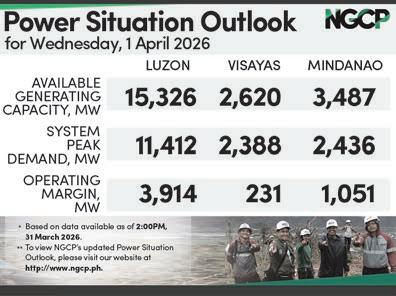

ETBy VG Cabuag @villygc
HE Makati Regional Trial Court Branch 38 has denied GMA Network Inc.’s application for a temporary restraining order (TRO) against a memorandum circular (MC) issued by the Securities and Exchange Commission (SEC) that imposes a strict term limit on independent directors of listed companies.
GMA filed a petition for certiorari on March 26, seeking to nullify and set aside MC 7. The petition included an urgent prayer for the issuance of a TRO and/or writ of preliminary injunction.
The SEC’s Memorandum Circular No. 7, Series of 2026, which took effect on February 1, mandates that an independent director may serve a maximum cumulative term
of nine years in the same company, reckoned from 2012.
After serving the maximum cumulative term limit, independent directors are now barred from being an independent director of the same company. They can, however, be elected as a regular director.
In opposing GMA’s application for TRO, the SEC contended that the company failed to meet the req -
uisites for the issuance of a TRO, as it was unable to show, among others, that a clear and unmistakable right was being violated by the implementation of the MC.
The SEC, through the Office of the Solicitor General, pointed out that at the time the petition was filed on March 26, GMA, through a disclosure to the Philippine Stock Exchange on March 25, already rescheduled the date of its annual stockholders meeting from May 20 to December 9.
The SEC said MC 7 is consistent with the state’s policy to actively promote corporate governance reforms aimed to raise investor confidence, develop the capital market and help achieve high sustained growth for the corporate sector and the economy.
The RTC denied GMA’s application for a TRO following revelations that the network failed to disclose a key board decision. While GMA’s petition, filed last March 26, claimed an urgent need for relief due to a looming May 2026 annual stockholders’ meet -
‘Lopez exec ouster due to loss of trust’
THE three Lopez factions representing a 71 percent majority stake in the family’s holding company on Tuesday said they removed Federico “Piki” Lopez as president and CEO of Lopez Inc. “for cause and for loss of trust and confidence.” Lopez Inc. is the private, ultimate holding company of the Lopez family, who owns a broadcast company stripped of its franchise, power plants and a property development firm.
It said the company’s by-laws allow the removal of any corporate officer even without cause by a majority vote. The company’s board voted 5-2 to remove Piki on February 27, with Piki and his brother, Benjamin, dissenting.
Piki, from the Oscar Lopez group, represents the fourth family faction. A court order temporarily blocked his ouster and allowed him to stay.
“The majority said it has found
PLDT Inc. and its wireless unit
Smart Communications Inc. said on Tuesday they are prepared to block online gaming platform Roblox once the National Telecommunications Commission (NTC) issues a formal order, as regulators intensify scrutiny of the platform over child safety concerns.
The telco group made the commitment following a meeting convened by the NTC with the Cybercrime Investigation and Coordinating Center (CICC) and the Department of Information and Communications Technology (DICT) to address complaints from parents, educators, and religious organizations over alleged risks children face on the platform, including exposure to violent extremism.
The CICC had earlier given Roblox 15 days to respond to concerns over alleged illegal activities involving pedophiles and drug traffickers targeting minors.
As of the latest update, no response has been received, with the deadline extended to April 10. “Protecting children online is a responsibility we share with gov -
questionable transactions involving billions of pesos in the companies Piki runs and is now preparing legal action against him and others for betraying their fiduciary obligations,” it said in a statement.
Efforts by the majority to audit First Gen Corp., a listed company that is involved in the subject transactions, were met with a non-disclosure agreement from Piki’s camp prohibiting the use of any adverse information gathered in any complaint.
The majority did not sign but said it would push for an audit for the protection of all shareholders, the statement read.
Piki’s camp did not respond to BusinessMirror’s comment until press time.
The lawyers of the majority had filed a motion for the dissolution of the court order favoring Piki, citing, among others, the by-laws allowing Lopez Inc.’s board to remove Piki by a majority vote, and also Piki’s “opaque
to block
management style which is a breach of proper governance,” it said.
The majority said First Gen entered into transactions involving billions of pesos without informing Lopez Inc. and its board beforehand.
Many Lopez board members said they found out about the deals only through media and only after Piki was pressed for information.
One of the transactions was basically a done deal when it was presented for discussion for an hour before the board. It was concealed under “other matters” in the agenda.
Questions about the validity of the board approval were also raised, the statement said.
It did not identify the said transaction. Other transactions in the past few years involving huge amounts are also being looked into. The majority said Piki must open the books for an audit without conditions especially since the companies are public, they said. VG Cabuag

ernment and families,” said Joan de Venecia-Fabul, PLDT chief legal counsel and head of regulatory and strategic affairs. “We recognize that children are among our most important stakeholders, and we fully support efforts to create a safer digital environment for them.”
Roblox, which lets users build and explore virtual worlds, has drawn regulatory attention over how its
open, user-generated environment can be exploited by bad actors.
Authorities described a pattern in which predators initiate contact through in-game chat, migrate interactions to private or external channels with weaker moderation, then groom minors through in-game incentives before exposing them to harmful content or illicit activity outside the platform. Lorenz S. Marasigan
ing (ASM), evidence presented by the SEC, through the OSG, revealed that GMA’s board had already approved postponing the meeting to December 2026.
During the hearing, it was observed that there was an apparent concealment by GMA of the rescheduling of its ASM from May to December 2026. This misled the court regarding the urgency of the case.
The RTC ruled that no “extreme urgency” exists, as the network now has ample time to vet potential independent directors in compliance with SEC regulations.
“Our people clamor against political dynasties—so our public companies must reject boardroom entrenchment. No double standards,” SEC Chairman Francis E. Lim said.
“We must raise our governance standards to restore investor confidence. Our stock market has been falling behind. The time to act is now-and we call on everyone to step up for the sake of our capital markets.”
NERGY Development Corp. (EDC), the geothermal arm of First Gen Corp., has set aside a budget of P20.06 billion for this year’s capital expenditures (capex).
About 82.52 percent or P16.55 billion of it has been earmarked for acquisitions to support the operations and maintenance requirements of the geothermal plants in Leyte, Negros Island, Bacon-Manito and Mt. Apo.
“This amount is mainly for power plant and steam field reliability improvement in said sites,” EDC said in a filing on Tuesday.
The balance of 17.48 percent or P3.51 billion is primarily composed of investments in hydro, wind and solar operations, local geothermal expansions, funding for Indonesia activities, among others.
EDC had entered into a strategic joint venture (JV) with Indonesia’s PT DSSR Daya Mas Sakti (DSSR), a subsidiary of Sinar Mas Group, to develop geothermal projects in Indonesia.
The company was granted surface exploration and drilling rights, also known as the preliminary survey assignments plus exploration (PSPE), for two greenfield geothermal proj-
ects in Indonesia. These are the Koto Sani Tanjung Bingkung and Bora Pulu. EDC also has a concession in Graho Nayabu in Sumatra, Indonesia.
EDC has over 1,464.5 megawatts (MW) total installed capacity that accounts for almost 20 percent of the country’s total installed renewable energy capacity. Its 1,169.85MW geothermal portfolio comprises 80 percent of the country’s total installed geothermal capacity, making the Philippines the third largest geothermal producer in the world.
“It’s a new opportunity to grow. In the Philippines, we have 4,000 (MW) potential. We’ve already developed around 2,000 (MW). With other developers in the Philippines, around 2,000 megawatts have been developed. The remaining 2,000 megawatts are low-enthalpy, hardto-reach areas.
For us to be able to develop around 400 to 500 megawatts in a country as rich in geothermal in Indonesia as well, it’s a new opportunity. For now, we’re at the early stages. We’re looking at around $30 million for the exploration and initial drilling,” EDC President Jerome Cainglet earlier said. Lenie Lectura
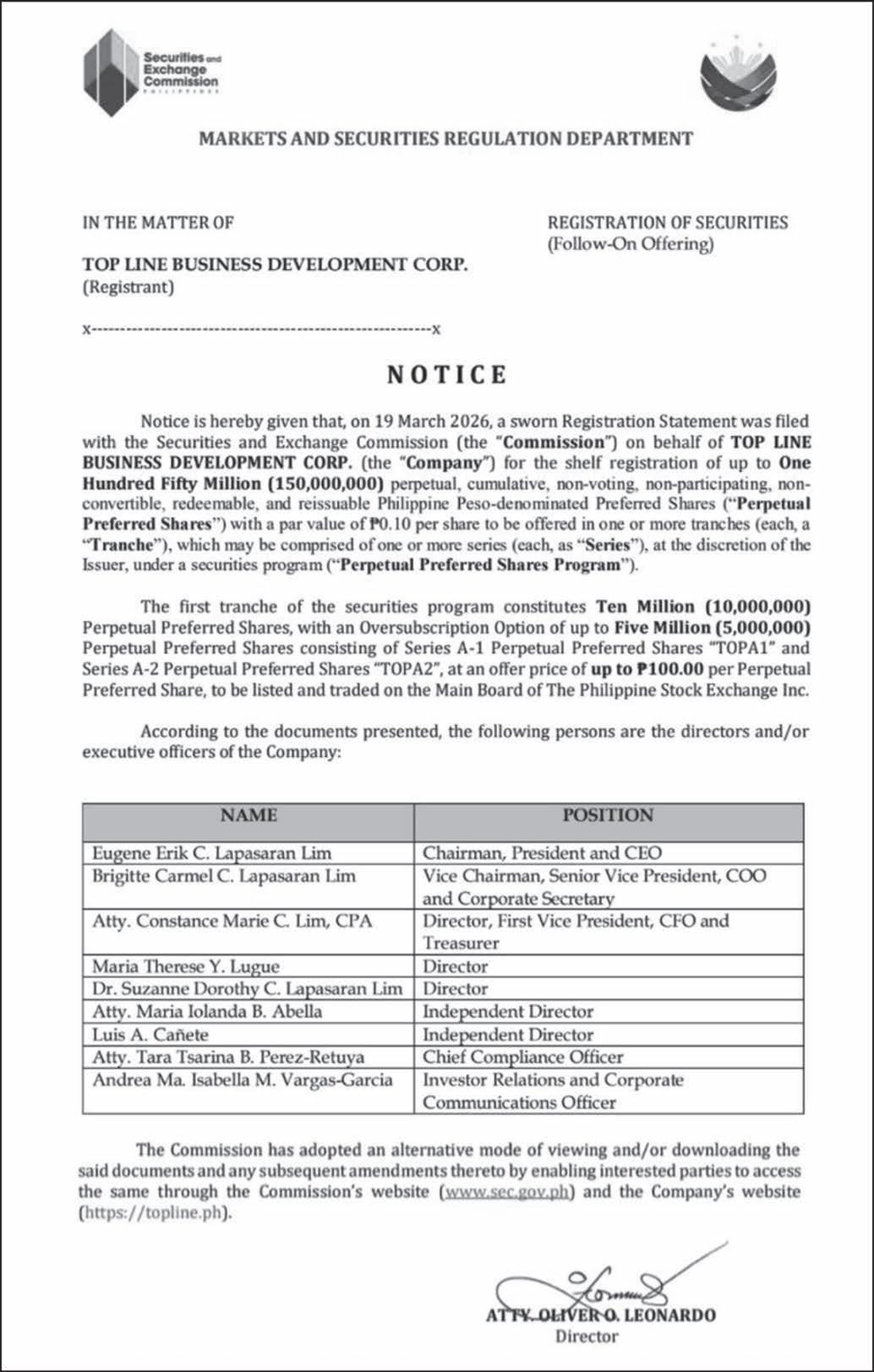
BLOOMBERG NEWS
THE country’s international investment position, which provides a snapshot of the value of foreign financial assets and liabilities at a given point in time, posted a lower net external liability of $50.8 billion as of endDecember 2025, data from the Bangko Sentral ng Pilipinas (BSP) showed. Data from the BSP showed that the country’s net external liability position declined by 0.7 percent from $51.2 billion at end-December 2024 to $50.8 billion as of endDecember 2025.
The central bank said this was on account of a stronger expansion in total external assets, which rose by 5.4 percent from $250.5 billion, compared with a 4.4-percent increase in total external liabilities from $301.7 billion. According to the BSP, external financial assets grew due to several factors. One is the 14.1-percent increase in residents’ investments in foreign-issued debt securities amounting to $37.3 billion. There was also a 4.3-percent rise in reserve assets to $110.8 billion and a 9.6-percent ($35.6 billion) expansion in residents’ equity capital investments in their foreign affiliates. The external financial assets also grew due to a 15.7-percent growth in residents’ holdings of foreign equity securities, totaling $7.6 billion. Meanwhile, the expansion in external financial liabilities from end-December 2024 to end-December 2025 stemmed mainly from: an 8.4-percent rise in nonresidents’ investments in debt instruments to $75.3 billion; a 7.6-percent increase to $81.6 billion in outstanding foreign loans availed by residents; and, a 9.4-percent expansion to $48.6 billion in nonresidents’ holdings of debt securities.
The latter reflects strong investor sentiment in emerging markets like the Philippines, despite the challenges the economy faced.
According to BSP, the international investment position is an important indicator of the Philippines’s financial links with the rest of the world at a given period.
“It shows what a country owns and owes internationally, aiding in the assessment of its external vulnerability and resilience,” the BSP explained.
By institutional sector, the central bank and deposit-taking corporations maintained net external asset positions, consistent with higher reserve assets and overseas placements of deposits by banks.
In contrast, the general government and other sectors posted net liability positions, associated with external financing.
Andrea Louise San Juan
Banking&Finance
‘Frontloading led to borrowing jump’
By Andrea Louise San Juan
DELIBERATE frontloading led to the sharp jump in January gross borrowings while market conditions were still favorable, according to analysts.
The national government started the year with P408.233 billion in gross borrowings from the domestic and external debt market to finance the Marcos administration’s programs and projects.
Data from the Bureau of the Treasury (BTr) showed gross borrowings in January hit 91.53-percent higher than the P213.141 billion recorded in the same month a year ago.
“The sharp jump in January borrowings tells me this is deliberate front-loading, not fiscal stress,” Jonathan L. Ravelas, senior adviser at Reyes Tacandong & Co., said.
According to Ravelas, he believes the government moved early to secure funding while market conditions and liquidity were still favor-
able, giving it “flexibility” for the rest of the year.
The views by Michael L. Ricafort, chief economist at Rizal Commercial Banking Corp. (RCBC), is in line with Ravelas’s, saying that some frontloading of both global/foreign and local borrowings prompted the sharp increase in January. Ricafort cited the $2.75-billion ROP bond issuance and the P398-billion 10-year Treasury note offer.
The RCBC executive added the frontloading coincided with some debt expected to mature in the early part of this year as well as the new record high US dollar, which “led to higher peso equivalent of foreign debts.”
Broken down, 52.94 percent of the government’s borrowings in January 2026 were sourced domestically. This amounted to P216.099 billion,
BIR to issue permits for fuel imports
By Justine Xyrah Garcia
THE Bureau of Internal Revenue (BIR) announced it will soon issue special permits to facilitate the immediate entry of petroleum products into the country a week after the President declared a national energy emergency. According to the BIR, the permits would be processed through its Large Taxpayers Service unit in close coordination with the Philippine National Oil Co.- Exploration Corp. (PNOC-EC).
The move comes as PNOC-EC, the upstream oil, gas, and coal exploration arm of the state-owned PNOC, undertakes the procurement of about two million barrels of diesel worth around P20 billion. The move would extend the country’s fuel supply by an estimated 10 days.
BIR Commissioner Charlito Martin R. Mendoza said the agency is streamlining procedures to ensure the unhampered entry of critical energy commodities.
Earlier this week, the bureau said
‘HHWs’
Ait had already issued a special permit covering incoming petroleum shipments of PNOC-EC, after the state-run firm signaled its intent to immediately import fuel as an emergency measure. According to the BIR, its staff coordinated with PNOC executives to complete documentary and procedural requirements to allow faster processing of the transaction.
The government’s increasing reliance on PNOC-EC comes as the country’s oil supply remains tight.
Latest estimates from the DOE show total petroleum inventory at 75.052 million liters, equivalent to about 50.94 days of supply.
Broken down, gasoline stocks stood at 22.326 million liters, or roughly 59.78 days’ worth, while diesel—critical for transport and industry—was at 32.516 million liters, equivalent to about 46.93 days.
Kerosene supply was estimated at 142,140 liters (107.88 days), jet fuel at 6.320 million liters (62.69 days), fuel oil at 2.472 million liters (57.27 days), and liquefied petroleum gas
(LPG) at 10.274 million liters, or about 34.02 days’ worth.
Another round of fuel price increases started last Tuesday, the fourth consecutive week of hikes as the conflict in the Middle East showed no sign of relenting after a month.
Last Monday, Petro Gazz Ventures Philippines Corp. and Unioil Petroleum Philippines Inc. announced their diesel and gasoline prices will increase by P12.50 a liter and P2.50 a liter, respectively.
Seoil Philippines Inc., meanwhile, announced its diesel product would increase by P12.50 a liter and kerosene by P2 a liter. The firm said no increase would be applied on its gasoline product.
Pilipinas Shell Petroleum Corp. also announced a Tuesday increased price of P12.90 a liter for diesel, P2.90 a liter for gasoline and P2.40 a liter for kerosene.
Jetti Petroleum Inc. also announced an increase in its diesel by P12.90 a liter and gasoline by P1 a liter.
enrolment in SSS an investment’
COMMISSIONER of the Social Security System (SSS) is urging people who employ household workers (HHWs) to see the latter’s enrolment in the pension fund as an investment and not a cost.
“We should look at social security as an investment rather than an expense,” SSS Commissioner Eva B. Arcos said through a statement last Tuesday.
“For every employer who registers their kasambahay, they are not only paying a contribution but also securing a safety net for a worker who helps run their household,” Arcos added.
Under Republic Act 11199 or the Social Security Act of 2018, employers are required to register their
household workers within 30 days of hiring and pay the corresponding contributions.
For those earning more than P5,000 a month, employers share the contribution with the worker, while those earning P5,000 or less are fully covered by the employer.
Arcos spoke after the SSS announced plans to increase the enrolment of HHWs in the agency.
Last week, the agency rolled out its “Kasambahay Caravan” across 43 sites in Metro Manila and Rizal, offering a one-stop shop for registration and member services.
Aside from registration, the SSS provided services such as updating member records, issuing SSS numbers and forms, and assisting pen-
sioners with annual confirmation requirements.
It also offered online support, including My.SSS registration, password resets, generation of Payment Reference Numbers (PRNs), as well as loan and benefit applications and orientations on coverage and responsibilities.
The SSS bared the plan to expand the reach of its caravan while promising to study measures to help members tide over the successive increase in fuel prices seen impacting Filipinos’ purchasing power.
(See https://businessmirror.com. ph/2026/03/30/sss-eyes-measures-to-help-contributors-address-challenges/) Justine Xyrah Garcia
1 in 6 eyes saving for EVs amid high fuel prices—poll
TBy Rizal Raoul S. Reyes @brownindio

ECHNOLOGY firm Agile
Data Solutions Inc. (ADSI) revealed results of its recent poll suggest that some Filipinos are beginning to think longer-term in terms of transportation as fuel prices continue to increase.
About 1 in 6 say they would prioritize saving toward an electric or hybrid vehicle if transportation costs continue to rise—signaling early momentum toward EV adoption, even as high upfront costs and practical barriers keep full transition out of reach, read a statement the company issued last Tuesday.
“Every fuel price increase reshapes how Filipinos think about mobility. What was once routine becomes a daily calculation,” ADSI
Chairman Jason Christian B. Gaguan was quoted in the statement as saying. According to the company, Filipinos exhibits high awareness as 91 percent of respondents said they are familiar with EVs or hybrid vehicles.
“Major brands such as Toyota and Tesla dominate recall, showing that EVs have firmly entered public consciousness,” the company said. “Yet awareness has not translated into ownership.”
According to ADSI, around 66 percent of Filipinos still do not own any form of electric or hybrid vehicle. While many have already experienced riding one, regular use remains limited.
What the data points to is not resistance, but delayed adoption— where familiarity and even open -
ness already exist, but transition is postponed until cost, infrastructure, and day-to-day practicality improve, according to the company.
“Filipinos are no longer strangers to electric vehicles. The challenge now is not awareness, but whether adoption is realistically within reach,” Gaguan said.
Despite growing interest, affordability remains the primary obstacle.
Nearly half of respondents (44 percent) cite the high purchase price as the main reason for not switching to EVs. Concerns around battery lifespan, replacement costs, and limited charging infrastructure further complicate the decision.
Government incentives, while present, are not yet decisive, accord-
a 41.98-percent increase from the P152.200 billion in January 2025.
Domestic borrowings consisted of P176.599 billion generated from the issuance of fixed-rate Treasury bonds, 26.13 percent higher than last year’s P140 billion. The sale of Treasury bills also raised P39.5 billion for the government, 223.77 percent higher than the P12.200 billion recorded in January 2025.
Meanwhile, the government incurred lower external borrowings in January 2026, amounting to P192.134 billion. This is 215.28 percent lower than the P60.941 billion it borrowed in January 2025.
Government’s external borrowings were global bonds worth P161.286 billion followed by P26.389 billion in program loans and P4.459 billion in project loans.
In the same period a year ago,
there were no global bonds but program loans and project loans in January 2026 are lower than the P56.289 billion and P4.652 billion in program loans and project loan, respectively, recorded last year.
Looking ahead, Ravelas said borrowings will likely stay elevated in 2026 given spending needs.
“But after this strong start, the pace should become more measured and opportunistic. In short, this is about managing risk early, not losing control later,” he added.
Ricafort expects “the national government’s catch up spending to make up for the underspending in the latter part of 2025 would lead to a wider budget deficit that, in turn, would require more NG borrowings; as well as to hedge/frontload some borrowings in view of the geopolitical risks.”
Hoping for a Reset
“Our moral economy went bankrupt long before our financial one.”
— From a compilation on economic collapse
WITH the Middle East crisis, we live amidst extreme uncertainty where what is certain is no one knows the end game. Everyone has an opinion on what, why, and how. The key players hold the power to change the world, yet their motivations and expectations are essentially their own.
The Middle East crisis is one of a kind. It brings the “whammiest” impact that no one is exempted from. Economists expect for the country to experience the following.
1. Lower growth that may drag growth rate back below 5 percent.
2. Skyrocketing oil price may lead to high inflation rate impacting on consumption.
3. Energy and food security are at risks.
4. With the repatriation of overseas Filipinos from the troubled region, remittances are seen to be reduced.
5. The peso quickly reacted and has shown its weakness.
It seems we have a confluence of the worst situations. But one should not lose hope. One blessing we have is that we are not in the immediate region where war is happening.
The destroyed buildings and infrastructures, the loss of lives—civilians, military men and women—the dislocated citizens, the disparaged economies and more have to be restored and/or redeveloped. Some order has to follow. How long will it take and for how much, one can only speculate.
The powers that be have unload-

ed their ammunitions’ inventories and will continue to produce with enhanced technology, creating new ways and tools to prepare for the next adventurism. This will spur development.
Not all is lost. Another cycle will begin with opportunities.
Meantime, one can only ask some basic questions.
1. What is the United Nations for?
2. What happened to the Board of Peace? Is the crisis part of the Board of Peace plan?
3. Who cares for humanity?
“Peace and humanity are intrinsically linked, requiring compassion, empathy, and understanding rather than force. True peace is not merely the absence of war, but the presence of justice, harmony, and inner calmness that stems from recognizing our shared humanity, compassion, and the necessity of loving one another to create a better world.”
Conchita L. Manabat is an incorporator and the president of the Development Center for Finance, an incorporator of and Trustee at San Carlos School of Cebu Inc. She is also a Trustee at the
Credit risk in Asia spikes most this month since 2023
Ting to the company. Only about half of Filipinos believe these significantly reduce the financial burden of switching, it added.
This reveals a critical gap: while EVs may promise long-term savings, the upfront cost remains out of reach for many households already managing rising daily expenses.
“For most households, the decision is still shaped less by environmental intent and more by financial practicality,” Gaguan said. However, the company said the current fuel crisis may prove to be more than a temporary disruption.
“As traditional fuel systems become more volatile, EVs are being reframed not just as an environmental alternative, but as a potential way to reduce economic vulnerability,” it added.
HE cost to insure better-rated Asian debt against default has jumped in March by the most for any month since 2023, signaling growing concern about the economic impact of the Iran War on the region’s borrowers.
The credit-default swaps are on track to widen by 27 basis points for March after traders indicated a one-basis point increase on Tuesday, a Markit index shows. That’s the biggest monthly spike since August 2023, a time when China’s property crisis was deepening.
Gauges of credit risk around the world have jumped as investors increasingly factor in more negative scenarios for the global economy, the longer the Iran War drags on. Asia is more dependent than any region on Middle Eastern energy flows, and investors have been buffeted over the past month by changing signals from the US administration on the war, leaving them caught between growth and inflation risks.
“While the ultimate path of the Middle East conflict remains highly
uncertain, a more prolonged return to pre-conflict conditions would likely prompt a broader and sharper repricing of growth risk,” Lotfi Karoui, a multi-asset credit strategist at PIMCO, wrote in a report. The Wall Street Journal earlier reported President Donald Trump told aides he’s willing to end the military campaign in Iran even if the crucial Strait of Hormuz remains largely closed. Some Asian economies are particularly exposed to Middle Eastern energy supplies. The Philippines, which imports almost all of its oil from the region, is trying to find other sources to ease a supply crunch that has triggered the government to declare a national energy emergency. Still, the recent widening in credit spreads isn’t without potential opportunities. “Recent new issues are priced considerably outside secondary curves, and the coupon carry is good,” said Zerlina Zeng, head of Asia strategy at CreditSights Singapore. “We would participate in good quality names.” Bloomberg
Conchita L. Manabat
Show BusinessMirror

NOTHING TO DENY
IT’S the relationship that never was. The former child star entered into a relationship with the male starlet when she was just a minor, so naturally they kept it a secret. Even when she came of age, they still did not admit that they were officially together. For yet undisclosed reasons, the two ended their relationship recently and even now, they will not admit they were ever together. According to the grapevine, the former child star developed feelings for someone else. The male starlet tried to ignore it at first but eventually, they had a serious talk and agreed to end things.
USER
THIS guy, who comes from a powerful family, portrays himself as a simple man on social media. However, he goes around with several bodyguards, even more than the rich and influential people who walk around with security. He also has a reputation for being a user and has in fact burned bridges because of this. He has lost a lot of followers because of this but some brands still believe in him and get him for big projects. Most recently, he was involved in a controversy with a woman, who basically called him a user and a liar.
HE LIKES THEM BEAUTIFUL
HE comes from a family of politicians but politics is not his thing. He likes models, actresses and beauty queens, aside from being a businessman of course. In fact, when he was younger, his family tried to pair him with a popular actress but this did not prosper because he prefers models and beauty queens. Still single, he is quite the playboy. At one point, he had two beauty queen girlfriends in one pageant. He is said to be currently dating a front runner of an ongoing beauty contest. The said contestant is feuding with another beauty queen, according to the grapevine.
CONTROVERSIAL FANGIRL
AT this point, it would just be better for the beautiful star that she has a boyfriend. Whenever she fangirls over her favorite male stars, she is attacked online by fans. It’s not because they are jealous. It’s more like they think that at her level of celebrity, she should be more circumspect. It doesn’t help that the beautiful star’s fans are very quarrelsome. They also like comparing their favorite to other young actresses and that results in even more fan wars. The beautiful star has had a boyfriend even before she joined the program that made her famous so to keep out of trouble with the fans, she should just admit that she’s in a relationship.

Everything you need to know about ‘BTS:
The Return,’ the new Net�lix documentary
BY MARIA SHERMAN The Associated Press
NEW YORK—All seven members log onto a livestream, broadcast from a beach. A few years ago, it was a common image. But after the K-pop boy band BTS pressed pause on their full-band duties for nearly four years, it was revelatory.
That’s the scene that begins BTS: The Return, a new Netflix documentary from director Bao Nguyen (The Stringer, The Greatest Night in Pop), produced by This Machine (Martha, Karol G) and HYBE, the South Korean entertainment company behind BTS and countless other international acts.
The mostly-Korean language film offers an intimate look at BTS’ journey to their latest album, Arirang, released on Friday. It also follows the sevenmember group—RM, Jin, Jimin, V, Suga, Jung Kook
and j-hope—as they learned to reacclimate to their life in the fast lane, together again.
Here are key takeaways from the documentary film, which premiered on Netflix on March 27: ■ South Korea’s mandatory military service comes up fast—As BTS fans are well aware, Arirang is the band’s first full-length release since all seven members completed South Korea’s mandatory military service. In South Korea, all able-bodied men aged 18-28 are required by law to perform 18-21 months of military service under a conscription system meant to deter aggression from North Korea. In their documentary, mention of BTS’ service emerges right away. In the first minute, while the band films their live video on the beach, RM mentions that he “learned to hustle” in the military. Then it cuts to footage of the guys getting their heads shaved
GMA News renews commitment to ‘Serbisyong Totoo’

IN a bold move to strengthen its legacy and sharpen its identity in an evolving media landscape, GMA News ushers in a renewed era this 2026, reaffirming its enduring commitment to its core mission: delivering truthful, balanced and credible journalism to Filipinos around the world.
At the heart of this renewal is the reaffirmation of its enduring brand promise, “Serbisyong Totoo,” underscoring the organization’s role as the Philippines’ foremost guardian of truth and a trusted source of authoritative news and information.
Anchoring this renewed direction is the defining statement, “Walang kinikilingan. Walang pinoprotektahan. Noon at ngayon, Serbisyong Totoo,” reflecting GMA News’

unwavering dedication to impartiality, integrity, and public service—values that have defined its journalism across generations.
With over 1,000 journalists, staff, and crew across platforms, GMA News is committed to reporting relevant news and providing “serbisyong totoo” to Filipinos within and beyond the Philippines.
GMA News’ flagship newscast, 24 Oras —anchored by Mel Tiangco, Emil Sumangil, and Vicky Morales—continues to shape the Philippine TV news landscape.
Together with the rest of its newscasts—24 Oras Weekend, Saksi, GTV’s Balitanghali, State of the Nation, Dobol B TV, and Regional TV News —GMA News provides the public with information and public service through its news reports,
special features, and exclusive stories and interviews.
Across the regions, viewers tune in to GMA Regional TV One North Central Luzon, GMA Regional TV Balitang Bisdak, GMA Regional TV One Western Visayas, and GMA Regional TV One Mindanao Moreover, there is GMA Radio and the network’s formidable online presence via the major social networks.
Through this renewed direction, GMA News reaffirms a trusted and familiar identity while continuing to evolve in the digital age through innovative, multiplatform storytelling—grounded in the same core values it has upheld through the years. More information can be found at www. gmanetwork.com.
Eugenia Last

an opportunity to learn, hone skills and communicate with people, offering insight into something that interests you. Walk away from negative people. Refuse to let anyone stifle your plans; actions will help you carry your thoughts forward. ★★★★
VIRGO (Aug. 23-Sept. 22): Pay attention to small but important changes that can shift the outcome of your financial, physical or emotional well-being. Taking care of business first will make it easier to release stress and enjoy life’s little pleasures. Shoot for greater balance between work and play, and set a routine that puts your mind at ease.★★★
LIBRA (Sept. 23-Oct. 22): You know what’s coming, but are you ready to adjust? Recap your experience, and you’ll find a passage that offers clarity and justification regarding the outcome. Walk away from drama and those trying to stand in your way. A change of location or workplace will revive a chance to use your skills in a manner that suits you. ★★★
SCORPIO (Oct. 23-Nov. 21): Making impossible promises or demands will take its toll. Put emotions aside and be reasonable, and you’ll devise an alternative that works wonders for others and puts you in a good position. Be an advocate of goodwill, using your connections and intelligence to bring others together. Avoid taking risks that can result in illness or injury. ★★★
SAGITTARIUS (Nov. 22-Dec. 21): Do your best to protect against misrepresentation, gossip and false information. Put more thought into how you run your household, and use what you already have to capacity. “Waste not, want not” is the mantra for today. Don’t give in to temptation, scams or purchases that promise the impossible. Set your space up to reflect your lifestyle. ★★★★
CAPRICORN (Dec. 22-Jan. 19): Take notes, keep tabs on what you hear and see, and separate truth from fiction. Choose to protect and appreciate your body and to awaken to truth and possibilities. Change begins with you; honor yourself and what you value most. A personal improvement will result in compliments and attention from someone you love.
AQUARIUS (Jan. 20-Feb. 18): Lay down a foundation and begin your journey. How you use your skills, discipline and money to enrich your life will lead to a fresh start. The possibilities are endless if you restrict excess and use your time and ingenuity to reach your goals. Distance yourself from situations that can infringe on your rights, safety or reputation. ★★★★★
PISCES (Feb. 19-March 20): Interact with people who spark your imagination and motivate you to

documentary.
Image BusinessMirror
Feel with me, not for me

YOU have likely heard the words “empathy” and “sympathy” used as if they mean the same thing. In everyday conversation, they often blend into each other. Yet when it comes to real human connection, the difference between them can shape how deeply you relate to others and how supported people feel around you. If you want stronger relationships at work, at home, and in everyday life, understanding this difference matters more than you might expect.
Sympathy is when you feel concern for someone from a distance. You recognize that a person is hurting and you care about their situation. You might say something kind or offer reassurance. It often sounds like, “I am sorry you are going through this.” There is nothing wrong with sympathy. It is a natural and decent response. However, it can sometimes create a subtle separation. You remain on the outside of the experience, looking in.
MCCORMICK UNVEILS NEW SNAPTIGHT CAP FOR ULTIMATE SEALED FRESHNESS

Empathy, on the other hand, invites you to step closer. It asks you to imagine what the other person might be feeling, and to sit with them in that space. Instead of observing their pain, you connect with it. You might say, “That sounds really difficult. I can see why you feel that way.” The goal is not to fix or judge, but to understand. When you practice empathy, you communicate that the other person is not alone in what they are experiencing.
You have probably felt the difference yourself. Think about a time when you shared something hard and received a quick response that tried to cheer you up. It may have been well-meaning, but it might have felt dismissive. Now, think about a time when someone simply listened, acknowledged your feelings, and stayed present with you. That moment likely felt more comforting and real. That is the power of empathy in action.
One reason empathy creates deeper connection is that it validates emotion. When you feel understood, your guard lowers. You do not need to explain or defend your feelings. You feel seen. Sympathy can sometimes unintentionally minimize emotion when it jumps too quickly to solutions or reassurance. Statements like “It will be okay” or “Others have it worse” may come from a good place, but they can make a person feel unheard.
If you want to practice empathy in your daily life, start with listening. This sounds simple, yet it requires intention. When someone is speaking, focus on their words instead of preparing your response.
THE average person visits the bathroom at most 10 times a day. That’s roughly 3,650 times every year. When you realize how much of your life is spent in this space, refining frequently overlooked bathroom habits makes perfect sense. Knowing that good personal hygiene impacts physical and mental well-being, elevating this daily experience is the ultimate way to add comfort and mindfulness to your personal time. In a home thoughtfully designed for better living, this means investing in a smart toilet, which has become an essential tool for personal wellness.
Now with so many options on the market, what features actually matter in upgrading every bathroom visit? Famed global brandd Kohler (www.kohler.ph) breaks down the essential smart toilet technology every wellness-driven home needs.
■ Self-cleaning functions. One of the best things about modern smart toilets are their self-sanitizing functions that allow you to maximize the experience by minimizing the manual maintenance. UV light, electrolyzed water, and automatic wand cleaning disinfect surfaces such as the bowl and bidet nozzle. They can also have antimicrobial coating for surfaces to help prevent dirt from sticking, mist technology to prevent splashing, and rimless bowl designs to get rid of hard-to-clean corners and reduce build up.
Notice their tone, their pace, and what they might not be saying out loud. Let there be pauses. Silence can give the other person room to express more honestly. When you respond, reflect what you heard. You might say, “It sounds like you felt overwhelmed when that happened.” This shows that you are paying attention and that you care about their experience.
Another practical way to build empathy is to resist the urge to fix immediately. When someone shares a problem, your instinct may be to offer advice. While solutions can be helpful, they are not always what a person needs at the moment. Ask yourself what they are really asking for. Sometimes they need guidance, but often they need understanding first. You can ask, “Do you want advice or do you just want me to listen?”
This small question can make your support more meaningful. You can also strengthen empathy by being aware of your own emotional reactions. When you hear something difficult, you may feel discomfort or the urge to change the subject. Instead of pulling away, stay present. Remind yourself that you do not need to have the perfect words. Your presence is often enough. Real connection does not require perfection. It requires sincerity.
Consider a simple example at work. A colleague shares that they are struggling with a heavy workload. A sympathetic response might be, “That sounds tough. You will get through it.” An empathetic response could be, “That sounds really overwhelming.
What part feels the hardest right now?” The second response opens space for a deeper conversation. It shows that you are willing to understand, not just acknowledge. In personal relationships, empathy can transform conflict. When disagreements happen, it is easy to focus on being right. Empathy shifts the focus toward understanding. Instead of defending your position immediately, try to understand the other person’s feelings. You might say, “I want to understand how this affected you.” This does not mean you agree with everything. It means you value the relationship enough to listen. Empathy also requires boundaries. Feeling with someone does not mean carrying their emotions as your own. You can be present and supportive without losing your sense of self. Healthy empathy allows you to care while still maintaining balance. This is especially important in environments where you are often exposed to stress or strong emotions. In the end, the difference between empathy and sympathy is not about choosing one and rejecting the other. Both have a place in human interaction. However, when you want to build genuine connections, empathy brings you closer. It turns moments of pain into opportunities for understanding. It replaces distance with presence. And in a world where many people feel unheard, your willingness to truly listen and feel with others can make a lasting difference.

that considers ergonomic height, structural forms, installation, and reduced footprint for room sizes. They are meant to complement rather than compete with your bathroom design and seamlessly fit your lifestyle.
Kohler’s most compact smart toilet—the slender and sculptural Leap Smart Toilet—offers a stunning statement in the bathroom as well as full suite of features. Its tankless elongated design measures 20 inches (305 mm) in height making for a smooth transition from sitting to standing. Motion-activated sensors open its lid as you approach it and close it when you walk away. Flushing is also automatic after every use.
FOR decades, the familiar green-capped bottles of McCormick Herbs, Spices & Seasoning Blends have been a staple in Filipino pantries, turning everyday meals into extraordinary culinary experiences. Today, the world’s leading spice brand is painting the town—and your spice rack—red in a bold new glow-up that everyone’s going to love.
McCormick Philippines officially reveals the new Red Bottle design across its full range of Herbs, Spices & Seasoning Blends in glass bottles. This visual refresh is a bold and striking new look, changing from the old green label and bottle design to align with the global McCormick color of red. It’s a reinforcement of the brand’s commitment to consistency, quality, and, most importantly, the preservation of the vibrant flavors of the spices you love.
Together with the glow-up, the brand is also introducing another change that should keep the aroma and flavors of your spices and seasonings locked-in.
Aside from the red glow-up, McCormick introduces the revolutionary SnapTight technology—an enhanced flavorlock system that’s designed specifically for those who value the sensory experience of cooking.
The new bottles feature a tighter seal that provides an audible “snap” every time you close them. This ensures that the aromatic compounds of the herbs and spices are locked inside, keeping them fresher for longer.
Whether it’s the earthy warmth of cumin or the zesty kick of oregano, the SnapTight cap guarantees that the first sprinkle is as potent as the last.
McCormick remains the reliable, trustworthy flavor partner for everyday cooks exploring global flavors and families building their pantry staples.
With the new red bottles of McCormick Herbs, Spices & Seasoning Blends, the brand continues to bridge the gap between convenience and gourmet quality—and ensures that you continue to cook up the most delicious dishes possible right in your home.
They are now available online at Shopee, TikTok Shop and Lazada, and in leading supermarkets nationwide.


EVERYTHING YOU NEED TO KNOW ABOUT ‘BTS: THE RETURN,’ THE NEW NETFLIX DOCUMENTARY
CONTINUED FROM B4
and wearing their uniforms—and quickly thereafter, rejoining the band. In reality, they were separated for a number of years. Before announcing their comeback in June, all seven members hadn’t been seen broadcasting live together since September 2022.
■ THE ROAD TO ‘ARIRANG’ WAS SWIFT—Shortly after returning from their mandatory service, the band decamped to Los Angeles during the summer of 2025 to begin work on Arirang, their 14-track, fifth studio album and first in nearly four years. They lived in the same house together. It was tight quarters, and a tight turnaround: In the film, Jin says he joined the band in Los Angeles the day after completing his 2025 solo tour. For that reason, he missed some of the early writing and recording.
The journey was also bumpy. As RM mentions in the movie, a long lifespan for a K-pop group is not guaranteed. Fans of the genre might be familiar with what is referred to as the “seven-year curse,” where a group disbands, or loses members, or contracts expires, and they fall apart. That has not been the case for BTS, still widely regarded as one of the most popular bands on the planet. The question then, for them, became: Where does their sound go from here?
“We’re doing a lot of experiments, trying to find out, like, what makes us special,” RM said. “What makes us BTS?”
They also felt the pressure to deliver a good album, and fast. “We’ve been out for too long,” said Jimin in one dinner scene. “Now that we’re finally out of the military, we don’t want to extend this break.”
■ LOS ANGELES WAS A CREATIVE HUB—Working in and around Hollywood was a source of creativity for the band. The documentary shows clips of the guys in the studio working with some recognizable producers like Diplo and the South Korean songwriter Pdogg. It also shows the band struggling to land a lead single and their in-studio dynamics: Suga playing guitar, serious and studious, V comforting an anxious Jin, so on and so forth.
Then they returned to South Korea to finish and mix the album.
■ Enhanced hygiene features. The toilet is consistently ranked among the germiest surfaces at home.
Touching a toilet to flush or moving the lid is one of the primary ways bacteria
■ Customized comfort settings. Imagine having access to warm seats and even bidet water during the colder months, or being able to change the intensity of the water pressure based on your needs. These toilets can adapt to your preferences through advanced settings for personalization, and precise control to ensure that your routine is always tailored to your comfort. Kohler also recommends getting one with a handheld remote with programmable presets to access your preferences every single time.
and viruses are spread throughout a household. Consider smart toilets that integrate motion-activated sensors to automate everything from the opening and closing of the lid to flushing, for a more hygienic and hands-free experience. Definitely check on other features such as deodorization technology, built-in air cleaners, and carbon filters that automatically neutralize odors after use.
■ Special design considerations. If you think smart toilets are just, well, smart, you’d be mistaken. They can also be stylish and carry an aesthetic that aligns with the rest of your home. These modern marvels have a range
The Leap Smart Toilet has its own handheld remote control with four programmable user presets, which you can use to warm the seat to your desired temperature, adjust the water temperature, pressure and spray from the stainless-steel bidet wand to your liking, and finish with a nice warmair drying with three temperature settings. This intelligent toilet also has rear and front bidet wands that offer more personalization with adjustable spray shape, position, water pressure, temperature, pulsate, and oscillate functions. A germ-killing UV light self-sanitizes the bidet wands’ surfaces after every use, while a builtin deodorizer pulls air from the toilet bowl into a carbon filter, ensuring a fresh-smelling bathroom every time. They did say that smart (and clean!) is the new sexy.
■ PREPARING FOR THEIR COMEBACK WAS DAUNTING—Some members expressed reservations about how they may be received—what did their fans want from them, after so much time apart? And in an industry that demands reinvention? So, they worked as hard as they could, and in surprising ways: In one scene, V throws a baseball in a parking lot—seemingly to blow off steam. Days later he’s throwing a pitch at Los Angeles’ Dodgers Stadium. It’s clear he was practicing as to not disappoint their fans. Even when the band is relaxing at night together at their shared home in Los Angeles — enjoying pork belly, soju and beer—they are still shown talking about their music, what could’ve been done differently in the studio, what they might want to try in the future. It’s a 24/7 process.
“I wonder if we’ve done a good job here,” Jung Kook asks aloud.
■ THEY WERE UNSURE ABOUT ‘SWIM’ AS THE FIRST ARIRANG SINGLE—Some members of the band thought the song “Swim” might be too low in energy to serve as their lead single. But they also weren’t sure about “Dynamite” back in 2020, which became a huge international smash. It was their first all-Englishlanguage single and it debuted at No. 1 on the Billboard Hot 100—a first for an all-South Korean musical act. Suga appeared to be an early believer in “Swim.” “‘Oh, they can come back with a song like this?’ I think it’ll be cool,” he told his band mates, fantasizing about fan reaction. “It’s a cool, mature song for us,” RM agreed. “It’s time we give off a grown-up vibe.”
PHOTO BY TRANSLY TRANSLATION AGENCY ON UNSPLASH
Concepcion Industrial Corporation is one of TIME’s Asia-Pacific Top 500 Best Companies
Concepcion Industrial Corporation (CIC), the country’s leading provider of consumer appliances and industrial solutions, has been recognized as one of Time’s Top 500 Best Companies in the Asia-Pacific for 2026.
For the 65-year-old Filipino company, this milestone affirms that a local organization can remain competitive and relevant on the regional stage. Selected by TIME in collaboration with Statista, the ranking evaluates companies based on revenue growth, employee satisfaction, and environmental, social, and governance (ESG) performance.
The recognition highlights CIC’s disciplined growth and the intentional transformation it has pursued as an organization. By focusing on innovation and market leadership, the

company continues to advance initiatives that support both sustainability and community impact.
“This recognition is truly meaningful because it validates the impact of our purpose-driven strategy,” said Raul Joseph
Concepcion, Chairman and President of CIC. “For over six decades, our mission has been to build better lives and contribute to national progress. Being recognized among Asia-Pacific’s best challenges us to raise the bar even higher for the Filipino people.”
At the same time, CIC remains deeply committed to its people. Through focused leadership development and an enterprisewide transformation anchored on strong core values, the company is building the capabilities required for sustainable, longterm success.
“We see this milestone not as a finish line, but as a responsibility,” Concepcion added. “We will continue to strengthen our capabilities, accelerate sustainable innovation, and nurture future- ready leaders, ensuring that our organization remains resilient and globally competitive in the years ahead.”
CIC attributes this recognition to the enduring support of its stakeholders. To its customers, partners, employees, and communities, their trust and confidence continue to inspire CIC to improve and to advance its mission of building better lives for Filipinos.
Make Easter moments matter with Richmonde Hotels’ family staycation experiences
THIS Easter, skip the long drives and crowded destinations, and instead, spend meaningful moments with the people who matter most at your home away from home in the city.
Richmonde Hotels invites families to celebrate the season with staycation experiences that bring together relaxation and a touch of summer holiday fun, perfect for creating memories across generations.
Richmonde Hotel Ortigas: Easter traditions, celebrations for the whole family AT Richmonde Hotel Ortigas, Easter is all about togetherness and with its family-friendly offers at the best value for money rates, grandparents, parents, and the little ones can share in simple joys that become lasting traditions.
Available until April 6, 2026, the Easter Break Escape room package may be booked at rates starting at only P3,500 nett for room-only stays (except on April 4) and P5,100 nett if with breakfast buffet for two. Guests staying on April 4 get a special treat with an extended Easter Sunday Breakfast Buffet served from 6 am to 11 am at Richmonde Cafe. Expect a delectable spread of breakfast favorites plus a roast beef carving, a dimsum and hotpot station, a salad bar, chocolate fountain, and many more that will delight the young ones and the young at heart.
The Easter Sunday Breakfast Buffet is also open for walk-in guests at P1,180 nett for adults and P590 nett for children six to 12 years old. Children five and below eat for free.
Families can spend unhurried afternoons at the hotel’s “Kitchen Lab,” a series of hands-on activities where kids and kids-at-heart can create their own pizzas, decorate donuts, and design cookies for P350 nett per person per activity, complete with themed snacks and drinks. Metro dwellers can look to Richmonde for a cozy staycation that feels both familiar and refreshing and where there’s something for every family member to enjoy together. For inquiries and bookings, call +632 8638 7777, +63 917 859 7914 (Room Reservations), +63 534 4352 (Food & Beverage), email stay@richmondeortigas.com, or log on to www.richmondehotelortigas.com.ph
Eastwood Richmonde Hotel: Effortless Easter fun in the city EASTER unfolds at Eastwood Richmonde Hotel with ease and energy, thanks to its prime location within the vibrant Eastwood City and direct access to Eastwood Mall, giving
families everything they need just steps away. Room packages until April 5, 2026 start at P4,000 nett (room only) and P5,600 nett (with breakfast for two).
For those planning a full Easter weekend, packages on April 4 and 5 are available from P6,500 nett (room only) and P8,100 nett (with breakfast), inclusive of two tickets to the Enchanted Garden Easter Party. Happening on April 5, 2026 from 1 pm to 6 pm at the ballroom, the Enchanted Garden Easter Party celebration promises an exciting afternoon of magical fun and wonder for children and parents alike, highlighted by a variety of engaging activities and delightful surprises. The venue transforms into a whimsical garden where imagination blossoms and childhood fancy come to life. Kids can embark on a thrilling Easter egg hunt, get creative with bracelet making, and enjoy colorful face painting and sticker tattoos, while the whole family can look forward to captivating performances lined up in the party’s program, a deliciously satisfying snack buffet, and special giveaways. Tickets to the Enchanted Garden Easter Party are priced at P1,888 nett per person. Dining is just as inviting, with Eastwood Café+Bar’s Favorite Filipino Eats consisting of a Lenten Merienda Buffet on April 2 and 3 at P600 nett per person, and an Easter Sunday Lunch Buffet on April 5 at P1,200 nett per adult and P600 nett for children, with little ones five and below dining for free. Offering popular Pinoy dishes like pancit, puto bumbong, bibingka, and halo-halo for snacks and freshly grilled meats and seafood plus many more local delights for the luncheon celebration, Eastwood Café+Bar’s buffets are a flavorful collection of well-loved flavors for all ages.
At Eastwood Richmonde everything is designed for seamless experiences so guests can simply relax and enjoy a worry-free stay. For inquiries, reservations, and ticket purchases, get in touch with Eastwood Richmonde Hotel at +63 8570 7777, +63 917 531 6867 (Room Reservations), +63 917 821 0333 (Food & Beverage), and email stay@eastwoodrichmonde.com, or log on to www. eastoodrichmondehotel.com.ph.
Richmonde Hotel Iloilo: A relaxed Easter escape in the heart of Iloilo EASTER takes on a more laid-back rhythm at Richmonde Hotel Iloilo. Set within the cosmopolitan township of Iloilo Business Park, also named as the city’s Center of Arts and Culture, the hotel embodies the best of the

Eastwood Richmonde Hotel’s Enchanted Garden Easter Party. past and present worlds of Iloilo. Expect a space where comfort, convenience, and a sense of place come together beautifully.
Until April 5, 2026, the Eggsclusive Easter Getaway package is available for both locals of Western Visayas and domestic and international travelers wishing to visit the City of Love during the Easter break. Rates start at P4,200 nett (room only) and P4,800 nett (with breakfast for two), accommodating up to two adults and two children.
During the Lenten Week, days are best spent enjoying the summer breeze at the hotel’s pool or exploring the surrounding scenic spots, including heritage churches, at a relaxed pace. On Easter Sunday, families can gather at The Granary from 11:30 am to 4 pm for the Eggstraordinary Easter Lunch Buffet priced at P1,500 nett per adult and P750 nett for children, with kids five and below dining for free. A festive spread and special raffle draw add a cheerful touch to the celebration.
For inquiries and reservations, contact Richmonde Hotel Iloilo at +633 328 7888, +63 917 580 9642 (Room Reservations), +63 917 563 3558 (Food & Beverage), and stay@richmondeiloilo.com, or log on to www. richmondehoteliloilo.com.ph
Indeed, Richmonde Hotels make it easy to celebrate Easter in a way that feels both meaningful and memorable without having to travel far. Sometimes, the best holidays are simply but about being fully present with the ones you love.
Easter FantaSea Long Weekend unveiled at Discovery Suites
THIS Easter, families and friends are invited to dive into a festive and flavorful escape as Discovery Suites presents its Easter FantaSea Long Weekend package, a vibrant celebration filled with indulgent dining, family-friendly activities, and memorable staycation experiences. Running throughout the long weekend, the Easter FantaSea package offers guests a seamless blend of leisure and culinary delights, making it an ideal urban getaway in the heart of Ortigas.
A Staycation Made for the Season GUESTS can enjoy a relaxing Easter retreat with staycation packages starting at P7,000 nett per night, inclusive of breakfast, access to daily Easter-themed activities from April 3 to 4, 2026, Merienda Cena access for two persons from April 2 to 4, and passes to the much-anticipated Easter Sunday program.
Designed for families and couples alike, the package ensures a fun-filled and
convenient holiday experience.
Kids will be receiving loot bags from brand partners, Rebisco, Jiggels, Lipps Color Burst, Mr. Yema, Unilab, Ceelin Gummies, Gardenia, and Nestlé Koko Krunch.
A Nostalgic Culinary Experience at Restaurant 5
CELEBRATE Filipino flavors with a delightful Merienda Cena at Restaurant 5, featuring an array of well-loved Pinoy snacks and comfort food favorites. The menu line-up includes classics such as Arroz Caldo, Bibingka, Pancit Malabon, Halo-Halo Bar, and a lot more. Available from April 2 to 4, at P695 nett per person, perfect for afternoon indulgence or a light evening feast.
Easter Sunday Feast to Remember ON Easter Sunday, gather with loved ones for a lunch buffet at Restaurant 5. From tender Lechon, Roast Beef, and Chicken Inasal to decadent desserts, there is surely something for everyone.

Around 50 families move into new homes at SHFC-DOTR
THE initial batch of 48 families affected by the North-South Commuter Railway Extension Project in San Pedro, Laguna, formally received their housing units at Sining Residences I on March 25, 2026, marking a significant step in the Marcos administration’s resettlement efforts for communities impacted by major infrastructure development.
The housing project, implemented by the Social Housing Finance Corporation (SHFC) and funded by the Department of Transportation (DOTr), is part of a broader resettlement initiative by both agencies that will benefit thousands of families affected by the ongoing massive railway modernization along the stretch of Solis, Manila, and Calamba, Laguna.
Leading the ceremonial turnover were SHFC President and CEO Federico Laxa, DOTr Assistant Secretary Irish Calaguas, San Pedro, Laguna Mayor Art Joseph Francis Mercado, and Assistant Secretary Hernando Caraig, Jr., who represented Department of Human Settlements and Urban Development (DHSUD) Secretary Jose Ramon Aliling. Presidential Commission for the Urban Poor Chairperson Michelle Anne Gonzales, San Pedro, Laguna Vice Mayor Sheriliz Niña Almoro, and Asian Development Bank Representative Mary Ann Botengan also attended the event.
Located in Barangay Bagong Silang, Sining Residences 1 comprises 11 buildings that will house a total of 528 families. Each 27sqm unit includes a one-bedroom layout with its own toilet and bath. The development will also include a park, playground, and a multipurpose center to support community life. The project is implemented under the SHFC Resettlement Services Group, led by Vice President Bob Flores.
In his message, Laxa emphasized that the turnover is only the beginning of a broader vision for the community’s growth and development. “We will not stop until we improve and develop your community,” he said, reaffirming SHFC’s commitment to the transformative
project in Laguna
approach in housing.
Laxa also expressed his gratitude to President Ferdinand Marcos, Jr. for his unwavering support of SHFC’s housing initiatives, which make projects like these possible.
Calaguas credited the project’s success to strong inter-agency collaboration, while Caraig reaffirmed DHSUD’s commitment to expanding access to resilient and affordable housing under the Expanded Pambansang Pabahay para sa Pilipino (4PH) Program.
Gonzales pledged continued support through livelihood and community development programs, while Mercado and Almoro expressed their gratitude to national agencies involved in the project for helping uplift the lives of their constituents.
More than a relocation effort, the turnover marks a fresh start for beneficiary families who previously faced uncertainty due to displacement. For the homeowners’ association president, Dennis Santiago, the new housing unit marks a life-changing shift from living along the railway to a place they can truly call home.
“To everyone who was part of this project from planning to implementation, we are sincerely grateful,” he said. “Sa lahat po ng naging bahagi ng proyektong ito mula sa pagpaplano hanggang sa pagsasakatuparan, kami po ay taos-pusong nagpapasalamat,” he said. “Many thanks also to President Bongbong Marcos, Jr., for a great project like this.””
As part of their ongoing resettlement efforts, SHFC and DoTr have started awarding housing units to affected families, starting with the initial turnover at Sining Residences 1. Last month, around 80 families from Biñan, Laguna, moved into their new homes at The Meadow, while a similar number of families transferred to their units at Rizalville in Calamba, Laguna, in January 2025, under the same program.
For more information about the resettlement housing initiatives of SHFC and its other programs, please visit www.shfc.gov.ph.
SMX Convention Center Seaside Cebu brings world-class MICE to province
SM Hotels and Conventions Corporation (SMHCC) is poised to redefine the country’s MICE landscape as it prepares to open the biggest convention center in the Philippines, SMX Convention Center Seaside Cebu. Strategically designed to attract international organizers, it is seen to compete with leading venues across Southeast Asia, including those in Singapore, Thailand, and Malaysia.
Located within Cebu’s fast-rising South Road Properties (SRP), the region’s most ambitious development corridor, the venue offers seamless connectivity to SM Seaside City Cebu via a link bridge, with direct access to SM Hotels’ uprising hotel properties: a dual-branded development that showcases both the Radisson and Park Inn by Radisson brands. It also stands adjacent to SM Arena Seaside Cebu.
This enables event organizers to create a fully integrated event ecosystem in a single destination, where delegates can conveniently access convention facilities, large-scale entertainment venues, as well as a wide range of dining, retail, and leisure experiences within a compact and wellconnected district.

Enjoy a generous spread of thoughtfully curated and festive specials for only P1,295 nett per person.
Elevated Dining at 22 Prime FOR those seeking a more refined culinary experience, 22 Prime offers its signature premium steakhouse dining. Guests can complement their Easter celebrations with expertly prepared steaks, curated wine selections, and impeccable service in an elegant setting. With its combination of comfortable accommodations, diverse dining options, and the signature Discovery hospitality, the coming Easter long weekend at Discovery Suites promises an unforgettable holiday experience for all ages without having to leave the city.
Learn more about this offer at https:// bit.ly/EasterWeekendAtDS. For inquiries, call (+632) 7719 8888 | (0966) 496 2355 for restaurant reservations.
Spanning a gross floor area of more than 40,000 square meters and offering 21,000 square meters of leasable space, the convention center is built for scale and flexibility. Its four expansive, columnfree exhibition halls feature an impressive 10-meter vertical clearance and industrygrade floor loading capacity of 250 lbs per square foot, ideal for large-scale trade shows, international exhibitions, and highimpact events. Complementing these are eight function rooms and nineteen meeting rooms, designed to accommodate a wide range of corporate and social gatherings. The venue is equipped with advanced technical infrastructure, including robust rigging load capacities, multiple freight and car lifts for efficient ingress and egress, and large roll-up doors for seamless event setup. A 10-meterhigh pre-function lobby, executive VIP lounge, and fourteen strategically located kitchens further enhance its ability to host simultaneous, large-scale events with premium service delivery. Built with global standards in mind,
SMX Convention Center Seaside Cebu offers full connectivity through Wi-Fi, LAN, and telecommunication systems, alongside comprehensive safety features such as CCTV monitoring, automated fire alarm systems, emergency power backup, and an on-site medical clinic. With 1,815 parking slots and a wide network of accredited caterers, contractors, and technical providers, the venue ensures a seamless end-to-end event experience. Beyond its scale and facilities, the center is designed to be inclusive and accessible, with provisions for persons with disabilities, all-gender restrooms, and convenient access to retail, dining, and commercial establishments within its perimeter.
Positioning the Philippines as a Global MICE
Destination
SM Hotels Senior Vice President for Operations Walid Wafik said, “With its contemporary architecture, expansive capabilities, and prime location, SMX Convention Center Seaside Cebu is set to elevate the Philippines’ position in the global MICE industry. It also offers international organizers a compelling alternative to established convention destinations across Southeast Asia while providing the unique opportunity to complement business events with leisure experiences, allowing delegates to enjoy Cebu’s vibrant culture, stunning beaches, and local attractions alongside their professional engagements.”
Raul Joseph A. Concepcion, Chairman and President of Concepcion Industrial Corporation, leading the company’s vision for innovation and growth.
Sining Residences turnover ceremony
Editor: Tet Andolong

PHIRST EXPANDS FOOTPRINT IN CAVITE WITH IMPRESSIONS GEN TRI

By Rizal Raoul S. Reyes @brownindio
CENTURY Properties Group’s first-home brand, PHirst, boosted its leadership in value-driven housing with the unveiling of PHirst Impressions Gen Tri on March 7, 2026.
The 23.8-hectare development in Brgy. Biclatan, General Trias, Cavite, marks a strategic expansion into one of South Luzon’s most dynamic growth hubs.
“The launch of PHirst Impressions Gen Tri underscores our commitment to high-growth markets,” s aid Ricky M. Celis, President of PHirst Park Homes Inc. “We are capturing emerging opportunities by providing a premium yet accessible product.”
W ith a total project value of approximately P6.6 billion, the development will feature over 1,500 h omes designed for a new generation of homeowners who prioritize connectivity, flexibility and long-term a ppreciation.
Continuing the momentum THE project builds on the momentum of PHirst Park Homes Gen Tri, l aunched in 2021, which is now 57 percent complete and home to over 700 families. The sustained demand confirms General Trias as a premier residential destination for those seeking a retreat from dense urban centers without sacrificing modern conveniences.
Elevated spaces and modern flexibility PHIRST Impressions Gen Tri introduces significant upgrades to its s ignature house models, focusing on “future-ready” design. While retaining the efficient 40 sq m floor area, the C alista End now sits on a 90 sqm lot


(up from 60.5 sq m), and the Calista Mid sits on a 60 sqm lot (up from 44 sq m). This represents a 42 percent average increase in land area.
Despite larger lots, units remain accessible, starting at P2.9 illion for Calista Mid and P3.8 million for Calista End. The homes are designed to grow with the family. The extra yard space allows for gardens, additional parking, or structural expansions, reducing the need for residents t o relocate as their needs evolve.
Future homeowners are given an
FOR decades, the housing conversation has centered on supply.
Build more units. Improve affordability. Expand financing.
All of these matter. But they are not enough. Because housing, on its own, does not create demand. Opportunity does.
The limits of solving Housing in isolation
ACROSS our urban centers, a familiar pattern continues to play out: people living far from where they work, spending hours in transit, and absorbing the hidden cost of distance—on time, income, and quality of life.
In this setup, even well-designed housing struggles to deliver lasting value when it is disconnected from employment and growth. Housing becomes temporary—a stopgap, rather than a foundation.
CENTURY Properties officially unveiled on March
2 1 the main gate and opened new lifestyle amenities, the waterplay park and fitness center, at Commune Village Batulao within Century PHirst Centrale in Batangas.
T his milestone was marked by a ceremonial opening attended by company officers, local government representatives, partners, residents, and guests.
The newly inaugurated main gate now provides direct access to the Tagaytay–Nasugbu Road, improving daily convenience while enhancing residents’ sense of security and a rrival.
Completing the community experience are newly opened amenities d esigned for recreation and wellness. The waterplay park, a vibrant outdoor space provides families an exciting place to gather and enjoy fun moments with their children, while the fitness center provides residents with a dedicated area for active living amid Nasugbu’s relaxed setting.
“Today’s milestone reflects our commitment to building not just homes, but complete communities where families can truly thrive,” said Julienne Cruz, Group Head and
Vice President for Corporate Communications and Marketing. “With t he main gate and new amenities now in place, Commune Village Batulao offers a more connected and enriching living experience.”
With its village components now complete, Commune Village Batulao presents a well-rounded residential community defined by ease, connection, and everyday livability.
C ommune Village Batulao is part of the 142-hectare Century PHirst Centrale Batulao township, offering a fresh take on modern countryside living. Set near Mt. Batulao, the d evelopment blends nature, design, and community within a thoughtfully planned environment. Located along the Nasugbu–Tagaytay National Highway, the mixed-use estate integrates residential, commercial, institutional, and retail components. It is designed around a “15-minute city” concept, placing everyday essentials within easy re ach for added convenience and accessibility.
C entury PHirst Centrale is set to welcome commercial locators by year-end, reinforcing its commitment to developing a comprehensive, master-planned estate. To learn more, visit www.commune.village.com.
And over time, this disconnect shows up in churn, in underutilized communities, and in the inability of families to truly put down roots.
Start with what sustains demand AT Aboitiz Economic Estates and Aboitiz Land, we take a different starting point. We begin with jobs.
By building and operating economic estates, we anchor development on sustained job creation—real, measurable demand that allows us to plan communities with greater clarity and confidence. Housing, then, is not speculative—it is responsive.
But jobs alone are not enough to sustain a community. If people are to stay, grow, and build their lives in place, there must also be a clear pathway for progression—where skills, income, and opportunity evolve over time, and this is where education becomes essential.
Why education is now a deciding factor
WE are seeing a shift in how people choose where to live. It is no longer just about proximity to work.
It is about proximity to opportunity— over time.
In LIMA Estate, our partnership with Batangas State University reflects this shift. Through industry-based learning, students develop skills that are directly aligned with the needs of locators within the estate. The transition from education to employment becomes more seamless.
option as the development also offers the Dua single-attached model f or buyers requiring even more space and privacy.
Lifestyle-Driven amenities
FOR wellness and social interaction, the project integrates concept-driven features such as core facilities (clubhouse, basketball court, and swimming pool), Panorama Patch (Outdoor Cinema), Cube Climber, Animal Maze, Paw Park, Foot Reflexology Area, and a Jogging Trail.

Strategic diversification
DEVELOPERS should pivot toward geographic diversification and horizontal (house-and-lot) projects as t he Metro Manila condominium market faces inventory challenges, according to Colliers Philippine.
According to Colliers Philippines research director Joey Roi Bondoc, demand is shifting toward less dense communities in Southern and Central Luzon, driven by OFWs and endu sers seeking open spaces.
Lot-only developments in key
regions saw price appreciation between 5 percent and 13 percent annually from 2016 to 2025.
M ajor players like Cebu Landmasters (CLI) and DMCI are already e xpanding into Batangas, Cavite, Laguna, and Baguio to capture the affluent and leisure-oriented segments.
While Metro Manila’s unsold inventory is recovering from its 2025 peak, the future of Philippine real estate lies in “masterplanned differentiation,” explained Bondoc.
Careers can begin—and grow—without leaving the community. For families and young professionals, this changes the equation. They are no longer choosing a home near a job, they are choosing a place where learning, work, and long-term growth are connected.
From proximity to progress
WHEN industry, education, and housing are
planned together, the impact compounds: people spend less time commuting because jobs are closer to home, they gain relevant skills through education aligned with industry, and they have access to employment within the same ecosystem. And over time, they move forward— often within the same community.
From renting to owning, from employee to entrepreneur, from participant to



stakeholder—and this creates a different kind of stability.
Communities then become more rooted, participation deepens, and national and local economic activity becomes more sustained. Housing, then, in this context, no longer just serves as shelter, but it becomes part of a continuum of mobility.
Building ecosystems, not standalone projects THIS is why we believe the future of real estate—particularly in emerging economies like the Philippines—lies in integrated ecosystems.
Places where:
n Jobs are created at scale
n Education is aligned with industry
n Housing supports people across life stages
n Daily needs are met within a connected environment
When these elements come together, development moves beyond physical space. It becomes a platform—one that enables people not just to live, but to participate meaningfully in economic growth.
A more durable path to progress WHEN opportunity is closer to home, progress becomes more attainable. People can build careers without disruption. Families can plan with more certainty. Communities can grow with continuity. Income growth becomes more predictable, homeownership becomes more achievable, and for some, the journey extends further—into business, investment, and deeper participation in the local economy. Growth is no longer something people have to chase. It is something they can build—where they are.
Where this leads THE challenge ahead is not simply to build more housing. It is to build environments where people can access opportunity, grow their capabilities, and improve their lives over time. Because ultimately, people do not choose homes based on units alone. They choose based on what those homes make possible, and increasingly,
PHirst brand ambassador Robi Domingo welcomes guests and visitors during the recent launching of PHirst Impressions in General Trias, Cavite.
A PHIRST Impressions model housing unit.
Tagaytay elevates PHL profile in track cycling
TAGAYTAY City—The Philippines is now playing a major role in the development of track cycling in Asia with Tagaytay City and PhilCycling’s hosting of the 45th Asian Cycling Confederation (ACC) Track Cycling Championships and 14th Asian Para Track Cycling Championships. The Philippines is playing a major role in the development of track cycling in Asia,”
facilities, including a 250-meter indoor, homologated velodrome,” said Gill, also a vice president of the International Cycling Union. “This clearly places the Philippines among the emerging forces in cycling in Asia.” G ill commended the leadership of PhilCycling president Abraham “Bambol” Tolentino and his vision in bringing to life the ACC track championships supported by the Philippine Sports Commission, MVP Sports Foundation, Sports Plus PH, Toyota and Peak. “ I want to congratulate President Bambol Tolentino for his leadership, his foresight and his vision to make this happen,” he said. “Well done the Philippines.”



Velodrome sits adjacent to another UCI-standard BMX track which was built for the country’s hosting of the 2019 Southeast Asian Games. So far, so good and in terms of hosting, we’re on cloud nine,” said Tolentino, also the president of the Philippine Olympic Committee. “Thank you
By Josef T. Ramos
floor exercise in the Artistic Gymnastics World Cup Series in Turkiye in March, his first ever gold medal in the senior level. I am not thinking about the competitors around me. I focus only
on perfecting my routines in various apparatuses,” the younger brother of Paris double Olympics gold medalist Carlos Yulo said. “Every competition gets tougher so I must adjust myself in everything going upwards, not downwards.” J ustin de Leon, Miguel Besana, and Bangkok 2025 Southeast Asian Games gold medalist Ivan Cruz are also competing, with coaches Alyousef Nedal of Australia and Rey Capellan handling the team. Yulo will compete in all apparatuses—floor exercise, vault, still rings, parallel bars, pommel horse, and horizontal bar. De Leon will see action in the still rings, Besana in pommel
horse, parallel bars, and horizontal bar, and Cruz in floor exercise and vault.
Still nervous because the people’s expectations are getting higher especially after I won the gold. I’m busy training. Despite the pressure, we enjoy the competition and learn from every experience,” Yulo added.
Yulo’s debut was a forgettable one, placing sixth in the men’s floor exercise and seventh overall in horizontal bar in Baku, Azerbaijan World Cup series second leg, but he bounced back in Türkiye.
Eldrew is still young, and he will experience a lot of things and learn as he goes forward competing,” Nedal said.
Galanza, Santos lead PVL All-Star voting
ALTHOUGH sidelined with an injury, Creamline’s Jema Galanza has surged to the top of the outside hitter voting for the Premier Volleyball League and Spikers’ Turf All-Star Weekend. Galanza, who is dealing with a foot injury, now has 27.15 percent of the votes, moving past Capital1’s Bella Belen and Creamline teammate Alyssa Valdez for Team Heart. B elen remains in a starting position at 16.03 percent, while Valdez is third at 15.48 percent.
Cignal’s Erika Santos leads the opposite hitter race for Team Heart with a commanding 44.57 percent of the votes, while Farm Fresh’s Ara Galang dropped to second with 27.11 percent.
I n the middle blocker category, Jeanette Panaga of the Cool Smashers retained the top spot with 33.39 percent, while Nxled’s MJ Phillips, who ranked fifth in the first returns, jumped to second with 21.56 percent. A t libero, Justine Jazareno of Akari continues to lead Team Heart with 50.48 percent, while Creamline’s Jia De Guzman remains the top setter with 79.91 percent. At Team Hustle, Alyssa Eroa of ZUS Coffee made a massive leap from fourth place with 10.55 percent to first with 35.22 percent, surpassing PLDT’s Kath Arado, now second with 23.33 percent.
Meanwhile, Eya Laure of Choco Mucho moved up to second in the outside hitter race with 32.08 percent, joining Bernadeth Pons of the Cool Smashers, who leads with 32.89 percent. Tots Carlos of Creamline built a huge lead in the opposite spiker race with 54.08 percent, while the High Speed Hitters’ Kianna Dy remains second with 21.81 percent.




Baguhin reaches quarterfinals; Petecio bows out of Asian meet
XIAN BAGUHIN beat Singapore’s Danisha Mathialagan via unanimous decision at the start of the 2026 Asian Boxing Elite Championships on Monday evening at the ASA Arena in Ulaanbaatar, Mongolia. aguhin won, 5-0, and will take on India’s Zareen Nikhan in the flyweight (51 kg) round of eight on April 3.
detrimental to the team.” Ivey, who is injured , did not travel with the team during its four-game road trip. The news didn’t impact Chicago early, as an uncontested one-handed slam by Matas Buzelis gave the Bulls an early 5-2 lead and led to an angry timeout by Spurs coach Mitch Johnson 71 seconds into the game. San Antonio responded with a 20-13 run fueled by the start of Wembanyama’s early double-double. AP
Baguhin’s next opponent is stronger, more durable, and seeded fighter from India. We are hoping she sustains her energy all along the way,” national coach Pat Gaspi told the BusinessMirror on Tuesday.
N orlan Petecio, younger brother of Tokyo Olympics silver medalist Nesthy, suffered a 0-5 loss to Mongolia’s ByambaErdene Otgonbataar in the men’s welterweight (67 kg) preliminary round.
statement: “Eligibility for any female category event at the Olympic Games or any other IOC event, including individual and team sports, is now limited to biological females.”
F urther, AFP said gender tests will be carried out through a saliva sample, cheek swab, or blood sample—done once in an athlete’s lifetime.
IOC president Kirsty Coventry, a female, said: “The policy we have announced is based on science and has been led by medical experts. At the Olympic Games, even the smallest margins can be the difference between victory and defeat.”
So it is absolutely clear that it would not be fair for biological males to compete in the female category. In addition, in some sports, it would simply not be safe.”
The new policy should make American President Trump happy as Trump has issued an executive order banning transgender athletes from women’s sport soon after he came to office.
G ender testing, first adopted in the 1968 Olympics, was last used at the 1996 Atlanta Games and then scrapped in response to protests from the scientific community.
A aron Bado faces Bilguunsaikhan Kharkhuu, another hometown bet, in the men’s bantamweight (55 kg) preliminary round. The other Filipino fighters in the competition are John Wayne Vicera in the men’s flyweight (51kg) and lightweight (60 kg) Paul Julyfer Bascon. Josef T. Ramos
I h ave always believed that transgender athletes have that distinct, if not built-in, advantage over those that are biologically-born female. A m ale is a male is a male. W hat’s your take, fellas?
THAT’S IT Bol Bol,
Antonio center Victor Wembanyama (1) tangles with Chicago guard Josh Giddey in first-half action. AP
PHILCYCLING president Abraham “Bambol” Tolentino (left) receives a plaque from Asian Cycling Confederation (ACC) president Dató Amarjit Singh Gill—with them are ACC secretary-general Kozimkhuja Urinboykhujaev (third from left) and Tagaytay City Mayor Brent Tolentino as foreign
Tinikling during the Gala Night celebrating the continental organization’s 33rd foundation anniversary at the Sigtuna Hall in Tagaytay City. PHILCYCLING PHOTO