Tment’s full-year debt-to-GDP target of 60.6 percent, as set by the Cabinet-level Development Budget Coordination Committee (DBCC), and the international accepted threshold of 60 percent.
The ratio is used to evaluate the country’s economic stability and debt repayment ability. A low-
Finance Secretary Ralph G. Recto: “We are using debts to spur our stronger economic recovery by investing in more infrastructure and human capital development projects, which have the highest multiplier effect on the economy.”
er ratio indicates the country has a more sustainable debt level, which can affect its ability to source financing, attract foreign investments and pay off its obligations.
“The debt ratio reflects the accomplishment of 89.5 percent of the full-year borrowing program to fund 2024 expenditures,” the Treasury said.
The latest debt-to-GDP data comes after the Philippines’ economy slowed to 5.2 percent in the third quarter of the year, the slowest since the second quarter of 2023 at 6.4 percent and slower than the 6 percent recorded year-on-year.
Rizal Commercial Banking Corporation (RCBC) Chief Economist Michael L. Ricafort said the tax and other fiscal reform measures will help increase the government’s revenue collections, thereby reducing the debt-toGDP ratio.
Continued economic growth would also help the country’s fiscal management and debt management be sustainable over the long
Continued on A2
PHL assesses Trump presidency impact on semiconductor sector
By Malou TalosigBartolome
THE Philippine government is now taking stock of the effects of the presidency of Donald Trump on the country’s semiconductor industry.
“The economic side of our bilateral relations is really what we should be watchful for. What we are doing right now is to see what the parameters are where we need to have some renegotiations,” Philippine Ambassador to Washington D.C. Jose Manuel Romualdez said in a Zoom interview with the Foreign Correspondents Association of the Philippines (Focap). Romualdez said he had a telephone conversation recently with Frederick Go, special assistant to
the President for Investment and Economic Affairs, on a strategy to handle the economic relations with the US under the incoming administration of Trump. Trump had earlier threatened to impose 10 percent tariffs on all imported goods, and up to 60 percent and 100 percent for China and Mexico, respectively.
For foreign manufacturers to be able to enter the US market, many will move their manufacturing factories to the US.
Romualdez said Manila is eyeing to have a piece of the $80-billion semiconductor industry that is expected to exit from China. Romualdez said the Philippines has been identified as a “trusted partner” in semiconductors, with some of the US semicon-
Philippine Ambassador to Washington D.C. Jose Manuel Romualdez: “We are gunning to have more of that business pie, so to speak. And we’re competing here with Thailand, with Indonesia and even Malaysia, and also Vietnam,” highlighting the competitive landscape.
“So we’re hoping that [our] semiconductor industry can supply [the US] and at the same time, we are a trusted partner,” he said.
In 2023, the Philippines exported $221 million (P12 billion) worth of semiconductor devices such as diodes, transistors, solar cells and LEDs. Around $20.7 million worth of these exports landed in the US. The other top export markets for Philippine semi-conductors are Hong Kong, Japan, Singapore, the Netherlands and Germany.
“We are gunning to have more of that business pie, so to speak. And we’re competing here with Thailand, with Indonesia and even Malaysia, and also Vietnam,” Romualdez said.
MINISTERS
DISCUSS ’RULES’ TO ENHANCE, REGULATE
AI IN TOURISM AT WTM
By Ma. Stella F. Arnaldo
ONDON—Teach the machine, and it will learn. That’s what Egypt’s Minister of Tourism and Antiquities Sherif Fathy said, as he urged the adoption of a global regulatory framework to control the dangers of using artificial intelligence (AI), during the Ministers’ Summit on November 6 at the World Travel Market (WTM), which discussed “AI for Good in Tourism: Exploring AI and Emerging Technologies.” “AI is very much driven by machine learning, and when the machine learns, it develops very quickly. So there is no room for stagnant regulations,” he said on the challenges of AI. Even as Egypt uses AI in its marketing campaigns and its museums to enhance the visitor’s experience, he stressed, “We need to have more control … through a strong and firm code of conduct. The control has to be done by defining where the machine should stop in order to allow us
THE country’s gross international reserves (GIR) contracted in October 2024 on the back of foreign currency withdrawals, according to the Bangko Sentral ng Pilipinas (BSP).
The data showed the GIR settled at $112.43 billion as of endOctober 2024, a 0.24-percent decline from $112.71 billion posted at the end of September 2024.
The BSP’s reserve assets consist of foreign investments, gold, foreign exchange, reserve position in the IMF, and special drawing rights. “The month-on-month decrease in the GIR level reflected mainly the National Government’s (NG) net foreign currency withdrawals from its deposits with the
PHL chip industry wants help from Taiwan’s TSMC
By Cliff Venzon & Gao Yuan | Bloomberg
THE Philippines is trying to enlist Taiwanese chip giants in an effort to expand in semiconductors, a bid to catch up with its neighbors who are emerging as significant suppliers in the industry.
Taiwan Semiconductor Manufacturing Co. and United Microelectronics Corp. are among companies the Philippines is reaching out to as it seeks equipment and expertise to build out chip fabrication operations, said Dan Lachica, head of the Southeast Asian country’s main electronics industry group. The association is working with officials in Taiwan to talk with the potential partners.
“What I am hoping is that TSMC or UMC or some other company aspiring for wafer fabs overseas is to consider: send us your depreciated equipment, and in exchange, we’ll train the Filipino workers that you can deploy in your global operations,” Lachica said.
The country of more than 100 million people trails neighbors such as Malaysia and Singapore in the complex industry of chip
manufacturing, where plants can require billions of dollars in initial investment. Taiwan is the world leader, and its companies including TSMC are expanding overseas to alleviate potential risks related to tensions between the island and the Chinese government.
TSMC representatives didn’t respond to a request for comment.
“It is UMC’s policy not to comment on market speculation,” a UMC spokesperson said in an e-mail.
The Philippines is betting that its low costs and ample workforce could help attract manufacturers. Talent shortage is one of the main challenges for global chipmakers from the US to Malaysia—the industry will need more than 1 million additional skilled workers across the world by 2030, Deloitte has estimated.
Taiwan and the Philippines enjoy a healthy trade relationship,
and both have recurring tensions with China. Beijing views Taiwan as a breakaway province and has repeatedly threatened invasion. Meanwhile, Philippine boats have clashed with Chinese vessels as the countries spar over the disputed South China Sea.
The pitch by Lachica’s group, the Semiconductor and Electronics Industries in the Philippines Foundation Inc., is part of the country’s attempt to diversify beyond chip testing and packaging, a less advanced part of the manufacturing process that carries thin profit margins.
“We’re moving up the value chain as well in terms of IC design and hopefully, semiconductor wa-
fer fab,” Lachica said. The Philippines has lost ground to neighbors like Vietnam in recent years after a revamp of local incentive programs led to the flow of advanced manufacturing elsewhere, according to Lachica. The country’s electronics and semiconductor exports are set to contract by 10 percent this year because of inventory corrections, before rebounding by 5 percent next year, he said.
President Ferdinand Marcos Jr. has backed a bill seeking to change the incentive regime to attract more foreign investors. Meanwhile, efforts backed by the US and Japan to build Philippine infrastructure bode well for the industry’s prospects.
term and for the coming generations, in terms of maintaining the country’s favorable credit rating, Ricafort added.
Finance Secretary Ralph G. Recto said earlier that the Philippines is on track to outgrow its debt despite the increasing debt level amid expectations of faster economic growth.
“We are using debts to spur our stronger economic recovery by
investing in more infrastructure and human capital development projects, which have the highest multiplier effect on the economy,” the Finance chief said. The government’s outstanding debt reached a new record high at P15.893 trillion as of the third quarter of 2024, 11.4 percent higher year-on-year
October GIR shrinks on forex withdrawals–BSP
BSP to settle its foreign currency debt obligations and pay for its various expenditures,” BSP explained.
The BSP data also showed that the net international reserves (NIR) declined slightly by $0.28 billion to $112.39 billion as of end-October 2024, from the end-September 2024 level of $112.67 billion. NIR refers to the difference between the BSP’s reserve assets (GIR) and reserve liabilities— short-term foreign debt and credit and loans from the IMF, according to BSP.
However, BSP said the GIR grew 11.28 percent from the $101.04 billion posted in October 2023.
The latest GIR level also represented a more than adequate ex-
ternal liquidity buffer equivalent to 8.1 months’ worth of imports of goods and payments of services and primary income.
BSP said GIR is viewed to be adequate if it can finance at least three-months’ worth of the country’s imports of goods and payments of services and primary income. Further, the October GIR is also 4.5 times the country’s shortterm external debt based on residual maturity.
The Central Bank explained short-term debt based on residual maturity refers to outstanding external debt with an original maturity of one year or less, plus principal payments on medium- and long-term loans of the public and private sectors falling due within the next 12 months.
Cai U. Ordinario
Ministers discuss ‘rules’ to enhance, regulate AI in tourism at WTM
to monitor what’s happening, and it also has to be done through triggers. We need to know when and how the machine has crossed the line. When [it] crosses the line, we need to interfere and we need the trigger for us to understand this.”
Benefit to local communities
FOR his part, Saudi Arabia’s Deputy Minister of Tourism for International Affairs Sultan Mohammed Al Musallam underscored the benefits of AI, especially in giving local communities access to tourism. “We speak about women in the south of Saudi that would never have been able to have that German or Korean tourists coming to her house without that access to the digital market. So I think that local community element is necessary. Without them we cannot have them be part of the evolution of tourism moving forward.”
UN Tourism Executive Director Natalia Bayona earlier set out the organization’s vision for the future of the sector with its Strategic Roadmap on AI. “The key part of the strategy is the creation of a new Global Task Force on Universal Nomenclature for AI in Tourism. This groundbreaking initiative will be a first collaborative effort to standardize AI terminology with key ex-
perts from all UN Tourism regions from across the tourism value chain and AI, ensuring clarity and consistency for stakeholders,” she said. It also launched the “Artificial Intelligence Challenge,” a call for AIdriven solutions that will shape the future of tourism, with a focus on branding, promotion and marketing, smart destinations, education, and efficient operations. For her part, Tourism Secretary Christina Garcia Frasco cited her agency’s National Accreditation Standards for accommodation establishments, which drew up “incentives” for tourism businesses to adopt digital technology and enable them to get higher star ratings. A number of hotels and resorts, she noted, have already implemented AI in areas of virtual assistance, smart hotel technology, and food waste management.
Keeping the human element STILL , she stressed the importance of keeping the “human touch” in Philippine tourism. “The balance very much weighs heavily on the side of human interaction, especially that in the Philippines, tourism employs anywhere from 6 million to 9 million … and this is a great source of revenue for the Philippines, contributing over 8.6 percent to our [gross domestic product]. And so, we
are very conscious to ensure that the human element of tourism is never lost in the Philippines, especially recognizing that Filipino hospitality is known worldwide and is the very best asset of Philippine tourism,” she said.
Julia Simpson, president and CEO of the World Travel and Tourism Council, said, “While we must address global issues like climate change and the need for sustainable practices, we also have incredible opportunities ahead …. By working hand in glove, we can ensure that travel and tourism continues to thrive, leveraging AI and other technologies to create a future that is resilient, sustainable, and inclusive.” Other participants in the summit were: Minister of Tourism and Trade Jordi Torres of Andorra, Minister of Tourism and Sports Tonči Glavina (Croatia), Minister of Culture and Tourism Gajendra Singh Shekhawat (India), Tourism Secretary Josefina Rodriguez Zamora (Mexico), Minister of Foreign Trade and Tourism Úrsula Desilú León Chempén (Peru), Minister of Tourism and Cultural Affairs Nabeela Farida Tunis (Sierra Leone), and Minister of Tourism and Hospitality Industry Barbara Rwodzi (Zimbabwe), and a host of private stakeholders like JTB and Expedia.
TSMC ’s North America Silicon Valley campus in San Jose, California. MICHAEL VI VIA DREAMSTIME.COM
Marce leaves but another LPA threatens PHL
YPHOON Marce (interna -
Ttional name Yinxing) continues to weaken but still packs maximum sustained winds of 140 kilometers per hour near the center and gustiness of up to 170 kph.
The state weather bureau said in its 11 a.m. bulletin Friday that as of 10 a.m., the typhoon was located 165 kilometers west of Laoag City, Ilocos Norte, or 165 km. west of Batac, Ilocos Norte.
Tropical Cyclone Wind Signal (TCWS) 2 is hoisted over the northwestern portion of mainland Cagayan, Abra, Ilocos Norte, and the northern portion of Ilocos Sur. Gale-force winds will prevail in these areas.
TCWS 1 is hoisted over Batanes, the Babuyan Islands, the rest of mainland Cagayan, the northern and western portions of Isabela, the northern and western portions of Nueva Vizcaya, the northwestern portion of Quirino, the rest of Apayao, Kalinga, Mountain Province, Ifugao, Benguet, the rest of Ilocos Sur, La Union, and the northern and central portions of Pangasinan. Strong winds will be experienced in these areas.
Batanes, northern Cagayan including the Babuyan Islands, and Ilocos Region will continue to experience strong to gale-force gusts due to the northeasterly wind flow
and the periphery of the typhoon, the weather bureau said.
Marce is less likely to bring heavy rainfall to any part of the country in the next three days.
The Civil Aviation Authority of the Philippines (CAAP) on Friday said there was no significant damage to airports in Northern Luzon amid the impact of Marce.
The CAAP reported that Basco Airport had four canceled flights on Friday.
All commercial flights were suspended at the Laoag Airport, while there was no scheduled flight to Isabela via the Cauayan Airport.
Flights were canceled at the Palanan Airport, while operation is suspended at Lingayen and Vigan airports, CAAP said.
Meanwhile, “there is a high risk of life-threatening storm surge with peak surge heights exceeding three meters in the next 48 hours over the low-lying or exposed coastal localities of Babuyan Islands, Ilocos Norte, Ilocos Sur, and La Union,” the Philippine Atmospheric, Geophysical and Astronomical Services Administration (Pagasa) said.
Gale warning is hoisted over the northern and western seaboards of Northern Luzon. Sea travel is risky for all types or tonnage of vessels. Marce is forecast to leave the Philippine Area of Responsibility (PAR) on Friday afternoon or
evening.
“We expect Marce to further weaken but maintain the typhoon category,” Pagasa forecaster Ana Claren said in a briefing.
New LPA spotted CLAREN said a low-pressure area (LPA) was last spotted 1,770 kilometers east of southeastern Luzon.
“It has a slim chance of developing into a tropical cyclone in the next 24 hours, but likely to develop into a tropical depression in the next days,” she said.
The LPA is forecast to enter PAR on Friday night or Saturday.
“In the next days, whether an LPA or a tropical cyclone, this would bring rains over the eastern section of Luzon,” Claren said.
Indon military personnel hailed for Kristine HADR efforts
THE Air Force on Wednesday expressed gratitude to Tentara Nasional Indonesia (TNI) personnel for their invaluable humanitarian assistance and disaster relief (HADR) support during relief efforts for victims of Severe Tropical Storm Kristine in the Bicol Region.
“A recognition and awarding ceremony was held on November 6, 2024, at the Air Force MultiPurpose Gymnasium, Villamor Air Base Pasay City, with the Commanding General, Lt. Gen.
Stephen Parreño,” the Air Force spokesperson, Col. Maria Consuelo Castillo, said in a statement Thursday night.
Parreño expressed deep gratitude to the Indonesian Armed Forces, highlighting the bilateral partnership of the two neighboring countries.
He emphasized that the Indonesian military’s swift and effective response to the crisis demonstrated the enduring friendship and cooperation between the Republics of Indonesia and the Philippines.
The 24 members of the Indonesian contingent, headed by Col. Asep Wahyu Wijaya of the Indonesian Air Force, were awarded with the Chief of Staff Commendation Medal and Ribbon (CSCMR) and the Military Civic Action Medal (MCAM).
These Indonesian military personnel augmented the the Air Force’s HADR missions, providing essential aerial relief services to the hardest-hit areas of the Bicol Region.
“The ceremony underscored the Republic of Indonesia’s dedication and commitment to humanitarian principles and the collaboration between the two nations in ensuring the efficient and timely delivery of aid to those affected by the calamity,” Castillo said. Rex Anthony Naval with PNA
DOH warns vs fake news on Covid
THE Department of Health (DOH) on Friday warned the public against false claims indicating that Singapore discovered that Covid-19 does not exist as a virus but as a bacterium.
Posts in social media also said that the said bacterium has been exposed to radiation and causes human death by coagulation in the blood.
“The Singapore Ministry of Health clarified that this information did not originate from them and referenced similar misleading claims that have appeared in other countries,” the DOH statement read.
In addition, the DOH emphasized that Covid-19 is caused by the SARS-CoV-2 virus, and not by a bacterium.
The DOH advised the public to remain vigilant against misleading Covid-19 information and to seek updates only from legitimate sources and platforms, such as the Department.
Posts in the social media claimed that Singapore scientists for the first time autopsied a Covid victim and found that the cause of death was coagulation of the blood caused by a bacterium.
Brawner honors fallen Marines on Corps’s 74th anniversary
GEN. Romeo Brawner Jr., Armed Forces chief of staff, on Thursday paid tribute to the fallen members of the Philippine Marine Corps (PMC) as the unit celebrated its 74th founding anniversary.
In his speech during the celebration held at the Marine Heroes’ Monument in Fort Andres Bonifacio, Taguig City, Brawner praised the Corps for its unwavering commitment to the defense of the country, highlighting its role in safeguarding national sovereignty and maintaining peace.
He also acknowledged the dedication and sacrifice of the soldiers, noting that their courage in the face of adversity continues to inspire future generations of service personnel.
“We gather today to honor those who have made the ultimate sacrifice in defense of our freedom and sovereignty,” Brawner said.
The PMC was established on November 2, 1950 through AFP General Order 319 in response to increasing threats from insurgents and lawless elements.
Navy Lieutenant Senior Grade Manuel Gomez, a member of Philippine Military Academy Class of 1941 and a graduate of armor tactics at Fort Knox, US was the first commandant. From its inception, the unit was merely called Philippine Marines until it was officially named Philippine Marine Corps on Nov. 7, 1995.
From 1996 to the present, Marine operations have focused on supporting land-based irregular warfare and marine security operations, particularly in the southern Philippines. In recent years, Marine operations have included humanitarian assistance and disaster response efforts. Rex Anthony Naval
He added that the courage of fallen Marines proved their courage and devotion to duty and highlighted their commitment to the nation’s security and the protection of all Filipinos.
Claudeth Mocon-Ciriaco
Marcos signs maritime laws to ‘fortify sovereign rights’
By Samuel P. Medenilla
S China continues its en -
Acroachment in the West Philippine Sea (WPS), President Ferdinand Marcos signed last Friday two new laws to “fortify” Philippines’ sovereign rights in its maritime territories.
The two newly signed laws were the Republic Act 12064 or the Maritime Zones Law and the RA 12065 or the Archipelagic Sea Lanes (ASL) Law.
“It is my fervent hope that with the help of these two laws, we will continue to pursue and defend our maritime interests and navigate towards a brighter and stronger Bagong Pilipinas,” Marcos said in is his speech during the ceremonial signing of the two laws in Malacañang.
RA 12064 establishes the extent of the country’s maritime jurisdiction and to ensure that the Philippines’ rights and duties as an archipelagic state are in line with the United Nations Convention on the Law of the Sea (UNCLOS).
It also implements the 2016 Arbitral Award, which reaffirms Philippines sovereignty, sovereign rights and jurisdiction in our waters, while invalidating China’s “historical” claims in the South China Sea.
“By defining and asserting our maritime zones, we project to the in -
ternational community that we are staunchly committed to nurturing, cultivating and protecting our maritime domain,” Marcos said. As for the RA 12065, it designate sea lanes and air routes within the country’s territory, where foreign ships and aircraft, respectively, can pass.
“These sea lanes will offer continuous, expeditious, and unobstructed transit for vessels and air transports, while obliging them to comply with navigational regulations and procedures, as well as with the air rules of flight safety and protocols,” Marcos said.
International recognition
IN a press briefing in Malacañang on Friday, Sen. Francis N. Tolentino lauded Marcos for the passage of the twin laws, which he said help grant international recognition to the country’s maritime territory.
He attributed the passage of both legislation, which have been pending for 18 years, to the President’s decision to include both laws on his list of priority legislative measures.
Once the National Mapping and Resource Information Authority (Namria) comes out with a new Philippine map and its maritime territory pursuant to RA 12064, the senator said the country will be able to effectively enforce its laws not only within its
12-nautical mile territorial sea, but also in the WPS—the part of the South China Sea within the Philippine Exclusive Economic Zone (EEZ).
“Instantly the tensions on the exclusive economic zone will be diluted. There will still be [tension] because the other side, China, is not recognizing this [law], but the recognition imprimatur that we will be getting from the international community would strengthen our position,” Tolentino explained.
Updated maritime laws
FOR her part, Department of Justice
Senior State Counsel Fretti Ganchoon stressed the importance of RA 12064 in ending the confusion with respect to the country’s territorial laws.
“The main objective of this law is to align our existing laws because we do have existing laws on maritime zones, but these are outdated laws, these are old laws that were issued before the 1983 United Nations Convention on the Law of the Sea,” Ganchoon said.
Namria Administrator Peter N. Tiangco noted they will be able to come out with the new Philippine map, which will include the WPS and the Philippine Rise as soon as the implementing rules of the RA 12064 is finalized.
RA 12064 will take effect 15 days after its publication, while RA 12065
must be approved by the International Maritime Organization (IOM) and the International Civil Aviation Organization (ICAO) before it can be enforced, according to Tolentino.
Sufficient assets
NATIONAL Maritime Council (NMC) spokesperson Alexander Lopez said the Armed Forces is seeking additional resources to effectively enforce the twin laws.
“We can actually implement that, but of course we need to come up with more [resources], so that—you can see how vast the sea that we have to guard,” Lopez said.
He noted while the ASL Law limited into three the sea lanes for foreign vessels to traverse within the country’s territory, he said they need additional assets and technical capabilities to monitor it in real time.
The three sea lanes mentioned in the ASL Law are the Balintang, Sibutu and Celebes lanes.
Foreign Affairs Assistant Secretary Marchall Louis M. Alferez said they are confident the ASL Law will not limit global trade.
“So, the inter-agency group chose these sea lanes because precisely these have been traditionally used for navigation. So, I think we will get the required support from our partners and other user-states,” Alferez said.
FMJr activates groups to close Pogos, help displaced workers
PRESIDENT Marcos has created two new technical working group (TWG) to spearhead the crackdown on Philippine Offshore Gaming Operators (Pogo) and other internet gambling activities next month and assist the workers, who will be displaced.
In Executive Order 72 dated November 5
2024, the chief executive created the TWG on Anti-illegal Offshore Gaming Operations (Aiogo) to go after the illegal Pogos and Internet Gaming Licensees (IGL).
The Aiogo will be chaired by Presidential Anti-Organized Crime Commission (Paocc) and vice chaired by the Department of
Justice (DOJ).
Its members include the Department of the Interior and Local Government (DILG) and the National Police (PNP), Bureau of Immigration (BI), National Bureau of Investigation (NBI), Anti-Money Laundering Council (AMLC), Securities and Exchange Commission (SEC), and the Cagayan Economic Zone Authority (Ceza).
The TWG was tasked to investigate, prosecute, and deport, if applicable, those who will be involved in illegal POGO/IGL operations.
Marcos called on the local governments to support authorities by reporting remaining Pogo or IGLs.
Employment recovery
EO 72 also created a TWG for Employment Recovery and Reintegration (ERR) for workers who will be lose their jobs with the Pogo-IGL closures.
The ERR will be chaired Philippine Amusement and Gaming Corporation (Pagcor) and vice chaired by the Department of Labor and Employment (Dole).
It members are the Department of Finance (DOF), Department of Trade and Industry
(DTI), Department of Budget and Management (DBM), Department of Social Welfare and Development (DSWD), Department of Information and Communication Technology (DICT), and the National Economic and Development Authority (Neda).
The second TWG will asses the economic impact of the Pogo-IGL ban and help the affected employees to provide them with alternative work opportunities and skills training.
Dole earlier said it estimates about 30,000 workers may be displaced due to the said ban.
Both TWGs are required to submit monthly reports to the Office of the Executive Secretary with the cessation and winding down of PogoIGLs by December 31.
During his third State of the Nation Address (Sona) last July, Marcos announced the ban on all Pogo-IGLs by the end of the year due to social and law enforcement concerns.
To facilitate the immediate closure of such establishments, he urged the private sector to waive interests, penalties, fees and other charges attendant to the termination of ancillary contracts or related services of Pogo-IGLs affected by the ban. Samuel P. Medenilla
By Claudeth Mocon-Ciriaco
THE Department of Education
(DepEd) said that the approved budget of P793.740 billion during the Senate plenary hearing on Thursday will boost the agency’s five-point agenda.
Secretary Juan Edgardo “Sonny” Angara said the five-point agenda reflects the directives of President Ferdinand “Bongbong” R. Marcos Jr., which broadly covers conducive learning environment; efficient learning delivery; upskilled teachers; employable students; and raised achievement levels.
Under the General Appropriations Bill (GAB), DepEd and its attached agencies shall receive an allocation of P793.740 billion, 3.99 percent higher than the agency’s budget under the General Appropriations Act (GAA) in 2024.
“I extend our gratitude to our Chairman of the Committee on Finance Senator [Grace] Poe for granting some of the Committee’s proposals,” Cayetano added.
Several DepEd programs received significant boosts in funding, including Basic Education Facilities with P36.81 billion; Basic Education Curriculum, P3.69 billion; Early Language Literacy and Numeracy, P106.23 million; Physical Fitness and School Sports, P479.17 million; and Implementation of the Grant of Cash allowance, Hardship Pay and Reclassification of Positions with 19.77 billion.
In addition, funds are also allocated to DepEd’s attached agencies, including National Book Development Board (NBDB), National Council for Children Television (NCCT), Philippine High School for the Arts (PHSA), National Museum of the Philippines, Early Childhood Care and Development Council (ECCD), and National Academy of Sports (NAS).
“Mr. President, in the past years during the budget season, we have always tried to be sustainable but also resilient to future challenges, all while considering intergenerational fairness. This is the idea that the needs of the present generation should be met without compromising the needs of the future generations,” said budget sponsor Senator Pia Cayetano as she successfully defended the agency’s budget during the deliberations.
Marcos: Lessons from Yolanda ‘powerful lesson’
PRESIDENT Marcos on Friday said the country is now better prepared against climate change with the “powerful lesson” it learned from the onslaught of Super Typhoon Yolanda (international name: Haiyan) over a decade ago.
In a statement on the 11th Anniversary of Yolanda, the Chief Executive said the deadly weather disturbance “delivered a payload of lessons,” which the government use to enhance its readiness against succeeding extreme weather events, which were attributed by experts to climate change.
Yolanda resulted in the death of over 6,000 people and caused billions of pesos worth of damages.
“Heeding these [lessons] is the best way to honor the lives lost,” Marcos said.
“Since then, we have strengthened institutional bulwarks against calamities, which our countrymen have matched with increasing care and compassion for those affected,” he added.
He thanked the international community for sending their support to the country after it was hit by Yolanda.
“Their response reaffirmed a tenet civilization must uphold when one nation faces an emergency or an existential threat—that no man is an island, indeed,” he said.
Better prepared
YOLANDA, Marcos said, led the government
to intensify its relief capabilities and efforts to mitigate and adapt to the challenges of climate change by empowering the affected communities and local governments.
“As the most disaster-prone country in the world, we cannot do otherwise. We do not have the luxury of ignorance, inaction, and complacency,” the President said. He made the remark as the country continues to recover from the effects of Severe Tropical Storm Kristine (international name: Trami) and Typhoon Leon (international name: Kong-Rey), which resulted in 158 reported deaths and 134 injuries last month. This made both tropical cyclones to register the highest number of fatalities this year to date.
The Marcos administration also reiterated its commitment to complete the rehabilitation efforts in Yolanda-affected communities.
“All unfulfilled commitments made in the past for Yolanda rehabilitation are responsibilities we fully assume,” he said.
“Though no singular fault of anyone, many of these pledges remain unredeemed, and we shall see to it that what the state owed to impacted people and places will be satisfactorily settled,” he added. In May, Marcos attributed the slow pace of rehabilitation initiatives to the “neglect” of the two previous administration.
Samuel P. Medenilla
Time BusinessMirror Our
Reclaiming the value of our citizenship
TBy Nick Tayag
my sixty-zen’s WORtH
WO thousand years ago, said President John F. Kennedy in a fiery speech, the proudest boast in the known world was “Civis Romanus Sum” (I am a Roman citizen.) It was probably true because in the Acts of the Apostles, we read about St. Paul demanding entitlements due him as a Roman citizen upon being arrested, including a face to face meeting with the Emperor in Rome. He knew how to play his cards so to speak, and even as a Jew by birth, his Roman citizenship gave him some sort of leverage or power.
In contrast, sad to say, Filipino citizenship is an undervalued currency. In the wake of the surprising revelations that were uncovered in the congressional hearings, we are now also starting to discover that mu nicipal officials and clerks in some remote towns are only too willing to issue fake birth certificates to foreign-born individ uals, which enable them to acquire fake Filipino citizenships and even get elected to be a mayor of an LGU. Some Filipinos have no qualms, no respect at all for what Filipino citizenship stands for, as long as the price is right. “Kay daling ibenta,” (so easy to sell) as a keen watcher of the hearings remarked.
the form of built-in taxes.
From this citizenship emanates a power we Filipinos tend to squander and waste away as we allow the politics of patronage or corrupt governance hold sway in our nation.
In fact, our political leaders should be fearful and wary of the power that citizens hold in their hands. It is the power to give, and the power to take away.
This is what most of our elected leaders have forgotten. They are merely hirelings. Hired stewards, managers, executives, agents, and employees. Maybe they should not be called public servants but citizens’ servants to make it clearer to everyone in government.
It also seems to me that many Filipinos would be willing to throw away their Filipino citizenship in exchange for something more desirable and enviable: an American, Canadian, or Australian citizenship in that order.
I must confess that my wife and I have Filipino relatives and friends who have renounced their Filipino citizenship as migrants to a new country, a few of them even announcing their newly acquired status with a gloating “sorry about you” air of superiority.
But don’t get me wrong. We also have many Filipino friends and former classmates who immigrated to America, Canada, and Australia who still find their Filipino citizenship worth retaining.
Yet, to be honest about it, even for those with dual citizenships, the Philippines is just like a spare just-in-case car, kept there in the garage after acquiring a better more expensive car.
At the risk of sounding like a KJ or balloon poker or even a lone wolf in the wilderness, now is a good time as any to rethink what “Filipino citizenship” is all about.
Why should we value and cherish the idea or concept of citizenship? Why is it so important? Why should it be considered priceless? Does Juan de la Cruz who lives from hand-to-mouth existence even care?
Juan de la Cruz and those who have materially nothing need to hear this. It is the only winning card they hold in the game of living in the Philippines.
First of all that citizenship you take for granted is a privilege card that has a load of “assured expectations” to borrow a phrase from St. Paul.
Citizenship is a title deed, like a land title, given to every Filipino as a proof that he or she is a co-owner of a land and property called the Philippines.
Your citizenship is proof that you own some stock of a company or enterprise called Philippines. We are all shareholders. Just like in a business enterprise, you become a part owner and you’ll generally make money if the company does well—or lose money if it doesn’t. This is even more significant if you are a tax-paying Filipino citizen, which is everyone including the poorest of the poor. We get to contribute to the pot every time each of us buys a piece of candy, stick of cigarette, can of milk, or a kilo of rice in
Cebu City to provide free maintenance medication for 90,000 elderly in 2025
CEBU
By John Rey Saavedra
CITY Mayor
Raymond Alvin Garcia on Friday said elderly citizens here will receive maintenance medication starting January 2025.
In a barangay assembly in the coastal village of Tinago, Garcia said there are available funds for this program that will benefit over 90,000 seniors.
As co-owners of the Philippines, we have the right to fire any elected official or citizens’ servant who deserves to be fired or no longer meets what we call “assured expectations.”To make this clearer, I suggest a law stipulating that every elected official after taking his oath must sign a pro forma resignation letter with his name, but yet undated, which is to be kept in a vault. In case he fails to perform to people’s expectations, or betrays his oath, that signed resignation letter will be taken and dated on the day he gets booted out of office. That dangling Damocles sword would be a constant reminder that they all serve at the pleasure of the citizens.
But the power and privilege of citizenship also demand from those who hold it to exercise their duties and responsibilities. It is not enough to be a Filipino citizen by virtue of soil and blood. We need to be more aware and conscious of not only our power but also our duties and responsibilities as citizens, starting with the obligation to vote wisely.
It is all spelled out in our original “Panatang Makabayan” (Patriotic Oath) whose words we may have memorized in childhood but have not taken to heart or conveniently forgotten or cast off once the prospect of a greener grass beckons. This patriotic oath expresses love for the Philippines as one’s homeland and ends with the following lines:
I will perform the duties of a patriotic, lawabiding citizen;
I will serve my country unselfishly and faithfully
I will be a true Filipino in thought, in word, and in deed.
This is not an ordinary oath but a sacred pledge and should never be taken lightly or for granted. To abandon it is tantamount to a religious sacrilege, a desecration, a defamation, extreme disrespect or impiety, equivalent to trashing your parents and grandparents.
As citizens, we must never trash talk about our country and culture most especially when we are in foreign lands. We trash our country every time we allow foreigners to do illegal and immoral activities here in our land of birth in exchange for money. It is like allowing foreign trash to be dumped into our own land or letting in foreigners so they could freely sh-t in our own backyard.
If all of us will abide by it “sa isip, sa salita at sa gawa” (in thought, in word, in deed) and reclaim our value as Filipino citizens, then the time would surely come when the “assured expectations” as promised by our citizenship will come to pass. Think twice before you sell or mortgage your Filipino citizenship. Like a piece of land or equity, the value will go up and you will regret why you did not hold on to it.
When that appointed time happens, one of the proudest boasts in the world will be “Civis Philippinus Sum.” I am a Filipino citizen.
“That’s why next year, I promise you that we have put in the budget that next year, January, we will start giving daily maintenance medicine,” the mayor said.
“You will not buy those medicines anymore,” he vowed.
The mayor said the program came when many senior citizens asked about it when he visited various barangays.
Also, Garcia announced that in the first week of December, senior citizens will also receive
their monthly allowance from October to December. Meanwhile, village officials who will retire from service starting 2025 will get a retirement gratuity pay of P3,000 to P5,000 per year of service.
Mayor Garcia said Friday that the retirement package is the city’s way of recognizing the work and contribution of village officials.
He authored the ordinance passed by the Cebu City Council that seeks to give gratuity pay to all officials who serve in any of the 80 villages here.
The ordinance provides that every councilor who will retire can get P3,000 per year of ser -
vice while it will be P5,000 per year of service for the barangay captain.
Garcia also announced that next year, he will increase the financial assistance for the youth council Sangguniang Kabataan (SK).
In July, the city gave P1 million to each of the 80 SK members as financial assistance.
He said he would make it P2 million from the current P1.5
million, stressing there are enough funds for the purpose.
Apart from this, the honorarium-based employees of the barangay will be among the recipients of the Christmas bonus in December.
Garcia pushed for Supplemental Budget No. 3 at the city council where the Christmas bonus for the honorarium-based employees of the barangay is earmarked. PNA
Climate activism no longer just a young person’s game
By Olivia Rudgard
WHEN Cathy Fulkerson walked into her bank in Reno, Nevada, she was ready to cancel her credit card. Carrying a letter stating her concerns, Fulkerson explained to the manager why she wanted to cut ties: its investments in fossil fuels.
“The manager was very nervous and very confrontational, and I was a customer. I was shocked,” Fulkerson says —though she was also quite thrilled. “It was obviously very uncomfortable for him and obviously made a statement.”
Fulkerson is no righteous 19-year-old. She’s never thrown soup at a painting or glued herself to a highway. The 67-yearold, who recently retired from a career in higher education, is part of Third Act, a US group that gets older people involved in climate activism.
Ever since Greta Thunberg burst onto the scene in 2018, climate protest has been seen as a primarily youthful pursuit. Not only do younger people have the chutzpah to storm public spaces and tussle with police, they are arguably the cohort most impacted by systems they had no part in creating. In 2050—the global deadline for net zero and the point by which warming is expected to graze 2C—many Baby Boomers will be out of the picture. Millennials will be reaching their own golden years, while today’s teenagers will be in their prime. It’s common to hear that the next generation will solve problems that today’s leaders couldn’t, or wouldn’t.
A growing group of climate retirees are countering that narrative. They’re playing a major role in protesting fossil fuel expansion, exhorting their contemporaries to vote with the climate in mind, and even taking part in the most confrontational types of protest.
“There’s no known way to
stop old people from voting, and we ended up with an awful lot of the country’s resources, [including] most of the money,” says Bill McKibben, 63, a longtime environmental advocate who founded Third Act and who published his first book, The End of Nature, in his late 20s. “If you want to pressure Washington or Wall Street or your state capital, having some people with hairlines like mine is not the worst plan in the world.”
Mark Coleman, a Church of England priest based in northwest England, managed to make it to 60 before his first arrest. The father of two and grandfather of one marched against nuclear missiles in the 1980s; but it wasn’t until 2019, when he joined climate street protests spearheaded by Extinction Rebellion, that Coleman ended up in a jail cell. He was arrested again two years later for taking part in Insulate Britain protests, whose participants blocked traffic to campaign for better energy efficiency ahead of the COP26 climate conference in Glasgow.
Coleman has found that retirement creates “space just to think about [climate change]” that young families don’t necessarily have. His own family is supportive of his activism, though it has forced him to rethink some of the diktats he handed down to his children. Among them: Don’t break the law.
“The new edition says sometimes it’s OK to break the law when the law is wrong or when the law is protecting those who are doing wrong,” he says.
Sue Parfitt, Coleman’s fellow cleric, was also arrested at the Insulate Britain protests. Parfitt was 79 at the time—she brought a camping chair to sit on the road —and has since become one of the UK’s most prominent climate protesters. Earlier this year, she broke the glass on the display case protecting the Magna Carta in the British Library in London, and is facing charges of criminal
damage.
Many modern climate movements have far more age variety than people might think, says Graeme Hayes, a sociologist at Aston University in Birmingham, UK, who has co-authored demographic analyses of Britain’s climate activism. “One thing that really came across to us was the idea of being a parent, or the idea of being a grandparent, and that being a really important motivating force in why they were taking action,” Hayes says.
In court, arrested protesters talk about their responsibility to do something because of their age. “As part of the generation whose complacency has led to this emergency, I should prepare to be arrested,” said one woman, born in 1942, quoted in the study.
Climate activism is evolving as the threat of warming grows, but there’s ample evidence of older people—and in particular, older women—taking part in other direct action protests. In the 1980s, women of all ages set up a camp at Greenham Common in Berkshire to protest against nuclear weapons. In 2014, groups of women calling themselves “nanas” led antifracking protests in Lancashire. In China, crowds of retirees led protests against cuts to their medical benefits last year, and elderly people have long participated in protests against cuts to Medicaid and Medicare in the US.
The demographic is “hyperlegitimate,” Hayes says. “They’re unimpeachable, because how can you possibly turn around and say the grandmothers have no stake in the future and are somehow troublemakers? It’s an identity that you can organize around.”
Third Act is playful with its members’ maturity. One protest style is the Rocking Chair Rebellion, in which members sit in rocking chairs outside of banks to pressure them to divest from oil and gas. The group doesn’t default to physical protest—its efforts to block the expansion of LNG exports from the Gulf of Mexico started with letterwriting—but they’re sanguine about arrests when necessary. (McKibben says he’s been arrested at least a dozen times.)
While an arrest can make life and work significantly harder for young people, members of Third Act often discuss how little they have to lose from it, says Lani Ritter Hall, 78, a retired teacher from Ohio who joined the group in 2022.
“We talk about [how] we’ve got time and we’ve got the finances,” Ritter Hall says. “We’ve got a little bit of wisdom underneath us.”
Insulate Britain, which wanted its members to get arrested as a means of embarrassing the government, seemed to actively cultivate an older demographic, Hayes says. The group held recruitment and organizing meetings in church halls. Extinction Rebellion had an even age split during its 2019 heyday, but Hayes says older people were disproportionately represented among those arrested.
Retirees also have a selfinterested case for objecting to a warming world: They are particularly vulnerable to its effects. Older people are at greater risk of experiencing dangerous health impacts from intense heat, and most excess heat deaths occur among the elderly. Bloomberg
Cebu City Mayor Raymond Alvin Garcia (extreme left) talks to the residents of barangay Tinago during an assembly on November 1, 2024. Garcia announced that senior citizens in the city would start receiving their maintenance medication starting January 2025.
Photo courtesy of cebu city Pio
DepEd deploys Canva Education to boost creativity, interactive learning
By Claudeth Mocon-Ciriaco
PUBLIC school teachers and staff members nationwide are set to receive free access and training on Canva for Education starting this November.
Education Secretary Juan Edgardo “Sonny” Angara has signed a partnership with Canva Philippines for the rollout of the Canva software within the Department of Education (DepEd) to bring digital design and creativity further into classrooms across the archipelago, while supporting teachers
with user-friendly tools for more interactive learning.
“The President himself said in his [State of the Nation Address] that classrooms should be incubators of creativity and innovation,” Angara said. “With this partnership, we’re building those incubators, one design at a time.”
Angara was joined by Amb. HK Yu PSM, FCPA of Australia and Canva Philippines’ country lead Yani Hornilla-Donato as well as marketing, content and discovery lead Maisie Littaua at the ceremonial signing.
Yu lauded the speedy action of Angara’s team in facilitating the partnership with Canva for Education, which she said will give learners and educators tools for 21st-Century learning: “What I didn’t expect was how quickly it was going to happen under Sec. Angara’s leadership. It was literally only a few months ago when he was first appointed that I called on him to emphasize how the Australian government will continue to support in improving your education system.”
Canva for Education is an all-
Edtech experts call on Phil. universities to prioritize lifelong learning, AI literacy
LIFELONG learning is crucial for preparing the Philippine work force for the future.
This was underscored by experts at the “CanvasCon Philippines 2024”—a yearly event for the education community by Instructure, which is the leading learning ecosystem and maker of Canvas Learning Management System (LMS).
Martin Bean CBE, professor at the University of New South Wales and CEO of The Bean Centre, highlighted global challenges of skills mismatch, deficit and redundancy during his keynote speech. He pointed out that advances in technology, particularly artificial intelligence (AI), render many job roles obsolete, and institutions must provide lifelong learning opportunities to ensure both students and workers are
equipped to navigate the everevolving job market.
“[Globally], including in the Philippines, the value of traditional university degrees is being questioned as technological innovation outpaces the relevance of existing qualifications,” said Bean. “Embracing lifelong learning is essential to ensure individuals remain employable and competitive in this evolving landscape.”
The need for lifelong learning is made evident by significant job market shifts, with more with over 55 percent of roles expected to be impacted by AI in the coming years, according to the professor: “In a world where machines are automating many tasks, enduring human capabilities like critical thinking, creativity and emotional intelligence will stand out.”
Meanwhile, Instructure’s Global Academic Strategy vice president Ryan Lufkin spoke about best practices and challenges in generative AI, as well as the role of data and analytics in educational technology or edtech during his presentation.
According to Lufkin, as technology-enhanced learning is increasingly becoming the norm, a sound pedagogical foundation is crucial for driving students, learning outcomes and ensuring success. He also highlighted the importance of AI literacy among students.
“The more we help overcome the fear of AI, the more empowered we become to embrace these tools,” he said. “This helps develop a key AI literacy skill, the ability to evaluate AI tools and understand which ones are appropriate for student needs.”
in-one visual communication platform that is 100-percent free for all K-12 schools, teachers and students. With it, they can access all the benefits of Canva’s premium features, empowering them to create, collaborate and communicate visually.
Under the phased rollout, select teachers and Central Office staff will benefit from the pilot training using Canva’s design platform using their official DepEd email. It will also be rolled out to the 17 regions starting January 2025.
With the software, teachers and students alike will have access to thousands of templates, interactive presentation tools, and design resources—all for free.
Hornilla-Donato expressed her excitement over the partnership, as she noted that the collaboration would help teachers and learners embrace digital and design literacy: “Visual communication is fast becoming a must-have skill in today’s workplace, and it’s time for classrooms in the Philippines to fully embrace the power of digital and design literacy.”
She said that with the partnership, Canva is empowering teachers and students with the tools and technology they need to spark creativity and collaboration: “We’re so excited for DepEd’s support in this rollout, and we can’t wait to see how this empowers Filipino teachers and students nationwide.”
To access Canva for Education for free, teachers and staff members can log in at www.canva.com using their DepEd email addresses.
Lufkin also shared data from the “Digital Education Council Global AI Student Survey 2024” that 58 percent of students feel they lack sufficient AI knowledge and skills. Furthermore, 72 percent agree that universities should offer more courses on AI literacy, indicating a growing need for AI education in academic curricula.
The conference also featured speakers from local universities that use Canvas LMS: Ateneo de Manila University, CIIT College of Arts and Technology, De La Salle University, Holy Angel University, University of Santo Tomas and University of the East. They shared ways of using Canvas LMS to enhance faculty development and tailor learning strategies to address their students’ diverse needs.
Instructure’s Asia Pacific managing director Harrison Kelly closed the gathering by highlighting the vital role of edtech in providing educators data-driven insights, as he ensured students are aligned with the evolving global landscape.
In rapid rise of AI, employers pivot to business-school grads for human skills
DESPITE concerns about inflation and recession risk, employer confidence in graduate-management education (GME) and its ability to prepare business-school graduates to be successful in their organizations has reached new heights since the pandemic, according to an annual survey of global corporate recruiters of business graduates released by the Graduate Management Admission Council (GMAC). This increase in confidence was seen across key industries business education caters to, like consulting, finance and accounting, as well as technology. The best news for today’s businessschool graduates is that employers’ appreciation translates into
optimistic hiring projections, with the majority of global recruiters planning steady or expanding hiring in 2024. A third expected to hire more Master in Business Administration graduates than last year.
Notably, employers’ renewed confidence in GME is reflected in the growing number of them who say business-school graduates tend to outperform their other employees, fast-track to upperlevel positions, and earn more than other employees. The share has grown in recent years despite, or perhaps due to, the rapid rise of technologies like generative artificial intelligence (AI).
With the attention AI has received, responding employers
do not necessarily believe the predicted changes have hit their work places just yet, with only 26 percent considering AI to be a key skill for current GME graduates to leverage in their firms.
However, when asked which skills will be most important in five years, AI ranked high across regions and industries. More important, employers consistently value problem-solving and strategic thinking as top skills for GME graduates of both today and tomorrow. These core competencies are seen as essential globally.
“As disruptive technologies like generative AI reshape the labor market and the skill economy expands, employers are putting a premium on strategic thinking,
New batch of displaced Marawi youth-graduates’ skills to help rebuild city
By Manuel T. Cayon
DAVAO CITY—The second batch of former youth-evacuees from Marawi City have graduated from vocational courses aimed at reconstructing the stilluntouched war-damaged portion of the city, the Bangsamoro government said last week.
The 256 youth, who were listed as internally displaced persons (IDPs), officially completed intensive skills training programs designed to help rebuild the most affected areas (MAAs) of Marawi City, said Asnawi Bato, who is Lanao del Sur’s provincial director of Ministry of Basic, Higher and Technical Education-Technical Education and Skills Development (MBHTE-TESD).
Each graduate received a training allowance, a toolkit specific to their skill area, and a certificate of completion during the commencement ceremony held in this city on October 25. Bato remarked that “you [IDPs] are our true partners in rebuilding the MAAs.”
This is the second group to complete the program in 2024, follow -
ing an initial batch of 250 graduates from early this year. The skills training is a component of the Marawi Rehabilitation Program’s (MRP) “Construction Materials Assistance (CMA),” which targets to equip a total of 1,500 former youth-evacuees affected by the 2017 Marawi siege. Under this, MRP has partnered with MBHTE-TESD to train the beneficiaries in carpentry, masonry or electrical maintenance—skills vital for rebuilding their homes and communities. For this batch, a total of nine training centers were tapped to teach the former evacuees in their respective skills areas. To deepen their learning, the trainees engaged in hands-on activities that put their skills into practice.
“With our combined efforts and the skills you’ve gained, we can sustainably rebuild Marawi together,” Bato added.
Monib Batuampar Jr., one of the graduates, affirmed that they have seen many changes since the Bangsamoro government was established. The training is proof that the assistance IDPs like him receive goes beyond just relief aid.
PHL embarks on semiconductors labor devt, public policy seminars
THE Philippines is kicking-off a series of sessions to further its role in the global semiconductor industry, with focus on laborforce development and public policy.
Sessions are part of the International Technology Security & Innovation Fund (ITSI Fund)—a key initiative of the CHIPS and Science Act designed to enhance semiconductor capabilities and supply-chain resilience worldwide.
Organized by the United States’ Department of State and Arizona State University (ASU) with the Board of Investments (BOI), the kick-off sessions gathered key stakeholders from the Department of Education; Commission on Higher Education; Technical Education and Skills Development Authority; Department of Trade and Industry (DTI); Office of the Special Assistant to the President for Investment and Economic Affairs; local government officials; assembly, testing and packaging (ATP) industry leaders, as well as academic representatives from top engineering and technology universities and vocational colleges to cite the Philippines’ strengths and challenges in the semiconductor sector, then form action plans to boost its capabilities.
The Philippines is one of six strategic countries selected for this initiative, along with Costa Rica, Mexico, Panama, Indonesia and Vietnam, which are all supported by the US Department of State. The department awarded ASU $13.8 million to drive talent development and formulate public policy recommendations across these nations.
people leadership, and problemsolving while betting on the rising importance of tech prowess,” said GMAC CEO Joy Jones. “To achieve success, future business leaders will need to harness technological advancements and possess the knowledge and experience to manage the change brought on by these evolutions.”
“This year’s Corporate Recruiters Survey affirms that graduate business programs continue to be uniquely positioned—and trusted for their ability—to develop business talent with increasingly relevant and cutting-edge skills, who are equipped to tackle new and perennial challenges with a balance of technology and human understanding.”
“This initiative represents a significant leap forward for the Philippines’ semiconductor industry,” underscored Trade undersecretary and BOI managing head Ceferino Rodolfo.
“It not only strengthens our global ties with the US, but also sets the stage for the Philippines to become a critical contributor to the global semiconductor supply chain.”
The workshops are designed to develop a skilled work force and create a supportive policy environment to lure investments and innovation in the semiconductor sector. These efforts are aligned with the ITSI Fund’s goals to diversify and expand global semiconductor ATP capabilities, ensuring a robust and resilient supply chain.
“[This program’s impact] goes beyond the semiconductor industry—it is a driving force for the entire Philippine economy,” said Trade Secretary
Cristina Roque. “As we invest in our people and build a welcoming environment for investors, the [country is on track to becoming a top] destination for semiconductor manufacturing and innovation.”
Part of this initiative, ASU has launched the portal https://itsiskillsaccelerator.org which offers free courses to students interested in the semiconductor industry. The platform also provides opportunities for faculty members to receive certifications in semiconductor technology, acting as a hub for individuals and institutions eager to engage with this critical field.
Speaking on behalf of Special Assistant to the President for Investment and Economic Affairs Frederick D. Go, Asst. Sec. Marvin Jason N. Bayang (Investment Affairs) emphasized the importance of maximizing the semiconductor industry’s potential to boost economic growth. “The government is undertaking several key initiatives such as instituting a conducive policy environment, enhancing ease of doing business, streamlining processes, accelerating infrastructure development, expanding access to capital markets, pursuing upskilling and reskilling opportunities, offering incentives, and identifying areas for investments.”
ITSI senior coordinator Virginia Kent highlighted the larger impact of these efforts: “This collaboration goes beyond mere technological progress; it reflects a mutual dedication to promoting sustainable growth and prosperity through innovation. By working together, we can guarantee that the advantages of technological advancements are accessible to all, reinforcing our economies and the democratic values we share.”
Principal investigator Jeffrey Goss of ASU’s ITSI program noted that the linkage creates invaluable opportunities for students and professionals in the Philippines to acquire advanced skills in semiconductor technology: “ASU is proud to contribute to the Philippines’ path toward becoming a major player in this rapidly evolving industry.”
These efforts align with the broader goals of the Philippines to position itself at the forefront of technology and innovation. By nurturing talent and enhancing policy frameworks, the country is set to attract new investments and partnerships, contributing to the global semiconductor ecosystem’s resilience and growth.
Editor: Mike Policarpio
SEC. Juan Edgardo Angara and Amb. HK Yu PSM FCPA (center) with representatives from Canva, Department of Education and Australian Embassy.
Tourism Editor: Edwin P. Sallan
OF WATERFALL TREKS AND RIVER TUBING THRILLS
Into the great outdoors of General Nakar
The town of General Nakar in Quezon Province is a place that most people may be familiar with but likely have limited knowledge about.
This rings true in my case. As I packed my stuff for the trip, I took a peek at its location on Google Maps and observed that it faces the Pacific Ocean and runs parallel to Polillo Island. Studying its position and knowing the geography around, it struck me that this town likely boasts a wealth of outdoor attractions, nestled as it is in the foothills of the Sierra Madre mountain range.
Despite being enroute to General Nakar to cover the Gapo and Palusong Festival, which also coincides with the 75th founding anniversary of the town, an excited jolt shot up my body, knowing that we would be there not just for the fun revelry but also for some naturetripping adventure.
An Emerging Eco-Tourism Destination
Ge N er A l Nakar was named in the honor of Major General Guillermo Peñamante Nakar (1905–1942), a revered figure who hailed from the barangay of Anoling and led the 1st Battalion of the 71st Infantry Division of the USAFF e in their valiant stand against the invading Japanese Forces during World War II.
General Guillermo Nakar has shown that the town named after him boasts a long lineage of brave individuals, complemented by the equally resilient and hardworking Dumagat and r emontado Indigenous communities. A significant number of Dumagat- r emontado settlers made their home alongside the waters of the r igrig r iver, in the area now known as Sitio Masla.
After nearly two hours of navigating the bumpy and muddy terrain of the ongoing construction site of the Pacific Coast Trail highway that will soon link General Nakar to Dingalan, Aurora, aboard a habal-habal, we finally reached Sitio Masla. This burgeoning eco-adventure tourism hotspot is teeming with excitement and exploration opportunities for travelers eager to embrace fresh outdoor experiences.
Upon our arrival, we were warmly greeted
by members of the Masla Community Nature Adventure, predominantly representing the Dumagat and r emontado Indigenous People communities. In a bid to enhance its community-based tourism program, the municipal tourism office has empowered the Masla community members to manage all the outdoor attractions in their area.
Our group of seven travel writers and content creators was pleasantly surprised to find that the same number of trained guides was assigned to accompany us on our trek to the waterfalls and during our river tubing adventures for the day. During our pre-hike briefing, we learned that each guide has completed and is actively pursuing further eco-tourism training to enhance their ability to serve future visitors to their community.
First on our agenda is a trek to the 150-foot Sapot Falls which according to our lead guide Jonathan Ascaraga will only take “one hour tops”. I wanted to believe him right away but just by crossing the river to the jump-off point of our hike already took us 20 minutes, I knew right away it would take us more than an hour. Fortunately, the captivating sights and the verdant beauty of the forested path kept us thoroughly engaged. It offered all the essential elements of an ideal outdoor excursion: the soothing sounds of the river streams, the melodic chirping of birds, the vibrant hues
of small flowers set against the lush greenery, and the refreshing water that cooled our feet. e ach detail provided us with something to be in awe at as we inch closer to our first destination, the waterfalls steeped with a legend to tell.
According to our guides, a local legend tells of a Dumagat family who ventured near the waterfall. As they were climbing around the rocky walls, the child lost his footing, causing the mother to yell to the father, “ Sapotin mo !” which loosely translates to “catch him!”. Since then, the story evolved into a poignant reflection of familial bonds, illustrating the collec
tive concern one extends beyond individual members to include the entire community.
What was supposed to be an hour-long hike ended up as a two-hour walk in the woods. After spending 60 minutes or so of swimming in the chest-deep pool of the waterfall and photo shoots, we set off on our descending trek to the starting point of our day’s second activity: river tubing at r igrig river.
r iver tubing offers a delightful experience where you can sit on a donut-shaped inner tube, letting the gentle flow of the river guide you. While you may occasionally dip your hands into the water to paddle, for the most part, it’s all about surrendering to the whims of the current. This thrilling adventure activity is still in its early stages here, and as such, it
has yet to receive an official river grade under the International r iver Grading System. We quickly selected our preferred tube and prepared ourselves for an exhilarating journey. In no time, as our guide pushed us downstream, the river’s current took charge from thereon, taking us on a whirlwind of circling movements. There was a moment when we tipped over, giving us a fleeting taste of what it feels like to be inside a washing machine for a few seconds.
With my companion’s excited shouts of “Whoo-hoo” harmonizing with the rhythmic rush of r igrig r iver’s rapids, I found myself gazing up at the vast blue sky as my tube carried me in a quick, swirling dance. As I reclined comfortably after passing a violent rapid, the flow of the water would calm for a minute carrying my thoughts away, guiding me into a tranquil Zen state of mind. From time to time, I would glance forward to catch a glimpse of the approaching rapids. Our guides would shout “hold on” ahead of the stream, signaling that we were nearing the area they call the “washing machine zone.” As we navigated each rapid, the exuberant voices of my friends April and Jerame rose in a delightful crescendo, filling the air with joyous yells. A little more than an hour of this had us brimming with smiles on our faces while each showing each other part of our skin that mildly
scraped a rock. A little bruise here and there, but generally safe over-all, we escaped with a wonderful experience that we will all remember for a long time and something we would associate with General Nakar.
The next day, while we were enjoying the water activities at Mondy and Goldy’s Beach r esort, riding a banana boat, a jet ski, a UFO boat, and an ATV over the fine gray sands of the beach, Jonathan Saynes, the Tourism Officer of General Nakar, said to us, “If only you had more time, we have a lot more nature spots here in our town.” He mentioned Tulaog Cave, considered a sacred place for the Dumagat people, accessible from the sea and leading into a striking inner chamber nestled within a dense karst wall. ThereThere is also a unique beach with smooth pebble rocks, a beautiful rock formation known as Masanga Point, and numerous waterfalls such as the Pagapeden Falls and the 50-foot-high Depalyon Falls. ally, much of Mt. Daraitan is in General Nakar,” he adds.
General Nakar is shaping up to be an exciting destination, especially with the upcoming completion of the Quezon-Aurora road that traces the stunning Pacific Coastal Trail. The region boasts a wealth of natural wonders, featuring stunning beaches, intriguing caves, and flowing rivers, including the Tinipak and Agos rivers that also passes through General Nakar.
BAlAnghAis AnD morE in BuTuAn CiT y
WH e N one thinks of Butuan City one thinks of the balanghai, the traditional lashed-lug trading ships used during the Pre-Hispanic e ra. With good reason as the city was the site where nine of these ancient boats and, now National Cultural Treasures, were discovered in 1976. Before 1001, Butuan also served as the capital of the r ajahnate of Butuan. Many also claim that the first documented Catholic mass was held here, in Barangay Masao, on March 31, 1521. Already rich in history, Butuan, the de facto capital of Agusan del Norte and the commercial, industrial, and administrative center of the Caraga r egion, also offers much more. A nearly two-hour Cebu Pacific Air flight (there are 20 flights daily), brought me to the city’s Bancasi Airport, the gateway to the Caraga r egion. From here, it was just a short 15-minute drive to the four-hectare, 72-room Almont Inland r esort the only 3-star resort hotel in the area. Owned by the Alegrado family whose matriarch, the late Marle Montalban Alegrado, is a Butuanon, the name Almont is combination of both surnames. A sister resort of the 25-room Almont City Hotel, also in Butuan, as well as Almont Beach r esort in Surigao City and the three Bluewater r esorts (two in Cebu and one in Bohol), the resort is strategically located near the city’s many tourist attractions and, throughout our 4-day stay, Mr. Carl Ballesteros and Ms. Debra Tanginan, Sales and Marketing Manager and Media Marketing Officer, respectively, of the
resort, assisted us with the tours. On our first day in the city, we fittingly visited two museums dedicated to the balanghais.
The first was the Balangay Shrine Museum where, enclosed in a specially made glass case, is the more than 1,700-year old balanghai, the oldest of the nine boats discovered. Also on display are 3-meter long wooden coffins and deformed skulls dating to the 14th and 15th centuries. A further 6-kilometer drive away is the Butuan r egional Museum which houses the remains of Balanghai No.5 as well as archaeological finds found near the Agusan r iver in 1984.
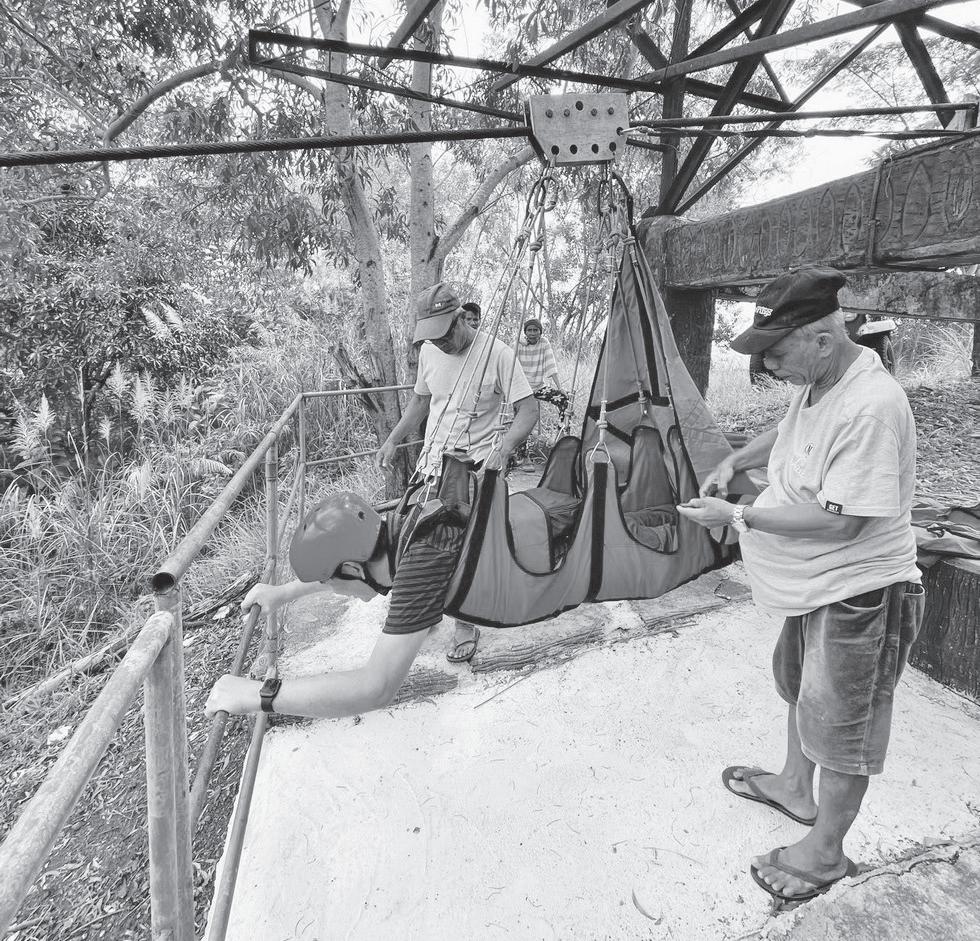
A 20-minute drive brought us next to the Banza Church r uins, the oldest stone church ruins in Mindanao. What is left of its former beauty is a bell tower engulfed inside a giant banyan tree. We took a peek at the ruins from a small opening on the side of the tree. The place is also a great spot to view the mighty Agusan r iver and to watch the sunset. On our way back to the resort, we crossed the beautiful 908-meter long Diosdado Macapagal Bridge, the third longest cable-stayed bridge in the country. On our second day Debra brought us to the Delta Discovery Park, home to the longest zipline in the country at 1.3 kilometers long. For adrenaline junkies like us, this was an opportunity we shouldn’t miss out on. The jeepney ride to the staging area, on offroad tracks over rocks and potholes, was a thrill in itself and fun, making us literally jump on our seats. The piece de resistance, of course, was the zipline ride. Using the horizontal, forward facing Superman zipline harness (the ultimate exhilarating “flying experience), we flew, head
first, down the zipline, for nearly two minutes, over two scenic valleys and a gulley, before the end of the line.
We also visited two statued monuments of the city’s claim to Magellan having landed here (the Magellan Anchorage) and first documented Catholic mass (Bood Promontory and e co Park). At Barangay Bading, we visited the two drydocked replicas of balanghais ( r aya Kolambu and r aya Siyagu), built in 2017, which kept alive the balanghai
l iturgical Museum (which showcases prized collections of religious and liturgical arts and materials), we spent the rest of the afternoon savoring the delights of the resort—swimming at the
lunch and dinner at the
Manay Maling r estaurant and capped the day with a relaxing massage inside our room. You can also do Zumba at the resort’s Tubay Hall. On our fourth and last day in Butuan, prior to our early evening flight back to Manila, we went beachcombing. Though Butuan doesn’t have a white sand beach, we were driven, for about an hour, to the short, white sand Vinapor Beach, as well as the clean, gray sand Bolihon Beach, in the nearby town of Carmen. So much to see, so little time. Too bad we weren’t able to visit Darangadang Falls and the
of
and
Story & photos by Marky Ramone Go
Story & photos by Benjamin Locsin Layug
and Eco Park
Flying like superman at Delta Discovery Park
photo by Debra r utz tanginan
rAyA Kolambu—Keeping the balanhai legacy alive
The Galaxy Tab S10+ is a productivity tablet equipped with AI
IAM no stranger to tablets but the Samsung Galaxy Tab S10+ is the first one I have used with 12.4 inches for the display and it’s quite large. But the reward of using one that large is that amazing display, thanks to the 120Hz Dynamic AMOLED 2X panel with an anti-reflective coating upfront.
Because of the Galaxy Tab S10+’s size, you also get a big 10,090mAh battery with 45W charging. This means you can bring it to a cafe to work and watch videos without the need for charging. So, yes, it’s very compact compared to a laptop.
The Tab S10+ weighs 1.25lbs for the Wi-Fi model and 1.27lbs for the 5G version.
The tablet is very thin and the materials used for the hardware are premium. It’s big but rests easy on the hand.
The size is not a big deal for me. My old phone was a Samsung Note 2 which had a 5.5-inch display and was called a phablet at the time.
The Enhanced Armor Aluminum frame is ready for all kinds of drops but please do not drop your tablet (or any other gadget) deliberately. The protection is for accidental drops.
The Galaxy Tab S10+ and the Tab S10 Ultra and the included S Pen are rated IP68 under IEC standard 60529. This is based on lab test submersion in up to 1.5 meters of freshwater for up to 30 minutes (IP68). Samsung disclaimer: it is not advised for beach or pool use. Water and dust resistance of the device is not permanent and may diminish over time because of normal wear and tear.
“The dust resistance rating is tested under lab conditions by a third party: 2kg of talc powder [max. diameter of 0.05mm] per cubic meter was blown into a test chamber housing the device [air pressure within the device kept below surrounding air] for 2 hours. [It is] rated IP6X. Dust-resistance may vary by actual usage conditions,” said Samsung in its website.
The Galaxy Tab S10+ is in a category called a productivity laptop and for someone like me, who normally writes on a phone but needs a laptop for certain work requirements, this is a need. If you want a keyboard with this, that is not included in the package. You need to buy the keyboard separately.
The 12.4-inch screen gives you a 1,752 x 2,800 pixel resolution and a 120Hz refresh rate. The tablet comes in 256 GB or 512 GB configurations, both with 12GB of RAM.
The front-facing camera is centered on the top edge while the antenna lines cross the back panel, which also has the Samsung logo, a magnetic charging groove for the S Pen stylus, and the camera module.
The top left edge houses the power button and volume rocker while the left side has a tray for SIM (for the 5G model) and microSD cards and two speaker grilles. Two other two speaker grilles flank the USB-C port (3.2 Gen 1) on the right edge. Meanwhile, Pogo-pin connectors can be seen the bottom edge and these are centered between two attachment points for accessories.
That stylus attaches to the back of the tablet magnetically.
I have a funny story about this. For some reason, I discovered that the stylus of the unit I was reviewing was missing and
sure that your video calls keep you framed to perfection. You can also use the camera to take HD videos and videos and edit them on the tablet. My personal choice is to take videos and photos on the S24 Ultra and edit them here.
The release of the Galaxy Tab S10+ and Galaxy Tab S10+ Ultra is a milestone for the brand because they are Samsung’s first tablets purposefully built for AI. This means it has all the stuff to help you enhance your photos but on a screen that’s bigger than a phone.
For Sketch to Image, go to your Gallery, choose your favorite moment, click on the Galaxy AI icon (stars icon) and click on Sketch to Image. Draw anything, and Galaxy AI will create a new element on your chosen photo in seconds – you can add a crown on the head to a person, a puppy, a kitten, or anything you prefer.
Photo assist helps improve and enhance photos. Edit suggestions, which is compatible with JPG, PNG, GIF, and MP4 formats, provide ideas on how to make your shots look better. There are other photo-enhancing recommendations like Background Blur, Erase Reflections, Erase Shadows, and even Remaster, Long-Exposure, and Colorize.
Of course, one of the most used features of Galaxy AI is allowing you to remove photo bombers and unnecessary clutter, which can then be filled in through Generative Edit. Just select the photo from the Gallery App and click Edit (pencil-shaped icon). Tap the Galaxy AI icon on the far left and edit. You can select an object by tapping or drawing a line around it (I use the Galaxy S Pen that comes with the tablet) and from there you can delete, move, or resize the object. Circle to Search, one of my favorite Galaxy AI features, is
OPPO, HKPolyU renew collaboration and
incorporated in the Galaxy S Pen for easy access to Galaxy AI Assistant features without jumping from menu to menu. The Book Cover Keyboard enables writing prompts to launch AI Assistant if you need any help while you write articles, letters and other forms of communication. This is another feature that I have yet to try.
One of the most useful AI features for me is the AIenhanced Note Taking, which transcribes interviews from voice recording. Transcription is not perfect but it gets half of the job done for me.
Would I purchase the Samsung Galaxy Tab S10+? Yes, I would. It’s a great device for work and play, and the 10,090 mAh battery and super fast charging are more than decent. Until November 17, Samsung is offering great deals on its new gadgets. Purchase a Galaxy S24 FE 128GB and get a FREE Galaxy Fit3 worth Php3,490 or a Galaxy S24 FE 256GB and get a Php5,000 discount in Globe and Smart stores. You also get zero percent interest on your Galaxy S24 FE 256GB when you apply for Samsung Finance+.
For the Galaxy Tab S10+ | Ultra, each purchase comes with a FREE pair of Galaxy Buds FE, a 12-month personal access to Microsoft 365, and a three-month subscription to YouTube Premium. Your device will be protected with a free six-month Samsung Care+ package, or you can upgrade to a one-year plan with a 60 percent discount or a two-year plan with a 30 percent discount. The Samsung Galaxy Tab S10+ is now available in the Samsung Online Store and Authorized Stores nationwide for around P83,990 for the 5G version and P68,000 for the
Accounting firm upskilling Filipino youth in digital literacy
BY RIZAL RAOUL S. REYES
ACCOUNTING giant Ernst and Young (EY) Global Services (GDS) is implementing a comprehensive program to upskill the Filipino youth to be competitive in the digital economy.
Rumi Mallick Mitra, corporate responsibility leader of EY Global Services, said in a recent press briefing that the accounting giant is pursuing a digital literacy program at multiple levels.
“First is, of course, the need for young people to be digitally literate as much as possible. When we say digital literacy, we do a combination of things. We, of course, make sure that they understand some of the essentials of digital interactions, from basic productivity tools to also something like AI,” said
Mitra. “We do a number of introductory sessions on artificial intelligence [AI], helping young people to understand what AI is for them. You know, they have been hearing chatGPT and chatbots and everything. These are all foundational—foundational because these are young people,” she said. She said young people need to be introduced to the idea of what the future will offer them and equip them with the right tools. “We also talk about cybersecurity because, as you understand, cybersecurity and AI pretty much converge with each other in many, many areas,” Mitra pointed out. She said EY GDS Philippines is also teaching the Filipino students specific areas of technology which are relevant in the Fourth Industrial Revolution such as AI. Mitra said EY GDS Philippines wants to ensure that the
students are first and foremost aware that these are the new technologies they need to be aware of (in understanding what) is happening around the world. Moreover, Mitra said teaching the new technologies would generate interest to pursue further upskilling or better training. “Because the reality is that most of the companies and workplaces are looking for young people to be prepared, to be ready, to know all of this,” she said. Mitra said EY GDS Philippines has about 100-plus schools. In the junior level, it has partnered with 82 schools in 10 regions nationwide. At EY GDS Philippines, Mitra said one of their initiatives is the promotion of the EY STEM App, an innovative gamified mobile platform developed by EY Ripples and Women in Technology, to inspire 100,000 girls across the globe to pursue a career in STEM.
launch joint innovation on
AI
HONG KONG—Guangdong OPPO Mobile Telecommunications Corp. Ltd. (OPPO) and The Hong Kong Polytechnic University (PolyU) held a signing ceremony to further deepen their collaboration based on the agreement signed in 2022, contributing to the integration of the Guangdong-Hong Kong-Macao Greater Bay Area (GBA).
According to the renewal agreement, OPPO will collaborate with PolyU to increase funding and technology investment, upgrading the PolyU-OPPO Joint Innovation Research Centre, which marks a new chapter in the comprehensive partnership in AI imaging technology.
The signing ceremony took place last November 1 at the PolyU campus, witnessed by Prof. Jin-Guang TENG, President of PolyU, and Jason LIAO, president of OPPO Research Institute.
The agreement was signed by Prof. Christopher CHAO, vice president (Research and Innovation) of PolyU, and Zheng QIN, Head of Industry-Academia Affairs of OPPO. Under the framework of the agreement, the PolyU-OPPO Joint Innovation Lab will be upgraded to the Joint Innovation Research Centre.
Additionally, OPPO will provide no less than RMB 30 million over the next five years to expand the scale of co-trained PhD and postdoctoral researchers, promoting technical development and exploration in imaging algorithms while further deepening the collaborative efforts between OPPO and PolyU in AI imaging technology.
“In the three years of collaboration between OPPO and PolyU, we have witnessed significant technological breakthroughs and notable achievements in talent cultivation through the Joint Lab,” said Jason LIAO.
“Adhering to our mission of ‘Technology for Mankind, Kindness for the World’, OPPO is dedicated to deepening the integration of academia-industry cooperation in the field of AI through this renewal, bringing more innovative intelligent imaging experiences to global users.”
Prof. TENG remarked, “To address the opportunities and challenges of the AI era, PolyU will officially establish the Faculty of Computer and Mathematical Sciences in January 2025. This is an important move to implement the university’s innovation development strategy, aiming to meet growing technological needs and support talent nurturing. The Department of Computing, which houses the Joint Innovation Research Centre, will also join the new faculty. The new structure will effectively promote in-depth exchanges and collaboration among research teams, and create more impactful outcomes. We believe that this in-depth cooperation with OPPO will enable us to fully seize opportunities and actively promote technological innovation and knowledge transfer.”
The evolving collaboration between OPPO and PolyU will propel the further development of AI imaging technology, providing new momentum for technological innovation and talent development in the GBA. Looking ahead, both parties will continue to strengthen the academia-industry cooperation, fully exploring and promoting innovative applications of AI imaging technology.
The app is accessible through partner nongovernment organizations and educational institutions across 10 regional and city divisions of the Department of Education. At the end of its second run in the Philippines, the EY STEM App now has over 6,000 registered females and has been integrated into the STEM curriculum as a complementary learning resource for both female and male students. In collaboration with the Junior Achievement of the Philippines. the EY STEM App conducted 8,357 STEM learning overall classroom activities involving 147 teachers, 87 schools, 10 Department of Education divisions (Caloocan, Taguig, Parañaque, Pasay, Mandaluyong, Manila, Negros Occidental, Victorias, Sagay, and Cebu), 314 Junior High School students, 10 differently-abled girls and 4,512 accessing the app.
OPPO signed a collaborative framework agreement with PolyU
www.businessmirror.com.ph
GOOGLE MAPS ADDS AI FEATURES TO HELP USERS EXPLORE AND NAVIGATE THE WORLD AROUND THEM
PALO ALTO, California—Google Maps is heading down a new road steered by artificial intelligence.
The shift announced on Thursday will bring more of the revolutionary AI technology that Google already has been baking into its dominant search engine to the digital maps service that the internet company launched nearly 20 years ago as part of its efforts to expand into new frontiers. Google Maps recently surpassed 2 billion monthly users worldwide for the first time, a milestone that illustrates how dependent people have become on the service’s directions during their daily commutes and excursions to new places. With the introduction of Google’s AI-powered Gemini technology, the maps are now being set up to become entertainment guides in addition to navigational tools.
Starting this week in the US only, users will be able to converse with Google Maps to ask for tips on things to do around specific spots in a neighborhood or city and receive lists of restaurants, bars and other nearby attractions that include reviews that have been compiled through the years.
The new features will also provide more detailed information about parking options near a designated destination along with walking directions for a user to check after departing the car.
“We are entering a new era of maps,” Miriam Daniel, general manager of Google Maps, told reporters Wednesday during a preview of the features presented in Palo Alto, California. “We are transforming how you navigate and explore the world.”
Google Maps also is trying to address complaints by introducing more detailed imagery that will make it easier to see which lane of the road to be situated in well ahead of having to make a turn.
In another AI twist, Google Maps is going to allow outside developers to tap into the language models underlying its Gemini technology to enable users to pose questions about specific destinations, such as apartments or restaurants, and get their queries answered within seconds. Google says this new feature, which initially will go through a testing phase, has undergone a fact-checking procedure that it calls “grounding.”
Google’s Waze maps, which focus exclusively on real-time driving directions, will use AI to offer a conversational way for its roughly 180 million monthly users to announce hazards in the road and other problems that could affect traveling times.
The decision to bring AI into a service that so many rely upon to get from one point to the next reflects Google’s growing confidence in its ability to prevent its Gemini technology from providing false or misleading information, also known as “hallucinations,” to users. AP
UNLOCK WORLD OF JOY AND DELIGHTFUL SURPRISES WITH GLOBE’S ALL-NEW REWARDS
GET ready for a new level of excitement with Globe’s All-New Rewards. Designed to turn everyday moments into surprising experiences, this revamped rewards program is packed with new features and partners.
Unlock a treasure trove of surprises, from mystery boxes to gamified scratch cards. With fresh collaborations on board, your daily purchases via the GlobeOne app now come with more Rewards points so you can redeem special perks that add a spark of joy to your routine. Taking things to a whole new level, Globe has also teamed up with the nation’s beloved girl group BINI and world-renowned esports legends Blacklist International. This dynamic and unexpected collaboration is set to captivate millions and create those memorable “Oh My G!” experiences.
“Globe has always been about creating meaningful connections and delightful experiences, and with the All-New Rewards program, we’re taking that commitment to the next level,” said Jerome Patalud, head of Globe Rewards.
“We want our customers to feel excited every time they interact with Globe, whether they’re redeeming Rewards, completing fun challenges, or simply exploring the new features we’ve introduced. This is our way of saying thank you for being part of the Globe family and for staying with us through the years.”
The All-New Rewards is loaded with incredible perks.
Check out what’s in store for you: G-Unbox: dive into mystery boxes filled with monthly offers from new partners; G-Swipe: enjoy gamified scratch cards for a shot at premium items; Challen-Gs: embrace the fun in completing missions and earning bonus points to enjoy more rewards; G-gantic Goals: team up with family and friends to reach goals and unlock rewards that support meaningful causes.
To enjoy these rewards and experiences, join All-New Rewards for free exclusive on the GlobeOne app.
BusinessMirror
Game on: GT Mode arrives on realme 13 5G
Gbecome a mainstream hobby spanning all ages, interests and regions. Mobile gaming, in particular, has skyrocketed, pulling in close to $100 billion in annual revenues and reaching nearly two billion mobile gamers. In markets like the Philippines and Indonesia, over 94% of internet users play video games, making mobile the most popular gaming platform across the globe.
It’s no surprise, then, that smartphone companies have invested heavily in mobile gaming-focused devices. After launching its duo of camera-centric Pro models, realme is completing the 13 series with the realme 13 5G and realme 13 Plus 5G. Both are aimed to make quality gaming more accessible by promising powerful performance at a more affordable price point.
To give it an edge over its competitors, realme brings GT Mode from its flagship GT6 and partners it with a Dimensity 6300 processor, to make sure it can handle serious gaming.
Now, here’s the funny part: my writing career started with reviewing games, but these days carpal tunnel keeps me from playing for more than 30 minutes. So, to give the realme 13 5G a proper workout, I handed it over to my nephew Finn—a gamer through and through—and asked him to put it to the test with his favorite games for a week. His feedback, paired with key specs, gives us a real look at how the realme 13 5G measures up in the world of mobile gaming.
DISPLAY: BUTTERY SMOOTH REFRESH RATE
FOR gamers, the display is more than just a screen— it’s the entire experience. The realme 13 5G has a 6.72-inch FHD+ IPS LCD panel with a resolution of 1080 x 2400 pixels. It’s a good size, providing plenty of space for immersive gameplay, without being so big that it becomes unwieldy. Even more important is the 120Hz refresh rate that brings the buttery-smooth interactions you’d expect in a high-end device to a mid-range phone. This refresh rate is particularly handy for fast-paced games where every flick and swipe matters and Finn noticed this immediately during his gaming sessions.
The 580 nits peak brightness is decent but it can be tricky to see the screen in direct sunlight. For indoor play, though, the brightness was just fine, and the eye comfort features were a nice touch during long gaming sessions. IPS LCD may not have the deeper contrasts of OLED screens, but it still does a great job with colors, so games with rich, vibrant worlds, like Genshin Impact, still look appealing.
When it comes to audio, the realme 13 5G doesn’t just settle for “good enough” as it’s equipped with dual stereo speakers that deliver clear, immersive sound. realme also included an Ultra Volume mode that can boost sound up to 200%, though Finn said keeping it between 170% and 180% struck a good balance—loud and clear without distortion. This volume boost can be a game-changer for action-packed titles like PUBG Mobile, where being able to hear footsteps or gunfire directions can make the difference between winning and losing. For those who want a more private experience, the realme 13 5G keeps things old school with a 3.5mm headphone jack. While many phones have ditched the jack, realme made a smart call here, appealing to those who prefer wired connections for that added clarity and zero-latency sound.
PERFORMANCE: DIMENSITY 6300+GT MODE
NOW, onto the engine under the hood. Powered by the MediaTek Dimensity 6300 and paired with 12GB of RAM, this phone means business—or serious gaming. The Dimensity 6300 is built on a 6nm process, designed for efficiency and performance, making it
a solid match for gaming. The combination of 26GB total RAM plus 12GB + 14GB via Dynamic Expansion makes for efficient switching when multitasking leading to a 7% faster app launch speed and helping it run up to 19 open apps smoothly in the background. With 256GB of storage, the realme 13 5G has plenty of room for your gaming library—from shooters to MOBAs and RPGs, you won’t need to delete apps to make space. Or you could use that to save 56,000 photos/songs or 900+ of your favorite TV episodes. But the real highlight here is GT Mode. Usually reserved for its flagship models, GT Mode essentially boosts the phone’s power, prioritizing the CPU and GPU to enhance frame rates and reduce lag during demanding gameplay. This mode isn’t just a gimmick—it makes a noticeable difference. Finn said he was able to play the most graphic-intensive games like Call of Duty, Honkai: Star Rail, Diablo and Genshin Impact on medium to high settings with consistent frame rates and minimal stuttering. He also noticed minimal heat up during his weekend marathon gaming sessions. This is because the realme 13 5G utilizes a stainless-steel 2249mm large vapor chamber cooling system. The benchmark scores of the realme 13 5G are impressive, with an Antutu score of 450,000+—punching well above its weight for a mid-range phone.
So, how does all this tech translate to actual gaming? Finn said it was surprisingly smooth. He had a blast trying out Honor of Kings, which ran at Ultra resolution with high FPS settings without any hiccups. The game maintained a stable near-60 FPS throughout, letting him enjoy the action without lag or interruptions. Maybe this is the reason why the realme 13 5G has been chosen as the game’s official phone. I also asked him to play Asphalt Legends, a game known for its fast-moving graphics, and the realme 13 5G handled it well only showing minor stutters, he said.
Also worth mentioning is the AI Boost which enhances gaming by using AI to make real-time adjustments based on app demands. Working alongside GT Mode, AI Boost dynamically adjusts CPU and GPU power to keep gameplay smooth while conserving battery. It predicts app usage for faster launch times, optimizes RAM allocation for efficient multitasking, and scales resource demands to prevent overheating. This intelligent resource management ensures stable performance, long gaming sessions, and fast responsiveness across apps.
On my part testing it out on casual games: I’d say for a phone in this price bracket, the realme 13 5G’s gaming performance is impressive giving other midrange competitors a serious run for their money.
CAMERA: SOLID FOR SOCMED
WHILE the realme 13 5G isn’t a photography-focused phone, it still packs a 50MP main camera with Optical Image Stabilization (OIS), accompanied by
a 2MP depth sensor. To test this feature, I lent the phone to our friends Judy Ching and Mark Bondoc of WhereATMNL for our event coverages. They too were quite pleased with the results and it was easy to take clear, sharp and vibrant photos that are perfect for sharing on social media. It doesn’t offer ultra-wide or telephoto lenses, but for the essentials, it gets the job done.
The front-facing 16MP camera is also okay for selfies, though I would strongly recommend a selfie light in less-than-ideal or darker environments to preserve more details. For photo samples check out our Instagram pages (@whereiseduy, @whereat.mnl). Videos are limited to 2K at 30fps, which keeps things reasonably smooth for casual recording.
DESIGN: VICTORY SPEED
IT’S easy to recognize gaming phones with their decked industrial, rugged designs and angular lines; the realme 13 5G goes in a different direction maintaining the design inspiration of the series. It offers a clean, unique look with a dual-pattern design. The top section of the back has a sleek “Speedy Curve” finish, while the lower part features a “Speedy Lightning Texture” that gives a slight wave effect, adding a touch of character without screaming “gamer.”
At 7.79mm thick and 190 grams, the realme 13 5G has a comfortable hand feel that makes long gaming sessions more enjoyable. Finn noted the flat, mattefinished sides help keep fingerprints away, and make it easier to grip during gameplay. We used the Speed Green for this review which is certainly eye-catching, but for those who want a more muted option there’s also Dark Purple. And realme didn’t just focus on looks—this phone is built to last. With IP64 water resistance and ArmorShell Drop-Proof Protection, it’s designed to withstand daily use, including the occasional splash or bump. For a gaming-focused device, this durability is a welcome feature, showing that realme paid attention to both form and function.
Final word: The realme 13 5G packs a solid gaming punch for its P16,999 price, with highlights like GT Mode, AI Boost, a 120Hz refresh rate, and ample 12GB RAM that make it an appealing choice for casual to moderate gamers. Its Dimensity 6300 processor and effective cooling system keep it performing smoothly across popular games, while dual stereo speakers and a sizable 5,000mAh battery with 45W fast charging (a 10-minute charge yields 1.5 hours gametime) enhance the overall experience. For those looking to dive into mobile gaming on a budget, the realme 13 5G is a
A10 Saturday, November 9, 2024
Everything to gain for Alas Pilipinas
By Aldrin Quinto
CITY of Santa Rosa—Kly
Orillaneda dove for the ball like her life depended on it and Gen Eslapor had spring in her step that seemed to cancel out their Chinese rivals’ height advantage.
The Alas Pilipinas pair held the upper hand briefly before the grizzled team of Xia Xinyi and Wang Jingzhe seized control, scoring a 21-13, 21-8 victory Friday to advance to the quarterfinals of the Asian Senior Beach Volleyball Championships at the Nuvali Sand Courts here.
The teen tandem of Khylem Progella and Sofiah Pagara also struggled to keep up against a towering Chinese pair in the Round of 16 with Xue Chen and Zeng Jinjin booking a 21-14, 21-11 victory to advance.
“We wanted a good start and we did, but we just lost steam because it’s not easy trying to match the game of these veterans,” Orillaneda said.
With great positioning and some misdirection, Orillaneda and Eslapor led 5-3 to the home crowd’s delight before the Chinese duo stepped on the gas and took over.
It was a solid effort by the Philippine teams considering they faced Olympians and world champions.
Xia and Xue, Paris Olympians and winners of the Asian Seniors last year in Pingtan, gun for the title with new partners this time—Xue owns an Olympic bronze medal and a world championship title.
They are joined by a third Chinese pair in the round of eight as Yan Xu and Zhou Mingli beat Thailand’s Tanarattha Udomchavee and Rumpaipruet Numwong, 21-15, 21-18, in the tournament backed by Nuvali, Ayala Land, Rebisco, Smart, Philippine Sports Commission, Philippine Olympic Committee, City of Santa Rosa, Mikasa, Senoh, Asics, Akari, Sip, Cignal, One Sports, One Sports Plus, Pilipinas Live and Asian Volleyball Confederation and Philippine National Volleyball Federation headed by Ramon “Tats” Suzara. Orillaneda and Eslapor were all smiles even as they bowed out of the tournament.
“We played with nothing to lose, everything to gain,” Eslapor said. “The important thing was we did our best
NO matter the result, Kly Orillaneda and Gen Eslapor lose nothing but the match and gain everything they need for their future campaign. ROY DOMINGO
because we were given an opportunity to face players of their level.”
The 18-year-old Progella and the 19-year-old Pagara showed flashes of brilliance but Chinese six-footers kept control throughout the 31-minute match.
“We tried to keep it close but it was really tough to overcome their advantage in height and experience,” Progella said.
Jasmine Fleming and Elizabeth Alchin prevailed in an all-Australian showdown with Alisha Stevens and Cameron Zajer, 14-21, 21-14, 15-12. AVC Beach Tour Nuvali Open
champions Jana Milutinovic and Stefanie Fejes of Australia also entered the quarterfinals, beating Thailand’s Salinda Mungkhon and Somruedee Koedkaew, 21-10, 21-12, while New Zealand’s Shauna Polley and Olivia MacDonald held off Japan’s Ren Matsumoto and Non Matsumoto, 2220, 21-18.
Japan’s Asami Shiba and Saki Maruyama eliminated Indonesia’s Desi Ratnasari and Nur Atika Sari, 21-19, 21-6.
Australia’s Tara Phillips and Kayl Mears downed Thailand’s Taravadee Naraphornrapat and
Del Rosario brings act to tough Party Ladies Open
PAULINE DEL ROSARIO heads to the Party Ladies Open in Taiwan aiming to build on her past successes and redeem herself after a joint sixth-place finish last year.
The 54-hole NT$5 million championship is part of the Ladies Professional Golf Association of Taiwan (TLPGA) series and starts November 13 the Lily Golf and Country Club in Hsinchu County.
“I’m looking forward to playing in Taiwan. I have great memories there and am excited to compete with many top Asian players,” said del Rosario, recalling her 2017 victory in the TLPGA and Royal Open, where she became the first Filipina to win on the Taiwan circuit. She also dominated the Ladies Philippine Golf Tour (LPGT) that year with four to win the prestigious Order of Merit. After moving to the Epson Tour— LPGA Tour’s developmental circuit—del Rosario faced some challenging seasons
By Josef Ramos
but has steadily gained experience and resilience by making the cut in her first six events and highlighted her campaign with a top 10 finish at the IOA Classic. Her form dipped at midseason but rallied with a year-best jointeighth finish at the Twin Bridges Championship in July.
“After a full season on the Epson Tour, my swing has flattened a bit, so I’m working with my coach to get it back on plane,” she said. “I feel good about the adjustments, and hopefully, they’ll start to show next week.”
Del Rosario will face a strong field at the Party Ladies Open, including Taiwan’s top-ranked players Yu Ju Chen, Li Ning Wang, Cheng Hsuan Shih and last year’s winner Ling Jie Chen.
Top golfers from Japan, Malaysia and Thailand—one of them Thai PK Kongkraphan, who has won three TLPGA titles this year and has 37 career wins— are also in the contest.
Advancing to the men’s quarterfinals were 2023 champions Thomas Hodges and Zachery Schubert of Australia after beating Yoshi Hasegawa and Dylan Kurokawa of Japan, 21-12, 21-14.
China’s Wu Jiaxin and Ha Likejiang won, 21-12, 21-14, over Dunwinit Kaewsai and Banlue Nakprakong of Thailand, while Australia’s D’Artagnan Potts and Jack Pearse beat Japan’s Takumi Takahashi and Jumpei Ikeda, 21-17, 21-17.
win-loss-draw record with 23 knockouts, Ancajas said he’s very eager to climb the ring even opposite a fellow Filipino before the year ends as either a bantamweight or super bantamweight.
“I have no scheduled fight for now, but I’m willing to fight even in December if there’s an opportunity,” he said. “And yes, even against a fellow Filipino, someone who’s tougher and brave to give it his best shot.” Joven Jimenez manages and trains Ancajas at the Survival Camp in Magallanes Cavite.
THE Premier Volleyball League’s giant leap forward jumpstarts on Saturday with the six months long All-Filipino Conference at the PhilSports Arena in Pasig City.
The tournament goes down as the longest and most comprehensive tournament in league history.
Following the success of the inaugural Rookie Draft, the league tinkered with its calendar and introduced an innovative format aligned with the International Volleyball Federation’s schedule that provides fans a wealth of high-stakes matches and fierce competition.
Creamline leads the 12-team field as the defending champions with a record four straight titles since the 2023 AllFilipino Conference.
The conference opens with a thrilling doubleheader with Akari, fresh from a runner-up finish in the Reinforced Conference, facing off against Galeries Tower at 4 p.m. and Petro Gazz Angels and Choco Mucho Flying Titans squaring off at 6:30 p.m.
The Chargers bring a formidable roster led by Ivy Lacsina, Ced Domingo, Faith Nisperos and Fifi Sharma and
THE Association of Firearms and Ammunition Dealers (AFAD) hosts the second and final phase of the 30th Defense and Sports Arms Show from November 20 to 24 at the SMX Convention Center in Pasay City. AFAD Spokesman Alaric “Aric” Topacio said this year’s final show is expected to outshine last August’s first installment and the Davao City edition last month as the shooting community and firearms industry brace to
complimented by seasoned players Gretchel Soltones, Joy Soyud and Michelle Cobb.
The Highrisers have top rookie Julia Coronel playing alongside key players Grazie Bombita and Jewel Encarnacion. A fully healthy Choco Mucho side is bolstered by a star-studded roster made up of Kat Tolentino, Royse Tubino and Dindin Manabat, while Petro Gazz brings back experienced talents Jonah Sabete and Aiza Pontillas and the returning MJ Phillips. On Tuesday, PLDT will take on Nxled, followed by the Chery TiggoCapital1 matchup, while Creamline’s title defense begins next Saturday against Petro Gazz, a challenging start to the Cool Smashers’ bid for an 11th championship.
After the preliminary round, teams will be ranked 1 to 12. In the qualifying round with the top-ranked teams facing the lowest-ranked squads and the losing teams will enter a play-in tournament for another opportunity to progress. The quarterfinals will feature a bestof-three series, while the semifinals will follow a round-robin format with a tiebreaker if needed. The championship will also be a best-of-three showdown.
ASSOCIATION of Firearms and Ammunition Dealers president Edwin Lim (left) and spokesman Alaric “Aric” Topacio expounds on the defense and sports arms show.
Pirates triumph Lyceum of the Philippines University’s Simon Penafiel drive against Jose Rizal University’s Karl De Jesus during their National Collegiate Athletic Association Season 100 seniors basketball game on Friday at the Filoil-EcoOil Center in San Juan City. The Pirates won, 82-80, to stay in contention for the Final Four. COURTESY RUDY ESPERAS
PAULINE DEL ROSARIO’S eager on her Taiwan stint.
Editor: Angel R. Calso
Federal Reserve cuts key interest rate; Powell won’t resign if asked by Trump
By Christopher Rugaber Ap Economics Writer
WASHINGTON—The
Federal Reserve cut its key interest rate Thursday by a quarter-point in response to the steady decline in the once-high inflation that had angered Americans and helped drive Donald Trump’s presidential election victory this week.
The rate cut follows a larger half-point reduction in September, and it reflects the Fed’s renewed focus on supporting the job market as well as fighting inflation, which now barely exceeds the central bank’s 2 percent target.
Asked at a news conference how Trump’s election might affect the Fed’s policymaking, Chair Jerome Powell said that “in the near term, the election will have no effects on our (interest rate) decisions.”
But Trump’s election, beyond its economic consequences, has raised the specter of meddling by the White House in the Fed’s policy decisions. Trump has argued that as president, he should have a voice in the central bank’s interest rate decisions. The Fed has long guarded its role as an independent agency able to make difficult decisions about borrowing rates, free from political interference. Yet in his previous term in the White House, Trump publicly attacked Powell after the Fed raised rates
to fight inflation, and he may do so again.
Asked whether he would resign if Trump asked him to, Powell, who will have a year left in his second four-year term as Fed chair when Trump takes office, replied simply, “No.”
And Powell said that in his view, Trump could not fire or demote him: It would “not be permitted under the law,” he said. Thursday’s Fed rate cut reduced its benchmark rate to about 4.6 percent, down from a four-decade high of 5.3 percent. The Fed had kept its rate that high for more than a year to fight the worst inflation streak in four decades. Annual inflation has since fallen from a 9.1 percent peak in mid-2022 to a 3 1/2-year low of 2.4 percent in September.
When its latest policy meeting ended Thursday, the Fed issued a statement noting that the “unemployment rate has moved up but remains low,” and while inflation
has fallen closer to the 2 percent target level, it “remains somewhat elevated.”
After their rate cut in September—their first such move in more than four years—the policymakers had projected that they would make further quarter-point cuts in November and December and four more next year. But with the economy now mostly solid and Wall Street anticipating faster growth, larger budget deficits and higher inflation under a Trump presidency, further rate cuts may have become less likely. Rate cuts by the Fed typically lead over time to lower borrowing costs for consumers and businesses.
Powell declined to be pinned down Thursday on whether the Fed would proceed with an additional quarter-point rate cut in December or the four rate cuts its policymakers penciled in for 2025.
Diane Swonk, chief economist at accounting giant KPMG, said she thought Powell was reluctant to provide hints about the Fed’s next moves because of the uncertainty caused by Trump’s election victory.
“He’s not willing to go too far out ahead of his skis, given how much could change,” she said. “In an environment where you don’t know how promises on the campaign trail translate to actual policies, you don’t want to frontrun it.”
Still, Matthew Luzzetti, an economist at Deutsche Bank, said there were signs that the Fed might end up announcing fewer rate cuts next year than many economists expect. The job market and the economy are looking healthier than they appeared in September, when the Fed announced an out -
size half-point rate cut.
“Nothing in the economic data,” Luzzetti said, “suggests that the (Fed) has any need to be in a hurry” to get rates down substantially.”
On Thursday, Powell did express confidence that inflation, despite some recent higher-thanexpected readings, would keep falling back to the Fed’s target.
“We feel like the story is very consistent with inflation continuing to come down on a bumpy path over the next couple of years, and settling around 2 percent,” he said.
The economy is clouding the picture by flashing conflicting signals, with growth solid but hiring weakening. Consumer spending, though, has been healthy, fueling concerns that there is no need for the Fed to reduce borrowing costs and that doing so might overstimulate the economy and even re-accelerate inflation.
Financial markets are throwing yet another curve at the Fed:
Investors have pushed up Treasury yields since the central bank cut rates in September. The result has been higher borrowing costs throughout the economy, thereby diminishing the benefit to consumers of the Fed’s half-point cut in its benchmark rate, which it announced after its September meeting.
Broader interest rates have risen because investors are anticipating higher inflation, larger federal budget deficits, and faster economic growth under President-elect Trump. Trump’s plan to impose at least a 10 percent tariff on all imports, as well as significantly higher taxes on Chinese goods, and to carry out a mass deportation of undocumented immigrants would almost certainly boost inflation. This would make it less likely that the Fed would continue cutting its key rate. Annual inflation as measured by the central bank’s
preferred gauge fell to 2.1 percent in September.
Economists at Goldman Sachs estimate that Trump’s proposed 10 percent tariff, as well as his proposed taxes on Chinese imports and autos from Mexico, could send inflation back up to about 2.75 percent to 3 percent by mid-2026. The economy grew at a solid annual rate just below 3 percent over the past six months, while consumer spending—fueled by higher-income shoppers—rose strongly in the July-September quarter.
But companies have scaled back hiring, with many people who are out of work struggling to find jobs. Powell has suggested that the Fed is reducing its key rate in part to bolster the job market. If economic growth continues at a healthy clip and inflation climbs again, though, the central bank will come under pressure to slow or stop its rate cuts.
Asked at his news conference about Americans who are feeling little relief from the pain of high prices and who helped fuel Trump’s victory, Powell said:
“It takes some years of real wage gains for people to feel better, and that’s what we’re trying to create, and I think we’re well on the road to creating that. Inflation has come way down, the economy is still strong here, wages are moving up, but at a sustainable level.
“I think what needs to happen is happening, and for the most part has happened, but it will be some time before people regain their confidence and feel that.”
Massive Southern California wildfire destroys 132 structures in 2 days, threatens thousands
By Christopher Weber & Noah Berger
CThe Associated Press
AMARILLO, Calif.—A
Southern California wildfire has destroyed 132 structures, mostly houses, in less than two days, fire officials said Thursday as raging winds were forecast to ease.
The fire started Wednesday morning in Ventura County and has grown to about 32 square miles (83 square kilometers) at 5% containment. Its cause has not been determined.
Ten people have been injured in the course of the fire, Ventura County Sheriff James Fryhoff said. Most of them suffered from smoke inhalation or other nonlife-threatening injuries.
Fire officials said 88 other structures were damaged but did not specify whether they had been burned or affected by water or smoke damage.
Some 10,000 people remained under evacuation orders Thursday as the Mountain Fire continued to threaten some 3,500 structures in suburban neighborhoods, ranches and agricultural areas around Camarillo in Ventura County.
County fire officials said crews working in steep terrain with support from water-dropping helicopters were focusing on protecting homes on hillsides along the fire’s northeast edge near the city of Santa Paula, home to more than 30,000 people.
Kelly Barton watched as firefighters sifted through the charred
rubble of her parents’ ranch home of 20 years in the hills of Camarillo with a view of the Pacific Ocean. The crews uncovered two safes and her parents’ collection of vintage door knockers undamaged among the devastation.
“This was their forever retirement home,” Barton said Thursday. “Now in their 70s, they have to start over.”
Her father returned to the house an hour after evacuating Wednesday to find it already destroyed. He was able to move four of their vintage cars to safety but two—including a Chevy Nova he’d had since he was 18—burned to “toast,” Barton said.
Officials in several Southern California counties urged residents to be on watch for fastspreading blazes, power outages
and downed trees during the latest round of notorious Santa Ana winds.
Santa Anas are dry, warm and gusty northeast winds that blow from the interior of Southern California toward the coast and offshore, moving in the opposite direction of the normal onshore flow that carries moist air from the Pacific. They typically occur during the fall months and continue through winter and into early spring.
Ariel Cohen, the National Weather Service’s meteorologist in charge in Oxnard, said Santa Ana winds were subsiding in the lower elevations but remained gusty across the higher elevations Thursday evening.
The red flag warnings, indicating conditions for high fire danger,
expired in the area except for in the Santa Susana Mountains, Cohen said. The warnings will expire by 11 a.m. Friday in the mountains.
The Santa Ana winds are expected to return early-to-midweek next week, Cohen added.
The Mountain Fire was burning in a region that has seen some of California’s most destructive fires over the years. The fire swiftly grew from less than half a square mile (about 1.2 square kilometers) to more than 16 square miles (41 square kilometers) in little more than five hours on Wednesday. By Thursday evening it was mapped at about 32 square miles (83 square kilometers) and Gov. Gavin Newsom had proclaimed a state of emergency in the county.
Marcus Eriksen, who has a farm in Santa Paula, said firefighters kept embers from spreading to his home, his vehicles and other structures even as piles of compost and wood chips were engulfed.
The flames were up to 30 feet (9 meters) tall and moving quickly, Eriksen said Thursday. Their speed and ferocity overwhelmed him, but the firefighters kept battling to save as much as they could on his property. Thanks to their work, “we dodged a bullet, big time,” he said.
Sharon Boggie said the fire came within 200 feet (60 meters) of her house in Santa Paula.
“We thought we were going to lose it at 7:00 this morning,” Boggie said Thursday as white smoke billowed through the neighborhood. She initially fled with her two dogs while her sister and neph
ew stayed behind. Hours later the situation seemed better, she said.
The Ventura County Office of Education announced that more than a dozen school districts and campuses in the county were closed Thursday, and a few were expected to be closed Friday.
Weber reported from Los Angeles. Jaimie Ding and Stefanie Dazio in Los Angeles; Ethan Swope in Camarillo; Eugene Garcia in Santa Paula; Amy Taxin in Orange County; Kathy McCormack in Concord, New Hampshire; and Sarah Brumfield in Washington, D.C., contributed to this report.
JAIME HERNANDEZ sprays water to defend his home while battling approaching flames from the Mountain Fire near Moorpark, Calif., on Thursday, Nov. 7, 2024. Hernandez has been staying behind to fight multiple wildfires since
China unveils $839-B plan to refinance local government debt and boost economic growth
By Ken Moritsugu & Zen Soo The Associated Press
BEIJING—China on Friday approved a 6 trillion yuan ($839 billion) plan to help local governments refinance their mountains of debt in the latest push to rev up growth in the world’s second largest economy.
The plan will be implemented over the next three years, Xu Hongcai, vice-chairman of the National People’s Congress’s financial and economic committee, said at a news conference Friday.
Finance minister Lan Fo’an estimated that the hidden debt of local governments was 14.3 trillion yuan (US$2 trillion) at the end of 2023.
Lan said 2 trillion yuan would be allocated each year from 2024 to 2026 to help local government resolve their debts. He estimated that the amount of hidden debt will drop to 2.3 trillion yuan ($320.9 billion) by the end of 2028. Analysts have called for bold, multi-trillion yuan measures to
reinvigorate the world’s second largest economy, which has yet to bounce back fully from the Covid-19 pandemic.
Local government debts have ballooned partly due to high spending and low tax revenues during the pandemic, but also due to a downturn in the property industry, since sales of land use rights, a key source of local government revenue, have sagged.
The central bank loosened restrictions on borrowing in late September, sparking a stock market rally, but economists say the government needs to do more to ignite a sustained recovery. Government officials have indicated that could come at this week’s meeting of the Standing Committee of the National People’s Congress, which must give official approval to any new spending.
The economy has shown signs of life in the last two months. Purchase subsidies offered to people
who trade in old cars or appliances for new ones helped auto sales rebound in September. A survey of manufacturers turned positive in October after five straight months of decline, and exports surged 12.7 percent last month, the largest
Australian states back national plan to ban children younger than 16 from social media
By Rod Mcguirk The Associated Press
ELBOURNE, Austra -
Mlia—Australia’s states and territories on Friday unanimously backed a national plan to require most forms of social media to bar children younger than 16.
Leaders of the eight provinces held a virtual meeting with Prime Minister Anthony Albanese to discuss what he calls a world-first national approach that would make platforms including X, TikTok, Instagram and Facebook responsible for enforcing the age limit.
“Social media is doing social harm to our young Australians,” Albanese told reporters. “The safety and mental health of our young people has to be a priority.”
The government leaders had been discussing for months setting a limit, considering options from 14 to 16 years of age.
While Tasmania would have preferred 14, the state was prepared to support 16 in the interests of achieving national uniformity, Albanese said.
The legislation will be introduced into Parliament within two weeks, and the age ban would take effect a year after it passes into law, giving platforms time to work out how to exclude children. The gov -
ernment has yet to offer a technical solution.
The delay is also intended to allow time to address privacy concerns around age verification.
The main opposition party has given in-principle support to the 16-year age limit since it was announced on Thursday, suggesting the legislation will pass the Senate.
The minor Greens party was critical, saying the ban would prevent the emergence in Australia of future child environmental activists like Sweden’s Greta Thunberg.
More than 140 academics with expertise in fields related to technology and child welfare signed an open letter to Albanese last month opposing a social media
age limit as “too blunt an instrument to address risks effectively.”
Critics say most teenagers are tech savvy enough to get around such laws. Some fear the ban will create conflicts within families and drive social media problems underground.
Meta, which owns Facebook and Instagram, argues that stronger tools in app stores and operating systems for parents to control what apps their children can use would be a “simple and effective solution.”
The government likens the proposed social media age limit to the laws that restrict the sale of alcohol to adults aged 18 and older across Australia. Children still find ways to drink, but the
prohibition remains.
“We think these laws will make a real positive difference,” Albanese said.
But Lisa Given, professor of information sciences at RMIT University, described the legislation as “really problematic.”
“Many of our social networks are actually about the provision of extremely critical information to kids,” Given told Australian Broadcasting Corp.
“There’s no doubt that they’re also facing bullying and other challenges online, but they actually need the social supports to know how to navigate the platforms safely and so they need more support from parents, from care-givers, not less access to a single or multiple platforms,” Given added.
Tama Leaver, professor of Internet studies at Curtin University, described the government’s plan to remove 14 and 15-yearolds from their already established social media accounts was “strange.”
“If you’ve already developed that space in that world, to have it taken away really could do as much harm as the harms that are purportedly being fixed,” Leaver said.
“There are so many questions about this that have yet to be answered, but even if we had solid answers about how this might work technically and how this might get implemented socially, it’s still hard to believe that this would actually keep kids safe online,” he added.
Communications Minister Michelle Rowland said children would retain access to online education and health services.
The legislation would also include strong privacy protections surrounding age verification.
“Privacy must be paramount, including that of children,” Rowland said. “We should also be very clear about the realities. These platforms know about their users in a way that no one else does.”
Rowland said YouTube would likely be included among the mainstream platforms defined under the legislation as age restricted services.
But YouTube Kids could be exempted. Gaming and messaging services would not face age restrictions, she said.
increase in more than two years. For most of the year, the ruling Communist Party appeared more focused on addressing long-term structural issues with the economy rather than short-term ones. Previous steps to boost the economy
were piecemeal, seemingly aimed at keeping the economy afloat rather than sparking a robust recovery.
In recent weeks, the party has signaled a growing concern about the economy’s sluggishness as it tries to meet its goal of achieving growth of around 5 percent this year. The central bank’s monetary easing was followed by government pronouncements that it still has ample funds to pump into the economy.
Still, the longer-term goals of transforming China into a hightech and green energy economy seem likely to remain the chief aims of the Communist Party, which doesn’t face election pressures like the ones that toppled the Democrats and swept Donald Trump’s Republicans to power in America this week.
AP Business Writer Zen Soo contributed from Hong Kong.
Myanmar’s conflict-torn Rakhine state could face an imminent acute famine–UN report
By Edith M. Lederer The Associated Press
UNITED NATIONS—Myanmar’s Rakhine state, home to the Rohingya minority and engulfed in conflict between government forces and a powerful ethnic group, could face an imminent acute famine, the United Nations development agency warned in a new report.
The UN Development Program said in the report issued Thursday that “a perfect storm is brewing” which has put western Rakhine “on the precipice of an unprecedented disaster.”
It pointed to a chain of interlinked developments including restrictions on goods from elsewhere in Myanmar and neighboring Bangladesh, the absence of income for residents, hyperinflation, significantly reduced food production, and a lack of essential services and social safety net.
As a result, UNDP said, “an already highly vulnerable population may be on the brink of collapse in the coming months.”
Buddhist-majority Myanmar has long considered the Rohingya Muslim minority to be “Bengalis” from Bangladesh even though their families have lived in the country for generations. Nearly all have been denied citizenship since 1982.
In August 2017, attacks by a Rohingya insurgent group on Myanmar security personnel triggered a brutal campaign by the military which drove at least 740,000 Rohingya to Bangladesh. The military is accused of mass rape, killings and burning thousands of homes.
Since Myanmar’s military seized power in 2021 from the elected government of Aung San Suu Kyi, pro-democracy guerillas and ethnic minority armed forces have been attempting to oust the military from power.
Last November, the Arakan Army, which is seeking autonomy from Myanmar’s central government, began an offensive against the military in Rakhine and has gained control of more than half of its townships. The Arakan Army, which is the well-armed wing of the Rakhine ethnic minority movement, is also a
member of the armed ethnic group alliance trying to topple the military.
The UNDP report said that based on data the agency collected in 2023 and 2024, “Rakhine’s economy has stopped functioning, with critical sectors such as trade, agriculture, and construction nearly at a standstill.”
With domestic and international markets no longer accessible because of blockades, UNDP said people’s incomes are collapsing because they can’t export goods, and that agricultural jobs are disappearing for the same reason.
In addition, it said, imports of cement have stopped, leading to “an exorbitant price increase” and shutting down the construction industry, a major employer.
The report, titled “Rakhine: A Famine in the Making,” said, “Rakhine could face acute famine imminently.”
“Predictions indicate that domestic food production will only cover 20 percent of its needs by March-April 2025,” UNDP said.
“Internal rice production is plummeting due to a lack of seeds, fertilizers, severe weather conditions, a steep rise in the number of internally displaced people who can longer engage in cultivation, and escalating conflict,” the UN agency said. “This, along with the near-total cessation of internal and external trade, will leave over 2 million people at risk of starvation.”
UNDP called for immediate action to allow goods and humanitarian aid into Rakhine, enable unimpeded access for aid workers and ensure their safety, and urgently provide financial resources to enable the agricultural sector to recover.
“Without urgent action, 95 percent of the population will regress into survival mode, left to fend for themselves amid a drastic reduction in domestic production, skyrocketing prices, widespread unemployment, and heightened insecurity,” UNDP warned.
“With trade routes closed and severe restrictions on aid, Rakhine risks becoming a fully isolated zone of deep human suffering,” the UN agency said.
WORKERS use heavy equipment at a worksite in Beijing on Thursday, November 7, 2024. AP/NG HAN GUAN
14-YEAR-OLD Henry, right, and Angel, 15, use their phones to view social media in Sydney on Friday, November 8, 2024. AP/RICK RYCROFT
4.
5.
6. HE, LIJUAN Mandarin UX Designer
Brief Job Description: Analyze user feedback and data to inform design decisions and enhance user experiences.
7. ARJONA ALONSO, MANUEL Commissioning Technician
Brief Job Description: Responsible for driving the delivery and implementation of commissioning activities and for collaborating with the Integration and Completion Teams to manage the different commissioning phases of the project.
Salary Range: Php 90,000 - Php 149,999
Basic Qualification: Proficient in speaking, reading and writing in Mandarin language. Salary Range: Php 60,000 - Php 89,999
Basic Qualification: College graduate, with previous
BUFFET AVENUE MATGALNE INC. Level 6, Shangri-la, Plaza Edsa Cor, Wack-wack Greenhills, City Of Mandaluyong
20. LEE, JISUNG Operations Manager
Brief Job Description: Responsible for providing expertise and knowledge in formulating policies, managing the company’s daily operations and for supervision and manage of the company’s staff.
BYTEDANCE PHILIPPINES, INC. Figari Solutions, 12th Floor, The Curve Building, 3rd
Global City, Fort Bonifacio, City Of Taguig
ZHOU, PENGCHAO
CBS TOTAL CONSULTANCY CORP. 3f Ech Bldg., 100 Jupiter St., Cor. Makati Ave., Bel-air, City Of Makati
22. KIM, YOUNGWOO Business Consultant
Brief Job Description: Respond promptly to customer inquiries on CBS products and services maintain positive, empathetic and professional attitude toward customers at all time.
CHIANG KAI SHEK COLLEGE, INC. 1477, Narra St., Barangay 244, Tondo I/ii, City Of Manila
23. ZHANG, NAMEI Mandarin Language Specialist
Brief Job Description: Responsible for providing Mandarin support to local teachers and for monitoring the progress employees.
Basic Qualification: College graduate, with previous work experience in a similar role and with excellent technical and communication skills.
Salary Range: Php 30,000 - Php 59,999
CHINA HARBOUR ENGINEERING COMPANY 5/f Section E Ramon Magsaysay Center, 1680 Roxas Blvd., 076, Barangay 699, Malate, City Of Manila
24. QIAN, QUAN Bilingual Dredger Navigation Controller Brief Job Description: The Bilingual Dredger Navigation Controller will be a strategist and a leader able to
25.
54.
FLASH EXPRESS SOFTWARE (PH) CO., LTD. INC. 11/f Cybersigma, Lawton Ave., West Mckinley, Fort Bonifacio, City Of Taguig
56. KANG, PING Area Manager
Brief Job Description: Oversee and manage day-to-day operations of multiple locations within the designated area.
57. BAI, YUAN Assistant To Hub Manager
Brief Job Description: Provide administrative support to hub manager in organizing and coordinating day-to-day activities.
Basic Qualification: Bachelor’s degree in relevant field, or equivalent work experience.
Salary Range: Php 60,000 - Php 89,999
Basic Qualification: Bachelor’s degree in relevant field, or equivalent work experience. Salary Range: Php 60,000 - Php 89,999
GIGA INFORMATION TECHNOLOGY AND SOFTWARE DEVELOPMENT INC. 31/f Pbcom Tower 6795 Ayala Ave., Cor. V.a. Rufino St., Bel-air, City Of Makati
58. CHEN, HONG Bilingual Comptroller
Brief Job Description: Prepares work to be processed by gathering, sorting, organizing and recording data, information and documents.
59. HU, YANWEN Bilingual Comptroller
Brief Job Description: Prepares work to be processed by gathering, sorting, organizing and recording data information and documents.
60. LAI, BOJUN Bilingual Comptroller
Brief Job Description: Prepares work to be processed by gathering, sorting, organizing and recording data, information and documents.
61. LI, RONGPO Bilingual Comptroller
Brief Job Description: Prepares work to be processed by gathering, sorting, organizing and recording data, information and documents.
62. SHAO, LIANGQUAN Bilingual Comptroller
Brief Job Description: Prepares work to be processed by gathering, sorting, organizing, and recording data, information, and documents.
63. ZHANG, JIAJIN Bilingual Comptroller
Brief Job Description: Prepares work to be processed by gathering, sorting, organizing, and recording data, information, and documents.
64. ZUO, JINJIN
Bilingual Comptroller
Brief Job Description: Prepares work to be processed by gathering, sorting, organizing, and recording data, information, and documents. Basic Qualification: Foreign
65. NGUYEN, TAN PHAT Bilingual Customer Service Representative
Brief Job Description: Identify and assess customers’ needs to achieve satisfaction.
66. CAI, ENJUAN Chinese Account Specialist
Brief Job Description: Prepares work to be processed by gathering, sorting, organizing and recording data, information and documents.
67. CAI, HUAZHONG Chinese Account Specialist
Brief Job Description: Prepares work to be processed by gathering, sorting, organizing and recording data, information and documents.
68. CAI, LE Chinese Account Specialist
Brief Job Description: Prepares work to be processed by gathering, sorting, organizing and recording data, information and documents.
69. CAI, YUMEI Chinese Account Specialist
Brief
70. CHEN, BAOSHENG Chinese Account Specialist
Brief
71.
Qualification: Exceptional ability to provide technical support and resolve
Basic
106.
107.
Brief
108. ZENG, SHIQIANG Store Manager (Mandarin Speaking)
Brief Job Description: Oversee
109. ZHAO, JUNFANG Store Manager (Mandarin Speaking)
Brief Job Description: Oversee restaurant operations and ensure a smooth flow.
Brief Job Description: To develop and implement supply chain strategy.
Basic Qualification: Must be bachelor’s degree in business administration, retail management, or a related field (preferred but not always required).
Salary Range: Php 30,000 - Php 59,999
Basic Qualification: Must have an excellent written and verbal communication
Product Marketing Director
111. DEHESTRU, MAXENCE, PIERRE, MICHEL
Brief Job Description: To understand customer needs, market trends, and competitive landscape, defining product positioning and messaging to differentiate the product in the market. Basic Qualification: Bachelor’s degree in business, economics,
NITORI PHILIPPINES INC. (NITORI) Room 604-b Vicente Madrigal Bldg., 6793 Ayala Ave., Bel-air, City Of
112. WADA, TAKAHIDE Store Development Manager
Brief Job Description: Responsible for continuously working to reduce cost without affecting the standard of work or operation in the retail stores and for resolving conflicts or complaints from customers and employees.
NOVELTECH INNOVATIONS INC. Level 10-01 Fort Legend Tower, 31st Street Corner 3rd Avenue Bonifacio Global City, Fort Bonifacio, City Of Taguig
Brief Job Description: Preparing and following a general maintenance schedule.
Basic Qualification: Proficient in speaking and writing in a foreign language.
Salary Range: Php 30,000 - Php 59,999
PHI INTERNATIONAL NEW ZEALAND LIMITED (PHILIPPINE BRANCH OFFICE) 28/f The Enterprise Center Tower 2, Ayala Ave., San Lorenzo, City Of Makati
114. ROUVIERE, GILLES MARIE BENJAMIN AW139 Offshore Captain
Brief Job Description: Safe and effective conduct of flights under the prime contract.
115. CAHILL, BRENDAN MARK AW139 Training Offshore Captain
Brief Job Description: Safe and effective conduct of flights under the Malampaya project.
MCLEOD, MICHEAL ANTHONY AW139 Training Offshore Captain
116.
Brief Job Description: Safe and effective conduct of flights under the Malampaya project.
117. JORDAN, RICHARD JAMES Base Manager
Brief Job Description: Ensuring company aircraft airworthiness.
Basic Qualification: Pilot’s current training licenses, ratings, and medical certificate.
Salary Range: Php 500,000 and above
Basic Qualification: Pilot’s current training licenses, ratings, and medical certificate.
Salary Range: Php 500,000 and above
Basic Qualification: Pilot’s current training licenses, ratings, and medical certificate.
Salary Range: Php 500,000 and above
Basic Qualification: Engineer’s current trainings, licenses, ratings and medical certificate. Salary Range: Php 500,000 and above
POWERCHINA PHILIPPINES CORPORATION Unit 2101 21/f Bdo Equitable Tower, 8751 Paseo De Roxas, Bel-air, City Of Makati
Qualification:
118. WANG, WENQING Mandarin Project Planner
Brief Job Description: The Mandarin Project Planner is responsible for planning and scheduling various workloads. Gathers and analyzes information to prepare status report. Evaluate current procedures and recommends changes to improve the efficiency of planning and scheduling of projects.