


NEW DATA PORTAL REFLECTS THE KEY ISSUES THAT MAKE REDRESSING VIOLENCE AGAINST CHILDREN STILL A TOUGH CHALLENGE.


“BBy Cai U. Ordinario
ATA, laro tayo. Hindi pa ako napapalo.” Such was the comment of a young boy to a new-found playmate, heard by this reporter while on vacation years ago somewhere in southern Luzon. The comment made the reporter laugh, recognizing that all children always had to test the limits of their freedom.
Filipino parents are clear subscribers of the idea “spare the rod, spoil the child.” Young children recognize ordinary objects such as slippers, hangers, and belts or even food items such as mongo beans and salt [on which they must kneel] as “weapons of mass discipline.”
There are parents and guardians who use these items and their bare hands to threaten children to control misbehavior, but there are those who act on these threats and some even resort to downright child abuse.
Data collated by the United Nation Children’s Fund (Unicef) from official government data violence experienced by Filipino children has become one of the major reasons for their unhappiness.
The newly launched data portal Situation of Children in the Philippines showed more than half or 58.8 percent of children aged 1 to 14 years old experienced at least one form of violent discipline.
In a briefing on Monday, Unicef Philippines Chief of Planning, Monitoring, Evidence, & Data


Xavier Foulquier said the experience of violence against children is at its peak at age 10 years old.
“By bringing all this data in one spot we can compare those different sources and we can confirm, triangulate the different sources and can confidently say that, like the highest violence tends to be at the age of 10 by peers, then by a parent and it’s going down as the age is going,” Foulquier said.
“So early in the childhood, it’s like that’s when we need to address violence. And it has an implication. The thing is, that data will be fascinating to mind. Who are those children? What happens to those children that experience violence at 10? Will they have a different outcome later on in their life?” he added. The data portal also showed the prevalence of violent child discipline is the highest among 3 to 4 year olds at 63.3 percent and among 5 to 9 year olds at 62.3 percent.
Children aged 3 to 4 years old, the data showed, suffered the most
from physical punishment at 49.5 percent while children aged 5 to 9 years old faced psychological aggression at 51.5 percent and 10 to 14 years old at 50.5 percent.
“Among the oldest children aged 10 to 14 years, 4.1 percent have been meted out severe forms of physical punishment,” the data portal stated.
Based on the data on the platform, boys are more likely to experience any form of violent discipline than their girl counterparts and children in urban areas are more prone to receive violent discipline than those living in rural areas.
According to the portal, the prevalence of children experiencing violent discipline is highest among those whose mothers have had no education or postsecondary education.
Among regions, Regions IX and II have the highest prevalence
of children aged 1 to 14 years who experienced any violent means of discipline, physical or psychological, with 72.3 percent and 71.7 percent, respectively, in 2022.
Region XI with 69.2 percent and Region III at 68.8 percent follow closely while BARMM has the lowest percentage of 28.3 percent.
Violence against children, however, is not just about excessive discipline. The portal pointed out that forms of violence include physical, sexual and emotional (or psychological), or any combination thereof, and includes bullying, violent discipline, trafficking, and involvement in armed conflicts. Abuse, the portal said, may also involve neglect or deprivation of essential needs.
“Violence against children occurs in any and different settings, such as the home, school, street, community, and increasingly, online platforms. Perpetrators of
violence against children comprise a wide range—children’s parents, siblings, other family members, peers, and neighbors—mostly people they trust, as well as strangers, other children, and intimate partners such as spouses, boyfriends, or girlfriends,” the portal stated.
“Some violence inflicts physical harm that can lead to serious injury or even death, while some causes psychological damage that can hinder children’s growth and development,” it added.
The level of violence experienced by children has prompted the Council for the Welfare of Children (CWC) to support the proposed Positive Parenting Bill, which seeks to ban corporal punishment.
The Positive Parenting Bill or Senate Bill No. 2036, was filed by Senator Risa Hontiveros in March 2022. The bill seeks to promote positive parenting of children at home, in school, in institutions, in alternative care systems, in workplaces and in other settings.
Positive parenting encourages “behavior change in adults and establishes the necessary structures and mechanisms and mobilize resources to make this possible.” The proposed legislation also seeks to defend and uphold the rights of children against “all forms of neglect, abuse, cruelty, exploitation and other conditions prejudicial to their development.”
CWC Executive Director Angelo Tapales said apart from backing this proposed legislation, the government could also explore legal remedies for children under the Domestic Adversity Adoption Act, which aims to give “victim-survivor child a semblance of family” in a different home.
Tapales said another policy di-
rection could be to consider foster care or even kinship care, where children are entrusted to relatives within the fourth degree of consanguinity and affinity to escape violence in their immediate family.
“In not so many words, data, statistics, trends and issues inform our policies. And perhaps because of the establishment of the virtual platform, policymakers, stakeholders, and even the public will not be blind anymore on what is really happening to the Filipino children,” Tapales said. However, while data helps address violence against children, the new platform also pointed to problems of underreporting. The portal said that cases of violence against children are hidden because of the stigma it creates, as well as the fear of perpetrators that the law will catch up with them.
The portal also noted there are issues regarding information of who or where to report these cases, especially when the victim is dead and there are no witnesses to the abuse except the perpetrators.
“It is common assumption that many instances of violence against children remain invisible and undocumented which prevents help for victims and deprives children of their right to protection,” the platform lamented.
It is unfortunate that violence against children is happening but there is no way to determine how much is occurring behind closed doors where these children cannot be reached.
Somewhere there is a child screaming but it’s not out of the joy of playing with a new-found friend. Somewhere a child is calling out for help to get away from the pain brought by a familiar face.
By Bloomberg News
DEFAULTS in an opaque corner of China’s local debt market have surged to a record high, ensnaring investors who’d assumed the securities had an implicit guarantee from the state.
It wasn’t supposed to be this way. Last year, confronted with a wave of bad debt issued by municipalities’ financing arms, the country’s central government took action. It gave local governments permission to raise around 2.2 trillion yuan ($309 billion) in new bonds to help repay creditors and ordered state banks to provide additional refinancing support. Those measures drove borrowing costs to a record low and investors rushed back into the market, clamoring to buy bonds and loans. But one segment didn’t get fixed. Failures of so-called non-standard products, which are fixed-income investments that aren’t publicly traded, surged to record levels.
While there is no official tally of the size of the sector, analysts estimate it to be around $800 billion. In the first nine months of this year, 60 non-standard products tied to LGFVs have defaulted or warned of repayment risks, up
20% from the same period last year, according to Financial China Information & Technology Co., a data provider. The still relatively small but growing figure was a record in data going back to 2019. The defaults have proved costly for many retail investors. Take Lulu Fang. The 60-yearold owner of a small trading company said she lost her life savings of 15 million yuan when she bought so-called trust products tied to Guizhou province in the southwest of the country. She was counting on a stable return of about 8%, much higher than what she would earn from depositing the funds in a bank. Instead her investment was wiped out when the products defaulted last year.
Faced with possible foreclosure on her apartment in Shenzhen due to her failure to make mortgage payments, she joined more than 100 other investors on multiple trips to the trusts and government
offices to plead for repayment.
“My life is a total mess now,” she said. “I have worked my entire life and put all the money I saved for retirement into the products. I was told these were safe. That was a lie.”
The country’s towns, cities and provinces have used socalled local government financing vehicles (LGFVs) to fund infrastructure projects, including road and ports. However, projects financed by the LGFVs don’t necessarily earn money. That makes them dependent upon support from the government.
The issuers of the debt generally do not disclose the total amount. Of the 60 cases of nonstandard products that defaulted or warned of repayment risk which were tallied by the Chinese data provider FCI&T this year, 40 did not give any figures. The remaining 20 products totaled about 4.55 billion yuan.
This stands in stark contrast to publicly traded bonds issued by LGFVs. Local governments have prioritized these securities, which are favored by institutional investors and there has never been a default. Since nonstandard products are typically sold to investors in private placements, local authorities have less incentive to help them.


“Although China has introduced a series of policies to address LGFV debts, the policies need to ensure the repayment of LGFVs’ public bonds as they are part of the capital market,” said Laura Li, a managing director at S&P Global Ratings. “Should they default, it will endanger financial stability and social stability.”
There is some hope for investors who own the defaulted debt. The central government is considering allowing local authorities to issue as much as 6 trillion yuan in bonds through 2027 to refinance off-balance-sheet debt, according to people familiar with the matter. If this happens, it opens the possibility for LGFVs to broaden their support for non-standard products. Still, that is not a given and some analysts doubt that would happen.
“If the new round of vows to cut hidden debt actually come true, local authorities will still prioritize LGFV bonds over non-standard debt when any products need support,” said Wang Chen, co-founder of Belt & Road Origin (Beijing) Tech Co., a provider of credit-risk analysis. “The new plan’s impact on the non-standard market would depend on the actual scale of policy support, and how such resources could be allocated among different regions and entities.”
Many of the defaults have occurred in the trust industry. Trust fund products are usually unlist-

ed and sold via channels such as banks and securities firms to companies, financial institutions and high net worth individuals with a minimum investment threshold of 1 million yuan. They usually offer regular fixed payments annually or semi-annually with a set period of six months to five years. The LGFVs have turned to the non-standard products because local governments are increasingly cash-strapped due to the country’s economic slow-down and a sharp decline in land sales. Regulators have tightened restrictions on the sale of bonds by LGFVs, forcing them to seek alternatives. They typically pay 7-8% interest on nonstandard products compared with 3%
Those defaults have left retail investors like Fang desperate for assistance, but the experience of a fellow retail investor suggests she doesn’t have much chance of getting her money back. Jason Lai’s investment of three million yuan into an LGFVguaranteed wealth management product went sour five years ago. Lai, an employee at a Beijing-based state-owned enterprise, has traveled four times to the regional city of Anshun, seeking repayment.
“Since 2019 when the product first defaulted, I could only manage to reclaim about 10% of
Editor: Angel R. Calso

By John Authers
AS the 1549 papal conclave dragged on into a second and third month, Venice’s ambassador to the Vatican, Matteo Dandolo, was outraged by insider trading. “It is more than clear that the merchants are very well informed about the state of the poll,” he said, “and that the cardinals’ attendants in Conclave go partners with them in wagers, which thus causes many tens of thousands of crowns to change hands.”
Although the conclave was supposedly secret, Roman traders ran a thriving market in the streets around the Vatican trying to predict the winner. Odds shifted rapidly, and bettors appeared suspiciously well informed and perceptive. Everyone knew the race was wide open, and the original favorite in the crowded field, at 5-to-1 against (or 20 percent odds), was Cardinal Giovanni Maria del Monte. Ten weeks later, he was elected Pope Julius III as a compromise candidate, but only after opposing cardinals had brought forward a parade of options. Bettors on the streets helped the population understand who was leading, and by spotting early on that Julius might be the inoffensive candidate who would provoke the least opposition, they even guided the cardinals as they tried to break the deadlock.
Prediction markets grew so widespread and so disliked that by the end of the 16th century, Pope Gregory XIV had outlawed them. The penalty for betting on the identity of the next pope was excommunication.
Five centuries later, the urge to bet on elections has not abated. Neither has the whiff of corruption surrounding them, nor the sense that bettors’ money can move not just markets but election results themselves. For centuries there have been cycles of political betting—in 19th century Pall Mall clubs, and in the early 20th century on the floors of the New York and London stock exchanges—punctuated by moves to ban them. As the 2024 presidential campaign drives towards a bitter conclusion, the cycle is repeating.
This time the ultimate authority is not the pope but the US Supreme Court. At present, the US’s biggest political betting markets are offshore. The only legal, regulated entities are nonprofits run as academic experiments with tight limits on how much can be wagered—the best known are the Iowa Electronic Markets and PredictIt.com, which operates in the US under the auspices of Victoria University in New Zealand. Now, the Commodities and Futures Trading Commission is fighting an attempt to set up a legal onshore political futures market, which would allow Americans to take part without limits on how much they can trade. In the latest round, the forprofit Kalshi futures market won a stay against the CFTC’s ban that cleared the way for a huge experiment. The litigation could go on for years, but Kalshi can run a market on this year’s election, and
its odds now appear in huge neon lights above Times Square. This has prompted established brokers to get in on the act; Interactive Brokers also launched political futures trading for the election. The world’s richest man is paying attention. Earlier this month, Elon Musk urged his followers on the online platform X, which he owns, to follow the offshore venue Polymarket (launched by his former colleague Peter Thiel). “More accurate than polls, as actual money is on the line,” he wrote. At the time, Polymarket showed Donald Trump’s chances at 50.1 percent. Hours later, and with no relevant news, a still-anonymous French investor made the first of a series of giant trades now totaling some $45 million on a Trump win, pushing his odds way up. Ten days later, with Kamala Harris still ahead in polls of polls, Trump’s chances had surged to 62.2 percent.
PredictIt, populated mostly by academics limited to stakes of $850, also raised Trump’s chances, but at a much slower pace. The press was more interested in Polymarket. Since Musk’s tweet it has featured in 10 times more news stories than PredictIt. Polymarket’s odds helped change the narrative in markets where far more money is at stake. Treasury yields and share prices both rose, as traders started pricing in a Trump win and the corporate tax cuts that would come with it.
The problem of reflexivity LIKE all markets, popular prediction markets are prone to what the hedge fund manager George Soros calls “reflexivity.” Rather than just reflecting or reacting to facts on the ground, moves in bonds, stocks or oil markets can actually change that reality. It is this fear that animates opposition to Kalshi. The pressure group Better Markets, an amicus in the CFTC’s suit, asserts that manipulating these markets could shift the facts. Cantrell Dumas, its director of derivatives policy, says that if the markets are taken seriously and show that one candidate is likely to win “people could stay home and not vote for their preferred candidate.”
On the other side, Kalshi’s supporters argue that manipulation is a problem for all markets, and the key is regulation. David Mason, general counsel of PredictIt and a former chairman of the Federal Election Commission argues, “these manipulation problems are dealt with in regulated markets every day. There are trading exclusions; if they have material nonpublic information then they are prohibited from trading. Kalshi

has a long list of people who aren’t allowed to trade.”
But Dumas rejects the comparison. “In a traditional market, if a regulator sees manipulation and takes action, it has remedies. With election manipulation that changes the result, that’s irreparable harm. It’s a fundamental distinction,” he told me.
The excitement since Musk’s tweet looks very much like reflexivity in action. And social change has amplified the potential reflexive power of markets. We are now far more inclined to trust in the “wisdom of crowds.”
Most importantly, the Efficient Market Hypothesis, developed in the 1950s and the basis for much modern finance, holds that markets continuously incorporate all information, and so they can’t be consistently beaten, except by insiders who know something others don’t. Central to the argument for investing passively in indexes and exchange-traded funds, this idea can transmogrify into a belief that markets can’t be wrong.
Historically, political betting is impressively accurate. The academics Justin Wolfers and Eric Zitzewitz demonstrated 20 years ago that over history, markets had come closer to getting presidential elections right (with an average error of 1.5 percent) than the Gallup poll, which was on average off by 2.1 percent. Market discipline should help experts thrash out a better consensus estimate, and many companies now run internal prediction markets to improve forecasting. Wikipedia and Google have convinced us that crowd-sourcing information can work, and popular culture is saturated with tales of brilliant statisticians, like Michael Lewis’ 2003 book Moneyball on how the Oakland A’s used statistics to spot good players others had missed. Nate Silver, an adviser to Polymarket, made his name as a baseball statistician.
Then there’s what Wall Streeters call the Elaine Garzarelli Effect: We tend to place excessive trust in whichever guru made a good call last time. As a Lehman Brothers investment strategist, Garzarelli brilliantly urged clients to get out of the stock market the
week before the Black Monday crash in 1987. That made her one of the most widely quoted strategists on the Street; her words would move markets, and she compiled a good track record. But she was fallible—in December 2007, on the eve of the global financial crisis, she proclaimed that stocks were undervalued by 25 percent—and people lost interest.
In politics, the offshore Intrade prediction market developed a Garzarelli effect after calling 49 states correctly in 2008, and then all 50—amid much attention— in 2012. Then regulators shut it down, but other venues rose to replace it. The market odds on a Donald Trump victory were about 35 percent on election night in 2016.
Betting markets may also have grown more reflexive because the legalization of sports betting has made gambling socially acceptable, while investing looks ever more like gambling. Baseball banned Shoeless Joe Jackson and Pete Rose for life over wagering on the sport. Now, Major League Baseball has its own formal spread-betting partner. Investment apps now resemble video games: Robinhood. com drove the meme stock craze of 2021 as people poured stimulus checks, and a lot of political anger, into bets on companies like GameStop Corp. While papal envoys disdained people betting in the street, our current society has little problem with people trading elections on their phones.
Reflexivity is amplified by a constant of human nature; our psychological need for an anchor. We want a number, and once we have one we cling to it, because it gives us an illusion of control. The idea of anchoring has been a staple of behavioral finance since it was first applied to economics by the psychologists Daniel Kahneman and Amos Tversky 50 years ago. Their experiments showed that people’s answers to numeric questions can be skewed just by showing them a number at random before they answer. In the unmoored climate of a polarized election that appears to be in a dead heat, our desire for an anchor will naturally grow.
In the UK’s Brexit referendum, betting markets put the chances
that Britons would vote to leave the EU at one in five. Statisticians David Rothschild and Andrew Gelman argued afterwards that there was “a feedback mechanism whereby the betting-market odds reify themselves.” People distrusted polls, they said, but “we do watch the prediction markets, which all sorts of experts have assured us capture the wisdom of crowds.” Pollsters and pundits—and even the arch-Brexiteer Nigel Farage— were “to some extent anchoring themselves off the prediction odds,” and dismissed polls that showed Brexit in the lead. The clue, Rothschild and Gelman argued, was that a “mature prediction market should show measured, but real, swings in prices in response to news,” but the Brexit odds stayed weirdly stable.
Polls closed with the market odds of Brexit at 31 percent. When they were proved wrong, the pound dropped by more than 10 percent in a matter of minutes—more than treble its previous worst fall. Brexit looks very much like a classic example of Soros’ reflexivity at work—and on the face of it, suggests that the CFTC is amply justified in trying to keep political betting out of mainstream investment.
Self-fulfilling prophecies
THE CFTC’s problem is that the other markets it regulates exist to help manage risks, from fluctuating commodity prices or interest rates to the possibility of a catastrophic hurricane. Investors wish to insure against political surprises—with the fallout from the Brexit vote showing why they might be sensible. So how to allow that, while limiting the chance of either deliberate manipulation or innocent irrational exuberance which, with reflexivity, could turn markets into a tool for changing election results? There are two plausible solutions.
The first, advocated by Kalshi and Polymarket, is to make markets liquid by attracting more money. With billions at stake, no individual can move the market.
But for now, while they remain on a smaller scale, whales can make a big splash.
The alternative is to limit liquidity. PredictIt’s $850 limit on
stakes thwarts whales. A rich person’s views don’t count for more just because they’re rich. But it’s harder to move the price when genuine news happens, and it reduces the market’s usefulness as a place to manage risk. Limited markets might produce the public good of more robust predictions, but a multi-trillion dollar manager like BlackRock cannot hedge a given election result on PredictIt. Recent experiences with opening new markets have shown how difficult this can be. In the decade before the global financial crisis, quants spotted that emerging markets and commodity futures tended to gain over time, with a low correlation to stocks and bonds. That sounded like the holy grail for asset allocators, and big institutions piled in. Once they did so, however, they changed the way these markets behaved and interacted. If money moved into copper as a result of a deliberate decision to move out of bonds, for example, it was inevitable that bonds and copper would grow more correlated, which they did. In 2008, stocks, commodities and emerging markets all crashed together. Similarly, once big financial hedgers and/or wealthy individuals arrive in betting markets, there’s no reason to assume those markets will keep behaving the same way. Treasury bonds, oil or tech stocks are deep markets combining people with many different motivations, and the messages they send should be taken very seriously; Kalshi, Polymarket and others are far from that scale. There’s also the eternal issue of Garbage In, Garbage Out. Markets synthesize information and give participants an incentive to sniff out fake news. But they aren’t a protection against bad information—if the polls are wrong, markets will be wrong. If well regulated, political prediction markets might yet provide probabilities that help guide us in times of uncertainty. But like all markets they will be prone to get things wrong, and while they remain largely unregulated, it behooves us to be careful. The threat of excommunication doesn’t deter miscreants the way it once did. Bloomberg News
By Claire Galofaro & Kim Tong-Hyung
The Associated Press
HENDERSON, Nev.—The 50-year-old newspaper was turning yellow and its edges fraying, so she had it laminated, not as a memento but as proof—America made a promise to her, and did not keep it.
She pointed to the picture in the corner of her as a little girl in the rural Midwest, hugging the family Yorkshire terrier, with dark pigtails and brown eyes so round people called her Buttons. Next to her sit smiling, proud parents—her father an Air Force veteran who had survived a German prison camp in World War II and found her in an orphanage in Iran. She was a skinny, sickly 2-year-old; he and his wife decided in 1972 to take her home and make her their American daughter.
They brought her to the United States on a tourist visa, which in the eyes of the government she soon overstayed as a toddler—and that is an offense that cannot be rectified. She is one of thousands of children adopted from abroad by American parents—many of them military service members—who were left without citizenship by loopholes in American law that Congress has been aware of for decades, yet remains unwilling to fix.
She is technically living here illegally, and eligible for deportation.
“My dad died thinking, ‘I raised my daughter. I did my part,’ but not knowing it put me on a path of instability and fear,” she said. The Associated Press is using only her childhood nickname, Buttons, because of her legal status. “Adoption tells you: You’re an American, this is your home. But the United States doesn’t see me as an American.” Every time she turns on the news, she hears former President Donald Trump, in his bid for reelection, promising to round up immigrants living illegally in the US. Now she lays awake at night, wondering what it would be like to be sent back to Iran.
“What is a detention camp even like?” she wondered.
“We have a plan, we won’t let that happen,” her friend Joy Alessi, a Korean adoptee, assured her. They have lawyers, media statements prepared, phone numbers of sympathetic congressmembers.
But they slumped their shoulders— they know it could happen, because it already has.
Out of the shadows
THESE two women grew up in military families, and were taught to be grateful to the nation that celebrated saving them. Then one day, as adults, they walked into passport offices and learned the news that would unspool their lives.
Their adoption paperwork, signed by judges and stamped by governments, declared they enjoyed all the privileges of being daughters of American families. But that was untrue in one critical respect: Adoption for decades did not automatically make children citizens.
They both hid for years, thinking they were the only one who fell through the cracks. Then Trump stormed into politics in 2015 on a promise to rid America of undocumented immigrants. They weren’t citizens, so they couldn’t even vote to try to stop him. Each decided they had nothing left to lose, emerged and found each other. Other adoptees found them, too, and told stories of indignities endured by those not fully American—they can’t get jobs or driver’s licenses or passports, every interaction with the government is terrifying, some panic when there’s a knock on the door.
No one knows how many of them there are—estimates range from 15,000 to 75,000. Many were adopted from South Korea, home to the world’s longest and largest adoption program, but they’d also been brought from Ethiopia, Romania, Belize, more than two-dozen countries.
They started the Adoptee Rights Campaign, and were joined by an unexpected coalition, from the Southern Baptist Convention to liberal immigration advocates, all baffled that the government let this linger. The Adoptee Rights Campaign has heard from people who’d been deported, some still living in hiding, others freshly discovering they’d never been made citizens. There is no government mechanism for alerting them. They find out by accident, when applying for passports or government benefits. One
woman learned as a senior citizen, when she was denied the Social Security she’d paid into all her life.
Buttons calls herself the group’s “adoptee wrangler;” she was visiting Alessi in Nevada, sitting at her kitchen table, fielding inquiries and checking in on people.
She’s 54 and has never been in trouble; she has a corporate job in health care, owns her own home in California. She was raised a Christian, so fears that deportation to Iran would be “a death sentence.” Still legislators won’t help.
She had hope. She’s lost that now. For a decade, legislation has been introduced over and over, it dies, and nothing happens.
So she lugs around the laminated newspaper clipping, stacks of adoption files and court records as proof she’s supposed to be here.
“It’s hard to give hope,” she said, “when I don’t feel like I have any left.”
‘One piece of paper can ruin your life’
ALESSI anointed her friend Buttons “an honorary Korean.”
This problem they have both endured was born there, in Alessi’s motherland, and to her it represents the most glaring example of the neglectful system that brought them here.
The international adoption industry grew out of the wreckage of the Korean War in the 1950s. Americans were desperate for babies—the domestic supply of adoptable children had plummeted—and South Korea wanted to rid itself of mouths of feed. Alessi was among this early wave of adoptees, taken from South Korea at 7 months old in 1967.
The system focused on shipping children abroad as quickly as possible. Korea’s government, eager to curry favor with the US, did everything it could to speed up the process, including relaxing the obligation of agencies to ensure citizenship for adoptees.
The adoption industry took the model created in South Korea into poor countries around the world, shipping babies in bulk to American families.
South Korea has struggled to track the citizenship of children placed in US homes, and the status of more than 17,550 remains unconfirmed, according to government data AP obtained. The Adoptee Rights Campaign used Korean figures to estimate up to 75,000 adoptees from all over the world could lack citizenship. But groups like the National Council for Adoption put the number somewhere between 15,000 and 18,000.
The Korean adoption diaspora has been hit particularly hard—there are simply more of them. At least 11 adoptees have been deported to South Korea since 2002, where they don’t know the language or the culture. An adoptee named Phillip Clay, sent to the US at 8 years old in 1983, was deported. He killed himself by jumping from an apartment building in Seoul in 2017 at 42 years old. Adam Crapser, adopted at 3 years old in 1979, was also deported to South Korea. The married father of two says he was abused and abandoned by two different adoptive families who never filed his citizenship papers. He got into trouble with the law— once for breaking into his adoptive parents’ home to retrieve the Bible that came with him from the orphanage.
He sued his Korean adoption agency, Holt Children’s Services, and a court last year ordered the agency to pay him damages for failing to inform his adopters that they should take steps to secure his citizenship.
For some adoptees, their status is fixable through the arduous naturalization process—they have to join the line as though they’d just arrived. It takes years, thousands of dollars, wasted days, routine rejections from immigration offices on technicalities, the wrong form, an errant typo.
Alessi looked at a picture of herself standing in a high school gymnasium, finally being made an American citizen at 52. “We welcome you!” she remembers the announcer saying, and the crowd cheered. But her body looks stiff, her mouth pursed.
“You don’t welcome us,” she thought that day in 2019.
Her friend, the adoptee called Buttons, was at the ceremony crying, genuinely happy for her friend, but also devastated for herself. Alessi felt a sort of survivor’s guilt.
“You were sitting right there, and I felt so conflicted, so shameful,” Alessi told her.

Because for some adoptees, there is no clear solution. The difference between them is what visa their adoptive parents brought them in on, and many chose the fastest route—like a tourist or medical visa—not imagining complications down the road.
“One piece of paper,” Buttons said, “can ruin your life.”
‘A collective failure’
A QUARTER-CENTURY ago, the US Congress recognized it had left adoptees in this legal limbo.
By 2000, nearly 20,000 children were coming to America each year. But the US had wedged foreign adoptions into a system created for domestic ones. State courts give adopted children new birth certificates that list their adoptive parents’ names, purporting to give them all the privileges of biological children.
But state courts have no control over immigration. After the expensive, long process of adoption, parents were supposed to naturalize their adopted children, but some never did.
Those early decades of adoption were a “wild west,” said Greg Luce, a lawyer who has represented many non-citizen adoptees; there was no standardized procedure to help adoptive families.
“It’s a combination of adoption agencies that were neglectful, adoptive parents who should have known better, and the US government that had lax oversight and a visa system that could allow this to happen,” Luce said. “It’s a collective failure on the part of everyone who was involved except the adoptee. They were a child, and they’re the ones left holding the bag.”
The US is unique in this: No other nation that has taken in adopted children deprives them of citizenship.
In 2000, Congress acknowledged that injustice and passed the Child Citizenship Act, conferring automatic citizenship to adopted children. But it was designed to streamline the process for adoptive parents, not to help adoptees, and so applied only to those younger than 18 when it took effect. Everyone born before the arbitrary date of Feb. 27, 1983, was not included.
Hannah Daniel, director of public policy for the Ethics and Religious Liberty Commission, the lobbying arm of the Southern Baptist Convention, said lawmakers often find this situation hard to believe.
“I agree that it feels unbelievable,” she said. “It’s the most classic example of wanting to bang your head against the wall, because how in the world have we not fixed this?”
Adoption has been a rare issue championed by lawmakers on both sides of the aisle, a way of saving children by making them American. Many churches preach intercountry adoption as a Biblical calling.
Daniel is part of a bipartisan coalition lobbying for a decade for a bill that extends citizenship to everyone legally adopted by American parents. The groups insist that families formed by adoption are due the same respect, the same rights, as biological ones, including equal treatment under the criminal justice system.
But that argument has been consumed by the country’s hyper-partisan frenzy over immigration. Any bills offering paths to citizenship have stalled out.
Republican Sen. Chuck Grassley, among
and their children went home to Georgia.
Mike was their breadwinner, and they struggled without him. They lived in cars and motels, but never blamed him.
Laura Lynn kept all his things neatly packed and awaiting his return: clothes, sports memorabilia, his favorite music—on cassette tapes, a reminder of how the world changed since he left. He gets sick a lot as he’s getting older, she said, and can’t access medications in Ethiopia.
He has five grandchildren he’s never met. His youngest son, Adam, 26 now, recently moved into his first apartment, and thought how nice it would be to have his father there to see it.
Laura Lynn has more hope than she has in a long time, she said, because a group she never expected came to their aid: Koreans. They’ve offered advocacy and legal help.
He’s being represented by groups like Asian Americans Advancing Justice and Adoptees for Justice.
“I pray we can make them see that he didn’t ask to come here, he was adopted and brought here. He became a really good man,” she said. “He has a family who loves him and we’re ready for him to come back home to us.”
those skeptical of the legislation, declined an interview. A spokesperson wrote in a statement that he is “a longtime adoption advocate” but “believes that any adult seeking US citizenship should have their criminal records taken into consideration.”
That is a sentiment that advocates of the bill say undermines the very meaning of adoption. If a foreign adopted sibling and a biological sibling commit a crime together, the biological child would pay their debt to society and move on. The adopted child might face a second, severe punishment: getting sent back to where the US professed to have rescued them from.
A bill is before Congress again now. But Daniel isn’t hopeful.
“In this day and age in Congress, if not doing anything is an option,” she said, “that is the bet I’m going to take.”
‘The American dream’
LAURA LYNN DAVIS called her representatives, her senators. She’s written to celebrities and talk show hosts, thinking surely someone would help.
Mike Davis, her husband of 27 years, was adopted by a soldier, a Vietnam veteran stationed in Ethiopia, who met him there as a boy and brought him to the US.
He was deported to Ethiopia two decades ago, and now lives in a room with a mud floor and running water only once a month and even when the tap works, it isn’t safe to drink.
Davis, now 61, remembers his father telling him that everything would be OK because he was an American now. He pledged allegiance to the flag every morning and considered himself a happy military brat, moving around Army bases.
“I was living the American dream,” Davis said.
He worked at a pizza shop through high school and when he graduated, he opened his own.
In the 1990s, he was charged with possession of a firearm, marijuana and cocaine. He didn’t go to prison; he was sentenced to 120 days in a boot camp program. He found out he’d never been naturalized when he reported to his probation officer.
Nothing happened for years. He married Laura Lynn, they had children to raise, and he pushed it to the back of his mind.
Then one day in 2003, he closed his pizza shop and went to bed, someone banged on their door at 5 a.m.
“My kids were sleeping,” he said, “When they woke up, their dad was gone.”
He languished in a detention center for over a year, terrified, because he had the same perception of Ethiopia as every American: The State Department advises its citizens to not go there because of unpredictable violence, kidnappings, terrorism.
Then officers took him to the airport and put him on a plane, he said. One officer felt sorry for him and gave him $20; Davis promised to pay him back when he returned to the US.
He sold his wedding ring to pay rent, and that was the darkest moment. His adoptive father grew sicker, and Davis anguished over not being with him in the end.
His wife sold their house and moved their family to be with him. But life was hard in Ethiopia: There were people with M16s on the street, they couldn’t work or speak the language. Laura Lynn lost 30 pounds. She
derstands. She’s a Special Olympian, now 46, with a stack of gold medals. She can’t compete in international competitions because she can’t get a passport.
“I want to be a citizen really bad,” their daughter said. “I want to be here for a long, long time.”
They’ve called their legislators. Debbie wept again and again: “My adopted children deserve all the privileges of my birth children. They are no different in our eyes. Why are you looking at them differently?”
Everyone told them not to worry because they aren’t the type of people on immigration’s radar.
Then Trump’s administration terrified them. Debbie lay in bed, thinking her children couldn’t survive a detention camp. She imagined someone barging into their home and snatching them. It made her physically sick.
Debbie and Paul are in their late 60s, and feel an urgent need to fix this.
“The clock is ticking,” Debbie said. “I have zero regrets about adding these two to my family. But this country let them down, absolutely, without a doubt.”
‘It’s time for my country to fight for me’
‘A spin of the roulette wheel’ EMILY HOWE , a lawyer in California, carries around a 5-inch binder, which she calls “the simplified version” of the labyrinthine set of laws that dictate which adoptees have been able to become citizens and which have not.
Howe was adopted from South Korea in 1984, barely young enough to be granted citizenship by the 2000 law. By a twist of luck and timing, this could have been her, she said. So she represents many adoptive families for free.
“It shouldn’t be a spin of the roulette wheel,” she said. She now asks every adoptee if they know their citizenship status. It gets complicated quickly; if they ask the government and find out they aren’t citizens, they tip off authorities to them living here illegally.
Her clients are panicking about what will happen if Trump wins reelection.
“I’m terrified,” a mother named Debbie cried in Howe’s San Diego office. “What if he gets back in? I’m hearing him talk about mass deportations.”
Debbie and her husband, Paul, adopted two special-needs children from a Romanian orphanage in the 1990s, and they’ve been trying to make them citizens almost ever since. The Associated Press is using only the first names of the parents because they fear endangering their adopted children.
The California couple watched a “20/20” television special about the plight of children there—they called them “unsalvagables,” they didn’t learn to read, there wasn’t enough food.
The couple was middle-class, with three biological children. But Debbie couldn’t sleep thinking about those kids, cold and hungry. So they refinanced their house to bring home two, a boy and a girl.
“We thought we had to get these children out of there. Then we’ll deal with what we need to deal with,” Debbie said.
The boy was 10, and so small, just 40 pounds, that the school allowed him in kindergarten. The girl was 14 and legally blind, with limited vision in just one eye. They both had physical and cognitive impairments; the doctors believed the boy suffered fetal alcohol poisoning.
The family was overwhelmed by their needs. Their new son was curious—in another life, he might have been an engineer, Debbie thinks. But in this one, they had to nail the front door shut because he’d wander out at night. He was fascinated by electricity, and couldn’t be left alone without fear he’d start a fire.
Howe assures them they did everything they could.
“We thought we did it the right way, we tried to, hope we did,” Debbie said. “Maybe we were naive. Maybe there was something we missed.”
They consulted with dozens of lawyers, who all said it couldn’t be fixed—it was a convoluted calculation of the children’s ages, how their birth certificates were written, their visas. They can’t tally how many thousands of dollars they’ve spent.
“It’s dumb, it’s outrageously dumb, it should not be this monstrous task,” Howe said. “This could be fixed in a month if anyone had the political will to do it.” Their son, 43, doesn’t understand the situation he’s in. But their daughter un -
FOR most of her life, Joy Alessi was a proud patriot, who got teary-eyed when Garth Brooks sang about America. But patriotism is confusing for her now—as it is for many of the adoptees who’ve found themselves in this predicament.
Alessi and Buttons hadn’t seen their friend and fellow adoptee, Leah Elmquist, since she became naturalized.
“Do you feel different? Do you feel like a citizen?” Alessi asked her, when they met for dinner at a Korean barbeque. Elmquist had always considered herself “super-duper American.” She served in the Navy for 10 years; she was in a USAA commercial. That was all before she was actually made an American.
She told Alessi she doesn’t feel any differently now.
“I felt like a citizen for the decade I was in the Navy. And I wasn’t one,” she said. Elmquist was adopted from South Korea as an infant in 1983, just six months too old to get citizenship by the 2000 legislation. She grew up in a white family in a Nebraska town with two stoplights. She can cite what her adoption decree declared her parents had done: they “do hereby bestow upon said minor child equal rights, privileges and immunities with children born in lawful wedlock.”
That was not true, but she only learned that later.
“That’s why I joined the military. I felt so lucky to be an American, ironically. I wanted to thank this country for raising me,” she said. “I didn’t think about citizenship because I felt I was being more American than most Americans.”
She excelled in the military, but wasn’t eligible for certain security clearances. She’s wanted to serve as a linguist, but couldn’t. After leaving, she laid low, terrified of deportation. When Trump won election in 2016, she felt a fear more intense than the night before she deployed to Iraq. Alessi pulled up a photo of Elmquist in 2019, standing behind a podium marked with the seal of the US House of Representatives. Elmquist was wearing her military uniform, and Alessi recalled that the room went quiet, all you could hear was the “click click click” of cameras. Elmquist remembered what she’d said: “I fought for my country, now it’s time for my country to fight for me.” It didn’t.
That session, the bill didn’t pass. Elmquist was rejected multiple times by immigration. Finally, she made it to an interview, and had to prove she could read and write English. Her interviewer was a veteran, like her, and said it seemed weird she was there. “Tell me about it,” she remembers responding.
She was naturalized in 2022, the day before her 40th birthday. She likes to look back at her picture on the front page of the local newspaper.
“I can see how happy I was,” she says. “I almost cried.”
“I can imagine,” Buttons responded. She smiled, and wiped away a tear, imagining that one day maybe she’d feel that too.
AP researcher Rhonda Shafner contributed to this report.

STUDENTS of Angelo L. Loyola Senior High School (ALLSHS) in Carmona, Cavite, will enjoy learning various science-related lessons and concepts with the launch of the 21st Century Learning Environment Model (CLEM).
The project served as one of the main highlights of the recent opening of the 2024 Regional Science, Technology, and Innovation Week (RSTW) celebration in Calabarzon.
The future-ready classroom aims to develop 21st-century skills among students, including creativity, collaboration, communication in science, and critical thinking through innovative learning practices and a conducive physical environment.
“This classroom is not just about introducing state-of-theart technologies or modernizing our teaching tools. While these are certainly important aspects, more than that, this project represents a transformation in how we teach, how we learn, and how we think about the future,” affirmed
ALLSHS Principal Laarni S. Doliente in her remarks. The 21st CLEM is a classroom setup equipped with facilities designed for mobility and connectivity to promote collaborative teaching and learning through education, information, communication.
It likewise uses creative immersive technologies that bridge the technological gap between teachers and students.
Furthermore, it supports the Department of Education’s (DepED) K-12 curriculum, including the Science, Technology, Engineering, and Mathematics (STEM) track and other strands.
The facility also aims to promote a culture of S&T in schools and the community, recognizing

its crucial role in local and national development.
Through the Access to Resources and Innovations in Science Education (ARISE) Project of the Department of Science and Technology-Science Education Institute (DOST-SEI), the 21st CLEM was designed and established in 2016, providing educational training, monitoring, and further research and development for the project. In total, there have been 16 school adopters, including those
in Carmona, Cavite, in the Luzon area, with more set to be established in the Visayas and Mindanao regions.
The classroom is applicable from elementary to tertiary levels.
Students of ALLSHS expressed their excitement and shared the importance of having the facility, especially in this generation.
“I think the reason why it’s important to launch a learning facility that is inclined toward technology is because nowadays, for Gen Z
FLAWS were revealed in the 1950s studies on warnings against saturated fat on heart health, Ateneo de Manila University (ADMU) researchers said.
ADMU professor and chemist Dr. Fabian M. Dayrit, and American physician Dr. Mary T. Newport, have recently called into question the lipid-heart hypothesis of physiologist Ancel Keys, known as Keys equation, in their review paper titled “The Lipid-Heart Hypothesis and the Keys Equation Defined the Dietary Guidelines but Ignored the Impact of Trans-Fat and High Linoleic Acid Consumption.”
“Numerous observational, epidemiological, interventional, and autopsy studies have failed to validate the Keys equation and the lipid-heart hypothesis. Nevertheless, these have been the cornerstone of national and international dietary guidelines,” the researchers said in their paper.
In 1953, spurred by an apparent surge in heart disease in the US, Keys published a study that introduced the “lipid-heart hypothesis.”

decades since Keys published his findings.
The study highlights that transfats, commonly found in processed foods, are strongly linked to heart disease.
These industrial fats were widely consumed during the 20th century but ignored in dietary guidelines that were based on Keys’ claims.
It also critiques the unregulated promotion of polyunsaturated fats—specifically linoleic acid, commonly found in soybean oil and other vegetable oils—which can lead to an imbalance in omega-6 and omega-3 fatty acids and increase the risk of chronic inflammation and other health issues.
and millennials like us, technologies like 3D printing and robots are more engaging since we’re techsavvy,” said Hanamiel Gamutan, a Grade 11 STEM student.
She believes that technology is essential for the nation’s progress.
“If we dodn’t have these technologies or inventors, maybe it would be harder for us to grow, both as individuals and as a nation. I think it’s also important to study or have this specific learning facility because it gives us broader knowledge of modern technologies,” she said.
Juliana Wells A. Young, also a Grade 11 student, expressed her gratitude for having the facility in their city as a STEM student.
“I think it’s important to build these kinds of facilities because, as a STEM student, there aren’t many places here in Carmona where you can study or meet up with your groupmates. As a STEM student, we know how important research is in our curriculum,” she pointed out.
Meanwhile, Josephine S. Feliciano, the SEI Project Leader of 21st CLEM, expressed hopes to replicate the project in other schools, particularly at the elementary level, prioritizing low to averageperforming schools.
“Our goal is for all Philippine schools to be a 21st Century Learning Environment Model. So, let’s move on from the armchairs and transition to future classrooms. [This is not difficult to] achieve; in collaboration and cooperation with your LGUs and the provincial government, as well as the Department of Education, DOST, and SEI, we can achieve this,” Feliciano encouraged interested school leaders. She added that they plan to conduct an impact study once they reach 30 school adopters. Future plans for the project include organizing a conference to recognize the best adopters and their activities and achievements. Other activities during the opening ceremony included ceremonial turnovers and the signing of Memorandum of Agreement for various DOST projects with partner stakeholders. The event included project visits to DOST-assisted initiatives. This year’s Calabarzon RSTW likewise featured forums on sustainable communities and the green economy, along with various S&T competitions, such as robotics and quiz bees, culminating in awarding ceremonies. Kesha Shua V. Leosala/S&T Media Service
THE Southeast Asian Regional Center for Graduate Study and Research in Agriculture (Searca) has set October 31 as the deadline for applications for its Seed Fund for Research and Training (SFRT).
The seed fund provides support of up to $15,000 for research and training projects.
SFRT is open to Southeast Asian researchers, scientists, and academic professionals who have limited funds for their research or training proposals.
engagement in ARD, enhanced ARD towards climate resilience, and EcoHealth or One Health applications to ARD.
“We believe in the power of research and innovation to transform agriculture across Southeast Asia,” said Searca Director Dr. Glenn Gregorio.
“Through SFRT, we are not only supporting researchers in the field but also encouraging regional collaboration to address critical challenges in food security, climate resilience, and agricultural development,” Gregorio said.
Without evidence, Keys claimed that high-saturated fat and cholesterol in the diet raise cholesterol levels in the blood and contribute to heart disease. He developed the Keys equation, where he mathematically predicted serum cholesterol levels based on saturated fat and cholesterol intake.
Keys also included coconut oil in the warning.
Newport and Dayrit pointed out that Keys erroneously conflated the saturated fats found in meat and dairy with the harmful industrial trans-fats commonly used in margarine and shortening.
The researchers argue that this misunderstanding has led to flawed dietary recommendations, including a disproportionate focus on heart disease at the expense of research into the role of transfats in cancer, obesity, and other metabolic disorders.
They said these conditions have been steadily on the rise in the
Dayrit and Newport argue that dietary guidelines based on Keys’ lipid-heart hypothesis are outdated and not supported by scientific evidence.
They also underscore the need to distinguish between different types of fats and take a more nuanced approach to dietary recommendations.
The Ateneo paper was recently cited for the special achievement of being viewed 4,931 times from the open-access journal Nutrients since its publication on May 11, 2024.
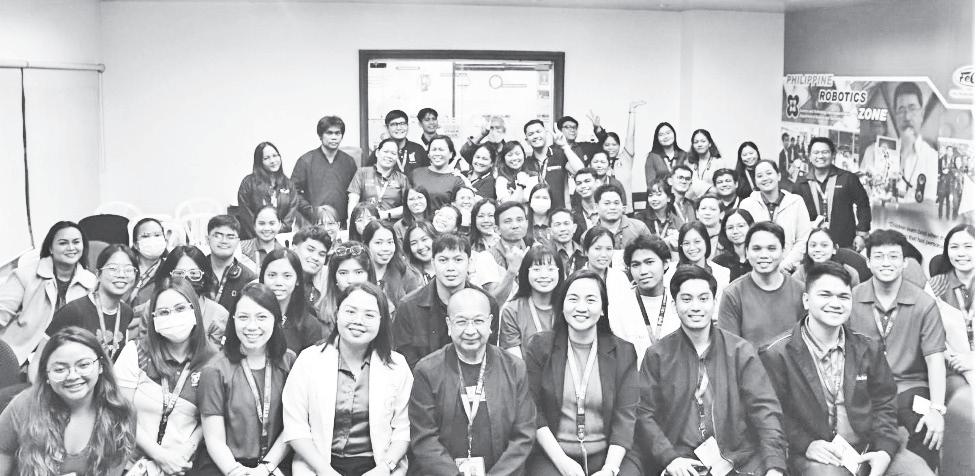
OST of us are resilient but we cannot ignore the signs [of mental health problem.] We have to face the signs, and if we cannot address it alone then we have to seek our support system,” said Ma. Kristine B. Reyes, head of the Human Resource Section of Department of Science and Technology-Science and Technology Information Institute (DOST-STII). Reyes spoke at the mental health seminar the DOST-STII held on October 10 in celebration of the World Mental Health Day. It had the theme, “It’s Time to Prioritize Mental Health in the Workplace.”
This year’s celebration pushes for a healthy working environment to protect mental health, recognizing the important connection between mental health and work that fosters purpose and stability.
The applicants’ proposed projects should align with Searca’s strategic goals, reflect regional significance, and demonstrate clear benefits to Southeast Asia’s agricultural sector.
The topic of proposed projects must fall within Searca’s priority areas—such as agribusiness models for increased productivity and income, sustainable farming systems and natural resource management, food and nutrition security, transformational leadership for agricultural and rural development (ARD), gender and youth
Applications must be submitted via the Grants Information System portal in the Searca website.
“Through our capacity-building, research, innovation, and knowledge-sharing programs, Searca has been at the forefront of advancing ARD in Southeast Asia for 58 years. In the next five years our development efforts will focus on carbon-WISE agriculture: Winnable Innovative Solutions for the Environment,” Gregorio added.
Ubalde listened to the staff’s perception of a picture related to mental health. This helped them to engage in the conversation that led her to defining mental health, understanding stigma, and addressing misconceptions about the topic.
She shared that absenteeism and presenteeism were among the impacts of mental health on employees, that affect one’s productivity.
Some of this may be caused by stress, anxiety, burnout and depression, which were identified as common mental health issues in the workplace.
According to a World Health Organization’s case report in 2021, mental health conditions caused an economic burden in the country costing P68.9 billion per year.
Niña Maricheliz Ubalde, a psychologist from the National Center for Mental Health, acknowledged the work and service of public servants. She believes that the event is an opportunity to understand mental health and the work in progress toward improving mental health in the workplace.
The report states that 96 percent of the cost comes from the loss of workforce or reduced productivity.
In prioritizing mental health in the workplace, Ubalde suggested creating a supportive environment for employees, such as rethinking job designs, training and intervention for workers, and having effective conflict resolution strategies.
She also emphasized the responsibility of each individual in creating a healthier workplace.
In reflection, the staff were asked to have an awareness check, reflect on how to achieve worklife balance and connections with people, community and one’s values.
Ubalde also explained how to balance life and the demands of work by practicing the three Bs of break, boundaries, and basic routines
She affirmed that seeking further help may not only be for mental health issues but for selfgrowth as well.
She shared available mental health resources, such as hotlines, and encouraged everyone through a quote by Noam Shpancer that “mental health is not a destination but a process.”
Some STII staff shared their reflection on the importance of mental health in the organization specializing in disseminating science and technology information.
Neven Aligan, an administrative assistant from the HR section, highlighting the importance of being psychologically stable, said: “If your overall well being is healthy, you will also function well, given the stressful nature of our work, where we need focus, attention to details for the contents we produce…if it is validated or if the informations are reliable.”
For her part, Precious Gayle Balgua, an HR administrative officer, said: “Majority of us are creatives, and the primary thing we use is our mind...So mental health is important because our staff need
headspace to create engaging, [and] appealing content since it requires a long process.”
“The talk was very timely, not only because it’s World Mental Health Day, but because the most important resource in our organization is its people. It’s important that the employees’ well-being is prioritized and that we continue to combat the stigma surrounding mental health, especially in the workplace. So I really appreciate that STII is making an effort to raise mental health awareness through events like this,” shared Kinessa Denise Chispa, the plan -
ning officer of the DOST-STII. Rodolfo P. de
division chief of
Communication Resource and Production Division, believes that acceptance is the key to move forward, and to accept means to also pray about it, to have strength in weathering the challenges, and become fruitful in life. Ultimately, it is the compassion and understanding of every employee that fosters a supportive workplace. Even small acts of empathy and kindness can have a significant impact. Kesha Shua V. Leosala/S&T Media Service

Virgilio David of Kalookan has been elected to a 17-member council tasked with implementing the synodality process and preparing for the next synod—an indication of the cardinal-elect’s growing role in the universal Church.
David, head of the Philippine delegation to the 16th Ordinary General Assembly of the Synod of Bishops, which will wrap up its second and final session this week, was elected by delegates during the Vatican meeting’s 15th General Congregation on Wednesday afternoon, according to the Holy See Press Office.
The president of the Catholic Bishops Conference of the Philippines, David will represent Asia in the Ordinary Council of the synod’s general secretariat along with a top Indian prelate, Cardinal Filipe Neri Ferrão, the archbishop of Goa and Damão.
Ferrão also leads his country’s bishops’ conferences.
In February, Ferrão was elected president of the Federation of Asian Bishops’ Conferences, with David as vice president. They will assume their new roles in January 2025.
Last year, during the synod’s first session, David was elected to its Commission on Information.
The 2018 Apostolic Constitution Episcopalis Communio states that the “Ordinary Council of the General Secretariat is competent for the preparation and implementation of the Ordinary General Assembly.”
It is composed mostly of diocesan bishops representing geographical areas.
Members of the Ordinary Coun -
cil will begin their terms of office at the conclusion of the Ordinary General Assembly during which they were elected.
In a change made by Pope Francis, the number of council members was increased from 16 to 17, with 12 elected by the assembly.
The pope will appoint four more members, and the head of a Vatican dicastery whose work is related to the theme of the next synod.
Under the new synod instruction, the composition of the elected council members is as follows: one each from the Eastern Catholic Churches and from Oceania, and two each from North America, Latin America, Europe, Africa and Asia.
Below is the list of the new council members:
Eastern Catholic Churches: His Beatitude Youssef Absi, Patriarch of Antioch of the Greek Melkites, head of the Synod of the Greek Melkite Catholic Church
Oceania: Most Rev. Msgr. Timothy John Costelloe, S.D.B., Archbishop of Perth (Australia)
North America: Most Rev. Msgr. Daniel Ernest Flores, Bishop of Brownsville (United States of America); and Most Rev. Msgr. Alain Faubert, Bishop of Valleyfield (Canada)
Latin America: Most Rev. Cardinal Luis José Rueda Aparicio, Archbishop of Bogotá (Colombia); and Msgr. José Luis Azuaje Ayala, Archbishop of Maracaibo (Venezuela)
Europe: Most Rev. Cardinal Jean-Marc Aveline, Archbishop of Marseille (France); and Mot Rev. Msgr. Gintaras Grušas, Archbishop of Vilnius (Lithuania)
Africa: Most Rev. Cardinal Dieudonné Nzapalainga, C.S.Sp., Archbishop of Bangui (Central African Republic); and Most Rev. Msgr. Andrew Fuanya Nkea, Archbishop of Bamenda (Cameroon)
Asia: Most Rev. Cardinal Filipe Neri António Sebastião do Rosário Ferrão, Archbishop of Goa and Damão (India); and Most. Msgr.

Pablo Virgilio S. David, Bishop of Kalookan (Philippines)
At the end of the 15th Ordinary General Assembly in 2018, synod fathers elected 16 council members, whose mandates conclude at the end of the 16th assembly on October 27.
The 16th assembly, which began its work in 2021, held its global consultations carried out at the parish, vicariate, diocesan, national, and continental levels, and convened two sessions at the Vatican.
Its goal was to establish a “synodal process” in the Church to make it more consultative, discerning, and accountable.
“Synodality” refers to the idea of walking or journeying together as the “People of God” in mission.
The synod, historically a domain of bishops, is unprecedented as lay delegates accounted for about a quarter of the total, and women were given voting powers for the first time.
Delegates were expected to vote on Saturday afternoon (October 26) on the final document containing recommendations, which the pope may adopt in a post-synodal apostolic exhortation.
More than a thousand amendments, or doci, were submitted to the synod secretariat before the Wednesday deadline, with 900 proposed by the assembly’s small groups and about a hundred from individuals, according to the Holy See Press Office.
Pope Francis close the synod with a Mass in St. Peter’s Basilica on Sunday, October 27.
David is set to become a close collaborator of the pope. He will return to the Vatican on December 7 for a consistory, where he will be officially declared a cardinal along with 19 others.
Felipe Salvosa II/CBCP News
LIMA, Peru—Peruvian theologian the Rev. Gustavo Gutiérrez, known as the “father” of the social justicecentered liberation theology that the Vatican once criticized for its Marxist undercurrents, has died. He was 96.
The Dominican Order in Peru announced on social media that the Catholic priest died on the night of October 22 at a convent in Lima, the South American country’s capital. It did not give a cause of death.
Gutiérrez’s liberation theology put the poor as its priority and exerted great influence on doctrine and the history of the church in Latin America.
His 1971 book “A Theology of Liberation” had a profound impact by proposing a faith based on social justice focused on the poor and positing that poverty “is a scandalous state, an attack on human dignity, and therefore, contrary to the will of God.”
“We thank God for having had a faithful theologian priest who never thought about money, or luxuries, or anything that seemed to make him superior,” Cardinal and Archbishop of Lima Carlos Castillo said in a statement following Gutiérrez’s death.
“Small as he was, he knew how to announce the Gospel to us with strength and courage in his smallness,” Castillo added.
Gutiérrez’s thinking attracted
many who were outraged by the inequality and dictatorships in several Latin American countries in the 1960s and 1970s.
But his ideals were severely criticized by the Vatican, which spent decades disciplining some of its most vocal supporters.
Gutiérrez, who himself was never disciplined, told reporters in 2015 that liberation theology as a whole was never condemned, but he acknowledged that the Holy See had engaged in “very critical dialogue” with its proponents and that there were “difficult moments.”
The Vatican objected to liberation theology’s basis in Marxist analysis of society—
particularly the idea of class struggle in the promotion of social, political and economic justice for the poor.
Some versions of liberation theology are at variance with church teachings because they view Christ as a mere social liberator.
The arrival of the first Latin American pope, Pope Francis, focused the Vatican’s attention on social justice and the poor and led to something of a rehabilitation of liberation theology.
“I think in this moment, the climate surrounding this theology is different. That is true,” Gutiérrez told reporters at the time.
When he turned 90 in 2018,


BEIJING—China and the Vatican have agreed to extend a provisional agreement on the appointment of Catholic bishops in China for four more years, officials said Tuesday.
The 2018 agreement, extended twice previously, was an attempt under Pope Francis to bridge longstanding differences over control of the church in China.
There have been disagreements since, but they have so far not derailed the fragile rapprochement.
“The two sides will maintain contact and dialogue following a constructive spirit and continue to advance the improvement of China-Vatican relations,” China’s Foreign Ministry spokesperson Lin Jian said on Tuesday while confirming the extension.
The Vatican said that it “remains dedicated to furthering the respectful and constructive dialogue” with China, “in view of the further development of bilateral relations for the benefit of the Catholic Church in China and the Chinese people as a whole.”
Francis has reached out to China during trips to Asia both
this year and last year, repeating his desire to visit the country on a flight home from Singapore last month.
The Vatican’s relations with China were severed more than seven decades ago when the Communist Party came to power.
The country’s estimated 12 million Catholics were divided into a state-recognized church and an underground one that stayed loyal to Rome. Relations were stymied over China’s insistence on its exclusive right to name bishops as a matter of national sovereignty, while the Vatican insisted the pope has the right to name the successors of the original Apostles.
The 2018 agreement sought to find a middle ground, although Rome has acknowledged it was a bad deal and the only one it could get.
The Holy See’s outreach to China under Francis has drawn criticism, especially from American conservatives who have accused the Vatican of selling out the faithful who have been forced underground. AP
Bishop Bastes’ homily hours before he died: ‘Only God’s love can fulfill the human soul’
Pope Francis wrote Gutierrez a letter thanking him for his contributions to “the Church and to humanity, through your theological service and your preferential love for the poor and the discarded of society.”
Gutiérrez was born in Lima on June 8, 1928.
He was ordained a priest in 1959 and joined the Dominican order in 2001.
He studied medicine and literature at the National University of San Marcos while participating in Catholic Action.
He later studied theology at the University of Louvain (Belgium) and earned a doctorate in theology the Institut Catholique of Lyon (France).
Gutiérrez served as the John Cardinal O’Hara Endowed Professor of Theology at the University of Notre Dame (USA).
His books have been translated into multiple languages.
One of Gutiérrez’s last international appearances was in Rome in October 2019 at a congress held at the Jesuit General Curia.
There, at the invitation of the Pontifical Commission for Latin America, he delivered a lecture on “The Preferential Option for the Poor.”
In addition to his theological work, Gutiérrez served a parish in a Lima neighborhood for more than two decades. The Associated Press with Walter Sánchez Silva/CNA via CBCP News

RETIRED Bishop Arturo Bastes of Sorsogon celebrated Mass on the eve of World Mission Sunday on October 20.
No one expected it to be his last. The Mass, live-streamed on social media, captured some of the final hours of his life before he passed away early the next morning.
During his homily at a congress on Sacred Heart devotion, he emphasized that nothing can quench the thirst of the human soul except a personal relationship with God.
“No other love, no other thing in the world, no other riches in the world can ever surpass the greatness of the love and Sacred Heart of Jesus,” Bastes said at the Sacred Heart Parish-Shrine in Quezon City.
He lamented that, instead of loving God, people often choose to love money and material possessions.
Despite all human efforts, he stressed that only God’s love can truly fulfill humanity.
“No materialistic thing, nothing in this world can satisfy your heart except the love of God,” Bastes said.
According to him, devotion to the Sacred Heart emphasizes that God’s love is unfailing, even in the face of human unfaithfulness.
“The Sacred Heart is the best proof that God loves us,” he said.
Bastes succumbed to a heart attack at 6:30 a.m. on October 20 at his brother’s residence in Cainta, Rizal. He was 80. Born in Loboc, Bohol, in 1944, he was ordained priest for the Society of the Divine Word in 1970.
He was named bishop of Romblon on July 3, 1997, and received his episcopal ordination on August 21 of the same year in Cebu City.
In July 2002, he was appointed coadjutor bishop of Sorsogon, a position he held until April 2023, when he became the fourth bishop of the diocese. Within the Catholic Bishops’ Conference of the Philippines, he served as chairman of its Episcopal Commission on Biblical Apostolate.
His wake was held at Villa Cristo Rey in Christ the King Mission Seminary in Quezon City. His remains were later transported to Sorsogon. Wakes will also be held at the Sorsogon Cathedral until his funeral at 10 a.m. on October 30.
The funeral Mass will be presided over by papal nuncio Archbishop Charles Brown with Bishop Jose Alan Dialogo of Sorsogon and other bishops. CBCP News

Asean
Editor: Lyn Resurreccion

By Jonathan L. Mayuga
UNLESS humanity acts with greater boldness and urgency, an increasingly out-of-balance water cycle will wreak havoc on economies and humanity worldwide.
The warning was aired recently by an international group of leaders and experts in Paris, France, during the launch of a landmark report
“The Economics of Water: Valuing the Hydrological Cycle as a Global Common Good.”
The report of the Global Commission on the Economics of Water. says the water crisis puts at risk more than half of the world’s food production by 2050.
It also threatens an 8 percent loss on average of GDP in countries around the world by 2050, with as much as a 15 percent loss in lower-income countries, and even larger economic consequences beyond.
Unprecedented stress
ACCORDING to the report, weak economics, destructive land use, and the persistent mismanagement of water resources have combined with the worsening climate crisis to put the global water cycle under unprecedented stress.
It says that nearly 3 billion people and over half of the world’s food production are in areas experiencing drying, or unstable trends in total water availability.
Further, the report added that several cities are sinking due to the loss of water below the ground.
Water scarcity
TODAY, half of the world’s population faces water scarcity. As this vital resource becomes increasingly scarce, food security and human development are at risk—and we are allowing this to happen,” Johan Rockström, director of the Potsdam Institute for Climate Impact Research (PIK) and one of the Commission’s four co-chairs, said in a statement.
“For the first time in human history, we are pushing the global water cycle out of balance. Precipitation, the source of all freshwater, can no longer be relied upon due to humancaused climate and land use change, undermining the basis for human wellbeing and the global economy,” Rockström added.
Abundant water supply
FORTUNATELY for the Philippines, it is blessed with rich natural resources, including abundant water supply, yet the challenges of making it available when and where they are needed remain.
According to the Department of Environment and Natural Resources (DENR), the Philippines has 18 major
river basins, 421 principal rivers, and 79 natural lakes.
It also has an extensive coastline that stretches 17,460 km.
Meanwhile, the World Bank Climate Change Portal says the Philippines receives an average annual rainfall of approximately 2,348 millimeters (mm).
However, this varies geographically, from 960 mm in southeast Mindanao to over 4,050 mm in Central Luzon.
While 84.4 percent of families have access to safe water, around 56.9 percent of households do not treat their water.
Substantial number of people suffer water scarcity and access to basic sanitation.
They are at risk for waterborne disease, according to the Sustainable Development Goals Fund, an international multi-donor and multi-agency development mechanism created in 2014 by the United Nations to support sustainable development activities through integrated and multidimensional joint programs.
Dry and wet seasons woes DURING the dry season from December to May, many areas in the Philippines, particularly the National Capital Region, experience water scarcity.
With its population of roughly 12 million, water demand sharply increases.
During the wet season, from June to November, flooding occurs, submerging low-lying areas under floodwaters.
Often, both seasons adversely impact communities, intermittently paralyzing the economy, affecting transportation, slowing down trade and commerce, and undermining productivity, including its food production capacity.
IN February 2023, President Marcos Jr. ordered the creation of a Water Resource Management Office (WRMO) to manage the country’s water resources and respond to the perennial environmental challenges, underscoring the need for a plan that will serve as a roadmap for waste management agencies.
Various water-related government agencies were placed under WRMO— they are the Metropolitan Waterworks and Sewerage System Local Water Utilities Administration, and the Water Board of the DENR.
Subsequently, an executive order placed the WRMO under the DENR.
The WRMO’s main functions include formulating and ensuring the implementation of the Integrated Water Management Plan (IWMP),
THE tamaraw (Bubalus mindorensis) is one of the Philippines’ most iconic animal species, second only to the Philippine Eagle (Pithecophaga jefferyi) in global renown. Estimated to number over 10,000 heads a century ago, this dwarf buffalo once grazed across the entirety of Mindoro—until poaching, land conversion and a deadly outbreak of cattle-killing rinderpest nearly wiped it out. By 1969, less than 100 were thought to remain, prompting the International Union for the Conservation of Nature (IUCN) to declare the tamaraw as critically endangered, a precarious step above extinction.
Vigorous conservation efforts by Department of Environment and Natural Resources’ Biodiversity Management Bureau (DENR-BMB) via the Mounts Iglit-Baco Natural Park

which will integrate various plans of different agencies, to serve as the main guiding document for the WRMO.
Valuable economic resource
WATER is a very valuable economic resource. It is used for irrigation, as well as commercial, industrial, and domestic needs. It is also used for power generation.
Water provides a life-support system that is key to human survival.
In the natural environment, water also keeps forests healthy, allowing it to provide various ecosystem services, including provisions for the survival of the diverse species of plants and animals that dwell in both terrestrial and water ecosystems.
In creating the WRMO, Marcos Jr. underscored the crucial role of water in food security, citing that irrigation accounts for a 35.6 percent contribution to the agriculture sector’s gross value added. Marcos Jr. also added that water is critical to supporting cities and urban growth.
Incidentally, the Philippines ranks among the world’s rapidly urbanizing countries, with over 47 percent of its population living in cities in 2021, requiring large water projects, including large dams and other water infrastructure to ensure water supply and address hygiene and sanitation challenges.
have everything from environmental outreach programs, native treeplanting drives, town parades, poster-making contests, even a bike ride for the tamaraw,” adds TCP Assistant Coordinator Neil Anthony Del Mundo.
(MIBNP) and Tamaraw Conservation Programme (TCP) have so far staved off its demise.
“We estimate that there are from 574 to 610 tamaraw left in Mindoro, with around 433 living within the MIBNP, where the largest population is concentrated,” shares MIBNP Park Superintendent Ellie Nuñez. Together, MIBNP and TCP are working to drive off poachers while convincing residents to stop deforestation and “kaingin,” or the slashand-burn of forest to make way for upland farms.
During the Tamaraw Month that is celebrated every October, the conservation efforts of the dwarf buffalo are highlighted.
“We observe Tamaraw Month every October, but we work hard to protect our tamaraw 365 days a year,” says TCP Coordinator Efren Delos Reyes.
“This month is jam-packed. We
For Tamaraw Month 2024, the Biodiversity Finance Initiative of the United Nations Development Programme (UNDP-BioFin), the Department of Environment and Natural Resources (DENR) and the Forest Foundation Philippines (FFP) are asking people to download and play “Animal Town,” a mobile game about animals and biodiversity conservation launched in March 2024.
“We want to introduce iconic and endangered Pinoy wildlife to a fresh generation of environmentalists,” explains UNDP-BioFin Philippines Country Manager Anabelle Plantilla.
“With 30 million gamers in the Philippines, including me, the potential for gamers to donate to wildlife conservation can definitely help save endangered species like our tamaraw.”
BioFin is a global UNDP initiative across 41 countries with funding from the European Commission and the
Meanwhile, hydropower, a renewable energy source, represents 7 percent of the total energy production.
Water mapping
UNDERSECRETARY for Integrated Sciences Carlos Primo David, also the concurrent chief of the DENR’s WRMO, said the country’s problem is unique compared to other countries or regions where water is scarce.
He said the Philippines has abundant water unlike Africa, or other countries where water supply is scarce
“It is just a matter of harnessing it to our advantage. While we have 2,300 mm of rain annually, with climate change, the distribution is a little more distinct. It is pretty much scattered throughout the year. What we are seeing, is a longer dry season and during rainy [season], heavy to torrential rains,” David said.
Mapping water source
THE WRMO, through the Geospatial Database Office, also headed by David, has completed mapping out the country’s sources of surface water and identified the lakes and rivers that can be developed as sources of surface water supply.
With the mapping already complete, he said the next step is to verify it on the ground, and with the help of the private sector, conduct feasibility studies on how to best harness
governments of Germany, Switzerland, Norway, Belgium, Flanders, the United Kingdom, Canada and France. It contributes to closing the financing gap for the conservation and sustainable use of biological diversity by identifying, accessing, combining and sequencing sources of biodiversity funding.
In the Philippines, BioFin is working with the DENR to narrow the financing gap for the implementation of the Philippine Biodiversity Strategy and Action Plan (PBSAP), the country’s roadmap to conserving its biodiversity.
Among its identified finance solutions are the improvement of biodiversity expenditure reports, supporting and strengthening policies, mainstreaming biodiversity in national and regional programs, increasing investments in protected areas and generating revenues from private individuals.
Animal Town donations will be managed by FFP, while DENR-BMB will identify conservation programs to be funded.
Some funds will go to tamaraw conservation initiatives, such as halting
the Angat-Ipi-LaMesa water system.
Tapping on excess irrigation water
IN Cavite, as part of the initiative of the WRMO, David said 18 small dams in Cavite intended for irrigation are now being eyed as a source of potable water for the province.
This, he said, will partially address the looming water crisis in the province, the most populated province in the country.
Speaking partly in Filipino, David said the DENR-WRMO and the provincial government of Cavite are working closely with the Public-Private Partnership (PPP) Center for the ambitious project that will, hopefully, eliminate the dependence of the province on groundwater sources.
He said the WRMO is already in talks with private investors for potential PPP bulk water supply projects, to boost water accessibility, possibly tapping on irrigation water supply, to make tap water available to communities.
Water districts as purified water supplier
DAVID said another initiative of the WRMO is to convince water districts to venture into the production of purified water to boost distribution in hard-to-reach areas or far-flung areas where there is no access to clean, drinking water.
and utilize these freshwater sources as well as protect and conserve them for future generations. Because of excessive groundwater use, the country’s freshwater reserve—the aquifers that are supposed to be conserved—is already depleted, if not contaminated with salt water, particularly those in the coastal areas.
Lack of water infrastructure
WHILE the Philippines has abundant water sources, David said there is a need for the country to invest in water infrastructure, and develop more water-supply sources to make water available even in far-flung areas.
He cited the increasing demand for water infrastructure because of rapid urbanization.
For the longest time, Metro Manila has been highly dependent on water coming from the Angat-Ipo-La Mesa dam system.
Angat remains the single major water source for Metro Manila and is also being used to irrigate farms in Bulacan and Pampanga.
Just recently, the government and its private-sector partners announced that the Upper Wawa Dam Project is on track and will begin commercial operations by the end of 2025.
The dam will help augment the water supply for Metro Manila and nearby towns and cities, thus reducing Metro Manila’s dependence on
illegal poaching for bushmeat, developing solutions to connect genetically isolated tamaraw subpopulations and reducing human-wildlife conflict between the buffalo and Indigenous communities.
“Tamaraw conservation is complicated and involves close, continuous coordination between the Indigenous people who share the tamaraw’s home range, protected area managers, fundraisers, policymakers, scientists and law enforcers,” adds D’Aboville Foundation’s Emmanuel Schutz, who has been helping conserve the endangered buffalo for the past 12 years.
“The tamaraw is iconic of Philippine wildlife, but many lesser-known plants and animals need the country’s attention,” adds British Ambassador to the Philippines Laure Beaufils.
“Introducing wildlife stewardship in a fun and casual way can help younger Filipinos understand and value Filipino wildlife of all shapes and sizes,” she said.
The UK government helps fund BioFin to advance the implementation of biodiversity finance plans,
Water districts, he said, are more than capable of producing purified water—with its water infrastructure and technical know-how.
“These water districts have engineers unlike small water distributors,” he said.
He said a study by the WRMO revealed that purified water can be made available compared to private companies that produce purified water—whether in big containers or bottled water.
“We can cut the price of drinking water by half,” he said. He added that in the long run, private companies that would be affected by the competition offered by water districts venturing into purified water distribution can become distributors, thereby making the water districts centralized source of clean, drinking water.
As of 2020, Cavite has a total population of 4,344,829.
“But even with this project, water supply will not be enough for Cavite,” David said, citing the projected growth in population, plus the rapid industrialization in the province,” he said. Indeed, with the rapid population growth, urbanization, and industrialization, the challenge of ensuring access to water will remain humanity’s biggest challenge.
collaborate with the finance sector and repurpose subsidies.
One of its key workstreams for the Philippines focuses on implementing a biodiversity finance solution focused on sub-national plans in protected areas, while helping develop Animal Town.
Freely downloadable, the app has been snowballing in popularity since its launch.
“We have almost 20,000 users who have donated nearly P20,000, with donations trickling in monthly. We hope to generate more funds as players have fun building their tiny animal towns,” adds Animal Town App Developer Lord Gosingtian. So to help save the tamaraw and “level up” your involvement in conservation, simply download the Animal Town app and make a small donation. By doing so, you’re helping ensure that Tamaraw Month will continue to celebrate successful the animal’s conservation for many years to come. Animal Town can be downloaded at the Google Play Store for Android Phones or the Apple App Store for iOS Phones.
last year, a Ugandan woman beams. Then one more smiles widely. And another. They take turns expressing how they too might shine on the big world stage one day. Indeed, an international star like US pitcher Kelsie Whitmore or Japan’s Ayami Sato eventually could come from the African country where women’s baseball has planted roots in recent years.
“Baseball has done a lot in our lives,” said Lillian Nayiga, a single mother playing baseball in Uganda while also teaching other women.
In the upcoming “See Her Be Her” documentary, sports photographer Jean Fruth and her team chronicle seven standout women doing far more than just playing the game in their corners of the world spanning the United States, Canada, Puerto Rico, Japan, South Korea, Cuba and Uganda.
“We’re representing women in sport, and that’s something really powerful to hold onto,” said Whitmore, who two years ago became the first woman to sign with a regular-season men›s professional team in a Major League Baseball (MLB) partner league, playing for the Atlantic League’s Staten Island Ferry Hawks.
Whitmore pitched this past summer for the independent Oakland Ballers and became the first woman to start a Pioneer League game.
The nearly two-hour film, set to premiere on MLB Network between Games 2 and 3 of the World Series, follows the teams through 2023 qualifying for this year’s Women’s Baseball World Cup—won by Sato and seven-time reigning champion Japan over the US.
There’s Canadian Alli Schroder, who works grueling two-week stretches fighting major wildfires. She showed up to play this summer with burns on a hand from falling into an ash pit and deals with chronically sore shoulders and knees that might shorten her playing career. The fingers on her non-throwing, left hand were injured enough she worried whether she could even swing a bat.
“I figured before that I burnt myself out from playing baseball and training, but it’s incomparable to working 14day shifts in a row fighting wildfires,” Schroder said. “There’s a lot more at stake on the fire line than there is in a big game, and I think that’s something that I’ve really been able to use to calm myself down on the baseball field in big situations.”
Korean standout Soyeon Park typically can only play on weekends while she trains to become a pilot. Fellow countryman Chan Ho Park, the former big league pitcher, is a fan.
In the baseball-crazed Cuban culture, first baseman Libia Duarte wants to see women playing baseball at a high level accepted so they can break the stereotype that they should stick to being housewives.
Editor: Jun Lomibao


MONTEVIDEO, Uruguay—Former Uruguay striker
Diego Forlán will make his professional tennis debut next month when he plays doubles at an Association of Tennis Professionals (ATP) Challenger tournament.
Gabby Vélez of Puerto Rico shares her own mental health struggles, and each of these women give back in their unique way trying to pave an easier path for the young women coming after them.
“These women will touch your heart,” Fruth said. “They certainly touched mine.”
Each faced her own struggles— doubters, discrimination—competing in a sport primarily played by boys and men for well over a century. Those skeptics who believe women don’t belong motivate Whitmore, who on her phone keeps a screenshot of demeaning social media posts.
The women also have some prominent backers.
Former Seattle Mariners star Ichiro Suzuki has become an ambassador for them, leading efforts to build the women’s game in Japan.
“People come and see Major League Baseball games, but the same doesn’t apply to women’s baseball,” Suzuki says in the film. “People who share the same passion should come together. Instead of discussing the level women’s baseball is at, we have to first create the stage for them. That’s what drives motivation. I hope this wave will spread and grow all over the world.”
Ferguson Jenkins, Cal Ripken Jr. and Jimmy Rollins are all in, too. Their support matters.


“There is no Cal Ripken Jr. of women’s baseball—yet,” Fruth said.
The documentary is the vision of non-profit Grassroots Baseball, founded by Fruth and former longtime National Baseball Hall of Fame and Museum President Jeff Idelson. They traveled extensively across six countries and Puerto Rico to provide an intimate glimpse into the athleticism, talent and determination of these ladies putting baseball on the world map.
“To sit there and to watch the entire film, it is powerful, inspiring and eyeopening. And I say eye-opening because the quality of play and competition not just in the US but globally certainly exceeded what I understood before and what I think a lot of people know,” Selig-Prieb said. “And so what Jeff and Jean are doing by providing visibility for not only the potential and possibilities that exist going forward, but more importantly what’s happening right now in women’s baseball, is just tremendous.”
Grassroots Baseball also is releasing a book to accompany the film featuring a collection of Fruth’s photos taken during the project.
Selig-Prieb hopes the film provides girls and women everywhere a glimpse of what is possible, even if baseball isn’t her passion.
“The name sums it up, right, See Her Be Her,” Selig-Prieb said. “I never aspired to be the first woman to do anything. It was not an aspiration or a goal I had. But it is where I have sometimes found myself. And what I learned from that is when you are, you gain a voice. And I like using mine to support others and amplify others who are forging a new path.” In Uganda, they are aiming big in baseball—even if some show up to play barefoot or in dresses. The joyful women hold hands in a large circle, dancing this way and that.
“I want to pitch 90 mph,” one player shares.
“I want to be a catcher professionally,” offers another. Americans like Whitmore, Anna Kimbrell, Ashton Lansdell and Meggie Meidlinger are among those helping grow the game by traveling to Uganda to provide instruction and support. Meidlinger had been previously to lead clinics and was inspired by the interest and stayed involved. AP
Executive Producer Wendy SeligPrieb, the former Milwaukee Brewers CEO and a daughter of retired baseball Commissioner Bud Selig, was thrilled to get behind this work at a moment when interest in women’s sports is exploding.
MThe 45-year-old Forlán will play with Argentina’s Federico Coria at the clay court Uruguay Open, tournament organizers confirmed. It starts November 11. Forlán, who retired from soccer in 2019, played for Manchester United, Atletico Madrid, Internazionale and Penarol.
He helped Uruguay reach the semifinals of the 2010 World Cup and win the Copa America title in 2011. Forlán has played International Tennis Federation Masters tournaments since last year. He said his father, Pablo Forlán, who was also a footballer, also played tennis after his retirement.
“He started playing at age 41. That’s also why I have played [tennis] since I was 2,” the former Uruguay striker said. AP

M
ILO and Boysen cap 2024 by furnishing 100 barangay courts and providing added support to 200,000 grassroots athletes in basketball as part of the Barangay Liga program.
As part of Milo’s 60th anniversary celebration, the two brands inked a partnership that was initiated last year to refurbish

Liga as a venue where kids can learn the values that sports can impart— discipline, grit and teamwork.
Boysen imparted its expertise to serve as motivation for the grassroots athletes of Milo through painted installations that house inspiring words to be seen while they play on the court.
The partnership was warmly recognized
and continuing the legacy of nurturing Filipino kids to success through sports during the Gathering of Champions.
Both brands aspire to support even more communities in their shared efforts to rally the nation through sports and build even more champions in sports and life.
ARIA SHARAPOVA, a five-time Grand Slam singles champion known for plenty of on-court grit and off-court attention, and Bob and Mike Bryan, twins who won a record 16 major titles in men›s doubles together, are first-ballot selections for the International Tennis Hall of Fame The Newport, Rhode Island-based Hall announced the Class of 2025 before the weekend.

Sharapova won at least one championship at each of her sport’s four most prestigious events, making her one of 10 women in tennis history to complete a career Grand Slam, and she was the first Russian woman to reach No. 1 in the Women’s Tennis Association (WTA) singles rankings. She retired in 2020 at age 32 after a career that included 15 years in the spotlight, a 15-month doping ban and multiple operations on her right shoulder. In a message posted on social media, Sharapova called herself “incredibly grateful to receive this honor.”
The Bryan brothers also compiled a career Grand Slam and spent 438 weeks at No. 1 in the Association of Tennis Professionals (ATP) doubles rankings. They won a gold medal at the 2012 London Olympics and helped the United States win the 2007 Davis Cup title; Bob is currently the captain of the American team that
will go to Malaga, Spain, for next month›s finals to compete for the country›s first triumph in that competition since then.
Mike Bryan—he’s right-handed, and his brother is a lefty—is the career leader with 18 major men’s doubles trophies overall; he got two with Jack Sock while Bob was injured in
“We
on
“Mike and I continue to be best friends, and we feel lucky to have been able to ride this tennis rollercoaster together.”
Sharapova became an instant star when she won her first major title at Wimbledon in 2004 at age 17 by beating Serena Williams in the final, then collected the trophies at the US Open in 2006, the Australian Open in 2008 and the French Open in 2012 and 2014.
Sharapova helped Russia win the team competition now known as the Billie Jean King Cup in 2008, and she claimed a silver medal in singles at the 2012 Olympics, losing to Williams in the final.
All the while, Sharapova earned millions of dollars more in endorsement deals than prize money.
“There are a couple of sides of me,” Sharapova said in an interview with the AP in 2006, shortly before she won the title at Flushing Meadows.
“There’s the Maria that’s a tennis player. There’s the Maria that is a normal girl. And there’s the Maria who’s a businesswoman. And that’s where the ‘Maria Sharapova brand’ comes into play.”
At the 2016 Australian Open, Sharapova tested positive for the newly banned drug meldonium and initially was handed a twoyear suspension. After appealing to the Court of Arbitration for Sport, Sharapova was given a reduced penalty when it was determined that she bore “less than significant fault” in the case and could not “be considered to be an intentional doper.” AP


Halloween Horror movies: a look at reviews of tHe classics
By Justine Xyrah Garcia
SELF-DOUBT is a silent enemy that keeps many from realizing their full potential, and for Stephen Ordoñez—better known as Labit—this battle was deeply personal.
For years, the Los Angeles-based artist was a ghost in the music world. He had spent countless hours writing for other artists, watching them take the stage and wondering if he would ever find the courage to step into the spotlight himself.
In an exclusive interview with SoundStrip, Labit shared that it was not just the fear of failure. It was the loud, deafening voice of

impostor syndrome whispering that his story was not worth sharing.
“I feel like I’ve fought it like my entire life almost, you know, playing music and writing songs. It’s definitely been up and down,” he shared.
Despite that, another voice—a stronger, more persistent one—reminded him that he was bigger than his worries. This had led him to take the leap and carve his own name in the music industry.
“I had this little voice in my head telling me I [needed] to tell my own story. I finally got around to figure out how to do that the way I wanted to,” Labit recalled.
Now, his name is no longer behind someone else’s success. It is becoming a story of its own.
BEFORE he found his footing as a solo artist, Labit’s musical journey was steeped in his deep love for playing the guitar.
Like many musicians of his generation, the rising artist initially built his confidence by posting covers online. These videos were the first step in sharing his art with a wide audience, but Labit knew he wanted more.
Around 2018, he started writing and producing songs for various artists like BYRNE, Jaira Burns, and Emei. His contributions to their music helped Labit discover his way to create his own, distinct sound.
“I have really just kind of buckled down and have decided that I want to release more Labit music,” he shared.
The LA-based artist said that his collaboration with his peers, particularly with his longtime friend James Cola in 2020, helped him craft a sound that felt truly his own.
“He really just helped me find my own sound and...working with a lot of my close friends has just helped me find where my truth is as an artist,” Labit said.
Now, the rising artist proudly embraces not just guitar-driven melodies but also electronic, “weird sounds” that most people have not heard before.
“I just make sure everything is [as] authentic as possible. Writing wise, I’m true to myself but then also kind of letting go of the reins bit on where the sound goes,” he explained.
Breaking in
LABIT’S breakout moment came with his emotionally raw track Someday Far Away.
Reflecting on a long distance situationship that ended without closure, Labit did not expect that his personal experience would resonate to millions of people worldwide.
“It took a toll on me and the song when I

wrote it, I think I was just looking for any sort of hope and any sort of optimistic point of view,” he recalled. “I had no idea that it would be what it is today, and it’s still growing.”
To his surprise, Someday Far Away quickly gained traction on platforms like TikTok, where countless users have shared their interpretations of the song, often tying it to their own experiences of love and loss.
As he looks to the future, Labit has no signs of stopping—gone are the days that he’s content to walk behind the shadow of someone else.
With plans to release more music next year, he is excited to continue exploring new sounds and sharing his journey with fans.
“We have a couple things up our sleeves and we have more music coming out,” he promised, hinting at the possibility of a new album and a solo Labit show next year.
‘Tell your story’
LABIT’S journey in the music industry has
been far from easy. From his early days as a songwriter for others, to battling his impostor syndrome, he surely learned that most battles are internal.
He now stands as proof that perseverance and authenticity, no matter what happens, can break through the deafening noise of doubt.
Reflecting on the struggles he faced, Labit offered words of encouragement to those who, like him, wrestle with doubts.
“Everybody has a story to tell and you’re the only person who could btell your story,” he said. For Labit, the key isn’t in following fleeting trends or trying to fit into someone else’s mold—it’s about carving your own path and staying true to your voice.
“Just trust that you have the talent… trust yourself,” he advised.
In an industry as competitive and fastevolving as music, where it’s easy to feel lost or overshadowed, Labit’s message is clear: there is a space for everyone who dares to embrace their individuality.

MORRISSEY couldn’t be that serious when he sang, “Burn down the disco, hang the DJ…” in The Smiths’ 1986 hit single “Panic”—though, apparently, it was “because the music that they constantly play / It says nothing to me about my life…”
Boomers can relate to such sentiments, since the period in which they came of age—from the 1950s to the ’80s—was also the time when DJs (disc jockeys) were looked upon almost as highly as the artists whose records they played on the radio or at clubs.
The popularity of DJs coincided with the birth of rock ’n’ roll. Alan Freed, an American DJ who hosted radio shows in Cleveland and New York, went on to appear in “jukebox musicals” like “Rock Around the Clock.”
Life as a teenager in Manila during martial law was bearable because certain radio stations had DJs who played songs that went beyond entertainment.
To my generation born in the ’60s, went to high school in the ’70s, and attended college in the ’80s, the most influential of these stations were RJ, RT, WK, and later, NU and City Lite.
RJ—dubbed the Rock of Manila on 810 AM, and The Source on 100.3 FM—featured DJs who defined the essence of cool and hip, introducing listeners to songs other than the released singles of a particular artist’s latest album. RJ also championed OPM via its Pinoy Rock & Rhythm program. The music was bright and upbeat in the daytime, and got deep and cerebral at night on the Rock & Roll Machine.
RT—known as the Music Authority and, later, Rhythm of the City 99.5 RT—boasted DJs with flawless diction and engaging voices that kept listeners abreast of the latest hits from American Top 40, while also breaking songs otherwise unheard on other stations. WK was the refuge of jazz enthusiasts, its DJs led by the raspy-voiced Brother Wayne.
City Lite 88.3 picked up where WK left off, and added some crossover pop, with some of its DJs from RT.
NU 107 played modern rock with an allnew set of youthful DJs.



The thing about the DJs from these radio stations is they made listeners feel good through some of the best music of the times. While many of the songs were pre-selected to fit their respective formats and programming, the DJs were also given the freedom to choose what they wanted to play.
And since they knew the nature of the songs, the DJs educated their fans. In effect, these DJs became arbiters of fine musical taste.
MEANWHILE , the club DJs were in a class of their own. There were more challenges since they “performed” with no commercial or station ID breaks, and often with no spiels on the mic.
One of these DJs who has been at it practically all his life is Edgar Sallan, a.k.a. Pirate Satellite.
He has played records in many bars and clubs around town, including Roxy’s, Kublai’s Rock, Chotto Matte, and Borough. He warmed up the crowd when Marky Ramone played at Hard Rock Café Makati. He was also the guest DJ at the Rivermaya reunion concert last Feb. 17 at the SMDC Festival Grounds in Parañaque.
Dig his promotion of his coming show on October 30 at Mono by Phono in Poblacion,
Makati:
“Along with the Beatles, U2, CSN, Eric Clapton, Stevie Wonder, Arctic Monkeys, Ziggy Marley, The Jackson 5, The Beastie Boys, Edwyn Collins, Paul Kelly, Hall & Oates, Canned Heat, Sonic Youth, Sting, Chick Corea, Terry Chimes, Elton John, Depeche Mode, Gary Numan, Marky Ramone, Foo Fighters, Jimmy Cliff, Ray Charles, David Byrne, Morrissey, Liam Gallagher, Shonen Knife & Chuck Berry…
“The Specials’ legendary frontman Terry Hall was one of the aforementioned musical icons who have performed in Manila.
“Mr. Hall dined, shopped, DJ’ed and graced Fred Perry Philippines’ 10th anniversary event six years ago.
“You’ll be hearing The Specials’ top tunes, lots of rarities + other modern classics and 21st-century rockers galore on October 30th @ Mono by Phono for Pirate Satellite Night LIVE’s Halloween/Payday, whatever... as presented by FredPerryPH, featuring chef Buddy Trinidad of Betrayed, Major Chie Castañeda of NY Cubao, Vive Le France’s Dubmeister Norris King, This Is Ternoman Toti Garcia Dalmacion, Girlfrendo Khis Minty, & Greater MNL Commission Ghost Employee Edgar Sallan!”
Sounds like he’s got the best job in the world.
DJs
CONFIDENTIALITY NOTICE: “This email message, including attachments, if any, contains confidential information and may be privileged or otherwise protected from disclosure and is intended solely for the use of the individual to whom it is addressed. If you are not the intended recipient of this email message or you have received this email in error, please notify the original sender and immediately delete this e-mail and any copies thereof. Notice is hereby given to you that any use, downloading, copying, review, re-transmission, dissemination, distribution, reproduction or any action taken in reliance upon this email message, without the consent of the original sender, is prohibited by law, including R.A. 4200 (The Anti-Wire Tapping Law), R.A. 8792 (The E-Commerce Law), A.M. No. 01-7-01-SC (Rules on Electronic Evidence), or R.A. 10173 (The Data Privacy Act of 2012).This email has been scanned and is certified virus-clean upon transmission.”
By Sophia Tulp
The Associated Press
SomeTimeS, you just have to return to the classics.
That’s especially true as Halloween approaches. While you queue up your spooky movie marathon, here are some iconic horror movies from the past 70 years for inspiration, and what The Associated Press writers had to say about them when they were first released.
We resurrected excerpts from these reviews, edited for clarity, from the dead—did they stand the test of time?
Saw (2004)
The fright flick Saw is consistent, if nothing else.
This serial-killer tale is inanely plotted, badly written, poorly acted, coarsely directed, hideously photographed and clumsily edited, all these ingredients leading to a yawner of a surprise ending. To top it off, the music’s bad, too.
You could forgive all (well, not all, or even, fractionally, much) of the movie’s flaws if there were any chills or scares to this sordid little horror affair. But Saw director James Wan and screenwriter Leigh Whannell, who developed the story together, have come up with nothing more than an exercise in unpleasantry and ugliness.
★III according to David Germain
Paranormal Activity (2009)
T H e no-budget ghost story Paranormal Activity arrives 10 years after The Blair

Witch Project , and the two horror movies share more than a clever construct and shaky, handheld camerawork.
The entire film takes place at the couple’s cookie-cutter dwelling, its layout and furnishings indistinguishable from just about any other readymade home constructed in the past 20 years. Its ordinariness makes the eerie, nocturnal activities all the more terrifying, as does the anonymity of the actors adequately playing the leads.
The thinness of the premise is laid bare toward the end, but not enough to erase the horror of those silent, nighttime images seen through Micah’s bedroom camera. Paranormal Activity owns a raw, primal potency, proving again that, to the mind, suggestion has as much power as a sledgehammer to the skull.
★★★I, according to Glenn Whipp
The Conjuring (2013)
As sympathetic, methodical ghostbusters Lorraine and e d Warren, Vera
Farmiga and Patrick Wilson make the old-fashioned haunted-house horror film The Conjuring something more than your average fright fest.
The Conjuring , which boasts incredulously of being their most fearsome, previously unknown case, is built very in the ’70s-style mold of Amityville and, if one is kind, The Exorcist . The film opens with a majestic, foreboding title card that announces its aspirations to such a lineage.
But as effectively crafted as The Conjuring is, it’s lacking the raw, haunting power of the models it falls shy of. The Exorcist is a high standard, though; The Conjuring is an unusually sturdy piece of haunted-house genre filmmaking.
★★II, according to Jake Coyle
F IFTY years after s idney Poitier upended the latent racial prejudices of his white date’s liberal family in Guess Who’s Coming to Dinner, writer-director
Jordan Peele has crafted a similar confrontation with altogether more combustible results in Get Out
In Peele’s directorial debut, the former Key and Peele star has—as he often did on that satirical sketch series— turned inside out even supposedly progressive assumptions about race. But Peele has largely left comedy behind in a more chilling portrait of the racism that lurks beneath smiling white faces and defensive, paper-thin protestations like, “But I voted for Obama!” and “Isn’t Tiger Woods amazing?”
It’s long been a lamentable joke that in horror films—never the most inclusive of genres—the Black dude is always the first to go. In this way, Get Out is radical and refreshing in its perspective.
★★★I, according to Jake Coyle
Hereditary (2018)
In Ari Aster’s intensely nightmarish feature-film debut Hereditary, when Annie (Toni Collette), an artist and mother of two teenagers, sneaks out to a grief-support group following the death of her mother, she lies to her husband s teve (Gabriel Byrne) that she’s “going to the movies.”
A night out with Hereditary is many things, but you won’t confuse it for an evening of healing and therapy. It’s more like the opposite. Aster’s film, relentlessly unsettling and pitilessly gripping, has carried with it an ominous air of danger and dread: a movie so horrifying and good that you have to see it, even if you shouldn’t want to, even if you might never sleep peacefully again. The hype is mostly justified.
★★★I, according to Jake Coyle
n Cover photo by Nathan J Hilton on Pexels.com
Ce L e Br AT e the spookiest time of the year with a thrilling Halloween party at Conrad Manila, featuring the special participation of r eese’s, the iconic American chocolate brand known for its delectable peanut butter cups. Alongside themed events, guests can expect eerily delightful culinary offerings at the hotel’s award-winning dining outlets.
The highlight of this year’s Halloween festivities at Conrad Manila is the
“ spooky Mansion: A Monstrously sweet Celebration,” promising unforgettable moments for families. Today, October 27, the hotel’s Forbes Ballrooms 1 and 2 will transform into a majestic mansion, featuring kiddie entertainment, a play area, r eese’s spooky mansion, trick-or-treat activities, face painting, arts and crafts, and more. Kids are encouraged to wear their cutest Halloween costumes for delightful rewards and surprises. r egistration opens at 1:00 pm.
“We always strive to curate inspiring experiences for our guests,” says Conrad Manila General Manager Fabio Berto. “This Halloween, we invite families and friends to get into the spooky season and create fun and lasting memories with our delightful culinary offerings and exciting family-oriented activities.”
What’s more, indulge in premium culinary items and international cuisine at Brasserie on 3’s Halloween-themed buffet. At C Lounge, patrons can delight

in the “Treats of Horror” Halloween-inspired afternoon tea from October 28 to november 3. Then, families who wish to bring the Halloween celebrations home can grab Bru Coffee Bar’s “Wickedly sweet Treats,” featuring a selection of adorably spooky pastries and cakes, also from October 28 to november 3.
For more information about Conrad Manila’s Halloween offers and promotions, contact +632 8833 9999 or email conradmanila@conradhotels.com
MOTT 32 Cebu, the renowned dining destination at NUSTAR Resort Cebu, has earned global recognition by being named one of the top 10 percent of restaurants worldwide by TripAdvisor. This prestigious accolade highlights the restaurant’s unwavering commitment to culinary excellence, world-class service, and an unparalleled dining experience that consistently exceeds guest expectations.
As part of the internationally acclaimed Mott 32 brand, Mott 32 Cebu has quickly become one of the top destinations for fine dining in Cebu. The restaurant offers a seamless fusion of traditional Chinese
“We are deeply honored to be recognized as one of the top 10 percent of restaurants worldwide by TripAdvisor,” said Roel Constantino, General Manager for Hotels of NUSTAR Resort Cebu. “This award
Mott 32 is the one of the most awarded Chinese restaurant brands in the World with locations including Hong Kong, Las Vegas, Vancouver, Singapore, Dubai, Toronto, Bangkok, Seoul and Cebu with Los Angeles,
the recently constructed Cebu-Cordova Link Expressway (CCLEX). Its strategic location allows for convenient access, being a 30-minute drive from the Mactan-Cebu International Airport via CCLEX and a 25-minute sea travel from Mactan.
As the country’s first and only Filipino five-star hotel brand, Fili Hotel NUSTAR Cebu pledges to deliver the global allure of Filipino hospitality and accommodations, emphasizing luxury and genuine Filipino care in every aspect.
For inquiries and reservations, dial (032) 888-8282 or email the hotel through contactus@nustar.com.ph. More information can also be found on the website at www.nustar.ph/ hotels/fili.
flavors with modern innovation, serving dishes made from the finest ingredients. Guests are welcomed into a bespoke, world-class interior that enhances the dining experience, offering a luxurious atmosphere that perfectly complements the restaurant’s exceptional culinary offerings.
The restaurant’s private dining rooms provide an exclusive space to host intimate events, such as family gatherings, celebrations, and corporate meetings. Designed to offer both privacy and elegance, these rooms ensure a memorable setting for guests seeking a refined atmosphere for their special occasions or business functions.
Mott 32 Cebu also boasts of a beautifully designed bar and terrace, making it a great place for cocktails and a perfect spot for a night out. The intimate yet sophisticated setting offers guests a range of handcrafted cocktails, allowing them to unwind and enjoy their evening in style. Whether for pre-dinner drinks or a full night of socializing, the bar and terrace provide a chic and inviting ambiance.
The menu at Mott 32 Cebu features a range of signature dishes, including the renowned Apple Wood Roasted Peking Duck, Crispy Soft Shell Crab, and Smoked Black Cod, all carefully crafted to highlight the rich flavors of Cantonese, Szechuan, and Beijing cuisine. The restaurant’s commitment to culinary excellence is further reflected in its array of handcrafted dim sum and other distinctive offerings.

a reflection of the passion and dedication of our team, as well as the loyalty and support of our guests. We remain committed to delivering an exceptional din
ing experience that not only delights the senses but also creates lasting memories.”
The TripAdvisor award is based on millions of guest reviews and opinions shared globally, underscoring Mott 32 Cebu’s reputation for excellence in both culinary artistry and service. This recognition highlights the restaurant’s status as a world-class destination for food lovers and discerning guests alike.
(Daily) For inquiries and table reservations, contact NUSTAR Restaurant Reservations at (032) 888 8282. Walk-ins are also welcome, based on availability, on a first come, first served basis.
Fili Hotel NUSTAR Cebu, the new brand of homegrown hotels by Robinsons Hotels and Resorts, has inaugurated its flagship property at NUSTAR Resort and Casino in Cebu City.
Positioned as the first of three hotel towers in NUSTAR Resort and Casino, a pioneering integrated resort in Cebu, Fili Hotel NUSTAR Cebu offers a picturesque view of the southern part of Cebu City and





By Benjamin Locsin Layug
FOLLOWING the tradition of the successful Ilonggo Culinary Treasures and the Cebu Food Fest, Boracay took centerstage at Savoy Hotel Manila with Boracay Island Flavors: A Culinary Journey at Savoy Hotel Manila, a limited-time celebration of Boracay’s finest cuisine which was held from October 7 to 20, 2024. Guests were able to experience the true flavors of Boracay’s beloved dishes without leaving Manila.
The event showcased a special menu, inspired by the rich, comforting, well-loved and authentic dishes of Boracay, prepared by Savoy Hotel Boracay Newcoast’s talented and admired Executive Chef Nicks Valmeo.
Chef Nicks joined forces with Executive Chef Kit Carpio of Savoy Hotel Manila to create a delectable culinary experience for Manila’s valued patrons. Invaluable support in making this event possible was provided by GM Maia Israel of Savoy Hotel Boracay Newcoast and her team.
Chef Nicks shared his excitement, saying, “I grew up loving the outdoors, and I take great joy in cooking the most requested dishes from our customers who are vacationing with us, especially favorites from Aklan and the Visayas region. These are the flavors that bring people together.”
Savoy Hotel Manila GM Ferdinand “Den” V. Navarro added, “As the Philippines’ leading airport hotel, we have guests who stay with us while en route to various parts

of the country. Serving Boracay Island’s iconic dishes at our very own Savoy Café gives our guests a taste of vacation even before they reach their destination.”
Culinary adventure IN A press conference held last October 8 at the modern and cozy ambiance of the Savoy Café, members of the media got to preview and savor a sampler of mouthwatering dishes from this event that promised a culinary adventure filled with unforgettable flavors and a feast for the senses. This was not just a dining experience. It was a journey capturing the essence of Boracay.
For starters, we tried out the Binakol na Manok (chicken sautéed in ginger, garlic, and onion with a hint of lemongrass with fresh coconut juice and meat), Alugbati at Kesong Puti Salad (Mesclun greens, local alugbati, cherry tomato, black olives and kesong puti, drizzled with dalandan-honey vinaigrette) and Ensaladang Pako (crisp and refreshing salad consisting of fiddlehead fern, cherry tomato, sliced onion rings topped with crispy danggit fish with calamansi vinaigrette on the side).
The highlight of the foodfest was a banana leaf-lined bamboo tray filled with Hurnong Talaba

Start your Holiday Adventure with The Coffee Bean & Tea Leaf’s 2024 Limited Edition Holiday Collection
Twith their grandest collection
Each item is designed to mark the beginning of your festive adventures, serving as the perfect companion to your holiday celebrations, from cozy gatherings to new discoveries. A Festive Journey Just as espresso brings depth and richness to every cup, the new Holiday Collection reflects the vibrant holiday spirit and the brand’s deep connection to coffee. Each item in the collection has been thoughtfully designed to accompany you in your holiday adventures and beyond.
The 2024 Limited Edition Holiday Collection The 2024 collection features the Travel Tumblers in Latte, Macchiato, and Cappuccino, and the Duffel Bags in Flat White and Affogato. These items are redeemable for just 20 stamps at almost all The Coffee Bean & Tea Leaf™ stores nationwide.
(baked oysters, from New Washington in Aklan, with Mornay sauce, mozzarella and parmesan cheese on top), Beef Kansi (an Ilonggo sour soup made with beef shank and jackfruit flavored with batuan, lemongrass and anatto), Tinumis (sautéed pork with fresh tomato, onion, garlic, vinegar, and batuan puree for a tangier, sour flavor), Inubarang Manok (slowcooked chicken in coconut milk, flavored with lemongrass and ginger, and flavored with ubad or banana pith which is abundant in Aklan), Tinumkay/Linapay (ulang or freshwater shrimps, coconut meat, ginger, and spices wrapped in taro leaves and gently simmered in coconut cream), Chori Pasta (Pinoy spaghetti with a Boracay twist) and Pansit Bisaya (A famous noodle recipe in the Visayan Region combining egg and rice noodles with seafood, pork, and chorizo).
For dessert, we tried the Inday-Inday ( palitao with bukayo with coconut sauce on the side) and Eangkoga , the Aklanon’s version of binignit or bilo-bilo in the Tagalog Region. You can add to these the Mango Graham Shake , a tropical dessert of sweet mango, coconut and crushed Graham crackers, topped with whipped cream, that completed our taste of the Boracay Island life.




Extra Precautions: Please handle your tumbler with care when using the magnetic phone holder. The magnetic feature is designed to hold your phone in place for stationary use only. Avoid moving the tumbler while your phone is attached, especially if using a phone without a protective case, as it may not provide a secure grip for heavier movements. This is intended for light, temporary placement, and phones may detach if the tumbler is moved too much.
For extra safety, you may use the additional magnetic lid provided. Just remove the white sticker and attach it directly to your phone to enhance stability.
Macchiato Travel Tumbler (30 oz / 900 ml): A glossy tumbler with a dual-function lid, featuring a stainless steel body and a silicone mat for grip and style.
Cappuccino Travel Tumbler (24 oz / 720 ml): A sleek matte tumbler with a metallic finish, perfect for keeping drinks hot or cold for up to 12 hours. Flat White Duffel Bag: A creamcolored canvas duffle bag, designed with multiple pockets and an adjustable shoulder strap. Affogato Duffel Bag: A similar design to the Flat White Duffel, but
Latte Travel Tumbler (32 oz / 1,000 ml): A powder-coated tumbler with a stainless steel body, built in straw, a magnetic lid that holds up your phone, and the ability to keep beverages hot or cold for 10 to 12 hours.
in a warm brown shade, perfect for holiday travels.
Holiday in a Cup
To complement the collection, CBTL is also launching a completely new drink – the White Chocolate Ice Blended®. This festive blend combines the flavors of white chocolate, vanilla, and milk, and can be enjoyed with or without coffee.
Holiday Spirit and Giving Back
As part of this campaign, CBTL will continue to support Real LIFE Foundation, a non-profit organization dedicated to empowering underprivileged youth in the Philippines through education and leadership programs. A portion of the proceeds from the Holiday Collection will go towards supporting this cause.
Join the Celebration!
This holiday season, The Coffee Bean & Tea Leaf™ Philippines invites you to embrace the spirit of giving, connection, and warmth through their Holiday in a Cup campaign. Whether you’re collecting stamps for the new collection, enjoying a seasonal drink, or simply sharing the joy of coffee with loved ones, this campaign is a celebration of the meaningful moments that make the holidays special.
To learn more about CBTL’s 2024 Holiday Campaign, visit: https://www.coffeebean.com.ph/

TITTOS Latin BBQ and Brew, the beloved casual restaurant specializing in Latin American cuisine, is excited to announce the launch of its new Christmas specials in celebration of its 8th anniversary.



By Anne Ruth P. Dela Cruz
DID you know that the United States is the world’s largest cheese producer and that it produced 29 percent of the world’s cheese supply in 2023, compared to the production of the top three European cheese producing countries?
According to data presented by the US Dairy Export Council (USDEC), the production of cheese in the US has been increasing over the past few years with the country producing around 6.45 million metric tons in 2023. This covers 29 percent of the total amount of cheese produced around the world.
The same data indicated that the top three cheese producing European countries are Germany, France and Italy and they only produce a combined 24 percent of the cheese in the world.
That was just some of the information that was shared during the “Think USA Cheese Seminar” organized by the US Dairy Export Council (USDEC) last September 27, 2024 at the Conrad Manila Hotel.
US dairy representative
THE USDEC is a non-profit, independent organization that represents the US dairy

industry. Based in Arlington, Virginia, the USDEC actively collaborates with various stakeholders including US dairy farmers, academic institutions, and local government bodies and organizations to raise awareness of the benefits of US dairy products.
According to Amy Foor, Vice President of Global Foodservice Programs of USDEC, the organization provides a range of services designed to boost exports of US dairy products specially in cheese.
“We have a network of international offices around the world and we have a regional office in Singapore and staff in several countries in Asia and in the Philippines. What we are doing today are demand building programs and we brought in nine US suppliers to meet with potential clients in the Philippines,” she said.
In her presentation titled “Why Choose Cheese from the USA: A Guide for Retail and Foodservice Buyers,” Merle McNeil, USDEC SVP of Global Cheese Retail Programs, pointed out that unlike their European counterparts, US cheesemakers have the freedom to produce traditional recipes and experiment with new techniques.
“The finest US cheeses are renowned for

blending traditional and innovative methods, resulting in unique, award-winning varieties that push the boundaries of cheesemaking,” she said.
ADDITIONALLY, the US produces cheese nationwide, meaning all 50 states produce some form of cheese with Wisconsin contributing 25 percent of the production followed by California at 18 percent. Cheese production has grown continuously throughout the years thanks to year-round milk production and the increase in cheese production facilities. The US boasts of over 600 types of cheese ranging from European style to American Originals, soft, fresh options to hard, aged varieties to smoked and flavored ones.
Of the cheese types, the US produces the most Mozzarella (32 percent), Cheddar (29 percent) and Cream Cheese (eight percent). It was also the US that introduced cream cheese to the world.
Not known to many is the fact that US cheese is an award-winning industry. It has won numerous awards in the World Cheese Awards, International Cheese and Dairy Awards
By Brian K. Ong
KENANGAN Coffee, Indonesia’s fastest-growing coffee chain, is coming to Manila!
Indonesian coffee chain Kopi Kenangan, also known as Kenangan Coffee globally, is expanding its international presence with the opening an inaugural Philippine location in the SM Mall of Asia in Pasay City this November 12, 2024.
“Kopi Kenangan stands for Coffee Memories, and our mission is to spread our passion for high quality coffee from Indonesia to the rest of Asia,” says Edward Tirtanata, Founder and CEO. “At Kopi Kenangan, our dream is to serve high quality coffee, made with the freshest local ingredients to customers across Indonesia –and the rest of the world,” he adds.
Founded in August 2017, Kopi Kenangan has rapidly become one of Indonesia’s leading coffee chains, boasting over 900 locations across 60
HALLYU BITES
cities. Likewise, Kopi Kenangan became the first F&B unicorn in Southeast Asia in 2022 after raising US$96 million in a Series C funding round, which valued the company at more than $1 billion.
The brand made its first foray into international markets with a launch in Malaysia in October 2022, followed by its expansion into Singapore in September 2023, where it currently operates 48 and seven outlets, respectively.
“Our growth into Malaysia and Singapore reflects our dedication to delivering exceptional coffee to a wider audience globally. Looking ahead, we aspire to expand our presence by opening 500 Kenangan Coffee locations in various countries,” stated Tirtanata.
Franchise holder
KOPI Kenangan is partnering with Avin Ong’s Fredley Group of Companies, Philippine-based master franchise collection established in 2014, as
Eat Pizza brings K-style flavors to the PHL
Text and photo by Bless
WHY limit yourself to one flavor when you can indulge in a variety with every
different types of food because we are not one-minded when it comes to our food culture… the Philippines is a good hub to open a concept that other countries that are not embracing,” he told BusinessMirror.
What sets Eat Pizza apart is in its craftsmanship. Each pizza is made with high-protein dough, enhanced with the richness of extra virgin olive oil, and topped with natural mozzarella and premium ingredients.
These mouthwatering creations come in a 10-inch rectangular format, perfect for sharing. The best part? You can mix and match flavors, ensuring everyone gets exactly what they crave.
ripe for innovation.
“We’re very open to a lot of
franchise holder in the Philippines to open Kenangan Coffee stores.
“Our mission is to bring in premium and innovative global brands that cater to the Filipino taste. Part of our pursuit of being an industry leader is our promise to deliver exce ptional and enjoyable dining experience through quality food and beverage and top-notch customer service,” says Avin Ong, Founder and CEO of the Fredley Group of Companies.
The Fredley Group of Companies include well loved brands such as Macao Imperial Tea, Nabe Japanese Izakaya, Mitasu Yakiniku, Liang, Happy Truck, NYFD, 11 Bakes and 107 Co-working by MIT. “Currently, we have nine brands with over 250 restaurants and cafe branches,” Ong adds.
More Asian coffee brands?
WHILE the Jollibee Group continues to prioritize its coffee chain growth this year with the Vietnamese coffee brand Highlands Coffee, The Coffee Bean &Tea
and World Championship Cheese Contest. The most remarkable performance from the US was at the 2019 World Cheese Awards in Bergamo, Italy where US cheesemaker Rogue Creamery’s Rogue River Blue was crowned World Champion Cheese, the first American recipient of this honor. It was the first for an American cheese in the awards’ 32-year history. Rogue River Blue beat out a field of 3,800 cheese from 42 countries.
“These accolades from cheese experts are a clear testament to the fantastic quality and craftsmanship of cheeses from the US,” said McNeil.
Export promise THE US in not only the top cheese producing country; it is also the world’s largest cheese exporter. US cheese exports is projected to exceed 470,000 metric tons in 2024. Last year, it exported 433,100 metric tons compared to New Zealand’s 374,000 metric tons.
“This is our commitment to those who would want to bring in American cheeses. We want to align with the needs of our customers with an expanded product portfolio, specifications that meet your demands, new products, supply chain transparency and fast


and efficient customer service,” McNeil said.
As to why they made the trip to the Philippines only now, Dali Ghazalay, USDEC Regional Director, pointed out that the program had to be put in the back burner because of Covid-19.
“We had to wait for Covid-19 to end before we made the trip. Southeast Asia is a good market for us. We can see growth in this market and want to make sure that we are investing now and talking to them about the great products that we have,” Ghazalay said.
Cheese consumption
IN HER presentation titled “Grate Expectations! Versatile Opportunities for Cheese in the Philippines,” Anoo Pothen, USDEC SEA Director for Consumer Insights, said according to the 2023 Innova Cheese Category Survey, 69 percent of Filipino consumers eat cheese once a week or more often.
The same study shows that breakfast is the main meal when cheese is consumed and that consumers are purchase drivers for cheese.
This, she said, reflects the broader trend of consumers demanding more from their food and beverage choices.
“Although current consumption skews

into the Philippine market of Kopi Kenangan coincides with a competitive push from other coffee chains looking to carve out their share of the market. Notably, Malaysia’s ZUS

“I’ve been overwhelmed (by the reception). I’ve been talking to a lot of different people parang mostly they’re very amazed… in a way, they were surprised that pizza could be served that way,” Tan said.
The Aloha, Eat Pizza’s take on the pineapple pizza, adds a white sauce drizzle for extra flair, while Pepperoni sticks to tradition with a kick of cured meat and mozzarella. More experimental options include Sweet Corn Cheese, topped with sweet corn kernels and mozzarella, and Sweet Potato, a starchy twist that blends well with its creamy white sauce and scattered corn bits. Then there’s the “Hallyu” flavors as the showstopper. Priced at P179 ala carte and P199 with iced tea, four slices with one liter of iced tea are P699, and eight slices with two one liters come in at P1,299.
These Korean-inspired varieties include Beef Bulgogi, loaded with tender, marinated beef and sweet-savory notes; Hot & Spicy Bulgogi, which kicks up the heat with fiery spices; Korean Sausage, offering a smoky, garlicky bite; and Samgyupsal, a nod to the beloved Korean BBQ, featuring savory pork slices with a hint of soy and sesame. The pizza feast can be paired with one of five irresistible baked sides. Choose from: Tteokbokki with Cheese (P139), a chewy rice cake dish smothered in a cheese blanket; Sweet and Spicy Corn Cheese (P129),
toward processed cheese varieties, there is an opportunity for the market to evolve, as indicated by 38 percent of consumer saying products made with real ingredients or natural ingredients are also an influencing factor,” Pothen said.
US cheese, Pothen said, can be positioned as a key ingredient in both traditional and modern Filipino dishes, providing an opportunity for chefs to innovate while preserving authentic flavors.
USDEC Consultant Chef Jill Sandique prepared snack items for the seminar participants using American cheeses. She prepared Cream Cheese-filled Ensaimadas with Parmesan, Turon with Jackfruit and Mozzarella Dip and Doughnuts Glazed with Colby Jack. For members of the media who joined the event, Sandique prepared a cheese plate that highlighted the various cheese that the US had to offer.
“Cheese is really not the main staple here in the Philippine market but it is consumed in many different ways. We want to elevate the cheese experience in ways that the Southeast Asian market can understand. We want to bring everyone to the next level, explore more and discover how they can add an extra dimension,” Pothen said.
Coffee and Indonesia’s Tomoro Coffee are actively vying for attention in a landscape dominated by established giants like Dunkin and Starbucks, which have been fixtures in the country since 1981 and 1997, respectively.
ZUS Coffee made its Philippine debut in September 2023 and has ambitious plans to grow from 16 locations to an impressive 150 by the end of 2024. This aggressive scaling strategy highlights the brand’s confidence in the market’s potential. Similarly, Tomoro Coffee was launched in April 2024 and has already opened eight stores. In June of the same year, this Jakarta-based chain announced a substantial $10 million investment aimed at accelerating its growth, with the goal of establishing 100 franchised stores in the Philippines over the next year. The influx of these new players raises an intriguing question: Is there enough space in the market for more coffee brands? As consumer preferences evolve and the coffee culture continues
By Anne Ruth Dela Cruz
Lorenzo Development Corporation and owner of Dusit Thani Lubi Plantation Resort, pointed out that this was the second time that the resort had hosted renowned chefs and underscored the fact that guests come not just for the breathtaking views but also for the extraordinary food.
“At Dusit Thani Lubi Plantation Resort, we are as much about the culinary experience and its quality as we are about our beachside luxury,” he said.
Partnering with the resort is Roots from Siargao which is celebrated for its inventive approach to traditional Filipino cuisine. The creative force behind Roots are known for their skillful fusion of local ingredients with global culinary trends.
“Our mission is to serve food that is not only flavorful but rooted in sustainability and the nourishment of both body and soul,” said Ricardo Miranda de Sousa of Roots.
Locally sourced ingredients
THE seven-course meal made use of ingredients that were sourced locally and from the island. It started of with Roots & Dip which featured Salvaro, a goat cheese from Noble Goat Farm and ube. This unique combination went well with the breadsticks that were served with them. This was followed by the Tartar, Duck Egg and Davao



Lubi and singkamas. It was such a refreshing dish and you could taste the freshness of the fish that went well with the crunch of the singkamas.


experience.
That for me was the main event of my trip to Davao. Prior to the opening of the food and wine festival, I and other members of the media had the opportunity to enjoy a great meal upon our arrival in the early evening of October 2 in Davao City at the Benjarong Bar and Restaurant located at dusitD2 Davao.
Thai food I MUST admit that I am not really a fan of Thai food because it is hot and spicy. Thanks to my very understanding companions and hosts, I enjoyed the food immensely. It was a rainy evening so I actually joined my share of the Tom Yam Gung. One of my favorites that evening was the Nuea Yang, Thai Grilled Beet with Tamarind Sauce. The meat was so tender even if it was grilled and it actually melted in your mouth. Other favorites include the Som Tham (Authentic Thai Papaya Salad), Por Pia Pak (Deep Fried Vegetable Spring Roll served with sweet chili sauce). Tord Man Gung





By Pablo A. Tariman
2 Sunday, October 27, 2024

By Pablo A. Tarima
Easily one of the top newsmakers during the last week of september 2024 is the University of santo Tomas (UsT) singers, who won the Grand Prize at the 2024 Grieg international Choir Festival held in Bergen, Norway.

The UST Singers is the first Filipino and Asian ensemble to win the top prize in the competition’s tenth edition. This choral feat includes winning first place in the Mixed Choir category, besting nine other choirs from Norway, Sweden, Latvia, Poland, and Slovakia.
The Filipino choir narrowly missed another top prize in the Folk Music category, losing by just a few points to the Czech Republic’s winning score.
Founded in 1992 by Prof. Fidel G. Calalang Jr., the UST Singers are a mixed choral ensemble of students and alumni from various colleges of Asia’s oldest university, the Pontifical and Royal University of Santo Tomas (UST).
Other choral triumphs include winning Choir of the World Championships in UK and a grand prize at the Florence International Choral Competition in Italy.
The ensemble’s winning program includes a Filipino repertoire, which includes the award-winning Sagayan by Nilo Alcala. The piece is based on traditional Southern Philippines kulintang music.
The UST Singers acknowledged the com-
poser of their winning piece Sagayan: “Without that piece, our victory would not have been possible.”
The winning years of the UST Singers, however, didn’t come easy.
Calalang recounted once: “Those years could be described as arduously inspiring but, in sum, very colorful and fulfilling. The first few steps were difficult. Just like any other organization or institution, the first few years are always tough, but as we went along, the fruits of our labor and hard work paid off.”
In the very beginning, Calalang made sure the choir’s repertoire was varied and not focusing on just one genre or period. He also considered the different types of audience that they performed for, and made an extra effort to make their repertoire appealing to them.
“I stayed away from the common notion that choral music is confined to Church repertoire and, therefore, perceived as boring,” Calalang said. “I have to keep myself updated on the changing trends, innovations, and developments of choral music around the world. I am blessed to have been given talented singers and members with varied but

positive personalities. Perhaps the mix of singers that I always get sets us apart from other choirs. The sundry personalities, different voice qualities, and assortment of talents create a distinctive kind of choir that is always a big challenge to a choir conductor.”
LOOKING back, the first international newsmaker for choral competitions is, of course, the Philippine Madrigal Singers, also known as The Madz, founded in 1963 by Prof. Andrea O. Veneracion, now a National Artist for Music.
In 1997, The Madz under Andrea O. Veneracion also won the grand prize in the European Grand Prix for Choral Singing in town of Tours, France, besting five other grand prize winners of the most prestigious choral competitions in Europe: the Guido d’Arezzo in Italy and its equivalent in Varna (Hungary) and Tolosa (Spain).
One member of the jury described The Madz as the “most beautiful sound on earth.”
Under the baton of Mark Anthony Carpio on August 26, 2007, The Madz won, for the second time, the grand prize in the European Grand Prix for Choral Singing in Arezzo, Italy. This made The Madz the first of the only four choirs in the world to win the grand prize twice.
T HE show stealer in the recently concluded 2024 Gawad CCP Para Sa Sining is the Loboc Children’s Choir, composed of 30 schoolchildren of the Loboc Central Elementary School in Loboc, Bohol.
The Loboc Children’s Choir was founded in 1980 at the Loboc Central Elementary School in Loboc, Bohol. It won the National Music Competition for Young Artists twice.
In 2002, it bagged a gold medal in the Europe Song Festival, and again in 2003, for getting the highest mark in all categories.

Acknowledging the CCP recognition, the Loboc Children’s Choir musical director Alma Taldo and conductor Lea Claudia Cal said: “We are grateful for having been bestowed with the remarkable honor of being named one of the recipients of the esteemed Gawad Cultural Center of the Philippines Para Sa Sining. It is with immense pride and gratitude that we accept this prestigious award.”
The Gawad CCP Para Sa Sining stands as a symbol of recognition for artists and groups who have consistently demonstrated excellence and innovation in their respective art forms.
IN 2022, the Sing Philippines Youth Choir (SPYC) under the direction of Mark Anthony Carpio placed second in the Classical Mixed & Equal Category, and also won the Gold Diploma in the Ethnic Category, during the Busan Choral Festival and Competition (BCFC) in Busan, South Korea.
The membership of the SPYC is unique. Its members come from four batches, made up of 213 singers from 56 local communities in the country. Their talents were honed through music camps and sustained regional workshops.
Continued on page 3
Continued from page 2
SPYC was launched in 2014 with support from the Philippine Madrigal Singers and the Cultural Center of the Philippines Outreach Program.
The Sing Philippines movement brought to life the vision of National Artist for Music
Andrea O. Veneracion, who dreamed of a nation singing in harmony and united in songs.
In the Ethnic/Traditional category, where it won the gold diploma, the winning choir performed Tatlong Awiting Pambata, Ang Alibangbang by Saunder Choi, Dandansoy arranged by Fidel Calalang, and Three Kalinga Chants by Nilo Alcala.
Four other Philippine choral groups also won prizes in the Busan competition—namely, the Villanueva Chorale of Misamis Oriental, the Imusikapella of Cavite, the Balanga Choral Artists, and the Bataan Peninsula State University Chorale.
ThE winning streak of Philippine choirs doesn’t surprise the Philippine Madrigal Singers’ choir director Mark Carpio. Carpio credits National Artist Veneracion for instilling the value of hard work among choir members.
“As Prof. Veneracion has pointed out in the past, nothing is more enjoyable than to see our hard work pay off. The objective of competition is not to win. It is just a means for us to get better,” Carpio said.
Carpio, who once sat in the jury of the

Busan choral festival and competition, pointed out that there is no such thing as an ideal sound in any choral competition. “The sound that the choir always tries to maintain is a free and relaxed sound, but at the same time versatile and flexible. I believe there is no ideal or perfect sound for a choir. I have made this conclusion after listening to so many choirs from different countries of different cultures and ages. Each one sounds good but different from each other. There are qualities that are common to choirs. They are homogenous, and the different voice parts are well-balanced. This is what conductors find very challenging.”
IN 2021, Kammerchor Manila (KM) under
FOR Sagayan composer Nilo Alcala, a composer-singer writing for the voice truly understands how the vocal mechanism works and would know what would work and what would not.
Alcala, a former member of The Madz, further explained: “A composer-singer writing an instrumental work will probably craft very cantabile passages as melodies. One advantage for me while I was still singing with The Madz was having this resource of being able to hear my creation performed in its best possible interpretation, as well as getting feedback from learned, musical, and well-meaning colleagues in the group. A composer learns a lot from hearing the notes he just previously imagined, probably more than by reading a book on composition. he learns even more when
he gets feedback from highly musical and well-trained performers.”
Alcala likes to think there’s probably something in his own musical language that he can share with music lovers worldwide.
The prizewinner of the Asian Composers League Competition held in Jerusalem and Israel said: “When composing, my first goal is to write something that I myself would love to hear, yet would also resonate well with the performers. I would have in mind a governing concept, idea, theme or material and follow whatever sonic devices would ‘serve’ it. I always think of the specific performer that the work is being written for—their strengths (and possible weaknesses). I always try to make the piece a worthwhile and enjoyable endeavor for the ensemble.”
conductor Anthony Go Villanueva bagged the Grand Prix and the Best Conductor Prize in the Queen of the Adriatic Sea Choral Festival and Competition in Italy. Its winning piece was Dan Forrest’s “Entreat Me Not To Leave You.”
The competition was streamed online from June 4 to 6, 2021, and saw the Philippine choir beating participants from equally excellent choirs of Armenia, Bulgaria, China, Croatia, Czech Republic, Italy, Japan, Poland, UK, USA, and Russia.
Kammerchor Manila was founded in 1992 by Prof. Fidel Calalang, who is also behind the internationally acclaimed UST Singers.
The Aleron Choir received the Grand Prize in the 10th Busan International Choral Festival and Competition. It won over 38
other choirs from eight countries, including the Czech Republic, Russia, and Colombia.
Aleron Choir conductor Christopher Amado Ong Arceo said the victory was the result of hard work: “It takes a lot of diligence and insight from both the conductor and the choristers. It all boils down to finding that meaning in the material and to be able to transfer it through sound that makes a winning performance, whether in a competition or a concert setting. The preparations are rigorous, from training the voice to balancing each section, arriving at an interpretation that each one can own with sincerity, to nurturing their psyche and sustaining their faith in themselves and one another through camaraderie and fellowship. The work never ends until you get the ideal sound.”
The Ateneo Chamber Singers (ACS) under Jonathan Velasco was another prizewinner. It was declared champion in the Musica Sacra category and earned the gold medal in the Mixed Chamber category at the 8th World Choir Games in Riga, Latvia. The festival attracted approximately 27,000 participants from 400 choirs from 73 countries.
At the 60th Certamen Internacional de habaneras y Polyfonia held in Torrevieja, Spain, the ACS won First Prize in the habaneras category, the competition’s most coveted prize.
The ACS conductor observed: “We were winning gold in choral Olympics since the early ’80s but, sad to say, it is the boxers and the beauty queens and the athletes who get national attention.”

4 Sunday, October 27, 2024
SM Supermalls and the Estée Lauder Companies (ELC) stand united in their mission to educate, empower, and support those affected by breast cancer, kicking off the numerous activities in store for Breast Cancer Awareness Month on October 3, 2024, at SM Aura’s Upper Ground Atrium.
Following the theme “Beautifully United to Help End Breast Cancer,” Estée Lauder partnered with SM Supermalls to launch an impactful month dedicated to raising awareness and providing essential resources in the fight against breast cancer.
The press event was meant to bring together, educate, and inspire advocates, medical experts, and community members.
“At SM Supermalls, we recognize our responsibility to support and empower women and women’s health. As a society, we must work together to enhance breast cancer awareness and response. By promoting a supportive community, advocating for better access to healthcare, and empowering individuals with knowledge, we can make a significant impact,” said SM Supermalls President Steven Tan.
The press event featured insightful talks from esteemed speakers, including Dr. Helen Amo, a surgical oncologist, who shared crucial information about the disease. Celebrity fashion stylist and inspirational speaker Kat Cruz moved attendees with her personal story

of embracing courage in the face of breast cancer, illustrating the hope and resilience of those affected. Editor Chit Lijauco also shared her experience as a breast cancer patient and victor.
Additionally, free breast health exams were offered to the mall-goers of SM Aura as part of the push for early detection and regular screening.
Landmarks such as the SM Mall of Asia Globe and facade, SM Aura façade, SM Megamall’s Time Sculpture, façade, and Mega Tower, SM Lanang in Davao façade and fountain, and SM Seaside City Cebu’s façade and The Cube, were also illuminated in pink, sending a powerful message of solidarity.
Through these collaborative efforts, SM Supermalls is not just raising awareness for breast cancer—it is also providing vital resources that can lead to early detection and improved health outcomes. For more information on SM Supermalls and to stay updated, visit www.smsupermalls.com or follow SM Supermalls on Facebook.





Create aweSM MeMorieS for your SuperKidS with Super aCtivitieS for the faMily!
It’s a super October at sM supermalls because it’s officially super Kids Month! Dive into exciting activities designed to celebrate our young heroes— from engaging games to creative adventures, sM supermalls offers a plethora of fun-filled experiences for superKids and super parents alike!

Start off your super adventures at the whimsical and wonderful world of GOOTOPIA, located at SM Mall of Asia, SM City North EDSA, and SM City Fairview! Test your skills with a range of fun challenges and daring obstacles, and experience the mischief and mayhem of a full-on SLIME experience!
For SuperKids seeking some friendly competition, head over to your nearest SM GAME PARK! This action-packed venue features various games that will keep the family entertained—from bowling to basketball, karaoke to archery, there is certainly something your SuperKids will enjoy. Visit SM Mall of Asia, SM Southmall, SM City Fairview, SM City Santa Rosa, or SM CDO Downtown to see who comes out on top!
To infinity and beyond! Your SuperKids can explore the wonders of the universe at the SPACE & TIME CUBE+ at S Maison, an immersive art museum designed with the coolest in advanced technology!
Take your kids for a spin on the ice at SM SKATING with locations in SM Mall of Asia, SM Megamall, and SM Seaside City Cebu! Whether you’ve got a little Elsa or a little Jack Frost, SuperKids and super parents alike can slide, glide and skate to their hearts’ content.
Channel your SuperKids’ inner Green Arrow or Katniss Everdeen at PANA ARCHERY, found in several locations including SM Mall

of Asia, SM City North EDSA, and more! This unique activity encourages focus, precision and skill—true traits of an aweSM superhero!
Enjoy some cinematic magic with your SuperKids by immersing yourselves in the latest blockbusters at SM CINEMA! Feel part of the epic story unfolding on the screen thanks to IMAX with Laser, available at SM City Iloilo and SM Aura.
With a wide array of exciting and unconventional activities to choose from, SM Supermalls is the place to be this October! Whether your SuperKids want to dance, play, or explore, SM Supermalls has something just for them.
Enjoy #SuperKidsMonthAtSM and celebrate what makes our SuperKids unique and special! For more information on SM Supermalls and to stay updated, visit www. smsupermalls.com or follow SM Supermalls on Facebook.



6 Sunday, October 27, 2024
In an era saturated with misinformation, the creation of science documentary films stays alive with Indie-Siyensya standing at the forefront, ensuring this vital medium continues to thrive.
Now on its 8th edition, the filmmaking competition has garnered over a hundred entries across the country featuring the theme “Siyensya sa Kultura, Kultura sa Siyensya,” which emphasizes the vital role of scientific inquiry in shaping cultural practices and vice versa.
The 8th Indie-Siyensya Filmmaking Competition, organized by the Department of Science and Technology-Science Education Institute (DOSTSEI), has officially premiered, bringing together filmmakers and audiences to explore the rich interplay between science and Filipino culture.
Simultaneous film screenings in different Cinematheque Centres nationwide from October 14-18 were attended by students, teachers, filmmakers, and other members of the local government unit.
In collaboration with the Film Development Council of the Philippines (FDCP), the competition showcases a diverse array of films that will be screened at various Cinematheque Centres across the country (Manila, Iloilo, Negros, Davao and Nabunturan) from October 14 to 18 and will be available online through the streaming platform JuanFlix on October 19 to November 8, 2024.
ThE 8th Indie-Siyensya seeks to utilize the power of storytelling through film to communicate essential scientific concepts to the public.
It premieres at Cinematheque Centres Davao City and Nabunturan in Davao de Oro, with a program attended by members of the board of judges—Science Communicator and University of the Philippines Los Baños Senior Lecturer Dr. Ruby Cristobal, University of Santo Tomas Creative Writing Department head Dr. Joselito delos Reyes and UPLB Professor and Scientist Dr. Aimee Lynn Dupo.
“For the past six years, the FDCP and Indie-Siyensya of the DOST-SEI have had this really fruitful partnership. The correlation between science and filmmaking are practically indivisible because the advancements done in the art and technology of filmmaking is highly dependent on science,” said Jose Javier-Reyes, chairman and CEO of the FDCP.
This year, the competition features two distinct categories: the Youth Category and the Open Category.
The Youth films focus on uncovering science within Filipino culture, highlighting evidencebased indigenous practices and traditions.
The Open Category, on the other hand, explores how Filipino culture informs and integrates science and technology into everyday life.
OPEN CATEGORY
A MONg the hundred entries in the Open Category is Eksmen by heather Simonette Rose M. Intong, a captivating documentary that delves into the extraordinary diving abilities of the Badjaos (Sama Dilaut) in Simunul, Tawi-Tawi leaving a lingering

question to the audience whether this tribe should let their tradition be swept by the passing tides of time or use their adaptive nature to keep up with a fast-paced society.
Another notable entry, Kalasag ng Tubod by Mondrayniel F. Sarte, brings the viewers to the picturesque Twin Lakes Natural Park in Negros Oriental, shedding light on the harmonious relationship between traditional ecological knowledge and modern conservation efforts.
Through interviews and expert observations, the film illustrates how “ bayanihan,” plays a crucial role in protecting this vital ecological resource.
Meanwhile, Herbolaryo by Dexter Paul De Jesus and Drexler Jaramel, explains the role of herbolaryos and the culture of using herbal plants in traditional healing, as modern science transforms these medicinal plants into modern drug formulations.
Banghay by John Rafael C. Labini is a captivating documentary that explores the tradition of naming winds in Malaban, Binan, Laguna.
Through a compelling blend of folklore and science, the film uncovers the significance of these wind names to the local fishing community and their connection to the environment.
Additionally, Through Each Thread by gian Arre highlights the intricate weaving tradition of Indang, Cavite, showcasing the scientific principles inherent in this age-old craft, while emphasizing the cultural significance of the weaving process.
YOUTH CATEGORY
IN the Youth Category, films like KaLikhasan by Julia gabrielle P. Salonga and Nganga by Anjalique Rendon dive into the sustainability of traditional practices, with KaLikhasan focusing on the benefits of bahay na bato architecture and Nganga examining the cultural and scientific aspects of betel nut chewing among the Dumagat-Remontados.
Gakit: The Journey of Change by Eula Frances A. Macabodbod explores the historical and cultural significance of the Pulangi River in Valencia, Bukidnon, while Decadent Bitterness by Lloyd Zedric B. Apacible reflects on the rich history tied to the local delicacy, piaya Gangis by Xandre Yosef gaan further bridges tradition and science by connecting the beliefs of
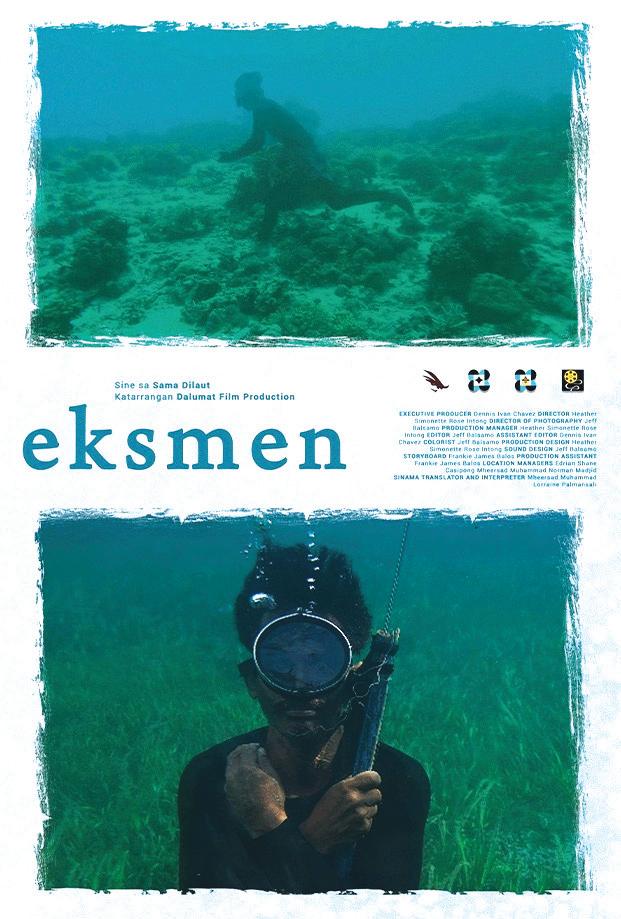


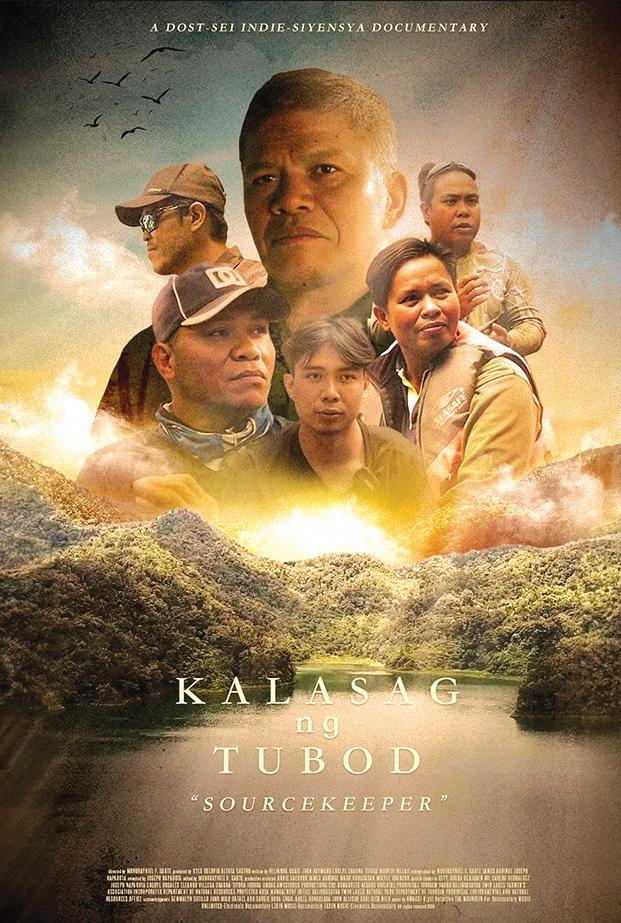

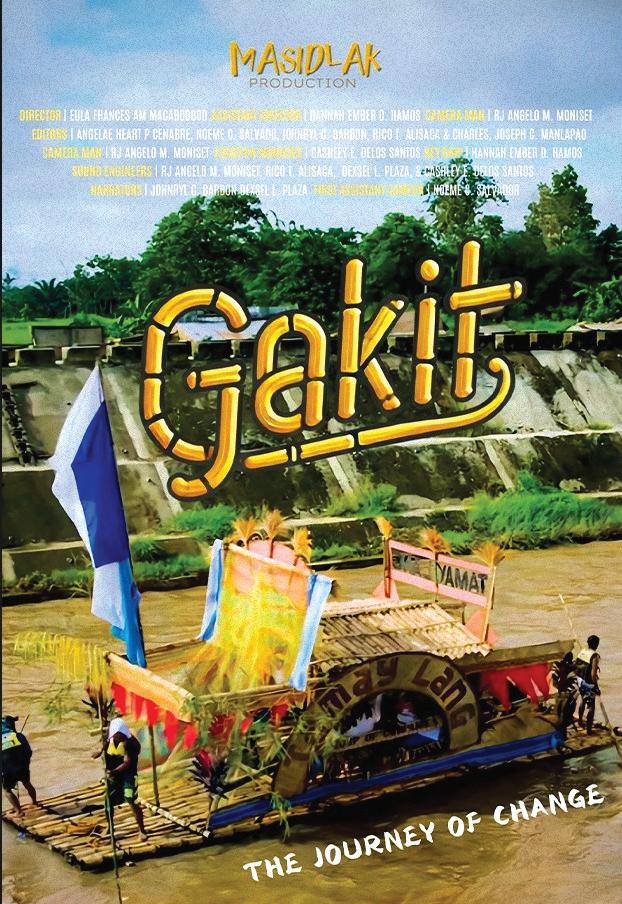
the Talaandig tribe with scientific insights.
Dr. Ruby Cristobal, a science communicator and member of the board of judges also stressed that as the scientific community continues to push the boundaries of knowledge, we must always acknowledge our roots and embrace our diverse cultural heritage. Culture, she pointed out, is not separate from science—it is integral to who we are as a people.
The Indie-Siyensya competition not only highlights the creativity of Filipino filmmakers and science communicators but also underscores the importance of integrating cultural heritage and scientific knowledge for the betterment of society.
As DOST-SEI and FDCP continue to forward these initiatives, they invite audiences to reflect on the essential connections between art, science, and Filipino identity.
8TH INDIE-SIYENSYA FILMS WILL BE AVAILABLE ONLINE THROUGH THE STREAMING PLATFORM JUANFLIX FROM OCT. 19 TO NOV. 8, 2024.






8 Sunday, October 27, 2024
By Seymour Barros Sanchez
NiNe top Metro Manila schools partnered with the instituto Cervantes de Manila for the successful holding of the recently concluded 23rd Pelicula>Pelikula Manila Spanish Film Festival.

The festival featured more than 20 Spanish and Latin American films from Oct. 5 to 13. It was mounted in collaboration with the Asia Pacific Film Institute (APFI), Ateneo de Manila University-Modern Languages, CIIT College of Arts and Technology, De La Salle-College of Saint Benilde (DLS-CSB) School of New Media Arts, Far Eastern University (FEU) Institute of Arts and Sciences, iAcademy, Mapúa University School of Media Studies (SMS), Meridian International (MINT) College, University of the Philippines Film Institute (UPFI), and the UP Department of European Languages.
Mapúa Digital Film Program Chair, SMS professor, and filmmaker Sheryl Andes moderated the talkback session with Benito Pérez Buñuel director Luis Roca and producer Marta de Santa Ana after the Asian premiere of their documentary.
The film explores the life and influence of Spanish filmmaker Luis Buñuel and Spanish writer Benito Pérez Galdós.
The audience had the opportunity to learn about the creative process behind the documentary, as the filmmakers shared their insights on Galdós' and Buñuel's legacy and their passion to bring it to life.
POST-PRODUCTION WORKSHOP
MEAN whILE, Spanish filmmaker Mario Torrecillas conducted a two-day postproduction workshop at iAcademy Nexus Makati.
Torrecillas provided 12 students from APFI, CIIT, DLS-CSB, iAcademy, Mapúa, and MINT with hands-on experience on the postproduction process and practical knowledge
of stop-motion animation.
Torrecillas earlier discussed his work as a comic book writer and his experience of adapting comics to cinema in his talk “From Comics to Film.”
he presented at Cinema 2, Shangri-La Plaza Red Carpet Cinemas the film Loli Tormenta, of which he wrote the script. he also facilitated a free animation workshop for children at the Grand Atrium of the mall.
Pelicula>Pelikula was also made possible through the Embassy of Spain in the Philippines, AECID, the Film Development Council of the Philippines (FDCP), the Movie and Television Review and Classification Board (MTRCB), Teatro Real, the Embassy of Argentina in the Philippines, the Embassy of Brazil in the Philippines, the Embassy of Colombia in the Philippines, CMB Film Services Inc., Kinoise Ph, and SINEGANG Ph, and sponsored by Philippine Transmarine Carriers, Inc., Arthaland, Ayala Corporation, BOYSEN, Fundador, Terminal Six, and Barcino.
AUDIENCE CHOICE AWARD
A LL screenings were free of charge, and films were shown in Spanish (or their original language) with English subtitles.
Several audience members received exclusive merchandise for every five films they watched. Moviegoers collected stamps on their ballots after each screening and earned their rewards.
The Festival wrapped up on October 13 with the awarding of the Premio del Público (Audience Choice Award), which went to Dani de la Orden's Casa en llamas (2024).


The film, a dark comedy about a woman’s determined yet chaotic attempt to reunite her family, captured viewers' hearts.
The movie made waves in the cinematic world, bagging several national awards and becoming the highest-grossing Catalan film of all time. The recognition that this film has received underscores the importance of supporting and promoting such works, as they reflect the cultural mosaic of Spain and highlight the unique narratives that each region brings to the cinematic landscape.
CULTURAL INTERACTION
SEv ERAL other films garnered significant audience support and were recognized as runner-ups, including El maestro que prometió el mar, Loli Tormenta, La llegada, Cerrar los ojos, Robot Dreams, Te



estoy amando locamente, Puan, Pacarrete, and La estrella azul.
Each film added depth to the festival’s lineup, reflecting the diverse stories and perspectives from Spain and Latin America.
Festival organizers also celebrated the success of its En Corto series, a space for cultural interaction, where local filmmaker Kyla Romero presented her short film Transients alongside her cast and crew.
This series offered a platform for short films that picture different facets of the human experience. Included in the lineup were: Aunque es de noche by Guillermo