



By Joel C. Paredes
FOLLOWING an emissions testing for Cebu’s first “waste-to-energy” treatment plant using thermal oxidation, stakeholders are optimistic that modern waste management methods are poised for significant advancement in the Philippines.
After they recently convened in Cebu City, they forged a consensus that waste treatment plants, both for general garbage and for wasteto-energy generation, must become a priority.
This imperative, they said, extends beyond local governments to include private entities, particularly hospitals and businesses that produce industrial waste.
While waste-to-energy technology is widely adopted in other countries, it is still in its early stages in the Philippines, according to Commissioner Dwight Ramos of the National Solid Waste Management Commission.
“Eventually we are realizing that the waste you throw away will come back to you,” he said, citing the old mistaken notion that the “mayor will take care of it” as well as the attitude of ignoring garbage for being NIMBY or “not in my own backyard.”
“If the LGUs [local government units] don’t have funding, probably we can cluster them. So in their backyard, maybe a cluster of municipalities or cities [can] come together so they can afford at least a 20-totonner [waste treatment plant]. And they will not have to rely on biggerscale landfills to take care of them,” said Ramos.
Citing his past experience when they operated a landfill in the former US military base in Clark in partnership with the Clark Development Corp., Ramos pointed out it was one of the biggest landfills in the country, because “the community was integrated and we were only talking to locators.”
This time, Ramos said he hoped that the waste treatment technologies, including the use of thermal oxidation, will really be propagated in the country. “Technologies such as this are really important in order for
management problem in the country,” he said.
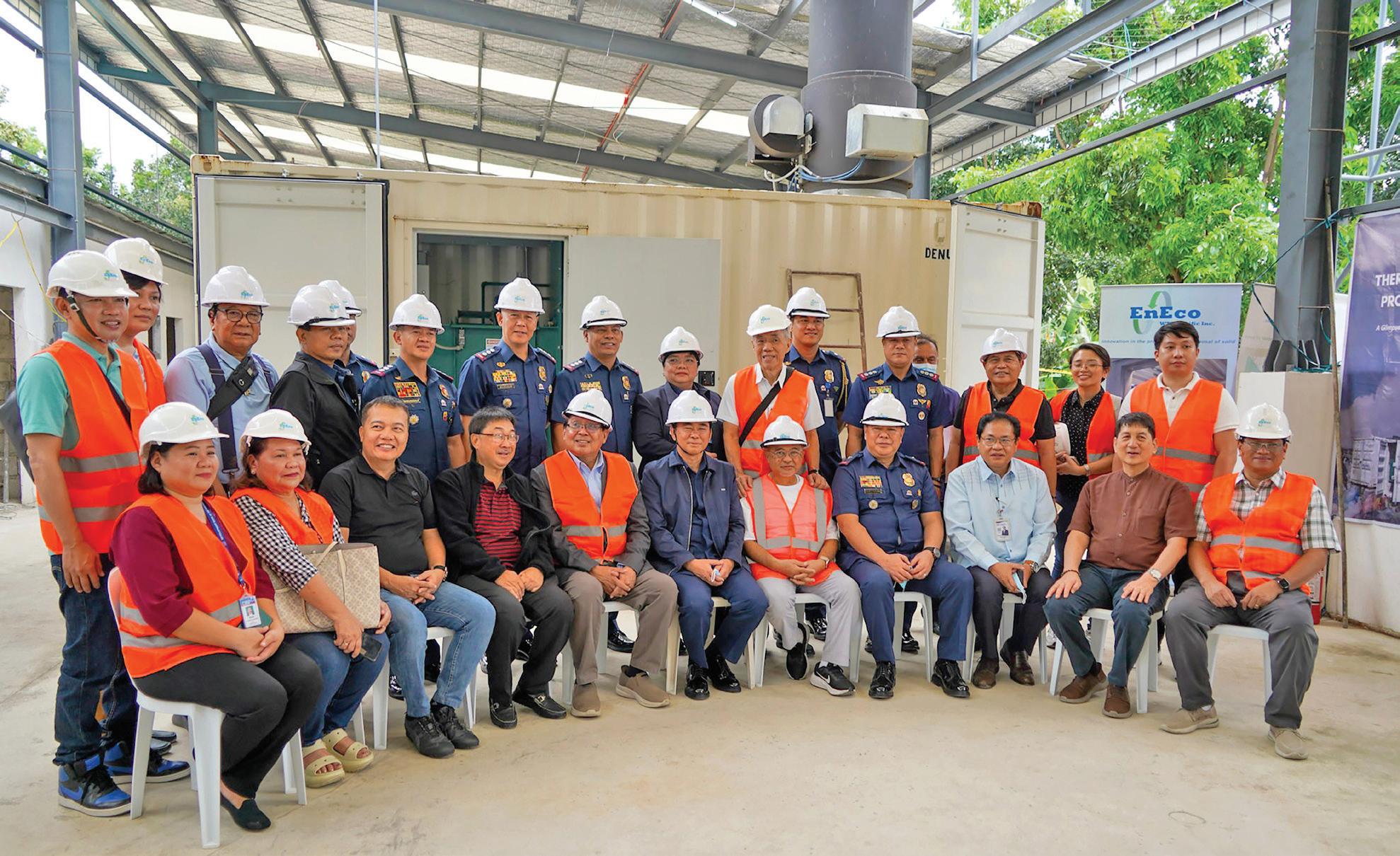
Awaiting a permit-to-operate from the city government is the first waste-to-energy plant using thermal oxidation. The enterprise of the Canadian company EnEco is located at the Mactan Economic Zone in Lapu-Lapu City. The new plant is a fully-integrated waste treatment plant and disposal facility using EnEco’s second-generation technology, which is smaller, but more affordable. Jesus Jayme Jr., president of En-
Eco WtE Pacific Inc., acknowledged challenges in pursuing the project, including a “wait-and-see” attitude among political leaders. He also pointed out that these technologies aren’t always affordable. However, EnEco has developed smaller, more accessible units, ranging from five to ten tons, compared to the standard 20-ton units.
EnEco’s current focus is on catering to businesses that generate industrial waste, such as those in the Cebu Mactan Export Process-
ing Zones. They’ve partnered with Juniper, a local marketing firm, to penetrate the hospital sector, which is particularly vulnerable to the longterm effects of improper solid waste disposal.
Lt. Gen. Alan O. Okubo, chief of the Philippine National Police directorial staff who personally attended the meeting with ranking regional PNP officials, emphasized the critical need for modernized garbage collection systems within PNP camps across the country .
To illustrate the problem’s extent, he pointed out that even the PNP general headquarters struggles to maintain functional canteens due to inadequate waste disposals. He suggested a phased approach, beginning with the establishment of a waste treatment plant in a selected camp, which would then handle waste treatment from surrounding PNP facilities.
Jayme believes that waste-to-energy technology can offer a viable alternative to incinerators, which have been deemed environmentally hazardous. He emphasized that while largescale energy generation is a longterm goal, the immediate priority is addressing the urgent problem of overflowing landfills and unsanitary dumpsites that are degrading the environment. Currently, the energy output of their equipment isn’t the primary consideration, as costeffective energy generation requires higher volumes of waste.
The Mactan Cebu Export Processing Zone generates approximately 17 tons of waste daily. However, with the newly established plant located within the zone, it can process up to 15 tons daily over a sustained period, Jayme said. To begin, the plant is equipped with two 5-ton capacity units.
Meanwhile, the policy support for waste-to-energy projects is strong. Recently, the Department of Energy announced it will conduct a separate green energy auction for
By Eddie Spence and Eko Listiyorini Bloomberg
IN a workshop overlooking paddy fields on the eastern edge of Java, Dimas Firmansyah is tinkering away on a large truck engine. A lanky 18-year-old in a hard hat and work shirt, he hopes to find a job repairing coal machinery when he graduates in a few months. Thanks to his school’s revamped curriculum and corporate partnerships, he almost certainly will.
Indonesian President Prabowo Subianto—who has advertised ambitious, industry-heavy growth goals for the coming years—needs many more Firmansyahs. Southeast Asia’s most populous economy has the world’s fourth-largest workforce, but more than a third of Indonesians over 15 have only a primary school education, or less. Vital vocational training, like this class some 400 miles (roughly 640 km) east of Jakarta, too often falls short because of poor teaching and a dearth of basic equipment.
climate center of Muhammadiyah, an Islamic organization which runs thousands of schools in the country. “Investment in human capital, education and healthcare has not kept pace.”
Inadequate schools, ill-qualified teachers and a poor return on government spending on education are problems familiar to many emerging economies and Indonesia has made some effort to address the problem, including for vocational colleges.
But complications ranging from out-of-date syllabuses to tangled oversight mean it continues to lag, even by the standards of the region. Labor productivity, an indicator linked to growth and competitiveness, sits alongside Venezuela, according to the International Labor Organization. That’s below regional peers like Thailand and Malaysia, which both made earlier bets on manufacturing.
“Indonesia has invested heavily on infrastructure,” said Alpha Amirrachman, a director of the
The result is a pressing shortage of qualified workers and high unemployment among young people who find themselves lacking the skills companies need, even with a diploma in hand. The rate of youth that are out of both a job and education, a good indicator of wasted human resources, is one of Southeast Asia’s highest, at more than a fifth. That gap threatens Prabowo’s ambitions to turn a wealth of natural resources into a thriving electricvehicle and clean-energy industry. Discontent with paltry education funding is already fueling youth protests on Jakarta’s streets, the largest demonstrations of popular discontent since the president took office in October.
“If companies like Apple come here and open big operations, the concern is they wouldn’t have enough highly skilled labor— which they do in other countries, like Vietnam,” said Martyn Terpilowski, chief executive officer of Jakarta-based software firm PT Bhumi Varta Technology, referring to one of the highest-profile names courted by Indonesia. “Yes, we have some good people now, but we don’t have the number of good people that we need.”


Apple Inc. and its suppliers have invested at least $16 billion in Vietnam since 2019, according to figures provided by the company last year. By contrast, even after bans and threats from Jakarta, Apple will put just at $1 billion into Indonesia. A long courtship of Tesla Inc. boss Elon Musk, meanwhile, has yet to yield a significant manufacturing investment.
Metal processing has seen significant inbound investment in recent years, but the problem is no less acute there—large Chinese nickel producers bring in skilled industrial workers from China or, in some cases, take Indonesians to China to receive the necessary training.
Reforms to date, designed to ensure Indonesia makes the most of its demographic “dividend” before a peak around the end of the decade, include increases to compulsory education and skill development programs with incentives, introduced under Prabowo’s predecessor. But deep changes to curriculums and teaching standards have been far harder to implement. According to the latest Program for International Student Assessment, which tests 15-year-olds in dozens of countries in math, reading and science, most Indonesian children fell below the baseline level of proficiency.
“There’s a lack of teachers with expertise in emerging fields,” said Amirrachman. “Many institutions still lack access to modern technologies such as those needed for EV production.”
Prabowo himself came into office with promises for schools, but the most high profile has been a headline-grabbing $30-billion free lunch program, aimed at alleviating malnutrition. The cuts to finance that policy have impacted other budgets including primary, secondary and higher education, at a time when money is also being funneled to Danantara, a new state investment fund—prompting the
“Dark Indonesia” movement and last month’s large youth demonstrations against what are seen as hasty, inconsistent austerity moves.
The Ministry of Primary and Secondary Education and the Ministry of Higher Education, Science and Technology did not respond to requests for comment. Officials have said efforts to improve education will not be affected by the cuts.
Stop gap measures
FIRMANSYAH’S school—a neatly maintained, low-rise complex of bright blue buildings—is something of an exception, with even a forklift and excavators for students to work on. That’s thanks partly to a partnership with one of the companies seeking just such qualified workers, United Tractors Tbk, the largest distributor of construction equipment in Indonesia.
“There was a big lack of supply of certified people, competent people, capable people to fulfil the needs of our industry,” said Edhie Sarwono, human capital and sustainability director at the company. “We had to solve the problem by ourselves.”
Shortages common to many schools are particularly acute for vocational colleges trying to produce employment-ready mechanics and technicians to operate metal smelters and electric-vehicle factories, creating a wide gap between students’ capacities and what employers require. Young graduates from technical high schools face unemployment rates almost four times higher than those with only primary education.
Sarwono, speaking in Jakarta, says companies have a role to play. United Tractors works to align teaching at the school with skills needed in the workplace and donates equipment. But he warns this will only be a stop-gap measure for Indonesia’s wider needs.
“For the low- to medium-level
Continued from A1 biomass and waste-to-energy (WTE) technologies in hopes there will be interested renewable energy (RE) developers this time. Under the proposed GEA-4.1, which covers WTE and biomass projects, the agency is targeting to make this happen within the year, according to a report in the BusinessMirror (https://businessmirror.com. ph/2025/03/10/doe-sets-separateauctions-for-biomass-wte-projects/).
technology, we can solve that with the competencies of the vocational schools,” he said. “For high tech, we do not have specific schools that can anticipate and face those challenges.”
Prabowo’s predecessor Joko Widodo, known popularly as Jokowi, did attempt a revitalization program for vocational schools during his decade as president. But weak political commitment and the decentralized nature of the education system have made change slow at best.
That stands in sharp contrast to his $800-billion program to expand roads, airports and railways, which left a visible legacy across the archipelago nation.
The risk for Indonesia is that it loses out to neighbors with better trained workforces, including Vietnam. While it has twisted the arms of nickel producers to bring in largescale investment, its dominance of other metals is less stark—meaning leverage with foreign producers is not as overwhelming.
Former bright spots, such as steel, textiles and ceramics, are already contracting in the face of brutal competition from Chinese imports.
“The policy of pushing some big companies to invest in Indonesia, like they pushed Apple, is a short cut,” said Ilimiawan Auwalin, an economics lecturer at Universitas Airlangga in Surabaya. “Far better to improve competitiveness.” In eastern Java, Firmansyah and a handful of fellow students still working on machinery parts at the end of the school day have a more pressing concern: jobs. Most are realistic. They expect to serve the metal and coal industry that has sustained the economy for decades—not clean cars.
“My father is a carpenter, but the business is not stable,” said Firmansyah. “In mining, the salary is large.”
which is quite challenging as well, because of the huge investment and the capacity that will be built, we’re now doing a study. We’re seeking advice from various experts on how to develop the terms of reference for the option bid projects,” Capongcol added.

By Huizhong Wu, Jintamas Saksornchai & Martha Mendoza The Associated Press
AE SOT, Thailand—
MThousands of sick, exhausted and terrified young men and women, from countries all over the world, squat in rows, packed shoulder to shoulder, surgical masks covering their mouths and eyes.
Their nightmare was supposed to be over.
Last month, a dramatic and highly publicized operation by Thai, Chinese and Myanmar authorities led to the release of more than 7,000 people from locked compounds in Myanmar where they were forced to trick Americans and others out of their life savings. But survivors have found themselves trapped once again, this time in overcrowded facilities with no medical care, limited food and no idea when they’ll be sent home.
One young man from India said about 800 people were being held in the same facility as him, sharing 10 dirty toilets. He said many of the people there were feverish and coughing. Like all former enslaved
are
scammers who talked to The Associated Press, he spoke on condition of anonymity out of concern for his safety.
“If we die here with health issues, who is responsible for that?” he asked.
The armed groups who are holding the survivors, as well as Thai officials across the border, say they are awaiting action from the detainees’ home governments.
It’s one of the largest potential rescues of forced laborers in modern history, but advocates say the first major effort to crack down on the cyber scam industry has turned into a growing humanitarian crisis.
The people released are just a small fraction of what could be 300,000 people working in similar scam operations across the region, according to an estimate from the United States Institute of Peace.
Human rights groups and analysts add that the networks that run these illegal scams will continue to operate unless much broader action is taken against them.
A high-profile crackdown THE trapped people, some of whom are highly educated and fluent in English, were initially
lured to Thailand with promises of lucrative office jobs, only to find themselves locked in buildings where they describe being forced to sit at computers up to 16 hours a day running scams. Refusing to work could bring beatings, starvation and electric shocks.
“Your passport is confiscated, you cannot go outside and everything is like hell, a living hell,” a trapped Pakistani man told The Associated Press.
Cyber scams run from compounds have flourished during the pandemic, targeting people around the world. The United Nations Office on Drugs and Crimes estimates that between $18 billion and $37 billion was lost in Asia alone in 2023, with minimal government action against the criminal industry’s spread.
Beijing began pushing the region’s governments to crack down this year after a young Chinese actor was trafficked to Myanmar by people who promised him an acting job in Thailand. His girlfriend spearheaded a viral social media campaign that led to his release.
Following that rescue, a senior Chinese government official visited Thailand and Myanmar demanding
an end to the scams. In response, Thailand cut electricity, Internet and gas supplies to five border towns in Myanmar.
Shortly after, the ethnic militia groups that rule this part of Myanmar—the Kayin Border Guard Force and the Democratic Kayin Buddhist Army—asked some of the trapped scammers if they wanted to leave, and then escorted them out of their compounds.
From forced labor to detention
AS the number of people released grew into the thousands, formerly enslaved scammers found themselves caught in indefinite detention just across a narrow, slow-moving river’s width from freedom.
Most are being held either in army camps controlled by the Kayin Border Guard Force, or repurposed scam compounds, where many have been since early February.
For weeks, men and women have shared unsanitary conditions, sleeping on the floor and eating what their captors provide. At one point, the Border Guard Force said that over 7,000 people were crammed into these facilities, as China began busing citizens across the border for flights.
Exclusive photos obtained by AP underscore the detainees’ desperation: Surgical masks, often two per face, cover their eyes, noses and mouths as they huddle under the watchful eyes of armed guards.
“It felt like a blessing that we came out of that trap, but the actual thing is that every person just wants to go back home,” said another Indian man, 24, speaking softly on a contraband phone from inside a makeshift detention center. He asked to not publish his name out of concern for his safety and because the militias guarding them had confiscated their phones.
Last week, fights broke out between Chinese citizens waiting to go home and the security forces guarding them, two detainees told the AP.
An unconfirmed list provided by authorities in Myanmar says they’re holding citizens from 29 countries including Philippines, Kenya and the Czech Republic.
Waiting for a $600 plane ticket
AUTHORITIES in Thailand say they cannot allow foreigners to cross the border from Myanmar unless they can be sent home immediately, leaving many to wait for help from embassies that has been long in coming.
China sent a chartered flight Thursday to the tiny Mae Sot airport to pick up a group of its citizens, but few other governments have matched that. There are roughly 130 Ethiopians waiting in a Thai military base, stuck for want of a $600 plane ticket. Dozens of Indonesians were bused out one morning last week, pushing suitcases and carrying plastic bags with their meager possessions as they headed to Bangkok for a flight home.
Thai officials held a meeting this week with representatives from foreign embassies, promising to move “as quickly as possible” to allow them to rescue their trapped citizens. But they warned that Thailand can only manage to receive 300 people per day, down from 500 previously, Monday through Fridays. It also announced it would let embassy staff cross over into Myanmar.
“The ministry attaches very high importance to this and is aware that there are sick people, and that they need to be repatriated,” Nikorndej Balankura, spokesman for Thailand’s Ministry of Foreign Affairs said on Thursday.
See “Myanmar,” A4

By Sarah Parvini Ap Technology Writer
LOS ANGELES—When artificial intelligence-backed tractors became available to vineyards, Tom Gamble wanted to be an early adopter. He knew there would be a learning curve, but Gamble decided the technology was worth figuring out.
The third-generation farmer bought one autonomous tractor. He plans on deploying its selfdriving feature this spring and is currently using the tractor’s AI sensor to map his Napa Valley vineyard. As it learns each row, the tractor will know where to go once it is used autonomously. The AI within the machine will then process the data it collects and help Gamble make better-informed decisions about his crops—what he calls “precision farming.”
“It’s not going to completely replace the human element of putting your boot into the vineyard, and that’s one of my favorite things to do,” he said. “But it’s going to be able to allow you to work more smartly, more intelligently and in the end, make better decisions under less fatigue.”
Gamble said he anticipates using the tech as much as possible because of “economic, air quality and regulatory imperatives.” Autonomous tractors, he said, could help lower his fuel use and cut back on pollution.
As AI continues to grow, experts
The Indian Embassy in Bangkok did not respond to requests for comment. The Czech Foreign Ministry says it cannot confirm a Czech citizen is among those repatriated. It says it is in touch with the embassies in Bangkok and Yangon over the issue and that the embassies have not been asked for assistance.
Amy Miller, the Southeast Asia director of Acts of Mercy International who is based at the ThaiMyanmar border, says it’s hard for the world to understand why all of the released workers aren’t free.
“You can literally, with your naked eye, stand at the border and see people inside, on their balconies, in these compounds, and yet we cannot reach them,” she said.
Pausing a moment, she gestured out a nearby window toward the Friendship Bridge to Myanmar just blocks away. “I think what people
say that the wine industry is proof that businesses can integrate the technology efficiently to supplement labor without displacing a workforce. New agricultural tech like AI can help farmers to cut back on waste, and to run more efficient and sustainable vineyards by monitoring water use and helping determine when and where to use products like fertilizers or pest control. AI-backed tractors and irrigation systems, farmer say, can minimize water use by analyzing soil or vines, while also helping farmers to manage acres of vineyards by providing more accurate data on the health of a crop or what a season’s yield will be. Other facets of the wine industry have also started adopting the tech, from using generative AI to create custom wine labels to turning to ChatGPT to develop, label and price an entire bottle.
“I don’t see anybody losing their job, because I think that a tractor operator’s skills are going to increase and as a result, and maybe they’re overseeing a small fleet of these machines that are out
don’t understand is that to enter into another country is an act of war. You cannot just go in and receive these people out.”
Assistance is scarce AIDING the work on the front lines, especially for those countries with fewer resources, are a handful of small nonprofit groups with very limited funds.
In a nondescript Mae Sot home, Miller’s organization receives escapees and a trickle of survivors who have made it across the river with comfortable couches, clean water, food and working phones to reach their families. She said today’s unprecedented numbers are overwhelming the aid available across the river.
“When we’re looking at numbers in the thousands, the ability to get them over to Thailand and process them and house them and feed them would be impossible for most governments,” said Miller. “It really does require a kind of a global response.”

there, and they’ll be compensated as a result of their increased skill level,” he said.
Farmers, Gamble said, are always evolving. There were fears when the tractor replaced horses and mules pulling plows, but that technology “proved itself” just like AI farming tech will, he said, adding that adopting any new tech always takes time.
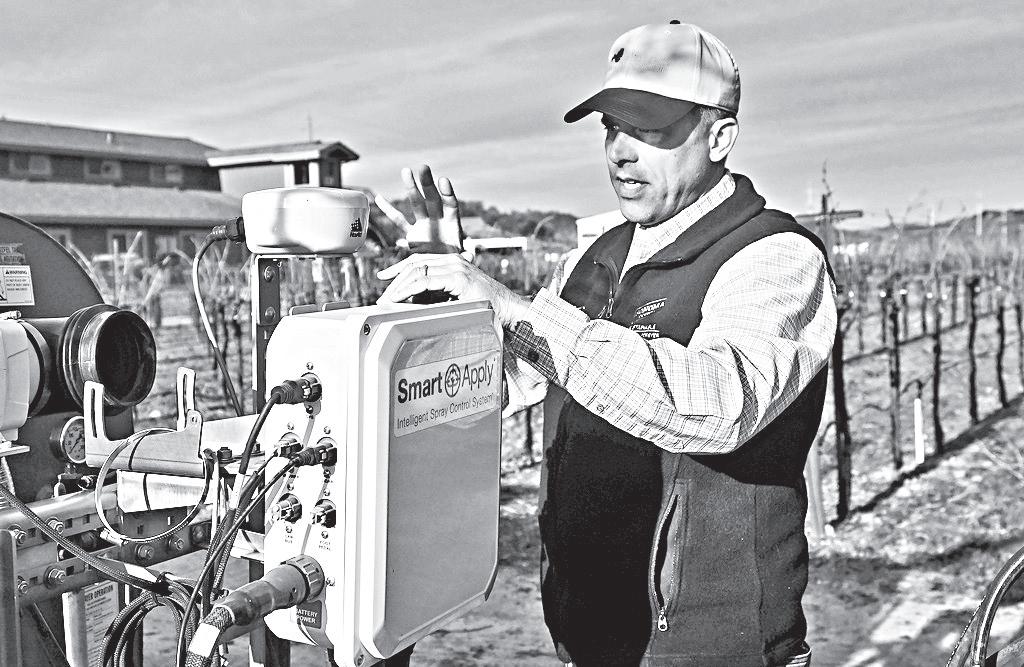
Companies like John Deere have started using the AI that wine farmers are beginning to adopt. The agricultural giant uses “Smart Apply” technology on tractors, for example, helping growers apply material for crop retention by using sensors and algorithms to sense foliage on grape canopies, said Sean Sundberg, business integration manager at John Deere.
The tractors that use that tech then only spray “where there are grapes or leaves or whatnot so that it doesn’t spray material unnecessarily,” he said. Last year, the company announced a project with Sonoma County Winegrowers to use tech to help wine grape growers maximize their yield.
Tyler Klick, partner at Redwood Empire Vineyard Management, said his company has started automating irrigation valves at the vineyards it helps manage. The valves send an alert in the event of a leak and will automatically shut off if they notice an “excessive” water flow rate.
“That valve is actually starting to learn typical water use,” Klick said. “It’ll learn how much water is used before the production starts to fall off.”
Klick said each valve costs roughly $600, plus $150 per acre each year to subscribe to
The recent abrupt halt to US foreign aid funding has made it even harder to get help to released scam center workers.
The United Nations’ International Organization for Migration, for example, previously funded care for victims of trafficking in scam compounds in one shelter in Cambodia, but was forced to halt that work by the Trump Administration’s funding freeze announced in January, according to a source with direct knowledge of the situation. The halt to funding has also impacted a network of civil society groups that worked to stop human trafficking and rescue survivors in Thailand.
“It’s really heartbreaking to see that there’s such an immense amount of people that are in need of assistance,” said Saskia Kok, Head of Protection Unit in Thailand for the IOM.
In a statement, US officials acknowledged the high pressure impasse.
“The United States remains deeply concerned about online scam operations throughout Southeast Asia, which affect thousands of Americans and individuals from many other countries,” said a State Department spokesperson in a statement sent to the AP.
A bigger problem
WHILE advocates estimate some 50 million people are living in modern slavery, mass rescues of enslaved workers are rare. In 2015, more than 2,000 fishermen were rescued from brutal conditions at sea, liberated after an Associated Press investigation exposed their plight. That same year hundreds of Indians were rescued from brick factories in India. And last year Brazilian prosecutors rescued 163 Chinese
the service.
“Our job, viticulture, is to adjust our operations to the climatic conditions we’re dealt,” Klick said. “I can see AI helping us with finite conditions.”
Angelo A. Camillo, a professor of wine business at Sonoma State University, said that despite excitement over AI in the wine industry, some smaller vineyards are more skeptical about their ability to use the technology. Small, family-owned operations, which Camillo said account for about 80 percent of the wine business in America, are slowly disappearing—many don’t have the money to invest in AI, he said. A robotic arm that helps put together pallets of wine, for example, can cost as much as $150,000, he said.
“For small wineries, there’s a question mark, which is the investment. Then there’s the education. Who’s going to work with all of these AI applications? Where is the training?” he said.
There are also potential challenges with scalability, Camillo
added. Drones, for example, could be useful for smaller vineyards that could use AI to target specific crops that have a bug problem, he said—it would be much harder to operate 100 drones in a 1,000-acre vineyard while also employing the IT workers who understand the tech.
“I don’t think a person can manage 40 drones as a swarm of drones,” he said. “So, there’s a constraint for the operators to adopt certain things.”
However, AI is particularly good at tracking a crop’s health— including how the plant itself is doing and whether it’s growing enough leaves—while also moni
toring grapes to aid in yield projections, said Mason Earles, an assistant professor who leads the Plant AI and Biophysics Lab at UC Davis.
Diseases or viruses can sneak up and destroy entire vineyards, Earles said, calling it an “elephant in the room” across the wine industry. The process of replanting a vineyard and getting it to produce

nationals working in “slavery-like” conditions at an electric vehicle factory construction site in northeastern Brazil.
“What we are seeing at the ThaiMyanmar border now is the result of years of inaction on a trafficking crisis that has had a devastating impact on thousands of people, many of whom were simply seeking better economic prospect, but were lured to these compounds on false pretenses,” said Amnesty International Myanmar researcher Joe Freeman.
Being forced to commit a crime under threat of violence should not be criminalized, said Freeman. “However, in general we are aware of countries in the region repatriating their nationals from scam compounds only to then charge them with crimes.”
Business as usual
IT’S not clear how much of an effect these releases will have on the criminal groups that run the scam centers.
February marked the third time the Thais have cut Internet or electricity to towns across the river. Each time, the compounds have managed to work around the cuts. Large compounds have access to diesel-powered generators, as well as access to Internet provider Starlink, experts working with law enforcement say.
“The resources is the one thing that they are not lacking and they’ve been able to bring them to bear in the past,” said Benedikt Hoffman, acting representative for the United Nations Office on Drugs and Crime in the region.
The armed groups that staged the crackdown have also been accused of helping to run scam compounds in Myawaddy. The head of the Kayin Border Guard Force, General Saw Chit Thu, has been sanctioned by the European Union and the United Kingdom for profiting from scam compounds and human trafficking, respectively. Compounds in the DKBA’s control are less welldocumented in the public record,
well takes at least five years, he said. AI can help growers determine which virus is affecting their plants, he said, and whether they should rip out some crops immediately to avoid losing their entire vineyard.
Earles, who is also cofounder of the AI-powered farm management platform Scout, said his company uses AI to process thousands of images in hours and extract data quickly—something that would be difficult by hand in large vineyards that span hundreds of acres. Scout’s AI platform then counts and measures the number of grape clusters as early as when a plant is beginning to flower in order to forecast what a yield will be. The sooner vintners know how much yield to expect, the better they can “dial in” their wine making process, he added.
“Predicting what yields you’re going to have at the end of the season, no one is that good at it right now,” he said. “But it’s really important because it determines how much labor contract you’re going to need and the supplies you’ll need for making wine.” Earles doesn’t think the budding use of AI in vineyards is “freaking farmers out.” Rather, he anticipates that AI will be used more frequently to help with difficult field labor and to discern problems in vineyards that farmers need help with.
“They’ve seen people trying to sell them tech for decades. It’s hard to farm; it’s unpredictable compared to most other jobs,” he said. “The walking and counting, I think people would have said a long time ago, ‘I would happily let a machine take over.’”
but activists say they also control a fair number.
“There is clearly a lot of pressure on the Border Guard Force to take action and helping people to leave is one of the most visible ways to do so,” Hoffman said. “That said, it likely also reflects an adjustment to the business model, reducing the number of people involved— and with less attention, continuing lower key operations.” It will take simultaneous pressure exerted in multiple areas to truly shut down the compounds, said Hoffman. In this crackdown, there have been no major prosecutions or compounds shut down.
“This doesn’t affect anything,” said a 23-year-old Pakistani man who had hoped to be freed only to be trapped in an army camp. The bosses, he said, are “rich as hell” and can buy anything they need to keep the lucrative operations going. Meanwhile, he said, conditions are worsening.
“My friends are in really bad condition, we can’t survive here,” he said, requesting anonymity out of fear for retribution from his guards. He asks a question that’s been haunting him day in and day out for weeks: “Is anyone coming for us?”
The Associated Press is investigating cyber scams. If you or someone you know is being or has been held and forced to scam others, here are the ways to get in touch with us. AP’s global investigative team: Investigative@ap.org. Mendoza, a former investigative journalist

SCIENTISTS from the University of the Philippines Diliman College of Science (UPD-CS) have pioneered a simpler, faster, cheaper, and more eco-friendly method to fabricate gold nanocorals by using natural, low-cost acids in water at room temperature.
Gold nanostructures have unique properties that depend on their shape. Branched structures resembling tiny corals, particularly gold nanocorals, have been proven valuable in applications, such as chemical detection, fluorescence imaging, and catalysis. However, their production
often involves complex, costly, and environmentally harmful processes.
Christian Paul Ende, Rufus Mart Ceasar Ramos, Phil Justin Pangilinan, Rogie Bautista, and Dr. Michelle Regulacio of the UPDCS Institute of Chemistry, along with John Rae Louis Escosio of

the UPD-CS Natural Sciences Research Institute and the UPD-CS Materials Science and Engineering
celebrates 43 yrs
THE Philippine Council for Health Research and Development of the Department of Science and Technology (DOST-PCHRD) will celebrate its 43rd anniversary on March 17 at a hotel in Pasay City.
With the theme “Building a Healthier and Wealthier Future: Advancing Research Utilization for Greater Impact,” the event underscores the role of health research in driving public health initiatives and contributing to the nation’s well-being.
Health Secretary Dr. Teodoro J. Herbosa, who will deliver the
keynote address, will share his perspectives on leveraging research utilization to promote public health vis a vis sustainable economic growth.
The event will celebrate excellence in health research through the awarding of winners in the Capture the Heart in Health Research Photo Contest; the prestigious Gelia Castillo Award for Research on Social Innovations in Health; and the accreditation of Research Ethics Committees.
The main plenary session titled “Towards a Mutually Beneficial Partnership: Understanding
Policies and Strategies in Health Research Utilization” will feature insights and discussion on policies and strategies, focusing on partnerships to facilitate health research utilization.
There will be three parallel sessions namely: Bridging Research and Policy—Stakeholder Engagement and Unveiling of Competency Tools for Researchto-Policy Translation; the Philippine Association of Medical Journal Editors Educational Forum and General Assembly, and the PCHRD Scholars’ Society Annual Convention.
By John Eiron R. Francisco
THE James Dyson Award, a global design competition recognizing innovative solutions to real-world problems, began accepting entries on March 12, exclusively for current and recent students in product design, industrial design, and engineering.
According to the James Dyson Foundation, the award aligns with its mission to inspire young people to explore design engineering and to showcase how engineers can develop solutions to everyday frustrations or global challenges.
“We’re looking for designers who think differently, to create products that work better,” the competition website said.
‘Filipino ingenuity at its best’ SINCE its inception in 2005, the competition has supported over 400 groundbreaking inventions, helping bring them to market.
Several Filipino inventors have gained international recognition through the award.
“Ramun,” short for Resistivity Acquisition and Monitoring of the Underground, is a real-time underground monitoring system designed to address flooding, subsidence, and groundwater mismanagement in cities.
Developed by Joseph Aristotle de Leon, a manufacturing engineering student from De La Salle University-Manila, Ramun offers non-invasive, adaptable monitoring for urban areas.


The system uses multiple sensors installed on-site to collect data. The sensors record voltage responses from transmitters that inject electric currents into the ground.
The collected information from detailed spatial data is then sent to a central server, where specialized software processes it into a time-lapse subsurface resistivity map, creating a “video” of underground activity.
After named the 2024 Philippine National Winner, de Leon has continued refining his innovation, aiming for global deployment to provide deeper insights into underground conditions.
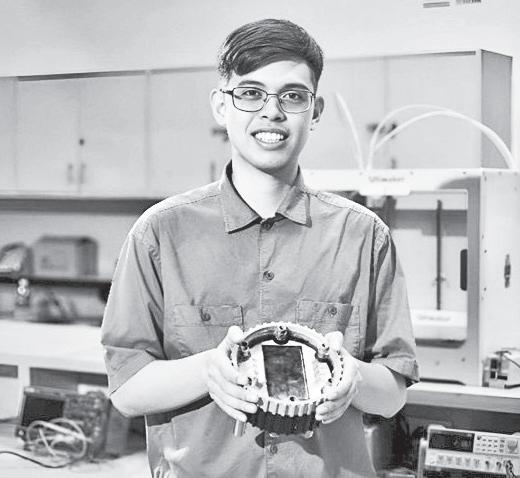
“Make-roscope” is a portable keychain microscope created by Jeremy de Leon, an engineering student from Mapúa University.
Designed in 2023, the device transforms smartphones and tablets into powerful microscopes, magnifying objects up to 125 times with a single lens. Made from durable, food-grade silicone, its flexible arms ensure stability for clear imaging.
The Make-roscope is designed for convenience and ease of use. Instead of looking through an eyepiece, users can simply place the device over their phone’s front camera and view magnified images directly on the screen.
With plans to develop a version tailored for children aged 7 and up, the Makeroscope aims to introduce young learners to microbiology in a fun and accessible way which encourages curiosity beyond the classroom.
Recognized as part of the 2023 James Dyson Award International Top 20, it continues to expand its reach, making scientific exploration more accessible to young students without access to laboratory equipment.
“Brakong,” a lightweight and breathable external breast prosthesis, earned a spot in the competition’s international Top 20 in 2022.
Developed by Emmanuelle Pangilinan and Jason Pechardo from the University of the Philippines Diliman, Brakong is crafted from “bakong,” an aquatic plant with natural antimicrobial properties that helps maintain freshness and hygiene.
Designed to support breast cancer survivors who have undergone mastectomies, Brakong aims to provide both comfort and confidence. Its bio-based material ensures sustainability, allowing it to be reintegrated into the economy at the end of its lifecycle.
The prosthesis features a natureinspired design that enhances airflow, minimizes weight, and reduces material use, lowering costs while maintaining stability.
To ensure a custom fit, Brakong utilizes 3D scanning technology, adapting to the wearer’s chest contours for a natural look and feel, offering breast cancer survivors both physical and emotional comfort.
Addressing sustainability challenges
Program, investigated innovative and eco-friendly ways to produce gold nanocorals.
“For over 43 years, the Council has demonstrated unwavering commitment and dedication to advancing health research and development in the country… This remarkable milestone serves as a testament to how research utilization can chart the path toward a healthier and wealthier future, guided by the principles of inclusivity, ethics, and meaningful impact,” said DOST-PCHRD Executive Director Dr. Jaime C. Montoya.
He further emphasized the importance of collaboration, inviting and encouraging the Council’s partners and stakeholders to remain steadfast in the shared mission of building a happier and healthier nation— one health R&D, one project at a time.
JAMES DYSON AWARD entries must demonstrate both effectiveness and thoughtful design, addressing sustainability challenges through eco-friendly design, sourcing, or production.
Judges, including James Dyson—a British inventor, industrial designer, farmer, and business magnate who founded Dyson—favor entries that employ smart yet simple engineering solutions to welldefined problems, following an iterative design process.
”As well as proving your project’s technical viability, we’d also love to see that it’s commercially viable, too,” the statement added, urging participants to include research on manufacturing costs and pricing.
Unlike many other competitions, participants reportedly retain full ownership of their intellectual property.
To qualify, participants must be current students or recent graduates—within the last four years—who have completed at least one semester in an undergraduate or graduate program related to engineering or design.
For team submissions, all members must meet the same academic criteria, with at least one team member having studied an eligible engineering or design course. Innovate to win ENTRIES for the engineering and design award will close on July 16, with judging taking place at the national level. A panel of external judges, along with a Dyson engineer, will evaluate the submissions.
The national winners and finalists will be announced on September 10. Each national winner will receive P361,300. Every participating market will recognize one national winner and two national runners-up.
From national winners, an international shortlist of 20 entries will be selected, which will be revealed on October 5.
Dyson will personally review the projects and choose the global winners. The international winner and the sustainability winner will each receive P2.168 million, while the international runners-up will be awarded P361,300.
The announcement for the international and sustainability winners is on November
“The key ingredients involved are biogenic acids that are commonly found in plants. Using the right combination of low-cost biogenic acids, we were able to produce hyperbranched gold nanocorals in water under ambient conditions, with the entire procedure completed in less than an hour,” Regulacio said.
The research provides valuable insights into the specific chemical structures, known as functional groups, that play an important role in shaping gold nanocorals into their highly branched forms (hyperbranched morphology).
By gaining a deeper understanding of how these functional groups facilitate hyperbranched growth, scientists can better control the formation of these nanostructures.
“This work demonstrates that the creation of complex
morphological designs does not necessarily require complicated and expensive fabrication processes,” Regulacio said. She clarified, however, that the procedure reported in the study does not produce nanocorals from other metals.
The researchers predict that this breakthrough is projected to spur scientific interest in hyperbranched nanomaterials and open up potential applications in various fields.
Their paper, “A systematic study on the use of biogenic acids in directing the hyperbranched growth of Au [gold] nanocorals,” was published on CrystEngComm, a journal featuring studies on the design and understanding of solid-state and crystalline materials.
The research was funded by the Natural Sciences Research Institute.

IN Pinili, Ilocos Norte, National Living Treasure Magdalena Gamayo weaves with Philippine cotton once more. At 100, her hands remain steady, crafting “inabel,” an Ilocano textile tradition.
This return to Philippine cotton marks a blend of heritage and innovation. The Philippine Textile Research Institute of the Department of Science and Technology (DOST-PTRI) is leading the revival.
In celebration of National Arts Month, the Institute provided 9 kilograms of brown and 6 kilograms of white ring-spun Philippine cotton yarns to the Gawad sa Manlilikha ng Bayan (Gamaba) Weavers Association on February 12. Gamaba is the Philippines’ National Living Treasures Award.
The initiative was part of the revival of Philippine cotton to boost local textiles, cut imports, and promote sustainability, thus, providing weavers with quality, sustainable yarns.
For generations, inabel weaving has featured patterns like binakol, inuritan, kusikos, and Inubon a Sabong.
Gamayo is currently weaving inunsoy, a stripe-patterned weave, using DOST-PTRI-developed cotton yarns. This effort ensures that traditional weaving remains relevant and sustainable. The Gamaba Weaving Association, based at the Gamaba Cultural Center, is one of the first batch of communities selected for DOSTPTRI’s yarn deployment. The field trials allow weavers to assess the yarn’s quality, ensuring alignment with traditional techniques before commercialization.
“This is a weaving movement in which we ask communities to validate with us whether cotton can be used for weaving. We seek feedback as it allows us to adjust the specifications of the cotton yarns.” said DOST-PTRI Director Julius L. Leaño, Jr.. Gamayo and the weaving association will refine DOST-PTRIdeveloped yarns, ensuring they align with traditional weaving standards.
By actively weaving with the new yarns and providing valuable feedback, they will contribute to R&D, bridging innovation and heritage.

A6 Sunday, March 16, 2025

Editor: Lyn Resurreccion • www.businessmirror.com.ph
By Roy Lagarde
ACATHOLIC priest known for helping families of victims of “drug war” killings said March 12 that the arrest of former president Rodrigo Duterte was “a triumph of good against evil.”
Fr. Flavie Villanueva of the Society of the Divine Word described it a “moral victory,” saying it signified the nation’s reckoning with the deadly anti-drug campaign that killed thousands, including young children.
“It began with a nightmare because it should not have happened in the first place. But since it did, goodwill responded, and yesterday [March 11] goodwill also won,” Villanueva said.
Duterte was arrested on March 11 in Manila on a warrant from the International Criminal Court (ICC), which accuses him of crimes against humanity for his administration’s brutal war on drugs.
ROn Wednesday, a chartered plane carrying the former president flew to The Hague, Netherlands, where he will stand trial. A day after the arrest, Villanueva led a prayer service before the inurnment of the remains of 18 more victims of extrajudicial killings at Dambana ng Paghilom, or Shrine of Healing.
The shrine, built in 2024 inside Laloma Catholic Cemetery in Caloocan City, is a project backed by the Diocese of Kalookan to serve as the final resting place for victims of extrajudicial killings. It also provides a dignified home for the dead whose families could not afford to renew leases on their apartment-style graves.
Since its establishment, more than 70 urns have been interred at the shrine.
Villanueva urged Filipinos to reflect on the consequences of Duterte’s policies and move beyond the violence to rebuild a culture of healing.
“I just hope that people finally realize that nothing good came out of ‘tokhang,’” he said, using the term for Duterte’s anti-drug operations.
“Instead, a culture of darkness and death prevailed. And with Duterte’s arrest, I hope we can put an end to this culture and recreate a beautiful, much better culture of caring and healing.”
Bishops: Duterte arrest a step toward accountability, justice
SOME Catholic bishops expressed hope that the arrest of Duterte marks a step toward accountability and sets a precedent for addressing human rights violations in the country.
Bishop Jose Colin Bagaforo of Kidapawan, Cotabato, said Duterte’s arrest was a crucial move toward justice for the thousands killed in his deadly drug war.
“True justice...is about accountability, transparency, and the pro -

tection of human dignity,” said Bagaforo, who is also president of Caritas Philippines.
“For years, former President Duterte has claimed that he is ready to face the consequences of his actions. Now is the time for him to prove it,” he said.
The Interpol served Duterte with an arrest warrant from the ICC for alleged crimes against humanity upon his arrival at Manila’s international airport on March 11.
spends 12th year of papacy in hospital; receives cake, good news
OME—Pope Francis marked the 12th anniversary of his pontificate Thursday in the hospital—the first pope to do so in modern church history—as he received increasingly positive medical news on his recovery, a cake and hundreds of messages wishing him well.
The pope spent the morning in physiotherapy, followed Lenten spiritual exercises of the Roman curia and stopped to pray at the chapel in the Gemelli Hospital, where he has been under treatment for a complex lung infection since February 14, Vatican sources said.
In the afternoon, he received a cake from hospital personnel.
A chest X-ray has confirmed improvements in his condition, the Vatican said on Wednesday, just two days after doctors declared he’s no longer in imminent danger of death.
The latest medical bulletin said that the 88-year-old pope’s condition remained stable but indicated a complex picture considering his overall fragility, which includes his age, limited mobility often requiring a wheelchair and the removal of part of a lung as a young man. No medical updates were issued on his anniversary.
Francis was elected on March 13, 2013, as the 266th pontiff— and the Catholic Church’s first Latin American pope.
The pope’s anniversary is a public holiday at the Vatican, but no special commemorations were held.

A Mass was held in his honor later at the Argentine church in Rome, with several dozen worshippers in attendance. “It was a different church before [him],’’ said Lia Pratico. “It has changed from a niche church to a universal church because Pope Francis is everybody’s pope, not just an Argentine pope.”
Francis received hundreds of drawings and messages from children and young people from around the globe wishing him a full recovery, the Vatican said. Gemelli Hospital, about a 15-minute train ride from the Vatican, has become a stop for pilgrims visiting Rome as part of
Jubilee Year celebrations.
The Rev. Enrico Bortolaso, who led a group of pilgrims from northern Veneto, offered prayers near a statue of Pope John Paul II outside of the hospital. He said they made Gemelli their first stop.
“We wanted to come here to pray for him and for his recovery,’’ said one of the Veneto faithful, Alberto Jerbonato.
“We are aware that he is 88 years old, and we are fully aware of what he is facing.”
John Paul, who spent 55 days in Gemelli in the longest hospital stretch by a pope to date, used to quip that it was ’’Vatican 3,” following the Vatican itself and Cas -
TRIPOLI, Libya—Every year during the Muslim holy month of Ramadan, a Libyan town comes together to prepare—and share—one of their all-time favorite dishes: bazin.
In Tajoura, just east of Libya ’s capital of Tripoli, it’s the perfect food for iftar, the evening meal when Muslims break the dawn-to-dusk fasting of Ramadan. Savory and rich, bazin is usually made of unleavened barley flour and served with a rich stew full of vegetables and— hopefully—mutton.
If those aren’t available, which they often haven’t been in the past decade and a half due to Libya’s violence and turmoil, a simple
tel Gandolfo, long used as a papal retreat by popes until Francis.
‘’It’s a sort of a seat of fragility, from where he continues his ministry,’’ Cardinal Marcello Semeraro was quoted as saying in L’Avvenire, the newspaper of the Italian bishops’ conference, on Thursday.
The newspaper underlined that Francis is the first pope, at least in modern history, to spend the anniversary of his pontificate in the hospital.
Francis this week has been following a Lenten spiritual retreat that has been a mainstay of his papacy, with updates on his condition omitting reference to work as earlier in his hospital stay.
He continues to receive high flows of oxygen through nasal tubes during the day and a noninvasive mechanical mask to aid his rest at night.
He also is undergoing physical therapy, key to avoiding further repercussions from his hospitalization.
The former Cardinal Jorge Mario Bergoglio was elected on the fifth ballot of the 2013 conclave, which was called after Pope Benedict XVI resigned.
While Francis has praised Benedict’s humility in stepping down and said he might follow in his footsteps, more recently he has said the papacy is a job for life.
Another milestone came last Friday, when Francis marked four weeks of hospitalization.
Colleen Barry/Associated Press
Preparing it is a joint effort, and Tajoura residents of all ages are eager to help with roles from making the bread, handing it out to the poor or donating ingredients to the community.
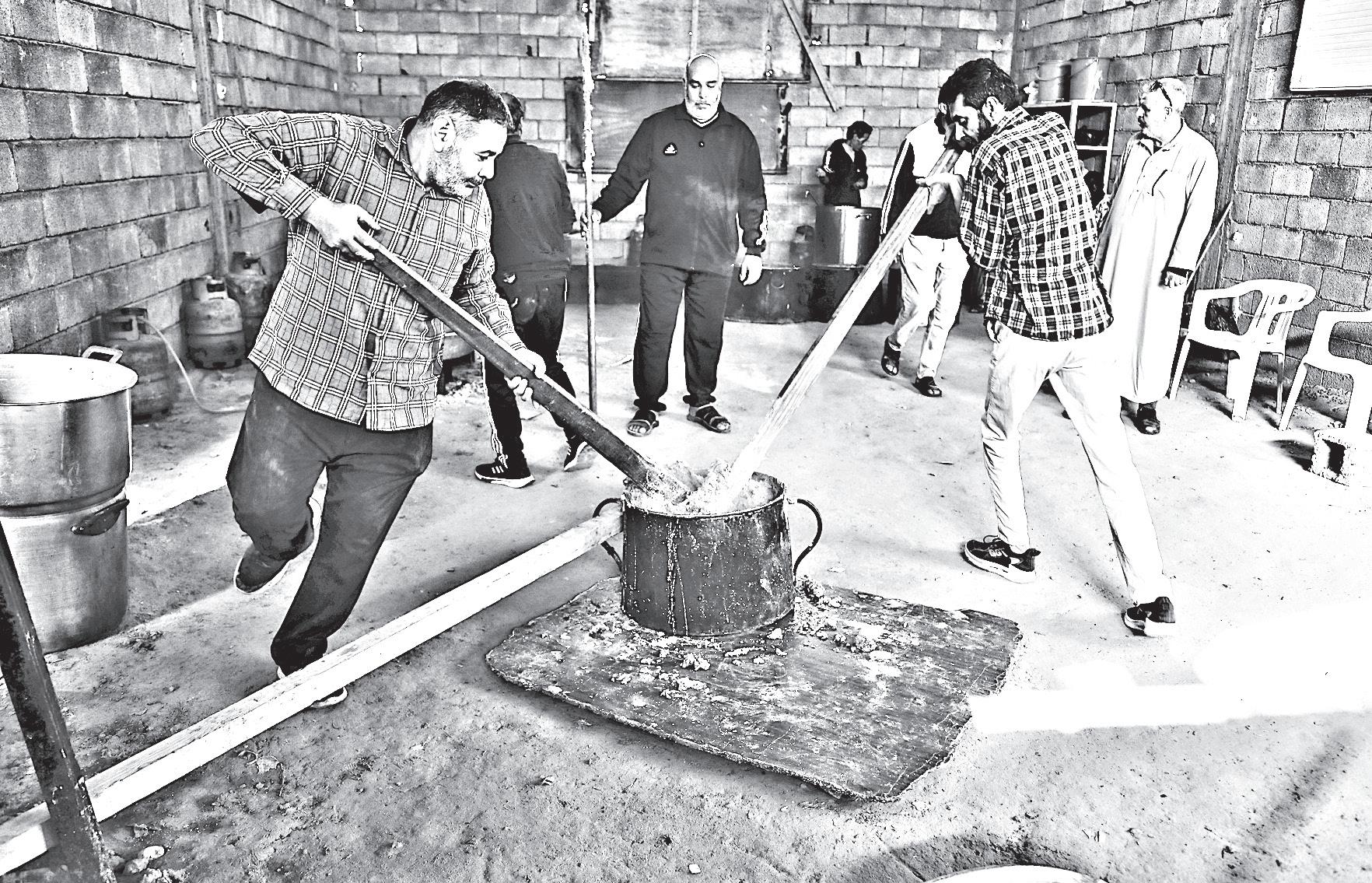
Typically, the men of Tajoura volunteer to make the bread in a makeshift communal kitchen, using long wooden sticks to stir the barley flour water in large pots to make the dough.
Others then knead the dough, shaping it into large clumps that look a bit like giant dumplings, to be baked or steamed. Once ready, other volunteers hand out bazin to a people lined up outside, who eagerly wait to take it home for iftar. Ramadan is a time of intense prayers, charity and spirituality. And in Tajoura, it’s also time for bazin. Yousef Murad/Associated Press
The ICC has been investigating the brutal anti-drugs crackdown that Duterte oversaw while he was in office.
Duterte withdrew the Philippines from the ICC in 2019, but an appeals judge ruled that prosecutors still have jurisdiction over the alleged crimes because they occurred when the country was still a member.
Most cases investigated by the ICC took place between 2016 and
2019. The probe also covered alleged crimes committed when Duterte was mayor of Davao.
Bishop Gerardo Alminaza of the Diocese of San Carlos in Negros emphasized the need for justice, stating that the victims and their families deserve truth and reparations.
“These killings were not random; they were part of a policy that violated the fundamental right to life,” said Alminaza, who is also vice president of the national Caritas.
“The families of the victims deserve truth, reparations, and justice. As a nation, we must ensure that such crimes never happen again,” he said.
Duterte’s arrest does not mean he is guilty. But Bishop Broderick Pabillo of Taytay said the crimes happened under the former leader’s watch must be investigated.
“This is where we will see whether his actions were right or wrong and whether he should be held responsible if they were wrong,” Pabillo told Manila archdiocese-run Radio Veritas.
“That is what democracy should be—no one is above the law, and everyone must answer for their actions,” he said. CBCP News

Spanish priest Fr. Bernardo Blanco, former kidnap victim in Basilan, dies
SPANISH missionary Fr. Bernardo Blanco, who was abducted in 1993 on the Mindanao island of Basilan, died on March 10 in Quezon City.
Blanco, a Claretian priest, died at 1:02 a.m. at Diliman Doctors Hospital, his congregation announced. He was 97.
“We humbly ask you to remember him in your prayers,” the Claretians said.
Blanco lived in the Philippines for 32 years and served the Church in various capacities and ministries.
Born in Ceadea de Aliste, a quaint village in the Spanish province of Zamora, he was ordained a Claretian priest in 1953.
Following his ordination, he was sent to Equatorial Guinea in Africa for his first missionary assignment serving there for 22 years.
In 1968, the country underwent political turmoil, leading to a dictatorship that severely restricted religious practices.
In 1976, Blanco was among 52 foreign priests and 200 foreign nuns expelled from the country. He returned to Spain and waited seven months for a new assignment before being sent to the Philippines.
“In this role, he also attended to the needs of the surrounding Christian and Muslim communities,” according to the Claretians.
In 1993, extremists affiliated with the terrorist group Abu Sayyaf kidnapped Blanco. He endured 49 days in captivity before seizing an opportunity to escape.
“His resilience and faith during this ordeal were widely acknowledged,” the congregation added.
“Fr. Bernardo Blanco, CMF, faced expulsion and abduction, yet he remained unwavering in his missionary commitment.”
In 1994, after a brief visit to Rome and Spain, he was appointed spiritual director at the Claretian Seminary in Quezon City. He later served at Claret Theology, first as superior and later as spiritual director.
Blanco arrived in the Philippines in February 1977 and was assigned to Bolong, Zamboanga City, where he dedicated himself to youth ministry and promoting devotion to the Blessed Virgin Mary. He was later assigned to the Claretian missions in Basilan, where he served as parish priest of Immaculate Heart of Mary Parish in Maluso.
“He contributed to the spiritual formation of Claretian institutions in Quezon City while also serving as spiritual director for several women’s religious communities,” the congregation also said. CBCP News

Editor: Lyn Resurreccion
‘AGRICULTURE and biodiversity conservation are often framed as conflicting pursuits—as if we must sacrifice one for the other. But the real challenge is not about choosing between them. It’s about finding ways to make agriculture a partner in conservation,” emphasized Director Dr. Glenn Gregorio of the Southeast Asian Regional Center for Graduate Study and Research in Agriculture (Searca)
Gregorio was the keynote speaker at the “Webinar on Challenges, Opportunities, and Innovation Strategies in Managing Protected Forests for Biodiversity Conservation and Sustainability” held on March 7, a Searca news release said.
The webinar was organized and hosted by the Central Mindanao University, an affiliate member of the Southeast Asian University Consortium for Graduate Education in Agriculture and Natural Resources (UC). The UC is a regional network established by Searca in 1989 to strengthen graduate education and collaborative research in agriculture and natural resources.
Gregorio, who also serves as adjunct professor at CMU and the University of the Philippines Los Baños (UPLB), as well as Academician of the National Academy of Science and Technology of the Philippines (NAST), delivered his address to an audience of academics, students, and CMU partners.
Speaking not only as a plant breeder, rice scientist, United Nations Food Systems Champion, sustainability advocate, and carbon agriculture enthusiast, but also, in his own words, “at my core, a farmer,” he challenged participants to reimagine the relationship between agriculture and biodiversity conservation.
Urgent call for action, innovation GREGORIO noted that biodiversity is disappearing up to a thousand times faster than normal because of deforestation, urban expansion, and unsustainable farming practices. He pointed out that protected forests, essential for carbon storage, climate regulation, and wildlife habitats, are under increasing pressure.
He, thus, introduced Carbon-Smart Agriculture as a transformative solution—a way to regenerate soils, enhance biodiversity, and secure food production all at once.
“Agriculture doesn’t have to deplete nature; it can restore it,” he emphasized.
He said, “With the right innovations, we can turn farms into partners for conservation.”
Searca’s Carbon WISE innovations
HE explained that Searca has three ongoing initiatives aligned with its advocacy for “Carbon WISE Agriculture: Winnable Innovation Solutions for the Environment” embodied in its 12th Five-Year Development Plan (2025-30).
Its Rice Straw Biogas Hub project led by United Kingdom-startup Straw Innovations is converting rice straw waste into clean energy, reducing emissions while providing Filipino farmers with sustainable energy alternatives.
Searca also developed a carbon footprint tracker, an internal system that enables the Center to measure, manage, and reduce its environmental impact.
This is one way of embedding sustainability into Searca’s operations because, according to him, “real change starts with accountability.”
In partnership with Bangko Sentral ng Pilipinas, Searca is organizing a regional collaboration for carbon farming.
They are looking to gather more than 100 experts across agriculture, finance, and policy sectors to scale up carbon-smart agriculture across Southeast Asia.
Collaboration is key
GREGORIO pointed out that to achieve a balance between agricultural productivity and biodiversity conservation demands science-based innovation, evidenceinformed policies, and strong cross-sectoral partnerships.
“The future of our forests and food systems is in our hands,” Gregorio said.
He asserted that “together, we can redefine agriculture not as a threat to biodiversity, but as its ally. The time to act is now.”
REENPEACE Philippines said the Palawan provincial government’s decision to impose a 50-year ban on new mining operations in the province was a welcome move.
It said the decision was a step in the right direction to ensure the survival of communities, and future generations in the face of the triple planetary crisis, setting a precedent that the rest of the country should follow.
“The Philippines is already facing the worst impacts of the climate crisis–yet destructive industries keep fuelling disasters, putting profit over people,” said Greenpeace Philippines country Director Lea Guerrero in a news release.
“The recent devastating floods in Palawan are a stark reminder of how environmental impacts from other destructive industries make it worse, and this decision by Palawan leaders and the strong campaign of communities against mining recognizes the urgent need to protect the province’s rich biodiversity and communities from the irreversible damage caused by large-scale mining,” she added. She said it is a “crucial step in ensuring a sustainable and climate-resilient future for Palawan and the rest of the country.”
From her part, Grizelda Gerthie MayoAnda, executive director of Environmental Legal Assistance Center and Convenor of the Save Palawan Movement (SPM), said: “The moratorium on endorsement of new and pending applications is a good start.” She added: “Of course, there are continuing challenges with existing mines in six areas and 11 mineral agreements. But new mining applications of about 77 will cover more than 200,000 hectares of natural forest. We can save these forests and help enable Palaweños to achieve
climate resilience.”
“We urge the national government to take inspiration from Palawan’s leadership and implement stronger, long-term policies that prioritize the protection of the people and the environment over short-term economic gain,” Guerrero added.
“The country must move away from destructive extractive industries and invest in real, sustainable climate solutions—such as ecosystem protection, community-led conservation, and sustainable livelihoods that put people and planet at the center,” she said.
Over the years, Palawan has faced numerous threats from environmentally destructive projects, including the controversial plan by Nickelodeon to build an underwater theme park in 2017, which was ultimately scrapped due to strong public opposition.
The province is one of the country’s last ecological frontiers, home to critical forests, marine ecosystems, and indigenous communities whose survival depends on a healthy environment.
This latest victory against mining is a testament to the ongoing fight of Palawan’s people to protect their home from corporate exploitation, the environment group said.
Greenpeace urged voters to elect leaders who will champion the protection of the people and environment over corporate profit.
“We need decision-makers who will commit to policies that safeguard the environment, uphold climate justice, and transition the country to a just and sustainable future. This decision is proof that a different path is possible–one that prioritizes sustainability, justice, and resilience over the profit of corporations,” he said.

By Jonathan L. Mayuga
TWO Russian divers were reported missing off a popular resort in Batangas province in February. The following day, news reports said they were found dead and were attacked by sharks.
Later, autopsy reports revealed otherwise. They died of drowning— apparently after being swept away by the strong ocean current during their dive.
Shark attack what?
THE “shark attack” report, however, left an indelible mark in the minds of readers which triggered howls of protest from not only Filipino divers but also ocean and shark conservation advocates.
Danny Ocampo, a dive master and ocean conservation advocate, said the report has once again put sharks in a bad light—depicting them as dangerous, or worse, monsters that need to be hunted in the ocean.
“I hope there would be more responsibility in validating information and using terms such as attack from sharks, which puts them in a bad light and can cause undue panic among those who spend time in the water, such as scuba divers,” Ocampo told the BusinessMirror via Messenger on March 4.
“There are sharks in the ocean, that’s a fact. But I am not certain if the diver died by being ‘attacked’ by a shark,” he added.
Ocampo, who dives at the worldrenowned Tubbataha Reefs, said he often encounters large marine mammals like rays and sharks. An ocean underwater photography expert, Ocampo takes advantage of every encounter as an opportunity to get videos or photographs.
Shark encounters
MARIVIC VERDADERO MARA -
MOT, founder of Batangas Diving Academy, said as a professional diver and scuba diving instructor who frequently dives in Batangas— the same area where the reported shark “attack” happened—she has encountered sharks many times.
Maramot said sharks are “dangerous” only because of their instinct “because they fear humans, too.”
“But if you don’t touch them or harm them, they are not dangerous,” she told the BusinessMirror via Messenger on March 4.
However, she cautioned that swimming or diving with sharks requires discipline.
“We maintain the respect and the distance. They are very gentle,” she said partly in Filipino. Who or what is on the menu?
ACCORDING to Maramot, being attacked or bitten by sharks is unlikely.
“We are not even part of their ‘menu,” she said.
However, “once humans die, their carcass become part of the menu, not only of sharks, but also of other sea creatures as well. Sharks can smell blood or carcass from miles away.”
How about divers? She said sharks “often ignore divers,” curiously approach them, but later on would leave them alone.
Apex predators SHARKS have existed for a long time. Some believe they are older than dinosaurs.
In the ocean, some of them are at the top of the food chain—considered as apex predators—but they don’t prey on humans; only fish and marine life.
On the other hand, sharks are the ones on the menu of humans. Despite laws supposedly protecting them, hunting sharks persists.
Death by asphyxiation
DR. A A YAPTINCHAY , executive

director of Marine Wildlife Watch of the Philippines, agreed that no shark attack happened in the February fatalities.
Clearly, he said, the cause of death of the two Russian divers was asphyxiation caused by lack of air from the scuba tank as the investigation team stated.
“If it was a shark attack, the cause of death would have been blood loss and massive injuries. Therefore, [if that was the case] the person would have already passed before it was seen floating, and sharks, as well as other marine organisms probably had been feeding on the carcass,” he said.
Yaptinchay confirmed that while sharks are indeed the apex predators in the ocean, they don’t attack humans unprovoked.
“In areas where attacks occur, it is mostly a mistake to identity swimmers or surfers as shark prey. This usually happens around feeding areas of large sharks with abundant marine mammals [seals, sea lions, dolphins, and whales] or marine turtles,” he said.
‘Not all sharks are predators’ ACCORDING to Yaptinchay, not all sharks are top predators. Some occupy lower trophic levels, such as the whale sharks feeding only on plankton, and smaller reef sharks that are mid-level predators.
“There are only a few species in the Philippines that could fit the top-predator description like the great white shark, bull shark, and the tiger shark,” he said.
Yaptinchay said sharks are part of the marine ecosystem and have every right to remain there. Ecosystem balance and the health of the seas are dependent on biodiversity, including sharks.
He agreed that shark attacks, or even encounters with sharks, rarely happen.
“Those encountering sharks, such as scuba divers, should be cautious like how they should be with any other toxic/venomous/aggressive marine life. [They should] follow responsible wildlife interaction guidelines, including maintaining distance and not touching or feeding wildlife,” he advised.
He said that while there are no available data about shark attacks in the Philippines, a global database exists, but was quick to add that in the past century, only a handful were recorded as shark attacks in the country.
“A lot were implicated in maritime accidents, involving sinking boats [with] a lot of dead bodies,” he said.
Declining shark population
THE population of most shark species are on the decline due to various reasons—including habitat loss, accidental bycatch, illegal wildlife trade, and, lately, climate change.
Worse, tagging them as deadly maneater like in the movie “Jaws” is not helping because it puts them back on the hunters’ list. These misunderstood creatures are also being hunted to their extinction for their meat, skin, and—their fins—having been part of the human diet for as long as fishing has become a way of life for humans.
According to Save the Sharks Network Philippines (SSNP), an alliance of shark conservation advocates, there are more than 1,200 known shark species in the world—200 of them in the Philippines, including rays and chimaeras.
“The listing of several shark species in the Convention on International Trade in Endangered Species of Wild Fauna and Flora in August 2019 and the Convention on Migratory Species in October 2017 only proves the urgent need for the Philippines to conserve our dwindling shark populations. To date, only 25 species of sharks are protected in the Philippines,” SSNP said.
According to the group, the Philippines has earned a unique position globally in shark biodiversity, ranking fourth after Australia, Indonesia, and Japan, and second in Southeast Asia after Indonesia.
Economic, ecosystem importance
IN a signature campaign launched years back, the group said protecting sharks is important because their presence is beneficial to both the economy and ecosystems.
It said that shark fishery has been historically practiced in the country, with municipalities dominating over commercial fisheries.
At the same time, shark-based tourism has been contributing to the local economy, such as in Donsol in Sorsogon, and on Malapascua Island in Cebu.
SSNP pointed out the ecological benefits of sharks include keeping coral reefs and seagrass beds healthy, fish populations robust, and nutrient cycling in the seas’ functioning.
In sum, they said that “healthy shark populations mean healthy seas.”
Maintaining balanced ecology
SUE ONG , project coordinator at Wild Conservation Society (WCS), said as top predators, confirmed that sharks help maintain a balanced ecosystem.
“They are good indicators of
ocean health. Protecting sharks supports ecological stability and provides socio-economic benefits for people and nature,” she said.
WCS Philippines promotes the conservation and protection of sharks and rays, particularly endangered and threatened species, to support marine biodiversity, food security, and community resilience. It advocates for sustainable fisheries management to prevent further shark population decline while ensuring long-term benefits.
Kate Lim, country director of WCS, said as keystone species, sharks support the ecosystems that millions of people depend on for food and livelihood.
“By fostering a deeper understanding of the socio-cultural dynamics of shark-human interactions, we can pave the way for more sustainable shark conservation,” she said.
The government and local communities, she said, play a crucial role in protecting these species, ensuring their survival through stronger legal safeguards, science-based fisheries management, and the preservation of critical habitats like Important Shark and Ray Areas.
“Implementing these measures not only secures the future of sharks but also strengthens the resilience of coastal communities. Additionally, responsible shark tourism offers a powerful opportunity to generate economic benefits while inspiring local stewardship and global appreciation for these remarkable creatures,” she said.
Lim added: “By working together, we can protect sharks and, in turn, protect the health of our oceans and communities.”
Shark conservation roadmap FOR its part, SSNP launched the “Pating, Saan ka Pararating?: the 2020 Conservation Roadmap for Sharks and Rays in the Philippines in November 2017.”
The roadmap tackles the complex issues surrounding shark conservation. It serves as guide to align the efforts of all stakeholders toward a common vision of conserving sharks and rays in the Philippines through these conservation pillars: research, communication, community engagement, and governance.
The 2020 Roadmap was designed for use by different agencies, organizations, and individuals to execute their commitments on their own or through concerted efforts.
Several bills have been filed to protect and conserve sharks, but all for naught as Congress ends with the bills not seeing the light of day.
A8 SundAy, MArch 16, 2025
mirror_sports@yahoo.com.ph
Editor: Jun Lomibao

The academic part’s no problem for Damon LaSalle, a Fire

WHILE it might not be the flashiest way to chart the rapid growth of women’s professional sports, a building boom is showing that investors are paying attention. There’s already a dedicated women’s soccer stadium in the National Women’s Soccer League (NWSL) and another one is planned. The Women’s National Basketball Association (WNBA) has seen a jump in new practice facilities—including a purpose-built training center for the Indiana Fever, Caitlin Clark’s team. These new facilities, often
designed specifically for women, help teams attract and retain elite talent while also allowing for possible new revenue streams, like sponsorship opportunities.
“I would argue in the last two and a half years, we’ve made more progress than anyone thought would be possible. And our work is not done,” NWSL Commissioner Jessica Berman said. The NWSL’s Portland Thorns and the city’s yet-unnamed WNBA team for 2026 are among the teams that have benefitted. The Bhathal family, which owns both teams, is building a $150 million training facility to be used by
By Eric Olson The Associated Press
DAMON LASALLE keeps the athletic trainers busy at New Jersey City University.
As he gets out of bed, his hamstrings, knees and back give him daily reminders that playing college volleyball can take a toll on the body. He has standing appointments with a chiropractor and acupuncturist in addition to the frequent visits to the training room.
“I have like a professional team taping me and sewing me together,” he said, laughing.
Those aches and pains are magnified for LaSalle.
He is, after all, 40 years old.
LaSalle plays middle blocker for the Knights, and most of his teammates weren’t born 20 years ago when he was one of the biggest stars in Division III. His first go in college ended because he was ruled academically ineligible before what would have been his senior season.
With his wife’s encouragement, the stay-at-home dad went back to school so he could honor his late mother’s wish that he earn a degree and to set an example for his three children. He also wanted to put a proper bow on his volleyball career.
The academic part has been no problem. LaSalle is a Fire Science major who is on the dean’s list with a 3.8 grade-point average on a 4.0 scale, and he is on track to graduate this spring.
The volleyball part has been an adventure. He has been limited to 10 of the Knights’ first 18 matches because of his assortment of injuries. Not all were volleyball-related. He missed two matches with a classic dad injury—he tweaked his hamstring shoveling snow and the pain migrated to his back.
both teams—a unique partnership between the two leagues.
Just 10 years ago, stories about the lack of proper facilities in the NWSL began to surface. Former players for Sky Blue, which later rebranded as Gotham FC, practiced on a field with a porta-potty for a restroom. Former US goalkeeper Hope Solo blogged in 2016 about some of the dismal conditions she experienced while playing in the league.
Last year, the NWSL’s Chicago Stars were left scrambling after a music festival was booked for Bridgeview Village that would have disrupted fans attending a home match. While the
40 going on 20
DAMON LA SALLE doesn’t jump as high or move as quickly as he once did. The way he describes it, he once could dunk a basketball and now can grab the rim with both hands. The guy can still play a little volleyball, though.
Knights coach Carlo Edra, who played with LaSalle at NJCU from 2004-06, said he’s shown two opposing coaches a photo array of the team and asked them to identify the 40-year-old.
Both pointed to someone other than LaSalle.
LaSalle can keep up with his younger teammates, but he’s not the intimidating middle he once was. In 2006, he was national player of the week once and division player of the year in the old North East Collegiate Volleyball Association, which was Division III’s top league.
He is NJCU’s career leader in block assists, and in wrapping his fourth season he is on the cusp of becoming the program’s all-time leader in total blocks.
“His resume was right on hall of fame level at this college,” said Ira Thor, the school’s former sports information director.
A sudden ending
DAMON LASALLE’S first stint at NJCU ended suddenly. He was in preseason training during the fall of 2006 when an assistant athletic director pulled him out of practice and told him he was ineligible. His grade-point average was 1.4, the equivalent of a D-plus.
“I was more of an athlete-student instead of a student-athlete,” he said. “That happens to a lot of kids, and I let it get too far. I got to a point where when the athlete part wasn’t available to me, it wasn’t as interesting to be a student.”
So he quit school and, needing a
music festival later moved, the incident highlighted the issues some teams have with stadiums that are not their own.
Many pro women’s teams must share facilities with men’s teams or other entities.
The arrival of Clark supercharged the WNBA last year, with league attendance nearly doubling over 2023.
The Fever in January announced a new $78 million training facility to open in 2027 that will give the team its own space apart from the NBA’s Pacers.
The Chicago Sky, which has practiced at a public recreation center, will move into its own training facility
job, asked Carlo Edra for help. Edra had graduated the year before and worked at a kitchen cabinet company. Edra recommended LaSalle, and he spent six or seven years there and became warehouse manager. LaSalle ended up marrying the woman who interviewed him for the job, and when Christina and he began a family, he was able to stay home.
The LaSalles live about a 35-minute drive from NJCU’s Jersey City campus and have daughters ages 4 and 6 and a son who’s 8. When he asked Christina if she would be OK with him going to school and playing volleyball again, she told him it would make her proud if he did.
“That gave me goosebumps,” he said. “It made me feel like I could really do this.”
His biggest regret DAMON LASALLE said his biggest regret was dropping out of school, and his desire to go back grew stronger several years ago when he came across his wife’s diploma from Rutgers.
“I looked at it and I was, ‘I want one of these,’” he said. “Carlo and I had a conversation, What if my kids ask me why I don’t have one, what would my answer be to them about why I didn’t finish?”
LaSalle, Edra and their former teammates have remained close over the years, and during their get-togethers or in their group texts somebody occasionally would suggest LaSalle finish what he started academically and athletically.
In Division III, an athlete gets 10 semesters as a full-time student to play four seasons. There is no running eligibility clock as in Division I, so an athlete could leave school and return in, say, 20 years and pick up where he left off.
ahead of the 2026 season.
The NWSL’s Kansas City Current opened the first purpose-built women’s soccer stadium last year. Denver, which was awarded the league’s 16th team and begins play in 2026, pledged to build a privately-financed stadium as part of its expansion bid.
Bay FC is building a training center on Treasure Island, a former military base in the San Francisco Bay. Earlier this year, Angel City opened the NWSL’s largest practice facility at Cal Lutheran University, which includes a 5,400-square-foot gym and even a children’s playroom. AP
MELBOURNE—Seven-time world champion Lewis Hamilton racing a Ferrari for the first time. Reigning world champion Max Verstappen arriving without a lot of mileage in his Red Bull. Lando Norris helping McLaren set a benchmark with his pace in testing.
Formula 1 is expecting a hyper-competitive milestone 75th anniversary season in 2025 , and it starts this weekend with the Australian Grand Prix There’s no shortage of unknowns in terms of the pecking order, and the weather.
Most of the headlines ahead of Sunday’s Australian GP have revolved around Hamilton’s move to Ferrari from Mercedes.
The normally relaxed pre-event news conference at Albert Park was overflowing with journalists and photographers on Thursday to hear from a rejuvenated Hamilton about how much he’s enjoying the prancing horse-ride. The 40-year-old British driver is going into his 19th season in F1 but has had a different outlook since his first day in January at the Scuderia’s Maranello HQ, where he’s teammates with Charles Leclerc.
“I don’t really approach this role with pressure,” Hamilton said. “I think over the years, the pressure I put on myself has always been 10 times higher than any other pressure that could be put upon me. I haven’t joined this team and been made to feel any pressure.
“I have an expectation for myself—I know what I can bring. I know what I can deliver. And I know what it’s going to take.”
McLaren’s pace LANDO NORRIS has been trying to downplay his long-run pace that impressed the paddock during pre-season testing in Bahrain last month and made McLaren an early-season favorite.
“I know there’s a lot of expectation,” Norris said. “It was just my one race run I did that kind of just made everyone believe this quite heavily. It was a good race run, but it was also in the most perfect conditions.”
He tried to temper expectations by saying McLaren teammate Oscar Piastri ‹s run the following day “was a lot slower.” “‘Not because he drove worse,” Norris explained, “but simply because the conditions on the final day were considerably slower.” There’s no denying, though, that McLaren is confident going into the opening race of the season, even if they’re not quite sure of their ultimate pace.
“No one really knows what to expect,” said Piastri, who is aiming to become the first Aussie to win the Australian F1 Grand Prix.
“Testing went pretty well, but you don’t know where everybody stands. I think we’re pretty happy with how our test went, but Melbourne is a




President of gaming giant Blizzard Entertainment: ‘THERE’S A GAME FOR YOU’ NO MATTER WHAT TYPE OF PLAYER YOU ARE
MARCH 16, 2025 | soundstrip.businessmirror@gmail.com

AS a solo artist, j-hope is the bomb.
The 31-year-old member of Korea’s biggest music group BTS, who started as a dancer, has emerged as a fine singer-songwriter in the hip-hop mold.
In 2018, five years after joining BTS, j-hope — born Jung Ho-seok in Gwangju, South Korea — released a seven-track solo mixtape, Hope World.
Heavily influenced by oldschool rap, the album peaked at no. 38 on the US Billboard 200, the highest-charting record by a Korean solo artist at the time of its release.

Publisher :
Editor-In-Chief :
Concept :
Y2Z Editor :
SoundStrip Editor : Group Creative Director : Graphic Designers :
Contributing Writers :


T. Anthony C. Cabangon
Lourdes M. Fernandez
Aldwin M. Tolosa
Jt Nisay
Edwin P. Sallan
Eduardo A. Davad
Niggel Figueroa
Anabelle O. Flores
Tony M. Maghirang
Rick Olivares
Jill Tan Radovan
Reine Juvierre S. Alberto
John Eiron R. Francisco
Pocholo Concepcion
Francine Y. Medina
Justine Xyrah Garcia
Bea Rollo
Trixzy Leigh Bonotan
Bless Aubrey Ogerio
Photographers :
Bernard P. Testa Nonie Reyes
Y2Z & SOUNDSTRIP are published and distributed free every Sunday by the Philippine Business Daily Mirror Publishing Inc. as a project of the
The Philippine Business Mirror Publishing, Inc., with offices on the 3rd Floor of Dominga Building III 2113 Chino Roces Avenue corner Dela Rosa Street, Makati City, Philippines. Tel. Nos. (Editorial) 817-9467; 813-0725. Fax line: 813-7025
Advertising Sales: 893-2019; 817-1351,817-2807. Circulation: 893-1662; 814-0134 to 36. www.businessmirror.com.ph

In 2019, j-hope was cited as the first BTS member to enter the Billboard Hot 100 as a soloist with the single, “Chicken Noodle Soup,” featuring US-born singer Becky G.
And in 2022, he dropped his debut studio album, Jack in the Box, whose remixed version (Hope Edition) came out the following year.
After tripping on these works in the past few days, now I understand why friends, especially women, have fallen hard for him — as well as the rest of BTS, for that matter.
What makes these Korean artists, particularly j-hope, loveable is their ability not just to interpret but to own the songs they record.
In j-hope’s case, he makes rap sound like he’s one of its OG creators. In Hope World, he is credited as
co-writer in all the tracks, as well as coproducer in three cuts.
Jack in the Box floored me. Inspired by the character Pandora in Greek mythology, the album takes off with a reading from the tale, which ends with narrator mentioning the artist’s adopted name:
“It was hope that was kept in the innermost nook of the box It trailed behind the miasma of darkness Assuaging their ill-effects on humankind Hope gave people the will to carry on living amidst the pain and strife.”
That intro segues into j-hope’s rumination of his own condition in “Pandora’s Box” — whose lyrics point to his artistic purpose: “Someone’s light, someone’s smile/ Someone’s hope…”
But the album’s biggest surprise is “More,” in which j-hope demonstrates total command of the hip-hop idiom,
flawlessly throwing street verses over basic rhythm tracks, the track’s groove punctuated with scratching and a sample vocal squeak, tickling my brain for me to spontaneously rap along with lines from Wreckx-N-Effect’s “Rump Shaker” (“Check baby, check baby…”). Rock guitar riffs are heard midway into “More,” with j-hope singing like a screaming banshee — a brilliant progression in the song that reflects the artist’s open-minded exploration of sonic texture and atmosphere.
There’s much more to enjoy in the album’s Hope Edition, including Lollapalooza versions — j-hope is the first Korean artist to headline the famous music festival in Chicago on July 31, 2022 — of “Equal Sign,” “Stop,” and “Future.”
A 2025 single, “Sweet Dreams” (featuring US singer Miguel), has a catchy melody and teasing lines (“Don’t sleep alone…”).
Having recently completed his 18-month mandatory military service and discharged on Oct. 17, 2024, j-hope and the rest of BTS will reportedly regroup this year.
In the meantime, he’s performing live on April 12 and 13 at SM MOA Arena, part of his tour HOPE ON THE STAGE, with Live Nation Philippines as promoter.
By Bless Aubrey Ogerio
SOME songs just have a way of hitting the heart in all the right places, and “Only Always” is one of them.
Released on January 25, the track by rising pop act NERIAH and industry vet Jake Miller is a slow-burn reflection on lost love wrapped in wistful nostalgia. Over dreamy yet aching melodies, the duo trade verses about an old flame, the passage of time and the what-ifs that refuse to fade.
“Me and NERIAH both love writing and listening to music that is sad and heartfelt and emotional,” Jake told Soundstrip. “We just really wanted to make a song that you could dance to, but also kind of cry to.”
For NERIAH, it’s all about stripping emotions bare. “With lyrics, it is so important to us,” she said. “We really talk about exactly what happened or kind of paint the picture.”
But Only Always didn’t land fully formed. It wasn’t sad enough, at least, not at first. “Originally, the song was a lot more happy—the chords were less emotional,” Jake admitted. “We revisited it and said, this song has so much potential if we make it a little bit more sad and turn the chords a little darker.”
The breakout artist agreed, “We really

changed every single thing: chords, production, lyrics, melody. We picked the song apart until we were very happy with it.”
The numbers say they did. As of March 4, “Only Always” has 22,600 YouTube views and 457,000 Spotify streams—and counting.
Soundtracking the feeling
BEYOND its aching lyrics, “Only Always” is something that NERIAH and Jake meticulously shaped to carry its full emotional weight.
“There were definitely some references,” the “Rumors” singer said. “We both really love Julia Michaels and JP Saxe. Before we even start making our own music, we kind of listen to a couple of other people’s songs to get inspiration. I think we were both inspired by If the World Was Ending.”
Per the artists, melody was the backbone of the track. “I always say that if I can remember the melody the next day without listening to it, then it’s a good one,” the indie-pop darling explained.
For the seasoned hitmaker, melody is king in making a song unforgettable. “If you hear a song in a shopping mall and don’t even know the lyrics but find yourself humming the tune all day— that’s the perfect song,” he said.
In perfect sync
MORE than splitting verses, singing a duet is also about creating something seamless.
“It was honestly so natural,” NERIAH recalled. “The way the song happened, it kind of wrote itself. Jake and I have such similar tastes in music, so we were on the same page throughout the

whole process.”
The American rapper agreed, saying there was never a struggle in deciding who would take which part. “Now, when we’re working on new songs, we’re more intentional—like, ‘You took the first verse last time, so I’ll take it now.’ But at the end of the day, we just do whatever makes the song sound as good as possible,” he said.

That effortless synergy extends beyond structure, which is down to the way their voices blend.
“I think our voices just mix really well. The frequencies of our voices together sound really good, so we’re really excited to keep making more stuff,” Jake said.
Instead of piecing things together remotely, they built “Only Always” from scratch, side by side.
“Yes, we wrote it together, all the tweaks and everything,” NERIAH shared. “Aside from a few voice memos, it was all in the same place.”
That back-and-forth kept the momentum alive. “We probably had two or three in-studio sessions,
but mostly, we’d wake up with an idea and just send voice memos back and forth,” Jake said.
Living just 15 minutes apart also helped. “It was an easy song to make, logistically and creatively; the juices were flowing for a month straight.”
AT its core, Only Always is about missing someone. But beyond the ache of nostalgia, Jake and NERIAH hope it leaves listeners with something more.
“It happens to all of us, no matter where we are in life. And like Jake was saying earlier, I hope it’s a song that they can cry to, but also dance to—one they blast with their friends and make a part of their lives,” NERIAH said.
For Jake, the song carries a unique duality. It is sad yet uplifting. “It’s a sad song, but for some reason, it makes you feel hopeful when you listen to it,” he said. “If someone’s going through a breakup or missing somebody, maybe it gives them the motivation to know that one day, things will work out.”
Maybe that’s the magic of “Only Always.” It lingers, not just in the moment, but in the way it makes you feel… always.
By Sarah Parvini
The Associated Press
IRVINE, California— California gaming giant Blizzard Entertainment announced Thursday that its popular event BlizzCon is coming back after several years off.
The celebration of all things Blizzard, which will be held at the Anaheim Convention Center, is scheduled for September 2026. Blizzard last held the event in 2023. Next year’s BlizzCon will include staples like its opening ceremony— which typically includes big game announcements—as well as panels and other experiences.
Johanna Faries, president of Blizzard Entertainment, said BlizzCon is part of Blizzard’s role as an entertainment company that stretches beyond the boundaries of making games. BlizzCon, she said, is an entertainment platform and “an opportunity to create a different kind of gathering well for gamers.”
“There are so many stories at an individual level, just at BlizzCon alone, about how people’s lives were changed: I met my partner there. I finally could bond with my son in a way that I couldn’t before, thanks to BlizzCon,” said Faries. “We take that role very seriously.”
Faries discussed gaming’s growing popularity in pop culture, and why the medium is at the forefront of entertainment, with comedian Conan O’Brien at the SXSW Film & TV Festival in Texas on Tuesday. She recently spoke with The Associated Press.
What do you think it is about the last few years that has propelled gaming to the forefront?
I LOVE that it’s happened. I think it’s been really just wonderful to also witness that change in conversation and zeitgeist and understanding. A lot of the things we talk about now is it’s really less about, you know, who is a gamer. It’s really what is anyone playing at any given moment in time. This also goes back to, I think, that the medium is starting to meet people on their terms. If you’re a casual gamer of a certain demographic in a certain part of the world, there’s games for you. If you only have so many hours in a day to be able to expend escaping into the “World of Warcraft,” there’s a game for you. If you’re a mobile player, if you’re a PC player, if you’re both depending on the

room in your house, there’s a way for us to be able to meet you—and not only cross platform or cross progression, cross play.
That’s part of where I think the technology has met this moment of making the consumer experience so personal to them, but also so ready-made and more immediate. It’s also part of why again, I go back to, I think, this intersection of the best of the best in technology, the best of the best in creativity, the best of the best in what is entertainment today, where we want it to shape into the future, is really where gaming comes at the forefront, as compared to many other mediums.
How has the gaming landscape changed from one that was perhaps more focused on Triple-A titles to one that now runs the gamut?
THE models have changed and evolved over time as well. To your point, I think there’s a consumer appetite for long form, short form, and there are now, I think, so many skill sets coming into the sector to be able to do that in a world-class way.
I’d also say what’s been really cool is how hybridized a lot of the play styles and play habits have been.
Some of the most followed and renowned creators or streamers are playing multiple games, right? They’re not sort of a one-hit wonder, so to speak, even if they may be more fluent in certain Triple-A or Double-A or, you know, different ways that we would sort of ascribe labels.
I myself play a ton of different games. Depends on my mood. Depends on, again, how many hours do I have to spend in it? And I love the sort of menu of choices that now we as an industry have been able to deliver for consumers, and not thinking about people in one-dimensional ways.
The video game industry globally has generated more revenue than North American sports and movies combined. Where do you see gaming and the gaming experience fitting into broader entertainment?
IT’S helped that a lot of our household name celebrities are also avid gamers, right? They’ve normalized the conversation around when the Kansas City Chiefs aren’t on the field, they’re playing a ton of games. We’ve got so many different well-known entertainment names across Hollywood, across film, across music, across fashion, who consider themselves fans of games. And that helps us connect dots. It helps us think about collaborations.
How do you balance the use of AI with what the folks who are working on the games want?
YOU hit the nail on the head in terms of the word “balance.” We have wonderful, worldclass talent who are always looking at the best in tech, the best in tools, to be able to unlock their creative prowess. What’s really wonderful, I think, is we take a lens of being very principled in that, no matter what the new technology is. We have peers and cross functional groups who are always talking about, what is the role of new tech in our work, but how do we make sure that it’s coming from the ground up? It’s dev-led. It’s dev-inspired. These are really emergent technologies, but we have to be principled and responsible about how we steward it, how we collectively mine for new opportunities.
But what I love is that there’s a real energy around this. That’s always been part and parcel of how, I think, Blizzard has approached new tech in game making. But we have a really good balance of being able to absorb what’s new, but
also think about it from a principled people-first, player-first way, to ensure that, you know, our employees feel good about it. Our games thrive. Again, we’re just giving people the tools and the opportunity to do their best work.
DEI (Diversity, Equity and Inclusion) has been a very big topic of conversation as over the last couple of months, as some companies have ditched those initiatives. What role do you see DEI playing at your company?
I FIND it such a blessing that both Blizzard, but also gaming in general, has been inherently a diverse medium since its founding, and so that’s the lens that we were always going to think about it. Not only just at the consumer and the gaming level, in terms of our end results around the communities we forge, but with the people and the talent we want to recruit, retain and advance and empower who make up this organization. That’s always when we’re operating at our best, that’s always been critical to our values and how we see the world.
I also think one of the things that’s come up in conversation that’s really important to me is that kind of value, or values-based approach, is what engenders so much empathy in the stories that we create. Our worlds are nuanced and diverse. Our characters are nuanced and diverse. There is a sensitivity to different abilities, different backgrounds, different lived experiences. Nothing monolithic, nothing too obvious. And, so, we need people who have diverse, nuanced lived experiences to be able to tell and shape the stories that make us great. And that’s always going to be the truth for how we’re going to operate.
What more can you tell me about what we can expect from BlizzCon? I’M just so thrilled to be bringing it back in the fall of 2026 and I think time is on our side. That was a big part of why we wanted to take this longer lens approach to make sure that everybody comes with the best that we have to offer when we get back to Anaheim. But coming back to Anaheim Convention Center is also a key component to the legacy of BlizzCon, right?
It will be our 15th BlizzCon in Blizzard’s history. So, this is a mega moment for us. And you know, I think we’re just really energized by the opportunity to not only bring it back, but elevate it and really over-deliver on people’s expectations—both, again, the players who play our games and have really high expectations for what BlizzCon needs to look and feel like for them, but also for our employees.
n Cover photo by Marcel Strauß on Unsplash
‘Pokémon Go’ games unit sold to Saudi group for $3.5 billion
AUDI sovereign wealth fund-backed Scopely Inc. has agreed to buy Niantic Inc.’s gaming business, including the mobile hit Pokémon Go, for $3.5 billion.
Scopely, which is owned by a unit of the Public Investment Fund of Saudi Arabia, will also acquire Pikmin Bloom and Monster Hunter Now from Niantic, along with the teams working on them, the Saudi company said in a statement on Wednesday, confirming an earlier Bloomberg News report. Niantic’s games encourage players to go outside and explore their neighborhoods to receive in-game rewards. The Niantic games business generated more than $1 billion in revenue from 30 million monthly active users last year, Scopely said. Beyond the runaway success of Pokémon Go, many of Niantic’s other games have struggled to gain traction or have shut down entirely.
Scopely will not acquire Niantic’s mapping technology business, which the company’s Chief Executive Officer John Hanke will helm under the new name, Niantic Spatial. Using players’ data, the company said in a press release, it will build mapping technology that “captures the content of the world at a level of fidelity never before achieved” with applications in manufacturing, education, warehousing, logistics, tourism and more.
Peridot, will stay with Niantic Spatial. Niantic was spun out of Alphabet Inc.’s Google in 2015. Hanke worked in satellite mapping before leading Google’s Geo product division.
Niantic Spatial is funded with $200 million from Niantic and $50 million from Scopely. Niantic’s augmented-reality games, including Ingress Prime and

Savvy Games Group, a subsidiary of Saudi Arabia’s PIF, bought mobile gamemaker Scopely for $4.9 billion two years ago. Savvy was launched with $38 billion of funding to help transform Saudi Arabia into a video-games hub. Bloomberg