BusinessMirror
Out soon | Free to BusinessMirror subscribers
MEDIA PARTNER OF THE YEAR
BusinessMirror
UNITED NATIONS
2015 ENVIRONMENTAL MEDIA AWARD LEADERSHIP AWARD 2008
A broader look at today’s business
www.businessmirror.com.ph
■
Wednesday, January 20, 2016 Vol. 11 No. 104
P. | | 7 DAYS A WEEK
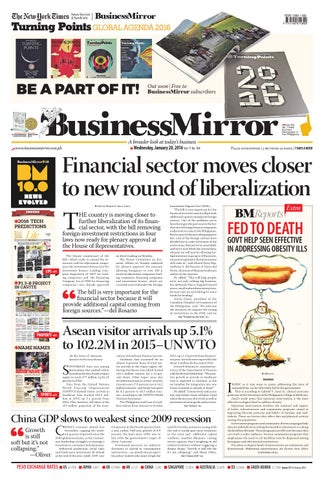
Financial sector moves closer to new round of liberalization
T
INSIDE
HE country is moving closer to further liberalization of its financial sector, with the bill removing foreign-investment restrictions in four laws now ready for plenary approval at the House of Representatives.
2016 TECH PREDICTIONS You may abide forever
B
Y the Lord are the steps made firm of one in whose path He delights. Though he stumbles, he shall never fall, for the Lord will hold him by the hand, then turn away from evil and do good, and you may abide forever; for indeed, the Lord loves justice, and will never forsake His faithful. The unjust will be wiped forever, and the descendants of the wicked destroyed. The just shall inherit the land; there they shall abide forever. (Psalm 37: 23-24, 27-29). We keep trying to be holy, Lord, in order to be included in Your Kingdom. Amen. GIVE US THIS DAY, COMMITTEE ON WORSHIP AND LOUIE M. LACSON, HFL Word&Life Publications • teacherlouie1965@yahoo.com
Editor: Gerard S. Ramos • lifestylebusinessmirror@gmail.com
Life
15 PUBLIC SPEAKING TIPS FROM IMPROV PROS D4
BusinessMirror
Wednesday, January 20, 2016
D1
2016 tech predictions include an Internet of Things bust and success for Net�lix THE automated car that Google has been roadtesting— with notable success— for some months now.
S
BY OMAR L. GALLAGA Austin American-Statesman
OMETIMES the future is a little more clear in certain years than in others. And so it was for 2015, as celebrated soothsayer Omarstradamus (my future-predicting alter ego) made a round of predictions for the year as 2014 was closing. Before we look ahead to 2016, let’s look at my Omarstradamus predictions for 2015 and whether they came true: ■ VR celebrities will emerge. I guessed that virtual reality filmmaking would evolve so quickly online that a new breed of YouTube-like celebrities would begin to draw fans. That part was wrong, but VR did make headway in 2015, generating excitement about products such as Oculus and HTC Vive, which have yet to become available to consumers. ■ Podcasting gets experimental. Omarstradamus foretold a shift in podcasts away from comedy and pop culture to true crime and serialized fiction as podcasters spread their wings in more genres. As of this writing, the top podcasts on iTunes include “Serial,” “Criminal,” “Radiolab” and “TED Radio Hour,” while one of the buzziest new podcasts of the year was the whimsical “Mystery Show” from Gimlet Media. Comedy and pop culture are still popular, but podcasting is getting more ambitious with great shows in all genres. ■ Cyberhacks get worse. According to CNET, hacking of major companies got so bad in 2015 that nearly every American was affected by at least one cyberhack. Victims included the FBI, VTech, Trump hotels, Patreon, T-Mobile, Scottrade, the IRS, CVS Health and Anthem. But perhaps the most embarrassing data breach was at Ashley Madison, a company that made a business out of facilitating affairs for married people. Whoops! ■ Apple Watch only a modest success. Before the launch of the Apple Watch, Omarstradamus said it “will be too expensive to be a huge hit at first and most will wait to see what’s in the next version.” Given Apple’s reluctance to share sales numbers for the wrist devices and the $100 discounts some retailers were offering toward the end of the year, it seems the Apple Watch isn’t a flop so far, but isn’t an instant roaring success either. I’m one of those people who hasn’t bought one yet but can’t wait to see what 2016’s second-generation device looks like. ■ Uber will unleash autonomous cars sooner than anyone expected. Autonomous cars did hit the streets of Austin (with engineers on board), but they came from Google and are still in the testing phase. Uber instead caused waves by clashing with city government, pulling public pranks to support its cause, and growing into a company valued at more than $62 billion (more about them in a moment). Not too shabby on the foretelling! That sounds like 3.5 or 4 out of 5 depending on how harsh a grader you
KRISTIAN SALVO, founder and CEO of YouPoundit.com, at the Rice Bowl Startup Awards in Malaysia
Filipino online store wins as Retail Startup of the Year
are. Now on to 2016! Here’s what Omarstradamus sees in the great crystal ball of tech predictions for the year ahead. ■ The “Internet of Things” will become a punchline. Increasing frustration with “smart” products that seem anything but more interoperability headaches for early adopters and high-profile hacking incidents and downtime for services that are supposed to just work will uglify the rosy picture tech companies have painted about the smart home and connected Crock-Pots. Despite a few promising new products, the term “Internet of Things” will come to be associated with devices that don’t work like they should and are more trouble than they’re worth. ■ Boom times in automated cars. No, automated cars won’t be commonplace on roads in 2016 or affordable for any of us, even if there’s a sudden technological breakthrough. But companies getting into the business of self-driving cars, including Google, Apple, Tesla, Uber and every auto manufacturer, will be doing massive hiring and supply-chain scouting, creating a big talent demand for engineers and auto-industry and machinelearning experts. ■ Net�lix stays on top. You could argue that
Netflix had a breakthrough year in 2015, putting aside concerns that its subscriber growth was slowing by simply offering the best streaming video service out there with some of the most compelling original TV series, comedy specials and even an Oscar-caliber movie. That movie, Beasts of No Nation, will end up with at least one Oscar, becoming Netflix’s first Academy Award winner. The company will also sign a deal with a major broadcast network, securing exclusive streaming-rights to a slate of TV shows. If I had to guess which network, I’d say Fox. Netflix will also start branding its growing stable of exclusive movies, TV shows and comedy beyond just calling them “originals.” ■ Apple Music becomes Apple entertainment. Apple will expand its fledgling Apple Music pay streaming music service, which, like the Apple Watch, was only a modest success (and not beloved by all) in 2015, to include television, movies, concerts and even books for one streaming/download monthly fee. Offerings will be limited at first, but it will serve to better compete with companies such as Spotify and Amazon Prime, which appear to be eating into Apple’s long-standing dominance with iTunes. Here’s to a happy 2016 from your mystic seer Omarstradamus!
Apple shares falling as iPhone sales become a cause for concern BY PARESH DAVE Los Angeles Times SHARES of Apple Inc. have plunged about 14 percent over the last month amid several reports that iPhone partmakers and assemblers are bracing for slowdown in work. Apple isn’t commenting on iPhone sales, but financial analysts said the company is trimming orders to its Asian suppliers, which suggests the iPhone 6S hasn’t sold as well as expected. With inventory building, Apple “needs to clear the decks into the spring” and focus on ramping up iPhone 7 production later in the year, said Daniel Ives of FBR Capital Markets. Wall Street “was bracing for a cut but the magnitude here is a bit more worrisome and speaks to a soft March quarter on the horizon,” he said in an e-mail. “I think it’s going to be a little bit rough here for next one to two quarters,” UBS analyst Steven Milunovich recently said on CNBC.
Apple’s battering began in mid-December, when companies that produce casings and internal components for iPhones, including Jabil Circuit and Dialog Semiconductor, reported lower-thanexpected revenue forecasts. In recent days, iPhone concerns seem to have weighed on investors as they pulled out of other companies in Apple’s supply chain. Shares of Apple sank 2 percent on Wednesday to close at $100.7. Apple shares traded at above $119 just over a month ago. Apple reports holiday-quarter earnings on January 26, though it offered a tease on Wednesday. Apple announced a record $1.1 billion in sales of App Store apps and in-app data in the two weeks ending January 3. It included the biggest day of sales since the store launched in 2008, with $144 million of app-related purchases on New Year’s Day. Apple used different measurements in announcing similar milestones a year ago, making comparison difficult.
YOUPOUNDIT.COM a niche e-commerce site for consumer electronics from the Philippines, recently took home the Retail Startup of the Year at the Rice Bowl Awards held in Kuala Lumpur, Malaysia. The Rice Bowl Startup Awards is the first Asean award that celebrates rising startups that harness technology innovatively to propel their business regionally. The awards honor rising startups that embrace mobility by harnessing technology, especially in web or mobile, in redefining business strategies and promise high-growth potential and are worthy of a regional shout-out. The awards are named after diet staple among Asians, so is technology for fuelling businesses of the future. A total of 376 nominations were received across outstanding startups in the region. A panel of over 30 judges from the awards community partners evaluated the entries in four broad areas: business, traction, unique selling proposition and investability. YouPoundit.com bested other retail startups in the Asean region to win the Retail Startup of the Year category.
Sun Cellular offers discounts to online shoppers
LIFE
SUN Cellular’s prepaid subscribers are in for a treat. By simply making text inquiries or subscribing to a promo via Sun’s easy-access menu, they will get a P400 discount when they shop at Takatack, the country’s largest online marketplace. There are two easy steps to get discounts under the Sun Cares Shopping Spree promo. First, register for free by texting SUNCARES <space> FULL NAME/ COMPLETE ADDRESS to 6771 (Example: SUNCARES PAT SY/123 Apple St., Makati City) One should complete either of the following selfcare transactions: ■ Text SUNSAGOT PREPAID to 1200 for free, and complete 5 transactions. Sun Sagot is a 24/7 text hotline that responds to inquiries on Sun’s products and services. ■ Subscribe to any Sun promo by calling *247#. This is an easy-access menu that lets subscribers browse through various Sun offers and customer service transactions. Within 24 hours, the subscribers will receive a discount coupon code via SMS. This code can be used to avail themselves of a P400 discount on a minimum purchase of P1,000 at www.takatack.com. The Sun Cares Shopping Spree promo runs until January 31. “To serve our customers better, Sun has launched services that allow them to complete various aftersales transactions easily, quickly, and at no cost. With just a few clicks, they can get answers to their inquiries and learn about our promos and services,” said Smart customer support innovation head Maricris Crisostomo. “On top of these innovations, we have also launched several rewards programs and promos as a way of thanking customers for their continued trust in our services,” she added. For information, visit suncellular.com.ph/suncares or text SUNCARES to 1200 for free.
D1
P1.3-B PROJECT IN CAVITE Several media agencies, including Nikkei in Japan, reported on Tuesday that primary iPhone assembly giant Foxconn Technology Group plans to dial back work in China during next month’s Lunar New Year celebration. The Wall Street Journal reported that Foxconn sent some workers home on
vacation early, unusual compared to recent years. Foxconn denied the assertion, saying vacation “did not begin in December 2015 for our employees” and that it was still “in the midst of planning operational schedules for the Lunar New Year holiday.”
B J M N. C
The Senate counterpart of the bill—which seeks to amend the Insurance code for adjustment companies; the Investment Houses Law for investment houses; Lending Company Regulation of 2007 for lending companies; and the Financing Company Act of 1998 for financing companies—was already approved
on third reading on Monday. The House Committee on Economic Affairs on Tuesday endorsed for plenary approval the measure allowing foreigners to own 100 p ercent of adjustment companies, lending companies, financing companies and investment houses, which are currently restricted under the Foreign
The bill is very important for the financial sector because it will provide additional capital coming from foreign sources.”—del Rosario
BusinessMirror E1 | Wednesday, January 20, 2016 Editor: Tet Andolong
DUPLEX
ELANVITAL ENCLAVES TO LAUNCH
P1.3-B PROJECT IN CAVITE E B R R R
LANVITAL Enclaves Inc. (EVE), the propertydevelopment arm of the Ng family, is set to launch the Tradizo Enclave, a P1.3-billion, 500-unit project in Imus, Cavite, as part of solidifying its position as a major provider of housing for the middle segment of the market.
VILLAGE Homes Premium
Spanning a total of 8.5 hectares, the project will offer mostly house and lot and a minimal lotonly product. The project will open at a very friendly price range of P2.3 million to P3.3 million. In a recent media briefing, Apple Hurtado, Elanvital COO, said EVE will continue opening up suburban enclaves for families who are planning to establish permanent residence in the southern
futsal field and basketball court, as well as a children’s playground. Moreover, Hurtado said the park has a Social Zone, which hosts the clubhouse and experiential pools. Completing this leisure space is a Relax Zone with a kite-flying lawn, a multipurpose tent, secret gardens and picnic grounds. On his part, EVE COO Jacinto Ng Jr. said the company introduced a 5-percent down payment
part of the metropolis. Nostalji Enclave has been receiving positive response from the market. “At present, there are already 75 residents in Nostalji,” Hurtado said. She noted that Nostalji was developed to ensure its residents will have a well-rounded lifestyle. With the different zones in the Nostalji Central Park, Hurtado said EVE has allocated an Active Zone with
scheme to ensure a big number of Filipinos, particularly belonging to the middle market, can afford to buy homes. The scheme is payable in five months. The balance can be paid through in-house financing and/ or bank financing at a lowest interest of 8 percent fi xed for one year. “We also give good counsel to our prospective buyers before they acquire a property. This is to ensure
Investing in a piece of history M
ANILA will always be a fascinating city. Its asset is rooted to its colorful history and rich culture. Because of its unique identity, the nation’s capital is an attractive investment site whether for business or home buyers. Owning a home in The Radiance Manila Bay is like owning a slice of this captivating city. Perfectly situated along Roxas Boulevard, the development is surrounded by heritage landmarks and vestiges of the past against rapidly rising modern structures. Places of interests, such as Fort Santiago, Intramuros, Cultural Center of the Philippines, National Museum, historical churches and Rizal Park, exist proudly side by side with images of progress that include hotels, luxury clubs and integrated resort casinos. At the center of all these action is The Radiance Manila
Bay, which serves not only as a home, but a gateway, to a sophisticated and dynamic lifestyle. Manila was declared the nation’s capital as early as the Spanish colonization era. Because of this, it has enjoyed progress ahead of other cities in the metropolis, as evidenced by the numerous classical structures, chanceries and government offices in its area. One of the country’s oldest universities, the University of Santo Tomas is located here, along with other established educational institutions in the country. Near the mouth of the Pasig River lies the oldest Chinatown in the world, which is the Binondo district of Manila. These distinguishing characters make the city an amazing place to live in, promising an extraordinary life for future Manileños, like the residents of The Radiance Manila Bay.
Composed of two towers, The Radiance Manila Bay affords its residents a perennial view of the spectacular Manila Bay sunset. There is no greater way to end the daily stresses of everyday life than to witness the golden glow of the setting sun right from the balcony of its selected units or its luxurious floor-toceiling windows. Other suites allow glimpses of the Makati skyline or Manila cityscape. At The Radiance Manila Bay, units bearing efficiently sized living spaces are offered in options of one-, twoand three-bedroom suites. About 30 stories of the North and South towers will be devoted to the residential component of the development. An upscale retail area featuring various brands, restaurants and other specialty shops will occupy a three-story building within the property.
VILLAGE Homes Premium’s master bedroom
VILLAGE Homes Premium’s living room
that they can sustain their investment in the property,” Ng said. Ng added, EVE also recognizes the important role of their broker partners and property consultants in boosting their sales. The company gives lovely incentives for people who produce high numbers. Performance-based rewards, like gadgets, local trips, vehicles and cash upon formalization of the sale and another set of similar prizes, are
also designed for sellers once these accounts have their down payments fully settled. Moreover, agents who can sell from an exclusive inventory within three months will receive a Toyota Innova, Hi-Ace van and a BMW 1-series. EVE is part of a conglomerate with various business ventures, which include Asia United Bank, Republic Biscuit Corp., Oakwood Premier Joy~Nostalg and Crystal Jade.
PROPERTY
The entire development adopts a modern architecture based on a design philosophy inspired by the water element, which echoes the waters of the Manila Bay. Water is also a harbinger of luck and prosperity, promoting positive vibes and overall feeling of wellness. Another project of real-estate maverick Robinsons Land under the Robinsons Residences brand, The Radiance Manila Bay is a testament to the company’s mantra of city living done right by providing the perfect live-work-play lifestyle through generous living spaces situated in prime locations. This allows residents to efficiently manage their time and focus on things they care and desire the most, be it their loved ones, a hobby or a compelling social life. www.robinsonsresidences.com,
E1
RMB Building façade sunset
NAME NAMES
Sports BusinessMirror
| WEDNESDAY, JANUARY 20, 2016 mirror_sports@yahoo.com.ph sports@businessmirror.com.ph Editor: Jun Lomibao Asst. Editor: Joel Orellana
NAME NAMES B J B
M
The Associated Press
ELBOURNE, Australia—Roger Federer has heard enough speculation about match-fixing in tennis. If players are suspected of corruption, he wants names. Federer was responding to reports by BBC and BuzzFeed News published on Monday that tennis authorities have suppressed evidence of match-fixing and overlooked suspected cases involving players ranked in the top 50, including Grand Slam singles and doubles winners. The reports said that none of these players had faced sanctions and more than half would be playing at this year’s Australian Open, which started on Monday. The players weren’t identified by name. “I would love to hear names,” Federer said after beating Nikoloz Basilashvili of Georgia, 6-2, 6-1, 6-2. “Then at least it’s concrete stuff and you can actually debate about it. Was it the player? Was it the support team? Who was it? Was it before? Was it a doubles player, a singles player? Which Slam?” “It’s super serious and it’s super important to maintain the integrity of our sport,” Federer added. “So how high up does it go? The higher it goes, the more surprised I would be.” Association of Tennis Professionals (ATP) Chairman Chris Kermode appeared at a news conference to reject the assertion that match-fixing had gone unchecked in the sport, saying the Tennis Integrity Unit (TIU) remained “constantly vigilant and not complacent” when it comes to tackling corruption. “The Tennis Integrity Unit and tennis authorities absolutely reject any suggestion that evidence of match-fixing has been suppressed for any reason or isn’t being thoroughly investigated,” he said. The BBC and BuzzFeed allegations were based on files they reported had been leaked “from inside the sport” showing evidence of suspected matchfixing orchestrated by gambling syndicates in Russia and Italy that had been uncovered during an ATP investigation of a 2007 match in Sopot, Poland, involving suspiciously high levels of betting.
Call it foot fault, loud and clear
Roger Federer responds to reports that tennis authorities have suppressed evidence of match-fixing and overlooked suspected cases involving players ranked in the top 50, including Grand Slam singles and doubles winners.
NO. 5 Maria Sharapova, who lost to Williams in last year’s final, breezes through her first-round match, 6-1, 6-3, against Nao Hibino of Japan. AP
T
HAT match-fixing exists in tennis is nothing new. But that Grand Slam winners are also involved in throwing matches, possibly in top tournaments, like Wimbledon, is the crucible confronting the world game. A 2008 internal enquiry commissioned by the Association of Tennis Professionals found as many as 28 shady players, the BBC and BuzzFeed have reported. The report suggests that a core group of 10 players were consistent offenders. Disturbingly, the body apparently did nothing to expose the black sheep, and the results of the enquiry seem to have been quickly brushed under the carpet. It appears that federations, both national and international, routinely protect top performers. At the root of this apathy is, of course, the basic fact that stakeholders in a sport can’t afford to have its credibility questioned. They tend to lose just as much as the ones they expose. Match-fixing has reared its ugly head closer home. Winner of 12 doubles Grand Slam titles Mahesh Bhupathi once claimed that he had been approached to fix a Davis Cup match, and Asian doubles gold winner Gaurav Natekar claimed that he had been approached to throw his final at the Hiroshima Games in 1994. These are the bits that became public. Insiders know, for a fact, that many players bet—typically, even if someone else fronts the wagers, the players provide the information. The crux of a winning bet lies in access to information that very few have: The injuries afflicting one player, or the early flight that another may want to take. Players willing to arbitrage such information gleaned in locker rooms stand to make a killing. Betting on one’s own games and trying to fix the outcome to win the bet takes the matter to another depth altogether. Hindustan Times, New Delhi
M
ELBOURNE, Australia—Venus Williams tried to rally, winning two games and getting another break-point chance after falling a set and, 5-0, behind, before her 16th trip to the Australian Open finished in a first-round loss to Johanna Konta. The 35-year-old, seven-time major winner trudged off Rod Laver Arena, waving to the crowd at 1:55 p.m. on the second day of the tournament following a surprising, 6-4, 6-2, loss to the No. 47-ranked Konta, a Sydney-born British player who was making her debut in the main draw at the Australian Open after losing twice previously in qualifying. Williams had a career comeback last season, winning three titles, finding some consistency after a long struggle with illness and finishing the year in the top 10 for the first time since 2010. She
reached the quarterfinals at the Australian and US Opens—the first and last majors of the year. In 2016 she’s 0-2 after also losing in a warm-up tournament at Auckland, New Zealand. It was the eighth time she’s lost in the first round of a Grand Slam tournament and the third in Australia, where she reached the quarterfinals in her first appearance in 1998 and lost the final to her youngest sister, Serena, in 2003. Konta was really going for her groundstrokes in a high-risk, highreward approach that kept Williams, who had wrapping on her left leg, on the defensive. “When the draw came out and I saw who I was playing, I was like ‘Well, ok, I just hope to stay out there more than an hour,’” Konta said in
S
According to the reports, the ATP investigation widened to uncover a network of other players suspected of match-fixing, but officials didn’t follow up on the cases. Since then, the reports said, the ATP has repeatedly been warned by bookmakers, foreign police and other investigators about many of the same players, but hasn’t taken any action against them. Kermode said the integrity unit had been formed in 2008 as a joint initiative of the International Tennis Federation, the ATP, the Women’s Tennis Association and the Grand Slam Board to combat corruption in the wake of the Sopot investigation. He maintained that the unit investigates every report it receives and takes action only when it has enough evidence to do so. It has since sanctioned 18 people for match-fixing, including five players and one official who received lifetime bans. “You can have lots of information, lots of anecdotal reports, but it’s about getting evidence that we can use,” Kermode said. TIU Chief Nigel Willerton declined to say whether any players at the Australian Open were being monitored for suspected match-fixing. Many of those punished have been lower-ranked players on the second-tier Challenger tour. Two of the most higher-profile players — former top 50 players Daniele Bracciali and Potito Starace—were initially banned for life before their suspensions were lifted by the Italian Tennis Federation last year. Top-ranked Novak Djokovic said he doubted the problem extended to the top level of the sport, and pointed to the enhanced monitoring systems put in place. “We have, I think, a sport [that has] evolved and upgraded our programs and authorities to deal with these particular cases,” he said. “There’s no real proof or evidence yet of any active players [being involved in match-fixing], for that matter. As long as it’s like that, it’s just speculation.” Djokovic did confirm, though, that members of his support team were approached about throwing a match in Russia in 2007. “I was not approached directly. I was approached through people that were working with me at that time,” he said. “Of course, we [rejected] it right away. It didn’t even get to me—the guy that was trying to talk to me, he didn’t even get to me directly. There was nothing out of it.” Other questions were raised on Monday about whether the sport was sending mixed messages by allowing the bookmaker William Hill to become one of the Australian Open’s sponsors this year and advertise on stadium courts. “Honestly, it’s on a borderline, I would say,” Djokovic said. “Whether you want to have betting companies involved in the big tournaments in our sport, it’s hard to say what’s right and what’s wrong.”
SPORTS
VENUS BOMBS OUT
Special to th BM
ROGER FEDERER walks onto Rod Laver Arena for his match against Nikoloz Basilashvili in Melbourne on Monday. AP
a post-match TV interview, apparently as surprised as anyone after her straight sets win over the No. 8-seeded Williams. No. 3 Garbine Muguruza needed exactly an hour to beat Estonian qualifier Anett Kontaveit, 6-0, 6-4; No. 11 Timea Bacsinszky advanced over Katerina Siniakova, 6-3, 7-5; and No. 15 Madison Keys, a semifinalist here last year, had to save set points in the first before beating Zarina Diyas, 7-6 (5), 6-1. No. 21 Ekaterina Makarova, who beat Venus Williams in the first round here in 2014, opened with a, 6-3, 6-0, win over Maddison Inglis. On the men’s side, No. 13 Milos Raonic followed up his win over Roger Federer in the final of the Brisbane International tune-up event with a 6-1, 6-4, 6-4 win over Lucas Pouille, and No. 32 Joao Sousa beat Mikhail Kukushkin, 6-3, 6-4, 6-3. AP
C1
FED TO DEATH GOVT HELP SEEN EFFECTIVE
IN ADDRESSING OBESITY ILLS
S “F ,” A
OUTHEAST Asia was among destinations that pushed visitor arrivals in the Asia-Pacific (Aspac) region to reach 277 million, up by 23 percent in 2015. Data from the United Nations World Tou r i sm O rg a n i z at ion (UNWTO) showed visitor arrivals in Southeast Asia reached 102.2 million in 2015, up 5.1 percent from 2014. This, however, fell short of the 107-million projection of the Asso-
ciation of Southeast Nations (Asean). Southeast Asia accounted for an almost 9-percent share of total visitor arrivals in the Aspac region, following Northeast Asia which hosted 142.3 million visitors, for a 12-percent share. Other Aspac areas also recorded increases in visitor arrivals: Oceania saw a 7.3-percent rise to 14.2 million tourists, and South Asia grew by 4.2 percent to 18.3 million tourists, according to the UNWTO World Tourism Barometer. The Philippines itself saw 4.4 million visitors from January to October
2015, up 11.13 percent from the previous year. Arrivals were expected to hit about 5 million by the end of 2015. Arturo P. Boncato Jr., assistant secretary of the Department of Tourism told the BM: “The positive growth in arrivals to Southeast Asia is expected to continue, as the set timeline for integration into one Asean economy is already at hand.” He added: “Connectivity and access into and within Asean will play a lead role in the increase of arrivals, as well as movement of more goods and services. S “A,” A
China GDP slows to weakest since 2009 recession
Growth is still soft but it’s not collapsing.” —Oliver
BMReports
Asean visitor arrivals up 5.1% to 102.2M in 2015–UNWTO B M. S F. A
C1
Investment Negative List (FINL). “The bill is very important for the financial sector because it will provide additional capital coming from foreign sources. One of the problems we’ve been having in the past years is the fact that a lot of foreign finance companies really want to come to the Philippines. But because of the prevailing negative list, a lot of the foreign entities have decided not to come in because of the restrictions. But now we’ve amended it and we’ve now lifted the restrictions, wherein we will now be allowing foreign investors to go up to 100 percent, we are now optimistic that more money will come in,” said Liberal Party Rep. Anthony G. del Rosario of Davao del Norte, chairman of the panel and main author of the measure. He added: “This will help people, we’re not only talking big business, but definitely this is targeted toward micro, small and medium enterprises, because now we are looking for more funds for lending.” Julian Payne, president of the Canadian Chamber of Commerce of the Philippines, said: “We welcome the measure; we support the easing of restrictions in the FINL and we
C
HINA’S economy slowed last December, capping the weakest quarter of growth since the 2009 global recession, as the Communist leadership struggles to manage a transition to consumer-led expansion. Industrial production, retail sales and fixed-asset investment all slowed at the end of the year, while GDP rose
PESO EXCHANGE RATES ■ US 47.7500
6.8 percent in the fourth quarter from a year earlier. Full-year growth of 6.9 percent, the least since 1990, was in line with the government’s target of about 7 percent. Downward pressure on industry threatens to spread to consumption and services—an unwelcome prospect for policy-makers who must weigh the
need for further monetary easing with the risk it would spur more weakness in the yuan and additional capital outflows. Another dilemma: cutting excess capacity that’s weighing on old industrial drivers without triggering a deeper slump. “Growth is still soft but it’s not collapsing,” said Shane Oliver,
B R C
I
Conclusion
RONIC as it may seem to many, addressing the issue of unwanted fat can be effectively led by the government. That is according to Gabriel V. Jasul Jr., clinical associate professor of the University of the Philippines College of Medicine. Jasul’s study notes that upstream intervention is the most effective ecological level to address obesity. Upstream intervention involves the national and regional levels, infrastructure and community programs aimed at improving lifestyle patterns and habits of families and individuals. These are factors that affect diet and physical activity among the population. Government programs and community-driven campaigns help educate individuals on taking the healthier alternative or taking the healthier lifestyle. These programs are effective because they can reach a wider audience. Various community programs that emphasizes the need to eat healthier may be dispersed among barangays and educational institutions. The other ecological levels of intervention are midstream and downstream. Midstream interventions are factors that affect C A
S “C GDP,” A
■ JAPAN 0.4071 ■ UK 67.9960 ■ HK 6.1221 ■ CHINA 7.2581 ■ SINGAPORE 33.1874 ■ AUSTRALIA 32.8291 ■ EU 52.0666 ■ SAUDI ARABIA 12.7340
Source: BSP (19 January 2016 )
BMReports BusinessMirror
A2 Wednesday, January 20, 2016
Fed to death C A
the eating pattern of an individual either at home, the workplace or school community. The downstream intervention involves individual decision-making that affects a person’s habits. According to Jasul’s study, the midstream level is also as effective since it targets individuals early on. Eating habits and physical activities can be altered from childhood since this happens inside the home. An early prevention starting from the household is noted to be extremely effective. The study explains that to effectively prevent the rise of obesity, all ecological levels of intervention must be used.
Labeling
THE imposition of the voluntary front-ofpack labeling policy by the Food and Drug Administration (FDA), together with the Philippine Food and Chamber of Manufacturers Inc., helped increase awareness
Asean…
among consumers on the number of calories of processed food products. “The front-of-pack labeling seeks to improve renewed interest and heighten awareness of consumers on energy content of the products they buy and consume,” Health Undersecretary Kenneth Y.Hartigan-Go said. “Through fact-based front-of-pack labeling, consumers have a simple and immediate way to make healthier food choices.” Hartigan-Go added the voluntary declaration of the front-of-pack labeling (energy or calorie content) on the labels of processed- food products was institutionalized through FDA Circular 2012-015 dated December 2012. The label aims to educate the consumer on whether additives or certain ingredients within the item, like sugar, have high or low contents. For example, sugar content may be high for certain beverage products and which diabetics should steer clear from, he explained. If fat content is low, then a number of consumers can eat
the food item or it is deemed healthy by most, Hartigan-Go added. Since the release of the 2012 FDA Circular, some food and beverages manufacturers have registered their products with the FDA with this front-of-pack labeling, according to Hartigan-Go.
Opportunity
SOME entreprising individuals, however, see in obesity an opportunity. For example, plus-size sections can already be found in local department stores and fashion boutiques. According to research done by the Mintel International Group Ltd., the plus-size niche market has reached more or less about $32 billion in 2005. The rise in the demand for plus-size garments can somehow be attributed to the rise in number of obese or overweight consumers. The study done by the NPD Group on the plus-size sector also showed that compared to the year 2013, the plus-size clothing market have increased about 5
www.businessmirror.com.ph
percent for the year 2014 with revenue reaching $17.5 billion. Retail stores have taken advantage of the trend and have added sections within their stores devoted to plus-size garments. But the need for more stores catering to the plus-size niche is still there. The entry of the plus-size garments retail business appear to project that being obese is okay. Nonetheless, these businesses could not be faulted for recognizing there is a market and these consumers should be given variety and choices.
nutritionist-dietician, added. Consumers can live a healthier lifestyle, make time for physical activity and exercise, and eat more fruits and vegetables, Hartigan-Go said. “Responsible consumption has to be emphasized. Individuals must be empowered to determine for themselves what goods are beneficial and what are harmful,” he added. “For many commodities, it is a matter of dosage. Scarcity and excess both can lead to disadvantageous health conditions.” “But obesity, like most noncommunicable disease, is multifactorial, and so is tackled with several strategies,” according to Hartigan-Go. “It would be reductive to focus on sweetened beverages alone. In this sense, it [obseity] is not like a bacterial infection that can be hit specifically with an antibiotic.” Hartigan-Go emphasized that “inadequate activity in relation to calorie consumption, genetic predisposition and behavior all contribute to the evolution of obesity.”
Options
THE only option to avoid acquiring or to cure the illness of obesity is choosing a healthy lifestyle. “An individual should follow a healthy eating habit,” Ivy D. Ramallosa of the Makati Medical Center (MMC) said. “This includes choosing healthier food choices and practicing a healthy lifestyle. And medically-related obesity should be treated properly,” Ramallosa, a registered
C
The hosting of the Asean Tourism Forum [ATF], indeed, is an early milestone of our single economic community.” Tourism ministers and senior officials of national tourism organizations from Southeast Asia are in Manila for this week’s ATF. They are meeting to draw up a road map to bring more visitors to the region via the Asean Tourism Strategic Plan for 2016 to 2025. (See “Asean ministers push tourism agenda to
counter ‘risky’ tag” in the BM, January 18, 2016.) Meanwhile, the UNWTO Barometer also reported that a record 1.2 billion tourists traveled to international destinations last year, growing by 4 percent from 2014. In a news statement, UNWTO Secretary-General Taleb Rifai said: “International tourism reached new heights in 2015. The robust performance of the sector is contributing to economic growth and job creation
in many parts of the world. It is, thus, critical for countries to promote policies that foster the continued growth of tourism, including travel facilitation, human-resources development and sustainability.” The UNWTO noted that demand was strong overall, though with mixed results across individual destinations due to unusually strong exchange-rate fluctuations, the drop in oil prices and other commodities which increased
disposable income in importing countries, but weakened demand in exporters, as well as increased safety and security concerns. Rifai underscored the need for governments to reinforce security measures in the light of recent terrorist attacks in a number of tourism destinations around the world. The 2015 results “were influenced by exchange rates, oil prices and natural and man-made crises in many parts of the world. As the current environment highlights in a particular manner the issues of safety and security, we should recall that tourism development greatly depends upon our collective capacity to promote safe, secure and seamless travel. In this respect, UNWTO urges governments to include tourism administrations in their national-security planning, structures and procedures, not only to ensure that the sector’s exposure to threats is minimized but also to maximize the sector’s ability to
support security and facilitation, as seamless and safe travel can and should go hand in hand.” Four civilians and four bombing suspects were killed in last Thursday’s terrorist attacks in Jakarta, the latest in the wave of attacks against Indonesia by suspected Islamist militants. Last year terrorists also made their mark in Paris, Tunisia, California and this year, Burkina Faso. Despite these security concerns on global travel, the UNWTO still projects international tourist arrivals to expand by 4 percent to some 1.25 billion this year. “By region, growth is expected to be stronger in Asia and the Pacific [+4 percent to +5 percent] and the Americas [+4 percent to +5 percent], followed by Europe [+3.5 percent to +4.5 percent]. The projections for Africa [+2 percent to 5 percent] and the Middle East [+2 percent to +5 percent] are positive, though with a larger degree of uncertainty and volatility,” the UNWTO stressed.
China GDP… head of investment strategy and chief economist at AMP Capital Investors Ltd. in Sydney. “Policy stimulus measures are helping but more is needed to help the economy as it transitions from a reliance on manufacturing and investment to services and consumption.” Industrial production posted one of the weakest gains in the past quarter century, increasing 5.9 percent in December from a year
C
earlier. That compared with a 6-percent median estimate of analysts and November’s 6.2 percent. Retail sales increased 11.1-percent from a year earlier, compared with the 11.3 percent projected by economists. Fixedasset investment excluding rural areas expanded 10 percent last year, the slowest pace since 2000. “This may complicate the fragile balance between carrying out reforms and maintaining growth,” said Daili Wang, a Singapore-based
Financial sector… believethis is a steponthatdirection, and it will very much help the economy of the Philippines and also foreign investment.” The Philippines earlier allowed foreigners to own 100 percent of local banks. “Given the country’s development objectives/thrusts and the need to increase investments to achieve these, removing the limitations on foreign investments or participations in certain activities/areas listed in the FINL, as provided for in specific laws, becomes necessary,” del Rosario noted. Under Article XII of the Constitution, foreign investors are prohibited to own more than 40 percent of companies in certain industries, while they are totally restricted to exploit natural resources, public utilities and own any company in the media industry. Del Rosario said the lower chamber is eyeing to approve the measure on final reading on January 27. “An investment house may be owned up to 100 percent by foreign
Last year Europe led the growth in international tourist arrivals, rising by 5 percent to 609 million. The growth was attributed to the “weaker euro vis-à-vis the US dollar and other main currencies.” Aside from Europe and Asia Pacific, the Americas also recorded a 5-percent growth in visitor arrivals to some 191 million in 2015. “The appreciation of the US dollar stimulated outbound travel from the US, benefiting the Caribbean and Central America, both recording 7-percent growth. Results in South America and North America [both at +4 percent] were close to the average,” the UNWTO said. Arrivals in the Middle East posted a 3-percent rise to some 54 million, while in Africa, tourists dipped 3.3 percent to 53 million, mostly due to “weak results in North Africa, which accounts for over one third of arrivals in the region.” The UNWTO noted there was limited data available for visitors to Africa. economist at Roubini Global Economics Llc. “Fourth-quarter growth was a mere 1.6 percent quarter-onquarter, with annualized growth at 6.4 percent, already lower than the 6.5-percent growth target,” citing his own calculations based on Tuesday’s data. China’s top leadership has signaled in recent months that it may allow some additional slowness as they tackle delicate tasks, such as reducing excess capacity, but not h ing t hat cou ld t hreaten President Xi Jinping’s goal of at least 6.5-percent growth through 2020. Bloomberg News
C
nationals. Foreign nationals may become members of the board of directors to the extent of the foreign participation in the equity of said enterprise,” the measure said. It also said a lending company may be owned up to 100 percent by foreign nationals, “provided, however, that where the loan is secured by land, a lending company, more than 40 percent of whose capital is owned by foreign nationals, may bid and take part in any sale of such land as a consequence of such mortgage, avail themselves of enforcement proceedings, take possession and transfer their rights to qualified Philippine nationals for a period not exceeding five years from actual possession.” The title to said land “shall not be transferred to such lending companies, and that investments of a lending company shall be in accordance with the provisions of the Constitution.” It also provides that financing companies shall be organized in the form of stock corporations, may be owned up to 100 percent by foreign
nationals, and shall have a paid-up capital of not less than P10 million in case the financing company is in Metro Manila and other first class cities, P5 million if in other classes of cities and P2.5 million in municipalities. The measure said the Securities and Exchange Commission may adjust the minimum paid-up levels as it deems warranted by its prudential oversight requirements. The bill added that the capital requirements for financing companies with quasi-banking licenses under the Bangko Sentral ng Pilipinas’s (BSP) supervision and regulation shall comply with applicable rules of the BSP, “provided, however, that financing companies duly existing and in operation before the effectivity of this act shall comply with the minimum capital requirement within one year from the date of the said effectivity and that where land is concerned, the financing company shall comply with the Constitutional provision on foreign ownership of land.”
news@businessmirror.com.ph
BMReports BusinessMirror
Wednesday, January 20, 2016 A3
ERC to start PEMC, NGCP audit
T
B L L
HE Energy Regulatory Commission (ERC) will start looking into the operations of the Philippine Electricity Market Corp. (PEMC) and the National Grid Corp. of the Philippines (NGCP) to make sure consumers are getting reliable power service and reasonable rates.
ERC Chairman Jose Vicente B. Salazar told the BusinessMirror that the conduct of an audit on the PEMC is expected to be finished in April, to be followed by the release of a similar audit on NGCP before the year ends. Salazar, in an interview, said the agency has tapped Reyes Tacandong & Co. to conduct the audit on PEMC, operator of the country’s trading floor for electricity. He said the agency has concluded the procurement process for the engagement of an independent auditor before the end of 2015. “Reyes Tacandong won the bidding conducted in December last year,” Salazar said. The auditor, he added, is about to start preliminary works on the audit. The project is expected to be completed in three months. An audit on PEMC was first raised by Senator Sergio Osmeña II, chairman of the Senate Committee on Energy, in October last year. He called on the ERC to conduct an independent audit since PEMC is not subject to audits by the Commission on Audit (COA), being a private corporation.
Both audits are being undertaken by the ERC in connection with our clear mandate under the law. The objective is to ensure reliable power service and more reasonable rates for the consumers.”—Salazar The PEMC board is a 15-man body made up of representatives from each sector of the electric-power industry, as well as independent members. It is chaired by the secretary of the Department of Energy (DOE). The DOE also appoints the members of the board. SGV & Co. has been engaged by PEMC as external auditor since 2006. Under the Electric Power Industry Reform Act of 2001, the PEMC is supposed to last for only one year and would transition to an Independent Market Operator (IMO). The PEMC has existed for 12 years now. Osmeña said the energy secretary should be out of PEMC or IMO as its chairman, because it cannot be a real independent body if the chair is the DOE chief, which issues policies, some of which becomes part of the rules of PEMC and Wholesale Electricity Spot Market. PEMC President Melinda Ocampo, when sought for comment, said her office would comply with whatever the ERC tells them to do. “We are transparent, as far as I know,” she said. When asked if the conduct of an audit was necessary, Ocampo said, “I can’t say it’s unnecessary because they are the regulator, but we will comply,” she added. On the NGCP audit, Salazar said the Grid Management Committee (GMC) of the ERC is now in the process of drafting the audit procedures. “The ERC ROS [Regulatory Operations Service] will conduct the system-operator audit, with the assistance of the GMC,” said the ERC chief in the same interview. Salazar added that the NGCP audit will be awarded to a third party and the selection of the third-party auditor will start as soon as the terms of reference and audit procedures have been finalized. “The turnaround time for the audit will be six months from award of the contract,” the ERC chief said. When sought for comment, NGCP Spokesman Cynthia Alabanza said the NGCP will “assess once it has received a copy of the order.” In February 2015 the ERC issued a resolution ordering the NGCP audit through the GMC. The ERC is looking into the grid operator’s performance as a system operator (SO) under the WESM rules for a competitive energy market. The ERC said that as an SO, the NGCP balances the supply and demand of electricity to efficiently serve all of its customers: power generators, private-distribution utilities, electric cooperatives, government-owned utilities, eco-zones, industries, as well as directly connected companies. The NGCP provides the central dispatch to all generation
facilities and load connected, directly or indirectly, to the transmission system, according to the dispatch schedule submitted by the market operator. The NGCP is a private consortium that holds the 25year concession to operate the country’s power-transmission network. The Sy-led consortium
is composed of State Grid Corp. of China (40 percent); One Taipan Holdings Corp. (30 percent); and Calaca High Power Corp. (30 percent). Salazar said the audit on the PEMC and the NGCP are meant to ensure that both entities comply with existing rules and regulations relevant to their
respective operations. “Both audits are being undertaken by the ERC in connection with our clear mandate under the law. “The objective is to ensure reliable power service and more reasonable rates for the consumers.” The PEMC, as the market operator, ensures the optimal dispatch of generation based
on the submitted offers from generators, bids from customers and conditions of the grid from the NGCP, from which a spot price for electricity throughout the grid is set. The PEMC facilitates the settlement of financial accounts of the trading participants based on the same sources of information.
A4 Wednesday, January 20, 2016
BMReports BusinessMirror
news@businessmirror.com.ph
IMF marginally downgrades Philippine economic growth in 2016 to 6.2 percent
D
B B C
ESPITE its optimism on the local economy’s dynamics, the International Monetary Fund (IMF) has revised downward its Philippine growth outlook for this year, as the region’s sluggish performance and the global economy continued to drag the country’s potential growth going forward. In an e-mai l to repor ters following the release of the World Economic Outlook (WEO) from the IMF in Washington, IMF Resident Representative to the Philippines Shanaka Jayanath Peiris said the international financial authority has revised its Philippine growth forecast for 2016 marginally downward, from 6.3 percent to 6.2 percent, to reflect the “challenging external environment.” The IMF’s projected growth for 2016 is an acceleration from the actual growth rates of the coun-
try in the first three quarters of the year at 5.6 percent. While an improvement, it is still short of the government’s ambitious growth target for this year at 7 percent to 8 percent. While the risks to the global outlook remain burdensome, Peiris said the Philippines’s growth forecast was only revised marginally downward, as the country is in a position of strength to ride out volatilities in the international economy. In its WEO update, the IMF downgraded its 2016 forecast for
4.8%
Projected growth of the whole Asean members in 2016. the world output to 3.4 percent, down from 3.6 percent, projected in October last year. The Association of Southeast Asian Nations-5, meanwhile, also got a growth downgrade to 4.8 percent from 4.9 percent. The diminished prospects were due to slowerthan-expected pickup in global activity, especially in emerging markets (EMs) and developing economies. The IMF said the picture for EMs is diverse but, in many cases, challenging, as the slowdown and
rebalancing of the Chinese economy lower commodity prices, and strains in some large EM economies will continue to weigh on growth prospects in 2016 and 2017. “The Philippines is relatively less exposed to China given the low trade and financial linkages, and stands to benefit from the lower commodity prices. However, a generalized slowdown in growth in the region, tighter external financial linkages conditions due to monetary-policy normalization in the US, and sudden spikes in global risk aversion are downside risks,” the IMF resident representative said. The ample policy space of the
country is also said to give cushion to the negative effects of a slowing global economy. “The current policy configuration appears appropriate given the continued strong growth outlook and anticipated pickup in inflation toward the target range in 2016 and 2017,” Peiris said. Policies, however, could be recalibrated if the downside risks were to materialize, Peiris added. Among the main sources of growth for 2016 for the Philippines remains to be a robust private domestic demand. Some recovery in export growth and a pickup in public expenditure are seen to put on more fuel to the
country’s economic growth for this year. For 2015 the Philippine economy managed to post a 5.7-percent growth, lower than the IMF’s earlier forecast of 6 percent, due in part to the lower-than-expected outturns in the first three quarters of the year. For 2017 IMF kept its growth projection of 6.5 percent. “The medium-term economic outlook is based on an assumption of continued prudent macroeconomic policies and greater investments in infrastructure and human capital to benefit from the demographic dividend, supported by the low levels of public and private debt,” Peiris said.
CAAP POISED TO RUN TO ‘BIG BROTHER’ ICAO IF CHINA…
B R M
T
HE Civil Aviation Authority of the Philippines (Caap) will complain to the International Civil Aviation Organization (Icao) if China tries to stop the installation of a sophisticated navigational aid (Navaid) on Pagasa Island. Caap Deputy Director General for Operations Rodante Joya made the statement after a private airplane carrying Caap personnel was harrassed by the Chinese Navy while about to land on Pagasa Island on January 7. Asked whether the Caap expects China to object installing the equipment in Pagasa, Joya said: “Why should they? It’s purely for civil aviation navigation use?” He added that if China tries to stop the construction, the Caap will inform the Icao about the breach of agreement. “It is the contracting states’ obligation to provide for safe passage of civil aviation aircraft in its airspace,” Joya said. The Icao has more than 190 member-states that include the Philippines and China. Joya said the Philippines is installing a sophisticated Navaid, on Pagasa Island at the West Philippine Sea (WPS), because some 200 international flights a day enter and leave the Manila Flight Information Region (FIR). The Manila FIR is an imaginary line, enclosing the whole Philippine archipelago. It is more than 3 million square miles in area, which extend all the way to the
contested WPS. Joya said Caap personnel flew to Pagasa last week in a private plane to survey the area they will lease from the municipality of Kalayaan, for the proposed installation of equipment to monitor and guide aircraft movements. Called the Automatic Dependent Surveillance-Broadcast (ADS-B) equipment, Joya said the navigational aid would be installed in a 200 square-meter lot beside the Major Gen. Jose Rancudo Airfield at Pagasa Island. ADS-B technology is a system that aircraft use to determine their location through satellites orbiting high above the earth. Joya said the technology “makes flying significantly safer for the aviation community by providing pilots with improved situational awareness,” meaning accurate locations without resorting to the old-model Navaids, such as the VOR or NDB (non-directional beacon). He said pilots with ADS-B in equipped cockpit will have the ability to see, on their in-cockpit flight display, other traffic operating in the immediate airspace, as well as access to clear and detailed weather information. “They will also be able to receive pertinent updates ranging from temporary flight restrictions to runway closings,” Joya added. Joya reported that while Caap engineers were enroute to Pagasa last week, the pilots were harassed by the Chinese Navy. He said on January 7 the
Caap team of seven technical personnel, accompanied by Kalayaan Mayor Bito-onon, flew to Pagasa Island onboard a chartered Cessna aircraft to survey the proposed site. A Caap consultant, Inocencio Yncierto, reported that the 275nautical miles trip was uneventful, lasting one hour and 45 minutes, starting from the Puerto Princesa International Airport. However, when the airplane was some 40 miles away from the Maj. Gen. Jose Rancudo Airstrip, a Chinese navy blurted out a message on radio: “Foreign military aircraft, this is the Chinese navy, you are threatening the security of our station.” Yncierto said the message was ignored by the pilot, knowing that they are in private airplane that is within the Philippine territory. Upon landing in Kalayaan Island, the Caap team conducted survey and inspection of the proposed site. Asked whether the Philippines will file a diplomatic protest, Foreign Affairs Spokesman Charles Jose said, “We’re still studying the case.” The Caap’s trip came shortly after it was revealed to the media that China had completed construction of a runway on Fiery Cross Reef. China’s state-backed Xinhua News has posted pictures of two Boeing 737-like aircraft parked on the tarmac of the reclaimed island. In the foreground are scores of waving Chinese passengers of the plane, displaying a banner with Chinese inscriptions.
news@businessmirror.com.ph
Thai govt may hike oil tax to curb use
T
HAILAND’S energy policy-makers have expressed concern that the low oil price is encouraging motorists to be careless with energy consumption. The government is looking at raising the tax on fuel to increase its fund for campaigning for alternative fuels, said Areepong Bhoocha-oom, the Energy Ministry’s permanent secretary. A tax rise is yet to be finalized, but next week the energy and finance ministries will discuss the possibility of raising the levy on fuel and gases in the transport sector. The excise tax on diesel was already increased by 70 satang per liter from January 1 this year to 4.95 baht, which is projected to increase national revenue by 15 billion baht a year. The new tax is likely to include liquefied petroleum gas and compressed natural gas to be fair to motorists because large trucks that use gas do not pay tax. “The deep plunge in the crude oil price to below $30 per barrel may make motorists happy and cut some imported product prices, but it is ruining our efforts to promote energy efficiency,” Areepong said. Retail petrol and diesel prices have declined by over half from mid-2014, while demand for petrol gained 13.2 percent based on average daily use of 26.4 million liters per day at the end of 2015, up from 23.3 million liters the previous year. Diesel use increased 3.7 percent to 60 million liters and jet-fuel use gained 9.5 percent to 16.6 million liters year-on-year. Demand for jet fuel and petrol rose to record highs in Thailand, partly because of the increasing number of travelers. However, airfares are cheaper in part, thanks to the lower oil price as fuel is the major cost of the aviation industry. Oil prices this year are likely to stay low because of the weak global economy, Areepong said. MCT
AseanWednesday BusinessMirror
Wednesday, January 20, 2016 A5
Shoppers pay 0%, retailers 10% in strained Asean credit market
F
AMILIES buying televisions are getting lower borrowing costs than the stores selling them, a reflection of the toll taken on Southeast Asia retailers by flagging consumer demand and e-commerce rivalry.
Courts Asia Ltd., which offers shoppers 0 percent long-term credit on higher-end products, has seen its Singapore dollar bond yields rise 26 basis points to 4.32 percent in the past six months, and is trying to refinance the note ahead of its May repayment. The yield on US currency bonds of Parkson Retail Group Ltd., part of a Malaysian retailer that operates across Southeast Asia, has soared 321 basis points to 10.23 percent. Flagging global growth and rising household debt is knocking consumer demand across Southeast Asia, with Indonesian phone
No one buys at the store, unless it’s urgent. Generally, mobile phones are cheaper online.” —Singaporean student seller PT Trikomsel Oke last November becoming the first company
to default on Singapore dollar bonds since 2009. Retailers that borrowed to finance growth are also losing ground to online marketplaces like Alibaba Group Holding Ltd. The median debt load of the region’s retailers rose to 1.75 times operating profit in latest filings compared with 1.3 at the end of fiscal 2014. “I have been very careful about some local currency corporate bonds,” said Singaporebased Desmond Soon, cohead of investment management last Asia at Western Asset Management Co., which had $446 billion under management last September 30 and held Courts Asia bonds as of November 30, according to Bloomberg-compiled data. “Bricks and mortar retailers do have an issue,” Soon said, adding the money manager isn’t likely to buy Courts’s potential new offering. Retail-store sales in Singapore dropped for a third month last November, falling
2 percent from a year earlier, Department of Statistics data show. Meanwhi le, on line transactions in the region are growing. Singapore Post Ltd.’s domestic e-commerce orders in Southeast Asia and Australia rose 384 percent in the 12 months through November, according to a company presentation. Courts Asia, which sells goods from electronics to home furniture in Singapore, Malaysia and Indonesia, began meeting investors last week, ahead of its scheduled S$125-million ($86.9-million) repayment of notes in May. It’s looking to raise funds to help refinance and repay the bond, Courts’s Singapore-based Spokesman Tammy Teo said by phone. The company had S$107 million of cash and S$263 million of short-term liabilities last September 30, according to its latest quarterly report. “Everyone recognizes that the retail sector for Southeast Asia markets will continue to
be a bit challenging in the short term,” Teo said. “But if investors look across the medium and long term, the prospects are still there.” The financial position of Hong Kong-listed Parkson Retail, which is majority-owned by Kuala Lumpur-based Parkson Group, remains “strong” with cash balances of 3.7 billion yuan ($562 million), said the group’s external press representatives at Bell Pottinger Llp. While it has no plans for fund-raising this year, the firm will be “more than happy” to seize any opportunities to lower the group’s borrowing costs. Potential debt investors may not be encouraged by 24-year-old student Samuel Ng, who says that young Singaporeans rarely visit physical outlets. “No one buys at the store, unless it’s urgent,” he said via a Samsung S4 phone that was bought on shopping app Carousell.com. “Generally, mobile phones are cheaper online.” Bloomberg News
The World BusinessMirror
A6 Wednesday, January 20, 2016 | Editor: Lyn Resurreccion
Reduce inequality, leaders urged ahead of Davos meet
D
BIG Ben in the Elizabeth Tower is seen through railings at Britain’s Parliament buildings in Westminster in London on Monday. A proposal to ban Donald Trump from the United Kingdom because of his comment to ban Muslims from entering the United States drew a lively debate on Monday in the British Parliament. AP/KIRSTY WIGGLESWORTH
UK lawmakers slam Trump, but most oppose banning him
L
ONDON—Donald Trump doesn’t have many fans in Britain’s Parliament. But a debate among lawmakers on calls to ban Trump from the country revealed little appetite to close Britain’s doors to the provocative Republican US presidential contender. During a three-hour debate on Monday, legislators from Britain’s main parties stood to call Trump an attention-seeker, a demagogue and a fool. Many, though, argued that he should not be stifled or banned. “While I think this man is crazy, while I think this man has no valid points to make, I will not be the one to silence his voice,” Conservative lawmaker Tom Tugendhat said. Parliament took up the topic after half-a-million people sig ned a petition ca l ling for Trump to be excluded over his call for a temporary ban on Muslims entering the US in the wake of extremist violence. Trump has also claimed that some areas of Britain are so radicalized that police fear for their lives. Under British law, any petition supported by 100,000 people—who
must each provide and confirm an e-mail address—is considered for parliamentary debate. Monday’s debate was intended to air the subject rather than take a vote. Labour Party legislator Paul Flynn, who opened the session, said Trump had already received “far too much attention.” “The great danger by attacking this one man is that we can fix on him a halo of victimhood” and boost his popularity among supporters, Flynn said. But another Labour lawmaker, Tulip Siddiq, supported a ban. “This is a man who is extremely high-profile...a man who is interviewing for the most important job in the world,” she said. “His words are not comical, his words are not funny. His words are poisonous.” Prime Minister David Cameron has condemned Trump’s remarks
500k Petitioned to ban Donald Trump from the United Kingdom
about Muslims as “divisive, stupid and wrong,” but he and other senior officials have said they do not think Trump should be banned. The government has the power to deny entry to people with criminal convictions or those whose presence is considered not “conducive to the public good.” The power has been used against figures as diverse as boxer Mike Tyson, rapper Tyler the Creator, radical Muslim preachers and the late Christian fundamentalist Fred Phelps Sr. Britain also turned away anti-Islam Dutch legislator Geert Wilders at an airport in 2009. Wilders later sued and won the right to come to Britain. Several lawmakers argued that banning Trump would betray the principles of free speech. Conservative Paul Scully said that, while people had been excluded from Britain for incitement or
hatred, “I have never heard of one for stupidity and I’m not sure we should be starting now.” But Labour’s Jack Dromey said Trump was dangerous because he stirred up hatred among different faiths. “Donald Trump is a fool,” Dromey said. “He is free to be a fool. He is not free to be a dangerous fool on our shores.” Trump’s mother was born in Scotland, and he owns a golf resort there. Sarah Malone, executive vice president of Trump International Golf Links, Scotland, said “debating a matter raised as part of the American presidential election” was a waste of parliamentary time. “Westminster is creating a dangerous precedent on this issue and is sending a terrible message to the world,” she said. Shou ld Tr u mp v i sit Br it ain again, he will have no shortage of things to do. Labour legislator Naz Shah was one of several lawmakers who invited Trump to visit their constituencies to see Britain’s multiethnic society firsthand. Shah said she would take him to a curry restaurant in her home city of Bradford. She said she was “a proud Muslim woman” and the Quran had taught her that “goodness is better than evil. If someone does bad, you do good in return.” AP
AVOS, Switzerland—The world’s political and business elite are being urged to do more than pay lip service to growing inequalities around the world as they head off for this week’s World Economic Forum (WEF) in the Swiss ski resort of Davos. Two reports published on Monday, from Oxfam and public relations firm Edelman, warned that the widening gap between the haves and have-nots since the global financial crisis is undermining a decadeslong effort to reduce global poverty and fueling the rise of populist politicians. According to Oxfam, the scale of the problem is increasingly stark: just 62 people, it says, own the same wealth as half the planet. That compares with 388 people just five years ago, when the global economy was just emerging from its deepest recession since World War II. The theme of this year’s Davos gathering is the “fourth industrial revolution”— caused by fast and broad innovations in areas like robotics, driverless cars, 3-D printing and biotechnology. WEF founder Klaus Schwab, in an Associated Press interview in Davos, said it could widen the gap between rich and poor. “It’s my biggest concern, because the fourth industrial revolution will even increase the inequality which we have,” Schwab said, adding: “Those who are entrepreneurs, who have talents, will push innovation—will gain from the revolution—and those who are on the other side, particularly in service positions, will lose.” While the wealth of the poorest half of the world’s population—more than 3.6 billion people—has fallen by a trillion dollars, or 41 percent, since 2010, Oxfam said in its report that the wealth of the super-elite has risen by around half a trillion dollars. Though acknowledging that dealing with inequalities has become a part of discussions in Davos, Oxfam said it’s time for leaders to do more than just acknowledge the problem, especially if they want to hit poverty-reduction targets. “It is simply unacceptable that the poorest half of the world’s population owns no more than a few dozen super-rich people who could fit onto one bus,” said Winnie Byanyima, Oxfam International Executive Director, who will again attend Davos, having co-chaired last year’s event. Tax havens, she said, are at the core of the rigged system that allows big corporations and wealthy individuals to avoid paying their fair share of tax. “I challenge the governments, companies and elites at Davos to play their part in ending the era of tax havens, which is fuelling economic inequality and preventing hundreds of millions of people lifting themselves out of poverty,” said Byanyima. “Multinational companies and wealthy elites are playing by different rules to everyone else, refusing to pay the taxes that society needs to function.” Oxfam reckons around $7.6 trillion of individuals’ wealth sits offshore, around 12 percent of the total, and that around $190 billion could be made available for poverty-fighting initiatives if tax were paid on that wealth. Closing the loopholes, which Oxfam says are used by nine out of 10 of the WEF’s sponsoring corporations, will help
62
People own the same wealth as half the planet
governments meet their goal of eliminating extreme poverty by 2030. Over the past few years, those voicing concerns over growing inequalities have increased. Even the International Monetary Fund has warned of the perils to growth stemming from this gap. According to Edelman, inequalities within society are already driving political change and that could put a break on economic potential. In its annual survey of trust levels around the world, it found the largest-ever gap between the views of highly educated people and those with fewer years of schooling, driven by a disparity in income. Edelman found general level of trust in institutions— government, business, media and non-governmental organizations—among college-educated people around the globe up 4 percentage points at 60 percent, its highest level in the survey’s 16 year-history. For the wider public, Edelman’s trust gauge was up 2 percentage points at 48 percent. It noted that the US has the biggest disparity in trust within its population, followed by Britain and France. Edelman’s online survey of 33,000 plus respondents in 28 countries, was conducted between October 13 and November 16, 2015. “We are now observing the inequality of trust around the world,”said Richard Edelman, the president and CEO of Edelman. “This brings a number of potential consequences including the rise of populist politicians, the blocking of innovation and the onset of protectionism and nativism.” Around the world, there’s been a groundswell of support for what were previously considered fringe political leaders and parties. Edelman noted the rise of Donald Trump, who is in a seemingly strong position in the race to be the Republican Party’s candidate in the presidential election this fall, the politics of many countries are in flux. Spain has seen the anti-austerity Podemos party perform strongly in last month’s general election, while polls suggest that Marine Le Pen, leader of the far-right Front National in France, could be contesting the presidential runoff next year. Edelman said that following the global financial crisis and global recession, most of the income gains have gone to the better-off, who have also benefited from low mortgage rates and rising house prices. For those lower down the income scale, Edelman said the years since have been marked by a growing sense of insecurity and anger. Bad behavior by banks, politicians and even the likes of German car giant Volkswagen further eroded trust. “The trust of the mass population can no longer be taken for granted,” said Edelman. AP
Britain to offer language classes to female Muslim migrants L ONDON—Britain’s prime minister says Muslim women must improve their English to better integrate into British society, and suggested some migrants could be deported if they fail to speak the language. Arguing that community cohesion is the best antidote to extremism, Prime Minster David Cameron on Monday pledged to fund English language classes for female migrants. The £20-million ($28.5-million) fund will help tens of thousands of women facing social isolation and discrimination, and emphasizes that Britain has expectations for those who want to live in the country, Cameron said. “At the moment, someone can move here with very basic English and there’s no requirement to improve it over time. We will change that,” Cameron wrote in a commentary in the Times. “We will now say: If you don’t improve your fluency,
that could affect your ability to stay in the UK. This will help make it clear to those men who stop their partners from integrating that there are consequences.” Muslim groups reacted sharply to the proposal, describing the plan as a blunt instrument leveled at their expense and focusing on the extremist minority rather than the peaceful majority. The program aimed at women is meant to end what Cameron called the “passive tolerance” of discriminatory practices and to challenge the “ backward attitudes” of a minority of men. Some 190,000 Muslim women in England speak little or no English. Though Cameron acknowledged that problems of forced gender segregation and social isolation are not unique to Muslim communities, he did not mention other groups. Cameron’s proposal reflects the challenge the country’s leaders face
in trying to defuse the appeal that the Islamic State group holds for many young Britons. Some 800 British citizens have managed to enter Syria in the last four years, while another 600 have been caught trying to get there. Parents who are unable to speak English have less of a chance of preventing radicalization of their children, Cameron argued. Muslim groups protested that they were being singled out. “The best way to confront it [terrorism] is to build support within Muslims and support the work done across the country, and not lashing out and denigrating Muslims,” said Mohammed Shafiq, chief executive of the Ramadhan Foundation. “The irony of the prime minister calling for more resources to help migrants learn English when his government cut the funding for English classes in 2011 has not been lost on many people.” AP
BRITAIN’S Prime Minister David Cameron (center) meets women attending an English language class during a visit to the Shantona Women’s Centre in Leeds on Monday. OLI SCARFF/PA VIA AP
news@businessmirror.com.ph | Wednesday, January 20, 2016
A7
Iran to win back oil buyers as glut drags down prices
I
N a world awash with cheap oil, buyers in the world’s biggest consuming region aren’t clamoring for an additional 500,000 barrels a day from Iran. As international sanctions against the country are lifted and Oil Minister Bijan Namdar Zanganeh looks to make good on his pledge to regain marketshare lost in Asia, he’ll have to contend with a global glut that’s dragged down prices and spawned a buyers’ market with abundant supplies from the Americas to Africa and the Middle East. W hi le consumers, such as Japan’s Cosmo Energy Holdings Co. and India’s Hindustan Petroleum Corp., are open to buying more, they say Iran will have to provide an incentive. Purchases by some customers in Asia dropped about 50 percent after sanctions were imposed on the Middle East producer over its nuclear program. “We can accommodate more Iranian crude, but it will depend on what terms and conditions they offer,” Sanjiv Singh, the director of refineries at Indian Oil Corp., the nation’s largest processor, said by phone on Monday. “Refining capacities and configurations have changed since the time Iran went under sanctions, so I can’t say if volumes similar to that time will be bought by refiners.”
Sanctions effect
IN South Korea shipments from Iran have tumbled by more than half since 2011, according to government data compiled by Bloomberg. While Asia’s fourth-biggest oil user imported a record amount of crude last year, purchases from Iran fell about 8 percent to the lowest in data going back to 1995. Iran was the second-biggest producer in the Organization of Petroleum Exporting Countries (Opec) before its disputed nuclear program prompted the European Union to ban purchases of its crude in July 2012. Countries, including China, India and Japan, had to get a waiver from the US to buy limited amounts of Iranian oil or risk losing access to parts of the global financial system. “Until now, refiners had to annually reduce Iranian crude imports due to international sanctions,” South Korea’s Ministry of Trade, Industry and Energy said in an e-mailed statement on January 17. “They can now voluntarily decide their own import levels, considering domestic demand.” Brent crude, the benchmark for more than half the world’s oil, added 48 cents to $29.03 a barrel by 1:34 p.m. Singapore time. Prices fell to $28.55 on Monday, the lowest close since December 2003.
Exports boost
IRAN is targeting an immediate increase in shipments of 500,000 barrels a day, Amir Hossein Zamaninia, deputy oil minister for commerce and international affairs, said on Sunday in an interview in Tehran. Iran plans to add another half million barrels within months. Japan’s Chief Cabinet Secretary Yoshihide Suga said on Monday the Asian country “welcomed” that Iran complied with the deal on its nuclear program. The nation cut annual crude purchases from the Middle East producer nearly half to about 166,000 barrels a day by 2014 from 2011 levels, according to data from the Ministry of Finance. Japan’s Cosmo Energy will decide on an increase in Iranian crude purchases only if it makes economic sense, Eita Ushioda, a Tokyo-based spokesman for the company, said by phone on Monday. “I hope Iran will consider better terms for Indian refineries to make their way in this growing market,” B.K. Namdeo, director refineries at India’s state-run Hindustan Petroleum Corp., said by phone on Monday.
500
Barrels of oil Iran plans to increase in daily shipment
“Better terms could be in the form of services, like more loading days. Can’t say at this point whether we will be able to return to the volumes before sanctions any time soon. It will all depend on prices and other terms.” In comments posted on the Oil Ministry’s web site on Monday, Deputy Oil Minister Roknoddin Javadi said Iran is determined to retake its share of the oil market, which plunged after crippling sanctions were imposed in 2012. The United Nations nuclear agency certified on Saturday that Iran has met all its commitments under last summer’s agreement, prompting the lifting of a broad range of economic sanctions, including those covering the oil industry. Other sanctions unrelated to Iran’s nuclear program remain in place.
‘Very bad time’
IRAN used to export 2.3 million barrels per day, but its crude exports fell to 1 million in 2012. Iran’s total production currently stands at 3.1 million barrels per day. “In the wake of removal of sanctions, Iran is prepared to increase its crude output by 500,000 barrels per day. Today a government order was issued to increase production,” Javadi said, adding that it will take a year to return to presanctions production levels. Oil prices have recently plummeted to under $30 a barrel, the lowest in 13 years. Javadi said an oversupply of some 2 million barrels a day is to blame. Barclays analysts Alia Moubayed and Michael Cohen wrote in a research note to investors that the anticipated ramp-up in Iranian production comes “at a very bad time” for the oil market, given the existing pressure on prices. “It is too early to say what kind of market impact Iran’s return will have or how much of Iran’s return is already priced in,” they wrote. “Our view is that Iranian wellhead production and sales from existing onshore and offshore storage will surprise the market initially, as the country shows its muscle, leading to downward price pressure,” they added. They estimate that Iran already has some 46 million barrels of petroleum pumped and stored offshore and another 30 million to 40 million barrels reportedly in storage on land. They expect it will try to quickly reclaim lost market share in Europe, but getting additional sales out of customers, such as India and China, could prove trickier. Iran has vowed to boost crude exports and retake its market share even if prices fall further, saying fellow Opec members exporting more oil than their quota are should be blamed. Iran’s regional rival Saudi Arabia is Opec’s largest producer. Iran unveiled a new model of oil contracts last November aimed at attracting foreign investment in anticipation of the lifting of sanctions. Iran has sweetened the terms of the new model, hoping to bring in $30 billion in new investment. The new contracts last 15 to 20 years, and allow for the full recovery of costs. The older buyback model contracts were shorter term, and investors complained of heavy risks and suffering losses. Bloomberg News and AP
A8 Wednesday, January 20, 2016
The World BusinessMirror
Editor: Lyn Resurreccion • news@businessmirror.com.ph
ASSAD’S BATTLEFIELD GAINS CAST CLOUD ON UPCOMING SYRIA TALKS
B
EIRUT—Syrian peace talks due next week are looking increasingly moot, as a string of recent battlefield victories by government troops have bolstered President Bashar al-Assad’s hand and plunged the rebels into disarray.
The government’s advances add to the obstacles that have scuttled chances of halting—at least anytime soon—the five-year civil war that has killed a quarter of a million people, displaced half the country and enabled the radical Islamic State (IS) group to seize a third of Syria’s territory. A proxy war on the ground between regional rivals Iran and Saudi Arabia, disorganization among the rebels after a top commander and several other local leaders were killed, rigid and disparate US and Russian positions regarding Assad’s future, and a spat over which groups will be invited to the negotiating table have all added to the conflagration. “I don’t think we should expect any major results,” said Fawaz Gerges, professor of Middle Eastern politics at the London School of Economics. “Assad really believes that time is on his side, that he is winning, that the opposition is in tatters.” The January 25 talks in Geneva are meant to start a political process to end the conflict that started in 2011 as a largely peaceful uprising against Assad’s rule but escalated into an all-out war after a harsh state crackdown. The plan calls for cease-fires in parallel to the talks, a new constitution and elections in a year and a half. The fighting has intensified since Russia intervened militarily with air strikes last September, ostensibly to target IS militants and other extremists. But the air strikes helped Assad push back rebels on several fronts and capture dozens of villages in the north and west. Last November government troops
5
Years of civil war in Syria
broke a three-year siege of the Kweiras air base in the northern province of Aleppo, and last December they captured another air base, Marj alSultan, in an opposition stronghold near the capital, Damascus. Allied fighters from the Lebanon’s Shiite Hezbollah group, as well as Iranian military advisers and pro-government militias, have helped the army take several areas in and around Latakia province, the heartland of Assad’s minority Alawite sect, which dominates the military and government. The latest victory came last week with the capture of the town of Salma, one of the most significant government advances since the Russian air campaign began. Overlooking the coast, it is only 12 kilometers from the border with Turkey, a key supporter of rebels in the area. “The Syrian army has shifted from a defensive mode to offense,” Gerges said. “Before the Russian intervention the army was bleeding, it was desperately trying to maintain its position, but now it has achieved major tactical gains on many fronts.” This does not bode well for the Geneva talks, as neither side will be interested in making compromises while the front lines are in a state of flux, Gerges added.
SYRIAN government troops walk inside the Kweiras air base, east of Aleppo, Syria, in November 2015. SANA VIA AP
Damascus officials have indicated lately that Syria’s future will be decided on the battlefield, and have repeatedly said the rebels—whom they refer to as “terrorists”—should not expect to gain anything from the talks that they could not achieve on the ground. Meanwhile, relations have been deteriorating between the two main players backing opposite sides— Saudi Arabia and Iran. The kingdom’s execution earlier this month of a Shiite cleric who had criticized the ruling family brought a wave of recriminations from Tehran. Protesters attacked Saudi diplomatic missions in Iran, prompting Riyadh to cut diplomatic ties. That escalation has under-
mined hopes that arose at the United Nations last December, when a resolution established a new “road map” set to begin with the Geneva talks. The Saudis and the Iranians are already facing off in Yemen, where the kingdom is fighting Shiite rebels who are supported by Tehran. Riyadh is highly skeptical of the nuclear deal with Iran and wary of the billions of dollars that will fi ll Tehran’s coffers now that international sanctions have been lifted. “The Saudis are in a very confrontational mood, and that’s not just with regard to Syria but also in Yemen,” said Shadi Hamid, senior fellow at the Brookings Institution’s Center for Middle East Policy.
While Syrian opposition factions outside the country say they hope to see some confidence-building measures by Assad before the Geneva talks, dozens of insurgent groups within Syria said last week they wouldn’t attend at all unless humanitarian access was granted to areas under siege and prisoners were released. “The regime is trying to achieve as much as possible on the ground before the peace talks, which will be hollow,” said Zakaria Ahmad, a spokesman for a moderate rebel faction operating near the Turkish border. It remains unclear which rebel groups will be invited to join the talks. Russia and Syria want to bar many moderate Islamic groups
Pope to visit prison in once-infernal Mexico border city
C
IUDAD JUAREZ, Mexico—The cold, dust-blown prison yard where inmates are welding a new steel bell tower for the February 17 visit of Pope Francis is a microcosm of the changes that have brought hope to the once-infernal border city of Ciudad Juarez, both inside and outside the walls. Some see the pontiff ’s visit as a capstone on the city’s transformation from one of the most violent places on earth; others hope Francis will draw attention to the problems that remain in the bustling metropolis. The Pope will be making an unusual visit to Prison No. 3, which used to be a center and symbol of gang power. Warring gangs once wielded total control, shooting and knifing each other, selling drugs and locking themselves inside cellblocks to which only they had the keys. They alone enforced discipline, and marked the wings of the 3,000-inmate facility with gangrelated murals. “This was the biggest drug den in Ciudad Juarez,” Chihuahua state prison director Jorge Bissuet Galarza said. Other lockups weren’t much better: In 2010, the worst year of violence, 216 inmates were killed in the state. “You couldn’t enter a single prison... without asking permission from the inmates. They were the ones who controlled things,” Bissuet Galarza said. He said officials finally wrested back control, and today the prison is calm enough that Francis will be able to enter and speak to prisoners, 250 relatives and 100 religious workers— even as masked guards with shotguns patrol the yard. Inmate Juan Salazar recalled how
INMATES work on the construction of a chapel inside the state prison in Ciudad Juarez on Sunday. On February 17 Pope Francis will visit the prison and the chapel. AP/DARIO LOPEZ-MILLS
after he arrived in 2011, to serve a seven-year sentence for auto theft, a fight between rival gangs killed 17 inmates in one day. “It’s quieter now, you feel safer,” Salazar said as a he helped weld beams in the prison chapel. Juarez as a whole is still struggling to come to terms with its thousands of dead. Most fell in the drug wars, while others—especially poor female factory workers—simply vanished, only to turn up dead long afterward. City officials point to a reformed police force and less corruption. But many residents think the turf war between Juarez’s main cartel-backed gangs ended with a deal or simply burned itself out. “It has calmed down. The ones that had to be killed were killed,” said Joel Garcia, who makes a living selling candy outside the prison and safeguarding
purses, keys and other belongings that visitors can’t bring inside. “The authorities want to take credit. But it was [the gangs] themselves that made a pact.” In 2010 Juarez was widely considered the murder capital of the world with a homicide rate of about 230 per 100,000 inhabitants. In the first 11 months of 2015, it was about one-tenth that level, around 21 per 100,000. Shuttered restaurants have reopened, and street shootouts are rare. Tourists drawn by the slumping Mexican peso have begun crossing the border again to dine and shop. Billboards with Francis’s image have sprouted with slogans like “Juarez is love. We are ready.” “This is what we need to talk about Juarez now, not the Juarez of before,” said Pedro Martinez, the engineer
tasked with erecting a stage about 50 meters from the border where Francis will celebrate Mass for about a quarter-million people, with thousands more expected to watch from the other side of the Rio Grande. “This is why the pope’s visit is so important.” Martinez said it has been years since he’s had to execute the traffic maneuver Juarez residents know all too well—the quick U-turn, sometimes jumping a median strip, to avoid a gun battle up the road. The stage is going up on a dusty lot with mounds of gravel. Martinez has already cleared a path over an expressway so Francis will be able to approach the river and El Paso, Texas. On the US side, backhoes are furiously cleaning mud and silt out of the river. Juarez’s proximity to the US has brought jobs through hundreds of foreign-owned maquiladora assembly
plants that ship clothes, electronics and other goods north. But many of those pay very little, and some residents link the low wages to the broader societal ills. At a ragtag protest camp consisting of a couple of tents and an old RV outside an Eaton Industries plant, demonstrators said they earn just $45 a week with scant vacation. “If you really want to eliminate violence, you have to provide decent-paid jobs,” said Antonia Hinojosa, a mother of two. With the worst of the bloodshed behind it, Juarez has settled back into the more common but stubborn problems that afflict other border cities—deep social inequality, and waves of migrants heading north or being deported from the United States. Monserrat Munoz, a construction worker deported several weeks ago, said crossing the border has become increasingly dangerous. Interviewed at a shelter in Juarez, he hopes the pope delivers a pro-migrant message. “I hope that message gets through to the governors of Texas, Arizona and New Mexico, where migrants are most being abused,” Munoz said. The Rev. Javier Calvillo Salazar, who runs the shelter, said the pope’s visit promises to be a golden moment, but Juarez’s root problems must still be addressed. “All the women who were widowed, all the children who were orphaned, the young people who were traumatized, the people who...witnessed a kidnapping or executions,” the priest said. “All that can’t be changed or swept from your mind or your heart in five years.” AP
which are backed by the Saudis, who will insist on giving them a place at the table. Meanwhile, top international players—the United States and Russia— disagree on the basic issue of whether Assad should be allowed to stay on and run in presidential elections or if he should step down as part of the transition. The Saudis and much of the West are adamant that he should leave, while Iran and Russia say his fate should be decided in elections. “As long as the basic question of Assad’s future is not resolved there will be no elections—it’s the central issue,” said Rami Khouri of the American University of Beirut’s Issam Fares Institute for Public Policy and International Affairs. AP
Morocco arrests Belgian man linked to Paris attackers
R
ABAT, Morocco—Moroccan police have arrested a Belgian man of Moroccan descent, saying he is linked to the Islamic State (IS) group and had a “direct relationship” to the attackers who killed 130 people in Paris two months ago, the Interior Ministry said on Monday. The man had traveled to Syria with one of the Paris suicide bombers, where he received military training and built relationships with IS field commanders, “including the mastermind” of the Paris attacks, and others who threatened attacks in France and Belgium, the ministry said in a statement. The statement identified the suspect only by the initials J.A., and didn’t explain his suspected relationship to the Paris attackers. But Belgian federal prosecutor Eric van der Sypt told the Associated Press the suspect’s name is Gelel Attar, a dual BelgianMoroccan national previously convicted in Belgium of involvement with a terrorist group. The letters G and J are represented by the same letter in Arabic script. Several of the Islamic extremists who targeted a Paris rock concert, stadium and cafés last November 13 had Moroccan origins and links to Belgium. The Moroccan ministry said in a statement that the man was arrested on Friday in the town of Mohammedia, near Casablanca, after traveling through Turkey, Germany, the Netherlands and Belgium. It said the suspect is under investigation. At least one of the Paris attackers remains at large. Morocco has emerged as a key ally for European investigators trying to piece together the geography of the November 13 attacks. AP
The World BusinessMirror
news@businessmirror.com.ph
briefs
WORLD’S OLDEST MAN DIES AT 112; JAPAN HAS 61,000 CENTENARIANS
TOKYO—The world’s oldest man, a Japanese who died at the age of 112, said his secret to a long life was not to smoke, drink or overdo it. Yasutaro Koide, born on March 13, 1903, died two months short of his 113th birthday. Koide worked as a tailor when he was younger. He was recognized by Guinness World Records as the world’s oldest man last August. The Ministry of Health, Labor and Welfare said he died early Tuesday at a hospital in Nagoya, central Japan, where he had been treated for chronic heart problems. In Japan, 111-year-old Tokyo native Masamitsu Yoshida, born on May 30, 1904, succeeds Koide as the oldest man. It was not immediately known whether Yoshida is also the world’s oldest male. Japan, a rapidly aging country, has more than 61,000 centenarians, according to the nation’s family registration records. Nearly 90 percent are women. The world’s oldest person is an American woman, 116-year-old Susannah Mushatt Jones of Brooklyn, New York. AP
Wednesday, January 20, 2016
A9
New mosquito-borne virus Zika spreading in Caribbean
FEMALE MIGRANTS TO EUROPE FACE VIOLENCEA.I. LONDON—Women and girl migrants coming into Europe face violence and sexual harassment at every stage of their journey, according to a new report from Amnesty International (AI). The report released on Monday by the human-rights group was based on interviews with 40 women and girls in Germany and Norway last month who had traveled from Turkey to Greece and then across the Balkans. Women and girls traveling alone or accompanied only by children said they felt particularly under threat in Hungary, Croatia and Greece, where they were forced to sleep alongside hundreds of male refugees. Those interviewed included female refugees from Iraq and Syria. The vast majority of the migrants streaming into Europe are men, which leaves women particularly vulnerable, aid workers say. Women at camps reported having to use the same bathroom and shower facilities as men, and some said they did not eat or drink to avoid going to the toilet. AP
BOMB KILLS 11 IN PAKISTAN, 17 WOUNDED PESHAWAR, Pakistan—A local official says a bomb targeting a police checkpoint in northwestern Pakistan has killed 11 people. Iqbal Khan says another 17 people were wounded in the Tuesday morning blast, which took place on the outskirts of Peshawar on a road leading to neighboring Afghanistan. He says the dead include police, civilians and at least one child. He says the attack appears to have been carried out by a suicide bomber, who struck as a local police chief arrived at the checkpoint. No one has claimed the attack. Peshawar is on the edge of Pakistan’s volatile tribal regions, which have long been home to local and foreign Islamic militants. AP
NIGERIA: MINISTER ALLEGES $9 BILLION STOLEN FROM ECONOMY LAGOS, Nigeria—Fifty-five people, including former governors, Cabinet ministers and government workers, stole $9 billion from Nigeria’s treasury, the information minister said on Monday. Lai Mohammed made the allegations as he kicked off a “national sensitization campaign,” appealing to Nigerians to join the fight against corruption that is crippling what should be a rich nation with Africa’s biggest economy, population and oil production. The looted 1.35 trillion Nigerian naira could have built 36 hospitals or educated 4,000 children through university, Mohammed said. He said it was stolen between 2006 and 2013, when the naira stood at about 150 to the dollar, half today’s value. Mohammed did not identify the 55 accused but said bankers and businessmen are among them. The funds include $2.1 billion meant to buy weapons to fight Boko Haram’s six-year-old Islamic uprising that has killed some 20,000 people but instead was diverted to the election campaign of former President Goodluck Jonathan and his party, Mohammed said. AP
SOLANGE FERREIRA bathes her son Jose Wesley in a bucket of water, which she says he enjoys and helps calm him, at their home in Poco Fundo, Brazil, in this December 23, 2015, photo. Ferreira had never heard of microcephaly before her youngest son was diagnosed a couple of days after his birth. She became one of hundreds of Brazilian women infected during pregnancy with a mosquito-borne virus that researchers suspect causes brain damage in fetuses. AP/FELIPE DANA
P
ORT-AU-PRINCE, Haiti—The US Centers for Disease Control and Prevention (CDC) is warning pregnant woman and others to be aware when traveling to countries where a new mosquitoborne illness—possibly linked to babies born with small, undeveloped brains in Brazil—has appeared. The travel alert came the same day that Haitian health officials confirmed that the Zika virus was present in the country. “We’ve always said that once we are certain of something, we will say it,” Minister Florence Guillaume
said at a news conference on Friday. “We have scientifically confirmed that the illness…everyone calls Zika is in Haiti.” Hours later, the CDC, which was considering whether to warn pregnant women against travel to the
region where Zika is present, issued its travel alert. The countries it warned about are: Brazil, Colombia, El Salvador, French Guiana, Guatemala, Haiti, Honduras, Martinique, Mexico, Panama, Paraguay, Suriname, Venezuela and the commonwealth of Puerto Rico. Caribbean health officials say the virus is also present in Guyana. “Pregnant women who must travel to one of these areas should strictly follow steps to avoid mosquito bites during the trip,” the CDC said. The health agency acknowledged that it’s difficult to determine specific areas where Zika virus transmission is ongoing. For weeks, Haitians had suspected that the rare virus, which has been quickly spreading through South America, Central America and the Caribbean, was present in Haiti. But health officials had refused to confirm their suspicions that the flu-like symptoms of fever,
13
Countries and a commonwealth territory are said to have Zira virus.
red eyes and rashes were Zika. Spread by the same Aedes aegypti mosquito that spreads dengue fever and chikungunya, Zika was first discovered in Uganda in 1947. But its spread from Africa and Southeast Asia had been rare, even though it usually follows an outbreak of chikungunya fever, which threatened the social and
economic development of small island economies after it was first detected in the Western Hemisphere in December 2013. Recalling chikungunya’s quick spread in the Caribbean last year, Dr. James Hospedales said he expects Zika to also quickly spread to other Caribbean islands. Hospedales is the executive director of the Trinidad-based Caribbean Public Health Agency, which confirmed Zika’s presence in Haiti after receiving blood samples from the health ministry. In Brazil, health officials are studying whether the virus is linked to microcephaly, a condition in which children are born with damaged, smaller-than-normal brains. The number of cases has jumped dramatically since 2014, and the CDC says more research is needed to determine the relationship, but pregnant women should take precautions. TNS
New Dietary Guidelines sparks debate among nutrition experts
A
WEEK after the federal government released its latest recommendations for healthful eating, the 2015-2020 Dietary Guidelines have touched off a food fight. Acknowledging that the “scientific integrity” of the drafting process has been called into question, Congress has asked the National Academies of Science to review “whether balanced nutrition information is reaching the public,” and set aside $1 million for the effort. Meanwhile, nutritionists, public health specialists and experts in preventive health are vying to critique the government document, fill in its gaps and “spin” the guidelines to support their interests. Steven Nissen, perhaps the nation’s most influential cardiologist, took aim on Monday at the new Dietary Guidelines for sowing public confusion and for lacking the support of rigorous scientific evidence.
Writing in the Annals of Internal Medicine, Nissen scolded the drafters of the guidelines for lifting the longstanding advice on consuming foods high in cholesterol but also suggesting Americans “should eat as little dietary cholesterol as possible.” “Which version should we believe? How can the same committee arrive at diametrically opposite conclusions?” he wrote. Nissen also faulted the guidelines’ recommendation for Americans to limit their intake of saturated fat, writing “the best available evidence does not clearly support the widely held belief that Americans should limit saturated fat” in their diets. The problem, Nissen suggested, is lousy science undergirding good advice on nutrition. He called on the federal government to conduct and underwrite the cost of rigorous clinical trials to determine, for instance, whether
saturated fat intake affects such health outcomes as cardiovascular disease. “Properly performed studies may demonstrate that saturated fat and cholesterol are, indeed, nutrients of concern, but the opposite conclusion is also possible,” Nissen wrote. “It is time to transition from the current evidence-free zone to an era where dietary recommendations are based on the same quality evidence that we demand in other fields of medicine.” In an interview, Nissen said the government should stop making dietary recommendations until it has its scientific act together. “I believe it is better to say nothing than to give advice that’s wrong,” Nissen said. “And I think there’s a very good chance that much of the Dietary Guidelines’s advice is wrong.” Nutrition scientists fired back at Nissen, saying the guidelines were tainted by politics, not hampered by
poor science. They charge that by suggesting there’s no solid evidence to support good dietary advice, Nissen has strengthened the hands of commercial and political interests who would prefer to let Americans’ penchant for poor dietary choices go unchecked. “It’s just going to be another argument that these guys don’t know what they’re talking about,” said Dr. David L. Katz, director of Yale University’s Prevention Research Center and founder of a new consortium of nutrition experts called the True Health Initiative. “It tells people, ‘Don’t listen to anybody and keep on eating double-bacon cheeseburgers and don’t worry about it.’ But that’s calamitous.” Yale University epidemiologist Rafael Perez-Escamilla acknowledged that clinical trials were rare in the science of nutrition because they are difficult and expensive to conduct. Instead, he said, nutrition recommendations for the
public “rely heavily on triangulating evidence” from long-term population studies and short-term trials. But both Katz and Perez-Escamilla said the science of nutrition had generated plenty of reliable advice on healthful eating—none of which has been overturned by good clinical trials. That “massive confluence of science and sense” on healthful eating was clearly reflected in an advisory report written by 14 independent scientists and delivered last February to the federal drafters of the Dietary Guidelines, Katz said. But when it came time to carry that scientific advice forward, Katz said, “food industry elements prevailed over scientists. This process was stolen from us.” The result, he said, was that good recommendations made by the scientific advisory committee were obfuscated or diluted to the point of contradiction in the final Dietary Guidelines. Los Angeles Times/TNS
A10 Wednesday, January 20, 2016 • Editor: Angel R. Calso
Opinion BusinessMirror
editorial
On the increase in social-security pensions
P
RESIDENT Aquino’s veto of the House Bill increasing the monthly stipend of some 2 million Social Security System (SSS) pensioners has raised a political storm in the country, moving some people to defend the action as saving the system from bankruptcy and others to denounce it as a manifestation of lack of compassion for the country’s deserving poor citizens.
The House bill will grant an increase of P2,000 monthly to the current stipend of P1,200 monthly. The heavily partisan exchange of words should not be allowed to obscure the real issue. The real issue is whether the monthly stipend of P1,200 is anywhere adequate to support any human being in the Philippines in this age of high prices. Annualized, the stipend comes down to P14,400 per pensioner, which is slightly higher than the 2014 annual per-capita poverty threshold of P10,534. Surely, one does not have to be a do-gooder to realize that the current pension is much too small to sustain senior people’s lives at any decent level. It must be increased. Legitimate issues arise from this decision. How much should the increase be? Where will the money to fund the increase come from? The suggestion that the increase be from P1,000 to anywhere up to P2,000 seems responsive. Will the required funds come from an increase in contributions by members? From an assiduous collection of funds not remitted by unscrupulous employers? From a capital infusion by the government? On the first point, the suggestion that the same set of rules governing the Government Service Insurance System (GSIS)—where employees contribute 9 percent of their salaries and the government contributes 12 percent, for a total of 21 percent—be applied to the SSS, where employees contribute 3.63 percent of their salaries and the employer puts in 7.36 percent for a total of 11 percent contribution, seems meritorious. The second point deserves to be pursued, but it is not likely to yield substantial results. The third alternative must be entertained. Let us not forget that it was the government with its initial capital contribution that established the SSS to begin with. One thing is noticeable in this unfolding historical episode—the effort to increase the pension of retired SSS members comes from Congress, not the President, not the SSS itself. Congress is guilty of politicking, the President is callous, and the SSS leadership, engrossed in its fat bonuses, is simply too dense to comprehend that it should be the SSS, and nobody else, that should be initiating the whole exercise since it is the SSS that is mandated to deal with the issue that is at the center of the current debate. What next to expect in this chain of events? Congress may override the veto. But don’t count on it. In the end, the citizens may have no recourse except to take the matter into their own hands, to hand out, in the coming elections, rewards to the faithful parties and punishments to the unfaithful ones. That’s what democracy is all about.
It might not be popular, but it was the right thing to do Susie G. Bugante
All About Social Security
T
HE day after President Aquino’s announcement, the Social Security System (SSS) expressed support for his decision to veto House Bill 5842, which proposed a P2,000 across-theboard pension increase. The SSS believes the President’s decision will help to preserve the pension fund’s long-term sustainability.
At first glance, the proposed pension hike seemed to be a blessing to all SSS pensioners. At a closer look, however, the proposed increase would inflict consequences not only on the 31 million members, but also on the 2.15 million current pensioners. SSS would need at least P56 billion per year to fund the additional pension, and its implementation would lead to a projected deficit of P26 billion from 2016, instead of earning an estimated income of P41 billion. With the increasing annual deficit and net loss, SSS fund life is projected to last till 2027 at the earliest, or 2029 at the latest. The SSS’s current fund life is good till 2024 or
26 years from now. Had the proposed pension been approved, and taking into account the low market sentiment, the pension fund’s life could dwindle down to 2027 or 11 years from today, affecting prospective and current pensioners. President Aquino’s decision might not be popular, but it was the right thing to do. We fully understand the disappointment of our pensioners and where they were coming from as their expectations had been raised with the promised monies. But it is gratifying to hear from some pensioners themselves who understand the problems that the would-be
increase would have created. As one pensioner said, “Gusto ko din abutan ng anak ko ang kanyang retirement benefit pagdating ng araw [I also want my child to enjoy his retirement benefit when the time comes.]” How did the proposed bill get through Congress and reach the President in the first place? Despite the fact that SSS presented the financial impact of such a move, the proposed bill went through both Houses of Congress with unusual speed. As a wellknown columnist told me in reaction to the proposed pension increase, “the problem with some people, it’s easy for them to give away money that is not theirs. I want to receive my pension a few years from now, so please keep away from my pension fund!” Plus the fact, of course, that it was the popular thing to do. It is not surprising that there is so much noise about the matter. It is election season, after all, and as politicians are wont to do, every bit of publicity is a golden opportunity. Our members can be assured that for as long as it is feasible and actuarial studies show that the pension fund can afford it, SSS will not hesitate to initiate benefit enhancements. In June 2014 SSS
implemented a 5-percent acrossthe-board pension increase for about 2 million SSS pensioners. In June last year it successfully pursued the increase in SSS funeral benefits from P20,000 to a variable amount of up to P40,000. Effective September 2013, SSS pensioners under the Employees’ Compensation (EC) Program received an across-theboard pension increase of 10 percent, and EC funeral grants were doubled from P10,000 to P20,000. It is our responsibility to provide meaningful benefits to the current and future members and beneficiaries without compromising the fund’s long-term sustainability. At stake is our members’ trust and assurance to reaping the fruits of their labor throughout their decades of employment and retirement. For more details on SSS programs, members can drop by the nearest SSS branch, visit the SSS web site (www.sss.gov.ph), or contact the SSS Call Center at 920-6446 to 55 which accepts calls from 7 a.m. on Mondays all the way to 7 a.m. on Saturdays. Susie G. Bugante is the vice president for public affairs and special events of the SSS. Send comments about this column to susiebugante. bmirror@gmail.com.
Economists can tell you what you should want Mark Buchanan
BLOOMBERG VIEW
A
T its best, economics is the study of what makes people better off, and how they can have more of it. To be effective, though, economists may have to tackle a tougher question: what “better off” really means. For much of the past several decades, mainstream economics operated on the ambitious assumption that humans as a whole were perfectly rational, and would hence always do what was in their aggregate best interest. More recently, behavioral economists have made a lot of progress in disabusing their colleagues of that notion, as Richard Thaler describes in his book Misbehaving: The Making of Behavioral Economics. The result has been a lot of useful policies that take into account people’s irrational biases. The Obama administration, for example, has employed timely text and e-mail reminders to boost college enrollment and student-loan repayment rates. The behavioral approach, though, goes only so far. As the economists Karla Hoff and Joseph Stiglitz argue, it still focuses on people’s
preferences as the measure of their economic success. If they’re getting what they want, the logic goes, they must be better off. In this way, the behavioral revolution adheres to the convention that economics should be value-neutral, avoiding any discussion of the forces that lead people to desire certain outcomes over others. This, say Stiglitz and Hoff, makes it useless as a guide for policy in situations where people’s values are the problem, which is actually quite often. Consider, for example, banking. Financial scandals occur not because bankers are incapable of maximizing their utility, but because their desired outcomes are often at odds with those of society at large, or even the firms where they work. This is a problem of values. Last year psychologists found that bankers tend
to act more dishonestly if they’ve first been primed or reminded of their professional identity, suggesting that selfishness is an integral part of the culture in which they operate. Hence, mere rule changes are unlikely to prevent them from doing what, in their view, makes them better off. It’s the values and preferences that need to be changed. As an example of what’s possible, Stiglitz and Hoff point to a company in Brazil that used television to bring about a reduction in fertility rates. Rather than invoking any cost-based incentives, the company produced soap operas in which families had few or no children—to counter prevailing social norms about the need for large families. Fertility began falling within the first year in cities with access to the shows, suggesting that the program successfully changed peoples’ values. The point is that societies—or parts of them—all too easily get trapped into dysfunctional social norms and self-sustaining patterns of behavior. People may maximize their utility in some crude way when over-consuming sugary soft drinks or smoking three packs of cigarettes a day, but that’s only in the context of their current preferences. The whole point of advertising is to create desires for products, or to shift them from
one product to another. Taxes can help sway behavior, but they leave preferences unchanged. Policies to reduce obesity, smoking or other behaviors relevant to public health cut themselves short if they ignore values and focus only on the calculus of cost and benefit. The problems of climate change and environmental degradation are further examples. Economic thinking—conventional or behavioral —can make solutions seem more costly than they really are, because it takes humanity’s preference for extreme material consumption as a given. It assumes that policies won’t change how people behave or what they desire—a sadly unambitious vision of what might be possible. In so doing, economics essentially refuses to consider some of the most powerful means for achieving social transformation. By bringing some ideas from psychology into economics, the behavioral revolution has undeniably done the world a service. That said, economics also has a lot to learn from sociology and anthropology, areas of social science concerned with how values and social norms emerge—that is, how people decide what makes them better off. Like it or not, there is no objective, value-free perspective on the human condition.
Opinion BusinessMirror
opinion@businessmirror.com.ph
It’s in your hands, Mr. President
The Medical Information Bureau Atty. Dennis B. Funa
Kent Marjun Primor
Driving Momentum
O
VER the last four Philippine Congresses, the creation of the Department of Information and Communications Technology (DICT) has been introduced, but has often failed to secure approval either due to lack of political will or strong oppositions from agencies within the government. Legislators in the 15th Congress passed the bill, but the bicameral conference committee was not convened, hence, did not materialize. Yet again, Senate Bill 2686 and House Bill 6198 have reached the critical stage of the policy-making process—the President’s seal of approval for a bill to become a statutory law.
The Senate was quick to pass the DICT bill on third reading as early as June 2015, and transmitted the same after three days to the lower House for concurrence. The House version contains almost similar provisions with the Senate that sees a development of world-class Philippine information communications technology (ICT) systems. With more than a majority voting in favor of the bill, the measure was approved in the House by October. On the other hand, the Senate adopted and concurred with the House version, thereby, bypassing the bicameral conference committee. This took place because DICT is a priority measure of Senate President Franklin Drilon and Speaker Feliciano Belmonte Jr., who both gave marching orders to the committee heads of Science and Technology, Government Reorganizations, Information and Communications Technology, and Appropriations. If one may recall, the leaderships of both chambers, together with their committee chairmen, met once a month to iron out key measures to push through in the 16th Congress. Had the same mechanism been adopted by the Executive department, there would not have been incidents, such as the Social Security System veto, as any reservations are expressed early on in the tedious process of legislation. This is precisely the reason the Legislative Executive Development Advisory Council was created, so that the three branches of government would, as much as possible, synchronize their priorities. Several articles and statements have been published in support of the DICT. It is understandably so because we have reached a point of no return. In an era of fast-evolving digital and virtual world, the Philippines could not afford to lose the battle of competitiveness and place too much burden on its people. The DICT is for security, efficient delivery of public service, business facilitation and pro-development. The proposed law cuts the “communications” burden currently on the shoulders of the Department of Transportation and Communications (DOTC), consistent with earlier recommendations to consolidate all ICT functions of various government agencies. It should help the DOTC, then, to focus its role in addressing transport-related issues to make Metro Manila still habitable in the succeeding years. Aside from abolishing the Information and Communications Technology Office, National Computer Center and the Telecommunications Office, it will, likewise, oversee the National Telecommunications Commission and the Philippine Postal Corp. for policy and program coordination. Hopefully, gone are the days where we have to wait for weeks and months to receive documents from postal offices. It will be encouraging to see young, highly qualified technocrats serve in this about-to-be-created Cabinet-level agency. There is no point in appointing individuals that are not adept to combating trojans, phishing scams, or malwares. A good combination is always preferred—a professional electronics engineer (technical expertise); a lawyer (compliance with laws); a career officer (familiar with
The DICT brings hope for equality, as every citizen is given an opportunity for easier access to public service, regardless of social status or geographical location. Poor Filipinos will now have better information on available jobs nearest to their places and will now have venues for e-participation in social and political discourses. bureaucratic maze); and a businessman (hates redundant procedures) for the top posts in the DICT. The Council of Chief Information Officers composed of representatives from the government, constitutional bodies, local government units, academe and private sector ICT-oriented non-governmental organizations manifest the intent of the bill for effective coordination and implementation of the e-government master plan. It is government-enabled, private sector-led, citizen-centric and market-based in approach toward nation-building and economic growth. Infusion of mobile governance is a welcome development. It allows participation of more than 100 million Filipinos in various phases of governance, from barangay deliberations to regional initiatives, up to national accountability and even winning international competitions. Where in the world is there another country with 114-percent mobile penetration and a 33-percent growth rate in active social-mobile accounts? In fact, Global Web Index in 2014 reported that Filipinos spent 33 percent of their time per day for Internet use access through mobile devices. This might be due to slow Internet connection at an average speed of 2.5 Mbps, or Filipinos being simply tech-savvy, thanks to its young dynamic population. Once approved by the President, the DICT brings hope for equality as every citizen is given an opportunity for easier access to public service, regardless of social status or geographical location. Poor Filipinos will now have better information on available jobs nearest to their places, and will now have venues for e-participation in social and political discourses. In Brazil, for instance, officials post expenses online and within 24 hours, corruption fell, while faith in the government increased. Rural citizens in Tanzania send messages to their officials when water supply runs dry and the government responds immediately. In other words, electronic connectivity can do so much to improve our society. With so many things to work on, we must realize that ideas come almost everywhere. The DICT enables every Juan and Juana to do his and her part in nation-building. It is certainly inclusive and daang matuwid. Hence, our steadfast call to the President is to sign the bill into law to complete this reform, upgrade our ICT capabilities, and possibly complement our microsatellite “Diwata” in the space. Kent Marjun Primor serves as the Market Research & Communications specialist at the Nordic Business Council of the Philippines. For comments and inquiries, direct it to kent.primor@nbcp.com.ph.
Wednesday, January 20, 2016 A11
INSURANCE FORUM
A
MEDICAL information sharing or exchange system was first established by life-insurance companies in the United States and Canada to prevent fraud through the omission and misrepresentation of relevant medical facts. In 1902 the Medical Information Bureau Inc. (MIB), later The Medical Information Bureau Group Inc., was organized as a nonstock, nonprofit membership association of health-care and life-insurance companies. It was subsequently incorporated in Delaware, US. Today its main headquarters is in Braintree, Massachusetts. It is the only one of its kind in North America. Currently it is composed of about 600 companies. Its primary objective is the maintenance of accurate medical information on persons applying for insurance, which, in turn, is needed for accurate insurance underwriting. The MIB states that its mission is “detecting and deterring fraud that may occur in the course of obtaining life, health, disability income, critical illness and long-term care insurance.” Indeed, it has become an essential tool in lifeinsurance underwriting process. In practice, the member-companies send relevant medical information to the MIB. These medical and health information may then be shared or exchanged among the member insurance companies. Nonmember companies and employers of applicants cannot access MIB records. It is important to emphasize that the information is not sourced from medical practitioners. The medical information are set in codes corresponding to specific medical conditions, which are also called “impairments.” For example, there are codes for high blood pressure, diabetes, or heart ailments. There are a total of 230 codes. The
codes are classified into 10 categories of bodily systems: General (medical), Brain and Nervous, Circulatory, Respiratory, Digestive, Kidneys and Genito-Urinary, Family History (medical), Miscellaneous (medical), Glands of Internal Secretion and Metabolism, and Supplementary. Anything that affects mortality or morbidity is required to be reported to the MIB. Whenever there is an applicant for insurance, the insurer may validate information given by the applicant with the MIB. Under the MIB system, records are kept for seven years after which they are deleted. Medical information is kept in a computer database and, as of 1999 figures, 65,000 searches are done every day. Automation of database started in the early 1970s. Prior to this, data were kept in 3x5 cards and a search was done manually. MIB records are kept transparent to the consumer, and the consumer may correct any inaccurate or incomplete information. The medical information is, in fact, obtained with the consent of the applicant. In most cases, it is disclosed by the applicant himself.
A voice silenced in Gaza
L
IKE Winston Smith after his reeducation in 1984, or Randle McMurphy after his lobotomy in One Flew Over the Cuckoo’s Nest, Ayman al-Aloul seems to have been vanquished by the authorities. Al-Aloul is a journalist in the Gaza Strip. As editor of the Arab Now agency, he wrote about the quality of life in that depressing, overcrowded sliver of oceanfront territory, and about the failings of the Hamas government that runs it. He has posted photos of Gazans scrounging for food in garbage containers and has blamed Hamas for
power blackouts. In a society in which such internal criticism is rare, he stood out. So much so that on January 3, alAloul was arrested. When he was released nine days later, he announced that he won’t be writing about the government’s failings anymore. In an interview with the Associated Press (AP), he described being beaten in jail and sent to a room known as “the bus,” where he was bound painfully to a tiny chair for an entire day. He was repeatedly slapped in the face during his incarceration, he said. “I’ve decided not to talk about the
In New Zealand, insurers can only collect health information that is “necessary” to make insurance decisions. Beyond that, there is a risk of violating the 1994 Health Information Privacy Code. In the United Kingdom, accessing a patient’s entire medical record beyond what is relevant in underwriting a policy is deemed abusive. The reports are made available to other insurers with the written authorization of the applicant. If a medical record discloses derogatory information, the insurance application may either be denied, in which case it is called an “adverse action,” or the premiums may be increased. It should be emphasized that information reflected in the MIB reports are not conclusive, as they should be subjected to verification or validation from other sources in case of inconsistent information. A typical MIB report would include information about health condition, surgeries, critical illnesses and other disabilities. A few nonmedical information are also kept, such as your avocation interests like participation in hazardous sports. The MIB has been hailed as “the fastest, most cost-effective way for insurance companies to determine if medical statements on application are accurate and complete.” In the US, the MIB is regulated by the Fair Credit Reporting Act, which guarantees the applicant access to his or her records once a year for free. It is classified as a “consumer-reporting agency,” very much akin to a creditreporting agency. It is also covered by the Health Insurance Portability and Accountability Act of 1996, which guarantees privacy protection for health and medical information. In addition, customer information is subject to privacy protection under the Gramm-Leach-Bliley Act. The latest legislative development in the US is the Medical Information
Privacy and Security Act. The MIB was established in 1902 by a group of physicians (medical directors) representing 15 life-insurance companies after a string of fraudulent claims to the detriment of legitimate policyholders. Omissions and fraud went undetected during the underwriting process. Previous to the MIB, a similar unit called The Rejection Bureau, or Rejection Exchange, was organized in 1897. Until 1945 the MIB was governed by a subcommittee of the Association of Life Insurance Medical Directors of America. Eventually, in 1946, it became an unincorporated association under New York law. In 1978 it became a Delaware membership corporation. In the 1970s the MIB became controversial largely due to the nondisclosure to the applicants that their medical files were being accessed by other insurance companies. Most insurance applicants were not even aware that such medical files existed. In the Philippines, a Medical Information Bureau is constituted as a committee within the Philippine Life Insurance Association. Every lifeinsurance applicant signs a consent form allowing an insurance company to share with the MIB any relevant medical information disclosed by the applicant. Data collected by the Philippine MIB is covered by Republic Act 10173, otherwise known as the Data Privacy Act of 2012. A corollary subject is the field of insurance medicine. It was in 1960 when life-insurance medical directors formed an association that would eventually become the Philippine Society of Insurance Medicine. These medical directors are called upon to address medical issues in underwriting.
general situation anymore,” he said. “The experience I went through was very difficult.” In the future, al-Aloul told the AP, he will focus on more anodyne topics like sports, food, literature and fashion. The mistreatment of journalists in the Arab world is nothing new, of course. For years, Hamas in Gaza and the Palestinian Authority in the West Bank have harassed, detained and beaten them, shut down their publications and confiscated their equipment, according to Human Rights Watch.
Al-Aloul’s story isn’t the most egregious example of media suppression in the world. But it is particularly sad—heartbreaking, really —to see a journalist acknowledge so frankly that he has been defeated. In Gaza—where Palestinians live under a punishing Israeli blockade, unemployment is running at 43 percent, poverty is relentless, war has become familiar, and democracy simply doesn’t exist—people who write honestly and independently are badly needed, but in short supply. Incidents like this one only discourage others from filling that role. TNS
Dennis B. Funa is currently the deputy insurance commissioner for Legal Services of the Insurance Commission. E-mail: dennisfuna@yahoo.
2nd Front Page BusinessMirror
A12 Wednesday, January 20, 2016
www.businessmirror.com.ph
Invasive species ‘serious threat’ to food security
A
B J L. M
N official of the Department of Environment and Natural Resources (DENR) on Wednesday warned hobbyists against releasing into the wild their imported pets, which may eventually threaten other native species.
Director Theresa Mundita Lim of the DENR’s Biodiversity Management Bureau (BMB) issued the warning in light of the continuing knife fish infestation in Laguna de Bay, the country’s largest freshwater lake. Lim said imported pets, such as ornamental or aquarium fish, crabs, turtles, spiders, lizards, rodents and snakes, are potential invasive alien species, and should be safely kept in tanks or cages by hobbyists. She added that the Wildlife Conser vat ion a nd Protec t ion Act prohibits the introduction of invasive alien species into the wild because of their potential adverse impact to the natural ecosystems. Lim warned that imported pets can easily survive and adapt to new environments and may eventually dominate other native species threatening the country’s rich biodiversity. She said the BMB issues import permits for exotic animals as pets, but warned against unreported breeding or introduction into the wild. These exotic wildlife are often smuggled into the country because the BMB is very strict in issuing import permits. According to Lim, the BMB makes sure that the pets are not invasive and can be easily controlled. She said the DENR-BMB studies reports of the behavior of pets, particularly feeding habit and reproduction to determine their potential danger, before issuing permits. T he prol i ferat ion of i nvasive alien species, she said, may affect the country’s food-production
That is the problem with invasive alien species, you get fewer choice for food.”–Lim capacity, as well, citing its potential impact in forests and water bodies, such as lakes and rivers. She cited the effect of the dreaded janitor fish and knife fish which have invaded the Laguna de Bay. The 90,000-hectare lake supplies 70 per cent of Metro Manila’s fish requirement. Fishermen, who go out to fish in the lake, complain that instead of native fishes with high commercial value, they end up catching janitor or knife fish. Both the janitor fish and knife fish are considered a serious threat to the lake’s biodiversity as they compete with other native fish for food, prey on smaller fishes and feed on eggs while reproducing faster than any other species. Another aquarium pet, the Chinese soft-shell turtles have been reported to infest the lake and other inland waters, including fish ponds in Central Luzon. Introduced in the Philippines as an aquarium fish to naturally clean aquariums, the janitor fish once became a major headache to small fishermen after they started to proliferate in the Laguna de Bay. After the janitor fish, the Laguna de Bay is now threatened by the dreaded knife fish, an ornamental species,
which has the appearance of the famed arowana. The Laguna Lake Development Authority and the Bureau of Fisheries and Aquatic Resources (BFAR) of the Department of Agriculture (DA) are planning to address the knife fish infestation in the lake by electrocuting its eggs in fish pens. Fish-pen operators and other stakeholders will be consulted about the implementation of the plan as electrocuting the eggs of the knife fish may also kill eggs of other fish species present in the target areas. “We are appealing to pet lovers to be very cautious. Accidentally or intentionally releasing their pets into the wild pose serious threat to our biodiversity,” Lim added. The official said these pets may compete with other native species for food or become predators of other species. Invasive alien species, she said, easily reproduce, thus, by sheer number, can cause ecosystem imbalance. “The problem is when these invasive alien species have completely replaced other native species. Every species have an important ecological function, and once they are replaced by these invasive alien species, getting rid of them will require deeper
study,” said Lim, citing the case of the tilapia, which is now more famous than the native galunggong because it is cheaper and can be bought in the market all year-round. Tilapia was introduced in the Philippines as early as the 1950s for aquaculture production. The Mozambique tilapia (Oreochromis mossambicus), which came from Thailand, has dark color and smaller in size than the Nile tilapia, which was introduced in the 1970s. Today, being a major source of protein, tilapia is still being promoted for aquaculture, and the DA-BFAR is introducing these fish in inland waters to boost fish supply. However, because of the tilapia’s proliferation in rivers and other water bodies, many native fish have become extinct. “We now have fewer fish to choose from. Puro tilapia na lang,” she said. “That is the problem with invasive alien species, you get fewer choice for food,” she added. Lim said that because of reports of the invasion of the janitor fish and lately, the knife fish in the Laguna de Bay and its impact to the livelihood of small fishermen, the BMB is now very cautious in issuing import per mits for a l l other exotic pets. She said pet lovers should also secure a permit from the BMB before breeding.“They should let us know if they are into breeding, so that we can monitor these potential invasive alien species,” Lim said.