

CYBERSECURITY: A CAT-AND-MOUSE GAME
A FORMER US NAVY TECHIE, HIRED BY THE PHILIPPINES’ TOP MEDIA NETWORK TO GUARD AGAINST RANSOMWARE, WANTS TO SEE HIS FELLOW PINOYS AS A WORKFORCE WHICH CAN SOLVE COMPUTER PROBLEMS IN MINUTES


By Pocholo Concepcion
GIn this exclusive Q&A, Dumatol—whose company DUMATEK provides cybersecurity for the Philippines’ top media network— talks about hackers, ransomware, and understanding technology through common sense.
Tell us about your work in technology and how you got into cybersecurity.
My knowledge in technology started in the US Navy nearly 30 years ago, when I was involved in setting up its first Learning Resource Center (LRC) in Dam Neck, Virginia. This was part of a directive to train sailors in computers using interactive courseware, instead of “live” instructors. I was instrumental in the launch and use of the LRC. After receiving an honorable discharge from the Navy, I started my own company, DUMATEK, which provides computer services and healthcare security and compliance. To do this, one must have an in-depth knowledge of cybersecurity and the ability to apply it with the latest technology, as well as an updated knowledge of most compliance frameworks in the US.
Hacking into websites, email and bank accounts, not to mention entire networking systems, has become a rampant,

ERRY DUMATOL wants to pay it forward. The Philippineborn techie, who first applied his knowledge of computers in the US Navy, is touching base with his fellow Lasallians to help them become adept in quantum computing—which he says “can solve problems in minutes that would normally take years to figure out with today’s desktops.” worldwide problem. Do hackers set out to form a group to engage in ransomware? Yes! Ransomware is big business on the dark web. It’s a whole industry, and many are trying to learn it because of the huge amount of money that hackers have made from it. Ransomware is a huge “business,” and due to its size, groups form to specialize in certain sections of the process—in exchange for a percentage of the ransom. Ransomware-asa-Service, or RAAS, is a tool used by
groups involved in ransomware. As a ransomware attacker, you can lease an RAAS tool in exchange for a percentage of your collected ransom.
Is there an aspiration for them to get into the dark web?
Yes, it’s important to know that the dark web is a section of the internet, or the World Wide Web, that normal people like you and I use to communicate messages without exposing our identity. There is nothing against the law in using the dark web. There are legit websites and services in the dark web. The dark web is used by many, even the US government uses it to move messages secretly. Basically, the dark web provides the benefit of anonymity, but also allows bad actors to use it as a haven. They use it when conducting illicit activities like trading stolen data or developing malicious attacks, or even recruiting hacker talent for malicious attacks.
What do you make of the recent spate of hackings of Philippine government websites?
Today’s hacks are made for the unprotected. Ransomware is a very costly attack for a victim. Normally, in a ransomware attack, hackers can scrub the data of their victims prior to demanding ransom. Through this scrubbing, they can zero in on the value of the operation, and they can ask for only 1 to 3 percent of the value of the company. So, a P100M operation should easily get them P1M to P3M in ransom. Inevitably, this experience teaches the company to fix its cybersecurity measures to prevent such attacks again.
The best thing that any entity, in any country in the world, can do to prevent such attacks is protect itself with a “managed detectionand-response” (MDR) solution specifically for addressing ransomware. The reasons for multiple hacks may not necessarily have a political agenda, but for me, reasons for attempts can best be identified through MDR.
Aside from financial gain, are there other things that motivate hackers? In the case involving employees of a national media outlet, one of the suspects alleged that he hacked into almost 100 websites so his boss could write about it. It’s like having bragging rights in a perverted sense. A malicious hacker would always like to see prominent victims hanging on their wall, but monetary gain is today’s real trophy. Many hackers who have exceptional talent and tools are immediately tracked down and are offered special jobs. Hackers are programmers who know how to look up vulnerabilities of files and networks. Many of them have day jobs that are technology-related.
You’ve recently formalized a deal to provide cybersecurity services to the Philippines’ top media network. Can you explain in layman’s terms how you can foil hacking?
Ransomware is the most critical part of cybersecurity—it’s the No. 1 threat in the world today. In my job, I use four cybersecurity parts stacked together. The first part is to install Artificial Intelligence (AI) in all endpoints of the entity. These serve as front-line perimeter protection—the best type of endpoint protection you can buy in the market. One thing about the AI endpoint protection, it does not protect 100 percent, but it’s a very good beacon for shouting, “Something is wrong!” AI shouts to the cybersecurity experts on watch.
The second part is a team of cybersecurity experts watching all devices of the entity 24 hours a day, 7 days a week. These experts address everything the AI alerts them to, but the group is also equipped with the third part, which is what we call isolation capabilities.
If they see a threat at the app level, they will try to isolate it from all other apps in the device. Or they can isolate the infected device from all other devices.
The fourth and last part is a repair/replace administrator to fix the victimized system and put it back in production. Higher-end stacks come with an executable file that can bring the victimized system back to its original state, like it never got hit. If this happens every time, paying ransom will be a thing of the past, making the ransomware attack ineffective.
You also regularly fly home to Manila to attend the homecoming of your high-school alma mater La Salle Green Hills, to which you have also been giving back by facilitating an elective course, Quantum Computing. What’s so special about this course?
Many governments around the world are seriously investing millions of dollars in quantum computing (QC) education and research because it is where the future of computing lies. In quantum computing, advancements are quicker than ever, especially with the help of AI. AI and QC complement each other. Once quantum computing is learned, it will advance AI very quickly, and then they will feed off each other.
Quantum computing uses several counterintuitive quantum phenomena to be possible, such as quantum entanglement, super positioning, or quantum wave interference. It basically spins particles of atoms to solve problems (on the sub-atomic level). In a nutshell, quantum computers solve problems in minutes that would normally take years to figure out using today’s desktops.
I found it seriously important to get the Philippines on the quantum computing world map of IBM. That’s good enough for me, and for Lasallians being a possible quantum computing workforce representing the Philippines, even better. The country will need it to attain economic prosperity.
Do you think technology has ironically made life more diffi-
cult or complicated? It is complicated for those who get left behind in the digital divide. Technology makes things easier, but even now, there are still things you need to do conventionally to make technology function. A perfect example is reading the manual. Many do not read instructions, preventing them from getting the full benefits of the technology. In my case, I get to do things others cannot, simply because of my understanding of technology, and being aware that it is all around me, no matter where I go, I have convenience all around me, and it never gets complicated.
And yet technological innovations pop up like mushrooms. What does it all mean to you? In the cybersecurity world, it is a cat-and-mouse game between black hats and white hats (bad guy hackers and ethical hackers). Strategic M&As (mergers and acquisitions) between cybersecurity companies are happening to combine security approaches to have a solution strong enough to deal with today’s complex cyberthreats. I see another paradigm shift in which CTOs (chief technology officers) and CIOs (chief information officers) must accept that an MDR solution is the minimum needed to have true peace of mind. The threat landscape has changed, and all business and government entities need to implement MDR to be protected against today’s cyberthreats, most especially from ransomware.
What’s your favorite gadget at home?
My favorite technology gadget today is the system I use to access the quantum computers of IBM. If the students of La Salle Green Hills love running quantum algorithms through the IBM quantum computers, their best gadget will also be the system that allows them to connect to them. It’s all about the computing power we were trained to chase.
GERRY DUMATOL: “Ransomware is the most critical part of cybersecurity—it’s the No. 1 threat in the world today. In my job, I use four cybersecurity parts stacked together.”
Russian-linked cybercampaigns put a bull’s-eye on France. Their focus? The Olympics and elections
By Lori Hinnant The Associated Press
PARIS—Photos of blood-red hands on a Holocaust memorial. Caskets at the Eiffel Tower. A fake French military recruitment drive calling for soldiers in Ukraine, and major French news sites improbably registered in an obscure Pacific territory, population 15,000.
All are part of disinformation campaigns orchestrated out of Russia and targeting France, according to French officials and cybersecurity experts in Europe and the United States. The Paris Olympics, and France’s recent elections, sent them into overdrive.
More than a dozen reports issued in the past year point to an intensifying effort from Russia to undermine France, particularly the upcoming Games, and President Emmanuel Macron, who is one of Ukraine’s most vocal supporters in Europe.
The Russian campaigns sowing anti-French disinformation began online in early summer 2023, but first became tangible in October, when more than 1,000 bots
linked to Russia relayed photos of graffitied Stars of David in Paris and its suburbs.
A French intelligence report said the Russian intelligence agency FSB ordered the tagging, as well as subsequent vandalism of a memorial to those who helped rescue Jews from the Holocaust.
Photos from each event were amplified on social media by fake accounts linked to the Russian disinformation site RRN, according to cybersecurity experts. Russia denies any such campaigns. The French intelligence report says RRN is part of a larger operation orchestrated by Sergei Kiriyenko, a ranking Kremlin official. “You have to see this as an ecosystem,” said a French military


official, who spoke on condition of anonymity to reveal information about the Russian effort. “It’s a hybrid strategy.”
The tags and the vandalism had no direct link to Russia’s war in Ukraine, but they provoked a strong reaction from the French political class, with denunciations in the legislature and public debate. Antisemitic attacks are on the rise in France, and the war in Gaza has proven divisive.
The Stars of David could be interpreted either as support for Israel or as opposition. The effect was to sow division and unease. French Jews in particular have found themselves unwittingly thrust into the political fray despite, at just 500,000 people, making up a small proportion of the French population.
In March, just after Macron discussed the possibility of mobilizing the French military in Ukraine, a fake recruitment drive went up for the French army in Ukraine, spawning a series of posts in Russian- and French-language Telegram channels that got picked up in Russian and Belarusian media, according to a separate French government report seen by The Associated Press. On June 1, caskets appeared outside the Eiffel Tower, bearing the inscription “French soldiers in Ukraine.”
The larger disinformation efforts show little traction in France, but the Russian audience may have been the real target, officials said, by showing that Russia’s war in Ukraine is, as Putin has said, really a war with the West.
Among the broader goals, the French military official said, was a long-term and steady effort to sow social discord, erode faith in the media and democratic governments, undermine NATO, and sap Western support for Ukraine. Denigrating the Olympics, from which most Russian athletes are banned, is a bonus, according to French officials monitoring the increasingly strident posts warning of imminent unrest ahead of the Games.
On June 9, the French far-right National Rally trounced Macron’s party in elections for the European Parliament. The party has historically been close to Russia: One of its leading figures, Marine Le Pen, cultivated ties to Putin for many years and supported Russia’s illegal annexation of Crimea from Ukraine in 2014. Her protégé, Jordan Bardella, has said he opposes sending longrange weapons to Kyiv.
In more than 4,400 posts gathered since mid-November by anti-
‘D
bot4navalny, a collective that analyzes Russian bot behavior, those targeting audiences in France and Germany predominated. The number of weekly posts ranged from 100 to 200 except for the week of May 5, when it dropped near zero, the data showed. That week, as it happens, was a holiday in Russia.
Many of the posts redirect either to RRN or to sites that appear identical to major French media, but with the domain—and content—changed. At least two of the more recent mirrored sites are registered in Wallis and Futuna, a French Pacific territory 10 time zones from Paris. A click on the top of the fake page redirects back to the real news sites themselves to give the impression of authenticity. Other posts redirect to original sites controlled by the the campaign itself, dubbed Doppelganger. The redirects shifted focus for the European elections and continued after Macron called the surprise legislative elections with just three weeks to spare. Threequarters of posts from the week ahead of the June 30 first-round legislative vote that were directed toward a French audience focused on either criticizing Macron or boosting the National Rally, antibot4navalny found in data shared with the AP.
One post on a fake site purported to be from Le Point, a current affairs magazine, and the French news agency AFP, criticizing Macron. “Our leaders have no idea how ordinary French people live but are ready to destroy France in the name of aid for Ukraine,” read the headline on June 25.
Another site falsely claimed to be from Macron’s party, offering to pay €100 for a vote for him—and linking back to the party’s true website. And still another inadvertently left a generative artificial intelligence prompt calling for the rewrite of an article “taking a conservative stance against the liberal policies of the Macron administration,” according to findings from Insikt Group, the threat research division of the cybersecurity consultancy Recorded Future.
“They’re scraping automati-
cally, sending the text to the AI and asking the AI to introduce bias or slants into the article and rewrite it,” said Clément Briens, an analyst for Recorded Future. Briens said metrics tools embedded within the site are likely intended to prove that the campaigns were money well-spent for “whoever is doing the payouts for these operations.”
The French government cybersecurity watchdog, Viginum, has published multiple reports since June 2023 singling out Russian efforts to sow divisions in France and elsewhere. That was around the time that pro-Kremlin Telegram feeds started promoting “Olympics has Fallen”—a full-length fake Netflix film featuring an AI-generated voice resembling Tom Cruise that criticized the International Olympic Committee, according to the Microsoft Threat Analysis Center.
Microsoft said this campaign, which it dubbed Storm-1679, is fanning fears of violence at the Games and last fall disseminated digitally generated photos referring, among other things, to the attacks on Israeli athletes at the 1972 Olympics.
The latest effort, which started just after the first round of the elections, had merged fears of violence related to both the Olympics and the risk of protests after the decisive second round, antibot4navalny found. Viginum recently released a report detailing the risks ahead for the Games—not for violence but for disinformation.
“Digital information manipulation campaigns have become a veritable instrument of destabilization of democracies,” Viginum said.
“This global event will give untold informational exposure to malevolent foreign actors.” The word Russia appears nowhere.
Baptiste Robert, a French cybersecurity expert who ran unsuccessfully as an unaffiliated centrist in the legislative elections, called on his government—and especially lawmakers—to prepare for the digital threats to come.
“This is a global policy of Russia. They really want to push people into the extremes,” he said before the first-round vote. “It’s working perfectly right now.”
officials described as “criminal actions” and sabotage. AP/MARK BAKER
Editor: Angel R. Calso
Meet the world’s cleanest pigs, raised to grow kidneys and hearts for humans
By Lauran Neergaard Ap Medical Writer
BLACKSBURG, Va.—Wide-eyed piglets rushing to check out the visitors to their unusual barn just might represent the future of organ transplantation—and there’s no rolling around in the mud here.
The first gene-edited pig organs ever transplanted into people came from animals born on this special research farm in the Blue Ridge mountains—behind locked gates, where entry requires washing down your vehicle, swapping your clothes for medical scrubs and stepping into tubs of disinfectant to clean your boots between each airconditioned barn.
“These are precious animals,” said David Ayares of Revivicor Inc., who spent decades learning to clone pigs with just the right genetic changes to allow those first audacious experiments.
The biosecurity gets even tighter just a few miles away in Christiansburg, Virginia, where a new herd is being raised—pigs expected to supply organs for formal studies of animal-to-human transplantation as soon as next year.
This massive first-of-its-kind building bears no resemblance to a farm. It’s more like a pharmaceutical plant. And part of it is closed to all but certain carefully chosen employees who take a timed shower, don company-provided clothes and shoes, and then enter an enclave where piglets are growing up.
Behind that protective barrier are some of the world’s cleanest pigs. They breathe air and drink water that’s better filtered against contaminants than what’s required for people. Even their feed gets disinfected—all to prevent them from picking up any possible infections that might ultimately harm a transplant recipient.
“We designed this facility to protect the pigs against contamination from the environment and from people,” said Matthew VonEsch of United Therapeutics, Revivicor’s parent company. “Every person that enters this building is a possible pathogen risk.”
The Associated Press got a peek at what it takes to clone and raise designer pigs for their organs—including a $75 million “designated pathogen-free facility” built to meet Food and Drug Administration safety standards for xenotransplantation. Creating pigs to ease shortage of human organs THOUSANDS of Americans each year die waiting for a transplant, and many experts acknowledge there never will be enough human donors to meet the need.
Animals offer the tantalizing promise of a ready-made supply. After decades of failed attempts, companies including Revivicor, eGenesis and Makana Therapeutics are engineering pigs to be more humanlike.
So far in the US there have been four “compassionate use” transplants, last-ditch experiments into dying patients—two hearts and two kidneys. Revivicor provided both hearts and one of the kidneys. While the four patients died within a few months, they offered valuable lessons for researchers ready to try again in people who aren’t quite as sick.
Now the FDA is evaluating promising results from experiments in donated human bodies and awaiting results of additional studies of pig organs in baboons before deciding next steps.
They’re semi-custom organs—“we’re growing these pigs to the size of the recipient,” Ayares noted—that won’t show the wear-and-tear of aging or chronic disease like most organs donated by people.
Transplant surgeons who’ve retrieved organs on Revivicor’s farm “go, ‘Oh my god that’s the most beautiful kidney I’ve ever seen,’” Ayares added. “Same thing when they get the heart, a pink healthy happy heart from a young animal.”
The main challenges: how to avoid rejection and whether the animals might carry some unknown infection risk.
The process starts with modifying genes in pig skin cells in a lab. Revivicor initially deleted a gene that produces a sugar named alpha-gal, which triggers immediate destruction from the human immune system. Next came three-gene “knockouts,” to remove other immune-triggering red flags. Now the company is focusing on 10 gene edits—deleted pig genes and added human ones that together lessen risk of rejection and blood clots plus limit organ size.
They clone pigs with those alterations, similar to how Dolly the sheep was created.
Twice a week, slaughterhouses ship Revivicor hundreds of eggs retrieved from sow ovaries. Working in the dark with the light-sensitive eggs, scientists peer through a microscope while suctioning out the maternal DNA. Then they slip in the genetic modifications.
“Tuck it in nice and smooth,” murmurs senior researcher Lori Sorrells, pushing to just the right spot without rupturing the egg. Mild electric shocks fuse in the new DNA and activate embryo growth.
Ayares, a molecular geneticist who heads Revivicor and helped create the world’s first cloned pigs in 2000, says the technique is “like playing two video games at the same time,” holding the egg in place with one hand and manipulating it with the other. The company’s first modified pig, the GalSafe single gene knockout, now is bred instead of cloned. If xenotransplantation eventually works, other pigs with the desired gene combinations would be, too.
Hours later, embryos are carried to the research farm in a handheld incubator and implanted into waiting sows.
Luxury accommodations for important pigs ON the research farm, Tom Petty’s “Free Fallin’” was serenading a piglet barn, where music acclimates the youngsters to human voices. In air-conditioned pens, the animals grunted excited greetings until it’s obvious their visitors brought no treats. The 3-week-olds darted back to the security of mom. Next door, older siblings laid down for a nap or checked out balls and other toys.
“It is luxury for a pig,” Ayares said. “But these are very valuable animals. They’re very smart animals. I’ve watched piglets play with balls together like soccer.”
About 300 pigs of different ages live on this farm, nestled in rolling hills, its exact location undisclosed for security reasons. Tags on their ears identify their genetics.
“There are certain ones I say hi to,” said Suyapa Ball, Revivicor’s head of porcine technology and farm operations, as she rubbed one pig’s back. “You have to give them a good life. They’re giving their lives for us.”
A subset of pigs used for the most critical experiments—those early attempts with people and the FDA-required baboon studies—are housed in more restricted, even cleaner barns.
But in neighboring Christiansburg is the clearest signal that xenotransplantation is entering a new phase—the sheer size of United Therapeutics’ new pathogen-free facility. Inside the 77,000-square-foot building, the company expects to produce about 125 pig organs a year, likely enough to supply clinical trials.
Company video shows piglets running around behind the protective barrier, chewing on toys and nosing balls back and forth. The

Harris targets Trump by raising threat of ‘extreme’ Project 2025
By Emily Birnbaum
IN Kamala Harris’ first public remarks as the leading Democratic presidential candidate, she vowed to defeat two enemies: Donald Trump and “his extreme Project 2025 agenda.”
Harris’ comment thrusts Project 2025, the 900-page conservative manifesto led by the right-leaning Heritage Foundation, even more forcefully into the spotlight as Democrats use it to showcase prospective threats if Trump wins the White House this year.
The former president says his campaign isn’t affiliated with Project 2025 and doesn’t endorse all of its ideas. Still, more than 100 of those leading the effort formerly served in his administration and many of its proposals hew closely to Trump and the Republican party’s platforms.
The plan—which is coming under attack more than a year after it became public—proposes to scrap climate-change rules, lessen worker protections, replace civil servants with Trump loyalists and dismantle the Education, Commerce and Homeland Security Departments, among other initiatives.
Recent polling shows there has been a dramatic uptick in awareness and negative views of Project 2025 since late June, when Democrats began emphasizing the plan as a central plank of their campaign against Trump.
The controversial playbook, shepherded by the Washingtonbased Heritage think tank, was shaped in part by corporate lobbyists who have done work for such companies as Meta Platforms Inc., Dominion Energy Inc. and Verizon Communications Inc.
Chapters were written by contenders to lead federal agencies during a second Trump term, some of whom now lobby on behalf of companies regulated by the federal government.
“This is a widely coordinated operation by the most extreme in the conservative wing of the Republican party to institutionalize Trumpism,” said Jennifer Horn, a political strategist and former New Hampshire GOP chair, who doesn’t support Trump.
“They’re doing it in part because of their own extreme beliefs, but they’re also doing it because so many of them are going to benefit financially from it.”
Understanding Project 2025: What it says and who’s behind it MANY Project 2025 plan contributors have ties to both Trump and the companies they represent. The White House reform section was written by Rick Dearborn, Trump’s onetime deputy chief of staff, who now works for such companies as Shell Plc, Verizon, and Amazon. com Inc. Dustin Carmack, a former Trump administration official and a current Meta public policy director wrote the intelligence community chapter. Carmack joined Meta after he wrote the chapter as a Heritage
researcher. Brooks Tucker, author of the Department of Veterans Affairs chapter, is a lobbyist for the Spectrum Group, advising clients how to promote business interests to decisionmakers in Congress, the firm’s website says.
Project 2025 authors representing special interests DEMOCRATS have increased the focus on Project 2025 after Biden exited the presidential race this weekend. Former presidential candidate Hillary Clinton in her endorsement of Harris said the vice president will “make the case against convicted felon Donald Trump and the Project 2025 agenda to take away our freedoms.”
“Project 2025 has given power to right-wing industry players so that big corporations and special interests can have even more control over our lives,” said Tony Carrk, executive director of progressive nonprofit Accountable.US, which helped research lobbyist ties to Project 2025. “Americans deserve to know who’s pulling the strings behind policy proposals for key agencies.”
A central theme of Project 2025 is deregulation, gutting government efforts to protect the environment, safeguard workers, promote diversity and prevent federal sex discrimination. Many of the proposals align with business interests, envisioning a government that keeps its distance and mainly enacts rules that would benefit corporations.
Kevin Roberts, president of the Heritage Foundation and leader of Project 2025, said the think tank is “fastidious about conflicts of interest.”
“That is extended to Project 2025,” Roberts said. “We love private business, we love the free market. But what we don’t love is when big government and big business collude against everyday Americans.”
Steven Groves, co-editor of the Project 2025 playbook, said the authors of the chapters were “selected based on their deep knowledge of various government agencies and their past service in the Executive Branch.” He added that many people—not only the named authors—contributed to each of the chapters.
Here are some of the Project 2025 proposals and the former Trump officials and corporate lobbyists who helped pen them: Labor policy
THIS section, written by Jonathan Berry, who headed the regulatory office at Trump’s Labor Department, would pare back protections for unions and the power of agencies such as the Occupational Health and Safety Administration. Berry also called for granting waivers to allow some minors to do “inherently dangerous jobs,” providing they have parental

consent and training.
Under Berry’s plan, corporations would likely dole out less overtime pay and they would have more control over whether workers form unions. It would also prevent labor unions from lobbying the federal government on behalf of workers.
Among other corporate clients, Berry represented Liberty Energy Inc., a fracking company, in its case over the Securities and Exchange Commission’s climate change reporting rules. He also represents Intra-National Home Care LLC, a home nursing agency accused by the Labor Department of willfully failing to pay overtime wages to nearly 160 workers.
“This plan would lead to an erosion of the power of working people through unions in our economy,” said Karla Walter, a labor policy expert with the left-leaning Center for American Progress.
Berry denied in an email that corporate America backs all of his proposals, pointing out he favors phasing out temporary guestworker visas, eliminating use of forced labor abroad and giving workers time off for Sabbath observance.
‘Extreme’ green
THE Energy Department should eliminate offices that work on net-zero carbon goals after the Biden administration created a new energy crisis through “extreme ‘green’ policies,” according to the Project 2025 section written by Bernard McNamee, a Trump appointee to the Federal Energy Regulatory Commission.
He called for an end to the “war on oil and natural gas,” fighting climate change and promoting environmental, social and governance, or ESG, policies.
McNamee, who faced criticism at FERC for fossil fuels support, is now a partner at McGuireWoods, where he has represented oil and gas companies. Dominion Energy, which supplies electricity and natural gas to customers in 13 states, is one of the law firm’s biggest clients, shelling out $670,000 over the course of the Biden administration.
Groves, the Project 2025 playbook editor, said the calls for deregulation are “consistent with conservative thought going back decades.”
Rapid shift
THE Biden administration has pushed an overly rapid shift to electric vehicles, or EVs, by raising fuel economy standards too high, according to the chapter written by Diana
Furchtgott-Roth, a deputy assistant secretary in Trump’s Transportation Department. Biden administration regulators “subsidize EV producers such as Tesla at the expense of legacy automakers,” she wrote.
Furchtgott-Roth frequently publishes op-eds and appears on news shows to tout proindustry energy positions, such as curbing the spread of Chinese electric vehicles in the US – a stance shared by the trade group for General Motors Co. and Ford Motor Co.
Furchtgott-Roth, who heads her own consultancy, doesn’t disclose her clients. She said in an email she does “occasional consulting work,” but has “no transportation clients.” She said she does not accept money from clients for published articles.
Restructure EPA
MANDY GUNASEKARA , former chief of staff for Trump’s EPA Administrator Andrew Wheeler, calls for a total restructuring that stays existing rules, shrinks the agency’s staff and halts grants to advocacy groups. Gunasekara is a principal at consulting firm Section VII Capital, which describes itself as a “boutique energy, environmental, and bitcoin investment firm focused on counseling portfolio companies.” She doesn’t disclose her clients. But her suggestions have generated criticism. Rachel Cleetus, climate and energy policy director with the Union of Concerned Scientists, said Project 2025 takes “specific aim at the federal government’s ability to address the climate crisis and instead doubles down on actions to worsen it.”
Aggressive attacks
DEARBORN , the former Trump deputy chief of staff, penned the chapter on the White House Office, which is focused on combating “wokeism” in the federal government and “the left’s aggressive attacks on life and religious liberty.” Dearborn left the White House in 2017 for lobbying firm Mindset and has established himself as a wellconnected Republican operative representing companies such as Citigroup and Verizon. His biography lists his expertise in the “trade, agriculture, defense, energy, healthcare, and telecom” sectors.
Dearborn, who would likely play an influential role in a Trump administration, called for “reversing regulatory policies in order to promote energy production,” a priority for corporate clients such as Shell. With assistance from Hadriana Lowenkron/Bloomberg
KEVIN ROBERTS BLOOMBERG PHOTO
Asean envoys meet with China as friction mounts over Beijing’s sweeping maritime claims in South China Sea
By Jintamas Saksornchai The Associated Press
VIENTIANE, Laos—Top diplomats from Southeast Asia met Friday in Laos with China’s foreign minister for talks that come as friction escalates over Beijing’s growing effort to press its sweeping maritime claims in the South China Sea.
Several members of the Association of Southeast Asian Nations have territorial disputes with China, which have led to direct confrontations that many worry could lead to broader conflict.
“One wrong step in the South China Sea will turn a small fire into a terrible firestorm,” Indonesian Foreign Minister Retno Marsudi said ahead of the talks with Chinese Foreign Minister Wang Yi.
Asean members Vietnam, the Philippines, Malaysia and Brunei all have conflicts with China over its claim of sovereignty over virtually all of the South China Sea, one of the world’s most crucial waterways for shipping. Indonesia has also expressed concern about what it sees as Beijing’s encroachment on its exclusive economic zone.
The United States and its allies, meanwhile, have regularly conducted military exercises and patrols in the area to assert their “free and open Indo-Pacific” policy, including the right to navigate in international waters, drawing criticism from China.
US Secretary of State Antony Blinken was to arrive Saturday to attend the Asean foreign ministers’ meetings and was expected to meet with Wang on the sidelines.
Russian Foreign Minister Sergey Lavrov is also attending the meetings, and already held direct talks with Wang.
China is a key ally of Russia’s in its war against Ukraine, and Wang emphasized the “deepening strategic coordination” between the two nations, China’s official Xinhua News Agency reported.
Josep Borrell, the European Union’s top diplomat, urged the Asean ministers not to ignore the European conflict as they hold their meetings.
“I am aware that the Russian aggression against Ukraine may seem far away from Asean, but its consequences, be it in inflation or increase in food and oil prices, are also felt by our populations, even if Russia works hard to spread disinformation,” Borrell said.
This year, tensions between the Philippines—an American treaty ally—and China have escalated. In

June, a Chinese vessel and a Philippine supply ship collided near the disputed Spratly Islands in the South China Sea, sparking alarm.
The Asean members—Indonesia, Thailand, Singapore, Philippines, Vietnam, Malaysia, Myanmar, Cambodia, Brunei and Laos—emphasized in their opening meetings Thursday that it’s important they don’t get drawn in as both China and the US look to expand their influence in the region.
Following the talks, Marsudi said the group stressed that it should not be a proxy for any power, otherwise “it will be difficult for Asean to become an anchor for regional stability and peace.”
Wang did not mention the South China Sea in his opening remarks as he met with the Asean ministers Friday, instead emphasizing Chinese economic and trade ties.
But the issue did come up, with Indonesia imploring China to “participate in maintaining peace, stability and prosperity in the region,” Indonesia’s Foreign Ministry said.
The Asean ministers emphasized the importance of completing ongoing work with China on preparing a South China Sea code of conduct, as issues there continue to be a “stumbling block” in Asean relations with China, the ministry said.
“Indonesia’s position is consistent, namely that all claims must be resolved peacefully through direct dialogue between the parties concerned,” it quoted Marsudi as saying.
China and the Philippines said Sunday they had reached a deal that they hope will end their confrontations, aiming to establish a mutually acceptable arrangement for the disputed area without
conceding each side’s territorial claims.
There are divisions within Asean on how to deal with China’s maritime claims and the Philippines has been critical over a perceived lack of support from the bloc.
In Thursday’s talks, the Philippines pushed for the inclusion of June’s collision in the joint communiqué to be issued at the end of the meetings. Cambodia and Laos, which are close to China, opposed the wording, according to a senior Southeast Asian diplomat who was involved in closed-door negotiations and spoke on condition of anonymity to discuss the matter freely.
Manila’s proposal stated that a recent incident in the South China Sea caused “damage to properties” and “caused injuries” without mentioning specific details like the name of the shoal and the contending state forces, the diplomat said.
The increasingly violent civil war in Asean member state Myanmar is also one of the main issues being taken up, and the group supported Thailand taking a broader role, Thai Foreign Minister Maris Sangiampongsa said.
Thailand, which shares a long border with Myanmar, has already been involved in providing humanitarian assistance. Maris announced another $250,000 will be donated to the Asean Coordinating Center for Humanitarian Assistance on Disaster Management that is overseeing a plan to deliver aid into Myanmar.
LBy Danica Kirka The Associated Press
ONDON—When Donald Trump suggested during the 2016 presidential campaign that he might not honor a US commitment to defend other NATO countries if they were attacked, it triggered alarm throughout the trans-Atlantic alliance.
With Trump’s “America First” rhetoric drawing cheers from fervent supporters, the future of the North Atlantic Treaty Organization is once again on the agenda. But this time, European leaders acknowledge the alliance must evolve to meet the challenges of the 21st century and say they are ready to shoulder more responsibility for their own defense.
A lot has changed in eight years.
First, Trump’s presidency forced Europe to recognize that US military support was no longer guaranteed, then Russia’s invasion of Ukraine underscored the threat on its eastern border. Meanwhile, the US has increasingly focused on China’s expansion in the Asia-Pacific, as well as Iran and North Korea.
“Confronted with powers such as Russia and China, and a United States whose pivot to Asia seems inevitable, no matter who wins the next election, we Europeans need to do more to ensure our own security,” Josep Borrell, the European Union’s foreign policy chief, wrote last weekend in The Times of London.
After relying on US leadership of NATO to protect them with overwhelming nuclear and conventional capability for the past 75 years, European nations must
Asean has been pushing a “fivepoint consensus” for peace, but the military leadership in Myanmar has so far ignored the plan, raising questions about the bloc’s efficiency and credibility. It calls for the immediate cessation of violence in Myanmar, a dialogue among all concerned parties, mediation by an Asean special envoy, provision of humanitarian aid through Asean channels, and a visit to Myanmar by the special envoy to meet all concerned parties.
Myanmar has been blocked from sending political representatives to Asean meetings and is instead represented by Aung Kyaw Moe, the permanent secretary of Myanmar’s Foreign Ministry. China, which also shares a long border with Myanmar, also plays an important role in that it supports the military regime while also maintaining close contacts with several of the powerful ethnic armed groups that are currently fighting against it. In his opening statement ahead of talks between Asean and China, Aung Kyaw Moe had effusive praise for Beijing, pledging that the bloc would continue to work to deepen cooperation with China in all areas.
The Associated Press journalists Jerry Harmer in Vientiane, Jim Gomez in Manila, Philippines, David Rising in Bangkok and Edna Tarigan in Jakarta, Indonesia, contributed to this report.
The army in Myanmar ousted the elected government of Aung San Suu Kyi in February 2021 and suppressed widespread nonviolent protests that sought a return to democratic rule, leading to increasing violence and a humanitarian crisis.
With uncertainty across the Atlantic, Europe worries about its own security
take on a larger role in funding and leading the 32-nation alliance because their interests are increasingly diverging from those of the United States.
“We are talking about a NATO which the United States is still part of, but which the United States is no longer the indispensable leader (of),” said Malcolm Chalmers, deputy director-general of the Royal United Services Institute, a London-based think tank focused on defense and security. “I mean, that is what JD Vance and Donald Trump are talking about. They’re talking about a NATO that is transformed and one in which the Europeans take the greatest share of the burden.”
NATO grew out of secret talks among US officials after World War II about how to supply military equipment to Western Europe and ensure a coordinated response to any attack by the Soviet Union. The 12 founding members signed the North Atlantic Treaty on April 4, 1949.
NATO’s military structure is headed by the Supreme Allied Commander Europe, who is also the commander-in-chief of American forces in Europe. The US is expected to spend almost twice as much on its military this year as all the other alliance members combined, according to NATO statistics.
Trump’s skepticism about NATO was underlined last week when he named Vance as his running mate. Vance has opposed US support for Ukraine, has criticized European nations for slashing defense spending since the Cold War, and said it’s time for “Europe to stand on its own feet.”

Europe got another wakeup call on Sunday when President Joe Biden, whose strong support for NATO was cemented during standoffs with the Soviet Union in the 1970s, said he would not seek reelection. Vice President Kamala Harris, the likely Democratic presidential nominee, has backed the administration’s position on NATO and aid to Ukraine, but she entered politics long after the Cold War and is better known for her work on domestic issues.
“The question is whether she will have that same strong transAtlantic view that’s kind of part of her blood in the way that Biden had it,” said Armida van Rij, an expert on European security policy at the Chatham House think tank in London.
Trump’s threat to renege on NATO’s collective security guarantee, a cornerstone of the alliance, is based on his belief that member states aren’t living up to their funding commitments,
forcing US taxpayers to subsidize Europe’s defense.
That argument has weakened since 2016.
Twenty-three of the alliance’s 31 non-US members will meet or exceed their commitment to spend at least 2 percent of economic output on defense this year, up from just three 10 years ago, according to figures compiled by NATO. Overall, the non-US members now spend 2.02 percent of gross domestic product on defense, compared with 3.4 percent by the US.
Besides that, the European Union has ambitious plans to boost its defense industry in response to the threat posed by Russia’s war on Ukraine. France’s President Emmanuel Macron has urged European nations to seek more independence on airspace defense and relocate production to the continent rather than purchasing material off the shelf from American arms merchants.
The EU plans center on
streamlining arms procurement and to increasingly produce them within the 27-state bloc in a multibillion-dollar pivot away from the United States.
The risks for Europe, as well as the United States, are evolving.
It’s not just about Russian tanks on Europe’s borders. NATO, as a defensive alliance, must also consider the threats posed by Iran, China and North Korea and be prepared for cyber warfare and foreign interference in elections, as well as conventional military attacks, van Rij said.
That means European nations need to increase troop numbers, upgrade equipment such as tanks, fighter planes and transport aircraft, and improve their ability to counter technological threats, she said.
“We need to look at this not as Trump-proofing, but as futureproofing European security and the NATO alliance as a whole,’’ van Rij said. “Because yes, while there are concerns about US engagements in Europe ...—and the JD Vance appointment as Trump’s running mate has only accelerated concerns—there is a bipartisan focus on China, which in the medium- to longer-term could mean that we see resources being reallocated elsewhere.’’
One model may be NATO’s newest members, Finland and Sweden, which joined the alliance to bolster their security in the face of Russian aggression.
“The Finnish defense people would say…we planned up to now to fight Russia by ourselves, now NATO is definitely a bonus...,’’ Chalmers said.
“NATO countries have the opposite problem. They’re so used to thinking about fighting with others and particularly fighting with the Americans, they sometimes get out of the habit of thinking about fighting for themselves.”
The risks of over-reliance on the US were highlighted this year when the House of Representatives blocked $61 billion of military aid for Ukraine for months while conservative Republicans argued the government should focus on domestic border security and the nation’s rising debt.
While the funding was eventually approved, the delay left Ukraine short of ammunition and hardware as Russia launched a brutal spring offensive.
A second Trump presidency would bring that mindset to the White House.
“Today…we peer apprehensively across the Atlantic at a worst case in which an erratic, ignorant, self-obsessed prospective US president might cut us loose,’’ historian Max Hastings wrote in The Times. “Trump is right about one big thing: behind an American shield, since the 1950s Europeans have enjoyed an almost
As historically non-aligned nations, they were forced to develop strategies to fight off any Russian incursion largely on their own, equipping their militaries with a full range of capabilities sometimes missing in NATO countries that are used to relying on the US for commanders and battle plans. Both have military service, important weapons industries and large standing armies.
CHINESE Foreign Minister Wang Yi attends the Asean Post Ministerial Conference with China at the Association of Southeast Asian Nations Foreign Ministers’ Meeting in Vientiane, Laos on Friday, July, 26, 2024. AP/ACHMAD IBRAHIM

Balik Scientists support PHL’s 1st biomolecular engineering lab
THE University of Mindanao (UM) inaugurated the first biomolecular engineering laboratory in the country.
During the inauguration ceremony of the UM Biomolecular Engineering Laboratory (UMBEL) on July 23, three Department of Science and Technology (DOST) Balik Scientists—Dr. Angelo Banares (metabolic engineering), Dr. Chosel Lawagon (nanotechnology), and Dr. Terence Al Abaquita (crop protection, neurobiology, chronobiology, and cell and molecular biology)—showcased their collaborations to enhance the capabilities of the new laboratory.
UMBEL was established to advance studies in biomolecular engineering using state-of-the-art approaches and techniques.
The laboratory focuses on integrating metabolic engineering and synthetic biology to address pressing environmental issues through the engineering of nonpathogenic microbes.
This initiative aims to transform environmental wastes into valuable industrial compounds and develop innovative biosensors for detecting environmental pollutants.
The laboratory’s research interests include:
1. Metabolic engineering to accelerate the degradation of wastes such as plastics, agricultural, urban, and other toxic chemical wastes.
2. Metabolic engineering to convert wastes into specialty and highvalue chemicals.
3. Optimization through finetuning of metabolic pathways and fermentation processes to enhance the production of engineered strains for industrial purposes.
4. Development of cost-effective biosensors for the detection of toxic heavy metals and chemical pollutants.
“The inauguration of UMBEL
today is a result of the complementary skills and knowledge, brought to the table by three DOST Balik Scientists,” said Science Secretary Renato U. Solidum Jr.
“This laboratory will be a great step toward enhancing the country’s capability in metabolic engineering and the right direction in developing innovations to solve environmental concerns,” Solidum added.
For her part, Science Undersecretary for Research and Development Leah J. Buendia expressed hope that this event will encourage more Filipinos abroad to join the DOST Balik Scientist Program.
“We aim to promote continuous knowledge sharing and accelerate the flow of new technologies among our local researchers by seeking support from Filipino experts and professionals to avail themselves of the program and return to the Philippines,” Buendia said.
The Balik Scientist Program (BSP) aims to promote information exchange and accelerate the flow of new technology into the country by strengthening the scientific and technological manpower of the academe and public and private institutions.
The program’s objective is to encourage Filipino scientists and technologists to return and reside in the Philippines and share their expertise.
In her keynote speech, Buendia said: “Since the inception of the Balik Scientist Program in 1975, we have had 665 Balik Scientists under 861 engagements across 16 regions,” Buendia said.
“This is a testament that the DOST-Balik Scientist Program is an exceptional initiative that undoubtedly strengthens our nation’s capabilities in science and technology, through our esteemed Balik Scientists like Dr. Bañares, Dr. Lawagon and Dr. Abaquita,” she added.
Searca’s Gregorio is PRC’s 2024 Outstanding Professional
T HE Philippine Professional Regulation Commission (PRC) recently announced that Director Glenn B Gregorio of the Southeast Asian Regional Center for Graduate Study and Research in Agriculture (Searca) as its 2024 Outstanding Professional of the Year in Agriculture. The announcement coincided with the celebration of the Philippine Agriculturists’ Month every July. The awarding ceremony will be held on August 2. The PRC Awards recognize and honor professionals who are hallmarks of integrity, responsibility, competence, excellent service, and valuable contribution to the professions.
The National Academy of Science and Technology, Philippines, congratulated Gregorio, one of its


SEARCA Director Dr. Glenn B. Gregorio PHOTO FROM FACEBOOK
Academicians for the award. For its part, the Philippine Association of Agriculturists Inc. also lauded Searca’s chief.
“Your exceptional contributions and unwavering dedication to agricultural advancement have earned you this prestigious recognition,” the association said, also citing Gregorio’s “positive impact” in the field, and his “inspiring leadership.”

Last Sunday to Tuesday: World’s hottest days ever
BENGALURU, India—Global temperatures dropped a minuscule amount after two days of record highs, making Tuesday only the world’s second-hottest day ever measured.
The European climate service Copernicus calculated that Tuesday’s global average temperature was 0.01 Celsius (0.01 Fahrenheit) lower than Monday’s all-time high of 17.16 degrees Celsius (62.8 degrees Fahrenheit), which was .06 degrees Celsius hotter (0.1 degrees Fahrenheit) than Sunday.
All three days were hotter than Earth’s previous hottest day in 2023.
“The steady drumbeat of hottestday-ever records and near-records is concerning for three main reasons. The first is that heat is a killer. The second is that the health impacts of heat waves become much more serious when events persist. The third is that the hottest-day records this year are a surprise,” said Stanford University climate scientist Chris Field.
Field said high temperatures usually occur during El Niño years—a natural warming of the equatorial Pacific
that triggers weather extremes across the globe—but the last El Nino ended in April.
Field said these high temperatures “underscores the seriousness of the climate crisis.”
“This has been, I mean, probably the shortest-lived record ever,” Copernicus Director Carlo Buontempo said on Wednesday, after his agency calculated that Monday had beaten Sunday’s mark. And he predicted that mark would also quickly fall.
“We are in uncharted territory,” he said.
Before July 3, 2023, the hottest day measured by Copernicus was 16.8 degrees Celsius (62.2 degrees Fahrenheit) on August 13, 2016.
In the last 13 months that mark has now been beaten 59 times, according to Copernicus.
Humanity is now “operating in a world that is already much warmer than it was before,” Buontempo said.
“Unfortunately people are going to die and those deaths are preventable,” said Kristie Ebi, a public health and climate professor at the University of Washington.
“Heat is called the silent killer for
a reason. People often don’t know they’re in trouble with heat until it’s too late,” Ebi added.
In past heat waves, including in 2021 in the Pacific Northwest, heat deaths didn’t start piling up until day two, Ebi said.
“At some point, the accumulated heat internally becomes too much, then your cells and your organs start to warm up,” Ebi said.
Last year, the United States had its most recorded heat deaths in more than 80 years, according to an Associated Press analysis of Centers for Disease Control and Prevention data.
The death certificates of more than 2,300 people mentioned excessive heat.
Heat killed 874 people in Arizona, 450 in Texas, 226 in Nevada, 84 in Florida and 83 in Louisiana.
Earlier this year, India witnessed prolonged heatwaves that resulted in the death of at least a 100 people.
However, health experts say heat deaths are likely undercounted in India and potentially other countries.
THE Team Inflection Point of the Batangas State University (BatStateU) will be the first-ever Philippine team to join Kibo Robot Programming Challenge (Kibo-RPC), the Philippine Space Agency (PhilSA) announced.
Hosted by the Japan Aerospace Exploration Agency (JAXA), in cooperation with the National Aeronautics and Space Administration (NASA), the Kibo-RPC is an international programming challenge for the youth to gain scientific, technical, and mathematical skills for manipulating space robots, PhilSA said in a news release.
Student teams will code a program for Astrobee, NASA’s free-floating robot, within the Japanese “Kibo” module aboard the International Space Station (ISS).
‘Not expecting’ to be on ISS
TEAM Inflection Point is composed of six first-year aerospace engineering students from BatStateU—Andrew Cabile, Howell de la Cruz, Benedict Lontok, Ahron Martinez, Amer Panganiban, and John Royeth Samson.
Their entry scored 260.2 points during simulation conducted by PhilSA staff using JAXA’s simulator, acquiring the highest average score among all the Philippine entries.
“Upon seeing this competition, we im -
Those gases help trap heat, changing the energy balance between the heat coming in from the sun and that escaping Earth, meaning the planet retains more heat energy than before, he said.
Other factors include the warming of the Pacific by El Niño; the sun reaching its peak cycle of activity; an undersea volcano explosion; and air with fewer heat-reflecting particles because of marine fuel pollution regulations, experts said.
The last 13 months have all set heat records. The world’s oceans broke heat records for 15 months in a row and that water heat, along with an unusually warm Antarctica, are helping push temperatures to record level, Buontempo said.
“I wouldn’t be surprised to see Thursday, Friday and Saturday also set new warmest day records,” said climate scientist Andrew Weaver at the University of Victoria in Canada, which has been broiling in the warmth. Sibi Arasu and Seth Borenstein, The Associated Press
The “big driver” of the current heat is greenhouse gas emissions, from the burning of coal, oil and natural gas, Buontempo said.
Filipino students’ robot program to be tested on Intl Space Station

mediately joined without knowing much, thinking that we will obtain knowledge and experience along the way,” the team said.
“ We weren’t expecting that our curiosity and desire to learn would enable us to dive deep through this competition and dedicate ourselves to obtaining the best results, leading to the win that none of us would see coming a few months back. Expect us to do what we can in the final round as we dare mighty things,” they added.
Following the preliminary round, each winning team from the participating
countries and regions will advance to the in-orbit final round, which will take place aboard the ISS later this year.
PhilSA led and organized the local call for proposals for this year’s Kibo-RPC Philippines.
Twenty-nine team applications were received nationwide in April and May, and seven teams successfully submitted their APK source codes.
The teams were from BatStateU, Feati University, Mapúa University, Polytechnic University of the Philippines-Santa Rosa
Campus, Lyceum of Alabang, and Rizal Technological University. The simulation was conducted simultaneously for all seven teams.
The JAXA Simulator was able to run 10 simulations per program/team, from which individual and average scores were collected.
Insights on each team’s mission performance, time record, and scores were also generated during the preliminary round. This marks the first year of the Philippines joining the Kibo-RPC.
The Kibo-ABC program
THE Kibo-ABC program, or Asian Beneficial Collaboration through Kibo Utilization, was established by the Space Frontier Working Group of the Asia-Pacific Regional Space Agency Forum. It aims to promote the utilization and share the value of the Japanese Experiment Module “Kibo;” enhance the capacity of participating organizations; and foster collaborative projects between Japan and Kibo-ABC member countries. The Kibo-RPC, through its member organizations, is one of the activities under the Kibo-ABC program that aims to expand the use of the Kibo module on ISS and develop the youth’s understanding of space environments.
UP study identifies culprit in aggressive prostate cancer
PROSTATE cancer is the third most common type of cancer among Filipino men, according to the World Health Organization. In 2022, almost 10,000 Filipino men were diagnosed with the disease, said Harvey Sapigao in a news release by University of the Philippines Diliman-College of Sciene (UPD-CS).
In serious cases, the disease can develop into an aggressive type called castration-resistant prostate cancer (CRPC). Some further progress into the most aggressive form, neuroendocrine prostate cancer (NEPC), where standard treatments no longer work and it becomes the most fatal of all prostate cancers.
In a pioneering study, Romie Angelo Azur, Kevin Christian Olarte, Weand Ybañez, Alessandria Maeve Ocampo, and Dr. Pia Bagamasbad of the UPD-CS National Institute of Molecular Biology and Biotechnology (UPD-CS NIMBB) identified and described a key protein that contributes to the progression of prostate cancer into NEPC, elucidating the
molecular basis of the disease and paving the way for identifying novel treatments.
Prostate cancer depends on male sex hormones, or androgens, to grow. When the prostate cancer cells don’t have access to androgens, their development is stunted.
This is why androgen deprivation therapy (ADT) is the standard treatment for the disease.
Over time, however, the cancer cells can mutate in ways that enable them to develop without the need for androgens.
This advanced type is resistant to ADT and may develop into the most aggressive form, the NEPC.
Bagamasbad and her team discovered that a protein called CYB561 is pivotal for the progression, growth, and survival of aggressive, treatment-resistant prostate cancer cells.
“CYB561 has a dual role in driving cancer,” said Bagamasbad. “It activates specific growth factors and manages iron levels, both of which appear to help the cancer thrive and grow even when deprived of the male
hormones it usually depends on.”
Using publicly available data from prostate tumors and experimental findings from human cell culture lines, the researchers discovered that CYB561 is more prevalent in CRPC and NEPC cells than in normal prostate cancer cells.
When they depleted CYB561, the prostate cancer cells became more sensitive to enzalutamide, a common ADT drug, suggesting that the protein provides some resistance to the drug.
Furthermore, they found that CYB561 converts iron into a more active form essential for various cell processes, including supporting the growth of aggressive forms of cancer. As such, the cancer cells require higher iron levels, and CYB561 seems to help maintain the needed active iron concentration.
Knocking down the protein lowered active iron levels in NEPC cells, delayed the progression of CRPC to NEPC, and dampened the highly aggressive behavior of NEPC cells. The findings of their study, now
published in PLOS One, can help develop new therapies for CRPC and NEPC.
“By understanding the role of CYB561 in prostate cancer,” Bagamasbad said, “we have not only gained a deeper understanding of how prostate cancer develops drug resistance but we have also potentially identified a new target for future treatments, paving the way for novel therapies that could specifically inhibit CYB561’s activity to slow down or stop cancer progression.” In the future, Bagamasbad and her team hope to experiment on animal models and primary tumor samples. They also plan to examine whether Filipinos have higher risks of developing CRPC and NEPC, and if CYB561 contributes to the aggressiveness of the disease.
“More importantly, we need to identify other key players involved and establish a drug-screening platform that can mechanistically target CYB561 activity,” Bagamasbad pointed out.
THE University of Mindanao Biomolecular Engineering Laboratory, the first in the country, is inaugurated on July 23. Cutting the ribbon of the facility in Davao City are (from left) DOSTBalik Scientist Dr. Angelo Banares, Science Undersecretary Leah Buendia, UM official Edgardo O. Castillo, DOST-PCIEERD Deputy Director Ninaliza Escorial and DOST-Balik Scientist Terence al Abaquita. DOST PHOTO
THE Inflection Point of the Batangas State University will join an international programming challenge within the Japanese “Kibo” module aboard the International Space Station. PHILSA PHOTO
A6 Sunday, July 28, 2024
MFaith Sunday

Catholic Church provides aid to typhoon victims
ANILA’S Roman Catholic Church announced on Thursday a fundraising drive to aid victims of massive flooding that struck the capital and nearby provinces.
Cardinal Jose Advincula, archbishop of Manila, urged the archdiocese’s more than 90 parishes and mission stations to conduct a second collection in all Masses on Saturday evening and the whole of Sunday.
He said the fund raising will be held “as we offer our prayers and sacrifices for the victims of Typhoon Carina”, which, which along with monsoon rain dumped heavy rains triggering floods on Wednesday.
The storm left at least 22 people dead from flooding and landslides and displaced over 600,000, according to authorities on Thursday.
“My heart and prayers go out to all those affected by the heavy rain and flooding,” Advincula said. The cardinal thanked the churches and homes that opened their doors to accommodate the affected residents.
“The solidarity among Christians is deeply felt in times like these,” he added.
Caritas calls for solidarity
THE Catholic Church’s social action arm asked everyone to show concrete solidarity toward the people severely affected by flooding in Metro Manila and other provinces.
“Together, we stand in solidarity with affected families, striving to bring them comfort and hope in the wake of this disaster,” Caritas Philippines said.
The organization is collaborating with dioceses to ensure swift aid delivery and has reached out to partners for additional support.
The national Caritas also expressed its sympathy, saying: “Our thoughts and prayers are especially with those who have lost loved ones. May they find peace and strength during this time of immense grief.”
The nation’s disaster risk-reduction and management council said the storms affected more than 1.1 million people or some 245,000 families in many parts of the country.
Those who want to send help
“May we request our priests, consecrated men and women, and lay leaders to continue extending the compassion of the Lord Jesus to the victims, the poor, the hungry, and all those in need,” he also said. The archdiocese covers the parishes in the cities of Manila, Pasay, Makati, Mandaluyong and San Juan.



may coordinate with Caritas Philippines via email at alaykapwa@ caritas.org.ph or by mobile number at +63 916 694 5278.
Cash donations, on the other hand, may be deposited into the following bank accounts:
n BPI Account name:
Caritas Philippines Foundation Inc. Account Number:
Pilgrims to Indy have old-style devotion in modern stadium setting
LIKE the star of an arena tour, a spotlight illuminated the glittering, golden vessel carried by a Catholic bishop. Inside, it held a round communion host, which Catholics believe is the full presence of Jesus in the appearance of bread.
The bishop placed it on an altar at the center of Lucas Oil Stadium in Indianapolis on Wednesday evening.
It was the culmination of more than two years of preparations and two months of four cross-country pilgrimages destined for the Midwestern city and the first National Eucharistic Congress in more than 80 years.
Thousands of Catholics converged for the start of a five-day gathering focused on devotion to the Eucharist and the core Catholic doctrine that it is not merely a symbol but is the reality of Jesus among them.
The congress reflects bishops’ attempt to revive traditional devotions that have waned in recent generations, even as some have questioned how this movement was forged.
There has been debate involving politics as well as disputed research over whether most Catholics actually believe the doctrine.
The stadium remained quiet for a half hour of devotional adoration, followed by prayers, multiple speakers and an extended session led by a worship band in front of a stage set and lighting that simulated the look of gothic stained-glass windows.
The music ranged from the solemn hymn “Holy God, We Praise Thy Name” to contemporary, electronic-infused music that more resembled that of an evangelical megachurch than of a Mass songbook.
Bishop Andrew Cozzens, who brought in the Eucharist, read a gospel passage in which Jesus calls himself the bread of life.
“We want every Catholic to realize that you are alive in the Eucharist and to encounter your love,” said Cozzens, of the Diocese of Cookston, Minnesota, in an extended prayer.
Attendees expressed enthusiasm.
“It’s a beautiful thing to see so many families, religious (order members), priests, the whole church here represented,” said Sister Teresa Christine DesGeorges, one of several members of the Carmelite Sisters of the Most Sacred Heart of Los Angeles who traveled from California.
“There was something about being in that room with so many thousands of people for the same reason that reignites the faith,” she said.
There were nine National Eucharistic Congresses between 1895 and 1941, an era when Catholics also gathered by the tens of thousands in stadiums and parades in their home cities for rosary prayers, Eucharistic adoration and other traditional devotions.
Such events displayed the growing numbers and clout of the Catholic population, then largely defined by their urban neighborhoods and parishes made up of European immigrant families.
By the 1950s, mass devotional gatherings had declined, and liturgical reforms of the 1960s put emphasis on other areas, such as preaching, lay involvement and congregational singing.
Many churches retained such practices on smaller scales, but this event coincides with a push by some to revive many older traditions, including the Latin Mass.
A 2021 document from US bishops, “The Mystery of the Eucharist in the Life of the Church,” arose amid debate over whether bishops should withhold Communion from Catholic politicians like President Joe Biden or Rep. Nancy Pelosi, Democrats who supported abortion rights.
Following cautionary signals from the Vatican, the document ultimately avoided that direct question, though it called on Catholics to examine whether they align with church teachings.
Some bishops also said the Eucharistic doctrine needed a fresh emphasis, citing a 2019 survey that found most church members didn’t believe it.
But some researchers have questioned the phrasing of that survey.
A follow-up poll in 2022—by the Georgetown University-affiliated Center for Applied Research in the Apostolate—used multiple phrasings and found that 64 percent of Catholics expressed belief in Jesus’ presence in the Eucharist in at least one response, as did virtually all who attended Mass weekly.
Among the main speakers was Pope Francis’ diplomatic representative to the US Cardinal Christophe Pierre. While many traditionalist Catholics have been disenchanted with Pope Francis, such as with his outreach toward LGBTQ+ people, Francis has endorsed the Eucharistic revival and personally blessed the custom-made monstrance used to display the Communion host at the congress.
Pierre underscored themes of the Francis papacy, including “synodality”—church-wide dialogue—and bridging cultural divides.
“Our encounter with Christ’s real presence in the sacrament opens us to an encounter with him in the rest of our lives,” he said.
“Not only is he present in our family, friends, ommunities, but he is also present in our encounters with people from whom we would otherwise consider ourselves divided.
This might include people from a different economic class or race. People who challenge our way of thinking, people whose perspective is informed by experiences that differ greatly from our own,” Pierre said.
Another speaker, Sister Bethany Madonna of the Sisters of Life, spoke of how Eucharistic adoration is integral to the group’s work with pregnant women considering abortion.
The five-day event includes stadium gatherings, breakout sessions, Masses, rosary prayers and more.
In keeping with the traditionalist tenor, there are displays of saints’ relics and of a replica of the Shroud of Turin, which some believe is Jesus’ burial cloth.
The event included greetings in English and Spanish, reflecting the large Hispanic presence amid the diverse crowd
Logistical delays led to long registration lines, but the stadium gradually filled to roughly 70 percent of capacity.
Tim Glemkowski, chief executive officer of the congress, said he anticipates 50,000 attendees over the course of the congress.
“We did a lot of things over the past couple of years to make it affordable,” he said, including some discounted tickets as well as free admission for young children.
Event organizers have studiously emphasized that it’s not political and wasn’t timed to coincide with the Republican National Convention.
But the event comes during a conservative Catholic moment in US politics. Even as the Eucharistic gathering was underway, Ohio Sen. J.D. Vance, a Catholic convert, accepted the GOP nomination as the vice presidential running mate of Donald Trump.
And some US Catholics are voicing their belief that God spared Trump’s life in Pennsylvania on July 13, associating the assassination attempt with an apparition of the Virgin Mary that same date in 1917 in Fatima, Portugal. Peter Smith/Associated Press
4951-0071-08/4951-0071-16
n Metrobank Account name: Caritas Philippines Foundation Inc. Account Number: 632-7-632028322/ 632-7-632028586
n BDO Account name: Caritas Philippines Foundation Inc. Account Number: 004508034192
Churches as evacuation centers MANY parish churches and religious orders have opened their doors to serve as evacuation centers for residents displaced by flooding.
Some religious orders also prepared food packs for the displaced people.
In the Diocese of Novaliches in Quezon City, about 5,000 families sought shelter in the parishes and chapels under its jurisdiction.
“These churches provide safe shelter and basic necessities for displaced individuals and families,” the diocese said.
In the Diocese of Malolos, Bishop Dennis Villarojo also urged the faithful to stand in solidarity with those affected and displaced by the calamity.
“I encourage all the faithful to provide necessary assistance to those affected by the disaster
closest to your area,” he said.
The Minor Basilica of the National Shrine of Our Lady of Mt. Carmel thanked everyone who responded to its “Tulong Kapwa” drive for the flood victims.
“Your prayers and donations are helping our affected countrymen. We thank the volunteers parish ministries, mandated organization, church workers and Carmelite friars for their immediate assistance in cooking , packing of foods and relief goods and clothes, also in preparing the shrine’s Mark Horan Hall for displaced people ,” the Carmelites said on its Facebook account.
The other religious groups that the Carmelites partnered with are their neighboring Congregation of the Immaculate Heart of Mary, Missionary Society of St. Paul House and Scalabrini Formation House. CBCP News and Lyn Resurreccion
What is Catholic Integralism?
SINCE his nomination as the Republican candidate for vice president, focus has intensified on JD Vance’s religious beliefs and how they connect to his politics.
Vance is a convert to Catholicism and seems to have the same policy positions that many American Catholic conservatives hold: opposition to abortion, support for the traditional family, skepticism regarding liberal immigration policies and efforts to combat climate change, and advocacy of economic tariffs.
Some news reports have also referenced Vance’s apparent association with Catholic Integralism, although Vance himself has not addressed the issue publicly.
So, now might be a good time to ask: What is Catholic Integralism?
What is Catholic Integralism?
THE basic position of Catholic Integralism is that there are two areas of human life: the spiritual and the temporal, or worldly.
Catholic Integralists argue that the spiritual and temporal should be integrated—with the spiritual being the dominant partner.
This means that religious values, specifically Christian ones, should guide government policies.
Catholic Integralists disagree about how to achieve this integration between the spiritual and temporal.
Some argue that Christians, particularly Catholics, should have advisory roles in government
and lead by example. Other Catholic Integralists want a more comprehensive approach to organizing society along Christian principles.
Catholic Integralists share an opposition to liberalism.
Generally, liberalism is understood as a political philosophy that supports limits on the government’s authority and constitutional protections for the rights of individuals and minorities.
But Catholic Integralists argue that liberalism is incapable of establishing deep forms of human community because it values individualism and liberty above all things.
The irony, from the Catholic Integralist perspective, is that liberalism is not really that liberal. Instead, liberalism demands—and enforces— adherence to a certain set of values, like tolerance and pluralism, that prevents creating a social order in which human beings can realize a larger, God-given meaning for their lives.
Catholic critiques THERE are of Catholic Integralism coming from both within the Catholic church and beyond.
The Vatican II document, “Dignitatis Humanae,” affirms that the state should protect religious liberty for all, not only Catholics.
This is a position that some Catholic Integralists would find problematic.
Other critics have argued that Catholic Integralism is “unreasonable” and
unworkable because society needs to rely on the cooperation of individuals who inevitably have different ideas and values.
Vance and Integralist views WHEN considering Vance’s current policy commitments, some certainly seem consistent with Catholic Integralist views.
For example, Catholic Integralists might justify opposing immigration and migration because they believe that society needs to be more homogeneous in order to have a shared system of values.
Additionally, Vance has recently called to criminalize gender-affirming care for minors.
In one sense, Vance is expressing the overall Catholic belief that sex and gender distinctions are willed by God—a point that Pope Francis has also made. But moving to enforce this religious belief by law might reflect a Catholic Integralist position that society must respect “natural law,” or the order of the universe as believed to be established by God.
Right now, Catholic Integralism is of interest to a distinct minority of Catholic academics and political conservatives in the the English-speaking world. But if Vance is elected vice president, it will be interesting to see what happens if he clarifies—or expands‚his apparent Catholic Integralist connections.
Mathew Schmalz, College of the Holy Cross/The Conversation (CC) via AP
ALMOST 200 evacuees sought refuge at the Santuario del Sto. Cristo Parish Church in San Juan City amid heavy rains and floodings on July 24. PHOTO FROM SANTUARIO DEL STO. CRISTO PARISH
HUNDREDS of evacuees sought refuge at Don Bosco School-Manila at the height of Typhoon Carina and monsoon rain that caused floods on July 24. The evacuees spent the night on the school premises and were provided with
meals. PHOTO FROM SALESIAN SISTERS/FACEBOOK

Editor: Lyn Resurreccion
Bugs thrive in urban Los Angeles–volunteers’ traps reveal biodiversity hot spots for city insects and spiders
THE most significant predictors of bug biodiversity in Los Angeles are proximity to the mountains and temperature stability throughout the year, according to a study we co-authored with Brian V. Brown of the Los Angeles Natural History Museum and colleagues at the University of Southern California and California State University.
The project used data from the museum’s BioSCAN project, where volunteers across Los Angeles allowed insect traps to be installed on their property between 2014 and 2018.
The analysis showed some surprising results.
For instance, land values had little impact on the overall diversity of arthropods, specifically spiders and insects.
This finding challenges the “luxury hypothesis,” the notion that wealthier neighborhoods, which tend to have more trees, always have greater biodiversity—an assumption that generally holds true for birds and mammals, including bats.
The BioSCAN study identified over 400 different species of bugs across Greater Los Angeles, many surviving despite pavement and habitat loss.
In fact, urban environments can be attractive to some invasive arthropod species.
Often called urban opportunists, such species frequently come in waves that replace or restrict current species.
For instance, about 20 years ago, Los Angeles’ native black widow spiders (Latrodectus hesperus) began to be replaced by brown widow spiders (Latrodectus geometricus).
Recent evidence shows these interlopers are now being replaced by noble false widow spiders (Steatoda nobilis).
Why it matters
BUG populations are essential for people, who rely on them to provide pollination, decompose plant and animal material and control pest insects.
These services are as important in cities as they are in rural environments—and are provided by insects for free.
Imagine a city where organic waste like dead animals or plant matter didn’t decompose.
A city without insects would also mean an environment without birds and most other types of wildlife, many of which rely on insects for food.
Such a place would also have no flowers, fruits or vegetables growing. In fact, a world without insects would be a world without humans.
Low arthropod diversity can lead to ecosystem imbalance.
A 2022 study found that pests, like sap-feeding aphids, can get out of control in highly urban areas because there are not enough predators like beetles and spiders to keep them in check.
Most biodiversity studies are conducted in natural or even protected areas, but more and more, scientists are recognizing that urban areas can harbor many species.
Understanding biodiversity in urban areas is important because cities are expected to continue spreading—with the United Nations predicting urban populations to grow by 2.5 billion by 2050.
What still isn’t known
ALTHOUGH we now know which factors most strongly influence arthropod diversity in Los Angeles, we don’t fully understand how this diversity translates to healthy urban ecosystems.
Scientists know more species lead to healthier urban ecosystems, but not all species contribute equally.
For example, planting pollinator-friendly plants are a relatively easy intervention in urban environments, but it will not benefit all insect species.
What’s next
AS part of the BioSCAN project, volunteers also allowed bioacoustic monitors to be installed on their properties, so future studies can include bats, which are also crucial for pollination and pest control in cities.
Additionally, researchers at the University of Southern California are continuing to study the same data set to understand seasonality in urban arthropod communities.
In a warming climate, this knowledge could help predict future bug population shifts.
Overall, insights from these studies may help inform urban planning and development to support bug biodiversity, particularly as cities expand through urban sprawl.
Laura Melissa Guzman, USC Dornsife College of Letters, Arts and Sciences/The Conversation (CC) via AP


High hopes for ‘Uswag,’ ‘Carlito’
By Jonathan L. Mayuga
APAIR of Philippine eagles from Mindanao were brought to Western Leyte in the Visayas in June as part of the continuing effort to conserve the critically endangered species.
“Uswag,” a male eagle from Davao, and “Carlito,” a female eagle from Agusan del Sur, were released into the Anonang-Lobi mountain range in Western Leyte, with the hope that the two rescued eagles will eventually meet, fall in love, and start a new life as a productive Philippine eagle pair in that part of the forest.
The two are considered a pair of free-living, wild surplus birds in Mindanao. Before their release, they both underwent a pilot translocation to a vacant forest habitat on Leyte Island, in Eastern Visayas.
The release site is the Marabong Watershed in Barangay Kagbana, Burauen, within the AnonangLobi Range, one of the key biodiversity areas (KBA( within a total of 91,000 hectares of remaining suitable natural eagle habitats in the province.
Spearheading this pioneering conservation translocation project are the Philippine Eagle Foundation (PEF), the Department of Environment and Natural Resources (DENR), and the provincial government of Leyte, supported by multi-sectoral partners Energy Development Corp. (EDC), InLife Foundation, the Eastern Visayas State University, the Australian Embassy, and the Homaed Bin Zayed Raptor Conservation Fund.
Locally extinct
LEYTE is one of only four islands where Philippine eagles are recorded.
However, no eagle has been seen or reported on the island, particularly in the aftermath of Supertyphoon Yolanda in 2013. This leads to the belief that the Philippine eagle is locally extinct in Leyte.
This is the reason why the PEF hatched the plan to reintroduce the raptor in Leyte.
This is the first time that the PEF released an eagle from Mindanao to another location, hop -
ing that the two rescued eagles from Mindanao will eventually become a loving and productive pair and start to repopulate the forest in Leyte.
Every individual counts
“For a critically endangered species, such as the Philippine eagle, every single individual counts,” says Environment Secretary Ma. Antonia Yulo-Loyzaga in her keynote speech.
“Our hope, therefore, is that Uswag and Carlito will bear offsprings that will help us reintroduce this species sustainably here in this part of the country,” YuloLoyzaga adds
Private sector support
EDC , a 100 percent renewable energy firm, a unit of the Lopez Group’s First Gen, affirms its commitment to supporting the Philippine eagle conservation efforts of the DENR and the PEF as part of its institutional commitment to the environment and biodiversity, especially in its areas of operation.
The company is pursuing a mission toward a decarbonized and regenerative future. Leyte is home to the world’s largest wet steam field and the site of EDC’s first and biggest geothermal energy operations in the country.
The company has over 1,464.5MW total installed capacity that accounts for almost 20 percent of the country’s total installed renewable energy capacity.
Its 1,169.85MW geothermal portfolio comprises 80 percent of the country’s total installed geothermal capacity, making the Philippines the third largest geothermal producer in the world. First Gen is the Philippines’ leading clean energy company.
“Taking care of our forests, which are natural biodiversity habitats, goes hand in hand with ensuring the long-term viability and success of geothermal energy. Thus, a thriving ecosystem is truly indicative of the regenerative powers of renewable energy, and we remain unequivocally committed to achieving and sustaining this,” Atty. Allan V. Barcena, assistant vice president and head of Corporate Support Functions at
EDC, says in a statement.
Forest guard training, FPIC
THE release of Uswag and Carlito forms the initial part of PEF’s translocation project.
It includes the EDC-sponsored identification and training of at least 25 local forest guards in the host community of Barangay. Kagbana. They will be engaged as Wildlife Enforcement Officers (WEO) by the DENR and PEF.
They will also be an information, education and communication (IEC) campaign to instil behavioral change among residents to ensure the long-term success of the project.
The EDC is the current de facto manager of the whole 110,000-hectare geothermal reservation which overlaps with the Anonang Lobi Range KBA, it was learned.
As a manager and current tenure holder of the whole mountain range and its forests, EDC will play a very important role, PEF Direc
tor for Research and Conservation Jayson Ibanez tells the BusinessMirror via Messenger on July 22.
EDC Funding support
M ORE importantly, Ibanez said EDC also provided counterpart funding to the release.
“They will also fund the retraining of the Kagbana forest guards to renew their deputation as government wildlife enforcement officers,” he says.
Moreover, the EDC also committed to support the release and associated project activities for the next five years.
10-year planning
THE translocation plan started 10 years ago, Ibanez says.
The PEF has to secure Free, Prior, and Informed Consent from the concerned Indigenous People (IP) with ancestral domain rights or claim over the territory as part of the plan.
He says the PEF started working with the various stakeholders, including the local government units, the IPs, and the community where the eagles were released.
“We are working with the Indigenous Mamanwa of Kagbana, as well as the Waray and Bisaya communities across the range,”
Ibanez says.
“Apart from the forest guard program, we are also investing in community-based conservation and rural development with our host communities, which also includes education, capacity building, and livelihood support together with partners like the Forest Foundation Philippines, Rotary Club of Central Tacloban City, the Australian Embassy, Eastern Visayas State University, and the Mohammed Bin Zayed Raptor Conservation Fund,” he adds.
A long way to go
Ibanez says repopulating Leyte with the country’s national bird is easier said than done. The release of the two eagles from Mindanao, he says, is hoped to lead to a happy ending.
Uswag and Carlito are both not yet sexually mature, he says, “so there is no assurance that they will pair up.”
But Ibanez says that the PEF will release a total of 18 birds in five years—four birds next year, and the same number in succeeding years.
“Once all of the birds become sexually mature, we would rely on natural mix and match among these birds,” he says.
As for Uswag and Carlito eventually finding love and becoming a pair, there’s no guarantee, Ibanez says.
“We would rely on natural pairing in the wild. Can’t really tell the odds of them pairing up,” he adds.
He said once the eagles mature at 7 years old to 8 years old, sex hormones will trigger their desires to perform courtship displays and pairing to form a monogamous bond.
Once this happens with Uswag and Carlito matching up, then they can become a pair. But this can happen between 8 to 10 years yer.
On a positive note, Ibanez says the release site at Kagbana is a potential nesting site, including the valley of old-growth forests at the Marabong watershed and the forest within the Visayas State University Campus, which means once the two eventually become a pair, nesting will be ideal right where they were both released.
Citing climate change, Brazil’s federal court halts rainforest
BRASILIA, Brazil—In an unusual action, a Brazilian federal court halted progress on a project to pave a dirt highway that connects the major city of Manaus to populous regions, ruling it likely will contribute to climate change.
highway paving
Bolsonaro.
In the decision, Federal Judge Maria Elisa Andrade sided with the plaintiff, stating that the license ignored analyses by Brazil’s environmental agency, Ibama, indicating the highway project lacks a governance plan to deter rampant deforestation in the region.
paving project’s ultimate approval, because it means the project has passed economic and environmental reviews.
The asphalt work hasn’t started yet, and other bureaucratic steps are pending.
at the Climate Observatory and former Ibama president, said it’s unprecedented for Brazil´s judiciary to link an infrastructure project to climate change.
The court suspended on Wednesday a key environmental permit after the Climate Observatory—a network of 107 environmental, civil society and academic groups—argued that the preliminary permit could lead to mass clearing of pristine rainforest. Amazon deforestation is the major source of Brazil’s climate-changing carbon emissions, and most of it occurs along roads, where access is easier and land value is higher.
The license was issued in 2022, during the rule of far-right former President Jair
“The absence of a climate impact study diminishes the quality of risk management analyses and undermines the balance between projected impacts and measures to avoid, mitigate and compensate for damage,” the ruling said. The preliminary license is crucial to the
With the court decision, the federal government, now under leftist President Luiz Inácio Lula da Silva, will have to reevaluate the highway´s environmental impact on deforestation, Indigenous peoples and climate.
In a statement, Ibama said it wouldn’t comment on the decision until federal judicial officials formally send it. Suely Araújo, a senior policy advisor
“There is not enough environmental governance in the region to enforce deforestation control,” she said in a phone interview.
BR-319—which runs about 560 miles (900 kilometers)—is the only highway connecting Manaus, home to 2.2 million people, with the nation’s urban centers to the south.
Half its length is unpaved and becomes impassable during the rainy season, helping
to keep forest clear-cutters away. However, increasing expectations that the road would be paved led to a surge in deforestation in the region in recent years.
Brazil is the world’s fifth-largest emitter of greenhouse gases, contributing nearly 3 percent of global emissions, according to Climate Watch, an online platform managed by the World Resources Institute. Almost half these emissions stem from destruction of trees in the Amazon rainforest, which reached a 15-year high during Bolsonaro’s presidency. Fabiano Maisonnave/Associated Press
THE safe acclimation of Carlito and Uswag to their new environment in Leyte marks the initial success of PEF’s translocation project. PHOTOS COURTESY OF EDC
(FROM left) EDC AVP and Corporate Support Functions Head Atty. Allan V. Barcena, Burauen Mayor Juanito E. Renomeron; former PEF director general William Hotchkiss; Australian Embassy First Secretary Kathlyn Gonzales; and Environment Secretary Ma. Antonia YuloLoyzaga witness the transfer of “Uswag” and “Carlito” from Agusan del Sur, to the AnonangLobi mountain range in Western Leyte in June.
Sports
A8
SundAy, July 28, 2024
mirror_sports@yahoo.com.ph
Editor: Jun Lomibao

Cheating inevitable in Olympics?
WADA chief: ‘You will always find someone who wants to cheat’
PARIS—The days are over when Olympic organizers and anti-doping officials would typically predict “the cleanest Games ever.” Not at the Paris Olympics.
“It’s not our role to do it,” World Anti-Doping Agency President Witold Bańka said on Thursday.
“It’s not that now we want to assure that every single athlete is clean. We do not,” Bańka said at the agency’s preGames news conference. “It’s obvious that you will never eliminate doping from the sporting landscape.
“You will always find someone who wants to cheat.”
The lesson of the 2008 Beijing Olympics and 2012 London Games is that it can take years to judge how clean or dirty it was.
Dozens of medals were stripped and athletes disqualified years after those competitions, in large part because more advanced testing could be used on samples.
The samples taken in Paris will be stored and can be retested until 2034 in a program run by the International Testing Agency, the operational wing of the global

ARIS—Sure, they call it the
of
But Paris is also the City of Fashion, one of
capitals of the world for decades,
(remember Louis XIV?) So it’s no surprise that fashion designers across the globe are busy getting their national team uniforms ready for their unique spotlight. When it comes to high-end Olympic fashion—from the festive opening ceremonies to the competition—all runways lead to Paris. Stella Jean will be there, styling each of Haiti’s dozen or so athletes herself.
“For these athletes, it’s a victory just to be here,” says Jean, , an Italian-Haitian designer based in Rome whose vivid, colorful design is intended to highlight the cultural vitality of the Caribbean nation.
On the other end of the size (and budget) spectrum is Ralph Lauren, who will outfit hundreds of athletes of the US team at opening and closing ceremonies, for the ninth time.
Lauren, who’s presenting a casual look of blue jeans and blazers, is of course one of the world’s richest designers, along with Giorgio Armani, who has been designing Italy’s uniforms since 2012.
anti-doping system based in the Olympic home city of Lausanne, Switzerland.
“Our role is to oversee the system,” Bańka said of Montreal-based WADA, “to make sure the system is robust, to make sure that we are using all the existing tools to test athletes properly.
“And not to tell you that the Games are going to be totally clean and you will not have even one single positive test,” said the 39-year-old former 400-meter runner from Poland.
WADA took one track and field athlete out of the Paris Olympics on Thursday, after winning an appeal
hearing at the Court of Arbitration for Sport in Lausanne.
CAS judges imposed a two-year ban on Romanian long jumper Florentina Iusco, who had tested positive last year for a banned diuretic, furosemide. WADA used its right to challenge doping verdicts worldwide after a Romanian tribunal decided she was not at fault and issued only a reprimand.
Bańka said the program overseen by the ITA took 87,000 samples from potential Olympic athletes in March to June. The best-in-class operator is likely track and field’s Athletics Integrity Unit.

“Our focus has been that the Olympics and Paralympic Games are protected,” Bańka said, “and the athletes are afforded a level playing field that they deserve.”
Not all athletes have full confidence in that goal.
“No. Not really,” seven-time Olympic gold medalist swimmer Caeleb Dressel said Thursday when asked about the case of 23 Chinese swimmers who tested positive ahead of the Tokyo Olympics but were never suspended. WADA accepted a Chinese theory of accidental contamination from a hotel kitchen.
“I don’t really think they’ve given us enough evidence to support them in how this case was handled,” Dressel said at a news conference where he shared a platform with World Aquatics leaders and other top athletes. Skepticism also followed recent reports of athletes—British taekwondo Olympic champion Jade Jones and US weightlifter Wes Kitts— avoiding bans in cases that might have kept them from competing in Paris.
“Sometimes the decisions that are taken,” WADA director general Olivier Niggli acknowledged, “are not easy to understand for the public.” AP


Paris x Olympics = Fusion of fashion Uniforms befitting
“Designers and manufacturers now realize this can be a huge platform for them, for many things,” says Alison Brown, who co-hosts a podcast on all things Olympics, “Keep the Flame Alive.” For example: “Sustainability is a huge buzzword now for this whole Olympics,” she says. And so is style—because, well, Paris.
“You always want to represent you r country, and you want to represent the athletes. But it seems like this time, the pressure to do it well has been turned up a notch,” Brown says.
Canada: A focus on inclusivity, adaptability
DURING the design process, the team from Lululemon, outfitting Canada’s athletes for the second time, says they listened carefully to the athletes, and how they felt in the clothes. “When you feel your best, you perform your best,” says Audrey Reilly, creative director for Team Canada at the athletic apparel company.
Countless other designers have gotten involved—including, this year, more young, “indie” labels eager to make a splash. It’s also a chance to emphasize qualities such as sustainability in fashion and adaptability, too, as in designs for the Paralympics.
She recalls listening to Alison Levine, a Paralympian who uses a wheelchair, and learning the athlete had nothing suitable to train in—so she wore medical scrubs.
“I was shocked that a professional athlete had to do that,” Reilly said in an interview. So we said, “Let’s investigate.” One result was a “seated carpenter pant,” part of a collection intended to be inclusive and adaptable. Other features include special closures to facilitate putting on and taking off garments, and pockets at the knees so an athlete like Levine can access her phone when training.
The collection covers all aspects of Team Canada’s journey, from travel to the games, to opening and medal ceremonies, to training—everything except competition. To combat the expected searing Paris heat, Lululemon, which has a four-Games deal with the team, paid special attention to ventilation and wicking.
And for opening ceremonies, designers created what they call a “tapestry of pride.” Hand-drawn and engineered into the fabric, it includes
10 animals—nine representing the provinces of Canada and one representing France. “We wanted to evoke all of Canada, coast to coast and north to south,” Reilly says.
Haiti: “They know their bodies are a flag”
STELLA JEAN is used to designing beautiful clothes. But beauty for beauty’s sake was not a consideration in her designs for Haiti’s team. It was all about the message.
“This will be the first good news coming out of Haiti in at least the last three years,” she says, the athletes’ appearance a counter-message to news about political turmoil, poverty or natural disasters. “So, I felt the responsibility to say as much as I can about the country.”
For that, Jean is collaborating with Haitian artist Philippe Dodard, whose vibrant painting will be incorporated into the ceremonial uniforms—a brightly hued skirt for women and pants for men, paired with traditional items like a chambray shirt. The designs have been constructed from “leftover”
fabric—sustainability, yes, but not because it is trendy, says Jean, but because in Haiti it’s both a tradition and a necessity. Jean calls the Haitian athletes “ambassadors.”
“These ambassadors will be there, in Paris,” she says, “and they all know, even if they are very, very young, how important their presence is—and that it’s not just about performance. They know their bodies are a flag.”
USA: “Nothing says America like blue jeans”
FOR the last summer games in steamy Tokyo, Ralph Lauren outfitted athletes with something cool—literally—a technology that directed heat away through a fan device at the back of the neck.
For steamy Paris, he’s introducing another type of cool: good old American jeans.
“Nothing says America like blue jeans, especially when we’re in Paris,” said David Lauren, the label’s chief branding and innovation officer and the founder’s son, upon revealing the design in June.
For its ninth turn dressing Team USA for opening and closing ceremonies, Ralph Lauren says it will be fitting each athlete personally. For the opening ceremony they’ll be wearing tailored navy blazers with blue-and-white striped Oxford shirts—and those blue jeans. For the closing ceremony, the team will wear white jeans with matching jackets in red, white and blue. Lauren called the closing ceremony looks “more graphic, more fun, a little more exciting.” Mexico:


How a small Caribbean island is trying to become hurricane-proof
JULY 28, 2024
OPENING SALVO Revenge of ‘90s Pinoy rockers

THE recently released compilation CD titled Bandang X: Vol. 1 is conceived to pay tribute to the Bandang X community composed of ‘90s Pinoy rock bands still currently active. The idea for the community started as a 30-minute segment of The Punk Connection which aired on Jam 88.3 from 2016 until 2022.

Publisher : Editor-In-Chief : Concept : Y2Z Editor : SoundStrip Editor : Group Creative Director : Graphic Designers :
Contributing Writers :
T. Anthony C. Cabangon
Lourdes M. Fernandez
Aldwin M. Tolosa
Jt Nisay
Edwin P. Sallan
Eduardo A. Davad
Niggel Figueroa
Anabelle O. Flores
Tony M. Maghirang
Rick Olivares
Jill Tan Radovan
Reine Juvierre S. Alberto
John Eiron R. Francisco
Pocholo Concepcion
Francine Y. Medina
Rory Visco
Bea Rollo
Trixzy Leigh Bonotan
Photographers :
Bernard P. Testa
Nonie Reyes
Y2Z & SOUNDSTRIP are published and distributed free every Sunday by the Philippine Business Daily Mirror Publishing Inc. as a project of the
The Philippine Business Mirror Publishing, Inc., with offices on the 3rd Floor of Dominga Building III 2113 Chino Roces Avenue corner Dela Rosa Street, Makati City, Philippines. Tel. Nos. (Editorial) 817-9467; 813-0725. Fax line: 813-7025
Advertising Sales: 893-2019; 817-1351,817-2807.
Circulation: 893-1662; 814-0134 to 36. www.businessmirror.com.ph

Co-executive producer Renmin Nadela tells Soundstrip: “The CD is intended to solidify the bond – a passion for music—that has brought together bands such as Agaw Agimat, Dahong Palay and Erectus since the early ‘90s. This is the perfect moment when Bandang X bands have already laid down the foundation in organizing the remaining 90s bands who are still making music and still performing.
Participating bands commented on their contributions to the compilation dubbed “A Time Machine Back to the ‘90s.”
AGAW AGIMAT - “Mamatay Ka Sa Inggit”
RENMIN Nadela said:, “It’s written by vocalist Wendy Villanueva and explores how envy can negatively affect individuals and society as a whole. It serves as a reminder to embrace unity, empathy, and support in a world often plagued by envy and negativity.
“It was drawn from personal experiences with haters who constantly stalk our private and band Facebook page; but instead of fighting fire with fire, we opted to write a song for them, and shoot a music video while we’re at it.”
MUTINY - “Engkanto”
THE band shared, “The song we contributed draws from Filipino folklore staples such as the engkanto and the diwata. It’s kind of like a fictional narrative.
“It’s also the lead track of our “Engkanto album, a follow up to our first album “Salamangkero” released 30 years ago.. We’d like to think that our music now is more mature without toning down on the aggression of the first album featuring dark themes for which we have been known ever since.”
DEAD NAILS – “Huminga”
BAND vocalist/bassist Jeff Sarmiento said, “Our song is about staying positive despite the troubles we encounter every day. It’s also a reminder to take a break, relax and just breathe.
“This song is also the last one we recorded with our original Bassist/Guitarist Reynald ‘Nad’ Caladiao who passed away last year. It was originally conceived as a beautiful and subtle love song. But Dead Nails being known for Alternative Novelty
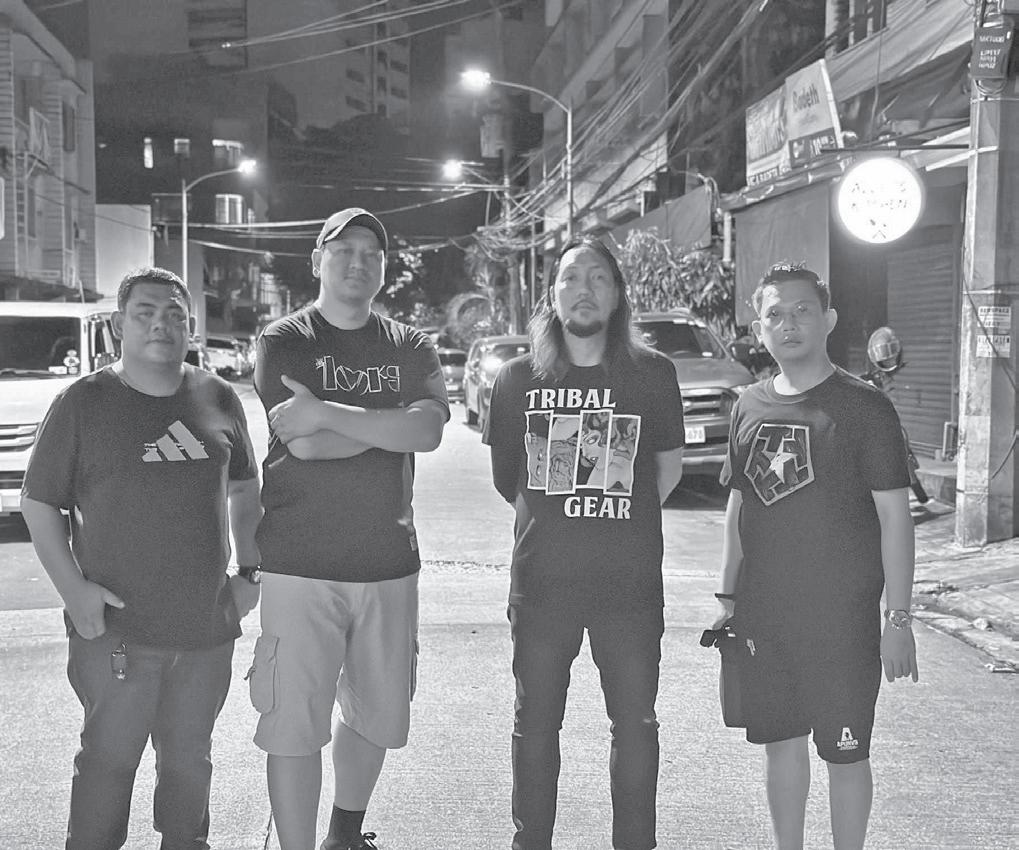


Pop/Punk, we ended up with the current version while retaining the basic idea that when our lives seem stressed or felt hopeless, don’t forget to take a break and breathe (“huminga”).
HALF-LIFE, HALF-DEATH – “A Wish (Dragonflies in Sumner Skies)”
ALFIE Mella explained. “It’s about revisitng an old unreciprocated love from one’s teenage years, trying to imagine what could have happened if it was pursued or if it flourished. Wishful thinking, actually, The memory just remains in the past and serves now as an inspiration to become positive, realizing that one can never bring back an old love. “Dragonflies” is intended to be a sequel to our song “Butterflies,” in our 1995 debut album, Pymyth Prahn. In our coming new album, “My Half Life Dream,” the track “Fireflies (In Midsummer Night Skies),” which completes the trilogy of New Wave ballads of similar themes.
THE PIN-UP GIRLS – “Can’t Stand Waiting Here” MONDO told Soundstrip’ “ It is about waiting


for the end of the world and leaving all the anger and fears behind. It is inspired by the Book of Revelations and the message on The Stone Roses song “Made Of Stone”. At the time the song was recorded, we had Ryan Nachura on lead guitar, Yas Neri on guitar and vocals, Hazel Silvestre on bass, and Raffy Bonifacio on drums.”
MADFISH – “Tambay No. 1.”
THE band said,” Our song talks about the day to day life of a typical Filipino istambay na walang ginagawa sa buhay maghapon kundi inom, tambay, etc. Di natin masabi kung choice nila ung ganung buhay or they are just victims ng society natin. Maaring di nila gusto but wala lang magawa kundi ilaban ang buhay.
“It draws from no particular experience but obvious naman sa lipunan natin na since then na marami pa ring tambay. At pinamagatan naming Tambay No. 1 coz catchy at bumagay dahil rock and roll ang riffs ng kanta.”
Score the CD when the Bandang X tropa rocks your side of the city.
AGAW Agimat
DEAD Nails
HALF Life Half Death
MADFISH
PIN-Up Girls
MUTINY
DREAMING TOGETHER
J-Pop group Psychic Fever on making dreams happen
By Bea Rollo
NOW embracing music on a global scale is the Japanese Pop (J-Pop) group PSYCHIC FEVER. The group came about as the members initially attended the entertainment school EXPG. After six rounds of auditions, the eight-member group TSURUGI, RYOGA, REN, JIMMY, KOKORO, RYUSHIN, WEESA, and HANATAROU became a reality.
Interestingly, the tale of how the name of their team is rooted in the team’s shared dreams. “The group’s name is derived from the meaning of the chemical reaction (psychic) that occurs when seven different personalities and dreams come together, and the passion (fever) of their music and entertainment is transmitted to the world,” Kokoro said.
On another sweet note, the fandom name is called “ForEVER” a sweet way to send their gratitude and love for their supporters.
Meet the Members
THE group welcomes a very diverse group, lined up with their rappers TSURUGI, RYOGA, JIMMY, RYUSHIN, and HANATAROU. Plus vocal unit–WEESA, KOKORO, and REN. They shared how they get along outside of doing their shows and projects.
“I think it is our respect for each other. In a good way, each member has


their own likes and ways of thinking, that it is important to understand and enhance each other. That is the charm of PSYCHIC FEVER, and what makes PSYCHIC FEVER stand out from the crowd. RYOGA said.
“We also cherish our time together by often having dinner or hanging out together,” he added.
Further after releasing their 2nd EP PSYCHIC FEVER FILE II, they have viewed their musicality and brotherhood at best.
“I believe that the individual characters and voices of each member have become more distinctive. Each one of us has taken on many challenges in this EP, so I hope you will enjoy it and pay attention to each one of us,” WEESA said.
Aside from bonding over making their great tunes, the members enjoy their free time doing dance challenges.
“I like dancing! I have only danced until I joined PSYCHIC FEVER, and I have loved dancing since I was in elementary school. Now I can use dance to express myself on social media and communicate my passion to everyone in the world, so I hope our dance and songs are well-liked in various places!” RYUSHIN stated.
One of the most recent ones they surprised with is dancing to P-pop girl group BINI’s “Salamin, Salamin” and their song “Just Like That”.
Making the Magic in Music Happen
PSYCHIC FEVER also put in the manifestations of their dream
collaborations, and with all hopes make it happen.
“I can’t talk about specifics, but we are talking about various things with different artists! We would like to collaborate with artists who can create a chemical reaction with our music!”TSURUGI
“Of course, I would like to collaborate with other artists. In the case of groups, personally, I would like to collaborate with Stray Kids and XG. Also, I have a dream of collaborating with the rapper G-Eazy. He is the reason I started rapping in the first place,” -RYOGA
“It would be a dream come true to be able to collaborate with artists who can sing and dance, such as Usher, Chris Brown, Omarion, and others who have influenced me personally,”
-JIMMY
“Of course, I would like to do so, and I would also like to experience many cultures of the world through collaborations in various countries!”
-REN
“I’d like to collaborate with YOASOBI! I really like YOASOBI and often listen to their music. I respect them very much and learn a lot from how they express themselves. I imagine that we can have a great chemical reaction together, so this is one of the dreams that I would like to realize someday,” - KOKORO
“I would like to collaborate with many people! When we were in Thailand, we collaborated with Thai artists, and we learned a lot. We
can deliver what we cannot express by ourselves by collaborating with others, so we would like to collaborate with artists from various countries!” -RYUSHIN
“I would like to visit various countries, meet artists from different regions, and collaborate with them. If we were able to collaborate with Travis Scott, who is now known around the world, I think it would bring about a new chemical reaction. I would also like to collaborate with a female singer,” -WEESA
Future with the Dream Team
VENTURING on a new chapter in their music career, creating the genre based on Hip-Hop R&B is also the inspiration for their EP, PSYCHIC FILE. A concept encompassing genres such as Jersey Club, Drill, and POPS—they wanted to experiment with electronic music such as techno and tech house in the future.
The legacy PSYCHIC FEVER wanted to embark on in the future is to become the dream team. One step ahead of reaching the universe through their love for music is doing a world tour— from Asia, Europe, Africa, and America. The group wanted to connect to the world.
“Billboard Global 200 #1! This is one of our goals right now! Our biggest dream is to connect with many people through our music! Billboard Global is one of our goals! TSURUGI said.
“Pursuing your dream is to know the importance of having a dream! From there, you can gain confidence, work hard, and make your dreams come true!” REN added.
PSYCHIC Fever
How a small Caribbean island is trying to become hurricane-proof
By Emily Wilkinson Global affairs think tank ODI
WhEn hurricane Maria struck the eastern Caribbean island of Dominica in 2017, it caused the kind of devastation unthinkable to larger countries.
The Category 5 hurricane caused US$1.2 billion in damage, and Dominica effectively lost 226 percent of its GDP overnight.
Climate change is increasing the frequency and intensity of extreme weather events in the Caribbean. For small islands such as Dominica (not to be confused with the much larger Dominican Republic) it is an existential threat. The topography and small size of the island imposes hard limits on its ability to adapt. That’s why Dominica ranked 11th most at risk out of 150 countries in the 2021 Global Climate Risk Index, based on an analysis of extreme weather between 2000 and 2019.
Reeling from Hurricane Maria, the island’s prime minister Roosevelt Skerrit set the bold ambition of becoming the first climate-resilient nation. In Dominica’s case, this means being able to handle more intense hurricanes and more frequent flooding.
There was no “climate blueprint” to pick up and follow—it had to be created from scratch. Dominica developed a clear set of

targets and a roadmap, combining everything from building design to nature-based power sources and climate resilient crop systems.
I am a climate resilience researcher with particular expertise in small island developing states. Over the years I have worked with Pacific islands threatened by rising seas and Caribbean countries devastated by hurricanes. In 2019, I was brought in to serve as an adviser to Dominica’s newly established climate resilience agency. I helped draft the country’s climate resilience plan and in early 2023 went back to film a documentary Climate Blueprint: Dominica
In the film, some of the architects of the country’s climate resilience strategy explain how Dominica is building back better and stronger in the aftermath of Hurricane Maria. They reveal four critical principles, broken down here:
Buy-in from everyone
GOveR nMen T must work across silos and no single agency or department can be responsible for building resilience. It’s thinking about how and where infrastructure
is built in relation to slopes, rivers and the sea. It’s also about education and buy in, to ensure island residents can effectively play their part.
Dominica has 20 targets for resilience by 2030, including an aim for all communities to be self-sufficient for 14 days following a disaster. The aim is for 90 percent of all housing to be built or retrofitted to comply with resilient building codes.
Natural resources are key
AbOUT two thirds of Dominica is covered in natural vegetation and forest. These plants, and the coral reefs surrounding the island, provide a critical buffer against winds and waves and so need to be protected.
This is part of the resilience plan, which increases protected forest areas and maintains healthy coral reefs around the island through monitoring, restoration, sustainable fishing and by reducing runoff of pesticides from agriculture into the sea.
Learn from history and indigenous practices
THe plantation economy imposed on Dominica under british rule—which focused on
one crop after another (sugar, cocoa, limes, then bananas)—was not well suited to the country’s difficult terrain and frequency of economic and environmental shocks. each crop failed, wiped out by hurricanes, disease and global food price rises.
Yet Dominica also has the Caribbean’s largest remaining indigenous community, and the Kalinago people have farming practices that combine crop diversification with planting methods that help stabilize slopes. Applying lessons from history and indigenous practices is key to building resilience in Dominica and a priority for environment minister Cozier Frederick, himself of Kalinago descent.
A collective voice with other islands DOMInICA’S climate blueprint should be seen as an opportunity for donors and development partners to support a vision that already exists. but there is geopolitics at play here as well.
Rich nations have yet to fulfil the goal of US$100 billion in climate finance for poorer nations. Analysis colleagues and I carried out for the think tank ODI found that small island developing nations received four times less finance for climate resilience than least developed countries, as a percentage of GDP. nations like Dominica have found it a huge challenge to navigate bureaucracies to access this vital finance.
As Skerrit, the Dominica prime minister, said in a 2017 address to the U n: “We as a country and as a region did not start this war against nature. We did not provoke it. The war has come to us. […] We are in shock, but we will rise, because Dominican people are strong. because Caribbean people are resilient.” The Conversation n Cover photo from Pexels.com
Notes from a room of dreaming minds
By Rio Constantino
(Last
Bacolod City, where he delivered a provocation lecture)
WHen it was finally time to deliver the provocation lectures, my father went first. My parents have almost always been my first readers. If I finish a draft and want feedback, I send it to them, and later we briefly talk about it after dinner. That’s my workshop. While I’ve had a lot of writing mentors in my life, in terms of influence it has always been my parents first.
Listen, said my father. I am a born campaigner. I relish combat and will not shy away from confrontation. but there’s no clear way of confronting a tumor. The only sure thing to do, he said, after my son’s diagnosis, was to gather the wagons against the dark.
Afterwards he talked about how history is the key to unlocking global warming and vice- versa. before the oil wars there were coal wars; did you know that Guantanamo
bay, that premier U.S. torture camp, and the old Subic naval base, were originally American coaling stations, fueling the expansion of rapacious empire? We must navigate our way through these dark times in the distant light of memory; by these strange and haunting stars are we guided.
Like the rest of the audience, I was a rapt listener. I even forgot to take a video for my mother, though that may also be attributable to nerves, given I was in line to go next.
Remember, kids: only look your audience in the eye when you’re actually ready to speak. Otherwise, you might find yourself sweating before you even begin. Plug in the HDMI cable to your laptop and open your slideshow. Keep a copy of your essay by your side, and breathe. How did I practice that first sentence again?
Every weekend, amateur botanists and semi-professional gardeners gather in eager droves at the Quezon City Memorial Circle Plant Center...
n n n
My one big regret about the lecture was giving a poor response to one of the questions asked during the open forum. The
question, if I recall correctly, went something like this: what about the history of science can help us, as writers, tackle climate change?
At the time, I gave a generic response about elite interests in science, about how corporate misinformation campaigns helped prop up tobacco and fossil fuels for years, despite the avalanche of scientific evidence warning us away from the use of either. Which is, to be fair, a useful piece of information to know, but one probably already familiar to the audience I was speaking to.
It might have been more interesting to mention something related to the concept of shifting baselines. All of us now live on a radically altered planet. Cities sprawl where forests once stood just fifty years ago. In centuries past the katala or red-vented cockatoo once soared throughout much of the Philippines. Many of our ancestors probably glimpsed it once or twice as they ventured into the jungle, a pale ghost between the trees. now the bird is largely restricted to a few strongholds on the island of Palawan.
Most people have never seen a katala in

the wild. I definitely haven’t. If you look at a map of the species’ current range, of where it remains in the present after decades of decimation, it’s easy to think it never existed anywhere else but Palawan. That’s the shifting baseline. When more and more things are lost, and as succeeding generations become used to and forget that loss, a depauperate earth quickly becomes everyone’s idea of normal.
We often assume there is no other way of life but the fragmented, cruel, and impoverished society that we have right now. Part of a writer’s power is being able to imagine stories that undermine this deception, whether in the form of novels, plays, poems, essays, or any other medium of language. And sometimes, the best way of pointing out that the future is more open than we might suspect is by looking back and noticing the richness of our common past.
One day I want to go on a casual hike some distance away from Metro Manila and randomly see a wild katala flying through the air. I will wave at the white shadow of its wings and smile. With these small aspirations is memory preserved.
of a series, following the author’s stint in the 23rd IYAS National Writer’s Workshop at University of St. La Salle,
A sCreenshoT of the documentary Climate Blueprint: Dominica, filmed by the author, who serves as Director of resilient and sustainable Islands Initiative at global affairs think tank oDI
Wine Dine& BusinessMirror
Tausug cuisine lands in Metro Manila


WITH Tausug heritage deeply ingrained in him, Filipino Chef Miguel Cabel Moreno has brought his culinary roots to the heart of Metro Manila, aiming “to change people’s perspective of Mindanao as a whole.”
In an interview with BusinessMirror, Moreno expressed that his primary method of achieving this goal is through food. He believes that food has a unique ability to unite people and that understanding others begins with exploring the flavors and dishes that are au-
thentically Filipino. Through his restaurants, “Palm Grill,” touted as the first and only authentic Southern Mindanaoan cuisine in Luzon, initially opened in Tomas Morato, Quezon City and its second branch at the Palenque, situated in the all-Filipino food hall

of the newly launched Gateway Mall 2 in Araneta City, Moreno believes that as long as there are customers who are hesitant to try, discover these flavors and apprehensive about exploring new or unfamiliar dishes, his mission remains unfinished.
“I must continue to spread the word, and I must continue to uplift Tausug cuisine as a Filipino cuisine that we can be really, truly proud of,” he said.
Moreno, born in Jolo, Sulu, and raised in Zamboanga City, has been promoting the cuisine of his homeland since 2017. Since then, he has gradually introduced Tausug cuisine not only to Luzon but also to foreigners visiting the Philippines, allowing them to experience these authentic Southern Mindanaoan flavors without needing to travel to Mindanao.
Culinary magic LAST July 13, 2024, Moreno conducted a cooking demonstration featuring traditional Tausug dishes specifically from the Zamboanga, Basilan, Sulu, Tawi-Tawi (ZamBa-


SulTa) region.
One highlight was “Beef Satti” skewered and grilled beef seasoned with turmeric, lemongrass, and garlic, served with a choice of peanut or sweet soy sauce, renowned for its savory, subtly sweet, and mildly spicy profile.
Another dish, “Sizzling Sambal Squid” featured squid marinated in sambal sauce containing chili peppers, garlic, shallots, shrimp paste, and lime juice, served on a hot plate for a sizzling presentation and aromatic experience. Moreno also showcased “Palikambing,” a Tausug delicacy similar to the Filipino “maruya” or banana fritters. Unlike the typical solid and sliced bananas used in maruya, “Palikambing” features mashed bananas mixed with sugar, flour, and baking powder, resulting in a dumpling-like appearance. Known as fried banana dumplings, palikambing has a slightly chewy texture when eaten. To give it a modern twist, Moreno creatively coated the dumplings with cinnamon and sugar for added texture.



“Nowadays with modernity, it’s not really hard to find any ingredients. You can source it out locally or you can buy it out at grocery stores readily available,” he said.
Farm-to-table ingredients
ACCORDING to Moreno, the defining features of Tausug cuisine include the use of farm-to-table ingredients, with a special emphasis on coconut.
“Because these islands are very rich in coconut trees, so that’s why they’ve really well incorporated that specific ingredient in all, if not most of their specialties,” he said.
Data from the Department of Agriculture (DA) reveals that the Philippines is the world’s secondlargest coconut producer, following Indonesia, but holds the top spot in exports, sending about 70 percent of its production abroad.
The Philippine Statistics Authority (PSA) figures showed that the Davao Region led in coconut production for the quarter of April to June 2023, yielding 461.07 thousand metric tons, accounting for
13.5 percent of the total. Northern Mindanao and Zamboanga Peninsula followed, producing 452.33 thousand metric tons or 13.3 percent and 437.60 thousand metric tons or 12.8 percent respectively.
However, Moreno highlighted a particularly distinctive and laborintensive process in Tausug cuisine: the burning of coconut, a traditional method they refer to as “sunog laing.” Moreno elaborated that the process involves carefully charring the coconut to develop a rich, smoky flavor, which is then incorporated into various dishes. This method, though time-consuming, adds a depth of taste that sets Tausug cuisine apart.
In his restaurant, these traditional dishes not only showcase the unique culinary heritage but also offer diners an authentic taste of Tausug culture.
“Pyangang Manok,” for instance, features chicken marinated in a mixture of spices and burnt coconut, resulting in a dish that’s both flavorful and aromatic.
“Tula Itum,” with its distinct black color and robust flavor, uses the burnt coconut to create a deeply savory broth, making it a standout among Filipino soups.
No shortcuts to authenticity WHEN asked about additional tips in cooking Tausug dishes, he emphasized that while quality ingredients are crucial, achieving authentic food involves more than just what goes into the dish.
“In cooking, there can never be shortcuts,” he stressed.
“If you really want to stick to the authenticity of things, don’t scrimp on the quality, don’t do shortcuts, source it out properly, understand it, and then cook it by heart,” he said.
He added that any dish prepared with care and passion will consistently yield excellent results.
“It has always been my philosophy to make sure that I don’t scrimp on the quality. There’s no shortcut because it’s not nice for us to claim that we are authentic if we do not serve them what is not authentic,” he concluded.
With his two restaurants in Metro Manila, Palm Grills is set to expand its offerings to the southern part of Luzon, allowing more people to experience their cuisine.

Editor: Anne Ruth Dela Cruz |
Text and photos by John Eiron R. Francisco
Pyangang Rice Meal
Lokot-Lokit (Jaa) with chocolate dip
Cocoroons: Freshly baked macaroons topped with mango puree and cherries.
Sizzling Sambal Squid Beef Kurma Rice Meal
Chiquiles con Longgarizo Melon Horchata
Dayap Agua Fresca Compañeros
Wine Dine& BusinessMirror
A SIP OF THE RISING SUN HERE IN THE PHILIPPINES

By Rory Visco Contributor
WHY do many people around the world love coffee? For most, coffee gives them that much-needed energy boost, a stimulant, especially on a day when they need it the most like when there’s heavy workload at the office or preparing for a big event so that they’d be awake, sharp, and smart. For others, coffee gives them an extraordinarily good feeling when feeling down and puts them in a good mood. On the other hand, coffee makes some people refreshed and fo -

cused. For others, however, drinking coffee allows them the opportunity to enjoy quality time after a hard day’s work, to unwind with the company of friends. It’s no different in the Philippines. Coffee is also a well-loved beverage here. Hot or cold, it doesn’t matter, as long as gives that full-bodied flavor and aroma. One sniff and sip, it feels like everything is fine. Coffee revolutionized the beverage industry in the country. Judging by the humongous number of coffee brands, local cafés or upscale coffee houses, coffee shops have sprouted in major urban areas in the country that has made it into
a multi-billion-peso business. Really, Filipinos of all ages have already made coffee an important part of their daily routines.
A shot of happiness
JUST walk along any busy business district or any major thoroughfare in the metropolis and you’ll most likely bump into someone holding a coffee cup.
According to the World Coffee Portal Research, the Philippines is the second largest individual coffee-consuming market in Asia where around 80 percent of Filipinos drink an average of 2.5 cups a day. This goes to show that coffee

is not just a pastime among Filipinos anymore but an essential part of their lives. Of course, Japan is lodged in first place.
But many Filipino coffee drinkers who can afford to spend are beginning to show a preference for not just ordinary coffee but coffee that tastes so good and definitely, does not compromise on quality.
The Mugen Group, the company behind the UCC cafés and restaurants in the Philippines, knows this all too well.
Coffee enthusiasts who are looking for a quick stopover to enjoy a good brew will delight in the newest store concept unveiled by UCC Ueshima Coffee Philippines, the first XPRESSO by UCC located at the busy Petron Bel-Air in Makati.
“As we move forward, we remain dedicated to our mission: to provide convenient coffee venues that serve the finest flavors of Japanese coffee at an affordable price. Each cup of XPRESSO coffee is a promise of quality and a moment of joy,” Mugen Group President and
SHELL LEVELS UP TRAVELERS’ MOBILITY
By Roderick L. Abad Contributor
GONE are the days when gasoline stations in the country are just there to fuel up a vehicle. Evolving from having a convenience store, some have become a mix-used complex to also include dining and retail spaces.
Shell Pilipinas Corp. (SPC), in its innovative way however, stands out from the rest by having its very own coffee shop, plus other added services for utmost convenience of customers. With its mobility stations, the oil giant never fails to cater to Filipino’s evolving tastes and needs on the road. SPC’s Shell Café is now present in 14 locations and continues to grow nationwide. This is fast-becoming a “go-to” place, especially for those who want to perk themselves up with a cup of its ethically sourced 100 percent Arabica coffee from Cavite.
By Roderick L. Abad Contributor
Apart from this flavorful coffee that is freshly ground, customers frequent here to sample its fruit teas, rich chocolate drinks, and freshly baked pastries, as well as the signature frankfurter. Shell Café stations offer dine-in service, and some locations also have a drive-thru.
“Our move aims to address the growing demand for more accessible, convenient, and comfortable mobility destinations for our customers. Our mobility stations aim to fulfill your needs, whether it is refueling your vehicle or recharging yourself for the long journey ahead. Shell mobility stations reflect Shell’s decadeslong commitment to providing sustainable innovations and solutions in the country,” said SPC Vice President for Mobility Randy del Valle.
Some ‘must-visit’ outlets
SHELL Café was launched in January 2023 with the opening of its first branch in Tagaytay City.
This pioneering outlet reflected SPC’s


CEO Hubert Young said. He said that at XPRESSO, they understand that people are always on the go, and XPRESSO is here to fuel everyone’s journey with a shot of happiness. “XPRESSO by UCC is more than just a coffee kiosk; it is a testament to our commitment to providing people with the best quality coffee, quickly and conveniently,” Young added.
Go-To
Store for Quality Coffee
YOUNG also expressed pride that they are able to offer their products at affordable prices without compromising on quality. He said that their coffee and food items are meticulously crafted to ensure they meet the high standards that UCC is known for. From P60 to P180 for beverages and P70 to P120 for food items, XPRESSO makes premium coffee accessible to everyone, Young enthused.
XPRESSO by UCC’s menu includes to-go coffee and non-coffee varieties that are perfect with their pastries and sandwiches. Menu
items are all designed to be readyto-carry for customers on their way to school, work, home, or even to their favorite hangout place with their friends.
Japanese pop culture and aesthetics are inculcated pretty much in the store’s design and branding as can be seen in its logo, which consists of a red circle (similar to the Nisshōki or Japanese flag) and the XPRESSO name, all contained within a stacked box.
The Gen X’ers, Millennials, and Gen Z’s, the most common groups that look for quality coffee on-thego, will certainly love XPRESSO by UCC. Its official tagline, “A Sip of the Rising Sun,” embodies its Japanese roots and inspiration. The company that eventually became UCC was founded in Kobe in 1933 by the Father of Coffee in Japan, Tadao Ueshima.
The tagline also mirrors the heartwarming and energetic personality of XPRESSO by UCC to help Filipinos level up their day and encourage them to be their best.
thrust of enhancing customer experience by welcoming locals, travelers, and passers-by to its cozy and comfortable haven as they refuel and recharge for their adventures.
For Metro Manila residents, the Shell Café in EDSA Balintawak has become popular, particularly among online food groups and reviewers, who lauded it not only for its delicious offerings like the signature matcha drink and sausage roll, and its cool vibe, but also for its convenience and accessibility. Adding comfort to them is the drive-thru feature that allows ordering and picking up their chosen items while onboard their vehicles.
At the Shell mobility station along South Luzon Tollway (SLT) 1 in Muntinlupa, motorists may opt to
Mugen Group President and CEO Hubert U. Young
Coffee brewing action inside XPRESSO by UCC.
XPRESSO by UCC façade
Wine Dine& BusinessMirror


THE NEW GO-TO SPOT FOR GEN Z, MILLENNIALS’ ASIAN CUISINE CRAVINGS
Text and photos by John Eiron R. Francisco
WITH its intriguing concept of “Asian
In with a Twist,” Young
Asian Grill shakes things up by blending four distinct Asian cuisines into one spot. Diners do not need to hop from place to place to enjoy Japanese, Korean, Thai, and Chinese grilled delights and hotpot dishes as this restaurant brings it all together under one roof with a deliciously diverse dining experience.
Last July 16, 2024, at SM By The Bay in Mall of Asia (MoA), Pasay City, the restaurant celebrated its grand opening following a soft launch the previous month. Raymund Magdaluyo, one of the entrepreneurs behind Wolfgang’s Steakhouse, Red Crab, and now Young Won, shared that their experience with steakhouse operations led them to create a unique Asian barbecue concept aimed specifically at the younger generation. The restaurant’s name is inspired by the Korean word “Youngwonil,” meaning forever, infinite, and endless and represents a commitment to timeless quality and endless enjoyment. Its Chinese translation, “Yang Wan,” means Sunshine Bay, symbolizing warmth, hospitality, and a radiant experience. Additionally, the English phrase “Young
CONTINUING the tradition of gathering the best in the industry, McCormick Culinary’s Together, We Flavor 2024 once again brings the spotlight on the ever-changing food service with this year’s theme: The Newstalgic Gastronomic Experience.
The event was held last June 27, 2024 at the Grand Ballroom 1, Coral Wing of Okada Manila highlighting the McCormick Flavor Forecast 24th Edition. McCormick Flavor Forecast is an annual report created by the Global McCormick Team that uncovers on-point predictions and trends that influence the future of flavor. These are the results of studies in over 10 global locations, uncovering 1,000 trend signals, and more than 290 restaurant explorations.
“Since 2000, our signature Flavor Forecast has pinpointed top trends and flavors that we embody in our new product developments whether in the retail market, food service or for collaborative customized projects for our valued partner accounts,” said Rebecca Ann K. Sy, CEO of McCormick Philippines.
Industry trends MOREOVER, McCormick Flavor Forecast has gained a following for giving attention to industry trends that will impact the way millions of consumers, chefs, food professionals and the public prepare and enjoy their food. In the
McCormick has forecasted global flavor trends such Chipotle in 2003, Pumpkin pie
one” targets the vibrant and dynamic spirit of the Millennial and Gen Z generations.
The experience THE restaurant is situated along the famous Sea Bay of MoA, directly across Conrad Manila. Upon entering, diners will immediately feel a sense of comfort and intimacy, enhanced by the subtle ambiance featuring neon LED wall lights and regular live band performances that create a good vibes experience.
If you’re a Gen Z or millennial who enjoys belting out OPM, pop hits, or any song you like, the stage and microphone are open for you. It’s the perfect way to have fun while sampling a variety of Asian cuisines all in one place. Each table, equipped with its own grill, comfortably accommodates four people which offers a personalized and interactive dining experience.
Unlimited Grill and Hotpot Delights UNDER its menu, the restaurant offers unlimited grill and hotpot options priced at P899 for Tier 1 and P1,199 for Tier 2. The grill options include Crazy Cut Angus Steak, Beijing Beef Rib Fingers, Top Blade Premium Steak, Spicy Beef Bulgogi, Yakiniku Karubi, Pork Steak (with Wasabi Gravy),


Buta Kushi (Pork Steak), Spiced Buta Kushi, Moo Ping (Thai Pork BBQ), Thai Chicken BBQ, Hawker Chicken Satay, Vegetables Assorted Vegetables, Spicy Bulgogi Squid, and Butter Garlic White Shrimps.
With their signature grill sauces such as the cilantro sauce, a creamy blend of herbs, provides a fresh, zesty flavor that compliments grilled meats beautifully.
The Bulldog sauce, with its salty and savory profile accented by a subtle kick of spice adds depth to every bite.
Meanwhile, the Teriyaki sauce offers a sweet and savory balance that pairs perfectly with any grilled fare.
The hotpot selection features Beef Belly, Beef Brisket, Pork Belly, Angus Hanger Steak, Shrimp Balls, Squid Balls, Fish Balls, Lobster Balls, Shiitake Mushrooms, Enoki Mushrooms, Shimeji Mushrooms, Tofu, Assorted Vegetables and Greens, Egg Noodles, and Ramen Noodles.
To enhance the hotpot experience, Young Won proudly offers six broths: Miso Nabe, Mushroom Collagen, Mala, Kimchi, Thai Suki, and Thai Yentafo.
When asked about his top three recommendations for beginners, Magdaluyo suggested Mala, Mushroom Collagen and any of the Thai broths.
Mala, on the other hand, features Sichuan peppers and a blend of spices, resulting in a rich umami broth with a satisfying spice level. Mushroom Collagen offers a Chinese-inspired broth made with dried goji berries, jujube, ginger, and scallions for a nourishing flavor. Thai Suki is a Thai pork hot pot broth enriched with soy and mirin, ideal for pairing with meats. And Thai Yentafo presents a distinctively pink broth made from Thai yentafoo sauce, a fermented bean curd sauce that delivers a tangy, umamirich flavor.
They say you haven’t fully experienced Young Won dining until you try their signature cocktail. Perfect for the younger crowd who love bar hopping or exploring new drinks, the Jade Dragon is a vibrant, Asian-inspired mix of melon liqueur, soju, and sour mix.
The concept of “Asian All In with a Twist” makes sense, as it goes beyond the unique flavors and offerings from the four Asian countries mentioned. It’s also about creating a space where friends and family can enjoy quality time together, reflecting the Filipino love for gathering and karaoke. Plus, it’s convenient. There’s no need to hop from one restaurant to another to satisfy your Asian cuisine cravings. Everything is in one place; all you need to do is savor the flavors, enjoy the moment, and make lasting memories.
ABy Brian K. Ong
LL eyes are on Iloilo once again as the Iloilo MICE Alliance, a group of meetings, incentive travels, conventions, and exhibitions (MICE) industry professionals that encompasses all major tourism stakeholders in Iloilo City, presents Iloilo’s premier chef and heritage food advocate, Chef Rafael “Tibong” Jardeleza in “Sabores De Visayas: Diez Edición.” Sabores de Visayas started in 2016, “when the Department of Tourism Region 6 was invited to spearhead the participation of a ‘One Visayas’ representation by the Western Visayas, Central Visayas and Eastern Visayas regions to the 2nd Madrid Fusion held in Manila back in 2016,” explains Chef Tibong. What started as a fundraising event to augment for the cost of the trip of the “One Visayas” delegation to represent the region to the 2016 Madrid Fusion, now became an annual gala dinner event that showcased not only the region’s cuisines, but also highlighted Ilonggo Heritage Regional Cuisine. Sabores de Visayas now “aims to showcase the rich culinary heritage of the Visayas region.” The annual event gathers respected chefs from all over the country and invites food entrepreneurs and cooks to “bring out the diverse flavors of the region as well as to serve the crème de la crème, only the best gastronomic experiences available.”
Now on its 10th year, Sabores de Visayas continues the tradition in Iloilo City with Diez Edición, bringing together renowned chefs from Metro Manila and young Ilonggo chefs featuring culinary delights that make Iloilo the true “food haven of the Philippines.”
Following the recent designation of Iloilo City as the Philippines’ only UNESCO City of Gastronomy and the Department of Tourism’s thrust to further promote Gastronomy Tourism, the event is a viable avenue to further this goal.
Chef Tibong, author of Flavors of Iloilo (Gold Winner of the 2023 National Book Awards) and founder of the annual Tabuan Cooking Competition, is at the helm of the event and he conducted a food tour as pre-event and post-event for the chefs coming from Manila.
The chefs who flew in from Manila were Sandy Daza, Margarita Fores, Kalel Chan, Mikel Zaguirre of Locavore, Patrick Go of Your Local, Panky Lopez and Simpol’s Myke Tatung. They were joined by seasoned Iloilo chefs Maridel Uygingco and Wilson Esperancilla. The featured local Ilonggo chefs inlcuded

Ilonggo Grazing Table with Ilonggo-inspired nibbles, Inasal Empanaditas, Tinapay, Oyster Okoy, Traditional
Sitaw at Kalkag), Roast Lamb, Tenderloin Steak (ala minute), Glazed Ham, Ilonggo Style Tusok Tusok street food / Barbecue/ Inasal, Pork Humba, Pulled Duck with Arroz Valenciana, Lechon
brightness. McCormick puts the spotlight not only on vinegars but on citrus and sour fruits, fermenting and pickling and many more. In the event, McCormick customized sour sauces such
as Shoyu Vinegar, Yuzu Chili, and Shoyu Tamarind made a perfect pairing to Stick Bites (a mix breaded protein skewers).
Fusion cooking
THOUGHTFULLY Borrowed, on the other hand, is tagged as the evolution of fusion-cooking as it combined ingredients and techniques from different cultures but basing them on familiar platforms. More than being artistic, Thoughtfully Borrowed recipes are rooted in authenticity and not based on individual lived experiences and influences. McCormick’s interpretation of this trend includes customized sauces such as Truffle Ranch, Lemongrass Aioli and Sriracha Applewood Barbeque, which went perfectly with Beef Sliders, Pork Belly Mantou, and Crispy Chicken Wrap.
In Indulgence Redefined, bold and nuanced flavors come in all shapes and forms, but just the same, they guarantee to satisfy both the eyes and the palate. From Newstalgic food to flavor Maximalism, this trend gives importance to personal expression and unique experiences. In short, familiar and nostalgic flavors are given an updated take, flavorful zings like lime, hibiscus, chili, cilantro, and more. To amplify this trend, McCormick presented different flavors of Frozen Slush through their customized creation of syrups like Jelly Ace, Ice Pop, and Tropical Passion. ndulging in Iskrambol, a Filipino frozen dessert, was one of the major highlights of the event.
Flavor of the year
TAMARIND, a tangy and versatile fruit popular in Asian cuisine, is celebrated as the Flavor of the Year. Its unique sweet and sour notes add depth to both savory and sweet dishes, enhancing sauces, curries, beverages, and desserts.
Tamarind’s ability to blend harmoniously with various ingredients while standing out with its distinctive taste makes it a favorite among chefs and food enthusiasts, inviting new flavor explorations. This versatile fruit is now making waves in global gastronomy, appearing from Worcestershire Sauce to refreshing beverages. Wrapping up the event, McCormick presented its Sinigang Cheesecake as an embodiment of all three trends in one small dessert.
As a brand that embodies flavor as its main component in coming up with new innovative ways to bring in diversity, this echoes Sy’s words during the event.
“We hope that the trends that we shared will inspire our audience in their big product launch or menu ideation with McCormick as their flavor partner. We would gladly help you turn your visions into reality,” Sy added.
Aside from its annual Flavor Forecast, McCormick Culinary aims to help businesses gain a foothold in the current foodservice landscape by providing access to quality and premium products. McCormick Culinary aim to help food businesses on how they can stay relevant and competitive in the industry with innovations, on-trend menu ideas, and collaborative new product developments. Being known as a global leader in flavor and a go-to Flavor Solutions Partner for any food business, McCormick Culinary continues to stand by its commitment – To Stand Together for the Future of Flavor.
For more details and information, please follow McCormick Culinary Philippines at: FB: https://www.facebook.com/mccormickculinaryphilippines IG: https://www.instagram.com/mccor-

AWARD-WINNING Singaporean delicatessen brand Delicato recently announced the launch of its gourmet sausages in the Philippine market. The pork sausage range, comprising unique flavors including Truffle Cheese and Mixed Herbs & Spices, is made with premium quality meat, and delight customers by helping
This makes the Philippines the perfect first stop in our expansion of the Delicato brand. Eating is such an important part of Filipino culture. Having grown up in the Philippines, I know how big of a role mealtime can play in showing love and appreciation for family. Through this launch, we are
Frances Aimee Tiu-Villanueva, Jose Ariel Castañeda Jr., Andrea Valdez-Gorriceta, OJ Salazar, Paul Frias, Aaron Pastilloso, Jeffrey Ticao, Karl Jason Hibionada, Keith Biason and Paul Aligaen. Ilonggo flavors took centerstage at the Jade Ballroom of Grand Xing Hotel as the following dishes were offered: Kinilaw Salad Bar,
Pancit Molo Soup, Linaga Kasudlan, Linatik (Squash Puree with Malunggay,
WON ASIAN GRILL
Sampling the goodies based
flavor forecast. Sinigang cheesecake sampler
Delicato Premium Sausages
Iloilo’s premier chef and heritage food advocate, Chef Rafael “Tibong” Jardeleza.
Thai pork barbecue skewers
Young Won’s interior design ensures comfortable seating for four at every table.
Discover a variety of hotpot options at Young Wan, featuring six delicious broths and a selection of premium meats.
Kpop Chicken tenders
Kimchi Gyoza
Young Won Asian Grill is conveniently located along SM by the Bay at Mall of Asia.
Steak Tataki
Wine Dine&


ENJOY SOUTHEAST
ASIAN FARE AT THIS HOTEL IN MAKATI

By Anne Ruth Dela


Widence Hotel, Hue Hotels & Resorts in Boracay and in Puerto Princesa and Charlie’s El Nido.
HILE most hotels offer a buffet breakfast for their checked-in guests, there are those who are overwhelmed with the wide range of choices. This hotel, located in the heart of the central business district of Makati, gives guests the opportunity to choose whether to have a Singaporean, Indonesian or a Chinese breakfast.
is located along the busy Jupiter Street. Its prime location ensures that both business and leisure travelers are conveniently close to the city’s business establishments, shopping malls, restaurants, and vibrant Makati nightlife.
The Belamy House is the newest three-star boutique hotel that
The Belamy House is managed by Hospitality Innovators, Inc.
(HII), which over the past 25 years, has continuously re-imagined and transformed the management and operation of hotels, resorts, serviced apartments and other properties in the Philippines. Among the properties HII manages include The Picasso Boutique Serviced Residences, The Exchange Regency Res-
Chef Tweet Obsequio makes it big with chocolates
By Anne Ruth Dela Cruz
WHILE she graduated with a BS Financial Management degree from St. Scholastica’s College, Chef Tweet Obsequio knew that she did not want to pursue that career path. She decided to take up an Associate Degree in Culinary Arts and Diploma in Professional Culinary and Baking Arts.
“I grew up with a mother who cooked to earn a living and I would often help her in the kitchen. enjoyed the culinary course and I managed to gradate at the top of my class. It was also the time that I realized that I wanted to be a chef,” Chef Tweet related.
As part of her culinary curriculum, Chef Tweet was required to take up an internship in a hotel and was assigned in the pastry kitchen of Sofitel Philippine Plaza. After her internship, she worked as a casual employee and eventually became a regular staff as kitchen helper of the Pastry team. While working with the Pastry team, Chef Tweet got interested in making chocolate garnishes for the cakes.
“I usually extend my duty time to learn the art and craft of chocolates. When the hotel needed someone to change the line of pralines for the chocolate retail outlet, I was the one chosen to do so,” she recalled.
Pralines EVEN if she held a rank-and-file position, she was tasked to to present different sets of flavors of pralines for the General Manager’s (GM) taste testing as part of her project to change the entire praline line. Week after week, she would present her praline creations to the GM who would not hold back on his comments. There was even an instance when the GM even threatened to transfer Chef Tweet to the Engineering Department.
“It was an invaluable experience for me to consider every comment, whether good or bad, to improve my praline creations. After several presentations and when I was able to meet the stringent standards, I was given the freedom to change the chocolate retail line of the hotel,” she said as she assumed the position of Chocolate Chef.
She went on to win the gold medal and the L’Assiette D’or Trophy in the Pralines Professional Division of Manila’s Chiefs on Parade for two consecutive years. She was part of the culinary team composed of chefs from different countries that were victorious in the Star Chef Team Battle Mystery Box Challenge and Good Food and Wine Showdown at the Sofitel Star Chefs Asian Tour at Guangzhou, China. In the same event, she assisted Chef Stephane Donnat, renowed French Chocolatier and Confectioner and the late Chef Marc Claerbout, famed Belgian Chocolatier and Culinyar School Owner, for a demonstration on making pralines.
She trained in Belgium under Chef Stephane Leroux. French Mielleur Ouvrier de France (Best Craftsman of France) on the art of creating chocolate display pieces, several of which have been and are prominently showcased at Café Society.
After her stint with Sofitel Philippine Plaza from 2006 to 2016 as Chocolate Chef, she worked as Pastry Senior Sous Chef for the opening team of Parisian Sands Macau from July 2016 to 2017.
Head Chocolatier IN 2017 she was hired by City of Dreams Manila to serve as Head Chocolatier to open Chocol8, Chocolate Shop in City of Dreams and manage the operations of the chocolate atelier.
“I created the chocolate menu for the retail shop, crafted the recipes for the different chocolate variants and packaging and prepared the cost matrix that goes with it. I also train our team of chocolatiers on the production, ensuring that the recipes and standards are followed,” Chef Tweet said.
She added that she is also responsible for “the whimsical chocolate sculptures at Café Society and festive events.” This year, she started training the chocolatiers on the art of creating chocolate showpieces for display. For Chef Tweet, the perfect chocolate “balances all the sense elements in harmonious whole. It will have subtle, complex notes, much like fine wine.”
“High quality chocolate should be smooth, creamy and melts right away because of the low melting point of the cocoa butter. When it melts

in your mouth, it should be flavorful enough to awaken your senses from the tip of your tongue to the back of your throat. Overall it is about the bursting of flavor, texture and aroma,” she explained.
Product of nature
She added that the perfect chocolate “is a product of nature from a certain territory to the hands of a skilled chocolatier, giving a memorable experience especially when eaten for a special occasion.”
According to Chef Tweet, what makes Chocol8, the chocolate label of City of Dreams stand out is its 65 percent dark chocolate base from Felchlin Switzerland, one of the leading companies in the production of the finest Swiss chocolates.
“The Swiss chocolates are customized exclusively for a chocolate flavor profile unique to the luxury integrated resort. It has a full-bodied cacao taste, intensive coffee notes with strong chocolate aroma and prune-like finish,” she said.
Chocol8’s milk chocolate, on the other hand, “is a single origin Venezuelan beans manufactured in Belgium. It has a nutty base and roasted-cocoa notes with strong caramel, creamy milk taste.”
Artisanal chocolates
Chocolates always make good gifts and Chef Tweet recommends that handcrafted chocolates skillfully made by chocolatiers make the best gifts.

“These artisanal chocolates are meticulously prepared and made of the finest ingredients, setting them apart from the ones mass produced for supermarkets,” she said, adding that her favorite at Chocol8 is the chocolatecoated Biscoff which brings back good memories of her training in Belgium.
As for her favorite chocolate, Chef Tweet said it is the Bonnat Chocolate from Voiron, France. She related that it is a highly respected chocolate brand that has an extensive range of single origin chocolate bars.
“When I participated in the Sofitel Star Chefs Asian Tour at Guangzhou, China, I had the chance to work with Chef Stephane Bonnat, renowned French chocolatier and confectioner behind the popular French chocolate brand and sampled his line of chocolate bars, each one with a distinctive flavor profile,” she said, stressing that chocolates are best kept at room temperature.
Chocol8 can be found at Café Society which is located at the Upper Ground Floor, The Shops at the Boulevard, City of Dreams Manila.
“HII is a hotel management company but the brands we handle are unique. We give the respective properties its unique personality like the Picasso is artsy and young. We have more or less 25 properties and we will soon be opening properties in Aurora, Subic, Tagaytay and Pampanga,” related James Pangilinan, General Manager of The Belamy House, stressing that HII is a Filipino brand of hospitality.
Flight attendant
PANGILINAN started in the hospitality industry back when Pacific Plans, a pre-need company, closed shop. He was forced to stop school and work as a flight attendant at the then PAL Express. When he had saved enough money, he went back to school and finished his psychology course.
“My dream was to be a teacher but I applied to be a management trainee at Shangri-la. While there, I was trained in all of their properties and my first job was at Shangrila Mactan. From there, I went to Ascott. I opened the Acacia Hotel, tried Agoda, went back to Edsa Shangri-la, opened Seda in Nuvali, Makati Diamond, Crowne Plaza and Microtel where I became Director for Sales,” he said.
When the pandemic came, Pangilinan was managing a 12-hectare resort in San Juan, Batangas and moved on to become the General Manager of Picasso. He moved to Belamy House in March 2020 as it was scheduled to open at that time.
“The project was delayed by two years. When the world opened, we decided to finally open it in October of 2023 and here we are,” he said.
Modern elegance
THE Belamy House features a total of 83 well-appointed rooms and suites that provide modern elegance, superior comfort, and excellent service. The hotel offers three room categories: Studio, Premier and One Bedroom Suite.
“We have a roof deck that has a 360-degree view of Makati, Mandaluyong and the BGC skyline. The Internet is designed to be future proof and is ready for 5G up to 7G. The TVs are android. We have cable but we do streaming as well,” Pangilinan said. What stands out in the hotel room is the mini bar which features items that are locally made. The mini bar is made of Chocolates from Theo and Philo, tortilla and tofu chips from Taters and Rite and Light drinks.
“We really made a conscious effort to make our snacks all Filipino. I am looking for a supplier for local tea to complete the experience. Our
furniture in the roof deck is from Bulacan and we have other furniture that are made in Pampanga,” he said. Belamy Hotel also has its own water filtering system so the tap water is potable. Those who prefer purified water, have access to water dispensers that are available in all floors of the hotel. The hotel also collects rainwater that is used to flush the toilets.
“We are pushing for a holistic approach to tourism and we are currently talking to a solar panel provider,” he said.
Partnerships
PANGILINAN related that part of the ecosystem of of the building is that everyone partners with each other.
“We will soon be launching a choose your own breakfast service. The night before, guests can inform the front desk where they would like to have their breakfast and they can choose from Kaokee, RIA and Wang Xiang,” he said. These three restaurants are located at the ground floor of the hotel and serve mainly Asian cuisine. RIA restaurant specializes in Indonesian street food; Wang Xiang serves Chinese specialties while Kaokee offers Singaporean fare.
“Belamy House does not have its own food and beverage team so we decided to partner with the establishments in the building. It is also part of the food hub culture in the Jupiter area. We tried to offer cuisine that is not available in the area,” Pangilinan said.
Kaokee is owned by the Gringo Group of Restaurants. Must tries at Kaokee include the Hainanese Chicken, Cereal Shrimp, Stewed Eggplant with Minced Pork in Claypot and Egg Fried Rice with Scallops. Kaokee also has a selection of Singapore coffee, beverages and desserts.
RIA serves authentic Indonesian food and those who love a little spice in their food will enjoy their experience here. For RIA, must tries include the Gado Gado (Steamed vegetables, rice cakes, potatoes, tofu), Ayam Geprek (Battered fried chicken with sambal garlic), Sate Ayam (Chicken Sate served with peanut sauce), and Nasi Goreng (Chicken Fried Rice served with fried egg). Don’t forget to try their Es Sendol (house made iced cendol, jelly, coconut milk and palm sugar).
“The Belamy House has everything you need for an enjoyable stay. We are near the party scene, we are probably near where you work. We want to make it fun and vibrant and very alive,” Pangalinan said.
The Belamy House is located at 106 to 108 Jupiter Street, Bel-Air Village, Makati City. For reservations, email reservations@thebelamyhouse. com or call +632 8424 1298.
Cruz
Photos by Elaine Andrea P. Dela Cruz and Haydee Dimawala
Whimsical chocolate sculptures at Chocol8 catch the eyes of chocolate lovers and onlookers.
Chief Tweet Obsequio is the svelte and creative Head Chocolatier of City of Dreams Manila
Kaokee’s Stewed Eggplant with Minced Pork Kaokee’s Egg Fried Rice with Scallops
Kaokee’s Cereal Shrimp
RIA’s Ayam Geprek
RIA’s Gado Gado
The entrance to The Belamy House.
The Belamy House’s one bedroom suite
RIA’s Sate Ayam


Sunday, July 28, 2024 |
Edited by Jose F. Lacaba
By Pablo A. Tariman
By Pablo A. Tariman
Nonoy Froilan as Albrecht in Giselle
2 Sunday, July 28, 2024


WBy Pablo A. Tariman
HEN he retired as the country’s premier danseur in 1993, Nonoy Froilan found himself jobless, with no retirement benefits, no insurance and no monthly income.
“After serving in the altar of dance for more than 20 years, I was on my own with my wife and children who learned how to survive outside the arts. I was penniless but the pressure of having to be in good shape for opening nights was finally gone. I felt so relieved. How I wished that in the future, the government would help performing artists retiring on the concert stage,” Nonoy recalled.
In his prime, Nonoy danced with the
revered prima ballerinas of the world stage— England’s Dame Margot Fonteyn, Japan’s Yoko Morishita and our very own Maniya Barredo.
He was Siegfred in Swan Lake, Albrecht in Giselle, the voyager in Norman Walker’s Season of Flight.
It was in the early 70s, when Nonoy became the dancing partner of Dame Margot Fonteyn.

The ballet was Dahil Sayo by Mike Velarde
Nonoy Froilan and wife Edna Vida in Firebird in the late 70s
Nonoy Froilan conducting a dance class
BusinessMirror
and Dame Margot had John Meehan and Kevin Coe (principal dancers of Australian Ballet) and Nonoy Froilan as co-dancers, playing the role of stage suitors of the character of La Fonteyn.
Nonoy recalled the first encounter in the rehearsal hall. “They were gods walking into the room and I can’t believe they were dancing with me. I let out a silent shriek of admiration while my heart palpitated in excitement. When you are dancing and partnering a prima ballerina assoluta like Dame Margot Fonteyn, you have to show your best.”
Dancing side by side with her and two great principal dancers of the Australian Ballet was no ordinary encounter for Nonoy.
“I felt I had to do my best as I was dancing not for personal gratification but more for your country. We rehearsed for three hours prior to the performance on the same day. I recited a mantra while rehearsing, ‘I must blend with them.’ They were the living icons in the midst of us mere mortals on that CCP stage. I wished I was just back on the wings watching them instead of me
dancing with them. But for some reason I always got the leading roles which meant bigger responsibilities,” he mused.
INSPIRED TO EXCEL
THE role of Albrecht in Giselle with Japan’s Yoko Morishita was a turning point. “Dancing with her gave me renewed inspiration to excel. She was exquisite, humble and light. And she kept on going back to Manila to dance with me.”
One of his favorite roles is Norman Walker’s Songs of a Wayfarer.
Although it was based on a poem by Gustav Mahler, he knew it had something to do with the choreographer’s personal life. “I think it is one of my biggest breaks and the most terrifying,” he said. “Norman (Walker) was always screaming during the rehearsal, trying to perfect his work and he got on the nerves of the dancers Tommy Sabarre (he died during the sinking of the Sulpicio ship) and Josette Salang.”
From trying to live up to the challenge, Nonoy fell sick during the world premiere. “Boy, I really got sick, I got thin from


dehydration and my weight was down to 127 pounds.”
Many times, after retirement, he was asked to restage classical works he had performed before. “Either I let the dancers perform the original sequence of steps or change some parts to suit their artistry. It also boils down to the technical prowess of the dancers. Difficult dance sequences may change in timing and steps. The challenge with most classical ballets is the audience is already expecting the 32 fouettés or the series of tour en l’aires. A dancer just has to do it. Once, I asked permission from Russian Vahktang Chabukiani in his restaging of La Bayadere if I could change a pirouette because I was not good at it.”
For Nonoy, it’s always de riguer to ask permission to change choreography whether the creators are still alive or dead. “Interpretations are expected to evolve but I still believe in sticking to the original choreography for it to become a true classic. It’s because I worked with the choreographers first hand and I want to transfer everything I heard from their mouths. Their voice, style, technique, their doubts, their creativity that made the dance brilliant. I become a bit stricter with contemporary interpretations because of their particular style and technique which is harder to learn.
He further explained: “Some dancers can easily adapt to a certain style even if they are classically trained. But the rudimentary method between technique in classical and contemporary dance is being weightless in the former and grounded in the latter.”
Nonoy added that he always approached a dance given to him with a model in mind. “Manny Molina is one example in Season of Flight. I tried to dance like him because his movements emanated from the mind of the choreographer. I definitely will
not be a Manny Molina or dance like him but the fact is the image inside my brain manifests into the dance. Baryshnikov is one of my favorite models in classical ballet. I will watch his variation three times before leaving for CCP with the mantra, ‘I dance like Baryshnikov.’ I always aim for his perfection even if I know I can never dance like him.”
1993 RETIREMENT
THE country’s premier danseur bowed out of the dance scene in 1993, even as he found the mere thought of retiring unnerving.
He admitted that the urge to fade out as a danseur came as early as the mid-80s, but that every time Maniya Barredo or someone like Yoko Morishita was in town, the surge of excitement swept the retirement plans away. He just couldn’t give it up.
And so, for more than 20 years, his world revolved around the theater. There was a daily workout with or without performance, since he had to be in top shape for world premieres. He had to continue a performance even in the middle of an injury. He was in the theater during floods, typhoons, coup d’ etat, rallies, and yes, even during earthquakes and volcano eruptions.
The only time Nonoy was taken away from the daily dance routine was when he took a bride (Edna Vida, dancer and choreographer) and fussed over his now grownup daughter Micaela and son Rafael Jr. Fatherhood was one role he had long cherished. It gave him a role different from those he played onstage like Romeo ( Romeo and Juliet), Siegfred (Swan Lake), the most touching Albrecht (Giselle) and the eternal Prince (Sleeping Beauty, Nutcracker, Cinderella), not to mention countless parts in modern ballets.
Continued on A4
Nonoy Froilan and Maniya Barredo in Swan Lake
Nonoy Froilan and Edna Vida with National Artist for Dance Alice Reyes
4 Sunday, July 28, 2024

PRINCE OF DANCE
IN the gallery of Filipino male dancers, he inherited the throne left by Eddie Elejar, essaying nobility which contrasted with the passion of Enrico Labayen, the cerebral appeal of Ray Dizon, the fire of Manuel Molina and the virtuosity of Nicolas Pacana.
Indeed, for more than two decades, he was the country’s Prince of Dance carrying the torch for the country’s male dancers.
In that final tribute, there was a lot of dance memories to relive.
Born on October 24, 1950 in Calbiga, Samar, Nonoy didn’t have dance in mind for a career. His simple folks wanted him to study as a seaman in Cebu and later was advised to apply in the US Navy.
He recalled: “I grew up surrounded by artists who probably didn’t know they were
artists. They were the local singers, dancers, musicians, painters, sculptors, goldsmiths, actors, composers. I’ve seen them all in Calbiga while growing up.”
He probably absorbed their artistic genes without his knowing it. “My Samar high school days were very eventful. What I remember was that I often figured in school programs where I learned Russian and Spanish dances. Later I was even nominated dancer of the year. I was also part of a singing trio.”
A summer vacation in Manila changed all that the family planned for him. His idyllic Calbiga nights turned into neon lights in the big city. At the time, he was dark-skinned, the color of burnt kettle.
In the late 60s, he enrolled at the University of the East with no specific course in mind. “I just wanted to earn a degree and get a job. Then I saw an announcement in The Dawn school paper for students who

wanted to join the school dance troupe.”
To make the story short, he passed the audition.
The dance troupe opened many doors for him. In time, he learned folk dance, jazz, and basic ballet. “I learned how to quickly change from one costume to another.”
In time with no dance roles beckoning, he became part of the back up dancers in the TV specials of Vilma Santos & Edgar Mortiz, Tirso Cruz & Nora Aunor.
SHOWBIZ, MUSICALS, FASHION
THE serious training in ballet and jazz soon began with him getting a scholarship under Julie Borromeo’s Dance Art Studio where he had a very good mentor named Tony Llacer. “He (Tony) gave me a good foundation for my initial ballet training.”
Slowly he was ushered into the world of show business, theater musicals and even
fashion shows.
In the then weekly show called “Changes,” he met director Peque Gallaga and learned camera movements by just watching behind the camera. “I learned many things from him especially his patience when things didn’t work. He really worked fast because he knew what he wanted.”
Suddenly he was in the circle of showbiz personalities like Peque Gallaga, June Keithley, Mitch Valdez, Jaime Fabregas, Jonee Gamboa and Margie Moran who would later on become Miss Universe then president of Ballet Philippines Foundation and interim president of the CCP later.
Today, at 73, Nonoy’s recognition as one of the country’s best danseurs, seems finally forthcoming.
In 2020, he became a Gawad CCP Awardee for Dance. This year, he has been nominated as National Artist for Dance by the Local Government of Calbiga, Samar.

Continued from A3
AFTER RETIREMENT
Nonoy discovered passion for photography during the pandemic
Nonoy Froilan and Edna Vida with their son and daughter Rafael, Jr. and Micaela
Nonoy Froilan and Yoko Morishita in Sleeping Beauty
SM City Dasmariñas is serving up major cuteness overload with their latest attraction—a massive and cuddly bear that’s sure to bring a smile to your face and an “o-bear-load” of fun to your mall visit. Standing at an impressive 30 feet tall, this bear is officially the biggest indoor installation in the entire province of Cavite.

Meet Dash—the Dashing Bear of the Giant SM Squad! He’s the first member of the squad to grace Cavite, and with his friendly personality and undeniable charm, he’s bound to become your new favorite. Whether you’re out with family, shopping for the latest trends, or just enjoying the atmosphere, this adorable installation is a must-see.
Strike a pose and capture the perfect selfie with Dash—he’s guaranteed to make your Instagram feed and TikTok videos stand out!


DASH, the 30-foot Dashing Bear of the Giant SM Squad brings cute vibes to SM City Dasmarinas.
SM Little Stars 2023 Grand Winner, Jourdanne Baldonido, wows the crowd with the Dash Dance Craze as SM City Dasmariñas unveils the Giant Bear to the public.
Dash completes the SM Bear Squad with Da and Ash.
Strike a pose with Dash like these cool students and dominate your social media feeds.
SM Supermalls South 2 Group Marketing Manager Paul Garrido, Senior Assistant Vice President for Marketing - South Luzon Ritzgerald Gonzales, Assistant Vice President for Marketing - Special Events Hanna Carinna Sy, and Sparkle Star Migs Almendras hang out with Dash, Da, Ash, and the bear squad, bringing the ultimate cuddle vibes to SM City Dasmarinas.
6 Sunday, July 28, 2024

MBy Pablo A. Tariman
ARNE L. KILATES , Poet of the Year at the 2013 Nick Joaquin Literary Awards (NJLA), has written 30. He was 71.
As I write this,I am still contemplating if I should see him for the last time. Reflecting on a long list of departed friends in the last five years, I decided to avoid wakes. Even of close friends.
Speaking of wakes, I remember consulting Marne if I should go to the wake of Carmen Guerrero-Nakpil who was a member of our monthly CGN Wednesday Club.
I told Marne: “I cannot see her for the last time in that state.”
He replied: “You won’t see her in that state. She has been cremated and her ashes are in a jar enclosed in a box surrounded by flowers…”
Since I was not sure I could accept Mrs. Nakpil’s passing with some civility, I decided I would stay home without seeing the array of roses surrounding her urn.
I felt the same for Marne. I prefer to remember our happy moments than to have my last memory of him in that urn.
A few months back before he was hospitalized, our last sessions together were spent exchanging guffaws with the descendants of Jose Rizal: Gemma Cruz Araneta and Ika Laurel and other members of our monthly CGN Wednesday Club.
I fear that if I see him in that state, he might come back to life, tap my shoulder and
again crack another joke: “Pablo, don’t you dare vocalize in my wake!”
Marne lived a full life as a writer-poet.
He was baptismal godfather of my eldest daughter, Karenina, now based in Frankfurt.
He was more than an award-winning poet. He was also essayist, editor, and translator. He translated some poems of Kerima Tariman’s last book, Sa Aking Henerasyon which appeared in Santelmo literary magazine.
He was born on November 5, 1952 in Daraga, Albay where I met him. He was one of the singers (among them—if I am not mistaken—Rolando Esquela, Mike Molina, Renato Ravalo, Chito Baldo) during my wedding at Cagsawa Church Ruins in 1974.
One of our Albay watering holes was near Divine Word College in Legazpi City where he graduated with a bachelor’s degree in English. in 1976.
In the 80s, most of us in the Albay gang settled in Manila. He worked for an advertising agency while I ended up in the media office of the CCP. I even attended his wedding at the old Hilton Hotel along UN Avenue in Manila.
I remember his four books of poetry: Children of the Snarl and Other Poems (1988), Poems en Route (1998), Mostly in Monsoon Weather: Poems New and Revisited (2007), Pictures as Poems and Other (Re)Visions (2012), Time’s Enchantment and Other Reflections (2014), and Lyrical Objects: New & Selected Poems (2016).
He won the Carlos Palanca Memorial Awards for Literature for several collections of poetry,
as well as the National Book Award for Poetry from the Manila Critics Circle. He also received the South East Asian Writers or S.E.A. Write Award in 1998.
I will remember Marne for the poem especially dedicated to me. Here it is:
“Secrets of the Pili” (for Pablo Tariman)
By Marne Kilates
June 13, 2012
1.
You probably know it only as the nut of Bikol wConfectionary art—brittle, mazapan, tart— But it was a fruit before it became a nut And it pleased other than sweet teeth, not just. (In point of fact the pili fruit is a drupe, Which makes the nut not a nut but a pit— The stone or seed at the core of fruit. But for Sanity’s sake let’s call the pili a genius, a nut.)
2.
First, the pleasures of the pili are many. Contemplate its color: not the rich brown Granite-hard shell of the nut, but two distinct Hues: when it was green, when it was ripe. Green or ripe, the fruit with coat or rind Has a form of rare perfection, a word seems Invented for it: Ovoid. Oh boy, such a shape! Ineffably curved but not fragile as an egg!
3.
There, you have an image in your head: Ovoid drupe, first green when unripe, and Here’s the other hue: the deepest purple when Ripe, you’d think an eggplant was so tough. In childhood’s ancient times, unskinned Pili were children’s playthings, both bets And pieces in the street game of camino, But mature and skinned, best for cencito.
4.
The fame of the pili rests on its candied form. That comes from the twin kernels secreted Inside the hardly frangible nut. Stripped Of its leathery coat, it has its own secret name—
The most elegant ellipsoid you may ever Have seen. In cross-section it’s a triangular shell,
Called in the language the quaintest of names, Lagtíng, with the tintinnabulation of bells.
5.
The leathery coat is another story. Outermost is the exocarp skin that turns Purple when ripe; underneath is the fibrous Mesocarp, the greenish yellow pulp. Extracting the lagtíng beneath all that hide You either crush or slice, but the Bikolano Has another secret called tulá (rhymes With ooh la la!) to get to the nut inside.
6.
Last of the arcane pili lore, tulá is almost Simple. Soften the pulp when ripe and purple,
With the nut still inside. And you will have
The most exquisite side dish for lunch. Briefly blanch the pili fruits unhusked. The water should neither be lukewarm Nor too hot, but when pouring with care, You should be able to say “Just enough.”
7.
Still steaming (take care not to scald your Yourself) the pili fruits are ready. You have In your hands the tinulang pili, peel the skin And see it leave a violet stain on the pulp. Pinch a dainty sliver and dip in fish sauce, Maybe spiced. Eat. Roll the tender stringy Flesh on your tongue. ‘Tis the incarnate pili You don’t know: The taste can only be acquired. 8.
For the native Bikol mouth, peerless pili Brings back summer seasons on the tongue. It is not about sweetness (that’s the candy part) But a vague, elusive flavor called nanám, A taste that lives in the heart, in the past: A memory of dried fish, cocido, dewy fresh (And violet!) camote tops laid on steaming rice, And a pinch of the pili’s sinful secret flesh.
Poem for Marne by National Artist for Literature Virgilio Almario
Marne (1952-2024)
Napakabigat ng puntod mo, napakabigat. Parang may higanteng iceberg na nilulusaw Sa aking dibdib
At hindi ganap na matutunaw Hanggang ang pusò ko’y mabálot ng lamig. Nakíta kitáng nakaratay sa ospital
At nagunita ko ang iyong matutunog na hagikgik
Kahit sa munting katatawanan. Hinaplos ko ang bisig mong yayat at namumutla
At naalaala ko ang sipag mo sa paglikha
At pagpopost ng tula, Araw-araw, kung hindi ka aawatin ng kaibigan
Para imbitahan sa masasayáng umpukan. Kakulay mo ang mundo; Ang katutubò at erotiko sa pintura ni Botong Francisco, Ang misteryoso’t surreal kay Ang Kiukok, Ang payak kina Luz at Ocampo, Ang lagim sa lungsod nina Bencab at Manansala,
At ang naglaho’t masaganang paraiso ni Amorsolo.
Ikaw ang kaluluwa ng makatuturang búhay, Ng kagandahang-loob sa sinuman; Kayâ natatawahan mo kahit ang poot at inggit, Kahit ang lumbay
Na tulad ng hindi ko maiwaksi ngayong lumbay,
At parang iceberg na ipaghihintay ko ng pagkatunaw
Sa dibdib kong napipinto na ring manlamig.
Rio Alma 20 Hulyo 2024
Marne L. Kilates as Outstanding Albayano in 2014

