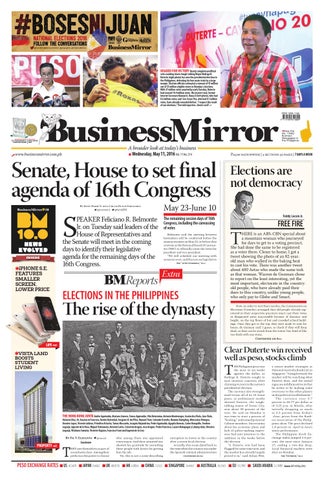
HEADED FOR VICTORY Nearly complete unofficial
vote counting shows tough-talking Mayor Rodrigo R. Duterte (right photo) has won the presidential election in the Philippines, defeating his four main rivals by a large margin. Election officials estimated a turnout of 41 million out of 55 million eligible voters in Monday’s elections. With 37 million votes counted by early Tuesday, Duterte had secured 14.4 million votes. His nearest rival, former Interior Secretary Manuel A. Roxas II (left photo), who had 8.6 million votes; and Sen. Grace Poe, who had 8.1 million votes, have already conceded defeat. “I respect the result of our elections,” Poe told reporters. Stories on B7. AP
MEDIA PARTNER OF THE YEAR
UNITED NATIONS
2015 ENVIRONMENTAL MEDIA AWARD LEADERSHIP AWARD 2008
BusinessMirror A broader look at today’s business
www.businessmirror.com.ph
n
Wednesday, May 11, 2016 Vol. 11 No. 214
Senate, House to set final agenda of 16th Congress
S
B J M N. C B F @joveemarie
@butchfBM
PEAKER Feliciano R. Belmonte Jr. on Tuesday said leaders of the House of Representatives and the Senate will meet in the coming days to identify their legislative agenda for the remaining days of the 16th Congress.
INSIDE
iPHONE S.E. FEATURES SMALLER SCREEN, LOWER PRICE
The remaining session days of 16th Congress, including the canvassing of votes Belmonte said the meeting between lawmakers will be conducted before the session resumes on May 23, or before they convene as the National Board of Canvassers (NBC) to officially count the votes for president and vice president. “We will schedule our meeting with senators soon, and discuss our legislative S “ C,” A
BMReports
ELECTIONS IN THE PHILIPPINES
D1
Teddy Locsin Jr.
FREE FIRE
T
HERE is an ABS-CBN special about a mountain woman who journeyed for days to get to a voting precinct. She had done the same to be registered as a voter there. Closer to home, I got a tweet showing the photo of an 82-yearold man who walked in the baking heat to cast his vote. There was another tweet about 400 Aetas who made the same trek as that woman. Warren de Guzman chose to report on the least interesting, yet the most important, electorate in the country: old people, who have already paid their dues to this country, unlike young people, who only pay to Globe and Smart. Now, in order to test their resolve, the Commission on Elections (Comelec) arranged that old people already registered in their respective precincts must cast their votes in designated areas inaccessible because of distance and height, on the top floors of hot and crowded school buildings. Once they got to the top, they were made to wait for hours, de Guzman said. I guess, to check if they will drop dead, so they can be struck from the voters’ list; kind of like two birds with one stone. C A
Clear Duterte win received well as peso, stocks climb
VISTA LAND BOOSTS STUDENT LIVING
T THE HONG KONG JUNTA Emilio Aguinaldo, Mariano Llanera, Tomas Aguinaldo, Vito Belarmino, Antonio Montenegro, Escolastico Viola, Lino Viola, Valentin Diaz, Dr. Anastacio Francisco, Benito Natividad, Gregorio H. del Pilar, Manuel Tinio, Salvador Estrella, Maximo Kabigting, Wenceslao Viniegra, Doroteo Lopez, Vicente Lukban, Primitivo Artacho, Tomas Mascardo, Joaquin Alejandrino, Pedro Aguinaldo, Agapito Bonson, Carlos Ronquillo, Teodoro Legazpi, Agustin de la Rosa, Miguel Valenzuela, Antonio Carlos, Celestino Aragon, Jose Aragon, Pedro Francisco, Lazaro Makapagal y Lakang-dula, Silvestre Legazpi, Vitaliano Famular, Vicenter Kagton, Francisco Frani and Eugenio de la Cruz B F V. E
PROPERTY
Elections are not democracy
May 23-June 10
The rise of the dynasty LIFE
P. | | 7 DAYS A WEEK
@elefantefil
Conclusion E1
T
HEY saw themselves as part of an exclusive class. Among their perks was the power to choose
PESO EXCHANGE RATES n US 47.2470
who among them was appointed town mayor. And their anointed one showed his gratitude by rewarding these people with favors for getting him the job. No, this is not a scene describing
corruption in towns in the country after a recent local election. Actually, this scene dated back to the time when the country was under the Spanish colonial administration C A
HE Philippine peso rose the most in six weeks against the dollar, as Rodrigo R. Duterte sought to ease investor concerns after claiming victory in the nation’s presidential election. The currency also strengthened versus all of its 10 Asian peers, as preliminary results showed Duterte, the toughtalking mayor of Davao City, won about 39 percent of the vote. He said on Monday it was time to start a process of “healing,” and named potential Cabinet members. Uncertainty about his economic plans and lack of policy-making experience had sent investors to the sidelines in the weeks before the election. “A Duterte win had been flagged for some time now, and the market has already largely priced it in,” said Julian Wee,
a senior market strategist at National Australia Bank Ltd. in Singapore. “Going forward, the market will be watching what Duterte does, and the initial signs are mildly positive in that he seems to be making some overtures to the other players in the political establishment.” T he c u r re n c y r o s e 0.7 percent to 46.77 per dollar as of 3:25 p.m. in Manila, after initially dropping as much as 0.3 percent from Friday’s close, prices from the Bankers Association of the Philippines show. The peso declined 1.8 percent in April in Asia’s worst performance. The Philippine Stock Exchange index jumped 2.6 percent, the most since January 27, ending a two-day drop. Local financial markets were shut on Monday. S “D,” A
n JAPAN 0.4362 n UK 68.0735 n HK 6.0856 n CHINA 7.2523 n SINGAPORE 34.4567 n AUSTRALIA 34.5565 n EU 53.7907 n SAUDI ARABIA 12.5989
Source: BSP (10 May 2016 )
BMReports BusinessMirror
A2 Wednesday, May 11, 2016
www.businessmirror.com.ph
ELECTIONS IN THE PHILIPPINES The rise of the dynasty from early 17th century until the late 19th century.
had no say in how things were to be run.
The ‘principalia’
Reform and revolution
FOR more than 200 years, this privileged class, known as the principalia, were the only people the Spanish colonial administration allowed to hold any sort of local administrative position in the towns and villages. The principalia were descendants of the original village leaders who agreed to cooperate with the newly arrived Spanish conquistadors in the mid-16th century. By the 17th century, the descendants of these tribal leaders were firmly entrenched in the lowest rungs of the Spanish colonial administration. Prominent among these descendants were the village leaders or cabeza de barangays. This group, usually composed of a dozen men, were known as the principales. They choose among themselves who will be the town mayor, or gobernadorcillo. The gobernadorcillo was the only one allowed to deal directly with the Spanish colonial administrators and officials, while the cabezas de barangay enjoyed generally cordial relations with the Spanish clergy. Thus, in a town of 1,000 natives, political power concentrated in the hands of just 12 men, chief among them was the gobernadorcillo. The principales kept their fellow natives in line. While doing so, they enjoyed the patronage of their Spanish bosses. The general native population
BY the 19th century, such a state of affairs was no longer acceptable. The rise of liberalism in Europe finally made its way to the Philippines. The Propaganda Movement was born. This movement sought reforms. Unfortunately, their movement failed. And with the failure of this movement, a revolt of the masses arose. The principales became involved in the revolt. Unfortunately, some among them only sought to protect and enhance their status.
Ballot padding
WHEN the time came to form a new government, members of the principales class took control of the proceedings of the Tejeros Convention. They sought to protect the traditional colonial practice of consolidating political power within their class. They refused to accept a nonmember of the principalia class as a peer. In their eyes, only a peer was qualified to hold political power. In what was possibly the first case of ballot padding, the integrity of the proceedings of the Tejeros Convention was compromised. There were more ballots than delegates. And when the ballots were counted, a principales was named president. He was Emilio Aguinaldo, a former gobernadorcillo. His chief rival, Andres Bonifacio, was
10 of 18
The number of votes a candidate in 1902 needs to win as mayor in a town with a population of 1,000, according to Jennifer Conroy Franco in her book Elections and Democratization in the Philippines elected secretary of the Interior. One of Bonifacio’s avowed goal for the revolution was to do away with as much of the Spanish colonial practices as possible. The principales saw the Revolution as a chance to increase their prestige and authority by replacing the Spaniards with people from their class. Bonifacio wanted to have the name “Filipinas” replaced, because it is in honor of a Spanish monarch. The principales, who felt threatened by Bonifacio’s changes, disagreed.
A coup and sham trial
THINGS came to a head. Since Bonifacio was not a principales, a delegate of the convention questioned Bonifacio’s qualification to hold any post in the new government. Insulted, Bonifacio invoked his authority as head of the revolution to declare the proceedings void. Aguinaldo’s supporters began circulating rumors that Bonifacio was actually a Spanish collaborator and
a thief. Acting upon these rumors, Aguinaldo had Bonifacio arrested and tried as a traitor of the revolution. Bonifacio was found guilty and executed. Several months after Bonifacio’s execution, Aguinaldo agreed to a truce with Spanish colonial authorities. In exchange for ending the revolt, the Spanish colonial government agreed to pay Aguinaldo and members of his Cabinet, as well as instituting reforms. Aguinaldo, along with his immediate circle, went into exile, while the remaining principales in the towns restored their status before the revolution. The archipelago remained a Spanish colony. The Spaniards did attempt to institute administrative reforms. However, the only people among the natives who had the educational and administrative background to implement these reforms were still the principales. Thus, the principales maintained their hold on power despite Spanish reforms.
Enter the Americans
THE outbreak of the war between the United States and the Spanish Crown brought in a new dimension. Aguinaldo sided with the Americans against Spain. He declared the Philippines an independent state on June 12, 1898. In doing so, he tried to insinuate himself with the US officials by adding in his declaration of independence that the country was under the protection of the US government. The people in Washington, D.C., however, had other plans. They negotiated directly with representatives of the Spanish Crown and the Spaniards ceded the Philippines, Guam and Puerto Rico to the Americans. Instead of finding himself as the new country’s head honcho who can deal with the newly arrived Americans, just as what he used to do with the Spaniards, Aguinaldo found himself in the middle of another war. While some in his Cabinet actively sought to continue fighting a war with the US, many of Aguinaldo’s allies thought differently. They sought to end the fighting based on amicable terms, the same formula that they used with Spain. Bitter infighting occurred within the Aguinaldo administration. In the end, Aguinaldo’s loyalists had those people who disagreed with them removed quietly. Those who refused to do so were murdered. As a reward for keeping him in power, Aguinaldo protected his loyalists. Unfortunately for Aguinaldo, these “loyalists” continued to undermine the war against the Americans. In the end, Aguinaldo, whom the Americans captured, executed an oath of allegiance to the US on April 19, 1901. The other Filipino leaders who refused to swear allegiance to the US were exiled to Guam. Official hostilities ended in 1902, when US President Theodore Roosevelt offered a general amnesty to Filipinos. Those who refused to lay down their arms were branded as bandits.
The ‘principalia’ under the US
IN order to assert administrative control over the archipelago, Americans tapped people who had previous administrative experience into positions of local authority. John Ray Ramos, a heritage-conservation advocate and historian, said under the first rules on suffrage at the beginning of American rule, only men who were at least 23 years old, owned real property worth at least $250, paid an annual tax of at least $15 annually, had held a municipal position under Spain and could read or write in either Spanish or English were eligible to vote. That meant that only people qualified to vote and run for municipal elections were the members of the principalia class. According to Jennifer Conroy Franco in her book Elections and
C
Democratization in the Philippines, these early restrictions resulted in an extremely small electorate under during the first municipal elections under the US rule in 1902. “By one account, in 390 municipalites with a total population of 2,695,801, there were a total of 49,523 persons who had qualified as electors, or 18.37 electors, to 1,000 inhabitants,” Franco wrote. This was a situation tailormade for the perpetuation of the principalia class. Coupled with the then existing rules on suffrage, the principales easily maintained their hold on power. They were the town’s large landowners, the only people who can afford to pay such an annual tax, the only people who held administrative posts under Spain, aside from being able to speak English and Spanish fluently. Put simply, an average of only 18 people in a town of 1,000 could vote for mayor. This was little changed from the previous practice of 12 people deciding who among them can become gobernadorcillo during the Spanish colonial period. When the US allowed Filipinos to assume provincial posts, those elected to municipal posts were the ones to choose who among them would be provincial governor. This expanded the power of the principalia from the towns to the provincial level. The Americans inadvertently allowed the principalia’s patronage politics to expand. And when the Americans opened the National Assembly for Filipino voters in 1907, the rules on suffrage haven’t changed. “Only 104,996 Filipinos, or 1.15 percent, of the total population was qualified to vote in the 1907 elections,” Franco wrote in her book. A check with the records of the National Historical Commission of the Philippines confirmed Franco’s account. Because of the situation, the campaigning for a municipal office was a simple matter. In 1902, to win as mayor in a town with a population of 1,000, a candidate only has to get 10 out of 18 votes. By 1907, a person who wants to win the post of governor only has to win the nod of a majority of town mayors in a province. For example, if that province has 25 towns, the candidate only has to get the nod of 13 mayors to be governor. It was network that encouraged the development of political alliances, even between rival factions. The principalia was a class that survived the downfall of the Spanish colonial administration, thrived during the revolution and adapted well to the American occupation of the Philippines. US officials in the Philippines later sought to expand the number of voters in the country. The rules on suffrage were changed by the time of the Jones Act, otherwise known as the Philippine Autonomy Act of 1916. R amos ex plained that the change consisted merely of allowing Filipinos who can read and write any of the dialects fluently aside from English and Spanish to vote. The same other restrictions on landownership and taxes remained. “This changed brought the number of voters in the colony to a mere 9 percent of the entire population,” Franco wrote in her book. Records showed that by 1916, the Philippines had a population of 9,542,000. The statistic Franco cited meant that the country had a little over 850,000 people who were qualified to vote. Despite the expansion, it kept the right to vote largely within the landed class. That meant that most of the political campaigning was done by ward leaders. T hese ward leaders had the responsibility of convincing the voters who lived in the ward leaders’ area to vote for a particular candidate. It was a simple matter for the ward leaders to tell the relatively few dozens of voters to gather in the town plaza and tell them who to
vote for. At the plaza, favors were asked and promises made. The practice of candidates barnstorming in the towns was unknown. “With the promulgation of the 1935 Commonwealth Constitution, the property restrictions were dropped, but literacy and gender requirements were retained,” Franco added. Ramos said the country’s voting population expanded in 1936, when Filipino women won a plebiscite granting them the right to vote. Due to the literacy requirement, only a mere 11 percent of the population at that time were qualified to vote, even after women were granted the right to vote. According to Franco, the restrictiveness in voting qualifications came from the principalia class, who had gained their posts in previous elections. This gave rise to what was described in Franco’s book as an “electoral style of dexterous manipulation.” Franco cited the memoirs of former US Vice Governor in the Philippines Joseph Ralston Hayden. “From 1903, a very large proportion of citizens, who possessed the electoral qualifications, actually registered,” Hayden wrote. “Not only is the franchise highly esteemed, but in the early days, a man’s vote possessed a distinct material value in many districts. Furthermore, in many provinces, the rival political factions saw to it that every possible voter qualified and, in many instances, forced onto the register additional persons who were not legally entitled to vote. An especially common method was to secure the registration of a voter under the property qualification by grossly overestimating the value of his possessions.” “On the other hand, some persons who were legally entitled to be registered were kept off the books by partisan officials,” Hayden added. This was a principalia practice of preventing people from outside their class from voting or running for office. Franco claimed that US colonial officials in the Philippines did not take a serious effort to enforce the formal rules governing political competition. “Such practices quickly became a standard feature of elections in the Philippines,” Franco wrote. “ The carefully orchestrated introduction of national political institutions was clearly intended to ensure that national political power would belong exclusively to members of the elite, who as the main beneficiaries of US colonial policies, were also expected to be the most reliable guarantors of US interest in the Philippines,” Franco wrote. “In creating the national political arena, US colonial officials had consciously built upon existing rival networks of competing factions of the elite that had dominated municipal politics since the 19th century.” And it was the principalia class that had been dominating municipal politics since the Spanish colonial era, Ramos said. “In effect, this created a controlled environment for members of the native land-based elite to build and expand the political resources and develop the political skills needed to compete electorally and gain access to the national political arena in the future,” Franco wrote. “The most politically ambitious members of the Filipino elite used the opportunity to establish and extend rival elite alliances and patronage networks, to gain experience in managing government affairs, and to win the confidence of top US colonial officials.” Even after the introduction of the popular vote after World War II, the practices of the principalia class, especially that of political patronage, still endures to this day. One rarely hears the word principales nowadays because they are now more popularly identified as “political dynasty.”
BMReports BusinessMirror
news@businessmirror.com.ph
Wednesday, May 11, 2016 A3
Bt cotton rollout may get green light this year
T
B M G C. P
@ _enren
HE Philippine Fiber Industry Development Authority (PhilFida) on Tuesday expressed confidence that the commercialization of Bacillus thuringiensis (Bt) will be given the go signal in the fourth quarter of 2016. PhilFida Executive Director Clarito M. Barron said Bt cotton would have to hurdle an environmental risk assessment—an additional requirement in the new joint department circular (JDC) for genetically modified (GM) crops, which replaced Administrative Order (AO) 8. “Under the new JDC, there are already revised guidelines for the impact assessment of every GM crop on the environment. That’s what we are working out,” Barron said, adding that multilocation field trials of Bt cotton have concluded. He noted that the old guidelines authorized only the Department of Agriculture (DA) to evaluate GM crops. “The new JDC requires the involvement of other national agencies for its approval. In this case, the Department of Environment and Natural Resources will be the one on top of the environmental risk assessment,” Barron said. The new JDC replaced AO 8, which was nullified by the Supreme Court (SC) last December. The SC ruling delayed the propagation of Bt cotton. Barron said the PhilFida will be hard-pressed to reach its target of planting 50 hectares of land with Bt cotton to jump-start the propagation of the GM variant this year. “If Bt cotton gets approved for commercialization in the last quarter of this year, then definitely, planting would be delayed. Planting would start in 2017,” he added. Barron said the target of planting 20,000 hectares of land with Bt cotton by 2020 may be delayed by a year. It has been more than a decade since the clamor to introduce Bt cotton in the country has started. The DA initiated efforts to introduce and evaluate Bt cotton varieties locally in 2004. However, field trials were repeatedly delayed due to a number of issues, such as the feasibility of selling Bt cotton seeds in the
11.32 MT The volume of cotton produced by the Philippines in 2014 Philippines. Bt cotton will address the infestation of bollworm, an insect that causes as much as 60-percent yield loss in cotton plantations. The production cost incurred by farmers would be reduced, as they would no longer need to buy pesticides to control bollworm, Barron said. “The reduction in yield loss and the use of insecticides and pesticides will therefore increase farmers’ income and profit,” he said. International Service for the Acquisition of Agri-Biotech Applications (ISAAA) Global Coordinator and Southeast Asia Director Randy Hautea said the expected commercialization of Bt cotton in the country is a “welcome” development. “Cotton is probably the biggest pesticide and insecticide user among all crops because of the issue of the bollworm. I’m sure, local cotton growers would welcome its commercialization,” Hautea said. The PhilFida said the rollout of Bt cotton in the Philippines could help fast-track the revival of the local textile industry and make the country self-sufficient in cotton. Data from the Philippine Statistics Authority (PSA) showed the country’s cotton production in 2014 reached 11.32 metric tons (MT), 79.54 percent lower than the 2013 output of 55.34 MT. With the propagation of Bt cotton, the PhilFida said about 60,000 MT of cotton could be harvested from 20,000 hectares of land. This volume is seen to wipe out the country’s imports of lint estimated at 40,000 MT a year valued at P3 billion.
BULLISH MARKET A trader at the Philippine Stock Exchange trading floor in Makati City gives a thumbs-up sign after the market closed at 7,174.88, up 183.01 points, or 2.62 percent, on Monday. See related story on A1. NONIE REYES
Changes to Amla, bank secrecy eyed B B C @BcuaresmaBM
B
ANKING and finance officials have proposed to leaders of both houses of Congress to amend the country’s Anti-Money Laundering Act (Amla) and revise the bank deposit secrecy law for tax-evasion purposes. The proposal was prepared jointly by the Department of Finance (DOF), the Anti-Money Laundering Council (AMLC) and the Bangko Sentral ng Pilipinas (BSP). “Amendments to the Amla have been proposed in the last two years and were made more urgent by recent financial controversies that have exploited the weakness in the country’s tax and financial system’s legal framework: the Bangladesh Bank cyber heist involving a local bank and casinos; the Panama Papers exposing offshore bank transactions from across the globe that may have avoided or evaded
domestic taxation; the “derisking” phenomenon, where foreign banks are closing the accounts of our money-transfer operators abroad, which may double the cost of remitting money to the Philippines,” the DOF said in a statement. Among the more salient proposed amendments to Republic Act (RA) 9160, also known as the Amla of 2001, is to include casinos, among others, as mentioned in the Financial Action Task Force (FATF) recommendations, as covered entities under the law; as well as the inclusion of tax evasion, among other crimes, as a predicate crime to money laundering. The government also said the proposal aims to improve the ability of AMLC to safeguard the financial system from money-laundering activities. This is by authorizing the AMLC to issue subpoenas, by allowing the council, instead of the Court of Appeals, to issue ex parte freeze orders
PSALM lists ‘hurdles’ in privatization of power assets
T
B L L
@llectura
HE Power Sector Assets and Liabilities Management Corp. (PSALM) has yet to line up the inventory of power assets up for sale this year, pending further discussions with concerned agencies. Under Republic Act 9136, or the Electric Power Industry Reform Act of 2001, PSALM is mandated to manage the privatization and maintenance of National Power Corp.’s (Napocor) power-generation assets, liabilities and contracted capacities. Among the power assets that are yet to be privatized are the 850-megawatt (MW) Sucat Thermal Power Plant; the 200-MW Mindanao Coal-Fired Thermal Power; the 982-MW AgusPulangi hydropower complex; the 40-MW “security capacity” of the Unified Leyte Geothermal Power Plant (ULGPP) and the bulk capacity of the ULGPP itself. “There is no definite bid schedule yet for Unified Leyte bulk and security energy this year because we need further consultation with [the] DOE [Department of Energy] on policy directions,” PSALM Officer in Charge Lourdes Alzona said in an interview. The ULGPP is in the Visayas. The PSALM Board still needs to determine if the 40-MW security capacity would be bundled to the remaining 160 MW of ULGPP’s bulk capacity that has yet to be privatized. PSALM is also looking at a negotiated sale of the bulk capacity of ULGPP after only one bidder—Unified Leyte Geothermal Energy Inc., a subsidiary of Lopez-led Energy Development
Corp.—participated in the bidding activity. In the case of Mindanao coal, PSALM said it is awaiting the go ahead of the DOE. “We are continuously consulting the DOE with regard to power demand-supply outlook in Mindanao before further presentation to the PSALM Board will be made this year,” Alzona said in the same interview. Mindanao coal privatization has been deferred taking into consideration the power supply outlook because of the El Niño, and the target schedule for commissioning of new capacities in 2016. Alzona said PSALM fully supports the position of the DOE to reschedule the bidding on a later date when the power-supply outlook is already at a comfortable level. The power plant supplies about a fifth of Mindanao’s power requirements. An early auction, at a time when supply is tight, could cause price shocks, DOE officials said, adding that the winning bidder might dictate electricity rates, which, in turn, could translate to higher electricity rates for the consumers. Located in Misamis Oriental, the Mindanao coal plant was constructed in 2006 for a 25-year Power Purchase Agreement under a build-operate-transfer scheme that ends in 2031 with Steag SPI. The power plant is 51-percent owned by Steag; 34 percent, Aboitiz Power; and 15 percent, La Filipina. For the 982-MW Agus-Pulangi hydropower complex, which provides more than half of Mindano’s current electricity capacity, Alzona said
the facility is unlikely to be privatized this year. “Agus-Pulangi [has not been lined up for privatization], as there is still need for consultation with Congress and stakeholders. PSALM, meanwhile, is studying sale structure options for these power assets,” Alzona added. The hydro facility is tentatively scheduled for privatization in 2017. However, the sale is being opposed by some Mindanao lawmakers and consumer groups, fearing it could result in power-rate hikes. The Mindanao Development Authority strongly opposed the privatization of Agus-Pulangi power complex, and said this should be operated by the proposed Mindanao Power Corp. It also urged Congress to pass a law that will allow Mindanao to manage and operate the crucial power facility in the region before the end of the Aquino administration. The PSALM Privatization Bids and Awards Committee, meanwhile, has yet to convene to discuss the next steps for the sale of the decommissioned 850-MW Sucat Thermal Power Plant. PSALM earlier declared the second round bidding for the structures, plant equipment, auxiliaries and accessories of the Sucat plant, as a failed bidding after the three qualified bidders did not meet the reserve price set by the PSALM Board. Initially, four bidders submitted their offers for the Sucat sale. However, one bidder was disqualified after it was found noncompliant with the legal requirements of the bidding process. The three bidders who were qualified in the bidding were Riverbend Consolidated Mining Corp., VPD Trading and Sta. Clara International.
with respect to certain unlawful activities, and by adding unlawful activities that are exempted from the requirement of a court order before a bank inquiry may be conducted. The proposed bill also increases the monetary penalty for administrative sanctions. “The Philippine banking and financial system remains stable and strong. To respond to emergent risks and challenges, we are proposing a thorough update of the Anti-Money Laundering Act to further strengthen our regulatory institutions in safeguarding a robust financial system,” BSP Governor Amando Tetangco Jr. said. Also among the amendments include the designation of the BSP as the supervising authority over foreign-exchange dealers, money changers, and remittance and money-transfer businesses for purposes of the Amla. T he DOF also proposed to amend
RA 1405, or the bank-secrecy law, and RA 6426, otherwise known as the Foreign Currency Deposit Act of the Philippines, to lift restrictions on bank secrecy of peso deposits and foreign currency deposits for tax purposes. “We are one of only three countries in the entire world where our tax administration cannot access bank transactions for taxevasion purposes. We are one of only two countries in the entire world where tax evasion is not a predicate crime to money laundering,” Finance Secretary Cesar V. Purisima said. Purisima noted that, while the tax gap has narrowed since 2009, the country still has a long way to go in plugging the 4 percent of GDP lost to tax evasion. “It’s high time we keep up with international standards and pierce the veil the unscrupulous few have conveniently hidden behind,” the finance secretary said.
BMReports BusinessMirror
A4 Wednesday, May 11, 2016
news@businessmirror.com.ph
Duterte seen as emancipator, looming dictator
R
ODRIGO R. DUTERTE, the bombastic mayor of a major southern city, was heralded on Tuesday as president-elect of the Philippines after an incendiary and populist campaign that projected him alternatively as an emancipator and a looming dictator.
“Our people have spoken and their verdict is accepted and respected,” outgoing President Aquino’s Spokesman Herminio B. Coloma Jr. said in a statement. “The path of good governance...is already established as all presidential candidates spoke out against corruption.” For mer Inter ior Sec ret a r y Manuel A. Roxas II, who was running second behind Duterte in the unofficial vote count following Monday’s election, conceded defeat. “Digong, I wish you success,” Roxas said at a news conference, using Duterte’s nickname. “Your victory is the victory of our people and our country.” Duterte’s harshest critic also conceded that the mayor, known for his off-color sexual remarks and pledges to kill criminal suspects, had emerged the unquestioned winner. “I will not be the party pooper at this time of a festive mood,” Sen. Antonio F. Trillanes IV, who has filed a plunder complaint against Duterte, told The Associated Press. “I will step back, listen to his policy pronouncements. This time we don’t expect a
briefs CHINA READY TO WORK WITH NEW ADMIN ON SEA ROW CHINA said on Tuesday that it hopes to work with the Philippines’s new government to resolve territorial disputes in the South China Sea, but insisted the onus is on Manila to lower tensions. Beijing hopes the Philippines will “meet China halfway, taking concrete measures to properly deal with the disputes so as to put the ties of the two countries back on the track of sound development,” Foreign Ministry Spokesman Lu Kang said at a daily news briefing. Lu said that, while the two countries have a traditional friendship, bilateral relations have been "hit by major setbacks in recent years, due to reasons known to all”—a reference to moves by the Philippines to assert its claims and activities by the US challenging China’s actions. Beijing and Manila have for years accused one another of infringing on each other’s territory in the South China Sea, which China claims virtually in its entirety. President-elect Rodrigo R. Duterte has said he would negotiate directly with China on the dispute. However, he also said that if negotiations fail, he would sail to one of China’s newly built artificial islands and plant the Philippine flag on it. AP
MALACAÑANG ASSURES SMOOTH TRANSITION
MALACAÑANG on Tuesday assured a smooth transition of power to the next president, who would likely be Davao City mayor and PDP-Laban standard-bearer Rodrigo R. Duterte, according to the partial and unofficial results from the Commission on Elections (Comelec). Communications Secretary Herminio B. Coloma Jr. said the Aquino administration had always been willing and ready to work with the incoming administration. “We are ready to cooperate and work with the incoming administration and all that we have done in the last six years to strengthen our government structure to empower and to capacitate our government employees have all been geared toward bequeathing or transferring to the next administration a government work force and a government that is more capable, more responsive and that will be more effective in delivering essential services to our people,” Coloma said in a press conference. David Cagahastian
stand-up comedy act but a president who will address the nation.” Duterte, 71, himself has not spoken since casting his vote on Monday, and remained at his home in Davao, on the southern main island of Mindanao. Results from a semiofficial count gave Duterte an unassailable lead, thrusting him into national politics for the first time after 22 years as mayor of Davao and a government prosecutor before that. In those two jobs, Duterte gained notoriety by going after criminals, although he was accused of carrying out hundreds of extrajudicial killings. This earned him the nickname “Duterte Harry,” a reference to the Clint Eastwood movie character with little regard for rules. He has also been compared to Donald Trump, the US Republican presumptive presidential nominee, for his propensity for inflammable statements. In the election for vice president, who is separately elected in the Philippines, the son of late dictator Ferdinand E. Marcos was trailing by a hair to a political neophyte, Rep. Leni Robredo, who is backed by outgoing
Digong, I wish you success. Your victory is the victory of our people and our country.”—R
DUTERTE
President Aquino. During the three-month campaign, Duterte made audacious promises to eradicate crime and corruption within six months. His explosive outbursts and curses against the inequality and social ills that bedevil the Filipino everyman resonated among different class levels of the people that his big political rivals clearly underestimated, until he began to take a strong lead in opinion polls in the final weeks of the campaign.
Election brings change PHL doesn’t need
L
IKE Donald Trump, to whom he’s often compared, the Philippines’s apparent president-elect Rodrigo R. Duterte won over voters with a crude and bombastic persona—or, if you will, his big mouth. What the country he may soon inherit needs most, however, is a steady hand. Duterte, a mayor who has proudly advertised his links to vigilante death squads in Davao City and threatened a “bloodbath” for criminals once he’s in power, has tapped into a deep vein of frustration with the political status quo. In truth, though, the Philippines are in better shape than they’ve been in for years. The country is forecast to grow faster than its neighbors this year, aided by low oil prices and continued healthy consumption. Remittances are strong, while a booming outsourcing sector could soon replace them as the country’s largest source of dollar revenues. Outgoing President Aquino can’t take credit for all this good fortune. But he’s unquestionably leaving the country on a stronger footing than he found it six years ago. The Philippines, the former “sick man of Asia,” now boasts a current-account surplus, an investment-grade credit rating, improved competitiveness and steady growth in foreign investment. Aquino has gone after tax cheats and scored notable victories against official corruption. Aquino, the son of former President Corazon C. Aquino, is a likable, but diffident leader. He has built his record on sober and unflashy reforms. His successful efforts to widen the tax base have helped shrink the budget deficit. Changes, such as introducing online bidding for government contracts, helped convince ratings agencies to give the country its first investment-grade rankings. He’s rolled out a cash-transfer program for the poor and boosted infrastructure spending to around 5 percent of GDP this year. Certainly, growth hasn’t trickled down enough: A quarter of Filipinos still live in poverty, and Manila’s crumbling and traffic-choked roads remain a nightmare. But change will require patient work and coalition building. Duterte will need Congress’s help if he wants to pursue land reforms that would spread growth beyond Manila, or if he’s to open up more sectors of the economy, including mining, to greater foreign investment. He can’t fix the power sector—critical, if the country is to build up its manufacturing industries—on his own. Yet, much like Trump in the United States, Duterte has done nothing to improve his standing among legislators, whom he largely derided during the campaign as trapos, or traditional politicians, sucking the country dry. Geopolitically, his election comes at a fraught moment. A United Nations tribunal is set to rule soon on a case the Philippines brought against China’s expansive maritime claims in the Spratly Islands chain. Even as the Philippines has welcomed US military forces back to its shores for the first time in decades, Duterte has issued provocative and contradictory policy statements—in one breath threatening to ride a jet ski out to a disputed reef to plant the Philippine flag, in another offering to negotiate concessions with China in return for infrastructure investment. Either move would undermine US efforts to build regional support for the rule of law in the South China Sea. As Indonesia’s President Joko Widodo, himself a successful former mayor, might attest, skills that are effective locally don’t always translate at the national level. A single figure, no matter how determined, can’t dictate outcomes the way he or she might in a city or town. What Filipinos need from their next leader isn’t brute strength, but consistency and pragmatism, to reassure markets and to make deals possible. While Duterte hasn’t shown those abilities to date, part of his appeal is his unpredictability. He should aim to surprise everyone. Bloomberg Editorial
He captured domestic and international attention with speeches peppered with obscene jokes about sex and rape and anecdotes about his Viagra-fueled sexual escapades, and for undiplomatic remarks about Australia, the United States and China, all key players in the country’s politics. He has not articulated an overall foreign policy, but has described himself as a socialist wary of the US-Philippine security alliance. He has worried members of the
armed forces by saying that communist rebels could play a role in his government. When the Australian and American ambassadors criticized a joke he made about wanting to be the first to have raped an Australian missionary who was gang-raped and killed by inmates in a 1989 jail riot, he told them to shut up. He said he would talk with China about territorial disputes in the South China Sea, but if nothing happened, he would sail to an
artificial island newly created by China and plant the Philippine flag there. China, he said, could shoot him and turn him into a national hero. He has also threatened to form a one-man rule if legislators in the Congress oppose him. President Aquino went public against Duterte late in the campaign, saying the mayor may endanger the country’s hard-fought democracy and squander economic gains of the last six years, when the Philippine economy grew at an average of 6.2 percent, one of the best rates in Asia. Aquino, whose parents were democrac y champions who helped topple the senior Marcos, also campaigned against Marcos Jr., who has never clearly apologized for economic plunder and widespread human-rights abuses under his father. Filipinos have been hypersensitive to potential threats to democracy since they ousted the elder Marcos. On Monday Duterte was asked to comment about his image as a mass-murder advocate. He replied without elaborating, “I’m sure that there will be a resurrection one of these days.” AP
Next job of new president is winning over investors We’re looking for an administration that will have A continuity—almost seamless—
FTER defeating his opponents in a heated presidential election in the Philippines, Rodrigo R. Duterte is seeking to calm markets with a call for “healing,” as he seeks to win over Filipinos and investors watching closely for how he will manage the economy. “Past days have been virulent, I’d like to reach my hand to my opponents,” Duterte, 71, said in a briefing in Davao City after Monday’s voting. “Let’s begin healing now.” He claimed victory after preliminary results showed he secured about 39 percent of the vote, and named some potential cabinet members. The early response from markets was a positive one. The peso strengthened against the dollar and all its major Asian peers. The Philippine Stock Exchange Index rose for the first time in three trading sessions, bucking the trend for emerging-market equities that extended their longest slide this year. Volatility in local shares will persist as investors gain familiarity with Duterte, according to the Bank of the Philippine Islands. “There will be a honeymoon period moving forward, as investors give Duterte the benefit of the doubt,” said Smith Chua, who helps manage about $10.6 billion as chief investment officer at the nation’s secondlargest money manager. “His popularity is very resounding and investors are interested to see what he will do with this strong popularity and how he will conduct peace with other parties and run government.” The peso rose 0.4 percent to 46.89 per dollar as of 11:48 a.m. in Manila, prices from the Bankers Association of the Philippines show. The currency has strength-
particularly in infrastructure.” —F
ened more than 1 percent from a two-month low reached on Friday. The benchmark stock index gained 0.5 percent. Local markets were shut Monday. The country’s dollar-denominated bonds due in 2041 advanced for a fourth day, sending the yield down three basis points to 3.26 percent, according to Bloomberg Bond Trader prices. Uncertainty about Duterte’s economic plans and his lack of policy-making experience had sent investors to the sidelines in the weeks before the election. Duterte told reporters on Monday he may appoint Carlos Dominguez as finance chief or to head the transport department. Dominguez was agriculture secretary in the cabinet of late President Corazon C. Aquino. He owns Marco Polo Hotel and is a childhood friend of Duterte. “We’re looking for an administration that will have continuity—almost seamless—particularly in infrastructure,” John Forbes, senior adviser at the American Chamber of the Philippines, said in an interview with Bloomberg TV’s Haslinda Amin. “The first challenge is going to be infrastructure because the growth of the economy has produced much more demand on roads and airports and seaports.” Once labeled Asia’s “sick man,” the nation of 101 million people has earned World Bank praise
as the continent’s “rising tiger” under outgoing leader Benigno Aquino III. It posted average annual growth of 6.2 percent over the past six years, the fastest pace since the 1970s. Despite those gains, poverty rates remain high and Duterte tapped rising discontent among millions of voters who feel they haven’t benefited from Aquino’s reforms. Faster growth and 4 million jobs created during Aquino’s six-year term led to record car sales, but also clogged up Manila’s already gridlocked roads as infrastructure spending failed to keep pace with economic expansion. Duterte has been making positive signals to investors. He told online news web site Rappler in an interview published on Monday that he will consider raising the 40-percent foreign-ownership limit in certain industries to win over investors. He also pledged to work with countries in the region to boost trade. “Our mayor has been successful in making Davao investor-friendly,” Bonifacio Tan, president of Davao Chamber of Commerce, said in an interview. “The mayor really does what he says. The mayor may be a bit emotional, when he speaks, when he gets mad, he sometimes expresses foul language. The way he talks does not show the real government official he will be.” Bloomberg News
news@businessmirror.com.ph
PHL, Thailand return to WTO on tobacco settlement case B C P @c_pillas29
M
ANILA is now formally demanding Bangkok’s compliance to a World Trade Organization (WTO) ruling to adjust its tax treatment on imports of cigarettes from the Philippines before the multilateral trading body. This is through the “compliance review” that was submitted by the Philippines to the WTO’s dispute settlement body on May 4. This request will entail consultations with Thailand under Article 21.5 of the Dispute Settlement Understanding (“compliance panel”) to review Thailand’s compliance to a 2011 WTO ruling. The formal request may also be seen as an implementation case. An implementation case, under Article 21.5 of the WTO’s Dispute Settlement Understanding, is a formal demand for compliance that a complainant-country can initiate if it deems that the losing party in a dispute-settlement case is not observing the WTO ruling. The Philippines has been shuffling its feet in formally requesting compliance in recent years, saying the country should give space to the Thai government, as its authorities were caught in a separate legal battle with Philip Morris Thailand. The Philippines, in 2008, questioned Thailand’s fiscal and customs measures affecting its cigarette exports (mostly from the local unit of Philip Morris) at the WTO. The Philippines claimed that its cigarettes are being excessively taxed versus Thailand’s domestically manufactured counterpart, and being slapped with burdensome administrative requirements. Thailand subjected resellers of imported cigarettes to value-added tax-related administrative requirements, but exempted resellers of domestic cigarettes from these. The Philippines also claimed Thailand’s customs-valuation measure is inconsistent with the WTO’s Customs Valuation Agreement. The WTO ruled in favor of the Philippines. It said Philip Morris’s declared import value was correct, and ordered Thailand to comply with the recommendations and rulings of WTO’s disputesettlement body. However, Thai authorities recently slapped a criminal case against Philip Morris Thailand for alleged tax evasion on imports of cigarettes sourced from the Philippines, threatening the cigarette manufacturer with a $ 2.2-billion fine. The import transactions covered by the case may have overlapped those covered by the WTO ruling, thus, inadvertently dragging back the Philippines’s WTO case into the discussions.
AseanWednesday BusinessMirror
Editor: Max V. de Leon • Wednesday, May 11, 2016 A5
Indonesia coffee crop may tumble most in five years on El Niño effect
C
OFFEE production in Indonesia will probably drop 10 percent this year after dry weather, caused by the worst El Niño in almost two decades, damaged some crops and delayed the harvest.
Farmers in the world’s thirdlargest grower of robusta may reap 570,000 metric tons of beans in the season that started April 1, down from a record 636,300 tons a year earlier, according to the median of five traders estimates compiled by Bloomberg. That would be the steepest decline since 2011-2012, data from the US Department of Agriculture (USDA) showed. A smaller Indonesian crop will cut supply of robusta beans used by Nestlé SA, potentially boosting a rally in futures in London this year. The strongest El Niño since 1997-1998 was largely responsible for dryness in the country’s main coffee-producing region of southern Sumatra last year, according to Indonesia’s Meteorology, Climatology and Geophysics Agency. “Drought caused a crop failure in the lowland of Sumatra, the trees withered and dried and flowering has failed,” said Moelyono Soesilo, purchasing and marketing manager at PT Taman Delta Indonesia, a Semarang, Central Java-based exporter. “We’re now waiting for the harvest in the highland to start in June or July.” The harvest normally starts at
570,000 MT The projected coffee yield of Indonesia in the season that started April 1, down from a record 636,300 metric tons a year earlier the end of May or early June on the higher ground of Southern Sumatra, Soesilo said.
Coffee regions
THE provinces of Lampung, Bengkulu and South Sumatra in the southern tip of Sumatra island are the main robusta areas in Indonesia, producing about 75 percent of the country’s output. Beans from the area are shipped from Panjang port in Lampung. Arabica is grown mostly in northern Sumatra and Java, and accounted for 16 percent of the total harvest in 2014-2015, USDA data showed. Robusta coffee 0.9 percent to close at $1, 635 a ton on ICE Futures Europe on Monday, trimming the gain this year to 6.9 percent. Futures slumped 20 percent last year. The dry period may soon give
NEED FOR A SEXUAL-VIOLENCE LAW Activists light candles during a vigil for a teenage girl who was raped and murdered by 14 men in
Bengkulu province on Sumatra island, outside the presidential palace in Jakarta, Indonesia. The attack on the girl in western Indonesia on April 2, which went largely unnoticed at a national level until social-media users began highlighting its brutality, has reignited calls in Indonesia for a sexualviolence law that is languishing in Parliament to be enacted. AP
way to normal weather as there is a 50 percent chance for La Niña weather from August to October, with its impact to be seen by the end of year, said Adi Ripaldi, head of climate analysis and information at the Indonesia’s meteorology agency.
Rainy season
“THE weather is likely to be normal starting June or July, as El Niño is
F
La Niñas occur when the surface of the Pacific cools, bringing on an atmospheric reaction that can upset global weather patterns and move commodity and energy markets. In addition to helping cause colder winters across the northern US, the phenomenon also has meant heavier monsoons in India, as well as more rain across parts of Indonesia, Australia and Brazil. Bloomberg News
UN vows to assist Vietnam tackle drought, salinity
T
THAI FM IN MYANMAR Thai Foreign Minister Don Pramudwinai (second from left) shakes hands with his Myanmar counterpart and de-facto leader Aung San Suu Kyi following their meeting in Naypyitaw, Myanmar, on Monday. Pramudwinai is visiting Myanmar as part of his regional tour. AP
Investors staying away from Thai junta bond
OREIGN investors are shying away from Thai government bonds after their extra yield over US Treasuries evaporated, bringing an end to a record ninemonth rally. An index of baht notes fell in April after surging 12 percent from July through March. The yield premium on Thailand’s 10-year securities is near zero, compared with more than 2 percentage points four years ago, and the gap with US bonds maturing in 2046 has turned negative. The currency’s gains are slowing too following the best quarterly advance since early 2013. The appeal of the Southeast Asian nation’s debt is likely to fade further, as the central bank seems to now favor spurring growth via stimulus spending rather than cutting borrowing costs, while the US is poised
seen fading through the end of May,” Adi said by phone on May 3. Indonesia may see a very wet rainy season if La Niña happens, he said. The possibility of a prolonged rainy period is bad, as well, and can damage bean quality as most farmers rely on the sun to dry cherries by spreading them on the ground, said Hutama Sugandhi, head of Indonesian Coffee Exporters’ Association.
to raise interest rates. A 15-month bout of deflation also ceased in April, removing support for bonds in a country that remains under military rule two years after a coup—with no set date for elections. “As the Federal Reserve embarks on further rate hikes this year, we expect US Treasury yields to slowly creep up,” said Edward Ng, a Singapore-based fixed-income portfolio manager at Nikko Asset Management Co., which oversaw 18.5 trillion yen ($171 billion) globally at the end of 2015. “We are maintaining our underweight in Thai bonds and will look to further reduce our holdings when inflation shows stronger signs of picking up in the next few months.” Bank of Thailand Governor Veerathai Santiprabhob said in March that fiscal policies will do more to improve the economy than lowering
borrowing costs, and the government’s stimulus spending should show results in the second half. The central bank has kept the repurchase rate at 1.5 percent since cutting it in April last year. It next meets on May 11. The finance ministry cut the 2016 GDP growth forecast to 3.3 percent from 3.7 percent, last month. The Washington-based International Monetary Fund projects a lower 3 percent. Thailand’s yield curve flattened after the 30-year yield dropped more than a 100 basis points in 2016 to 2.46 percent, while that for 10-year paper declined 75 points to 1.77 percent. Plentiful money supply is supporting demand with the threemonth money-market rate near the lowest in more than five years.
Overseas investors turned net buyers of Thai debt this month after offloading $2.9 billion in April. “The rally in the first three months of this year was more based on liquidity than anything else,” said Pongtharin Sapayanon, a Bangkokbased fixed-income manager at Aberdeen Asset Management Plc. overseeing $421 billion worldwide. “If yields go up, we will see buying back in from locals, because there are more positives than negatives to be invested in Thai bonds.” He’s considering adding to his holdings from the current “almost neutral” position against the benchmark used to measure performance should yields rise “significantly.” It’s unlikely there will be any big selloff in long-term bonds because there’s still large demand from insurers, he said. Bloomberg News
HE UN deputy secretarygeneral has offered assistance to Vietnam in coping with the ongoing drought and saline intrusion, which affected 2 million people in the southern and south-central region of the country. Jan Eliasson, who recently completed a fact-finding trip to Mekong Delta’s BenTre Province, told local media during a news briefing last Friday that the UN would allocate a budget of $48.5 million to support Vietnam. The UN and partners have called on the international community to offer emergency assistance to Vietnam in fighting drought. The UN official said he offered support to the efforts now being taken by the UN secretary-general to assist Vietnam in adapting to climate change. Visiting Ben Tre, Eliasson said that, during his fact-finding trip, he could clearly see the impact of drought and saline intrusion. Many farms have been seriously damaged by the drought and saline intrusion. Eliasson has asked UN officials in Vietnam to monitor the case of a family in Ben Tre, whose 0.5 hectares of farmland face a total loss due to the historic drought. Meeting with local residents affected by the disaster, Eliasson vowed to seek solutions to help affected farmers. During the upcoming World Humanitarian Summit and climate change in Turkey at the end of this month, he will mention the challenge that Vietnam is confronting and the case of the Ben Tre family. Drought this year has seriously affected other countries, Eliasson said, adding that “Vietnam is not alone…” Freshwater shortage has also become serious, not only in Vietnam, but in the world community, he added.
200,000
The number of households in the Mekong Delta that currently lack sufficient water
The UN also plans to work with Vietnamese scientists to develop solutions that would alleviate the fresh water shortage. Rising sea levels are other serious concerns in Vietnam. Eliasson urged close cooperation in water use between riparian countries along the Mekong River. He said water demand from countries near the upstream and downstream of the river was high, especially for agriculture. But he noted that countries need water for electricity, as well. Drought and saline intrusion has caused the Mekong Delta to lose 1 million tons of rice and more than 9,000 hectares of fruit orchards, while more than 200,000 households lack sufficient water. Eliasson suggested that Vietnam work with countries to devise a joint action plan that takes climate change into account.
Mass fish deaths
CONCERNING the mass fish deaths in the central region of Vietnam, Eliasson said the UN would assist in finding the cause of the incident if the Vietnamese government asked for help. He said it was a serious issue that needed to be addressed, and urged the local government to promptly determine the cause of the incident. He also said the government should stop industrial production that causes negative impact to the environment and curb other activities that disrupt natural processes. PNA
A6
The World BusinessMirror
Wednesday, May 11, 2016
news@businessmirror.com.ph
Effort to impeach Brazil’s president plunges into chaos
R
IO DE JANEIRO—The fight over President Dilma Rousseff ’s future has taken a strange twist in Congress, with the leader of the lower house saying senators can’t go ahead with an impeachment vote and the Senate leader insisting they will. The latest chapter in Brazil’s political drama began on Monday, when the acting speaker of the Chamber of Deputies announced that he had annulled a majority vote by his own colleagues last month that favored ousting Rousseff and sent the matter to the Senate for a possible trial of the president. The surprise move by acting Speaker Waldir Maranhao touched off a stormy debate over the decision’s legality and its possible implications, a standoff that will likely have to be solved by the country’s supreme court. The Senate had been expected to vote on Wednesday whether to accept the impeachment case against Rousseff and put her on trial for allegedly breaking fiscal rules in her management of the national budget. If a simple majority of senators decides in favor, Rousseff will be suspended and Vice President Michel Temer will take over until a trial is conducted. Senate President Renan Calheiros told colleagues that he intended to ignore Maranhao’s action and move forward with the proceedings as scheduled. He criticized the speaker’s action as “toying with democracy.” Whether the Senate would be able to go forward was unclear, since both the government and opposition were likely to appeal Maranhao’s decision. At the very least, the impeachment process could be pushed back a few days. The impeachment proceedings come as Brazil is grappling with its worst recession in decades, a continuing corruption probe that already has ensnared top politicians and prominent businessmen, and an outbreak of the Zika virus. At the same time, the country’s showcase city, Rio de Janeiro, is gearing up to host the Olympics in August. Rousseff’s once-overwhelming public support has eroded with the onslaught of bad news, with her approval ratings dipping into the single digits in recent months. While polls have suggested broad public support for her impeachment, they have also pointed to widespread worry about who might replace her. Under the terms of Maranhao’s decision, the Chamber of Deputies would have five sessions to hold another vote on whether to send the impeachment process against Rousseff to the Senate. The lower house overwhelmingly voted to move forward with the process last month and it is those April 15 to April 17 sessions that were annulled by Maranhao, who opposed impeachment. Speaking late Monday, Maranhao said the vote was riddled with irregularities, and included a violation of rules, such as party leaders telling members how to vote. “We are not, nor will we ever be, joking around with how we make democracy,” he said. Rousseff is battling impeachment over allegations that her government violated fiscal rules, in what critics say was a bid to artificially bolster the country’s flagging economy. Rousseff has said that prior presidents used such fiscal maneuvers and that the impeachment effort amounts to a “coup” aimed at removing her and her leftleaning Workers’ Party, which has governed the country for 13 years. Rousseff reacted cautiously to Maranhao’s announcement, suggesting it wasn’t entirely clear what was happening. “We have a difficult fight ahead of us,” she said at an event about education. She also called for caution, saying that “we live in a time of cunning and wile.” AP
PARADE participants carry the ruling Workers’ Party flag as they march during a parade at Kim Il Sung Square on May 10 in Pyongyang, North Korea. Hundreds of thousands of North Koreans celebrated the country’s newly completed ruling-party congress with a massive civilian parade featuring floats bearing patriotic slogans and marchers with flags and pompoms. AP
Ex-North Korea army head, who Seoul said was executed, is alive
S
EOUL, South Korea—A former North Korean military chief who Seoul had said was executed is actually alive and in possession of several new senior-level posts, the North’s state media said on Tuesday. The news on Ri Yong Gil marks yet another blunder for South Korean intelligence officials, who have often gotten information wrong in tracking developments with their rival. It also points to the difficulties that even professional spies have in figuring out what’s going on in one of the world’s most closed governments. Ri, who was considered one of North Korean leader Kim Jong Un’s most trusted aides, missed two key national meetings in February. Seoul intelligence officials later
said that Kim had him executed for corruption and other charges. Kim has reportedly overseen a series of killings, purges and dismissals since he took power in late 2011, part of what foreign experts call an attempt to tighten his grip on power. The South’s report on Ri’s execution seemed to be bolstered later in February when Pyongyang’s official Korean Central News Agency (KCNA) confirmed Ri had lost his job by describing someone else as chief of the
North Korean military’s general staff. He hadn’t appeared anywhere in KCNA, the North’s main media outlet for foreign audiences, until the report on Tuesday that a person with the same name as Ri was among those awarded important positions during the just-concluded Workers’ Party congress in Pyongyang. The congress, the first in 36 years, ended on Monday with announcements of personnel and organizational changes. According to KCNA dispatches, Ri got three posts—member of the party’s Central Committee, alternate member of the committee’s powerful Political Bureau, and member of the party’s Central Military Commission. Seoul’s Unification Ministry said on Tuesday that it confirmed Ri is back after analyzing North Korean state media photos and video of the party congress. South Korean media said Seoul intelli-
36 The number of years that has passed since the last congress of North Korea’s Workers’ Party
gence authorities were responsible for the initial reports on Ri’s execution. But the National Intelligence Service—South Korea’s main spy agency—tried to distance itself from the misstep, saying it never disclosed any information on Ri. Mon itor i ng de ve lopment s among the North’s ruling elite is very hard for outsiders; the country keeps strict tabs on visitors and
its own state-run press acts as a disseminator of government propaganda. South Korea, which runs several intelligence organizations mainly tasked with spying on the North, has a mixed record. Earlier this year, South Korean intelligence and defense officials faced criticism for failing to see in advance that North Korea had been preparing for its fourth nuclear test. The NIS also failed to learn of the 2011 death of Kim Jong Il, the dictator father of Kim Jong Un, before Pyongyang’s state TV announced it. In 2013, it saved its face by releasing its finding that Kim’s powerful uncle Jang Song Thaek was purged, days before North Korea announced his execution. The rival Koreas have shared the world’s most heavily fortified border since the end of the 1950-1953 Korean War, and they bar ordinary citizens from exchanging phone calls, letters and e-mails without special permission. AP
Royal Botanical Gardens: Mixed report on the world’s plants
L
ONDON—A report billed as the first comprehensive look at world’s plants finds a planet slowly being ravaged by changing land use, mostly conversion of forests to agriculture to feed a growing population, and climate change. The “State of the World’s Plants” study is designed to provide a baseline for annual reports that will measure how many plant species are being discovered, and how many are being lost forever. “The positive is we’re still discovering lots of new plants, about 2,000 each year, new plants for food, for fuel, for drugs,” said Kathy Willis, science director at the Royal Botanic Gardens at Kew. “On the negative, we’ve seen a huge change in land cover, mainly driven by cultural activity, with a little bit of climate change in there, as well.” The goal, she said, is to better understand the factors driving these negative changes—and to change them to protect more plants from extinction. The report by one of the world’s leading
research institutions involved more than 80 scientists. Here are some of its findings:
How many plants are out there?
THE report estimates there are 391,000 vascular plant species known to science, with an average of 2,000 new ones being discovered and named each year. Brazil, with its vast rain forests, has led the way in the last decade with the highest number of newly discovered species. That sounds encouraging, but a daunting 21 percent of global plant species are currently threatened with extinction, the report finds, as habitat is gobbled up for human use.
Why does it matter?
T H E n e w s t u d y d o c u m e nt s 31,128 plant types put to a specific use, mostly for medicine (17,810 plant species used in the pursuit of good health), but also for human food, animal food, fuel, materials and other things. Plants provide many of
the building blocks used for textiles and construction materials. The study found “significant gaps” in the collection of DNA data and specimens from many parts of the world that would hinder efforts to preserve plant diversity in the face of changing climate and land-use patterns. It also seeks to pinpoint locations where botanists should focus collection efforts to boost food security and find plants that can adapt.
won’t be viable by the end of the century. The figures for beans are even higher, with 60 percent of the land likely to be unfit for that purpose. But some crops—particularly yams and cassava—are found to be much more resilient, making them important candidates for more research and investment as the world copes with mounting food insecurity as population rises and productive land dwindles.
How bad is climate change?
What’s in a name?
IT is too early to accurately judge the impact of climate change, Willis says, but the report finds most of the world’s ecosystems have experienced a greater than 10 percent change in land cover in the last 10 years, due to changes in land use and climate change. Studies by a research institute in Colombia included in the report establish timelines for the loss of certain foods in Africa, finding that up to 30 percent of land used for growing maize and bananas
THE obscure process of discovering, describing and naming a new species may seem of little practical value, but Timothy M.A. Utteridge, head of identification and naming at the Royal Botanical Gardens, says the information is vital if scientists are to protect plants. He helped name 12 new species last year and sees a remarkable number of new plants pinpointed in Australia, Brazil and China, all of which are developing new computer databases with nearly
comprehensive deta i ls about their plants. That’s step one in protecting those plants, he said. “If this plant doesn’t have a name, and it falls over in the forest, no one knows,” he said. “Once we have a specimen, and a name, we put that on the map,” he said, adding that it’s important for “conservation assessment.”
Who collected that?
LEST anyone doubt Kew’s bona fides, consider the origin of some of the samples hidden away in the vast herbarium—including the ones collected in the Galapagos Islands by Charles Darwin. The scientist, whose theory of evolution has helped shape modern thinking, enjoyed a long, intense friendship with William Hooker, who was an early director at the botanical gardens, and Darwin used Hooker’s son Joseph as a taxonomist to work on the plants Darwin had brought back from his travels. AP
news@businessmirror.com.ph
The World BusinessMirror
Former broker who had affair with client challenges firing
S
AINT PETERSBURG, Florida—Roy S peer, the cofounder of Home Shopping Network, was a Florida billionaire once listed on the Forbes 400 list of richest Americans. His investments were handled by Ami Forte of Morgan Stanley, and she made tens of millions buying and selling on his behalf. Because of her expertise in handling Speer’s assets and other top-flight accounts worth $2 billion, she became a managing director and one of the few female members of Morgan Stanley’s Chairman’s Club, which was reserved for its top wealth-management advisers. She, too, was well-known around her home near Tampa, serving on several boards and was once named “Businesswoman of the Year” by the Tampa Bay Business Journal. But there was something else between Forte and Speer: a years-long love affair—and after Speer died in 2012, things got messy, with his widow alleging that Forte and Morgan Stanley took advantage of him in his later years to earn millions in commissions. Forte was fired, and she is now fighting back by filing an arbitration case against Morgan Stanley challenging that decision. “I cared deeply for this person,” Forte said, during an exclusive interview with The Associated Press on Monday. “The type of relationship we had changed over the years. We were very, very dear friends. It changed to a very dear friendship, there was a time when it was more than that.” After Speer’s death, his widow gained control of her husband’s brokerage account and alleged that Morgan Stanley, through Forte, put through approximately 12,000 unauthorized trades in Speer’s accounts, generating commissions of nearly $40 million. Lynnda Speer filed suit with the Financial Industry Regulatory Authority (Finra), saying Forte and Morgan Stanley “took advantage” of the elderly man, who died when he was 80. A three-person arbitration panel ruled in March that Morgan Stanley, Forte and a Morgan Stanley branch manager were guilty of elder exploitation, breach of fiduciary duty, constructive fraud, unauthorized trading and
churning Roy Speer’s accounts, along with negligence, negligent supervision and unjust enrichment. The panel awarded Lynnda Speer $32.8 million, plus costs and legal fees likely to be several million dollars more. Forte and another broker who worked with her were fired days later. She’d worked at Morgan Stanley for 16 years and, she said, her dismissal prevented her from receiving millions in deferred compensation and other benefits. Now Forte, who lives in Pinellas County, Florida, has struck back. She has filed a multimillion-dollar securities arbitration case before Finra against Morgan Stanley and its subsidiaries, saying the company unjustly fired and penalized her. She says the basis for the arbitrator’s decision was Morgan Stanley’s conduct after she was no longer managing the Speer investment accounts. “It’s just not right,” Forte said. “I have been a loyal employee, I loved that company. I’ve done everything for them. When times were tough, I rallied the troops.” Forte, who was divorced when she met Speer, insists that her relationship with him wasn’t manipulative. According to documents filed by Forte’s attorney, Speer had been estranged from his wife for years. Forte and Speer began a relationship about eight months after meeting in 1999, she said. “There were many, many people in Morgan Stanley who very much knew about that relationship for years and years and years,” Forte said. Morgan Stanley declined comment. Forte questions whether she would have been fired had she been a male broker. Speer visited the Morgan Stanley office several times a week, said Forte and her lawyer, Robert Pearl. “Mr. Speer had no problem disagreeing with those around him, including the people at Morgan Stanley who serviced his accounts, when he felt it appropriate,” wrote a Morgan Stanley attorney in an arbitration document. “He was not a person who was manipulated into doing anything he did not want to do.” AP
Wednesday, May 11, 2016
A7
Study: Sanders’s economic plan piles $18T on US’s federal debt
W
ASHINGTON—Sen. Bernie Sanders’s tax and spending proposals would provide new levels of health and education benefits for American families, but they’d also blow an $18-trillion hole in federal deficits, piling on so much debt they would damage the economy. T h at sober i ng a ssessment comes from a joint analysis released on Monday by the nonpartisan Urban-Brookings Tax Policy Center and the Urban Institute Health Policy Center, well-known Washington think tanks. Democratic presidential candidate Sanders would raise taxes by more than $15 trillion over 10 years, with most of that paid by upper-income earners. But that wouldn’t be enough to cover the cost of his proposed gover n ment - r u n hea lt h- c a re system, along with free undergraduate college, enhanced social security, family and medical leave, among other new programs. The cost of the healthcare plan alone is more than $30 trillion, according to the study. The bottom line: Sanders would add $18 trillion to federal debt over a decade. That’s about double the current total government debt of $19 trillion. “The dramatic increase in government borrowing
$30T The cost of the health-care plan proposed by Sen. Bernie Sanders
would crowd out private investment, raise interest rates, further increase government borrowing costs and retard economic growth,” the analysis concluded. In a statement, the Sanders campaign said the analysis “wildly overestimates” the cost of the Vermont senator’s healthcare proposal. The campaign also said the analysis “significantly underestimates” health-care savings through less bureaucracy, simplified paperwork and lower prescription drug prices, similar to what other countries with
government-run systems have achieved. “If every other major country can spend less on health care and insure all of their people, so can the US,” the campaign said. But economist John Holahan of the Health Policy Center said those countries put their systems in place decades ago, and he doubts modern-day America could easily achieve comparable savings. If the critics are right, a President Sanders may be forced to raise taxes even more to pay for considerably richer social benefits. Running as a democratic socialist, Sanders envisions making the US more like European countries that cover a much broader set of services. Because the Sanders plan already maximizes tax increases on upper-income earners, any additional levies to pay for the shortfall would like fall on middle- and lower-income families, the study authors said. A leading possibility would be a new national sales tax, a revenue-raising scheme used by other economically advanced countries with more extensive social benefits. “President Sanders would have to rely on much more broad-based taxes,” said economist Len Burman, director of the Tax Policy Center. The studies try to give a sense of winners and losers under Sanders’s proposals. All but the richest would come out ahead. Those in the middle of the income ladder—averaging about $41,000 in annual income—would
gain nearly $8,700 on average because the new benefits would be worth more than the taxes they would pay. But households in the upper rungs—the top 5 percent averaging about $650,000 in annual income—would lose about $110,000 on average, because the new taxes levied on them would exceed the value of benefits they would receive under the plan. Health care is the most ambitious and costliest part of Sanders’s plan. His new “single-payer” government-run health-care system would incorporate all private insurance, Medicare, Medicaid and President Barack Obama’s health-coverage expansion into a new program. Everyone would be covered. There would be no insurance premiums, deductibles or copayments. Long-term care would be covered, as would most dental, vision and hearing care. “It would be significantly more generous than current-law Medicare or typical private insurance,” the analysis said. With more generous benefits and without copayments and deductibles, the analysis projects individuals would use more healthcare services, growing the nation’s overall health-care tab. All told, the Sanders health-care plan would cost about $32 trillion over 10 years. “Sanders would change what the government does for people in a very big way,” said economist Roberton Williams, a Tax Policy Center expert. AP
to grow outside the city and now is about 2,020 square kilometers in size. No deaths or injuries have been reported from the fire itself. But the fire has forced as much as a third of Canada’s oil output offline and was expected to impact an economy already hurt by the fall in oil prices. “We’re just beginning to become aware of the economic impacts,” Canadian Prime Minister Justin Trudeau said. Alberta’s oil sands have the third-largest reserves of oil in the world behind Saudi Arabia and Venezuela. Its workers largely live in Fort McMurray, a
former frontier outpost-turnedcity whose residents come from all over Canada. Officials said the fire didn’t reach the Suncor or Syncrude oil-sands facilities north of Fort McMurray, and that the oil mines to the north are not threatened. Analysts at Goldman Sachs estimated the wildfire has reduced Canada’s oil-sands production by a million barrels per day, but said in a note the lack of damage to the oil mines could allow for a fast ramp up in production. They noted, however, that the complete evacuation of personnel and of the city could point to a more gradual recovery. AP
Alberta officials say oil sands city saved from fire’s worst
F
ORT MCMURRAY, Alberta— Alberta premier’s declared Canada’s oil sands city saved and said a plan will be put together within two weeks, so the 88,000 residents forced to evacuate can return to their homes. At least two neighborhoods in Fort McMurray were scenes of utter devastation with incinerated homes leveled to the ground from a wildfire that the city’s fire chief called a “beast ... a fire like I’ve never seen in my life.” But the wider picture was more optimistic, as Fire Chief Darby Allen said 85 percent of the city remains intact, including the downtown district. Alberta Premier Rachel Notley said about 2,400 homes and buildings were destroyed, but firefighters managed to save 25,000 others, including the hospital, municipal buildings and every functioning school. “This city was surrounded by an ocean of fire only a few days ago but Fort McMurray and the surrounding communities have been saved and they will be rebuilt,” Notley said. Notley added there will be a meeting on Tuesday with the energy industry to discuss the state of their facilities and the impact on operations. She got her first direct look at the devastation on Monday after cold temperatures and light rain had stabilized the massive wildfire to a point where officials could begin planning to get thousands of evacuated residents back. T he brea k i n t he weat her left officials optimistic they’ve re ac he d a t u r n i ng p oi nt on getting a handle on the massive wildfire. The temperature dipped to 7 degrees Celsius on Monday, following a week where the reg ion had unseasonably warm temperatures. Notley flew in on Monday to meet with local officials and took
a ground tour of the town before holding a news conference at the emergency center. “I was very much struck by the devastation of the fire. It was really quite overwhelming in some spots,” Notley said. “But I will also say I was struck by the proximity of that devastation to neighborhoods that were untouched.” More than 40 journalists were allowed into Fort McMurray on a bus escorted by the police. The forest surrounding the road into town was still smoldering and there were abandoned cars. Only the sign remained at a Super 8 Motel and Denny’s restaurant on the edge of town. The Beacon Hill neighborhood was a scene of utter devastation, with homes burned to their foundations. Allen said at one point in Beacon Hill the fire jumped across a road that is 15 feet to 20 feet wide. “It jumped that without thinking about it. This was a beast. It was an animal. It was a fire like I’ve never seen in my life,” he said on the media bus. In the early stages of the fire he feared that as much as half the city could burn down. Allen said at one point the fire raced down a hill to the corner of a bank, but firefighters were able to halt the encroaching flames at the bank. Had they failed to stop it there, the fire would have destroyed the downtown district, he said. But other neighborhoods were not spared. In the Abasand district, townhouses were completely destroyed, and charred children’s bikes could be seen in backyards. A parking facility was burned to the ground. “I just want everyone to know that there were hundreds of people, emergency services staff, that gave their all,” Allen said. “I do truly believe we couldn’t do any more. This was a horrible fire. Whatever
FLAMES flare up from hot spots from a wildfire along a highway to Fort McMurray, Alberta, Canada, on May 8. Officials said on Sunday they reached a turning point in fighting an enormous wildfire, hoping to get a “death grip“ on the blaze that devastated Canada’s oil sands town of Fort McMurray amid cooler temperatures and light rain. RYAN REMIORZ/THE CANADIAN PRESS VIA AP
we tried to do, it went a different way and it found some new fuel so we our very best.” About 88,000 people have been forced out of Fort McMurray since the fire broke out a week ago in the heart of Canada’s oil sands region. The bulk of the city’s evacuees moved south after a mandatory evacuation order, but 25,000 evacuees moved north and were housed in camps normally used for oil sands workers until they also could be evacuated south. Gas has been turned off, the power grid is damaged and water is undrinkable in Fort McMurray.
More than 250 power company workers are trying to restore the grid and assess the gas infrastructure. “We are now turning our minds more and more to the recovery effort,” Federal Public Safety Minister Ralph Goodale said. “This is going to be a long-term endeavor because, at the moment, there is no power and gas, no palatable water supply. There’s dangerous hazardous material all over the place. It’s going to take a very careful, thoughtful effort to get that community back in a livable condition,” Goodale said. Notley said the fire continues
A8
The World BusinessMirror
Wednesday, May 11, 2016
Florida judge: New death penalty law unconstitutional
briefs
EGYPT ARRESTS 3 MEMBERS OF A STREET SATIRICAL GROUP
CAIRO—Egyptian security officials say police have arrested three members of a satirical street group that mocked President Abdel-Fattah el-Sissi and his supporters in video clips posted online. The officials say the three were arrested late on Monday in Cairo and are likely to face charges of inciting protests and insulting state institutions. A fourth member of the group, 19-year-old Ezzedeen Khaled, was detained on Saturday and faces the same charges. The officials spoke on condition of anonymity because they aren’t authorized to speak to reporters. AP
A
GERMANY: UP TO 5 WOUNDED IN STABBING AT TRAIN STATION
BERLIN—German police say several people were stabbed at a train station near Munich early Tuesday. Four or five people were wounded, one of them seriously. The incident happened at the Grafing Bahnhof station, some 30 kilometers east of Munich and near the end of one of the city’s commuter railway lines, shortly before 5 a.m. (0300 GMT). Police spokesman Michaela Grob said a man was arrested and authorities are working to identify him. AP
CHINESE MAN LOSES IN COUNTRY’S 1ST TRANSGENDER LABOR DISPUTE
BEIJING—A Chinese transgender man says he is disappointed but will continue to fight for equality, after a labor arbitration panel rejected his complaint that he was fired unfairly, in China’s first transgender job-discrimination case. The man, who uses the name Mr. C to protect his parents from discrimination, said on Tuesday the panel in the southwestern province of Guizhou granted his demand for about $62 in wages owed but did not rule that his dismissal was unfair. AP
IRAQ OFFICIALS: SUICIDE BOMB KILLS AT LEAST 13 NEAR BAGHDAD
BAGHDAD—Iraqi officials say a suicide bombing in a commercial area northeast of Baghdad the previous evening killed at least 13 civilians. A police officer said on Tuesday the bomber blew up his explosives-laden minibus shortly before sunset on Monday near a bakery and a falafel restaurant in a Shiite neighborhood of the city of Baqouba. The explosion also wounded at least 60 others. Baqouba, the provincial capital of Iraq’s Diyala province, is located 60 kilometers northeast of Baghdad. AP
2 EXRWANDAN MAYORS STAND TRIAL IN FRANCE OVER GENOCIDE
PARIS—Two former Rwandan mayors are appearing in a French court for allegedly inciting and taking a leading part in mass killing of ethnic Tutsis during the first days of the 1994 Rwandan genocide. Tite Barahirwa, 64, and Octavien Ngenzi, 58, are both accused of genocide and crimes against humanity. They face trial on Tuesday over the massacre of some 2,000 Tutsis who had sought refuge in a church in the eastern town of Kabarondo. AP
PAKISTAN SAYS U.S.AFGHAN RAID RESCUES SON OF PAKISTANI EXPM ISLAMABAD—Pakistan’s foreign ministry says a joint raid by US and Afghan forces has rescued the son of a former Pakistani prime minister from a three-year Taliban captivity in Afghanistan. The Foreign Office says the Afghan National Security Adviser Mohammad Hanif Atmar told Pakistan’s Foreign Affairs Adviser Sartaj Aziz in a telephone call that Ali Hiader Gilani was found on Tuesday and is safe. Gilani, believed to be in his 30s, is the son of Pakistan’s former Prime Minister Yusuf Raza Gilani, whose secular anti-Taliban Pakistan People’s Party’s led several major offensives against militants. AP
news@businessmirror.com.ph
IN this April 29 photo, workers load steel bars at a steel market in Yichang in central China’s Hubei province. China’s Cabinet has approved measures to boost exports in a move that might worsen tensions with trading partners that say Beijing is flooding their markets with unfairly low-priced steel and other goods. AP
China announces steps to boost sagging exports
B
EIJING—China’s Cabinet has approved measures to boost exports in a move that might inflame tensions with Western trading partners that accuse Beijing of flooding their markets with steel and other goods at improperly low prices.
1.8
The percentage of contraction in Chinese exports in April compared with the same period last year
The announcement late Monday comes as Beijing struggles to reduce a glut of goods in an array of industries and reverse an export decline that threatens to cause politically dangerous job losses. Its efforts so far have prompted complaints by European and US steelmakers and others that it is violating freetrading pledges. In its latest measures, the Cabinet promised more bank lending, an increase in tax rebates and support for export credit.
Chinese exports contracted by 1.8 percent last month compared with the same period last year and are down 7.6 percent so far this year. “The foreign trade situation is complicated and grim,” said the Cabinet statement. “Promoting foreign trade to return to stability is important for economic stability and upgrading.” Beijing is tr ying to shrink bloated companies, many of them state-owned, in industries including steel, coal, glass, cement and aluminum in which supply exceeds demand. That has led to pricecutting wars and heavy losses. Monday’s announcement follows a Cabinet announcement last month promising to boost steel exports with bank loans and other support. I n M a rc h Wa sh i ng ton re sponded to a flood of low-cost steel from China by announced antidumping tariffs of up to 266 percent on some Chinese steelmakers. Britain’s government faces pressure to act after Tata Steel cited low-cost Chinese
competition when it announced plans in April to sell money-losing operations there that employ 20,000 people. Elsewhere in Europe, steelworkers have protested in Brussels outside the European Union headqu a r ters. A l so i n Apr i l, China pushed back against its trading partners, announcing antidumping duties on steel from the European Union, Japan and South Korea. Monday’s announcement also said Beijing will support companies in setting up foreign distribution centers and other sales infrastructure and shifting some operations abroad. As part of the campaign to reduce overcapacity, China’s minister of human resources announced plans in February to eliminate 1.8 million jobs in coal and steel. Beijing announced a 100-billion-yuan ($15-billion) fund to help laid-off workers find jobs. Plans for other industries have yet to be announced. AP
MIAMI-DADE circuit judge declared that the state’s new death-penalty law is unconstitutional, saying on Monday it should require a unanimous decision from the jury. Florida had to revise its law after the US Supreme Court ruled on January 12 that it was unconstitutional because it gave too much power to judges, not juries. W hen the Florida Legislature passed the new law in March, some thought that it could hold constitutional muster because it says a jury needs a unanimous vote on aggravating factors to consider someone for a death sentence but it takes only a 10-2 vote to impose it. Judge Milton Hirsch said the new law should require all 12 jurors to agree to the death penalty. “Every verdict in every criminal case in Florida requires the concurrence, not of some, not of most, but of all jurors—every single one of them,” he said. The ruling was in the case of Karon Gaiter, who is awaiting trial on a first-degree murder charge. The ruling is limited because it applies only to Florida’s 11th circuit and no other judge is bound by it. Ed Griffith, a spokesman for Miami-Dade’s state attorney, said the state would appeal. Hirsch’s decision was first reported by The Miami Herald. Under the new law, judges can’t impose the death penalty if a jury recommends a life sentence. The new law was signed by Republican Gov. Rick Scott on March 7. The Senate originally favored unanimous verdicts while the House supported a 9-3 vote before reaching a compromise. “The Legislature was certainly forewarned as they were debating what new statute would require that there would be constitutional attacks if they didn’t vote for unanimity. That is what has come to pass,” said Karen Gottlieb, who is the director of the Florida Center for Capital Representation at Florida International University’s School of Law. Florida’s Supreme Court will take up the matter of 10-2 juries next month after ordering briefs last Thursday in a case involving Larry Darnell Perry. That was the same day the court heard oral arguments in the Timothy Lee Hurst case on whether he should receive a life sentence instead of death due to flaws with the old law. The case could have far-reaching impact as the court could rule that all 390 inmates on Florida’s death row should also receive life sentences. AP
Scientific basis for laws on driving, marijuana questioned by auto club
W
ASHINGTON—Si x states that allow marijuana use legal tests to determine driving while impaired by the drug that have no scientific basis, according to a study by the nation’s largest automobile club that calls for scrapping those laws. The study commissioned by AAA’s safety foundation said it’s not possible to set a blood-test threshold for THC, the chemical in marijuana that makes people high, that can reliably determine impairment. Yet, the laws in five of the six states automatically presume a driver guilty if that person tests higher than the limit, and not guilty if it’s lower. As a result, drivers who are unsafe may be going free, while others may be wrongly convicted, the foundation said. The foundation recommends replacing the laws with ones that rely on especially trained police officers to determine if a driver is impaired, backed up by a test
for the presence of THC rather than a specific threshold. The officers are supposed to screen for dozens of indicators of drug use, from pupil dilation and tongue color to behavior. The foundation’s recommendation to scrap the laws in Colorado, Montana, Nevada, Ohio, Pennsylvania and Washington comes as legislatures in several more states consider adopting similar laws. At least three states, and possibly as many as eleven, will vote this fall on ballot measures to legalize marijuana for either recreational or medicinal use, or both. Several legislatures are also considering legalization bills. “ There is understandably a strong desire by both lawmakers and the public to create legal limits for marijuana impairment in the same manner we do alcohol,” said Marshall Doney, AAA president and CEO. “In the case of marijuana, this approach is flawed and not supported by scientific research.”
Determining whether someone is impaired by marijuana, as opposed to having simply used the drug at some time, is far more complex than the simple and reliable tests that have been developed for alcohol impairment. There’s no science that shows drivers become impaired at a specific level of THC in the blood. A lot depends upon the individual. Drivers with relatively high levels of THC in their systems might not be impaired, especially if they are regular users, while others with relatively low levels may be unsafe behind the wheel. Some drivers may be impaired when they are stopped by police, but by the time their blood is tested they have fallen below the legal threshold because active THC dissipates rapidly. The average time to collect blood from a suspected driver is often more than two hours because taking a blood sample typically requires a warrant and transport to a police station or hospital,
the foundation said. In addition, frequent users of the drug can exhibit persistent levels of the drug long after use, while THC levels can decline more rapidly among occasional users. Nine states, including some that have legalized marijuana for medicinal use, have zero-tolerance laws for driving and marijuana that make not only the presence of THC in a driver’s blood illegal, but also the presence of its metabolites, which can linger for weeks after use. That makes no sense, said Mark A. R. Kleiman, a New York University professor specializing in issues involving drugs and criminal policy. “A law against driving with THC in your bloodstream is not a law you can know you are obeying except by never smoking marijuana or never driving,” he said. He said rather than switching to a new kind of law as AAA recommends, states should consider simply making it a traffic violation. Studies show that using mari-
juana and driving roughly doubles the risk of a crash, Kleiman said. By comparison, talking on a handsfree cellphone while driving—legal in all states—quadruples crash risk, he said. A blood alcohol content of .12, which is about the median amount in drunken-driving cases, increases crash risk by about 15 times, he said. Driving with “a noisy child in the back of the car” is about as dangerous as using marijuana and driving, Kleiman said. The exception is when a driver has both been using marijuana and drinking alcohol because the two substances together greatly heighten impairment, he said. The foundation also released a second study that found the share of drivers in fatal crashes who had recently used marijuana doubled in Washington after the state legalized it for recreational use in December 2012. In 2013 and 2014, the share of drivers who had recently used marijuana rose from 8 percent to 17 percent. AP
ExportUnlimited BusinessMirror
Editor: Efleda P. Campos • www.businessmirror.com.ph
Wednesday, May 11, 2016
A9
Of new beginnings and innovation
By Nora K. Terrado
Undersecretary, Investment Promotions Group
FULL SPEED AHEAD
W
E are on the verge of a new beginning. As the nation welcomes the new administration, we, at the Department of Trade and Industry (DTI), shall stay focused and motivated to do the work that has been entrusted to us. We shall continue to provide an enabling environment to businesses and to empower the Filipino consumers. With full optimism, we hope to provide information that will serve the interests of the Philippine exporting community. Aside from helping local exporters to grow more competitively, the page also aspires to encourage more micro, small and medium enterprises to participate in the global value chain (GVC). Over the last decades, the global production landscape has witnessed significant changes, with GVCs becoming a dominant feature of international trade. GVCs entail the process of producing goods from raw materials to finished products being carried out wherever the necessary skills and materials are available at competitive cost and quality. With the emergence of GVCs, goods must now cross borders several times, first as inputs and then as final products. Our goal is to deepen our participation in GVCs. To succeed in international markets, countries must have both the capacity to export and import world-class inputs. In a GVC world, the view that exports are good, and imports are bad and that market access is a concession in exchange for access to a partner’s market is clearly self-defeating. Successful participation would depend on factors, such as resource endowments, infrastructure, skilled labor, human capital, innovation and other relevant domestic policies that our new industrial policy espouses. Both trade policy and complementary industrial policies are necessary for capturing value and upgrading within these value chains to ensure inclusive, and sustainable growth and employment. Exports play a vital role in the nation’s economy. We have seen how it has shaped the country’s economic direction and brought it to a brighter era. Latest data from the World Bank showed that exports of goods and services comprised 28.7 percent of our GDP in 2014. Moreover, the Philippines was ranked the 39th largest economy in the world and is touted as an emerging market in the 2016 International Monetary Fund records. With this, the export industry is challenged to maintain the necessary momentum to drive the country to a higher and more rapid growth path. Innovation is among the eight strategies identified in the 20152017 Philippine Export Development Plan (PEDP) to help domestic
industries establish their niches in regional and global markets and expand the country’s participation in GVCs. While there is a wealth of technological advances that local exporters can tap, they are hindered because of gaps in the flow of knowledge and information among industries, universities and publicresearch institutions. Systemic failures that undermine the capacity of industries to innovate are another concern together with the mismatches between basic research in the public sector and academia and industry’s need for more applied research. Raising the effectiveness of technology transfer institutions, and providing incentives for collaborative research and technology development among firms and with public research institutions are also areas of concern that government has to resolve in partnership with the private sector. Together with the implementation of the other strategies laid out in the current PEDP, the government hopes to attain the elusive $100-billion export target by the end of the cycle. Under the PEDP, exports are projected to grow between 6.6 percent and 8.8 percent this year, and between 7.7 percent and 10.6 percent next year. The growth targets translate to additional export revenues of $5.2 billion to $8.8 billion in 2016 and $8.5 billion to $15.5 billion in 2017. Aligned with the ultimate goal of the government to reduce poverty, the PEDP aims to provide from 800,000 to 1.4 million job opportunities this year, and between 1.2 million and 2.3 million next year. The estimated additional employment opportunities over the planning period is between 500,000 and 2.8 million. In keeping with the innovation agenda for the export sector, the DTI is implementing programs that will help develop and promote it. Recently, DTI launched SlingShot, a program that aims to support startups in the country by providing an enabling environment that will encourage and nurture new enteprises and innovative businesses. Another program is the provision of a coworking space for start-ups at the DTI International Building where the Export Marketing Bureau (EMB) is located. This complements the establishment of two other workspaces in Intramuros and Marikina, where the Center for Innovation and Technology Enterprise, formerly the Cottage Industry Technology Center, is housed. People and administrations, for that matter, may come and go, but the agency will continue to do what it ought to do. Information technology will continue to serve generations beyond administrations. The agency embraces new beginnings and innovations.
Upcoming Events MAY 12, 2016
9 a.m. to 12 noon: Doing Business in
Free Trade Areas Session 1: Discussion of ATIGA, ACFTA, AKFTA, AJCEPA, AANZFTA, AIFTA, PJEPA Session 2: Doing Business Using the Generalized Schemes of Preferences (GSP), EU GSP+, US GSP, Canada’s General Preferential Tariff 1 p.m. to 4:30 p.m.: Philippine Export Competitiveness Program Seminar Series for Exporters Session 1: Overview of EMB Services and Export Procedures Session 2: Overview of E-Commerce
Session 3: Key Techniques for
Digital Marketing Strategy: Beginners Guide to Search Engine Optimization (SEO) Venue: Penthouse, 5th Floor, DTI International Building, #375 Sen. Gil Puyat Avenue, Makati City
MAY 1113, 2016
5th Software Development Expo (Outbound okyo Big Business Matching Mission–Services Division) Sight, Japan Being attended by EMB Director Senen Perlada and Ma. Teresa Loring OIC–Services Division
PRESENT at the signing of the Philippine-European Free Trade Association (Efta) Free Trade Agreement on April 28, in Bern, Switzerland, are (from left) Martin Zbiden, deputy secretary-general, Efta; Iceland Ambassador Martin Eyjolfsson; Aurelia Frick, foreign minister of Liechtenstein; Johann Schneider-Ammann, federal president of Switzerland; Adrian Cristobal, Philippine Trade and Industry secretary; and Dilek Ayhan, state secretary of trade and industry and fisheries of Norway.
DTI-EMB leads OBMs to 7 overseas markets this year
T
HE Department of Trade and Industry’s Export Marketing Bureau (DTI-EMB) is pushing various innovative measures to boost the competitiveness of local companies by physically exposing them in the international trade arena.
The past few years, the DTI-EMB spearheaded outbound trade missions to its major market Japan. Last year it also led a mission that visited the cities of Atlanta, Washington, D.C., and New York in the United States. This year the DTI-EMB has expanded its sight to lead outbound business missions (OBMs) to Europe; North America to include Canada in the US OBM; and its Asean neighbors Thailand, Myanmar and Indonesia. Later this year it will again spearhead a business mission to Japan. Activities, scheduled during OBMs include business-matching activities, such as business-tobusiness meetings, store checks and information sessions. EMB Assistant Director Agnes Legazpi stressed the importance
of joining outbound missions. She said, “We really want to position our products to what the market needs. The last outbound mission to the United States has been an eye-opening experience to us. It has provided us with insights about the US market and the challenge on how we can mainstream our products like what our Asean neighbors have achieved.” The DTI-EMB’s most important OBM, to date under the administration of President Aquino, took place in Switzerland where Trade Secretar y Adrian S. Cristobal signed the Philippines-European Free Trade Association (Efta) Free Trade Agreement (FTA) on April 28. The Efta is composed of four countries, namely Switzerland, Iceland, Norway and Liechtenstein. The OBM to Switzerland on
April 26-28 also coincided with the second Philippines-Switzerland Joint Economic Commission meeting. Participants to the Swiss OBM represented the food, garments and forensic-supply sectors. The OBM to the US and Canada will take place on May 1528, 2016. The delegation will cover the East Coast in the US and also participate in a business-matching event called Centrallia to be held in Winnipeg, Manitoba, Canada. Centrallia in Canada is an event where around 700 participants from Canada and around the world are expected to take part in what is dubbed as the “speed dating for small and medium sized businesses.” This event is a way for the Philippine delegation to tap opportunities for the international market through business matching and networking. Participants will come from various sectors including food, personal care, health and wellness products, as well as construction materials. Other government promotion agencies, like the Philippine Retirement Authority, Tourism Infrastructure and Enterprise Zone Authority, Tourism Promotions Board and Zamboanga Cit y Specia l Economic Zone Authority, will join the DTI-EMB in Centrallia.
On May 24-June 1, 2016, the DTI-EMB is set to lead a business delegation to Thailand and Myanmar. The OBM to the two countries will be a significant avenue for Philippine participants to meet buyers, look into the possibility of joint-venture projects, and strengthen business tie-ups and network linkages. The OBM will include Philippine participation and/or visit to THAIFEX—World Food Asia onMay 25-28, 2016 at the IMPACT Exhibition and Convention Center, Bangkok, Thailand. The participants have the option to join the OBM in Yangon, Myanmar on May 28-June 1, 2016. A total of 21 companies mostly involved in food manufacturing signified interest to join this trade mission. An innovation the DTIEMB added to its trade missions this year is the exposure of Philippine educational institutions and the competitive edge Philippine schools and universities have over their counterparts in the Asean. Last February 20-21, local universities including representatives from Enderun Colleges, WCC Aviation Co. Inc. and the Asian Institute of Aviation participated at the World Education Expo Festival 2016 in Jakarta, Indonesia. With RD Velasco
EDC leads implementation of 3-year PEDP
P
RESIDENT Aquino III approved on February 4, 2016 the 2015-2017 Philippine Export Development Plan (PEDP) through Memorandum Circular 91, directing 14 agencies to plan the flow of exports as a primary platform to achieve inclusive growth and to transform the Philippines into a strong, competitive and innovative exporting nation. The PEDP is a three-year rolli ng pl a n for e x por t s, wh ic h forms part of the Philippine Development Plan (PDP). It lays out the plan of providing a business environment supportive of trade, growth and innovation. The plan would enable domestic industries, especially micro, small and medium enterprises (MSMEs), to establish their niches in the regional and global markets by increasing the country’s participation in the global value chain (GVC). The Export Development Council (EDC) is the lead agency that will oversee the implementation of the PEDP. It is tasked to coordinate the formulation and implementation of policy reforms and export promotion strategies. Director Senen Perl ad a of the Export Marketing Bureau (EMB) of the Department of Trade and Industry (DTI) and concurrently the executive director of the EDC said, “The goals set for this plan are two-fold: One is to
transform the Philippines into a strong, competitive and innovative exporting nation; and two is to make exports a primary platform to achieve inclusive growth. The latter resonates with the overarching goal of the PDP to bring about inclusive growth. These twin goals translate to increasing the country’s participation in the GVC and making full use of the benefits that can be derived from such participation. As a core strategy, the plan is to maximize the country’s participation in the GVC through provision of a healthy and conducive business environment that would allow domestic producers, including SMEs, to find niches in the GVCs through which they can profitably and sustainably integrate in the regional and global markets.” Emmarita Z. Mijares, deputy executive director of the EDC, noted some major weaknesses in the Philippine Export Sector that the PEDP aims to address. “Some of the major weaknesses in the Philippine export sector that the PEDP will give priority addressing include the low degree of diversification, such as concentration in few markets and products, concentration in products with limited growth potentials and lack of competitiveness on most products it exports, including those
products where it is deemed to have comparative advantage.” The PEDP identified eight development strategies, namely, (1) design comprehensive packages of support for key and emerging sectors; (2) remove burdensome domestic regulations that impede the movement of goods; (3) raise the productivity and competitiveness of Philippine enterprises; (4) upgrade the quality of exports; (5) improve exporters’ access to finance; (6) exploit the opportunities presented by the Asean Economic Community (AEC) and other preferential trade areas (free trade agreements or FTAs), US General System of Preferences (GSP), EU GSP+ and explore new ones; (7) intensify export promotion by linking it with various initiatives designed to attract investments; and (8) enhance the innovative capacity of the export system of national innovation. T he core strateg ies of the PEDP a im to achieve e x por t competitiveness through comprehensive support to identified key and emerging sectors, maximization of preferential trading agreements lowering of the common hurdles, and costs faced by exporters. and capacity building through innovation. The initial targets set for 2015 took into consideration the global economic slowdown, particularly
in the Philippines’s major markets: China, Japan and the United States. They also considered the impact of past natural calamities on the domestic supply of raw materials. From 2016, however, exports are targeted to be back on track and grow according to the trend of 8.8 percent and breach 10 percent in 2017. Mijares said there will be challenges in the implementation of the PEDP, especially with the coming change in leadership by July. Getting the support of the incoming administration to the export sector is key to its success. “If export is not recognized as a means to attain inclusive growth, the new administration may divert their attention to other sectors,” Mijares said. Fourteen government agencies were directed to collectively work to formulate, revise and implement policy reforms in order to facilitate the free flow of exports, including the DTI as the lead agency, Departments of Agriculture, Energy, Environment and Natural Resources, Finance, Department of Foreign Affairs, Health, Interior and Local Government, Labor and Employment, Public Works and Highways, Science and Technology, Transportation and Communications, Bangko Sentral ng Pilipinas and National Economic Development Authority. RD Velasco
A10 Wednesday, May 11, 2016 • Editor: Angel R. Calso
Opinion BusinessMirror
editorial
We wish success to all winners in the elections
W
E congratulate the winners in the other day’s elections, led by former Davao City Mayor Rodrigo R. Duterte, now the president-elect of our country, and wish them all success in the fulfillment of the promises they made to the people. We also hope that we now forget and forgive the charges that were hurled during the campaign, including the vicious ones that were made in desperation in the last few days.
What exactly are these promises? We know those made by Vice President Jejomar Binay and Sen. Grace Poe, because these were more or less clearly articulated during the campaign. Vice President Binay would implement nationwide, among all members of the family, particularly those suffering from ill health, lack of education, senior age, the programs of social uplift he had successfully carried out in Makati City. Senator Poe would bring compassion to the people by a faithful attendance to their problems, in the fields of employment, education, health and livelihood, and by an acceleration of investment in key sectors of our economy. The three others? Former interior secretary Manuel A. Roxas II vowed to continue the programs of daang matuwid. Beyond linking him directly to a program of doubtful acceptability to the people, that commitment gave him the image of one who had no initiative of his own. True enough, Secretary Roxas made no promise of his own to the people. Sen. Miriam Defensor-Santiago, asking the electorate to focus on the candidates’ educational qualifications, also made no promise at all but raised a counter-issue: Where will the money come from to back up the promises of her adversaries? Comes now former Davao City Mayor Duterte, the most important candidate of them all because he won the mandate. The mayor was a single-issue candidate: criminality. He would kill all drug pushers, drug users, pickpockets, even traffic violators, within six months of his presidency. It was not clear whether his definition of lawbreakers included the big crooks in the highest councils of our government, the president himself, the senators, the congressmen and the Cabinet secretaries, who resorted to all schemes, overt and covert, to enrich themselves in office. This would seem to be the real issue, the plundering of the public treasury by crooks of the highest ranks, not the petty criminality on the streets. Still and all, a political campaign might be too narrow a framework for the articulation of a comprehensive program of government. No place for China or other foreign-policy issues, for instance. Cognizant of that possibility, we are encouraged by the good mayor, when apprised of the nonresponsiveness of his speech before the Makati Business Club, saying that he would adopt as parts of his Development Plan programs of predecessors that have been shown to be beneficial to our country. Good enough. We hope so fervently. We wish President-elect Duterte and the other elected people all success in their leadership of our country in the next six years.
Since 2005
BusinessMirror A broader look at today’s business ✝ Ambassador Antonio L. Cabangon Chua Founder
Publisher Editor in Chief Managing Editor Associate Editor News Editor City & Assignments Editor Senior Editors
T. Anthony C. Cabangon Jun B. Vallecera Max V. de Leon Jennifer A. Ng Dionisio L. Pelayo Vittorio V. Vitug
Ruben M. Cruz Jr. Angel R. Calso
Creative Director Chief Photographer
Eduardo A. Davad Nonilon G. Reyes Judge Pedro T. Santiago (Ret.) Benjamin V. Ramos Adebelo D. Gasmin Frederick M. Alegre Marvin Nisperos Estigoy Aldwin Maralit Tolosa Dante S. Castro
BusinessMirror is published daily by the Philippine Business Daily Mirror
HOM
Publishing, Inc., with offices on the 3rd floor of Dominga Building III 2113 Chino Roces Avenue corner De La Rosa Street, Makati City, Philippines. Tel. Nos. (Editorial) 817-9467; 813-0725. Fax line: 813-7025. (Advertising Sales) 893-2019; 817-1351, 817-2807. (Circulation) 893-1662; 814-0134 to 36. E-mail: news@businessmirror.com.ph.
www.businessmirror.com.ph
REGIONAL OFFICES n DXQR -93dot5 HOME RADIO CAGAYAN DE ORO E-MAIL ADDRESS: homecdo@yahoo.com ADDRESS: Archbishop Hayes corner Velez Street, Cagayan de Oro City CONTACT NOs.: (088) 227-2104/ 857-9350/ 0922-811-3997 n DYQC -106dot7 HOME RADIO CEBU E-MAIL ADDRESS: homecebu@yahoo.com ADDRESS: Ground Floor, Fortune Life Building, Jones Avenue, Cebu City CONTACT NOs.: (032) 253-2973/ 234-4252/ 416-1067/ 0922-811-3994 n DWQT -89dot3 HOME RADIO DAGUPAN E-MAIL ADDRESS: homeradiodagupan@ yahoo.com ADDRESS: 4th Floor, Orchids Hotel Building,
Susie G. Bugante
All About Social Security
H
AVING incorrect or un-updated personal record with the Social Security System (SSS) could be problematic, especially at a time when one applies for a benefit claim.
One of the common failures of SSS members is updating their civil statuses and lists of beneficiaries or correcting their names according to their birth records or submitting the supporting documents needed during SSS registration. What they don’t realize is that updating or correcting their personal record with SSS is really quite simple. All they need to do is accomplish SSS form E-4 or the Member Data Change Request Form and submit it with the needed supporting documents. For correction of name and birth date, the supporting document required is the birth certificate duly authenticated by the Philippine Statistics Authority (PSA), formerly National Statistics Office, or a valid passport. In the absence of both, a certificate of no birth record issued
by the local civil registrar or the PSA along with any two valid identification cards or documents showing the member’s name and date of birth, as listed at the back of the SSS Form E-4. If the correction of name is due to naturalization from Filipino citizenship to foreign citizenship or vice-versa, any of the following should be submitted: Certificate of Naturalization issued by the Philippine Department of Foreign Affairs, identification certificate issued by the Philippine Bureau of Immigration, and any foreign governmentissued ID cards and/or documents showing the new name (e.g., passport, driver’s license). To update one’s civil status from single to married, a marriage contract is required; from married to legally separated, certificate of
Rizal Street, Dagupan City CONTACT NOs.: (075) 522-8209/ 515-4663/ 0922-811-4001 n DXQM – 98dot7 HOME RADIO DAVAO E-MAIL ADDRESS: home98dot7@gmail.com ADDRESS: 4D 3rd Floor, ATU Plaza, Duterte Street, Davao City CONTACT NOs.: (082) 222-2337/ 221-7537/ 0922-811-3996 n DXQS -98dot3 HOME RADIO GENERAL SANTOS E-MAIL ADDRESS: homegensan@yahoo.com ADDRESS: 2nd Floor, Penamante Clinic Tiongson Street, General Santos City CONTACT NO.: 0922-811-3998 n DYQN -89dot5 HOME RADIO ILOILO E-MAIL ADDRESS: homeiloilo@yahoo.com
ADDRESS: 3rd Floor, Eternal Plans Building, Ortiz Street, Iloilo City CONTACT NOs.: (033) 337-2698/ 508-8102/ 0922-811-3995 n DWQA -92dot3 HOME RADIO LEGAZPI E-MAIL ADDRESS: homeradiolegazpi@ yahoo.com ADDRESS: 4th Floor, Fortune Building, Rizal Street, Brgy. Pigcale, Legazpi City CONTACT NOs.: (052) 480-4858/ 820-6880/ 0922-811-3992 n DWQJ -95dot1 HOME RADIO NAGA E-MAIL ADDRESS: homenaga@yahoo.com ADDRESS: Eternal Garden Compound, Balatas Road, Naga City CONTACT NOs.: (054) 473-3818/ 811-2951/ 0922-811-3993
Printed by BROWN MADONNA Press, Inc.–San Valley Drive KM-15, South Superhighway, Parañaque, Metro Manila
separation; from married to widowed, death certificate or court declaration of presumptive death; from married to single, a certificate of finality of annulment or annotated marriage contract or decree of divorce or certificate of divorce (in the case of Muslim members) or certificate of no marriage (if not legally married to a previously reported spouse). Sometimes members commit mistakes in indicating their gender during registration. To correct one’s gender, any of the following documents may be submitted: birth certificate, passport, member’s copy of Personal Record (SS Forms E-1, RS-1, OW-1, NW-1) duly received by the SSS where the correct gender is indicated and court order granting petition for correction of gender, if with erroneous entry of gender in the birth certificate. To report new or additional dependents or beneficiaries in case of a spouse, the submission of a marriage contract is required. In the case of a dependent child, a birth or baptismal certificate is needed or a decree of adoption as the case may be. To delete previously reported dependents or beneficiaries, in the case of a spouse, any of the following, whichever is applicable, should be submitted: decree of legal separation,
if legally separated with previously reported spouse; death certificate of spouse, if due to death of previously reported spouse; certificate of Finality of Annulment/Nullity or annotated Marriage Contract/ Certificate, if due to annulled or void marriage with previously reported spouse; court order on declaration of presumptive death, if previously reported spouse is presumed dead; and certificate of divorce (OCRG Form No. 102), if due to divorce of Muslim member with previously reported spouse. To remove one’s parents as beneficiaries one must submit parents’ death certificates, if previously reported parents are already dead. Why is it important to update or correct one’s personal data with the SSS? To avoid delays in the processing of one’s benefit claims and to ensure that the rightful beneficiaries are given the benefits due them.
For more details on SSS programs, members can drop by the nearest SSS branch, visit the SSS web site (www.sss.gov.ph), or contact the SSS Call Center at 920-6446 to 55, which accepts calls from 7 a.m. on Mondays all the way to 7 a.m. on Saturdays. Susie G. Bugante is the vice president for public affairs and special events of the SSS. Send comments about this column to susiebugante.bmirror@gmail.com.
Money laundering in the insurance industry
Lorenzo M. Lomibao Jr., Gerard S. Ramos Lyn B. Resurreccion, Efleda P. Campos
Online Editor Social Media Editor
Chairman of the Board & Ombudsman President VP-Finance VP-Corporate Affairs VP Advertising Sales Advertising Sales Manager Group Circulation Manager
Updating or correcting your personal data with SSS
Atty. Dennis B. Funa
INSURANCE FORUM Part two
Defining suspicious transactions
T
HERE are a number of “red flags” that should alert insurance companies. Among these are a) funding a policy using payments from a third party; b) purchasing single-premium investmentlinked policies, then cashing them in a short time later; c) payment of premiums from different (multiple and diverse) sources or third-party funding; d) overpayment on a policy, then asking for a refund; e) unusual relationship between the policyholder and the beneficiary; f) practicing “structuring” or purchasing several policies below the reportable limit, instead of purchasing one large policy; g) the customer is more interested about the cancellation terms than about the benefits of the policy; h) making payment of premiums via offshore banks; i) insurance policies with premiums that exceed the client’s apparent means; and j) transactions involving an undisclosed party.
Lower risk in insurance sector
ACCORDING to a 2004 report of the International Association of Insurance Supervisors (IAIS), the vulnerability of the life-insurance industry is not regarded as being high compared to the other sectors of the financial industry. According to the Financial Action Task Force (FATF) Typologies Report (2004-2005), there is a low level of insurance related STRs in comparison to the total STRs received by the financial investigation units. From 1999 to 2003, 23 jurisdictions had only 3 percent total insurance-related STRs, while
only two jurisdictions had more than 20 percent total insurance-related STRs. The FATF stated that earlier typologies research “indicated that there was a low detection of money laundering within the insurance industry in comparison to the size of the industry and in comparison to other parts of the financial services industry.” It furthermore added that “the insurance sector’s relative size within the financial services industry of each jurisdiction is such that one would expect it to be exposed to the risk of being infiltrated by money launderers
and criminals in general to a much wider extent than the number of STRs would indicate.” Vincent Schmoll, principal administrator at the FATF secretariat stated that “there would appear to be less of it [money laundering] in the insurance industry than in other financial sectors.” These figures may lead to the conclusion that the number of actual money-laundering cases related to life insurance is low when compared to the actual size of the life-insurance market. It can also lead to a conclusion that insurers are failing to identify suspicious transactions. But it has been pointed out that the insurance industry would “certainly be one of the more complicated and lengthier channels” for ML. The FATF holds an annual exercise to examine the methods and trends—the typologies—of money laundering. The FATF pointed to the reliance on brokers by the industry and the “lack of an industry-wide commitment to address this risk” as the possible reasons for the low detection of ML within the insurance industry. According to Steven Emerson of the Investigative Project, a nonprofit organization, “[T]he insurance industry is a kind of second-tier financial services industry. The companies may now have to file suspicious activity reports, but remember that they’re not the ones necessarily setting up accounts all the time or the ones that are receiving the lion’s share of direct deposits. The major share of responsibility always falls on the first tier of financial services, the deposit-taking companies.” A theory has been forwarded that introduction of money-laundering
measures did not really pose that much challenge in the insurance industry because in insurance underwriting the “insurer already had risk-assessment procedures indirectly incorporating features very similar to antimoneylaundering precautions.” These procedures have been put in place not against money laundering but against insurance fraud. Indeed, many state regulators have required the reporting of insurance fraud.
Role of intermediaries
ATthe forefront of antimoney-laundering measures are the insurance intermediaries (i.e., the brokers and agents). Intermediaries are the ones in direct contact with the clients and not the insurers. Indeed, “intermediaries are an insurer’s first line of defense.” It is therefore important that intermediaries receive adequate training on AML/FT legislations. According to Franz-Josef Werle, director at the European committee of insurance associations, “Normally it is done by an intermediary, an agent or broker, and normally it’s up to them to take on the identify obligation for the client—it’s up to the intermediary to do the job and verify the client.” Money launderers may deliberately seek out insurance brokers who are not aware of, or does not conform necessarily to, the procedures. It has been observed that intermediaries may be too focused on making a sale and may overlook money-laundering indicators. To be continued Dennis B. Funa is currently the deputy insurance commissioner for Legal Services of the Insurance
Opinion BusinessMirror
opinion@businessmirror.com.ph
Analyzing President-elect Duterte’s victory
Elections are not democracy Teddy Locsin Jr.
FREE FIRE Continued from A1
Michael Makabenta Alunan
ON THE CONTRARY
P
RESIDENTELECT Rodrigo R. Duterte may have shocked the well-heeled scented crowd of the elite with his gutter language, but by being true to himself, he has done a “great job” of endearing himself to the hoi polloi or the masses (masa), which has catapulted him to a landslide victory.
His ways may be coarse, rough and uncouth, but an analysis of his campaign strategies and propaganda shows that he has played well with metaphors, the indirect approach, and has captured the “Pinoy masa” culture and how the masses think and behave. Duterte’s obnoxious ways are something that Manuel A. Roxas II and Grace Poe could not replicate, nor should they do the same, as that is not being themselves. Their class backgrounds must not be taken against them, but what matters to people is one’s standpoint and how one can convey one’s messages effectively. It is only Vice President Jejomar C. Binay who could have matched Duterte’s deep grasp of the masa culture. Unfortunately, he fell into the folly of heeding the advice of his leaders to declare his ambitions too early, which, on the contrary, also gave all his political opponents enough time, too, to launch a dragging Senate probe on his corruption cases in Makati. Being an eager beaver is a trait Pinoys do not actually like. In contrast, Duterte played coy from the start, or made pakipot, a Pinoy term downplaying any overtures of selfish desires and ambitions. In fact, his initial plans of running and backtracking the next moment was not seen as being indecisive, as everyone knows him as a decisive executive, who is even perceived to figuratively shoot from the hip without aiming. Actually, Duterte was just testing the political waters, while dishing out his usual unorthodox comments on issues, often laced with sound bites of expletives and cuss words. Many even perceived his indecision as lacking the funds to launch a campaign. Whether this is true, it has become effective to some people, as he has played the power of metaphors, being an underdog. He caps this positioning line with his powerful political ads played a month before the elections. His ad message declares that he may not have the resources and machinery of other candidates, but appeals on the public to become his political machinery instead. This ad did more than bring awareness and conversion, it mobilized people to take action. Known for getting criminals “caught in the act,” called acto in the local language, this ad became an acronym for “A Call To Organize,” thus, beating the traditional “machineries” of Binay and Mar. Whether his opponents should have done better is already water under the bridge. Binay should have learned from Machiavelli by playing both the fox and the lion, a sly cunning fox playing on the surface without declaring early, while continuously building like a lion and consolidating and expanding his forces with his solid organizing. Binay’s decline over corruption charges became an advantage for Poe, who soared in surveys, but failed to secure and consolidate these popularity gains by transforming them into solid organized commitments. Coming from a showbiz family exposed to cameras, Poe should have mobilized her young cadres
Many say Duterte won not because people really like him, but more because he simply personifies the people’s anger, angst and frustrations over the failures of the government and that the democracy won in Edsa 1986 has not translated to benefits to a majority of the poor still stuck in poverty. Perhaps, indeed, it is Duterte’s destiny. It’s good, though, that his opponents have conceded for the common good. of supporters and equip them with cameras and portable printers to take pictures of rural folks, who rarely have pictures of themselves in their entire lives. So instead of distributing posters with pictures of themselves, she should have gone metaphorical or adopt the indirect method again to win people’s hearts and minds by pasting the photos of people on reserved blank spaces of her political posters. This is what I call Project Click. Miriam Defensor-Santiago’s chances have long been discounted owing to health issues. So let’s discuss Roxas, whose obsession of becoming president having the pedigree of being a grandson of wartime President Manuel Roxas, has colored his objectivity to be able to see political opportunities beyond his ego. After the Mamasapano issue, where he was left out of the loop, he could have resigned and rallied the opposition to his side. But he stuck it out with P-Noy’s Daang Matuwid, hoping for his eventual endorsement. Unfortunately, all failures of the Aquino administration became a political stain that he could not easily remove. When Duterte’s surveys were soaring, Mar hinted on people to vote for decency, this only insulted Duterte’s supporters who only dug in, and felt alluded and insulted, claiming “Why? Don’t we have decency?” Mar could have done the ultimate selfless sacrifice again, by giving way to Poe, and echoing his grandfather’s quotation “Nation above self,” which he did in 2010 for P-Noy. It could have wiped out all the negatives on him. But because of his bloated ego and obsession with the presidency, he does not have Duterte’s grit to go for the jugular. Many say Duterte won not because people really like him, but more because he simply personifies the people’s anger, angst and frustrations over the failures of the government and that the democracy won in Edsa 1986 has not translated to benefits to a majority of the poor still stuck in poverty. Perhaps, indeed, it is Duterte’s destiny. It’s good, though, that his opponents have conceded for the common good. On Duterte’s part, he should also be magnanimous in victory and always decide with the common good and the general welfare in mind. E-mail: mikealunan@yahoo.com.
Wednesday, May 11, 2016 A11
As a senior citizen myself, let me say, without calling you what you are because I vowed not to use bad words anymore, “Do not do us any favors just to look good pretending to help old people—but doing it in a way that will kill them. And yet, it is for such people, for those who take each painful step along the highway to cast their vote in the elections that democracy was invented in the first place: for the grizzled old men of Athens who pulled the oars of the rowing ships that protected Athenian freedom. It is for them that democracy was invented—and it was not to give them freedom, because they had that already.
Indeed, they freely gave of their time and strength to row the battleships of freedom. Democracy was invented to give their freedom its most appropriate political expression in a democracy. It was also old people who stood in the front ranks of the phalanx, because experience enabled them to take the first fresh blows of the enemy full in the chest until they fell—and the young took their places, hopefully, or ran. We have just concluded an election; for the most part, cleanly; for some part, dirtily. This election was not about democracy nor is democracy about elections. If that were true, we should give up democracy, because elections
This election has not yet settled anything. The elected president has yet to show that he is making a serious start at establishing a democracy— and that is to say a government of, by and for the people—and not for himself and his chums. have given us only crap for governments. It is just that elections seem the best way of picking the people who will run a democracy with the least threat to freedom. It is the safest but, by no means, the smartest way to pick such people. Lee Kuan Yew showed that democracy does not need the kind of elections we have. My good friend Joey Leviste published a book of short pieces, written by people such as myself, and called it: If the Philippines had a Lee Kuan Yew. Yes, what would the Philippines be like if it had a Lee Kuan Yew? It would be what Singapore is: a perennially satisfied democracy, which is, to say, a government of, by and for the people.
How to freeze North Korea’s nukes B R L R D | TNS Forum
P
YONGYANG’S version of YouTube recently featured a computer-animated clip of a nuclear strike on Washington delivered via a North Korean ICBM. The North, which a decade ago tested its first nuclear weapon, will soon cross another threshold that could make its video propaganda a genuine threat: It will be able to attack the US homeland with nuclear-tipped long-range ballistic missiles. North Korea’s potential nuclear breakout is both quantitative and qualitative. Unclassified American assessments estimate that North Korea will possess from 20 to 100 nuclear warheads by 2020, and some US officials believe it has already achieved the miniaturization necessary to mount warheads on ballistic missiles. An arsenal of this scale and quality would be a game-changer not only for the US, but also for China, whose security interests would be harmed by the inevitable US response—a significant arms buildup on China’s doorstep. This convergence of Western and Chinese interests creates political space for coordinated diplomacy aimed at freezing North
Korea’s nuclear capabilities at the present level. Relying on sanctions in hopes of bringing about the collapse of the Kim government won’t work. Pyongyang has already withstood societal pressures, such as mass starvation in the 1990s, that would topple other governments. In 2002, on the assumption that the government of the late Kim Jong Il was teetering, the George W. Bush administration voided the 1994 Agreed Framework, which had resolved the first nuclear crisis of the early 1990s by freezing the North’s plutonium program. It confronted Pyongyang over its alternate route to a bomb: covert uranium enrichment. The teeter never materialized; the bomb did. The Obama administration came to office with hopes of reengaging the Kim government. After these ambitions were dashed by North Korean border provocations and nuclear tests, the US defaulted to a policy of strategic patience. When Pyongyang rewarded patience with an additional nuclear test and missile launches earlier this year, the US, working through the United Nations Security Council, reverted to sanctions yet again. Alternating between strategic patience and sanctions has resulted in tacit acquiescence to North
Korea’s nuclear ambitions. Beijing, meanwhile, will not permit sanctions to endanger the government of Kim’s son, Kim Jong Un, which could precipitate a refugee crisis in northern China and lead to a unified Korea allied with the US. (Just recently, Chinese President Xi Jinping declared “we will never allow…chaos on the Korean peninsula.”) But Beijing must now weigh that risk against a North Korean strategic breakout that could lead to the US deploying its latest antiballistic missile system in South Korea. Working with the US to secure a freeze of Pyongyang’s nuclear program is the best achievable outcome for Beijing, as well as Washington. China can’t compel Pyongyang, but it can influence North Korea’s actions, and a freeze would demonstrate its responsible regional leadership. It would also stabilize the north-south division of the Korean peninsula that gives China a buffer against American alliances in the Pacific region and free China’s leader to focus on the country’s daunting social and economic challenges. The timing is, therefore, as good as it will ever be to engage Beijing in a freeze campaign. The full diplomatic attention of both great powers, combined with sanctions
It only seems like a dictatorship, because the people do not want change when they have it so good already. In our country, elections are definitely not about democracy, because elections have not produced, even remotely, a government of, by and for the people. It has produced only government for the government and its chums. This election has not yet settled anything. The elected president has yet to show that he is making a serious start at establishing a democracy—and that is to say a government of, by, and for the people—and not for himself and his chums. So going back, democracy was invented for the sort of people who, against all reason, still believe; it is worth giving your last ounce of strength to cast your vote even if you barely survive to see it counted because the Commission on Elections has tried to kill you with the distance and the altitude. Fu—, fyu—; no I must keep my promise never again to use a bad word.
that punish North Korea even if they don’t cripple it, could prove a sufficient inducement to Kim to negotiate a freeze. Reinvigorating diplomacy with North Korea has its pitfalls. Pyongyang has cheated on past agreements, and any American concessions will be characterized by administration opponents as the propping up of an odious regime. Kim Jong Un would surely sell the deal at home by credibly claiming that his strong leadership had caused the West to change its demands. Distasteful as those prospects are, joint diplomacy with China remains America’s best strategy. As with the Iran nuclear agreement—in which China (and Russia) played a constructive role—the goal would be to buy time and prevent a deteriorating situation from getting worse. Freezing North Korean’s nuclear capabilities is an imperfect, interim solution, but it would avert the greater danger of North Korea developing a nuclear weapon that could strike the US. The alternative—principled refusal to negotiate and the blinkered hope that sanctions and patience will bring Kim Jong Un to his senses— will almost certainly result in North Korea’s full emergence as a belligerent nuclear state.
2nd Front Page BusinessMirror
A12 Wednesday, May 11, 2016
www.businessmirror.com.ph
Analysts: Aquino help doomed Roxas
P
B D C
@davecaga
RESIDENT Aquino should have just focused on legacy projects instead of actively campaigning for his anointed successor, which has apparently backfired with the protest vote against his efforts to perpetuate his platform of daang matuwid, political analysts said on Tuesday. University of the Philippines (UP) Prof. Leonor Magtolis Briones said the impending victory of presidential candidate and Davao City Mayor Rodrigo R. Duterte appears to have been delivered by votes from the young, informed but unemployed millenials who are fed up with the government’s utter failure to create jobs and consequently decrease poverty.
16th Congress. . .
agenda for the remaining session days of [16th] Congress,” Belmonte told the BusinessMirror. Based on the legislative calendar, Congress sessions adjourned on February 3 as part of its preparation for the May national and local election, then resume from May 23 to June 10. According to Belmonte, the two chambers will approve first the pending priority bills before they convene as the NBC. “The idea is we will resume our session and finish our legislative work before we convene as the
Briones, a former National Treasurer, explained that with the unemployment rate of 5.8 percent as of January, the number of voters among the unemployed is estimated to be around 3 million, and most of these voters are the millenials, or those between the ages of 18 and 35. This is the same work force which the Aquino administration had earlier referred to as “our de-
C A
NBC,” he said. For his part, Senate President Franklin M. Drilon a f f i r med t h at sen ators w i l l focus efforts to fasttrack passage of pending measures intended to “help Filipinos meet their daily needs” when Congress resumes sessions on May 23. He confirmed that among those on their priority list are “the bills on income-tax reform, higher wages for state workers and the institutionalization of the Pantawid Pamilyang Pilipino Program.” Drilon assured that senators will also facilitate approval of
mographic sweet spot,” or that bulk of the population who are capable of working. B ut w it ho ut e mp l o y m e nt oppor t u n it ies, t he supposed drivers of the Philippine golden age would count for nothing and will have minimal contribution to the GDP. “Our usual impression is that these millenials have jobs, but what we overlook is that most of them are unemployed, and I have a feeling that many of these well-informed but jobless young Filipinos voted. Aside from the 3 million, add the 700,000 who just graduated and are also unemployed,” Briones said in an interview with the BusinessMirror. Br iones poi nted out t h at during the past six years, the Philippines became the only middle-level country in the Asean that has not complied with its commitment of halving poverty levels by 2015 under the United Nations’s Millenium Development Goals, with a 25.3percent poverty rate as of 2016. Another factor, which contribut-
ed to Duterte’s unfolding landslide victory, is the people’s dislike for the continuity of daang matuwid, which was the Liberal Party’s (LP) campaign strategy. Another UP professor and political analyst said LP standard bearer Manuel A. Roxas II, who has conceded to Duterte, could still have pitched for continuity even if he did not use Aquino’s campaign slogan of daang matuwid. “Mar Roxas could have moved away from daang matuwid for the purpose of recognizing that change and inclusive growth are the way forward, not a continuity of the present situation,” said Edna Estifania-Co, also from the UP National College of Public Administration and Governance. This pitch for continuity translated to a position in favor of the status quo, which Filipinos hated enough to risk some of their freedoms in exchange for Duterte’s promised change. Despite earlier speculations that the poor would shun a Duterte presidency because of his known propensity for extra-
judicial killings of petty criminals, Duterte remained popular among the poor and lower middle-class Filipinos for whom the status quo simply did not work. The daang matuwid slogan was diametrically opposed to what Filipino voters wanted, as shown by Duterte’s more than 6 million vote lead over Roxas, according to UP Vice President for Public Affairs Prospero de Vera. “ I w o u l d h av e p re f e r re d that the President did not get directly involved in the campaign and instead stayed above the political fray. Instead, he not only campaigned for Roxas, he also became
reform measures seeking upward adjustments in the existing take-home pay of workers belonging to the middle- and lowersocioeconomic brackets. Assured of reelection to the Senate, Drilon said senators are raring to go back to work on quick passage of pending legislation that will “improve people’s lives and uplift the economy.” Under the Constitution, Congress—the Senate and the House of Representatives in joint session—will act as the NBC to canvass the votes and proclaim the winners of the presidential and vice-presidential race. On the other hand, the Commission on
Elections (Comelec) will canvass the election results for the senatorial and party-list polls. After the May 9 elections, the Comelec is expected to transmit the certificates of canvas and election returns to the Senate in Pasay City for safekeeping, until the NBC convenes to count the votes for the presidential and vice-presidential candidates. Belmonte said there are still many important measures that need to be approved by the 16th Congress, saying, “There’s still time to approve bills. Also, several bills will be tackled when session resumes.” Earlier, Majority Leader and Liberal Party Rep. Neptali Gonzales II of Mandaluyong has said the lower
chamber would approve several bills that are now in the advanced stage. “We will approve bicameral committee reports and also bills already passed on third reading by the House and the Senate that either house will accept as its version [or vice versa],” he said. Drilon said the official canvassing of votes for presidential and vice-presidential candidates will start a day or two days after the resumption of session. T he bic a mera l con ference committee reports on Strengthening t he Ba l a nced Housing Development Program; Amending Foreign Ownership Restrictions in Specific Laws Governing
RIDGE OF HIGH PRESSURE AREA EXTENDING OVER LUZON EASTERLIES AFFECTING EASTERN SECTION OF VISAYAS AND MINDANAO (MAY 10, 5:00 PM)
a rabid attack dog against [Jejomar C.] Binay, [Grace] Poe, and especially Duterte. The overwhelming win by Duterte is a slap on the face of daang matuwid,” de Vera said. De Vera added that President Aquino should have just used his remaining politica l capital to push for the Freedom of I n f o r m at i o n b i l l a n d o t h e r critical legislation. “His focus on his last few days should be to immediately recognize the victory of Duterte to rachet down the tension and anger of his followers and ensure a smooth transition for the next administration,” he added.
Mar Roxas could have moved away from daang matuwid for the purpose of recognizing that change and inclusive growth are the way forward, not a continuity of the present situation.”—Estifania-Co Adjustment Companies, Lending Companies, Financing Companies and Investment Houses Cited in The Foreign Investment Negative List, except those in the Constitution; Modernizing the National Bureau of Investigation; Banning the Reappointment of a Regular Member of the Judicial and Bar Council, who has already served two full terms; and Speed Limiters in Public-Utility Vehicles, are now awaiting ratification by the House when sessions resume. Also, measures that are still pending for bicameral conference committee approval are the proposed Salary Standardization Law IV; Increase in the prescriptive period for violations of AntiGraft and Corrupt Practices Act from 15 years to 20 years; Establishing the Philippine Trade Representative Office; and Institutiona lizing the Nationa l Implementation of the Jobstart Philippines Program.
Duterte. . .
C A
The country’s dollar-denominated bonds due in 2041 advanced for a fourth day, sending the yield down three basis points to 3.26 percent, according to Bloomberg Bond Trader prices. Local-currency notes were steady, with the yield on the benchmark 10-year debt at 3.94 percent, prices compiled by Bloomberg show. It has risen 29 basis points from this year’s low of 3.65 percent on April 20. Duter te told repor ters he may appoint Carlos Dominguez, a former agriculture secretary to the late-President Corazon Aquino, as finance or transport chief, and may turn to his running mate Alan Peter S.Cayetano as foreign secretary. Dominguez owns a hotel and is Duterte’s childhood friend. O nce l abe led A si a’s “ Sic k Man,” the nation of 101 million people has earned World Bank praise as the continent’s “Rising Tiger” under outgoing leader Aquino, posting average annual growth of 6.2 percent over the past six years, the fastest pace since the 1970s. “The business sector will also be anxious to see what policies Duterte has planned for the economy and investment,” NAB’s Wee said. “In the meantime, the market is likely to wait and watch, and we would expect that the dollar-peso would be fairly supported around current levels.” Bloomberg News