GROWING UP AS ADOPTEES IN THE WEST ARE ASKING QUESTIONS, UNRAVELLING A WIDESPREAD MAIL-ORDER SYSTEM THAT ABETTED KIDNAPPING OF CHILDREN DECADES AGO
YBy Kim Tong-Hyung & Claire Galofaro
OOREE KIM marched into a police station in Paris and told an officer she wanted to report a crime. Forty years ago, she said, she was kidnapped from the other side of the world, and the French government endorsed it.
She wept as she described years spent piecing it together, stymied at every turn to get an answer to a simple question: How was she, a bright, diligent schoolgirl, with known parents whom she loved, documented as an abandoned orphan in South Korea in 1984 and sent to strangers in France? She believes the government of France—along with many Western nations—allowed families to “mail order children” through international adoption, and did nothing to protect them.
“They were reckless,” she said. “They never questioned anything. They never checked where I was from. They never checked whether my parents existed or not.”
Kim was caught in an adoption machine that sent hundreds of thousands of Korean children to families in the United States, Europe and Australia. Now adults, many have since discovered that their adoption paperwork was untrue, and their quest for accountability now has spread far beyond South Korea’s borders to the Western countries that claimed them.
Those governments turned a blind eye to rampant fraud and sometimes pressured the South Korean government to keep the kids coming, an investigation led by The Associated Press has found. Documents show that at the peak of adoptions from South Korea, Western diplomats processed papers like an assembly line, despite evidence that adoption agencies were aggressively
competing for babies to send abroad, pressuring mothers and paying hospitals. Governments focused on satisfying intense demand from Western families desperate for children.
The AP, in collaboration with Frontline (PBS), spoke with more than 80 adoptees in the US, Australia and Europe and examined thousands of pages of documents to reveal evidence of kidnapped or missing children ending up abroad, fabricated names, babies switched with one another and parents told their newborns were gravely sick or dead, only to discover decades later they’d been sent to new parents overseas.
The seismic consequences are ricocheting around the world and challenging the entire international adoption industry, which was built on the model created in South Korea.
The Netherlands in May announced it would no longer allow its citizens to adopt from abroad. Denmark’s only international adoption agency said it was shutting down, Sweden stopped adoptions from South Korea, and Norway is investigating. Switzerland apologized for failing to prevent illegal adoptions. France in March released a scathing assessment of its own culpability.
The US, the pioneer of this system and long the country to adopt the most foreign orphans, has not analyzed its own accountability, and some have questioned why. The State Department said questions from AP over several months have prompted it to begin trying to piece together its
history from archives. An early review found that widespread practices in South Korea at the time “may have resulted in adoptions based on falsified documentation” but no indication yet that US officials were aware of it.
Kim believes Western governments clung to the narrative that they were saving needy children and ignored evidence that suggested otherwise. Foreign diplomats in the country surely would have noticed that Seoul’s streets weren’t packed with abandoned babies and street children, she said.
“We were commodified like a good to be sold,” she said. “They made fake orphans and fed the market.”
‘Illicit practices of a systemic nature’ THE Korean adoptee diaspora of around 200,000 children is thought to be the largest in the world. At the peak in the 1970s and ’80s, South Korea was sending out babies by the hundreds per month.
It’s impossible to tell how many adoptions involved fraud, and advocates argue most went well. But France, the country that took in Yooree Kim, acknowledged in March that its own government had long known of “the existence of illicit
practices of a systemic nature.”
“The public authorities were alerted early and were late in taking action,” the report said. “In France, diplomatic archives and the archives of associations effectively showed these practices existed in countries over long periods of time and they were alerted at times at the highest levels, often in isolation, without any political reaction to put an end to them.”
Access to birth control and abortion in the Western world had caused the number of domestically adoptable babies to plummet, and families clamored for children. The system was designed for the convenience of consumers, and most adoptive parents didn’t even have to visit South Korea.
“To put it simply, there was supply because there was demand,” said Park Geon-Tae, who leads a team with South Korea’s Truth and Reconciliation Commission now investigating its adoption practices. “Were there so many abandoned children in South Korea? We have yet to see this.”
In 1974, South Korea tried to stop adoptions to Scandinavia, after its political rival, North Korea, charged that children were “being sold like animals in the foreign land.” South Korean government records from the time show that diplomats from Sweden, Denmark and Norway began begging for babies.
“The adoption of Korean orphans by Swedish parents is not because Korea is neglecting its orphans, but because Swedish couples without children are desiring to adopt them, so it would be good to continue the transfers of orphans,” the Swedish ambassador said in a meeting with South Korea’s deputy foreign minister in January 1975.
South Korean Health Minister Ko Jae-pil wrote in a report that the countries sent nine pleas for adoptions to continue, citing at least 1,455 requests for Korean children. Ambassadors visited Korean officials multiple times and “have kept badgering by sending diplomatic documents” that practically threatened halted adoptions would damage relations, the report says. One wrote that he was “concerned that the public opinion against South Korea would worsen” if they halted adoptions to Scandinavia. A Danish citizen wrote to the South Korean president directly to plead for him to expedite the adoptions of two Korean boys.
Under pressure, South Korea reversed course.
“Accepting the strong requests by related nations to resume adoptions is
the posters into the country’s largest adoption agency, Holt Children’s Services, every month for years. Each time, they were told there was no information.
Nearly 50 years later, after exhausting all other options, she submitted her DNA to a police unit that helps Korean adoptees find their families. Choi has been fighting stomach cancer. As she was rolled into the operating room, all she thought was that she could not die without seeing her son.
When she learned last year that they had found him, she fell to the ground and wept.
He’d been adopted to Norway in December 1975, five months after he went missing. The documents that went with him made up a new name, and included a photo—black-andwhite, his lips pursed tight, his hands curled inward. His adoption case number, K-8818, was taped to his chest.
The adoption agency that sent him away was Holt, the same agency she had visited so many times. She stormed into Holt’s offices in Seoul, demanding her son’s full adoption files, she said. When a worker refused without her son’s signoff, Choi snapped: She flipped a chair, hurled a trash bin, and swung a roll of paper.
“Did you get me to sign off when you sold away my 4-year-old?!” Choi recalled shouting. Holt did not respond to a request to verify Choi’s account of the meeting.
She’s working with lawyers to file a lawsuit against the South Korean government and Holt for sending her son to Norway.
Norwegian authorities “are aware of serious findings that have
YOOREE KIM sits for a portrait with a computer tablet displaying a picture of her taken before she was sent from South Korea to be adopted by a family in France when she was 11 years old, in her apartment in Seoul, South Korea, Sunday, May 19, 2024. AP/JAE C. HONG
OREGON farmer Harry Holt checks the identification of one of the Korean orphans he brought from South Korea as they arrive in San Francisco, December 17, 1956. AP/ERNEST K. BENNETT
CHOI YOUNG-JA holds a photo of her son, who went missing in 1975, in her motel room in Seoul, South Korea, Tuesday, March 5, 2024. AP/AHN YOUNG-JOON
‘Adopted’ or stolen?
come to light” about adoptions, said Ingeborg Gloppen Johnsen, a spokesperson for the Ministry of Foreign Affairs. The country launched an investigation last year to uncover whether illegal or unethical practices happened, and if Norwegian officials failed to control them.
In late October, Choi nervously paced her narrow living quarters, double-checked flight arrival times and dug through an album of fading photographs. She hadn’t slept for days. Her boy—now a graying 52-year-old fashion designer—was coming to visit.
Choi quietly stood at the Incheon International Airport, sporting freshly styled hair and a vibrant pink cardigan she handpicked for the reunion. She’d been rehearsing what to say, and practiced “I’m sorry” in English. Then he emerged from the crowd. She knew him immediately— the familiar round cheeks, the prominent ears, the wide, grinning eyes. She buried her face into his chest and wailed, managing to choke out the words:
“I’m sorry.”
‘We constantly dropped the ball' AMERICANS pioneered the modern adoption system and brought home far more South Korean children than any other nation.
In the 1950s, Harry and Bertha Holt, evangelical Christians from Oregon, said they’d received a calling from God to save Korean War orphans. Until then, international adoptions were not common. But after the war,
biracial babies born to Korean women and American soldiers were shunned by a society that valued racial purity and saw them as a painful reminder of US imperialism.
Harry Holt, a farmer and timberman, flew to Korea and rounded up a dozen orphans—eight for himself and four for friends. The Holts were “deluged” with letters from others who wanted orphans of their own, Bertha Holt wrote in a memoir.
Harry Holt began flying planeloads of babies to the US. The only qualification for adoptive families was that they were born-again Christians.
The government knew its citizens were desperate for children: Aching letters had been pouring into US government offices from hopeful parents, begging for help finding someone to adopt, according to archives. A woman wrote she felt she was “cheating” her husband out of a family. Another said they wanted a child born to parents suitably intelligent. Yet another asked for a baby “or one as young as I can get it.”
US officials wanted to process the adoptions as quickly as possible to avoid bad publicity, according to internal government memos at the National Archives. A social worker wrote that an immigration official told her his boss “wants no reports to reach Washington of dissatisfied customers due to delays in processing.”
The mothers of biracial children didn’t always want to give them up, records show. In a letter to his wife in 1956, Harry Holt wrote: “One poor girl almost had hysterics in the office. She thought she could keep track of her baby after he had gone to America. I had to tell her it was a clean break
and forever. Poor girl, her baby wasn’t weaned yet and she cried and cried.”
The adoption business boomed and attracted competitors, including Eastern Social Welfare Society, Korea Welfare Services and Korea Social Service. Holt remained the largest, sending about half of Korean adoptees abroad. Holt split in 1977, forming a separate Oregon-based agency, Holt International, that often partnered with its Korean sister. By then, South Korea was climbing out of post-war poverty, yet the numbers of adoptions kept skyrocketing.
An International Social Service social worker who visited the US Embassy in Seoul around that time found what she saw “distasteful,” according to documents at the agency’s archives at the University of Minnesota Libraries.
“It showed the callous way in which children going to the US were processed, to me, it was a real assembly line type method,” Patricia Nye, the east Asia director for ISS, wrote. “Only documents are seen, children are never seen by the visa officers.”
American officials seemed to defer entirely to the agencies, she wrote: “I was told that it is the US embassy’s feelings that each agency should be left to their own cognizance.” Nye has since died.
At a hearing in 1977, a US Congressman asked why so many children were still coming from South Korea. Immigration officials acknowledged it was because of “the active cooperation of the Korean government” and “very active adoption agencies.”
An official testified that an officer in Tokyo would fly to Seoul for
one week a month to make sure the children were adoptable orphans. But with hundreds of stories to verify in a single week, only a tiny fraction of adoptions were denied.
“We didn’t pay attention when we should have been in the beginning. Somebody should have said, what is going on? How is that possible?” said Susan Jacobs, a retired State Department official who has worked on adoption reform efforts. “We were wrong, we were totally wrong, we constantly dropped the ball.”
Laws tended to favor the desires of adoptive parents, she said, and there were few safeguards built into the system. International adoptions were shoehorned into a process built for domestic adoptions. After the federal government issued the initial visas, adoptions were finalized through thousands of local courthouses with different judges, laws and standards.
In 1985, Judge Homer Stark in Gwinnett County, Georgia, noticed the adoption file before him for twin Korean boys included no acknowledgement of the birth parents or proof that they consented. The only paperwork submitted was a statement signed by a guardian, and it was unclear how the person came into possession of the children.
“That opens a lot of holes for illegal things,” Stark remembers thinking, in a recent conversation with AP. “I don’t know where this child came from, he might have been picked up off the street.”
Stark asked the attorney general for an opinion. Assistant Attorney General David Will wrote that granting adoptions without documentation of the birth parents’ consent “would condone the practice of the sale of kidnapping of foreign children for ultimate adoption in this state.”
Will soon got a call from his boss to look in their office lobby, he told AP. Mothers had pushed their adopted children in strollers into the attorney general’s office for a sit-in, claiming he was trying to shut down adoption.
He says he tried to tell them: “We just want adoptions to be done right, to respect the rights of the parents and make sure that no one is stealing a child or buying a child.”
When Stark rejected the petition, it was granted by a judge in another Georgia county where the US adoption agency was based. The adoptive father, who asked to not be named, still treasures the photo from that day—him and his wife, the judge and their twin sons, all smiling.
The year after his boys arrived, the adoption industry took its case to the legislature. Georgia’s governor signed a bill into law in April 1986 that exempted the requirement to prove that birth parents gave their consent for foreign adoptions. It fell to federal officials to determine whether a child was truly an adoptable orphan.
“For us, it seemed like we were sending children to a better situation—whether that’s true or not, I can’t tell you, but that’s what it seemed like,” said Donald Wells, who was chief of the State Department’s immigrant visa unit in Seoul from 1980 to 1984. “I’ve always considered that we were doing a good thing.”
He estimates they processed more than 12,000 visas, and immigration officers checked if the child met the definition of an eligible orphan. If the paperwork then looked right to the State Department, they accepted it.
“We saw paperwork, we did not see children,” he said, “and we did not have the resources to go out and investigate the background and find out where this child came from.”
The immigration officer he worked with there did question where all the kids were coming from.
Robert Ackerman, immigration attaché at the US Embassy in Seoul, told reporters in 1988 that he had heard allegations of birth mothers being bribed. But he said he saw “no evidence of fraud or profiteering” in his five years at the embassy, despite complaints that he was too tough with adoption applications. Ackerman, who has died, said then that he was “bothered” by the business.
“When I see 500 kids going out of the country a month, I have to ask, ‘Do we have a humanitarian effort or just a baby pipeline?’” Ackerman told United Press International. “Where does humanitarianism end and business begin?”
‘That day has come’ TODAY, the United States is in the middle of an emotional debate about how best to move forward with adoptions built on a model some call deeply flawed.
Maureen Flatley, a consultant who’s helped write reforms of the international adoption system, believes it can only do so after looking at its past. She recalled telling a lobbyist fighting against safeguards in the 1990s that one day, adoptees would grow up and tell their own stories, and that would force a reckoning.
“I think that day has come and I’m glad it’s here,” she said. “I think it’s long past time for the US government to conduct a deep and thorough and searching investigation into what these practices have been. There’s a reason the old saying is ‘Those who don’t learn from history are doomed to repeat it.’”
Michelle Bernier-Toth, the State Department’s special adviser for children’s issues, said the agency is tracking developments in Europe, and has been in contact with South Korea’s truth-finding commission on adoptions. They are sympathetic to adoptees who believe their lives were shaped by fraud and deceit. The State Department just started working with an archivist to understand its own history, she said, but records are sparse and difficult to find.
The department emphasized that adoption now is very different. The United States in 2008 ratified the Hague Adoption Convention, an international treaty meant to safeguard intercountry adoptions. Agencies must now be accredited, there are far more regulations and a more stringent process for evaluating orphans. Most children now are older or have special needs, and the number of intercountry adoptions to the US has plummeted from 20,000 in 2004 to less than 2,000, with just 47 from Korea last year.
That has caused some to warn of the danger of stringent regulations making it too hard to save children from dire conditions abroad.
“Of course, I, like all adoption advocates, would prefer that we have even better systems…to make sure that there are as few as possible illegal adoptions that happen,” said Elizabeth Bartholet, a Harvard law professor and adoptive parent. “But if you set the standard to be ‘we want zero,’ you are going to deny millions of kids homes. And that’s enormously destructive.”
The lobby of Holt International, on a leafy street in Eugene, Oregon, is a museum to its origin story and Christian mission: to find families for the world’s neediest children. It is a well-respected agency that works all over the world, and has called for stricter safeguards in the industry. Holt asked Susan Soonkeum Cox, who retired last year after working for 40 years at the adoption agency, to speak to AP and Frontline. Holt brought Cox from Korea to the US at around 4 years old in 1956. Cox rejects the allegations that agencies foraged for babies to send abroad.
“What I’m aware of is the franticness of so many children being brought to orphanages,” she said. “It would be wonderful if every child born in Korea and every other country could stay with their biological family and live a happy, fulfilling life. But that’s not the reality.”
Holt’s South Korea operation, a separate company from the US Holt International, declined to comment on specific allegations, as did the three other Korean adoption agencies. Holt Korea in recent years has denied wrongdoing, attributing adoptees’ complaints to misunderstandings and the country’s problems with social welfare. Kim Jin Sook, president of Eastern, said the agency was just carrying out government policies to find Western homes for “discarded children.”
Cox said that as a representative of Holt, she’s often at an “uncomfortable juxtaposition” where some fellow adoptees blame her. But she believes the majority are happily living their lives.
Cox still refers to Bertha Holt as “grandma,” and remembers finding a snapshot of a little girl staring off into the distance in a giant scrapbook when she first began working for Holt.
“Oh my God, that’s me,” she gasped at the time. “Any kind of hint
or a clue is so precious.” She later learned that her father was a Western soldier, and her mother, now dead, gave her the name Soonkeum—“pure gold” in Korean. On her 40th birthday, she reclaimed that name as part of her own.
‘Answer me!’
MOST adoptees were babies and have no memories of their own. But Yooree Kim remembers. She was 11 when she and her younger brother were sent by the Korean agency Holt to a couple in France who’d requested siblings around their ages. After a divorce, her impoverished single mother had put them in an orphanage so at least they could eat, a common practice then in Korea. Two days before Christmas in 1983, an orphanage worker pulled her aside to say they would be sent away.
She was terrified. She claimed she was abused at her new home, which her adoptive parents deny. Her brother also denies it, she said, but he did not respond to AP requests for comment. A judge dismissed a complaint she filed against her adoptive father for insufficient evidence.
Ten years after her traumatic move to France, she remembered her Korean family’s names, their addresses. So she found them.
“Why did you abandon me?” she asked her mother.
Her mother said she never did. When she returned to the orphanage, Angel’s Home in Seoul, she learned her daughter was already gone.
Angel’s Home has since closed. From 1973 to 1990, at least 390 children from there were sent to foreign adopters, including 217 to the US and 127 to France, according to information AP obtained through a records request. All but seven were handled through Holt.
Kim’s paperwork contains three conflicting stories of how she and her brother were turned into orphans.
One said they were relinquished by their paternal grand-aunt, whom Kim never recalls meeting. Korean law made clear that consent for adoption can only come from parents, direct-line grandparents or legal guardians. Another document says Kim’s mother agreed to the adoption. A third says the siblings were found “roaming” the streets and were “emotionally hardened” by the experience. She wondered: How did no one in this system, from South Korea to France, catch such discrepancies?
She called the former president of Holt in Korea, who signed her paperwork.
“How can you say you knew nothing when you were the president?” she asked on the call, which she recorded and provided to AP. He scolded her.
“You are now 50, you should know better,” he said to Kim. “This was something that happened 40 years ago.” Then he hung up.
When reached by AP, the president, Kim Han-Kyu, refused to comment on individual cases.
“What would I know? The president stamps the paperwork as the guardian and the nuts and bolts are handled by working-level employees,” he said. He added that he didn’t know where Holt got its children, but insisted it “didn’t do bad things” and agencies didn’t compete for children.
“No, no, no, the children were sent abroad as a government policy,” he said. “Holt and other social welfare organizations had the role of transport stations. You sent them because the government approved it, otherwise you couldn’t.”
Kim’s French agency, Les Amis des Enfants du Monde, didn’t respond to requests for comment. Kim wants the world to know what happened to her and to so many others. She stormed up to the home of a French adoption agency leader with a Korean film crew, pressed the buzzer and held it down for a full minute.
“Why did you steal me from my Korean parents?...They never abandoned me,” she screamed, unsure if anyone was listening.
“Answer me!”
AP researcher Rhonda Shafner and reporter Lori Hinnant and Frontline’s Lora Moftah and Emily Sternlicht contributed to this report.
Editor: Angel R. Calso
September 22, 2024 A3
Britain’s ‘smart’ prison: A rehabilitative dream collides with the reality of system-wide crises
By Tom Rees
ON the edge of the English town of Wellingborough, the future of Britain’s creaking prison system is marked by seven X-shaped blocks. When opened in 2022, HMP Five Wells—about 70 miles north of London—was heralded as the first of a new generation of “smart” prisons that would help modernize an outdated and severely overcrowded estate.
Its 1,694 “residents”—not inmates—live in “rooms,” not cells, fitted with their own shower. Secure windows that avoid the need for old-fashioned metal bars adorn the £253 million facility—the fifth biggest prison by numbers in the UK. A gym, workshops and table tennis offer prisoners, most serving sentences for non-violent offenses, a glimpse of the life they might enjoy once they leave.
This rehabilitative approach has been championed by the new prisons minister James Timpson, appointed by Prime Minister Keir Starmer within hours of the Labour Party’s landslide election win in July. Timpson, the former chief executive officer of the eponymous key-cutting and shoe-repair company, has previously argued that the UK should jail fewer people, hand out shorter sentences, and offer greater mental health support to offenders. Ex-prisoners make up around 10 percent of employees at Timpson Ltd.
His political boss—Justice Secretary Shabana Mahmood—said Five Wells pointed “the way to a different future” in a speech at the prison in July, when she laid out emergency plans for the early release of thousands of prisoners to ease the capacity crisis gripping the system.
But the ambitions of the G4Srun prison are running up against the realities of Britain’s modern justice system. The opening of what’s been sneeringly dubbed “Britain’s cushiest prison” by tabloid media, has been mired by drugs use, staff dismissals and criticism from the regulator around an “inadequate” education program.
The financial, political and social stresses around prisons—and the potential danger they pose to the Starmer government—were vividly exposed within weeks of Labour taking power when a series of riots, some prompted by far-right protesters targeting migration hostels, broke out across the country.
Almost 1,300 people were arrested, close to 800 charged and more than 120 jailed after Starmer insisted that there would be swift justice for those involved. That demand has further stretched a court network dealing with a post-pandemic backlog of cases and a prison system close to breaking point with few spaces left in an overflowing, outdated and staff-starved prison estate.
The government has introduced an early release program that saw 1,700 prisoners freed on Tuesday to reduce pressure on the system. But it is a gamble for a government wary of the potential for a tabloid media backlash the first time one of those released prisoners commits a more serious offense. “I’m angry to be put in a position of having to release people who should be in prison because the last government broke the prison system,” Starmer told parliament on Wednesday.
The prime minister’s other problem is that he doesn’t have the money to fix it. Chancellor Rachel Reeves has said she needs to plug a £22 billion black hole in the government’s finances ahead of the budget on October 30. And although Mahmood has spoken of “live discussions as part of the budget” there appears to be little prospect of a major funding boost to ease a crisis that threatens to boil over.
“It’s shocking that even this, our newest prison is already overcrowded, has insufficient properly qualified staff, and can’t keep all its prisoners occupied and outside their cells for a full day,” says Catherine Heard, director of the World Prison Research Programme at the Institute for Crime & Justice Policy Research (ICPR). “Five Wells is a resettlement prison, so the focus should be preparing people for their return to society.”
Lock them up
ENGLAND and Wales locks up a bigger proportion of its combined population than anywhere else in Western Europe—apart from
Scotland—a total of 88,521 at the last count, according to the Ministry of Justice. And often for longer with the system regularly running at over 99 percent full. At the end of last week there were just 1,098 places available in England and Wales. And some people are leaving prison with their behavior little changed with reoffending rates among ex-prisoners over the last decade fluctuating between a third and a quarter within the first year after release.
Even before the summer riots Mahmood had announced the plan to release 5,500 prisoners early after serving 40 percent of their sentences rather than 50 percent—an idea initially floated by her Conservative predecessor. The process, which began with the 1,700 prisoners on Tuesday, has been described by Charlie Taylor, chief inspector of prisons as providing “breathing space”. But it risks exposing the underfunded probation service that has to deal with the resettlement of ex-offenders.
“If we had not done this, we faced courts unable to hold trials, police unable to make arrests, and a total breakdown of law and order,” Mahmood told parliament on Tuesday. “It’s impossible to do good quality rehabilitative work in prisons that are over 99 percent full and locking up prisoners for 23 hours a day, so the first step is to address capacity.”
The prisons crisis is symptomatic of a wider malaise across Britain’s public sector, which saw flat growth in real terms spending in the 2010s and a slight uptick in the last parliamentary term. With any increases in government spending focused on protected departments such as health, unprotected budgets felt the brunt of austerity. The Institute for Fiscal Studies estimates that the Ministry of Justice— which includes prisons and the probation services—has seen
a near 20 percent cut in day-today spending in real terms over the last 15 years. Its budget for 2024-25 is £11 billion, lower than those of the Home Office and Department of Defence.
Labour pledged during the election campaign to reduce reoffending and review sentencing, but it also committed to finishing off a £4 billion prison building program begun by the Conservatives in 2020.
But, elected on a promise to revive Britain’s public services, fiscal constraints mean significant amounts of new funding are unlikely. Reeves’ predecessor, Jeremy Hunt, suggested cuts of between 1.9 percent and 3.5 percent per year for day-to-day spending in unprotected departments— including justice—according to the IFS.
Yet the prison crisis is acute.
The aging prison estate has suffered from under-investment, but has been kept open to avoid deepening the capacity crisis. “We’ve got entire wings which are not able to be occupied because they’re deemed unsafe,” says Carl Davies, vice president of the Prison Governors’ Association.
Critics argue that some of the money earmarked for new prisons could be better spent. “The billions that the last government and new government have committed to building new prisons won’t touch the sides on the actual population projections,” says Andrew Neilson, director of campaigns at the Howard League for Penal Reform. “Some of that money could be used to invest in the existing prisons and in the probation service in the community, in order to get the criminal justice system as a whole functioning better again.”
Does prison work?
TIMPSON , who quit as chair of the Prison Reform Trust to take up his new post, has previously
said that a third of inmates should not be in prison and his company has been praised for hiring ex-offenders. This has led some observers to speculate that his appointment could bring a sea change in policy. “He’s somebody who really cares about prisons,” says Richard Garside, director of the Centre for Crime and Justice Studies, a public policy think-tank. “He understands the role that businesses can play in helping the resettlement of prisoners on release—to a degree, he can lead by example.”
Yet the experience of Five Wells suggests that modern facilities and a rehabilitative approach might not, on their own, be enough to solve the prisons crisis. In a report earlier this year, the Chief Inspector of Prisons marked Five Wells poorly for its skills and work programs and found that staff were “inexperienced” and unable to challenge bad behavior. Drug use was a “huge problem” with 30 percent of inmates on average failing mandatory tests and selfharm among prisoners “high” the report found.
G4S has subsequently changed the education provider operating at Five Wells. A prison spokesperson said the facility had “made significant progress” since the initial report in January. Bloomberg requested access to Five Wells and an interview with its director Pete Small but the request was turned down by the Ministry of Justice and G4S.
“You can build all the new prison spaces, which is an important thing, but ultimately, if you don’t have anyone to run these jails and very quickly, we’re going to be in the same problem,” says Alex South, author of Behind These Doors, an account of her time as a prison officer. She says that from 2016-17 “we really started to see the impact of the cuts to the governor’s budget, but also, crucially to staffing.”
Ministry of Justice data show that prison officer levels have improved in the last year, shifting from a 1,180 shortfall to a 224 excess against its targets. But Davies of the Prison Governors’ Association says this masks wider shortages created by the inexperience of new officers and assumptions around time off. A recent survey of prison officers by the Parliamentary Justice Committee found that 84 percent believed there was not “enough staff to ensure prisoners can engage in purposeful activity.”
Five Wells lays bare the political risk of the prison system. Polling suggests Britons want harsher sentences not more lenient ones. A YouGov survey in July found that 62 percent of the public believe sentences are not harsh enough, versus just 3 percent who said they were too punitive.
The length of prison sentences in the UK has been spiraling higher since the 1990s under governments of all stripes. A 1993 speech by Michael Howard, the then Conservative home secretary, declared that “prison works” and is seen as the turning point for policy towards tougher sentencing. No politician—fearing that they will be labeled soft on crime—has dared to challenge the doctrine since. The difference now is that Timpson, who declined to be interviewed for this story, is a prisons minister who seems to agree with the minority view that sentencing is too punitive.
“We’re addicted to sentencing. We’re addicted to punishment,” he told Channel 4 News in February. “So many of the people who are in prison, in my view, shouldn’t be there. A lot should, but a lot shouldn’t, and they’re there for far too long, far, far too long. And that’s just getting worse and worse.” Combined, England and Wales have seen the largest increase in incarceration rates of any Western European country since 1995, according to data from the World Prison Brief at the ICPR: up by 45 to 145 per 100,000 people. The rate has fallen in Portugal, Switzerland, Germany and the Netherlands over the same period. Several of those countries— the Netherlands, Portugal and Switzerland—also saw the total number of criminal offences per 100,000 decline between 2016 and 2021, even as England and Wales saw a 25 percent increase, according to the European Sourcebook of Crime and Criminal Justice Statistics 2024.
“The main factor underlying our stubbornly high imprisonment rates is the steady lengthening of prison terms,” says Heard from the World Prison Research Programme. “It’s due to changes in sentencing laws, like the introduction of ‘three strikes’ laws and mandatory minimum sentences for certain offenses.”
It means that although there are fewer offenders receiving custodial sentences today, those that do are imprisoned for much longer creating bottlenecks in the system. Government data shows that the average prison sentence length was 12.7 months in 2003. Today, it is almost double that at 20.6 months. Longer sentences have led to the prison population doubling in England and Wales since 1993 to over 88,500 with the Ministry of Justice projecting a further increase to as high as 105,000 by late 2027—a rise the current system could not cope with.
“There is a ratchet effect here,” says Garside, “once sentences have gone up it’s very difficult to reduce them.” With assistance from Ailbhe Rea and Karolina Sekula / Bloomberg
Pediatrician wrote a book on how climate change is making kids sick
DBy Zahra Hirji
EBRA Hendrickson used to avoid bringing up climate change at work. A pediatrician in Reno, Nevada, she treated kids for everything from asthma to depression without pulling their parents aside to explain how rising global temperatures are compromising human health. At least not until 2018.
That summer, Hendrickson was treating a boy for exposure
to wildfire smoke from California, in a hospital room he shared with another boy also struggling to breathe. Looking out at the hazy sky, one of the kids’ fathers asked what was happening. Hendrickson, who has a background in forestry and environmental science, decided to be blunt: “It’s climate change,” she said. To her relief, no one scoffed, stormed out or demanded a new doctor.
“People are not denying the evidence really that’s right in front of
them,” Hendrickson says. “They may have different explanations for what’s going on, but they understand that this is happening and it’s right outside the window.”
Six years later, Hendrickson brings up climate change with patients and their parents on the regular—so much so that in July she released her first book.
In The Air They Breathe: A Pediatrician on the Frontlines of Climate Change, she shares anecdotes and explains all the ways
climate change is making kids sick, sometimes fatally so.
“I really wrote this because I wanted parents to understand the urgency of the moment we’re in,” Hendrickson says.
As kids head back to school, Bloomberg Green spoke with Hendrickson about her book and how parents and teachers can keep kids safe in a warming world. This interview has been edited and condensed for clarity.
Kids across the US are returning to school this month. What do you wish teachers and parents knew about how climate change is impacting them?
In schools, one of the biggest issues is that the higher temperatures we’re seeing are associated with more difficulty learning and behavior problems in classrooms. Schools in areas that have in the past been more temperate, like Seattle and Reno, if the air conditioning goes out, if
they don’t have air conditioning because they’ve never needed it before at the time kids go back to school—those kids are more at risk of being affected. Here in the West, smoke becomes a big hazard this time of year. Typically we’ve gone through a hot, dry summer, and the fires will often start in late summer or early fall. The main pollutant in smoke is particulate pollution and
A gold mining town in Congo becomes an mpox hot spot as new strain spreads
By Sam Mednick The Associated Press
KAMITUGA, Congo—Slumped on the ground over a mound of dirt, Divine Wisoba pulled weeds from her daughter’s grave. The 1-month-old died from mpox in eastern Congo in August, but Wisoba, 21, was too traumatized to attend the funeral.
In her first visit to the cemetery, she wept into her shirt for the child she lost and worried about the rest of her family. “When she was born, it was as if God had answered our prayers—we wanted a girl,” Wisoba said of little Maombi Katengey. “But our biggest joy was transformed into devastation.”
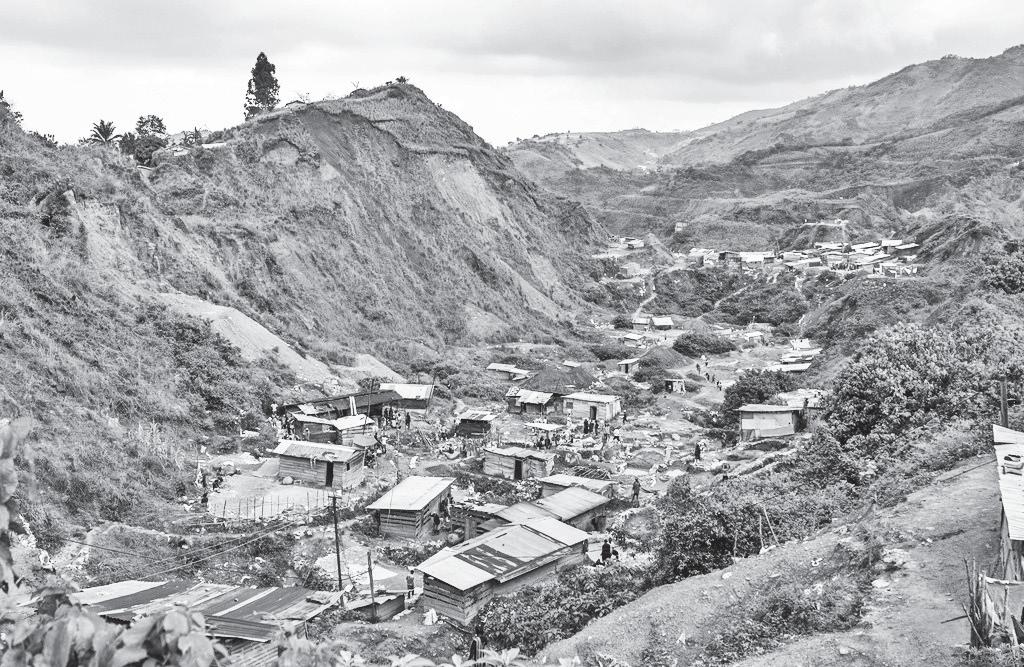
Her daughter is one of more than 6,000 people officials suspect have contracted the disease in South Kivu province, the epicenter of the world’s latest mpox outbreak, in what the World Health Organization has labeled a global health emergency. A new strain of the virus is spreading, largely through skin-to-skin contact, including but not limited to sex. A lack of funds, vaccines and information is making it difficult to stem the spread, according to alarmed disease experts.
Mpox—which causes mostly mild symptoms like fever and body aches, but can trigger serious cases with prominent blisters on the face, hands, chest and genitals—had been spreading mostly undetected for years in Africa, until a 2022 outbreak reached more than 70 countries. Globally, gay and bisexual men made up the vast majority of cases in that outbreak. But officials note mpox has long disproportionately affected children in Africa, and they say cases are now rising sharply among kids, pregnant women and other vulnerable groups, with many types of close contact responsible for the spread.
Health officials have zeroed in on Kamituga, a remote yet bustling gold mining town of some 300,000 people that attracts miners, sex workers and traders who are constantly on the move. Cases from other parts of eastern Congo can be traced back here, officials say, with the first originating in the nightclub scene. Since this outbreak began, one year ago, nearly 1,000 people in Kamituga have been infected. Eight have died, half of them children.
Challenges on the ground LAST month, the World Health Organization said mpox outbreaks might be stopped in the next six months, with governments’ leadership and cooperation.
But in Kamituga, people say they face a starkly different reality.
There’s a daily average of five new cases at the general hospital, which is regularly near capacity. Overall in South Kivu, weekly new suspected cases have skyrocketed from about 12 in January to 600 in August, according to province health officials.
Even that’s likely an underestimate, they say, because of a lack of access to rural areas, the inability of many residents to seek care, and Kamituga’s transient nature. Locals say they simply don’t have enough information about mpox.
Before her daughter got sick, Wisoba said, she was infected her -
Pediatrician
the particulates are often bound to heavy metals and toxic chemicals that are really bad for kids’ lungs and other organs. We see increased rates of wheezing, coughing [and] visits to the pediatrician when this kind of air hits down here. But it also influences kids over time because their lungs and brains are still growing and developing. We know that kids who are raised in heavily polluted areas that have high rates of particle pollution, the kids are much more likely to have stunted, stiffer lungs. And those particles don’t stop at the lungs, they invade the bloodstream and affect every organ in the body.
What is it about kids that makes them more at risk of getting sick from the heat?
Pediatricians often say children are not just small adults. It’s because their physiology is very different from adults, and so you can’t use the same calculations and assumptions when you’re figuring out how much fluid to give them or that kind of thing. They have im -
self but didn’t know it.
Painful lesions emerged around her genitals, making walking difficult. She thought she had a common sexually transmitted infection and sought medicine at a pharmacy. Days later, she went to the hospital with her newborn and was diagnosed with mpox. She recovered, but her daughter developed lesions on her foot.
Nearly a week later, Maombi died at the same hospital that treated her mother.
Wisoba said she didn’t know about mpox until she got it. She wants the government to invest more in teaching people protective measures.
Local officials can’t reach areas more than a few miles outside Kamituga to track suspected cases or inform residents. They broadcast radio messages but say that doesn’t reach far enough.
Kasindi Mwenyelwata goes door to door describing how to detect mpox—looking for fevers, aches or lesions. But the 42-yearold community leader said a lack of money means he doesn’t have the right materials, such as posters showing images of patients,
which he finds more powerful than words.
ALIMA, one of the few aid groups working on mpox in Kamituga, lacks funds to set up programs or clinics that would reach some 150,000 people, with its budget set to run out at year’s end, according to program coordinator Dr. Dally Muamba.
If support keeps waning and mpox spreads, he said, “there will be an impact on the economy, people will stop coming to the area as the epidemic takes its toll. ... And as the disease grows, will resources follow?”
The vaccine vacuum Health experts agree: What’s needed most are vaccines—even if they go only to adults, under emergency approval in Congo.
None has arrived in Kamituga, though it’s a priority city in South Kivu, officials said. It’s unclear when or how they will. The main road into town is unpaved—barely passable by car during the ongoing rainy season.
Once they make it here, it’s unclear whether supply will meet demand for those who are at greatest
risk and first in line: health staff, sex workers, miners and motorcycle taxi drivers. Congo’s government has budgeted more than $190 million for its initial mpox response, which includes the purchase of 3 million vaccine doses, according to a draft national mpox plan, widely circulating among health experts and aid groups this month and seen by The Associated Press. But so far, just 250,000 doses have arrived in Congo and the government’s given only $10 million, according to the finance ministry.
Most people with mild cases recover in less than two weeks. But lesions can get infected, and children or immunocompromised people are more prone to severe cases.
Doctors can ensure lesions are clean and give pain medication or antibiotics for secondary infections such as sepsis.
But those who recover can get the virus again.
A new variant, a lack of understanding EXPERTS say a lack of resources and knowledge about the new
strain makes it difficult to advise people on protecting themselves. An internal report circulated among aid groups and agencies and seen by AP labeled confidence in the available information about mpox in eastern Congo and neighboring countries low.
While the variant is known to be more easily transmissible through sex, it’s unclear how long the virus remains in the system.
Doctors tell recovered patients to abstain from sex for three months, but acknowledge the number is largely arbitrary.
“Studies haven’t clarified if you’re still contagious or not ... if you can or can’t have sex with your wife,” said Dr. Steven Bilembo, of Kamituga’s general hospital.
Doctors say they’re seeing cases they simply don’t understand, such as pregnant women losing babies. Of 32 pregnant women infected since January, nearly half lost the baby through miscarriage or stillbirth, hospital statistics show.
Alice Neema was among them.
From the hospital’s isolation ward, she told AP she’d noticed lesions around her genitals and a fever— but didn’t have enough money to travel the 30 miles (50 kilometers) on motorbike for help in time. She miscarried after her diagnosis. As information trickles in, locals say fear spreads alongside the new strain.
Diego Nyago said he’d brought his 2-year-old son, Emile, in for circumcision when he developed a fever and lesions.
It was mpox—and today, Nyago is grateful health care workers noticed his symptoms.
“I didn’t believe that children could catch this disease,” he said as doctors gently poured water over the boy to bring his temperature down. “Some children die quickly, because their families aren’t informed.
“Those who die are the ones who stay at home.”
AP reporters Jean-Yves Kamale in Kinshasa, Congo, and Maria Cheng in London contributed.
wrote a book on how climate change is making kids sick
mature judgment and they depend on adults to tell them when it’s too hot, or when they are showing signs of heat illness, which a child may not recognize. The other reason that kids in general are more at risk from environmental hazards is that their organs are still developing and growing.
Beyond the physical impacts, climate change is also a source of anxiety and stress for kids. Have you seen this with your patients?
I tell the story in the book of this girl—I was just asking about her future and she suddenly brought this up. She wanted to work with kids because she wasn’t sure she wanted to have any on her own.
She’d done some research with a local university on climate change and was feeling so down about what she was seeing in the models this scientist showed her. She didn’t want to talk to her mom about it because she didn’t want to upset her mom.
But at the end of that story, they were both getting involved and doing something about it. They went to a climate march downtown before the pandemic and that girl
went on to be involved with some environmental projects to reduce her school’s carbon emissions.
The anecdote is to get kids involved in some kind of action, especially action to reduce carbon emissions in some way and have them join together with other
kids. [The anxiety is] just below the surface for a lot of teens. I’ve had to tell some kids that you need to take a break from the news and just try to do something outdoors.
Speaking with families about climate change can be tricky
because the issue is so politicized. What have you learned about how to do this effectively?
There’s often something going on outside or in the news that makes it easier to bring up. Throughout the summer, I give warnings about the heat and I’ll say, “Temperatures are rising.” No matter where the parents are coming from, they’ll usually go, “Yeah, I know.” People are not denying the evidence really that’s right in front of them. They may have different explanations for what’s going on, but they understand that this is happening and it’s right outside the window. Then we talk about how to keep kids safe. I have brochures in the rooms about how they could decarbonize their homes or lives to help protect the air quality that kids are breathing. So focusing on immediate health benefits is a less political topic. Everybody loves for their kids to have clean air and clean water. Everybody here loves the outdoors.
Have you gotten any pushback from parents?
I don’t push the issue to the point of an argument. I think the
best way to approach any conflict like that is to ask questions about where they are coming from, like: Do you have any concerns about this? What are your thoughts about this? Do you want ideas for how to deal with this? Then it’s really up to them. It never works well to really lecture people. They’ve looked at what techniques work for talking to vaccine-resistant parents; often the more you talk at them, the more resistant they get. It’s sometimes better just to create a little space and ask a question and see where they go.
What have your patients taught you about climate change?
I’ve learned that it’s affecting them. Summer used to be the time that you were off school and everything was carefree. Now you have to worry about smoke and heat. It makes me upset and angry. It’s a crime against them that’s being committed that we are all sitting back and watching. It’s not just a crime, it’s probably the biggest crime that has ever been committed. It’s going to affect every child who ever lives from now on. Bloomberg News
THE town of Kamituga, in South Kivu province in eastern Congo, considered the epicenter of the world’s latest outbreak of mpox, is seen on September 5, 2024. AP/MOSES SAWASAWA
Inclusive design, resource efficiency keys to tech success–startups
By Bless Aubrey Ogerio
STARTUPS emphasized that inclusive design and efficient resource management are important for the successful commercialization and incubation of technology—strategies that are proven fundamental to their achievements in the sector.
During the third National Agri-Aqua Technology Business Incubation (ATBI) Conference and Incubatee Summit held recently i Clark, Pampanga, two organizations showcased how targeted strategies can drive success in technology innovation.
Vera Bella Enterprises, known for its innovative tilapia-based ice cream and cookies, has turned product development challenges into a success.
“Our goal from the start has been to help farmers grow with ev -
PHL Inventor
YOUNG Filipino innovator Engr. Mark Kennedy E. Bantugon acknowledged the significant contributions of the Department of Science and Technology (DOST) in his adventures and triumphs as an innovator.
In particular, he thanked the following agencies of the DOST at the opening ceremony of the National Youth Science, Technology, and Innovation Festival (NYSTIF), at the PICC Forum Tent, They are the Science Education Institute (SEI), Technology Application and Promotion Institute (TAPI), Industrial Technology Development Institute (ITDI), and Forest Products Research and Development Institute (FPRDI).
Among his milestones was his development of aviation sealant “Pili Seal” where the DOST-FPRDI contributed particularly in the early stage of development.
Bantugon’s Pili Seal is a sustainable sealant made from the waste of pili (Canarium ovatum) tree resin production.
It has gained global recognition for its industrial and material applications, and has won prestigious awards including the James Dyson Award in 2021, Swiss
ery scoop and bite of our ice cream and cookies.Throughout the entire process of product development, we had placed a strong emphasis on inclusive product design,” Vera Bella Managing Partner Dana Vera Cruz said.
The company’s nine-year journey involved rigorous processes, including securing intellectual property, validating technology, and perfecting their product. To appeal to many customers, including those with diverse dietary needs, they ensured that their products were not only marketready, but supportive of local agricultural communities.
Vera Bella has achieved a Technology Readiness Level of 9, indicating their technology is ready for full-scale commercialization.
Their Marketing Readiness Level of 8 suggests their product is nearly market-ready, while an
Investment Readiness Level of 6 reflects moderate preparedness for investment and scaling.
Conversely, DMMMSU ATBI, an agri-aqua technology incubator based at Don Mariano
Marcos Memorial State University, faces its own set of challenges, especially on managing limited resources.
“Balancing the distribution of these resources among multiple incubates can be difficult, often leading to disparities in the support provided,” Prof. Victoria Malaya, director of Innovation and Technology Commercialization, said.
Since its inception in 2018, DMMMSU ATBI has concentrated on effective resource management, including securing sustainable funding and providing highquality mentorship to emerging technologies.
The challenge of attracting and retaining top talent is something that is a double-edged sword, as Malaya pointed out.
“Our incubates need skilled individuals and experts to drive their innovation, yet sometimes
lauds DOST-FPRDI’s role in developing billion-dollar
Innovation Prize Competition 2023, and the OCBC Global Sustainability Innovation Challenge 2023.
The pili seal also clinched a historic milestone by being the fastest granted patent in the Philippines, to date. In 2019, the DOST-FPRDI assisted Bantugon in his undergraduate study that examined the various properties of pili tree resin as aircraft integral fuel tank sealant.
The Institute offered testing services, technical guidance, and access to advanced facilities, helping him develop the pilibased sealant.
Experts from DOST-FPRDI’s Physics and Mechanics Section, Chemistry and Biotechnology Section, and Bio-Energy and Equipment Design Section played key roles in the success of his research.
Their support contributed to. Bantugon winning the Alfredo M. Yao Intellectual Property Awards in 2020.
Science Secretary Renato U. Solidum Jr. highlighted the significance of this cooperation.
“This collaboration between government research institutions and Filipino innovators underscores the role of DOST in
empowering our inventors and researchers to transform their ideas into viable products,” Solidum said.
“By providing the technical support and resources they need, we can drive innovation and create solutions that benefit not only our local communities but the entire nation,” the DOST chief added.
DOST-FPRDI OIC Director Rico J.
Cabangon, meanwhile, expressed pride in the agency’s involvement with pili-based research.
“The Institute is committed to supporting inventors like Engineer Bantugon who pushes the boundaries of what local resources can achieve. Pili Seal is an example of how we can harness our natural resources to create sustainable, high-quality prod -
Companies’ push for critical climate transitions gains ground amid crisis
By Edwin P. Galvez
THE impacts of the current climate crisis are such that “the science tells us we no longer have a choice” but to pursue and achieve net-zero carbon emissions by 2050.
This was stressed by Lopez Group Chairman Federico R. Lopez as he urged fellow Net Zero advocates for a “systematic and collaborative way” to push critical climate transitions within the next 25 years at the first Net Zero Conference held in Makati City last Thursday.
Lopez cited in his keynote message the catastrophic consequences of the “extreme heat” in many parts of the world, particularly in the Philippines, which “remains among the top countries most vulnerable to disaster risks.”
“Today, there is no one and no place on the planet that’s spared from the unprecedented fury unleashed by the increasing number and more frequent occurrence of extreme weather events that’s also supercharged by climate change,” he said.
These include deadly wildfires, scorching heatwaves, severe droughts, and recordbreaking levels of ocean heat and acidification that fuel typhoons and cyclones with stronger winds and heavier rainfall. Lopez warned it would be equally catastrophic if further inaction continues as “our own actions led us to the climate crisis we now face.”
He said, “We have a narrowing time frame of the next 25 years to make our every action count and avoid irreversible damage to our planet. There is no other way to go but Net
Zero. And it’s not going to stop. It will never leave us.”
Nowhere to go but Net Zero
WITH the ultimate goal to solve the climate crisis that is “undeniably real and in urgent need of action,” Lopez amplified on the three phases of the global “Journey to Net Zero.”
Phase 1, where “practically all of the efforts of the world today are focused on,” reduces the current level of greenhouse gas (GHG) emissions by 59 gigatons per year and sees these emissions peak by 2025.
Phase 2 eliminates all GHG emissions and gets to Net Zero by 2050, while Phase 3 reduces the concentration of greenhouse gasses in the atmosphere and achieves net negative emissions.
“Everything that’s up there has to come down because if that stays, and all we do is get emissions here to zero, the damage to the planet will still continue and we will continue to experience all of this warming that we’re having now,” he explained.
He underscored energy as the largest link in the critical climate transitions, although “it takes more than energy security and transition to stabilize the distressing state of the climate.”
“It’s evident that decarbonizing and scaling up a green electricity grid over the next 25 years is the greatest energy transition in the history of mankind,” he said.
“And it’s not just changing the electricity system, but building a new global energy system with components that we have never built before and at a massive scale. This will need nothing short of collaborative action among various players,” he added.
Lopez is the chairman of the Energy Development Corp. (EDC), the all-renewable energy arm of the Lopez Group’s First Gen Corp. that spearheaded Net Zero Carbon Alliance (NZCA) in 2021 as part of its mission to “forge collaborative pathways for a decarbonized and regenerative future.”
EDC has embarked on a multi-year welldrilling program to expand the output of its various geothermal power plants for a steady and reliable energy supply, “one of the few renewable energy sources capable of delivering power on a 24/7 basis.”
The company plans to expand into hydro, solar, and wind in the next few years.
“Addressing the climate crisis feels like a daunting task, but we remain optimistic and encouraged as we see a myriad of sectors of society coming together and taking collective action,” he said.
Growing Net Zero advocates HEEDING this call are the 34 partner-
companies that now comprise NZCA, the largest organization of private companies committed to net-zero carbon emissions and organizer of the conference.
The group introduced 13 new partners at the conference, which provided “a unique opportunity to collaborate, innovate, and drive meaningful climate action,” according to NZCA Executive Director Allan V. Barcena, also the assistant vice president and head of corporate support functions,
Barcena said 12 partners are actively using its Net Zero gateway to track and manage GHG emissions.
“For scope 1, three partners have successfully reduced their footprint with the highest reduction reaching 35 percent. On scope 2, five partners achieve reductions with one partner cutting emissions by an impressive 56 percent. For scope 3, four partners have begun their calculations with the highest reduction so far at 10 percent,” he reported.
we struggle to find and retain such talent.”
On March 19, a World Bank data reported that the Philippines has been one of the most dynamic economies in the East Asia and Pacific region, with a robust economic recovery evident in its 5.6 percent growth rate in 2023.
According to the Statistical Indicators on Philippine Development 2023, the agricultural sector faces significant challenges, with only 1 out of 12 indicators showing a high likelihood of achieving end-of-plan targets.
However, the overall performance metrics revealed that 72 out of 33 indicators in Human and Social Development are low, reflecting challenges in areas that overlap with the startup ecosystem’s efforts to address community needs and support inclusive growth.
Pili-based sealant
ucts. We look forward to collaborating with more Filipino innovators and inventors in the future.”
Before the Pili Seal’s success, Bantugon went through the eye of a needle to reach the product’s current state.
He faced challenges like the lack of related studies, human resources, and financial constraints.
Many companies rejected his product due to concerns about its potential to damage equipment, but DOST-FPRDI recognized its potential and provided the needed assistance.
Bantugon expressed his gratitude to DOST-FPRDI for providing technical knowledge on resin and product development, for conducting key processes, such as the hydrodistillation of raw pili resin, and for testing its standard strength and peel strength.
“I want to express my heartfelt gratitude to DOST-FPRDI for their unwavering support and technical assistance throughout this product development journey. Their expertise and trust were instrumental in helping me achieve this high-profile recognition,” he said.
In the global arena, Science Based Targets Initiative reported that 9,015 companies are already taking ambitious climate action, 6,158 of which have science-based targets, while 3,482 have net zero commitments.
Collective initiative
LOPEZ said that many governments are now strengthening their climate policies and targets, while more countries are introducing carbon pricing instruments like emissions trading systems, carbon taxes, and carbon trading.
“For the Philippines, we see our government’s efforts for a more systematic and comprehensive approach to climate action through the Environment department and the Climate Change Commission, following the submission of our country’s nationallydetermined contributions (NDCs) in April 2021,” he said.
In Congress, Lopez mentioned the proposed bills on “climate accountability” that calls for corporate litigation for greenwashing, climate denialism, and missed global carbon
DOST-FPRDI is not new to studying saps or resins from trees It has conducted countless R&D projects on various plants and trees in the Philippines.
Bantugon highlighted the importance of local research institutions in nurturing the country’s young innovators and developing science-based solutions that tap into the rich biodiversity of the Philippines.
“The Institute remains committed to supporting local inventors and entrepreneurs. DOST-FPRDI’s collaboration with Engr. Bantugon highlights the positive impact of scientific and technological partnerships in driving innovation and creating value-added products from the Philippines’ natural resources. We are one with Engr. Bantugon and all aspiring youth scientists in pushing the message “PILIin ang PILIpinas,” said FPRDI OIC Director Cabangon.
DOST-FPRDI is DOST’s research and development arm on wood and non-wood forest products, pioneering initiatives that promote the responsible use of forest resources. Idohna Leah B. Jomao-as, Ivan Patrick Martinez, Rodel Gomez and Kristel Espinosa/S&T Media Service
targets, and “low-carbon economy” that mandates a decarbonization plan from carbon emitters from the major sectors and corresponding investments to meet carbon reduction targets.
At the conference, Bukidnon Rep. Jose Manuel F. Alba, co-author of House Bill 7705 on low-carbon economy, emphasized the need for private sector support to climate legislations.
“The biggest barrier is actually us [because]. the battle for climate change cannot be addressed solely by the government or the private sector. There has to be a wholeof-nation initiative….We need to work together [and] do a lot of influencing with the private sector and our policymakers and decision-makers,” Alba explained.
He said the proposed low-carbon investment Act, was a “very challenging measure that we all need to support.” According to Alba, there are only two ways in pushing for a low-carbon economy. The carbon tax, “the easiest policy but burdensome to the private sector and ultimately to the general public,” and the “complex” emissions-trading system, which took Europe a long time to perfect yet still “needs a lot of improvement.”
Alba said there will be emissions caps on covered sectors or corresponding caps for covered enterprises, the excess of which “will have a corresponding amount based on what the government will set in terms of carbon pricing.”
“This amount will not be turned over to the
as a form of
LICENSED Aeronautical Engineer Mark Kennedy Bantugon (center) shares a light moment with DOST Secretary Renato U. Solidum, Jr. (right) and DOST-FPRDI OIC Director Rico J. Cabangonat the
Faith Sunday
A6 Sunday, September 22, 2024
Vatican approves devotion at Medjugorje, but not on authenticity of ‘messages’
ROME—In a highly anticipated report on the alleged decadeslong apparitions of the Blessed Virgin Mary in Medjugorje, the Vatican’s doctrinal office on Thursday endorsed prudent devotion to Mary at the popular pilgrimage site in Bosnia and Herzegovina yet withheld any declaration on whether the alleged visions are supernatural in origin.
The September 19 note from the Dicastery for the Doctrine of the Faith (DDF), signed by prefect Cardinal Víctor Manuel Fernández and approved by Pope Francis in an August 28 audience, grants a “nihil obstat” to the spiritual experience at Medjugorje.
The authoritative judgment means that pilgrims may continue to visit and pray at the site, as some 40 million people from around the world have done since the apparitions allegedly first began 43 years ago.
Six children, who are now middle-aged, first reported experiencing visions of the Blessed Mother, originally on a hilltop near the rural village of Medjugorje, on June 24, 1981.
The Vatican’s report notes that the remote site, formerly part of Yugoslavia, is now widely “perceived as a space of great peace, recollection, and a piety that is sincere, deep, and easily shared.”
While it offers no definitive judgment on the supernatural authenticity of the alleged apparitions, the Vatican’s report highlights the abundant good fruits that have come from Medjugorje.
“The positive fruits are most evident in the promotion of a healthy practice of a life of faith, in accordance with the tradition of the Church,” the report states.
It points to “abundant conversions, a frequent return to the sacraments [particularly, the Eucharist and reconciliation], many vocations to priestly, religious, and married life, a deepening of the life
of faith, a more intense practice of prayer, many reconciliations between spouses, and the renewal of marriage and family life.”
“It should be noted,” the report emphasizes, “that such experiences occur above all in the context of pilgrimages to the places associated with the original events rather than in meetings with the ‘visionaries’ to be present for the alleged apparitions.”
Fernández presented the report in a two-hour news conference at the Holy See Press Office on September 19.
The prelate quoted Cardinal Joseph Ratzinger’s 1985 statement that emphasized separating the question of supernatural origin from spiritual fruits.
Fernández pointed out that Ratzinger said even if modern critical thinking might question some aspects, “this doesn’t detract from the fact that those pilgrimages were fruitful, useful, important for the life of the Christian people.”
On this view, he added, Pope Francis said there was “no magic wand” to determine the authenticity of the phenomena, but “the spiritual pastoral fact cannot be denied.”
Spirituality of the messages
A SIGNIFICANT portion of the document is a summary of the central points and spirituality of the numerous alleged messages received by the alleged visionaries, identifying “Queen of Peace” as the “most original title in the alleged messages,” though Mary most frequently refers to herself as “Mother.”
The predominant themes of those communications—which the Vatican stresses should be referred to as “alleged messages”— are calls for conversion, peace, reconciliation, and a return to the sacraments, along with a “constant call to abandon a worldly life -
style and excessive attachment to worldly goods.”
“One of the prevailing characteristics of the spirituality that emerges from the messages is that of trust in God through a total trust in Mary, in order to become instruments of peace in the world,” the Vatican’s document says.
The note quotes from some of the messages to illustrate that in the missives, “Our Lady does not place herself at the center but shows herself to be fully directed toward our union with God.”
The spirituality of the messages is also one of communion with the pope and with the whole Church, it said, and the spirituality of Medjugorje is overall “joyful, celebratory, and includes a call to live the joy of following Christ.”
During the news conference, Fernández quoted from several of the alleged messages he found to be edifying.
“Most of the messages have a beautiful content that can stimulate the faithful to conversion, to grow in their encounter with Christ, to be peacemakers in the world,” he said.
‘Misleading messages’
THE report also notes that as in other spiritual experiences and
Nepal’s festival season starts, devotees honor living goddess
Kalleged supernatural phenomena, “positive and edifying elements are mixed with other elements that are to be ignored,”
It adds: “But this fact should not lead one to spurn the richness and the good of the Medjugorje proposal as a whole.”
The report draws attention to a number of “misleading messages” from Mary, particularly when she reprimands or makes threats, or when she insists strongly on listening to her messages:
“This risks creating a dependence and an excessive expectation on the part of the faithful, which could ultimately obscure the central importance of the revealed word,” it says.
The note said this becomes “even more problematic” when the messages give orders about specific dates, places, and practical decisions “unlikely to be of supernatural origin.”
“Although messages of this type are infrequent in Medjugorje, we can find some of them that are explained solely from the personal desires of the alleged visionaries,” the note says.
“It is reasonable for the faithful, using prudence and common sense, not to take these details seriously nor heed them.”
‘Mercy
AThe dicastery also said “those messages that attribute to Our Lady the expressions ’my plan’ or ‘my project’ also show a certain problematic aspect,” and these expressions “might create some confusion” because “in reality, everything Mary accomplishes is always at the service of the Lord’s plan and his divine plan of salvation.”
Another term requiring special attention is “the possible misuse of the word ‘mediatrix’ in reference to Mary” in the messages.
When the messages say “I am the mediatrix between you and God” (July 17, 1986) and “I desire to be the link between you and the Heavenly Father, your mediatrix” (March 18 2012), they “fail to express adequately the fact that, as St. John Paul II explained, Mary’s mediatory cooperation is ‘subordinate’ to the mediation of Christ,” the note explained.
The DDF said Archbishop Aldo Cavalli, special apostolic visitor to the parish community of Medjugorje, will continue the duties already entrusted to him and will be responsible for authorizing the publication of any future messages.
The dicastery advised people who may visit Medjugorje that pilgrimages should not be made to meet with alleged visionaries but to have an encounter with Mary, Queen of Peace and with her son, Jesus Christ, through participation in the sacraments.
Some of the alleged messages of Mary the Vatican found problematic were those containing explicit and repeated exhortations to the parishioners of the local church, St. James, the Vatican said.
Those messages are “an understandable expression of the alleged visionaries’ intense love for their parish community,” the note said.
‘Nihil obstat’ IN accordance with new norms on the discernment of “alleged supernatural phenomena,” the local bishop must consult and receive final approval from the Vatican after investigating and judging alleged apparitions and connected devotions.
According to the May 17 norms, a “nihil obstat” judgment means: “Without expressing any certainty about the supernatural authenticity of the phenomenon itself, many signs of the action of the Holy Spirit are acknowledged ‘in the midst’ of a given spiritual experience, and no aspects that are particularly critical or risky have been detected, at least so far.” In its September 19 note, the DDF explained that “through the ‘nihil obstat’ about a spiritual event, the faithful ‘are authorized to give it their adherence in a prudent manner’ (Norms, art. 22, §1; cf. Benedict XVI, Verbum Domini, par. 14).”
“While this does not imply a declaration of the supernatural character of the phenomenon in question (cf. Norms, art. 22, §2)— and recalling that the faithful are not obliged to believe in it—the nihil obstat indicates that the faithful can receive a positive encouragement for their Christian life through this spiritual proposal, and it authorizes public acts of devotion,” the dicastery continued.
“Such a determination is possible,” it said, “insofar as many positive fruits have been noted in the midst of a spiritual experience, while negative and dangerous effects have not spread among the people of God.” Hannah Brockhaus/ Catholic News Agency via CBCP News
“However, Our Lady’s messages cannot replace the ordinary role of the parish priest, the pastoral council, and the synodal work of the community regarding decisions that are the subject of communal discernment, through which the parish matures in prudence, fraternal listening, respect for others, and dialogue.”
without works is dead’
T a Mass declaring a new national shrine, Cardinal Jose Advincula used his homily to stress that mercy should be shown through concrete acts of service.
The Manila archbishop on September 15 led the liturgy to elevate the Diocesan Shrine and Parish of Our Lady of Mercy of Novaliches to national shrine status.
For the cardinal, to be granted with such a “tremendous privilege” is both a gift and a great responsibility.
Catholic Bishops’ Conference of the Philippines.
The declaration took place more than two months after the CBCP approved the diocese’s petition to the church among the country’s national shrines.
Established by the Augustinian missionaries from Spain in 1856, it is the oldest church in the diocese.
In 2008, the church was designated as a diocesan shrine, and in January 2021, Our Lady of Mercy was declared the secondary patroness of the diocese.
shrine was granted spiritual affinity with the Papal Basilica of Saint Mary Major in Rome. In September 2021, the image of Our Lady of Mercy received the papal honor of canonical coronation during a Mass celebrated by Archbishop Charles Brown, apos
tolic nuncio to the Philippines. CBCP News
The masked dancers, one of the highlights of the ceremony, can be fearsome, entertaining and awe-inspiring, depending on the performers’ movements. Kumari, a
is revered by both Hindus and Bud -
ATHMANDU, Nepal—Nepal’s monthslong festival season began on September 17 with tens of thousands of devotees pulling a wooden chariot with a young girl revered as a living goddess. Families gathered for feasts and lit incense for the dead at shrines. Men and boys in colorful masks and gowns representing Hindu deities danced to traditional music and drums, drawing throngs of spectators to Kathmandu’s old streets. The Indra Jatra festival marks the end of the monsoon and rice farming season and signals the dawn of fall. It is celebrated mostly by the Newar community, the native residents of Kathmandu. It is also known as the festival of deities and demons and especially honors Indra, the Hindu god of rain.
dhists in Nepal as a living goddess, left her temple palace and was driven around the center of the capital in a wooden chariot pulled by devotees, who lined up to receive her blessing.
Among the spectators were President Ram Chandra Poudel, officials and diplomats.
The weeklong Indra Jatra precedes months of other festivals in the predominantly Hindu nation.
They include Dasain, the main festival, and Tihar, or Diwali, the festival of lights, in November.
Binaj Gurubacharya/Associated Press
“You are called to be a holy place where mercy overflows, where church as a mother should be deeply felt,” Advincula said. But mercy, according to him, directs the Church and the faithful to concrete acts of service and charity.
“Faith without works is dead. So is mercy with works,” Advincula said.
“Let this national shrine of ‘Ina ng Awa’ be a living testament to the saving power of the Cross,” he added. “You may exemplify a life of mercy and truly become a community that witnesses mercy.”
Now known as the National Shrine and Parish of Our Lady of Mercy, it is the first church in the Diocese of Novaliches to receive such a title from the
Later that year, in June, the
THE Medjugorje Youth Festival, in its 34th edition, held from July 26 trom 30, 2023, at the site of alleged Marian apparitions in Bosnia and Herzegovina. RADIO MIR MEDJUGORJE VIA CNA
-
CARDINAL Jose Advincula if archbishop of Manila celebrates Mass to formally declare the Diocesan Shrine and Parish of Our Lady of Mercy in Novaliches, Quezon City, as a national shrine on September 15.
PHOTO FROM DIOCESE OF NOVALICHES
young girl who
LIVING goddess Kumari reacts as she is being carried during Indra Jatra, a festival that marks the end of the rainy season in Kathmandu, Nepal, on September 17. AP/NIRANJAN SHRESTHA
Editor: Lyn Resurreccion
EU warns deadly flooding, wildfires show climate breakdown fast becoming the norm
BRUSSELS—Devastating
floods through much of Central Europe and deadly wildfires in Portugal are joint proof of a “climate breakdown” that will become the norm unless drastic action is taken, the European Union’s head office said Wednesday.
“Make no mistake. This tragedy is not an anomaly. This is fast becoming the norm for our shared future,” said EU Crisis Management Commissioner Janez Lenarcic.
The worst flooding in years moved Tuesday across a broad swath of Central Europe, taking lives and destroying homes.
At the other end of the 27-nation EU, raging fires through northern Portugal have killed at last six people.
“Europe is the fastest warming continent globally and is particularly vulnerable to extreme weather events like the one we are discussing today. We could not return to a safer past,” Lenarcic told EU lawmakers in Strasbourg, France. He warned that beyond the human cost, nations are also struggling to cope with mounting bills for repairing the damage from emergencies and the lengthy recovery from disaster.
“The average cost of disasters in the 1980s was €8 billion per year. More recently in 2021 and in 2022, the damage is surpassed €50 billion per year, meaning the cost of inaction is far greater than
the cost of action,” he said. Terry Reintke, president of the Greens group in the European Parliament, said the cost for the EU since the 1980s was estimated at 650 billion euros.
The EU is struggling to move quickly with measures to counter climate change and has run into political opposition in many member states, where the political climate is turning against environmental issues and measures ranging from home heating to farm pollution.
“Our success will depend on how determined we are to combat climate change together in order to reduce emissions,” Reintke said, adding that EU members must back its Green Deal.
The vast EU plan to become climate neutral by 2050 has come under increasing pressure from critics who call it unrealistic and too expensive. Populist and far-right parties have made it a key point of attack on the bloc’s institutions.
Lenarcic said people only needed to follow the daily news to understand the urgency of the issue.
“We face a Europe that is simultaneously flooding and burning. These extreme weather events... are now an almost annual occurrence,” he said. “The global reality of the climate breakdown has moved into the everyday lives of Europeans.” Raf Casert/Associated Press
Scientists confirm 2 Philippine buffaloes have distinct species
SCIENTISTS have found that the species of two domesticated buffaloes—swamp buffaloes and riverine buffaloes—are distinct from each other.
The recent study dispels the traditional classification of the domesticated buffaloes ( Bubalus bubalis) into two subspecies.
The study was conducted by a team from the University of the Philippines-Diliman College of Science’s Institute of Biology (UPD-CS IB) and from the Department of Agriculture-Philippine Carabao Center (DA-PCC), said a UPD-CS news release.
Swamp buffaloes ( Bubalus bubalis carabanensis) are primarily used to assist farmers with tilling the land, transporting tools, and, alternatively for meat, milk, hide, and manure, which is used as organic fertilizer.
Riverine buffaloes ( Bubalus bubalis bubalis), on the other hand, are mainly used in milk production.
In the Philippines, crossbreeding and backcrossing these two breeds on a large scale helps create animals with improved potential
for milk and meat production, despite their differences.
Hybridization of swamp and river buffaloes has limited success, however, sometimes producing offspring that does not achieve the desired traits.
The researchers conducted an investigation to clarify the taxonomic designation of swamp and riverine buffaloes in the Philippines.
They discovered that the DNA sequences of the genes from both swamp and riverine buffaloes are distinguishable and their chromosome numbers are different, affirming that they are two distinct species, not just subspecies of Bubalus bubalis.
The research team is comprised of Dr. Ian Kendrich C. Fontanilla, Nelvie Fatima Jane A. Soliven, John Gregor A. Roño, Francis L. Fontanilla, Emerson R. Servo, and Dr. Ernelea P. Cao
of the UPD-CS IB. Also in the team are Dr. Lilian P. Villamor, Therese Patricka C. Cailipan, Alexander M. Paraguas, and Aivhie Jhoy E. Cuanang from DA-PCC.
“These results corroborate the observed diffeences in their appearances.” Villamor said.
Swamp buffaloes can be identified by the white or light gray markings on their lower jaw and brisket, known as a chevron, as well as their lighter skin and coat color compared to riverine buffaloes.
“They are also smaller, weighing between 325 kg and 450 kg, and have crescent-shaped horns. They are mainly used as draught animals,” said Villamor, citing data from her previous studies.
She said that river buffaloes, on the other hand, are larger, weighing between 450 kg and 1,000 kg, and have curly horns. They are primarily raised for milk and meat production.”
According to the team, the Philippine native carabao, which is currently classified as Bubalus bubalis carabanensis, should be now considered as Bubalus kerabau Fitzinger, 1860.
“The reclassification of the Bubalus bubalis carabanensis to Bubalus
kerabau Fitzinger, 1860 supports earlier assumptions that riverine and swamp buffaloes are distinct,” added Fontanilla.
“Confusions on the classifications of the two buffaloes have implications on the breeding program of these species,” he said.
As their study was limited to examining the chromosomes of only swamp and riverine buffaloes, the researchers plan to include chromosomes from crossbred buffaloes in future studies to gain new insights into how these different types of buffaloes are genetically related and potentially improve the classification of the Bubalus bubalis. The study, titled “Molecular Data and Karyotype Revealed Two Distinct Species of Domesticated Water Buffaloes in the Philippines,” offers valuable insights into the diversity of domesticated buffaloes, and can guide conservation and management efforts, particularly in developing potential hybrids with desired traits. It was published in the Philippine Journal of Science, an openaccess, single-blind peer-reviewed journal on natural sciences, engineering, mathematics, and social sciences.
Poor law enforcement: A driver of biodiversity loss?
By Jonathan L. Mayuga
ACOUPLE of weeks ago, news reports carried the story of a juvenile Philippine eagle that was rescued from the Bagalbal forest on Mt. Kalatungan Range Natural Park (MKRNP) in Valencia City, Bukidnon, on August 31. It was rescued when in distress as it called out due to pain and starvation, while perched on a tree. Estimated to be around six to seven months old, the eagle was malnourished.
Emergency surgery
THE eagle’s condition was critical, with its wing injury necrotic, necessitating amputation to save its life.
According to Jayson Ibanez, the PEF director for Operations and Conservation, the PEF recorded an average rescue rate of five eagles per year post-pandemic.
The rescue rate was the highest during the pandemic with seven eagles rescued in a year.
Shot by improvised gun
DR . Bayani Vandenbroeck, PEF’s veterinary consultant, said in his medical report: ”It is improbable that the eagle sustained this type of compound fracture and wound solely from a fall from the nest. A more plausible explanation is that the eagle was shot with a high-powered firearm using large ammunition, such as a marble gun or shotgun, which caused the extensive bone fragmentation in the wing at the point of
impact.”
PEF Executive Director Dennis I. Salvador expressed alarm over the continued attack of the country’s National Bird in the wild.
Ironically, the juvenile Philippine eagle, a critically endangered species that is protected under existing laws, was shot and nearly killed within the vicinity of MKRNP—one of the Philippines’ most significant biodiversity hotspots.
Illegal wildlife trade, hunting
WHILE the illegal wildlife trade is a major driver of biodiversity loss, hunting is fast becoming another problem that could lead to the extinction of wildlife because of poor law enforcement.
Emerson Sy, a conservation advocate and wildlife researcher, said it is likely that the culprit is targeting rare birds, and chancing upon the young Philippine eagle is making it a target.
He said that just recently, a hunter shot and killed a Palawan hornbill.
Sy said bird catchers use different methods, including shooting, and once injured and unable to fly, it would be caught and as it would later on recover and it would be sold.
Another method of catching birds, he said, is by using snare or cage trap, which effectively catches almost anything that unsuspectingly pass by the trap.
“Unfortunately, the birds would often die while in captivity or even in transport. There’s no study on what’s the rate of survival of those being caught in the wild, but I believe
there is a high mortality,” Sy explained to the B usiness M irror in a phone interview on September 18.
Taking a jab at the hunters’ misconception of the value of wildlife, he said: “Philippine wildlife is valuable not in terms of its monetary value. But in terms of the ecosystem services they provide while alive, and in the wild.”
Doomed to remain in captivity
HAVING survived the delicate surgical procedure, the juvenile bird, with its amputated left wing, could no longer be released back into the wild, even after its complete recovery, Ibanez told the B usiness M irror on September 14.
Every injured animal that could no longer survive in the wild is doomed, like it is doomed to remain in captivity for the rest of its life.
“The best option for the bird is to give it the best possible life in captivity and use the best practices in raptor husbandry to help it become a productive breeder,” Ibanez said.
Potential ‘breeder’ NEVERTHELESS even an injured animal can be productive. In captivity, the rest of an animal’s natural life can become meaningful—as a live exhibit and become part of an awareness campaign or a potential breeder.
Ibanez said that if DNA sexing shows that it is a female bird, then the injured eagle can be paired with a male and become a natural pair for breeding.
“However, if the bird turns out to be male, natural pairing is not possible as a naturally paired male needs its full wings to balance properly on top of the female [during mating],” he said, explaining that balance is
key to successful copulation.
Nevertheless, Ibanez said that malimprinting to an animal keeper and cooperative artificial insemination would then be the best option for the bird.
“We will bring blood samples for DNA testing at UP [University of the Philippines] Diliman next week, and we will decide once the results are in,” he said.
Marble gun, deadly firearm
ACCORDING to Ibanez, it is highly suspected that the rescued eagle was shot and severely injured with the use of a marble gun, an improvised deadly weapon that uses marbles.
a small rounded glass-like toy also used by young boys as a “bullet.”
Ibanez said marble gun is among the most common weapon of hunters, along with airguns, and 22 caliber rifles.
He said that although it does not use gunpowder, its use of alcohol allows the combustion, propelling the projectile (marble), which makes it fall under the category of a firearm, citing the Firearm Act, or Republic Act 10591.
“Jolen [marbles] guns are adequately powerful that it could not only kill animals but also people,” he warned, explaining that the Philippine National Police should confiscate marble guns
Unfortunately, while it has been a longtime advocacy of the government and local government units to enforce wildlife laws and illegal gun confiscations, Ibanez said concrete actions from authorities remain to be seen.
Poor law enforcement
ACCORDING to Ibanez, while awarenessraising campaigns are good, they need to be matched with effective wildlife law enforcement “so that public knowledge of the law becomes a strong deterrent against crimes.”
He noted that there is an ongoing move in Congress to amend Republic Act 9147, or the Wildlife Act, to increase penalties for wildlife violators.
However, enforcement remains key, he insisted.
Ibanez said that according to a theory of wildlife crime, three conditions must be present so that any law becomes an effective deterrent. They are:
1. Law enforcement should be swift: Whenever one violates, penalty should be swiftly imposed:
2. The certainty of getting caught should be high: This is the reason why general law enforcement
A PHILIPPINE native carabao (Bubalus kerabau Fitzinger, 1860)
injured juvenile Philippine eagle was suspected to have been shot with a marble gun
RIVER Wien floods its banks next to tracks and a closed subway station in the west of Vienna, Austria, on September 15. AP/HEINZ-PETER BADER
AUSANNE, Switzerland—
LThe anti-doping program for the Paris Olympics caught five athletes after earlier finding 40 rule violations among competitors who had been expected to take part in the Games, the agency that ran the operation said Thursday.
Summing up its Olympic program, the International Testing Agency (ITA) said 6,130 samples were collected during the Games period in JulyAugust from 4,150 different athletes.
The samples were of urine, blood and dried blood spot.
Taking samples from almost 39 percent of the athletes was “a 4 percent increase compared to Tokyo 2020 and 10 percent higher than Rio 2016,” the ITA said. The most tested nations were those with the biggest teams in Paris: the United States, France, China, Australia and Britain.
The agency said nearly 90 percent of athletes who took part were tested at least once before the Paris Summer Games opened.
“The ITA can also report over 40 anti-doping rule violations stemming from the testing activities implemented on behalf of its partners ahead of the Games pertaining to athletes who were likely due to participate,” it said.
The Games-time samples, plus selected ones from the pre-Games testing program, will now be stored for 10 years. They can be opened and re-analyzed when better tests are developed and new intelligence emerges.
The five positive tests in Paris came from two cases in judo and one each in track and field, aquatics and boxing. The substances involved were anabolic steroids and a diuretic.
The athletes from Afghanistan, Bolivia, Congo, Iraq and Nigeria were removed ahead of their event or had their results disqualified. Disciplinary cases are now being prosecuted, typically by their sport’s governing body.
The ITA was created by the International Olympic Committee in 2016 to bring more independence to global anti-doping and manage testing programs on behalf of sports bodies.
US gymnasts goes to Swiss Court AMERICAN gymnast Jordan Chiles is asking Switzerland’s Supreme Court to overturn a ruling by the Court of Arbitration for Sport (CAS) that stripped her of a bronze medal in floor exercise at the 2024 Olympics. Chiles, with the support of the
SParis anti-doping program finds almost 50 violations
United States Olympic and Paralympic Committee and USA Gymnastics (USAG), filed the appeal recently, a little over a month after CAS voided an on-floor appeal by Chiles’ coach Cecile Landi during the event finals on Aug. 5 that vaulted Chiles from fifth to third.
CAS, following a hearing requested by Romanian officials, ruled Landi’s appeal came four seconds beyond the one-minute time limit for scoring inquiries and recommended the initial finishing order be restored.
The International Gymnastics Federation complied and the International Olympic Committee (IOC) ended up awarding bronze to Romanian Ana Barbosu on August 16.
Chiles’ appeal maintains that the CAS hearing violated her “right to be heard” by refusing to allow video evidence that Chiles and USA Gymnastics believe showed Landi appealed within the one-minute time allotment.
Chiles’s appeal also argues that Hamid G. Gharavi, president of the CAS panel, has a conflict of interest due to past legal ties to Romania.
USAG wrote in a statement Monday night that it made a “collective, strategic decision to have Jordan lead the initial filing.
USAG is closely coordinating with Jordan and her legal team and will make supportive filings with the court in the continued pursuit of justice for Jordan.”
The appeal is the next step in what could be a months- or years-long legal battle over the gymnastics scores.
Chiles was last among the eight women to compete during the floor exercise finals initially given a score of 13.666 that placed her fifth, right behind Barbosu and fellow Romanian Sabrina Maneca-Voinea. Landi called for an inquiry on Chiles’ score.
“At this point, we had nothing to lose, so I was like ‘We’re just going to try,’” Landi said after the awards ceremony. “I honestly didn’t think it was going to happen, but when I heard her scream, I turned around and was like ‘What?’”
Judges awarded the appeal, leapfrogging Chiles past Barbosu and Maneca-Voinea for the last spot on the podium.
Romanian officials appealed to CAS on several fronts while also asking a bronze medal be awarded to Chiles, Barbosu and Maneca-Voinea. The FIG and the IOC ultimately gave the bronze to Barbosu, who beat her teammate on a tiebreaker because she produced a higher execution score during her routine. AP
Padel Pilipinas bares national team competing in Asia Pacific tilt in Bali
Senators ‘Bato,’ Villar praise shooters
SENATOR Pia Cayetano leads Padel Pilipinas’s 13-member national team that plunged into international action in the Asia Pacific Padel Cup (APPC) in Bali, Indonesia. Joining Cayetano in the women’s team are Tao Yee Tan, Princess Jean Naquila, Yam Garsin and tennis convert Marian Capadocia.
The men’s squad is composed of topranked tennis players Johnny Arcilla and Francis Casey “Niño” Alcantara, Atty. Duane Santos, Derrick Santos, Raymark “Mac” Gulfo, Abdulqoahar “Qoqo” Allian, Mhar Joseph Serra and captain Argil Lance “LA” Cañizares.
Recognized by the Philippine Olympic Committee (POC) and Philippine Sports Commission (PSC), the nationals were presented recently at the sport’s base Play Padel at the Greenfield District in Mandaluyong City.
Bryan Casao is the head coach and Atty. Jacqueline Gan executive director of the organization that Cayetano founded.
“We’re very proud as the sole national sports association recognized by POC and PSC to send our official national team to this prestigious international competition, where nations compete against nations–not just individuals or organizations,” Gan said.
wins anymore, it’s about achieving success for the team,” Serra said.
“We’re a group of exceptional players, both on and off the court.”
“I challenge everyone who’s a part of the team to raise the bar because we are accountable to the Filipino people,” Cayetano said. “I try to inculcate in our players that they must always conduct themselves in a manner deserving to bear the Filipino flag.”
Strength and conditioning coach Jaric Lavalle trained the team members for the Bali tournament.
“We’ve been training for two months now. I’m excited for the team, and I can say that our team is ready,” Casao said.
The APPC is the first padel competition among Asia Pacific countries the Philippines, Singapore, Thailand, India, Malaysia, Hong Kong and Indonesia.
“I’m very honored that Padel Pilipinas chose me to be their player and captain for the APPC Nations Cup,” Cañizares said. “I’m very proud and very excited to lead the team.”
and
Filipinos shooters—Thomas Luzuriaga, Rolly Nathaniel Tecson and Edcel John Gino—who ruled their respective divisions in the recent Australasia Handgun Championship in Bali, Indonesia. Luzuriaga was overall champion of the Classic division, Tecson topped the Standard competition and Gino dominated the Production Optics class.
The Filipino shooters brought home a total of 80 medals and trophies—41 gold, 21 silver and 23 bronze medals.
“These Filipinos have truly risen to the occasion,” said De la Rosa, a sports shooter himself who stressed on the Bali competition as an International Practical Shooting Confederation or IPSC Level 4 Championship.
SINGAPORE—Lewis Hamilton said there was a “racial element” to FIA president Mohammed Ben Sulayem’s recent comments regarding drivers swearing during Formula 1 races. In an interview with motorsport. com, Ben Sulayem said “we have to differentiate between our
De la Rosa and Villar expressed their recognition of the shooters during the Senate’s plenary session last week.
“We have with us three of our fellow Filipinos who proudly represented the country and gave honor to our nation as they brought home, not just one, but three championships from three
“The championship is not for the weak of hand, and most certainly not for the weak of heart,” he said. “Attended and participated in by professionals all over the world, the competition was a test of skill and determination for our shooting athletes.”
Hamilton: FIA president’s ‘rappers’ comment ‘racist’
sport—motorsport—and rap music” when referring to drivers having a responsibility to stop swearing on the radio.
“We’re not rappers, you know,” Ben Sulayem said.
Responding to those remarks ahead of Sunday’s Singapore Grand
Prix, seven-time champion Hamilton said: “With what he said, I don’t like how he has expressed it. Saying ‘rappers’ is very stereotypical.”
“If you think about it, most rappers are Black. So it says, ‘We are not like them.’ So I think those are the wrong choice of words and there is
different divisions of the tournament,” Villar said.
“Congratulations to all three of you and to our other fellow Filipinos who have persevered through the challenges of the tournament,” he said.
“Rest assured that you have your allies here at the Senate in forwarding your goal of advancing and enhancing the marksmanship of our uniformed men and women so as to meet the demands and challenges of modern warfare.”
a racial element there.”
Hamilton, the only Black driver in F1, did say that he also has concerns about swearing.
“I definitely think there is a little bit too much of it. I agree it needs cleaning up. But it is also good to show some emotion. We are not robots,” the Mercedes driver said.
The FIA did not immediately respond to a request for comment. AP
Top-ranked Philippine padel player Serra said he’s excited to bring his skills overseas.
“Being part of Team Padel Pilipinas has elevated my game to the next level. It’s not about individual
“I’m very excited to compete against the other nations, we’re going to represent our country and I’m very confident,” first-timer Naquila zaid. Padel Pilipinas recently wrapped up the Padel Pilipinas Open 2024, the largest padel tournament in the country with 108 teams of 170 players and 234 matches played in eight days.
Makati, Bato Spartans triumph in Cebu
MAKATI Football Club (MFC) Cebu shut out Don Bosco FC-A, 12-0, and Bato
Spartans blanked City of Naga FC, 4-0, at the start of the 24th Aboitiz Football Cup (AFC) at the Dynamic Herb-Borromeo Sports Complex in Talisay, Cebu, recently.
Bato Spartans FC also beat Don Bosco FC-A, 8-0, in Group 1 on opening day of the competitions that gathered 26 of the 110 teams for Aboitiz’s longest-running grassroots football program.
Group 1 also saw MFC Cebu beat Cebu Football Club, which rebounded with its other team via a 3-0 victory over Giuseppe.
Sacred Heart School-Ateneo de Cebu Magis Eagles posted a 2-0 win over Giuseppe’s second team also in Group 1. In Group 2, Real Galaxy and Don Bosco-B won 3-0 over Marco Mateo FC teams, while Real Galaxy
defeated Corona Del Mar, 8-0, and Cebu United FC thrilled spectators with a 5-0 win over Don Bosco with another Don Bosco squad earning a 7-2 victory over Corona Del Mar. Anton Perdices, President and CEO of AboitizPower Distribution Utilities, graced the opening ceremony with Aboitiz Foundation and Chief Reputation and Sustainability Officer of Aboitiz Equity Ventures president Ginggay Hontiveros-Malvar, Aboitiz InfaCapital’s subsidiary Mactan Cebu International Airport Domestic Operations Head Nenette Castillon, Liloan’s (Cebu) Margo Frasco, Cebu Regional Football Association head Rodney Orale and Aboitiz Football Cup alumni athletes.
The season—featuring athletes as young as six to the 40-and-above category—will be held in various venues in Cebu and will culminate in February 2025 with an exhibition match in Cebu.
FANS wave French flags during a parade of French athletes who participated in the Olympics and Paralympics as the US’s Jordan Chiles holds up her medals in women’s artistic gymnastics at the Bercy Arena. AP
SENATOR Pia Cayetano (sixth from left) with (from left) head Coach Bryan Casao, Princess Jean Naquila, Raymark “Mac” Gulfo, Tao Yee Tan, Mhar Joseph Serra, Argil Lance “LA” Cañizares, Yam Garsin, Abdulqoahar “Qoqo” Allian and Marian Capadocia
FIA president Mohammed Ben Sulayem (center) walks through the starting grid before the Italian Grand Prix at Monza earlier this month. AP
VILLAR DELA ROSA
Why students are reading fewer books in English class
SEPTEMBER 22, 2024
DOUBLE DROP
Story by Bless Aubrey Ogerio
Interview by Edwin P. Sallan
AFTER
years of wrestling with creative silence, Kai Del Rio’s comeback is marked by a striking dual release that encapsulates her emotional depth.
On September 13, she premiered her highly anticipated singles at Sari Sari Bar in Makati City, presenting a striking contrast with “Ang Nag-iisa,” a blues-infused anthem, and “Storm Like Me,” a serene piano ballad.
“The past few years as a songwriter, I’ve had massive writer’s block and didn’t know who I was as a singer anymore. One day, I just asked myself, ‘What is the biggest emotion I am feeling right now,’ and the answer was rage. It was pain. It was
Publisher
Editor-In-Chief
Concept
Y2Z Editor
SoundStrip Editor
Group Creative Director Graphic Designers
Contributing Writers
Photographers
T. Anthony C. Cabangon
Lourdes M. Fernandez
Aldwin M. Tolosa
Jt Nisay
Edwin P. Sallan
Eduardo A. Davad
Niggel Figueroa
Anabelle O. Flores
Tony M. Maghirang
Rick Olivares
Jill Tan Radovan
Reine Juvierre S. Alberto
John Eiron R. Francisco
Pocholo Concepcion
Francine Y. Medina
Justine Xyrah Garcia
Bea Rollo
Trixzy Leigh Bonotan
Bless Aubrey Ogerio
Bernard P. Testa
Nonie Reyes
Y2Z & SOUNDSTRIP are published and distributed free every Sunday by the Philippine Business Daily Mirror Publishing Inc. as a project of the
The Philippine Business Mirror Publishing, Inc., with offices on the 3rd Floor of Dominga Building III 2113 Chino Roces Avenue corner
Dela Rosa Street, Makati City, Philippines. Tel. Nos. (Editorial) 817-9467; 813-0725. Fax line: 813-7025
Advertising Sales: 893-2019; 817-1351,817-2807. Circulation: 893-1662; 814-0134 to 36. www.businessmirror.com.ph
disappointment. It was sadness,” she said.
Her single “Ang Nag-iisa” marks a departure from her previous work with its intense blues-poprock energy. Co-written with her brother Karel Honasan and produced with a top-notch band including Ira Cruz on guitars, Nikko Rivera on keys, and Rickson Ruiz on drums, the track embodies raw emotion and gritty realism.
“I don’t know how many times I cried in that session, but I could not have imagined a more amazing group of musicians to take hold of this song, and I will be forever grateful,” the indie artist said.
“Storm Like Me,” a stripped-down track that explores the confessional vulnerability, is also set to be released on September 20 as part of Kai’s nonconsecutive “double single” release.
Drawing inspiration from Adele’s iconic sound, Kai contrasts this release with her fiery single. “I wanted the other side, a calm energy. A classic ballad. But still the same heart. I gathered the same team again to do lay on the drama for this song and they effortlessly killed it.”
Kai del Rio blends fury and fragility in new singles
Dual release dynamic
TWO different sounds? No problem—Kai proves they can share the same heartbeat.
“When I considered returning to my solo work, I always envisioned releasing a double single as a way to showcase my duality right off the bat. Nagagalit tayo at nasasaktan tayo. When you experience so much pain, you eventually experience hope,” she said.
The process, however, was not a smooth ride. It took Kai several weeks to complete the singles as she frequently second-guessed herself, wondering if the material might be too raw.
“But to be quite honest, what we need more of is raw emotion. That, I feel, creates the best art. Whether it’s pure, shameless joy or the isolation of heartbreak, what is real will always feel the most authentic,” she explained.
The official launch, set for September 20, will feature performances of the new tracks. Co-produced by GNN Entertainment Productions and Locked Down Entertainment, and supported by Lightfirst and Underdog Music, it marks a fresh chapter for Kai with a new name, revamped record label, and a renewed creative vision.
“I took my time because I wanted it to be as real, as sincere, and as authentic as possible. These will be my first solo songs in a decade and I wanted to take my time with them from crafting the songs to building the team,” she said.
Growth in words
THE difference between “Kai Honasan” and “Kai Del Rio” is striking as it shows her growth from a young, emerging artist to a more introspective and mature songwriter.
Her earlier music, created between the ages of 18 and 21, was characterized by youthful themes of love and heartbreak, which are a reflection of her simpler, more carefree experiences.
“It’s the natural progression of the human being… In the 10 years that I hadn’t released music,
ang daming nangyari sa buhay ko that challenged me as a person, that challenged me as a human being,” she said.
“I hope people will like this grown-up version of me,” she said. “The people who saw me before also saw me as a young girl, but now I’m a married woman. The things that bother you, the things that you want to write about are heavier and more mature.”
Her time with Autotelic, the indie rock band she joined in 2014, also contributed to her artistic development. “You have to be immovable in your values because you lose yourself if you’re not and I feel like I was on the verge of losing myself. I think anyone and any band dynamic needs to have a strong sense of self,” she said.
On July 24, 2022, she announced her departure from the band via her YouTube channel, marking her new chapter as a solo artist by reintroducing herself as “Kai del Rio.”
Defying norms
HER career path has been characterized by unconventional choices.
In 2012, she joined the ranks of the Philippines’ elite music scene at the Elements National Music Camp, mentored by legends like Ryan Cayabyab, Joey Ayala, and Noel Cabangon. From then, she went from stepping out of the indie rock scene to participating in a reality show and then making an unexpected leap into her solo career.
“[I never felt the need to be where others were] because when my fellow singer-songwriter girls were off doing things, I was in a band and it was very different, it was very fun,” she said.
As she prepares for her headline show next month, Kai promises a new experience. “It’s very different from the ukulele or keytar girl you might have met before, but I hope you’re ready for the ride—It’s going to get real, but it’s going to be a lot of fun,” she said.
KAI Del Rio (Photo by Dee Cruz)
Photo by Edwin P. Sallan
ON Sept. 18, Wolfgang lead singer Basti Artadi posted on his Facebook page his misgivings about the rerelease, on vinyl, of the band’s self-titled 1995 debut album:
“This could have been so easy and enjoyable but … You know why Wolfgang is not supporting the Ivory/Vicor “Wolfgang” vinyl pressing? They will “pay” the band P2.40 per P1,900 record. P2.40 that Manuel (Legarda), Wolf (Gemora), myself and Mon’s (Legaspi) kids will have to split between each other. That means if the record company makes P1,900,000 of album sales, Wolfgang gets 600 pesos each. [It’s] 2024 and this is the type of stuff that still goes on today when, honestly, there is enough to go around if people weren’t so greedy. Next year is the official 30th anniversary of the album. I have plans, if you can wait, I will make it worth your while and the band would appreciate it because we will finally get paid for fighting to put that album out.”
Artadi attached a photo of the album cover, with P2.40 in coins.
His thoughts brought me back to 1994, the year of the release of Yano’s self-titled album. At the time I was comanaging Yano with Arthur “Judge Dredd” Pimentel, with whom I was also handling Pepe Smith, who had just come out of jail after being acquitted of drug charges.
The story of how Yano bagged an album deal — especially the negotiations which involved three record labels, the actual recording, how the single “Banal na Aso” was promoted, and so on — is worth retelling in the context of the Wolfgang album’s contract and Artadi’s situation.
Early on, Arthur and I knew Yano would hit the bigtime by virtue of its brilliantly written songs. If the Eraserheads was then the country’s no. 1 band, Yano wouldn’t be far behind, Arthur and I agreed.
“I won’t mind if Yano is no. 2,” I said, although when it came to performing live — and this was in 1994 — the Eheads sounded lousy.
I laid out a plan. Since I was then a freelance writer, I thought it would be good to do a feature story on Yano as a hot, upcoming band with a full album’s worth of original songs.
We asked Francine Medina to do a photo shoot at the UP Diliman campus. Since she was part of our Red Rocks/Club Dredd circle of friends, I paid her in kind — a merienda of Pancit Malabon at my sister’s restaurant.
I wrote the story for Inquirer, and my then editor, Gin de Mesa, gave it a lavish, full-page exposure.
Bidding war
I WANTED the record labels to do a bidding war to sign up Yano. Pretty soon, Fred Samantela, who was
HOW YANO GOT P350K IN ALBUM ROYATIES
And that was just for the first 4 months of sales
then an executive at Viva Records (incidentally the label which will re-release Wolfgang’s album), called and offered a contract.
We asked for P300,000 in advance royalties. Fred sent a draft of the contract, with the amount stipulated.
But wait, Arthur said, let’s ask for a high royalty rate. Ok, I seconded the motion. We didn’t sign right away.
Vic Valenciano of BMG Records (where the Eraserheads were signed) also wanted Yano. What
recording Yano’s songs at Jim Paredes’ Circle of Fifths studio, with G.I. and the Idiots guitarist Benjie Sengson as sound engineer.
‘Utang muna’
UTANG muna, I asked Benjie and explained that we’d soon have a record deal. Utang muna rin ang food, I asked my sister Menchu Fenix, since we needed to feed the two Yanos, Dong Abay and Eric Gancio, plus session musicians Onie Badiang and Nowie Favila (on loan from Joey Ayala’s Bagong Lumad and Cocojam,
I remember was being persuaded and lectured by him and label boss Buddy Medina at the BMG office on why I should agree to their terms — which sadly didn’t include a good royalty rate.
Bidder no. 3 was Alpha Records, which sent its artist & repertoire (A&R) manager, Manny Salta, to ask what it would take to sign up with them.
P300,000 in advance royalties payable upon the contract signing, and 12-percent royalty rate, said Arthur. He calculated that, for every cassette tape sold at the time, Yano will get something like P8.00, and higher for the CD.
But even without a record deal, we had started
respectively), and roadie Romy Buen.
We had not completed the recording sessions when Jim called me up. Magbayad ka na, he said. The running bill was over P100,000.
Just in time, Alpha agreed to our terms. Yano and I signed a deal that would pay off handsomely in just a few months. After Alpha released the advance royalty check and I settled the recording bill, among other expenses, the next step was to promote a single from the album, the unanimous choice of which was “Banal na Aso.”
Alpha went to work, and the song was put on heavy rotation on WLS, starting with the
Triggerman’s show, “Top 20 at 12.”
Arthur tapped friends including Maghiar Tuason and Bones Calleja to do a homemade music video. We accepted all kinds of gigs to promote the album. One of the first was a performance at UP Baguio which paid only P1,500 — for four band members.
When “Banal na Aso” made its mark, and later on, when “Eat Bulaga ” called for Yano to do the show’s opening number (the band chose to perform “Tsinelas”), the phone at Arthur’s house kept ringing with offers to do concerts all over the country.
A gig in Cebu featured the Eheads and Yano back-to-back, with both bands getting paid P100,000 each. That would probably be worth P1 million today, which Parokya ni Edgar currently charges.
Sales report on scratch paper
WHEN it was time to collect royalties from album sales for the first quarter (four months), Arthur was laughing from my kuwento: After impatiently waiting for the sales report in the Alpha office, I was given a small piece of scratch paper with a handwriting that says, P350,000.
But Alpha didn’t want to pay in cash, and instead offered us a Mitsubishi L300 van, not brand-new, but still in fine shape. Ok na rin, Arthur said, we can use it to go to gigs.
In 1995 I quit managing Yano, and Arthur followed suit. Yano didn’t want to record a second album, and Alpha sued us for breach of contract. Yano needed a new manager and got Butch Dans, who was wise enough to realize that he had to deal with Arthur and me first before anything else.
Butch bought us out of the contract and paid us with the van plus P60,000 cash. I said Arthur can keep the van, while I get the cash.
I don’t know if Yano continued receiving royalties from its first album. The bottom line is, a good band with good songs can ask for a good royalty rate.
Confidentiality Notice: “This email message, including attachments, if any, contains confidential information and may be privileged or otherwise protected from disclosure and is intended solely for the use of the individual to whom it is addressed. If you are not the intended recipient of this email message or you have received this email in error, please notify the original sender and immediately delete this e-mail and any copies thereof. Notice is hereby given to you that any use, downloading, copying, review, re-transmission, dissemination, distribution, reproduction or any action taken in reliance upon this email message, without the consent of the original sender, is prohibited by law, including R.A. 4200 (The Anti-Wire Tapping Law), R.A. 8792 (The E-Commerce Law), A.M. No. 01-7-01-SC (Rules on Electronic Evidence), or R.A. 10173 (The Data Privacy Act of 2012).This email has been scanned and is certified virus-clean upon transmission.”
Why students are reading fewer books in English class
by Sharon Lurye The Associated Press
ChriS
StaniSL awSki didn’t read much in his middle school english classes, but it never felt necessary.
Students were given detailed chapter summaries for every novel they discussed, and teachers played audio of the books during class. Much of the reading material at Garden City Middle School in Long Island was either abridged books, or online texts and printouts, he said.
“When you’re given a summary of the book telling you what you’re about to read in baby form, it kind of just ruins the whole story for you,” said Chris, 14. “Like, what’s the point of actually reading?”
Signs of the times
In many English classrooms across America, assignments to read full-length novels are becoming less common. Some teachers focus instead on selected passages—a concession to perceptions of shorter attention spans, pressure to prepare for standardized tests and a sense that short-form content will prepare students for the modern, digital world.
The national Council of Teachers of English acknowledged the shift in a 2022 statement on media education, saying: “The time has come to decenter book reading and essay-writing as the pinnacles of English language arts education.”
The idea is not to remove books but to teach media literacy and add other texts that feel relevant to students, said Seth French, one of the statement’s coauthors. In the English class he taught before becoming a dean last year at Bentonville High School in Arkansas, students engaged with plays, poetry and articles but read just one book together as a class.
“At the end of the day, a lot of our students are not interested in some of these texts that they didn’t have a choice in,” he said.
The emphasis on shorter, digital texts does not sit well with everyone.
Deep reading is essential to strengthen circuits in the brain tied to critical thinking skills, background knowledge — and, most of all, empathy, said Maryanne Wolf, a cognitive neuroscientist at UCLA specializing in dyslexia research.
“We must give our young an opportu -
nity to understand who others are, not through little snapshots, but through immersion into the lives and thoughts and feelings of others,” Wolf said.
At Garden City Middle School, students are required to read several books in their entirety each year, including Of Mice and Men and Romeo and Juliet, Principal Matthew Samuelson said. Audio versions and summaries are provided as extra resources, he said.
For Chris, who has dyslexia, the audio didn’t make the reading feel more accessible. He just felt bored. He switched this fall to a Catholic school, which his mother feels will prepare him better for college.
Even outside school, students are reading less
T HEr E ’ S little data on how many books are assigned by schools. But in general, students are reading less. Federal data from last year shows only 14 percent of young teens say they read for fun daily, compared with 27 percent in 2012.
Teachers say the slide has its roots in the Covid-19 crisis.
“There was a trend, it happened when Covid hit, to stop reading full-length novels because students were in trauma; we were in a pandemic. The problem is we haven’t quite come back from that,” said Kristy Acevedo, who teaches English at a vocational high school in new Bedford, Massachusetts.
This year, she said she won’t accept that students are too distracted to read. She plans to teach time-management strategies and to use only paper and pen -
cils for most of class time.
Other teachers say the trend stems from standardized testing and the influence of education technology. Digital platforms can deliver a complete English curriculum, with thousands of short passages aligned to state standards—all without having to assign an actual book.
“If admins and school districts are judged by their test scores, how are they going to improve their test scores? They’re going to mirror the test as much
text to do that,” she said.
Teachers fit books in with other ‘spinning plates’ Ev E n in well-resourced schools, one thing is always in short supply: time.
Terri White, a teacher at South Windsor High School in Connecticut, no longer makes her honors ninth-grade English class read all of To Kill a Mockingbird. She assigns about a third of the book and a synopsis of the rest. They have to move on quickly because of pressure for teachers to cram more into the curriculum, she said.
“It’s like spinning plates, you know what I mean? Like it’s a circus,” she said. She also assigns less homework because kids’ schedules are so packed with sports, clubs and other activities.
“I maintain rigor. But I’m more about helping students become stronger and more critical readers, writers and thinkers, while taking their social-emotional well-being into account,” she said. In the long run, the synopsis approach harms students’ critical thinking skills, said Alden Jones, a literature professor at Emerson College in Boston. She assigns fewer books than she once did and gives more quizzes to make sure students do the reading.
“We don’t value the thinking time that we used to have. It’s all time we could be on our phone accomplishing tasks,” she said.
‘The emphasis on shorter, digital texts does not sit well with everyone.’
as possible,” said Karl Ubelhoer, a middle school special education teacher in Tabernacle, new Jersey.
For some students, it’s a struggle to read at all. Only around a third of fourth and eighth graders reached reading proficiency in the 2022 national Assessment of Educational Progress, down significantly from 2019.
Leah van Belle, executive director of the Detroit literacy coalition 313r eads, said when her son read Peter Pan in late elementary school, it was too hard for most kids in the class. She laments that Detroit feels like “a book desert.” Her son’s school doesn’t even have a library.
Still, she said it makes sense for English classes to focus on shorter texts.
“As an adult, if I want to learn about a topic and research it, be it personal or professional, I’m using interactive digital
Will Higgins, an English teacher at Dartmouth High School in Massachusetts, said he still believes in teaching the classics, but demands on students’ time have made it necessary to cut back.
“We haven’t given up on ‘Jane Eyre’ and ‘Pride and Prejudice.’ We haven’t given up on ‘Hamlet’ or ‘The Great Gatsby,’ Higgins said. But he said they have given up assigning others like “A Tale of Two Cities.”
His school has had success encouraging reading through student-directed book clubs, where small groups pick a book and discuss it together. Contemporary authors like John Green and Jason r eynolds have been a big hit.
“It’s funny,” he said. “Many students are saying that it’s the first time in a long time they’ve read a full book.”
n Cover photo by cottonbro studio on Pexels. com
Chris stanislawski, 14, poses for a portrait outside of his home in Garden City. n.Y., on Friday, september 13, 2024. Chris didn’t finish any books in his 8th grade English class, in part because their google classroom had detailed summaries of each chapter of every book. aP