






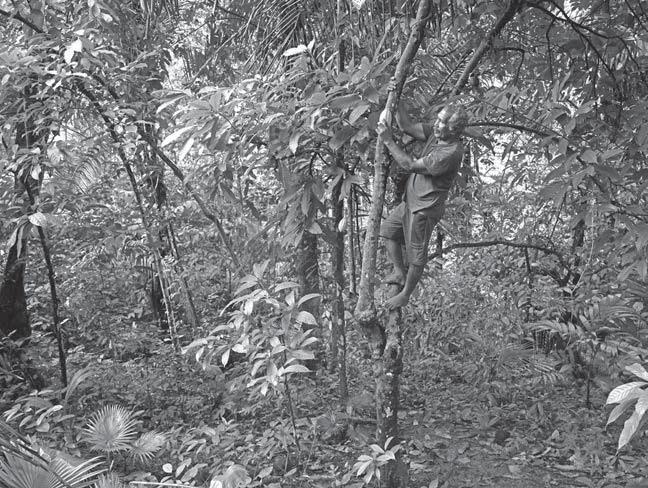
LELILEF SAWAI, Indonesia—On a steep trek up to his forest farm on the Indonesian island of Halmahera, Librek Loha let out a cry of dismay. “Aduuuuh,” he said, his voice trailing off.
Continued from A1
increased...rivers are polluted, mangroves are cut to develop smelter areas, coastal areas and coral are being damaged by the smelters.”
The waste from coal power plants was another problem, he said. The Associated Press verified the methodology used in the Auriga report.
A vast tropical archipelago, Indonesia is the world’s third most rainforest-covered country, home to giant forest flowers and endangered orangutans and elephants. Since 1950, more than 740,000 square kilometers (more than 285,000 square miles) of Indonesian rainforest—an area twice the size of Germany—have been logged, burned or degraded, according to Global Forest Watch.


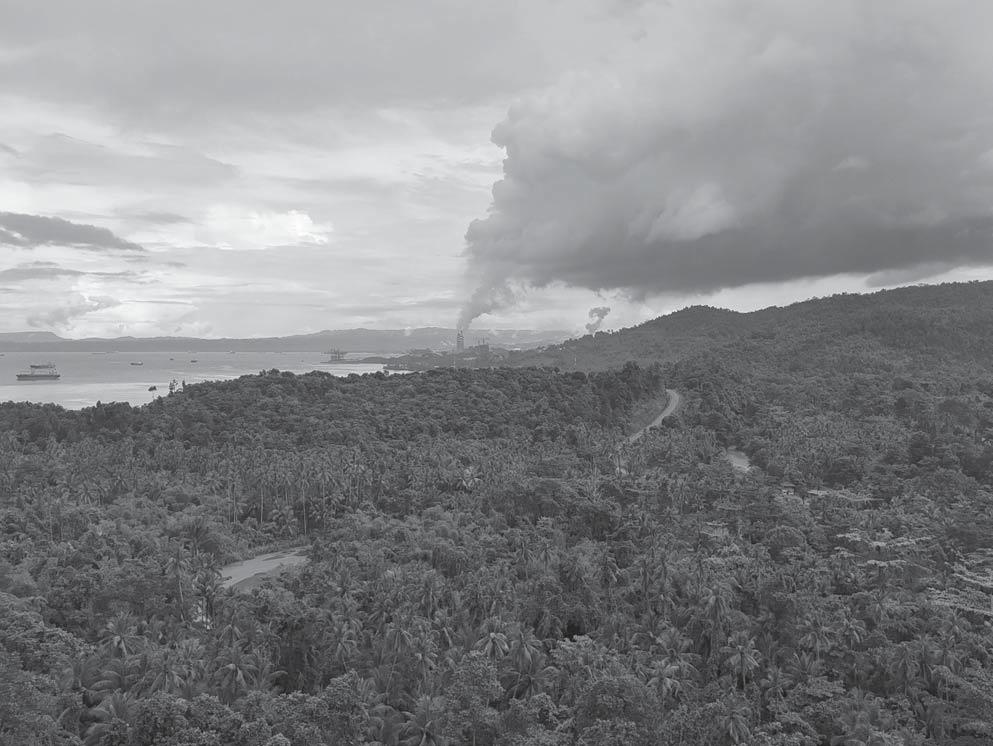
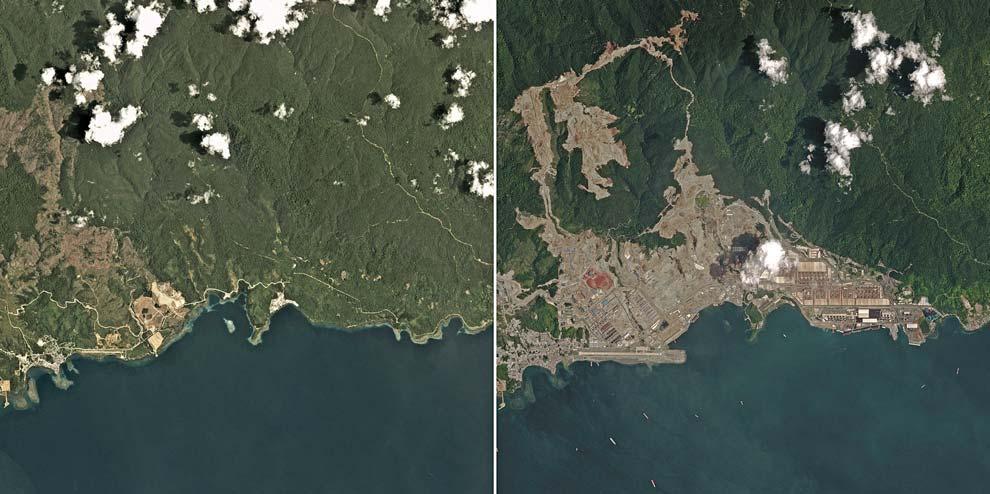
In Lelilef Sawai, the village now surrounded by the Weda Bay Industrial Park, the deforestation and its impact are evident. Loha, the farmer, has held out, refusing to sell the land he’s tended for four decades. Now orange dust often covers his plants and clean water is scarce. The plants also grow more slowly, he said.
From his land, he can hear construction and see bright orange sediment flow into the sea. Research shows landslides are far more likely in deforested areas.
Max Sigoro, 54, a traditional hunter and farmer, echoes Loha. Bright lights and noise from construction repel the deer he used to hunt at night. He says he’s lost nearly all his previous income since the industrial park’s expansion.
Abdullah Ambar, 61, says the sea near the project has become murky and he can’t fish anymore; the fish are gone.
PT Indonesia Weda Bay officials declined to be interviewed by the AP but the company said in statement it has planted more than 10 square kilometers (about 4 square miles) of new trees. The company plays an active role in supporting the living standards of local people, offering economic development, it said, and the industrial zone meets all environ-
mental standards. The company said it strives to protect water and has launched coral and mangrove planting programs.
Complaints from villagers at the Weda Bay project mirror those from communities near other smelter works across Indonesia, including a controversial industrial park on the island of Borneo and other projects in North Maluku.
Perhaps related to these complaints, the interest of some European companies in nickel from Indonesia may be cooling.
In recent weeks, the French mining company Eramet and German chemical giant BASF announced they were canceling plans to build a $2.6-billion nickel refinery. Eramet cited no reason, while BASF blamed changes in the global nickel market. The announcements came shortly after being contacted by the AP for this story.
Indonesia has been wooing Tesla, which uses twice as much metal in its total production of batteries than the next highest auto competitor. The amount of nickel it used in 2023 was up a third over the year before. Only 13% came from Indonesia last year, but its 2023 impact report mentioned Indonesia 18 times and warned the country’s nickel will be crucial. Tesla did not respond to
emailed questions asking about its use of nickel from Indonesia and deforestation.
Questions to Indonesia’s Ministry of Environment and Forestry, Coordinating Ministry of Maritime and Investment Affairs and Ministry of Energy and Natural Resources went unanswered. Nickel-making doesn’t have to be dirty. Using clean energy rather than coal goes a long way toward cleaning the air near nickel complexes. The cleanest operations produce emissions vastly below the industry average, according to a report by the nonprofit Transport and Environment last year. Automakers could do more to investigate where their nickel comes from, including using satellites, and ban nickel from deforested areas.
But for villagers like Loha, Sigoro and Ambar, the prosperity they were led to believe would come, has not come.
“Now our water is dirty and the fish and animals we hunt are gone,” Ambar said. “Where is the better life promised?“
(Davey reported from London and Fassett reported from San Francisco. Associated Press photographer Achmad Ibrahim contributed to this report.)
Editor: Angel R. Calso

By Seung Min Kim, Jill Colvin & Calvin Woodward The Associated Press
WASHINGTON—Joe Biden and Donald Trump are two presidents with unfinished business and an itch to get it done.
Their track records and plans on abortion, immigration, taxes, wars abroad—you name it—leave no doubt that the man voters choose in November will seek to shape the landscape of American life in ways wholly distinct from the other.
The recent assassination attempt against Trump left Biden and his opponent both urging national unity in a rare moment of overlap. But it’s unclear how long that will last: Biden has largely built his reelection campaign around criticizing Trump as a menace to democracy and the nation’s founding principles; the former president has long been a sharp Biden critic who relishes bombast and is known for holding political grudges.
On nearly every issue, the choices—if the winner gets his way—are sharply defined. The onward march of regulation and incentives to restrain climate change, or a slow walk if not an about-face. Higher taxes on the super rich, or not. Abortion rights reaffirmed, or left to states to restrict or allow as each decides. Another attempt to legislate border security and orderly entry into the country, or massive deportations. A commitment to stand with Ukraine or let go.
At no time in living memory have two presidents, current and former, competed for the office. Not since Presidents Teddy Roosevelt and William Howard Taft, both Republicans, in 1912, and that didn’t work out for either of them—Democrat Woodrow Wilson won that threeway race.
More than a century later, voters again get to judge two presidents on their records alongside their promises for the next four years. Here’s where they stand on 10 of the top issues:
Abortion
BIDEN: The president has called for Congress to send him legislation that would codify in federal law the right to an abortion, which stood for nearly 50 years before being overturned by the Supreme Court. He has also criticized statewide bans on abortion in Republican states and says he will veto any potential nationwide ban should one come to his desk. In the absence of legislation, his administration has taken narrower actions, such as proposals that would protect women who travel to obtain abortions and limit how law enforcement collects medical records.
TRUMP: The former president often brags about appointing the Supreme Court justices who overturned Roe v. Wade, ending the constitutional right to an abortion. After dodging questions about when in pregnancy he believes the procedure should be restricted, Trump announced in April that decisions on access and cutoffs should be left to the states. He said he would not sign a national
abortion ban into law. But he’s declined to say whether he would try to limit access to the abortion pill mifepristone. He told Time magazine that it should also be left up to states to determine whether to prosecute women for abortions or to monitor their pregnancies.
BIDEN: In a second term, Biden could be expected to continue his focus on implementing the climate provisions of his Inflation Reduction Act, which provided nearly $375 billion for things like financial incentives for electric cars and clean energy projects. Biden is also enlisting more than 20,000 young people in a national “Climate Corps,” a Peace Corps-like program to promote conservation through tasks such as weatherizing homes and repairing wetlands. Biden wants to triple the group’s size this decade. Despite all this, it’s unlikely that the US will be on track to meet Biden’s goal of cutting greenhouse gas emissions in half by 2030.
TRUMP: His mantra for one of his top policy priorities: “DRILL, BABY, DRILL.” Trump, who in the past cast climate change as a “hoax” and harbors a particular disdain for wind power, says it’s his goal for the US to have the cheapest energy and electricity in the world. He’d increase oil drilling on public lands, offer tax breaks to oil, gas and coal producers, speed the approval of natural gas pipelines and roll back the Biden administration’s aggressive efforts to get people to switch to electric cars, which he argues have a place but shouldn’t be forced on consumers. He has also pledged to re-exit the Paris Climate Accords, end wind subsidies and eliminate regulations imposed and proposed by the Biden administration targeting energyinefficient kinds of lightbulbs, stoves, dishwashers and showerheads.
Democracy/Rule
BIDEN: Protecting democracy has been the raison d’etre behind Biden’s decision to run for reelection. In a symbolic nod to the Revolutionary War, Biden delivered his first campaign speech of 2024 near Valley Forge, Pennsylvania, where he spoke of George Washington’s decision to step down as the leader of the Continental Army after American independence was won. During the January 5 speech, Biden said this year’s presidential contest is “all about” whether US democracy will survive and he regularly condemns Trump’s denial that he lost the 2020 general election. Biden has called the January 6, 2021, assault on the Capitol a “day that we nearly lost America—lost it all.” TRUMP: The former president, who famously refused to accept his loss to Biden in 2020, has not committed to accepting the results this time. “If everything’s honest, I’ll gladly accept the results,”

Trump told the Milwaukee Journal Sentinel. “If it’s not, you have to fight for the right of the country.” He has said he will pardon the January 6 defendants jailed for assaulting police officers and other crimes during the attack on the Capitol. He vows to overhaul the Justice Department and FBI “from the ground up,” aggrieved by the criminal charges the department has brought against him. He also promises to deploy the National Guard to cities such as Chicago that are struggling with violent crime, and in response to protests, and has also vowed to appoint a special prosecutor to go after Biden.
Federal government
BIDEN: The Biden administration is already taking steps to make it harder for any mass firings of civil servants to occur. In April, the Office of Personnel Management issued a new rule that would ban federal workers from being reclassified as political appointees or other at-will employees, thus making them easier to dismiss. That was in response to Schedule F, a 2020 executive order from Trump that reclassified tens of thousands of federal workers to make firing them easier.
TRUMP: The former president vows an overhaul of the federal bureaucracy, which he has long blamed for stymying his first term agenda: “I will totally obliterate the deep state.” He plans to reissue the Schedule F order stripping civil service protections. He’d then move to fire “rogue bureaucrats,” including those who “weaponized our justice system,” and the “warmongers and America-Last globalists in the Deep State, the Pentagon, the State Department, and the national security industrial complex.” He’s pledged to terminate the Education Department and wants to curtail the independence of regulatory agencies like the Federal Communications Commission.
Immigration
BIDEN: The president continues to advocate for the comprehensive immigration bill he introduced on his first day in office, which would grant an eight-year pathway to citizenship for immigrants in the US without legal status, with a faster track for young immigrants living in the country illegally who were brought here as children. That legislation went nowhere in Congress. This year, facing large numbers of people crossing the border illegally, the president backed a Senate compromise
that included tougher asylum standards and billions more in federal dollars to hire more border agents, immigration judges and asylum officers. That deal collapsed on Capitol Hill due to Trump’s opposition. Biden instead issued two major executive actions on the border in recent months, one tightening US asylum restrictions and the other offering potential citizenship to hundreds of thousands of immigrants without legal status in the US.
TRUMP: The former president promises to mount the largest domestic deportation in US history—an operation that could include detention camps and the National Guard. He’d bring back policies he put in place during his first term, like the Remain in Mexico program and Title 42, which placed curbs on migrants on public health grounds.
And he’d revive and expand the travel ban that originally targeted citizens from seven Muslim-majority countries.
After the October 7 Hamas attack on Israel, he pledged new “ideological screening” for immigrants to bar “dangerous lunatics, haters, bigots, and maniacs.” He’d also try to deport people who are in the U.S. legally but harbor “jihadist sympathies.” He’d seek to end birthright citizenship for people born in the US whose parents are both in the country illegally.
Israel/Gaza
BIDEN : The war in Gaza, more than other national security considerations, has defined Biden’s foreign policy this year, with significant political implications. He has offered full-throated support for Israel since Hamas militants launched a surprise deadly assault on October 7. But as the death toll in Gaza rose sharply, Biden faced massive backlash at home.
In May he proposed a threephased hostage for extended cease-fire deal that aims to bring all remaining hostages and Israeli dead home. Biden believes the deal could lead to a permanent end to the grinding nine-month war. He also calls for a two-state solution, which would have Israel existing alongside an independent Palestinian state.
TRUMP: The former president has expressed support for Israel’s efforts to “destroy” Hamas but he’s also been critical of some of Israel’s tactics. He says the country must finish the job quickly and get back to peace. He has called for more aggressive responses to pro-Palestinian protests at college campuses and applauded police efforts to
clear encampments. Trump also proposes to revoke the student visas of those who espouse antisemitic or anti-American views.
BIDEN: The president and White House officials regularly denounce discrimination and attacks against the LGBTQ+ community. Shortly after he took office, Biden reversed an executive order from Trump that had largely banned transgender people from military service, and his Education Department issued a rule that says Title IX, the 1972 law that was passed to protect women’s rights, also bars discrimination based on sexual orientation or gender identity. That rule was silent on the issue of transgender athletes.
TRUMP: The former president has pledged to keep transgender women out of women’s sports and says he will ask Congress to pass a bill establishing that “only two genders,” as determined at birth, are recognized by the United States. He promises to “defeat the toxic poison of gender ideology.” As part of his crackdown on gender-affirming care, he would declare that any health care provider that participates in the “chemical or physical mutilation of minor youth” no longer meets federal health and safety standards and won’t get federal money. He’d take similarly punitive steps in schools against any teacher or school official who “suggests to a child that they could be trapped in the wrong body.” Trump would support a national prohibition of hormonal or surgical intervention for transgender minors and bar transgender people from military service.
BIDEN: The president has spent much of his time rebuilding alliances unraveled by Trump, particularly NATO, a critical bulwark against Russian aggression. Since the onset of Russia’s invasion of Ukraine, Biden has pledged unceasing support to Kyiv and he made an unannounced visit there in February 2023 in a show of solidarity. His administration and Congress have sent tens of billions of dollars in military and other aid to Ukraine. The latest tranche of aid totaled $61 billion in weapons, ammunition and other assistance and is expected to last through this year. Continued US assistance is critical, Biden says, because he argues that Russian leader Vladimir Putin will not stop at invading Ukraine.
TRUMP: The former president has repeatedly taken issue with US aid to Ukraine and says he will continue to “fundamentally reevaluate” the mission and purpose of the NATO alliance if he returns to office. He has claimed, without explanation, that he will be able to end the war before his inauguration by bringing both sides to the negotiating table. (His approach seems to hinge on Ukraine giving up at least some of its Russianoccupied territory in exchange for a cease-fire.) On NATO, he has assailed member nations for years for failing to hit agreedupon military spending targets. Trump drew alarms this year when he said that, as president, he had warned leaders that he would not only refuse to defend
nations that don’t hit those targets, but “would encourage” Russia “to do whatever the hell they want” to countries that are “delinquent.”
BIDEN: This is where Biden and his protectionist tendencies—in a continued appeal to workingclass voters—have some similarities with Trump. Biden is calling for a tripling of tariffs on Chinese steel, a move that would shield US producers from cheaper imports. His administration in May said it would raise the tariff rate on steel and aluminum to 25 percent from 7.5 percent. Biden has also said he opposes the proposed acquisition of US Steel by Japan’s Nippon Steel, because it is “vital for it to remain an American steel company that is domestically owned and operated.”
TRUMP: The former president wants a dramatic expansion of tariffs, proposing a levy of perhaps 10 percent or higher on nearly all imported foreign goods. Penalties would increase if trade partners manipulate their currencies or engage in other unfair trading practices. He would also urge Congress to pass legislation giving the president authority to impose a reciprocal tariff on any country that imposes one on the US. Much of his trade agenda has focused on China. Trump has proposed phasing out Chinese imports of essential goods including electronics, steel and pharmaceuticals and wants to ban Chinese companies from owning US infrastructure in sectors such as energy, technology and farmland. Whether higher tariffs come from a Biden administration or a Trump one, they are likely to raise prices for consumers who have already faced higher costs from inflation.
Taxes
BIDEN: The president has proposed raising the corporate tax rate to 28 percent and the corporate minimum tax to 21 percent as a matter of “fundamental fairness” that will bring in more money to invest in Americans. The current corporate rate is 21 percent and the corporate minimum, raised under the Inflation Reduction Act, is at 15 percent for companies making more than $1 billion a year. Biden also wants to require billionaires to pay at least 25 percent of their income in taxes and to restore the child tax credit that was enacted under his 2021 Covid-19 relief package, but has since expired.
TRUMP: The former president has promised to extend the 2017 tax cuts that he signed into law and are set to expire at the end of 2025. That package cut the corporate tax rate from 35 percent to 21 percent and roughly doubled the standard deduction and child tax credit. Those elements will remain until and unless a new law changes them, but many other tax cuts in Trump’s package will lapse without further action by Congress. Trump says he wants to trim the corporate tax rate further—to as low as 15 percent—and repeal any tax increases that occurred under Biden. Trump also promised to eliminate taxes on tipped income—though doing so would probably require congressional approval.
Sunday, July 21,


Editor: Tet Andolong





from the madding crowd.
THE weather bureau has declared the official end of the long, hot summer and the onset of the rainy season. But those who shied away from the searing heat of the sun can catch up with the summer vibe with less of the record heat index we experienced just a few weeks back.
An exciting place to do this is Calatagan South Beach (CaSoBe), an emerging resort estate south in Batangas which is redrawing the landscape and reinventing the beach experience.
A sprawling 15-hectare seaside community, this beach town and residential resort is a master-planned family getaway by Millennial Resorts Corp., the hospitality arm of property con-
glomerate Landco Pacific. Just like its famed namesake and inspiration in Miami, Florida, it is aspiring to be a consummate getaway and more than the usual resort we group up with.
Situated near the tip of Calatagan peninsula or some 3 hours from the metro, its unhurried comfy and modern amenities, and pace is ideal for those wanting to recharge in a beach paradise away
CaSoBe hugged the limelight 3 years ago when it launched Crusoe Cabins, which are refitted container vans turned into trendy beach-side lodgings which was later recognized as the country’s first resort given the Excellence in Design for Greater Efficiencies certification.
It also has the pod-like Cocoons which were designed for the more active guests who prefer adventure-oriented lodging.
With a vast stretch of powdery beach, it offers a kaleidoscopic sunset which can paint a thousand words and can evoke the artist in every person.
Living up to its mission of providing “unconventional accommodations” to a market often looking for new concepts, Landco Pacific recently launched the stately Chairman’s Cabin dedicated to Metro Pacific Investments Corp. board chair Manuel Pangilinan.
Regarded as CaSoBe’s crowning jewel, the well-appointed 300sq-m villa has four bedrooms,
state-of-the-art facilities, bar and kitchen, spacious common spaces, a veranda looking out to the sea.
The Cabin’s three bedrooms and the common facilities are available for bookings for staycations and small group events from Monday to Thursday.
Punctuating it is a 15.5-meter replica of the century-old Cape Santiago Lighthouse, Calatagan’s most iconic landmark, which boasts of a panoramic 360-degree viewing deck overlooking the entire property, the long beach, and the islands of Mindoro in the horizon.
CaSoBe will also soon open two new lodging experiences— Cupola and Apollo which will fascinate today’s breed of travelers.
Cupola is a cluster of 5 unique geodesic and dome-shaped tents with a private toilet, bath, and outdoor jacuzzi, which will take glamping up a notch higher. It also has comfy beds which are ideal for a small family or groups of four.
Meanwhile, Apollo Aeropods is a lunar capsule accommoda-
THE 79th anniversary of the Battle of Bessang Pass, the most decisive battle of the Second World War in the Philippines which helped turn the tide of the war, was recently observed in Ilocos Sur by local government units and socio-civic organizations.
Fought from the January 9 to June 14, 1945, the battle took place in the highland towns of Ilocos Sur involving over 20,000 Filipino guerillas and American officers under the United States Army Forces in the Philippines—Northern Luzon (USAFIP-NL) and some 4,000 battle-hardened troops of the Imperial Japanese Army’s Tora (Tiger) Division.
The Filipino victory paved the way for the entrapment of Japanese forces in the Cordillera mountains until the surrender of its commanding general Tomoyuki Yamashita later in September in Kiangan, Ifugao. Led by the Municipality of
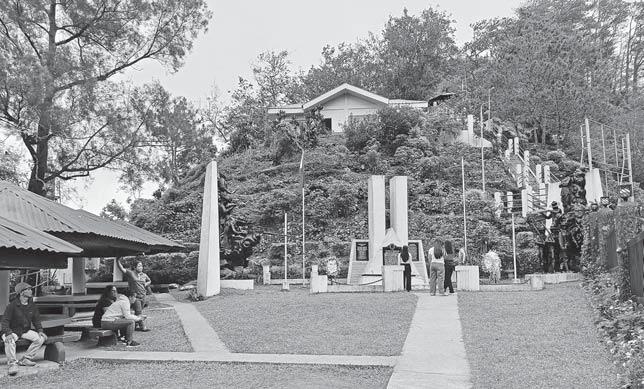
Cervantes, and supported by the Philippine Veterans Affairs Office (PVAO), the Province of Ilocos Sur, Municipality of Suyo, and Veterans Federation of the Philippines, the commemorative event was held at the Bessang Pass Natural Monument, a war shrine tucked in a 693-hectare sprawling protected area. Highlighting the solemn event was a wreath-laying ceremony, military honors and 21gun salute to the war dead.
University of the Philippines professor and World War II expert Dr. Ricardo Jose rendered a historical glimpse on the pivotal battle, which was also referred to as the “Battle of the Clouds” because of its high altitude of 1,600 meters above sea level which are often covered by clouds.
Another highlight is the awarding of the PVAO World War II Victory Medals to surviving nonagenarian guerillas Vicente Cabello and Dominador
Cabatic who fought in the said battle.
The program was capped by the indigenous victory community tayaw dance by a school dance troupe and the Barangay Malaya village officials.
June 14 has been declared by Malacanang as a province-wide non-working holiday in Ilocos Sur, but local officials and legislators are advocating for a national proclamation to emphasize its pivotal role during the Pacific War, particularly with its forthcoming 80th anniversary next year.
Situated along the SuyoCervantes highland highway, the protected area is managed by the Department of Environment and Natural Resources, and is habitat to a rich flora and fauna biodiversity, and is a favorite stopover among mountaineers and motorcycle riders.
In photo at the commemorative event are PVAO finance division chief Navy Captain
Edwina Taylor, Philippine Veterans Bank (PVB) first vicepresident and Veterans Federation of the Philippines-Sons & Daughters Association Inc. national executive vice-president (VFP-SDAI) Mike Villa-Real, Ilocos Sur Sangguniang Panlalawigan member Benjamin Maggay, Prof. Ricardo Jose, Vicente Casabar Cabello, PVAO chief administrative officer Col Nieves Gat-Eb (ret) who was also the guest of honor and speaker, Col Rhenante Salvador of the Philippine Army, Cervantes municipal mayor Pablito Benjamin Maggay, and Suyo municipal mayor Mario Subagan.
Also in photo are reenactors of the Republica Filipina Reenactment Group and the Philippine Living History Society who did historical impressions of the USAFIP-NL guerillas, American troops and Japanese soldiers, and brought in by the PVB as part of its mission to keep the valor of war veterans alive.

tion inspired by the Apollo 11 mission to the moon.
It also offers mixed-use residential and commercial lots which elevates the resort lifestyle under Landco’s BeachTowns development, winner of the Most Sustainable Developer and Best Real Estate Developer in the 2023 International Investment Awards.
Once completed in a few years’ time, self-contained community will be like a township with a town.
On top of first-rate amenities, guests can enjoy a myriad of activities for a consummate vacation—hopping around the coves and sandbars, snorkeling in the coral gardens, frolicking in the bamboo raft, hitting the fairways of the 18-hole par 72 Calatagan Golf Club, or sunset-watching at Cape Santiago Lighthouse.
It is best to visit the so-called Little Boracay during low tide in the late afternoon so you can marvel at the powdery sandbar snaking in off the shore.
The more athletic ones can ride the waves at Lago De Oro, perhaps
the country’s first cable ski park which popularized the sport in the early 2000s.
Within CaSoBe, visitors can frolic in Aquaria Water Park’s three-story slides, kayak around the bay, bike around the estate, feast on the specialty food of Sands and Captain Barbozza’s, do bonfires, or sip your fave coffee beverage at Mia Taza while watching the world go by.
Groups can also organize special interest activities such as art workshops, yoga retreats, Zumba, or the helluva mixture of culture, adventure and nature which the resort can help put together.
Time permitting, you can cross over to the intriguing island of Lubang in Occidental Mindoro, where you can retrace the trail of legendary Japanese straggler Hiroo Onoda who only surrendered 29 years after the end of World War 2. With sun, sea and sand, and everything in between, life is indeed a beach and summer is forever at CaSoBe.


THE Philippines will be the battleground for the brightest young minds from 13 other countries in the Asia-Pacific region as the first-ever International Nuclear Science Olympiad (INSO) takes center stage from July 31 to August 7 at the National Government Administrative Center in New Clark Center in Capas, Tarlac. Spearheaded by the Department of Science and Technology-Philippine Nuclear Research Institute (DOST-PNRI) and in partnership with the Department of Education, DOST-National Research Council of the Philippines, and International Atomic Energy Agency (IAEA), the INSO is an annual competition that aims to increase awareness and
demonstrate the commitment of the participating countries to the peaceful applications of nuclear science and technology through a battle of wits among secondary level students.
According to the DOST-PNRI, the Philippines is set to pioneer the first-ever INSO, where students from various schools across the Asia-Pacific region will compete in both theoretical and practical exams to test their knowledge of nuclear science.
Besides the Philippines, the other participating countries for the first INSO will be Bahrain, Iran, Jordan, Malaysia, Mongolia, Oman, Pakistan, Qatar, Saudi Arabia, Singapore, Sri Lanka, Thailand, and the United Arab Emirates. Allan Mauro V. Marfal/S&R Media service
SINCE 2020, the condition known as long Covid-19 has become awidespread disabilityaffecting the health and quality of life of millions of people across the globe and costing economies billions of dollars inreduced productivity of employees and an overall drop in the work force.
The intense scientific effort that long Covid sparked has resulted inmore than 24,000 scientific publications, making it the most researched health condition in any four years of recorded human history.
Long Covidis a term that describes theconstellation of long-term health effects caused by infection with the SARSCoV-2 virus.
These range from persistent respiratory symptoms, such as shortness of breath, to debilitating fatigue or brain fog that limits people’s ability to work, and conditions, such as heart failure and diabetes, which are known to last a lifetime.
I am a physician scientist, and I have been deeply immersed in studying long Covid since the early days of the pandemic.
I have testified before the US Senate as anexpert witness on long Covid, havepublished extensively on itand was named as one ofTime’s 100 most influential people in health in 2024for my research in this area.
Over the first half of 2024, aflurry of reports and scientific paperson long Covid added clarity to this complex condition. These include, in particular, insights into how Covid-19 can still wreak havoc in many organs years after the initial viral infection, as well as emerging evidence on viral persistence and immune dysfunction that last for months or years after initial infection. How long Covid affects the body
A new study that my colleagues and I published in the New England Journal of Medicine on July 17, shows that therisk of long Covid declinedover the course of the pandemic.
In 2020, when the ancestral strain of SARS-CoV-2 was dominant and vaccines were not available, about 10.4 percent of adults who got Covid-19 developed long Covid.
By early 2022, when the omicron family of variants predominated, that rate declined to 7.7 percent among unvaccinated adults and 3.5 percent of vaccinated adults. In other words, unvaccinated people were more than twice as likely to develop long Covid.
While researchers like me do not yet have concrete numbers for the current rate in mid-2024 due to the time it takes for long Covid cases to be reflected in the data, the flow of new patients into long Covid clinics has been on par with 2022.
We found that the decline was the result of two key drivers: availability of vaccines and changes in the characteristics of the virus—which made the virus less prone to cause severe acute infections and may have reduced its ability to persist in the human body long enough to cause chronic disease.
Despite the decline in risk of developing long Covid, even a 3.5 percent risk is substantial.
New and repeat Covid-19 infections translate into millions of new long Covid cases that add to an already staggering number of people suffering from this condition.
Estimates for the first year of the pandemic suggests that atleast 65 million people globally have had long Covid.
Along with a group of other leading
scientists, my team will soon publish updated estimates of the global burden of long Covid and its impact on the global economy through 2023.
In addition, a major new report by the National Academies of Sciences Engineering and Medicine details all thehealth effects that constitute long Covid.
The report was commissioned by the Social Security Administration to understand the implications of long Covid on its disability benefits.
It concludes that long Covid is a complex chronic condition that can result in more than 200 health effects across multiple body systems.
These include new onset or worsening: Heart disease
Neurologic problems,such ascognitive impairment, strokes anddysautonomia. This is a category of disorders that affect the body’s autonomic nervous system—nerves that regulate most of the body’s vital mechanisms, such as blood pressure, heart rate and temperature.
Post-exertional malaise, a state of severe exhaustion that may happen after even minor activity—often leaving the patient unable to function for hours, days or weeks
Gastrointestinal disorders
Kidney disease metabolic disorders, such asdiabetesandhyperlipidemia, or a rise in bad cholesterol
Immune dysfunction Long Covid can affect people across the lifespan from children to older adults, and across race and ethnicity and baseline health status.
Importantly,more than 90 percent of people with long Covidhad mild Covid-19 infections.
The National Academies report also concluded that long Covid can result in the inability to return to work or school; poor quality of life; diminished ability to perform activities of daily living; and decreased physical and cognitive function for months or years after the initial infection.
The report points out that many health effects of long Covid, such as post-exertional malaise and chronic fatigue, cognitive impairment and autonomic dysfunction, are not currently captured in theSocial Security Administration’s Listing of Impairments, yet may significantly affect an individual’s ability to participate in work or school.
A long road ahead
WHAT’S more, health problems resulting from Covid-19 can last years after the initial infection.
A large study published in early 2024 showed that even people who had amild SARS-CoV-2 infection still experienced new health problemsrelated to COVID-19 in the third year after the initial infection.
Such findings parallel other research showing that thevirus persistsin various organ systems for months or years after Covid-19 infection.
Research is showing that immune responses to the infection arestill evident two to three yearsafter a mild infection. Together, these studies may explain why a SARS-CoV-2 infection years ago could still cause new health problems long after the initial infection.
Important progress is also being made in understanding the pathways by which long


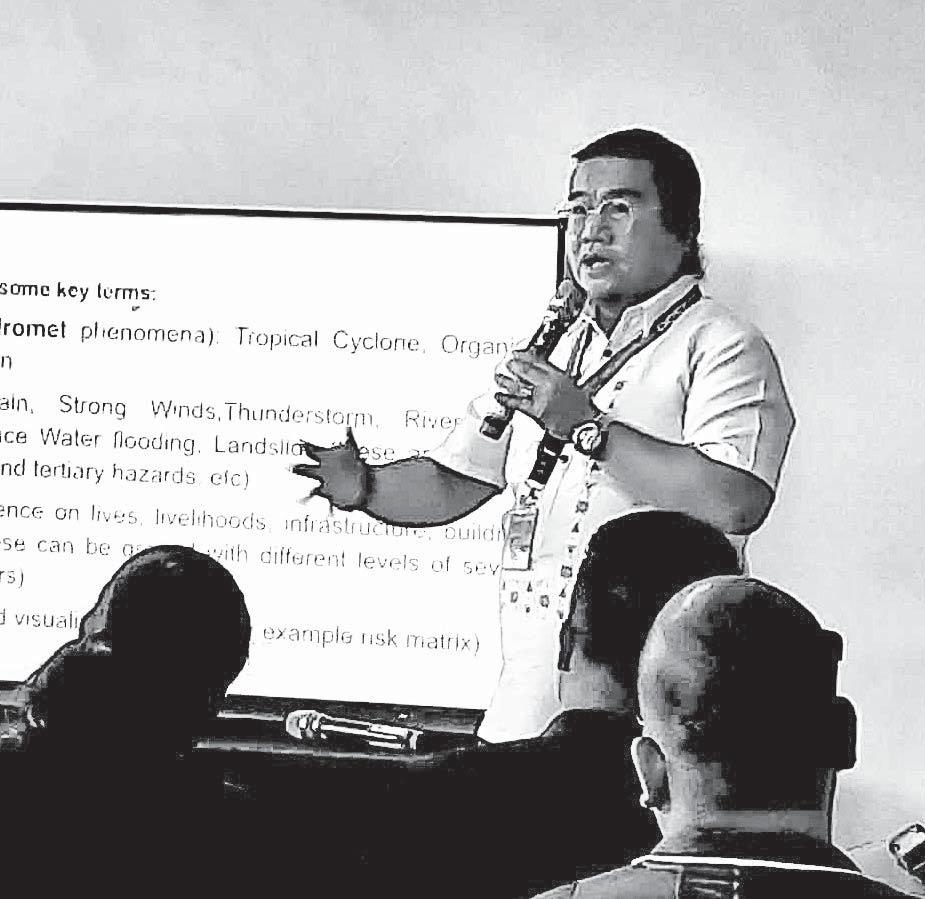

THE Philippine Atmospheric, Geophysical and Astronomical Services Administration’s (Pagasa) undertook innovations on its website and rain forecast to be able to serve the public better.
The new website has uniform look and information for the provinces that can provide a five-day weather information.
“We can give ‘chance-of-rain’ data for the week, wherein the public may know the chances of rain, like how many percent, 30 percent, for instance. But these information are available for now only in our website, not yet in social media,” said Sharon Juliet M. Arruejo, Assistant Weather Services chief of Pagasa.
Arruejo added that this special forecast can be used by the public in rescue operations and even in their planned travel.
The country’s weather bureau discussed the Sub-seasonal to
Seasonal (S2S) forecast in a forum during the recent Handa Luzon leg, a disaster risk reduction and management (DRRM) campaign by the Department of Science and Technology (DOST).
The S2S provides tropical cyclone and rainfall exceedance probability forecast.
Ana Liza S. Solis, assistant Weather Services chief, said that Pagasa can provide tailor-like program based on agricultural needs. They can also give “historical data which the people can used in policy-making.”
However, no matter how accurate the weather forecast is, but if those on the ground will have difficulty in understanding or interpreting the forecast, the warning issued will not be of much use, said Romeo B. Ganal Jr., Pagasa senior weather specialist, during the Technology Forum on Disaster Prevention and Mitigation at the Handa Pilipinas Luzon leg in
Ilocos Norte.
“There’s a paradigm shift from the traditional forecast. For instance, we used to say, this is the weather, to impact-based forecast, wherein we will now say these are what will likely to happen given this weather,” Ganal explained partly in Filipino.
Typhoon Haiyan in 2013 created a huge impact where the weather experts realized it’s not enough to just give a forecast.
For the local government to take action or even for people in the community to know what to do, they have to understand what the impact of the weather will be, so they can prepare in order to reduce damage to themselves and to properties.
In the forum, Ganal discussed the multi-hazard impact-based forecasting and early warning system for the Philippines which is based on international standards.
He said there is a limitation
to what a forecast agency can do. There is a need to make people in the localities understand and interpret appropriately, so they can make appropriate action in order to save more lives.
Heads of local governments from different parts of Luzon and some national government offices, including the Office of the Civil Defense, the Department of Interior, Local Government, Philippines Information Agency, local DRRM officers and students gathered for a three-day event as Handa Pilipinas Innovations in Climate and Disaster Resilience Luzon leg kicks off at Plaza del Norte, Laoag City, Ilocos Norte. The DOST-Technology Application and Promotion Institute managed this year’s Handa, in collaboration with DOST-Regions I who hosted the Luzon leg, VII, VIII and X, and other government agencies.
THE Southeast Asian Regional Center for Graduate Study and Research in Agriculture (Searca) has released the June 2024 issue (Volume 21.1) of the Asian Journal of Agriculture and Development (AJAD), which dives into critical themes for agriculture in Southeast Asia, including food security, resilient food value chains, and sustainable rural development.
Published bySearca, AJAD is a freely accessible, peer-reviewed journal focusing on agriculture and development research.
Searca Director Dr. Glenn Gregorio said AJAD publishes articles on empirical studies, policy discussions, and institutional development analyses.
While the journal offers online access to all articles, printed copies are available through subscription.
Gregorio said the latest AJAD issue features seven research papers that explore how communities across Southeast Asia are responding to recent food and economic shocks.
These studies examine various aspects of agricultural practices and their impact.
One study, “Drivers of Successful Adoption of Eco-innovation: Case Studies of Agricultural Cooperatives in Vietnam,” by Huong Lan Pham and colleagues, investigates how opportunity, motivation, and ability affect the adoption of eco-innovation by agricultural cooperatives.
The research highlights the importance of water management, pesticide reduction, and waste recycling to promote sustainability and food security.
The study suggests distinct strategies for different cooperative models.
Technology-driven cooperatives should strengthen their networks to amplify marketing and sales, while market-driven cooperatives should prioritize strong technical expertise to educate members on the

most suitable technologies.
Authority-driven cooperatives, on the other hand, require a business strategy revamp and investment in human and social capital.
Another paper, “Motivation toward Rice Farming in Margokaton Village, Indonesia,” by Japan-based Rosalia Natalia Seleky and her co-authors, explores what motivates farmers to stay in the rice-growing industry.
The research reveals that factors like educational attainment, side jobs, perception of farming as a career, and parental encouragement significantly influence farmers’ motivation.
These findings can be used to attract younger generations and maintain engagement in rice farming.
“Analysis of the Strawberry Value Chain in the Philippines” by University of the Philippines Los Baños (UPLB)-based Mar Cruz and his co-authors. examines the strawberry industry, particularly the challenges faced during the Covid-19 pandemic.
The study identifies constraints like
limited planting materials, lack of capital for technology adoption, and weak price negotiation power for farmers.
The authors propose solutions for developing the value chain, including using tissue-cultured seedlings, researching warm-weather planting options, and establishing distribution agreements for processed products.
The paper “Farming Systems and GAP Adoption in JASS Coffee in Indonesia” by M Royan and co-authors from Kasetsart University, Thailand and L’Institut Agro Montpellier, France, discusses the impact of introducing Java Arabica Sindoro-Sumbing (JASS) coffee as a new income source for farmers.
The study found that coffee intercropped with other crops, along with the adoption of good agricultural practices, leads to higher yields and income for farmers specializing in coffee.
The impact of Covid-19 on food security is tackled in “Household Food Insecurity and Covid-19 Social Safety Nets in Cavite,
Philippines” by Mildred Guirindola and her co-authors from the Food and Nutrition Research Institute, UPLB, UP Manila, and the Philippine Children’s Medical Center. The study evaluates the effectiveness of emergency cash assistance and food aid provided during the pandemic to help vulnerable households cope with the economic crisis and improve their food security. The authors recommend improvements to safety net programs, such as updating beneficiary databases for ready access during food shocks and combining food aid with nutrition-focused initiatives.
“Digitalization in Indonesia’s Agrifood Sector in the Wake of the Covid-19 Pandemic” by Silvia Uthari Nuzaverra Mayang Mangurai and her co-authors, analyzes how the pandemic has accelerated the development of digital technologies like Internet of Things, artificial intelligence, and big data in the Indonesian agri-food sector. Hailing from Southeast Asian Regional Centre for Tropical Biology, Bogor Agricultural University, Universitas Tanjungpura, Institut Teknologi Sumatera, Indonesian Green Action Forum, Politeknik Pertanian Negeri Kupang, and University of Sultan Agung, Indonesia, the authors highlight in their study that many startups are in the form of farmers’ advisory, mechanization platforms, digital marketplace, e-commerce, traceability, food delivery, and peer-to-peer lending.
The journal issue concludes with a book review of “Becoming a Young Farmer— Young People’s Pathways into Farming: Canada, China, India and Indonesia” by Priyarsono.
The review sheds light on the economics of aging farmers in both developed and developing countries. It is valuable for students, rural social research, and agricultural policymaking.



By Lyn Resurreccion
Carmelite nuns stay within the four walls of the monastery. However, during the celebration of the centennial of the foundation of Carmelites in Jaro, Iloilo, last November 9, 2023, many of the cloistered nuns attended the event together with the Order of Discalced Carmelites (OCD) friars, Secular Discalced Carmelites and the faithful.
Jaro Carmel Mother Superior Teresa Josephine of Jesus and Mary, OCD, in her speech during the historic event, highlights the presence of contemplative nuns from many parts of the country and abroad.
“Our hidden life is exposed today at this very rare occasion of this 100th anniversary foundation [of Carmel in Jaro],” she says.
“It cannot be kept ‘under a bushel basket’ but must be set on a hill ‘that others may see how good the Lord is,’” she says, quoting from a parable from the Gospel of Matthew.
The first Carmelite presence in the Philippines was founded on November 9, 1923, when four French Carmelite nuns from Hue, Vietnam, arrived in Jaro. They came through the persistent invitation of then-Jaro Bishop James Paul McCloskey—a devotee of Our Lady of Mount Carmel and of Saint Therese of the Child Jesus.
The first monastery gave birth to the current 22 Carmelite monasteries, along with OCD friars and Secular Discalced Carmelites all over the country.
Hidden life in serving God HOW do the cloistered Carmelite nuns live and spend their day? Do they pray the whole day and do nothing else?
The BusinessMirror interviewed Mother Teresa Josephine through email to shed light on their life inside the monastery.
The dictionary defines contemplative life as which involves or is given to deep silent prayer or religious
meditation, especially in a monastery or convent.
Mother Teresa Josephine says the Carmel monastery in Jaro has been established 100 years ago, but in the Archdiocese of Jaro not all the faithful know that there is a Carmel there with prayer as apostolate.
“This is precisely because the life in Carmel is hidden and it serves God, and His church in silence and solitude, remaining constantly in the presence of God. When life is hidden it is solely spent to give glory to God who is Himself hidden,” she explains.
She says that when the people in Jaro learned that Carmelites “exist” in the area, they “come to ask for prayers.”
“They praise God that there are nuns who walk with them quietly on the journey of life,” she adds.
Prayer dominates daily schedule
MOTHER Teresa Josephine furnished the BusinessMirror with the monastery’s “horarium,” Latin for schedule for the hours of the day, especially within a religious house.
The nuns start their day at 4:30 a.m., inviting each other with these words: “Praise be Jesus Christ and the Virgin Mary His mother! Come to prayer, Sisters. Come to praise the Lord.”
Yes, their day is dominated with praying from 4:30 a.m. to 10 p.m. In addition they also attend Mass, pray the rosary and have spiritual readings.
Work and recreation
HOWEVER, like ordinary

mortals, the cloistered nuns also have other activities.
They have “work” schedules— such as kitchen chores, hostmaking, gardening, cleaning and laundry—which are interspersed with other schedules.
Recreation? They have that, too. They share stories, listen to news and practice music. They also set time for siesta.
This is the nuns’ daily horarium:
4:30Waking-up
5:00 Mental prayer (Silent prayer)
6:00Morning prayer (Lauds)
6:30 Mass (Eucharistic Celebration); Thanksgiving
7:30 Breakfast; work (kitchen, garden, host making, cleaning, laundry, etc.)
9:00 Mid-morning prayer (15 mins.) and back to work
10:50 Midday prayer; Examination of conscience
11:15Lunch with Reading
11:40 Recreation (1 hour) where they talk, share stories; listen to local, national, international news or news about the Church; music practice
1:00Siesta
2:00Spiritual reading
3:00 3Mid-afternoon prayer (15 minutes); work
4:30Rosary
5:00 Mental prayer (Silent Prayer)
6:00 Evening prayer; Office of Readings
7:00Supper with Readings
8:00 Recreation, or Community study/Evaluation or Sharing of the Word of Life
9:00Night Prayer
10:00Retirement (lights off)
‘Prayer is life’
MOTHER Teresa Josephine explains their prayer schedules, including Mental Prayer in the morning and in the evening.
“Seven times we have the Liturgy of the Hours, or Prayers of the Church, and we pray the rosary together,” she said.
During Mental Prayer, they spend the hour in silence, “uniting with God and listening to Him.”
“The Liturgy of the Hours are prayers prescribed by the Church, which is found in the Breviary. On Fridays, we have the Holy Hour with the Exposition of the Blessed Sacrament,” she adds.
In Carmel, “prayer is life,” she points out.




“Our time is sanctified because we try to be united with God, with the Church and with the sorrows and anguish of our people as well as their joys,” she says.
In the video “A day in Carmel” on the Facebook account of Archdiocese of Jaro Commission on Social Communications, the nuns’ activities from prayer to chores are described by the narrator as “every moment is a prayer, every moment is an offering, every moment is a gift” as they seek God in the ordinariness of life.
Releasing tension ACCORDING to Mother Teresa Josephine, they “create activities” to help them “release tensions” like playing parlor games during big feasts or solemnities.
Or simply relax their minds by having a “picnic in the garden.”
“We have to be creative in order to break the monotony of life,” she added.
Why choose to be cloistered?
MOTHER Teresa Josephine says that if they listen to God’s word, “‘It is I who chose you,’ I guess, this is not our choice. We are led by grace into this kind of life. We simply have to cooperate with God’s grace.
“Of course if each of us in the monastery is asked, we may have different answers depending on our different experiences of God’s call, the mystery of a call,” she adds.
In her case, the former catechist, a teacher by profession, she says she loves her work, her apostolate.
But she felt she had “‘to put out my net into the deep’ where I had to allow God to do the work for me. I only need to keep still, to sit beside Him and listen to Him. Isn’t this the ‘better portion’ Jesus is speaking of? Enjoying the better portion gives happiness.”
She notes that “no one can remain in the cloister if she is not happy.”
What makes her happy?
AS she says in her message during the centennial celebration last November 9, the Carmelite nun says: “It is the love of God that brings us to where we are now.”
“I would say that the certainty that I am loved by the Lord is a cause of pure joy to me. When you feel you are loved tremendously by this God of Mercy, you also are moved to love and be merciful,” she points out.
“In one’s own little way there is always joy in giving something of oneself which can be a reason to be truly happy,” she adds.
Abnormal, boring life? IT can be said that living in the cloister can be abnormal.
One is not free to go out anytime and anywhere one wants to, cannot do the things people normally do like going shopping, watching a movie or anything that can give one a freedom to be happy—which she calls “a happiness that does not last forever.”
She says: “Life can be boring inside the cloister.”
“But if you have decided to follow the Lord, you are also aware of the difficulties and sacrifices and the ‘dying to self’ that this following entails. You know too well that the Lord has called you to carry the cross. Perhaps if you try to focus your gaze on the cross and what is beyond the cross, you will be able to bear the consequences of a cloistered life,” the prioress shares.
Of course, she says, wherever we are, there is difficulty. “No one is exempted.”
She adds: “Perhaps it depends on the focus of your love. We can be creative in doing service to God and to others. When we find meaning in little things, we don’t have to go out and do big things in order to be happy and contented.”
Can go out of monastery on some occasions
THE cloistered nuns, however, can go out of the monastery under some circumstances— when they need to see a doctor, to exercise their civil rights, attend meetings or assemblies of the nuns’ federation, or on very special occasion like last year’s centennial celebration of Carmel.
“We have to do it [centennial event] outside the Carmel [monastery] because our chapel is small. Besides, it was made in the cathedral with the permission of the bishop,” she says.
Extern nuns
BESIDES the cloistered nuns, there are extern nuns, who are not bound to remain in the cloister.
The extern nuns do errands for their cloistered sisters and represent them when external activities require.
“A cloistered nun can become an extern, or an extern sister can become a cloistered nun, when there is a valid reason and which should be approved by the
Holy See,” she explains.
Friendship with the Lord DESCRIBING the life of Carmelite nuns, Mother Teresa Josephine said that in the silence and solitude of Carmel, the one called by the Lord enters into a friendship.
“Since it is a friendship, it is a kind of give and take relationship. Jesus gives himself completely and takes everything there is in the person who vowed to be his faithful BFF [best friend forever] and vice versa,” she says. The friendship grows in time and in silence.
“Prayer, the Word of God and the Eucharist are the greatest means to make progress in this friendship and discover the many facets of loving, of giving, of dying to self and living for God alone.
“Life in Carmel is a hidden, loving sacrifice for God and His Church. Everything depends on Grace, so one needs only to surrender her will to the Giver of all graces. The Blessed Virgin Mary will be working overtime with her mantle of motherly protection as one journeys with her to the heights of Carmel,” she shares.
Message, invitation to young women IN a message to young women, Mother Teresa Josephine says that to be a Carmelite is a “special calling” and being special it is “given as a gift to a few.”
“If you are courageous to answer the call, ‘rejoice and be glad!’ Do not hold back, because you shall not be deprived of the better portion…. If you have a determined determination, with God’s grace, you will become ambitious of the heavenly treasures which you will have the pure joy of apportioning to the poor,” she says.
Being a Carmelite nun, she says, one “will not be acknowledged” in this world, “neither obtain popularity.”
“But the glory that will be revealed to you will be enough to lift your heart to God in prayer. Nothing remains but sweet encounter with Him who loves and lives forever,” she says.
Inviting the young women to join Carmel, Mother Teresa Josephine says: “Join us, will you? Let us dare to be special friends of God. Let us dare to be hidden apostles like St. Therese of the Child Jesus. If you dare to be so, our Carmel in Jaro, Iloilo, is open for you. God bless you always.”

Editor: Lyn Resurreccion

PNOMH PENH, Cambodia— Conservationists in Cambodia found 106 eggs of rare Siamese crocodile species in a western Cambodian wildlife sanctuary, officials said on Thursday, calling it the biggest discovery in the last 20 years, giving new hope for the world’s rarest crocodile species’ survival in the wild.
The group discovered the species eggs in Cardamom National Park in May.
Between June 27 and 30, a total of 60 eggs were successfully hatched, according to a joint statement issued by the ministries of agriculture and environment along with the conservation group Fauna & Flora.
“This discovery indicates that the area is a key habitat for wild crocodiles, providing hope for the species recovery,” the statement said.
The area and the young reptiles have been under the protection of Cardamom National Park Wildlife Sanctuary rangers, it added.
The crocodile species was once widespread across Southeast Asia but is now listed as critically endangered by the International Union for the Conservation of Nature.
It had all but disappeared by
the 1990s due to a combination of poaching, habitat destruction and crossbreeding with other crocodile species.
Cambodian environment minister, Eang Sophalleth, said his ministry is working on the conservation and habitat restoration of these critically endangered Siamese crocodiles.
“The Siamese crocodiles play an important role in the ecosystem and the discovery of the five nets successfully hatching 60 eggs reflects that the Cardamom National Park is a safe and suitable habitat for this species,” Sophalleth said in Thursday’s statement. It’s believed only about 1,000 Siamese crocodiles remain in the wild, with more than 300 of them in Cambodia.
In 2017, wildlife researchers found six eggs in Sre Ambel district in the southern province of Koh Kong as they were exploring for tracks and signs of the reptile.
Later in September 2021, eight hatchlings were found by conservationists in a river in the Srepok wildlife sanctuary in eastern Cambodia which raised hopes for its survival in the wild. The Associated Press

No kidding! King Charles III gives royal title on rare golden goat breed
LONDON—King Charles III
has bestowed a royal title on a rare golden goat breed.
From now on, the breed known for its connection to the island of Guernsey will have the special title of Royal Golden Guernsey Goat.
The title, bestowed on Tuesday during the king’s visit to the island in the English Channel, will apply to the livestock breed anywhere in the world.
“Hopefully this will raise awareness for the breed,” said Rebecca Martin, the owner of eight-year-old Summerville Tamsin, the goat chosen to represent the breed.
As he bestowed the honor, the king petted the small creature and offered a compliment on the shade of its pale blond coat.
The goats are a rare breed and considered “at risk” on the Rare Breeds Watchlist. Considered friendly and docile, they produce good milk. Christopher Price, the chief executive of the Rare Breeds Survival Trust, said the honor offers recognition of the breed’s historical significance and its value to biodiversity, the environment and sustainable food production.
“Being choosy in what they eat, their grazing can provide very specific environmental benefits,’’ Price said in a statement.
’’We are extremely grateful to his majesty for his continued, greatly valued support for British rare native livestock and equine breeds,” he added. The Associated Press



By Jonathan L. Mayuga
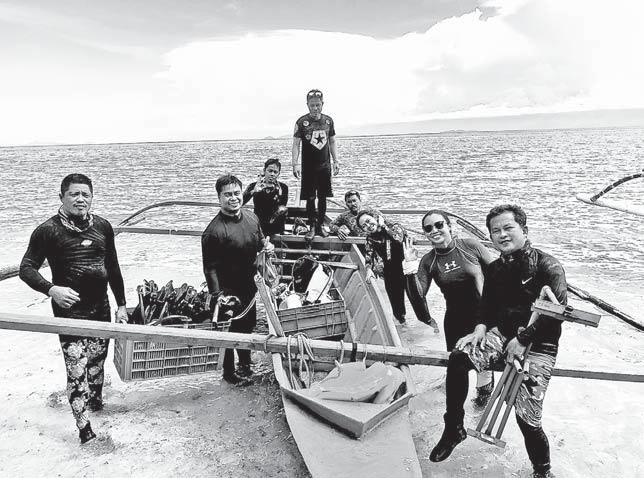
EVERY morning, Bantay Dagat volunteer Roilan Arguelles prepares his small motorized banca—not to catch fish—but to investigate and gather data on the health of the coastal and marine environment in Lobo, Batangas province, and in the Verde Island Passage.
Arguelles is one of 18 citizen scientists tapped by First Gen Corp. and ABS-CBN Foundation Inc. (AFI), as force multipliers in monitoring and gathering valuable data in reefs near and around Lobo’s marine protected areas.
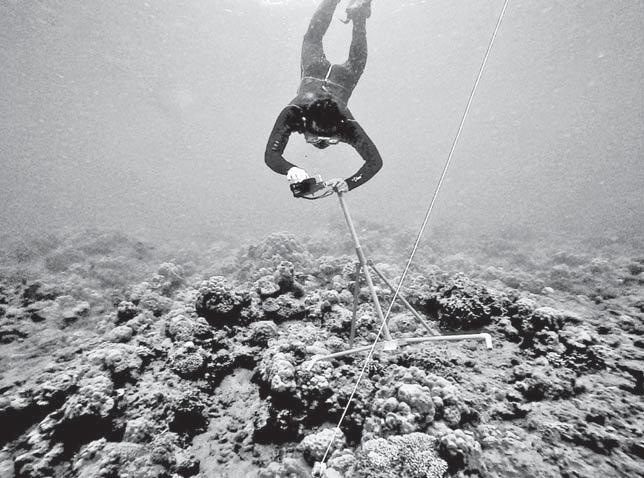
A licensed scuba diver, Arguelles, who hails from Barangay Sawang in Lobo, says monitoring and assessment of coastal environment, such as corals and mangroves, allow them to learn about the problems besetting the ecosystem to prevent further concerns.
“In gathering data, we also assess and make comparisons. For instance, we conduct fish [identification]. We note if the fish stock is increasing or not,” Arguelles tells the BusinessMirror in a telephone interview on July 5.
At the same time, he says that the citizen scientists act as protectors of marine protected areas and fish sanctuaries.
White sand beach, fish sanctuaries
LOBO is located near the southern tip of Batangas province, about 145 kilometers south of Manila. The town boasts of white sand beaches and has protected mangrove forests and fish sanctuaries.
A mining-free town, Lobo has nine coastal barangays, which boasts of highly secured coastal and marine environments against illegal fishing activities.
Lobo has protected mangrove forests and fish sanctuaries, which are part of several locally managed Marine Protected Areas (MPAs) that are guarded by volunteer Bantay Dagat members in various coastal barangays.
Fighting plastic pollution
LOBO is also known to combat ocean plastic pollution. Coastal clean-up activities are held to collect trash brought by sea waves to its shores from other areas.
The Department of Environment and Natural Resources (DENR) in the Calabarzon Region and the Community Environment and Natural Resource Office in Lipa, Batangas, which has jurisdiction in Lobo, have identified sustainable coastal and ocean development projects. They are particularly on habitat protection, as part of an integrated coastal management strategy, highlighted


by the establishment of MPAs, deployment of artificial reefs, and mobilization of people’s organizations.
These include the management of the Olo-olo-Sawang MPA, the Olo-olo Artificial Reefs, Lagadlarin Artificial Reefs, Soloc Artificial Reefs, Malabrigo Fish Sanctuary and Refuge, Malabrigo Artificial Reefs, Balibago Artificial Reefs, Biga Fish Sanctuary, and Biga Artificial Reefs.
There are also two proposed MPA sites in Lobo, one in Barangay Balibago and one in Barangay Banalo.
Rising scuba divers
MARIVIC VERDADERO MARA
MOT, a scuba diver and instructor from Lobo, says scuba divers have gained stewardship of Batangas province’s marine ecosystem
“With the rising number of scuba divers exploring the coast of Batangas, we have gained more stewards of our marine ecosystem. As a scuba instructor, I observed that more and more towns in Batangas, like San Juan and Lobo, are now opening their tourism for diving, which is a very good indicator of emerging more citizen scientists,” Maramot told the BusinessMirror via Messenger on July 16.
“Divers are advocates apart from engaging in recreational diving activities/. They normally conduct underwater clean-ups, coral planting, and restoration. [They] involve themselves in different organizations doing projects of similar nature that benefit not only the marine life but help people living in the coastal areas to be more aware and responsible in protecting the water surrounding them,” she adds.
Citizen scientists
ARGUELLES and his colleagues are the first batch of citizen scientists in Lobo, a new approach introduced by the Lopez-led groups in the town.
Citizen scientists are tasked to gather and provide inputs to help draw up effective and regenerative conservation measures and policies
for the Verde Island Passage under the Lopez-led Lobo Reef Monitoring Program (LRMP).
A component of the Project Center of Center (Project COC) initiated 20 years ago by First Gen for VIP’s marine ecosystem protection, the LRMP helped develop Alwan, a lowcost, coral reef monitoring method that is simple and easy to learn.
“Alwan” is a Filipino term meaning “easy.”. Dr. Al Licuanan, of De La Salle University and one of the partners implementing LRMP, coined the term for easy recall and less daunting for community volunteers.
Alwan conveys that citizen science is easy and that anyone from the community can do it with proper training.
Empowering communities
ALWAN allows coastal communities to collect timely information on the health of their coral reefs, says Ramon J. Araneta, First Gen vice president for external affairs and security.
He says it is enough for the communities to institute measures that will prevent environmental problems.
Araneta says in a statement that the citizen science approach empowers community members to be part of scientific expeditions.
With their help, data collection becomes more frequent and extensive even without the presence of research professionals.
“The volunteers not only bolster scientific research but also enhance the monitoring and management of the marine protected areas,” he points out.
Coastal resource planning
WITH the help of citizen scientists, Lobo’s Coastal Resource Management Plan is enhanced to support its development programs.
Restricted or no-access zones were established in Lobo by First Gen and AFI to protect the ecosystem from
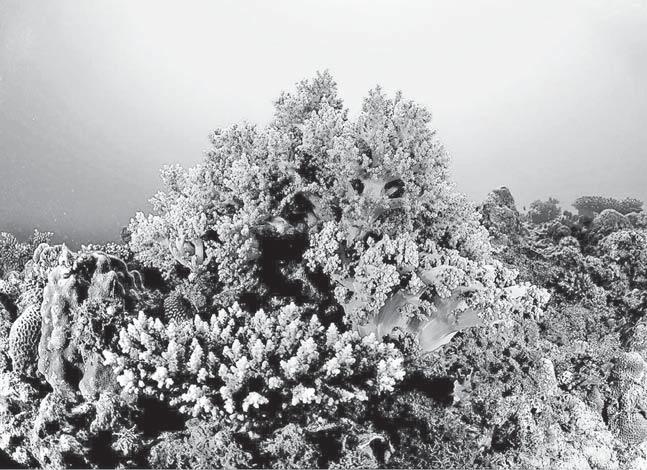
being promoted as an ecotourism destination.
Under the LRMP, the citizen scientists help in identifying and delineating areas in Lobo that is suitable for recreational and tourism activities like scuba diving, snorkeling, kayaking and swimming.
The citizen scientists likewise provide valuable data about areas of concern, such as the potential impacts of climate change and local infrastructure development on water quality.
Data-gathering training, diving lessons
THE citizen scientists, who are mainly residents and Bantay Dagat members, underwent training in reef data collection, species identification, and the use of specialized equipment.
They also took freediving lessons and receibed freediving certifications.
The citizen scientists have already gained the recognition and support of local government units and regulators, as well as some prominent foreign and local groups involved in promoting sustainable environment.
Funding support
THE United States Agency for International Development (USAID), through a collaboration with AFI, has agreed to support the initiative by providing funds, equipment, and training for citizen scientists.
The release of funds for the initiative has started and will continue until next year under USAID’s Inspire, or Investing in Sustainability and Partnerships for Inclusive Growth and Regenerative Ecosystems Project.
First Gen initiated Project COC in 2004, the same year when an extensive study had identified the VIP as “the center of the center of marine shore fish biodiversity.”
The authors of the study warn that the marine ecosystem in the passage face degradation from destructive fishing methods, rapid industrialization, and other problems.
VIP stewardship
LAST month, First Gen and AFI reaffirmed their commitment to serve as VIP stewards by finalizing a memorandum of understanding (MOU) with the DENR and the Department of Energy.
Under the MOU, both the Lopezled entities agree, among others, to harmonize efforts for the
the
















THE San Miguel Beermen and Meralco Bolts will represent the Philippine Basketball Association (PBA) in the East Asia Super League (EASL) 2024-25 Season. The Beermen and the Bolts were selected to compete in EASL based on their performances during the 202324 PBA season. The Beermen are the 2023-24 Commissioner’s Cup champions and runners-up in the Philippine Cup.
The Bolts, on the other hand, are the Philippine Cup winners.
The Beermen are in Group A for the group stage with Japan B.League champions Hiroshima Dragonflies, Korean Basketball League (KBL) runners-up the Suwon KT Sonicboom and P. LEAGUE+ second-placers Taoyuan Pauian Pilots. Meralco Bolts are in Group B with Japan B.League runners-up Ryukyu Golden Kings, KBL champions Busan KCC Egis and P. League+ champions New Taipei



she would see everyone in Paris.
The 42-year-old guard turned the joke into reality—she’ll be playing in a record sixth Olympic games when the US women’s basketball team goes for its eighth consecutive gold medal later this month.
“Why not? I say this all the time, if i sign up to play, I sign up to play,” she said in a wide-ranging interview with The Associated Press. “I don’t love how my last Olympics went personally. I think as a team we still have a lot to prove. I love playing USA Basketball. You play with the best in the world. Basketball is a team sport and if you have the opportunity to play with the best in the world, I’ll always sign up.” Taurasi has been a mainstay on the Olympic women’s team since
graduating from UConn in 2004 and leading the Huskies to three consecutive NCAA championships.
The Women’s National Basketball Association’s (WNBA) all-time scoring leader with over 10,000 points, Taurasi is still playing at a high level. The Phoenix Mercury All-Star is averaging 16.1 points and 4.8 rebounds in her 20th season in the WNBA.
“No one has done it more than her. There’s no substitute for that level of experience,” US coach Cheryl Reeve said. “We’re going to count on her voice and that experience she has is incredible and valuable.”
Taurasi is currently the fourth alltime leading scorer in Olympic history with 414 points. She’s 74 points behind her former teammate Lisa Leslie for the top spot on the American list. She already is the all-time leader in games
played already with 38.
Her teammates respect her knowledge and insight as there’s very little she hasn’t seen during her time playing on the international stage.
“She’s seen it all,” US teammate Breanna Stewart said. “She knows exactly what to say before the coaches even come into the locker room.”
Besides winning the five gold medals, Taurasi’s favorite Olympic memory was the opening ceremonies at her first one in Athens in 2004.
“The whole world is watching this and when they call out all the countries and the US lines up, there’s this togetherness you don’t get very often in sports,” she said. “Every single walk of life, every discipline in sports is all in one place. It’s pretty special. That moment is special at every Olympics.”
So is winning. Taurasi doesn’t



know what it’s like to lose at the Olympics.
The US has never lost an Olympic game that Taurasi’s competed in, going 38-0 during that stretch. That streak dates back even further that Taurasi; the last loss by the Americans was in the 1992 Barcelona Games.
Taurasi said winning is engrained in the culture of USA Basketball.
“You always have to wait your turn,” she said. “In ‘04 I was getting Lisa [Leslie] and Dawn [Staley] donuts. Learning the ropes.... I tried to soak up all the knowledge I could. Then as I progressed in my career I got more responsibility. I became one of the leaders. I think that’s what USA B does so great. It’s not forced, it just happens which makes it even better.”
Taurasi smiled when asked about the 2028 Olympics, which will be

URICH—Fifa
she’ll be
that point. “I’m just as addicted to basketball right now as I was when I was 15 playing in my driveway. I have the same ambitions, the same passion, the same love for it,” she said. “I show up every single day in Phoenix at the practice facility at 7:30 a.m. ready to go. That’s how I treat it.
“However, when it’s done it’s done.”
If this will be Taurasi’s last Olympics, as Coach Reeve says, no basketball player has done it more— or better—than Taurasi. AP
ARGENTINA was confirmed as the world’s No. 1 team in the FIFA men’s rankings on Thursday, as the national government doubled down on defending the players who celebrated winning the Copa America by singing a racist song targeting No. 2-ranked France.
The fallout of the chant sung late on Sunday in Miami—which mocked the African heritage of some France players—continued four days later, including a rebuke to Argentina’s critics by the vice president in its farright government.
Argentina’s government on Wednesday fired one of its leading sports officials who urged Lionel Messi and the president of the Argentine Football Association to apologize.
The sports under-secretary, Julio Garro, spoke after FIFA said it was looking into the incident and English club Chelsea started a disciplinary process against its midfielder Enzo Fernandez. He broadcast the footage on social media from the Argentina team bus in Florida.
Fernandez later published an apology on his Instagram account, which disappeared by Thursday, saying he was “truly sorry. That video, that moment, those words, do not reflect my beliefs or my character.”
However, a defiant post by the vice president of Argentina, Victoria
Villarruel, on social media hit back at the country’s critics.
“No country with a colonial history is going to put us down for a song sung on a field nor for speaking a truth that nobody wants to admit,” Villarruel wrote.
“Enough of pretending to be offended, hypocrites. Enzo I am with you, Messi thanks for everything! Argentines always keep your heads high! Long live Argentina!”
Villarruel said Argentina’s history had been forged by people of all races: “We never forced our way of life on anyone, nor will we tolerate that someone tries to do the same to us.”
The song refers to France players being “all from Angola,” having parents from Nigeria and Cameroon, and also includes an offensive reference to Kylian Mbappé. One of Fernandez’s French teammates at Chelsea, Wesley Fofana, who is Black, described the video as “uninhibited racism.” France players Jules Koundé and Mike Maignan also posted critical comments about



AI
2024
Remembering radio broadcaster and jazz enthusiast Brother Wayne
Friends look back at the life and times of Wayne Enage—the voice of influential radio station WK and the face of the popular bar Jazz Box

IN the late 1970s, Metro Manila’s young and hip music crowd listened to three radio stations: 99.5 RT for pop, RJ AM/FM for rock, and WK 101.9 for jazz.

Publisher :
T. Anthony C. Cabangon
Lourdes M. Fernandez
Editor-In-Chief : Concept : Y2Z Editor : SoundStrip Editor : Group Creative Director : Graphic Designers :
Aldwin M. Tolosa
Jt Nisay
Edwin P. Sallan
Eduardo A. Davad
Niggel Figueroa
Anabelle O. Flores
Contributing Writers :
Tony M. Maghirang
Rick Olivares
Jill Tan Radovan
Reine Juvierre S. Alberto
John Eiron R. Francisco
Pocholo Concepcion
Francine Y. Medina
Rory Visco
Bea Rollo
Trixzy Leigh Bonotan
Photographers :
Bernard P. Testa
Nonie Reyes
Y2Z & SOUNDSTRIP are published and distributed free every Sunday by the Philippine Business Daily Mirror Publishing Inc. as a project of the
The Philippine Business Mirror Publishing, Inc., with offices on the 3rd Floor of Dominga Building III 2113 Chino Roces Avenue corner Dela Rosa Street, Makati City, Philippines. Tel. Nos. (Editorial) 817-9467; 813-0725. Fax line: 813-7025
Advertising Sales: 893-2019; 817-1351,817-2807. Circulation: 893-1662; 814-0134 to 36. www.businessmirror.com.ph
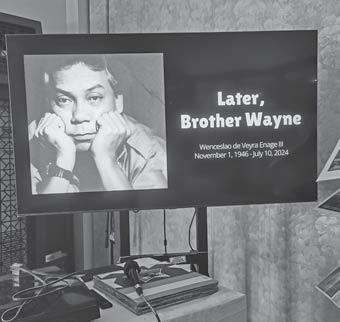

“Drive carefully. The life you save may be mine. Later...” Photo by Pocholo Concepcion
WK’s most prominent DJ was Brother Wayne, who spoke in a soft rasp and ended his show with Willie Bobo’s “Fairy Tales for Two” and his signature spiel, “Drive carefully. The life you save may be mine. Later…”
In the last few years, WK’s former jocks, including Wayne, revived their station’s contemporary jazz programming on Facebook. Recently the DJs announced they were disbanding the platform. And on July 10, Brother Wayne himself signed off for life—dying of complications arising from colon cancer.
He was 77.
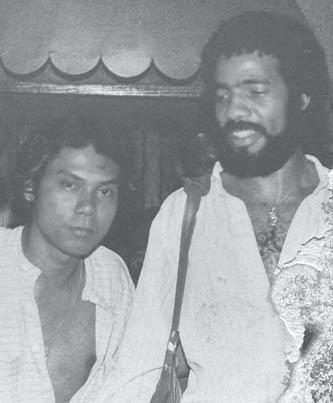
TRIBUTES poured on Facebook. Bob Magoo of DZRJ fame recalled Wayne—who was born Wenceslao De Veyra Enage III—used Walloping Wayne as his moniker on radio station UW in the early ’70s.
Magoo said he and Wayne were both DJs on UW—then owned by Bob Stewart (Uncle Bob of the pre-martial law TV station RBS Channel 7), before Ramon Jacinto bought and moved it to the J&T Building in Sta. Mesa, where it became RJFM.
“We didn’t have any playlist then,” Magoo said. “We played our own favorites. We had the latest albums. Album-oriented na kami.”
Birds of the Same Feather MAGOO didn’t mention when Wayne transitioned from playing rock to jazz records. But Serafin Pua remembered the circumstances that led to a close friendship with Wayne.
“I met him in 1977,” said Pua, who was then preparing to open the jazz club Birds of the Same Feather at the
corner of Morato and Timog in Quezon City. “Wayne guided my journey into jazz,” Pua pointed out, explaining that he sought Wayne’s help in finding the musicians who would play at Birds. “We went to Lito Benavidez’s studio where I met Boy Katindig, Rudy Lozano, and Paco Gamboa who would comprise Birds’ house band Sticky with vocalist Jacqui Magno.”
Wayne would become one of Birds’ biggest supporters—promoting its gigs on WK, hosting the shows on the Birds stage, and hobnobbing with the likes of Lee Ritenour, Bobby Lyle and Alphonse Mouzon when they visited Birds to jam after their concerts.
“Wayne negotiated my talent fee when I was hired to play guitar with Boy Katindig’s band at Birds,” said Joey Puyat.
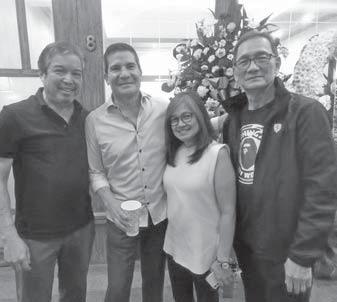
AT the wake for Wayne at Heritage in Taguig, Edu Manzano was busy receiving visitors. “I met Wayne in 1982,” Manzano said, explaining that he was a regular guest at Jazz Box, the Malate bar then owned by Larry Cruz and which Wayne managed.
Later Wayne, with business partners, opened a Jazz Box branch at St. Francis Square in Ortigas Center, Pasig.
“Those were fun times,” said Malou Espina, Wayne’s former domestic partner with whom he has a daughter, Alex. “Wayne was no saint, but he was a good man known for his generosity.”
Generous to a fault—that was Wayne as a person, said Zeny Enriquez, another regular guest at Jazz Box St. Francis. “We were there practically every night. At exactly midnight, Wayne would pour tequila shots for
everyone as James Brown’s ‘I Got You (I Feel Good)’ played.”
That was Wayne’s way of telling us to go home, said Manzano: “He would turn on the lights. But we’d end up staying till 3 a.m.”
Manzano went on to narrate a hilarious anecdote.
“Three pretty women walked into Jazz Box. I looked at Wayne. After some time, Wayne approached the women and asked if he could buy them drinks.”
Manzano said the women were hesitant and said they wanted to go home because it was late. “Wayne said, ‘Maaga pa, come on, have some more drinks.”
The drinks kept coming, Manzano recounted, until the women begged off to say they really had to go since they didn’t have a ride to go home.
But Wayne was insistent, said Manzano: “No problem, we have a car. Wayne asked, ‘Where do you girls live?”
When the women answered, “Bulacan,” Manzano recalled, “Wayne said, “Oh, ingat kayo, ha.”
By Reine Juvierre S. Alberto
Wala na akong mahihiling pa. Oh shux! Kung hindi ko tyinaga baka nauwi na sa wala. Pero salamat sa lahat ng naniwala.
THIS may be a mash-up that one could not think of happening but a retail giant made it possible as a way of showcasing every Filipino’s talent and victory.
Who would expect to witness the country’s biggest Original Pilipino Music (OPM) artists unite on one stage and surprise their fans with a collaboration of a lifetime?
P-Pop Kings SB19, Nation’s Girl Group BINI and hip-hop icon Flow G all performed at the Puregold “Nasa Atin ang Panalo” Thanksgiving Concert on July 12 at the Araneta Coliseum.
For an unforgettable night, A’tin, Blooms and “Flow-ers” were delighted with music, celebration of victory stories and paying it forward.
More than just entertainment, the night became a tribute to the stories of Filipinos with grit and courage to change for success.
Puregold Price Club Inc. President Vincent Co said these “panalo” values are ingrained in these OPM artists who all started from humble beginnings and thrived to reach where they are now, adding they hope to inspire fellow Filipinos through them.
“We are excitedly presenting these top musicians not only to showcase their talent and spotlight local music but to highlight the stories of SB19, BINI, Flow G and SunKissed Lola,” Co added.
Nation’s girl group
THE concert started strong with the eight-member girl group BINI opening with its catchy song “Lagi.”
“Lagi lagi lagi nang umaawit..”
Blooms went wild when BINI Aiah, Colet, Maloi, Gwen, Stacey,


Jhoanna and Sheena lit the stage. BINI Mikha was unable to perform during BINI’s set due to an injury but she was spotted supporting the group in the crowd.
BINI also sang and danced to “Ang Huling Cha Cha,” “Huwag Muna Tayong Umuwi” and ended with the viral summer anthem “Pantropiko.”
It’s not that hard to notice why BINI rose to stardom. With their easyto-follow Filipino song lyrics, groovy tunes and uniquely Filipino sound, it’s impossible to not be converted as a listener or even as a casual enjoyer, as Gen Zs would say.
Literally everyone, no matter how old or young, knew the lyrics and steps to their songs, BINI proved their vocal and dance prowess. Not to mention their face cards and adorable green-colored outfits that all just came together.
But what got everyone in Araneta screaming was when Justin of SB19 went up the stage to dance along to the last chorus of “Salamin, Salamin.” Indeed, it was a collab no one was expecting.
Another surprise happened when SB19’s Stell suddenly came out to sing Sunkissed Lola’s “Pasilyo.” Known for his impressive vocals, Stell wowed the crowd as he belted out the romantic song.
Hip-hop icons
NEXT up was hip-hop icon Flow G who single-handedly proved that he is indeed a “Rapstar” by opening his set

sitting comfortably on a golden throne as he charismatically rapped the verses of the song.
Flow G also performed songs he collaborated with Nik Makino such as “We Made It,” to which he credited SB19’s Pablo for using the song to dance to on TikTok that caused its rise, and the infamous “Moon.”
Angelica Yap, also known as “Pastillas Girl,” was brought out to the stage by his partner Flow G, who he referred to as “Burgis” or rich.
Rap legend Gloc-9 shared the stage with Flow G rapping to “Bahay Yugyugan” and Skusta Clee with “Ikaw Na Nga Yon” treating “Flow-ers” to a surprise.
But Flow G did not skimp on surprises. SB19’s Josh, Pablo and Ken further caused Araneta to shake when it dropped the beat with Flow G in “High Score.”
“Balang araw maging icon Gusto ko kagaya ko si Idol…”
Flow G’s set was full of “angas” or swag as he skillfully rapped the verses to his most-streamed songs at a speed I could not imagine was possible. The orchestra and band that accompanied his set made it even more powerful and memorable.
P-pop kings
FINALLY, P-pop Kings SB19 finally graced the stage with an explosive performance of the chart-topping “GENTO.”
The last surprise for the night was when BINI Colet, Sheena, Stacy and




Gwen danced to the hit with SB19. Blooms and A’tin went crazy and never thought a collab like that would happen.
Despite being all dressed in gray, Pablo, Stell, Ken, Josh and Justin stood out and shone that night, particularly in their performance of their new song “Moonlight.”
A’tin lose their voices from screaming when SB19 hit the right notes in “I WANT YOU,” the group’s sultry song.
SB19 also showcased their harmonious and powerful vocals in “MAPA” and “Liham,” slowing down a bit after receiving an award from Puregold and their fans.
To wrap up their set, SB19 ended with “CRIMZONE” as everyone partied and let crimson drip!
Lahat panalo
CONCLUDING the thanksgiving concert were SB19, BINI and Flow G all together on stage to sing the genre-bending “Nasa Atin Ang Panalo” celebrating the artists, Puregold’s customers, hardworking employees and partners.
“The ‘Nasa Atin Ang Panalo’ Thanksgiving Concert marks another significant milestone for Puregold. Celebrating 25 years of success and 500 stores, we have also forged a path for others to create their own Panalo stories,” Co said.
“This event is our way of showing appreciation to our loyal shoppers and the community that helped us get here,” Co added.
By Luana Carcano, Simon Fraser University
FASHION is a dynamic business. The selling window is around three months, and unsold inventories represent financial loss.
Fast fashion companies introduce new lines even more frequently, reducing the amount of time needed to design, produce and market new items.
The fashion industry is familiar with experimenting with technological frontiers. It has experimented with basic AI and other cutting-edge technologies. One example is the Gucci Garden, the label’s collaboration with virtual world platform Roblox in May 2021 to celebrate the brand’s centennial.
Fashion companies also use blockchains for product authentication, traceability and digital IDs, including those integrated by LVMH/Louis Vuitton, product authentication and traceability. Additionally, companies have incorporated augmented reality into marketing and retail strategies to create immersive and interactive customer experiences.
Game-changing technology
IN 2021, fashion companies invested between 1.6 and 1.8 percent of their revenues in technology. By 2030, that figure is
expected to rise to between three and 3.5 percent.
Generative AI could become a gamechanger for the fashion industry, adding between US$150 and US$250 billion to operating profits within three to five years. While the fashion sector has only started integrating AI, the opportunities and challenges it presents are evident across all business processes. Generative AI could help fashion companies improve their processes, bring their products to the market faster, sell more efficiently and improve customer experience.
Estée Lauder Companies and Microsoft have teamed up to open an in-house AI innovation lab for identifying and responding to trends, informing product development and improving customer experiences. Designers could also use AI to visualize different materials and patterns based on past consumer preferences.
Designers can also convert sketches and mood boards into 3D designs and 3D print them to speed up prototyping. Iris van Herpen, a Dutch fashion designer, used AI to imagine and execute the visuals of her fall/ winter 2023 collection.
AI helps in creating more sustainable fashion practices by optimizing the use of resources, recycling materials and reducing waste through more precise manufacturing processes and efficient supply chain and inventory management. For example, H&M uses AI to improve its recycling processes, sort and categorize garments for recycling and promote a circular fashion economy.
AI can improve operations and supply chain processes by optimizing inventory management, predicting sales based on historical data, and reducing overstock and stock-outs. Brands like Zara and H&M already use AI to control supply chains, promoting sustainability by optimizing stock levels and reducing waste. Zara also introduced AI and robotics into their retail stores to speed up online order pick-ups.
FASHION companies should be prepared to manage the associated risks with new technologies, particularly regarding intellectual property, creative rights and brand reputation. One of the primary issues is the potential infringement of intellectual property related to training data.
GenAI models are trained on vast design datasets, often containing copyrighted works. This can lead to legal disputes over originality and ownership. A related risk is bias and fairness in generative-AI systems, which may present reputational challenges for brands that rely on the technology.
The ambiguity surrounding creative rights in the age of AI is another concern. It’s challenging to determine who holds the creative rights to a design, whether it’s the designer who conceptualized the idea, the developer who built the AI or the AI itself. This ambiguity can dilute the authenticity of a brand’s creative expression, potentially harming its reputation if consumers perceive the brand as less innovative or authentic. The Conversation
CELEBRITIES Jericho Rosales and Donny Pangilinan are two style icons riding the wave of resurgence of the wide pants. In an insightful conversation titled “The UNIQLO Wide Pants Collection Style Talk” recently held at SM Mall of Asia’s Main Mall Atrium Hall, the two shared tips on how to widen one’s wardrobe with different silhouettes and colors.
For Jericho, who looked dashing in the UNIQLO Wide Straight Jeans with its subtle stitching that creates a sophisticated look, it’s all about looking sharp while feeling at ease. Meanwhile, Donny prioritizes striking the perfect balance between casual and polished, as he sported the UNIQLO Wide Fit Chino Pants with an elegant silhouette from its moderately crisp twill fabric.
“Style starts within you,” Jericho said. “Just pick what you like. Personally, I like plain white shirts. If I’m comfortable, I know I can be stylish.” Meanwhile, Donny added, “fashion is more than just clothes. It’s an expression. My style is more lowkey, chill, and not too loud.”
Jericho and Donny were joined in the panel by esteemed celebrity stylists, Cath Sobrevega and John Lozano, who also shared their best style tips and fashion

hacks that transform any outfit into a statement of one’s identity.
When it comes to styling with the UNIQLO Wide Pants Collection, John talked about the common misconceptions about wide leg pants as well as highlighting the importance of balance between the volume of the pants and the fit of the top. Then, Cath gave an informative rundown of the origin of the wide leg pants and how to

style them in different scenarios. For a complete overview of the UNIQLO Wide Pants Collection, check out the items now in-store or via the UNIQLO App. Download the UNIQLO App for Free on Google Play Store or Apple Store. To learn more about #UniqloPH and #LifeWear, visit www.uniqlo.com/ph/en/ and follow @uniqlophofficial on Facebook, Instagram, TikTok and Twitter/X.

By Rio Constantino
(Second of a series, following the author’s stint in the 23rd IYAS National Writer’s Workshop at University of St. La Salle, Bacolod City, where he delivered a provocation lecture)
My provocation lecture was generously subtitled “Crafting Hope,” presumably because I was considered somewhat an expert on that thorny feeling, being alive so many years after my cancer diagnosis. I definitely needed a lot of hope as I tried to cram my slideshow.
The main issue was that there are really little to no inspiring images of microtubules. Part of my essay describes the science of microtubules, proteins which form an integral part of the skeleton of cells, including those of mutated cancer cells, and which are often targets of antitumor drugs. Very interesting, except when you type in the word “microtubule” in Google Images, what you get are mostly crudely rendered 3D models that look a bit like those uncanny bowling animations from the 90’s. Look, the 3D artists even put in different colors for the two different components of a tubulin dimer! Good for a routine biology class, but not IYAS.
I was stuck until I realized it might be better to look for images of fluorescence microscopy, where selectively sticky fluorescent dyes are used to highlight the different parts of an entire cell. In other words, images not of individual proteins, but of their place within the cell. Not of a bone in isolation, but in conjunction with the rest of the body.
True enough, I quickly found an image to my liking. A human cell smeared on black background, its tangled insides sketched using a simple palette: blue DNA, red actin microfilaments, and green microtubules. Without context it looked like a vivid illustration of densely woven fungal mycelia.
The rest of the slideshow was easy. Obviously, I had to include the periwinkle, and brief glimpses of my brief fieldwork in the forest. And there had to be pictures of myself, deep in the throes of chemotherapy: bald, thin, trembling.
I made sure that in all my pictures I was facing away from the camera. It felt too embarrassingly intimate to share my face as I withstood the agonies of treatment. Besides, I was ugly: I didn’t have eyebrows.
No single photo can encompass the galaxy of emotions that comes with being a cancer patient: the confusion, the pain, the freewheeling desperation, the austere joy. Sometimes it’s hard even for me, barely a year after my last full treatment, to comprehend how I managed to survive all those stony months and weeks. The memory has become increasingly hazy, perhaps a significant part of me cannot bear anymore to look.
So instead, I tried to find pictures that showed me but did not show me, at least not fully. Me reading in the garden, head partly hidden by a large leaf; me trapped in a cramped hospital room, body turned sidewards as I stare out a tiny window, trying to find the sky beyond an obstructing mesh of ventilation pipes. Back in my room, as the stars rose over Bacolod, I kept practicing awkwardly, catching myself speaking in a rushed monotone. Don’t mumble, I reminded myself. Tired, I spun around, taking note of the soft shapes behind me: a picture of Mama Mary, the bare wall, my messy blanket, the bedside lamp spilling its warmth on my rumpled pillow.
Every good writer, I have since realized, needs a good lamp. Without that gentle beacon and its brass glow, my room, and by extension myself, would have felt quite empty. But with it on, even the shadows were mellow and inviting. The quiet moon, some jazzy lighting, the chatter in your own head—that’s all you need, really, to make the evening air sing.