DESPITE reducing key policy rates by another 25 basis points on Wednesday, the Monetary Board intends to take “baby steps” when adjusting policy rates next year, according to the Bangko Sentral ng Pilipinas (BSP).
e Monetary Board reduced its Target Reverse Repurchase (RRP) Rate to 6 percent while the overnight deposit and lending facilities were accordingly adjusted to 5.50 percent and 6.50 percent, respectively. ese will take place on October 17, 2024.
In an earlier interview on Bloomberg, BSP Governor Eli M. Remolona Jr. said the Monetary Board may reduce rates by 100 basis points next year. However, on Wednesday, he said this will be done in a measured manner.
“If we rule out a hard landing [in
FILIPINOS continue to suffer from a lack of opportunities for socioeconomic mobility that would have been a key to achieving inclusive growth, according to the World Bank.
In the World Bank’s new Poverty, Prosperity, and Planet Report, the Philippines still has a gini coefficient of 40.7 percent, which placed it as a high-inequality country together with Malaysia and the United States.
Based on the report, high-inequality countries have a gini coefficient of 40 and above. e Gini coefficient is a measure of inequality where perfect inequality is 100 and perfect equality is zero.
“ e number of economies with
VACANCY rates of condominiums are expected to continue in the wake of the exodus of Philippine o shore gaming operations (Pogo) and the completion of projects this year, according to a local property consultancy rm. In an East West Bank economic forum, Colliers Philippines Research Director Joey Bondoc said the overall vacancy rate in Metro Manila was at 17.2 percent as of the second quarter of 2024. Bondoc said the country’s vacancy rate could continue to hover above 17 percent. The projected vacancy rate could average 17.7 percent by yearend and average 17.3 percent next year.
“Vacancy is declining. We saw this being at 17.9 percent in 2021 because of the height of the Pogo exodus as well as the Covid-19 pandemic. We are now seeing some improvement,”
Bondoc said.
“However, we’re likely to see vacancies slightly inching up by the end of 2024. Why? Because there will be substantial completion this year, 2024. About 11,300 will be completed across Metro Manila this year,” he added. Bondoc noted that the projects to be completed this year are the same ones launched in 2018-2019, at the height of Pogo demand for units. This has led to a 65-percent decline in preselling launchings and 58-percent decline in preselling takeup as of the rst semester of 2024.
In 2018, there were 55,000 units launched and 59,000 units taken up; while in 2019, 56,000 units were launched and 51,000 units were taken up.
However, in the rst semester of 2024, only 5,000 units were launched and 6,000 units
were taken up. In the full year of 2023, a total of 25,000 units were launched and 23,000 units were taken up.
“Two out of three unsold ready-for-occupancy units are coming from the mid-income segment. It’s still this segment that is growing, that is still seeing sustained demand,” Bondoc said.
Nonetheless, these units will continue to be taken up as the economy’s prospects for growth are looking up. Bondoc said many infrastructure projects are also coming online further supporting various real estate projects.
Bondoc said the real estate sector will also be driving growth in regional areas and the resilience of key sectors like outsourcing and tourism.
“Given the rapid changes in the Philippine economic environment, particularly in the real
estate sector, it is crucial to equip our clients and stakeholders with the knowledge needed to make informed and calculated decisions,” Richie Tamayo, Senior Vice President and Head of Wealth Management at EastWest, said. “At
high income inequality has declined over the past decade,” the World Bank said. “High inequality reflects a lack of opportunities for socioeconomic mobility, which hinders prospects for inclusive growth and poverty reduction.”
e World Bank report said 49 countries are classified as having high inequality countries based on their gini coefficients. However, the number of countries classified as such has declined over the years.
“[Some] 1.7 billion people—20 percent of the global population—still live in high-inequality economies, concentrated mostly in
THE Philippines may be one of the fastest-growing economies in Asia, averaging growth of 6-7 percent annual gross domestic product. But with 17.54 million poor Filipinos, that GDP rate is still “not enough,” a Filipino economist said on Wednesday.
e government should aim for a higher gross domestic product growth to 8 percent to be able to achieve its target of bringing down poverty incidence from 15.5 percent to 9 percent by 2028, according to Dr. Bernardo Villegas, vice president of the University of Asia and the Pacific.
“A high rate of GDP means very little if close to [17] million Filipi-
nos go to bed hungry every day,” Villegas said in a briefi ng with the diplomatic corps Wednesday.
e Philippines has the highest poverty rate incidence compared to neighboring Asean countries such as Singapore, ailand, Vietnam, Malaysia and Indonesia which register single-digit poverty incidence.
“Even 9 percent is not good enough,” he added, considering that other Asean countries average between 0 to 5 percent in poverty incidence.
Villegas said he offered “strategic” solutions to President Ferdinand Marcos Jr. to achieve an 8 percent GDP.
“We’re asking him, ‘Please, Mr.
livelihoods, and health and the economic, physical, social, cultural, and environmental assets of persons, businesses, communities and countries.
e Framework resulted from stakeholder consultations initiated in March 2012 and intergovernmental negotiations held from July 2014 to March 2015, supported by the United Nations Office for Disaster Risk Reduction (UNDRR).
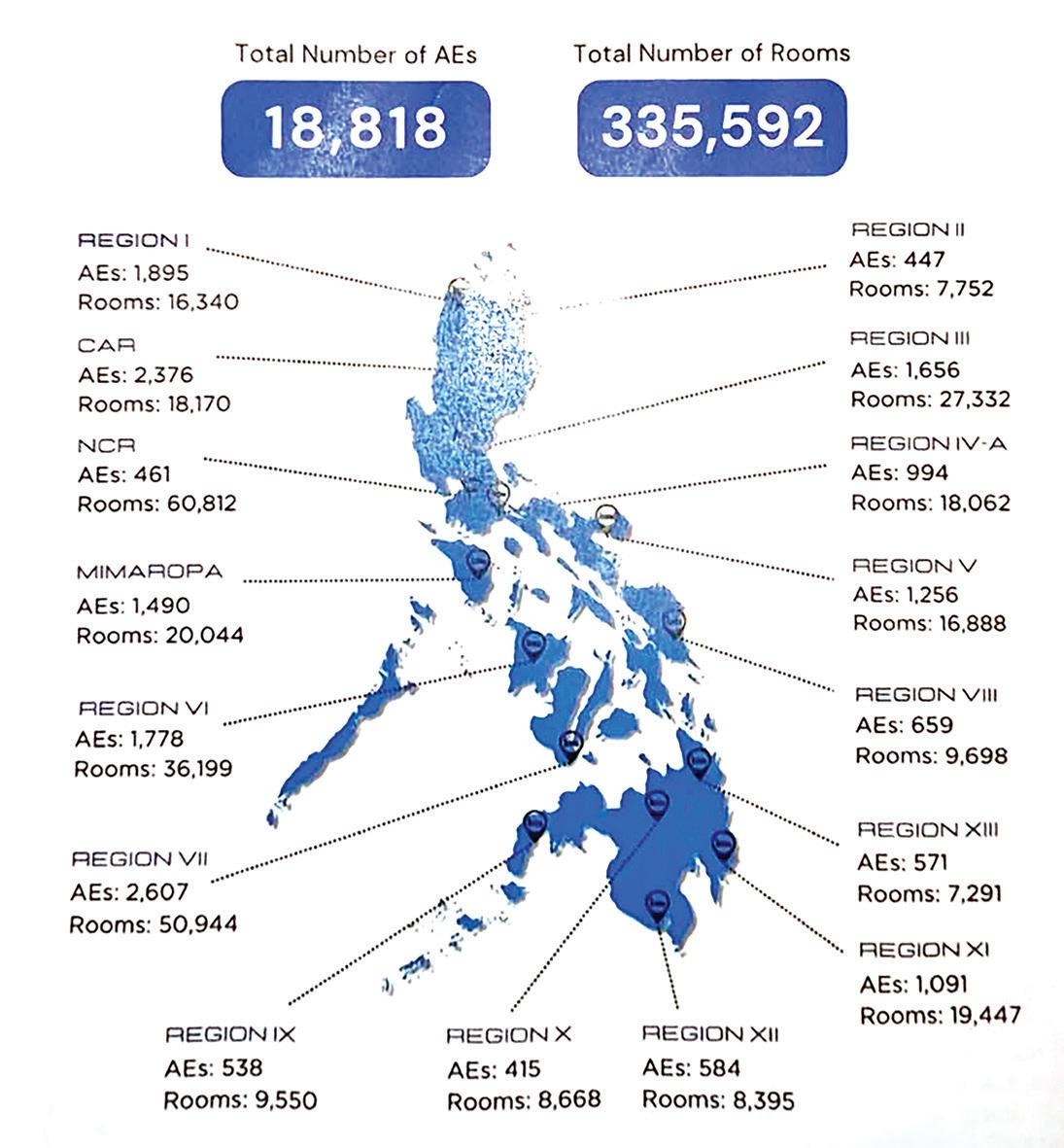
Over 456K rooms needed by 2028–DOT
and private sectors to facilitate growth and accommodate the projected room demand,” said the Phisap. Areas with a projected medium room demand are Cotabato-Sarangani with a 7,819 room gap by 2028; Metro Manila and Rizal 7,242; Surigao-Dinagat Islands 7,068; and Cagayan de Oro Coast and Hinterland 6,967.
“The time to act is now,” said Frasco. “There is no time to wait. Every delay in building capacity and improving infrastructure is a missed opportunity, for the global tourism industry is rapidly evolving and travelers’ preferences are shifting. We cannot a ord to fall behind.”
Per the Phisap, the National Capital Region has the most number of keys at 60,812 in 461 accommodation establishments (AEs); followed by Region 7 (Central Visayas) with 50,944 keys in 2,607 AEs; and Region 6 (Western Visayas) with 36,199 keys in 1,778 AEs.
PHL, EU resume FTA talks in Brussels after 7-yr break
THE Philippines and the European Union have resumed negotiations for a free trade agreement, seven years after a hiatus brought about by the bloc’s staunch opposition to the previous Duterte administration’s war on drugs.
German Ambassador to Manila Andreas Pfaffernoschke announced this Wednesday during a meeting with the German Chamber of Commerce.
Philippine Foreign Affairs Undersecretary for Multilateral Affairs and International Economic
the United States], then as I have said, we prefer to take baby steps in terms of adjusting the policy rate meaning 25 basis points at a time but not necessarily every quarter and not necessarily every meeting,” Remolona said. “I would say 100 basis points in 2025 after the cuts we’ve made in
Relations Charles Jose also con-
rmed to BM that the Philippine-EU FTA talks have resumed in Brussels this week.
e EU is the Philippines’ fourth largest trading partner.
e Philippines, on the other hand, is the 7th most important
2024 [is possible]. [ is] would be somewhat on the dovish side. It’s possible that it will be somewhat dovish,” he also said.
Key policy rates were reduced on Wednesday on account of better infl ation expectations. e risk-adjusted forecast of the BSP is now lower at 3.1 percent from 3.3 percent estimated in the previous meeting of the Monetary Board.
However, the BSP said, its risk-adjusted outlook for 2025 was increased to 3.3 percent from
trading partner of EU in the Asean region, and the 41st worldwide.
Bilateral trade in goods amounted to over €18.4 billion in 2022, while trade in services was worth €4.7 billion in 2021.
e EU is also one of the largest investors in the Philippines, with the EU’s foreign direct investment to the Philippines amounting to €13.7 billion in 2021. Currently, the EU extends duty free access to the 6,274 goods from the Philippines under the Generalized Scheme of Preferences Plus (GSP+). e GSP+ was extended until 2027.
e DTI, which is leading the negotiations, hopes that with the Philippine-EU FTA agreement, more goods from the Philippines will enjoy duty-free market access to the world’s largest trading bloc.
the 2.9 estimated in August. e 2026 risk-adjusted forecast is now pegged at 3.7 percent, also higher than the 3.3-percent forecast made in August.
e BSP’s baseline forecast for infl ation was at 3.1 percent in 2024; 3.2 percent in 2025; and 3.4 percent in 2026.
BSP Monetary Policy Sub-Sector Assistant Governor Zeno Ronald R. Abenoja said the main driver of the adjustments made on the infl ation expectations was oil prices. Nonetheless, the forecasts are still within the BSP’s infl ation target of 2 to 4 percent.
“To some extent, that reflects what we are seeing, possible higher oil prices, than what was originally envisioned for 2024 and 2025. So we might still see very muted infl ation rates for the rest of the year and early next year, but with positive [base] effects that the Governor has mentioned, the infl ation print might go up slightly by the second half of 2025,” Abenoja said. Meanwhile, international economists share the BSP’s outlook when it comes to infl ation. Given
merce and Industry Inc.
Delegates from the Philippinesalso engaged their counterparts from other Asean nations and China in a wide range of activities focused on trade, investment, tourism, and cultural exchange, DTI said. e Philippines has consistently participated in the Caexpo, held annually in Nanning, China. “ is vital platform fosters trade and cooperation between China and Asean member states, providing valuable opportunities for businesses to forge connections and expand their global reach,” DTI said in a statement on Wednesday.
these, analysts also expect the Monetary Board to continue its policy easing in 2025.
Capital Economics said the BSP is still expected to make another 25- basis-point reduction in December as well as in 2025. It expects that by the end of 2025, the BSP’s RRP rate will be 4.75 percent, which “is more dovish than the consensus.”
e analyst also noted that the policy rate cut was correctly predicted by analysts and marked the second consecutive meeting at which the BSP has cut rates.
Oxford Economics: Easing to continue
Oxford Economics, meanwhile, expects the BSP’s easing cycle will continue, probably with another 25 basis point rate cut at BSP’s next meeting in December.
“Core infl ation also dipped to 2.4 percent year on year from 2.6 percent in August, the lowest since March 2022. We expect headline infl ation to continue its downward trend, especially since India has lifted restrictions on non-basmati
Aim for 8% GDP to sharply reduce poverty–economist
President, make sure that under your watch, the agricultural sector will grow at 3 to 4 percent every year,” he recalled telling Marcos Jr. He also suggested increasing the investment-to-GDP ratio which is now at 20-21 percent. Other East Asian economies like South Korea and China have 40 percent investment-to-GDP ratio.
“After agricultural productivity, please make sure that by the end of your watch, we are getting $15 to 20 billion of foreign direct investment,” he also recalled suggesting to the President.
Villegas asked the diplomatic corps to share with the Philippine government the reasons foreign investors refuse to invest in the Philippines compared to Vietnam.
white rice exports,” Oxford Economics said.
“Nevertheless, upside risks to prices—potentially driven by higher electricity prices—could constrain the pace of BSP’s rate cuts particularly in 2025,” it added. Earlier, geopolitical tensions and even a Trump presidency in the United States should serve as a caution to the Monetary Board to not cut rates aggressively as this could add to infl ationary pressures, according to an analyst.
In the recent Chamber of rift Banks General Membership Meeting, Jonathan Ravelas, senior adviser at professional services fi rm Reyes Tacandong & Co., said aggressive monetary policy easing could be infl ationary by itself. is could be a problem since geopolitical tensions are poised to raise prices while the plan of former President Trump to raise tariffs on US imports could drive up prices of goods in the international market. (See: https://businessmirror.com.ph/2024/10/13/geopoliticstrump-win-not-suited-to-sharp-ratecuts/)
Rice importers are required to secure an SPSIC from the BPI before bringing in foreign rice stocks. is would certify that an inbound shipment is safe for human and animal consumption, and would not bring in any pests that could be detrimental to the local agriculture sector.
Agriculture Secretary Francisco Tiu Laurel Jr. said a number of factors would account for the nonuse of the import clearances issued by the government.
For one, the lack of ships and
Latin America and the Caribbean, and Sub-Saharan Africa,” the World Bank, nonetheless, said. e Bank estimates that at the current pace of poverty and inequality reduction, it could take more than a century to eliminate poverty. It said this is based on a poverty threshold of less than $6.85 per day.
e report said the global goal of ending extreme poverty—defi ned as $2.15 per person per day—by 2030 is out of reach.
Almost 700 million people—8.5 percent of the global population— live today on less than $2.15 per day, with 7.3 percent of the population projected to be living in extreme poverty in 2030.
e World Bank said extreme poverty remains concentrated in countries with historically low eco-
nomic growth and fragility, many of which are in Sub-Saharan Africa.
It is estimated that 44 percent of the world’s population lives on less than $6.85 per day, the poverty line for upper-middle-income countries. e number of people living under this poverty line has barely changed since 1990 due to population growth.
“After decades of progress, the world is experiencing serious setbacks in the fight against global poverty, a result of intersecting challenges that include slow economic growth, the pandemic, high debt, confl ict and fragility, and climate shocks,” said Axel van Trotsenburg, World Bank Senior Managing Director.
“Amid these overlapping crises, a business-as-usual approach will no longer work. We need a fundamentally new development playbook if we are to truly improve people’s lives and livelihoods and protect our planet,” he added.
tropical storms discouraged traders who will have to comply with the government directive to bring in rice within a prescribed period.
“When there is news that tariffs will decline, importers put on hold their importation plans. So, they reapply after their SPSICs expire,” the DA chief told the B-
“ en when there was a tender from Indonesia and Malaysia. ere were Vietnamese suppliers who canceled contracts to try to get a better price, so traders were not able to use their SPSICs.” Laurel noted that since rice is liberalized, the department could not stop anyone from applying for an import permit.
e World Bank also said the progress in reducing the Global Prosperity Gap, the World Bank’s new measure of shared prosperity, has stalled since the Covid-19 pandemic, highlighting a slowdown in inclusive income growth over this period.
On average, incomes around the world would have to rise five-fold today to reach the level of $25 per person per day, the minimum prosperity standard for high-income countries.
In order to address poverty and inequality, the World Bank said high-income and upper-middleincome countries should focus on cutting carbon emissions while ensuring job generation.
e World Bank said governments must fi nd ways to alleviate job losses and other short-term costs that can result from such cuts, particularly for people living in or vulnerable to poverty.
Cai U. Ordinario
QuadCom tracing money trail in EJKs
By Jovee Marie N. dela
@joveemarie
THE House Quad Committee investigating extra-judicial killings (EJKs) during the Duterte administration is ramping up its efforts to follow the money trail allegedly used to incentivize police officers in the bloody war on drugs.
Led by Co-chairmen Reps. Bienvenido Abante Jr. of Manila and Dan Fernandez of Laguna, the committee is seeking the assistance of the Anti-Money Laundering Council (AMLC) to trace the cash flow tied to these operations.
This move follows explosive testimony from former Philippine Charity Sweepstakes Office (PCSO) General Manager Royina Garma, who claimed that cash rewards for carrying out EJKs were funneled through the banking system.
Garma exposed the reward system behind the killings and detailed the roles of Duterte and his close aide, Christopher “Bong” Go, in overseeing the lethal antidrug operations.
Co has since been elected to the Senate.
“THE QuadComm will leave no stone unturned. Those who profited from the killings must be held accountable, and the AMLC is key to tracking down these illicit transactions that led to the deaths of innocent civilians,” Abante said.
Fernandez, for his part, added that “the use of financial institutions for illegal activities is a serious crime. We will follow every lead to ensure that those responsible face justice.”
The Quad Committee plans to formally request AMLC’s assistance
within the week. Lawmakers believe the financial probe will shed light on the full extent of the money trail behind Duterte’s violent anti-drug campaign.
Abante and Fernandez called on police officers who may have received cash rewards to come forward.
“Your testimony could be critical to uncovering the truth. This is the time to speak up,” said Abante, who chairs the House Committee on Human Rights.
Fernandez, who heads the Committee on Public Order and Safety, assured that those who cooperate will be treated fairly.
“We are giving those involved a chance to help clear the air and ensure justice is served,” he said.
Potential misuse
MEANWHILE, House Deputy
House leader calls for amendments to UHC Law
ALEADER of the House of Representatives said that replacing the Philippine Health Insurance Corporation (PhilHealth) head would be useless if the Universal Health Care (UHC) Law were not amended.
House Deputy Majority Leader Janette Garin, also a physician and vaccinologist, called on the leadership of both Houses of Congress to prioritize amending the UHC Law, citing specific “killer provisions” that hinder its effective implementation.
“We can change the PhilHealth
chief a hundred times, but unless we amend the law as soon as possible, universal health care can never be achieved,” Garin, former health secretary, said.
“I call on the leadership of both Houses to make the amendment to the UHC a priority,” she added. Garin said she plans to refile a House Resolution, urging the House Committee on Health to review some provisions of UHC Law as the said law will not be fulfilled because it contains “killer provisions.”
Garin aid that health inter -
ventions such as medicines, vaccines, and medical devices need not undergo Phase IV clinical study, as Section 34 of the UHC law states.
She emphasized that after the Phase III clinical trial, health interventions are already considered safe and efficacious.
“With this requirement of Phase IV, Filipinos will have no recourse but to go to other countries to gain access to any breakthrough in science. This Section 34 of the UHC is just one of the many provisions deemed restric -
Minority Leader Rep. France Castro raised concerns about the possible misuse of confidential and intelligence funds by former President Rodrigo Duterte, suggesting these funds may have been used as rewards for extrajudicial killings, not only in the anti-drug campaign but also against Duterte critics.
Castro pointed out that substantial allocations to confidential and intelligence funds in Davao during Duterte’s time as mayor and later under his daughter, Vice President Sara Duterte, were significant. “In 2016 alone, Davao’s confidential funds reached P144 million, escalating to P2.697 billion by 2022,” she noted.
She also cited Garma’s testimony at the Quad Committee hearing, which indicated that confidential funds were used as reward money
tive and detrimental to health care accessibility,” added Garin.
The lawmaker also criticized the creation of the Health Technology Assessment Council (HTAC), pointing out that it was influenced by anti-pharmaceutical groups and former officials who wanted to empower themselves.
Garin has been pushing for the amendment of the UHC Law since the 18th Congress. It has been pending at the committee level since August 2020.
Jovee Marie N. dela Cruz
Lacson assails cash ‘rewards’ system in drug war
By Butch Fernandez @butchfBM
ORMER senator Panfilo
FLacson on Wednesday offered “unsolicited advice, as it may be,” to strengthen and make independent the National Police’s Internal affairs Service which, he said, “as of now” is not functioning as well as it should owing to inherent limitations in its structure, mandate and funding.
Proof of such institutional weakness, he said, is that the local IAS, for all the hard work of those named to head it, does not evoke as much fear among the ranks of policemen under investigation. In contrast, he said., in the US, “pag narinig ng pulis sila pinapatawag ng IAS, alam nila totohanan at meron
SEN. Christopher Go, during the Senate hearing on Monday on the proposed 2025 budget for the Department of Social Welfare and Development (DSWD), highlighted the importance of ensuring that Filipinos returning to their provinces under both the “Balik Probinsya, Bagong Pag-asa” (BP2) and the new “Oplan Pag-Abot” programs receive appropriate assistance in accordance with its guidelines.
Go stressed the need for comprehensive support, as he urged Social Welfare Secretary Rex Gatchalian to provide continued monitoring and aid for these returnees, ensuring their success -
silang paglalagyan kung may kasalanan sila [when a cop learns he is being called by IAS, they know it’s serious and they will land somewhere if they’re found guilty].”
In aid of legislation, he added, one reform may be that besides the filing of cases against erring cops. “let’s strengthen IAS to handle abuses and violations. By policemen. Besides, he added, “under the PNP Law [there is a] PLEB [Police Local Law Enforcement Board], which is communitybased.
He agreed with Justice Secretary Jesus Crispin Remulla that “we should really remove politics from the National Police. Stop the practice of allowing local politicians to pull the strings and interfer in police
operations.
Asked how politicking can be stopped, Lacson, a former National Police chief before being elected senator, said, “the structure must be defined.”
In the case of the PNP IAS, he said police officers must not be shuffled between their mother units and the IAS and back, to avoid pressue from peers or superior officers.
The IAS should be like “a permanent service where one stays until retirement so as to be insulated from politics. Let’s face it, there’s politics in the PNP; may pulitika sa PNP. There’s politics in all organizations, even in the private sector.”
Lacson’s views were sought in a radio interview owing to his police background, and the recent
controversies that ensnared former ranking police officials, notably the murder of a former PCSO official, and the revelations that a “reward system” was set up during the Duuterte presidency so that policemen carrying out the anti-drug war received higher “rewards” if they killed suspects. Lacson said a reward system is always good, but it’s better to give out medals for achievements, not cash.
“Ang kasamaan kasi nito pag may reward, nagiging overeager ang ating kapulisan at minsan nauuwi sa personalan at kung hindi man, pinipilit maka -score para makakuha ng reward money. Iyan din ang sinabi ni Colonel Garma.
Pardon the word, pero naprostitute ang kalakaran sa operation laban sa droga.”
ful reintegration back into their communities.
Go was one of the proponents of the BP2 program, a key initiative during the height of the Covid-19 pandemic aimed at decongesting urban areas, aiding Filipinos who wish to relocate back to their home provinces and at the same time, promoting regional development. One of the central discussions during the hearing was the introduction of the DSWD’s new initiative, “Oplan Pag-Abot.” This program, as clarified by Gatchalian, specifically targets families and individuals in street situations within Metro Manila. Its primary goal is to offer these vulnerable
populations options, including returning to their provinces where they can receive the support they need.
“All in all, 7,000 families were profiled living in streets in Metro Manila. Of which, 2,638 actually went back to their families and reintegrated back to their families,” Gatchalian reported.
However, Go quickly followed up with a pressing concern, asking for more clarity on how long the DSWD monitors these individuals. He also raised a crucial point regarding individuals who might return to the streets despite receiving initial assistance.
Go’s main point of emphasis was
the continuity of support for returnees, regardless of whether they were part of the BP2 or the newer Oplan Pag-Abot program. He repeatedly stressed that these programs must deliver a comprehensive package of aid to all beneficiaries.
Gatchalian assured the Senate that the DSWD is actively monitoring the situation of individuals who have returned under both the BP2 and Oplan Pag-Abot. He highlighted the use of biometrics to track individuals and ensure that those who return to urban areas after initially going back to their provinces are identified and provided with further assistance if needed.
for EJKs during the drug war. Castro stressed that the confidential funds for the Office of the President (OP) significantly increased during Duterte’s presidency, particularly as the administration intensified attacks on critics.
The confidential and intelligence funds from 2016 to 2022, totaling P2.697 billion, could have been better utilized to support sectors like education, which could have provided critical support for teachers and students, Castro said.
She emphasized that the funds could have provided a P1,000 city allowance to approximately 17,000 Davao City teachers for over 13 years. Castro urged a thorough investigation into the use of these funds, calling for their abolition due to the lack of transparency.
Marines-led Kamandag military exercise ongoing
By Rex Anthony Naval
THE Philippine Marine Corps (PMC)-led Kamandag military exercise with key allies is going on in various locations in the country.
Kamandag is short for “Kaagapay ng Mga Mandirigma ng Dagat.” Opening ceremonies of the exercise took place at Naval Station Jose Francisco, Fort Bonifacio, Taguig City, on Tuesday.
At least 1,150 troops from the PMC, Naval Air Wing of the Navy, National Police, and Coast Guard are participating in the exercise.
The US Marine Corps sent 1,072; Japan Ground Self Defense Force, 54; Republic of Korea Marine Corps, 58; eight from the British armed forces and five from the Australian Defense Force.
Observers for this year are two members of the French Armed Forces, one from the Royal Thai Marine Corps and one from the Indonesian Kor Marinir.
Overall, there are an estimated 2,351 participants and observers.
Primary exercise locations for Kamandag are in Burgos, Ilocos Norte, and Batanes, Zambales, Aurora, the National Capital Region, Cavite, and Palawan.
Kamandag is being conducted pusuant to the Mutual Defense
Board and Security Engagement Board (MBD-SEB) activities for CY-2024.
The exercise aims to strengthen the interoperability of participating nations while promoting regional security and cooperation.
It is designed to enhance combined operational proficiency in key areas such as special operations, coastal defense operations, and humanitarian assistance and disaster relief operations.
This year’s exercise features participants from several allied countries, fostering deeper international military cooperation and preparedness. It also serves as a platform for promoting cooperation in pursuit of a free, open, and secure Indo-Pacific, the PMC said in a statement.
Kamandag is more than just defense. It is about building trust, fostering cooperation, and reinforcing the partnerships that allow us to maintain peace and stability in the Indo-Pacific,” the PMC commandant, Maj. Gen. Arturo Rojas. said. He added that the exercise also represents the deep bond between the participating nations and the collective will to safeguard peace and stability in the region. Rex Anthony Naval
Ombudsman files graft charges against Porac mayor, others
GBy Joel R. San Juan @jrsanjuan1573
OVERNMENT authorities on Wednesday filed graft charges before the Department of Justice against the mayor of Porac, Pampanga, Jaime Capil, and several others for allowing the illegal offshore gaming operations of Lucky South 99. Aside from Capil, also charged for violation of Section 3 ( e ) (f) (j) of Republic Act 3019 or the Antigraft and Corrupt Practices Act were Porac vice mayor Francis Laurence Tamayo, Business Permit and Licensing Office (BPLO) chief Emerald Salonga Vital and municipal councilors John Nuevy Venzon, Rohner Buan, Michelle Santors, Hilario Dimalanta, Essel Joy David and Addrian Carreon. The Presidential Anti-Organized Crime Commission (Paocc), the National Polics-Criminal Investigation and Detection Group (PNP-CIDG), Inter-Agency Council Against Trafficking (IACAT)
initiated the filing of the charges against the Porac local officials. The Office of the Ombudsman earlier suspended the said local officials for six months pending its investigation on the administrative complaint filed against them. The graft and administrative complaint stemmed from the alleged anomalous grant of a business permit to Lucky South 99, which was raided by the PAOCC last June 4 where more than 200 workers, mostly Chinese nationals, were rescued. Section 3 ( e ) of RA 3019 declared as unlawful the “causing any undue injury to any party, including the government, or giving any private party any unwarranted benefits, advantage or preference in the discharge of his official administrative or judicial functions through manifest partiality, evident bad faith or gross inexcusable negligence. The provision applies to
Cruz
It’s official: Sara’s 2025 budget reduced by ₧1.3B
By Jovee Marie N. dela Cruz @joveemarie
THE House of Representatives has officially reduced the Office of the Vice President’s (OVP) 2025 budget by P1.3 billion, redirecting the funds to vital programs under the Department of Social Welfare and Development (DSWD) and the Department of Health (DOH).
House Committee on Appropriations Chairman Zaldy Co confirmed that the small committee responsible for introducing individual and
institutional amendments to the 2025 General Appropriations bill (GAB) had reallocated the P1.3 billion cut to two agencies.
He said a total of P646.5 million will now bolster DSWD’s Assistance to Individuals in Crisis Situations (AICS) program, while another P646.5 million will support the DOH’s Medical Assistance for Indigent and Financially Incapacitated Patients (Maifip) program.
Earlier, the House Committee on Appropriations and the entire House agreed to reduce Vice President Sara Duterte’s 2025 budget from P2.037 billion to P733.198 million. Lawmakers cited overlapping functions between the OVP and other agencies like the DSWD and DOH, which contributed to
redundant expenses.
Co said the realignment will result in significant savings, particularly concerning the OVP’s rental expenditures. In 2023, the OVP spent P53 million on leasing 10 satellite offices and two extension offices nationwide. This was a steep increase from the P4.1 million annually spent on office rentals during the term of former Vice President Leni Robredo.
“These satellite offices are performing functions that should fall under existing government agencies, leading to unnecessary duplication and higher costs,” Co explained.
He added that some of these offices, which are only manned by a few individuals, are often
Marcos asks Congress to amend mining law
By Samuel P. Medenilla @sam_medenilla
AMID the surge in demand for critical minerals as the world transitions to green energy, PresidenT Marcos called on Congress to finally pass the bill simplifying the mining fiscal regime to help the country generate more revenue and become a leader in responsible mining.
In his speech during the 2023 Presidential Mineral Industry Environmental Award (PMIEA) awarding ceremony in Malacañang on Wednesday, the chief executive underscored the need for investments to attain the said targets.
The Department of Environment Natural Resources (DENR) said the Philippines is among the countries which can benefit from the energy transition due to its rich deposits of minerals needed for green technology such as copper and nickel.
“And in the emerging landscape, our country’s abundant resources place us in a prime position to lead the way [in responsible mining],”
Marcos said.
“But to truly harness this potential, we must invest in the infrastructure and the technology required to process these minerals domestically,” he added.
Pending priority bill TO help finance the said investments, the President reiterated his call to lawmakers to pass the bill for the Rationalization of the Mining Fiscal Regime. “I urge all our dedicated agencies and esteemed members of Congress to support the Rationalization of the Mining Fiscal Regime. This crucial bill, which I highlighted in my 2023 SONA [State of the Nation Address], is fundamental to creating a fair and equitable mining environment for everyone involved, he said.
Rationalization of the Mining Fiscal Regime bill is also part of the priority bills of the LegislativeExecutive Development Advisory Council (Ledac).
Last month, the House of Representatives passed on final reading the said piece of legislation. The
Senate has yet to pass its counterpart version of the said bill.
Under the proposed version of the bill from the Department of Finance (DOF), a four-tier scheme will be implemented, wherein margin-based royalty ranging from 1.5 percent to 5 percent will be imposed on the income from mining operations outside of mineral reservations.
Currently, the tax obligations of mining groups and companies vary depending on their mining agreement. It also imposes taxes only for mines operating within a mineral reservation.
Good practices
ENVIRONMENT ang Natural Resources Secretary Maria Antonio Yulo-Loyzaga explained the need for promoting responsible mining to allow the country to continue extracting its valuable mineral resources with minimal negative impact on the environment.
She said the PMIEA will help in mainstreaming good practices in the mining industry which focuses on rehabilitation of affected areas and giving back to the affected
communities through social services, while addressing the country’s demands for mined resources in line with existing laws and government policies.
“The thrust here of the President, and here we have made this very clear to the mining sector from his first SONA was that those who extract our natural resources must follow the law,” Loyzaga said.
The 13 mining companies that were recognized for the 2023 PMIEA are Cagdianao Mining Corporation; CTP Construction and Mining Corporation; Eramen Minerals, Inc.;Hinatuan Mining Corporation-Tagana-an Nickel Project; FCF Minerals Corporation; Zambales Diversified Metals Corporation; Taganito Mining Corporation.
Also among the PMIEA winners were Republic Cement & Building Materials, Inc.-Batangas; Eagle Cement Corporation; Helix Resources and Development Corporation; Republic Cement & Building Materials, Inc.Teresa; Coral Bay Nickel Corporation; and Philippine Mining Service Corporation-Alcoy Plant.
Foundation receives Bantayog ng Lawa Award
By Jonathan L. Mayuga @jonlmayuga
F OR its effort in protecting and conserving Laguna de Bay, the Million Trees Foundation Inc. (MTFI) was recognized with the Bantayog ng Lawa award by the Laguna Lake Development Authority (LLDA).
MTFI was among 59 other individuals and institutions awarded a trophy and plaque during the 55th anniversary of the Laguna Lake Development Authority (LLDA) in ceremonies held in Quezon City.
Sustaining the gains of the Annual Million Trees Challenge (AMTC) of the Metropolitan Waterworks and Sewerage System (MWSS) to plant a million trees annually, MTFI has
partnered with the MWSS and its private water concessionaires Manila Water Corporation, Inc. and Maynilad Water Services, Inc. to reforest some of the country’s critical watersheds including Laguna de Bay, also the country’s biggest aquaculture hub.
Laguna de Bay is the largest lake in the country. It has 29 shoreland towns with 217 shoreland barangays. Its watershed area is approximately 2,920 square kilometer Laguna de Bay is one of the watershed beneficiaries of MTFI’s watershed rehabilitation program through reforestation.
The Bantayog ng Lawa trophy with its figurine shaped like the Laguna Lake was received by MTFI Chairman Emeritus Reynaldo V. Velasco.
Velasco said the MTFI is grateful for
the award.
“This is another inspiration for us in the Foundation to continue our efforts in tree-planting and tree-growing to save our critical watersheds and contribute to environment protection.” MTFI targets to plant 15 million trees more by 2030.
Among those present at the event were Enviroment Secretary Maria Antonia Yulo-Loyzaga, Marius P. Corpus, chairman of the Government Commission for GOCCs, Vice Governor Reynaldo H. San Juan, Jr. of Rizal, and Roda Valenzeula, Department head of the Provincial Government Environment and Natural Resource Office of Laguna, and LLDA officials led by Acting General Manager Senando A. Santiago. In her speech, Secretary Loyzaga
said that aside from providing pathways and resources for socioeconomic development, the lake has a role in defining our culture as a nation. She thanked the awardees and stakeholders for “the environmental initiatives and for providing sustainable and innovative solutions for the development and economic growth of multiple regions, not just one.”
Meanwhile, Atty Corpus urged the audience to consider the future and the legacy of the younger generation. “Act now to protect our lake, save our future. Indeed the challenges we face require not just policies but passion and partnership among the various stakeholders, both public and private,” he added.
used for political rather than social service purposes.
“By eliminating redundant roles, the government can save as much as P1.3 billion, which constitutes a significant portion of the OVP’s proposed P2.037 billion budget for 2025. The House believes this amount could be more effectively allocated to existing agencies, enabling them to extend their services to the public more efficiently,” Co stressed.
While the OVP has reported serving over 1.5 million beneficiaries through its medical, burial, and relief programs as of August 31, 2024, Co noted that these services could be more efficiently managed by agencies with dedicated resources and expertise.
“Consolidating these responsibilities under the appropriate departments would not only eliminate costs associated with maintaining satellite offices but also streamline service delivery, reducing administrative overlap and minimizing confusion among beneficiaries,” he added. Co also said the Commission on Audit (COA) has recommended a thorough review of the OVP’s functions and expenditures to assess the necessity of maintaining these satellite offices.
“As the government faces increasing pressure to adopt more fiscally responsible practices, reducing the OVP’s redundant spending could be a key step toward ensuring more efficient governance,” Co said.
Tolentino recognizes key role of business licensing officers
SENATE Majority Leader Francis ‘Tolentino recognized the key role of Business Permits and Licensing Officers (BPLOs) in fostering economic growth at the municipal, city, and provincial levels.
Moreover, the senator said that BPLOs reflect the local government’s commitment to ensure a fair and efficient business climate that allows investments to grow and thrive.
This was the gist of Tolentino’s speech at the 7th National Association of Business Permits and Licensing Officers (NABPLO) convention held in Okada Manila on Tuesday afternoon.
“The issuance of business licenses is not just about speed, but also fairness,” the Senate Majority Leader told the audience, composed of 600 BPLOs from different local governments. He continued: “As business licensing officers, you are the custodians of public interest. It is your duty to balance the need for efficiency with the responsibility of ensuring that businesses adhere to regulations that protect consumers, the environment, and the public.”
If the BPLO is fair to everyone, then this would redound to
a sound, strong and sustainable local economy, Tolentino noted.
Citing an example, the senator recounted how Tagaytay—where he served as mayor for three consecutive terms—developed into a progressive city with a bustling business climate.
He noted that Tagaytay’s success didn’t come overnight, but was the result of the hard work, sacrifices, and innovations undertaken by the local government to foster business confidence and support local entrepreneurship. Moreover, Tolentino recalled that from just two restaurants and one hotel, the number of business establishments in Tagaytay grew to 300 by the end of his term.
Tolentino also took pride in how several homegrown businesses from Tagaytay came to be widely known in other localities, including Metro Manila.
Finally, Tolentino said that he will work on legislation that would institutionalize BPLOs in the Local Government Code.
“Every license you issue, every entrepreneur you assist, and every innovation you adopt contributes to the bigger vision of progress for our nation,” he said.
DPWH completes road enhancements in Nueva Ecija
THE Department of Public Works and Highways (DPWH) has successfully completed twoprojects aimed at enhancing road safety and durability in the towns of Guimba and Zaragosa, Nueva Ecija.
With a combined cost of P192.02million, the road repair and upgrading works implemented by DPWH Nueva Ecija First District Engineering Office (DEO) involved portions of Tarlac-Guimba Road in barangay Banitan, Guimba and Sta. Rosa-Tarlac Road in barangay H. Romero, Poblacion, and Sto. Rosario, Zaragosa town.
In a report to Public Works Secretary Manuel M. Bonoan, DPWH Region 3 Director
Pogo. . .
Continued from A3
officers and employees of offices or government corporations charged with the grant of licenses or permits or other concessions.
Section 3 (f), on the other hand, declares as unlawful the giving of undue advantage to any party while Section 3 (j) declares as illegal the grant of permit to any person not qualified or entitled to such privilege.
“It was discovered based on documents that Lucy South 99 managed to secure a permit from
Roseller A. Tolentino said that the asphalt overlaying covered 2.8 kilometers of road in Guimba, and 4.796-lane kilometers of road in Zaragosa. “Reflectorized thermoplastic markings were also applied to alert drivers to potential hazards, thereby aiming to reduce accidents and enhance overall safety,” said Regional Director Tolentino. The completion of the road projects in Guimba and Zaragosa which were funded under the 2024 General Appropriations Act (GAA), has greatly benefited motorists by improving access to public transportation and reducing the risk of accidents for vehicles traveling between provinces.
2021-2023 despite the problems with the documents it submitted to support its application,” San Fernando Assistant prosecutor Jose Teodoro Leonardo Santos said.
Santos noted that Lucky South 99’s primary purpose was to engage in the export of services by the way of business process outsourcing but was instead allowed to operate a POGO hub. The complainants said Capil and the other local officials were charged with graft since they were the ones who approved the business permit of Lucky South 99 and for their failure to detect its illegal activities.
Comprehensive monitoring system for mining up in ‘25
TO help prevent the spread of illegal activities in the mining sector, the Department of Environment and Natural Resources (DENR) is set to establish a comprehensive monitoring system next year to keep track of all mining operations nationwide.
In a press briefing in Malacañaang on Wednesday, DENR
Secretary Maria Antonia YuloLoyzaga said they will soon complete their preliminary geospatial database of all mineralized areas nationwide.
“What we’re doing now is we’re overlaying all the different permits, whether they are local, national [on the geospatial database].
So we will be able to complete that by the end of this year,” she said, partly Filipino.
“So, the observation and monitoring system will then follow,” she added.
This was in line with the order of President Ferdinand Marcos Jr. for DENR “to strengthen regulatory capabilities for all mining operations to ensure compliance with safety and environmental standards.”
Loyzaga underscored the importance of identifying the areas which they need to monitor since the country has nine million
hectares of mineralized areas.
“That is a large area—almost one third of the entire Philippines have some kind of mineralized [assets], which can be used for development,” Loyzaga said.
The DENR chief made the remark amid reports that 11 Chinese workers in an illegal mine were arrested by authorities in Paracale, Camarines Norte.
Loyzaga said she believes there are other foreign workers who are illegally working in other mines nationwide.
“I think it was last year, we also apprehended, together with authorities, an operation on the border of, I think, Cagayan de Oro and Iligan in the upland areas that had foreign workers also conducting, yes, illegal activities,” she said.
She noted it is illegal for foreign workers to engage in mining, unless it is for specific highlytechnical positions.
DENR is now coordinating with local government units (LGU), Department of National Defense (DND), Department of Trade and Industry (DTI), and the Department of Labor and Employment (DOLE) to ensure there are no illegal migrant workers in the mining sector.
Samuel P. Medenilla
BOI upbeat about breaching ₧1.6-T investment approvals
By Andrea E. San Juan @andreasanjuan
THE Board of Investments
(BOI) said it is optimistic that investment approvals this year will breach the P1.6-trillion mark, an all-time high, owing to upcoming renewable energy and “big-ticket” infrastructure projects.
“We’re confident that we will breach the P1.6-trillion mark,” BOI Managing Head Ceferino S. Rodolfo told reporters on the sidelines of the 16th Investment Policy Forum held in Pasay City on Wednesday.
On top of the influx of renewable energy projects, Rodolfo said the BOI is processing “big-ticket” infrastructure projects, which he did not disclose, explaining, “I don’t want to preempt.”
As to the pipeline of renewable energy projects, he confirmed that the investment promotion agency is still expecting to approve more RE projects: “Yes, if you base it on the pipeline of projects under the green lane. Kitang kita namin eh pag nagpo-progress sila doon, pumupunta naman dito [We can clear see it, that when they process proposals for that, the investments come in].”
Just last week, Ernesto C. Delos
Nearing 100 days at DepEd, Angara hopeful
By Claudeth Mocon-Ciriaco @claudethmc3
WHILE faced with many challenges after assuming the position as chief of the department, Education Secretary Juan Edgardo “ Sonny” Angara on Wednesday said that they were “never short of hope” as he neared the 100-day mark, serving the largest bureaucracy in the country.
“We are reaching our 100 days. I have to tell you we are already low on our red urgent tags. I remind my team that there are no quick, easy answers for a system of this scale. Policies, though long awaited, remain a work in progress.Nothing is final. Everything will be up for feedback,” Angara said in his speech before the European Chamber of Commerce of the Philippines.
Angara also provided a rundown of the DepEd’s
accomplishments and progress in reaching its target.
The veteran legislator assumed the top DepEd post after the resignation of Vice President Sara Z. Duterte from the Marcos Cabinet. Angara said he and his Team Angara had prioritized the basics, namely, making the curriculum flexible, gearing up early for international assessments, raising teachers’ allowances and benefits, among others.
“This includes a curriculum that ensures functional literacy and numeracy, a disciplined plan for local and international assessments and the Senior High School’s full promise of employability,” he said.
As for our resources, he said, they don’t aim for abundance.
“We just want them on time. I’m grateful that some of the best technocrats and reformists have joined my team to make this happen,”
he said..
Angara said the DepEd will fulfill the President’s marching orders to “secure the basics and make the students ready for work.”
To ensure the welfare of teachers, Angara said the department is making fiscal room to provide them additional allowance.
“What we can’t put money on, we are making up for it in benefits. This includes additional service credits and leaves. We’re reviewing our teacher development plan,” he said, adding that teachers need to have the dignity of career promotion and progression.
Matatag curriculum
ANGARA added: “We just want to work from what’s already there, so we will continue the piloting of the Matatag curriculum for Grades 1, 4, and 7 for this year and then for next year Grades 2, 3, 5, and 8 [that’s to continue],” he added.
The Matatag curriculum targets the “decongestion” of the current curriculum to improve the quality of basic education in the country.
Among the revisions in the K to 10 program include reducing the number of competencies and greater emphasis on the development of foundational skills such as literacy, numeracy, and socioemotional skills for Kinder to Grade 3 learners.
The current curriculum has seven competencies -Mother Tongue, Filipino, English, Mathematics, Araling Panlipunan, MAPEH, and Edukasyon sa Pagpapakatao.
However, under the Matatag curriculum there will be five competencies namely, Language, Reading and Literacy, Mathematics, Makabansa, and GMRC.
Angara also promised dramatic actions to address the classroom shortage, which he said stood at around 159,000 nationwide.
Pacific isles, African states likely focus of LDF
SBy Samuel P. Medenilla @sam_medenilla
MALL Pacific islands and African states, which are now facing existential threats from Climate Change, will likely be prioritized for the fund aid from the Loss and Damage Fund (LDF), according to the Department of Environment and Natural Resources (DENR).
In a briefing in Malacañang on Wednesday, DENR Secretary Maria Antonia Yulo-Loyzaga noted the climate-vulnerable countries, particularly those from the Pacific, are in dire need of financial support since they are bearing the brunt of Climate Change.
“I have to say, small island
development states and Africa, will be prioritized rather than the Philippines because we know how severe their problems are,” Loyzaga said. Countries like Kiribati and Vanuatu, she said, are losing their coastal areas due to rising sea waters and now organizing migration to other countries under special agreements.
“Their conditions are far more extreme than what is happening here [in the Philippines]. We don’t diminish what is happening here [in the Philippines] in terms of floods, but in their case, they don’t have mountains to block [the typhoons] or whatever--they are exposed, they are vulnerable,” Loyzaga said.
As the host country and member of the LDF Board, Philippines will have a say in the crafting of the guidelines in the availment of the fund.
“It will contain the guidelines on who can avail [of the fund] and will be the rules for its availment. So it is access, which is really important,” Loyzaga said.
She said the LDF Board will meet in December to discuss the guidelines for fund availment and other possible sources of the LDF budget.
“Now, the funding only comes from countries. The whole idea of the board and the fund is actually so that there can be funding sources from other countries than countries, specifically,” Loyzaga said.
The LDF was established during the United Nations Climate Conference 2022 (COP27) in Egypt to provide financial support to low-income countries that are heavily affected by climate change.
“Right now, the funding of the board still is at around less than 700 million dollars. Most of that will actually be used in setting up the operations of the fund,” Loyzaga said.
In his opening speech at the 2024 Asia-Pacific Ministerial Conference on Disaster Risk Reduction (APMCDRR), President Ferdinand Marcos stressed the importance of providing funding to climatevulnerable countries for their climate response.
Reyes, Jr., BOI Director for Investment Assistance Service (IAS), told reporters that nearly P2 trillion worth of projects are waiting to be approved under the green lane, with renewable projects occupying a huge chunk of the pipeline.
“There are still about 90-plus projects on line, mostly RE,” Delos Reyes told reporters recently.
Investment approvals under the BOI from January to midSeptember this year reached P1.35 trillion, surpassing the P1.26trillion full-year investment approvals last year, with renewable energy projects accounting for a huge chunk of the pie.
According to the investment promotion agency attached to the Department of Trade and Industry (DTI), the energy sector, or mainly projects in renewable energy, continued to dominate the investment approvals at P1.29 trillion.
Meanwhile, during the 16th Investment Policy Forum held in Pasay City on Wednesday, Rodolfo shared his insights on how the BOI strategizes in terms of attracting investments.
“We follow 5Ps for investment attraction. Number one, [you must have the] right policy. And then number two, very important are the programs and projects; and then number three are the partnerships; and then people and institutional development; and number five are promotions,” added Rodolfo, partly in filipino. In the case of the renewable energy projects which accounted for a huge chunk of the investment approvals of the BOI this year, he explained that the “most critical piece of the puzzle” that led to this was the removal of the foreign equity restriction on RE projects.
“That’s the most important. So you started with the policy, second , you go full blast on the programs and projects. For example, port development for offshore wind because you need that,” he said. In addition, he noted, “Green jobs, [or the] training of our seafarers who before were into offshore drilling to now be certified for putting up the windmills.”
Neda Board clears 2 WB projects on health, transport
THE National Economic and Development Authority (Neda) Board led by President Ferdinand Marcos has approved two World Bank (WB)funded projects, which will improve health system resilience and transport connectivity in Mindanao.
In his social media post, the chief executive said he the board greenlit the Phase 1 of the P27.92billion Health System Resilience Project, which will help enhance healthcare in 17 provinces.
“This is about ensuring that no matter where you live, you can count on your healthcare system when it matters most,” Marcos said.
The NEDA Board also approved Mindanao Transport Connectivity Improvement Project, which benefits Regions 10, 11, and 12.
“For farmers and communities in these regions, this means better roads, easier access to markets, and more opportunities to grow,” he said.
For his part, DPWH Secretary Manuel Bonoan said it will help facilitate high-speed traffic in the three regions covered by the project.
“This project should provide high-level traffic services by assuring high speed mobility and safe travel to vital transport socio-economic activities for development of the regions and the country as a whole,” he added. Both projects were approved during the 21st NEDA Board Meeting at the Malacañang last Wednesday. Samuel P. Medenilla
The project will have at least five components before its completion in 2030. Marcos said the infrastructure project will help unlock the full potential of Mindanao, particularly its agriculture sector.
Palace won’t stop reopening of high-profile drug war slays
CITING the need for the fair dispensation of justice, Malacañang on Wednesday said it will not stop the Philippine National Police (PNP) from reopening the investigation of high profile drug cases from the previous administration.
Executive Secretary Lucas P. Bersamin made the assurance after PNP announced it will once again look into the 2018 murder of then Tanauan City, Batangas Mayor Antonio Halili.
This, after former Philippine Charity Sweepstakes Office (PCSO) chief and a retired police colonel Royina Garma recently claimed that a police official was behind the said killing.
“The reopening of the investigations of the high killings related to the war on drugs should indicate that the Marcos administration places the highest importance on the fair dispensation of justice and on the universal observance of the rule of law in the country,” said Bersamin, a former chief justice.
Last Tuesday, Bersamin said the Marcos administration will also support the filing of charges against former National Police
Commission (Napolcom) Commissioner Edilberto Dela Cruz Leonardo, who is being linked to the killing of convicted Chinese drug convicts.
Both Garma and Leonardo were also linked to the killing of PCSO board secretary Wesley Barayuga in 2020. During the House of Representatives Quad Committee (Quadcom) probe, Garma claimed there was a state-sanctioned scheme for killing of drug suspects during the administration of former President Rodrigo R. Duterte, which she called the “Davao Model.”
Aside from Congress, the International Criminal Court (ICC) is also conducting its own investigation on the bloody drug war of the Duterte administration, which killed at least 6,000 people, according to police records. The Marcos administration, however, maintained it will not cooperate with the ICC investigation and instead let local authorities investigate those responsible for the drug-related deaths.
Samuel P. Medenilla
XIAOZHEN Marketing Specialist
Brief Job Description: Responsible for coordinating with other marketing and sales professionals to implement innovative campaigns for branding or product launches.
Basic Qualification: Ability to work under pressure and motivation to succeed in a competitive environment. Should have a bachelor’s degree in journalism, marketing,
Brief
15. KIM, HAERAN Ground Instructor
Brief Job Description: Responsible for assisting the Chief Ground Instructor in the performance of his duties and for monitoring all aspects of ground training.
NIPPON AIRWAYS CO., LTD. 15/f Tower 11 Rcbc Plaza, 6819 Ayala Ave., Bel-air, City Of Makati
Brief Job Description: Responsible for ensuring aircrafts operate properly and safely and for performing regular inspections, modifications and updating aircrafts as needed.
ASHTEL PHILIPPINES, INC. Unit 215b, 2nd Flr, V-mall, Gsc, Greenhills, City Of San Juan
BLOOMBERRY RESORTS AND HOTELS INC. Solaire Resort And Casino, 1 Asean Avenue, Entertainment City, Tambo,
18. JANG, EONYOUNG Agent, Casino Services
Brief Job Description: Responsible for telemarketing efforts to liaise with
BusinessMirror
FORTINET SECURITY PHILIPPINES, INC. Unit B 19th Floor Menarco Tower, 32nd Street
Bonifacio, City Of Taguig
48. GIACUMBO, EMILIANO
Senior Technical Trainer
Brief Job Description: Responsible for delivering instructor-led training on
company’s products and solutions, and cybersecurity skills to the company’s customers, partners and employees.
GENPACT SERVICES LLC 5f Genpact Bldg., Cyberzone Northgate, Alabang, City Of Muntinlupa
49. PHURAHONG, CHAKRIYA Process Associate - Thai
Brief Job Description: Work different shifts including night, weekend schedules and overtime.
GIGA INFORMATION TECHNOLOGY AND SOFTWARE DEVELOPMENT INC. 31/f Pbcom Tower 6795 Ayala Ave., Cor. V.a. Rufino St., Bel-air, City Of Makati
50. CAI, JUNQIU Chinese Account Specialist
Brief Job Description: Prepares work to be processed by gathering, sorting, organizing and recording data, information and documents.
51. CHEN, LIANGHAO Chinese Account Specialist
Brief Job Description: Prepares work to be processed by gathering, sorting, organizing and recording data, information and documents.
52. FU, WEI Chinese Account Specialist
Brief Job Description: Prepares work to be processed by gathering, sorting, organizing and recording data, information and documents.
53. GONG, CHAO Chinese Account Specialist
Brief Job Description: Prepares work to be processed by gathering, sorting, organizing and recording data, information and documents.
54. GU, SHISONG Chinese Account Specialist
Brief Job Description: Prepares work to be processed by gathering, sorting, organizing and recording data, information and documents.
55. HE, JIABAO Chinese Account Specialist
Brief Job Description: Prepares work to be processed by gathering, sorting, organizing and recording data, information and documents.
56. QIU, GUOYONG Chinese Account Specialist
Brief Job Description: Prepares work to be processed by gathering, sorting, organizing and recording data, information and documents.
57. SHU, SHENGJUAN Chinese Account Specialist
Brief Job Description: Prepares work to be processed by gathering, sorting, organizing and recording data, information and documents.
58. TAN, CHUNYAN Chinese Account Specialist
Brief Job Description: Prepares work to be processed by gathering, sorting, organizing and recording data, information and documents.
59. ZHANG, LIANG Chinese Account Specialist
Brief Job Description: Prepares work to be processed by gathering, sorting, organizing and recording data, information and documents.
HUAWEI TECHNOLOGIES PHILS. INC. 53/f Pbcom Tower, 6795 Ayala Ave., Cor., V.a. Rufino St., Bel-air, City Of Makati
60. ONG BOON HAN Network Product Manager
Brief Job Description: Eliminate major risks and problems found in the live network inspection to
Israeli jets hit southern suburbs of Beirut, defying US assurances
BEIRUT—Israeli jets struck the southern suburbs of Beirut early Wednesday for the first time in six days, Lebanese state media reported. The casualty count was not yet clear.
The attack comes just one day after caretaker Prime Minister Najib Mikati said the United States government gave him some assurances of Israel easing its strikes in the Lebanese capital.
Israel says it is striking Hezbollah assets in the suburbs, where the militant group has a strong presence, but is also a busy residential and commercial area. The Israeli military said the Wednesday strike hit a weapons warehouse stored under a residential building.
The Israeli military posted an evacuation warning on X, formerly Twitter, saying it is targeting a building in the Haret Hreik neighborhood. An Associated Press photographer who witnessed the strikes said there were three in the area. The first strike was documented less than an hour after the notice.
Hezbollah began firing rockets into Israel on October 8 in solidarity with the Palestinian militant group Hamas, following their surprise attack on southern Israel. Almost
one year of low-level fighting has turned into all-out war and displaced some 1.2 million people in Lebanon.
Elsewhere, Israeli strikes late Tuesday in the southern town of Qana killed at least 15 people, according to Lebanese Civil Defense.
It’s been more than a year since Hamasled militants blew holes in Israel’s security fence and stormed in, killing some 1,200 people, mostly civilians, and abducting another 250. Israel’s offensive in Gaza has killed over 42,000 Palestinians, according to local health authorities, who do not distinguish combatants from civilians. The war has destroyed large areas of Gaza and displaced about 90 percent of its population of 2.3 million people.
In northern Gaza, Israel has been waging an air and ground campaign in Jabaliya for more than a week, leaving families trapped in their shelters.
Israel must cease operations in Lebanon, French president tells Netanyahu
PARIS—French President Emmanuel Macron stressed “the absolute necessity of a ceasefire without further delay in Lebanon” and called for Israel to “cease” operations in the country in a phone call with Israeli Prime Minister Benjamin Netanyahu on Tuesday.
Macron also expressed “indignation” after Israel fired on and wounded several U.N. peacekeepers in southern Lebanon, according to a statement from Macron’s office. He urged Israel “to put an end to this unjustifiable targeting.”
France will continue to work with troop contributors and alongside the U.N. Secretary-General to ensure the full implementation of the mission of the peacekeeping force known as UNIFIL, the statement said.
Netanyahu said in a statement after the call that he was opposed to a unilateral cease-fire. He said he would not agree to any arrangement that does not provide security for residents of northern Israel and “does not stop Hezbollah from rearming and regrouping.”
Iran is ready for Israeli retaliation, foreign minister tells UN TEHRAN, Iran—Iran is ready for a retaliatory attack from Israel, the Foreign Ministry said Wednesday.
In a phone call Tuesday with United Nations Secretary-General António Guterres, Iran’s Foreign Minister Abbas Araghchi said his country is fully prepared to answer to any kind of “adventure-seeking.”
“Responsibility of consequences of spreading insecurity in the region will be on the regime and the United States as main supporter,” of Israel, he added. He urged the U.N. to use its entire capacity for stopping “crimes and invasions,” as well as providing humanitarian aid to Lebanon and Gaza. Iran launched some 180 missiles at
Israel on October 1 in retaliation for the deaths of Hamas Leader Ismail Haniyeh and Hezbollah leader Hassan Nasrallah. Israel has threatened to strike back for the barrage.
Iran is the main backer of Lebanese Hezbollah and supports anti-Israeli groups in the region such as Palestinian Hamas. EU official says calls for a cease-fire have not been heard
MANILA, Philippines—A European Union official expressed regret over the failure so far of efforts to forge a ceasefire in the Middle East, saying that fighting between Israel and the Hezbollah has made it more difficult to work for wide-ranging reforms in Lebanon and create conditions to draw international financial aid in.
EU Commissioner for Crisis Management Janez Lenarčič told The Associated Press in an interview late Tuesday in Manila that stalled reforms in Lebanon include the election of a new president, the establishment of a working government and the signing of a deal with the International Monetary Fund.
“It’s difficult to see that happening in these circumstances when Lebanon is under such a strain,” said Lenarčič, who flew to Manila to attend an Asia Pacific conference on disaster mitigation. “That’s one of the reasons why we’re calling for a cease-fire, so as to allow Lebanon to organize itself so that it can benefit from all the funding which is out there,” he said. “I regret that we have not been heard.”
The EU was also extremely concerned over the killings of civilians in the fighting between Israel and the Hezbollah militant group. “This collateral damage is simply unacceptable,” Lenarčič said. AP
Yemen on brink of catastrophic Middle East conflict,
UBy Edith M. Lederer
The Associated Press
NITED NATIONS—Yemen risks being dragged further into the military escalation in the Middle East that keeps intensifying and could spiral out of control, the UN special envoy for the Arab world’s poorest nation said Tuesday.
Hans Grundberg told the UN Security Council that regrettably Yemen is part of the escalation—and he warned that repeated attacks on international shipping by its Houthi rebels “have significantly increased the risk of an environment disaster” in the Red Sea.
Both Grundberg and the UN’s acting humanitarian chief Joyce Msuya urged the Iranian-backed Houthis to halt their attacks on international shipping, which the rebel group began to support fellow Iranian-backed militant group Hamas after its October 7 attack in Israel that sparked Israel’s ongoing war in Gaza.
The UN officials also demanded the release of dozens of UN personnel, staff of non-governmental organizations and diplomatic missions, and members of civil society, most detained since June.
Msuya called the Houthis’ recent referral of a significant number of those detained for “criminal prosecution” unacceptable and accusations against them false. She said three are UN personnel—
two from the Paris-based UN Educational, Scientific and Cultural Organization and one from the Geneva-based UN human rights office. They were detained earlier in 2021 and 2023.
Days after the June detentions, the Houthis said those being held were members of what they called an “AmericanIsraeli spy network,” an allegation vehemently denied by the UN, NGO organizations, governments and others.
The Houthis have been engaged in a civil war with Yemen’s internationally recognized government, backed by a Saudiled coalition, since 2014, when they took control of the capital Sanaa and most of the north. Hopes for peace talks vanished after the October 7 attack, which killed about 1,200 people in Israel, mainly civilians, and saw about 250 taken hostage, with about 100 still being held. Israel’s offensive in Gaza has killed over 42,000 Palestinians, according to local health authorities, who do not say how many were fighters but say women and children make up more than half of the fatalities.
Grundberg told council members “Yemenis continue to yearn and work for peace,” but he said hopes for progress to end the escalating violence in the Middle East “seem distant.”
“Now, like many in the Middle East, their hopes for a brighter future are falling under the shadow of potentially catastrophic regional conflagration,” he said.
The Houthis have targeted more than 80 merchant vessels with missiles and drones since the war in Gaza started a year ago. They seized one vessel and sank two in the campaign that also killed four sailors, and have seriously disrupted traffic in the Red Sea, which once saw $1 trillion in goods move through it in a year.
Grundberg said the Houthi attack on the Greek-flagged oil tanker Sounion in August narrowly avoided an environmental disaster and warned that repeated attacks increase the risk of an environmental catastrophe.
In response to the Houthi attacks, a US-led coalition has carried out airstrikes in Yemen, and the Israelis have attacked the port of Hodeida, a key location for delivery of aid and commercial goods that are critical as the country is reliant on imports.
Msuya said the UN is “very alarmed” at the ongoing attacks on Hodeida and the smaller port of Ras Issa. The airstrikes damaged critical energy and port infrastructure but she said both ports are able to receive commercial and humanitarian imports.
“Power stations throughout Hodeida city are, however, running at very limited capacity,” Msuya said, and the UN is assisting health facilities to continue essential services.
Last month, Msuya told the council
UN warns
the UN was cutting back its activities in Yemen in response to the Houthi crackdown on staff working for the UN and other groups.
She warned the council on Tuesday that despite escalating needs, the arbitrary detentions and “false accusations against them continue to significantly hinder our ability to provide life saving humanitarian assistance in Yemen.”
“The humanitarian situation in Yemen continues to worsen, both in scale and severity,” Msuya said, and “hunger continues to rise.”
The number of Yemenis without enough to eat “soared to unprecedented levels” in August, and in Houthi-controlled areas severe levels of food deprivation have doubled since last year, she said. Msuya said the UN appeal for $2.7 billion for Yemen this year to help 11.2 million people is 41% funded. She said $870 million is needed urgently, and warned that without the additional funds 9 million Yemenis across the country won’t get emergency food aid in the last quarter of this year.
While cholera continues to spread, with more than 203,000 suspected cases and over 720 deaths since March, Msuya said cholera funding has already run out, and the UN’s health partners have been forced to close 21 of 78 diarrhea treatment centers and 97 of 423 oral rehydration centers.
US warns Israel to boost humanitarian aid into Gaza or risk losing weapons funding
By Tara Copp, Matthew Lee & Lolita C. Baldor The
Associated Press W
ASHINGTON—The Biden administration has warned Israel that it must increase the amount of humanitarian aid it is allowing into Gaza within the next 30 days or it could risk losing access to US weapons funding.
Secretary of State Antony Blinken and Defense Secretary Lloyd Austin warned their Israeli counterparts in a letter dated Sunday that the changes must occur. The letter, which restates US policy toward humanitarian aid and arms transfers, was sent amid deteriorating conditions in northern Gaza and an Israeli airstrike on a hospital tent site in central Gaza
that killed at least four people and burned others.
A similar letter that Blinken sent to Israeli officials in April led to more humanitarian assistance getting to the Palestinian territory, State Department spokesman Matthew Miller said Tuesday. But that has not lasted.
“In fact, it’s fallen by over 50 percent from where it was at its peak,” Miller said at a briefing. Blinken and Austin “thought it was appropriate to make clear to the government of Israel that there are changes that they need to make again, to see that the level of assistance making it into Gaza comes back up from the very, very low levels that it is at today.”
For Israel to continue qualifying for foreign military financing, the level of aid getting into Gaza must increase to at least 350 trucks a day, Israel must institute additional humanitarian pauses and provide increased security for humanitarian sites, Austin and
Blinken said in their letter. They said Israel had 30 days to respond to the requirements.
“The letter was not meant as a threat,” White House national security spokesman John Kirby told reporters.
“The letter was simply meant to reiterate the sense of urgency we feel and the seriousness with which we feel it, about the need for an increase, a dramatic increase in humanitarian assistance.”
An Israeli official confirmed a letter had been delivered but did not discuss the contents. That official, speaking on condition of anonymity to discuss a diplomatic matter, confirmed the US had raised
“humanitarian concerns” and was putting pressure on Israel to speed up the flow of aid into Gaza.
The letter, which an Axios reporter posted a copy of online, was sent during a period of growing frustration in the administration that despite repeated
and increasingly vocal requests to scale back offensive operations against Hamas, Israel’s bombardment has led to unnecessary civilian deaths and risks plunging the region into a much wider war.
“We are particularly concerned that recent actions by the Israeli government, including halting commercial imports, denying or impeding 90 percent of humanitarian movements” and other restrictions have kept aid from flowing, Blinken and Austin said. The Biden administration is increasing its calls for its ally and biggest recipient of US military aid to ease the humanitarian crisis in Gaza while assuring that America’s support for Israel is unwavering just before the US presidential election in three weeks. AP reporter Josef Federman in Jerusalem and Edith M. Lederer at the United Nations contributed.
SMOKE rises from Israeli airstrikes on Dahiyeh, Beirut’s southern suburbs, Lebanon on Wednesday, October 16, 2024. AP/HUSSEIN MALLA
Thursday, October 17, 2024 A9
US secures assurances from Israel not to hit Iran’s nuclear or oil sites
By Matthew Lee Ap Diplomatic Writer
WASHINGTON—The Biden administration believes it has won assurances from Israel that it will not hit Iranian nuclear or oil sites as it looks to strike back following Iran’s missile barrage earlier this month, two US officials said Tuesday.
The administration also believes that sending a US Terminal High Altitude Area Defense battery to Israel and roughly 100 soldiers to operate it has eased some of Israel’s concerns about possible Iranian retaliation and general security issues.
The Pentagon on Sunday announced the THAAD deployment to help bolster Israel’s air defenses following Iran’s ballistic missile attacks on Israel in April and October, saying it was authorized at the direction of President Joe Biden.
However, the US officials, who spoke on condition of anonymity to discuss private diplomatic discussions, cautioned that Israel’s assurances are not ironclad and that circumstances could change.
The officials also noted that Israel’s track record on fulfilling pledges in the past is mixed and has often reflected domestic Israeli politics that have upended Washington’s expectations.
The most recent example of that was last month, when US officials were told by their Israeli counterparts that Prime Minister Benjamin Netanyahu would welcome a US- and French-led temporary cease-fire initiative in Lebanon only to see Israel launch a massive airstrike that killed Hezbollah chief Hassan Nasrallah two days later.
Netanyahu’s office said in a statement that “we listen to the opinions of the United States, but we will make our final decisions based on our national interests.”
Meanwhile, Defense Secretary Lloyd Austin and Secretary of State Antony Blinken warned their Israeli counterparts in a letter dated Sunday that it must increase the amount of humanitarian aid being allowed into Gaza within the next 30 days or Israel could risk losing access to US weapons funding.
The Middle East has been bracing for an expected response from Israel after Iran launched roughly 180 ballistic missiles on October 1, which the United States helped to fend off. The tit-for-tat strikes and uncertainty about whether Israel might strike strategically important energy and nuclear sites in Iran have raised fears about escalation into an all-out regional war.
Israel’s offensive against Iranian-backed Hamas militants in Gaza has expanded into a ground invasion of Lebanon targeting Hezbollah, another Iranian proxy that has been firing into Israel since the conflict in Gaza started a year ago in solidarity with Hamas.
Biden has said he would not support a retaliatory Israeli strike on sites related to Tehran’s nuclear program and urged Israel to consider alternatives to hitting Iran’s oil sector. Such a strike could affect the global oil market and boost pump prices just ahead of the US presidential election.
There is already a deep divide among Democrats over the war, with Vice President Kamala Harris failing to get the usual Democratic endorsement of a political action group of Arab American leaders over the weekend. Former President Donald Trump didn’t get backing from the Arab American PAC either.
Biden said earlier this month that he didn’t know whether Netanyahu was holding up a Mideast peace deal to influence the outcome of the US presidential election but noted that he was “not counting on that.” Biden also noted his administration’s support for Israel, which has long carried weight in American politics.
Biden and Netanyahu spoke by phone last week for the first time in seven weeks, while Defense Secretary Austin has been speaking regularly with his Israeli counterpart, Yoav Gallant.
The Pentagon said in a readout of a call from Sunday that Austin reaffirmed US support for Israel’s security but urged it to ensure protections for U.N. peacekeepers in southern Lebanon, shift from military operations to a diplomatic solution and “raised concern for the dire humanitarian situation in Gaza and stressed that steps must be taken soon to address it.”
The White House National Security Council declined to confirm that Netanyahu offered Biden any assurances about targets.
“Our commitment to Israel’s defense is ironclad,” the White House National Security Council said in a statement. “We will not discuss private diplomatic discussions and would refer you to the Israeli government to speak to their own potential military operations.”
Jerusalem.
Southern Africa faces worst hunger crisis in decades as drought devastates millions
By Gerald Imray The Associated Press
CAPE TOWN, South Africa—
Months of drought in southern Africa triggered by the El Niño weather phenomenon have had a devastating impact on more than 27 million people and caused the region’s worst hunger crisis in decades, the United Nations’ food agency said Tuesday.
The World Food Program warned it could become a “fullscale human catastrophe.”
Five countries—Lesotho, Malawi, Namibia, Zambia and Zimbabwe—have declared national disasters over the drought and resultant hunger. The WFP estimates that about 21 million children in southern Africa are now malnourished as crops have failed.
Tens of millions in the region rely on small-scale agriculture that is irrigated by rain for their food and to make money to buy provisions. Aid agencies warned of a potential disaster late last year as the naturally occurring El Niño led to below-average rainfall across the region, while its impact has been exacerbated by warming temperatures linked to climate change.
“This is the worst food crisis in decades,” WFP spokesperson Tomson Phiri said. “October in southern Africa marks the start of the lean season, and each month is expected to be worse than the previous one until harvests next year in March and April. Crops have failed, livestock have perished and children are lucky to
receive one meal per day.”
The five countries that declared drought-related disasters have pleaded for international aid, while Angola on the west coast of Africa and Mozambique on the east coast are also “severely affected,” Phiri said, showing the extent to which the drought has swept across the region.
Zelenskyy to unveil ‘victory plan’ to Ukrainian lawmakers after presenting it to Western allies
By Samya Kullab
The Associated Press
KYIV, Ukraine—Ukrainian President Volodymyr Zelenskyy was set to at least partially unveil a plan to win the war against Russia to his country’s Parliament on Wednesday after weeks of dropping hints about the blueprint to lukewarm Western allies, including US President Joe Biden. The plan—comprising military, political, diplomatic and economic elements—is considered by many as Ukraine’s last resort to strengthen its hand in any future cease-fire negotiations with Russia. Thus far, however, no country has publicly endorsed it or commented on its feasibility.
Zelenskyy is keen to get the “victory plan” in place before a new US president is sworn in next year, though Ukrainian officials say neither presidential candidate will necessarily improve Kyiv’s standing in the war.
Zelenskyy’s presentation to Parliament, announced on Monday by presidential adviser Serhii Leshchenko, comes during a bleak moment in Ukraine. The country’s military is suffering losses along the eastern front as Russian forces inch closer
to a strategically significant victory near the crucial logistics hub of Pokrovsk.
At every turn, Kyiv is outnumbered by Moscow: The country is struggling to replenish ranks with an unpopular mobilization drive; its ammunition stocks are limited; and Russia’s superiority in the skies is wreaking havoc for Ukrainian defensive lines.
It’s not clear how much of his victory plan Zelenskyy will reveal on Wednesday; Leshchenko indicated that it would be fully unveiled, while other officials suggested that the president would not divulge its most sensitive elements to all lawmakers.
Either way, the plan essentially puts Kyiv’s future in the hands of its allies. Without it, any deal with Russia would almost certainly be unfavorable for Ukraine, which has lost a fifth of its territory and tens of thousands of lives in the conflict. Kyiv would be unlikely to ever recover occupied territory, or receive reparations for widespread destruction across the country.
Several elements of the plan have already come to light: making Ukraine a member of NATO; allowing the country to use Western long-range weapons to strike deep inside Russia; providing resources to strengthen Ukraine’s air and other defenses,
and intensifying sanctions against Russia.
Ukraine’s surprise military incursion into Russia’s Kursk region in August was also part of the plan, Zelenskyy told reporters.
He said the 1,000 square kilometers (386 square miles) of territory captured by Ukraine—along with other provisions of the plan—will likely serve as a bargaining chip in negotiations with Russia.
NATO’s Article 5 states that an attack against one member is considered an attack against all. Ukraine’s inclusion in the alliance would deter Russian President Vladimir Putin from invading again, Ukrainian officials argue. Western leaders have so far been reluctant to guarantee an invitation, fearing escalation from Putin.
Ukrainian officials were expecting feedback from Western allies at a meeting of the Ukraine Defense Contact Group at Ramstein Air Base in Germany, during which defense leaders from 50-plus partner nations gather to coordinate weapons aid for the war. Scheduled for this past weekend, the summit was postponed after Biden canceled his attendance in response to Hurricane Milton in the US.
Zelenskyy has since toured Western capitals to present other key allies an outline of his vision. But none so far have given any
indication they will support the plan. Some expressed concerns over the tight deadline set by Zelenskyy, who gave allies just three months to adopt the blueprint’s main tenets in late September.
Thus far, the US has been Kyiv’s main backer during the two-and-a-half-year war. But Biden has balked at the request to use long-range weapons to strike specific targets inside Russia, fearing a possible escalation in the war. Meanwhile, an intensifying conflict in the Middle East between Israel and Hezbollah that risks embroiling Iran has diverted Washington’s attention.
Many expect Democratic nominee and Vice President Kamala Harris to continue Biden’s policy and maintain the status quo.
Under Biden, US assistance to Kyiv, though substantial, has consistently arrived too late to make a significant difference for Ukrainian forces.
Republican nominee and former President Donald Trump has only said that he’d end the war quickly, without saying how.
Meanwhile, Brazil and China have proposed alternate peace plans that Zelenskyy has rejected, saying they would merely pause the war and give Moscow time to consolidate its battered army and defense industry.
US court ruling raises hopes for holding Saudi Arabia accountable for human rights abuses
By Ellen Knickmeyer
WThe Associated Press
ASHINGTON—A US court has given two top associates of Saudi Crown Prince Mohammed bin Salman until early November to start turning over any evidence in a lawsuit from a former senior Saudi intelligence official who says he survived a plot by the kingdom to silence him. The order is among a spate of recent rulings suggesting US courts are becoming more open to lawsuits seeking to hold foreign powers accountable for rights abuses, legal experts and advocates say. That is after a couple of decades in which American judges tended to toss those cases. The long-running lawsuit by former Saudi intelligence official Saad al-Jabri accuses Saudi Arabia of trying to assassinate him in October 2018. The kingdom calls the allegation groundless. That’s the same month the US, UN and others allege that aides of Prince Mohammed and other Saudi officials killed
US-based journalist Jamal Khashoggi, whose columns for The Washington Post were critical of the crown prince. Al-Jabri’s lawsuit asserts that the plot against him involved at least one of the same officials, former royal court adviser Saud alQahtani, whom the Biden administration has sanctioned over allegations of involvement in Khashoggi’s killing.
The ruling is among a half-dozen recently giving hope to rights groups and dissidents that US courts may be more open again to lawsuits that accuse foreign governments and officials of abuses—even when any wrongdoing took place abroad.
“More and more...it seems like the US courts are an opportunity to directly hold governments accountable,” said Yana Gorokhovskaia, research director at Freedom House, a US-based rights group that advocates for people facing cross-border persecution by repressive governments.
“It’s an uphill battle,” especially in cases where little of the alleged harassment took
place on US soil, Gorokhovskaia noted. “But it’s more than we saw, definitely, even a few years ago.”
Khalid al-Jabri, a doctor who like his father lives in exile in the West for fear of retaliation by the Saudi government, said the recent ruling allowing his father’s lawsuit to move forward will do more than help recent victims.
It “hopefully, in the long run, will make... oppressive regimes think twice about transnational repression on US soil,” the younger al-Jabri said.
The Saudi Embassy in Washington acknowledged receiving requests for comment from The Associated Press in the al-Jabri case but did not immediately respond. Lawyers for one of the two Saudis named in the case, Bader al-Asaker, declined to comment, while al-Qahtani’s attorneys did not respond.
Past court motions by lawyers for the crown prince called al-Jabri a liar wanted in Saudi Arabia to face corruption allegations and said there was no evidence of a Saudi plot to kill him.
The Saudi government, meanwhile, has said the killing of Khashoggi by Saudi agents inside the Saudi consulate in Istanbul was a “rogue operation” carried out without the crown prince’s knowledge.
Khashoggi’s killing and the events alleged by al-Jabri took place in a crackdown in the first years after King Salman and his son Prince Mohammed came to power in Saudi Arabia, after the 2015 death of King Abdullah. They detained critics and rights advocates, former prominent figures under the old king, and fellow princes for what the government often said were corruption investigations.
Al-Jabri escaped to Canada. As with Khashoggi, the lawsuit alleges the crown prince sent a hit team known as the “Tiger Squad” to kill him there but claims the plot was foiled when Canadian officials questioned the men and examined their luggage. Canada has said little about the case, although a Royal Canadian Mounted Police investigator has testified that officials found the allegations credible and said they remain under investigation.
“The situation is dire,” Phiri said. He said the WFP needs around $369 million to provide immediate help but has only received a fifth of that amid a shortfall in donations. The WFP has begun helping with food assistance and other critical support at the request of various governments in the region, he said.
Phiri said southern Africa’s crisis came at a time of “soaring global needs,” with humanitarian aid also desperately required in Gaza, Sudan and elsewhere.
Other aid agencies have said the drought in southern Africa is especially harsh, with the United States aid agency, USAID, saying in June it was the most severe drought in 100 years during the January to March agricultural season, wiping out swathes of crops and food for millions.
El Niño, a weather phenomenon that warms parts of the central Pacific, has different impacts on weather in different parts of the world. The latest El Niño formed in the middle of last year and ended in June. It was blamed, along with human-caused climate change and
overall ocean warmth, for a wild 12 months of heat waves and extreme weather.
In southern Africa, food prices have risen sharply in many areas affected by the drought, increasing the hardship. The drought has also had other damaging effects. Zambia has lost much of its electricity and has been plunged into hours and sometimes days of blackouts because it relies heavily on hydroelectric power from the huge Kariba Dam. The water level of the dam is so low that it can hardly generate any power. Zimbabwe shares the dam and is also experiencing power outages.
Authorities in Namibia and Zimbabwe have resorted to killing wildlife, including elephants, to provide meat for hungry people.
Scientists say sub-Saharan Africa is one of the most vulnerable parts of the world to climate change because of a high dependency on rain-fed agriculture and natural resources. Millions of African livelihoods depend on the climate, while poor countries are unable to finance climate-resilience measures.
SCO leaders meet in Pakistan to enhance security cooperation and economic ties
By Munir Ahmed The Associated Press
ISLAMABAD—Officials from an international security group founded to counter Western alliances met in Pakistan’s capital on Wednesday to discuss how to boost security cooperation and economic ties.
The meeting of the heads of the council of the Shanghai Cooperation Organization began with opening remarks from the host country’s leader, Pakistan’s Prime Minister Shehbaz Sharif, whose government is struggling against insurgencies and one of the worst economic crises.
Sharif received leaders and officials from the member states before the formal proceedings.
The group was founded in 2001 by China and Russia to counter Western alliances. Other members include Iran, India, Pakistan, Kazakhstan, Kyrgyzstan, Tajikistan and Uzbekistan.
He thanked the guests for attending, saying “your presence here today underscores our shared commitment to fulfilling the aspirations of our people to ensure collective security and to enhance mutually beneficial cooperation for sustainable development and prosperity of the SCO region.”
Sharif also called for a peaceful Afghanistan, but said the neighbor’s soil should not be used for violence against any country.
Sharif’s remarks came amid a surge in violence for which Pakistan blames the militants who are based in Afghanistan. However,
Kabul has denied the charge, with Afghanistan’s Taliban government saying it does not allow anyone to use its soil for violence against any country, including Pakistan. Pakistan has deployed troops in Islamabad and deployed additional police to ensure security during the meeting of SCO leaders and officials. These measures have virtually have locked down the capital, making it difficult even for ambulances to pass through. The SCO meetings comes more than a week after two Chinese engineers were killed in suicide bombing outside the airport in Karachi, the capital of southern Sindh province. An outlawed separatist group, which opposes Chinese-funded projects in Pakistan, claimed responsibility for the attack. Thousands of Chinese are currently working of projects relating to CPEC, which us also known as the One Road Project, and which is part of China’s Belt and Road Initiative, a global endeavor aimed at reconstituting the Silk Road and linking China to all corners of Asia.
In Pakistan, it has been billed as a massive development program that will bring new prosperity to the South Asian nation.
Among those attending the SCP meeting are
CHINESE Premier Li Qiang, left, and Russian Prime Minister Mikhail Mishustin pose for a photo on the sidelines of the Shanghai Cooperation Organization (SCO) Council of Heads of Governments Summit in Islamabad, Pakistan on Wednesday, October 16, 2024. ALEXANDER MIRIDONOV, SPUTNIK, GOVERNMENT POOL PHOTO
Editor: Jennifer A. Ng
Rice output seen lower as harvest area shrinks
TBy Ada Pelonia @adapelonia
HE country’s unmilled rice output likely fell by more than a fifth in the third quarter, when typhoons and monsoon rains affected production areas, based on the Philippine Statistics Authority’s (PSA) survey of standing crops.
PSA said its data indicated that palay production in July to September may have declined by nearly 12 percent to 3.35 million metric tons (MMT), from last year’s actual output of 3.8 MMT. The latest figure is also 1.2 percent lower than the agency’s initial estimate of 3.39 MMT.
As of September 1, the PSA said the total palay harvest area during the period likely shrank by 14.1 percent to 796,280 hectares (ha) from the 926,920 ha recorded in the same period last year.
“As of 01 September 2024, about 310,780 hectares or 39.0 percent of the 796,280 hectares updated harvest area of standing crop have been harvested. This translates to palay output of 1.31 million metric tons,” it said.
“Of the total area of 485,500 hectares of standing palay yet to be harvested as of 01 September 2024, 16.5 percent were at the reproductive stage and 83.5 percent were at the maturing stage.”
Meanwhile, the PSA said results of its survey showed that corn
output may have gone up by 2.4 percent to 2.526 MMT from last year’s 2.47 MMT.
However, the latest estimate is slightly lower than its earlier projection of 2.533 MMT.
PSA said corn harvest area during the period may have contracted by 2 percent to 806,360 ha from the 822,400 ha recorded in the previous year while yield per hectare may have inched up by 4.3 percent to 3.13 metric tons (MT) from 3 MT.
“As of 01 September 2024, about 346,230 hectares or 42.9 percent of the 806,360 hectares updated harvest area of standing corn have been harvested, translating to a 1.07 million metric tons of corn output,” it said.
“Of the total area of 460,140 hectares of standing corn yet to be harvested as of 01 September 2024, about 11.4 percent were at the reproductive stage and 88.6 percent were at the maturing stage.”
Rice stockpile THE country started September with a higher rice stockpile compared to last year as the com -
mercial sector and the National Food Authority (NFA) had a bigger inventory.
Data from the PSA showed that rice stocks grew by 6.8 percent to 1.66 million metric tons (MMT) from last year’s 1.55 MMT.
“This month’s rice stocks inventories registered annual increases from the NFA depositories by 196.7 percent and from the commercial sector by 16.4 percent. On the other hand, an annual decrease was noted from the households by 23.7 percent,” the PSA said.
However, the PSA noted that the September stock inventory was lower than the 1.87 MMT recorded in August.
PSA said 63.3 percent or some 1.05 MMT of rice were held by commercial entities while 27.6 percent or 457,820 MT were stored by households.
It added that rice stocks in the NFA warehouses as of September 1 reached 151,160 MT, accounting for 9.1 percent of total inventory during the reference period.
“In comparison to the August 2024 rice stocks levels, decrements were noted from the households
DAR to distribute more land titles to planters by yearend
THE Department of Agrarian Reform (DAR) said it aims to distribute an additional 101,666 land titles to agrarian reform beneficiaries (ARBs) by yearend.
During the Senate hearing on the agency’s proposed budget for 2025, DAR Secretary Conrado Estrella III said the department had distributed 54,874 titles from January to September.
These titles represented 65,897 hectares, which were received by 48,577 beneficiaries.
“We are targeting to distribute more land titles to farmers before the end of the year,” Estrella said.
According to Estrella, the agency has ironed out the bottlenecks which allowed them to hasten the distribution of titles to beneficiaries.
For one, he said the shortage of judicial forms prompted them to
BUSINESSMIRROR FILE PHOTO
procure these documents ahead of time. He also noted the issue of “overlapping” forest lands.
“With the help of the secretary of the Department of Environment and Natural Resources, the issue on forest lands was immediately addressed.”
The DAR’s proposed budget for 2025 is P11.101 billion, higher than the current year’s allocation of P8.579 billion.
‘Promote ARB products’ ESTRELLA also appealed for help in promoting the products made
by ARBs.
The DAR chief made the appeal during the opening of the four-day Agraryo Trade Fair at the DAR Central Office in celebration of International Rural Women’s Day and Rural Women’s Month.
“Let us help promote the products of our ARBs not only for local consumption but also globally. The DAR has allocated funds for training so that they can improve their products for it to be competitive and marketable not only locally but also around the world.”
He said local and global networks will enable ARBs to promote and sell their products through the DAR’s value chain system where the agency helps the ARBs from land to material sourcing, production, credit assistance, product processing, consumption and marketing assistance. Ada Pelonia, Jonathan L. Mayuga
Govt keen on using bamboo to repel onion armyworms
TBy Bless Aubrey Ogerio
HE Forest Products Research and Development Institute of the Department of Science and Technology (DOST-FPRDI) is investigating the use of bamboo pyroligneous liquid (PL) as a natural pesticide to help combat onion armyworms and cutworms.
The project, titled “Bamboo LIQUOR Ph: Local Innovation for Quality Use of Organic Pesticide Resource in the Philippines,” aims to develop an affordable and eco-friendly pesticide from this liquid.
by 17.0 percent, and from the commercial sector by 9.8 percent.
Meanwhile, rice stocks inventory from the NFA depositories increased by 0.3 percent.”
In the same report, the PSA said total corn inventory as of Septmber 1 declined by 22.1 percent to 625,120 MT from 802,570 MT last year.
It added that the latest total corn inventory was lower than the 666,480 MT recorded in August.
PSA data showed that the corn inventory in commercial entitled reached 591,980 MT while corn stocks in households were at 33,130 MT.
“From the same month of the previous year’s level, corn stocks inventory in September 2024 recorded annual decreases from the households by 47.8 percent and from the commercial sector by 19.9 percent.”
Farmgate prices
MEANWHILE , PSA data showed that local traders bought palay at a higher price in September.
The last month of the lean sea -
son for rice saw the average quotation for unmilled rice rise by 12.7 percent to P22.43 per kilo in September, from P19.91 per kilo last year. The lean season for rice starts in July and ends in September.
“Farmgate prices refer to the prices received by farmers for the sale of their produce at the first point of sale net of the total marketing cost paid by the farmers,” the PSA said.
“These prices are determined at the farmgate or first point of sale transactions and are also known as ‘producer prices.’” On a monthly basis, the average farmgate price of palay in September declined by 4.3 percent from P23.44 per kilo registered in August.
PSA data showed that the highest increase was observed in Bangsamoro Autonomous Region in Muslim Mindanao (BARMM), where the average price registered a year-on-year growth of 95.8 percent.
The average palay farmgate price in BARMM reached P26.04 per kilo in September, higher than the previous year’s P13.30 per kilo.
MTFI receives award from LLDA
By Jonathan L. Mayuga @jonlmayuga
FOR its effort in protecting and conserving the Laguna de Bay, the Million Trees Foundation Inc. (MTFI) was recognized with the Bantayog ng Lawa award by the Laguna Lake Development Authority (LLDA).
MTFI was among 59 other individuals and institutions awarded a trophy and plaque during the 55th anniversary of the LLDA in ceremonies held in Quezon City.
Velasco (Ret). According to Velasco, the MTFI is grateful for the award.
“This is another inspiration for us in the Foundation to continue our efforts in treeplanting and tree-growing to save our critical watersheds and contribute to environment protection.”
Bamboo pyroligneous liquid is produced as a by-product during charcoal production, resulting from the collection and condensation of smoke through a process known as pyrolysis, which heats plant biomass in the absence of oxygen. This has a range of uses, including as a disinfectant and organic pesticide, and finds applications in medicine and food processing.
DOST Secretary Renato Solidum, Jr. said the project has the potential to provide “innovative solutions” for onion farmers and promote the local bamboo industry.
“The potential of bamboo as a cost-
“A cost-effective and more environment-friendly pesticide from bamboo PL can translate into higher yield and reduced production cost for local onion farmers. It can also open new economic opportunities for bamboo growers who rely mostly on its traditional uses,” DOST-FPRDI OIC Director Rico Cabangon said.
Typhoon-hit Southeast Asia to see rainier end to 2024
OUTHEAST
further disruptions to agriculture, tourism, and industrial output in a region already hit by a series of storms this year. Weather forecasters predict wetter conditions from the Philippines to Vietnam through November, in large part because of the emerging La Niña phenomenon, which moves warm water toward the western Pacific Ocean and brings more rainfall over the region. More rain could hamper recovery efforts in Vietnam, which in September was battered by Typhoon Yagi, the worst storm to hit
the country in decades. The manufacturing powerhouse has already taken a 40 trillion dong ($1.6 billion) hit from Yagi, and authorities have warned that damage from the storm—like inundated factories and flooded rice and coffee harvests—could cut into this year’s overall economic growth. Tourism-dependent Thailand is staring at a 30 billion baht ($904 million) bill in damages from a wave of flooding in the north, including in Chiang Mai, which forced the evacuation of around 100 elephants from a conservation center. And the Philippines, which sees around nine typhoons each year,
effective solution to enhance the local production of high-value crops opens exciting market opportunities for our farmers.”
Bamboo’s rapid growth and high yield make it a sustainable resource, while the use of pyroligneous liquid presents an environmentally friendly alternative to conventional chemical pesticides, according to the agency.
DOST said onion armyworm and cutworm are the larval stages of moths that cause crop damage to plantations in the Philippines, particularly in high-yielding areas such as Nueva Ecija, which is known as the country’s onion capital.
Earlier this year, the Bureau of Plant Industry said 366 hectares of the 10,217 hectares of onion farms were struck by armyworm.
is still reeling from several deadly storms in recent months, including Gaemi in July, Yagi in September, and Krathon in October.
“La Niña conditions are predicted from October-November 2024 onwards, one of the factors contributing to a chance of abovenormal rainfall,” across several countries in the region, the ASEAN Specialised Meteorological Centre said.
Singapore issued a flood alert on Monday as the inter-monsoon period brought one of the highest daily rainfall levels in more than four decades, according to the national water agency. The Philippines weather agency predicts large parts of the archipelago may see above-average rainfall through the end of the year and 160 percent above average in January.
Vietnam is forecast to see higher-thanaverage rainfall, including in the export-
To combat these pests, the DOST plans to conduct field validation of various formulations of bamboo pyroligneous liquid against armyworms.
Trials are set for a half-hectare plot in Sto. Domingo, Nueva Ecija, following a Memorandum of Agreement signed last August 22 between DOST-FPRDI and the Rice, Onion, and Corn Growers Association.
The DOST is collaborating with the BPI for this initiative, which is funded by the Philippine Council for Agriculture, Aquatic and Natural Resources Research and Development. It also forms part of the “Establishment of Philippines-China Joint Program on Bamboo Research,” in partnership with China’s Jiangxi Academy of Forestry.
oriented and industry-heavy north, according to the country’s meteorological service. The country’s central region, another important industrial hub, could see as many as five flood events through March.
Vietnam could also see a higher number of tropical storms than usual through April, according to Takahisa Nishikawa, forecast operations leader for The Weather Company, potentially “producing heavy rain with a risk of flooding, mudslides, and collapsed buildings due to strong winds.”
La Niña watch
THE World Meteorological Organization predicts a 60 percent chance of La Niña conditions emerging toward the end of this year. Experts have been predicting its arrival for months, and it is expected to be weaker and shorter
Sustaining the gains of the Annual Million Trees Challenge (AMTC) of the Metropolitan Waterworks and Sewerage System (MWSS) to plant a million trees annually, MTFI has partnered with the MWSS and its private water concessionaires Manila Water Corp. Inc. and Maynilad Water Services Inc. to reforest some of the country’s critical watersheds including the Laguna de Bay, also the country’s biggest aquaculture hub.
Laguna de Bay is the largest lake in the country. It has 29 shoreland municipalities with 217 shoreland barangays. Its watershed area is approximately 2,920 sq. kms. Laguna de Bay is one of the watershed beneficiaries of MTFI’s watershed rehabilitation program through reforestation.
The Bantayog ng Lawa trophy with its figurine shaped like the Laguna Lake was received by MTFI Chairman Emeritus PGen Reynaldo V.
than initially forecast. The phenomenon pushes warm water toward Asia and Australia and is the opposite of El Niño, which brings drier conditions.
Warmer sea surface temperatures also contribute to the development of storm systems.
Research by scientists in the US and Singapore shows a warming climate is expected to increase the likelihood of typhoons forming and intensifying closer to Southeast Asian coastlines.
“Tropical cyclones are going to get strong because the underlying theory is obvious: ocean temperatures are higher,”said Benjamin Horton, director of the Earth Observatory of Singapore, who was involved in the research. “The warmer the oceans, the more energy there is for tropical cyclones to get bigger, and bigger, and bigger,” and places like Taiwan and Vietnam can expect to see more super typhoons.
MTFI targets to plant 15 million trees more in 2030. Among those present at the event was DENR Secretary Ma. Antonia Yulo-Loyzaga; Marius P. Corpus, Chairperson of the Government Commission for GOCCs; Vice Governor Reynaldo H. San Juan Jr. of Rizal; and LLDA officials led by Acting General Manager Senando A. Santiago. In her speech, Loyzaga said that aside from providing pathways and resources for socioeconomic development, the lake has a role in defining Filipino culture as a nation. She thanked the awardees and stakeholders for “the environmental initiatives and for providing sustainable and innovative solutions for the development and economic growth of multiple regions, not just one.” Corpus urged the audience to consider the future and the legacy for the younger generation.
“Act now to protect our lake, save our future. Indeed the challenges we face require not just policies but passion and partnership among the various stakeholders, both public and private.”
Storm-proof now THE increasing ferocity of tropical cyclones in the Pacific Ocean is compelling businesses and governments in the weather-prone region to consider new ways of stormproofing.
“If Yagi has proven anything, it is that if you need to future-proof your country and its economy, there is no pragmatic approach other than you should start now,” said Bruno Jaspaert, chairman of EuroCham Vietnam. The Amata City Ha Long industrial park in the north of the country is a
Established
Surge in longer stays, premium tickets signal positive momentum for PHL tourism industry
TH e recent surge in international travelers opting for longer and more immersive holidays in the Philippines marks a significant shift in travel trends for the country. According to insights shared by ForwardKeys, medium-length stays ranging from four to 13 nights have seen a remarkable 11 percent increase, indicating a growing preference for in-depth experiences within the country’s diverse landscapes and cultures. This trend aligns with a global resurgence in tourism, with the Asia-Pacific region driving a 16 percent growth in international arrivals compared to the previous year. (Read the BusinessMirror story: “Foreign tourists stay longer, pay premium tickets to PHL,” October 13, 2024).
One notable aspect of this evolving travel landscape is the willingness of travelers to invest in premium air tickets to visit the Philippines. The increase in bookings for premium cabin classes by 21 percent signifies a demand for high-value travel experiences, suggesting that travelers are seeking luxury and comfort as they explore the country’s offerings.
As the tourism industry continues its recovery post-pandemic, destinations like the Philippines are poised to benefit from this positive momentum. While international booked tickets between October and December show a promising 3 percent increase compared to 2023, the numbers remain below the pre-pandemic levels of 2019. Despite this, regional markets have shown a 5 percent growth in travel demand, indicating a strong interest from neighboring countries in exploring the beauty and richness of the Philippines.
The rise in travel demand is a testament to the country’s appeal to travelers seeking high-quality experiences. Olivier Ponti from ForwardKeys rightly points out that the Philippines is becoming increasingly attractive to tourists looking for enriching and diverse travel encounters, thereby enhancing the country’s evolving tourism landscape.
As the Department of Tourism reports a steady influx of international travelers, it is evident that the Philippines remains a sought-after destination for visitors from South Korea, the United States, Japan, China, Australia, and other key markets. While challenges persist, such as sluggish arrivals from mainland China impacting overall targets, the tourism sector continues to showcase resilience and adaptability in the face of changing market dynamics.
The World Travel & Tourism Council underscores the immense potential for growth in the Asia-Pacific region’s travel and tourism sector. With an expected contribution of $3.22 trillion to the regional economy by the end of this year and the creation of job opportunities for millions, the travel industry is not only a driver of economic prosperity but also a catalyst for sustainable development.
As we witness this shift towards more immersive travel experiences and the resurgence of tourism in the Philippines, it is crucial for stakeholders to focus on sustainability, inclusivity, and innovation. By fostering these values, the Philippines can draw more tourists while also establishing a standard for responsible tourism practices in the region. This will not only benefit the country’s economy but also preserve its natural and cultural resources for future generations.
The path ahead is promising, and with a strategic focus on quality experiences and sustainable growth, the Philippines is well-positioned to emerge as a premier destination for global travelers seeking unforgettable journeys.
The Prize in Economics
TJohn Mangun
OUTSIDE THE BOX
He year 2013 will always be memorable, not for something that happened in my life but for something that happened on the other side of the world.
The Nobel Prizes are five separate prizes in Physics, Chemistry, Medicine, Literature, and Peace established by the 1895 will of Alfred Nobel. A sixth prize, “Sveriges Riksbank Prize in Economic Sciences in Memory of Alfred Nobel,” first presented in 1969, is administered by the Nobel Foundation. Simply put, in general the “Science” prizes are given for figuring out something that had not been figured out before and that “conferred the greatest benefit to humankind.”
In 2013, the “Economic Sciences” prize went to Lars Hansen, Eugene Fama, and Robert Shiller. The research from these three distinguished economists was specifically about the stock market and stock prices. Finally, something had been figured out that was going to make me more money and much easier.
Hansen and Fama’s research was that stock prices followed the “Efficient Market Hypothesis” stating that asset prices reflect all available information. A direct implication
T. Anthony C. Cabangon
Lourdes M.
(Circulation) 893-1662; 814-0134 to 36. E-mail: news.businessmirror@gmail.com www.news.businessmirror@gmail.com Printed by brown madonna Press, Inc.–Sun Valley Drive KM-15, South Superhighway, Parañaque,
is that it is impossible to “beat the market” consistently since market prices have all news factored in already. Granted, they postulated that there is strong form, semi-strong form, and weak efficiency but market prices still should only react to new information.
Semi-strong form says that all public information is reflected in current prices and strong form says that all information, including “secret” information, are incorporated in price trend. You cannot “beat the market” until new information comes in and only if you can figure out what that new information will have on the price. OK, fair enough. Stock prices move sensibly and efficiently.
Except, Shiller takes the exact opposite view that the Efficient Market Hypothesis is fallacious and wrong. Stock prices movements are extremely erratic, not efficient, because of the irrationality of people making buy/sell decisions as with “bubble” prices.
In September 2007, almost ex-
Chile keeps Latin America’s
By Carolina Gonzalez
S&P Global Ratings kept its classification of Chile as the highest in Latin America and raised its outlook to stable, citing the government’s commitment to halt a multi-year rise in the debt burden.
Chile’s foreign currency rating was maintained at A, two notches above its closest regional peer, Uruguay. The decision leaves it on a level with Israel, Latvia and Lithuania. Fitch rates Chile a notch lower at A-, while Moody’s is at par with S&P at A2.
“Despite recent years of elevated political polarization, Chile benefits from anchors on its fiscal and monetary policy that have helped stabilize economic performance,” the ratings firm said. “We think the government’s commitment to fiscal consolidation will stabilize its debt ratios in the coming years.”
S&P had cut Chile’s rating twice since 2017, citing increased pressure on fiscal spending and rising debt levels. But the worst may now have passed. Chile’s five-year credit default swaps, a key indicator of coun-
try risk, are near their pre-pandemic levels and have fallen below regional peers such as Panama and Peru, after they were almost the same just a year-and-a-half ago. The administration of President Gabriel Boric has kept a tight rein on spending. The government set its 2024 fiscal deficit forecast at 2% of gross domestic product in October, compared with last year’s 2.4% shortfall.
Risk factors
STILL , Chile is a long way from regaining its former position as the poster-child of free-market reforms and fiscal prudence in Latin America. Many regard next year’s budget forecast as optimistic. The deficit totaled 2.2 percent of GDP in the first eight months of the year, according to Banco Itau, and the shortfall usually
This year’s economic sciences laureates’ (Daron Acemoglu, Simon Johnson and James Robinson), “scholarship lays bare how much inclusive institutions matter to prosperity in a society. Societies with a poor rule of law and institutions that exploit the population do not generate growth or change for the better. The laureates’ research helps us understand why.”
actly one year before the collapse of Lehman Brothers, Shiller wrote an article in which he predicted an imminent collapse in the US housing market, and subsequent financial panic.
This year’s economic sciences laureates’ (Daron Acemoglu, Simon Johnson and James Robinson), “scholarship lays bare how much inclusive institutions matter to prosperity in a society. Societies with a poor rule of law and institutions that exploit the population do not generate growth or change for the better. The laureates’ research helps us understand why.”
The studies compare countries in the 1500s with today and the effect that European colonization had on the future. China, Japan, Korea, and Thailand among others are excluded because these were never colonized. However, when speaking of institutions and more particularly the importance of the “Rule of Law” to economic prosperity, not once is
China or Vietnam mentioned even though both have had enormous economic success over decades while scoring poorly in the “Rule of Law” institution. What then have we figured out that had not been figured out before? European colonizers that gave strong institutions to a populace that embraced and encouraged those institutions (or built their own) have prospered more than “bad” colonizers that left “bad” institutions to people who did not build their own strong institutions. Who could have guessed that?
The “Ig Nobel Prize” is a satirical prize awarded annually since 1991 to celebrate unusual achievements in scientific research.
Perhaps the most interesting are in the field of Economics. A study in 2022 explained mathematically why success most often goes not to the most talented people, but instead to the luckiest. Bitcoiners take note. In 2019 researchers looked at which country’s paper money is best at transmitting dangerous bacteria.
The Best-in-Class award should probably go to the group that discovered the relationship between different countries’ national income inequality and the average amount of mouth-to-mouth kissing. Kiss more and get rich.
E-mail me at mangun@gmail.com. Follow me on Twitter @mangunonmarkets. PSE stock-market information and technical analysis provided by AAA Southeast Equities Inc.
raises outlook
S&P had cut Chile’s rating twice since 2017, citing increased pressure on fiscal spending and rising debt levels. But the worst may now have passed. Chile’s fiveyear credit default swaps, a key indicator of country risk, are near their pre-pandemic levels and have fallen below regional peers such as Panama and Peru, after they were almost the same just a year-and-a-half ago.
ramps up during the final quarter of the year, suggesting an even greater figure by year-end.
“S&P’s decision to stabilize the outlook recognizes progress on fiscal consolidation and the enhancements to the fiscal institutional framework,” said Andres Perez, chief economist for Latin America at Banco Itau, after the announcement. “Still, looking forward, arresting the steady rise in public debt will demand significant spending restraint and higher growth in the near term. Progress on much-needed structural reforms
is likely to continue to be hampered by increasing political fragmentation and polarization.”
The government has allowed the sovereign wealth fund to halve since the end of 2022, including a withdrawal of $1 billion earlier this month.
More long-term, Chile’s growth has “Latin Americanized” over the last decade, slowing to levels of its regional peers, Sebastian Briozzo, head of Latin America sovereigns at S&P, said last month.
On edge S&P warned that “high external indebtedness and external financing needs” could put pressure on Chile’s ratings in a statement accompanying the action. Many strategists had expected a downgrade some time this year, according to a Bloomberg survey carried out in December. Chile sees its gross debt burden reaching 41.3 percent of GDP at the end of the year, more than doubling in the past decade.
S&P’s decision comes at a time when key political reforms such as See “Chile,” A13
Ambassador Antonio L. Cabangon
Italy to tap banks, insurers for €3.5 billion in budget plan
By Alessandra Migliaccio & Sonia Sirletti
Prime minister Giorgia meloni’s cabinet is tapping italy’s banks and insurers to help finance its budget, according to a new plan designed to deliver on giveaways pledged to voters.
“As we promised, there will be no new taxes for citizens,” Meloni said in a post on X on Tuesday. “€3.5 billion from banks and insurance companies will be allocated to healthcare and the most vulnerable.”
She didn’t specify how that money would be collected or over what time frame. The Treasury confirmed that the financial sector will help cover spending, but also failed to provide details. Finance Minister Giancarlo Giorgetti is set to hold a press conference on Wednesday at 11 a.m. in Rome.
The budget was agreed by ministers at a gathering late on Tuesday, just in time to meet a deadline to submit the plan for European Union scrutiny. The measures still need to be submitted to parliament for signoff.
The outcome, in a package with a gross value of €30 billion ($33 billion) for 2025, ends weeks of government agonizing over how to reconcile a vow to accelerate Italy’s deficit cutting with the political necessity of meeting expensive election promises. Those pledges include a reduction in the tax wedge—the difference between what workers cost employers and what gets paid out to them— and aid to low-income households and small businesses. The government is also boosting defense spending and outlays on healthcare.
The announcement crystallizes an aim of Giorgetti’s—a member of the League, which is a junior partner in the governing coalition—to deliver a budget reaping “sacrifices from everyone” with all parts of society helping out, as he described it this month in an interview with Bloomberg.
League chief Matteo Salvini, who also is a deputy prime minister, declared the hit on banks and insurers as a “victory” for his part, according to a post on X.
the pension bill are being discussed in Congress with pushback from the opposition. The lower house of Congress unexpectedly rejected the government’s flagship tax reform in March of last year.
S&P cautioned that political disputes could stall the legislative agenda and warned of challenges in passing the long-awaited pension reform as well as other laws to increase investment.
By tapping banks, Giorgetti is revisiting a prior target for the government, which has singled them out repeatedly for gaining excessively from a high interestrate environment.
By tapping banks, Giorgetti is revisiting a prior target for the government, which has singled them out repeatedly for gaining excessively from a high interest-rate environment.
In the first half, profit at Italy’s largest lender, Intesa Sanpaolo SpA, rose 13 percent from a year earlier. At UniCredit SpA, its next-biggest rival, it rose about 20 percent.
Past attempts to tax banks haven’t worked however. Last year, an unexpected proposal to do so flopped after a major selloff in Italian stocks. Giorgetti promised there would be no repeat of that mistake, and the Italian Banking Association has worked with government officials in recent weeks on a solution to contain any fallout.
Giorgetti is also drumming up more money by cutting expenses in public administration.
The need to improve Italy’s finances took on more urgency ever since it was placed into a special monitoring regime by Brussels officials for running deficits far in excess of the EU’s 3%-of-output limit.
In a bid to rebuild fiscal credibility, Giorgetti quickened the timetable for that, pledging to bring shortfalls to below that ceiling by 2026 and to start reducing its mammoth debt a year later.
So far, in contrast to the investor alarm surrounding France in recent weeks, Italy has managed to reassure financial markets. The spread between Italy’s 10-year bonds and those of Germany—a key measure of risk in the region—touched 124 basis points on Tuesday, the lowest since March. Bloomberg
US, UK push ahead with Modi despite bombshell Trudeau claims
By Laura Dhillon Kane
Canada’s closest allies signaled they will continue to pursue stronger ties with narendra modi’s government, despite Prime minister Justin Trudeau’s allegations that indian diplomats secretly collected intelligence on sikh separatists living in Canada who were then threatened, extorted or killed.
The extraordinary claims, backed by statements from Canada’s national police force, are the latest development in a dispute that began last year, when Trudeau accused India of involvement in the murder of a Sikh activist in British Columbia.
Canada now alleges that Indian officials were involved in a much wider array of illegal activities on Canadian soil. It expelled six Indian diplomats on Monday after India refused to waive their diplomatic immunity for questioning. India responded by ordering six Canadian diplomats to leave.
Trudeau’s allegations have the potential to undermine the public case for western allies strengthening their relations with India, but both the UK and US governments issued relatively muted statements on Tuesday that suggested little change in their approach.
“We have made clear that the allegations are extremely serious and they need to be taken seriously, and we’ve wanted to see the government of India cooperate with Canada in its investigation,” US State Department spokesman Matthew Miller told reporters. “Obviously they have not chosen that path.”
At the same time, Miller said India continues to be “an incredibly strong partner of the United States” and that New Delhi is key to the broader US vision of a free and open Indo-Pacific.
Trudeau spoke by phone with UK Prime Minister Keir Starmer
about the latest developments. A brief readout released by Downing Street didn’t mention India by name, but said both leaders “agreed on the importance of the rule of law” and to remain in “close contact pending the conclusions of the investigation.”
New Zealand Foreign Minister Winston Peters also didn’t refer to India in his statement. “The alleged criminal conduct outlined publicly by Canadian law enforcement authorities, if proven, would be very concerning,” he said.
Western countries have increasingly courted India as a geopolitical counterweight to China in the Indo-Pacific region—despite their distaste with elements of Modi’s Hindu nationalist government. The UK is seeking a free trade agreement with India, while the US is partnering with the nation on defense, clean technology and energy.
Canada’s claims bring out into the open the question of whether Indian diplomats may be involved in similar activities in other western nations with large Sikh diasporas. The US is already grappling with this issue behind the scenes, adopting a “quiet diplomacy” approach to its own allegation that an Indian government agent ordered the assassination of a US citizen in New York—a plot that was foiled.
“This issue is not unique to Canada, although the diplomatic fallout and the way all of this has unfolded publicly is unique to Canada,” Vina Nadjibulla, vice president of
Trudeau’s allegations have the potential to undermine the public case for western allies strengthening their relations with India, but both the UK and US governments issued relatively muted statements on Tuesday that suggested little change in their approach.
research and strategy at the Asia Pacific Foundation of Canada, said in an interview. The US has made a calculation that public shaming will work less effectively than cooperating with India—and to some extent it has been proven correct, she said.
Indian officials were in Washington on Tuesday to discuss the US allegation that one of its agents tried to arrange the killing of Gurpatwant Singh Pannun, an American Sikh separatist. Miller said the timing was coincidental to Canada’s claims.
Bloomberg has reported that the internal Indian probe has resulted in a finding that rogue agents were to blame and that several Indian officials have departed the spy agency as a result. On Tuesday, the Hindustan Times reported that India had arrested an official identified in the US indictment as having directed the plot.
India has established no such internal inquiry into Canada’s allegations instead, it has only denied, obfuscated and attacked in response, Trudeau said Monday. While the difference is also due to the US’s status as a superpower, it does speak to the efficacy of the US approach, Nadjibulla said.
‘It needs its allies’
C ANADIAN police and Trudeau said they spoke out publicly on
Monday to counter an ongoing public safety threat and because efforts to work with India were unsuccessful.
Still, Canada’s strategy has been frustrating to allies and may not ultimately be constructive, Nadjibulla said. “Canada cannot effect change of behavior on its own. It needs its allies,” she said. “So while it’s good for us to stand on principle, the efficacy of that will only be determined on whether or not others stand with us.”
India, for its part, has called Canada’s claims “preposterous.” It had designated both Pannun and the slain Sikh separatist in British Columbia, Hardeep Singh Nijjar, as terrorists.
Trudeau and his foreign minister, Melanie Joly, said Monday they had briefed their Five Eyes partners: the US, UK, Australia and New Zealand. A Canadian government official who asked not to be identified to discuss internal matters said they aren’t expecting big shows of public support from allies.
Trudeau and Joly, the official said, understand that this is a sensitive diplomatic matter and other countries may pursue their own approaches. However, the official stressed that allies support Canada’s probe behind closed doors.
Pannun said in an interview that the quiet diplomacy of the other Five Eyes nations won’t stop Modi’s administration. The Indian government feels encouraged that it has faced “no accountability” from the US, UK and others, he said.
“They are not being openly and publicly admonished, and they can continue to order assassinations of pro-Khalistan Sikhs and get away with it,” he said. With assistance from Iain Marlow and Alex Morales /Bloomberg
Meta can’t escape states’ claims it hooked kids on platforms
By Isaiah Poritz & Rachel Graf
meTa Platforms inc. must face a lawsuit by dozens of state attorneys general alleging it knowingly contributed to a youth mental health crisis by getting kids hooked on social media.
A federal judge in California on Tuesday sided with 34 attorneys general in allowing some of the claims over Meta’s Facebook and Instagram platforms to proceed in sprawling litigation over the harmful effects of social media.
And economic growth remains faltering. GDP shrank 0.6 percent in the second quarter from the previous three months, though there is some evidence it has rebounded in the third quarter. S&P said it expects average GDP growth of 2.4 percent during 2024-2027.
“The silver lining for Chile could come from external and internal factors, such is the case of the recovery in copper prices on the back of external demand and the continuation of a recovery in copper production,” William Snead, a strategist at Banco Bilbao Vizcaya Argentaria in New York, said before today’s announcement. Bloomberg
“Despite changes in political leadership and parties in recent years, we think there is political consensus on much of the country’s economic model, including its shortfalls, but there are differences on how to resolve them,” S&P wrote. “Finding middle ground across party lines would help advance structural reforms that boost growth, rebuild resilience, and improve living standards.”
US District Judge Yvonne Gonzalez Rogers, who issued the ruling, is overseeing hundreds of lawsuits alleging that a handful of social media companies — including Google’s YouTube, ByteDance’s TikTok and Snap, as well as Meta — have profited from the addiction of young people to their products. Tuesday’s ruling involves only the allegations brought by the state attorneys general against Meta.
The attorneys general have alleged that despite research showing Facebook and Instagram use is associated with depression and other mental health issues, Meta won’t remove the platforms’ harm-
ful features. They also claimed that Meta unlawfully collected data of children under 13 years old.
In October, TikTok was sued over similar claims in 13 state courts and in Washington, DC. The states accused the company of deceiving users about its child safety tools and using harmful features to keep children on the platform longer to maximize profits. A TikTok spokesperson called the claims “inaccurate and misleading.”
A Meta spokesperson said the company disagrees with the overall ruling even while it welcomes the dismissal of some claims under Section 230 of the Communications Decency Act, a longstanding federal law shielding Internet companies from lawsuits.
“We’ve developed numerous tools to support parents and teens, and we recently announced that we’re
significantly changing the Instagram experience for tens of millions of teens with new Teen Accounts, a protected experience for teens that automatically limits who can contact them and the content they see,” the spokesperson said in an e-mail. “We believe the evidence will demonstrate our commitment to supporting young people.”
Meta’s stock fell about 1% after the ruling to $581.77 before rising to $586.27 at the close of New York trading.
Rogers said “Meta’s alleged yearslong public campaign of deception as to the risks” of social media addiction and mental health harm to children is a potential violation of state and federal laws against deceptive and unfair business practices. But she said Section 230 “provides a fairly significant limitation on these claims.”
Section 230 prevents the states from challenging certain platform features such as “infinite scroll” and the display of likes on a post, Rogers said. But the states can challenge “appearance-altering filters” that allegedly promotes body dysmorphia among young people, she said, while
declining to dismiss claims about the company’s failure to warn about the known risks of addiction.
The judge also ruled on individual personal injury claims brought against the major social media platforms brought on behalf of hundreds of children, adolescents and young adults. She concluded that some claims based on violations of consumer protection laws can proceed.
Lexi Hazam and Previn Warren, lead lawyers for the plaintiffs, hailed the decision, saying it confirms that the companies “must face our claims that they failed to warn of significant risks to users’ safety and mental health, and that they engaged in deceptive marketing and business tactics.”
The social media companies also face hundreds of lawsuits by public school districts alleging the platforms have created a public nuisance. The companies won a ruling in June dismissing claims filed by some districts in state court in Los Angeles. Rogers has yet to rule on a request for dismissal of cases consolidated in her court. With assistance from Olivia Carville /Bloomberg
World Bank sees raising record-breaking funds for poor nations ‘challenging’
By Jorgelina do Rosario
The World Bank faces a “challenging” task of raising a record amount of new money to help the most impoverished nations, according to a top official from the development lender.
Akihiko Nishio, vice-president of development finance, said a strong US dollar is one key factor, as are the competing funding demands on donors, including aid to support Ukraine, refugees and those impacted by higher food prices.
low-interest loans and grants to the roughly 75 poorest countries.
The last high of $93 billion was raised in the most-recent donor round, which ended in 2021. Nishio said the IDA would need to mobilize at least $105 billion just to maintain the size of replenishment in realdollar terms.
World Bank President Ajay Banga last year set a goal of raising a recordbreaking amount of donations for the International Development Association, the bank unit that makes
“We have a good chance of getting there, but it’s challenging,” Nishio said in an interview. “Given the steep appreciation of the US dollar, almost all donor currencies have depreciated,” he said, adding that some European countries will need to increase contributions by around 20 percent just to maintain inflation-adjusted donation levels.
Banga will likely make an appeal to donors, including top shareholder US, during the bank’s annual meetings next week in Washington. Final donation figures will be announced at an event in Seoul in early December.
“We’re fighting really hard to get through this,” Banga said in an inter -
view Tuesday with Reuters, adding that he expects the replenishment to hit at least $100 billion, with up to $120 billion possible. He cited as progress a recent pledge from Denmark to boost its donation 40% while the UK and Spain have also said they plan to increase.
“The United States is working its way through what it’s contribution will be, and I’m reasonably optimistic it will be a good number,” he said.
Banga added that the bank’s board on Tuesday decided to lower the equity-to-loan ratio for its International Bank for Reconstruction and Development arm by one percentage point, to 18 percent, which would free up
more lending capacity. The Washington-based lender highlighted the need for the funds in a report released Sunday that showed the poorest economies— those with annual per capita incomes of less than $1,145—are worse off today than on the eve of the Covid-19 pandemic.
As well, the world’s 26 poorest economies are “deeper in debt than at any time since 2006,” the fund said in the report.
US Treasury Undersecretary Jay Shambaugh said in a speech Friday that low-income countries are spending about $60 billion annually to service debt, up from an average of
$20 billion between 2010 and 2020. Nishio said in the interview that he’s seeking to shore up support from nations in the Gulf Cooperation Council, which includes Saudi Arabia and the United Arab Emirates. “Some countries are very generous donors, but we would like to see all GCC countries being generous donors,” he said, declining to name specific nations.
Nishio also said that Latin American countries Brazil, Colombia and Chile should be more involved as donors. He added that Brazil is “seriously considering” coming back as an IDA donor since its last pledge almost a decade ago. Bloomberg
PHL fruit exports cited as Caexpo sales climb to $49M
@andreasanjuan
SALES from Philippine fruit exports such as durian, coconut and banana products at the annual China-Asean Expo (Caexpo) climbed by nearly five-fold to reach an all-time high of $49 million in 2024, according to the Department of Trade and Industry (DTI) Philippine Trade and Investment Center.
In a statement on Wednesday, the Trade department said the Philippine delegation secured $49 million in negotiated sales, the highest in the country’s history at Caexpo. is is a 381-percent increase from the $10.19 million generated in 2023.
e Trade department attributed this “success” to the growing demand for “high-quality” Philippine produce in the Chinese market.
According to DTI, the Philippine Commodity Pavilion at Caexpo was organized by the Center for International Trade Expositions and Missions (Citem), the export promotions arm of DTI. Caexpo was held from September 24-28, 2024 in Nanning, China. Top-selling commodities at the China-based annual international trade event, DTI said, included durian, banana chips and personal care products. In fact, DTI said one of the Durian exporters attributed the “impressive” sales generated to consumers becoming more aware of the health benefits of eating du-
Neda eyes standard for infra resilience in PHL
@caiordinario
THE National Economic and Development Authority (Neda) intends to establish a national standard for infrastructure resilience to strengthen disaster resilience in the Philippines.
Neda Investment Programming Group (IPG) Assistant Secretary Roderick M. Planta told B-
M will be drafted and presented to the interagency Infrastructure Committee (InfraCom).
e draft could adopt international best practices and will include policies on a sectoral basis. e process would also entail technical working group meetings and focus group discussions.
“ is will have to go through the InfraCom so we can discuss this thoroughly. e aim is to come up with a coherent and purposive strategy in infrastructure resilience,” Planta told BM on Wednesday.
Planta said one possible policy to be included is the standard for flood control projects, particularly on flood recurrence—a measure of the annual recurrence of floods.
In the Philippines, Planta said, the standard is five to 30 years. He said it is possible that this could be increased to 50 to 100 years given the magnitude of disasters today.
In countries like the Netherlands, the flood recurrence standard is set at 1,000 years or one millennia. However, Planta said this could have an impact on cost, making it necessary to identify a “sweet spot” that can be used locally.
“I think there could be some benefits to higher flood recurrence intervals given the effects of disasters today. Some of these benefits include avoided cost of dislocation and loss of productive hours, among others," Planta said.
Meanwhile, National Economic and Development Authority Secretary Arsenio Balisacan earlier said efforts to make projects more disaster- resilient cover various Public Private Partnerships (PPPs).
While most of the country’s PPP projects are in the physical and digital connectivity sectors, Balisacan said, “major water supply, flood control, and irrigation
infrastructure projects are also in the pipeline to meet the economy’s growing needs while ensuring climate-change resiliency.”
“Limited fi scal space, especially in the aftermath of the Covid-19 pandemic, necessitates developing our governance framework for public-private partnerships to finance climate-resilient infrastructure,” Balisacan said.
Neda Undersecretary Carlos Bernardo O. Abad Santos and Assistant Secretary Roderick M. Planta were also among the Philippines’s representatives at the conference.
In his keynote address on resilient recovery, Abad Santos emphasized that “predisaster planning and preparedness are key to faster and less costly recovery.”
Planta shared during the plenary session on investing in disasterresilient infrastructure that the “Philippine government is committed to increasing the country’s resiliency spending over time.”
Loss and Damage Board
MEANWHILE, the President also announced that the Philippines was selected to host the fourth Loss and Damage Fund Board meeting in December 2024.
e Board is a decision-making body mandated to lead the management of funds to assist climatevulnerable developing countries and to respond to economic and non-economic loss and damage associated with the adverse effects of climate change.
With the theme “Surge to 2030: Enhancing Ambition in Asia-Pacific to Accelerate Disaster Risk Reduction,” the 2024 APMCDRR brought together governments, intergovernmental, international, national, and civil society organizations, the private sector, science, academia, and stakeholder groups.
e objective is to accelerate the region’s progress in reducing disaster risk and meet the goals of the Sendai Framework for Disaster Risk Reduction 2015-2030.
e Sendai Framework serves as the international community’s guide to disaster risk reduction. It advocates substantially reducing disaster risk and losses in lives,
rian.
e fruit is increasingly recognized for its positive effects on digestion, bone strength, and immune system support.
Aside from the top commodities, the pavilion offered other products such as liqueur, dried vegetable leaves, coconut products, guyabano, kangkong chips, banana, pineapple, local wearables, bags and accessories, banking and fi nance products and services, oils and liniments.
It is worth noting that despite sending the same number of companies as last year, Citem’s OIC for Corporate Planning, Katrina Pineda, reported “encouraging” sales figures from Philippine exporters at the five-day China expo.
Food industry leaders present at the trade event were Eng Seng Food Products (Davao), Cale88 Foods Corporation (Davao), Raspina Tropical Fruits (Davao), KKK Food Corporation (Quezon City), and ree Sisters Home Made Banana Chips (Marinduque).
Manufacturers like Dry Tech Manufacturing (Mindoro) demonstrated their capabilities, while fi nancial institutions like BDO
Unibank, Inc. (Makati) explored potential collaborations, the DTI said.
Other notable participants included BRICS Ventures (Laguna), Cervia Global Trading Inc. (Makati), Heart Of Islands Holding Inc. (Marinduque), Abra Diocesan Teachers and Employees MultiPurpose Cooperative (ADTEMPCO Abra), Anmari’s Fashion House (Bulacan), Jegen Swe Enterprises (Pampanga), and Kit Silver Jewellery (Bulacan).
According to DTI, this year’s Philippine delegation to the Caexpo was spearheaded by Philippine Ambassador to Beijing Jaime FlorCruz, the Philippine Consul General to Guangzhou Iric Cruz Arribas, Citem’s Katrina Pineda, Philippine Trade and Investment Center (PTIC)-Beijing Commercial Counselor Glenn Peñaranda, and PTIC Guangzhou Vice Consul Froilan Pamintuan.
DTI also noted that for this year’s edition, the Philippines had a National Pavilion supported by Citem and the Federation of Filipino-Chinese Chambers of Com-
THE country’s rice imports hit 3.4 million metric tons (MMT) as of mid-October, or about 95 percent of the actual shipments of 3.61 MMT last year.
Data from the Bureau of Plant Industry (BPI) showed that rice arrivals from January 1 to October 10 reached 3.43 MMT. Agriculture Assistant Secretary Arnel de Mesa earlier said that since rice shipments tend to pick up during the last quarter, it would be possible to surpass the total imports recorded in the previous year.
Rice shipments in August and September rose to nearly 400,000 metric tons (MT), which was the average arrival from the fi rst semester, based on BPI data.
is, after shipments in July slowed to 167,407.26 MT following the issuance of Executive Order (EO) 62, which lowered the tariffs to 15 percent and took effect in the same month.
Of the volume that arrived in the Philippines, BPI data showed that over 2.72 MMT came from Vietnam, which maintained its status as the country’s top source of imports. ailand was the second-largest supplier as it ac-
counted for 435,112.28 MT. India, the world’s largest exporter, recently lifted its ban on non-basmati white rice shipments and set a minimum export price (MEP) of $490 per MT. Government official and industry sources said India easing its export restrictions could affect world and domestic rice prices.
It could also open the country to an alternative source of imported rice, considering its lower quotation on the commodity in contrast with other exporting countries.
“Considering that it is cheaper compared to Vietnam and ailand, it can be an option for additional rice supply and import diversification,” University of Asia and the Pacific’s Center for Food and Agribusiness (CFA) Executive Director Marie Annette Galvez-Dacul said. However, the volume of rice shipments as of October 10 is less than half of what was covered by the sanitary and phytosanitary import clearances (SPSICs) issued by the BPI. e BPI approved and issued 7,995 SPSICs for the purchase of 7.9 MMT of imported rice.
Over 456K rooms needed by 2028–DOT
Tmeet the projected 10- to 12-million international arrivals by 2028.
The agency, in collaboration with the Philippine Hotel Owners Association (PHOA), launched on Wednesday the Philippine Hotel Industry Strategic Action Plan (Phisap) for 2023-2028, which Tourism Secretary Christina Garcia Frasco described as “more than just a road map—it is a bold vision for a thriving, sustainable, and inclusive future for Philippine tourism, outlining the pathways to develop world-class accommodations, while ensuring that facilities are accessible to a broad spectrum of travelers.”
As per the DOT, the current room supply is 335,592—these include accommodation establishments (AEs) that are accredited and not accredited with the agency. As such, 120,463 rooms still need to be constructed to meet the projected demand by the end of the Marcos administration’s term.
“We have some catching up to do,” said Frasco in her speech at the launch, “and I’m very glad that with the aggressive investment of our hotel owners, as well as our partners in the tourism industry, we are well on our way to meeting that demand.” A recent private sector report estimated some P250 billion investments in 158 AEs, accounting for 40,084 keys in the pipeline. These establishments are only
Hoping for funding for new roads
A MAJOR key to attaining the goals under the Phisap is the acceleration of the upgrade and expansion of infrastructure, including the construction of roads and bridges leading to local destinations. Despite a 13-year convergence program between the DOT and the Department of Public Works and Highways, the latter no longer wants to fund new tourism roads due to its limited scal space. Asked about this issue, Frasco said the DOT has emphasized to lawmakers the necessity of funding new roads. “I believe that we are making headway and I’m optimistic that with the help of both houses of Congress, as well as our President’s continued articulation that tourism is a priority, that 2025 will see funding for new roads.... I think that all of us are aligned, in a sense that we recognize that investing in tourism is investing in the Filipino people in the success of the country.”
Senator Loren Legarda, who sponsors the DOT’s budget for 2025, is looking at an amendment to allow the
of
in DOT,
TOURISM Secretary Christina Garcia Frasco (left) and Philippine Hotel Owners Association President Arthur Lopez sign a Pledge of Commitment and support to the Philippine Hotel Industry Strategic Action Plan, together with other participating tourism and hotel industry stakeholders. The Phisap is a roadmap to transform the country’s hospitality sector. DOT PHOTO
Editor: Jennifer A. Ng
New inventory, promotions boost vehicle sales–Campi
By Andrea E. San Juan @andreasanjuan
The arrival of new stocks and promotional offers allowed dealers to sell more vehicles in September, according to the Chamber of Automotive Manufacturers of the Philippines Inc. (Campi).
A joint report by Campi and the Truck Manufacturers Association (TMA) showed that vehicle sales in January to September rose by 9.4 percent to 344,307 units from last year’s 314,843 units.
motions from brands,” said Campi
President Rommel Gutierrez.
In January to September, commercial vehicles (CV) lifted sales, accounting for nearly 74 percent of the units sold during the period. CV sales during the period reached 253,542 units, nearly 8 percent higher than the previous year’s 234,834 units.
Light commercial vehicles boosted the performance of the CV segment as sales reached 185,385 units in the nine-month period.
continued to lead auto sales with a market share of 46.21 percent, followed by Mitsubishi Motors Philippines Corp. with 19.18 percent, and Ford Motor Company Phils. Inc., with 6.23 percent.
The units sold by automotive makers in the nine-month period are nearly 70 percent of their 500,000unit target for the year.
Last August, Gutierrez told reporters that Campi had initially set a “conservative” sales target of 468,300 units for 2024.
Compared to last year’s 39,155 units, sales in September were higher by 2.4 percent.
“The increase can be attributed to new stock arrivals and improved pro-
On a monthly basis, data from Campi and TMA indicated that auto sales inched up by 1 percent to 39,542 units in September from the 39,155 units recorded in August.
While passenger cars accounted for only 26.36 percent of auto sales in January to September, dealers were able to sell 90,765 units in the 9-month period, 13.4 percent higher than last year’s 80,009 units.
During the nine-month period, Toyota Motor Philippines Corp.
“However, with the excitement and momentum building up for PIMS [Philippine International Motor Show], we are optimistic about surpassing this goal and potentially reaching 500,000 units.
The 9th PIMS will happen on October 24 to October 27.
Firm selling securities faces raps
TBy VG Cabuag @villygc
He Securities and exchange Commission (SeC) has filed a criminal complaint against Bulacan Ukay Ukay Direct Supplier for offering investments to the public sans the necessary license.
In a complaint filed before the Department of Justice last October 10, the SeC charged elaine Joy Zapata Silva, the identified owner and sole proprietor of Bulacan Ukay Ukay.
Meralco launches
Laguna project
THe Manila electric Co. (Meralco) has recently commissioned the Milagrosa 115 kilovolt (kV) switching station in Carmelray Industrial Park II in Calamba City, Laguna. The P35-million project is meant to support the power requirements of Solar Tanauan Corp. (STC).
“The project—which will improve the delivery of power output of Solar Tanauan’s 50 megawatt alternating current (MWac) power plant to the 115 kV system of Meralco—will provide additional green capacity to enhance the power service reliability in the areas of Calamba, Canlubang, and Cabuyao in Laguna,” the utility firm said in a statement on Wednesday.
The project involved the construction of the 115 kV switching station with an initial three sets of 115 kV power circuit breakers, and various equipment for Supervisory Control and Data Acquisition (SCADA), protection and control, and telecommunications among others.
Meralco said it continues to invest in the improvement of its distribution system to ensure the delivery of safe, stable, and reliable electricity service to its customers.
Among the major distribution network projects completed by Meralco in the first half of the year are the gasinsulated switchgear (GIS) Pallocan West Substation in Batangas City and the expansion of the eton
in Quezon
The complaint was filed following an entrapment operation conducted by the Philippine National Police Anti-Fraud and Commercial Crimes Unit, together with the SeC enforcement and Investor Protection Department (eIPD), in Guiguinto, Bulacan last October 9. The eIPD was acting on a report filed against Silva, which alleged that she was soliciting investments ranging from P2 million to P4 million, with supposed returns of 7 percent to 10 percent monthly, through the
Facebook page of Bulacan Ukay Ukay Direct Supplier. Investigations by the eIPD later revealed that Silva was soliciting investments from the public without the necessary registration and license from the SeC.
The Securities Regulation Code (SRC) prohibits the sale or distribution of securities without a registration duly filed and approved by the SeC.
“Publicly offering and selling said investment contracts without
a license or approval from the SeC is not only illegal per se but would also operate as a fraud or deceit upon any person,” according to the complaint.
“[T]he boldness of [Bulacan Ukay Ukay and Silva] to offer or sell securities to the public despite the fact that she knew full well that [they] do not possess the requisite license or permit from the SeC, is an act constituting fraudulent transaction punishable under Section 26 of the SRC.”
‘New service enhances MCT connectivity’
TH e Mindanao Container Terminal (MCT) of Razonled International Container Terminal Services Inc. (ICTSI) has received the inaugural call of evergreen and Wan Hai’s joint MindanaoHong Kong-Taiwan (MHT) service. The new bi-monthly service enhances MCT’s connectivity with key international markets in Hong Kong and Taiwan through the ports of Cagayan de Oro, Davao, Shekou, Subic, and Cebu. It also strengthens MCT’s role as an important gateway for trade in Mindanao.
The 1,984-twenty-foot equivalent unit (T eU) MV ever Core vessel operates the MHT service, which is designed to meet the timely export needs of coconut by-products. The additional capacity and improved schedules will help ensure that agricultural exporters can reliably meet the increasing demand from international buyers of one of Mindanao’s primary exports.
“This new partnership with evergreen and Wan Hai further demonstrates our commitment to providing enhanced connectivity to Mindanao’s exporters and importers.
As we continue to grow and expand our network, we’re confident that this new service will bring greater value to the region’s agricultural sector and foster economic growth,” Aurelio Garcia, MCT chief executive officer, said in a statement.
MCT develops, manages, and operates the container terminal at the PHIVIDeC Industrial estate in Tagoloan, Misamis Oriental in southern Philippines. It provides full terminal operations and supports the Philippines’ agro-industrial sectors in Mindanao as well as the country’s international standing as a leader in fresh and canned pineapple trade.
It continues to enhance its facilities and expand its service offerings, positioning itself as a vital hub for international trade in Southern
Philippines.
ICTSI reported last August that its profits jumped by 34 percent to $420.55 million in the first half from $313.80 million the year prior due to the robust performance of its portfolio of terminals globally.
The company’s revenue from port operations also recorded an increase of 13 percent to $1.32 billion, driven by higher ancillary services, favorable tariff adjustments, and a more favorable container mix at certain terminals.
ICTSI handled a consolidated volume of 6.31 million TeUs in January to June, marginally higher than the last year’s 6.28 million TeUs.
“We’ve delivered a strong first half performance, yet again demonstrating the strength of ICTSI’s diversified international portfolio and continued delivery of our strategic initiatives,” enrique K. Razon Jr., ICTSI chairman and president, said. Lenie Lectura
By Lenie Lectura @llectura
THe Department of energy (DOe) has endorsed 19 renewable energy (R e) projects and battery energy storage system (BeSS) to the National Grid Corporation of the Philippines (NGCP) for the conduct of system impact study (SIS). The conduct of SIS is necessary to determine the adequacy of the grid and its capability to accommodate a request for power delivery service.
These proposed projects will inject 3,632 megawatts (MW) of additional capacity into the transmission grids being managed by the NGCP.
“The DOe issued 19 SIS endorsements to the NGCP, which are composed of three amendments and 16 new applications,” according to data from the agency’s website.
The 19 endorsed projects are the 1000MW offshore wind of Vortex Offshore Wind Corp., 150MW onshore wind of wpd Philippines Onshore Inc., 100MW wind power of First Gen Visayas energy Inc., 40MW BeSS of energjia Sur 2 Inc., 100MW wind power of MC Project Solutions Inc., 112MW wind power of The Blue Circle Philippines Mindoro Corp., 10MW phase 2 solar power project of Sta. Ignacia Tarlac Solar Power Corp., and another 10MW solar power of Sta. Ignacia,
PHILIPPINe Seven Corp., the local licensee of 7-eleven convenience stores, said it is opening some 500 new stores next year.
The company is allotting P5 billion to P6 billion in capital expenditures to expand its footprint across the city centers of the country.
For the year, the company’s finance and accounting services division head Lawrence M. De Leon said the company is on track to open 450 branches, which will bring its store count to 4,100.
As of the third quarter, the company already had 4,022 stores.
“We are very encouraged with the sales performance of the new stores. We are aiming to open 450 stores this year. We’re already more than half of that as we already opened 270 stores at the end of the first three quarters. We expect to end the year with 4,100 stores all over the Philippines,” De Leon said.
“We have a lot of stores in the pipeline, so we are confident that we can achieve that 450-new store
100MW waste-to-energy of Manila Integrated environment Corp.
Also cleared for SIS are the 425MW solar power of Tuy Solar Power Corp., 79MW solar power of Freya Renewables Inc.,400MW wind power project of wpd Philippines Onshore Inc., 100MW wind power of MC Project Solutions, Inc., 70MW solar power of Kanji Solar Inc., 478MW solar power of North Luzon Green and Sustainable energy Inc., 97MW solar power of Linglingay Power Corp., 50MW wind power of Citicore Wind energy Corp., 209MW solar power of Cleanergy 2 Inc., and 100MW solar power of exzal Renewable energy Corp. The list for September brings the total SIS endorsement to 148 since January. The DOe also endorsed 12 power projects, both new and existing, to the energy Regulatory Commission (eRC) for approval. The eRC is expected to issue certificates of compliance (COCs) to these projects. The COCs will then serve as permits to operate.
“In September 2024, the DOe issued 12 COe [certificates of endorsement] to eRC, which are composed of four amendments and eight new applications,” the DOe said. This brings to 117 the total endorsement forwarded to the eRC since January.
target. This year, most of the stores are located in the residential clusters since the pandemic changed consumer behavior.”
Philippine Seven President and CeO Jose Victor P. Paterno said the company is keen on opening new branches outside of Metro Manila.
“It’s basically outside (Metro Manila). The demand is outside. It’s also where competition is. In Visayas and Mindanao, we’re the only ones with the logistics network,” he said.
“People are shopping closer to home since they are already working from home. When they shop close to home, they buy different things than when they’re shopping from work. That’s how we make the stores: by carrying only what the customers want in that location. We’re able to identify what’s needed.”
The company said its income rose 14 percent to P1.76 billion in the first half from P1.55 billion the previous year. System-wide sales rose 18 percent year-on-year to P45.9 billion. VG Cabuag
ALAWMAKER on Wednesday strongly backed a fresh initiative to accelerate the digitalization of local government operations to swiftly deliver support and services directly to the people.
Bicol Saro Partylist Rep. Brian Raymund S. Yamsuan said this digitalization initiative of newly-appointed Secretary Juanito Victor “Jonvic” C. Remulla Jr. of the Department of the Interior and Local Government (DILG) would not only cut red tape in the delivery of services by the local government units (LGUs) but would also help target beneficiaries who are truly in need of state-funded support.
“I fully support and laud Secretary Remulla’s plan to digitalize the operations of LGUs, which is in sync with our ongoing efforts to find ways of speeding up the delivery of assistance to the government’s intended beneficiaries and providing it directly to them,” said Yamsuan, who is a former DILG assistant secretary. Yamsuan was referring to Remulla’s reform agenda for the DILG, which includes prioritizing the digitalization of LGUs. The DILG chief said digitalization would enhance the efficiency of governance and make the delivery of public services transparent and more accessible.
“We have long been pushing for digitalization and the use of modern tools not only for our
LGUs but also for our Philippine National Police. I have always pointed out during our committee hearings in Congress that instead of seeing technology as a threat, we should find ways to use this to improve the welfare of our countrymen,” he added.
Technology, complemented by modern equipment such as body-worn cameras for the PNP and science-driven investigative tools and processes, would help curb crime, boost public trust and confidence in our law enforcers, and build peaceful communities, according to Yamsuan.
Digitalization would also help curb corruption and attract more investors who would be encouraged to set up their businesses here as a result of the streamlined operations at the local government level, he further explained.
Yamsuan has filed his candidacy for representative of Parañaque’s 2nd District in the May 2025 elections.
His educational assistance program in the district is part of his advocacy of capitalizing on the advantages of digital technology to directly provide support to his fellow residents in Parañaque’s 2nd District, where he and his family have resided for over two decades.
His program was launched last week in coordination with the Department of Social Welfare and Development. The program, dubbed the Bigay Ayuda at Oportunidad sa Nakababata, or “Baon,” has garnered an overwhelming response from students in the district.
BDO Unibank’s CSR arm backs educators’ financial literacy trek
BDO Foundation Inc., the corporate social responsibility arm of BDO Unibank Inc., announced having organized a financial literacy session for the benefit of 20 teachers from Naga, 20 teachers from Iriga, and 60 teachers and nonteaching personnel from Camarines Sur in commemoration of this year’s National Teachers’ Month.
“Designed to empower teachers in the early stages of their career, the session focused on essential financial management lessons like budgeting, saving, financial planning, debt management, and fraud and scam prevention,” read a statement issued by BDO Foundation this week.
“As teachers, we are responsible for setting a positive example to our students – we are their second parents after all,”
Norma B. Samantela, Camarines Sur Schools Division Su -
Critics go to court as transfer of Philhealth fund nears end
By Joel R. San Juan @jrsanjuan1573 & Reine Juvierre Alberto @reine_alberto
AS oppositors to the “illegal” transfer of the fund balances of the Philippine Health Insurance Corp. (PhilHealth) trooped to the Supreme Court (SC) last Wednesday, the state-run health insurer still proceeded to remit P30 billion to the Treasury on October 16.
Legal luminaries, priests, students and several groups yesterday filed the third petition before the SC questioning the constitutionality of the order issued by Department of Finance (DoF) to transfer the unutilized government subsidy of PhilHealth back to the national treasury amounting to P89.9 billion. The petitioners led by 1Sambayanan Coalition also sought the Court’s immediate issuance of a temporary restraining order (TRO) to immediately enjoin the enforcement of the DOF’s Memorandum Circular (MC) 003-2024. The latter directs the transfer of unused subsidies from government-owned andcontrolled corporations, specifically PhilHealth, to the national treasury in a bid to bolster the government’s unprogrammed appropriations.
Finance Secretary Ralph G. Recto said PhilHealth is set as scheduled to transfer the third tranche of PhilHealth’s fund balance amounting to P30 billion to the Bureau of the Treasury (BTr).
Late Wednesday, PhilHealth Spokesman Dr. Israel Francis A. Pargas confirmed to the BusinessMirror “the transfer of third tranche today [October 16] in compliance to [MC] 003-2024 as mandated under the GAA [General Appropriations Act] 2024.”
Right to health
THE DOF’s MC 003-2024 also ordered the Philippine Deposit Insurance Corp. (PDIC) to remit P110 billion to the Treasury. According to the DOF, the “unused and idle” funds of state coffers will be used to bankroll P203.1-billion worth of projects in health, social services and infrastructure under unprogrammed appropriations in the 2024 GAA.
“Unlocking these excess fund balances is a more prudent fiscal option than borrowing more or imposing taxes. The move does not affect the viability of participating corporations. It does not impair their delivery of services,” the DOF has said.
perintendent, was quoted in the statement as saying. “This training initiative enables us to be better role models as we make sound financial decisions and secure our futures and those of our families.”
According to BDO Foundation, it works closely with the Department of Education (DepEd) “to help improve the financial literacy levels of beneficiaries in the education sector.”
The partners currently implement a financial education program for public schools across the country, it added. Financial inclusion is one of the program pillars of BDO Foundation, read its statement.
“The initiative in Naga is one of the many efforts of the organization to spearhead actions that aim to help improve the economic well-being of Filipinos in different sectors of society,” the organization added.
According to the DOF, it issued the circular in line with Section 1 (d) of XLIII of the Unprogrammed Appropriations in General Appropriations Act (GAA) of 2024. This section, however, is also being assailed in the three pending petitions before the
THE Bureau of Internal Revenue (BIR) announced it will support the programs of the Presidential Commission for the Urban Poor (PCUP) by exempting from taxes the private donations to the agency. The exemption was hatched last month after officials of the BIR and the PCUP signed a memorandum of agreement (MOA) on September 10. In a statement, the BIR said the agreement aims to simplify the process for private companies donating to the PCUP.
A donor’s tax is a tax on donations or gifts made between
Court for being an “inserted” provision in the law.
The oppositors argued that the implementation of the DOF circular and that section of the GAA 2024 threaten the basic constitutional right of the people to health.
‘Excess funds’
MEANWHILE, independent health reform advocate Anthony C. Leachon told the BusinessMirror that “[this] particular transfer of P30 billion to the National Treasury for unprogrammed appropriations is unconstitutional, illegal, immoral and a betrayal of public trust.”
Leachon underscored that siphoning off PhilHealth’s “excess funds” is a “sign of callousness” and “lack of compassion” to the Filipino people, who hopes for a good healthcare system.
“Stealing the funds allocated for stakeholders when public health is in shambles would be repulsive,” Leachon added.
Leachon cited Republic Act (RA) 11223 (Universal Health Care Act), stating that PhilHealth’s funds should be used to alleviate the suffering of indigent patients and reduce members’ contributions and not be absorbed into the national budget.
PhilHealth recently increased its benefit packages for hemodialysis, neonatal sepsis, bronchial asthma and breast cancer, among others, to lower the out-of-pocket expenses of patients.
PhilHealth President and CEO Emmanuel R. Ledesma Jr. said members can expect a total increase of more than 50 percent across the board increase in benefits before 2024 ends.
“Those recent benefit packages are drop in the bucket and do not address the huge problems we are facing,” Leachon said. “These are shallow PR (press release) campaigns to dissuade the public from taking action against them. It doesn’t amount to anything.”
Irreparable damage
IN its petition for certiorari and prohibition to the high tribunal, the 1Sambayan Coalition stressed that the series of acts by Finance Secretary Ralph G. Recto to transfer PhilHealth funds to the national treasury con-
people who are alive at the time of the transfer. It applies to all types of gifts, whether given directly or indirectly, and whether the property is real or personal, tangible or intangible.
To note, Republic Act (RA) 10963, or the Tax Reform for Acceleration and Inclusion (Train Law), simplifies donor’s tax by imposing a flat tax rate of 6 percent on the total value of donations exceeding P250,000. Donations equivalent to or less than that amount per year are exempted from donor’s tax. These tax rates are applicable
stitute technical malversation and/ or plunder.
The petitioners said that all the requisites of technical malversation are present in the case, noting that the person involved (the DOF secretary) is an officer accountable for public funds and there was diversion of PhilHealth funds to another use other than that for which PhilHealth funds were appropriated
On the other hand, the petitioners said the respondents may be held liable for plunder when they “amassed, accumulated or acquired ill-gotten wealth through a combination or series of misappropriation, conversion, misuse or malversation of public funds or raids on the public treasury …”
“There is irreparable damage because once the P89.9 billion is disbursed, Sec. Recto cannot return the money because the amount is so huge. His assets will not be sufficient to pay for the damage. The loss of the P89.9 billion will be irreparable even if it is quantifiable,” the petition read.
The petitioners also argued that Section 1 (d) of XLIII of the GAA 2024 is unconstitutional because there was an invalid delegation of authority.
Not authorized
THE power to transfer savings, according to the petitioners, is only vested to the President, Senate President, Speaker of the House of Representatives, the Chief Justice of the Supreme Court and the heads of Constitutional Commissions as provided under paragraph 5 of Section 25, Article Vi of the 1987 Constitution.
“The Secretary of the Department of Finance is not among the enumerated officials that may authorize the transfer,” the petitioners pointed out.
Even if the transfer was authorized by the President, the petitioners insisted it is still unconstitutional because the President himself cannot transfer a special fund raised for a specific purpose.
They stressed that PhilHealth funds are special funds because they are collected for a specific purpose and can never be used for another purpose other than for healthcare and/or hospitalization expenses of the Filipino people.
Likewise, the petitioners said Section 11 of RA 11223 prohibits the transfer of PhilHealth reserve funds back to the national treasury or to any government agencies unless the said funds were abandoned or its purpose has already been accomplished.
Negative impact
THE 1Sambayanan Coalition was joined by the members of University of the Philippines Law Class 1975 including retired SC Associate Justice Antonio T. Carpio and former Ombudsman Conchita Carpio Morales. The San Beda College Alabang-Human Rights Center, the Seniors Association Inc. and the Kidney Foun-
to direct and indirect donations, whether the property is real or personal, tangible or intangible.
“Excellent taxpayer service means the granting of tax exemptions, as long as there is legal and factual basis for the exemption,” Internal Revenue Commissioner Romeo D. Lumagui, Jr. was quoted in the statement as saying.
As part of the agreement, the BIR is tasked to educated focal persons on the policies and guidelines about tax exemptions for donors. The BIR will also appoint personnel to coordinate closely with
dation of the Philippines also joined the coalition.
Several priests—Fr. Flaviano L. Villanueva, SVD; Fr. Albert E. Alejo, SJ; Fr. Robert P. Reyes; Father Christian Buenafe; and, Fr. Joselito Sarabia—were also at Wednesday’s filing at the SC.
Aside from Recto and Ledesma, also named as respondents in the third petition were: House Speaker Ferdinand Martin G. Romualdez; Senate President Francis G. Escudero; and, Executive Secretary Lucas P. Bersamin.
The SC has earlier set for oral arguments—on January 14, 2025—the two petitions earlier filed questioning the constitutionality of DOF’s MC 003-2024 and Section 1 (d) of XLIII of the 2024 GAA.
The two consolidated petitions were filed by Senator Aquilino Martin dlL. Pimentel III et al. and Bayan Muna Chairman Neri J. Colmenares et al.
Meanwhile, Bayan Muna also filed a motion last Wednesday for the immediate issuance of a TRO before the SC to enjoin the transfer of the remaining P60 billion PhilHealth funds this October and November.
“Siphoning funds from PhilHealth could negatively impact on the benefits of PhilHealth beneficiaries, while withdrawal of funds from the PDIC could also affect depositors who rely on [the] PDIC to insure their deposits in banks. This is the reason why Bayan Muna is filing this motion for the issuance of a TRO,” the petition read.
Erroneously espoused
THE Office of the Solicitor General has sought the dismissal of the petition filed by Pimentel et al. saying that the transfer of PhilHealth’s excess funds is not contrary to the provisions of the Constitution. In his comment to the two petitions, Solicitor General Menardo I. Guevarra said the transfer of PhilHealth’s unutilized funds to the Treasury “when viewed from a broader perspective, will not necessarily hamper, much less disable, the implementation of PhilHealth’s mandate.”
“Assuming that there are challenges, roadblocks, and shortcomings in achieving the purposes of the UHC [Act], the same are matters only of its implementation, and are not tantamount to a violation of the right to health, as erroneously espoused by petitioners,” Guevarra said. Recto said PhilHealth will only stop its transfer if the SC issues a TRO, which has not been granted yet.
“We will abide by the decision of the Supreme Court or even by Congress. If Congress passes a law telling us to stop and give back the money, we will do so. If the Supreme Court says the same thing, we will do so,” Recto said earlier.
PhilHealth is set to remit the remaining P29.9 billion on November 24, the last tranche of the fund transfer.
the PCUP on the proper implementation and oversight of the agreement. The PCUP acts as a direct link of the urban poor to the government in policy formulation and program implementation addressing their needs. In its audit that covered the accounts and operations of the PCUP for the period ended December 31, 2021, the Commission on Audit noted there was a signifying underperformance of targeted activities as only 11.31 percent of the P300 million that the PCUP received in 2018 was utilized. Reine Juvierre Alberto
Department of education Camarines Sur Schools Division Superintendent norma B. Samantela speaks during a forum organized by the corporate social responsibility arm of BDO Unibank Inc. CREDIT: BDO UnIBank InC
Health& Fitness
Gens Y, Z prioritize family protection, emergency preparedness—study
By Rizal Raoul S. Reyes Contributor
Millennials and Gen Z are now putting importance on family protection and emergency preparedness instead of investing in other financial instruments.
The major shift is one of the most noteworthy findings of the recentlyconcluded survey titled “2024 Market Study: Feeling the Insurance Pulse of Pinoy Gen y and Z” conducted by health insurance provider PhilLife. Generation y, or Millennials, are those born between 1981 and 1996 while Generation Z, or Zoomers, are those born between 1997 and 2012.
According to the study, 78 percent of millennial respondents and 77 percent of zoomers chose protecting families and preparing for emergen -
cies as the benefits they consider the most important in insurance plans. accident insurance
T HE PhilLife study also found that for the next three years, 76 percent of the respondents want their insurance to prepare them for accidents and 67 percent for loss of life. Furthermore, 66 percent want an insurance benefit that will ensure their family’s standard of living and 64 percent want one that will ensure personal financial stability.
“Based on a qualitative study released a decade ago, we learned that investment growth was the top consideration when choosing an insurance. However, in this post-pandemic survey, the main considerations among the public are quite different,” PhilLife market study lead researcher d r. Fernando Paragas said.
“The changed priorities are perhaps due to our pandemic realizations wherein preparing for health emergencies and protecting the family trump the pursuit of financial gains per se.”
PhilLife President and CE o Jaeger
L. Tanco pointed out that the PhilLife Market Study was inspired by the PhilCare Wellness Index, an innovative nationwide study that began in 2014 and aims to understand the values and mindset of Filipinos on health and wellness.
“Just like the Wellness Index, the PhilLife Market Study has allowed us to gather relevant and reliable data on a particular demographic so we can make informed decisions
on how to better meet their needs,” Tanco said.
“The research confirms that health emergency preparedness and family security are non-negotiable priorities for Millennials and Gen Zs. Understanding these priorities is essential to designing products that align with their values,” he added.
Insurance solutions
TANCo said the results of the PhilLife Market Study has allowed the company to develop insurance solutions with the two generations in mind. These solutions include lifetime and term-life protection coverage, health assistance plan, and an investment plan with guaranteed returns.
“Armed with the study’s findings, we will ensure the comprehensive protection of the younger generation with adaptable plans,” Tanco added.
Tanco also serves as the President and CE o of PhilCare. He was recently honored with the prestigious Circle of Excellence CE o of the year award at the 2024 Asia CE o Award.
The hidden danger on our plates: Why food warning labels matter now more than ever
By Dr. Jaime Galvez Tan
THERE is a silent killer lurking in our country today, and it’s found in the very choices we make at the dining table—choices that too often, we’re not even aware of. This is far from a judgment of our eating habits; this is but an invitation to ask yourself this: do you really know what’s in the food you’re buying for your family?
We are a nation of food lovers, with rich culinary traditions that bind us together. In a country where the culture of food is at the heart of every gathering, it is painful to admit that many of these choices are contributing to a growing health crisis: obesity and noncommunicable diseases that may develop from childhood until later in adult life.
As recently as last year, heart diseases were still found to be the leading cause of death in the Philippines. The same children we expect to thrive and carry the future of this country are now at risk of life-threatening diseases because of the food they consume. At the heart of this crisis is our broken food system.
Unhealthy products
By Rory Visco Contributor
Good nutrition. Physical activity. These are the elements that medical experts believe are vital to living healthy and maintaining a healthy weight. But there are those who think that good nutrition is not just about weight but the many health benefits it brings to people.
Some of these benefits include reduced risks to many diseases, many of them non-communicable diseases (NC d) kind like diabetes, stroke, heart disease, some cancers. There is also the benefit of stable blood pressure, protection against certain ailments, improved well-being, heightened energy levels, and the like.
With the fast-paced lifestyle many are living nowadays however, people often neglect or overlook the value of nutrition by opting to consume high-calorie food types that are not only highly processed but sorely lacking in nutritional quality. This compared to home-cooked meals prepared traditionally and precisely to make sure that the body gets all the nutrients, vitamins and minerals it needs to stay healthy.
munity and the food and beverage industry, have joined hands and expressed their “solid commitment to establish transformative partnerships and taking a pivotal step toward improving nutrition outcomes in the Philippines.”
According to Cristina Sison, President of the Philippine Stakeholders for Nutrition and d ietetics, Inc. (PSN d), Public-Private Partnerships (PPPs) with the food and beverage sector are “crucial in addressing the nation’s growing nutrition and health challenges.” She highlighted the industry’s vital role in food fortification programs, affordable nutrition and emergency food provision for Filipinos.
By Claudeth Mocon-Ciriaco
BREAST cancer incidence in the Philippines, according to the World Health o rganization (WHo), is reported to be at 33,079 in 2022, among the highest in Asia.
The d epartment of Health ( do H) said that their advocacy for breast cancer awareness goes beyond information campaigns as it also includes expanding access to critical screening services. Health Secretary Teodoro Herbosa said that the do H has rolled out free breast cancer screening through accredited providers.
Under the PhilHealth (Philippine Health Insurance Corporation) Konsulta Package, clinical breast examinations are offered, while Cancer As -
T HE reality is this: our own dining tables, lovingly stocked and prepared by the hands of hardworking Filipino parents, are packed with highly processed, unhealthy products. This is because the food industry is simply not looking out for our best interests. Snacks and drinks, the prepackaged and processed food that claim to be healthy are fooling Filipino consumers when they are loaded with sodium, saturated fats, and sugar. These ingredients are masked by clever marketing and vague labeling, making it nearly impossible for the average consumer to make informed decisions.
This insidious marketing is by design, but a clear solution has been staring us in the face for years now.
Mandatory front-of-pack food warning labels ensuring clear and prominent information will allow consumers to quickly see when a product contains unhealthy levels of sugar, fat, or sodium. It’s a simple, powerful tool to help us all make healthier choices. Today, this
Many of us like to believe that the choices we make are our own. However, the reality is that our decisions about what to eat are often the result of forces beyond our control. It’s a story I’ve seen time and time again in my practice. Filipino families, so focused on work and studies, wonder why they get sick or can’t lose weight. “Healthy” naman daw ang kinakain namin, they say, but the truth is, it’s not just about individual choices. The environment we live in, including the lack of clear, understandable labeling, play a pivotal role in our health outcomes.
basic right to know is being denied in the name of profit, and the industry as a whole is going to lengths to make sure we don’t know what’s in their products.
We cannot allow big business to continue profiting at the expense of our children’s health. Food labeling is not just about awareness—it’s about public health. Many countries around the world have already adopted such policies, and it’s time for the Philippines to do the same.
This is a matter of public health, consumer rights, and public policy. The choices we make today will determine the health of future generations. We cannot afford to let our food—and by extension, our health—become another area where we lag behind the rest of the world.
Informed choices
A MAN d AT o R y front-of-pack food warning label policy will benefit all Filipinos—parents, children, workers, you, and me. It will empower us to make informed choices about what we put in our bodies and protect the most vulnerable among us from the long-term effects of unhealthy diets. d apat alam namin kung ano ang mga nasa pagkain ng mga anak namin. Bilang mga magulang, protektahan natin ang mga pamilya natin.
As we commemorate International World Food d ay, this is the call I extend
to us all: Let’s shift the focus from blaming individual choices to examining the broader factors that influence our food choices. Let’s examine the information available to us—starting at the dining table. If we are serious about protecting public health, then it is about time we give consumers the information they deserve and warn against the products that only damage us further. Public health should empower people, not place the burden on them.
There will be a mass media campaign organized by the Healthy Philippines Alliance and HealthJustice Philippines to raise awareness on the importance of front-of-pack food warning labels aimed at empowering Filipino consumers to make the right choices for themselves and their families. This will be part of a larger call for stronger policies to combat the country’s growing health crises of obesity and noncommunicable diseases.
Join our call for a food warning label policy and learn more via the Healthy Philippines Alliance Facebook page and website.
Dr. Jaime Galvez Tan has served in various capacities, including as Secretary of Health and as a East Asia and Pacific UNICEF Regional Adviser on Health and Nutrition. He currently serves as Lead Convenor of the Healthy Philippines Alliance and Board Member of HealthJustice Philippines.
Coupled with having a sedentary lifestyle, becoming overweight or obese is a situation that’s bound to happen. There are contributing factors to it such as malnutrition or undernutrition, poor diets, and even failing food systems. Just because one is eating does not necessarily mean one is healthy.
Solid plans on nutrition
BASE d on data provided by the Food and Nutrition Research Institute (FNRI), one of the research and development institutes of the d epartment of Science and Technology ( do ST), “stunting, or the failure of people to reach their full growth potential, has dropped since 2015 among all children, from newborns to adolescents, with the largest gains, from 31.2 percent in 2015 to 19.7 percent in 2021, among children five to 10 years old.”
When it comes to the percentage of pregnant women nutritionally at risk, “this has dropped significantly, from 24.7 percent in 2015 to 16 percent in 2021. o n the other hand, the prevalence of overweight and obesity has risen in recent years, especially among older adults.”
There is also the new Philippine Plan of Action for Nutrition (PPAN) 2023-2028, which has laid out plans to improve nutrition in the country to 2028, which “demonstrates the country’s commitment to making nutrition a key driver and indicator of development.”
She said that with the food and beverage industry partnering with the nutrition community, it can transform the country’s nutrition landscape. “PPPs offer a unique opportunity to amplify existing nutrition efforts by replicating successful models tailored for the Philippines.” Further, Sison emphasized that these partnerships could enhance food fortification, reduce health inequities, combat hunger, and improve food security for all. In a PSN d white paper titled “Public-Private Partnership with Food and Beverage Industry for Healthier Filipinos,” it advocated for the establishment of more substantive and transformational partnerships. “The food and beverage industry can leverage the expertise of professional organizations in nutrition and health, while the latter can offer their strength and knowledge on promoting healthy diets and engage with broader audiences.”
Meaningful progress F o R his part, d r. Mario Capanzana, Executive d irector of the Philippine Chamber of Food Manufacturers, Inc. (PCFMI), also stressed the food and beverage industry’s shared vision with the PSN d to drive meaningful progress toward improved nutrition outcomes for Filipino communities.
d r. Capanzana outlined key initiatives, including legislative and regulatory support, consumer education programs, innovation and product renovation, and ensuring a safe and sustainable food supply.
“We at the PCFMI are committed to collaboration and welcome discussions on product reformulation to enhance nutrition interventions through food fortification. We are also eager to explore new technologies that can improve the nutritional content of our products,” d r. Capanzana pointed out.
sistance Fund Access Sites provide mammography and breast ultrasound services, ensuring early detection and timely intervention for those Filipinos at risk.
Nationwide cancer awareness activity
T HE do H, led by Herbosa, recently joined the Philippine College of Surgeons (PCS) and Inner Wheel Club of the Philippines (IWCP) in launching a nationwide cancer awareness activity, focused on raising awareness about breast cancer.
Herbosa led the day’s culmination of activities on o ctober 11, 2024, through a nationwide lighting of 137 iconic landmarks, all illuminated in pink (the international color for breast cancer
awareness) to symbolize unity in the fight against cancer.
Among these landmarks were the Quezon Memorial Shrine, Manila Hotel, Cagsawa Ruins in Albay, Fernan Bridge in Cebu, and the Grand Mosque in Cotabato City. Numerous hospitals, capitol buildings, and other prominent structures also participated, amplifying the message of hope and collective action in the fight against cancer.
Improving cancer care
dURING the event, Herbosa highlighted his unwavering commitment to improve cancer care in the country as part of the Health Sector’s 8-Point Action Agenda. He also mentioned that among the recent milestones of the do H in this battle is the inauguration of the
East Avenue Medical Center (EAMC) Cancer Center, a state-of-the-art facility offering advanced services such as radiation oncology, nuclear medicine, chemotherapy, and a dedicated breast center.
This facility, which opened on o ctober 8, 2024, is set to become the country’s apex referral center for breast cancer by 2028.
“I am deeply moved by the overwhelming support from various sectors in our fight against cancer, particularly breast cancer. This collective effort, represented by all of you, is a true testament to our shared commitment to ensuring that every Filipino, regardless of their background or circumstance, has access to the quality healthcare they deserve,” said Herbosa.
The plan seeks to “reduce all forms of malnutrition across all life stages, includes interventions that focus on healthier diets, better practices and improved access to quality services. Changes from the previous action plan include the adoption of a life stage approach, strong emphasis on food security and obesity, a results framework based on a theory of change, and recognition of the importance of improving nutrition behaviors.”
Improving nutrition outcomes
IT will take time to address nutrition and health challenges in order to realize marked improvement but there is light at the end of the dark tunnel, as they say.
In a recent development, key leaders from the nutrition com -
He likewise underscored the immense potential for collaboration within the industry, saying that “leveraging industry expertise can significantly advance nutrition research, as well as utilizing distribution networks for a wider reach of nutrition programs.”
This early, snacks maker Mondelēz International, is aligned with the white paper’s goal of creating a holistic and collaborative approach to nutrition in the Philippines. As part of its advocacy, the company fortifies its products such as Tang, Eden Cheese, and Tiger biscuits, among others, to offer affordable nutrition. The company also promotes Mindful Snacking, which means eating with attention and intention, in order to help consumers avoid overindulging. These efforts reflect Mondelēz’s purpose to empower people to “snack right.”
Editor: Anne Ruth Dela Cruz
Filinvest Land earns Golden Arrow Award for 3rd Consecutive Year
FILINVEST Land, Inc. (FLI) has been honored with a 2 Golden Arrow Award at the Institute of Corporate Directors’ (ICD) ASEAN Corporate Governance Scorecard (ACGS) Golden Arrow Awards. This recognition marks the third consecutive year that FLI has been recognized for its exemplary corporate governance practices, having previously earned a 1 Golden Arrow Award in both 2022 and 2023.
The Golden Arrow Award is a testament to FLI’s unwavering commitment to upholding the highest standards of corporate governance. As one of the Philippines’ leading full-range property developers, FLI continuously exemplifies transparency, accountability, and equitable treatment of all shareholders. These principles are embedded in every facet of the company’s operations, reinforcing its reputation as a trusted and reliable partner for investors, stakeholders, and the broader community.
The ASEAN Corporate Governance
Scorecard (ACGS), which forms the basis for the Golden Arrow Awards, is a rigorous assessment tool used to evaluate the corporate governance practices of publicly listed companies across the ASEAN region. The scorecard measures how well companies facilitate the rights and equitable treatment of shareholders, manage relationships with various stakeholders, ensure transparency and accountability through timely disclosure of material information, and how the board of directors strategically guides the company, monitors management, and upholds its accountability.
With 184 questions covering these critical areas, the ACGS aims to elevate the corporate governance standards of Philippine companies, making them more attractive to investors both locally and internationally.
“Receiving the 2 Golden Arrow Award is an affirmation of our relentless pursuit of good governance,” said FLI President and CEO Tristan Las Marias. “We believe that strong corporate governance is the foundation of sustainable growth and long-term success. This honor motivates us to continue raising the bar in corporate governance practices.”
Filinvest Land continues to set benchmarks in the real estate industry, not only through its innovative developments and strategic investments but also by championing corporate governance excellence. As FLI looks to the future, it remains committed to continuously raising the bar in its governance framework, consistently exceeding the expectations of its shareholders and stakeholders, and securing FLI’s legacy of building the Filipino dream.
Top benefits of using debit cards for travel abroad
Besides convenience, it’s safer since you don’t have to carry a lot of cash with you. Hassle-free cash withdrawals. Avoid the hassle of having to look for money changers to convert your Philippine pesos or computing for foreign exchange rates. If you need cash while overseas, you can just use your BDO Debit Card to withdraw at any ATM that bears the Visa and/or Mastercard logo.
Security features. BDO Debit Cards are protected by several layers of security. Apart from strict security standards, you can use the BDO Online app to monitor your transactions, as well as lock and unlock your debit card anytime, anywhere.
Enjoy a broad range of deals and promos with your BDO Debit Card such as: extra 30% OFF at Klook’s 10th Birthday, 6% OFF on hotels worldwide at Agoda, 35% OFF at Big Sky Nation, and 6% OFF on hotels at Trip.com Terms and conditions apply.
Visit the Deals page of the BDO website to stay updated on their latest promos and offers.
No BDO Debit Card yet? Open a BDO account online or at your nearest BDO branch now to travel better and start enjoying these benefits today.
Asian Eye Institute Doctors Publish New Breakthroughs in Eye Health
JUST in time for World Sight Day this October 10, two of the most accomplished dodctors of Asian Eye Institute were recently recognized by top peer-reviewed academic journals around the world, thanks to their research into intraocular lens (IOL) and glaucoma screening.
Published in the journal BMC Ophthalmology, Cornea and Refractive Surgery Services Head Dr. Robert T. Ang’s research assesses the contrasts between lens power measurements. The study provides a comparative analysis of advanced biometry technologies.
Written together with Asian Eye Institute fellows Paulo Hector C. Luz, Maria Isabel N. Umali, Michelle Marie Q. Araneta, and Emerson M. Cruz, the paper examines the impact of technological advancements on biometry and emphasizes the need to further enhance surgical planning and outcomes.
Meanwhile, Glaucoma Service CoDirector Dr. Maria Imelda Yap-Veloso’s research focuses on the early detection of glaucoma, which was published by Dove Medical Press. By identifying reliable biomarkers for glaucoma, her work allows ophthalmologists to make more informed decisions for glaucoma treatment strategies.
As two of the country’s top ophthalmologists, the Harvard-trained specialists’ works have been cited by journals and institutions like the American Academy of Ophthalmology, The
Ophthalmologist Magazine, Philippine Journal of Ophthalmology, and Asian Journal of Ophthalmology, among others. In the past, Dr. Ang’s research has led to breakthroughs in areas like cataract procedures, glaucoma devices, presbyopia treatment, and IOL technology. Dr. YapVeloso, on the other hand, has authored numerous local and international publications on glaucoma and retinal imaging.
Ultimately, Dr. Ang and Dr. Yap-Veloso’s insights underscore refined standardization when it comes to measurement techniques and verification. More importantly, their contributions serve as guides for ophthalmologists in selecting the most appropriate biometry devices, as well as in better screening, detecting, and staging of glaucoma.
As part of the Asian Eye Institute Research Center (AEIRC), these studies lay the foundation for further research on eye health, including cataract, glaucoma, corneal diseases, and refractive surgery. For more than 23 years, the AEIRC has been at the forefront of Philippine eye care, delivering new treatments, surgical techniques, and diagnostic technologies. It collaborates with global academic institutions and organizations for the advancement of the practice of optometry and ophthalmology in the Pacific Rim and other parts of Asia. For more information on Asian Eye Institute and its roster of doctors, visit www.asianeyeinstitute.com.
Karofi enters PHL, launches pilot store at Robinsons Magnolia
WATER from the faucet or tap in the Philippines is not safe for drinking, and the quality of the water does not meet the standards set by the national government, especially in urban areas.
Karofi Water Purifier, a global brand and one of the world’s best water purifiers for home that is present in 50 countries, was honored as one of the “Top 10 ASEAN Strong Brands 2024” at the 8th Edition of the ASEAN Strong Brand Announcement Ceremony 2024, is expanding in the Philippines with a pilot store at Robinsons Magnolia Mall. The honor is a testament to Karofi’s research and development efforts to fulfill its mission “to ensure the healthy life for everyone in the water and air environment of our beautiful green planet.”
Karofi launched a pilot store at Robinsons Magnolia Mall last September 8, 2024, giving Filipinos access to the most advanced water filtration technology and cheap water filters, the SMAX Pro V. This technology removes 99.99 percent of bacteria and provides goodtasting, alkaline, and hydrogen-induced quality water.
“Karofi was established with a mission to protect and enhance every people’s health in any environment. We have a mission to protect the water we drink and we are now one of the leading brands globally with a presence in 50 countries. We should all live beautifully,” said Karofi chief customer officer Huong Elly in his speech.
Actress Coleen Garcia, the official endorser of Karofi Water Purifier, said she is elated by her partnership with the brand. “I am excited to be here today. I have been using water purifiers for a long time because we are trying to minimize our use of plastic bottles [which clogs the drainage system and adds to global warming]. I have been loving Karofi water filters so far, and I like their new counter top water purifier with hot and cold water functionalities at the turn of a knob. Plus, the water quality tastes so good, in addition to being so healthy.”
She went on, “Water is a basic necessity, and we consume it on a daily basis. We have to make sure that the water we provide our family is of maximum quality. Karofi’s water purifiers offer the most health benefits, with the safest and healthiest features. I am so impressed.”
Meanwhile, Elly explained that hydrogen neutralizes and alkaline water fights oxidants and free radicals for healthy cells and bodies. Karofi’s cheap water filter system will enable Filipinos to drink water directly from the tap without the need to boil it or buy it from refilling stations or bottled water. It is the best cheap water filter in the market.
Karofi’s water purifier filters also use Nano Silver, which kills or inhibits the growth of microorganisms, including pathogenic bacteria, viruses, and fungi, but causes little to no damage to the human body. Nano Silver prevents re-infection when water circulates in the filter system.
“The economics of the water purifier are better. Karofi’s water filters have hydrogen and alkaline for better health, safe and clean water to prepare milk for babies, and a safe water source that meets the standards set by the Philippine National Standard for Drinking Water and regulator of FDA Certified Water Filters,” Karofi said.
In addition, Karofi’s water purifiers could reduce the cost of clean drinking water to only between P1,000 and P1,500 in six to eight months.
Garcia highlighted the health benefits of alkaline water in the body, but added sometimes it is a challenge where to buy alkaline water. “This gives us more reason to try Karofi water purifiers because of its quality. The questions you may ask yourselves are “Is the water purifier safe?” and How to install [Karofi] water filter?” The answers are, yes, water purifiers are safe, and it’s easy to install them,” she added.
“Karofi is the best water purifier for home,” Garcia stated.
IN the photo are, from left, Atty. Katrina Clemente-Lua (FLI Corporate Secretary and Corporate Information Officer), Atty. Victoria Beltran (FLI General Counsel and Compliance Officer), Venus Mejia (FLI CFO), and Atty. Jennifer Lee (FLI Assistant Corporate Secretary).
Asialink Finance Corporation is Asia CEO Awards’ SME Company of the Year
ASIALINK Finance Corporation, a leading financial institution in the Philippines, has been honored with the prestigious Circle of Excellence Award for SME Company of the Year at the Asia CEO Awards. This recognition underscores Asialink’s pivotal role in supporting the growth and development of micro, small, and medium-sized enterprises (MSMEs) in the country.
In addition to the SME Company of the Year award, Asialink’s Founder and CEO, Robert “Bobby” B. Jordan Jr., was also bestowed with The Circle of Excellence Award as Entrepreneur of the Year. This award celebrates Jordan’s exceptional leadership, entrepreneurial vision, and unwavering commitment to driving positive change in the Philippine business landscape.
Under Jordan’s guidance, Asialink has expanded rapidly, establishing a strong network of nearly 200 branches nationwide, employing over 2,000 individuals, and partnering with 4,000 sales agents. The company offers a diverse range of financial solutions tailored to meet the unique needs
BDO empowers women employees, breaks gender barriers in leadership
AT BDO Unibank, women make up 75 percent of the total workforce and 58 percent of senior management. To empower all employees, particularly women, to reach new heights in their careers, BDO offers skills enhancement programs, with female employees representing 65 percent of participants in the management development program and an impressive 88 percent in the officer development program.
inclusive culture is reflected in the significant presence of women in leadership and decisionmaking roles, underscoring the Bank’s dedication to breaking down barriers that often hinder women’s career advancement.
Evelyn Salagubang, BDO’s Senior Vice President and Head of Human Resources, emphasizes the importance of this inclusive approach. “When we have diverse voices at the table, we create policies that resonate with everyone. It’s about building an environment where every employee, regardless of gender, has the opportunity to grow and succeed,” she shared.
BDO’s commitment to equal opportunity ensures that all employees, particularly women, are not just part of the team but are actively encouraged to achieve their full potential. This
BDO’s commitment to an inclusive and empowering workplace has earned it significant recognition, including being named the Philippines’ Best Employer Brand at the LinkedIn Talent Awards 2024. This accolade highlights the Bank’s substantial investment in creating a workplace where everyone is valued and supported in their professional journey.
“This award affirms our dedication to fostering an environment where every employee feels empowered to contribute and grow,” says Salagubang. “It motivates us to continue prioritizing the growth and wellbeing of our talent.”
BDO continues to promote a workplace that allows its employees not only to advance in their careers, but also to achieve the necessary balance in their personal lives.
ROBERT “Bobby” B. Jordan Jr., Founder and CEO of Asialink Finance Group, proudly holds the Circle of Excellence Award for SME Company of the Year and Entrepreneur of the Year at the prestigious Asia CEO Awards
of MSMEs and individuals, making it a trusted partner for businesses of all sizes.
“MSMEs are the backbone of the Philippine economy, and their success is crucial to the overall growth and development of our country,” Jordan stated.
“Asialink is committed to providing the necessary financial support and resources to help MSMEs thrive and contribute to the nation’s economic prosperity.”
Asialink has always been committed to addressing the financial needs of individuals and MSMEs in the country. By providing secured business financing and secured personal financing, Asialink enables these entities to pursue their goals and manage
unexpected financial challenges with ease.
“This recognition is a testament to the hard work and dedication of our entire team at Asialink,” Jordan added. “We will continue to innovate and provide exceptional financial solutions that empower MSMEs and entrepreneurs to achieve their goals.”
The Asia CEO Awards is a prestigious event that recognizes outstanding business leaders and companies in the Philippines and Southeast Asia. Asialink’s recognition as SME Company of the Year and Jordan’s award as Entrepreneur of the Year highlight their significant contributions to the Philippine business community and their commitment to driving positive change.
LAST October 10, 2024, DoubleDragon conducted the topping off ceremony of the 548room Hotel101-Cebu Mactan Airport, as the building structure and topmost floor of the hotel project has been completed. The project will form part of the long-term goal of Hotel101-Global’s one million operating Hotel101 rooms worldwide before 2050. Out of the one million operating Hotel101 rooms global target before 2050, 50,000 are intended to be in the Philippines. This is expected to further cement the position of DoubleDragon’s Hotel101 to become the largest hotel company in the Philippines, and become one of the top five hotel companies in the world.
The 548-room Hotel101-Cebu Mactan Airport project has been 100 percent fully sold out as all the units have been presold prior to the project completion.
Hotel101-Cebu Mactan Airport
with its 548 rooms is poised to be the biggest airport hotel in the Visayas and Mindanao regions and currently ongoing construction on a 5,493 square meter prime commercial lot along the Cebu Mactan Airport Terminal Road near Mactan Marina Mall.
With Hotel101–Cebu Mactan Airport as a new addition to Hotel101’s operating recurring revenue-generating hotel inventory, Hotel101 will also
have additional strategic seeds in place towards its near term goal of becoming the top-of-mind branded hotel chain in the country and eventually, in other parts of the world.
The next milestone is the opening of Hotel101-Cebu Mactan project which is expected within the first half of 2025, which will follow the expected opening of 519-room Hotel101-Davao project. Both Hotel101-Cebu Mactan and Hotel101-Davao will add more than 1,000 additional operating rooms to the Hotel101 Group in the next few months. More Hotel101’s are currently on simultaneous development in various parts of the Philippines and overseas.
Hotel101 adopts dynamic pricing on its room rates similar to airline tickets where its room price moves up and down depending on the real time supply and demand on the chosen date of booking.
The Asset Light Hotel101 concept allows DoubleDragon to generate revenue and income twice, first from the pre-selling of the Hotel101 Happy Rooms, then second after the project is constructed it generates long term recurring revenue from hotel operations.
DoubleDragon’s Total Equity is set to exceed P100 billion for the first time in 2024. The company is positioned to become one of the few companies in the Philippines with Total Equity at
12-digit level. DoubleDragon happens to be one of the very few companies that has not only positioned a diversified hard asset portfolio spread out across the Philippines, but it also happens to be one of the very few that has organically developed a novel asset-light concept and highly unique business model in Hotel101 (HBnB) that is portable and exportable to other continents globally. The export of Hotel101 is expected to eventually become one of the major US Dollar inflow generator to the Philippine economy.
DoubleDragon Corporation is one of a handful of companies in the Philippines that has accumulated a completed recurring income portfolio of 1.3 million square meters in diversified hard assets in office leasing with its Jollibee Tower, DoubleDragon Plaza at DD Meridian Park complex, its string of CityMall community centers, its string of CentralHub warehouse complexes, and its string of Hotel101 projects in the Philippines and overseas.
The DoubleDragon team is committed to put in the necessary hard work, entrepreneurial grit and perseverance towards this vision and eventually aims to make Hotel101 a truly global brand operating in various jurisdictions worldwide, and eventually bring a pinch of pride and honor to our fellow Filipino countrymen.
Telco provider DITO Launches Groundbreaking DITO Home WOWFi
DITO Telecommunity, the fastest growing telco provider in the country, introduces DITO Home WOWFi, the first 5G RedCap technology Wi-Fi in the world for home usage, powered by DITO’s Standalone, “true 5G” network.
In partnership with Huawei Technologies, one of the global leaders in 5G deployment, DITO brings its newest product to the market, unlocking the full potential of 5G, bringing fast internet speeds of up to 100 megabits per second (Mbps) to allow more Filipinos to enjoy the true 5G experience at an affordable cost.
Evelyn Jimenez, DITO Chief Revenue Officer for Consumer Business, claims that DITO’s newest home WOWFi, is changing the norm and disrupting the market, enriching the lives of Filipino households with better internet options that suit their needs.
“In reality, the current internet options of Filipino households are quite limiting. You can get fast and unlimited Wi-Fi, but it won’t be cheap; you can get fast and affordable but not unlimited, and you can get affordable and unlimited, but it won’t be fast. This is the reality we live in. As the third telco committed to enhancing the lives of the Filipino people, we want to change the norm and disrupt the market by giving Filipinos the home internet they deserve: fast, unlimited, and affordable.” Jimenez said.
“With DITO Home WOWFi, we want to jolt Filipinos out of their old ways of dealing with their internet at home; our goal is to give them a life-changing home Wi-Fi that lets them live big and never lets them down, especially in this age of digitalization and technological advancements,” Jimenez added.
5G RedCap is a new 5G standard and critical evolution of 5G originally called NRLight, an important part of lightweight 5G. This kind of technology only operates on 5G Standalone (SA) networks, the “true 5G,” offering high capacity, maximum quality, and lower latency compared to 5G Non-Standalone (NSA) networks that rely on existing 4G infrastructures.
“5G RedCap is a new
addition to the 5G family, offering the right balance of 5G capabilities. It is the kind of technology that provides all the benefits of 5G, such as low latency, high peak data rate, maximum capacity, without the need for high bandwidth,” said Huawei Technologies. Globally, 5G RedCap is only being utilized for industrial use, but this time, here in the Philippines, DITO is bringing this technology straight to Filipino homes, allowing them to enjoy the full potential of 5G.
DITO is the sole telco operator in the country with a true 5G or 5G SA network to date; hence, it can deliver this emerging technology. DITO’s newest Home WOWFi is also the first in the world for home, driving the future for Internet of Things (IoT) or smart home applications and supporting the growth of the digital economy.
Aside from going wireless, DITO Home WOWFi is also a prepaid service–no documents required, no monthly fees, and no lock-in period or long-term contracts. The Starter Kit is the most valuepacked price in the market at P1,990 with complimentary unlimited 5G data and 50GB 4G data for 30 days. The succeeding monthly load option is only at P790 for 30 days with UNLI 5G and bonus 50GB 4G data, which only applies to 4G covered areas. Interested subscribers can conveniently purchase DITO Home WOWFi at DITO e-Shop, DITO Experience Stores, Device Retail Partners, Sales Blitzes, and DITO official stores in Shopee, Lazada, and TikTok With DITO Home WOWFi, experience the power of true 5G and say hello to the life-changing home internet experience that leaves behind the old era of internet. For more information, check out @ DITOphofficial on Facebook,Instagram, and TikTok or visit https://dito.ph/.
DoubleDragon conducts topping off ceremony of Hotel101-Cebu Mactan Airport
THE photo on the left is BDO Unibank Senior Vice President and Human Resources Group Head Evelyn C. Salagubang. In the right photo are Head of IT & Business Process Association of the Philippines Jack Madrid; BDO Vice President -- Human Resources Group, Micheline Vina J. Pe Lim; BDO Senior Assistant Vice President -- Human Resources Group, Tanya V. Cusi; and BDO Vice President -- Human Resources Group, Mary Ann L. Alcalde pose for a group photo during the LinkedIn Talent Awards.
Unique portions, Korean fusion—meet Eat Pizza
EBy Pauline Joy M. Gutierrez
AT Pizza, a rapidly growing Korean pizza brand, has officially opened its first branch in the Philippines. Located on the second floor of SM North Edsa’s main mall, this new establishment offers a fresh approach to the classic Italian dish, featuring traditional and inventive Korean flavors served in individual, easy-to-grab portions. Founded in South Korea in 2021, Eat Pizza has quickly expanded to over 120 locations in its home country. Following successful launches in Thailand and Singapore—where Scott Tan, managing director of Scottland Food Group Corp., discovered the brand—the Philippines is the next exciting destination for its growth.
“Filipinos have embraced Korean culture, especially its cuisine,” said Tan, the man who brought other popular Korean and Japanese dining concepts to the country, including Bonchon, Tori Chizu, and Go
Bento. Eat Pizza’s menu offers 10 flavors that blend classic and Korean-inspired options, using local ingredients. Traditional favorites include Aloha, Pepperoni, and Real Cheese, while unique choices such as Bulgogi, Hot & Spicy Bulgogi, Samgyeopsal, and Korean Sausage provide exciting twists. Fans of Korean snacks can also enjoy flavors like Sweet Milk, Sweet Corn, and Sweet Potato.
To complement the pizzas, customers can choose from five baked sides, including Tteokbokki with Cheese for a complete Korean dining experience, as well as Sweet and Spicy Corn Cheese and Sweet Potato Corn Cheese. Classic dishes like spaghetti and carbonara are also available, ensuring that there is something for everyone.
According to Tan, the individual portioning of their pizzas addresses the common challenge of group orders, allowing diners to enjoy their personal selections without compromise. The convenient packaging enables easy serving—simply slide the
What we need to know about rabies
RABIES remains a critical public health issue, causing 59,000 deaths annually across 150 countries, according to the World Health Organization (WHO). This neglected tropical disease primarily affects marginalized, poor and rural populations with 40 percent of victims being children in Africa and Asia. “Zero by 30” is the global strategic plan to end human deaths from dog-mediated rabies by 2030. The spread of rabies has been escalating in the Philippines since 2023, with 169 recent human rabies cases leading to 160 deaths and a fatality rate of 94.67 percent. Of these cases, 156 were associated with dog bites, 10 with cat bites, and 3 from other animals, according to news reports.
Dr. Alfredo Manglicmot, Provincial Veterinary Office-Oriental Mindoro, added, “Rabies poses a serious threat in our region and protecting the community remains our top priority. In collaboration with Boehringer Ingelheim, we are strengthening our efforts in vaccination, education and castration to ensure the safety of both animals and people in Puerto Galera.”
Biopharmaceutical company Boehringer Ingelheim (Philippines) Inc. (www.boehringer-ingelheim. com) launches the “Stop Rabies” program in Puerto Galera, Mindoro, to mark World Rabies Day. This initiative aims to drive efforts towards achieving a rabies-free Philippines. Now in its third year, the Stop Rabies program dedicates a week to advancing rabies education, conducting animal rabies mass vaccinations, and neutering programs for both cats and dogs. Dr. Anna Esmeralda J. Nagera, head of companion animal business at Boehringer Ingelheim Animal Health Philippines Inc., said, “Through the Stop Rabies program, we are making meaningful progress toward reducing rabies in Puerto Galera by vaccinating
pizza out of the box for a quick meal. Given the strong affinity for Korean cuisine among local consumers and the success of various Korean food establishments and trends—especially the widespread love for Korean BBQ and street food—Tan is confident that Eat Pizza’s concept will resonate with the local palette.
With this, the group envisions substantial growth for the brand, aiming to open more locations across the country.
“The Philippines presents a vast market with plenty of opportunities for expansion,” Tan noted, adding that this is also due to the brand being easy to operate, construct, and build.
Moreover, the brand’s owners have a flexible approach to franchising, allowing local franchises to tailor their offerings.
“They trust the franchises so much that they let them develop their own toppings,” Tan explained, adding that following Eat Pizza’s initial launch, new products will be introduced regularly while staying true to Korean culinary flavors. n
vaccination as the most effective strategy in preventing rabies, enhancing both animal and human health. The initiative aims to vaccinate approximately 5,000 animals in 13 barangays in Puerto Galera including Aninuan, San Isidro and Balatero. The program also neuters dogs and cats in collaboration with Philippine Animal Hospital Association Inc. (PAHA), Mimaropa Surgeons, and Marinduque Field Hospital. Key partners also include Global Alliance for Rabies Control, Field Epidemiology Training Program Alumni Foundation Inc., Research Institute for Tropical Medicine, Philippine Veterinary Medical Association, Bureau of Animal Industry, Mimaropa Regional Office, Puerto Galera LGU, and the Provincial Veterinary OfficeOriental Mindoro. The mass vaccination and sterilization efforts are supported by rabies education sessions on rabies prevention and responsible pet ownership to school children in Palangan, Poblacion, Tabinay
prioritizing education, improving vaccination efforts, and strengthening surveillance, we can empower communities to safeguard their health and work toward a world where rabies is no longer a threat to human or animal life.”
Rabies is entirely preventable with proper vaccination, education, and surveillance programs, improving animal health together with human health. These rabies elimination efforts help control the spread of rabies, save lives, and ultimately contribute to a world where humans and dogs live together in greater harmony.
The Stop Rabies program represents a significant step toward a rabies-free future, integrating community engagement, educational outreach, and essential medical interventions. With 30 years of experience in rabies prevention and management, Boehringer Ingelheim is committed to achieving zero rabies casualties by 2030 through sustained and collaborative community efforts.
THIS ONE SIMPLE STEP CAN HELP ACHIEVE HEALTHY, HAPPY FEET
IT doesn’t matter if you’re a fitness enthusiast getting in on the latest run club craze or just someone who walks a ton during their daily commute, your feet will inevitably go through daily wear and tear.
This is why Charles Rainier F. Arandia, MD of the Department of Orthopedic Surgery in the country’s leading medical instituion Makati Medical Center (MakatiMed, www.makatimed.net.ph), emphasizes the impact of good foot health on overall well-being. He says, “Our feet provide balance and stability for our entire body. They aren’t only meant to help us run and walk, but they also help prevent falls and injuries and maintain good posture.”
One common mistake that leads to a range of foot problems is simply wearing ill-fitting shoes. “Most people don’t realize that they wear shoes that are too small, which harms their foot health especially if they have to wear dress shoes or stand in heels all day,” adds Arandia. “You could suffer from bunions and corns from wearing narrow shoes as well as plantar fasciitis and blisters if they’re too big or if they don’t have enough arch support. These can bring pain and discomfort and get in the way of your daily movements.”
When left neglected, your foot problems can eventually have a long-term impact on the knee, hip and lower back. “By wearing improper shoes for your actual size, you’re adding strain to these parts and their muscles, ligaments, and joints. They can end up all misaligned, altering your gait, throwing off your body’s overall balance, and even giving you back pain,” says Arandia.
MakatiMed underlines that the best first step to better foot health is getting the right fit since a lot of people tend to stick to their shoe size for years.
“If you’re buying a new pair, measure your foot length from the tip of the big toe to the outer part of the heel at the end of the day when your feet are at their largest and leave about a finger’s width between your longest toe and the end of the shoe,” suggests Arandia. “Also check the width of your foot as the shoes should comfortably fit the ball of the foot and allow the toes to spread out naturally to improve stability.”
Consider your foot’s arches, too. “Many shoe brands today offer specific designs that’ll cater to your foot’s anatomy. Those with high arches should look at shoes with cushioned midsole to help absorb shock, whereas those with flat feet must find pairs that offer a rigid or stable midsole for more support,” reminds Arandia. “The most important thing to consider is comfort, so when buying shoes, try them on while standing and walking around to ensure they fit well and don’t cause any chafing or slipping.”
It’s also essential to factor in your activities when choosing new footwear. For instance, if you anticipate walking a lot during your daily commute, make sure to select shoes that can provide adequate support and protect your feet at the same time, Arandia notes.
Whether you’re counting daily steps, standing for long hours at work, or enjoying leisurely jogs with friends, investing in properly fitted shoes is a small yet impactful healthy step toward achieving “happy feet” and easing back pain, too.
THE ribbon-cutting ceremony at the Eat Pizza launch event at SM North Edsa. From left: Miguel Gaspi, SM North Edsa mall manager; Sujung Lee, director general of the Korea Trade Center; Kim Chul Min, CEO of Pizza Innovation; Kim Chul Un, president of Pizza Innovation; Scott Tan; Roel Sun, general manager of Scottland Food Group Corp.
SCOTT TAN, managing director of Scottland Food Group Corp.
B8 | Thursday, OcTOBer 17, 2024
mirror_sports@yahoo.com.ph
Editor: Jun Lomibao
Avaricio-Uy duel looms in Murcia
over 71, Avaricio found her rhythm in on Wednesday to assemble a 134 total heading to the final 18 holes.
“I had no expectations,” Avaricio said. “I just focused on putting myself in good positions and trusted my putting throughout.”
“My greens in regulation were solid, but it was my putting that really clicked,” she said. “I made a lot of long putts for birdies, and that gave me a lot of momentum.”
Uy, on the other hand, delivered her own flawless performance with a 65 highlighted by an eagle on the parfour No. 7.
Uy opted for a controlled shot as she had to decide between a 50- or 54-degree wedge for her 104-yard approach on the 368-yard hole.
a series of stints abroad, Avaricio showcased her well-rounded game and after a modest fifth-place finish at last week’s Iloilo Golf Challenge, she entered the Bacolod event without lofty expectations. After an uneven first-round of one-
Depilo in
The result was spectacular—the ball landed near the hole and rolled in for an eagle.
The former Junior World champion added birdies on Nos. 11, 15 and 17 to finish with a 33-32 round, tying Avaricio at six-under total.
RICO DEPILO went bogey-free for a second-round 64 on Wednesday to surge into the spotlight with a share of the lead midway through the International Container Terminal Services Inc. (ICTSI) Bacolod Golf Challenge on Murcia on Wednesday.
Often a contender but never a champion, Depilo got to eight-under at 132 to share the top spot with seasoned pro Angelo Que (63) and rising star Aidric Chan (66) in the P2.5 million tournament that has lived up to its reputation as a true test of skill and endurance at the Bacolod Golf and Country Club.
The tournament remained wide open with only two strokes separating the players in the top 10.
Kim Tae Soo fired a tournament best 62 under preferred lies to sit at 133, alongside seasoned contenders Jhonnel Ababa (65) and Reymon Jaraula (66). Keanu Jahns also positioned himself
THE Go For Gold Criterium Race Series 3 kicks off Sunday to discover fresh cycling talents this time in General Santos City in Mindanao. The third leg of the series will go to the home of former senator and world boxing icon Manny Pacquiao with the goal of identifying promising riders from the region.
“Aside from organizing safe and wellrun races in order to elevate the sport of cycling in the Philippines, these races serve as talent identification,” Go For Gold founder Jeremy Go said. About 500 cyclists are expected to
race in 10 categories in the culmination of the three-leg series supported by event partners Go For Gold PH, Scratchit, PhilCycling, General Santos City and Manny Pacquiao. Seasoned rider Jan Paul Morales ruled the men’s elite race in Cebu City last July while the series opener in Clark in Pampanga yielded prized finds Marvin Mandac of Batangas and Marco Lumanog of Pangasinan.
“We’re trying to grow the sport of cycling and also trying to professionalize it that’s why we always work hand in hand with PhilCycling,’’ said Go, the cycling godfather who has been
Two sides of the coin
AND they’re off and running!
The University Athletic Association of the Philippines (UAAP) and National Collegiate Athletic Association of the Philippines (NCAA) are in the heat of the second round of their basketball tournaments.
And despite the dominance of teams that controlled the first round, nothing is carved in stone.
After the “getting to know you portion” that is the first round, the teams have already accumulated empirical knowledge about their opponents, gained more confidence about their moves and are filled with a steelier resolve to make it, not break it. For they shall pass this way but once.
two teams if their places are secure and
“My ball striking was more consistent today, and my second shots were straighter,” said Uy, reflecting on her round that concluded under a heavy downpour. “I didn’t expect to have a chance at the title because I’m still working on my swing, but everything clicked today—especially my driving and putting.”
Avaricio and Uy, both bracing for an intense shootout, are maintaining a measured approach despite the high stakes.
“I’ll do my best and stay in the moment,” said Avaricio, determined yet composed.
“No expectations,” Uy echoed. “I’ll just play my game and have fun.”
Behind the leaders, Sarah Ababa, fresh off her win at last week’s Iloilo Golf Challenge, shot a solid 66 to move into solo third at 138, four shots off the pace.
firmly in the hunt for a second career victory after his breakthrough win at Forest Hills last month with a 65 that saw him climb into a tie for eighth place with a two-day total of 134.
Japan’s Ozeki Kakeru, who shot a 67, and Fidel Concepcion, who carded a 68, were also at 134.
Depilo has yet to claim a Philippine Golf Tour title, something that has eluded him throughout his 20-year career.
THERE’S no other way but toward the championship for Capital1 Solar Energy after the Solar Spikers sent a strong statement by making the playoffs of the recent import-laced Premiere Volleyball League (PVL) tournament.
“The team has overachieved in the last PVL conference, but winning a championship is still our main goal,” said co-team owner Milka Romero, whose passion for sports doesn’t waver—she played varsity football at Ateneo and—like her Capital1 co-team owner sister Mandy—was always with her dad, 1Pacman Partylist Rep. Mikee Romero’s side when Harbour Centre was winning one title after another in the defunct Philippine Basketball League.
“So we are doing everything possible to have the best players in our team,” said the charming Milka Romero, who also dabbles into modeling and a food business entrepreneur. Romero, however, is focusing on continuing his father’s legacy at 1Pacman.
“We’re actually excited about that,” Romero said. “So watch out.” Romero will be the 1Pacman’s No. 1 nominee in next year’s midterm national elections and if she succeeds, another role awaits her. Volleyball, the 31-year-old Milka Romero said, won’t be her only focus but also other sports—she’s familiar with her goal having been a chief assistant to Mikee Romero, who once
“My shots were steady and my approach shots landed close to the hole, which helped me score six birdies,” Depilo said. “Hopefully, I can play like this again tomorrow (Thursday) so I will have a chance to win the championship.”
Depilo, playing out of Davao, shot three birdies in a backside start and his game never wavered with three more birdies in the front nine to complete his bogey-free performance.
supporting nearly 200 riders, including the 26-rider Go For Gold Cycling Team.
The races will be in the men elite, under-23, junior, youth, MTB elite, MTB junior, 40-up and 30-39 age group and women open, as well as a managers’ category.
The riders will race over a
1.4-kilometer loop in front of the General Santos City Hall for the prized Go For Gold Race Series trophy.
“Gen San is the home of champions and we are thrilled to have the Go For Gold Race Series 3 in our city,’’ said General Santos City administrator Atty. Franklin “Jeng” Gacal.
they’ll be the first to say they’ve got to watch their backs.
“We haven’t accomplished anything yet. We have to stay sharp in the second round,” Benilde coach Charles Tiu said.
“We still have a lot to fix,” admitted San Beda coach Yuri Escueta, whose team’s journey to the top has been fraught with tough challenges but also full of lion-worthy achievements.
See, the Arellano Chiefs are in the hunt for a piece of prime property. And even current last placer San Sebastian had been tough enough to beat San Juan de Letran and the Lyceum Pirates in the first round.
Thus the road ahead for the teams of the centennial league is going to be tough as nails, considering how much
SBy Josef Ramos
IX Central Asian athletes displayed brute strength and skill to advance to the gold medal rounds of the inaugural Asian Mixed Martial Arts (MMA) Manila Open on Wednesday at the Grand Ballroom of the Marriott Hotel. Fighters from Tajikistan, Kazakhstan and Kyrgyzstan advanced to the finals while three Filipinos got automatic bronze medal after losing in the semifinals of the competition organized by the newlyformed Nasyonal MMA Pederasyon ng Pilipinas (NMMAP).
Tajikistan’s Loiq Ikromov pummeled Filipino Rene Catalan Jr. via a second-round stoppage in modern MMA -56 kgs event and Otabek Rajavob scored a first-round stoppage against Kazakhstan’s Sairan Sagyndykov in men’s -65 kgs modern MMA event for guaranteed silver medals.
Another Tajikistan fighter, Lutfullo Sohibnazarov, defeated Kyrgyzstan’s Kazabai Tilenov on points to advance to the traditional MMA men’s -71 kgs final against China’s Chuai Zhang, who trounced Filipino Joeven Derder also on points.
NMMAPP president Abraham “Bambol” Tolentino and secretary-general Alvin Aguilar thanked their Asian coun-
Kazakhstan’s Yernan Mussabek and Beibars Oraz earned finals berth in modern and traditional MMA events, respectively—Mussabek trounced Darkhan Adiyakhuu of Mongolia on points in men’s -56 kgs, while Oraz beat Thailand’s Kenneth Thongsong vonia points in men’s -85 kgs. Mussabek will meet Ikromov in the championship round while Rajavob clashes with Hong Kong’s Pui Wing Chung, who beat Syue-Hao Li of Chinese-Taipe in men’s modern MMA -65 kgs event. Belek Abdhizhaparov of Kyrgyzstan mauled Amirmohammad Hadihamid of Iran on points to in men’s traditional MMA -85 kgs and will face Oraz in the final. Iran’s Mehran Yavaripoor defeated Hong Kong’s Jeremy Lee on points to make the final of modern men’s MMA -77 kgs class.
The gold medalists will receive $8,000 each while the silver medalists will get $4,000 apiece.
Catalan, Derder and Annie Parungao will take home $2000 each for their bronze medals.
rockier competition can get in a league that is not afraid to wield its brand of physicality and flex rowdier, more expressive fans.
In the UAAP meanwhile, first round favorites De La Salle University and University of the Philippines are still hugging first and second places, both at 7-1. Behind them are the University of the East (5-3), University of Santo Tomas (4-4), Adamson University (3-5), National University (2-6), Far Eastern University (2-6) and Ateneo de Manila University (2-6).
But wait. Despite their recent loss to the Green Archers, the Red Warriors are still the most dangerous team alive. The young Tamaraws are slowly but surely getting their footing and threatening to rampage against the first round’s more established teams. The Growling Tigers are terrifying when they find their rhythm.
The NCAA and UAAP have existed side by side since 1938 (when the UAAP formed a new league) and together have engaged and entertained their distinctive crowds in their respective turfs.
Are they at odds with each other? Do they compete against each other? In my opinion, no.
Like Coke and Pepsi, they each have their devoted markets. They too have their own clear-cut styles. The UAAP has morphed into what the NCAA of the 50s and 60s used to be—the slicker, more Ivy League-ish league. The NCAA
LYCEUM of the Philippines University turned to veteran Johna Dolorito in the fourth set to spoil University of Perpetual Help System Dalta, 25-18, 25-15, 18-25, 25-22, in the Shakey’s Super League Collegiate Preseason Championship Wednesday at the Rizal Memorial Coliseum. A wing spiker, Dolorito scored 10 of her 16 points in the fourth set—four in the also-ran Lady Pirates’ 6-2 windup— to wrap up their Pool B campaign with a 2-2 win-loss record.
The Lady Altas threatened to extend the game to a decider after scoring three straight points capped by a Cyrille Almeniana kill block for a 20-19 lead. But Dolorito took over and scored three straight points before Joan Doguna added a hit to put the Lady Pirates in front, 23-21. Almeniana smashed a crosscourt kill to stop Perpetual’s bleeding but Dolorito quickly answered with a hit before Janeth Tulang smashed an off-the-block hammer to end the match.
“We struggled with our consistency, especially in the third set where our serves fluctuated and our defense didn’t work” said Dolorito, who had 14 kills and two aces. Doguna had 11 points while Tulang got all her 10 points off attacks. Perpetual remained winless in three starts despite the 19-point effort of Almeniana, who played through pain after spraining her right ankle in the fourth set.
Ateneo de Manila University, meanwhile, advanced to the playoffs after breezing past Emilio Aguinaldo College, 25-12, 25-21, 25-12, in Pool A. Jennifer Delo Santos scored 10 points while Jihan Chuatico and Alexia Montoro added seven each as the Blue Eagles won their second straight game for a 3-1 card and join pool leader and defending champion National University in the next phase. The Lady Generals ended their campaign winless in four matches.
has become what the UAAP of the 60s and 70s used to be— grittier, “rugged-er,” more physical.
Benjie Paras, an NCAA player in high school and a UAAP star in college said in a Rappler article written by Jon Perez, that the UAAP is indeed the premier collegiate league. “But if you want to watch exciting games, the NCAA is the right place.” What he probably means is that besides the anything goes outcomes of basketball games, there are more sensational occurrences in NCAA venues that really rock the news. Like fans going against each other in the stands. A referee getting assaulted after a game. Or that incident a year ago where an athlete flew off the handle and went after a number of opposing players. Whether we admit it or not, these things are a guilty pleasure of spectators and fans. So the UAAP and the NCAA continue to go their separate ways and continue to dish out stuff that keep their respective audiences mesmerized.
Two sides of the same coin they are, so it’s not surprising that athletes transfer from one league to the other to find greener grass. From the NCAA to the UAAP we have Dave Moralde, Evan Nelle and Jacob Cortez. From the UAAP to the NCAA we have Rhenz Abando,
terparts who joined the competition sanctioned by the Asian Mixed Martial Arts Association.
TAJIKISTAN’S Loiq Ikromov tries to apply a rear naked choke on the Philippines’ Rene Catalan.
RICO DEPILO hopes to sustain his consistency in the last two rounds. BERNARD TESTA
CHANELLE AVARICIO conquers the Bacolod Golf and Country Club with a 63. BERNARD TESTA
MILKA ROMERO has her focus in place.
Envoys&Expats
A.I. BY DESIGN:
Mktg head leads local team in inspiring Filipinos to channel their inner artist
GONE are the days when designing was just a domain for skilled visual and graphic artists, or required a great deal of money for a pricey subscription to a program…
Now, anyone with a good sense and eye for aesthetics and composition can whip up a decent artwork in their computers or mobile device— thanks to design software Canva. It has lately been a byword in organizations, schools, offices and just about any setting where a quick and clean layout or design is called for.
Thus, for many students, teachers and young professionals and entrepreneurs who need to whip up snappy designs for social-media posts, templated presentations, or even simple logos and everything else among the aforementioned, indeed, for them:
“Canva is life.”
In the country, the popularity of the software, which is powered by artificial intelligence (AI), has enabled countless computer desktop and app downloads. We recently reached out to Canva Phils.’ head of Marketing for
Southeast Asia and Latin America Ruoshan Tao to learn more about its surge of usage among Filipinos.
ENVOYS&EXPATS: Canva’s rise in popularity in the Philippines has been noteworthy. Your thoughts about it?
TAO: When Canva was first launched in 2013, design ecosystems were fragmented, complex and expensive. We envisioned a world where designing and creating content is easier and more accessible—and we’ve created our own category as the all-in-one visual communication platform for the 99 percent of the work force without design training.
Globally, we now have over 190 million monthly active users, with over 25 billion designs created on Canva. We’re definitely seeing rapid
growth across all metrics.
Specifically for the Philippines, we now have over 100,000 business owners, 90,000 freelancers and 150,000 teachers as part of our local communities. These numbers continue to grow year-on-year.
Our local journey actually started in 2014 when we opened our Philippine office with only a team of eight “customer happiness specialists;” now, we have over 900 employees here. It was 2019 when the country was identified as a strategic market, having reached our first 1 million users here through purely organic efforts. Since then, we’ve been seeing massive adoption of the platform: from entrepreneurs to freelancers, and even teachers and students.
Canva is targeting local businesses as a design solution. What other industries are benefiting from its features?
As we expand our focus on enterprise and businesses, we’re evolving our product to deliver what teams across various organizations need. That entails knowing the challenges they face when it comes to creating content and collaborating across teams and departments.
At our “Canva Create” event
held in Los Angeles last May, we unveiled a new Canva that’s designed for work. One of the things we launched is “Canva Work Kits” that are industry-specific collections of resources, templates, and tools addressing the visual communication needs of different departments.
The initial Work Kits included resources such as, for Human Resources: Onboarding decks, company newsletters and job advertisements; Sales: Pitch decks, sales reports and sales proposals; Marketing: Campaign content calendars, social media posts and campaign reports; and Creative: Creative briefs, production request forms and brand-strategy templates.
Apart from these, we also target other industries with “Canva for Education” and to eligible nonprofits through “Canva for Nonprofits.” We have more than 70 million teachers and students, and over 650,000 nonprofits using Canva globally.
What is the current uptake of the paid version compared with the free software? How is Canva profiting from this business model?
We have over 190 million monthly active users globally and more than
20 million subscribers.
Canva is essentially free for everyone. Users can access a full suite of editing tools for no cost. However, based on what individuals or organizations need, subscriptions can be upgraded to any of the following: Canva Pro: Ideal for individual entrepreneurs, content creators and freelancers. We now offer shorter one-day (at P49 daily) and seven-day subscription (at P119/weekly) plans to make the platform even more accessible to a broader range of users. One can also pay through GCash. Canva Teams: An all-in-one workplace design solution best for teams in small to medium-sized businesses.
Canva Enterprise: The enterpriseready solution for large or multi-team organizations. Over 95 percent of Fortune 500 companies are now using Canva.
Curiously, how much of Canva is AI-powered?
CANVA has supported AI-backed features since 2019. In 2021, we acquired Vienna-based Kaleido to reimagine how AI can be used in design. Since then, we’ve launched AIpowered features such as our “Background Remover” tool, followed by “Magic Write” and “Text-to-Image” in 2022, and the introduction of “Magic Studio” in 2023. The latter is our first-of-its-kind suite of AI tools that makes design easier, faster, and more creative than ever before. It’s built on proprietary models, in partnership with industry leaders, and through our rapidly growing app ecosystem. Just recently, we also announced our acquisition of “Leonardo AI,” which will supercharge our growing suite of AI products even further. Just like what we did to fragmented design tools a decade ago, we unified our AI design tools into one interoperable place, and we embedded them across our core features and products. Our AI tools have now been used more than 7 billion times.
Describe your leadership style. I’m a big believer in mentorship. I didn’t graduate with a marketing degree. I sought knowledge wherever I could, but it certainly helped to have amazing mentors throughout my career. If it hadn’t been for them, I wouldn’t be where I am now. Because of that, I make it a point to help guide others through their own professional journeys too.
Envoys&
TAPESTRY OF FRIENDSHIP, CULTURAL EXCHANGE AND MUTUAL ESTEEM:
Peru, PHL mark 50 years of diplomatic partnership
AVIBRANT mosaic of amity was woven as the republics of Peru and the Philippines commemorated the 50th anniversary of the establishment of their mutual relations.
A festive reception early this month marked the celebration of shared values, mutual respect, and the enduring bond between the two nations, according to the Peruvian Embassy based in Thailand.
The event was graced by a distinguished gathering of dignitaries led by Amb. Cecilia Galarreta Bazán, Secretary of Foreign Affairs
Enrique A. Manalo, Sec. Ivan John Uy of the Department of Information and Communications Technology, Usec. Charles C. Jose of the Department of Foreign Affairs’ (DFA) Multilateral Affairs and International Economic Relations, Papal Nuncio Rev. Charles Brown
John DD, Consul-Gen. Dr. Francis Chua, members of the diplomatic corps, government officials, business leaders, and the lively Peruvian community in the Philippines.
In his remarks, Dr. Chua highlighted the significance of the 50th anniversary as he expressed his admiration for Galarreta leadership. As honorary consul general for 18 years, he has been dedicated to supporting Peruvians in the Philippines and fostering collaboration in various areas. His mission includes enhancing cooperation in politics, trade and culture, harnessing the country’s strategic position as a gateway to Asean.
For her main address, Galarreta painted a picture of the bilateral linkages between Peru and the Philippines. She pointed out the common principles and mutual respect that have served as the foundation for their enduring partnership.
THE Royal Danish Embassy in Manila reaffirmed its commitment to deepen the 78-year long diplomatic relations between Denmark and the Philippines with a momentous celebration of its national day at the Ayala Museum on September 23.
Paying homage to the classic tales of renowned author Hans Christian Andersen, Amb. FranzMichael Mellbin highlighted the strong historical ties of the two countries “built on success stories collaboratively crafted over the years as partners in progress.”
As he acknowledged the success stories of economic cooperation on energy, agriculture, logistics and health, Mellbin also cautioned on taking a “fairytale” ending for granted, as he recognized the headwinds on international security that confront Denmark and the Philippines, among other challenges.
“Attempts to reshape the international order from a collective good to an instrument of national ambition threatens the prosperity and future of nations such as Denmark and the Philippines who risk being victims of predatory actions,” said the ambassador, who also reiterated his country’s call for respecting the Hague tribunal ruling on the South China Sea/ West Philippine Sea.
Foreign Affairs Asst. Sec. for European Affairs Maria Elena Algabre thanked Denmark for “its continuous steadfast statement
The ambassador underscored the progress made in various areas of cooperation that span trade, investments, culture, and people-topeople exchanges, as she pointed out the vast potential and bright prospects for future collaboration. She not only highlighted the progress made in the Peru-Philippines cooperation, but also addressed her compatriots residing in the country. She expressed her thanks for their contributions to the Peruvian community and their efforts in keeping the name of Peru held high.
For his special message, Jose emphasized the growing momentum in Philippines-Peru relations, noting the successful first “Bilateral Consultation Mechanism” held in June. He called attention to the significance of this step in deepening bilateral engagement and setting common goals.
The undersecretary also praised Peru’s leadership in the Association of Petroleum Exporting Countries, as he recognized its commitment to multilateralism, free and fair trade, and a rules-based international economic order. He underlined the alignment of Peru’s Apec agenda with the Philippines’ economic priorities, particularly in areas such as inclusive growth, innovation, and digitalization.
The DFA official also cited the South American country’s active engagement in the Pacific Alliance and Asean, further demonstrating its staunch multilateralism.
Special gift
AS a token of the enduring friend -
of support to the Philippines and [the countries]’ joint advocacy for the rule of law and the rules-based international order in the Pacific, in Europe, and the world.”
As seafaring nations, Denmark and the Philippines not only take pride in upholding security at the maritime space, but also in promoting its sustainability, economic viability, and inclusivity. Transportation chief Jaime Bautista recognized the shared triumphs of both countries in “benchmarking progress in seafarers’ upskilling, green shipping, decarbonization, digitalization, ‘blue economy,’ and ‘green corridors.’”
As Denmark and the Philippines continue to strengthen their bilateral relations, the embassy saw the celebration as “a unique opportunity to reflect on significant milestones, and to chart a path together toward a more prosperous and secure future.”
ship between the two countries, Galarreta presented a special gift to the Philippine government: a Shipibo konibo textile—a beautiful and original piece of Peruvian art that showcases the rich cultural heritage of the country.
According to the embassy, the textile is a testament to the skill and artistry of the indigenous Shipibo people of Peru. The intricate patterns and colors reflect their deep connection to their land and their traditions. For the deputation, the gift is “a fitting symbol of the interrelation between Peru and the Philippines: a partnership that has been enriched by cultural exchange and mutual esteem.”
Celebration of young talent HIGHLIGHT of the reception was the “Peru-Philippines Friendship Drawing Contest.” The creative initiative was opened to young artists between the ages of 6 and 11 who showcased their talent and imagination, as they created artworks that captured the essence of collegiality between the two nations.
The artists were encouraged to use their creativity and express their unique perspectives through their artwork. Select masterpieces not only served as testaments to the enduring collaboration between Peru and the Philippines, and would also be exhibited to the public “to inspire
future generations.”
Inca Trail photo exhibit
IN line with the celebrations, the embassy in partnership with the Honorary Consulate General of Peru in Manila and the University of Santo Tomas (UST) hosted the opening of the “Qhapac Ñan: The Great Inca Trail” photo exhibit. More than 30 high-definition photographs of the Qhapaq Ñan— an ancient Inca Road system recognized as a World Heritage Site of
the United Nations Educational, Scientific and Cultural Office or Unesco—will be showcased until November 8, 2024 at the UST Museum. The Qhapaq Ñan, spanning 30,000 kilometers across the Andes, served as a vital communication, trade, and defense network for the Inca Empire. In her opening remarks, Galarreta highlighted the significance of the Qhapaq Ñan as a testament to the Inca Civilization’s ingenuity and cultural heritage.
She emphasized the importance of preserving and promoting this ancient road system, which connected regions of the Inca Empire, and continues to be relevant today. She expressed her gratitude to UST and the Peruvian Honorary Consulate in Manila for their support in holding the exhibit, and invited attendees to explore the photographs and immerse themselves in the cultural wonders of the Qhapaq Ñan.
Mktg head leads local team in inspiring Filipinos to channel their inner artist
Continued from C1
Along with mentoring, I also encourage collaboration instead of competition. At different points in my career, I’ve worked with people more knowledgeable on certain things, and it makes a difference to ask for their opinions and thoughts.
Seeing the value in aligning and working towards the same goals, I strive to create an empowering and inclusive environment for those I work with. Especially for a diverse workplace like Canva, collaborative leadership is very important. Most of us work remotely and in different time zones, from different locations. I have to be able to trust my team to do their jobs the best way they know how and find ways to foster collaboration and teamwork despite our time differences.
On the flipside, how would you describe the level of talent of Filipinos, as workers and designers?
We realized early on that the Philippines was a strategic market for us because of a huge design and creative community here. In fact, one of the biggest specialties in our Philippine campus is design. Our Canva library was founded on Filipino creativity and the first couple of thousands of templates were created by homegrown designers. This alone speaks to the level of their talent and creativity.
Our Philippine team also contributes not just on local goals, but also those with global impact. And in these occasions, they’ve always infused their
ideas with a truly local mindset, making them integral in setting our hyperlocal strategies and playbooks that other markets can learn from. Canva Phils. has also been cited as a great place to work multiple times. It’s a real testament to the hard work of our team and the amazing culture we’ve built together.
What can users and fans of Canva expect in the near future?
WE’RE doubling down on local product experiences—that’s through our campaigns, content, partnerships and events. In fact, we recently brought to Manila the recent edition of “Canva Connect”—a series of events organized in different parts of the globe that featured insightful discussions on topics like marketing, branding and visual communication. There were also interactive activities that will bring Canva closer to communities. We’re also partnering with GCash through their “DigiCities Program,” where we’ll hold training sessions for local businesses nationwide, with stops in the cities of Antipolo, Bacolod, Cebu, Cagayan de Oro, and Davao, among others. We’re rolling out Canva for Education in more schools around the country too. Recently, we partnered with Rakso ED as our first local education-learning partner who will train more educators to use Canva for their classrooms. Overall, we’re excited to bring Canva to every business and every classroom through our local initiatives, communities and partners.
CHUA (from left), Sec. Ivan John Uy, Galarreta, Mme. Pamela Manalo, Sec. Enrique A. Manalo, and Deputy Head of Mission Alvaro Salcedo Teullet flank the Shipibo konibo weaving.
AMB. Cecilia Galarreta Bazán CONSUL-GENERAL Dr. Francis Chua USEC. Charles C. Jose (from left), Galarreta Bazán, and Rev. Charles John Brown DD
AMB. Franz-Michael Mellbin
SEC. Jaime Bautista (from left), Mellbin, Asst. Sec. Maria Elena Algabre and Rev. Charles John Brown DD
SPECIAL guests and attendees of Denmark’s National Day
‘E&E’ - Education cRoSSoVER
US boosts basic education with ₧485 million funding
THE United States government is placing an additional P485 million ($9 million) in funding to boost the “Advancing Basic Education in the Philippines (ABC+)” project.
The US Agency for International Development (USAID)-funded initiative aims to improve the literacy and math skills of children in the country. With a total grant of P2.6 billion ($47.5 million), ABC+ will now extend its reach to new regions, including select areas in the National Capital Region, Region 4-B, Cordillera Administrative Region, and Region 12.
The fresh funding will provide 900,000 new books and learning tools that will benefit an additional 350,000 students, bringing the total number reached to 2.8 million.
Amb. MaryKay Carlson said that the US government is focusing on strengthening students’ basic skills, especially for those who are struggling with reading: “Just as with learning to read, we’re taking a team approach: advancing step by step,
word by word, teacher by teacher, [and] student by student, to open possibilities for Filipino youth.”
Carlson confirmed that the US “is committed to working with the Philippines to provide a quality education that empowers children to enjoy a successful future.”
To commemorate the program’s growth, the ambassador led the handover of K-3 books on October 2 to the Schools Division Office of Malabon City—one of the project’s new expansion areas. Along with Department of Education (DepEd) chief Juan Edgardo “Sonny” Angara, she led a read-along session with Grade 3 students from Malabon Elementary School to further encourage a love for reading. Also in attendance were Malabon City local executives, officials from DepEd NCR, Region 4-B, and representatives of Schools Division Offices
in the cities of Malabon, Marikina and Pasig.
“There is so much to be thankful for. The USAID’s ABC+ project has been successful in improving the capacities of our learners… we want to expand it using the resources of the DepEd in the same way, with the same quality, the same measurability, and the same rigor that ABC+ has provided,” said Angara. “I see not just thousands, but millions, of learners blooming because of these contributions.”
The ABC+ project aims to build on its successful track record in the new regions. Through such, USAID
has provided over 43,000 educators with early-literacy training certified by the National Educators Academy of the Philippines; created and distributed 33.2 million early-grade literacy materials; and supported students in Regions 5, 6, and select areas in the Bangsamoro Autonomous Region in Muslim Mindanao.
Since 2019, USAID has been working with DepEd through the ABC+ project to strengthen professional development of teachers, improve the availability and use of learning resources, bolster the capacity of the education system, and support effective early-grade instruction.
Japan envoy visits uP-diliman for an official campus tour
AMB. Kazuya Endo and his spouse Mme. Akiko Endo recently went on an official visit to the University of the Philippines-Diliman. They visited the UP Asian Center, and had a tour of the campus that included the Oblation Plaza, Academic Oval, Quezon Hall, and other iconic landmarks.
At the Asian Center, participants exchanged views with Dean Prof. Henelito Sevilla Jr. and other professors of Japanese Studies regarding the further development of the said field in the future.
A formal meeting with UP officials followed, with UP president Angelo A. Jimenez, Atty. Edlyn Verzola, vice president for Academic Affairs Leo D.P. Cubillan, vice president for Plan-
ning and Finance Iryn Balmores, and assistant vice president for Academic Affairs Dr. Imee Su Martinez in attendance. UP-Los Baños officials led by Chancellor Jose Camacho Jr., his wife Roderica R. Camacho, and vice chancellor for Planning and Development Rosanna Marie Amongo, also graced the event.
During the visit, the group engaged in an insightful discussion about the substantial role of academia in honing the skills of future leaders and guiding them toward the path of honor and excellence, according to the Embassy of Japan.
In addition, the ambassador also expressed his desire to expand educational opportunities and academic partnerships between his country and the Philippines.
32 student teams nationwide to compete in ‘Eu
THE Delegation of the European Union to the Philippines is gearing up for “EU Whiz 2024”—a competition that will test the knowledge of Filipino students on all things about the bloc.
EU Whiz 2024 is one of the activities organized to commemorate the 60th year of the establishment of mutual relations between the union and the country. It seeks to enhance academic and analytical skills, engage in meaningful discussions on global issues, as well as network with peers and experts in European studies.
Thirty-two teams of university and college students from all over the country participated in the online semifinals held on September 28. The top 10 teams have advanced to the championship round, which will be held in person on October 24 at the Book Nook of SM Aura in Taguig City.
The student-teams include youth achievers from West Visayas State
Whiz 2024’
University (Iloilo City), University of San Carlos (Cebu City), Ateneo de Davao University (Davao del Sur), Far Eastern University (Manila), University of San Jose Recoletos (Cebu City), Ateneo de Manila University, and University of the Philippines-Diliman (Quezon City).
Amb. Massimo Santoro expressed his excitement about the upcoming event: “EU Whiz 2024 is not just a test of knowledge; it is a celebration of the strong and enduring partnership between the EU and the Philippines.” Santoro shared that “we are thrilled to see the passion and dedication of young Filipinos as they engage in the history [and] institutions of the EU, as well as its shared values and culture with the Philippines.”
The EU Whiz covers the following thematic areas: EU member-states, “All About EU,” and the 60 years of EU-Philippines diplomatic relations.
Full details are available on the official EU Whiz Facebook page: @euwhiz.
Matsuda (from left), Mme. Akiko Endo, Amb. Kazuya Endo and UP president
FACEBOOK: EMBASSY OF JAPAN IN THE PHILIPPINES
Canada’s RRC Polytech-Benilde team up for research collabs, exchange programs
CANADA-BASED Red River College Polytechnic (RRC Polytech) recently partnered with the De La Salle-College of Saint Benilde to develop mobility programs and joint research projects that will benefit students from both institutions—particularly through robust academic collaboration and educational exchanges.
RRC Polytech in Winnipeg is the province of Manitoba’s largest institute of applied learning and research offering faceto-face and online learning pathways.
This mutual pursuit will serve as an asset to enrollees in multimedia arts and animation, business administration, information technology, as well as hospitality and tourism management. Through the strategic partnership, the two schools aim to grant their students and staff an opportunity to boost professional development via educational, cultural, and virtual exchanges.
The agreement likewise delves into the trade of scientific and information materials, development of courses, collaborative seminars, conferences, academic meetings, and joint teaching or supervi-
Envoy: Romania to offer govt scholarships for Filipinos
THE government of Romania is set to open the application for its scholarship for foreign nationals from non-European Union (EU) countries—including the Philippines—in January 2025.
Amb. Raduta Dana Matache urged Filipinos to take advantage of Bucharest’s “Study in Romania” program, which also shoulders expenses for a Romanian language preparatory year.
“The diploma is recognized all over the EU, [and] the spectrum of areas of studies is very diverse: from literature, engineering, acting, to cultural managers,” Matache confirmed. “And it’s all expenses paid.”
She added that “if you study in Romania, you will feel the dynamism of the country. The quality of living is good.”
The ambassador further noted that studying in her country is “very cost effective,” as the cost of living there is slightly lower than in other European states.
Said program will be funded by the Romanian Ministry of Foreign Affairs and Ministry of Education, and opens up a significant number of slots for all eligible nationalities yearly.
The number of slots for the next batch would be announced in January 2025.
The envoy added that the process is “very competitive,” with at least 81,914 applications submitted from over 100 countries in 2024. Calls for application last year were made with the support of the Commission on Higher Education. Interested applicants may check out the Study in Romania platform for updates: https://studyinromania.gov.ro. In the sixth Philippine-Romania Political Consultations in 2023, education was among the areas that the two states agreed to further deepen cooperation in.
On top of scholarships, Matache said Romania hopes to facilitate more linkages between Romanian and Philippine higher education institutions.
Joyce Anne L. Rocamora/PNA
culinary masterclass in uSt warms up Peru-PHL relations
THE Embassy of Peru in Thailand, together with the Honorary Consulate General of Peru in Manila as well as the University of Santo Tomas’ (UST) Office of Public Affairs and College of Tourism and Hospitality Management, hosted an educational culinary masterclass that featured renowned Peruvian chef Carlo Huerta.
sion of graduate students.
Benilde and RRC Polytech have a common goal to offer Globally Networked Learning courses and experiences. GNL is an approach which allows students, faculty, and researchers to participate together from all over the world. The alliance also intends to advance experiential overseas programs such as internships, field study programs, and short-term summer immersions abroad.
The alliance was formalized through the signing of a memorandum of understanding between RRC Polytech president Fred Meier and vice president for Lasallian Mission and Student Life Maria Veronica Templo Perez, who represented Benilde president Br. Edmundo Fernandez FSC.
“This is a momentous occasion which marks a significant step in our shared commitment to academic excellence in relation to cooperative learning,” Perez noted. “Together, through our synergy’s pooled resources and expertise, we can find a cluster of globalized and interconnected academic communities in our pursuit of an equitable and inclusive society.”
The activity provided Thomasians with a unique opportunity to learn about Peruvian cuisine and deepen their understanding of the rich cultural heritage of both countries that are commemorating their bilateral relations’ 50th anniversary.
A culinary expert, Chef Huerta shared his expertise on preparing one of Peru’s most iconic dishes: the ceviche.
Amb. Cecilia Galarreta Bazán expressed her gratitude to UST for organizing the workshop, as she highlighted the significance of cultural exchange between Peru and the Philippines. Emphasizing the importance of preserving and promoting Peruvian culinary heritage, she noted that the “practices and meanings associated with the preparation and consumption of ceviche” were recently registered on the “Representative List of the Intangible Cultural Heritage of Humanity” by the United Nations Educational, Scientific and Cultural Office or Unesco.
The ambassador invited the students to pay close attention during the class so they can learn the techniques and traditions behind preparing authentic Peruvian ceviche, which
offers valuable insights into Peru’s culinary landscape.
c ulinary journey
THE masterclass took the students on a culinary journey through Peru, as Huerta shared secrets and techniques behind creating delicious and authentic ceviche. They had the opportunity to learn about the history, ingredients, and preparation methods of this iconic Peruvian dish. For the Peruvian Embassy, the activity was a valuable learning experience for the UST students, providing them with practical skills and knowledge that they can apply in their future careers. It also served as a celebration of the enduring friendship between Peru and the Philippines and a testament to the power of cultural exchange in fostering understanding and appreciation.
Huerta further described ceviche’s cultural significance in Peru, as he highlighted the way it has been passed down through generations, and has become an integral part of Peruvian identity.
The chef also shared how his expertise in ceviche has opened doors for him throughout his career. He discussed opportunities he has had to showcase Peruvian cuisine to the world and promote his culinary heritage. The embassy hailed UST’s College of Tourism and Hospitality
ment as “one of the leading programs in the country,
AMB. MaryKay Carlson shows the learning materials produced under the “Advancing Basic Education in the Philippines” project to Sec. Sonny Angara.
EMBASSY of Japan’s first secretary and Japan Information and Culture Center’s Shigehiro
Angelo A. Jimenez
Manage-
offering students comprehensive training in the tourism and hospitality industry.”
AMB. Cecilia Galarreta Bazán and Chef Carlo Huerta (third and fourth from right), flanked by UST officials: College of Tourism and Hospitality Management-Department of Tourism Management chair Asst. Prof. Christine Concepcion C. Fajardo MS; CTHM-Department of Hospitality Management chair Dr. Fhamela F. Sarmiento; regent Rev. Fr. Ferdinand L. Bautista OP, PhD; and Office of Public Affairs director Michaella O. Lagniton.
AMB. Raduta Dana Matache PNA/JOYCE ROCAMORA
THE Israeli Embassy held a solemn commemoration with the Department of Migrant Workers (DMW) and the Overseas Workers Welfare Administration (OWWA) to mark the first year of the Hamas terror attack.
The event on October 7 honored the lives of over 1,200 Israeli victims who included four overseas Filipino workers (OFWs), and offered prayers for the safe return of the 101 hostages still held captive by Hamas in Gaza.
Deputy ambassador Ester Buzgan shared her reflections on the attack, as she recalled moments when her family in Ofakim came under threat. Her remarks, for the embassy, underscored the emotional toll the tragedy has taken on Israelis.
Sec. Hans Leo Cacdac of the DMW expressed the Philippines’ solidarity:
“We continue to offer our sympathies and support to the people and government of Israel. Prayers [are offered] for the safe return of the 101
Israel, DMW, OWWA mark terror attack anniversary France rolls out Volunteering Day
FRANCE Volontaires—the French platform for international solidarity volunteering and exchange in partnership with the Embassy of France—celebrated the “French Volunteering Day (Journée du Volontariat Français/ JVF)” last October 4 at the IBG-KAL Theatre of the University of the Philippines-Diliman (UPD).
Celebrated globally every October since 2010, the JVF aims to underscore the commitment of French volunteers and France’s international solidarity. Anchored on the global theme: “Francophonie: Volunteers in Action” with a national sub-theme: “Francophonie: In Service to All,” the event highlighted the Organisation internationale de la Francophonie (OIF) and its link between volunteering and the way francophones strive to contribute to development and international cooperation through volunteerism and humanitarian work, respectively.
In her welcome remarks, Amb. Marie Fontanel lauded the French volunteers and their respective organizations for their essential role in France’s international solidarity actions. She also reiterated the role of French volunteers in creating links between communities around the world, and the way they enable civic society to carry out development actions.
“French volunteering embodies the commitment and sharing the values that are common to France and to the Philippines,” said Fontanel. “Your daily effort and enthusiasm strengthen the friendship between our two nations.”
Former Philippine envoy to France Cristina Ortega (2011-2014), for her part, emphasized the best practices of France Volontaires toward institutionalized volunteering, and the manner it compliments to the values of La Francophonie: “equality (égalité), complementarity (complémentarité), and solidarity (solidarité).”
Ortega then noted the role of volunteering in the field of international volunteering in diplomacy: “Volunteers are ambassadors themselves: representing their nations’ culture, and being agents of international cooperation.”
National representative Nanette Repalpa then presented France Volo -
hostages still held in captivity, and for the eternal repose of those who lost their lives on that fateful day.”
Cacdac also conveyed his hopes for the war to end, and bolstered the national government’s commitment to ensuring the safety and well-being of OFWs in Israel.
Administrator Arnell Ignacio of OWWA echoed these sentiments, as he reaffirmed the agency’s support for Filipino workers in Israel and highlighted the close ties between the two nations. He also shared his emotional experience of visiting Israel and meeting the communities affected by the Hamas attacks.
In his closing remarks, Amb. Ilan Fluss emphasized Israel’s resilience
“in the face of ongoing threats from Iran and its Iranian-backed terror groups such as Hamas, Hezbollah, and the Houthis. This is a war for survival, but Israel remains strong and resilient. Am Yisrael Chai—the people of Israel live,” as he acknowledged the challenges of rising antiSemitism.
Fluss expressed deep gratitude for the support from the Philippines during these trying times, and extended his appreciation to Filipino OFWs who continue to work and have become an integral part of Israeli society and families.
Malaysian Embassy, Maybank tee off Friendship Open 2024
THE Maybank-Malaysia Friendship Open 2024 was held on October 12 at the Pradera Verde Golf & Country Club. It was jointly organized by the Embassy of Malaysia in Manila and the Malaysia Chamber of Commerce and Industries Philippines Inc. or MCCI—a nonprofit organization and the first Asean member to have a business chamber in the Philippines.
The event also honored Filipina caregiver Camille Jesalva, whose bravery saved her elderly patient during the attack, and featured a video presentation paying tribute to the victims and hostages.
The commemoration was attended by members of the diplomatic corps, government officials, and prominent figures from both the Israeli and Filipino communities. The Embassy of Israel, DMW, and OWWA reaffirmed their pledge to strengthening ties and ensuring the well-being of Filipino workers in Israel.
ntaires volunteering programs and underlined the platform’s inclusive and equal opportunities to all, regardless of their nationalities and educational attainment. She reported that as of October 4, 137 international volunteers have been deployed in wide-ranging missions and across different regions in the country.
Further, she promoted to the Filipino audience “reciprocity volunteering”—a concept unique to the France Volontaires platform which allows Filipino youths to participate in volunteering programs in France.
Recently, France Volontaires, in partnership with the embassy, has managed to deploy nine Filipinos as volunteers for the Paris 2024 Olympic and Paralympic games. According to Repalpa, 39 Filipino youths have already volunteered in France—14 of which are currently in service.
As part of the program, French
volunteers Salomé Kerrand (from Alliance française de Manille), Ameline Roger (from ABConservation Palawan) and Belgian volunteer Virginie Depret (from Life Project for Youth) presented their volunteering missions, their experiences as international volunteers in the Philippines, and how they contribute to the missions of La Francophonie.
Former Filipino volunteers Juliana Garcia and Freddie Bernardino, who have concluded their missions in France and Zambia respectively, also presented their experiences and the way they contributed to their personal and professional development.
Additionally, the event had a roundtable discussion with the francophone and Filipino volunteers that tackled in-depth understanding of their challenges and accomplishments as volunteers.
The celebration was organized also supported by Campus FrancePhilippines, Alliance française de
manille, and UPD through its Department of European Languages and student organizations UP Le Club Français and UP Euro.
Special events
PRIOR to the main celebration of French Volunteering Day, France Volontaires held a special photo exhibition on October 1, with photos taken by local and Francophonie volunteers that showcased Francophonie values and missions at Alliance française de Manille’s Gallery.
On October 3, France Volontaires, in partnership with the National Parks Development Committee, illuminated the Rizal Monument into the red, white and blue colors of the French flag, then organized a special lights-and-sound presentation that adorned the Musical Dancing Fountain in Rizal Park into the colors of La Francophonie flag: blue, yellow, green, violet and red, and was accompanied by French music.
According to the embassy, the annual event has become a hallmark of diplomatic and professional engagement aimed at strengthening collaborative relationships, revitalizing connections, and promoting a positive environment among stakeholders from both nations.
As Malaysia and the Philippines celebrate the 60th anniversary of diplomatic relations, the gathering presented a valuable opportunity to enhance connections and participate in constructive discussions in a pleasant and enjoyable atmosphere.
The tournament earmarked the participation of around 216 golfers from Ma-
laysia and the Philippines, who included prominent business leaders, members of the diplomatic community, government officials from both countries, as well as golfers from Malaysia, Philippines and the international community. Proceeds were to be directed entirely to charity, with part of the contribution going to two schools in Pampanga, and one in Bulacan. The Embassy of Malaysia extended its sincere gratitude to “54 esteemed sponsors… [whose support contributed] to the success of this year’s event. We are honored to have these
CHAIRPERSON and MCCI’s chair of Ease of Doing Business and Good Governance Edward Ling (from left); deputy chairperson, MCCI’s Sports and
AMB. Marie Fontanel (front row, eighth from right) with French and other international volunteers of France Volontaires.
AMB. Marie Fontanel
FORMER Philippine ambassador to France Cristina Ortega
NATIONAL Representative Nanette Repalpa FILIPINO volunteer Juliana Garcia, who was deployed in France
SALOMé KERRAND (French Volunteer, Alliance française de manille)
AMELINE ROGER ( French Volunteer, ABConservation Palawan)