


By Estrella Torres
BOLOGNA, Italy—Citing the “multiple and worrying” effects of climate change in agricultural systems around the globe, agricultural technology experts gathered at the 46th annual EIMA International Exhibition raised the need to step up strategies for adaptation, including the use of machinery and innovative techniques.
“Agriculture is the first victim of climate change, since agricultural activities take place outdoors and must adapt to the extreme weather events that have now become quite usual,” said Prof. Luigi Sartori, who teaches Agricultural Mechanization at the University of Padua, in a forum held at the sidelines of the 46th annual EIMA International Exhibition.



Citing a clear example, he said intense rains wash away fertile areas and cause soil erosion and degradation. Also, the release of carbon dioxide from the soil during the mineralization processes of organic matter further contributes to the worsening of the climate crisis, he said.
Sartori said both conservative and precision agriculture techniques need to be applied to preserve the structure and fertility of the soil, as well as the use of ma-



By Bless Aubrey Ogerio
ADISCONNECT between classroom education and industry demands remains a key challenge in the Philippines’ science, technology, engineering, and mathematics (STEM) education sector.
Department of Education Secretary Sonny Angara recently cited concerns about graduates’ preparedness for the workforce despite what he said of DepEd’s decade-long promotion of STEM education.
“What we’re hearing from [industries] is that a lot of our graduates don’t have both the hard and
the soft skills,” he explained at the Swiss Embassy’s second “Day of the Future” event.
“The hard, meaning the science, the technology, the math, the basic foundational skills, but also the soft skills in terms of the attitudes for work, the positivity, and the willingness to sacrifice and work under pressure. Some of these things have been identified as weak spots,” he added. Recent results from the Programme for International Student Assessment (PISA) showed that the Philippines has experienced an increase in mathematics anxiety since 2012. This means that Filipino students not only worry about

their grades and failing math but also feel anxious about tackling math problems in general.
To address this, Angara plans to reform the DepEd’s assessment methods and is aligning with the standards of the Organisation for Economic Co-operation and Development (OECD), with science examinations scheduled for March next year.
He also pointed out that the newly introduced Matatag curriculum aims to strengthen basic competencies from kindergarten to Grade 10, with a further senior high school curriculum update set for school year 2025-2026 to better align with workforce needs.
“We also want to expand that STEM to STEAM, Arts and Design as well, especially in the age of Artificial Intelligence, as mentioned earlier,” he said.
In terms of job opportunities, the education chief noted a growing demand for skilled professionals, yet industries face a shortage of qualified graduates.
For instance, “Each company, each organization needs a cybersecurity professional, but there are no cybersecurity graduates or trainees. So these are opportunities for Tesda, universities, colleges, and even for our senior high schools that we have to take,” he said.
Citing also the effect of insufficient career information on the mismatch, he advocated for better career guidance to inform students about industry demands and job opportunities.
“I think if our students only knew the possibilities for the different companies here, there could be a synergistic relationship between [DepEd] and the various companies,” he said.
But the responsibility does not rest solely on these institutions; Angara acknowledged that the government must also improve its role in coordinating efforts across various industries and agencies.
By Bloomberg News
CHINESE copper smelters are facing pressure to rein in an expansion that’s pounding the industry’s profitability. The viability of plants across the globe may be at stake.
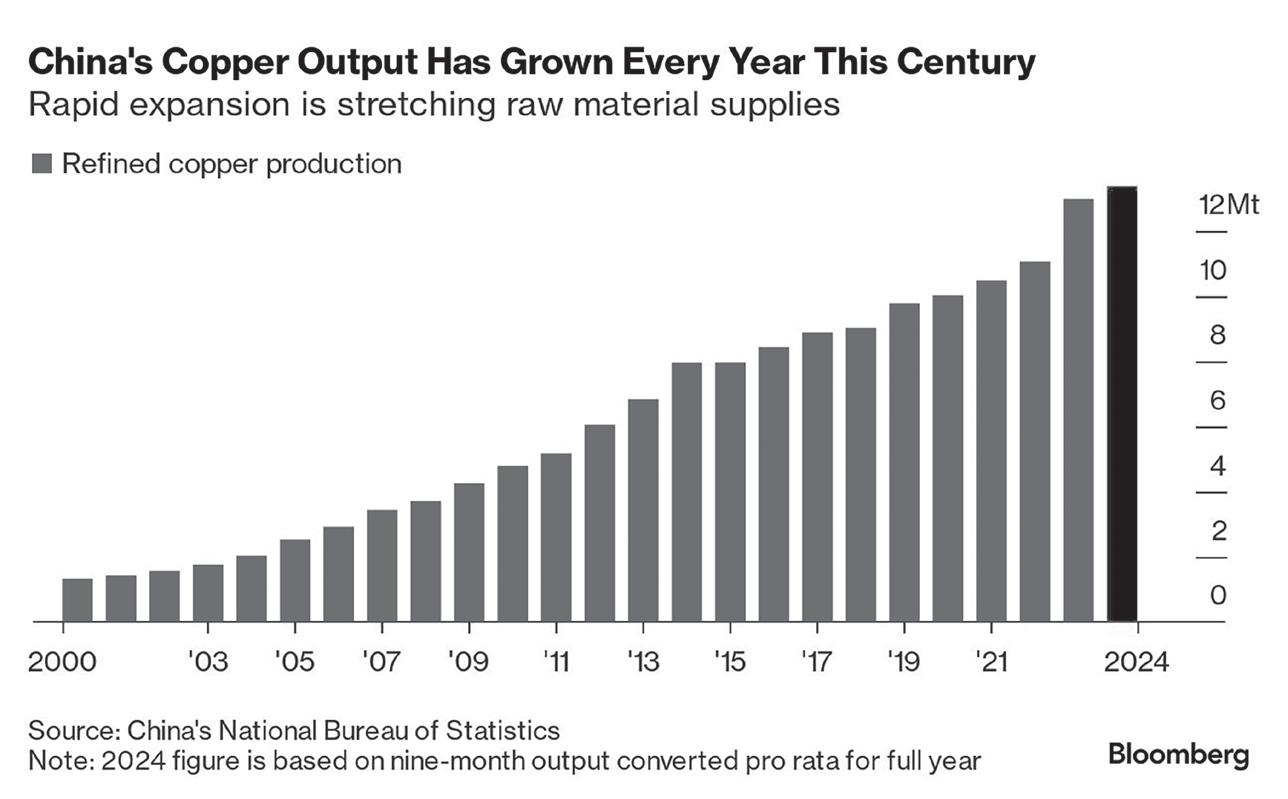
The top consumer of copper globally is on track to produce about half the world’s refined metal this year after a frenzy of smelter construction to secure supplies crucial to the energy transition.
The boom in capacity has continued despite cutthroat competition for scarce raw materials that is crushing margins everywhere.
China’s excesses threaten the future of copper refining beyond its borders, said Grant Sporre, head of metals and mining research at Bloomberg Intelligence. Operations from Chile to Europe and India could be at risk, he said.
Mounting calls within the country to curb production and scale back the formidable pipeline of new plants have yet to be heeded. If the breakneck expansion continues—and forces curtailments elsewhere in the world—more output
will be concentrated in China, even as western governments fret about its grip on strategic minerals.
The situation will come to a head at Asia’s biggest gathering of the copper industry in Shanghai this week, when smelters face crunch talks on the ore supply contracts that determine their margins. Miners have the whip hand at the annual negotiations because capacity is running so far ahead of global mine production.
The treatment and refining fees paid to smelters to convert ore into metal could drop to $40 a ton or less for next year, according to industry estimates, from $80 a ton in 2024. Such a settlement could lead to widespread losses. The previous low was $43 a ton in 2004, according to metals consultancy CRU Group, which has data going back to 1992.
Demand from renewables, electric vehicles and grid infrastructure is poised to balloon in coming decades. That’s spurring more investment along the copper supply chain, but smelters are far quicker and cheaper to build than new mines.
The ore squeeze has been compounded by the construction of new plants in India, which is seeking to reduce its reliance on imports, and Indonesia, where the government plans to halt exports of ore that currently feed smelters throughout Asia.
That has intensified the need to impose restraint in China. Spot

treatment fees made an unprecedented plunge below zero earlier in the year. But the industry’s push to cut output hasn’t had much impact. China’s production of refined copper has risen more than 5% so far in 2024. Last month, the country’s
main metals association called for stronger government intervention to stem the “blind expansion.”
It’s a familiar refrain across Chinese industries, from steel to solar and EVs, which are grappling with the effects of overcapacity while at the same time attempting to protect jobs and targets for economic growth.
China remains a net importer of copper, and doesn’t yet ship huge volumes overseas—unlike its steel and aluminum sectors, which are running up against increased protectionism from trade partners around the world. But that could change if it presses on with its expansion.
Top executives from key Chinese smelters have met in recent days to address the unfavorable market, according to people familiar with the talks. The meetings, which were attended by government representatives, included discussions
about sticking more firmly to plans to cut production, said the people, who asked not to be identified, as the information is private. But there’s skepticism. Analysts believe Chinese producers can weather the conditions better than others because of their cost advantage. Most of the older, less efficient plants have already been retired, according to Bloomberg’s Sporre. And large, privately owned smelters have been flushed out of the industry in recent years, leaving the sector dominated by stateowned firms more resilient to financial pressures.
“No one wants to cut first, but the ore tightness will be years-long and like running a marathon,” said Zhao Yongcheng, an analyst at Benchmark Mineral Intelligence Ltd. “Who can survive till the end will really be a test of everything from capital abundance to operations.”

chinery and digital technologies to optimize the use of resources such as water and fertilizers.
Genetic improvement can be applied in the selection of crop varieties that are more resistant to climate change, according to him.
Such path, according to Sartori, plays a fundamental role in allowing crops to gradually adapt to new environmental conditions.
SIMONA RAPASTELLA , General Manager of FederUnacoma, said the demand for mechanization remains potentially very high as the agricultural world recognizes the
need for innovations and plans its investments.
The weeklong EIMA International exhibition gathered 346,800 delegates, of whom 63,100 come from 150 different countries.
Over 60,000 models of vehicles, equipment and components —from tractors to combine harvesters, from soil processing equipment to treatment and harvesting machines, from forestry equipment to gardening and greenery maintenance equipment—were on display before a crowd of economic operators, farmers, contractors and technicians, as well as students and enthusiasts.
“The spotlight was on robots, drones, digital technologies and artificial intelligence systems that represent the new frontier of agromechanics, and which are already capable of responding to the challenges of food security, environmental sustainability and climate change,” Rapastella pointed out in a statement during the conclusion of the event.
FederUnacoma, the Italian federation of manufacturers that organized the exhibition, said the event gave them a platform to analyze the evolution of demand in the traditional markets of Europe and America, in the emerging markets of India and China, and in the newly-mechanized markets of Southeast Asia and Africa.
In July, the Philippine Statistics Authority reported 2.38 million unemployed individuals, with a significant portion being recent college or senior high school graduates who entered the labor force but were unable to secure jobs during that time.
In addition to curriculum reforms, Angara suggested ex-
panding events like “Day of the Future,” which offer students one-day work immersion experiences. According to Swiss Embassy Deputy Head of Mission Celine Furst, there is increased student participation in the event this year and expressed hopes to involve more local companies in the future.
“We could consider also opening up to Filipino companies and putting in the activity to Swiss companies, being the Swiss Embassy. We work with the Swiss Embassy mainly. But yes, it’s absolutely a dream. I hope for reality soon that we can extend this kind of activity,” she said. The “Day of the Future,” featured companies like Nestlé, Holcim, Roche, Novartis, Ivoclar Vivadent, SGS, Endress + Hauser, and more.
Editor: Angel R. Calso

By Justina Lee
TIMES are tough in private markets. High borrowing costs are hurting returns, managers are struggling to exit investments, and regulators are circling. All that is bringing back an issue that has long haunted these opaque holdings: No one is quite sure how to actually measure their performance.
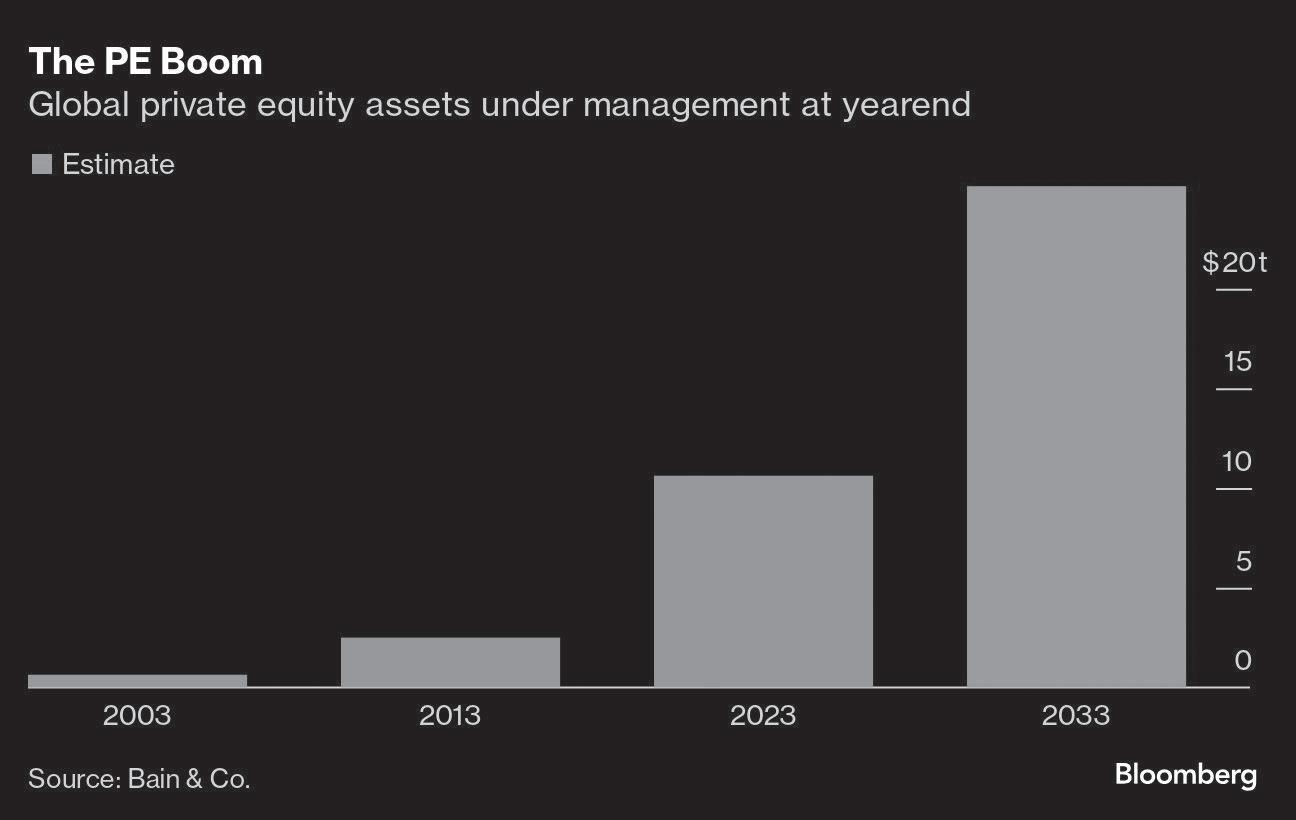
Barry Griffiths is one of a small group of quantitative analysts giving it a try. He’s the driving force behind an alternative method for gauging unlisted investments that he says has the potential to demystify the world of private markets, from buyout funds to venture capital. The claim is it will help investors compare returns with those of other asset classes, as well as reveal the true value provided by managers in the business along the way. That’s a controversial prospect in an industry famous for grading its own homework in terms of performance and for awarding itself generous pay based on the results. Not to mention that successfully decoding such illiquid investments is fraught with pitfalls, as anyone modeling mortgage bonds and derivatives before the financial crisis would probably testify. Yet the rewards of success could be huge: Private equity commanded $10.6 trillion in 2023 and is expected to grow to $25.1 trillion by 2033, according to estimates from Bain & Co.
“It’s not easy to understand the risks you’re taking,” says Griffiths, the former head quant at private-asset giant Ares Management. The lack of transparency is one reason systematic investors and analysts like him remain few and far between in the industry, because the data they rely on is in short supply. But as competition grows and market pressures mount, quant ideas are gaining more traction—in particular “direct alpha,” the approach devised by Griffiths and his peers.
Alpha—a measure of a portfolio manager’s returns on top of the broader market—is a familiar concept in finance. It’s become a common tool in equities, where indexes such as the S&P 500 provide an obvious benchmark for performance.
A huge amount of capital shifted into low-cost, passively managed funds at the expense of human stockpickers after it became clear that few managers consistently achieve alpha. It takes far fancier statistical footwork to do anything similar in private markets, where valuations are infrequent and largely decided by the managers of funds.
Private investments have cash flows that can be measured. But since every fund takes in money and pays it back at different times, it’s hard to truly understand performance.
The direct alpha approach compares those cash flows— both contributions and distributions—with what the
dollars would have been worth if they’d been invested in a public equity index in the same time period. That benchmark could be a broad one like the S&P 500 or perhaps a gauge of stocks in the same industry the fund invests in. The comparison should tell you how much you earned in excess of the market, or how much you lagged it. “Many times we found that somebody who had great absolute returns just happened to be invested in the right sector at the right time,” Griffiths says.
In one study published in 2023, he and co-authors Oleg Gredil at Tulane University and Ruediger Stucke, head of quant research at private equity firm Warburg Pincus, conducted a direct alpha analysis on a database of more than 2,400 funds specializing in buyouts. Their average reported internal rate of return (IRR)— the annual rate of growth based on a fund’s cash flows— was 12.3 percent. But how does that compare with other investments? The researchers found that the funds’ direct alpha was 3.1 percent using a broad market benchmark and 1.7 percent based on industry indexes.
Those are still good numbers, but for many investors it may be too little reward for locking up cash in illiquid and often leveraged assets for long periods. The average also obscures a notoriously wide range of outcomes. Meanwhile, venture capital funds fared even worse using this lens, with an average alpha of zero compared with similar listed stocks.
Direct alpha shares DNA with another well-known measure called the Kaplan-Schoar private
markets equivalent, named after Steven Kaplan and Antoinette Schoar, the economists who developed it. The main difference is that direct alpha shows results as an annualized percentage figure, which is closer to how investors typically think about performance.
Griffiths published his first paper on direct alpha while working at Landmark Partners, an investor in secondary private stakes that was later acquired by Ares. He retired from the firm last year. His successor, Avi Turetsky, calls Griffiths “the godfather” of private-market quants. Now a small band of his protégés from Landmark is quietly spreading direct alpha further through the industry.
Among them is Ian Charles, managing partner at Arctos Partners, which runs a strategy offering capital solutions to private equity managers. (Arctos has tapped Griffiths as an adviser.) One manager came to Charles with the idea of launching a fund focused on an industry where it had posted stellar returns. “It turns out a lot of firms with pure-play products in that industry have great IRRs,” Charles says. But alpha analysis told a different story. The firm’s actual alpha generation—the value it added—was “indistinguishable from zero” after adjusting for fees and broader industry performance, and its strength was actually elsewhere, he says.
Despite recent struggles in private equity, money keeps flowing in, with record levels of committed cash yet to be allocated to investments.
There’s a growing belief among many large institutional investors that private assets are an essential component of diversified portfolios. Against that backdrop, the added insight from direct alpha is winning over influential fans. Japan’s $1.6 trillion Government
Pension Investment Fund uses a version of it in combination with more established tools of analysis. Norges Bank Investment Management, which manages the $1.8 trillion Norwegian sovereign wealth fund, used the method as it weighed whether to enter the asset class.
It’s unlikely everyone will be as enthusiastic about these new insights in a business where private-fund managers are
Alpha—a measure of a portfolio manager’s returns on top of the broader market—is a familiar concept in finance. It’s become a common tool in equities, where indexes such as the S&P 500 provide an obvious benchmark for performance. A huge amount of capital shifted into low-cost, passively managed funds at the expense of human stockpickers after it became clear that few managers consistently achieve alpha. It takes far fancier statistical footwork to do anything similar in private markets, where valuations are infrequent and largely decided by the managers of funds.
typically compensated based on absolute performance. In a 2021 paper, Griffiths, Turetsky and other co-authors laid out a way to calculate private-market alpha in dollar terms. It would, they wrote, “enable performance compensation to be paid only for outperformance versus a public market benchmark.”
Direct alpha is “certainly not a standard way” of looking at performance, according to Hugh MacArthur, chairman of Bain’s private equity practice. He says investors care about two things: the absolute return over time and whether it’s repeatable.
“People try to torture the data to try and say, ‘Well, the returns aren’t really what you think they are,’” MacArthur says. But at the end of the day, “the cash goes in, and whatever cash comes back, I look at it and I measure it and it’s more, so what am I going to do? Deny that it’s more and not do the rational thing?”
Pretty much every attempt to bring statistical rigor to private markets—where the academic literature is packed with contradictory findings—is destined to be contentious. One common limitation is that every measure is only as good as the assumptions it needs to make.
The choice of benchmark makes a huge difference to direct alpha results. A recent study by money management firm Dimensional Fund Advisors found that while an average buyout fund beats the S&P 500 across its lifetime, it actually loses to an index of small-cap value shares—which some might say look more like a typical private equity portfolio.
Private equity rates of return are also vulnerable to a manager’s influence, because among other things they can control the timing of cash flows in and out of their funds. This can affect direct alpha calculations, though not as much as with absolute returns. “My group tended to do a lot of sensitivity analysis because we were aware that we were highly uncertain,” Griffiths says.
Big investors may even have an incentive not to look too carefully under the hood of returns. The apparent stability of prices in private markets— like in 2022 when the MSCI World Index of stocks lost 19 percent and an MSCI gauge of PE funds dropped only about half as much—can be advantageous for investors aiming to show their portfolios carry less risk. But some of the steadiness may be an illusion created by the fact that private assets aren’t traded
or priced as often as public stocks. Cliff Asness, co-founder of quant asset manager AQR Capital Management, considers this a deliberate ploy he dubs “volatility laundering.”
In a study this year, Mark Anson, chief investment officer of the $29 billion Commonfund, which invests money for nonprofits and others, found the volatility of large buyout funds almost doubles to 21 percent, far higher than the S&P 500, if you account for lags in the reporting of valuations. Traditional private-market reporting methods don’t tell you “the true economic story,” he says. For Anson, who previously led the California Public Employees’ Retirement System’s push into private equity, unsmoothing returns and computing the alpha has allowed Commonfund to have a higher allocation, because it can be more certain of the risks it’s taking.
It’s a similar story at the $43.4 billion UPS Pension Plan, where Senior Portfolio Manager Alexander Dorf says using direct alpha has boosted the plan’s private-asset performance and driven a shift from giant managers to smaller, more specialized ones. He figures these methods are catching on. As it becomes harder to ride
rising markets, “you’re going to see more of those debates around what is the purpose of PE,” he says. “Is it really just volatility dampening, or are there actual improvements?” Meanwhile, some of Wall Street’s biggest players are developing their own tools for assessing private markets. Asset management giant BlackRock Inc. is buying Preqin, an alternative-assets data provider, for $3.2 billion to help it index private markets. “There is a large gap in private-asset transparency relative to the public markets,” BlackRock Chief Operating Officer Rob Goldstein told analysts after announcing the deal. “If you can’t properly analyze an investment, you don’t understand it.” Still, the road to fully explaining private-asset performance is likely to be long. The earliest stock market quants laid the academic foundations for alpha in equities in the 1960s, but index funds only really took off after the global financial crisis. “I would love to see more of the information getting into the hands of practitioners, and I think it’s starting to,” Griffiths says. “It’s just slow. Everything in private equity moves slowly, right?” Bloomberg News


Editor: Tet Andolong
Story & photos by Bernard L. Supetran
The paradise island of Boracay, despite its overfamiliarity and occasional overtourism, has never lost its magic spell and remains a leading aspirational destination for locals and foreigners alike.
With talcum-fine sand, food crawl, swanky resorts, aqua adventures, Instagrammable nooks, and a vibrant nocturnal life, it is still the consummate getaway for beach bums, footloose wanderers and digital nomads.
And what makes the interlude truly memorable and worth coming back to is the guest’s choice of hotel which exudes the trademark tropical vibe and makes it worthy to be called your island home.
Greenhorns and frequent visitors to Boracay can uncover a not-soordinary experience in the island at Hue Hotels and Resorts which has been weaving its magic for the past seven years. Situated along the main road at Station 2, it prides itself of “bringing color to leisure” in more ways than one with its contemporary take on dining, relaxation, wellness and everything in between. With the offer of diverse visitor experience in mind, the resort has paired a twin establishment, Station X, which puts together several dining, recreation, boutique shops, and tourist services under one roof.
After basking in the sun, sea and sand, guests can shift into board games which families and friends will surely find fun moments.
Adorned with pastel-colored bean bags, tables, and lounging pillows along with the giant chess board and foosball table, the Turf Area is a swell chill out place while waiting for meal time.
Those who can’t seem to part with the microphone can sing their hearts out at a multi-purpose room which has a complete videoke setup. As a mini-arcade, mini-food court,
and watering hole, the resort also takes pride in Kubo, a casual dining outlet which takes the typical “tusoktusok” Pinoy street food to the next level. From the ubiquitous barbecue on skewers to reimagined bites, the resto is a jazzed-up version of the “pungko-pungko” pop-up grilled food stalls which is a common sight in the Visayas.
Bur the main culinary attraction though is LA-UD Restaurant which delivers a fusion of comfort food and new house recipes which it developed to mark its seventh-year milestone. With fresh ingredients sourced from local suppliers, it boasts of a wide range of specialties from Chori Burger Sliders, Seafood Pizza, Chef Erwin’s Poached Lapu-Lapu, Dried Fish Ceviche, Oxtail kare-kare, Grilled Pulpo and more.
Diners can feast on its Weekend Dinner Buffet from Thursday to Sunday which features themed culinary delights from the United States, France, and Vietnam, interspersed with all-time Filipino favorites and “kakanin” for desserts.
Guests can sink their teeth on a wide spread of culinary classics with modern twists, which include among others, premium seafood, freshlycarved meats, decadent desserts, and beverages which blend with the food theme.
Flamingo Social, which is just steps away from Kubo and LA-UD, is a fitting nightcap or a warm-up for a hearty dinner with its wide range of cocktails and spirits. Regarded as Boracay’s newest dry and pool bar, it takes pride in its innovative craft cocktails, made up of sustainable and exotic ingredients where it converts



food into liquid, repurposing food waste into creative garnishes, and crafting unique concoctions.
A must-try creation is the Isla (pronounced EYE-la) signature cocktails which has four variants which



will prepare your taste buds and set the mood for the gastronomic journey while humming or swaying to the beat of the house music played by the disc jockey.
As its name suggests, Hue Bora -
‘IShall Return” is arguably the most memorable and historic wartime promise made by a military leader.
Uttered by Gen. Douglas MacArthur in Australia after he escaped the Japanese troops in the Philippines during World War II, he would fulfill this promise after more than 2 years with over 100,000 Allied Forces to start the country’s liberation in what would be known as the Leyte Gulf Landings. To mark this historic event, the Province of Leyte recently held the 80th Leyte Gulf Landings Commemoration with the theme “Yesterday’s Heroes, Today’s Inspiration for the New Generation.”
“This year is a milestone observance, and the provincial government has pulled all stops to make it a very memorable way to immortalize the valor of war veterans who made this day forever etched in world history,” says Leyte governor Carlos Jericho Petilla.
He added that it is a constant reminder to everyone to pursue peace and renounce war, while asserting the country’s territorial integrity in view of the threats of foreign aggression. Commemorative events kicked off on October 17 with the observance of the raid by Filipino guerillas on Japanese forces in Suluan Island in Guiuan, Eastern Samar, which led to the establishment of a US naval base prior to the massive Allied landings.


The municipality of Tolosa led the Signal Day observance on October 18 which relived the exploits of Boy Scouts Valeriano Abello and his friends Antero Junia and Vicente Tiston who helped US warships redirect their artillery to Japanese positions with his semaphore skills, and spare the town’s population from shelling. Dulag town recreated the hoisting of the American flag on October 19 at Hill 120 by Lt. Clifford Mills of the US Army’s 96th Infantry Division, the first time it was raised on Philippine soil after the US surrendered in 1942.
It was followed by the opening of the Rawis Community Museum at the old Japanese airstrip, and wreath laying at the Shrine of Capt. Isao Yamazoe Shrine, a well-loved army officer because of his humane treatment of the townsfolk.
Meanwhile, the Palo municipal government welcomed special guests and dignitaries in the Pagbalik ha Palo, an annual barrio fiesta-themed gala dinner on the eve of the Leyte Gulf Landings.
A-Day unfolded on October 20 with a Sunrise Ceremony of the Filipino Veterans, and the 80th anniversary program where the 14 surviving veterans were honored by government agencies led by the Philippine Veterans Affairs Office.
Leading the rites were Leyte gov
cay is a profusion of colors which exudes a cheerful ambiance in every nook and corner. Such playful mood is evident in its rooms which abound in light and ethereal mood which will delight guests regardless
of age, gender or character. This 126-room lifestyle haven features five well-appointed room categories: Deluxe, Deluxe Pool View, Suite, Family Room, and the luxurious Spectrum Suite, which are tailored to fit all traveler types.
The resort’s unique coliseumlike architecture provides expansive open spaces with an overlooking view of the swimming pool as the central and recreational spot. And for everything else you would need outside the usual services, the trusty resort staff is just a phone call away.
Hue Boracay is managed by Hospitality Innovators, Inc. (HII), which has been running boutique properties under different brands across the country for the past two decades, including a sister resort of the same name in Puerto Princesa City in Palawan.

Sergio Osmeña.
Maj. Gen. Matthew McFarlane, and Veterans Federation of the Philippines president Romeo Alamillo.
Guest of honor and speaker Defense Secretary Gilberto Teodoro Jr. read the message of President Ferdinand Marcos Jr., reminding the younger generations of the sacrifice of the veterans to defend the country’s freedom.
“Their battle is our battle. Let us carry forward the lessons of those who gave their own so that we can prosper in a society where hope and opportunity flourish for all,” he said. The past came to life in the “Road to Leyte,” a 20-minute reenactment, theatrical and audio-visual show on pre-war Leyte, MacArthur’s landing, the gunfights with Japanese troops, and the turnover of the Philippine Commonwealth to then President
“For the first time since 1994, the Province mounted a reenactment to provide a stirring visual inspiration on the historic event for the present and succeeding generations to appreciate,” Petilla enthused. Reenactors in the production were from Eastern Visayas State University, Tacloban WWII Reenactors Group, Leyte Kalipayan Dance Company, Philippine National Police Regional Office, Dulag National High School, community theater groups of Burauen and Abuyog, Boy Scouts Leyte Council, and the Expats Zumba Group. Other sidelight events were the Miss Leyte Liberation pageant, the Hiscupex philatelic stamp exhibit, a film festival of Filipino World War 2-themed movies, the Leyte-Samar Historical Society Forum, and Philippine Veterans Bank’s “War of Our Fathers: A Brotherhood of Heroes” traveling exhibit.

Lyn Resurreccion
By Claudeth Mocon-Ciriaco
(DARL) of the University Philippines (UP) was able to get a much-needed upgrade to boost its capacity in strengthening the Philippine government’s drug abuse identification, control, and neutralization efforts.
This was made possible following the support given by the Commission on Higher Education (CHED) through the Ched-Philippine-California Advanced Research Institutes
By Lenie Lectura
EŌS Organization, a multinational integrated renewables company, will extend a P192-million grant to the Philippine Nuclear Science Foundation (PNSF) to fund nuclear research in the country.
EōS and the PNSF are in discussions with the Philippine Nuclear Research Institute (PNRI), two leading Philippine national universities, and EōS’ U.S. technology partner Valar Atomics USA to re-start nuclear energy education in the Philippines and produce Philippine graduates ready to enter the nuclear industry.
The education program will ensure a continuous supply of Philippine nuclear professionals.
Under the Clean Energy Scenario of the Philippine Energy Plan, the country is targeting to register 1,200 MW of nuclear energy capacity by 2032, with plans to double to 2,400 MW by 2035, and expand further to 4,800 MW by 2050.
This gradual scaling of nuclear capacity aligns with the Philippines’s long-term goals for energy security, economic development, and climate change mitigation.
On the second day of the Philippine International Nuclear Supply Chain Forum (PINSCF) 2024, the DOE said Canada and France shared insights into their longstanding experience in the nuclear energy sector.
Canadian Ambassador to the Philippines, David Hartman, said Canada will support the Philippines in achieving its nuclear energy goals. He highlighted Canada’s comprehensive nuclear ecosystem, which includes advanced reactor technologies and financing solutions through Export Development Canada.
Ambassador Hartman said Canada is prepared to offer a complete package of expertise and resources to help ensure the Philippines’ success on its nuclear energy journey.
Canada is home to the world’s fourth-largest uranium reserves, with Saskatchewan’s high-grade deposits accounting for over 8 percent of global uranium production, making Canada the second-largest producer globally.
Meanwhile, French Ambassador to the Philippines, Marie Fontanel, said French Ministry of Ecological Transition, Energy, Climate and Risk Education and the DOE are currently in discussions to sign a Memorandum of Understanding on cooperation in energy transition and the implementation of nuclear programs. This will focus on training, research and capacity building, including technical assistance on energy transition with focus on nuclear energy.
France is considering providing a grant to the Philippine government to support evaluation of potential sites for nuclear energy infrastructure.
(CHED-PCARI) program. With this program, the Commission gave P160,632,193.76 million to fund the capacity-building and procurement of equipment for the UP DARL.
Ched invested a total of P 112,608,000 million for the provision of various equipment that will help in identifying drug abuse including new psychoactive substances.
“Ched recognized the expertise of UP Manila in chemical and health sciences and we want this expertise to be at the service of the government. The UP DARL will provide information to help the government better address the drug problem in the country, taking into consideration a public health and human rights approach to the issue,” said CHED Chairperson Prospero De Vera III during the unveiling
of the marker at UP-Manila of the UP DARL. He was joined UP Manila Chancellor Mike Tee.
UP DARL now utilizes stateof-the-art equipment, currently only available at the UP Manila College of Pharmacy, to identify a wider class of drug compounds, including new party drugs in real time to enhance the illegal drug testing of law enforcement agencies.
For his part, Tee thanked Ched for supporting the establishment of the DARL.
“More than a laboratory to test drugs, this will serve as a teaching-learning facility where future experts will train. We hope that through this, we can help replicate the expertise in regional centers and other state colleges and universities so they too can assist our government in fighting the proliferation of illegal drugs,” Tee said.
The laboratory is capable of identifying 110 types of drug compounds, compared to available test kits that can only identify 10 types of drugs, and reduce the waiting time for test results from weeks to a day.
The laboratory utilizes Liquid ChromatographyQuadrupole Time-of-flight Mass Spectrometry (LC-QTOF/ MS) to analyze new designer drugs in the hair and point-ofcare (POCT) device for testing for the presence of selected new psychoactive substances through urine samples.
UP DARL research and clinical results could also help law enforcement officials to more accurately target the drugs whose supply must be reduced.
Furthermore, the active collaboration of UP DARL with health agencies, clinical, and forensics toxicologists, and
addiction medicine doctors will significantly help in managing existing drug abuse cases.
“This is an example of the expertise of the academe at the service of the government. Like what I have been constantly reiterating during my speeches in UP—UP can only and truly realize its mandate as a national university and prove its reputation as the top university in the country if it’s willing to translate their intelligence, skills, and excellence to concrete action that will help the government make a transformative impact on the lives of the Filipino people,” De Vera said. Since 2019, UP DARL has utilized various technologies for the identification of drugs of abuse, and has assisted law enforcement agencies including the Food and Drugs Administration (FDA).
Hundreds of 19th-century skulls collected in the name of medical science tell a story of who mattered and who didn’t
By Pamela L. Geller University Of Miami
The Conversation
WHEN I started my research on the Samuel George Morton Cranial Collection, a librarian leaned over my laptop one day to share some lore. “Legend has it,” she said, “John James Audubon really collected the skulls Morton claimed as his own.” Her voice was lowered so as not to disturb the other scholars in the hushed archive.
As my work progressed, I uncovered no evidence to substantiate her whispered claim. Audubon had collected human skulls, several of which he then passed on to Morton. But birds and ornithology remained Audubon’s passion.
Nevertheless, the librarian’s offhanded comment has proven useful—a touchstone of sorts that continues to remind me of the controversy and confusion long surrounding the Morton Collection.
Morton was a physician and naturalist who lived in Philadelphia from 1799 until the end of his life in 1851. A lecture he delivered to aspiring doctors at the Philadelphia Association for Medical Instruction outlined the reasons for his cranial compulsion: “I commenced the study of Ethnology in 1830; in which year, having occasion to deliver an introductory lecture on Anatomy, it occurred to me to illustrate the difference in the form of the skull as seen in the five great races of men…When I sought the materials for my proposed lecture, I found to my surprise that they could be neither bought nor borrowed.”
He would go on to acquire almost 1,000 human skulls. Morton used these skulls to advance an understanding of racial differences as natural, easily categorizable and able to be ranked. Big-brained “Caucasians,” he argued
in the 1839 publication “Crania Americana,” were far superior to smallskulled American Indians and even smaller-skulled Black Africans. Many subsequent scholars have since thoroughly debunked his ideas.
Certainly, condemnation of Morton as a scientific racist is warranted. But I find this take represents the man as a caricature, his conclusions as foregone. It provides little insight into his life and the complicated, interesting times in which he lived, as I detail in my book “Becoming Object: The Sociopolitics of the Samuel George Morton Cranial Collection.”
My research demonstrates that studies of skulls and diseases undertaken by Morton and his medical and scientific colleagues contributed to an understanding of US citizenship that valued whiteness, Christianity and heroic masculinity defined by violence. It is an exclusionary idea of what it means to be American that persists today.
Yet, at the same time, the collection is an unintended testament to the diversity of the US population during a tumultuous moment in the nation’s history.
Men of science and medicine
AS a bioarchaeologist who has studied the Morton Collection for many years, I have sought to better understand the social, political and ideological circumstances that led to its creation. From my work—analyzing archival sources including letters, laws, maps and medical treatises, as well as the skulls themselves— I’ve learned that, over a lifetime, Morton fostered a professional network that had far-reaching tentacles. He had plenty of help amassing the collection of skulls that bears his name. The physician connected with medical colleagues— many of whom, like
him, received degrees from the University of Pennsylvania—gentleman planters, enslavers, naturalists, amateur paleontologists, foreign diplomats and military officers. Occupational differences aside, they were mostly white, Christian men of some financial means. Their interactions took place during a pivotal moment in American history, the interlude between the nation’s revolutionary consolidation and its violent civil unraveling. Throughout this stretch of time, Morton and his colleagues catalyzed biomedical interventions and scientific standards to more effectively treat patients. They set in motion public health initiatives during epidemics. They established hospitals and medical schools. And they did so in the service of the nation. Not all lives were seen as worthy of these men’s care, however. Men of science and medicine may have fostered life for many, but they also let others die. In “Becoming Object,” I track how they represented certain populations as biologically inferior; diseases were tied to nonwhite people, female anatomy was pathologized, and poverty was presumed inherited.
From person to specimen SUCH representations made it easier for Morton and his colleagues to regulate these groups’ bodies, rationalize their deaths and collect their skulls with casual cruelty from almshouse dissecting tables, looted cemeteries and body-strewn battlefields. That is, a sizable portion of the skulls in Morton’s collections were not culled from ancient graves but belonged to those of the recently alive. It is no coincidence that Morton began his scientific research in earnest the same year Andrew Jackson signed the Indian Removal Act of 1830. Men of science and medicine benefited from
the expansionist policies, violent martial conflicts and Native displacement that underpinned Manifest Destiny.
The collection reveals these acts of nation-building as necropolitical strategies— techniques used by sovereign powers to destroy or erase certain, often already vulnerable, populations from the national consciousness. These skulls attest to precarious existences, untimely deaths and trauma experienced from cradle to beyond the grave.
In the specific case of Native Americans, skeletal analysis testifies to the violent effects of US military campaigns and forced removal. Native skulls that Morton labeled “warriors” have evidence of unhealed fractures and gunshot wounds. Children’s skulls bear the marks of compromised health; such pathology and their young ages at death are evidence of long-standing malnutrition, poverty and deprivation or stress.
To effectively transform subjects into objects— human beings into specimens—collected crania were ensconced in the institutional spaces of medical school lecture halls and museum storage cabinets.
There, Morton first numbered them sequentially. These numbers along with information about race, sex, age, “idiocy” or “criminality,” cranial capacity and provenance were inked on skulls and written in catalogs. Very rarely was the person’s name recorded. If used as teaching tools, Morton drilled holes to hang the skulls for display and notated them with the names of skeletal elements and features.
As dehumanizing as this process was, the Morton Collection does contain evidence of resilience and heterogeneous lives. There are traces of people with mixed-race backgrounds such as Black Indians. Several people may have
also bent gender to navigate dire conditions or in keeping with social norms, such as native Beloved Women, who were active in warfare and political life.
What these bones mean today
AS anthropologists now recognize, it is through the repatriation of the remains of the people in the Morton Collection to their descendants, among other types of reparations, that current practitioners may begin to atone for the sins of intellectual forebears.
Indeed, all institutions housing legacy collections must contend with this issue. There are other, valuable lessons—about diversity and suffering—that the Morton Collection has to impart in today’s interesting times. The collection demonstrates that the American body politic has always been a diverse one, despite efforts of erasure by men like Morton and his colleagues. Piecing together the stories of past, disenfranchised lives—and acknowledging the silences that have made it difficult to flesh them out—counters past white nationalism and xenophobia and their current resurgence. The collection, I believe, also urges the repudiation of violence, casual cruelty and opportunism as admirable attributes of masculinity. Valorizing men who embody these qualities has never served America well. Particularly in the mid-1800s, when Morton amassed skulls, it led to a nation divided and hardened to suffering, an unfathomable death count and the increasing fragility of democracy.
This AP article is republished from The Conversation under a Creative Commons license. The Conversation is an independent and nonprofit source of news, analysis and commentary from academic experts.
A6 Sunday, November 17, 2024

Editor: Lyn Resurreccion • www.businessmirror.com.ph
CATHOLIC educators must expand their approach to performance assessments, moving beyond academic achievement to include spiritual growth and evangelization, a Catholic archbishop said.
Archbishop Julius Tonel of Zamboanga on Thursday stressed that Catholic schools should not only evaluate students’ academic performance but also their development as better Christians.
“The rubric, I believe, should not only be in the matter of excellence in subject matters, but rather, whether our students become better Christians and Catholics,”
BTonel said. “That has to be gauged.”
He was speaking during his homily at Mass on the second day of the 2024 Catholic Educational Association of the Philippines (CEAP) national convention at the SMX Lanang in Davao City.
The archbishop also shared observations why many vocations in the country do not come from Catholic schools, emphasizing that the responsibility for spiritual formation begins with teachers and faculty.
“Teachers must be the number one to integrate the Gospel values, especially the beatitudes (into their teaching),” Tonel said.
“Performance task starts with
urged
ALTIMORE —Several Cath -
olic bishops in the United States on Wednesday encouraged the church to boldly share Vatican teachings on a range of hot-button issues, including the condemnation of abortion, euthanasia, surrogacy and genderaffirming surgery.
The prelates acknowledged theirs is often a countercultural view.
“We have been too apologetic for too long,” said Bishop Robert Barron, a media-savvy cleric who leads the Winona-Rochester diocese in Minnesota. “And we shouldn’t be cowed by the celebrities and so on in the culture who are preaching something that’s deeply problematic.”
The remarks came during the bishops’ annual fall meeting and a presentation on a Vatican declaration released in April. “Dignitas Infinita,” or “Infinite Dignity,” clarifies church teaching that promotes the dignity of all people and the protection of life from its earliest stages through death.
“The goal is to apply the lessons of ‘Dignitas Infinita’ to our American society,” said Barron, who praised the declaration for its “distinctively Catholic voice”—one that is not Democratic or Republican, liberal or conservative.
The 20 pages of “Infinite Dignity” were five years in the making
boldly
us. A person and a teacher, who tries to imbibe Catholic education with a heart,” he said.
The church official also expressed concern about the lack of participation from some teachers in school Masses.
“It’s very embarrassing when you have school Masses and Eucharistic celebrations, and teachers are not attending. The employees are left behind, and students see that,” he added.
To address this, the archbishop called on educators to engage in the “new way of evangelization” by involving students and faculty in parish life and Basic Ecclesial

and single out a range of harms, including forced migration and sexual abuse. In it, the Vatican labels gender-affirming surgery and surrogacy as violations of human dignity, comparing them to abortion and euthanasia.
Pope Francis has reached out to LGBTQ+ people throughout his papacy, and the document was a disappointing setback, if not unexpected, for transgender people and supporters of their rights. It comes during an election year in the United States where there has been a conservative backlash to transgender rights.
Bishop Thomas Daly of Spokane, Washington, spoke to the meeting about how Catholic schools can be a vehicle for edu -
cating young people about Catholic sexual ethics.
“We want our students to see the church’s teaching on sexuality as an expression of this deeper understanding of the human person, and not simply just a set of rules that stand in opposition to our popular culture,” Daly said.
Bishop Michael Burbidge of Arlington, Virginia, who is finishing a term as chair of the USCCB committee on pro-life activities, expressed gratitude to the Vatican and called the declaration “incredibly timely.”
“Sadly, many states continue to enshrine abortion in their state constitutions,” he told the gathering, referencing recent state ballot initiatives. “We know we still have

so much work to do.”
“Our work is not only to change laws, but to change hearts, to change minds,” Burbidge added.
Throughout their meeting, the US bishops have reaffirmed their anti-abortion commitments, even in the face of losses at the ballot box.
Voters supported 7 out of 10 abortion rights state ballot measures this election. Even in Florida, where the abortion rights amendment failed, 57 percent of voters supported the measure, just shy of the 60 percent it needed to pass.
Archbishop Joseph Naumann of Kansas City earlier told the gathering during an evangelization discussion that the success of abortion rights ballot initiatives should be “a wake-up call for us.” He said more pointed language is needed to help people accept church teaching on life issues.
In his opening address, Archbishop Timothy Broglio, president of the US Conference of Catholic Bishops, laid out a vision of proclaiming church teaching, even when it’s not popular or convenient.
“We never back-pedal or renounce the clear teaching of the Gospel. We proclaim it in and out of season,” said Broglio. “We must insist on the dignity of the human person from womb to tomb, be unstinting in our commitment.” AP
Communities.
He stressed that the Church’s role extends beyond the school, urging educators to guide students in actively participating in parish life.
“We, as pastors, are in need of your help. We are waiting. The problem might be you create your own, but never lead your students to the parish,” Tonel said.
“The rubric of performance tasks is based on how teachers and students carry out their mission in a manner that evangelizes with charity and conviction…and I leave that to your reflection,” he also said. CBCP News
Vatican, Microsoft create AI-generated St. Peter’s Basilica to allow virtual visits, log damage
VATICAN City—The Vatican and Microsoft on Monday unveiled a digital twin of St. Peter’s Basilica that uses artificial intelligence to explore one of the world’s most important monument’s while helping the Holy See manage visitor flows and identify conservation problems.
Using 400,000 high-resolution digital photographs, taken with drones, cameras and lasers over four weeks when no one was in the basilica, the digital replica is going online alongside two new on-site exhibits to provide visitors—real and virtual—with an interactive experience.
“It is literally one of the most technologically advanced and sophisticated projects of its kind that has ever been pursued,” Microsoft’s president Brad Smith told a Vatican press conference.
The project has been launched ahead of the Vatican’s 2025 Jubilee, a holy year in which more than 30 million pilgrims are expected to pass through the basilica’s Holy Door, on top of the 50,000 who visit on a normal day.
“Everyone, really everyone should feel welcome in this great house,” Pope Francis told Smith and members of the project’s development teams at an audience Monday.
The digital platform allows visitors to reserve entry times to the basilica, a novelty for one of the world’s most visited monuments that regularly has an hours-long line of tourists waiting to get in.
But the heart of the project is the creation of a digital twin of St. Peter’s Basilica through advanced photogrammetry and artificial intelligence that allows anyone to “visit” the church and learn about its history.
The ultra-precise 3D replica, developed in collaboration with digital preservation company Iconem, incorporates 22 petabytes of data—enough to fill five million DVDs— Smith said.
The images have already identified structural damage and signs of deterioration, such as missing mosaic pieces, cracks and fissures invisible to the naked eye, with a speed and precision far beyond human capabilities. Francis has called for the ethical use of AI and used his annual World Message of Peace this year to urge an international treaty to regulate it, arguing that technology lacking human values of compassion, mercy, morality and forgiveness were too great.
On Monday, he thanked the Microsoft team and basilica workers responsible for the project and marveled at how modern technology was helping spread an ancient faith and preserve a piece of world patrimony, which celebrates the 400th anniversary of its consecration in 2026.
“This house of prayer for all peoples has been entrusted to us by those who have preceded us in faith and apostolic ministry,” he told Smith and the delegation. “Therefore, it is a gift and a task to care for it, in both a spiritual and material sense, even through the latest technologies.” Smith declined to give a price tag for Microsoft’s investment in the project, saying only it was “substantial” and was borne of Francis’ initiative in 2018 to bring tech companies together to promote ethnically minded AI.
He said Microsoft had done similar AI projects at Mont Saint-Michel in France and Ancient Olympia, in Greece. AP
Papal elections aren’t always as dramatic as ‘Conclave’–but the history behind the process is
By Joelle Rollo-Koster University of Rhode Island
I’M a historian of the medieval papacy and editor of the forthcoming three volumes of the Cambridge History of the Papacy. So it was more or less mandatory for me to see the new movie “Conclave.”
Based on Robert Harris’ 2016 novel, the film shows the politics behind electing a pope to lead the world’s 1.36 billion Catholics. Any researcher who has spent some time at the Vatican will find familiarity in the characters’ speeches and behaviors, which are acted spot-on. What the movie does not do, though, is explain where the word “conclave” comes from, and how the mysterious system was created in the first place. Conclave is formed from the Latin words for “with key,” referring to how cardinals are sequestered to elect a pope—inside the Vatican, today; but wherever a pope died, in the Middle Ages. Why sequestered? Because it took centuries for the church to develop an electoral system free from manipulations and violence—which should resonate with contemporary politics.
Chosen by ‘the people’?
ONCE free from Byzantine and Holy Roman
imperial controls, from the end of the 11th century forward, a medieval pope held powers far superior to the ones a pope holds today. Not only did he offer spiritual guidance, but the pope was heavily engaged in political affairs, including negotiations between states, and was head of the wealthiest institution around, collecting taxes and revenues from most of Europe. Electing this powerful figure was a cantankerous affair, marred by violence and external interference. Originally, in early Christianity, the pope had been nominated by the “people of Rome” agreeing by consensus. In reality, that meant the election was in the hands of mobs, aristocrats, kings, emperors or anyone with any form of control over Rome. Consensus was achieved by either negotiation or force. Quite often, powerful people could appoint whomever they chose.
For example, the 686 election of Pope Conon is described in “The Book of Pontiffs,” a medieval collection of short papal biographies, as a chaotic affair that included the military. The author states that “there was much argument, since the clergy favoured the archpriest Peter while the army were for Theodore, the next in seniority.” After long negotiations the clergy opted for Conon, who had been third in rank under
the late pope.
Sacking the Vatican IN addition to “internal” pressures, a pattern emerged of mobs sacking the goods of the dead pope—sometimes including the clothes on his corpse and his liturgical garments. It is difficult to identify why: greed, certainly, and obtaining something that had been touched by holy men. But I would argue the mob also resented authorities who took the nomination process away from “the people.”
The Council of Chalcedon, a gathering of bishops in 451, forbade clerics from seizing a dead bishop’s belongings, at risk of losing their rank. Another council a few years later decreed: “Let no one, through theft, force, or deceit, conceal, take away, or hide anything” at the death of a bishop.
Yet looting went on for centuries. In a 1050 letter to Catholics in the diocese of Osimo, in present-day Italy, Cardinal Peter Damian stated:
From various reports we are aware of the perverse and wholly detestable practice of certain people, who at the death of the bishop break in like enemies and rob his house, like thieves make off with his belongings, set fire to the homes on his estate, and with fierce and savage barbarity cut down
his grape vines and orchards.
The movie may be alluding to this history when a cardinal asks Dean Lawrence, the man presiding over the conclave, if he could have the deceased pope’s chess game.
College of Cardinals
TO salvage the electoral system from internal and external chaos, Pope Nicholas II decreed in 1059 that popes should be selected by men of the cloth—namely, cardinal-bishops. Up to then, cardinals had been involved in liturgical functions in the great basilicas of Rome. They could be priests, deacons or bishops.
This did not work. A century later, Pope Alexander III decreed that all the cardinals—with equal representation between priests, deacons and bishops— would become the pope’s electors, and a nominee needed to secure two-thirds of the votes to win.
Still, intrigues and squabbles continued to mar the process for years. So long as there was a “Vacant See” at the Vatican, the cardinals were the church’s governors, so the incentive was on their side to delay the process.
And the looting expanded, with cardinals’ residences becoming new targets. Sacking would sometimes take place even
before the pope was dead, as rumors of a selection circulated.
Strict secrecy
THE continued chaos, as well as cardinals’ lengthy negotiations and ongoing external influences, pushed Pope Gregory X to act.
In 1274, he instituted the decree “Ubi periculum.” The first words of the text were “Ubi periculum maius intenditur”: “Where greater danger lies.” A papal nomination was dangerous business—sometimes to the person, most often to his property.
“Ubi periculum” established the basics of the conclave system still used today— most importantly, that cardinals would be completely isolated and confined during the process.
Sequestered cardinals would not tarry in long discussions, especially when they were away from the comfort of their own palaces, allowed only a single attendant and sleeping in simple cells. If they took longer than three days to decide, they lost the privilege of several daily meals, down to a single one. The politics of the stomach!
Incidentally, the traditional looting now spread to the cells of the conclave.
Two popes UNDER the new rules, the role of the car -
dinals was strictly limited to electing the next pope. But this did not prevent them from continuing their scheming.
At the death of Gregory XI in 1378, the cardinals elected Pope Urban VI, but soon regretted it. A few months later, they deposed him and elected a new one, under the pretext that the first election took place under duress: the fear of the mobs. Still, they knew full well that the looting was “customary.”
The chronicler Dietrich of Niem, a witness to the events, made that clear. After Urban had been chosen—unanimously— “he immediately moved his books and other valuables into a safe place, so that they would not be stolen,” Dietrich wrote. He added, “It is a custom of the Romans to go in his palace and rob his books and things of this kind.” Catholics now had two popes: the one who had been elected in April 1378—Urban VI, who refused to give up power—and the one elected in September 1378, Clement VII. Two popes, two courts and two “obediences” divided Europe. The crisis, which lasted from 1378-1417, is called the Great Western Schism.
Power is tantalizing—and electoral violence and manipulation are not new. The Conversation

Editor: Lyn Resurreccion

By Jonathan L. Mayuga
THE United Nations Development Program (UNDP) recently released the BIOFIN Work Book 2024: Finance for Nature, which provides detailed guidance on designing and implementing national Biodiversity Finance Plans (BFP).
The BFPs set out a coalition of actors to address biodiversity finance with the hope of narrowing the huge financing gap for biodiversity.
The publication noted considerable results such as – in the case of the Philippines—up to a US$86 million budget increase for protected areas.
It cited the enactment of the Expanded National Integrated Protected Areas System (E-NIPAS) Act which increased the number of legislated Protected Areas from 13 to 107, thus securing public sector funding for the management of these areas set aside for conservation
BIOFIN Philippines
IN the Philippines, BIOFIN, which stands for Biodiversity Finance started in 2014. The UNDP, together with the Biodiversity Management Bureau (BMB) of the Department of Environment and Natural Resources (DENR) and the Department of Finance (DoF), implement BIOFIN.
Under the project, the financial needs assessment of the Philippine Biodiversity Strategy and Action Plan (PBSAP) was updated, and the financial needs for its implementation until 2030.
Currently, the Philippines is implementing several finance solutions involving national agencies, local governments, the private sector, civil society organizations and the citizenry to mobilize resources for the PBSAP.
PBSAP financing gap
AS early as 2015, the biodiversity finance gap in the Philippines has been identified through the PBSAP 2015-2028 which puts in place measures to conserve and protect the country’s rich biodiversity.
Considered one of the 17 megadiverse countries in the world with 228 recognized key biodiversity areas, the Philippines is home to 855 globally important species of flora and fauna.
Unfortunately, the Philippines is also one of the world’s biodiversity hotspots because of the rapid rate of biodiversity loss driven by habitat loss because of deforesta -
tion, forest degradation, and conversion of forest land to other uses.
Overharvesting of natural resources is also a major threat to Philippine biodiversity, along with invasive species that outcompete native species for resources, eventually replacing or displacing them in the process; illegal wildlife trade and wildlife trafficking; pollution, climate change, and destructive fishing and farming activities.
These, coupled with underlying drivers such as population growth, poverty, urbanization, policy failures, trade, and globalization that put pressures on the already vulnerable ecosystem, is driving biodiversity loss in the Philippines.
Protected area management ALONG with the enactment of environmental laws that protect and conserve the country’s biodiversity, the implementation of protected area management was the government’s response to the alarming biodiversity loss.
Through Republic Act 7586 or the National Integrated Protected Areas System (NIPAS) Act of 1992 and principally authored by former Occidental Mindoro Rep. Josephine Ramirez-Sato, RA 11038 or the Expanded NIPAS Act of 2018, key biodiversity areas have been identified and set aside for conservation.
There are 240 protected areas in the Philippines, but only 13 are legislated Protected Areas.
With the enactment of the ENIPAS Law, the number of legislated Protected Areas was increased to 107, substantially increasing the budget for biodiversity conservation, and strengthening further the protected area management system in the Philippines.
However, with the gargantuan task of managing more than five million hectares—the total land area covered by all protected areas combined—funding for their protection including the flora and fauna that thrives within—remain wanting.
Tamaraw conservation advocate FOR her legislative advocacy for biodiversity conservation, the lawmaker from Occidental Mindoro, a key biodiversity area and home to


one of the rarest buffaloes in the world, was named along with three other global leaders as UNDP BIOFIN Champion of Change.
Each of the four global leaders was cited because of the roles they played in increasing the budget for financing biodiversity, hence narrowing the biodiversity financing gap in their respective countries. Their names and individual accomplishments were mentioned in the UNDP BIOFIN Work Book 2024 which stated that specific individuals can play a catalytic role in policy processes, acting as true agents of change.
Sato was cited for her role in protecting and conserving the Philippine tamaraw, the world’s rarest buffalo that can only be found in the hinterlands of Mindoro Island which is also a Protected Area— the Mounts Iglit-Baco Natural Park (MIBNP).
Sato was also recognized for imposing a ban on mining in her province during her stint as governor. She also advocated the protection and conservation of Mindoro’s natural treasures through her various environmental programs.
UNDP Champions of Change “CHAMPIONS of change are often senior government officialsd or visionary entrepreneurs, but they can also be influential media personalities, civil society leaders, or scientists. Decision makers such as these champions of change should be involved in the BIOFIN Process from an early stage. Only decisionmakers can push for draft laws,” the UNDP BIOFIN said.
Aside from facilitating the approval of the E-NIPAS Act, which resulted in increased funding for protected areas estimated at between US$1 million to US$10 million per year, Sato supported Tamaraw conservation with congressional fora, as well as site-level work in her province of Occidental Mindoro.
The other Champions of Change are Doris Ríos Ríos, vice-president of the National Indigenous Board of Costa Rica (MNICR), a Cabécar community leader from the China Kichá Indigenous territory. She was recognized in 2023 with the International Women of Courage Award by the United States Department of State; Sergio Graf Montero,
former Minister of Environment in the State of Jalisco in Mexico, emerged as a visionary; Mutumboi Mundia, a pivotal figure in Zambia›s biodiversity finance landscape and capital market development, who served as Director of Market Supervision and Development at the Securities and Exchange Commission (SEC), where she led transformative initiatives to enhance Zambia’s capital markets.
BIOFIN Ph key accomplishments
ASKED to weigh in about the importance of finding other funding sources for Protected Areas, Armida P. Andres, OIC Assistant Director of the Biodiversity Management Bureau (BMB) cited the BIOFIN project for narrowing the huge budget gap in managing the protected areas. She said through BIOFIN, plans were developed to identify funding source means to access them to help narrow the gap.
“Our BIOFIN Project led by Anabelle Plantilla, helped several PAs develop their finance plans so that they can identify diversified ways of financing their operation,” Andres told the BusinessMirror via text message. Plantilla is the coordinator of BIOFIN Philippines.
On its website, BIOFIN Philippines reported that aside from additional funding for the 107 legislated Protected Areas, it has also mobilized US$300,000 for reforestation by partnering with Mynt, creator of GCash and other biggest mobile wallet in the country through its GCash Forest app and the Corporate Social Responsibility program of partners such as World Wild Fund (WWF); P1.6 million through the Together for Tamaraws Crowdfunding Campaign for conservation communities affected by Covid-19 pandemic;
US$60,000 allocation at the Provincial Development and Physical Framework Plan 2020-2022 for Negros Oriental’s proposed priority biodiversity programs and activities, and P20 million from the 2020-2022 for Negros Occidental province’s Southwestern Negros Key Biodiversity Area (KBA).
Public sector funding
INTERVIEWED by the BusinessMirror on November 13, Plantilla said that the gains from the legislation of 107 Protected Areas is the biggest catch of BIOFIN Philippines.
“It’s public sector allocation for protected areas,” she said. While saying there is an increase in the budget, she said the financing gap remains huge.
Plantilla said securing funding support from local governments, such as in the case of Negros Oriental and Negros Occidental, is also a big win. Together with the Philippine Biodiversity Conservation Foundation, which is based in Bacolod, BIOFIN Philippines was able together with PHILBIO and the Provincial Government, five financial solutions were identified. The budget for biodiversity conservation in the two provinces, she said, would hopefully increase every year, with the crafting of a biodiversity conservation plan.
Working with local govts, private sector “SECONDLY, the provincial governments allocated funds for National Government programs. Such as for Cuernos de Negros, which is aligned with the DENR Provincial Offices. The alignment maximizes resources to achieve a common objective,” she said.
Another victory, she said, is securing funding support from the private sector.
Negros was identified as one of the beneficiaries of a foreignfunded project, referring to Philippine-Canada Partnership for Nature-Based Solutions through the Forest Foundation Philippines, which sits on the Board of BIOFIN Philippines. The funding, in the form of grants, secures P35 million for a three to five-year project with nongovernment organizations as implementing partners.
She said one other target is to work with mining companies and government regulators to set aside funding for biodiversity protection and conservation through their social development management programs (SDMP).
Plantilla said no matter how small, all additional funding for biodiversity protection and conservation, put together, eventually helps narrow the budget gap, thus helping make PBSAP 2015-2028 targets or goals within reach.
By Fabiano Maisonnave The Associated Press
AGUA CLARA, Brazil — Forest loss in Brazil’s Amazon dropped by 30.6 percent compared to the previous year, officials said, the lowest level of destruction in nine years.
In a 12-month span, the Amazon rainforest lost 6,288 square kilometers, roughly the size of the US state of Delaware.
The results, announced in Brazil’s presidential palace, sharply contrast with President Luiz Inácio Lula da Silva’s predecessor, far-right leader Jair Bolsonaro, who prioritized agribusiness expansion over forest protection and
weakened environmental agencies. Deforestation hit a 15-year high during his term. Deforestation in Brazil’s vast savannah, known as the Cerrado, decreased by 25.7 percent, the first decline in five years. The area destroyed reached 8,174 square kilometers. Located in central Brazil, it is the world’s most biodiverse savannah but has fewer legal protections than the Amazon. Despite the success in curbing Amazon deforestation, Lula’s government has been criticized by environmentalists for backing projects that could harm the region, such as the pavement of a highway that cuts from an old-

growth area, oil drilling in the mouth of the Amazon River and building a railway to transport soy to Amazonian ports.
Brazil’s deforestation monitoring system tracks Aug. 1 to July 30, so lasty week’s report doesn’t capture the destruction from the past few months, as a historic drought opened the way to a surge in forest fires that burned an area larger than Switzerland. Much of the damage from fires is classified as degradation, not clearcutting deforestation, as the fire in the Amazon rainforest spreads mostly through leaves on the ground, and not through treetops. But the full impact will be assessed in the following months through further satellite monitoring. Government officials already fear that the deforestation rate may increase next year as the Amazonian city of Belem prepares to host the annual UN climate talks, known as COP30. The Amazon, an area twice the size of India, holds the world’s largest rainforest, about twothirds of it within Brazil. It stores vast amounts of carbon dioxide, a greenhouse gas that causes climate change. The Amazon thus prevents the climate from warming even faster than it would otherwise. The basin also holds about 20 percent of the world’s fresh water and biodiversity includes 16,000 known tree species.
A8 SundAy november 17, 2024
mirror_sports@yahoo.com.ph
Editor: Jun Lomibao

LOS ANGELES—The International Olympic Committee’s (IOC) Coordination Commission wrapped up a three-day visit recently to check out selected venues and track the progress of the 2028 Los Angeles Olympics.
“We’re four short years away,” said Casey Wasserman, LA28 chairman and president, who noted the Los Angeles Games are 1,338 days from opening on July 14, 2028.
The commission visited the Rose Bowl in Pasadena, the new Intuit Dome in Inglewood, the Long Beach Convention Center, waterfront and Marine Stadium during its first trip to Los Angeles in two years.
“The venues are absolutely spectacular,” said Nicole Hoevertsz, a member of the IOC and chair of the Coordination Commission for LA28. “I’m going to highlight this every single time that I come to the city that you have no construction to do, that you have world-class venues. They know very well how to organize big events and big sporting events.”
In 2025, the Games plan, the venues and competition schedule, medal event program and athlete quota will be finalized, which in turn will drive transportation, security and ticketing plans.

In 2026, the LA organizing committee will “get into some of the fun stuff,” Wasserman said, which includes opening up ticketing and hospitality options to the public, organizing the torch relay, creating a mascot, Cultural Olympiad and volunteer program.
“We cannot wait to host the world,” he said during a news conference on the campus of UCLA, which will host the athletes’ village.
Wasserman doesn’t anticipate any issues working with the incoming administration of President-elect Donald Trump, who was in office in 2017 when Los Angeles won its bid to host
and signed federally binding documents for the government to deliver security and transportation for the Games.
“Our conversations with the federal government always involve talking to folks from every party, that’s the nature of the world we live in in this country,” Wasserman said. “One side doesn’t get to dictate everything. It requires cooperation and coordination. We’ve had great success with both Republican and Democratic administrations, and we have no doubt that will continue.”
Wasserman and the LA organizing committee visited
Paris to get an up-close view of how the French capital staged the recent Summer Games.
“We spent most of our time touring the back of the house while the competition was going on,” he said. “That’s where we will learn a lot and see a lot. Producing an event on the field of play I think we have a pretty good handle on. What makes the Olympics unique is everything else.”
Cricket is among the new sports at the 2028 Games, as are flag football, lacrosse and squash. A cricket venue doesn’t currently exist in Los Angeles.
“If we can find a place for cricket in Los Angeles, in the region, we will,” he said. “If not, it’s incumbent upon us to find the best place to produce the best cricket tournament.”
Softball and canoe slalom have already been moved 1,300 miles east to Oklahoma City.
“These Games are incredibly focused on LA and Southern California and being responsible and making hosting the Games fit our city and our community as opposed to fitting our city to host the games,” Wasserman said, “which is the mistake that has been made in the past and the promise we have made to the city and the community not to make going forward.”
TBy Bless Aubrey Ogerio
HE country continues to witness a cycling boom but the necessary infrastructure and support have not really kept pace. This prompted the Mobility Awards 2024, organized by climate and sustainable mobility advocates, to


JON JONES is widely considered the greatest fighter to ever strap on gloves in UFC—and he’ll have a familiar pair for his heavyweight title defense against Stipe Miocic.
UFC decided ahead of Saturday’s card at Madison Square Garden to ditch the ballyhooed new fight gloves unveiled in the spring designed in large part to stunt eye pokes that often render fighters unable to continue.
It is the first major change of the protective equipment in more than a decade and the new gloves were knocked out after six months.
The global mixed martial arts (MMA) leader returned to its old school style of gloves for the UFC 309 card headlined by the JonesMiocic title fight.
The change appears permanent, in large part because of fighter complaints.
“The new gloves are now the old gloves,” UFC President Dana White said.
The new gloves had been used on cards held since UFC 302 in June.
Some notable changes included: seams on the palm side of the hand just below the fingers, designed to minimize abrasions and cuts; new padding that was expected to make it easier for fighters to keep their fingers in a natural position and minimize eye pokes; and removal of finger
binding intended to reduce bulk and minimize seams that may cause abrasions and cuts.
Male and female sizing was eliminated in favor of 10 unisex sizes. The gloves weighed between 3 and 4.9 ounces (a reduction of 1 to 1.5 ounces).
Fighters balked from the outset about the gloves designed and engineered by sports equipment manufacture Vicis RDI. They said the gloves failed to deliver on the improved fit, greater comfort and maximum flexibility promised by the company.
“The shape, the curve in your hands, they’re very uncomfortable for me,” Jones said this week in New York. “I was actually really stressed thinking, how am I going to go into fight week wearing these gloves that I don’t even really want to train in?” He’ll wear the familiar equipment for his five-round championship bout.
“It was a major relief to my coach who wraps my hands,” Jones said. “It was a relief to me, as well.” MMA gloves haven’t evolved much since the company’s inception. When UFC held its first event in November 1993, fighter Art Jimmerson competed with one bare hand and one boxing glove. UFC 14 in 1997 was the first event in nwhich the company made it mandatory to wear padded gloves.

SThis year’s bicycle count, conducted during peak hours in June, captured the number of people using bicycles in urban areas, including both riders and passengers.
Environmental impact
COUNTING cyclists, more than just a data-gathering exercise, is a powerful tool to advocate for a sustainable future, as highlighted by Chuck Baclagon of 350 Pilipinas, awards co-convenor.

EOUL, South Korea—South Korean President Yoon Suk Yeol has dusted off his golf clubs in an attempt to forge a bond with President-elect Donald Trump, an avid lover of the game.
The presidential office said Tuesday that Yoon began practicing the game for the first time in eight years in preparation for a possible round of golf with Trump.
and agreed to hold an in-person meeting soon during a phone call on Thursday. The South Korean president told reporters later that while things couldn’t remain the same as under the Biden administration, “we have been preparing to hedge these risks for a long time.”
And apparently, a game of golf may be what’s needed.
City saw the highest growth rate at 49.2 percent, thanks to continued investments in cycling infrastructure. In contrast, cities like Baguio and Cagayan de Oro faced challenges due to hilly terrain and insufficient infrastructure. Despite the growth, only 56 percent of cyclists wear helmets, indicating safety concerns. Additionally, there is a significant gender gap in the cycling community, with only 3 percent of cyclists being female, equating to three women for every 100 bicycle trips.
Aldrin Pelicano of MNL Moves stressed the importance of collecting data to monitor progress, understand user needs, and design effective bike lanes, advocating for a shift in transportation metrics.
“Our measure of success for transport infrastructure and traffic management investments should go beyond the number of vehicles moved. It should focus on how many people are actually being transported, and the level of comfort and safety they experience on the road,” he said. Present during the event were representatives from the Department of Transportation, Department of Public Works and Highways and Metropolitan Manila Development Authority.
They acknowledged the need for stronger collaboration to enhance urban cycling infrastructure, prioritizing safety and sustainability for all road users.
“Every bike lane and safe road they advocate for isn’t just infrastructure, it’s a statement that we can tackle emissions and make our communities healthier at the same time,” he said.
For Nazrin Castro, another co-convenor, promoting emission-less transport alternatives contributes to a global movement against the climate crisis.
“We boast here both an increased number of cyclists and volunteers. Bicycle count activities then become more than just an exercise of data collection: it also carves a path for community engagement on climate-focused solutions,” Castro said.
The Mobility Awards is a joint initiative of the Institute for Climate and Sustainable Cities, MNL Moves, Climate Reality ProjectPhilippines, 350.Org Pilipinas and Pinay Bike Commuter.
Since his election, Trump’s “America first” approach has raised concerns it could negatively affect the US defense commitment to South Korea and hurt the trade interests of the Northeast Asian country in various ways, including increased tariffs.
Some experts say it’s important to build a close personal friendship with Trump during the transition period before he formally takes office in January.
“Much could depend on whether Yoon is able to strike up positive chemistry with Trump immediately during the transition and foster a close personal friendship to convince him to want to support and advance Seoul’s interests,” said Duyeon Kim, a senior analyst at the Center for a New American Security in Washington.
Yoon and Trump discussed strengthening bilateral cooperation
Local media said Yoon went to a Seoul golf course on Saturday, but the presidential office said it couldn’t confirm the reports.
A senior presidential official, speaking on condition of anonymity in a background briefing, said that while he didn’t know how hard Yoon practiced golf, training was necessary as “our president also has to hit a ball properly to get conversations going on” with Trump, who has “outstanding” golf skills. Yoon isn’t the first world leader to try to use golf to develop relations with Trump.
When he was in office, Japan’s assassinated prime


In China’s regimented society, youth find release at underground raves
NOVEMBER 17, 2024 | soundstrip.businessmirror@gmail.com


Publisher :
T. Anthony C. Cabangon
Lourdes M. Fernandez
Editor-In-Chief :
Concept :
Aldwin M. Tolosa
Y2Z Editor :
SoundStrip Editor :
Group Creative Director : Graphic Designers :
Jt Nisay
Edwin P. Sallan
Eduardo A. Davad
Niggel Figueroa
Anabelle O. Flores
Contributing Writers :
Tony M. Maghirang
Rick Olivares
Jill Tan Radovan
Reine Juvierre S. Alberto
John Eiron R. Francisco
Pocholo Concepcion
Francine Y. Medina
Justine Xyrah Garcia
Bea Rollo
Trixzy Leigh Bonotan
Bless Aubrey Ogerio
Photographers :
Bernard P. Testa
Nonie Reyes
Y2Z & SOUNDSTRIP are published and distributed free every Sunday by the Philippine Business Daily Mirror Publishing Inc. as a project of the
The Philippine Business Mirror Publishing, Inc., with offices on the 3rd Floor of Dominga Building III 2113 Chino Roces Avenue corner Dela Rosa Street, Makati City, Philippines. Tel. Nos. (Editorial) 817-9467; 813-0725. Fax line: 813-7025
Advertising Sales: 893-2019; 817-1351,817-2807. Circulation: 893-1662; 814-0134 to 36. www.businessmirror.com.ph
Story and Photos By Ica Hontiveros-Cheng
NOT even the rains of Tropical Cyclone Ofel could stop fans of English-Albanian singer and songwriter Dua Lipa from trooping to the Philippine Arena in Bulacan for the November 13 Manila stop of her ‘Radical Optimism’ tour. Some fans even arrived as early as 1:00 PM in the afternoon for the 8:00 PM show, a common practice among concertgoers to beat out the traffic and parking in the Arena.
One such fan is MJ, who is dressed in a Dua Lipa shirt and wearing a pair of heart-shaped rose-colored glasses, a nod to Dua Lipa’s lyrics in her song ‘Illusion’. MJ has been a fan of Dua Lipa since her Wish Bus performance seven years ago, so when the opportunity came to see her in concert, he made sure to secure tickets.
“Nasa Siargao kami nag-bobook kami nun. Kahit walang signal nag-hanap talaga kami ng signal para makapag book ng tickets.” (We were in Siargao when we were getting tickets. Even if there was no signal, we really made an effort to find a signal so we could book tickets.)
To prepare for the concert, MJ watched fan videos of Dua Lipa’s concerts and took note of the choreography so he could ‘dance the night away’ for the show. When asked what song he is most excited to see perform live, MJ answered “Electricity, because this is the most memorable song for me, It’s the song of my life” he says.
Bedazzled pretty young things
AS audiences made their way to their seats in the Philippine Arena, you would notice fans dressed in their best party outfits, lots of black dresses and bedazzled attire shining in glitter and rhinestones. Some even with jewels in star and heart shaped patterns on their faces and hair. High boots and different patterned stockings were also a popular choice among concertgoers.
It was also worth noting the number of dads who accompanied their young daughters to see the show. We all love girl dads who would give up a day to chaperone their kids to a Dua Lipa concert.
Dua Lipa is ‘the One’ THE crowd came to a deafening roar and applause as the lights closed and
the pulsating music grew louder and louder. The sound of an announcement akin to that off a flight taking off got the crowd in a frenzy.
Finally, the moment that fans like MJ have been waiting for became reality—Dua Lipa strutting down the stage, swaying her hips left and right as her sultry voice enveloped the whole Philippine Arena, which was filled to capacity of screaming and eager fans.
“They told me tonight was going to be crazy. They told me tonight was going to be loud.” Dua Lipa told the crowd and whoever shared this information to her was right on the money.
Dua Lipa performed her hits, fan favorites and tracks from her latest album Radical Optimism and it really was a party led by the hottest girl in the room, fans were singing and dancing.
“Thank you for your energy. Thank

you for being so loud.” Dua Lipa told the loud and appreciative crowd.
Not only was the 29 year-old Dua Lipa an all-out performer but her energy was matched by her equally impressive band and dancers.
It was a nice detail that these supporting players got to shine through dance breaks and solo performances— such as a stripped down rendition of “Anything for Love” accompanied only by a piano.
Aside from Dua Lipa’s incredible dancers and band, the visuals used for the stage were impressive as well, with some songs even having their own assigned background, from a sparkling galaxy to a beautiful lit cityscape. A pre-recorded video of Dua Lipa writing “Radical Optimism” on the screen was also wildly received.
At this point, the concert now doubling as a festive dance party further enhanced by both the pulsating and colorful lights and the raining confetti.
‘What matters is us now’
ADDRESSING the crowd, Dua Lipa says, “One thing that’s really important is that whatever is happening outside of these walls, what matters is us, here and now.” For fans like MJ who have waited for years to see her perform, it was an easy thing to forget the worries and the reality just waiting outside the walls of the arena. It was just the artist, the fans and music.
“Come back more often.” MJ says when asked if he had a message for Dua Lipa, and if the night of the concert was any indication, Dua Lipa will likely be back.



EXCEPT for the white hair, Raymond Lauchengco still looks pretty much like the ’80s kid he once was.
Raymond Lauchengco feels ‘immensely blessed’ with 40th anniversary concert



There are no special routines or whatnot, he says, “I just try to stay busy and active.”
In this Q&A, the well-rounded performing artist who has done theater, music, movies, photography, functional art, and, due to the pandemic, sculpture, recalls the highlights of a colorful career — plus a teaser on what to expect at his coming show, Just Got Lucky: The 40th Anniversary Concert, on Nov. 23 at The Theater at Solaire, with guest Bituin Escalante.
Forty years is a long time, but what were the highlights of your career as a performing artist?
RECORDING the songs of some of the best composers — Odette Quesada, Louie Ocampo, Cecile Azarcon, George Canseco, and Willy Cruz who gave me my hit songs. Being chosen to represent the Philippines at the 1987 Tokyo Music Festival. Doing movies, Bagets and Saan Darating ang Umaga in particular. Working alongside Sharon Cuneta, Maricel Soriano, Martin Nievera, and Gary Valenciano. Being directed by legends like Bibot Amador, Lino Brocka, Maryo de Los Reyes.
How did you get you into theater, did your sister Menchu have a hand in it?
YES, my sister Menchu made that happen — as a prank! She knew I was very shy, so without telling me, she filled out my name on the audition form for Repertory Philippines’ production of The King and I. I was only supposed to be there as Menchu’s chaperone. When I heard my name being called out by the stage
manager, I froze. Then Bibot Amador started to scream because no one was responding, so I figured the best thing to do was go up on stage so she’d stop screaming.
They asked me to sing a song, so I sang “Evergreen” which was Menchu’s favorite Streisand hit at the time. She’d play it all day at home, so I knew it. Next thing, I was cast as Louis Leonowens, the son of Ana. Menchu was cast in a chorus part, which she wasn’t happy about. She quit and I stayed on. All because she played a prank on me!
And then you got into pop music. Did you think it was your calling at that point?
NOT at that point. I guess I was too young then to realize that singing was a very precious gift and a serious profession. In the ’80s, kids my age were told to become doctors, teachers, lawyers, but not performers. I wanted to be an architect, actually, but somehow, a wonderful chain of events was set off, which saw me get into movies, recording, and TV as well.
Who would you consider your biggest musical influences, and why?
THE greats like Frank Sinatra and Tony Bennett. Impeccable phrasing. Superb technique. They were such wonderful storytellers who used music as their medium. I was also a huge fan of the three tenors — Luciano Pavarotti, Placido Domingo, and Jose Carreras.
I remember raving about the big band album you recorded many years back. Whose idea was that?
THAT was my wife Mia’s big idea. She wanted to produce a passion project/ album. Mia loves ’80s music and my heart was into big band standards at the time, so we merged both our preferences and came up with Full Circle: The Big Band Album.
Music took a backseat when you got married and started a family. What kept you busy for a living?
I’VE always had a “creative restlessness” about me. I saw my career as a journey to relish, rather than a mad rush to get to the destination.
So, I took my time to relish it and take detours, like professional photography, directing, and making art with my hands. But I’d always return to my first love — singing. But yes, those are the three things I’d be doing when I wasn’t singing.
You also got into the fine arts. Tell us about it.
That’s my pandemic story. I’ve always dreamed of working with my hands to make beautiful things, but never had the time. Then, when 2020 happened, I had all the time in the world. I started with functional art, then I challenged myself to make one-of-a-kind furniture pieces.
Then I taught myself how to restore ceramics, Kintsugi-style, and to my utter surprise, I started to sculpt. I still can’t believe I did all that! Close to 150 pieces during the pandemic years. Who would have known something beautiful could come out of such broken times.
You’ve recently performed with Odette Quesada. Was it just like old times?



YES, nine shows and counting — three in Manila and six in the US. Odette is the composer who made me a singer because she wrote my very first hit, “I Need You Back.” It’s really like going full circle with Odette. We have a very strong bond. Did you know we were classmates at the UP College of Music? So, yes, definitely like old times.
What can the audience look forward to at your coming concert?
JUST Got Lucky is my way of saying “thank you” to all the audiences who continue to listen to me even after 40 years.
Despite all my starts and stops, people have always welcomed me back without judgment every time I’d go back to performing. That’s why I feel like I just got lucky. The more appropriate term is, I have been immensely blessed.
As to what to expect? I’d like to celebrate 40 years by going back to when it all started in the ’80s. I’d like to take the audience back to the first time they fell in love, the first time they had their hearts broken, and when they first met the friends whom they’ve kept forever.
So, it’ll be nostalgic and loads of fun. I’ll be singing my hits and some of the best love songs of that decade, plus the most iconic dance tunes of that era as well.
You seemed to have aged well. How do you stay healthy?
Thank you. I don’t have any special routines, really. I just try to stay busy and active.
by elsie Chen And Dake Kang The Associated Press
CHANGCHUN, China—Crouch through the small metal door and walk down the dark tunnel, and even before you step into the abandoned air raid shelter, the air reverberates with pounding techno beats.
Young Chinese holding booze and cigarettes shake and sway in a red-lit passageway, below a big screen rolling through quotations from Chairman Mao. This is an underground rave in China, part of a subculture growing in hidden corners of the nation’s cities, even as its political and cultural mainstream grow increasingly controlled, staid and predictable.
For Chinese ravers, these gatherings— often called “ye di,” or “wild dances”—not only offer a rare space for unfettered fun, but signal resistance to the narrowly prescribed future a rigid society expects for them.
‘Going to work is like executing a prewritten program’ BY day, Xing Long works in the office of a state-owned company in Changchun, an industrial city in China’s northeastern rust belt region. By night, he’s a DJ and underground rave organizer, a side gig that offers an escape from the humdrum of reviewing corporate contracts.
“My job cannot make me feel I fulfilled my values,” he said. “Going to work is like executing a prewritten program.”
Chinese young people face intense pressure and high expectations from the society around them. In recent years, facing bleak economic prospects, Chinese youth culture has been swept by a series of viral slang terms to describe frustration and hopelessness: “996 ”—the brutal 9 a.m. to 9 p.m., six days a week work schedule many companies ask of employees. “Involution”—an endless treadmill of pointless competition that fresh graduates face. “Lying flat”—the growing trend among young people of giving up all ambition and aiming to do as little as possible.
Techno dance parties are an escape from all that for people like Xing. Every time he walks into a rave, the 31-year-old said, his brain “jolts awake like a bang.”
Xing first learned about techno music from a documentary made by the American media company Vice.
“My eyes brightened up when I heard it,”



he said. “I should’ve listened to this kind of music earlier.”
Xing began going to raves in Shenzhen, a southern city with a population of 17 million, but when he moved home in 2021 he realized no one else was organizing them.
“I want this city to have an underground techno music scene,” he said. “I want to listen to it myself, so I want to make it happen.”
Xing said that the underground techno scene fascinated him because it’s “real” even if not perfect, bad, not in the right order, or broken. “It’s not a beautiful thing that was deliberately produced into a mold to present to the mainstream.”
In recent years, space for culture and creativity has been shrinking in China as the authorities have ramped up censorship of concerts, shows, and other cultural events. Comedians have been silenced after joking about topics considered politically sensitive. A growing number of independent bookstores and creative spaces have shut down under pressure, while state-sanctioned media promotes uplifting, often saccharine narratives.
Yet underground raves are free from all those limitations because they sprout in gray zones. Hidden from public view, they
On one recent Saturday night, civil servants, students, an ex-firefighter, girls with dyed hair, and a man with a full-face mask and goggles filed into a bar tucked behind a flower shop in downtown Changchun to attend one of Xing’s raves.
They danced to fast-paced industrial techno spun by Du Jizhe, a local part-time DJ who works in HR by day. He said it’s the natural soundtrack of auto manufacturing cities like Changchun and Detroit, which prides itself on being the birthplace of techno. For Du, techno evokes childhood memories of the auto factory where his father worked.
“Techno is basically industrial noise like hammering and mechanical sounds,” Du said “These noises exert a subtle influence on people’s ears in industrial cities.”
Chen Xiangyu, a fashion student in an oversized black t-shirt with hair dyed blond, a black leather choker, a lip piercing, and smoky eye makeup, said raves are a pure release.
“The first time I came, I thought to myself, I don’t know anyone, no one knows me, so nobody’s paying any attention to how I dance, so long as I’m happy, it’s all good,” she said. “I shouldn’t care too much about what others think.”
‘We always need wild dances’ EVEn at raves, illegal drugs are rarely seen in China, but promoters still face risks from authorities who have little patience for unapproved social gatherings.
skirt formal approval processes, neither supported nor suppressed by the state.
Feng Zhe, 27, a rave organizer in Shenyang, a northeastern city about 400 miles from Beijing, said raves are about “refusing to be disciplined by society.”
Advertisements promoting raves are often cryptic, with only a date, a DJ lineup, and the cost of admission. Sometimes, the location won’t be revealed until an hour ahead of the party. Some organizers require guests to cover their phone’s camera with a sticker.
Loong Wu said her requirements for a rave spot were no CCTV cameras, no secu-
‘For Chinese ravers, these gatherings not only offer a rare space for unfettered fun, but signal resistance to the narrowly prescribed future a rigid society expects for them.’
“This is probably not how the world functions nowadays,” he said, adding that societies want to make people follow their rules and be useful but “underground culture is useless.”
“Most people are going to be repressed,” Feng said.
But for most rave organizers, the real meaning of underground rave culture is simply having fun. Loong Wu, a 26-yearold art student, started organizing raves in 2021 during COVID-19 lockdowns out of boredom.
“My original intention was just to break through the boredom,” she said. “When you are truly enjoying it, you don’t think about meanings.”

rity, and no nearby residents. Even those aren’t a guarantee—local police once busted one of her raves in an industrial port.
“It was pathetic how few such places exist in the city,” she said.
Frustrated with how hard it was to find a good rave spot, she once organized a public party where she put her DJ equipment on a cart and pushed it through city streets as revelers danced alongside. “
Restrictions exist for sure, but that’s exactly why we need to create our own scene,” she said. “We always need ‘wild dances.’ We always need to dance outside of set rules.”
n Cover photo by Nicholas Derio Palacios on Pexels.com