


By Andrea E. San Juan @andreasanjuan

THE Philippine semiconductor and electronics industry has lost around $5 million to $10 million since last year because of the absence of a free trade agreement (FTA) with the United States.
“We’ve actually lost some opportunities in the US because of the absence of an FTA. There’s such a thing called [Trade Agreements Act] TAA. And you know, this is more on the [electronics manufacturing services] EMS side, the finished products,” Semiconductor and Electronics Industries in the Philippines Foundation Inc. (Seipi) President Danilo C. Lachica said at a forum on Monday in Mandaluyong City.
“When companies want to export to the United States and they’re not TAA—compliant, then they can’t export to the US,” explained the Seipi chief.
Lachica said this was brought to his attention last year.
He explained that there is a preferential treatment on countries who are TAA compliant. “Yes, they will not accept the products. Unless US multinational, they won’t accept the product kung walang [ if there is no] FTA with the country.”
“Since they know we don’t have any FTA, some companies may just not want our EMS companies to produce for exports to the US,” added the Seipi chief. To address this issue on electronics exports and being TAA-compliant, he said the answer is, simply, “Do the FTA,” adding that “You can’t circumvent the law. We have to work on the FTA.” Lachica noted that the US is the second top export destination of Philippine electronics shipments.
“To give you the idea of numbers, 20 percent goes to Hong Kong. Still, that’s about $12 billion and 16 percent goes to the US to the tune of about $7 billion and 8 percent goes to China to the tune of $3.6 billion.”
See “FTA,” A2


TBy Cai U. Ordinario @caiordinario
HE country’s food staple has not seen even a P1 reduction in price since the implementation of reduced rice tariffs in August, data from the Philippine Statistics Authority (PSA) indicated on Tuesday.
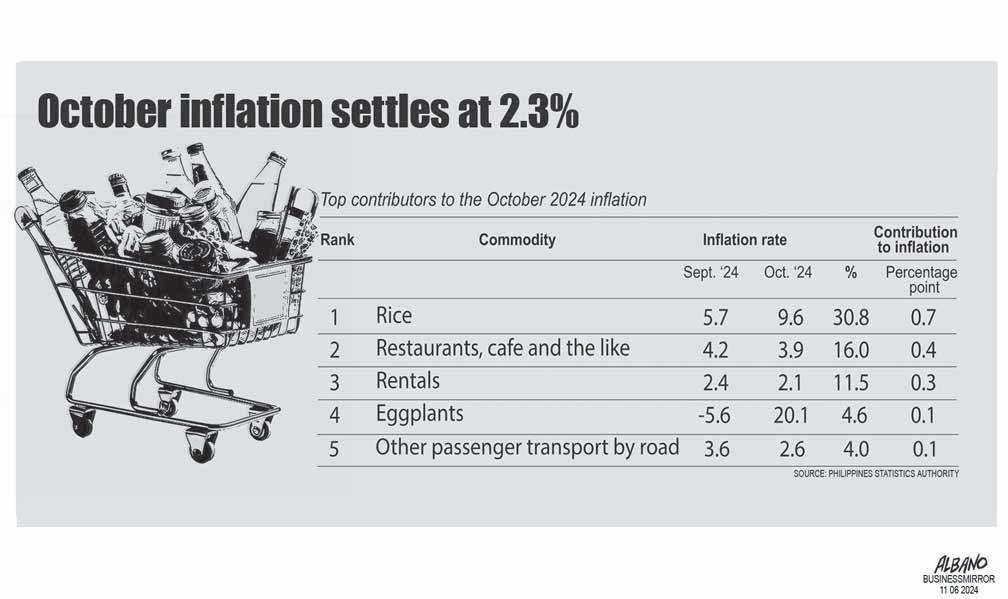
The impact on the October rice inflation print – at 9.6 percent from 5.7 percent in September.—did not go unnoticed by top officials of the land. President Ferdinand Marcos Jr. vowed on Tuesday more government interventions to provide consumers access to affordable rice.
In a social media post, the chief executive said he tasked the Department of Agriculture (DA) and the National Irrigation Administration to expand the P29 Rice-for-All program and increase the number of Kadiwa ng Pangulo centers from 21 to 300 by mid-2025.
“This will bring affordable rice within reach for more communities across the country,” Marcos said.
To help boost rice production, the President also urged local government units (LGU) to buy palay directly from farmers.
“This way, our farmers receive fair prices for their hard work, and we can secure a steady supply of rice for everyone,” he said. He said he already tasked the Department of Finance and the National Economic and Development Authority to “address the rising input cost and climate impacts that affect food prices.”
“This is a united effort to support our farmers and keep rice prices within reach for every Filipino family,” Marcos said.
PSA DATA
Based on the price monitoring efforts of the PSA, regular milled rice prices averaged P50.22 per kilo in October 2024, only 0.44 centavos less than the P50.66 per kilo posted in August 2024.
PSA Undersecretary Claire Dennis S. Mapa, the National Statistician and Civil Registrar General, said the implementation of the lower rice tariffs at

By Ma. Stella F. Arnaldo @akosistellaBM Special to the BusinessMirror
THE future is here. The “One ID” digital initiative of the largest group of airlines in the world has gone beyond an idea, having been pilot-tested recently in Hong Kong and Tokyo. The International Air Transport Association (IATA) said the organization and its partners have successfully demonstrated that the industry is ready to deliver a fully digital air travel experience. “This was achieved in a proof-of-concept
[PoC] involving two passengers using different digital wallets and travel credentials on a round-trip between Hong Kong and Tokyo,” said IATA in a news statement on Monday. Participating in the test run conducted on October 21 and 22 were Cathay Pacific, Hong Kong International Airport, Narita International Airport, digital platform and biometric solutions providers Branchspace and Facephi, digital wallet providers NEC Corp. and Neoke, and trust registries Northern Block and SICPA. “The airport elements of this PoC were conducted in a live environment,
building on an initial PoC carried out in a test environment in 2023,” IATA added.
During the pilot test, two travelers used digital wallets containing their digital passport, company ID, and frequent flyer credentials to obtain personalized offers, book a flight, obtain a visa, check their travel documentation, check-in and receive boarding passes. The travelers used biometric identification to manage airport processes in a live environment without repeatedly showing their travel documents.
See “One ID,” A2
By Reine Juvierre S. Alberto
T HE Department of Finance (DOF) urged rice traders to ensure that reductions in rice tariffs are passed on to consumers after rice inflation accelerated to 9.6 percent in October. The DOF said this on Tuesday as the October inflation print increased to 2.3 percent from 1.9 percent in September. The reminder is meant to ensure that the lower rice tariffs will help all Filipinos. Despite the reduction of rice tariffs to 15 percent from 35 percent effective on July 2024, rice inflation still increased to an alarming 9.6 percent in October from 5.7 percent in September. Average retail price of imported rice in the National Capital Region during the second half of October 2024 declined by P3.5 per kilogram from the second half of June 2024,
“DOF,” A2

By Justine Xyrah Garcia
WITH the labor depart -
ment’s cash-for-work initiative back in the spotlight as a lifeline for typhoonhit communities, a labor expert emphasized the need to develop a more robust public employment program that goes beyond shortterm relief work.
Assistant Professor Benjamin Velasco of the School of Labor and Industrial Relations in University of the Philippines Diliman, said on Monday that Tulong Panghanapbuhay sa ating Disadvantaged/Displaced Workers (TUPAD) program—while valuable—only offers temporary solution.
“No doubt TUPAD can be helpful. But we must be aware that it is very limited. It is just 10 days…good that we have a
The challenge: availability to all “A SEAMLESS fully digital travel experience powered by digital identity and biometrics has moved from theory to proven reality. The challenge now is to make this more efficient travel experience available to all travelers,” said IATA Senior Vice President for Operations, Safety, and Security Nick Careen. He added the successful journeys
public employment but we need a better one,” he said.
Originally launched to provide emergency employment, the Department of Labor and Employment’s TUPAD helps workers who have lost their homes or source of income by engaging them in 10day community work and infrastructure rehabilitation efforts.
At the end of their work period, program beneficiaries will receive wages based on their region’s highest prevailing minimum wage.
For Velasco, this initiative is merely a “pantawid” or a stopgap that does not offer a secure employment opportunity for such displaced workers.
“Talagang pantawid lang. Can displaced workers really find work after 10 days? This of course assumes beneficiaries are correctly identified,” he added.
integrated seven verifiable credentials such as an ePassport copy, live biometric image, visa copy, company ID, frequent flyer membership, order, and boarding pass; along with two digital wallets and a trust registry to verify issuers.
“There is good reason for optimism. With One ID standards already in place and the expansion of Modern Airline Retailing to support digital identity with the highest levels of data privacy and protection, the industry could be ready for this in the very near future. Government efforts to adopt digital travel credentials based
The labor professor also pointed out the “leakage” within the program due to its implementation through local politicians.
“If TUPAD passes through politicians—and anybody who knows how TUPAD really works, knows this—then this is where leakage occurs,” he said, noting that the program is vulnerable to being mishandled or misallocated, as beneficiaries may be chosen based on political connections rather than need.
To address these challenges, Velasco proposed that DOLE adopt a more data-driven approach, leveraging the Community-Based Monitoring System to create a national database of potential beneficiaries.
This approach, he argued, would enable more precise targeting of individuals in need and could reduce dependence on
on ICAO standards are picking up pace. Europe is already planning to issue Digital Identity Wallets to citizens and residents by 2027,” he added.
It’s about trust and security IATA didn’t mention how much time it took for the fully integrated digital travel process to be completed during the pilot test; however, it’s Philippine representative said recently the process should be able to complete this in eight minutes, from the moment the passenger is dropped off at the airport

stopgap solutions.
“Public employment must be complemented by an industrial policy. Industrial policy involves government intervention to promote and protect certain sectors and industry for whatever social objectives it desires,” Velasco added.
The DOLE recently began rolling out its temporary employment program for Typhoon Kristine victims in Regions IV-A and V, allocating over P424 million for Calabarzon and P30 million for Bicol workers.
In August, the TUPAD program has faced scrutiny after several lawmakers questioned the program’s lack of a pathway to stable employment. (Related: The https://businessmirror. com.ph/2024/08/21/how-sustainable-is-tupad-senate-reviewing-program/)
until he reaches his boarding gate. The new operator of the Ninoy Aquino International Airport described the eight-minute roadside-to-airside target as “challenging in the near term.” (See, “IATA: Digitalization can enhance the travel experience, speed up airline payments,” in the B usiness M irror , October 31, 2024.)
IATA said the successful pilot run is a key step towards a seamless digital travel experience, “allowing airlines to offer more personalized, secure, and efficient journeys” for passengers using digital identity, while ensuring traditional manual processing remains available for those who prefer it or in case backup systems are needed. It also demonstrated that the One ID standards can “seamlessly improve the customer experience, from shopping to travel, in harmonization with existing airline/airport processes.”
Careen pointed out, “With a traveler’s identity document securely stored in a digital wallet, the traveler can consent to share their biometrics to pass through various airport checkpoints—such as bag drop, security, immigration, and boarding—without needing to show physical documents.”
IATA represents some 330 airlines comprising over 80 percent of global air traffic.
Continued from A1
In terms of imports of electronics, he said the Philippines is still dependent on China with about $7 billion, compared to about $2.5 billion from the United States.
Lachica, meanwhile, said that the Philippines got a $13.9-million grant from the US (International Technology Security and Innovation) ITSI Fund for this year.
“Our share for the first year is about $13.9 million and essentially that intent is to upgrade the assembly, test and packaging capability in the Philippines,” Lachica explained.
The ITSI Fund is appropriated under the Creating Helpful Incentives to Produce Semiconductors (CHIPS) Act of 2022.
The CHIPS Act of 2022 provides the US Department of State with $500 million or $100 million per year over five years, “to promote the development and adoption of secure and trustworthy telecommunications networks and ensure semiconductor supply chain security and diversification,” according to the website of the US Department of State.
Apart from the Philippines, some of the other country beneficiaries of the ITSI Fund are Vietnam, Panama, Costa Rica, Mexico, and Indonesia.
15 percent from the initial 35 percent was approved in July and implemented starting in August 2024.
“The price of rice, based on the retail price in our outlets, declined. However, the decline was not as fast as what we expected,” Mapa said in a briefing.
Mapa also said their data showed wellmilled rice prices in October averaged P55.28 per kilo, only 0.28 centavos less than the P55.56 per kilo average in August this year.
The data also showed special rice prices averaged P63.97 per kilo in October, only 0.11 centavos lower than the P64.08 per kilo average in August 2024.
Rice inflation at 9.6%
MEANWHILE in October, rice inflation
picked up again at 9.6 percent for all income households while for the bottom 30 percent, rice inflation remained in double-digits at 10.2 percent.
However, Mapa said rice inflation is expected to continue its downward trend and that the October increase in inflation was only a blip.
“Our expectation was that this has already peaked. This one is apparently just a blip, right? And we expect that it will go down again, inflation rate and of course the price level per kilo in the coming months November and December, [will go down],” Mapa said.
Noche Buena NONETHELESS , Mapa said some commodity items are expected to see higher inflation in the last two months of the year owing to the holidays.
Based on the initial monitoring of the PSA, all-season items which are also seen as “stars” of the Noche Buena feast—or at least a component of these food items—have already seen an increase in items as early as October.
Mapa said these items include those needed to make salads, which already saw an inflation of 0.3 percent month on month, while fruit cocktail inflation increased 2.1 percent year on year in October.
He said prices of mayonnaise, spaghetti sauce, spaghetti noodles have also increased. But the increase in 250-gram ham items as well as a box of cheese, not quezo de bola variant, remain flat.
“There are other items. So we are tracking these Noche Buena items. Not all of them, but those that are included in the CPI [Consumer Price Index] basket,” Mapa said.
Mapa said some of the Noche Buena items are not being tracked by PSA and these are mainly the branded items like Quezo de Bola.
This monitoring, Mapa stressed, is also different from the one being done by the Department of Trade and Industry (DTI) which monitors the suggested retail price of Noche Buena items and not items that are sold at retail outlets.
Overall inflation
OWING to the impact of severe tropical storm Kristine, inflation increased to 2.3 percent in October 2024, faster than the 1.9 percent posted in September 2024.
However, the latest inflation print remained lower than the 4.9 percent inflation rate in October 2024. (See: https://businessmirror. com.ph/2024/11/05/kristines-effect-onrice-and-veggie-prices-lead-to-fasterinflation-in-oct-2024-psa/)
“Recent weather disturbances, including Typhoon Kristine, have posed significant challenges to our food supply and logistics. The government is working relentlessly to keep food available and prices steady, particularly for essential commodities,” Socioeconomic Planning Secretary Arsenio M. Balisacan said.
“With targeted support and streamlined food supply chains, we aim to ensure that food is affordable and accessible for Filipino families, especially those most vulnerable to price shocks when disasters hit us,” he added. Nonetheless, the National Economic and Development Authority (Neda) assured the public that the government is vigilant in implementing measures to stabilize prices amid external pressures.
To mitigate the impact of natural disasters, the Department of Social Welfare and Development is implementing the Building on Social Protection for Anticipatory Action and Response in Emergencies and Disasters (B-SPARED) Program. This initiative provides social safety nets and capacity-building measures to support affected communities.
“The President has mobilized all of government to ensure relief efforts are comprehensive and delivered on time. In addition, he has directed us to craft a robust solution to build the resilience of families and communities amid the onslaught of severe typhoons,” Balisacan said.
Within BSP’s forecast
MEANWHILE , the Bangko Sentral ng Pilipinas (BSP) said the latest inflation print is within its 2- to 2.8-percent forecast in its monthahead inflation expectations. However, BSP said the balance of risks, particularly for 2025 and 2026 is expected to shift upward due to higher electricity and labor costs.
BSP said the potential adjustments in electricity rates and higher minimum wages in areas outside Metro Manila could lead to faster inflation.
However, downside factors continue to be linked to the impact of lower import tariffs on rice.
“The Monetary Board will maintain a measured approach in its easing cycle to ensure price stability conducive to sustainable economic growth and employment,” BSP said. Given this, Bank of the Philippine Islands (BPI) economists led by Emilio S. Neri Jr. said the BSP may still deliver another rate cut in December, the Monetary Board’s last meeting for the year. However, the economists said the BSP’s decision could be affected by the recent depreciation of the peso which reflected the market’s concerns regarding the pace of Federal Reserve rate cuts.
Inflation in the United States could quicken if the Republicans win in the US elections, given that their policies are generally viewed as inflationary.
“The recent volatility in the markets highlights the need for prudence when it comes to rate cuts. While inflation forecasts allow room for a cut, aggressive action may not be prudent in the current climate,” BPI said. BPI economists also said the BSP may still cut rates, but aggressive rate cuts may be unlikely, given domestic and external considerations, leading to a steeper yield curve.
The peso may strengthen toward the end of the year but potential gains from a Federal Reserve cut may limit the appreciation of the peso compared to other emerging market economies.
tempering the prices of food commodities amid the onslaught of typhoons Kristine and Leon in October.
“Overall retail rice prices are expected to further ease in the coming months as more and cheaper imported rice is expected to enter the Philippine market,” the DOF said.
The DOF also sees a decrease in rice prices in the international market after India lifted the export ban in late September.

“The slight uptick in our October inflation rate was mainly caused by temporary factors, such as weather disturbances like Severe Tropical Storm Kristine and Super Typhoon Leon,” Recto said.
“We are on top of ensuring that the affected communities get the help that they need to recover faster from the recent disasters. In fact, the President has mobilized all agencies to quickly deliver relief, rehab, and assistance,” he added. As such, the Department of Trade and Industry (DTI) imposed a 60-day price freeze on basic necessities in areas under a state
Finance Secretary Ralph G. Recto said the whole-ofgovernment approach—such as intensive monitoring and mitigation of price increases on food and non-food items— will keep inflation within the government’s target range of 2 to 4 percent for the next two years. Higher inflation in food and non-alcoholic beverages at 2.9 percent in October from 1.4 percent in September drove this month’s inflation rate. Meanwhile, the average inflation rate settled at 3.3 percent from January to October 2024, still within the government’s 2 to 4 percent target range.
IBy Jovee Marie N. dela Cruz @joveemarie
N the wake of the Office of the Vice President’s boycott of a congressional hearing, the House Committee on Good Government and Public Accountability vowed to continue looking into the potential misuse of P612.5 million in confidential funds managed by the Department of Education (DepEd) and the Office of the Vice President (OVP), both of which are led by Vice President Sara Duterte. Manila Rep. Joel Chu, committee chairman, voiced frustration over what he called “improper” and “unexplained” expenditures spanning two years.
“People are deeply disappointed by the findings uncovered here at the House blue- ribbon committee,” Chua said in his opening remarks. “We see how the OVP and DepEd spent the confidential funds allocated to them in 2022 and 2023.”
Vice President Duterte served as Education Secretary from July 2022 until her resignation in July 2024.
Chua emphasized that the P612.5 million under scrutiny is substantial and called for transparent answers regarding these allocations and expenditures.
“It’s clear there may have been improper use of confidential funds by these agencies,” he said. “To clarify, we need an answer to this question: What happened to the people’s money?”
He added, “Over the two years, P612.5 million was allocated in confidential funds to the OVP and DepEd. Where is that money now? Who spent it, and for what?”
The Office of the Vice President declined to attend the House Committee hearing on Monday, questioning the committee’s jurisdiction and asserting that the inquiry is not in aid of legislation.
House Deputy Minority Leader
France Castro strongly criticized the Office of the Vice President’s boycott of Monday’s congressional hearing investigating the agency’s expenditures, calling it an affront to transparency and public accountability.
‘Squid-like evasiveness’
“Apparently, the squid-like evasiveness is contagious, or perhaps the OVP employees were simply intimidated into not attending the hearing,” Castro, the nominee of the party-list group ACT Teachers, said, referring to the pattern of evasion shown by the OVP officials.
Moreover, Chua noted that only a few officials have testified, while key figures directly responsible for disbursing the confidential funds have yet to appear before the committee.
“Only two individuals can answer these questions: the Head of Agency—in this case, the
Palace relieves Casio as Paocc spox for ‘maltreating’ Pinoy in Bataan raid
By Samuel P. Medenilla
@sam_medenilla
MALACAÑANG on Tuesday said Presidential Anti-Organized Crime Commission (Paocc) spokesperson Winston John R. Casio has been suspended for allegedly maltreating a Filipino during the raid at a suspected illegal Philippine Offshore Gaming Operator (Pogo) in Bataan last week.
In a Viber message, Executive Secretary Lucas P. Bersamin said Casio is now being investigated for the said incident.
“[He has been] relieved as Paocc spokesperson and ordered to explain in actuations in writing,” he said.
Bersamin was earlier asked to confirm a memorandum issued by Paocc Executive Director Gilberto DC Cruz on Casio’s preventive suspension. Casio was given 24 hours after receiving the copy of the memorandum to submit his explanation.
Cruz said Casio’s failure to submit an answer will be construed as a waiver of his right to air his side. He said Casio’s suspension took effect last Monday and will last until completion of the
investigation.
The alleged maltreatment happened during the execution of a search warrant in Central One in Bagac, Bataan on October 31.
The Filipino alleged poked a dirty finger at the raiders, provoking Casio to respond.
A purported video of the incident is said to be circulating on social media platforms.
The raid of Central One resulted in the rescue of over 700 Filipinos and the detention of 42 foreigners. The management of the facility is now facing charges for violating gaming regulations and human trafficking.
SBy Butch Fernandez @butchfBM
EN . Ronald “Bato” dela Rosa on Tuesday cited three key reasons to justify amending the law giving reparations to victims of the 2017 Marawi siege, despite the law’s being relatively new. Republic Act 11696, intended to give reparation to the Marawi siege in the form of compensation, was enacted on April 13, 2022. “Though RA 11696 is stable, it cannot afford to stand still,” said dela Rosa, paraphrasing legal scholar and educator, Roscoe Pound. RA 11696, said dela Rosa, cannot be left untouched. “Not in the face of a barangay’s pleas to be included on the list of affected areas. Not when, according to the victims themselves, the prevailing basis for determining the value of damaged
structures is largely unfavorable to them. And most definitely, not when reparation, as the primary aim and vision of the law, remains elusive.”
Presiding at a hearing on Senate Bill 2828 that aims to address the gaps left by RA 11696, dela Rosa expressed hope that “with the help of all the resource persons present, your Special Committee on Marawi Rehabilitation and Victims’ Compensation may now formulate a proposal that renders the existing legislation more stable than before.”
In the same hearing, Majority Leader Francis Tolentino asked how building an entirely new hospital would help the people of Marawi while the government continues its rehabilitation efforts for the city.
“There’s probably nothing wrong if another new hospital is built. So we are not just talking here of reconstructing and
rehabilitating a hospital structure that was destroyed, but putting up an entirely new hospital,” Tolentino said.
The new hospital, he said, will in the future “help address the medical needs of the people of Marawi and Lanao del Sur.” Marawi now has the Amai Pakpak Medical Center (APMC), a renationalized government hospital created into law in 1995 by virtue of RA 7943, and another hospital under construction worth P293million, which is now 90 percent complete.
Also on Tuesday, Sen. Robinhood Padilla, expressed gratitude for the continuous compensation given to victims of the 2017 siege, where home-grown but foreigninspired terrorists laid waste to what was once one of Mindanao’s most progressive and beautiful Islamic cities. Padilla, a Muslim convert, reminded everyone that the Marawi war should not be forgotten.
Vice President for both OVP and DepEd—and the Special Disbursement Officers, Ms. Gina F. Acosta for the OVP and Mr. Edward D. Fajarda for DepEd. But neither has shown up,” Chua said.
Chua revealed that Fajarda, a former SDO at DepEd, has since transferred to the OVP. His absence, along with that of Vice President Duterte, has left many questions unanswered.
Of the P612.5 million under investigation, P500 million pertains to the OVP’s confidential fund allocations, while P112.5 million were DepEd’s.
The OVP received P625 million in confidential funds for late 2022 and all of 2023, with the COA reviewing P500 million and noting significant irregularities.
In December 2022 alone, the OVP spent P125 million in just 11 days—from December 21 to 31— averaging P11.364 million daily, with COA disallowing P73.3 million of this for irregularities and
Jessica Soho victim of manipulated video clips posted online
GIANT television network GMA on Tuesday said manipulated videos of Jessica Soho purporting to show that she endorses investments in cryptocurrency have been posted on the internet.
In one of the posts shows Soho being interviewed by entertainment host Boy Abunda, where she allegedly said that all it takes is 10 minutes to earn a lot of money in cryptocurrency. She was shown telling that to Abunda.
An accompanying text under the masthead of a daily Manila newspaper (not the BusinessMirror said that the “Bank of the Philippines” had called the television station to stop airing the program.
The video and accompanying text were soon replaced but still showing the alleged photo of Soho being interviewed by Abunda.
The GMA Network statement says:
“It has come to our attention that video clips of Jessica Soho’s past interviews are being manipulated to falsely imply her support for cryptocurrency investments and other business schemes.
“These altered clips are fake. Jessica Soho does not endorse any cryptocurrency, nor does she promote any form of business investment scheme.”
ordering repayment from Duterte and two other OVP officials.
Additionally, COA issued three Audit Observation Memorandum in 2023, highlighting adverse findings on OVP’s quarterly confidential funds.
One of the confidential fund expenditures raising significant concerns involved P16 million reportedly spent by the OVP on 34 safe houses over an 11-day period in 2022.
Chua noted that one safe house cost P1 million for a four-day stay, equivalent to P250,000 per day.
In 2023, the OVP allegedly continued similar expenditures, with P16 million allocated quarterly for safe houses in the first and second quarters, dropping to P5 million in the third quarter.
“Did they really need these safe houses? Was the spending legitimate?” Chua asked
Chua also flagged P15 million in confidential fund expenses reportedly allocated by DepEd to
Youth Leadership Summits and other anti-extremism programs, allegedly justified through certifications from Philippine Army battalions.
Poa removed OVP spokesperson Michael Poa meanwhile confirmed that he is no longer affiliated with the OVP.
“I would like to inform the Honorable Committee that I am no longer connected with the Office of the Vice President. My consultancy contract was already pre-terminated, Your Honor,” said Poa.
Earlier, Poa made his statements before the House panel, where he confirmed that VP Duterte and DepEd Senior Disbursing Officer Edward Fajarda held sole authority over DepEd’s confidential funds. The OVP has yet to release a formal statement regarding Poa’s removal.
Marce intensifies, 11 areas in NL under
By Jonathan L. Mayuga, @jonlmayuga & Rex Anthony Naval
THE state weather bureau raised Tropical Cyclone Signal 1 in 11 areas in Northern Luzon on Tuesday as the weather disturbance Marce, international code name Yinxing, intensified a typhoon.
Anticipating the potential impacts of the typhoon, the Armed Forces said search, rescue, and retrieval teams have been prepositioned along the Marce’s path.
Placed under TCWS 1 are Batanes, Cagayan including Babuyan Islands, Isabela, Ilocos Norte, Apayao, Abra, Kalinga, Mountain Province, Ifugao, the northern portion of Nueva Vizcaya (Diadi, Bagabag, Ambaguio, Villaverde, Bayombong, Solano, Quezon, Kasibu), the north portion of Quirino (Diffun, Saguday, Cabarroguis, Aglipay, Maddela) and the north portion of Aurora (Dilasag, Casiguran, Dinalungan).
The Philippine Atmospheric, Geophysical and Astronomical Services Administration (Pagasa) said Marce, the thirteenth severe weather disturbance to enter the Philippine Area of Responsibility rapidly intensified into a severe tropical storm by 11 p.m. on Monday.
It continues to slightly intensify as it moves towards the Babuyan Islands or Cagayan.
The highest Wind Signal that may be hoisted due to Marce is Wind Signal 4.
As of 4:00 p.m. On Tuesday, Pagasa said the eye of the storm is located 510 kilometers east of Echague, Isabela. It is moving northwestward at a speed of 25 kilometers per hour. It packs a maximum sustained winds of 130 kmh near the center and gustiness of up to 160 kmh.
Marce is forecast to move generally westnorthwestward today until Wednesday morning before decelerating and turning westward over the Philippine Sea east of extreme Northern Luzon, the state weather bureau said.
Under these conditions, Pagasa said flooding and rain-induced landslides are likely, especially in areas that are highly or very highly susceptible to these hazards as identified in hazard maps and in areas with significant antecedent rainfall.
Military prepositions SRR teams THE Armed Forces said Tuesday it has prepositioned search, rescue and retrieval (SRR) teams in anticipation of the effects of Typhoon Marce.
“For the Armed Forces, we have prepared and prepositioned our SRR teams, in the Northern Luzon area, we have 305 SRR teams deployed. They are now ready to help our countrymen once (STS) Marce arrives,” The Armed Forces chief of Staff, Gen. Romeo Brawner Jr., said in a briefing at Camp General Emilio Aguinaldo, Quezon City. Aside from these personnel, Brawner said airlift assets such as C-130 transport aircraft have been placed on standby so that these can be tapped to transport essential relief goods and non-food items in case of need. These assets are to ensure that even isolated communities get resupplied with basic items should they be affected by the typhoon, says Brawner.
Besides these fixed-wing assets, the Brawner said seven Sikorsky UH-60 “Black Hawk” helicopters are ready to transport food and other relief items to isolated communities that cannot be accessed by other transport assets.
“As of now, we are loading food and nonfood items in Subic, aboard our two large Navy ships, and once the loading of food and non-food items, including construction materials, we will transport these to Basco, Batanes, he added. He said once loading is completed, the ships will set sail for the humanitarian mission.
TGuo asks DOJ to drop perjury, falsification raps of paragraph 2, Article 171 of the Revised Penal Code (RPC) (falsification by a notary public), Article 172 of the RPC (use of falsified document); Article 183 of the RPC (perjury) and Section 1 of the Presidential Decree 1829 (obstruction of justice)
HE dismissed mayor of Bamban, Tarlac, Alice Guo, on Tuesday sought the dismissal of the perjury and falsification charges filed against her and several others by the National Bureau of Investigation (NBI) before the Department of Justice (DOJ). Guo, who is detained at the Pasig City Jail Female Dormitory for a qualified human trafficking case, was brought to the DOJ by Bureau of Jail Management and Penology (BJMP) personnel to personally submit her sworn counter-affidavit during the DOJ’s preliminary investigation on the perjury and falsification charges.
The complaint stemmed from the discrepancies in Guo’s counter-affidavit in the qualified human trafficking case submitted to
the DOJ which she claimed to have signed prior to her escape from the Philippines last July 18. However, the counter-affidavit notarized by notary lawyer Elmer Galicia indicated that it was signed by Guo on August 14. Guo was arrested in Tangerang City, Jakarta, Indonesia on September 14. She was assisted by her counsel, Stephen David, who insisted on the former mayor’s innocence.
The complaint accused Guo of conspiring with Galicia and four other individuals namely Dante Catabay, Cheryl Medina, Catherine Salazar and Geraldine Pepito, in committing the alleged offenses.
The NBI specifically sought the prosecution of Guo and the other respondents for violation
In her counter-affidavit, Guo branded as “falsehood, concocted lies, and unfounded assertions” in the complaint-affidavit filed by the NBI.
“First and foremost, I strongly submit that am categorically and vehemently denying all the charges and accusations against me, and I strongly aver that they are bereft of any legal and factual bases,” Guo said.
“Respectfully, there is no enough evidence to prove that I actually committed any of these crimes imputed against me,” she added.
Guo added that the complaint is intended
to “vex, annoy and harass” her.
“Complaint is purely a malicious suit and simply a clear attempt to satisfy the sentiments of some in order to say that various cases are filed against me,” Guo stressed.
Guo also denied falsifying her counteraffidavit and insisted that she was the one who signed the subject document.
“If there is anyone who can disprove and disclaim the signature appearing thereon, that can only be me as the affiant and no one else. To say and allege that I falsified my own signature to make it appear that I participated in a notarial act is not only absurd but illogical,” she pointed out.
Meanwhile, Galicia and the other respondents have yet to file their respective counter-affidavits before the DOJ. Joel R. San Juan
On the forecast track, Marce may make landfall in the vicinity of Babuyan Islands or over the northern portion of mainland Cagayan on Thursday evening or early Friday morning.
Meanwhile, due to uncertainty in the strength of the high-pressure area north of Marce, the forecast track may still change and bring the landfall point to the mainland Cagayan-Isabela area. Marce may exit the PAR region on Friday evening or Saturday morning.
The storm is expected to continue intensifying and may reach its peak intensity before possible landfall over Babuyan Islands or Cagayan, the state weather bureau said.
Moderate to heavy rain (50 to 100 mm) is forecast over Cagayan, Batanes, Apayao, Ilocos Norte, and Batanes, Isabela, Abra, Ilocos Sur, Kalinga, and Mountain Province in the next three days.
Bicol relief operations continue DURING the same briefing, Brawner said relief operations continue in areas in the Bicol region that are still reeling from the impact of Severe Tropical Storm Kristine. He added that two Navy ships, carrying food items and non-food items, have already reached the region as part of the relief efforts for communities affected by the storm.
“The Armed Forces is doing a lot of preparations [for Marce], and these include preparing deployment of rubber boats. So far, we have already deployed more than 30 rubber boats in the area of Northern Luzon,” Brawner said. He assured continuous internal security operations against local threat groups. He cited as an example the October 27 clash where troops conducting rescue and relief works figured in an encounter with New People’s Army rebels in Pio Duran, Albay, which resulted in the wounding of a soldier. With PNA
By Jovee Marie N. dela Cruz @joveemarie
N economist-lawmaker
Aon Tuesday expressed optimism that the efficacy of current government economic policies will ensure that the fullyear inflation figure will fall within the Bangko Sentral ng Pilipinas (BSP)’s target.
The chairman of the House of Representative’s Committee on Ways and Means, Rep. Jose Maria Clemente “Joey” Sarte Salceda of Albay made a statement as the Philippine Statistics Authority (PSA) reported an increase in the country’s inflation rate, which climbed to 2.3 percent in October 2024 from 1.9 percent in September.
Despite the rise, October’s inflation is still markedly lower than the 4.9 percent rate recorded in the same month last year.
Salceda said October’s inflation rate fell within the BSP’s target range of 2 percent to 4 percent, with a 10-month average of 3.3 percent.
This stability, he stated, offers the BSP flexibility for potential
interest rate cuts.
“I can now confidently say that the full-year inflation figure will be within the BSP’s 2 percent to 4 percent target band. This will also give the BSP license for further rate cuts, especially since expected OFW remittances this December will give them some room on the currency strength side,” he said.
Salceda attributed much of the positive inflation figures to the policies implemented by President Marcos, especially the decision to reduce tariffs on rice imports.
He noted that while year-onyear inflation for rice remains an issue, month-on-month prices have been declining for rice and other cereals, such as corn and wheat.
“Year-on-year, rice price inflation remains a fundamental problem, but on a month-onmonth basis, prices are declining for all cereals [rice, corn, and wheat products]. There are also encouraging signs in meat prices, which have slowed to 3.6 percent inflation year on year and negative inflation month-on-month,” he said.



President Marcos’s policy of reducing rice tariffs by more than half seems to have produced positive results while keeping farmgate prices high for farmers,” Salceda explained.
He highlighted that farmgate prices, or the prices farmers receive, have risen significantly, from an average of P18.72 per kilogram to P24.70 per kilogram this year, marking a 32 percent increase.
Meanwhile, well-milled rice prices have risen by 27.17 percent. This difference, according to Salceda, is partially due to the tariff reduction policy, which benefits both consumers and local farmers.
Salceda also indicated that India’s recent lifting of its rice export ban in early October could contribute to further price stabilization, particularly as demand traditionally rises during December’s holiday season.
Promising meat prices
SALCEDA noted encouraging developments in meat prices, particularly poultry, which has seen
a significant price drop.
“Based on our monitoring of prices, poultry meat prices continue to decline and have lost as much as P27 per kilo from their prices last month. I expect current low-price levels to continue before picking up around the second week of December,” he said.
He said fish prices, too, have remained stable, with a year-onyear inflation rate of -0.4 percent.
However, Salceda cautioned that high corn prices could potentially limit further reductions in meat prices.
Overall, Salceda observed no major red flags in the October inflation figures, suggesting that global trade and local pricing have largely adjusted to the inflationary shocks of 2022 and 2023.
“In many ways, this is a return to the ‘boring’ monthly reports where nothing sticks out of the ordinary,” he remarked, emphasizing that continued stability will rely on addressing long-term structural issues such as agricultural yields, input costs, logistics, and postharvest losses.



By Lorenz S. Marasigan @lorenzmarasigan
THE Department of Information and Communications Technology (DICT) is accelerating the implementation of its ambitious National Fiber Backbone (NFB) project, aiming for completion by 2027—one year ahead of the original 2028 target.
Information and Communications Technology Secretary Ivan Uy said this expedited timeline is made possible by a recent loan approval of approximately $288 million from the World Bank, allowing simultaneous infrastructure development in the Visayas and Mindanao.
Uy, in a chance interview at the 19th FiberConnect Asia Pacific Conference on Tuesday, said the first three phases of the NFB are expected to be operational by mid-2025, covering Luzon and some parts of the Visayas and Mindanao.
The remaining phases, initially projected to reach completion by 2028, are being expedited, as the funds from the Washington-based lender will enable the government to shift from the previous sequential approach that depended solely on annual General Appropriations Act (GAA) funding to a dual funding approach.
“The strategy that we took was, while we are relying on the Congress to fund our national backbone, we will be implementing in parallel the remaining phases through funding from the World Bank,” he said.
The World Bank-backed project is expected to make a “significant impact,” according to Uy, citing how its other project, the deployment of 13,000 free WiFi sites, had already served more than 10 million Filipinos to date.
In April, the government completed the first phase of the NBF, deploying a 1,245-kilometer cable network that connects 28 nodes from Laoag City, Ilocos Norte, to Quezon City, spanning Northern and Central Luzon, Metro Manila, and four Bases Conversion and Development Authority (BCDA) economic zones.
The network’s initial 600 gigabyte per second [GBps] optical capacity, which spans 14 provinces, underscores its potential to serve as the country’s digital spine.
Deployment of Phases 2 and 3 are already underway and are on track for completion by mid-2025.
By 2027, the DICT expects the NFB to boost internet penetration from the current 33 percent to 65 percent, extending access to an estimated 70 million Filipinos.
The NBF aims to provide a government-owned high-speed fiber network, which will serve as the backbone for public internet access, benefiting government agencies, public institutions, and underserved communities. Furthermore, this initiative promises to make connectivity more affordable, potentially lowering internet costs.




Job Description: Manage a team of Team leads in the Order-To-Cash tower of the deal.
Brief
4.
Basic Qualification: Native and N2 Japanese language proficient (written/verbal) and with work experience in finance/ accounting.
Salary Range: Php 30,000 - Php 59,999
Basic Qualification: Graduate of any 4 years course, preferably IT or Engineering related. Strong working knowledge of the service desk function.
Range: Php 30,000 - Php 59,999 AMDOCS PHILIPPINES INC. 23rd, 25th, And 26th Floors Eco Tower, 32nd St. Cor.
17.
Brief Job
18. WANG, YEZHOU General Business Specialist
Brief Job Description: Identifying profitable business, negotiating and closing business goals. Basic
Basic Qualification:
19. ZHANG, MENGEN General Business Specialist
Brief Job Description: Identifying profitable business, negotiating and closing business goals.
Salary Range: Php 30,000 - Php 59,999
20. GURBHEJ SINGH Quantity Surveyor
Brief Job Description: Review construction plans and quantity requirements. Basic
21. LUO, YUBIAO Quantity Surveyor
Brief
66.
Brief
Brand
Brief
68. ZHOU, TAO Brand Planning
Brief
69. CAI, YATING Chinese Speaking Documentation Officer
Brief
70. DENG, LIANHUA Chinese Speaking Documentation Officer
Brief Job Description: Handling documentation and provide clerical and administrative support to the team.
71. HONG, DAYUAN Chinese Speaking Documentation Officer
Brief Job Description: Handling documentation and provide clerical and administrative support to the team.
72. HUANG, ZONGBI Chinese Speaking Documentation Officer
Brief Job Description: Handling documentation and provide clerical and administrative support to the team.
73. LI, NA Chinese Speaking Documentation Officer
Vietnamese languages.
Salary Range: Php 30,000 - Php 59,999
Basic Qualification: Able to speak, write and type in Mandarin and Vietnamese languages.
Basic Qualification: Able to speak, write and type in Mandarin and Vietnamese languages.
Brief Job Description: Handling documentation and provide clerical and administrative support to the team. Basic
74. LIANG, WEIPENG Chinese Speaking Documentation Officer
Brief Job Description: Handling documentation and provide clerical and administrative support to the team.
75. LIM HUI WEN Chinese Speaking Documentation Officer
Brief Job Description: Handling documentation and provide clerical and administrative support to the team.
76. XI, SHIQI Chinese Speaking Documentation Officer
Brief Job Description: Handling documentation and provide clerical and administrative support to the team.
77. CAI, MEIFEI
Documentation Specialist
Brief Job Description: Drafting various documents for the company and its employees, partners, customers and any related party.
78. WAN, FUQIN Documentation Specialist
Brief Job Description: Drafting various documents for the company and its employees, partners, customers and any related party. Basic
79. WANG, JINHUO
Documentation Specialist
Brief Job Description: Drafting various documents for the company and its employees, partners, customers and any related party. Basic
80. ZHUANG, YAXIN
Documentation Specialist
Brief Job Description: Drafting various documents for the company and its employees, partners, customers, and any related party. Basic
81. CHEN, JINHAO Jr. Consultant
Brief Job Description: Support in overall internal communication plans & execution.
82. CHEN, ZHUOBIAO Jr. Consultant
Brief Job Description: Support in overall internal communications plan and execution.
83. CHU, JUNHAO Jr. Consultant
Brief Job Description: Support in overall internal communication plans & execution.
84. DIAO, PENGFEI Jr. Consultant
85. JU, CHAOMEI Jr. Consultant
Brief Job
LAU PHILEX FREIGHT FORWARDING CORP.
Kabatuhan Road, Deparo, Barangay 168, City Of Caloocan
132. BRAR, HAKAM SINGH Freight Forwarding Specialist
Brief Job Description: Review and check all order requests before processing.
133. HARPREET SINGH Freight Forwarding Specialist
Brief Job Description: Review and check all order requests before processing.
134. JASKARAN SINGH Freight Forwarding Specialist
Brief Job Description: Review and check all order requests before processing.
135. KAUR, GAGANDEEP Freight Forwarding Specialist
136. LI, SONGBO Freight Logistic Officer
137.
138. WANG, CHANGBIN Freight Logistic Officer
139.
140. YANG, YUMING
141. ZHANG, JIPENG Freight Logistic Officer Brief Job Description: Provide
142. AMRIK SINGH International Freight Forwarding Manager
143. BARING, GURPREET SINGH International Freight Forwarding Manager
Brief
144. GAO, JI International Freight Forwarding Manager
Brief
193. LIU, CHULIN Mandarin Language Business Development Specialist
Brief Job Description: Analyzing business operations and strategies to identify new opportunities.
194. LIU, XIAOLONG Mandarin Language Business Development Specialist
Brief Job Description: Analyzing business operations and strategies to identify new opportunities.
195. WANG, QI Mandarin Language Business Development Specialist
Brief Job Description: Analyzing business operations and strategies to identify new opportunities.
196. XIAO, CAIFENG Mandarin Language Business Development Specialist
Brief Job Description: Analyzing business operations and strategies to identify new opportunities.
197. YE, ZHIPENG Mandarin Language Business Development Specialist
Brief Job Description: Analyzing business operations and strategies to identify new opportunities.
198.
59,999
Basic Qualification: Fluent in Mandarin language (both written and spoken), proficient in MS Office and with exceptional knowledge of Excel and PowerPoint.
Salary
Editor: Angel R. Calso
By Christina A. Cassidy & Ali Swenson
The Associated Press
WASHINGTON—Election
Day 2024 arrived Tuesday— with tens of millions of Americans having already cast their ballots. Those include record numbers in Georgia, North Carolina and other battleground states that could decide the winner.
The early turnout in Georgia, which has flipped between the Republican and Democratic nominees in the previous two presidential elections, has been so robust— over 4 million voters—that a top official in the secretary of state’s office said the big day could look like a “ghost town” at the polls.
As of Monday, Associated Press tracking of advance voting nationwide showed roughly 82 million ballots already cast—slightly more than half the total number of votes in the presidential election four years earlier. That’s driven partly by Republican voters, who were casting early ballots at a higher rate than in recent previous elections after a campaign by former President Donald Trump and the Republican National Committee to
counter the Democrats’ longstanding advantage in the early vote.
Despite long lines in some places and a few hiccups that are common to all elections, early inperson and mail voting proceeded without any major problems.
That included in the parts of western North Carolina hammered last month by Hurricane Helene. State and local election officials, benefiting from changes made by the Republican-controlled legislature, pulled off a herculean effort to ensure residents could cast their ballots as they dealt with power outages, lack of water and washed out roads.
By the time early voting in North Carolina had ended on Saturday, over 4.4 million voters— or nearly 57 percent of all registered voters in the state—had cast their ballots. As of Monday, turnout in the 25 western counties affected by the hurricane was even stronger at 59 percent of registered voters, state election board Executive Director Karen Brinson Bell said. Brinson Bell called the voters

and election workers in the hurricane-hit counties “an inspiration to us all.”
Besides the hurricanes in North Carolina and Florida, the most worrisome disruptions to the election season so far were arson attacks that damaged ballots in two drop boxes near the OregonWashington border. Authorities there were searching for the person responsible.
The absence of any significant, widespread problems has not stopped Trump, the Republican nominee, or the RNC, which is now under his sway, from making numerous claims of fraud or election interference during the early voting period, a possible prelude to challenges after Election Day.
He has mischaracterized an investigation underway in Pennsylvania into roughly 2,500 potentially fraudulent voter registration applications by saying one of the counties was “caught with 2600 Fake Ballots and Forms, all written by the same person.” The investigation is into registration applications; there is no indication that ballots are involved.
In Georgia, Republicans sought to prohibit voters from returning mailed ballots to their local election office by the close of polls on Election Day, votes that are allowed under state law. A judge rejected their lawsuit over the weekend.
Trump and Republicans also have warned about the possibility that Democrats are recruiting masses of noncitizens to vote, a claim they have made without evidence and that runs counter to the data, including from Republican secretaries of state. Research has consistently shown that a noncitizen registering to vote is rare. Any noncitizen that does faces the potential of felony
charges and deportation, a significant disincentive.
One case of noncitizen voting was caught during early voting last month and resulted in felony charges in Michigan after a student from China cast an illegal early ballot.
This is the first presidential vote since Trump lost to Joe Biden four years ago and began various attempts to circumvent the outcome and remain in power. That climaxed with the violent Jan. 6, 2021, attack on the US Capitol to halt certification of the results after Trump told his supporters to “fight like hell.”
Even now, a solid majority of Republicans believe Trump’s lie that Biden was not legitimately elected, despite reviews, audits and recounts in the battleground states that all affirmed Biden’s win. A survey last month from The Associated Press-NORC Center for Public Affairs Research showed Republicans remain much more skeptical than Democrats that their ballots will be counted accurately this year.
Seeking to rebuild voter confidence in a system targeted with false claims of widespread fraud, Republican lawmakers in more than a dozen states since 2020 have passed new voting restrictions. Those rules include shortening the window to apply or return a mail ballot, reducing the availability of ballot drop boxes and adding ID requirements.
On the last weekend before Election Day, Trump continued to falsely claim the election was being rigged against him and said a presidential winner should be declared on election night, before all the ballots are counted.
Vice President Kamala Harris urged voters not to fall for Trump’s tactic of casting doubt on elections. The Democratic nominee
told supporters at a weekend rally in Michigan that the tactic was intended to suggest to people “that if they vote, their vote won’t matter.” Instead, she urged people who had already cast ballots to encourage their friends to do the same.
Through four years of election lies and voting-related conspiracy theories, local election officials have faced harassment and even death threats. That has prompted high turnover and led to heightened security for election offices and polling sites that includes panic buttons and bulletproof glass.
While there have been no major reports of any malicious cyberactivity affecting election offices, foreign actors have been active in using fake social media profiles and websites to drum up partisan vitriol and disinformation. In the final weeks, US intelligence officials have attributed to Russia multiple fake videos alleging election fraud in presidential swing states.
On the eve of Election Day, they issued a joint statement with federal law enforcement agencies warning that Russia in particular was ramping up its influence operations, including in ways that could incite violence, and likely would continue those efforts well after the votes have been cast. Jen Easterly, the nation’s top election security official, urged Americans to rely on state and local election officials for information about elections.
“This is especially important as we are in an election cycle with an unprecedented amount of disinformation, including disinformation being aggressively peddled and amplified by our foreign adversaries at a greater scale than ever before,” she said. “We cannot allow our foreign adversaries to have a vote in our democracy.”
MOSCOW—A Russian rocket on Tuesday blasted off successfully to carry a pair of Iranian satellites into orbit, a launch that reflected growing cooperation between Moscow and Tehran.
The Soyuz rocket lifted off as scheduled from Vostochny launchpad in far eastern Russia and put its payload into a designated orbit nine minutes after the launch. It was carrying two Russian Ionosphere-M Earth observation satellites and several dozen smaller satellites, including the two Iranian ones.
Iran’s two satellites, named Kowsar and Hodhod, were the first launched on behalf of the country’s private sector. In 2022, a Russian rocket launched an Iranian Earth observation satellite called Khayyam that was built in Russia on Tehran’s order, and in February Russia put another Iranian satellite named Pars-1 into orbit.
Tuesday’s launch comes as Russia and Iran have expanded ties in various spheres. Ukraine and the West have accused Tehran of providing Moscow with hundreds of exploding drones for use on the battlefield in Ukraine and helped launch their production in Russia. The Iranian drone deliver -
ies, which Moscow and Tehran have denied, have allowed for a constant barrage of long-range drone strikes at Ukraine’s infrastructure.
Moscow and Tehran are planning to further bolster their ties with a “comprehensive strategic partnership” that is set to be signed during Iranian President Masoud Pezeshkian’s planned visit to Russia. The date for that visit hasn’t been set yet, but the Kremlin said it could happen soon.
Tuesday’s successful launch of the Iranian satellites atop a Russian rocket follows a series of failed launches suffered by Iran’s civilian space program in recent years. There have been five failed launches in a row for the Simorgh program, a satellitecarrying rocket.
A fire at the Imam Khomeini Spaceport in February 2019 killed three researchers, authorities said at the time. A launchpad rocket explosion later that year drew the attention of then-President Donald Trump, who taunted Iran with a tweet showing what appeared to be a US surveillance photo of the site.
At the same time, a separate Iranian space program run by the country’s paramilitary Revolu -
tionary Guard has seen successful launches from a military base outside of Shahroud, some 350 kilometers (215 miles) east of the capital, Tehran. However, satellite images analyzed by The Associated Press show Israel likely bombed the site during its October 26 retaliatory strike on Iran.
The US intelligence community’s worldwide threat assessment this year said Iran’s development of satellite launch vehicles “would shorten the timeline” for Iran to develop an intercontinental ballistic missile because it uses similar technology. Intercontinental ballistic missiles can be used to deliver nuclear weapons. Iran is now producing uranium close to weapons-grade levels after the collapse of its nuclear deal with world powers. Tehran has enough enriched uranium for “several” nuclear weapons, if it chooses to produce them, the head of the International Atomic Energy Agency has warned. Iran has always denied seeking nuclear weapons and says its space program, like its nuclear activities, is for purely civilian purposes. However, US intelligence agencies and the IAEA say Iran had an organized military nuclear program up until 2003.
By Wafaa Shurafa & Samy Magdy
The Associated Press
An Israeli airstrike in northern Gaza has killed at least 20 people, mostly women and children, Palestinian officials said Tuesday, as Israel wages a nearly month-long air and ground operation in what was already the most isolated and heavily destroyed part of the territory.
Separate strikes elsewhere in Gaza early Tuesday killed another 10 people, according to health officials.
The strike late Monday hit a home where several displaced families were sheltering in the town of Beit Lahiya, near the border with Israel, according to Hossam Abu Safiya, the director of the recently raided and barely functioning Kamal Adwan Hospital, which received the casualties.
The dead included eight women and six children, according to a list provided by the Gaza Health Ministry’s emergency service. There was no immediate comment from the Israeli military.
Israel launched the offensive in the north after saying Hamas militants had regrouped there. The army has returned to several areas of Gaza multiple times after previous operations, as Hamas continues to carry out hit-and-run attacks on troops and fire occasional rockets into Israel.
The military has ordered the complete evacuation of Beit Lahiya, the nearby town of Beit Hanoun and the urban Jabaliya refugee camp, and has allowed almost no humanitarian aid into the area for over a month. That has drawn rebukes from the Biden administration, which has warned that US laws might force it to curb
military aid to Israel if more aid is not allowed in.
Tens of thousands of people have fled to nearby Gaza City in the latest wave of displacement within the besieged territory. Around 90% of the population of 2.3 million have fled during the war, often multiple times.
The three hospitals serving the area have been largely inaccessible because of the fighting, and ambulances have stopped operating.
Israeli troops raided Kamal Adwan Hospital last month, saying Hamas militants were sheltering there, allegations denied by Palestinian health officials.
The offensive has raised fears among Palestinians that Israel is implementing a surrender-orstarve plan for northern Gaza proposed by former generals, in which civilians would be ordered out, aid would be cut off and anyone remaining would be considered a fighter.
The Israeli military has denied receiving such orders, but the government has not said whether it is adopting part or all of the plan.
Palestinian officials said a separate wave of Israeli strikes early Tuesday killed 10 people, including four children and two women.
One strike hit a house in the Tufah neighborhood in Gaza City, killing two children and their parents, according to the Health Ministry’s emergency

service. Two other children were wounded, it said.
In the central town of Zuweida, an Israeli airstrike hit a tent where a displaced family was sheltering, killing four people, including a mother and her two children, according to Al-Aqsa Martyrs Hospital in the nearby city of Deir alBalah. Another strike hit a house in Deir al-Balah, killing two people, the hospital said. An Associated Press journalist counted the bodies at the hospital morgue.
The Israeli military says it only targets militants and accuses them of hiding among civilians. It rarely comments on individual
By Matthew Lee Ap Diplomatic Writer
ASHINGTON—The
WBiden administration is stepping up criticism of Israel for not doing enough to improve humanitarian conditions in Gaza as a 30-day deadline looms for Israeli officials to meet certain requirements or risk potential restrictions on military assistance. State Department spokesman Matthew Miller on Monday gave Israel a “fail” grade in terms of meeting the conditions for an improvement in aid deliveries to Gaza laid out in a letter last month to senior Israeli officials from Secretary of State Antony Blinken and Defense Secretary Lloyd Austin. He said there were still roughly nine days until the deadline expires, but that limited progress so far has been insufficient.
“As of today, the situation has not significantly turned around,” Miller told reporters. “We have seen an increase in some measurements. But if you look at the stipulated recommendations in the letter—those have not been met.”
A day before the US election, the Biden administration called out its close ally, with support for Israel a key issue for many voters and the humanitarian crisis for Palestinians also a factor for many in the race. Former President Donald Trump and Vice President Kamala Harris have been competing for Muslim and Arab American voters and Jewish voters in battleground states like Michigan and Pennsylvania.
Among other conditions, Austin and Blinken’s letter from midOctober said that Israel must allow in a minimum of 350 trucks a day carrying desperately needed food and other supplies for Palestin -

ians besieged by more than a year of war between Israel and Hamas. By the end of October, an average of just 71 trucks a day were entering Gaza, according to the latest UN figures.
“The results are not good enough today,” Miller said. “They certainly do not have a pass. … They have failed to implement all the things that that we recommended. Now, that said, we are not at the end of the 30-day period.”
He would not say when asked what the US would do when the deadline comes up next week, just that “we will follow the law.”
Blinken spoke Monday with Israeli Defense Minister Yoav Gallant, urging additional steps to “substantially increase and sustain humanitarian aid” to civilians in Gaza, according to a State Department readout of their call. Similarly, Austin has been reinforcing “how important it is to ensure that humanitarian assistance can flow and flow faster into Gaza” in calls with Gallant,
said Maj. Gen. Pat Ryder, Pentagon press secretary.
The Israeli military body in charge of humanitarian aid to Gaza, known as COGAT, said it had evacuated 72 patients from hospitals in northern Gaza to other medical facilities Monday and had brought medical supplies as well as fuel, food, water and units of blood.
The head of UNICEF, the UN agency for children, said over the weekend that “the entire Palestinian population in North Gaza, especially children, is at imminent risk of dying from disease, famine, and the ongoing bombardments.”
Miller also said the US is looking into a decision by the Israeli government to end an agreement facilitating the work of the UN agency for Palestinian refugees, known as UNRWA, which is the main aid provider in Gaza.
It followed the passage of Israeli laws last week to sever ties with UNRWA, a move that Blinken
and Austin opposed in their letter.
The Israeli Foreign Ministry said in a statement Monday that it has notified the UN of the cancellation of an agreement dating back to 1967 that facilitates UNRWA’s work. It said UNRWA “is part of the problem in the Gaza Strip and not part of the solution.”
Israel alleges that UNRWA has been infiltrated by Hamas, which the agency denies and says it takes measures to ensure its neutrality.
UN Secretary-General Antonio Guterres reiterated that UNRWA is essential and there is no alternative to its work in the Palestinian territories, spokesman Stephane Dujarric said.
At the same time, Miller said the US is “deeply concerned” by a recent escalation in attacks by Israeli settlers on Palestinians in the West Bank, including several cars being torched overnight just a few kilometers (miles) away from the Palestinian Authority’s headquarters and attacks on Palestinians harvesting olives, their livestock and other property.
“These violent actions cause intense human suffering for Palestinians and they threaten Israel’s security,” Miller said. “It is critical that the government of Israel deter extremist settler violence and take measures to protect all communities from harm in accordance with its international obligations.”
He noted that the US has since the beginning of the year imposed sanctions against Israeli groups and people implicated in violence against Palestinian civilians and warned of more to come.
AP reporters Ellen Knickmeyer and Lolita C. Baldor in Washington and Edith M. Lederer at the United
strikes, which often kill women and children.
The war began when Hamasled militants attacked southern Israel on October 7, 2023, killing some 1,200 people, mostly civilians, taking another 250 people hostage. Around 100 captives are still inside Gaza, about a third of whom are believed to be dead.
Israel’s retaliatory offensive has killed over 43,000 Palestinians, according to Gaza’s Health Ministry, which does not distinguish between civilians and combatants in its toll but says over half of those killed were women and children.
3 killed in West Bank
PALESTINIAN officials say Israeli forces have killed three people in the occupied West Bank.
Two were killed in an airstrike early Tuesday near the northern city of Jenin, a flashpoint for Israeli-Palestinian violence in recent years. A third person was shot in the village of Tamoun, according to the Palestinian Health Ministry.
The Israeli military said it called in an airstrike on a militant cell near Jenin. There was no immediate comment on the shooting. Israeli forces have carried out near-daily military raids in the West Bank since Hamas’ October 7 attack out of the Gaza Strip triggered the Israel-Hamas war. The Health Ministry says at least 767 Palestinians have been killed in the West Bank since then. Most appear to have been militants killed in battles with Israeli forces, but the dead also include civilian bystanders and people killed during protests.
Israel says the raids are aimed at dismantling Hamas in the West Bank and preventing attacks. Palestinians have carried out dozens of

Lebanon reels as Israel-Hezbollah war kills over 3,000, displaces 1.2 million
By Bassem Mroue & Melanie Lidman The Associated Press
BEIRUT—The 13-month war between Israel and Hezbollah has killed more than 3,000 people in Lebanon, the country’s Health Ministry said on Monday, more than double the number of people killed since their last major war two decades ago.
The war shows no signs of ending, and Israel has said it is carrying out new operations targeting Hezbollah infrastructure across Lebanon and in parts of Syria while Hezbollah continues to launch dozens of rockets into northern Israel. Hezbollah began firing rockets into northern
the day after Hamas’ surprise attack into
in
with
on Oct. 7, 2023 ignited the
and Hamas are both
In Israel, 72 people have been killed by Hezbollah attacks, including 30 soldiers, according to the prime minister’s office. More than 60,000 people have been displaced from their homes. Also on Monday, Israel announced it terminated the agreement facilitating the work of the U.N. agency for Palestinian refugees, the main aid provider in Gaza. It was the first step in implementing legislation passed last week that would sever ties with the agency, which Israel says has been infiltrated by Hamas, and prevent it from operating in Israel. The agency, known as UNRWA, denies the allegations and says it takes measures to ensure its neutrality.
Lidman reported from Jerusalem. Associated Press writer Matthew Lee contributed from Washington.
For nearly a year, the conflict was mostly contained to the areas along the border between Israel and Lebanon. The conflict dramatically escalated on September 23 with intense Israeli airstrikes on south and east Lebanon as well as Beirut’s southern suburbs, leaving hundreds dead and leading to the displacement of nearly 1.2 million people. Israel began a ground invasion of south Lebanon on Oct. 1, causing wide destruction in border villages but making little advances on the ground inside Lebanon. Israel says it is destroying Hezbollah weapons and command centers near the border, including an extensive tunnel system built by Hezbollah. The Lebanese Health Ministry said 16 people were killed and 90 injured in attacks on Sunday, bringing the death toll to 3,002. At least 13,492 have been injured. The ministry does not differentiate between civilians and Hezbollah fighters in its toll. Israel claimed hundreds of Hezbollah fighters have been killed.
Ristine” and “Carina” are some of the popular names given to female children in the Philippines. these names, however, have become quite notorious in recent months because they were associated with storms that devastated the country. Carina alone destroyed crops and other agricultural products worth P4.73 billion, according to a report published by the Department of Agriculture (DA).
These storms and El Niño, which caused farmlands to dry up in the first half of the year, highlighted the difficulties confronting policymakers in raising the income of local farmers and the profile of the agricultural sector. Despite the billions of pesos poured into the sector in recent years and policy interventions introduced by the state, almost a third of farmers and fishers remain poor based on government data. Natural disasters, such as those experienced by the country in recent months, serve as additional hurdles to the state’s efforts to reduce poverty incidence among farmers.
As of September, the DA said the combined effects of droughts and storms have already destroyed crops, livestock, fish products and farm infrastructure worth P23 billion. (See “Farm damage from El Niño, storms now at P23B—DA,” BusinessMirror , September 5, 2024). This figure is expected to swell once the government completes its assessment of the damages caused by severe tropical storm Kristine, which ravaged the Bicol region, and Leon. Preliminary figures from the DA showed that Kristine alone has destroyed agricultural products amounting to more than P3 billion.
Of the commodities ravaged by bad weather, the rice subsector— which accounts for some 15 percent of agricultural output annually— suffered the most. The country’s food staple accounted for more than half of the crops destroyed by El Niño and the storms. The government is hopeful that some of the standing crops could still be recovered, but its recent pronouncements point to one thing—the rice subsector will be hard pressed to repeat its record performance last year, when farmers produced more than 20 million metric tons of palay.
While policymakers cannot predict the future, they should craft interventions that will allow farmers to adapt to a warming planet. For one, there is enough technology available, such as drought-tolerant rice seeds that farmers can plant so they don’t have to incur losses whenever El Niño strikes their provinces. The rice subsector has enough resources to boost the resilience of production areas and significantly raise output even during bad weather.
Technology will also help other agricultural subsectors and local planters cope with global warming. It is worth noting that the agriculture sector has received a substantial increase in budget in recent years and judging from the pronouncements of the President and lawmakers, it is poised to receive more funds in the near future. The national government and agencies that oversee farm production should use a good portion of it for acquiring or developing the necessary technology and tools to make Philippine agriculture climate-resilient.

he best way to recover from a natural disaster is to begin reconstruction immediately. People urgently need access to power, communication, markets and public services as soon as the typhoon passes or floodwaters recede.
Disaster victims need water and food and the most effective way to deliver these essentials is by clearing road obstructions so that public transportation can be quickly restored.
The National Disaster Risk Reduction and Management Council (NDRRMC) did well in alerting areas where typhoons were likely to pass, while the Department of Social Welfare and Development deployed relief goods once the weather permitted.
The recent storms serve as a reminder of the need to build stronger structures that can withstand extreme weather in this age of global warming. The Philippines is situated in a region prone to typhoons originating from both the Pacific Ocean and the West Philippine Sea, and experts note that storms have intensified in recent years.
While super typhoon Leon, with winds of 195 kilometers per hour, skirted the main island of Luzon last week, severe tropical storm Kristine brought heavy rains, left several dozens dead or missing, and caused widespread flooding across Luzon. It also damaged property, infrastructure, farms and other sources of livelihood.
Reconstruction efforts should begin immediately, especially in areas hit hardest by tropical storm
tKristine, including the Bicol Region. The Department of Public Works and Highways (DPWH) should prioritize road resurfacing to make travel safer, especially with the Christmas season approaching.
We should look back and learn from communities that have rebuilt after severe weather disturbances in the past. Marikina, Tacloban and Siargao are among the communities that have emerged stronger from the devastation of typhoons.
Marikina suffered the brunt of Tropical Storm Ondoy in 2009. Severe flooding displaced thousands, destroyed homes, vehicles and property and caused extensive economic damage. Local officials have gleaned crucial insights from the disaster and have since implemented a rigorous monitoring system for the water levels in the Marikina River to promptly notify communities in advance.
Marikina developed a comprehensive disaster preparedness plan, focusing on early warning systems and timely evacuation. The government reinforced embankments along the Marikina River to prevent heavy flooding and dredged the river to handle larger volumes of water.
Permanent evacuation centers were built to provide safe shelters,
By Naureen S. Malik & Will Wade
eCh giants looking to quickly power massive artificial intelligence centers will need to come up with new strategies after Us regulators quashed Amazon.com inc.’s effort to tap a Pennsylvania nuclear facility.
The Federal Energy Regulatory Commission on Friday rejected


The recent storms serve as a reminder of the need to build stronger structures that can withstand extreme weather in this age of global warming. The Philippines is situated in a region prone to typhoons originating from both the Pacific Ocean and the West Philippine Sea, and experts note that storms have intensified in recent years.
stricter building codes were enforced in flood-prone areas, and drainage systems were upgraded and cleared of obstructions.
Tacloban, devastated by Super Typhoon Yolanda in 2013, one of the most powerful storms to make landfall, rebuilt communities, flood control structures and infrastructure. The government reinforced Tacloban’s airport and transportation links to facilitate the movement of aid and supplies.
Reconstruction adhered to stricter building codes designed to withstand future storms. Schools, hospitals and government buildings were rebuilt with designs that could endure stronger winds. The government also established housing communities away from coastal areas to reduce vulnerability.
Siargao, which suffered 90-percent building damage from Super Typhoon Odette in December 2021, restored livelihoods and reopened to tourists within months of the calamity. It launched resettlement projects, constructed stronger buildings and established community centers.
Siargao likewise restored natural defenses, with organizations replanting mangroves to protect coastlines from storm surges and erosion. Volunteer groups organized waste management programs to clean beaches, dive spots and other natural areas.
The Amazon deal for power from the Susquehanna plant was one of the first big transactions that signaled the tech industry’s growing demand for power. Another was Constellation’s agreement in September to restart its shuttered Three Mile Island plant in Pennsylvania and sell power to Microsoft Corp. That deal is unlikely to face the same pushback, because the reactor is now dormant.
nuclear power may eventually help provide the needed energy, it now seems more probable that it will have to come from new reactors that are unlikely to be available anytime soon. “No more behind-the-meter
The island invested in disaster preparedness by creating an early warning and evacuation system and now emphasizes eco-tourism and conservation to build a sustainable and resilient tourism sector.
It is worth noting that disaster risk reduction is included in the national budget, meaning the national government allocates funds for relief and rehabilitation. Per the Department of Finance (DOF), the national government has funds available through the National Disaster Risk Reduction and Management Fund (NDRRMF) and the Quick Response Fund (QRF) to support various disaster relief operations, as provided under the General Appropriations Act of 2024. Finance Secretary Ralph Recto assures areas under a state of calamity that adequate funds are available to deliver critical services and support post-disaster emergency response, recovery and reconstruction. He says the government will further enhance local government units’ capacity to improve disaster preparedness and response. Due to constant disaster threats, the Philippines has become a regional leader in disaster risk reduction. The government’s direct response includes rescue operations, evacuation, food and water delivery, resettlement and reconstruction. Reconstruction, rehabilitation or repair of damaged roads, bridges and buildings should commence immediately after each calamity, not only as part of rebuilding efforts but also to make communities stronger and better prepared for future threats.
For feedback e-mail
deals are likely at this point,” Julien Dumoulin-Smith, analyst at Jefferies LLC, said in an e-mail, referring to agreements that tap directly into power plants without connecting to the grid. “The message is clear enough.”
Shares of generators plunged on the decision, with Constellation Energy Corp., the biggest US nuclear company, posting its biggest intraday decline even after reporting blowout earnings. Talen Energy and Vistra Corp. also tumbled. All three companies’ shares had more than doubled this year, in part on prospects for AI driving electricity demand growth to an unprecedented clip. See “Nuclear” A13
By Alex Gabriel Simon
aRisE in retail-loan defaults in india due to aggressive lending practices is reverberating in the stock market, with analysts worrying about possible spillover into the broader economy.
Concerns are mounting after lenders including Kotak Mahindra Bank Ltd. and IndusInd Bank Ltd. reported elevated stress in unsecured loans during second-quarter earnings, sending shares sliding. The pain is more acute in firms like Ujjivan Small Finance Bank Ltd. that focus on smaller-ticket loans, with the stock down more than 30 percent this year.
Personal-loan growth is moderating as the central bank last year clamped down on risky lending practices following a post-pandemic surge in credit. The impact is trickling into the market and company earnings, signaling more pain ahead for the world’s fastest-growing major economy.
“The issue will continue for at least the next two quarters and slippages and credit costs will remain high,” said Yuvraj Choudhary, an analyst at Anand Rathi Securities. “If the demand for these loans doesn’t pick up in the festive season, the stress can last much longer.” Choudhary is underweight on the space.
Last November, the Reserve Bank of India asked banks to set aside more capital for unsecured consumer credit, including small loans, as regulators grew concerned about borrowers buying items they could not afford. The increased cost of loans coupled with collection disruptions during the federal elections between April and June spurred a string of delinquencies.
In August, personal loan growth slowed to 14 percent from over 30 percent in the year-ago period. Ujjivan Small Finance Bank Ltd. and IIFL Finance Ltd. warned in earnings calls last month they expect the challenging situation to continue in the coming quarters.
Traders have already headed for
W HILE the ruling may be revised in the long-term, “there’s uncertainty about the potential for co-location at nuclear plants,” said Paul Patterson, an analyst at Glenrock Associates LLC.
Constellation sees the ruling as a temporary setback and “not the final word from FERC on co-location,” according to Chief Executive Officer Joe Dominguez. He expects to see further guidance on the issue.
The Amazon deal for power from the Susquehanna plant was one of the first big transactions that signaled the tech industry’s growing demand for power. Another was Constellation’s agreement in September to restart its shuttered Three Mile Island plant in Pennsylvania and sell power to Microsoft Corp. That deal is unlikely to face the same pushback, because the reactor is now dormant. Getting it back on line will mean new supply rather than diverting it from existing customers, though the reactor is not expected to be in service until 2028.
The Pennsylvania deal was emblematic of the inherent misalignment between the fast-moving tech sector and the much slower pace for power infrastructure planning.
FERC Chairman Willie Phillips, who dissented in the 2-1 commission order, called AI a “generational” opportunity for US national security concerns and economic opportunities. But there are significant concerns that quickly building big data centers will add stress to a grid already strained by aging infrastructure and extreme weather, and shift significant costs to households and
China’s top legislative body reviewed a proposal to move some off-balance-sheet debt of local governments to their official accounts, paving the way for the first mid-year increase in the borrowing limit since 2015.
Personal-loan growth is moderating as the central bank last year clamped down on risky lending practices following a post-pandemic surge in credit. The impact is trickling into the market and company earnings, signaling more pain ahead for the world’s fastest-growing major economy.
the exit. Shares of microfinance lenders such as Fusion Finance Ltd. and Spandana Sphoorty Financial Ltd. are down more than 60 percent so far this year, in contrast to a 15 percent gain in the BSE 500 over the period.
Private players have seen an impact too. Arohan Financial Services Pvt., which provides loans primarily to financially underserved women, is delaying an initial public offering. This followed an RBI order last month asking a group of shadow lenders to stop sanctioning new loans because of the high interest rates they charge customers.
A slowdown in loans also translates to waning demand from consumers for large ticket purchases like cars. Disappointing earnings at several automakers put the sector among the worst performing in October. Shares of consumer bellwether Hindustan Unilever and retail-chain Avenue Supermarts also plunged on similar concerns following the second-quarter results.
“Consumption has suffered from a clear policy tilt toward infra-led growth,” said Madhavi Arora, chief economist at Emkay Global Financial Services. The defaults are gaining pace amid slowing wage growth in urban areas, while rural wages haven’t picked up meaningfully, she added. “Discretionary spending will definitely be affected.” Bloomberg
other businesses.
Constellation’s Dominguez noted that tech companies have said they are willing to foot the cost of building power plants and transmission.
“This is not a dollars issue, this is a speed issue,” he said during an earnings call.
Reviewing options
IN the order Friday, FERC ruled on a technical “interconnection service agreement” that would have allowed a Pennsylvania nuclear plant to directly supply the adjacent data center campus, bypassing the 13-state Eastern US grid operated by PJM Interconnection LLC. The request was rejected because PJM didn’t adequately prove why a special contract should be awarded and that the deeper implications would need to be evaluated more closely.
“PJM is reviewing the commission’s order and assessing its implications,” Jeffrey Shields, spokesman for the grid serving more than 65 million people from Washington DC to Illinois, said in an e-mail. Talen Energy also said it’s reviewing options.
The FERC decision Friday came after a daylong meeting discussing the merits and concerns about building data centers next to power plants.
The commission is likely to request comments about that proceeding, ClearView Energy Partners LLC analysts led by Timothy Fox said in a report. They noted that the decision doesn’t undo the 300 megawatts of power Amazon was already approved to take from the Pennsylvania plant, and that PJM and the parties could file for a rehearing.
However, Jefferies’ DumoulinSmith said he doesn’t expect a refiling due to a “protracted and uncertain process.” Bloomberg
The National People’s Congress Standing Committee met on Monday to discuss the plan to lift local governments’ debt ceiling to swap out their hidden debt, according to the official Xinhua News Agency. The move, which policymakers in Beijing had hinted at, aims to reduce the financial burden of local officials.
Investors are closely watching the legislative meeting from November 4-8 for signs of new stimulus to revive the world’s second-largest economy.
Economists expect lawmakers to approve a program to swap socalled hidden debt over several years, with forecasts ranging from about 6 trillion to 10 trillion yuan.
Xinhua didn’t provide details on the proposal or indicate if any other fiscal measures were discussed. The news agency typically provides a summary of the bills reviewed by legislators on the first day of the NPCSC meeting and then publishes a list of items approved by the legislature on the final day.
Chinese stocks were volatile in early trading Tuesday, with the benchmark CSI 300 Index falling as much as 0.5 percent before climbing 1.1 percent as data showed a pick up in China’s services activity in October.
Economists are divided on whether additional fiscal measures beyond the debt swap will be announced this week, with some suggesting that Beijing needs to manage expectations more carefully to mitigate the potential impact of the US presiden-
tial election on Chinese asset prices.
“Releasing details about fiscal policy from day one may be intended at dealing with the potential volatility by boosting market expectations,” said Xing Zhaopeng, senior China strategist at Australia & New Zealand Banking Group Ltd.
This will help ensure that investors are not overly affected by external events, such as the US election, he said, anticipating that more policies related to this year’s budget will be announced in the coming days.
“We think the session will likely announce some top-line figures for the four major components indicated at a Ministry of Finance briefing in midOctober—namely, local government debt restructuring, housing-market stabilization, injections of bank capital, and support for domestic demand,” said Bloomberg economists Chang Shu, David Qu and Eric Zhu.
Other analysts are more cautious, expecting the authorities to refrain from introducing additional policies until later in the year.
“If history is any guide, the magnitude of the debt ceiling adjustment may be the only answer the market will get when the NPCSC meeting closes,” Huaxi Securities Co. analysts including Tian Lemeng wrote in a note Tuesday. Any further measures might not be revealed until after the Central Economic Work Conference next month, they said.
The debt swap program was telegraphed by Finance Minister Lan Fo’an, who announced last month
that China would soon launch its biggest effort in years to address risks from local government debt.
The International Monetary Fund estimated there was about 60 trillion yuan ($8.5 trillion) of local hidden debt as of last year.
Bloomberg News reported previously that China was considering allowing local authorities to issue as much as 6 trillion yuan in bonds through 2027 to refinance their hidden debt. Most of these borrowings are tied to entities known as local government financing vehicles, which borrow on behalf of provinces and cities to finance investment in infrastructure.
While the debt swap may not satisfy market demands for more central government borrowing and consumer stimulus, it would free up cash for local governments to spend on various needs, such as employee salaries and construction projects.
Since the Global Financial Crisis, local officials have played a major role in boosting economic growth by building infrastructure projects, as well as promoting urbanization and housing demand.
“Reviewing local government debt swap is on the agenda, but additional special sovereign bond issuance to fill the fiscal gap or support demand measures is not mentioned,” said Michelle Lam, Greater China economist at Societe Generale SA. “It seems that fiscal support beyond debt swap will likely come in forward guidance rather than imminent implementation.”
A slowing economy and prolonged property downturn have slashed local authorities’ revenue, making it difficult for them to repay debt and finance basic expenditures, such as
public workers’ salaries. David Li Daokui, a professor at Tsinghua University in Beijing and a government adviser, estimated that local governments’ delayed payments to companies and employees accounted for 10 percent of China’s gross domestic product, roughly 13 trillion yuan based on last year’s GDP. Minister Lan said in October that local authorities will be allowed to use proceeds from special bonds to buy unsold homes to reduce housing inventory, following Chinese leaders’ pledge to stop the decline in the real estate market.
Beyond that, market attention is focused on the possibility of fresh public borrowing and spending for this year, which several economists consider unlikely given that there are only two months left to the year. Beijing may also want to preserve some fiscal flexibility to offset possible increases in tariffs on Chinese goods after the US presidential election.
Investors are seeking insights into how the fiscal budget for next year will be structured and whether it will offer greater support for the economy. Weak fiscal spending this year has negatively impacted growth.
The announcement on Monday is “good news because at least we will have local government bonds refinancing, and it will boost the expectation of other measures,” said Kenny Wen, head of investment strategy at KGI Asia.
“But we still do not know the size and timing,” he said, adding that investors will be in a “wait-and-see” mode, especially ahead of the US election. With assistance from James Mayger, Winnie Hsu, Shikhar Balwani and Abhishek Vishnoi /Bloomberg
By Chris Strohm and Natalia Drozdiak
Russia is increasing its efforts to manufacture and disseminate phony videos and bogus information to undermine the legitimacy of the american election and exacerbate already deep divisions, us intelligence agencies warned late Monday—hours before Election Day.
“These efforts risk inciting violence, including against election officials. We anticipate Russian actors will release additional manufactured content with these themes through Election Day and in the days and weeks after polls close” according to a joint statement from the Office of the Director of National Intelligence, the FBI and the Department of Homeland Security.
The agencies also said that Iran posed a threat to election integrity and had “conducted malicious cyber activities to compromise former President Trump’s campaign.”
Late last month, intelligence officials said Russian operatives were behind a fake video supposedly showing someone tearing up ballots in Pennsylvania.
Over the weekend, the Russian Embassy in Washington denied, in a statement on Telegram, that it had anything to do with videos that falsely appeared to show voting fraud. “We view these allegations as baseless,” the embassy said in the statement.
The amount of content created and spread by operatives working for US adversaries has increased in the
The amount of content created and spread by operatives working for US adversaries has increased in the 2024 election compared to previous ones, according to David Salvo, managing director at the German Marshall Fund’s Alliance for Securing Democracy and Malign Autocratic Influence. Russia and Iran are also using a greater variety of tactics this time, with use of AI and American influencers, he added.
2024 election compared to previous ones, according to David Salvo, managing director at the German Marshall Fund’s Alliance for Securing Democracy and Malign Autocratic Influence. Russia and Iran are also using a greater variety of tactics this
By Olivia Poh
southEast asia’s internet economy will log its slowest growth on record this year, a group of researchers said, underscoring weakness in consumer demand and a push to show profits instead of revenue gains.
Online spending will rise about 15 percent this year to $263 billion in the region, research from Google, Temasek Holdings Pte and Bain & Co. showed, slowing from 17 percent a year earlier and reaching its lowest rate since at least 2017. The local digital economy is also set to record its lowest level of private funding this year, the report showed.
Consumers in the region of more than 650 million people are curbing spending to cope with elevated inflation and interest rates. That’s raising questions about the billions of dollars in investments that tech companies have made in countries from Indonesia and Singapore to Thailand and Vietnam, looking for new Asian growth markets beyond larger econo-
mies such as China and Japan. Meanwhile, competition is intensifying. Global giants like Amazon. com Inc. and Alibaba Group Holding Ltd. as well as regional players Grab Holdings Ltd., Sea Ltd. and GoTo Group are vying for a bigger share of markets from online retailing to food delivery and ride hailing.
The region’s largest tech companies have been under immense pressure to show investors that they can turn a profit—resorting to brutal cost cuts including slashing thousands of jobs and exiting businesses as user growth cools and competition weighs on margins. The region’s Internet economy will deliver $11 billion of profits this year on the back of $89 billion in total revenue, the
Consumers in the region of more than 650 million people are curbing spending to cope with elevated inflation and interest rates. That’s raising questions about the billions of dollars in investments that tech companies have made in countries from Indonesia and Singapore to Thailand and Vietnam, looking for new Asian growth markets beyond larger economies such as China and Japan.
report showed, mainly buoyed by the online media industry.
“Robust macroeconomic conditions in SEA continue to underpin the digital economy,” the researchers wrote in the annual collaborative report. “SEA’s digital economy will be shaped by increasing user sophistication, the growing importance of digital safety and security, and the need to unlock greater busi-
time, with use of AI and American influencers, he added. In the period between Election Day and inauguration day, Russia and Iran are likely to amplify domestic actors calling for violence and to “use this particular vulnerability of political extremism to try to galvanize Americans to come out and protest violently,” Salvo said.
Earlier Monday, Jen Easterly, director of the Cybersecurity and Infrastructure Security Agency told reporters that “we are in an election cycle with an unprecedented amount of disinformation, including disinformation being aggressively pedaled and amplified by our foreign adversaries at a greater scale than ever before.”
“We cannot allow our foreign adversaries to have a vote in our democracy,” she added. With assistance from Katrina Manson /Bloomberg
ness value from AI.” Private funding of companies in Southeast Asia has dropped to its lowest level on record, the report showed, slowing sharply from pandemic highs as investors become more choosy and capital becomes more expensive. The number of deals involving tech companies in the region shrank to 306 in the first half of 2024 from 564 a year earlier, according to the report. Investor funding is shifting to areas including software and sustainability technology. Yet, Southeast Asia is fast emerging as a bright spot for investments into data centers. In the first half of the year, tech giants committed about $30 billion to build AI-ready data centers, the report showed. The CEOs of Apple Inc., Microsoft Corp. and Nvidia Corp. are among the industry chieftains who’ve swung through the region in past months, committing billions of dollars in investment and holding forth with heads of state from Indonesia to Malaysia. Bloomberg
By Andrea E. San Juan @andreasanjuan
THE Intellectual Property Office of the Philippines (IPOPHL) has launched the Green Technology Incentive (GreenTech) Program which can help applicants save up to P6,600 in application fees for technologyrelated intellectual property (IP) that mitigates environmental impact and conserves natural resources.
On Tuesday, IPOPHL’s Bureau of Patents (BOP) held a ceremonial launch of the green program which now accepts applications for patents, utility models (UMs) or industrial designs (IDs). Under the program, IPOPHL noted that applicants can save up to P6,600 in fees and have their applications prioritized, possibly “significantly” reducing the time it would take to obtain a grant or registration. According to IPOPHL, the technology applied for protection must fall under the following classification: Alternative Energy Production,Solar Energy, Sustainable Transportation, Energy Conservation,Waste
BI:
TManagement,Sustainable Agriculture/Forestry, Administrative, Regulatory or Design Aspects and Nuclear Power Generation.
The intellectual property rights watchdog said the incentive will be granted to up to 30 patents, 60 UMs and 60 IDs.
IPOPHL, through examiners of the BOP, will evaluate and check for eligibility the submitted documents in the Formality Examination Report.
The BOP clarified that the GreenTech Program does not automatically confer a Certificate of Grant or Registration.
“The qualified applications will still undergo the regular registration or grant process but may succeed in benefiting from IPOPHL’s expedited application process if applications do not receive adverse information that will require further examination and inquiry on the part of BOP’s examiners,” said IPOPHL.
With the launch of the GreenTech Program, IPOPHL Director General Rowel S. Barba said the intellectual property rights watchdog hopes to encourage an
innovation climate that “doesn’t just consider the return of investments but also the costs of what we do to our environment and natural resources, especially when they cost jobs, incomes, homes and lives.”
For her part, IPOPHL Deputy Director General Ann Claire C. Cabochan urged inventors and innovators to leverage the GreenTech Program.
“We call on all inventive Filipinos with green technologies to take advantage of the GreenTech Program and gain IP protection at a lesser cost and, possibly, much faster approval than the regular track,” Cabochan added.
Meanwhile, BOP Director Ann N. Edillon expressed confidence in the future contributions of Filipinos in creating green inventions and innovations that make an impact.
“IPOPHL is confident that it is Filipino ingenuity, ideas and innovation that will ensure our nation will stand on steady ground amidst the challenges and uncertainty brought about by climate change,” Edillon added.
‘KRISTINE’ FARM DAMAGE HITS P6.2B; GOVT SETS REHAB PLANS
TBy Ada Pelonia @adapelonia
HE agricultural damage brought by tropical storm Kristine has reached P6.20 billion, according to the Department of Agriculture (DA).
The agency revised downward the volume of production losses across regions to 283,528 metric tons (MT) from its earlier record of 557,851 MT after validating reports.
“The decrease in production was due to validation conducted by the Regional Field Offices,” the DA said in its latest bulletin.
Broken down, rice still sustained the brunt of the damage at 239,302 MT. This was followed by high-value crops at 36,928 MT, corn at 3,392 MT, cassava at 2,125 MT, and fisheries at 1,781 MT.
The agency said these were equivalent to P4.46 billion for rice; P865.09 million for high-value crops, P74.05 million for corn, and P40.34 million for cassava.
For livestock and poultry, 7,352 heads of swine, chicken, and cattle, among others, were affected by the typhoon valued at P13.89 million.
The fisheries sector lost P665.01 million, affecting fish ponds and cages, fishing gears, and boats, among other fish species.
Agricultural infrastructure such as irrigation facilities and other farm structures were also hit by the storm, with damage valued at P28 million and P50.46 million, respectively.
Aside from this, damaged machinery
also recorded a P300,000 loss, based on the DA report.
According to the agency, typhoon Kristine displaced 143,065 farmers and fisherfolk, with 117,509 hectares (ha) of farmland. Of this, 40,863 hectares showed no chance of recovery. Despite this, the DA said it had allocated several interventions to the affected farmers, such as P541.02 million worth of agricultural inputs like rice, corn, and vegetable seeds; as well as drugs and biologics for livestock and poultry.
It noted that available funds from the Philippine Crop Insurance Corporation (PCIC) would be disbursed to indemnify affected farmers.
The DA recently said that 86,066 farmers are expected to receive indemnity checks amounting to around P666.5 million from the PCIC as compensation for the damage caused by typhoon Kristine.
Aside from these interventions, Agriculture Assistant Secretary Arnel de Mesa said the DA also deployed Kadiwa in affected areas to cushion consumers from the increased prices of some agricultural commodities.
The DA’s price monitoring showed that prices of some highland and lowland vegetable such as carrots, cabbage, eggplant, and tomatoes saw an increase following the typhoon’s impact.
“This will be a big help in easing prices in areas affected by typhoons, especially [typhoon] Kristine,” de Mesa told reporters on Monday.
By Joel R. San Juan @jrsanjuan1573
HE Bureau of Immigration (BI) has confirmed that French animator Bouhalem Bouchiba, recently convicted for online sexual abuse of Filipino girls aged five and 10, had travelled in and out of the country between 2010 and 2011.
BI spokesman Dana Sandoval said based on their records, Bouchiba made five successive trips to the Philippines during the said period.
Sandoval, however, could not release the full details of Bouchiba travel records as it is covered by the Data Privacy Act.
“He was in and out of the country. He would stay for several days and then leave and then return again after a few days,” Sandoval said.
Bouchiba was a well-known animator who worked at the Pixar and Disney animation studios, contributing to blockbusters like 2004 hit “The Incredibles” and “Ratatouille,” released in 2007.
The Paris court found Bouchiba guilty of paying women in the Philippines between 2012 and 2021 to rape and sexually assault preteen girls in front of a camera while he watched via livestream and issued instructions.
Authorities were alerted of Bouchiba’s illegal activities based on his suspicious money transfers to the Philippines.
Sandoval said Bouchiba was allowed entry to the country in 2010 and 2011 since he has no derogatory record with the BI although it was reported that he has prior conviction in 2019 for sexual abuse of his stepdaughter.
“No information about it was sent to the Philippine immigration authorities,” Sandoval said.
Bouchiba’s conviction elicited calls from lawmakers and the Child Rights Coalition Asia for Philippine authorities to arrest those who conspired with Bouchiba in the crime.
House Minority Leader Re. Arlene Brosas of Gabriela Women’s party list, in a statement, urged concerned agencies to strengthen the country’s financial monitoring system against online sexual abuse and exploitation of children (OSAEC).
When asked if the National Bureau of Investigation’s (NBI) would act to find the victims and the local perpetrators in Bouchiba’s case, the agency’s director Jaime Santiago said: “According to our counterpart in the Netherlands, the case was referred
to the PNP (Philippine National Police). It was a Mutual Legal Assistance case way back in 2021.”
Meanwhile, the Department of Justice (DOJ) released a statement saying it would work closely with the National Coordination Center Against OSAEC and Child Sexual Abuse or Exploitation (CSAEM) and the Philippine National Police-Women and Children Protection Center to investigate and prosecute the Filipino accomplices of Bouchiba.
The agencies will also work on improving and institutionalizing the information-sharing and collaboration among law enforcement agencies across different countries.
Justice Secretary Jesus Crispin Remulla said the DOJ would explore stronger collaboration with money services businesses and social media platforms.
Remulla noted that these firms play a critical role in detecting and preventing the flow of funds toward illegal child exploitation content and access to harmful sites.
He stressed the need for a “whole-ofnation” approach to fight human trafficking. Nongovernment organizations, international partners, telecommunications companies, and private citizens must all be involved in the effort to combat OSAEC, he added.
“This case sends a powerful message that child exploitation, whether online or offline, will not be tolerated.
The government will continue to work diligently with international partners to ensure that offenders are brought to justice and that our children are safeguarded from such crimes,” Remulla said.
The DOJ and the BI called on anyone with information about child exploitation to report to authorities immediately.
The BI and the Council for Welfare of Children (CWC) earlier designated Makabata Hotline 1389 and BI Commissioner’s helpline at Facebook.com/immigration.helpline. ph for concerned citizens reporting foreign sexual predators.
The helplines were set up in July to combat sexual predators and protect the welfare of children in the country.
“The threat against our children is real and imminent. With the reopening of our borders post-pandemic, we have seen a rise in attempts by sexual predators to enter the country. We protect those who rely on us for their safety,” the BI earlier said.
In 2023, the BI said it had excluded 171 foreign nationals previously convicted or wanted for sex crimes.

THE Metropolitan Manila Development Authority (MMDA) cited the importance of public-private collaboration as it embarked on a 10-Year Road to Zero Waste Program to address the pressing issues of solid waste management in the metropolis through the first-ever Road to Zero Waste Summit. With the goal of promoting and demonstrating various practices that support a more sustainable and circular economy, the summit is part of a 10-Year Road to Zero Waste Program for Metro Manila focusing on waste management practices in the region. It is part of a broader strategy shift from a traditional linear economy, where waste is discarded to a more sustainable circular economy that emphasizes waste reduction, recycling, and resource recovery.
“Your presence is a testament to your commitment to ensuring its success as we pursue the Metro
Manila 10-Year Road-To-Zero Waste Program,” said MMDA Chairman Romando Artes as he underscored the need for the government and the private sector to work closely together.
Artes said the program will encompass all types of waste generated in the metropolis, focusing on innovative approaches that transform solid waste into valuable resources.
The summit showcased exhibits featuring products made from solid waste, as well as technologies that utilize solid waste as raw material for further processing.
“Today marks the beginning of a dynamic collaboration between the government and the private sector intended to bridge the gap in promoting environmental sustainability through the ecological use of solid waste as a source,” said Artes.
Commitment
MMDA General Manager Procopio
Lipana said Metro Manila’s 10Year Road to Zero Waste Plan is a commitment to solid waste disposal and management, protecting landfills; proactive adherence to the Ecological Solid Waste Management Act of 2000 and the Extended Producer’s Responsibility Act of 2022; including advocacy for a green procurement roadmap, among other implementing laws.
According to a 2023 Waste Analysis and Characterization study in Metro Manila conducted by the MMDA, almost 21.44 percent of the waste from households can be recycled. Moreover, a report by the DENR-EMB estimated that 85 percent of waste generated can be composted.
“We cannot ignore the urgent need to address these waste types. If left unattended, they will continue to degrade our environment, pollute our waterways, contribute increasingly to flooding, and hinder our economic
growth, ultimately impacting our economy and overall public health.”
The MMDA will also continue to prioritize integration of solid waste management plans, promoting eco-products, advocating for societal behavioral change, and adapting technologies.
The MMDA thanked the private sector working together with the agency to achieve a closed-loop system of solid waste management. Private partners have also signed a pledge to support the exploration of innovative solutions to effect social change and environmental development to help the government champion the goal of implementation of comprehensive and integrated solid waste management strategies.
The event, which ends on November 6, intends to raise public awareness on adopting good practices and secure support for systematic, comprehensive, and ecological solid waste management.
Editor: Jennifer A. Ng
SAN MIGUEL BREWERY
INC . (SMB) on Tuesday
said its net income from its Philippine operations reached P23.4 billion in January to September, a 36-percent increase over last year.
This growth includes dividends of P7.4 billion from SMB’s international subsidiary, the company said.
As of September 30, domestic revenues reached P98.8 billion, up 2 percent from the previous year due to a better third-quarter performance, the company said.
In the third quarter alone, beer sales volume increased by 4 percent, or 1.9 million cases, recovering from a slower first half. This growth was driven by targeted sales and marketing efforts, along with volume-boosting programs.
“San Miguel Brewery’s strong performance reflects our dedication to keeping
consumers engaged with our iconic brands and making sure there’s a San Miguel beer for every occasion and preference,” SMB Chairman Ramon S. Ang said.
“We will build on this momentum to drive continued growth, support San Miguel’s mission to help boost the economy, and make a positive impact on the lives of more Filipinos.”
Last March, San Miguel Food and Beverage Inc. (SMFB) said its income in 2023 rose 10 percent to P38.1 billion from the previous year’s P34.66 billion, despite the challenges of an unpredictable macroeconomic landscape.
Consolidated sales reached P379.8 billion, a 6-percent increase from the previous year’s P358.85 billion, with all business units reporting growth in sales compared to 2022. This was attributed to improved volumes and pricing strategies. VG Cabuag

By Lenie Lectura @llectura
PETRON Corp. saw its net income fall by more than a quarter in January to September as refining margins declined amid a challenging a business environment.
The country’s lone refiner reported that its net income during the period went down to P7.1 billion from last year’s P9.5 billion.
Petron also said the international oil market remains “uncertain” as weak demand from China aggravates the continued impact of political tensions in the Middle East. The price of benchmark Dubai crude continued to drop in the third quarter, settling at $74 per barrel, down 17 percent from its peak of $89 per barrel last April.
However, despite the downward trend, Dubai crude averaged $82 per barrel for the three quarters of the year, at par with the same period last year.
Meanwhile, regional refining cracks tracked the continued cor -
rection in crude prices to pre-war levels affecting the margins of Petron. Average refining cracks declined by close to 30 percent from a year ago, Petron said.
Petron booked an operating income of P22.3 billion at end-September this year from P27 billion in the same period last year.
“The strong performance of the company’s marketing segment was weighed down by the correction in refining margins resulting to a net income for the nine-month period of P7.1 billion from P9.5 billion in 2023.”
Consolidated revenues grew 12 percent to P657.93 billion from P587.28 billion in the same period last year. This was driven by the company’s sustained volume growth in January to September
LOURDES GUTIERREZ-ALFONSO , the newly appointed president of Andrew Tan’s property developer Megaworld Corp., made it to Forbes Asia’s Power Businesswomen list 2024.
The list features a number of industry veterans who set precedent by becoming the first women to step into these roles at their companies.
Last June, Alfonso succeeded Tan, who founded Megaworld in 1989 and is now considered as the country’s biggest call center landlord and hotel operator.
“She has been given the task of handling a major expansion of the company— Megaworld plans to spend P350 billion
($6.1 billion) in the five years to 2027 to develop and expand its townships to 35 by end-2024 from 31 in May. It also aims to beef up its hotel portfolio to 12,000 rooms across 27 properties, up from 8,000 rooms in 19 properties as of September,” Forbes said.
“Gutierrez-Alfonso’s new role will be a challenge: Although the central
bank has started to ease interest rates, borrowing costs remain high while rival builders are aggressively constructing hotels in anticipation tourism will rally as the government and private sector invest heavily in infrastructure, including airports.”
Alfonso, a certified public accountant, joined Megaworld in 1990. She held various positions, including senior executive vice president for finance and administration and, most recently, chief operating officer. She was appointed in June. Tan, 72, remains as chairman of the company.
Others on the Forbes Asia magazine list have taken on booming industries, including Feny Djoko Susanto, who is president commissioner of Sumber Alfaria Trijaya, the owner of Alfamart through a joint venture with the SM Group.
“The entrants this year represent a new generation of businesswomen with bold strategies, who are ready to face any
SteelAsia to export 30,000MT of steel bars to Canada in '25
By Andrea E. San Juan @andreasanjuan
TEELASIA
Smetric tons (MT) of high-strength steel bars worth around P1.2 billion to Canada early next year. The company made the pronouncement after it shipped 14,200 MT of high-strength steel bars worth $8.8million (P511.24 million) to Canada a few days ago.
The local steel manufacturer said the latest shipment is SteelAsia’s seventh export of rebars for Canadian infrastructure projects.
“It was sourced from the company’s Davao mill, which will also be the source of the upcoming bigger shipment,” SteelAsia said in a statement on Tuesday.
The company said the previous six shipments came from SteelAsia’s mill in Batangas and reached more than 41,400
and CEO Benjamin Yao said the company’s entry into a First World
market “validates” the firm’s investment in the most modern steelmaking technology available. “If we must compete with the best, we must be as good as they are at the very least. After all, our vision is to lay the foundation of a full-fledged steel industry here,” Yao said. With this, the chief of SteelAsia said he envisions the Philippine steel industry as the “mother industry that will give birth to new businesses in construction, infrastructure, car making, shipbuilding, and appliance production, to name just a few.” According to SteelAsia, it has five mills in the country whose combined production capacity makes it among the largest rebar manufacturers in Southeast Asia. Meanwhile, the company said it is also putting up new plants in the next few years in various parts of the archipelago to save on shipping costs and sell to customers at similar prices.
Last July, President Ferdinand R. Marcos, Jr. inaugurated the steel firm’s latest mill in Compostela, Cebu.
difficulties head-on. They were chosen for their accomplishments and proven success as leaders in the business world,” said Forbes Asia.
“Forbes Asia’s Power Businesswomen list this year spotlights 20 executives, entrepreneurs and family business members who are steering their companies through industry challenges and economic uncertainties,” said Rana Wehbe Watson, list editor.
Selected for their achievements and proven track records, the women highlighted this year represent a new generation of business leaders who are ready to face any difficulties head-on.
These leaders Shina Chung, who took the helm of Kakao, the tech giant behind the popular namesake South Korean instant messaging app, in March this year, becoming the company’s first female CEO. VG Cabuag

Petron’s sales volume from its Philippine operations and Singapore trading arm posted a combined 16-percent increase to 67.8 million barrels, while sales volume from the company’s Malaysian subsidiaries rose 4 percent to 36.6 million barrels.
“Our resilience, while repeatedly tested, continues to carry us through challenging market dynamics. We are grateful for the steady support of our customers and other stakeholders, allowing us to still deliver growth despite temporary setbacks,” Petron President and CEO Ramon S. Ang said in a statement.

Do you want some change?

HERACLITUS has said: “You cannot step into the same river twice.”
This is how the Greek philosopher highlighted his concept on change—that as a result of the flowing water and the process of growth experienced by man, both water and man already experienced certain degrees of change over time.
Hence, for Heraclitus, change is the only thing constant in this world. This means that we will experience change whether we like it or not.
But do we simply go with the flow or do we become purposive with it? As a sales leader, we must be intentional with change.
Here are three tips to achieve change for the better.
1. Acknowledge the need for change.
Is there really a need for change?
Do you honestly think that you need to become better at something? If the answer is yes, acknowledge the need for it.
Actually, change is essential in sales leadership; for we should always have a mindset of changing for the better. After all, even the best can still get better. John Maxwell refer to this as “lifting the lid,” which basically tells us to strengthen the areas of our strengths. It’s a continual process of intentional growth where we constantly stretch our capacities with the sole purpose of getting better than we were yesterday. Why? Because as sales leaders, our task is to achieve constantly increasing goals within a continuously evolving marketplace.
2. Understand the deeper reason for wanting to change.
Yet it isn’t enough to simply acknowledge the need for change. We need to find out why we should do what we need to do; other -

By VG Cabuag @villygc
Gwise known as the “deepest why.”
Once we discover and understand the deeper reason for wanting to change, we activate grit. Grit is the combination of passion and undying determination to overcome challenges, take risks, and achieve goals. Without it, we tend to easily give up or haphazardly move into other growth areas, which we also usually do not achieve successfully. Understanding the deeper reason for wanting to change will help us move forward and upward with our goals.
3. Change! Finally, just do it. Change! Let’s make it a point to head into action as soon as we resolve to make a change. Craft a plan of action and followthrough on each action points. We don’t need to aspire for immediate phenomenal results—just resolve to grow by at least 1 percent per day. And by the end of one year, we would have grown by 365 percent! The important thing is that we effect the changes that will help us grow and succeed in our chosen endeavors.
In some respects, Heraclitus is correct. However, for me, the only real constant in this world is God—He is unchanging, hence is truly constant. And if we want to sincerely change for the better, then let’s ask God to help us. He will never let us down. God bless!
Alexey Rola Cajilig is the president of Arcway Consultancy Inc., executive director of ARC Docendi and senior vice president and chief operations officer of EM-Core Dotnet Inc. Cajilig is also a sales leadership coach, strategic sales operations consultant, Christian motivational speaker, human ecologist and author of “The Effective Seller.” He is also the creator of “ARCH Styles,” a behavioral and personality assessment tool. If you have questions and suggestions, you may send an e-mail to alexey.cajilig@gmail.com.
BAY, Laguna—The Department of Trade and Industry-Laguna Provincial Office (DTI-LPO) announced it conducted a training last October 30 entitled “Pangkabuhayan para sa Bayeños” for indigent families, persons with disabilities, people of who use drugs, and individuals in crisis situation.
In a statement, the DTI-LPO said the training was held through Negosyo Center Bay and Negosyo Center Rizal, in partnership with the Municipal Social Welfare and Development Office (MSWD) of Bay, Laguna. It added that the discourse focused on how to start a business, giving the participants ideas on how to polish their business ideas, as well as on financial literacy for them to know their responsibility in proper handling of their finance.
Negosyo Center Rizal Business Counselor Ma. Nicole Concejero, the first speaker on the topic “How to Start a Business,” opened the discussion with a short question and answer activity. Concejero, according to the DTI, provided an in-depth discussion on the pros and cons of starting a business.
In addition, she discussed the characteristics and skills that a business owner should have. The discussion on the first topic ended with the steps on registering their businesses, as well as its requirements.

In her discussion of financial literacy, Negosyo Center Bay Business Counselor Avegail Agojo provided insights on the proper management of finance, as well as examples of the habits that should be avoided in terms of handling money. The training ended with positive feedback from the attendees as gleaned from client satisfaction forms.
According to the DTI, the program was highly praised by the beneficiaries, who appreciated the provision of relevant and actionable information. The enthusiasm for the training was evident, with many participants as well as the hosts expressing a strong interest in future training opportunities.
oTyme Bank Corp. announced it has entered into a partnership with Delivery Hero Logistics Philippines Inc. (DBA Foodpanda) to support micro-sized, small-scale and medium-sized enterprises (mSmes) within the Foodpanda online food and grocery delivery platform.
The said partnership offers partner vendors flexible financing for working capital, providing them the financial boost they need to sustain their businesses.
GoTyme Bank President and CEO Nate Clarke said the digital bank is looking “forward to providing entrepreneurs with the crucial financial support they need to achieve their dream business.”
The loan program directly addresses the financing challenges faced by MSMEs in today’s economic climate, characterized by rising operational costs and lack of access to funding, according to GoTyme Bank. The lender would provide online food delivery entrepreneurs access to capital at competitive interest rates with a simple application and repayment process, it added.
According to GoTyme Bank, the agreement—the value of which wasn’t disclosed—aligns with its mission “to support Filipino entrepreneurs by bridging the credit gap for MSMEs,” which form a growing portion of its customer base.
The Gokongwei-led financial technology (fintech) firm said it will support MSMEs by “streamlining” the loan application process and offering “flexible” repayment options. Through this partnership, Foodpanda partner merchants can focus on their core operations while enjoying the convenience of paying more during peak seasons and less during lean times, according to GoTyme Bank.
“This tailored approach helps MSMEs optimize their cash flow and achieve their financial goals,” it added.
Foodpanda Director of Finance Leopoldo De Castro Jr. said the firm is “committed to leveraging GoTyme’s expertise in digital banking and MSME lending.”
SYDNEY, Australia—Frankie General Store (Pty) Ltd., a retailer specializing in handcrafted goods, introduced a new collection of Filipino artisanal products in the Northern suburb of Balgowlah in Sydney. Held on October 26, the launch event showcased the high quality craftmanship of Filipino makers. With the support of the Department of Trade and Industry (DTI) through its Philippine Trade and Investment Center (PTIC) in Sydney, the event showcased eight Filipino brands, including: Anthill Fabric Gallery; RCB Crafts and Design; Orias Studios; Casa Juan; Artritos; Mafikraktika; Knitting Expedition; and, Sibol Organics.
GoTyme Bank, a collaboration of South Africa’s Tyme bank with members of the Gokongwei Group, is the country’s fastest-growing bank, with 4.5 million customers, having operated for less than two years.
Foodpanda, meanwhile, is a unit of global food delivery leader Delivery Hero, an on-demand food and grocery platform headquartered in Singapore.
It is currently the largest food and grocery delivery platform in Asia, operating in 11 Asian markets comprising thousands of restaurants across 400 cities. It was launched in the Philippines in 2014, and today delivers meals from curated local restaurants to food lovers nationwide. Currently operating in 150 cities and municipalities, the platform continues its expansion across the country.
“Since majority of our partner vendors come from the MSME sector, our goal is to offer innovative and accessible loan products specifically designed for them. This partnership goes beyond digital inclusion for our MSME partners; it prioritizes their financial empowerment,” De Castro added.

This initiative aims to help Philippine small and medium-sized enterprises (SMEs) expand their businesses internationally, a statement
issued by the DTI read.
“By partnering with Frankie General Store, these brands will gain a three-month presence with
dedicated space in-store and online presence. This program facilitates global by providing access to Australian market with minimum capital, streamlined logistics through consolidated batch shipments, and increased visibility through a retail space within Frankie General Store,” the DTI added.
Frankie General Store offers a curated selection of small-batch, artisanal products sourced from the Philippines and Australia. In 2021, Frankie General Store opened its first international store that fostered collaborations and brought Filipino handmade gifts and products to Sydney, according to the DTI.
THE Quezon City Government announced through a statement that it awarded a total of P6 million in equity-free grants to six local technology startups under the “Startup QC” program to support and empower homegrown innovators as they create impactful solutions for various sectors.
The first and largest local government unit (LGU)-run startup program in the Philippines, the program culminated in a “Demo Day” featuring tech-driven solutions aimed at addressing the most pressing challenges across a variety of sector.
The finalists surpass expectations with a remarkable diversity
of innovations, tackling issues in creative industries, youth empowerment, education, disaster risk reduction, sustainability, finance, and information technology.
From an initial pool of 58 applicants, the final awardees were selected after a selection process, underwent group mentorship and product development workshops, and received needs-based coaching with industry practitioners.
One standout finalist is “Nyha Robotics,” a team that first made waves as awardees in the recently launched “Startup QC” competition among students. While a newer entrant, “Nyha Robotics” stood alongside seasoned entrepreneurs and experts
in hopes of advancing their cause to make robotics education more accessible to children.
Other notable startups from this cohort include “Callback,” which aims to professionalize the casting process for cultural workers, and “Kwentoon,” a startup that seeks to enhance youth literacy and promote Filipino contemporary arts through storytelling digital platforms.
Another set of groundbreaking startups include “Lithos Manufacturing,” “Pasajob” and “RevUp Finance,” each driving innovation in their respective fields.
According to the LGU, “Lithos” tackles climate resilience with a compact, portable water filtration system that provides safe drinking water to remote or disaster-affected areas. “Pasajob,” branded in the GCash app as “GJobs,” accelerates job placements through a referralbased system that rewards users with referral fees. Meanwhile, “RevUp Finance” revolutionizes SME financial operations by cutting invoicing and payment processing times by 80 percent. These startups exemplify the diverse range of solutions emerging from the “StartUp QC” program. The Demo Day marked the culmination of an intense and inspiring journey, where these startups once again presented their business pitches.
SINGAPOREAN firm ESGpe-
dia Pte. Ltd. announced it has joined the Sustainable Practices and Reporting Kickoff (Spark) program to support sustainability reporting among Filipino small and medium-sized enterprises (SMEs) and drive its adoption.
With that, ESGpedia has digitally integrated the Spark reporting template onto its ESG reporting platform and ran a series of workshops with SMEs under the network of the Department of Trade and Industry (DTI), read a statement issued by the data and technology solutions company last Tuesday.
The company explained that as part of a wider collaboration between the Global Reporting Initiative-Association of Southeast Asian Nations (GRI Asean) and the DTI, the Spark
program aims to foster sustainable business practices by SMEs in the Philippines, exploring the impacts of business activities on the economy, environment and society, and how these factors relate to resilient business operations.
The company added that the Spark template aims to help provide Filipino SMEs with a streamlined and standardized set of guidelines in relation to ESG disclosures, aligned with the “Sustainability Reporting Guidelines” for publicly-listed companies, released by the Securities and Exchange Commission (SEC).
The digitalized Spark template tool on ESGpedia will be in the form of a digital assessment, equipped with guidance notes to provide SMEs additional information on the requirements of the disclosure.
Filipino SMEs can use ESGpedia platform’s embedded carbon calculator in accordance with GHG Protocol and ISO14064 methodologies to attain an automated carbon calculation and greater insights into their greenhouse gas emissions.
This enables Filipino SMEs to leverage digitalization to easily kickstart their ESG reporting journey in accordance with their local reporting requirements, scalable to international frameworks, and future-proof against rising ESG regulations globally.
“As Filipino SMEs adopt sustainable practices, the Spark Template on the ESGpedia platform enhances transparency and simplifies ESG reporting,” Emma C. Asusano, director of the DTI Bureau of Small and Medium Enterprise Development,
was quoted in the statement as saying. “This integration boosts access to sustainable financing, attracts responsible investors, and strengthens SMEs’ resilience and competitiveness, aligning them with global standards and advancing the country’s sustainable development goals.”
“As GRI and DTI advance on our 5-year collaboration, we realize the need to harness the power of technology to make the lives of SMEs even easier when it comes to sustainability reporting,” GRI Asean Country Manager for the Philippines Ma. Katreena Pillejera said through the statement. “Bringing the ‘Safe’ Initiative, as powered by ESGpedia, into the Spark pilot program not only provides a technological option for SMEs, but also for DTI, to analyze data at the tip of their fingers.”
By Reine Juvierre Alberto @reine_alberto
THE Insurance Commission
(IC) is open to removing health maintenance organizations (HMOs) from its regulatory and supervisory mandates if other organizations are more capable of handling them.
“If there would be better people or better organization to handle it, I would be more than happy to transition,” Regalado said. The removal of HMOs from IC’s regulation and supervision has been in the talks, according to Regalado.
However, he said where to transfer them has not been identified yet. Even the IC chief admitted he doesn’t know which regulator could accommodate these firms.
“I think we have to get the wisdom of the legislators since it has to be covered by law and the mandate has to be cleared,” Regalado said adding he will discuss the matter with Rep. Anthony Rolando T. Golez Jr.
Regalado said he isn’t keen on managing the HMOs as it is not “very clear” how the IC is supposed to handle them compared to other types of insurance that are under the regulator’s supervision.
He added that the transfer of HMOs to the IC in 2015, under Executive Order 192, from the Department of Health (DOH), was “unfair” since this mandates the agency to
ask for “so much” requirements from HMOs especially on anti-money laundering.
The move put HMOs under antimoney laundering rules because they are regulated entities by the IC. Regalado, however, said these rules were not meant for HMOs.
“Money laundering cannot be done in HMO’s products. When I became the commissioner of IC, I wanted to scrap the requirements. When those regulations on money laundering be removed, at least that will also remove our headaches,” he said.
But as long as they are currently under IC’s supervision, Regalado vowed the agency will do everything to regulate them properly.
The IC chief said he is studying the HMO governance of California and New York.
By Lenie Lectura @llectura
THE Department of Energy (DOE) has tapped the Landbank of the Philippines (LBP) to help assist the beneficiaries of Energy Regulations 1-94 (ER 1-94) program. Through the ER 1-94 Program, power generation companies contribute one centavo per kilowatthour of generated power to support the communities hosting their projects. In this way, communities can readily access resources to drive social, economic, and environmental progress in their areas.
However, the DOE said numerous barangays, as well as indigenous peoples or indigenous cultural communities in remote areas—particularly those located near small hydropower plants and newly established generation facilities—have yet to establish the required trust accounts under the ER 1-94 Program.
“Setting up a trust account is
THE Rizal Commercial Banking Corp. (RCBC) recently revealed it has bankrolled nearly P100-billion worth of sustainability projects last year.
In its “2023 Sustainability and Impact Report,” RCBC said it has allocated P98.1 billion towards projects that carried significant environmental and social impact.
These included green, blue, and social assets covering over 18,000 projects aimed at fostering positive environmental and social outcomes.
“RCBC’s 2023 Sustainable Finance portfolio goes beyond numbers—it reflects our deeprooted commitment to creating real, meaningful impacts for both people and the planet. We see ourselves as a catalyst for positive change, supporting projects that build a more sustainable future for generations to come,” RCBC Chief Sustainability Officer Armi M. Lamberte said.
Of the bank’s sustainable finance portfolio, over 40 percent was invested in renewable energy (RE) and energy efficiency projects.
This translates to RE capacity totaling 944 megawatts (MW) and generating 1.82 million megawatt hour (MWh) of RE annually. This prevents the release of 977,211 tons of carbon dioxide emissions to the environment annually.
RCBC also helped support
a crucial step for these host communities to access and utilize these funds. Without an operational trust account, these communities may miss out on valuable support for local projects that could enhance infrastructure, education, health, and livelihood opportunities,”
DOE Undersecretary Christina Guevara said.
The partnership between the agency the LBP was formalized via a Memorandum of Understanding (MOU) signed by Guevara and LBP Senior Vice President Althon C. Ferolino. The MOU establishes a dedicated trust account to streamline access by host beneficiaries of energy projects to essential funds.
Under the MOU, LBP is committed to waive service charges for accounts falling below the maintaining balance. This special feature underscores their commitment to ensuring that financial services are equitable and accessible to all, par-
ticularly those communities who may face challenges in maintaining a minimum balance.
The DOE emphasized the importance of establishing these trust accounts to enable communities to fully benefit from the ER 1-94 Program. “With LBP as our partner, assisting local leaders and community representatives in understanding the account setup process and requirements is essential to ensure that they can manage and use the funds effectively for sustainable development and social welfare,” Guevara added.
The LBP is also committed to disseminate information about this special arrangement across their 607 branches and branch-lite units nationwide, ensuring that communities are well-informed and are able to experience the benefits of this partnerships.
The DOE aims to further strengthen partnerships with government and private organizations
to better serve the beneficiaries of ER 1-94,. A key focus is addressing the banking challenges these beneficiaries face, particularly in opening and maintaining deposit accounts required by the Program.
“With LBP’s extensive reach, we are confident that this initiative will lead to a more efficient and effective use of our ER 1-94 funds,” added the DOE official.
Distribution Utilities (DUs), Energy Centers (ECs) and local communities hosting generation projects can benefit from three interest-bearing current accounts under ER 1-94. These accounts include the Development and Livelihood Fund and the Reforestation, Watershed Management, Health, and Environment Enhancement Fund, from which local communities can access 25 percent each from the one-centavo per kilowatt-hour of generated power. Additionally, the Electrification Fund allows DUs and ECs to access the remaining 50 percent.
THE Pru Life lnsurance Corp. of UK (Pru Life UK) announced it would launch its first Takaful insurance products in the Philippine market in the first quarter of next year.
Pru Life UK President and CEO Sanjay Chakrabarty told reporters late Monday the Takaful products target underserved Muslim and nonMuslim population.
“The market is ready for the Takaful product,” Chakrabarty said adding that the number of people “whom this would directly impact, [which is] 7 million, is not small.”
He added that the company is structuring the product to be “not just restrictive” to the seven million Muslims in the country.
According to Chakrabarty, Pru Life UK obtained its Takaful window operation certification from the Insurance Commission (IC) just last Monday.
He added that the company will offer the insurance products “at affordable prices” to enable the Muslim community to access simple and understandable products “as financial literacy remains a challenge.”
The products will be built on the tenets of savings and protection to address the simple needs of the community, such as sending children to school and having the family insured in case something unexpected happens to the breadwinner, he added.
“Once people are used to the idea of protection [and we see] good penetration in the community, then we can start to re-enhance the products and think along the lines of wealthtransfer products,” Chakrabarty said.
He added that the company will also train more than 3,000 agents make them understand the principles of Takaful before they are allowed to sell the products. Chakrabarty said Pru Life UK will also work for these agents’ accreditation to sell.
According to Pru Life UK, its Takaful operation is supervised by its newly-created Shari’ah Committee to the unique needs of the Muslim community.
It has also worked with its Prudential affiliates with established Takaful operations in Malaysia and Indonesia to imbibe their practices. Pru Life UK will also launch public awareness campaigns to educate communities on the benefits of Takaful.
Takaful is a Shariah-compliant insurance founded on cooperative arrangement and aligns with the principles of mutuality and solidarity. Takaful plan holders will not only protect themselves but also provide mutual assistance to all eligible Takaful participants and their nominees since members’ contributions will be pooled and do not earn interest (riba).
Juvierre Alberto
Reine
“The elderly are not a burden, they are a treasure.” — Unknown
THE Sampung Ulirang Nakatatanda (SUN) Awards is an annual search for the ten most inspiring and outstanding older persons in the Philippines.
The Coalition of Services of the Elderly (COSE) started the SUN Awards in 1991 and it has been part of the annual Elderly Filipino Week celebration. This is to honor the important contributions of older persons in the society.

75 years old from Parañaque City. (Actively involved in assisting Persons Deprived of Liberty and their families, part of Ministry of Prisons)
water supply projects, providing 17.18 million cubic meters of water per year and treating 8,279 cubic meters of sewage and financed the deployment of 120 light rail vehicles, contributing to an environmentally friendly transportation network.
In the social sector, the Yuchengco-led bank helped support healthcare facilities with 5,371 hospital beds and treated 4.99 million patients annually.
The financing has also helped in funding educational institutions with 112,543 students per year and provided scholarships or subsidies to 558 vulnerable students.
Meanwhile, the bank’s financing initiatives include loans to 730 qualified micro, small and medium enterprises (MSMEs), with 152 of these directed towards businesses led/owned by women and 103 having women as the majority in their workforce/supply chain. These loans support business expansion and job creation.
RCBC has also financed 17,870 affordable houses, facilitating access to quality housing for a broader segment of the population.
It also extended support to cooperatives and rural banks with 572,279 members and 52,905 clients served, respectively, translating into a total of P11.3 billion in loans. Cai U. Ordinario
FBy Cai U. Ordinario @caiordinario
ILIPINO credit card holders must check their purchases twice to guard against any fraudulent transactions that may come out of their Christmas shopping sprees.
In a statement on Tuesday, the Credit Card Association of the Philippines (CCAP) reminded credit cardholders to be extra vigilant particularly during these “BER” months when, much like Santa’s elves, scammers are also working overtime.
Scammers, CCAP said, take advantage of the usually busy holiday season, preying on consumers who let their guard down while these shoppers search for the best gifts to give to their loved ones.
“The holiday season is not just a busy time for shoppers but also for fraudsters, as consumer spending is in full swing. Many are so busy with shopping that they fail to scrutinize the fraudulent charges made using their credit card or the higher volume of transactions in their billing statement until it’s too late,” CCAP
Executive Director Alex G. Ilagan was quoted in a statement.
CCAP said fraudulent credit card activities via remote and other digital payment channels have significantly increased in the country due to the growing acceptance of digital payment channels and the increasing popularity of artificial intelligence (AI) tools and platforms.
“Scammers continue to employ various modus operandi such as creating genuine-looking spam emails,
SMS, and fake websites that can capture their personal data, and other means to deceive credit cardholders,” Ilagan said.
CCAP also advised cardholders not to disregard transaction verification messages sent by card issuers and heed warnings against sharing pertinent credit card information.
Credit card information such as one-time passwords (OTP) and card verification value (CVV) cannot be shared over the phone during their shopping spree.
To guard against fraud, Ilagan said credit cardholders who notice their credit cards missing or stolen should immediately report them to their respective banks.
Ilagan noted that some banks have introduced security features that enable customers to lock or unlock their credit cards using their mobile apps so they can regain control of their account quickly in case their cards have been stolen, hacked, or blocked.
“Combating financial crime is a shared responsibility so we need everyone’s cooperation in our continuous fight against these progressive fraudsters,” Ilagan said.
While there is the potential for fraud, using a credit card for holiday shopping is still the best option considering the promos, rebates, and double rewards points being offered by various card issuers, he added.
CCAP has been running a campaign focused on consumer protection and regulations, tips and reminders to avoid credit card fraud, and consumer rights and mechanisms for reporting fraud.
SUN nominees and awardees come from different sectors such as farmers, fisher folks, women, persons with disabilities, indigenous peoples, human rights advocates, environmental advocates, and educators. They are ordinary people who, in their own ways have rendered exemplary and notable services to help others and their communities.
To qualify, nominees should be: n 60 years old and above; n not multi-awarded and not well-recognized in international or national level; and, n selflessly rendered life for the service of other people for at least five years.
This year, COSE received 119 nominations from Luzon, Visayas, and Mindanao. Thirty-five nominees were shortlisted consisting of 22 female and 13 male. There were two levels of screening followed by validation and final judging. With this year’s awardees, there are now 334 recognized Outstanding Elderlies (Ulirang Nakatatanda).
The 2024 SUN Awardees are:
1. Zenaida R. Barroca, 76 years old from Hinoba-an, Negros Occidental. (Katunggan Patrol Woman, an advocate of marine and environmental conservation, rehabilitation and protection)
2. Susana C. Butobara, 65 years old from Culion, Palawan. (First Day Care Wworker of Baldat, Culion, Palawan, Officer of Mananahing Asosasyon ng Alulad Heritage Inhabitants)
3. Delia F. Camacho, 75 years old from Alvarez, Cavite. (Organizer, Leader & considered Pillar of Sarilaya, GMA Chapter)
4. Maribel H. Cruz, 69 years old from Antipolo City. (Advocate and volunteer in advancing the rights and welfare of persons with disabilities)
5. Adoracion L. delos Santos,
6. Luz M. Docuyanan, 76 years old from Malabon City. (Active volunteer in assisting persons with disabilities)
7. Alicia A. La Torre, 81 years old from Bacnotan, La Union. (Leads the organization Pure and Ubiquitous Seniors Optimistic; fondly called “Lola Basyang” ng Bacnotan)
8. Cristina C. Prado, 96 years old from Malay, Aklan. (Founder of Medalya Milagrosa Association, an organization of devotees of Blessed Virgin Mary)
9. Rosalinda A. Pugsong, 76 years old from Alfonso Castaneda, Nueva Vizcaya. (Started as volunteer for Barangay Health Workers and became Barangay Nutrition Scholar in the 1980’s)
10. Oscar E. Ricafranca, 82 years old from Calapan City, Oriental Mindoro. (Active advocate for the “Age & Disability Friendly Society” at Mimaropa region particularly in Oriental Mindoro) With an appropriate program, the outstanding elderlies were awarded on October 6, 2024 at the Children’s Heart Foundation Grand Auditorium, Philippine Heart Center, Quezon City. COSE’s continuing annual recognition of the Ulirang Nakakatanda not only features model elderlies but more importantly, what the elderly can do for the community.
Age is not an impediment to care for others and the society.
Conchita L. Manabat is the president of the
velopment Center for Finance,
www.businessmirror.com.ph

Is retaIl therapy enough— or do you need actual therapy?
iT was the late televangelist Tammy Faye Bakker who once quipped, “i always say shopping is cheaper than a psychiatrist.” Chuckle if you will, but there’s some truth—and science—to it. Whose mood hasn’t perked up after indulging in a pair of shoes or the newest gadget, not because you needed it, but simply because you need some cheering up? “When you’re feeling low, shopping—from looking at nice things to spotting an item that you like, holding it, trying it, and paying for it—releases dopamine, a neurotransmitter and ‘feel-good’ hormone associated with pleasurable experiences like eating, sex, and, yes, shopping,” explains Jon Edward B. Jurilla, mD from the section of psychiatry of top hospital in the Philippines makati medical Center (makatimed, www. makatimed.net.ph). “retail therapy can be a healthy way to cope with stress as it can help improve your mood when things aren’t going your way. it can also be a form of selfmotivation, a reward system to celebrate personal wins.” While retail therapy’s “high” lasts beyond the act of purchasing an item, it’s only temporary. Trouble begins once shopping becomes an insatiable salve to issues you don’t want to face. “The excitement and empowering feeling of buying something ‘just because’ can be addictive,” warns Jurilla. “This can potentially lead to compulsive shopping disorder, especially if you’re turning to shopping to escape stress and low self-confidence.” is your shopping retail therapy—or a compulsive disorder? The difference lies in your behavior. “Occasional shopping sprees are normal and acceptable. But if you find yourself accumulating things you never get to use, hiding your purchases, and experiencing financial and relationship strains because of your spending, then it’s likely that you’re a compulsive shopper,” says Jurilla. “Beyond losing control over your spending habits, compulsive shopping disorder can leave you feeling guilty or remorseful about your purchases.”
With more reasons to shop and add to cart this 11.11 and other yearend sale events, makatimed offers tips to help compulsive shoppers mark themselves “safe” from all the overspending.
n stIck to a budget and a lIst. if you have the urge to shop, create a clear limit for impulse purchases. “Opt for something practical and useful, like groceries or food, instead of items that may lead to buyer’s remorse,” reminds Jurilla. if you haven’t cleared credit card balances or debts from buy now, pay later schemes, prioritize those payments and other essentials. Only allot whatever’s left for extra purchases and pay in cash.” n Just look. Window shopping, shares Jurilla, can be just as satisfying an activity as shopping—and it won’t cost you a centavo. “Take time to walk around a store. admire a bag or piece of jewelry or even try on a pair of jeans. Bring a friend to make the activity more fun. You can exchange shopping tips and help keep you in check.” n learn to waIt. Love an item from your window shopping? Think about it for at least two days, says Jurilla. sometimes, distancing yourself from the object of your desire gives you time to carefully consider if it’s truly a necessary purchase. This can help you develop mindfulness and manage your shopping urges more effectively.” n undergo therapy—for real. Compulsive shopping disorder can be caused by psychological and social factors. When you’re ready to face the problem head-on, it’s best to reach out to a professional whom you can trust and be open with. “The sooner you realize that shopping won’t fix your unresolved issues—and may even exacerbate them — the better you’ll feel about yourself and your situation,” says Jurilla. “in this case, going to a psychiatrist will be the best option for your long-term mental wellness.”


By Dinna Chan Vasquez
THE Philippines ranks fourth as the most sleep-deprived country in the world, according to a 2023 study by consumer research and data analytics company Milieu Insight. The study showed that 56 percent of Filipinos sleep less than seven hours of sleep per day.
The top three most sleepless countries, in order, are Japan, South Korea, and Saudi Arabia. According to the study, the cause of sleep deprivation of Filipinos is digitalization, specifically the use of mobile phones.
Harvard Medical School has recommended at least seven hours of quality sleep for every person for body restoration, and to prevent the risk of acquiring diseases such as diabetes, stroke, heart disease, and mental health problems.
To emphasize the importance, of a good night’s sleep, IKEA Pasay City, home to the world’s largest IKEA store, hosted a sleepover called Swede Dreams for selected IKEA family members and the media.
“We believe good sleep is essential to a healthier, happier life. That’s why

IN the modern business world, data alone is rarely enough to captivate an audience. Most of the time, you need to tell the story behind the numbers to communicate and persuade others. As a business skill, storytelling can help people in all roles—whether executives, managers, or team members—to connect with their audience, make information memorable, and influence decisions. But how can someone develop storytelling as a business skill?
Stories create an emotional connection, making information more relatable and memorable. A well-told story can turn raw data into a meaningful message. In marketing, stories give personality to a brand. In leadership, stories align teams with vision and values. In sales, stories illustrate how a product can solve a real problem. Effective storytelling can build trust by humanizing brands and leaders and making genuine connections with audiences.
at IKEA Pasay, we’re excited to offer a weekend of fun while also showcasing practical, affordable solutions to help people get the rest they deserve,” said Daniel Rivero, store manager at IKEA Pasay City.
IKEA believes in the six elements of sleep—comfort, light, temperature, sound, air quality, room color, and furnishings—which all come together to create a base for a good night’s sleep. Comfort may mean a comfortable bed, the right mattress, and pillow. At IKEA, there are pillows for all types of sleepers (back, side, or stomach). The Klubbsporre ergonomic pillow, for example, is contoured to support side and back sleepers.
IKEA also has lamps that allow a person to easily turn the light off. There are also pillows, duvets, and cooling pads that help people get good sleep while air purifiers trap pollution, dust and pollen particles, and ventilate the air in the room. IKEA offers soft furnishings (such as Gunnlaug, a sound absorbing curtain) that help absorb sound.

IKEA’s range of home furnishing solutions are designed to enhance sleep quality. According to IKEA’s Life at Home Report 2023, 44 percent of Filipinos consider sleeping as the solutions focused on different elements that contribute to better sleep. The Vestmarka spring mattress, which is now available at an even lower price, provides exceptional comfort and support. The Klubbsporre ergonomic pillow is designed to adapt to the needs of both side and back sleepers. To further improve the sleep who wake up late. The MALM storage bed offers organization solutions while the Symfonisk picture frame with a Sonos WiFi speaker combines high-quality audio with an artistic design.
It simplifies complex ideas, making them easier to understand, and inspires motivation through relatable narratives of challenges and success. Additionally, storytelling drives action as people are more likely to respond to action when emotionally engaged with a story.
Before crafting a story, take the time to understand your audience’s values, interests and emotional drivers. Knowing what resonates with your audience can shape your message for maximum impact. For instance, when pitching to executives, emphasize data-driven outcomes and return on investment. For team members, highlight relatable experiences from your journey before leadership, showing how you faced and overcame similar challenges. Keep your audience’s motivations, needs and challenges at the forefront as you develop your story, aligning each element to ensure relevance and connection.
A common pitfall in storytelling is a lack of focus. Before crafting your story, define the single key message you want your audience to remember. Effective business storytelling should have a clear purpose—whether it is introducing a product, explaining a goal, or presenting a solution. Keep the story straightforward, emphasizing one impactful takeaway rather than complicating it with excess details. To refine your message, try the “elevator pitch test”: imagine delivering your story’s main point in 30 seconds. If you cannot summarize it concisely, revisit and distill the core idea until it is clear and compelling.
While each story is unique, using a familiar structure enhances accessibility and engagement. A classic storytelling structure includes setting the scene by introducing context and characters, presenting a conflict or challenge, and concluding with a resolution that leads to positive change.
For example, when introducing a new policy, begin with a character facing relevant work challenges, then invite the audience to brainstorm solutions. As ideas flow, steer the discussion toward a solution that aligns with the new policy, and wrap up by highlighting its key features. Tailor your story to best fit your audience by experimenting with different structures to find the one that resonates most effectively with your team. In a business context, stories need a balance of emotion and evidence. Supporting your narrative with data, real-world examples, or case studies adds credibility. However, remember that the story should be the primary driver—data is just there to reinforce and not overshadow the narrative. As a tip, use relevant statistics, testimonials, or visuals minimally to make your story more memorable and trustworthy. Authenticity is important for effective business storytelling. Audiences are quick to notice when stories are forced, exaggerated, or too polished. Authentic stories, whether they reflect a personal experience, a team value, or a real customer testimonial, are much more compelling and trustworthy. Keep your language natural and approachable and speak from the heart, whether it is a
n You can shop online at www.ikea.ph or visit IKEA Pasay City.
success story, a challenge, or an aspirational vision. In business, time is of the essence and concise stories have the most impact. Resist the urge to provide excessive details. Instead, focus on making each part of the story as brief and impactful as possible. Remember, stories are about quality, not quantity. To do this, practice delivering your story in different time frames, like 1 minute, 5 minutes, or even a single sentence, to learn how to edit and focus on what are essentials. To refine your storytelling skills, seek feedback from trusted colleagues and identify areas for improvement. Observe effective storytellers, such as TED speakers or business leaders, and take notes on techniques you can adapt. Record and review your delivery to improve pacing, tone and energy, ensuring that the story is engaging. Finally, practice telling the story across various formats—like email, video, and in person—to enhance adaptability for different audiences and contexts.
Developing your storytelling skills is not about perfecting a polished script but about learning to connect with audiences on a deeper level, using authentic narratives that resonate with real human experiences. When done well, storytelling can build trust, clarify complex ideas, and inspire action, making it an indispensable skill in your professional toolkit. With consistent practice, reflection and adaptation, you can become an effective storyteller, capable of making your messages memorable and impactful in today’s fast-paced business landscape.
MONDELĒZ International in the Philippines recently celebrated its Purpose Day, an annual event dedicated to reinforcing the company’s mission of empowering people to snack right. This year’s celebration, themed #ProudToBeMDLZ, focused on encouraging its employees to make mindful choices in their everyday lives, whether in their snacking habits or their commitment to fitness and well-being. The event was also marked by the conclusion of its internal “Walk-RunBike-Workout (WRBW) Challenge,” a company-wide fitness initiative that saw nearly 100 participants embracing the importance of health alongside mindful snacking.
Aleli Arcilla, Managing Director of Mondelēz International in the Philippines, underscored the connection between snacking and well-being, stating, “At Mondelēz International, where snacking is at the heart of what we do, it’s important to remind ourselves that we must be mindful about our actions. We support making purposeful choices, both in how much we snack and how much time we devote to physical fitness. That’s why we started the WRBW challenge in 2021, at the height of the pandemic. To remind our people that
wellness should always be a priority. On this our 3rd year, I am happy to see the commitment of our people to their own wellbeing, something the company greatly supports.”
Purpose Day celebrated the conclusion of the WRBW Challenge, which saw impressive results across all categories.
A total of 12 million steps were logged in the Walk challenge, more than 3,000 kilometers covered in the Runchallenge, almost 6,000 kilometers completed in the Bike challenge, and a staggering 700,000

IN the photo are, from left, Katrina Mae de Jesus (Assistant Vice President for Business Development), Roel Constantino (General
Laccay (Vice President for IT), Fabio Moretti (AVP, Electronic Gaming) and Michael Canalda (Director, Engineering)
NUSTAR Resort Cebu, the premier destination for world-class luxury in the Visayas-Mindanao region, officially kicked off the holiday season with its highly-anticipated Christmas Tree Lighting Ceremony held at The Atrium on October 25, 2024. The event, which marked the launch of “NUSTAR’s Mystical Holiday Magic,” enchanted guests with a dazzling display of lights and festive decorations.
NUSTAR’s Tree Illumination: The Installation of Stars FOR three years, NUSTAR has maintained a cherished tradition, where esteemed members of the community, its Star Bearers, are invited to carry symbolic stars that represent love, hope, peace, and joy, illuminating the tree with values that NUSTAR holds dear. The fifth and final star was carried by the property’s COO Alan Teo, completing the radiant display of unity and celebration.
This year, the property invited changemakers who best represent each value, individuals who have made a positive impact in their respective fields and embody the spirit that each star represents. As these influential figures placed their stars on the tree, they were accompanied by the Sistemang Pilipino scholars. This tradition reminded everyone of the deeper meaning behind the festive season, a blend of tradition, purpose, and community. The culmination of the ceremony left the Atrium bathed in light, symbolizing NUSTAR’s commitment to bringing hope, joy, peace, and love to its patrons and the local community throughout the holiday season.
Celebrating with Purpose: A Heartfelt
Tribute to the Community
NUSTAR’s Mystical Holiday Magic was not just about luxury; it also embodied the true spirit of Christmas by giving back to the community. Through its foundation, the Universal Cultural Foundation Inc. (UCFI), made a significant contribution to Sistema Pilipino, a nonprofit organization that nurtures young musical talent across Cebu and the Philippines. As part of this heartfelt gesture, scholarships were awarded to deserving young musicians, providing them with the opportunity to pursue their dreams and develop their talents. This act of generosity was a powerful reminder of the importance of uplifting others during the holiday season, ensuring that the magic of Christmas extends beyond the festivities and into the lives of those who need it most.
A Night to Remember: Music, Magic, and Holiday Cheer
THE celebration reached its peak with a special afterparty at Axis, where guests were treated to the exclusive launch of NUSTAR’s music video, “Balay ni Mayang.” Balay ni Mayang is a continuation to the “I Love Cebu” music video launched during the Sinulog festivities. The afterparty was a magical blend of live performances, festive music, and unforgettable holiday cheer, ensuring the night carried on with joy and excitement.
Joyful Holiday Stays and Surprises TO extend the enchantment of the season, Fili Hotel
calories were burned in the workout portion. This challenge was not just about individual accomplishments but also about fostering a culture of health and well-being within the organization.
The event highlighted the company’s dedication to Mindful Snacking, an integral part of Mondelēz International’s global leadership in the snacking industry. Employees were reminded of the significance of savoring snacks in a more mindful way: by taking the time to appreciate the flavors, enjoying smaller portions, and making healthier snack choices. These initiatives reflect Mondelēz International’s ongoing effort to promote eating snacks with attention and intention to have a more satisfying snacking experience and avoid overindulgence.
Another standout initiative of Purpose Day was the celebration of “Find Your Purpose Day” last October 4, 2024, a free day for employees to reflect, recharge, and reconnect with their personal purpose. By providing employees with a dedicated day to rest and focus on what drives them, the Company is fostering both professional and personal
at NUSTAR is offering an exclusive 20% discount on direct bookings for standard rooms and suites, with an additional 10% off for NUSTAR Rewards members.
NUSTAR’s signature restaurants will also be serving holiday-themed menus on Christmas Eve and Christmas Day, offering a culinary experience that celebrates the season in style. Guests can look forward to a variety of seasonal dishes that bring holiday fantasies to life.
Indulge in a Luxurious Shopping Experience DISCOVER the newest luxury shopping destination in the country and the first of its kind in the Visayas and Mindanao. The Mall | NUSTAR offers a carefully curated selection of the world’s most sought-after luxury fashion brands, upscale boutiques, and specialty stores.
Here, you’ll find not only high-end retail options but also a diverse array of exceptional dining experiences and entertainment choices, all conveniently located under one roof. Whether you’re in search of the latest fashion trends, unique gifts, or a memorable dining experience, The Mall | NUSTAR promises an unparalleled shopping experience that caters to your every desire. Come and immerse yourself in a world of elegance and sophistication.
NUSTAR Rewards Points Fest: Elevate Your Holiday Experience NUSTAR’s Rewards Program took center stage this holiday season, offering guests the chance to multiply their points or double their gaming credits during the holiday period. Whether enjoying a fine dining experience, booking a luxurious stay, or playing in the casino, members can make the most of this special promotion, ensuring that their time at NUSTAR is as rewarding as it is magical.
Looking Ahead to More Magical Offerings and Experiences
OVER the coming weeks, NUSTAR will unveil more festive surprises, including the highly anticipated 12 Days of Holiday Magic, which promises to delight guests with world-class performances by Sistemang Pilipino, ringing in an elevated weekend of music and magic. Guests can expect daily holiday treats, enchanting decor, interactive displays, and exclusive offers across dining, shopping, and entertainment. As each day brings new wonders, NUSTAR will continue to create unforgettable moments, ensuring that the holiday spirit lingers long into the season.
NUSTAR Resort Cebu continues to shine as a beacon of holiday wonder, where the spirit of the season comes to life in the most luxurious and enchanting ways. Stay tuned for more updates and offers by visiting www. nustar.com.ph.

growth in support of World Mental Health Day this October.
“It was a day meant for recharging and reconnecting with what drives our people. Mental health is a priority for our Company and we wanted to dedicate day for that, apart from the support provided to our colleagues all year round.” Arcilla concluded.
As a global leader in the snacking industry, Mondelēz International continues to champion a culture where its employees live more mindfully, making
(September 20, 2024), Makati (September 27), and Davao (October 4). This year’s celebration coincided with the Bank’s 85th anniversary with the theme “85th Year: Transcending Limits,” as well as the MidAutumn Festival, making the

balanced choices in both their professional and personal lives. The success of Purpose Day, combined with the WRBW Challenge, demonstrates the company’s commitment to making the right snacks, for the right moment and made the right way. This dedication has been recognized with Mondelēz International’s recent induction into the HR Asia Hall of Fame, celebrating its status as one of the “Best Companies to Work for in Asia” for the fifth consecutive year.

Enchanted Kingdom celebrates 29 years with a spectacular anniversary show
ENCHANTED Kingdom, the first and only world-class theme park in the Philippines, presented a night of magical storytelling, enchanting performances and a timeless exhibition show to thousands of guests during its 29th anniversary celebration last October 19, 2024 in Santa Rosa, Laguna.
The Timeless Magic Anniversary Show featured worldclass performances from OPM singer-songwriter Zack Tabudlo, OPM gem Janine Berdin, and powerhouse dance crew G-Force. EK’s homegrown talents, the ladies of Victoria’s Way, gents of Kingsmen, and EK Circle of Artists, brought nostalgia to the festivities with their rendition of iconic EK songs. EK’s P-pop girl group SMS also charmed the crowd with their performance of their upcoming single, “Meant 2 Shine.”
The theme park’s timeless character Eldar the Wizard, along with Princess Victoria and Madeline, accompanied the audience in this spectacular evening of fun and entertainment.
Towards the end of the night, Eldar brought the magic to the sky with the new Timeless Magic Fireworks Exhibition Show. With the flick of his wand, dazzling lights burst into the sky in symphony to the tune of “Timeless Magic,” EK’s 29th anniversary theme song composed and sung by SMS. “Timeless Magic” is now available for streaming and download on Spotify, Youtube Music, Apple Music, Amazon Music, as well as on other social media channels.
October is just the beginning of EK’s celebration of 29 years of providing magical experiences and memories that last a lifetime.
EK’s 29th Anniversary Chairman and Integrated Marketing Division Head Nico R. Mamon shared that the pioneering theme park is committed to serve timeless experiences to its multi-generational guests, leading up to its 30th year. To make the most out of the holiday season, EK is now open five days a week, and every day starting December 15 until the first week of January.
Get into the holiday spirit with EK’s recently opened Food Fiesta Bazaar. Located at the Cultural Village’s Agila Grounds, enjoy an array of Filipino and Korean street foods, fresh fruits, juices, hot meals, and delectable snacks. This November, kids and the young-at-heart are in for a treat with EK’s Halo-ween event! Feel the Filipino festive cheer as we bring back the proudly locally-made giant Parol and Christmas Tree. Embrace
at Coca-Cola, we look forward to many more years of growing our partnership and creating memories that will last a lifetime,” says Chris Pesigan, CCBPI Commercial Vice President. Since the beginning of this timeless partnership in 2012, the beverage company and the world-class theme park have made their
Editor: Tet Andolong


By Rizal Raoul S. Reyes @brownindio
Just like its counterparts in the Calabarzon area, Cavite continues to attract home buyers who prefer to settle outside the National Capital Region for several reasons such as bigger space and fresher environment.
Joey Roi Bondoc, research director of Colliers Philippines, said major destinations including Calaba, Calabarzon, Central Luzon, and Davao are getting warm market response. Right now, Bondoc said during the company’s latest briefing that house and lot and stock had a total of 176,960 units.
In 2023, Cavite saw the launching of 7,870 units, up by 73 percent over the 2021 period. Furthermore, take-up in 2023 was 7,540 units, up by 49 percent compared to the 2021 period.
“In 2023, we're seeing better figures, meaning developers have been wrapping up their launches in these low areas, which supports our previous statement that we are seeing the shift to suburbs. And developers have been responding to this demand. Look at the increase of launches. For example, in Batangas, there are more than 3,000 percent.
‘Upsize idea’
I N the emerging city center of
Imus in Cavite, a pioneering vertical community is offering a novel “upsize” idea—enhanced freedom of space at no additional cost.
One Lancaster Park, the first and only condominium project in the burgeoning Lancaster City development south of Metro Manila, achieves another first by introducing the concept of “upsized” living in the locale.
The units in One Lancaster Park’s third tower, Fairmont, boast of a modern loft design that effectively provides additional living space for the price of a condo with a traditional flat layout.
“In line with One Lancaster Park’s unique proposition of ‘metro, nature in one,’ we are bringing the cosmopolitan urban lifestyle of loft living within Cavite’s refreshing suburban setting,” said Gigi Alcantara, president of developer Famtech Properties Inc. Famtech’s parent, PH1 World Developers, has developed a niche in the local real estate industry as a purveyor of loft living, with its

Gr EE n, open spaces characterize the unique lifestyle that One Lancaster Park offers as a master-planned development
projects such as My Enso Lofts in Quezon City, as well as The Hive Residences and Modern Lofts Ortigas Hills in Taytay, Rizal.
PH1 World Developers is the real estate arm of leading Philippine infrastructure and engineering innovator Megawide. As the construction partner of Famtech, Megawide executes One Lancaster Park’s revolutionary loft concept with world-class quality and excellence.
At One Lancaster Park’s Fairmont tower, Alcantara said unit buyers can look forward to at least 26 percent more floor area when selecting among its studio, one- and two-bedroom layouts that start at 21, 33 and 49.50 square meters, respectively. Unit prices range from
Bacolod c ity’s dynamic and vibrant culture took center stage as PHINM a Properties launched its newest township, Saludad, over the weekend–reflecting the PHINM a Group’s commitment to making lives better by creating sustainable communities and spurring regional development.
The launch held last o ctober 19 showcased the spirit of Negros through its heritage, culture and food. a ptly themed “aton Ini: Experience the Best of Bacolod in o ne Integrated Township,” the event had captivating performances by Kabataang Silay Rondalla and a degustation by the Slow Food community highlighting Negros Island’s artisanal farmers and produce that strictly practices good, clean and fair principles in nurturing and growing their crops that promotes sustainability. a n immersive presentation and walkthrough of Saludad followed, where atty. Reggie Jacinto-Barrientos of JEPP Property c orp., PHINM a Properties Vice President and c hief Township o fficer Paolo V. Reyes, and Royal Pineda+ a rchitecture. d esign Principal a rchitect and c E o a r. Royal Pineda showcased the township’s masterplan designed to reflect Bacolod’s evolving needs and honor its culture and natural beauty. “Saludad’s location has a unique charm and potential which we want to share with you all. We’re integrating the best of the c ity of Smiles in this township, embracing both heritage and modernity which both Bacolodnons and people from other places will love,” said PHINM a Properties President and c E o Raphael B. Felix. The P12-billion, 21-hectare township builds on Bacolod’s emerging economic prominence and key infrastructure developments. Saludad will have a business district sprawling with commercial opportunities for local entrepreneurs and professionals and feature essential

services from the PHINM a Group: accessible, quality learning right within the township from PHINM a Education and hotel and event spaces from PHINM a Hospitality that showcase the city’s signature warmth and charm. Saludad reflects the guidance of PHINM a Properties’ and PHINM a c orporation’s c hairman Emeritus o scar J. Hilado, a proud Bacolodnon himself. PHINM a Properties has partnered with JEPP Real Estate c o of the Jacinto, Echaus, and Puentevella families for the mixeduse, master-planned development. PHINM a c orporation c hairman and c E o Ramon R. del Rosario Jr. congratulated PHINM a Properties for the successful launch of Saludad—a project which he also noted is close to Mr. Hilado’s heart given his Negrense roots. “Bacolodnon culture immensely values family and community, the basic units of society that we in the PHINM a Group mainly cater to. This township will provide Bacolodnons and other locals more opportunities to improve their lives while finding their own community in Saludad,” said Mr. del Rosario.
“This certainly inspires the Group to harness our businesses’ strengths and ramp up investments to boost development in our regions and impact more lives. By building sustainable commu -
nities, we reaffirm our commitment to nation-building,” Mr. del Rosario added. Saludad’s town center also has a curated selection of dining, shopping, and entertainment choices for residents and visitors alike. The township likewise features residential enclaves that are more than just living spaces: its offerings include residential lots and medium-rise condominiums.
Likha Estates T HE event also marked the launch of l ikha Estates, a meticulously planned residential community inside Saludad which features modern living spaces, upscale amenities, and green spaces that seamlessly blend a life of class and convenience.
“at l ikha Estates, families in Bacolod can find a home where they can recharge, unwind, and excel. Its various amenities enable a well-rounded lifestyle tailored to whatever their needs and desires are,” said Mr. Reyes.cation, construction materials, property development, and hospitality businesses. a s it champions using business as a force for good, PHINM a believes in mutually serving the needs of society and the aspirations of shareholders. For more information about PHINM a c orporation, please visit www.phinma.com.ph.
P2.8 million to P7.5 million.
“All this additional space is for free—imagine getting an upgrade to a one-bedroom unit when you purchase a studio, and so forth,” explained Alcantara. “This spells the utmost value whether you are looking to invest for rental potential, or to settle down and enjoy living in the area.”
Alcantara said One Lancaster Park’s current initial phase is a master planned community of mid rise condominium buildings nestled across 10 hectares, including amenities such

as numerous picnic areas and an active zone comprising a calisthenics park, meditation park and a basketball court.
One Lancaster Park has swimming pools for adults and kids, and a kids’ zone and play area. A central clubhouse offers a gym, function rooms, a daycare center and a co-working space. All these create the dynamic, contemporary atmosphere that One Lancaster Park promises amid a nature-rich suburban environment.
Most importantly, the development is conveniently accessible through ma -
jor transport infrastructure that is unlocking the immense potential of the Calabarzon area, such as Daang Hari Road, CALAX, CAVITEX, the SLEX elevated extension, the C-5 Southlink Expressway, as well as the Skyway Stage 3 linking the North.
Alcantara said One Lancaster Park offers a valuable option for the home buyers—a move up from the usual condo living and a sound investment in an emerging prime location.


Over 1500 gold medals at stake across 30 sports in Batang
EVERYTHING is set for the staging of the 2024 Batang Pinoy in Puerto Princesa City Palawan less than three weeks from now.
Project director Paolo Tatad said only minor kinks are being worked out, otherwise it’s all systems go for the November 23 to 28 event that serves as the major grassroots program of the Philippine Sports Commission.
“We’ve done all the meetings that we can, but we’re still having meetings in preparation for the event this month,” said the PSC executive director in the Philippine Sportswriters Association (PSA) Forum Tuesday at the conference hall of the Rizal Memorial Sports Complex.
“We’re now in the finish line of our preparations. We’re now holding a delegation registration meeting with LGUs [Local Government Units] coming from the Visayas and Mindanao until Nov. 7. Last week, we met wit Luzon and NCR [National Capital Region] LGUs,” added core team member Anna Ruiz during the same session presented by San Miguel Corporation, PSC, Philippine Olympic Committee, Smart/PLDT, Milo and 24/7 sports app Arena Plus.
Around 12,000 delegates from 177 LGUs are set to compete in the
event for young athletes aged 12-17 years old and featuring 30 different sports in celebration of the silver anniversary of the multi-sports event first held in 1999.
The contingent includes 1,000 technical officials will be billeted in 29 different schools around Puerto Princesa, while 650 people have also been tapped as volunteers.
Palawan is hosting all events except for gymnastics, whicll will be held in Manila.
“One is comebacking sport in soft tennis. Obstacle sports, which used to be a demo sport, is now considered a regular sport, and then we have jiu-jitsu and kurash as first timers,” Tatad said.
The age brackets are 12-13 years old, 14-15 years old and 16-17, with a total of 1,554 gold medals at stake.
“Palawan isn’t new to hosting sports events,” Tatad said, noting after Batang Pinoy, the province will next host the BIMP-EAGA Friendship Games from December 1 to 5.
“Batang Pinoy is here to stay. Batang Pinoy is something we really looked forward to by the LGUs, families, and most especially the young athletes. It’s a program where the young ones should be exposed and display their talent in terms of sports,” Tatad said.
Key agencies, organizations gather for 1st TWG meeting for FIVB 2025 MWCH
THE Philippines’ first-ever hosting of the FIVB 2025 had its first Inter-Agency Technical Working Group Meeting among representatives from key organizations and government agencies at the Badminton Hall of the Rizal Memorial Sports Complex.
“Our first inter-agency meeting for the FIVB 2025 Men’s World Championship draws a lot of interest from various government and non-government agencies,” said Ramon “Tats” Suzara, head of both the Asian Volleyball Confederation and Philippine National Volleyball Federation who’s also president and CEO of the Local Organizing Committee for the worlds set September 12 to 28 next year, in his address to the TWG meeting.
“We will all be part of this historic hosting, this is just our first inter agency meeting and we’re looking forward to another collaboration [in the second week of December],” Suzara said. “Your meaningful insights are very important in this hosting.”
Chairman Richard “Dickie” Bachmann welcomed over 40 representatives representing 20 agencies and organizations at the Philippine Sports Commission (PSC), which will play a key role in the championship set at both the SM Mall of Asia Arena and the Smart
Coliseum.
“As we gather here, we are tasked to establish our comprehensive strategies and ensure all our relevant

assignments are well-coordinated to achieve the smooth and outstanding staging of this world championship,” Bachmann said.
Bachmann added: “We have already proven our capacity to stage this kind of international tournament after our successful hosting of multiple continental and global events this year.” William Vincent Araneta Marcos and Senator Alan Peter Cayetano co-chair the LOC with Senator Pia Cayetano, Bachmann, Philippine Olympic Committee president Abraham “Bambol” Tolentino and MVP Group of Companies head Manuel V. Pangilinan as members. Representatives from the Philippine Olympic Committee (POC), Department of Information and Communications Technology (DICT), Department of Transportation (DOTr), Department

Go

By Josef T. Ramos
ARANGAY GINEBRA looks
Bto sustain its fiery run, while TNT Tropang Giga needs to figure out how to stop it on Wednesday in Game Five of the Philippine Basketball Association Governors’ Cup Finals.
After losing their first two games, the Gin Kings scored dominant backto-back victories, knotting the best-ofseven championships series 2-2 with an impressive 106-92 Game 4 win.
The Gin Kings look to make it three in a row and lead the series for the first time when they face the Tropang Giga at the Araneta Coliseum at 7:30 p.m.
Two-time grand slam coach Tim Cone and the Gin Kings know the Tropang Giga, led by two-time Best Import Rondae Hollis-Jefferson, would recalibrate their defensive schemes.
“We just tied the series and both teams got a huge break. We know TNT will come back but we are going to try to hit those big shots again,” Cone said, who will rely on Justine Brownlee’s early explosion to set the tone of the game.
“Justin Brownlee is always usually a good starter especially in big games. He knows how important he is to set the tempo and give confidence to the rest of his teammates. If we have a good lead, we have confidence,” Cone added.
Brownlee erupted for 15 of his 34 points in the first quarter in addition to his six rebounds and four assists that put the Gin Kings up with 54-42 halftime advantage in Game 4.
“Hopefully, we can continue it in Game 5. We will rely on our resilience in Game 5,” he said.
Brownlee fired two four-point bombs and Maverick Ahanmisi, who had 18 points in Game 4, added one four-point shot in Game 4 for a total of three fours against none from TNT. Japeth Aguilar and Stephen Holt also had 18 points apiece while Scottie Thompson made 12 points.
“It is not the weapon that we are going to ignore just I do not like it, but it is a weapon to embrace. It is part of the rules,” Cone explained.
TNT coach Chot Reyes is now formulating new defensive schemes not only to stop Brownlee, Aguilar, and Thompson, but also Ahanmisi and the 2023 top overall pick Holt who made a good job defending Hollis-Jefferson.
“We have to find a solution to Holt and Ahanmisi. Hats off to them for making it very difficult for us. They definitely have the momentum and we have to find a way to stop it,” Reyes said.
Hollis-Jefferson leads TNT in the finals, averaging 27.5 points, 11.5 rebounds, 5.5 assists, 2.0 steals and 1.25 blocks in four games.
By Aldrin Quinto
of Education (DepEd), Bureau of Customs (BOC), Department of Public Works and Highways (DPWH), Bureau of Immigrations (BOI), Department of Foreign Affairs (DFA), National Intelligence Coordinating Agency (NICA), Philippine National Police (PNP), Department of Finance (DOF), Department of Budget and Management (DBM), Office of Senator Alan Cayetano, Philippine National Anti-Doping Organization (Phi-NADO), Department of Tourism, Department of the Interior and Local Government (DILG), Metro Manila Development Authority (MMDA), and Philippine Postal Corporation (POSTAL) attended the meeting.
Thirty countries, including host Philippines, are seeing action in the world championship.
PRESSURE is on for the grizzled Alas Pilipinas players after their unheralded teammates fell at the first hurdle in the Asian Senior Beach Volleyball Championships Tuesday at the Nuvali Sand Courts in the City of Santa Rosa. Ronniel Rosales and Edwin Tolentino of the Philippines could not get past Iran’s Salemiinjehboroun Bahman and Khakizadeh Abolhassan in the qualification tournament, 21-8, 21-10.
Twenty pairs are seeded to the main draw—including Southeast Asian Games bronze medalists Ran

IT is hardest to inflict three successive losses to the same team you are tangling with. In a war of attrition at that. Two straight wins is already a big deal. What more with achieving three straight?
Isn’t pocketing a third straight triumph like hitting the lotto jackpot itself? Almost too impossible to accomplish? Like man landing in Jupiter or Mars?
But given Tim Cone’s propensity to score wondrous feats, Cone spearing three straight wins looks achievable. For, if he’s done it twice in-a-row, what would stop him from doing it three-in-row?
The way Cone conned his way to collaring a second straight win on Sunday, November 3, it would appear like he has found his groove to make life harder for Chot Reyes. After absorbing cruel back-to-back losses in Games 1 & 2—
cruel because both defeats were by double-digit deficits—Cone steered his Barangay Ginebra Gin Kings to a sensational bounce back of winning Games 3 & 4 in a pair of prideful victories that massively stunned Reyes and his TNT Tropang Giga. Climbing out of that shameful 104-88 rout in Game 1 and a 96-84 loss in Game 2, Cone courageously fought back to convincingly win Game 3, 85-73, before carving out an emphatic 106-92 Game 4 victory behind the heroics yet again of his ever-dependable import, Justin Brownlee. Sensing, perhaps, that Brownlee was hurting inside after Brownlee lost the Best Import Award to TNT reinforcement Rondae Hollis-Jefferson, Cone liberally let loose his import to allow him to prove that he should be worthy of the trophy. And Brownlee responded rather crazily, unloading 34 points—his largest output thus far in the best-of-seven
Abdilla and James Buytrago. Beach Volley World Futures Nuvali silver medalist Rancel Varga is paired with Alas Pilipinas new recruit Lerry John Francisco. Fifteen teams battle for the four remaining open spots in the 24-team main draw.
The Philippines also suffered a huge early blow in the women’s side as Alexa Polidario and Jen Gaviola bowed to Indonesia’s Kaize Josephine Selvina Anasthasya and Melinda Novita Sari, 23-21, 21-15.
Four slots in the women’s main draw are at stake in the seven-team qualifying round. Alas Pilipinas women looking to make their mark in the tournament
JAYDEN REECE BALLADOand Anthony Bjorn Castigador won two titles each in the recent Puerto Princesa City Palawan Pawnshop National Juniors Tennis Championships to share Most Valuable Player honors. No. 2 Ballado beat No. 4 Zita Clarke, 6-4, 4-6, 6-2, to win the girls’ 16-andunder and then dominated Micaella Encarnacion, 6-1, 6-1, to rule 18-andunder division.
The top-seeded Castigador ruled the boys’ 14-and-under after defeating Armik Serillo 6-4, 6-2 and stunned top seed Gavin Kraut in a nail-biting final, 1-6, 7-6(9), 6-4, to win the 16-and-under trophy in the Philippine Tennis Association Group I event. The week-long tournament was presented by Dunlop and supported by

SAriel John
kept Gilas intact—Kai
Edu,
proper are FIVB Futures Qingdao quarterfinalists Khylem Progella and Sofiah Pagara, while also seeking with Kly Orillaneda and Gen Eslapor. In other men’s matches, Nguyen Thanh Sang and Nguyen Hoang Long defeated Hong Kong’s Chong Keiloi and Wong Yingcheung, 21-17, 21-16. Kazakhstan’s Mokhammad Abdulmajid and Ryukhov Klim beat China’s Yuan Liu and Yuan Mao, 2321, 21-12. Oman’s Al-Jalbubi Nouh and Alshereiqi Haitham edged out Vietnam’s Doan Gia Luan and Le Hoang Y, 18-21, 21-14, 15-13. Song Jinyang and Zhang Tai downed Vietnam’s Cao Nhat Minh and Tran Sinh Phan, 21-11, 21-18.
Palawan Pawnshop’s nationwide talent search program initiated by president and CEO Bobby Castro. Notable winners were local favorite Evan Bacalso, Francisco De Juan III of Iloilo, Maximus Calingasan of Balanga (Bataan), Maristella Torrecampo of Naga City (Camarines Sur) and Ma. Caroliean Fiel og Ormoc City. Bacalso beat Rizzjun Labindao, 6-1, 6-1, in the boys’ 18-and-under class and No. 2 De Juan III overwhelmed top-seed Cristiano Calingasan, 6-0, 6-2, in the 12-and-under division. In the 10-and-under unisex category, Calingasan defeated Wind Encarnacion, 4-2, 4-2,