


By Lenie Lectura
IF an energy legal expert were to rate the effectiveness of the 23-year-old Electric Power Industry Reform Act (Epira), Atty. Jay Layug would give perfect scores for transparency in electricity prices and for fostering competition in the power generation sector.
“Transparency-wise, it is definitely 100 percent. In terms of transparency, with the unbundling of rates, the consumers are now well-informed of where their payments go,” said the former undersecretary of the Department of Energy (DOE) in an interview.
Epira, among others, provided for the unbundling of electricity rates, making the cost of electricity transparent to end-users.
Layug, who also served as chairman of the National Renewable Energy Board, said the law basically divided the power industry into four sectors. “Generation, transmission, distribution and supply. Transparency has been met, indeed.”
Epira also reformed the power industry by allowing private investors to put up generation facilities and compete in the business of supplying electricity. It facilitated the entry of competition into the power industry.
This competitive environment under a regime of fairness, transparency and public accountability was intended to ensure reasonable, if not lower, prices of electricity in the country. “Definitely, we have met that. In fact, we have widened the base of ownership. Yes, of generating plants. Once upon a time, you only have a few conglomerates, right? Right now, you see everybody being a generator, especially with the renewables,” Layug, a Senior Partner at Divina Law Offices and President of the Developers of Renewable Energy for AdvanceMent Inc. (DREAM), said.
To prevent monopolies, the Energy Regulatory Commission (ERC) yearly sets the limit on the power-generating capacity that a company can own or acquire. Under Epira, a company or group of related companies is barred from owning, operating or controlling more than 30 percent of the installed
(IGC) of a grid and/or 25 percent of the national IGC.
“The commission determines


These are Aboitiz Equity Ventures Inc. (AEV), San Miguel Corp., First Gen Corp., Ayala Corp., and the Manila Electric Company (Meralco). They, according to Dimalanta, all complied with the 20024 IGC and MSL.
Eric Francia, president of ACEN Corp., the power arm of Ayala Corp., said Epira has enabled a transparent and competitive power market. “We value the benefits of an open and competitive market, especially when compared to other countries where we operate and where private sector is reliant on government procurement policy,” he said in a text message. Electricity rate is a touchy subject among power industry stakeholders. Layug, in his honest opinion, said, “in terms of reducing cost, I would say maybe around 60 percent,” referring to how Epira brought down electricity rates in the country. However, many would argue otherwise.
A research study recently released by various organizations including Friedrich-Ebert-Stiftung Philippines, 11.11.11, and The Center for Power Issues and Initiatives (CPII) stated that “millions of Filipinos still suffer from high electricity rates and energy poverty.”
Further, the current state of the power sector “reflects a transition to a new era defined by Epira, with a slow consolidation of generation plants, distribution utilities, and power suppliers into the hands of a few influential firms.”
“Overall, the power sector’s evolution is intricately tied to historical, political and economic developments in the Philippines.”
DOE Undersecretary Rowena Guevara said during the 16th media seminar of the US Embassy in the Philippines that power rates vary from P5.93 per kilowatt-hour (kWh) to P19.01 per kWh as of May 2024. “So why do some areas pay more than others when the generators and electric lines are essentially the same?” Guevara said.
“This is because of reliability. You pay for what you get,” she said. The Manila Electric Company (Meralco), for instance, provides “reliable power supply” because it has extensively invested in its distribution network, thereby resulting, among others, less power outage incidents than other distribution utilities. “Since they have invested more to give its customers a reliable power supply there is a price to pay for this reliability,” Guevara said.
The lack of government subsidy to the country’s energy sector is also another factor why power rates are higher than its neighboring countries.
“Thailand, Taiwan, Vietnam, Malaysia, Sri Lanka, Indonesia,
and South Africa boast lower electricity prices because their governments subsidize 36 to 60 percent of the costs. If we were to subsidize electricity, the funds would come from taxpayers, meaning we would still be paying for it indirectly,” added the DOE official.
In a recent economic forum, businessman Ramon Ang said the lack of subsidy and imposition of taxes determine electricity rates and fuel prices in the country. “Our power generation compared to our neighboring countries are lower, but we impose taxes on the power sector, on fuel, and we also don’t subsidize. We don’t give subsidy on power. That’s why our power prices are higher,” he said.
“Our neighboring countries don’t impose taxes. But if you look at it on an equal basis, our prices without the subsidy and without taxes are even lower than Malaysia, Indonesia and Thailand,” added Ang.
However, economic leaders insist that this move would only benefit “the rich” because they are
the biggest consumers of electricity and fuel.
In a 2020 report, the Center for Energy, Ecology and Development said the Philippines has the second-highest electricity prices in Asia at P8.96 per kWh on the average.
When comparing electricity prices over the years, Guevara said there has to be a reference year to accurately determine if power rates indeed increased or decreased.
“The price of electricity has not dropped yet? Ask any fresh graduate economist. The first thing he will say is that you have to base all other years on one year because we have inflation. So, I am annoyed by those who say, the price of electricity is increasing but they don’t adjust the inflation. There has to be a reference year,” she said.
The DOE official also pointed out that electricity consumption is growing, which therefore translates in higher monthly power bills.
“Our consumption is also growing. So, while most assume that their electric bills are going up, it is their electricity consumption that is
actually going up. Remember, the country is moving up to uppermiddle-income status,” she said.
President Ferdinand Marcos Jr. has already called on Congress to review Epira in a bid to bring down power costs. In his third State of the Nation Address on July 22, the President said Epira needs to be reexamined to determine if it is still suitable for the current situation or if it is time to amend it.
As vice chairman of the Senate Committee on Energy, Sherwin Gatchalian said any amendment in the Arroyo-era Epira should result in lower electricity prices.
“We need to be able to provide not just a steady and sufficient supply but also affordable energy for our consumers. Any amendment in the Epira law should be geared towards reducing the price of electricity,” said Gatchalian.
The key to achieve this rests in the hands of the ERC.
“ERC plays a critical role in the industry and we want strong provisions in Epira that would empower ERC to regulate industry players effectively,” Gatchalian said, adding that the ERC should have
enough power to enforce its mandate of protecting the interest of consumers and its charter should foster independence, transparency and accountability.
The DOE agrees. In fact, Guevara said the agency strongly supports this. “The first thing we will release is for the ERC strengthening,” she said, referring to the DOE’s proposals on Epira amendment. “Next, I think, would be transmission.”
Layug said the ERC should have more manpower to address delays in regulatory approvals.
“The DOE too needs a lot of manpower, especially with all these activities related to auctions. We need to expand human control. So that with more powers, they’ll be able to discharge their functions more efficiently,” he said.
When sought for comment, Dimalanta said she has presented measures during Senate and House Committee hearings on how the ERC can cope with the changes in the industry, address delays in regulatory processes and increase transparency and accountability in governance.
“In fact, one of the recommendations that we made for the Epira amendment is to allow ERC the authority to order the application of penalties for return, either in the form of refund or discounts, to the consumers that suffer the inconvenience or the violation that resulted in the interruption of service.”
“Right now, we don’t have the authority. But if there is an amendment in the law, then we can have that authority to make the application,” she said.
Under the Epira, the ERC is authorized the imposition of penalties ranging from P50,000 to a maximum of P50 million for violations by power industry players. The penalties are remitted to the National Treasury.
The Philippine Institute for Development Studies (PIDS), meanwhile, proposed a separate charter for the ERC to “allow it to be more dynamic, flexible, effective and efficient in responding to the changing needs of not only the electric power industry but also other components or subsectors of the energy sector.”
“Moreover, deregulation, light-
handed regulation, or expansion of regulatory coverage in response to the dynamic environment can be more easily addressed by amending the ERC charter, rather than by revisiting the whole Epira every time there is a need to amend particular sections on the ERC,” it added.
Other proposed Epira amendments will result in better performance from players in the distribution and transmission sectors. “We fully support those reforms,” said DOE Secretary Raphael Lotilla.
“We can adjust certain parts that may require some tweaking, whether it is on the ERC powers, the Philippine Competition Commission’s powers relative to the energy sector, or penalties that can be imposed by ERC,” added the energy chief.
The DOE maintained that Epira is working but admitted that it needs a lot of finetuning. Meantime, the push to amend Epira is growing every year especially when power outage occurs. It, however, remains to be seen if amendments to Epira would push through in Congress.
By Bloomberg News
NEAR-FACSIMILES of some of the world’s most popular fashion staples, from Lululemon Athletica Inc.’s yoga tights to Hermès International SCA’s handbags, are appearing in closets across China for a fraction of the price.
Known in Chinese as “pingti ” and Gen Z shopping parlance as “dupes,” their popularity reflects a backlash against brands among formerly label-loving Chinese shoppers. But they’re not cheap counterfeits either: these local makers sell products at relatively high prices by promising the same quality as top global brands—just without the logos.
That includes items like a 3,200-yuan ($450) herringbone tweed overcoat from fashion apparel maker Chicjoc, which says it’s made from Italian fabrics obtained from a supplier to Prada SpA and Bottega Veneta. Sales have skyrocketed since last year, as Chinese consumers search for better value amid faltering economic confidence. In the 12 months ending in July, some of the top local labels selling cheaper alternatives saw double-to-tripledigit growth on China’s dominant e-commerce platforms, Alibaba Group Holding Ltd.’s Taobao and Tmall, data from analytics firm Hangzhou Zhiyi Technology Co. show. At the same time, some of the foreign brands whose products they emulate saw slower growth or declines on the platforms, according to the data.
While online sales aren’t the full picture for foreign brands that have brick-and-mortar shops, the meteoric rise of dupes are the latest threat facing global retail giants who can’t seem to figure out what Chinese shoppers want. The economic slowdown is turning consumers more frugal, but even midrange brands like Nike Inc. and Fast Retailing Co.’s Uniqlo are stumbling. Instead, the rise of pingti likely reflects what Uniqlo called “a new set of consumer values”— the same instinct that’s pushing consumers to seek out products sold directly by manufacturers, cutting out the brand middlemen.
“Chinese consumers’ understanding of luxury goods is changing, as the traditional mindset

There’s little oversight of online and social channels—a sort of Wild West where factories and retailers can advertise products however they want—making it difficult for consumers to know what they’re really buying.
that a luxury handbag could signal prestige status is no longer their only preference,” said Blair Zhang, a senior luxury and fashion analyst with Mintel in Shanghai. “There’s no more blind trust in well-known brands under the currently-cautious spending trends. Instead, there’s more rational shopping decisions that spur active discussions on cheaper alternatives.”
Pingtis biggest impact might be on the luxury sector, which has taken a beating in China, as facsimiles using similar quality materials and craftsmanship—but without the logos or branding—proliferate.
Dupes are impacting the exclusivity that’s made high-end items so desirable and could hurt their future growth in China, consultancy
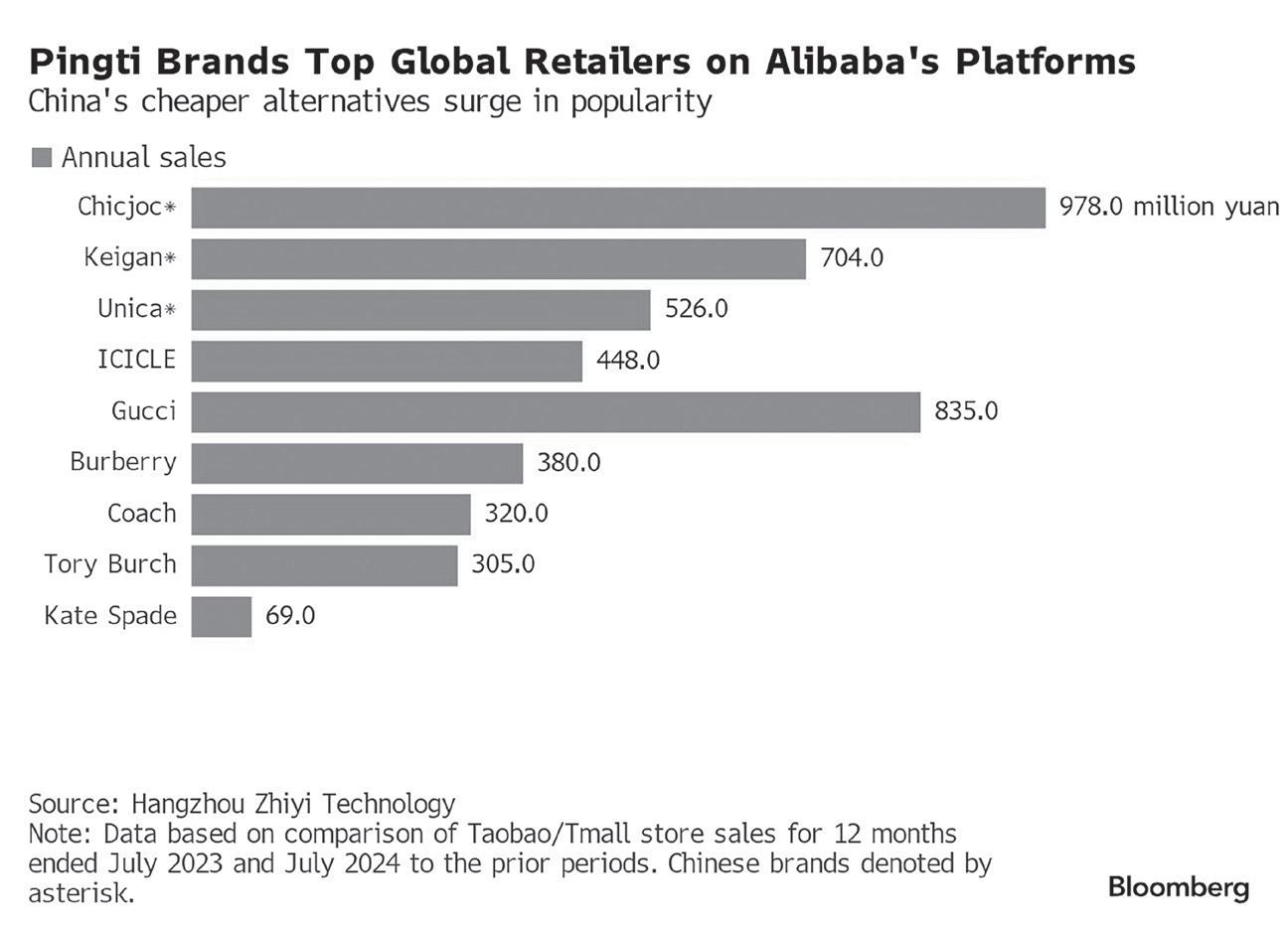
Yaok Group said in a report this month. Leather goods manufacturer Sitoy Group Holdings Ltd. says on social media videos that the quality of its $100 handbags is almost identical to those sold for upwards of $1,000 when churned out by the same production lines that manufacture for luxury brand clients such as Prada, Tumi and Michael Kors. Meanwhile Chicjoc, one of the biggest Chinese fashion apparel la-
bels on Taobao and Tmall, markets products it claims are made with Copenhagen-produced animal fur from the same supplier to LVMH and Fendi. The company has annual sales of about 1 billion yuan in its Taobao store, the Zhiyi data show.
‘Beyond my expectation’ SHENZHEN stock analyst Ding Xiaoying stopped splashing out thousands of dollars on designer
labels after China’s market routs slashed her annual bonuses in half. In recent months, she said she’s purchased pingti versions of Victoria’s Secret pajamas and shirts modeled on items from Ralph Lauren Co. and Kering SA’s Bottega Veneta.
“I’ve shifted some of my clothes spending to those no-name brands,” she said, praising the dupes’ textile quality. “I trust them now, and I even want them to start their own designs to avoid being sued as copycats.”
Local brands have been selling cheaper alternatives for decades, but they were generally derided by middle-class shoppers who splashed out on labels as status symbols. Pingti retailers entered the mainstream as Covid lockdowns kept people home and dependent on online shopping, giving rise to new directto-customer channels on social media platforms and livestreaming shows similar to the US’s QVC home shopping network.
People mostly find pingti items online and can score bragging rights from sharing finds with the closest resemblance to branded products. Millions of social media videos feature vloggers boasting about price points and quality. Shoppers can usually place orders directly into chat boxes, and receive items within days.
For Sitoy, one of the most prominent dupe retailers—and one of the few to be listed—private brands contributed nearly a third of some HK$841 million ($108 million) in total sales during the six months ended last December. Sitoy’s two main stores on TikTok’s Chinese cousin Douyin posted around 200 million yuan in sales in the past 12 months as of July— more than doubling the amount from the previous year, according to Zhiyi data.
Sitoy, which started out as a manufacturer for outside clients, has seen orders slow amid economic and geopolitical uncertainty, it’s said in financial reports. To counter the slide, it’s investing in dupes, transforming a four-story building at its factory in southern city Dongguan into an e-commerce center for its own labels—complete with livestreaming studios, retail stores and showrooms. Producing items for global
brands “isn’t something worth bragging about,” one woman says in a company sales video posted to Douyin. “So we decided to come to the front, using the same level of material and craftsmanship as luxury brands—and the same experienced workers—to make our own home-grown brands.”
Sitoy, Chicjoc, Chando, VFU, Hermès, Lululemon, Prada, Tumi’s parent company Samsonite International SA, Michael Kors owner Capri Holdings Ltd. and SK-II’s parent Procter & Gamble Co. didn’t reply to requests for comment.
Most consumers maintain there’s little to no difference between pingti and the branded items they mimic. A 330-millileter bottle of Japanese cosmetics maker SKII’s bestselling Facial Treatment Essence, featuring a natural fermentation product, typically sells for nearly 1700 yuan—compared to a 569 yuan dupe from Chinese alternative Chando touting a similar ingredient.
Popular Lululemon pingti brand VFU charges just 200 yuan for a pair of high-waisted black workout tights similar to the athleisure giant’s, typically costing four times as much.
Despite the rush, it’s unclear if local upstarts will have the same staying power as the global giants they’re copying.
People selling cheap counterfeits often try to muscle in on pingti channels. There’s little oversight of online and social channels—a sort of Wild West where factories and retailers can advertise products however they want—making it difficult for consumers to know what they’re really buying. And there’s generally no punishment from ecommerce and social platforms for sellers who falsely claim to be producing for known brands. For now, that’s not stopping shoppers like 45-year-old financial programmer Jessica Wang. She recently spent 3,700 yuan on a pingti of a Hermès Lindy purse, which usually sells for thousands of dollars, from a WeChat seller whose handbags mirror luxury designs.
“It was beyond my expectation in so many ways: The leather is so soft, the stitching is delicate, and its packaging is nice and neat,” Wang said. “I’m going to order other bags from that shop.” With assistance from Shirley Zhao/ Bloomberg
Editor: Angel R. Calso
By Kirsten Grieshaber The Associated Press
J
ENA, Germany—When electrical engineer Preetam Gaikwad first moved to Jena in 2013, she was smitten by what the eastern German city had to offer: a prestigious university, top research institutions, and cutting-edge technology companies, global leaders in their field.
Eleven years later, the Indian native takes a more sober view.
“I’m really worried about the development of the political situation here,” Gaikwad, 43, said. Jena is in the eastern German state of Thuringia, which has elections on Sept. 1.
The far-right Alternative for Germany party, or AfD, is currently leading the polls with about 30 percent support, far ahead of the center-right Christian Democrats (21 percent) and the center-left Social Democrats of Chancellor Olaf Scholz (7 percent). The AfD’s anti-foreigner stance is the cornerstone of its campaign, raising concern among businesses like Jenoptik, Gaikwad’s employer. The company, which supplied lens assemblies for Perseverance, the NASA remote vehicle on Mars, employs 1,680 people in Jena and more than 4,600 globally.
Jenoptik, one of the few internationally successful businesses in Jena, depends on being able to attract and retain a highly skilled workforce, much of it from outside Germany. The rise of the AfD is making that more difficult, says Jenoptik CEO Stefan Traeger.
More and more prospective employees tell Traeger that while they would love to work for Jenoptik, they won’t take a job there because they don’t want to live in a state dominated by a hard-right party that ostracizes migrants or other minorities such as members of the LGBTQI+ community.
Traeger, a Jena native who studied in the US, told the AP he hopes that after the election “we will still be as open, free and democratic a country as we are now. That’s what we need in order to move the company forward.”
Germany is already facing a massive skilled labor shortage with experts estimating that the country needs about 400,000 skilled immigrants each year as the workforce ages and shrinks. Long considered Europe’s economic powerhouse, Germany was recently rated the world’s worst performing major developed economy by the International Monetary Fund.
Thuringia is one of the poorest states in Germany, a legacy of communist rule in what was East Germany from 1949 to 1990. Salaries are lower than average, and it has few major employers outside the public sector. Most young people, especially women, leave for opportunities elsewhere, a brain drain to the more affluent west that began in 1989, when the Berlin Wall fell, and has not stopped since.
The rise of the AfD has been catalyzed by high inflation and immigration. In 2023, Germany took in 1.9 million new inhabitants, while 1.2 million people left the country permanently, putting net migration at 663,000. While only a minority settle in Germany’s poorer eastern states, anti-immigration sentiment runs high.
The AfD’s Thuringia branch is particularly radical: its regional leader, Bjoern Hoecke, has described the Holocaust memorial in Berlin as a “monument of shame” and called for Germany to make a “180-degree turn” in the way it remembers its past, including the Nazis. In 2020, the branch was put under official surveillance by the German domestic intelligence service as a “proven right-wing extremist” group.
Thuringia’s cities and villages are plastered with AfD election posters carrying the slogan “summer, sun, remigration,” and the photo of a plane dubbed “deportation airline” that’s meant to fly out all those people that the party and its voters don’t want in Germany. Nonetheless, the AfD in an interview with the AP sought to downplay the issue of what it prefers to call “remigration.”
Remigration “refers to those who have no right to stay in this country and no prospect of staying because there is no reason for protective status, because there is no reason for their flight or for their migration in the sense of the applicable laws,” said Torben Braga, deputy speaker of the AfD Thuringia and member of the Thuringian state parliament. Migrants with work permits would “of course not be affected,” he said.
The experience of Gaikwad, a legal migrant, is rather different. Some of the racism she’s experienced is subtle, some is outright discrimination, but it is always hurtful and humiliating.
Like the supermarket cashier who bags up the groceries for all the other customers and wishes them a nice day, only to slam Gaikwad’s bag down next to her shopping without a word.
Or the elderly neighbor she greets in German who stops her one day to say, “It makes me uncomfortable when I see so many people with strange skin and hair color here in Jena.”
More than anything, Gaikwad was shocked when she took her daughter, now 10, to the playground and overheard a little German boy telling her that he was making a body powder for her “so that you will become a normal person again.”
The AfD is especially popular in rural areas—and that’s 70 percent of the population in Thuringia—says Axel Salheiser, the director of research at the Institute for Democracy and Civil Society in Jena.
“Even when there are no majorities so far, there are considerable minorities who vote for the AfD, either to express their protest or to openly express anti-immigration and anti-liberal positions,” he told the AP.
When it comes to Thuringia as a place to do business, Salheiser said, that means not only work migrants will think twice about whether they will move there, but “potential investors will also ask themselves whether they want to locate their company or their branch of business here.”
“It’s a big problem for the region, if the impression arises that significant parts of the population not only tolerate anti-immigration and anti-diversity positions, but also support...them,” he added.
A recent poll of more than 900 German companies by the Institute for the German Economy also showed that a majority sees the AfD as a risk, both for securing skilled workers and for investment in the region.
Last year, businesses and individuals set up Cosmopolitan Thuringia, a grassroots network to promote tolerance, diversity and “indivisible human rights,” which now has more than 7,940 members.
Among them is Jenoptik, which makes a point of promoting the diversity of its workforce, showcasing its foreign employees on posters at its Jena headquarters.
Gaikwad says Jenoptik’s open-mindedness, her great job and support from friends are what keep her in Jena, despite the racism she and her family have experienced.
“I have great faith in democracy, in the good in people,” she said.
Jenoptik’s CEO Traeger is grateful for Gaikwad and every other international employee he can retain in Jena.
“We need employees with creative potential. We Thuringians are a creative bunch, but we won’t be able to do it all by ourselves,” Traeger said. “We also need people who come from other parts of the world, who perhaps have different views, different beliefs, different skin colors or whatever.” (Kerstin Sopke and Pietro De Cristofaro contributed reporting.)
is part of an ongoing
This story, supported by the Pulitzer

By Jill R. Shah, Sridhar Natarajan & Reshmi Basu
CHRIS STANSBURY may have been the most hated person in the room as he made the rounds at one of Wall Street’s biggest leveraged finance conferences late last year.
The Lumen CFO was in the process of carrying out one of the largest and most controversial distressed-debt exchanges ever, and creditors stuck on the outside looking in were furious.
For those at the gathering, nothing captured the tension more than the sight of a man in a buttoned-up suit, backpack slung over his shoulder, appearing to guard Stansbury as he worked the room. Some attendees joked that his presence brought to life the phrase buzzing through the market: “creditor-on-creditor violence.”
Fast forward to today, and the deal has become one of the most successful distressed trades of the year, even for those that got left behind.
Backing the transaction was the upstart Diameter Capital Partners, a growing force in credit markets with about $20 billion in assets. The New York-based firm founded by Scott Goodwin and Jonathan Lewinsohn, like virtually everyone else, could tell that Lumen’s debt situation was dire.
But inside the all-but-insolvent telecommunications company, Diameter saw an opportunity. Level 3 Communications, a struggling provider of high-bandwidth fiber connections for businesses that Lumen had bought in 2017, was turning the corner.
Diameter piled into Level 3’s debt at deeply discounted prices. Then came a break.
Lumen, another fund discovered, may have violated a clause in its debt documents which would put it in default. Diameter paired up with the likes of Silver Point Capital, PGIM Fixed Income and BlackRock Inc. to negotiate an out of court deal that extended Lumen’s maturities and provided fresh financing. Ken Griffin’s Citadel was one of the main organizers of the group and put in over 10% of the new money for the deal, while PGIM contributed more than 25%.
In exchange, they received priority claims on assets, stripping other debt holders of their collateral in the process.
The trade has racked up big profits. For Diameter, it was the firm’s single largest wager at the start of the year. At Silver Point, it
was one of their biggest positions as of the end of the first quarter.
Yet they haven’t been the only winners. With its debt woes behind it for the time being, Lumen has repositioned itself as a player in the artificial intelligence boom, igniting a surge in its bonds and loans that’s juiced returns for creditors across the board. Firms like Hamza Lemssouguer’s Arini, which wasn’t part of the initial negotiations, have notched double-digit gains after snapping up more of the notes in recent months.
“The idea of pitting creditors against creditors is offensive. It becomes a giant game instead of priority of claims,” said Bill Zox, a portfolio manager at Brandywine Global Investment Management. “It bought the company more time and they engineered some theoretical value at a time of euphoria around artificial intelligence.”
Zox says he remains skeptical, but there’s no denying that those who got in on the deal and stayed put have enjoyed big returns.
A spokesperson for Lumen said in a statement that the company’s role as an emerging trusted network for AI is validating the support of its debt holders. Representatives for Diameter, Silver Point, PGIM, BlackRock and Citadel declined to comment, while Arini didn’t respond to requests seeking comment.
This story is based on conversations with conference attendees, people familiar with Diameter, Silver Point, Citadel, PGIM and Arini’s positions, and investor letters seen by Bloomberg News.
It was May of last year when Diameter’s Goodwin took the virtual stage and pitched Level 3 as a top trade idea at the Sohn Investment Conference. Its bonds, he argued, were undervalued largely because of the struggles of its parent company, which had about $20 billion in long-term debt. Level 3 had a manageable debt load and more favorable revenue mix than other communications firms.
It was a “solvent zombie inside an insolvent one,” according to Diameter’s first quarter investment letter, a copy of which was seen by Bloomberg.
Not long after, a hedge fund
In the aftermath of the deal, Lumen has been able to tap into growing demand for its fiber network among AI-focused firms. The company in early August said it secured $5 billion in new business, including a pact with Microsoft Corp. to expand its network capacity, and is in talks for another $7 billion in sales.

found a way to free it.
Buried inside the labyrinth of credit agreements governing all the subsidiaries of Lumen, Paloma Partners discovered an investor safeguard that had been breached due to a procedural misstep, according to people with knowledge of the matter, who asked not to be identified because they’re not authorized to speak publicly.
This breakthrough gave the funds the leverage they needed to bring Lumen to the table and position themselves to get the best deal.
A representative for Paloma didn’t respond to requests seeking comment.
An initial restructuring proposal in early November infuriated investors who were left out of the transaction, in no small part because of Goodwin’s recommendation just months earlier. Only holders of about $7 billion of debt initially signed on to the transaction.
“It’s really about jockeying to be one that gets the better deal versus the one that’s getting the worse deal,” said industry veteran Jason Mudrick, who oversees more than $3 billion and wasn’t involved in the trade. “People on the wrong side of the deal are losing. They’re getting value extracted from them into the hands of the creditors on the other side of the deal.”
Following the announcement, concerned creditors rushed to sell the company’s debt. Several bank trading desks began separating bonds that were part of the new deal and notes that would be left behind in quotes sent to investors, people said at the time.
“It was a very dark period, people lost quite a bit of money and no one was too happy with what was going on,” said Jeff Peskind, chief investment officer of Phoenix Investment Adviser.
Following months of prolonged negotiations, Lumen cut a deal in late January that allowed more
creditors to participate in the new money raise tied to the Level 3 unit. The revised agreement ultimately won support from holders backing $15 billion of debt, allowing the company to extend over $10 billion of maturities and secure more than $2 billion in new financing, Stansbury said on Lumen’s earnings call earlier this month.
For its role hammering out the restructuring, Diameter and other negotiating creditors earned hefty fees on top of claims to the company’s best collateral. In the aftermath of the deal, Lumen has been able to tap into growing demand for its fiber network among AI-focused firms. The company in early August said it secured $5 billion in new business, including a pact with Microsoft Corp. to expand its network capacity, and is in talks for another $7 billion in sales.
Its stock has surged more than 400% since a low in June, while some of its distressed bonds have almost doubled in price. New 11% bonds due in 2029 issued by Level 3 as part of the exchange now trade near 110 cents on the dollar, according to data compiled by Bloomberg.
“Their debt is further out than it had been previously, and the AI win that they’ve had more recently is positive,” said Rob Galtman, a senior director at Fitch Ratings.
“It’s a substantial sum of money in deal flow.”
Diameter acknowledged in its letter to investors that the market saw the deal as “fratricidal” and one that companies would never have done in the past because it erodes trust across the market.
“Norms are always evolving and will continue to adapt to the current environment,” Diameter wrote in the letter. “For now, however, the best bet is to size positions assuming that you can be screwed.” With assistance from Eliza Ronalds-Hannon and Nishant Kumar/Bloomberg

By Niniek Karmini, David Rising & Nicole Winfield
The Associated Press
DILI, East Timor—When the Vatican acknowledged in 2022 that the Nobel Peace Prize-winning, East Timorese independence hero Bishop Carlos Ximenes Belo had sexually abused young boys, it appeared that the global clergy sexual abuse scandal that has compromised the Catholic Church’s credibility around the world had finally arrived in Asia’s newest country.
And yet, the church in East Timor today is stronger than ever, with most downplaying, doubting or dismissing the claims against Belo and those against a popular American missionary who confessed to molesting young girls. Many instead focus on their roles saving lives during the country’s bloody struggle against Indonesia for independence.
Pope Francis will come face to face with the Timorese faithful on his first trip to the country, a former Portuguese colony that makes up half of the island of Timor off the northern coast of Australia. But so far, there is no word if he will meet with victims or even mention the sex abuse directly, as he has in other countries where the rank-and-file faithful have demanded an accounting from the hierarchy for how it failed to protect their children.
Even without pressure from within East Timor to address the scandals, it would be deeply meaningful to the victims if Francis did, said Tjiyske Lingsma, the Dutch journalist who helped bring both abuse cases to light.
“I think this is the time for the pope to say some words to the victims, to apologize,” she said in an interview from Amsterdam.
The day after Lingsma detailed the Belo case in a September 2022 report in De Groene Amsterdammer magazine, the Vatican confirmed that Belo had been sanctioned secretly two years earlier.
In Vatican spokesman Matteo Bruni’s statement, he said the church had been aware of the case since 2019 and had imposed
disciplinary measures in 2020, including restrictions on Belo’s movements and a ban on voluntary contact with minors.
Despite the official acknowledgement, many in East Timor still don’t believe it, like Dili university student Martinha Goveia, who is still expecting Belo will show up to be at Francis’ side during his upcoming visit.
If he’s not there, she said, “that is not good in my opinion,” because it will confirm he is being sanctioned by the Vatican.
Vegetable trader Alfredo Ximenes said the allegations and the Vatican’s acknowledged sanctions were merely rumors, and that he hoped Belo would come to welcome the pope and refute the claims in person.
“Our political leaders should immediately meet him to end the problem and persuade him to return, because after all he has contributed greatly to national independence,” Ximenes said.
Timorese officials refused to answer questions about the Belo case, but there’s been no attempt to avoid mentioning him, with a giant billboard in Dili welcoming Pope Francis, whose visit starts Sept. 9, placed right above a mural honoring Belo and three others as national heroes.
Only about 20 percent of East Timor’s people were Catholic when Indonesia invaded in 1975, shortly after Portugal abandoned it as a colony.
Today, some 98 percent of East Timor’s 1.3 million people are Catholic, making it the most Catholic country in the world outside the Vatican.
A law imposed by Indonesia requiring people to choose a religion, combined with the church’s opposition to the military occupation and support for the resistance over years of bloody fighting that saw as many as 200,000 people killed, helped bring about that flood of new members.
Belo won the Nobel Peace Prize for his bravery in drawing international attention to Indonesian human rights abuses during the conflict, and American missionary Richard Daschbach was widely celebrated for his role in helping

save lives in the struggle for independence.
Their heroic status, and societal factors in Asia, where the culture tends to confer much power on adults and authority figures, helps explain why the men are still revered while elsewhere in the world such cases are met with outrage, said Anne Barrett Doyle, of the online resource Bishop Accountability.
“Bishops are powerful, and in developing countries where the church is dominant, they are inordinately powerful,” Barrett Doyle said.
“But no case we’ve studied exhibits as extreme a power differential as that which exists between Belo and his victims. When a child is raped in a country that is devoutly Catholic, and the sexual predator is not only a bishop but a legendary national hero, there is almost no hope that justice will be done.”
In 2018, as rumors built against Daschbach, the priest confessed in a letter to church authorities to abusing young girls from at least 1991 to 2012.
“It is impossible for me to remember even the faces of many of them, let alone the names,” he wrote.
The 87-year-old was defrocked by the Vatican and criminally charged in East Timor, where he was convicted in 2021 and is now serving 12 years in prison.
But despite his confession and court testimony from victims that detailed the abuse, Prime Minister
By Joseph Krauss The Associated Press
THE latest flurry of Gaza cease-fire talks—the back-and-forth over nowfamiliar sticking points and appeals from around the world—obscures a grim truth about the monthslong efforts to end the Israel-Hamas war and free scores of hostages. Any deal requires the signatures of two men: Israeli Prime Minister Benjamin Netanyahu and Hamas leader Yahya Sinwar. They are sworn enemies, notoriously tough negotiators and know that the outcome of the talks will profoundly shape their legacies. In Sinwar’s case, it could mean life or death.
Both have strong incentives to end the war. But they may also think they stand to gain by holding out a bit longer, and that war is preferable to a deal that falls short of their demands.
Here’s a look at the two leaders and the constraints they face.
What does Netanyahu want?
NETANYAHU has promised “total victory” over Hamas and the return of all the hostages held in Gaza—goals that many believe are incompatible.
He has come under tremendous pressure from the hostages’ families and much of the
Israeli public to make a deal to bring them home, even if it leaves a battered Hamas intact. The United States, which has provided key military aid and diplomatic support to Israel, is also pushing for such a deal.
But Netanyahu’s governing coalition relies on far-right ministers who want to permanently reoccupy Gaza and have threatened to bring down the government if he concedes too much. That would force early elections that could drive him from power at a time when he is on trial for corruption.
It would also hasten a broader reckoning over the security failures surrounding the Oct. 7 attack in which Hamas-led militants killed some 1,200 people in southern Israel, mostly civilians, and abducted around 250 others— on Netanyahu’s watch. Netanyahu has rejected calls for a government investigation until the war is over.
The longer the war drags on, the more likely Israel is to achieve something that looks like victory—the killing of Sinwar, the rescue of more hostages—and the longer Netanyahu has to repair his political standing and reshape his legacy. But it also comes with risks as the number of soldiers killed in action rises nearly every day and Israel becomes increasingly isolated because of the suffering it has inflicted on Palestinians. Netanyahu has clashed with his own
defense minister over the endgame.
Israeli media is filled with reports quoting unnamed senior security officials expressing frustration with Netanyahu, especially his demand for lasting control over two strategic corridors in Gaza. Some have gone so far as to accuse him of sabotaging the talks.
Both Israel and Hamas say they have accepted different versions of an evolving US-backed cease-fire proposal in principle, while suggesting changes and accusing the other of making unacceptable demands.
Yohanan Plesner, head of the Israel Democracy Institute, a local think tank, acknowledged the anger directed at Netanyahu in the local press and among segments of Israeli society but said Sinwar bore most of the blame for the impasse because he had shown little interest in compromising.
“If we saw Sinwar was serious about getting a deal, that would force Israel and Netanyahu to expose their cards,” Plesner said. The current situation is “almost like negotiating with oneself.”
What does Sinwar want?
SINWAR wants to end the war—but only on his terms.
Israel’s offensive has killed over 40,000 people, according to local health officials, displaced 90% of Gaza’s population and
Xanana Gusmao, an independence hero himself, has visited Daschbach in prison—hand-feeding him cake and serving him wine on his birthday—and has said winning the ex-priest’s early release is a priority for him.
In Belo’s case, six years after winning the Nobel Prize, which he shared with current East Timor President Jose Ramos-Horta, he suddenly retired as the head of the church in East Timor in 2002, citing health reasons and stress.
Not long after his retirement, Belo, today 76, was sent by the Vatican and his Salesian missionary order to another former Portuguese colony, Mozambique, to work as a missionary priest.
There, he has said, he spent his time “teaching catechism to children, giving retreats to young people.” Today he lives in Portugal.
Suspicion arose that Belo, like others before him, had been allowed to quietly retire rather than face any reckoning, given the reputational harm to the church that would have caused.
In a 2023 interview with The Associated Press, Pope Francis suggested that indeed was the case, reasoning that was how such matters were handled in the past.
“This is a very old thing where this awareness of today did not exist,” Francis said. “And when it came out about the bishop of East Timor, I said, ‘Yes, let it go in the open.’ ... I’m not going to cover it up. But these were decisions made 25 years ago when there wasn’t this awareness.”
Lingsma said she first heard allegations against Belo in 2002, the same year East Timor, also known as Timor-Leste, won its formal independence after the Indonesian occupation ended in 1999. She said she wasn’t able to investigate the case and build enough evidence to publish her story on him until two decades later.
Her story garnered international attention, as well as the Vatican’s acknowledgement of the case, but in East Timor was primarily met with skepticism and negative reactions toward her reporting. Her 2019 story exposing the Daschbach case eventually prompted authorities to charge him, but also did not lead to the outpouring of anger that she had anticipated.
“The reaction was silence,” she recalled.
During the fight for independence, priests, nuns and missionaries put themselves at great risk to help people, like “parents wanting to save their children,” helping form today’s deep connection between the church and people of East Timor, said Timorese historian Luciano Valentim da Conceixao.
The church’s role is even enshrined in the preamble to the young country’s constitution, which says that the Catholic Church “has always been able to take on the suffering of all the people with dignity, placing itself on their side in the defense of their most fundamental rights.”
Because so many remember the church’s significant role during those dark days, it has fostered an environment where it is difficult for victims of abuse to speak out for fear of being labeled anti-church, and where men like Belo and Daschbach continue to receive support from all walks of society.
“Pedophilia and sexual violence are common enemies in East Timor, and we should not mix them up with the struggle for independence,” said Valentim da Costa Pinto, executive director of The Timor-Leste NGO Forum, an umbrella organization for some 270 NGOs.
The chancellor of the Dili Diocese today, Father Ludgerio Martins da Silva, said the cases of Belo
and Daschbach were the Vatican’s jurisdiction, and that most people consider the sex abuse scandals a thing of the past.
“We don’t hear a lot of people ask about bishop Belo because he left the country...20 years ago,” da Silva said.
Still, Lingsma said she knew of ongoing allegations against “four or five” other priests, including two who were now dead, “and if I know them, I’m the last person to know.”
“That also shows that this whole reporting system doesn’t work at all,” she said.
Da Conceixao, the historian, said he did not know enough about the cases against Daschbach or Belo to comment on them, but that he was well acquainted with their role in the independence struggle and called them “fearless freedom fighters and clergymen.”
“Clergymen are not free from mistakes,” da Conceixao conceded. “But we, the Timorese, have to look with a clear mind at the mistakes they made and the good they did for the country, for the freedom of a million people, and of course the value is not the same.”
Because of that prevailing attitude, Barrett Doyle said “the victims of those two men have to be the most isolated and least supported clergy sex abuse victims in the world right now. “ For that reason, Francis’ visit to East Timor could be a landmark moment in his papacy, she said, if he were to denounce Daschbach and Belo by name and praise the courage of the victims, sending a message that would resonate globally.
“Given the exalted status of the Catholic Church in East Timor, just imagine the impact of papal fury directed at Belo, Daschbach and the yet unknown number of other predatory clergy in that country,” she said.
“Francis could even address the country’s hidden victims, promising his support and urging them to contact him directly about their abuse—he literally could save lives.”
Rising reported from Bangkok and Winfield from Rome.
war in Gaza. Does either man want a deal?
destroyed its main cities. Hamas has lost thousands of fighters and much of its militant infrastructure.
Sinwar’s only bargaining chips are the roughly 110 hostages still held in Gaza, around a third of whom are believed to be dead. And he needs much more than a temporary pause in the fighting if he hopes to salvage anything resembling victory from the Oct. 7 attack that he helped mastermind.
That begins with assurances that Israel won’t resume the war once some or all of the hostages are freed. He also needs Israel to withdraw from all of Gaza to ensure that the lasting impact of the Oct. 7 attack is not a permanent reoccupation of the territory. The release of high-profile Palestinian prisoners as part of a deal is a sacred cause for Sinwar, who was himself a long-serving prisoner freed in an exchange. And he needs assurances that Palestinians will be able to return to their homes and rebuild them.
“Sinwar is very much concerned with bringing negotiations to a conclusion, whether with regard to a cease-fire or an exchange of prisoners, because in both cases, Sinwar will have come out as the winner,” said Nabih Awada, a Lebanese political analyst and former militant who spent years in an Israeli prison with Sinwar.
There are risks for Sinwar in drawing the talks out: More hostages are likely to
die or be rescued as the war grinds on.
Death, destruction and hardship in Gaza will continue, and could stoke Palestinian discontent with Hamas, with political implications down the line.
Sinwar himself, who sits atop Israel’s most-wanted list, could be killed at any time. But given the centrality of martyrdom in Hamas’ history and ideology, he may feel that outcome is inevitable—and preferable to a deal that looks like defeat.
Can any external pressure help?
EGYPT and Qatar have served as key mediators with Hamas, but their influence is limited.
Any pressure exerted on Hamas’ exiled leadership is unlikely to have much impact on Sinwar, who was appointed the overall head of Hamas after the killing of Ismail Haniyeh in Iran. Sinwar is believed to have spent most of the past 10 months living in tunnels under Gaza, and it is unclear how much contact he has with the outside world.
The United States has provided crucial military support for Israel throughout the conflict and has shielded it from international calls for a cease-fire. Earlier this year, President Joe Biden paused a shipment of hundreds of 2,000-pound (900-kilogram) bombs to pressure Israel not to invade the southern city of Rafah—which it did anyway.
US election politics could also blunt American pressure. Biden has shown little inclination to pressure Netanyahu, and Vice President Kamala Harris has offered no concrete policy changes. Donald Trump has urged Israel to finish up its offensive but would likely be even more accommodating to Netanyahu, as he was during his presidency. Any US arms embargo is even less likely when Israel faces a potential retaliatory strike from Iran over the killing of Haniyeh. Instead, the United States has poured military assets into the region, taking some of the pressure off Israel.
Sinwar might have hoped that the targeted killings of Haniyeh and a top Hezbollah commander last month would widen the war. But that appears less likely, with both Israel and Hezbollah applying the brakes following a heavy exchange of fire over the weekend. The cease-fire talks have continued through it all, punctuated by fleeting moments of optimism.
The mediators have spent recent weeks trying to hammer out a bridging proposal with Netanyahu, but it’s still a work in progress. It has not yet been submitted to Sinwar.
The Associated Press writers Melanie Lidman in Jerusalem and Abby Sewell in Beirut contributed to this report.

EIGHTEEN Persons Deprived of Liberty (PDL) at the Bureau of Jail Management and Penology (BJMP) in San Jose Antique District Jail will have a chance to earn a degree of Bachelor of Science in Entrepreneurship.
This opportunity for the PDLs to have college education is being offered by the Department of Science and Technology (DOST) in Region VI, in partnership with the University of Antique (UA).
DOST and UA officials made the announcement during the recent opening of the 2024 Regional Science, Technology, and Innovation Week held at the UA in Sibalom, Antique.
Under its major program, the Community Empowerment through Science and Technology (CEST), the DOST Region VI
will provide several S&T interventions for the BJMP San Jose District Jail, focusing on Livelihood/Economic Enterprise Development and Human Resource Development.
This includes the provision of bakery equipment and training, as well as the college education to the PDLs who have successfully passed the entrance exam at UA.
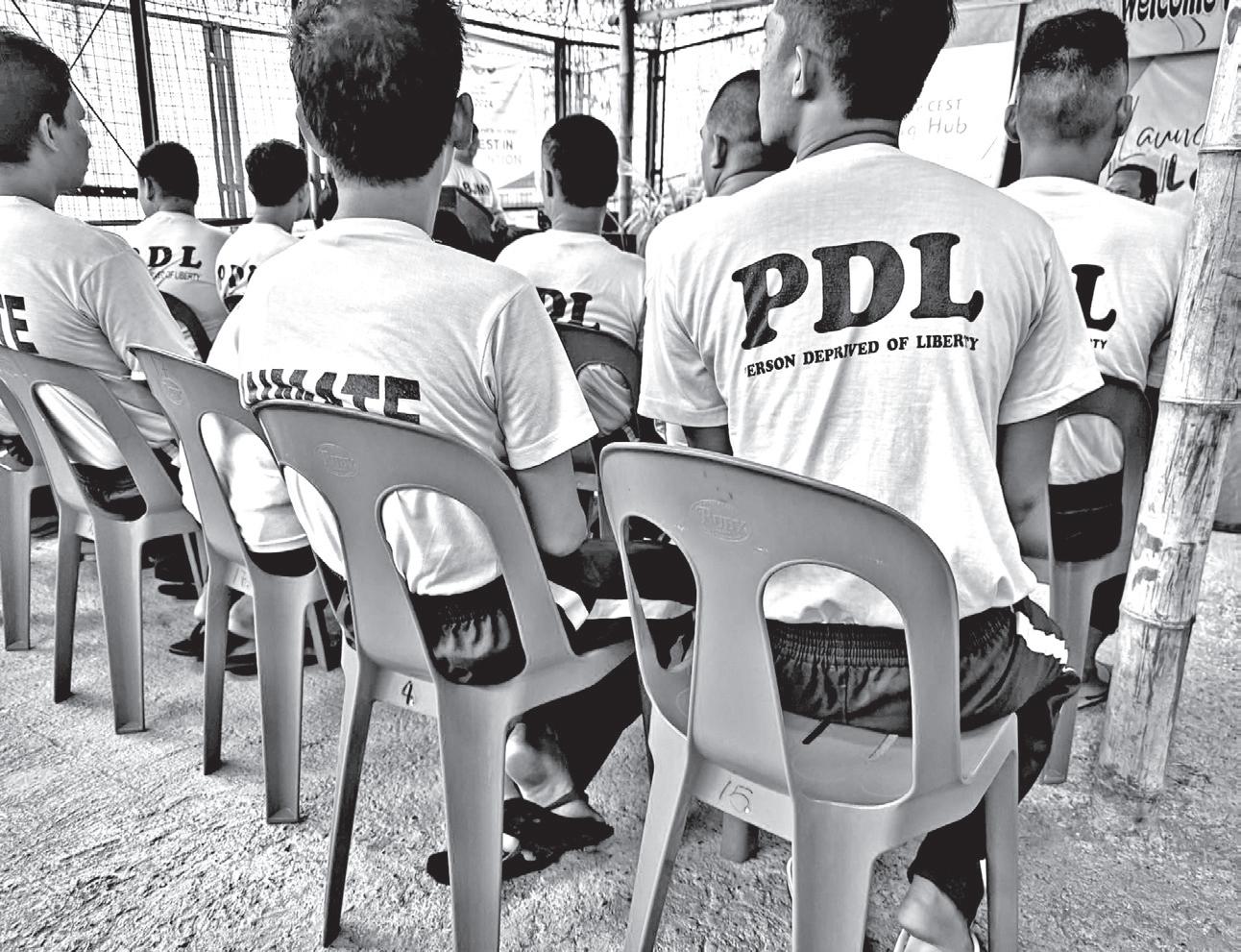
“The University of Antique will be providing the lectures. Eighteen PDLs also took the examination. As we are not undermining the standards of the university; they [PDLs] were treated just like any other students and did not receive special treatment. When they qualified for the entrance examination, they will be enrolled in the university and will be taught the same subjects [as other qualifiers],” said DOST Region VI Di -

ANEW research initiative aims to produce ecofriendly bioplastic films reinforced with nanocellulose derived from the Backcross Abaca with Native and Desirable Accessions to Lift Up the Abaca Industry (Bandala) abaca hybrid.
The project, “Application of Cellulose Nanocrystals Extracted from Bandala Fiber as Reinforcement Material in Starch-Based Bioplastic Film,” is implemented by the Forest Products Research and Development Institute of the Department of Science and Technology (DOST-FPRDI) with funding support of DOST-Philippine Council for Agriculture, Aquatic and Natural Resources Research and Development (PCAARRD). Bandala is an abaca hybrid developed by the University of the Philippines Los Baños (UPLB) that has resistance to the abaca bunchy top virus. The project will explore its potential use for bioplastic film production as a value-adding product from Bandala fibers.
Led by Dr. Anniver Ryan P. Lapuz,
the project team will assess the effect of pulping and bleaching to the cellulose pulp from Bandala fibers, characterize the properties of the extracted cellulose nanocrystals (CNC), test different CNC amounts in starch-based bioplastic films, and determine the production costs of CNC and CNC-reinforced starch-based bioplastic films. According to Lapuz, the bioplastic film that will be developed by the project could serve as an alternative to synthetic or petroleum-based plastic films, which can help reduce plastic waste and greenhouse gas emissions. The project will be implemented for two years. It is expected to benefit abaca and cassava farmers, abaca traders, researchers, and the pulp, paper, and plastic industries. The project kicked off during an inception meeting organized by DOST-PCAARRD, led by Deputy Executive Director Melvin B. Carlos, for Administration, Resource Management and Support Services, along with Director Leilani D. Pelegrina, of Crops Research Division in UPLB, Los Baños, Laguna.
rector Rowen Gelonga Jr. Gelonga explained that the mode of education will be either virtual or face-to-face, wherein in some instances, the UA professors will have to go to the jail to deliver face-to-face lectures. They also launched a small facility, a classroom, where face-to-face
learning will take place, Gelonga said.
Meanwhile, UA President Dr. Pablo Crespo Jr. said they were finalizing the enrollment process. They have met with faculty members to ensure the success of this education program behind bars.
“This is not just a [one-]college program. It involves the Colleges of Business, of Arts, and of Teacher Education,” he said.
In addition to teaching, teachers were also identified to serve as life coaches for the PDLs.
“In fact, I suggested that we treat this education-behind-bars program as a small school within the University of Antique, complete with research and extension activities,” Crespo said.
The project is funded by the DOST VI under the CEST program and is being implemented by the UA to provide a comprehensive assistance to PDLs in San Jose Antique District Jail.
The project encompasses five CEST components. In addition to the provision of bakery equip -
‘Partnership with industries, academe key to adoption of DOST technologies’
THE Department of Science and Technology (DOST) is prioritizing the strengthening of its relationship with local stakeholders and academic institutions in order to increase the chances of various research and development (R&D) projects being commercialized and used by local communities.
“The job of the DOST is to sustain the scientific efforts, whatever is your research, whatever products you are developing. For us, to sustain the knowledge gain and having it operational at the local level, we need to work with the local players, local government, local academic institutions, and local industry,” said Science Secretary Renato U. Solidum Jr. Solidum spoke at the 2024 Regional Science, Technology and Innovation Week (RSTW) at the University of Antique (US) Sibalom Campus from August 22 to 24.
He added that since the regional directors of the DOST are part of the board
of regents of state colleges and universities, and since the Science department also provides funding for their researchers, believes that the DOST have established a significantly strong relationship with them.
“The University of Antique, we are thankful that we are here today. We can foster a more conscious effort to translate what DOST, and the UA propose and to commercialize it,”. Solidum said.
He pointed out that to enable the R&D products and services of local scientists and researchers to be commercialized and be competitive locally and internationally, there is a need to make sure that there are standards, control, and quality assurance of the product.
He also urged that even if the business is small, they should have promotions for food products, and the packaging should be attractive and with longer shelf-life.
The Science Chief further said that one of his leadership’s 11 priorities is to improve
the DOST’s laboratories to provide testing and standards facility to ensure that the R&D products are competitive.
“For example, if there is a specific need of an industry partner or industry player within the community, we need to ensure that the laboratory they require is established,” Solidum said.
Natural dye hubs in Antique launched
ONE of the highlights of the opening of the RSTW in Western Visayas was the launching of the Antique Natural Dyes (NatDyes) Hub—a collaborationt involving the DOST-Philippine Textile Research Institute, DOST Regional Office VI, the Iguirindon Loom Weavers Association, and the local government of San Remigio in Antique.
The hub will feature facilities for natural dye extraction and textile dyeing, that aims to revitalize the country’s local colorant traditions
ment and training, and the college education, it includes, addressing health and nutrition concerns of the PDLs by providing ceramic water filters for safe water. It also has the RxBox for healthcare services; conducting meaning-making activities; and offers technical orientation on Pinggang Pinoy healthy diet program. CEST, being implemented by the DOST in all regions in the country, involves on environmental protection and conservation through solid waste management training; enhances disaster risk reduction, management; and climate-change adaptation with disaster preparedness information boards and the introduction of the Bantay Panahon system. The CEST program is one of the strategies of the DOST to address its thrust under its four pillars, namely: human well-being, wealth creation, wealth protection, and sustainability, that are aimed at providing solutions and opening opportunities. Allan Mauro V. Marfal/S&T Media Service
It also aims to empower weavers to infuse their creations with the vibrant hues of natural colorants and use DOSTdeveloped handloom weaving machinery to enhance the local weaving industry.
All these initiatives are geared at revitalizing the local textile industry that will support income generating projects to provide solutions and open opportunities for communities in the regions.
“Our programs are carefully tailored to meet the unique strengths, capabilities, and priorities of each locality or community we serve,” Solidum said.
“Every form of assistance we provide, every micro, small, and medium enterprise we support, and every community we empower is thoughtfully designed to meet the specific needs of the citizens and communities involved,” he added.
The RSTW is a yearly event to promote science, technology, and innovation in the countryside.
It features several homegrown technologies and R&D projects from DOST agencies and partner institutions that could potentially contribute to the development of the country’s green and blue economy. Allan Mauro V. Marfal/Science Media Services
AS the Philippines commemorated Buwan ng Wika in August, the Department of Science and Technology (DOST) led the way in coming up with a research and development roadmap that can help strengthen natural language research in the country.
This was highlighted during the multisectoral meeting among DOST, Ateneo Social Computing Science Laboratory, Ateneo Center for Computing Competency and Research, AI Singapore (AISG), and the Komisyon sa Wikang Filipino (KWF), a news release said.
The meeting discussed efforts on Natural Language Processing (NLP) and Large Language Model (LLM) in the Philippines.
With the theme “Toward Developing Large Language Models for Filipino Languages,” the gathering was attended by NLP, LLMs, and Artificial Intelligence (AI) experts from academic institutions, government, and industry.
The meeting had presentations of current works and discussions of elements toward building culturally appropriate LLMs for the Philippine languages.
“Different Filipino languages provide connections to our cultural heritage and enables us to have a deeper understanding about our identity and historical roots.
“We thank our researchers and partners from the academe, government, and industry in making solid efforts in providing solutions and opening opportunities for the Filipino people to utilize science, technol -
ogy, and innovation in this initiative,” said Science Secretary Renato U. Solidum Jr.
The S&T initiatives funded by DOST for the development of LLMs for Philippine languages were presented during the meeting.
One of the main DOST projects to preserve different languages of the Philippines is Project Marayum.
The project is a collaboratively built, desktop- and mobile phone-based, online dictionary platform for Philippine languages.
Its goal is to empower native language speakers to create and curate an online dictionary of their language without needing to have technical expertise in website design, implementation, and maintenance.
A project funded to answer the need of a Filipino company is FilWordNet.
Funded through the DOST-Collaborative Research and Development to Leverage Philippine Economy Program, FilWordNet is a Philippine language resource built by the De La Salle University-College of Computer Studies (DLSU-CCS) researchers in collaboration with Senti Techlabs.
The project tracks how word senses change in the digital realm through natural language processing and network science.
The DOST-Philippine Council for Industry, Energy, and Emerging Technology Research and Development (PCIEERD) funded the Interdisciplinary Signal Processing for Pinoys (ISIP) Program.
It consists of seven component projects implemented by the University of the Philippines-Electrical and Electronics Engineering
Institute (UP-EEEI) and its subsequent ISIP: Software Applications for Education (SAFE) Program with three component projects implemented by UPD-EEEI and DLSU, the DOST-PCIEERD news release said.
The ISIP Program developed a Philippine Languages Corpora of text and speech data of 10 spoken languages.
From databases, several language models were created for Automatic Speech Recognition, Filipino Speech Synthesizer, Code Switching Detector, Essay Grader and English Proficiency training program applications.
The ISIP: SAFE Program developed an automated reading tutor for elementary students in Filipino, closed captioning systems for Philippine languages, and a Filipino language writing tool.
The other projects include Project iWag, a mobile web bidirectional neural machine translation system for Filipino and Cebuano by the University of Immaculate Concepcion, and the Multi-Lingual Chatbot for Health Monitoring, which is a healthcare chatbot that is capable of interpreting audio input and conversing in Filipino and Bisaya by DLSU.
DOST-PCIEERD also funded the MinNaLProc (Mindanao Natural Language Processing) Research and Development Laboratory and Senti Techlabs, a start-up company focusing on AI technologies.
MinNa-LProc Research and Development Laboratory intends to make use of NLP to aid in the protection of endangered languages in the Mindanao region, such as Manobo, Mansaka, and Kalagan.
On the other hand, Senti Techlabs devised a machine-learning based language classifier that demonstrates automatic detection for any document’s language.
“This is an opportunity for us to maximize the use of technologies available to us in preserving and propagating our different languages. Through this roadmap, we can identify research gaps as well as the possible solutions in terms of technology, human resource, and policy,” said DOST PCIEERD Executive Director Enrico C. Paringit. The convention was graced by Dr. William Tjhi, head of Applied Research for Foundation Models of SG-AI. He presented the SEA-LION (Southeast Asian Languages In One Network) project that started in 2023. It is a family of Southeast Asian LLMs that seeks to construct well-represented language datasets to maximize the vast array of AI applications for both research and industry. SG-AI offered their assistance and expressed willingness to share their work to facilitate collaboration with the Philippines. KWF and academic institutions expressed support to this collaboration. KWF said the importance of making linguistic resources available to the public and likewise underscored the importance of a national dictionary and grammar guidelines. Attention was also drawn to the issues, needs, and challenges in large language models which must be considered in the formulation and implementation of the roadmap.
A6 Sunday, September 1, 2024

Editor: Lyn Resurreccion • www.businessmirror.com.ph
THE Diocese of Ávila in Spain reported on August 28 that the body of St. Teresa of Ávila, a doctor of the Church, remains incorrupt after her death on October 4, 1582, almost five centuries ago.
“Today the tomb of St. Teresa was opened and we have verified that it is in the same condition as when it was last opened in 1914,” said the postulator general of the Discalced Carmelite Order, Father Marco Chiesa of the Carmelite Monastery of Alba de Tormes, where the remains of the revered Spanish saint rest.
Father Miguel Ángel González, the Carmelite prior of Alba de Tormes and Salamanca of the Diocese of Ávila, explained how the procedure was carried out.
“The community of Discalced Carmelite mothers together with the postulator general of the order, the members of the ecclesiastical tribunal, and a small group of religious moved the reliquaries with stringency and solemnity to the place set up for study. We did it singing the Te Deum with our hearts full of emotion,” Gonzalez said.
The diocese explained that the event took place as part of the canonical recognition of the remains of St. Teresa of Ávila, requested from the Vatican on July 1 by the bishop of Salamanca, Luis Retana, with authorization granted by Pope Francis through the Dicastery for the Causes of Saints.
The process of studying the body, the heart, an arm, and a hand, the latter of which is preserved in the Spanish town of Ronda and which has been taken to Alba de Tormes for research, is taking place from August 28 to 31.
The diocese said that, in order to get to the body of St. Teresa, the marble slab of the sepulcher was first removed.
Then—in the room set up for the studies and now only in the presence of the scientific medical team and the members of the ecclesiastical court— the silver coffin was opened.
The tribunal is made up of the Carmelite provincial of the Iberian Province of St. Teresa of Jesús in Spain, Father Francisco Sánchez Oreja; González; and the superior of the Daughters of Charity of Alba de Tormes, Sister Remigia Blázquez Martín.
The silver coffin was opened with the help of the goldsmiths Ignacio Manzano Martín and Constantino Martín Jaén, who will also be present on the last day of the work.
The Diocese of Ávila also revealed that 10 keys were used to open the

tomb:
“The three that are kept in Alba de Tormes, the three that the Duke of Alba lent them, and the three that the father general [a Discalced Carmelite] keeps in Rome, in addition to the king’s key. Three of these keys are to open the outer grille, three are to open the marble tomb, and the other four are to open the silver coffin.”
Chiesa pointed out that the images preserved from the 1914 examination are in black and white, so “it is difficult to make a comparison,” although “the parts uncovered, which are the
face and the foot, are the same as they were in 1914.”
“There is no color, there is no skin color, because the skin is mummified, but you can see it, especially the middle of the face,” he noted. “The expert doctors can see Teresa’s face almost clearly.”
Three stages of the process
THE first stage, opening and recognition, took place until August 31. In this phase, a team led by Dr. José Antonio Ruiz de Alegría from Madrid took photos and X-rays as well as properly
clean the reliquaries.
The second stage will be in laboratories in Italy for a few months, to then draw up the scientific conclusions.
Finally, as a third stage, some interventions will be proposed to better preserve the remains.
Before the final closure, an appropriate time will be set aside so that the relics of St. Teresa can be venerated.
The 1914 opening THE previous opening of the tomb of St. Teresa of Jesús took place from August 16 to 23, 1914. At that time the
Diocese of Ávila stated that the body remained “completely incorrupt,” as occurred at the opening in 1750.
According to Carmelite Father Daniel de Pablo Maroto, the tomb was opened in 1914 because the superior general of the Discalced Carmelites, Father Clemente de los Santos, wanted to take advantage of his visit to Spain to see the bodies of the founding saints: St. John of the Cross in Segovia and St. Teresa in Alba de Tormes.
The study that is now underway with the remains of St. Teresa of Ávila will be similar to that carried out in 1991 with those of St. John of the Cross in Segovia on the occasion of the fourth centenary of his death.
Who was St. Teresa of Ávila?
THE website of the general curia of the Discalced Carmelites explains that they recognize as their mother and founder St. Teresa of Jesús, also known as St. Teresa of Ávila, the first woman to become a doctor of the Church, who wanted to “preserve the continuity of Carmel” with the desire that “a new style of religious life would be born,” always “in fidelity to the Church.”
Born in Spain in 1515, St. Teresa of Ávila was also a mystic and writer of Jewish descent, recognized both for her contribution to Catholic spirituality and to Spanish literature.
A famous saying of hers is: “Let nothing trouble you, let nothing frighten you. Everything passes, God does not change. Patience achieves everything. Whoever has God lacks for nothing. God alone is enough.”
Walter Sánchez Silva/ACI Prensa via Catholic News Agency
THE Italian teenager Carlo Acutis, who died in 2006 of a rare form of leukemia at age 15, will soon become the Catholic Church’s first “millennial saint.”
Acutis was a computer programmer who created virtual exhibitions and databases on Eucharistic miracles— when the bread and wine are believed to change into the physical body and blood of Jesus—and the reported sightings of the Virgin Mary.
Although the specific date has not been announced, the Vatican indicated that his canonization will occur in 2025 when the church celebrates its jubilee, or holy year that occurs every quarter century.
Canonization is the official term for declaring a person a saint. It requires the verification of a faithful life through an often lengthy research process. This includes confirming two miracles.
Acutis’ first miracle was attributed to a Brazilian child who could not eat solid food because of a pancreatic disorder, but was inexplicably healed in 2013 after praying to the teenager. The second involved a Costa Rican student who, after suffering a head injury, awoke from her coma after her mother prayed at Acutis’ shrine in 2022.
Described by the bishop of Assisi as an “ordinary” teenager with extraordinary faith, Acutis’s upcoming canonization reflects the Vatican’s interest in making a more modern church that appeals to a new generation of faithful.
This is a trend that began at the turn of the millennium with another charismatic saint, Padre Pio of Pietrelcina – one of the world’s most prayedto saints—whose devotion I’ve studied for over a decade.
Pio was arguably the first saint of the 21st century to speak to the culture of the time.
Padre Pio: Living saint of the 20th century A POOR friar, Pio was believed to have had the stigmata, or bleeding wounds of Jesus’ crucifixion.
Considered a living saint, he reportedly had mystical visions of Jesus and could know beforehand what people came to confess. In his lifetime, Pio used devotees’ donations to set up a research hospital at the shrine in San Giovanni Rotondo, Italy, to couple medical with spiritual healing.
When he died in 1968, the Italian air force dropped flowers on his funeral procession attended by an estimated 100,000 people, and his 2002 canonization ceremony had a record 300,000 attendees. His extraordinary veneration in 2008-2009 drew upward of 9 million pilgrims to the town of San Giovanni Rotondo.
That year, he was exhumed and exhibited before being moved into a new ultramodern basilica designed by globally recognized architect Renzo Piano and adorned with work from leading contemporary artists. In 2016, Pope Francis brought his body to Rome to be the centerpiece for his special Jubilee Year of Mercy.
Tens of thousands watched his procession through the city of Rome to the Vatican.
Pio’s “rock star” popularity was— and continues to be—fueled by global
Born in Pietrelcina, Italy, in 1887 and originally named Francesco Forgione, the Capuchin Franciscan priest was hailed by the Vatican as a “saint for the millennium” when he was canonized in 2002.

media that includes over five multilingual magazines, a publishing house, a radio station, a satellite TV station and a website, which together net the shrine over $150 million per year. Such modern media was rare for the turn-of-the-millennium, but were considered necessary for circulating photos and videos of his stigmata, something people had to see to believe.
Acutis: An everyday saint YET as Pio’s devotees get older, the church seems to be turning to Acutis to appeal to a new, more worldly
demographic.
Like Pio, Acutis enjoys widespread appeal among a new generation in search of contemporary models of holiness, according to journalist Rhina Guidos, who interviewed Latin American teens in 2023.
The appeal of Acutis lies in being an ordinary person who models everyday faith—whom Pope Francis calls a “saint next door.”
What sets Acutis apart from other saints is that “none of these individuals thus far have used cell phones, played PlayStation videogames, or searched for information on Google,”
writes the Rev. Will Conquer in his biography, “A Millennial in Paradise.”
Indeed, the media is already lauding Acutis as “God’s influencer” and the “patron saint of the Internet.”
In January 2024, Pope Francis urged young people to use their modern, everyday interests for the church as Acutis did:
“Since he was very good at getting around on the internet, he used it in the service of the Gospel, spreading love for prayer, the witness of faith and charity toward others.”
His story is also marketed through media the new generation uses, especially TikTok, Instagram and YouTube.
His biographies take the form of comics or young adult novels.
Biographies with titles such as “A Saint in Sneakers” and “God’s Computer Genius” mix stories of his holiness with discussions of his love of Nutella and struggle with weight, his interest in soccer, hiking and searching for information on Google, and his passion for Pokémon and Halo video games.
His online exhibitions also have gotten an old-school makeover: A physical version has been created and is exhibited in parishes throughout Europe and the US—a way to bridge younger and older generations.
Located in Pennsylvania, the Malvern Retreat House, one of the oldest and largest spiritual centers in the US, boasts a permanent exhibition of Acutis’s Eucharistic miracles in its Blessed Carlo Acutis Shrine and Center for Eucharistic Encounter.
A modern pilgrimage ON his deathbed, Acutis asked to be buried in Assisi, Italy—the birthplace of St. Francis, the founder of the Fran -
ciscan religious order and the patron saint of Italy, since he was attracted to his teachings.
Acutis was first buried in a cemetery in Assisi, but once his canonization process opened in 2019, his body was exhumed and dressed in jeans and sneakers; it was placed in a modern, see-through sarcophagus in the small church of the Sanctuary of the Spoliation in a little-visited area of the town.
That next year, 2020, over 117,000 pilgrims visited despite Covid-19 pandemic restrictions, according to the Diocese of Assisi.
It continues to be popular; when I visited in June 2024, long lines of people, especially children, from as far away as the United States and Sri Lanka were lining up for a chance to pray at his tomb.
Indeed, the town of Assisi has enjoyed a makeover of sorts, thanks to Acutis.
A modern chapel holding Acutis’ heart was created in Assisi’s cathedral, San Ruffino. He is given equal billing as St. Francis in guided tours.
Even souvenir stands incorporate a modern look, as ubiquitous images of St. Francis now share space with key chains, photos and pictures of Acutis in jeans, Adidas and a backpack. Acutis is continuing the trend started by the Catholic Church with Padre Pio’s sainthood to modernize devotion.
As a perpetual “teenager in heaven,” laid to rest in Nikes, jeans and a warmup jacket, a tech-savvy and socially conscious generation of young Catholics may very well see themselves in him. Michael A. Di Giovine,

Editor: Lyn Resurreccion

By Jonathan L. Mayuga
MORE than a month after the sinking of MT Terra Nova at the height of Super Typhoon Carina off the coast of Limay, Bataan, fear of oil spill continued to grip coastal residents of Manila Bay.
Two other vessels, the MTKR Jason Bradly, which was found abandoned in barangay Cababen, in Mariveles, Bataan, and MV Virola 1 that was abandoned and discovered to be leaking black oil in Mariveles, added to the continuing woes of fishermen and their families affected by the oil spill.
MT Terra Nova was carrying 1.4 million liters of industrial fuel oil.
So far, 161,612 liters have been extracted from the sunken vessel as of August 24.
Long-term impact
BESIDES its socio-economic impact, environmentalists consider oil spill as serious threat to coastal and marine ecosystems, expressing fear that a catastrophic failure of the extraction of the industrial fuel oil in the sunken vessel will have a devastating effect on the surrounding coastal and marine environment.
According to Environment Secretary Maria Antonia YuloLoyzaga during a public hearing of the Senate Committees on Environment and Natural Resources, and Climate Change on August 14, an assessment of critical ecosystems within a 30-kilometer radius from where the vessel sank revealed that 563 hectares of mangrove and beach forests, 2,162 hectares of seagrass meadows, 2,042 hectares of coral reef systems, and 44 Asian waterbird census sites stand to be affected.
The economic and environ -
mental impact of oil spills in the Philippines are well documented.
The 2006 Guimaras oil spill triggered by the sinking of M/V Solar I, which was carrying 2.4 million liters of oil for Mindanao was one of the most devastating.
With only 9,000 of the 2.4 million liters of oil that had been recovered from the vessel, 16 square kilometers of coral, 551 hectares of mangrove, 58 hectares of seaweed, and 825 hectares of fishponds were affected by the spill.
Two decades later, the ghost of the tragic incident continues to haunt fishing communities in Guimaras.
Elusive justice IN Oriental Mindoro, fisherfolk affected by the 2023 oil spill in the Verde Island Passage (VIP) continue to seek compensation.
Oil spill-affected fishermen and their families in the VIP filed another demand letter with the International Oil Pollution Compensation Funds (IOPC) with the hope of being compensated for the loss of income and livelihood with the declaration of a province-wide fishing ban due to the oil spill.
The oil spill caused by the sinking of MT Princess Empress off Naujan, Oriental Mindoro on February 28, 2023, also caused at least P41.2 billion in damage to environmental and coastal marine resources.
Fishermen in Manila Bay expressed fear that they would suffer the same fate.


According to the group Pambansang Lakas ng Kilusang Mamamalakaya ng Pilipinas (Pamalakaya), around 29,000 fisherfolk from Cavite province—from Cavite City and the municipalities of Noveleta, Tanza, Naic, Ternate, Maragondon, and Rosario— have been affected and continue to feel the effect of the oil spill as consumers avoid buying fish for fear of oil contamination.
Before the Bataan oil spill, the price of local fish, such as tulingan and gilyasan, ranged from P170 to P180 kilo. After the spill, prices increased by as low as P50 to 70 per kilo.
Catastrophic effect
OCEANA Philippines, an ocean conservation advocacy nongovernment organization, said oil spills have a catastrophic impact on coastal and marine environments.
“The toxic components of industrial fuel oil can cause longterm damage to coral reefs, mangroves, and seagrasses, which serve as critical habitats for numerous marine species. Oil con -
energy exported to the grid will be factored into the billing period, maximizing savings.
The project’s financial outlook is promising, with expected monetary savings projected at P5,906,094 during the initial 20 years of operation.
This estimation underscores the facility’s robust performance, as it maintains an impressive 85 percent of its designed capacity over the years.
Science Secretary Renato U. Solidum Jr. expressed his enthusiasm, saying, “This partnership with PNOC RC for the DOST Solar Photovoltaic Rooftop project couldn’t have come at a more opportune time. It represents our commitment to achieving energy self-sufficiency, security, and independence from fossil fuels. In doing so, we’re taking strides toward mitigating the adverse effects of climate change.”
The selection of the DOST Main Building for this transformative solar PV rooftop system installation is backed by a thorough study.
tamination can lead to the death of fish, marine mammals, birds, and other wildlife,” the group said in a position paper on oil spills.
Worse, the group said the toxic effects could impair reproductive capabilities and lead to population declines, reducing biodiversity in the region.
Additionally, the spill threatens the natural beauty and ecological integrity of the coastlines, affecting tourism and the broader economy dependent on healthy marine environments.
Wildlife monitoring
ANSON TAGTAG , chief of the Wildlife Resources Division of the Biodiversity Management Bureau (WRB-BMB) of the Department of Environment and Natural Resources (DENR), said besides completing an assessment of the areas threatened by the oil spill in Manila Bay, field staff of the BMB and various provincial and regional offices of the DENR are on the lookout for affected wildlife.
“So far, there’s no report of affected wildlife in Manila Bay,” he told the BusinessMirror during a
telephone interview on August 28. Tagtag said oil is hazardous in many aspects.
A seabird, he said, may be endangered when it dive into waters hit by oil spill.
“Their feathers might get smothered with oil when they dive to catch fish,” he said partly in Filipino.
He also said ingestion of prey contaminated by oil may lead to the death of seabirds.
Other marine wildlife that are threatened by oil spills include marine turtles and other large marine mammals. Once covered with oil, these they become vulnerable and at risk of dying.
“For marine turtles, oil spills become a threat even to their nesting sites once the oil reaches the beach areas,” he said.
Impact on biodiversity
ASKED on the impact of oil spills, Asean Centre for Biodiversity (ACB) Executive Director Theresa Mundita S. Lim said there are different types of oil spills. She said some may be lighter and easily evaporate from the surface, such
as gasoline, and some are heavier and sink quicker, such as crude.
“But whatever type these oil spills are, they always have a devastating impact on our marine biodiversity,” she told the BusinessMirror via Messenger on August 25.
Lim explained that there are impacts that could be immediately observed, such as fish kills, and dead sea birds and marine mammals covered in oil slicks or with signs of toxicity.
“If organisms are not directly killed by the oil spill, the impacts could be long term, accumulating in the environment and up the food chain, and eventually are manifested through severe health problems in humans who ingest affected seafood,” Lim said. Moreover, Lim said the physical movements in the oceans, such as currents, tides and directions of the wind affect the movement of the oil spill.
“This means that oil spill occurrence in one area can spread across political boundaries and affect critical marine ecosystems even distances away from the point source,” she said.
Recognizing this, the Asean developed cooperation mechanisms for joint oil spill preparedness and response, she said, referring to the Memorandum of Understanding on Asean Cooperation Mechanism for Joint Oil Spill Preparedness and Response.
The MOU was signed on November 28, 2014, in Mandalay, Myanmar, in recognition of the serious threat posed to the marine and coastal environment of the Asean region by oil pollution incidents involving ships, offshore units, seaports, and oil handling facilities.
The cooperation among parties in the Asean, including the Philippines, recognized the importance of effective preparation for the prompt and effective response to oil pollution incidents at the national, sub-regional, and regional levels, to minimize the damage that may result from oil spills.
FROM the pursuit of a smuggling gang to mega wildlife seizures, winners of the inaugural Wildlife Sentinel Awards (WiSe) in the Philippines demonstrated the persistence and adaptability required to take on wildlife crime in the country.
The first award of its kind in the country, WiSe recognises the exemplary contributions of law enforcement officers who have gone above and beyond in their duties.

and
PNOC
DOST. The entire project will initially be financed by PNOC RC. In a show of commitment, the DOST will, within 60 calendar days of the MOA signing, provide a security deposit equivalent to two months’ worth of monthly payments, totaling P217,000. As the project transitions into commercial operation, the DOST will engage in monthly payments to PNOC RC. The payments will be calculated based on the building’s energy consumption from the solar PV system, multiplied by the prevailing electricity rate of the Manila Electric Co. (Meralco). Moreover, a 5-percent discount will be applied, further optimizing cost-efficiency. Additionally, any surplus or unutilized
Utilizing PV software for precise measurements and simulations, the building boasts of an estimated total rooftop area of 2,400 m².
The ample space has the potential to accommodate up to 320 kWp of Solar PV capacity for on-site applications, reinforcing the project’s environmental credentials.
To ensure the seamless performance of the solar PV rooftop installation, PNOC RC has committed to providing comprehensive training to DOST technical personnel.
The training program will be offered free of charge, providing DOST personnel with the essential knowledge and technical expertise required for the operation and maintenance of the system well before the project’s official turnover. Allan Mauro V. Marfal, S&T Media Service
Established by Traffic under a project funded by the United States Department of State Bureau of International Narcotics and Law Enforcement Affairs, the award also encourages continued progress and commitment toward stamping out wildlife crime.
A panel of esteemed judges conferred five awards under the themes of Innovation, Collaboration, Impact, Integrity and Leadership at a ceremony in Quezon City.
The winners were from among the dozens of law enforcement individuals, groups and units who contributed to thousands of wildlife seizures that occurred in the Philippines in 2023, through groundbreaking and persistent investigations, and new approaches and even entirely new enforcement units to address pressing areas of wildlife crime.
“The achievements we celebrate today are reflections of what’s possible when we all work together,” said Quezon City Mayor, Josefina Belmonte in her opening address at the awards ceremony.
“To all those working tirelessly to protect our natural world, your dedication inspires us all, reminding us that while the challenges are great, our collective will to protect and preserve is even greater,” she told the audience of about 100 law enforcement officers.
The winners received a medal with a stylised symbol of the award and icon of the country’s rich biodiversity, the Philippine pangolin; one among several endemic and critically endangered species threatened by illegal trade.
The winners under the five themes were:
n INNOVATION: PCOL Fernando Lacson Cunanan Jr. (Individual winner) Legislative Affairs Center, Directorate for Plans, Philippine National Police (PNP), Camp Crame, Quezon City. n IMPACT: PNP-Maritime Group (PNP-MG), represented by Brig. Gen. Jonathan Cabal, Director of PNP-MG (Unit winner).
n LEADERSHIP: PMAJ Leoncio P. Alcantara Jr. (Individual winner) Station Chief, Olongapo City Maritime Police Station-Regional Maritime Unit 3 (RMU 3), PNPMG
n COLLABORATION: Wildlife Regulation Section of the Wildlife Resources Division (Unit winner)
A8
SundAy, September 1, 2024 mirror_sports@yahoo.com.ph
Editor: Jun Lomibao

By Howard Fendrich The Associated Press
NEW YORK—Plenty of tennis players at the US Open agree: Don›t sleep on the benefits of a good nap, especially ahead of a night match. Whether at a hotel or on one of the beds in the “Player Quiet Room” down the hall from the locker rooms or anywhere else they can find a spot to stretch out, these Grand Slam athletes appreciate the net gains offered by extra Zs during the tournament being played this week and next.
a 27-year-old who won a silver medal for China in mixed doubles at the Paris Olympics. “Sometimes in the afternoon, I will sleep for one or two hours.”
Not everyone in tennis is a napper, of course, but those who aren’t tend to be jealous of their colleagues who are.
“I see other players taking naps, and I’m like, ‘I wish I could.’ I’d love to kind of unwind like that,” said 2020 Australian Open champion Sofia Kenin, a 25-year-old American.
“But I’m too fired up before a match. There’s adrenaline and nerves.”
the latter portion of the day. His optimum time for bonus shuteye is “typically after breakfast,” he said. The 25-year-old from Norway gets back up at around noon and goes to the tournament grounds. The naps are always at his hotel.
“When I come to the site,” Ruud said with a chuckle, “there’s no sleeping.”
Others, though, appreciate the benefits of nodding off whenever and wherever they can.



CAITLIN CLARK and Angel Reese both have been having historic rookie seasons on and off the court and the their performances continue to fuel the debates around the Women’s National Basketball A ssociation (WNBA) Rookie of the Year race. The pair came into the league highly touted and haven’t disappointed.
Despite the record-setting play by both players, Clark is still the favorite to win the league’s Rookie of the Year award, according to BetMGM Sportsbook Clark and Reese meet for the final time during the regular season on Friday when the Indiana Fever take on the Sky in Chicago.
Clark continued making headlines Wednesday night. After setting the rookie assists record on August 18, the Fever guard set the rookie record for made 3-pointers in a win against the Connecticut Sun.
She is averaging 18 points, a leagueleading 8.1 assists and 5.7 rebounds. Clark is on pace to break the overall assists record for a single season. She also has had at least 15 points and five assists in 22 games this season, more than any WNBA player ever.
Clark has helped lead the Fever to the most wins they’ve had since 2016 and the team is in position to make the playoffs for the first time since that season.
“She’s got special, special skills and those open things up for her,” said alltime assist leader Sue Bird. “Her range unlocks so much for her. Her pace of play, she’s either walking or sprinting, she even made a joke about it. That puts a lot of pressure on defense.”
One downside to Clark’s aggressive play is that it leads to turnovers. In addition to leading the league in assists, she also leads the WNBA in turnovers.
But the pros outweigh the cons for Bird, one of the league’s iconic point guards.
“Her ability to find her teammates and create opportunities for her teammates,” Bird said, “it’s the combination of those three things that makes her a threat all the time.
So you can never really exhale” when defending Clark.
Reese is getting her work done inside.
The 6-foot-3 forward is the league’s leading rebounder at 12.9 a game—the highest average in league history. She saw her unprecedented streak of three straight 20 or more rebound games come to an end on Wednesday in a loss to Washington. She’s currently tied with Tina Charles for the rookie record with 22 double-doubles this season.
The Sky All-Star set the overall WNBA record earlier in the season with 15 consecutive double-doubles. AP
ARIS—Great Britain’s Jodie
PGrinham returned to the Paralympic stage Thursday for the first time since Rio 2016, this time seven months pregnant.
Grinham wrapped up her first competition in the morning in the women’s individual compound open. She finished fourth and scored a personal best of 693. Later in the evening she and Nathan MacQueen placed second in the mixed team compound open ranking round.
“I know I can do more, it’s a personal best but there’s lots of room for improvement,” Grinham said. “The key for me was finishing in that top four, and that gives me a day off competition to focus on tweaking things and making myself better.”
Grinham returned Saturday for the elimination round which allows her rest from competition Friday.
After having a minor scare earlier in the week the rest is luxurious—on Monday she had taken a trip to the hospital as the baby had stopped moving.
Grinham’s doctors assured her everything looked normal and the baby was healthy and said her doctor knew there was no point in asking her to rest now, but begged that once she finished competing to rest from everything.
For Grinham, medaling in Paris is not just for herself as she hopes to set an example of female strength by bringing home the hardware.
“I want to be a mother and an athlete,” Grinham said. “I’m not willing to sacrifice either of them but at home I am mummy.”
Balancing her passion and responsibilities has been rewarding but nonetheless, taxing,
she said. With her partner Christopher Greenan, she says they have learned the importance of separating family from work, which Grinham said allows for more time with her 2-year-old son Christian.
“If I have, like, mummy hat and athlete hat, and if I’m in athlete mode, then that is it,” Grinham said. “You know, I am in an athlete mindset.”
Grinham previously earned the silver medal at the Rio 2016 Paralympics with partner John Stubbs in the mixed team compound and placed 10th in the individual competition.
“In the evening, I get tired, like everybody else, so that’s why I have to take a nap,” said Tatjana Maria, a 37-year-old mother of two from Germany who lost to defending champion Coco Gauff under the lights in Arthur Ashe Stadium on Wednesday night. “I have to rest pretty much the whole afternoon to be ready for the evening.”
She’s not alone in a sport where the action can begin anywhere from 11 a.m. to 11 p.m.—and, on occasion, even later.
The way a lot of competitors look at it, no matter their country, ranking or age, is that if you DON’T snooze, you lose.
“If I feel tired, I want to sleep, so I go to sleep. Maybe if I have the first match at 11 a.m., I don’t have enough time. But any other match, I probably will take a nap for 10 or 15 minutes,” said Zhang Zhizhen,
Tommy Paul, a 27-year-old American who reached the semifinals at Melbourne Park last year, said his team pushes him to give it a try. Alas, Paul said, “I can’t sleep until it’s time for bed.” Clara Tauson, 21, a Dane currently ranked 67th, is afraid to nap on a match day, she explained, “Because then I don’t know if my brain is ever going to wake up again.”
Donna Vekic, a 26-year-old from Croatia who made Wimbledon’s semifinals in July and earned a silver medal at the Summer Games this month, only nods off if she feels “absolutely dead,” she said, because, “If I nap, I just wake up in a bad mood.”
Bianca Andreescu , the 2019 US Open champion, suggested one way to counter that sort of reaction: She downs a shot of espresso shortly before lying down.
Whether that’s on a first-come, first-served basis in the designated space in Ashe—set up in 2022, it has three lounge chairs in a main room outfitted with a water feature offering the sort of soothing sounds often found in a spa; four twin beds in one side room where the lights are kept suitably low; and four chaise lounges in another—or a place not necessarily designed for dozing off.
“I’ve done some weird spots. I’ve been in locker rooms before where there’s not really a couch and you kind of have to make a couch,” said Denis Shapovalov, a 25-year-old Canadian who reached Wimbledon’s semifinals in 2021. “I’ve done it at [tournament] restaurants. I’ve

She will compete next on Saturday in the elimination round for the women’s individual compound open and the mixed quarterfinals on Monday afternoon. AP

“The coffee doesn’t kick in fully until 30 to 90 minutes after, so...I wake up super refreshed after” what typically will be 25 minutes of slumber, the 24-year-old from Canada said. “The power nap is the most effective one.”
Casper Ruud—a three-time runner-up at majors, including at the US Open two years ago—puts his head back on a pillow for an hour or two if he’s scheduled to be on court in
STANFORD, California—For Stephen Curry, winning an Olympic gold medal has certainly taken some of the sting away from such a disappointing end to his season with the Golden State Warriors when they missed the playoffs. Back from his scoring flurry in a triumphant Paris Games for the United States and back on regular family duty before the new National Basketball Association (NBA) season begins, Curry can reflect on the highs and lows of his year—with one notable joy being the addition of his fourth child with wife Ayesha, baby boy Caius Chai born May 11. He has a new contract in hand, too, after receiving a $62.6 million, one-year extension on his current deal that now keeps him with Golden State through the 2026-27 season.
“Everything happens for a reason and the journey gives you all type of different experiences along the way,” the 36-yearold Curry said Wednesday before hosting a charity golf tournament benefiting
the couple’s Eat.Learn.Play. Foundation devoted to Oakland schools. “But this summer’s been amazing, just coming off a tough NBA year to experience what we did and get a win in the Olympics and some of the things I look forward to every year especially around our foundation and the work that we’re doing here in Oakland.... It puts everything into perspective of what basketball has done for me and the doors that it’s opened and trying to take full advantage of it.”
Now, Curry can catch his breath and clear his mind from basketball at least for a little while—before the Warriors hold training camp in Hawaii beginning in early October.
A kids’ size golf club in hand, Curry lined up to hit his shot on an upward slope toward the green while reminding elementary-school students LeAni Wade and Terrell Covington about the importance of keeping their eyes on the plastic neon yellow ball to make solid contact. And, the superstar instructed, no reason to be concerned about taking a



Two Filipino students were among the 50 participants in the 2024 UNIQLO Global Management Program that nurtures young talents worldwide
by Jt Nisay
every year since 2019, 50 undergraduate students from around the world flock to tokyo for a six-day program to learn about the art of fashion retailing from one of the global industry leaders, Fast retailing Group, which handles Japanese clothing apparel company UNIQLO.
In this year’s edition of the program, two Filipino students made the cut and share their learnings about the company, the industry, and themselves.
The Fast Retailing Global Management Program (GMP) provides students worldwide with the opportunity to interact with global business leaders and learn about the fashion retailing industry and Fast Retailing’s business. The idea is for students to understand the company’s corporate philosophy—“Changing clothes. Changing conventional wisdom. Change the world”—as well as to understand the realities of business management to deepen their knowledge and experience beyond the classroom setting.
“We place great emphasis on collaborating with universities around the world to provide students with training that addresses specific business issues while giving them exposure to real corporate management,” Noriyaki Koyama, Fast Retailing Chief Advisor to the CEO, said in an exclusive interview with Y2Z. “We will continue to explore ways to implement such experience more effectively moving forward.”
The GMP is one of the company’s flagship internship programs, along with the Global Study Program, which sends out Japanese students to its overseas locations. Through such initiatives, Fast Retailing hopes to build the reputation as a potential workplace for young global talent. Koyama said that the programs likewise reflect the company’s intention to contribute to society in the countries and regions where they conduct business.
“We are working together to think about what we can do to further demonstrate our commitment to the local community and aim to develop and nurture talents,” he said.


With the slot for the annual GMP limited at 50 students worldwide, the selection process involves numerous, meticulous steps. It begins with the tedious verification and review of the online applications, followed by an even more detailed interview process in the applicant’s country/region. There are online assignments handed out as well. Finally, shortlisted applicants are screened through an online interview with a GMP representative.
At the recently concluded 2024 GMP, which ran from July 28 to August 4 at Fast Retailing headquarters in Ariake, Tokyo, two Filipino students were selected to take part in the program. One is Samantha Chan, a BS Business Administration and Accountancy student at the University of the Philippines–Diliman, and the other Adrianne Ong of De La Salle University, taking up the ladderized program BS/MS Industrial Engineering.
Here, the two talk about their experience in the 2024 GMP, from their initial reaction to finding out they were selected, to the learnings the said they will carry for the rest of their lives.
n How did you learn about the Global Management Program and what prompted you to join? What was your initial reaction upon learning that you made the cut?
Samantha Chan: My closet is full of UNIQLO pieces, and I’ve always been drawn to the LifeWear concept, which un-

derscores the brand’s dedication to creating high-quality products. So, when I came across the opportunity to join the Global Management Program (GMP) on LinkedIn, I immediately recognized it as a chance to work with a brand I truly admire.
My career aspirations include joining a management trainee program where I can grow into a strategic global leader in the retail industry. GMP presents an ideal platform to develop my skills and knowledge across various aspects of retail management while learning from distinguished global leaders. This experience not only aligns with my career goals but also gives me the opportunity to learn from individuals across diverse cultures.
Adrianne Ong: I stumbled upon an announcement about this program through our university’s career services page. While reading about the program, I saw how the GMP would be a great opportunity to learn from diverse perspectives from students around the world, understand Fast Retailing’s business practices, and make a positive impact. My strong connection with UNIQLO’s brand motivated me to apply because I want to be part of a company that shares my values and offers products I genuinely enjoy. When I received my acceptance email, I had to read it multiple times because I couldn’t believe I made it into the program! It was a mixture of emotions, relief, and joy because I knew it was the start of an exciting journey.

n Many participants thank the program for the opportunity to immerse with people from different countries. How important was it for you to experience cultural diversity in a professional setting, especially with the global pandemic limiting your social interaction in school?
Chan: I’m deeply grateful for the chance to collaborate with such a remarkable group of people. Engaging with bright minds from diverse backgrounds and cultures has significantly broadened my perspective, especially after the social limitations imposed by the pandemic. This experience underscored the importance of understanding and navigating the cultural nuances in each market where a global brand operates. It also reinforced the need to devise solutions that can be applied globally.
Ong: Collaborating with students from various countries strengthened my belief in teamwork across cultures and gave me a broader perspective on the global business. While working on the business case, I loved how diverse the ideas of the different team members were. By integrating each one’s suggestions, strategies were developed to strengthen UNIQLO’s branding further.
n What are your takeaways from the program that will contribute most to your personal and professional growth?
Chan: The program provided me with a comprehensive understanding of retail management and deepened my appreciation for customer-centric strategies. UNIQLO’s dedication to simplicity, quality, and innovation clearly sets it apart, and its focus on aligning strategies with the needs of stakeholders and the environment gives it a competitive advantage. Personally, this experience has taught me to approach challenges with an open and creative mindset, even when dealing with complex issues. It has reinforced the value of thinking outside the box while staying grounded in the core principles of the company.
Ong: Clothing has the power to make society better. In this 6-day program, I garnered different insights about the industry through talks from market leaders, store visits, and business cases. I also gained a deep appreciation for UNIQLO’s commitment to quality, innovation, and sustainability. GMP has given me unique experience, cherished memories, and valuable learnings that I will carry on as I step into the business world. It has equipped me with the tools and perspective to become a global leader in the future.
n Cover photo by fauxels on Pexels.com


Publisher :
T. Anthony C. Cabangon
Editor-In-Chief :
Lourdes M. Fernandez
Aldwin M. Tolosa
Concept : Y2Z Editor :
SoundStrip Editor : Group Creative Director : Graphic Designers :
Jt Nisay
Edwin P. Sallan
Eduardo A. Davad
Niggel Figueroa
Anabelle O. Flores
Contributing Writers :
Tony M. Maghirang
Rick Olivares
Jill Tan Radovan
Reine Juvierre S. Alberto
John Eiron R. Francisco
Pocholo Concepcion
Francine Y. Medina
Justine Xyrah Garcia
Bea Rollo
Trixzy Leigh Bonotan
Photographers :
Bernard P. Testa
Nonie Reyes
Y2Z & SOUNDSTRIP are published and distributed free every Sunday by the Philippine Business Daily Mirror Publishing Inc. as a project of the
The Philippine Business Mirror Publishing, Inc., with offices on the 3rd Floor of Dominga Building III 2113 Chino Roces Avenue corner Dela Rosa Street, Makati City, Philippines. Tel. Nos. (Editorial) 817-9467; 813-0725.
Fax line: 813-7025
Advertising Sales: 893-2019; 817-1351,817-2807. Circulation: 893-1662; 814-0134 to 36. www.businessmirror.com.ph
Text By Justine Xyrah Garcia Interview by Edwin P. Sallan
“But you should know It always gets better in the end And I know it might feel hard, but you’ll see for yourself…”
WHILE many artists opt to chase fleeting trends and beats, Australia’s dark pop artist remains true to his core—baring his vulnerability and soul to the world through his music.
Rising artist Oliver Cronin offers a heartfelt embrace through his latest single “In the End.” The 22-year-old musician turned his dark pop sound to a glimpse of hope, reminding everyone that there is always a light at the end of every tunnel.
In an exclusive interview with SoundStrip, Oliver described his new release as a “healing anthem” for those who are currently navigating through hard times.
“In the End is a hopeful and a healing anthem, something that people can listen to when times get tough—to show them [and] to prove [to] them that it always gets better in the end,”the rising artist explained.
Like many others, Oliver had his fair share of dark days too. There were days where he found himself trapped in hopelessness and going in circles with despair.
“I thought things weren’t ever going to work out… but hey, it all worked out. It always gets better in the end,” he said, smiling at the thought of rising above difficulties.
OLIVER was not shy to admit that his inspiration for writing“In the End”came from his personal experiences. As he shared with BusinessMirror, he wanted to let his fans know that they are not alone.
“I thought things weren’t going to make it with my career. I didn’t know if I was ever going to be able to actually pursue a career in music,” the dark pop artist recalled.
His music journey can be traced back to 2017. At the age of 15, Oliver—then known for his stage name “Asher”—started making songs and posting them online.
He diligently reached out to various Australian managers and label representatives via social media, hoping that one of them would take notice of his talent.
“Once you kind of make a bit of a wave among the industry, everyone starts to catch on because everyone speaks. Australia is very small so a few people started being interested and [it] kind of [snowboarded] from there,” the 22-year-old artist said.
But gaining traction was not as easy as some would think. Oliver only officially began releasing music with a record label, Warner Music, in 2020. And it was not until 2022 that one of his songs finally hit the charts.
Just like his healing anthem, Oliver’s milestone signified a light at the end of the tunnel. An end to his
hopelessness about the direction of his career.
Oliver Cronin’s new healing anthem a reminder that things get better
“I got myself a record deal and yea, we’re still kind of growing from there,” he proudly shared.
A surreal journey
OLIVER first went viral for his upbeat track “Boys Don’t Cry” two years ago.
Breaking the societal norm that men cannot show emotions, thousands of netizens found his track relatable. Within a week of its released, it gained more than 500,000 streams worldwide—springboarding his career towards new heights.
“I make music because I love it and for many people to listen to it is a pretty surreal feeling. It’s pretty awesome,” Oliver said.
“I’m not a massive numbers guy so it’s kind of weird sometimes thinking, damn that’s a lot of people that listen,” he added.
After hitting the charts with“Boys Don’t Cry,”Oliver’s career continued to flouris. His extended play (EP) debut titled“Beautiful Nightmare,”released in November 2022, clocked more than five million streams in just one month.
It is safe to say that the dark pop artist has successfully carved a unique niche for himself in the music industry. By incorporating elements of electronic, hip-hop, r&b, and alternative, Oliver continues to create a distinct sound that now resonates with millions of people.
“I have a lot of influences, [it is] pop with flavor… a bit taste of everything,” he said.
Beyond talent and perseverance, Oliver also recognizes the huge role of social media towards his success as an artist. He even thinks it is “pretty much the reason” for where he is right now.
“Social media [is the] cheat code these days. It has enabled me to travel the world and reach countries and markets I never thought I’d be able to reach,” he explained.
Outside Australia, Oliver’s tracks are recently making numbers in various countries, including the Philippines. With his growing popularity, it is undeniable that the dark pop artist is poised to reach a wider audience in the coming months.
FANS and listeners can expect Oliver to release “more and better” music and content for the remaining months of 2024.
Following the success of “In the End,” the 22-yearold artist revealed plans to release another EP before dropping his much-awaited debut album.
“I want to give [my] fans a body of work and a taste of what I’ve bee working on through these last couple of years. EP is a bit of an entree for what’s come in the album,” Oliver said.
Additionally, he also hinted at the possibility of collaborating with Filipino artists in the future.
“I recently came back from a writing trip in Kuala Lumpur where I made music with a lot of Filipino artists. I never realized [that] the scope of the music scene here is so big, deep, and talented,” he said.
“To have such a strong genre from one nation is so incredible and the impact that it [has] is so inspiring. I hope I can do something similar,” Oliver added.
Just last August 23, Oliver shared the stage with five-guy hiphop act PLAYERTWO as they performed the latter’s hit single “That’s My Baby” in the University of the Philippines Diliman crowd.
Currently, the young Australian has over 458,000 monthly listeners on Spotify and over 29 million combined streams across all music platforms— solidifying his growing influence in the dark pop scene.


FRANKLY I don’t remember much from Liam Gallagher’s Aug. 14, 2017 concert at the Mall of Asia (MOA) Arena, except, of course, his trademark onstage persona: parka jacket, hands behind his back, and singing with the mic hanging over his mouth.
Oh, yes, he sang a number of Oasis tracks, in fact the first three numbers (“Fuc***’ in the Bushes,” “Rock ‘’n’ Roll Star,” “Morning Glory”), two more during the set, plus the last two songs (“Be Here Now” and the encore, “Champagne Supernova”). But overall, something was missing — which nobody probably wanted to articulate at the time since Liam was performing as a solo act.
But now is the perfect occasion to say it: Liam and elder brother Noel reuniting for an Oasis tour completes the equation and magnifies everything to make it one of the biggest events to look forward to.
14 dates in the UK, Ireland
“OASIS Live ’25” has 14 dates in the UK and Ireland next year: July 4, 5 (Cardiff, Principality Stadium); July 11, 12, 19, 20 (Manchester, Heaton Park); July 25, 26, Aug. 2, 3 (London, Wembley Stadium); Aug. 8, 9 (Edinburgh, Murrayfield Stadium); and Aug. 16, 17 (Dublin, Croke Park)
“However, Oasis Live ’25 has been described as a ‘world tour,’ suggesting more dates will be announced soon,” reported bbc.com
As for the chances of an Asian leg, including Manila, let’s leave Live Nation PH or Ovation to work it out.
In the meantime, here are some quotes on why Oasis is still worth watching in concert.
From a story in The Guardian: “They were ever present in the culture. You can almost compare them to Abba or the Beatles, there’s always something



happening to remind and draw in new listeners.
“They’ve never monetized that nostalgia on this scale. They’ll probably make more money from these gigs than they did in the entire ’90s.
“Birmingham City University estimates that the initial 14 dates could bring in £400 million in ticket sales and other add-ons, with Liam and Noel both in line to each earn £50 million.”
But there’s skepticism, too: “Oasis is following in the footsteps of several of their Brit Pop peers by reuniting, but it doesn’t always work out. Pulp has had several

get-togethers over the years, while Blur reformed in 2009 and 2015 before their summer shows in 2023.
“The Gallagher brothers didn’t speak to each other for years after their split in 2009, and have traded barbs in the press ever since: bookmakers are offering 4/1 on Oasis splitting up before the end of tour.”
Even so, observers note that “wellknown friction may have led to watertight contracts with clauses that would make it financially ruinous for either of the brothers to walk away or incredibly high insurance premiums for all parties involved in case of a split. But ways can be
found to mitigate tensions when so much money is at stake.
“You hear about all these acts that hated each other whether it was the Eagles or Simon and Garfunkel, and they just didn’t see each other until they got on stage.”
Will the other Oasis members join the reunion?
What we know is that original guitarist Paul “Bonehead” Arthurs has been touring with Liam of late, while Noel’s own group, the High Flying Birds, includes former Oasis member Gem Archer, who also played with Liam’s band Beady Eye.