Natoya Rimmer Global Head of Accounts natoya.rimmer@busenq.com
DATA ANALYSIS
Dan Reeves Head of Data dan.reeves@busenq.com
Kumar Nil-Khan Senior Data Strategy kumar.nilkhan@busenq.com
Simon Ferrening Production Manager Commercial Performance Analysis
SOCIAL MEDIA TEAM
Anita Terrell Social Media Manager anita.terrell@busenq.com
Lee Dixon Social Media Manager lee.dixon@busenq.com
Susan Tumelty HR Partnered Company info@hrdept.co.uk
Laura Green Editor in Chief laura.green@busenq.com
Catherine Lafferty Business Editor catherine.lafferty@busenq.com
PRODUCTION
Remo Savino Production Assistant remo.savino@busenq.com
Jamie Bolton Head of Design jamie.bolton@busenq.com
Didie Nturo Head of Video & Content Creation didie.nturo@busenq.com
Matt Hardwick Online Website Manager matt.hardwick@busenq.com
DESIGN WEBSITE PHOTOGRAPHY
Didie Nturo Lead Photographer didie.nturo@busenq.com
Chloe Bird Birketts LLP Norwich LEGAL
www.igamingenquirer.com
igamingenquirer@busenq.com
a word from our team
Welcome to the October edition of iGaming Enquirer, where innovation, strategy and leadership converge to define the future of the global iGaming industry. This issue brings together the stories of companies and individuals who are reshaping how the business of gaming operates, from infrastructure pioneers driving extraordinary growth to technology leaders building platforms designed for the next generation of operators.
We begin with Rickard Vikström, Founder and CEO of Internet Vikings, whose focused approach has turned a once-small Swedish hosting company into one of the most respected infrastructure providers in the United States. By specialising in licensed, in-state hosting for the U.S. iGaming and online sports betting market, Internet Vikings achieved an impressive 600 percent growth in just three years. Vikström explains how clarity of purpose, steady execution and an unshakeable belief in specialisation over scale helped the company establish a strong and sustainable foothold in one of the most competitive industries in the world.
Our spotlight also falls on Casumo, a brand known for challenging convention and reimagining digital entertainment. Under the leadership of Cristina Turbatu, Chief Technology Officer, Casumo has entered a transformative era of innovation centred on agility, inclusivity and data-driven creativity. Since joining in 2023, Turbatu has led a 70 percent improvement in front-end responsiveness while introducing advanced technology frameworks that allow teams to move faster, think bigger and build smarter. Her work captures the spirit of modern iGaming, an industry where technology and creativity coexist to deliver exceptional player experiences.
Rounding off the issue is our Executive Q&A with Apex Platform, a next-generation solution redefining iGaming infrastructure. Built on the pillars of speed, scale and simplicity, Apex provides a flexible, all-in-one platform that enables operators to launch fully equipped online casinos or sportsbooks in as little as twelve weeks. From games and payments to CRM and compliance, the system’s modular design allows brands to grow without the constraints of legacy technology, creating a model built for ambition, accessibility and efficiency.
Across this edition, iGaming Enquirer celebrates the people and ideas driving one of the world’s fastest-moving sectors. Whether through focus, innovation or accessibility, these stories highlight an industry that thrives on clarity, creativity and the courage to evolve ahead of the curve.
The game is changing. The question is, are you ready to stay ahead of it?
Enjoy the read.
If you have a business story you wish to share in 2024/5, please contact our Head of Production via production@busenq.com
Laura Watling Editor in Chief
Roisin Brennand Chief Operations Officer
Jamie Bolton Head of Design
The editor and publishers do not guarantee the accuracy of statements made by contributers or advertisers, or accept responsibilty for any statement they express in this publication. The opinion of the contributors may not necessarily be the opinion of the editor or publishers.
News: Slotegrator reveals the 10 features playerslove in 2025 and 3 you should avoid
News: The Rise of Micro-Licensing: How Small Jurisdictions Are Redefining Compliance
News: The UX Race: How Player Experience is Becoming the New Battleground
News: AI at the Table: How Artificial Intelligence is Reshaping iGaming Operations
006 008 012 034 040 046 016 020 028
Apex Platform: Leading the Next Generation of iGaming Solutions
Apex Platform: PostNEXT.io Interview with Sharon Agimal, Apex
News: Betting Beyond the Stadium: Sports Wagering in the Age of Fan Engagement
Internet Vikings: How Did Internet Vikings Achieve 600% Growth?
Casumo: A Vision for the Future of i-Gaming
024 This month’s Innovators Shaping the Future of iGaming 2025
Slotegrator reveals the 10 features players love in 2025 and 3 you should avoid
Players love extra features. The newest report by Slotegrator, a leading online casino software supplier and aggregator, covers the 10 features that still keep players engaged in 2025 — and the 3 features that drive them away.
The genius of slots lies in their simplicity.
They’re the essence of real-money gaming. The player lays their money on the line and waits to see if they win more than they risked or if their wager disappears.
But sometimes even genius can be improved upon — that’s where extra features come in.
Extra features like free spins and sticky wilds add an extra level of excitement
to the game. They heighten player expectations, raise the stakes, and promise even more thrills than normal. By breaking up the rhythm of the base game, they create a more varied experience.
Players see the value in both smallscale and large-scale features. At one end of the spectrum are, for example, free spins, where players get to spin the reels a few times free of charge. At the other end are extensive, tiered VIP and loyalty programs that create a gaming ecosystem that increases in value over time.
But operators should tread lightly.
Players’ love of features has a limit. While there are some features that they can’t get enough of, there are \ others that they definitely can — and a few they want nothing to do with.
“Understanding player behavior is the cornerstone of building successful iGaming projects. Features like free spins and loyalty programs not only elevate the player experience but also strengthen retention. At the same time, operators need to be aware of the mechanics that can work against them. With an in-depth report, we’re giving the industry valuable insights into how to balance innovation with player expectations in 2025”, says Andrii Lypovyi, sales manager at Slotegrator.
Download Slotegrator’s newest report via the link to find out which 10 features players still love in 2025 and which 3 will drive them away.
About Slotegrator
Since 2012, Slotegrator has been one of the iGaming industry’s leading software and business solution providers for online casino and sportsbook operators.
The company’s main focus is software development and support for online casino platforms, as well as the integration of game content and payment systems.
The company works with licensed game developers and offers a vast portfolio of casino content: slots, live casino games, poker, virtual sports, table games, lotteries, casual games, and data feeds for betting.Slotegrator also
The Rise of Micro-Licensing: How Small Jurisdictions Are Redefining Compliance
The iGaming sector has long been shaped by a handful of heavyweight jurisdictions whose licensing regimes carry global recognition. Malta, Gibraltar, the United Kingdom, and the Isle of Man have traditionally set the standard for operators seeking both credibility and regulatory oversight. Yet as the market evolves and technology lowers barriers to entry, a new wave of smaller jurisdictions is emerging, promising agile frameworks and competitive pricing for ambitious start-ups. This movement towards what is increasingly referred to as micro-licensing is quietly reshaping the way new entrants approach compliance and market access.
In an industry where regulatory scrutiny is intensifying, the growth of microjurisdictions raises an essential question. Can small territories provide meaningful oversight while maintaining the flexibility that attracts operators in the first place? The answer, as with much in iGaming, is complex.
At the heart of the trend is affordability. Traditional Tier 1 licences, while highly regarded, can be prohibitively expensive for new companies testing concepts in competitive markets. The Malta Gaming Authority’s B2C licence, for example, requires both substantial capital commitments and rigorous compliance processes, which can delay go-to-market timelines. By contrast, jurisdictions such as Anjouan in the Comoros Islands, or the reformed Curaçao regime, are offering licences at a fraction of the cost and with faster onboarding. For entrepreneurs, the ability to launch with limited capital outlay and demonstrate early traction before pursuing more demanding regulatory environments is an attractive proposition.
Affordability, however, cannot be considered in isolation. A licence’s true value lies in its credibility with payment providers, software partners, and ultimately players. Industry legal specialists point out that a micro-licence
may get a start-up to market quickly, but banks and PSPs are increasingly cautious about jurisdictions perceived as lenient. If a payment processor is unwilling to service operators under a particular licence, the cost savings become irrelevant. This is why reforms in territories like Curaçao have been so closely watched. The drive to improve transparency, strengthen compliance, and bring the jurisdiction in line with international standards has been designed to move its perception away from a soft option towards a legitimate pathway for operators.
There is also the issue of regulatory arbitrage. If smaller jurisdictions compete solely on cost and ease of entry, they risk undermining the very credibility they hope to build. The sustainability of micro-licensing will depend on these regulators’ ability to balance accessibility with robust frameworks. This means introducing systems that satisfy antimoney laundering requirements, enforce responsible gaming standards, and ensure player funds are protected. The market is unforgiving towards jurisdictions seen to offer light-touch regulation without substance.
Despite these challenges, the opportunity is real. The democratisation of licensing is encouraging innovation by lowering barriers for niche operators, boutique studios, and new concepts that would never have been viable under Tier 1 cost structures. Consider the rapid rise of crypto casinos. Many of these operators began under licences that offered just enough oversight to secure partnerships while experimenting with on-chain transparency, tokenised play, and new models of player engagement. While not all survived, the experimentation would have been impossible under more rigid regimes. Micro-licensing provides the runway for such innovation.
Interviews with consultants working with early-stage operators highlight another critical factor. Speed. In an industry where trends can emerge and peak within a year, waiting months for approval can be fatal to a concept. Smaller regulators often
promise approval timelines measured in weeks rather than quarters. For a startup trying to capitalise on esports betting during a tournament season, or a studio launching a themed slot to coincide with a major cultural event, speed can be the difference between commercial success and a missed opportunity.
Still, credibility remains the long-term currency. Mature operators will often use a micro-licence as a stepping stone rather than an endpoint. It provides the ability to test the waters, refine business models, and build initial revenues. Once established, many then seek licensing from a Tier 1 jurisdiction to unlock wider partnerships, advertising opportunities, and player trust. In this way, microlicensing is not a competitor to traditional frameworks, but a complement to them.
For players, the picture is mixed. On one hand, greater competition and diversity of operators can enhance choice and bring new entertainment formats to market. On the other, jurisdictions with weaker oversight increase the risk of
disputes, delayed withdrawals, or even fraud. Responsible gaming advocates have been vocal in urging micro-licensing jurisdictions to adopt stronger safeguards from the outset. The industry has learned hard lessons from past scandals, and reputational damage can extend far beyond individual operators.
Payment providers are watching closely. For them, regulatory credibility directly translates to risk exposure. Several PSPs already differentiate between licences when determining onboarding criteria. This dynamic creates a feedback loop where the most credible microjurisdictions are able to attract higherquality operators and partners, while weaker frameworks are relegated to the margins. Over time, this will likely determine which smaller regulators thrive and which fade into irrelevance.
The next two years will be pivotal. Curaçao’s reform process, which is bringing in higher compliance standards and independent oversight, may set a benchmark for other micro-jurisdictions.
Anjouan, meanwhile, is rapidly gaining traction, but will need to demonstrate that its low-cost licensing can coexist with meaningful compliance. The Isle of Man’s introduction of scalable frameworks for start-ups suggests even established jurisdictions see value in adapting to the demand for accessibility. The future of licensing will not be a zero-sum contest between large and small regulators, but a spectrum where operators choose based on their business stage, markets, and ambitions.
From an editorial standpoint, it is difficult not to see micro-licensing as a reflection of the broader evolution of the iGaming sector. What began as a highly niche, centralised industry has fragmented into a diverse ecosystem of global players. Smaller jurisdictions are capitalising on this fragmentation, offering an entry point to the long tail of operators who may never have otherwise found a place. The challenge will be ensuring that accessibility does not come at the expense of trust. Without trust, licensing is meaningless.
For industry leaders, the conversation is not whether micro-licensing will endure, but what form it will take. As start-ups continue to enter the market, and as regulators compete for their business, the winners will be those who balance agility with responsibility. Those who succeed will not only democratise access but also contribute to a more resilient, innovative, and sustainable iGaming sector.
Micro-licensing is not a panacea, nor is it a threat to established regulators. It is, rather, a sign of the sector’s maturity. iGaming is no longer defined solely by the handful of jurisdictions that built its foundations. The next generation will be shaped as much by small islands and emerging territories as by the regulatory powerhouses of the past. The industry’s task is to ensure that in opening the door to more participants, it does not inadvertently compromise the standards upon which its long-term legitimacy depends.
Betting Beyond the Stadium: Sports Wagering in the Age of Fan Engagement
Sports betting has always been more than a financial transaction.
For fans, placing a wager has historically served as a way to deepen the connection to the teams, athletes, and events they already care about. Yet in 2025, the very nature of that connection is evolving. The convergence of digital platforms, social media, and data-driven engagement is transforming wagering from a peripheral activity into an integrated part of the fan experience.
At the centre of this transformation lies the concept of engagement. Where traditional sports betting was primarily transactional, today’s fans are looking for interactive, personalised experiences that blur the line between entertainment and investment. Operators have been quick to recognise this shift. From micro-betting on individual plays to fantasy-linked wagering tied directly to live broadcasts, the goal is no longer simply to offer odds. It is to create an immersive ecosystem where fans feel like participants rather than spectators.
Micro-betting is perhaps the most striking example. Advances in real-time data and streaming technologies have enabled wagers on granular moments within a match: the outcome of the next corner, the success of the next free throw, or even the speed of a player’s next serve. For fans, this is not about waiting for the final score but about engaging with the ebb and flow of the game in real time. It is a shift from event-based to moment-based betting, mirroring the pace of modern digital consumption.
The influence of younger audiences cannot be overstated. Generation Z and Millennials approach sports not as passive consumers but as participants in a continuous conversation. They expect interactive polls, instant replays, and social media overlays as part of their viewing experience. Betting is increasingly being woven into this fabric. Partnerships between sportsbooks and professional teams, such as front-of-shirt sponsorships in football or integrated betting widgets in esports broadcasts, reflect the merging of fandom and wagering. The line between
supporting a team and engaging in a betting market is becoming increasingly blurred.
This evolution is not without its complexities. Regulators across Europe and North America are grappling with how to reconcile fan engagement with responsible gambling obligations. The more integrated betting becomes with the fan experience, the harder it is to separate entertainment from risk. The UK’s tightening of rules around advertising during live broadcasts and the push in several US states for greater safeguards on micro-betting illustrate the growing concern.
Industry insiders suggest that the future lies in transparency and education rather than restriction. Players must be given tools to understand probabilities, manage limits, and recognise signs of risky behaviour. Operators who succeed will be those who not only innovate but also invest in protecting their customers. Without this, the reputational risks could outweigh the commercial benefits.
There is also a cultural dimension to this transformation. In markets where sports betting has historically been stigmatised, integration with fan engagement can help normalise the activity. In others, it risks saturating the experience to the point of fatigue. The challenge for operators is finding the right balance. Too much emphasis on betting can erode the authenticity of the fan relationship. Too little, and they risk losing relevance in an increasingly interactive ecosystem.
Looking ahead, the most promising innovations may come from the intersection of wagering and media. Imagine a streaming platform where fans can toggle between commentary feeds, engage in community discussions, and place wagers all within the same interface. Some of these concepts are already being tested, particularly in esports, where digital-native audiences demand seamless integration. For traditional sports, the adoption curve may be slower, but the trajectory is clear.
The broader significance of this shift is that sports betting is no longer a standalone product. It is becoming part of the cultural infrastructure of fandom. Whether it is a teenager engaging with fantasy football linked to micro-bets, or a lifelong fan using in-app features to predict outcomes with friends, the act of wagering is merging with the act of following sport. The operators who recognise this will not only capture market share but redefine what it means to be a fan.
As with all transformations, the risks are real. Regulatory backlash, cultural resistance, and ethical considerations will shape the pace and scope of adoption. Yet the momentum is undeniable. Sports betting is moving beyond the stadium, embedding itself into the digital lives of fans worldwide. It is no longer simply about odds and outcomes. It is about creating experiences that turn moments into memories and spectators into participants.
Crypto Casinos in 2025: Trust, Transparency, and Tokenisation
Few developments in iGaming have generated as much excitement, scepticism, and debate as the rise of crypto casinos. What began as a niche experiment on the fringes of the industry has now become one of its most dynamic and contested spaces. By 2025, blockchain-based gaming platforms are no longer simply novel alternatives. They are significant players whose innovations are forcing the wider industry to confront questions of trust, transparency, and the future of regulation.
The promise of crypto casinos rests on three pillars: anonymity, speed, and transparency. Traditional operators often struggle with cross-border payments, slow withdrawal processes, and heavy reliance on intermediaries. By contrast, blockchain technology offers nearinstant transactions, lower fees, and provably fair systems that allow players to verify outcomes independently. For digital-native audiences accustomed to decentralised finance and crypto wallets, these advantages are compelling.
Yet trust remains the central challenge.
The volatility of cryptocurrencies, coupled with high-profile collapses of exchanges and fraud scandals, has left regulators wary. For many players, the promise of transparency is undermined by the absence of robust oversight. Licensing remains fragmented, with only a handful of jurisdictions explicitly recognising and regulating crypto casinos. Those that do, such as Curaçao under its reformed framework, are experimenting with models that seek to balance innovation with compliance.
Tokenisation is emerging as the next frontier. By issuing native tokens, operators can create ecosystems that reward loyalty, enable cross-platform play, and provide new layers of engagement. Players who hold tokens are not merely customers but stakeholders with a vested interest in the success of the platform. This dynamic has parallels with communityled projects in decentralised finance, where users collectively shape governance and growth. For operators, tokenisation offers a way to align incentives and build communities that extend beyond the casino floor.
Sceptics, however, warn of risks. The intersection of gambling and speculative assets introduces complexities that are difficult to regulate. If tokens fluctuate in value, the boundary between entertainment and investment becomes blurred. Regulators are already exploring whether tokenised rewards should be treated as financial instruments rather than loyalty perks. For operators, the risk of misclassification could have significant legal consequences.
Despite these challenges, the trajectory is upward. Player demand for faster, more transparent systems is unlikely to recede. Surveys consistently show that younger audiences are more comfortable holding and transacting with digital assets. For them, a crypto casino does not represent a radical departure but a natural extension of their financial and entertainment lives.
Partnerships with established suppliers are accelerating mainstream acceptance. Game developers are increasingly offering blockchain-compatible versions of popular titles, while payment providers are integrating wallet services into existing infrastructures. These moves signal that the market is maturing beyond early experimentation.
The central question remains whether crypto casinos can build long-term trust. Without credible licensing and clear safeguards, they risk being seen as high-risk ventures, attractive only to those already embedded in the crypto ecosystem. With robust oversight and transparent practices, however, they could become standard-bearers for a more open and verifiable iGaming industry.
For now, the picture is one of transition. Crypto casinos are no longer marginal, but neither are they fully mainstream. The next phase will be defined not by technological capability but by credibility. The operators who thrive will be those who demonstrate that innovation and integrity can coexist. For the industry as a whole, the lesson is clear: transparency is not a feature. It is the foundation upon which trust is built.
The UX Race: How Player Experience is Becoming the New Battleground
In the early days of online gambling, success was measured largely in terms of bonuses and promotions. Operators competed on the size of their welcome offers, the variety of their games, and the appeal of their odds. Today, that equation is shifting. As markets mature and players become more discerning, user experience is emerging as the decisive factor that separates leaders from laggards.
The importance of user experience extends far beyond visual design. It encompasses speed, accessibility, personalisation, and trust. In an era where consumers expect seamless digital interactions, iGaming platforms cannot afford friction. A delay in loading, a confusing navigation menu, or a lack of intuitive payment options can drive players away within seconds. The best operators understand that experience is now as valuable a differentiator as price.
Personalisation is at the forefront of this shift. Advances in data analytics allow operators to tailor recommendations, promotions, and interfaces to individual players. This not only enhances engagement but also creates a sense of familiarity that encourages loyalty. Players who feel understood are more likely to return. At the same time, operators must strike a balance between personalisation and privacy. Transparency about how data is used is essential to maintaining trust.
Gamification is another powerful tool. Features such as progress tracking, achievement badges, and community leaderboards transform solitary play into interactive journeys. These elements tap into psychological drivers of reward and competition, turning casual players into long-term participants. When integrated thoughtfully, gamification elevates the experience without overwhelming the core activity.
Responsible gaming safeguards are also becoming integral to UX. Regulators and advocates have long pushed for operators to build in features such as self-exclusion tools, deposit limits, and reality checks. Increasingly, these are not viewed as compliance burdens but as essential elements of a high-quality user experience. Players are more likely to trust and engage with platforms that actively demonstrate care for their wellbeing.
The role of design cannot be overlooked. Clean interfaces, mobile optimisation, and intuitive navigation are no longer optional. As mobile devices dominate digital usage, platforms must deliver experiences that are as engaging on a smartphone as they are on a desktop. The best operators are those who treat every device as a primary channel rather than a compromise.
Industry insiders argue that the next phase of competition will be defined by invisible UX. This means creating platforms so seamless that players hardly notice the mechanics at all. From oneclick deposits to instant game loading, the goal is to remove barriers between intent and action. In such environments, the distinction between technology and experience effectively disappears.
This evolution reflects broader consumer trends. Across retail, streaming, and social media, experience is now the cornerstone of loyalty. The same logic applies to iGaming. Operators who prioritise UX are not only enhancing engagement but building resilience against churn. In a crowded marketplace, this can be the difference between fleeting interest and lasting growth.
The message for operators is clear. Bonuses may attract, but experience retains. The winners of tomorrow will be those who view UX not as an afterthought but as the core of their strategy. In the race for player attention, experience is the battleground, and the stakes have never been higher.
AI at the Table: How Artificial Intelligence is Reshaping iGaming Operations
Artificial intelligence has become one of the defining forces of modern business, and iGaming is no exception. From fraud detection to personalised marketing, AI is transforming the way operators run their businesses and engage with players. What was once considered speculative is now operational reality. The challenge is no longer whether AI will shape iGaming, but how responsibly and effectively it will be deployed.
In the back office, AI is proving indispensable for compliance. Algorithms trained on vast datasets can identify suspicious patterns that might indicate money laundering, collusion, or fraudulent activity. Where manual monitoring would be slow and error-prone, AI can detect anomalies in real time, allowing operators to act before risks escalate. Regulators have welcomed these developments, viewing AI as a tool to enhance oversight
and protect the integrity of the market. Customer support is another area where AI is making its presence felt. Chatbots and virtual assistants now handle a significant proportion of player queries, offering instant responses and freeing up human agents for more complex issues. The key to success lies in striking the right balance between automation and empathy. Players still value human interaction when dealing with sensitive matters, but they increasingly appreciate the convenience of 24/7 AI-driven assistance for routine tasks.
Perhaps the most visible application of AI lies in personalisation. By analysing player behaviour, AI systems can deliver targeted recommendations, promotions, and content. This not only improves engagement but also increases retention by ensuring that players feel understood. Yet here, too, the line between service and manipulation must be carefully managed. Overly aggressive personalisation risks
encouraging unhealthy behaviour, drawing scrutiny from regulators and advocates alike.
AI is also entering the creative side of the industry. Some studios are experimenting with AI-assisted game design, using algorithms to generate variations of mechanics, themes, or narratives. While still in its early stages, this raises intriguing questions about the nature of creativity in gaming. Can a game designed by AI capture the emotional resonance of one crafted by humans? Or will it risk reducing play to formulaic engagement? The answers remain uncertain, but the exploration is underway.
The ethical implications of AI are profound. Concerns about bias, privacy, and accountability must be addressed if the technology is to fulfil its potential responsibly. Regulators are beginning to insist on transparency, requiring operators to explain how algorithms influence decision-making. Industry groups are exploring standards for responsible AI, recognising that credibility depends on trust as much as innovation.
For operators, the strategic challenge is integration. AI is not a plug-and-play solution but a set of capabilities that must be embedded into processes, culture, and compliance frameworks. Those who succeed will be those who treat AI not as a replacement for human judgment but as a complement to it.
Looking ahead, the role of AI in iGaming will only expand. As data volumes grow and computational power increases, the opportunities for insight, efficiency, and engagement will multiply. Yet the sector must remain vigilant. Innovation must be matched by responsibility, or the promise of AI could be overshadowed by backlash.
Artificial intelligence is no longer a future concept. It is at the table, shaping the way the industry operates today. The task now is to ensure that it serves not only the bottom line but also the players, partners, and communities upon which iGaming depends.
Top 10 Innovators Shaping the Future of iGaming
2025
Internet Vikings –The Power of Focus
Founder and CEO of Internet Vikings, decided to pivot his company toward a single specialism, it marked a turning point not just for the business, but for the wider iGaming infrastructure landscape. Rather than chasing scale, Internet Vikings pursued focus. By providing licensed, in-state hosting infrastructure specifically tailored for the U.S. iGaming and online sports betting markets, the company achieved more than 600 percent growth in just three years. That success stems from a philosophy rooted in precision and trust. Internet Vikings invested heavily in local licensing, compliance, and technical excellence, while building a team that truly understood the needs of operators navigating the complex U.S. regulatory environment. As a result, the company has become a trusted partner for brands seeking speed, stability and scalability in a challenging market. Vikström’s approach offers a valuable lesson for the industry: in a world obsessed with expansion, specialisation remains one of the most powerful growth strategies of all.
Casumo – Innovation Through Culture
Few brands embody creativity in iGaming quite like Casumo. Since its inception, the company has built a reputation for rethinking the traditional player experience. Today, under the guidance of Cristina Turbatu, Chief Technology Officer, Casumo continues to push the boundaries of digital entertainment. Over the past two years, Turbatu has led a significant technological transformation across the business. Her initiatives have delivered a 70 percent improvement in front-end responsiveness and introduced advanced frameworks designed to streamline development cycles and boost innovation capacity. But Casumo’s success isn’t solely about technology. Its true strength lies in its people. The company’s culture encourages collaboration, inclusion, and experimentation — fostering an environment where teams can move quickly, test ideas, and deliver new features with confidence. Casumo’s evolution is a testament to the belief that innovation is not just a process, but a mindset. In an increasingly data-driven industry, its commitment to creativity and culture sets a powerful example for how technology can enhance human connection and enjoyment.
Apex Platform
– Building the Future
The Apex Platform has quickly established itself as a nextgeneration force in iGaming infrastructure. Designed around the core principles of speed, scale and simplicity, Apex offers operators a flexible solution that allows them to launch fully operational online casinos or sportsbooks in as little as twelve weeks. Unlike legacy systems with rigid structures, Apex delivers a modular, cloudbased platform that includes everything from games and payments to CRM, compliance, and player analytics. This design reduces time-to-market and lowers operational barriers, giving emerging brands a realistic opportunity to compete at the highest level. Apex’s mission is clear: to empower a new generation of operators by handling complex backend work — technology, licensing, and integration — so clients can focus on building exceptional front-end experiences and strong brand identities. With its philosophy of accessibility and ambition, Apex is democratising entry into the iGaming world, allowing creativity and competition to thrive.
Relax Gaming –Content Without Limits Yggdrasil –The Art of Innovation
Relax Gaming has built one of the most versatile and respected content portfolios in the industry. Its network connects leading operators with high-quality slot titles and engaging casino experiences, backed by state-of-the-art aggregation technology. What truly sets Relax Gaming apart is its focus on flexibility and collaboration. The company’s open approach allows partners to integrate seamlessly, enabling faster game distribution and stronger performance analytics. As a result, Relax Gaming has become a trusted partner for operators looking to expand content libraries efficiently while maintaining quality and compliance. Its recent innovations in jackpot mechanics and promotional tools continue to redefine how developers and operators engage players, keeping Relax Gaming firmly at the forefront of content innovation.
Known for its distinctive visual identity and technical excellence, Yggdrasil remains one of the most creative forces in iGaming. Combining artistry with deep technical expertise, the company consistently delivers immersive, highperformance games that set new standards for storytelling and design. Yggdrasil’s Game Engagement Mechanics (GEMs) have become a benchmark for interactive slot features, inspiring developers across the industry. Beyond content, the company’s innovative YG Masters Programme empowers independent studios by providing access to Yggdrasil’s technology, distribution, and compliance infrastructure — creating an ecosystem where creativity can flourish. Through its blend of artistry, partnership, and engineering, Yggdrasil continues to prove that innovation is as much about imagination as it is about technology.
ten
top ten
Betsson Group – Global Strategy, Local Insight
With a history spanning more than six decades, Betsson Group has become synonymous with consistency, trust, and global excellence. Yet what truly defines its success is adaptability. The company’s expansion into new markets has been guided by a deep understanding of local culture, regulation, and player behaviour. This balance of global reach and local precision has allowed Betsson to maintain a strong brand presence while ensuring compliance and relevance in every jurisdiction. Betsson’s ongoing commitment to responsible gaming and its embrace of emerging technologies continue to make it one of the most respected and resilient operators in the world.
Pragmatic Play – The MultiVertical Powerhouse
Pragmatic Play has mastered the art of diversification. With an extensive portfolio that includes slots, live casino, bingo, virtual sports, and more, the company delivers entertainment across every vertical. Its strength lies in agility. Pragmatic Play’s inhouse teams release new titles at an impressive pace while maintaining consistent quality, design, and gameplay innovation. The brand’s global success is also built on its robust partnership network, enabling seamless integrations that support operators worldwide. From live dealer environments to immersive virtual experiences, Pragmatic Play continues to redefine what versatility means in the iGaming space.
Wazdan –Innovation
Through Immersion
Wazdan’s player-centric approach has made it one of the most inventive developers in online gaming. Its philosophy centres on giving players more control over their experience — from volatility levels to bonus frequency and speed settings. This focus on personalisation, combined with cutting-edge design, ensures Wazdan games resonate with a wide range of audiences. The company’s dedication to flexible game mechanics and responsible engagement continues to influence how developers think about interactivity and user empowerment. In a market driven by attention and retention, Wazdan stands out for creating experiences that prioritise individuality and enjoyment.
Kindred Group – Responsible Leadership
In an era of growth and digital acceleration, Kindred Group remains a steadfast advocate for sustainability and responsibility. The company’s data-driven approach to safer gambling has set new industry standards for transparency and player protection. Kindred’s longterm ambition is to achieve zero revenue from harmful gambling, a goal that demonstrates both leadership and integrity. By combining real-time monitoring with proactive intervention tools, the group is showing that profitability and player welfare can coexist — and that responsible gaming is the foundation of long-term trust. Kindred’s influence extends beyond compliance; it is shaping a cultural shift that places ethics at the centre of innovation.
Light &
Wonder
– The Science of Entertainment
As one of the world’s most recognisable names in gaming, Light & Wonder continues to evolve its multiplatform strategy, uniting land-based, digital and social gaming experiences under one cohesive vision. The company’s focus on connected play experiences and cross-platform technology allows players to transition seamlessly between environments, reinforcing engagement and loyalty. Its continued investment in creative talent and proprietary IP ensures that innovation remains at the core of its business. By blending entertainment and engineering, Light & Wonder embodies the future of gaming — a space where creativity meets science to deliver extraordinary experiences.
top ten
The Next Generation of iGaming Leadership Each of these innovators represents a different aspect of iGaming’s ongoing transformation. From infrastructure and data to content and culture, they share a collective ambition to push the boundaries of what is possible. The next phase of iGaming will not be defined by who plays the game, but by who changes it. These ten leaders are already doing exactly that — proving that the future of the industry belongs to those who innovate with purpose, precision, and imagination.
How Did Internet Vikings Achieve 600% Growth?
A conversation with Internet Vikings’ Founder and CEO Rickard Vikström on why specialization beats scale and how a focused strategy took a Swedish hosting company to the top of the U.S. market.
AQRickard, 600% growth in three years is no small feat. What made it possible?
In 2022, we made a deliberate decision to specialize. We stopped trying to be everything to everyone and chose to do one thing better than anyone else: provide licensed in-state hosting infrastructure tailored specifically for the iGaming and online sports betting industry in the U.S.
That focus reshaped our company. We aligned our technology, our people, and our strategy around one goal. We committed to building not just great infrastructure, but a great team — one that's driven by trust, a strong work ethic, and a genuine understanding of the clients we serve.
AQSo the first step was focus — what came next, and why the U.S.?
The next step was specialization, and the U.S. was the perfect place for it. Hyperscalers were trying to serve every industry with the same infrastructure. The market was just opening up, and we saw a clear gap. We knew we could offer a hosting solution designed from the ground up for this niche. That clarity of purpose helped us build real momentum.
AQWere you nervous about entering such a complex and competitive market?
Honestly? Yes! Back then we were a European hosting company entering a new market. But we were smart. We took it one state at a time, did the research, got the licenses, built real infrastructure. That slow, deliberate entry made all the difference.
AQWhat makes your hosting solutions different from the others?
We offer more control to clients who want it while maintaining full-service reliability for all. Some companies have their own teams and want flexibility. Others prefer a partner who takes complete responsibility so that they can focus on growing their core business. We support both with the same level of secure, reliable hosting.
Everything we do is designed with our customers’ reality in mind: transparent pricing, industry-specific infrastructure, fast deployment, and hands-on 24/7 support.
AQFor other European tech companies looking at the U.S., what’s your advice?
Start earlier than you think, and invest your own time to learn the market. Don’t rush into all states at the same time — start smaller and build gradually. You’ll save time and money by getting it right from the start.
AQAnd now you’ve grown over 600% in the last 3 years. What’s next?
More growth, but still focused on the iGaming and online sports betting industry. There’s a shift happening and companies are starting to realize that generic cloud solutions don’t cut it anymore. They need tailored infrastructure, real support, and a partner who understands the industry. That’s where Internet Vikings comes in.
Apex Platform: Leading the Next Generation of iGaming Solutions
QFor those new to Apex, how would you define the platform’s core mission and the unique value it brings to the iGaming ecosystem?
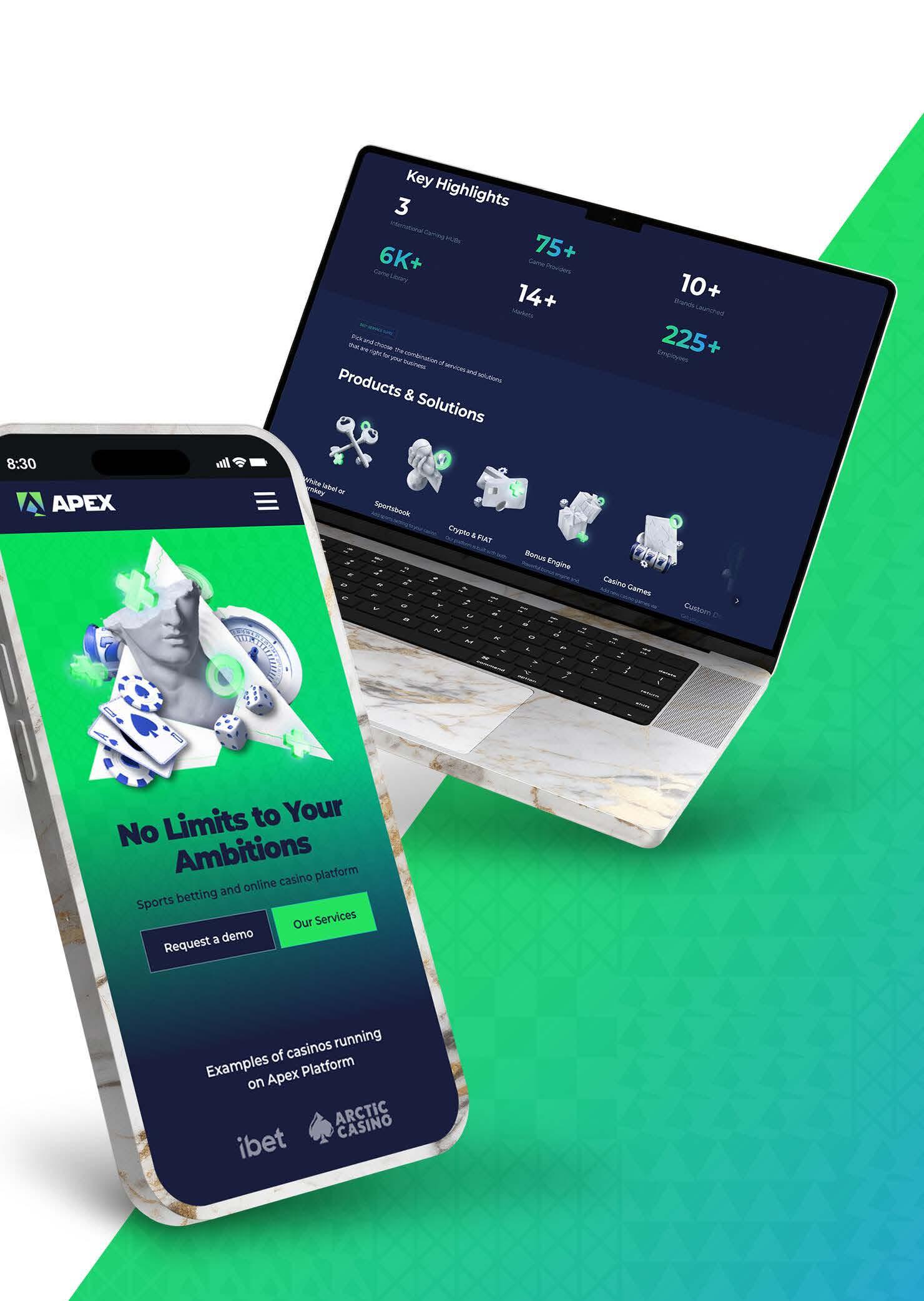
Apex Platform is driven by the mission to empower the next generation of iGaming operators through a modern infrastructure that removes traditional barriers to entry. We provide a flexible, fast, all-in-one solution that allows operators to launch online casinos or sportsbooks with “no limits to their ambitions”, a philosophy that defines how we work. Unlike legacy solutions, we don’t offer a one-size-fits-all approach. Apex offers a pre-built, readymade platform that includes everything from games and payments to CRM and compliance, while still giving operators the flexibility to customise the front-end design and player experience to align with their brand vision. Our core value proposition is simple: we take care of the backend heavy lifting; technology, licensing, and integrations, allowing operators to focus on creativity, marketing, and providing an exceptional player experience. By lowering
the entry threshold, we enable smaller or newer brands to compete at a high level right from the start.
QApex launched as a nextgeneration platform built for speed, scale, and simplicity. How do these pillars directly translate into competitive advantages for operators?
ASpeed, scale, and simplicity are fundamental to Apex’s design and provide distinct competitive advantages.
Speed translates to quicker time-tomarket and optimal performance. A new brand can launch in as little as 12 weeks, fully tested and ready. This agility allows operators to capitalise on market trends or seasonal opportunities much sooner than competitors stuck in lengthy development cycles. Apex is also engineered for fast load times, enhancing the player experience and keeping engagement levels high.
Scale encompasses both technical scalability and business growth. Apex
is built to seamlessly support growth, whether an operator has 100 players or 100,000. Our cloud-based, modular architecture ensures the platform scales effortlessly without performance hiccups. This gives operators the confidence to pursue aggressive growth strategies, knowing the platform can handle increased demand.
Simplicity focuses on ease of use and operational efficiency. We’ve designed an intuitive back office and toolset that simplifies complex tasks like configuring bonuses, segmenting players, and pulling compliance reports. This reduces the need for specialised IT resources, lowering operating costs and freeing up time for operators to focus on player engagement rather than technical hurdles. In essence, Apex’s combination of speed, scalability, and simplicity allows operators to move faster, grow larger, and run more efficiently.
QWith the market’s growing pressure to launch new brands faster without sacrificing compliance or player experience, how does Apex meet this challenge head-on?
AApex was specifically designed to meet this challenge. We recognise that speed cannot come at the expense of compliance or player experience. A fast launch is only valuable if it adheres to strict regulatory standards. To address this, Apex pre-integrates and pre-certifies essential components, such as KYC/AML processes, anti-fraud measures, data security, and responsible gambling features. These are built into the platform by default, ensuring compliance from day one.
When it comes to player experience, Apex includes a suite of industry-proven frontend templates and UX components. Operators can customise the look and feel of their site, but they’re building on a foundation of best practices for user experience. Furthermore, Apex comes with pre-integrated game providers and payment solutions, allowing operators to
launch with a rich content library and the most popular payment methods without the lengthy integration phase. This results in a faster, fully compliant launch with an outstanding player experience.
QTurnkey and white-label solutions are common in iGaming, but what makes Apex’s approach truly disruptive and differentiated?
AApex stands out as a truly nextgeneration platform that goes beyond traditional white-label solutions. While white-label options often limit customisation, Apex combines the convenience of turnkey solutions with unparalleled flexibility.
We offer both white-label and turnkey models. Operators can use our gaming license and complete service suite, or, if they already have their own license, they can utilise just the technology. This flexibility allows us to meet operators where they are, without forcing them into a rigid framework.
What truly sets us apart is our emphasis on operator empowerment. Apex is highly customisable and modular. For example, if an operator wants a unique front-end design, they can use our flexible frontend tools or build something custom on top of our APIs. Our modern tech stack allows us to easily add new integrations, meaning operators aren’t locked into predefined options. Additionally, Apex includes advanced features such as a built-in bonus and promotion engine, and a mobilefirst design approach, which are typically available only as bolt-on solutions with other platforms.
In short, Apex allows operators to be more creative, player-centric, and agile, something that traditional white-label platforms struggle to match. By using the latest cloud-native and microservices technologies, we also provide the speed and flexibility needed to stay ahead of emerging trends, making Apex a gamechanger in the iGaming space.
QApex boasts pre-integrated games, payment solutions, CRM, and regulatory tools out-of-the-box. How does this all-in-one integration transform operational efficiency for operators?
AThe all-in-one nature of Apex is a massive operational efficiency boost. It’s like having a fully equipped “casino-in-a-box” on day one. Instead of spending months negotiating and integrating with multiple vendors, operators can get started immediately with Apex’s pre-integrated library of over 1,000 games, major payment methods (including crypto), CRM systems, KYC tools, and more.
This approach significantly reduces complexity. Operators manage everything from one unified system with a single back office, eliminating the need for multiple dashboards and logins. It also reduces human error and saves time, as data flows seamlessly across the platform, allowing for centralised reporting and analytics. Moreover, the pre-integrated nature of the platform means faster issue resolution. If a problem arises, Apex can quickly pinpoint the issue and minimise downtime, which keeps operations running smoothly.
In addition, Apex makes scaling easier. When operators want to expand into new markets or launch a second brand, the integrations are already in place, requiring little more than deploying a new skin and configuration.
QHow does Apex maintain technological agility and innovation velocity in an industry where market demands and player expectations shift rapidly?
AApex’s agility stems from its modern, microservices-based architecture, which allows us to continuously roll out updates, new features, or integrations with minimal
disruption. This flexibility means we can stay ahead of industry trends and quickly respond to shifts in market demands or player expectations.
For example, Apex’s mobile-first design ensures casinos run flawlessly across all devices, and our in-house gamification engine allows operators to deploy engagement features such as real-time rewards, tournaments, and missions. When trends like cryptocurrency or AI became prominent, we quickly integrated them into the platform, giving our clients a competitive edge.
Apex’s ability to innovate at speed is also driven by our close communication with operator partners. We take feedback seriously, and many of our best innovations come from listening to the needs of the operators we work with. We can rapidly prototype and deliver custom solutions when needed, and if successful, integrate them into the core platform for all operators.
QHow is Apex’s architecture engineered to serve both startups entering iGaming and established operators seeking scalable, flexible infrastructure?
AApex’s architecture is versatile and designed to meet the needs of both startups and established operators. For startups, the turnkey model provides everything they need to get up and running quickly, with low upfront costs and minimal technical overhead. They can launch a brand quickly and efficiently, leveraging our shared infrastructure and integrations.
For larger operators, Apex offers the flexibility to integrate with their existing systems and scale as needed. We can deploy Apex in dedicated environments or connect with custom front-end systems, CRM tools, or loyalty programs through our robust API layer. The platform can handle high volumes of transactions and concurrent users, making it suitable for operators who need to support a large, growing player base.
Ultimately, Apex adapts to the operator’s size and needs, ensuring that both small startups and large, established brands can benefit from its cutting-edge capabilities.
QPartnerships are essential to iGaming success. How is Apex building and nurturing its ecosystem to empower operators?
AApex understands the importance of a strong partner network in iGaming. We’ve built a robust ecosystem that includes a wide range of game providers, payment gateways, CRM tools, fraud detection services, and more. Our partnerships give operators access to a diverse and comprehensive selection of games and services, all pre-integrated into the platform.
We also work closely with industry events and other B2B providers to form strategic collaborations that benefit our operators. Whether it’s integrating new payment methods or collaborating with innovative startups, we make sure Apex stays at the cutting edge by continuously expanding its ecosystem. This network empowers our operators by giving them access to the best tools, content, and services in the industry.
QWith upcoming events like SiGMA, ICE, and iGB Live, what are Apex’s headline innovations and strategic priorities you plan to showcase?
AAt these events, we’re excited to showcase Apex’s “brand launch speed-run” capability, where we’ll demonstrate how quickly a new casino can be set up on our platform, launching in minutes, not months. We’ll also highlight our multi-jurisdiction capabilities, showing how Apex can seamlessly launch brands in different markets with support for multiple languages, currencies, and region-specific content.
We’ll also reveal new partnerships and innovations, underscoring that Apex is not only at the forefront of iGaming technology but also continuously evolving to meet the demands of the market.
QLooking ahead, what is Apex’s strategic roadmap for growth, market penetration, and further evolution as a platform?
AApex is focused on expanding into emerging markets while enhancing its platform with AI, machine learning, and community features. We’re investing heavily in personalisation, predictive analytics, and social gaming features to ensure operators remain ahead of the curve. Our goal is to become the platform that powers iGaming brands worldwide, from mature markets to the next frontier jurisdictions. We want Apex to be synonymous with cutting-edge technology, flexibility, and operator empowerment, shaping the future of iGaming for years to come.
www.apexplatform.io
Post-NEXT.io Interview with Sharon Agimal, Apex
QSharon, reflecting on Apex’s engagement with the iGaming community at NEXT.io, how would you assess the company’s positioning and momentum following the event?
ANEXT.io in Valletta was a pivotal moment for Apex. It was a resounding success for us as a newcomer in the platform space. We saw a significant amount of interest, and the buzz around our product was palpable. The conversations we had with operators, suppliers, and investors all validated the need for a fresh, agile platform solution. Coupled with Eagle Hub, our aggregator,
Apex brings the industry’s pressing demands into clear focus.
Our positioning in the market is crystal clear, we offer a high-speed, scalable white-label and turnkey solution. This resonated with everyone we spoke to, particularly brands eager to move quickly without compromising on quality and capability. Following the event, the momentum has only grown, with a notable uptick in interest and leads that have progressed into established discussions. The energy at NEXT.io was dynamic, forward-thinking, and driven by innovation and operator agility. Apex fit seamlessly into that narrative.
Agimal,
Sharon Agimal , APEX, B2B Sales and Accounts
QCan you share insights into the development process of Apex? What were some of the key challenges encountered, and how were they addressed?
AApex is the result of everything we’ve learned, often through experience, and occasionally, through adversity. The development process focused on eliminating friction for both operators and players. We were determined not to build just another platform with long lead times and vague roadmaps. Speed and structure had to coexist harmoniously, so we made significant upfront investments in technology and pre-integrated services such as payments, content, and compliance.
One of the greatest challenges we faced was balancing speed with flexibility, something many platforms struggle with. Some platforms excel in one but not the other, and we wanted both. We created a solution that is fast to market, yet flexible when issues arise. Instead of deliberating on whether something can be done, we focus on action. We took a step back to understand the bigger picture, drawing from our experiences to develop a platform that places the client’s needs at the centre. From seamless onboarding to continuous support as clients go live, our goal has been to remove obstacles from the start.
QIn what ways does Apex differentiate itself in the competitive iGaming market, and what unique value does it offer to users?
AWhat sets Apex apart is our approach: we think like operators, not just platform providers. The market is crowded with systems that are either too rigid or overly complex. Apex prioritises speed to market and ease of use. We’ve built something lean, fast, and highly intuitive. While others rely on long development cycles, we focus on efficient onboarding, fully documented processes, and hands-on support throughout.
For our partners, this means launching a new brand in as little as 12 weeks, with no compromise on player experience or scalability. Apex isn’t just a product, it’s a managed solution backed by a team that understands the operational realities of running a casino business. A key takeaway from NEXT.io was the frustration operators feel when locked into technology that fails to scale or evolve. Apex isn’t just about tech; it’s about ensuring our partners understand what it takes to operate, launch, and grow in this industry.
QHow has the response been from the iGaming community and early adopters at NEXT.io and beyond? Have any early learnings influenced the product’s direction?
AThe response has been overwhelmingly positive. Operators frustrated with legacy tech and slow development cycles have been particularly receptive. Clients have already noticed the speed with which they can go to market and the intuitiveness of our tools, especially the CMS and promotional engines. During the event, conversations were centred around key pain points, particularly slow delivery times and inflexible roadmaps. This feedback has only reaffirmed that we’re on the right track.
Live clients are particularly impressed with how ready the platform is, getting live quickly is crucial in this fast-paced industry, and time is money. Another learning from these conversations is the lack of out-of-the-box thinking in the market. Many systems are rigid, but Apex is built on adaptable technology that can evolve with client needs. We encourage our clients to bring their ideas to us, and we turn them into reality.
QConsidering the rapid advancements in technology, does Apex remain adaptable?
AAdaptability is built into our platform’s DNA. It’s one of our core strengths. From the outset, we designed Apex to be modular, allowing clients to plug in new technologies seamlessly and enabling us to respond swiftly to changes. Whether it’s new payment methods, AI-driven tools, or player protection enhancements, our platform’s structure facilitates integration without disrupting the client ecosystem. At NEXT.io, discussions around AI and automation were prominent. This is not just a future concern, it’s happening now. We’re committed to staying ahead of these trends, embedding smart tools that help operators make faster decisions, segment players more effectively, and reduce manual interventions. We’re not just watching trends; we’re building alongside them.
QWhat role does data analytics and user insight play in Apex’s design and ongoing development?
AData drives everything we do. From how we design brand experiences for our operators to prioritising platform features, data is central to our decision-making. We continually assess how clients interact with the platform, ensuring it remains intuitive and responsive. Regular feedback sessions help us identify friction points quickly, enabling us to add value where it’s most needed. Communication is essential, and our roadmap is informed by real-time client needs, not assumptions.
Real-time data is critical for understanding player behaviour, GGR, retention, FTDs, and other metrics. This level of agility has a profound impact on retention rates and overall profitability. We’re committed to using this data to continuously enhance the platform’s value.
QLooking ahead, what are the key milestones or innovations planned for Apex over the next 12 months?
AThe next 12 months will be transformative for Apex. We’re expanding rapidly and focused on offering our partners the reliability, stability, and evolution they need. We’re developing more features to further support our clients and enhance the value we deliver.
Key priorities include expanding our onboarding and account management functions to provide even more tailored support, whether for white-label partners looking to launch quickly or turnkey clients with more bespoke requirements. The goal is to scale confidently, ensuring that our clients have everything they need to succeed. The focus isn’t just on what the platform can do, but on how easy and efficient it is to run a business using Apex.
sharon@apexplatform.io
A Vision for the Future of i-Gaming
“It’s a very exciting time to be a part of the business,” said Casumo’s Chief Technology Office (CTO), Cristina Turbatu, who joined the company in July 2023 as part of a complete C-suite overhaul.
The change of leadership has reignited a spark within the company to push boundaries and drive innovation within the i-gaming industry.
Forming part of Casumo’s vibrant, new identity, it has made significant investment into its front end, which has seen responsiveness improve by up to 70%.
“The business has seen a real turnaround in the last year and I am thrilled to be part of a team pushing boundaries,” shared Cristina, “we’re looking forward to measuring the impact that the changes we are making have had”.
2023 saw pivotal change for one of Europe’s most innovative online gaming platforms, Casumo.
Project directed by:
Written by: Laura Green Jess Collins
Causumo
CTO Cristina Turbatu
Following over a decade working in technology and innovation, CTO Cristina joined Casumo to support the business in building a robust technology strategy which is secure and scalable, ensuring ongoing growth of the business and its capabilities.
Inheriting a team which needed a renewed sense of guidance and purpose, Crisitna has imparted a culture of inclusivity, innovation, and decisiveness within her team, whilst also prioritising creativity.
“It’s also crucial that tech development isn’t isolated, and so I drive an environment of transparency, opencommunication, and cross-functionality,” explained Cristina.
Cristina also highlighted the internationality of the technology team, which fosters an environment of kindness and challenge with respect.
Despite Cristina’s focus on creativity, she also highlighted the importance of utilising data to drive improvements.
Partnerships Optimise Security
Casumo, which holds licences in Matla, the UK, Sweden, and Spain, offers gamers distinctive and innovative online casino experiences, as well as sports betting.
With this in mind, it is crucial that the business implements banking standards to ensure security for its customers. To support this, in 2023 Casumo migrated its platform to Google Cloud, in a move which Cristina described as a “game changer”.
“Our relationship with Google Cloud and their sales partner in Malta, AmagisTech, has been a true partnership, with their team offering a lot of support and training to ensure a smooth transition and enabling us to build a more robust platform,” she said.
Casumo has developed a rigorous protocol to ensure Casumo gamers can enjoy i-gaming safely and securely.
The business has implemented advanced encryption to ensure data protection, as
well as a complete and transparent audit trail for all transactions.
Partnerships, such as its one with Google Cloud, are crucial for Casumo’s growth, with Cristina commenting that these relationships help to “build trust and leverage” with customers.
Additionally, it supports the business in enhancing and expanding, on its mission to become an entertainment platform and not simply a gambling platform.
“It’s incredibly important to us that we encourage our users to play for entertainment and not to encourage unhealthy gambling habits,” said Cristina.
Industry-Leading Transformation
Alongside Casumo’s rebrand and c-suite reorganisation, the business has been implementing its digital transformation strategy in order to develop a seamless and efficient experience for users.
“We have been transforming both internally and externally in order to better our user experience,” explained Cristina.
The business is currently focussing on its backend system, ensuring that it is fit for efficient scalability and plugging-in of new innovations.
In order to deepen engagement with its users, the online casino platform is enhancing its user experience by utilising AI technologies.
“AI has enabled us to develop an algorithm to offer personalised game suggestions based on user preferences. We plan to develop this further to offer our users the most personalised experience on the market,” explained Cristina.
“As we move forward, Casumo wants to influence market standards and lead by example,” she added.
Leading by example, Casumo has a strong representation of women in leadership roles, reflecting the company's commitment to diversity and inclusivity at the highest levels of the company.
“Our diverse and inclusive environment sends a strong message that we employ based on talent and experience, seeking the best people from around the world to drive Casumo forward for the benefit of our users,” said Cristina.