THE ENTERPRISE DOES NOT NEED REBUILDING. IT NEEDS REWIRING.



THE ENTERPRISE DOES NOT NEED REBUILDING. IT NEEDS REWIRING.
TIBCO PROJECT DIRECTED BY: JENNIFER DAVIES

There is a quiet but decisive shift taking place inside large enterprises. It is not defined by wholesale reinvention, nor by the fashionable rhetoric of tearing everything down to start again. Instead, it is characterised by something far more pragmatic and, ultimately, more difficult to execute: modernisation without destruction. In an era dominated by AI headlines and cloud-first mandates, the real challenge for enterprise leaders is not whether to transform, but how to do so without undermining the decades of systems, processes and intellectual property that continue to run the global economy.
This is the context in which TIBCO now finds itself. Long recognised for its role in integration, messaging and real time data, the business is deliberately reframing its place in the enterprise stack. Not as a disruptive force that demands replacement, but as an enabling layer that allows innovation to happen where it matters most, on top of what already works.
At the centre of this evolution is Ali Ahmed, President of TIBCO, whose perspective has been shaped by a 25 year tenure that spans multiple technology cycles. His message is clear and notably unsentimental. Enterprises do not need to abandon their past to claim their future. They need platforms that respect both.
“Too many organisations are paralysed by the belief that they must reimagine their core systems to adopt AI,” Ahmed says. “The reality is that those mission critical systems are the very assets that need to be protected, not replaced.”
This philosophy underpins TIBCO’s approach to what it calls modernisation in place. Rather than asking customers to rewrite transactional systems or migrate everything into the cloud, the business

has built a platform designed to sit across environments, spanning on-premise infrastructure, public cloud services and edge deployments, all managed through a unified control plane. The ambition is not abstraction for its own sake, but operational coherence. A single way to see, manage and extend an estate that is already complex and often fragmented.
That fragmentation has long been one of enterprise IT’s most persistent burdens. Over time, powerful tools accumulate in silos, each with its own licences, interfaces and monitoring frameworks. The result is capability without cohesion. TIBCO’s response was the launch of the unified TIBCO® Platform in June 2024, consolidating products, subscriptions and management into a single operational and commercial model.
“Before the platform, customers were managing different products with different logins, licences and monitoring tools,” Ahmed explains. “It was powerful, but operationally very heavy. The unified platform gives them one control plane and one subscription that removes both technical and commercial friction.”
The implications of that simplification are significant. From an operational standpoint, teams can deploy cloud native services, monitor legacy engines and track event flows from a single pane of glass. Commercially, access to the full platform removes the gating effect of procurement cycles, allowing teams to experiment, adopt new capabilities and scale successful initiatives without renegotiating contracts at every step. In effect, the platform turns TIBCO from a collection of tools into a flexible innovation partner.
That flexibility is increasingly defined by composability, a term often used loosely but treated with precision here. In practical terms, composability means replacing rigid, monolithic applications with modular capabilities that can be assembled and reassembled as needs change. For enterprise technology teams, this represents a shift from building everything from scratch to orchestrating outcomes from reusable components.
“Composability is about moving away from monolithic applications towards a library of reusable business capabilities,” Ahmed says. “Teams stop rebuilding the wheel and start assembling solutions that are focused on outcomes rather than plumbing.”
TIBCO’s vision pushes this further by introducing AI driven composability. Instead of developers manually wiring integrations, the platform increasingly allows intent to drive execution. A user describes what they want to achieve, such as creating a real time pipeline between ERP and CRM systems, and the platform selects and composes the necessary components automatically. The aim is not simply speed, but accessibility. Lowering the barrier to innovation so that more of the organisation can participate in building value, without compromising governance or reliability.
This balance between speed and control becomes especially critical in the context of generative AI. While enthusiasm for large language models is widespread, enterprise adoption has been constrained by a fundamental concern: data. Models are only as useful as the information they can access, and for most organisations, that information is private, regulated and deeply sensitive.
“The biggest barrier to enterprise AI is not the model,” Ahmed notes. “It is the risk of exposing your private data.”
TIBCO’s response has been to evolve its ActiveSpaces® technology into a secure vector database designed for enterprise use. Proprietary data, from customer records to transaction histories, can be transformed into vector embeddings that remain within the organisation’s own environment. These embeddings can then be used in retrieval augmented generation workflows, allowing AI systems to access relevant context without that data ever leaving the firewall or training public models.
“It becomes a safe bridge between your private intellectual property and public large language models,” Ahmed says. “You get the power of semantic search and AI reasoning, but wrapped in the governance,
>Behaim became a TIBCO Services Partner in 2005 and operates in North America and Central Europe. Over the past 2+ decades Behaim has grown with TIBCO’s core Integration, EDI and File Transfer offering, covering Containers, Cloud, CI/CD, and now AI through various homegrown solutions proven across enterprise customers. Behaim ITS has won the TIBCO Partner Excellence award 4x times.
Behaim ITS’ current focus with TIBCO is on bringing the TIBCO Platform successfully to TIBCO’s customers around the globe Behaim does this with its Services offering and AI solutions
Behaim’s TIBCO Platform Services cover the core products within the Platform, that means: Integration, MFT, EDI, and all plugins As the TIBCO Platform covers all these products, and customers might not use all of them, Behaim is able to either deliver mature expertise to products the TIBCO customers use, or drive POCs for infant TIBCO products that have the customer ’s interest. In addition to covering all TIBCO Platform products,
Behaim works closely with TIBCO on all new TIBCO Platform Portal and Developer Hub releases, allowing Behaim to educate its customers on leveraging the most out of the TIBCO Platform
Behaim’s AI solutions for the TIBCO Platform have a main goal of driving more value out of the TIBCO Platform for TIBCO’s customers
We achieve this in teaching customers to develop faster into the TIBCO Platform by Behaim’s TIBCO Agentic Coding guidelines and Behaim’s CI/CD
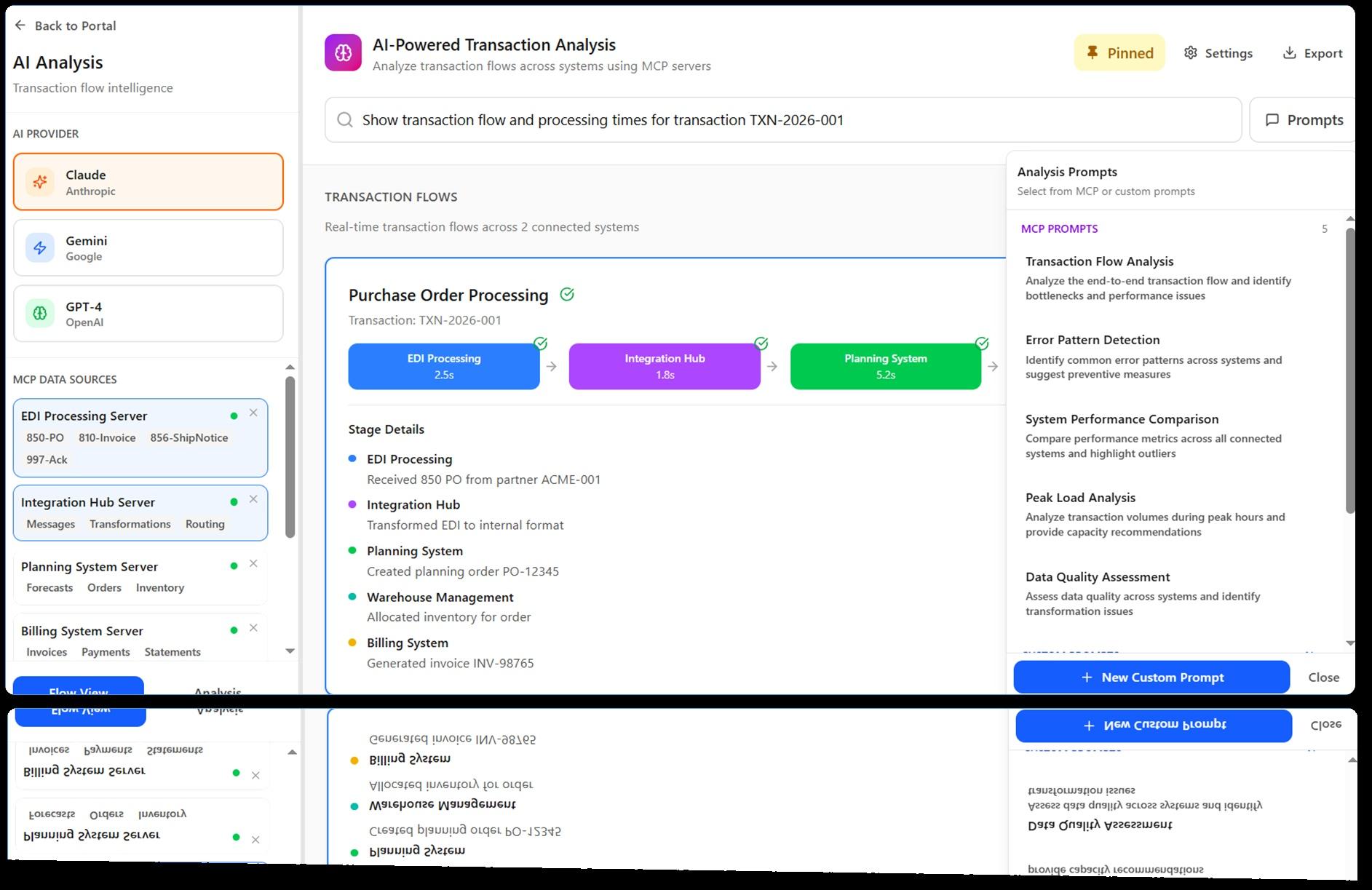
In the Platform, Behaim’s MCP servers deliver End to End Visibility (see screenshot) across the EDI, MFT, and / or Integration Business Flows to give customers a complete picture of their business transactions.
The TIBCO Platform also has strong value through its all you can eat licensing covering all of TIBCO’s products This means that standardizing on TIBCO’s platform for a customer ’s Integration needs has usually delivered a 12 to 18month ROI
Behaim AI Powered Portal increasing visibility and improving application management including AI drive troubleshooting.
Behaim achieves this through its AI powered Integration Migrator Behaim’s migrator takes Boomi, Mulesoft, or any other Integration platform input, and is able to convert it automatically to TIBCO BusinessWorks Each step of the process is automatically documented giving the customer full insight into the process. Behaim covers any custom activities, libraries, or outliers through its migration services offering
security and compliance enterprises already trust.”
That same philosophy extends to TIBCO’s work around Model Context Protocol and the newly introduced Flogo® Connector for MCP. In simple terms, the connector acts as a translator between enterprise systems and AI tools such as ChatGPT or Copilot, exposing existing integrations as standardised interfaces that AI models can call directly.
“It turns your enterprise systems into tools that AI can understand,” Ahmed explains. “Instead of an AI hallucinating an answer, it can securely reach into live systems to fetch real time facts or trigger actual workflows.”
The distinction is subtle but profound. AI shifts from being a passive generator of content to an active participant in business processes, capable of executing tasks within defined boundaries. This is where real-world adoption begins, not in novelty demonstrations, but in compliant, auditable actions that deliver measurable value.
Underpinning all of this is an architectural commitment to hybrid and multi cloud deployment. For most large organisations,
standardising on a single cloud provider is neither realistic nor desirable. Regulatory constraints, cost optimisation and performance considerations all demand flexibility. TIBCO’s Kubernetes native architecture decouples software from infrastructure, allowing deployments to move across environments without rewriting applications or renegotiating licences.
“You are not buying an AWS version or an Azure version,” Ahmed says. “You are buying capabilities that you can shift between clouds or on-premise environments instantly.”
Kubernetes becomes the common denominator, presenting a uniform fabric to the control plane whether workloads run on managed cloud services or private infrastructure. For operations teams, this consistency simplifies management and security. For business leaders, it preserves optionality in a market where conditions change quickly.
Observability is another area where consolidation delivers tangible returns. Managing separate monitoring tools for legacy systems and cloud native services


is expensive and inefficient. The TIBCO® Control Plane addresses this by providing deep, context-aware visibility that traces business processes end to end, even when they span decades old applications and modern microservices.
“It understands business context, not just infrastructure metrics,” Ahmed says. “You can trace a specific order or process instance across your entire estate in a single view.”
Crucially, this visibility is delivered without locking customers into proprietary dashboards. By embracing open telemetry standards, logs, metrics and traces can flow into existing enterprise observability platforms, preserving investments while enhancing insight. It is a pattern repeated throughout the platform: integration without entrapment.

We make it happen together!
Axis Technologies has been a long standing TIBCO Platform Partner for over 15 Years helping Clients reach their DT Goals on time and on budget.
We serve multiple industries:
• Aerospace & Defense
• Manufacturing
• Energy,
• Supply Chain
• Financial Services
None of this operates in isolation from TIBCO’s partner ecosystem, which has long been central to its market presence. In the platform era, partnerships are evolving from reselling relationships into co-creation models, where industry expertise and technical capability converge to deliver repeatable solutions.
“Our partners bring the industry use cases,” Ahmed says. “We provide the platform and the technology teams to help turn those into real solutions.”
The refreshed partner programme reflects this shift, enabling systems integrators and resellers to build, license and sell industry-specific offerings on top of the TIBCO Platform. Success is measured not by volume alone, but by the ability to create solutions that can be deployed repeatedly, scaled efficiently and adapted as needs evolve.
As enterprises look ahead to the next decade, the message from TIBCO is notably restrained. There is no call to abandon stability in pursuit of innovation, nor any suggestion that AI demands a clean slate. Instead, the argument is that resilience and progress are not opposing forces.
“Stability does not have to be the enemy of innovation,” Ahmed says. “You can protect your core systems, unify your operations and accelerate AI adoption at the same time.”

Axis Technologies is providing a New Client Incentive Pricing for new Services Engagements, limited time.


It is a message that resonates precisely because it acknowledges the realities enterprise leaders face. Digital transformation is not a single project with a defined endpoint. It is an ongoing negotiation between what must be preserved and what must be enabled. In positioning itself as the composable backbone of that negotiation, TIBCO is betting that the future of enterprise technology will be built not by burning down what exists, but by rewiring it intelligently for what comes next.
In a market often dominated by extremes, that may prove to be its most radical stance of all.
www.tibco.com