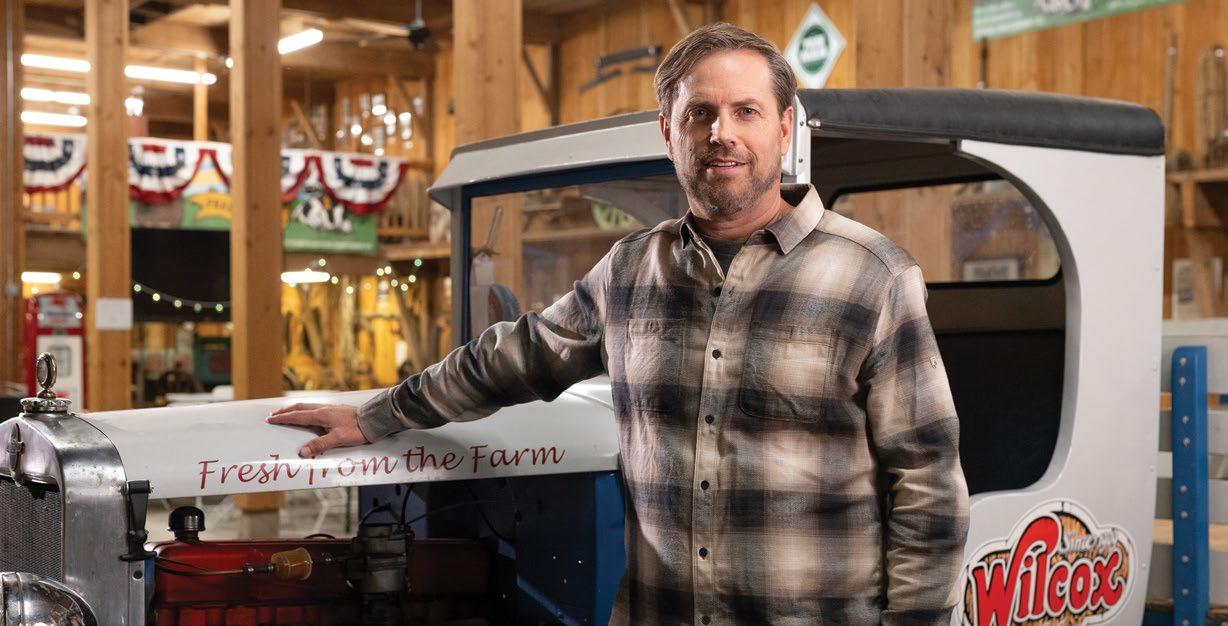
— Brent Wilcox Fourth Generation Owner Wilcox Family Farms
Your local business news brought to you by WHATCOM BUSINESS ALLIANCE
VOL. 51 | NO. 4
PULSE EDITOR/PUBLISHER AND WBA EXECUTIVE DIRECTOR
Barbara Chase
CONTRIBUTING WRITERS
Matt Benoit
Tamara Loucks
Tony Moceri
Cheryl Stritzel McCarthy
Mary Louise Van Dyke
GUEST COLUMNISTS
Levi Carlisle
Justin Gross
Mark Harmsworth
Dann Mead Smith
Elizabeth New
Steve Scranton
COMMUNICATIONS DIRECTOR
Tara Gilligan Reimer
PHOTOGRAPHY
Sattva Photo
COPY EDITOR
Matthew Anderson
Bellingham PR & Communications
WBA BOARD OF DIRECTORS
BOARD CHAIR: Josh Wright, Partner, Acrisure
EXECUTIVE COMMITTEE: Jon Ensch, Regional Commercial Director, Peoples Bank; John Huntley, President/CEO, Mills Electric Inc.; Doug Thomas, Senior Advisor, Lineage; Josh Turrell, Partner, Larson Gross PLLC
BOARD OF DIRECTORS: Kevin Bedlington, Senior Vice President, Washington Trust Bank; Jane Carten, President, Saturna Capital; Bryant Engebretson, Managing Principal, Tradewinds Capital; Mitch Faber, Partner, Faber Fairchild McCurdy LLP; Sandy Keathley, Former Owner, K & K Industries; Tamera Lienhart, Government Affairs Manager, bp Cherry Point Refinery; Sarah Rothenbuhler, Owner/CEO, Birch Equipment; Billy VanZanten, COO, Western Refinery Services; Tony Larson, WBA Founder Emeritus
POSTMASTER: Send address changes to Business Pulse, 1225 Roeder Ave., Ste. 108, Bellingham, WA 98226
Up Front
The best of us: Here are the companies and contributors shaping the economic landscape of Whatcom County
Finance
Personal finance strategies for business owners
Economic development Whatcom County is a diversified economy under near-term strain
Government Why business leaders need to pay close attention to the actions of the Washington Supreme Court
AI
When your customers ask AI, does your business rise to the top?
Human resources
Workers are staying put, but that does not mean all is well
Capital Chair/ CEO Jane Carten invests
The Top 100! Celebrating the employers, champions and drivers of our local economy
Barbara Chase is the editor of Business Pulse magazine and executive director of the Whatcom Business Alliance.
Each year, we are pleased to present the Top 100 Private Companies in Whatcom County, recognizing the organizations that play a vital role in driving our local economy. Compiled by Business Pulse in partnership with the Whatcom Business Alliance, this ranking highlights privately held companies headquartered in Whatcom County and is based on reported 2025 gross revenue. Collectively, these businesses generate billions of dollars in annual revenue, support thousands of jobs and contribute significantly to the economic strength of our region.
For nearly four decades, Business Pulse has published this annual report to showcase not only the scale of our local business community but also the leadership, innovation and entrepreneurial spirit behind its success. While the ranking is based on revenue, the Top 100 is about much more than financial performance. It reflects the determination, adaptability and long-term commitment of companies that continue to invest in their employees, customers and communities. Check out one local manufacturing business founded in 1878!
As with every edition, our team worked diligently to identify and verify qualifying companies. In some cases, organizations that appear to meet the criteria were unable to confirm financial information before publication deadlines, while others may have been inadvertently omitted despite our best efforts. We welcome feedback from companies that believe they should be considered for future editions.
The economic impact of Whatcom County
extends well beyond the private companies featured in this report. Major employers and contributors to the local economy — including publicly traded corporations, industrial operations at Cherry Point, educational institutions, healthcare providers and nonprofit organizations — also play essential roles in supporting regional growth and prosperity. While these organizations may fall outside the scope of our ranking, their contributions remain significant.
Creating a business environment where companies can grow, invest and succeed benefits the entire community. Local businesses generate employment opportunities, attract new investment, strengthen local supply chains and help sustain the quality of life residents enjoy throughout the county. Although rising costs, workforce challenges and economic uncertainty continue to impact organizations across industries, many local companies demonstrated remarkable resilience and growth over the past year.
The WBA has been working alongside Whatcom County Council members, community partners and stakeholders during the long and arduous Comprehensive Plan process (the plan that will guide the next 20 years of growth in Whatcom County) and the many concerns that have been raised surrounding the proposed language and amendments to the plan. We proposed that the amendments should support and encourage the development of housing, enhance economic development opportunities, support the creation and retention of living-wage jobs, and protect and expand industrial lands. At publication, the process is ongoing, and we are hopeful that the council will act in the best interests of our community, par-
ticularly regarding land-use policies. In a May 20 letter to the council, Whatcom County Executive Satpal Sidhu issued a dire warning about the lack of shovel-ready industrial land availability, and his “core recommendation has been to take bold and transformational steps to stimulate economic development in Whatcom County.” The Growth Management Act (passed in 1990) made Washington one of the first states in the country to implement a stifling statewide land-use policy. The plan updates give our county an opportunity to make wise decisions to encourage industry to develop in our region, but will the County Council’s final decisions work toward achieving these goals?
Recently, the city of Bellingham Mayor’s Office announced an executive order that intends to consider how the office can better support local businesses and expand economic opportunity by reviewing permitting, licensing and regulatory requirements to reduce barriers that stifle business development in our region. A public meeting is set for 9 a.m. on Aug. 12, with further details to be announced. We encourage business leaders to join the conversation with their valuable input!
This issue includes Top 100 highlight stories. Western Refinery Services focuses on both its clients and employees, with diverse contracting and employee ownership. Hytech Roofing showcases product quality and cus-
tomer experience. Natural Way Chiropractic & Massage provides pain relief and healing to patients.
Readers will also find coverage of notable business developments and examples of companies adapting to changing market conditions. We feature profiles of established local organizations, multigenerational family businesses and emerging leaders that continue to shape the future of Whatcom County’s economy. In addition, this issue includes insights on technology, finance, public policy and other topics affecting businesses across the region.
Producing the annual Top 100 is a collaborative effort, and we extend our appreciation to the companies that participate, the advertisers and sponsors who support this publication, our contributors and staff and the readers who make it possible. Their engagement helps us continue telling the stories of the businesses that power our local economy.
We encourage our readers to support local businesses whenever possible. Their success strengthens our communities, creates opportunities for future growth and reinforces the economic foundation that benefits us all.
For information on upcoming networking events, leadership programs and economic forums hosted by the Whatcom Business Alliance, visit our website and stay connected with the region’s business community.
Enjoy the start of summer and one of our biggest issues of the year!
Brad Barron announces expansion of Barron Plumbing
Barron Plumbing has expanded its capabilities, adding sewer line maintenance and repair and replacement services for residential and commercial customers.
“With an in-house licensed plumbing team already in place at Barron, supporting homeowners and business owners with their side sewer projects makes coordinating plumbing work simple and cost-effective,” said Brad Barron, CEO of parent company Barron Heating AC Electrical & Plumbing.
Brad Barron, CEO
Barron said demand for residential sewer services is increasing due to the number of side sewers, which connect to a city’s sewer lines typically along the street, that are aging and made of older materials that no longer meet industry standards. Sewer lines older than 50 years that were made from cast iron, clay or Orangeburg (fiber) are particularly susceptible to deterioration or collapse, he added.
Thousands of homeowners in the Pacific Northwest are affected by side sewer challenges, Barron said. The most common challenges arise from root intrusion (by far the top issue), pipe deterioration and collapse, ground movement and settlement, debris and grease buildup, improper installation due to older standards, and infiltration and inflow due to rainwater.
Barron Plumbing offers a wide range of sewer-related services, including drain cleaning, line location, repairs and smoke testing for undesirable smells.
“We’re using modern pipe bursting and lining techniques that often can avoid digging unsightly trenches to reach affected lines and install new lines,” Barron said.
Washington Trust Bank promotes Kevin Bedlington
Washington Trust Bank has announced the promotion of Kevin Bedlington to senior vice president and team leader of its Bellingham commercial team. He previously served as a vice president and commercial relationship manager.
Bedlington, who has more than 22 years of banking and commercial lending experience, joined Washington Trust in November 2022. Throughout his career, Bedlington has shown a well-rounded knowledge of the business, building relationships and serving clients throughout the Puget Sound. He has extensive experience in business development.
Kevin Bedlington, senior vice president and team leader
“I’m more than confident in Kevin’s ability to lead our commercial team in Bellingham, given his proven track record of helping commercial clients in the Puget Sound achieve their goals,” said Craig Manalili, regional president at Washington Trust. “His experience helping clients across a wide variety of indus-
tries by using his business development acumen makes him more than qualified to lead the team.”
Washington Trust Bank is the largest independently owned full-service commercial bank in the Northwest, serving the region since 1902. A wholly owned subsidiary of W.T.B. Financial Corporation, Washington Trust Bank has $11 billion in assets. Headquartered in Spokane, Washington Trust Bank has 45 branches and offices in Washington, Idaho and Oregon and employs approximately 1,200 people.
Downtown Sounds:
Lindsey Payne Johnstone showcases partnerships with local companies, nonprofits
The Downtown Bellingham Partnership, led by Executive Director Lindsey Payne Johnstone, has announced the return of Downtown Sounds for its 22nd season, bringing free live music, local artists and community activities to downtown Bellingham on Wednesday evenings from July 8 through Aug. 5.
Lindsey Payne Johnstone, executive director
Each week, Downtown Sounds transforms the Arts District into a lively gathering space featuring music, food vendors, family activities and local businesses. The series now welcomes more than 28,000 attendees and generates an estimated $450,000 in spending for downtown businesses throughout the season.
WRS announces employee ownership of company
Western Refinery Services Inc., based in Ferndale, has entered into an employee stock ownership plan, CEO Ryan Likkel has announced.
In late 2025, Likkel — who at the time owned WRS outright — announced to the company that WRS would enter into an ESOP. In 2026, WRS officially became an employee-owned company.
“I made the decision to turn WRS into an employeeowned company because it’s never been about any one individual — it’s always been all about the people,” Likkel said. “Our people make WRS what it is, so it felt right to put the company into the hands of the people who built it and continue to build it by living out our values every day.”
Ryan Likkel, CEO
At WRS, the people are the strength of the company. The employees understand the importance of being a team, all with different skillsets, working toward the same goal. The values of character, chemistry and competency make up WRS’s identity, and Likkel knew that one of the best ways to preserve that identity through the years was to enter into an ESOP, ensuring the people of WRS always come first.
“This is how we preserve the culture of what’s been built,” Likkel said. “It’s one way to ensure that, at its core, WRS remains about the people.”
Under an ESOP, WRS employees earn company shares each year without out-of-pocket costs. This means that every employee has a vested interest in the health of the company.
Over the years, WRS has seen growth, due in large part to the can-do attitude upon which it was founded.
WRS is a specialty contractor based in Ferndale with a second office in Nampa, Idaho. It specializes in civil construction, asphalt paving and maintenance, industrial maintenance, land leveling and more.
The 2026 season is presented with support from title sponsors BECU and Julian & Company, alongside dozens of community sponsors, volunteers and local partners.
Concertgoers can enjoy food trucks, family-friendly activities and giveaways. For attendees 21 and older, the beverage garden features local breweries and cideries, plus wine and non-alcoholic options. Early arrivers can enjoy $2 off drink tokens during happy hour from 5:30 to 6:30 p.m.
The 2026 Downtown Sounds lineup includes:
• July 8: Boot Juice (Sacramento, Americana rock), Stapletones (Bellingham, country)
• July 15: Cytrus (Seattle, psychedelic funk), ÆFECT (Bellingham, rock)
• July 22: Global Heat (Vancouver, British Columbia, hip-hop/R&B/ World Beat), Wasabi Samba (Seattle, Latin rock)
• July 29: Bellingham All-Star Super Jam featuring over 30 Bellingham-based musicians
• Aug. 5: MarchFourth (Seattle and New Orleans, marching band circus troupe), Silent Disco Club (Bellingham, funk and soul)
For full event details, volunteer opportunities and sponsor info, visit downtownbellingham.com/ downtownsounds.
Adrik Brashear, broker for The Muljat Group, reports on Whatcom County home sales
Whatcom County home sales fell in the first quarter of this year, and the houses that were sold took three more weeks to do so, according to a
Adrik Brashear, broker for The Muljat Group
local real estate report.
Only 411 Whatcom County homes sold in the first three months this year, down 7.4% from the same period in 2025, according to Adrik Brashear, broker for Bellingham-based The Muljat Group. It was the fewest Whatcom County homes sales in a quarter since before 2022. Also, the average time for selling a Whatcom County home rose to 82 days, up 30.2% from the first quarter of 2025.
However, the median sales price for a Whatcom home in the first quarter ticked up 0.8% to $630,000, Brashear said.
Brashear prepared a report based on data from the Northwest Multiple Listing Service. He said prices remain stable because there are enough qualified buyers who want to live in Whatcom County.
“The first quarter is the slowest time of year in real estate,” Brashear said. “The seasonal decline likely was exacerbated by March’s rise in mortgage rates and some buyers pausing to assess the impact of the war with Iran.”
Bellingham’s median sales price rose 1.6% from 2025 to $742,000, and the number of units sold in Whatcom County’s largest city declined 3.7%, to 130.
The number of homes sold was the most notable statistic in the first quarter for many communities. Lynden experienced 29.6% more sales, but Ferndale, Nooksack Valley and Mount Baker all saw declines of at least 10%.
A.C. Griffith, North Coast Credit Union president and CEO, reveals $400M milestone
North Coast Credit Union’s total assets topped the $400 million milestone for the first time, rising 10.3% to $420.7 million in 2025, according to its recently released annual report.
With five branches in Whatcom and Skagit counties, North Coast Credit Union also funded over $263 million in member loans in 2025. This included $112 million in real estate loans, $89 million in member business loans and $62 million in consumer loans.
“We continue to possess a balanced loan portfolio, a strong capitaliza-
tion rate and the appropriate levels of liquidity that provide the basis for a continued safe and sound financial future,” said A.C. Griffith, president and CEO.
“Last year also saw us continue impacting our communities through our North Coast Cares Fund, Operation Warm and our Need-A-Meal – Take-AMeal program to help families in need during the historic floods in Skagit and Whatcom counties.”
North Coast Credit Union, founded in 1939, has more than 20,000 members. Membership is open to anyone who lives, works, worships or attends school in Washington state. North Coast has branches in Bellingham, Ferndale, Mount Vernon, Anacortes and Sedro-Woolley.
COSTS
ON THE RISE
Where businesses are feeling it and how leaders are adapting
| By Tony Moceri
A
cross all economies in Whatcom County, from individual household budgets spread out on kitchen tables to small-business cash-flow spreadsheets opened on conference tables, an increasing number of conversations are about rising costs and how to respond. Spikes across household and business categories (from first-time home purchase prices and grocery items such as eggs to rising business and occupation taxes and, notably, fuel) are common comparisons and ways for all consumers to understand their local, lived economies.
But as economic pressures increase, it has become more difficult, especially for owners of small and large companies alike, to contend not only with expected upticks but also the growing consensus that it is just plain expensive to run a business in Washington state.
At a time when the Federal Reserve has been keeping interest rates higher to stave off inflation, Americans would expect costs to rise only moderately. The Fed targets a 2% inflation rate, but rising costs sure feel like more in Whatcom County.
What are the causes of rising expenses, and how are organizational leaders strategizing? To open up and deepen the discussion within the local private sector, three business owners have revealed their pain points and problem-solving processes.
Dave Vitt reported that the primary strain for Kulshan Brewing Company, the beloved and independent craft brewery that he co-owns, is wage pressure from two sources.
The first source is minimum wage. The Washington state minimum wage is $17.13 per hour, the highest state minimum wage in the country. In Whatcom County, there are variations for minimum wage according to each city. Bellingham’s minimum wage comes in $2 per hour higher, at a total of $19.13 per hour.
The second source of pressure comes from the high cost of living in Bellingham and Whatcom County. Business owners want to compensate their employees with both wages and benefits so they can afford to live here. “There’s mental stress… because it’s terrible to lay people off, and it’s terrible ▶ ▶
We have doubled down on our transparency so they can see how tight things are. It’s changed their perspective on business.
Dave Vitt, co-owner, Kulshan Brewing Company
Focus on raising the value of the work you deliver instead of worrying about the forces you can’t control.
BY THE NUMBERS
The Association of Washington Business conducted a survey with responses from 407 manufacturers in the state.
91% reported they would not expand business in Washington in the next year or two.
37% said their company plans to expand to another state or county in the next year or two.
25% are planning to relocate their business.
to cut services and tell people they’re not getting certain benefits,” Vitt said. “Having to restrict people’s hours or not spend money on things employees really want or that we need as a company is a challenge. We scrutinize every purchase, and there’s mental strain there.”
Jacob Marr, vice president of Marr’s Heating, AC, Plumbing & Electrical, expressed his deeply felt commitment to provide jobs that allow employees to stay in the area.
For this home-servicing company, family-owned and operated since 1965, wages are critical for attracting and keeping high performers. But with many expenses rising, including for healthcare, benefits at Marr’s are not add-on employment incentives but important for employee survival as well.
“The health plan that we proudly supply to our staff went up 20%,” Marr said.
Leaders also must contend with costs that aren’t obvious to their customers. For his company, Marr described the effect of his partnership with manufacturers on his fleet of service vehicles.
“Last year, we made the switch to A2L refrigerants, which forced us to retool our vans, retrain our entire staff, and absorb significant price increases on equipment because the manufacturers were retooling, retraining and reworking their product lines at the same time.”
There also are other hidden costs, he said.
“Equipment with metal, bearings, motors, and semiconductors is up 5% to 20% annually,” Marr said. “Fuel is another one that doesn’t get talked about enough when people think about hiring a trades company like ours. We run a large mobile fleet, and every penny at the pump shows up in our cost structure.”
To offset costs, some businesses have been forced to respond by reducing staff, asking
others to do more, or relying on technology to perform those tasks. Sometimes the cost of integrating a new technology such as automation or self-service platforms emerges as a better financial decision. Extending that reality out for operating a business in Whatcom County, the choice is between making the better financial decision or ceasing to exist as a business.
While local owners don’t want to see their essential people replaced by technology, the cost of employees continues to rise and become more cumbersome. According to a study conducted by StratACUMEN for the Association of Washington Business, Washington is the eighth-most-regulated state in the country, with more than 200,000 regulations. More than 45,000 of those regulations are associated with labor and workforce, compared to the national average of 7,000 regulations.
Of course, right alongside building and strengthening employee relationships, business leaders are keenly attentive to how costs are affecting their customers. Those customers often include long-term clients who have been loyal over years or even generations of family-run businesses and who also are struggling to afford to live in the area.
“The cumulative increase for fuel and labor has created tighter margins, while [the challenge is] still trying to offer the high level of service people have come to expect from us,” said Jeff Ten Pas, CEO of BAI Environmental Services, a Lynden-based company that provides industrial cleaning and maintenance along with environmental site services.
“We can’t pass on those costs overnight without impacting relationships,” Ten Pas said.
There’s a tender equilibrium between company costs and customer expectations.
“When costs hit us as hard as they have,
that equilibrium shifts,” Marr said, “and it has to. To put it plainly: Customers still expect an air conditioner to cost $8,000, when the real number for quality equipment, quality materials and a proper installation is $12,000 to $18,000.”
From a proper AC unit to a proper pint, Vitt explained the similarities even among vast pricing differentials.
“We’ve reached a point in Bellingham where people don’t want to pay more than $8 for a pint of beer,” Vitt said. “That is a lot of money. So, it gets really challenging to figure out how much we can actually charge … without customers turning away.”
The issue affects the distribution
side of the business as well, Vitt said.
“We have to stay competitive on the shelves if we want to sell beer,” he said, “and continue to make the volume of beer that we need to keep all of our people employed.”
The challenge of paying a high enough wage also points to a larger concern: Will more Whatcom- and Washington-based companies continue to relocate all or parts of their workforces to friendlier economic climates? The Association of Washington Business conducted a survey with responses from 407 manufacturers in the state. And the results were telling, as 91% reported they would not expand business in Washington in the next year or two. In ad-
dition, 37% said their company plans to expand to another state or county in the next year or two, and 25% are planning to relocate their business.
Of course, most business owners cannot relocate, and none can pause operations because of rapidly rising costs. Leaders are finding ways to provide high levels of service and produce profit by changing how they operate.
While Marr described how he cannot find savings in material critical to contractor services, such as for copper, steel and aluminum, the company has found savings in operations.
“We minimize routing and drive times,” Marr said. “We reconfigure truck stock so a technician can ▶ ▶
complete the job on the first visit instead of the second. We tighten dispatch. Those changes help us and they help the customer at the same time, and that alignment is the test. Before we cut anything, the question we ask is: Does this help us and the customer? If the answer is unequivocally yes, we keep it.”
Leaders are also leaning into their companies’ strengths in this high-pressure environment.
“Work on building a really good culture and focus on employee retention,” Ten Pas said. “Hiring and training are expensive, so keeping the valuable team in place is important.”
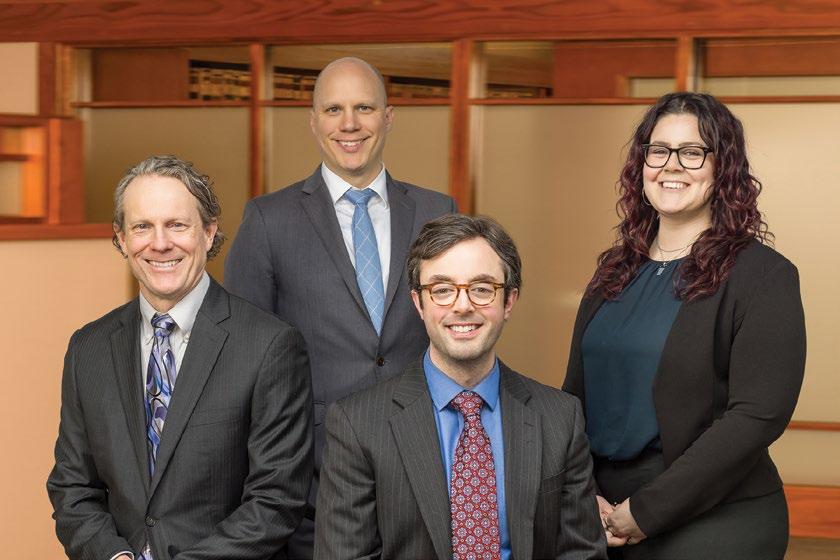
Over the past 42 years, the lawyers of CSD Attorneys at Law P.S. have quietly built a reputation for responsiveness, professionalism, and quality service for business and government clients throughout Washington.
The firm looks back with great pride at the team of talented lawyers that decided to call Bellingham home and help grow a robust statewide practice. Recognizing that we thrive as a team, we congratulate Seth Woolson and Richard Davis, who have been selected to the 2026 Washington Super Lawyers list and Aaron Haynes and Sara Frase who have been selected as Rising Stars honorees.
Only five percent of all lawyers in Washington are selected to this prestigious Super Lawyers list.
Vitt and Marr agreed, saying that good people on the team are crucial.
Vitt even opened the company’s financial records, showing its expenses to more team members.
“I’ve brought my management team in to be involved in the books, the budgeting process and the spending process,” he said. “We have doubled down on our transparency so they can see how
L-R: Richard Davis*, Seth Woolson*, Aaron Haynes**, Sara Frase** *Super Lawyers Honoree **Rising Stars Honoree
Work on building a really good culture and focus on employee retention. Hiring and training are expensive, so keeping the valuable team in place is important.
Jeff Ten Pas, CEO, BAI Environmental Services
tight things are. It’s changed their perspective on business.”
Being adaptable is a necessity in this economic climate. Another action Kulshan Brewery has taken is passing on credit card fees to customers.
Marr reflected on the external forces that he, Vitt, Ten Pas and all business owners face.
“When the outside world shifts on us (cost increases, regulatory changes, code changes), the instinct is to chase the next big idea. I do the opposite. I go back to the fundamentals,” Marr said. “Are our customers getting the service they deserve? Are we doing the jobs the right way? Are we communicating well? … (T)he gap between a good business and a great one is hiding in exactly those answers.”
In the end, worrying isn’t a great business strategy, Marr said.
“The lesson I keep coming back to is this: Focus on raising the value of the work you deliver instead of worrying about the forces you can’t control,” he said. “If you do that, you can charge what you need to charge to be sustainable. You can feel good about it at the end of the day, and the customer will, too.” n
BP FINANCE
Proactive personal finance strategies for Washington business owners
Justin Gross, CFP, has been a wealth adviser at Financial Plan for more than 10 years. He became a partner in 2023. He serves highnet-worth families, helping his clients build, optimize and protect their wealth.
Washington state has long offered competitive advantages for business growth and expansion. By implementing a higher sales tax rather than a personal income tax, Washington has attracted capital, innovation and jobs, fueling economic growth.
However, that advantage has eroded in recent decades, as rising operating costs driven by labor, insurance and regulation have placed significant strain on businesses. Concurrently, proposed state income tax policies are prompting many owners to revisit their long-term strategies. While policy outcomes may shift, planning ahead can help business owners preserve wealth and reduce future tax exposure.
Below are five considerations to help you stay ahead.
1
Strengthen personal financial resilience
Investing in your business is important, but intentionally building outside reserves, brokerage portfolios and retirement accounts reduces reliance on business distributions and doesn’t depend on the performance of the business. Also, reassessing debt exposure, especially variable-rate obligations and credit limits, is critical.
In combination, these can create a buffer if margins compress due to higher taxes, labor or regulatory expenses.
2
Optimize potential “millionaires’ tax” exposure
Although details of the proposed “millionaires’ tax” could change, measures are initially target-
ing high-income individuals through an additional surtax above specified thresholds. It is important to evaluate whether your current business structure (LLC, S corporation or C corporation) remains the most tax-efficient option. Thoughtful decisions around diversifying income types, such as how you split compensation between salary and distributions and the timing of income recognition, can have a meaningful impact, especially if specified thresholds fall significantly.
Utilizing retirement and tax-advantaged accounts and maximizing contributions to qualified plans can also reduce current taxable income and may help keep you below marginal thresholds.
3
Plan around capital gains taxes
Washington’s capital gains tax introduced an added layer of complexity to business and personal planning strategies. Spreading asset sales over multiple years may reduce exposure in any single tax period, while taxloss harvesting can help offset gains when appropriate. It also is important to consider holding periods and the timing of exits, as these decisions can influence tax outcomes. Strategies such as charitable gifting, domicile changes and other deferral vehicles may unlock additional flexibility.
4
The Washington estate tax
Changes to Washington’s already aggressive estate tax system, such as the lowered exemption threshold and the removal of inflation indexing beginning July 1, increase the urgency for long-term planning. With-
out inflation adjustments, the real value of the exemption declines each year, meaning more estates may be taxable over time even if wealth has not significantly grown in real terms. Considerations such as early gifting and calculated trust planning can help reduce the size of a taxable estate, allowing future appreciation to occur outside of it.
For owners of privately held businesses, valuation discounts and liquidity planning may offer additional opportunities to reduce the tax impacts of their estates.
Revisit residency and multistate planning (carefully)
Revisiting residency and multistate planning is a growing consideration that can offer potential benefits but should be approached with a clear understanding of the risks involved. Residency rules are scrutinized, and proper documentation is critical to support any change in domicile.
At the same time, business nexus laws can still trigger ongoing tax obligations in Washington, even if you spend significant time elsewhere.
Beware that poorly planned and executed moves can ultimately increase your tax exposure rather than reduce it.
5
Final thoughts
Washington’s business climate is becoming more complex. While you cannot control policy decisions, proactive planning provides options. A thoughtful and forward-looking strategy can protect your personal wealth and strengthen the long-term stability of the business you have worked hard to build. When implementing any of these strategies, coordination among experienced professionals (accountants, wealth advisers, estate planning attorneys, etc.) is essential. n
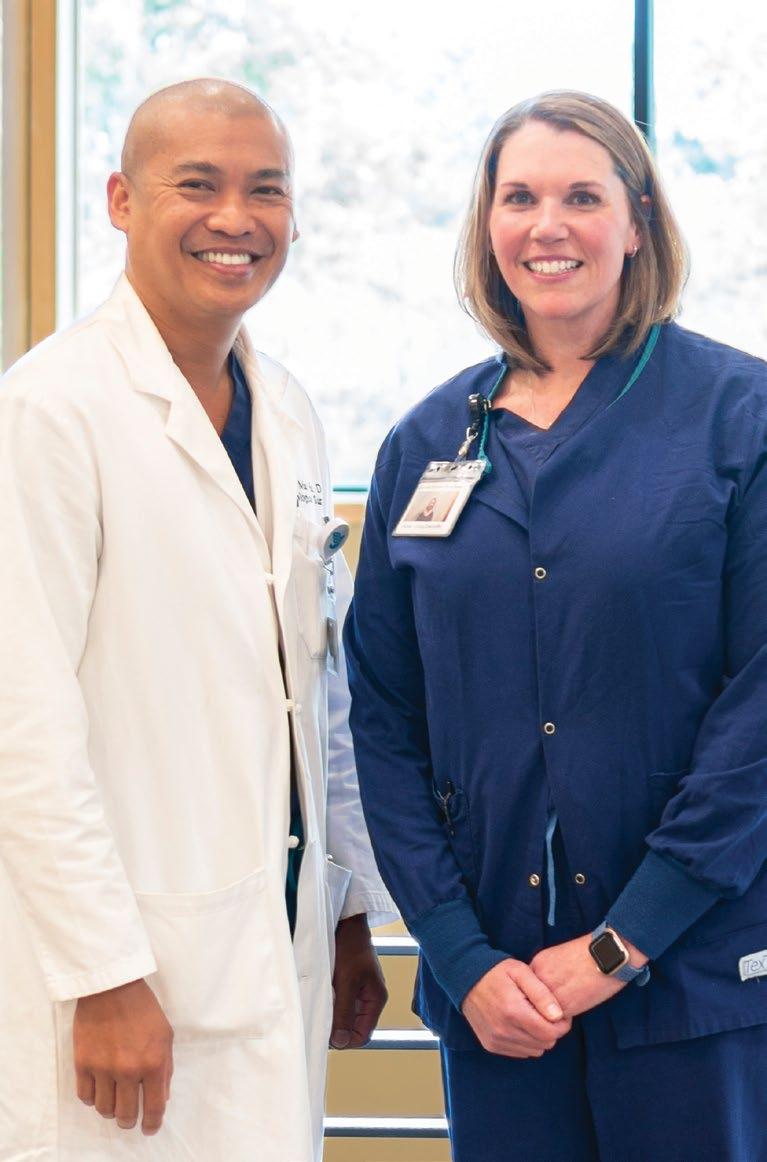
Dr. Tung Ha, DO, Neurosurgeon at Fourth Corner Neurosurgical Associates
They want you to understand what you’re investing in and what you’re contributing for rather than just telling you what to do. They want you to make informed decisions. And I really like that about Saturna.
Hannah Martinez, Clinical Director & Manager of Finances at Fourth Corner Neurosurgical Associates
Whatcom County: A diversified economy under near-term strain
The simplest way to understand an economy is to start by understanding what is happening with jobs. Jobs are what create income that consumers use to spend, and consumer spending remains the driving force of economic growth.
Through March 31, Whatcom County experienced a net loss of 400 jobs in the past year, equating to a 0.9% decline in jobs growth from the year before. Just two industry sectors showed growth: local government (500 additional jobs) and manufacturing (200 additional jobs). From a total jobs standpoint, the trade, transportation and utilities sector is the biggest source of jobs, with a 15.9% share. Federal government jobs are the smallest contributor, at 1.6%.
For companies to continue to grow jobs, they need to see growth in the labor force. The good news is that Whatcom County outperformed both Washington and the United States for labor force growth. On a year-overyear basis, Whatcom County’s labor force grew 3.8%, compared to Washington at 0.4% and the U.S. at -0.3%. From an income standpoint, Whatcom County continues to have a lower average monthly wage than the state of Washington and the United States. As of March 31, Whatcom County’s average monthly wage was $4,876.73, compared to the U.S. at $5,525.27 and Washington at $6,686.98. Washington is clearly distorted by the high wages in the Seattle/Bellevue region. The Bureau of Labor Statistics breaks down its data for each state into regions called Metropolitan Statistical Areas. For Washington, those regions are Bellingham, Bremerton-Silverdale, Kennewick-Pasco-Richland, Longview, Mt. Vernon-Anacortes, Olympia, Seattle-Bellevue-Everett, Spokane, Wenatchee and Yakima. Note: The Bellingham MSA incorporates all
Steve Scranton is chief economist for Washington Trust Bank and holds a Chartered Financial Analyst designation. He has more than 40 years of investment and economic experience.
of Whatcom County. When examining these regions, Whatcom County wages are higher than four of the regions and lower than five.
The challenge for the average worker in Whatcom County is housing affordability. Based on March 31 data from Zillow, Whatcom County’s average home price ($668,589) is higher than the averages for the state of Washington ($606,016) and the U.S. ($366,019). Whatcom County has the second-highest average home price when comparing the 10 regions of Washington.
LABOR FORCE GROWTH
3.8%
The amount Whatcom County’s labor force grew year over year, compared to Washington at 0.4% and the U.S. at -0.3%
It is easy to get caught up in the negative news that bombards us from the media (traditional and social). In reality, Whatcom County continues to have a diversified economy, but it has clearly been under near-term strain. The most pressing near-term challenge is external, with the loss of Canadian business due to tariffs and a strained relationship between the two countries. Whether this proves cyclical or a lasting reorientation of Canadian behavior is the single biggest swing factor for the outlook for next year. The county’s resilience rests on diversification. With close to 115,000 jobs spread across healthcare, education, manufacturing, maritime and agriculture, no single shock is likely to be catastrophic. Western Washington University and two colleges supply both employment and a talent pipeline, while the Cherry Point zone delivers the high-wage, high-tax-yield industrial activity that supports local services.
During times of uncertainty, the key is to believe what you are experiencing, not what might be reported by national media. Bad news sells, but good news is what inspires confidence and drives business. A solid risk management strategy involves planning for potential risks (bad news) before they occur while looking for opportunities (good news) that traditionally arise during periods of high uncertainty. n
Dona Bracke is running for Whatcom County prosecuting attorney
| By Mary Louise Van Dyke
Dona Bracke, the current assistant chief criminal deputy prosecutor with the Whatcom County Prosecuting Attorney’s Office, is running to become the next Whatcom County prosecuting attorney. The seat is currently occupied by Eric Richey, who is not seeking reelection.
Vying for that office wasn’t something Bracke envisioned for herself as a child growing up in California or while attending the University of California, Los Angeles.
ELECTION 2026
“I was a math/science major, and what I really wanted to do was go to medical school and become a doctor,” she said.
However, her enthusiasm for that goal dimmed after she got a closer look at what that program involved.
“I didn’t immediately change course, because I ended up with my degree in biology,” Bracke said.
A roommate suggested she take the law school admission test; however, Bracke protested that she was a science major. Her roommate kindly assured her that anyone could take the test or attend law school regardless of major.
She did “very well” and selected Pepperdine University School of Law.
“Most of my friends and family said, ‘Oh, that’s actually perfect for you, because you do like to talk,’” she said.
Bracke received her law degree in 1978 and took the California bar exam before applying for a position with the Los Angeles District Attorney’s office. She was set up for a 10:30 a.m. Monday interview but was informed it would be canceled if she hadn’t passed the exam.
The results were posted on Saturday, and Bracke jubilantly learned she’d passed. Now onto the interview. She arrived Monday morning only to be asked why she was there. Had she passed the bar exam? She told the assistant she had and then learned her interview had been given to another applicant.
Bracke was asked to reschedule her interview for Friday. She declined, figuring all 18 jobs would be given away by then. Instead, over the lunch hour, she interviewed with Los Angeles County District Attorney John Van de Kamp and Assistant District Attorney Johnnie Cochran, who
would later be O.J. Simpson’s lead trial counsel in 1995. She got the job.
That marked the start of a career prosecuting serious cases, including a triple murder and robbery charge for a 1986 incident at a Beverly Hills jewelry store and the 1984 murder of singer Marvin Gaye by his father.
Her past legal experience includes working in her own private defense firm, a civil firm and as a Glendale court commissioner in California.
After Bracke’s dad retired, her parents relocated to Orcas Island. Bracke and her kids moved to Wash-
tor’s office. Support all employees and strengthen morale.
The Prosecuting Attorney’s Office is composed of the Superior Court Division, the Juvenile Division, the District Court Division, the Victim-Witness Unit, the Civil Division and the Family Support Unit.
In her current position, Bracke’s primary assignment is to train newly hired prosecutors. Training entails starting with first appearance calendars, assigned trials calendars, motions practice, jury trials, probation violations and deferred prosecution revocations. Trainees learn how to
“What I really like about Whatcom County is the people. The desire that most people have here, on both sides of the fence, to make things better.”
ington state in 1999 to be closer to her dad after her mother passed away from cancer.
“What I really like about Whatcom County is the people,” she said. “The desire that most people have here, on both sides of the fence, to make things better.”
Bracke said she’s considered running for the prosecutor position for the past few years. Her priorities are: Pursue justice fairly, with integrity and consistency, and focus on victims. Rebuild trust between law enforcement and the public. Restore professionalism within the prosecu-
make appropriate offers, go to trial, work with law enforcement and witnesses, conduct interviews and support victims seeking justice.
There are alternatives to jail through the work release program. One program allows people to work their usual jobs and then return to jail during their non-working hours. Other options involve participating in work crews or wearing an ankle monitor. These options are geared toward individuals who pose a minimal risk to the community.
Among the other alternatives are therapeutic options such as Recovery
Court, Mental Health Court, inpatient or outpatient treatment, and drug offender sentencing alternatives.
The purpose is to provide “enough of a punishment that they don’t want to commit more crimes,” she said, “but enough kindness that they don’t lose their jobs and can see a path going forward that doesn’t involve criminal activity.”
Bracke experienced what victims’ families deal with after her son was killed on Thanksgiving Day, 2017, in Phoenix, Arizona. He was crossing a street when he was hit by a driver who was speeding and looking down at a phone.
“I’ve never been that depressed about anything at any time,” she said.
She wanted to do something as a tribute to him and decided to honor his favorite pastime, basketball, by actively supporting fourth grade and fifth grade basketball teams (Michael’s Lakers and Michael’s Sparks) at Boys & Girls Clubs of Whatcom County in Bellingham.
She goes all out, wearing each team’s colors and bringing treats to games.
“It’s very time consuming, but I love it,” she said. “It’s about doing what Michael would love. I miss him terribly.”
Home includes two basset hounds and her daughter, at times. She enjoys playing pickleball and participating in Women Sharing Hope, a nonprofit organization.
Bracke looks forward to the primary in August to take a step closer to becoming the next elected prosecutor for Whatcom County. n
Saturna Capital’s Jane Carten keeps family business, client portfolios healthy
| By Matt Benoit
Jane Carten is chair and CEO of Saturna Capital, an investment company based in downtown Bellingham. Answers have been lightly edited.
Saturna Capital has been a leader in managing financial products for over 35 years. Can you tell me about your company’s beginnings, including its formation by your father, Nick Kaiser, who left a profound imprint?
Saturna Capital’s beginnings are very much tied to my father, Nick Kaiser, and his distinctive mix of intellectual curiosity and entrepreneurial energy. The firm was founded in 1989, but in many ways it started with the Amana Income Fund, which already existed at the time.
What set him apart as an investor was his clarity of purpose. His approach was thoughtful, hands on and grounded in a long-term perspective. He wasn’t interested in chasing trends or reacting to market noise; he built Saturna around the idea that careful analysis, risk awareness and patience would ultimately serve clients best. Nick brought a strong sense of values to the work, something that naturally aligned with the principles behind the Amana Funds and helped establish Saturna as an early leader in faithbased and values-driven investing.
More than 35 years later, his imprint
is still everywhere, from our investment philosophy and long-term orientation to the way we think about stewardship. What started as a focused effort to manage a single fund has grown into something much larger, but the foundation he built remains intact.
Saturna’s portfolio includes the largest faith-based fund in the United States, Amana Growth Fund. Can you talk about the origins of faith-based investing, its significance and how Saturna leads values-based investing?
The concept for Amana emerged in the 1980s when my father was approached about creating a mutual fund that respected Islamic principles for U.S. investors. Amana Income Fund launched in 1986, applying Islamic guidelines (avoiding
interest-based financials, alcohol, tobacco, gambling, pork and excessive leverage) through a disciplined value investing lens and paying investors through equity income (dividends).
Faith-based funds give investors a way to pursue competitive returns without compromising on core beliefs, turning abstract values into tangible portfolio decisions. In Amana’s case, that means combining financial discipline with explicit ethical and financial screens, which attracts a broad range of investors who may or may not be Muslim but care deeply about how their capital is used.
Saturna’s philosophy is to be long term, value oriented and explicitly values based, viewing investing as a partnership with high-integrity businesses and emphasizing risk awareness over chasing fads.
By integrating ethical principles, broader sustainability considerations and a strong fiduciary culture, we have helped demonstrate that faithand values-based investing can be rigorous, scalable and fully competitive in mainstream markets. The Saturna Funds are also faith consistent, although they are nondenominational.
Building on the above question, your company helped change the way many look at investing by leading with what investors care about versus by leading with profits alone. How did this paradigm shift occur?
Tiffany Brooks Photography Jane Carten is chair and CEO of Saturna Capital.
What began as serving a specific faith community evolved into a broader values-based approach that resonated with investors who wanted their investments to reflect their beliefs about stewardship, responsibility and long-term impact.
Today, when we talk about leading with what investors care about, we mean building strategies around their convictions regarding faith, family, sustainability and legacy and then applying rigorous research and risk management to pursue strong outcomes within that framework.
While the above shift was important, your investment strategies are still conservative and strategic. Your father often said, “The money you don’t lose is the easiest money you can make.” For emerging investors, can you elaborate on that and how it plays out at Saturna?
My dad was reminding us that avoiding big mistakes is just as powerful as finding big winners. We use a disciplined, buy-and-hold, value-oriented approach, typically with low portfolio turnover, aiming to participate in long-term growth while reducing the risk of sharp, permanent losses. One of our core values is, “We are risk managers,” and that is true throughout the entire business, and especially in the case of our clients’ money. We’re not bandwagon investors; we thoroughly vet anything that we’re investing our shareholders in. The portfolios we manage are a group of strong companies with strong balance sheets, good governance and long-term track records and that are leaders in their industries. A lot of people, when investing for themselves, put all their eggs into
whatever the latest popular basket is instead of diversifying.
We’re offering diversified portfolios of best-in-class stocks.
Transparency is important in choosing an investment company. Could you elaborate on this?
We’re extremely transparent, partly because we don’t employ financial engineering or leverage to create overly complicated investment schemes. We invest in good companies on behalf of our shareowners.
It’s a big responsibility to be entrusted with somebody’s money. When customers trust us with their money, they should be able to know and understand the investment process and the fees they are paying.
You graduated from Western Washington University with a Master of Business Administration, preceded by your undergraduate degree there. Could you talk about how your roots here feed your work?
At Saturna, I started in the mailroom. I was here through the 1990s, including the dot com boom. I left to launch a local nonprofit internet service provider then returned to help build out our in-house software development capabilities and lead technology, development, as well as marketing functions.
When I went back to Western for my MBA, I assumed I would eventually leave the family business. Around the time I was being recruited by Silicon Valley companies, my mom — then our chief financial officer — suffered an aneurysm in our office
and was airlifted to Harborview. My parents had been together since college, raised five kids, and built the business side by side. Losing her so suddenly, at 61, was devastating.
Soon after, my dad asked if I would stay with Saturna, and I said yes. I sometimes believe Saturna would have benefited from me getting greater experience outside. To counterbalance that, I’ve been very intentional about building a leadership team with deep outside experience, and that strategy has served Saturna well.
Can you talk about Saturna’s investment in being headquartered in downtown Bellingham, emotionally and otherwise? Why is it important for major businesses to be downtown?
I think it’s wonderful to be in the heart of the city and be part of the community in the way that we are. We have a robust set of unique benefits for our crewmembers that encourage community involvement in many ways.
In the past 20 years, there have been a lot of changes. It can be hard to keep everybody feeling happy and safe downtown, but we hope downtown will continue to become more vibrant. I think it can, but it definitely has its challenges. n
Please consider an investment’s objectives, risks, charges and expenses carefully before investing. For this and other important information about the Amana Funds and Saturna Funds, please obtain and carefully read a free prospectus or summary prospectus from saturna.com or by calling toll-free 1-800-728-8762.
The Amana Funds limit the securities they purchase to those consistent with Islamic and sustainable principles. The Saturna Funds limit the securities they purchase to those consistent with sustainable principles. This limits opportunities and may affect performance.
Distributor: Saturna Brokerage Services, a wholly owned subsidiary of Saturna Capital Corporation, investment adviser to the Amana Funds and Saturna Funds. Member FINRA / SIPC.
TOP 100 PRIVATE COMPANIES IN WHATCOM COUNTY *
based on 2025 sales *
The power of a list is singular. A reputable list can frame the field, categorize the competitors and distinguish the leaders. For 51 years, editors and writers at Business Pulse magazine have reported on the entrepreneurial spirit and economic influence of the Whatcom County community. Highly anticipated in one of our largest issues, our annual Top 100 list provides a reveal of the companies shaping our economy.
The content of this list is based on gross sales from the most recently completed fiscal year (2025). Inside the revenue figures are compelling stories of leaders and their teams who create living-wage family jobs, meaningful careers and generational success. This 2026 Top 100 list reveals the breadth of industries fueling our economy — from agriculture to banking, con-
STANDOUT BUSINESSES
NO. 20: Ferndale’s Western Refinery Services offers diverse contracting, employee ownership, Page 28
NO. 61: Natural Way Chiropractic & Massage provides pain relief, healing to patients, Page 33
struction to information technology, marine services to retail, tourism and hospitality — all illustrating the diversity of Whatcom business.
The impact of this list is formative, setting up industry expectations and influencing consumer perceptions. As always, this year’s rankings include perennial top performers and rising stars. Not on this list? Take inspiration from this issue of Business Pulse. Join us at events hosted by the Whatcom Business Alliance (publisher of this magazine) and make plans to be on this definitive list next year.
The people in this list are the best of us: the individual contributors and leaders, performers and achievers, who make Whatcom County an exceptional place to work and live. Out of these talents, here are the Top 100 private companies in Whatcom. ▶ ▶
By the people, for the people
| By Matt Benoit
Western Refinery Services wears a lot of different hats.
So many hats, in fact, that employees have a saying for when people ask them what they do.
“What don’t we do?” said Kaelyn Sayles, the company’s marketing and communications manager.
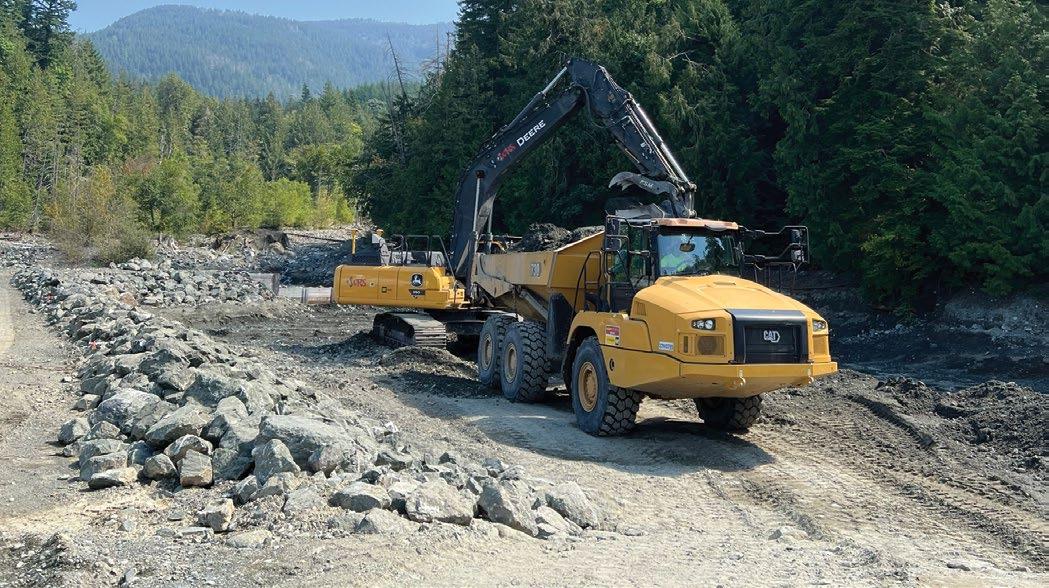
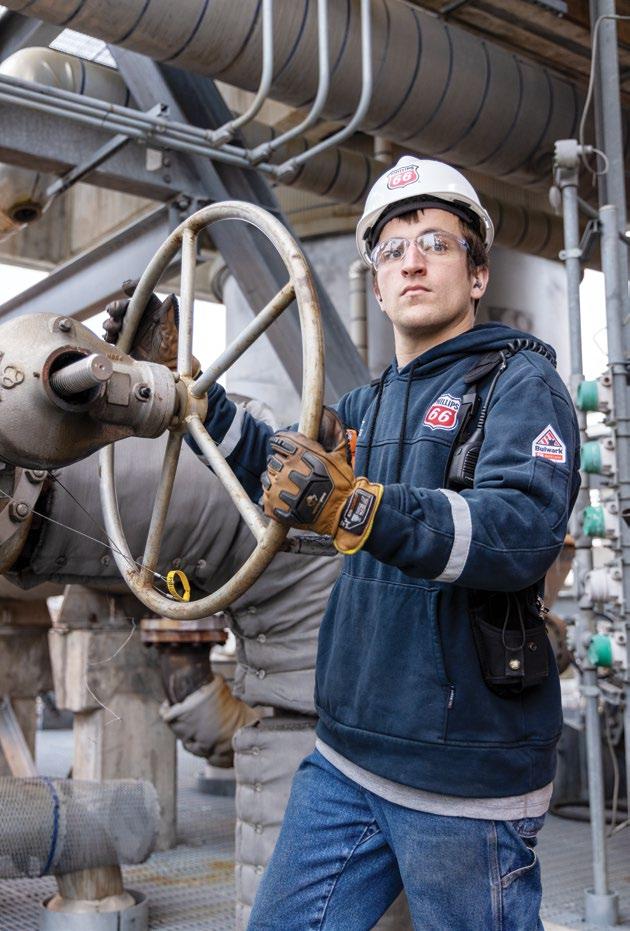
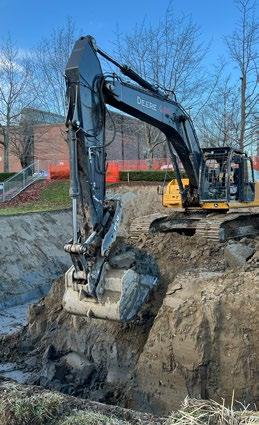
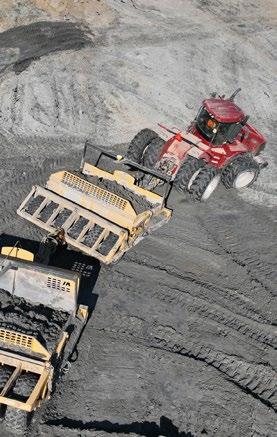
Based in Ferndale, the specialty contractor provides services such as civil construction (mass excavation, utility installation, demolition), residential and commercial asphalt paving and maintenance, land leveling, industrial maintenance and more.
WRS employs more than 230 people, with 210 of them local, and has generated revenues between $50 million and $100 million in each of the past three years.
The company got its start in 1982
Ferndale’s Western Refinery Services offers diverse contracting, employee ownership
| By Matt Benoit
under the name Western Services, working in soil conservation services to haul waste for the city of Lynden and area farmers. When an opportunity to be involved in a local refinery project came up, the company dove in; by decade’s end, it had rebranded to Western Refinery Services.
Through the 1980s, WRS became known for its hard work and can-do attitude, Sayles said. The company’s diverse array of services has evolved to be offered both inside and outside of local refineries, though the company still tackles industrial maintenance with several major refineries in Whatcom and Skagit counties.
WRS is also proud to do its work with a culture oriented around safety and community involvement.
“We’re really proud to be local,” Sayles said. “So we’re happy when we get opportunities to be out in the community.”
In 2023, WRS established a second office in Nampa, Idaho, that now employs 20 people. The company has also expanded to tackle projects in Eastern Washington cities such as Spokane and Pasco.
Late in 2025, the company’s CEO, Ryan Likkel, announced that WRS would enter into an employee stock ownership program, or ESOP, starting this year. The move makes WRS an employee-owned company, offering workers the ability to earn company shares without incurring outof-pocket costs.
The move was a decision that comes back to one of the company’s core values: putting people first. n
On top of things
| By Matt Benoit
The fruits of Hytech Roofing’s labor aren’t hard to find in Whatcom County.
From Bellingham’s Alderwood Elementary School and Lynden’s Nooksack Northwood Casino to Fairhaven’s LeCocq Building, the longtime local roofing company has delivered exceptional results on projects big and small.
Hytech’s services, which focus mainly but not entirely on commercial work, include new construction roofing, reroofing, commercial roof maintenance and repair, metal siding, architectural sheet metal fabrication and installation, and below-grade waterproofing, among others.
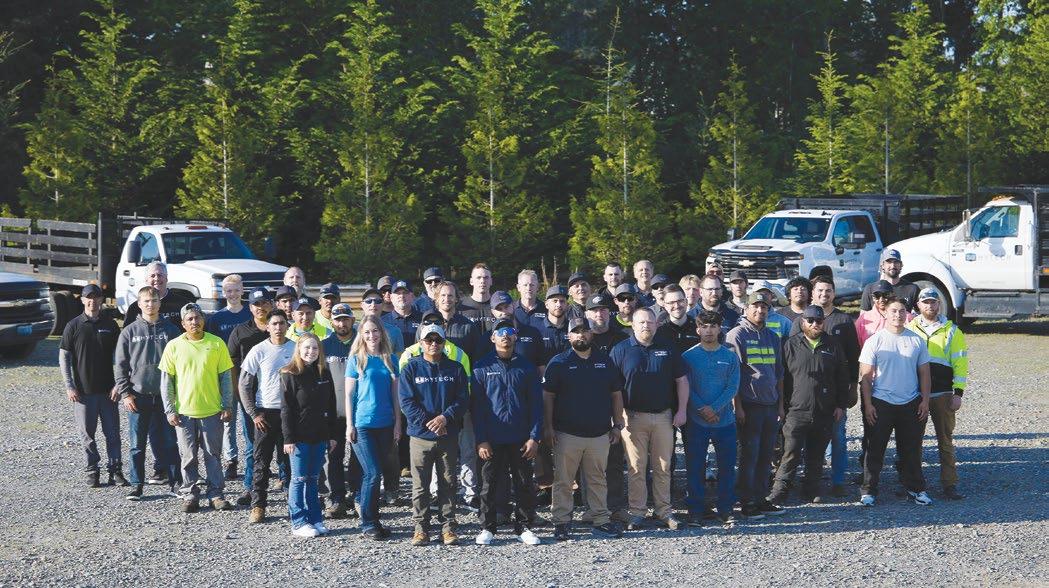
The company is led by the ownership team of Terry Carlson, Tim Eshuis and Josh Allsop, who have a combined 89 years of industry service. Eshuis can trace Hytech’s origin story through his own family’s
roofing business, as Eshuis Roofing merged with Scholten Roofing Enterprises in 1984. The company then rebranded as Hytech in 1990.
With around 50 employees in Whatcom, Skagit and Snohomish counties and 2025 revenue of $16.5 million (about $1 million more than 2024), Hytech continues to grow. Within the past five years, the company has added a full-service sheet metal fabrication facility, allowing Hytech to make all its own architectural sheet metal flashings. The fabrication service is also available to other roofing, siding, HVAC and general contractors.
Its growth has not come at the ex-
pense of product quality, and Hytech’s team is continually dedicated to exceeding its clients’ expectations. That dedication has resulted in numerous awards, including a 2026 Carlisle SynTec Systems’ “Perfect10n Award,” given to the top 5% of all American and Canadian commercial roofing applicators based on installation quality and low warranty claims.
Hytech also recently received an Associated General Contractors Workplace Safety Award, and Terry Carlson, company president, says the company is fully committed to the training and education of its current and future generations of roofers.
While on-the-job training works best, Carlson says several employees are currently going through state-certified apprenticeship programs, with an increasing number slated to follow.
“We are focused on developing and equipping our team to continue serving our industry long after our current owners retire,” Carlson said. n
Driven to get better
Natural Way Chiropractic & Massage provides pain relief, healing
to patients
| By Matt Benoit
Since opening the first Natural Way Chiropractic office in Bellingham in 1995, Dr. Eddie Hansen and his team of associates have helped thousands of local residents feel better.
Whether patients are dealing with back pain, neck pain or other musculoskeletal issues, Natural Way’s Hansen-developed healing system relies on comprehensive, cutting-edge diagnostics and modern methods to pinpoint root causes, provide immediate and long-term relief, and educate patients on how best to remain healthy.
“We stand out because we implement higher standards in our procedures and systems,” Hansen said, “from meeting somebody, to the analysis of exactly what’s wrong, to the right treatment plan that’s going to be the most effective and produce the best long-term outcome.”
In addition to chiropractic services, Natural Way offers massage therapy, non-surgical spinal decompression and student wellness, which focuses on improving posture and reducing pain caused by backpack issues.
Natural Way’s track record of dedication, trust and excellence now exists at three Whatcom County locations (Bellingham, Ferndale and Lynden) and six others throughout Western Washington (Anacortes, Mount Vernon, Oak Harbor, Everett, Vancouver and, most recently, Arlington).
The company generated revenues of $8.7 million in 2025, up from 2024, Hansen said, and expansion to more Western Washington cities is planned. n
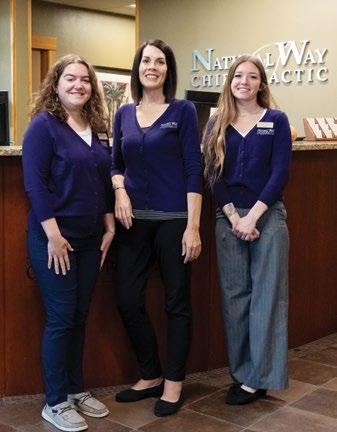
The Natural Way Chiropractic & Massage team includes Dr. Eddie Hansen, above, and (from left to right) Sam Martin, Julia Kleinendorst and Marissa Schuchard.
Sattva Photo
SALES RANGE: $1+ MILLION TO $5 MILLION
The editors of Business Pulse magazine believe the following companies qualify for the Top 100 list, based on previous years; however, they were unable to confirm their data as of press time. (In alphabetical order:)
Anvil
Barlean’s
This list is provided for informational purposes only. Although we have made every effort to ensure its accuracy, we assume no responsibility for any errors, omissions, or changes that may be present.
CONGRATULATIONS
These companies extend their best wishes to the Top 100 businesses in Whatcom County.
Why businesses need to pay close attention to the actions of the State Supreme Court
Dann Mead Smith is co-founder and co-leader of Future 42.
For business owners in Whatcom County and around the state, there is a lot to keep track of when it comes to politics and public policy and how actions by councils and the Legislature can impact how they operate and often, stay in business: city councils, Whatcom County Council, the Port of Bellingham, the state legislature, and even congressional bills and agency regulations at the federal level. We forget about the judicial system, from municipal court and county superior court to the state Supreme Court, the rulings at all levels impact businesses and employees. It is difficult to track court rulings as they are not often covered in the media and are not as easy to find online.
Full Court Press, a new organization at which I serve on the board, is bringing much-needed transparency to the state Supreme Court and plans to focus on local courts in the future. It recently has released its 2026 Washington State Supreme Court Judicial Scorecard. This new tool for citizens highlights 12 rulings by the court over the past six years and briefly explains what the case and ruling were and “why this decision is significant,” and then in a graphic image (see pages 38-39) shows how each of the nine justices ruled on each one.
The 12 rulings covered in the scorecard are divided into four categories: public safety, protection of constitutional rights, tort liability and government accountability. Some of the cases included drug possession laws, including regarding open drug use on our city streets and around your business; agriculture workers’ overtime pay exemption; providing more power to judges to dismiss criminal cases; homeless encampment regulations by local citizens; and our state’s new capital gains tax.
Unfortunately, many of the these rulings are considered “political decisions” and are harmful to businesses and taxpayers. Many court observers note that most justices have been appointed by the last three governors rather than first being elected by state voters and that decisions are unanimous or have only one or two justices ruling in the minority.
In a recent Seattle Times column by editorial page editor Kate Riley, a Ballotpedia analysis of our state Supreme Court was highlighted: ▶ ▶
ON THE PRIMARY BALLOT
Seattle
pro tem
3: David Stevens, Mason County Superior Court Judge
5: Dave Larson, retired Federal Way Municipal Court Judge
Sean O’Donnell, King County Superior Court Judge
Position 1: Scott Edwards, Ballard Spahr,
Position 1: Laura Christensen Colberg, Snohomish County Superior Court Commissioner
Position
Position 4:
Position
Position 7: Todd Bloom, Glein, Bloom Accounting & Tax Services, Port Orchard
BP GOVERNMENT
“Covering 2013-2022, the analysis of Washington State Supreme Court candidate campaign finance and court case outcomes found hands down that court case parties and amici filers ‘coded progressive’ were far more successful in favorable rulings (74%) than those coded conservative (14%). Also, progressive money was mostly on the side of winning
candidates. The report is fascinating and well worth voters’ scrutiny.”
Most people have no idea how the nine members of the state Supreme Court ruled on these decisions, so when it comes time to reelecting these justices and electing new ones when a current justice retires, voters often skip these races when filling out their ballot. This results in in-
FULL COURT PRESS JUDICIAL SCORECARD
cumbent justices being reelected and often running unopposed for reelection. A dramatic example occurred in 2024, when there were three of the nine positions on the ballot: two justices ran unopposed, and in the one competitive, open seat, 700,000 voters who voted for president or governor two years ago left their ballot blank for this race. One can assume
This comprehensive scorecard from Full Court Press highlights key rulings taken by the Washington State Supreme Court from 2020 to 2026. More about the scorecard can be found at fullcourtpresswa.org and the Ballotpedia study “Analysis of Washington State Supreme Court candidate campaign finance and court case outcomes (2013 - 2022).” A guide to each candidate running this year is available at Ballotpedia, ballotpedia.org
Principle Case
Public Safety Public defender caseload reduction
Public Safety Making it easier for judges to dismiss criminal cases
Public Safety Voter-approved Spokane homeless camping initiative
Public Safety Ruling drug possession laws unconstitutional
Government Accountability Collective bargaining with state employee unions
Government Accountability Failed attempt by opponents of the Let’s Go Washington initiatives to have them removed from the ballot
Government Accountability Ruling that Spokane County’s open union negotiations are unconstitutional
Constitutional Rights State capital gains tax
Constitutional Rights Ruling agriculture’s exemption from time-and-a-half overtime pay is unconstitutional
Tort Liability
Reversing an established legal principle and expanding medical provider exposure
Upholding certain defenses in medical malpractice cases
Does not align with FCP’s evaluation criteria Aligns with FCP’s evaluation criteria
that the vast majority of these voters did not feel that they had enough information to make a choice between the two candidates: Dave Larson and Sal Mungia. Mungia won the race by only half a percentage point — 50.5% to Larson’s 49.5%, about 20,000 votes in a statewide election.
Citizens have a unique opportunity this year to change the direction of
the state Supreme Court, as five positions are on the ballot, with only one longtime incumbent running for reelection (Position 7, the Chief Justice, Debra Stephens who has three opponents), two justices who were just appointed over the last few months will be on the ballot for the first time (positions 1 and 5), and two seats are open seats (positions 3 and 4).
Four of these five positions have multiple opponents so will be narrowed down to two candidates during the upcoming August primary election. Now is the time to start learning about each candidate so you can make an informed decision on the one who best reflects your values and will follow the state constitution when ruling from the bench. n
Debra L. Stephens
Charles W. Johnson Barbara Madsen* Steven Gonzalez
Gordon McCloud
Mary Yu**
Raquel MontoyaLewis
Helen Whitener
Sal Mungia
LOCAL LAW FIRM SUPPORTS BUSINESS
| By Cheryl Stritzel McCarthy
What makes a community prosperous? Successful businesses. What makes a business succeed? A myriad of factors, but one that doesn’t often get attention is legal services.
In the early 1980s, one law firm in Bellingham decided to focus on the legal needs of local businesses. Today, Faber Fairchild McCurdy is a local choice for such business needs as formation, succession, acquisitions, real estate and employment, as well as trusts and estates. They are not general practitioners.
The firm moved this past year from downtown to Barkley Village.
“We enjoy the proximity to other professional firms and clients, though we deeply miss the Bagelry,” said Jeff Fairchild, referencing a downtown landmark.
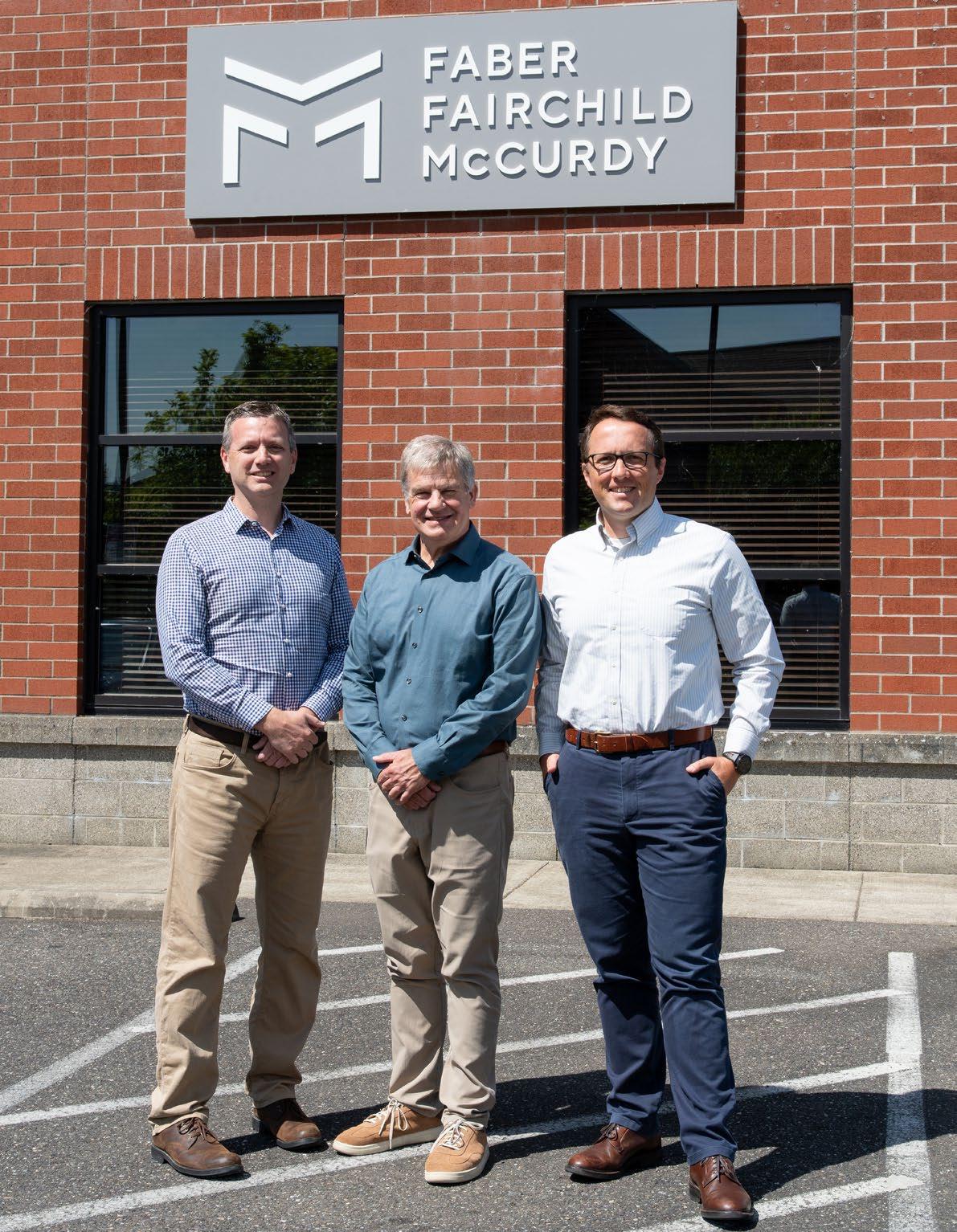
That comment gives you a sense that this firm, a group of eight attorneys, is affable, approachable and down-to-earth. Partners are Mitchell G. Faber, Jeffrey P. Fairchild and Ian P. McCurdy.
“We help clients navigate complicated issues, and part of our job is to shoulder some of the resulting stress,” Fairchild said. “Building client relationships is the fun part of our job.”
Ian P. McCurdy, partner, FFM “ “
The goal should be to create a tax environment where families want to stay in Washington, not one where advisers tell them the best tax strategy is to leave.
Here’s their take on issues affecting local business, including the state millionaires’ tax, 2026 state legislation that allows cities and counties to impose their own local income taxes, estate tax reversion, punitive estate taxes and more. ▶ ▶
From left: Mitch Faber, Jeff Fairchild, Ian McCurdy. Sattva Photo
Mitchell G. Faber, partner, FFM
Photo:
Sattva Photo
“We represent owners who’ve spent decades building companies and reinvesting in this community,” Faber said. “What concerns them is not one tax in isolation. It’s whether overall policy still rewards people for investing here. Businesses can plan around almost anything when rules are clear and stable. What’s difficult is when rules change simply because business has been successful.”
What about the possibility of cities and counties imposing their own income taxes?
“Most small and midsize businesses are already managing a huge array of regulations: federal tax, state tax, employment, insurance, permitting and rising labor costs, not to mention tariffs,” Faber said. “The possibility of different income taxes depending on the city or county where a business operates creates another layer of compliance difficulty and uncertainty.”
The estate tax reversion to lower rates than in 2025 sounds like good news. What’s it mean to business owners?
“Any move toward stability is welcome, but tinkering with estate tax rates, combined with other tax changes, contributes to uncertainty,” McCurdy said. “Estate plans are built over years. When rates change significantly, it affects families and businesses whose value may be tied up in assets rather than liquidity. Stability in the law allows families to plan for transition instead of reacting to policy shifts.”
Washington state has one of the most punitive estate taxes in the nation. Financial advisers have said
“We help clients navigate complicated issues, and part of our job is to shoulder some of the resulting stress.
Jeffrey P. Fairchild, partner, FFM
“ington are considering changing residency late in life for tax reasons, that should get policymakers’ attention,” McCurdy said. “Most families do not want to leave. The goal should be to create a tax environment where families want to stay in Washington, not one where advisers tell them the best tax strategy is to leave.”
The state needs family businesses to stay put, McCurdy said.
the solution is to move out of state before dying, and they’re not joking. McCurdy’s take?
“When people who’ve spent their lives building businesses in Wash-
“We support policies that make it easier for legitimate family businesses to survive generational transition. In communities like ours, family businesses are often major employers. Preserving those benefits not just the family involved but the broader local economy,” McCurdy said. “One issue we hear about consistently is predictability in regulations. Business owners, developers and property owners are willing to invest here. But long permitting timelines, shifting regulations and uncertainty can make that difficult.”
One thing business owners know for certain: FFM, founded as Adelstein, Sharpe & Serka in 1974, is here for the long term. n
A CENTURY ON THE LINE
How a teen’s passion for fishing built Bellingham’s oldest outdoor legacy business
| By Tamara Loucks
In 1903, 3-year-old Ira Yeager and his family moved from the state of Iowa to Bellingham.
Surrounded by an abundance of beautiful lakes, rivers and the ocean, Yeager developed a love for fishing in his teen years, and this passion ultimately launched a four-generation family enterprise. Through tenacity, vision and community loyalty, Yeager’s Sporting Goods has remained a Bellingham institution for more than 105 years.
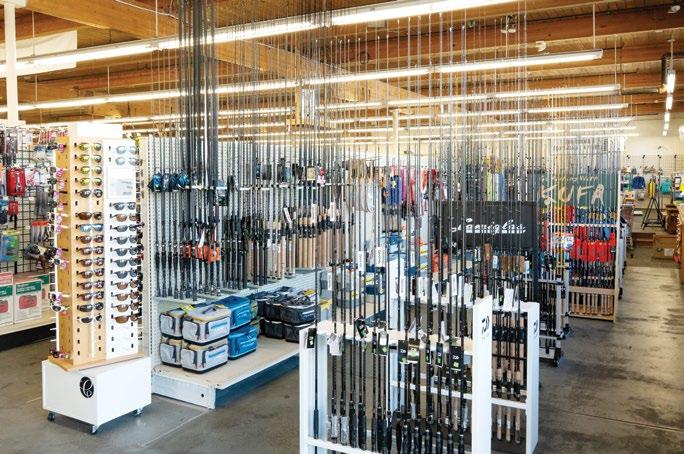
Although Yeager’s today is known for carrying the latest and greatest in outdoor sporting gear, the store began far from the world of rods and tackle. When Yeager and his grandfather launched the store on Bellingham’s State Street in 1918, the shop dealt exclusively in used furniture. Although working the business helped support the family, Yeager was always happiest outdoors. ▶ ▶
Wyatt Uhrig, far left, serves as general manager, while his brother, Jed Uhrig, manages the hunting department and gun shop. Together, they continue the legacy their greatgrandfather built over a century ago. Chris Hamilton, left, adds line to a fishing reel.
The ski shop is overseen by Otto Begus, above.
Credits: Sattva Photo
BP BUSINESS SPOTLIGHT
The launch of a legacy
Prior to opening the store with his grandfather, Yeager lived with his parents, early rural homesteaders, outside the Bellingham city limits. When they raised enough money to move to the city and buy a home that had indoor plumbing, Yeager instead chose to live with his grandfather, William Yeager, aboard his grandfather’s fishing boat. Together, he and the elder Yeager not only opened and ran the furniture store but also launched a fishing charter business on the side. Not long after, the younger Yeager took over the charter business and became the recipient of Washington state’s first guided fishing license for steelhead in the Nooksack and Skagit rivers.
Young Yeager’s entrepreneurial spirit didn’t end with the charter business. He visited the Evinrude display at the Pacific Northwest Motorboat Show in Seattle and persuaded the company to let him sell their motors out of a small garage. With an Evinrude mounted on his boat as an operating demo, he began selling motors directly to his guided-fishing clients. Before long, those same customers were asking for advice on gear and tackle, prompting Yeager to stock the equipment he recommended, transforming his side business into a convenient resource for both charter customers and local anglers.
Yeager loved to share his love of fishing with others, and word spread of his gift for teaching and knowledge of the local waters. His guided trips attracted prominent businessmen and politicians, including President Franklin D. Roosevelt. A young Eddie Bauer, long before founding his
namesake outfitting brand, also honed his fishing skills under Yeager’s tutelage.
As his reputation grew, so did the side business. By 1921, the used furniture
shop had transformed into a sporting goods store specializing in fishing and hunting gear. Yeager’s became the area’s first Evinrude boat motor dealer, and the store’s selection expanded to include boats and trailers,
marking the beginning of a legacy that would span generations.
The era of the Great Depression revealed not only Yeager’s resilience, as the business stayed financially sound, but also his compassion for the community. His skills as a fisherman and hunter became a lifeline for struggling families. Without seeking public recognition, he quietly delivered fish and game to households he learned were going hungry. Those acts of generosity cemented his place in the community and built a loyal following that would sustain the store for decades to come.
A daughter’s vision and drive inspired expansion
While Yeager’s passions laid the foundation for the business, it was his daughter, Marianne, who propelled it into a new area of growth. In the 1950’s, inspired by Seattle’s busy department stores, she encouraged her father to broaden the store’s offerings. Under her guidance, Yeager’s expanded to include apparel, home goods and, during the holiday season, toys.
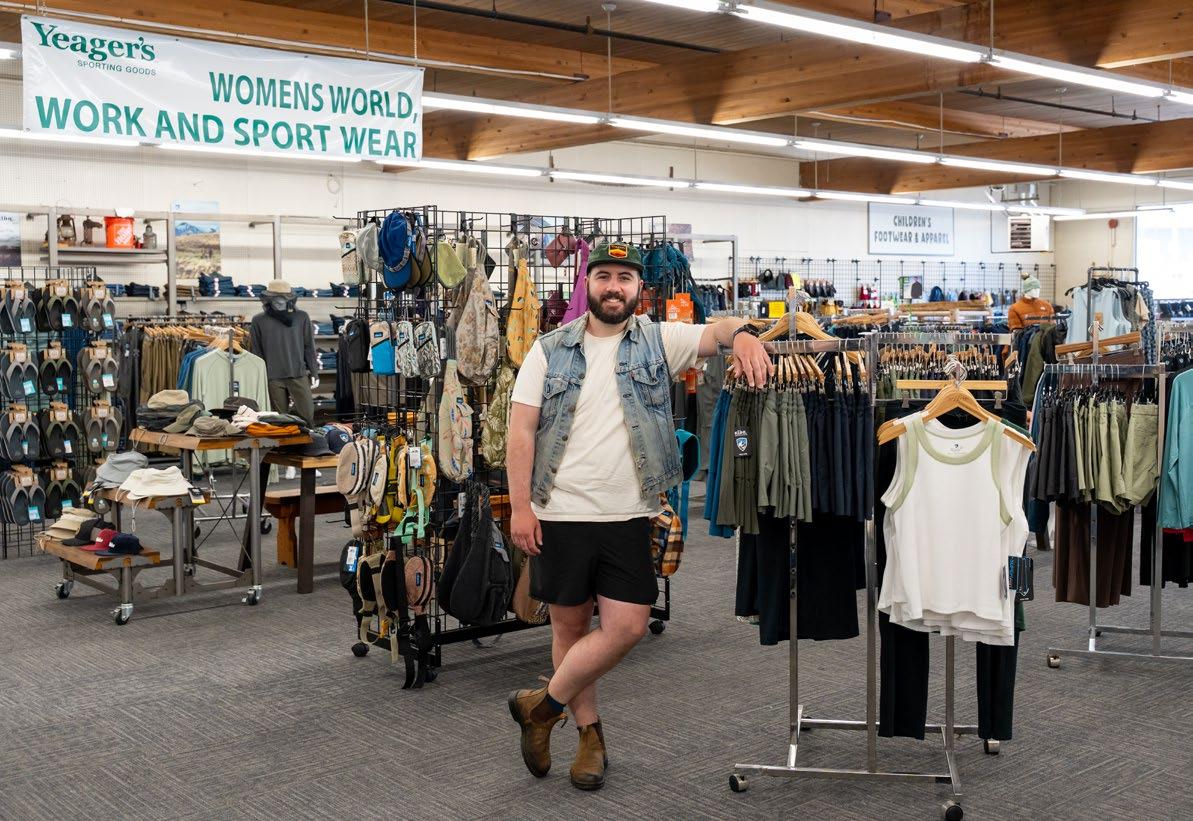
Yeager owned a small acreage on Northwest Avenue, and at Marianne’s urging, in 1956 he constructed a larger, more modern building to accommodate the expanding retail operation and create space for an outdoor boatyard. Yeager’s has occupied this location at 3101 Northwest Ave. for nearly seven decades. Over the years, the store has grown through multiple renovations, including the addition of a basement, an annex, several outbuildings and a 7,000-square-foot barn. Today, Yeager’s now occupies 26,000 square feet of dedicated re-
In the store, Yeager’s hosts a free annual Family Fishing Day.
tail space, an enduring tribute to Marianne’s vision.
“While everyone in town knew Ira and came to him for his knowledge of hunting, fishing and the local waterways, in reality it was the combination of Ira’s expertise and reputation and Marianne’s vision and drive
that made Yeager’s into the business it is today,” said Wyatt Uhrig, Yeager’s great-grandson and the store’s current general manager.
The legacy continues
For more than a century, Yeager’s has remained proudly family owned. Although Yeager never officially retired, continuing to come into the store well into his 90s, he sold the business to his son-in-law, Frank Uhrig, in 1980. Frank and Yeager’s daughter, Marianne, had both worked in the store since the early 1950s, but the business never passed to her. Marianne died of lymphoma in 1968, a loss that deeply affected the family.
“The store was everything to Grandpa Frank,” Wyatt Uhrig said. “He had a very sentimental attachment to the store because it reminded ▶ ▶
him of Marianne, and it drove him to work seven days a week, open to close, until late in his life.”
When Frank passed away in 2010, ownership transitioned to his son, Ira Uhrig. After Ira’s death from cancer in 2018, his wife, Kristin, inherited the business. Today, Kristin Uhrig is the sole owner. While she chooses not to take on the day-to-day leadership role, she remains involved, overseeing bookkeeping, managing social media and pouring her creative energy into her passion, merchandising.
The next generation now carries the operational torch. Her son, Wyatt Uhrig, serves as general manager, while his brother, Jed Uhrig, manages the hunting department and gun
Wyatt Uhrig, general manager, and great-grandson of founder Ira Uhrig “ “
Yeager’s isn’t just a store. The authentic, experiencedriven service started with Ira.
shop. Together, they continue the legacy their great-grandfather built over a century ago.
Uhrig mentioned that over the years they’d had opportunities to sell, but it was important to keep the business in the family. Nearly all family members, including cousins, at one point worked at the store. However, not all family who retained ownership actively managed the business. Uhrig’s father, Ira, named after the store’s founder, went to law school and eventually became a Whatcom County Superior Court Judge. Under his ownership, Yeager’s was managed by long-time trusted employee John “Westy” Westerfield.
Uhrig himself attended Western Washington University and envisioned a ca-
reer in healthcare. But the family business pulled him in early. At age 13, he worked his first holiday season standing outside the store dressed as a snowman, waving at passing cars. Over time, he transitioned to the ski shop, and after graduating from Western, he moved to the role of buyer for the ski shop. In the spring of 2024, Uhrig became general manager when Westerfield retired.
“I loved the snowman job,” he said. “It was so much fun. It’s a rite of passage for family working at the store to start out as the snowman. But I wasn’t a business major, so when I took over managing the store, there was a lot I didn’t know and had to learn.”
Yeager’s is now a fourth-generation family-owned business. Uhrig acknowledged that working with family has its benefits and challenges. He joked that on the bright side, it would be hard to get fired. He also enjoys collaborating with his brother, Jed, about new products to consider, appreciates the flexibility to adjust his hours or work from home when needed, and values not having layers of management to answer to. On the downside, he said that it’s impossible to consider your role as “just a job” because Yeager’s is part of the family legacy, and the work — and the responsibility — follows you home.
Sustained through community
According to the U.S. Small Business Administration, just 3% to 4% of family-owned businesses reach fourth-generation ownership. Uhrig attributes the store’s staying power to its diverse yet loyal customers.
Unlike the big box stores, where em-
ployees are often unequipped to answer detailed product or sport-specific questions, Yeager’s has long prioritized hiring staff with genuine expertise. Applicants with deep knowledge of fishing, hunting and skiing work in the departments that match their interests. This practice results in a team capable of offering personalized recommendations, demonstrating how to use equipment and guiding customers toward the best waterways, hunting grounds and ski slopes for their next adventure.
“Yeager’s isn’t just a store,” Uhrig said. “The authentic, experience-driven service started with Ira. Customers may be able to find things cheaper elsewhere, but they buy at Yeager’s because we’ve built a loyal community who share the same love for the outdoors. Throughout the store’s history, people have come in to share their hunting and fishing stories. Some would return and hang their catch, whether it was fish, deer or elk, on the front of the store and take photos.”
That sense of community runs generations deep with Yeager’s customers. Elder patrons who once knew Ira and Frank still stop by the store over the holidays to share their stories. Even those who have moved away come to visit when they are back in the area, eager to recount their own Yeager’s tales.
From the e-commerce side, Uhrig said they were a little late to the game, not launching an online store until COVID hit. The digital move strengthened the store’s legacy as former customers around the country continue to support the business they grew up with through online orders.
The Yeager’s team honors that sense
of community through a variety of sponsorships and free in-store events offered throughout the year. They’ve hosted veterans’ events, sponsor the annual Bellingham Kids Fishing Derby at Whatcom Falls (with a station to teach children to learn to fish) and support the Lake Fazon Fishing Derby. Yeager’s also backs the Junior Ski to Sea race, serving as title sponsor for the past three years, and fields teams for the iconic annual Ski to Sea race.
In the store, Yeager’s hosts a free annual Family Fishing Day, complete with fishing events and other handson activities such as old-time school carnivals, prizes included. Each holiday season, the team sets up a complimentary studio for families to take photos with Santa. Photos are offered by a free-will donation, with all proceeds given to charity, reinforcing the family legacy of building community.
Founder Ira Yeager passed in 2001 at the age of 101. For his 100th birthday, the family hosted a celebration at the Bellingham Cruise Terminal and placed an invitation in the Bellingham Herald welcoming the community to join. To Yeager’s surprise, the line of well-wishers stretched out the door, as people eagerly waited to greet him and share their personal stories — proof of how deeply he’d touched the lives around him.
Beyond his impact in the community, Yeager left an enduring imprint on the generations who continued to run the business he built from his love of fishing and the outdoors. If what Uhrig called the “running family joke” holds true, the Yeager’s family legacy is destined to carry on for at least a century more. n
PHILLIPS 66 FERNDALE:
POWERING WHATCOM COUNTY
Family-wage careers, strong safety culture, giving back
| By Business Pulse staff
In Washington state, Whatcom County is often called “the fourth corner of the United States,” joining the far reaches of Maine, Florida and California as the nation’s geographic outer edges. It is a place defined by dramatic coastlines, working waterfronts and fertile farmland, where the Salish Sea meets the Pacific Northwest economy. Tucked into this corner of the country is Cherry Point, a 6,000acre industrial zone that has quietly become one of the most strategically important energy hubs in the region.
Positioned along the Strait of Georgia near the Canadian border, Cherry Point is home to two refineries and a propane export facility serving Asian markets. For decades, the industrial area has anchored jobs, trade and energy infrastructure throughout Washington and the Pacific Northwest. A major player in the region is Phillips 66 Ferndale Refinery, with an economic footprint that extends well beyond the refinery boundaries.
For many residents of Whatcom County, the refinery is more than an industrial operation. It is a major employer, a source of family-supporting careers, a contributor to schools and community programs, and a key part of the region’s energy supply chain.
“Our workforce is approximately 305 employees and 290 contractors, with annual payroll totaling $56 million and $3.7 million in property taxes that help support essential local services and infrastructure,” said Kevin Schmitt, vice president of the Phillips 66 Ferndale Refinery. ▶ ▶ Kevin Schmitt
The Phillips 66 Ferndale Refinery facilities include crude distillation, naphtha reforming, fluid catalytic cracking, alkylation and hydrodesulfurization units. The refinery produces a high percentage of transportation fuels.
Courtesy photos
BP BUSINESS SPOTLIGHT
The numbers tell only part of the story. According to industry data cited by Phillips 66, each refinery job supports many additional jobs across the Washington economy. That ripple effect reaches construction crews, truck drivers, marine operators, engineering firms, suppliers, maintenance contractors and countless small businesses tied to the regional energy economy.
A foundation built over generations
The Ferndale Refinery traces its roots back to 1954, when it was built by General Petroleum Corporation. It became the first of five refineries established in Washington state and helped transform Cherry Point into a long-term center for manufacturing, marine commerce and energy distribution.
“That long history still matters today,” Schmitt said.
When the refinery began operations, Whatcom County’s population was approximately 62,500. Today, more than 238,000 people call the county home. Over the past seven decades, Cherry Point’s industrial infrastructure has played a significant role in supporting that growth.
The refinery’s location remains one of its greatest strategic advantages. Situated roughly 20 miles south of the border with Canada, the facility has direct access to marine transportation routes, pipelines and regional fuel distribution networks that serve customers across the Pacific Northwest.
“For people who are new to the area, Cherry Point is important because it is one of the places where major
Products produced include residual fuel oil, which is supplied to the Northwest marine bunker fuel market.
industrial infrastructure, marine access and regional energy logistics come together in one location,”
3901 Unick Rd, Ferndale Community hotline: (360) 384-8417
Info: phillips66.com/ refining/ferndalerefinery/
Schmitt explained.
Most of the refinery’s products are
distributed throughout the Northwest by pipeline and barge, helping supply the fuel that keeps regional economies moving.
“That makes Cherry Point strategically important not only to Whatcom County but to the broader region,” Schmitt said.
The refinery also operates within a uniquely complex environment.
Cherry Point sits adjacent to the Lummi Nation and near the city of Ferndale, creating a setting where industry, environmental steward-
ship, tribal interests and community priorities intersect daily.
“This intersection is why the refinery operates in a setting shaped by local, state, federal and tribal engagement,” Schmitt said.
Family-wage careers
For Phillips 66, one of the refinery’s greatest strengths is its workforce.
Schmitt’s own career reflects the longterm opportunities available within the industry. A Kansas State Univer-
In Whatcom County, 88% of refinery employees live in the communities where they work.
sity graduate with a degree in chemical engineering, he worked through positions at four different refineries before taking leadership at Ferndale.
“Our people serve in highly skilled operations, maintenance, engineering, technical and support roles,” Schmitt said. “These are family-supporting careers that help local household owners put down roots, invest in homeownership, support local businesses and create opportunities for the next generation.”
In Whatcom County, 88% of refinery employees live in the communities where they work, underscoring the facility’s close connection to the local economy. Employees coach youth sports, volunteer at nonprofits, support local schools and spend their earnings at nearby businesses.
That level of economic stability matters in a county where housing affordability and wage growth continue to challenge many families.
“A refinery of this scale supports an ecosystem of jobs and businesses far beyond its own workforce,” Schmitt said.
That ecosystem includes turnaround crews, marine and barge operators, trucking companies, pipeline logistics, environmental consultants, engineering firms, equipment suppliers and specialized maintenance contractors.
“This ripple effect is one reason energy infrastructure is such an ▶ ▶
BP BUSINESS SPOTLIGHT
important part of a regional economy,” Schmitt said.
Products that touch everyday life
At the Ferndale Refinery, the primary products include gasoline, diesel and marine fuel oil — fuels that power personal vehicles, freight transportation, agricultural equipment and emergency response vehicles.
“These products can be easy to take for granted, but they are part of everyday life,” Schmitt said.
The impact of refining extends well beyond transportation fuels. Petroleum products are deeply woven into modern manufacturing and consumer goods.
At Phillips 66, the company motto “Bring the Go” reflects the role refined products play in keeping society functioning. Crude oil processed at facilities such as Ferndale is used in everything from asphalt and electrical wiring to cosmetics, paint, soaps and weatherproof materials.
“It is one more reminder that the products we produce make possible nearly every part of modern life,” Schmitt said.
For consumers, the refinery’s importance is often invisible. Yet the products refined at Cherry Point help keep supply chains moving, homes connected and regional industries operating.
A culture built around safety
Inside the refinery gates, safety is not treated as a checklist item. Phillips 66 leaders describe it as a core operating principle embedded in the
company culture.
“A strong safety culture is at the heart of everything we do,” Schmitt said.
Every employee is expected to take personal responsibility for workplace safety, and the company’s “Stop Work Authority” program empowers workers at every level to halt operations if they identify unsafe conditions.
“We don’t compromise on safety,” Schmitt said.
That philosophy has produced measurable results.
The Ferndale Refinery recently earned the Elite Platinum industry safety award from the American Fuel
& Petrochemical Manufacturers, reflecting strong safety performance over the past two years. The refinery achieved two consecutive years with zero recordable injuries among employees and contractors while surpassing three million safe work hours since its last recordable incident.
The refinery also earned the AFPM Elite Gold Safety Award in 2018 and 2024 and the AFPM Distinguished Safety Award in 2019.
“We are committed to protecting the health and safety of everyone connected to our operations,” Schmitt said. “Our workforce, our business partners and the communities where we operate.”
CONNECTION | COLLABORATION |
Whatcom County’s newest event venue and community gathering space is now available for booking.
www.innatlynden.com 100 5th Street, Lynden, WA 360/746-8597
Safety at Ferndale extends beyond compliance requirements. The company invests heavily in ongoing training, emergency preparedness and operational safeguards designed to reduce risk and improve reliability.
“That approach doesn’t just protect people,” Schmitt said. “It builds trust, strengthens resilience and ultimately drives stronger overall performance.”
Operational excellence and sustainability
Alongside safety, operational efficiency has become a major focus for modern refining operations.
The Ferndale Refinery has earned Energy Star certification seven times, placing it among the top-performing refineries nationwide for energy efficiency.
Schmitt believes sustainability is best understood not as a single initiative but as a process of continuous improvement.
“We believe sustainability is a journey of continuous improvement, adaptation and resilience,” he said.
At the corporate level, Phillips 66 organizes its sustainability strategy around five pillars: environmental stewardship, social responsibility, financial performance, governance and operational excellence.
Locally, those priorities translate into investments in emergency preparedness, operational reliability, workforce development and community partnerships.
“It also means fostering an inclusive culture and preparing a workforce
that is ready for the future,” Schmitt said.
The refinery operates in one of the Pacific Northwest’s most environmentally sensitive coastal regions, making responsible operations especially important.
Phillips 66 leaders acknowledge that balancing industrial activity with environmental expectations requires constant collaboration with regulators, community stakeholders and tribal governments.
growth and quality of life.
“Over the long term, energy demand is becoming more complex, not simply disappearing,” Schmitt said.
Communities continue to rely on dependable fuels and petroleum-based products even as policymakers and businesses pursue lower-carbon technologies, improved efficiency and emissions reductions.
For Ferndale, that means maintaining safe and competitive operations while adapting to evolving technolo-
“What makes Ferndale and Whatcom County so special is not only the natural beauty of this place but also the people and families who call it home.”
Kevin Schmitt, vice president of the Phillips 66 Ferndale Refinery
“One challenge people outside the industry may not always see is the complexity of operating a large energy facility in a sensitive coastal setting while meeting high expectations from regulators, communities and other stakeholders,” he said. “When regulations overlap without delivering clear, tangible benefits, it can make it more difficult to invest in the business and ultimately support job creation in the community.”
Even amid those challenges, Phillips 66 executives maintain that reliable domestic energy infrastructure remains critical to both economic
gies, policy expectations and market conditions.
Strong stewardship and economy
“What makes Ferndale and Whatcom County so special is not only the natural beauty of this place but also the people and families who call it home,” Schmitt said. “When I think about what is worth protecting, I think first about this community and the opportunity for families to build stable, healthy lives here. That is why balance matters so much in Whatcom County. We need responsible environmental stewardship, and we also need sustainable economic growth. Our community depends on both.” n
Courtesy
Levi
Carlisle is co-founder of OpSprocket.
When your customers ask AI, does your business rise to the top?
What it takes to be the name AI gives your next customer
Ahomeowner in Bellingham needs a plumber. Instead of opening Google and scrolling, she opens ChatGPT and asks which plumber in Whatcom County is best. Seconds later, she has two names and a reason to call each.
Your business is either one of them or it isn’t.
More buying decisions now start that way,
with a question to an artificial intelligence assistant instead of a Google search. A 2026 BrightLocal survey found the share of consumers using AI to find a local business jumped from 6% to 45% in a single year. The good news is you’re not starting from zero. Most of what helps you show up in AI is the same work that’s always helped customers find you. A current website, a complete Google Business Profile, steady reviews and
accurate details still carry the load. You don’t need to chase every new acronym; you just need to understand two ways AI search behaves differently.
The first is where AI gets its information. When AI answers a question about your business, it isn’t only reading your website. A 2025 Yext analysis of 6.8 million AI citations found that business listings drive nearly as many mentions as company websites do, and together they account for most of what AI repeats about a local business. Your Google Business Profile, your Yelp listing and your reviews can carry as much weight as anything you publish, so what sits on those pages matters as much as your own site.
The second difference is how the answer looks. AI doesn’t hand you 10 links to scroll through. It gives back a handful of options with a reason for each, and most businesses never make the list. When the marketing firm SOCi studied more than 350,000 business locations for its 2026 Local Visibility Index, ChatGPT recommended just about 1% of them, compared with a third that show up in Google’s local results. Ranking on Google no longer guarantees a spot.
Start by testing. Open Claude, ChatGPT or Gemini and ask what a customer would ask. Who’s the best HVAC company, accountant or caterer in Whatcom County? See whether you come up, and notice what it says about you. Change a few words and watch the answer shift. You can even ask which prompts would surface your business and let the answer point to your gaps.
Then strengthen the signals AI leans on. Start with your Google Business Profile. Claim it, fill in every field, pick the right categories and keep your hours, services and photos current. It’s the highest-value hour you’ll spend. Next, keep your details consistent everywhere. Your name, address and phone should match exactly across your site, Google, Yelp, the Better Business Bureau and any industry directories. Mismatched information makes AI less sure about recommending you.
Then show up where AI looks. Ask happy customers for reviews on Google and Yelp, get listed in the directories your industry uses, and
earn spots on local “best of” lists and trade coverage. Those mentions are what AI relies on when it decides whom to name. Finally, answer real questions in plain language. Write the way customers actually ask. Put the answer first and make your pages easy for AI to quote.
None of this takes a big budget or a marketing department, just a couple of focused hours and the discipline to keep your information current. The Whatcom County companies that thrive in the next few years will be the ones AI names when a customer asks, not the ones it leaves out. n
Workers are staying put, but that does not mean all is well
Elizabeth New is a policy analyst and director of the Center for Worker Rights and the Center for Health Care at the Washington Policy Center.
Aworker holding onto a steady job can be a sign of loyalty, satisfaction and good management. It can also be a sign that the ice looks too thin to step anywhere else.
A recent CBS News story described the current trend of workers staying in their current jobs as “job hugging.” Hugging it out is in stark contrast with the “great resignation,” the economic trend during the pandemic. Also known as the “big quit,” that trend had employees voluntarily leaving jobs en masse, switching workplaces and demanding higher pay.
The labor market has changed. Workers are more cautious. The next opportunity can look less like a ladder and more like a gamble. Employers are also more cautious. Their approach to both hiring and firing is slower.
Data supports the shift. In Washington state, the Employment Security Department reported the state lost an estimated 4,500 jobs in April and unemployment ticked up to 5.2%.
Nationally, ADP Research describes this period as “the big stay,” noting low turnover and a narrowing pay advantage for switching jobs. Recent numbers from the provider of labor market analysis show turnover hit a nine-year low in January, at 5.8%. The Bureau of Labor Statistics also reported staying activity: Quits are down over the year.
Low turnover may sound welcome, as retaining good employees matters. But job hugging should not be confused with a healthy labor market or job satisfaction. There is a difference between workers staying because they are thriving and workers staying because they are nervous.
Nervousness is understandable, especially with today’s economic uncertainty. People are seeing hiring slow in some sectors. They’re hearing about artificial intelligence changing the way we work. They’re rightly weighing the cost of benefits. A known job with known pay and known people can feel safer than an unknown opportunity, even when that opportunity might offer growth.
iStock
vancement and less leverage to seek better pay.
High minimum wages, restrictive gig-worker rules and layers of labor mandates may be sold as worker protections, but they, too, can reduce the number and variety of opportunities available to young people, part-time workers, parents, students and people trying to reenter the workforce. When employers expect labor costs to rise on autopilot and take on more hiring risk, they hire less, automate more and reserve openings for applicants with more experience.
State policymakers should make it easier for people to work, move and advance. That includes reducing unnecessary licensing barriers, supporting flexible work arrangements and revisiting minimum wage law.
Employers also have a role. They can continue to build workplaces people want to stay in rather than workplaces people feel trapped in. They can reward loyalty by offering useful training, flexibility and paths for advancement. Retention built on opportunity is healthy. Retention built on fear is not.
The current labor trend should remind us that workers benefit from more career options, and too many of them have fewer options than they should. A state with higher-than-national unemployment should be especially careful about policies that shrink jobs and make hiring harder and first chances rarer.
A strong economy does not keep people hugging in place. It gives them solid ground for the next step. n
Since 1982, our people have been building WRS into what it is today - a company that stands on the values of Character, Chemistry, & Competency. Now, the people who continue to build WRS have ownership in it, ensuring WRS will always be about the people.
Here we go again — Bellingham follows Seattle rent-control effort
Mark Harmsworth is the director of the Small Business Center at the Washington Policy Center. Elected in 2014, he served two terms in the Washington State House of Representatives.
Bellingham’s rents have risen 71% over the past 11 years. Rent is now averaging $2,275 per month.
Bellingham rental rates are sitting 14% above the national average.
Seattle’s ill-conceived ban on algorithmic rent-setting software illustrates what critics see as a textbook case of unconstitutional government meddling in private markets. Now Bellingham is poised to repeat the same mistake. Local activists with Community First Whatcom are gathering signatures for Initiative 26-01, which would prohibit property owners from using apps and artificial intelligence to determine the market rate for rents on properties. This follows the unanimous Seattle City Council vote in June 2025 enacting similar restrictions.
The core argument against these tools, such as RealPage, is that the apps somehow enable “price-fixing” and drive up rents. This claim collapses under basic economic scrutiny. Property owners have always analyzed market data to set rents. Algorithms simply make that process faster, more data driven and less prone to emotional guesswork. Banning them doesn’t lower prices; it forces leasing agents to eyeball competitor listings and round up aggressively to avoid leaving money on the table. Humans with incentives to maximize revenue are likely to replace the software calculations, often with less precision and more upward bias.
In Seattle, the ordinance raises serious constitutional red flags. It potentially violates the takings clause by devaluing rental properties without compensation, restricts commercial speech under the First Amendment by limiting the use of publicly available market data, and runs afoul of the 14th Amendment’s due process clause through vague language that leaves property owners guessing what tools might trigger a $7,500 penalty. Property owners retain the right to accept or reject algorithmic recommendations. ▶ ▶
According to Department of Justice filings, between 2017 and 2024 only 40–50% of property owners adopted prices within 1% of RealPage’s recommendations. This is not collusion; it is competition informed by supply and demand.
Bellingham’s rents have risen 71% over the past 11 years, now averaging $2,275 per month and sitting 14% above the national average. Chronic undersupply caused by restrictive zoning, endless permitting delays, high property taxes passed on to tenants and a regulatory environment that discourages new construction are the real reasons rents are so high. Washington’s cost of living has climbed faster than nearly anywhere else in the country. No algorithm created those barriers.
Trying to control the free market this way is not just ineffective, it is economically illiterate. Rent control experiments and price-fixing bans across history have consistently reduced housing supply, degraded quality and created black markets. Property owners facing uncertainty will convert units to owner-occupied housing or short-term rentals, or they will simply exit the market. Tenants gain nothing while innovation in property management is stifled.
The free market is not perfect, but it remains the best mechanism for allocating scarce housing. When demand exceeds supply, prices rise, signaling to investors the need to build more units. Government interference that attacks the pricing mechanism only distorts that situation further. Seattle has shown no
evidence so far of measurable relief for renters after the ban. Bellingham should learn from that failure before November’s ballot.
Policymakers serious about affordability must focus on root causes: slashing red tape, reforming permitting, reducing development taxes and expanding housing supply through market incentives. Performative bans on technology may feel good to activists, but they punish small-property owners, reduce efficiency and, ultimately, harm the very renters they claim to help.
It’s time to stop the stupidity of pretending government can outsmart supply and demand. Washington needs more housing, not more restrictions on how property owners discover its true price. n