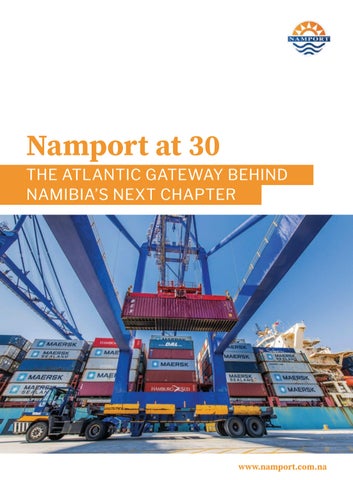
Namport at 30
THE ATLANTIC GATEWAY BEHIND NAMIBIA’S NEXT CHAPTER
www.namport.com.na
Nampo
THE ATLANTIC G NAMIBIA’S NE PRODUCED BY
2
[ AUGUST 2026 ] BUSINESS EXCELLENCE
Xoli
ort at 30
GATEWAY BEHIND EXT CHAPTER
iswa Mhlaraza BUSINESS EXCELLENCE [ AUGUST 2026 ]
3
T
hirty years after its establishment, the Namibian Ports Authority stands as one of the clearest expressions of Namibia’s national ambition. It is measured in cargo, vessels, terminals, berths and quay walls. But it is also measured in corridors opened, markets connected, suppliers developed, ships repaired, energy projects supported, young people inspired, and in the quiet certainty that a country’s access to the world begins at the port gate. For Namibia, that gate is Namport. From Walvis Bay and Lüderitz, Namport has helped position one of Africa’s least populous countries as a serious logistics player in Southern
4
[ AUGUST 2026 ] BUSINESS EXCELLENCE
“For Namibia, the gate to the world is Namport.” Africa. It has done so from a coastline where geography is both gift and challenge: the Atlantic on one side, desert on the other, and beyond that, a region of landlocked economies searching for reliable routes to global trade. When Business Excellence last profiled Namport, the story was one of ambition being underpinned by infrastructure. The Port of Walvis Bay’s New
NAMPORT
Container Terminal had added major capacity, Namibia was positioning itself more strongly within SADC trade, and the Authority was already exploring partnerships that could help it move from capacity to competitiveness. The earlier feature noted Namport’s role in Namibia’s international trade, its responsibility for Walvis Bay, Lüderitz and the Walvis Bay Syncrolift, and the importance of the N$4.2 billion New Container Terminal as a platform for future growth. Today, that future has arrived in a more complex and more consequential form. Namport’s next chapter is not simply about handling more cargo. It is about whether Namibia can become a logistics hub, an energy gateway, a
critical-minerals platform and a country capable of translating maritime infrastructure into industrial value.
The port, the corridor and the country
At its simplest, Namport operates ports. At its most important, it enables a national strategy. That distinction matters. Walvis Bay and Lüderitz are not isolated maritime assets; they are entry points into a regional system. A port only creates its full value when the road, rail, border, customs, logistics, warehousing and shipping layers behind it work together. In that sense, Namport’s next chapter is three stories told at once. The first is a port-development story: deeper
BUSINESS EXCELLENCE [ AUGUST 2026 ]
5
GATEWAY TO GLOBAL MARKETS
At Grindrod, movement is more than the transportation of goods. It is the connection between mines and markets, businesses and opportunities as well as communities and economic growth. With more than 120 years of experience and operations across Sub-Saharan Africa, Grindrod provides integrated logistics solutions spanning the entire value chain, from mine to port and onward to global markets. Through a comprehensive suite of services, including rail and road transportation, terminal operations, ships agency, container depots, freight forwarding and cross-border logistics, we provide a gateway to global markets. This capability is supported by a portfolio of strategically located terminals and logistics assets across the region. From the established trade routes of Maputo and South Africa’s major port gateways, including Durban and Richards Bay, to the growing opportunities presented by Walvis Bay and the Nacala Corridor, Grindrod enables cargo owners to access efficient and flexible routes to market. In Walvis Bay for example, Grindrod operates from a 50 000 m² facility located across berths seven and eight, including a modern 4 000 m² warehouse that supports cargo handling, storage and the seamless transfer of freight between sea, road and rail transport. This investment strengthens the Port of Walvis Bay’s position as a vital gateway for trade flowing from Zambia, Botswana, Zimbabwe, South Africa and the Democratic Republic of Congo. Grindrod is also supporting the development of key trade corridors, including the Nacala Corridor and Richards Bay. Through investments in logistic infrastructure and transport networks we help facilitate the movement of cargo while strengthening connectivity and improving market access for landlocked economies.
The importance of this role is expected to increase as mining investment, energy projects and industrial development continue to drive demand for export logistics. Growth in commodities such as copper, gold, iron ore and manganese, together with emerging energy opportunities, is creating a need for additional port capacity, storage facilities and specialised cargo handling solutions. Grindrod’s ongoing investments position the company to support these expanding requirements while contributing to the long-term development of Africa’s strategic trade corridors. Infrastructure alone does not guarantee supply chain success. Collaboration between port authorities, logistics providers, transport operators and customers remains essential. Grindrod’s investment in strategic infrastructure reflects its commitment to working alongside stakeholders to enhance operational efficiency, develop sustainable logistics solutions and support economic growth. As African trade continues to expand, resilient and integrated logistics networks will be central to unlocking future growth. Grindrod is helping to build the connections that enable Africa’s trade with the world while supporting the continued development of key logistics gateways.
+264 64 271 270 commercial@grindrod.com www.grindrod.com
BUSINESS EXCELLENCE [ AUGUST 2026 ]
7
Bachmus supplies high-quality fuel and lubricants with reliable service, technical expertise and nationwide solutions you can trust. Service & Expertise you can trust: Proudly Namibian. More than 30 years of customer service excellence. Wholesale diesel and lubricant supplier. Marine Bunkering. Fuel Management Solutions. Certified Technical Lubricant support. Fuel Storage Solutions.
www.bachmus.com.na
8
[ AUGUST 2026 ] BUSINESS EXCELLENCE
Erf 5738, Rossing Str., New Industrial Area, Walvis Bay +264 83 334 3600 sales@bachmus.com.na info@bachmus.com.na ops@bachmus.com.na
BACHMUS: FUELLING NAMIBIA’S PORT-TO-CORRIDOR ECONOMY
At anchorage outside Walvis Bay, a vessel may be waiting for a narrow operating window. Alongside in port, trucks are preparing to carry cargo inland. Both depend on services that rarely attract attention when they work well: fuel delivered on time, the correct lubricant available, secure storage in place and accurate information about consumption. When any one of those fails, schedules tighten and costs begin to rise.
Namibia, Bachmus supplies automotive, industrial and marine products for engines, transmissions, hydraulic systems and deck machinery. Its technical services include oil sampling, oil analysis, lubrication audits, fuel-system consultation and practical lubricant advice. Together, these services help customers identify wear earlier, improve maintenance planning, extend oil drain intervals, extend equipment life and reduce unplanned downtime.
Bachmus Oil & Fuel Supplies has built its business around preventing that disruption.
Bachmus also connects port activity with Namibia’s inland logistics network. Its own depots in Walvis Bay, Swakopmund, Karibib, Windhoek, Otjiwarongo, Ondangwa and Katima Mulilo are supported by partner refuelling sites across major transport corridors, border routes, mining regions and commercial centres.
Founded in 1994 and headquartered in Walvis Bay, Bachmus has developed from its marine roots into one of Namibia’s established fuel and lubrication partners. Its services span marine bunkering, wholesale diesel supply, lubricant distribution, fuel logistics, on-site storage, technical support and digital fuel management. That breadth allows the company to support customers at the port, on the road and across remote operating locations. For port, fleet and industrial customers, this means dealing with a supplier that can combine product availability with local knowledge, technical guidance and a national distribution network rather than relying on several disconnected service providers. Within the Port of Walvis Bay ecosystem, Bachmus supplies marine gas oil, Low sulphur fuel oil and vessel lubricants, both in port, and at anchorage. It supports fishing fleets, commercial shipping operators and offshore marine activities, where timing, safety and continuity are critical. The value lies not only in supplying the product, but in responding within demanding operating windows and helping customers avoid disruption. The company’s lubrication offer adds another layer of support. As a leading distributor of Caltex lubricants in
For customers requiring direct supply, Bachmus provides bulk diesel deliveries, scheduled contract deliveries, emergency fuel supply, fleet refuelling and remote-site support. It also offers bulk, selfbunded and mobile fuel-storage systems, supported by consumption monitoring, inventory management and dispensing controls. These solutions help reduce losses, improve accountability and give operators clearer oversight of fuel use. Technology strengthens that offer. Through its exclusive partnership with TFN, Bachmus provides secure app-based refuelling, real-time reporting, driver and vehicle controls, nationwide network access and cross-border capability across the SADC region. From vessel to vehicle, Bachmus brings marine fuel, wholesale diesel, premium lubricants, storage, technical expertise and fuel management together through one Namibian partner. In an economy built on movement, its role is simple but essential: keep operations supplied, controlled and moving.
BUSINESS EXCELLENCE [ AUGUST 2026 ]
9
NAMIBIA DRYDOCK & SHIP REPAIR (PTY) LTD (NAMDOCK) When a vessel enters dock, the job is never just mechanical. Behind every repair is a crew waiting to sail, a client watching the clock, and an operation that needs to get back to work safely. That is the space Namdock understands. Based in Walvis Bay and trusted since 2003, Namdock is a wholly Namibian marine and industrial engineering company serving vessels across the West African coast. Its work covers offshore support vessels, tankers, rigs, fishing vessels, dredgers, drill ships and other specialised marine assets. For Namport and the wider Walvis Bay maritime ecosystem, Namdock adds something essential: the ability to keep ships close to the port, close to the customer, and close to the next assignment. With three floating docks, advanced workshops and a skilled workforce, the company provides ship repair, fabrication and maintenance services built around fast turnaround, safety and practical workmanship. Its teams work across project management, metal
10
[ AUGUST 2026 ] BUSINESS EXCELLENCE
work, piping, electrical, propulsion, carpentry, mechanical, valves, rigging, coatings, machining, design and fabrication. These are not background services. They are the quiet, technical disciplines that keep vessels moving and help protect the reliability of the port economy. Beyond the port, Namdock plays a wider role in Namibia’s industrial story. Its shipyard supports local subcontractors, develops technical skills, and creates opportunities for Namibian tradespeople to work to international standards without leaving the country. In that sense, every vessel repaired at Walvis Bay is also part of a bigger story about local capability. Namdock’s strength is simple: it brings people, equipment and experience together when reliability matters most. For vessel owners, offshore operators and marine clients looking for a trusted repair partner in West Africa, Namdock is ready to help keep your operation moving.
NAMPORT
“Namport sits where three stories meet: port development, regional logistics and national industrialisation.” channels, stronger quay walls, improved cargohandling equipment, terminal systems, marine services, infrastructure resilience and future expansion. The second is a regional logistics story: Walvis Bay and Lüderitz connecting Namibia to Botswana, Zambia, the DRC, Zimbabwe, Angola, South Africa and Malawi through the Trans-Kalahari, Walvis Bay–Ndola–Lubumbashi, Trans-Cunene and Trans-Oranje corridors. The third is an industrialisation story: offshore oil
and gas, green hydrogen, green ammonia, critical minerals, processed mineral exports, ship repair, bulk storage, energy logistics and higher-value trade. Namport sits where those three stories meet. This is why its 30-year milestone is not just an anniversary. It is a point of transition. The first decades built the institution and the infrastructure. The next decade will test how far that infrastructure can support a larger economic role for Namibia.
BUSINESS EXCELLENCE [ AUGUST 2026 ]
11
Walvis Bay: from capacity to competitiveness
The Port of Walvis Bay remains the commercial centre of Namport’s system. It is Namibia’s principal port, its main container and general cargo gateway, and one of the most strategically placed ports on Africa’s west coast. It connects Southern Africa to Europe, the Americas and Asia, while offering landlocked regional economies an Atlantic alternative to longer or more congested trade routes. The defining asset at Walvis Bay is the New Container Terminal. Built on reclaimed land and commissioned in 2019, the terminal gave Walvis Bay annual capacity of 750,000 TEUs. But infrastructure on its own is not enough. A modern terminal must be connected to shipping lines, equipped for larger vessels, supported by reliable systems and operated with the discipline of global terminal management. That is why the concessioning of the New Container Terminal to Terminal Investment
12
[ AUGUST 2026 ] BUSINESS EXCELLENCE
Namibia represents one of the most important moments in Namport’s recent history. The 25-year concession, which became effective on 1 October 2024, gives TiN responsibility for operating and managing the terminal, while Namport retains ownership and its wider role as port authority. Namport said the decision was designed to attract private capital, widen and deepen the channel, acquire new equipment and systems, improve efficiency, increase cargo volumes and preserve employment. Andrew Kanime, Namport’s Chief Executive Officer, described the logic clearly at the handover: “The concession allows us to attract private capital to invest in crucial upgrades, including dredging the entrance channel and acquiring new equipment.” That statement goes to the heart of the new Namport model. The Authority is not stepping away from the port. It is repositioning itself as the custodian of a port system in which specialist operators, global shipping networks and private investment can help turn national infrastructure into regional competitiveness. Terminal Investment Limited’s link to the MSC ecosystem also matters. For a port like Walvis Bay, shipping connectivity is as important as physical capacity. More reliable calls, stronger commercial relationships and improved terminal productivity can help move Walvis Bay from being an alternative route to becoming a preferred route.
The hard test of growth
Namport’s recent performance gives the strategy substance. For the financial year ended 31 March 2025, Namport recorded total revenue of approximately N$2.88 billion, up from N$2.56 billion the previous year. Operating profit for the Authority rose by 45 percent to N$793 million, while group operating profit reached N$967 million, supported by an EBITDA margin of 42 percent. The year also included N$143 million in concession revenue, showing that the new operating model is already beginning to register in the Authority’s financial
NAMPORT performance. Cargo volumes strengthened as well. Total cargo throughput reached 8.42 million tonnes across Walvis Bay and Lüderitz, up from 8.03 million tonnes the previous year. Container throughput rose to 253,996 TEUs, representing a 48 percent increase, while general cargo reached 6.34 million tonnes, up by 13 percent. The cross-border story is particularly important. Namport handled approximately 2.45 million tonnes of cross-border cargo, with South Africa contributing 35 percent and Zambia 34 percent. Together, those two markets accounted for almost 70 percent of Namport’s regional cargo.
This is the clearest proof that Walvis Bay and Lüderitz are not only national assets. They are part of the wider SADC trade system. Another important signal is the changing vessel profile. Vessel calls declined by 13 percent to 1,850, while gross tonnage increased to 23.5 million. In practical terms, fewer vessels called, but they were larger. That shift supports the case for deeper access, stronger terminal productivity and a port system prepared for the future shape of maritime trade. Growth at a port is never just a number. It tells a story about mining cargo, shipping schedules, vessel availability, customer confidence, terminal
“The Authority is not stepping away from the port. It is repositioning itself as the custodian of a system where private investment turns infrastructure into competitiveness.”
BUSINESS EXCELLENCE [ AUGUST 2026 ]
13
the quay. Namibia must continue improving rail connectivity, border efficiency, cargo visibility, tariffs, customer service and inland logistics reliability. The Walvis Bay–Karibib rail corridor, launched by Kaleido Logistics and TransNamib in July 2026, is one practical step in that direction, designed to strengthen cargo logistics between Namibia’s inland regions and the port. Ports compete at the quay. Corridors compete in the hinterland. Namport must win both.
Lüderitz: promise, pressure and possibility
efficiency, fuel supply, imports, exports and the strength of the corridor behind the port. Some of Namport’s momentum is cyclical, shaped by commodity flows and regional market conditions. But the more important story is structural. Walvis Bay is now supported by a deeper operating model: the New Container Terminal concession, specialist terminal management, channel and equipment investment, bulk-terminal partnerships, cross-border cargo growth and Namibia’s wider logistics-hub ambition. That matters because other corridors are moving too. The Lobito Corridor is being positioned as a rail-linked Atlantic route for Copperbelt minerals, backed by a consortium involving Mota-Engil, Trafigura and Vecturis, with strong international financing support. TAZARA is also receiving renewed attention through a major rehabilitation programme involving Zambia, Tanzania and China. For Walvis Bay, the response must extend beyond
14
[ AUGUST 2026 ] BUSINESS EXCELLENCE
If Walvis Bay is Namport’s commercial engine, Lüderitz is its strategic frontier. For much of its history, Lüderitz has been the smaller port: important, productive, but more specialised. It has served fishing, mining, offshore diamond activity, southern Namibia and South Africa’s Northern Cape. Today, however, Lüderitz is being pulled into a much larger national story. That story includes offshore oil and gas, green hydrogen, green ammonia, manganese, critical minerals, project cargo and future industrial exports. The opportunity is significant, but the constraints are real. Lüderitz does not yet have the scale of infrastructure that its future industries may require. Berth space, depth, land availability, environmental approvals, port access and specialised handling facilities all become more pressing when energy and mineral projects move from concept to development. That pressure is already visible. With fishing, mining and energy-related demand increasingly competing for limited capacity, Lüderitz is no longer a quiet supporting port. It is becoming a strategic point of national pressure. Kanime has acknowledged the practical nature of that constraint. Speaking about the proposed Lüderitz quay-wall extension, he told Reuters: “If we extend it, the quay wall will then enable us to maybe double or even triple berth availability.” The path has not been entirely linear. In August 2025, Namport cancelled a pre-qualification
NAMPORT
“Ports compete at the quay. Corridors compete in the hinterland. Namport must win both.” tender for a proposed Lüderitz oil and gas supply base shortly after launching it. In a less mature story, that might be read only as a setback. In the context of Lüderitz, it is also a reminder of the seriousness of the work ahead. Transforming a constrained port into a credible energy and minerals platform requires careful sequencing, financing, technical design, procurement, environmental approvals, heritage sensitivity and stakeholder confidence. That makes Lüderitz a more human infrastructure story. It is not simply a project on a plan. It is a port town being asked to carry part of Namibia’s
future. It must support existing fishing, mining and community life while preparing for industries that could reshape the national economy. If Lüderitz expands successfully, it can complement Walvis Bay rather than compete with it. Walvis Bay can remain the primary container, general cargo, marine services and regional logistics gateway. Lüderitz can become the specialised southern platform for energy, green ammonia, processed minerals and offshore support. In the next decade, Lüderitz may become one of the most important ports in Southern Africa
BUSINESS EXCELLENCE [ AUGUST 2026 ]
15
not because of what it has historically been, but because of what Namibia now needs it to become.
Angra Point and the industrial port
The proposed Angra Point development gives Lüderitz its most globally significant storyline. The European Union and the Port of Rotterdam are supporting the planning of Lüderitz Port expansion at Angra Point as part of the EU– Namibia Strategic Partnership on Sustainable Raw Materials Value Chains and Renewable Hydrogen. The EU announced a NAD 13 million partnership with the Port of Rotterdam and Namport to support this planning work. The Port of Rotterdam has also confirmed EU-backed work on the design of a Green Minerals Terminal at the Angra Point Hydrogen Hub in Lüderitz. The terminal is intended to support the export of processed mineral ores and other cargoes, linking Namibia’s green hydrogen and critical minerals ambitions with international
16
[ AUGUST 2026 ] BUSINESS EXCELLENCE
markets. This is where Namport’s role begins to move beyond traditional port operations. A port handling raw exports is one kind of asset. A port designed to support processed minerals, green ammonia, energy logistics and multi-user industrial cargo is something more: it becomes an industrial platform. That distinction matters deeply for Namibia. The country’s opportunity is not only to move cargo through its ports. It is to capture more value before that cargo leaves: more processing, more storage, more handling, more services, more technical work, more local employment and more supplier capability. Namport’s role is not to produce hydrogen or mine minerals. Its role is to make Namibia export-ready.
The partner ecosystem behind the gateway
No port of Namport’s importance is built, sustained or renewed by one organisation alone.
NAMPORT Behind every vessel call is a network of partners whose work extends far beyond the quay. Government, terminal operators, logistics companies, engineers, ship agents, fuel suppliers, diving specialists, equipment providers, marine-service centres, ship-repair yards and contractors all contribute to the performance of the port. Their roles may be less visible than the cargo moving through the terminal, but they are no less essential to keeping Namibia connected to regional and international trade. At the centre of this ecosystem is the Government of Namibia, Namport’s sole shareholder and the institution responsible for providing the legislative, policy and strategic framework within
which the ports operate. Through its oversight, the Government supports public-enterprise governance, national logistics planning, capital development and Namibia’s ambition to establish itself as a regional logistics hub. That ambition is being advanced through a growing number of strategic partnerships. Terminal Investment Namibia, part of Terminal Investment Limited, now operates the New Container Terminal at Walvis Bay under a 25-year concession that began in October 2024. The partnership brings specialist terminalmanagement expertise, private capital, modern systems, equipment and stronger links to international shipping networks. It is intended
“Lüderitz may become one of Southern Africa’s most important ports not because of what it has historically been, but because of what Namibia now needs it to become.”
BUSINESS EXCELLENCE [ AUGUST 2026 ]
17
to improve efficiency, increase cargo volumes and strengthen the competitiveness of one of Namibia’s most important infrastructure assets. In the bulk and break-bulk environment, Africa Global Logistics Namibia has taken on a significant role through its management of the Walvis Bay Multipurpose Bulk Terminal. Following an international tender launched by Namport in January 2023, AGL was appointed to manage the facility, strengthening Walvis Bay’s ability to handle bulk cargo, mining products, energyrelated projects and regional industrial trade. The performance of a port, however, depends not only on the terminals that handle cargo, but also on the condition and reliability of the infrastructure supporting them. Lithon Project Consultants contributes to this area through its work on Namport’s conditions survey. The survey captures inventory and deterioration data for port civil and marine structures and buildings under Namport management, covering Walvis Bay, the Syncrolift and Lüderitz. This information supports
18
[ AUGUST 2026 ] BUSINESS EXCELLENCE
maintenance planning, asset management and long-term investment decisions. Specialist marine contractors provide another important layer of capability. B-4 Engineering & Diving has undertaken underwater and marine works within the Port of Walvis Bay, including subsea cutting at the Small Craft Harbour and work on the New Port Extension. The company has reported more than 1,000 square metres of subsea cutting and is also included in Namport’s pollution contingency planning, reflecting the importance of specialist response capability in a working port environment. The fuel and lubrication supply chain is equally important. Bachmus Oil & Fuel Supplies supports marine, industrial, mining and transport activity through the supply of marine oils and lubricants, mining-equipment lubricants, bunkering services and fuel products. With depots across Namibia, including Walvis Bay, the company forms part of the operational backbone that keeps vessels, equipment and industrial customers moving.
NAMPORT
Ship agencies provide the coordination that allows the wider system to function. Sturrock Grindrod Maritime Namibia is part of the shipagency and maritime-services network around Walvis Bay, helping to coordinate vessel calls, documentation, port interfaces, cargo movement and communication between shipowners, cargo owners and port authorities. In a port economy, these services are not peripheral. They are the link between the vessel arriving offshore and the cargo moving inland. Walvis Bay’s marine-engineering capability is anchored by Namdock — Namibia Drydock & Ship Repair. Namdock is described by Namport as a leader in the West African ship-repair market. Namport remains its key shareholder, with a 52.5 percent stake, while the company operates three floating docks at Walvis Bay with a combined lifting capacity of 29,500 metric tonnes. This gives Namibia an important platform for ship repair, maintenance and marine engineering, while also supporting the development of a wider
maritime-services cluster. Underwater maintenance and inspection are supported by companies such as Dynamic Commercial Diving, which provides ship husbandry, underwater maintenance, repair and inspection services to vessel owners and shipmanagement companies operating from the Port of Walvis Bay. These services are essential to the safe and efficient operation of vessels, harbour infrastructure and marine equipment. The presence of the Rolls-Royce Marine Service Centre Namibia adds further international technical capability to the cluster. Located within the ship-repair yard at Walvis Bay, the facility was established to serve companies operating along the west coast of Africa. Its presence strengthens Namibia’s ability to provide specialised marineengine support closer to the vessels and offshore activities that depend on it. The logistics and forwarding network completes the connection between the port and the wider economy. Manica Group Namibia is one of the
BUSINESS EXCELLENCE [ AUGUST 2026 ]
19
established logistics and marine-services groups operating across shipping, freight, warehousing, forwarding and related port services. Alongside companies such as Woker Freight Services, Maersk Namibia, the Walvis Bay Port Users’ Association, shipping lines and the Container Liners Operations Forum, Manica forms part of the commercial network that turns port infrastructure into cargo movement. Together, these organisations represent the practical layer of Namport’s growth. Strategy may be established through national policy and boardroom decisions, but the port is delivered every day by contractors, pilots, agents, divers, mechanics, engineers, crane operators, warehouse teams, fuel suppliers, customs officials and logistics planners working in sequence. That sequence is what transforms infrastructure into performance. It is also what gives Namport’s development a wider economic meaning. Each new terminal,
20
[ AUGUST 2026 ] BUSINESS EXCELLENCE
marine service, engineering contract or logistics partnership creates opportunities for technical learning, supplier development, employment and local industrial capability. A company that works inside a port must meet demanding standards around safety, timing, documentation, access control, environmental compliance, equipment reliability, emergency response and the unforgiving rhythm of maritime operations. Over time, those standards strengthen the local industrial base. Lithon’s infrastructure condition work builds capability around asset management. B-4’s underwater works show specialist competence in marine environments. Bachmus supports the fuel and lubrication needs of marine and industrial customers. Namdock anchors a shiprepair economy with regional relevance. AGL and TiN bring global logistics and terminal-operating standards into Namibia’s port system. When the ecosystem works, port development becomes industrial development.
NAMPORT Beyond the quay: technology, ESG and social value
Namport’s contribution to Namibia cannot be measured only in tonnes, TEUs, vessels and terminals. A port authority of its scale also builds softer forms of infrastructure: skills, community confidence, institutional discipline, environmental responsibility and the systems that allow trade to move with greater efficiency and trust. Through the Namport Social Investment Fund, the Authority’s development footprint extends beyond Walvis Bay and Lüderitz into communities across Namibia. Its support for education, health, youth development and community wellbeing reflects a wider understanding of what national infrastructure should do. The port may sit on the coast, but its social purpose reaches inland — into schools, community organisations, vulnerable groups and young people who may one day see the maritime economy as part of their own future. That connection is especially visible in education and maritime awareness. Initiatives such as
Maritime Week open the port to students, communities and future professionals, turning what might otherwise seem like a distant industrial environment into something tangible and national. For many young Namibians, a visit to the port is not only an introduction to ships and cargo; it is an introduction to logistics, engineering, trade, safety, technology and the careers that sit behind a working maritime economy. Sport adds another human dimension to this impact. Through its support for football and youth development, Namport’s role moves beyond trade and into community identity. Sport creates structure, discipline, opportunity and belonging. In that sense, Namport’s investment in sport is not separate from its national role; it is part of the same commitment to building the people and communities around the infrastructure. Technology is becoming another part of this soft infrastructure. The earlier Namport feature highlighted the Authority’s move toward a smarter, more digitally enabled port environment,
BUSINESS EXCELLENCE [ AUGUST 2026 ]
21
and that direction remains essential. Modern ports are measured by visibility, predictability and reliability: when vessels berth, when cargo clears, when trucks move, when equipment is available and when customers know what is happening. Digitalisation is therefore not an administrative upgrade. It is part of competitiveness. As ports around the world move toward automation, digital trade facilitation, predictive systems and AI-supported decision-making, Namport’s work around digital systems, e-procurement, trade facilitation and gate automation points toward a smarter operating environment. The next generation of port competitiveness will depend not only on deeper berths or larger terminals,
but on data, visibility, security and the ability to coordinate cargo flows in real time. The same is true of ESG. As Walvis Bay and Lüderitz move into more complex cargo environments — from offshore energy to green ammonia, critical minerals, bunkering, ship repair and industrial logistics — growth must be matched by environmental discipline and community trust. Sustainability is no longer a parallel concern to port development. It is part of the licence to expand. This is the deeper meaning of Namport’s soft infrastructure. The hard infrastructure moves cargo. The soft infrastructure builds the skills, trust, systems and standards that allow that
“The hard infrastructure moves cargo. The soft infrastructure builds the skills, trust and standards that allow that cargo economy to become national development.”
22
[ AUGUST 2026 ] BUSINESS EXCELLENCE
NAMPORT
cargo economy to become national development. As Namport looks beyond its first 30 years, that balance between concrete and community, technology and trust, growth and responsibility will define the quality of the next chapter.
The next 30 years
The first 30 years of Namport can be counted in cargo handled, vessels served, terminals built, suppliers engaged, corridors promoted and infrastructure expanded. The next 30 years will be counted differently. They will be counted in whether Walvis Bay becomes a preferred regional gateway rather than an alternative route. They will be counted in whether Lüderitz becomes a credible energy and minerals port. They will be counted in whether Angra Point becomes a genuine multiuser industrial platform. They will be counted in whether Namibian suppliers move further into the technical core of the port economy. They will be counted in whether Namibia captures value from green hydrogen and critical minerals before they leave its shores.
Every mature infrastructure institution reaches a point where its future must be earned again. For Namport, that moment is now. The ports that helped Namibia connect to the world are being asked to do something larger: help the country compete within it. Walvis Bay and Lüderitz are no longer only gateways. They are becoming instruments of national development, regional integration and industrial possibility. The Atlantic has always been Namibia’s opening to the world. Through Namport, it is now becoming the route to the country’s next chapter. NAMPORT - Nr 17, Rikumbi Kandanga Rd P O Box 361 Walvis Bay, Namibia
(+264 64) 208 2111 7 (+264 64) 208 232 www.namport.com.na
BUSINESS EXCELLENCE [ AUGUST 2026 ]
23
Namport - Nr 17, Rikumbi Kandanga Rd P O Box 361 Walvis Bay, Namibia
(+264 64) 208 2111 7 (+264 64) 208 232 www.namport.com.na
Produced by: www.bus-ex.com