- BE GLOBAL ISSUE - 1485

Page 1


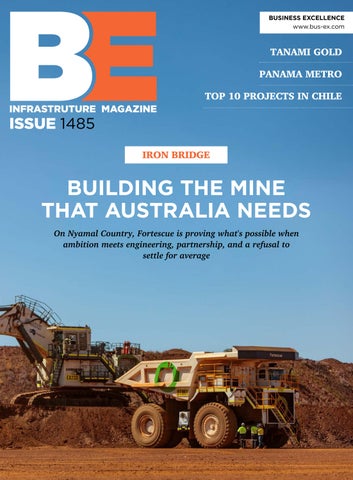
BUILDING THE MINE THAT AUSTRALIA NEEDS

On Nyamal Country, Fortescue is proving what's possible when ambition meets engineering, partnership, and a refusal to settle for average

Commercial Publishing Services

Introducing our new commercial publishing services team

Would you like to have your very own corporate magazine or newsletter? We can help you with your publishing needs from CSR, Sustainability or annual investor reports to your employee or shareholder handbooks. Whatever you need, we would love to help [ Tel: +44 203 637 2469 ] or email [ sales@bus-ex.com ]

THE TEAM

THE TEAM

Abi Abagun abi@bus-ex.com

Wisner Gomes w.gomez@bus-ex.com

Michael Miniham michael@bus-ex.com

Wisner Gomes w.gomez@bus-ex.com

Eurides Lopes e.lopes@bus-ex.com

Jason Olayinka j.olayinka@bus-ex.com

Eurides Lopes e.lopes@bus-ex.com

Maria Cobano m.cobano@bus-ex.com

EDITORIAL RESEARCH

Joseph Philips joe@bus-ex.com

Maria Cobano m.cobano@bus-ex.com

Joseph Philips j.philips@bus-ex.com

Wenzile Ndlovu wenzile@bus-ex.com

Joseph Philips j.philips@bus-ex.com

EDITORIAL

Xoliswa Mhlaraza xoliswa@bus-ex.com

Editorial

Michael Minihan m.minihan@bus-ex.com

EDITORIAL

Editorial Michael Minihan m.minihan@bus-ex.com

Michael Minihan michael@bus-ex.com

Jason Olayinka j.olayinka@bus-ex.com

CREATIVE

Jason Olayinka j.olayinka@bus-ex.com

Karen Teh k.teh@bus-ex.com

info@bus-ex.com

Jason Olayinka j.olayinka@bus-ex.com info@bus-ex.com

SUBSCRIPTIONS & ENQUIRES

Karen Teh k.teh@bus-ex.com info@bus-ex.com

SUBSCRIPTIONS & ENQUIRES Volume

SUBSCRIPTIONS & ENQUIRES

20-22 Wenlock Road, N1 7GU, London

Volume

Volume Media Limited 20-22 Wenlock Road, N1 7GU, London

20-22 Wenlock Road, N1 7GU, London

The content of this magazine is copyright of Volume Media Ltd. Redistribution or reproduction of any content is prohibited.

The

The content of this magazine is copyright of Volume Media Ltd. Redistribution or reproduction of any content is prohibited.

© Copyright 2018 Volume Media Ltd.

© Copyright 2018 Volume Media Ltd.

10 14 18 40 58

The New Hierarchy Five Priorities

Remaking European Infrastructure

The Electron Arms Race

How AI is Redrawing the Energy Map

The Desalination Imperative

Latin America's $3 Billion Infrastructure Opportunity Tanami Gold Mine Deep Gold in a Far Country

Iron Bridge Building the Mine That Australia Needs

Sierra Gorda Mine

Rewriting the Economics of

Copper

Metro de Panamá Line 3

The Canal's New Twin to the West

Rewiring Bibiani Inside Asante's Corridor Bet in Ghana's New Gold Era

Simandou

Forging Guinea's Future from Iron Logistics Sector

Tanami Gold

A FAR COUNTRY

Australia’s next great underground story

JOSEPH PHILIPS
Gold Mine

If you take the long road north-west from Alice Springs, the land stretches out into heat mirage and red-gold dust. The highway gives way to corrugations and silence, and then—after hours—the desert reveals a city that isn’t on any tourist map. Towers and conveyors puncture the sky; a headframe throws a geometric shadow in the late light. Beneath it all, 1.6 kilometres down, a deep underground world hums.

This is Tanami. Not a camp, not a project, but a place. It has its own rhythm: buses at dawn from Twin Hills Village, radios crackling through the afternoon, the steady thrum of the mill through the night. On the surface, it is remote. Below, it is precise.

“Tanami fits our Tier 1 strategy because we have a mine life that extends for decades,” says Justin De Meillon, General Manager of Newmont Tanami. “And once the expansion projects are completed, we’ll produce at a rate of over half a million ounces per year.” He doesn’t say it as a slogan; he says it the way people here talk—plainly, with the certainty that comes from doing the hard parts over and over.

Tier 1 strategy because we have a mine life that extends for decades,” says Justin De Meillon, General Manager of Newmont Tanami. “And once the expansion projects are completed, we’ll produce at a rate of over half a million ounces per year.

Purpose Built for

With a maximum payload of 13,000 kilograms, the New Purpose Built Australian standards, including AS5400 for Tow Trucks and offers tray operated by a Wi-Fi remote control. The 6785 mm x 2500 mm class-leading 12.5-tonne planetary drive winch, a robust steel plate container locks (ISO 1O' pattern), and the provision for optional ratchet

for Underground.

Built E15 Tilt Tray is compliant to all relevant ISO and offers a flexible and safe transport solution with tilt and sliding mm tray has a 15° loading approach angle and features a plate floor bordered by multiple tie-down points, lashing rail, four ratchet load binders. Scan the QR Code to find out more.

ELPHINSTONE: A CORNERSTONE IN MINING INNOVATION

ELPHINSTONE: A CORNERSTONE IN MINING INNOVATION

Built on a passion for mining, and a commitment to deliver value to its customers, it’s no surprise E l p h

Built on a passion for mining, and a commitment to deliver value to its customers, it’s no surprise E

innovation for over half a century.

innovation for over half a century.

The Elphinstone name is synonymous with the mining industry, designing and manufacturing specialised e q u i p m

The Elphinstone name is synonymous with the mining industry, designing and manufacturing specialised

operations for over 50 years.

operations for over 50 years.

From underground mining support vehicles to offhighway extended-dist ance haul trucks and mine extraction equipment, the company is also a wellestablished Caterpillar OEM Solutions customer

From underground mining support vehicles to offhighway extended-dist ance haul trucks and mine extraction equipment, the company is also a wellestablished Caterpillar OEM Solutions customer

With machines operating in over 25 countries across six continents, Elphinstone continues to strengthen its capabilities and expand its presence in the mining industry sector

With machines operating in over 25 countries across six continents, Elphinstone continues to strengthen its capabilities and expand its presence in the mining industry sector

A PASSION FOR MINING

A PASSION FOR MINING

It was in 1975, when Dale was modifying Cat surface m

established.

established.

The sale of the company’s first underground machine, the Elphinstone 79C (a modified Caterpillar 769C), soon followed in 1976 and 1977, respectively, with innovation quickly expanding beyond expectations.

The original fully designed and manufactured Elphinstone R1500 LHD, Machine #1, is now part of Dale’s collection. acceler ra d i o g Government cancer

In 1986 Elphinstone rose to the challenge and in just seven months produced and sold its first fully designed and manufactured load haul dump loader (LHD), the R1500.

It was in 1975, when Dale was modifying Cat surface m

The original fully designed and manufactured Elphinstone R1500 LHD, Machine #1, is now part of Dale’s collection.

In 2010 its under Rayong, To retain local supply to “buy range vehicles. A BRIGHT In his doesn’t 50-year

In 1986 Elphinstone rose to the challenge and seven months produced and sold its first fully designed and manufactured load haul dump loader (LHD R1500.

The following year, Elphinstone sold its first R1500 overseas to Freeport McMoRan’s Henderson mine in the USA.

The sale of the company’s first underground machine, the Elphinstone 79C (a modified Caterpillar 769C), soon followed in 1976 and 1977, respectively, with innovation quickly expanding beyond expectations.

After pioneering a series of underground support v e h i c l e s , E l p h i n s

underground dump trucks, the AD13 and AD17, entered the market during the early 1980s.

The following year, Elphinstone sold its first overseas to Freeport McMoRan’s Henderson mine the USA.

Dale recalls, “Someone said to me, ‘You realise that your machine price is double your competition’, and I said back to him, ‘I had no idea what the price of our competition was, because we sell the value of our product and what it will do for you’,” he said.

After pioneering a series of underground support

under includ

Dale recalls, “Someone said to me, ‘You realise your machine price is double your competition’, said back to him, ‘I had no idea what the price competition was, because we sell the value product and what it will do for you’,” he said.

Elphinstone replaced 36 of the competitions’ loaders at Henderson with 10 Elphinstone R1500 LHD loaders.

underground dump trucks, the AD13 and AD17, entered the market during the early 1980s.

An economic downturn followed in the mid-1980s, with mining companies deciding to reduce their tunnel size which would require smaller machines with equal capacity.

electrification

Elphinstone replaced 36 of the competitions’ loaders at Henderson with 10 Elphinstone R1500 LHD loaders.

Infrastructur

INNOVATION, GROWTH, PHILANTHROPY

INNOVATION, GROWTH, PHILANTHROPY

New developments followed with the release of the R2800 LHD (1988), the R1700 LHD and AD40 dump t r u c k ( 1 9 9

An economic downturn followed in the mid-1980s, with mining companies deciding to reduce their tunnel size which would require smaller machines with equal capacity.

first purpose-built underground dump trucks were the AD13 (pictured), and Ad17.

To this

New developments followed with the release R2800 LHD (1988), the R1700 LHD and AD40 t r u c k ( 1 9 9 1 ) , a n d t h e fi r

delivering more than 200 LHDs globally by the end of that year

solutions.

delivering more than 200 LHDs globally by the that year

T h e c o m p a n y ’ s s u c c e

T

Caterpillar, and the two parties established a 50/50 joint venture in 1995, creating the business known as Caterpillar Elphinstone Pty Ltd.

Caterpillar, and the two parties established a joint venture in 1995, creating the business kno Caterpillar Elphinstone Pty Ltd.

Caterpillar later purchased the remaining 50 per cent of the business replacing the Elphinstone name with the Caterpillar trademark.

Caterpillar later purchased the remaining 50 per of the business replacing the Elphinstone name the Caterpillar trademark.

After the sale of its underground mining business to Caterpillar, Elphinstone accelerated its philanthropic efforts.

Elphinstone’s first purpose-built underground dump trucks were the AD13 (pictured), and Ad17.

After the sale of its underground mining busines Caterpillar, Elphinstone accelerated its philanthr efforts.

Initiatives included a 50 percent contribution towards the purchase of an MRI scanner, the purchase of a linear

Initiatives included a 50 percent contribution to the purchase of an MRI scanner, the purchase of a

featuring

Elphinstone’s
The Elphinstone

elerator, local university scholarships for aspiring g ra p h e r s , a n d a p a r t n e r s h i p w i t h t h e S t a te ernment to establish a state-of-the-art, regional er treatment facility in Burnie, Tasmania.

accelerator, local university scholarships for aspiring ra d i o g ra p h e r s , a n d a p a r t n e r s h i p w i t h t h e S t a te Government to establish a state-of-the-art, regional cancer treatment facility in Burnie, Tasmania.

2010, Caterpillar advised of its intention to relocate underground mining manufacturing operations to ong, Thailand.

In 2010, Caterpillar advised of its intention to relocate its underground mining manufacturing operations to Rayong, Thailand.

etain the employment of skilled employees and supply chain, Elphinstone worked with Caterpillar “buy back” its brand and in 2016 launched a new of specialised underground hard rock support ehicles.

To retain the employment of skilled employees and local supply chain, Elphinstone worked with Caterpillar to “buy back” its brand and in 2016 launched a new range of specialised underground hard rock support vehicles.

BRIGHT FUTURE

A BRIGHT FUTURE

own words, Dale would say “one person doesn’t do very much” and attributes the Group’s ear success to its valued team of people

The latest addition to Newmont’s Tanami operations support fleet, the new Elphinstone E15 Tilt Tray.

In his own words, Dale would say “one person doesn’t do very much” and attributes the Group’s 50-year success to its valued team of people

re-entering the market in 2016, Elphinstone

d e s i g n e d a n d d e v e l o p e d m o r e t h a n 2 0 ground support vehicle configurations which de both centre- and front-mounted three-

n c a b s h o s t i n g s eve ra l u t i l i t i e s , s u c h a s ete agitators, delivery trucks, scissor lifts, cannons and tilt trays.

The latest addition to Newmont’s Tanami operations support fleet, the new Elphinstone E15 Tilt Tray.

ELPHINSTONE AND NEWMONT

S

Since re-entering the market in 2016, Elphinstone h a s d e s i g n e d a n d d e v e l o p e d m o r e t h a n 2 0 underground support vehicle configurations which include both centre- and front-mounted threep e r s o n c a b s h o s t i n g s

ELPHINSTONE AND NEWMONT

S i n c e r e - e s t a b l i s h i n g i t s b u

Elphinstone has developed strong relationships with world-renowned global mining customers.

a

concrete agitators, delivery trucks, scissor lifts, water cannons and tilt trays.

“ T h e c o m p a n y

c o m p a n y w i l l c o n t i n u e t o i n v e s t i n electrification projects driven by our customer ’s

c a t i o n s , r e q u i r e m e n t s a n d a p p e t i t e f o r

b o n i s at i o n ” E l p h i n sto n e g l o b a l s a l e s a n d

e t i n g m a n a g e r T i m M i t c h e l l t o l d B E tructure

The valued relationship between Newmont and E l p h i n sto n e b e g a n i n 2 018 w i t h t h e s a l e o f 3 Elphinstone WR810 Scissor Lifts into Newmont’s Cerro Negro operations in Argentina.

electrification projects driven by our customer ’s

a l s a l

a n d m a r k e t i n g m a n a g e r T i m M i t c h e l l t o l d B E

Infrastructure

this day, the Elphinstone brand is recognised as a e r o f u n d e rg ro u n d m i n i n g h e avy ve h i c l e solutions.

To this day, the Elphinstone brand is recognised as a p i o n e e r o f u n d e rg ro u n d m i n i n g h e avy ve h i c l e solutions.

, Elphinstone has developed strong relationships with world-renowned global mining customers.

The valued relationship between Newmont and E l p h i n sto n e b e g a n i n 2 01 8 w i t h t h

f 3 Elphinstone WR810 Scissor Lifts into Newmont’s Cerro Negro operations in Argentina.

Then in 2019, the same operation purchased a WR810 Fuel & Lube which has just logged over 22,000 hours. Additionally, the site purchased 2 WR810 6m3 Agitators and UG20K underground grader. In 2023 an order for a second UG20K was received followed by a WR810 Lube truck in 2024.

Meanwhile, Elphinstone’s support vehicle range began to draw interest from other Newmont ’s Australian operations.

and crane options.

t h e r

Then in 2019, the same operation purchased a WR810 Fuel & Lube which has just logged over 22,000 hours. Additionally, the site purchased 2 WR810 6m3 Agitators and UG20K underground grader In 2023 an order for a second UG20K was received followed by a WR810 Lube truck in 2024.

Meanwhile, Elphinstone’s support vehicle range began to draw interest from other Newmont ’s Australian operations.

I n 2 0 1 9, N ew

’s C

N ew m o n t ’s C a d i a o p e ra t i o n s i n N SW Newcrest) took delivery of 4 WR820 gitators, and another 3 in 2024. Recently ed orders for 4 E15 machines.

(formerly Newcrest) took delivery of 4 WR820 10m3 Agitators, and another 3 in 2024. Recently Cadia placed orders for 4 E15 machines.

r y, N e w m o

I n t h e N o r t h e r n t e r r i t

r y, N e w m o n

a WR820 10m3 Agitator and E10 Water

Ta n a m i purchased a WR820 10m3 Agitator and E10 Water C a n n o n w h i c h

ra

support ehicles. In 2024 they purchased an E15 Delivery [Flat Deck] and have just received a new E15 Tilt Tray, and MED360 mine extraction device on-site

E 1 5 support vehicles. In 2024 they purchased an E15 Delivery [Flat Deck] and have just received a new E15 Tilt Tray, and MED360 mine extraction device on-site

www.elphinstone.com in just designed (LHD), the R1500 mine in ealise that ompetition’, and I of our of our loaders loaders. of the dump 1 9 9 4 , end of o n o f 50/50 known as per cent name with business to philanthropic owards a linear Elphinstone collection.

www.elphinstone.com

Elphinstone E15 Series includes an E15 Delivery truck featuring various deck
The Elphinstone E15 Series includes an E15 Delivery truck featuring various deck and crane options.

TE2 will be the deepest production shaft of any mine in Australia

From The Granites to the modern mine

Long before there were headframes, there were prospectors. The Granites district has seen a century of hopeful picks, but the modern story began in the 1980s with a mill at The Granites and, later, the discovery of the high-grade Callie orebody—an underground anchor that would make the desert relevant to global gold. Newmont’s acquisition cemented the direction: decline access, disciplined underground methods, a processing plant that treated reliability as a virtue.

Years later, the mine’s language evolved. Callie made room for Orion—the dominant producer today—flanked by Federation and Liberator like the tines of a trident. The veins are many and often narrow, but together they

add up to something powerful: consistent, high-grade tonnes at depth. Tanami became a quiet statement of what Australia does well: patient engineering, steady production, and an appetite for hard ground.

A shaft that changes the conversation

Stand at the base of Tanami’s new headframe and you feel both the scale and the intent. The Tanami Expansion 2 (TE2) project isn’t just another capital line; it changes how the mine breathes. A 1.46-kilometre vertical production shaft—destined to be Australia’s deepest—replaces long, hot decline hauls with fast, efficient skip hoisting. What used to be a three-hour truck cycle becomes a couple of minutes on a hoist designed to move 3.8 million tonnes a year.

AUSTRALIAN WINCH & HAULAGE CO. PTY LTD

AUSTRALIAN WINCH & HAULAGE CO. PTY LTD

Australian Winch & Haulage Co Pty Ltd (AWH) is a specialist winch, winder and heavy engineering company based in Smithfield, Western Sydney From our 7,800 m� workshop we design, build, hire and overhaul h o i s t i n g e q

n g , marine, offshore and defence projects.

Australian Winch & Haulage Co Pty Ltd (AWH) is a specialist winch, winder and heavy engineering company based in Smithfield, Western Sydney From our 7,800 m� workshop we design, build, hire and overhaul h o i s t i n

,

Olympic Dam and Tanami; and marine, defence and offshore projects using constant-tension d re d g e w

Olympic Dam and Tanami; and marine, defence and offshore projects using constant-tension d re d g

a n c h o r - h

dedicated power units.

, marine, offshore and defence projects.

When you’re sinking a shaft, cutting a tunnel, running a dredge or holding a vessel on station, the hoisting system can’t fail. AWH combines practical engineering, a workshop set up for heavy gear and a large winch and winder hire fleet to keep projects moving and within spec. We’re not a general machine shop: everything centres on winches, winders, power units and the steelwork around them – man-riding and kibble winders, dredge winches, headframes, reelers and sheaves. Our project managers, engineers, equipment managers, fitters and machinists know both workshop and site, so we take responsibility for the full hoisting package, not just loose components.

dedicated power units.

Tanami Expansion 2 – Koepe hoisting for a remote gold mine

When you’re sinking a shaft, cutting a tunnel, running a dredge or holding a vessel on station, the hoisting system can’t fail. AWH combines practical engineering, a workshop set up for heavy gear and a large winch and winder hire fleet to keep projects moving and within spec. We’re not a general machine shop: everything centres on winches, winders, power units and the steelwork around them – man-riding and kibble winders, dredge winches, headframes, reelers and sheaves. Our project managers, engineers, equipment managers, fitters and machinists know both workshop and site, so we take responsibility for the full hoisting package, not just loose components.

Over the years AWH has supported many major o p e r a t i o n s , i n c l u d i n g s h a

Tanami Expansion 2 – Koepe hoisting for a remote gold mine

A recent key project is Tanami Expansion 2 (TE2) for Newmont Mining Services, where AWH manufactured and supplied Koepe winder skips and a personnel cage for the remote underground gold operation. The work drew on our full capability – detailed mechanical and s t r u c t u r

A recent key project is Tanami Expansion 2 (TE2) for Newmont Mining Services, where AWH manufactured and supplied Koepe winder skips and a personnel cage for the remote underground gold operation. The work drew on our full capability – detailed mechanical and s

AWH IN-HOUSE TECHNICAL SKILLS ARE COMPLIMENTED BY MANY YEARS OF PRACTICAL EXPERIENCE

Over the years AWH has supported many major o p e r a

d upgrades with friction, emergency egress and kibble winders; underground gold and base-

upgrades with friction, emergency egress and kibble winders; underground gold and basem

m

AWH IN-HOUSE TECHNICAL SKILLS ARE COMPLIMENTED BY MANY YEARS OF PRACTICAL EXPERIENCE

machining in Smithfield, shop testing under our ISO 9001 quality system and the supply of critical spares for long-term operation TE2 s h o w s h o w AW H

A

machining in Smithfield, shop testing under our ISO 9001 quality system and the supply of critical spares for long-term operation TE2 s h

A

engineer the equipment around it, keep as much as possible under one roof and stay involved from design through to testing and site support, so there is one party responsible for the hoisting system end to end.

engineer the equipment around it, keep as much as possible under one roof and stay involved from design through to testing and site support, so there is one party responsible for the hoisting system end to end.

WE EXCEL AT THESE SERVICES

WE EXCEL AT THESE SERVICES

WINCH & WINDER HIRE

WINCH & WINDER HIRE

• Shaft and kibble winders

• Shaft and kibble winders

• Man-riders and service winches

• Man-riders and service winches

• Constant-tension and mooring winches

• Constant-tension and mooring winches

• Power units, control cabins and ancillary equipment

• Power units, control cabins and ancillary equipment

Available for short- and long-term projects in m i n i n g , t u n n e l l i n g , m

Available for short- and long-term projects in m i n i n g ,

environments.

environments.

PROJECT HOISTING SYSTEMS

PROJECT HOISTING SYSTEMS

• Complete hoisting packages – winch or winder, headframe, sheaves an power units

• Complete hoisting packages – winch or winder, headframe, sheaves an power units

• Temporary and permanent shaft equipment

• Temporary and permanent shaft equipment

• Emergency egress systems

• Emergency egress systems

• Engineering, fabrication, assembly, testing and commissioning support MANUFACTURING & HEAVY FABRICATION

• Engineering, fabrication, assembly, testing and commissioning support MANUFACTURING & HEAVY FABRICATION

• Design and manufacture of winches and winders

• Design and manufacture of winches and winders

• Headframes, reelers, sheaves and custom steelwork

• Headframes, reelers, sheaves and custom steelwork

• Very large fabrications, including Sub-Arc welding

• Very large fabrications, including Sub-Arc welding

• Overhead crane capacity up to 60t for heavy assemblies.

• Overhead crane capacity up to 60t for heavy assemblies.

E Q U I P M E N T O V E R H A U L S , R E B U I L D S & UPGRADES

THESE CAPABILITIES ALLOW AWH TO KEEP CRITICAL PROJECT EQUIPMENT IN SERVICE AND PERFORMING AS DESIGNED.

THESE CAPABILITIES ALLOW AWH TO KEEP CRITICAL PROJECT EQUIPMENT IN SERVICE AND PERFORMING AS DESIGNED.

WHERE WE WORK

WHERE WE WORK

• Underground and surface mining

• Underground and surface mining

• Shaft sinking and tunnelling

• Shaft sinking and tunnelling

• Dredging and marine construction

• Dredging and marine construction

• Offshore oil & gas and mooring systems

• Offshore oil & gas and mooring systems

• Defence and naval support

• Defence and naval support

• Heavy civil and infrastructure projects

• Heavy civil and infrastructure projects

CAPABILITY & COMPLIANCE

CAPABILITY & COMPLIANCE

• ISO 9001:2015 certified quality management system

• ISO 9001:2015 certified quality management system

• Fabrication in accordance with MDG41, DNV, Lloyd’s, ABS, MIL and AS 1418 requirements

• Fabrication in accordance with MDG41, DNV, Lloyd’s, ABS, MIL and AS 1418 requirements

• Accredited and qualified welders to AS 1554

• Accredited and qualified welders to AS 1554

• 7,800 m� factory plus 1,000 m� office and stores in Smithfield, NSW

E Q U I P M E N T O E R H A U L S , R E B U I L D S & UPGRADES

• Strip, inspect and rebuild existingwinches and winders

• Strip, inspect and rebuild existingwinches and winders

• Brake, drive and control system upgrades

• Brake, drive and control system upgrades

• Life-extension and compliance modifications

• 7,800 m� factory plus 1,000 m� office and stores in Smithfield, NSW

• Large overhead crane coverage and heavy machining capacity

• Life-extension and compliance modifications

• Dynamic testing of winches up to 100 t WORKSHOP SERVICES

• Dynamic testing of winches up to 100 t WORKSHOP SERVICES

• Large-capacity lathes, vertical and horizontal borers

• Large-capacity lathes, vertical and horizontal borers

• Heat treatment – stress relieving and normalising

• Heat treatment – stress relieving and normalising

• Grit blasting and large enclosed paint booth

• Grit blasting and large enclosed paint booth

• Electrical cabinet construction and faultfinding

• Electrical cabinet construction and faultfinding

• Large overhead crane coverage and heavy machining capacity

Planning a shaft, tunnel, dredging or offshore project?

Planning a shaft, tunnel, dredging or offshore project?

Talk to the winch and winder specialists first.

Talk to the winch and winder specialists first.

AUSTRALIAN WINCH & HAULAGE CO. PTY LTD

AUSTRALIAN WINCH & HAULAGE CO. PTY LTD

227 Woodpark Road, Smithfield, Sydney NSW 2164, Australia

227 Woodpark Road, Smithfield, Sydney NSW 2164, Australia

Tel: +61 (0)2 9725 2772 Email: sales@auswinch.com.au

Tel: +61 (0)2 9725 2772

Email: sales@auswinch.com.au

“The aim is simple,” says Grant Brinkmann, Area Manager for Shaft and Surface Construction. “Increase production and lower costs.” He points to the 90-plus-metre headframe. “When complete, TE2 will be the deepest production shaft of any mine in Australia—and this headframe is one of the highest structures in the Territory.” There’s pride in that, but also relief: the ventilation will work better; the heat load eases; the bottlenecks unclench. Underground, the expansion adds a mechanised crushing system so ore meets the skip as crushed rock, ready to fly. On the surface, the mill—already a 24-hour instrument—is tuned to catch the new cadence without missing a beat.

The craft of precision at depth

There is a romance to the desert; there is none in aligning a six-metre winder drum to millimetric tolerances a mile below. That’s craft. RUC Cementation—part of Murray & Roberts—has carried the shaft sinking, lining

and equipping through the desert’s moods: heat, dust, sudden storms. Above, Yenem Engineering and GR Engineering Services worked the geometry of steel and concrete so the headframe mirrors the winder’s needs, not the other way around. PHE Group threaded cables, panels and sensors through a logic that will seem simple only when it is finished. Redpath Mining brought the discipline at the shaft bottom—the place where the theory meets the cage. And Australian Winch & Haulage did the quiet lifting, the controlled pulls, the brake and drum installations that make commissioning feel inevitable.

The hoist itself carries the two signatures that matter: ABB’s 6-metre Koepe friction winder for ore and a personnel winder that moves crews with ease, both tied into SILrated controls and the kind of automation you don’t notice until it saves a day. Regenerative braking. Battery-backed stability. Remote diagnostics that predict, not react.

“Every component weighs tonnes, and our tolerances are measured in millimetres,” a project engineer says, running a finger along a drawing. “You don’t get second chances at this depth.”

The art of keeping an underground alive

People who haven’t been underground think the challenge is rock. People who have know the challenge is air. At Tanami’s depths, the rock carries its own heat; the air must compete. So, in parallel with shaft steel and hoist motors, the mine has built a ventilation and cooling system with serious muscle—big primary fans, dozens of clever secondaries and chillers that make the difference between “possible” and “safe.” The shaft won’t just move ore; it will help the mine breathe better.

Above, another system watches the whole orchestra. Minestar—a fleet and operations platform—has trimmed the radio traffic and grown the visibility. “We have far more visibility underground now,” says Rochelle Patamore, who helped implement it. “We can see where equipment is, predict arrival times, and deal with delays before they ripple. It lets the control room think about improvement, not just input.”

What a supply chain looks like when it’s working

Lists don’t do justice to what’s been built here, but the names matter. RUC Cementation at the shaft; ABB for hoists and controls; Valmec for early utilities; NRW/Golding on civils and foundations; GRES and Yenem for structural design and erection; PHE for E&I integration; Redpath for bottoming and test hoists; thyssenkrupp for the underground gyratory crusher; Australian Winch & Haulage for mechanical handling; and dozens more local specialists who rarely make the press but do the day-on-day.

The desert doesn’t forgive poor coordination. Newmont’s team has leaned on packages that make sense, ICN Gateway pathways that open doors to local firms, and a commissioning schedule that treats risk like an engineering problem, not an inevitability. The result is less a “project” than a network of teams doing what they do best, in sequence, with respect for the whole.

A mine of people

It’s easy to tell this as a machine story. It isn’t. At 4:45 a.m., the first buses pull away from Twin Hills. Suzanne Burke—once a real estate agent, now an underground haulage supervisor—does the safety brief the same way every day: calm, direct, specific. “You work hard down here,” she says later, “but when you go home, you switch off. That balance keeps you sane.” She loves the mentoring: turning truckies into trainers, watching careers climb out of the decline.

For the Warlpiri communities of Yuendumu and Lajamanu, “mine” often meant “elsewhere.” Not here. The Yapa Crew—Newmont’s on-thejob training pathway—has drawn people from the nearest communities into proper roles: machines, environmental work, trades. Mia Leklatna speaks for many. “It’s pretty good,” she says, smiling. “I feel like I’m making them proud. My brothers and sisters look up to me now.” There are statistics—more Indigenous employment every year, more local procurement—but it’s the faces that stick.

A desert code for ESG

The letters have become shorthand—ESG— but in a place like this they read as common sense. Paste backfill returns much of the mill’s leftovers to the stopes, cutting the surface footprint. Water is managed like the precious desert resource it is. The Tanami Gas Pipeline replaced long diesel trains with cleaner, steadier power and an emissions profile that

moves the needle in the right direction. The shaft and hoists will reduce underground diesel haulage further; you can hear the ventilation engineers quietly cheering.

Community isn’t a side programme. The mine sits on Aboriginal freehold land, and the relationship with the Central Desert Aboriginal Lands Trust is baked into every planning conversation. Jobs, business opportunities, sealed roads, the small things and the big ones—this is the long work of making sure the mine’s success shows up in people’s lives beyond the front gate.

“The project will improve ore transportation, increase processing capacity, lower our carbon output, and extend the mine’s life beyond 2040,” says Justin De Meillon. It sounds like a performance plan; it is also a promise that the mine intends to be a good neighbour for a long time.

The approval of our second expansion project at Tanami will further improve costs and extend the life of this world-class mine in a core Newmont jurisdiction,” says Tom Palmer, Newmont’s President and CEO

Why Tanami matters to Newmont - and to the market

There’s a practical answer: the mine is core to Newmont’s Australian portfolio and a material contributor to global production. There’s a strategic one: in a world where gold remains an anchor for uncertain times, reliable ounces from good jurisdictions are worth more than their weight. Tanami is both—reliable and right-sited.

“The approval of our second expansion project at Tanami will further improve costs and extend the life of this world-class mine in a core Newmont jurisdiction,” says Tom Palmer, Newmont’s President and CEO. It isn’t just corporate positioning—postexpansion, Tanami joins that short global list of underground operations capable of more than half a million ounces a year from a single system, and it does it with the kind of cost base you earn, not inherit.

The last miles to commissioning

Nobody here underestimates the distance between “almost” and “done.” There are still alignments to check, systems to prove, the long ladder of commissioning steps to climb. The plan is disciplined: mechanical completion of the hoist systems, staged commissioning that treats the shaft like the critical path it is, then a ramp-up that lets the plant and pit talk to each other without shouting.

“TE2 secures Tanami’s future as a long-life, lowcost producer,” says Tom Palmer, “and provides a platform for future exploration and growth.”

Below the current levels, the geologists are already chasing the next pages of Orion and its neighbours. There’s confidence underground: the ore doesn’t read press releases, but it does respond to patient drilling.

The multiplier in a far place

You can see the mine’s economy in the obvious ways—jobs, flights, fuel, food contracts. But

the real multiplier is subtler: the welders who become supervisors, the trainers who go home with stories their kids can believe, the local businesses that move from one-off contracts to standing orders. Each on-site role creates others—aviation, logistics, maintenance, hospitality—across a region that has learned to make a living at the far end of the map.

And then there are the legacies that don’t fit on a balance sheet. Sealed roads that outlast mine schedules. A headframe that becomes a landmark. Skills people take to the next job, or bring back to the community. In a country that mines well, Tanami is a case study in how to do it with respect for land and people—and with ambition that doesn’t shout.

What success will look like

When the first ore rises on the new hoist, success won’t sound like trumpets. It will sound like a winder humming at speed and a control room that’s quiet because the systems work. It will look like a production graph that climbs and a cost line that bends. It will be a supervisor’s calm voice in a prestart, a Yapa Crew graduate swapping a trainee badge for a permanent one, a contractor winning a second package because the first was done right.

“Deepest production shaft in Australia,” Brinkmann says, almost to himself. Then, with the same understatement that runs through the place: “Built to last.”

In the meantime, the desert waits and the mine moves to its own metronome. Buses at dawn. Radios all afternoon. Mill at night. The kind of rhythm that builds a future one precise step at a time.

Partners in the making (selected)

While Business Excellence is not a directory, it is fair to acknowledge the breadth of

craft behind TE2: RUC Cementation (shaft sinking, lining and equipping), ABB (minehoist systems and controls), Valmec (early utilities and mechanical works), NRW/Golding (civils and foundations), GR Engineering Services and Yenem Engineering (structural and headframe engineering), PHE Group (electrical and instrumentation integration), Redpath Mining (shaft bottoming and test hoisting), thyssenkrupp Industrial Solutions (primary underground crusher), and Australian Winch & Haulage Co (auxiliary winches and mechanical handling). Each did their part so that the whole could sing.

And there are many more—across every discipline that keeps a deep mine alive in the desert: underground development and ground support; drilling and blasting; ventilation and refrigeration; materials handling and conveyors; power generation and highvoltage reticulation; process control, comms,

and IT; water, dewatering, and tailings/pastefill; geotech, survey, and QA; fabrication and machining; explosives and consumables; roadworks and freight logistics; aviation and bus operations; fuel and lubricants; waste and recycling; emergency response and medical; camp operations (catering, housekeeping, laundry); PPE and industrial supply; heritage, environmental, and rehabilitation services; training, apprenticeships, and RTO partners; security; and a meaningful cadre of Indigenous-owned enterprises delivering earthworks, services, and cultural advisory.

Much of this ecosystem has been engaged through structured work packages and local procurement pathways (including ICN), giving regional SMEs and Indigenous businesses a durable stake in TE2’s success—proof that a project of this scale is never just steel and schedules, but a community of specialists moving in time.

The Last Word

What happens next at Tanami is not a question of whether the gold is there — it is — but how far Newmont and its partners can stretch the boundary of possibility. The Tanami Expansion 2 (TE2) project is already redefining what remote mining looks like, not only in engineering but in mindset.

Once the new shaft is commissioned, Tanami will step into a rare global league: underground mines capable of producing over half a million ounces a year at grades that still make geologists raise an eyebrow. Yet, for Newmont, TE2 is as much about longevity as tonnage — about ensuring the mine remains a living, breathing asset long after today’s teams have moved on.

The project opens the door to new orebodies at depth — Orion’s deeper limbs, Federation’s

extensions, Liberator’s lateral reach — each promising a new chapter in the desert’s geology. Exploration continues quietly below the known levels, guided by smarter data and sharper modelling, while above ground, Tanami is becoming a template for next-generation remote mining operations: automation layered with human skill, technology tempered by local wisdom.

There’s a sense among the leadership team that Tanami is evolving from mine to model — a benchmark in what sustainable underground operations can be. The energy efficiency

measures, the Indigenous training pathways, the digital hoisting systems and predictive maintenance — these are not footnotes but signals of an industry learning to think in decades, not quarters.

Executives across the mining world will be watching how Newmont integrates these layers: how a $2.3 billion investment turns into a multi-decade advantage; how collaboration among global OEMs and local contractors reshapes performance; and how the mine’s success filters through to regional development, education, and infrastructure across the Northern Territory.

What began as a bold logistical challenge — “Can you mine this deep, this far from anywhere?” — is quietly becoming one of Australia’s great industrial case studies in resilience, precision, and respect for place. Tanami is proof that even in the most extreme

settings, engineering excellence and human intent can coexist beautifully.

“Since acquiring Tanami in 2002, it has become central to our long-term strategy,” says Justin De Meillon, General Manager. That’s the measured voice of a manager. But the desert version is simpler: keep your promises; do the next thing right; let the work speak.

And out here — in the red heart of Australia, where the horizon is a straight line and the light never lies — it does.

BUILDING THE MINE THAT

On Nyamal Country, Fortescue is proving engineering, partnership, and

Iron Bridge

THAT AUSTRALIA NEEDS

proving what's possible when ambition meets a refusal to settle for average

Bridge

The pipeline burst in late 2023, and for a moment, the future looked uncertain.

After years of construction and cost escalation, Fortescue's Iron Bridge magnetite plant had finally found its rhythm. Premium concentrate was flowing toward Port Hedland at prices that validated the entire ambitious vision. Then a 65-kilometer section of the raw water pipeline started leaking into the Pilbara soil, and shipment forecasts collapsed from 5 million tonnes to 2 million.

Most companies would have hedged. Fortescue doubled down.

The response was swift and decisive: commit another US$100 million to replace the pipeline, implement water banking to capture every drop of rainfall, and maintain the same unwavering message they'd been delivering since 2019. Iron Bridge isn't just another mine - it's a demonstration of what Australian mining can become when it aims higher than good enough.

Standing 145 kilometers south of Port Hedland on Nyamal land, Iron Bridge is teaching the industry what premium iron ore actually requires. Not just capitalthough at US$4 billion there's plenty of that - but vision, resilience, partnership depth, and the courage to build something that looks less like traditional mining and more like an integrated industrial system that happens to start with magnetite ore.

The headlines focused on delays and cost overruns. The real story is about the hundreds of businesses - from multinational EPCs to specialized Pilbara contractors - that are collectively solving problems nobody had faced at this scale

The biggest range of tyres & wheels for the Mining, Industrial & Construction sectors

OTR - Tyres Wheels Axles supply earthmover, ag, truck, bus and light vehicle tyres and rims from 6” through to 63” in diameter, to blue chip mining, civil contracting, road transport companies, agricultural dealerships & end users.

We maintain a healthy inventory of new and used earthmover tyres of critical sizes and have the ability to custom manufacture Australian Made wheels in 1 of our 16 locations Australia wide.

SALES PHONE: 1300 CALL OTR

For any enquiries please visit www.otrtyreswheelsaxles.com

OTR - TYRES WHEELS AXLES, AUSTRALIA’S OWN TYRE & WHEEL PARTNER

If your tyres and wheels stop, your production stops – and that’s exactly where OTR - Tyres Wheels Axles fits into the picture at Fortescue’s Iron Bridge Magnetite Project.

Proudly Australian-owned and Australian-based, OTR - Tyres Wheels

Axles is run by people who’ve spent decades in the WA mining tyre game.

The business now delivers a complete “ground contact” package – OTR tyres, wheels, rims and axles – all specified, supported and serviced for tough Australian conditions and demanding haul profiles.

For Iron Bridge and other major iron ore operations, OTR - Tyres Wheels

Axles focuses on the things that really matter on site:

• The right tyre and wheel selection, backed by haul profile studies.

• Safety and compliance, with inspections, repairs and certification to Australian Standards.

• Fast, local support, helping to reduce failures, cut downtime and keep trucks moving.

The long-standing relationship with Fortescue reflects a straightforward value proposition: reliable, safe performance that supports high production targets in remote, high-temperature environments.

While OTR - Tyres Wheels Axles roots are firmly in Australia, its capability is not confined by borders. With integrated product, engineering and service expertise under one roof, the company is well placed to support projects beyond Australia, including growth markets such as Africa and other mining regions that demand the same blend of reliability, safety and practical, on-the-ground know-how.

From the Pilbara to projects abroad, OTR - Tyres Wheels Axles is ready to keep heavy fleets rolling – safely, efficiently and profitably – on solid Australian expertise.

If you would like to learn more on how OTR - Tyres Wheels Axles can help your business, visit www.otrtyreswheelsaxles.com or phone 1300 CALL OTR today.

www.otrtyreswheelsaxles.com

At 67% iron content and commanding US$28-per-tonne premiums, Iron Bridge concentrate isn't just working—it's showing the industry what becomes possible when you refuse to accept that "good enough" is good enough.

before. About Traditional Owners who moved from contracts to equity. About engineers who are proving that Australia can compete in the premium iron ore market that green steel will demand. At 67% iron content and commanding US$28-per-tonne premiums, Iron Bridge concentrate isn't just working - it's showing the industry what becomes possible when you refuse to accept that "good enough" is good enough.

This is the story of how they're building it.

The Ore That Demands Excellence

Walk into most Pilbara iron ore mines and you'll see elegant simplicity: massive trucks hauling rock that gets crushed, screened, and loaded onto trains. Iron Bridge is something else entirely.

The processing plant hums with precision. Massive high-pressure grinding rolls pulverize magnetite ore into particles finer than talcum powder. Air classifiers separate fractions with exacting precision. Magnetic drums extract concentrate from slurry. The entire operation consumes enough electricity to power a city, but every kilowatt is justified by what emerges: concentrate at 67% iron, the kind of premium product that steel mills building low-emission furnaces will pay extra to secure.

This is magnetite's promise and challenge.

The ore bodies - North Star, Glacier Valley, Eastern Limb, West Star - contain value locked inside hard rock that demands transformation, not just extraction. The flowsheet reads like advanced materials processing because that's exactly what it is.

Getting the comminution circuit right required specialists who understand the margins are measured in microns. Reflex Instruments Asia Pacific supplied downhole surveying tools that helped map the ore bodies with precision, ensuring every tonne mined justified the energy to process it. Boart Longyear Australia delivered drilling services and equipment that could handle the hard magnetite formations, their rigs working round-theclock to define the resource and keep the

mine plan ahead of the processing plant's appetite.

Dino Otranto, Fortescue's metals and operations chief, frames it clearly: "Iron Bridge is critically important in the energy transition to make green iron." The world is learning to make steel without wrecking the climate, and that new world demands better iron ore than most of Australia currently produces. Iron Bridge is demonstrating that Australia can deliver. The journey hasn't been smooth, but every challenge has driven innovation that's making the operation more robust, more efficient, more capable of hitting the ambitious targets that once seemed aspirational.

Building the Water Infrastructure That Makes It Possible

The engineering challenge at Iron Bridge starts with a simple fact: magnetite processing needs water, and the nearest reliable source is 220 kilometers away in the Canning Basin - roughly the distance

from London to Paris.

So Fortescue and its partners built not just a pipeline, but a complete water management system. The raw water line from the Canning Basin. Twin 135-kilometer pipelines to send concentrate slurry to Port Hedland and return process water to site. Storage facilities to capture and bank water onsite. Monitoring systems to track every gigalitre. The total water infrastructure represents hundreds of millions in investment and some of the most sophisticated remote pipeline engineering in Australian mining.

When the high-pressure section began showing stress, the response demonstrated the maturity of the project team. Rather than compromising, they committed US$100 million to replace the suspect section with upgraded specifications. Operations teams simultaneously implemented water banking - capturing rainfall and process water in onsite storage - to buffer the plant against any future pipeline interruptions.

Iron Bridge is an “obvious choice to be considered as one of our first decarbonised, fossil fuel free sites” as Fortescue pursues real zero by 2030

Pentium Hydro brought specialized expertise to the hydraulic systems, ensuring pumps and flow control could handle the precise pressures and volumes the process demands. Clover Pipelines Mining and Resources contributed to pipeline construction and integrity work, their crews understanding that in magnetite operations, pipeline reliability isn't just important - it's foundational. The fix is more than just new pipe. It's a commitment to the long-term vision, backed by capital and operational discipline. Site teams now manage roughly 0.8 gigalitres of onsite water storage,

creating resilience that means the plant can maintain steady operation even during pipeline maintenance.

Meanwhile, the decarbonization work is accelerating. The 100-megawatt North Star Junction solar farm is feeding the grid, with Energy Power Systems Australia providing critical power infrastructure and control systems that allow renewable energy to integrate seamlessly with industrial processing loads. A 50-megawatt battery - the grid-forming kind that can stabilize intermittent solar without fossil backup - is being commissioned. Electric

excavators are moving ore. Andrew Forrest states Iron Bridge is an “obvious choice to be considered as one of our first decarbonised, fossil fuel free sites” as Fortescue pursues real zero by 2030.

The vision is clicking into place: a magnetite operation powered by Pilbara sun, processing premium concentrate for steel mills that care about both quality and carbon footprint.

The Engineering Ecosystem That Makes Excellence Routine

Behind Iron Bridge's emergence as a producing mine is a dense network of capability - multinational contractors working alongside specialized Australian firms, each contributing pieces that interlock into a functioning whole.

CPB Contractors anchored the construction phase, delivering the concrete foundations and structures for a wet processing plant that has to absorb constant vibration from grinding mills

without degrading. InfraBuild supplied 4,000 tonnes of reinforcing steel into those foundations, engineering the hidden skeleton that ensures longevity. Civmec delivered structural steel, mechanical systems, and electrical installations across the ore processing facility. SIMPEC built the wet processing plant itself under a A$145 million contract, drawing on Pilbara labor and training locals on industrial

But scale alone doesn't create a functioning mine. That requires depth - the specialized contractors who solve problems that only reveal themselves when equipment meets ore meets Pilbara conditions.

MACA Civil brought earthmoving expertise to site development, shaping landforms and drainage that can handle both flooding rains and months of dust. Their work creates the stable platforms everything else depends on. On the mining front, Thiess runs drill and blast, load and haul, and fleet maintenance, delivering ore with the consistency that keeps the processing plant optimized.

Q.H. & M. Birt contributed structural steel fabrication and specialized metalwork, the kind of precision components that

keep materials handling systems aligned under continuous heavy loads. Prothious Engineering Services delivered mechanical and piping expertise to the complex wet processing circuits, where tolerances matter and failures cascade.

The instrumentation and control systems that make the plant responsive rather than just loud came from multiple specialists. Radlink supplied communications infrastructure that keeps remote operations coordinated. ABB delivered the variablespeed drives and motors that make the grinding circuit controllable, squeezing efficiency from every megawatt.

As the plant transitions toward steadystate operation, asset integrity becomes paramount. Bugarrba, an Aboriginal joint venture involving SRG Global, holds a five-year contract for maintenance, rope processing systems.

access, and structural remediation - the crews who work in 45-degree heat to catch problems before they become failures. TKPH brings tire monitoring and management expertise, critical for mining equipment operating in abrasive conditions where tire failures can halt production.

Warrikal, another Aboriginal business, is contributing to operations support services, building capability that will outlast any single project. And when camps needed to be established to house the workforce building all of this? Rapid Camps delivered accommodation infrastructure that made remote construction not just possible but livable.

These aren't just vendors executing scope. They're an interlocking ecosystem where each specialist enables the others.

The most transformative aspect of Iron Bridge might not be the technology. It might be the redefinition of what partnership means.

The processing plant works because the power systems are reliable. The power systems work because the infrastructure is maintained. The maintenance works because communications are solid. Everything connects.

It's this depth of capability - multinational scale combined with specialized expertise and local knowledge - that's allowing Iron Bridge to mature from ambitious concept into productive reality.

What Partnership Looks Like When It's Done Right

The most transformative aspect of Iron Bridge might not be the technology.

It might be the redefinition of what partnership means.

Nyamal Holdings - the business arm of the Nyamal people, on whose country Iron Bridge operates - owns a fleet of contour drill rigs, stemming loaders, and platform rigs worth A$18 million. Not leasing. Not operating under contract. Owning. The equipment sits on Nyamal's balance sheet, generating revenue, building equity, creating futures.

This represents a fundamental shift from how mining traditionally engages with Traditional Owners. Instead of royalties that flow through without building capability, or labor contracts that leave no assets behind, equipment ownership creates lasting value. It means Nyamal businesses can deploy these assets into other projects, other opportunities, other visions of what economic self-determination looks like.

By late 2023, Fortescue had channeled

over A$370 million in contracts to Nyamalowned businesses through Iron Bridge. That's not symbolic procurement - it's a transformation of the local business landscape, creating companies with balance sheets, capability, and confidence to compete for work anywhere.

Gavin Mitchell, chair of the Nyamal Aboriginal Corporation, describes it as "a significant contract for the Nyamal people," providing training, employment, and deepening commercial relationships. But the numbers tell a bigger story: 3,000 construction jobs, 900 ongoing operational roles, and a growing cohort of Nyamal businesses that have moved from labor hire to delivering heavy civil works, asset maintenance, drilling, and plant operations.

Cundaline Resources, a 100% Aboriginalowned business, exemplifies the trajectory.

Fortescue's Billion Opportunities program, which targets procurement from Aboriginal businesses across all operations, is using Iron Bridge as proof that Indigenous economic participation can scale into the hundreds of millions when companies design it into projects from the start, rather than adding it as afterthought

Starting with labor hire, they've grown into delivering earthworks and mechanical services on the West Canning Basin water transfer infrastructure, building the track record and capability to bid on larger scopes.

Fortescue's Billion Opportunities program, which targets procurement from Aboriginal businesses across all

operations, is using Iron Bridge as proof that Indigenous economic participation can scale into the hundreds of millions when companies design it into projects from the start, rather than adding it as afterthought.

The conversation among Nyamal elders now extends beyond contracts to deeper questions: equity positions, joint ventures,

seats at the table where strategic decisions get made. Iron Bridge has given them the leverage and credibility to have those conversations from a position of strength.

The Premium Product the Market Was Waiting For

While engineers were managing the pipeline challenge, the commercial team was discovering something remarkable: steel mills were willing to pay significantly more for Iron Bridge concentrate than anyone had conservatively forecast.

In December 2023, Iron Bridge magnetite was realizing prices about US$28 per tonne higher than standard Fortescue hematite - roughly a 25% premium. At nameplate production of 22 million tonnes per year, that premium translates to around US$600 million in additional annual revenue compared to equivalent-volume hematite production.

The premium isn't arbitrary. Steel mills building hydrogen-based direct reduction

plants and low-emission furnaces need high iron content, low impurities, and consistent specifications. They need exactly what takes a US$4 billion processing plant to produce. As one steel executive put it privately: "We're not paying for iron ore anymore. We're paying for steel plant reliability, and that starts with input quality."

Iron Bridge concentrate delivers that reliability. At 67% iron, it can be used straight or blended with lower-grade cargoes to lift the overall quality. That flexibility is valuable to both Fortescue and its customers, creating optionality that traditional single-grade operations don't offer.

The strategic positioning is equally important. Analysts have warned that Australia risks losing substantial iron ore export revenue if it doesn't move toward high-grade and green iron products as global steelmaking decarbonizes. Iron Bridge, alongside Fortescue's West Pilbara Fines project and emerging green

iron initiatives, represents the company's answer to that structural challenge.

The project has also demonstrated something that extends beyond Fortescue's balance sheet: premium magnetite can be produced in Australia at scale and sold into the seaborne market at prices that justify the complexity. That proof of concept could unlock other magnetite deposits across the Pilbara, potentially reshaping the region's longterm ore mix.

From a capability perspective, Iron Bridge has pushed Fortescue beyond its traditional strength in high-volume hematite mining into precision processing, energy systems integration, and the operational discipline that complex manufacturing demands. Those capabilities position the company for an industry that's evolving from extraction toward materials science.

What Gets Built Becomes What's Possible

Every ambitious project teaches lessons, but Iron Bridge's lessons are particularly valuable because they're being proven in real-time by crews who've learned what works when theory meets Pilbara reality. Magnetite rewards integrated thinking. The pipeline challenge proved that mining, processing, water, and power can't be modeled as discrete projects. They're one interdependent system where investment in any element strengthens the whole. The water banking strategy, for example, emerged from understanding that buffer capacity in one part of the system creates resilience everywhere else.

Infrastructure resilience combines hardware and culture. The pipeline is being upgraded with better specifications, but the real resilience comes from water banking, process optimization, and an operations culture that treats reliability

as non-negotiable. The best infrastructure projects build both the physical systems and the organizational capability to manage them.

Partnership depth creates competitive advantage. The progression from tens of millions to hundreds of millions in Nyamal contracts happened because Indigenous participation was designed into the project from early stages, not added during procurement. Equipment ownership works when Traditional Owners have capital access, training pathways, and governance structures - and when mining companies accept that genuine partnership means sharing both value and decision-making.

Specialized capability is strategic, not tactical. CPB, Civmec, SIMPEC, Thiess, MACA, MPC Kinetic, Pentium Hydro, Boart Longyear, TKPH Pty Ltd, ABB, Energy Power Systems, Bugarrba, and dozens of others aren't interchangeable. Their interlocking expertise defines what's achievable. The contractors thriving at

Iron Bridge are those who understood early that they were building an industrial processing facility, not just a mine. Narrative consistency builds confidence during complexity. While commissioning faced challenges, Fortescue maintained unwavering messaging: Iron Bridge is strategic, premiums are real, green steel is coming. That consistency keeps investors focused on long-term value creation rather than quarterly volatility - and preserved access to capital when the pipeline upgrade required additional investment. The broader lesson transcends Iron Bridge: when projects are conceived as integrated systems rather than collections of assets, when partnerships are designed for shared success, when specialized expertise is valued over lowest-price tendering, what gets built is not just infrastructure but capability that compounds over time.

Building What Australia Needs

Iron Bridge is teaching the industry something essential: premium products

require premium capabilities, and building those capabilities creates value that extends far beyond any single project.

The complexity isn't a bug - it's the feature. Premium magnetite concentrate commands premiums because it requires orchestrating processing, pipelines, power systems, and partnerships into an integrated whole that consistently delivers quality. The companies that master that orchestration will capture the value. Those that don't will watch the market move without them.

Fortescue is proving it has that capability. The pipeline challenge tested their capital and resolve - they committed more of both. The commissioning complexity tested their engineering - they brought in the specialized expertise needed. The Indigenous partnership tested their willingness to share value - they're building a model others are now studying.

On Nyamal Country, in the Pilbara heat, Iron Bridge is operating. Solar farms are generating. Batteries are storing. Pipes are flowing. Nyamal businesses are building equity and capability. The processing plant is producing concentrate that steel mills pay premiums to secure. The system is becoming more robust with each passing quarter.

The mine that skeptics said was too complex, too expensive, too ambitious is working. Not perfectly - no first-of-kind project does. But working, improving, demonstrating what becomes possible when ambition meets engineering discipline, partnership depth, and refusal to accept that good enough is good enough.

Iron Bridge isn't just producing premium

iron ore. It's producing evidence that Australia can compete in the high-value segments that the future of steelmaking demands. It's proving that Indigenous economic participation can scale to hundreds of millions when designed into projects properly. It's demonstrating that renewable energy can power industrial processing at scale. It's showing that complex infrastructure projects can work when built on strong partnerships and specialized expertise.

In the gap between what mining used to be and what it's becoming, Iron Bridge is building the bridge. Tonne by premium tonne, partnership by partnership, innovation by innovation.

That's not just the future of one project. It's a demonstration of what Australian mining can become when it aims higher than average and builds the capability to deliver on that ambition.

How Brownfield Engineering Is Rewriting the

SGM
SIERRA GORDA

the Economics of Low-Grade Copper in Chile

JOSEPH PHILIPS

Before the first truck rolls, before the first flotation cell turns, Sierra Gorda's challenge is already in motion.

It begins 143 kilometres away, at Mejillones on Chile's northern coast, where seawater starts a long engineered journey inland. From there it moves into one of the driest mining environments on Earth, toward a copper operation that was never going to win on grade alone. Sierra Gorda, deep in the Atacama Desert, does not have that luxury. Its orebody is low grade. Its margins depend on control. Its future depends on whether infrastructure, process discipline and expansion logic can keep moving in step.

That is what makes Sierra Gorda SCM worth watching.

In an industry still drawn to the scale and spectacle of new-build megaprojects, Sierra Gorda has been advancing in a different way: by forcing more value out of what is already there. The open-pit Catabela operation, a 55-45 joint venture between KGHM Polska Miedź S.A. and South32, began commercial production in 2015 as a 110,000-tonnes-perday Phase I plant built to treat low-grade porphyry ore. By 2024, the site was routinely processing about 49 Mtpa, roughly 30% above its original design basis. That gain did not come from a fresh multibillion-dollar build. It came from de-bottlenecking, equipment changes, better process control and the kind of brownfield discipline that rarely looks glamorous from the outside.

Sierra Gorda does not win on grade alone. It wins on control

Yet this is exactly the sort of work that will define much of the next generation of copper supply.

In 2024, Sierra Gorda produced 154,559 tonnes of copper and 2,808 tonnes of molybdenum. Its annual power demand --- roughly 1,310 GWh --- is supplied through a long-term renewable power purchase agreement with AES Andes. Its process water comes from seawater, not continental freshwater, delivered through that dedicated Mejillones pipeline. By the end of 2025, KGHM had revalued its stake in the mine at US\$504 million after the repayment of nearly US\$1 billion in liabilities between 2021 and 2025. On a 100% basis, the operation generated US\$1.48 billion in revenue and US\$291 million in net profit in the first nine months of 2025.

Those are headline numbers. But the deeper story is not about one year's performance. It is about how a difficult asset was made more

resilient, more expandable and more relevant at a time when copper projects are becoming harder to permit, harder to fund and harder to operate.

A Mine Built on Constraint

Sierra Gorda's copper grade is about half the Chilean national average. That shapes everything.

Low-grade mining narrows the operating window. It makes energy efficiency more important. It makes recovery stability more important. It makes downtime more expensive. A high-grade mine can hide certain inefficiencies for longer. A low-grade one cannot. The engineering must be tighter. The interfaces between mine planning, grinding, flotation, tailings handling and maintenance must hold.

That is why Sierra Gorda's progress reads less like a breakthrough and more like a sequence of technical decisions, each one adding a little more room to an otherwise unforgiving system.

The 2024 throughput record came through that accumulation. Engineers added a third tailings thickener and a fourth concentrate filter. They modified shear agitation tanks. They upgraded pumps and conveyors. Highpressure grinding rolls were introduced to improve comminution efficiency and reduce energy intensity. Process controls were refined to support more consistent Cu-Mo flotation performance under changing ore conditions. None of this is theatrical. All of it matters.

That is often how brownfield value is created: not in one dramatic act, but in a long succession of improvements that make a plant steadier, faster and harder to interrupt.

Marcelo Bustos Collao, who became CEO on 1 July 2025, arrived with operating

experience shaped in Chilean mining rather than in boardroom abstraction. A mining civil engineer and extractive metallurgist trained at the University of Chile, with a background spanning Carmen de Andacollo, Teck Chile, Los Bronces and El Soldado, Bustos stepped into Sierra Gorda with a clear reading of the asset. It is low grade, yes, but it is also highly capable --- provided the operation keeps tightening the system around it.

He has framed that direction around three pillars: Unique Culture, Operational Excellence and Responsible Mining. At Sierra Gorda, those ideas are not especially interesting as slogans. They become interesting only when they appear in plant performance, infrastructure

In the Atacama, water and power are not utilities. They are strategic enablers

decisions and workforce execution.

And that is where the mine has been making its case.

The Real Asset Is the System Around the Plant

Copper operations are often described by their reserves, grades and annual output. Those metrics matter. But at Sierra Gorda, the more revealing story sits in the enabling system around the concentrator.

In northern Chile, water and power are never incidental. They are strategic. They affect cost, permitting, expansion pathways and long-term risk. A mine that secures them well is not just better supplied. It is better positioned.

Sierra Gorda's seawater system is a case in point. Process water is supplied through a 143-kilometre dedicated pipeline from Mejillones, allowing the operation to function without continental freshwater. Less than 10% of that water is desalinated, mainly for the molybdenum plant and camp. The rest supports the broader process circuit. With the addition of the third tailings thickener pushing densities above 60%, recirculation has improved further, helping close the loop in a region where every water decision carries operational and political weight.

The power arrangement works in the same strategic way. Sierra Gorda's energy demand is covered under a long-term renewable agreement with AES Andes, drawing on a mix of solar, wind, hydro and storage-backed supply. In another context, this might be written off as an ESG talking point. Here it is something more practical. It lowers emissions, yes, but it also stabilises a large power-intensive industrial system in a region where long-term energy planning shapes competitiveness.

Together, those two infrastructure lines --water and power --- do more than support

It is a low-grade mine that has been a national reference in several aspects of sustainability and efficiency

current production. They change the mine's future options.

That becomes especially important when expansion comes back into view.

The Next Expansion Is Not Starting From Zero

When Sierra Gorda's Phase I plant was originally delivered, expandability was built into the concept. At one point, the operation was expected to move toward a much larger Phase II development. That larger build was deferred. Instead, the owners took a slower route: improve the installed base, strengthen the economics, then expand from a position of greater control.

It now looks like a shrewd sequence.

The next step under evaluation is a fourth grinding line, along with additional flotation capacity and supporting infrastructure. The proposed expansion would lift throughput to around 58 Mtpa, another material increase. What makes it notable is not simply the volume gain, but the shape of the opportunity. Much of the hardest groundwork --- the water line, the power framework, the site platform --- is already there. That lowers capital intensity and reduces the risk profile compared with an equivalent standalone development.

This is where good infrastructure planning begins to reveal its second life. Extra capacity built in years ago can look expensive in the moment. Later, it becomes the reason a mine can expand at all without starting over.

Exploration is advancing alongside that

brownfield pathway. Over the past two years, more than US\$32 million has gone into drilling at the adjacent Catabela Northeast porphyry, which remains open in all directions. A JORC Exploration Target of 1.1--2.9 billion tonnes at 0.45--0.48% total copper points to minelife extension potential that is meaningful in any copper market, and especially so in this one. An oxide stockpile of around 110 Mt is also being assessed for possible heap-leach/ SX-EW treatment.

So Sierra Gorda's future is not being shaped by one lever alone. It is being built through the overlap of three things: a stronger plant, an expandable infrastructure base and a reserve story that still has room to run.

Contractor Ecosystem: The Operating System Behind the Asset

Brownfield optimisation is often described in terms of plant upgrades and capital efficiency, but mines do not de-bottleneck themselves. Somewhere behind every throughput gain is a contractor, a maintenance team, a component supplier, a controls specialist, a logistics partner --- usually many of them --- keeping the system intact long after the capital slide has disappeared from view.

At Sierra Gorda, that ecosystem is both broad and increasingly strategic. The mine's 148 local service providers and 192 goods suppliers accounted for roughly 29% of total spend in recent years. At the Connected Suppliers 2025:

The contractor network is not an outer ring around the asset. It sits inside the asset's performance

Sustainability Dimension event in Antofagasta, more than 100 contractors came together to tackle social, economic and environmental issues. Awards went to Puerto Angamos for its community programme and ROES Ecocir for circular-economy insulating panels made from textile waste and discarded mattresses.

VP Supply Chain Sandra Montiel Chamorro has embedded a 10--15% sustainability weighting into tender evaluations, a reminder that procurement at large industrial sites is no longer judged on price and delivery alone. The question now is not only whether suppliers can perform, but how they perform,

and what kind of operating environment they help create around the mine.

That is particularly visible in the range of roles Sierra Gorda's suppliers play. Macep Ltda. Chile provides industrial maintenance, metalworking, civil construction and on-site logistics that help keep both plant and mobile equipment functioning around the clock. Komatsu Chile S.A. supports the open-pit fleet, including 930E haul trucks, D475-A bulldozers, WD900-3 wheel dozers and GD825A motor graders. PROK Chile supplies conveyor idlers that are central to reliable material handling. Hatch delivered detailed

engineering for the molybdenum plant, one of the site's important process facilities. Busanc Sociedad Sances Limitada, recognised by Sierra Gorda at industry events, contributes specialised goods and support services. Sitrans LTDA provides instrumentation and control expertise essential to maintaining process reliability in the Cu-Mo concentrator.

The point is not simply that Sierra Gorda has many suppliers. Large mines do. The point is that, on a site like this, the contractor network is not an outer ring around the asset. It sits inside the asset's performance. It influences uptime, plant stability, maintenance quality, response time and increasingly the site's sustainability profile. At a low-grade operation, where inefficiency has less room to hide, that is not a supporting detail. It is part of the operating model.

ESG Here Is Not Decoration

Mining companies often describe ESG in language that floats a little too far above the site itself. Sierra Gorda is more persuasive when the focus stays on what has actually been built, changed or maintained.

The strongest examples are physical. Renewable electricity. Seawater infrastructure. Thickened tailings. These are not abstract commitments. They are engineered decisions with operational consequences. In a waterstressed desert environment, they also have a direct bearing on social licence.

Bustos has described sustainability as "respect for the territory, responsibility towards communities, innovation with purpose." Sierra Gorda also speaks of itself as un vecino más --- one more neighbour. That kind of phrase can sound easy in isolation. It becomes more credible only when backed by repeated local engagement and measurable programmes.

The Trainee Comunitario programme is one example. Now in its tenth year, it recruits local residents into a full year of paid technical and safety training at market wages, with successful graduates moving into permanent roles. Nearly 60 neighbours have already been integrated into the operation through the programme. In 2025, 20 new places were opened, with 13 apprentices joining the latest intake.

Health infrastructure has been another focus. In 2025, an ophthalmological campaign in Mejillones delivered more than 700 pairs of lenses, more than 400 in-person consultations and 125 complex evaluations through partnerships involving the municipality, the Community Hospital, the Antofagasta Health Service and Desafío Levantemos Chile. A telemedicine platform followed, giving local residents access to more than 20 medical specialists without long journeys to larger

urban centres.

Then there is the kind of response that tells you how a company behaves when it is not speaking from a podium. After a late-2025 frontal system flooded parts of Sierra Gorda town, the company deployed crews and vacuum trucks for a two-day emergency streetcleaning operation. That voluntary effort has since continued on a three-times-per-week

In a constrained mining world, the smartest growth may not come from starting over. It may come from building more intelligently on what is already there.

basis to help reduce suspended particulate matter on local roads.

In August 2025, Sierra Gorda formalised a broader environmental alliance with BHP's Spence and Antofagasta Minerals' Centinela through a territorial Clean Production Agreement focused on dust studies, mitigation measures and social investment to improve air quality in the commune. It was a practical move, and perhaps an inevitable one. In northern Chile, shared environmental pressures increasingly demand shared responses.

Why Sierra Gorda Matters Now

There is a wider reason Sierra Gorda deserves attention beyond its own production figures.

The copper market increasingly needs growth from places that are harder to build, harder to permit and harder to run. The next tranche of supply will not all come from cleansheet discoveries with perfect grades and uncomplicated infrastructure corridors. Much of it will come from assets already in operation --- assets that can be pushed further through engineering, better systems and smarter use of installed capacity.

That is where Sierra Gorda enters the conversation.

It shows what a low-grade copper operation can become when management stops treating grade as destiny and starts treating the asset as a systems problem. It shows what happens when water security is solved as infrastructure, not as an afterthought. It shows the advantage of expansion pathways built on existing power, process and logistics capacity rather than on entirely new footprints. And it shows why brownfield work, so often overshadowed by the mythology of the next big mine, may end up delivering some of the industry's most meaningful tonnes.

Sierra Gorda is not finished proving itself. The fourth grinding line still needs a final investment decision. Exploration still needs to convert promise into longer-term certainty. Low-grade mining will remain operationally

unforgiving. But the operation has already demonstrated something that matters far beyond northern Chile: in a constrained mining world, the smartest growth may not come from starting over. It may come from building more intelligently on what is already there.

At Sierra Gorda, that is no longer a theory. It is the operating reality.

SIERRA GORDA SCM

Tel: +56 2 2366 5200

Email: comunicaciones.externassg@sgscm.cl www.sgscm.cl

Metro de Panamá

in Panama Oeste and setting a playbook for mid-sized cities

IBy the time the morning traffic begins to stack up on the Bridge of the Americas, the future relief for Panama Oeste’s commuters is already taking shape a few kilometres away.

On one side of the Canal, a 13-metre-class tunnel boring machine named Panamá is grinding slowly under the shipping lane, assembling a pressure tunnel more than 60 metres below the water surface. On the other, concrete piers and precast beams are marching along the Pan-American Highway toward Ciudad del Futuro, where a new depot will anchor the country’s first monorail.

When it opens in stages later this decade, Line 3 of the Metro de Panamá will be the country’s most consequential mobility investment since the Canal expansion: roughly 25 kilometres of mostly elevated guideway in its first phase between Albrook and Ciudad del Futuro, expanding to about 34 kilometres when a second phase pushes west to La Chorrera. It is designed to carry around 160,000 passengers a day and to serve a catchment of more than half a million residents in Panama Oeste.

For government and lenders, though, Line 3 is not just another line on the map. It is the mechanism for unblocking the west side’s role in the national economy—recovering thousands of lost commuter hours every day,

For government and lenders, though, Line 3 is not just another line on the map. It is the mechanism for unblocking the west side’s role in the national economy

ERSIGROUP

ERSIGROUP, SOCIO INTERNACIONAL EN INDUSTRIALIZADAS PARA LA LÍNEA 3 DEL METRO DE PANAMÁ

ERSIGROUP, SOCIO INTERNACIONAL EN INDUSTRIALIZADAS PARA LA LÍNEA 3 DEL METRO DE PANAMÁ

ERSIGROUP es un grupo internacional e s p e c i a l i z a d o e n l a i n g e n i e r í a d e detalle, el suministro, la transformación d e l a c e r o c o r r u g a d o y e l m o n t a j e d e armaduras para estructuras de hormigón a r m a d o e n g r a n d e s p r o y e c t o s d e infraest ructura. Co n más de 60 años de trayectoria, la compañía ha consolidado un modelo de servicio integral que combina la optimización técnica de las soluciones de armadura con procesos industrializados de fabricación y prefabricación, permitiendo d a r re s p u e st a a ex i g e n c i a s co n st r u c t i va s e s p e c i a l m e n t e e s t r i c t a s y a r i t m o s d e e j e c u c i ó n a c e l e r a d o s e n o b r a s c i v i l e s complejas como sistemas de metro, puentes, t ú n e l e s e i n f r a e s t r u c t u r a s h i d r á u l i c a s y marítimas.

ERSIGROUP es un grupo internacional e s p e c i a l i z a d o e n l a i n g e n i e r í a d e detalle, el suministro, la transformación d e l a c e r o c o r r u g a d o y e l m o n t a j e d e armaduras para estructuras de hormigón a r m a d o e n g r a n d e s p r o y e c t o s d e infraest ructura. Co n más de 60 años de trayectoria, la compañía ha consolidado un modelo de servicio integral que combina la optimización técnica de las soluciones de armadura con procesos industrializados de fabricación y prefabricación, permitiendo d a r re s p u e st a a ex i g e n c i s co n st r u c t i va s e s p e c i a l m e n t e e s t r i c a s y a r i t m o s d e e j e c u c i ó n a c e l e r a d o s e n o b r a s c i v i l e s complejas como sistemas de metro, puentes, t ú n e l e s e i n f r a e s t r u c t u r a s h i d r á u l i c a s y marítimas.

La propuesta de valor de se ERSIGROUP apoya en una visión claramente enfocada en l a i n g e n i e r í a d e d e t a l l e d e l r e f u e r z o e s t r u c t u r a l , o r i e n t a d a a m e j o r a r l a constructibilidad, la eficiencia estructural y el c o n t r o l d e c o s t e s d u r a n t e l a f a s e d e

e j e c u c i ó n . E ste e n fo q u e h a p e r m i t i d o a l

grupo posicionarse como un socio técnico de l a r g o r e c o r r i d o p a r a l a s p r i n c i p a l e s constructoras internacionales involucradas e n p roye c t o s d e i n f ra e s t r u c t u ra d e a l t a complejidad.

grupo posicionarse como un socio técnico de l a r g o r e c o r r i d o a r a l a s p r i n c i p a l e constructoras internacionales involucradas e n p roye c t o s d e i n f ra e s t r u c ra d e a l t complejidad.

E n P a n a m á , h a p a r t i c i p a d o E R S I G R O U P activamente en el desarrollo del sistema de Metro desde el inicio de la construcción de s u s i n f r a e s t r u c t u r a s . L a c o m p a ñ í a h a colaborado en la Línea 1 y la Línea 2 y actualmente participa en la ejecución de la L í n e a 3 , c o n s o l i d a n d o u n a p r e s e n c i a co n t i n u a d a e n u n o d e l o s p roye c to s d e t ra n s p o r te u r b a n o m á s re l eva n te s d e l a región.

E n P a n a m á , h a p a r t i c i p a d E R S I G R O U P activamente en el desarrollo del sistema de Metro desde el inicio de la construcción de s u

colaborado en la Línea 1 y la Línea 2 actualmente participa en la ejecución de L í n e a 3 , c o n s o l i d a n d o u n a p r e s e n c co n t i n u a d

t ra n s p o r te u r b a n o m á s re l

región.

A través de el grupo ERSIGROUP PANAMÁ, actúa como un hub regional para grandes p r o y e c t o s d e i n f r a e s t r u c t u r a e n Ce ntroamérica. La Línea 3 del Metro de

La propuesta de valor de se ERSIGROUP apoya en una visión claramente enfocada en l a i n g e n i e r í a d e d e t l l e d e l r e f u e r z o e s t r u c t u r a l , o r i e n t a d a a m e j o r a r l a constructibilidad, la eficiencia estructural y el c o n t r o l d e c o s s d u r a n t e l a f a s e d e e j e c u c i ó n . E ste e n fo q u e h a p e r m i t i d o a l

A través de el grupo ERSIGROUP PANAMÁ, actúa como un hub regional para grandes p r o y e c t o s d e i n f r a e s t r u c t u r a e Ce ntroamérica. La Línea 3 del Metro d

Panamá d e

longitud

Futur consor hito m e ERSI ejecución de que corr ERSI la pref hormigón l o n alcanzando s u p suminis (mur túneles

de e s adas t a d o de de h a y la i a d e l a grupo andes e n de

anamá —un sistema de monorriel elevado a p r ox i m a d a m e n t e 2 5 k i l ó m e t r o s d e longitud que conecta Albrook con Ciudad del Futuro, en Panamá Oeste—, adjudicada al onsorcio HPH Joint Venture, constituye un o estratégico en la expansión de la red e t r o p o l i t a n a . E n e s t e p r o y e c t o , ERSIGROUP desempeña un papel clave en la ejecución de las cimentaciones profundas y los principales elementos estructurales que conforman el núcleo resistente del nuevo orredor ferroviario

Panamá —un sistema de monorriel elevado d e a p r ox i m a d a m e n t e 2 5 k i l ó m e t r o s d e longitud que conecta Albrook con Ciudad del Futuro, en Panamá Oeste—, adjudicada al consorcio HPH Joint Venture, constituye un hito estratégico en la expansión de la red m e t r o p o l i t n a . E n e s t e p r o y e c t o ,

en instalaciones propias y montadas in situ bajo estrictos procedimientos de control de calidad, garantizando una elevada precisión dimensional y una trazabilidad completa de los materiales.

ERSIGROUP desempeña un papel clave en la ejecución de las cimentaciones profundas y de los principales elementos estructurales que conforman el núcleo resistente del nuevo corredor ferroviario

ERSIGROUP es responsable del desarrollo de ingeniería de detalle , la fabricación, la efabricación y el montaje de pilotes de hormigón armado de hasta 18 metros de n g i t u d y 2 , 8 m e t r o s d e d i á m e t r o , alcanzando profundidades de cimentación p e r i o r e s a l o s 5 0 m e t r o s . A s i m i s m o , suministra los refuerzos para muros pantalla (muros D), segmentos de revestimiento de túneles y vigas de vía, todos ellos fabricados

ERSIGROUP es responsable del desarrollo de la ingeniería de detalle , la fabricación, la prefabricación y el montaje de pilotes de hormigón armado de hasta 18 metros de l o n g i t u d y 2 , 8 m e t r o s d e d i á m e t r o , alcanzando profundidades de cimentación s u p e r i o r e s a l o s 5 0 m e t r o s . A s i m i s m o , suministra los refuerzos para muros pantalla (muros D), segmentos de revestimiento de túneles y vigas de vía, todos ellos fabricados

en instalaciones propias y montadas in situ bajo estrictos procedimientos de control de calidad, garantizando una elevada precisión dimensional y una trazabilidad completa de los materiales.

La participación de en la Línea 3 ERSIGROUP del Metro de Panamá refleja su capacidad p a r a i n t e g r a r s e e n p r o y e c t o s d e infraestructura de gran escala, aportando s o l u c i o n e s t é c n i c a s fi a b l e s , p r o c e s o s industrializados y una ejecución alineada con los estándares internacionales exigidos en sistemas de transporte masivo.

La participación de en la Línea 3 ERSIGROUP del Metro de Panamá refleja su capacidad p a r a i t e g r a r s e e n p r o y e c t o s d e infraestructura de gran escala, aportando s o l u c i o n e s t é c n i c a s fi a b l e s , p r o c e s o s industrializados y una ejecución alineada con los estándares internacionales exigidos en sistemas de transporte masivo.

ERSI GROUP PANAMÁ

ERSI GROUP PANAMÁ

VIA CENTENARIO. AREA INDUSTRIAL

VIA CENTENARIO. AREA INDUSTRIAL

KM 6 Panamá

KM 6 Panamá

TEL: +507 6230 2422

TEL: +507 6230 2422

WEBSITE: www.ersigroup.com

WEBSITE: www.ersigroup.com

de-risking further residential and industrial growth in Panama Oeste and extending the time-saving, emission-cutting benefits already proven on Lines 1 and 2.

Proof of concept:

Lines 1 and 2 de-risk the bet

By the time construction proper began on Line 3 in 2021, Panama’s first two metro lines had already turned rail transit from a political experiment into an operational baseline.

Line 1, a north–south heavy-metro corridor, opened in 2014 and quickly stabilised at roughly a quarter of a million riders a day, exceeding early forecasts. Line 2, which opened eastward in 2019 and has since been extended toward Tocumen International Airport, operates at up to roughly 400,000 passengers daily at full design capacity. Together they have become the city’s primary urban spine, cutting cross-city journey times on key corridors to around 20–25 minutes where comparable bus trips once took much longer.

Development banks and independent assessments link those time savings directly to labour-productivity gains and better job access for lower-income riders. Traffic and fuel-use data show a steady shift of trips from cars and diesel buses to electric rail, translating into lower greenhouse-gas emissions and fewer local pollutants than the pre-metro baseline. Metro expansion is now treated by financiers as a tested instrument for productivity and climate policy, not a speculative bet.

For investors and contractors, that performance effectively de-risked Line 3. The system had demonstrated that Panamanians will use rail when it is fast, frequent and affordable; that the operator can keep complex infrastructure running; and that lenders can view metro extensions as part of a stable, repeatable programme.

The gap was geographic. Lines 1 and 2 serve the core and the eastern flank of the metropolitan area. They barely touch Panama Oeste. For hundreds of thousands of residents

in Arraiján, Nuevo Chorrillo and La Chorrera, the daily choice remained binary: bus or car across a bridge and a highway that can turn a 25-kilometre trip into a 90–120-minute crawl. Line 3 is the first piece of infrastructure designed to structurally fix that imbalance.

Why a monorail west of the Canal

Officially, Line 3 is “Panama Metropolitan Area Urban Transportation Line-3”—a dry title for a simple idea: connect the western suburbs to the capital with high-capacity, segregated rail that is independent of Canal bridge traffic.

Phase 1 runs roughly 24½ –25 kilometres from an interchange at Albrook (connecting with Line 1) out through Panama Pacífico, Arraiján and Nuevo Chorrillo to Ciudad del Futuro, serving a string of elevated stations at major catchment points. A second phase will push the line on to La Chorrera, taking the total corridor length to about 34 kilometres and extending its reach deeper into Panama Oeste. Two design decisions are central to the project’s business logic.

The first is technology. Line 3 is a straddle-type monorail, not a continuation of the heavy-metro platform used on Lines 1 and 2. The elevated guideway—precast concrete beams on single piers—threads along and across the PanAmerican Highway through hilly terrain and tight sites. Monorail allows steeper gradients and tighter curves than conventional metro, trims the structural footprint above congested roads and reduces the number of long-span structures required.

In business terms, that choice buys Panama more capacity per corridor metre, lower visual

and structural impact over existing highways and a clearer approvals path, while maintaining metro-level frequency and reliability.

The second is the Canal crossing. Earlier plans had Line 3 running on a rail deck on the long-planned Fourth Bridge. As that road megaproject stalled, the risk of coupling the west-side rail investment to a separate, politically complex structure became harder to justify. Metro de Panamá and its lenders ultimately opted for a dedicated bored tunnel under the Canal between Albrook and Panama Pacífico.

The pivot front-loads engineering risk into a single, tightly managed package—one tunnel drive, one specialist supply chain, one scope under the metro’s control—rather than spreading it across an external bridge interface. It has increased capex, but it has also simplified risk allocation.

For riders, the promise is straightforward: cut typical peak-hour journeys between Panama Oeste and the city from 90–120 minutes down toward 35–45 minutes, with far more predictable arrival times. For planners, the line is designed for an initial peak capacity of around 20,000 passengers per hour per direction—enough to absorb current demand with room to grow.

Inside the trains: Japanese monorail, tropical operating conditions

If Line 3’s structures are shaped by Panama’s topography and the Canal, its trains are decisively Japanese.

Under a major rolling-stock and systems contract, a Hitachi-led consortium with Hitachi Rail and Mitsubishi is supplying sixcar monorail sets, along with electrification, signalling, communications, platform screen doors, a central control centre and depot

equipment. The trains are based on a proven platform with a long operating record in Osaka and other Asian cities.

Each set runs close to 90–95 metres long and roughly three metres wide, with a crush-load capacity of around 1,000 passengers—about a quarter seated and the rest standing. A bank of rubber-tyred bogies and multiple traction motors gives each train enough power to handle steep gradients at a maximum speed above 90 km/h, even though commercial operations will sit closer to 80 km/h.

The point is not raw horsepower. It is the ability to maintain timetable reliability on steep grades in hot, wet conditions, where under-powered rolling stock would quickly eat into performance margins and erode public confidence.

Energy efficiency is built into the traction system. Regenerative braking feeds energy back into the line, trimming overall consumption, while on-board and wayside

For the commuter who steps onto a violet-branded monorail at Ciudad del Futuro and steps off 40 minutes later at Albrook, the value is measured not in billions, but in hours of life quietly taken back from traffic

batteries provide a “get to the next station” safety margin if grid power is lost. For an operator, that combination reduces operating costs per train-kilometre and avoids catastrophic service disruptions that can damage a young system’s reputation.

On the control side, communications-based train control and a centralised operations room—integrated with or interfaced to the existing OCC for Lines 1 and 2—will support peak headways on the order of four minutes. That level of automation and visibility is what allows the owner to extract the full capacity that the civil infrastructure is being built for.

For passengers used to the narrower heavymetro cars of the existing lines, Line 3’s trains will feel different: wider interiors, large doorways, dedicated spaces for people with reduced mobility, full-height platform doors and clearer real-time information inside the cars.

Under the Canal: managing deep-tunnelling risk

Where Line 3 departs most dramatically from its predecessors is not in what riders will see, but in what they will never see at all.

To cross the Canal, Metro de Panamá opted for a deep bored tunnel, abandoning the idea of using a shared deck on the Fourth Bridge. The result is one of the most technically demanding pieces of urban tunnelling in Central America: several kilometres of largediameter tunnel at depth, in mixed ground, under a world-critical shipping lane.

The TBM Panamá—a mix-shield machine more than 90 metres long with a cutterhead around 13 metres in diameter—is being launched from a shaft at Farfán to drive beneath the navigation channel toward a reception shaft on the opposite bank. At its lowest point, the tunnel crown sits more than 60 metres below the Canal bed, under high hydrostatic pressures and in variable soils.

The machine advances ring by ring, erecting a precast concrete segmental lining behind the cutterhead. Each ring is gasketed and bolted

to withstand external water pressure; grout injection behind the lining fills the annulus and locks the tunnel into the ground. Ventilation, smoke extraction, drainage and evacuation walkways are built into the design, along with cross passages and emergency shafts to meet international life-safety standards.

For Metro de Panamá and its lenders, the deep-bored solution has clear advantages. It concentrates the highest geotechnical and construction risk into a single, well-defined scope, with a clear chain of accountability, rather than tethering rail operations to the schedule and politics of a separate highway megaproject. It also creates an asset that is entirely controlled by the metro authority, with no long-term structural interface to a road bridge owner.

The Canal crossing is also where the global supply chain and local industry intersect most

visibly. A Panamanian reinforcement specialist, ERSI Group, is supplying the reinforcing steel for thousands of tunnel lining segments and for the heavy piles that carry much of the elevated guideway. To do so, it has scaled up prefabrication lines capable of producing large-diameter cage assemblies in industrial quantities—capacity that simply did not exist in the country when Line 1 was tendered a decade ago.

Financing a US$4 billion corridor

Behind the engineering sits an institutional and financial architecture that looks very different from the early days of Line 1.

Metro de Panamá S.A. acts as project owner and contracting authority. For the core civil works and basic systems, it selected the HPH consortium—Hyundai Engineering & Construction, POSCO E&C and Hyundai Engineering—as design–build contractor under

a contract initially worth around US$2 billion. On the systems side, the Hitachi–Hitachi Rail–Mitsubishi package covers rolling stock, power, signalling and platform screen doors.

As scope evolved from a bridge-based Canal crossing to a deep tunnel and as global construction costs rose, the overall project envelope has moved from roughly US$2.8 billion at award to close to US$4 billion today. The main drivers are the added complexity of the tunnel solution, inflation in materials and labour, and additional systems and riskmitigation features agreed with lenders.

On the financing side, the structure is deliberate rather than improvised. Longtenor, concessional yen loans from JICA fund much of the tunnel and systems work, reflecting Japan’s strong export and climate objectives. Export credit and commercial bank participation sits behind key packages, while multilateral institutions have arranged

significant A/B loan structures linked to certified project receivables.

The result is a mix that spreads risk, locks in lower rates for the most complex elements and creates a template that can be reused on future metro phases: sovereign-backed ODA for big underground and systems work; capital-market instruments where cashflows are clear; and a competent, professional owner in the middle.

As on most megaprojects, the schedule has proved elastic. Construction started in 2021 with talk of completion in the mid-2020s. As scope clarified and the tunnel decision bedded in, the programme was re-baselined: Phase 1, the elevated section to Ciudad del Futuro, is now targeted for opening around 2027; Phase 2, the Canal tunnel and remaining works to Albrook, around 2028.

Short-term labour disruption has been part of that story. A high-profile construction strike in 2025 over overtime and collective-agreement compliance paused work for several days before being resolved between the HPH joint venture and the construction union. For owners and EPCs elsewhere, the episode is a reminder to build structured labourengagement and grievance mechanisms into project governance from day one, especially on long-duration, multi-shift contracts.

Global primes, local muscle

Viewed from the depot or a station box, Line 3 looks like a tightly coordinated Korean–Japanese engineering exercise. Follow the supply chain and a more strategic picture emerges: global primes setting standards and architecture; local firms delivering physical work at scale; digital tools binding them together.

By staging Lines 1, 2 and 3 back-to-back and insisting on local content, Metro de Panamá has turned the metro programme into a quiet form of industrial policy

On the civil side, HPH’s joint-venture structure brings Korea’s metro and rail experience into a new geography, supported by Spanish, Japanese and Panamanian design teams working in a common BIM environment. Shared models and a single common-data environment have significantly shortened decision cycles across time zones and languages.

ERSI Group, already a familiar name from earlier lines and Canal-related works, has effectively become Metro de Panamá’s default heavy-rebar and pile-cage specialist. For Line

3, its prefabrication facilities can turn out thousands of tonnes of prefabricated steel piles and segment reinforcement per month, feeding an industrialised construction process for both guideway and tunnel. That capability simply did not exist locally when the first metro contracts were let.

Systems-assurance specialist Ricardo gives the owner and JICA a single point of responsibility for safety and reliability across design and construction. The early-stage Canal-tunnel design was led by a consortium including Typsa and Louis Berger, while specialist suppliers such as coupler manufacturers and

For the commuter who steps onto a violet-branded monorail at Ciudad del Futuro and steps off 40 minutes later at Albrook, the value is measured not in billions, but in hours of life quietly taken back from traffic

platform-door vendors slot into the Korean and Japanese systems architecture.

For Panama’s construction sector, the metro programme has quietly become a form of industrial policy. By staging Lines 1, 2 and 3 back-to-back and insisting on local content, Metro de Panamá has allowed firms like ERSI and other Panamanian specialists to invest in people, plant and process that are now being redeployed into water, energy, healthcare and road projects. For global primes, that depth of local capability reduces execution risk and improves competitiveness on the next wave of bids.

Impacts, operations and a wider playbook

By late 2020s, when Line 3 is fully open, its benefits will be measured on several fronts that matter to C-suite leaders and policymakers alike.

On the mobility side, the corridor is designed to capture a major share of Panama Oeste’s commuting flows, shifting tens of thousands of daily trips from congested road bridges to a segregated, high-capacity rail line. That is expected to recover thousands of commuter hours every day—time that can be reallocated to work and family—and to make daily

operations more predictable for employers that currently lose productivity to traffic.

On the economic side, the construction phase is supporting several thousand direct jobs on site and many more in the supply chain at peak. Over the longer term, experience from Lines 1 and 2 suggests that station areas along Line 3 will see a gradual intensification of residential and commercial development, with higher land values near stations, more retail and services nodes and a shift away from lowdensity, car-dependent expansion into more transit-oriented growth.

From a climate and environmental perspective, Line 3 extends to the west the same suite of co-benefits already observed on the first two lines: fewer private-car and diesel-bus kilometres on congested arteries, lower fuel use, less wear and tear on road assets, fewer accidents and a meaningful reduction in local air pollutants. Over the project life, lender models suggest the metro programme as a

whole will avoid tens of thousands of tonnes of CO2 compared with a roads-only development path.

On the operations and lifecycle-cost front, the integrated Hitachi platform—rolling stock, power, signalling and platform doors from a single supplier—should simplify maintenance, concentrate accountability and keep wholeof-life costs more predictable, provided

spare-parts strategies are localised and skills transfer is embedded into the operating model. The depot and training centre at Ciudad del Futuro will be key to building a local workforce capable of sustaining the system.

Perhaps the most important impact, though, is institutional.

Line 3 tests Panama’s ability to manage a multiphase, multi-billion-dollar urban transport investment that combines deep tunnelling, advanced systems and complex social and environmental obligations under intense public scrutiny. How it performs—on safety, schedule, cost and, ultimately, ridership—will influence not only whether La Chorrera gets its extension, but also how quickly future lines are green-lit and how easily the country can finance other large pieces of infrastructure.

If Line 3 delivers as planned, Metro de Panamá’s three-line network becomes more

than a national achievement. It becomes a playbook for other mid-sized cities: start with a high-impact spine, demonstrate ridership and emissions gains, then extend to underserved growth corridors using a repeatable financing and delivery model.

For the commuter who, a few years from now, steps onto a violet-branded monorail at Ciudad del Futuro and steps off 40 minutes later at Albrook, the value will be measured not in billions, but in hours of life quietly taken back from traffic. For the CEOs, financiers and contractors watching from afar, Line 3 will be a test case for how far a relatively small country can push its rail infrastructure when it treats metro expansion with the same seriousness it once reserved for the Canal.

JOSEPH PHILIPS Corporation

Bet in Ghana’s New Gold Era

On most mornings at Bibiani, the first hint that the mine is fully awake isn’t the light - it’s the sound.

Haul trucks grind up the benches of the Main pit in low gear, engines working hard against the slope. The refurbished plant on the hill hums steadily. Just behind it, a new sulphide circuit - tanks, towers and steel - crowds into every metre of flat ground the engineers could find.

From a distance, it could be any busy West African gold mine. Up close, Bibiani tells a different story: a once-mothballed operation being rewired to anchor a 53-kilometre production corridor all the way down to Chirano.

“As a company, we’ve turned Bibiani from a restart into a growth engine,” says Asante Gold president and CEO Dave Anthony. He tends to talk about the mine in before-and-after terms: before the 2021 acquisition, Bibiani was an old name on care and maintenance; after, it has become the test case for whether a junior-turned-mid-tier can stitch open pits, an underground mine, a new flowsheet and a demanding host community into one coherent plan.

From Restart Project to Corridor Anchor

The backstory has been told before, but it matters.

Bibiani is not a frontier discovery. It’s a

As a company, we’ve

turned

Bibiani

from a restart into a growth engine

century-old mine with millions of ounces behind it and several corporate names on the door. The previous owner placed it on care and maintenance in 2017. By the time Asante arrived in 2021, the plant was idle, the Main pit quiet and local expectations frayed after multiple false dawns.

Asante bought the asset and inherited a 3-million-tonne-per-year plant, a sizeable resource and a community that had every reason to be sceptical. The first act was conventional: refurbish the plant, restart open-pit mining, pour gold. First gold came in mid-2022, with commercial production later that year.

The second act is where the story changes. Rather than treating Bibiani as a standalone asset, Asante began talking about a “Bibiani–Chirano corridor”: two mines, shared infrastructure, a common technical team and a combined production target in the half-million-ounce range later this decade. Bibiani’s share of that is expected to be north of 250,000 ounces a year once the sulphide plant is settled and the underground mine is in full swing.

“Our plan is for Bibiani and Chirano

together to deliver more than half a million ounces annually by 2028,” Anthony tells investors. For a mine that only recently came off care and maintenance, that is a bold re-casting of its role.

The Pits: Steel, Stripping and a New Profile

Stand on the crest of the Main pit today and you see a mine in full physical motion. The pit has been pushed wider and deeper; benches are being cut in orderly steps. A

second working area - the Russel pit, a few kilometres away - feeds a steady stream of ore to the plant. What began as a cautious oxide restart has become a multi-pit, multiphase operation.

To get there, Asante turned to PW Mining (Ghana) Ltd, a familiar name on big earthmoving jobs in the region. PW rolled in a large mixed fleet - excavators, trucks, drills, ancillary gear - and, under a contract geared for high material-movement rates, started to change the tonnage profile of the mine.

The logic is simple on paper: move more waste now, expose better ore later, and use the extra tonnes to feed a more capable processing plant. Anyone who has run a stripping campaign knows the balance is delicate - push too hard and costs explode; hold back and you starve the mill. At

Bibiani, that tension plays out shift by shift in dispatch rooms and on pit ramps, with production and cost curves under close watch.

Around PW, a cluster of Ghanaian firms has taken on much of the everyday work - civils, minor earthworks, haul road maintenance, crew transport - turning the corridor into less of a one-contractor show and more of a layered operating ecosystem.

Seven More Years Underground

The surface story is only half of Bibiani’s reinvention. The bigger question for a mine like this is: what happens after the last pushback?

Asante’s answer is the underground DFS. Engineers and consultants have mapped out a seven-year underground mine

beneath the existing pits. The study outlines almost 12 million tonnes of ore at a healthy grade, mined using mechanised long-hole stoping and cut-and-fill, and accessed by declines tied into the geometry of the Main and Walsh orebodies. Existing underground access is to be extended and re-equipped rather than abandoned, a classic brownfield move aimed at saving both time and capital.

“We’ve confirmed the potential for an underground operation with an initial life of about seven years,” Anthony says. “The intent is for underground tonnes to overlap with open-pit production so the plant never has to run half-full.”

Technical advisors provide the backbone for that plan. Knight Piésold’s Ghana office brings tailings and water-management expertise that allows an old site to handle new volumes and underground dewatering. Geodrill, a fixture on drill pads across West Africa, has been part of the definition drilling that turns resources into reserves. Rocksure International, one of

Ghana’s home-grown mining contractors, is already on the ground, adding underground skills to a corridor that once relied heavily on imported expertise.

On paper, the underground mine dovetails neatly with the open pits: pit grades ease off just as underground stopes start to deliver, keeping the enlarged plant full. On the ground, that timing will be won or lost a few metres at a time.

The Sulphide Plant: Rewiring the Metallurgy

Bibiani’s new sulphide plant is less photogenic than the open pit, but it is where the mine’s economics pivot. Under previous owners, the plant was tuned mainly for oxide ore. Deep sulphide material could be processed, but recoveries were modest and the incentive to mine at depth was limited. Asante’s team chose a more aggressive route: upgrade and add to the circuit so that it can handle 4 million tonnes a year of harder sulphide ore at recoveries in the low 90s.

Civil works and steel went in on a tight footprint beside the existing mill. Crews installed a pebble crusher, reworked crushing stages and upgraded CIL and elution capacity. Tie-ins had to be done in stages to avoid long shutdowns, which meant a lot of night work and finely timed outages.

Publicly, Anthony has called 2025 “a year of execution” for the processing upgrades at both Bibiani and Chirano. Inside the plant, metallurgists and operators are working through the familiar commissioning headaches: tuning grind size, reagent regimes and residence times while lengthening continuous runs.

Companies like Weir Ghana, with its pumps, cyclones and wear parts, and

Harlequin International, with its fabrication and mechanical repair shops, are quiet constants in this phase. Their work rarely makes a headline, but when you’re trying to push hard rock through a West African plant at higher tonnages, they are the difference between design and reality.

Money, Balance Sheets and Forward Bets

None of this comes cheap.

Between the sulphide plant, pit pushbacks, underground development and resettlement, Bibiani is in a capitalheavy stretch. Asante’s answer has been to assemble a layered financing stack that mixes equity, bonds, streaming, senior debt and a notable gold-forward agreement tied directly to ramp-up activities.

In broad terms, legacy liabilities have been

refinanced, a new package of senior and subordinated debt is in place, a gold stream takes a measured slice of future production, and a forward sale provides up-front cash in exchange for delivering ounces later at pre-agreed terms.

“It’s about giving ourselves the firepower to execute the plan,” Anthony has said of the overall package, linking it explicitly to the half-million-ounce production goal.

For any mining executive, that sentence carries weight. Forward sales and streams provide certainty, but they also give away a portion of future upside. Debt brings leverage and discipline - but also fixed obligations - into a business exposed to gold price, fuel costs and Ghanaian policy risk. Bibiani’s future will be shaped as much by how well it handles that financial

architecture as by how neatly it executes a mine plan.

The Highway That Had to Move

No modern mine is just a pit and a plant. At Bibiani, one of the most visible pieces of the plan is a public road.

The Bibiani–Goaso highway once clipped the edge of the mining lease, constraining how far engineers could safely push the Main pit. Asante’s technical team and Ghana’s authorities agreed on a different answer: reroute a section of the road, build a new alignment and free up ground the mine needs for long-term cutbacks.

On a site map, the new road is a simple line. On the ground, it’s survey crews from local firms, bulldozers and graders cutting

a new path, drainage crossings redesigned for tropical storms, traffic-management plans to keep local commerce moving during construction, and a long series of community meetings to explain why the highway is shifting and where it will go. For commuters and traders, the reroute will change travel patterns. For the mine, it is a gate-opening event - without it, the study numbers on Main pit expansion do not work. The project sits at the intersection of public infrastructure and private investment, showing in concrete terms how a corridor strategy touches lives beyond the fence line.

Old Town, New Address: ESG and Resettlement

Bibiani’s most difficult engineering challenge may not involve rock at all.

The Main pit and the old town sit uncomfortably close. To expand safely, the mine needs to move people - thousands of them - out of harm’s way. That means houses, shops, churches, schools. It means livelihoods. It means memory.

Resettlement of this scale is always contentious, and Bibiani is no exception. A formal Resettlement Action Plan sets out the frameworks for consultation, compensation and new housing. A 100acre site is being carved out for relocated neighbourhoods. But on the ground, the process plays out in community halls, on dusty streets and at kitchen tables, where residents weigh the promise of new services and safer homes against the loss of long-familiar surroundings.

Ghana’s state Minerals Income Investment Fund, now on Asante’s share register, has

taken an unusually hands-on interest. During a recent visit, its leadership toured the sulphide works and resettlement housing and publicly pressed Asante to keep ESG and community performance level with production growth. Country management has gone on record committing to exactly that.

For a mine that once faced intense local scrutiny, that kind of external oversight - and public commitment from senior management - matters. Whether Bibiani’s expansion is remembered as a net positive in Old Town and the surrounding communities will depend less on powerpoints than on how these next few years feel on the ground.

Strategic Supplier Partnerships: Relationships as Infrastructure

One of the quieter truths about the Bibiani–Chirano corridor is that its real footprint is measured not just in benches and haul roads, but in the web of supplier relationships stitched around it. Around Bibiani, local engineering outfits, small

We’re not just letting contracts; we’re trying to grow the people who will still be here after the pits are gone

civil contractors, caterers, safety firms, logistics operators and IT shops are treated less like anonymous vendors and more like partners whose fortunes are meant to rise with the mine’s own trajectory.

Spend a little time in the site offices and you hear it in the way people talk. Procurement teams describe early-engagement sessions where scopes are shaped together rather than thrown over the fence. Engineers invite nearby fabrication shops and survey firms into the plant during shutdowns so they can see, up close, the tolerances and response times a modern operation demands. Community and finance staff

compare notes on payment terms that keep smaller Bibiani- and Chirano-area businesses liquid enough to buy a new truck, hire a trainee or upgrade a workshop - without losing the commercial discipline the mine itself has to live under. What starts as a small contract - a local civil firm tidying drains near a village junction, a family-run transport operator taking on short-haul crew buses, a PPE supplier delivering its first batch of kit - often turns, over several seasons of performance reviews and shared problemsolving, into something more substantial. Framework agreements give volume visibility. Joint safety drills align standards.

Corridor-wide logistics roles stretch a company’s confidence and capacity beyond its original patch. “We’re not just letting contracts,” says one senior buyer. “We’re trying to grow the people who will still be here after the pits are gone.”

At Bibiani, the supplier list reads like a cross-section of Ghana’s modern mining cluster. On the mining side, PW Mining (Ghana) Ltd does the heavy lifting in the pits, moving the rock that turns plans into production, while Rocksure International is being brought in to add underground depth as stopes move below the pit floor. Step back and you see Geodrill rigs marching across drill pads, punching in exploration fences and definition holes that quietly reset the resource model, and Knight Piésold engineers working behind the scenes on tailings embankments and water balances, checking that storage and hydrology keep pace with new volumes.

Closer to the ground, LOSAM Surveys & Engineering and Top Quality Investments

Limited handle the unglamorous but critical work of survey and civils - setting out cutbacks, pegging road realignments, stitching new drains and culverts into a landscape that has to keep functioning in the wet season. Yellow Power International keeps the yellow iron on the move with rental fleets and backup machines when the stripping schedule tightens. Inside the fence, Harlequin International fabricates and repairs the steel that holds the plant and mobile fleet together, while Weir Ghana and Cummins Ghana keep critical pumps and engines running reliably in punishing dust and humidity. Fuel arrives through GASO Petroleum’s logistics chain, bridging ports, depots and site tanks, and

The Bibiani–Chirano road starts to look less like a narrow line of trucks on a map and more like a catalyst for a thicker industrial fabric in Western North

all of it is underpinned by SGS Tarkwa, whose assay results and bottle rolls quietly steer each week’s mine plan as surely as any spreadsheet in the main office.

The effect extends beyond the mine fence. As these partners learn to meet the documentation, safety and quality expectations - shaped as much by Ghana’s local-content rules as by Asante’s own standards - they become more competitive across the wider mining belt, able to bid for work at other sites, train up their own apprentices and invest in better yards

and equipment. The Bibiani–Chirano road starts to look less like a narrow line of trucks on a map and more like a catalyst for a thicker industrial fabric in Western North, an ecosystem with a chance of outliving any single pit or plant.

The Runway to 2028: An Open Ending

By the time you reach the end of Bibiani’s current chapter, the stakes are hard to miss. A new sulphide circuit has to move from commissioning curiosity to dependable workhorse. Open pits and an underground

Put simply, ounces, cash flow, community trust and local capability all need to rise roughly in step

mine must learn to share a plant without tripping over each other. A resettlement programme has to feel, at street level, like a genuine improvement rather than a clever compliance exercise. And over all of it sits a financing structure that needs to behave like a springboard, not a set of shackles, in a Ghanaian policy environment that is asking for more value to stay closer to home.

Put simply, ounces, cash flow, community trust and local capability all need to rise roughly in step. If they do, Bibiani stops being just another restart story and starts to look like a rare case study in how to rewire a long-lived mine for a new era. As one executive admits, “we’re only halfway through the job - this is the hard part.”

The ending, for now, is open—trucks are still climbing out of deepening pits and the production targets on corporate slides are still aspirations rather than history

The ending, for now, is open. Trucks are still climbing out of deepening pits. Declines are still being driven under the Main orebody. Supplier roundtables in Bibiani and Chirano are still testing new ways to share risk and reward. Production targets on corporate slides are still aspirations rather than history. The real questionshow the first underground stopes perform, how the plant behaves in a bad wet season, how far the local supplier base can stretch, what the corridor looks like five years from now - can only be answered by watching what happens next.

That is where a good BE story ought to leave you: not with everything tied up, but with just enough answered, and just enough unresolved, that you find yourself looking back toward Western North Ghana and wondering how this mine - and the network of people around it - will look when the cameras return.

SIMANDOU

Future from

Deep within Guinea’s forested southeast, in a remote corner largely untouched by industrial ambitions, a mountain of promise is rising. Simandou, a storied iron ore deposit long described as the world's largest untapped resource, is swiftly becoming reality. After decades of anticipation, complicated negotiations, and immense logistical hurdles, a consortium of international giants and local heroes is transforming dreams into infrastructure, ore into opportunity, and potential into prosperity.

"Simandou will deliver a significant new source of high-grade iron ore…along with trans-Guinean rail and port infrastructure that can make a major contribution to Guinea’s economic development," says Bold Baatar, CEO of Rio Tinto Copper & Guinea operations, capturing the project's significance succinctly.

A Global Giant Awakens

The scale of Simandou is immense—almost mythical. With reserves of approximately four billion tonnes of iron ore, each boasting an unparalleled iron content of around 65%, the project is poised to reshape global steel markets profoundly. It is expected to produce up to 100 million tonnes of high-grade ore annually once fully operational, a volume that could shift trade flows and pricing dynamics globally. But beyond the sheer volume, Simandou's geological quality and strategic location make it a jewel of the global mining sector. Its ore requires less processing, resulting in lower carbon emissions and reduced operating costs—a key factor as the global steel industry pushes for decarbonisation. The project’s position along the southern spine of Guinea provides direct access to the Atlantic, making logistics more viable and globally competitive.

380 OPERATING SITES

16.000 EMPLOYESS

20 COUNTRIES

For 33 years, the CIS Group has been providing complete remote site services in the four corners of the globe, in the most isolated and sometimes extreme onshore and offshore environments. CIS supports major players in the energy, mining and construction sectors, as well as institutions and governments, at every stage of their projects.

In Guinea, CIS and Welhy established a joint company, WELHY-CIS to provide full ranges of services to SIMFER Rio Tinto SIMANDOU Project.

As a service integrator, we offer rapid turnkey solutions to bring well-being, comfort and userfriendliness to all base residents and non-residents. To meet the specific needs of each of our customers, we offer a diversified range of services (catering in numerous and diversified feeding stations, hospitality, facility & utility management) from camp design to the supply of installations and equipment.

As a reliable and longs-standing partner, WELHY-CIS supports its customers with robust logistics and high-quality services, enabling them to focus on their most important operational challenges. WELHY-CIS teams, driven by a passion for our business, work every day to create safe and welcoming environments for base residents and non-residents.

We are committed to the sustainable development of Guinea, by recruiting and training our employees, and by adopting a proactive approach focused on innovation and continuous improvement to reduce our impact on the environment.

We are seeing the birth of a new economic era—an era built on self-determination, industrial sovereignty, and smart partnerships

"This is not just a mine, it is a new axis for Guinea’s emergence," says Djiba Diakité, Chairman of the Strategic Committee for Simandou. "We are seeing the birth of a new economic era—an era built on selfdetermination, industrial sovereignty, and smart partnerships."

This story transcends mere mining statistics; it’s about crafting a legacy of sustainable growth in one of Africa’s most resource-rich yet historically underserved nations.

Infrastructure: The Backbone of Progress

At the heart of Simandou's success lies groundbreaking infrastructure: over 600 kilometers of new railway traversing jungles and mountains, and a deepwater port designed for global shipping demands. Mota Engil, a global leader in construction, secured a monumental $300 million contract for the railway's earthworks, bridge foundations, and drainage.

Additionally, extensive communication and technology networks have been installed, ensuring seamless operational management and safety

This marks the project's largest single construction contract to date, symbolizing significant forward momentum.

"Today marks the most important date in the development of the Simandou project," remarked Robin Lu of the Winning Consortium Simandou (WCS) upon signing the rail joint venture. The railway, a lifeline designed not only to transport iron ore but also to open Guinea’s interior to trade and connectivity,

promises transformative socio-economic impacts far beyond mining alone.

At the coastal terminus in Morebaya, China Harbour Engineering Company (CHEC) is carving a new maritime gateway. CHEC is dredging a massive 22.6 km channel to enable giant bulk carriers to dock—a critical infrastructure element that will establish Guinea as a maritime hub for West Africa.

The estimated total capital expenditure (CAPEX) for the full project is approximately $15 billion, making it one of Africa’s most capital-intensive undertakings.

The mine itself, nestled within the Simandou mountains, incorporates stateof-the-art facilities designed for efficiency and sustainability. Using a combination of conventional open-pit mining and advanced ore beneficiation, the operation will reduce waste and maximize yield. A fleet of autonomous haul trucks, realtime ore tracking systems, and AI-assisted maintenance will boost productivity and lower downtime. Ore will undergo dry crushing and screening, minimizing water usage and improving environmental performance.

Supporting infrastructure around the mine is equally impressive, including a robust power generation system that combines renewable sources and conventional generators to guarantee stable energy supplies. Comprehensive water management systems have been developed to recycle and treat water, significantly reducing water consumption and protecting local ecosystems. These sophisticated systems represent Simandou’s commitment to environmental stewardship and long-term operational sustainability.

Additionally, extensive communication and technology networks have been installed, ensuring seamless operational management and safety. Dedicated logistics hubs strategically positioned along the railway route enhance operational efficiency and supply-chain reliability, facilitating rapid responses to operational demands.

Global Players, Local Champions

Simandou's success hinges on robust partnerships. The estimated total capital expenditure (CAPEX) for the full project is approximately $15 billion, making it one of Africa’s most capital-intensive undertakings. Production is scheduled to begin by 2026, with the Guinean state

Our

partnership extends beyond locomotives—we’re

fostering

local employment and

skills to keep this rail network running for generations," affirms Mpilo Dlamini, Wabtec’s Vice President for Africa

holding a 15% equity stake alongside Rio Tinto, Baowu, Chinalco, and WCS.

The project's financial architecture blends private investment, international equity, and concessional infrastructure financing, making it a textbook case in mobilizing long-term capital for strategic assets.

"Simandou is an economic accelerator," said Dr. Moussa Magassouba, Guinea’s Minister of Mines and Geology. "It is the foundation of our industrial ambition and a pillar of our future export economy."

"The incorporation of La Compagnie du TransGuinéen with our partners underscores the importance of Simandou in today’s decarbonising world," says Baatar, emphasizing the strategic vision behind the venture.

Suppliers: Powering the Project, Empowering Guinea

Simandou’s supply chain is a vibrant blend of global expertise and local entrepreneurship. Wabtec Corporation from the United States is delivering over $500 million worth of state-of-the-art locomotives, while Komatsu, through its distributor BIA Group, will supply heavy mining machinery coupled with a training academy for local operators. Portuguese firm Mota Engil, alongside CHEC, anchors large-scale civil engineering tasks, while

local firms contribute critical services and capacity building.

CIS Group, a global leader in integrated life-support services, is managing "remote-hotel" facilities, providing food, housing, and healthcare to over 4,000 workers. HSEC Training & Services, a Guinean company, is leading health, safety, and ESG training, already educating over 2,000 project personnel.

Neemba Guinée, another local champion, oversees warehouse management and logistics, while The Mining House centralizes procurement and supply operations, greatly enhancing project efficiency. Africa Transport Logistics recently secured a $120 million contract, handling extensive freight logistics and establishing a robust local training program under the HSEC Training & Services.

"Our partnership extends beyond locomotives—we’re fostering local employment and skills to keep this rail network running for generations," affirms Mpilo Dlamini, Wabtec’s Vice President for Africa.

Socio-Economic Transformation: Jobs, Skills, and Local Content

Already employing over 13,000 people, primarily Guineans, the project is reshaping local economies. Job creation goes handin-hand with intensive training programs, such as the University of Conakry’s specialized railway engineering course, producing the country's first homegrown rail engineers.

Local content laws ensure significant procurement stays within Guinea, stimulating an industrial and

info@spectraoil.com www.spectraoil.com

Chris Aitchison, CEO of Rio Tinto Simfer, underscoring the project's commitment to local empowerment.

By directing approximately $600 million to Guinean businesses, Simandou is not just building a mine but creating a sustainable economic ecosystem poised to thrive long after extraction ends.

Local Impact: Community and Quality of Life

In communities surrounding Simandou, the project’s impact is palpable. Villages previously isolated now benefit from improved access to clean water, healthcare facilities, and schools. Investments have spurred growth in local markets and small

businesses, fostering entrepreneurial spirit among residents. Women-led cooperatives are thriving, and youth employment has significantly increased, offering new hope and stability. This grassroots transformation ensures that Simandou’s legacy is deeply woven into the fabric of local society.

ESG at its Core: Environment, Social, Governance

Transparency and environmental responsibility are cornerstones of Simandou. Extensive environmental assessments have resulted in dedicated conservation zones, wildlife corridors, and innovative construction techniques minimizing ecological impact.

Djiba Diakité, Chair of the Simandou Strategic Committee, reassures

stakeholders, "Industrial commitments to Simandou are now irreversible—the project is Guinea’s strategic lever for a diversified economy." His words reflect stringent governance standards designed to prevent mismanagement and ensure revenue transparency. Moreover, social development initiatives, from health clinics to educational facilities, embed Simandou deeply within the community fabric, securing its social license to operate.

Navigating Execution: Delivering at Scale

by mountainous rainforest and limited existing infrastructure—poses formidable engineering hurdles. Coordinating thousands of workers, subcontractors, and materials across multiple jurisdictions requires robust project management systems.

Despite its immense promise, delivering Simandou at full scale is not without its challenges. The terrain—marked

Weather patterns in the region, including intense seasonal rains, have demanded resilient construction methods and advanced drainage engineering. To Rio Tinto and WCS have also committed to long-term sustainability programs, including carbon offset initiatives, green energy investments, and biodiversity conservation. As part of the mine's closure planning—even before its operational phase begins—stakeholders are collaborating on future land use strategies that ensure ecological and economic resilience. An ESG monitoring council, composed of independent observers and local community representatives, provides transparency and regular performance assessments.

mitigate delays, modular pre-fabrication of rail and port components is being deployed, while digital twin models assist with risk forecasting and logistics planning. "We are not building a mine; we are building a nation-scale transformation," said Mamady Youla, former Prime Minister and strategic advisor to the project. "The complexity is high—but so is our resolve."

A Vision Beyond Extraction

Simandou is more than a mining project— it is a national transformation engine. Guinea’s leaders envision this megaproject as the cornerstone of the Simandou 2040 Vision, a blueprint for diversification across agriculture, education, healthcare, and industry. With revenues from the mine projected to significantly bolster GDP and government coffers, the nation

is positioning itself not merely as a raw material exporter, but as an emerging regional economic power.

This vision is echoed by the project’s global partners. "Simandou is a project that is truly multi-generational—it represents the future of responsible resource development, blending economic value, environmental stewardship, and human impact," says Baatar. Diakité reinforces this message, stating, "We are building more than railways and ports—we are building the future of Guinea."

In an era when the world is rethinking supply chains, environmental footprints, and equitable growth, Simandou stands out. It offers a rare and timely case study of how mineral wealth—managed well— can light a path to national transformation. From the depths of its mountains to the breadth of its ambitions, Simandou is Guinea’s iron resolve forged into a beacon of hope.

And for those watching from boardrooms in London, Beijing, Conakry, and beyond, the message is clear: Simandou is no longer a myth. It is a model. And its time is now.

T: +61 3 9283 3333

Email: info@riotinto.com www.riotinto.com

THE SIMANDUO MINE
THE SIMANDUO MINE

Commercial Publishing Services

Introducing our new commercial publishing services team

Would you like to have your very own corporate magazine or newsletter? We can help you with your publishing needs from CSR, Sustainability or annual investor reports to your employee or shareholder handbooks. Whatever you need, we would love to help [ Tel: +44 203 637 2469 ] or email [ sales@bus-ex.com ]

Turn static files into dynamic content formats.

Create a flipbook