ISSUE
40 AUG 2026
Impactful Research Insights for Business
Research INSIGHTS
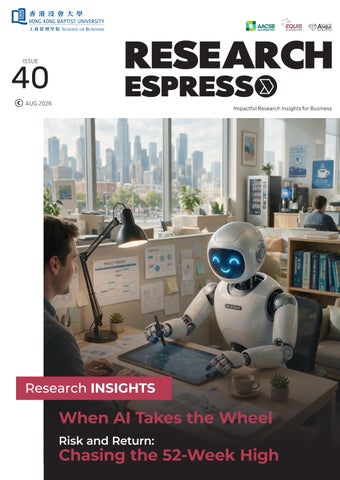
When AI Takes the Wheel Risk and Return:
Chasing the 52-Week High
04
Research INSIGHT When AI Takes the Wheel Risk and Return: Chasing the 52Week High
12
NEWS
HKBU School of Business and SUSTech Co‑host Joint Summer Workshop on Information Systems 2026 HKBU School of Business Doubles Its RGC Success With 14 Grants in 2026/27 GRF and ECS
14
Research EXCELLENCE
Research Espresso / AUG 2026
Research INSIGHT
When AI Takes the Wheel
4
5
Research Insight
Kumar, N., Wei, X., & Zhang, H. (2026). Agentic artificial intelligence as a new frontier in information systems: Promise, peril, and research opportunities. Information & Management, 63(3), 104317. https://doi.org/10.1016/j.im.2026.104317
6
RESEARC INSIGHT
Research Espresso / AUG 2026
F
rom HAL 9000’s lethal mission logic in 2001: A Space Odyssey to Skynet’s self-directed war in Terminator 2: Judgment Day, and the quiet self-determination portrayed in Her, Hollywood has long explored what happens when machines act with agency. Today, that idea is moving from the script to the boardroom. A new paper explores this emerging class of Agentic Artificial Intelligence (“AAI”), maps its core characteristics, and outlines the governance and research challenges it poses for modern information systems. While many of us are still dabbling with ChatGPT and DeepSeek, AAI is already reshaping enterprise systems through autonomous capabilities. From Microsoft and Google to Salesforce, firms are deploying AAI to manage complex workflows across distributed digital environments. No longer confined to responding to human prompts, these systems increasingly initiate actions, make decisions, and adapt to changing conditions with minimal oversight. The rewards are clear: lower costs, leaner teams, and faster decisions. But while the gains may be operational, the implications are structural. Delegating authority to autonomous systems forces organizations to rethink control, accountability, and governance.
Drawing on existing research in artificial intelligence, automation, and information systems, the authors define AAI as goaldirected, planning-capable, adaptive systems embedded within enterprise infrastructures and operating with varying degrees of autonomy. In this sense, AAI is becoming less a tool and
more a colleague. This shift creates a central challenge: how to balance expanding machine autonomy with the need for firms to retain control. As these systems become more autonomous, the harder they are to govern. Different configurations —from single agents embedded in workflows to coordinated multi-agent networks—amplify this complexity. As autonomy scales, it is hard to maintain accountability and governance. Oversight mechanisms designed for human decision-makers struggle to keep pace with systems that learn, coordinate, and act across digital infrastructures.
7
The challenge, then, is not merely technical. Capturing AAI’s efficiency gains while preserving transparency, control, and institutional stability requires rethinking how authority is allocated inside the firm. For the authors, this calls for a research effort spanning three fronts. Technically, firms must determine which tasks can be safely delegated and how system architecture shapes reliability. Organisationally, they must redesign oversight and accountability for environments where decisions are no longer singular or static. At a societal level, the questions widen—how work
Research Insight
evolves, and who ultimately captures the value created by increasingly autonomous systems. Fiction has already mapped the extremes: the dependable collaboration of R2-D2, the principled intelligence of Data, and the cold logic of HAL 9000. The reality taking shape will be less theatrical, but no more consequential. Whether agentic AI becomes a trusted extension of the firm will not be determined solely by capability, but by how organisations choose to govern systems that no longer wait to be told what to do!
Professor ZHANG Han Chair Professor Department of Management, Marketing and Information Systems (MMIS)
Research Espresso / AUG 2026
Research INSIGHT
Risk and Return:
Chasing the 52-Week High
8
9
Research Insight
Chen, X., Chen, Z., Tu, J., & Wang, L. (2026). Proximity to the 52week high and the risk-return trade-off. Journal of Economic Dynamics and Control, 158, 105286. http://doi.org/10.1016/j.jedc.2026.105286
10
RESEARC INSIGHT
Research Espresso / AUG 2026
“
High risk, high return” is one of those market truisms that survives more by repetition than scrutiny. Sitting comfortably alongside “buy low, sell high,” it drives what we do as readily at the poker table as on the trading floor. Buying HSBC in 2022 felt sensible; backing NVIDIA looked speculative. With hindsight, that judgment is less certain. Is risk, in fact, reliably rewarded? New research suggests a more complex picture, in which investors anchor expectations to familiar price levels, most notably the 52-week high. The world of finance has long operated under the capital asset pricing model (CAPM). Rooted in the logic of homo economicus, the idealized decisionmaker assumed to act with full information and consistent logic, CAPM holds that higher risk should command higher expected returns. Yet what seems intuitive does not always play out in practice. Stocks with lower betas, meaning they move less with the broader market, often outperform those with higher betas, while measures of risk such as volatility are negatively related to future returns. How can this be?
Using a broad cross-section of U.S. equities from 1963 to 2020, the researchers sort stocks by their level of risk, with standard proxies such as beta and volatility, and their proximity to the 52-week high. They then compare returns
over the following months to test whether the risk–return relationship varies depending on where a stock sits relative to that threshold. Their conclusion? The relationship is not stable but shifts with a stock’s position relative to its recent peak. When stocks are far from their 52week highs, higher risk is associated with lower subsequent returns; near those highs, the relationship reverses. More importantly, this variation is behavioural. Because it is impossible to observe the prices at which investors bought
11
Research Insight
their shares, the researchers use a stock’s proximity to its 52-week high as a proxy for whether they are sitting on gains or losses. When a stock trades near its recent peak, investors are in profit and grow more cautious, requiring higher returns to take on additional risk. When it trades below that level, many sit on losses and become more willing to gamble, favouring riskier stocks to break even. This pushes up prices and lowers future returns. The authors test their findings in different ways to ensure the result is not a quirk of the data. The pattern holds across different measures of risk and remains even after accounting for factors such as size, value and momentum. It also shows up across different samples and time periods. So next time your broker tries to talk you into a risky stock for its high returns, ask yourself whether you are truly buying low or simply telling yourself you will sell high!
Professor WANG Liyao Associate Professor Department of Accountancy, Economics and Finance (AEF)
12
Research Espresso / AUG 2026
NEWS HKBU School of Business and
SUSTech Co‑host Joint Summer Workshop on Information Systems 2026 As part of its 70th anniversary celebrations, the HKBU School of Business, in partnership with the Southern University of Science and Technology (SUSTech), successfully concluded the Joint Summer Workshop on Information Systems 2026, held on the HKBU campus on 13-14 July. The two-day workshop brought together more than 80 academics and research postgraduate students from within and beyond the Information Systems discipline, offering a vibrant platform for scholarly exchange under the theme “Future Forward: AI-Driven Business Research”. Professor Zhang Han, Dean and Chair Professor of the School of Business, opened the event by highlighting the workshop’s growth since its inaugural edition at SUSTech in Shenzhen last summer. He noted the expanded participation this year, which included scholars from Beijing Normal-Hong Kong Baptist University (BNBU). The programme was intensive and highly interactive, featuring 24 presentations across two parallel tracks, spirited discussions, and expert reflections. Participants presented research-in-progress papers and received constructive feedback from distinguished mentors from leading universities, helping them refine their ideas for publication in leading journals. The eight mentors are senior editors or associate editors from top-tier academic journals. They shared expertise across a range of emerging topics, including generative AI, digital transformation, platform ecosystems, healthcare analytics, and responsible AI. Their guidance helped participants refine both their research questions and methodologies. The success of the workshop was also made possible through the collective efforts of an organizing committee comprising faculty members and partners from SUSTech and BNBU. Together with the mentors, they exemplified the spirit of cross-institutional collaboration and academic mentorship. The joint workshop drew to a fruitful close, creating an inspiring space for researchers to connect and collaborate. Looking ahead, the School will continue to nurture future academics and propel innovation in AI-enabled business studies.
13
NEWS
HKBU School of Business Doubles
Its RGC Success With 14 Grants in 2026/27 GRF and ECS The HKBU School of Business has secured 14 grants in the Research Grants Council’s (RGC) 2026/27 General Research Fund (GRF) and Early Career Scheme (ECS), bringing a total of HK$6,426,424 in competitive funding (HK$5,378,131 GRF; HK$1,048,293 ECS). This outcome, comprising 11 GRF and three ECS projects, doubles both the number of funded applications and the total grant amount compared with last year. It reaffirms the School’s commitment to rigorous, high‑impact scholarship that addresses business and societal challenges. The GRF and ECS are among Hong Kong’s most competitive research schemes, adjudicated through rigorous peer review for academic excellence and potential impact. This year’s portfolio spans responsible AI, platform and service governance, market design and trading innovations, international investment networks and business cycles, workplace inclusion and wellbeing, consumer behaviour in immersive environments, and technology‑enabled healthy aging. In alphabetical order by surname, the awardees are: • • • • • • • • • • • • • •
Professor Rocky Chen – Associate Professor, Department of Management, Marketing and Information Systems (MMIS) (GRF) Professor Chen Sihao – Assistant Professor, Department of Accountancy, Economics and Finance (AEF) (GRF) Professor Christy Cheung – Chair Professor, Department of Management, Marketing and Information Systems (MMIS) (GRF) Professor Chung Kim-sau – Professor, Department of Accountancy, Economics and Finance (AEF) (GRF) Professor Deng Huan – Assistant Professor, Department of Accountancy, Economics and Finance (AEF) (ECS) Professor Emily Huang – Associate Professor, Department of Management, Marketing and Information Systems (MMIS) (GRF) Professor Lee Shin-woo – Assistant Professor, Department of Accountancy, Economics and Finance (AEF) (ECS) Professor Li Xueni – Associate Professor, Department of Management, Marketing and Information Systems (MMIS) (GRF) Professor Byron Song – Associate Professor, Department of Accountancy, Economics and Finance (AEF) (GRF) Dr Song Qingping – Research Assistant Professor, Department of Management, Marketing and Information Systems (MMIS) (GRF) Professor Erica Xu – Associate Professor, Department of Management, Marketing and Information Systems (MMIS) (GRF) Professor Soohyun Yoon – Assistant Professor, Department of Management, Marketing and Information Systems (MMIS) (ECS) Professor Yuan Peixuan – Assistant Professor, Department of Accountancy, Economics and Finance (AEF) (GRF) Dr Zhan Chaoqun – Research Assistant Professor, Department of Accountancy, Economics and Finance (AEF) (GRF)
Congratulations to all awardees for advancing research that informs practice, shapes policy, and enriches global conversations.
14
Research Espresso / AUG 2026
Research EXCELLENCE
Professor DONG Ding
Professor Christy CHEUNG
Assistant Professor Department of Accountancy, Economics and Finance (AEF)
Chair Professor Department of Management, Marketing and Information Systems (MMIS)
Turbulent Business Cycles
An Integrated Model of Ambivalence and Deterrence of Bystander Inaction in Delegitimizing Doxing
Journal of Monetary Economics
Information and Management
https://doi.org/10.1016/j.jmoneco.2025.103814
https://doi.org/10.1016/j.im.2025.104118
Subscribe
The Research Espresso, a bimonthly e-publication covering everything you need to know about the latest research developments at the HKBU School of Business, focuses on four key areas: Research Insights (the main research topic of the month), Research Excellence (recognition of faculty members’ research achievements), News (research-related updates), and Seminars (sharing research skills and knowledge). The idea is to provide business practitioners with the most recent research findings from the School‘s faculty members. We want to build links between research and practice and to ensure that the School's research has business and societal impact. Enjoy reading, and your feedback and input are always welcome!
hkbubusinessschool hkbubusinessschool HKBU School of Business 浸大工管
hkbuschoolofbusiness bus.hkbu.edu.hk