





Ru, H., Yang, E., & Zou, K. (2022). Early-life experience and CEOs’ reactions to COVID-19. SSRN. https://doi.org/10.2139/ssrn.4199775
Ah, the COVID-19 pandemic. Who doesn’t remember the masks, the confinement, the vaccine debates, the social distancing and, more seriously, the tragic loss of life and the financial toll on so many businesses? For those who lived through it as children or teenagers, those years were formative ones, marked by disruption, uncertainty, and resilience. While memories fade, it’s worth asking: what happens when that generation grows up to run companies of their own? According to new research, their early-life experience of the pandemic could determine how they respond to crises for years to come.
As the CEO role shifts from operations to identity, who these leaders are—and what shaped them— matters more than ever. The researchers look at how early-life exposure to crisis, particularly past epidemics, influenced how today’s executives navigated COVID-19. Their focus: whether those formative shocks left a mark on investment decisions and corporate transparency when the world shut down.
The study tracks the CEOs of U.S. public firms from 2010 to 2021, using data from S&P’s ExecuComp to link their birthplaces with historical records of major disasters and disease outbreaks during their formative years, roughly ages 5 to 15. Within this framework, the authors identify which executives experienced earlylife adversity (“imprinted CEOs”) and examine how those experiences influenced their decisions during COVID-19. The results are striking. Following the initial lockdowns, firms led by imprinted CEOs cut capital expenditure growth by 18 percentage points more

than their peers on average. Since pre-pandemic spending patterns were similar across both groups, this reinforces the idea that the difference reflects how these leaders reacted under stress, rather than any preexisting strategic approach. The effect is especially strong in industries hardest hit by the pandemic, where imprinted CEOs appeared even more cautious in their investment and communication choices.
To ensure the effect wasn’t simply about resilience to generic or natural disasters—especially since such resilience might itself have influenced their


selection as CEO—the authors focused on childhood exposure to infectious diseases such as measles, tuberculosis, polio, and scarlet fever. These CEOs proved even more conservative, as their firms used 6.8% fewer positive words in financial reports and were nearly 30 percentage points less likely to issue upbeat earnings guidance during lockdowns.
The findings point to a lasting psychological imprint: leaders who faced deadly epidemics early in life carried that sense of risk into boardroom decisions decades later. In short, the pandemic revealed how childhood

shocks can shape corporate strategy long after the masks come off. Or, as the poet William Wordsworth wrote two centuries ago, “The child is father of the man.” Hardly management theory, but it certainly seems to fit the data!

Professor ZOU Kunru Assistant Professor Department of Accountancy, Economics and Finance

The use (and misuse) of

Ganco, M., Liu, J., Wang, H., & Yamaguchi, S. (2024). Strategic restraint: When do human capital-intensive companies choose (not) to use noncompete agreements? Strategic Management Journal, 45(13), 2696–2726. https://doi.org/10.1002/smj.3648
Few employment experiences stir such mixed emotions as garden leave, a period when an employee leaving a firm remains on the payroll but is barred from starting a new role, often under the terms of a noncompete agreement (“NCA”). On the surface, being paid to stay home sounds idyllic, a rare pause in the rush of working life. However, for many professionals, this contractually enforced idleness can feel more like exile than rest, particularly when it drags on for months or even years.
Companies that use NCAs argue they are essential to protect intellectual property, client relationships, and strategic know-how. By limiting where former employees can work, firms hope to prevent the leakage of confidential information and preserve their competitive advantages. But if NCAs are so valuable and seemingly costless for firms to use, why do many firms—even in industries where they’re standard—choose not to adopt them?
New research offers an answer. Drawing on a large-scale survey conducted with PayScale, a U.S. compensation analytics firm, the authors examined how reliance on human capital and firm position in the industry shapes the use of NCAs across industries.
Their findings reveal a clear pattern: firms that see talent as their main edge—and aren’t industry leaders—are far less likely to use NCAs. For them, the trade-off is clear. NCAs make it harder to hire the technical talent they need to grow, especially since they have less proprietary

knowledge to protect and bargaining power to exert than industry leaders. Data show that firms opting out of NCAs fill high-skill roles more easily than peers that rely on them, suggesting NCAs penalize challengers more than incumbents. The pattern is strongest in sectors where patents matter less, underscoring that when ideas move faster than legal protections, agility and culture matter more than control.
The authors call this “strategic restraint”, or a conscious choice by some firms to compete through culture, opportunity, and reputation rather than legal constraint.


This approach helps attract top performers who value autonomy and collaboration, qualities that are particularly critical in sectors such as architecture, engineering, and marketing, where expertise and creativity drive performance. For these firms, strategic restraint itself becomes a signal: we trust our people to stay because they want to, not because they have to.
The takeaway for executives is clear: in knowledgeintensive industries, trust, transparency, and culture often do more to attract and retain talent than any legal clause. The data bear this out,

as firms that forego NCAs in favor of openness report higher employee satisfaction and stronger communication between workers and managers.
So, for prospective employees, the next time a gardenleave clause appears in an offer letter featuring an NCA, think carefully. It may say as much about the company’s position, culture, and competitive choice as its compensation plan!

Professor WANG Haifeng Assistant Professor Department of Management, Marketing and Information Systems

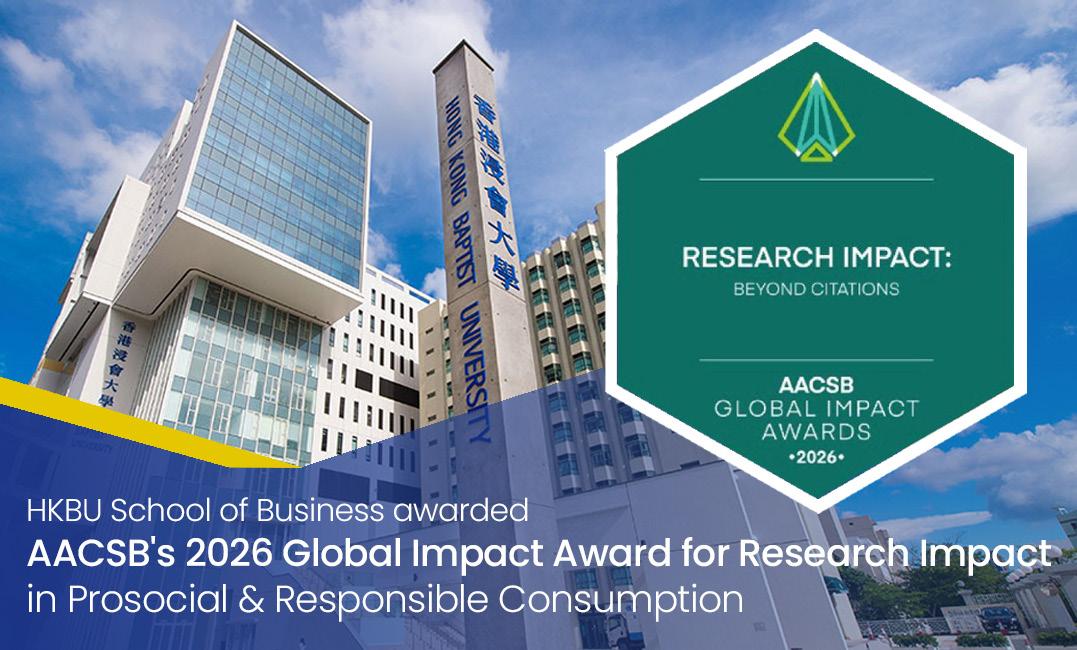
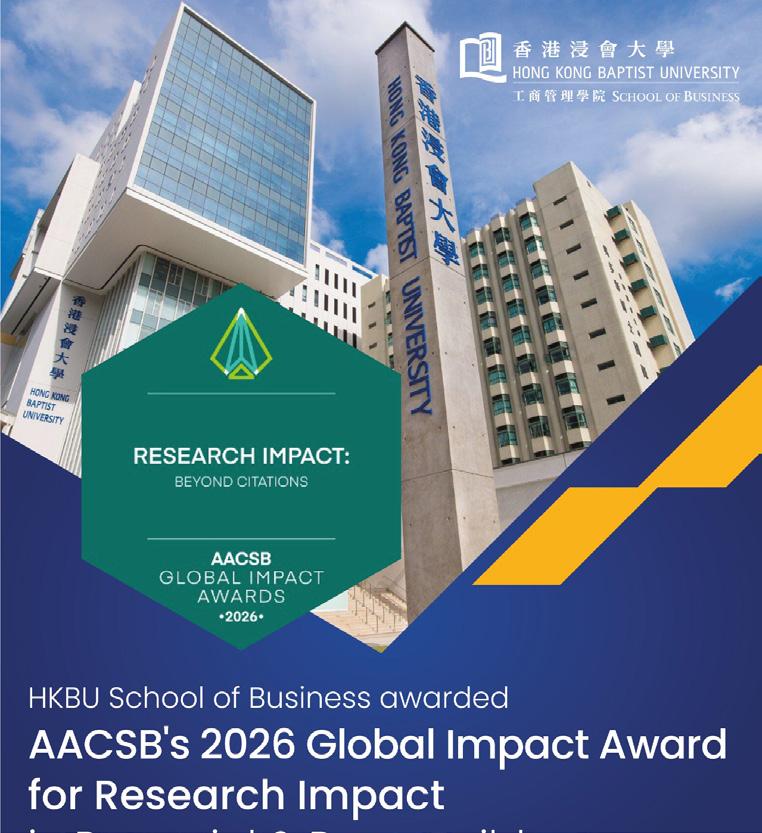
HKBU School of Business has been honoured at the Association to Advance Collegiate Schools of Business (AACSB) inaugural Global Impact Awards 2026 for Research Impact in prosocial and responsible consumption, becoming the first and only winner in Hong Kong, China. This prestige highlights the School’s dedication to translating impactful research into societal benefits.
The inaugural awards celebrate innovation, leadership, and measurable impact in business education and society. This year, 27 individuals and institutions from 16 countries were selected from a highly competitive pool of submissions. Winners were recognised for Impactful Leadership in shaping future-ready business schools; for Teaching and Learning Excellence through the integration of emerging technologies into learning experiences; for Research Impact that informs policy, shapes industries, and improves lives beyond academia; for Societal Impact in fostering inclusive social and economic growth; and for Excellence in Service through community leadership and dedicated accreditation volunteer work within the
This accolade reflects the School’s ongoing efforts to extend reach for its research, create benefits for society and to shape the future of business education.

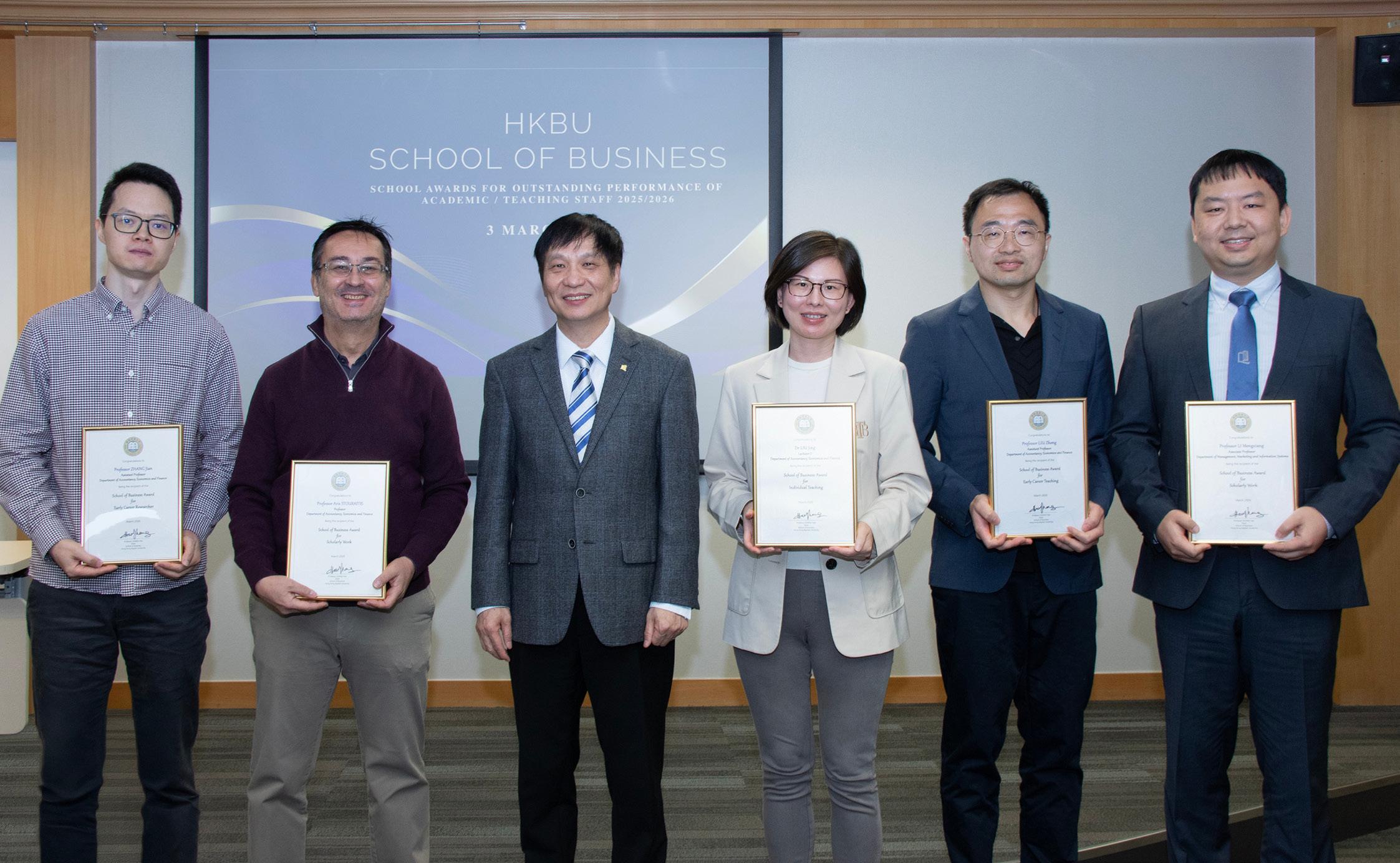
The Annual School Awards of the HKBU School of Business honours colleagues for their exceptional contributions in teaching, research, and service. In the 2025/26 academic year, five distinguished faculty members were recognised for their outstanding academic achievements.
Dr LIU Jing, Lecturer I, Department of Accountancy, Economics and Finance (AEF)
Dr Liu Jing is a Lecturer in the Department of Accountancy, Economics and Finance. With a Ph.D in Communication and a Master’s in Applied Data Science, she teaches undergraduate and postgraduate courses on data analytics, including statistics, machine learning, and AI. Dr Liu’s teaching is informed by her research on computer-mediated communication and public opinion, with work published in journals like Behaviour and Information Technology and Computers in
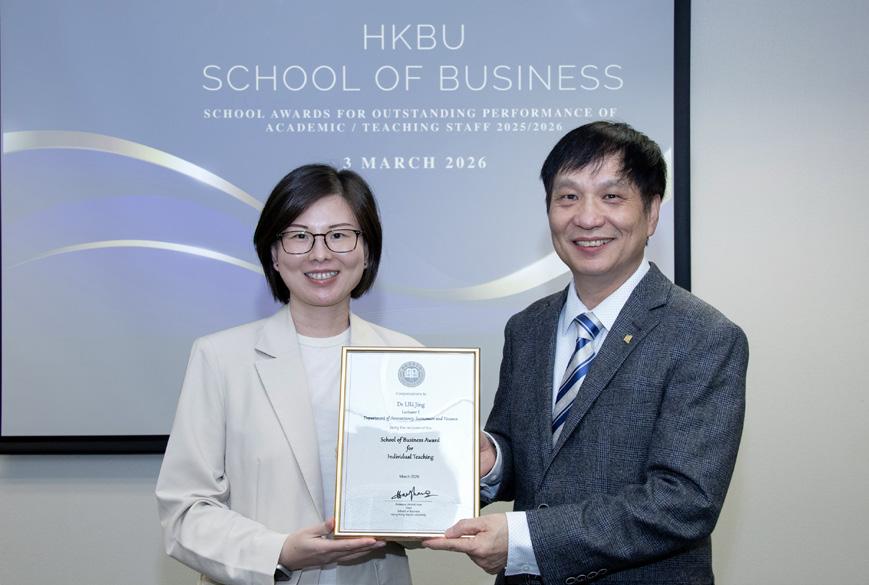
Human Behavior. She holds various leadership roles including MScDABE Director and Assistant Dean (Outreach and Engagement), allowing her to contribute to students’ learning and development on a broader scale. She also shares her insights through media channels like Hong Kong Economic Journal.
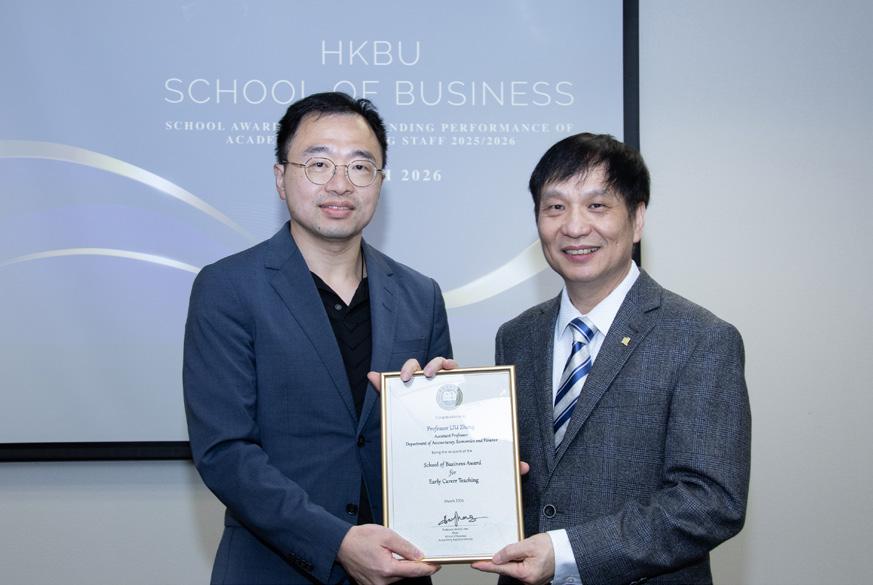
Professor LIU Zheng, Assistant Professor, Department of Accountancy, Economics and Finance (AEF)
Liu Zheng is an Assistant Professor in the Department of Accountancy, Economics and Finance. His research examines empirical capital markets, corporate financial reporting, data analytics in finance and accounting, and firm ESG performance. His work has been published in the Journal of Accounting and Economics and Review of Accounting Studies. He holds a PhD in Business Administration (Accounting) from Smith School of Business, Queen’s University. He designs and teaches courses in data visualisation and Python that blend concept-focused lectures with hands-on labs, giving students the skills to translate business questions into defensible analyses and communicate insights clearly.
Professor LI Mengxiang, Associate Professor, Department of Management, Marketing and Information Systems (MMIS)
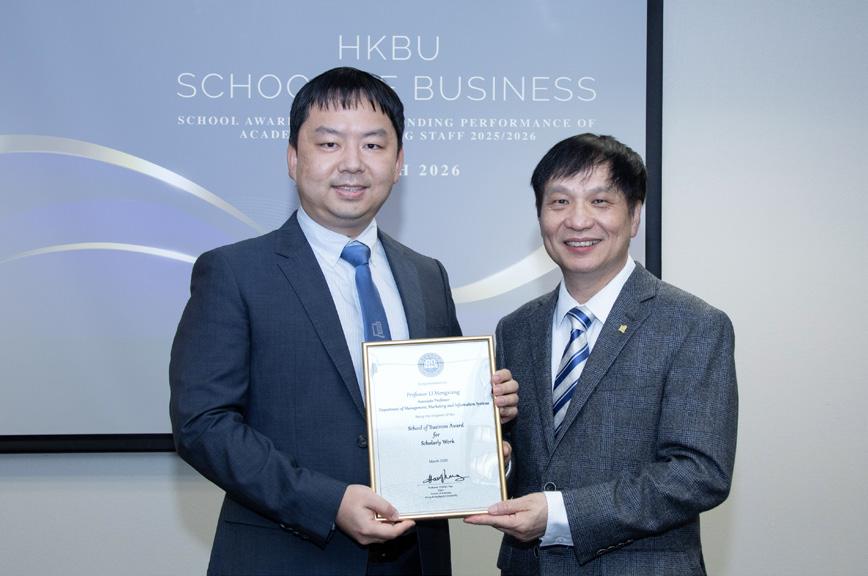
Professor Li Mengxiang’s papers have appeared in top-tier journals such as MIS Quarterly, Information Systems Research, Journal of MIS, and Information & Management. Professor Li’s current research examines AI governance, digital transformation, HumanAI collaboration, digital resilience, and remote everything. Professor Li has served as an Associate Editor for several notable journals, including Information & Management, Internet Research, Journal of Global Information Management, and Journal of Electronic Commerce Research. His extensive background and ongoing research contribute significantly to advancements in the information systems discipline.
Professor Aris STOURAITIS, Professor, Department of Accountancy, Economics and Finance (AEF)
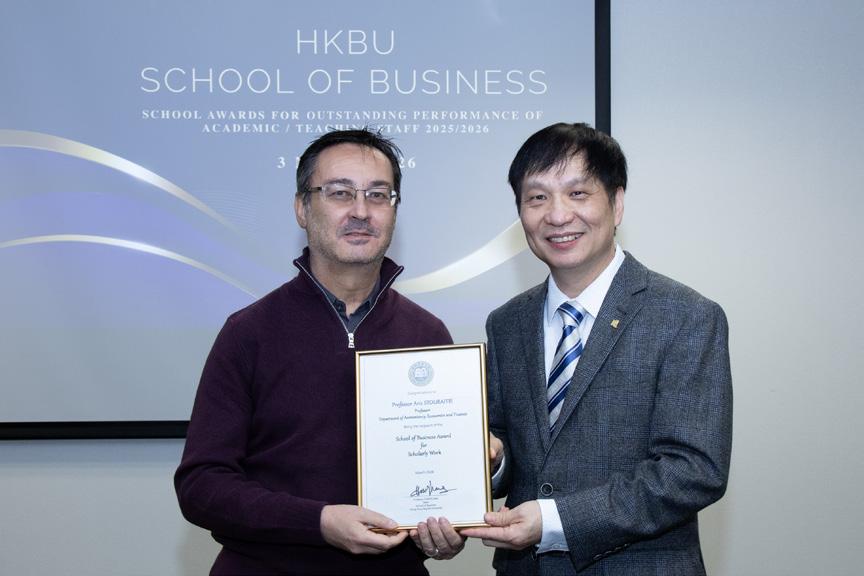
Professor Aris Stouraitis is a Professor of Finance in the Department of Accountancy, Economics and Finance and serves as Director of the Centre for Corporate Governance & Financial Policy and the MSc in Finance (Fintech & Financial Analytics) programme. He holds Bachelor’s degrees in economics, accounting, and finance from the American College of Greece, an MSc in Management from INSEAD, and a Ph.D. in Finance from Imperial College London. His research focuses on corporate finance, particularly corporate restructuring, governance, and corruption, with publications in top-tier journals such as the Journal of Financial
Economics. Additionally, he has presented at prestigious conferences and is a member of the Governing Council of the Institute of Financial Technologists of Asia (IFTA).
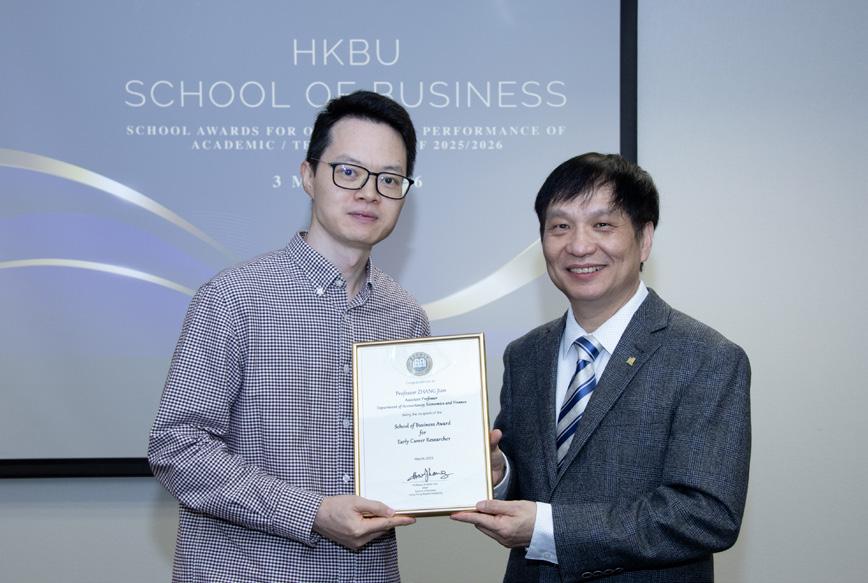
Professor ZHANG Jian, Assistant Professor, Department of Accountancy, Economics, Finance (AEF)
Professor Zhang Jian is an Assistant Professor in Accounting. He earned his PhD from the Hong Kong Polytechnic University and holds a Bachelor’s degree from Sun Yat-sen University.
Professor Zhang teaches undergraduate courses in financial and managerial accounting. His teaching philosophy emphasises practical application and critical thinking, ensuring that students grasp complex accounting principles effectively.
His research interests include financial accounting, auditing, and banking, where he explores contemporary issues and challenges facing these fields. Through his work, Professor Zhang contributes to advancing academic knowledge and practices in accounting.



Professor WANG Zi
Associate Professor Department of Accountancy, Economics and Finance (AEF)
Local Corporate Taxes and the Geography of Foreign Multinationals

The Review of Economics and Statistics
https://doi.org/10.1162/rest.a.279
Professor ZHANG Han
Chair Professor Department of Management, Marketing and Information Systems (MMIS)
Tripartite Reactions to Emotions (TRE) Theory: The Impact of Emotional Expressions in User-Generated Content
MIS Quarterly
https://doi.org/10.25300/MISQ/2025/18570
Centre for Business Analytics and the Digital Economy
4 September 2026
16:00-17:30 Zoom
Co-hosted with NTU, NYU-Shanghai, and Sinica
2 September 2026
09:00-10:30 Zoom
Co-hosted with CEIBS, NTU, NUS, and Sinica
Professor Clément Gorin
Paris 1 Pantheon Sorbonne University
Prof. Andrew WEDEMAN
Georgia State University
State of the Art: Economic Development Through the Lens of Paintings
The Third Paradox: Corruption, Growth, and Regime Integrity in China

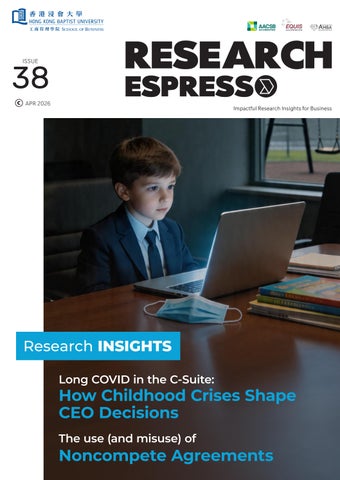
The Research Espresso, a bimonthly e-publication covering everything you need to know about the latest research developments at the HKBU School of Business, focuses on four key areas: Research Insights (the main research topic of the month), Research Excellence (recognition of faculty members’ research achievements), News (research-related updates), and Seminars (sharing research skills and knowledge).
The idea is to provide business practitioners with the most recent research findings from the School‘s faculty members. We want to build links between research and practice and to ensure that the School's research has business and societal impact.
Enjoy reading, and your feedback and input are always welcome!