VAMzzz
PUBLISHING
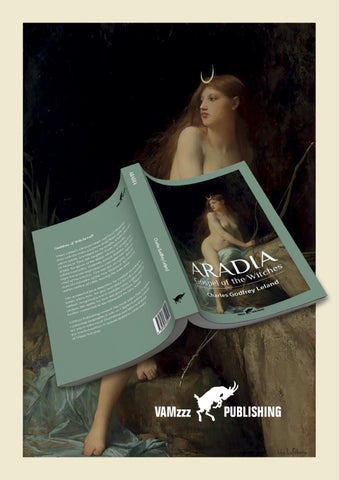
Aradia Gospel of the Witches by Charles Godfrey Leland 174 pages, Paperback, ISBN 9789492355010
€ 19,50
Where Leland’s Etruscan Magic and Occult Remedies deals with the entire pantheon of old Italian gods and nature spirits, worshiped by the streghe, Aradia is focused on Diana or Tana, her daughter Aradia and Lucifer. Aradia, the queen of the Italian witches, or streghe is as Leland concludes: ‘evidently enough Herodias, who was regarded in the beginning as associated with Diana as chief of the witches. This was not, as I opine, derived from the Herodias of the New Testament, but from an earlier replica of Lilith, bearing the same name.’ This wonderful book describes the creation according to Italian witch-lore. We also read about the witch-meeting or sabbath (treguenda) and it contains many original magical recipes, like spells for love and good fortune. Diana is further connected to the Moon and the fairy world. VAMzzz Publishing revised this book with a Post Scriptum, containing biographical info on Charles Godfrey Leland, his witchinformant Maddalena and historical proof the witch-tradition is indeed linked to 2000 years of Diana worship.
Etruscan Magic & Occult Remedies (Two volumes in one book) by Charles Godfrey Leland 628 pages, Paperback, ISBN 9789492355003
€ 32,50
Etruscan Magic & Occult Remedies by Charles Godfrey Leland was first published as Etruscan Roman Remains in Popular Tradition, in 1892. Part One of the book offers a complete and detailed insight in the Etruscan and Roman rooted pantheon of the Tuscan Streghe (witches). Part Two describes many of their spells, incantations, sorcery and several lost divination methods. Leland found himself at the crossroads of the academic and the romantic and it is precisely this, which makes the reading of his work so enjoyable. His primary aim was to preserve this ancient traditional knowledge, as he feared, it would soon be wiped out by modernism. Much information in this book, Leland received first hand from the Tuscan witches Maddalena and Marietta. His second work on Stregheria: Aradia, or the Gospel of the Witches was published seven years later in 1899. One of Leland’s readers was the late Gerald Gardner, which makes one wonder who was the true godfather of modern witchcraft… Special revised edition with an index of ancient Etruscan gods and spirits.
Taboo, Magic, Spirits € 19,50 A study of primitive elements in Roman religion by Eli Edward Burriss 200 pages, Paperback, ISBN 9789492355034 In Ancient Rome Mana was the term used for a mysterious force, which could be helpful or harmful. When harmful it was called Taboo. Just like the Chinese Qi, Mana could empower both the positive and the negative. Taboo, Magic, Spirits: a Study of Primitive Elements in Roman Religion offers a still unique insight into the magical elements, beliefs, methods and rites of Rome in ancient days. Mana and Taboo play an important role, but the author also deals with the worship of stones, trees, groves, water and fire, with magical incantations, the removal of evil by washing, burning or dancing, with taboos on sex, blood, corpses, women, certain days, and much more. Eli Edward Burriss was an Associate-Professor of Classics at the New York University. No researcher before Burriss made an attempt to gather from the ancient sources those elements in the Roman State religion, and in the popular religious life of the Roman people, which are commonly termed “primitive”. His efforts have resulted in a fascinating work of micro-history, which will be appreciated by both the academic student and those interested in paganism, Wicca and magic.
Chaldean Magic It’s Origin and Development by François Lenormant 454 pages, Paperback, ISBN 9789492355027
€ 29,50
La Magie chez Les Chaldeens, of which this present volume is an enlarged English edition, was issued in the autumn of 1874. It was preceded by Les Premieres Civilisations and closely followed in 1875 by La Divination et la Science des Présages. All these works possess the same characteristic feature: the exposition of Assyrian thought, as evidenced by the language of the cuneiform inscriptions themselves. Lenormant had revised his book to such an extend, he regarded Chaldean Magic not as a translation, but as a publication on its own. The essentials of magic in Chaldea are presented within the context of comparison or contrast to Egyptian, Median, Turanian, Finno-Tartarian and Akkadian magic, mythologies, religion and speech. Interesting is the Chaldean demonology, with its incubus, succubus, vampire, nightmare and many Elemental spirits, most of them coalesced with the primal powers of nature. Chaldean Magic dwells on the threshold of predating sjamanistic lore and the later systemization of the occult. This makes the work of Lenormant an invaluable and fascinating source for both the academic and the modern occultist.
Fairy Mythology € 22,50 Romance and Superstition of Various Countries 1 by Thomas Keightley 404 pages, Paperback, ISBN 9789492355096 The term “Fairy” covers all kinds of nature spirits and Elementals all over the world. Not just the tiny sugar sweet creatures hovering around flowers. Thomas Keightley collected an impressive amount of mostly European, and nowadays often “extinct” folklorist data on these invisible realm’s inhabitants, and compiled these in Fairy Mythology (1870). In its revised edition, this massive work of over 800 pages, is republished in two volumes to meet modern reading standards. Volume 1 deals extensively with Scandinavia, Iceland, Feroer, the Orkneys, Shetland Islands, Rugen, Germany and Switserland. In volume 1 the origins of the term Fairy are traced and oriental and medieval romance, Eddas and Sagas, are examined before we explore Fairy-species as Elle-maids, Trolls, Nisses, Elves, Dwarfs, Necks, Mermaids, Nixes, Heinzelmänchen, Watermen or Wassermänchen, Hödeken, Changeling, Wild women and Little people. An invaluable work of resource for those interested in old European folklore or nature magic.
Fairy Mythology € 22,50 Romance and Superstition of Various Countries 2 by Thomas Keightley 404 pages, Paperback, ISBN 9789492355102 Thomas Keightley collected an impressive amount of mostly European, and nowadays often “extinct” folklorist data on these invisible realm’s inhabitants, and compiled these in Fairy Mythology (1870). In its revised edition, this massive work of over 800 pages, is republished in two volumes to meet modern reading standards. Volume 2 deals with Great Britain, the Scottish Highlands and Lowlands, England, Wales, the Isle of Man, Brittany, France, Greece, Italy, Spain, stories of the Finns and Slavonic people and some Jewish and African Fairy-lore. We encounter Fairies in many varieties, Pixies, Brownies, Leprechauns, Chancelings, the Boggard, Puck, the Phynodderee, Kobold, Urisk, Korrigen, the Korred, Tylwyth Teg and more. Just like volume 1, volume 2 displays a precious collection of ancient folklore directly based on the realm of the hidden Elemental nature.
Unicorn A mythological investigation by Robert Brown Jr. 124 pages, Paperback, ISBN 9789492355072
€ 19,50
In this rare and unique book, Unicorn – A Mythological Investigation, Robert Brown Junior (1844-1912) places the unicorn-phenomena in a context of comparative mythology, while hypothesizing on ancient astrological symbolism. Unicorn was published in the Autumn of 1881. A time when all mythological and folklore narratives were believed to be old astronomical metaphors. Brown believes the unicorn to be a lunar symbol, and draws on mythology from a wide range of sources all over the world to build his case. Brown Junior discusses the heraldic use of the unicorn, relates the creature to ancient goddesses like Astarte, Hecate en the Gorgon Medusa, and provides the reader with lost esoteric Moon-lore. Robert Brown Jr, FSA (Fellow of the Society of Antiquaries), MRAS (Member of the Royal Astronomical Society) was a writer on archaic religion, mythology, and pioneered in the research of Babylonian astronomy. He distinguished himself by investigating the influence of ancient Semitic cultures on Hellenic religious mythology and the origin of the extra-zodiacal constellations.
Amazons - Two volumes - € 22,50 I. The Amazons by Guy Cadogan Rothery II. Religious Cults Associated With the Amazons by Florence Mary Bennett 328 pages, Paperback, ISBN 9789492355089 The world of the Amazons lies scattered between legend and historical fact. Greek writings give many details about the geography, history and anthropology of the Amazon nation and the Athenians in particular were most insistent about the historical reality of a nation consisting only of women warriors. The Amazons, whether legendary or real, were not confined to the Balkan-Black Sea regions bordering to ancient Greece. As Guy Cadogan Rothery points out, they were known on four different continents. Florence Mary Bennett examines the traditional Amazons, as mentioned in Greek sources, and relates them to several goddess cults of ancient Greece and Asia Minor. Among them the cult of the Great Mother, the Ephesian Artemis, Artemis Astrateia and Aphrodite. Bennet deals with historical facts in an outstanding piece of scholarly research, unveiling not just many historical data about this ancient warrior tribe, but also providing surprising insights into the image evolution of Greek Gods, the double axe symbol and more.
Devil-worship in France Or The Question of Lucifer by Arthur Edward Waite 240 pages, Paperback, ISBN 9789492355065
€ 19,50
In Devil-Worship in France, Waite attempts to discern what is genuine from what is fake in the evidence of 19th century Satanism. To get the answers he spends a great deal of time investigating the French Masonic echelon, debunking a “conspiracy of falsehood” and determining what should be understood by Satanism and what not. Huysmans’ diabolical novel Là-Bas (1891) inspired Waite to write this sceptical analysis. His main motive to write this book, however, could very well have been its use as a lubricant for a Masonic career. Waite took a leading role in a counterattack, after French rumour spreaders had accused Golden Dawn founders William Wynn Westcott and MacGregor Mathers of being chief Lucifer-worshippers. This was much appreciated by them. In the end, Waite’s Devil-Worship in France debunked the whole accusation affair - and this a year before Gabriel Jogand Pages (Leo Taxil in the book) admitted the allegations were indeed a hoax. Waite was a scholarly mystic, Freemason, Rosicrucian and Golden Dawn member, who wrote extensively on occult and esoteric matters, mostly in academic style.
Là-Bas A Journey into the Self by Joris-Karl Huysmans 378 pages, Paperback, ISBN 9789492355058
€ 15,50
The story of Là-Bas concerns the novelist Durtal who is disgusted by the emptiness and vulgarity of the modern world. He attempts to escape it by studying medieval topics and plans to write a biography about the 15th century murderer and devilworshipper Gilles de Rais. Through his contacts in Paris with Dr. Johannes, (modelled after Joseph-Antoine Boullan, a French Roman Catholic priest accused of Satanism), Durtal discovers that Satanism is not a thing of the past, but alive and kicking in turn of the century France. He embarks on an investigation of the occult underworld with the help of his lover Madame Chantelouve. The novel climaxes with a description of a black mass. Charles Marie Georges Huysmans (February 5, 1848 – May 12, 1907) was a French novelist who published his works as Joris-Karl Huysmans. Là-Bas (English: Down There or The Damned) was first published in 1891. Huysmans is now recognized as one of the most challenging and pioneering figures in European literature. Short after its publication, the sale of the book was banned on French railway stations.
Ophiolatreia Rites and Mysteries of Serpent Worship by Hargrave Jennings 186 pages, Paperback, ISBN 9789492355126
€ 19,50
Ophiolatreia - Rites and Mysteries of Serpent Worship is one of the most substantial and complete books written on this subject. It was published anonymously in London in 1889 by the Freemason and Rosicrucian Hargrave Jennings. In several voluminous works, Jennings developed the theory that the origin of all religion is to be sought in phallic worship of the Sun and fire, which he properly called “phallism.” Ophiolatreia is just one of its expressions. Unlike many modern authors, for whom he word “phallic”implies the penis, Jennings used the word “phallic” in its non-gendered sense, meaning “relating to the sexual organs”. Hargrave Jennings was a rival of Blavatsky and friend of the American sex magician and occult writer Paschal Beverly Randolph and both authors had a major influence on the twentieth century pioneers of sex magic. This collectors item describes the rites and mysteries connected with the origin of ophiolatreia and its rise and development in many parts of the world. The relation between snake worship, raw creation force and sexual energy includes Jennings analyses of Bacchic orgies and rites related to Saturn, Zoroaster, Abaddon, Dionysus and Osiris.
Voodoos and Obeahs Phases of West India Witchcraft by Joseph J. Williams 374 pages, Paperback, ISBN 9789492355119
€ 24,50
Voodoos and Obeahs: Phases of West India Witchcraft by the Jesuit anthropologist Joseph J. Williams (1875-1940) offers a careful documentation of the history and ethnography of Voodoo and reveals the connection of both Haitian Voodoo and Jamaican Obeah to snake worship (ophioletreia). In Jamaica, Obeah is the general term to denote those Africans who in the island practice witchcraft or sorcery. Williams includes numerous quotations from rare documents and books on the topic. This work goes into great depth concerning the New WorldAfrican connection and is highly recommended if you want a deep understanding of the dramatic historical background of Haitian and Jamaican magic and witchcraft, and the profound influence of imperialism, slavery and racism on its development. Williams is best known for his anthropological writings about African and Caribbean people, which include Whispering of the Caribbean, Whence the “Black Irish” of Jamaica?, Psychic Phenomena in Jamaica and Africa’s God.
Testament of Solomon A First Century AD Grimoire Translated by F.C. Conybeare 76 pages, Paperback, ISBN 9789492355041
â‚Ź 15,50
Testament of Solomon could be the oldest of all classical grimoires. The work is one of the so called Pseudepigrapha and should therefore be dated somewhere before the middle of the first century AD, according to the latest research. The book was written in Greek, but most likely the Greek version is a translation of an older version in Hebrew. Testament of Solomon sums up a list of demonic decan rulers of the Zodiac and provides the method or the invoked angel they can be countered by. This relation between decans and demons or their angelic counterforce is emphasized. Interesting is the relation between the decans and physical complaints. Especially if we compare this text with those of contemporary medical astrology. See Reinhold Ebertin, Enzo Venosta or H.L. Cornell. The document was translated and first published by F.C. Conybeare in the Jewish Quaterly Review of October 1889. Possibly it is the first text that mentions the use of the pentagram (pentalpha) for protection against the evil forces.
P.O. Box 3340 1001 AC Amsterdam The Netherlands 020 - 4231441 www.vamzzz.com contactvamzzz@gmail.com
No e-books but real books! Previews on vamzzz.com