– TWO VOLUMES –
AMAZONS THE AMAZONS by Guy Cadogan Rothery RELIGIOUS CULTS ASSOCIATED WITH THE AMAZONS by Florence Mary Bennett
VAMzzz
PUBLISHING
Amazons Two Volumes Authors: Guy Cadogan Rothery and Florence Mary Bennett
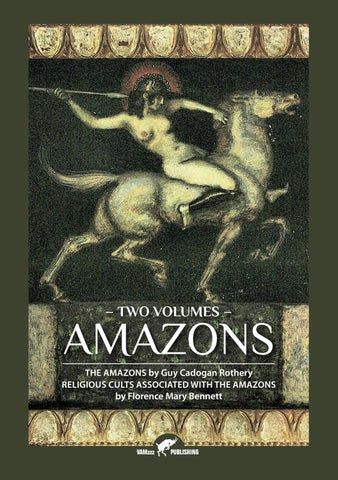
Original title 1: T he Amazons (1910) Original title 2: R eligious Cults Associated With the Amazons (1912) Cover image: A mazon and Centaur (detail, 1912), Franz von Stuck (1863 - 1928) Lay-out: www.burokd.nl ISBN 978-94-92355-08-9 Š 2015 Revised publication by:
VAMzzz Publishing P.O. Box 3340 1001 AC Amsterdam The Netherlands www.vamzzz.com contactvamzzz@gmail.com
– TWO VOLUMES –
AMAZONS THE AMAZONS by Guy Cadogan Rothery RELIGIOUS CULTS ASSOCIATED WITH THE AMAZONS by Florence Mary Bennett
VAMzzz
PUBLISHING
4
The Amazons by Guy Cadogan Rothery
5
The Amazons by Guy Cadogan Rothery
6
contents
I Introductory 9 II
The Amazons of Antiquity 31
III
The Amazons of Antiquity (continued) 57
IV
Amazons in Far Asia 71
V
Modern Amazons of the Caucasus 95
VI
Amazons of Europe 105
VII
Amazons of Africa 119
VIII
Amazons of America 147
IX
The Amazon Stones 171
X Conclusion 185
7
The Amazons by Guy Cadogan Rothery
8
I
Introductory
NEVER, PERHAPS, has the alchemy of Greek genius been more potent than in the matter of the Amazonian myth. It has bestowed a charm on the whole amazing story which has been most prolific in its results; but, unfortunately, by tending to confine it to the narrow vistas of poetry, the intensely interesting psychological aspect has been somewhat obscured. Yet to us the chief value of this myth is due rather to the insight it affords into the mental workings of primitive races, the attitude of man towards that which he dreads but does not fully comprehend, than to the influence of Hellenic art and literature, fruitful in beautiful and humanising manifestations though that influence has been. The Greek spirit, indeed, working upon a crude collection of stories, took the sting, out of the lessons they should have taught. For, as we shall endeavour to show, the message of the myth to a people struggling towards a higher civilisation to beware of barbarians and their ways, was softened to an attitude of admiration before physical beauty and courage, and a tender pity for woman, fomenter of strife though she might be. We may unhesitatingly sweep away the story of the unnatural state about which so many Greek poets and historians entertain us. But while relegating the Amazonian state to the realms of imagina9
The Amazons by Guy Cadogan Rothery
tion, we must recognise the Amazon herself as a not insignificant historic fact—a fact, indeed, of sufficient moment to have peopled a whole world of fiction, real enough to its original creators, and whose force is hardly spent even now. Etymology will not help us much, though it has been relied upon by controversialists. Any argument founded on the descriptive nature of the word, or on its somewhat suspicious many-sidedness, must prove a double-edged weapon, as likely to injure the wielder as his opponent. Besides the obvious “breastless” (a-mazon) and “moon” (maza), we are offered a choice of a variety of interpretations conveying to us such meanings as “vestals,” “girdle-bearers,” and other synonyms, also “game eaters” and “eaters of strong foods.” But after all the word is hybrid Greek, not a native name, and may be classed as a nickname, itself much younger than the supposed state; and then, naturally, it would be as comprehensively descriptive as the ingenuity of man could devise. We may, therefore, leave the etymologists to the labyrinthine twistings of their own wordy warfare. The tale begins rationally enough with the perfectly familiar incident in the life-history of so many nations, the expulsion of a surplus growth of population and its emigration to new fields. In this case we have reference to a cabal against two youthful Scythian princes, who, being ordered into exile, carry with them a whole horde of followers—men, women, and children. There is the story of their settling down, of their casting off of the old Scythian simplicity before a growing desire for riches, which leads to conquest and ulti10
mately to their undoing—the men being mostly massacred by their enraged neighbours. Then comes the extraordinary violent rage of the widows and orphans, first against the slayers of their husbands and fathers, and later against men in general, this aversion bringing about the founding of a state that is to be manless, the women throwing aside their girdles, that priceless symbol of the unmarried, only for a brief spell in the spring-time, when by commerce with their male neighbours means should be taken to guard against the extinction of the race. That such a myth should have sprung to life and gained credence is not difficult to understand. To the inhabitants of the Archipelago and Magna Grecia, no matter whence they originated, distant Asia and the regions to the north-east of the Black Sea and round about the Caspian were lands of peril shrouded in mystery, out of which fierce hordes swept down bent on rapine and conquest. Beyond the fringe of the nearer Mediterranean coast there were worlds of darkness, peopled by the fertile Greek mind with many unnatural but by no means illogically conceived monsters; for the makers of the myths had hardly emerged from the influence of animistic interpretation of nature. All phenomena were explainable in the terms of human emotions, and man acknowledged himself the relation, and not always the superior relation, of the beasts of the field, nay, even of the stocks and stones. To such men, nomadic tribes from the sandy Asian wastes bursting out of clouds of dust on their fleet horses to pillage and slaughter and then as swiftly pass away, had suggested the Centaur myth, the man-horses lying behind the woods 11
Religious cults associated with the
Amazons by Florence Mary Bennett
This monograph has been approved by the Department of Philology in Columbia University as a contribution to knowledge worthy of publication. – Clarence H. Young, Chairman.
1
Religious cults associated with the Amazons by Florence Mary Bennett
2
contents
CHAPTER I
The Amazons in Greek legend 5
CHAPTER II
The Great Mother 25
CHAPTER III
Ephesian Artemis 41
CHAPTER IV
Artemis Astrateia and Apollo Amazonius 53
CHAPTER V
Ares 73
Conclusion 93
3
Religious cults associated with the Amazons by Florence Mary Bennett
4
CHAPTER I
T he Amazons in Greek legend
THE ILIAD contains two direct references to the Amazons:—namely, in the story of Bellerophon 1 and in a passage from the famous teichoscopy. 2 The context to which the first of these belongs is classed by critics as an “echo” from the pre-Homeric saga, and therefore it may be inferred that the Amazon tradition in Greek literature dates from a time even earlier than the Homeric poems. The description of the women here is very slight, being given by the epithet ἀντιανείρας of the line τὸ τρίτον αῦ᾽ κατέπεφνεν Ἀμαζόνας ἀντιανείρας, 3 but, from the facts that battle with them is considered a severe test of the hero’s valour and that as warriors they are ranked with the monstrous chimaera, the fierce Solymi, and picked men of Lycia, we gather that they are conceived as beings to be feared. The scene of combat with them is Lycia. The second of the two passages cited above is more definite. Priam, exclaiming on the happy lot of Agamemnon, who has been pointed out to him, says to Helen: “Oh, happy Atreïd, fate’s child, blessed with prosperity! Verily, to thee are many subject, youths of the Achaeans! Once did I go to vine-rich Phrygia, where I beheld vast numbers of Phrygian men with swift-moving steeds, the people of Otreus and godlike Mygdon, who were then encamped by the banks of the Sangarius. For I was numbered an ally with these on that day when the Amazons 5
Religious cults associated with the Amazons by Florence Mary Bennett
came, pitted against men. Yet even these were not as many as are the quick-glancing Achaeans.” Although the characterisation is the same as in the Bellerophon story (Ἀμαζόνες ἀντιάνειραι), there is gain in that the impression of the Amazons as a mighty band of warriors is strengthened, also that the event has its place in the conventional chronology of Greek legend, antedating the Trojan War. It is to be noted, moreover, that here the Amazons are the aggressors on the confines of Phrygia. There is another allusion in Homer to the Amazons, although this is indirect rather than direct. It occurs in the second book of the Iliad, where the spot of assembly for the Trojans and their allies is designated: 4 “There is before the city a certain lofty barrow, in the plain far away, standing detached on this side and on that, which men, forsooth, call Batieia, but the immortals name it the grave of swift-bounding Myrina. Here then were the Trojans numbered and their allies.” The scholiast and the commentary of Eustatius on the passage tell that this Myrina was an Amazon, the daughter of Teucer and the wife of Dardanus, and that from her the city Myrina in Aeolis was said to have been named. 5 It seems reasonable to suppose that the commentators are correct, for in later literature we hear much of an Amazon by this name, and there is frequent mention of graves of various Amazons, here and there in Greek lands, always regarded with wonder and awe akin to the reverence with which Homer mentions the tomb of Myrina. The Amazons then, as they appear in the Homeric poems, are 6
a horde of warrior women who strive against men, and with whom conflict is dangerous even to the bravest of heroes. They belong to Asia Minor, seemingly at home in the neighbourhood of Lycia and opponents of the Phrygians on the river Sangarius About the grave of one of their number there lurks a hint of the supernatural. The poet does not say whether she was friend or foe of Troy. On the analogy of similar graves pointed out in various parts of Greece, she who lay buried there may well have been a foe, yet later Greek commentators saw in this one an ancestress of the royal line of Troy. In this they may have drawn on the Aethiopis, which tells of an alliance between Amazons and Trojans. We pass thus from the Homeric Epic to the Epic Cycle. Proclus in the Χρηστομάθεια Γραμματική, whence Photius quotes excerpts, says that the last book of the Iliad was followed by the Aethiopis in five books, written by Arctinus of Miletus (circa 750 B.C.). He starts the argument thus: “The Amazon Penthesilea, daughter of Ares, a Thracian by birth, appears to give aid to the Trojans. In the pride of her valour Achilles slays her, and the Trojans bury her. Achilles destroys Thersites for speaking slander against him and carping at his alleged love for Penthesilea; whence there is a division among the Greeks in regard to the murder of Thersites.” It is not possible to trace the story of Penthesilea beyond the date of the Aethiopis. How much the poet made of the romantic situation drily described by Proclus, it cannot be determined, for the evidence has perished with the work. Certainly it did not lose in pathetic details at the bands of the writers and painters of later years. The outline preserved by Proclus speaks 7
VAMzzz
PUBLISHING
Revealing the secrets of the legendary female warrior The Amazons (1910) by Guy Cadogan Rothery (1863-1940) and Religious Cults Associated with the Amazons (1912) by Prof. Florence Mary Bennett (1880–1954) are still two of the very few books ever published on these legendary female warriors. The world of the Amazons lies scattered between legend and historical fact. Greek writings give many details about the geography, history and anthropology of the Amazon nation and the Athenians in particular were most insistent about the historical reality of a nation consisting only of women warriors. The Amazons, whether legendary or real, were not confined to the Balkan-Black Sea regions bordering to ancient Greece. As Guy Cadogan Rothery points out, they were known on four different continents. Florence Mary Bennett examines the traditional Amazons, as mentioned in Greek sources, and relates them to several goddess cults of ancient Greece and Asia Minor. Among them the cult of the Great Mother, the Ephesian Artemis, Artemis Astrateia and Aphrodite, in later mythology a love goddess, but originally a war goddess. Bennet deals with historical facts in an outstanding piece of scholarly research, unveiling not just many historical data about this ancient warrior tribe, but also providing surprising insights into the image evolution of Greek Gods, the double axe symbol and more. This two volumes in one issue by VAMzzz Publishing offers a unique insight in the unknown world of the Amazon from an interesting choice of perspectives. 9 789492 355089