Exhibitions
productive curatorial framing might have explored the possibility that his work reflects a negotiation of social identity rather than a formal or stylistic alignment with modernism. Fra Paris reinforces this reading: it demonstrates that he had the ability to pursue more modern tendencies, but also that this ability was ultimately secondary to self-reinvention, upward social mobility and institutional and financial recognition. His ambition, in other words, may simply have been to be a successful artist, not necessarily a modern one.
– have, according to the exhibition catalogue, now been resolved.3 It is fitting that this exhibition first opened at Tate St Ives before travelling to Tate Britain, London, as Cornwall – its landscapes, culture, myths and ancient histories – was of profound significance to Colquhoun.4
Although both shows follow the same thematic structure, there have been some changes in the London iteration and inevitably the spaces hold the works differently. The galleries at St Ives seemed to this reviewer to be more sympathetic to the work: intimate and free flowing. By contrast,
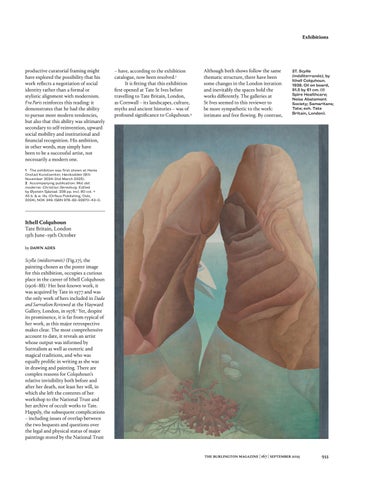
27. Scylla (méditerranée), by Ithell Colquhoun. 1938. Oil on board, 91.5 by 61 cm. (© Spire Healthcare; Noise Abatement Society; Samaritans; Tate; exh. Tate Britain, London).
1 The exhibition was first shown at Henie Onstad Kunstsenter, Høvikodden (8th November 2024–2nd March 2025). 2 Accompanying publication: Mot det moderne: Christian Skredsvig. Edited by Øystein Sjåstad. 208 pp. incl. 80 col. + 45 b. & w. ills. (Orfeus Publishing, Oslo, 2024), NOK 349. ISBN 978–82–92870–43–0.
Ithell Colquhoun Tate Britain, London 13th June–19th October by dawn ades
Scylla (méditerranée) (Fig.27), the painting chosen as the poster image for this exhibition, occupies a curious place in the career of Ithell Colquhoun (1906–88).1 Her best-known work, it was acquired by Tate in 1977 and was the only work of hers included in Dada and Surrealism Reviewed at the Hayward Gallery, London, in 1978.2 Yet, despite its prominence, it is far from typical of her work, as this major retrospective makes clear. The most comprehensive account to date, it reveals an artist whose output was informed by Surrealism as well as esoteric and magical traditions, and who was equally prolific in writing as she was in drawing and painting. There are complex reasons for Colquhoun’s relative invisibility both before and after her death, not least her will, in which she left the contents of her workshop to the National Trust and her archive of occult works to Tate. Happily, the subsequent complications – including issues of overlap between the two bequests and questions over the legal and physical status of major paintings stored by the National Trust the burlington magazine | 167 | september 2025
ERs_SEP25.indd 933
933
18/08/2025 10:58