Fort Bend Symphony to ‘Tango!’ on Sunday - Page 3
GET SEEN CALL 713-371-3600
ADVERTISE HERE! WEDNESDAY • MARCH 11, 2026
Fort Bend / Southwest • Volume 51 • No. 10 • $1.00
Visit www.FortBendStar.com
Fort Bend George’s long-awaited money-laundering trial begins ISD board votes to close seven elementary schools By Ken Fountain
KFOUNTAIN@FORTBENDSTAR.COM
Jury selection began Tuesday morning in the felony money-laundering trial of beleaguered Fort Bend County Judge KP George, who last week lost his bid for the nomination
in the Republican primary for his seat in November’s election. The trial began after a three-judge panel of the 14th Court of Appeals in Houston on Monday rejected a virtually last-minute appeal by George’s defense attorneys that would have indefinitely postponed the trial.
In the two felony charges, George is accused of tampering with campaign finance reports during his 2018 campaign while moving money between his campaign and personal bank accounts. Prosecutors have said in court filings that they also plan to introduce evidence of other
“extraneous offenses” allegedly committed by George during the trial. In a so-called “writ of mandamus” filed last Friday afternoon, Jared Woodfill, George’s lead attorney,
SEE GEORGE PAGE 4
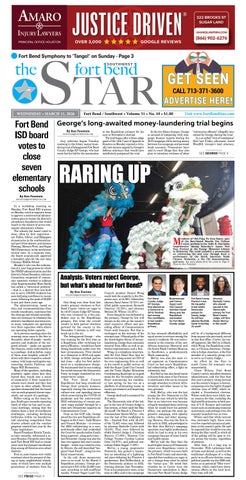
RARING UP
By Ken Fountain KFOUNTAIN@FORTBENDSTAR.COM
In a workshop meeting on Monday, Fort Bend ISD trustees on Monday voted in separate items to approve a controversial administration plan to rezone the district's attendance boundaries that would result in the closure of seven community elementary schools. The schools the board voted to close, often by thin majorities are Dulles, Glover, and Ridgegate elementaries in the southwest/central part of the district; and Arizona Fleming, Mission West, and Sugar Mill Elementary in the northwest/ central zone. In a separate item, the board unanimously approved a boundary plan for the new Amy Coleman Middle School. Monday’s vote was the culmination of a year-long process by which the FBISD administration and the district’s School Boundary Advisory Committee comprised of community members worked to address what Superintendent Marc Smith has called a “structural problem” – that is, a district that was built out to serve 100,000 students has seen declining enrollment in recent years, following the peak of 80,000 it saw just three years ago. The administration, based on data and recommendations from outside consultants, maintains that the closings and related consolidations are necessary to rebalance the district’s enrollment and resources, as many campuses are operating over their capacities while others are operating below capacity. As in previous meetings since the rezoning issue came to the fore in December, about 45 people – mostly parents and students of the targeted schools – spoke out against the closures, either individually or as a package. And as before, many of them wore brightly colored Tshirts with their respective schools’ names, with large contingents representing Austin Parkway and Sugar Mill Elementary, Many of the speakers, including students, spoke about how they feared they would lose a sense of community if their respective schools were closed and they had to move to other schools. Several speakers demanded that the board vote on each proposed closure separately, not as part of a package. Before voting on the items began, Smith gave remarks repeating much of what he has said in previous meetings, stating that the district faces a host of enrollment challenges, including declining birthrates within its boundaries and mounting competition from charter schools and the voucher program enacted last year by the Texas Legislature. Board President Kristin Tassin, in later remarks, referenced a recent Houston Chronicle story that said Fort Bend ISD had in recent years seen the sharpest enrollment drop among all Houston-area school districts. Even so, most trustees were visibly emotional about the prospect of closing so many neighborhood schools, many of which have seen multiple generations of students from the
SEE FBISD PAGE 4
M
embers of USA Fung Fu Lion Dance, part of the Katy-based Shaolin Xiu Culture Centre, perform in the Jodie E. Stavinoha Amphitheater during Saturday’s Lunar New Year Festival at the George Memorial Library in Richmond. The event included a presentation on celebrating the new year through food, a performance by the North American Youth Chinese Orchestra, a Tai Chi demonstration, and more. See more photos form the event on Page 5.
Photo by Ken Fountain
Analysis: Voters reject George, but what’s ahead for Fort Bend? By Ken Foutain KFOUNTAIN@FORTBENDSTAR.COM
One thing was clear from last week’s primary elections in Fort Bend County: voters are eager to be rid of County Judge KP George, who was trounced in a five-candidate race in the Republican primary. But what the overall results in both parties’ elections portend for the county in the November 3 election is still very much up in the air. The beleaguered George – who was running for the first time as a Republican after switching his party affiliation – would have faced strong headwinds under even the best circumstances. First elected as a Democrat in 2018 and again in 2022, George switched parties last June – after his first indictment on a misdemeanor charge. He maintained that he was making the switch because the Democratic Party no longer matched his own conservative values. But Fort Bend County Republican had long considered George their primary nemesis, especially during the contentious culture-war and spending issues which arose during the COVID-19 pandemic and the controversial 2022 redistricting of county precinct maps pushed through by a then-new Democratic majority on Commissioners Court. Once on the GOP side, George joined his two new Republican colleagues on the Court – Andy Meyers and Vincent Morales – to reverse the 2022 redistricting in a rare, mid-decade effort that embroiled the Court for months before finally being approved - along party lines – last November. George was also the lone vote against last year’s county budget – which was voted for even by Meyers, the self-described “taxpayer’s best friend” – citing his own fiscal conservatism. In the end, those maneuvers were to no avail. In the March 3 Republican primary, George garnered just 8.42% of the 50,860 votes cast, according to still-unofficial results. Former Sugar Land City
Council member Daniel Wong easily took the majority in the fiveperson race, at 54.06%, followed by attorney Daryl Aaron (12.75%), certified public accountant Kenneth Omoruyi (12.52%), and attorney Melissa M. Wilson (12.25%). Even though he was defeated in the primary, George by law will remain in his role as the county’s chief executive officer and presiding officer of Commissioners Court until January. But that is contingent on the outcome of his criminal case. If found guilty of the the third-degree felony of moneylaundering, George faces automatic removal from office as well as potential imprisonment and a fine. Wong, in a telephone interview. told the Fort Bend Star that he believes his long career as CEO of his own engineering firm as well as his record in public service on both the Sugar Land City Council and the Texas Higher Education Coordinating Board put in in good stead for the November election. Since announcing his candidacy last spring, he has run on a platform of eliminating waste in county government and improving efficiency. George declined to comment for this story. The Democratic side of the ledger in the race of County Judge is less certain, at least until the May 26 runoff. On March 3, Precinct 4 Commissioner Dexter McCoy – who was the last of five candidates to file – finished first with 40.42% of the 72,461 votes cast, followed by attorney Rachelle Carter with 18.93%. They were followed by 434th District Judge J. Christian Becerra (17.09%), Houston City College Trustee Cynthia Lenton Gray (15.97%), and political consultant Eddie Sajjad (7.59%). McCoy, a young, progressive Democrat, has gained a reputation as something of a lightning rod since defeating his Precinct 4 predecessor, Ken DeMerchant, in the Democratic primary in 2022, winning election that November. True to his progressive roots, in his time in office and in his campaign
Fort Bend County Judge KP George, first elected as a Democrat in 2018, finished last among five candidates in last week’s Republican primary.
Businessman and former Sugar Land City Council member Daniel Wong was the Republican nomination for Fort Bend County Judge.
he has stressed affordability and equal access to services among the county’s residents. He was instrumental in the creation of the new African-American Memorial and the future Black Cowboys Museum in Kendleton, a predominantly Black community. McCoy was also the most vocal opponent on Commissioners Court on last year’s Republicanled redistricting effort, a fight he ultimately lost. But McCoy has also faced harsh criticism from some of his Precinct 4 constituents who say he not paid enough attention to critical infrastructure and other issues in his own precinct. Still, McCoy, who was the last among the five Democrats to file for for the race (which he told the Star in an interview was because of legally mandated dates involving when he would leave his present office), ran perhaps the most aggressive campaign, with splashy online videos and other messaging. Becerra, who was the first to file early in 2025, acknowledged to the Star that McCoy’s campaign operation was highly professional, while he had to step in his own campaign because of some family and health issues. McCoy told the Star that the much-higher turnout of Democratic voters over Republican voters in the primary, which was seen both in Fort Bend County and statewide, signaled that residents are eager to see a change from what he called the “status quo.” He noted that whether he or Carter wins the Democratic nomination in May, the next Fort Bend County Judge
Fort Bend County Precinct 4 was the top-getter in last week’s Democratic primary for County Judge. He will face attorney Rachelle Carter in the May 26 runoff.
Attorney Rachelle Carter, who placed second in the Democratic primary for Fort Bend County Judge, will face Dexter McCoy in the runoff.
will be of a background different from anyone who previously served in that that office. (Carter, his runoff opponent, like McCoy is Black, while Wong, the Republican nominee, is Chinese-American. George, who is Indian-American, is the first member of a minority group ever to serve as County Judge.) An effort by the Star to reach Carter for comment was unsuccessful. Chase Wilson, Fort Bend County’s newly installed elections administrator, told the Star that this year’s primary voting turnout was the county’s largest in history, surpassing even the highly charged election year of 2020, which included a Presidential election. Wilson said there were likely many reasons for that, including the high-profile primaries in both parties of U.S. Senator and national issues such as continuing economic uncertainty and perhaps even the recently launched war on Iran. Wilson said that while turnout was extremely high, there were very few reported instances of problems at the county’s polls. He said he expected that would be true also during the May runoff, in which all of the polling will be open to voters across the county, regardless of precinct. After that, it’s a long way to November. With turbulence both at home and abroad, as well as the traditional challenges of a ruling party in an off-year election, many political pundits see the 2026 midterms as as potential “Blue wave” election, which could have downstream effects at the local level. Only time will tell.