2023
READERS’ CHOICE
Holiday Lights continues at Constellation Field through Jan. 4 - Page 4
PAINTING SERVICES:
• Interior Painting • Exterior Painting • Sheetrock repairs • Textures & Finishes • Power Washing
✔ Insured ✔ References Available SPECIAL OFFERS FOR JOBS OF
500
$
OR MORE!
www.smart-improvements.com
713-298-8393 WEDNESDAY • DECEMBER 24, 2025
Fed economist: Inflation to remain 'sticky' in 2026 By Ken Fountain KFOUNTAIN@FORTBENDSTAR.COM
Economic growth in Texas and in the greater Houston region will likely be tepid in while inflation will continue to be “sticky” in 2026, an economist told a Fort Bend County audience last week. Jesse Thompson, a senior business economist with the Federal Reserve Bank of Dallas’s Houston branch, spoke at the Ford Bend County Chamber of Commerce in Sugar Land on December 18. “The forecast is for trend or neartrend GDP growth through 2026, 1.8 to 2 percent,” Thompson told an audience of business leaders and elected officials. “We’re a little bit below that.” “Somewhere around trend is where we are, and it looks like we’re going to stay (in 2026),” he said. Thompson said that inflation in 2026, which the Fed had earlier projected would ease to its target goal of 2 percent in 2025, is projected to remain elevated in 2026. “It’s a little bit sticker than we projected earlier, for a variety of reasons,” he said, with the inflation rate projected to remain in the 2.5 to 3% range. Among the reasons for the expected continued inflation are policies instituted by the Trump Administration, particularly its tariff policy. “Federal policy is mixed, for a variety of reasons, and uncertain,” he said. Thompson said that is reflected when the Fed polls business leaders across the country, including in Texas. “We have many businesses that say I would really like some more clarity, some certainty, and stability of policy. It’s hard for many businesses to find that happy medium where they’re splitting the upside/ downside risk between policy choices,” he said. The employment and wage growth projections for Texas are decidedly mixed, but Thompson cautioned that the data from recent
SEE INFLATION PAGE 4
Fort Bend / Southwest • Volume 50 • No. 51 • $1.00
Visit www.FortBendStar.com
55-hour race in Missouri City honors cancer patient's legacy By Juhi Varma CONTRIBUTING WRITER
A 55-hour race in Missouri City will honor Dickinson girl Chelsey Campbell and a marathon surgery she underwent during her cancer treatment in 2006. The race is hosted by Snowdrop Foundation, which provides scholarships for childhood cancer survivors while raising awareness and funding for research. It will take place from Tuesday, December 30, (beginning at 7 a.m.) through
Thursday, January 1 (ending at 2 p.m.) at Buffalo Run Park at Missouri City’s 1122 Buffalo Run Blvd. Chelsey Campbell died in December 2006, and the foundation was formed in her honor. “The Snowdrop Foundation was founded in June 2006, four months after the recordsetting surgery took place at Texas Children’s Hospital here in Houston,” said Jered Mansell, one of the race directors. “Chelsey passed away, and it has been the mission of the Snowdrop Foundation and the Snowdrop Ultra55 Race
and Relay to share her legacy of positivity and joy with the world.” A 55-hour race may sound daunting, but the event is very popular, with registration filling quickly each year, Mansell said. Registration for this year’s race is already closed, though the public is encouraged to attend the park to cheer on runners and support the cause. “Participation in the event has always been great,” said Mansell. “We are looking at
SEE CANCER PAGE 4
Chelsey Campbell, a Dickinson girl whose marathon cancer surgery is the inspiration for the Snowdrop Foundation’s 13th Annual Ultra 55 Race and Walk in Missouri City’s Buffalo Run Park, is pictured in this undated photo. Chelsey died in 2006. Photo via Snowdrop Foundation Facebook page
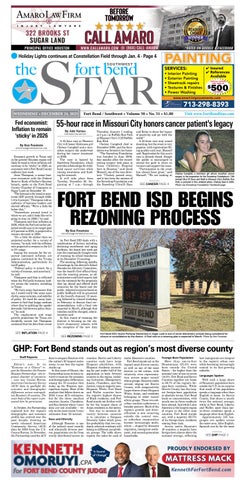
FORT BEND ISD BEGINS REZONING PROCESS By Ken Fountain
KFOUNTAIN@FORTBENDSTAR.COM
As Fort Bend ISD deals with a combination of factors including declining enrollment and aging facilities, the board last week got into the emotionally fraught work of rezoning its school boundaries at its December 15 meeting. The meeting, following months of meetings by the district’s School Boundaries Advisory Committee, was the board’s first official foray into the rezoning process, as administrators and hired experts laid out the rationale for the proposals that lay ahead and offered draft scenarios for the board and the public. Adjusted scenarios based on public feedback will be presented at the board’s January 12 meeting, followed by a board workshop in February to discuss final recommendations, with a final vote expected in March, although that timeline could be changed, administrators said. In this round of rezoning the district is focusing on the district’s elementary schools, with the exception of the new Amy
SEE REZONING PAGE 2
Fort Bend ISD’s Austin Parkway Elementary in Sugar Land is one of seven elementary schools being considered for closure or consolidation by the district. A final vote on a rezoning plan is expected in March. Photo by Ken Fountain
GHP: Fort Bend stands out as region’s most diverse county Staff Reports Editor’s note: In its “Economy at a Glance” report for December, the Greater Houston Partnership – the regional chamber of commerce – uses new Census Bureau American Community Survey (ACS) data to spotlight the economic and demographic differences across metropolitan Houston’s 10 counties. The main body of the report is presented here by permission. In October, the Partnership explored how the region’s demographic and economic profile has evolved over the past decade, drawing on newly released American Community Survey (ACS) data for 2024 from the U.S. Census Bureau. In November, the Partnership used the ACS
data to compare Houston with the nation’s 20 largest metro areas, to see how the region stacks up. In this issue of Glance, the Partnership turns its focus inward to examine the economic and demographic differences among the 10 counties that make up the Houston metropolitan region. Most of the analysis that follows draws on 2024 1-year ACS estimates, but for the three smallest counties (Austin, Chambers, and San Jacinto) where 1-year data are not available – we rely on the most recent 5-year estimates from ’23 instead. Race and Ethnicity Although Houston is one of the nation’s most racially and ethnically diverse metros, populations are far from evenly distributed across its
counties. Harris and Liberty counties each have large Hispanic pluralities, with Hispanic residents accounting for just under half of the population in both. Several counties in the region, including Galveston, Montgomery, Austin, Chambers, and San Jacinto, remain majority nonHispanic White. Fort Bend and Waller counties have the region’s highest shares of Black residents, and Fort Bend stands out further with by far the largest share of Asian residents in the metro. One way to measure diversity between counties is to calculate a Simpson Diversity Index which gives the probability that two randomly selected residents will belong to different racial/ethnic groups. The table above reports the index for each of
metro Houston’s counties. Fort Bend stands out as the region’s most diverse county, as well as one of the most diverse in the nation, with relatively even representation across major racial/ ethnic groups. Brazoria ranks second, edging out Harris County, with comparatively larger shares of non-Hispanic White, Asian, and residents belonging to other racial/ ethnic groups. These two suburban counties underscore a broader pattern: Much of the region’s growth and diversification is now occurring outside the central core, as suburban communities become increasingly multiethnic – shaped by domestic migration, immigrant settlement, and second-generation households.
Foreign-Born Population More than one-in-four Houstonians (25.4%) were born outside the United States – far higher than the national rate of one-in-seven (14.8%). Fort Bend and Harris Counties together are home to 86.7% of the region’s foreign-born residents. While Harris County has the largest foreign-born population in absolute terms, Fort Bend leads on concentration, with nearly one-in-three residents born abroad. And while Latin America is the largest region of origin in the other nine counties, Fort Bend stands out, with a majority (50.7%) of its foreign-born residents coming from Asia. Across metro Houston’s 10 counties, a majority have foreign-born shares above the national average, reflecting
how immigrants are integral to the region’s urban core while becoming increasingly central to its fast-growing suburbs. Languages Spoken With such a large share of Houston’s population born outside the U.S. its no surprise that much of the population speaks a language other than English at home. In Harris County, that share is nearly twice the national average, while in Fort Bend, Liberty, and Waller, more than onein-three residents speak a language other than English. Approximately 145 languages are spoken across the metro area. After English, Spanish was by far the most
SEE GHP PAGE 2
PROUDLY ENDORSED PROUDLY ENDORSED BY BY
,CPA
MATTRESS MACK MATTRESS MACK
KennethForFortBend.com
THE STAR
PAGE 2 • Wednesday, December 24, 2025
REZONING
FROM PAGE 1
Coleman Middle. Middle and high-schools (which are the linchpins of the district’s feeder patterns) will be addressed in later rounds of the district’s Long-Range Boundary Planning process. Even though the rezoning effort hadn’t been formally before the board before last week, parents and some students have been speaking during public comments portions of meetings for weeks, voicing concerns about the potential for school closures or consolidations and the redrawing of school boundaries that might shift students away from the schools closest to their communities. That was true on December 15, with about 16 speakers signed up, most of them speaking about the proposed boundaries. During a specially called meeting just before the December 15 regular meeting, Stacey Tepera, president of the College Station-based school demographics consulting firm PASA (Population and Survey Analysts), gave a presentation laying out enrollment trends that have been facing school districts statewide, in the greater Houston region and in Fort Bend County. While just a few years ago Fort Bend ISD had reached enrollment of just over 80,000 students, the largest in the district’s history, more recently enrollment has been in decline, Tepera said, following trends that have been affecting public schools across the state, and even nationally, going back to the 2010s. One of the recent main factors has been an erosion in public school enrollment since the end of the COVID-19
pandemic, she said. Growing competition from charter and private schools, and even some virtual school options, has provided families with alternatives to public schools that have contributed to that attrition, Tepera said. On a more fundamental level, she said, Fort Bend ISD, after experiencing tremendous growth in the 1970s and 1980s, has since entered a phase of “stabilization” in its population base. There are fewer families with young children in the district, even as those families have more educational options from which to choose, Tepera said. And while there are areas of the district that are still seeing large growth, particularly in the northwest and southeast of its borders, much of the central core of the district has seen decline. That requires that the district find a balance among its underutilized and overutilized campuses, she said. Melissa Turnbaugh, a principal with the architectural firm PBK, followed with the firm’s latest Facilities Condition Index, a methodology that measures the structural condition of all of the district’s buildings. While many of the district’s newest (or renovated) facilities have very high FCI scores, many of the district’s older schools, especially in the central core, have much lower scores. Turnbaugh said this, combined with the demographic trends, calls for the likely closure or consolidation of several elementary schools. Robert Templeton of Zonda, the district’s boundary planner, followed with a presentation about the planning process and presented the draft boundary plans. According to the presentation, the elementary schools being considered for closure or consolidation are: Austin
Parkway, Dulles, Fleming, Glover, Mission West, Ridgegate, and Sugar Mill. “I want our community to clearly understand that what was shared tonight represents draft plans, not final decisions,” board president Kristin Tassin said in a news release. “The School Boundary Advisory Committee, Administration, and the Board have devoted significant time and thoughtful discussion to these initial draft plans, always with one goal in mind, ensuring longterm success and stability for our students and schools.” The purpose of sharing draft plans at this stage is to provide transparency and to ensure the community is able to understand the status of the work at this point. In January, proposed boundary scenarios will be posted for community review and feedback.” “Schools are truly the heartbeat of our neighborhoods, and we recognize how deeply our families, staff, and students care about them,” Superintendent Marc Smith said in the release. “These conversations are not easy, but they are necessary. While many districts across the state are facing similar challenges, we are committed to navigating this process with care, integrity, and open communication, and to emerging as a model for how districts can address difficult decisions while keeping students at the center.” Community members can learn more about and participate in process by visiting the Long-Range Boundary Planning webpage at www. f o r t b e n d i s d . c o m /a t t e n danceboundaries. To view recordings of the December 15 meetings, visit fortbendisd. com/Page/124962.
Happy Holidays
See us online www.FortBendStar.com
GHP
FROM PAGE 1 common language with 30.2% of residents using it at home. Asian or Pacific Islander languages (such as Vietnamese or Chinese) are spoken by 5.2% of the population, followed by other Indo-European languages at 3.6%. Age Houston’s median age was 35.7 years in ‘24, meaning half of residents were younger and half older than that age. Across the region, all but three counties fall below the U.S. median age of 39.2 years. Liberty is the youngest county in metro Houston with a median age of 33.7 years. It is one of the nation’s fastest-growing counties, buoyed by relatively affordable housing that has kept homeownership within reach
for many and attracted young families and earlycareer workers. But median age only tells part of the story. A county can look “young” because it has many families with children, a large pool of early-career adults without children, or fewer retirees. Pairing median age with the share of residents under 18 offers a clearer read on what is driving each county’s age profile. Liberty ranks as no. 1 on both measures, indicating its youth is driven in large part by family formation. Harris County ranks as no. 2 by median age and no. 4 for minors, implying a profile driven by more young working adults and fewer families with children. Fort Bend, which ranks No. 7 by median age but No. 3 for minors, suggests the opposite - many families with
children and a meaningful presence of older adults, but fewer young workers without children. Note: The geographic area referred to in this publication as “Houston,” “Houston Area” and “Metro Houston” is the ten-county Census designated metropolitan statistical area of Houston-Pasadena-The Woodlands-Sugar Land, TX. The ten counties are: Austin, Brazoria, Chambers, Fort Bend, Galveston, Harris, Liberty, Montgomery, San Jacinto, and Waller. Find the full “Economy at a Glance” report at houston. org/houston-data/economyat-a-glance-november-2025. Find the recently released ACS data at census.gov/ programs-surveys/acs/news/ data-releases/2024/release. html.
Fort Bend stands out as the region’s most diverse county, as well as one of the most diverse in the nation, with relatively even representation across major racial/ethnic groups, according to a Greater Houston Partnership analysis of newly released American Community Survey (ACS) data. Courtesy Greater Houston Partnership
THEIR ADVANCED TREATMENTS BEAT MY CANCER From diagnosis to treatment to recovery, your dedicated Houston Methodist cancer center team uses leading research, cutting-edge technology and the latest treatments to create a personalized care plan for you. At eight cancer center locations throughout the Greater Houston area, you’ll find the cancer expertise to help you feel whole again. That’s the difference between practicing medicine and leading it. For you.
The Woodlands
Cypress
Willowbrook
Katy-West Houston Baytown Texas Medical Center
houstonmethodist.org/cancer 713.790.2700
Sugar Land
Clear Lake
THE STAR
See us online www.FortBendStar.com
Wednesday, December 24, 2025 • PAGE 3
EDITORIAL In one year and out another
W
hat a year it was, with patriotism over f lowing, led by a courageous leader daring danger to give America a sense of glory and new heights, an air of joyfulness and a future so bright that other nations could only gasp in admiration. Of course, I’m referring to 1776. But 2025 looked hopeful: it was only a prelude to 2026 when we shall celebrate our nation’s 250th birthday, and we can wonder at the pride our Founding Fathers would feel towards the way we have handled what they created. So let’s look back at 2025 with the good (no hurricanes), the bad (Hill Country floods) and the ugly (the Texas state government). First, our Somewhere Over the Rainbow Award: Officials with the cities of Galveston and Houston had crews remove two rainbow crosswalks to avoid losing state transportation funding. In Lubbock they even removed crosswalks portraying local hero Buddy Holley’s glasses. The ICE of Texas: Two immigrants opened three Trump Burger joints in the Houston area. Trump memorabilia fes-
Lynn Ashby Columnist
ASHBY2@COMCAST.NET
tooned the restaurants. The tops of the buns were branded “Trump.” Then Trump’s ICEmen arrested them for being illegal immigrants. A Scotsman playing his bagpipes in Memorial Park was accosted by a woman who objected to the music. One thing led to another and the angry woman was led away in handcuffs by constables. According to an analysis from Stacker, “a digital content distribution firm,” (whatever that is) Hunters Creek Village is the richest town in Texas; 75 percent of households in the small city of about 4,400 people earn at least $200,000 a year. Meanwhile, just 1.6 percent of families in the community fall below the poverty line. They must be the maids and bodyguards. The 788,066 folks in Houston’s 18the Congressional
District will finally get a voice in the U.S. House. Rep. Sylvester Turner died last March 5, but Gov. Greg Abbott refused to call a special election, as is the norm, until the next election cycle. Why? The district is solidly Democratic, which is bad news for the thin Republican majority in the House. This brings us to the Redistricting Debacle of 2025. Do you know who your U.S. representative is? No? Not to worry. That’s about to change. It was the work of Gov. Abbott. Indeed, 2025 was a good year for him. After constantly calling for special sessions of the lawmakers, the Guv got his minions to pass his charter school bill, giving one billion of your tax dollars to private schools and homeschooling students. There go Friday Night Lights. Abbott has ordered all high schools to start right-wing Turning Point USA clubs, and warned schools that plan to block his command to expect “meaningful disciplinary action.” He also wants to eliminate all school taxes. Huh? So congratulations, our state lawmakers. Y’all have made a mockery of Texas – again. (The late columnist Molly Ivins wrote of one legislator: “If his IQ slips
any lower, we’ll have to water him twice a day.”) Our Lite Guv, Dan Patrick, called on lawmakers to declare that the cut of beef taken from the short loin behind the ribs shall be known, by law, as the “Texas strip” steak, an item which appears on menus across the nation as the “New York strip.” Patrick wrote on X: “Liberal New York shouldn’t ge the credit for our hard-working ranchers.” It’s all a matter of priorities. There are 41 college football bowl games, 82 teams. Even Rice, with a 5-7 record, made the cut, facing Texas State in the Armed Forces Bowl. At least the Owls didn’t get invited to the Gasparilla, Pop-Tarts or ReliaQuest bowls. However, Texas Tech and Texas A&M are good enough to play in the Meaningful Bowls – they both made the play-offs. Incidentally, I always said the Fightin’ Texas Aggie Band was the best. Now it’s official: It has been named the Number 1 marching band in the world by ESPN. The announcement follows a perfect performance at the International Marching Arts Showcase in Paris where – it says here – “the Aggie Band stunned both the live audience and millions watching worldwide.”
This just in: While visiting a Texas wildlife park, former British Prime Minister Boris Johnson was bitten by an ostrich! The 200 Texas National Guard members (minus the fat ones) spent about $4 million to never do anything in Chicago. Now they’re going home for the holidays. We turn to our voices in Washington. Rep. Al Green of Houston (and part of Fort Bend County) was tossed from the U.S. House of Representatives for shouting that President Trump had no mandate to cut Medicaid. Rep. Jasmine Crockett (now a candidate for Senator) referred to wheelchair-riding Abbott as “Governor Hot Wheels.” Crockett later explained she was referring to Abbott’s sending thousands of immigrants to liberal cities. At a House Foreign Affairs Committee meeting, Rep. Keith Self, Republican from Texas, recognized Rep. Sarah McBride, the first transgender person elected to Congress, by saying: “I now recognize the representative from Delaware: Mister McBride.” She countered with “Thank you, Madame Chair.” Sen. Ted Cruz retweeted a video showing, what he said, were thousands of demonstrators taking to Los Angeles
streets to protest against the Trump regime’s immigration crackdowns. It even included LAPD cruisers being set ablaze by protesters. “This… is…not…peaceful,” Cruz wrote on the social medi platform X. There’s just one problem: the clip was filmed in May 2020 – five years ago – during Black Lives Matter and George Floyd protests. The clip was later deleted. That may help explain why Cruz and Crockett both won awards from Politico Magazine’s list of the “7 Most Shameless Attention-Seekers in Congress.” The magazine gave Cruz the “Most Obsessed with His Own Podcast Award” and Crocket was called the “Most Likely to Mug for the C-SPAN Cameras Award.” Oh, well, those days are behind us, and we can all look forward to a great 250-year birthday party. We’ll have a year of fireworks, picnics and fun. Pay no attention to the Debbie Downers and “My Champagne glass is half empty” pessimists, or as George Washington told King George, “Don’t reign on our parade.” Ashby is already celebrating at ashby2@comcast.net
What Hanukkah means to me now I h ave c elebr at e d Hanukkah every year of my life. I know the prayers, the songs, the rhythm of lighting the candles, by heart. But this year, something has shifted. Hanukkah is no longer just a holiday. This year, Hanukkah sits heavier on my heart than it ever has before. As a Jewish teenager living in a world that feels increasingly hostile, the light of the menorah no longer feels symbolic alone but has changed into something bigger. Hanukkah is no longer just about recalling ancient miracles or retelling familiar stories. This year, it is about presence, identity, and resilience.
Eva K. Morris Youth Columnist
To be Jewish right now is to live with an awareness that our existence is still questioned and, at times, threatened. Being a Jewish teenager today means carrying an awareness that feels far beyond my age. Antisemitism is no longer something I associate solely with history lessons or distant tragedies. It is present and real, unfolding
in the news and in everyday conversations. Violent incidents, like the recent attack at Bondi Beach in Australia, and so many others across the world, force a painful realization. Being Jewish is not always safe. It never fully has been. That truth is unsettling, but it is also clarifying. It asks a question that cannot be ignored. When your identity is challenged, how do you respond? This year, I am responding with intention. When I light the menorah now, I am not only remembering the miracle of oil that lasted eight days, I am thinking about what it means to
exist openly as a Jew when doing so can feel risky. I am thinking about the generations before me who lit candles in secret, who whispered prayers, who held onto their faith when the world told them they did not belong. Lighting the menorah now feels like more than a tradition. It feels like a choice. Each night, as another candle is added, I am reminded that Jewish identity has always required courage. I think about those who held onto their faith when doing so came with real consequences. The miracle of Hanukkah was not only that the oil burned for eight days, iIt was that the people who lit the flame never
the leader Puzzlers.
Answers found in this week’s ANSWERS Classified section
FOUND ON PAGE 4
SUDOKU
stopped believing it was worth protecting. For so long, Jewish history has been taught through the lens of suffering, and that history matters. But that is not the whole story. We are not only the people who were oppressed, we are the people who endured, who rebuilt, who chose joy in the face of fear. Our survival is not accidental, it is intentional, just like the lighting of each candle. We are here because our ancestors refused to let darkness have the final word. We refuse to let fear take away our pride. We refuse to back down to hatred. We will not be the persecuted people any longer. We are not a forgotten people, and we are not a broken one. We are united by faith, resilience, and an unshakable sense of belonging. When we light the menorah, we are not only honoring history. We are declaring our presence. We are saying that we are still here, still shining, and still refusing to be erased. This year, I feel more connected to my Jewish identity than ever before. What once felt inherited now feels cho-
sen. I am choosing to be proud. I am choosing to be visible. I am choosing not to let fear dictate how openly I live as a Jew. Remembering the miracles of the past is meaningful, but it is no longer enough. We are being asked to carry that legacy forward, to be the light we once depended on for survival. Eight candles are lit, but they tell one truth. The light did not end with the miracle. It continues with all of us. This Hanukkah, may we remember who we are, stand firmly in that truth, and carry our light into a world that desperately needs it. Morris is a Ridge Point High School student, class of 2027, a varsity tennis player, and an active member of JCC Maccabi Houston. If you are a Fort Bend County high-school-age student (public, private, charter, or homeschool) who might be interested in becoming a Youth Columnist, please send an email to editor@fortbendstar.com.
PUBLIC LIVE AUCTION FORT BEND COUNTY Site: 9110 Long St., Needville Saturday – October 25th – 10 AM
aCrOss
1. Hindu stratification 6. Least harm 12. Medical confinement 16. Silver 17. In a sick state 18. Belonging to me 19. 1/2 an em 20. “Makeover’s” Pennington 21. Take a seat 22. 1/10 meter (abbr.) 23. Atomic # 13 24. Fallow deer genus 26. Skin lesions 28. Charlie Parker’s sax 30. 31st state 31. Disparity 32. Poking stroke 34. Long time 35. Wm. the Conqueror grave 37. Hosts film festival 39. Mend 40. Gear teeth 41. Of cadmium 43. 1618 Reformed synod 44. Fringe-toed lizard 45. Where passengers ride 47. 1/60 hour (abbr.) 48. Initials of TV cartoon father 50. Pack down 52. ___ and feathered
54. Hyperbolic cosecant 56. Operating system (abbr.) 57. Atomic #99 59. Crown owned Isle 60. Santa __ trail 61. Booze support group 62. Footcandle 63. Retaliations 66. Natural logarithm 67. Quality of usefulness 70. Sitting position 71. They turn litmus paper red
dOwn
1. Brandy region of France 2. Equally 3. Spittles 4. Very small 5. Ethiopia 6. Filled with sediment 7. An antiviral AIDS drug 8. Saudi king to 2005 9. Early word forms 10. Yes in Spanish 11. Ketchup veggies 12. Used to have (Scottish) 13. Old Greek storyteller
14. Den 15. Stockings 25. Scottish road surface 26. Diego, Francisco, Anselmo 27. Bodily cavity 29. Durations 31. About gene 33. ‘Footloose’ actor Kevin 36. Supply weaponry 38. Neither 39. Capital of Syria 41. Shortcut 42. Feline 43. Have already done 46. Rifle barrel cleaning tool 47. High IQ group 49. Libra constellation 51. Perch genus 53. Summer precipitation 54. Ancient Roman boxing gloves 55. Silver Skates’ Brinker 58. Cobblestone 60. Policeman (French) 64. Pizza, apple or chiffon 65. Winglike structure 68. 37th state 69. Potato state
WORD SCRAMBLE
FEATURED HEAVY EQUIPMENT, VEHICLES, TRUCKS & MISC CAT D4K2 Dozer, Cat 416B Loader Backhoe, Cat 324 EL Hydraulic Excavator, Kobelco SK250 LC Excavator, Cat 308 E2 CR Mini Excavator, Cat 12M Motor Grader, Cat 326 FL Midi Excavator, Dynapac Pneumatic Roller, Cat PS 360B Pneumatic Roller, (4) FRHT. Dump Trucks, (3) Flat Bed Trucks, Live- stock Trailer, Cargo Trailer, Rotary Cutters, (4) Ambulances, (Approx. 129) Fleet Vehicles Including: Ford F250 P.U.’s, Ford F150 P.U.’s, Ford Flatbed, Chev. 3500 P.U., Chev. 2500 P.U.’s, Dodge C & C, Chev. Tahoe’s, Ford Fusions, Caprice, Crown Victoria, Dodge Grand Caravan, Journey Van, Cargo & Pass. Vans, Ford Explorers, & More See Terms, Conditions, & Operational Videos – No Buyer’s Premium www.lemonsauctioneers.com Lori Lemons-Campbell #7341 (800)243-1113 OR (281)357-4977
Be prepared before the next power outage.
Receive a free 5-year warranty with qualifying purchase* - valued at $535. Call 713-832-1238 to schedule your free quote!
Let the community know in our Community Calendar!
Contact: editor@fortbendstar.com
THE STAR
PAGE 4 • Wednesday, December 24, 2025
See us online www.FortBendStar.com
Holiday Lights continues at Constellation Field through Jan. 4
The 12th Annual Sugar Land Holiday Lights at Constellation Field continues through January 4. Courtesy Sugar Land Space Cowboys
Community Reports With the holiday season ramping into full gear, the 12th Annual Sugar Land Holiday Lights presented by Houston Methodist carries on throughout the holiday season, continuing its 45 consecutive day run through January 4.
CANCER
FROM PAGE 1
record numbers this year, although increasing our participation is never a big focus of ours. We try and go for quality of experience over quantity of runners and with the size of the venue, putting more runners on the course than are currently registered would put a strain on resources.” Last year’s overall winner and the three-time men’s champion was Juan Acevedo, a teacher from Lufkin. Snowdrop 55 Hour Ultra Race Since its inception in 2013, the Snowdrop Ultra 55 Hour Race has raised approximately $1.4 million to support pediatric cancer research here in Houston and scholarships for pediatric cancer patients and survivors to continue their education, Mansell said. “Although the 55 hours may seem intimidating to those outside the ultra-running community, we actually have many who seek out our event because of the longer timeframe,” Mansell said. “When they see that our event is 55 hours and they can earn their 100-mile buckle, they get really excited about it. It helps that we have the most beautiful finisher buckles by far.” The race represents 160,544.1 miles run, according to the Snowdrop Foundation website (snowdropfoundation. org). It is for solo runners or relay teams of up to 10 runners. The relay teams are in a separate division; individual runners compete against each
Upcoming promotions for the remainder of Sugar Land Holiday Lights include Lights and Leashes (December 28) presented by Hollywood Feed. There is also a second Teacher Appreciation Night (January 2) presented by Raining Cane’s with a wine tasting add-on before school resumes. Plus, attendees will
have their final chances to take photos with Santa Claus every night until December 23. Sugar Land Holiday Lights will also be open on Christmas Eve and Christmas Day from 6 pm to 10 pm with tickets available for $22-$25. A staple of Sugar Land Holiday Lights is
other, and relay teams compete against each other. There will be three teams of students competing in this year’s relay event, Mansell said.
After receiving her diagnosis, Campbell told her doctor she intended to be “that one person in ten.” The number 55 holds particular significance in her story. In February 2006, following three months of chemotherapy, Campbell underwent a 27-hour marathon surgery at Texas Children’s Cancer Center. The operation required four anesthesiologists and multiple nursing shifts, but was performed in its entirety by one primary surgeon and one assistant surgeon, neither of whom took a break. The figure reflects the time and commitment of the two surgeons who operated to save one patient’s life: two surgeons multiplied by 27 hours equals 54, plus one additional hour to represent Campbell, making a total of 55 hours. Surgeons were able to remove 95 percent of Campbell’s tumors during the procedure. Two tumors remained following surgery: after four weeks of radiation, only one persisted. Continued radiation treatment, however, failed to eliminate the final tumor. Subsequent scans revealed the return of previous tumors and the emergence of new ones. Doctors determined that no further treatment options were available. Campbell lived in Dickinson in Galveston County and attended Santa Fe High School. She is survived by her parents, three sisters and one brother. Varma can be reached at juhi.varma@gmail.com.
“We closed registration to individual runners at 200 participants and then we also have relay teams that have up to 10 participants on a team,” he said. The course is a USA Track & Field Certified loop of .69045 miles on crushed granite and pavement. During its first several years, the race was held at a different park each year. When the time came to renew the venue agreement, costs increased significantly, prompting organizers to look for an alternative. Missouri City stepped in, offering Buffalo Run Park as the new venue. Mansell said the city has since become a strong partner and an effective steward of the event. “They have invested quite a bit of time and money improving the park, making it more runner friendly,” he said. “The mayor and members of the city council often come out at the start of the race to demonstrate their support for us and for the runners and thank them on behalf of the city for supporting our cause. It’s pretty fantastic to be honest.” Chelsey Campbell’s story In October 2005, Chelsey Campbell, 15, was diagnosed with advanced, Stage 4 undifferentiate sarcoma, a rare soft-tissue cancer that affects roughly 50 people worldwide each year. Survival rates are low; statistically, only one in 10 patients survives.
$49
New Years Eve with a New Years Eve Fireworks Show at midnight presented by Houston Methodist as Sugar Land Holiday Lights stays open from 6 pm to 12 pm. It’s also the Fourth Annual New Years Eve Ball presented by Planet Fitness from 8 pm to 12 pm in the Regions Bank Club. New Years Eve
Ball tickets include a buffet dinner, a three-hour open bar for beer and wine, a DJ, photobooth, a champagne toast at midnight and a premium view of the midnight fireworks display. Tickets for the New Years Ball are for guest 21-years-old and up and include access to the Regions Bank festivities as
well as Sugar Land Holiday Lights. After the New Year, Sugar Land Holiday Lights concludes its run by being open nightly from January 1 through 4 from 6 pm to 10 pm. Full details and tickets can be found online at SugarLandHolidayLights. com.
INFLATION
FROM PAGE 1
months has been murky due largely to the recent government shutdown. “Texas job growth is approaching 0.9 percent growth in 2025, based on data through September. We have potentially very significant revisions to jobs data in Texas across all sectors. “Houston is coming in at about 0.5 percent jobs growth in 2026. That is very, very low. But it is still growth,” he said. The underlying trends call for about 1.7 percent job growth, he said. One bright spot for the Houston region is that oil prices are rising after a long period of decline, which should end layoff in the oil and gas production sector, Thompson said. “The good thing for Houston is that the worst has likely passed,” he said. “That doesn’t mean there’s a recovery in 2026. But it does mean that it isn’t a drag on the region.” The construction and real estate sectors are likely to be “soft” in 2026, he said. One thing buttressing the overall economy is that consumer expenditures remain strong, Thompson said. But, he added, most of that consumption is by higher-earning people, while lower-earning people aren’t buying as much since inflation hits their pocketbooks harder. The Federal Reserve prefers measures of what is called “core inflation,” which strip out highly volatile items like food and energy,
Jesse Thompson, an economist with the Houston branch of the Federal Reserve Bank of Dallas, discusses the economic outlook for 2026 at the Fort Bend County Chamber of Commerce. Photo by Ken Fountain
Thompson said. “Core inflation is still pretty sticky. Some of it is affecting the lowest-wage earners the most,” he said, adding that the current data is still “choppy.” The Administration’s immigration policies are also having an impact on the employment outlook, Thompson said. “The immigration shock is doing two things simultaneously. It’s pulling labor supply out of the market, and also pulling demand out of the market. That dual effect is making predictions about the labor market really cloudy,” he said. “Texas manufacturing is seeing an uptick in produc-
tion, driven by certain niche sectors, LNG pipelines, data centers, and semiconductors. I don’t know how sustainable it is,” he said. Thompson said that the services sector is seeing a slight decline. “This doesn’t mean that we’re in (an overall) decline but it does mean that services numbers aren’t as positive as they were,” he said. “Service sector leaders are saying they are less optimistic about the next six months because of a fear of business slowdown. They’ve stopped telling us that they are understaffed and they are more or less balanced. There’s definitely some softness there,” he said.
LEADER PUZZLER SOLUTIONS PUZZLE SOLUTIONS
Cooling or Heating System Tune Up
When Was Your Last HVAC Tune-Up?
Schedule Soon & Save Up to $2000!
Call today & Save!
(866) 754-6849
Price valid for one working unit. Excludes oil fired systems. Valid at participating ARS® Network locations. Not valid for third party, new construction, or commercial customers, with any other offers, discounts, or on prior sales. Call service center for details. Coupon required at time of service. Void if copied or transferred and where prohibited. Any other use may constitute fraud. Cash value $.001. Offer expires 3/31/2026. License numbers available at ars.com/licenses
SAVE UP TO
$2000
on a New Cooling and Heating System with our Buy Back Program! Savings requires purchase and installation of select complete heating and cooling system. Removal and disposal by Company of existing heating and cooling system required. Valid at participating ARS® Network locations. Not valid for third party, new construction, or commercial customers, with any other offers, discounts, or on prior sales. Call service center for details. Coupon required at time of service. Void if copied or transferred and where prohibited. Any other use may constitute fraud. Cash value $.001. Offer expires 3/31/2026. License numbers available at ars.com/licenses
WORD SCRAMBLE ServiCe
CRyptO fun
Answers: A. account B. merger C. employee D. salary
See us online www.FortBendStar.com
THE STAR
Eye on Fortbend T
he Cullinan Park Conservancy in October announced the winners of its Annual Photo Contest during its 2025 Picnic for the Park, the organization’s biggest fundraising event. The five categories judged are: Birds; Wildlife; Flora (trees, flowers, plants), Landscapes, and any subject taken with a cell phone. Photographers of every age and skill level are invited to participate each year. The Cullinan Park Conservancy, created in 2010, is charged with the mission of raising funds to promote, enhance and protect Joseph S. and Lucie H. Cullinan’s 754-acre park at Oyster Creek. Cullinan Park, located at 12414 Highway 6 S, Sugar Land, is one of the largest nature parks in the region with two lakes, miles of shady pedestrian-only hiking trails and abundant wildlife. This year’s winners are: • Birds Category 1st Place: Leonard Cichowski – But you said, “hold my head up” • Wildlife Category 1st Place: Roger Hutchison – Eyes like Lanterns • Flora Category 1st Place: Vivian Vu – Shimmering in the Sun • Landscape Category 1st Place: Irfan Ali – Water, Wings, Wonder • Taken with Phone Category 1st Place: Mike Cassity – Stormy morning! • People’s Choice Winner: Katie Lagunes – Blue Dasher • Birds Category 2nd Place: Irfan Ali – Where water meets sky, and form meets reflection • Wildlife Category 2nd Place: Hieu Do – Gator Bro-mance • Flora Category 2nd Place: Nathan Heilman – He’s just a little guy • Landscape Category 2nd Place: Asma Bumbia – Rainbow enhances the beauty of the park • Taken with Phone Category 2nd Place: Jan Poscovsky – Fungus Among Us • Birds Category 3rd Place: Clarence Yeung – Circle of Life • Wildlife Category 3rd Place: Dillon Hutyra – Snake Snack • Flora Category 3rd Place: Darleen Patin – Flower Buzzing • Landscape Category 3rd Place: Aizah Bumbia – Beautiful rainbow taken by a 14 year old Taken with Phone Category 3rd Place: Karla Jordan – Leaves that gleam and peaceful green trees is what makes Cullinan’s perfect scene! All images courtesy Cullinan Park Conservancy
Wednesday, December 24, 2025 • PAGE 5
THE STAR
PAGE 6 • Wednesday, December 24, 2025
See us online www.FortBendStar.com
Deadline is noon every Friday. Limit entries to the “5 Ws” Who, What, When, Where, and Why. Email to editor@fortbendstar.com
FOR NON-PROFIT EVENTS
FORT BEND COUNTY MASTER GARDENERS FRUIT TREE SALE
Fort Bend County Master Gardeners are asking you to circle February 14 on your calendar. That’s when they will hold their annual fruit/citrus tree sale in Barn H at the Fort Bend County Fairgrounds, 4310 Texas 36 in Rosenberg. The sale will be open from 9 a.m.-noon or until sold out and will feature an estimated 75 varieties of fruit trees, berries and tropicals/subtropicals. A list of trees at the sale will be available soon. Give a gift that grows for Valentine’s Day!
ONGOING ENGLISH AS A SECOND LANGUAGE CLASSES AT GPBC
In conjunction with the Literacy Council of Fort Bend Bend County, Grand Parkway Baptist Church will offer ESL classes on Tuesday nights from mid-August 2025 through May 2026. We are located at 12000 FM 1464, Richmond, across from Austin High School. Our students speak several languages and encompass many faiths, all are welcome. For more information call 281-277-2200 and ask for ESL information. You may also email ESL@grandparkway.org
EMMY-NOMINATED FORT BEND BOYS CHOIR HOLDING AUDITIONS
The Fort Bend Boys Choir is seeking talented young boys who like music and singing. If know of one, encourage him to audition for our award-winning and Emmy-Nominated Fort Bend Boys Choir! No experience is necessary and boys should be around eight years of age or older with an unchanged voice. Auditions are by special appointment at the First United Methodist Church Missouri City, 3900 Lexington Blvd., Missouri City, TX. Visit the Fort Bend Boys Choir’s webpage at www.fbbctx.org or call (281) 240-3800 for more details about auditions. Benefits as a choir member include greater self-esteem and selfconfidence, better work ethic and a sense of belonging and community. A boy’s voice has an expiration date so it is important to audition when boys’ voices are still unchanged. Auditions are free!
AMERICAN LEGION POST 942
311 Ulrich Street, Sugar Land meets the fourth Tuesday of each Month at 7:00 pm. All Veterans are welcome.
LOVING FRIENDS IS A GROUP OF WOMEN AND MEN WHO ARE WIDOWS AND WIDOWERS THAT MEET MONTHLY FOR LUNCH, FRIENDSHIP, AND SOCIALIZATION
Lunches. are planned for the fourth Tuesday of the month at various local restaurants. Please contact Bobbie Tomlin at {281} 967-0718 For more information about us and to learn about this month’s planned lunch. We hope to meet you soon.
QUAIL VALLEY GARDEN CLUB
The Quail Valley Garden Club is very busy, not only with meetings, but with some fun “stuff” for our members and the community. Please find our fall schedule of events that the QVGC will be involved with this fall leading up to the holidays.
FT. BEND ACCORDION CLUB
Meets on the 4th Sunday of every month from 2:pm - 4:pm at: CHRIST CHURCH SUGAR LAND (in the Chapel) 3300 Austin Parkway, Sugar Land, TX 77479 FREE and Open to the Public! We welcome everybody! If you play accordion, beginners to professional and would like to play Call, Text or email: Vince Ramos Cell: 281-204-7716 vincer.music@gmail.com.
LITERACY COUNCIL OF FORT BEND COUNTY
We enhance lives and strengthen communities by teaching adults to read. We need your help. Literacy Council is actively recruiting Volunteer Tutors to provide instruction for English as a Second Language (ESL) Levels 0-5, three hours a week. For more information, call 281-240-8181 or visit our website www.ftbendliteracy.org.
FBJSL IS ACCEPTING CAF GRANT APPLICATIONS
We provide grants of up to $5,000.00 to charitable causes serving Fort Bend County with requests to fund a critical need, pilot a program, or expand a significant service to the community. If your agency or organization is interested in applying for a CAF grant, please visit the Request Support page of the FBJSL website (www.fbjsl.org/request-support). All applications should be submitted via e-mail to brccom@fbjsl.com.
THE SANCTUARY FOSTER CARE SERVICES
We are a child placing agency that provides wrap around care support for foster children and foster families. We provide free therapy services, 24 hr. crisis intervention, respite/alternative care services and community-based support. For more info, www.sanctuaryfostercare.org
ALIEF AARP CHAPTER 3264
Meets the first Thursday of every month at 10:00 a.m. at Salvation Army Church, 7920 Cook Road, Houston, TX 77072. Educational Program/Entertainment at each meeting. Bus Trips every month. Seniors 50 and above invited. Call 281785-7372 for more information.
SUGAR LAND ROTARY CLUB
Sugar Land Rotary Club, the nation’s oldest community service organization, wants you to be its guest at a meeting that could turn out to be the best fit for getting involved with a local, non-political, humanitarian service organization with a global presence to satisfy your passion. We’re on a quest for new members! Call or email Dean Clark, 832-987-4193, sugarlandrotaryclub5890@gmail.com We just started a new evening club also. Contact me for more info.
GIVE A GIFT OF HOPE
Give a Gift of Hope one-time or monthly. Your help provides access to therapies and services children with autism might otherwise go without. Please consider Hope For Three in your Estate, Planned, or Year-End Giving. Register now, or learn more about exciting events: www.hopeforthree.org/events.
DVD-BASED ADULT SUNDAY SCHOOL CLASS WITH NO HOMEWORK REQUIRED
Weekly class designed to help you understand and appreciate the Bible by giving you a better sense of the land and culture from which it sprang. The class meets at 9:30 am every Sunday at First Presbyterian of Sugar Land (502 Eldridge Rd.). For more information call 281-240-3195.
EXCHANGE
EXCHANGE, America’s Service Club, always welcomes guests and is in search of new members! Various Fort Bend clubs exist and can accommodate early morning (7 a.m.), noon and evening meeting time desires. For more info, contact Mike Reichek, Regional Vice President, 281-575-1145 or mike@reichekfinancial. com We would love to have you join us and see what we are all about!
MISSOURI CITY AARP CHAPTER 3801
Meets the second Monday of every month at 11:30 a.m., at 2701 Cypress Point Dr., Missouri City Rec Center. Lunch, education, and entertainment. All seniors over 50 invited. For more information, call 713-859-5920 or 281-499-3345.
PUBLIC NOTICE
Innovative Radiology, P.A. 14835 Southwest Freeway Sugar Land, TX 77478 Please be advised that Innovative Radiology, P.A. will no longer provide mammography services at this location. The facility will remain open for other imaging examinations. Patients who previously received mammography services may request copies of their mammography images and medical records by contacting: Inna Yarmoshchuk Inna.Yarmoshchuk@radnet.com • 713-797-1919 Medical records and images will be maintained and available for five (5) years after the date of service. We thank our patients and the community for their trust and support. HoustonImaging.com
Worship Directory FORT BEND COUNTY
CHURCH OF CHRIST
METHODIST CHURCH
CHRIST CHURCH SUGAR LAND • 281-980-6888
STAFFORD CHURCH OF CHRIST • 281-499-2507
A United Methodist Community 3300 Austin Parkway • Sugar Land, TX 77479 Rev. Dr. Daniel Irving, Senior Pastor Sunday Schedule 9:30 am Blended Worship 9:30 am Sunday School for all ages 11:00 am Traditional & Contemporary Worship www.christchurchsl.org
402 Stafford Run Rd. -Stafford, 77477 Stephen Higley, Preacher Sunday Bible Study 9:30 am Sunday Worship 10:30 am Wednesday 7:00 pm www.staffordcoc.com
PRESBYTERIAN CHURCH
FIRST PRESBYTERIAN CHURCH • 281-240-3195
502 Eldridge Rd. -Sugar Land, TX 77478 Reverend Dr. Fred Seay, Pastor Sunday Worship In Person 11:00 am / Nursery Available Worship Online on YouTube www.fpcsl.org
Scripture of the week
NON DENOMINATIONAL
OMEGA FIRE MINISTRIES • 832-598-8144 13155 Westheimer Rd. Suite 123, Hou. 77077 Sunday: 1st Service - 9am 2nd Service 11am. Friday: Prayer & Deliverance 7pm. Tuesday: Bible Study 7pm. www.ofmhouston.org
MIRACLE CONFERENCE FREE EVENT Font Bend Epicenter. 28505 Southwest FWY, Rosenberg TX 77471 Apostle Johnson Suleman Pastor Benny Hinn Grupo Barak performing live Oct. 28th - 6pm Healing Service Oct. 29th & 30th - 9am & 6pm Service. Register at www.ofmhouston.org
‘There is neither (…) male nor female, for you are all one in Christ Jesus.’
Introduce Your Congregation to the Community with a listing in our Worship Directory
Call Anqunette for more information
- Galatians 3:28b
713-371-3600 DONATIONS
A division of
TX STREET MEDIA PUBLISHER & OWNER BRIAN CALLE
EDITORIAL
SALES/MARKETING
DESIGN
KENNETH FOUNTAIN Editor in Chief kfountain@fortbendstar.com
ANQUNETTE WILLIAMS Sales Manager awilliams@txstreetmedia.com
LAURA WHITE Production Manager/Senior Designer lwhite@txstreetmedia.com
THE FORT BEND STAR WELCOMES OPINION ARTICLES ON MATTERS OF INTEREST TO FORT BEND COUNTY RESIDENTS. PUBLICATION IS AT THE DISCRETION OF THE EDITOR. MAIL: 2400 CENTRAL PKWY STE I HOUSTON, TX 77092-7712 PHONE: 713.371.3600
WEBSITE: www.fortbendstar.com FACEBOOK: www.facebook.com/fortbendstar EMAILS: editor@fortbendstar.com