EDITION 2, 2026
TRUSTED PARTNERS
Future-Proofing Growth: the blueprint behind growth and scalability, supply chain and service.
WORLDSTAR-WINNING PACKAGING RIPPLE WALL CUPS POINT OF DIFFERENCE THE MICROFIBRE ADVANTAGE JANITORIAL SOLUTIONS
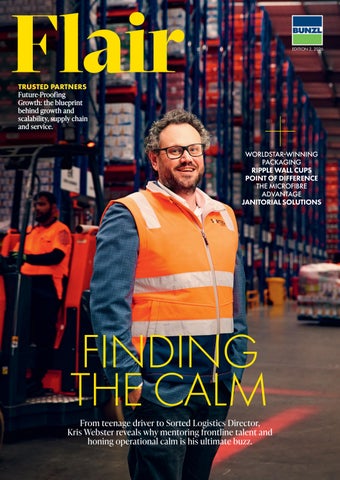
FINDING THE CALM
From teenage driver to Sorted Logistics Director, Kris Webster reveals why mentoring frontline talent and honing operational calm is his ultimate buzz.
I
n this edition of Flair, we explore how practical solutions, strong partnerships and forwardthinking design are helping organisations navigate change and drive long-term success. Across hospitality, healthcare, food processing and facilities management, you’ll discover how businesses are balancing operational performance with sustainability outcomes, from Bunzl’s award-winning WorldStarrecognised packaging innovations (pg 5) to the expanding Sustain packaging range including ripple wall cups (pg 22). We also examine how small decisions can have a significant impact. From the role of precision tools in commercial kitchens (pg 32) to the growing adoption of microfibre cleaning systems (pg 12), these articles showcase practical innovations helping teams work smarter every day. Partnerships remain a key theme throughout this edition. Our feature article explores why future-ready supplier relationships are critical to business growth and expansion (pg 8), while Kris Webster of Sorted Logistics shares his leadership journey on building successful teams and long-term business relationships (pg 34). This edition also explores Bunzl’s latest Innovate Reconciliation Action Plan (pg 4) and how meaningful action can help strengthen relationships and contribute to positive social outcomes for communities and businesses alike. Thank you for your continued partnership and for joining us as we explore the people, ideas and innovations helping shape the future of our industries.
Mark Phelan Managing Director, Bunzl Australia & New Zealand
2
flair@bunzl.com.au
Bunzl Australia & New Zealand
Contents
4 & 5 Spotlight: Sustainability 6 The Process: Simplified Sourcing 7 Check Out: Safe Handling 8 Partners In Growth True strategic collaborators look beyond price to deliver long-term value, innovation, and trusted support. 12 Beyond The Bucket Microfibre systems balance strict hygiene standards with reduced operational expenses. 16 Peak Performance Discover how monitoring wornout janitorial inventory eliminates hidden operational waste and elevates hygiene standards. 21 Quality Hygiene Solutions Unify your entire facility with Pristine’s high-performance paper ecosystem. 22 In Good Hands Choose innovative ripple wall cups to maximise performance and storage space. 24 Better By Design Elevate your retail presence with rPET MAP trays designed for high-speed automated lines. 28 The Mobile Advantage Learn how janitorial carts transform daily workflows into highly visible mobile hubs. 32 The Perfect Paring The right paring knives optimise commercial kitchen prep efficiency daily. 34 From Passenger To Driver Cover Photography: Grahaminsights Werner Kris Webster shares on managing calm warehouse operations and mentoring young professionals. 35 Expert Q&A With Bunzl’s James Beleno. Cover Photography: Devon Krige @bunzlANZ
@BunzlAustraliaandNewZealand
@BunzlANZHospitality
www.forte.bunzl.com.au
3
SPOTLIGHT
Art by Kylie Hill
A Strong Path Forward Bunzl’s second Innovate Reconciliation Action Plan builds on the foundations of the first, setting out a practical framework for strengthening relationships, respect, opportunities and accountability across the business. RECONCILIATION REQUIRES MORE THAN just good intentions. It requires action, accountability and a long-term commitment to learning, listening and improving. With the launch of its second Innovate Reconciliation Action Plan (RAP), running from 2026 to 2028, Bunzl Australasia is building on the foundations, relationships and lessons established through its first RAP. The RAP focuses on deepening relationships with Aboriginal and Torres Strait Islander peoples, embedding cultural respect across the organisation and expanding opportunities through employment, education and supplier engagement. It also strengthens governance and accountability, helping ensure reconciliation is reflected in everyday decisions, policies and business practices. A key focus of the plan is economic participation. Through Bunzl’s Supply Nation membership and partnerships with First Nations-owned and operated businesses, the company is continuing to increase engagement with Indigenous suppliers and make these products and services more accessible to customers. For customers, this creates an opportunity to support First Nations economic participation through everyday purchasing decisions, from cleaning chemicals and PPE to
4
hospitality products, workwear, water and paper products. For Bunzl, it is an important way to use its supply chain to support broader social and economic outcomes. Education and employment pathways are also central to Bunzl’s Reconciliation work. Bunzl has ongoing partnerships with the Clontarf Foundation and Yalari, which both support Aboriginal and Torres Strait Islander young people to stay engaged in education, build confidence and develop pathways into further study, training and employment. The RAP also includes actions to better understand and strengthen First Nations employment, retention and professional development opportunities within Bunzl. Cultural learning remains another important priority. Bunzl has provided practical resources for employees and teams on topics such as First Nations procurement and celebrating NAIDOC Week. Leaders have also taken part in cultural learning experiences, including an on-Country immersion, where participants learned about the language, stories and cultural practices. The RAP is supported by a cross-functional RAP Working Group, with representatives from across the business helping guide implementation, monitor progress and keep reconciliation embedded in decision-making. Bunzl recognises that reconciliation is an ongoing journey. This second Innovate RAP reflects a commitment to respectful relationships, cultural learning, supplier diversity and practical action. This helps create a more inclusive workplace while contributing to positive, lasting outcomes for First Nations communities.
Find out more about Bunzl’s Innovate Reconciliation Action Plan here.
SPOTLIGHT
Sustainable By Design Bunzl ANZ’s latest two global award wins show how practical packaging design can deliver measurable gains across material use, handling, reuse and supply chain efficiency. INNOVATIVE PACKAGING SOLUTIONS from Bunzl have been recognised at the 2026 WorldStar Global Packaging Awards. The standout entries focus on customer-led designs that deliver meaningful environmental benefits and were celebrated for their excellence. The Advantage 9um Pallet Wrap, a high-performance machine wrap designed to reduce material use while supporting load stability and transport efficiency, received a global WorldStar 2026 Award from the World Packaging Organization (WPO) in the Packaging Materials and Components category. The groundbreaking packaging solution was recognised for rethinking one of the most familiar issues in logistics – reduced plastic use without compromising load security. Advantage’s high stretch capability (up to 385% more than alternative
wraps) means fewer revolutions per pallet, reducing film consumption and wastage. Compared to the standard 15um wrap, Advantage reduces plastic use by up to 66%, meaning an average customer can potentially save roughly 12 tonnes of plastic. Katermaster win Katermaster’s Regen Container took on the challenge of re-imagining reusable food service packaging, while still meeting the pressures of commercial catering, also earning it a 2026 WorldStar Global Packaging Awards win. Made from monomaterial polypropylene, it’s designed for repeated use, with optimised wall strength, commercial dishwasher suitability, microwave and freezer compatibility, and the ability to interstack for storage and transport efficiency. Its leak-resistant lid supports safer
handling of hot foods and helps minimise food loss without relying on composite sealing materials. “We’re committed to reducing product and packaging waste to improve sustainable outcomes. Together with our customers, we are driving the transition towards a more sustainable and circular economy,” says Mark Phelan, Managing Director of Bunzl ANZ. Together, these products showcase the ingenuity of design to solve practical problems. From load stability to reuse systems, and material efficiency to operational fit, Bunzl’s WorldStar wins are designed to provide solutions with less waste.
Learn more about Bunzl ANZ’s sustainability initiatives here.
www.forte.bunzl.com.au
5
THE PRO C ES S
Simplified Sourcing Discover how Bunzl’s newly released Buyer’s Guide brings everything together under one roof, demonstrating how a true one-stop shop makes sourcing simpler, faster and more cost-effective.
BUNZL AUSTRALIA HAS RELEASED ITS comprehensive new Buyer’s Guide, a 336-page resource designed to streamline sourcing across the country’s core industries. Featuring almost 5,000 product SKUs across eight easy-to-navigate sections, the guide showcases the sheer breadth of Bunzl’s offering and serves as a one-stop shop for sectors ranging from healthcare and hospitality to facilities management and food processing. Bunzl works alongside trusted, quality manufacturers to deliver products that meet the high standards customers expect. The new catalogue reflects these strong partnerships while making it easier than ever to discover the required products and solutions. More than a product directory, the catalogue highlights the value Bunzl brings beyond supply. It showcases a commitment to operational excellence, category expertise and customer-focused service, demonstrating how specialist teams help businesses improve efficiency, compliance and performance. The catalogue also outlines Bunzl’s ongoing commitment to sustainability through responsible product development and design, responsible sourcing practices and efforts to address modern slavery within the supply chain. These initiatives reflect a dedication to
6
supporting customers in making informed purchasing decisions while contributing to more sustainable business practices. To further support informed purchasing decisions, the catalogue includes a practical guide to packaging codes and recycling symbols, helping customers better understand packaging materials and disposal options. More than simply a product catalogue, the latest Bunzl Buyer’s Guide is a valuable business resource. It brings together quality products, trusted brands, industry expertise and value-added services in one place, making it easier than ever to source everything a business needs through one reliable partner. The new catalogue invites exploration to discover how Bunzl can continue to support businesses with quality products, trusted partnerships and industryleading solutions. Contact your Bunzl representative for your copy.
View Bunzl’s digital Buyers Guide here.
C HEC K OUT
Safe Handling In healthcare, patient and staff safety depends on every risk being clearly managed, consistently handled and securely contained; from soiled linen to hazardous waste. THE DEMAND FOR HEALTHCARE continues to grow, driven by an ageing population, rising rates of chronic conditions and complex care settings. Consequently, the systems that support infection control, waste segregation and staff safety are more essential than ever. In healthcare settings all across Australia and New Zealand, safe handling is a critical part of the daily pressure of care. Across hospitals, aged-care facilities and clinics, staff need clear, reliable systems for soiled linen and hazardous waste. WHAT’S THE SOLUTION? Containment is a vital part of that process. From soiled linen leaving a ward to cytotoxic waste moving through a specialised disposal stream, the right bag solution – like the Kwikmaster Cytotoxic Waste Bag – helps teams identify, separate and manage materials in line with established procedures. For linen handling, soluble seam laundry bags are designed to reduce unnecessary contact with soiled or infectious linen during collection, transport and washing. Soluble Seam Laundry Bags can move through the laundry process with the linen inside, and the seam will release the contents during the wash cycle. This helps reduce the risk of crosscontamination and limits manual handling at critical points in the process.
HAZARDOUS WASTE OPTIONS The cytotoxic waste bags support the segregation and containment of materials with clear colour-coded systems for ease and safety. Infectious linen/clothing is marked red. At the same time, purple is used for cytotoxic waste, helping staff recognise the correct stream quickly and manage it with caution and confidence. With more than one million people now working across Australia’s healthcare sector alone, it’s paramount that there’s a safe waste-handling process in high-pressure settings. Medical teams need clear systems they can trust implicitly. From linen to hazardous waste, smarter containment helps teams protect themselves and patients as essential workflows move fast and under pressure.
Learn more about Bunzl’s Healthcare Bags range here.
www.forte.bunzl.com.au
7
Partners In Growth GROWTH DEMANDS MORE THAN A SUPPLIER; IT DEMANDS A STRATEGIC PARTNER.
B
8
usinesses may be navigating economic uncertainty, supply chain disruption and ongoing market volatility, but growth remains firmly on the agenda. For many, that growth extends beyond domestic borders, whether expanding across the Tasman, into Asia or into new global markets.
competitive advantage. Every market has its own procurement processes, operating practices and service expectations. A supplier with established local infrastructure and regional expertise can simplify market entry while providing consistent pricing, reliable communication and uninterrupted supply across every location.
Success in those markets depends on more than ambition. It requires the right partners. Choosing a supplier for an expansion is about far more than product availability or price. The right partner reduces complexity, minimises risk and helps create the operational foundation needed to scale with confidence. “A supplier needs to operate as a true strategic collaborator rather than simply a product supplier,” says Bunzl ANZ Business Development Manager, Industrial Packaging, James Beleno. “That means having the scalability, infrastructure and supply continuity to support growth across multiple locations while maintaining consistent service, quality and operational standards.” Equally important is the ability to adapt. Commercial flexibility, data-driven insights and dedicated support enable suppliers to respond quickly to changing business needs while helping customers build more efficient, resilient operations for the long term. Local expertise also becomes a significant
According to Bunzl General Manager New Zealand, Lillian Small, the right partner removes much of the complexity that comes with expansion. “By aligning business values, sustainability goals, streamlining account management and providing scalable inventory across multiple countries, they mitigate operational risk and create a smoother pathway for growth,” Small says. The greatest value often comes from taking a holistic approach. Rather than managing multiple suppliers across different regions, businesses benefit from one strategic partner with the capability to support every site. “Having one core supplier across multiple markets provides greater transparency across the supply chain,” Small says. “With visibility across your entire operation, your partner can deliver meaningful data that supports smarter decisions, reduces operating costs and identifies new efficiencies.”
BUILDING OPERATIONAL ADVANTAGE
SPOTLIGHT
www.forte.bunzl.com.au
9
Kelly Anderson, Processor and Industry sector, Bunzl New Zealand, supports this, as for her, “consolidating suppliers and product ranges simplifies operations, reduces costs, strengthens purchasing power and creates greater consistency in sustainability and ethical sourcing across every market. This is an important differentiator when looking for business partners.”
10
Discover how Bunzl helps scale and streamline your business across markets.
“Successful onboarding is about much more than getting a customer up and running. It has to be a positive experience from day one. Any change needs to deliver genuine benefits to the business.”
PARTNERSHIPS THAT KEEP IMPROVING The strongest supplier relationships don’t stop once onboarding is complete. They continue to evolve. As businesses grow, operational requirements inevitably change. That’s why successful partnerships are built on collaboration, responsiveness and a shared commitment to continuous improvement. “Successful onboarding is about much more than getting a customer up and running. It has to be a positive experience from day one,” says Bunzl ANZ National Business Development Manager Raymond Failla. “Any change needs to deliver genuine benefits to the business, whether that’s improved efficiency, better service or greater value.” Failla believes the most successful supplier relationships are those where the supplier becomes an extension of the customer’s own team. “When I work with a customer, I become part of their business, identifying what I call continuous improvement opportunities, practical solutions that deliver measurable value. That’s what creates lasting partnerships
BUILT FOR TOMORROW As businesses expand, today’s supplier decisions should also support tomorrow’s ambitions. “A good strategic relationship with a supplier partner will support not just today’s operations but tomorrow’s growth,” Small says. “Yes, you need consistent stock availability and product quality assurance. You also need
robust cybersecurity, ethical sourcing and a credible sustainability strategy. But equally important is a supplier that’s forward-thinking and innovative, one that evolves alongside your business, anticipates change and helps you adapt as operating conditions and customer expectations continue to shift.” That long-term perspective is shared by Kris Webster, Director of Sorted Logistics New Zealand. “When we assess a supplier relationship, we’re looking beyond price very quickly,” Webster says. “We’re looking at whether there’s genuine long-term potential. We don’t see supplier relationships as 12 or 24-month arrangements. We want partnerships where both businesses continue improving together over time.” For Webster, the best suppliers are proactive rather than reactive. “We’re looking for relationships that are innovative and forwardthinking. The strongest partners are constantly bringing new ideas, finding efficiencies and helping improve the operation rather than simply delivering products.” In an increasingly complex business environment, that’s what separates a supplier from a strategic partner. The best partnerships are built on trust, innovation and a shared commitment to continuous improvement. Whether your business is expanding across New Zealand or internationally, the right supplier partner won’t simply support your growth. They’ll help accelerate it.
www.forte.bunzl.com.au
11
Beyond The Bucket FROM SCHOOLS AND HOSPITALS TO LARGE STADIUMS, MICROFIBRE MOP SYSTEMS PROVIDE COMMERCIAL FACILITIES WITH A RELIABLE APPROACH TO STRICT HYGIENE STANDARDS, REDUCED WATER AND CHEMICAL USE, AND FASTER TURNAROUND TIMES.
12
M
aintaining largescale facilities across Australia and New Zealand is a balancing act between escalating labour costs and non-negotiable hygiene standards. To protect the bottom line, commercial cleaning operations need tools that double as efficiency drivers. Modern microfibre mop systems bridge this gap, delivering a measurable reduction in water, chemical and labour expenses. Lightweight and highly ergonomic, they accelerate floor turnaround times while maximising pathogen removal. With the flexibility to deploy either durable, laundered or target-specific disposable systems, facilities can seamlessly eliminate cross-contamination and resource waste without sacrificing operational speed. Microfibre has been a staple in healthcare cleaning protocols for over a decade now; its alignment with infection prevention guidelines made it a natural fit for clinical environments. What is now catching up is the broader commercial sector: office buildings, schools, aged care facilities, stadiums and hospitality venues where the case for microfibre is equally strong, but the conversation is only just beginning.
advanced microfibre systems physically extract and retain debris. Malcolm Barclay, Category Manager, Cleaning and Hygiene, Bunzl ANZ, explains it well: “Microfibre’s ability to physically capture and retain dirt and pathogens, rather than simply moving them, shows measurable reductions in microbial counts. Reduced infection rates and fewer hygiene-related incidents provide strong outcome-based indicators over time.” Industry benchmarks highlight the impact of utilising advanced microfibre mop pads designed to eliminate micro-dirt, macro-dirt and grease. Independently tested systems can remove up to 99.99% of bacteria and fungi using water alone, meeting rigorous international standards such as EN 16615:2015 for hard surface disinfection. For commercial facilities seeking to reduce chemical consumption as both a cost-control and sustainability measure, adopting high-performance microfibre systems presents a compelling case for optimising labour efficiency and elevating hygiene standards. “Reduced chemical dependency lowers procurement costs while minimising environmental impact, strengthening both the financial and ESG case for microfibre adoption,” says Barclay. What’s more, colour-coded reusable mop heads – blue for general areas, red for higher-risk zones – reduce the risk of cross-contamination between spaces. For food service, aged care and education environments, this is an absolute essential, not a nice-to-have.
“Reduced chemical dependency lowers procurement costs while minimising environmental impact.”
THE CASE FOR MICROFIBRE: WHAT ‘CLEAN’ LOOKS LIKE From a risk-management perspective, surface performance directly correlates with operational downtime and liability. Rather than redistributing particulate matter like traditional cotton mops,
www.forte.bunzl.com.au
13
REUSABLE VS DISPOSABLE: HOW TO DECIDE? An important conversation happening in commercial cleaning right now is about flexibility; specifically, the ability to use reusable or disposable microfibre pads depending on the environment and the risk level. Washable microfibre mop pads make strong economic and sustainability sense for largefootprint environments with predictable cleaning cycles: office buildings, schools, retail spaces, stadiums between events. Washable cloths reduce landfill waste and use less water and chemicals: each pad can cover up to 20 square metres before needing to be changed. For multi-site operations (think franchise networks or contracted cleaning services), this is a game-changer. Disposable pads, by contrast, come into their own in healthcare facilities, commercial spaces or any high-risk environment that requires high standards of hygiene and infection control. Think aged care facilities and high-traffic food preparation areas.
14
Learn more about microfibre cleaning solutions here.
“For operations running across multiple sites, the consistency the system delivers is equally valuable.”
LIGHTER, FASTER, SMARTER The efficiency gains don’t stop at the mop pads. The microfibre system itself is lightweight, ergonomic, versatile and quick to switch between tasks. At its core, it’s designed to reduce the physical toll of commercial cleaning: a system weighing under 800 grams in total means less physical strain over a full shift, and more ground covered. “Less water means faster drying times, allowing areas to be reopened sooner. In hightraffic environments, faster area availability translates directly into improved operational efficiency and better customer or patient flow,” says Barclay. For operations running across multiple sites, the consistency the system delivers is equally valuable. The same pad, the same process, the same result, whether you’re in Auckland or Adelaide. Training is straightforward, and the interchangeable cloth system means teams can move between hard floors, tiles and surfaces without needing additional tools, reducing equipment costs and simplifying procurement across the board. Integrating high-performance microfibre into a facility management strategy is a straightforward way to balance budgets with strict hygiene demands. Ultimately, matching the right tools to specific operational needs ensures a cleaning program that works smarter, controls expenses and delivers reliable results across complex environments.
MAP rPET Trays
Engineered for Butchers, Meat & Seafood Processors, Poultry & Red Meat Abattoirs, Meat Wholesalers and Fresh Fruit & Vegetable Producers
Innovative Liquid Retention Technology
Contains Recycled Content
Widely Recyclable
Designed to capture and retain liquid in the base cells, helping to prevent leakage.
Made using 80% post-consumer recycled content.
Once rinsed thoroughly can be disposed of in co-mingled recycling.
www.forte.bunzl.com.au
www.bunzl.com.au/revive
15
Peak Performance DISCOVER HOW A PROACTIVE, USAGE-BASED REPLACEMENT STRATEGY FOR EVERYDAY JANITORIAL TOOLS SHIELDS YOUR COMMERCIAL FACILITY FROM HIDDEN LABOUR COSTS, PROTECTS HYGIENE STANDARDS AND MAINTAINS STRICT OPERATIONAL COMPLIANCE.
I
n high-volume commercial cleaning, balancing strict hygiene standards with tight operational margins is a constant juggling act. While big-ticket assets like automated scrubbers always get rigorous lifecycle tracking, it’s easy for smaller, everyday consumables like mop heads, microfibre cloths, sponges and brushes to slip under the radar. But because labour makes up the vast majority of your cleaning spend, even a minor drop in tool performance can quietly compound into major labour inefficiencies and compliance risks across your facilities. For facility directors, logistics managers, and procurement leaders steering operations through economic fluctuations and high interest rates, maximising the utility of existing inventory is a logical cost-containment priority. Yet, in a highly price-conscious market, delaying the replacement of degraded equipment can unintentionally introduce higher operational costs down the line. Recent IBISWorld data shows that following a post-pandemic surge, the commercial cleaning sector across Australia and New Zealand has stabilised, with the Australian market valued at $20 billion and New Zealand at $3.1 billion. As revenue growth normalises, building operators and hospitality leaders are increasingly focused on cost awareness and productivity. In a price-conscious market, the temptation to extend the lifecycle of degraded equipment is understandable, yet it represents a false narrative of the economy. “Knowing when to replace cleaning tools is critical to maintaining hygiene standards,
operational efficiency and avoiding hidden costs,” says Lach Nankervis, Bunzl ANZ General Manager, Hospitality and Facilities. “Worn-out cleaning tools don’t just impact hygiene; they slow down operations and increase labour costs.” The operational math is straightforward. When a cleaning cloth loses absorbency or a broom filament wears down, cleaning efficiency plummets. A custodian must execute multiple passes to achieve the same result that a fresh tool delivers in one. In an industry where labour constitutes the overwhelming majority of operational expenditure, these lost minutes accumulate across shifts, inflating labour inefficiencies and affecting compliance protocols. Worn-out tools compromise cleaning standards and consistency. A cotton mop head, typically spent after 40 to 50 washes, or a high-use mop pad begins to spread grime rather than lift it. Similarly, using the wrong concentration of a cleaning chemical or mixing incompatible products can leave behind hazardous residues, cause permanent surface discolouration, or release toxic vapours marked by an unusual odour. In commercial kitchens and hospitality venues, these deficiencies directly elevate the risk of cross-contamination and non-compliance. To mitigate these risks, operational teams are shifting from reactive purchasing to proactive, usage-based replacement frameworks grounded in product lifespan and intensity of use. Establishing strict replacement disciplines ensures predictable outcomes.
www.forte.bunzl.com.au
17
SPOTLIGHT
PRODUCT LIFECYCLES Cleaning Asset
Recommended Replacement Frequency Key Operational Driver
Sponges and dish scrubbers
Every 1–2 weeks (monthly absolute maximum)
Prevents bacteria build-up and cross-contamination.
Toilet brushes and surface scrubbers
Every 3 months
Maintains hygienic baselines and scrubbing efficacy.
Brooms and mop heads (high-use)
Every 6 –12 months
Avoids frayed filaments and lost fluid absorbency that drive up labour time.
Chemical solutions As needed (upon expiration)
Prevents the use of degraded solutions that have lost sanitising efficacy.
Chemical inventory and SDSs
Ensures regulatory compliance and updates safety documentation.
Annually (formal audit)
Ultimately, astringent asset management links back to core commercial drivers. Ensuring tools work properly guarantees operational efficiency and protects staff and occupants. By systematically monitoring indicators like damaged bristles, thin cloths and declining vacuum performance, businesses eliminate hidden labour costs and maintain uncompromised hygiene. This planned approach avoids excessive waste, proving that operational discipline is the most effective strategy for safeguarding staff, customers, reputation and margin.
18
Replacing or updating your janitorial inventory? Scan here.
www.forte.bunzl.com.au
19
Professional Cleaning Starts Here Janitorial carts and safety signage designed to support safer, more efficient cleaning operations. Janitorial Cleaning Cart | KWJJANCART01 A-Frame Caution Wet Floor Sign | KWJSIGNAFY01 Caution Wet Floor Cone | KWJSIGNCNY01
www.forte.bunzl.com.au 20 www.bunzl.com.au/kwikmaster
Complete Coverage. Every space. Every need. From front of house to back of house, Pristine delivers reliable quality paper solutions for every part of your facility.
Back of House Spaces
Common & Public Spaces
Staff washrooms, kitchen & service areas Focus Durability, efficiency cost control
Reception, public restrooms, event areas Focus High capacity, reliability, presentation
Guest Rooms & Private Spaces Private rooms & personal spaces Focus Comfort, softness, premium quality
THE RANGE PURPOSE DESIGNED FOR EVERY NEED Hand Towel Range
Toilet Tissue Range
Facial Tissue Range
Blue Hard Towel Roll HACCP International-certified for food areas.
Jumbo Rolls for high traffic. Interleaved Sheet for dispenser control.
Cube Premium Facial Tissue smaller box for compact spaces.
White Hand Towel Roll for spills and hand drying. Ultraslim/Slimline/Compact interleaved hand towel via Pristine dispensers. Premium Hand Towel through air dried (TAD).
Made from Renewable Sources: Selected Pristine facial tissues, roll towels, hand towels and toilet tissues are Forest Stewardship Council® (FSC®-C117930) certified. FSC® is a global, not-for-profit organisation dedicated to the promotion of responsible forest management.
Individually Wrapped Rolls for better hygiene and presentation.
Rectangle Premium Facial Tissue classic presentation and reliable quality.
Recycled Individually Wrapped Rolls from 100% post consumer waste.
Rectangle Sugarcane Facial Tissue made from a bagasse renewable resource.
HACCP International Certified: Selected Pristine roll towels and hand towels are HACCP International certified meaning they are suitable for use in facilities that operate in accordance with a HACCP International based Food Safety Programme.
Consistent Quality & Supply across every space. Designed for Different Needs with high-end durability and premium comfort. Simplifies Procurement with one solution, one supplier, less complexity, greater control.
In Good Hands
LOOKING FOR A CUP THAT INSULATES LONGER WHILE GIVING YOU MORE EFFICIENT STORAGE CAPACITY? THE LATEST RIPPLE WALL HOT CUPS OFFER A PRACTICAL WAY TO BOOST BACK-OF-HOUSE EFFICIENCY AND CUSTOMER EXPERIENCE WHILE DELIVERING ON SUSTAINABILITY BENEFITS.
22
www.forte.bunzl.com.au
F
or commercial food-service operations, beverage packaging procurement is increasingly dictated by freight logistics, warehouse footprint constraints and evolving national regulatory frameworks. In this environment, the takeaway hot cup must be engineered to minimise material volume while maintaining strict thermal performance and cost efficiency. This makes the takeaway hot cup a strategic choice in catering, and advances in cup design are now more important than ever before. Reducing material use while maintaining insulation and grip has become a key consideration for food-service operators looking to balance performance and efficiency.
WHAT MAKES A QUALITY RIPPLE WALL CUP DIFFERENT? Ripple wall hot cups are designed specifically for hot beverages, and their defining feature, the rippled outer layer, creates air pockets between layers, acting as a natural thermal barrier, to provide insulation and grip. This makes the cup comfortable to hold – especially effective in high-traffic and takeaway environments – while keeping the drink to the required temperature. For operators, this means there’s no need for separate cardboard insulation sleeves, and this design simplifies inventory, storage, service time and, of course, reduces costs and waste. As technology packaging evolves, it allows for the design and increased efficiency to be improved.
DESIGNED FOR EFFICIENCY Using the latest design technology, the modern ripple wall cups offer the insulation and grip advantages associated with ripple wall construction while using a lighter, thinner structure than conventional multi-layer ripple wall formats. High-quality ripple cup design combines a sleek finish with structural practicality for everyday commercial use. Built with a durable paper construction, the integrated ripple layer is engineered directly into the base paper. This streamlined design maintains excellent thermal insulation and superior grip for hot beverage service, while significantly reducing physical bulk to allow more efficient storage capacity across back-of-house and logistics operations. Reducing material use without compromising insulation or grip has become a key packaging priority for food-service operators. Packaging needs to be fit for purpose, but it also needs to respond to growing expectations around responsible material use. This is where design details start to carry operational weight. A lighter cup can reduce material inputs. Better stackability can help maximise storage space on premises. A more compact format can support
more efficient pallet use during transport. For operators managing tight back-ofhouse areas, high stock turnover or multi-site procurement, these gains are understandably and rightfully crucial.
SUPPORTING SUSTAINABILITY GOALS Across Australia, APCO’s National Packaging Targets set the direction for packaging design and recovery, with a focus on reusable, recyclable or compostable packaging, increased recovery and recycled content, and the phaseout of problematic and unnecessary single-use plastic packaging. Modern ripple wall cups align with this system-wide approach by utilising a water-based coating without a plastic lining, supporting compliant national distribution in Australia. The selection of packaging manufactured from FSC®-C117930 mixed materials ensures the paperboard includes a verified blend of responsibly sourced fibre. Ensure the cup you choose is also designed to be home- and industrial-certified compostable, helping businesses align packaging choices. Adopting a ripple wall hot cup is a smart, forward-thinking choice for modern food service packaging. By combining insulation, safety, waste reduction and sustainability into a single product, it delivers measurable value across daily operations.
Learn more about Ripple Wall Cups here. www.forte.bunzl.com.au
23
Better By Design 24
www.forte.bunzl.com.au
IN MEAT PROCESSING,EVERY PACKAGING DECISION AFFECTS EFFICIENCY, PRODUCT PRESENTATION AND PROFITABILITY. CHOOSING THE RIGHT MODIFIED ATMOSPHERE PACKAGING (MAP) TRAY IS NO LONGER JUST ABOUT FIT AND FUNCTION.
F
rom the packing line to the retail cabinet, meat trays need to perform under pressure – supporting heavy products, maintaining an effective seal and delivering a premium appearance that customers trust. Modified Atmosphere Packaging (MAP) rPET trays have been engineered to do exactly that. Every structural feature has been designed with real-world meat processing and retail environments in mind. And while sustainability expectations rise and presentation remains critical at retail, the tray itself plays a bigger role in your operational efficiency and brand perception. Switching to recycled Polyethylene Terephthalate (rPET) MAP trays offers a highly sustainable, high-performance alternative to traditional polypropylene (PP) trays.
ON THE LINE For high-volume processors, even a tiny glitch on the packing line can quickly add up to massive costs. These MAP trays are designed to drop straight into your existing high-speed, automated lines. • Denesting Lug Configuration: Engineered to prevent compression bunching during transport while allowing trays to separate cleanly during production. The lug design also avoids interference with the sealing flange, helping maintain efficient machine operation. Flattened tray corners further strengthen the structure by reducing common weak points, improving durability throughout handling, packing and distribution. • Reliable Machine Sealing: Consistency is essential in automated packaging environments. Wide sealing flanges accommodate broader tooling tolerances, while a slight prebow in the flange reduces slack during sealing. These design enhancements help create more reliable seals, minimise downtime and improve packaging consistency across production runs. • The Right Film: When paired with a compatible mono lidding film, the entire unit creates a secure, leak-proof seal that protects the product throughout the entire distribution network without sacrificing line speed. The innovative hexagonal moisture-lock base captures and retains excess liquid within the cells of the tray. This intelligent floor design helps eliminate the need for nonrecyclable soaker pads while maintaining an attractive product presentation. For the retail buyer, this means a clean, premium presentation that keeps meat elevated and visually appealing to shoppers. For the processor, removing the soaker pad not only simplifies the packaging process but also supports a cleaner, more recyclable packaging solution.
www.forte.bunzl.com.au
25
CIRCULAR APPROACH: THE RPET ADVANTAGE
“The real value of this material comes to life during the sorting process. By keeping the packaging completely clear and avoiding carbon-black pigments, the trays are fully optimised for modern waste infrastructure.”
True sustainability is built directly into the material selection. By utilising rPET, these trays give existing plastic a genuine second life, incorporating a minimum of 80% post-consumer recycled content and 20% post-industrial material. This material brings value to the product’s end of life during the sorting process. By keeping the packaging completely clear and avoiding carbon-black pigments, the trays are fully optimised for modern waste infrastructure. Near-infrared sorting sensors at materials recovery facilities can easily identify and process the plastic, making sure the tray is successfully routed back into the recycling stream to be used again. This choice immediately aligns your packaging with circular economy principles. According to Greg McGrath, National Business Development Manager at Bunzl Australia and New Zealand, packaging must now perform on multiple fronts. “Businesses expect packaging to support production efficiency, present products at their best on the shelf, and contribute to broader sustainability objectives,” McGrath says. “By removing unnecessary components while maintaining high performance, processors can streamline operations, improve presentation, and make packaging much easier to recover at the end of its life.” Designed for performance, rPET MAP trays deliver operational efficiency, stronger shelf appeal and a more sustainable packaging solution - helping businesses reduce costs while adding value from production to retail.
Contact your Bunzl Representative to find out more about Revive MAP trays.
26
www.forte.bunzl.com.au
The Mobile Advantage AS THE VISUAL FOCAL POINT OF COMMERCIAL FACILITY OPERATIONS, THE JANITORIAL CART TRANSFORMS FROM A SIMPLE TOOLBOX ON WHEELS INTO A HIGHLY VISIBLE, COORDINATED SYSTEM THAT PROTECTS ASSETS, MANAGES RISK AND OPTIMISES LABOUR PRODUCTIVITY.
T
he modern commercial landscape demands a complete reassessment of how daily facility operations are executed. Cleanliness is no longer a task hidden away after hours or restricted to the background. In healthcare, education, hospitality and premium corporate environments, maintenance now occurs in real time, working discreetly around customers. Expectations for hygiene mean that visible cleaning routines have become a direct reflection of professional health and corporate standards. When public perception sits alongside workflow performance, cleaning workflow matters just as much as the final outcome.
FROM ISOLATION TO INTEGRATION Managing a high-visibility environment requires a fundamental shift in how equipment is deployed. For decades, facilities treated janitorial carts, chemicals and warning signs as isolated components. Forward-thinking operations teams now recognise that true efficiency requires
28
www.forte.bunzl.com.au
www.forte.bunzl.com.au
29
these elements as a single, integrated mobile system. When tools function in isolation, friction inevitably slows down the day-to-day routine. For example, a cleaner returning to a central supply closet for a forgotten item can represent lost time, increased physical fatigue and disrupted workflow. By contrast, an integrated mobile system such as a janitorial cart serves as a centralised hub that brings together materials, equipment and safety communication, allowing the entire cleaning process to move seamlessly through a facility. Ling Zheng, Bunzl Australia and New Zealand Junior Category Manager, Cleaning and Hygiene, notes that operational refinement at this level has a profound effect on the bottom line. “Mastering this efficiency is essential for commercial operators to increase productivity, maintain consistent cleaning and overcome rising costs. True efficiency relies on how well
the mobile janitorial hub supports the actual cleaning sequence, which typically involves cleaning surfaces, restocking consumables, managing waste and moving forward. By pre-sorting disinfecting caddies by task and utilising multi-directional storage bins, staff can execute their rounds without constant rearrangement.” This level of organisation translates directly into faster task completion, less physical worker fatigue by the end of a roster and significant time savings across every single shift.
“The true value of a connected system is realised when the cart and signage function together.”
30
www.forte.bunzl.com.au
SAFETY YOU CAN SEE: IT’S A SIGN
In a highly visible operational model, risk management must evolve from a static compliance protocol into a dynamic strategy for asset protection. For commercial teams, safety signage represents far more than a basic regulatory obligation; it’s a critical instrument for real-time liability reduction and brand protection. Deploying clear signage at the
Upgrade your daily workflow with an integrated mobile janitorial system. Scan here.
exact moment a floor is maintained doesn’t just alert foot traffic; it also establishes an active, visible record of a facility’s duty of care. When these communication tools are seamlessly embedded into the physical cleaning workflow, facility managers create a more reliable chain of operational control. This systematic approach minimises the window of exposure to public liability claims, safeguards corporate reputation and reinforces measurable compliance frameworks without disrupting the pace of high-traffic commercial zones. The true value of a connected system is realised when the cart and signage function together. Having dedicated storage hooks built directly into the mobile hub means safety signs are always within arm’s reach and ready for immediate deployment. There are no missed steps or delayed warnings. This flawless integration ensures that risk mitigation happens at the exact point of cleaning, creating a safer environment for the public and a more reliable process for supervisors.
ENGINEERED FOR DEMANDING ENVIRONMENTS Commercial facilities require robust architecture that stands up to heavy daily use whilst remaining staff-friendly. Modern janitorial cart systems are engineered with lightweight yet highly durable materials, ensuring they remain easy to manoeuvre even when fully loaded with heavy waste or chemical supplies. As facility requirements evolve, the hardware supporting environmental services must adapt accordingly. New-generation janitorial systems are designed with integrated storage, mobility and safety features that support these changing operational needs. Ultimately, transitioning from fragmented tools to coordinated janitorial cart systems allows teams to increase productivity, improve workplace safety, enhance infection control, lower operating costs, improve waste collection and establish a reliable standard of excellence. www.forte.bunzl.com.au
31
The Perfect
Paring 32
www.forte.bunzl.com.au
IN A COMMERCIAL KITCHEN, THE DIFFERENCE BETWEEN A SMOOTH PREP SHIFT AND A CHAOTIC ONE OFTEN COMES DOWN TO THE TOOLS IN HAND, AND FEW ARE AS HARDWORKING OR MORE OVERLOOKED THAN THE PARING KNIFE.
I
t’s 6am in a busy commercial kitchen, and prep has already begun. Herbs are being stripped, vegetables trimmed, garnishes shaped with quiet precision. The standard expected at service is already being set: clean cuts, consistent presentation, zero waste. And at the centre of it all, picked up and put down dozens of times before the first order hits, is one of the smallest tools on the bench. Enter the paring knife. The paring knife rarely gets top billing. It doesn’t have the drama of a chef’s knife or the theatre of a carving blade. But in the cadence of a commercial kitchen, it’s indispensable; the tool that handles the detailed work that defines a kitchen’s output as much as any other.
WHERE PRECISION MEETS PRESSURE The catering sector in Australia and New Zealand employs hundreds of thousands of workers across a landscape that has faced sustained pressure on labour availability and cost. The pressure is well documented on both sides of the Tasman. IBISWorld Restaurants in Australia Industry Data and Analysis research, from November 2025, points to growing investment in tools that reduce the burden of repetitive tasks as labour pressures persist. Meanwhile, the Restaurant Association of New Zealand’s 2025 Remuneration Survey reports labour costs have hit a record 40 per cent of revenue, with operators increasingly focused on efficiency as a survival strategy. For kitchen teams navigating these realities daily, the tools on the bench matter more than ever. It is a trend that reframes how procurement teams and kitchen managers think about equipment; not as a line-item expense, but as a lever for performance. Paring knives sit squarely in that conversation. Peeling, trimming, segmenting, scoring, garnishing: these are the tasks that run on repeat across every prep shift, in every kitchen, every day. Using the right tool directly impacts portion control and minimises food waste on high-cost ingredients. Conversely, a blade that is poorly balanced, uncomfortable to hold
or difficult to maintain slows a kitchen down in ways that compound across a full service. The ergonomic case is straightforward: a knife that fits well in the hand reduces fatigue over extended use, improves control on detailed tasks and supports consistency across different skill levels on the team. In kitchens managing high turnover or mixed experience levels, that kind of built-in reliability is essential. Selecting the correct specifications for high-use blades is a practical way to address operational demands. Tools manufactured from high-carbon stainless steel ensure the durability and edge retention required for commercial volumes, while slip-resistant polymer handles offer ergonomic comfort during long shifts. High-visibility handle colours also introduce a crucial safety benefit, making blades easily identifiable when submerged or left among equipment in busy washing areas.
“Paring knives sit squarely in that conversation. Peeling, trimming, segmenting, scoring, garnishing: these are the tasks that run on repeat across every prep shift.”
THE RIGHT TOOL FOR THE JOB
From a chef running a busy prep section to a large-scale operator managing multiple sites, small equipment choices carry outsized operational consequences. A knife that dulls quickly, slips in a wet hand or needs replacing every few months does more than disrupt a shift; it compounds into unnecessary replacement costs and lost productivity. Ultimately, investing in the right high-frequency tools proves that operational excellence is won or lost in the smallest details of the kitchen workflow. In an industry constantly navigating tight margins and demanding absolute consistency, minor operational choices frequently carry the most weight. While a paring knife rarely takes centre stage in a commercial kitchen, its reliability directly influences what ultimately defines the guest experience.
Learn more about commercial paring knives here.
www.forte.bunzl.com.au
33
A C UT ABOVE
From school holiday sales trips with his mother to leading one of New Zealand’s major logistics businesses, Director at Sorted Logistics Kris Webster reflects on why the best operations run quietly and how helping young people succeed remains ‘the real buzz’.
34
www.forte.bunzl.com.au
K
ris Webster still remembers trips in the car with his mother during school holidays as she travelled between sales appointments. At home in Wellington, dinner table conversations were usually about business and relationship building. Both of his parents ran their own businesses, and long before Kris got involved in logistics, he was learning crucial lessons about trust and communication. Watching his parents build relationships through work also taught him early that business was fundamentally about people, not transactions. “If you build a great relationship, then the work becomes easy,” he says. “That was indoctrinated into me pretty early.” Independence and self-sufficiency were other lessons learned early. “Going to boarding school at 12 sort of cut the umbilical cord and made me grow up really fast,” says Webster. While university had originally been the plan, his mother encouraged him to work for a year and then reassess. He started doing some courier work, and within a few months, Kris was an independent
PHOTOGRAPHY: DEVON KRIGE
From Passenger To Driver
“If you build a great relationship, then the work becomes easy. That was indoctrinated into me pretty early.” contractor. “I think I was always going to end up doing something for myself,” he says. While at school, he’d saved enough money to purchase cattle for the family farm, later selling them to buy his first courier truck. At the time, he was the youngest owner-driver at Freightways and recalls that special insurance arrangements were needed to cover someone his age. “I’ve probably always pushed boundaries a little bit,” Webster laughs. Decades later, what motivates him the most is watching young people grow within the business. “One of the biggest satisfactions for me is seeing someone who maybe didn’t have a great academic experience at school progress through the business,” he says. “There are so many people I could name that started in store roles and have gone on to bigger things.” “There was a guy who came into the office for a meeting recently who’s been here six or seven years. He started as a casual while he was still at school at 16, and now he’s turned into this young professional in a shirt and tie. Yes, we have huge buildings and fleets of vehicles, but to me, that’s the real buzz.” Creating opportunities for young people who may think they couldn’t have a career because they weren’t good at school is something he remains passionate about. “A store person’s role isn’t glamorous. But if people can see a pathway into management, customer service, sales, or leadership, that’s where it becomes rewarding.” Asked what successful logistics operations actually look like on the ground, Kris’s answer is unexpectedly simple. “Calm,” he says. “We talk about ‘silent running’. If you walk into a warehouse and there’s chaos, that’s inefficiency. I’m always looking for pockets of pressure when I walk the warehouse floor. That’s where the learning is. That’s where you can improve things next time.” With nearly three decades of experience in logistics, around half of which were spent leading Sorted, Kris has become highly attuned to spotting signs of pressure before they escalate and admits that it was difficult to switch off from work in the first several years after launching Sorted. “In the early days, it was 24/7,” he recalls. “You’d wake up at two in the morning, do emails for a couple of hours, try and get some sleep, then start travelling. I’ve worked hard over the last five years to get better at switching off.” These days, he recognises time off as an essential counterbalance and spends several weeks every year fishing, diving and travelling with his wife and three daughters. But logistics is never entirely absent. His daughters, he laughs, still get excited when they spot Sorted trucks on the road.
QUICK-FIRE Q&A
BEYOND PRODUCT
James tells us about his role as National Business Development Manager, and how an unconventional start on the frontline shaped his drive for strategic, value-first solutions. How did you get started in the industry? Early in life, I aspired to be a professional golfer, but my path evolved into the hospitality industry as a chef. JAMES BELENO Over five years, I travelled National Business across Australia managing Development restaurants, developing Manager, Industrial Packaging my leadership, resilience, and operational skills. My transition into the industrial sector began as a truck driver for Lessines. This role was pivotal, allowing me to build hands-on customer relationships and deeply understand ground operations, which led to my progression into an Account Manager role achieving strong commercial growth. What do you appreciate the most about your position? In my current role as National BDM, I value the ability to think differently. It allows me to move beyond traditional product sales to deliver innovative, solution-based outcomes focused on sustainability, efficiency, and total cost. Ultimately, it’s the variety, the constant challenges, and the opportunity to create real impact for both our customers and the business that I appreciate most. What have been some major highlights in your career? Throughout my career, I’ve consistently delivered strong commercial outcomes, earning multiple Salesperson of the Year awards and turning underperforming regions into profitable, highgrowth businesses. Leading North Queensland and New Zealand are strong examples, where I drove significant growth by targeting new sectors. During disruptions like COVID-19, I focused heavily on supporting teams and customers, ensuring continuity of supply and strengthening our position as a reliable partner. What are you excited to see more of in the future when it comes to your industry? What excites me is shifting from price to value through flexible, solution-based models like machinery rental, automation and sustainable, data-driven trials. Challenging traditional models drives real outcomes and competitive advantages.
www.forte.bunzl.com.au
35