


(Photo by Bumper DeJesus)
In both the United States and across much of the globe, 2025 has been a challenging year for the clean energy transition. While 2024 was the first year that the world’s average temperatures breached 1.5 °C above preindustrial levels, clean energy technologies and policies have faced mounting political, economic, and social pressures around the world.
At this moment of uncertainty, it is important to underscore that the mission and goals of the Andlinger Center remain consistent to those that shaped the Center’s creation and indeed, they have only intensified. At the Andlinger Center, we are steadfast in our commitment to developing transformative solutions to secure a sustainable energy and environmental future for the planet. And that mission has become increasingly urgent as the devastating impacts of climate change have made themselves manifest in more frequent and severe extreme weather, rising sea levels, and climate-induced displacement.
research platforms, poised to tackle the greatest energy and environmental challenges facing the planet. In the pages that follow, you will read about the cutting-edge work of our faculty, researchers, students, and corporate partners to drive meaningful progress across each of these focus areas.
Our strategic plan also recognizes that the work of the center is inherently interdisciplinary, with faculty who are leaders in energy technology development, energy and environmental systems modeling, and policy research. While we align our efforts around our research initiatives, it is critical that we remain flexible and responsive enough to address new and emerging energy challenges, such as the proliferation of AI and its associated energy demand over the past year. You can read more about how Andlinger Center and Princeton faculty are shaping conversations around AI on pages 4 and 5.
“We at the Andlinger Center will continue our work to secure a sustainable future for all. Our mission is larger than any one of us as individuals, and its scope extends beyond any one of our lifetimes.”
Now more than ever, it is imperative that the Andlinger Center is focused and clear about its efforts to ensure that our work has the greatest societal impact. In early 2025, our faculty and I came together to finalize a 5-year strategic plan for the Andlinger Center that will allow us to align our efforts around initiatives on which our researchers are well-positioned to lead. The strategic plan will lend clarity to our efforts as we navigate an unpredictable funding landscape.
The plan outlines six priority research areas for the center, which we classify as “Research Initiatives.” These initiatives are renewable energy systems; industrial decarbonization; decarbonizing buildings and transportation; carbon capture, utilization, and storage; the water-energy-resource nexus; and climate resilience engineering. By identifying new opportunities for collaboration, we expect these initiatives will develop into full-fledged
As we develop our research programs, we are continually looking to grow the number of opportunities for our research community and find new ways for our early-career researchers to benefit from and engage with the Andlinger Center’s work. From our newly established Minor in Sustainable Energy and our Early Career Leadership Forum to building connections for Princeton students with industry experts, we recognize the importance of equipping our next generation of leaders with the skills, knowledge, and experience they need to make a positive impact on the world.
Despite the current headwinds, we at the Andlinger Center will continue our work to secure a sustainable future for all. Our mission is larger than any one of us as individuals, and its scope extends far beyond any one of our lifetimes. It is a mission that inspires and draws top-tier researchers and industry partners from around the world to the Andlinger Center, and it is one that I believe is worth fighting for.
Vision
To achieve transformative breakthroughs in energy and environmental technologies through collaborative, interdisciplinary research leadership.
To translate use-inspired ideas into technology and policy solutions, by fostering interdisciplinary research and education to address societal needs, accelerating innovation and impact through collaboration, creating a vibrant community to train the next generation of experts and leaders, and providing guidance for decision makers on energy and environmental policy.


To achieve its ambitious mission, the Andlinger Center is advancing strategic research initiatives that leverage the unique interdisciplinary expertise of Princeton faculty to address the most pressing energy and environmental challenges of our time.
Renewable Energy Systems: Develop improved approaches to generate and transition to clean electrical power and enable effective deployment at scale.
Industrial Decarbonization: Develop approaches for process electrification and energy efficiency improvements to decarbonize heavy industry in materials, chemicals, and fuels.
Decarbonizing Buildings and Transportation: Decrease the carbon intensity of buildings and transportation systems by developing and deploying novel materials, technologies, and processes.
Carbon Capture, Utilization, and Storage: Develop new materials and systems that improve the efficiency and practicability of carbon dioxide capture, valorization, and sequestration.
The Water-Energy-Resource Nexus: Reduce the energy and resource intensity of water and wastewater treatment, recover energy and valuable resources from process waste, and develop technologies for effective pollution remediation.
Climate Resilience Engineering: Create effective strategies for making infrastructure and energy systems more resilient to climate risks and mitigating the impacts of climate change on human health and wellbeing.
Convergent research on these complex problems will leverage our community’s broad expertise and be advanced through three complementary, cross-cutting themes: Enabling Technologies, Systems Modeling, and Policy and Decision Making.


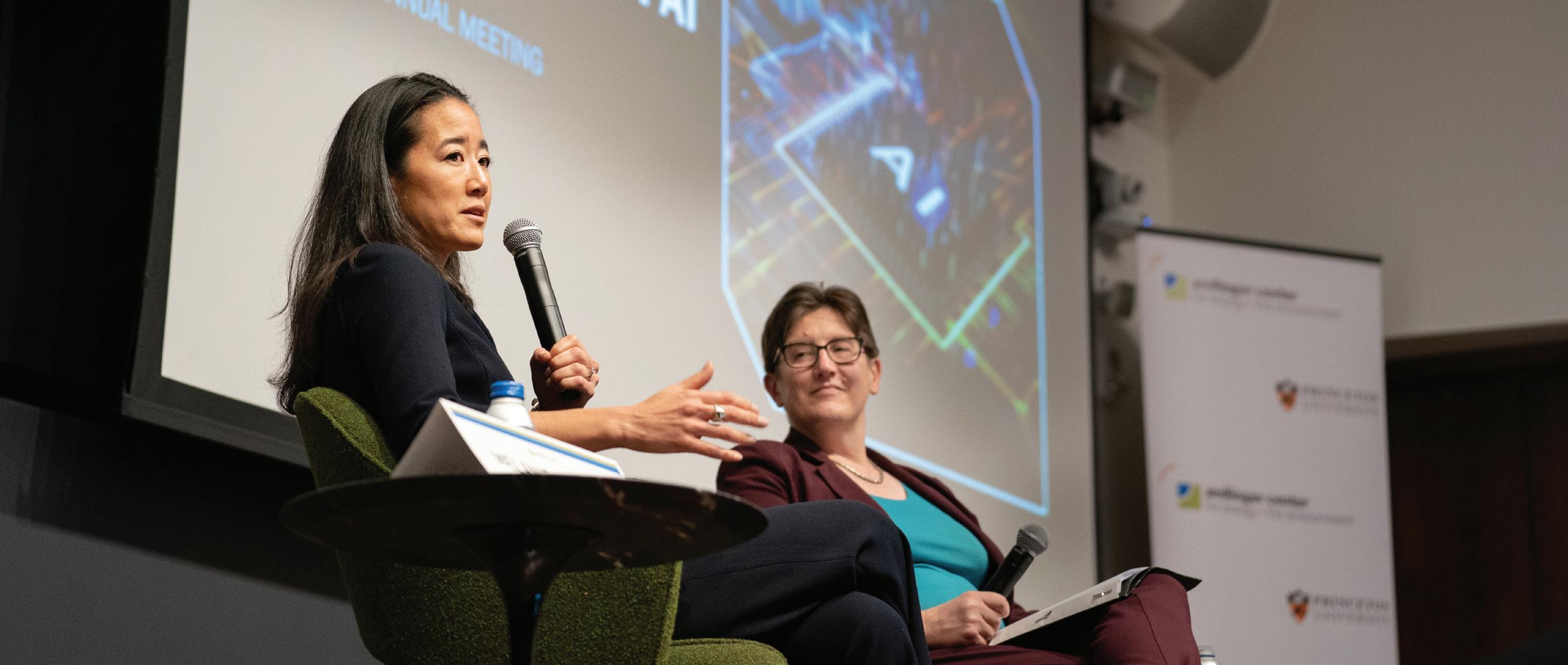
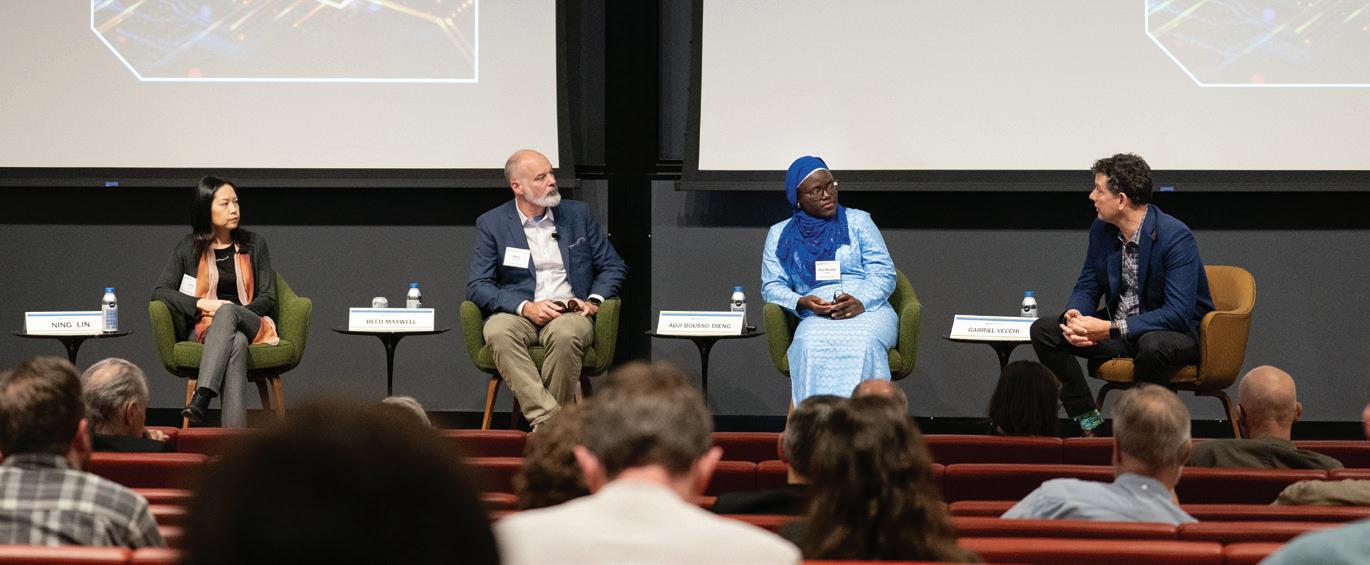
The Andlinger Center convened high-ranking experts from across academia and industry at its 13th Annual Meeting to unpack the opportunities and risks of AI for the clean energy transition.
Input from speakers across the day made the paradox of AI clear: although the high energy consumption of data centers for AI will make it even harder to meet already demanding energy-reduction targets, the technology could also help unlock new and efficient ways of approaching energy and climate challenges.
Keynote speaker Melanie Nakagawa, Microsoft’s Chief Sustainability Officer, said the key to navigating the energy and environmental challenges of AI’s rise is to consider its impacts across the global ecosystem.
“Ultimately, this is a systems challenge,” Nakagawa said. “We want to create an impact beyond our company, so we are investing in solutions and advocating for policies that can support a net-zero future for everyone.”
Panelists underscored that AI and its associated data centers will be just one driver of future energy demand, alongside the wider adoption of electric vehicles and the
Top: Melanie Nakagawa and Jennifer Rexford, Princeton’s provost and the Gordon Y.S. Wu Professor in Engineering, discuss the energy and environmental challenges of AI.
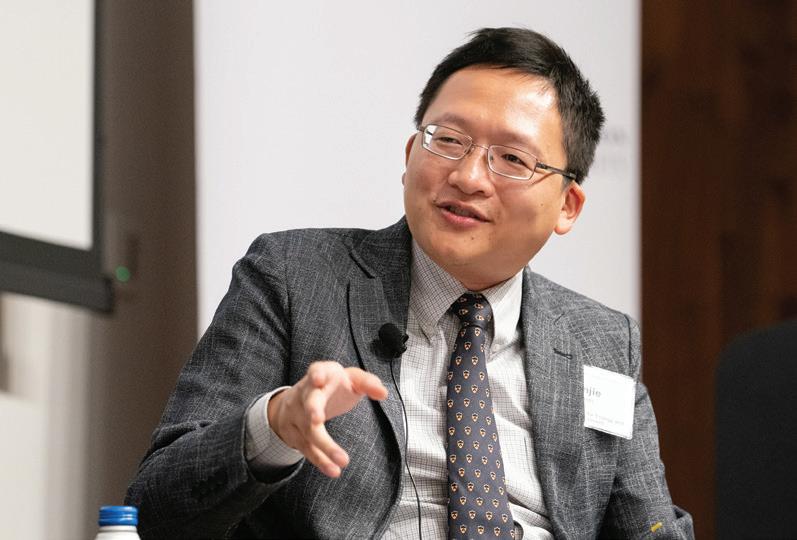
Lower: Annual Meeting co-chair Minjie Chen moderated a panel on how AI can also unlock new approaches for addressing energy and environmental challenges.
growth of emerging energy technologies. Beyond AI, they said the real challenge is preparing the energy system for this period of sustained growth after decades of plateaued energy demand.
Lucia Tian, head of clean energy and decarbonization technologies at Google, argued that AI’s growing energy footprint is also an opportunity to grow global investments in clean energy technologies that will catalyze the broader energy transition.
“Some of our early investments and partnerships can bring these emerging technologies that are at a premium today down the cost curve, so they can be available for everyone,” Tian said.
Andlinger Center researchers are leveraging the power of artificial intelligence and machine learning to drive progress on energy and environmental issues:
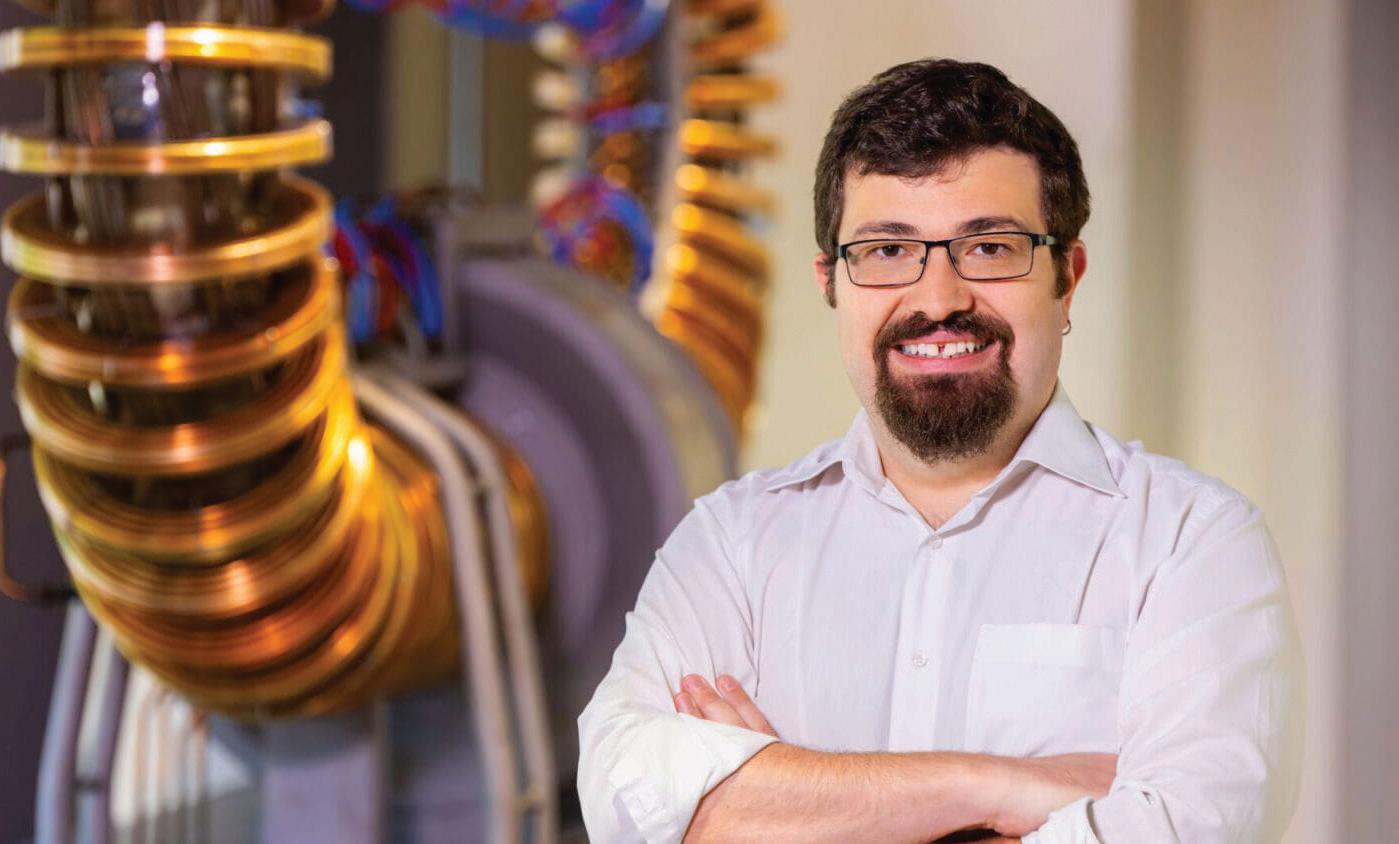
Egemen Kolemen is using AI tools to enable real-time plasma control during fusion reactions. His team has developed an AI controller that can forecast potential plasma instabilities and take corrective action to avoid reaction-ending disruptions.
Following the Annual Meeting, the Andlinger Center hosted representatives from the New Jersey Governor’s Office, Board of Public Utilities, and Economic Development Authority in February 2025 for a workshop on the intersection of AI and energy. The workshop established shared priority areas between Princeton University and New Jersey state agencies related to AI and energy and identified key research gaps, with several Princeton faculty presenting their work. Those research gaps included ways that AI can be harnessed to improve energy efficiency and accelerate the pace of decarbonization, as well as the best ways for the state to meet the growing energy demands from AI and its associated data centers. The workshop marked the start of an ongoing conversation between Princeton faculty and state agencies about how New Jersey can best address the challenges and opportunities that AI poses for the state’s energy sector.
Z. Jason Ren is harnessing machine learning and AI to solve challenges in the water and wastewater sector, including better quantifying the greenhouse gas emissions from various treatment processes, predicting the performance of novel materials, and managing the risks associated with wastewater discharge.

Andlinger Center faculty reach across disciplines and sectors to tackle the complex and interrelated challenges of the clean energy transition, helping countries around the world achieve economy-wide decarbonization.
In December 2024, over 60 energy and related infrastructure executives, government representatives, NGOs, and researchers convened on Princeton’s campus to examine how trust between stakeholders can shape the pace of the global energy transition.
Co-organized by the Andlinger Center and Princeton E-ffiliates Partnership member Worley, a global professional services company of energy, chemicals, and resources experts, the From Ambition to Reality Summit yielded meaningful discussions about how to restore, maintain, and build the trust between energy stakeholders needed to meet international climate targets.
Chris Greig, Elke Weber, postdoctoral researcher Anandita Sabherwal, and 2024 Maeder Graduate Fellow and psychology student Jordana Composto partnered with the Worley team to create a candid forum for high-ranking executives to share authentically about their challenges and experiences working in the energy sector.
“One of the privileges of being at the Andlinger Center and Princeton is our ability to engage some of the strongest business and academic leaders around the world’s thorniest challenges,” said Greig.
The Princeton and Worley teams are using the summit’s discussions to inform their Infrastructure for Trust project, which explores how durable trust can be systematically built and maintained between stakeholders to deliver energy infrastructure at the speed and scale required to meet global climate targets.
The summit was part of the From Ambition to Reality series, a cornerstone of the partnership between the Andlinger Center and Worley that outlines the shifts in infrastructure delivery practices that are needed to bridge the gap between climate goals and on-the-ground progress.
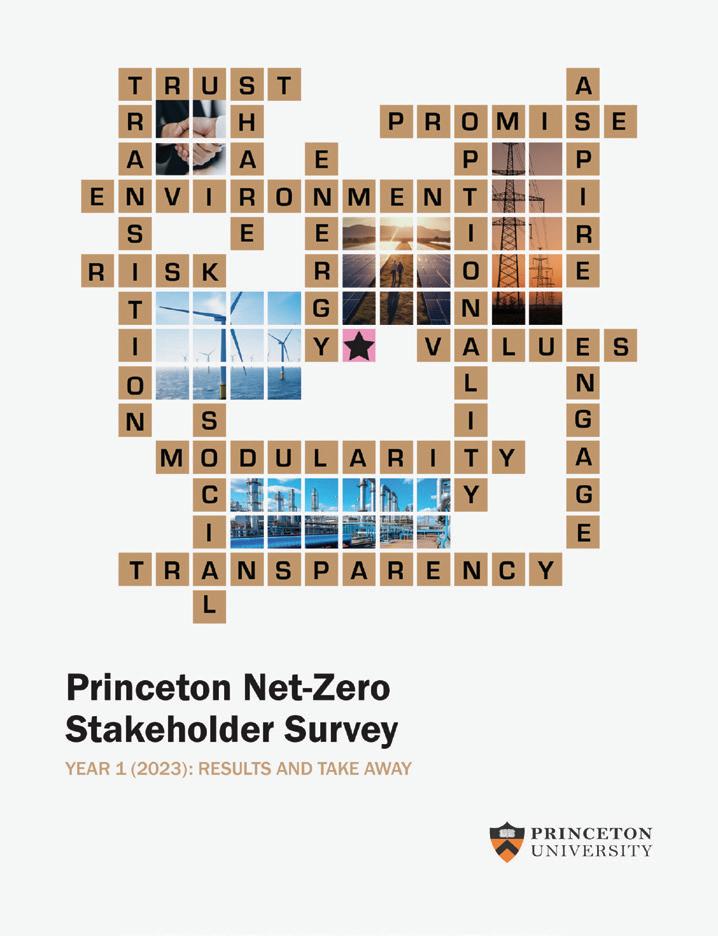
The partnership with Worley has also led to the Net-Zero Stakeholder Survey, which gauges stakeholder perceptions about the progress made on key paradigm shifts for net-zero energy infrastructure delivery.
When it comes to the clean energy transition, not every technology is equal, and some solutions that appear strongest at a glance can be politically infeasible or bring unwanted impacts such as a deterioration in local air quality. Wei Peng studies how to design politically and socially durable decarbonization strategies.
A major focus of Peng’s research group is understanding the health impacts of different decarbonization strategies to ensure that the clean energy transition yields both climate and health benefits. Peng’s recent work has unlocked insight across sectors and regions.
Coal retirements in Pennsylvania: Peng’s group found that retiring half of the coal plants in Pennsylvania by prioritizing retirements in environmental justice areas could reduce electricity-related carbon dioxide emissions in the state by up to 12%, cut air pollutant emissions by up to 75%, and avoid up to 20% of the deaths attributable to fine particulate matter exposure when compared to a business-as-usual, no-retirement scenario.
In fall 2024, Wei Peng launched a new course focused on using integrated assessment models (IAMs) to inform climate and energy policy. The course introduced students to two major types of IAMs: detailed-process IAMs that assess how technology choices and mitigation pathways shape regional emissions and global climate outcomes, and benefit-cost IAMs that estimate the social cost of carbon or determine optimal emissions trajectories for maximizing global welfare. Through hands-on projects and policy simulations, students gained practical experience using IAMs to explore real-world climate scenarios.
Electric vehicle manufacturing in China and India: If China and India were to fully onshore their supply chains for electric vehicle manufacturing, national sulfur dioxide emissions could increase by up to 20% over today’s levels, with manufacturing centers becoming unwanted air pollution hotspots. Peng’s team identified solutions, such as implementing stricter air pollution standards and exploring alternative battery chemistries, to ensure the electric vehicle transition yields maximum societal benefits.
An all-of-society approach to U.S. climate policy: Peng’s group found that combining federal and subnational clean energy actions could avoid 6,600 premature deaths from air pollution nationally in 2030, with net health co-benefits found in every state nearly every county. Regions like the Midwest and South, with high levels of existing fossil fuel consumption, would particularly benefit from coordinated national, state, and local climate policies.
(Photo by David Kelly Crow)

FUND FOR ENERGY RESEARCH WITH CORPORATE PARTNERS Bridging energy systems modeling and societal impact
Energy systems models are vital tools for shaping national decarbonization strategies, but they often overlook local realities, air quality, health outcomes, and other societal impacts. To address this gap, Wei Peng will lead a new project to develop an integrated modeling framework that connects advanced energy systems models with a global integrated assessment model.
Supported by the Andlinger Center’s Fund for Energy Research with Corporate Partners and carried out in collaboration with Google, the project will explore how decarbonization strategies affect global supply chains, trade, and public health. Along with co-PI Eric Larson and in partnership with the Korea Advanced Institute of Science and Technology (KAIST), the team will apply this modeling framework to South Korea to inform the country’s national climate policy.