Matt Bruno, Patrick Ianni, Sarah Mitchell, Kat Seiffert, Claudia St. John
ADVERTISING SALES (714) 486-2735
Chuck Casey • ccasey@526mediagroup.com
John Haugh • jhaugh@526mediagroup.com
Nick Kosan • nkosan@526mediagroup.com
DIGITAL SUPPORT
Katherine Williams kwilliams@526mediagroup.com
CIRCULATION/SUPPORT info@526mediagroup.com
A PUBLICATION OF 526 MEDIA GROUP, INC.
151 Kalmus Dr., Ste. J3, Costa Mesa, CA 92626 Phone (714) 486-2735
CHANGE OF ADDRESS Send address label from recent issue, new address, and 9-digit zip to address below.
POSTMASTER Send address changes to The Merchant Magazine, 151 Kalmus Dr., Ste. J3, Costa Mesa, CA 92626. The Merchant Magazine (ISSN 7399723) (USPS 796-560) is published monthly at 151 Kalmus Dr., Ste. J3, Costa Mesa, CA 92626 by 526 Media Group, Inc. Periodicals Postage paid at Santa Ana, CA, and additional post offices. It is an independently-owned publication for the retail, wholesale and distribution levels of the lumber and building products markets in 13 western states. Copyright®2026 by 526 Media Group, Inc. Cover and entire contents are fully protected and must not be reproduced in any manner without written permission. All Rights Reserved. We reserve the right to accept or reject any editorial or advertising matter, and assumes no liability for materials furnished to it. Opinions expressed are those of the authors or persons quoted and not necessarily those of 526 Media Group, Inc. Articles are intended for informational purposes only and should not be construed as legal, financial or business management advice, nor an endorsement of any company, product, service or individual referenced.
Volume 105 • Number 5
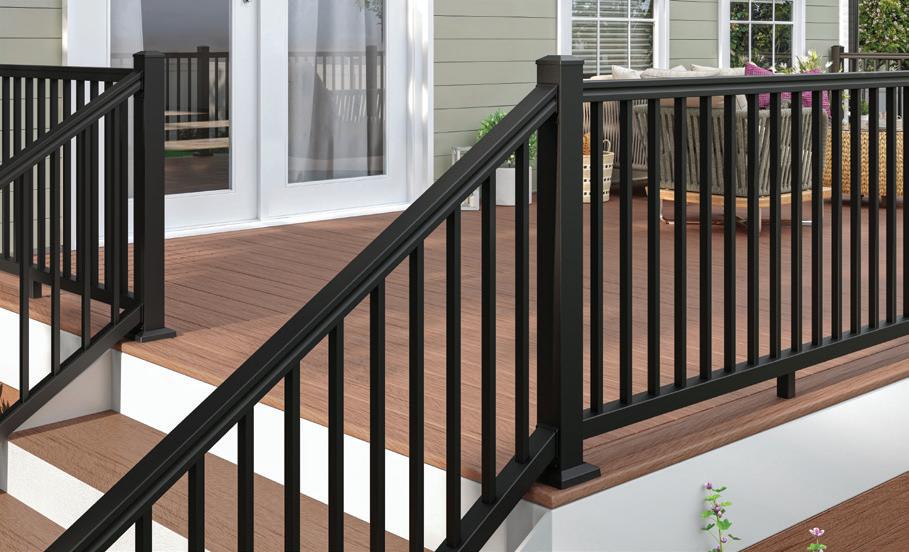
Railings have
How dealers can win more bids by helping contractors to better
What lives under the
The future of outdoor living: Trex shares 6 trends shaping backyards this year
Industry’s top execs assembled for the inaugural NAWLA T-100 to strengthen connections and glean new perspectives
ARE YOU BUSY OR ARE YOU BUILDING?
------------ BY PATRICK ADAMS
I’VE ALWAYS BELIEVED being busy is a blessing. It means you’re in the game—pursuing something that matters. I’ve also long believed in being the person who says, “send me,” and in leading from the front. That has always been my standard.
So when a recent industry event gave me the chance to step away from the day-to-day, I almost didn’t go. Stepping back has never felt like leadership to me. But I came home with something I didn’t expect: clarity. And more questions than answers—which, in this case, felt like progress.
Something closer to home was already on my mind before leaving. My daughter had just rolled her ankle at volleyball—not serious, thankfully, but significant enough. I’ve watched plenty of young athletes get pushed to “fight through it,” the moment winning out over the long term. I’ve held myself to that same standard my whole life. Push through. Outwork it. Never slow down. “Pain is weakness leaving the body” is the old adage.
But this time, I found myself thinking differently. She’s 15. If the goal is a lifetime of health and opportunity, maybe the right call isn’t to push through—it’s to step back, recover properly, and trust that doing the right thing now matters more than proving something in the moment. That’s stewardship. And it applies well beyond sports.
I read something recently that hit home: “I’m at the age where my mind is 29, my humor suggests I’m 12, and my body possibly died in the Civil War.” It has been a long, hard road of abuse and neglect that I pay for every minute.
Back at the event, someone introduced me to what they called the “96% rule.” The idea: empower your people to make decisions confidently, knowing that the vast majority—96%—will align with your thinking. Move quickly. Be decisive. Trust your instincts. And for the small percentage that miss the mark, address them calmly, learn and move on.
It reinforces something I’ve always believed but perhaps never said plainly: leadership isn’t about controlling every decision. It’s about building an environment where people can think, act and grow—where mistakes are part of the process, not something to be feared.
One more moment from that trip hasn’t left me. I was sharing some high-stakes plans with a trusted industry leader who has become a true friend—the kind of decisions that can change everything. What he said was simple. But it landed hard.
“You can’t buy more time. Make sure you’re doing this for the right reasons. Mount Everest is covered in bodies who once were the most driven and successful people.” That honest challenge has stayed with me ever since and left me considering: am I busy, or am I building?
Drive alone is not enough. I’ve spent most of my life taking pride in outworking the room—pushing through, adapting, persevering. But I’ve started to wonder whether that mindset alone is still sufficient. Maybe the next phase of leadership requires something different. Not less effort, but more intention. Not just perseverance, but perspective.
So if you can, find time to think. Step away, even briefly—and better yet, do it alongside people you trust. People who’ve been in your shoes, who understand the weight of what you carry, and who will tell you the truth. The best leaders I know aren’t just those who have achieved success. They’re the ones who took the time to understand it—and were generous enough to share what they learned.
As always, it is a privilege to serve you and this great industry. Thank you for the example you set every day.
PATRICK S. ADAMS, Publisher/President padams@526mediagroup.com
DECKED IN STYLE
WHAT’S IN FASHION IN DECKING & RAILING
------------ BY DAVID KOENIG
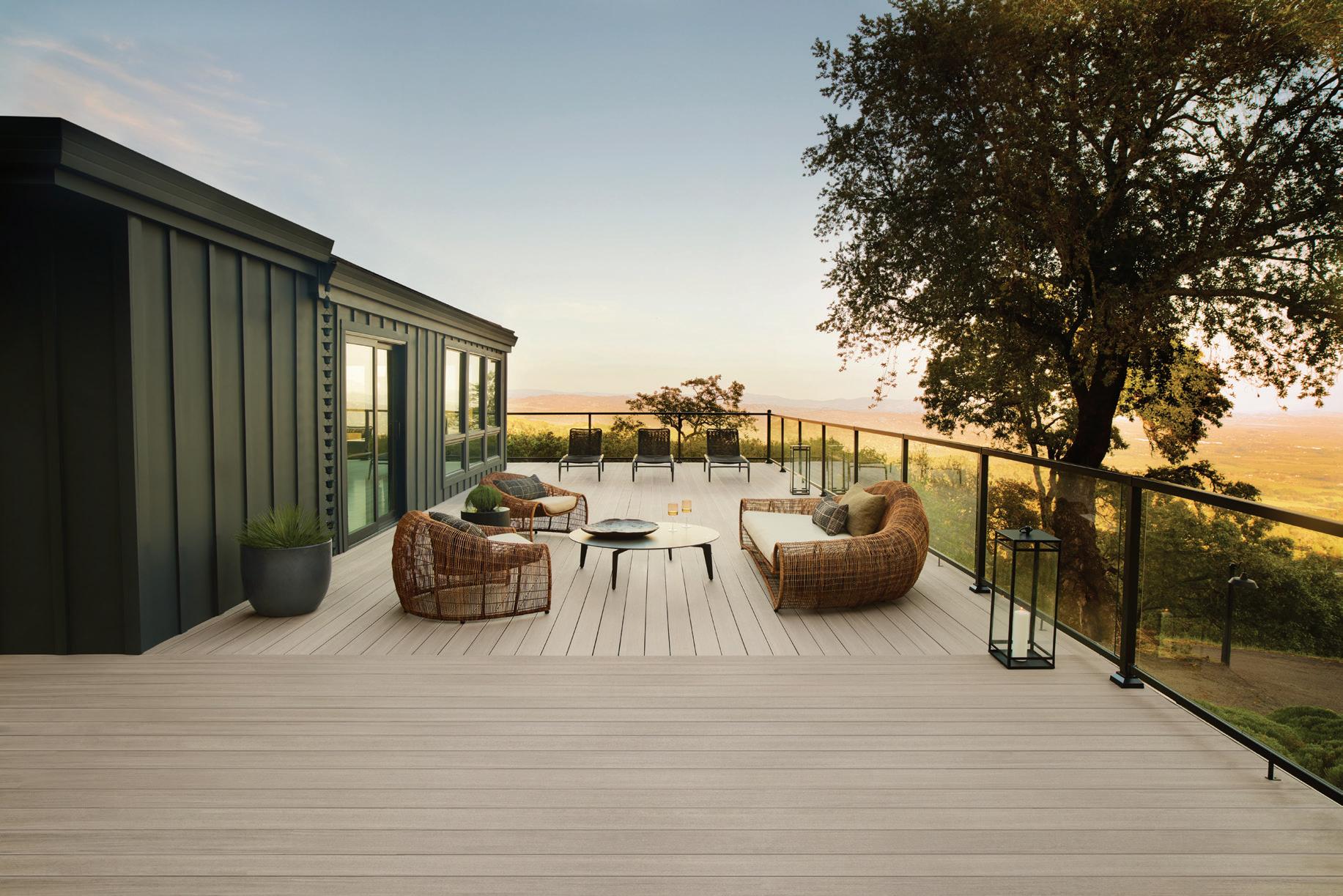
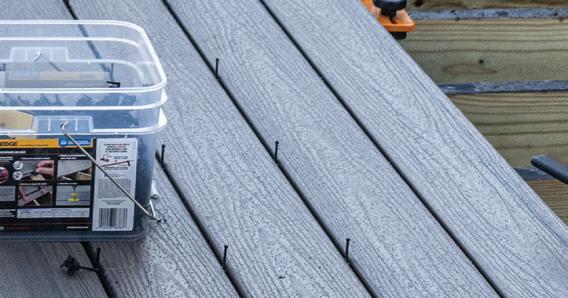
WHILE MANY decking and railing lines lean into their performance features, from moisture resistance to fire protection, how the products look is often the deciding factor for many homeowners. They want to know how they will look assembled in their yard. We asked a group of industry experts for advice on how dealers can help guide buyers through the deck and railing design and selection process with aesthetics in mind.
What decking styles and colors are currently most in demand?
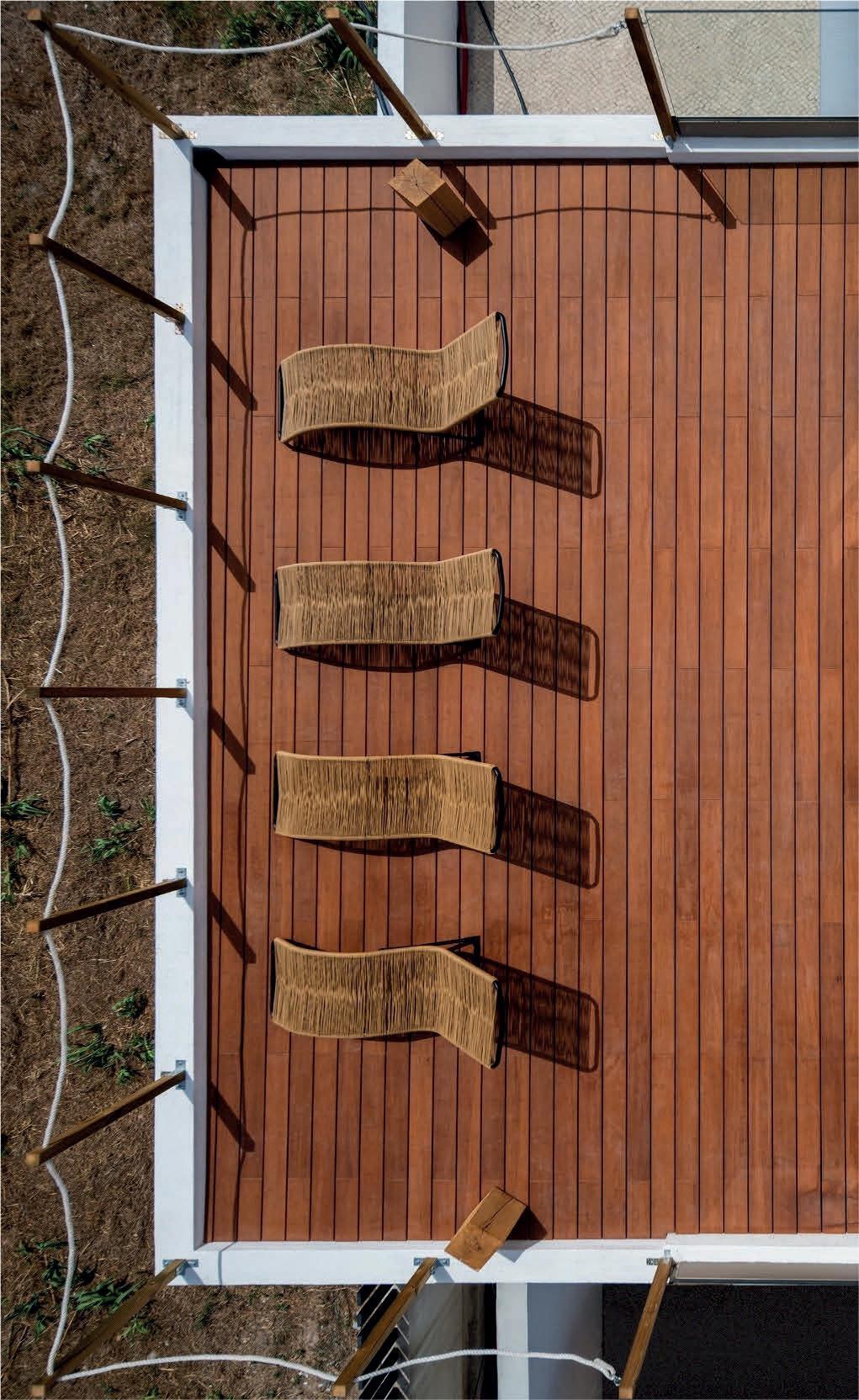
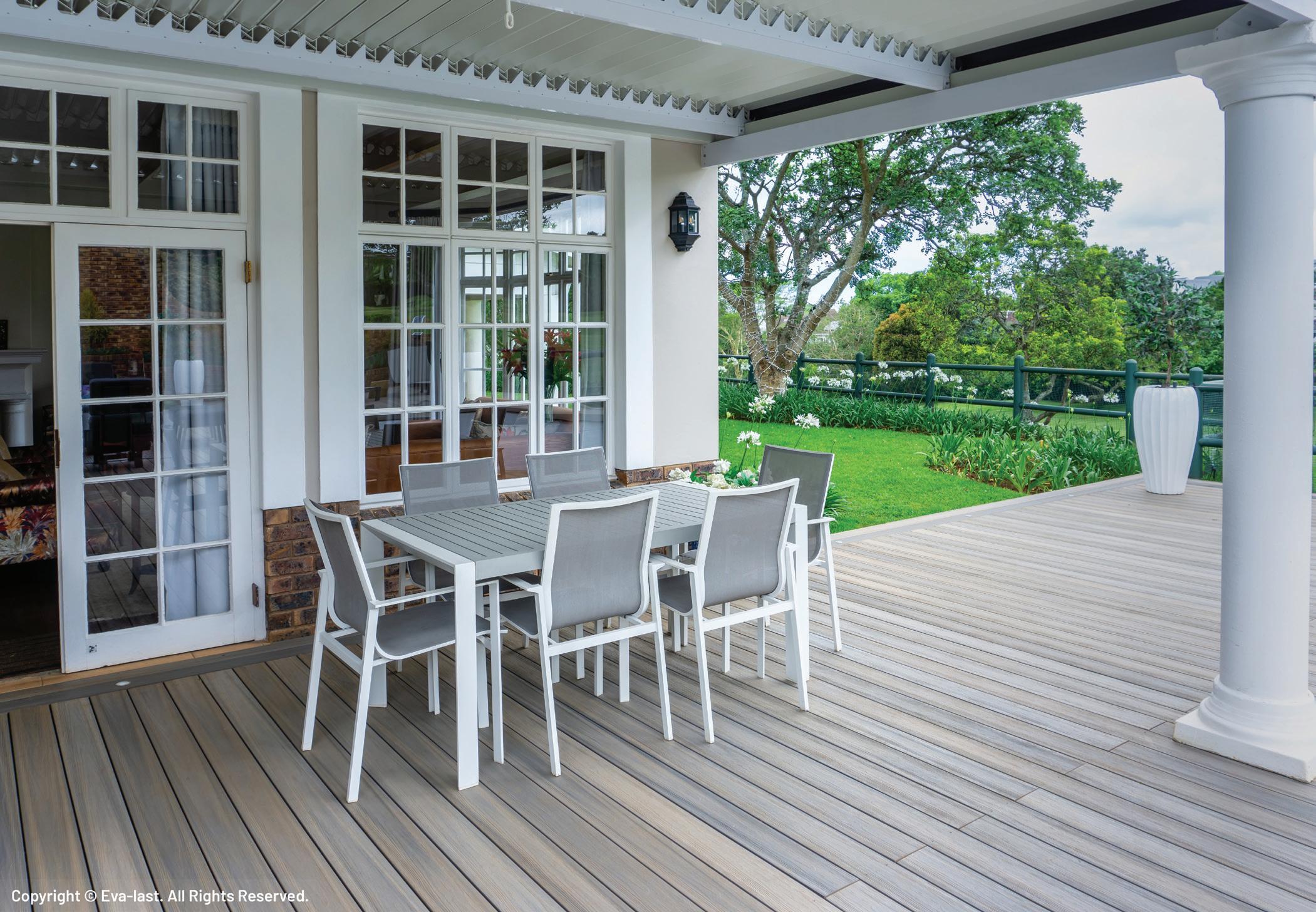
Thomas Gooch, senior manager, product management for Fiberon: There’s a clear evolution in decking trends that reflect both style and practicality. Lighter, earthy tones are gaining traction because they not only create a natural, inviting aesthetic but also help keep decks cooler during the warmer months.
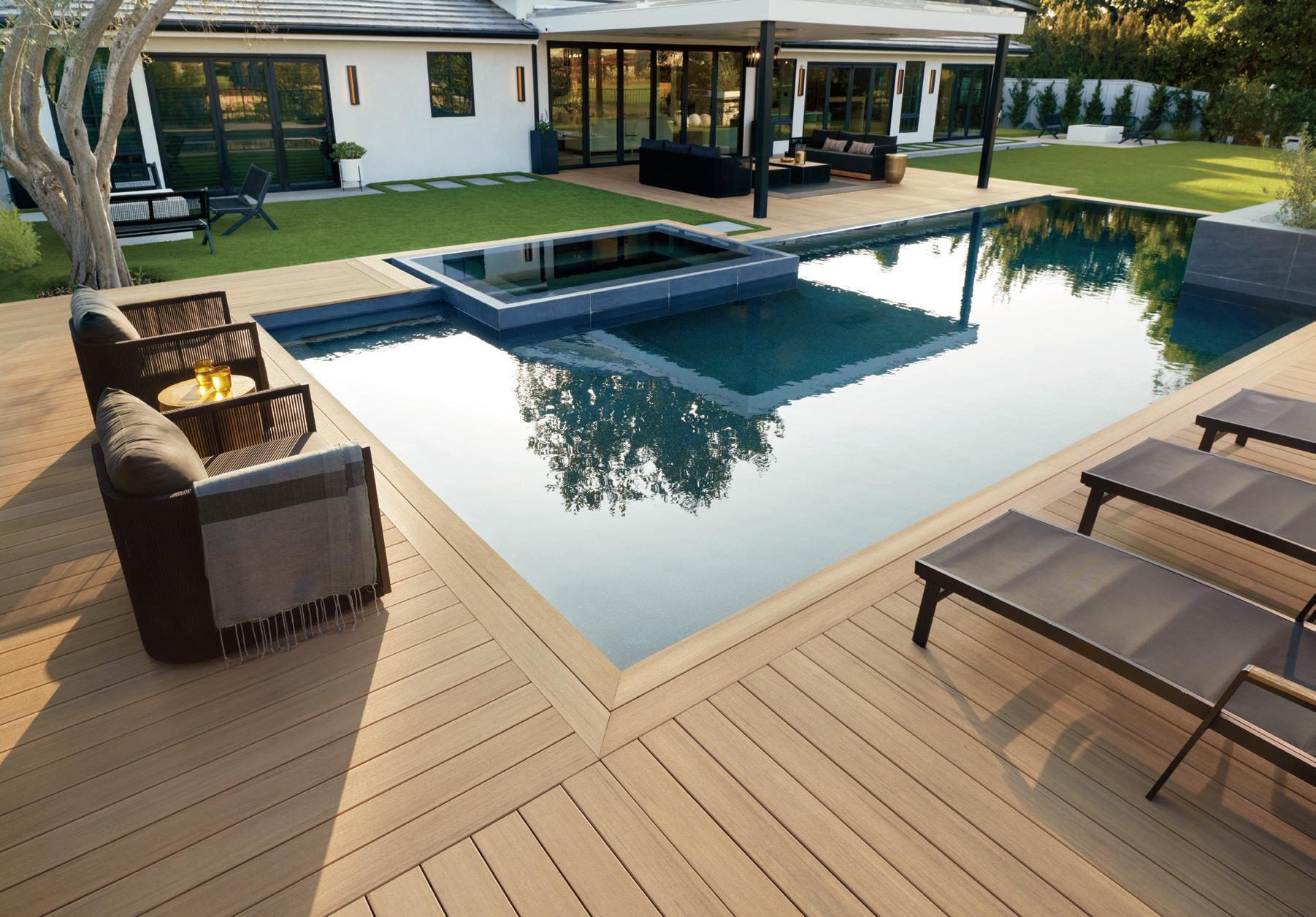
We are also seeing more deck contractors get creative with the deck designs, bringing in more herringbone designs and inserts. Borders and step levels are being used to delineate zones within the deck for different uses. Very rarely nowadays do you see a deck that does not have a picture-frame border.
When it comes to texture, safety is becoming a top priority—homeowners are increasingly looking for surfaces that offer better slip resistance. People choose composite decking for its low maintenance, but there’s a greater emphasis on aesthetics when it comes to driving decisions. What homeowners today want is the authen-
tic look of real wood—we’re seeing a departure from plastic-looking deck materials. We believe the future of composite decking lies in delivering hyper-realistic finishes that combine beauty with durability, like our new Novus fused decking launching later this year.
Michelle Hendricks, director of marketing, Deckorators: We’re seeing strong demand for warm, neutral tones. Lighter colors remain popular, especially in coastal regions, but richer browns and woodgrain finishes and textures keep decks looking grounded in their surroundings. Homeowners want their decks to feel like natural extensions of their homes. Many gravitate toward colors that blend nicely with their interior and exterior finishes.
Sara Tschida, marketing support manager, Avon Plastics: At Armadillo Decking, we’re seeing strong demand for natural wood-inspired colors and clean, well-defined deck designs. Homeowners continue to gravitate toward warm browns, rich walnut tones, and weathered gray colors that provide the look of real wood while offering the long-term durability and low maintenance of composite decking.
From a design standpoint, builders are also incorporating more detail into deck layouts. One trend we’re seeing more often is homeowners choosing to picture frame their deck boards or add accent colors as transition boards. These design elements help break up larger spaces and create a more custom, finished appearance.
Mike Ondereko, senior director, product management for Trex Co.: Homeowners are leaning more toward warm, earth-inspired tones, especially browns, that feel natural and timeless. They’re also looking for subtle, refined details like gentle streaking and realistic woodgrain patterns. Cool grays, which have dominated decks for years, are giving way to softer, nature-inspired shades like Trex’s Color of the Year, Biscayne, a sunkissed brown that adds warmth and sophistication to any outdoor space.
From a style standpoint, an increasingly popular trend is integrating deck boards of different widths to create custom layouts that feel intentional, architecturally sophisticated, and full of dimension. New for 2026, Trex has introduced a 1”x4” board profile to our Transcend Lineage decking line to support multi-width surface designs, drink rail applications and other custom detailing. The square-edge, 16’ board is available in all of the Lineage colors and features the same SunComfortable technology and 50-year Limited Residential Warranty as other Lineage boards.
What railing styles and colors are currently most popular?
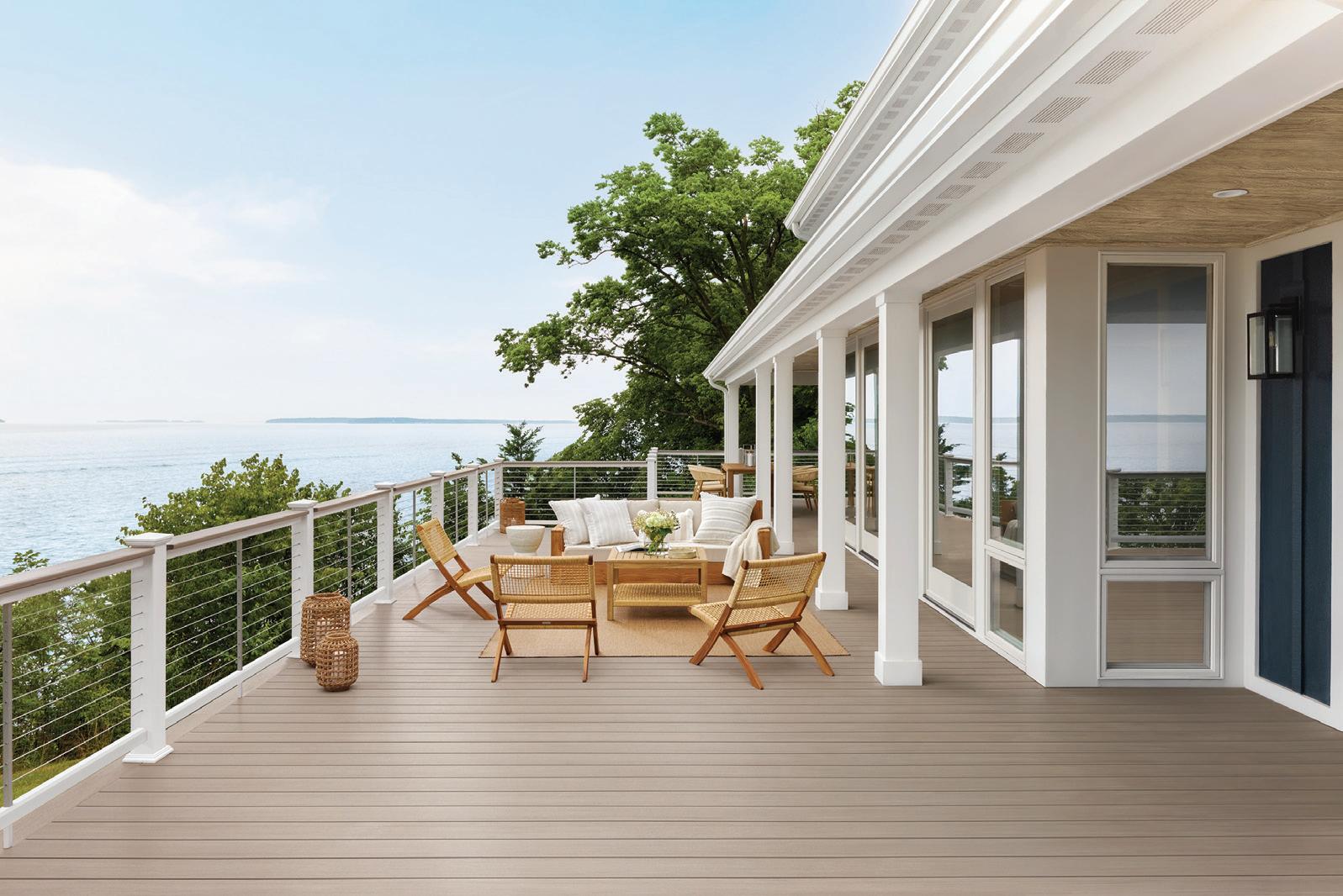
Meredith Opie, associate product manager for Fiberon Railing and Fypon: Clean, minimalist designs are dominating. For those who want to let the view to take center stage, CitySide Aluminum Railing is a great choice. Its clean lines and infill options help it visually fade into the background.
Railings today are seen not just as a safety necessity, but as a way to add functionality and beauty to a deck. Railings with a built-in drink rail make outdoor spaces ideal for hosting gatherings, and sleek balusters or glass panels create a serene retreat with unobstructed views.
The most modern railing choice is knowing when to get out of the way. People don’t want to look at their railing—they want to look through it. So today’s railings focus on protecting the space without competing with it. That’s driving trends in slim aluminum, glass, and cable railings.
Another big thing is labor. Products that go in faster and solve more problems are the ones that win. That’s where railing is headed—clarity in the view and on the jobsite.
Ondereko: Railing is no longer just a safety feature; it’s become a key design element that can drive sales and set decking projects apart. Today’s homeowners are treating railing with the same level of intention as decking, selecting materials, colors, and infill options that frame the deck, maximize sightlines, and elevate the overall look of their outdoor space. For dealers, this means offering products that perform, look great, and are easy to sell.
One of the hottest trends in railing right now is clean, minimalist metal systems in classic colors like black, white, and brown. These streamlined, view-optimizing styles are in high demand because they complement modern deck designs without competing with the decking itself. Aluminum railing, like Trex Select Aluminum Railing, continues to grow in popularity thanks to its sleek aesthetic, durability, and low maintenance, while
steel options such as Trex Enhance Steel Railing offer a modern look at a more accessible price point.
Efficiency and simplicity are increasingly important to contractors. Pre-assembled, panelized railing systems reduce labor time and simplify installation, making it easier to close deals and keep projects on schedule. Trex’s Allin-One Post Kits, for example, bundle key components for faster ordering and assembly, helping contractors save time on the jobsite.
For dealers looking to simplify inventory while still offering design flexibility, innovations like Trex Signature X-Series Railing are a game-changer. Just 11 SKUs cover end, line, and corner posts for both cable and glass infill— compared with traditional systems that may require 80 or more components—while delivering the modern, open sightlines homeowners want. Offering these high-demand, easy-to-specify solutions can help your customers achieve great results while making your sales and support processes more efficient.
Tschida: Another popular feature is the use of 2x4 composite boards for railing components. Using composite boards in the railing helps tie the overall design together while maintaining the durability and low-maintenance benefits homeowners expect from composite materials.
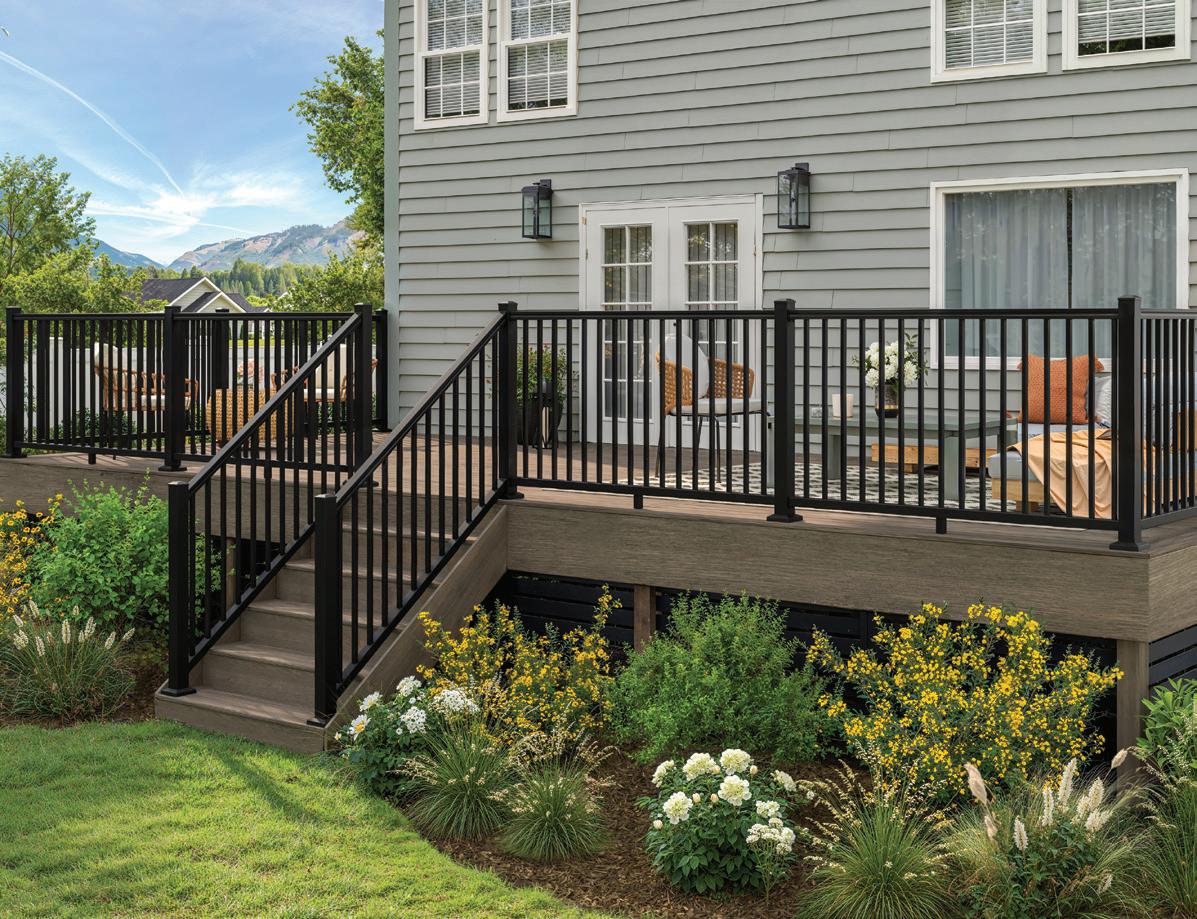
Patrick Ianni, VP, customer operations and product development, Oldcastle APG/RDI: From a railing standpoint, we’re seeing continued demand for clean lines and architectural black railing systems. Homeowners want profiles that feel intentional and modern, rather than ornamental, and for their outdoor spaces to feel elevated and cohesive, not pieced together.
What’s interesting is that railing is increasingly being recognized as the element that defines the space. It frames the view, it shapes the silhouette of the deck and
CLEAN, MINIMALIST designs are dominating, such as in Fiberon’s CitySide Aluminum Railing.
it is what you see and touch every day. That’s driving demand toward sleek black T-rails like RDI Overlook, aluminum-inspired profiles like RDI Fusion with AlumiCast technology, and streamlined cable systems like RDI Elevation Rail.
Black remains dominant because it creates contrast, frames sightlines and pairs seamlessly with both warm and cool decking tones. But more than color, this trend is about refinement, bringing forward railing that feels engineered, modern and designed with intention. Black railing with thinner profiles, such as RDI Fusion and RDI Elevation Rail, allows the railing to disappear into the horizon. You not only get the safety required, but also a railing that does not impair your view. Our broader mission is to make railing a deliberate choice, not a default one.
Hendricks: Railing is no longer seen as just a functional component of the deck. It’s becoming more of a consideration as part of the overall deck design.
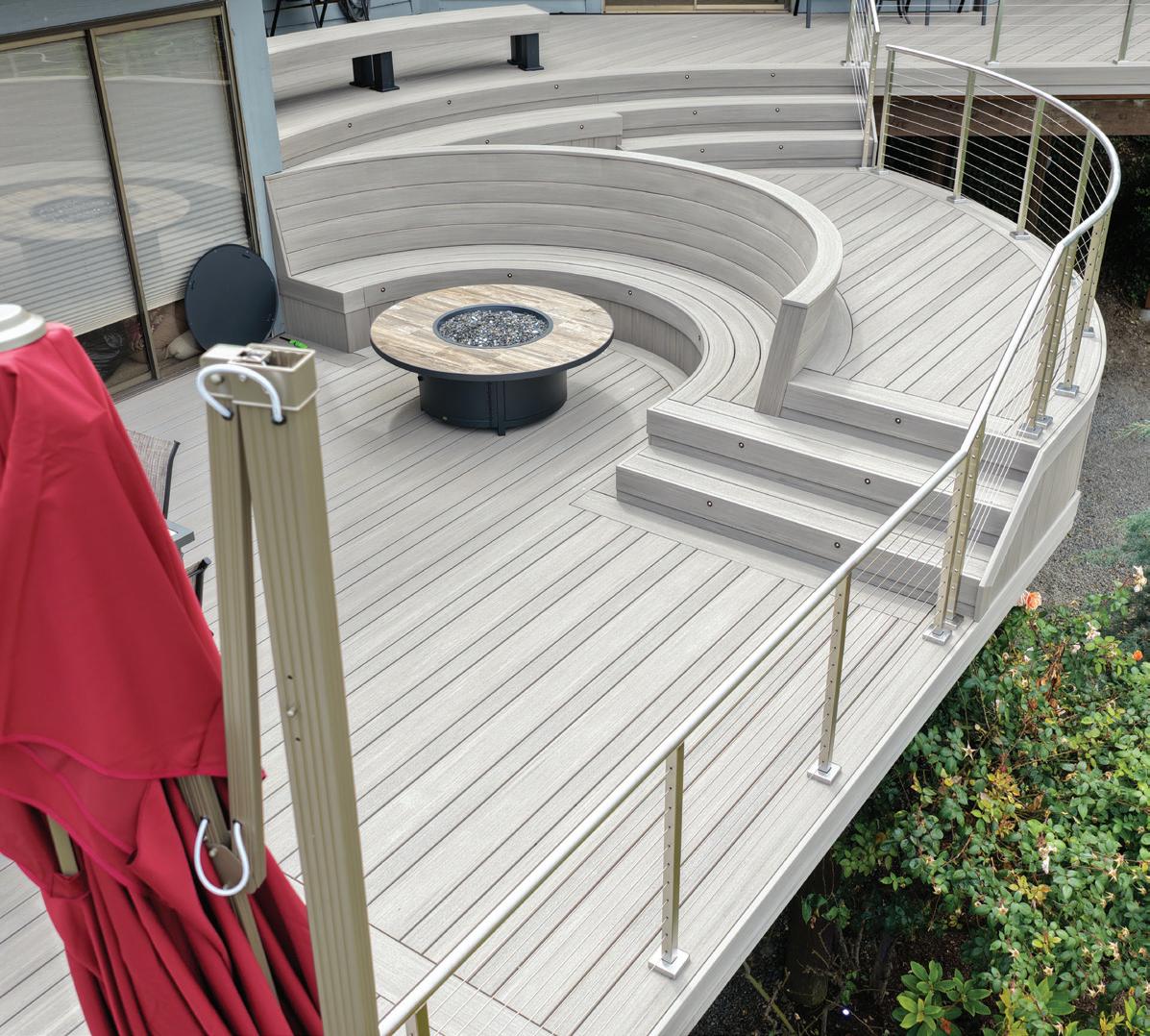
The trend in railing continues to move toward slimmer profiles and clean, minimal designs. Options like Deckorators Contemporary Cable Railing or our Glass Rail Post Kit frame spaces nicely without dominating views.
One trend we identified in our 2026 Outdoor Living Report is the shift toward including bold black accents in outdoor design. Railing is a great place to incorporate that high-impact look.
Is there a strategy or basic rules of thumb for mixing and/or matching a chosen deck style with the right railing?
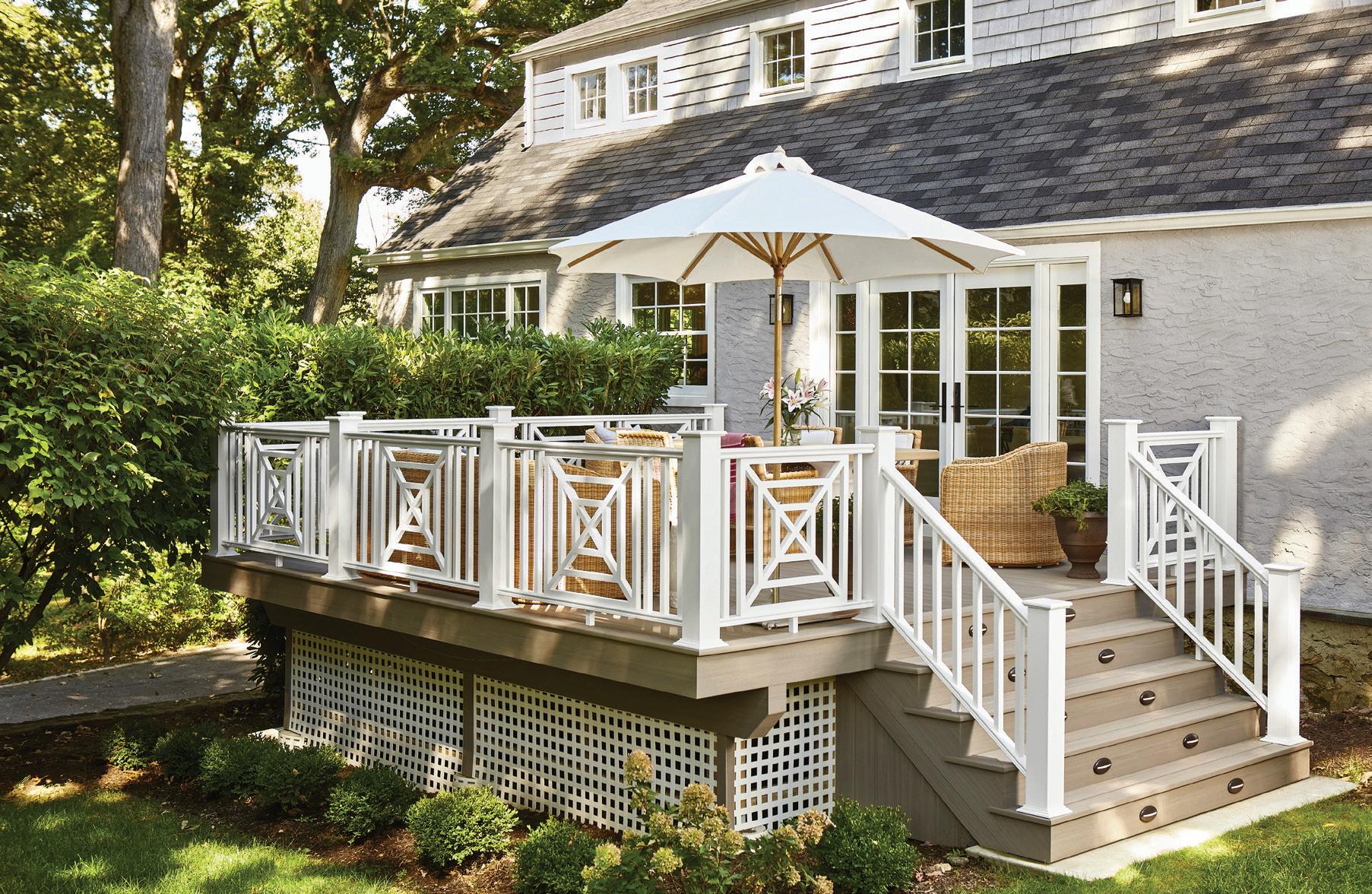
Hendricks: There’s definitely a strategy to mixing and matching decking and railing, but, ultimately, it comes down to a homeowner’s preference and style. We’re seeing many people pair warm decking tones with matte-black aluminum railing to create contrast and a more architectural feel. But there are also regional differences in decking preferences. In the Northeast, for example, coastal-inspired deck boards paired with white composite railing remain a popular choice. Our newest color, Shoreline, is a great option for contractors and homeowners who want to achieve the coastal look. Part of our Venture decking collection, Shoreline is a light, driftwood-washed gray with all the features of our traditional composite collection. It’s made in the USA from 95% recycled plastic and sawdust, and offers durability, sustainability and style.
Gooch: The best deck and railing pairings aren’t about matching; they’re about choosing a leader. Historically, matching was about playing it safe, but mixing is about intention. If the deck has a bold color, strong grain, or wide boards, it goes better with a quieter railing with clean lines. If the railing is the statement, keep the deck more neutral so the two don’t compete. When everything matches, nothing leads, which is why
the strongest outdoor spaces choose a clear hero.
Regionality plays a big part also. In the western U.S. where views are prized, black aluminum railing is used for visibility. New England and the Midwest use more composite due to trending to tradition designs in housing. Railing designs follow the housing designs; railing needs to coordinate with the whole look.
Rather than strict rules, focus on balance, consistent color tones, and whether you want the railing to blend in or make a statement. Real-world examples and guidance from knowledgeable dealers can also help you land on the right look.
Tschida: There are a few helpful guidelines that homeowners and builders can follow when pairing decking with railing. The most common approach is to choose railing styles and colors that complement the decking and the home’s exterior, creating a balanced and cohesive look.
Many designers also like to add subtle contrast. For example, darker railings paired with warm-toned composite decking can create a clean, modern appearance that highlights both materials.
Builders are also enhancing deck designs with picture framing or accent boards to define the deck space, while using 2x4 composite boards in the railing system to tie the design together. These small details can make a big difference in the final look of the project.
At Armadillo Decking, we always recommend reviewing samples together and considering the overall outdoor environment, including the home’s color, landscaping, and lighting. Taking those elements into account helps ensure the final deck design looks cohesive and delivers a space homeowners will enjoy for years to come.
Ondereko: We encourage our contractors to use what we call the “3 Cs” when working with homeowners on railing selection. This approach focuses on coordinating, contrasting or customizing depending on a client’s preferences and level of design confidence.
Coordinating: You can never go wrong by selecting railing in the
(Continued on page 14)
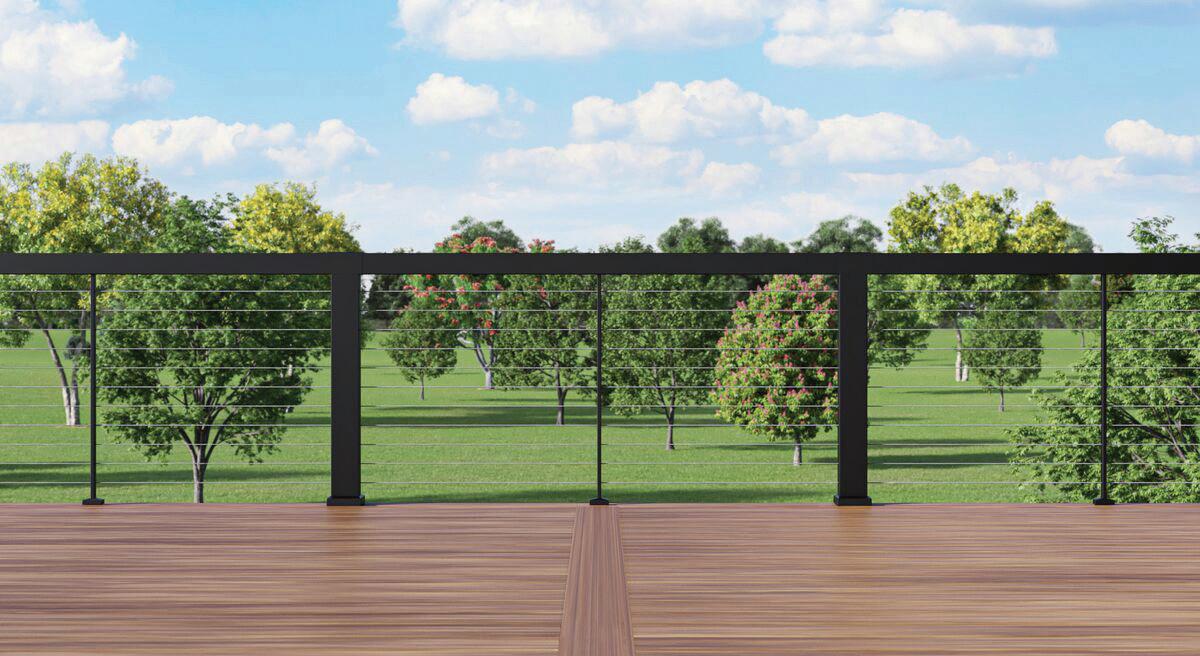
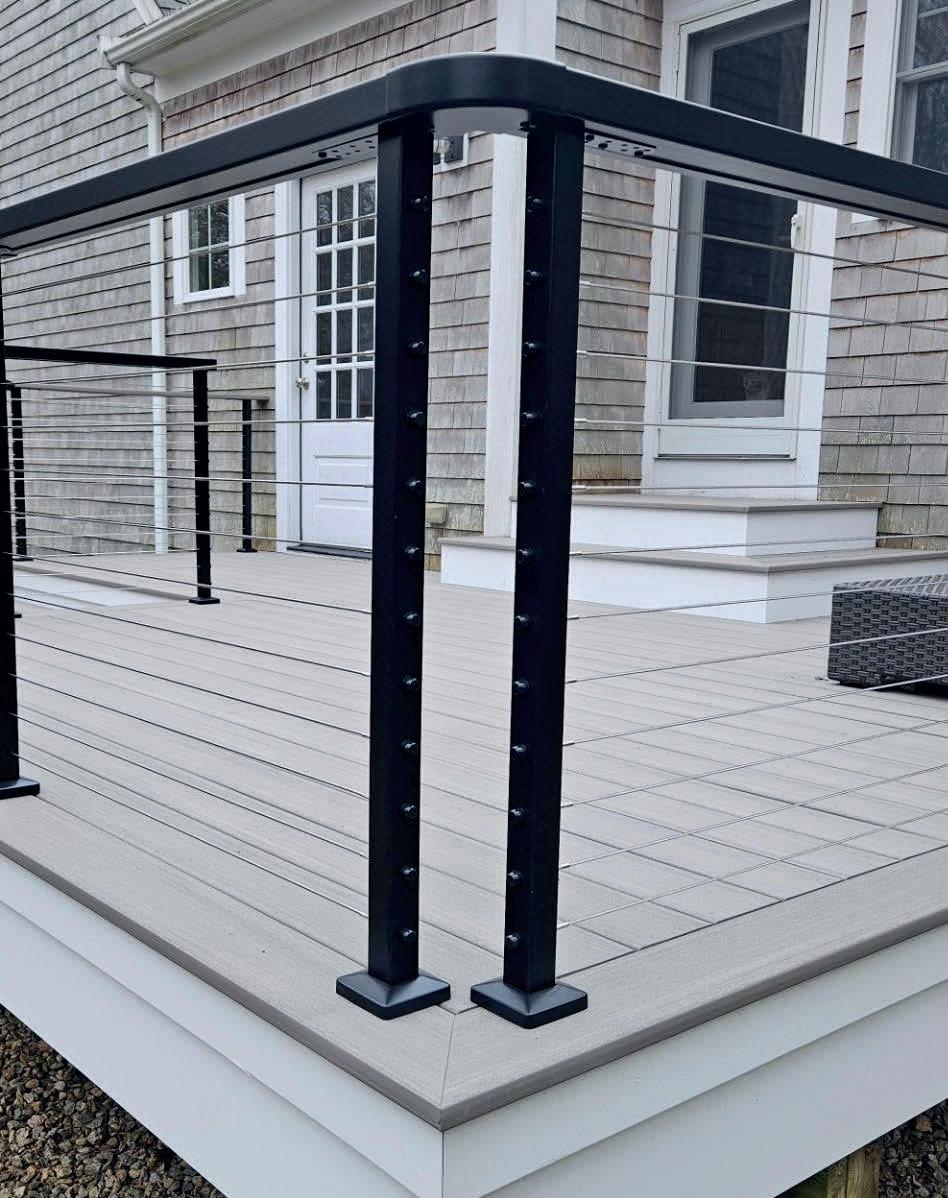
MIXED MATERIALS: RDI Elevation aluminum cable railing with matte black finish plays off the vibrant composite decking with woodgrain look.
same shade as your decking (i.e., dark brown railing for a dark brown deck, or light gray railing to complement light gray boards, etc.). This creates a cozy, well-coordinated look and is a great approach for risk-averse homeowners.
Contrasting: If you have trouble finding a perfect match for the decking—or if you’re working with a homeowner that is open to trying something different—consider proposing a contrasting railing and decking color design, such as a light shade decking and dark railing or vice versa. Both are classic options that complement virtually any outdoor setting.
Classic white looks crisp against deep brown deck boards and is ideal for highlighting a deck’s design and features. Alternately, if you’re working with lightercolored decking, a contrasted look can be achieved by selecting darker railing. Dark colors give a deck a modern look and feel. They also are a good choice for clients looking to showcase their home’s natural surroundings since dark railings tend to visually blend into the background.
Customizing: For design-savvy homeowners looking for something distinctive, going for a completely customized look can reflect personal tastes and show off personality. Mixing colors and materials is a great way to do something different than coordinating or contracting. For example, suggesting combining dark aluminum railing and balusters with white composite posts creates a dramatic look that delivers a sophisticated mixture of texture and color.
Ianni: The biggest shift we’re encouraging is simple: don’t start with the deck. Start with the railing. Most outdoor projects begin with decking selection, and railing gets bundled at the end. But the railing frames the view and defines the experience. If it blocks sightlines, feels dated or looks like an afterthought, that is what the homeowner lives with.
There are a few design principles homeowners can follow:
(1) Think “frame,” not “match” – Black railing acts like a picture frame around the deck and landscape. It works exceptionally well with mid-tone and lighter composite
decking because it provides design contrast without conflicting with the overall design.
(2) Coordinate with architecture first – Tie railing to window trim, roof accents, lighting or exterior metal finishes. That creates cohesion across the entire home, not just the deck.
(3) Use contrast to elevate – Matching decking and railing can feel safe, but contrast feels more architectural and modern. A sleek satin black rail paired with natural-tone decking feels intentional and elevated.
(4) Consider sightlines – If preserving views is critical, cable systems like RDI Elevation Rail minimize visual interruption while maintaining structural performance.
Ultimately, railing shouldn’t feel incidental. It should feel like the design decision that pulls everything together.
So then is matching decking and railing the safest approach?
Ianni: In short, yes—it is safe. But it is not always the most impressive. Today’s homeowners are investing heavily in outdoor living spaces. They want something that feels finished and elevated, not standard. Matching materials can work in traditional aesthetics, but modern design often benefits from contrast and clean geometry.
When homeowners see a before-and-after comparison of wood railing vs. a sleek composite or an aluminum-inspired RDI Railing system, the difference is immediate. The space feels lighter, more intentional and more complete. That’s the shift we’re seeing: railing moving from afterthought to defining feature.
Are there resources available to help achieve the right look?
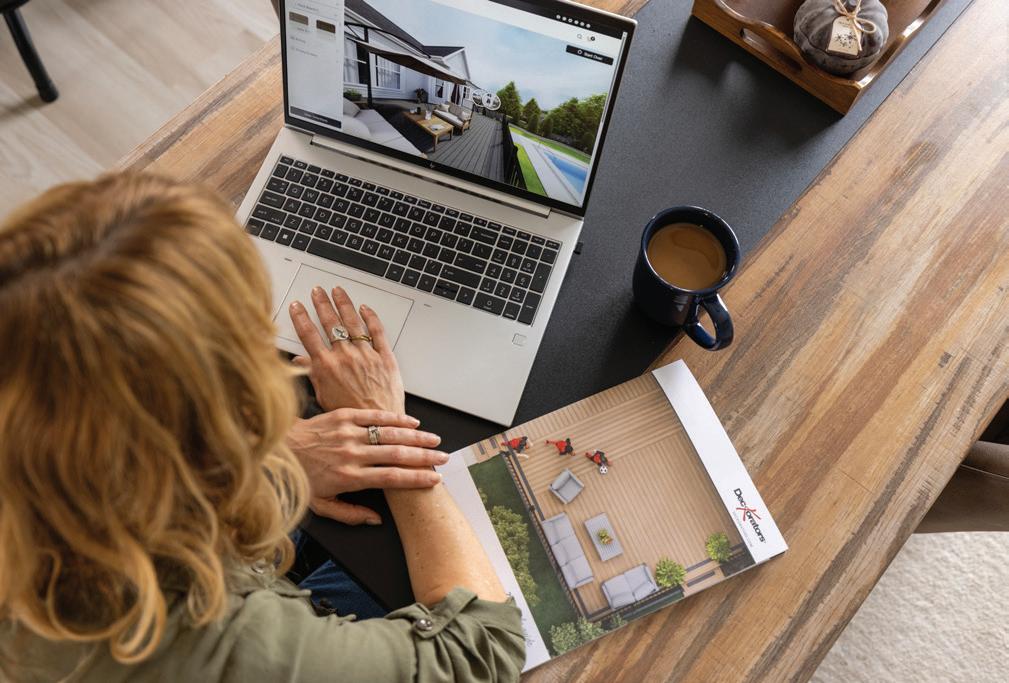
Hendricks: Showroom displays and design tools such as Deckorators Deck Visualizer help contractors and homeowners confidently experiment with different combinations before committing to a final design.
Ondereko: Trex also offers helpful design tools to aid both homeowners and builders in their decision making. Launched last year, the Trex Deck Railing Designer was developed with speed, accuracy and efficiency in mind. This user-friendly digital platform delivers real-time 3D visualization, instant material estimates and seamless performance across devices.
The Trex Deck Design Tool and Online Deck Planner is an intuitive software that allows homeowners to design their custom outdoor space in 3D. The Trex Augmented Reality (AR) Decking and Railing Visualizer tool allows users to explore design possibilities for their outdoor spaces by experimenting with shape, color and material combinations using the full suite of Trex products against the backdrop of their actual home environments. The app affords users a panoramic view to experiment with the brand’s extensive array of decking and selected railing pairings.
The Trex Deck Cost Calculator is a great tool for a quick budget snapshot and helps homeowners estimate material costs for a deck build quickly and easily based on size and the decking and railing products being considered. MM
RESOURCES such as Deckorators Deck Visualizer abound to help your customers experiment with different looks before committing to a final design.
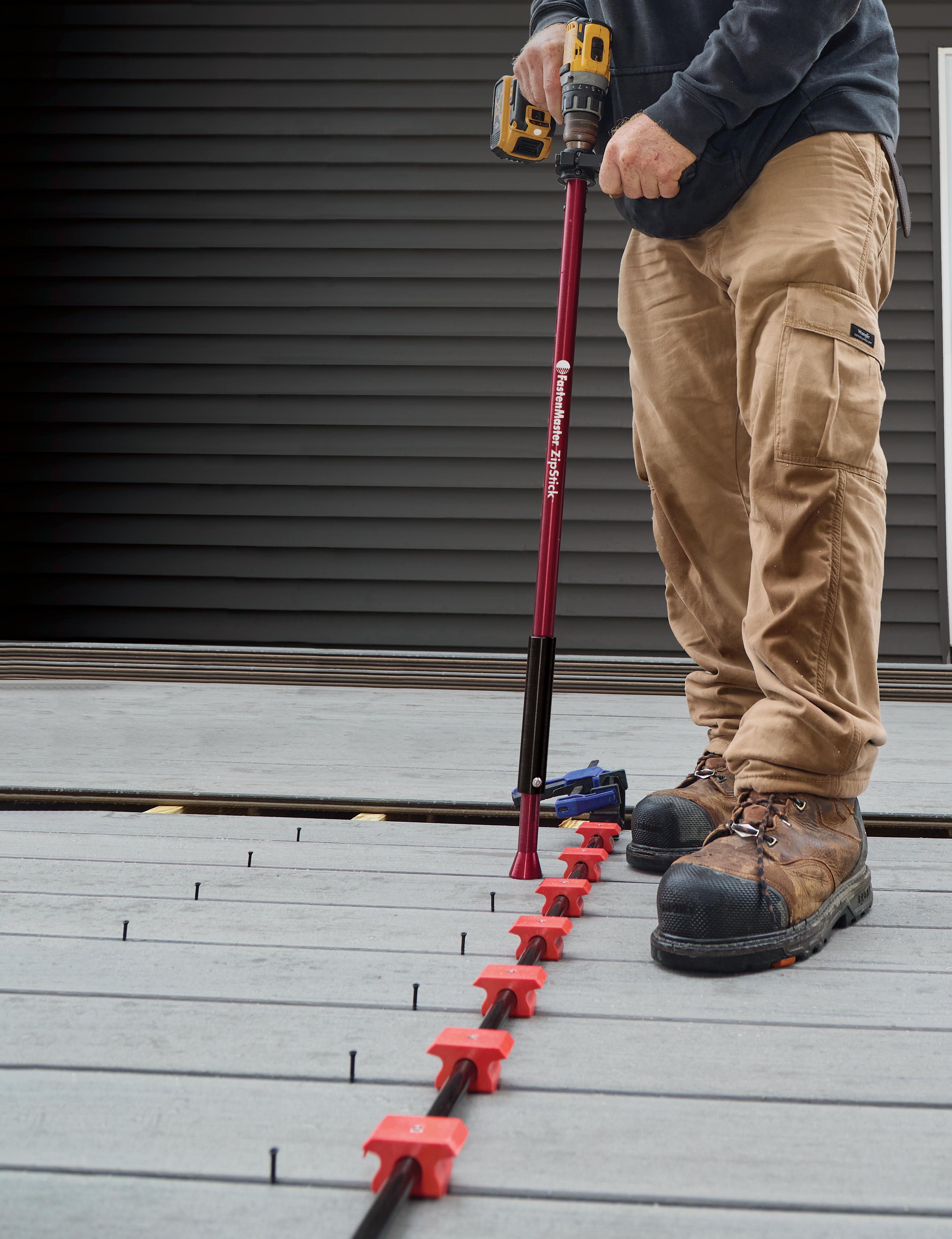
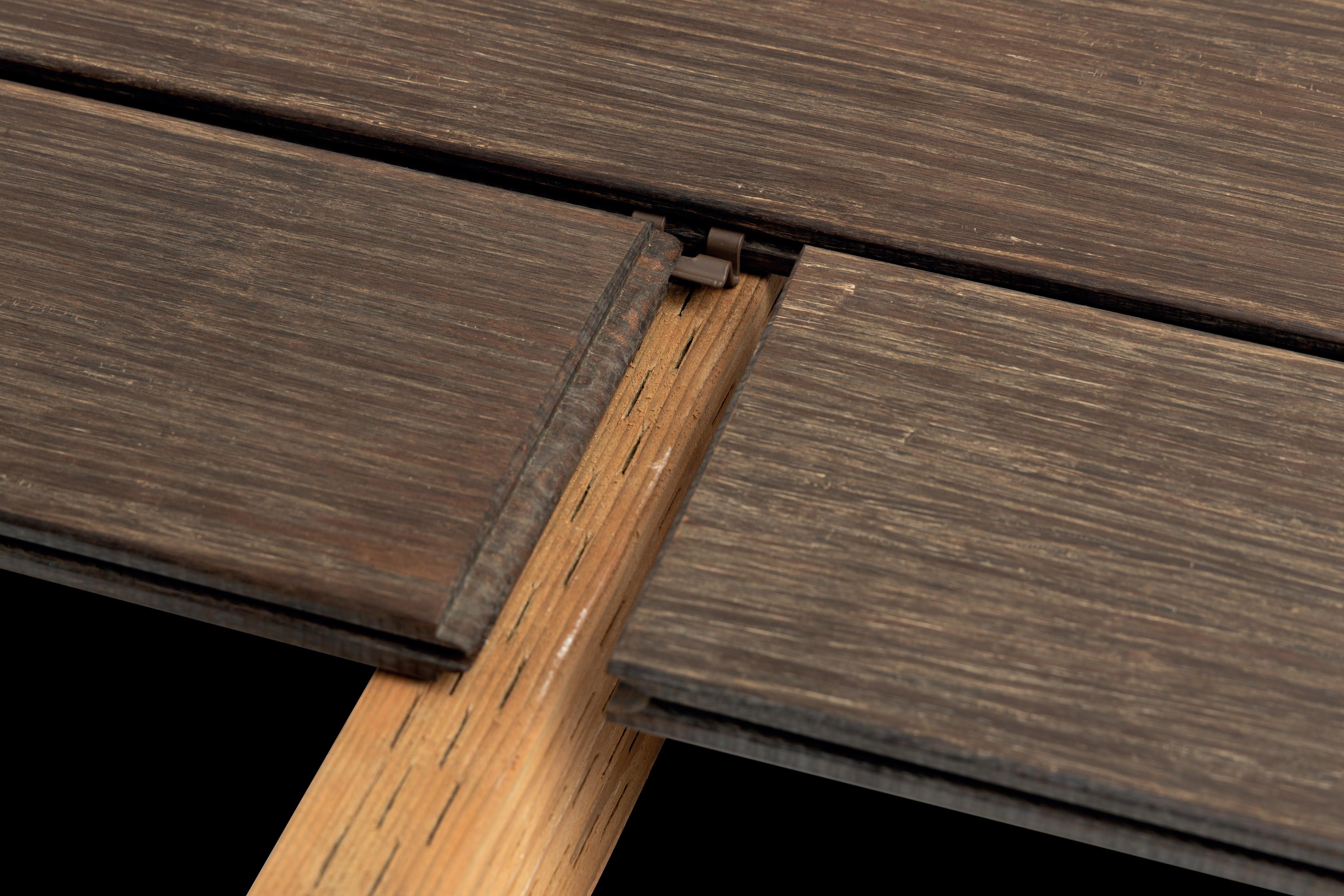
The Next Generation of Hidden Deck Fastening
Fastest Installation
Precision Accuracy
Versatile Clip Design
Lifetime Guarantee
Scan to contact your local FastenMaster representative
LEAD WITH RAILING
------------ BY SARA GRAVES
RAILING IS MOVING to the front of the conversation, and that shift has direct implications for building products dealers. There has been a clear change in how railing is specified and sold. What was once a final add-on is now influencing material selection, layout and even how outdoor spaces are marketed to homeowners.
For dealers, that means railing is no longer just a line item, it’s a category with growing influence over the entire project package.
Open Views Drive Product Mix
The strongest throughline across manufacturers we interviewed is the continued demand for open-view railing systems.
Glass, cable and low-profile metal systems are being specified not just for aesthetics, but for how they connect the deck to the broader outdoor environment. Homeowners want visual continuity—whether that’s a backyard, pool, or surrounding landscape—and railing is expected to support that experience.
That shift is especially relevant at the point of sale. Railing systems that preserve sightlines and create a sense of openness are consistently gaining traction.
Several manufacturers point to glass and cable as key drivers, with slim aluminum framing and minimalist profiles helping maintain durability while reducing visual obstruction.
“Homeowners are asking for less visual interruption between them and the view, and that preference is pushing baluster profiles thinner and top rail designs lower and flatter,” says Meredith Opie, associate product manager for Fiberon Railing and Fypon.
For dealers, that translates into a need for a well-balanced offering of view-oriented systems, along with the components that support them—posts, infill options, and compatible accessories.
At the same time, black continues to dominate as the finish of choice. Its ability to blend into the background while complementing a wide range of decking colors makes it an easy upsell and a safe inventory bet.
Luke Guittar, VP sales/marketing, Absolute Distribution Inc., adds powder-coated textured black aluminum railing with vertical picket infill is not popular by accident. “It’s one of the few categories in outdoor living where performance, price, and aesthetics all align.”
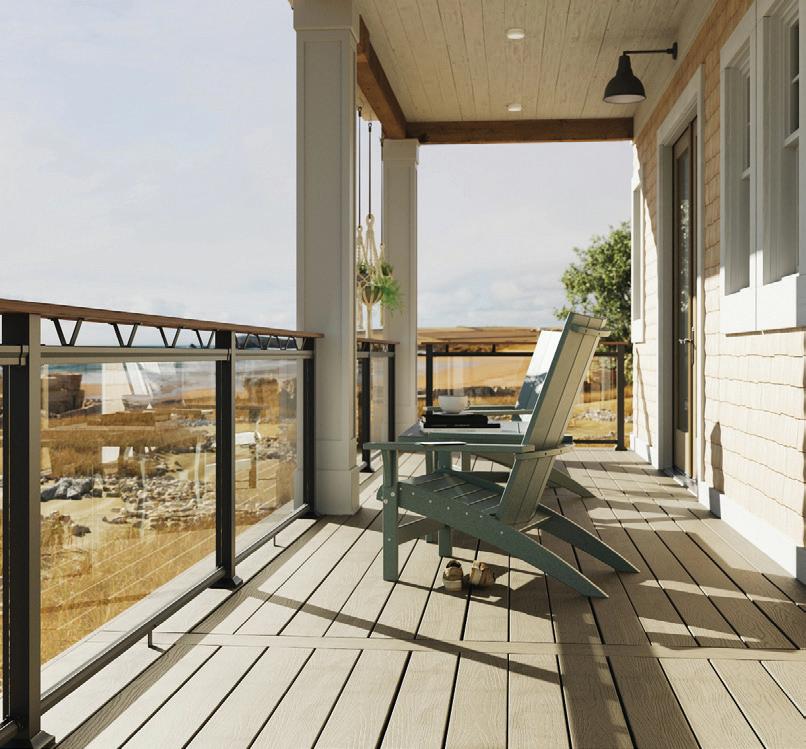
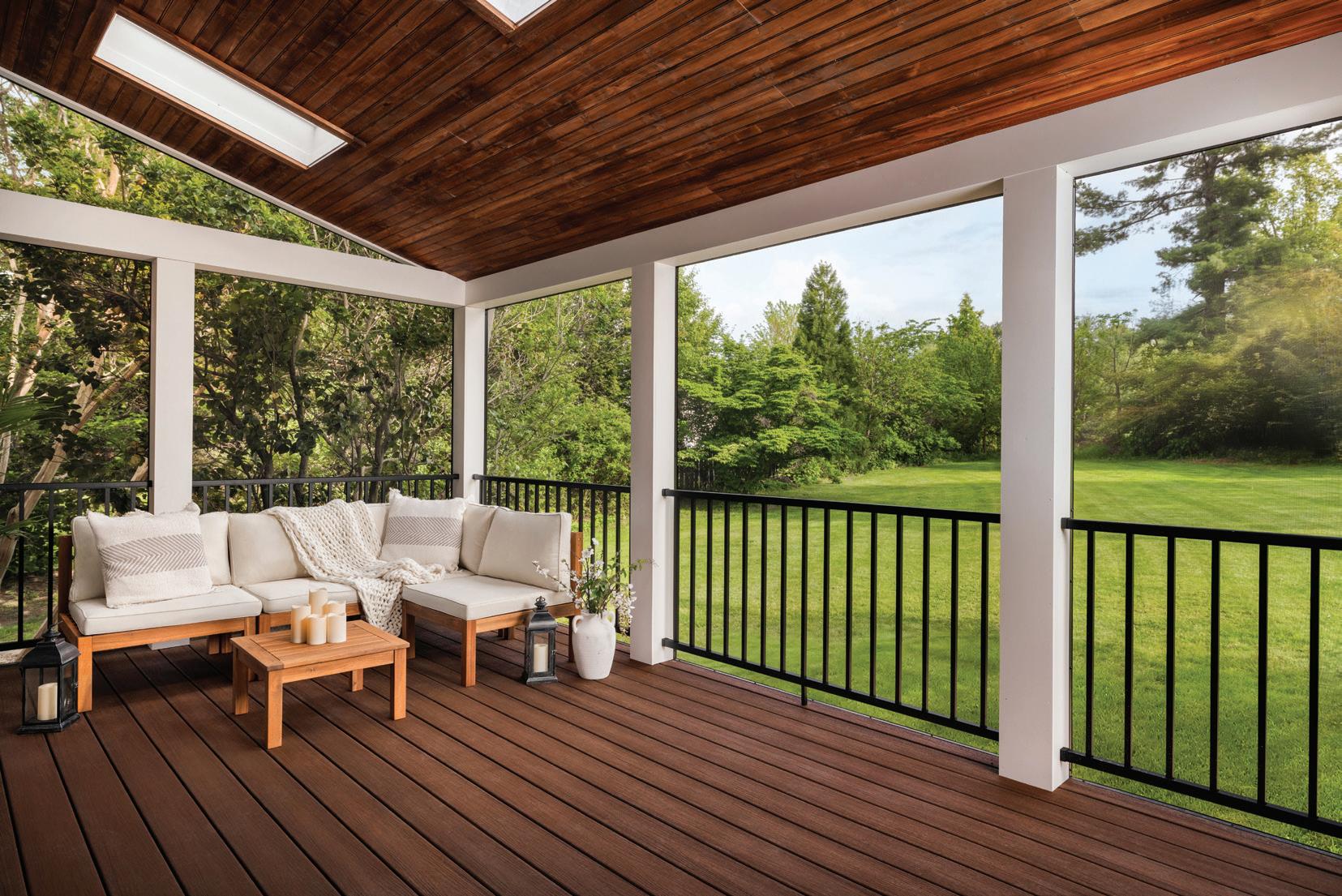
FOR MANY OUTDOOR living projects, railing has become the star that influences other components of the deck. (Photo by TimberTech)
Simplicity Sells
Beyond aesthetics, ease of installation is becoming a major factor in product selection. “Builders and dealers are looking for solutions that combine clean design, durability, and simplicity in installation,” says Rob Mitchell, president & CEO, Vista Railing Systems Inc. “That has been a major focus of our product development and dealer support strategy.”
In fact, according to Mike Onderko, senior director, product management for Trex Co., pre-assembled, panelized sections and bundled key components are reducing labor time and simplifying ordering, helping contractors improve efficiency on the jobsite. Manufacturers are increasingly focused on simplifying the buying and building process with the goal being to reduce friction across the entire process, from quoting to installation.
For dealers, that simplification offers a clear advantage. Products that are easier to quote, stock, and explain to customers can accelerate sales and reduce errors. Systems that arrive pre-configured or require fewer components also minimize confusion for both contractors and DIY buyers.
At the same time, low maintenance remains a key selling point. Materials such as aluminum, composite, and PVC continue to gain ground as homeowners move away from wood due to upkeep concerns. Durability, corrosion resistance, and long-term performance are now expected.
The opportunity for dealers is to position these benefits clearly, helping customers understand not just what the product looks like, but how it performs over time.
Lighting and Add-Ons Expand the Ticket
As railing becomes more central to the outdoor living experience, so does lighting.
Manufacturers are seeing growing interest in lighting systems that are built into the railing itself, offering a cleaner look and a more cohesive design. These solutions are shifting from optional upgrades to expected features, particularly in higher-end projects.
For dealers, lighting represents both an upsell opportunity and a category extension. Stocking compatible lighting components and promoting them alongside railing systems can increase average ticket size while reinforcing the idea of a complete outdoor package.
Customization without Complexity
While homeowners are asking for more design flexibility, manufacturers are working to deliver that variety without increasing complexity for dealers and installers.
Multiple infill options—glass, cable, horizontal and vertical elements—are becoming standard within single systems, allowing dealers to offer customization without carrying entirely separate product lines.
There is also a growing emphasis on systems that are adaptable and intuitive, making it easier for dealers to support different design preferences without complicating inventory management.
At the same time, accessibility remains important. Even as high-end aesthetics continue to drive demand, many customers are balancing design goals with budget constraints. Manufacturers are responding with solutions that bring modern looks and improved perfor-
mance into more attainable price points.
For dealers, that creates an opportunity to segment offerings clearly while maintaining a consistent design story across price tiers.
The Shift to “Railing-First” Thinking
Perhaps the most significant change for dealers is when railing enters the conversation.
Manufacturers report that railing is increasingly being considered earlier in the design process, sometimes even before decking materials are finalized. This “railing-first thinking” reflects a broader shift in how outdoor spaces are planned, with railing shaping both the visual and functional experience.
“For decades, railing has typically been the last choice made on decking projects, and we see that changing with new alternatives in railing being easy to buy,” says Mike Kunard, co-owner, IG Railing.
As a result, dealers who lead with railing, rather than treating it as an afterthought, may find new opportunities to influence the entire project scope. That includes guiding customers through infill options, finishes, and system compatibility, as well as helping them visualize how railing integrates with the rest of the space.
A Category of Growing Influence
Step back, and the message is clear: railing is no longer a secondary category. It’s evolving alongside the outdoor living market itself, moving from a safety component to a design-forward system that impacts how spaces are built and sold.
For building products dealers, that shift creates both opportunity and responsibility. Product mix, merchandising, and sales strategy all need to reflect railing’s expanding role. MM
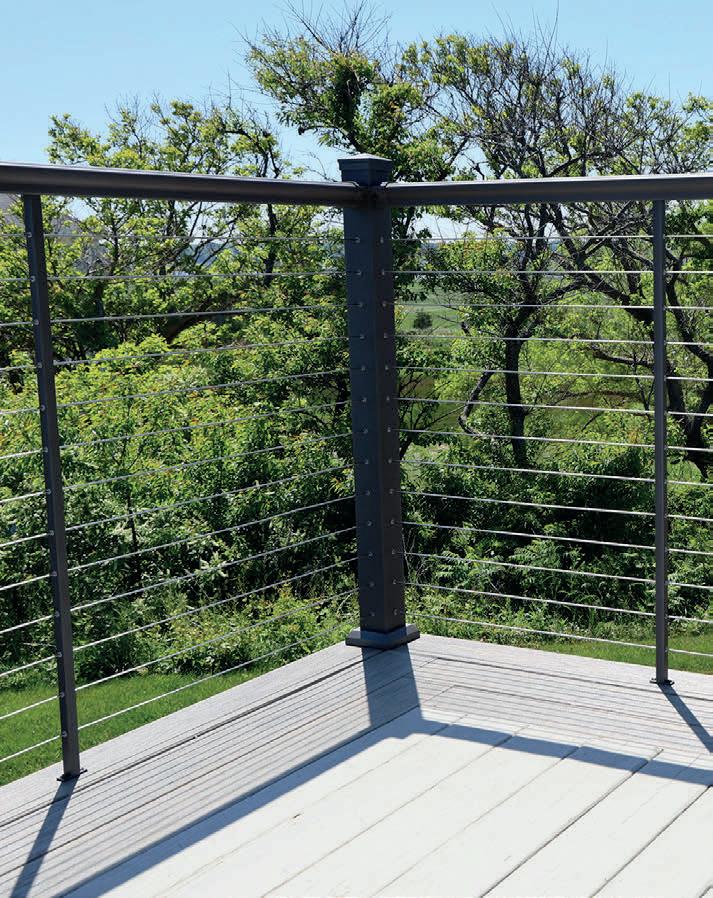
OPEN-VIEW railing systems, such as cable rail, is top of mind with industry experts (Photo by AGS Stainless)
WINNING MORE BIDS HOW DEALERS CAN HELP CONTRACTORS COMPETE
------------ BY PATRICK IANNI
IN TODAY’S BUILDING environment, winning contractor bids has become just as challenging as completing them—for both dealers and contractors. For pros, success is no longer solely defined by craftsmanship.
Homeowners evaluate contractors based on how efficiently they move from estimate to installation, how confidently they can stand behind their material choices, and how effectively they communicate value to increasingly cost-conscious customers. In this environment, contractors and dealers can work together to bid and install more effectively.
The New Relationship Between Contractor/ Dealer/Manufacturer
Traditionally, dealers have been measured by product availability and price. But that transactional model is no longer enough. The most valuable dealers are evolving into true business partners, helping contractors navigate complexity, reduce risk, and improve their chances of winning the job.
This shift is happening because the market for winning bids has changed. Contractors are competing across value, speed, labor efficiency and long-term performance. Dealers who understand these expectations and align their offerings become a critical extension of the contractor’s business.
At the same time, manufacturers must answer the market need for products and tools that deliver across these four areas. The industry is seeing new products and technologies come to market that help contractors deliver quality work on time and within a client’s budget.
Competing on Value, Not Just Cost
Homeowners continue to gravitate toward premium outdoor aesthetics but are more price-sensitive than ever. That creates a challenge for pros: how to deliver high-end design without pricing themselves out of a project. This is where material innovation and dealer guidance can make a measurable difference.
For example, new surface technologies enable contractors to offer the look of premium materials like aluminum at a more accessible price point through composite railing and fence products. New railing and fence systems on the market deliver aluminum-inspired aesthetics with composite construction, allowing contractors to offer an elevated design option while maintaining competitive bids. Contractors can pivot the conversation from cost to value, offering homeowners the style they want with long-term durability and lower maintenance needs.
Dealers should stay in tune with the latest innovations so they can recommend products that don’t just meet specs but also strengthen the contractor’s value proposition.
Install Speed Plays a Role
Market labor constraints continue to impact contractors, making installation speed and efficiency one of their most competitive advantages. Contractors who can complete projects faster and more predictably have a clear edge in both bidding and execution.
Product selection plays a significant role. Product systems designed for efficiency, such as pre-assembled components, modular construction or simplified installation processes, can significantly reduce time on site. For example, newer cable railing systems are engineered
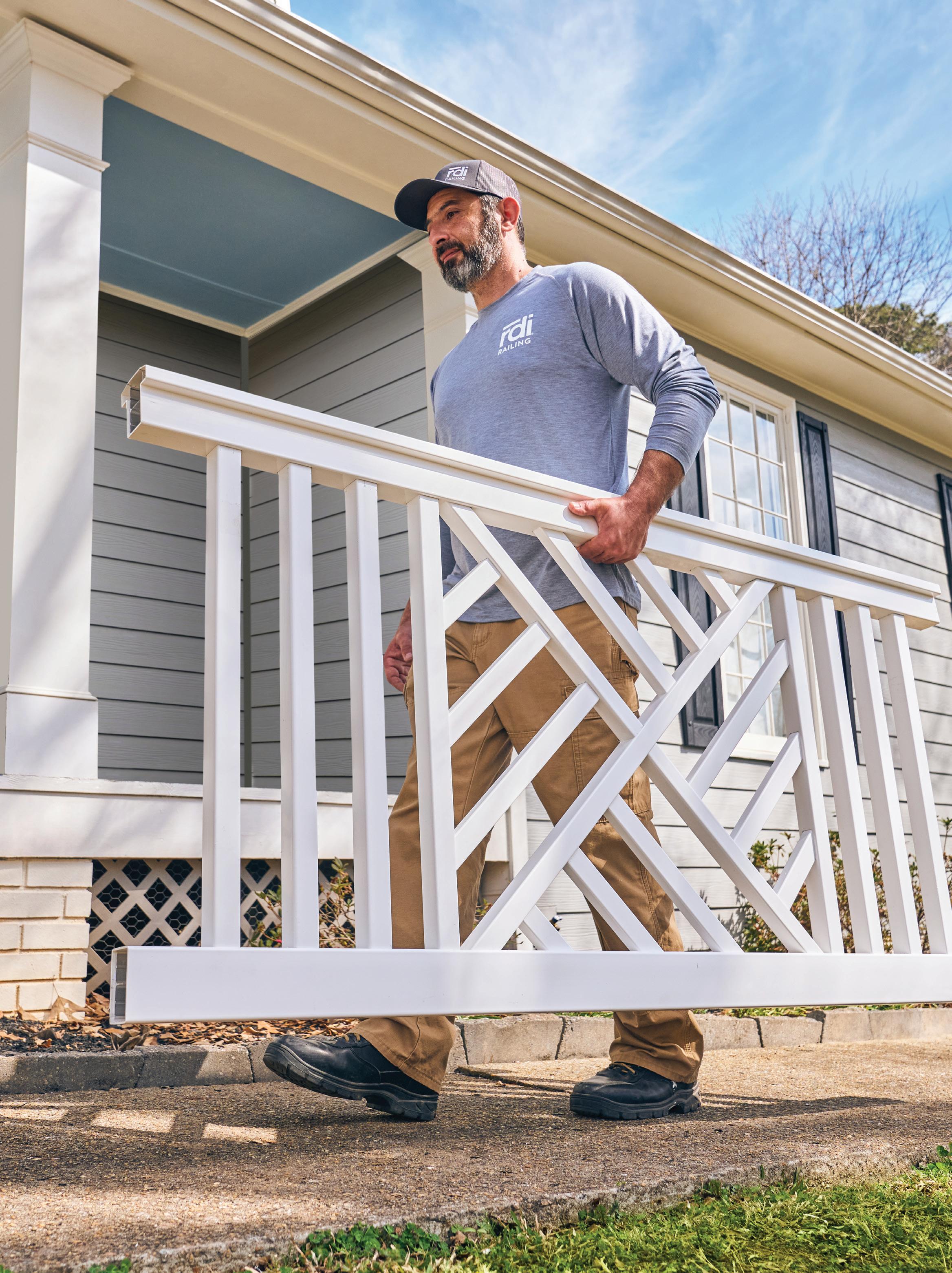
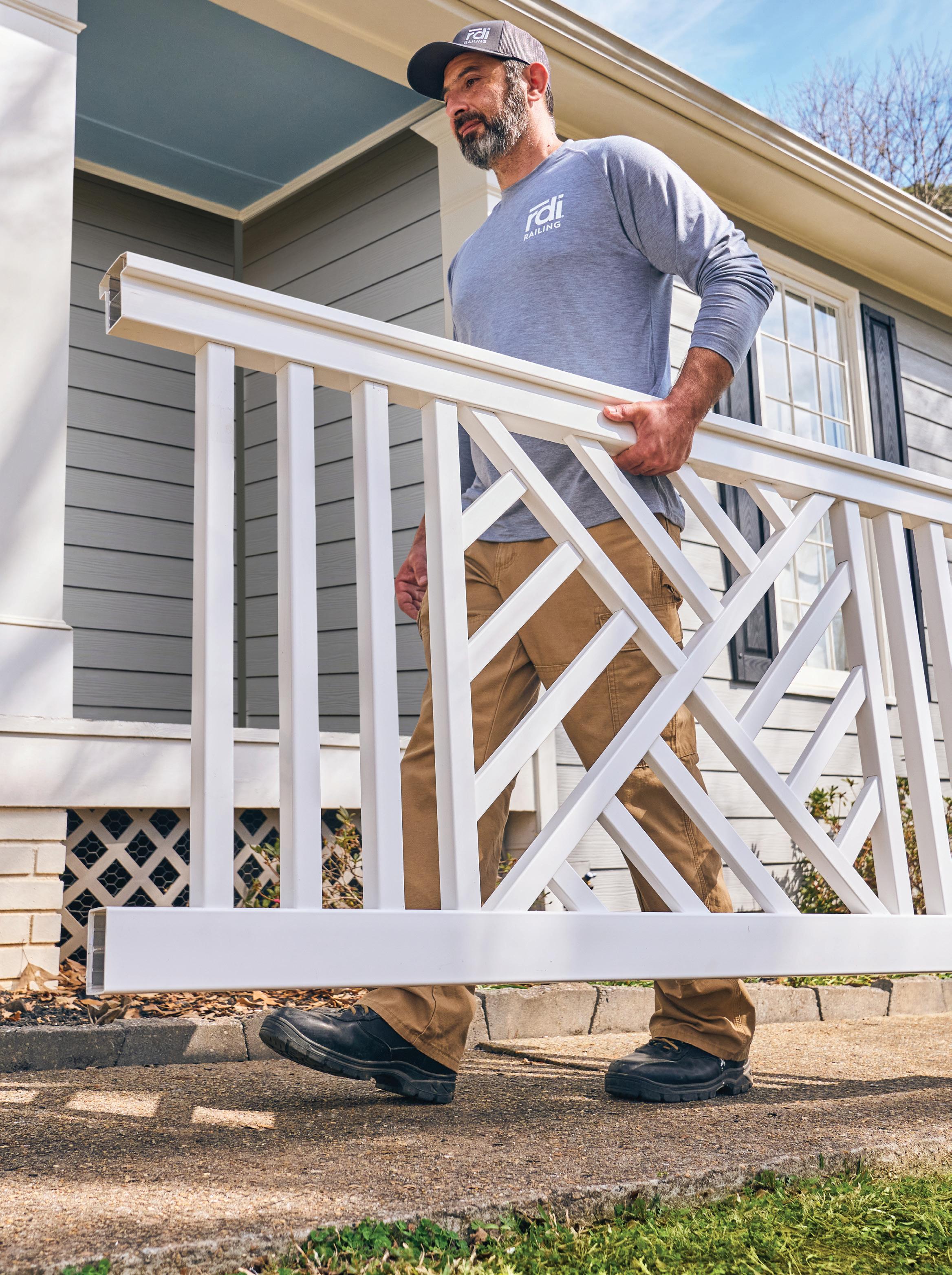
RDI FUSION composite railing offers the strength and look of satin-finish aluminum with the value and durability of composite.
with pre-strung panels and centralized tensioning systems that eliminate the need to tension each cable individually. That translates directly into lower labor costs, tighter project timelines, improved profitability and happier clients.
Speed in railing installations is also realized with well-engineered brackets. Systems that feature intuitive, easy-to-install brackets that also deliver a clean, finished appearance help contractors work more efficiently without adding complexity or compromising the final look.
The balance between speed and aesthetics is vital with railing. Unlike other building products, railing sits directly within the homeowner’s line of sight and daily use. Yet many homeowners experience “railing regret” after installation, realizing they didn’t give enough thought to the product they selected. Railing must deliver both installation efficiency for the contractor and a refined finish for the homeowner. Systems that combine fast, straightforward installations with clean lines and minimal hardware visibility allow contractors to move quickly while still delivering a final product that feels intentional.
Dealers who prioritize these solutions and educate contractors on their benefits are helping their cus tomers compete in a very real way. It’s not just about what the product is. It’s about how quickly and reliably it can be installed.
Reducing Risk Through Proven Performance
In a cost-conscious market, call backs, repairs and premature product failures can eat into margins and damage reputations. Contractors are placing greater emphasis on materi als that deliver consistent, long-term performance. For example, composite fencing and composite railing that re sist rot, warping, splintering and mold offer a compelling advantage, not just in durability but in the ability to confidently stand behind the finished product.
The same mindset applies to hardscapes, where contractors look beyond surface-level aesthetics and prioritize products engineered for long-term performance. Select ing materials engineered to a high standard helps reduce failure risk, minimize callbacks, and ensure the finished space performs as intended over time.
Dealers play a trusted role in guiding these decisions with contractors. By steering them towards proven, low-maintenance systems, they help reduce uncertainty and reinforce trust with homeowners. Over time, that reliability becomes a differentiator for contractors.
Visualization Tools to Close Deals
Homeowners expect fast quotes, clear visualizations and confidence before committing to a project. Contractors who can move quickly from concept to proposal have a distinct advantage, and a trusted dealer can point contractors to these resources.
From professional design renderings to augmented reality visualization and rapid quoting tools, these tools help contractors present ideas more clearly and close deals faster. They reduce back-and-forth revisions, creating more confidence and increasing close rates. Dealers who stay up to date with the latest visualization tools can position themselves as strong partners to contractors.
Integrated Project Planning
Outdoor living projects are increasingly complex, involving railings,
fencing, hardscapes, decking and more. Managing multiple vendors, coordinating deliveries and ensuring compatibility across systems can bring unnecessary friction into both the bid and the build. Dealers who can offer a more integrated solution, such as through one manufacturer’s broad product portfolio, can provide a meaningful advantage. Fewer suppliers mean fewer variables, greater predictability and greater overall efficiency.
Contractors who are winning more bids today are those who are best equipped to navigate a complex, fastmoving market. They’re leveraging smarter materials, more efficient systems and stronger support networks to deliver better projects, for themselves and their customers.
In a cost-conscious market, success isn’t just about lowering costs. Contractors need to increase confidence in the materials being used, promised timelines and their ability to deliver the desired outcomes. MM
– Patrick Ianni is VP of customer operations and product development for Oldcastle APG (oldcastleapg.com).
WHAT LIVES UNDER THE DECK—
AND WHY IT’S WHAT PROTECTS EVERYTHING ABOVE IT
BY SARA GRAVES
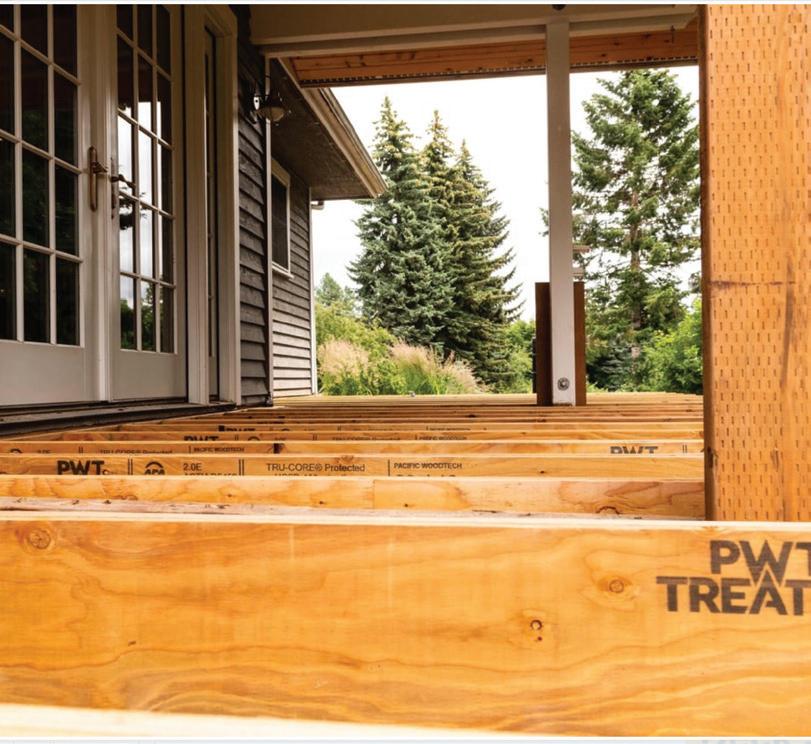
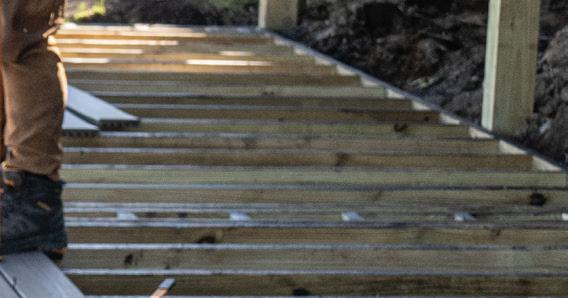
WHEN HOMEOWNERS imagine their new deck, they picture color, railings and how the space will look when it’s finished. The real story begins below the surface. Framing, footings, protective barriers, and drainage all work together as a system—one that quietly determines how a deck performs years after the last board is installed.
Dealers should be able to explain what lives under the deck and why it matters. Not in technical terms, and not as a checklist of products, but as a long-term protection strategy. The message is simple: a deck that lasts is planned from the bottom up.
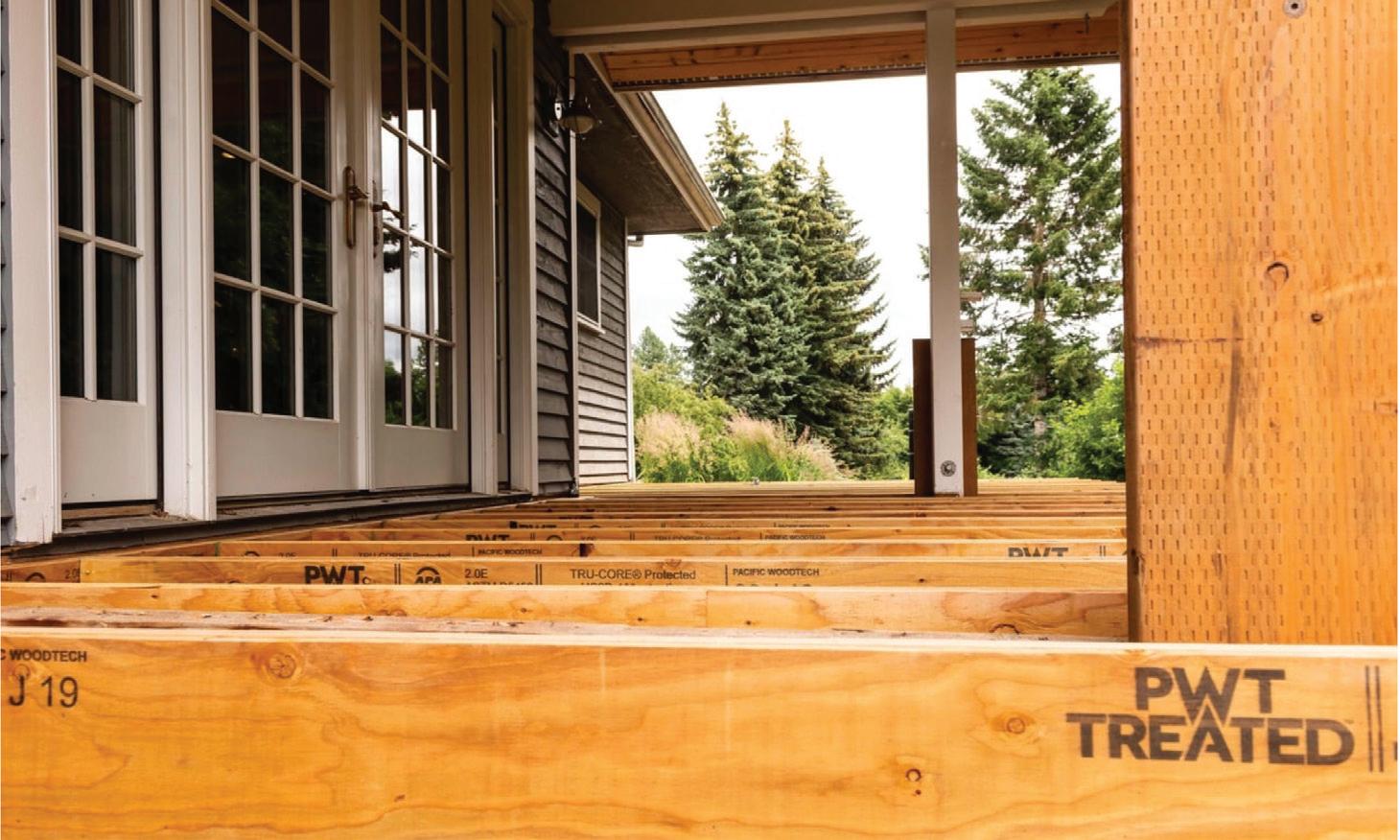
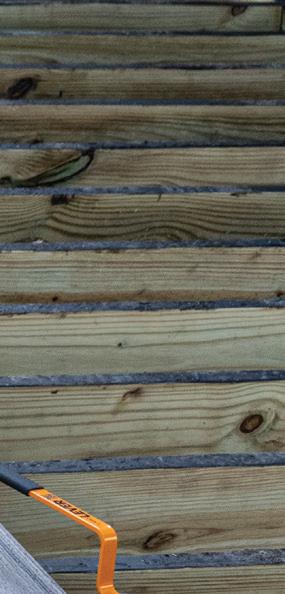
Framing is often the first piece of that conversation. Explain that joist layout, spacing and fastening affect far more than structure alone. Good framing reduces bounce, limits movement, and helps the entire deck feel solid over time. Whether working with traditional pressure-treated lumber or alternative framing systems, strength and longevity are established long before surface boards are installed.
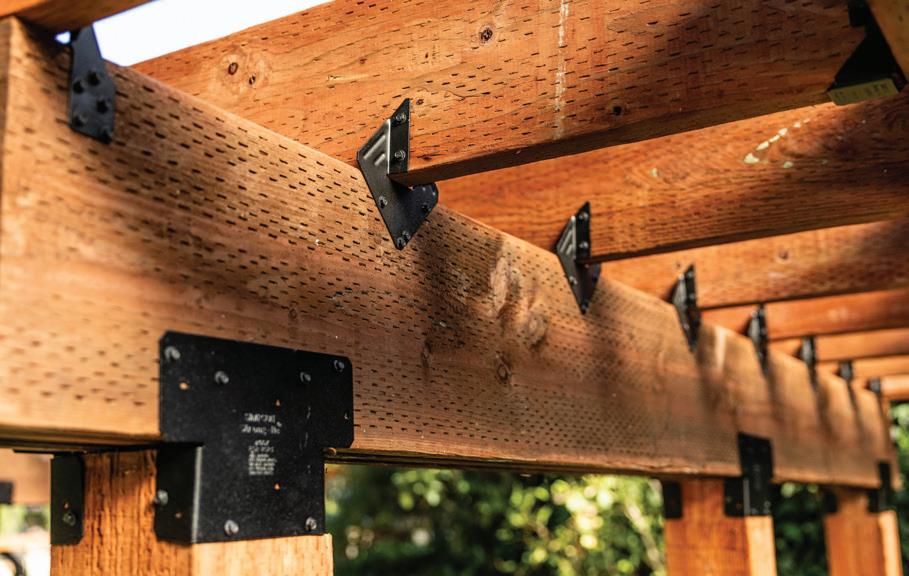
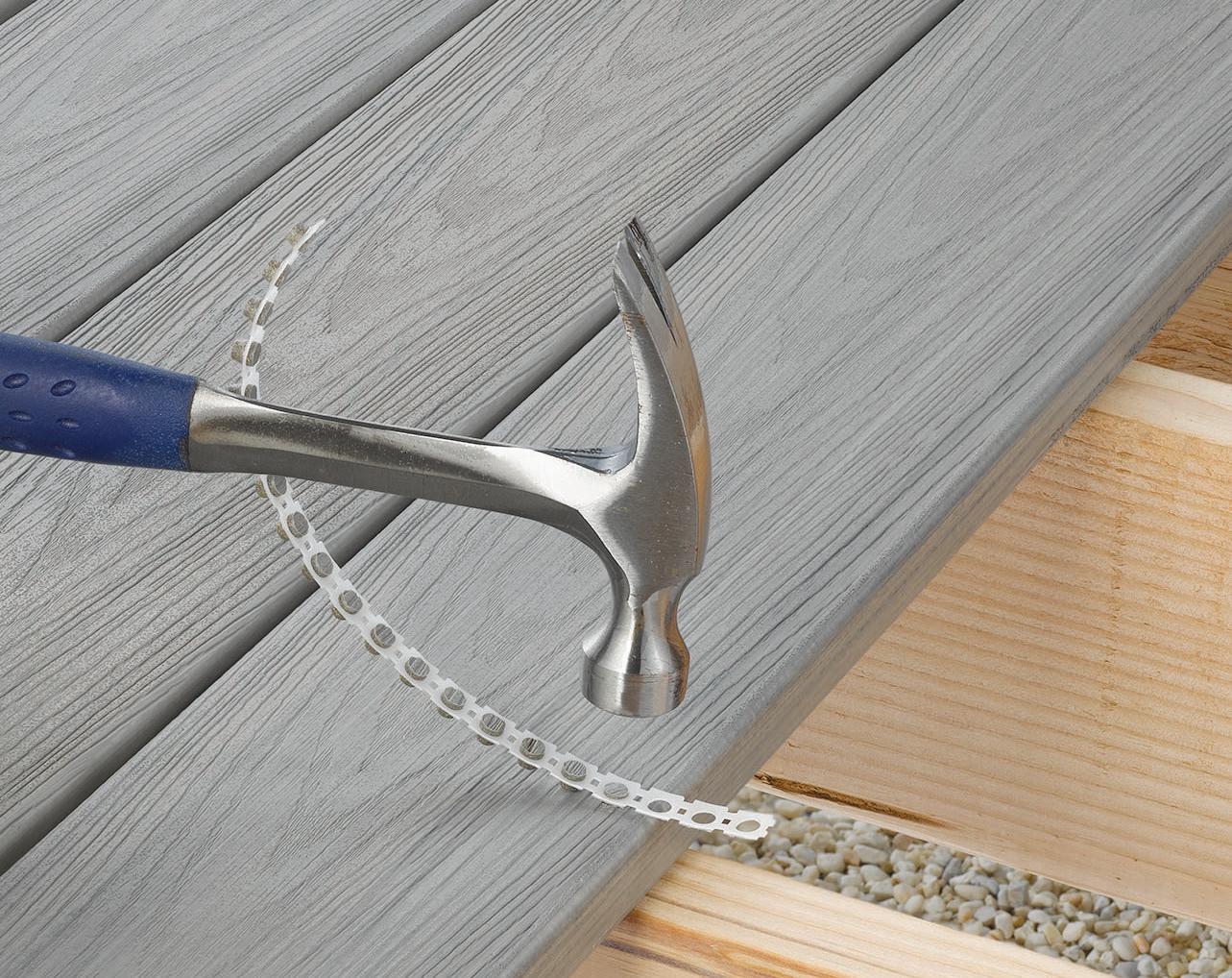
Moisture protection is another critical layer homeowners rarely see—but builders should never ignore. Water is relentless; decks are exposed to it from above, below and along every connection point. That’s why many pros now treat joist tape, beam tape, and flashing as standard practice, not optional upgrades. Deck joist tape and coatings from CAMO, DeckWise, FastenMaster, Deckorators, Trex, SPAX, Protecto Wrap, and others are commonly specified to shield framing from moisture intrusion at its most vulnerable points.
Emphasize that these protective layers aren’t about overbuilding—they’re about preventing rot, corrosion and premature failure in the places homeowners never inspect. Once explained, clients often understand that these small, hidden details can add years to a deck’s service life.
Framing materials are also part of that under-thedeck system. Pressure-treated lumber suppliers such as ProWood and PWT are frequently paired with protective tapes and barriers like Mitsubishi Nichigo G-Tape, reinforcing the idea that longevity comes from how components work together—not from any single material choice.
Some builders are also expanding beyond wood framing altogether. Steel and alternative framing systems from companies like Fortress, New Castle Steel, TimberTech, and Versadeck change how moisture management, protection, and detailing are approached—but not the importance of planning what happens below the deck.
At the very bottom of the system are footings and piers—components that homeowners rarely see but builders rely on completely. Whether using cast-in-place concrete or alternative foundation systems, experienced pros make these decisions early in the design and estimating phase. Solutions from manufacturers such as Diamond Pier, Perma-Column, Footing Pad, and Bigfoot Systems are evaluated not just for structural support, but for predictability, scheduling and how smoothly a project can move from planning to framing.
That emphasis on planning ties every under-the-deck component together. MM
WHAT GOES UNDER the deck is just as important as what goes on the deck what determining the longevity of the structure. (Photo by PWT)
TRIM
THE FUTURE OF OUTDOOR LIVING 6 TRENDS SHAPING BACKYARDS THIS YEAR
OUTDOOR LIVING isn’t just a trend for 2026, it’s a priority. According to the latest Outdoor Living Trend Report from the International Casual Furnishings Association, 77% of U.S. homeowners say they wish they spent more time outside, and nearly 60% plan to invest in their outdoor spaces this year, with durability and practicality topping their wish lists.
“Homeowners want outdoor spaces that deliver style with substance that can stand up to everyday life,” said Jodi Lee, senior vice president of marketing for Trex. “We’re seeing an increased focus on materials built to take on sun, moisture and changing climates, so backyards aren’t just beautiful, they’re built to last.”
From resort-style retreats to climate-smart materials, here are six trends set to define outdoor living this year and beyond:
1. Micro-Resort Living
Gone are the days of the basic backyard with a grill on wheels and some folding lawn chairs. Today’s homeowners are transforming their outdoor spaces into immersive, resort-style retreats that rival boutique hotels. These spaces are thoughtfully designed with dedicated zones for everything from yoga and quiet reflection to al fresco dining and game nights. Outdoor kitchens and full-service bars make entertaining effortless, while ambient lighting, fire features, and water elements set the mood from sunrise to
starlit evenings.
Thanks to low-maintenance, durable materials like composite decking and all-weather furnishings, these outdoor retreats don’t just look like a vacation, they feel like one, too. Without the upkeep that comes with traditional wood, homeowners can truly unwind and enjoy the feeling of a luxurious getaway without ever packing a suitcase.
2. Back to Earth
Cool grays have dominated decks for years, but warmer earth-inspired browns are making a strong comeback. Homeowners are gravitating toward soft hues, such as Trex’s “Color of the Year,” Biscayne, a rich, sun-kissed brown that brings warmth and sophistication to any outdoor space.
“It looks like something you’d find in the Hamptons,” noted journalist Courtney Thompson, who selected Biscayne for her outdoor space. “It’s such a soothing colorway and the natural wood graining gives off an elevated-but-rustic vibe that I’m obsessed with.”
Design-savvy homeowners are also taking visual contrast up a notch by combining materials like stone, composite, wicker, and metals, as well as mixing colors and patterns for added personality and visual interest. An increasingly popular trend is integrating deck boards of different widths to create custom layouts that feel intentional, architecturally sophisticated, and full of dimension.
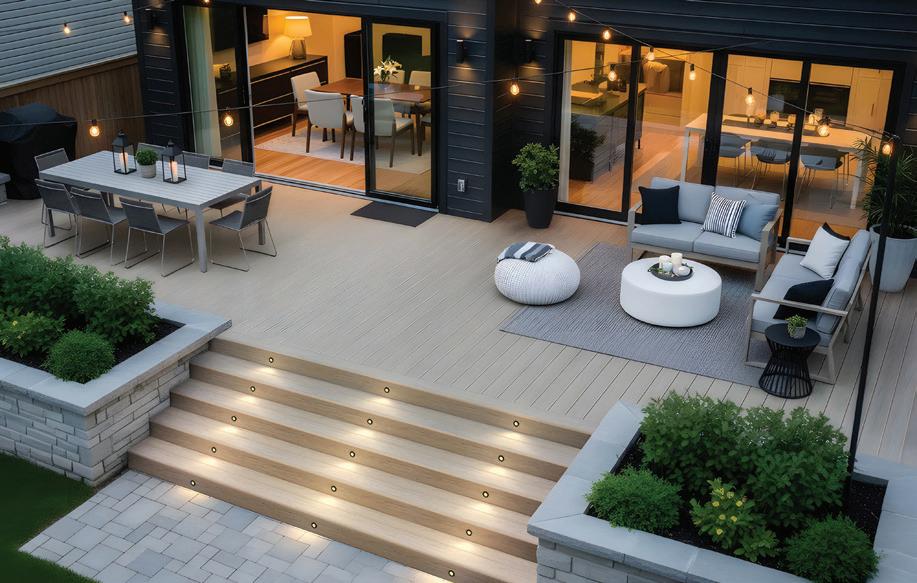
CLEVER DESIGN can make even smaller spaces beautiful and functional (Photo of Trex Enhance Decking)
3. Climate-Resilient Materials
From sun-soaked backyards to moisture-rich coastal settings, homeowners are seeking materials that can handle whatever nature throws their way. Recent innovations in composite decking have made it a material of choice for decks, docks and other outdoor surfaces due to its ability to stay beautiful and functional in any climate.
Heat-mitigating technology engineered into deck boards helps to reduce heat absorption and keep surfaces cooler, while marine-grade composition prevents rot, warping, and water damage in humid or waterfront environments. There are even fire-resistant options that offer added peace of mind to homeowners in wildfire-prone regions.
“While much of our porch is covered, the stairs on both sides are exposed to sun throughout the day so I really appreciate the heat-mitigating technology incorporated into our decking,” Thompson said.
4. Small but Stunning
Not every backyard is expansive, but that doesn’t mean style and impact have to take a back seat. Homeowners are embracing smaller, highly curated outdoor spaces that pack a visual punch and deliver maximum functionality. Creative design choices like layered textures, built-in seating, and bold color accents can make even a modest patio or deck feel luxurious.
Multi-level layouts, integrated breaker boards, and strategically placed planters help create depth and separation, allowing compact spaces to serve multiple functions without feeling cramped. And don’t overlook the space
beneath an elevated deck. Installing an underdeck drainage system can expand outdoor living area by keeping the space under the deck dry and usable as a patio, spa area or fully functional outdoor room.
5. View-Optimization
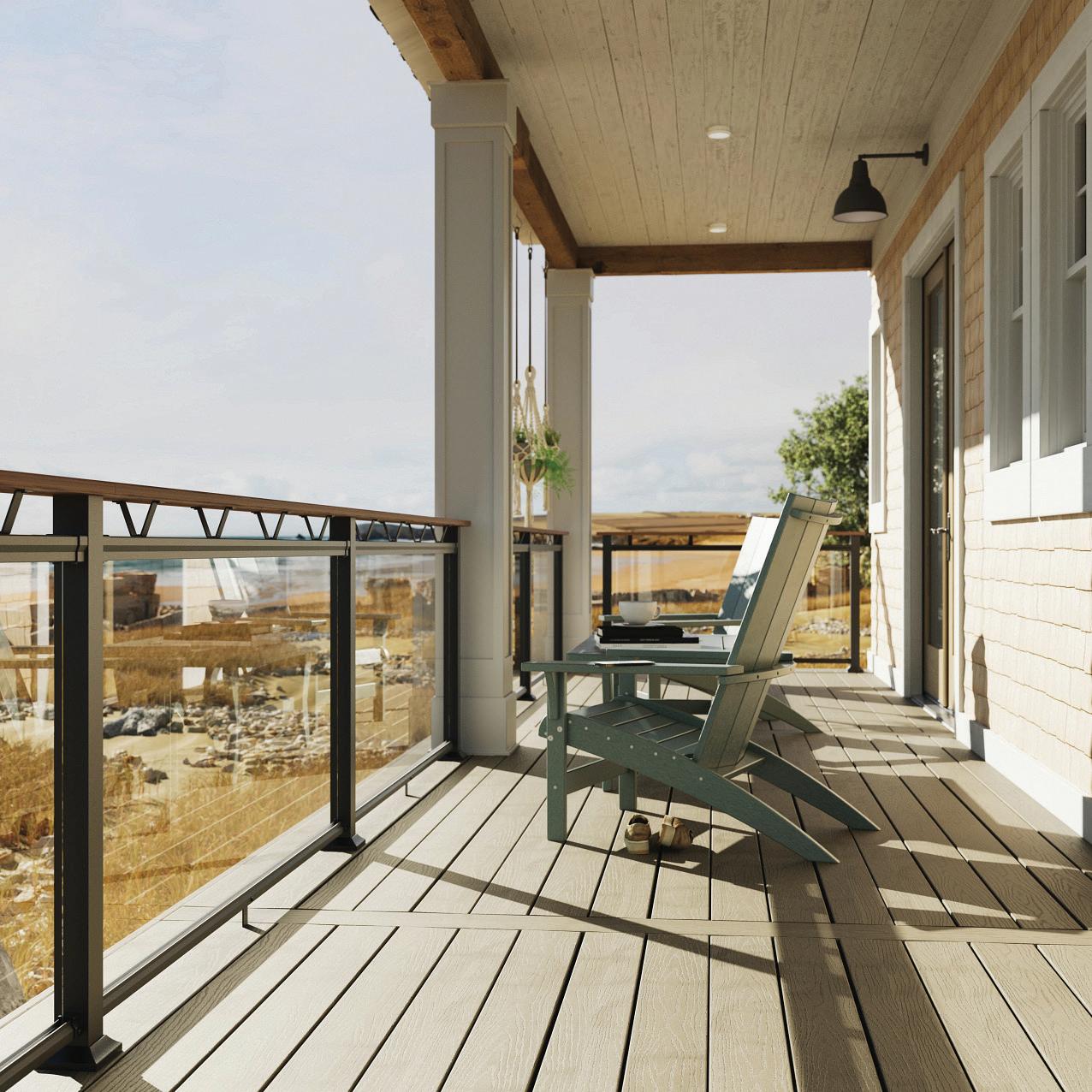
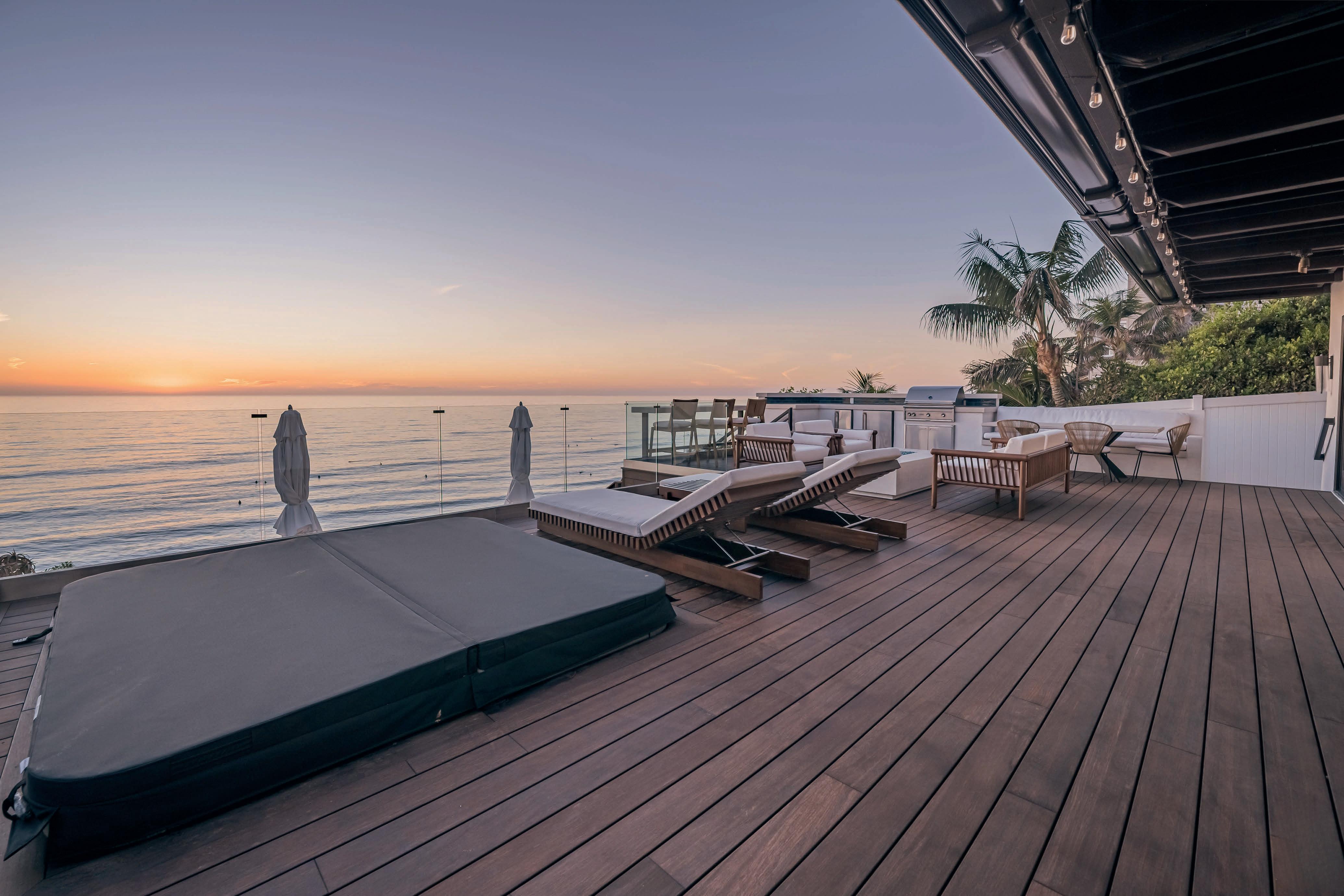
As decks become more architectural, railing is stepping into the spotlight. Minimalist aluminum systems, sleek cable railing and modern glass panels are in high demand, especially for homes with water, mountain or wooded views. These low-profile options maximize sightlines while delivering durability in coastal settings and other harsh weather environments.
6. Privacy, Please
Privacy isn’t just about keeping neighbors out, it’s about designing outdoor spaces where every moment feels personal. Pergolas and shade screens provide a sense of enclosure without feeling closed in. For greater privacy, composite fencing offers a low-maintenance, long-lasting alternative to wood. Vertical panels deliver full seclusion for quiet retreats or play areas, while horizontal styles create sleek, modern lines that enhance curb appeal. With so many options, privacy features are no longer just functional, they’re design statements helping to transform backyards into personal sanctuaries that are both beautiful and highly livable.
Across all of these trends, one theme stands out: performance is powering design. Today’s homeowners are investing in outdoor spaces that must endure intense sun, heavy moisture, shifting temperatures and evolving building codes, all while looking elevated and inviting. MM
Wood Treating Service with a Superior Preservative Selection
FEAR OF THE BIG, BAD CUSTOMER
------------ BY JAMES OLSEN
WHAT DO WE feel for the fearful? We pity them, we feel sorry for them, right? These are not the feelings we want our customers to feel for us. We respect and revere the fearless. Don’t we want our customers to respect us? If we are fearful, our customers will feel it.
When my son was four, I took him to swimming lessons. The pool was just a big bathtub—a little deeper maybe—but not scary—dad was there. The lady teaching the class kept asking him to blow bubbles in the water. He gladly complied, once. He ignored her after that. He seemed to be saying, “I already did it, I already know how, so let’s move on to the actual swimming!” I digress. He’s learning to swim and having a great time with it. After six lessons, we thought it would be a great idea for my wife to come along to see how our big boy was learning. My wife is deathly afraid of (deep) water. When she got in the pool with us, my son was fine until she touched his arm. I felt her fear course from her through his body and to mine like an electric shock.
What does this have to do with sales? Fear kills sales. Our customers will feel our fear just as my son felt his mother’s fear. Working with salespeople, I find that fear of upsetting, bothering, negotiating with (real give-andtake negotiation) the customer is the number one emotional problem for struggling sellers. When we feel fear, our customers feel sorry for us and may pity us. When we are fearful, customers will not respect and revere us, much less treat us like a partner. When customers feel our fear, one of two things will happen: they will take advantage or they will want to get away.
I work with charming, likable, hardworking salespeople who understand sales techniques and strategies, but all this charisma and sales knowledge is wasted because of the fear these salespeople have of their “Big, Bad Customers!”
How many of us married the yes-man or yes-woman? When I ask for a show of hands on this question in classes across the country, no one ever raises their hand. Why? Wouldn’t it be easier to spend our lives with someone who always gives us our way? Of course not. It would be deathly boring. We want someone who has their own ideas and maybe someone to keep us in check from time to time, right? Sales, like marriage, is a relationship. Our customers don’t want to buy from a yes-man or yes-wom-
an. They may throw ’em a bone now and then to keep them giving numbers, but these fearful salespeople will always under-achieve and get the leftovers.
Here are some solutions to overcome our fear of our “B.B.C’s”:
1. Prepare. Don’t just call—prepare everything!
2. Prospect. Talk to new customers and practice a confident approach. Fake it till we make it. Prospecting will help us build our account base. A big reason sellers are afraid of losing accounts is because they don’t have enough of them. How can we win a negotiation when the other negotiator knows we’ve got no place else to go?
3. Prepare and offer product. Back to the marriage metaphor, nobody wants to be with someone who always says, “I don’t know, what do you want to do?”
4. Call a friendly. Start our day with the accounts we have a good relationship with. The best time to call a B.B.C. is right after we have sold something.
5. Psyche up. Self talk works. We must convince ourselves before we put ourselves in front of a customer. (Many sellers are embarrassed by self affirmations—“And gosh darn it, people like me!” I agree that it seems corny, but it works.
6. Smile. Smiling before and during the sales call will make us feel more confident. Humans are drawn to and are more comfortable around people who smile.
Technique is important. Sales skills are necessary to maximize our efforts. But as the saying goes, we must get our hearts right before sales techniques will be effective.
Salespeople, unite! Let’s buck up, screw up our courage, and approach our customers with confidence. MM
JAMES OLSEN
THE CASE FOR STRATEGIC WORKFORCE PLANNING
BY CLAUDIA ST. JOHN
WHEN I TRAVEL to conferences and work with clients, I often get asked some variation of the same question: “Where did all the workers go?” To this, I usually answer, “You know where they went? They went to work…for someone else.”
And the data suggests I’m right. The U.S. unemployment rate at the time of this writing is 4.3%. It has been at this level or lower for much of the past decade. For context, most economists consider full employment to be 4.2% which means that everyone that wants a job is currently working. Employers can anticipate this “tight labor market” to continue for the foreseeable future, driven largely by a declining birth rate, the “grey tsunami” of baby boomer retirements, smaller Gen Z and upcoming Alpha generations, and reductions in legal immigration.
According to the Congressional Budget Office in 2025, by 2033 we will have more deaths than live births for the first time in our nation’s history.
If businesses are hoping to grow, or just survive, and aren’t strategically planning for the workforce challenges ahead, they will lose to those businesses who do.
In my opinion, this is the strongest business case for establishing a strategic workforce plan.
How to Build a Strategic Workforce Plan
Strategic workforce planning connects business strategy to the reality of people, skills, and cost. Done well, it helps a company ensure it has the right workforce to grow and thrive, both today and in the future. Done poorly, companies turn to reactive hiring, uneven compensation, underused training, and constant “fire drills” that erode trust and exhaust an already-strapped workforce.
At its core, workforce planning is a four-step process answering the following questions:
Step 1 – Where are you going?
Every workforce decision should be tied back to where the business is going. Yet one of the most common issues we see is a lack of clarity or alignment of workforce planning around that long-term, strategic goal.
Are you planning to expand into new markets? Launch new services? Increase revenue by a certain percentage? Improve operational efficiency? What workforce needs will this require? Will you need more salespeople? Stronger customer support? More operational capacity? All of the above?
For example, through this process, you may identify a need to grow your workforce by 20%, but with a declining population, how will you do that?
Because the answers to these questions span the organization, it’s important to include all key stakeholders, including the president/CEO, your C-Suite, HR, finance, IT, operations, customer service, sales and others. Each stakeholder will have a different perspective on both the internal and external landscapes that will influence, positively and negatively, those growth goals.
Step 2 – What will it take to achieve these goals?
Once your goals are clear, the next step is figuring out what it will take to achieve them. This is where you move from strategy to execution.
Instead of thinking immediately about headcount, it’s more useful to think in terms of work. What work needs to get done, and what skills are required to do it?
Breaking work into measurable components—wheth-
er that’s sales activity, production volume, or customer response times—can help bring clarity to what might otherwise feel like guesswork.
It’s also worth considering whether hiring is the only answer. In many cases, organizations can meet their needs by developing existing employees, improving processes, or leveraging technology and outsourcing. And given the tight labor market, is hiring even feasible?
This is one of the biggest mindset shifts in workforce planning: it’s not just about adding people, it’s about imagining the most effective way to get work done, both today and tomorrow.
Step 3 – What are the gaps between where you are today and where you need to be?
With a clear understanding of your goals and needs, the next step is to look honestly at where you are today.
This is where many organizations uncover surprises. On paper, they may feel adequately staffed, but a deeper look reveals skill gaps, uneven workloads, or roles that have evolved without being formally redefined.
A true gap analysis goes beyond simple headcount. It looks at whether your team has the right mix of skills, whether people have the capacity to take on additional work, and whether your systems and processes are helping or hindering productivity.
It’s also important to consider risk. Are there critical roles where losing one person would significantly disrupt operations? Are there areas with high turnover or burnout? Are there critical skills that the workforce of tomorrow lacks?
Q. We provide employees with laptops so they can work remotely when needed. While they are expected to come into the office regularly, we allow them to work from home one day a week; however, they must be available during their regular scheduled hours. Since employees have laptops for remote work, can we expect them to respond to urgent emails or inquiries after hours?
A. Possibly. Hopefully, this doesn't happen too often so employees are not tied to their computers. All employees need a chance to step away from work to recharge and prioritize their personal lives.
You can set the expectation that employees respond to certain communications (such as urgent calls or emails from clients or co-workers or inquiries from prospects) whenever they are received even if they are during off-hours.
However, if you are holding employees to a strict work schedule without flexibility during the week, they may push back and hold you to that same schedule.
Legally, if the employee is non-exempt, they will need to track this time via your time-tracking method and you will need to pay them for this time, which may create overtime obligations.
If this is a regular occurrence, then you might consider creating "on-call" schedules where one employee covers the requests to give others a break. These on-call employees may need to be paid for this time as well, so it is important to review your obligations before implementing any practice.
Too often, companies assume that any gap can be solved by hiring. But in reality, the issue might be something else entirely—inefficient processes, unclear roles, or a lack of training and development. And solving gaps by hoping to hire the perfect person in the current labor environment may be unrealistic. Instead, a longer-term commitment to growing and developing the talent you need is a better strategic and realistic solution, such as hiring someone with high potential and then training them with the specific skills and knowledge you need.
Step 4 – Build the plan, turning insights into action.
Once you understand your goals, needs, and gaps, you’re ready to build a plan. This is where everything comes together—and where many organizations either gain momentum or stall out.
A strong workforce plan is both practical and flexible. It outlines what changes need to happen, when they should happen, and who is responsible for making them happen.
That might include a variety of action plans such as:
• hiring for key roles;
• investing in training and development and growing talent from within;
• upgrading technology, workflows and processes; or
• prioritizing retention by reevaluating compensation, investing in culture, creatively redesigning benefits.
And don’t just create one action plan. Consider multiple scenarios that imagine what happens if growth accelerates, slows down, or changes direction. Most importantly, make workforce planning an ongoing process, not a one-time exercise. This ensures that your plan will stay relevant and actionable and that your current leaders are part of the process.
Moving from Reactive to Proactive
At the end of the day, strategic workforce planning is about shifting from reactive decision making to intentional design. Instead of constantly responding to hiring needs, turnover, or operational challenges as they arise, businesses that take this approach are better able to anticipate what’s coming and prepare for it.
In today’s environment, planning is what will separate organizations that struggle from those that grow. Remember, the talent you need is already working… just not necessarily for you. The question is whether you’ll build a strategy strong enough to change that. MM
CLAUDIA ST. JOHN
Claudia St. John, SPHR, SHRM-SCP, is founder and CEO of The Workplace Advisors. Reach her at (877) 660-6400 or claudia@theworkplaceadvisors.com.
RAPID CHANGE IS THE GREATEST THREAT TO OUR BUSINESSES AND OUR CAREERS
------------
BY DAVE KAHLE
OUR GENERATION is facing change to such a degree that it is unprecedented in the history of mankind. Of course, individuals and small groups of people have lived through mind-boggling change. Times of war and natural disasters, for example, have uprooted groups and transported them to a condition light years away from where they started. But these changes have typically been the consequences of an event. After the event passes, the folks settle into a new situation.
Today, however, the changes are pervasive, systematic and continuous. Let me illustrate. The root cause of our changing situation is the increase in information. As information expands, it seeps into every area of our economy and culture and causes change. So, to measure change, track the growth in information.
There is a measurement called “the total amount of information available to mankind.” It is estimated that, in the year 1900, the total amount of information was doubling every 500 years. That meant that the world was changing relatively slowly. Our great-grandparents, for example, probably lived in the same kinds of houses their parents did, worked at the same kinds of jobs, and interacted within the same kinds of social structures.
Fast forward to the year 2000. The total amount of information available to mankind was doubling every two years. But what about now? Estimates indicate the total amount of information doubles about every 30 days. Is it any wonder that we feel like the ground that we stand on is shaking? We’re overwhelmed and confused.
Richard Swensen, in his book Margin, observed: “The spontaneous tendency of our culture is to inexorably add detail to our lives: one more option, one more problem, one more commitment, one more expectation, one more purchase, one more debt, one more change, one more job, one more decision. We must now deal with more ‘things per person’ than at any other time in history.”
That Margin was published in the year 2000 adds even more emphasis to the speed of change today. One can’t help but conclude that there has never been a generation of businesspeople who have had to deal with the pace of change moving as rapidly as our generation. It truly is unprecedented.
The potential consequences
Look around us and we see products that have become obsolete almost overnight (remember the iPod?) and companies come and go (where’s Howard Johnson’s these days?). Disruptive technologies upend entire industries in the blink of an eye (anyone want to invest in taxi companies these days?). Now, the emergence of AI portends to usher in a world dramatically different than it was just a year ago.
While we can and do react to specific instances of change that impact us, few of us recognize that the pace of change itself is the greatest threat. We can, for example, respond to a new competitive product. But more important than that specific instance of change, we need to recognize that the pace of change will bring ever more new competitive products. Today’s instance is just today’s instance.
It’s like a piece of driftwood being swept along by an ocean current. We can see and respond to the driftwood, but the underlying current is far more extensive and powerful. That powerful current threatens to upend our jobs, transform our industries, and warp our culture. The rapidly increasing pace of change is the single biggest threat to our businesses and our careers—and our personal lives— that we will face for the balance of our lives.
If we don’t effectively manage change, we risk our organizations and our lives being upended and rendered obsolete before we can respond. There was a time when an organization prided itself on being quick reacting. Today, if you wait to react, you are probably behind the curve.
Leaders must build disciplines and processes that proactively identify the “next thing” before it hits. Unprecedented change calls for new thinking. MM
DAVE KAHLE
Dave Kahle is a leading sales authority, having presented in 47 states and 11 countries and written 12 books including The Good Book on Business. For more information, visit davekahle.com.
ROSBORO X-BEAM® IS NOW 2.0E!
Your stock glulam program just got better
The beam that revolutionized glulam in 2010 as the industry’s first fullframing-width architectural beam just got an upgrade. Introducing X-Beam® 2.0E—engineered with a 2.0E true modulus of elasticity to span farther and deflect less than any other 24F-V4 stock glulam. Rosboro X-Beam® 2.0E; there is no match.
GMS ACQUIRES COLORADO’S FRONTIER DRYWALL SUPPLY
GMS Inc., Atlanta, Ga., acquired the assets of Frontier Drywall Supply, LLC, a distributor of wallboard, steel products, and related core interior products serving eastern Colorado with three locations in Denver, Fort Collins, and Colorado Springs.
According to Andy Frank and Jay Haddick, Frontier’s managing partners, “Frontier is excited for the opportunity to join forces with GMS in the Colorado Region. The driving values of customer service and relationships above all, with a focus on our employees as our cornerstone, have led us to great success. This will only prove stronger as we come together with GMS. We look forward to the future.”
Frontier and its team will continue operating under its existing brand-
BERRY LUMBER REBRANDS AS BERCO
Northern California sister companies Berco Redwood and Berry Lumber have rebranded as Berco Building Materials.
According to Berco, “Our name has evolved to better reflect all the products we offer today, but our commitment to contractors, homeowners, and our community remains the same. Since 1982, we’ve been proud to supply the materials and service that help build great projects. Same family. Same company. Same quality and trusted service. Just a name that better reflects everything we offer.”
The name change comes on the heels of the Berco Redwood location on Auburn Boulevard in Sacramento merging operations with Berry Lumber yard across the street. Personnel remain the same, but everything is “now in one place—a one-stop shop for building materials, plus new displays and more space for full lines of fencing, decking and lumber.”
ACE HARDWARE REOPENS IN CERES
Mark Yamayoshi has acquired the shuttered Richland Ace Hardware, Ceres, Ca., and reopened the business March 15 as Ceres Ace Hardware.
Former owner Rob Nelson closed the store last year.
Yamayoshi also owns Patterson Ace Hardware, Patterson, Ca., and Newman Ace Hardware, Newman, Ca.
ing as part of Pioneer Materials West in GMS’s Northwest Division. The newly acquired company will further support GMS’s presence and growth strategy throughout Colorado, including the addition of GMS’s inaugural location in the Colorado Springs market. Frank and Haddick will continue to lead the business going forward, ensuring continuity and consistency for its customers, suppliers, and associates.
Founded in 1971, GMS operates a network of more than 320 distribution centers with extensive product offerings of wallboard, ceilings, steel framing, and complementary products, plus nearly 100 tool sales, rental and service centers. GMS is a subsidiary of SRS Distribution, a wholly owned subsidiary of The Home Depot.
The new store has eight employees, with more to be added as business ramps up. Departments include power tools, paint, barbecues, electric blowers, chainsaws, automotive, housewares, plumbing, electric, gardening supplies, and more.
Yamayoshi anticipated holding a grand opening in April.
HOME DEPOT ROLLS OUT REAL-TIME TRACKING FOR BULKY MATERIALS
The Home Depot, the world’s largest home improvement retailer, will launch the industry’s first realtime delivery tracker for big and bulky materials by the end of the first quarter, empowering pro customers with a new level of planning and precision for complex projects.
On a busy jobsite, time is of the essence. According to industry analysis by Autodesk, construction professionals can spend 35% of their time—over 14 hours a week—on non-productive activities. When a critical delivery of concrete, drywall, or lumber is late, it can bring an entire crew to a standstill and result in significant, unnecessary labor costs.
Once live, the feature will be available on The Home Depot’s mobile app and homedepot.com and will provide minute-by-minute updates on deliveries, including visibility into the truck route and remaining stops. Customers will be able to see when their large items
QXO, Inc. has completed its acquisition of Kodiak Building Partners, Englewood, Co., from Court Square Capital Partners for approximately $2.25 billion.
Ace Hardware is teaming up with Uber Eats to provide on-demand or scheduled deliveries from more than 3,700 stores.
Mirax Group has acquired the former Errington Cedar Sawmill in Errington, B.C.
Basic Materials, Corona, Ca., is now representing MFM Building Products’ line of FlexClad products throughout California.
Royal Plywood Co. has been recognized as the 2025 Distributor of the Year – Great West Region by Formica Group North America. Franklin Building Supply recognized its Twin Falls, Id., team as Location of the Year for 2025.
Humboldt Hoo-Hoo Club 63 donated $2,000 to support We Are Up’s Vision for Inclusive Living, a planned campus that will blend housing, agriculture and community programming.
will arrive and plan with greater precision, instead of losing valuable work time due to unpredictable delivery windows.
This live tracking is powered by the new The Home Depot Driver Handheld application, which transmits real-time GPS data directly from the delivery truck. This technology pinpoints the truck’s location on a live map, offering customers a transparent, up-to-the-minute view of their order’s progress toward its final destination.
“Last-mile logistics for large, flatbed deliveries have been a persistent blind spot for retailers delivering building materials to pros,” said Dee Walk, senior VP of enterprise delivery experience. “The Home Depot is focused on removing friction at every step of the customer experience, and we know that every minute counts on a busy jobsite.”
Real-time tracking is already live for consumers ordering large appliances. The expanded experience for big and bulky materials is expected to be live for pro customers by the end of the first quarter.
------------| MOVERS & SHAKERS
Max Heller, ex-Lumber Runner, has joined the sales team at Utah Lumber, Bend, Or., specializing in dimension, studs and trusses. Mike Tyler is new as logistics mgr. and wholesale lumber trader.
Miker Davis, ex-Parr Lumber, has rejoined the contractor sales team at Chinook Lumber, Arlington, Wa.
Isahah Sanders, ex-Weyerhaeuser, is a new account mgr. with Capital Lumber, Tacoma, Wa.
Brad Wilson has been promoted to assistant general mgr. of International Wood Products, Cloverdale, Ca.
Nicholas Kenoyer has joined the outside sales force at OrePac Building Products, Sacramento, Ca.
Sean O’Bannon is now vice president/general mgr. of Bear Forest Products, Riverside, Ca.
Amber Strahan has been appointed mgr. of Thousand Lake Lumber, Lyman, Ut.
Amanda Lanning has joined Knight Wall Systems, Deer Park, Wa., as materials/supply chain mgr. Mike Gallinger is now engineering mgr. and Ben Sedgwick, ERP systems analyst.
Roy Sandoval is new to outside sales for Master Halco, Jurupa Valley, Ca.
Jessica Perritano, RedBuilt, North Las Vegas, Nv., moved into a new role as technical sales support specialist.
Kim Peffley has been promoted to chief operating officer for Nation’s Best, Dallas, Tx.
David Duncan was named president and CEO of GeorgiaPacific Corp., succeeding interim head Mark Luetters, who remains executive VP of parent Koch, Inc.
Pascual Rodriguez, ex-Bellisi Design, has been appointed superintendent at Clear Millwork, Pomona, Ca.
Sarah Naid has taken charge of all in-store background music at Mungus-Fungus Forest Products, Climax, Nv., report co-owners Hugh Mungus and Freddy Fungus
USDA VOWS $115 MILLION TO EXPAND TIMBER PRODUCTION
At the recent Advanced Bioeconomy Leadership Conference, U.S. Department of Agriculture administrator for the Rural Business and Cooperative Service J.R. Claeys announced it is guaranteeing $115.2 million across eight states through the Timber Production Expansion Guaranteed Loan Program to ensure sawmills and other wood processing facilities have funding to establish, reopen, expand or improve their operations.
The investments represent a commitment by the Trump Administration to expand American timber production by 25%, reduce wildfire risk, and save American lives and communities by strengthening domestic wood processing capacity.
More than half of the funding will go to projects in California, including $18.5 towards a new sawmill near Truckee, Ca., by Alpenglow Timber; $17.75 million to Sierra Forest Products to improve operations and increase processing capacity; and $25 million for a 3-megawatt gasification plant in Wilseyville, Ca., which will convert biomass into synthetic natural gas.
PLIB LAUNCHES ONLINE LEARNING PORTAL
Pacific Lumber Inspection Bureau has launched Fundamentals of Lumber Grading, a comprehensive introductory online training course providing detailed foundational knowledge of lumber grading. With its deep dive into softwood lumber grading basics the course is an ideal training tool for anyone involved in buying, selling or trading softwood lumber, as well as architects, engineers, specifiers, contractors, code officials, and others who design, build and inspect wood-based structures.
Fundamentals of Lumber Grading is the first of several training programs PLIB plans to offer at education.plib. org, the agency’s new Education and Training website. It serves as a prerequisite to PLIB’s three-course curriculum designed to help prospective mill graders learn to grade to the National Grade Rule standards for Studs, Light Framing, Structural Light Framing and Joists and Planks.
“Before anyone can learn to grade lumber they must have a clear understanding of how and why lumber grading came to be, the characteristics that impact lumber grades and how to measure and evaluate those characteristics,” explained Erik Wilson, PLIB’s executive VP. “Those same fundamentals are critical to wood-based structural design, lumber specification and product use.
“Fundamentals of Lumber Grading is the most comprehensive online offering available. In addition to those wishing to become lumber graders, it will benefit anyone involved in structural lumber sales, purchasing, specification or use.”
Based on in-person training PLIB has provided its members for decades, Fundamentals accommodates a
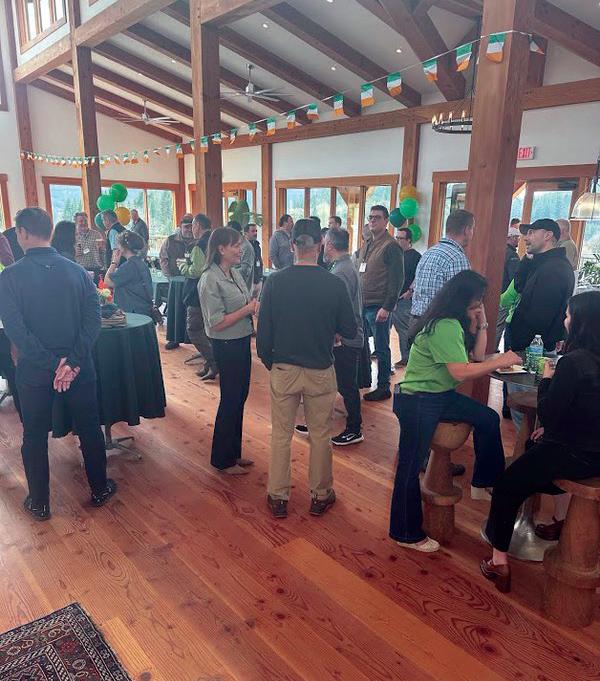
PATRICK LUMBER CO , a specialty lumber wholesaler and manufacturer based in Philomath, Or., welcomed employees, industry partners, and community members to its annual St. Patrick’s Day Open House March 13 at Timber Hall. The event included guided tours of Patrick Lumber Manufacturing and Patrick Hardwoods’ newly established hardwood mill, showcasing how raw timber is transformed into specialty wood products.
range of learning styles with a variety of content delivery methods, including instructional videos, hundreds of photos depicting characteristics found in real lumber, and interactive three-dimensional models derived from actual mill scanner data. Each of its 10 units is comprised of multiple lessons, each of which concludes with a quiz designed to confirm comprehension before learners can move to the next lesson. Subjects covered include:
stand-alone course for anyone involved in lumber sales,
purchasing, wood design, specification and use. It is a required prerequisite for PLIB’s NGR grader training curriculum designed to prepare learners to become certified mill graders. Subsequent courses comprising that curriculum will be launched in the coming weeks.
To learn more about PLIB’s education and training offerings, visit plib.org/education. To enroll in Fundamentals of Lumber Grading, go to education.plib.org.
Established in 1903, PLIB is a rules writing quality standards organization offering lumber grading and grade stamping quality control and inspection services, along with a wide range of wood product certification and registration services, including PRG 320 certification for mass timber panels. PLIB also provides experienced technical support and publishes technical standards for the glulam and laminated timber panel industry under
JAPANESE CEDAR JAPANESE CEDAR
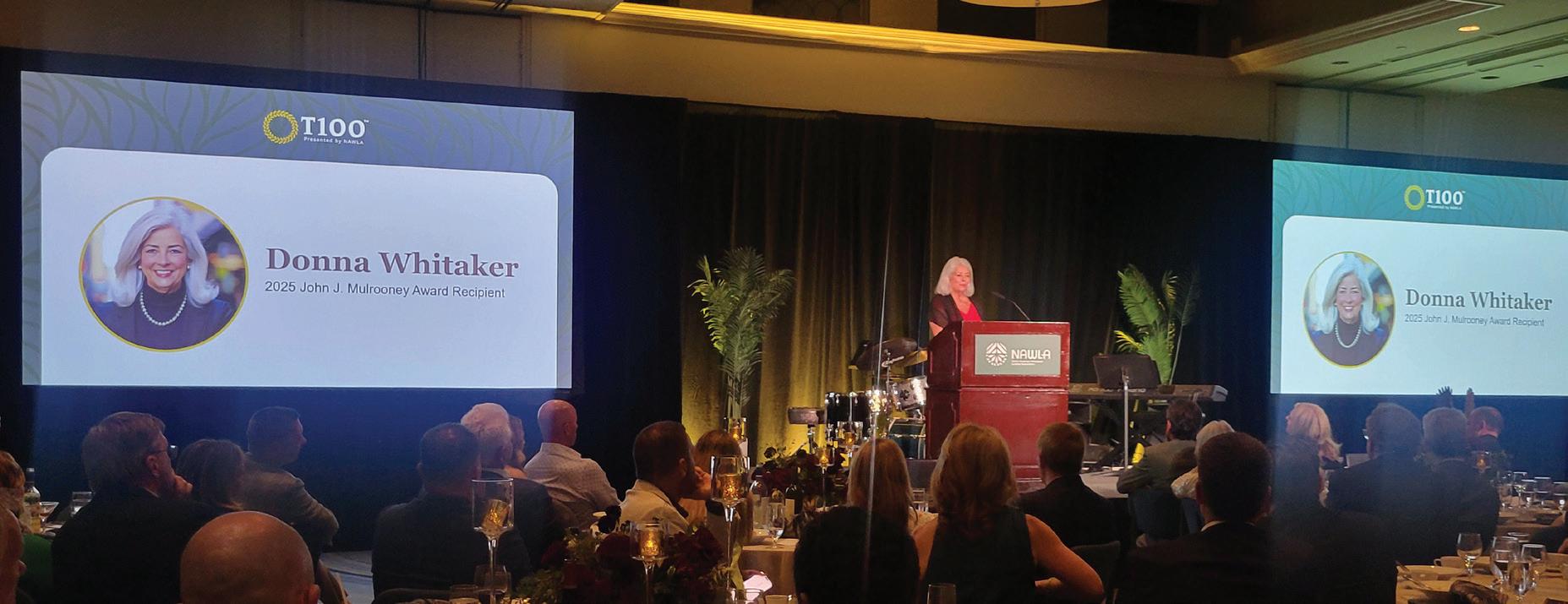
T-100: WHERE LEADERSHIP, PERSPECTIVE AND THE FUTURE OF OUR CHANNEL CONVERGE
BY MATT BRUNO, EXECUTIVE DIRECTOR, NAWLA
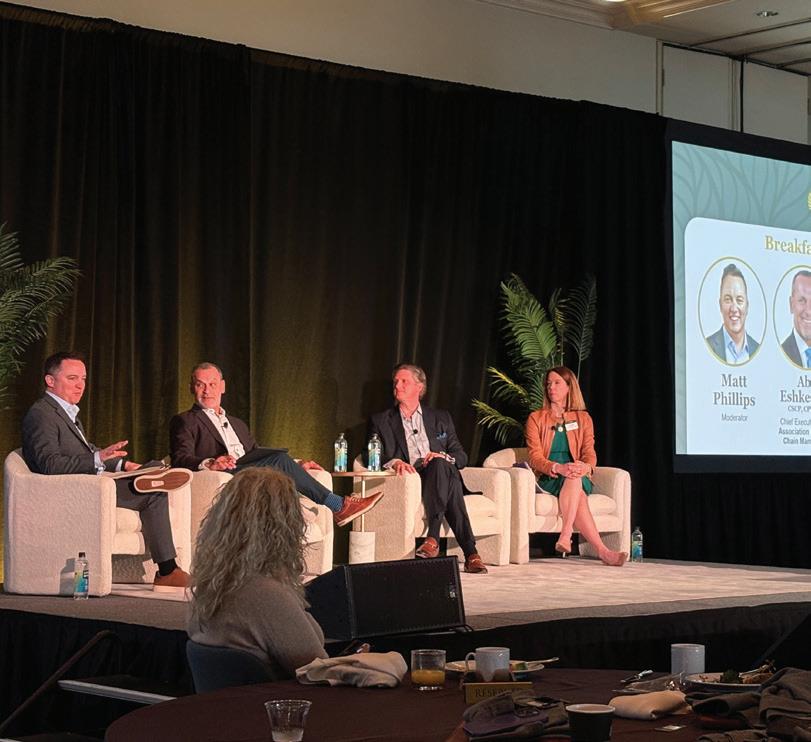
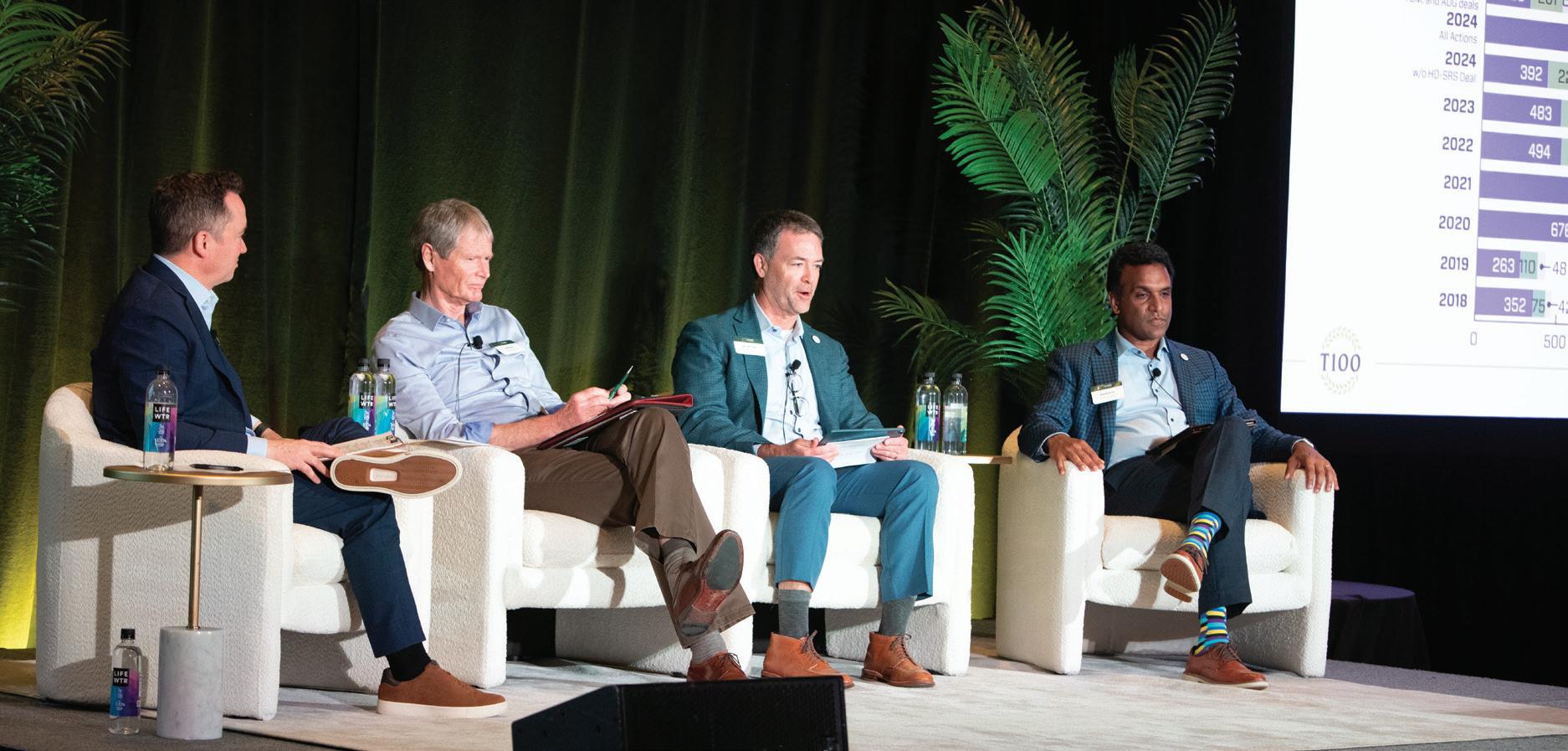
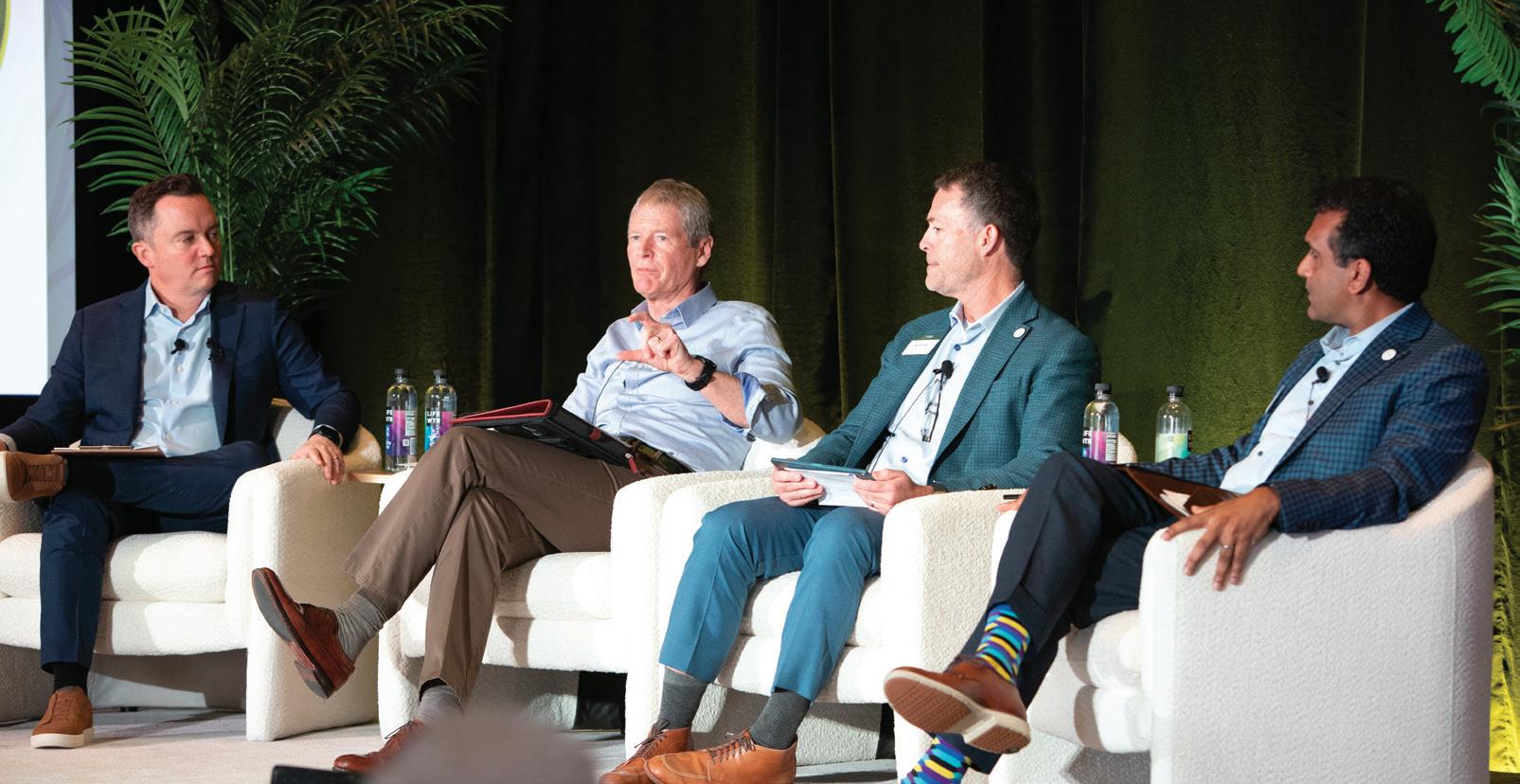
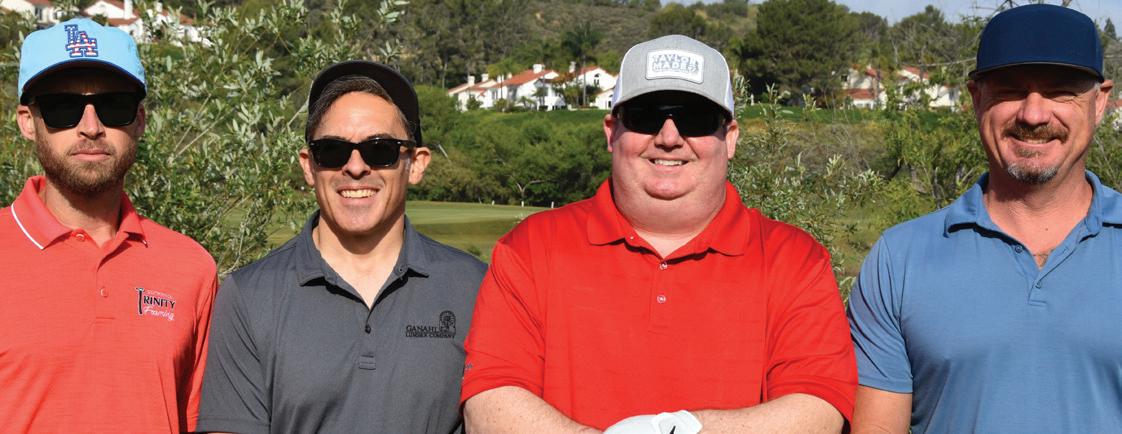
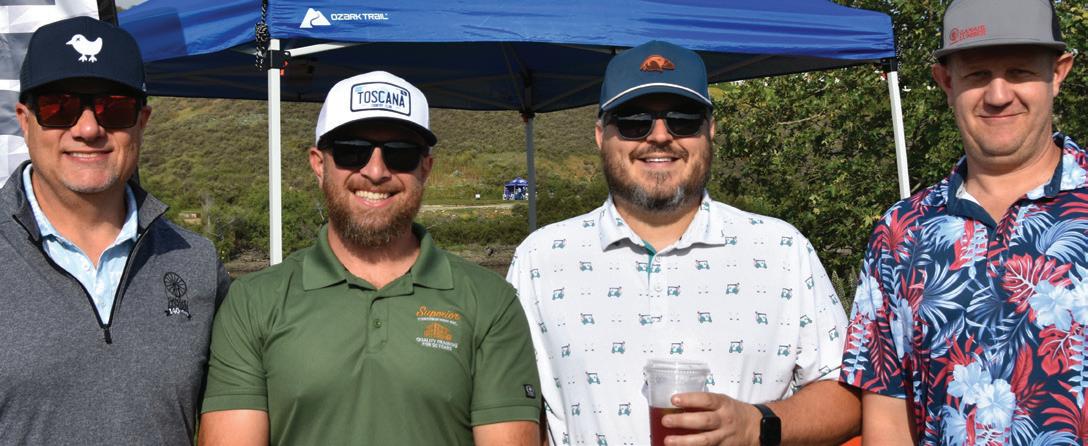
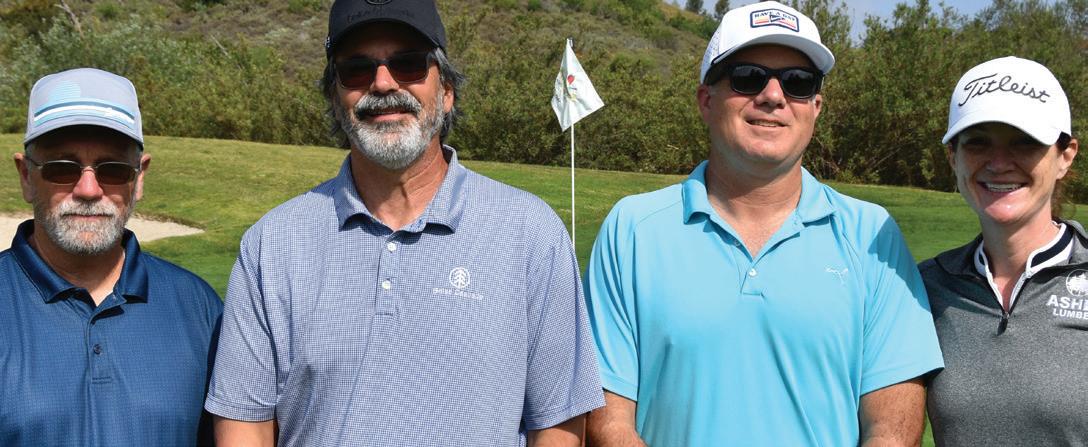
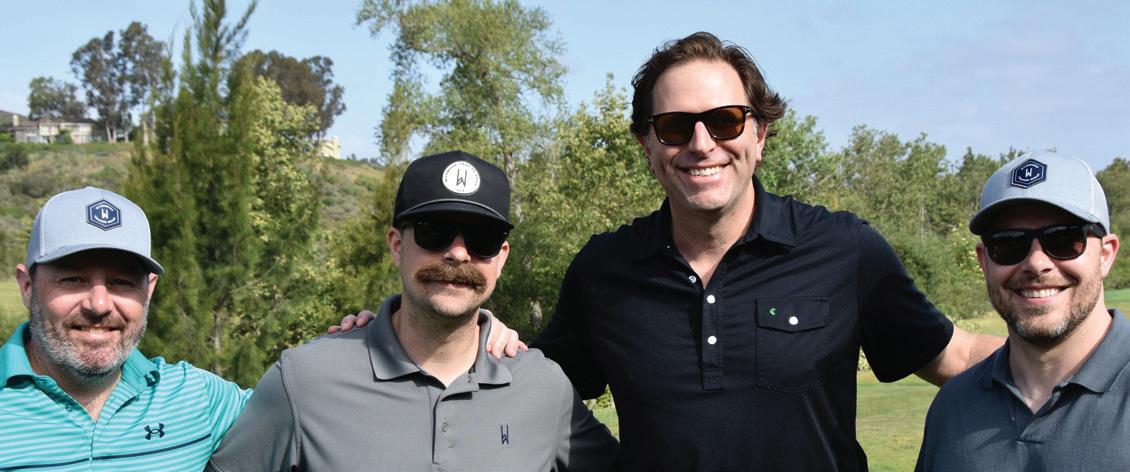
WHEN NAWLA set out to design T-100, the objective was both simple and ambitious: create an intentional, executive level environment for the owners and senior leaders who are shaping the future of the lumber and building materials distribution channel.
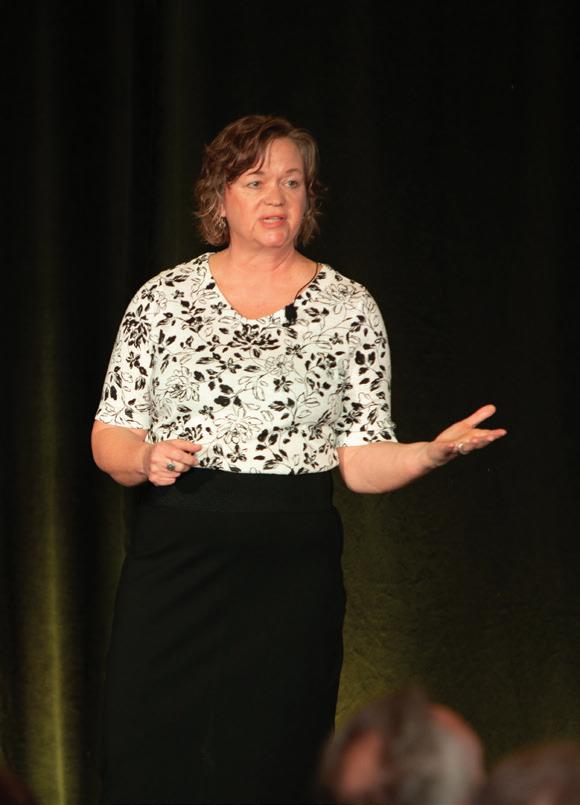
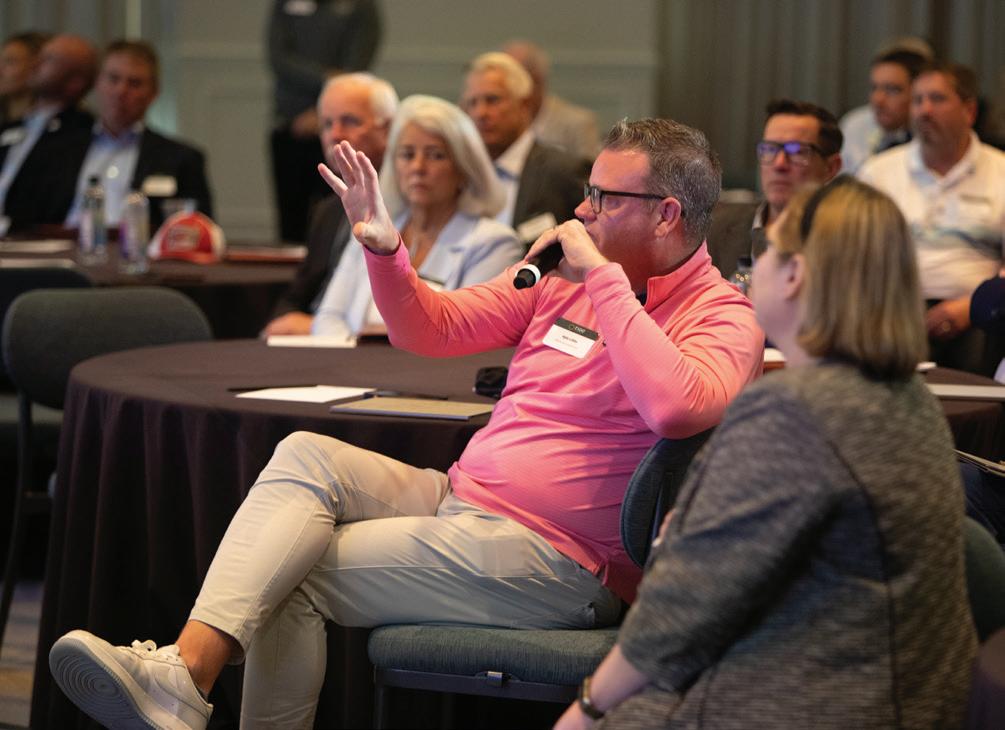
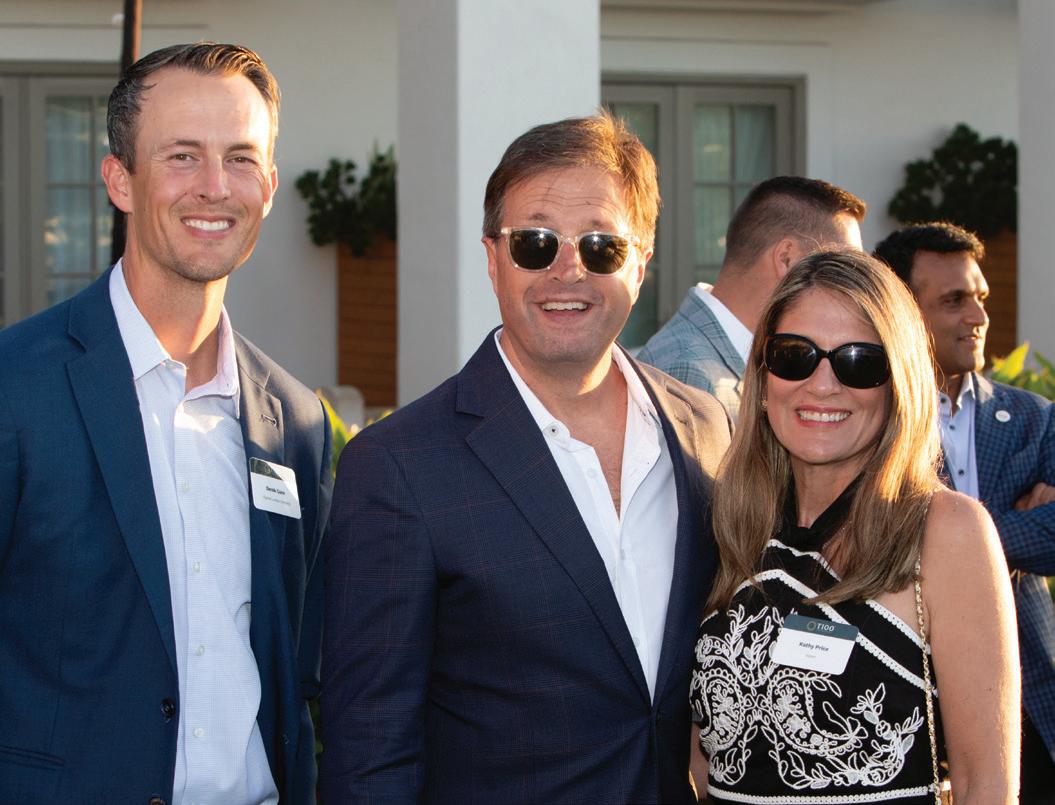
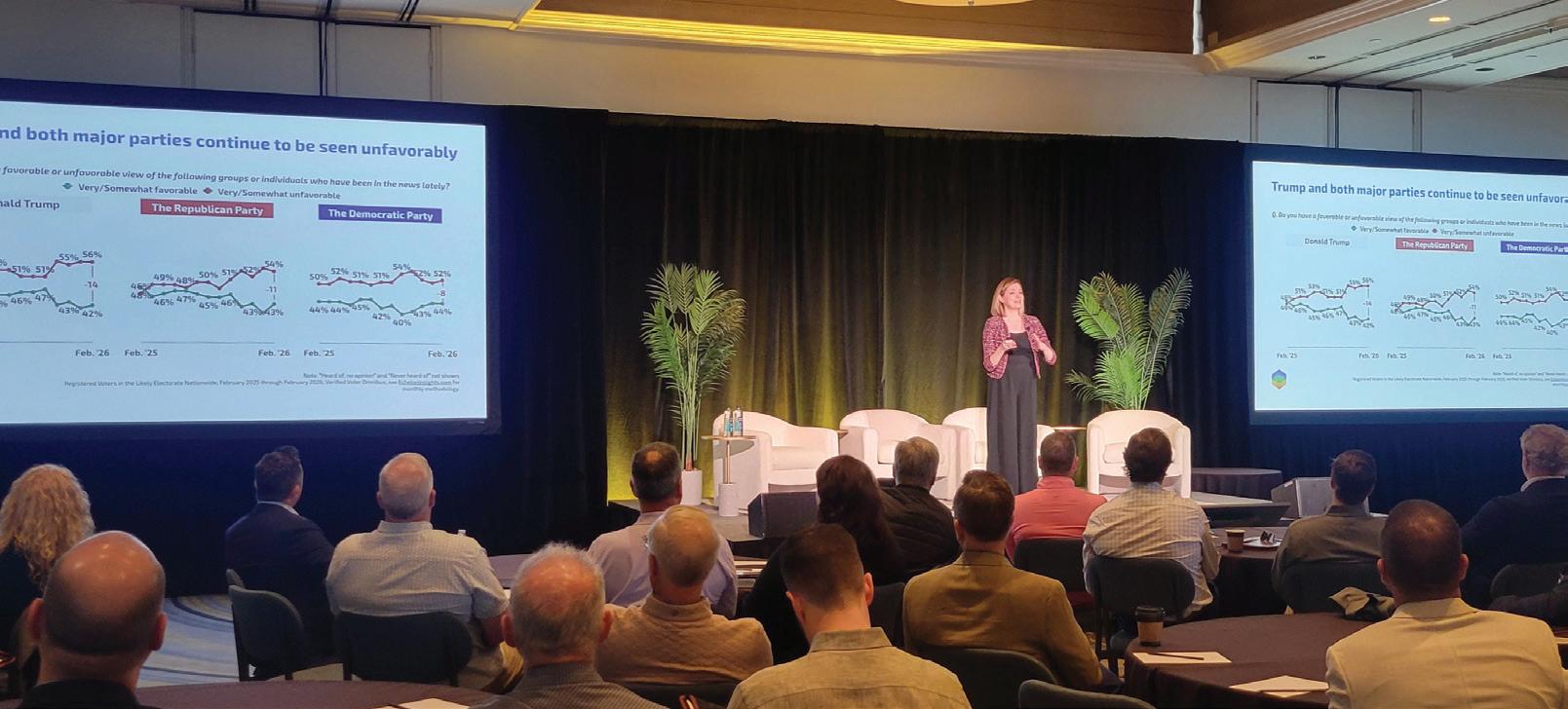
What took place at the inaugural T-100 exceeded expectations. From the opening welcome at The Ritz-Carlton, Dana Point, Ca., through every conversation, panel and shared experience, T-100 delivered on its promise to connect influential leaders, broaden perspective, and foster strategic relationships at a time when our industry is navigating extraordinary change.
“T-100 was built to bring together influential leaders from across the channel to connect, collaborate and collectively drive the future success of our industry.”
Judy Haney, Board Chair, NAWLA
As NAWLA Board Chair Judy Haney shared during the Welcome Dinner, T-100 was created with urgency and purpose. That purpose resonated deeply with attendees. In fact, 97% of participants rated their overall T-100 experience as good to excellent—with more than two thirds rating it excellent. The environment mattered as much as the agenda: 100% of attendees rated the location and overall setting for executive level engagement positively, again with more than two thirds calling it excellent.
We were also encouraged by the caliber of attendees in our inaugural year, with over 50% having the title of owner, c-suite or president, and the companies in attendance representing over $35 billion in sales revenue.
The conversations at T-100 reflected today’s realities— economic shifts, supply chain complexities, evolving customer expectations and accelerating technology. They also reinforced an enduring truth: relationships still matter.
As T-100 Committee Chair Brian Boyd noted in his opening toast, this was not another conference. It was a deliberate leadership experience.
“This even reflects NAWLA’s commitment to creating intentional, executive-level environments that support strategic thinking and industry leadership.”
Brian Boyd, Chair, T-100
Committee
That intention translated directly into impact. More than four out of five attendees shared that they made at least one new connection that could lead to a strategic opportunity. Those connections—often formed over candid peer exchanges rather than scripted programming—are exactly what T-100 was designed to enable.
Attendees themselves underscored the value of the experience: “The networking opportunities were amazing. The whole program was well thought out. I also felt the last panel was amazing and really spoke to so many challenges that we all face.”
For many, the most meaningful takeaway was not a single tactic or trend, but perspective: “As we prioritize issues related to our business, it’s important to understand issues affecting other businesses and other markets. It was very interesting to hear different people explain their definition of volatility as it exists today.”
That exchange of perspective—across markets, company models and leadership styles—is why T-100 matters now. As Judy shared with attendees, the greatest risk in times of change is standing still. T-100 exists to ensure we are not standing still, but challenging our assumptions, learning from one another and building the relationships that will shape what comes next.
The success of the inaugural T-100 is a testament to the vision of the NAWLA Board, the leadership of the T-100 Committee, and the willingness of senior executives to engage deeply and authentically with one another.
And we are just getting started.
Save the Date: T-100 2027
The Ritz Carlton, Amelia Island March 1-3, 2027
We look forward to welcoming the next group of industry leaders as T-100 continues to evolve as the LBM industry’s premier executive experience—where leaders connect, collaborate and help shape the future of our channel. MM
DMSi Frameworks 100% web-based, AI-enabled inventory & point-of-sale system
DMSi is an independent, family-owned software company providing inventory and accounting software backed by exceptional service. That's the DMSi difference.
EXECUTIVES SHAPING THE FUTURE OF OUR CHANNEL
T-100 BROUGHT together an exceptional group of owners and senior executives from across the lumber and building materials distribution channel.
• All Star Forest Products Inc.: Bill Price, Patrick Price
• Association for Supply Chain Management: Abe Eshkenazi
• BlueLinx Corp.: Leo Oei, Shyam Reddy, Kelly Wall, Mike Wilson
• Boise Cascade Building Materials Distribution: Joanna Barney, Judy Haney
• Boise Cascade Wood Products: Jeff Strom
• Capital Lumber: Derek Cone, Lance Doalson
• Disdero Lumber: Ryan Kline
• DMSi: Henry German, Anthony Muck, Josh Weiss
• Endeavor AI: Sami Senapthy, Dan Ulrich
• Epicor: Jim Houser, Eric Wolfe
• Flagship Forest Products: Alyson McLaughlin, Michael McLaughlin
• FLW International Forest Products: Lance Whittaker, Taggart Whittaker
• Forest City Trading Group: Derrick Coder, Scott Elston, Matt Vaughan
• Freres Engineered Wood: Tyler Freres
• Gorman Bros. Lumber Ltd.: Nick Arkle
• Hampton Lumber: Scott Gascho
• Humboldt Sawmill Co.: Bob Mertz, Adam Steinbuck
• Idaho Timber: Ted Ellis
• Interfor: Donna Whitaker (retired)
• Intermodal Association of North America: Anne Chettle Reinke
• International Wood Products LLC: Josh Hamilton
• J.M. Thomas Forest Products: Carl Daines
• Keiver Willard Lumber: Patti Heintzelman, Tom Slater
• LBM Advantage: David DeJoy
• Manufacturers Reserve Supply: Brian Boyd, Steve Boyd
• Murphy Co.: John Murphy Jr., Dan Semsak
• National Association of Wholesaler-Distributors: Eric Hoplin
• Nicholson & Cates Ltd.: Morgan Wellens, Dustin Wood
• Oregon Canadian Forest Products Inc.: Lauren Holm, Mike Holm
• Patrick Lumber Co.: Natalie Heacock, Chelsea Zuccato
• PLS Logistics Services: Jacque Morrow
• Power Wood Corp.: Jake Power
• PWT: Jim Enright, Dan Milfred
• Rand Wood Reman Co.: Richard Russell
• Robbins Lumber: Alden Robbins
• RoyOMartin Lumber: Bobby Byrd, Roy Martin, Scott Poole
• Saw ADD LLC: Virginia Myrfield, Warren Myrfield
• Sherwood Lumber: Kyle Little
• Sierra Pacific Industries: Mark Emmerson, Aaron Sulzer
• Skana Forest Products Ltd.: Kent Beveridge
• UFP Industries: William Schwartz
• VK North America: Sebastien Morasse
• Western Forest Products: Steven Hofer
• Weston Forest Products Inc.: Brandon Desyatnik, Mat Murray
• Wholesale Wood Products: Warren Reeves
• Wildwood Trading Group: Grant Phillips
• Winston Plywood and Veneer: Bruce Warren
• Xngage: Charbel Abou Chaaya, Joe Albrecht
• Zip-O-Log Mills, Inc.: KayCee Hallstrom, James Workman
• 526 Media Group: Patrick Adams
Representing diverse markets, business models and perspectives, these leaders joined us with a shared commitment to meaningful dialogue, strategic connection and shaping the future of our industry.
Thank You to Our Inaugural Sponsors
T-100 would not have been possible without the generous support of our inaugural sponsors. We extend our sincere thanks to all 11 sponsoring companies whose partnership helped create a world-class executive experience.
We extend special thanks to Humboldt Sawmill Co., our Platinum Sponsor, whose early and meaningful
support helped set the standard for the inaugural T-100.
We also gratefully acknowledge our Gold, Silver and Bronze Sponsors, whose commitment to NAWLA and to advancing the distribution channel played a vital role in bringing this event to life.
Platinum Level:
• Humboldt Sawmill Co.
Gold Level:
• BlueLinx Corp.
• DMSi Software
• Endeavor AI
• PWT
• Xngage
Silver Level:
• Epicor
• Saw ADD LLC
• VK North America
Bronze Level:
• Forest City Trading Group
• PLS Logistics Services
LEADERS OF INDUSTRY
TOP EXECS DISCUSS THE EVOLVING ROLE OF DISTRIBUTION
PROVING TO BE ONE of the high points of T-100, the Industry Leaders Panel sponsored by DMSi Software brought together top executives for a wide-ranging discussion on market dynamics, volatility and the evolving role of distribution.
The panel included Nick Arkle, CEO of McCormick Group; Derrick Coder, President and CEO of Forest City Trading Group; and Shyam K. Reddy, president and CEO of BlueLinx Holdings, with Matt Phillips serving as moderator.
A central theme throughout the discussion was how rapidly the industry is changing, particularly within distribution, and what that means for companies navigating consolidation, technology and shifting customer expectations.
Coder pointed to structural change in the channel itself, emphasizing that while relationships remain foundational, the flow of information and pace of innovation are reshaping how companies compete. “This distribution channel is going
“We
need to invest as an industry even in downturns—whether that’s people, logistics or service.”
Derrick
Coder, President and CEO, Forest City Trading Group
to change,” said Coder. “The importance of information flow [and] technology changes…are underestimated today, but remembering that this still is a relationship industry, that’s not going to change.”
Arkle expanded the conversation beyond traditional supply chain thinking, highlighting how relation-
“Independent distributors are no longer just inventory providers— they’re the connective tissue of resilient supply chains.”
Nick Arkle, CEO, McCormick Group
ships with communities and First Nations are redefining business in British Columbia. “The forest industry is a whole lot more than just logs to lumber,” he said, “Companies are actually finding themselves spending more and more time on building the trust around stewardship of the land.”
Reddy focused on the value proposition of distribution in the increasingly competitive home ownership environment. “For any two-step distributor, especially with all the acquisition activity happening out there, it’s like being in a submarine in the middle of the ocean where you have all this pressure that’s basically trying to get you out of existence,” he said. “If you can provide the right values… and leverage value-proposition and technology to do things faster, better or more cost effective, then price becomes less relevant.”
Volatility was another key topic of the discussion. Rather than attempting to predict cycles, panelists emphasized discipline, diversification and continued investment.
Coder underscored the importance of staying committed during downturns. “We don’t try to predict
“Everybody benefits from what two-step can provide, especially as we branch out in terms of services.”
Shyam K. Reddy, President and CEO, BlueLinx Holdings
cycles. I think about the lumber, the building products cycles, it’s not one cycle; it’s multiple cycles,” he said. “There’s multiple products, multiple regions, and sometimes they don’t even move in the same direction.”
Arkle offered a longer-term perspective, framing volatility as part of a broader economic rhythm. “It’s more a marathon than a sprint,” he said. “Let’s keep doing what we’re doing, getting our customers a high-value product because at the end of the day, there’s going to be a
demand for it.”
The panel also addressed forecasting challenges, with consensus that uncertainty remains a constant. Coder warned against overreliance on macro indicators. Reddy added that internal execution often matters more than external noise.
On consolidation, panelists agreed that while disruption can reset relationships, it also creates opportunity. Coder said consolidation presents an opportunity to build a new relationship and to provide new services.
Despite ongoing shifts, including technology adoption, M&A activity, and evolving customer expectations, the discussion repeatedly returned to a consistent conclusion: companies that invest in relationships, adaptability and long-term value creation will be best positioned to navigate whatever comes next. MM
BREAKFAST OF CHAMPIONS
PERSPECTIVE AT THE INTERSECTION OF LEADERSHIP, SUPPLY CHAIN & STRATEGY
T-100 CONCLUDED March 18 with a session that many attendees described as the defining moment of the event: the Breakfast of Champions panel. Designed to elevate thinking beyond individual company or sector challenges, the discussion brought together national association CEOs whose work sits at critical intersections of the broader supply chain and distribution ecosystem.
In post-event feedback, the panel was referenced more often than any other session as the highlight of T-100. One attendee captured the sentiment succinctly: “The Wednesday morning session was the best part of T-100.”
Moderated by Matt Phillips as emcee, the panel featured: Abe Eshkenazi, CSCP, CPA, CAE, CEO, Association for Supply Chain Management; Eric Hoplin, President and CEO, National Association of Wholesaler-Distributors; and Anne Chettle Reinke, President and CEO, Intermodal Association of North America. Together, the panelists delivered a candid, fast-paced conversation on volatility, leadership decision making, and the structural shifts reshaping how businesses compete and collaborate.
Brian Boyd, T-100 Committee chair, noted, “The caliber of the perspective in that room—and the candid conversation around supply chain dynamics and strategic leadership—is exactly why T-100 matters. These are the conversations that help shape what’s next for our industry.”
Throughout the discussion, a common theme emerged: resilience today is built on adaptability, insight and informed leadership judgment—not efficiency alone.
From a supply chain perspective, Eshkenazi emphasized that cost-optimized global networks are becoming increasingly vulnerable as geopolitics, climate disruption and regional conflicts reshape sourcing and logistics strategies. He urged leaders to rethink traditional approaches and build greater optionality into their supply chains.
Hoplin expanded on the evolving role of distributors, noting that independent distributors have become central
“Leaders need to move from static sourcing strategies to dynamic portfolio management—building optionality into logistics lanes and stress-testing their networks.”
Abe Eshkenazi, ASCM
“Independent distributors are no longer just inventory providers— they’re the connective tissue of resilient supply chains.”
Eric Hoplin, National Association of Wholesaler-Distributors
to supply chain resilience. By leveraging data, technology and partnerships, distributors help create flexibility and continuity when disruption strikes—while also redefining how distribution networks compete and collaborate.
Data shared during the panel discussion reinforced how quickly the industry is moving in this direction. A recent National Association of Wholesaler-Distributors survey revealed 78% of distributors are already using AI today, many in multiple areas of their business. That use of technology is supporting a shift from “just in case” inventory management to precision buffers using predictive AI.
“Planning for investment during market uncertainty requires strategizing through multiple scenarios.”
Anne Chettle Reinke, Intermodal Association of North America
Reinke added a logistics and infrastructure lens, highlighting external forces executives must factor into strategic planning, from delayed roadway infrastructure improvements to regulatory and tariff uncertainty. She emphasized that long-term competitiveness requires scenario-based planning and strong partnerships across the transportation ecosystem.
The Breakfast of Champions delivered precisely what T-100 was designed to provide: broader perspective, candid dialogue, and insights that extend beyond any single organization or sector, empowering leaders to return to their businesses better equipped to navigate what lies ahead.
NAWLA extends its sincere thanks to BlueLinx Corp. for its generous sponsorship of the session, helping close out T-100 with a thoughtful, forward-looking conversation. MM
INSPIRATION AND CONNECTION
THE BUSINESS BRIEFING
MAKING SENSE OF MARKET VOLATILITY IN A DATA-DRIVEN WORLD
T-100 OPENED Tuesday morning with a session designed to do exactly what senior leaders need most in a volatile environment: separate signal from noise.
In her opening keynote—“The Business Briefing”— renowned pollster and strategist Kristen Soltis Anderson delivered a clear-eyed analysis of the political and economic landscape shaping today’s operating environment—and what it means for leaders across the lumber and building materials distribution channel.
As founding partner of Echelon Insights, Anderson brings a rare combination of political intelligence, advanced analytics and business perspective. Her work with Fortune 500 companies, trade associations and policymakers gives her a unique vantage point into how public sentiment influences markets, regulation and consumer behavior long before trends appear in traditional business metrics.
Throughout the session, Anderson emphasized that while uncertainty feels acute today, it is not evenly distributed—and perceptions matter as much as fundamentals. Drawing on national polling data, she noted that more than half of voters currently believe the U.S. economy is getting worse, a view that has remained persistent despite periods of economic stabilization.
Cost pressures are a major driver of that sentiment. According to data from Echelon Insights, more than three-quarters of Americans describe essentials such as groceries, household utilities and housing as expensive, reinforcing why inflation and cost of living remain dominant concerns across demographic and political lines. For distributors and suppliers, this environment places a premium on value, reliability and clear communication with customers who are increasingly cost sensitive.
Another key theme of the Business Briefing was the importance of understanding how economic and political perceptions change—not just what the latest numbers say. Anderson cautioned against overreacting to individual data points or headlines, urging leaders instead to look for shifts that show consistency and magnitude over time.
She also highlighted growing partisan divergence in how Americans evaluate economic conditions, noting that perceptions can shift rapidly based on political context
“One great thing about polls is we expect them to be a little noisy. The goal isn't to panic over individual shifts, but to identify patterns that are moving steadily—and meaningfully—over time.”
Kristen
Soltis Anderson, Echelon Insights
even when underlying conditions change little. However, despite increasing polarization, voters across parties consistently rank cost of living and jobs among the most important issues—a reminder that fundamentals still anchor public priorities.
Looking ahead to the 2026 midterm landscape in the United States, Anderson shared data showing high and rising voter motivation, particularly among highly engaged voters—with Democrats outpacing Republicans in being “extremely motivated” to vote in the 2026 midterms by 15%. Anderson shared that voter motivation and the impact of heightened global geopolitical tensions are increasing the likelihood that the U.S. House of Representatives will have a shift in control, which could alter the legislative environment for business.
Policy uncertainty, messaging volatility and rapid shifts in regulatory focus are more likely to occur in the short term, which are all factors that executives must factor into strategic planning.
By grounding a complex external environment in rigorous data and practical interpretation, Anderson set the tone for T-100: informed, disciplined and future focused. Her Business Briefing equipped attendees with a clearer framework for understanding the forces shaping markets—and for making strategic decisions amid continued uncertainty.
NAWLA extends its sincere thanks to PWT for sponsoring the Business Briefing and helping launch the inaugural T-100 with insight, clarity and perspective. MM
A LEGACY OF LEADERSHIP
ONE OF THE MOST meaningful moments of T-100 took place on Tuesday evening, March 17, when NAWLA honored Donna Whitaker as the recipient of the 2026 John J. Mulrooney Award—the highest individual honor bestowed by NAWLA.
Presented during a special dinner at T-100, the Mulrooney Award recognizes leaders whose character, service and contributions reflect the legacy of John J. Mulrooney, a longtime lumber wholesaler and NAWLA executive whose commitment to people, education and integrity helped shape the association more than four decades ago.
As NAWLA Board Chair Judy Haney shared in her introduction of the award, “The John J. Mulrooney Award reflects the best of who we are—and the best of what we aspire to be.” It stands as both a reflection of NAWLA’s values and an aspirational marker for leadership across the lumber and building materials distribution channel.
This year’s presentation carried special significance. Whitaker is the first woman to receive the Mulrooney Award in NAWLA’s more than 130-year history—a milestone reflecting both her individual impact and the industry’s evolving leadership.
Over a career spanning more than three decades, Whitaker has shaped the lumber and building materials sector through exceptional leadership and a deep commitment to developing others. Her service to NAWLA mirrors that dedication, including five years on the Board of Directors, seven years of leadership on the Leadership Summit Committee, impactful work on the Southeast Regional Committee and continued involvement on the T-100 Committee.
In presenting the award, NAWLA Executive Director Matt Bruno emphasized that Whitaker’s influence extends far beyond formal roles or tenure. As Whitaker herself shared during her acceptance speech, “Leadership isn’t about the title on your business card. It’s about the people you influence, the culture you create and the opportunities you create for others to succeed.”
Her leadership aligns closely with NAWLA’s strategic pillars of expansion, engagement and education—and has helped strengthen the association and the industry at large.
That sentiment was echoed throughout the evening. Scott Elston, Forest City Trading Group, reflected on her authenticity, accountability and generosity—qualities that
WHITAKER RECEIVES MULROONEY AWARD
have earned respect across every corner of the channel: “When you compare the history of this award and what it embodies, I could not think of a better ambassador than Donna Whitaker.”
That influence was felt just as strongly by those who had the opportunity to lead alongside her. Steven Hofer, Western Forest Products, who earlier worked with Whitaker at Interfor, reflected on her approach to leadership and culture: “What always stood out to me about Donna was how intentionally she built culture, particularly across newly acquired sawmills in the South. She leads the right way—with integrity, a strong customer focus and a genuine commitment to developing future women leaders.”
“This award honors something far more meaningful—a lifetime of showing up... My plans are to continue to hold the door for others so they can gracefully enter our industry.”
Donna Whitaker, Interfor (retired)
Throughout the evening, tributes highlighted not only Whitaker’s professional accomplishments but also her role as a mentor, advocate and builder of community—particularly her efforts to support women entering and advancing within the industry. Her leadership has helped foster connection, inclusion and opportunity, leaving a lasting imprint on both NAWLA and the broader distribution ecosystem.
The John J. Mulrooney Award is more than a recognition of past achievements—it is a beacon for the future. In honoring Donna Whitaker, NAWLA celebrates a legacy of service, stewardship and integrity, and a leader whose impact will continue to shape the industry for years to come. MM
Watch the video presented during the Mulrooney Award Dinner celebrating Donna Whitaker: https://www.youtube.com/watch?v=LljvP-PiWts
BLACK OUTDOOR ACCENTS
Simpson Strong-Tie is expanding its Outdoor Accents Essentials collection of decorative hardware with a range of new black powder-coated connectors and fasteners. Designed for easy installation, the connectors and fasteners allow pros and DIYers alike to build all sorts of outdoor structures.
Made of ZMAX-galvanized steel for superior corrosion resistance, the new offerings include: AC4PC/ AC6PC adjustable post cap, H1APC and H2.5APC hurricane ties, L70PC/ L90PC L-shaped reinforcing angle, LCE4PC light post cap for end condition, LSCPC adjustable stringer connector, ML24PC and ML26PC medium angles, RPBPC retrofit post base, TA9PC and TA10PC staircase angles, and Outdoor Accents connector screws and heavy-duty connector screws.
STRONGTIE.COM (800) 999-5099
COASTAL-TONED DECKING
Deckorators’ newest Venture decking line color, Shoreline, features a soft, light coastal-inspired tone designed to brighten outdoor spaces and complement modern exterior designs. Its contemporary woodgrain texture mimics the natural look of real wood while maintaining a smooth, refined finish.
The composite line is engineered to resist fading, staining, moisture, rot and insect damage.
DECKORATORS.COM (800) 556-8449
MATCHING DECK FASTENERS
FastenMaster has expanded its Cortex Hidden Fastening System to include compatibility across the full line of Fiberon decking.
Long used for hidden fastening in composite and PVC decking, Cortex now offers 29 color-matched plug options engineered specifically for Fiberon’s Promenade and Paramount PVC decking, and Concordia, Sanctuary, and Good Life composite collections.
Cortex plugs are manufactured directly from deck boards, ensuring a 100% perfect color and texture match for a fastener-free finished surface.
FASTENMASTER.COM (800) 518-3569
RAIL IN STYLE
Oldcastle APG is introducing RDI Fusion Rail, a sleek, modern railing system that delivers aluminum aesthetics ideal for builders seeking premium style without premium material pricing.
Fusion features wood-free Composicore construction paired with AlumiCast’s minimalist black finish. A matching gate kit helps ensure design continuity across decks, balconies and outdoor living spaces.
AIumiCast is a breakthrough surface technology that delivers the look of aluminum with the value and performance advantages of composite materials, including no splitting, rotting, warping or molding.
RDIRAIL.COM (877) 665-2220
Re Reddwwood i ood
thrives in some of the most productive timberlands in the world. Redwood is known for its timeless durability without the use of chemicals. Due to its flawless formation, there has never been a Redwood recall. There is a grade of Redwood for every application, every budget, and every customer.
“Growing beyond measure.”
Call or visit us today. Our family of Redwood timberland owners will continue to be your reputable and reliable source of Redwood.
MODULAR MOUNTING
FLEX is revolutionizing workspaces with the introduction of its Track-Lock wall-mount storage system. The modular system features nearly two dozen hooks, racks, rails and shelving for organizing and storing tools, outdoor power equipment, and more. It comes with 32" wall-mounted rails that support up to 75 lbs.
A quick-clamp tool-free mounting system allows for easy adjustments of the various attachments, including C-hooks, U-hooks, S-hooks, racks and shelves. Each easily snaps onto the rails and is held securely in place with non-slip rubber contact points. Removing the attachments is as simple as pushing a button for easy release.
FLEXPOWERTOOLS.COM (833) 353-9496
WINDOW COLLECTION
MITER Brands has unified its Restorations Series, Vanguard Series, and Sunrise Series vinyl windows and doors into a new premium replacement brand, Sunrise Collection.
Previously offered as individual product lines, the windows and doors are thoughtfully designed to flood spaces with natural light, while delivering clear views and lasting comfort year after year.
They are powered by the 4SG Fusion Bonded Spacer System, FiberCore reinforced frames, UltraCore polyurethane insulation, and triple weatherstrip barriers, which work together to provide improved energy performance, added long-term value and durability, and enhanced comfort in the home environment.
SUNRISECOLLECTION.COM (941) 480-1600
,
FRT MODIFIED WOOD
Maximo Wood is rolling out Thermo Ayous with BurnBlock technology, an advanced wood treatment that meets rigorous fire code requirements and demanding performance with the on-trend beauty of natural wood. Because it is thermally modified, Thermo Ayous is very stable, lightweight and available in a wide variety of widths.
BurnBlock technology is a fire-retardant treatment applied to wood through a vacuum-pressure process that penetrates the material at the cellular level, delivering durable, consistent fire resistance throughout the board. Products can be cut, profiled and machined after treatment without diminishing fire performance. Products are WUI (Wildland–Urban Interface) compliant.
MAXIMOWOOD.COM (888) 987-2224
ENTRY DOOR ELEGANCE
Created for the entrances of contemporary homes, Novatech’s new Infinite Black doorglass features a fine V-grooved, reeded texture and shadowy black finish. It filters light while gently obscuring the view, adding depth, elegance and privacy. The deep black tint reflects sunlight during the day and appears a softer gray at night to let additional light into the home.
The doorglass is crafted with triple-insulated glass for superior energy efficiency. Each unit is assembled with low-E coatings and argon fill to enhance thermal performance. The glass in Infinite Black is also thicker than typical triple-insulated glass, providing additional energy performance.
GROUPENOVATECH.COM (800) 257-8641
SOUTHERN CALIFORNIA GOLF TOURNAMENT
Byron Grabinger. [7] Jesse Jackson, Lance Ford, Steve Ford, Frank Bader. [8] Taylor Rios, Erika Behling, Jackie Vega, Saul Nunez. [ 9 ] Erik Drinkward, Mike Saggiani, Sean Elliott, Oliver Thomas. [10] Ross Valine, Thomas Stremlau, Sean Fogarty, Emily Morgan. [11] Ricky Lizarraga, Josh O’Quinn, Carlos Lucas, Freddi Partida. [12] Al Reed, Frank Huerta, Pat Woolstenhulme, Greg Scott. (More
WEST COAST LBMA held its Southern California golf tournament April 9 in Irvine, Ca.
[1] Anthony Ypez, Jake Schauer, Craig Fisher, Chris Lindsay. [2] Alex Gilmer, Bryan Callaway, Johnny Martin. [3] Andy Frambach, Mike Caccavale, Mike Smith, Jason Watson. [4] Danny Andrea, Madison Miller, Rick Deen, Josh Coyne. [5] Myles Ramsey, Ken Day, Josh Householder, Vern O’Connor. [6] Eric Pitner, Jordan Lynch, Rex Klopfer,
FARMS Golf Club hosted the West Coast LBMA tourney (continued from previous page): [13] Andy Jones, Matt Ferguson, Grant Phillips, Jake Moriniti. [14] Kim Wood, Micah Orr, Lam Huyvu, Christine Taylor-Born. [15] Omar Diaz, Luis Rojas, Scott Sexton, Darryl Guzman. [16] Jaeson Fikse, Vaughan Barker, Damien Simpson, Keith Hitchcock. [17] Jeff Schauer, Eli Lopez, Brandon Ray, Steve Schroeder. [18] Miguel Chavez, Tony Pena, Mark Macdonald, Mo Shearer. [19] Ryan Smith, Anthony Kaser, Brock Lee, Robert Vera. [20] Joe Alotta, Phil Velez, Chris Johnson, Dan May. [21] Jason Godfrey, Sean O’Bannon, Michael Ochoa, Mason Finnerty. [22] Dan Tumilty, Brandon Wert, Sean Cummings, Mike Poirier. [23] Mario Yruretagoyena, Josh Orr, Paul Reid, Camero Rankin. [24] Jake Spurzen, Marwan Salem, Joe Thielen, Juan Guzman. [25] Aaron Eckermann, Joshua Myers, Jacklyn
WEST COAST LBMA
STRAWBERRY
Norihiro, Russ Rust (More photos on next page)
SNAKES ALIVE! Golfers picked up a slithery straggler during the West Coast LBMA’s annual Southern California golf tournament (continued from previous pages). [26] Ian Souza, Troy Loggins, David Frick, Matt Fink, Joe Dressel, Gavin Morris. [ 27 ] Brooke Peterson, Connie Nijst. [ 28 ] Scott Middaugh, Jeff Norihiro, John Seely, Derrick Raines. [29] Grant Pearsall, Dan Delaney, Steve Mitchell, Brad Satterfield. [ 30 ] Frank Benjamin, David Vigil, Daniel Hines, Nate Barrett. [31] Jason Schulze, Robby Ligtermoet, Jerry Arriaga, David Label. [32]
Guzman, Jonathan Shelton, Issac Espinoza. [33] Jason Moss, Barbie Molina, Leo Delgado. [34] Kevin Phelps, Chris Glass. [ 35] Lance McCullough, Jose Garcia, Tianna Roman, Alex Gamez. [ 36 ] Jason Boeschen, Ethan Brouwer, Parker Simmons, Scott Ryan. [ 37 ] Jacqueline Palazzolo, Lovelle Williams. [38 ] Nick Matute, Reyes Romero, Brad Schneider, Eric Matute. [39] Edgar Campos, Edgar Llamas, Bryce Miller. [40] Augie Venezia, Betsy Bendix.
Elizar
Generated
1.5 BILLION BOARD FEET
of incremental demand.
Influenced
1,536 PROJECTS
580 MM BF
to build with wood resulting in of incremental lumber consumption.
The Softwood Lumber Board invests industry funds to expand lumber’s role in the built environment and capture greater market share across key segments. SLB investments have now generated 16.7 BBF of incremental demand since 2012, including 1.5 BBF in 2025 alone.
IN 2025, THE SLB:
Influenced of wood project construction.
62 MILLION SQUARE FEET
By facilitating wood use, produced a carbon benefit of 3.5 MILLION METRIC TONS OF CO2.
129,700 HOURS OF EDUCATION
Delivered to architects, engineers, developers, contractors, and code officials from SLB-funded programs.
The average incremental demand from SLB investments is in 2025.* over the lifetime of the SLB.*
$1 = 85 BF $1 = 77 BF
Every $100 the SLB invests in programs leverages from the government and other wood products manufacturers. $93 IN ADDITIONAL OUTSIDE FUNDING
Edward L. Gavotto, longtime San Diego area lumberman, passed away on April 4. He was 93.
After graduating from San Diego High in 1951, Ed went to work for his father, Carl Gavotto, at South Bay Lumber Co., Chula Vista, Ca. He became manager in 1958 and closed the yard in 1960. He then worked for Empire Lumber until 1970, then on to American Mill & Lumber, Chula Vista, retiring in 1994.
Ed had been an active member of Hoo Hoo International since 1955, being elected president of the San Diego chapter in 1964 and named to the Supreme Nine in 1988 and 1992.
Paul Wood II, 67, Arizona lumber salesman, died on March 3 after a lengthy battle with Alzheimer’s disease.
After studying business and marketing at West Virginia University, he began his four-decade career in
Atlantis Rail Systems www.atlantisrail.com
Bowers International www.j-wood.org Capital www.capital-lumber.com
DMSi www.dmsi.com
Do it Best Corp. www.doitbestonline.com
Doman Building Materials www.domanbm.com
Elk Creek Forest Products www.elkcreekforest.com
FastenMaster www.fastenmaster.com
Huff Lumber Co. www.hufflumber.com
Humboldt Sawmill www.mendoco.com
International Wood Products www.iwpllc.com
lumber sales at Alliance Lumber and Ray Lumber, both in Glendale, Az.
James Lawrence Marshall, former manager of Copeland Lumber, Scappoose and McMinnville, Or., died on Feb. 9 at the age of 89.
After high school, Jim joined the U.S. Navy as a medic, serving in Japan and Korea. He began his lumber career with Copeland in 1968, relocating to the McMinnville location in 1973. He spent the rest of his career in the local lumber and construction industries, including operating his own yard with sons David and Dale.
David Erwin Gibson IV, retired VP of Gibson Lumber Co., Albuquerque, N.M., died on March 11 at the age of 77. David obtained a degree in business administration from Colorado College, then worked for many years at the family lumber business. After the yard closed in 1982, he became a stockbroker.
Listings are often submitted months in advance. Always verify dates and locations with sponsor before making plans to attend.
Hardlines Distribution Alliance – May 4-7, group merchandising conference, Atlanta, Ga.; www.hdaworks.com.
SFI – May 5-7, annual conference, Montreal, P.Q.; www.forest.org.
Transload Distribution Association – May 5-7, annual conference, Savannah, Ga.; www.tdana.com.
Wood Industry Conference – May 5-7, El Conquistador Resort, Puerto Rico; www.woodworkingindustryconference.com.
North American Wholesale Lumber Association – May 6, regional meeting, Terminal City Club, Vancouver, B.C.; www.nawla.org.
SRS Distribution Northern California Building Expo – May 7, PayPal Park, San Jose, Ca.; dominique.sev@srsbuildingproducts.com.
Western Red Cedar Lumber Association – May 10-15, Cedar School; May 13-15, Cedar Summit, Victoria, B.C.; www.realcedar.com.
Western Forestry & Conservation Association – May 12-14, Mapping the Course & OFRI Workforce Summit, Riverhouse Lodge, Bend, Or.; www.westernforestry.org.
Oregon Women in Lumber – May 14, 2026 Women’s Summit, DoubleTree, Portland, Or.; www.zeffy.com/en-US/ticketing/owl-2026-womens-summit.
Sacramento Hoo-Hoo Club – May 14, Silver Dollar Golf BBQ, Courtyard Suites, Grass Valley, Ca.; May 15, Silver Dollar Golf Tournament, Alta Sierra Country Club, Grass Valley; www.hoohoo109.org.
Epicor – May 18-21, Insights conference, Nashville, Tn.; www.epicor.com.
Portland Wholesale Lumber Assn. – May 28, Logs to Lumber, Superior Wood Treating and Manke Lumber, Sumner, Wa.; www.pwla.net.
North American Wholesale Lumber Association – June 4, regional meeting, Amaterra Winery, Portland, Or.; www.nawla.org.
Society of Wood Science & Technology – June 7-12, annual convention, Seoul, South Korea; www.swst.org.
Deming Logging Show – June 14-15, Deming, Wa.; www. demingloggingshow.com.
National Lawn & Garden Show – June 15-17, Westgate Hotel & Casino, Las Vegas, Nv.; www.nlgshow.com.
Western Wood Preservers Institute – June 21-23, summer meeting, Grove Hotel, Boise, Id.; www.wwpinstitute.org.
Buckley Log Show – June 27-28, Buckley, Wa.; www.cityofbuckley.com.
Sedro-Woolley Annual LoggeRodeo – June 28-July 4, Sedro-Woolley, Wa.; www.loggerodeo.org.
International Conference on Reforestation Under Drought – July 7-10, Independence, Or.; www.iufro.org.
Amboy Territorial Days Logging Show – July 10-12, Amboy, Wa.; www. tdays.org.
Forest Products Society – July 14-17, international conference, Eugene, Or.; www.forestprod.org.
South Fork Loggers Day Festival– July 17-19, South Fork, Co.; www. southfork.org.
Black Bart Hoo-Hoo Club – July 18, family picnic, Sturgeon’s Mill, Sebastopol, Ca.; www.hoohoo181.org.
Mountain States Lumber & Building Material Dealers Association –July 22, golf tournament, Fossil Trace Golf Club, Golden, Co.; www. mslbmda.org.
PCBC – July 27-30, San Diego Convention Center, San Diego, Ca.; www. pcbc.com.
• 10:30 am check in
• Shotgun start
• Buffet Dinner
• Raffle prizes
• Helicopter ball drop
• Corporate & personal sponsorships available
• Closest to the hole/putting competition
FLASHBACK: FIXER UPPER MONTH
FIFTY YEARS AGO this month, The Merchant Magazine published its annual “Home Improvement Special Issue,” a long-standing tradition held in concert with promotional activities throughout the industry.
The May 1976 issue coincided with the 10th anniversary mailing of the How to Participate in Home Improvement Time, a 32-page, full-color booklet, to more than 85,000 dealers, home centers, contractors and others interested in home improvement.
Home Improvement Time—or “HIT”—was a yearround promotional campaign funded by more than 50 national manufacturers, associations and publications
FOR LBM COMPANIES brave enough to set aside their pencils and typewriters, Philips advertised a small office computer to assist businesses with their bookkeeping. Philips—a pioneer of appliances, radios, Norelco shavers, TVs and mini-cassettes though best known for its light bulbs— continued marketing home and business computers until it sold the division to Digital Equipment Corp. in 1990.
that reached over 100 million consumers annually. It also underwrote two different 24-page supplements distributed by 10,000 newspapers across the country.
For a nominal cost, retailers could join HIT and receive:
• 16-page brochures providing consumer customers with remodeling and energy-saving ideas;
• merchandising aids, including a display, poster, pennant, banner, streamer and adhesive back seal;
• an advertising kit with sheets of clip art for newspaper ads, and copy for radio and TV commercials;
• free samples and literature from the dozens of manufacturer sponsors of the promotion; and
• access to a library of 16mm how-to films that could be shown at in-store clinics.
The program was one of the most visible features of May as National Home Improvement Month, which President Lyndon B. Johnson had inaugurated in 1967.
The National Association of the Remodeling Industry picked up the mantle in the early 2000s as the premier promoter of National Home Improvement Month.
In other news of May 1976...
• Capital Lumber, Phoenix, Az., was honored by Simpson Timber Co. for selling more than 1 million ft. of Simpson redwood lumber in 1975.
Capital was also putting the finishing touches on a new yard in Albuquerque, N.M.—unsurprisingly, since a sizable portion of its volume was already shipping into New Mexico.
• Redwood Empire moved into a new 10-acre site in Morgan Hill, Ca., with plenty of extra room for future expansion—allowing the company to use the property as its headquarters to this day.
• Don Simon, Tom Crabtree and Pat Ryan formed office wholesaler Simon, Crabtree & Ryan (SCR, Inc.), Lake Grove, Or. MM
The May 1976 front cover spotlighted Rounds Lumber Co., Cloverdale, Ca., since 1967 a division of GeorgiaPacific.
REDWOOD
Like the foods we buy, when it comes to decking, we want natural and real. Redwood is always available in abundance of options. So stock the shelves! Unlike mass-produced and inferior products, Redwood is strong, reliable and possesses many qualities not found in artificial products. They maintain temperatures that are comfortable in all climates.
Redwood Empire stocks several grades and sizing options of Redwood.