




2,600 dedicated employees, and one of the most extensive product offerings of value-added treated lumber, we can deliver in ways few others can.


PRESIDENT/PUBLISHER
Patrick Adams padams@526mediagroup.com
VICE PRESIDENT
Shelly Smith Adams sadams@526mediagroup.com
PUBLISHER EMERITUS
Alan Oakes
MANAGING EDITOR
David Koenig dkoenig@526mediagroup.com
SENIOR EDITOR
Sara Graves • sgraves@526mediagroup.com
COLUMNISTS
James Olsen, Claudia St. John, Dave Kahle
CONTRIBUTORS
Dallin Brooks, Jason Gesser, Brennah Hutchison, Andy Johnson, Paige McAllister, Dana Spessert
ADVERTISING SALES
(714) 486-2735
Chuck Casey • ccasey@526mediagroup.com
John Haugh • jhaugh@526mediagroup.com
Nick Kosan • nkosan@526mediagroup.com
DIGITAL SUPPORT
Katherine Williams kwilliams@526mediagroup.com
CIRCULATION/SUPPORT info@526mediagroup.com
151 Kalmus Dr., Ste. J3, Costa Mesa, CA 92626
Phone (714) 486-2735
CHANGE OF ADDRESS Send address label from recent issue, new address, and 9-digit zip to address below. POSTMASTER Send address changes to The Merchant Magazine, 151 Kalmus Dr., Ste. J3, Costa Mesa, CA 92626. The Merchant Magazine (ISSN 7399723) (USPS 796-560) is published monthly at 151 Kalmus Dr., Ste. J3, Costa Mesa, CA 92626 by 526 Media Group, Inc. Periodicals Postage paid at Santa Ana, CA, and additional post offices. It is an independently-owned publication for the retail, wholesale and distribution levels of the lumber and building products markets in 13 western states. Copyright®2026 by 526 Media Group, Inc. Cover and entire contents are fully protected and must not be reproduced in any manner without written permission. All Rights Reserved. We reserve the right to accept or reject any editorial or advertising matter, and assumes no liability for materials furnished to it. Opinions expressed are those of the authors or persons quoted and not necessarily those of 526 Media Group, Inc. Articles are intended for informational purposes only and should not be construed as legal, financial or business management advice, nor an endorsement of any company, product, service or individual referenced.
Volume 105 • Number 2


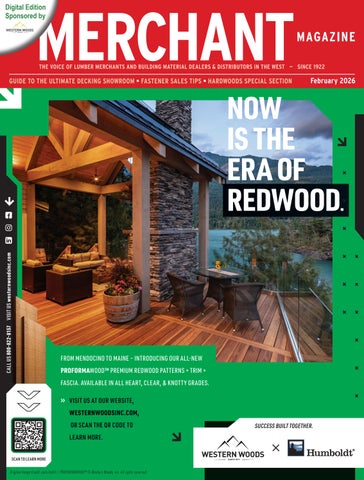
Like the foods we buy, when it comes to decking, we want natural and real. Redwood is always available in abundance of options. So stock the shelves! Unlike mass-produced and inferior products, Redwood is strong, reliable and possesses many qualities not found in artificial products. They maintain temperatures that are comfortable in all climates.
Redwood Empire stocks several grades and sizing options of Redwood.


A
5
4
SPECIAL
National Hardwood Lumber Association presents a deep dive into all the latest on hardwoods, including marketing efforts, a lumber grade breakdown, strategies to fight “greenwashing,” update on urban wood, and a sobering production report


ENDURE™ DOUBLE HUNG WINDOWS WITH INTERNAL GRIDS

HARBOR MILL™ SHINGLE SIDING IN SANDALWOOD

SADDLEWOOD SHAKE METAL ROOFING


WOODBRIDGE NATURAL CUT™ MANUFACTURED STONE

SIGNET® FIBERGLASS
DOOR WITH PRIVACY
GLASS

BOARD ‘N BATTEN IN
ProVia is your one source for professional-class building products
Use the QR code to learn more about our premium building products and why it’s great to partner with ProVia.
DOORS | WINDOWS SIDING | STONE | ROOFING

------------ BY PATRICK ADAMS
RESILIENCE IS ONE of those words that gets used so often it risks losing its meaning. We tend to associate it with big moments—crises, downturns, setbacks that demand everything we have just to keep moving forward. But lately, I’ve been thinking that true resilience is usually quieter than that. Less dramatic. More consistent.
It shows up in the small, daily decisions to keep going when it would be easier not to. In choosing discipline over comfort. In showing up for work, for family, for one another—even when the path ahead isn’t perfectly clear.
Our industry understands this better than most.
I’ve spent years traveling the country meeting professionals in every corner of the market. Different regions, different challenges, different cycles—yet the same underlying character. This is an industry built on people who adapt without complaining, who solve problems without fanfare, and who take pride in producing something real and lasting.
Resilience isn’t about pretending things are easy. Anyone paying attention knows they aren’t. Costs fluctuate. Labor is tight. Regulations evolve. Markets shift. Some days feel heavier than others. But resilience is the refusal to let those realities define who we are or what we stand for.
I see it in the leaders who weathered past downturns and still find a way to invest in their people. In the managers who lead with steadiness instead of panic. In the sales professionals who don’t disappear when times get tough, but lean in harder. In the next generation entering this industry with curiosity, grit and a willingness to learn.
Resilience is also deeply personal.
Like many of you, I’ve had many chapters where the future felt uncertain—where the “what ifs” were louder than my confidence. In those moments, I’ve learned that resilience doesn’t come from having all the answers. It
comes from trusting the values that got you this far. From remembering who you are when circumstances try to tell you otherwise.
It’s easy to confuse resilience with toughness alone. But I believe it’s more than that. True resilience allows room for humility, for reflection, for learning. It acknowledges setbacks without surrendering to them. It’s knowing when to push forward—and when to pause, reassess and adjust course.
The strongest people I know aren’t the loudest. They don’t posture. They don’t need to prove anything. They simply keep doing the right things, consistently, over time. That quiet persistence is what builds companies, families, and communities that last.
And that’s what gives me confidence in this industry’s future.
We work with people who understand long-term thinking. Who know that what you build today should still matter tomorrow. Who recognize that resilience isn’t reactive—it’s foundational. You don’t wait for a storm to decide whether your structure is sound.
If there’s one thing I hope we all carry forward, it’s this: resilience is not just something we rely on in hard times. It’s something we cultivate every day—in how we lead, how we treat one another, and how we choose to show up when no one is watching.
I remain deeply grateful for the opportunity to serve an industry defined by perseverance, integrity, and pride of craft. You continue to remind me that no matter the challenges ahead, resilience—real resilience—is already part of who we are.
Thank you for what you do, for how you do it, and for the example you set for those coming behind you.
PATRICK S. ADAMS, Publisher/President padams@526mediagroup.com


DESPITE SLOWING in some home improvement categories, demand for outdoor living products continues to grow. At the same time, decking, railings and accessories have transformed from commodities into high-margin, design-driven solutions.
A number of LBM dealers have capitalized on these trends by adding a dedicated showroom for decking and outdoor living products. These display areas can significantly increase sales, elevate customer experience, inspire new and larger projects, and strengthen relationships with contractors and homeowners alike.
A well-designed showroom does more than display products—it tells a story, simplifies the buying process, and positions the retailer as a trusted expert rather than just a supplier.
Consider that decking, railing, fasteners and outdoor lighting are notoriously difficult to sell from samples alone.
“There is significant benefit to seeing larger sections of composite decks boards since small samples don’t always show the variegation properly,” agrees Ben Braun, vice president of Braun Building Center, Manitowoc, Wi.
Color variations, texture, performance features, and compatibility between components can all require explanation. A showroom removes that friction.
By allowing customers to see, touch and compare products in realistic installations, dealers help prospects move from abstract decisions to confident purchases. They
are reassured that they are investing in a quality system. Full-scale displays demonstrate how decking boards interact with railings, how hidden fasteners affect appearance, and how lighting enhances safety and ambiance—all factors that drive upsell opportunities.
“I built our showroom to give contractors and homeowners the handson experience and expert guidance that turns confusing research into confident decisions,” explains James Bonham, who—before launching Utah Deck Supply, West Jordan, Ut., in 2023—spent a decade with Trex Co. learning the ins and outs of composite decking.
Bonham says visiting a decking showroom is a completely different experience from visiting a website.
“You can feel the texture and embossing of different boards, which online images can’t convey,” he says. You can “see how colors look in natural light, not just on a calibrated monitor. This helps avoid surprises once the deck is installed. (And you can) visualize scale. Full-size boards help you understand the real look and feel of your future deck.”
Showrooms also provide a destination for contractors to bring their customers to you. They’re a sales tool for both you and your pro customers. “A showroom helps customers see all the products together to compare and choose the products that best fit their needs,” suggests Anna Kaufmann, co-owner, Rock Solid Builders, McHenry, Il. “If a salesperson is only bringing samples into a customer’s home, they are limited on what they can sell.” A showroom adds to her customers’ excitement for their new outdoor living project.
A dedicated outdoor living showroom also supports system selling. Instead of selling decking boards as a standalone product, dealers can showcase fascia, stairs, railing systems, fasteners and framing connectors, outdoor lighting, and all the bells and whistles.
When these products are displayed together, customers are far more likely to purchase the full package. Seeing how lighting integrates into railings or how fasteners improve aesthetics helps justify premium upgrades and increases average order value.
The outdoor living display area at Wisconsin’s Braun Building Center is centered around a 12-ft. by 16-ft. composite deck that presents a range of options. “We display eight different deck boards and three different brands in that space,” notes Ben Braun. “We also show seven types of composite and aluminum railing, all installed as it would be in the field. The deck boards are also fastened with three different types of concealed fasteners to show the different spacing provided by each.”
Adobe Lumber, American Canyon, Ca., unveiled its expansive 3,500sq. ft. decking showroom in 2021. In addition to composite decking, said purchasing manager Jarrod Moulton says, “we display lighting, railing, hardwood decking, and pergolas. We also have some tiny homes built in


Pitting the Showroom Experience vs. the Online Experience
Showroom Experience Online Experience
Full-size board displays Small, often misleading swatches
See color in real light
Feel textures and finishes
Compare systems in context
Interactive, installed sections
Instant expert advice
Screen color only, subject to calibration
Flat images, no tactile feedback
Separate pages, hard to visualize together
Static product listings
Delayed email replies or generic FAQs – Info courtesy Utah Deck Supply


the middle of our showroom displaying various trim and siding, as well as using deck boards for siding or fencing.”
Here are tips on getting the most out of your outdoor living display space:
Design for realism, not volume. Limited on space? A few thoughtfully built displays are more effective than never-ending rows of samples. Use real-world layouts— stairs, corners, elevated decks, and railing transitions—to demonstrate performance and design flexibility.
Show comparisons side by side. Highlight differences between good, better and best options. Place capped composite next to uncapped boards, or standard railings next to premium aluminum or cable systems. Visual comparison shortens the sales cycle.
Educate through signage and storytelling. Clear signage explaining benefits such as low maintenance, fade resistance, hidden fastening, or code compliance helps customers self-educate and reinforces the salesperson’s message.
Integrate fasteners and lighting into the display. Fasteners and lighting are often overlooked add-ons. By visibly integrating them into deck and railing displays, retailers naturally increase attachment rates and reinforce their value.
Keep it current. Outdoor living trends change quickly. Refreshing displays periodically with the latest colors, textures or lighting options keeps the showroom relevant and encourages repeat visits from contractors.
Test and adjust. Different markets want different types of products. Find out what sells best and lean into it. “Our most-effective feature in our showroom are the timber frames,” says Utah Deck Supply’s Bonham. “Customers come in looking to create an outdoor space not thinking about or anticipating the beauty and elegance of our timber frames.”
“The most effective component of our showroom would be the decking floor itself,” Adobe Lumber’s Moulton says. “We have five of the major deck brands (Trex, AZEK/TimberTech, Fiberon, Eva-Last, and Envision), and put down three to five colors in various 10’x10’ areas.
Having customers feel the different textures of deck boards between brands, and also being able to see the deck colors in a larger sample size and actually stand on it helps the customer decide between colors.”
A showroom is only as effective as the people using it. Dealers should ensure sales teams are trained not just on product specs, but on how to guide customers through the showroom experience.
Encouraging contractors to bring clients into the showroom creates a win-win scenario. The retailer supports the contractor’s sales process, while the contractor drives higher-margin product sales through the retailer.
A showroom also helps to ease the constant pressure to compete on price. The option-filled surroundings help shift conversations away from price and toward value, design and performance. It positions the dealer as a destination—one that offers expertise, inspiration and complete solutions.
And, it’s the perfect place to close sales.
Your decking showroom doesn’t have to end with deck displays. If space permits, adjacent sales, stocking and customer gathering areas can benefit from the proximity.
Mitchell Construction Custom Decks built its first showroom in Frankfort, IL., outside of Chicago a year ago. The new showroom occupies approximately 500 sq. ft. of the inside of the 4,000-sq. ft. building they leased, with another 200 sq. ft. in the adjacent warehouse section. In addition to showcasing Trex, MoistureShield, TimberTech and Deckorators decking, the showroom has a designated area for meeting clients. Plans are underway to add cabinetry, an outdoor kitchen space, and updated company signage.
Mitchell Construction’s appointment-only showroom opens directly into a sectioned-off warehouse where pergolas, a louvered roof, and lighting options are visible. Privacy walls allow clients to see enough of the operation to understand its scale without being overwhelmed, said owner Mike Mitchell. He explained that walking out into the warehouse gives homeowners with larger projects in
mind the sense that “OK, they’re not just here for the weekend. They’re here to stay. They’re going to be here to service our project for a long time,” he says. “It gave us credibility. It made them feel more comfortable.”
ProBuilt Construction worked out of the Pacylowski family home in Highland, Md., for nearly 30 years before opening its first showroom 17 years ago. At the time, they felt like they were invading their customers’ private space by asking prospects to come and see their finished work. “We found it a whole lot more relaxing for everyone involved if it was in a setting that was more commercial looking versus going to someone’s home,” says ProBuilt owner/president Ed Pacylowski.
When building their first showroom, they realized they had more indoor space than they needed, says ProBuilt’s director of sales and design Christina Speiden. They scaled down the indoor space to 1,000 sq. ft. and created a larger yard. Outdoors, they built a community gathering place for the coffee-shop neighbors to enjoy their drinks, daycare children to play under the gazebo, and hair salon guests to relax on the patio chairs. The outdoor space was lit up at night, creating a 24-hour advertisement of their work for the cars driving by. Free manufacturing samples and company fliers were available to visitors.
Now, ProBuilt is in the process of moving their showroom 800 ft. from their first location to a 9-acre lot with a house and yard. Using an entire former home will enable the company to showcase its indoor remodeling as well as its outdoor living work. The company will be renovating the home’s indoor space with an updated kitchen and bathroom. The outdoor space will feature a screened-in porch, new walkway to the front door, an elevated deck with an underdeck drainage system, and the company’s signature curved stairs. Speiden says the home they are moving into is next door to a restaurant. They plan to collaborate with the restaurant owner to offer their outdoor space for the restaurant patrons to enjoy if there’s overflow.
Even if you’re not ready to add your own coffee shop, few additions can perk up your bottom line more than a dedicated outdoor living showroom. MM


BY SARA GRAVES
AS OUTDOOR LIVING continues to evolve, lighting has blossomed into a defining feature that brings outdoor spaces to life. Builders and designers are using light not only for visibility but to shape emotion, movement and atmosphere. The result? Decks that feel immersive, cohesive, and intentional.
“Deck lighting isn’t just about brightness anymore—it’s about ambiance, design, integration and efficiency,” says in-lite’s Michelle Vilera. “We are stepping into a world where lighting will become part of your deck’s personality, an extension of interior design principles applied outdoors: layered, atmospheric, smart and expressive.”
Leif Wirtanen of Cascade Fence & Deck, Vancouver, Wa., adds homeowners are becoming more deliberate about how lighting transforms a space. “We’re seeing homeowners become more intentional about how lighting shapes the experience of a space, not just how it looks at night,” he says. “Instead of relying on overhead brightness, we’re designing layered systems that solve specific needs: step lights for safety, subtle wall washes that highlight texture or make vertical surfaces feel more expansive, and under-rail lighting that adds depth without glare.”
Premier Outdoor Living’s Catherine Lippincott says in south New Jersey and the Philadelphia area they’re incorporating slim, architectural fixtures that trace pergola beams, accent the geometry of railings, or glow softly from ceiling panels. Even twinkling overhead lights are strung with purpose, layered alongside pergolas or beams to add warmth and “a touch of magic.”
“Thoughtful lighting transforms a space from functional to unforgettable,” she says. “Every glow needs to be intentional. The trend is toward integrated, intentional lighting that makes each space not only feel safe but purposeful and dynamic.”
In more complex outdoor environments, balance is everything, she adds. “As outdoor spaces grow more complex, it can be a challenge to highlight features without creating glare or visual clutter,” says Lippincott. “We’ve found that layered lighting offers the solution.”
Combining soft under-rail glows, focused uplights on trees and textures, and accent lighting on architectural details can guide the eye naturally. “Lighting within pergolas and covered structures is just as important,” she adds. “Creating an indoor-style space isn’t enough. It needs illumination that feels welcoming and encourages people to step inside.”
This layered approach is expected to shape future lighting strategies as well. Vilera foresees a rise in layered and atmospheric lighting schemes, with builders installing multiple types of lighting to visually connect the deck to surrounding gardens or pathways using statement ceiling, wall, and ground fixtures.
For Wirtanen, the next few years will bring a major shift: “Lighting will no longer be treated as an afterthought. It’s becoming part of the core design conversation from day one,” he says.
He also sees lighting intersecting with wellness. “In the Pacific Northwest, lighting can transform how people ex-
perience their outdoor environments year-round,” he explains. “Something as simple as a subtle glow along a pathway or warm accents beneath seating can turn a deck into a relaxation destination after a long day.”
Technology is adding new layers of personalization. “Adjustable color temperatures, smart controls, and weatherproof low-voltage systems allow homeowners to be the captain of the ship,” says Wirtanen. “They can shift from warm ambient tones for relaxation to brighter, functional light for entertaining.”
Vilera sees demand increasing for app-controlled and voice-compatible LED lighting that integrates with home automation systems and sensors. “Homeowners want full customization of their deck lighting experience by controlling the color, brightness, and schedules remotely to create inviting, modern and creative spaces,” she says.
Deckorators’ Michelle Hendricks said the company is aligning its materials and accessories with this next wave of lighting design. “Home-


owners are looking for lighting that feels purposeful and reflects the way they want to live: calm, intentional and connected,” she says. “Many are drawn to designs that use light to create contrast, whether that means warm light against cool materials or soft glow that adds depth.”
The next chapter of deck lighting
is about artistry meeting intention. Builders are designing with atmosphere and emotion in mind, homeowners are seeking control and personalization, and manufacturers are stepping up with materials that enhance light rather than compete with it. Nowadays, lighting doesn’t just illuminate the deck, it defines it. MM


A COMPREHENSIVE, well-organized fastener department brimming with attractive displays increases product visibility and sales.
AS DECKING materials evolve, so do fastening requirements. Retailers who educate their staff, merchandise fasteners strategically, and market the value of the right fastening system can drive higher ticket sizes while reducing jobsite callbacks and customer frustration.
One of the most effective ways to sell more decking fasteners is to stop treating them as standalone SKUs. Decks cannot be built without them, so instead position fasteners as an essential part of a complete decking system that are every bit as important as the boards, framing and railing. When customers understand that the wrong fastener can void a warranty, compromise performance, or detract from appearance, they are far more receptive to premium options. Signage, shelf talkers, and sales conversations should reinforce that fasteners are engineered to work with specific decking materials and applications.
Retailers can support this approach by:
• Bundling fasteners with decking quotes and takeoffs
• Including fastener recommendations on material lists and invoices
• Training staff to lead with “the right fastener for this deck” instead of “how many pounds do you need?”
Fasteners sell best when they are merchandised close to the decking materials they support. Too often, fasteners are relegated to a generic hardware aisle, disconnected from the decking purchase decision.
Best-in-class retailers use cross-merchandising to increase attachment rates:
• Place fasteners in end caps or bays adjacent to decking displays
• Create small, focused fastener sections within outdoor living showrooms
• Use comparison boards showing face-screwed vs. hidden-fastener installations
Clear, concise signage is critical. Customers should be able to quickly identify:

• Which fasteners work with wood, composite or PVC
• Hidden vs. face-fastening options
• Benefits such as corrosion resistance, color matching, and ease of installation
Visual merchandising, particularly installed samples, helps customers understand why premium fasteners are worth the investment.
3. Simplify the Buying Process with Clear Guidance
Fasteners can be confusing, even for experienced DIYers and contractors. Gauge, length, coating, drive type, spacing requirements, and compatibility all factor into the decision. Retailers that simplify this process gain customer trust and close sales faster.
Effective strategies include:
• Fastener selection charts posted in-store or provided as handouts
• QR codes linking to install videos or manufacturer guides
• Pre-calculated “per square foot” fastener recommendations
Sales associates should be trained to ask key questions:
• “What decking material are you using?”
• “Is this residential or commercial?”
• “Do you want a hidden or traditional fastener look?”
These questions position the associate as a problemsolver, not a clerk.

for
Price competition is intense in fasteners, but value-driven selling protects margins. Staff training should emphasize how premium fasteners reduce long-term costs by preventing issues such as corrosion, mushrooming, board movement, and squeaking.
Retailers should ensure their teams understand:
• Why stainless steel matters in coastal or treated lumber applications
• How proprietary coatings extend fastener life
• How hidden fasteners improve aesthetics as well as resale value
Short, focused training sessions—often supported by manufacturers—can dramatically improve confidence and upsell rates at the counter.
Many fastener manufacturers offer such resources as branded displays, demo boards, product literature, and digital assets.
Retailers should partner with suppliers to:
• Host contractor demo days focused on fastening
• Promote fasteners in seasonal deck marketing campaigns, as well as in social media, email newsletters, and project spotlights
In a competitive market, the most successful retailers sweat the details—and, as far as decks, few details matter more than what holds them all together MM

------------
BY JASON GESSER
EMPLOYERS IN Oregon’s building products sector are in a fairly good position when it comes to worker safety. This is evidenced by declining workers’ compensation claims overall in the state. In 2023 (the most recent year data’s available), claims for occupational injuries and diseases came in at a rate of 1.1 per 100 workers, versus a rate of 1.3 claims per 100 workers in 2022 and 2021.
Also notable? Oregon’s workers’ compensation premiums are among the lowest in the nation. The state’s Department of Consumer and Business Services has proposed a 3.3% drop in the pure premium rate for 2026, marking 13 years of decreases. This translates into an average payment by employers of 87¢ per $100 of payroll next year, down from 91¢.
This is still no time to breathe easy.
New workers file more claims than those with longer tenure, a concern for construction-related businesses given the persistent labor shortage amid an aging workforce. Close to half of claims in Oregon in 2023 where the worker tenure was known were from first-year employees. Plus, a new Experience Modification Rate (EMR) formula puts the focus on smaller and more frequent claims, which can impact premiums.
Maintaining those positive workers’ compensation trend lines requires employers to sharpen their focus on safety, benefiting workers and businesses overall. Consider four ways to foster and strengthen a culture of safety.
Maintaining and following a schedule for routine inspections of each worksite is a given. Potential safety hazards and risks should be identified and immediately addressed.
This includes general risks for contractors and in manufacturing facilities such as exposure to airborne dust (like wood or crystalline silica). Another: Slip, trip and fall hazards like wet surfaces and scaffolding work are leading causes of non-fatal injuries. Ergonomic injuries, for example, account for a third of worker injuries and cost employers about $50 billion annually. Staving them off takes consistently reinforcing ergonomic best practices, like lifting with your legs and not your back.
A culture of safety also focuses on employee wellness overall. That means being cognizant of and prepared to manage risky external conditions that can put workers at risk. During times of excessive heat, for example, mea-
sures should ensure outdoor workers remain hydrated, wear sunscreen, and are encouraged to take breaks in the shade. That requires supervisors to be trained to recognize and respond proactively to signs of heat stroke.
2.
It is essential to document work safety rules and ensure employees are familiar with best safety practices. This means training new employees on safe use of tools and equipment. Subsequent and ongoing training in safety protocols and regulations is helpful for all workers and ensures compliance with relevant labor laws.
It is worth introducing a daily check-in for workers so they can report any potential safety issues on the job that should be promptly addressed. This ensures open lines of communication and fosters trust between managers and workers.
Not only is pre-screening a valuable tool to reduce workers’ compensation claims, but it can help employers better evaluate where individuals are best—and most safely—utilized on the job.
Screenings can evaluate for strength, flexibility, balance, coordination, endurance and agility, and not just establish the physical capability to do specific work, but whether higher-risk jobs should be ruled out.
Such evaluations might best be undertaken by a third-party professional. They also should extend to the prospective employee’s medical history, including any


health issues that could affect their ability to perform certain tasks.
Stress and anxiety can heighten the risk of injury and illness. A wellness program can help, and does not have to be complicated or overly costly.
Options include stress management classes, along with providing access to mental health services for employees needing help with anxiety or depression. Regular breaks help people refresh mentally. Incentives for fitness activities can pay off, too. Personal issues outside of work can affect how safely the job is done, so providing resources such as grief counseling or financial advisory services helps everyone.
Not only do such offers provide support for those who are struggling, but they also demonstrate that the company cares about its workers. MM


------------
BY JAMES OLSEN
THERE ARE A LOT of uninteresting and uninspired sales calls. Some examples:
Quotron: “Hello, Bob. I’ve got a load of 2x4 16’s I can get into you for $800/MBF. Whaddya think?
Quotron: “Hello, Susan, I can get a load of 2x6 12’s into you at $700/MBF….” Then silently waiting for a response.
Quotron: “Good morning, John. Are you low on anything right now?”
Quotron: “Good morning, Sarah. I’ve got a load of studs looking for a home. Can you give me a firm?”
These “sellers” push the “Kick Me” button. And they do get kicked around and treated badly. They invite and deserve bad treatment because they are wasting the customer’s time and bringing little value. In addition, and in some ways more importantly, these calls are plain boring. Customers do not want to be bored.
Storytelling and Listening in Our DNA
Humans have been around for 1.4 to 4 million years depending on who you talk to. The written word has been around for about 5,500 years, the Gutenberg press was invented in 1440 and even in the 1950s in America only 53% of the population was literate. Radio transmission for the masses began in the 1920s and exploded after WWII. The TV became widespread in the late ’40s and early 1950s.
All this is to say that we have been telling and listening to (verbal) stories long before storytelling became a product that is fed to us.
When our customers are engaged, we are not guaranteed a sale, but we are guaranteed a solid listen to and consideration. A lot of sellers don’t get either. Telling a story is interesting. It leads the customers and is what the Master Seller does. Customers want to deal with an expert who takes them to the good deals in an interesting and exciting way. That’s what storytelling does.
The “similar story” close is a classic. We take a past sale or situation that applies to our customer’s needs and use it to tell a story about how a similar product or proposal will help our customer also. Our customers want and deserve proof. What’s the first thing we do before we purchase something online? We read the reviews. Our customers want the same thing. We use the “similar story” close to give them the proof they seek. Example:
Master Seller: “Good morning, Maria. We just bought a block of 2x4 Euro from a mill you love. We picked up 10 truckloads. Five of them were picked off right away by a national account who buys direct from everyone, so I know these are a good deal. How many do you want to put on?”
The beauty of the “similar story” is it doesn’t have to be our similar story. If someone on our team sells a good deal, we can say to our customers, “We just moved five of these.” We’re part of our team, so we say this truthfully.
Note: It’s called “similar story” not “similar lie.” We use true stories. Lying is bad (sales) karma.
If our customer missed a deal in the last sales cycle, we could bring it up again on objections.
Customer: “I think I’m going to hold off for now.”
Master Seller: “Sure. We can hold off. No pressure. I just want to remind you, Tom, that six weeks ago we held off and it cost us $150/MBF when the market moved. I assure you the market is moving up. Let’s at least put on two loads for insurance.”
Master Sellers use historical data to tell a story that makes sense and brings value to the customer. Example:
Master Seller: “Pete, I’ve got a great deal on five loads of 2x8 #2. The market is sloppy on some items but 2x8 has found a level. How many can you use?”
Customer: “I’m going to hold off for now.”
Master Seller: “Okay. But think about this. Six weeks ago, we were paying twice this number, so the market has really come back to us and bottomed out, so why don’t we pick up a couple?”
Customer: “Wow. That is a big move. Let’s do one.”
Similar story sells. MM


------------ BY PAIGE McALLISTER
CLIENTS ASK ME all of the time, “How much paid time off should we offer?” My answer is always “It depends.” In reality, there is not one right answer or formula for how much paid time off a company should offer as so many factors must be considered. The days of the standard two weeks off every year does not work for most employees and therefore it does not work for most companies.
When deciding to apply to or stay at a company, employees evaluate several aspects to determine the fit with their individual needs and lifestyle: total compensation (wages, paid time off, benefits), culture, and work-life balance. Companies which find the right balance as valued by their applicants and employees create a strategic advantage over other companies competing for the same employees; those that do not, create a disadvantage for themselves which may require finding another aspect to compete on so as to not lose good employees.
While wages are important, it is usually not practical or affordable to increase wages too far above market and studies show that the initial gratitude for a raise fades quickly. The reality is everyone needs to take time off from work to rest and recharge, to care for themselves or a loved one who is sick or injured, to mourn a family member, or to meet civic obligations such as serving on jury duty, voting, or serving as a volunteer fire rescue member. Additionally, those needs and priorities will vary from employee to employee.
Numerous factors go into developing a company’s paid time off so what works for one company can be completely wrong for another. When working with a company to develop their time off policy, here are aspects I ask clients to consider:
Philosophy and culture: Some companies consider their paid time off benefits as an inconvenient necessity while others use it to differentiate themselves in the job market by making them more attractive to applicants and current employees. Some companies want to manage and account for every minute of an employee’s day and time off while
others allow employees to use time off whenever they need to without tracking or approval. None of these decisions are inherently right or wrong but, if contradictory to the company’s philosophy and culture, any can create more problems than the time off can fix.
Legal requirements: While there is no federal law mandating paid time off, many states require some paid time off in the form of sick time; general time off; bereavement; voting; jury duty; school activities; blood, organ, or bone marrow donation; time off due to being a victim of domestic violence, sexual assault, or stalking, etc. The paid time off policies of any company must at least meet all of the criteria of these laws including parameters of the amount of leave, how it is accrued, carryover, payout at separation, length of notice for use, and usage increments. It should also be noted that companies with employees working in multiple states must draft policies which satisfy the criteria of each state, even if you need to carve out exceptions for certain employees.
Industry and job responsibilities: Employee expectations for available time off vary by industry, job duties, demands, etc. While every employee needs time off, the reality is that employees in different industries and jobs often have differing expectations of and/or access to paid time off. For example, some general guidelines are:
In-person, service employees need to be in-person to meet client demands and needs and often work alone or in small groups so their absence has a bigger impact on operations. Typically, these are lower-waged jobs which correlates to lesser benefits. These companies tend to:
• offer only mandated time off with or without minimal time off in addition to that requirement;
• request significant notice periods but in reality, little to no notice may be able to be provided, especially if used for sick time; and
• usually keep sick and vacation separate to better control usage.
In-person hourly employees who work in a company’s facility and/or in larger groups who need to be in-person but, since there are other people in the same workplace, it is easier to absorb the absence. They usually have very structured schedules, often with the whole company working established hours or shifts. Given the direct correlation between employees’ attendance and company operations and profitability, time off is a luxury many companies cannot afford to provide frivolously. These companies often offer additional time off following a traditional model such as starting at two weeks after six months or one year with annual totals increasing corresponding to added years of service. Again, these companies tend to keep sick and vacation separate for better tracking but may combine all into a paid time off (PTO) bank for easier record-keeping.
Professional and/or remote salaried employees often have more flexibility with their schedules and view time off as a basic part of their overall compensation package. These employees can often do their work at any time of the day or week as long as they are also available when coworkers and clients need them. These companies tend to offer more generous time off as a competitive advantage in the labor market. This time may be separated into sick and vacation but is often combined into PTO so employees can take time when they need it. Some companies go one step further and offer unlimited or unstructured PTO for eligible employees allowing them to take any time off they need as long as they meet the job requirements.
As you develop your paid time off philosophy, consider the following:
• What do employees expect? Is paid time off an extra or expectation? Is it a nice benefit or part of a comprehensive compensation package including salary, bonuses, commissions, insurance, etc.?
• Do you want to use paid time off as a competitive advantage over competitors for the same workforce, meet the market, or lag behind? Do you plan to use other aspects such as wages, other benefits, or flexibility to attract and retain good employees?
• Do you want to offer only traditional paid time off (sick, vacation) or differentiate your company by offering
unconventional options (i.e., sick pet or pet bereavement, community service, mental health days, etc.)?
• What are the impacts on your operations and other employees if an employee takes a day off, and how can you accommodate this with offering more flexibility given how highly employees value workplace flexibility?
• What are the impacts on your budget, scheduling and service levels if employees take all the time off you offer?
Whatever your philosophy, ensure that your policies are comprehen-
sive, cover the legal minimums, and address all necessary aspects such as accruals, usage, payout, carryover, borrowing, etc. MM

Paige McAllister, SPHR, SHRM-SCP, is VP for compliance with The Workplace Advisors, Inc. Reach her at (877) 6606400 or paige@theworkplaceadvisors.com.


------------ BY DAVE KAHLE
WE’VE ALL HEARD the numbers. Consumer confidence is down, retail sales are dismal, unemployment is up. The housing market is iffy. And for many of us, the markets we serve are down as well.
There is an important relationship to note here. Confidence—an attitude—is down, so sales are down. When confidence is up, sales follow. The principle at work here is this: Our actions follow our attitudes. The relationship between actions and attitudes is so close, that the two go hand-in-hand, and our actions can be seen as outward expressions of our attitudes.
For example, let’s say that you got up this morning in a great mood. You bound down the steps, give your spouse a passionate kiss, announce to the kids that it is going to be a great day, and with effervescent energy dance out the door to the car. It doesn’t take a psychologist to see that your attitude—your great mood—influenced your actions.
While it is easy to connect the two in this example, the principle that it unveils—that our attitudes influence our actions—extends to every aspect of our lives, and particularly to our jobs, in even the slightest and most mundane portions of our work lives. I was in a particularly pensive mood yesterday afternoon, for example, and, as a result, chose not to answer a couple of emails, but, instead, left them for this morning. An action as simple and mundane as responding to an email was dependent on my attitude.
And that leads us to one of the greatest principles of self-improvement: You can choose your attitudes. You can choose to be happy, you can choose to be sad, you can choose to be confident, and you can choose to be cautious. Don’t believe it? Take this little test. Tomorrow, as you are eating breakfast, tell yourself these things over and over: “It’s going to be a rotten day. Everybody’s afraid to buy. Most people probably won’t even see me. I’ll probably be laid off soon anyway.” Now, having repeated that litany of dreariness to yourself, pay attention to what kind of attitude you exhibit during the course of the day. You are probably not going to be effervescent and overwhelmingly positive. Instead, you’ll be depressed and discouraged, and
you’ll spread it to the people around you like the plague.
You could, on the other hand, dramatically change your attitude for the day if you were to get up in the morning and repeat this kind of dialogue with yourself: “It’s going to be a good day. I can’t wait to see what good things are going to happen. I know there are some good things I can do for my customers. I’m going to make a difference in their businesses and their lives.” The result of that train of thought is confidence and positive energy.
Look at the mechanics in these simple illustrations. You started out thinking a thought, then expressed that thought, and that action created an attitude, which in turn influenced future actions. In other words, your thoughts eventually and directly influenced your actions. And that brings us to the key to self improvement: you can choose your thoughts!
You can choose what you think. And when you do that, it influences everything up the chain—your attitudes, your actions, and your results. It starts with how you think. That is a piece of wisdom that is ageless.
Two thousand years ago, the Apostle Paul wrote in Romans 12:2: “Do not conform to the pattern of this world, but be transformed by the renewing of your mind.”
So, here we are, in a time of rapid change and growing turmoil, with all sorts of negative attitudes populating the menu of the day. Choose to be discouraged about this or depressed about that. It seems as if everyone we meet has a worry, anxiety or tough luck story to tell.
What do we do? We don’t look outside of ourselves—at the federal government, for example, to borrow and spend our way to better times. Instead, we look inward, accept responsibility for our own actions, attitudes and thoughts, and start to change who we are, by changing what we think. We change ourselves, one thought at a time, to influence our attitudes, to shape our actions, to produce better results.
I believe we have a responsibility to do so. We are responsible, not only to ourselves and our families, but to the companies that employ us, the industries we serve, and the communities in which we live.
Attitudes are contagious. You know that if you spend a lot of time with negative people, you begin to see what’s wrong with everything and everyone. Hang around a lot with depressed people, and you become depressed. On the other hand, if you are with energetic and optimistic people, it rubs off on you as well.
Here’s the point. You can choose to be part of the problem, or part of the solution. You can choose to be influenced by the negativity around you. You can reflect that cautiousness and lack of confidence. You can contribute to that downward spiral in attitude. In that case, you have chosen to be part of the problem.
On the other hand, you can choose to be part of the solution. You can choose an attitude of confidence and optimism. By so doing, you influence those around you, and you do your small part to contribute to the solution. Of course, you are not single-handedly going to change world attitudes. But you can positively influence those in your spheres of contact.
You are a professional. You contact more individuals in the course of the day than most people do. Your
customers, prospects, colleagues; your friends and family; the people you work with and supervise; even your managers—all of them can be influenced via your attitude. Because of your position of great potential influence, you have a greater responsibility to be proactive, and to lead others.
It’s time for you to step up to the plate and to become a positive leader for those around you. Here are a couple guidelines to help you:
(1) Start with yourself. Make sure you are nurturing your own personal attitude. Now is the time to revisit and revitalize your faith in God. Hang around positive people. Make a point to read uplifting books and articles. Get some additional training, expose yourself to positive audiotapes. Create a set of strong affirmations and read them to yourself at the start of every day.
(2) Assume that you are the leader for which people around you are looking. Be sensitive to opportunities that come up in the course of the day to influence the attitudes of those around you. If you are a manager, do something positive for your people. Invest in them someway. Enlist their input
and involvement in some new initiative. Don’t just talk the talk; show your attitude by your actions. Walk the walk.
It is time that we, American salespeople and businesspeople, step up. It is the combination of applied energy, knowledge and wisdom of American businesspeople that has brought freedom of choice, dignity and financial opportunity to our own people, and has been a model for billions of people around the world.
American businesspeople need to step up and accept our leadership opportunities. It’s time for each of us to contribute to the solution, not to be part of the problem. MM

is a leading sales authority, having presented in 47 states and 11 countries and written 12 books including How to Sell Anything to Anyone Anytime and The Good Book on Business. For more information, visit davekahle.com.

Elk Creek Forest Products, through our partnership with All-Coast Forest Products, now offers an expanded range of lumber and building materials. You can expect the same exceptional service, with more options to meet all your needs.
• Douglas Fir — Kiln-dried and green timbers in a range of finishes
• Redwood and Western Red Cedar — green timbers
• Siding, fascia, and trim in an extensive selection of patterns
• 1” and 2” also available in Alaskan Yellow Cedar, Pine and Hem-Fir
• Decking and specialty products
Prompt shipments are available throughout Elk Creek’s nationwide distribution network. Reach out for more information, or a referral to a qualified Elk Creek distributor.

McMinnville, OR | elkcreekforest.com 503-474-4446 | sales @elkcreekforest.com
Ganahl Lumber, Anaheim, Ca., is expanding into San Diego with the acquisition of two-unit independent Pine Tree Lumber, Escondido and Fallbrook, Ca.
The deal brings Ganahl to 13 locations, covering San Diego, Orange, Riverside and Los Angeles counties.
Pine Tree Lumber was founded in Escondido in the 1940s by B.A. Sweet and his sons-in law, Warren S. Wexler and William S. Wyland. They purchased the Fallbrook yard from Hayward Lumber in 1952. The business passed to Sweet’s grandsons, Warren Wexler and Mark Wyland, in the 1970s.
The Pine Tree locations are now operating under the Ganahl name.
James Hardie Industries is closing its fiber-cement products manufacturing plants in Fontana, Ca., and Summerville, S.C., providing 60-days notice, which would put the shutdowns in mid-March. The closures are among steps the company is taking to optimize its manufacturing footprint as part of its ongoing commitment to operational excellence through the Hardie Operating System.
The Fontana site’s Innovation and Research & Development functions will remain in operation. The two sites’ manufacturing operations, which represent approximately 6% of the company’s year-to-date North American volume, will be absorbed by other facilities.
CEO Aaron Erter said, “During the past several years, James Hardie has made significant investments in modernizing our manufacturing facilities to improve efficiency, support our material conversion opportunities, and to better serve our customers. Following a comprehensive review of our manufacturing network, we have decided to transfer more production volume to our modern, advanced plants. These actions will further improve our cost structure, increase productivity, and reinforce the Hardie Operating System, while ensuring we have the capacity needed to support our growth initiatives. Our focus remains on driving sustainable growth and value creation over the long term.”
The company expects the site closures and optimization initiatives to generate annualized cost savings of approximately $25 million beginning in the first quarter of fiscal year 2027.
DeNault’s Ace Hardware will permanently close its 28-year-old Carlsbad, Ca., location during the first quarter of 2026. A storewide clearance sale began Dec. 6, after which the store fixtures and equipment will also be put up for sale.
Opened in 1998, the branch has been on the chopping block for several years, ever since the Carlsbad Village shopping center, of which it is a part, was scheduled for redevelopment.
DeNault’s four other Ace Hardware locations—all in southern Orange County—are unaffected and remain open.
Hensel’s Ace Hardware, Arcata, Ca., was damaged by a fire that tore through a city block on Jan. 2.
SiteOne Landscape Supply has acquired hardscape products distributor Bourget Flagstone Co., Santa Monica, Ca., a division of Bourget Bros. Building Materials.
Wahoo Building Products announced a new enhancement to its flagship AridDek Waterproof Deck System: Quiet Step Technology. This upgrade reduces the noise often associated with walking on aluminum decking, offering a more comfortable and quiet outdoor experience for residential, marine, and multifamily spaces.
Knauf Insulation has reportedly become the first fiberglass insulation manufacturer to be entirely formaldehyde-free across its product portfolio. Starting Jan. 1, the company began removing from its plants the last remaining equipment that used formaldehyde.
LBM Advantage announced its 2025 Vendors of the Year: Specialty Building Products (millwork), CertainTeed Gypsum (commodities), DAP (specialties), and Cabinetworks Group (kitchen & bath).
Cornerstone Building Brands has recruited multiplatinum award-winning country music artist Jordan Davis as its 2026 Home for Good project ambassador.
Capital Lumber, Healdsburg, Ca., celebrated its 40th anniversary ... Pete’s Ace Hardware, Castro Valley, Ca., is marking its 100th anniversary.


The Mendocino Companies hosted a tour of its Humbolt Sawmill in Scotia, Ca., on Jan. 22, in conjunction with the Humboldt Hoo-Hoo Club Crab Feed that evening. See next month’s issue for photo coverage of the Crab Feed, Black Bart Industry Night, and Sacramento Concat.

CUSTOMER SUCCESS STORY #3
When people ask what makes Morris Hardware special, I start with our story. Founded in 1845, our store has served McConnelsville for 180 years and is one of the oldest family-owned hardware businesses in the country. Today, Tom Schanken—our founder’s sixth-generation descendant—and I are committed to carrying that legacy forward.
We’ve endured wars, depressions, pandemics, and the rise of big-box competitors, but our small-town spirit and commitment to neighbors have never wavered. Our customers — contractors, farmers, and DIYers—are the heart of Main Street, and we’re proud to serve them.
Still, even a historic business must adapt. When our previous supplier could no longer support our needs, we sought a partner who shared our values. We found that in Orgill. I first met the company through our rep, Jake Thompson, whose genuine, no-pressure approach made the decision easy when it came time to change.
Orgill helped modernize key departments, update assortments, and refine pricing while respecting our independence.
At 180 years and counting, Morris Hardware is stronger than ever—proof that personal service and community connection remain timeless, and that we’ve found the right partner to help us continue that legacy.
Shayna Roberts

Shayna Roberts Co-Owner, Morris Hardware | McConnelsville, Ohio

Milgard Windows & Doors has completed a significant renovation of its fiberglass window and door production facility in Tacoma, Wa., to drive innovation in 2026.
After removing all existing assets and refurbishing the entire 150,000-sq. ft. facility, Milgard installed stateof-the-art equipment to support several innovative new product launches, including the upcoming C700 Fiberglass Series windows and doors, which will be introduced to the market in the first quarter of 2026. The new equipment will help increase manufacturing efficiency, improve quality control, and promote a safe manufacturing environment for team members.
“One of our core company values is innovation, and that’s what we focused on with this renovation and investment in automation,” said Brent Wright, Milgard new product development project manager. “Fiberglass is one of our heavier products, so improving the cutting procedures and refining the handling process enhances team member safety, as the product will now be moved automatically by a machine. Additionally, by installing RFID monitors at every station, we are advancing our inventory control.”
In addition to improving inventory control, the new RFID smart tag system directs team members on the required tasks at each production station, streamlining many processes across the manufacturing floor.
The company also installed dust-collecting machines to improve containment of the dust created when cutting fiberglass. Approximately 99.9% of the dust generated from production is now captured, creating a healthier working environment for team members and maintaining a cleaner product throughout the process.
“As a company, we concurrently design a product and a process, which is what we did to prepare for the C700,” said Anand Mahajani, Milgard senior engineering manager. “This investment reinforces team member safety, supports innovation, and streamlines processes through automation for greater efficiency.”
Founded in 1958, Milgard offers a full line of vinyl, fiberglass and aluminum windows and patio doors. Part of the MITER Brands portfolio, Milgard operates plants in Arizona, California, Oregon and Washington.
Faspac Inc., Vancouver, Wa., the parent company of Fastap Screw Products, has permanently ceased operations after 41 years of business. Faspac also operated the Screw Outfitters online store (screwoutfitters.com), which has also been closed.
Over four decades ago, the principals of what would become Faspac offered an otherwise technically undistinguished screw product to contractors from a small store front contractor’s supply in a suburb of Seattle, Wa. According to Faspac,“Although it might have looked like the average ‘self-tapping’ screw product of the time, its one distinguishing hallmark over other screw products, was its uncompromising quality in materials used in its design and manufacture.”
The product line grew over time until five years later, after a move to City of Industry, Ca., the original company was renamed Faspac Inc. and offered up its established product line as Fastap Self Tapping Screw Products. As this transformation was taking place, a new screw product was being developed that would define a new fastener category. That defining product was Fastap Plus self-tapping exterior grade screws, with a special polymer coating that Fastap would trademark as “Duracoat.”
Later developments included the Power Point, Fastap Plus, Fastap Tech 7, Lamina laminate screws, DuracoatXT coating, and Poly2 and Poly3 wood/poly composite screws.
Livermore, Ca.-based WorldBids is launching a new digital bidding platform designed to simplify how buyers and sellers connect across industries—starting with the lumber sector.
Built to eliminate inefficiencies, protect buyer privacy, and surface better pricing, WorldBids aims to modernize the quote process across traditionally analog industries. The platform allows buyers to anonymously submit detailed bid requests. Registered vendors can then respond with pricing, while all submissions remain confidential until the buyer selects a bid.
By skipping the traditional back-and-forth and reducing unnecessary phone calls, emails and sales pressure, the system claims to give both sides a faster, more transparent way to transact.
“We built WorldBids because we kept hearing the same frustration: ‘Getting accurate bids takes too long, and I never know if I’m overpaying,’” said Sam Rivinius, the founder of WorldBids. “This platform puts control back in the hands of the buyer, while giving sellers access to opportunities they would have never seen otherwise. It’s about unlocking efficiency without adding complexity.”
Following its initial rollout in the lumber industry, WorldBids will expand into other categories in which a bid-to-purchase process is standard—including agriculture, construction materials, manufacturing, and logistics.
Rivinius also heads a construction, excavation, grading and paving company, GradeTech, Inc., Livermore.

Re Reddwwood i ood is
thrives in some of the most productive timberlands in the world. Redwood is known for its timeless durability without the use of chemicals. Due to its flawless formation, there has never been a Redwood recall. There is a grade of Redwood for every application, every budget, and every customer.
“Growing beyond measure.”
Call or visit us today. Our family of Redwood timberland owners will continue to be your reputable and reliable source of Redwood.
Paul Owen, ex-Vanport International, has been appointed director of international sales for Bowers International, a new division of Bowers Forest Products, Beavercreek, Or.
Luke Warford has been appointed chief operating officer and chief financial officer for Wildwood Trading Group, Tualatin, Or.
Scott Gascho has been promoted to president of Hampton Lumber Sales, Portland, Or. T.J. Lyell, ex-International Paper, has moved to Hampton Lumber, Allendale, S.C., as procurement mgr.
Mike Maxwell, ex-Canby Builders Supply, has been named general mgr. of Trillium Lumber Co., Portland, Or.
Scott Fisher, ex-Kelleher Corp., has joined the outside sales team at National Wood Products – Southern California, Corona, Ca.
Dallas Reid, ex-Weyerhaeuser, has joined the sales team at Nova USA Wood, Forest Grove, Or., focusing on the company’s industrial hardwoods and specialty softwoods programs.
Lauren Kapaku has joined Honsador Lumber, Maui, Hi., as package homes coordinator.
Dennis Fringuelli has been named vice president of sales & marketing for the Building Materials Distribution Division of Boise Cascade Co., Boise, Id. Jeff Dracup was appointed VP of sales & marketing for engineered wood products


Julianne Bradley-Rowan has been promoted to director of business operations for Belco Forest Products, Shelton, Wa. Christian Staley is now with Belco Forest Products, as California market development mgr. based in Indian Wells, Ca.
David Barrington, ex-Builders FirstSource, has moved to Arizona Building Supply, Phoenix, Az., as truss design mgr.
Brandi Babin has joined the outside sales team at ABC Supply, Longmont, Co.
Eric Lambour is now business development mgr. for the Pacific Northwest with Fortress Building Products. He is based in Ellensburg, Wa.
Kenny Mays, ex-US LBM, has been named president of Rise Lumber & Truss, Phoenix, Az.
Angelo Altavas is now with Weyerhaeuser Co., Seattle, Wa., as senior pricing analyst.
Kelly Morrison is retiring as VP of finance after 30+ years with Parr Lumber, Hillsboro, Or.
Jessica Perritano has been promoted to technical sales support specialist at RedBuilt, Las Vegas, Nv.
Jeff Bryce, ex-Boise Cascade, has been appointed technical sales rep for North America with Nordic Structures.
José Méndez-Andino has been promoted to executive vice president and chief innovation officer of Owens Corning, Toledo, Oh. Romain Trarieux, Charlotte, N.C., is now sourcing leader for roofing components & OC Lumber.


Leo Oei was named chief commercial officer for BlueLinx, Atlanta, Ga. He succeeds retiring Mike Wilson, who will serve as senior advisor to the CEO through Aug. 1.
Scott Robinson, president, Concepts in Millwork, Colorado Springs, Co., was reelected to the National Woods Board board of directors.
Jennifer Coskren, ex-Fastmarkets, has been named vice president of economic analysis & market research for APA – The Engineered Wood Association, Tacoma, Wa. She succeeds Joe Elling, who retired in December.
Zack Champagne has joined Red Book Lumber Data, as mgr.-lumber data services.
Sharon Sheralike is in charge of the new co-op program at MungusFungus Forest Products, Climax, Nv., report co-owners Hugh Mungus and Freddy Fungus.
Armstrong World Industries, a leader in the design and manufacture of innovative interior and exterior architectural applications including ceilings, specialty walls, and exterior metal solutions, has acquired Parallel Architectural Products. Based in Englewood, Co., Parallel manufactures extruded aluminum products primarily used in exterior architectural applications.
“We are happy to welcome Parallel to the Armstrong family and further expand our exterior metal portfolio,” said Mark Hershey, COO and senior vice president of Armstrong World Industries. “In a short amount of time, the team at Parallel has built an innovative portfolio of easily specified, extruded metal solutions for cladding, soffits, battens and more. Adding these products and capabilities to our portfolio allows us to offer a more complete range of exterior metal solutions, complementing the design-centric, custom solutions offered by our Zahner and BOK Modern brands.”
Under the management of a team with decades of experience in extruded metal for exterior applications, Parallel has developed a leading, diverse portfolio of innovative, versatile aluminum architectur-
al products for both unique, custom structural elements and standard building applications.
“Joining the Armstrong family of architectural specialties brands provides us a unique opportunity to accelerate our growth with a company offering the industry’s most comprehensive portfolio of innovative standard and custom architectural solutions in North America,” said K’leb Shivvers, co-founder and president of Parallel.
Architects and designers can choose from a variety of finishes, including more than 30 woodgrain
options and 15 sleek solid colors that blend the warmth of real wood visuals with the design flexibility of durable, engineered solutions.
A proprietary sophisticated interlocking design from Parallel with minimal components reduces the time and materials required for installation for contractors and installers. With no screws or pins on the end of the planks, the cladding and soffit products are easier and more efficient to install. A 12" width material is unique to the Parallel offering, reducing the labor intensity of installation.

When Griffin Lumber set out to double their impact at their new Georgia facility, they partnered with CT Darnell to turn their bold ambition into reality.
The result? A state-of-the-art facility— combining a full-service lumberyard and a comprehensive 54,400 SF truss manufacturing plant—delivered through a seamless design-build process.
CT Darnell’s LBM expertise and creative design meant smarter storage, efficient SKU management, and optimized facility flow.


BEGINNING IN 2019, leaders across the hardwood industry recognized it was time to move beyond simply discussing the growing threat of wood-look alternatives and take coordinated action. Industry associations—local, regional, and national—were tasked with collaborating to combine resources and funding to raise awareness about the benefits, performance, and applications of real wood products. From this shared vision, the Real American Hardwood Coalition (RAHC) was formed.
Since then, more than 30 organizations have worked together to reach both consumers and prosumers, with impressive results:
• The coalition launched the national “Build Your World” marketing campaign, supported by advertising on the Magnolia Network from 2023 through 2025.
• Total Build Your World TV and streaming impressions (launched 2023): 98 million
• Total Build Your World social media and digital impressions (launched 2023): 49 million
• Total RealAmericanHardwood.com consumer website views since 2022: 403,000
• Total RealAmericanHardwood.pro designer and architect website views since 2024: 104,000
While consumer promotion on the Magnolia Network concluded in 2025, its impact continues. Combined efforts have reached more than 147 million people, significantly increasing awareness of Real American Hardwood products. Moving forward, the RAHC continues to engage consumers through informative social media content, sharing
inspiring project photography that highlights the natural character and appeal of real hardwood products. Follow Real American Hardwood at facebook.com/RealAmericanHardwood and instagram.com/realamericanhardwood.
For design professionals, the RAHC has exhibited at numerous trade shows since 2023 and launched a new publication, Hardwood & Design. The first issue is available at HardwoodandDesign.com. Outreach to the design community will expand in 2026 following the coalition’s receipt of a $275,000 grant through the 2025 USDA Forest Service Wood Innovations Grant program—part of an $80 million nationwide investment aimed at promoting forest health and supporting rural communities through expanded and innovative markets for timber and wood products.
A robust forest industry, supported by strength across every sector of the supply chain, provides the infrastructure necessary to implement management practices that sustain and improve the health of national, state and private forestlands, as well as the rural communities tied to them.
Over the past 25 years, U.S. hardwood lumber consumption has declined by more than 75%, due in large part to competition from unsustainably sourced and manufactured “wood-look” building, remodeling and furnishing products that have gained market share by misleading the public about the perceived benefits of non-wood alternatives.
With USDA Forest Service funding, the Real American Hardwood Coalition will educate, inspire, and mobilize architects, designers, and builders to increase awareness


------------ BY DANA SPESSERT
THE HARDWOOD INDUSTRY is unique within the broader wood products sector, as it is largely made up of smaller, often family-owned and multi-generational operations that trade primarily in raw materials and are typically located in rural areas.
Because hardwood lumber is traded as a raw material, it requires a standardized system for determining value. This is where the National Hardwood Lumber Association comes in. Founded in 1898, NHLA was established to develop and enforce rules for grading hardwood lumber.
The hardwood lumber grading system developed by NHLA has evolved over many years into one of the most effective grading systems in the world. It is based on the percentage of clear wood available in specified sizes and quantities, using standardized calculations to determine grade. These grades help match lumber to the parts of the industry best suited to use it and are designed to maximize the usable yield from each harvested tree.
One of the first things that needs to be obtained to grade a board is surface measure (SM). To get the SM, simply multiply the actual width by the standard length (rounded down to the nearest whole foot), then divide that number by 12, and round the result to the nearest whole number. The surface measure is what is used to determine the percentage of clear wood when grading.
Another important item is cutting units (CU), which are obtained by multiplying the width in inches by the length in feet. The total number of CUs is used to determine if the needed percentage is met on each board for that grade.
The highest grade in the standard hardwood lumber grading system is Firsts and Seconds (FAS). This grade is primarily used for doors, moldings, tabletops, and other applications that require large, wide, and long clear pieces of wood in manufacturing.
FAS has a minimum board size of 6" wide by 8 ft. long, with a minimum width of 5-3/4" allowed after kiln drying. To qualify as FAS, the board must yield at least 83-1/3% clear wood in cuttings of either 4" wide by 5 ft. long or 3" wide by 7 ft. long. The grade is determined from the poor side of the board, meaning the face that produces the lower yield when both faces are evaluated.
To verify the minimum 83-1/3% yield required for FAS, an inspector multiplies the surface measure by 10 to determine the number of cutting units needed. Additional limitations apply once the minimum yield is met, but a full explanation is beyond the scope of this article. These requirements are detailed in the NHLA Rules Book, which is available for free through the NHLA Rules app on Apple and Google app stores.
As was mentioned, this is the highest grade, the minimum standard only requires 83-1/3% yield, and it also contains all boards up to 100%.
The next grade that should be looked at is 1 Common (1C). This grade is primarily used in the cabinet and furniture industries, which require shorter and narrower pieces to manufacture their products.
1C has a minimum board size of 3" wide by 4 ft. long with a requirement of 66-2/3% yield. The cutting sizes are 3" wide by 3 ft. long or 4" wide by 2 ft. long, and the grade is determined from the poor side.
To determine if there is a minimum of 66-2/3% yield, an inspector will multiply the surface measure by 8; this will give the number of cutting units needed to achieve 1C.
There are two other grades between FAS and 1C; they are FAS 1 Face (F1F) and Selects. Both grades are evaluated independently on each face. The better side of the board must meet the minimum requirements for FAS, with the reverse side meeting the requirements for 1C. The main difference between these two grades is that F1F has a minimum size board of 6" wide by 8 ft. long, and the Selects have a minimum size board of 4" wide by 6 ft. long.
2 Common (2C) is a grade typically used in the flooring and furniture industries, where smaller pieces can be effectively utilized. 2C is subdivided into two categories of 2AC signifying Clear Cuttings and 2BC signifying Sound Cuttings (structural integrity). 2BC is typically used in upholstered furniture or rustic-style products.
2C has a minimum board size of 3" wide by 4 ft. long with a requirement of 50% yield. The cutting size is 3"
wide by 2 ft. long, and the grade is determined from the poor side.
To determine if there is a minimum of 50% yield, an inspector will multiply the surface measure by 6; this will give the number of cutting units needed to achieve 2C.
NHLA offers its members a Facility Grade Certification, where an NHLA employee will visit their facility twice a year to perform audits on their lumber grades to verify the company is following the rules. A list of members participating in the program is available on the NHLA website under the membership directory.
NHLA also offers a Kiln Dried Hardwood Certification program that verifies monthly that kiln procedures are being followed properly.
Understanding hardwood lumber grades is essential to accurately valuing lumber and ensuring it is matched with its best end use. The NHLA grading system provides a consistent, time-tested framework that supports transparency, efficiency, and maximum utilization across the hardwood supply chain.
For those interested in deepening their understanding of hardwood lumber grading, NHLA offers in-person and online grading classes designed for industry professionals at all levels. These courses provide hands-on instruction and practical knowledge to help participants apply the rules with confidence. More information about upcoming classes and certification opportunities can be found on the NHLA website. MM
– Dana Spessert is chief inspector for the National Hardwood Lumber Association (www.nhla.com).


BY BRENNAH HUTCHISON
STUDIES INDICATE that a significant share of products marketed with “green” claims contain some form of misleading information, and roughly 40% of environmental claims lack verifiable evidence. At the same time, consumer trust is eroding: surveys show that over half of U.S. consumers do not automatically trust sustainability claims made by brands, even as many express willingness to pay more for environmentally responsible products.
This trust gap is compounded by regulatory lag. The FTC’s Guides for the Use of Environmental Marketing Claims—known as the “Green Guides”—haven’t been substantively updated since 2012. As a result, companies can legally make broad claims such as “eco-friendly,” “renewable,” or “sustainable” without providing context that consumers often assume is implied. An unqualified claim that a product is “made with renewable materials” may lead buyers to assume recyclability or biodegradability, even when those attributes are not substantiated.
Within the wood products sector, this ambiguity has created fertile ground for imitation “wood-look” materials. These products often compete directly with hardwood on aesthetics, while positioning themselves as environmentally preferable through selective disclosures or loosely defined claims. In many cases, sustainability is conveyed through visuals and buzzwords rather than lifecycle performance or material reality.
Recent regulatory scrutiny underscores the risk of this approach. The National Advertising Division of the Better Business Bureau recently ruled that marketing claims for a laminate flooring product were misleading because they implied the presence of genuine hardwood where none existed. The case highlighted how easily consumers can be confused—and how sustainability messaging can cross into ------------
deception when appearance and substance are blurred.
Recognizing this environment, the Real American Hardwood Coalition—a collaboration of more than 30 organizations across the hardwood supply chain—has focused on addressing greenwashing through education, transparency and market-facing resources. Rather than countering misleading claims with competing slogans, the coalition has invested in initiatives designed to help buyers and specifiers better understand what real hardwood is, how it performs, and how its sustainability is achieved.
A central component of this effort is a professionalfocused platform that supports architects, designers, builders and specifiers: realamericanhardwood.pro.
The site provides accessible information on American hardwood species, performance characteristics, and sustainability practices, alongside real-world project examples. Importantly, it frames sustainability as a system—connecting responsible forest management, domestic manufacturing, durability, and long service life— rather than a single marketing claim.
This platform complements broader outreach efforts, including national marketing campaigns, trade show engagement, and editorial initiatives tailored to pros.
For manufacturers, distributors and suppliers, the implications are clear. Sustainability messaging must move beyond buzzwords and visual cues toward documented practices. Clear language, consistent education, and transparency across the supply chain are essential—not only to reduce regulatory and reputational risk, but to maintain credibility in a competitive market. MM
– Brennah Hutchison is hardwood industry liaison & content director for Real American Hardwood and National Hardwood Lumber Association (www.nhla.com).


------------ BY ANDY JOHNSON
EASTERN U.S. HARDWOOD sawmill production sank to the lowest level in at least 65 years in 2025, according to HMR/Fastmarkets estimates. While December production estimates were not finalized at the time of this writing, the annualized production rate through November was just 4.12 billion bd. ft. (BBF)—down 16.5% from 2024, 45.7% from the pre-Covid 2019 level, and 67.3% from the 1999 record of 12.62 BBF.
The U.S. hardwood industry is a poster child for the economic truism that supply reacts to and eventually conforms with demand. Record low production in 2025 did not happen in a vacuum but was the result of a downward spiral in hardwood consumption (demand) across most major grade lumber and industrial product markets over a quarter-century.
The Consumption Spiral
HMR/Fastmarkets estimates show that total consumption of hardwood lumber by domestic markets in 2025 was 2.9 billion bd. ft. lower than in 2019 and a staggering 7.5 BBF lower than the peak 1999 total. Between 1999 and 2025, consumption by the U.S. pallet and furniture sectors declined by 2.7 BBF and 2.4 BBF, respectively, with sharp reductions also occurring in the moulding/millwork (-985 million bd. ft. (MMBF), cabinet (-949 MMBF), and
flooring (-866 MMBF) sectors.
While a host of factors contributed to the downward spiral in consumption, two stand out. First, U.S. imports of secondary wood products exploded, with wood furniture imports leading the way, followed by solid and engineered flooring, then cabinets. Second, substitute wood and nonwood products captured larger shares of key markets. For example, raw material usage by the wood pallet and container industry flipped from 80% hardwood and 20% softwood to the reverse. Meanwhile, MDF usage took off in the cabinet industry, and luxury vinyl tile gained significant traction in the residential flooring sector.
All the while, the U.S. hardwood industry never implemented a sustained promotion program to convince consumers, designers and specifiers of the intrinsic value of real American hardwood, which could help fight off imports and competing products, including those that mimic hardwood.
During much of the 2010s, rapid growth in U.S. exports of hardwood lumber mitigated the ongoing contraction in domestic consumption. Between 2010 and 2018, exports climbed from 1.07 to 1.89 BBF, driven almost entirely by surging Chinese demand. However, a sharp downturn in Chinese housing markets combined with the outbreak of a U.S.-China trade war during the first Trump Admin-
istration caused an uneven retreat in exports. By 2025, exports were almost 800 MMBF lower than in 2018.
The Supply Response
Notwithstanding the post-pandemic sugar high in demand, markets are demanding much lower volumes of U.S. hardwoods than in the past. Furthermore, sharply higher operating costs have made profitability elusive for hardwood industry operations. Amid these circumstances, sawmills and concentration yards have less incentive to operate.
Not surprisingly, the last three years brought a flurry of closures throughout the hardwood supply chain, particularly in the sawmill sector. And, unlike the past, few mills are being acquired by other companies for continued operation; many are being dismantled and the property abandoned or converted to other uses. Other


Scientific = CRYPTOMERIA JAPONICA
Family Name = CUPRESSACEAE
From JAPAN & AZORES not China. Typical Imported Wood Procurement Cycles.
“A Naturally Oiled, Decay Resistant Imported Cedar with Low Very Attractive Prices, Tariffs Notwithstanding.”
KD BOARDS & PATTERNS
1x6 – 1x8 – 1x10 – 1x12 S4S – S1S2E – WP4 – SHIP LAP – CHANNEL
sawmills have switched part or all of their production to softwood, particularly in the softwood-heavy Southeastern U.S.
In 2025, lackluster U.S. new home construction and uncertainty about global trade caused hardwood businesses of all kinds to be cautious. The uncertainty has been harmful to the hardwood supply stream.
Despite record low grade lumber and industrial product output, most hardwood items are in adequate supply in early 2026. That said, historically low production is upholding prices for most items, including those in weak demand.
At HMR, our editors are frequently asked: “What is the production capacity of the U.S. hardwood lumber industry?” While a specific number is difficult to discern, there is no doubt that production capacity is much lower than in the past. The question also arises about how long it would take for the industry to respond to a substantial increase in demand. In the past, the supply response was typically rapid. However, that may no longer be the case. After years of contraction, industry members would welcome the opportunity to respond to increased demand. MM
– Andy Johnson is editor of the Hardwood Market Report, Memphis, Tn., a division of Fastmarkets (www.hmr.com). *
KD DECK & LUMBER 5/4x4 & 5/4x6 2x6 – 2x8 – 2x10 – 2x12
ADHT TIMBER 3x6 – 3x8 – 3x10 – 3x12
5x5 – 6x6 – 6x8 – 6x10 – 6x12 8x8 – 8x10 – 8x12 – 10x10 – 10x12 – 12x12

BY DALLIN BROOKS
WHAT IS urban wood? Urban wood is the utilization of wood from trees that originate in urban communities. This includes trees removed from rights-of-way for utilities, rail lines, and roads, as well as trees lost to storm damage. While the source of the wood is one distinguishing factor, urban wood also differs from forest-harvested wood in quality and growth characteristics.

into backyards without damaging property can be difficult, and many trees must be cut into smaller sections to avoid damaging nearby structures as they are removed. Third, the grade of urban wood tends to be more rustic and variable. Urban logs may contain rot, large knots, or contaminants such as nails, fencing or other embedded materials, making processing more complex.
Urban trees grow differently than trees in managed forests. Because they are typically spaced farther apart, urban trees develop larger canopies and grow with larger and more frequent knots than forest-grown trees, which compete closely for light. These differences are visible in the wood itself and often result in a more “rustic” appearance. Most urban wood comes from deciduous hardwood species, which are commonly planted in cities to allow sunlight penetration in winter—helping melt ice—and to provide shade during summer months.
The hardwood industry is increasingly working to support the growing demand for urban wood, but historically, most urban trees have been cut up for firewood or sent to landfills. While wood in a landfill does not pose an immediate environmental hazard, it occupies valuable landfill space needed for household and industrial waste. Additionally, carbon stored in trees—approximately 50% of a tree’s dry weight—is released back into the atmosphere as the wood decomposes. Methane is also released during decomposition, and methane has a global warming potential 28 to 30 times greater than carbon dioxide. In short, allowing trees to rot or be buried in landfills is not an ideal outcome.
Although modern, composite-lined landfills can capture methane and reduce environmental impact, a more effective solution is to divert urban wood from landfills into usable wood products.
There are three primary challenges that limit the large-scale utilization of urban wood. First, it is difficult for urban sawmills to achieve sufficient economies of scale due to the inconsistent and highly variable supply of material. Second, removing trees from urban settings presents logistical challenges. Getting logging or lifting equipment
Despite these challenges, urban wood utilization is growing as a niche market in many cities. Because most urban trees are hardwoods, there is strong potential for value-added products. In response, small companies are increasingly aggregating wood waste from multiple sources—such as arborists, municipalities, and utility contractors—to increase volume and consistency. At the same time, demand is rising as homeowners seek to repurpose trees removed from their own properties, and as designers, builders, and consumers show greater interest in using local materials and reducing environmental impact.
This growing supply and demand has allowed urban sawmills to sort, mill, dry, and manufacture value-added products such as furniture, architectural elements, and specialty wood items—products that often carry a compelling local story alongside their material value.
The National Hardwood Lumber Association is working with organizations such as the Urban Wood Network to help promote the use of urban wood and to support the development of grades and standards that can improve consistency and market confidence. Opportunities continue to grow, particularly among hobbyists, woodturners, and small-scale woodworkers who are well suited to working with urban hardwood.
Chances are, there is someone milling urban wood near you. It may take a little searching, but resources exist to help make those connections. NHLA can assist in connecting interested parties with local urban sawmills and organizations working to keep valuable hardwood resources in productive use rather than waste streams. MM
– Dallin Brooks is executive director of the National Hardwood Lumber Association (www.nhla.com).


the most complete lumber-specific credit and business information in the world. Manage your business with insights from 250,000 credit references and business profiles
Manage your business with insights from 250,000 credit references and business pro les
Limit your nancial risk with $25 billion of A/R captured Accelerate your growth with access to over 20,000 industry contacts and key decision makers
Limit your financial risk with $25 billion of A/R captured Accelerate your growth with access to over 20,000 industry contacts and key decision makers

KNOW THE DIFFERENCES between real hardwood flooring and the pretenders.
------------
BY DALLIN BROOKS
REAL HARDWOOD flooring, cabinets, furniture and other wood products have long been celebrated for their natural beauty, durability, and the way they can enhance a home’s value. Homeowners and designers appreciate the warmth and elegance that genuine wood brings to interiors, often viewing it as an investment that pays dividends in both daily enjoyment and resale value. Recognizing this beauty and love for wood, manufacturers of vinyl and laminate have worked hard to mimic the appearance of wood, posing a significant challenge to consumers and the hardwood industry alike.
Over recent years, laminate and luxury vinyl flooring have gained popularity due to their lower cost. These products are engineered to resemble wood, often featuring textured surfaces and realistic photographic layers. Despite their convincing appearance, laminate and luxury vinyl floors are not made from real wood. Instead, they utilize synthetic materials and high-tech printing to achieve a wood-like look, which can lead to confusion among homeowners and designers seeking the authentic and unique beauty of hardwood products.
One of the most significant threats posed by fake wood products is the marketing approach employed by many manufacturers. Advertisements and product descriptions often employ terms like “wood,” “hardwood,” or use species names to describe products that contain no actual hardwood. This strategic use of language can mislead consumers into believing they are purchasing genuine wood flooring, when in fact, they are buying laminate or vinyl alternatives. Such practices not only
erode the distinction between authentic and imitation products but also undermine the value proposition of genuine hardwoods.
Recently, the National Advertising Division (NAD) of BBB National Programs addressed this issue in a case involving Mohawk Industries’ marketing of its RevWood laminate flooring. The Decorative Hardwoods Association (DHA), which represents manufacturers of hardwood plywood, engineered wood floors, and hardwood veneer, challenged Mohawk’s use of wood-related terminology in advertising. NAD recommended discontinuing slogans like “Wood Without Compromise” and “The Perfect Wood for Your Home,” as they could mislead consumers into thinking RevWood was real wood.
The decision emphasized that disclosures identifying RevWood as a laminate were insufficient when positioned far from the central claims or when they contradicted the dominant marketing message. Mohawk appealed this ruling to the National Advertising Review Board (NARB). In agreement with NAD, the NARB panel concluded that the slogan “Wood Without Compromise” is likely to mislead consumers and recommended that it be discontinued.
The NARB panel based its conclusion on several findings, including:
• The taglines’ misleading use of the word “wood” since RevWood does not have a wood wearable surface.
• Mohawk’s failure to demonstrate that initial consumer confusion resulting from the misleading nature of its slogan is later overcome during the process of selecting flooring or by later references on its website to the term “laminate.”
• Mohawk’s use of the “Wood Without Compromise” tagline with the brand name “RevWood”—a brand name that contains the word “wood”—thereby compounding the misleading nature of the slogan.
Mohawk stated that it “respectfully disagrees with NARB’s decision and maintains that its ‘Wood Without Compromise’ slogan is neither false nor misleading.” Nevertheless, Mohawk launched a brand refresh for its RevWood product and agreed to discontinue use of the motto as part of the refresh.
The hardwood industry faces significant challenges from the misleading marketing of counterfeit wood products. Economically, the proliferation of laminate and luxury vinyl products marketed with wood terminology can divert sales away from authentic hardwood manufacturers, reducing their market share and profitability.
Reputationally, when consumers discover they have purchased a product that is not genuine wood, trust in the industry as a whole can erode. This confusion undermines the perceived value and prestige of genuine hardwood products, potentially diminishing their appeal and eroding long-term demand.
OFTEN EMPLOY TERMS LIKE "WOOD," "HARDWOOD," OR USE SPECIES NAMES TO DESCRIBE PRODUCTS THAT CONTAIN NO ACTUAL HARDWOOD.
For homeowners, the risks of misleading marketing are significant. Many buyers invest in hardwood products based on the assumption that terms like “wood” guarantee authenticity and quality. Unfortunately, some consumers may only find out their products are not real wood when they attempt to refinish them. When these expectations are not met, consumers may feel deceived, and the value of their investment may be compromised.
Furthermore, misrepresented flooring and other products can complicate future real estate transactions, as buyers and appraisers may question the legitimacy of “wood” claims when evaluating a property. Transparent and honest marketing is essential to ensure that consumers make informed choices and receive the value they expect.
The recent NAD decision highlights the importance of vigilance and advocacy within the hardwood sector. Industry organizations, such as the National Hardwood Lumber Association and DHA, must continue to challenge misleading claims and promote transparency in “wood” marketing. Stricter standards and more straightforward guidelines for product labeling and advertising are essential to protect consumers and maintain the integrity of genuine wood products.
By working together, manufacturers, lawmakers and industry groups can ensure that the distinction between authentic hardwood and imitation products remains clear, thereby preserving consumer trust and the value of genuine wood products.
As the market for wood-lookalike products continues to evolve, the threat posed by the misleading marketing of fake wood products demands decisive action. Protecting homeowners and the hardwood industry requires honest communication, robust advocacy, and strict enforcement of advertising standards. By confronting deceptive terminology and promoting transparency, the industry can maintain the prestige of real wood products and ensure that consumers continue to value and invest in the genuine beauty of hardwood. MM
– Dallin Brooks is executive director of the National Hardwood Lumber Association (www.nhla.com).


Simpson Strong-Tie is simplifying post frame construction with two new PFUD undersaddle hangers.
The hangers feature a two-sided design so one hanger supports ceiling joists on each side of a truss instead of requiring a separate face-mounted hanger for each joist. The continuous seat fits snugly under the truss’s bottom chord, automatically aligning parts vertically for an easier, faster layout. For single-side applications, installers simply bend and separate the hanger along the perforations to create two face-mounted options.
Two options are available: The PFUD24 fits one-ply trusses, the PFUDS24 fits two-ply trusses.
STRONGTIE.COM
(800) 999-5099

Envision Outdoor Living Products has added Cool Tread Technology to its budget-friendly Ridge Premium capped composite decking line. Already available on its Distinction Collection, Cool Tread creates a surface that’s up to 25% cooler, with up to 33% better traction and 61% less moisture absorption than typical competitors. The technology was previously added to its Distinction Collection.
Ridge Premium also comes in three new colors: Baja Tide (golden overtones inspired by warm coastal sands), Silver Drift (soft seaside grays), and Kodiak Bay (deep gray-brown hues).
ENVISIONOUTDOORLIVING.COM (800) 253-1401

Trex Co. is launching a new line of ignition-resistant cellular PVC decking in select regions with heightened fire-safety requirements, particularly the West Coast.
Third-party tested to the industry’s most rigorous standards, Trex Refuge decking resists ignition and slows flame spread, outperforming traditional wood decking. The line meets ASTM E84 Class A Flame Spread requirements and complies with IWUIC ASTM E2768 Ignition Resistance Standards.
It features a refined, wire-brushed grain pattern and comes in 1"x16' and 1"x20' lengths with solid, squareedge profiles, in two hues: Point Reyes (a misty coastal gray) and Martis Valley (a light, sun-washed beige).
TREX.COM (503) 512-6780

Axiom Precision has launched a new desktop CNC machine, designed to bring professional-grade power and an unparalleled user experience to the workshop. Unlike some machines that require users to purchase and install a separate router or spindle, the 2x2 model includes everything makers need, all in one box. Unlike common lead screws, the machine has rolled ball screws on all axes to deliver superior rigidity, precision and durability. It offers up to 200 IPM travel speed, a 5.5" Z-axis travel for cutting thicker materials, +/- 0.006" accuracy for pro-grade results, compact size, and improved stability and vibration absorption.
JPWINDUSTRIES.COM (615) 793-8900

To help prevent forklifts from bumping into racks in narrow aisles, Hubtex has developed Clear Aisle Assist, which oversees the vertical danger zones along rack systems and reacts automatically if needed.
It employs a system of laser sensors that identifies protruding loads in an aisle, alerts the driver, and automatically reduces speed. Sensors are mounted at suitable positions based on vehicle configuration and scan both forward and in reverse. The monitored area dynamically adjusts to key parameters, with speed, lift height, and configuration determining the size of the protective zones.
The technology is now available for Phoenix series electric multidirectional sideloaders.
HUBTEX.COM (800) 548-2849

Makita U.S.A. has released the 40V max XGT 16 Gauge Rebar Tying Tool, the first of its kind. It’s engineered for stronger ties, deep tying capacity, and greater efficiency as it dispenses the exact amount of wire each tie needs, which cuts production costs with more cost savings per tie.
The tool is ideal for a range of applications, from commercial buildings, road and bridge, and tilt-up construction to pool and residential building, electrical conduit installation, and pre-cast.
MAKITATOOLS.COM (800) 462-5482

LedgerShield LLC is introducing a ledger flashing system that is guaranteed to prevent catastrophic deck failures while making the job more efficient.
A patented two-piece ledger flashing system, LedgerShield is made from 99% pre-use recycled PVC. The system integrates all code-compliant flashing requirements; top and bottom z-flashing flanges with ice and water guard where it’s needed. Easy to install, it reportedly costs less per linear foot than traditional flashing products.


ProVia has added a new entry door line to its family of exterior building products—Ascent fiberglass exterior doors. Inspired by authentic white oak hardwood, Ascent doors feature a thicker fiberglass skin than many other doors on the market, superior structural integrity, and extraordinary craftsmanship.
Available in over 30 door styles, it offers 8' tall and 42" wide options and supports the full range of hardware and expansive glass selections found in the Signet fiberglass door line. The collection introduces exclusive Inscribed designs along with smooth panel planks. The woodgrain style is available with either wide or traditional embossing, while the smooth skin option delivers a clean, contemporary embossed look.
PROVIA.COM
(800) 669-4711

Eva-Last’s new Pioneer Indigenous Collection features True Ipe and Weathered Ipe for bold, high-contrast beauty. Inspired by nature’s most striking hardwoods, the decking showcases dramatic variegation in color, tone and woodgrain texture.
Pioneer decking offers advanced high-resolution digital replication of rare hardwoods, with low-maintenance durability, superior strength, and long-lasting performance. Its bamboo foamed-PVC- and glass-fiberreinforced core provides increased strength and span capability and reduces expansion and contraction.
EVA-LAST.COM/MODERN (325) 933-2701

A new generation of Trex Select decking represents the industry’s first mid-priced deck board with heat mitigation. Made with proprietary SunComfortable technology, the newest Select boards are engineered to reflect the sun and keep the surface cooler than other composite offerings. They also feature lighter hues with a refined grain pattern and low-sheen finish that provide a more natural wood look.
Boards are submersible and WUI-compliant, making them ideal for marine applications and areas susceptible to wildfires.
TREX.COM (503) 512-6780

Designed for use with both roof and wall systems, AeroNet from Benjamin Obdyke helps ensure proper drainage and drying behind roofing and cladding materials to protect the building envelope against moisture intrusion. Advantages over existing rainscreen options include straightforward installation, uniform application from wall to roof, elimination of wood furring strips, and better compression resistance.
AeroNet combines the installation benefits of a rolled rainscreen with the compression resistance of a grid/mat system. It features a lightweight, flexible design: simply roll onto the wall or roof and fasten with 1” cap nails or 7/8” staples—no special tools required. Designed for use under metal, wood and composite roofing and siding, its flexible design and consistent plane allow for maximum drainage.
BENJAMINOBDYKE.COM (800) 523-5261


Rooted in the heart of Southern Yellow Pine country, the North American Wholesale Lumber Association’s (NAWLA) Spring Wood Basics course gives rising professionals the knowledge, confidence and industry grounding they need to thrive. For more than 40 years, companies have trusted this program to develop capable, connected employees who bring long‑term value to the lumber and building materials industry.
Raymond Louis DuPuis, 91, longtime western lumber salesman for Roseburg Forest Products in San Jose, Ca., passed away on Jan. 4.
After spending two years in the U.S. Army stationed in Germany, Ray earned a degree in forestry from Oregon State University, Corvallis. In 1960, he went to work for Weyerhaeuser’s sales office in Sacramento. In 1966, he moved to Roseburg.
Dean Lester Parry, 80, Northwest lumberman, died on Dec. 13.
After high school, Dean joined the U.S. Army and served overseas in Ger-
many. After returning home, he graduated from the University of Montana, Missoula, with a forestry degree.
Dean worked for Sutherland Lumber Co. before joining the U.S. Forest Service in Portland, Or., in 1978. He retired in 2004.
Curtis Jay Hilsenbeck, Jr., head of global product management and North America marketing for Arxada, Atlanta, Ga., died on Dec. 14 after a brief illness. He was 47.
A graduate of Carnegie Mellon University, Jay was a high-school chemistry teacher before moving to ISP as a polymer chemist in 2003. He joined Arch Wood Production (the precur-
sor to Lonza and Arxada) as senior research chemist in 2006, rising in management positions in value chain, product and pricing management, and marketing.
He was a past president of the American Wood Protection Association and served on its executive committee, as well as on the board of directors for Arxada’s joint venture with Quimetal in Chile.
Jim Gogolski, 70, architectural and code specialist for Hoover Treated Wood Products in Columbus, Oh., passed away of cancer on Dec. 22.
Jim graduated from Ohio State University in 1976 with a degree in forestry business. He worked for the Southern Forest Products Association from 1976 to 1987, in Columbus, Kenner, La., and finally Memphis, Tn. He joined the field services division of APA – The Engineered Wood Association in 1990, before moving to Hoover in 2016.

The Home Depot has introduced Material List Builder AI, designed to help professionals create actionable project material lists within minutes. It leverages AI technology to interpret the project intent and generate an accurate, grouped material list.
Previously, creating a product list might take hours of searching for the right SKUs, comparing prices and manually rebuilding lists across spreadsheets or multiple project management platforms. Pros can:
• Write up project details using natural language.
• Voice-to-text for hands-free list creation on the jobsite or the road.
• Paste an existing list from spreadsheets, texts, emails, notes apps, or other documents.
• Leverage one of its starter templates for common projects, like bathroom renovations, kitchen renovations, or deck installations.
Pros will receive a draft material list organized by each project phase, which they can edit before accepting. Once accepted, product recommendations will populate beneath each section, complete with the pro’s preferred pricing and inventory availability. Pros can then select and order what they need.
Material List Builder AI is available for free to all Pro Xtra members within The Home Depot’s Project Planning tool.

1.800.444.7313

Atlantis Rail Systems www.atlantisrail.com
Capital Lumber www.capital-lumber.com
CT Darnell www.ct-darnell.com
Digger Specialties www.diggerspecialties.com
Doman Building Materials www.domanbm.com
Elk Creek Forest Products www.elkcreekforest.com
Huff Lumber Co. www.hufflumber.com
Humboldt Sawmill www.mendoco.com

JM Thomas Forest Products www.thomasforest.com


Listings are often submitted months in advance. Always verify dates and locations with sponsor before making plans to attend.
Buildex Vancouver – Feb. 11-12, Vancouver, B.C.; informaconnect.com.
Sacramento Hoo-Hoo Club – Feb. 14, annual Valentines Dinner & Dance, Sacramento, Ca.; www.hoohoo109.org.
International Builders Show/Kitchen & Bath Industry Show –Feb. 17-19, Orange County Convention Center, Orlando, Fl.; www. buildersshow.com.
Oregon Logging Conference – Feb. 19-21, Lane County Events Center & Fairgrounds, Eugene, Or.; www.oregonloggingconference.com.
Western Building Material Association – Feb. 23, introduction to building material sales; Feb. 24-25, estimating workshop, Bozeman, Mt.; www.wbma.org.
Western Forestry & Conservation Assn. – Feb. 23-24, women in forest management conference, Vancouver, Wa.; www.westernforestry.org.
Ace Hardware – Feb. 24-26, spring convention, Kentucky Exposition Center, Louisville, Ky.; www.acehardware.com.
National Frame Building Association – Feb. 25-27, Oklahoma City Convention Center, Oklahoma City, Ok.; www.nfba.org.
LBM Advantage – March 2-4, annual buying show, Gaylord Opryland Resort, Nashville, Tn.; www.lbmadvantage.com.
International Hardware Fair – March 3-6, Cologne, Germany; eisenwarenmesse.com.
Do it Best/True Value – March 6-8, spring market, Denver, Co.; www. doitbestmarket.com.
Tacoma Remodeling Expo – March 6-8, Greater Tacoma Convention Center, Tacoma, Wa.; www.homeshowcenter.com.
Cameron Ashley Building Products – March 8-12, dealer show, Walt Disney World Dolphin Hotel, Lake Buena Vista, Fl.; www. cameronashleybp.com.
Fastmarkets – March 9-11, Forest Products Europe Conference, Barcelona, Spain; www.fastmarkets.com.
Inspired Home Show – March 10-12, McCormick Place, Chicago, Il.; www.theinspiredhomeshow.com.
LMC – March 10-12, annual meeting, McCormick Place, Chicago, Il.; www. lmc.net.
Forest Economic Advisors – March 11-12, Global Softwood Log & Lumber Conference, Vancouver, B.C.; www.getfea.com.
Colorado Springs Remodeling Expo – March 13-15, Norris-Penrose Event Center, Colorado Springs, Co.; www.homeshowcenter.com.
North American Wholesale Lumber Association – March 16-18, T-100 conference, Ritz Carlton Laguna Niguel, Dana Point, Ca.; nawla.org.
University of Innovative Distribution – March 16-19, Indianapolis, In.; www.univid.org.
National Lumber & Building Material Dealers Assn. – March 17-18, spring meeting & legislative conference, Washington, D.C.; .dealer.org.
International Wood Products Assn. – March 17-19, World of Wood annual convention, Broadmoor, Colorado Springs, Co.; www.iwpawood.org.
Hearth, Patio & Barbecue Expo – March 18-21, New Orleans, La.; www. hpbexpo.com.
Redwood Region Logging Conference – March 19-21, Eureka, Ca.; www.rrlc.net.
Portland House & Outdoor Living Show – March 20-22, Oregon Convention Center, Portland, Or.; www.homeshowcenter.com.
Pasadena Home Show – March 21-22, Pasadena Convention Center, Pasadena, Ca.; www.pasadenahomeshow.com.
Pacific Northwest Association of Rail Shippers – March 23-25, spring meeting, Vancouver, B.C.; www.pnrailshippers.com.
CONSOLIDATION seemed rampant in the lumber business this past year. But, as a look back at the February 1968 issue of The California Lumber Merchant reveals that a multitude of mergers is nothing new for our industry, even in that down year.
In 1967, building products companies accounted for 47 of the recordbreaking total of 2,975 mergers (1.5%). A year prior, there were only 2,377 total mergers, but 3.5%—or 87 of them—were in building materials.

Divisional spin-offs accounted for eight LBM mergers in 1967, tender offers for three, and foreign acquisitions for just one (down from nine in 1966).
An industry expert said merger activity and prices declined in 1967 due to the short-range outlook for the housing market. He cited increased construction costs, tight mortgage money, and the Vietnam War as all working to impede the purchase of new or first homes, which depressed corporate earnings. He noted, however, that buyers of building products companies were typically major corporations concerned not so much with immediate returns, but rather eyeing the industry’s five- to 10-year growth prospects. Consequently, he predicted mergers to again heat up in 1968.
In other news from 58 years ago this month:
NAWLA (then known as the National American Wholesale Lumber Association) launched a first-ever series of regional “grassroots” meetings aimed at gathering wholesalers’ views and aims for the new year. Meetings were held along the Pacific Coast in early December 1967, including in San Francisco, Los Angeles, Seattle, Portland, and Vancouver, B.C.
NAWLA continues the tradition of yearly regional meetings to this day.
* * * * * *
Copeland Lumber Yards, Portland, Or., acquired 12 retail lumberyards in Oregon from Boise Cascade. The purchase gave Copeland a total of

87 branches in Oregon, Washington, California, Nevada and Idaho‚ making it, at the time, the largest LBM dealer in the West.
* * * * * *
A new trade group—Western Hardwood Plywood Producers—was formed to promote a standardization of quality and increased use of members’ products, as well as to assist in the development of new and better manufacturing techniques. Inaugural officers included president Richard Rinde, Columbia Plywood Sales; VP E.E. Leonardson, Georgia-Pacific; secretary James Mueller, St. Regis; and treasurer E.W. Maw, North Pacific Plywood.
* * * * * *
The late 1960s also marked the beginning of the Sierra Club’s aggressive campaign to cripple the lumber industry. The Merchant had a little fun picking up the following blurb from the UPI newswire:
“Seems old John Muir, founder of the Sierra Club, lived in a house built of (gasp)... you guessed it, Redwood! We don’t know exactly what that proves, unless it might be that redwood trees are good for something other than being gazed at fondly.” MM
Turn plain support posts into architectural features with Westbury® Wraps. The interlocking aluminum design provides a seamless appearance, while the powder-coated finish, available in all 12 signature DSI colors, offers both elegance and durability. The perfect finishing touch for patios, porches, and under-deck living areas.


Stylish Alternative
A fresh way to upgrade existing support posts.

Fast Assembly
Interlocking staves simplify assembly around existing structural post.
Ready to elevate your design?
Scan QR Code to get started with Westbury Wraps


Complete the Look Pair coordinating Cap and Base Sets to finish the clean, architectural appearance.
