
Build&Reno - Premier Edition (English)

Page 1


Wrestling with Uncertainty: Lumber Update 2026

Castle Building Centres Group Ltd. is a member-owned and member-directed, not-for-profit Lumber and Building Materials buying group. Our members make up a national network of LBM and Commercial dealers who are the pillars of their communities. Our connection to these members, our vendor partners and our industry has positioned Castle for continued growth. We’ve stood the test of time by putting our members first, building strong relationships with industry partners, and supporting the communities they serve.

Together…We Build Communities. www.castle.ca

Build & Reno Digital Magazine is published exclusively by Castle Building Centres Group Ltd. Each issue of Build & Reno features a curated blend of expert insights, industry news, product innovations, trend forecasts, and realworld project inspiration designed to help professionals and enthusiasts plan smarter and work more efficiently. The publication embraces technology and offers dynamic, accessible content across all devices.

BUILD & RENO MAGAZINE

Editorial & Marketing Direction

Castle Building Centres Group Ltd.

Jennifer Mercieca Director of Communications jmercieca@castle

Build & Reno Editor

Teresa Christine editor@castle.ca

Art Direction & Design

Sebastian Tan Espress Labs Inc

Volume 01 Issue 01

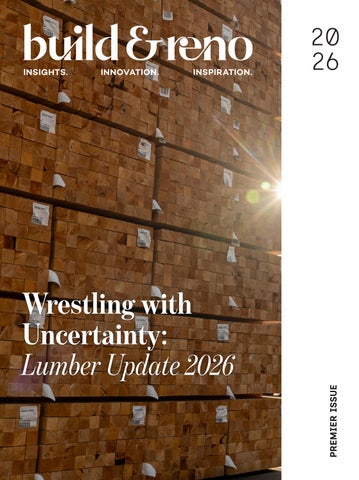
Cover photo courtesy of TAIGA BUILDING PRODUCTS

Contributors

Teresa Christine is an award-winning editor and author with over fifteen years of experience helping organizations build their brands and tell their stories through roles in marketing, public relations, and communications. Inspired by her love of writing and her passion for style and design, she began her own creative consulting boutique, Sassi Creative Co., in 2015.

Lawrence (“Law”) Cummer is a freelance writer and editor and has been a frequent contributor to Contractor Advantage, Ideas and Rough Construction for nearly a decade. Over his more than 20-year career, Law has written about contracting and construction, general business, information technology, health and safety, personal finance and almost every topic in between. He has a passion for storytelling and sharing how people can work better, easier — and “smarter” — from contractors to technologists to business executives.

Kate Zabriskie is the president of Business Training Works, Inc., a Maryland-based talent development firm. She and her team provide onsite, virtual, and online soft-skills training courses and workshops to clients in the United States and internationally. For more information, visit www. businesstrainingworks.com.

LAWRENCE CUMMER
KATE ZABRISKIE
TERESA CHRISTINE

After a more challenging year for the lumber industry than many expected — marred by political shocks, tariff concerns, weather disruptions and affordability fears — 2026 may prove to live up to the classic adage around expectations: the only certainty is uncertainty.

THE LEADERSHIP PLAYBOOK: SIX MOVES THAT MAKE A DIFFERENCE

Not every leader is a great one. Plenty of people wear the “leader” badge, but few earn the respect, trust, and loyalty that separates the good from the exceptional. The difference? Great leaders think, act, and show up in ways that set them apart.

BUILT ON COMMUNITY: DEBORAH BRINSON OF GANDER BAY BUILDING SUPPLIES

On most mornings in Victoria Cove, Deborah Brinson does exactly what she’s done for nearly two decades; she enters the doors of Gander Bay Building Supplies, greets familiar faces, and gets to work. Some customers are there for building materials; some need quotes; others come in simply to talk. And for Deborah, they are all equally important.

Welcome to the Premier Issue of Build & Reno Magazine!

Our newly designed, digital and bilingual, home renovation publication that marks the evolution of Contractor Advantage print magazine. This transition reflects Castle’s commitment to innovation, sustainability, and delivering meaningful value to its growing community of contractors, builders, tradespeople, DIY consumers, interior designers, and industry partners. The new digital format offers readers a modern, interactive experience and provides

vendors with expanded advertising opportunities across 12 annual issues.

Build & Reno features a curated blend of expert insights, industry news, product innovations, trend forecasts, and real-world project inspiration designed to help professionals and enthusiasts plan smarter and work more efficiently. With a fresh editorial direction and a fully paperless delivery model, the publication embraces technology and offers dynamic, accessible content across all devices.

Thank you to our Valued Castle Dealers across Canada and to our Vendor Partners for their continued support. We hope you enjoy this new publication!

— Jennifer Mercieca Editorial Director, Castle Building Centres Group Ltd.

Welcome to the inaugural issue of Build & Reno Magazine, a publication I’m genuinely excited to share with you.

This magazine marks an important evolution of Castle Publications and reflects the strength, expertise, and momentum of the Castle network. At its heart is a growing community of independent building material retailers, supported by valued vendor partners who play an essential role in their success.

As Castle continues to expand its reach, Build & Reno will serve as a platform to share insight, spotlight innovation, and celebrate the people

and ideas shaping the future of building and renovation. Each issue brings together industry perspective, product knowledge, and real-world inspiration, grounded in the experience of Castle members working at the heart of their local markets.

One of the things that stood out to me most while shaping this publication is how deeply Castle dealers are connected to the communities they serve. Through features like Castle Community Connection, we’ll go beyond the build to highlight the meaningful ways members support their neighbourhoods, champion local initiatives, and invest in the places they call home.

As editor, I’m proud to help bring these stories to life and to shape a publication that reflects what Castle believes at its core: that strong relationships, shared knowledge, and community connection are the foundation on which communities, and businesses, are built.

— Teresa Christine Editor, Build & Reno Magazine

Wrestling with Uncertainty: Lumber Update 2026

After a more challenging year for the lumber industry than many expected — marred by political shocks, tariff concerns, weather disruptions and affordability fears — 2026 may prove to live up to the classic adage around expectations: the only certainty is uncertainty.

Industry watchers are anticipating echoes of the instability of 2025, but with a twist; this time, everyone knows it’s coming.

“I think it will be just as uncertain, and we’re going into the new year knowing that it’s going to be uncertain,” says Brent Brownmiller, Vice President at Gillfor Distribution. “Last year we went in on January 1st thinking, ‘Oh, it could be a pretty good year’ — housing starts were expected to be better, pricing was expected to be better.”

This year, he says, the mood is different: “We’re going in knowing it’s going to be uncertain, and therefore people are going to just sit there and go [‘let’s hold our breath a little bit and just wait and see how the year kind of happens.’].”

Photos courtesy of GILLFOR DISTRIBUTION

2025 Expectations Clash with Reality

Brownmiller points to the events of January 6, 2025, and the looming tariff threats that followed as key drivers of unpredictability, softening consumer confidence throughout the year. U.S. affordability challenges have also resulted in too much lumber for takeaway, pushing the market toward historical lows.

It’s a sentiment echoed by Brendon Hiller, General Manager of Commodities at Taiga, who was surprised by what he called an overall lack of demand in North America. “Going into 2025, the market was very optimistic. That changed very quickly with a new U.S. government and the threat of tariffs — this put significant uncertainty into the market. The word ‘uncertainty’ remained a key topic throughout 2025.”

Stephen Marshall, Vice President at Doman Treated Wood, notes that in addition to trade barriers, the market faced several significant challenges. “A very slow start to the year, challenging weather and a huge amount of uncertainty created by disrupted trade with the USA and China led to a slowdown in business and building activity.” Because of this, he says, 2025 was a “cautious year” that panned out worse than expected. “Poor early weather and the massive trade upheaval were a blanket on the entire market, especially Ontario.”

Photos courtesy of DOMAN TAIGA BUILDING PRODUCTS left right
“ The market was challenging across the board, but our network stayed steady and made good decisions.”

JOHNSTON

Still, even amidst all this marked unpredictability, tariff exposure and policy volatility, Castle dealers were able to navigate the turbulence relatively well, says Kelvin Johnston, Senior Buyer at Castle Building Centres Group, focused on commodity lumber and panels. “Our dealers had a strong year,” he says, “but that was in spite of the conditions, not because they were easy.”

He attributes this to disciplined inventory management, strong local relationships and a focus on core categories. “The market was challenging across the board, but our network stayed steady and made good decisions.”

The Forces Shaping 2026

With no resolution on tariffs or trade tensions, they remain a wildcard heading into 2026 and continue to shape the outlook for the year ahead — and perhaps beyond.

Consumer confidence remains fragile heading into 2026, shaped by the same tariffdriven uncertainty that defined last year, Brownmiller suggests, adding that “there’s been no policy that has changed the minds of anybody.”

Actual confusion of tariffs related to the softwood lumber dispute also continues to shape the market, Hiller suggests.

Doman’s Marshall adds that the problem has longevity beyond the current U.S. administration, “Softwood lumber problems existed before Trump, and will continue with or without him unless there is some negotiated settlement.”

Perhaps even more important than U.S. policy on Canada, its effect on U.S. housing, confidence and buying trends may set the stage for the year, or years, to come.

“It’s not going away any time soon,” Johnston says. “We have three more years of the current U.S. Administration, and that’s something we’re going to have to live with. My question is: how bad will the U.S. economy get?”

courtesy of

That said, Canada, he suggests, is in “a good spot,” reminiscent of the 2009-2010 economic collapse. “We survived that and will again as long as we can keep people employed.”

Marshall is cautiously optimistic. While he expects more trade and economic uncertainty, he sees interest rates and inflation trending down, and notes that overall employment in Canada remains solid. He also points to new federal leadership under Carney, which he views as more pro business than the previous government, though he cautions that industries such as auto, steel and aluminum will feel the drag of ongoing trade disputes.

For those in lumber production, whether employment holds up is, of course, a real concern. Weak takeaway and affordability pressures — particularly in the U.S. — continues to suppress demand in 2026, increasing curtailments and potentially making some permanent. It’s a trend that will create what Brownmiller describes as “retirement villages” — communities hollowed out as mills close and jobs disappear.

Everyone predicts more mills shuttering due to a confluence of economic pressures, including low takeaway, low pricing and uncompetitive operating conditions, which they say may lead to not being able to supply demand when it picks up.

This has Johnston predicting an eventual run on lumber, once demand outpaces the curtailed supply, but who’s to say exactly when?

One thing is clear to him: the extremely low prices the market is seeing today might seem like a blessing to some, but they aren’t good for contractors, dealers, wholesalers or suppliers.

“While consumers might like low prices, they are not good for the industry at all levels. Flat markets are hard on the entire supply chain,” Johnston says. “Retailers and contractors don’t want prices to be so low; it means lower margin dollars. When there’s no upswing or downswing, it becomes incredibly competitive.”

Photo courtesy of GILLFOR DISTRIBUTION
Photos courtesy of TAIGA BUILDING PRODUCTS

Regional Dynamics at Play

Of course, a country as large as Canada saw 2025 play out — and will see 2026 shape up — differently from region to region. But while trends may not repeat from province to province, they will certainly rhyme, shaped by the same macro economic pressures.

Brownmiller notes that Ontario finished 2025 “pretty decent” and even started that year “terrifically,” but the outlook for 2026 remains tied to U.S. manufacturing. With so many communities dependent on auto sector employment, consumer confidence is easily

Photo courtesy of TAIGA BUILDING PRODUCTS

“Economic activity in certain regions (Ontario) is being severely affected by the current trade disputes with the U.S.A. and China,” Marshall says. Johnston notes that Ontario builders stopped building a few years ago, especially on condos. However, he adds, “I think there is going to be a change in housing overall — albeit not necessarily in 2026 — as we see it moving forward, where the demand for a single-

family home is going to be a little bit higher.”

Meanwhile, on the West Coast, BC is facing some of the steepest structural hurdles in 2026. Brownmiller points to higher log costs and provincial stumpage policies that leave BC mills uncompetitive compared to Alberta and U.S. producers. (All of which contributes to the curtailments Brownmiller and others expect.)

It’s a sentiment touched on by Hiller: “Alberta stood out as the strongest demand market, BC, and specifically the Okanagan, saw a sharp decline in demand. We expect demand in the Okanagan to remain challenging with multifamily overbuilt, the rental market very depressed and out of province taxes on vacation properties to remain; these will all make for a challenging housing market in the Okanagan.”

Photos courtesy of DOMAN GILLFOR DISTRIBUTION
TAIGA BUILDING PRODUCTS left right bottom

OSB production in Alberta and Saskatchewan remains heavily dependent on U.S. multifamily housing starts. With U.S. affordability still strained, Brownmiller warns that Prairie mills — often located in small, fibre adjacent communities — face a heavier risk from curtailments. That said, Johnston notes that “real estate remains strong in some regions, like Alberta,” and he expects renovations and multi dwelling builds to be key demand drivers there.

“Housing was quite regional in Canada. Quebec and Alberta were strong, other provinces lagged,” Marshall echoes.

Nationally, he adds, “Canadian sawmills certainly want more Canadian customers, but dealers were more cautious in their buying patterns with bad news and uncertainty being reported in most mainstream media. Most dealers ran their inventories very low by the end of 2025.”

Photo courtesy of TAIGA BUILDING PRODUCTS

What Contractors Should Watch in 2026

Marshall notes that early orders in Canada have been quite strong with lower prices, but the market will need to see takeaway and replenishment in the warmer months.

He urges contractors to “watch housing strength in the U.S. — if housing kicks up, U.S. lumber demand will increase, pushing up lumber prices.” He adds that U.S. fundamentals are strong: 30-year-mortgage rates back under 6% now, inflation under 3%, high employment, and government spending as a percentage of GDP is dropping. GDP growth is being forecast by many to rise above 5%, he says, with huge Capex projects, taxes dropping for businesses and taxpayers, and closed borders.

“The USA seems poised for growth,” he says. “This will help push up commodity pricing — such as lumber and metals — in Canada.”

Despite soft pricing this year, Brownmiller says this is not the time to adopt the usual downturn playbook of buying in January and selling in July. With carrying costs, uncertain demand and no sign of an early year rally, he cautions contractors against front loading inventory and urges them to stay nimble.

With 2026 starting with lean inventories, many suggest this could be a year of cautious, hand to mouth buying. Through 2025, Hiller says lumber yards bought “only what they needed,” as speculation fell out of the equation entirely and consumers remained cautious despite historically low prices. Marshall adds that sawmills want more Canadian customers, but dealers remain hesitant.

With mill closures and cautious lumber yards, contractors can expect supply to be lean in 2026 — a double edged sword that keeps prices soft for now but can turn sideways on a dime if demand shifts.

Marshall adds that the post COVID supply chain has conditioned dealers and contractors to expect next day or same week replenishment — a level of service that could change quickly if building activity strengthens.

Brownmiller also cautions contractors not to fixate solely on lumber prices. While contractors spend a lot of time tracking commodity costs, he notes that homeowners often view lumber as a small part of the overall project budget — meaning broader affordability pressures may influence demand more than the price of studs or sheathing.

But it’s not all doom and gloom. Hiller says that while R&R has been slow the past three years,

it’s expected to pick up in the latter half of 2026 as more people stay in their homes and invest in upgrades. He says contractors should cover committed projects early to avoid risk from low supply or a run on pricing.

That bodes well for some dealers and contractors, Johnston says, also predicting an uptick fueled by homeowners spending to improve their abodes. “For most of my stores, the majority of their business is not around new home builds but renovations, new decks, fences... I think that’s what’s going to make it another good year for Castle stores.”

The market may be cautious, but preparation, problem solving and flexibility are already part of every good contractor’s DNA. Those who adjust their planning and buying to shifting demand — and stay informed through strong relationships with customers and the supply chain — will be better prepared for whatever 2026 brings, and ready to build through it. —

Photos courtesy of TAIGA BUILDING PRODUCTS

The Leadership Playbook: Six Moves That Make a Difference

Not every leader is a great one. Plenty of people wear the “leader” badge, but few earn the respect, trust, and loyalty that separates the good from the exceptional. The difference? Great leaders think, act, and show up in ways that set them apart.

They don’t just manage—they inspire. They don’t just delegate—they empower. And they don’t just react—they anticipate. So what exactly makes great leaders stand out? Let’s break it down.

THEY SET THE STANDARD AND LIVE IT

HERE’S HOW THEY SET THE TONE:

• They Walk the Talk: They don’t just talk about values like integrity or collaboration—they embody them. If they say deadlines matter, you’ll never catch them missing one.

• They Own Their Mistakes: Great leaders admit when they’ve messed up. “I dropped the ball on this, and here’s how I’ll fix it” earns more respect than pretending it never happened.

• They Show Respect to Get Respect: They treat everyone—employees, peers, clients—with the same level of respect, whether it’s the intern or the CEO.

Great leaders know they’re walking billboards for the behaviors and values they want to see in their teams. If you want your people to work hard, show up on time, and deliver results, you’d better be doing the same.

ASK YOURSELF:

What behaviors am I modeling for my team? Are there gaps between what I say and what I do?

THEY PRIORITIZE CLARITY OVER COMPLEXITY

INSTEAD, THEY’RE MASTERS OF CLARITY:

• They Make Expectations Crystal Clear: No one on their team is left guessing what “good” looks like. They spell it out: “We need to improve customer satisfaction scores by 10% this quarter, and here’s how we’ll do it.”

• They Simplify Goals: They break big visions into manageable chunks. “Increase market share” becomes, “Let’s land three new clients this quarter.”

• They Over-Communicate: Great leaders know that one memo or meeting isn’t enough. They repeat key messages often so no one forgets what’s important.

A lot of leaders think throwing around buzzwords and jargon makes them look smart. Great leaders know it just makes them hard to follow.

ASK YOURSELF:

Are my team members clear on what’s expected of them? How often do I check for understanding?

THEY BUILD TRUST, NOT FEAR

Fear-based leadership is a shortcut—and a bad one at that. Sure, people might jump when you bark orders, but they’re not jumping because they respect you. Great leaders understand that trust, not fear, is the real currency of leadership.

HERE’S HOW THEY BUILD IT:

• They Follow Through: If they say they’ll do something, they do it. No excuses, no dodging.

• They Listen More Than They Talk: Great leaders don’t just hear—they listen. Whether it’s feedback, concerns, or ideas, they show they value what their team has to say.

• They’re Transparent: When things go wrong, they’re honest about it. They don’t sugarcoat, spin, or hide behind vague statements.

ASK YOURSELF:

Do my actions consistently build trust? Would my team say they feel safe bringing challenges to me?

THEY EMPOWER, NOT MICROMANAGE

Micromanagers drain the life out of their teams. Great leaders, on the other hand, empower their people to take ownership of their work— and the results speak for themselves.

HERE’S HOW THEY EMPOWER THEIR TEAMS:

• They Delegate the Right Way: They assign tasks with clear goals, then trust their team to figure out the “how.” They’re there for support, not to hover.

• They Celebrate Wins: Great leaders don’t hog the spotlight. When things go well, they shine it on their team.

• They Let People Fail: This one’s tough, but it’s important. They know that sometimes the best lessons come from mistakes, so they create a culture where failure is a learning opportunity—not a career-ending event.

ASK YOURSELF:

How much autonomy do I give my team? Do I celebrate their successes loudly enough?

THEY STAY COOL UNDER PRESSURE

HERE’S HOW THEY HANDLE THE HEAT:

• They Pause Before Reacting: Knee-jerk decisions rarely lead to good outcomes. Great leaders take a beat to assess the situation before acting.

• They Stay Solutions-Focused: While others spiral into blame or negativity, great leaders zero in on what needs to happen next.

• They Radiate Confidence: Even if they’re sweating on the inside, they project steady confidence to their team. Calm is contagious—and so is chaos.

When the stakes are high, great leaders don’t panic. They stay calm, think clearly, and lead with confidence—even when the situation is anything but calm.

ASK YOURSELF:

How do I respond to pressure? Am I helping my team stay calm and focused, or adding to the stress?

THEY NEVER STOP LEARNING

HERE’S HOW THEY EMBRACE LEARNING:

• They Seek Feedback: They don’t just give it—they ask for it. Whether it’s from their team, peers, or mentors, they’re always looking for ways to improve.

• They Stay Curious: Great leaders are always asking questions. “Why is this happening? How can we do it better?”

• They Invest in Themselves: From reading books to attending workshops, they never stop sharpening their skills.

Great leaders don’t see themselves as finished products. They’re constantly looking for ways to grow, improve, and stay ahead of the curve.

ASK YOURSELF:

When was the last time I sought out feedback? What am I doing to grow as a leader right now?

Final Thought

Start small. Pick one thing from this list and commit to doing it better. Then add another, and another. Leadership isn’t about being perfect—it’s about showing up, doing the work, and inspiring your team to do the same.

And if you’re already leading? Remember this: Great leaders don’t just create great results— they create great people. That’s the difference, and it’s one worth striving for every single day.

Built on Community: Deborah Brinson of Gander Bay Building Supplies

On most mornings in Victoria Cove, Deborah Brinson does exactly what she’s done for nearly two decades; she enters the doors of Gander Bay Building Supplies, greets familiar faces, and gets to work. Some customers are there for building materials; some need quotes; others come in simply to talk. And for Deborah, they are all equally important.

“People don’t always come in just because they need something,” she says. “Sometimes

they just need a place to stop, to chat, to feel connected. That’s the kind of store we’ve always wanted this to be.”

Raised in Gander Bay, Deborah left Newfoundland in her early twenties to work in Ontario’s automotive industry. In 2007, she and her husband Todd made what she describes as a surprisingly quick decision, to return home and purchase the local building supply store overlooking the bay.

“I came from HR and automotive. I knew nothing about building materials, but I knew people. And I knew community.”
DEBORAH BRINSON Gander Bay Building Supplies

“I came from HR and automotive. I knew nothing about building materials,” she laughed. “But I knew people. And I knew community.”

With a newborn at home and a business to learn from the ground up, Deborah stepped into an industry that was entirely new to her. What she found was challenging, demanding, and deeply rewarding.

A Store That Knows Your Name

Gander Bay Building Supplies has stood on the same site since 1912, just steps from the ocean. Over the years it has evolved from a general store into a modern building supply centre, but its role in the community has remained unchanged.

“It’s always been a landmark,” Deborah says. “Everyone knows the store. Even people who moved away decades ago still talk about it.”

Serving a town of roughly 1,300 people, with other customers traveling from as far as an hour away, the store is woven into daily life in the region. Some customers have been coming in for generations, some stop by weekly, for many it’s a place that they have relied on for years. Many are greeted by name.

“We take service very seriously,” Deborah explains. “But more than that, we take relationships seriously. Products and pricing can be matched. Relationships can’t.”

That philosophy shows up in countless ways, from matching community donations raised through pallet sales, to supporting the local school, fire department, recreation committee, and youth programs. One of the moments Deborah is most proud of came several years ago, when she joined a group of local mothers to raise more than $100,000 to build the town’s first playground.

Learning as You Go

When Deborah and Todd purchased the business, much of it was still run manually. Orders were handwritten, records kept in ledgers, and systems were based on longstanding routines. Instead of forcing rapid change, Deborah chose to move slowly.

“When you buy a business that comes with staff, you meet them where they are,” she says. “You learn together.”

Over time, the store was computerized, a pointof-sale system was introduced, and processes were modernized, while preserving the culture that made the store special in the first place.

“But more than that, we take relationships seriously. Products and pricing can be matched. Relationships can’t.”
- DEBORAH BRINSON -

Deborah handles all back-office operations and financials, manages all window quotations, and works directly with new home customers, guiding them through each stage of their building process. Many of these new home customers live out of the province. Todd focuses on purchasing and supplier relationships. Their approach is hands-on and collaborative.

“There was no playground here before,” she says. “We wanted a place where kids could just be kids, right in their own community.”

Gander Bay Building Supplies was a major sponsor of the project, contributing both financially and materially. Today, the playground stands as a visible reminder of what can happen when a community comes together, and of Deborah’s belief that businesses have a responsibility to help create spaces where families can thrive.”

“Being a community presence is about much more than sales,” she says. “It’s about showing up when people need you.”

“We don’t stand back and manage from a distance,” Deborah says. “We work alongside our staff. That’s important in a small store.”

Leadership, Connection, and Castle

Deborah’s commitment to collaboration naturally extended beyond her own store. She currently serves as Vice Chair of the Board for Castle Building Centres Group, a role she credits with expanding her understanding of the industry.

“When I first got involved, I realized very quickly that no matter where you are or how big your store is, we’re all dealing with many of the same challenges,” she says. “Some of the best learning happens just talking with other members.”

Joining Castle in 2015 was a turning point.

“It was honestly one of the best decisions we made for the business,” Deborah says. “The support, the innovation, the sense of community, it aligned with how we already operated.”

She also values Castle’s emphasis on giving back, including community recognition grants that help local projects thrive.

“Castle understands that strong communities build strong businesses,” she says. “That matters to us.”

Recognized for Retail Spirit

In 2022, Deborah received the Hardlines Retail Spirit Award at the Outstanding Retailer Awards, national recognition that felt especially meaningful in a small-town setting.

“We don’t advertise. We don’t do radio or TV,” she says. “So, for something like that to happen, it was huge. The whole town felt proud.”

For Deborah, the recognition wasn’t about personal achievement.

“It reflected our staff, our customers, and the history of the store,” she says. “This place has been here for over 100 years. We’re just one chapter in that story.”

A Woman Leading by Doing

As a woman in a traditionally male-dominated industry, Deborah encountered her share of assumptions early on.

“There were lots of moments where people would ask to speak to ‘the boss,’ or assume the technical answers would come from someone else,” she says. “You learn quickly not to take that personally.”

Instead, she focused on learning, leaning heavily on suppliers, asking questions, and building confidence through experience.

“I always tell people: learn as much as you can, and don’t be afraid to ask,” she says. “Good suppliers were key to my success.”

Her leadership style today is grounded, practical, and inclusive.

“We’re not a big corporate environment,” she explains. “We’re a team. We work together.”

Family, Balance, and Perspective

Family has shaped Deborah’s approach to leadership from the start. She grew up in

a family business; her son Jacob grew up around the business and is now pursuing a Commerce degree at a university in Halifax. Todd remains her partner in every sense.

Balance, she says, comes down to flexibility.

“This business gave me the ability to be present,” Deborah explains. “That’s something I don’t take for granted.”

Looking Ahead, and Defining Success

When Deborah thinks about the future of Gander Bay Building Supplies, one word comes up again and again: legacy.

“When the time comes, we would love for this store to stay locally rooted,” she says. “We want someone who values and appreciates this community the way we do.”

After nearly twenty years, her definition of success has evolved.

“Success isn’t about titles or awards,” Deborah says. “It’s about what you’ve built, who you’ve helped, and the people you’ve been able to support along the way.” It’s also about the people who have supported you”!

In Gander Bay, that peoplefirst mindset continues to shape not just a business, but a community. —

Turn static files into dynamic content formats.
Create a flipbook