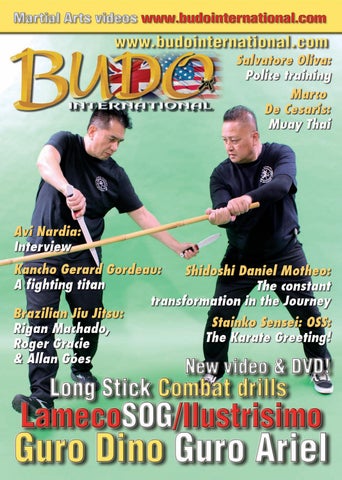
Ma r t i a l A r t sv i d e o swww. b u d o i n t e r n a t i o n a l . c o m
www. b u d o i n t e r n a t i o n a l . c o m
Newv i deo&DVD!
L ongSt i ckCombatdr i l l s
L amecoSOG/ I l us t r i s i mo
Gur oDi noGur oAr i el
Budo International magazine is a product of:
BUDO MAX INTERNATIONAL LLC GM Maurice Elmalem CEO/Director 684 BRITTON ST SUITE 4 BRONX NY 10467 USA e-mail contact: info@budomaxintl.com Tel: 718.652.7100
Budo MAX International Your source to a World audience!
We produce and sell Martial Arts videos and books: Please visit our website: www.budointernational.com Also available our Youtube channel: With more than 100,000 subscribers at: Budo International Official. We produce every month a free on line magazine available in our website and in issuu.com in 5 languages. English, Spanish, German, French, and Italian with already over 1,000,000 readers all over the world. All the issues remain available on line forever so they keep receiving reads for years. We have 1,000 different instructional videos available with the best masters of 5 continents. Any questions suggestions or ideas please contact GM Maurice Elmalem 1. Budo to add coverage of Boxing, Mix Martial Arts, Kick Boxing, Wrestling, UFC, entertainment & celebrity corner of pages in the last end of magazine pages.
2. Offer business card size advertising at $29.95 (and other sizes) monthly fee for organizations, schools, associations, personal, tournaments. 3. Cover stories on past today and world champions M/A, UFC, body builders. 4. Become a sponsor of Budo magazine, make legacy gifts to family in need. Create annual fund for online donations. 5. Always your special media of MA stories are welcome anytime. 6. Let us hear your story, you got photos of martial arts celebrities, updated news, send info to: Main office USA 718.652.6600 email: info@budomaxintl.com or call USA-888-455-8181 7. We collaborate with world renown organizations, MA Grand Master schools and association worldwide. 8. Free monthly Budo commercial for online and media promotions. 9. Budo Magazine Calendar that includes photos, events, advertising, Join Budo Club – Tell us your story - Got Talent. 10. Advertise with Budo Max International and be seen worldwide.
Pearls of the Warrior
“If tradition resides only in forms, it will wither. The essence that sustains life is flexible and adapts, gently harmonizing.”
Lao Tse
Editorial How silly we are! “A portrait is a feeling, not a reality” a dedication by Manolo Tarazona my painting teacher, on a drawing depicting me. he more complex the mind is, the harder it is for us to look at ourselves in our entirety with even a modicum of equanimity. The mind that thing that distinguishes us humans from other living beings through its complexity performs an indispensable service for survival. It is a great achievement of evolution and sets us apart to the point that we’ve come to affirm, in the words of Descartes, that “I think, therefore I am.” The West, in particular, took this identification to the extreme so much so that Westerners commit suicide by shooting themselves in the head (or dissolving their minds in a barbiturate cocktail!), while Easterners, traditionally, would cut open their bellies. This way of deciding how to bring our lives to an end reveals, in the most extreme sense, with which part of ourselves we truly identify most. The mind can never resolve its own issues because it lacks perspective; it is like a two-dimensional being evaluating a three-dimensional reality that comes into contact with its universe. A sphere interacting with a two-dimensional being that passes through its world would be perceived, first, as a point, and then as a circle that would magically begin to grow until it reached its equator at which point, surprisingly, it would begin to shrink until it became, once again, a single point before mysteriously disappearing. The mind, like any entity that takes on a form of its own, seeks to become independent and strengthen itself; it fills itself with arguments and justifications to protect itself and justify its preeminence, as if your very existence depended on it. Cerebronic personalities are particularly prone to this flaw. Everything must and can be explained! There is always a path, a decipherable method, a technique underlying everything, every solution. They tend to be great admirers of science, of academic authority, and of their traditional medium: written records. They spend more time trying to make reality fit into their molds than learning from it. For this reason, the image of the Western sage is that of a clueless being, detached from reality and consequently unable to deal with it in a practical way. As a result, they rarely achieve economic or emotional success, and their personal lives turn into a succession of paradoxes. Art is one of those things that defy reason. Why can a painting, a painter, or a work of art come to be valued so excessively even in economic terms? Art is the transubstantiation of matter. Let’s consider painting: A piece of canvas a two-dimensional object that recreates three dimensions through colors and shapes, made with oils and vegetable or mineral pigments, at a ridiculously low cost is transformed, almost as if by magic, into something priceless. My painting teacher, Manolo Tarazona, when he took me on as a student, made two promises to me: “When we finish your training, you’ll have two certainties. 1. That when you hang one of your paintings, you’ll do so with confidence, and you’ll see how our peers, upon seeing it, will approach and look… then step back and look… then come closer again and look once more… and they won’t believe their eyes!… That’s professionalism, and 2. Most importantly! You will have understood that Art does not exist unless you create emotions, and to do that you must feel them, and to feel them you must dare to live them.” A Portuguese fado says: “It’s never a pity, if the soul isn’t small.” The great Pablo Neruda expressed it in the title of his book: “I Confess That I Have Lived.” Yes, it’s no coincidence, because the three great classical muses are poetry, painting, and music. One can study as much as one wants that extraordinary mathematics that is music,
T
How silly we are! but Paul McCartney or John Lennon composers of so many timeless songs, the soundtracks of humanity didn’t know music! Paco de Lucía, the flamenco guitarist who transcended the boundaries of his own tradition, didn’t either… The examples are almost endless. The arts defy structures, because their reasons are reasons of the soul not techniques that the mind can analyze and then reproduce by following formulas. Art is the phlogiston of humanity! It is the proof, the embodiment, that there is life beyond the mind, and that reason must bow, for it is sovereign only within its own domain. The mind. Like a snake biting its own tail, it will never go beyond itself. Even this text, as it reasons about things, is nothing more than my mind justifying itself through its own experience. My professor calls them “Tuchist theories.” And the fact is that, in the end, what remains for all of us is the residue of what we’ve lived through, filtered through our own lens with its glorious moments and achievements, and its glaring flaws. Part of living healthily involves accepting this unique nature of ours, because we cannot live uncomfortably on our own continent, always adorned with unattainable values belonging to others, trying to please our “popo” and… no matter how magnificent those values may be! Because that is not the purpose of life, and because, deep down, none of humanity’s flaws or virtues not a single one are foreign to any of us. The mind cannot heal itself, much less the minds of others, by establishing protocols or covert moralizing whether insidious or not, well-intentioned or not… for there is always a bit of everything in the personal hodgepodge we exude, and in the slime we leave behind like snails as we walk. This is a path that is not only fruitless essentially perverse and alienating for oneself, trapped and chasing one’s own tail but also for others, who, dressed in clothes that aren’t their own around you, shrink back uncomfortably, afraid of stepping out of line, of screwing up again, of bothering you, or even worse out of fear. No mold, no matter how good it may be, can encompass all souls. The sky is much larger than the sliver that the frog, from its ledge, is able to conceive when looking up. Destacados
“The Arts defy structures, because their reasons are reasons of the soul not techniques that the mind can analyze and then reproduce by following recipes. Art is the phlogiston of humanity! It is the demonstration, the embodiment, that there is life beyond the mind, and that reason must bow, for it is sovereign only within its own domain.”
LAMECO ESKRIMA S.O.G. Sulite Original Group — The Backyard Group Taking the essence and tradition of Lameco Eskrima and Lameco S.O.G. (Sulite Original Group), the Backyard Group, into the Twenty-First Century. ¡Effective with knives, effective with impact weapons, effective in self-defense… and now… with firearms! Few names carry the weight of authenticity in the Filipino Martial Arts the way Guro Dino Flores and Guro Ariel Flores Mosses carry it. Theirs is not a lineage assembled from seminars and certificates bought across many schools. It is a lineage forged in blood, sweat, and the unflinching presence of the Grandmasters who chose them, tested them, and trusted them with what could not be taught to everyone. Text by Tim Fredianelli
Guro Dino Flores: The Chosen Defender Punong Guro Edgar Sulite trained four kinds of students: those who studied with him in standard classes, seminar students, private students, and a small, hand-selected circle he personally forged for combat — the Sulite Original Group, known to insiders simply as Lameco S.O.G. or the Backyard Group. This was never the public face of Lameco Eskrima. It was the Punong Guro's invitation-only personal backyard group, a crucible apart from — and different from — the mainstream Lameco organizations that exist today. Guro Dino Flores stood among the elite few chosen to enter the Backyard Group. In the early days, Punong Guro Sulite was frequently challenged — and though few know it, Guro Dino Flores was one of those hand-picked and personally schooled in the deepest combat secrets of Lameco, primarily for his willingness to defend the system. Over time he was one of the few chosen by Punong Guro Sulite himself to stand in his place when challengers came, and to defend the honor of the art with his own hands, alongside a few other members. Guro Dino Flores was also granted the rare privilege of training under all five Pillars of Ilustrisimo, most notably under Grandmaster Christopher Ricketts and Grandmaster Tony Diego, both of whom authorized Guro Dino full authority to teach their system of Kali Ilustrisimo.
His integrity as a serious Eskrimador drew the attention of Punong Guro's favorite fighter and teacher, Grandmaster Olavides of Grandmaster Caballero's Eskrima De Campo System. Grandmaster Olavides took Guro Dino on as a personal student in that fiercely combative and, at the time, secretive art. Later, Guro Dino was offered the chance to become the first international representative for the Eskrima De Campo System across all U.S. territory. Instead, Guro Dino chose to remain devoted to the Backyard Lameco — a decision that tempered him further and carried him to the height of his standing as a respected fighter. Originally, Guro Dino did not plan to train with other teachers besides Punong Guro Sulite. He was content being a student of Punong Guro in the Backyard for the rest of his Eskrima journey. It was Punong Guro Sulite who insisted, giving Guro Dino a list of his own training partners and teachers to seek out — insisting that it would give him a deeper understanding of why Lameco is structured as it is. Guro Dino initially did not take the list seriously, as he was training with the founder himself, frequently, four times a week. However, after the sudden passing of Punong Guro, it made more sense as to why he had insisted Guro Dino train with a few additional select Masters. Guro Dino was among the first of his peers to answer challenges in combat for Punong Guro. Some members who wished to follow that same path were also trained directly under Guro Dino's hand when they were not in the Backyard. Guro Dino's purpose now is to pass on everything he carries — the Backyard philosophy and the mainstream curriculum, exactly as Punong Guro Sulite taught it — so the essence of this art lives on in the generations still to come.
Guro Ariel Flores Mosses: The Technical Vanguard Guro Dino and Guro Ariel have trained together since the early 1980s in various martial arts, including the FMA systems of Sikaran, Arnis, and Manaois Eskrima. Once they began training in Lameco Eskrima and Kali Ilustrisimo in the 1990s, they never looked back, and continue to this day. Guro Ariel Flores Mosses is a practitioner with over thirtyfive years forged in the warrior arts. Ariel's lineage is no less prestigious than his cousin's — trained under Grandmaster Conrad Manaois, Grandmaster Christopher Ricketts, and Punong Guro Edgar Sulite himself. He carries the blood and discipline of the old masters in everything he teaches. But Ariel's path cut a second blade. Long before most practitioners ever touch a firearm with intent, he sought out living keepers of the rare art of Cowboy Action Shooting, an Old Western-style firearms discipline utilizing single-action revolvers and lever-action rifles — the methods of Western gunfighters, tracing back to the unforgiving times of the American frontier, where a man's draw, his aim, and his nerve were the only insurance he had. Guro Ariel's firearms instructors were some of the best in the nation, instructing personnel from the FBI, CIA, SWAT, and military special operations units. These agencies would send personnel across the country to train with the same firearms instructors who resided in his hometown of Moses Lake, WA. It is this same rare, uncompromising knowledge that Guro Ariel Flores Mosses personally inherited. This lineage runs through Ariel's hands today. It is this mastery with firearms, tested in any situation, that has made him a sought-after gun trainer in North America. This is not theory passed down in a classroom alone. As a former law enforcement officer, Ariel has stood inside the cruel arithmetic of real violence — situations where the margin between living and dying was measured in a fraction of a second — and he has walked out the other side victorious every time. What he teaches is drawn not only from manuals, but from having been there and survived unscathed. Ariel Flores Mosses held a unique position in the Lameco hierarchy. He was initially accepted into the Backyard Group, especially alongside his cousins, Guro Choy and Guro Dino, both early members. However, work took him to Washington State. When he relocated to Washington State in the early 1990s, Punong Guro Sulite himself appointed him head representative for the state, entrusting him with Lameco ID, WA #1, for the State of Washington. In the years that followed, Punong Guro would spend weeks at a time visiting and training at Ariel's home, pouring himself into one-on-one intensive mentorship — a closeness few students were ever granted — allowing Ariel to absorb Lameco in its purest, unfiltered form, straight from the source. Ariel's career in law enforcement and security — Grant County Sheriff's Office & Moses Lake Police Dept., Security Police liaison for U.S. Customs at the Port of Moses Lake, Chief Security at Samaritan Hospital in Moses Lake, WA, Security Supervisor at Palms Resort and Casino Las Vegas, and personal protection work — adds a hard modern edge to the entirety of his instructorship. His teachings carry a tactical dimension shaped not in the dojo alone, but on the street, under fire, where theory either holds or it doesn't.
He is a certified NRA CCW instructor authorized by LVMPD (Las Vegas Metropolitan Police Dept.) and carries forward a combative philosophy he calls "Traditional Warrior Arts for a Modern World," bridging the old combative arts with the demands of today's diverse threats. He currently serves as President of Manaois Systems International and holds the rank of eighthdegree black belt in Kali Jukune Do. He is also the head instructor and cofounder of the CombatFMA Organization, a core umbrella of Lameco S.O.G., Kali Ilustrisimo CNR, and Manaois Eskrima.
Lameco Eskrima S.O.G., Kali Ilustrisimo, CombatFMA, and the Mandirigma Evolution Lameco History The historical trajectory of Filipino Martial Arts (FMA) in the late twentieth century is defined by a move away from fragmented regional secrets toward a sophisticated, analytical synthesis of combat systems. This evolution reached its zenith in the work of Punong Guro Edgar G. Sulite, whose creation of Lameco Eskrima stands as a monumental achievement in the systematic categorization of Filipino warrior traditions. Far from being a mere collection of techniques, Lameco was a revolutionary framework that integrated eleven distinct systems into a cohesive whole, designed to address the three vital distances of engagement: Largo (Long), Medio (Middle), and Corto (Close).In Tagalog the terms are LABANAN DIKITAN (CORTO/short or close range), LABANAN MALAPITAN (MEDIO/middle range) and LABANANAN MALAYU´AN (LARGO/long range). This report offers an exhaustive analysis of the lineage of Punong Guro Sulite, the architectural composition of the Lameco system, the lethal efficiency of Kalis Ilustrisimo, and the emergence of a new leadership vanguard — Guro Dino Flores and Guro Ariel Flores Mosses — who are currently steering these arts into the modern era through the Kapisanang Mandirigma federation and www.lamecoilustrisimo.com. The Architect of Synthesis: Punong Guro Edgar G. Sulite, a Grandmaster Ahead of His Time.
The development of Lameco Eskrima cannot be understood without first examining the cultural and personal foundations of its founder, Edgar G. Sulite. Born on September 25, 1957, in the Visayan islands, Sulite was an inheritor of a deep-seated martial legacy. His father, Helacrio Sulite Sr., was a practitioner of Arnis and a boxer, exposing Edgar to the fundamentals of striking and weapon handling from a tender age. This early exposure was not limited to the training hall; growing up in the barrios of the Philippines, Sulite witnessed the raw reality of bladed skirmishes, where disputes were settled with the bolo and the kris. These experiences forged in him a profound respect for the reality of the blade and a lifelong disdain for martial arts that lacked practical application. Sulite was a man of remarkable vision and intellectual discipline. While pursuing a Bachelor of Arts in Economics, he applied the same systematic rigor to martial arts that he did to his academic studies. He recognized that while the Philippines possessed an incredible wealth of martial knowledge, it was often unorganized and localized. He embarked on a decade-long odyssey, traveling across the archipelago — at times swimming between islands in sharkinfested waters — to seek out the most formidable masters of his time. His goal was not merely to collect techniques, but to understand the underlying principles that made each regional style effective in its specific context.
The Development of the Lameco Framework In 1981, Sulite founded Lameco Eskrima in Manila. The name itself is a portmanteau of the three ranges he identified as essential for a complete fighter: Range Long Middle Close
Filipino/Spanish Term Largo Medio Corto
Combative Focus Sniping the extremities, tip-of-weapon control, and linear footwork Checking the hand, body striking, and timing-based counter-offense Trapping, locking, disarming, and "dirty" fighting (knees, elbows, headbutts)
Sulite's systematic approach led him to categorize the systems he studied into five Major influences and six Minor influences. The major influences provided the tactical backbone and structural mechanics of Lameco, while the minor influences offered specialized solutions for varied combat scenarios.
The Five Major Pillar Systems of Lameco Major Influence Grandmaster Core Contribution to Lameco De Campo Uno-Dos-Tres Orihinal Jose Caballero The "sniping" mentality of Largo range and precise linear strikes Kalis Ilustrisimo Antonio Ilustrisimo Bladed directness, superior timing, and the "sword" over the "stick" Pekiti-Tirsia Kali Leo Tortal Gaje Jr. Footwork patterns (triangulation) and sophisticated knife/Corto work Modernos Largos Jesus Abella & Pablicito Cabahug Specialized long-range mobility and high-line/low-line transitions Sulite Rapelon Helacrio Sulite Sr. Family lineage, foundational mechanics, and traditional roots The influence of GM Jose Caballero was particularly transformative for Sulite. Caballero's De Campo system emphasized hitting the target without being hit in return — a philosophy that became the cornerstone of the Lameco Largo range. Conversely, the influence of Tuhon Leo Gaje Jr. brought the fluidity and aggressive close-quarters mechanics of Pekiti-Tirsia into the mix, ensuring that a Lameco practitioner was as dangerous with a dagger as with a long stick.
The Six Minor Systems of Lameco To ensure there were no technical gaps, Sulite integrated specialized elements from six additional systems. Minor Influence Grandmaster Specialized Tactical Element Doce Pares Diony Canete Comprehensive multi-range drills and traditional structure Balintawak Johnny Chiuten High-speed reflexive training and close-range checking (cuerdas) Lapunti Arnis De Abanico Felimon E. Caburnay Fanning (Abanico) strikes for defensive redirection and entrapment Siete Teros Serado Marcilino Ancheta Tight defensive postures and "closing the door" on an attacker Abanico De Sungkiti Billy Baaclo Specialized thrusting methods and wrist-heavy manipulations Tres Personas Eskrima De Combate Maj. Timoteo E. Maranga Principles of multi-opponent combat and tactical adaptation This synthesis allowed Sulite to create a curriculum that was "stainless steel" — a link in an unbroken chain of training succession that was both historically rooted and modernly efficient.
Effectiveness Above All Else BACKYARD LAMECO The Lameco Eskrima that Punong Guro Sulite taught in his Backyard was the epitome of his system. The backyard is where he was able to polish the final finishing touches of his vision. Fusing the most efficient combative concepts that he developed, learned and experienced thus far. What Punong Guro was teaching in the Backyard was a culmination of all he had learned in the Philippines, combined with his fights and experiences since arriving in the USA. Included in this was what he concluded by using the Backyard Group members in an experimental manner during their weekly sparring days and their fights outside of class. An important part of the his goal was the merging of the devastating power of Eskrima de Campo and the precise timing of Kali Ilustrisimo, all integrated with his Lameco strategies. Eskrima De Campo and Kali Ilustrisimo were the two arts from the Lameco heritage he privately thought were the most superior in real combat. Important pillars in bringing Lameco to a higher level. This belief was based on the real fight record of his teachers, analysis of their movements and his time spent training in those arts. Also important was his observations of the many arts he encountered on his legendary quest throughout the Philippines in search of the ultimate Eskrima. The journey resulting in his landmark book, “Masters of Arnis, Kali and Eskrima”. The book that introduced several important Eskrima Systems to the world. Punong Guro believed that the synthesis of De Campo and Ilustrisimo combined with the most combative elements of his Lameco curriculum, including his more recent developments were the final adjustments needed. Devastating power, superb timing, precision, range awareness, opponent skill awareness including strikers and grapplers, efficiency and refined real time sparring were the some of the objectives. Apart from all of the drilling, exercises, strategies and theories, an important emphasis was on successful real time sparring. Which he believed would translate most effectively into reality based self-defense. When Guro Dino asked him during a Backyard session how far he was from completion of his
vision, he replied that he is had finally got it. This was about two years before his passing. The Backyard was both his laboratory and a place he could have the camaraderie he had experienced in the Philippines. In the Philippines his peers were about seeking personal improvement and not a piece of paper. Punong Guro was weary of the typical Martial Arts politics and the constant need for modern practitioners to chase certificates and status, instead of just sharing true passion for the Warrior Arts. He would have cringed at how current practitioners freely give away secrets online for a “like”, "follow" or possible monetary gain without regard for the integrity of the lineage. One of the reasons he formed a Backyard Group was that he thought that his many secrets were not for public consumption. He felt that The Lameco International Curriculum was more than enough for the general public. Thus the Backyard Curriculum was reserved for those he believed would be loyal to Lameco Eskrima, Punong Guro and the future of the art.
Kapisanang Mandirigma: The Federation of the Future Following the death of Edgar Sulite in 1997, the survivors of the Lameco Backyard Group recognized that the survival of their arts depended on collective action. In 1998, they founded Kapisanang Mandirigma (Federation of Warriors).
Mission and Philosophy Kapisanang Mandirigma is not a "style" but a federation of practitioners united by common goals: providing a vehicle for growth and personal discovery through continued training, sparring, and research. The federation is extremely selective, maintaining the integrity of the "Backyard" training ethos while reaching out to a global community.
The organization's focus includes: 1. Preservation — keeping alive the ancient knowledge and honoring the sacrifices of previous generations. 2. Cultural Research — operating mandirigma.org as a repository for historical, literary, and technical knowledge of FMA. 3. Community Impact — a long history of volunteer work, notably the "Kali Klub" program in Los Angeles (1997–2004), which used FMA to divert at-risk youth from gangs and drugs.
The "DNA" Seminars: Dino and Ariel Today, the new and epic lineage that takes Lameco and Ilustrisimo into the future is manifested in the "DNA" (Dino and Ariel) seminars. These exclusive workshops, held globally from Las Vegas to Madrid, offer students a unique opportunity to learn from two of the most combat-oriented instructors in the world.
Seminar Component Mainstream Stream Backyard Stream Ilustrisimo Stream Tactical Stream
Focus Area
Instructors
Lameco ranking curriculum (Unang Baitang), Laban Laro drills Flores & Mosses The "Soul of Lameco" 12 Drills, high-intensity sparring secrets Flores & Mosses Ricketts lineage footwork, sword mechanics, timing Flores & Mosses Edged weapon psychology, police/bodyguard applications Ariel Flores Mosses
The Secret Techniques of the Backyard Group Sulite's most loyal students in the Backyard were entrusted with techniques that are not "magical," but sophisticated refinements of mechanics and internal states — refinements often omitted from public seminars due to the time and dedication required to master them.
The 12 Eskrima, 12 Kali, 12 Lameco: The "Soul of Lameco" The Fighting Drills are a combination of movements Sulite found to be the most common and effective in real combat — not to be confused with the mainstream drills used for general learning. They are considered the "Soul of Lameco," because many hidden secrets are found within their seemingly simple structures. These drills focus on: • Range Transition — learning to strike while moving from Largo to Medio without being countered. • Refining Distance — developing an instinctive sense of the tip of the weapon to avoid being hit or grabbed. • Equipment Mastery — using proper tension and contact to simulate real-time reaction against common attacks.
Internal Power: The Tai Chi, QiGong, and Hsing-I Connection A well-guarded secret of Edgar Sulite's personal training was his integration of Chinese internal arts, particularly QiGong, Tai Chi, and Hsing-I. Sulite believed that a warrior must master both the External (striking/mechanics) and the Internal (energy/intent) to be complete. He often demonstrated his "push hands" power, lifting practitioners off their feet with minimal visible effort — a skill he passed on to his most loyal backyard brothers.
The Psychology of the Duel Dino Flores, as a selected defender of the Lameco fighting art, was taught the mental architecture of the duel. This includes: • Mindset Management — evolving from an "aggressive" fighter to one who is calm and precise under pressure. • Attention and Intention — visualization and complete focus on the opponent's center, a component that separates Lameco from purely physical systems. • Dealing with the Ambush — specialized training for reacting to sudden, violent encounters (such as knife ambushes) that standard tournament training cannot address.
Teaching the Loyal: The Mandirigma Methodology Guro Dino Flores and Guro Ariel Flores Mosses have developed a comprehensive method for teaching new students that balances the open curriculum with the secret backyard traditions. But you must be loyal. In an age where everyone likes to pick flowers from as many gardens as possible, this knowledge and certification is not bought, as in other styles that hand out certifications easily — it is won with perseverance, resilience, pain, and loyalty.
The Unang Baitang (First Level) Ranking Lameco uses a structured ranking system to ensure foundational mastery before moving into advanced backyard concepts. Rank Aspirant Beginner Dedicated Earnest
Filipino Title Bagong Pasok Baguhan Masugid Masipag
Representation White belt — the beginning of the journey White with 1 red stripe — mastering basic strikes White with 2 red stripes — beginning flow drills White with 3 red stripes — preparing for sparring
The "Backyard" Apprenticeship For students who move beyond the standard ranks, instruction shifts to the "Backyard Eskrima™" model. To progress to Apprentice Guro, members must graduate from the Minimum Sparring Requirements — a grueling process that tests the student's heart, technical retention under pressure, and loyalty to the lineage. This "new and epic lineage," led by the Flores cousins, represents a holistic evolution of Filipino combat. It takes the systematic genius of Edgar Sulite, the peerless bladed directness of Antonio Ilustrisimo, and the tactical modernization of the twenty-first century to create a system that is truly "alive, vibrant, and true to its roots." Through their DNA seminars and the Kapisanang Mandirigma, the secrets of the backyard are no longer lost to history — they are being forged into a new generation of warriors.
Conclusion: The Enduring Legacy of the Mandirigma The synthesis of Lameco Eskrima and Kalis Ilustrisimo, as preserved and advanced by Guro Dino Flores and Guro Ariel Flores Mosses, stands as a testament to the resilience and sophistication of the Filipino martial arts. By bridging the gap between the Visayan barrios and the modern tactical arena, these instructors have ensured that the sacrifices of previous generations — masters like Sulite, Ilustrisimo, Ricketts, and Diego — are honored through the continuous development of elite practitioners. The "DNA" of this new lineage is built on a foundation of close ties: family, loyalty, honor, and tradition — making it the definitive path for any student seeking the true essence of the Filipino warrior arts. In an era of increasing commercialization, the Kapisanang Mandirigma remains a stainless-steel link to the reality of the blade, keeping the ancient knowledge vibrant for generations to come.
THE CALL OF THE LAMECO S.O.G. WARRIOR There are no shortcuts here. None. Our great-grandmaster and founder of Lameco Eskrima S.O.G. — Grandmaster Edgar Sulite, who forged this system from the deadliest truths of Kali, Eskrima, and Arnis — did not build his skill in comfort. He and his most loyal students built it in sweat, in bruises, in the thousand repetitions and fighting rounds that build not just the body, but the spirit. So it is with you. Every round you fight, every technique of stick, blade, and empty hand you drill until your hands remember it in your sleep, every time you rise after being struck down — this is the forge. This is how a student becomes a warrior, and a warrior becomes a brother of the S.O.G. To those who feel this calling — know this: you are not walking alone. You are joining a brotherhood bound not by blood, but by something harder-won: shared struggle, shared sweat, shared honor, carried in the name of Sulite's legacy. Here, true skill in selfdefense is not a promise made lightly — it is a guarantee earned through discipline, forged in the crucible of the BACKYARD Lameco Eskrima S.O.G., and carried forward by those willing to answer the call. ¡Mabuhay LAMECO! www.lamecoilustrisimo.com By Tim Fredianelli If you are interested in hosting a seminar, in training and/or seeking to become one of the few representatives and with time an Instructor in LAMECO S.O.G. please contact Guro Dino Flores and Guro Ariel Flores Mosses through our website. www.lamecoilustrisimo.com
Guro Jonathan Balani Las Vegas, Nevada
Guro John McCabe Washington State
Guro Jon Baloloy Las Vegas, Nevada
Guro Mark Ramos Los Angeles, Eagle Rock, California
INSTRUCTORS AND REPRESENTATIVES IN THE USA AND AROUND THE WORLD.
Guro Tim Fredianelli Madrid, Spain European Headquarters
Guro Kale Kemper Washington State
Guro Jojo Cabana Las Vegas, Nevada
Guro Brett Granstaff Carthage, Tennessee
Representative George Freeman Atlanta, Georgia
Interview: Executive Protection, Israeli Methodology, and the Evolution of Close Distance Combat (CDC) Budo International.: What is CDC (Close Distance Combat), and how does it differ from traditional systems? Avi Nardia.: Today, I tend to say that Kapap and Krav Maga are less of a rigid style and more of a training methodology—a philosophy where functionality stands above ritual. True capability does not stem from loyalty to a single system. Excellence comes from broad study: Kempo, Kyokushin, Brazilian Jiu-Jitsu (BJJ), Japanese Jiu-Jitsu (AKJJ), Muay Thai, Filipino Martial Arts (FMA), and many others. CDC (Close Distance Combat) was developed under the premise that survival must dictate the choice of technique, not tradition. CDC expands far beyond hand-to-hand combat. It integrates: • Firearms and close-quarters battle (CQB/CQC) • High-risk and low-light tactical firearms • Fast-rope insertion (rapid rope descent) • Surveillance and countersurveillance • Survival methodology • Escape and evacuation • Executive protection • Environmental adaptation • Defensive tactics and first aid The objective is simple: develop any skill that increases the probability of staying alive and successfully navigating a high-risk situation. CDC is built upon a core belief: style should never become a limitation. Budo International.: What defines combat in a confined or hostile environment? Avi Nardia.: Fighting in restricted and hazardous spaces is synonymous with sensory overload, chaos, and improvisation. People often imagine combat as choreography. Real conflict, however, is made of exhaustion, confusion, fear, noise, and incomplete information. The environment itself becomes an active combatant. A hostile setting must influence movement, breathing, decision-making, and survival. Whether fighting in an alleyway, on a rooftop, in a basement, in the desert, or in an urban collapse scenario, the surroundings constantly shape outcomes. Several principles define combat under these conditions: The Environment as a Combatant The terrain and weather conditions must dictate movements and tactics.
Examples: • Severe weather: freezing rain, sandstorms, oppressive heat. • Dangerous terrain: ice, uneven concrete, loose stones. • Structural hazards: piping, broken glass, exposed wiring, narrow corridors. Real combatants collide with the environment, exploit it to their advantage, or suffer its consequences. Sensory Overload and Disorientation Combat under pressure narrows perception. Focus on: • Tunnel vision • Burning lungs • Ringing in the ears • Smoke • Blinding glare • Darkness • Restricted mobility
The physiological impact matters far more than cinematic choreography. Fatigue and Psychological Pressure People stop fighting to win. Eventually, they fight simply to survive. Emphasis on: • Fatigued muscles • Heavy breathing • Desperation • Errors caused by exhaustion • Fear altering decision-making Weaponizing the Environment The surroundings must transform into a tool. Use of: • Debris • Cover and concealment • Limited resources • Architectural features • Escape routes
• Restricted access points Stakes and Consequences Combat must never be romanticized. Always ask: • Who are the combatants? • What are their styles? • What is at stake? • What happens in case of failure? • Are escape or evacuation possible? This foundation in reality is what delivers true pragmatism. Budo International.: What differentiates Israeli executive protection methodology from methods used elsewhere in the world? Avi Nardia.: The first mistake a professional makes is believing they are already a complete professional. The moment someone deems they know everything, that person stops studying and ceases to be a student. The Israeli methodology is frequently associated with an aggressive, immediate response—but, more accurately, it prioritizes rapid adaptation and immediate intervention. Just like in emergency medicine, response time can save lives. Sometimes a swift, albeit imperfect, reaction is better than a perfect reaction executed too late. That said, speed without discernment is dangerous. A fundamental principle is the control of elevation and observation. Elevated terrain is crucial. Observers, drones, elevated surveillance positions, and sniper overwatch should control vertical space whenever possible. When analyzing modern assassination attempts, many failures can be traced back to: • Loss of vertical control • Delayed reaction • Deficient evacuation procedures • Inadequate cover discipline
• Emotional collapse under stress Executive protection is not based on heroism—it is based on systems, preparation, positioning, and disciplined response. At the same time, Israeli protection should not be romanticized. Israel has had its failures too. The assassinations of Prime Minister Rabin and Minister Gandhi remind us that no doctrine is immune to error. Real-world experience matters more than nationality. Budo International.: In executive protection, what comes first: prevention or reaction? Avi Nardia.: Limiting oneself to just one doctrine is a mistake. Protection must combine rigorous prevention and rapid reaction. Prevention is always preferred—but it is never perfect. The schedules of dignitaries (VIPs) create predictability. Conferences, public appearances, routes, and routines present opportunities to attackers. This means protection requires: • Advance teams • Plan A, Plan B, Plan C • Contingency plans • Constant reassessment When prevention fails, reaction must take control immediately. Modern protection also needs to evolve. Today's risks include: • Drones • Improvised weapons • Unpredictability of crowds • New methods of technological surveillance Protection teams must think dynamically. You do not wait for a new type of attack to happen before reacting. You anticipate and ask: • "What if...?" And then, you train for that scenario. The greater a protection team's capacity for imagination and anticipation, the stronger its prevention becomes. Budo International.: Why are prevention, intelligence gathering, and anticipation so vital? Avi Nardia.: The greatest enemy of prevention, quite often, is not ignorance.
It is the budget. Security costs money. Teams shrink in size. Resources become scarce. People are expected to juggle multiple roles. Intelligence gathering, prevention, and anticipation are essential—but they are frequently constrained by funding and staffing shortages. Preparation includes: • Threat analysis • Detailed route studies • Behavioral observation • Environmental scanning • Continuous training But preparing also means maintaining operational capability. One frequently neglected area is handto-hand combat training. In many real attacks, protectors never even draw a firearm. They close the distance. They serve as a human shield. They intercept. Preparation is prevention. And as the saying goes: Failing to prepare is preparing to fail. Budo International.: What should executive protection professionals master before even thinking about weapons? Avi Nardia.: Before weapons: Domineer yourself. Proficiency in hand-to-hand combat remains the fundamental foundation. Next, learn: • Body coverage of the VIP • Deployment of ballistic blankets • Movement through crowds • Strategic positioning of observers • Parallel movement teams • Vehicle security procedures • Route blocking and denial • Deterrence and misdirection Protection is built in layers. Weapons are just one of those layers.
Budo International.: In what way does military experience influence executive protection? Avi Nardia.: A military background brings undeniable advantages: • Prior exposure to stress • Sharp perception of hostile environments • Rigorous discipline • Decision-making under pressure However, military experience alone does not make someone effective in this sector. It can also inflate the ego. Executive protection is not a frontline military combat operation. Sometimes, civilian professionals outperform military operators simply because they remain more flexible and adaptable. Experience helps. But humility is what keeps a professional in a constant state of evolution. Budo International.: How do you develop situational awareness? Avi Nardia.: Possessing situational awareness means actively resisting tunnel vision. A classic example is the famous invisible gorilla experiment: people focus so intensely on a single task that they fail to notice obvious events around them. Training must avoid turning professionals into robots. Situational awareness means: • Looking beyond immediate tasks • Managing the level of ammunition and resources • Keeping observers active • Rotating responsibilities within the team • Preserving total security coverage Rapid action without situational awareness turns into pure recklessness. Perception creates time. Time creates options. Budo International.: What psychological traits define an excellent executive protector? Avi Nardia.: The ideal protector: Sees everything. Hears everything. Forgets everything. Integrity comes first. You will be exposed to secrets, private moments, and highly sensitive information. Trustworthiness matters more than technical skill. The protector must also be: • Calm
• Serene • Disciplined • Analytical • Moderate in the escalation of force • Swift to act when strictly necessary Overreaction creates unnecessary risks. Good protection often resides in knowing exactly when not to act. Budo International.: What is the greatest lesson learned from protecting people under real threats? Avi Nardia.: Threats change. Some attacks involve firearms. Others involve the intent to publicly demoralize and humiliate. Some are purely improvised. But a failure remains a failure. If someone manages to approach the protected principal carrying a cake today, tomorrow it could be something much worse. One lesson remains unchanged: The more I study, the more I realize how much I still need to study. Protection is a lifelong learning process. And there is another indisputable truth: Preparation matters. Technique matters. But luck exists too. As Winston Churchill once beautifully observed: Everyone on board the Titanic enjoyed health and wealth. What they lacked was luck. Budo International.: Final Advice for Students and Professionals Avi Nardia.: After years of teaching Israeli martial arts, I moved away from rigid systems and developed CDC— Close Distance Combat. Isolating oneself within a single doctrine is insufficient. Every style possesses virtues. Every style has vulnerabilities. To neutralize all styles, you must avoid getting trapped inside any single one of them. Train comprehensively. Adapt constantly. Choose the right tool for the exact situation. There is no perfect stance. No infallible doctrine. No absolute method. There is only continuous learning and constant adaptation. That is survival.
Kancho Gerard Gordeau 9th Dan — The Greatest of All Times Chief Instructor, International Budokai “Simplicity is the ultimate sophistication.” — Leonardo da Vinci
A Teacher Like No Other There are fighters, and then there are masters. There are instructors, and then there are visionaries. And then, standing apart from all of them, there is Kancho Gerard Gordeau — a man whose very presence in a room shifts the atmosphere, whose words carry the quiet authority of someone who has not merely studied the martial arts but has lived them, bled for them, and transcended them. Sharing a training camp with Kancho Gordeau in Slovenia was among the most inspiring and transformative experiences one can have as a martial artist. What strikes you immediately is not the legend that precedes him — though that legend is formidable — but the humility with which he shares his knowledge. He is a teacher who speaks in simple words, yet those simple words carry the kind of wisdom that echoes in your mind long after the training hall has gone dark. He teaches with clarity, with purpose, and with a depth of understanding that only a lifetime devoted to the martial way can produce. It is perhaps Leonardo da Vinci — that supreme genius of the human spirit — who most perfectly articulated the philosophy that Kancho Gordeau embodies in every movement, every lesson, every moment on the mat: “Simplicity is the ultimate sophistication.” Anyone who has trained under Kancho Gordeau’s guidance will immediately recognise the truth of this. His techniques are stripped of all that is unnecessary, refined to their essential nature, and executed with an economy of motion that speaks of mastery earned over decades. “I have never regretted anything in my life. I do not care. We cannot change what is.” — Kancho Gerard Gordeau, 9th Dan
These are not the words of a man who has led a comfortable life. They are the words of a man who has faced adversity since childhood, who has stood in harm’s way more times than can be counted, and who has emerged from every trial not merely intact, but forged. Kancho Gordeau does not speak of regret because he understands something that takes most people a lifetime to learn: that every experience, however painful, however controversial, is a thread in the tapestry of who we become. He has worn his life with the same unflinching directness with which he has always fought — honestly, without apology, and without pretence. To any martial artist who has not yet had the privilege of training with Kancho Gordeau — whether you are a seasoned competitor, a member of special forces, a practitioner with decades of study behind you, or simply someone beginning their journey — this is not a suggestion but a calling: seek him out. Attend a seminar. Stand before this man and train. Whatever you believe you know about combat, about discipline, about the martial arts, it will be broadened, deepened, and fundamentally changed.
Origins: Forged by Fire Gerard Gordeau was born on the 30th of March, 1955, in The Hague, The Netherlands, the one of six children: 3 sisters and 2 brothers. His upbringing was one that would break lesser spirits. When Gordeau was just eleven years old, his father — a Jewish man of French heritage, a man whose own father had been shot at the Amersfoort concentration camp for his role in the Dutch resistance — passed away. The family’s loss was not only emotional but immediate and practical: young Gerard was compelled to leave school and seek work to help keep his brothers fed. There would be no comfortable adolescence, no sheltered pathway into adulthood. From an early age, Gerard Gordeau was required to be harder, faster, and more resourceful than those around him. It was the streets of The Hague — districts marked by genuine danger — that first forged the instincts that would later make Gordeau one of the most feared fighters on earth. He has spoken candidly of living under constant threat during those years, working as a bouncer and bodyguard for eight years in an environment where physical confrontation was not theoretical but daily. These experiences did not brutalise him; they sharpened him. They gave him something no dojo alone could provide: the unbreakable calmness of a man who has known real fear, and mastered it. His martial arts journey began in 1970 with Judo. Two years later, at the age of sixteen, an Indonesian friend introduced him to Kyokushin Karate, and the direction of his life was set. He trained under Harry Couzjin at Dojo Kokoro, and there is a story from those early days that tells you everything about the kind of man Gerard Gordeau is: having challenged an unassuming Japanese training partner and been defeated twice, Gordeau did not make excuses or walk away. He trained. He studied. He persevered. After a year of dedicated work, he faced that same partner again — and this time, he won. That story is Gordeau in miniature: the refusal to accept limitation, the willingness to be humbled, and the iron determination to grow.
A Champion Across Disciplines What sets Kancho Gordeau apart from virtually every other fighter of his era — or any era — is the sheer breadth and depth of his competitive achievements. In a world where most champions excel in a single discipline, Gordeau became a champion in multiple arts, across multiple continents, under multiple rule sets. He did not merely dabble; he dominated. From 1978 to 1985, he held the Dutch Karate Championship title without interruption — eight consecutive years as the finest Kyokushin competitor his nation could produce. He represented the Netherlands at the World Open Karate Tournament in Tokyo in 1979, alongside his brothers Al and Nico, and was part of the Dutch team that claimed the Karate Team Championship title. He returned to compete at the World Open Tournaments in 1983 and 1987, each time measuring himself against the finest fighters the global Kyokushin community could offer. In Savate — the elegant, demanding French discipline of kickboxing — Gordeau became a European Heavyweight Champion in 1988, a title he held for three years. In April 1991, he became European Savate Champion at a tournament in Toulouse, and just weeks later, in Paris on the 25th of May, he ascended to the summit of the sport: World Heavyweight Savate Champion. He successfully defended his title the following year. His Savate Silver Glove at the 3rd Dan level stands as a mark of technical excellence in a system that demands not just power but precision and artistry. In 1993, he added the Thai Boxing championship in Thailand to his collection, competing at Ramadajin and prevailing in a discipline that demands the highest levels of conditioning and toughness. The following year, 1994, he claimed the Seidokaikan Karate World Championship. By any measure — by any standard of competitive excellence in the striking arts — Kancho Gordeau’s record is extraordinary. It is the record of a man who truly tested himself against the world, repeatedly, across codes and continents, and who consistently emerged victorious.
UFC 1: The Night History Was Made On the 12th of November, 1993, at the McNichols Sports Arena in Denver, Colorado, a new chapter in combat sports history was written. The inaugural Ultimate Fighting Championship brought together fighters from different martial disciplines in an unprecedented no-holds-barred tournament. The organisers had approached several high-level Dutch fighters, among them kickboxing legend Ernesto Hoost, but Gordeau alone was willing to step into the unknown. The very first fight in UFC history was Gerard Gordeau against 400-pound sumo wrestler Teila Tuli. The contrast was stark: a lean, technical European striker against a colossal Pacific Islander trained in an ancient art of mass and momentum. It lasted twenty-six seconds. When Tuli launched forward with the explosive charge of his discipline, Gordeau — calm as ever, his nickname “The Undertaker from Hell” suddenly comprehensible to a worldwide television audience — stepped aside, allowing the sumo to crash against the cage wall, and delivered a right roundhouse kick to Tuli’s face that ended matters decisively. Three of Tuli’s teeth were knocked loose; two of them became embedded in Gordeau’s foot. What followed exemplifies something essential about Kancho Gordeau. A doctor attended to his foot, determining that attempting to remove the teeth would risk infection. They taped it. Gordeau had also broken his hand delivering the follow-up uppercut that cut Tuli’s eye. He went into his next fight — against heavyweight kickboxing champion Kevin Rosier, who outweighed him by nearly a hundred pounds — with two of his opponent’s teeth in his foot and a fractured hand, which by the semifinal had swollen visibly. He won that fight with complete authority, driving Rosier to the fence with leg kicks and jabs before finishing him with a stomp.
In the final, he faced Brazilian Jiu-Jitsu practitioner Royce Gracie — a man whose grappling artistry was entirely new to the world’s striking champions. Gordeau, fighting injured and exhausted, fell to Gracie’s rear naked choke in a contest that would reshape the understanding of combat sports globally. He finished the tournament as runner-up, the first man to win a UFC fight, and the first to reveal, before a worldwide audience, what a lifetime of devoted martial arts study produces under genuine pressure: composure. With his tournament winnings, Gordeau purchased a Harley-Davidson motorcycle — a characteristically free-spirited gesture — and, in a mark of the true martial artist, he immediately began studying Brazilian Jiu-Jitsu. To Gordeau, the loss to Gracie was not a defeat to be mourned; it was a lesson to be learned. In 2012, Royce Gracie visited Dojo Honbu Kamakura. It was the first time the two men had spoken in twenty years. “No hard feelings,” said Gordeau. Of course there were not.
The Dojo, the Brotherhood, and the Legacy of Teaching In 1981, Gerard, Al, and Nico Gordeau opened Dojo Honbu Kamakura in The Hague, teaching Kyokushin Karate. Over the decades, the dojo evolved into something remarkable: a crucible where Kyokushin Karate, Thai Boxing, Boxing, Wrestling, and Brazilian Jiu-Jitsu were taught together under one roof by men who had tested each of those arts at the highest competitive levels. The dojo became world-famous, drawing students from across the globe, producing champions, and serving as a testament to Gordeau’s conviction that true martial understanding requires breadth as well as depth. Among those who have trained under Gordeau’s guidance are Dutch K-1 fighter Mourad Bouzidi, Romanian champion Daniel Ghită, Cem Senol of Dojo Osaka Netherlands, and Robert Pepels — founder of the Ashigaru Ryu style and co-director of Gordeau’s International Karate Organisation. His influence extends far beyond the walls of his own dojo, rippling outward through the students of his students, through seminars conducted across the world, through the lives transformed by an encounter with his teaching. In 2010, at the age of fifty-five, Gordeau formally retired from competition. His record speaks for itself: eight years as Dutch Kyokushin Champion; European and World Savate Champion; Thai Boxing Champion; Seidokaikan World Champion; pioneer of the UFC. But it is in the teaching hall, not the competition arena, where his greatest contribution to the martial arts is now being written. Today, as Chief Instructor of International Budokai, he travels the world conducting seminars and training camps, giving to the next generation what he gave to the first televised fight audience in UFC history: the sight of true mastery in motion.
Rank and Credentials Kancho Gordeau holds the following ranks, each earned through decades of study and tested in competition at the highest levels: 9th Dan — Kyokushin Karate | Chief Instructor, International Budokai 7th Dan — Seibudokai Karate 4th Dan — Oyama Karate 3rd Silver Glove — Savate
The Man and the Philosophy Those who know Kancho Gordeau only through the highlight reel of his competitive career — the thunderous kick that opened UFC 1, the fearsome nickname, the complex controversies of a warrior who fought at a time before the rules of modern MMA had been written — know only a fraction of the man. The figure who stands before his students today is one of profound complexity: a man of remarkable warmth who has made peace with the totality of his journey; a philosopher whose insights cut to the heart of what the martial arts are for. Da Vinci wrote: “I have been impressed with the urgency of doing. Knowing is not enough; we must apply. Being willing is not enough; we must do.” Kancho Gordeau has lived this principle completely. He has not merely studied the martial arts — he has applied them, at the highest level, against the finest opponents the world could offer. He has not merely been willing to test himself — he has done so, repeatedly, with broken bones and borrowed time, on stages both grand and intimate. He went out and happened to things. And now, in the fullness of his experience, he shares what he has learned. The training camp in Slovenia offered a glimpse of this in its purest form. Here was a man who could claim, with complete justification, to have been one of the finest all-around fighters the world has ever produced — and what he brought to the mat was not ego, not nostalgia, not performance, but service. He taught. He corrected. He demonstrated with the patient precision of someone who understands that the transmission of true knowledge is as noble a pursuit as the acquisition of it. Art is never finished, only abandoned, wrote da Vinci. Kancho Gordeau has never abandoned his art. He has refined it, expanded it, and — most generously — shared it. The dojo he built with his brothers in The Hague stands today as a monument not merely to competitive success but to the martial life fully lived. The students he has produced carry something of his understanding into their own schools, their own competitions, their own lives. This is the truest measure of a great teacher: not the trophies, but the transformation.
The Greatest of All Times The title of GOAT — Greatest of All Times — is often applied carelessly. In the martial arts world, it is usually reserved for those who achieved dominance within a single era, a single organisation, a single set of rules. By that narrow standard, many could claim it. But by the standard that matters — breadth of mastery, depth of understanding, longevity of excellence, and the quality of what is passed on to those who follow — there are very few individuals who genuinely deserve the designation. Kancho Gerard Gordeau, 9th Dan, is one of them. He earned his place in history not in a single moment but across fifty years of relentless dedication to the martial way: as a champion of Kyokushin Karate, Savate, Thai Boxing, and Seidokaikan; as the man who threw the first punch and the first kick in UFC history; as the founder and chief instructor of a dojo that became world-famous; as a teacher who has shaped martial artists across continents and generations. To train with him — even once, even for a single afternoon at a seminar — is to understand something about the martial arts that cannot be found in books or videos or the accounts of others. It must be experienced directly. And those who experience it carry it with them for the rest of their lives. “When once you have tasted flight, you will forever walk the earth with your eyes turned skyward, for there you have been, and there you will always long to return.” — Leonardo da Vinci This is the gift of Kancho Gerard Gordeau. He opens the sky. https://gerardgordeau.weebly.com/
Police Training Police training is an important component of a nation’s public safety system. Police officers bear a great deal of responsibility, as they maintain public order, protect the public, and respond to emergencies. To perform these duties professionally, they require comprehensive and rigorous training. Basic police training consists of classroom instruction at a police academy and practical field assignments with a police department. During their training, prospective police officers learn both theoretical concepts and practical skills. Among the most important subjects are law, criminal law, traffic law, and police tactics. Trainees must know which laws apply and how to apply them correctly. Equally important is training in communication and conflict management. Police officers come into contact with people in a variety of situations every day. They must remain calm, speak clearly, and resolve conflicts without resorting to violence whenever possible. Another central component of the training is field training. During these exercises, trainee officers practice various scenarios, such as traffic stops, identity checks, arrests, or responses to domestic violence incidents. These exercises often take place under realistic conditions so that the training prepares cadets for their future professional lives. Physical fitness also plays a major role. Police officers must be resilient and able to react quickly in stressful situations. That is why sports, endurance training, and self-defense are integral parts of the training program. Trainees exercise regularly to improve their physical performance. In addition to the practical and physical requirements, ethical and social skills are also taught. The police serve the public and must treat everyone equally. Respect, fairness, and a sense of responsibility are therefore key values of the training. Future police officers learn to carefully weigh decisions and exercise their authority appropriately. During the practical training phases, trainees are accompanied by experienced police officers. In the process, they gain their first experiences on patrol, during traffic operations, or while handling reports. This hands-on experience is particularly valuable because it demonstrates just how diverse and demanding the police profession actually is. Upon completion of their training, the candidates take an exam. Only then do they receive their federal professional certificate and are permitted to work as fully trained police officers. However, learning does not end with graduation. The police regularly offer continuing education courses, for example in the areas of forensic science, cybercrime, leadership, or incident command. The demands placed on the police are constantly changing. New technologies, digital crimes, and societal developments present new challenges for law enforcement agencies. That is why modern and flexible police training is essential. It should not only prepare police officers for their duties but also equip them with the ability to adapt to future changes. In summary, police training is far more than just learning laws and operational techniques. It combines theoretical knowledge, practical experience, physical fitness, and social skills. The goal is to train responsible police officers who can protect the public and act professionally in difficult situations. The training thus lays the foundation for a profession that is of great importance to the functioning of a safe and orderly society. Conclusion: In summary, police training serves as an important foundation for the police profession. It equips prospective police officers with the necessary specialized knowledge, practical skills, and social competencies. Through the combination of theory and practice, they are well prepared for their responsibilities. A solid education helps ensure the safety of the public and strengthen people’s trust in the police.
The Connection Between Street Self-Defense and Police Self-Defense Street self-defense and police self-defense share the common goal of protecting people from danger. Both disciplines teach techniques for defending oneself in threatening situations. Nevertheless, they differ in several important ways. Street self-defense is aimed at private citizens. Its main goal is to avoid attacks, extricate oneself from dangerous situations, and get to safety. Awareness, proper behavior, and de-escalation play an important role in this. Physical techniques are used only when there is no other option left. Police self-defense is specifically tailored to the duties of police officers. Police officers must not only protect themselves but also protect others, subdue suspects, and arrest offenders. Therefore, they learn techniques for safely restraining and controlling individuals, as well as the proportionate use of force. In doing so, they must always comply with legal regulations. The connection between the two areas lies primarily in the fundamentals. In both street self-defense and police self-defense, awareness, quick reactions, good communication, and de-escalation are of great importance. Both emphasize resolving conflicts without violence whenever possible. Physical defense techniques are used only when this is not possible. In addition, both forms of self-defense promote self-confidence, physical fitness, and the ability to act calmly and deliberately even under stress. Regular training improves reaction time and helps individuals make appropriate decisions in dangerous situations. In summary, street self-defense and police self-defense share many similarities. Both teach important skills for protection against danger and emphasize prevention, de-escalation, and controlled action. The main difference is that the police must also fulfill legal duties and justify their actions under the law at all times. For this reason, police self-defense is more comprehensive and more strictly bound by legal requirements. Conclusion: In summary, street self-defense and police self-defense complement each other in many areas. Both teach important skills for recognizing dangers early, resolving conflicts without violence whenever possible, and effectively protecting oneself in emergency situations. While street selfdefense primarily serves one’s own safety, police self-defense is additionally focused on protecting the public and the lawful enforcement of police measures. Thorough training and regular practice are crucial in both areas to ensure that one can act safely, responsibly, and appropriately even under stress.
The Constant Shifts of the Journey
The Constant Shifts of the Journey By Daniel Motheo “When education is not liberating, the dream of the oppressed is to become the oppressor.” (Paulo Freire – Brazilian Educator and Philosopher)
Among the many phrases our teacher (Shidoshi Jordan Augusto) has shared with my training partners and me over the years... Of those I hold closest to my heart as I face the daily battles life throws at us, I have a special appreciation for two in particular: “Pain is inevitable, but suffering is optional.” (from the Buddhist tradition, if I’m not mistaken); and, “Experience is the path traveled…,” a popular saying that can be supplemented by: “…and not just time passed!” When I was first invited to write various articles describing the respective journeys of people who are part of our school and our “philosophical-martial” practice (to put it simply), I wondered what I might contribute to this account that would also be of value to you, dear reader. After all, “lifelong learning” and “lifewide learning” are concepts inherent to our human condition, significantly transcending our differences and disparities.
The Constant Shifts of the Journey
The Constant Shifts of the Journey
It’s curious to realize that the greatest constant in our lives is “change” (whether for better or worse in relation to our status quo), and even more interesting is discerning what is or isn’t within our control—even though the distinction between what is possible and what is impossible often lies in the eyes (and mind) of the beholder. And it is precisely by writing about these changes—both those I have experienced and those I have witnessed—that I would like to share with you at this moment, for I did not begin my martial arts studies in the traditional and classical forms found in Kaze no Ryu Bugei (Ogawa Ha). Rather, like many others, I started with more sport-oriented martial arts. Specifically, during part of my childhood in California (USA), I began my focused martial arts training with “JuJitsu” (柔術), and upon returning to Brazil, I moved on to practices such as “Jūdō” (柔道), then to the martial-meditative practice of “Tài Jí Quán” (太極拳), better known as Tai Chi Chuan, and finally… “Kendō” (剣道), under the friendship and guidance of the Yamamoto family, from whom I was able to learn so much and gain even more experience (whether through regular training sessions, social gatherings, studies, or even the book launches of our Shihan). And after a brief hiatus from group martial arts practice—due both to my service in the military and my dedication to higher education (whether in undergraduate, specialized, or graduate programs, etc.)—right at the start of my professional career, during which I have been able to work (both in the past and present) in various fields (e.g., Research and Development, Teaching, Consulting, etc.) in areas now better known as Innovation, Agility, and ESG (“Environmental, Social, and Governance”), among others—it was then that I was introduced (through a referral) to Kaze no Ryu Bugei (Ogawa Ha). Thus, dedicating myself exclusively to this path, I was able to embark—toward the end of the 1990s (right here in Brazil)— on new paths and deeper pursuits of improvement (both technical and personal) under the guidance of Shidoshi Jordan Augusto (at the headquarters), initially through his representatives and instructors (at the branches across the country). And with these fellow travelers, I learned to overcome many challenges; after all, as I’ve been told so many times: “One lifetime alone is not enough to learn everything there is,” hence the essential (and not merely important) need to constantly allow oneself to be reborn (emptying the cup whenever necessary in order to progress and evolve). And so, for more than two and a half decades, I’ve been able to cultivate reflections—some more extensive, others more concise—that are consistently indispensable for refining both the process of clarity and my technical, martial, professional, philosophical, and perhaps even spiritual evolution, so as not to overlook the elements that make us more complete beings in our unique individuality. “The greatest privilege of a lifetime is to become who you truly are.” (Carl Jung – Swiss Psychologist)
Part VII: The Warrior’s Response — Guarding the Heart Without Losing It When confronted with sociopathy, many people fall into one of two errors. Either they become naïve and are consumed. Or they become hardened and start resembling what wounded them. Both are defeats. The warrior’s path requires something harder: to become discerning without becoming cynical, strong without becoming cruel, guarded without becoming closed, truthful without becoming self-righteous, merciful without becoming available for exploitation. This is not easy. A person who has been manipulated often begins to question everything. Trust feels dangerous. Tenderness feels foolish. Idealism feels embarrassing. The heart wants to seal itself and say, “Never again.” This is understandable. But if you let pain teach you to stop loving, the violator has corrupted more than your circumstances—he has begun to shape your soul. Do not let that happen. The answer to sociopathy is not to become more sociopathic. Not to become colder. Not to become ruthless. Not to abandon your conscience because conscience made you vulnerable. No. The answer is to become stronger in truth. The Hwarang did not respond to danger by abolishing reverence. They deepened discipline. They trained perception. They learned restraint. They bowed more deeply so their strength would not turn destructive. This is what the wounded soul must do.
1. Name reality clearly The first response is truth. Stop romanticizing what is predatory. Stop calling confusion depth. Stop calling exploitation passion. Stop calling manipulation pain alone. Stop calling repeated violation “complicated love.” Truth is mercy, because it ends enchantment. If someone habitually lies, manipulates, objectifies, reverses blame, uses emotion strategically, lacks remorse, and leaves people diminished—name it. Not to indulge hatred, but to stop participating in illusion.
2. Restore moral language Modern culture softens everything. It says “toxic,” “messy,” “problematic,” “dysregulated,” “complicated.” Sometimes those words have use. But sometimes what is needed is simpler and more ancient: This was deceit. This was exploitation. This was pride. This was cruelty. This was domination. This was a violation of the sacredness of another person. Moral clarity is not cruelty. It is oxygen.
3. Set holy boundaries A boundary is not vengeance. It is stewardship. If a person uses access to wound, confuse, exploit, or destabilize, then limiting access is not lack of love. It is obedience to truth. Not everyone is entitled to your intimacy, your trust, your vulnerability, your time, or your inner world. Even Christ did not entrust Himself to everyone. Scripture says: “Jesus would not entrust himself to them, for he knew all people.” John 2:24 That is holy discernment.
4. Keep the heart alive This may be the hardest command of all. Do not let violation persuade you that love itself is false. Do not let manipulation persuade you that tenderness is weakness.
Do not let predation persuade you that sacredness is illusion. Guard the heart, yes. But keep it alive. Proverbs says: “Above all else, guard your heart, for everything you do flows from it.” Proverbs 4:23 Guard it—not bury it. Protect it—not petrify it. A guarded heart remains capable of reverence. A buried heart begins the path toward the very corruption it fears.
5. Bow again Every encounter with hollow power is also a temptation. A temptation to self-protection without God. To vengeance. To pride. To distrust of all goodness. To enthrone the self in the name of safety. Resist that temptation by bowing again. Bow before God. Bow before truth. Bow before the moral order of reality. Bow and say: I will not become what wounded me. I will not worship control. I will not use pain as permission to devour others. I will let this make me wiser, not crueler. That is the warrior’s victory.
Conclusion: A Heart of Flesh in an Age of Stone We live in an age that admires stone. Stone confidence. Stone image. Stone detachment. Stone ambition. Stone self-sufficiency. But God does not seek stone. He seeks hearts of flesh. A heart of flesh can be wounded, yes. But it can also love. It can grieve. It can repent. It can tremble before truth. It can kneel. It can be remade. The sociopathic soul is terrifying not because it is dramatic, but because it reveals what happens when the self is worshiped long enough. It becomes efficient. Calculating. Untouchable. And deadened to the sacred reality of other lives. Yet the answer is not despair. The answer is not hatred. The answer is not sentimental blindness. The answer is truth. Humility. Discernment. Boundaries. Repentance. And above all, surrender to God. For only God can keep power from becoming predatory. Only God can keep wounds from becoming weapons. Only God can keep discernment from becoming cynicism. Only God can restore hearts of flesh where stone has begun to form. So, examine yourself.
Where have you manipulated rather than spoken truth? Where have you used weakness rather than protected it? Where have you enjoyed control too much? Where have you hardened yourself against another’s pain? Where have you called self-protection wisdom when it was really pride? Where have you refused to bow? Begin there. The war is not only out there. It is in the soul. And every day, each of us chooses what kind of heart we will carry into the world. A heart of stone? Or a heart of flesh? A life organized around self? Or a life surrendered to truth? A hand that takes? Or a hand that protects? This is the real battle. This is the Hwarang’s test. This is the question beneath the label, beneath the psychology, beneath the behavior: Will you remain human in a world that rewards the loss of humanity? May we have the courage to answer rightly. May we have the humility to kneel before we strike. May we have the clarity to discern false strength. May we have the discipline to guard what is sacred. And may God, in His mercy, remove from us every seed of coldness, pride, manipulation, and self-worship before they harden into something dark. For it is better to weep before God now than to rule a hollow kingdom within yourself. And it is better to lose the throne of ego than to lose your soul.
“The warrior’s path requires something harder: to become discerning without becoming cynical, strong without becoming cruel, guarded without becoming closed, truthful without becoming self-righteous, merciful without becoming available for exploitation. This is not easy.”
Three BJJ Stories from Around the World First Short Story: “Rigan Machado – Red-Belt BJJ Grandmaster” I must think back very far into the history of the “Vacirca Brothers.” You’d think that would be easy, but it isn’t. We were so hungry for training and knowledge that we devoted ourselves entirely to the “Arte Suave”—often at the risk of forgetting or neglecting ourselves. But everything happened for a reason, and today we can look back on it with pride. In the coming months, I plan to share four different short BJJ stories or news items in each of my monthly BJJ columns. In my opinion, we should also tell the younger generations more about the early days, so they know where our roots lie. In addition to the Gracie’s, there were also some important non-Gracie’s to whom we owe the fact that Brazilian Jiu-Jitsu is so widespread throughout the world. I’d like to start with the Machado brothers, Gracie’s cousins. As a young and dynamic team, they had a significant influence on the sport of BJJ. When I first found my way to the “Machado Brothers,” I was living in Hermosa Beach, California. I discovered this place by another “coincidence” in my martial arts career. During one of my many training stints at the Inosanto Academy in 1992, I heard about a young man named Carlos Machado. One evening, when I had nothing to do, I walked along the beach to the Redondo Beach pier and then turned left up the hill. When I reached the top, I saw a row of small shops and a donut stand frequented by numerous police officers and taxi drivers. Suddenly, I got hungry, and I’d found that a donut was just the thing for me when I wanted a light snack in the evening. Whether that was healthy or not is another matter, because my calorie burn was very high during those days, weeks, and months, since I was getting my dose of Muay Thai from Ajarn Chai Sirisute—mornings and evenings. I can still remember very clearly standing up on the hill back then, having ordered my donuts and a long black coffee, and finding a seat at one of the few available spots right outside the door at . Soon, a young woman in a black uniform sat down next to me. I thought she was super sexy—please excuse this outburst—… She smiled at me and asked, “Hello, are you from around here?” I replied, “I live in Hermosa Beach, near the Good Stuff restaurant!” I answered as precisely as possible to make sure I wouldn’t end up in handcuffs right away—though I wouldn’t have really minded that with her.
She then added, “I go there in the morning to have breakfast with my coworkers.” I took that as an invitation to be there the next morning. “What are you doing here, and where are you from?” she asked. “I’m from Switzerland, here to train at the Inosanto Academy.” Then she said, “Oh, I see. Then you must know the Machados, too?” “No, not yet, but I’ve heard of them!” I replied. “Well, the Machado Jiu-Jitsu Academy is right around the corner. You should go check it out,” she continued. Soon she stood up and said, “We’ll surely run into each other around here again.” My heart was racing, and all I could think was, “God, please let this come true!” But there I was, still sitting there, thinking that I really should stop by the Machado Jiu-Jitsu Academy for a bit. Sure enough, the school was right at the beginning of this small row of shops and was only a few square meters in size. What caught my eye were the blue tatami mats instead of the traditional green ones. When I walked in, it was already late, but there were two people on the tatami, inclu-
ding Professor Carlos Machado. After the private lesson ended, I had the chance to ask if I could take a trial lesson the next day. I also mentioned right away that I train with Guro Dan Inosanto and Ajarn Chai Sirisute. Professor Carlos then said, “Sure, my friend! I won’t be here much longer, though—but you’re welcome to train with my brothers.” My gut feeling, however, told me that I should ask Professor Carlos directly about private lessons which I did. He said, “I still could take you in the morning, as long as I’m still here. After that, I’m heading to Texas.” I wanted to take advantage of this opportunity and decided to book a few private lessons right away. The next morning, I was back at the Academy at Redondo Beach. The academy was already busy in the morning, and the guys on the tatami all looked fit. John Machado, the youngest brother, greeted me politely at the door and invited me to train with the group, which I gratefully accepted. So, with Master Rigan, the oldest brother, and John as our coaches, we jumped right into our first
round of MJJ. After the group lesson was over, Professor Carlos came up to me and said, “Now I have time for your private lesson, too!” During that first training session, I asked him if someone could take a photo of us training. That was no problem for Professor Carlos, and that’s how the only photo I have of myself training with Professor Carlos came to be. Being able to train one-on-one with Professor Carlos was a major highlight for me back then for various reasons. His approach to working through the sequences of techniques was completely different from that of Gracie’s. In my humble opinion, he placed great emphasis on the “connections”—in other words, how I can go from A to B, but also recognize B2 and B3. Later, I learned that the Machado brothers had been the top BJJ athletes at the renowned Gracie Barra school and had trained under Master Carlos Gracie Jr. Among other things, Carlos Machado had also met Chuck Norris and, in 1995, received an invitation to establish his first Machado Jiu-Jitsu Academy in Texas. Those early days with the Machado brothers marked the beginning of a whole series of training trips that I undertook in the coming years with my brother Demetrio or my friend Marco. After my brother Demetrio and I competed in the World Championship in Rio de Janeiro, we visited Master Rigan and Professor John again at Redondo Beach. Nothing major had changed since my last visit with my friend Marco a year earlier, except that the Machados had welcomed several prominent martial arts experts—such as the Dog Brothers (from Filipino martial arts)—as well as numerous top Wrestlers and Judokas into their BJJ community. The seeds they had sown were slowly but surely bearing fruit, and competition with the Gracie Academy in Torrance seemed to be growing. Our teacher-student relationship with Rigan and John deepened during those years. Rigan had already made a name for himself in Rio de Janeiro, as his technical knowledge and skill were compared to those of Master Rickson. Professor John was a key source of support in helping me piece together many small details into a clear picture. Both remained in Los Angeles throughout my time practicing BJJ, even though the training location changed a few times. Later, John moved
to Allen, Texas, and Master Rigan established himself over the years as an absolute VIP and star BJJ coach in Hollywood. Among his students are some of the following celebrities: Ashton Kutcher, Keanu Reeves, Vin Diesel, Wiz Khalifa, and many more. Among the Machado brothers, Rigan is also the highest ranking: just a few days ago, he was awarded a red belt (9th degree) by his uncle, UFC founder and son of Hélio Gracie, Grandmaster Rorion Gracie. Master Rigan has made a huge impact on the American BJJ scene and brought JiuJitsu to a point where it’s fair to say that numerous films and TV series showcasing the Machado Brothers’ work are watched all over the world. It is my honor to congratulate this great teacher and true master on his well-deserved 9th-degree red belt. As of today, he is a Grandmaster of Brazilian Jiu-Jitsu—a title he has earned through long and arduous effort. We should be grateful to people like him for taking on this challenge, and hope that we may continue to learn from him for many years to come.
Second Short Story: “Roger Gracie and His Majesty the King” At the end of June, the moment had finally arrived: Members of the Royal Navy and Royal Marines Brazilian Jiu-Jitsu teams had the privilege of welcoming His Majesty
the King during a REORG charity seminar at the Roger Gracie Academy in London. He had come to get a firsthand look at Brazilian Jiu-Jitsu and to experience the work of the REORG organization—founded in 2020—through its founder, Sam Sheriff. Through BJJ, REORG provides various safe and supportive environments for veterans, active-duty service members, and first responders, thereby helping to improve their physical and mental well-being. This is an incredible achievement by Sam Sheriff. From introducing BJJ to the Royal Marines over a decade ago to presenting its impact to the King himself—all of this is proof of the difference this sport and REORG can make. The charity was founded in the United Kingdom by Sam Sheriff. He is a former physical training instructor with the Royal Marines Commandos and was the first active-duty Royal Marine to earn a black belt in BJJ. Many soldiers and frontline personnel struggle with severe physical injuries, depression, isolation, and post-traumatic stress disorders. When they leave service, they often lose the close camaraderie and structured environment— —on which they had relied. REORG uses Jiu-Jitsu to provide these individuals with a safe space free of ego, where they can rebuild their daily lives, find a new “community,” and heal both physically and mentally. REORG partners with hundreds of certified BJJ academies worldwide. These partner schools undergo a vetting process to ensure they provide a welcoming, high-quality,
and supportive environment. Through programs such as “REORG 60” (a 60day intensive course) and “REORG 365” (a one-year continuing education program), the charity covers training fees and the cost of training gear for eligible participants, allowing them to learn BJJ at no cost to themselves. The organization hosts its own tournaments, such as the “REORG Open,” which features divisions for all belt colors as well as a “Para-Jiu-Jitsu” division for athletes with physical disabilities. REORG has also managed to attract prominent “Ambassadors” such as Roger Gracie and Braulio Estima (Gracie Barra). In my opinion, Roger has been the best Kimono athlete on the BJJ scene for years. In 2005 and again two years later, we were able to bring Roger here to Zurich for a seminar. With his humility and without any ego, he showed us how Jiu-Jitsu can help you achieve major life goals. That’s why I’m not surprised that Roger can make an important contribution to REORG—and not just through the media. Sam Sheriff describes his mission as follows: “I founded REORG because I realized how much Jiu-Jitsu had helped me personally—and that, without even realizing it, I was also helping others with it, both on the mat and in everyday life. Since our founding in 2020, we’ve helped hundreds of people, and this has also had an impact on their friends and families, who notice a positive change in their lives because their loved ones have become part of the REORG community. For me, REORG means belonging. It’s a community, a support network of like-minded people who all help one another through their passion for Jiu-Jitsu and fitness. My vision is that one day every Jiu-Jitsu academy and every functional fitness studio will support REORG—and we will support them as well. So that all members of the military, emergency services, and all veterans can discover a new passion through our REORG community that gives them purpose, a sense of belonging, identity, and fulfillment.”
Third Short Story: “Allan Góes: A True Carlson Gracie Legacy” In the international BJJ scene, there are several teams that have made a name for themselves worldwide. None, however, quite like the Brazilian Top Team (BTT), which was founded by Grandmaster Carlson Gracie Sr. with his top BJJ and MMA athletes. I first met Grandmaster Carlson in 1996 at his academy in Copacabana during the first BJJ World Championship. Later, I visited him when he was just starting his school in West LA, California, and again when he settled in Chicago with his son, Carlson Junior. There, I trained privately for a week with Carlson Junior, who had his training space at a well-known fitness center. I have truly fond memories of BTT. For example, my student Martin Hardmeier had to face the famous Murillo Bustamante at the World Championship. I also have fond memories of training with Amaury Bitetti, who began training with Grandmaster Carlson at the age of five. Finally, I met Allan Góes, whom Grandmaster Carlson took in like a son and turned into one of the best Gracie fighters. Master Allan is today a 7th-degree Coral belt, and his numerous mixed martial arts fights are unmatched. As Grandmaster Carlson’s protégé, Góes became an eight-time BJJ champion and is one of the first pioneers to bring BJJ into MMA.
In the mid-1990s, he began his professional MMA career and gained international recognition through his appearances in organizations such as the PRIDE Fighting Championships, the Ultimate Fighting Championship (UFC), and the International Fight League (IFL). He is known for his outstanding technical Jiu-Jitsu and for his aggressive Guard game. Góes faced several high-profile opponents, including Frank Shamrock, Dan Henderson, Daniel Gracie, and Kazushi Sakuraba. After his time with the UFC, Góes returned to Japan to compete for the PRIDE Fighting Championships. There, he made his debut against the well-known “Gracie Hunter,” Kazushi Sakuraba. Góes made excellent tactical use of his defensive guard position, landing up-kicks and repeatedly threatening with submission attempts. He fended off the aggressive Sakuraba, moved into his back position several times, and attempted a rear-naked choke, but was unsuccessful and nearly got caught in an armbar in the second round. In the final round, Góes regained the dominant position and was on the verge of applying another choke while exchanging kicks with Sakuraba from the ground. Since the rules did not allow for decisions, the fight was ruled a draw. To honor the Carlson-Gracie legacy, I have decided to invite none other than Master Allan Góes to our Academy in Zurich this year. Carlson Gracie Sr. and my mentor Pedro Hemetério were two of the family’s most important Jiu-Jitsu and MMA fighters in the early days of Hélio Gracie Jiu-Jitsu, as well as co-developers of the Gracie teaching method. We are very proud to welcome this outstanding expert to our academy and to benefit from his valuable knowledge and expertise. Anyone interested in participating in this seminar can contact us via the following page: www.goes-carlsongracie-legacy.ch (or by email at contact@graciejiujitsu.eu). Never give up! -Franco Vacirca www.graciejiujitsu.eu
Forged in Combat: The Radical Transformation from Jutsu to Do The history of Eastern martial arts is not a gentle fable of harmonious movements; it is a chronicle of war, survival, and absolute triumph. If you want to understand the true essence of karate, judo, or kendo, you must break away from today’s superficial view. We must uproot the line that separates two eras, two mentalities, and two ways of approaching existence: Jutsu (the science of destruction) and Do (the path of absolute mastery).
1. The Concept of Jutsu: Uncompromising Lethal Effectiveness In its origins, combat knew nothing of mysticism or cheap meditation. The purpose was singular and brutal: to annihilate the enemy and survive on the battlefield. In that bloody era, the disciplines were all subsumed under the term Jutsu. Fencing was not a sport; it was Ken-Jutsu; archery was Kyu-Jutsu; unarmed combat was Karate-Jutsu; and hand-to-hand submission was JuJutsu. There was no room here for the weak. Jutsu demands: Relentless skill: Technical and surgical precision designed to be effective under the utmost pressure. An iron filter: Jutsu was never meant for the masses. It represented a savage technical level that only a select few managed to master after years of grueling, obsessive, and specialized training. You either achieved technical mastery, or you fell.
2. The Do Revolution: The Conquest of the True Self through Kicktoro Thought When the battlefields changed, martial arts had to evolve or die. The birth of modern Judo marked the turning point, transforming Ju-Jutsu into Ju-Do. From then on, fencing became Ken-Do, and Karate-Jutsu was reborn as Karate-Do. Combat no longer looked outward; the enemy was now within. The Do is not a comfortable path. It is a kamikaze path of ego demolition: “There is no gate on the path of life that denies entry to those who truly wish to pass through it. If you want to go somewhere, take any path… If, by chance, you reach your goal, the path will disappear, and you will become the path.” The Kicktoro Thought: The Warrior’s Mirror Following this path seems easy in theory, but reality crushes most people. The masses walk blindly, without will, and the few who see the light give up at the first sign of fatigue. This is where Kicktoro Thought comes in to break down structures. Kicktoro Thought eradicates the lie of duality: there isn’t one life for the gym and another for reality. It firmly posits that the most difficult victory— and the only one that matters—is not defeating a flesh-and-blood opponent, but crushing your own fears, your laziness, and your arrogance. Under Kicktoro Thought, every strike, every guard, and every breath is a brutal mirror that forces you to look at your true nature without filters or excuses.
3. The Dojo as an Impact Zone and the Kicktoro Methodology The dojo is not a place for recreation; it is a temple of spiritual forging through rigor. When seeking the Do, etiquette and mutual respect cease to be mere courtesies and become non-negotiable laws of steel. For this transformation to truly occur, the Kicktoro Methodology is strictly enforced. This methodology completely rejects soft or purely aesthetic training. The Kicktoro Methodology imposes a comprehensive system where physical power, relentless technical precision, and mental discipline are developed simultaneously, as one unified force. Here, protocol is not merely feigned: it is lived dynamically and combatively in every second of the session.
Iron Laws in the Training Area: Absolute Silence: Unnecessary noise or distractions are prohibited. Focus must be total. Respect for the Uniform: The karate gi is your armor; showing up in dirty clothes is unacceptable. Ritual of Submission to Learning: Bow in the seiza position when entering and exiting the combat area. Group Discipline: The dojo is cleaned collectively after the battle. Those who do not take care of their space do not respect their art. Code of Honor in Combat (Kumite) Even in the heat of an exchange of blows (kumite), courtesy is the restraint that separates the martial artist from the savage. Before crossing fists, the command is clear: look each other in the eyes, bow, and declare “Onegai shimasu” (“please support me in this training”). When finished, with your body pushed to the limit, respect is sealed with a resounding “Arigato gozai mashita” (“thank you for the lesson”).
4. Shattering Hypocrisy: Your Life Is Your Dojo Learning to strike and maintain proper form under the instructor’s watchful eye is the easy part. The real battle—the one that defines whether you’re a warrior or a fraud—takes place when you step out onto the street. The mistake of the mediocre is believing that respect stays on the tatami, reverting to being vulgar, rude, and weak citizens the moment they walk out the door. Karate-Do demands absolute consistency. You must be the same person inside and outside the dojo. You must unify your being into a single, true self. The Warrior’s Commandments At the end of each session, tradition requires that you imprint on your mind the moral principles that must guide your daily actions: Prioritize courtesy above all else: Courtesy is the strong man’s first line of defense. Cultivate a spirit of peace: Violence is the recourse of the incompetent; the true warrior seeks harmony. Master patience: Endure pressure, withstand pain, and stay the course. Push past your limits to become better: Complacency is the death of the spirit. Evolve every day. Conclusion. As a Kicktoro Conclusion, it is established that the shift from Jutsu to Do is the definitive transition from a technical executor to a philosopher of real action. We don’t train to destroy bodies; we train to master minds and overcome imperfections. The Kicktoro Conclusion is a reality check: The dojo is merely a testing ground; the true test awaits you outside, in the mud of everyday life. When you manage to fuse the power of your technique with an unshakable moral code, you cease to be someone who simply knows how to fight. You become a force of nature: a person of integrity, disciplined and mentally fortified, capable of mastering their environment and leading by example.
“When you manage to fuse the power of your technique with an unshakable moral code, you cease to be someone who simply knows how to fight. You become a force of nature: a person of integrity, discipline, and mental fortitude, capable of mastering your environment and leading by example.”