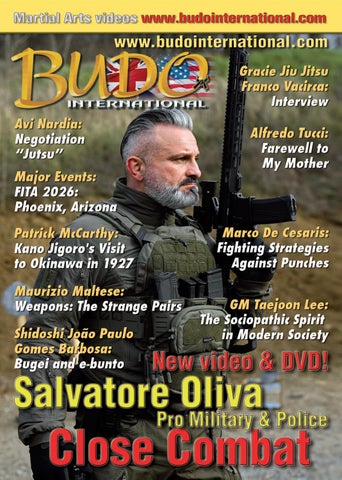
Martial Arts Magazine Budo International 529 August 2026
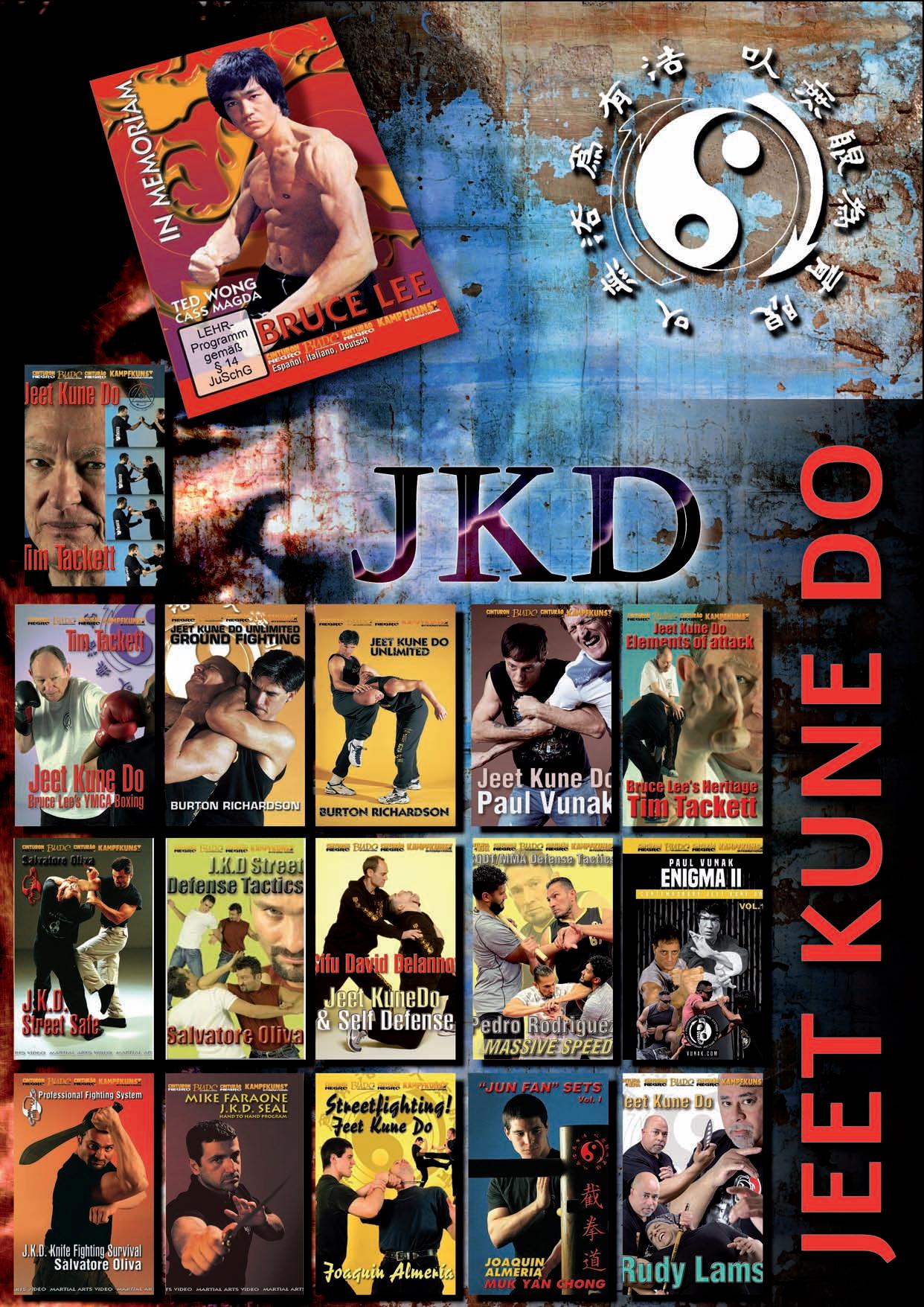
We produce and sell Martial Arts videos and books: Please visit our website: www.budointernational.com
Also available our Youtube channel: With more than 100,000 subscribers at: Budo International Official.
We produce every month a free on line magazine available in our website and in issuu.com in 5 languages. English, Spanish, German, French, and Italian with already over 1,000,000 readers all over the world.
All the issues remain available on line forever so they keep receiving reads for years.
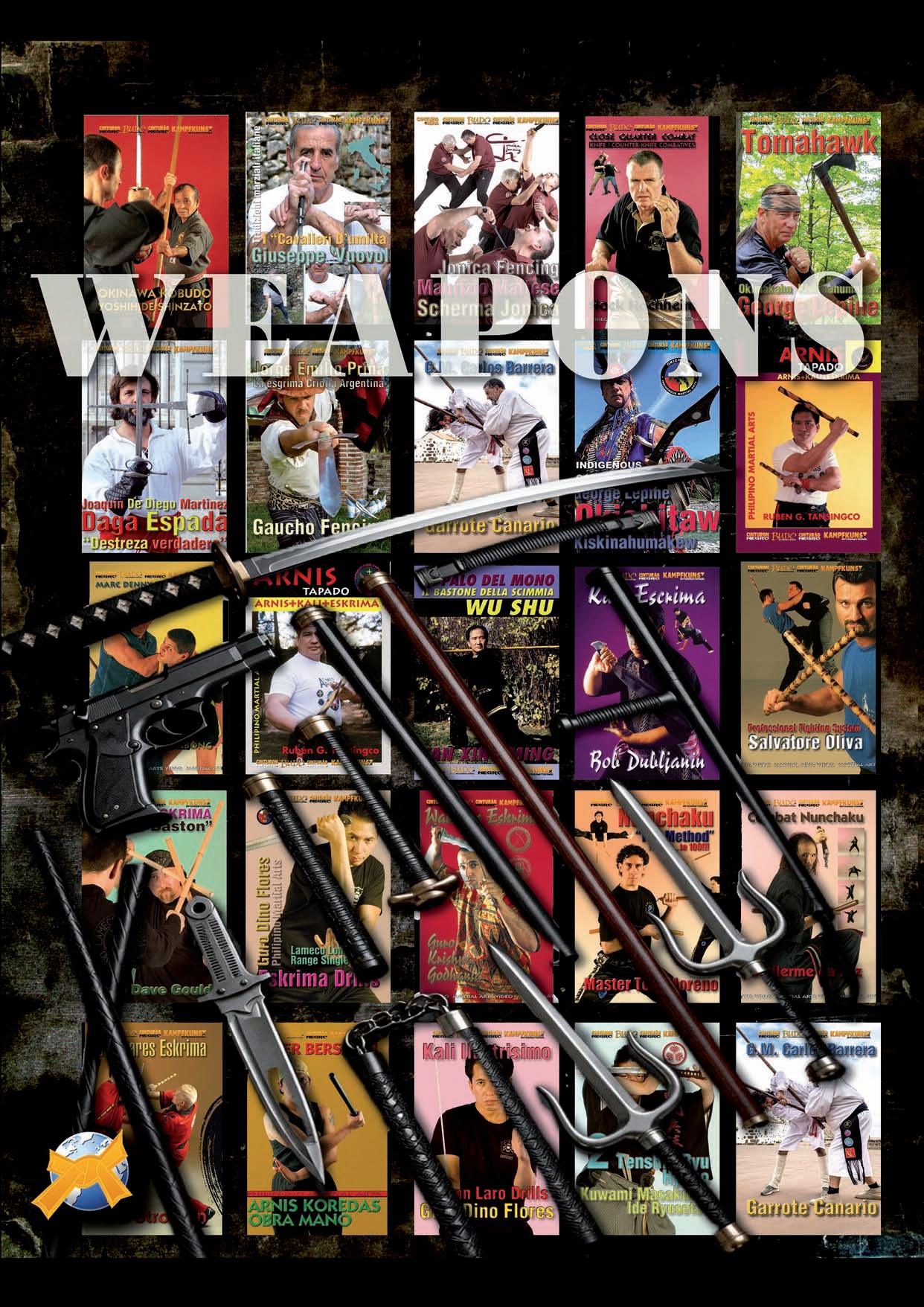
We have 1,000 different instructional videos available with the best masters of 5 continents.
Any questions suggestions or ideas please contact GM Maurice Elmalem
1. Budo to add coverage of Boxing, Mix Martial Arts, Kick Boxing, Wrestling, UFC, entertainment & celebrity corner of pages in the last end of magazine pages.
2. Offer business card size advertising at $29.95 (and other sizes) monthly fee for organizations, schools, associations, personal, tournaments.
3. Cover stories on past today and world champions M/A, UFC, body builders.
4. Become a sponsor of Budo magazine, make legacy gifts to family in need. Create annual fund for online donations.
5. Always your special media of MA stories are welcome anytime.
6. Let us hear your story, you got photos of martial arts celebrities, updated news, send info to: Main office USA 718.652.6600 email: info@budomaxintl.com or call USA-888-455-8181
7. We collaborate with world renown organizations, MA Grand Master schools and association worldwide.
8. Free monthly Budo commercial for online and media promotions.
9. Budo Magazine Calendar that includes photos, events, advertising, Join Budo Club – Tell us your story - Got Talent.
10. Advertise with Budo Max International and be seen worldwide.
“If what is sacred is not respected, there is nothing on which to base one's conduct.”
Pearls of the ConfuciusWarrior
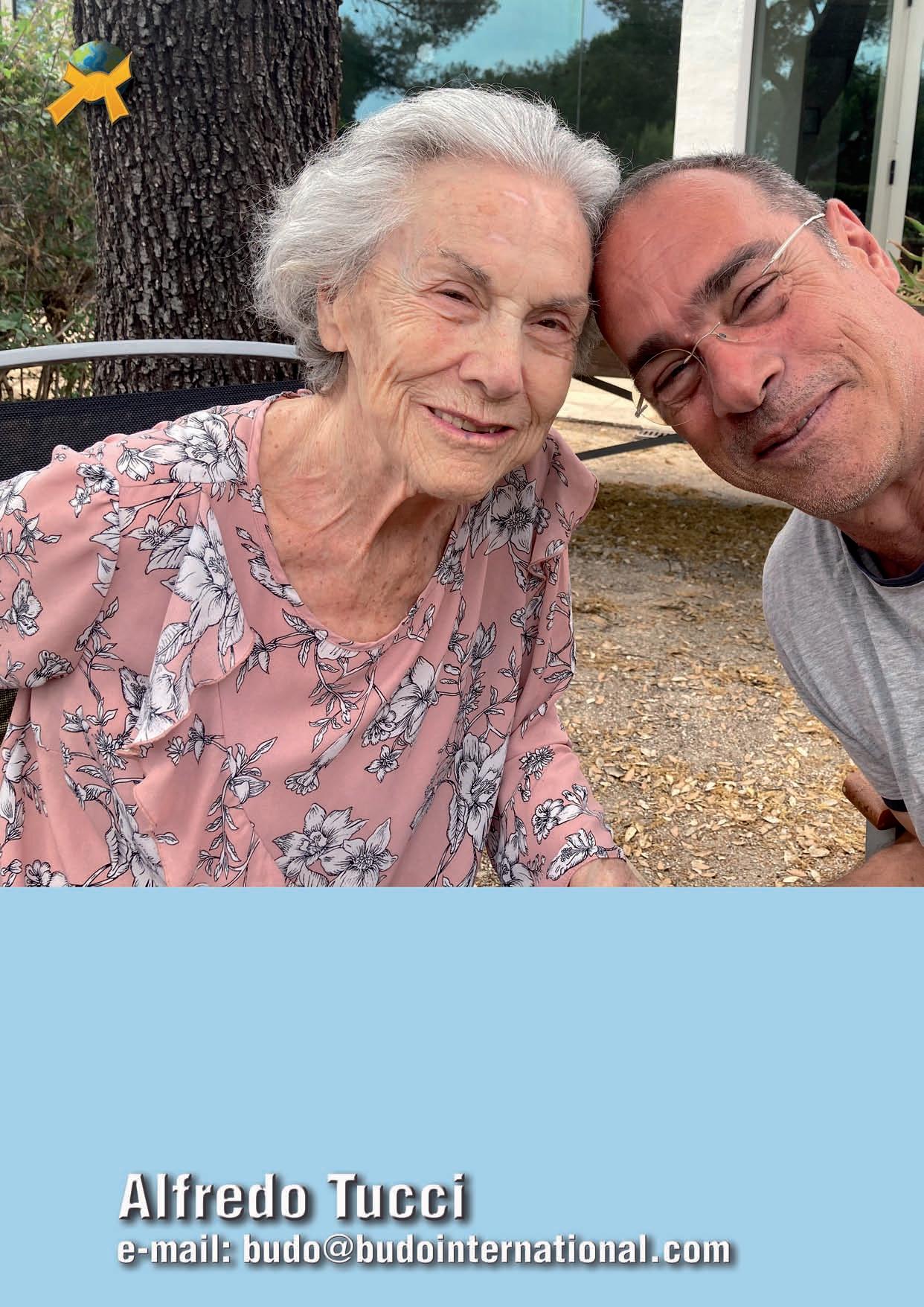
TI’ Saying Goodbye to My Mother Saying Goodbye to My Mother
ve been letting time pass before writing this. I want it to be free of any trace of grief over the loss, but perhaps that moment has already arrived. Of course I mourn my mother’s death, but at the same time, the person she once was gradually slipped away from us, lost behind that veil of absence that dims the mind and has a German name. It had been a long time since she knew who she was, since she recognized me, since she could hold a conversation or offer her measured advice—always impeccable and respectful of others’ freedom.
For nearly 10 years, through sheer love and care, I managed to keep her active and safe. The pandemic ended up making things worse, and one day we realized—even after moving houses for her sake (she was running away!)—that María and I could no longer do anything more. In cases like this, one must learn to accept that defeat as another stage of the illness and seek professional help. That’s what we did. We were fortunate to find an impeccable place—Selegna! And just three minutes from home, too! It wasn’t cheap, no, but it was worth every euro we paid over the next nearly five years. Rosana and Telvi, two angels dedicated to their calling, were with us the whole time, and most importantly, they managed each phase of Mom’s condition with care—we already knew that no phase would be better than the one before…
As long as it was possible, we went to the beach with her every week in the summer, and María and I visited her every week without fail throughout this entire time—except during bouts of colds or the flu, when we just couldn’t bring such germs into that sanctuary.
Editorial Editorial
Over the years, we had many curious and moving experiences with Mom. On one occasion, when we were still able to take her out to eat at home, Mom channeled her father’s spirit and, for half an hour, had an incredible conversation with us. She began by saying, “I thank your spirits for letting me come.” During that time, María and I looked at each other in disbelief. I recognized my grandfather’s gestures and the way he spoke and responded—he was quite a character. We didn’t know it at the time, but that was the last time we were able to bring her home for a meal.
Mom went through a critical period two years ago—she had pneumonia and we had to hospitalize her. She pulled through, but she had “shut her mouth”— she no longer wanted to eat, and what’s worse, she was very restless. I sensed that this restlessness wasn’t so much hers as it was that of the family spirits who had come with the best of intentions to help, but who weren’t in a position to do so.
In the spirit pantheon of the ebunto, there is only one type of entity that deals with the spirits of the deceased: the elderly priestesses who tended the cemeteries, known as Majo. There is, however, another name for one of their qualities: Aburaca—a strange name, to be sure, and little known even among initiates. The Majo walking with me possesses this quality, and given the situation, I went to ask her earnestly to step in and restore order, sending away any spirit whose presence was not helping but rather hindering us. At that moment, we thought Mom might pass away, and I said that if it were to happen, that was her time—not anyone else’s.
The next day we went to see her; she had changed completely. She was calm, and she—who at that time was able to utter only a few words, often nonsensical—told us, her eyes wide open: “Aburaca is up there! She’s the one in charge!”
The process of decline—as anyone who’s lived through it knows—is hard and inescapable, but we remained steadfast in our commitment to convey love, whether she received it consciously or not, with every visit, every little massage, every kiss, every caress.
When she was young, Mom told my brother and me: “When I’m old, put me in a nursing home—but not a war zone, mind you—and come by every now and then to make sure they’re not mistreating me.” Mom was always impeccable— clean, moisturized, and well cared for. I doubt this made any difference to her, but it certainly did to us.
That last week, Mom didn’t want to eat; she had a slight fever, and they suggested taking her to the hospital for an X-ray. Of course, I said absolutely not. Selegna had excellent ICU-style facilities and was prepared for palliative care. Then the community doctor came and prescribed antibiotics, leaving pain medication on hand—just in case—should distress visit her state of mind. It wasn’t necessary. We’d sent several Majo to handle the situation. Once she was stabilized, with an IV to keep her hydrated, Mom drifted away peacefully, without distress.
On Friday morning, I went to see her, as I had every day that week. She was stable, calm—nothing suggested that the end was so imminent—but as I left her room and got into the car, I burst into tears for the first time in those five years. The next morning, she stopped breathing.
That day, Saturday, May 16, we had a spiritual celebration planned at my house with 25 guests; believe it or not, a celebration dedicated to our deceased loved ones—to our spirit guides, known as Senzo or Saogi. Quite a few of those present had known her, which was the same as saying they loved her, because Doña Luz always shone with her own light. No, no—there is pain in this loss. There is also relief, because that state of being present yet absent—especially for someone who, with such poise and depth, has been alive and awake in every sense of the word—is a living sentence that no one would wish upon anyone. Medical science extends life by bypassing those episodes that once led us to the realm of the silent, and at times, those victorious battles lead us to states of survival that bear little resemblance to the idea of life itself.
We were there for Mom as best we could, both in her life and in her death; in the good times, we enjoyed her company; in the bad times, our roles were often reversed, and I ended up being her dad. She was a wonderful person, and thanks to her, I can say without a doubt that I… am the son of Luz! That’s something!
Have a safe journey, dear Mom! Thank you for so much… keep shining, “little light”, Luzita, Doña Luz…
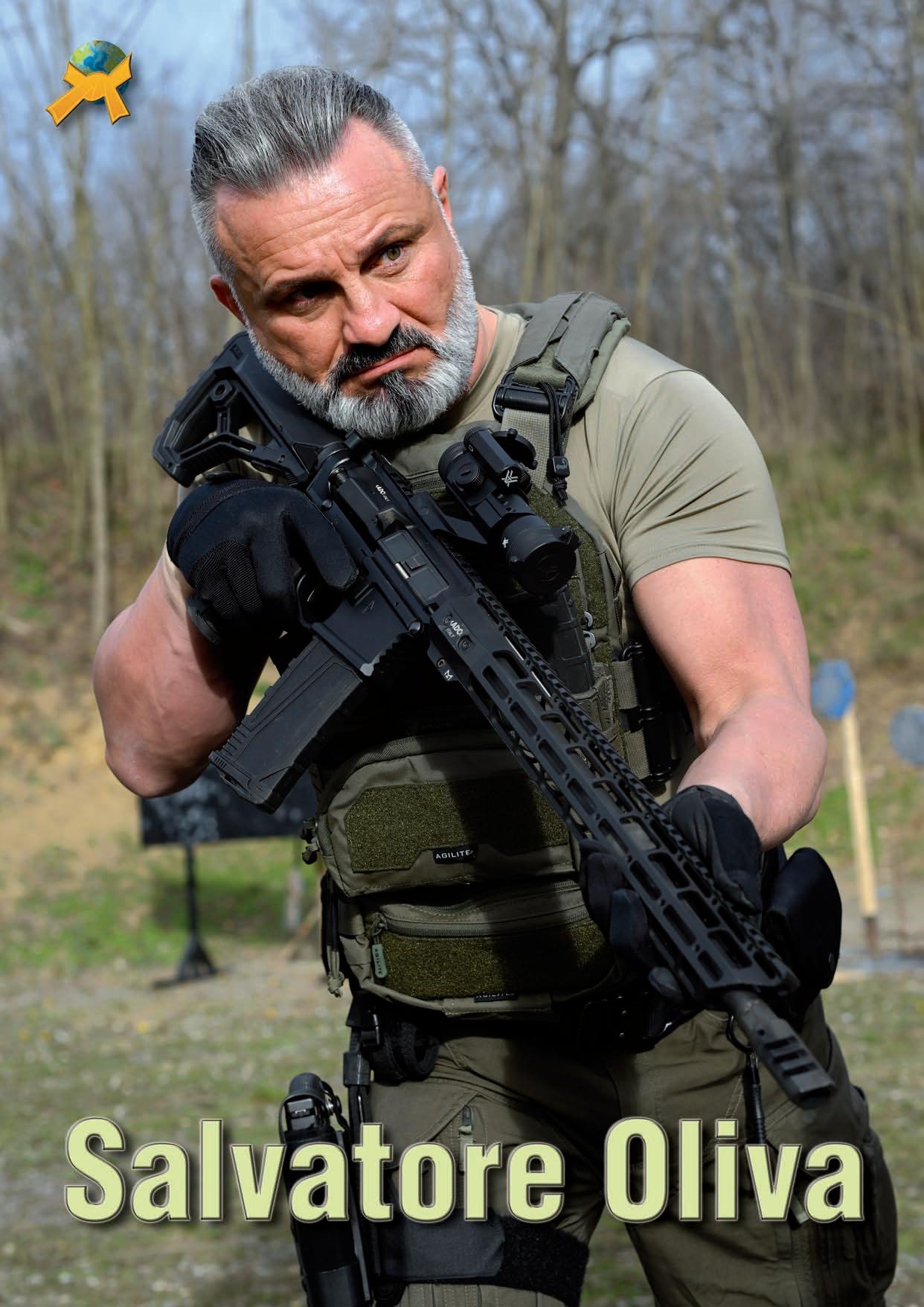
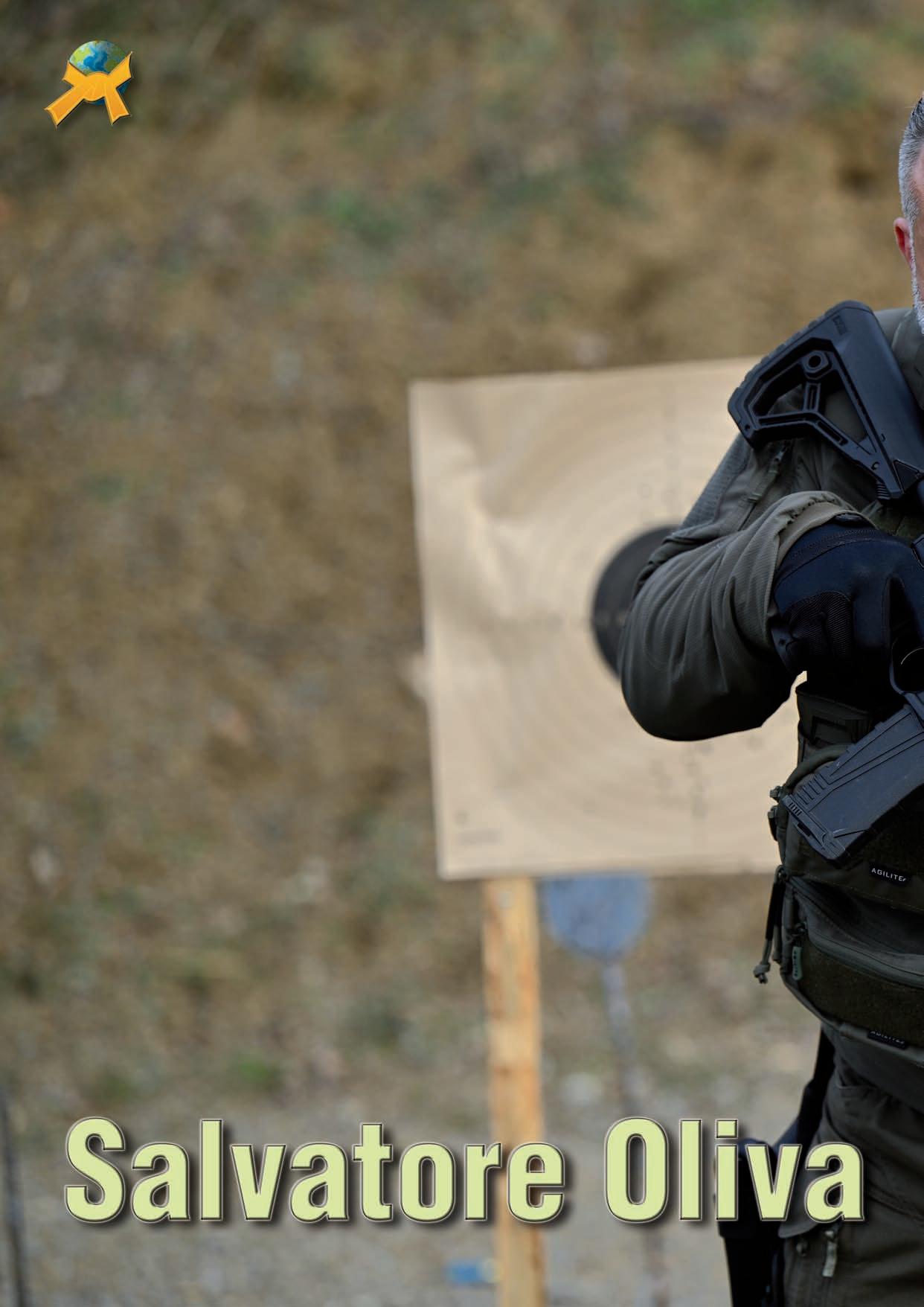
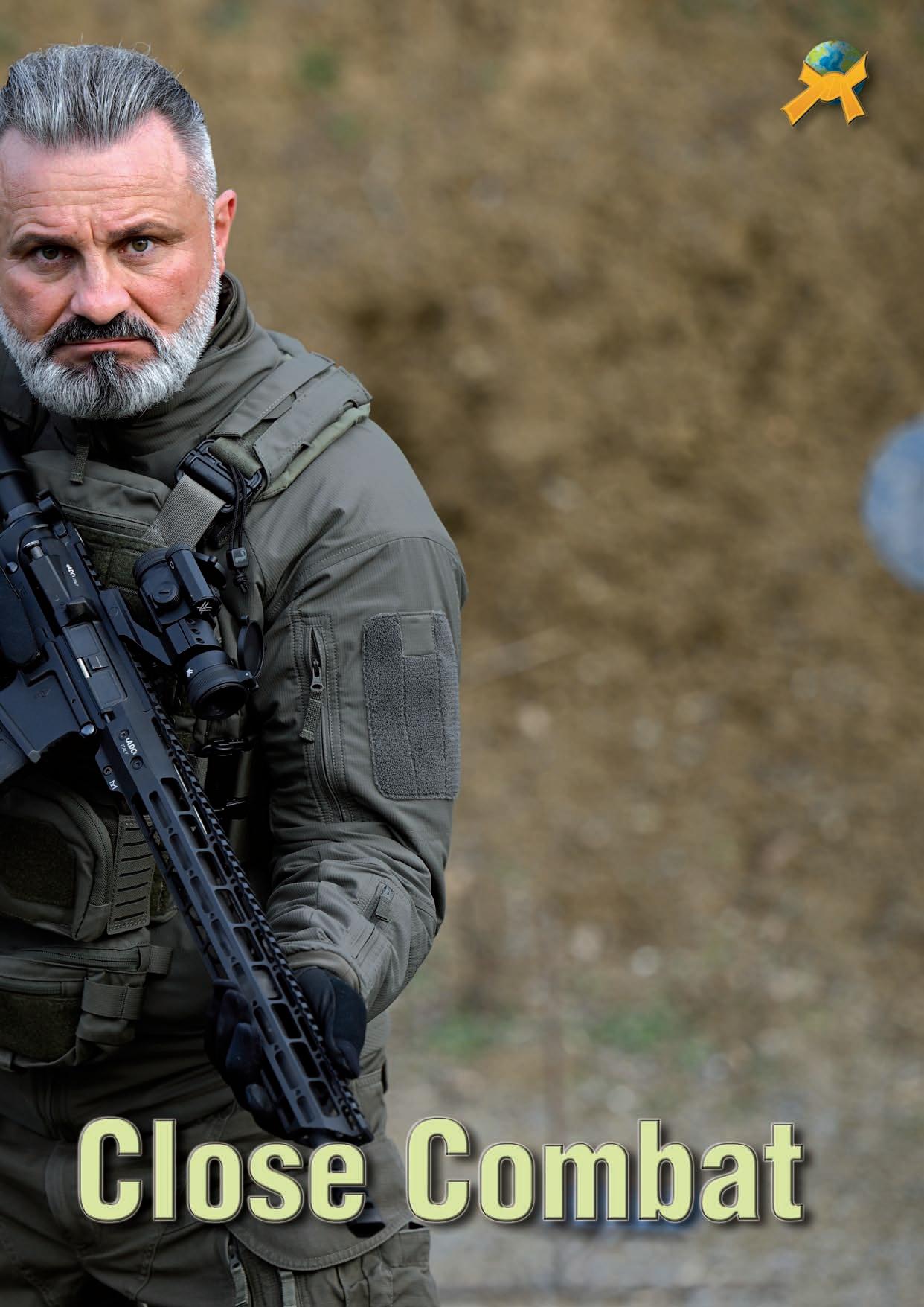
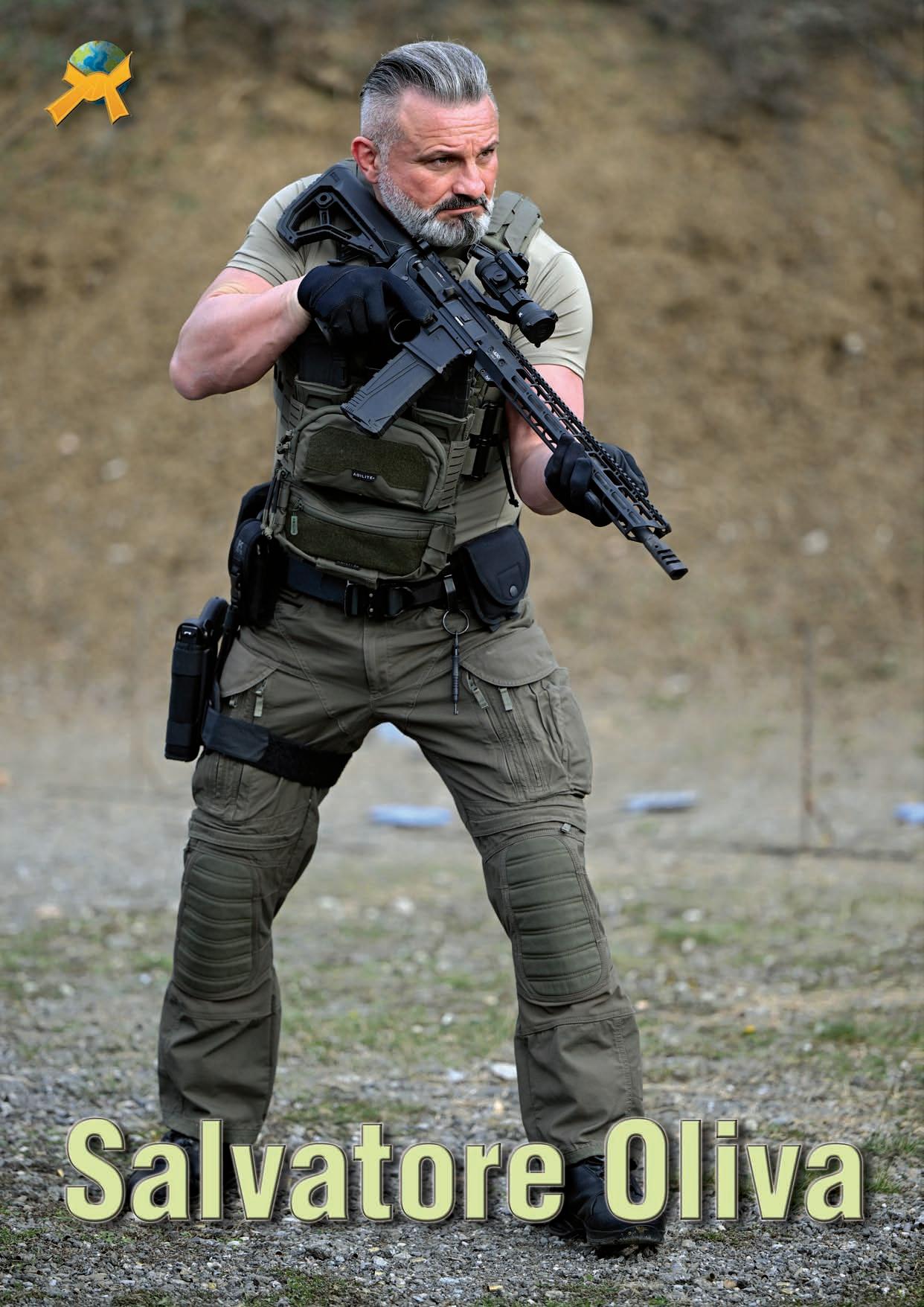
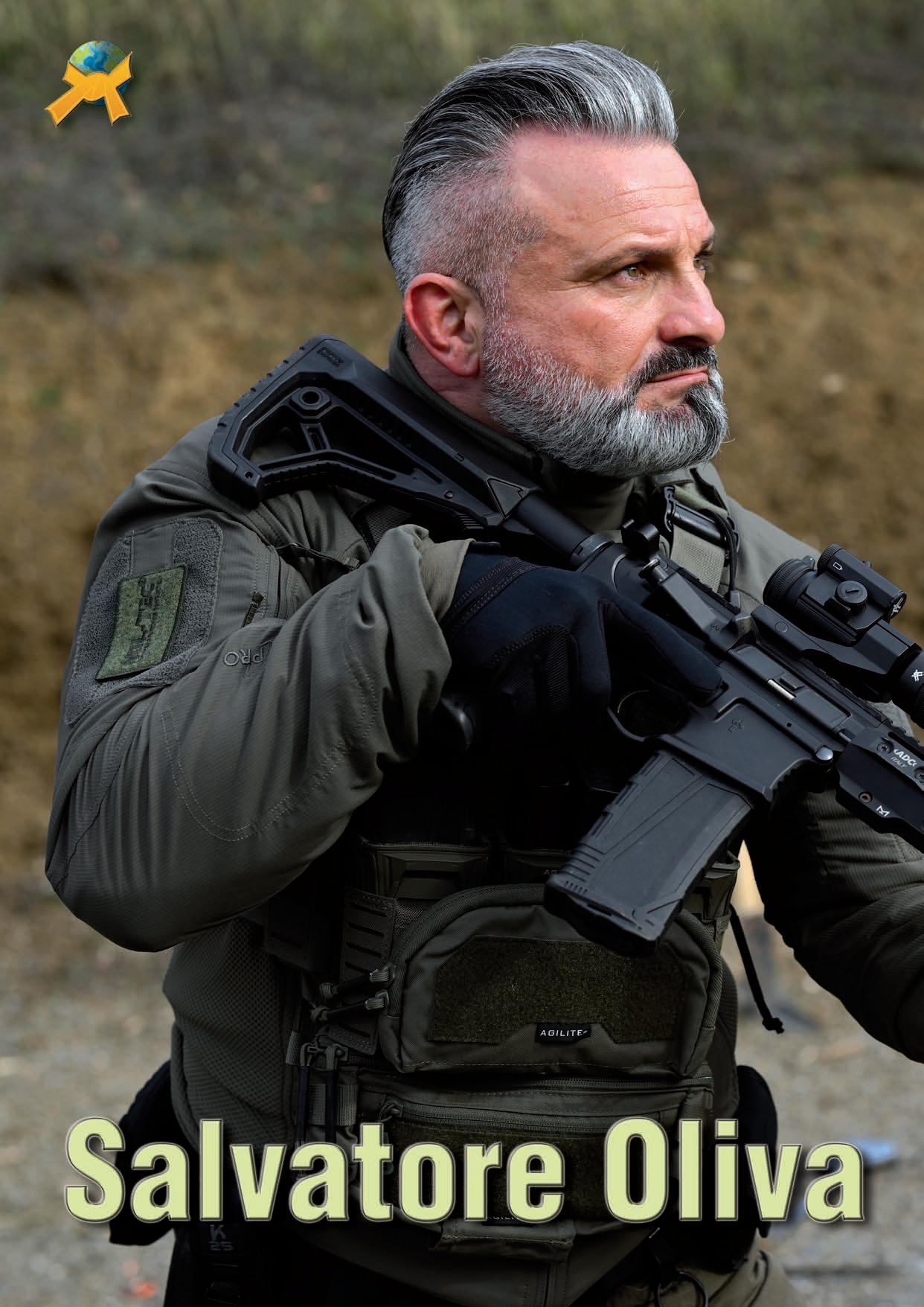
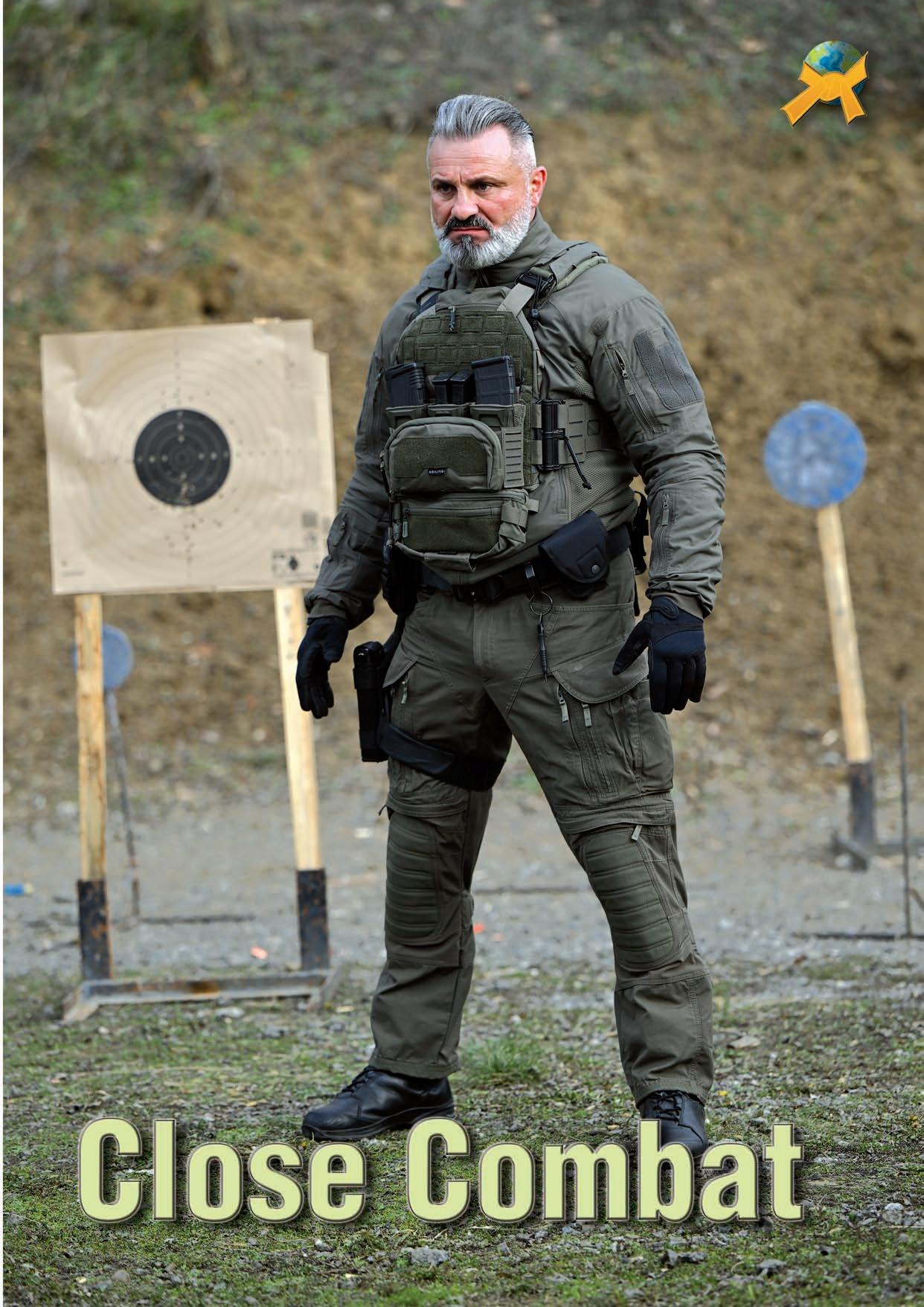
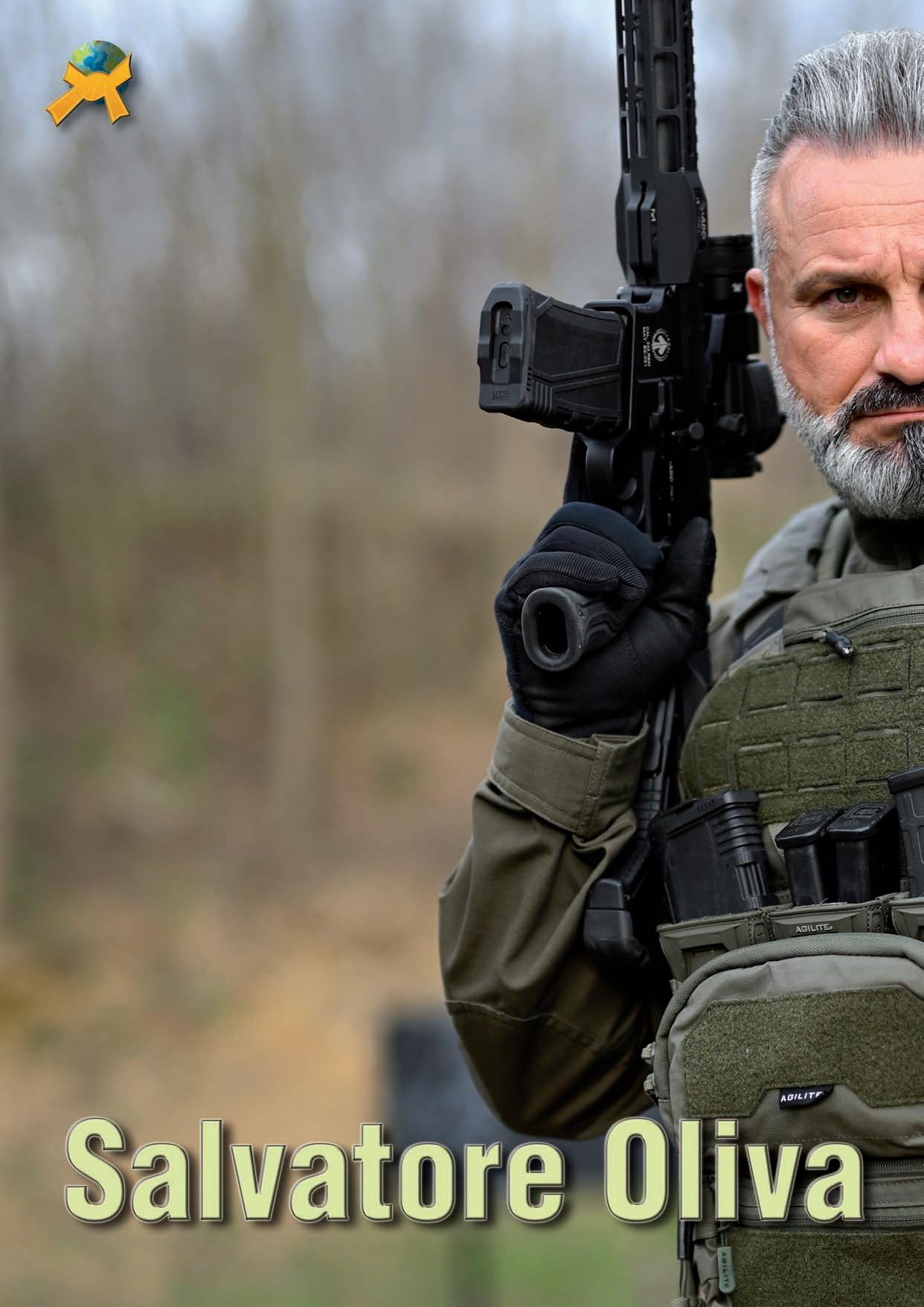
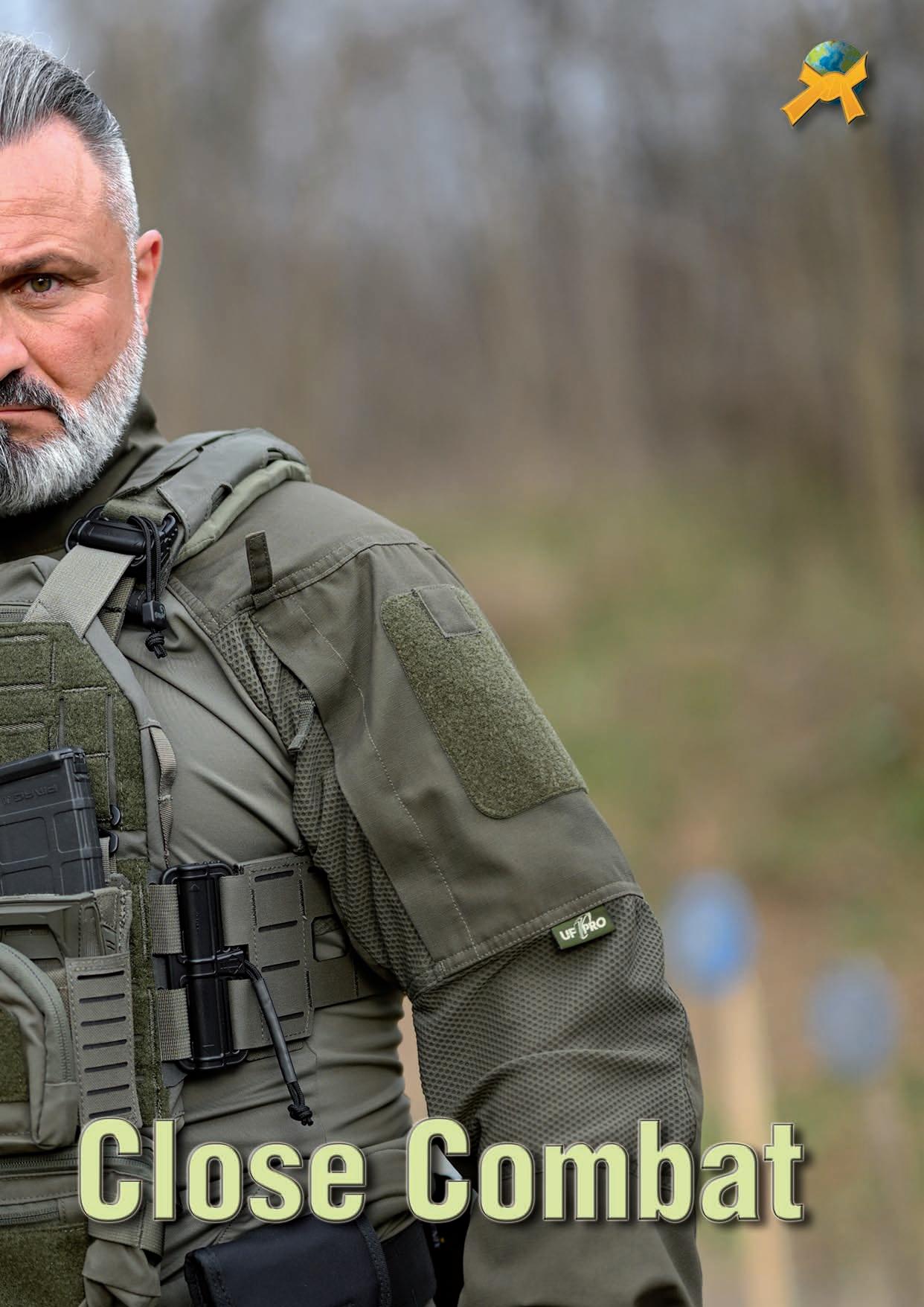
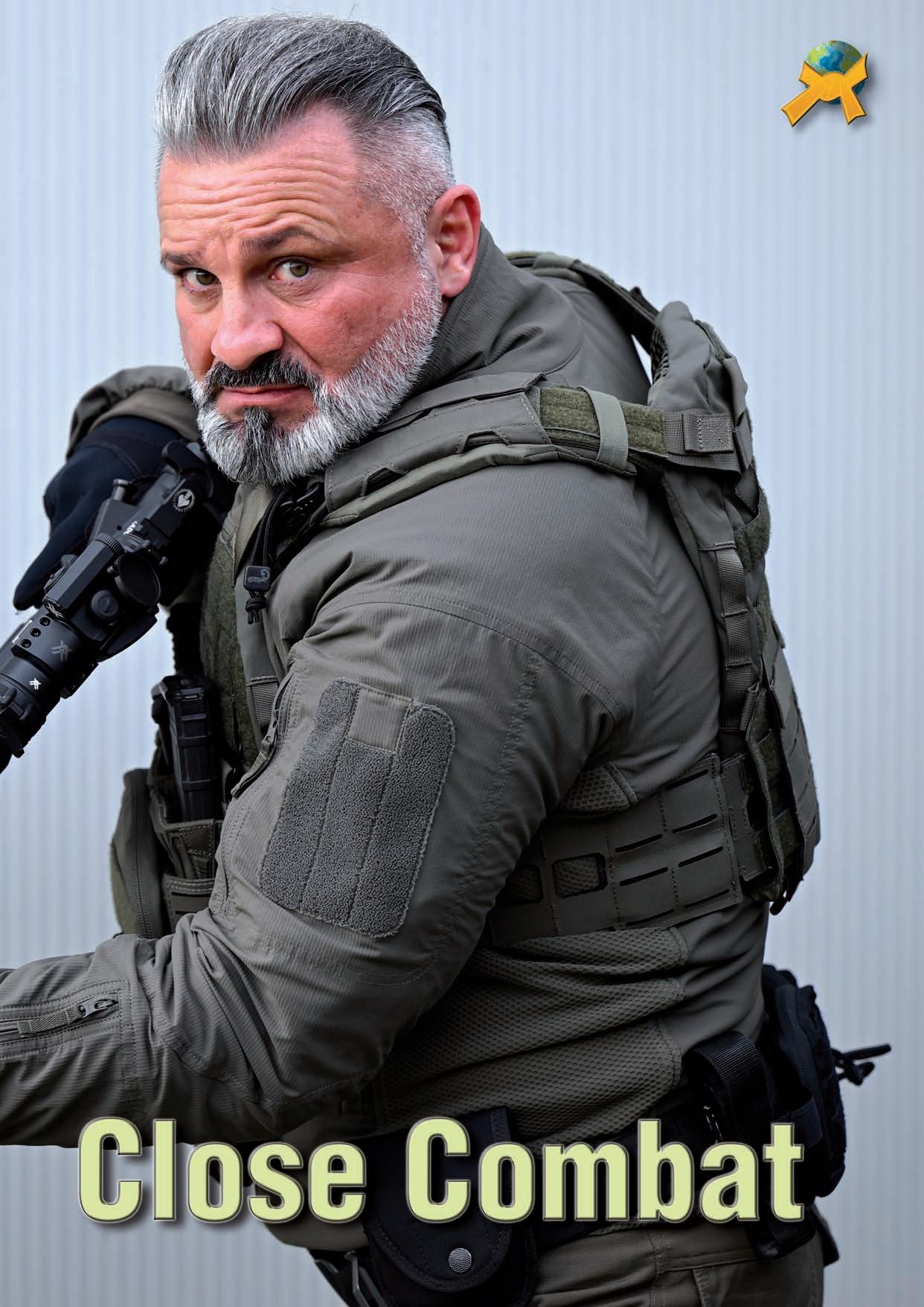
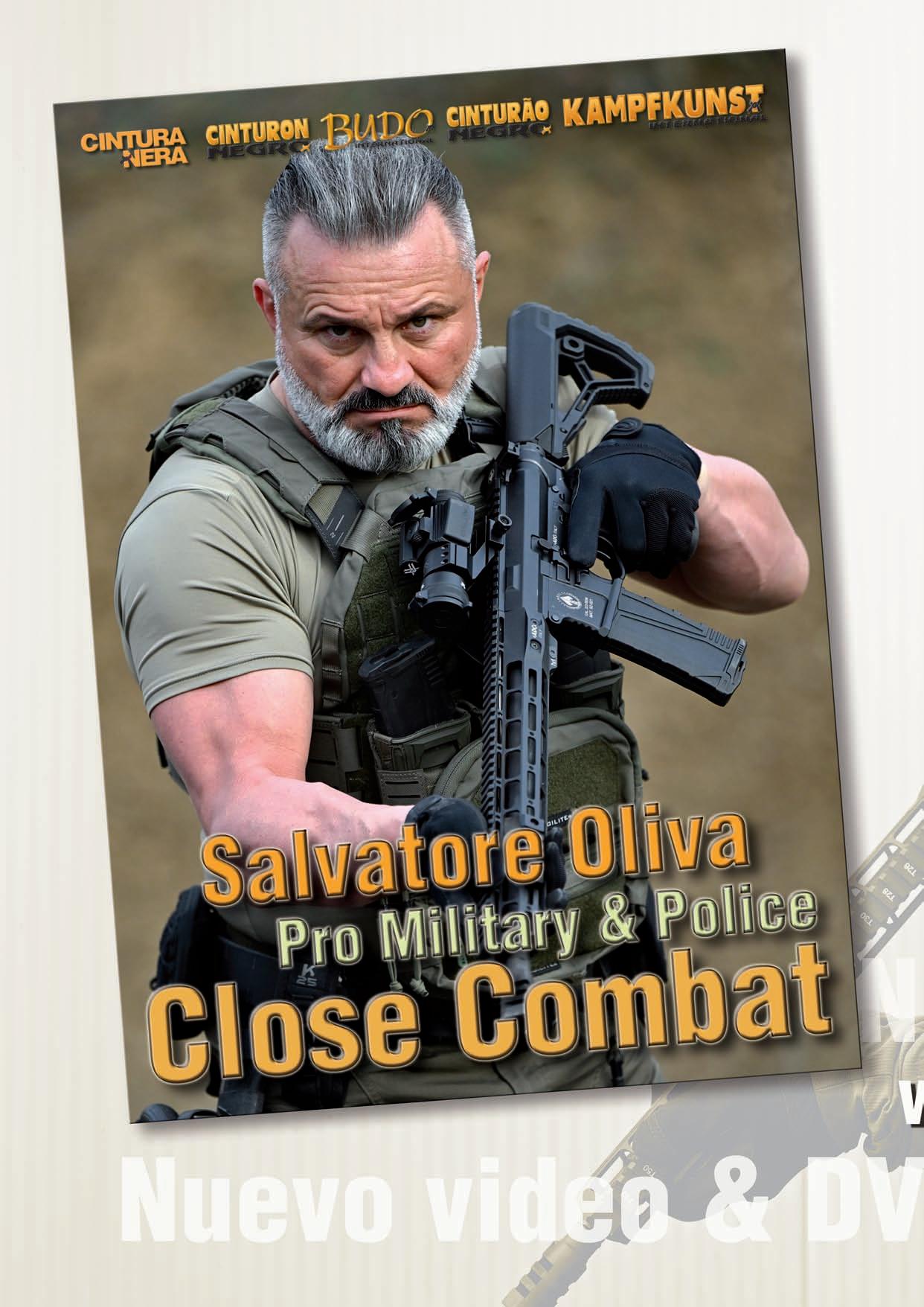
Close Combat
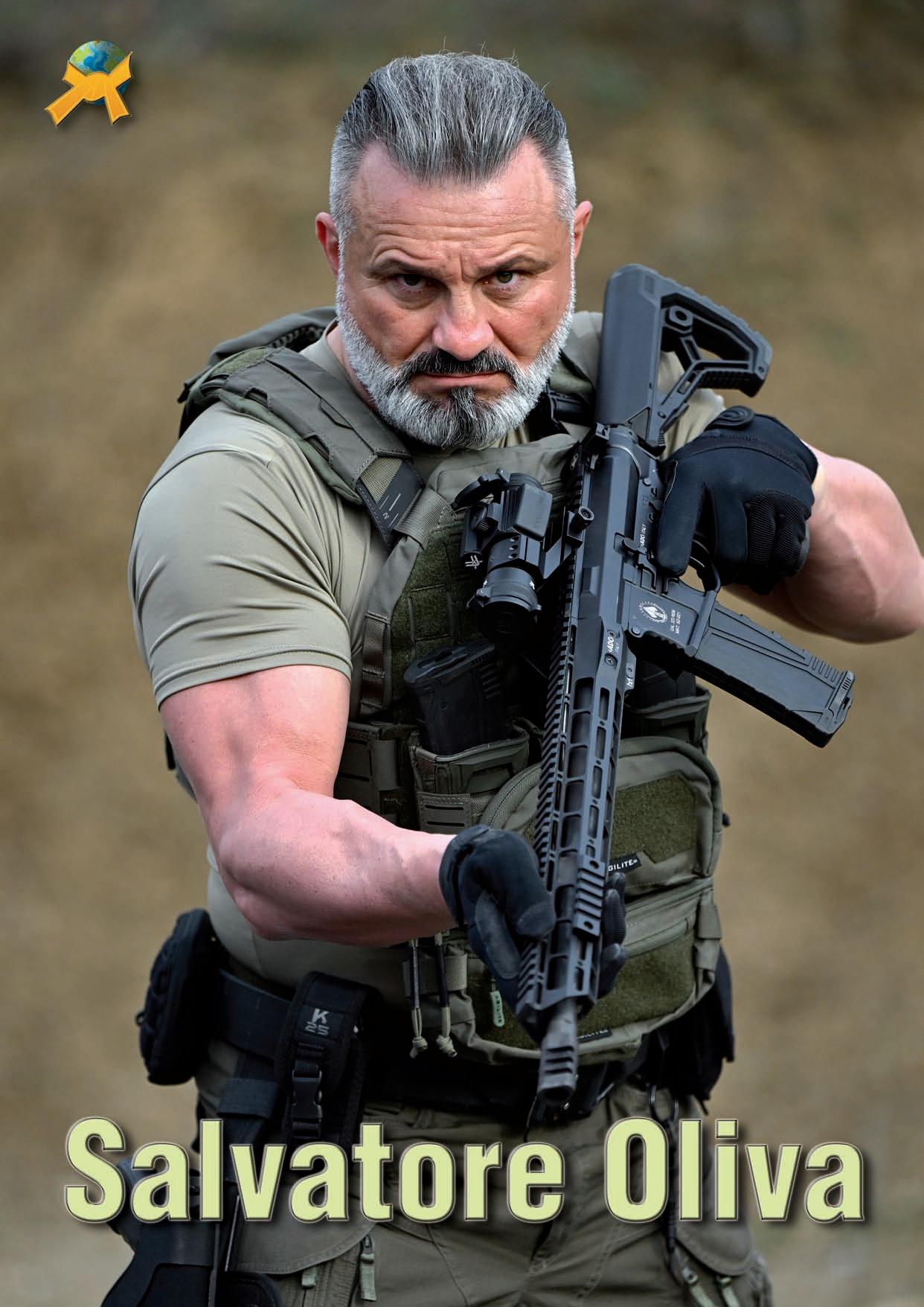
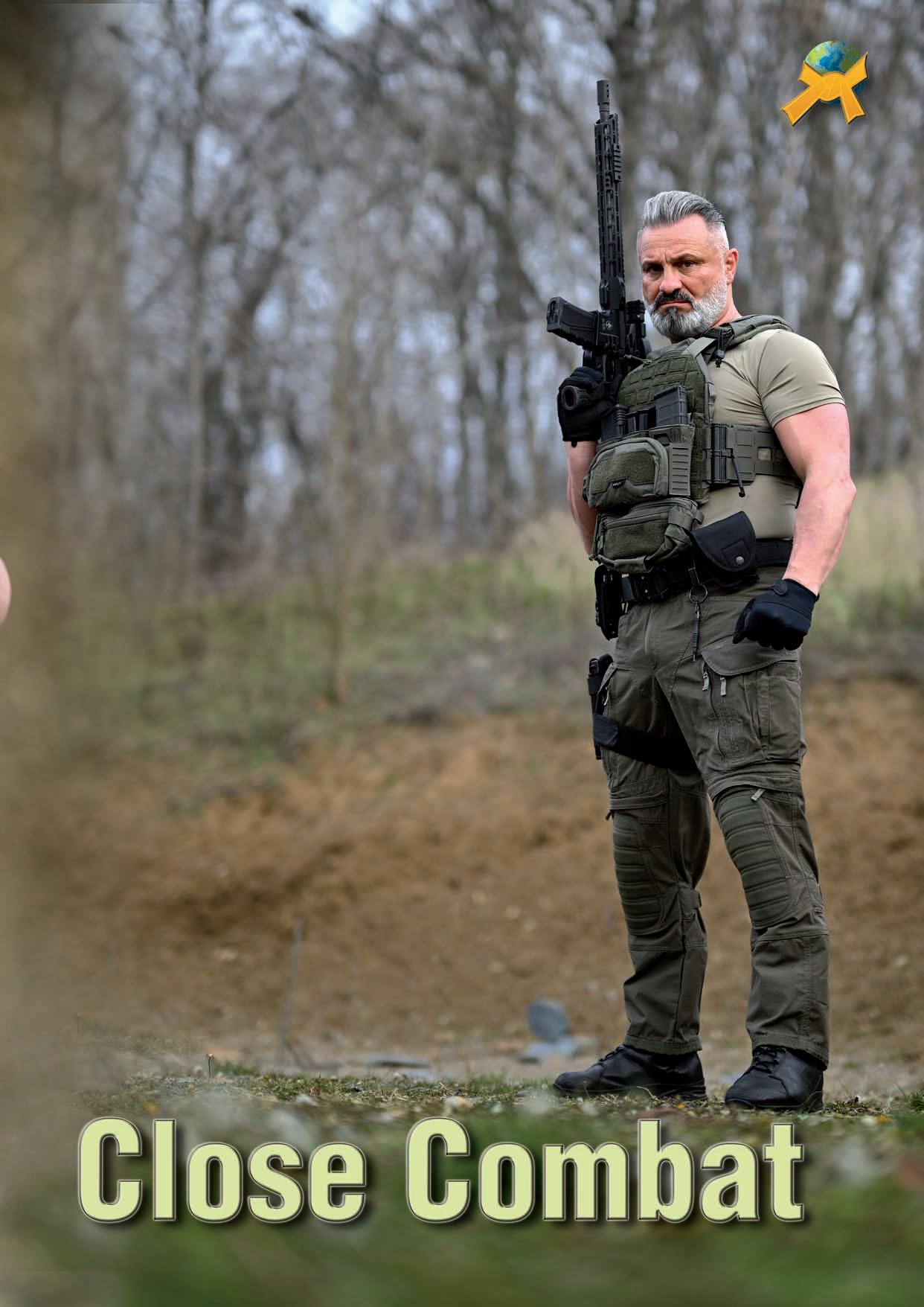
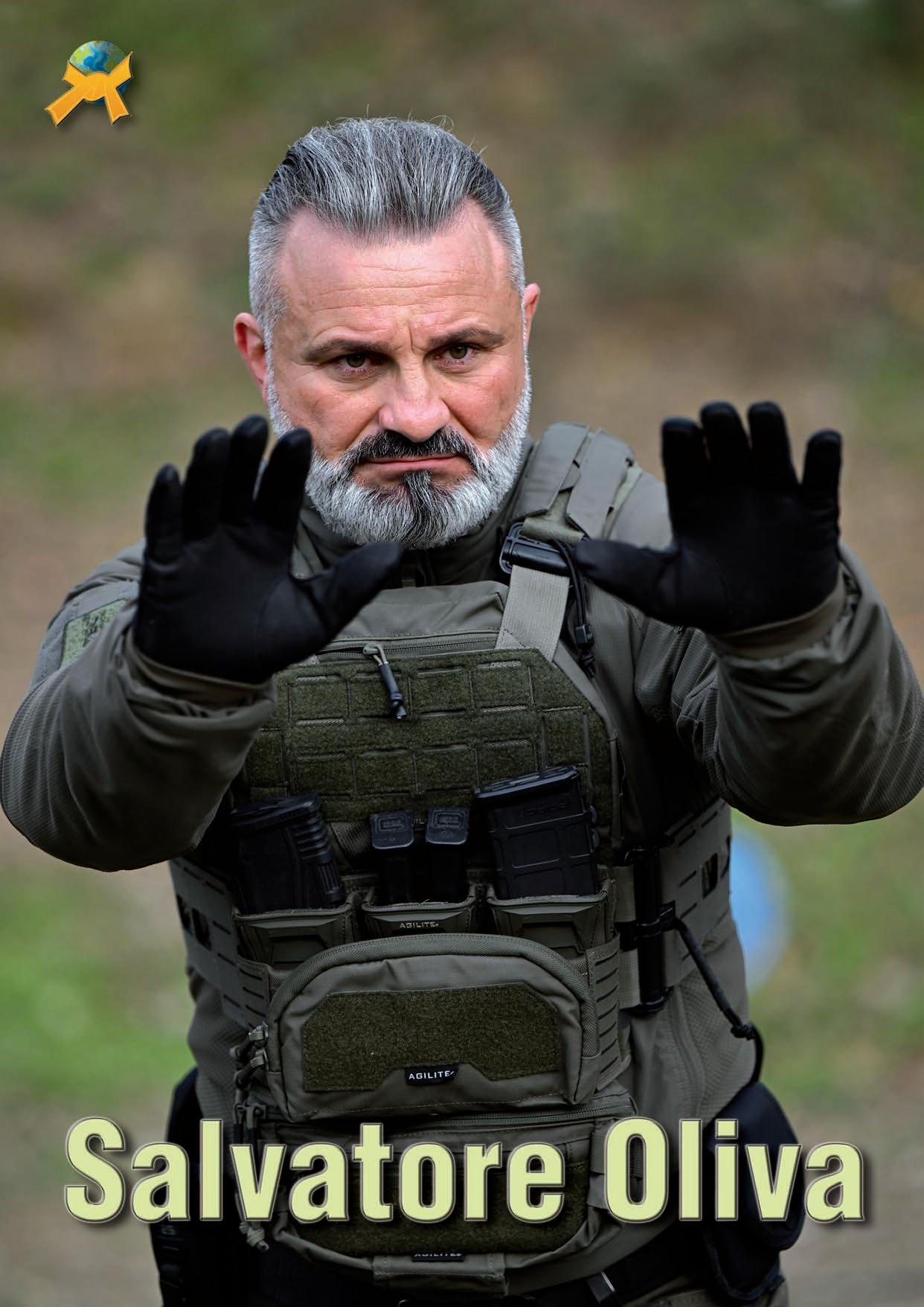
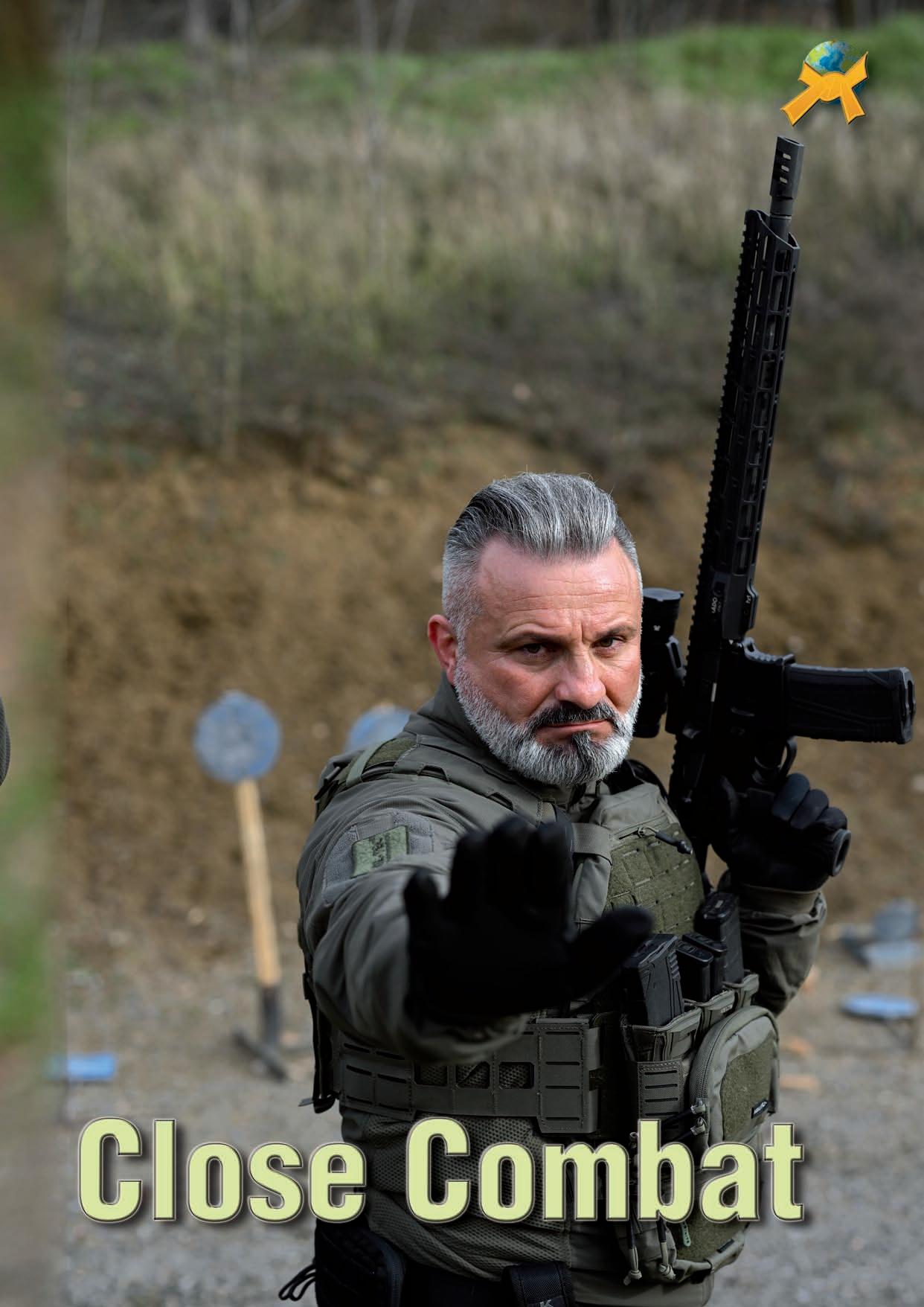
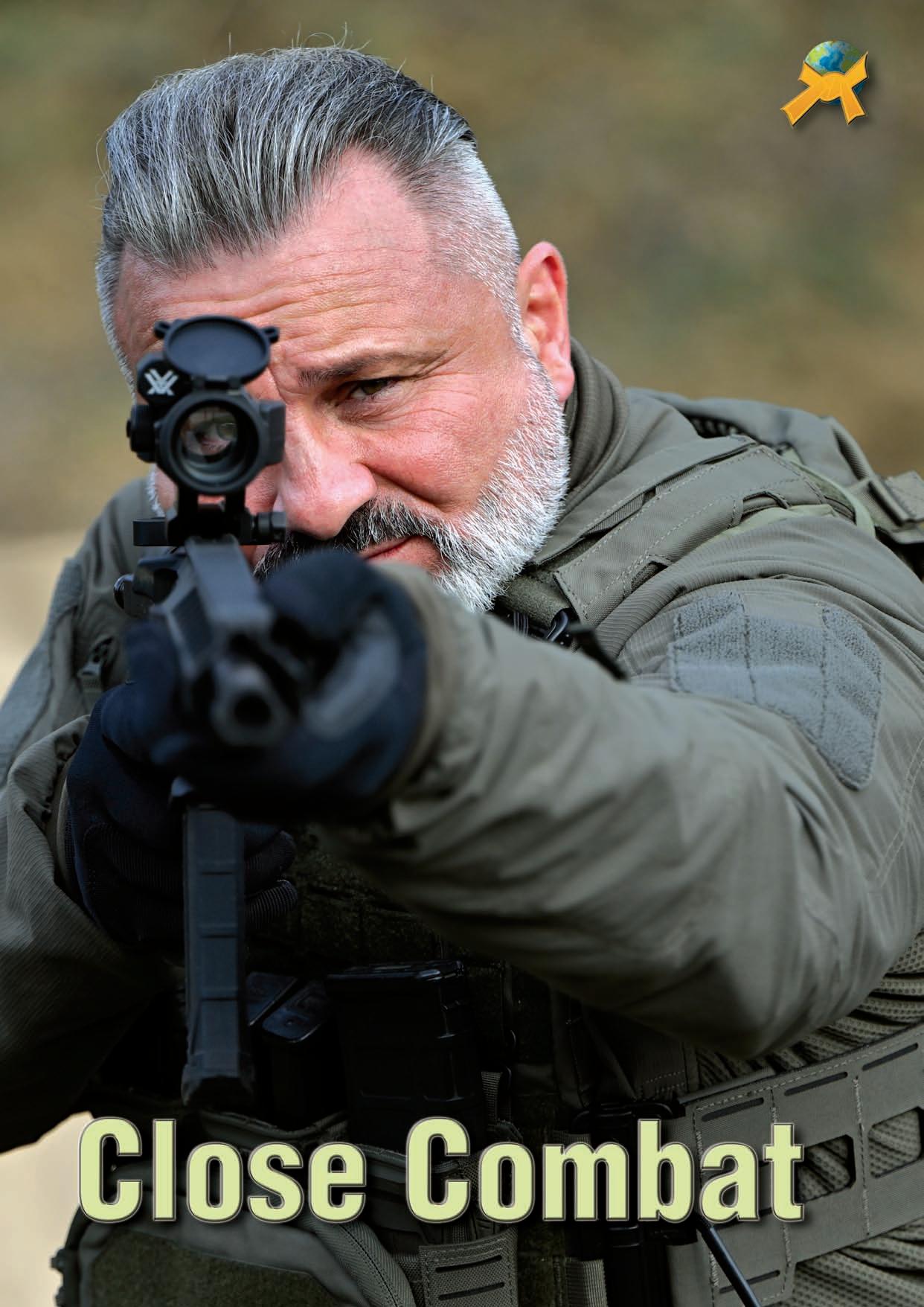
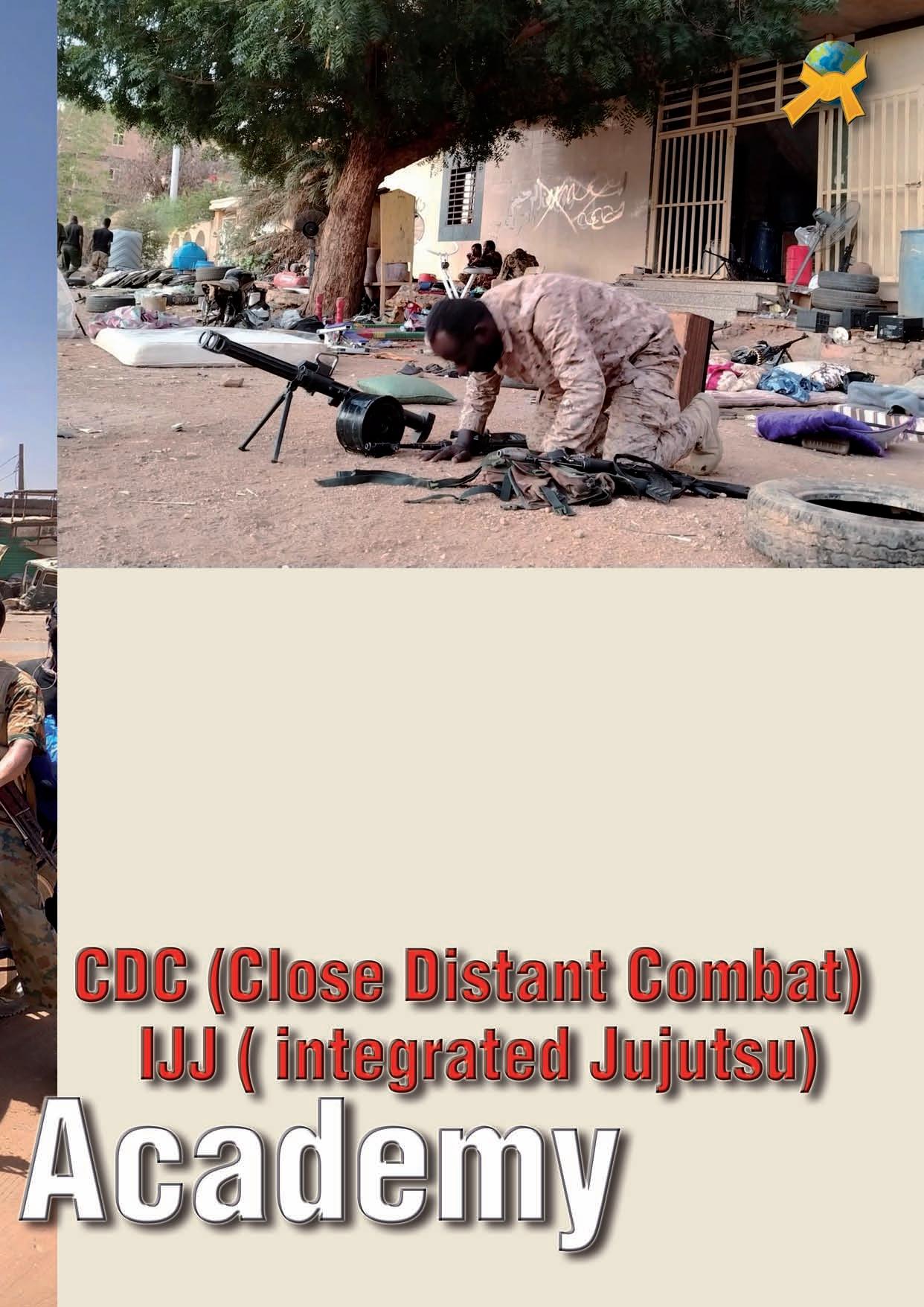
Close Combat for Military & Police
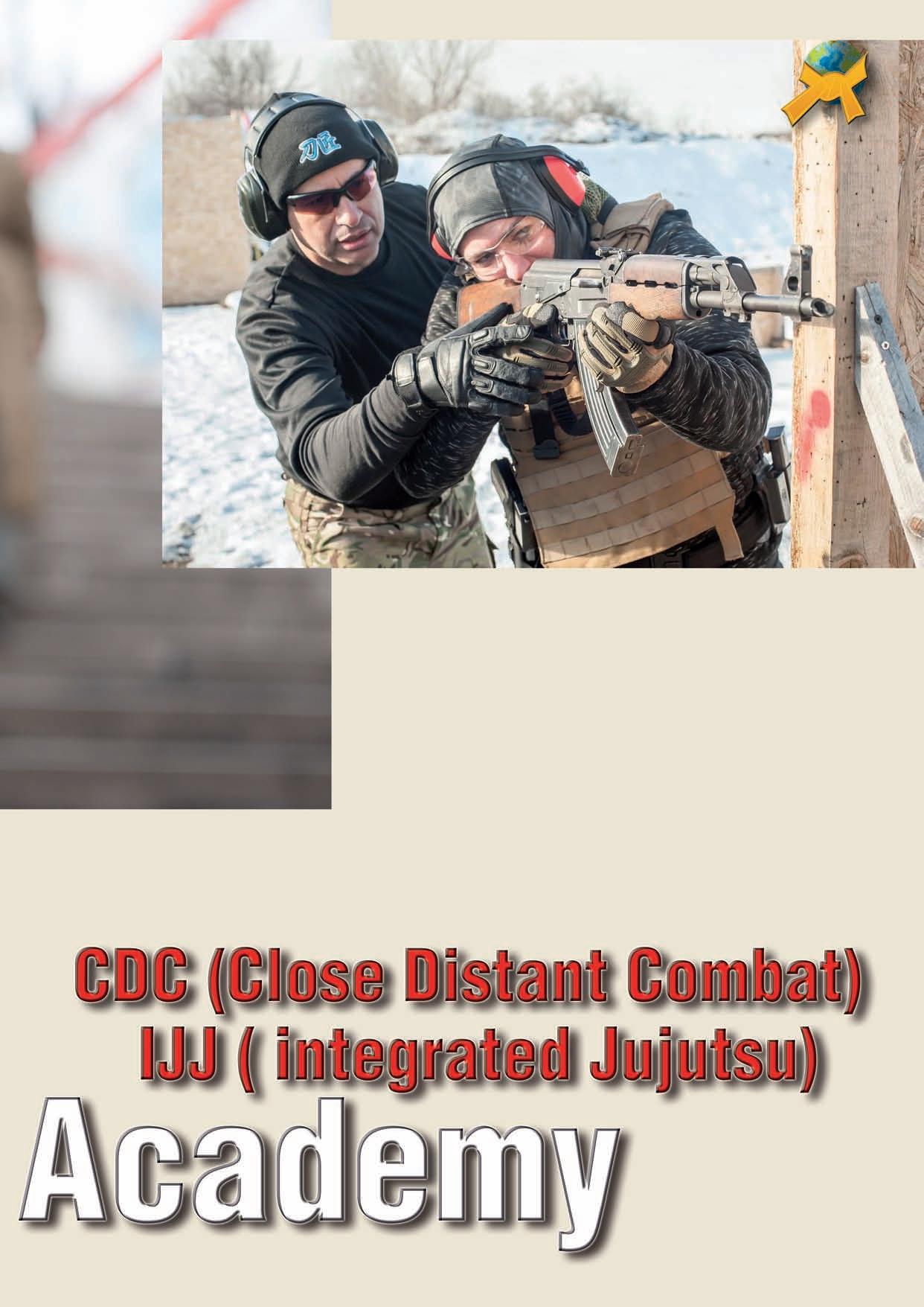
Close Combat for Pro Military & Police, known as hand-to-hand combat, represents one of the most primordial and, at the same time, most complex forms of human conflict. Its roots stretch back to the earliest phases of human history, when survival depended directly on the ability to defend oneself or assert dominance without the use of tools. Despite technological advances and the increasing regulation of violence in modern societies, close combat has lost none of its relevance. Rather, it has evolved and taken on various roles as a means of self-defense, a sporting discipline, a military tool, and an instrument of personal development. At its core, close combat describes direct physical confrontation between two or more people without the use of weapons. The term encompasses a wide variety of techniques, strategies, and philosophies that have developed over centuries in diverse cultural contexts. This diversity reflects humanity’s ability to adapt to different threat scenarios and environmental conditions. While structured martial arts with clearly defined rules and philosophical foundations emerged in some regions, pragmatic systems focused exclusively on efficiency and survival developed elsewhere.
“Today, military closequarters combat can no longer be viewed in isolation but is embedded in a comprehensive system of training, technology, strategy, and psychological preparation.”
Historically, close combat was a necessity. In times when weapons were either unavailable or unreliable, people had to learn to use their bodies as their primary tools. These skills were often passed down and refined within communities. In many cultures, these evolved into complex systems with established training methods, ranking systems, and ethical guidelines. This development shows that close combat was never merely about brute force, but always represented a form of knowledge, discipline, and cultural identity.
A central component of close combat is mastery of one’s own body. This encompasses strength, endurance, agility, and coordination, as well as a deep understanding of timing and distance. Effective techniques rarely rely on raw strength alone. Rather, it is about using energy purposefully and executing movements efficiently. An experienced fighter recognizes when to attack, evade, or take control. This ability does not develop overnight but is the result of intensive and continuous training.
In addition to the physical dimension, the mental component plays a crucial role. In a real conflict situation, the human body is subjected to extreme stress responses. Adrenaline, fear, and uncertainty can distort perception and impair decision-making. Therefore, it is essential to develop mental strength. This includes the ability to remain calm under pressure, analyze situations quickly, and act decisively. Many training systems therefore specifically incorporate exercises for stress management, concentration, and emotional control.
A factor often underestimated in close combat is situational awareness. Unlike in a sporting context, where rules and conditions are clearly defined, a real-life conflict takes place in unpredictable environments. Confined spaces, poor visibility, or multiple attackers can significantly complicate the situation. A competent fighter takes these factors into account and adapts their behavior accordingly. In this context, the environment can represent both a danger and a resource. Doors, furniture, or other obstacles can be used to create distance or control the opponent.
Self-defense is one of the most common reasons why people take up close combat. In this context, the focus is not on victory in the traditional sense, but rather on the goal of ending a dangerous situation as quickly and safely as possible. Effective self-defense is based on simple, reliable techniques that can be performed even under stress. At the same time, prevention plays a crucial role. Awareness, body language, and the ability to recognize potentially dangerous situations early on are often more important than the actual fighting techniques.
In the military, close combat holds a special place. Soldiers are trained to remain capable of acting even in situations where weapons are not available. Military close-quarters combat systems differ significantly from civilian martial arts. They are generally less formalized and focus exclusively on efficiency and achieving objectives. Techniques are evaluated based on how quickly and reliably they can neutralize an opponent. This also includes methods that may not be used in a civilian context for ethical or legal reasons.
Pro Military & Police Pro Military & Police
The competitive aspect of close combat has developed significantly, particularly in the 20th and 21st centuries. Competitions provide a structured and safe environment in which skills can be tested and improved. Clear rules, weight classes, and protective measures minimize the risk of injury without compromising the competitive nature of the sport. Competitive close combat requires not only technical skills but also strategic thinking, tactical adaptability, and a high level of physical fitness.
A key difference between competitive and real-world close combat lies in the context. While fairness and safety are paramount in sports, there are no such guarantees in real-world conflict situations. However, this does not mean that athletic training is worthless. On the contrary: it provides a solid foundation for physical fitness, technical understanding, and mental resilience. It is crucial, however, to recognize the limitations of the athletic context and, if necessary, to supplement it with specific self-defense training.
Another significant aspect of close combat is personal development. Regular training fosters discipline, perseverance, and self-reflection. Progress is often slow to become apparent, which requires patience and a longterm perspective. At the same time, trainees learn to cope with setbacks and to continuously improve. These experiences not only benefit the athletic realm but also positively influence other areas of life.
The technical fundamentals of close combat can be divided into various categories. Striking techniques use the arms to land precise blows. Kicking techniques extend reach and enable powerful attacks from a distance. Grappling and joint-lock techniques are used to control the opponent and are particularly relevant in situations where a direct exchange of blows should be avoided. Throws and ground fighting play an important role when the fight transitions to close quarters. Comprehensive training integrates elements from all these areas and emphasizes their effective combination.
Adaptability is one of the most important skills in hand-to-hand combat. No opponent reacts identically, and no situation is entirely predictable. Rigid sequences can therefore quickly become ineffective. Successful fighters develop a sense of dynamics and learn to apply their techniques flexibly. This requires not only technical skill but also a high degree of experience and situational awareness.
“An experienced fighter knows when to attack, evade, or take control. This ability doesn’t develop overnight; rather, it is the result of intensive and continuous training.”
Pro Military & Police Pro Military & Police
Ethics and responsibility are inextricably linked to the topic of close combat. The ability to inflict physical harm on another person inevitably carries a moral dimension . Many martial arts therefore emphasize values such as respect, self-control, and restraint. The goal is not to promote violence, but to handle it consciously and responsibly. In practice, this means that physical confrontations should only be considered a last resort.
In modern society, close combat has also established itself as a fitness concept. Training programs combine elements from various combat systems with classic endurance and strength exercises. This form of training is particularly effective because it engages the entire body while simultaneously improving coordination skills. Furthermore, it provides high levels of motivation through varied content and measurable progress.
The integration of technology has also transformed close combat training. Video analysis enables a detailed evaluation of movement sequences, while digital platforms facilitate access to training content. Virtual training programs can be particularly helpful for individual practice. Nevertheless, direct contact with training partners remains indispensable. Only through real-world interaction can timing, sense of distance, and reaction time be authentically developed.
Pro Military & Police Pro Military & Police
Another modern aspect is the growing scientific focus on the subject. Findings from fields such as sports science, psychology, and biomechanics are increasingly being incorporated into training methods. This makes training more efficient and targeted. At the same time, this development helps reduce the risk of injury and promotes the long-term health of trainees.
Societal perceptions of close combat have also changed. While physical confrontations were once often viewed as a necessary part of life, today the focus is on prevention and de-escalation. Martial arts and self-defense are increasingly understood as means of strengthening self-confidence and personal safety. This development reflects a fundamental shift in values, in which the focus is on control rather than confrontation.
In summary, close combat is a multifaceted and dynamic field that extends far beyond the mere application of techniques. It combines physical, mental, and ethical aspects and offers numerous opportunities for personal development. Whether in athletic competition, self-defense, or a professional context, the principles of close combat remain relevant and adaptable.
At the same time, it is important to recognize the limits and risks involved. Using the skills learned responsibly is crucial. Violence should always be a last resort, and the focus should be on avoiding or defusing conflicts whenever possible. In an ideal world, close combat would be unnecessary. However, as long as uncertainty and conflict exist, it remains an important skill—provided it is used with discretion, respect, and a sense of responsibility.
In an increasingly complex world, close combat thus offers not only practical skills but also a path to selfreflection and personal strength. It challenges individuals on both physical and mental levels and fosters a deeper understanding of oneself and one’s environment. It is precisely this combination that accounts for its enduring fascination and significance.
“Close Combat Pro Military & Police is more than just fighting—it is the ability to maintain control under extreme pressure. True strength lies not in violence, but in discipline, awareness, and making the right decision at the decisive moment.”
Pro Military & Police Pro Military & Police
The Development
The development of military close-quarters combat systems and modern self-defense concepts reflects the changes that armed forces and security agencies have undergone over time. While physical confrontations have always been part of military reality, their significance in the context of modern warfare has changed significantly. Today, military close-quarters combat can no longer be viewed in isolation but is embedded in a comprehensive system of training, technology, strategy, and psychological preparation.
Military Close Combat: Function Over Tradition
Unlike traditional martial arts, the military context does not prioritize tradition or athletic competition, but rather pure functionality. Military close-quarters combat systems are designed to be effective under extreme conditions. Soldiers are trained to remain capable of acting even when weapons fail, are lost, or cannot be used—for example, in confined spaces, during surprise encounters, or in situations where the use of firearms is not tactically or legally appropriate.
The training combines elements from various disciplines—such as striking, kicking, throwing, and ground techniques—but is highly simplified and standardized. The goal is to teach techniques that can be reliably executed under stress. Complex movement sequences or aesthetic aspects play no role here. What matters most is the rapid, controlled, and situation-appropriate neutralization of a threat.
Training and Tactical Integration
Modern armed forces integrate close combat as an integral part of their basic and specialized training. This involves not only physical techniques but also a comprehensive understanding of operational situations. Soldiers learn to recognize risks, assess distances, and make decisions within seconds.
A key component is what is known as situational awareness. This encompasses the ability to continuously analyze the environment, identify potential dangers early on, and respond appropriately. Especially in asymmetric conflicts, urban operations, or house-to-house combat, this ability is crucial for survival.
Furthermore, teamwork plays a central role. Military close combat is rarely conducted in isolation but is embedded within tactical operations. Communication, coordination, and clear chains of command ensure that a structured approach remains possible even in dynamic and chaotic situations.
“Effective techniques rarely rely on raw strength alone. Rather, it is about using energy strategically and executing movements efficiently.”
Pro Military & Police Pro Military & Police
Self-Protection in Military Operations
Self-protection is a central element of military training. Soldiers must not only protect others but also preserve their own physical and mental well-being. This includes both preventive measures and response strategies in the event of an emergency.
Prevention begins with the correct assessment of situations. Through experience and training, military personnel develop a sense for potentially dangerous developments. At the same time, de-escalation techniques are taught to resolve conflicts without the use of force whenever possible—an aspect that becomes particularly important during international missions and when interacting with the civilian population.
If an escalation does occur, decisive action is required. Military close-quarters combat techniques are designed to quickly gain control and stabilize the situation. In doing so, great emphasis is placed on proportionality and compliance with the legal framework.
“Military close-quarters combat systems are designed to be effective under extreme conditions. Soldiers are trained to remain capable of acting even when weapons fail, are lost, or cannot be used—for example, in confined spaces, during surprise encounters, or in situations where the use of firearms is not tactically or legally appropriate.”
“At its core, close combat describes direct physical confrontation between two or more people without the use of weapons. The term encompasses a wide range of techniques, strategies, and philosophies that have developed over centuries in various cultural contexts.”
Technological Support and Modern Defense Systems
The role of close combat has changed in the wake of technological developments, but it has by no means lost its importance. Modern armed forces have a wide range of technical tools at their disposal that enhance self-protection and operational capability. These include personal protective equipment such as ballistic vests, helmets, and protective eyewear, as well as nonlethal weapons.
In addition, digital systems are increasingly being deployed. Drones, sensors, surveillance technologies, and networked communication systems enable more precise situational awareness and improve decisionmaking. In many cases, these technologies reduce the need for direct physical confrontation, but they cannot completely replace it.
Especially in unpredictable situations, human beings—with their physical and mental abilities— remain the decisive factor. That is why the combination of technological support and traditional training is considered the key to modern defense.
Psychological Stress and Mental Strength
Military operations are associated with significant psychological stress. Stress, uncertainty, and potential life-threatening situations place high demands on soldiers’ mental stability. Close combat further intensifies this stress, as it involves immediate physical proximity and direct confrontation. For this reason, psychological training is an integral part of military training. Soldiers learn to cope with stress, control their emotions, and remain capable of acting even under extreme pressure. After missions, debriefing and psychological support also play an important role in reducing long-term stress.
Significance for Civilian Security Concepts
The principles of military training are increasingly being applied in the civilian sector as well, particularly by police and security services. Elements such as situational awareness, de-escalation, and basic selfdefense techniques are adapted and integrated into training programs.
Self-protection is also becoming increasingly important for civilians. This is less about combat skills in the strict sense and more about prevention, awareness, and appropriate behavior in dangerous situations. Military concepts often serve as a foundation here but are adapted to legal and social frameworks.
Pro Military & Police Pro Military & Police
“A central component of close combat is mastery of one’s own body. This includes strength, endurance, flexibility, and coordination, as well as a deep understanding of timing and distance.”
Future Prospects
The future development of military close-quarters combat systems will be strongly shaped by technological innovations and changing threat landscapes. Artificial intelligence, automated systems, and augmented reality could significantly transform training and mission preparation. Simulations enable realistic scenarios in which soldiers can train for complex situations without being exposed to real danger.
At the same time, the importance of fundamental skills remains. Physical fitness, responsiveness, and mental strength will continue to be indispensable in the future. Technological systems can support, but not replace, what humans themselves must accomplish at the decisive moment.
Another trend is a greater emphasis on prevention and conflict avoidance. Modern operational concepts increasingly prioritize preventing escalations at an early stage. Communication, intercultural competence, and strategic thinking are gaining in importance and complement traditional military skills.
Pro Military & Police Pro Military & Police
Concluding Remarks
Military close combat and self-defense are now part of a complex overall system that goes far beyond mere combat techniques. They combine physical abilities, tactical thinking, technological support, and ethical responsibility. For soldiers, this means continuous development, both physically and mentally.
In a world marked by uncertainty and dynamic change, the ability to defend oneself remains an essential component of security. At the same time, it requires a high degree of responsibility. The professional handling of violence, its controlled use, and the pursuit of de-escalation are central principles of modern military training.
The future will show how these concepts continue to evolve. One thing is already clear today, however: Those who are prepared, think flexibly, and act responsibly will be better able to meet the challenges of modern security situations—both in military operations and in civilian life.
Conclusion: The military’s approach to close combat, self-defense, and modern defense systems clearly demonstrates that security today is based on the interplay of multiple factors. Physical abilities alone are not enough; what is crucial is the combination of tactical training, mental strength, technological support, and responsible conduct. Soldiers and emergency responders must be able to adapt quickly to changing situations, recognize dangers early on, and respond both decisively and proportionately.
At the same time, it is clear that prevention and de-escalation are becoming increasingly important. Direct physical engagement is often a last resort today, not the first option. Modern military concepts therefore place greater emphasis on preparation, strategy, and control to defuse conflicts as early as possible.
These principles are relevant even beyond the military sphere. Self-defense, awareness, and discipline are skills that are becoming increasingly important in an uncertain and dynamic world. Ultimately, it is not just about being able to fight, but about knowing when and how to avoid violence or use it in a targeted manner.
In summary, effective security stems from knowledge, training, and responsibility. Those who combine these elements are not only better prepared but also act more consciously and sustainably in critical situations.
“Effective safety comes from knowledge, training, and responsibility. Those who combine these elements is not only better prepared but also acts more consciously and sustainably in critical situations.”
Pro Military & Police Pro Military & Police
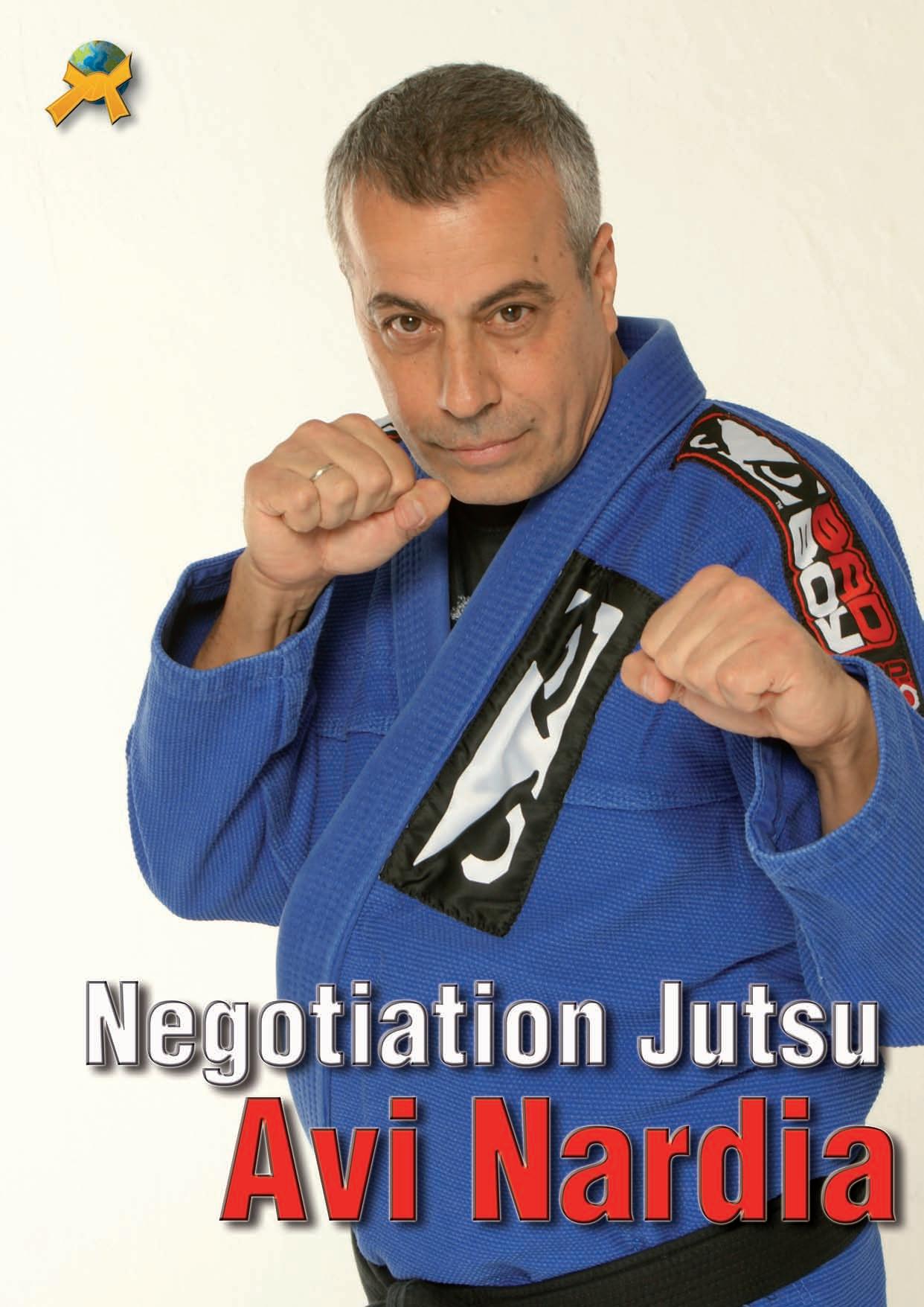
Fight Like Your Life Depends on It
The Art of Negotiation as Self-Defense
Introduction: Every Encounter Is a Negotiation
Self-defense is not merely the moment of physical combat. It begins long before fists fly in the silent exchange of glances across a parking lot, in the tension of a conversation that could tip either way, in the posture of your body as you walk down a street at night. True self-defense, stripped of its sports-competition costume, is about fighting for your life and like everything in life, it starts with negotiation.
Consider something as simple as crossing a road. You look left and right. You spot a car approaching. In that instant, a negotiation begins a silent exchange of intent between you and the driver. Will they slow down? Are they aware of you? Based on their speed, their eye contact, their reaction, you decide: do I cross or do I wait? This is pure negotiation. No words are spoken, yet a complex deal is struck in seconds.
The same dynamic governs every self-defense situation. Before a single punch is thrown, before a threat is even verbalized, a negotiation is already underway. Understanding this truly understanding it changes everything about how you approach both conflict and protection.
The Predator's Negotiation: Reading the Room
In the animal kingdom, the lion does not simply charge the herd. It watches. It assesses. It looks for signs of weakness the deer that limps, the one that lags behind, the one whose attention is elsewhere. The predator is negotiating with the environment, asking a silent question: "Is the risk worth the reward?"
Human predators those who seek to do harm in the streets, in dark parking structures, in vulnerable moments operate by the same logic. They scan their environment for soft targets. They are negotiating with potential victims before those victims ever know they are in a negotiation.
And here is where your first defensive move becomes critical: be the deer that leaps into the air. Be the one that signals strength, awareness, and cost. Walk with intention. Make eye contact. Project confidence through your body language. In doing so, you are entering the predator's negotiation and winning it without ever saying a word.
This is not bravado. It is strategy. It is the first principle of Negotiation-Jutsu: shape the negotiation before it reaches words.
Tactical Empathy: The FBI Weapon You Can Use on the Street
Former FBI lead hostage negotiator Chris Voss coined the term "Tactical Empathy" the deliberate, calculated process of understanding, labeling, and navigating another person's emotions to build trust and influence outcomes. In his landmark work, Never Split the Difference, Voss demonstrates how this concept born in hostage negotiation applies to every high-stakes human interaction.
"Tactical empathy is not about being nice. It is about understanding the other side deeply enough to navigate them toward your outcome." Chris Voss, Black Swan Group
In a self-defense context, tactical empathy means reading the person in front of you even a potential attacker with depth and clarity. What are they feeling? What do they want? Are they afraid? Angry? Desperate? A cornered animal is the most dangerous kind. Someone who feels heard and acknowledged is less likely to escalate. Applying tactical empathy in a tense street encounter might look like this: lowering your voice, acknowledging the tension, giving the other person a verbal "exit ramp." "Hey, I don't want any trouble." This is not weakness. This is the most powerful opening move in the negotiation it defuses emotion and creates space for a non-violent resolution.
The Body as a Negotiating Table
Even after a physical altercation has begun, negotiation continues now expressed through physical positioning, movement, and sacrifice. Every stance, every guard position, every movement is a statement being made and a question being asked.
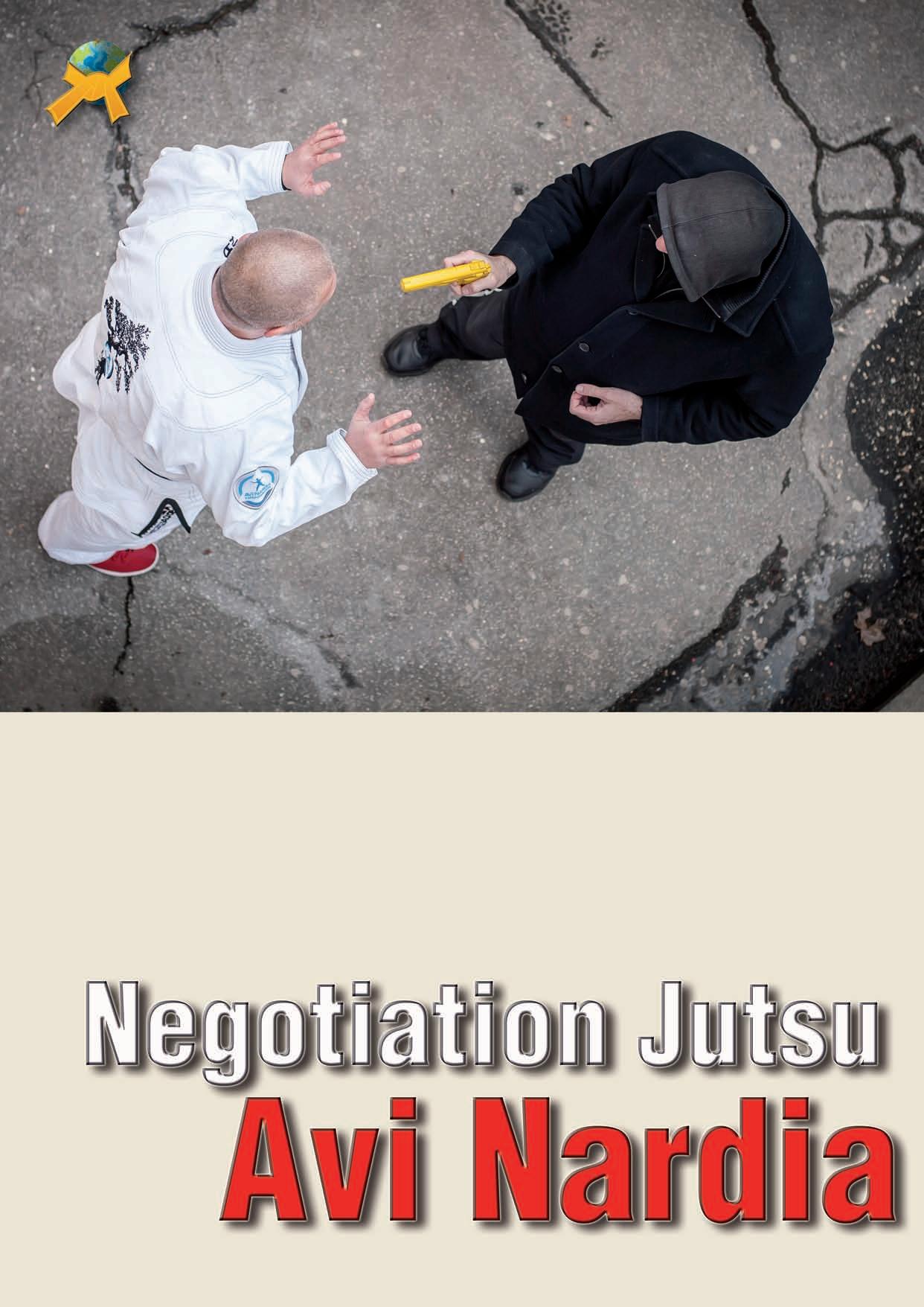
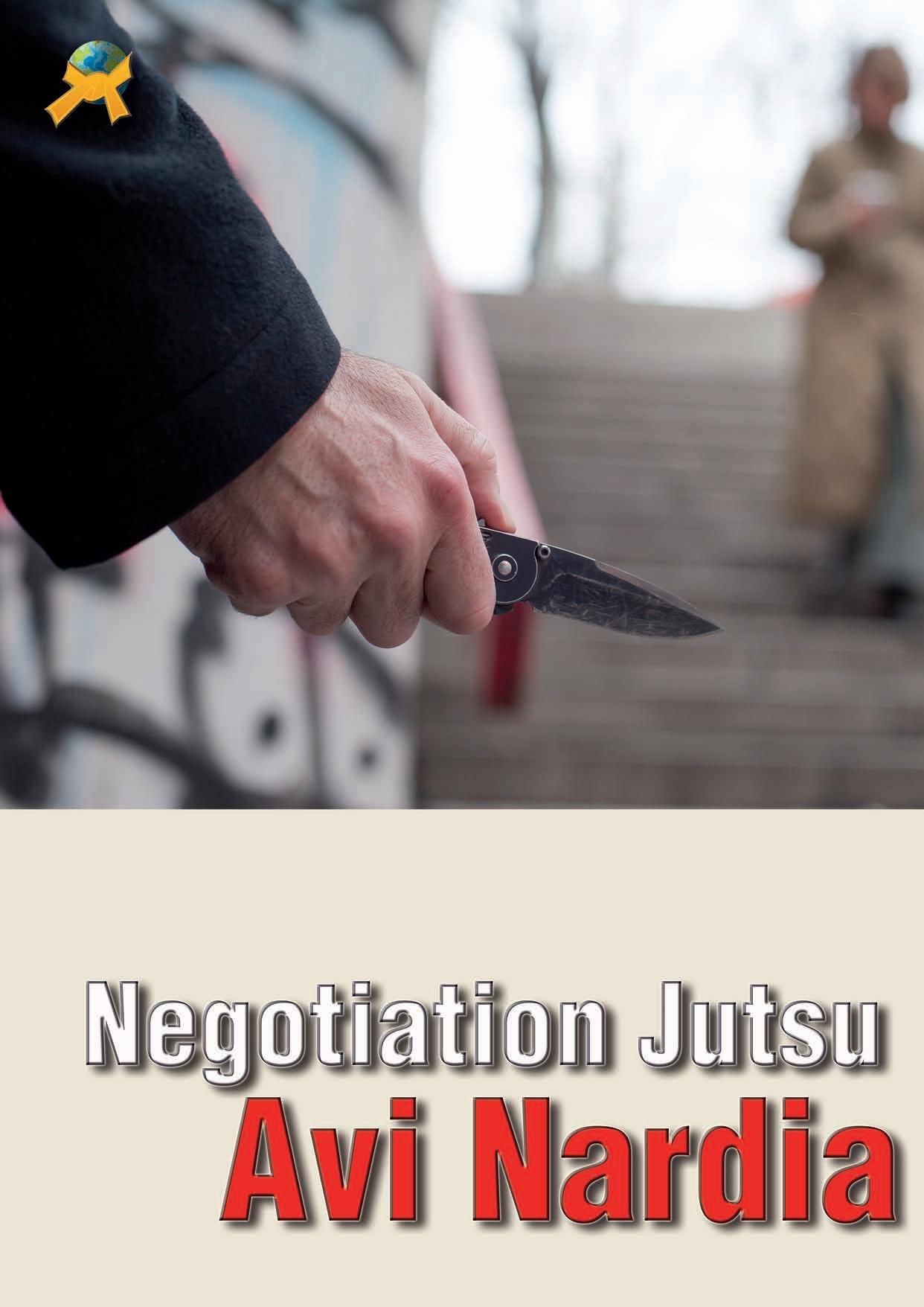
Consider the guard. When you raise your hands to protect your face, you are making a deal: your hands are now exposed, your face is covered. That is a negotiated trade. You have decided what you are willing to risk in exchange for what you must protect. When facing a weapon say, a knife the calculus becomes even more explicit:
•Will I risk my hands to protect my neck?
•Will I sacrifice a cut to my forearm to gain control?
•Which part of my body do I offer as a shield, and which part must I keep safe at all costs?
These are not decisions made in the heat of panic by untrained instinct. They are negotiated outcomes prepared in advance through training, rehearsed until they become reflex. The body that has trained well knows what deals it is willing to make under pressure.
This is why martial arts training is inseparable from negotiation training. Drilling a technique is drilling a decision. Every repetition is the body rehearsing a negotiated response: "When they do X, I will respond with Y."
Core Principles: Martial Arts Applied to Negotiation
The overlap between the dojo and the negotiating table is not metaphorical it is structural. Both demand the same internal state and the same set of skills:
1.
Mindset and Centered State
Both the martial artist and the skilled negotiator operate from a place of calm confidence not arrogance, but humble readiness. Ego closes the mind. Humility opens it. The negotiator who walks in demanding dominance has already lost the room, just as the fighter who charges forward with rage has telegraphed every move.
2. Reading the Opponent
A skilled martial artist doesn't watch the fist they watch the shoulder, the hips, the eyes. They look for what precedes the strike. Similarly, a skilled negotiator doesn't listen only to words they listen to what is underneath the words. Tone, hesitation, what is not said. Both arts demand radical attentiveness.
3. Fluidity Over Rigidity
In Aikido, the greatest power comes from yielding blending with the incoming force and redirecting it. "Negotiation Jujitsu," as described in the foundational negotiation text Getting to Yes, applies exactly this principle: instead of attacking the other party's position head-on, use their energy. Ask questions. Explore interests. Redirect.
4. The Power of Framing and Verbal Judo
Words are weapons and like all weapons, they can be turned. "Verbal Judo" is the artof using language to de-escalate, redirect, and guide. A single reframing of a situation "I can see you're frustrated" instead of "Calm down" can transform a confrontation into a conversation.
5. Mirroring and Labeling
From Chris Voss's work comes two of the most powerful micro-techniques in any negotiation: mirroring (repeating the last few words someone said) and labeling (naming an emotion you observe: "It seems like you're feeling disrespected"). Both create a sense of being understood, which is often all a volatile person needs to step back from the edge.
The DEAL Framework: When Words Are Your First Weapon
Before any physical technique is deployed, there is often a window sometimes only seconds wide where verbal negotiation can resolve the situation entirely. The DEAL method offers a structured approach:
•Defuse Address the emotion first. "I hear you. I understand you're angry."
•Explore Find the underlying interest. What does this person actually need?
•Agree Identify any common ground, however small.
•Lay out options Offer alternatives to conflict.
Knowing your BATNA Best Alternative to a Negotiated Agreement is equally vital. Before any negotiation, you must know: if this fails, what is my next move? In a self-defense context, your BATNA might be physical defense, escape, calling for help, or presenting a deterrent. Knowing your BATNA gives you confidence; confidence makes better negotiators and better fighters.
Five Dojo Principles for Any Negotiation
Whether you are negotiating a business deal, a street confrontation, or a custody dispute, the dojo teaches the same five principles:
1.Show Respect. Enter with dignity, not dominance. Humility builds trust; arrogance destroys it. The fighter who enters the dojo with their ego ahead of them has already been beaten.
2.Get in the Zone. Approach relaxed, empty, and quiet. Put down your agenda and pick up your awareness. Listen with full presence. The best move comes from complete attention.
3.Pay Close Attention. In the dojo, a wandering mind earns a bruise. In a negotiation, a wandering mind misses the moment. Attention is the sharpest weapon in any scenario.
4.Exude Calm. No path to resolution starts with sword-waving. When tension rises, lower your voice. Slow down. Restate what you agree on. Calm is not passivity it is control.
5.Find Wiggle Room. There is always a variable you can shift. What contingency can you offer? What alternative path exists? A deadlock is only permanent if you stop looking for the opening.
Act or Don't Act: The Use of Force Continuum
Every negotiation in a self-defense context ultimately arrives at the same fork in the road: to act or not to act. And if to act then how? With what force? At what moment?
The principle of Use of Force reminds us that the level of force applied must be proportional and appropriate to the threat. You cannot legally, ethically, or strategically respond to a verbal insult with a weapon strike. The negotiation of force is as important as any verbal negotiation. You must constantly assess:
•Is this threat real and immediate?
•Is this deadly force or manageable force?
•Am I responding or reacting is this self-defense or ego?
•What is the post-conflict landscape police, courts, witnesses?
The best self-defense practitioners plan for the post-conflict negotiation as much as the conflict itself. The fight may last seconds; the courtroom may last years. Every use of force carries a negotiation with the legal system that follows. This is not a reason to hesitate when life is truly threatened it is a reason to always know why you are acting.
"When your life is in danger, fight as if your life depends on it because it does. But remember: the moment the threat ends, the negotiation begins again."
Prevention: The Greatest Negotiation Win
The most underrated outcome in any conflict is prevention. Fights avoided are battles won without cost. The willingness to say "I'm sorry," to de-escalate verbally, to give someone a face-saving exit these are not signs of weakness. They are the highest expression of the negotiation warrior mindset.
Many violent encounters escalate because one or both parties felt they had no exit that preserved their dignity. A skilled Negotiation-Jutsu practitioner creates that exit for the other person. They give the potential aggressor a way out that lets them save face and in doing so, they save everyone from harm.
This is not naivety. There are predators who will not negotiate. There are moments where words have failed and only physical skill will carry you through. But even then especially then the mindset of the negotiator serves you. Calm. Present. Strategic. Knowing what you want. Knowing your BATNA. Knowing when to close the deal by other means.
Love Brings Love Violence Brings Results: A Dangerous Equation
The phrase "violence brings results" deserves examination particularly because in both the street and the personal relationship context, it is often misunderstood and dangerously misapplied.
In combat, yes decisive force applied at the right moment produces results. But this is not a universal law of human relationships. In personal life, in love, in community the belief that aggressive, coercive, or manipulative behavior "wins" is the hallmark of trauma bonding and abuse dynamics, not healthy connection.
The Negotiation-Jutsu practitioner must hold both truths simultaneously: on the street, force is sometimes necessary and decisive. In life, in relationships, in the spaces between love, respect, and genuine communication are not weaknesses. They are the most durable and powerful tools we have.
The warrior who cannot make this distinction who brings combat energy into every interaction, who mistakes control for connection is not protected. They are isolated. And isolation is its own vulnerability.
Conclusion: Negotiate Like Your Life Depends on It
Negotiation-Jutsu is not a metaphor. It is a way of moving through the world alert, empathetic, strategic, and prepared. It recognizes that every human encounter involves a dynamic negotiation, from the moment of eye contact to the final resolution.
The self-defense practitioner who understands negotiation is more dangerous than one who only knows how to fight because they win more often, with less cost, and in more situations. They win on the street, in the boardroom, in the difficult conversation, and in the courtroom after.
Train your body. Train your mind. Train your voice. Read Chris Voss. Step into the dojo. Walk with intention. Know your BATNA. Be the deer that leaps the one that says, without words: "I am not the easy target. Find another path."
And if the path still leads to conflict fight like your life depends on it. Because sometimes, it does.
Key References & Further Reading
Never Split the Difference Chris Voss & Tahl Raz (Black Swan Group)
Getting to Yes Roger Fisher & William Ury (Harvard Negotiation Project)
Verbal Judo George J. Thompson & Jerry B. Jenkins
The Gift of Fear Gavin de Becker Principles of Use of Force PPCT / FLETC Standards
FLETC (Federal Law Enforcement Training Centers) is a U.S. Department of Homeland Security agency that provides training to over 100 federal agencies and numerous state, local, and tribal law enforcement organizations.
PPCT (Pressure Point Control Tactics) is a subject control system often integrated into defensive tactics training, focusing on pressure points, joint locks, and counter-strikes based on tactical, legal, and medical research.
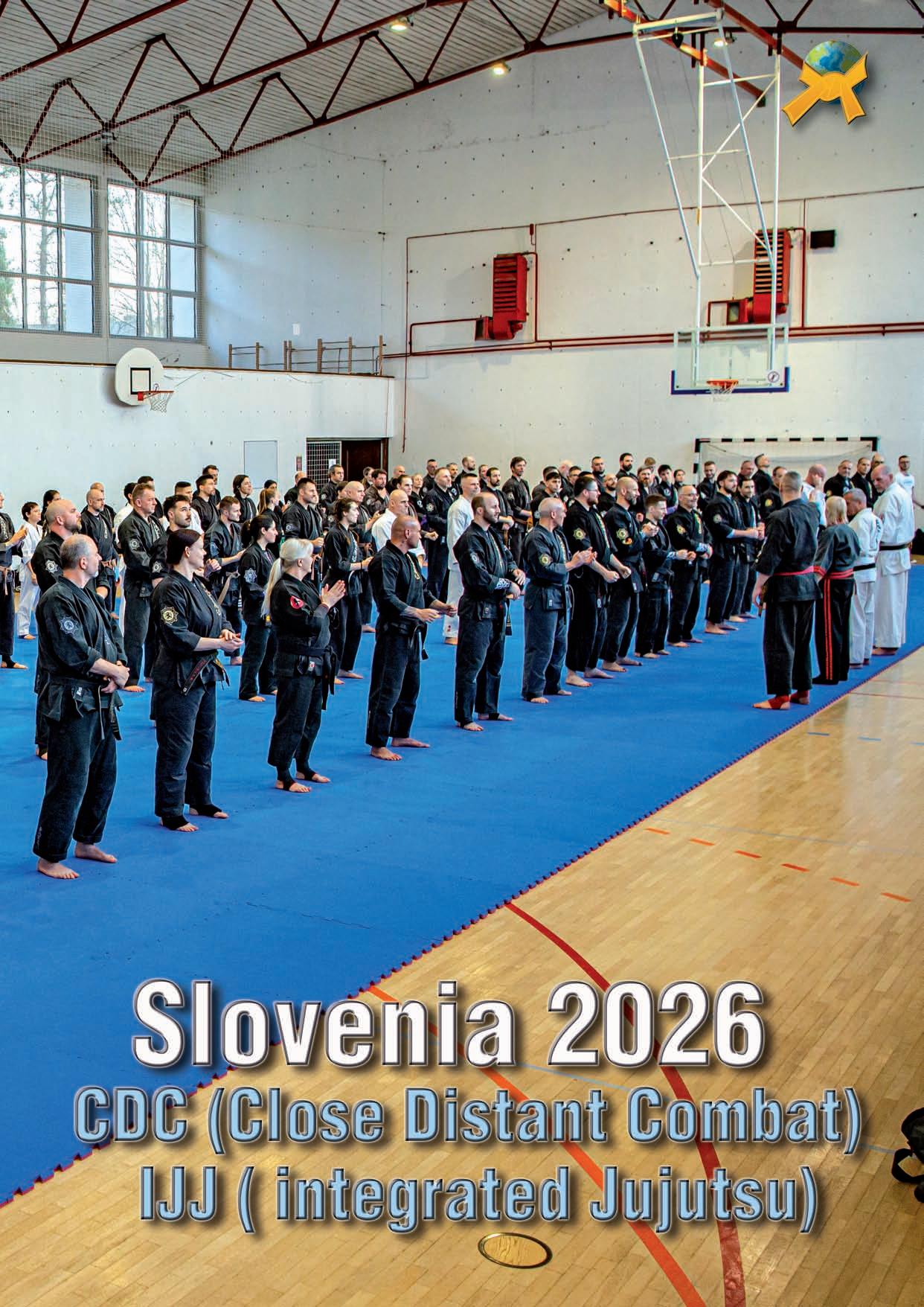
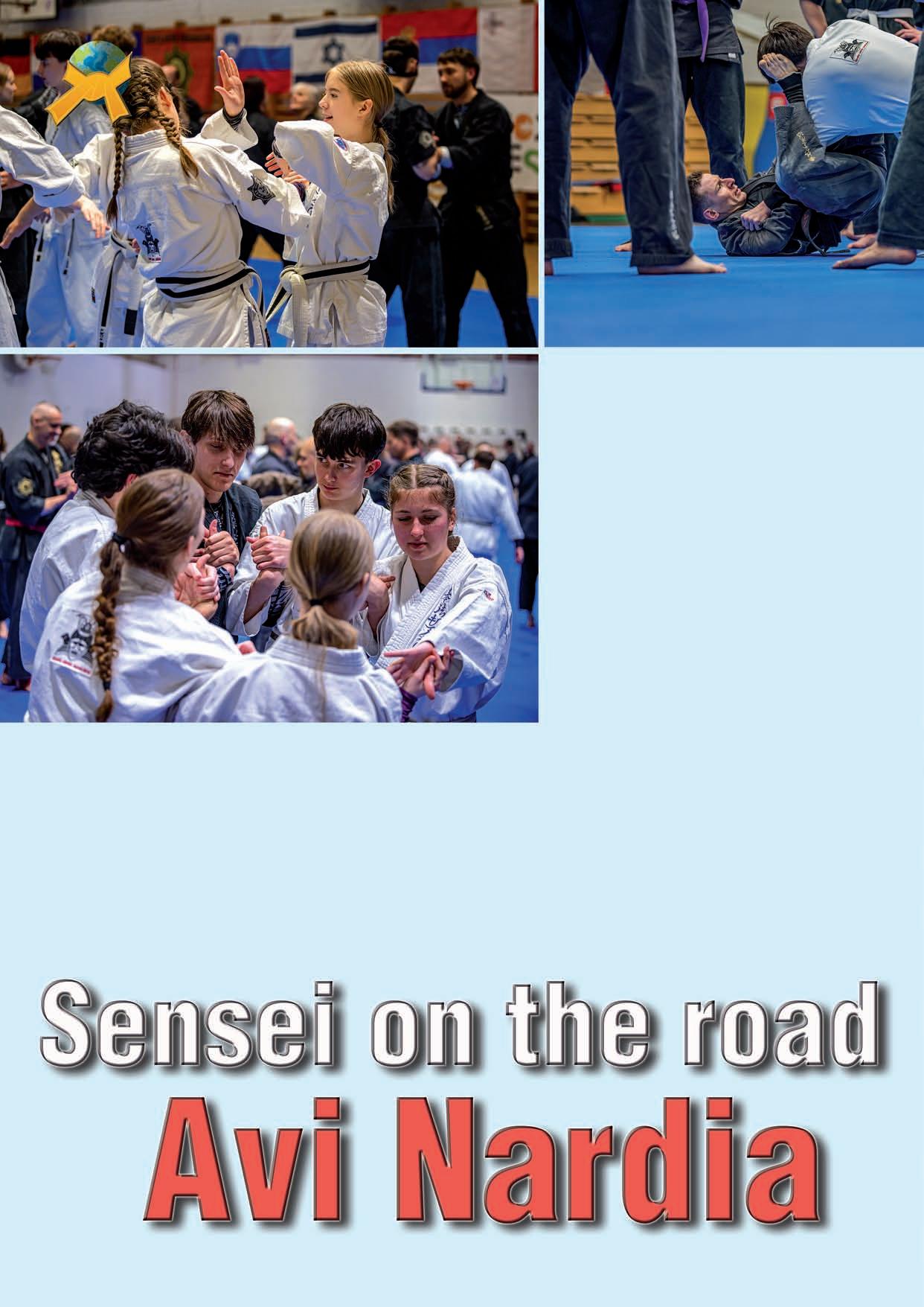
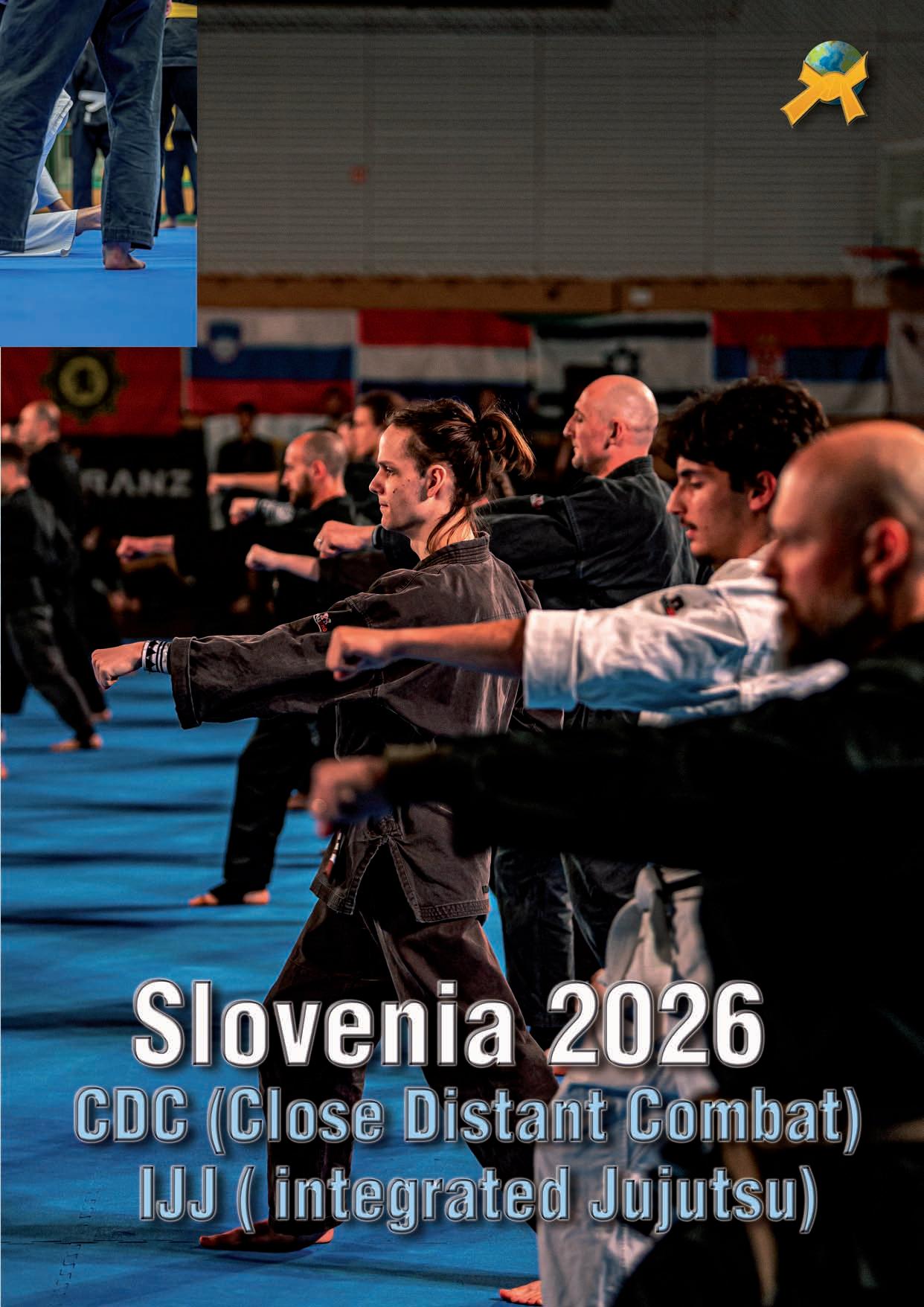
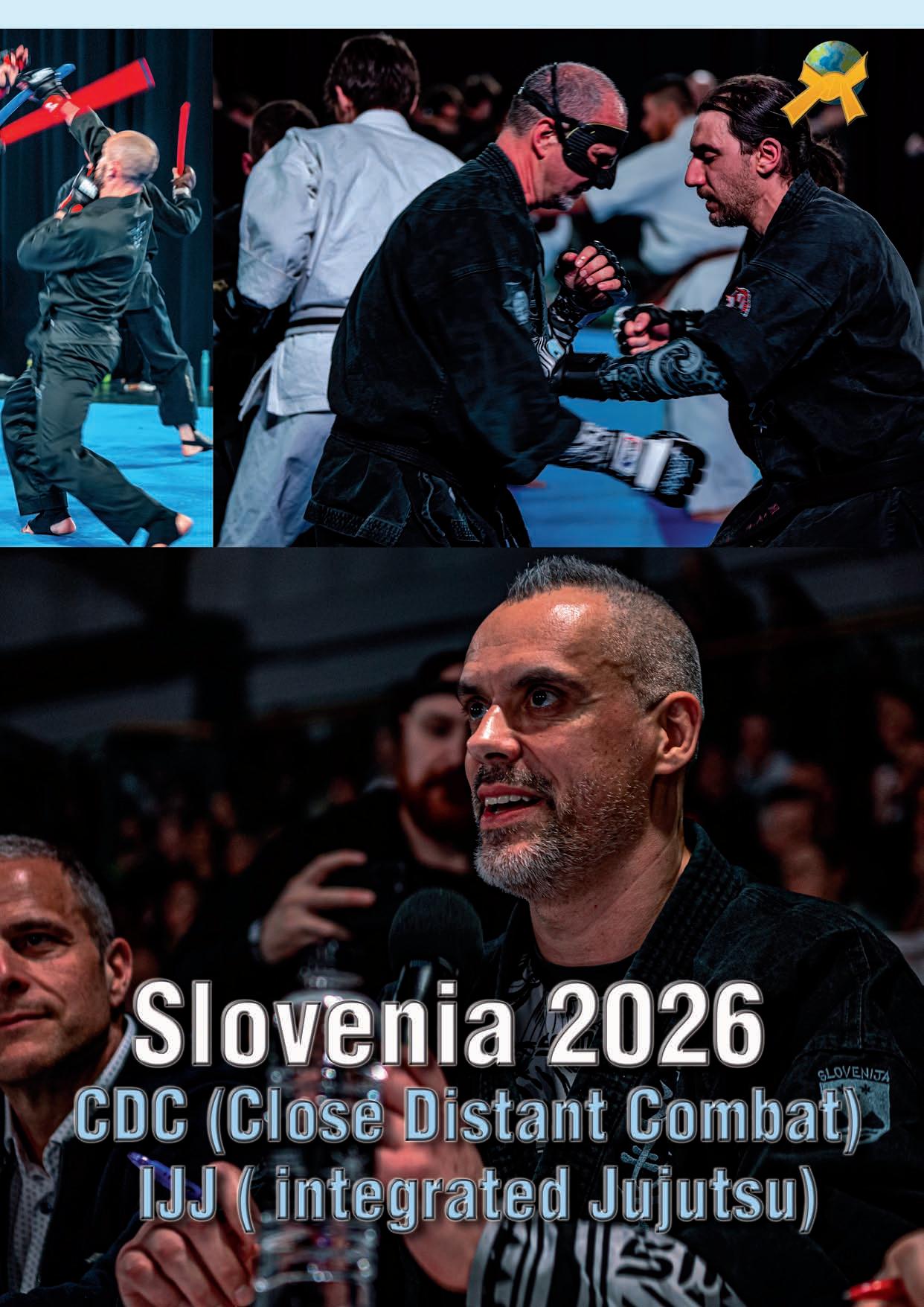
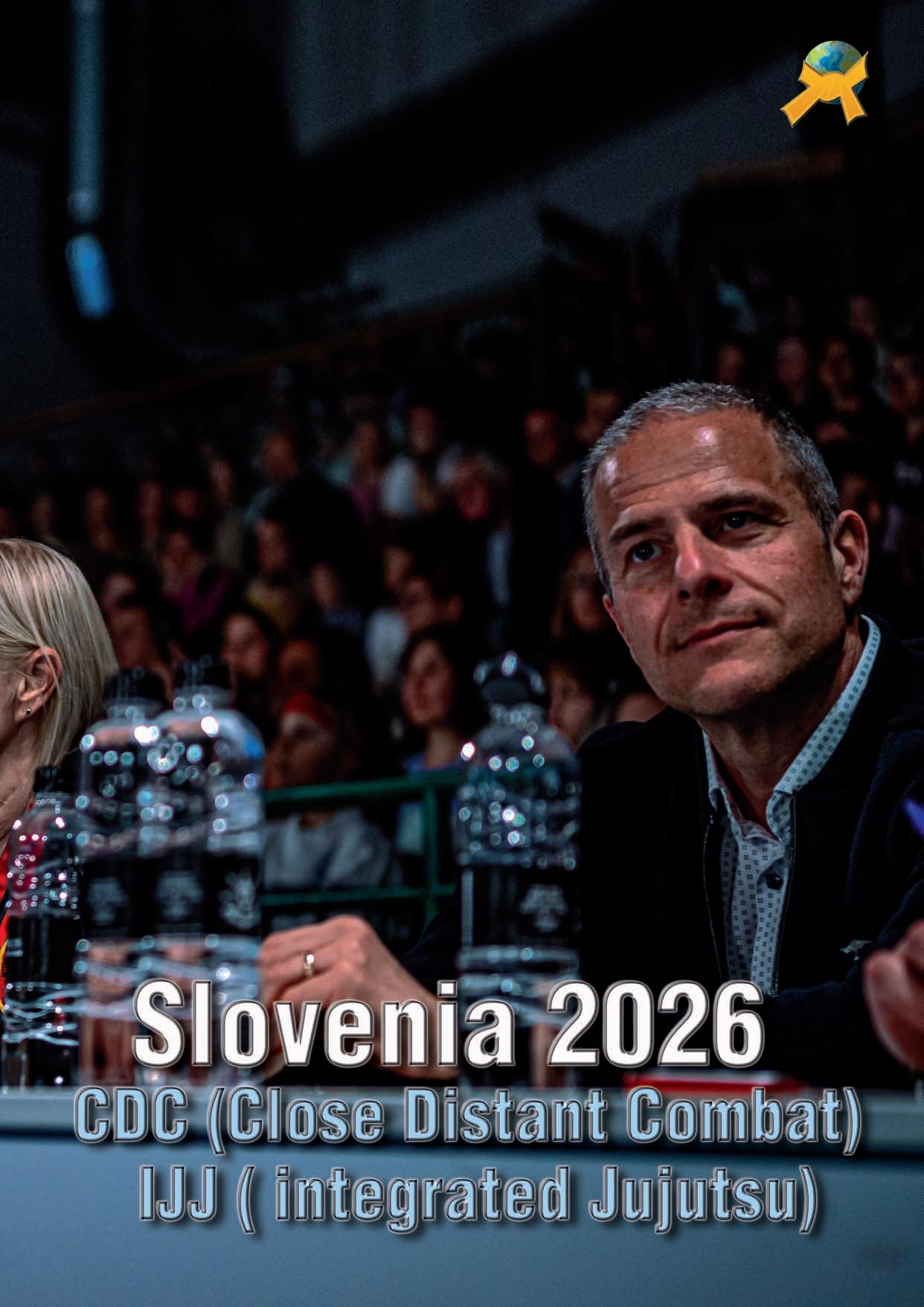
SLOVENIA SPRING CAMP 2026
53rd Black Belt Test & International Martial Arts Event Novo Mesto, Slovenia | March 20–22, 2026
A Legacy of Twenty-Five Years: My Annual Return to Slovenia
For the last 25 years, I have had the honor and privilege of being invited to Slovenia each spring — sometimes alongside different teachers, always alongside the same unwavering spirit. Year after year, I make this journey to witness something that is rare and truly special: a martial arts organization that does not merely survive the passage of time, but grows stronger, deeper, and more purposeful with every passing season.
I have watched students walk through the door as white belts — young, uncertain, searching — and I have seen those same individuals stand tall years later, earning ranks that reflect not just technical mastery, but genuine personal transformation. That continuity, that thread of growth, is something I hold in the deepest respect. It is not common. It is extraordinary.
And at the heart of it all, year after year, are two people whose dedication makes everything possible: Tina Kincl and Kyoshi Borut Kincl. This year was no different. Once again, they organized a camp and Black Belt ceremony of the highest quality — a tribute to their vision, their energy, and their love for this art and this community.
The Event: Novo Mesto, March 2026
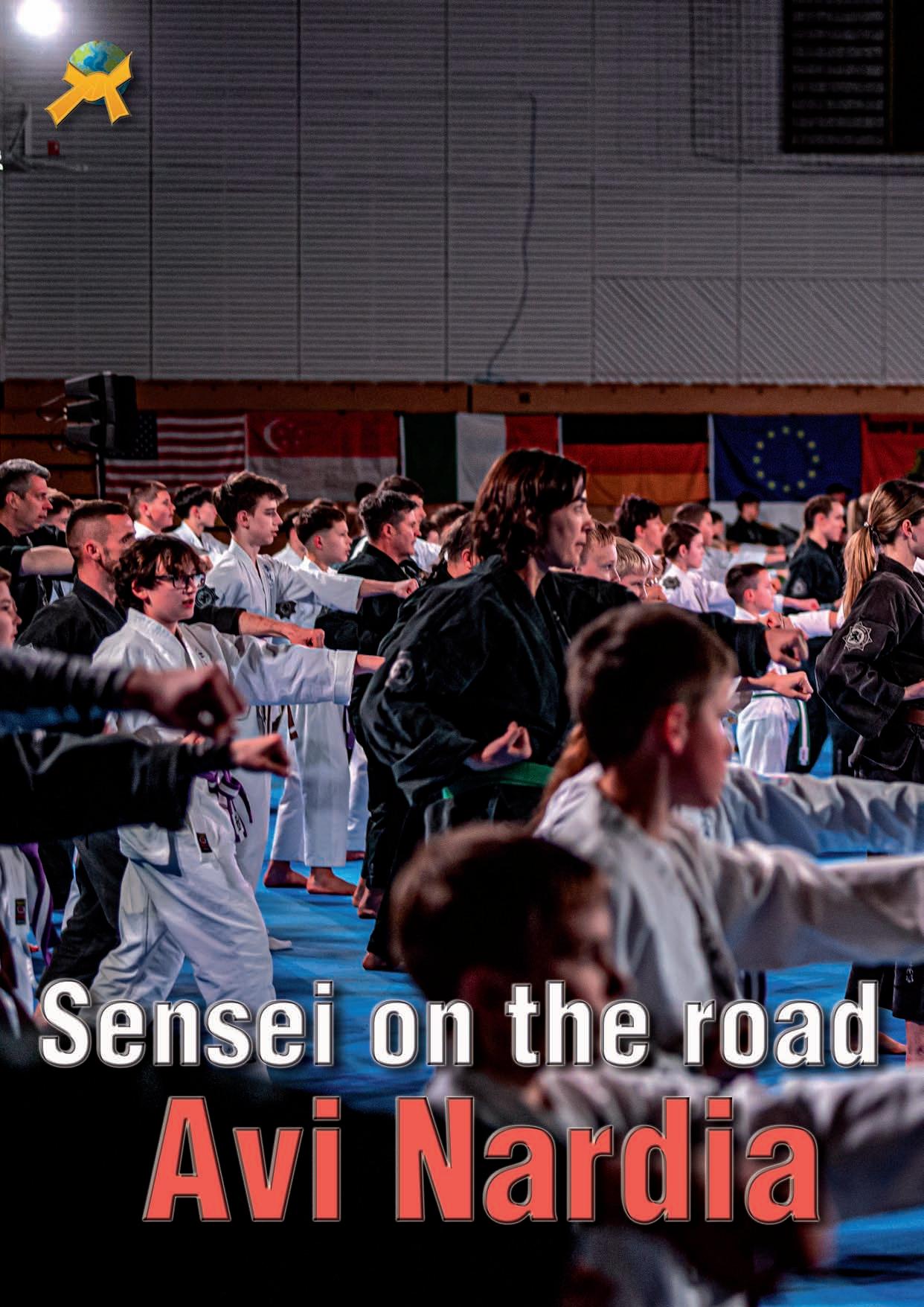
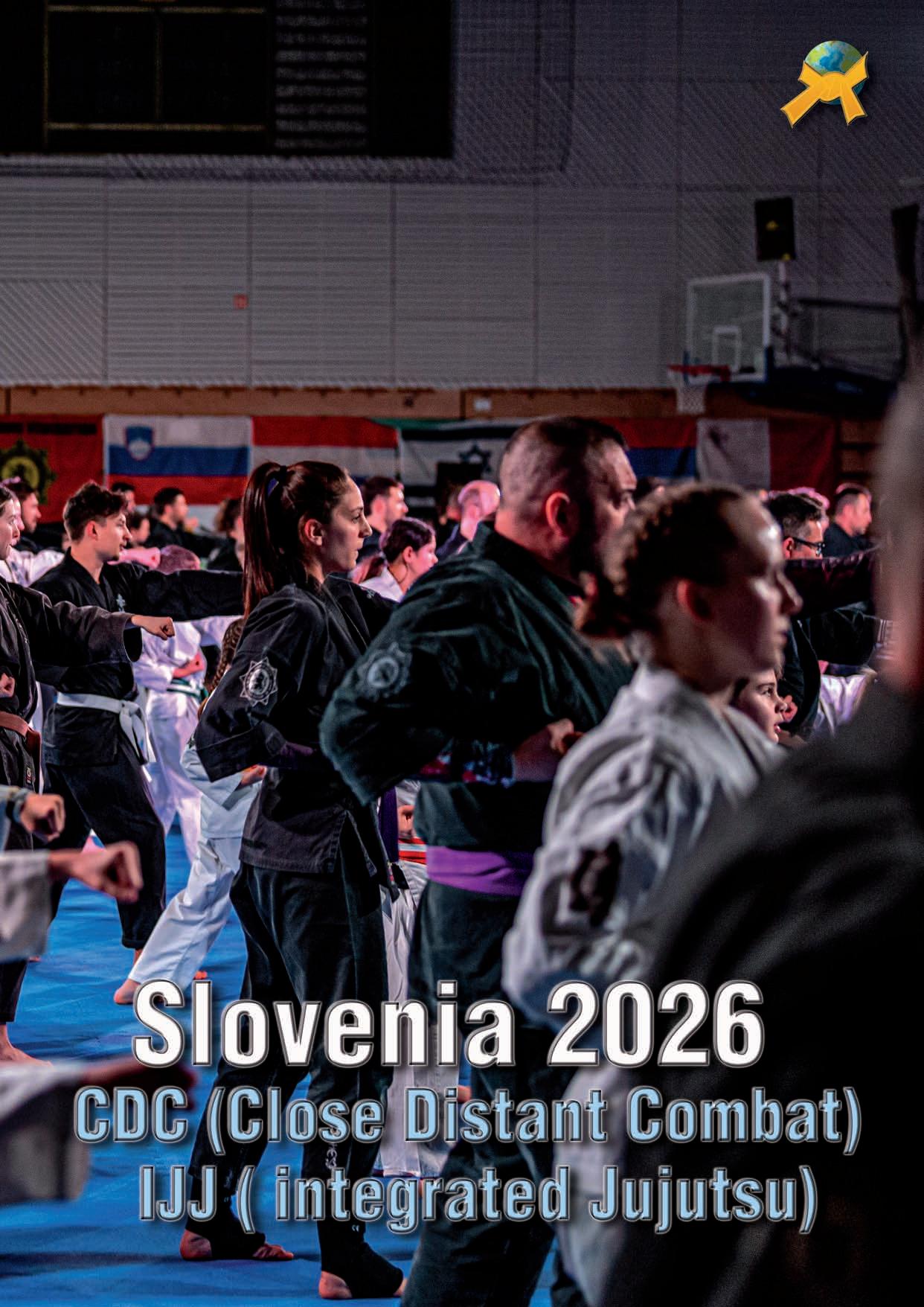
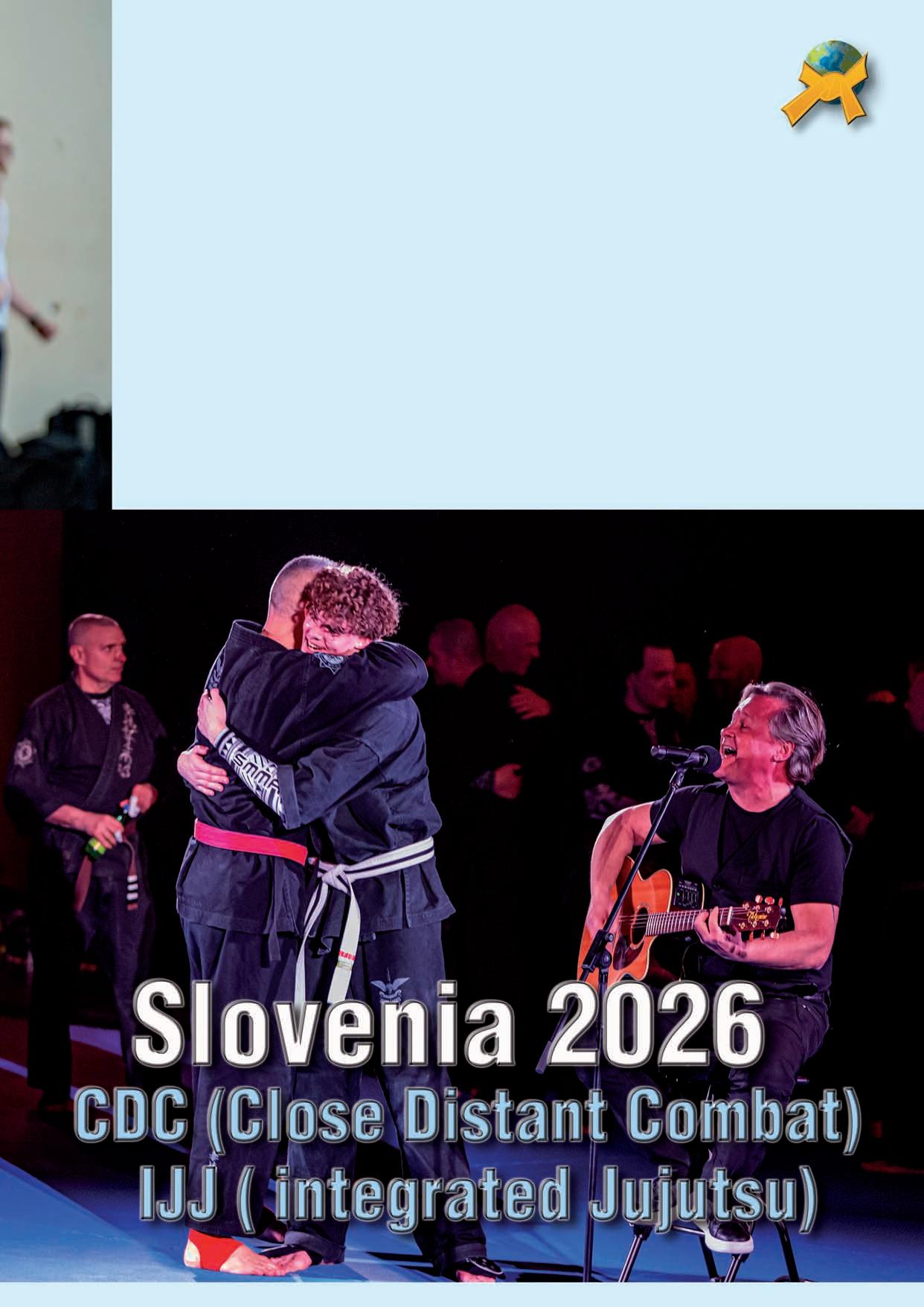
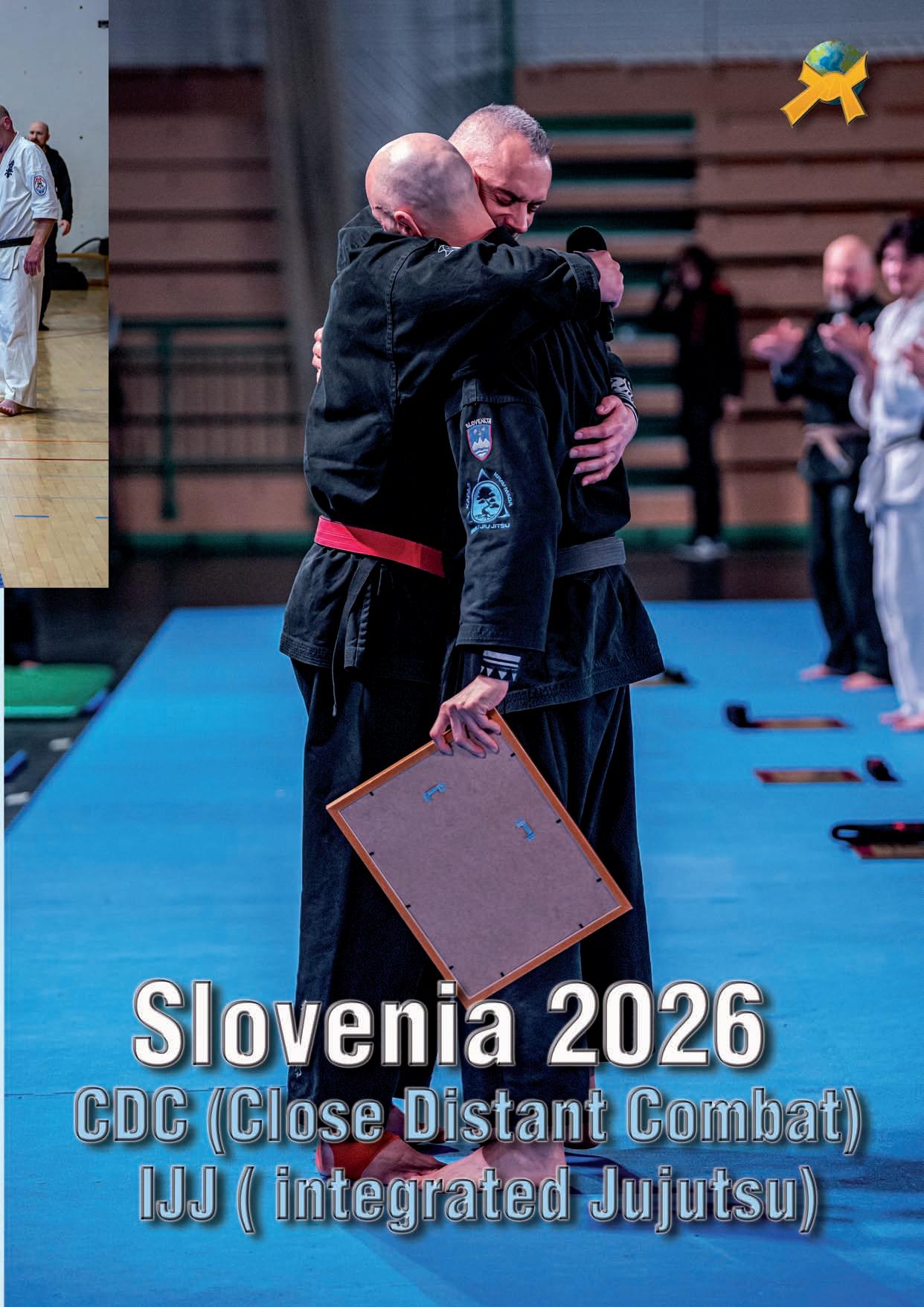
Last weekend, between March 20th and 22nd, the city of Novo Mesto hosted an international martial arts event of remarkable scale and significance. The Kempo Arnis Federation Black Belt Ceremony, held at the Leon Štukelj Sports Hall on Saturday evening, brought together more than 1,500 visitors — among them guests from the worlds of sports, politics, and business.
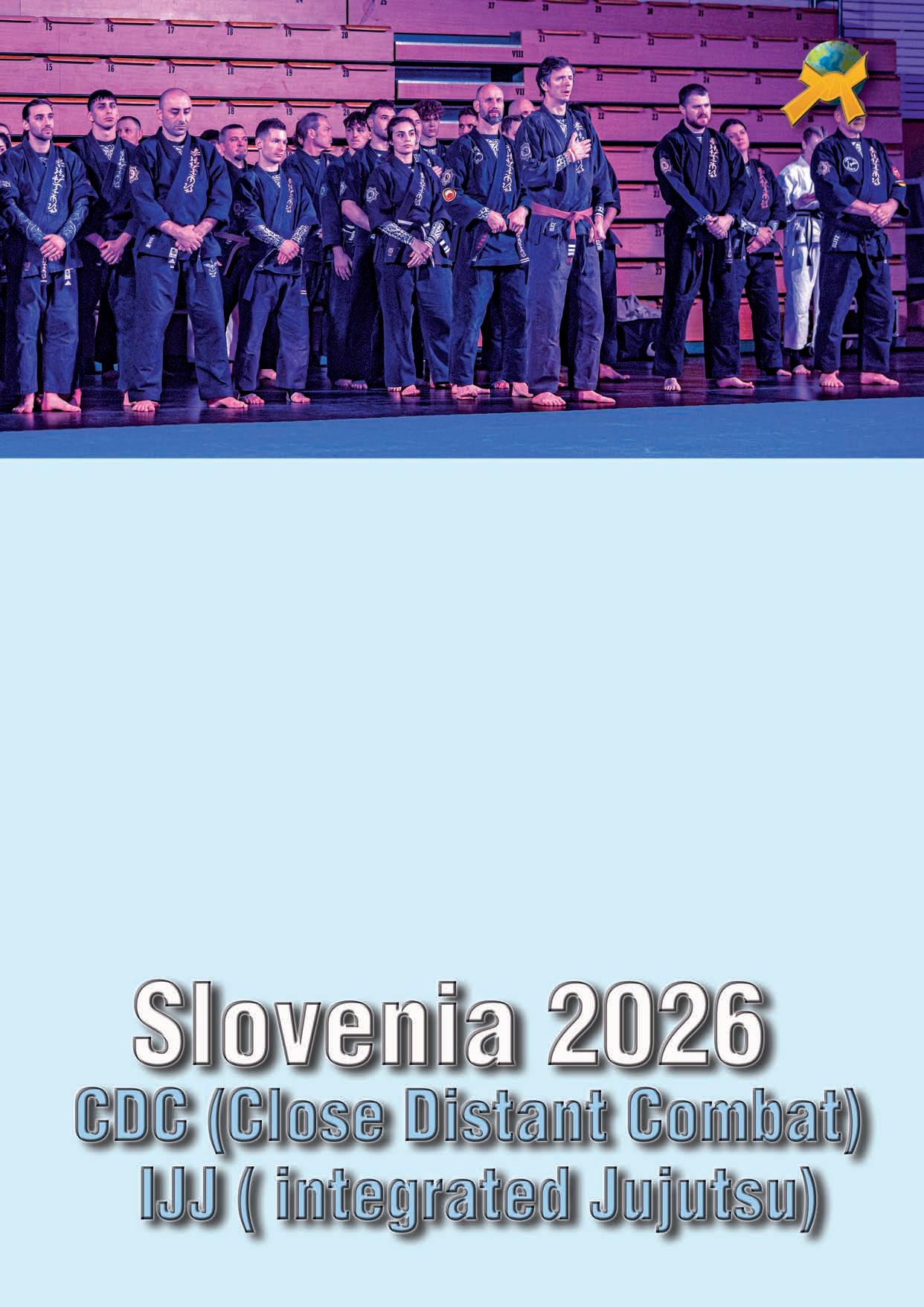
The event began with a solemn ceremony befitting its importance: the Slovenian national anthem was performed beautifully by Ida Metelko, setting a tone of dignity, pride, and deep appreciation for what martial arts can represent in a community. The Mayor of the Municipality of Novo Mesto, Gregor Macedoni, addressed the assembled audience and expressed his personal support for the continued development of martial arts in the region.
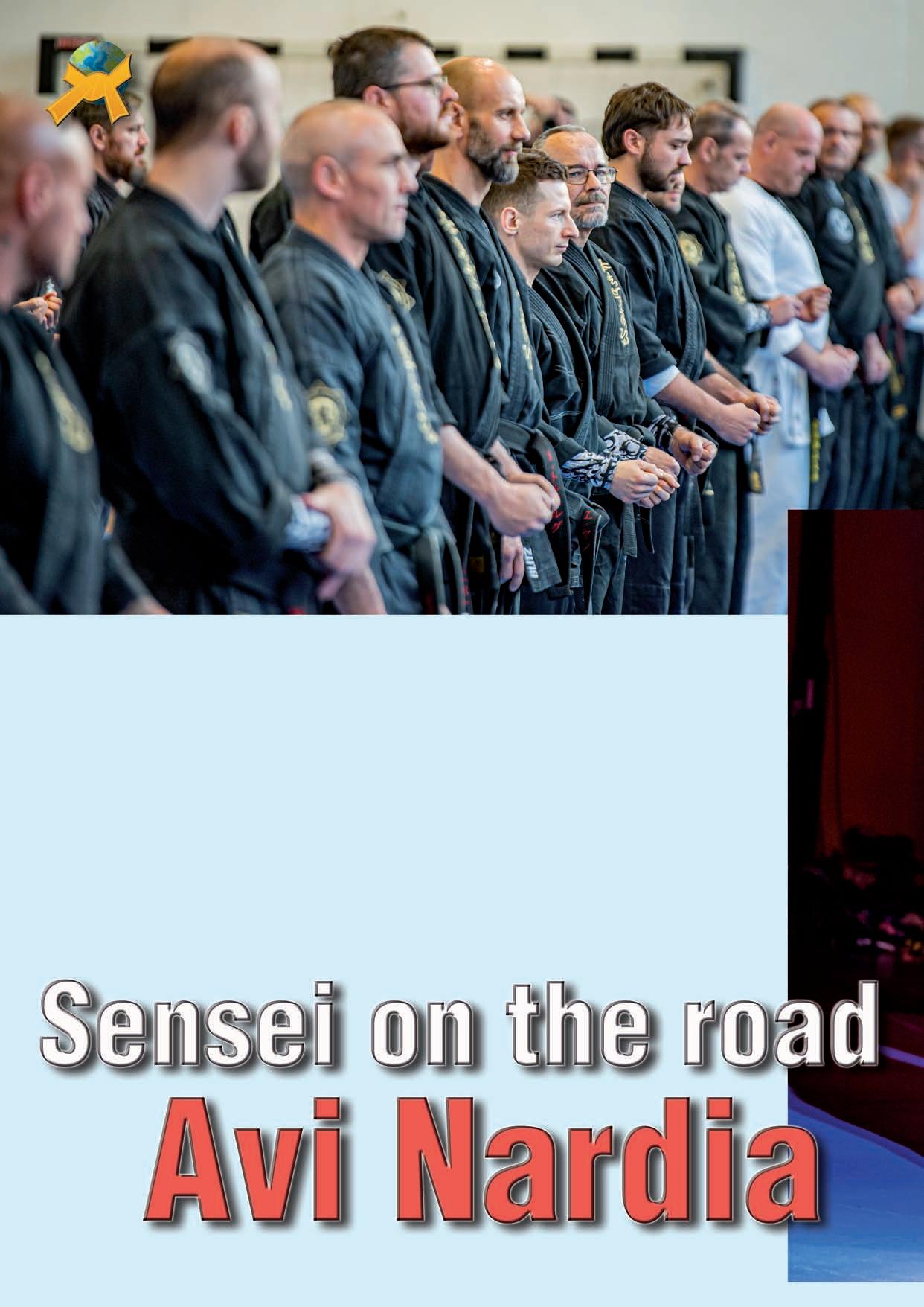
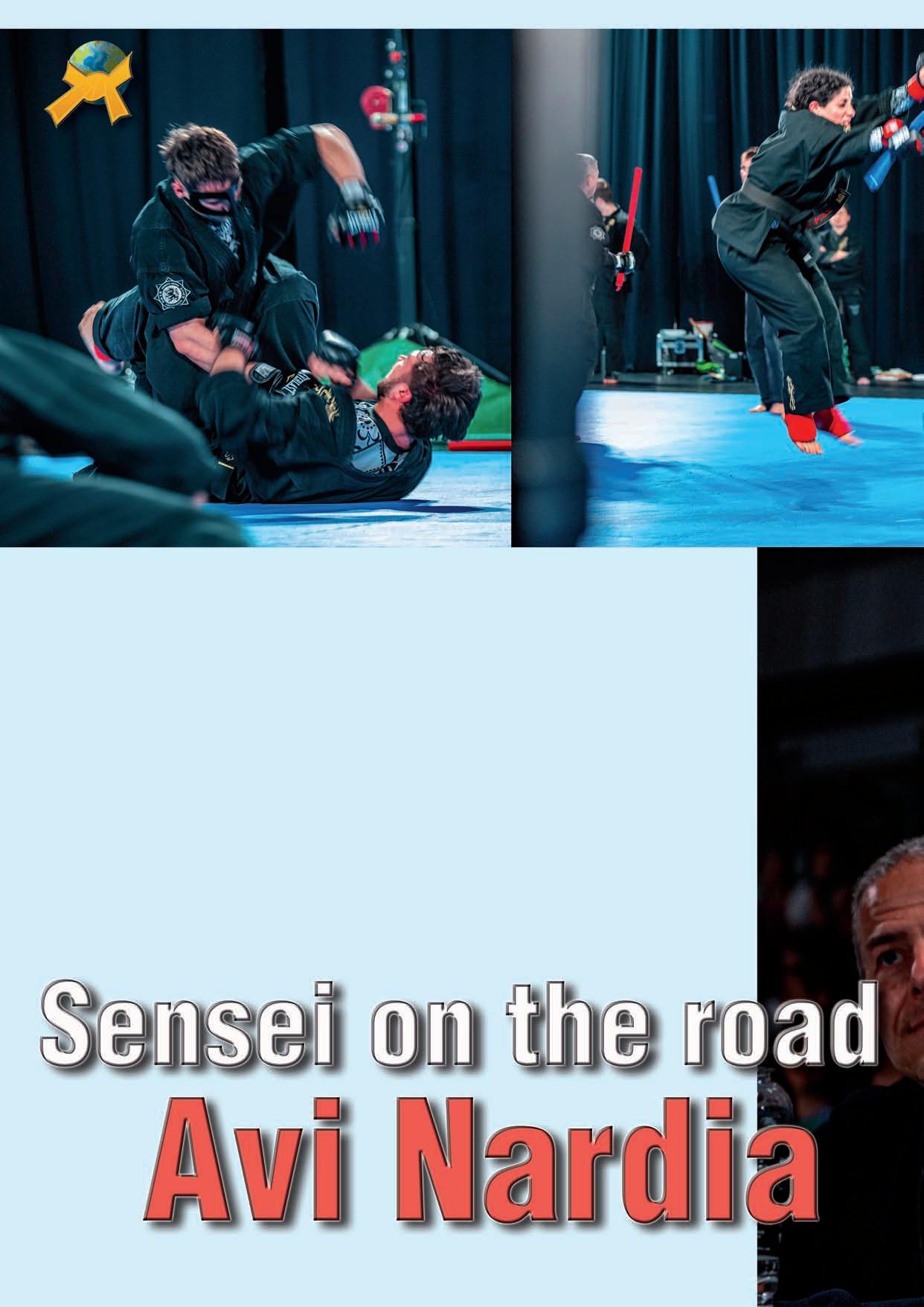
Through demanding tests, participants from many nations demonstrated the levels of knowledge, dedication, and perseverance that define Kempo Arnis at its best. Fifty-three candidates stood on the tatami — each one representing years of personal sacrifice, study, and commitment.
The Masters: An International Panel of Excellence
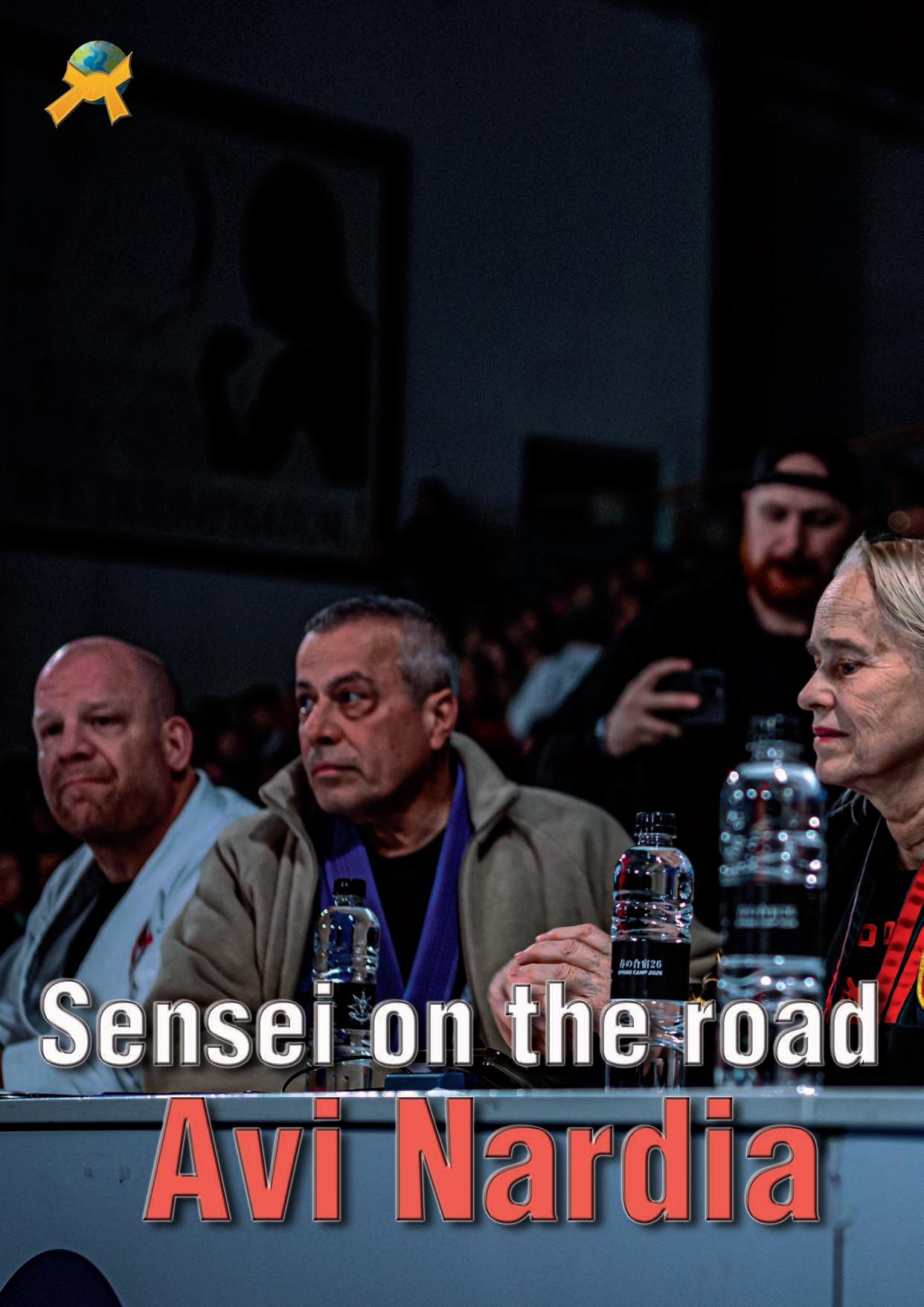
What gave this year's Spring Camp such exceptional depth and flavor was the caliber of teachers assembled. It was my honor to train alongside and learn from masters whose combined experience spans continents, disciplines, and decades.
Kancho Gerard Gordeau — 9th Dan Kyokushin Karate
This year, Kempo Arnis Federation welcomed for the first time the legendary Kancho Gerard Gordeau, 9th Dan Kyokushin Karate — a name that needs no introduction to anyone who understands the history of modern martial arts. A pioneer of modern MMA, Kancho Gordeau was a finalist in the very first UFC tournament in history. He fought the first official MMA-rules bout against sumo wrestler Tela Tula before meeting the legendary Royce Gracie in the final.
Beyond his historical achievements, what strikes you most about Kancho Gordeau when you train alongside him is his character — his quiet authority, his deep knowledge, his remarkable experience, and his genuine love for the art. He is known for his relentless low kicks, his steely discipline, and his exceptional fighting spirit. He is a unique bridge between traditional martial arts and real combat, and his presence gave the entire seminar an extraordinary and unforgettable flavor.
GM Gabrielle Roloff — Tapi Tapi Master, Modern Arnis
Our longtime friend and teacher, Grandmaster Gabrielle Roloff, returned to Slovenia as one of the highest-ranked women in the martial arts world. A true master of Tapi Tapi and Modern Arnis, GM Roloff is one of the official recognized successors of the legendary Remy Presas (RIP) — a lineage that carries immense weight and responsibility. Her presence at the camp was both an inspiration and a gift, and I have the deepest respect for her knowledge, her dedication to preserving the authentic teachings of Modern Arnis, and her generosity as an instructor.
Martijn De Bruijn — Representative of Hanshi Patrick McCarthy, AikiKenpoJujutsu
We were also honored to welcome Martijn De Bruijn from Holland, a representative of Hanshi Patrick McCarthy and the IRKRS (International Ryukyu Kempo Research Society), and a practitioner of AikiKenpoJujutsu. Hanshi Patrick McCarthy himself sent his warmest regards and welcome from Okinawa, though he was unable to join us in person. Martijn and I share a deep connection through AikiKenpoJujutsu, and it was a pleasure to share the mat with him and to represent together the art and legacy that Hanshi McCarthy has dedicated his life to building.
Jacob Lim — Instructor from Singapore, Under Kyoshi Leon Koh
We were further honored to welcome Jacob Lim, who traveled all the way from Singapore to be part of this event. An instructor under Kyoshi Leon Koh, Jacob's presence was a beautiful reminder of how far the reach of this federation and this art truly extends. He is part of our extended worldwide family — a family that crosses oceans and borders, united by a shared commitment to excellence and to the martial path.
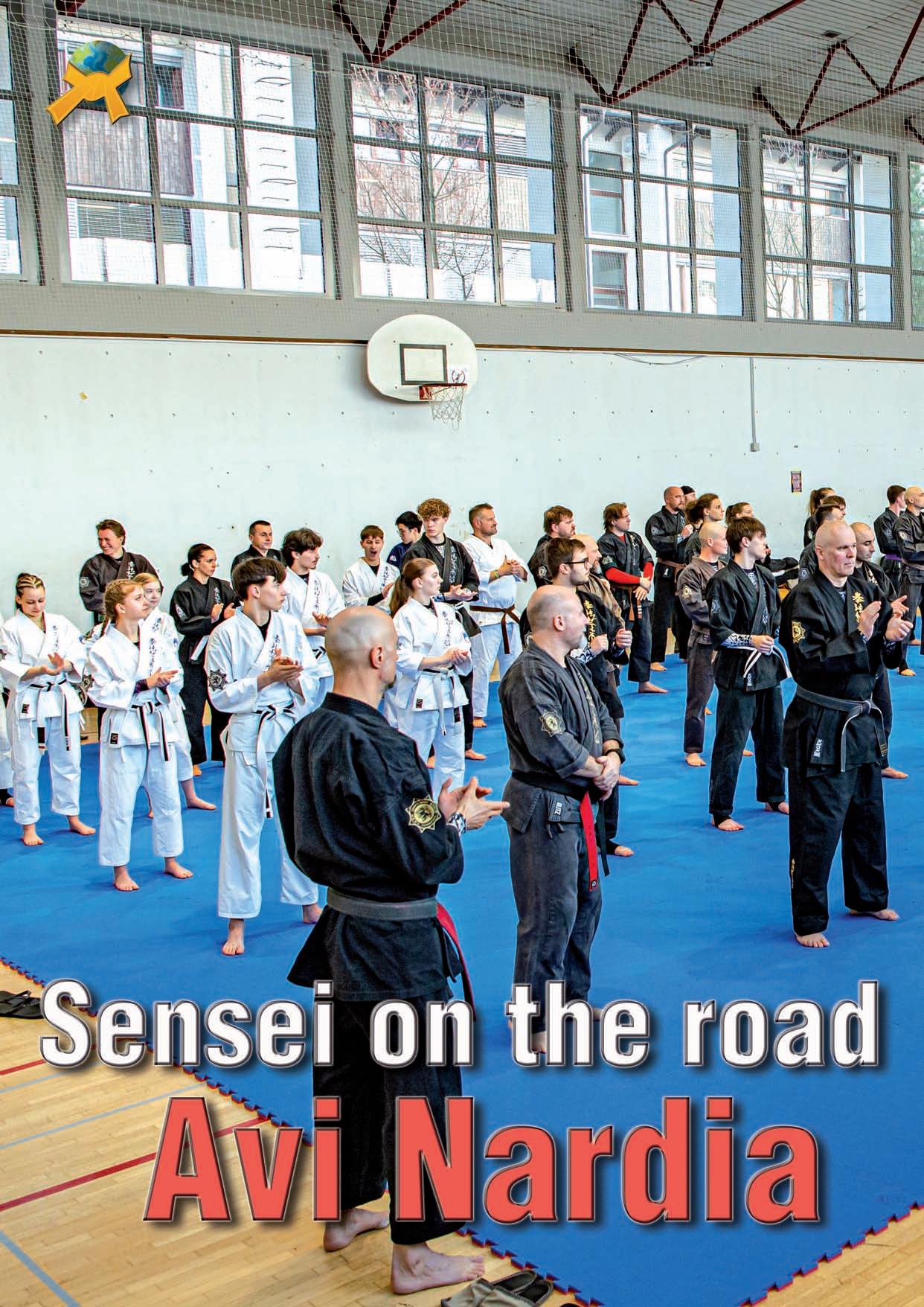
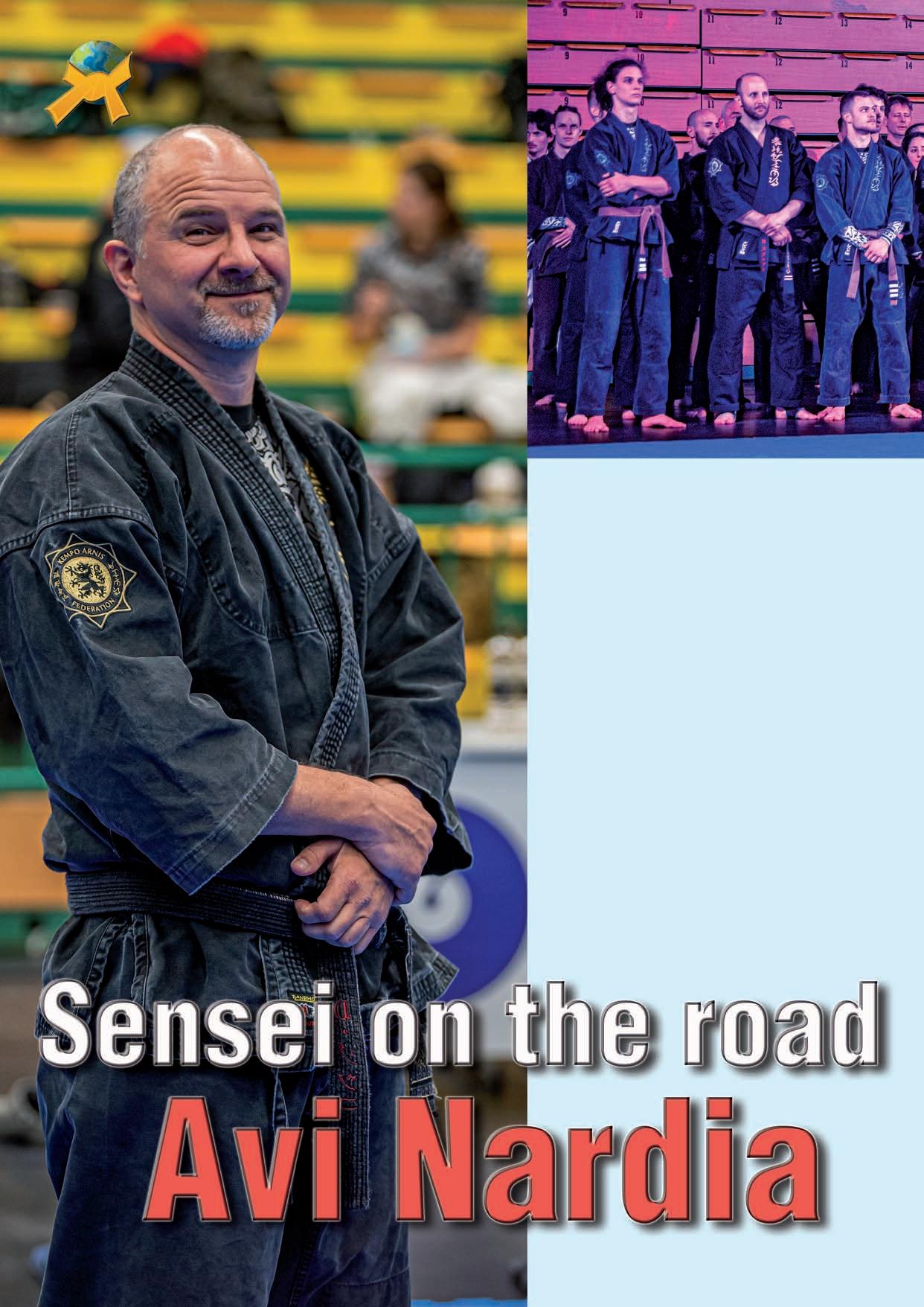
Avi Nardia — AikiKenpoJujutsu, KAPAP, CDC
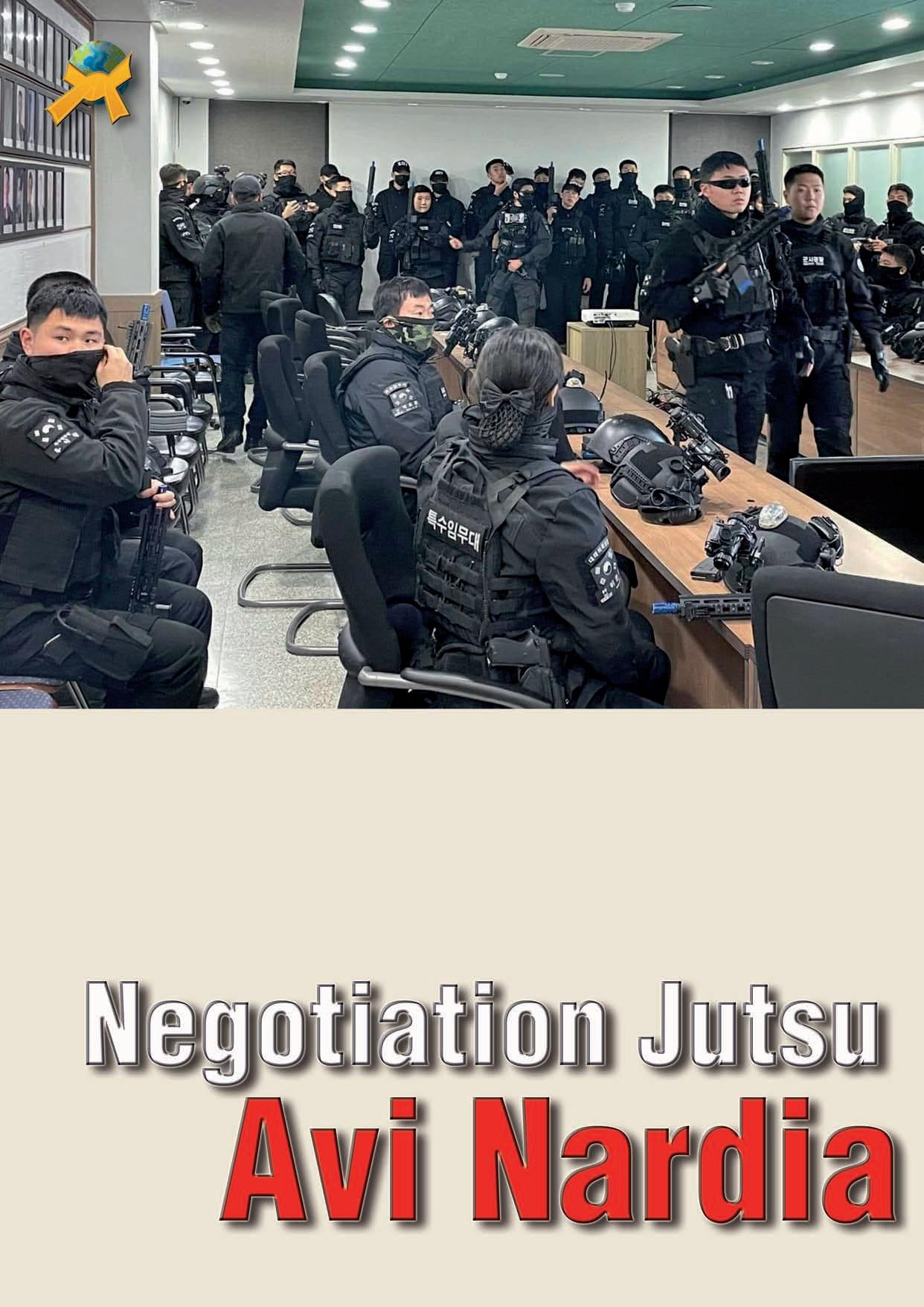
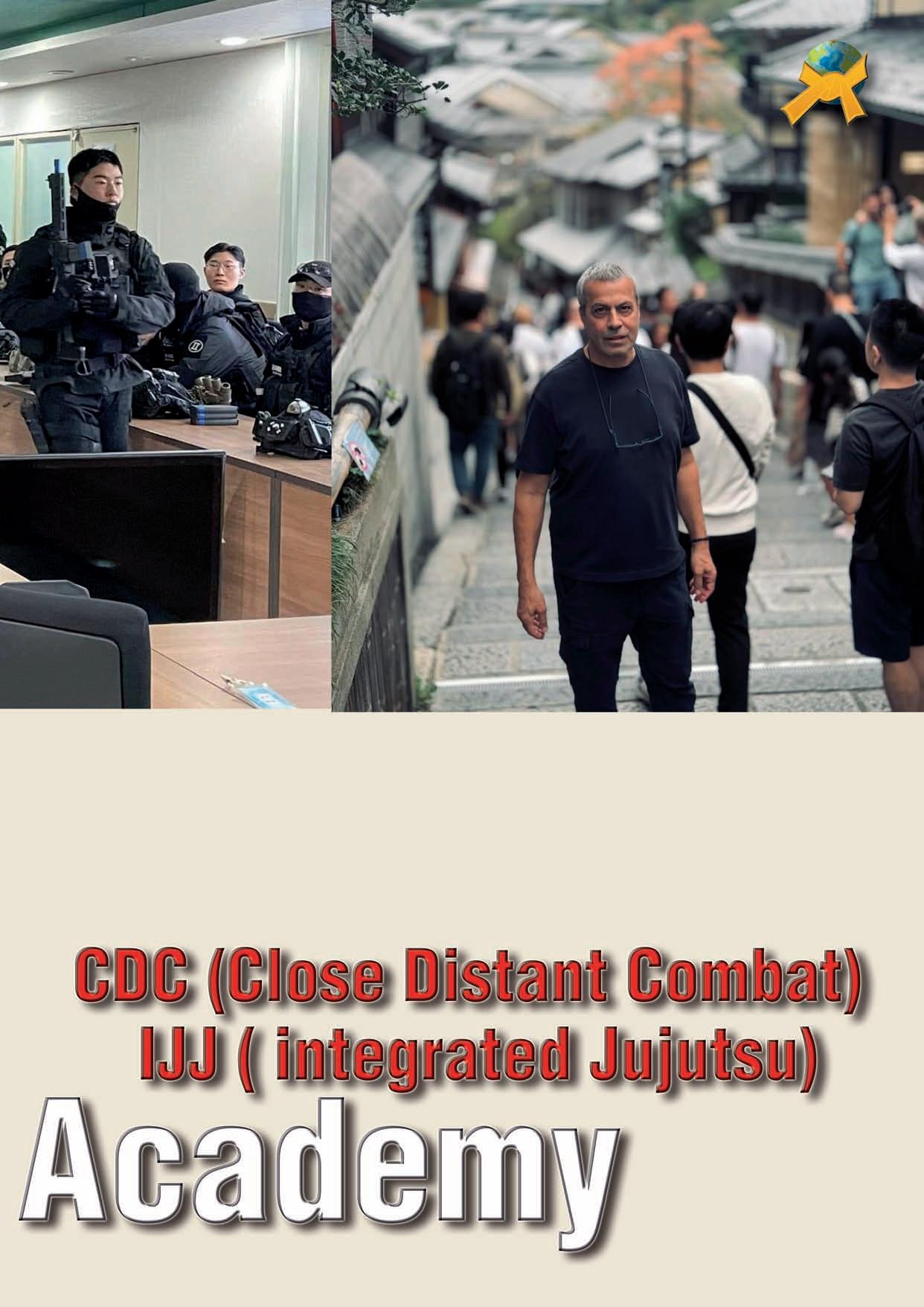
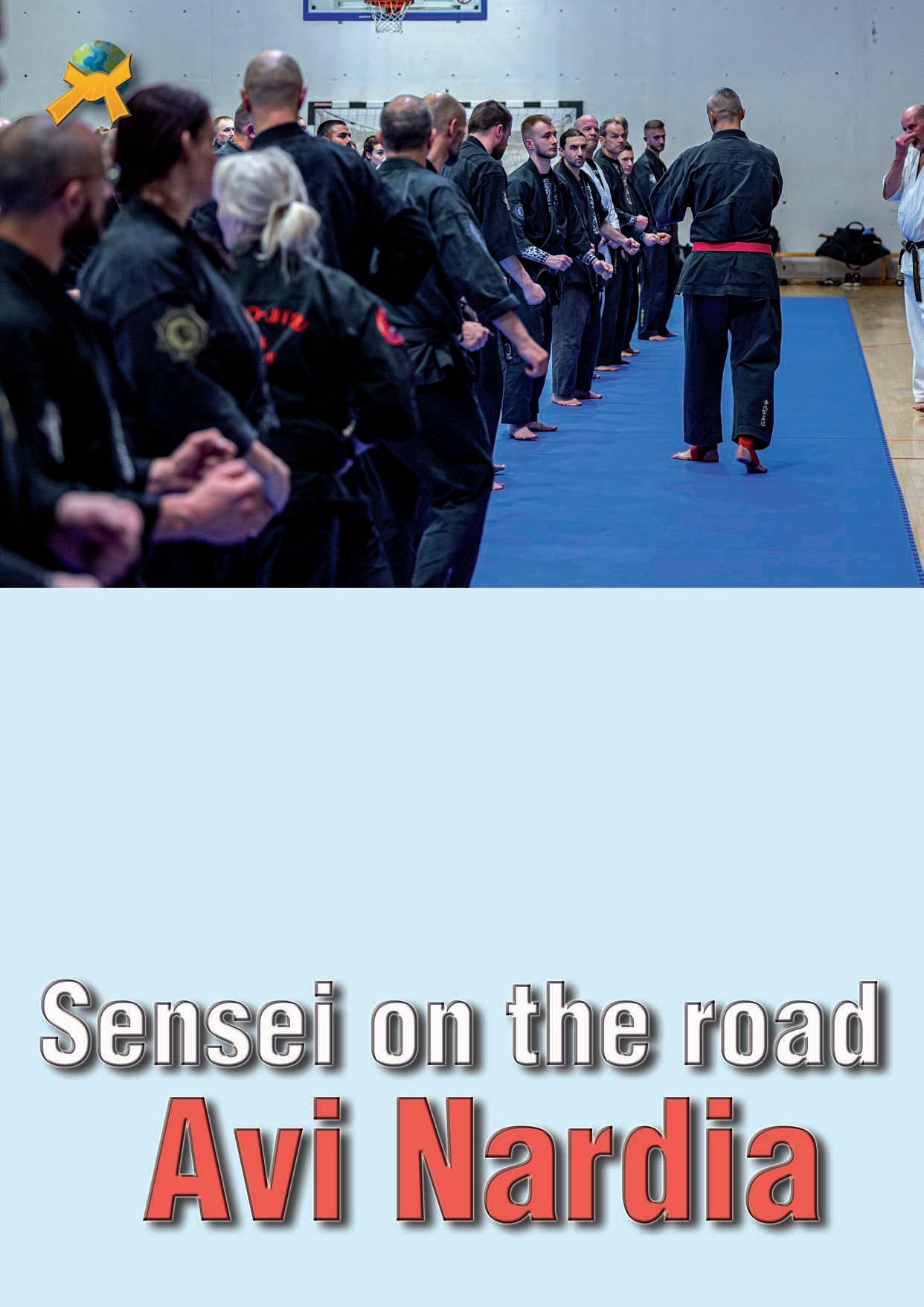
As for myself — I am Avi Nardia, and I have been a regular guest in Slovenia for more than 25 years. I am the founder of CDC/KAPAP, International Chief Instructor of AikiKenpoJujutsu, and hold a 4th Dan under Master Machado in Brazilian Jiu-Jitsu. I have served as a trainer of special military and police units across the world. But when I arrive in Slovenia each spring, I arrive not as a guest speaker — I arrive as someone who genuinely loves this community, these people, and this shared journey. Teaching at the camp this year was a privilege, and what struck me most was how much we all studied and learned from each other. The exchange between teachers was as rich as the teaching itself.
Tina and Borut Kincl: The Heart of It All
No words I write can fully capture what Tina and Borut Kincl have built — and continue to build — in Novo Mesto and beyond. Borut is the central figure of this federation: its founder, its visionary, and its most dedicated servant. With decades of tireless work, he has created a system that goes far beyond sport, far beyond technique, far beyond the dojo walls.
Tina expressed it most beautifully in her own words after this year's event: "To pull off such a megalomaniac event, you first need one crazy person who never gives up. Thank you Borut for convincing us to follow your madness with your energy." That "madness" — that refusal to settle, to slow down, to accept anything less than excellence — is exactly what has made the Kempo Arnis Federation what it is today.
Kyoshi Borut Kincl holds 8th Dan in Ryukyu Kempo Karate – Kyusho Jitsu – Tuite, 7th Dan in KAPAP – Israeli Jiu-Jitsu, and dans in both Modern Arnis and Shotokan Karate. He is the owner and Chief Instructor of the Kempo Arnis World Honbu Dojo, Founder and President of the Kempo Arnis Federation, a Martial Arts Hall of Fame inductee, and a trainer for special forces worldwide. His 8th Dan in AikiKenpoJujutsu — received in Okinawa from Hanshi Patrick McCarthy — is a recognition that his path is built on the most authentic foundations and the highest possible standards.
And behind every great leader stands an equally great partner. Tina Kincl is the organizational heart of this federation — co-organizer of the Spring Camp, the Black Belt Test, and the spectacular evening event. She describes the mission in words that I find deeply moving: "Both Borut and I were raised in the spirit to appreciate where we come from. That we love our family and people around us and that we want to create a community where the moment you walk out the door, your only identity becomes that you are a Kenpo Arnis member. That's why we don't look at it as a job, but as an extended family."
To both of you — Tina and Borut — I offer my deepest bow of respect. What you have built is not just a federation. It is a family. It is a legacy.
The 53rd Black Belt Test: A Moment of Light
Fifty-three candidates stood on the tatami for this year's Black Belt test — and all of them carried the weight of years of preparation. In the words of Renshi Damir Ivandic, 5th Dan, who captured the spirit of the evening with remarkable eloquence:
"Those 53 on the tatami were really full of light, but there was no less light in everyone else who did kata with us, fought with us, or cheered us on from the stands. The force is strong within us. Not just that unforgettable Saturday — Saturday was like that because we are like that every Monday, Tuesday, or any other day. Saturday was just the confirmation of that."
Renshi Ivandic also reflected on the journey of the federation itself, quoting Isaac Newton: "If I have seen further, it is because I have stood on the shoulders of giants." — a fitting tribute to the foundation that Kyoshi Borut Kincl has built for nearly a quarter century.
All members performed the Taikyoku 1 kata together before the fights began. The entire hall — more than 1,500 strong — became one united body, moving in unison, breathing in unison, honoring the art together. It was a moment I will not forget.
In Kempo Arnis, a black belt is not a destination — it is a commitment. A commitment to further development, to greater responsibility, and to a deeper understanding of the martial path.
International
Representation: A Global Family Team Malta — Outstanding Achievement
Huge congratulations are due to the KAF Malta team for their outstanding performance at the belt testing and training camp. Their results are a testament to dedication, sacrifice, and the strength of the Kempo Arnis family across borders:
•Nicole Sultana — 1st Dan
•Christina Said — 2nd Dan
•Emanuel Said — 2nd Dan
•Matthew Grima — 2nd Dan
•Franco Magrin — 2nd Dan
•Ryan Attard — 2nd Dan
•Amir Samhan — 2nd Dan
•Joseph Portelli — 4th Dan
As the Malta team wrote in their tribute: "We cannot express our gratitude enough to Kyoshi Borut Kincl, who has been the driving force behind all this. His passion, energy, belief, and vision turned a dream into reality, bringing people together and building an incredible community that is truly difficult to put into words." A tribute that echoes the sentiments of every person who has been part of this federation.
Team Germany — Jan Torborg, 3rd
Dan
Congratulations also to Jan Torborg of Team Germany, who successfully tested and passed his 3rd Dan at this camp. His achievement is another proud milestone in the federation's growing international reach.
About the Kempo Arnis Federation: The Spirit of Tradition in the Art of the Present
The Kempo Arnis Federation (KAF) is a unique synthesis of three martial systems: Ryukyu Kempo Tomari-te Karate, the Filipino martial art Modern Arnis, and Israeli KAPAP – Krav Maga. Its foundational program enables practitioners to achieve black belt or instructor level in all three arts, and is officially recognized by leading international organizations including IRKRS, DKI, IMAFP, and ANA.
What distinguishes Kempo Arnis from other martial arts is both its purpose and its philosophy. It is not designed for sport or competition — it is built for realistic self-defense in any situation, against any number of opponents, in any environment. As Kyoshi Borut states: "Mastering this skill requires not only physical strength and athletic ability, but also spontaneity and knowledge of the human body and psychology, which allows us to start learning Kempo Arnis at any age."
The federation holds that any art which does not change and adapt is dead — mere folklore. Kempo Arnis is therefore a living skill, one that evolves according to time and place, freeing the most effective aspects of traditional martial arts from the cumbersome interpretations that have frozen them in time, while maintaining the deepest respect for its origins in Okinawan and Filipino traditions.
What You Will Gain Through Kempo Arnis — In the Words of Kyoshi
Borut Kincl
1. Real Self-Defense Skills
Learn to use strategies and techniques drawn from three of the world's most effective martial systems, preparing you to face dangerous situations in modern, real-world contexts.
2. Improved Cognitive Abilities
Training demands a high level of focus, encouraging mental clarity and the art of maintaining inner peace under stress — skills that transfer directly into everyday life.
3. Reduced Stress Levels
Kempo Arnis is a powerful stress reliever. Physical training stimulates the body to release endorphins, creating a natural sense of wellbeing.
4. Improved Physical Fitness
Training builds resistance, flexibility, strength and endurance through varied and purposeful movement patterns.
5. Greater Self-Confidence
Progress in both fitness and martial arts naturally builds deep, earned self-confidence — the kind that comes from truly overcoming challenges.
6. Community and Belonging
Becoming part of the Kempo Arnis family means entering a community of like-minded individuals bound by shared values, shared challenges, and shared growth — a true extended family.
KAF: A Legacy of Firsts in Slovenia and the Former Yugoslavia
KAF and its predecessor RKSI have played a leading role in martial arts innovation and research in Slovenia and the former Yugoslavia since their inception. Among their many pioneering achievements:
•First to teach the concepts of real martial arts in the region
•First to organize seminars in Israeli martial arts — Krav Maga, KAPAP, and Israel Combat Systems
•First licensed Israeli martial arts instructors in Slovenia
•First to train and teach high levels of Bunkai Jitsu
•First to teach and organize Kyusho Jitsu – Tuite seminars
•First and only masters of Ryukyu Kempo – Kyusho Jitsu – Tuite in Slovenia
•First to teach and organize Filipino Martial Arts seminars (with masters including Bram Frank – CSSD/SC, Marc Denny – Dog Brothers, Cristino Vasquez – IMAFP, Jon Escudero – LSAI, Ken Smith – IMAF, Gaby Roloff – IMAF)
•First to organize fights and competitions in stick and knife fighting
•First masters of Filipino Martial Arts in Slovenia
•First to organize a seminar on the Russian martial art Systema
•First to teach and organize a Kiai Jitsu seminar
•First to organize competitions under Kyokushinkai (Knock Down) karate rules
This path of innovation and research continues. As Kyoshi Borut himself has said: "We at KAF know that there is still a long road ahead of us of research and serious study of man and his being. The study of martial arts is thus truly a study of life."
Closing Words: From One Warrior's Heart to Another
Every year I leave Slovenia with my cup full. Full of knowledge, full of friendship, full of inspiration, and full of profound gratitude for what this community represents.
This year was no exception. In fact, this year was exceptional. To have trained alongside Kancho Gerard Gordeau, GM Gabrielle Roloff, Martijn De Bruijn, Jacob Lim, and the entire Kempo Arnis family — guided always by the vision of Kyoshi Borut Kincl and the extraordinary organizational heart of Tina Kincl — was a privilege I do not take lightly.
Tina wrote of this year's ceremony: "We managed to connect people from different corners, with different beliefs and even more different backgrounds." That, to me, is the true achievement. Technique can be taught. Philosophy can be studied. But the ability to genuinely connect human beings across cultures, languages, and backgrounds — that is rare. That is leadership. That is love.
Kyoshi Borut Kincl is rightly recognized as the Best Ambassador to Slovenia through martial arts. He has placed Novo Mesto on the world map — not through politics or commerce, but through the universal language of discipline, respect, and the martial spirit.
I will be back next year. I always come back. Because here, in Slovenia, in the heart of the Kempo Arnis Federation, I find something that every martial artist searches for: a community that practices what it preaches. People who are truly, in the dojo and in life, Kenpo Arnis members.
OSU | Avi Nardia
International Chief Instructor, AikiKenpoJujutsu
Founder, CDC / KAPAP | 4th Dan, Machado Brazilian Jiu-Jitsu Trainer, Special Military & Police Units Worldwide 25+ Year Guest Instructor, Kempo Arnis Federation, Slovenia Spring 2026
Kano Jigoro's 1927 Okinawa Visit
by Patrick McCarthy
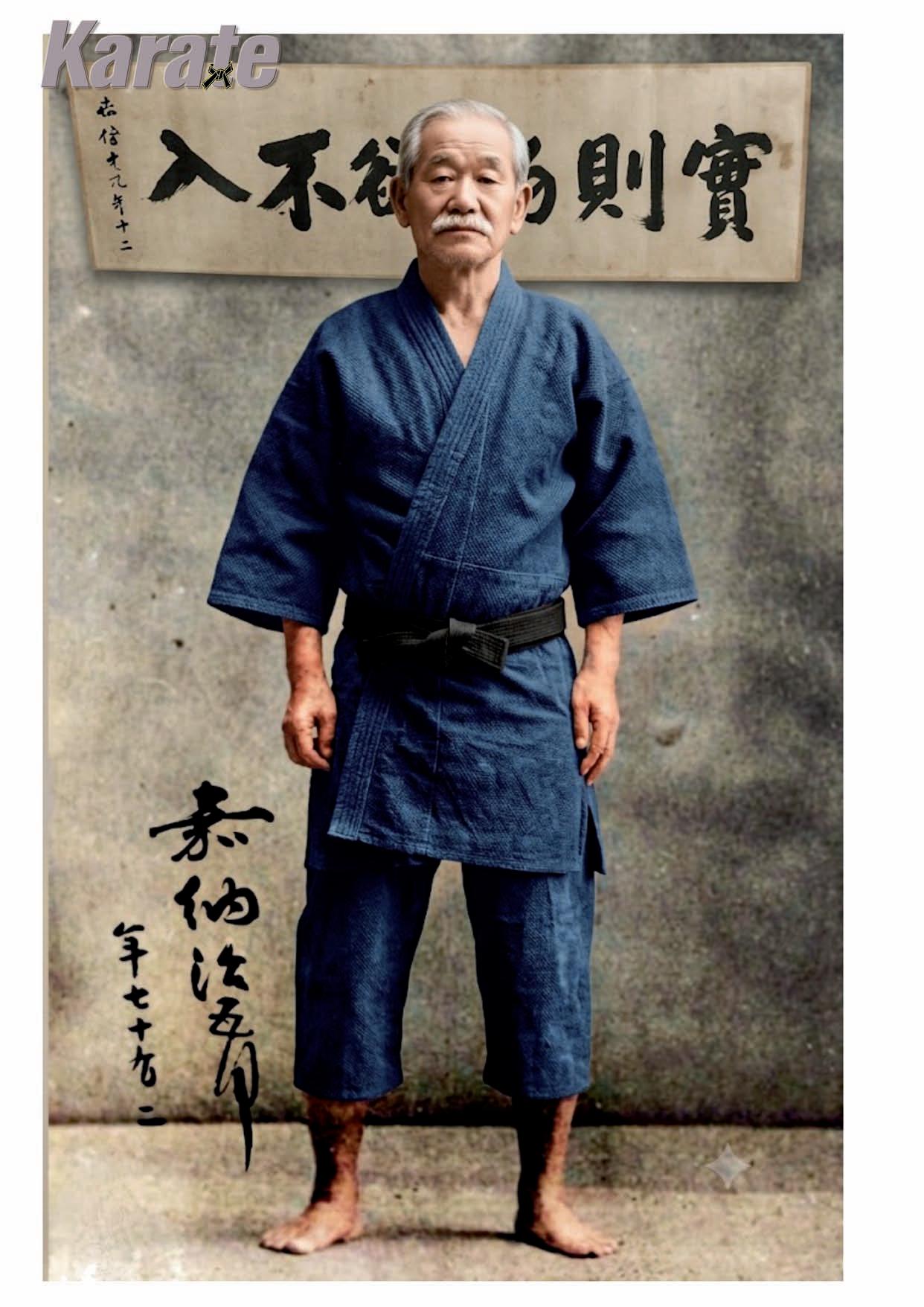
In January 1927, Kanō Jigorō visited Okinawa principally to inaugurate the island's first Jūdō Yūdansha Shinkō-kai. As an aristocrat of considerable standing, Kanō wielded significant political influence. He enjoyed the ear of the government, the Ministry of Education, the Department of War, and the Butokukai, and was widely regarded throughout Japan as the nation's foremost educator. His visit to Okinawa was therefore considered a great honour, and considerable effort was undertaken by a conservative committee — organised through the local board of education — to ensure that it was received accordingly.
Among the occasions arranged for Kanō's visit was a demonstration of Tōdi (唐手 ), the martial art then commonly written with characters identifying te 手 , "hand" or "art," with the prefix 唐 , denoting foreign — specifically Chinese — origin. It is worth pausing on this point, because the choice of nomenclature for the demonstration programme was far from incidental.
The classification of Tōdi into three principal districts — Shuri, Naha, and Tomari — had first appeared in the writing of Funakoshi Gichin. In 1913, Funakoshi described Tōdi, also rendered as Tōdi-jutsu Kenpō (唐手術拳法), as falling into two broad lineages of Chinese origin: Shōrin-ryū (少林流) and Shōrei-ryū (昭霊流), both names referring to temples or traditions associated with China. Today we may recognise that "Shōrei" was most likely a mistaken or confused rendering, perhaps better understood in relation to Wudang (武當/Wǔdāng), whilst Shōrin clearly points toward Shaolin. Even so, this geographical classification remained largely a descriptive convenience rather than a matter of public or official usage.
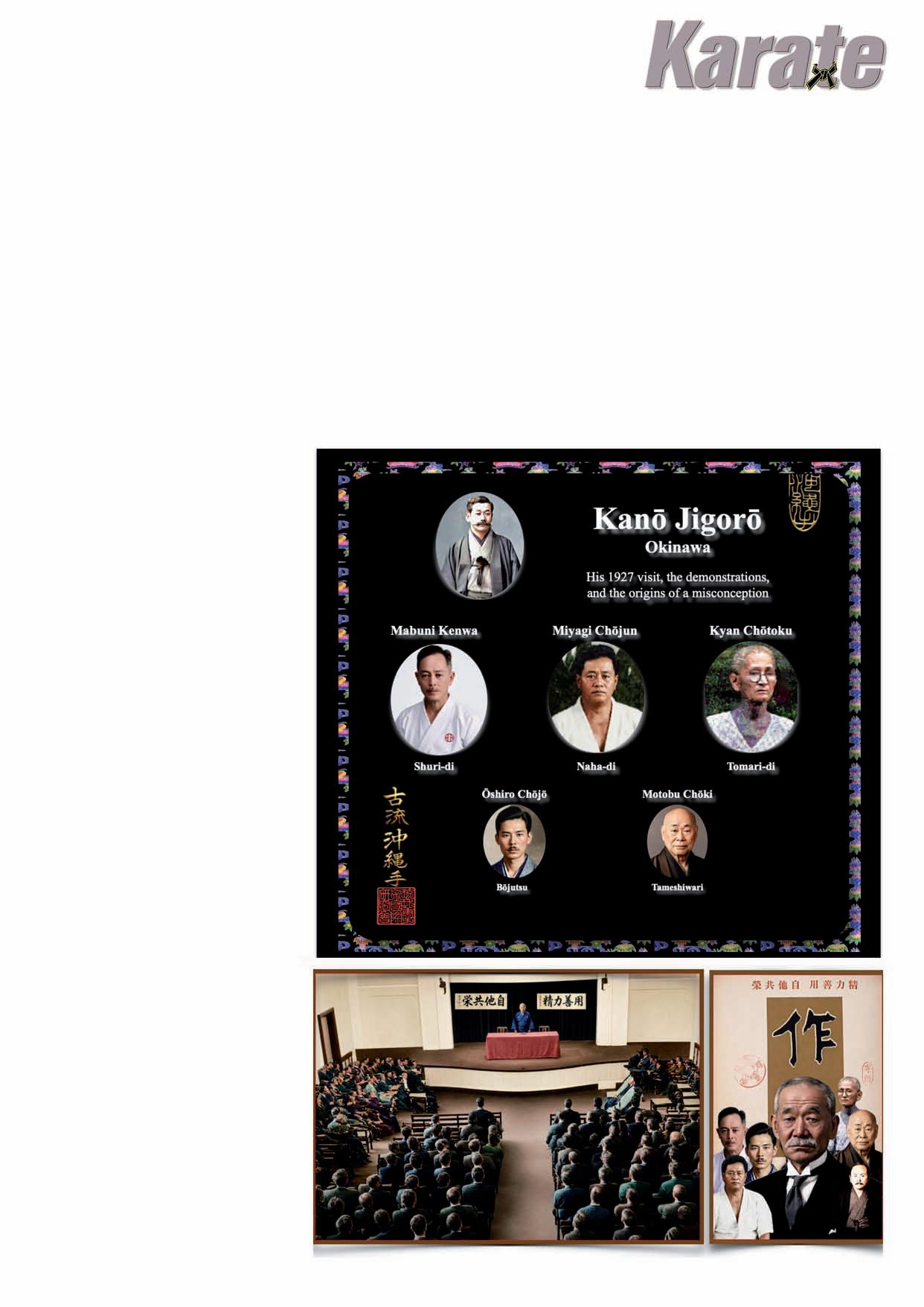
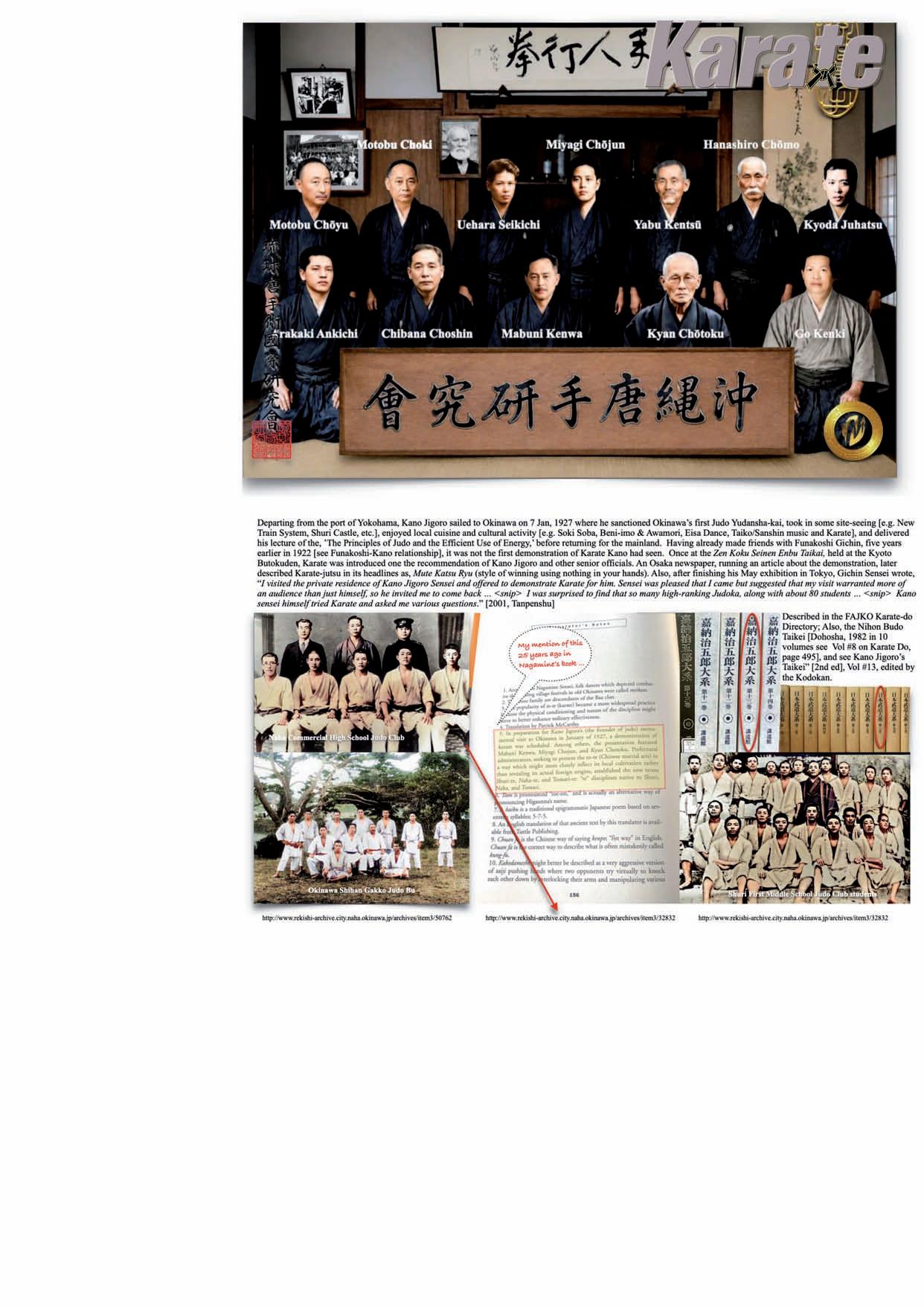
Towards the end of 1926, the committee charged with organising the demonstration before Kanō's January visit chose to adopt the geographical classification publicly, in preference to the original term Tōdi (唐手 ). Three local authorities were selected to represent their respective districts: Mabuni Kenwa (摩文仁賢和, 1889–1952), representing Tōdi in Shuri; Miyagi Chōjun (宮城長順 , 1888–1953), representing Tōdi in Naha; and Kyān Chōtoku (喜屋武 朝徳 , 1870–1945), representing Tōdi in Tomari — hence the terms Shuri-di (首里手), Naha-di (那覇手 ), and Tomari-di (泊手 ). Having now become associated with someone as nationally famous and influential as Kanō Jigorō, these labels took on a new life of their own and rapidly grew in popularity as accepted identifiers for the island's principal traditions. Although Motobu Chōki (本部朝基 , 1870–1944) is also said to have demonstrated Tameshiwari, and Ōshiro Chōjo ( 大城朝恕 , 1887–1935) performed bōjutsu, those performances are not directly relevant to the present point.
The reasoning behind this decision is not difficult to appreciate. The prefix 唐, read as Kara or Tō, explicitly identified China as the source of the practice. In a period of intense nationalism, antiChinese sentiment, and increasing military radicalisation, this carried obvious political hazard. To have presented Tōdi under its original name before so prominent a mainland Japanese dignitary — one with direct ties to government and national institutions — would likely have been regarded as poor taste at best, and politically provocative at worst. By substituting the names of the local districts from which each principal demonstra-
tor taught and practised, the committee achieved something rather elegant: the Chinese associations were quietly set aside, and in their place the art was presented as something rooted in Okinawa itself, lending it both public legitimacy and local pride.
When lecturing to young people, Kanō most often emphasised two core principles: Seiryoku Zen'yō (精力善用) — "Maximum efficient use of one's energy." Not merely in combat, but in study, work, daily life, and personal conduct. He taught that success comes from using both mental and physical energy wisely and without waste.
Jita Kyōei (自他共栄) — "Mutual welfare and benefit," or "You and I prosper together." The idea that individual achievement should contribute to the wider good of society. True progress, in Kanō's view, was not selfish advancement but collective betterment.
The nomenclature featured in that programme ultimately took hold. It is my view that although Funakoshi first employed the geographical classification in 1913, it was this significant cultural event that helped give rise to the common and enduring public identification of Tōdi as the distinct local practices of Shuri-te, Naha-te, and Tomari-te.
Yet this is precisely where a consequential error has since entered the historical record. Some historians — and, by extension, those influenced by their work — appear to have drawn from this episode the conclusion that the geographical prefixes reflected genuinely distinct and codified styles of the art, each unique to its respective district. I do not believe this to be the case.
Whether one traces this classification to Funakoshi's 1913 newspaper article or to the 1927 demonstration itself, the geographical labels were, at their origin, little more than a practical convenience—a means of identifying the art by the township or principality associated with its most prominent exponents. What distinguished Shuri-te, Naha-te, and Tomari-te was not, in any meaningful sense, a fundamental difference in the art itself, but rather the individual characteristics and teaching preferences of those responsible for transmitting it.
Funakoshi described Shuri-te as agile and fast-moving, characterised by natural breathing, light footwork, direct attacks, and evasive body movement. Naha-te, by contrast, was portrayed as favouring rooted stances, tension training, regulated breathing, and close-range power generation. Tomari-te was often presented as a synthesis of the two traditions, blending mobility with stability and linear movement with circular body evasion.
While such descriptions form part of the historical record, they should not be mistaken for rigid technical distinctions. In reality, all effective fighting methods depend upon the very qualities attributed to each tradition. Speed without stability is compromised. Power without mobility is limited. Evasion without structure is unreliable. Rooting, breathing, body shifting, agility, and power generation are not exclusive characteristics belonging to one geographical lineage or another; they are universal requirements of functional combative practice.
The determining factor is not where a practitioner happened to live, nor the label later attached to their tradition, but the nature of the physical violence being addressed. A tall, agile practitioner from Naha would not suddenly abandon mobility because of geography, nor would a compact and powerful practitioner from Shuri ignore the value of rootedness and close-range force. The problems posed by habitual acts of physical violence are universal, and the solutions they demand transcend regional classifications.
Viewed in this light, the historical distinctions between Shuri-te, Naha-te, and Tomari-te reveal more about the personalities, preferences, and training methods of influential teachers than they do about any fundamental differences in the underlying art itself.
This interpretation finds support in the remarks of Miyagi Chōjun (宮城長順, 1888–1953) during the now-famous 1936 Round Table Talks, often referred to as the "Meeting of the Masters." When discussion turned to the differences between the various traditions of Okinawan Karate-dō, Miyagi was asked to explain how one style differed from another. His response was both simple and revealing. If differences existed, he suggested, they were largely a matter of how the same principles and practices were taught by different instructors. In other words, the distinctions were less a reflection of the art itself than of the individuals responsible for transmitting it.
Such a perspective challenges the later tendency to view Shuri-te, Naha-te, and Tomari-te as fundamentally different systems. Rather, it suggests that what separated them was often a matter of emphasis, pedagogy, temperament, physique, experience, and personal preference. The differences were personal rather than stylistic—a reflection of the teachers, not the method.
Indeed, if one examines the surviving kata, two-person drills, training practices, and historical accounts associated with these traditions, the commonalities far outweigh the differences. All sought to cultivate efficient body mechanics, effective power generation, sound breathing, mobility, stability, evasive movement, and practical responses to interpersonal violence. What varied was not the objective, but the route taken to achieve it. The regional labels may have served a useful descriptive purpose in their own time, but they should not be mistaken for evidence of fun-
damentally different arts. They were, above all else, convenient geographical identifiers attached to traditions shaped by individual teachers, each interpreting and transmitting a common body of knowledge through the lens of personal experience.
To retrospectively read into those prefixes the existence of separate and formally defined schools is, I would argue, to mistake an administrative and politically motivated labelling exercise for evidence of genuine stylistic divergence.
Nowhere is this misunderstanding more evident than in today's highly stylised modern practices, where attention is often directed towards cosmetic difference rather than common combative function. Although contemporary training methods may emphasise different things, the art itself unfolded from the need for self-protection. The how and why of negotiating acts of physical violence were shaped by the dynamics of those acts themselves, and by the indi-
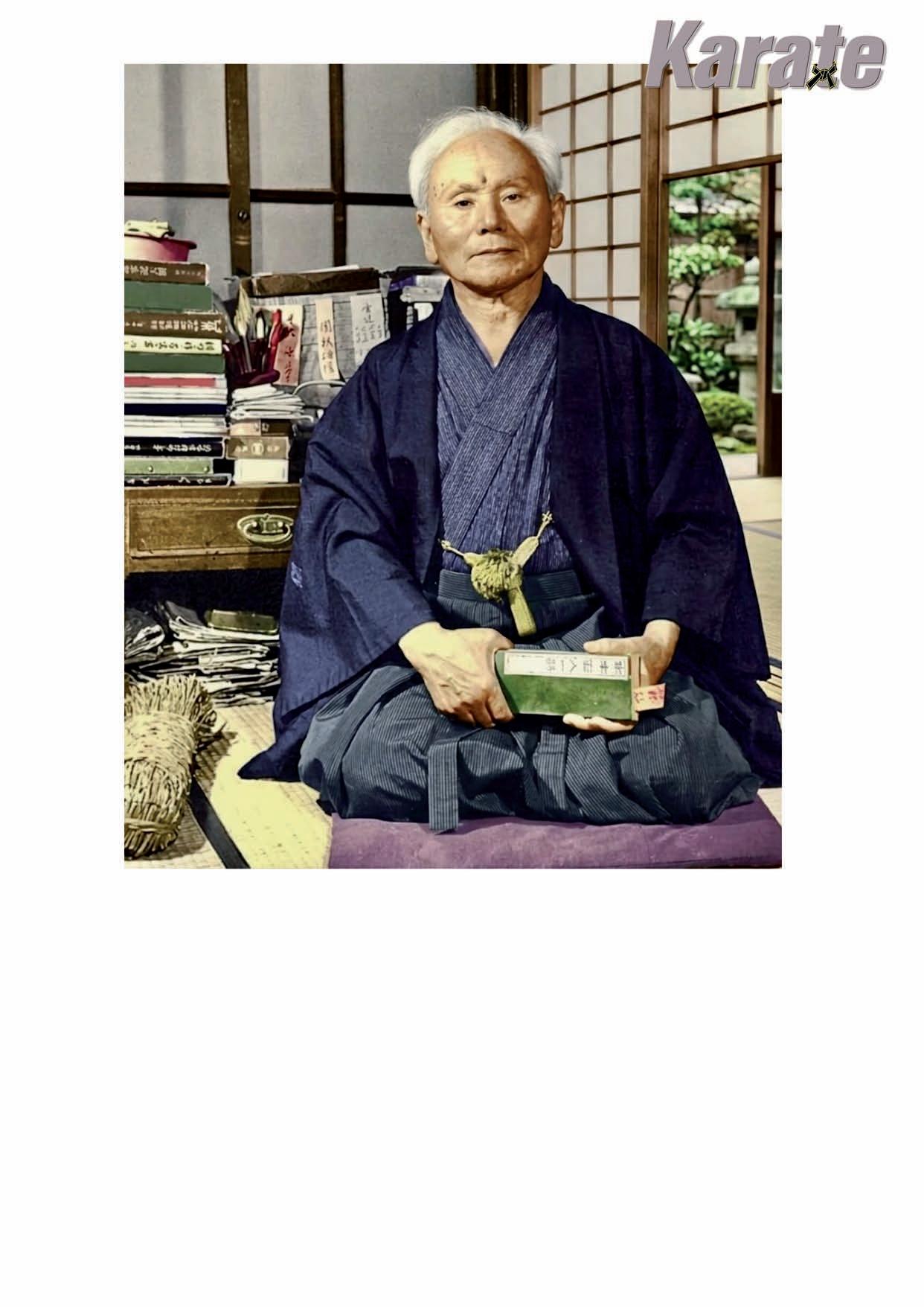
Funakoshi Gichin
vidual differences of those responding to them. In that sense, the art was never truly divided by geography. It was shaped by people, circumstances, experience, and necessity.
Outline of Kan Jigor 's 1927 Visit to Okinawa
On 31 December 1926, Kanō Jigorō, the visionary behind Jūdō, set sail for Naha aboard the Amakusa Maru. On 2 January 1927, he arrived at Kagoshima, where he and his colleagues left the ship for the evening to dine at the popular Suehiro restaurant.
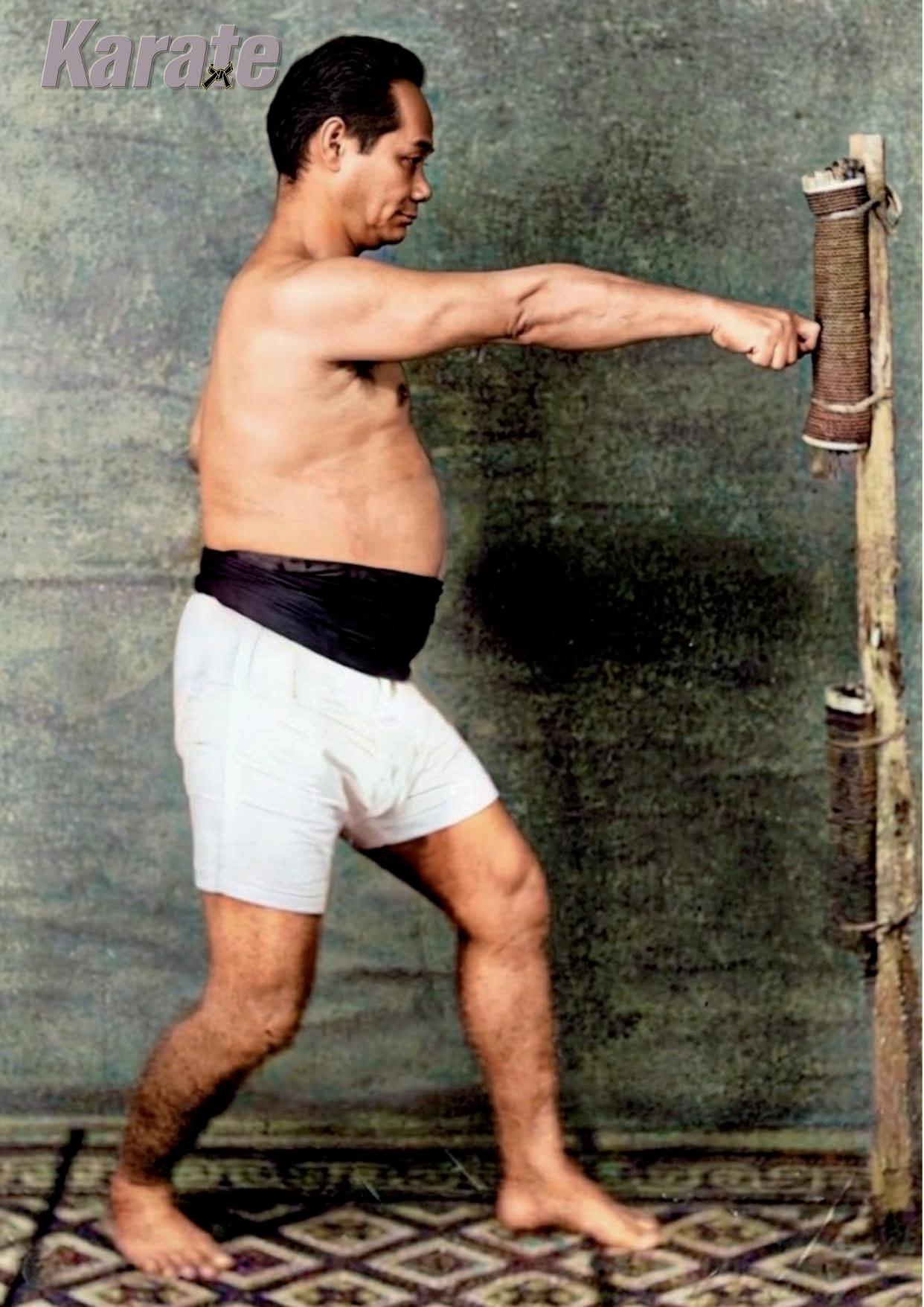
Arriving in Naha on 3 January 1927, his visit centred on inaugurating Okinawa's Jūdō Yūdansha Association, meeting various officials from both the public and private sectors, taking in the local sights, and enjoying cultural activities and local cuisine. He also had the opportunity to meet local experts of Karate, among them Miyagi Chōjun, Motobu Chōki, Mabuni Kenwa, Kyān Chōtoku and Ōshiro Chōjo.
His 9:00 am arrival was welcomed by a large gathering that included members of both the public and private sectors, among them Kishimoto Gashō — a local prefectural politician and a former university classmate of Kanō's in Tokyo.
After checking into his accommodations, they enjoyed a meal, and the following days were filled with various Jūdōrelated activities, lectures, and sightseeing, including watching a mongoose versus habu show. Kanō visited the Prefectural Library and City Hall, and met with various officials. He also journeyed to Shuri Castle by car — rather than by train, to save time — and visited other important sites, including the former King's mansion, his resting
place, the Industrial School, and Enkakuji Temple, situated next to the Shihan Gakkō.
The meeting with Miyagi Chōjun appeared to be a particular highlight, as Miyagi was well regarded as a local Karate expert. In addition to his training in Okinawa, Miyagi had also travelled to China twice to deepen his skill and knowledge. He graciously demonstrated various routines and fielded questions from Kanō, his insights providing valuable clarity on the art's fundamentals. During the same gathering, a Chinese man — most likely Go Kenki — also showcased Karate-like techniques based on the Crane style, offering a further perspective on the practice.
Following this enlightening session, Kanō and his companions were invited to the home of Ōshiro-san — another local politician — along with a group of students from the Higher Normal School, which included his eldest son, who was himself quite proficient in Karate.
On 6 January 1927, after a busy morning, Kanō and Ōshiro-san witnessed a bōjutsu demonstration by a local master — namely Ōshiro Chōjo. This was followed by a display of Tamashiwari by the esteemed Motobu Chōki. Motobu's dedication to refining Karate through years of practice and research had earned him a reputation as a local authority on practical application. Impressed by Motobu's physical conditioning, Kanō personally examined his hands and fists and acknowledged his commendable efforts.
Concluding his Okinawa visit, Kanō departed Naha on 8 January 1927, arriving in Kagoshima the following morning at 9:00 am. This journey, whilst centred on Jūdō, demonstrated Kanō's genuine appreciation for — and engagement with — the rich martial arts heritage of Okinawa, particularly Karate, as he interacted with accomplished practitioners including Miyagi Chōjun, Motobu Chōki, Mabuni Kenwa, Kyān Chōtoku, and others.
• Source: Kanō Okinawa Kyūshū diary, Jūdō, March 1927, pp. 28–36. Special thanks to Lance Gatling Shihan in Tokyo for the source material
Karate Timeline for Kanō Jigorō by Shishida Fumiaki, Waseda University (Journal of Martial Arts Anthropology, Vol. 11, nos. 1–4, 2011, p. 44)
1908/1909 — Kanō Jigorō first encounters Okinawan Karate at a Butokukai-sponsored youth event in Kyoto.
18 April 1911 — A group of Okinawan normal-school Karate instructors visits Kanō Jigorō at his home and the Kōdōkan.
March–June 1922 — Kanō observes demonstrations by Funakoshi Gichin and Gima Shinken, and subsequently lends active support to the mainland introduction of Karate.
Nov 1922 ~ See IRKRS Addendum
Oct 1926 ~ See IRKRS Addendum
3–7 January 1927 — Kanō visits Okinawa for four nights and five days, accompanied by Nagaoka Shūichi and Yokomoto Isekichi.
6 January 1927 — Kanō observes a Karate demonstration at the Okinawa Prefectural Normal School auditorium. Contemporary 1927 source material records his reaction to the art's movements as "terrific" or "ferocious." On the same occasion, he also witnessed a bōjutsu demonstration by Ōshiro Chōjō (大城朝恕 , 1887–1935), together with Motobu Chōki's (本部朝基, 1870–1944) famous board-breaking demonstration.
IRKRS Addendum ~ Separate from this timeline, regarding Kanō's two previous visits to Okinawa:
Source: Kindai Karate-dō no Rekishi o Kataru (近代空手 道の 歴史 を語る , "Talking About the History of Modern Karate-dō") by Fujiwara Ryōzō (藤原稜三) & Gima Shinken ( 儀間真謹), p. 90: "he went in Nov 1922 and Oct 1926." Published by Shin Jinbutsu Ōraisha, 1986.
“Speed without stability is incomplete. Power without mobility is limited. Each quality depends upon, and is enhanced by, the others”
Patrick McCarthy Patrick McCarthy
“I believe that this is precisely what the Dai Nippon Butokukai also came to recognise during what we might rightly call the golden era of Karate's transmission to the mainland — that remarkable decade between the early 1920s and December 1933, when the art was formally ratified as a single unified tradition”
Afterword
There is one final observation that seems to me worth making, and it concerns Kanō's two core principles in the context of what he witnessed during his Okinawa visit.
Seiryoku Zen'yō — the maximum efficient use of one's energy — and Jita Kyōei — mutual welfare and benefit — were not principles Kanō confined to Jūdō. They were, for him, universal truths applicable to every aspect of human endeavour: study, work, daily life, and personal conduct. It would be difficult to imagine that a man of his perception failed to recognise those same principles at work in Karate as it was demonstrated to him in January 1927.
Kanō was already familiar with Funakoshi Gichin and his approach to the art. Funakoshi had described Shuri-te in terms of agility, natural breathing, light footwork, direct attacks, and evasive body movement — a coherent and admirable system in its own right, but one that represented only a portion of what the art, in its entirety, had to offer. When Kanō then witnessed Miyagi Chōjun, Mabuni Kenwa, and Kyān Chōtoku demonstrate their respective traditions, he would have been confronted with precisely those qualities that Funakoshi's description had not encompassed: rooted stability, regulated breathing, tension training, and close-range power generation. Taken together, the demonstrations would have presented something considerably greater than the sum of their parts.
To a mind shaped by Seiryoku Zen'yō, the implication was self-evident. The successful application of any technique — whether in combat or in life — does not rest upon the isolated mastery of one set of skills drawn from one tradition. It rests upon the intelligent and efficient deployment of the whole. Speed without stability is incomplete. Power without mobility is limited. Each quality depends upon, and is enhanced by, the others. The geographical labels attached to these traditions were, in that sense, beside the point. What Kanō saw was not three separate arts but a single body of knowledge expressed through different emphases.
And if Seiryoku Zen'yō speaks to the efficient use of the whole over the partial, then Jita Kyōei speaks to something equally relevant: that true progress is not achieved through the isolation or privileging of one tradition over another, but through their collective integration. Not selfish advancement, but mutual betterment.
I believe that this is precisely what the Dai Nippon Butokukai also came to recognise during what we might rightly call the golden era of Karate's transmission to the mainland — that remarkable decade between the early 1920s and December 1933, when the art was formally ratified as a single unified tradition. In bringing the various practices together under one designation, the Butokukai was, whether consciously or not, affirming the very principles that Kanō had long championed: that the whole is greater than its parts, and that collective betterment outweighs the preservation of artificial boundaries.
Kanō saw it in Jūdō. He almost certainly saw it in Karate. And in 1933, the Butokukai made it official.
Patrick McCarthy マカシー パトリック
Hanshi 10th Dan 範士十段 International Ryukyu Karate-jutsu Research Society ~ est. 1988 琉球唐手術国際研究會 http://www.koryu-uchinadi.com
THE ODD COUPLES
The use of two weapons—one in each hand—in battle dates back to prehistoric times. Rock carvings have shown how warriors of the past learned to hold a shield in one hand and a weapon—whether a bladed or striking weapon—in the other, usually their dominant hand. The combination of whip and sword also appears to have ancient origins, a pairing we sometimes find in the combination of knife and whip or staff and whip.
If we consider the Italian Renaissance, we discover that the “bel paese” gave the world the extraordinary pairing of the sword and dagger, known in the world of martial arts thanks to the spread of Filipino martial arts. The Southeast Asian archipelago, colonized by the Spanish during the Renaissance period, gave rise to a “mestizo” culture in which East and West effectively fused and d together. As we have already mentioned here, the sword and dagger were the pair of weapons used by mercenary captains (especially Italians) serving in the elite units accompanying Magellan. In fact, this pairing represents the quintessential combination of weapons. In the Asian archipelago, this pairing was supplanted by the staff and knife—simpler tools, but more readily available. The use of these two weapons in battle allowed for greater effectiveness in both offense and defense.
Even the Japanese samurai, known for their two-handed swords, reached the same conclusion about a hundred years later: the great swordsman Miyamoto Musashi, in fact, founded the Ni Ten (Two Heavens) school, in which one hand held the classic katana and the other the smaller wakizashi.
Returning to the West, and especially to the Mediterranean basin, we recall that the knife—which we have defined as the “sword of the people”—is used either on its own or in combination with a jacket, a popular variation on the “cloak and sword” motif, or paired with a belt, which, as we can easily surmise, derives from the combination of whip and sword.
In every corner of the globe, man has learned to transform a tool of labor into a weapon of war; consider the so-called “Crusade of the Beggars,” made up of people who could not even afford to buy a horse, armor, or even a sword. These adventurers set out on their quest armed with sticks and pitchforks, ready to take rudimentary lessons in horsemanship at certain stations—especially on Italian soil—before embarking for Palestine. Experienced knights skilled in the art of warfare went out of their way to places like Messina in Sicily to train these makeshift recruits.
In the East, the Nun cha ku—made famous by Bruce Lee—and the tonfa became so well-known among martial artists that their more humble origins as tools used for pounding rice were forgotten. In Southeast Asia, a similar fate befell another tool-weapon: a distinctive knife with a curved blade found in various sizes throughout the Malay region. Many people think it’s a weapon created to make their martial art more effective. I used to think so too, until I saw a large quantity of them in all shapes and sizes at a very popular market in Sumatra. I immediately realized that this wasn’t a shop selling martial arts or self-defense gear, but rather work tools. They were, in fact, the knives used by tanners—those who work with leather and hides. The merchandise was displayed on a simple blanket spread out on the asphalt; I leaned toward the vendor, who was sitting on the ground, and asked what all those knives were used for. He answered with a demonstration: he picked up a piece of leather and began cutting it with swift, skillful movements. Then I asked him why some (not all) of them had a ring to slip a finger through.
The answer was simple, and his demonstration of the scene was, once again, enlightening: the ring allowed the user to work with both hands without having to set the knife down and pick it up again each time; when it wasn’t needed, the user would let it dangle from their hand. Some hooked it onto their index finger, others onto their little finger, and still others onto one of the other fingers, depending on the worker’s preference. The ring actually saved a lot of time because workers weren’t forced to set the tool down to use both hands—and then pick it up again—since it remained hooked to their hand at all times. Other knives, on the other hand, lacked a ring, but the dealer added that some workers were in the habit of tying them to their wrist with a cord, while others wanted nothing to do with rings or cords and preferred to use it as a simple curved-blade skinner.
When, in the villages of the Ionian region, I first saw the mazzola—used by sailors—hooked to the wrist or, as the more experienced ones did, to the thumb, I was reminded of the methods used in Sumatra to secure the curved knife. The small club used to stun or kill the catch—especially octopuses—was, when necessary, used as a defensive tool to stun humans or to break the bones of an armed arm, turning a passive parry into a sort of offensive counterattack.
The use of the mallet in self-defense, especially in light of what was said above, is a product of human creativity that transforms any tool into a weapon. Today it is a rare tool, difficult to find, and it is even more difficult to reconstruct the martial use of such a device. Those who knew have long since passed away, and the survivors do not like to speak of these things, especially in southern Italy. Knowing these customs meant having had a turbulent past, having taken part in disputes or, worse, in organizations that were chivalrous in name only.
Even more secretive and valuable is the use of the mazzola and the knife as a pair; in fact, among all the combinations listed above, this is the strangest and also the rarest—yet no less effective; on the contrary, their potential is downright explosive.
Usually, the dominant hand (the right for right-handers and the left for left-handers) holds the knife, while the other hand holds the mace. The parries and techniques are no different from those used with a single knife; however, one must learn to coordinate the movements of both weapons to achieve maximum effectiveness from both.
The first advantage is parrying with the gauntlet rather than with the bare hand, which provides a greater margin of safety during the parry and consequently significantly reduces the risk of an accidental cut.
Second, the parry is a sharp strike that, on its own, can end the duel by breaking the opponent’s wrist or, at the very least, disarming them due to the painful impact.
The targets for the gauntlet are not limited to the wrist or hand; it is effective against the collarbones, the chest, and, of course, the head.
Even the knees or ankles can sustain serious damage. To reach these targets, one must use specific techniques to lower one’s stance or take advantage of a kick thrown by the attacker to strike them in the legs without having to lower one’s stance.
“In every corner of the globe, man has learned to transform a tool of labor into a weapon of war. Consider the so-called ‘Crusade of the Beggars,’ made up of people who could not even afford to buy a horse, armor, or even a sword. These adventurers set out on their quest armed with sticks and pitchforks, ready to take rudimentary lessons in horsemanship at certain stations—especially on Italian soil—before embarking for Palestine.”
Muay Boran: grappling strategies against punches
Muay Thai is the Siamese art of unarmed fighting. The only “weapons” that are always available are our body parts, in particular: our hands, legs, knees, elbows and head. Siamese Muay has made the use of those natural weapons a true science: a Muay Thai stylist is trained to skilfully attack and defend using those natural weapons in hundreds of extremely efficient ways. Because of this, all martial arts fans consider Muay as a typical example of a “striking art”. A striking art is a fighting discipline whose techniques are focused on using power strikes as the main system to defeat an enemy/opponent. Most experts consider Muay Thai striking techniques as some of the best as far as explosive power and lethal efficiency is concerned.
This is surely true: however, there is much more. In fact, Muay has long history dating back several centuries. Along the years, this Art went through a series of transformations, going from a battlefield skill to a refined and well-regulated combat sport. The various versions of Muay before the great revolution of this style occurred around the year 1930, were not centered on striking only but consisted of multiple fighting strategies such as grabbing, locking, twisting and breaking the limbs or the neck of the opponent. Moreover, ancient Muay stylists had to be well prepared to defeat enemies using throws and finishing techniques applied once the opponent was on the ground. A few of these maneuvers are still in use in modern Thai Boxing but the introduction of boxing gloves and the strict regulations enforced during fights on the ring led to a progressive forsaking of the more combative tactics. On the contrary, ancient Muay was rich in grappling techniques and strategies:
one of the ancestral strategies used to dispatch an enemy on the battlefield consisted of grabbing an arm in order to apply a joint lock, a leverage or a strike to the elbow to disarm or otherwise incapacitate him.
Given the effectiveness of this technique, even today, attacking the elbow is the primary strategy employed by experienced Muay Pram grapplers to “break the wing of the swan”: in other words to put the enemy in a condition of extreme weakness due to pain and physical and psychological stress. The instantaneous result of a damaged elbow is an almost total lack of capacity to offend or defend properly.
The elbow is located between the arm and the forearm and forms the central pivot of the motor chain of the upper limbs. In a fight, if you manage to lock the elbow area of the opponent, as a consequence you also lock his shoulder and, as a result, you can control all of his body.
If the lock is applied with a jerk, the elbow joint may be permanently damaged. The opponent will not be in condition to hit you with his arm or to use a weapon against you: his fighting ability will be drastically diminished.
However, since it is protected by strong muscles and tendons, damaging the elbow joint is not very easy. In fact, if the opponent realizes that his elbow is being attacked, as an instinctive reaction he will tense the arm muscles, further protecting the joint. At this point, completing a lock becomes very difficult. Therefore, in order to apply a lock and damage the elbow you need to operate quickly and with great determination. Positioning is the key word at this stage.
Most elbow locks are applied against grabs or punches. If you want to catch a punching arm, in order to apply the lock properly, you must first learn to detect and control the opponent’s strike. However, since in executing punches the arm is extended and pulled back, seizing hold of the wrist may result very difficult to do. However, in the execution of punches the elbow moves slower than the hand: therefore, when the punch comes seizing hold of the elbow and wrist at the same time or in rapid succession is recommended instead of trying to grab the wrist area alone.
As soon as you get hold of the opponent’s arm, you have to instantly apply a pain-producing lock or a strike: you only have a split second at your disposal before the opponents puts up a defensive action. Therefore, be fast, be accurate and be vicious if you want your lock to be effective.
At this stage, all the sophisticated Muay Pram strategies aimed at blocking punches and catching the attacking arm come into play. A properly trained Nak Muay Pram (Muay Pram fighter) should possess dozens of highly effective techniques to intercept and catch the striking arm of any opponent.
For an untrained person, catching and holding a full speed punch may sound impossible to do; however, Muay Pram stylists learn how to do that since lesson one. And they practice these techniques on a regular basis until catching a punch becomes second nature.
The 3 main Muay Pram strategies to defend against head punches and catch the opponent’s arm are the following: the technique of 4 palms (Kan Pad Mue), opening the guard upwards (Poed Su) and putting a flower behind the ear (Dtad Mala).
For example against a straight rear punch to the face, the Muay Pram fighter may just turn his upper body and let the strike barely graze him. At the same time he would hook the opponent’s wrist with his own wrist and lock the elbow with his shoulder. A sudden hip twist and a shoulder push against the attacker’s arm, can easily snap the opponent’s elbow joint.
Otherwise, if the opponent attacks with a head hook or swing punch, the Nak Muay Pram steps into the attack employing the renowned Dtad Mala aggressive-defence tactic. In doing so, the impact is smothered and at the same time the point of the defender’s elbow impacts against the opponent’s throat or face. A quick over-hook can be easily applied at this point. An explosive hip turn is the usual follow up, possibly causing an elbow dislocation of the trapped arm.
•South America: Juan Carlos Duran (IMBA Colombia) imbacolombia@gmail.com
•Oceania: Maria Quaglia (IMBA Australia) imbaaust@gmail.com
•General Secretary: Marika Vallone (IMBA Italia) imbageneralsecretary@gmail.com
UNCONVENTIONAL ALTERNATIVES (UCA) FRANCO VACIRCA UNIQUE APPROACH TO BRAZILIAN JIU-JITSU
BUDO: Professor Franco, you were the first person to bring Brazilian Jiu-Jitsu to Europe, travelling from California to Zurich to do so. Many of your academy's early BJJ students have become teachers. However, not all of them represent you. Why is that?
VACIRCA: First, let me tell you that we were introduced to the Gracie family and our teacher at around the same time in the late '80s and early '90s. By 'we', I mean my brother Demetrio, my sister Maria Carmen and myself. Martial arts have always been something that the three of us have shared in the Vacirca family, even if I have always been the one encouraging my brother and sister in a positive way. It was always important to me to have them by my side, and we always supported each other, even when we had different opinions. For example, in the early '90s, my brother Demetrio brought Natural Movements and Yoga to BJJ.
I can't pinpoint one particular reason why some of our students left and forged their own path, but honestly, that's perfectly OK with us. The ones who stayed with us have been our friends and colleagues for over 37 years. People come and people go. I guess you could say that I am doing my best to uphold the 'Gracie tradition' as it was taught to me, but perhaps it does not align with everyone's philosophy.
I don't just teach Gracie Jiu-Jitsu in my Dojo – I prefer the term 'Dojo' to 'Academy' these days, even though I used the term 'Academy' myself in the past. I have had the huge honor of representing my MuayThai teacher Ajarn Chai Sirisute since 1989, and I have always incorporated different Filipino martial arts (FMA), such as Kali and Eskrima, into my teaching, particularly regarding weaponry and knife fighting.
I train people to be as realistic as possible. The sport aspect of BJJ is secondary to me. I want my students to be able to defend themselves if necessary. It's very easy to get caught up in the 'martial arts dream' these days, when I look at BJJ. In our Gracie Concepts® network, we have people from different backgrounds with different goals. However, that does not affect the way I teach my program. To be honest, how many martial arts instructors and experts have ever been in a real street confrontation? Very few! Most martial arts teachers have never been hit. The result is that these experts teach a kind of martial arts 'dance', which attracts the attention of the curious, and some people are taken in by it.
I focus on my work as a martial arts teacher. I don't have time for politics. The basic rules that I have established for the Gracie Concepts® network are very simple, offering you a unique opportunity to learn Gracie Jiu-Jitsu and be yourself. I ask that you follow our 54-lesson program; otherwise, how could I assess your students' level? At a certain level, I also provide “Alternatives” and "Unconventional Alternatives" (UCA) to help you develop a better understanding of how to apply them to your Jiu-Jitsu "game".
Our Gracie Concepts® work began in 1996 with the establishment of the first affiliate BJJ groups in countries such as Greece with Dimitrios Gletzakos, Italy with Fabrizio Manzo, Germany with Peter Angerer, Mario Stapel and André Stock, and many more. They were also the first black belts, and we shared some great times and stories.
Today, we at the Gracie Concepts® network can be very proud of the work we have done so far, and we must keep going and never give up.
BUDO: Compared to your partner schools and Dojos, you probably have the smallest location with no logo or other signs, no pictures or certifications on the wall, no medals, trophies or belts, and a Tatame area of maybe 70 m²! Why is that?
VACIRCA: In fact, the Dojo in Zurich (Switzerland) is not even owned by me. However, I teach Gracie Jiu-Jitsu, Muay Thai and FMA/Kali here every day. In the past, I had time to own a bigger Dojo, but due to a lack of time and the need to stay flexible for different projects, this is the perfect location — at least for now, since the end of the restrictions imposed by the Coronavirus pandemic.
People training with me should not be attracted by something that is not real. We have kept it real ever since 16 July 1995, when the Vacirca Academy of Martial Arts (VAMA) was established. From 1989 until 1991, we were just a study group; it was called the Basement, like the school of Nino Bernardo (Wong Shun Leung Wing Chun) in London, UK. From 1991 until VAMA's opening in 1995, we experimented with various training and teaching methods.
Between 1991 and 1995, we also changed the name of our training group several times due to the influence of my
teachers in California at the time. I introduced the Progressive Fighting System (PFS) by hosting a Paul Vunak seminar in Switzerland. Thanks to this seminar, he helped me introduce the first Gracie Brazilian Jiu-Jitsu techniques on the ground into my PFS/Kali/Muay-Thai group. While literally living in Hermosa Beach and focusing on martial arts and work, I was teaching my own students in Zurich. They became so good that I had to train harder to stay ahead of them, which was not always easy since our students were so dedicated.
People were also coming to my home from different countries. During this time, we focused more on Jeet Kune Do concepts (PFS/Kali), and later BJJ. The demand for VAMA seminars and private lessons increased rapidly. Some of our students believed that they would have the same or even more success if they split from us, but this was not the reality for them. Many JKD schools opened in a few years, and the same number had to close again. You could not teach just by reading the 'Tao of JKD', and very few had the personal quality and financial means to travel and learn from the source. Some of them found a way to earn money as self-named JKD experts, training others so
that they could afford to travel or invite trainers from California. But let's face it, that's not a long-term solution. Martial arts may not be for everyone, and those who are not serious never get very far.
BUDO: What do you think of how BJJ has taken off in Europe?
VACIRCA: OK, but what do you mean by BJJ? In the early '90s, teachers in the US started using the term 'Brazilian Jiu-Jitsu' (BJJ) because Grandmaster Rorion Gracie, one of the eldest sons of Grandmaster Hélio Gracie and co-founder of the UFC, was fighting members of his own family to register 'Gracie Jiu-Jitsu'. In Europe, Brazilian Jiu-Jitsu has two meanings: people use the term BJJ when they train at a school that teaches Brazilian Jiu-Jitsu, whether Gracie or non-Gracie, and people who train in Wrestling, Judo, Jiu-Jitsu, Luta-Livre, etc., and compete in BJJ tournaments.
Here in Europe, BJJ is a generic term that means you also train in 'ground fighting', but you could also teach Krav Maga, Judo or Wrestling, and still compete in BJJ tournaments and call yourself a BJJ practitioner! One year ago, I visited the UFC Gym in Berlin with Master Royce Gracie, as I was hosting a seminar for him. When we reached the gym reception, the head manager asked if he could help us and if we would like to see the gym. I said yes, but the manager did not recognize Master Royce, so I said to him, 'Do you know this gentleman?' He answered, 'No!' I immediately countered, 'Well, this is UFC champion Royce Gracie!'
While we were touring the gym, the manager was using his phone to try and find Royce Gracie on Google!
MMA has not provided the results that BJJ should have had. BJJ has helped MMA, but not vice versa. If you want to train in BJJ, please look for a proper BJJ school.
When I started teaching Gracie Jiu-Jitsu as a nonBrazilian, most people wouldn't believe that I was a recognized black belt. Even today, most Brazilians believe that you must be Brazilian to teach Jiu-Jitsu. The same was true in the 1970s with Kung Fu: my teacher had to deal with a lot of skepticism because he was Spanish and living in Switzerland, yet he could teach Chinese martial arts. Thankfully, things change over time. Unfortunately, however, too many Brazilians believe that they are good teachers just because they have won some BJJ tournaments. As my GJJ teacher Pedro Hemetério always reminds me: 'A good fighter is not necessarily a good teacher.' Selling belts and diplomas in Europe by Brazilian organizations and teachers is nothing new and is becoming increasingly common.
I am a European who has learnt a Brazilian fighting art with deep roots in Japanese Jiu-Jitsu. I brought it to Europe, and this is my personal interpretation of what I learnt from my teachers. My knowledge and skills have improved with experience and time. With the help of my teachers, I have adapted the traditional teaching program and used modern technologies and teaching tools to improve it. The standards have increased. It's the same as in any other sport.
People like to refer to Jiu-Jitsu as the art of the samurai, which is incorrect. Imagine a samurai in all his protective gear fighting on the ground as they do in BJJ today. The samurais were great in their day, but today we have much more advanced skills, knowledge and technology.
BUDO: Your teaching style is neither explosive nor slow. Is your approach more 'traditional' or 'modern'?
VACIRCA: Some people ask me if I teach 'old school' or 'new school', and I always answer, 'truth school'! Of course, it is MY truth! It's not the truth of any of my teachers. I can only interpret what I believe my teachers were giving me, but ultimately, it's me standing here in front of you. I believe that my 'movement' is an extension of traditional Jiu-Jitsu. I was the first black belt in Brazilian Jiu-Jitsu and was trained by the first and second generations of the Gracie family. I could choose to teach Brazilian Jiu-Jitsu in the same way that I was taught, using the same techniques that I use today. It is the experience of over 35 years of training that makes the difference. To me, Jiu-Jitsu is survival. Yes, it's fun to gently smash my training partner who smiles at me, but it's serious business when we train for self-defense. I believe this is why so many people are dedicated to Gracie Jiu-Jitsu today.
BUDO: Are all your first-generation students still teaching with you?
VACIRCA: No, of course not! As I mentioned before, I feel honored that we shared our path for a while, but I am also happy that they have forged their own path in Brazilian Jiu-Jitsu. Peter Angerer, for example, became the founder and leader of the famous German Top Team. I still visit his headquarters in Reutlingen for seminars and belt gradings. The same goes for André Stock in Magdeburg — I see his students at least once a year. Meanwhile, I have around fifteen schools in Europe with approximately two thousand students, and we have another fifteen smaller teams in various regions. I am not interested in the US market, even though we have received requests in the past. I am also not interested in the Asian market, even though we have been exchanging with Japanese BJJ groups for many years. Only time will tell what the future holds for us.
I have many students, such as Thomas Mehnert, who is a trainer at the Police Training Academy and has been with me for over twenty years. In 2006, he and I established the Gracie Jiu-Jitsu Team Berlin. Another excellent GJJ teacher is Maurice (Mo) Wollny, owner of the Panda Gym Berlin. Yes, my main market is Germany and Switzerland, and it is not easy to expand if you also want to keep your own Dojo.
BUDO: What can we expect to see in your new DVD, “Unconventional Alternatives”? Which belt level are these techniques suitable for?
VACIRCA: Initially, we use a structured class program. However, when you teach every day, you gain more knowledge of all scenarios. We have very dedicated students in our groups who are very committed and interested. When teaching seminars and lessons, you may find yourself repeating the same principles and techniques but applying them to different scenarios. I have developed the idea that students must learn in a natural way. Each student will retain whatever works well for their body. BJJ sport emphasizes athletic attributes, but our techniques do not. This means that you will approach Gracie Jiu-Jitsu from a very personal point of view. It's you using the system, not the system using you.
Randori (Japanese for 'freestyle Jiu-Jitsu') is one of the keys to success in Brazilian Jiu-Jitsu. Randori is not sparring. When I watch sparring in Boxing, it sometimes looks very similar to a real fight. This is not the way I want my students to train. In Randori, the goal is to try things out in a safe, progressive and supportive environment. It is not unusual to see hundreds of different techniques in one Randori session.
BUDO: How important are defenses against armed attackers? Do you teach defense against knife attacks?
VACIRCA: Yes, I do, but only once the students are familiar with the tool and understand that they must train their techniques very seriously. We also always had "Weaponry" training in our Dojo. In my opinion, if you want to defend yourself against a weapon, you must also know what it can do. Defense against knives, sticks and guns is essential for the complete Jiu-Jitsu practitioner today. However, most teachers prefer to avoid this subject, focusing instead on medals and belts. It's much easier that way, which is also why there aren't many good, well-rounded BJJ trainers. We kick, punch, grapple and fight on the ground. We see Gracie Jiu-Jitsu as 360-degree selfdefense. In a street fight, there are no rules. If you want to survive an attack, you need to win. The survivor is the one who wins the fight. We don't have any rules. During training, however, we are careful not to hurt each other. In Jiu-Jitsu, there is always contact. It's easy to hurt your training partner. Randori is not a substitute for a real street fight.
We also use randori to train against strikes and weaponry. Your body will react very naturally and not in a dance-like manner. In BJJ, you may learn a technique that requires ten or more steps before resulting in a submission. This is not realistic.
To stay ahead of your opponent, you need to think outside the box and explore unconventional strategies and techniques. Incorporating unique and innovative approaches into your Jiu-Jitsu can set you apart and help you to succeed in ways you never thought possible.
One way to do this is to embrace failure as a learning opportunity. Rather than viewing setbacks as obstacles, view them as steppingstones to growth and improvement. Taking risks and learning from mistakes can help you develop a resilient mindset that will propel you forward.
Another strategy is to leverage your unique strengths and talents. Identify what makes you different from others and use those qualities to your advantage. Whether it's a particular skill, a unique perspective or a creative approach, playing to your individual strengths can help you stand out.
BUDO: You have been several times in Japan; can you tell us a bit about it?
VACIRCA: For many who train in Jiu-Jitsu (spelled “Ju-Jutsu” in the new Japanese orthography), the topic of “Japanese roots” is essentially a “journey to one’s own identity.” Whether one grew up in Japan or not, the connection to the “Land of the Rising Sun” profoundly shapes one’s sense of self. The search for one’s “own roots” in Japan can take various forms. Some are inspired by Musashi Miyamoto, the most famous swordsman, while others look to Mitsuyo Maeda, the Jiu-Jitsu master, before he set off for Brazil.
Certainly, there are also those who are fascinated by a “blend of traditions” such as Buddhism and Shintoism, the language, rituals like the tea ceremony, and much more—all of which shape their lives and values.
As a “Gaijin” (outsider), you don’t always see everything at first glance; much of what seems quite clear at first turns out to be less straightforward, especially when the person is a friend (and later even a wife or husband). I could share a few short stories about this that have shaped my various journeys in Japan.
My “journey” came about through various “coincidental”—or perhaps not so coincidental—events. Out of “fear or respect” that I might unintentionally harm the people I had met on my journey or fail to protect the trust placed in me well enough, I decided to live with this “soothing burden” for many years and hardly share it with anyone. It was only in the last two or three years, after the person who first brought me to Japan clearly gave me permission to speak openly about it, that I began to share these stories.
The true masters in Japan whom I know never speak of JJ arts the way we do today in Europe, the U.S., or Brazil. I am convinced that they never did; even when masters like Maeda went to Europe, JJ was never what we imagined it to be today. For them, JJ is “Nihon” (日本) or “Nippon” (にっぽん) and should therefore also be understood as “Tai-Jutsu/TaiJitsu.” Both terms (Nihon and Nippon) literally mean “origin of the sun.” “Tai” refers to “physical” combat techniques or “skills,” because Jiu-Jitsu was always associated with weapons, be it a rope, a knife, a sword, or a stick.
On my journey, I probably actually found my “Japanese roots” (Nikkeijin) by often simply sharing the journey with someone I loved or liked. In my professional life, I encountered “Kaizen,” among other things, and learned to learn, optimize, and grow in small steps. Through this, I also believe I experienced a deep connection to Japanese aesthetics and mentality, even though I was only a guest. The concept of “Ikigai” (the meaning of life) or the appreciation of perfection and politeness are part of the Japanese cultural heritage—I took all that home with me in my own backpack.
BUDO: Two seminars in one month—and with two absolute BJJ legends! How did that come about?
VACIRCA: How? (smiling) It is simple: through years of getting to know each other and genuine collaboration. Master Royce Gracie gave me and my friend and Dojo partner Thomas Mehnert the opportunity to book him on short notice during the SOHA Camp in Cyprus. We didn’t let this chance slip by. Master Royce visits us once a year, and we want to keep it that way, thanks in part to the support of our members. To us, he’s not just the UFC legend. We all benefit greatly from his knowledge, and as a person, he’s someone you absolutely want to get to know. He’s approachable to everyone, and you can feel that he teaches Gracie Jiu-Jitsu with great passion and professionalism. It’s been almost 35 years since I started training with him and his older brother, Rorion Gracie, in California.
I have known Master Sergio “Malibu” Jardim for almost just as long. I met him when we were at the first BJJ World Championship in Rio de Janeiro. Together with one of my teachers in Rio de Janeiro, Mauricio Pereira (Behring), he ran the clothing company HUNTER, and that’s how we got to know each other. Professor Mauricão (RIP) sadly passed away at a very young age, but I remained in contact with Master Malibu. He is a student of the original Gracie tradition, trained under the legendary Rolls Gracie, among others, and is now an 8th-degree Coral belt holder. Present at his graduation were high-ranking Hélio Gracie students such as Francisco Mansur (Red belt), Rorion Gracie (Red belt), Reyson Gracie (Red belt), and our mutual friend Joe Moreira (Red belt). Master Malibu has big plans, which I hope to report on here soon.
BUDO: Thank you very much, Mestre, for taking the time to speak with us.
VACIRCA: Thank you all. Keep it real!
Part V: The Sociopathic Spirit in Modern Society
One of the great confusions of our age is that we imagine evil only in dramatic terms.
We look for extremes.
For headlines.
For obvious monsters.
For spectacular collapse.
Meanwhile, more ordinary forms of soul-corruption are normalized, rewarded, and even admired.
This is why the sociopathic spirit flourishes in modern culture. Not merely in pathological individuals, but as a pattern of values. It is woven into systems, incentives, media, relationships, politics, sexuality, and business. The age itself often trains people away from reverence and toward utility.
Consider the messages people receive daily:
Curate yourself.
Brand yourself.
Leverage your image.
Stay unbothered.
Never let them see you need.
Get what you can.
Use your pain as currency.
Exploit weakness before weakness exploits you.
Control the narrative.
Win the room.
Protect yourself first.
Detach.
Monetize attention. Appear powerful.
Photos: Claire Davey
Appear desirable.
Appear superior.
And above all: do not bow.
Tell me honestly—does this not cultivate the soil for sociopathy?
A culture obsessed with image over essence, outcomes over conscience, power over reverence, and consumption over communion will inevitably breed hollow souls. People learn to perform care without sacrifice, to mimic intimacy without truth, to speak morality without obedience, to use language of healing while avoiding accountability.
Modernity often teaches people to become managers of perception rather than servants of truth.
This is why many sociopathic traits can look “successful.” Ruthlessness is called ambition. Emotional coldness is called composure. Strategic lying is called savvy. Narcissistic image management is called confidence. Predatory seduction is called charisma. Relentless selfinterest is called strength. Public manipulation is called leadership.
No wonder the spirit of the age is starving.
The Hwarang ideal was never merely about martial technique. It was about forming a human being capable of holding strength in service of moral order. A warrior who cannot bow becomes danger to the community. In the same way, a society that rewards unbowed selves will become spiritually unstable no matter how technologically advanced, affluent, or efficient it becomes.
Look around.
We live in an age of connection and alienation.
Exposure and emptiness.
“People learn to perform care without sacrifice, to mimic intimacy without truth, to speak morality without obedience, to use language of healing while avoiding accountability.”
“People learn to perform care without sacrifice, to mimic intimacy without truth, to speak morality without obedience, to use language of healing while avoiding accountability.”
Visibility and inner poverty.
Noise and hollowness.
Many people now know how to signal empathy better than they know how to practice it. They know how to speak the grammar of authenticity while remaining profoundly defended. They know how to narrate suffering, but not how to repent of inflicting it. They know how to appear deep, but not how to kneel before truth.
This is why discernment is more necessary than ever. The sociopathic spirit no longer needs to wear obvious cruelty. It can now wear sophistication. Psychology. Activism. Spirituality. Professionalism. Romance. It can hide in every realm where human weakness can be exploited for advantage.
A person may use spiritual language to gain trust. Psychological language to evade accountability.
Moral language to shame others.
Victim language to manipulate sympathy.
Love language to gain access.
Success language to intimidate.
The vocabulary changes.
The throne remains the same.
Self at the center.
Others in orbit.
God excluded or instrumentalized.
This is why modern people are often so confused in relationships. They are dealing not only with personal immaturity, but with an entire culture that has desacralized the person. Once people are no longer viewed as bearers of divine image, they quickly become functions: Bodies, status symbols, resources, audiences, emotional regulators, trophies, steppingstones.
And once that happens, exploitation no longer feels shocking. It feels normal.
The Christian and the warrior must reject this completely.
A human being is not a utility.
Not a mirror.
Not a supply source.
Not a body for appetite.
Not a platform for your ego.
Not a target for your resentment.
Not a role in your private theater.
Every person is sacred.
Flawed, yes. Fallen, yes. Complicated, yes. But sacred.
To forget this is to drift toward sociopathy, whether extreme or subtle.
This is why society’s praise means very little if society itself is disordered. One may be admired by the age and still be rotten. One may be influential and spiritually bankrupt. One may look powerful while being incapable of love. One may command followers while remaining unfit to care for a single soul.
Do not measure health by applause.
Measure it by fruit.
By truth.
By capacity for repentance.
By ability to love without consuming.
By willingness to be accountable.
By humility before God.
And if we do not recover these measures, we will continue mistaking polished emptiness for greatness.
Part VI: Can a Sociopathic Soul Be Redeemed?
This is the question many fear to ask.
Not because it is abstract, but because it is personal. Some ask it because they have been wounded by such a person and want justice. Others ask because they glimpse frightening tendencies in themselves and want hope. Others ask because they love someone whose heart seems buried beyond reach.
So let us ask plainly:
Can a sociopathic soul be redeemed?
My answer is this:
With man, perhaps very little.
With God, no soul is beyond His reach.
But not every soul will choose to be reached. That distinction matters.
Redemption is not magic.
It is not the bypassing of truth.
It is not sentimental optimism.
It is not the denial of damage done.
Redemption requires confrontation with reality so severe that the false self can no longer be maintained.
For the sociopathic soul, this is especially difficult because the false self is not merely a costume—it is fortress, survival structure, throne, religion, and identity all at once. To abandon it feels like annihilation. To repent would require the person to feel the very guilt, grief, shame, need, and dependency he has built his whole existence to avoid.
That is why many do not repent.
Not because grace is unavailable.
But because surrender is unbearable.
Still, unbearable is not impossible.
There are moments in life when the fortress cracks. Consequences deepen. Relationships collapse. Exposure strips away illusion. The admired image fails. The body ages. Control slips. The person meets a suffering he cannot dominate, seduce, manipulate, or escape. Sometimes then, for the first time, the hollow self trembles.
This is mercy, though it does not feel like mercy.
Rock bottom is often grace in brutal clothing.
The question then is whether the person will harden further or finally bow.
If he bows—truly bows—redemption is possible. But understand what that means.
It means:
No more excuses.
No more narrative manipulation.
No more partial confessions.
No more using repentance as a tactic.
No more preserving image above truth.
It means accepting consequences.
Speaking truth without self-protection.
Making restitution where possible.
Submitting to limits.
Embracing exposure.
Learning empathy not as performance, but as participation in another’s pain.
Allowing the heart to be broken where it was formerly armored.
Allowing God to rule where self once reigned.
This is death to the false self.
And only then can resurrection begin.
Zacchaeus is a beautiful biblical example. A man organized around extraction. He took from others. Benefited from corruption. Used power selfishly. Then Christ encountered him—and repentance became visible not in emotion alone, but in fruit: restitution, humility, reversal.
That is the model.
Not words only. Fruit.
Could even a deeply sociopathic soul be transformed by Christ? Yes. Because Christ can reach what psychology cannot. He can resurrect what conscience has nearly lost. He can break stone and make flesh again.
God says in Ezekiel:
“I will remove from you your heart of stone and give you a heart of flesh.”
Ezekiel 36:26
There it is. The whole matter.
A heart of stone.
A heart of flesh.
The sociopathic soul is stone-like—hard, defended, unmoved by what should move it. Redemption is not decorative. It is cardiac. God must replace what the self has calcified.
But let us also be honest.
Some do not want flesh.
Stone feels safer.
Stone does not bleed.
Stone does not tremble.
Stone does not need.
Stone does not kneel easily.
So, while redemption is possible in principle, it is rare in practice unless suffering, grace, truth, and surrender converge in extraordinary ways.
This is why discernment and boundaries remain essential. Hope in God does not require foolish exposure to repeated harm. You may pray for someone’s redemption and still keep distance. You may believe in grace and still refuse access. You may long for transformation and still name the danger clearly.
Forgiveness does not abolish wisdom.
Compassion does not cancel boundaries.
Grace does not mean naivety.
Christ told His followers to be “as shrewd as snakes and as innocent as doves” (Matthew 10:16). That is wisdom. Innocence without discernment becomes prey. Discernment without innocence becomes cynicism. Both are needed.
So yes, redemption is possible.
But it is never cheap.
Never cosmetic.
Never merely verbal.
A redeemed sociopathic soul would look radically different: truthful, humble, accountable, grieved over harm, willing to submit, willing to lose status, willing to make repair, willing to be ordinary, willing to love without extraction.
Anything less may be improvement in form, but not full transformation in spirit.
Still, we leave the final judgment to God. He sees what we cannot. He knows whether the bow is real. He knows whether tears are strategy or contrition. He knows whether the heart of stone is cracking or only adapting.
Our duty is not to play God.
Our duty is to discern, to tell truth, to guard what is sacred, and to bow ourselves before the One who alone can judge and restore rightly.
By Dr. Neil Farber, Co-Founder of FIMA & GM Maurice Elmalem CEO/Director Budo Magazine
FITA 2026
FIMA INTERNATIONAL TRAINING & AWARDS CONFERENCE
The 2026 FITA, FIMA International Training and Awards Conference, came to Phoenix, Arizona, May 29 through May 31 hosted at Holiday Inn Phoenix Airport Phoenix, AZ. The weekend offered over 16 hours of training, the most extraordinary collection of self-defense icons and legends conducting seminars across multiple disciplines (Krav Maga, Brazilian Jui Jitsu, Mixed Martial Arts, Kickboxing) and the Israeli Martial Arts Hall of Honors Awards Banquet.
Since its inception FIMA has been an international, non-political umbrella organization dedicated to advancing high-quality Israeli Martial Arts. It originated from the historical development of Krav Maga and Kapap, established to serve as a governing body and global networking organization for practitioners and academies teaching these military-derived selfdefense systems. What originally was part of mandatory military training later became a required discipline for Israeli students beginning in 8th grade, continuing through high school and into military service. A system known for its straightforward and practical approach, Krav Maga emphasizes rapid, decisive movements designed to quickly neutralize threats. The techniques focus on swift strikes, kicks, and pushes to create distance and prevent prolonged close contact, making them both efficient and reliable.
With the event embarking on its second year one could clearly witness the beautiful collaboration of students, grandmasters and instructors from different countries engaging in seminars practically and otherwise. Ilya Dunsky, a seasoned Krav Maga expert with 30 years of experience in self-defense training and over 20 years of teaching expertise, opened Friday with the three principles that solve ninety percent of pistol threats. Samuel Kwok, a highly experienced martial artist who has traveled globally, teaching his unique techniques outlined Wing Chun for the street. Eyal Yanilov walked a packed room through robbery and hostage self-rescue against a drawn pistol. Gavriel Schneider, a 9th Degree Black Belt highly respected leader in self-defense, martial arts, and training education over 40 years of experience, broke down the pre-conflict indi-
cators that keep you out of a fight in the first place. Carlos Machado, renowned Brazilian Jiu-Jitsu expert, known for “Dominate from the bottom comprehensive butterfly guard system,” executed grabs and keys points of self defense. In his presentation Dan Severn, legendary MMA fighter and UFC champion/Hall of Famer gave insightful tips from his years of extensive fighting experience how to respond to an attacker, whether facing grabs, chokeholds, takedowns, or strikes. Don "The Dragon" Wilson drilled kickboxing essentials while Shonie Carter UFC veteran showed practical Judo for the street. 6 Time Undefeated World Kickboxing Champion, Benny "The Jet" Urquidez shared his Jet Combatives. Martial arts legend and professional kickboxer Bill "Superfoot" Wallace showcased Superfoot Combatives in fine style.
Jeff Speakman, certified Defensive Tactics Instructor (DTI) the “sharp edge weapons instructor” brought us Kenpo 5.0. Julius Melegrito, Philippine Combatives and Sandata Self-Defense System instructor gave a dynamic presentation on stick fighting, using two sticks to defend against various attacks. Dana Abbott carried the sword arts into modern self-defense, and Chris Lane and Greg Schneider pushed everyone through tactical fitness. Other contributors to the seminars included Cynthia Rothrock, Silvio Simac, Olivier Gruner and many more. Whatever you came to learn, a master was a few steps away, ready to teach it. Friday evening, before dinner, everyone enjoyed a striking outdoor performance at the hotel featuring fire displays, acrobatics, and a fast-paced knife demonstration. Later, we witnessed Dan Meyer’s astonishing sword-swallowing act—an incredible and daring feat.
On Saturday, prior to dinner, another performance showcased remarkable balance and juggling skills. The heart of the weekend however, was the Hall of Fame. This year the late Chuck Norris was honored. He was so much more than a movie star, he was true champion. Five of his dear friends came to the stage to accept the honor on his behalf: Bill "Superfoot" Wallace, Carlos Machado, Benny "The Jet" Urquidez, Joe Corley, and Jeff Smith. As those five legends stood together for their friend, the room went silent, and then it rose to its feet. There was not a dry eye in the house. It was a farewell worthy of the man. Among those who graced us with their presence was Chuck Zito, an accomplished actor and personal bodyguard (to celebrities, boxers, and political figures, including Donald Trump and his family), also Dr. Robert Goldman, a true Renaissance man with diverse talents and holder of multiple Guinness World Records.
2026 HALL OF FAME INDUCTEES
Living Legend Awards
Benny "The Jet" Urquidez (Kickboxing) Bill "Superfoot" Wallace (Full-Contact Karate)
Ernie Reyes Sr. (American Martial Arts)Dan "The Beast" Severn (MMA)
Carlos Machado (BJJ)
Jeff Speakman (Kenpo)
Ran Steinberg (Dennis Survival Ju Jitsu)Moti Horenstein (Mixed Combat Sports)
Lifetime Achievement
Chuck Norris - Everything
Darren Levine - Krav Maga
As this chapter of the 2026 FITA event came to a close we were reminded of some key aspects of Martial Arts: Legacy, Character and Community. Mastering the Arts is not a destination, but a lifelong pursuit of humility, respect, and perseverance.
“As this chapter of the 2026 FITA event came to a close we were reminded of some key aspects of Martial Arts: Legacy, Character and Community. Mastering the Arts is not a destination, but a lifelong pursuit of humility, respect, and perseverance.”
“As this chapter of the 2026 FITA event came to a close we were reminded of some key aspects of Martial Arts: Legacy, Character and Community. Mastering the Arts is not a destination, but a lifelong pursuit of humility, respect, and perseverance.”
The Path Is Made by Walking: My Journey in Bugei and Ebunto
“Traveler, there is no path; the path is made by walking.”
Antonio Machado (Spanish poet, 1875–1939)
My story with Kaze no Ryu Bugei began in 2005, when I discovered almost by chance that there were Kenjutsu and Aikijujutsu practices here in my city, Uberlândia, Minas Gerais. I asked to take a trial class, and since then, I have continued to practice regularly, learning more and more about the technical and historical aspects, as well as the deeper elements of Bugei culture.
My first encounter with Shidoshi Jordan Augusto took place in 2006, at a Kyujutsu seminar that he, along with other instructors from the school—such as Shidoshi Juliana, Shidoshi André, Shidoshi Giovanni, and Shidoshi Thiago— taught in my city. Following that event, there were others, such as the urban self-defense course and the winter and summer courses, traditionally offered by the headquarters, which at that time was located in Goiânia, Goiás.
One of the things that always caught my attention was the warmth and attention that Shidoshi Jordan always showed to the course participants—not only when teaching the material and answering questions at the end of the events, but also in his care for people after the activities. Social gatherings were usually held so that everyone could share good times and reflect on the concepts taught. Thus, barbecues, sushi, and other Japanese foods—a specialty of the Shidoshi and the people who were at the school at that time—were offered, as well as other ways to socialize, so that everyone would feel included and part of a group that shared the same interest.
Consequently, I thought that throughout 2006 and, especially, in 2007, I would have plenty of opportunities to interact with Shidoshi Jordan, whether here in my city or at the headquarters. But, interestingly, 2006 was the last year Shidoshi Jordan was in Brazil, as he moved to Spain around that time, where he still lives today and continues the activities he used to lead in Brazil—though now on a global scale, serving people from various countries.
I fondly remember that one of the last gatherings took place at my home, where all the participants worked hard to prepare sushi and other Japanese dishes, ensuring that everyone felt welcome and could be part of the school during Shidoshi Jordan’s final moments in Brazil.
The fact that he lives abroad, however, did not mean we grew apart. Quite the contrary: it was a time of growing closer through other means, such as virtual meetings and, above all, the articles and videos shared on the school’s website.
The website has always been a source of great admiration and frequent visits, as Shidoshi Jordan published about four articles a day on a wide variety of topics, in addition to providing videos and other instructional materials. This allowed us to gain an even deeper understanding of the tools and techniques that were being disseminated not only in Europe but also here in Brazil through the students trained by Shidoshi Jordan—such as Shidoshi Thiago Morais, who was my teacher during that period.
I confess that it was often difficult to keep up with the sheer amount of knowledge Shidoshi Jordan shared through his
articles and videos, but the effort was necessary to gain a systematic understanding of all the content that was made available in such a versatile manner—such as Akijujutsu, Jujutsu, Kenjutsu, Sumiê, the master-student relationship, the sempai-kohai relationship, and so many other arts offered by the school.
And so the training continued. In addition to the school’s website, Shidoshi Jordan also had articles published in Budo International magazine, and whenever these articles were published in print—at that time (remember, we’re talking about the first decade of the 2000s)—he would send — via digital tools such as email or by posting on the school’s website — copies of the articles and the covers featuring him so that we, here in Brazil, could see how successfully the path of Bugei was flourishing on the international stage.
This recognition made all of us in Brazil very happy, because seeing our teacher honored with “Living Treasure” titles in the Hall of Fame and participating in major festivals like the Bercy Festival in France was truly inspiring and certainly helped ensure that we, here in Brazil— —to also take our place of honor at major festivals, such as the Japan Festival in São Paulo, SP, considered the largest Japanese cultural event in Latin America.
It was wonderful to follow this development over the years, until in 2009, 2010, 2011, and 2012 we were able, from here in Brazil, to travel to Spain to participate in seminars and international gatherings organized by the school’s headquarters, now based in Europe. Being able to share moments of training and instruction not only with Shidoshi Jordan but also with
other representatives from countries such as the United States, Mexico, Portugal, Italy, Qatar, and many others allowed us to understand how these local cultures absorbed Shidoshi Jordan’s teachings—teachings he greatly admired.
It was at one of these gatherings that I also had the opportunity to learn about the spiritual aspect of our school, known as Montou. Through lectures and explanations provided by people close to Shidoshi Jordan and those responsible for this area within the school—such as Shidoshi Alfredo Tucci and others—I was able to gain a deeper understanding of this aspect. After the necessary ceremonies, I was also able to delve deeper into this path and learn more and more about the secrets and mysteries surrounding this type of study. Just as in martial arts, a saying that people here in Brazil repeated—and which, of course, they also began to repeat in Europe—summed up the importance of Bugei and Ebunto in people’s lives. In short, it stated that both Bugei and Ebunto are paths admired by many but followed by few, reflecting the seriousness and value the school held for all of us.
Since then, I have been able to participate in courses and festivities also focused on this spiritual path, so that whenever I went to Europe, not only were elements related to martial arts transmitted, but also elements related to the school’s spiritual path, which were expressed both in Ebunto and in the arts focused on mental development, such as Sumi-e and Shodo.
I had the opportunity to witness Shidoshi Jordan create beautiful works—primarily Sumi-e and Shodo—in person, and to see him so kindly and warmly offer and present these works as gifts to people—whether they were visitors, practitioners, or members of the school’s daily community. Anyone who arrived was treated so warmly that, whenever possible, they were also presented with one of these works.
One aspect I’d like to highlight and mention with great affection and care is that Shidoshi Jordan has always welcomed people with open arms. I myself, whenever I visit Spain, am treated with the kindness of always being able to be close to him. On many occasions, I was able to stay at Shidoshi’s home, a fact that played a very important role in allowing me to learn and practice for as much time as possible. Training sessions often lasted more than eight hours a day, and this immersion allowed us to gain an ever-deeper understanding of the school’s martial and spiritual paths.
To ensure this relationship did not become exploitative, I—in a very humble and helpful manner—always made myself available to Shidoshi Jordan to assist him in any matters where I could be of use. In a helpful, attentive, and humble way, I sought not only to serve him but also to address the school’s needs, so that, through this willingness to help, the school could continue to grow.
Another important moment I can highlight in my journey with Bugei took place during the pandemic, when online meetings were made possible through virtual tools. It was a time when I was able to delve even deeper into the martial arts and spirituality of the school, as well as meet new people who became part of Shidoshi Jordan’s story—and who, of course, are also part of my own story and my training—and to whom I am deeply grateful.
This is a snapshot of the journey I have experienced and continue to experience at the school, highlighting more than 20 years of dedication to the traditional paths of our lineage—a journey that will certainly continue for at least another 20 years.
I offer my humble and respectful thanks, not only to Shidoshi Jordan, but also to all those who have walked this path alongside me and who, each in their own way, have contributed to my training and growth at the school.
"Do not follow in the footsteps of the ancients; seek what they sought."