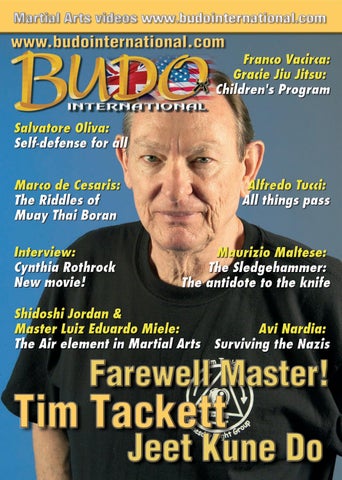
Ma r t i a l A r t sv i d e o swww. b u d o i n t e r n a t i o n a l . c o m
www. b u d o i n t e r n a t i o n a l . c o m
Far ewel lMas t er !
Ti mTacket t
J eetKuneDo
Pearls of the Warrior
“The pipe extracts wisdom from the lips of the philosopher and closes the mouth of the fool.”
Thackeray Oil on canvas by Alfredo Tucci
Editorial Sit transit gloria mundi! ormally, my editorials arise in a burst of inspiration, sometimes the result of reflection, sometimes of a past experience, and always of a thought that I must organize, express, repay, or order, bringing it out into the open. Sometimes a parasitic reasoning traps me, other times Prometheus possesses me, ready to steal fire from the gods. This impulse does not always exist. I can provoke it, yes, but I feel that today is not the day for such an attempt; I have chosen to sweetly let myself go with words, like a river without pause, to see where they take me. Motivations are now somewhat spurious, reflections annoying, goals dilettante flies that only bother me, and my desires, distant concerns detained for a moment. Sit transit gloria mundi! There are days and moments in my daily life, few indeed, when letting go acquires a value in itself. In our busy lives, immersed in our very important issues and projects, we rarely let go of the steering wheel and remove the driver, who, suddenly unmasked from his duties, we perceive as a usurper; a character invested with the will of others who has taken many liberties, a guest who, once in your house, no one can get rid of, and like fish, after the third day, stinks. Suddenly that heavy ego becomes dense, repetitive, annoying... Who is that other self who is in no hurry, who has no worries? The one who watches the wind moving the palm trees, feels the sun warming his hands as they type? Eastern sages often warn us about this meddlesome impostor and suggest as a remedy that we connect with the impartial observer who lies behind the masks. It smells of stillness, of serenity; it does nothing, and yet it is always present; it relinquishes control, yes, because nothing matters to it, not even surrendering to the masquerade of living, to the trampling of the immediate, to the imposture of desire. That one, the one in the quiet watchtower, exists in impermanence, so change does not subjugate it, does not alter it; letting go is not an option, it is a mandate so that nothing imprisons him; convinced as he is in his dimension that everything passes, he lives in a permanent state of transition; like the waters of a river, he surrounds obstacles, allowing himself to be pushed without hesitation, without fear, even into the deepest abyss. He breathes calmly... Nothing remains, everything changes... The awareness of everyday life will trap us again, for sure, because the very essence of the experience of living is based on it. However, it is important to visit ourselves in that phase of being periodically, to see things with sufficient distance, to repair the damage caused by anxiety and haste, to review our list of values and our order of priorities, and above all, to remember ourselves in this way, which will restore our certainty that there, somewhere deep in your consciousness, you exist in peace, in a state where absence becomes presence, and nothing can touch you. It is somewhat like returning to the primal home, to the simplicity of existing in the womb, where we float in a sea of infinite waters, safe and serene. As pleasant as that equanimous state may be, the purpose of life is not to stay there and “wait for things to happen.” We are alive to experience, readjust, learn, evolve, but we cannot forget that beyond the tribulations, desires, fears, and frustrations that come with living, there is a place, not as a refuge, but as a quintessence, not as an escape or purpose of living, but as the ultimate reality, which, like a drop conscious of its eternal identity, moves in an infinite ocean of change, free, serene, eternal. In essentia essendi existere. In vita vivere.
N
Tim Tackett, one of the most brilliant minds of Jeet Kune Do, has left us. He passed away peacefully, in his sleep... A blessing he undoubtedly deserved, for an intense life in which unanimity about his legacy and his person resonates everywhere, something unusual in this world. Personally, I had a wonderful and friendly relationship with him. He was an educated and intelligent man. He shared his father's paintings with me, as he liked my painting, and we enjoyed our conversations and company. These things are always mutual... and especially perhaps because martial arts were not at the center of them, which was undoubtedly a relief for someone who travels to teach. When I turned sixty, I asked him: “Tim, you are like an older brother to me. From your experience, I am about to turn sixty. What can you tell me about it?” He replied laconically: “Alfredo... the best you can feel right now is the best you will feel from now on! So enjoy it!” Farewell my friend! Alfredo Tucci
Structure To a large extent, this system of attack is based on the structure of the attacker's art, while the defender bases his defense on the structure of his art. One of the problems with style, as Bruce Lee saw it, was that a student of a particular style only understood things from the perspective of his own style, based on its structure. To understand this concept, it is necessary to briefly review history. When
I taught Kung Fu in the late 1960s, style was everything. If you practiced Kempo, you didn't practice Karate or Kung Fu; you only practiced with partners of your own style. The only time you saw another style was when you attended or participated in an open Karate tournament, but even then there were specific rules that made the difference in styles minor. Furthermore, these tournaments were also limited because there was no contact. Several Japanese, Chinese, and Korean styles competed in Ed Parker's annual International Karate Tournament.
Their methods of attack and defense were based on their structure and were also somewhat limited by it. I attended this tournament every year, my students competed there, so I could see the structure in action, just as it was. A Korean fighter like Chuck Norris had a stance that allowed him to kick effectively while also being able to throw a punch, as it was neither too low nor too narrow. Joe Lewis, on the other hand, used a low horse stance that limited his attack, especially to the front hand and foot, but also provided him with good defense. A Shotokan karateka adopted a low front stance that provided a solid base for linear attacks, such as a straight punch or a straight back kick. As we can see, their attack systems were largely based on their stances. Part of Bruce Lee's genius was observing an art and understanding its structure and limitations. In the 1960s and 1970s, it was very difficult for anyone to notice the limits of its structure, because the rules of non-contact tournaments did not allow anyone to take advantage of possible weaknesses in their opponent's structure. Although leg sweeps were allowed, for example, kicking the leg was not. When full-contact matches began, things changed. The first to appear on the scene was kickboxing. Fighters soon discovered that their karate-style punches were not as effective with boxing gloves on, so they turned to boxing coaches for help. Kickboxing became a mixture of karate kicks and boxing punches, although kicking the leg was still prohibited. When leg kicks were added to kickboxing in Japan, we witnessed the birth of Thai boxing. Low stances no longer worked. This was clearly demonstrated when Hong Kong sent five of its best fighters to Thailand to compete against five Thai fighters. None of the Kung Fu practitioners lasted more than one round. Before all this happened, Bruce Lee had already transformed his art. The difference was that he did it ten years before the others. Bruce had discovered in a fight that his Wing Chun was too limited. He had the feeling that there were universal truths in combat that could be discovered if he went beyond the limits of the style itself. He wanted to devise a structure based on mobility, so any low stance was too limiting for him. He could see someone like Muhammad Ali move and control the distance to such an extent that he always seemed to be out of his opponent's reach. So Bruce developed a modified boxing stance from which he could punch and kick with ease. Bruce wanted to expand the angles of attack offered by Wing Chun, so he added a basic repertoire of boxing to his art.
“Bruce had discovered in a fight that his Wing Chun was too limited. He had the feeling that there were universal truths in combat that could be discovered if he went beyond the limits of the style itself. He wanted to devise a structure based on mobility, so any low stance was too limiting for him”
When he realized that his finger jab could be used in the same way as a foil in fencing, he added many principles of Western fencing and named his art “Jeet Kune Do” (the way of the intercepting fist). He took the name from fencing theory, as swordsmen believe that the most effective way to deal with an attack is to intercept it before it is fully launched. The next big change came with the advent of No Holds Barred-style competitions, such as the UFC. Kickboxers soon discovered that they had few resources to defend themselves when they were taken to the ground or when they tried to get back to their feet. They discovered that they needed to learn grappling if they wanted to survive in the ring. Then, grappling practitioners discovered that they needed to learn some punches and kicks if they wanted to survive in the ring, and that's how we got to Mixed Martial Arts. Almost all the fighters we see in the ring today are a mixture of various grappling arts, Thai boxing, and Western boxing. Currently, one of the most popular martial arts is called Mixed Martial Arts, which is basically a mixture of grappling and standing arts. The question is, how do we mix martial arts? How do we mix martial arts that have different structures? Do we try to learn all the structures and then move from structure to structure, or do we take one structure and then add what fits into it? Jeet Kune Do is an example of the latter method. It consists of a structure to which other things that fit have been added. We, “The Wednesday Night Group,” try to do the same by researching other arts. First, we look for the strengths and weaknesses of the JKD we teach. The main weakness is that we did very little grappling, so we needed to know how a grappler attacks and how to defend against it. We decided that we needed to learn how to survive on the street, not in the ring. We focused on preventing ourselves from being taken to the ground, but if that did happen, we had to be able to get up as quickly as possible.
I was fortunate to work with some of the best grapplers: Larry Hartsell, Mark McFann, and Eric Paulson. Our group was extremely fortunate to work with professionals like Bert Poe, who had a direct approach to fighting and grappling and was interested in ending the fight as quickly as possible. We also worked with a great freestyle college wrestler and currently work with an expert in Greco-Roman wrestling. A few years ago, Lloyd Kennedy (the walking encyclopedia of grappling) started attending Wednesday night classes and sharing his knowledge with us. We started using a basic JKD training method called “Before, During, and After,” which is interpreted as follows: 1. BEFORE: means looking at the distance between us and the attacker and how the structure of their art leads them to grapple with us. 2. DURING: means that they are moving towards us or grappling with us in the Greco-Roman style, or applying a high leg lock, single or double, or a single low leg lock. 3. AFTER: means that they have us pinned and are either going to take us to the ground, apply a lock or choke, or have already taken us to the ground. We then analyze whether we have the tools to deal with each of the attacks. If not, we will try to find one by observing the rules used by each type of grappling practitioner to find a weak point in what they are used to doing. We will look at how the structure of their art is taught. Are they attempting a simple low takedown with their leg, making it difficult for us to attack their eyes, or are they offering us their eyes by executing a high takedown with their leg? Another example is when a good Jiu-Jitsu practitioner takes us to the ground and tries to establish a base from which to continue the attack. In this case, we will look for a way to disrupt their base in order to try to get back on our feet. We study other arts for two basic reasons: to find out if we have the tools to defend ourselves against them (by looking at their structure and attack system) and to observe the art to discover what it can offer our own art, something it lacks or that helps us improve. Of course, it is not a question of adding for the sake of adding. We are not looking for a way to counter a boxer's left hook, but rather a better way of doing things. A good example of this is our understanding of Thai boxing.
THE POSITION: We teach three different positions in our version of JKD. The first is the natural position, standing in a neutral stance, with most of the weight on the back leg and the hands raised in a non-threatening position. We do not want to get into position from the moment an attack may occur, for the following reasons: 1. First, we want to try to calm the situation by appearing passive. This way, if you are attacked, witnesses will blame the aggressor. 2. Always consider how the situation will appear to witnesses, as this may be important if you end up in court. Although Bruce Lee wrote many personal notes about the use of knees and elbows in combat, he did not teach his students much about this before he died. We thought it would be good to learn more about it, and where better to study it than in Thai boxing, which uses knees and elbows in all its full-contact matches? When we started working on that aspect of Thai boxing, we quickly learned that it fit into the basic structure of our stance, which resembles that of a boxer, but is slightly wider than shoulder width. We also believed that its rear roundhouse kick was very valuable because of its tremendous power. The first time Bob Bremer saw us working on it, he warned us, “It's a great kick, but not in the initial movement.” And he was right because the structure of Thai boxing is different from that of JKD, and this kick is not as effective in the first movement. Let me explain. The Thai boxer stands with his shoulders open and the toes of his rear foot almost level with the heel of his front foot. This narrow stance allows him to kick his opponent's front leg without it being very easy to see, as the kick does not have much range. With the basic JKD stance, the kick is very easy to see. Using it in the ring or on the street as the first move of an attack would be an invitation to counterattack. We have to use it based on the basic Thai structure. Many JKD students do this or make the mistake of applying it based on the JKD structure; although we have decided to do everything based on the JKD structure and use the Thai back kick, “but never in the initial movement.” Don't forget that to understand the art you practice or any other, we have to look at its basic structure, as this is the foundation for understanding that art.
The natural stance from a front and side view.
The initial step with two open stances, showing that you have lost your balance.
The toe is arched from a front view.
The initial step at a suitable distance.
Finally, we would like to share one of the last interviews we did with him, a small sample of everything he left us: his books, several videos, and years of harmonious and productive collaboration. After recording in our studios in Madrid, I would take him to magnificent restaurants, which he always praised, and we would linger over dinner until we were alone in the dining room. His students Timoteo and so many others enjoyed this side of him as a great conversationalist, cultured, gentle, and a good listener, eager to hear other people's points of view, always learning and enjoying the moment. He will always be remembered with love. Alfredo Tucci
Interview Budo International.: The "Old teacher" is still active? Tim Tackett.: I am retired from traveling and doing seminars. Right now I am 76. I have a really good retirement from my high school teaching career, so I don't need to do any. Money was never a purpose of my JKD teaching. My senior instructors are more than capable to carry on. Budo International.: We are missing many classic instructors of the second generation of BL What do you think Bruce Lee legacy is today? Tim Tackett.: There are really not too many of the old guys left. Last month we lost Richard Bustillo, Pete Jacobs, and Join Sewell. The photo I sent you was of Jim and me. I am not filled with confidence about the future of JKD as Bruce taught it.
We are doing it, but we do not have a large group, and have never tried to expand it by just taking anybody as a teacher. We always try to keep the quality high by keeping the quantity low. Budo International.: What we can expect for the future of JKD? Tim Tackett.: Right now the future of JKD is up in the air. It depends on how much the 2nd generation and 3rd generation can step up. Right now I don't see that much to feel optimistic about the future of JKD. Budo International.: How you look after the actual panorama of MA in the World? Tim Tackett.: I've had the opportunity to work with some of the best mma fighters, and I have found that there is a lot of what we teach that can carry over to the ring. A lot of mma depresses me with with use of performance enhancing drugs and attitude. Budo International.: How you feel about all these years of colaboration with Budo International? Tim Tackett.: I have always loved working with Budo. It is a quality organization and cherish our relationship as well as friendship.
Progressive self-defense system for everyone Progressive Defense System In this text, I describe and explain the Progressive Defense System (P.D.S.) that I developed. P.D.S. training pursues one goal and is based on three principles. The courses are primarily aimed at civilians, but can also be useful for law enforcement officers. The following chapter is not intended to be political or critical of self-defense instructors, trainers, or training modules for civilians. Consider it a resource. There are countless self-defense systems, and unfortunately, based on my experience, I have to admit that many of them are useless, not least because of the visual image of a street fight. I have noticed that many people strive to acquire the best techniques in their own style, art, or system of self-defense in order to integrate them later. But the point is not to develop techniques, but rather to be able to apply the technique under stress and pressure in a confrontation. When practicing self-defense techniques, always remember that the attacker intends to do the worst to you. This is the only way to train more effectively and realistically, so that you are more determined to defeat your opponent.
The Progressive Defense System (P.D.S.) is not a traditional martial art, but a revolutionary self-defense program. It is an authentic street self-defense concept and serves purely for the self-protection of civilians. The program emphasizes above all the functionality and effectiveness of the means of combat. The system is based on short, precise, logical, and instinctive movements, which are easy to execute at maximum speed, with fluid technique and full force. The goal is to present a system that serves exclusively for perfect defense in an emergency and ensures that the aggression is ended as quickly as possible. I want to train practitioners. In other words, I want to enable each individual to defend themselves as effectively and directly as possible. The primary requirement of the program is that the techniques are easy to maintain. This applies to all OLIVA Combat System programs, because they are not based on traditional martial arts or specific combat sports backgrounds. The P.D.S. program concept is a pragmatic and structured system and is divided into different levels from 1-6, with level 6 ending with the BLACK BELT. Instructor rankings range from 1 to 9 and end with the title of Grand Master. This brief excerpt about P.D.S., its training methods and defense strategies, as well as techniques, etc., is intended to be a guide for self-defense on the street. The three different levels of defense techniques described in this text can be learned regardless of gender or age. The whole thing has a common goal: first and foremost, to convey self-confidence and a feeling of self-assurance. The whole thing is based on three principles: “Functional, Simple, and Effective.” Those who internalize this principle will feel more confident, move correctly, and, above all, radiate this feeling. Never forget that effectiveness lies in simplicity. Whenever practicing self-defense techniques, you should imagine that the attacker has the worst intentions toward you. This is the only way to train more effectively and realistically, so that you are more determined than your opponent.
Target groups P.D.S. System courses are primarily aimed at civilians, but can also be useful for law enforcement officers. The various defense techniques can be learned regardless of gender or age. OLIVA's P.D.S. teaching program builds on the students' own potential, promotes their strengths, and sharpens their perception.
Course objective The primary goal is to instill self-confidence and self-assurance. This is achieved through an extreme self-defense system that serves solely to provide perfect defense in an emergency and ensures the fastest possible end to the aggression. Course participants are taught how to defend themselves as quickly and directly as possible.
Course content • The 10 golden rules of street fighting • Defusing conflicts • Behavior in the event of kidnapping • Physical conditioning • Fitness and endurance training • Various training applications • Leverage techniques and control of the opponent • Helpful everyday objects • Defense concepts, tactics, and techniques • Offensive and defensive techniques • Defense against stick threats • Defense against gun threats • Defense against knife threats • Extreme/efficient close combat techniques • Dynamic energy drills with knife attacks • Dynamic energy drills and fast trapping • Ground fighting techniques and survival tactics • Release techniques in various situations • Basics of anatomy • Knowledge of sensitive areas of the body and the consequences of injuries to these areas • Efficient defense against one or more unarmed/armed attackers • B.B.O.E.H. process (observe, assess the threat, orient yourself, decide, act) • Communication and body language • Defense in low light/no light conditions • Teamwork • Development of the following qualities: o Strength o Timing and precision o Agility and coordination o Recognition of dangerous situations o Controlling one's emotions under stress o Reducing aggression and greatly increasing performance o Transforming fears into self-confidence and self-assurance
“The P.D.S. system will enable practitioners to adapt to all circumstances in order to protect their lives in the best possible way.” The course content is pragmatically divided into three levels: Level 1: Designed to build solid foundations and principles. This includes, among other things, physical conditioning methods, communication and body language, conflict defusing, basics of anatomy, various training applications, knowledge of the sensitive areas of the body and the consequences of injuries to them, helpful everyday objects, and the 10 golden rules of street fighting.
Level 1 is ultimately designed to enable you to defend yourself against an attacker with a weapon (stick, knife, gun) or without a weapon from various fighting distances, especially at close range, using simple techniques, tactics, and concepts. Level 2: Here, the knowledge from Level 1 is refreshed and deepened, then supplemented with lever techniques and control of the opponent, dynamic energy drills with knife attacks, dynamic energy drills and fast trapping, extreme/efficient close combat techniques, offensive and defensive techniques. Attacks at the three attack heights are also trained, which can come at us from the side, diagonally, and head-on. On the lower line of the diagonal and frontal attack, I show how to defend and attack in the simplest and fastest way. All this with the aim of achieving maximum success with minimal effort and simple techniques that can be applied reflexively. Level 3: This covers how to behave in the event of a kidnapping, the B.B.O.E.H. process (observe, assess the threat, orientate yourself, decide, act) and efficient defense against one or more unarmed/armed attackers. It includes freeing yourself from ground fighting situations as quickly as possible in order to end the fight or to escape and continue the fight while standing. The art of Kino Mutai (The Filipino Art of Beiting, Eye Gouging) is used, which means biting and gouging eyes, combined with elbow and fist strikes. Another important component of P.D.S. is Mass Attack. This is also an important part of this system, especially nowadays. It is important to know that the OLIVA Combat System pays particular attention to improving certain characteristics of the trainee. Another important requirement of the program is that the techniques and concepts are easy to maintain. This applies to all OLIVA Combat System programs. The goal is not to defeat an opponent, but to master any threat.
“Never forget that martial arts are fair and have ‘dojo etiquette,’ but on the street there is no law and there are no rules.”
THE ANTIDOTE TO THE KNIFE THE MALLET OF JONIC FENCING All peoples of the earth have felt the need to create a system of defense with sticks, such as the long sticks used by shepherds in the Mediterranean area or the more famous ones used by Shaolin monks. We can also think of the shorter stick that made Filipino kali famous throughout the world, or the walking stick that was used to protect gentlemen when the use of swords was prohibited. Even pocket sticks have found their place in martial arts in order to enhance personal defense. I thought I had seen all the main percussion weapons used in the world when, due to my tireless curiosity, at the most unexpected moment and in the places of my childhood, completely new information appeared about a tool that I never thought could be used as a weapon: the fish club. Why be surprised? Haven't we learned that in Asia, some tools used to beat rice, such as the Nun Cha Ku and the Tonfa (just to mention the two most famous), have become spectacular instruments in the hands of martial arts experts? Well, among the fishermen of the Ionian Sea (and we could say of the entire Mediterranean), a mallet, sometimes very small, was used to kill freshly caught fish, and this tool came in handy for defending oneself, especially against an opponent armed with a knife. Contrary to my usual way of writing, this time I will try to reproduce the direct conversation I had with an elderly gentleman whom I was ‘lucky’ enough to meet during my research. Unfortunately, I was not allowed to take any photos because the elderly, now stooped, former fisherman told me that he was ashamed, at least that was the official reason. However, his friend who was with him hinted that the elderly man had had a turbulent past, to say the least, and that it was better for him to keep a low profile. “Consider yourself lucky, he usually doesn't want to talk about these things,” he added. “Good morning, Gigino sent me to talk to you about certain things from the past...” I said. “Yes, good morning, Gigino told me... but these are old things now, who cares about them?” “I'm doing research on the entire Ionian area to find out about the martial arts that developed in these areas.” “There are no martial arts here!” “What do you mean? Isn't there knife fencing and stick fencing?” “Oh yes... that's right... too much of it.” “Gigino told me that I can get information on the use of the mazzola, the fish mallet.” “Gigino never minds his own business.” Fortunately, he said this last statement with a smile. I didn't want to be the cause of a quarrel between two old friends. “That mazzola saved not only my life but also the lives of many other fishermen. When fishermen drank, they would easily put their hands in their pockets to take out their knives, and that's when trouble would start.” “We always had the mazzola attached to us, we kept it tied to our wrists or in our pockets for so long that it became part of our clothing.” “Did you have someone who taught you how to use it?” I tried to steer the conversation and asked again, “A kind of school...?” "What school? We used that tool all day long to kill the fish we caught, not just octopuses. We all knew how to strike with force and precision; we didn't need to go to school to learn how to swing a club...“
”But someone must have told you something about defending yourself against a knife...“ I said. ”If you know how to use a knife, you know how to use a club too; you just have to make a few adjustments." “Was it used against armed opponents?” “It was used against everyone. We had a good hand: one blow to the wrist and it was already broken, one blow to the head and you had already stunned him... with all that training with fish.” At that point, the old man must have noticed something in my face and added “I know what you're thinking, it's cruel... but it's just the opposite. If you catch a fish and let it bleed out or suffocate, that's when it suffers... and I'll tell you more, the meat of a fish that has died slowly is not as good. Instead, with a sharp, precise blow in the right place, the fish doesn't even have time to start suffering.” “But now the mallet is no longer used...” I said to keep him talking. “Now modern methods are used, but... they are not better.” “Can you tell me about some episodes?” I ventured to ask. “Let's leave it alone, it's in the past.” Then his face lit up. "I remember when I worked near Marseille... I was young, a long time ago, and everyone there kicked you in the face. They were good and fast, not only the young ones but also the older ones. One evening, a fight broke out, a little more heated than usual. I noticed it in time and got ready. I put the club, still stained with the blood of the fish I had killed, in my pocket. There were two of them and they started teasing me because I spoke southern Italian. As soon as one of them kicked me in the face (I was expecting it), I took the mallet out of my pocket and hit him on the ankle with the same force I used for tuna. He was in a cast for two months and even had surgery, or so I was told." “But weren't there two of them?” “The other one had his hand in his pocket... I didn't give him time... I hit him on the temple, just one blow, and he didn't get up again. I don't know what happened to him. I just thought I had to disappear because the French also take revenge... it's not just us who are vengeful... the whole world is the same.” One more question, please: “But if you didn't have a knife or a club with you, how did you do it?” “Didn't you think that a bottle is the same thing?” He said laughing and added: “A sailor always has a bottle in his hand!”
“Haven't we learned that in Asia, some tools used to beat rice, such as the Nun Cha Ku and the Tonfa (just to mention the two most famous), have become spectacular instruments in the hands of martial arts experts?”
THE SAILORS' CLUB The tonfa of the West The mallet used by sailors in the past deserves further study to better understand the defensive and offensive potential of this small but very effective tool. First of all, we have already mentioned here that it is a professional tool that has fallen into disuse for some time now. Its official name is “fish killer,” although many simply call it a mallet. In fact, this was its purpose: to strike fish, especially octopuses, to kill them instantly. Very small and pear-shaped, this tool allows for quick and explosive movements. Like many everyday objects, when necessary, they become extraordinary “force multipliers” that are very useful in fights or for self-defense. Easy to conceal, it is capable of breaking human bones with a single blow. Sailors, accustomed to delivering powerful, whip-like blows by flexibly moving their wrists on a daily basis, found it easy to strike their opponent's wrist with great effectiveness when the latter tried to cut or stab them with a knife or dagger. The direct experience of these men showed that a single, well-aimed blow was enough to break the bone instantly and thus produce a traumatic disarmament. If the target was the head, loss of consciousness and head trauma were guaranteed from the first impact. If you think about it, today the whole world knows, at least in theory, the Japanese tonfa, a work tool that has become an instrument for enhancing defense, but few know the martial use of the mallet. Even law enforcement agencies in several countries have adopted the tonfa in its wooden version, or in synthetic material, and even extendable and retractable (for example, some time ago, the Italian Carabinieri were equipped with it). There is no mention of our martial tradition, let alone research into it. Our traditional martial arts are most often useful for historical reenactments, especially in the many medieval towns that dot the Italian landscape. This neglect also stems from the fact that none of the experts of the past took the trouble to catalog how to use the mazzola, creating a kind of program. Its use was entrusted to the skills and knowledge of those who wielded it: “if you know how to use a knife, you know how to use a mace,” the old folks used to say, “you just have to adjust the way you use it a little and understand where to strike...” Here we find the first substantial difference: while the knife prefers the soft parts of the human body, in order to penetrate more easily and deeply, the mace, on the contrary, prefers the hard parts in order to break bones from the first impact. Dodges, movements, and parries are almost the same, but the blows are different, delivered to very specific points. Precision is essential, especially when it comes to neutralizing a person armed with blades, knives, or machetes. The mace is attached to the hand with a cord that hooks onto the thumb, and the end is structured so that it cannot escape the grip formed mainly by the thumb and index finger. The wrist must be completely free to rotate, and the weight of the object facilitates the whipping motion.
Below is a useful diagram to understand which targets to hit with the mace. 1. The fingers of the opponent's hand. Strike the hand holding the weapon during the parry, you will achieve an excellent effect by striking both the inside and the outside. 2. The back of the hand. This area is equally sensitive and a sharp blow should shatter most of the bones that compose it. 3. The wrist. A blow to the wrist is extremely effective, especially when it reaches the base of the thumb. Not only does it easily break the bone, but the person holding the weapon receives a tremendous shock that creates an automatic reflex that will cause them to open their hand and drop the weapon to the ground. 4. The elbow. If struck on the ulnar nerve, the person will feel a shock throughout their arm and immediate weakness in their hand. We are all familiar with the effects of this blow because, at least once in our lives, we have received an accidental blow to the ulnar nerve and know that it causes pain to radiate from the shoulder to the hand.
“While the knife prefers the soft parts of the human body, in order to penetrate more easily, the mallet, on the contrary, prefers the hard parts so that it can break bones on first impact.”
5. The collarbone. It is the protruding bone that seems so sturdy to the touch, but in fact is not at all. Just 7-8 kilograms of pressure is enough to shatter the collarbone, making arm movements difficult and even very dangerous, as a stump could sever an artery. 6. The temples. These have always been a very vulnerable part of our skull. Striking this area can cause serious damage and even death. 7. The nasal septum. This is the favorite target for a punch because it breaks easily and the damage prevents the other person from continuing to fight. The eyes swell, tear up, the pain is excruciating, breathing becomes difficult, and blood flows profusely. 8. The tip of the chin. As boxers know well, striking this point can cause a knockout due to the transmission of the impact inside the skull. 9. The top of the head. Specifically, the fontanelle is another point that can cause both unconsciousness and death. 10. The back of the neck. It has always been known that this part of the head is particularly sensitive to impact, and if struck, serious damage can be caused. 11. The spine. Although it appears to be strong and protected by the powerful muscles of the back, there are points that are very sensitive to blows. For example, the protruding vertebrae at the base of the neck, precisely between the seventh cervical vertebra and the first dorsal vertebra, are very vulnerable to impact. 12. The sternum. This is the flat bone at the front of the chest where the ribs meet, and it is sensitive to sharp blows.
“The mace is attached to the hand with a cord that hooks onto the thumb, and the end is structured so that it cannot escape the grip formed mainly by the thumb and index finger. The wrist must be completely free to rotate, and the weight of the object facilitates the whipping motion.”
13. The knees. If struck on the inside or outside, there is a risk of dislocating the kneecap from its usual position, damaging the ligaments. Anyone who receives such a blow will no longer be able to walk or move easily, as well as feeling excruciating pain. 14. The ankle. By striking the malleolus, either on the outside or the inside, it is easy to break the bone even with a medium-strength blow. This target can be reached either by lowering oneself and striking while the other person is standing, or by intercepting their kick with a sharp blow. With a broken ankle, the fight is immediately over.
“Very small and pearshaped, this tool allows for quick and explosive movements.”
The Fight to Be Born, to Survive, and to Live Today we see how evil can quietly spread in the world, often fueled by powerful hands working behind the scenes— paying professionals, protestors, and media figures to sow division, hatred, and mistrust among people. More and more, dangerous words echo through our societies, words that glorify fascism and even dare to praise the Nazis. By Sensei Domen Zorko & Avi Nardia
As a Budoka and Sensei on the Road, having taught martial arts for many years, I believe it is our mission to remind the world of what humanity truly stands for: to fight for life, to survive with dignity, and to remain good human beings despite hardship. No one should ever forget where such dangerous words once led us. I want to share the story of my grandmother, Marija Dragan—known to us as “Mama Minka.” Through her life, we can open our hearts and eyes to the truth that survival, courage, and humanity are the greatest victories against evil.
Why I Shouldn’t Have Even Been Born My grandmother, Marija Dragan, known in our family as Mama Minka, lived a life that embodied both unimaginable suffering and extraordinary resilience. Her story begins in World War II, when she was just 16 years old. At an age when most young people should be discovering the joys of youth, she became a courier in occupied Yugoslavia. She carried secret messages between her two brothers, both partisan commanders. To avoid detection, she ingeniously hid the notes in her ears and crossed enemy-held territories, risking capture with every step. One day, betrayal struck. Local collaborators exposed her, and she was captured. First, she was imprisoned inside a church, where priests brutally beat her before handing her over to the Nazi regime. From there, she was deported to the Ravensbrück concentration camp in Austria—a place where cruelty and inhumanity knew no limits. For three years she endured nightmarish conditions. Nazi doctors subjected her to grotesque medical experiments: artificial insemination, forced abortion, and endless physical torment. Because of her beauty, she was also raped repeatedly by guards. At one point, when her name was called for execution in the gas chambers, the unthinkable happened: a sick and elderly prisoner stepped forward and declared that she was Marija Dragan. This courageous act saved my grandmother’s life, as the woman sacrificed herself in her place.
Liberation and Survival Against the Odds In 1945, the Russian army liberated Ravensbrück. My grandmother was barely alive, starved nearly to death. It was only thanks to an elderly survivor named Tatyana that she survived those first fragile days of freedom. When food was distributed by the Russian soldiers, many prisoners—mad with hunger—ate too much, too quickly, and their bodies could not handle it. They died after finally tasting freedom. But Tatyana knew better. She fed my grandmother only crumbs of bread, slowly allowing her body to adjust to nourishment after years of starvation. This simple act of care saved her life. Doctors later told my grandmother she would never bear children again. Her body, scarred by the torture and experiments, seemed incapable of motherhood. Yet fate had other plans. In 1950, she gave birth to a daughter, whom she named Tatjana, after the woman who saved her.
A Legacy of Struggle and Perseverance My mother, Tatjana, entered the world carrying the physical scars of the war on her body. She was born without a left arm, without a left kidney, and with poor vision in her left eye—all consequences of the Nazi experiments inflicted on my grandmother. But my mother was never a victim. From her earliest years, she proved herself a fighter. She rode a bicycle, excelled in both primary and secondary school with honors, and built a career in accounting. She refused to let disability define her.
Later, she met my father, Jože, and together they built a family. They had three children—my sisters Simona and Urša, and me, Domen. Despite hardships, we worked tirelessly as a family. Alongside running a farm, my parents opened a hotel, continuing the family’s tradition of hard work and resilience. Just as my grandmother fought for survival and my mother fought against disability, we children were raised with the belief that nothing is given freely in life. All three of us graduated from university and pursued successful careers: one sister became a judge, the other manages cultural projects, and I found my life’s passion in martial arts.
Carrying Forward the Spirit of the Budoka I have trained in martial arts since the age of 21, and for the past 23 years I have dedicated myself to Kempo Arnis, now holding the rank of 3rd DAN. Through martial arts, I have carried my family’s philosophy of survival, perseverance, and indomitable spirit into every aspect of my teaching. As a Sensei, I have the privilege of passing these values on—not only to my daughters, Juliana Lia and Manuela, but also to my students and fellow members of the Kempo Arnis Federation. On the tatami, we learn that the true mission of a Budoka is not only to fight, but to live with dignity, courage, and humanity.
Strength from Wounds The Nazi regime inflicted deep wounds on my family, but those wounds did not destroy us. Instead, they forged resilience, strength, and unity. My grandmother’s goal was to survive the cruelest of circumstances. My mother’s goal was to thrive as a disabled woman in a post-war world. My goal is to honor their sacrifices by living fully and teaching others the way of perseverance. I am profoundly grateful to my grandmother Mama Minka, my mother Tatjana, and my father Jože for their unbreakable determination. Their legacy is the reason I live the life I do today. I also extend my gratitude to Shihan Borut Kincl, 8th DAN KAF, who has guided me on my martial path for decades. Together, under his leadership, we have faced obstacles that once seemed insurmountable and turned them into victories.
Conclusion This story is not only about one family—it is a reminder to the world. Words that glorify Nazis or fascism must never again find a place among us. As martial artists, as Budoka, and as human beings, our duty is to remember, to resist hatred, and to pass on the lessons of survival and humanity to future generations. Ossu! By Sensei Domen Zorko, 3rd DAN Kempo Arnis, Kapap Krav Maga, CDC Integrated Jiujutsu With Avi Nardia Sensei on the Road
“Be the Pillar — The Call of the Hwarang in 2026” New Year’s Message from Grandmaster Taejoon Lee I. The Foundation of Strength Understand this — truly understand it. You, as an individual, serve purpose in our community, society, the world. You, as a single life, carry meaning that extends beyond your own body, beyond your own dreams, beyond your own fears. Amongst your peers, your friends, and your family — you are meant to be that foundation. That footing. That pillar. Have you ever heard someone say, “He is the pillar of the community”? It’s not just a figure of speech. It’s a moral truth. A spiritual demand. A responsibility. Because everyone looks for stability. Everyone seeks someone they can depend on when the world begins to tremble. But the question is — are you that person? Or are you, too, trembling? You expect everyone else to be strong — reliable, dependable, unmoving, unwavering — and yet, you change your mind daily. You shift with the wind. You doubt your own convictions when life becomes inconvenient. Don’t be that person. Be the one who stands firm.
Photos by Claire Davey That is what it means to be a Hwarang. That is what it means to be a good, productive, valuable human being in society. Be the pillar. Be the foundation upon which others find their balance. Be that unyielding structure that others can grasp when they are slipping. Because make no mistake — everyone is slipping. Everyone is sliding down their own slippery slope of fear, uncertainty, and distraction. Everyone is falling into the noise of modern life — where values shift faster than the seasons, where truth is bent to convenience, where people chase pleasure and abandon responsibility. Your goal, as a Hwarang — as a human being of discipline and integrity — is to find grounding. To make deep roots. To hold the line, even when the earth moves beneath you. This is why our 65th anniversary means so much — to me, to us, to Hwa Rang Do, and to all who have walked this path before you. Sixty-five years of unwavering commitment to the ideals of the ancient Hwarang knights. Sixty-five years of struggle, of evolution, of sacrifice, of unrelenting perseverance. Our history is not only ancient; it is modern. It is alive in each of you who bow, who train, who suffer, who rise. We are a lineage not bound by time, but by purpose. And so, as we step into the year 2026 — we do not merely celebrate a number. We celebrate continuity. We celebrate endurance. We celebrate the truth that strength is not given — it is earned, maintained, and renewed with every breath, every trial, every act of service.
The Measure of Expectation Many people have come to me over the years and said, “Sir, I cannot live up to your expectations. I can’t live up to your standards. I’m sorry — I can’t do this.” And every time, I shake my head. What do you mean, you can’t live up to my expectations? What does that mean? Surely your own expectations of yourself should be the greatest, should they not? Surely your belief in your own capacity should outshine anything I could imagine for you. How can my expectation exceed your own? How can my belief in you be stronger than your belief in yourself? If that is the case, then something is wrong — not with my standards, but with your own self-regard. Do you suffer from low self-esteem? Do you lack confidence?
Do you lack faith in your abilities, your worth, your purpose? Or is it that you’re just looking for a way out — an excuse to quit, to walk away, while still pretending that your ego stands unbroken? And if that is true, then perhaps that is why you came — to Hwa Rang Do, to the dojang, to this community. Because you sought strength. Because you knew you were missing something essential — that foundation, that grounding. And now you want me to lower my expectation to satisfy your weakness and your doubts? Really? That’s not only foolishness, but it’s also ludicrous. That’s like a child saying to their parents, “Mom, Dad, please don’t love me so much. Don’t feed me so much. Don’t expect so much of me. I can’t take it.” Exclaiming in disgust, “Look how fat I am!” What would a loving parent say to that? Would they stop loving you? Stop feeding you? Stop wanting you to be your best? No. They would say, “My child, I expect from you because I believe in you.” Your parents feed you even when they are hungry. They clothe you even when they are cold. They work for your future even when theirs feels uncertain. So how can you say, “Don’t expect too much of me”? Expectation is not oppression — it is belief. It is faith made visible. It is love expressed through the hope of your growth. When I expect from you, it is because I see what you can become — not what you are now. If you see my expectation as a burden, then you misunderstand love, and you misunderstand discipline. I do not lower my standards because the world has grown softer. The world needs strength more than ever. If you came to Hwa Rang Do, you chose this path. You were told from the beginning — it is difficult. It is comprehensive. It demands everything. And, to that you said yes. You said, “Sign me up.” And now you say, “It’s too hard.” No. It is exactly as hard as it should be. It is you who must rise to meet it. Better to say, “I overestimated myself, and now I understand humility.” Better to say, “I was too confident, and now I will rebuild myself stronger.” That is the correct path. That is the Hwarang way. When your parents give you food, love, and even discipline, you say, “Thank you. May I have another.” Whether it is a plate of spaghetti or a lesson in humility, you receive it with gratitude. You can fast later. You can rest later. Because love never ends. Because the journey towards betterment never ends.
The Endless Race Remember this — I told you once: “Finish everything that you’ve started.” But there are things in life that cannot be finished. Love cannot be finished. Excellence cannot be finished. The race toward perfection — it has no finish line. There is no end to growth. There is no arrival at the summit of mastery. In truth, there is no arrival at mastery, for mastery is ever elusive — a horizon that continually recedes, never to be fully attained or possessed. You can climb your entire life and still see another peak beyond the clouds. That is not failure — that is the nature of the path. Excellence is not an outcome. It is a direction. It is a way of living, breathing, and thinking. The moment you think you have arrived, you begin to decay. The moment you believe you have nothing left to learn, you begin to die — not physically, but spiritually. So yes — we strive toward what cannot be reached. That is the paradox and the beauty of the warrior’s journey. Like Don Quixote, we dream the impossible dream. We aim for perfection, knowing it cannot be caught. And still, we chase it with all our might. Because the striving itself — that is where we live, where we learn humility, where we discover grace. Many people repeat the saying, “The journey is more important than the destination.” But when they say it, they often say it as an excuse. They say it to justify failure or complacency. They say it because it sounds wise — not because they understand it. But it is true. It is the deepest truth. Because life is the journey. There is no destination. The only destination known is Death, yet even it may not be the end. This life, fleeting and fragile, may serve only as the fragment that determines the eternity to come — whether of infinite peace or endless suffering. And so, when you say, “I can’t meet your expectations,” understand this: My expectation, the expectation of a true Hwarang, is unreachable. Even I cannot reach it.
Do you understand that? Even I — who have spent my entire life since birth in this art, in this discipline, in this service — cannot reach it. But I strive anyway. Because that striving gives meaning to my breath, my heart, my purpose. So, do not say, “I failed to meet your standard.” Say instead, “I continue to reach for it.” That is enough. That is the mark of a warrior. Not perfection, but perseverance.
II. The Path of Humility There are certain things in life that cannot be finished. There are certain truths that cannot be fully known. No matter how wise you believe yourself to be, there will always be mysteries beyond your reach — and this realization is what gives birth to humility. Humility is not weakness. It is not submission. It is not about lowering your head out of fear or inferiority. Humility is strength — because it is rooted in truth. It is the understanding that you are limited, that you are flawed, that you are human. And in that awareness, you find grace. When you recognize that you cannot control everything, that you cannot know everything, that you cannot conquer everything — then you begin to see clearly. You begin to see yourself, others, and the world with honesty. True humility is the realization that we are dependent on one another. That we need each other to survive, to grow, to endure. That no one — no matter how strong, how skilled, how powerful — can weather the storms of life alone. This is what it means to be human. This is what it means to live with compassion. In this modern world, we glorify independence. We glorify the lone hero — the one who needs no one, who stands above all. But this is an illusion. Strength without compassion is tyranny. Pride without humility is destruction. Independence without connection is emptiness. When you say, “I can do it all by myself,” you are already lost. Even the greatest warriors of history fought not for themselves, but for something larger — their people, their families, their nations, their god, their principles. The Hwarang were never solitary. They stood shoulder to shoulder, bound by honor, loyalty, and love for their brothers and sisters in arms. They trained not only for personal mastery but to become protectors — guardians of peace, defenders of virtue, servants of the greater good. That is what it means to be a Hwarang. Not to fight for glory, but to fight for meaning. Not to seek victory for the ego, but to uphold justice and truth, even when no one is watching. And this is what we need today, more than ever.
The Poverty of Modern Spirit Look around the world. We live in an age of abundance — yet our spirits are starving. We are surrounded by noise — yet our hearts are lonely. We are more connected by technology — yet more divided in soul. People seek comfort, not challenge. They seek attention, not purpose. They seek instant validation, not lasting fulfillment. And so, they slide down that slippery slope of distraction, one click, one scroll, one indulgence at a time. This is why I say — be the pillar. When everyone else is sliding, you must hold. When everyone else is lost, you must stand. When everyone else is afraid to speak truth, you must speak it with courage and love. To be a pillar is not to be perfect. It is to be steady. It is to endure. Everyone will lean on you — and sometimes, you will feel the weight of the world pressing against your shoulders. You will feel the burden of responsibility, the fatigue of compassion, the pain of disappointment and disillusionment. And you may ask yourself, “Why must I always be the strong one? Why must I always be the one others depend on?” The answer is simple: because you can. Because you have chosen to be. Because you have trained for this. The world does not need more people chasing comfort. It doesn’t need more people abandoning their responsibilities and duties for self-indulgences and selfish pleasures. It needs more people willing to carry weight. That is the meaning of the warrior’s life. Not violence, but service. Not domination, but sacrifice. Not pride, but humility in strength.
The Lesson of Loneliness Many of you — especially the young — believe that freedom means independence. You think you will be free when you are left alone. You think you will be strong when you need no one. But listen carefully. That is not freedom — that is isolation. It will be a sad day when you get what you think you want — when your parents finally stop calling, when your teachers stop caring, when your friends stop showing up. You will call that independence. But when you are truly alone, you will understand what loneliness really is. Do you want to see loneliness? Go to the streets. See the homeless lying under the cold night sky. See those who have no one to call, no one to care, no one to even remember their name. That is loneliness. That is the end of the path of isolation. Freedom is not the absence of others — it is the strength to coexist. It is the wisdom to depend on others with gratitude, and to be dependable in return. It is the courage to love, knowing that love demands vulnerability. To love is to risk. To care is to suffer. But to avoid love and care is to become hollow. The Hwarang understood this truth. They trained their bodies for battle, but their hearts for compassion. They studied poetry and philosophy as fiercely as they studied combat. Because they knew — the sword and the spirit must be one. When the sword serves only the self, it corrupts. When the sword serves others, it purifies. So, to you who practice martial arts, who seek to live the warrior’s path — remember this: Your greatest victories will not be on the mat, in the ring, or on the battlefield. They will be in the quiet moments when you choose patience over anger, service over pride, discipline over indulgence, love over fear. Those moments define the warrior. Those moments shape the human being.
The Call to Strive Strive, my students, my friends, my brothers and sisters. Strive with everything you have. There is nothing more that can be asked of you than your best. Sometimes your best will be enough. Sometimes it will not. Yet if what you offer is truly your best — forged in honesty, courage, and disciplined effort — it will bring peace to your conscience; and when done with faith, it will stand worthy in the eyes of God. Be honest with yourself. You can lie to the world, but you cannot lie to the mirror of your own heart. When you fail, do not seek excuses. Seek understanding. Ask yourself, “Did I truly give all that I could?” If you did — then accept the result and learn. If you did not — then rise again and correct your path. Failure is not the opposite of success. Failure is the foundation of success. It is the test that reveals your true character.
The Hwarang code teaches us five rules — loyalty, filial piety, trust, courage, and justice. These are not ancient slogans. They are living principles — the compass by which you navigate every choice, every conflict, every relationship. Without loyalty, there is no honor. Without filial piety — gratitude to those who raised and taught you — there is no humility. Without trust, there is no community. Without courage, there is no progress. Without justice, there is no peace. Live by these principles, and you will never be lost. Forget them, and even if you gain the world, you will lose your soul.
The True Measure of Strength Strength is not found in domination. It is found in restraint. It is not the ability to strike, but the wisdom to know when not to. In the end, strength without virtue is meaningless. The world is full of powerful people — but few are honorable. True power is not in what you can do to others, but in what you can do for others. It is the power to protect, to inspire, to heal, to lead with compassion. When you have real power, you do not need to display it. It radiates quietly from your actions, from your steadiness, from your presence.
This is why I say: be the pillar. Not the flame that burns brightly and fades, but the stone that endures through generations. Let your strength become a place of refuge for others. Let your stability give hope to those who are falling. Because we are all falling, more times than not. We all slip. We all falter. But when one stands firm, it gives courage to another. And when two stand firm, it gives strength to a third. And so the community rises — not because of one, but because of all who refuse to yield. This is the essence of Hwa Rang Do — the Way of the Flowering Knights. To bloom amidst adversity. To embody beauty and strength together. To live not just for the self, but for the harmony of all.
III. The Call to 2026 — To Endure, To Serve, To Lead We enter this new year — 2026 — standing on the shoulders of sixty-five years of history. Sixty-five years of Hwa Rang Do®. Sixty-five years of discipline, of sacrifice, of people who dared to believe that virtue could be lived, not merely spoken. This anniversary is not a number to boast about. It is a reminder — of how far we have come, and how far we still have to go. Every generation believes the world is more difficult than the last, that the challenges they face are heavier, the confusion greater, the pace faster. But truth does not change. Human character does not evolve with technology. The same virtues that built civilizations — courage, loyalty, honor, compassion, humility, self-sacrifice — are still the ones that hold them together. We cannot invent new values to replace the old. We can only rediscover the ancient ones we have forgotten. That is what this art, this way, this “Do” is for.
The Warrior of the Modern Age When you hear the word warrior, what image comes to mind? A soldier? A fighter? Someone who conquers? But the modern warrior is not defined by what he fights against — he is defined by what he stands for. In this age, our battles are not always fought with swords or fists. They are fought in the quiet spaces — in our minds, our words, our choices. The enemy is apathy. The enemy is distraction. The enemy is the small voice inside that whispers, “It doesn’t matter.” “I don’t matter.” “Nothing matters.” Everything matters. Every word you speak, every act you perform, every promise you keep or break — it all builds or erodes the pillar you are becoming. To be a Hwarang in 2026 is to live awake — to be conscious when others sleepwalk through life. To act with purpose when others drift. To cultivate self-discipline when others surrender to impulse. It is to remember that training does not end when class ends. The “Do” — the Way — is not confined to the dojang. It must walk with you into your home, your work, your relationships, your smallest interactions. A true warrior carries his art into every moment. Every bow, every breath, every act of kindness or restraint — that is your practice. When you bow to another, you bow to life itself. When you protect another, you protect humanity itself. When you discipline yourself, you strengthen the foundation upon which others may stand.
Legacy and Responsibility Our art has survived sixty-five years of modernity and thousands in ancestry because of those who refused to let it fade. They were not perfect. They were not all strong. But they were steadfast. They believed in something larger than themselves — and that belief became their immortality. Legacy is not written in stone monuments or medals. Legacy is written in people. In how you influence the next person who comes after you. In whether you leave them stronger or weaker than you found them. Every action ripples outward. Every lesson you teach, every act of compassion you perform, every discipline you embody — it all echoes beyond your own lifetime. Ask yourself this as the new year begins: What will I leave behind? Will I leave behind excuses, or will I leave behind strength? Will I leave behind resentment, or wisdom? Will I leave behind fear, or faith? Each day, you write your legacy with the ink of your choices. So write deliberately.
The Discipline of Love Many speak of love as if it were soft — as if it were the opposite of discipline. But true love is the hardest thing in the world. It demands more courage than any battle. Love without discipline is indulgence. Discipline without love is cruelty. A warrior must hold both — firm in principle, gentle in spirit. To love truly is to see others as extensions of yourself, as fellow travelers on the same uncertain path. To love is to correct, to protect, to guide, to forgive. When a teacher demands more of you, it is love. When a parent corrects you, it is love. When life challenges you, it is love — God pushing you to evolve beyond your comfort. So, in this new year, do not run from the difficult. Embrace it as a teacher. The pain you avoid today becomes the weakness that betrays you tomorrow. The discipline you embrace today becomes the strength that sustains you tomorrow. Every hardship is an invitation — to expand your capacity for patience, for courage, for love.
Harmony — The Flowering of the Human Spirit Hwa Rang Do means The Way of the Flowering Knights. Why flowering? Because the flower is both delicate and strong. It grows through the dirt, through the cold, through resistance, and still it blooms in beauty. That is the symbol of our way — the union of softness and strength, the balance of form and essence. In a world that celebrates extremes, the Hwarang seeks harmony. Between mind and body, between heart and reason, between power and compassion. Harmony is not compromise. It is mastery. It is the art of aligning opposites so they enhance each other instead of destroying each other. When you master harmony within, you bring harmony to others. When you are at peace inside, you can bring peace to the world around you. So, cultivate stillness. In stillness, you will hear the whisper of Truth. In Truth, you will find direction.And in direction, you will find strength.
A Vision for 2026 and Beyond 2026 is not just another year. It is a threshold — a chance to choose what kind of future we will build. The world is in flux. Old systems crumble. New possibilities arise. Technology grows faster than wisdom, and people are losing touch with their own humanity. But we — the practitioners of martial virtue, the students of “Do” — are not helpless observers. We are builders. We are cultivators of human potential. Our mission is not only to train the body but to awaken the spirit. Not only to teach combat but to preserve conscience. Not only to perfect technique but to elevate humanity. Every act of discipline, every act of kindness, every act of courage — it all matters. Do not underestimate your impact. One steady pillar can support an entire structure. One candle can light a hundred others. One act of integrity can change a life. You may think your actions are small, but they are never insignificant. Great change always begins in the quiet determination of a single individual who refuses to give up. So, be that individual. Be that warrior. Be that Hwarang.
The Oath Renewed As we enter this new year, let us renew our vows — not only as martial artists but as human beings of principle. Let us stand together as pillars of our families, our communities, our nations. Let us be loyal when loyalty is difficult. Let us be honest when honesty costs us. Let us be disciplined when no one is watching. Let us be compassionate even when the world seems unworthy of compassion. For these are the moments that define the warrior’s heart. Do not seek an easier path. Seek a truer one. Do not wish for less responsibility. Build the strength to bear more. If you falter, rise. If you fail, learn. If you are wounded, heal — and keep moving. That is the meaning of endurance. That is the essence of the Hwarang spirit.
Closing Meditation So, I ask you — as you stand at the dawn of this new year — take a moment of stillness. Close your eyes. Breathe deeply. Feel your feet on the ground. This is your foundation. This is where it all begins — not in the distant future, but here, now, in this single breath. Ask yourself: What kind of pillar will I be? Will I stand firm when the winds rise? Will I offer stability to those who need it? Will I live with courage, compassion, and purpose? You do not need to be perfect. You only need to strive. You only need to continue. In this striving, in this daily renewal of effort, you will find not only strength — but peace. For peace is not the absence of conflict. It is the mastery of self amidst conflict. Be the calm in the storm. Be the light in the darkness. Be the pillar that endures when all else falls. For that is what it means to be a Hwarang. That is what it means to be truly human. And when the world looks back at this time — this turbulent, uncertain era — let them see that there were still warriors who lived by honor, who stood unshaken, who believed in goodness even when it was difficult to do so, as they only feared God and no other man. Let them see you.
“Be the Pillar.” That is my wish for you this new year. That is my command as your teacher, your brother, your fellow traveler on this Way, the Warrior’s Path. May 2026 be the year you stand tall. May it be the year you root deeply. May it be the year you embody strength, humility, and love — the eternal trinity of the Hwarang spirit. The journey does not end. It never ends. It only deepens. Stand firm, my warriors. Stand proud. Stand true. Hwarang Forever and May God Bless You All.
Cynthia Rothrock Rides into the West with Black Creek With an illustrious career spanning decades, Cynthia Rothrock continues to prove why she’s one of the most respected and influential figures in the world of martial arts and action cinema. Holding black belt rankings in seven styles of martial arts, Rothrock was a world-class competitor long before she ever stepped in front of a camera. In 2016, the Martial Arts History Museum officially crowned her The Queen of Martial Arts. Her acting debut came in the 1985 Hong Kong action classic Yes, Madam, where she starred alongside Michelle Yeoh. Rothrock quickly became a powerhouse in Hong Kong cinema. In March 2024, Black Belt Magazine named her top of the list of “The Most Influential Women Martial Artists on the Planet.” Now, after an incredible run of over 70 films, Rothrock has stepped into a new role as producer and co-writer of Black Creek — a gritty, action-packed western that’s currently the number one western film on Amazon Prime Video. We sat down with Cynthia Rothrock to discuss her experience bringing Black Creek to life, her approach to storytelling and action, and how it feels to keep breaking barriers after all these years.
Q: How did your new movie Black Creek come about? A: Black Creek, produced in association with Marlowe-Pugnetti Company, Inc., is not only a passion project — it’s also the first film I’ve produced and co-wrote with my partner, Robert Clancy. I’ve always dreamed of creating an action-packed western featuring a strong female gunslinger who can fight just as fiercely as any outlaw. I’ve always loved gritty revenge stories and action comics, and Black Creek combines both — blending martial arts, western grit, and a dark, brutal storyline centered around a powerful female lead. I’m incredibly proud of the recognition Black Creek has received so far. The film was honored as Editor’s Choice for “Best Western of the Year—Streaming” by True West Magazine, and it’s currently up for a dozen international film awards, including Best International Film, Best Screenplay, Best Cinematography, and Best Actress, among others. But what means the most to me is how much the fans love it — their enthusiasm and support have been overwhelming.
What makes Black Creek even more special is the global community of fans who helped bring both the film and the accompanying graphic novels to life. It became the second most funded action film project on Kickstarter, which really showed us that this was something people were excited about. Q: What does the role of Rose Jennings in Black Creek represent to you personally, and what message do you hope audiences take away from her story? A: Rose Jennings’ passion is everything I stand for — she embodies strength, determination, and the courage to fight for what she believes in, no matter the cost. She’s a fierce protector of her family, and that protective instinct is something that resonates with me on a very personal level. What I love most about Rose is how she completely breaks the traditional western mold. She’s not the damsel in distress waiting to be rescued — she’s the one taking charge, facing danger head-on, and saving herself and those she loves. Q: Can you share a moment on set of Black Creek that challenged you physically or emotionally, and how you overcame it? A: There was a moment on set during the filming of the opening scene when things just weren’t coming together the way I had envisioned. It was frustrating because I knew how crucial that scene was in setting the tone for the entire film, but the shots just weren’t hitting the mark. As both producer and lead actor, I felt the weight of that responsibility. I knew I had to step up, take control, and make the call to re-shoot — even though we were on an incredibly tight 14-day shooting schedule. A huge part of why we succeeded was the incredible work of fight director Mike Möller, known for Expendables 4, and John Wick: Chapter 4. His ability to capture gritty, intense fight action while keeping us on schedule was nothing short of remarkable. That experience reminded me why perseverance matters — when you refuse to settle and keep pushing for your vision, the results will always follow. Q: Where can fans watch Black Creek? A: Fans can now watch Black Creek on Amazon Prime Video, Tubi, Apple TV, Fandango, Dish, DirecTV, and Spectrum On Demand. The film is currently available in the United States, United Kingdom, Australia, and Canada. I’m thrilled that audiences around the world are connecting with it, and even more excited that it will soon be expanding to Latin America, North Africa, the Middle East, and several additional territories as our distributor continues to close international deals. Q: How can people connect with you? • Official Website: https://www.CynthiaRothrockOfficial.com • Facebook: https://www.facebook.com/CYNTHIAROTHROCK • YouTube: https://www.youtube.com/@CynthiaRothrockChannel • Instagram: instagram.com/officialcynthiarothrock • Black Creek Movie: https://www.blackcreekmovie.com
Understanding Muay Thai Boran’s brain-teasers. Many times my students ask me why they have to learn so many names in a distant and complex language like Thai. Indeed for those who begin to learn Muay Boran one of the characteristics of this Art which apparently represents an obstacle to overcome is the language barrier. But couldn't we avoid using traditional names that are so complicated and often incomprehensible to define fighting techniques? We’d better not, actually. The reason for this is that in all Muay Thai Boran styles traditional names play a fundamental role in a deep understanding of the inner meaning of every martial maneuver of that style. In fact, it is very interesting to observe how the accurate analysis of an ancient fighting style like Muay Thai Boran, as well as providing extremely useful technical tools may offer a glimpse of the traditional customs of Thai people, the creators of this original martial art. The serious study of cultural traditions represents the last frontier in learning ancient martial arts that apparently have no more secrets for modern students, in the Internet era. If you really want to understand the Siamese fighting style, you must try to think like a Thai; learning true Thai traditions is the best way to understand Thai mentality and as a consequence to solve the riddles of Muay.
Ancient Muay Thai Boran techniques draw on mainly from 3 sources, as far as their names are concerned. These sources are as follows. 1. The myths of Ramakien. The Ramakien is the thai version of the original Indian epic Ramayana, written more than 2000 years ago by the poet and scholar Valmiki. The long narrative poem tells the story of divine prince Rama (Phra Ram in the Thai version) who struggles to free his wife Sida who has been abducted by the evil demon king Ravana
(Totsakan in Thai). In his fight against the giant demon, Phra Ram is helped by Hanuman, the white monkey, son of the god of winds Phra Pai, that becomes the general of the army of apes that eventually helps him in his victorious war against the evil Totsakan. The fight of good against evil is the universal theme of this piece of art. The Thai version of the Indian epic was commissioned and supervised by the first king of the current Chakri dynasty, Phra Phuttayotfa, known as Rama I. This version was twice the length of the original Ramayana and to a close review, it offers a glimpse on many aspects of Thai culture. History, art, religion, social life, language and even a detailed analysis of the country’s wildlife are admi-
rably presented to all careful readers of this ancient text. The popularity of Ramakien among present day Thai people is still undisputed: this artistic work is uniquely Thai and represents the true national epic of the kingdom of Thailand. 2. The daily actions of the ancient people of Siam and of various populations with which the Thai people came into direct contact (like the Mon or the Tai Yuan) 3. The actions of animals living in that country such as Chang the elephant, Jarake the crocodile, Ling the monkey, Kwang the deer. Also, many a names were inspired by the mythical creatures living in the Himmapan forest (Wanorns, Nakas, Hongsas ) whose undertakings can be found in the classical Hindu and Buddhist poems and legends. As if this were not enough, however, comparing the different regional styles created in various eras in particular areas of Thailand, discrepancies emerge between the denomination and the applications of several techniques or Mai Muay. To be more clear: the same traditional name may correspond to different combat maneuvers which, at first glance, have no element in common. In some cases under the same name defensive maneuvers, holds and throws, joint locks or strangles are defined. There is enough to confuse the most enthusiastic researchers. This is the case
of a famous Mai Muay Boran named Khun Yak Jab Ling. In the standard application, this technique represents a compendium of various defensive strategies: the defender blocks, deflects, avoids a series of punches, kicks, elbow and knee strikes, always keeping on the defensive. On the contrary, in the regional style of central Thailand, the ancient Muay Lopburi the same name corresponds to a hard throw performed by grabbing the attacker's neck and yanking him backwards. However, should the executor of Khun Yak Jab Ling be a Southern Thailand’s Muay Chaiya stylist, he would apply the technique carrying out a deadly front strangle, the so-called guillotine. But then, how can the riddle of these differences be solved? The first step consists in decoding the original name of the technique: Khun (the lord) Yak (of the demons) Jab or Chap (grabs) Ling (the monkey). The situation described is a clear reference to the aforementioned Ramakien epic. The Demon Lord is probably Totsakan while the monkey is one of the members of the army led by the mythical Hanuman. The two opponents obviously fight differently: the smaller and more agile monkey uses its speed so as not to get caught (or hit). The giant demon, stronger but slower, chases the monkey trying to grab it in order to assert its superior strength. At this point, to complete the reconstruction, one must take turns identifying with the monkey or the demon. In the first case (as shown in the standard version of Khun Yak Jub
Ling) it is our defensive ability that can make us prevail: avoid, deflect, block attacks until the moment is right to apply a fast counterattack aimed at a vital point. With this strategy the weaker but agile and skillful fighter can defeat the giant who attacks him. In the second case, we are faced with a faster and more elusive opponent; the winning strategy is to pursue the agile enemy until a control and a finishing technique strength (a joint lock, a choke or a throw) can be applied. In this instance, our superior strenght is the key to victory. The versions of Muay Lopburi and Muay Chaiya “put us in the shoes” of the giant who applies his power to overwhelm his opponent. Such richness of technical nuances cannot be appreciated without a sound knowledge of the cultural traditions of Thai people. For this reason, in Muay Boran IMBA’s courses a part of the teaching is dedicated to the study of the ancestral origins and meaning of the names of each Mai Muay Boran technique. Only through this analysis can we hope to solve the riddles of a wonderful and complex art like traditional Muay, managing to fully appreciate it.
For more information about IMBA: • IMBA Official website: www.muaythai.it • Europe: Dani Warnicki (IMBA Finland) dani.warnicki@imbafinland.com • South America: Juan Carlos Duran (IMBA Colombia) imbacolombia@gmail.com • Oceania: Maria Quaglia (IMBA Australia) imbaaust@gmail.com • General Secretary: Marika Vallone (IMBA Italia) imbageneralsecretary@gmail.com
The element of air in Martial Arts One week in November, in the middle of autumn in Spain, I was thinking to myself: what is the best place in my soul to rest? Perhaps, looking with “eyes to see, ears to hear, and a heart to feel,” it doesn't even exist. The reason? It's simple: small things have big repercussions and vice versa. Therefore, what these big things represent takes on an importance that changes the most conventional outlooks. Is that so? Well, in this new article that I am writing together with my dear friend, Master Luiz Eduardo Miele Jr., we will continue with the previous idea that eliminates the debris of Eastern medicine and relates it to martial arts in its deepest and most everyday context.
Abel Salazar was right when he said that “the doctor who only knows medicine doesn't even know medicine.” Perhaps, regardless of one's beliefs, my teacher was also right when he said that “we are spiritual beings living a material experience.” This brings us back to the idea that in us, or through us, there are means of alteration that have their lines of usurpation. It may be simple if we think that each force has its own
dominant characteristic, specializing in a particular creation that seems to be the raison d'être of each moment. This occurs because we function by association and, therefore, frequencies adapt to the environment in which we find ourselves. On the other hand, this force (emphasizing that, according to the vision of the studies we will carry out in this article, it is individual to each person and non-transferable in
its essence) is precisely the product of that creation that survives, since it is we who interact with its vibratory lines. In other words, we leave the animal line of action, reproducing actions and gestures, and shift this functionality to the vibrational fields that are produced through our thoughts. From a simplistic point of view, life pulses; and we, within a certain frequency, pulse. This encouraged the great masters of the past to reevaluate the nervous and psychic
fields. It is not, therefore, a random phenomenon: it is a substantial moment logically situated in the course of biological evolution and human spiritual/energetic ascensions, since in this type of study they are linked to the six elements. Let's see: • THE FIRE ELEMENT AWAKENS IN FRONT OF THE WATER ELEMENT: it either heats the water or the water extinguishes it.
• THE AIR ELEMENT AWAKENS IN THE PRESENCE OF THE EARTH ELEMENT: it either fertilizes it or desertifies it. • THE WOOD ELEMENT AWAKENS IN THE PRESENCE OF THE METAL ELEMENT: it either evolves or stagnates. As the central point of this article is the element of air, we will prioritize the idea that it is related to reasoning and the exchange of information. Considered by teachers as one of the six elements, it represents the intermediate world between heaven and earth, being active and masculine, according to traditional cosmogonies. It should be noted that fire is also an active and masculine element, while earth and water are passive and feminine. It is associated with wind and breath, symbolizing spirituality, purification, respiration, sexuality, change, and freedom. On the other hand, since we all breathe the same air, the element also acts as a social component; that is, of all the elements, it is the only one that we are forced to share in a less controlled way. It is not difficult to understand that it is Air that favors reason and logic over sensitivity or emotions. Some of its characteristics are: transmitting, stirring, mobilizing, communicating, oxygenating, encouraging, energizing, and purifying. In humans, it represents the self-aware mind. Unlike the passion and impulsiveness of the Fire element, the Air element prioritizes reason. For it, the mind is the most important aspect, and its movement must develop through transformation. Observe: When a person improves their inner self, the method of force and cunning evolves into that of justice and honesty: and this requires incredible strength. Strength in relation to the reality that has been generated, whether by thoughts, words, gestures, etc., and that is why the ancients adopted the method of atonement, without fear of looking at themselves and, when necessary, acknowledging responsibility and guilt, made the Air element different from the other elements. Let us observe: Like Fire, Air has an expansive and lively side, almost always optimistic, which serves precisely to communicate, always seeking intellectual stimulation, exploring new worldviews, and creating its own values and ideals from the experience of sharing. The wind is everywhere! That being the case, and since everything has its opposite complement, this is the problem that leads us to consciousness: what role does the element of air play in the reevaluation of our actions or problems? Like consciousness, air is an element that humans are unable to see, but which surrounds them. It represents change and, like consciousness, because it is not visible, few possess it (in the rational sense) or use it. In general, the vast majority prefer to use associations or adaptations for their own vision. The same is true in the trajectory of time in relation to cultures and associations. For example: Fujin is the Japanese god of winds and one of the earliest Shinto deities. Japan has a history of major storms and typhoons, so this god is feared by the people, but at the same time respected. In Japan, there is no line separating good gods from bad gods; it is believed that deities do good things and can also be disobedient. Fujin is depicted as a red-skinned human, dressed in leopard skin, carrying a large sack of winds on his shoulders. He has a disheveled appearance and is almost always presented alongside Rajin (god of lightning, thunder, and storms). Both symbolize protection and are related to nature and the sacred.
In traditional Chinese culture, there is an element called CHI (or KI), which is a life force that is part of any living entity. Linked to air, its translation/version can be “life force” or “energy flow.” It is a basic principle of traditional medicine and Eastern martial arts. Ki represents essential energy, which must be worked on to achieve balance and good health.
THE ELEMENT OF AIR LINKED TO THE OTHER ELEMENTS LINKED TO THE ELEMENT OF EARTH, THERE ARE 4 POINTS LINKED TO THE ELEMENT OF AIR THAT ARE SACRED AND MUST NOT BE TOUCHED 1. Sacrifice: refers to someone's efforts (such as sowing and harvesting) and their work, whether with the earth, iron, weaving, paper... Everyone is worthy in what they do. Be careful with the ego when it comes to the work of others. 2. Principles: those learned from teacher to student or from family to family. Be careful not to let your values or customs interfere with other cultures. 3. Honor: this can be summarized as Giri and Ninjo. Let me explain: According to my teachers, Japanese honor can be understood from two perspectives: Giri (義理) / Ninjō (人情) · Giri (義理) refers to the obligation to act in accordance with the dictates of society in relation to other people. However, it only applies to specific people with whom one has certain social relationships and is therefore a particular and not a universal norm. · Ninjō (人情) broadly refers to the universal human feelings of love, affection, pity, sympathy, sadness, and the like, which someone feels “naturally” towards others, as in parent-child or lover-lover relationships. Giri implies a moral force that compels members of society to engage in socially expected reciprocal activities, even when their natural inclination (ninjō) may be to do the opposite. Honne (本音) and Tatemae (建前) These are Japanese terms related to a person's external feelings and behaviors. · Honne (本音) refers to a person's true feelings and desires (本音, Hon'ne, “true sound”), · Tatemae (建前) refers, on the contrary, to the behavior and opinions that someone displays in public (建前, tatemae, “built in front,” “facade”). This distinction began to be made in the postwar period. A person's honne may be contrary to what society expects or what is required according to their position and circumstances, and is often kept hidden, except from their closest friends. Tatemae is what is expected by society and required according to one's position and circumstances, and may or
may not coincide with one's honne. 4. House: dwelling, home, residence...
LINKED TO THE ELEMENT OF FIRE • Our intentions are mitigating or aggravating factors in the faults we commit. • Our desires are coagulating mental forces that materialize the actions that, deep down, constitute the true field in which our life moves. • The fruits speak for the trees that produce them. • Our works, in the living sphere of our consciousness, are the crying expression of ourselves. • The form of our thinking shapes our destiny. Based on this vision, just as shadow implies the presence of light, so denial presupposes the existence of what is denied.
LINKED TO THE ELEMENT OF WOOD Let us think of man as an intelligent being, after filtering out emotions: • Feeling creates the idea. • The idea generates desire. • Cherished desire forms the word. • The word guides action. • Action triggers results. • Results chart our path in the infinite areas of time. • Each person remains on the path they have built for themselves. • The choice is always ours. However, what we see is that everything that is done with parts brought together for a particular purpose will, sooner or later, reclaim its position.
LINKED TO THE METAL ELEMENT Let us evaluate the idea that our body floats from the inside out and its energy is what alters our environment. Given this statement, life reverberates within the most common lines, since the metal element is the union of the other elements. That being the case: • Anger: is linked to fire. It focuses on action, has a demanding practical sense, which gives priority to the tasks that need to be done. • Pride: is linked to dirty water. It focuses on emotion, has a keen perception of others, turning people into conquerors who know how to get what they want from others. • Vanity: is related to the element of air. It focuses on image or planning, with the aim of gaining recognition. They have a mercantilist vision that guides them in their pursuit of success. • Envy: is related to the element of earth. It focuses on emotion, they are sensitive to their environment and emotionally unstable. Their sensitive emotional perception makes them people who see what most people do not see. • Greed: it is linked to the element of wood. It focuses on the mind, they are curious to understand, which makes them extremely rational planners.
DIVISORS: Fear: it focuses on action or emotion, with the aim of controlling. It is an attentive and distrustful divider, although it does not necessarily express it. It prefers to prepare rather than improvise. Gluttony: it focuses on the mind; it has the mental agility to handle several things at the same time, giving priority to pleasure. It is a divider that, being unconscious, justifies itself with an enthusiastic attitude and a self-image of a skilled improviser. Lust: focuses on action, has a knack for commanding and leading, prioritizing achievement. It is a divider that, being unconscious, justifies itself with a dominant attitude and a self-image of an achiever. Indolence: focuses on emotion or the mind, has a mediating attitude, prioritizing the common good. It is a divider that, being unconscious, is justified by a calm attitude and a conciliatory self-image.
LINKED TO THE ELEMENT OF WATER The energies of the body and spirit mix. Under this link, each moment has a crossroads of dimensions that lead us to a need to look more closely at what we do or how we do it. It can be perceived through various mindsets and at different depths that will generate different impressions in our condition of analysis and reflection. This means that we all generate particular atmospheres that become “wheels of forces” that can turn towards the positive or the negative. If we think about the relationship with Eastern medicine, emotions and energies directly influence illnesses. The flows are produced and initiated through unconscious transmission, as the subject feels and controls the entire process of externalizing their energies and tensions. This means that their intervention will arise consciously and actively. The being thinks, acts, and promotes the position of their reality, which will act directly on their spiritual atmosphere. Some understood this process as a background to the evolutionary succession of individual universes that arise, isolated, and through expansion into the collective atmosphere, these wheels gain strength and, like a dynamo, feed the three-phase universe of human conceivability; threephase, because it is made up of three planes of existence, which are Matter, Energy, and Spirit. They are divided into negative and positive. Let's look at the
TYPES OF WHEELS IN A NEGATIVE STATE: • Wheel of greed: greed enslaves you or enslaves others • Wheel of fear: fear enslaves you or enslaves others • Wheel of envy: envy enslaves you or enslaves others • Wheel of pride: pride enslaves you or enslaves others • Wheel of desires: desires (of all kinds) enslave you or enslave others • Wheels of obsession: obsessions enslave you or enslave others
TYPES OF WHEELS IN A POSITIVE STATE: • Wheel of generosity: generosity frees you or frees others • Wheel of understanding: understanding frees you or frees others • Wheel of detachment: detachment frees you or frees others • Wheel of humility: humility frees you or frees others • Wheel of disambition: disambition frees you or frees others • Wheels of clarification: clarification frees you or frees others. Fernando Pessoa said: “There comes a time when we must abandon the worn-out clothes that already have the shape of our body; forget our paths that always lead us to the same places. It is the moment of the journey, and if we do not dare to take it, we will remain forever on the margins of ourselves.”
Gracie Jiu-Jitsu Kids Program Different generations, but the same goal © Text, Franco Vacirca © Photos, Franco Vacirca (archive), Maurice Wollny (Panda Gym Berlin
Are martial arts the best alternative to team sports? Yes, and in my opinion, Brazilian Jiu-Jitsu (BJJ) is one of the best martial arts there is! For all children who don't like team sports such as soccer, basketball, etc., martial arts/combat sports are a good alternative. Through training, children can get fit not only physically but also mentally. Children who lack self-confidence quickly gain it. Martial arts teach good manners and respect for others, which contributes to character development. In the Gracie family's BJJ, the focus is on self-defense. We want to show children at an early age how to avoid aggression and protect themselves against bullying. In Gracie Jiu-Jitsu, we emphasize recognizing situations and reacting in advance. Fire is fought with water, not with fire. In my opinion, you can start Jiu-Jitsu at a very early age. However, the type of instruction must be very differentiated to cater to the different age groups. At our school, in our special "Gracie Kids" program, four-, five-, and six-year-olds learn the basic techniques through "playful" exercises in what we call "Gracie Games." During warm-up, there is no soccer or other activities not related to Jiu-Jitsu. We make sure that the children learn good Jiu-Jitsu from the very beginning. Parents can be an important source of support A Jiu-Jitsu Dojo is not a substitute for a nanny! How children develop in their free time and in their hobbies also depends on their parents. Often, children are brought to training by their parents or forced to attend because their parents did it themselves as children or always wanted to do it. They don't even ask if the child wants to do it themselves. Therefore, it is advisable for parents to first ask their child if they want to try such an activity . It is best to try it out for a short period of time — a quarter or a semester — and then decide how to proceed. The internet can certainly be helpful in finding the right program, but it is no substitute for visiting the location in person. It is also important to remember that the best Dojo may not be the one around the corner. The first contact with the Dojo director and coaches should take place in person. It is best for parents to be present during the first few lessons to make sure that their child is in good hands. However, you should not overdo it and give the children enough space to develop on their own. After the trial lessons, parents should therefore stay outside and use the time for themselves. Children do not need their parents to hold hands, and if their parents are nearby, they will find it difficult to concentrate properly on the group, the techniques, and the exercises.
Content and development in JiuJitsu Experts' opinions differ, which is normal, because we were all children once and may have started Jiu-Jitsu at a young age. We all have fond and not-so-fond memories of our experiences. In Gracie Jiu-Jitsu, the "technical content" does not differ significantly from what a teenager or even an adult learns. An arm lock is still an arm lock. However, the approach, i.e., the preliminary exercises, is adapted to the different age groups. Children learn to use their energy properly instead of just running around. Nevertheless, the little tigers or dragons are guaranteed to be exhausted and happy at the end of the lesson. In many schools, the teacher is treated like a "myth." Behind closed doors, it is said that the "master" was an undefeated martial art expert or that this martial art is the highest of all martial arts. BJJ and grappling schools are often nothing more than "medal hunters" because they believe that this raises their status in society or the BJJ community. For parents, however, medals and trophies should be irrelevant. The focus should be on their child's development. Competitive sports are not suitable for all children, but learning a martial art is. At Gracie Jiu-Jitsu, the focus is on individual development. For parents, it should be important to know whether the training environment (the dojo) is safe. They should also find out whether the children train on a clean mat (tatame) and whether the changing rooms are clean. Also make sure that the exits are clearly marked in case of emergency and that the children know what to do in case of fire or emergency. Can they quickly find the meeting point outside? Who is allowed to pick up the children? Do strangers have easy access to the premises, or is there a person at reception who is responsible for security and control? The Dojo manager should also be aware that minors are under their supervision from the moment they enter the Dojo and therefore also bear responsibility until they are picked up by their parents. As a parent, you should also find out how high the risk of injury is during training. In some BJJ schools, injuries are part of training! This attitude is familiar to anyone who started in the 70s and 80s. It was the only way people knew until a generation came along that did it better. Muay Thai boxing became quite popular and is also offered as fitness boxing. Many BJJ trainers in Europe come from (Japanese) judo and (Western) wrestling backgrounds. That's not necessarily a bad thing, but it has nothing to do with authentic Gracie Jiu-Jitsu. The Gracie family's BJJ has a clearly defined teaching method. We treat our members (students) as if they were part of our family. None of us wants to hurt or harm the other. That's why we take a lot of time and care to teach jiu-jitsu properly.
Gracie Jiu-Jitsu as a Lifestyle Children who practice martial arts often do better in school because they learn to set goals and are simply more attentive. They gain self-confidence and learn how to interact with other children. In today's technological world, we need more schooling for life. By gaining confidence, they succeed in impressing others with their personality and finding their place in life. They also learn to show respect, practice discipline, and take responsibility. They also learn more about loyalty and gratitude. The children learn to follow rules and order, and that it is important to be open and honest and to speak up when something is not right, for example, if they do not feel like participating in a competition tournament. In Jiu-Jitsu, children and young people also learn to be team players. They learn to support and communicate with each other. Together, they improve and reach the next color belt. Developing good techniques requires physical and mental effort. But that's not all: without a good training partner, you can't do the exercises and therefore can't achieve anything. One of the purposes of using colored belts in Gracie Jiu-Jitsu is to motivate children to train regularly. Children receive additional motivation from the attention of teachers and parents. Here, too, everyone involved must find the right balance so as not to overwhelm the child and place unnecessary stress on them. The time factor is also important here: some children learn faster at the beginning, others learn better later. That's why you should just let the children do their thing and support them along the way. The GJJ belt program, as used in the Gracie Concepts Network, is not only about technical content, but there is no belt program like Karate or Judo. The umbrella organization "International BJJ Federation" (IBJJF) has only defined basic guidelines such as "time-inbelt" (the training time between color belts) as well as age and weight classes for competition. The Gracie family's BJJ offers children the opportunity to develop in the direction that is best for them. Not everyone is ready to become an athlete – regardless of the sport – but it can be fun and become a philosophy of life. Anyone who starts Jiu-Jitsu will always take something positive away with them. A word from Grand Master Reyson Gracie: "In addition to his great charisma, I was particularly impressed by the way Prof. Franco Vacirca interacts with young people. It is the way he teaches Brazilian Jiu-Jitsu in a very educational manner and how he shows that it is a tool for shaping a person's character and personality. This makes Franco Vacirca a first-class teacher and a role model for all teachers who want to create a better world." (Zurich, 2006) Keep it real!
“Children who practice martial arts often do better in school because they learn to set goals and are simply more attentive. They gain selfconfidence and learn how to interact with other children. In today's technological world, we need more schooling for life”