
March 2026 Office Technology

Page 1


WATER FOR

GROWTH

OFFICE TECHNOLOGY DEALERS ACROSS THE COUNTRY HAVE SUCCESSFULLY ADDED WATER DISPENSERS AS A NATURAL PRODUCT LINE EXTENSION FOR THEIR EXISTING BUSINESS.

Our business model offers a comprehensive program to help you become successful in the lucrative B2B office water and ice industry.

OUR DEALERS ENJOY THESE BENEFITS:

Dedicated Regional Manager

Ongoing sales training

Technical training and support

Sales and marketing tools

Increased customer loyalty

High-profit recurring revenue model

Low cost of entry

Financing options

WE HELP YOU SUCCEED.

We offer the highest quality products and the most dynamic and powerful sales, marketing and training tools in the industry. Attractive consumer brochures, detailed specification and performance literature, and much more.

Easy To Reach Team

We prioritize speed, expertise, and personalized service through

Fast Quotes & Responses

Our teams collaborate seamlessly for quick decisions and approvals, eliminating long waits for financing.

Holistic

Approach

Experts in documentation, credit, sales, and customer service work together to tailor solutions to your needs.

A Stellar Experience

Your dedicated team knows your account thoroughly and assists you from application to funding.

Turn Up the Volume Dealers address the production print opportunity by Brent Hoskins

Office Technology Magazine

Perhaps the insight shared in these dealership profiles will encourage you to take another look at the production print opportunity.

Navigating Change

Pursue clarity, momentum & a stronger culture by Lee Rubin

LeeRubinSpeaks.com

Extraordinary teams do not eliminate uncertainty. They learn how to navigate it.

Being Prepared

The business trends shaping B2B growth in 2026 by Jenna Miller Emerald Strategic Marketing

The companies that adapt to the major trends shaping this year will grow more quickly, operate smarter and outperform competitors.

New Sales Territories

What strategies do dealers use to create them?

Compiled by Elizabeth Marvel Office Technology Magazine

This feature includes a question and answers from BTA’s Dealers Helping Dealers resource.

LEGAL PERSPECTIVE

Succession Planning

Take time to do some preventative maintenance by Greg Goldberg

BTA General Counsel

Few issues are more important than succession planning for BTA members.

PRINCIPAL ISSUES

FP National Dealer Summit

Mailing solutions company hosts event Feb. 18-20 by Elizabeth Marvel Office Technology Magazine

On Feb. 18-20, FP Mailing Solutions hosted attendees at its 2026 National Dealer Summit.

Governance: Data & AI

Why one cannot exist without the other by Dr. Tommy Cooke TommyCooke.com

As AI becomes operational, many organizations encounter a familiar question: How do we govern it responsibly?

‘BTA Has Been a Constant’ Association members share a century of impact

Compiled by Brent Hoskins Office Technology Magazine

As BTA celebrates 100 years, it is gathering testimonials that reflect on the people, businesses and experiences that have shaped it.

Mastering the Marathon Strategies for managing long sales cycles by Troy Harrison

Troy Harrison & Associates

Let’s explore strategies that can help you and your team excel in long-cycle sales.

BTA History Logged Within These Pages

DExecutive Director/BTA Editor/Office Technology

Brent Hoskins brent@bta.org (816) 303-4040

Associate Editor Elizabeth Marvel elizabeth@bta.org (816) 303-4060

Contributing Writers

uring 2026 in this space, I am taking the opportunity to look back at various aspects of the association as we celebrate its 100th anniversary. This month: BTA’s monthly magazine itself. It was first published in November 1938 as Dealers Topics, the magazine of the National Typewriter & Office Machine Dealers Association. Later, we had the NOMDA Spokesman during our 50 years as the National Office Machine Dealers Association. Then, for a few years, we had Solutions magazine. Since September 2001, the title has been Office Technology.

I have a copy of that first issue from 1938. A scanned copy can be found on the BTA website (Visit www.bta.org, click on “About Us,” then “History” and scroll to the bottom of the page). Just outside of my office are hundreds of copies of other past issues in several filing cabinets, dating from the 1950s to the present. I am not sure there is any greater source of industry and association history than these magazine archives.

Each month on this page of Office Technology (at the bottom right) is the image of a cover from a past issue. We call it Flashback. I simply select a copy from the archives that is for the same month as the current month and scan the cover. This month our Flashback is from the MarchApril 1965 issue of the NOMDA Spokesman. I don’t normally select a combined issue, but I was intrigued when I saw the cover story: “Profile of an Office Machine Dealer.”

So, as we celebrate the association’s 100 years, allow me to share a bit from that March-April 1965 article. It begins: “The results of a recent dealer profile indicate that the average office machine dealer has annual sales in excess of $100,000! The $100,000

and higher group now accounts for 63.6% of NOMDA’s membership with the remaining 36.4% falling into the less than $100,000 category. The most interesting and encouraging fact revealed by this survey is that the largest group of dealers (29.6%) do over $200,000 per year.”

You may be wondering: What would $100,000 in 1965 U.S. dollars be equivalent to today? ChatGPT tells me it’s $1,038,635 (after adjusting for inflation). Think about that for a moment. If the dealers of 1965 could have seen what was in store for the office technology dealer channel 61 years later, I am not sure they would have been able to believe how well future generations would be doing in terms of annual revenues. It brings a smile to my face to think about how this industry has allowed so many to make a great living.

Thumbing through the March-April 1965 issue I see a few more treasures — a promotion for the association’s new IBM Service course; an article previewing the upcoming June 12-15, 1965, NOMDA Convention in Chicago, Illinois; an ad placed by SW Typewriter Co., a Division of Button Industries, promoting three Underwood typewriter models priced at $89.50, $185 and $225. There is also an article from a dealer sharing his advertising strategy for each month of the year. For March, he writes: “With income tax time approaching, the need for better records becomes more prominent. Promote photocopiers, adding machines, typewriters, calculators and other recordkeeping equipment.”

As I look at the 61-year-old magazine, I find myself wondering what someone looking at this current issue will be thinking 61 years from now. I suspect they will be thinking about how many thousands of dealers have benefited from membership during the association’s 161-year history. n — Brent Hoskins

Dr. Tommy Cooke, TommyCooke.com www.tommycooke.com

Greg Goldberg, BTA General Counsel Business Technology Association Troy Harrison, Troy Harrison & Associates www.troyharrison.com

Jenna Miller, Emerald Strategic Marketing www.emeraldstrategicmarketing.com Lee Rubin, LeeRubinSpeaks.com www.leerubinspeaks.com

Business Technology Association 12411 Wornall Road Kansas City, MO 64145 (816) 941-3100 www.bta.org

Member Services: (800) 505-2821 BTA Legal Hotline: (847) 922-0945

Valerie Briseno Marketing Director valerie@bta.org

Brian Smith

Membership Sales Representative brian@bta.org

Photo Credits: Adobe Stock. Cover created by Bruce Quade, Brand X Studio. ©2026 by the Business Technology Association. All Rights Reserved. No part of this publication may be reproduced by any means without the written permission of the publisher. Every effort is made to ensure the accuracy of published material. However, the publisher assumes no liability for errors in articles nor are opinions expressed necessarily those of the publisher.

FLASHBACK

The association’s magazine cover 61 years ago this month — the NOMDA Spokesman, March-April 1965.

ECS: A Powerful Start to the Year Ahead

H2025-2026 Board of Directors

President

Debra Dennis CopyPro Inc. Greenville, North Carolina ddennis@copypro.net

President-Elect

Mike Boyle

BASE Technologies Inc. Bethel, Connecticut mboyle@baseinc.com

Vice President

eld Feb. 8-10 in Scottsdale, Arizona, the 2026 Executive Connection Summit (ECS) brought together the best of our industry — dealers, OEMs, solution providers, consultants and emerging leaders. With record attendance and wonderful collaboration opportunities, ECS kicked off what promises to be a tremendous year of industry events. This year’s themes of imagination and initiative were evident throughout the summit — in the panels, the sessions and especially in the hallway conversations where real collaboration happens.

There could not have been a more meaningful way to begin the event than with the keynote from Jim “Doc” McCloughan. His story of courage and selflessness during the Vietnam War immediately grounded the room. Before discussions around tariffs, managed IT or artificial intelligence (AI) began, we were reminded that leadership is ultimately about service.

One of the highlights of the week for me was the opportunity to represent the Business Technology Association (BTA) alongside BTA General Counsel Greg Goldberg on the association and peer group panel. It was an honor to share the stage with leaders from International Business Products Inc. (IBPI), the Copier Dealers Association (CDA) and the Business Products Council Association (BPCA) to discuss how peer groups and associations strengthen our channel.

The discussion reinforced something I firmly believe: dealers who actively engage in industry associations and peer groups navigate challenges more effectively and build stronger, more resilient businesses. These organizations create trusted environments for collaboration, accountability and growth,

and I was proud to highlight the value BTA continues to deliver to its members.

Despite the economic turbulence of 2025, the manufacturers demonstrated continued commitment to the dealer channel. Leaders from Fujifilm, Konica Minolta, Kyocera, Sharp, Toshiba and Xerox shared insights around services growth, A4 expansion, production print innovation and strategic alignment. The conversations were transparent and challenges were acknowledged, but the overall message was optimistic: the dealer/manufacturer relationship is stronger and more collaborative than ever.

The Breakaway Team’s presence made it clear that the next generation of leadership is already influencing strategy. Created by The Consortium in 2024, the group of young leaders held discussions around digital identity, AI fluency, compensation evolution and culture, underscoring a major shift. The business has changed, and dealers who adapt thoughtfully will win.

Managed IT was discussed not as a trend, but as a commitment. Dealers who have made the transition emphasized that MSP success requires operational maturity, adjusted margin expectations, strong vendor partnerships and patience. It is achievable by those who approach it as a strategic evolution, not an add-on.

Agentic AI led conversations across sessions. Leaders shared early wins and real ROI from internal AI initiatives, while emphasizing governance and readiness. The message was balanced: the opportunity is massive, but discipline matters.

ECS did not just deliver insight — it energized the industry. It served as the official launchpad for what is shaping up to be a strong year of collaboration, innovation and forward momentum. Here’s to a year of imagination, initiative and industry growth. n — Debra Dennis

Mike Hicks Electronic Business Machines Inc. Lexington, Kentucky mhicks@ebmky.com

Immediate Past President

Adam Gregory Advanced Business Solutions LLC

St. Augustine, Florida adam@goabsinc.com

BTA East

Chip Denlinger DCS Technologies Corp. Franklin, Ohio chip.denlinger@dcs-tech.com

Tim Seeley Jr. Seeley Office Systems Inc. Glens Falls, New York tseeleyjr@seeleyoffice.com

BTA Mid-America

Brett Blake Corporate Business Systems LLC Madison, Wisconsin bblake@corpbussystems.com

Grant Goldsmith

Regal Business Machines/Gateway Business Systems Chicago, Illinois goldsmithg@gateway-biz.com

BTA Southeast

Blake Renegar

Kelly Office Solutions Winston-Salem, North Carolina tbrenegar@kellyofficesolutions.com

Richie Creech CopyPro Inc. Greenville, North Carolina rcreech@copypro.net

BTA West

Scott Reynolds Imagine Technology Group LLC Chandler, Arizona sreynolds@itgarizona.com

Richard Van Dyke Advanced Office Irvine, California rvandyke@goadvanced.com

Ex-Officio/General Counsel

Greg Goldberg

Barta | Goldberg West Hollywood, California ggoldberg@bartagoldberg.com

Turn Up the Volume Dealers address the production print opportunity

The decline in print volumes in the workplace and otherwise has led many office technology dealers to pursue product and services diversification opportunities, including some within the printing domain. Many dealers have sought to “turn up the volume” in printed pages by pursuing production print. Perhaps the insight shared in the three dealership profiles below will encourage you to take another look at this opportunity.

DOCUmation

Production print is nothing new at San Antonio, Texasbased, DOCUmation. Founded in 1990, the dealership offers production print products primarily from Ricoh and Xerox, but also from Kyocera. “We’ve been selling production for more than 25 years,” says Doug Vroegh, vice president of operations. “We started with our own print shop, which we still have, and that helped us to master production before we got into selling it.”

The reason for embracing production print is simple, Vroegh says. “It makes you stickier with your clients,” he says. “You get more ingrained in their businesses and in their processes when you are solutioning production for them. That is why we decided to get into it so long ago — to not only evolve beyond [workgroup] print and copy, but also to partner with our customers and be a part of their business processes.”

DOCUmation leads with Ricoh production print products. “We have done so much with Ricoh over the years; the company has been a phenomenal partner of ours,” Vroegh says. “We took on Xerox production just under two years ago and so we are still growing that ... We’re doing high speed and fifth color, and everything in between. There is nothing in production print from Ricoh and Xerox that we are not providing.”

In terms of the Kyocera inkjet production product offered by DOCUmation, “that’s a little more of a niche product,” Vroegh says, noting that it is a “great” product. “We are seeing the opportunities, but it’s not sizeable for us ... It’s for environments with a lot more volume. On the Ricoh and Xerox sides,

customers are interested in bringing production in-house to have more control over color.”

In fact, the desire for “control over color” is predominant among DOCUmation’s production print customers, Vroegh says. “Realtors, banks, hospitals, finance companies — their marketing teams want more control over what is going out,” he says. “We’re finding that we can bring production in-house by offering customers more control over the process and brand color conformance.”

Is production print used as a door opener for other DOCUmation products and services? Yes, Vroegh says. “We do get net new through production,” he says. “We have a sales cycle going on right now for two color Xerox production machines with the intent of gaining access to that customer’s fleet. However, I would say a customer’s existing printer fleet with us brings more production opportunities than the other way around. We build trust and confidence with a customer by handling their printer fleet and IT service. So, [eventually], they are willing to bring production in-house because they know we can support them.”

Vroegh advises other dealers only now entering the production space to make sure they have production specialists and the technical expertise to ensure success with the product category. “The importance of the production specialist can’t be overstated and your technical team needs to be able to provide confidence to your customer — and even to your sales team — that if the equipment is placed, your dealership can support it,” he says. “You don’t want to lose a customer’s fleet because you added production and couldn’t handle it.”

That is not to say that a production print specialist ever replaces what DOCUmation refers to as a “core” sales rep in the selling process, Vroegh says. “We never want to hand off a customer to a production specialist from the rep who has been nurturing the relationship,” he says. “For us, the production specialist is there to support and be the expertise.”

Vroegh says more dealers may want to consider production print. “It is a great opportunity in the environment of declining clicks; there is so much volume in production

When the job’s larger than letter size, we keep it moving. Let us know how we can help,

From high-volume proposals to full-spread floor plans, our A3 portfolio makes large-format routine and reliable. With the TD SYNNEX Print and Imaging team behind you, you get supply automation, national service options, and pricing models that fit the way you sell. More pages out. Less drama in.

print,” he says. “Plus, it is more specialized; if you sell production as a solution, you are not just moving a box. It is a longer sales cycle, but you get paid for that. Because it is specialized, there can be more margin in production aftermarket ... Even though we’re seeing profitability under the microscope in our industry, there’s still plenty of margin in production.”

Function4

“It is a longer sales cycle, but you get paid for that. Because it is specialized, there can be more margin in production aftermarket ... There’s still plenty of margin in production.”

About 15 years ago, Function4, based in Sugar Land, Texas, “truly committed” to production print, says Bill Patsouras, a co-owner of the dealership, founded in 1998. “At that time, we decided we needed a dedicated sales rep and service team for the products we were offering,” he says. “We didn’t want our folks having to open up a manual each time because they didn’t see the products that often.”

Function4 customers made it clear dedicated personnel were needed, Patsouras says. As compared to workgroup MFPs, a production product is “part of a business process for them,” he says. “Either they are making money off of the unit or using it for all of the communications they generate. If it’s down, it’s a problem.”

In contrast, if a workgroup MFP is “down a couple of days awaiting a part, you can go someplace else in the office to copy or print,” Patsouras continues. “[With production print] you have got to be willing to have a tech at a customer location until, say, 7 p.m. or to send someone out on the weekend ... We had one customer [working on a mission-critical project] call for service at 2 a.m. on a Saturday morning. You have to be committed to the idea that you are going to have those types of customers.”

Today, Function4 offers both Konica Minolta and Xerox production print products. “Probably 85% of that business is with Konica Minolta,” Patsouras says. “We are also starting to look at Kyocera’s inkjet product and the new production presses from Sharp.”

Konica Minolta deserves credit for much of Function4’s production print success, Patsouras says. “They have dedicated salespeople who work with us and dedicated technicians on the training side; their support is fantastic,” he says. “We have really solid engineers, but if one of our guys gets stumped, Konica Minolta will dedicate the energy, resources and time to help solve the problem.”

Patsouras says the best prospects for production print include the health-care, education, insurance and finance

— Doug Vroegh DOCUmation

verticals. In addition, “there is a lot of oil industry-related manufacturing here in Texas, which means a lot of catalogs and safety information that has to be printed,” he says. “Some companies outsource it, but many have brought it in-house for cost savings. If they are running 50,000 to 100,000 pages a month or more, production print makes all the sense in the world.”

That 50,000-pages-per-month count is essentially the minimum where a production print product makes sense, Patsouras says. “If it’s much below 50,000, you have to take a very close look at the rates,” he says. “Here in Houston, you’ll see 3.5 cents for color. That’s a tough number if the customer is not running at least 50,000 pages a month.”

It is important to understand the customer’s projected monthly volumes, Patsouras continues. If a customer is interested in the product but is clearly not going to achieve the minimum monthly volume, “we’re not selling that production unit; they can buy it from somebody else,” he says. “We would never turn a profit on the aftermarket side. You have to have the ‘right horse for the right course.’”

In addition to projections of monthly print volumes that are too low, there is a second common reason to dissuade certain customers expressing an interest in production print, Patsouras says. “They don’t have the bandwidth and skill set to operate the product,” he says, noting that Function4 will often say “no” to a church, for example. “The admin person and/or the volunteer helping to build weekly bulletins does not have an understanding of the paper catalog, Adobe or all the other tools you need for the equipment to work properly.”

Patsouras advises dealers entering the production print space to “take the time to define your target market” and “know where you should play.” It is not replacing an office MFP “running 10,000 to 15,000 a month” with a production print product, he says. “If you do that, you will never make a penny.”

Smile Business Products

Founded in 1997, Smile Business Products, based in Sacramento, California, has been a Sharp-only dealership since day one. For that reason, Smile’s founder and president, Joe Reeves, was pleased when Sharp expanded its product lineup in 2024, launching two color and two monochrome digital production presses. He was particularly pleased with the availability of the 120-page-per-minute 1200S six-color production press. “No one else has that,” he says. “There are [competitive] machines

that will do five colors, but the problem is, with five colors, you can’t do an overlay and an underlay.”

Overlay? Underlay? Reeves — noting that “adding that fifth and sixth color is a game

be when printing labels for water bottles. Do you want to see through the logo, or do you want the logo to stand out? You have got to have white behind it.”

The other specialty toners

“I expect production print to grow into a $5-million-a-year business ... If you do the math, that’s 10 machines a year, each with a quarter-million dollars in service revenue. We’ll blow that out of the water easily.“

water easily. It’s going to fill a gap, making up for the loss of A3 volume in the workplace.”

Selling one “1200S is probably equivalent to selling a fleet of 70 traditional A3 MFPs, and it’s a good way to replace the volume we’ve lost on A3s due to COVID and the transition to digital workflows,” Reeves says. “The one area that has been growing consistently is production print, and I don’t necessarily mean embellishment [printing with five or six colors]. I just mean that because of digital presses, corporations can now do short-run jobs [unlike commercial offset printing, which is not cost effective for short runs]; that still may be 100,000 prints.”

When dealers enter the production print space, it is crucial they install production products in their dealerships’ showrooms, Reeves says. “It provides a proof of concept for customers and the best way to train your production staff is to have one in-house and require employees to learn how to use it. At Smile, I wanted people to walk into our showroom and say, ‘Wow, you guys are big, offering this diverse of a product offering’ ... We did a rebranding last year and I wanted everything that we designed to be run on a 1200, indicating on those marketing pieces that they were printed in-house at Smile on a production machine.”

Reeves notes that it was the decision to host several production print open houses at Smile that kick-started the dealership’s pursuit of high-end imaging opportunities. “They went phenomenally well,” he says, noting that among the invitees were representatives of the education, medical, local government and manufacturing verticals, which are particularly well-suited for production print. “We have a big enough facility that we had production machines as well as Duplo Plockmatics and wide-format devices, making it more of a learning experience rather than just demos.” n

Brent Hoskins, executive director of the Business Technology Association, is editor of Office Technology magazine. He can be reached at (816) 303-4040 or brent@bta.org.

Navigating Change

Pursue clarity, momentum & a stronger culture

Change is no longer an occasional disruption in business — it is the operating environment. In the office technology industry especially, teams are navigating constant shifts: rapid innovation cycles, artificial intelligence (AI) integration, evolving customer expectations, reorganizations, hybrid work models and economic uncertainty. While change can fuel growth and opportunity, it can just as easily erode morale, fracture trust and stall performance if not handled intentionally.

The difference between teams that merely survive change and those that thrive through it is not luck or talent. It is mindset, habits and leadership behaviors.

After years spent on high-performing teams — first as a student-athlete and football team captain at Penn State, and later working with organizations across industries — I have seen a consistent pattern. Extraordinary teams do not eliminate uncertainty. They learn how to navigate it.

Below is a proven framework used by exceptional teams in both sports and business to turn disruption into clarity, momentum and stronger culture.

Calm Down: Identify What Is Actually Changing

When change hits, the natural human response is emotional before it is analytical. Rumors spread. Anxiety rises. People fill information gaps with worst-case assumptions. Teams react to perceived threats rather than real ones.

Extraordinary teams start by slowing things down. Before shifting strategy, reallocating resources or overcorrecting behavior, they ask a simple but critical question: “What is actually changing and what is not?” This distinction matters. In many organizations, leaders and teams confuse surface-level disruption with foundational instability. A new system rollout becomes “everything is broken.” A leadership transition becomes “our culture is gone.” A market shift becomes “we are falling behind.” It can all feel like the sky is falling.

In reality, while tools, processes or priorities may be changing, core values, customer needs and team capabilities often remain intact.

High-performing teams take the time to assess:

n What is news? What is noise?

n What is within our control?

n What assumptions are we making?

n What problems are real versus emotional reactions?

You cannot shift effectively if you do not understand the real issue. Calm is not complacency — it is clarity. And clarity is the foundation of smart decisions.

Stay Customer-Focused: Lead With Clarity & Purpose

When organizations face internal change, it is easy for teams to become inwardly focused. Processes shift. Roles change. New systems are introduced. Meetings multiply. Energy turns toward what is happening inside the organization rather than who the organization exists to serve.

Extraordinary teams resist that pull. They anchor themselves in a clear, shared understanding of purpose and they keep the customer at the center of every decision.

In times of uncertainty, customer focus becomes a stabilizing force. While strategies may evolve and structures may shift, customer needs remain remarkably consistent. Highperforming teams use that consistency as a compass. They ask:

n How does this change improve the customer experience?

n What does our customer need most from us right now?

n How do we continue delivering value — even as we adapt internally?

This clarity gives teams direction when details are still

• Obtain 20%+ EBITDA when industry average is ONLY 6%

• Achieve an 85% close on your MSP deals

• Capture new business with innovative lead generation programs

• Enhance technician utilization to maximize productivity

emerging. It reduces confusion and aligns effort around something bigger than individual roles or short-term discomfort.

Leading with purpose also helps teams stay motivated. People are more willing to endure change when they understand why it matters and who it helps. A clearly communicated vision transforms disruption from something happening to the team into something the team is moving toward together.

Teams

that grow through change actively choose perspective. They shift from asking: “How

is this hurting us?”

to

“What is this teaching us?”

Extraordinary leaders communicate that purpose repeatedly and plainly. They do not assume alignment — they reinforce it. In doing so, they create focus, reduce friction and keep teams grounded in what matters most. When everything feels uncertain, the customer becomes the constant. Extraordinary teams never lose sight of that.

Communicate, Communicate, Communicate: Transparency Builds Trust

If there is one behavior that separates extraordinary teams during change, it is communication — not more emails and not longer meetings. It is clearer, more open and more honest communication.

During disruption, silence is rarely neutral. When leaders withhold information — or delay communication until everything is “perfect” — people assume the worst. Trust erodes in the gaps.

Extraordinary teams operate with what I call “painful transparency.” They communicate earlier, more often and with greater honesty than feels comfortable. This includes:

n Sharing what is known and what is not

n Acknowledging uncertainty without defensiveness

n Explaining the “why” behind decisions, not just the “what” Research consistently shows that trust is built less on certainty and more on credibility. Teams do not expect leaders to have all the answers, but they do expect them to tell the truth. In times of change, effective communication is not about control, it is about connection.

Be Consistent: Focus on the Fundamentals

Change can create the illusion that everything needs to change. Extraordinary teams resist that temptation. While strategy may evolve, the fundamentals still matter. Customers still need support. Deadlines still exist. Standards still apply.

High-performing teams simplify during chaos. They narrow the focus to what matters most and execute the basics exceptionally well.

This is especially critical in technology-driven organizations, where innovation pressure can pull teams in too many directions at once. Extraordinary teams ask:

n What are the nonnegotiables now?

n What does excellence look like today?

n How do we continue serving customers through this transition?

Consistency creates stability. Stability builds confidence. Confidence allows teams to adapt without losing their identities. Change does not excuse poor execution. In fact, it demands better discipline.

Choose How This Will Change You

Pressure reveals more than it creates. Extraordinary teams understand that tough times are not just obstacles to survive — they are opportunities to develop. The question is not whether change will affect you, but how. Will it make the team defensive or resilient? Fragmented or unified? Reactive or reflective?

I often compare this process to chemistry: heat and pressure can either cause breakdown — or transformation. The same conditions that crack weaker bonds can strengthen stronger ones.

Teams that grow through change actively choose perspective. They shift from asking: “How is this hurting us?” to “What is this teaching us?”

This mindset does not minimize difficulty. It reframes it. Growth is rarely comfortable, but it is always intentional. As one leadership guru says: “Change is inevitable. Growth is optional.”

Take Copious Notes: Capture the Lessons

As a college football player, I watched a tremendous amount of film of both games and practices. (Technically, we watched video, however, the term “film” has stuck.)

The purpose of filming is not judgment — it is improvement. It creates a shared, factual record of performance that allows teams to identify patterns, correct mistakes and make smarter adjustments moving forward.

The same principle applies in business. If we fail to capture and document our experiences — what worked, what did not and why — we lose the opportunity to grow from them. Without an honest record, reflection turns into opinion and improvement becomes guesswork.

Extraordinary teams take notes. They document decisions, outcomes and lessons learned — not to dwell on the past, but to prepare for the future. Because unless we are willing to own what we have done — and what we have not done — there is no room to make the necessary adjustments to perform better next time. And there will always be a next time.

Change is cyclical. This will not be the last disruption your team faces. Extraordinary teams document their learning. They take time — after the storm — to reflect:

n What worked?

n What did not?

n What would we do differently?

This reflection transforms experience into wisdom. Too many organizations rush forward without capturing insights, only to repeat the same mistakes later. High-performing teams build institutional memory. They record lessons, refine playbooks and prepare future leaders with context, not just conclusions. Growth compounds when learning is preserved.

Extraordinary teams are not defined by the absence of challenge. They are defined by how they respond when it arrives ... That response makes all the difference.

Conclusion: Turning Uncertainty Into Advantage

Change is unavoidable. But chaos is not. The most successful teams do not wait for certainty before acting. They build clarity, trust and discipline in the midst of uncertainty. By calming down, staying customer-focused, communicating transparently, staying consistent, choosing growth and capturing lessons, teams do not just navigate change, they use it as a catalyst for innovation, stronger relationships

2026 SPONSORS

Platinum - ConnectWise, GreatAmerica, Konica Minolta, Sharp, Toshiba, Xerox

and customer-centric performance. Extraordinary teams are not defined by the absence of challenge. They are defined by how they respond when it arrives. And in today’s business and technology landscape, that response makes all the difference. n

Lee Rubin is a professional speaker at corporations and conferences throughout the United States. He has 15 years of experience as a human resource professional with Fortune 500 companies. For more than 30 years, Rubin has been building high-performance teams in corporate America, professional associations and the collegiate sports world, sharing a framework, mindset and useful tools that help leaders transform collections of talented individuals into extraordinary, collaborative teams.

He can be reached at lee.rubin@leerubinspeaks.com. Visit www.leerubinspeaks.com.

WILLIAM MICELI

Being Prepared

The business trends shaping B2B growth in 2026

As a business leader in 2026, you are operating in one of the most complex and opportunity‑rich business environments in decades. Tech nology is accelerating more quickly than most companies can adapt. Customer expectations are rising. Talent markets remain tight. And economic signals are mixed at best.

But there is good news. The compa nies that adapt to the major trends shaping this year will grow more quickly, operate smarter and outperform competitors that are still reacting instead of preparing. Following are the four trends every B2B business owner needs to understand, as well as how each one ties directly to business growth.

AI is Operational, Autonomous & Embedded Everywhere

Artificial intelligence (AI) needs to be part of your busi ness. And, if you are using AI, it needs to be scaled. It is al ready the backbone of modern business infrastructure. In fact, as of 2025, 78% of businesses use AI for at least one func tion (source: SellersCommerce.com). From AI‑native develop ment platforms like Microsoft Copilot to multiagent systems and physical AI, the shift is abundantly clear: companies need to be moving at the speed of generative and agentic AI.

Small and mid size businesses are leaning heavily into automation to reduce costs, streamline workflows, in crease marketing personalization and improve overall de cision‑making. In 2026, AI adoption is what will set success stories apart from company failures.

What this means for growth: AI is a competitive advan tage. Companies that embed AI into customer service, sales enablement, operations, marketing and product develop ment will scale more quickly and operate with fewer bottle necks. If you are still relying on manual processes or siloed tools, this is the year to update your business plan.

Tip: Audit your most manual workflows and identify the top three areas where automation could reduce friction or

speed up productivity. Start there. Small wins compound quickly and show ROI for scaling AI further.

Economic Ambiguity — Proactive, Resilient Strategy

Economic sentiment is split. Only 39% of leaders feel optimistic about the nation al economy but, oddly, 71% feel confident about their own company’s performance this year (source: JP Morgan). That gap tells an interesting story: Leaders believe in their ability to navigate uncertainty, even if the broader economic environment feels unstable.

Harvard Business School experts point to political con tradictions, global fragmentation and climate pressures as ongoing challenges (source: HBR.org). The companies that thrive will be the ones that plan for multiple scenarios, em brace changes, and allow flexibility within their business and marketing strategies.

What this means for growth: Resilience is now a growth strategy. Diversified supply chains, strong cash positions, a flexible marketing strategy and adjustable planning models give you the ability to move quickly when opportunities arise.

Tip: Build a simple plan with best case, expected case and worst case scenarios. Identify the decisions you would make in each. This eliminates panic and reactive decision making, as well as speeds up execution when conditions shift. Do not wait for challenges to take you by surprise. Be ready for them.

Sustainability Aligns With Growth

Sustainability is becoming a driver of profitability. Climate initiatives are increasingly tied to economic growth, not reg ulation. And as AI infrastructure expands, energy efficiency and resource management are becoming business critical.

Companies that embrace circularity, low‑carbon opera tions and energy‑efficient technologies are seeing measur able cost savings and stronger brand trust. According to Superpowers Index research, businesses that prioritized sustainability were 28% more likely to see increased revenues

They call us the industry’s best-kept secret.

More Uptime. More Margin. Less Hassle. What are you waiting for?

But the real shift in 2026 is leadership: Companies need emotionally intelligent leaders who can manage conflict, uncertainty and cultural change.

in the last 12 months (source: B2BInterna tional.com).

What this means for growth: Sustainability is a differentiator. It is another way for your marketing team to set you apart. Customers, partners and investors are paying attention. Efficient operations reduce expenses. Plus, environmentally responsible practices open doors to new markets and contracts.

Tip: Start with one measurable sustainability initiative like energy reduction, waste minimization or supply chain transparency. Track the financial impact. Use that data to scale your efforts.

Workforce Flexibility, Upskilling & Human‑Centric Leadership

Talent remains one of the biggest challenges for B2B businesses. Retention, flexible work and skill development are top priorities. But the real shift in 2026 is leadership: Companies need emotionally intelligent leaders who can manage conflict, uncertainty and cultural change. Human-centric leadership is not soft; it is strategic. Teams perform better when they feel supported, aligned and empowered.

What this means for growth: Your people are your growth engine. Upskilling, hybrid flexibility and strong leadership directly impact productivity, innovation and the customer experience.

Tip: Invest in leadership development and cross-training. The ROI is immediate: fewer bottlenecks, stronger teams and faster execution.

The Bottom Line

2026 is the year of acceleration. AI is becoming infrastructure. Economic ambiguity demands resilience. Sustainability is now a growth lever. And your workforce is the ultimate competitive advantage. B2B companies that embrace these trends will not only survive the year, but also grow, differentiate and lead. n

Jenna Miller is the CEO of Emerald Strategic Marketing, a digital marketing agency in Tampa Bay, Florida, that delivers custom solutions like SEO, social media management and other marketing services.

She can be reached at info@emeraldstrategicmarketing.com.

Visit www.emeraldstrategicmarketing.com.

Governance: Data & AI

Why one cannot exist without the other

Artificial intelligence (AI) is squarely embedded into everyday business operations across virtually every industry. It supports IT ticket triage, analytics, customer interactions, demand forecasting, document generation, decision support and beyond. For many managed service providers, office technology dealers and vendors, AI is no longer a future capability. It has galvanized into a present-day offering and it is here to stay.

Yet, as AI becomes operational, many organizations encounter a familiar question: How do we govern it responsibly? In answering that question, one point is often misunderstood and even entirely overlooked: AI governance does not start with AI. It starts with data governance.

While data governance and AI governance are often used interchangeably, they are not the same thing. They serve different purposes, address different risks and require different forms of oversight. But they are deeply connected. Understanding how they differ and how they work together is essential for any organization that wants to scale AI with confidence — let alone adopt it altogether.

Understanding the Difference

At a high level, data governance focuses on managing data while AI governance focuses on managing decisions made with that data. According to IBM (https://www.ibm.com/ solutions/data-governance), data governance is a discipline that ensures data quality, security, availability and integrity through defined policies, standards and procedures. It clarifies ownership, controls access and establishes how data can be collected, stored, processed and used. Its goal is to ensure that data is trustworthy and usable for analytics, reporting and compliance purposes.

AI governance, by contrast, addresses how AI systems are designed, deployed, monitored and controlled. It introduces guardrails to ensure AI systems are safe, fair, transparent, accountable, and aligned with organizational and societal values. It focuses less on the data itself and more on how outputs are generated, interpreted and acted upon. Put simply: data governance is about trustworthy information while AI governance is about trustworthy decisions.

Why the Distinction Matters

The distinction matters because organizations often assume that if they are governing data, they are automatically

governing AI. This is a risky assumption that creates blind spots. Organizations may have well-documented data pipelines, strong privacy controls and clear ownership structures. And, yet, they still deploy AI systems that produce biased recommendations, opaque outcomes or poorly understood risks. Conversely, an organization may publish ethical AI principles or responsible AI statements while relying on fragmented, undocumented or low-quality data underneath. In both cases, something is missing.

AI systems do not operate independently. They learn from, rely on and amplify the data they are trained on. Without data governance, AI systems inherit and magnify existing issues such as biases, gaps, inconsistencies and errors. Without AI governance, organizations lack clarity around accountability, oversight and responsibility for how AI outputs are used.

A Foundation & a Structure

A useful way to think about this is the relationship between foundation and structure. Data governance is the foundation. It must be stable, documented and built to standard. If data is incomplete, biased, poorly classified or inconsistently managed, anything built on top of it will be unstable.

AI governance is the structure built on top of that foundation. It introduces decision rules, accountability mechanisms, ethical considerations and oversight processes. But structure alone does not make a building safe or usable if the foundation is cracked.

Both are necessary. One without the other creates risk. This is why research organizations such as ISG (https://research.

PARTNERSHIPS FOR THE FUTURE REVVING UP

Our shared expertise fuels growth, innovation, and transformation. Together, we drive success and set new standards of excellence. Introducing REV’D UP 2.0 – a reimagined Dealer Performance Program with smart solutions, powerful hardware, and services to accelerate revenue and exceed expectations.

Get ready to REV UP your performance – because success is better together.

Learn more: kmbs.konicaminolta.us/about

isg-one.com/analyst-perspectives/thesymbiotic-relationship-between-datagovernance-and-ai) describe the relationship between data governance and AI governance as symbiotic. Issues that affect data — such as privacy, quality, ownership and compliance — inevitably affect AI outcomes. Attempting to introduce AI governance after AI systems are already deployed often results in delays, rework and stalled innovation.

What This Means in Practice

AI governance does not replace data governance, and data governance does not automatically govern AI. They are distinct, complementary and mutually reinforcing.

For many organizations, especially MSPs and technology vendors, this relationship shows up operationally. A company may introduce AI-assisted analytics or automation only to discover that no one can clearly explain:

n Where the training data originated

n Whether personal or sensitive data were involved

n Who is responsible for reviewing outputs

n How bias or error is detected and handled

These gaps are not caused by AI itself. They are caused by misalignment between data governance and AI governance.

Strong data governance enables AI governance to function effectively. It clarifies data lineage, ownership, access controls and documentation, making it possible to audit, explain and manage AI behavior. At the same time, AI governance extends beyond data by introducing oversight for model performance, decision logic, human review processes and accountability structures.

Compliance Is Not the Finish Line

Regulatory requirements increasingly reflect this layered approach. For organizations operating in or serving the European Union (EU), for example, compliance often begins with the General Data Protection Regulation (GDPR) addressing data protection, privacy and automated decision-making provisions. The EU AI Act then builds on that foundation by introducing risk-based requirements for AI systems themselves. This sequencing is not accidental. Data governance prepares organizations to meet AI governance obligations. However, compliance alone is not enough. Governance is not simply about avoiding penalties. It is about enabling sustainable, scalable AI use. Organizations with mature data governance programs are better positioned to expand AI adoption responsibly because they already understand their data environments.

The Business Advantage

There is also a strategic upside to getting this right. Data governance is sometimes viewed as restrictive, but when done well, it does the opposite. It enables broader, safer access to data by establishing clear rules and expectations. This, in

turn, supports self-service analytics and faster, more effective decision-making.

AI governance also ensures that AI systems remain aligned with business goals, ethical standards and stakeholder expectations. Data governance teams monitor the integrity of inputs while AI governance teams evaluate outputs, decision logic and impact. Together, they create systems that are technically reliable and socially credible. Organizations that invest in both can innovate with confidence rather than hesitation.

Where Many Organizations Stand Today

Despite widespread AI adoption, governance maturity is remarkably uneven. Research suggests (https://www.precisely. com/data-integrity/2025-planning-insights-data-governanceadoption-has-risen-dramatically) that roughly three-quarters of organizations have some form of data governance in place. AI governance adoption, however, lags significantly even though most organizations are already using AI in some capacity.

This gap is risky. It creates situations where AI systems influence decisions without clear accountability, documentation or oversight. For service providers and vendors, this risk extends beyond internal operations to clients and customers that rely on those systems.

Why This Matters for Technology Providers

For MSPs, office technology dealers and vendors, governance is not just an internal concern. It is part of what you model for your clients. When you deploy AI without clarity around data and AI governance, you signal that governance is optional. When you demonstrate structured, transparent approaches, you set expectations for responsible use.

AI governance does not replace data governance and data governance does not automatically govern AI. They are distinct, complementary and mutually reinforcing. One ensures that information is reliable. The other ensures that decisions are defensible. n

Dr. Tommy Cooke is a professional practice and ethics educator, researcher and consultant. He has worked with regulated professionals and organizations to help them navigate ethical, technological and compliance-related matters affecting their work and practice. Cooke’s work focuses on professional judgement, confidentiality, accountability and public trust. He specializes in responsible digital practice involving data and AI, as well as communication and documentation coaching. Cooke can be reached at tommy@tommycooke.com. Visit www.tommycooke.com.

Turnkey

Document Management

Start, advance, and win more IS Docs deals with

technical and marketing support at your side from the industry leaders at Impression Solutions.

Created to help Imaging Dealers replace print revenues, IS Docs gives your dealership everything you need to start growing profitable monthly recurring revenues right away!

Turnkey Document Management Program

Hardware & Software Opportunities

Replaces Imaging Revenues

Sales & Technical Support by ISI

Eliminate common paper related challenges with IS Docs from Impression Solutions.

Winning Differentiators

• Unlimited Users

• All Inclusive Solution

o Content Management

o Electronic Forms

o Built-In Capture

o Workflow Automation

Flexible Packaging

• Hybrid Options (Cloud & On Prem)

• Simple Pricing & Quoting Model

• Hardware & Software Combinations

Unrivaled

Support

• Sales Assistance & Deal Crafting • Technical Pre & Post Sales Support • Marketing Tools (Dealer Brandable)

‘BTA Has Been a Constant‘ Association members share a century of impact

magazine

As the Business Technology Association (BTA) celebrates its 100th year, the association is gathering testimonials that reflect on the people, businesses and experiences that have shaped BTA across the decades. Office Technology asked BTA members to share what the association has meant to them and their businesses — favorite memories, experiences when BTA made a difference for them, the value of membership, their perspective on BTA’s role in the industry, words of congratulations, etc. Below are additional responses received. More responses will be published in this feature throughout 2026. If you would like to share your BTA story, email it to Brent Hoskins at brent@bta.org.

“Wow ... 100 years!? It makes perfect sense that multiple generations have leaned on BTA.

“BTA has been a constant throughout my father’s career, serving as a trusted resource and community as he built and grew our family business. He relied on the shared knowledge and collective experience of this group to navigate both challenges and opportunities in an ever-changing industry.

“As a newer leader stepping into the business, I have found BTA to be just as impactful. From day one, I was welcomed with open arms, offered guidance, listening ears and plenty of laughs along the way. The people behind BTA have made the industry feel more human, supportive and collaborative.”

Samantha Sanchez, director of business development

C3 Tech, Santa Ana, California

“Some of the things I enjoy about being a BTA member include working with Valerie [Briseno, BTA marketing director], Brent [Hoskins, BTA executive director], Bob Goldberg [former BTA general counsel] and, now, Greg [Goldberg, BTA general counsel].

“I truly value the ‘dealers helping dealers’ philosophy. The information I receive through BTA is insight I can’t get anywhere else. The conferences also provide valuable opportunities to connect and build relationships with other dealers.”

Chip Miceli, CEO

Pulse Technology, Schaumburg, Illinois

“Congratulations to BTA on reaching such a significant milestone. Throughout my career, BTA has represented consistency,

credibility and community in an industry that is constantly evolving. The value of BTA membership has never just been the resources or education, it has been the relationships, shared experiences and the sense that you are part of something bigger than your own business. BTA has played an important role in helping members navigate change while staying grounded in best practices and professionalism.

“It is an organization that has mattered for 100 years because it continues to matter to its members.”

Ian Nash, vice president of technology A.F. Smith Trading Co. Ltd., Hamilton, Bermuda

“BTA has, over the years, played a key role in helping dealers better understand and adapt to industry trends and challenges. From the digital revolution to managed IT, AI [artificial intelligence] and the introduction of inkjet into the production arena, BTA has been there to guide its dealer community in making the right decisions for their individual businesses. In fact, few organizations provide their members with the kind of meeting space that allows for both learning and socializing under one roof. Keep up the good work, BTA, and RISO looks forward to being part of the always-evolving industry landscape.”

Brandon Slicker, marketing operations lead RISO Inc., Woburn, Massachusetts

“Joining BTA was one of my best experiences — from all of the colleagues I have had the pleasure of meeting and working with, to the BTA staff and all of the vendors that have been so helpful over the years. Spending time as part of BTA has been totally awesome. Cheers to the next 100 years!”

Dan Castaneda, general manager

International Copy Machine Center, El Paso, Texas

“My memory is from my very first BTA event, which was more than 10 years ago. As you may know, I was not from this industry and was still trying to find my way around it. I didn’t fully appreciate the level of relationships and commitment within the channel. That first meeting gave me so much ... starting with the basics of how dealers thrive in this business and what they need from their manufacturer partners but, most importantly, how relationships define success and how critical it is to listen and really understand what dealers need

MORE THAN MAILING

STREAMLINE YOUR BUSINESS

ONLINE SHIPPING SOLUTION

FP Parcel Shipping gives you access to multiple carriers, built-in address validation, and real-time tracking so you can streamline your logistics, reduce manual errors, and deliver a smoother experience to your customers.

PARCEL MANAGEMENT & TRACKING SOFTWARE

FP Smart Lockers & TRAXsuite Software streamlines how your organization receives, logs, stores, and tracks packages - so nothing gets lost, delayed, or overlooked.

DIGITAL SIGNATURE SOLUTION

Empower your business with FP Sign to complete agreements faster, eliminate manual bottlenecks, and stay compliant with industry regulations.

to be successful. I will never forget those early lessons from the ‘booth.’ Congrats on the anniversary!”

Laura Blackmer, president of dealer sales

Konica Minolta Business Solutions U.S.A. Inc., Ramsey, New Jersey

“Congratulations on turning 100! What a great milestone — and you, Brent, have been such a big part of it. Great work!

“It is an environment where relationships deepen, ideas gain momentum and best practices spread in ways that truly benefit the entire industry.”

“Eakes has been a long-term member of BTA and we have forever received consistent value. Your networking events, educational programs, the scholarship program (which our employees’ kids have been fortunate enough to win many times) and your publications, which offer wonderful insight and peer guidance — all of it is so important. Thank you for being there for the independent dealer!”

Mark Miller, president & CEO

Eakes Office Solutions, Grand Island, Nebraska

“One of my favorite BTA memories goes back to the 90th anniversary celebration at Union Station in Kansas City — remarkably, a full decade ago. The event brought together an impressive mix of OEMs, dealers and industry partners, all united in recognizing BTA’s lasting influence on our channel. The energy in the room was contagious and the conversations continued long into the evening. I left feeling inspired and energized by the new relationships and fresh opportunities that surfaced that night.

“That celebration perfectly illustrated what sets BTA apart: compelling content, a strong sense of community and a culture that encourages learning from one another. It is an environment where relationships deepen, ideas gain momentum and best practices spread in ways that truly benefit the entire industry.”

Jennie Fisher, group president, office technology

GreatAmerica Financial Services Corp., Cedar Rapids, Iowa

“Partnership with the Business Technology Association has delivered meaningful sales growth for Intermedia. Through BTA-led events, peer collaboration and strategic initiatives, we have strengthened partner relationships, expanded market awareness and accelerated new customer opportunities.”

Shawna Reid, channel marketing manager Intermedia, Sunnyvale, California

“Having been a BTA member for 30 or so years, and having served on past BTA boards, I have to say the value my company and I have received though the years is the education that BTA brings to the table from the regional events, and also many of the vendors and dealers I have met through the years with the sharing of ideas within our businesses. Happy 100th

anniversary and keep up the good work you and your team do for BTA.”

Tom Ouellette, president Budget Document Technology Lewiston, Maine

“I truly value the way BTA fosters collaboration between business owners and vendors like Brother. This partnership is essential in empowering our team to deliver cutting-edge innovation and high-quality products to the field.”

Jeanie Stephan, district sales manager, strategic channel partners

Brother International Corp., Morris Plains, New Jersey

“BTA has always felt more like a family than an organization. Its events are a highlight for me — from setting up alongside familiar vendors, to sharing solutions and best practices, to building genuine camaraderie with partners across the country. Through BTA, I have formed friendships and connections that I know will last a lifetime.

“When I lost my dad, the support I received from BTA members meant more than I can express. This community truly shows up for one another.

“BTA is a true pillar in our industry, and I look forward to many great years ahead. Cheers to 100!”

Alex Crowder, client executive, print solutions

TD SYNNEX, Greenville, South Carolina

“As someone newer to the industry, BTA quickly showed me how strong and welcoming the partner community truly is. The openness, collaboration and relationships built through BTA make its 100-year legacy meaningful, and I am grateful to be part of Brother with BTA to see what comes next.”

Tausha Brillant, partner experience manager

Brother International Corp., Bridgewater, New Jersey

“For me, BTA is like a family reunion. It is a great way to reconnect with people through the year and network while learning the new key initiatives in our industry.

“Keypoint has always been a big fan and supporter of BTA and will be for a long time.

“I look forward to attending BTA’s 100-year-anniversary celebration, which is quite an accomplishment! Congratulations to you and the whole BTA team!”

Anthony Sci, president & CEO

Keypoint Intelligence, Fairfield, New Jersey n

Brent Hoskins, executive director of the Business Technology Association, is editor of Office Technology magazine. He can be reached at (816) 303-4040 or brent@bta.org.

New Sales Territories

What strategies do dealers use to create them?

Following is a question submitted by a dealer member as part of BTA’s Dealers Helping Dealers resource and many of the answers received. These answers and others can be found in the members-only section of the BTA website. Visit www.bta.org/DealersHelpingDealers. You will need your username and password to access this member resource.

show us the potential of each rep’s territory both from current client upgrades and any net-new possible business, as each rep has a quota on net new, not just the upgrades each year. We actually demonstrate it to sales rep candidates in our hiring interviews at times. PIVOT really lets them see the potential in the territories.”

Tom Ouellette, president Budget Document Technology, Lewiston, Maine

Do you have a certain strategy or steps to create new sales territories?

“We use the Business Equipment Quota Index (BEQI) to determine the amount of business in a specific region.”

Kim Valenta, vice president Offix, Gainesville, Virginia

“No, we allow our reps to sell wherever they can find business; [there are] no territories.”

Clint Feybusch, president Office Concepts, Warminster, Pennsylvania

“We assign an expected average upgrade dollar amount to each MIF and try to make them even or do what makes sense based on that total dollar amount.”

Christina Morgan, president TDSiT, Lowell, Arkansas

“By ZIP code. If a ZIP code is unassigned, we try to give it to the sales rep who has the most experience in the industry.”

Michele Lopez, marketing director Barlop Inc., Miami, Florida

“We look at an area to target and what would be required to fully cover that area. Is there enough business? [Is there] overlap with other reps? [What is the] drive time? [Are there] large account opportunities? [What is the] service viability and competition?”

Brian Bence, executive director of sales SVOE, Verona, Virginia

“We are members of PROS Elite Group and utilize its PIVOT software tool to map out sales territories. PIVOT is able to

“We identified territories in our service area several years ago using ZIP codes and expected revenue per ZIP.”

Jeremy Meadors, vice president of sales ABT Utah, North Salt Lake, Utah

“We use the BEQI and try and split areas based on the population opportunity when evaluating territories, with a distance component to make sure the area is feasibly traveled by someone.”

Ron Hulett, president & CEO U.S. Business Systems Inc., Elkhart, Indiana

“Yes, with the use of the PIVOT sales tool.”

Anthony Donnellon, vice president of operations Donnellon McCarthy Enterprises Inc., Cincinnati, Ohio

“We utilize the BEQI index, the current MIF and the EDA UCC data to create our territories, ensuring they are as balanced as possible. It is a lot of data to analyze, but it is worth it in the long run, and you will not have to redo this project for at least five to seven years. The data points will not change very much.”

Brad Osborn, vice president/general manager Fruth Group Inc., Phoenix, Arizona

“I recommend starting with vertical market specialties rather than geographic territories. This approach will allow team members to build deeper expertise, tailor messaging more effectively and deliver greater value to customers within each industry segment.”

Anna Slater, vice president of sales

Solutions Yes, Tigard, Oregon n Elizabeth Marvel is associate editor of Office Technology magazine. She can be reached at (816) 303-4060 or elizabeth@bta.org.

Succession Planning

Take time to do some preventative maintenance

As BTA member dealerships grow, evolve and advance, few issues are more important than succession planning — how to pass along the relationships, recurring revenues and institutional memories to the next generation of leaders. For any business, but particularly for family-run businesses, succession planning is often treated as an emotional topic with legal paperwork attached. In reality, it is a legal topic with emotions attached. When the legal side of the equation is neglected, the emotional component can overwhelm the situation, resulting in a rocky transition, or worse.

Beyond strictly quantitative figures like EBITDA, a dealership’s intrinsic value is tied up in its contracts, its service team, its financing arrangements, its manufacturer authorizations, and its reputation for meeting and exceeding its customers’ needs. When leadership changes, customers and vendors notice. So do lenders. And so do competitors, who rush to offer customers a steady hand and a fresh start. As a result, a disorderly transition can cause devastating results.

Legally, the first problem is that many family businesses may not know what they are. They may be incorporated, but operate like a partnership. They may have shareholders, but no shareholder agreement. They may have a buy-sell provision drafted a decade ago, back when the company had half its current revenue and no one had heard of managed IT. They may have promised a successor the business someday, which is not a recognized legal instrument in any jurisdiction, though it is a surprisingly common informal arrangement.

At its core, succession planning is the art of converting vague intentions into enforceable commitments. A concrete plan forces a business to answer questions that are incredibly basic but also potentially problematic: Who will own the company? Who will control it? How will decisions be made? What happens if the intended successor cannot — or does not want to — take over? What happens if family members disagree? What happens if the founder dies unexpectedly, becomes incapacitated or simply refuses to let go?

In the dealer channel, there is an additional layer of complexity. A business may be built on agreements that do not automatically survive a leadership transition. Manufacturer agreements may have change-of-control clauses. Financing relationships can tighten. The service manager — who has been quietly holding the business together for a decade — may decide the new

leadership is not up to the task. In other words, succession is not just a matter of who receives the shares; it is a matter of whether the business remains a business.

The second problem is that family businesses tend to confuse fairness with clarity. For instance, a founder may want to treat children equally — a common impulse — but equality is not always compatible with operational reality. One child may have risen in the ranks over time where another may attempt to transition from an unrelated career. If ownership is divided evenly without a plan for control, decision-making may be impossible. If control is handed to one person without a plan for compensating the others, resentment can metastasize into litigation.

The law does not resolve these issues gently. When a succession plan is missing, the default rules of corporate governance, probate and contract law step into the breach. Disputes over ownership can lead to injunctions, forced sales and court-appointed receivers. Arguments over what a founder wanted can evolve into battles over corporate records, bank accounts and signature authority. These fights are expensive, slow and — worst of all for a business built on customer confidence — public.

The most reliable way to avoid conflicts is neither sophisticated nor glamorous. It is to plan ahead, set expectations and communicate while everyone still likes one another. A sensible succession plan usually includes a written governance structure, including provisions regarding voting control and decision making, a buy-sell agreement, a clear compensation and role structure, and estate planning that aligns with the business plan. It should also include practical planning around customer relationships, key employees and vendor approvals — because a company’s value can evaporate quickly if the transition spooks the wrong people.

A succession plan does not eliminate risk, but it does manage it. Office technology dealerships often pride themselves on being steady. They keep machines running, contracts renewed and customers calm. Succession planning is simply the same principle applied inward: preventive maintenance for the company itself. n

Greg Goldberg, partner at Barta | Goldberg, is general counsel for the Business Technology Association. He can be reached at ggoldberg@bartagoldberg.com or (847) 922-0945.

BTA HIGHLIGHTS

BTA would like to welcome the following new members to the association:

Dealer Members

Automated Business Concepts Inc., Shreveport, LA

Bay Copy & Data, Tampa, FL

Boston Document Systems Inc., Marlborough, MA

Consultant/Trainer Member Sales Index, Clearmont, FL

For full contact information of these new members, visit www.bta.org.

Discover the ease and simplicity of acquiring expense management services, administrative support services and employee benefits — all from one partner. American Fidelity Assurance Company specializes in providing these services and benefits, which are specifically designed to help you and your employees save time, money and manage expenses. Look to American Fidelity for Section 125, long- and short-term disability, cancer and accidental death insurance policies.

All of American Fidelity’s services act independently from any major medical plans and may be used with an employer’s existing plan(s). These tax-favored benefits also help reduce employer and employee tax liabilities. For more information, visit www.bta.org/Insurance.

For information on BTA member benefits, visit www.bta.org/MemberBenefits.

Each month, BTA features two of its vendor or consultant/trainer members in this space. BTA recommends due diligence when choosing a partner.

RockRoot, founded by Kristal Cook, helps office technology dealerships grow profitable software revenue with confidence. Through RockRoot, Cook serves as a virtual solutions director, providing leadership alignment and onboarding, solutions portfolio evaluation, vendor coordination, sales enablement and presales support. Her work includes assistance with demos, trials and POCs, installation supervision, customer training, and the creation of customized sell sheets and sales resources. Cook aligns software strategy to each dealership’s KPIs, goals and priorities. www.rockroot.biz

AgentDealer is the sales force automation tool of choice for many of the most successful dealers in the industry. Built on the number-one sales platform in the world, Salesforce.com, AgentDealer speeds up and streamlines all phases of sales, from lead management to analytics and forecasting. With AgentDealer, your team can manage people and processes more effectively, pursue more business in less time and close more deals.

www.agentdealer.com

A full list of BTA vendor members can be found online at www.bta.org.

PRINCIPAL ISSUES

FP National Dealer Summit

Mailing solutions company hosts event Feb. 18-20

On Feb. 18-20, FP Mailing Solutions hosted 92 attendees from 64 dealerships at its 2026 National Dealer Summit at the Omni Hilton Head Oceanfront Resort in Hilton Head, South Carolina. The event featured keynote presentations from FP executives and guest speakers; a panel on how dealers are succeeding with selling FP products and solutions; breakout sessions; breaks with sponsors; and networking events.

FP CEO Friedrich Conzen presented the first keynote, “2026 FP Group Focus,” where he spoke about the challenges the company has experienced in recent years and how it has met those obstacles head-on. “The last few years were economically challenging and full of uncertainty, but FP did what FP always does well — stay calm, stay focused and keep building a strong foundation,” Conzen said, noting that FP has been completely debt-free since November 2025. “With delisting, we significantly reduce our regulatory overheads and complexity ... less bureaucracy, more business.”

Some of the economic challenges Conzen spoke about were U.S. tariffs and trade policy, and how they have affected the business. “We did everything in our power to minimize the impact of import tariffs,” he said. “We optimized our internal financial setups and processes to avoid pushing unnecessary costs to you or the end customers. Many of you noticed that the price adjustments were lower than the import tariffs themselves. That was intentional.

“This brings me to a topic that is, let’s say, diplomatically delicate,” Conzen continued. “U.S. trade policy does not make life easier for a small, specialized European manufacturer like FP — especially the frequency and the speed with which policies are reviewed, questioned or changed ... It’s not my place to judge the meaning or the strategic intent from an American perspective, but I do know this: Almost every economist on both sides of the Atlantic agrees that tariffs rarely benefit consumers in the long run. And, ultimately, it is the American customer who pays more. And then, there is this weak dollar.

From our perspective, it reduced U.S. revenue by roughly 13% in 2025.”

The reduced U.S. revenue was also noted during the second keynote by Michael Hannon, FP Mailing Solutions USA’s managing director for North America. He acknowledged that tariffs and market conditions created challenges across the industry in 2025, impacting new equipment placements and overall performance. Despite declines in new business and postage volumes, cancellations also fell while renewals increased. Hannon emphasized that FP chose to absorb much of the tariff impact rather than pass additional costs on to dealers and customers.

“We had a solid Q1,” Hannon said. “We launched the [FP PostBase] Fusion [postage meter], everything came out and was rolling really well, and then tariffs ... So that also had that secondary effect for us on the exchange rate side. So we saw both those things hit immediately and everyone just kind of froze for a little bit ... On our side, our quicker response was to try to get as much equipment into the U.S. as we could [before tariffs went into effect].”

Hannon went on to share some potential market opportunities for FP dealers in 2026 that may help to reverse last year’s declining revenue and profitability trends:

(1) Decertification campaigns — Many decertified competitive machines are still in the field, but need to be replaced. This is an opportunity for new equipment sales.

(2) Renewals — Forty-one percent of FP’s installed base is up for renewal this year, which presents another opening for new equipment sales.

(3) Upgrades from PostBase Vision meters — Vision meters have been discontinued, so Fusion meter sales will be key.

(4) Opportunities within existing accounts — Dealers should sell FP Smart Lockers, the TRAXsuite inbound parcel tracking solution and folder inserters to existing customers.

Hannon also emphasized the importance of new customers. “We need to focus on new,” he said. “We need to focus on the competition. We need to make sure we have a way we can grow.”

To accomplish this, FP has created several programs and incentives for dealers to help increase revenue and get more new customers. These programs were detailed in the “Marketing Spotlight” keynote by Amanda Fletcher, director of marketing for North America, at the end of the first day, as well as during several of the breakout sessions throughout the summit: “From Fold to Finish: Closing the Gap Between Interest and Investment,” “Unlocking Growth: How to Sell TRAXsuite and Smart

Friedrich Conzen
Michael Hannon

Parcel Solutions,” “Maximize Your Mailing: Showcasing the Full Value of Postage Meters,” and “Training to Sell Value: A Better Approach to Hardware Sales.”

During the “Maximize Your Mailing” breakout, regional sales managers Nick Panagakos and Mike Albanese gave more specifics about the amount of opportunity there is in mailing, noting that FP dealers hold about 345,000 customer accounts, approximately 30% of the total U.S. meter population of 900,000 units. They also shared that competitors Pitney Bowes and Quadient have about 650,000 unprotected units — devices with limited or no active rep coverage — that could be picked up by FP dealers. They also gave details on one of FP’s new programs to sell meters to new customers, emphasizing the support the company will provide to its dealers. “We’re all part of the program and we’re here to support you,” Panagakos said. “We’re going to give you that targeted list ... We’re going to do monthly training and help train you guys on how to prospect, cold call and do all of the stuff with your reps you may not have time to do.”

“So, the faster we get to resolutions with any toolset — be it going through ClubRED or .... a tool like this — and the fewer callbacks we have, the greater the profitability”

The summit also included two special guest speaker keynotes focused on artificial intelligence (AI), how dealers can use it to their advantage and how FP is leveraging it to improve outcomes for its dealers. The first of these keynotes was “From PDFs to Answers: How FP & GoWest.ai are Rewriting the Service Playbook,” presented by West McDonald of GoWest.ai. He shared how his company is working with FP to create a Service Knowledge Engine that uses AI to provide easily accessible answers for service technicians. “We ended up building something that actually answers only from official knowledge,” McDonald said. “The documentation that’s provided is the only thing that it can answer on and that’s really important ... If it is asked about any device outside of its realm of expertise, it simply will not give the answer.”

He noted that the engine will deliver validated output with accurate and cited information. This, in turn, should improve technician confidence, producing a more profitable business overall. “So, the faster we get to resolutions with any toolset — be it going through ClubRED or be it having a good repository of PDFs or being able to use a tool like this — and the fewer callbacks we have, the greater the profitability,” McDonald said. “So, confident technicians — they work faster. All of us do. The more confident we are, the faster we can move through things because we feel like we’re empowered. The second thing is that the faster resolutions we get are going to give us all better margins.”

The second guest speaker keynote, “Leveraging AI in Prospecting: Breaking Into Net-New Business in 2026,” was presented by Derek Shebby of Modern Sales Training. He encouraged reps to embrace “scary prospecting,” like in-person and phone cold calling, and to use AI to find real-time opportunities. He recommended using ChatGPT Agent Mode, which can search databases and extract relevant opportunities, build Excel spreadsheets and provide daily prospecting plans. During the presentation, he showed a video of how he used ChatGPT Agent Mode to put together a spreadsheet of opportunities, sharing his exact prompt, which asked for recent requests for proposals (RFPs) and requests for quotes (RFQs) in his area.

“When you’re done ... there’s your spreadsheet of all the RFPs/ RFQs in your territory that came out in the last 45 days,” Shebby said, showing the final output on screen and encouraging dealers to explore AI. “If you haven’t started using AI for yourself, this is where it starts,” he said. “You’ve got to become familiar with trying to do it just to make your own life better, easier.” n

Elizabeth Marvel is associate editor of Office Technology magazine. She can be reached at elizabeth@bta.org or (816) 303-4060.

SOLUTIONS

Mastering the Marathon Strategies for managing long sales cycles

Have you ever run a marathon? Most people have not. But many salespeople run them every day — the long sales cycle. Salespeople love the quick win — that satisfying moment when a prospect becomes a customer in a matter of days or weeks. Sometimes, it is even the fabled “onecall close.” But what about those times where the sales cycle stretches into months or even years? How do you keep your sales teams motivated, strategic, on-task and successful when the finish line seems so far away?

Long sales cycles present unique challenges. They test a salesperson’s patience, strategic thinking and ability to maintain momentum over extended periods. They can also tempt even the most disciplined sales professionals to neglect certain prospecting when a closed deal feels far out of reach. But here is the truth: mastering the long sales cycle is not just a skill, it is an art form. And like any art, it requires dedication, practice and a specific set of techniques. Let’s explore four key strategies that can help you and your team excel in the marathon of long-cycle sales.

Never Stop Prospecting

Imagine you are a farmer (no, not the old, outdated “hunter/ farmer” sales term). You know it takes months for your crops to grow, but you also know that if you do not plant seeds regularly, you will eventually have nothing to harvest. The same principle applies to long-cycle sales.

It is easy to fall into the trap of thinking: “Why start new conversations when I won’t close them for years?” But remember this: you cannot finish a sale unless you start one. Prospecting is the lifeblood of your sales pipeline, regardless of how long it takes to close a deal. A sales funnel that does not consistently fill at the top will run dry at the bottom. Make prospecting a nonnegotiable part of your weekly routine. Set dedicated time each day to reach out to new potential clients. Use a mix of cold calls, emails, social media outreach and networking events to keep your pipeline full. Remember, the seeds you plant today are the deals you will close tomorrow — or next year. The best prospecting cadence is to open with a phone call (yes, a genuine, pick-up-the-phone, voice-to-voice call) to attempt to reach your target. If you do not get an answer (80% to 90% of the time these days), then leave a powerful voicemail message and switch to a LinkedIn connection. Once connected, slow play the connection using engagement techniques, then ask for the appointment two to three months after connecting.

Think Strategically, Act Consistently

Once you have initiated a conversation with a prospect, it is time to shift into strategic mode. This is where the real art of long-cycle selling comes into play.

Start by estimating a realistic timeline for the deal. Is it six months? A year? Two years? This timeline becomes your road map, guiding your interactions and helping you set milestones along the way.

With each contact, your goal should be to move the buyer’s journey forward, even if it is just by inches. This is particularly crucial when you are up against an incumbent vendor with an existing contract. You are playing the long game, so every interaction should add value and strengthen your position. Basically, you are positioning yourself to be the vendor of choice at contract time.

Maybe it is sharing a relevant industry report, offering a fresh perspective on a challenge he (or she) is facing or simply checking in to maintain the relationship — but offering some new piece of knowledge or expertise every time. The key is consistency. Regular, value-added touchpoints keep you top of mind and position you as a trusted advisor, not just another vendor.

Keep Your Contacts Current

In the span of a long sales cycle, a lot can change. Decision-makers move on, new stakeholders emerge and organizational priorities shift. Your job is to stay on top of these changes and adapt your strategy accordingly.

Make it a habit to regularly verify and update your contact information. But do not stop there — strive to expand your network within the organization. The more contacts you have, the more resilient your opportunity becomes to personnel changes. “High, wide and deep” should be your watchwords.

Get as high on the corporate food chain as you can. Get as many contacts (a wide base of influence) in the target company as you can. And make sure that each person genuinely knows you and the value you bring. This approach not only provides you with a more comprehensive understanding of the organization, but also helps safeguard your opportunity if your main contact leaves.

Be Ready When the Stars Align

Winning in long-cycle sales requires a unique blend of patience, persistence and strategic thinking. It demands that we resist becoming demoralized ...

Here is a fundamental truth about sales: a deal happens when need, solution and timing intersect, and the buyer’s journey completes. In a long sales cycle, your job is to be ready when that moment arrives.

Maybe the incumbent vendor slips up, budget suddenly becomes available or a new initiative aligns perfectly with your offering. Your consistent presence and value-added interactions have positioned you to capitalize on these moments. Stay alert to industry trends, organizational changes and any shifts in your prospect’s business that might create an opening. When that window of opportunity opens, be ready to act swiftly and decisively.

Final Thoughts

Managing a long sales cycle is not about passive waiting — it is about active preparation. It is about building relationships, demonstrating value and positioning yourself as the obvious choice when the time is right. There are no shortcuts to any place worth going.

Winning in long-cycle sales requires a unique blend of patience, persistence and strategic thinking. It demands that we resist becoming demoralized due to the lack of quick wins and, instead, focus on building lasting relationships and delivering consistent value. By maintaining a steady prospecting rhythm, thinking strategically, keeping our contacts current and staying ready for opportunity, we can master the marathon of the long sales cycle. n

Troy Harrison is the author of “Sell Like You Mean It” and “The Pocket Sales Manager.” He helps companies navigate the elements of sales on their journeys to success. To schedule a free 45-minute Sales Strategy Review, call (913) 645-3603 or email troy@troyharrison.com. Visit www.troyharrison.com.

ADVERTISER INDEX

39 • ACDI https://acd-inc.com

9 • Avision www.avision.com/printer_MFP

31 • BPO Media www.workflowotg.com / www.theimagingchannel.com

14 • Crexendo (833) 744-2500/ www.crexendo.com/partners

2 • Culligan Quench https://quench.culligan.com

39 • ENX Magazine (818) 505-0022 / www.enxmag.com

29 • FP Mailing Solutions www.fp-usa.com

3 • GreatAmerica www.greatamerica.com

27 • Impression Solutions (866) 275-9213 / https://impressionsolutions.com

19 • Industry Analysts Inc. https://industryanalysts.com

5 • Intermedia (800) 300-1310 / www.intermedia.com/resellers

25 • Konica Minolta https://kmbs.konicaminolta.us/about

21 • Kyocera www.kyoceradocumentsolutions.us

31 • Mars International (973) 777-5886 / www.marsintl.com

7 • MPS Monitor www.mpsmonitor.com/demo

36 • ProFinance (800) 843-5059 / www.bta.org/ProFinance

22 • SalesChain (203) 262-1611 / https://saleschain.com

40 • Sharp https://business.sharpusa.com

11 • TD SYNNEX www.tdsynnex.com

17 • Technology Assurance Group (858) 946-2112 / www.tagnational.com

13 • Toshiba https://business.toshiba.com

23 • Xerox https://partnerportal.xerox.com

Turn static files into dynamic content formats.
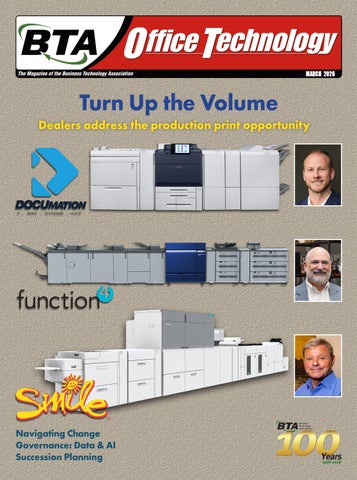
Create a flipbook