





























The different sides of first responders’ lives in Delaware County. first responders’ lives in 05




















ISABELLA KEMPER, DN; JESSICA BERGFORS, PHOTO ILLUSTRATION
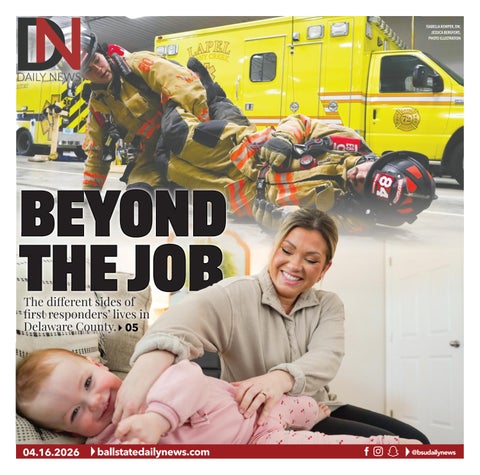
The different sides of first responders’ lives in Delaware County. first responders’ lives in 05

CONTACT THE DN Newsroom: 765-285-8249, editor@bsudailynews.com
EDITORIAL BOARD
Meghan Braddy, Editor-in-Chief
Katherine Hill, Managing Editor and Lifestyles Editor
Linnea Sundquist, News Editor
Kyle Stout, Sports Editor
Rylan Crum, Associate Sports Editor
Jayden Vaughn, Opinion Editor
Charlotte Jons, Associate Opinion Editor
Channing Matha, Copy Editor
Kyle Ingermann, Multimedia Editor
Kadin Bright, Associate Multimedia Editor
Ryan Fleek, Associate Multimedia Editor
Brenden Rowan, Visual Editor
Jessica Bergfors, Associate Visual Editor
Raquel Ruffin, Associate Visual Editor
Corey Ohlenkamp, Adviser
The Ball State Daily News (USPS-144-360), the Ball State student newspaper, is published Thursdays during the academic year except for during semester and summer breaks. The Daily News is supported in part by an allocation from the General Fund of the university and is available free to students at various campus locations.
TO ADVERTISE
• (765) 285-8256 or dailynewsads@bsu.edu
• Hours: 8 a.m.-5 p.m. Mon-Fri.
• ballstatedaily.com/advertise
TO SUBSCRIBE
Call 765-285-8134 between 9 a.m. and 3 p.m. Mon. -Fri. Subscription rates: $45 for one year. POSTMASTER: Send address changes to Daily News, AJ278, Ball State University, Muncie, IN 47306
JOIN THE DAILY NEWS Stop by room 278 in the Art and Journalism Building. All undergraduate majors accepted and no prior experience is necessary.
April 15: The top two Republicans at the Indiana Election Division have tendered their resignations, according to Indiana Capital Chronicle (ICC), effective May 6. This will be the day after the primary elections. Co-director Brad King is retiring after 24 years in the role, along with co-General Counsel Valerie Warycha, who is supporting GOP Secretary of State candidate David Shelton, who is also leaving. Both King and Warycha work alongside the Democratic co-director and co-general counsel in the Indiana Election Division, which is a part of Secretary of State Diego Morales’ agency, who is seeking renomination at the state convention this summer, according to ICC.
The Ball State Daily News is committed to providing accurate news to the community. In the event we need to correct inaccurate information, you will find it posted here.
To submit a correction, email editor@bsudailynews.com.

April 15: According to a press release from Ball State Communications Center, AQUA 220, a hands-on course that offers a unique opportunity to build both knowledge and practical skills in a dynamic learning environment, is open to all undergraduate students in summer or fall 2026. The course introduces them to recreational diving through a combination of classroom instruction and pool-based training. “Students will explore essential topics such as diving physics, physiology, equipment use, environmental awareness, and safe dive planning,” according to the release. No prerequisites are required.

At least 4,860 people in Indiana experienced homelessness by 2025.
Linnea Sundquist News Editor
Editor’s Note: The Daily News reached out to Muncie Mayor Dan Ridenour for comment, but did not receive a response by the time of publication.
“The overall cost of living has increased, [and] the struggle with finding an affordable house or apartment has never been harder,” Muncie Mission Ministries’ Vice President of Community Engagement Leigh Edwards, said.
Edwards has been on Muncie Mission’s staff for three and a half years, with prior volunteer experience with the organization, and explained that the cost of living in Muncie has been “extremely” high.
According to the website Hoosiers by the Numbers, Delaware County’s median household income in 2024 was $55,462, with per capita personal income in 2023 at $47,626.
At least 4,860 people in Indiana experienced homelessness by January 2025, according to the Indiana Housing and Community Development Authority (IHCDA) in a 2025 State of Homelessness for the Indiana Balance of State.
This statistic includes 3,659 people in sheltered locations, such as emergency shelters, transitional housing or safe havens for veterans, and 1,201 people in unsheltered locations, such as any place not meant for human habitation, according to the IHCDA.
In Delaware County specifically, the poverty rate in 2024 was 20.5 percent, according to the Hoosiers By The Numbers website, with the poverty rate among children under 18 years old being 21.9 percent.
According to the website, the poverty rate in Delaware County ranked was first in the state in 2024.
Director of community development in the city of Muncie, Gretchen Cheesman, said via

email that the housing cost burden in Muncie is a combination of “relatively low incomes and a large renter population, resulting in significant affordability pressure.”
Cheesman said that nearly half of the housing units in Muncie are renter-occupied, and local incomes are below state and national averages, which “increases the likelihood that low-income households will pay more than 30 percent of income toward housing costs.”
She explained that while cost burden among homeowners exists, it is at “lower levels” and is typically tied to fixed incomes, aging housing stock and maintenance costs.
The number of people in emergency shelters has increased by 18.4 percent in Indiana between 2019 and 2025, according to the IHCDA.
Muncie Mission is a faith-based organization that provides an emergency shelter, along with meals and other recovery services for individuals experiencing homelessness in East Central Indiana. Edwards said the organization wants to provide “compassionate relief” that “loves people where they are.”
“The long-term goal of helping them find a transformative situation where they’re able to sustain themselves and they do not need us anymore,” she said.
According to the Muncie Mission’s website, the organization has multiple “ministry locations” that serve individuals with different needs, along with various other resources to help them.
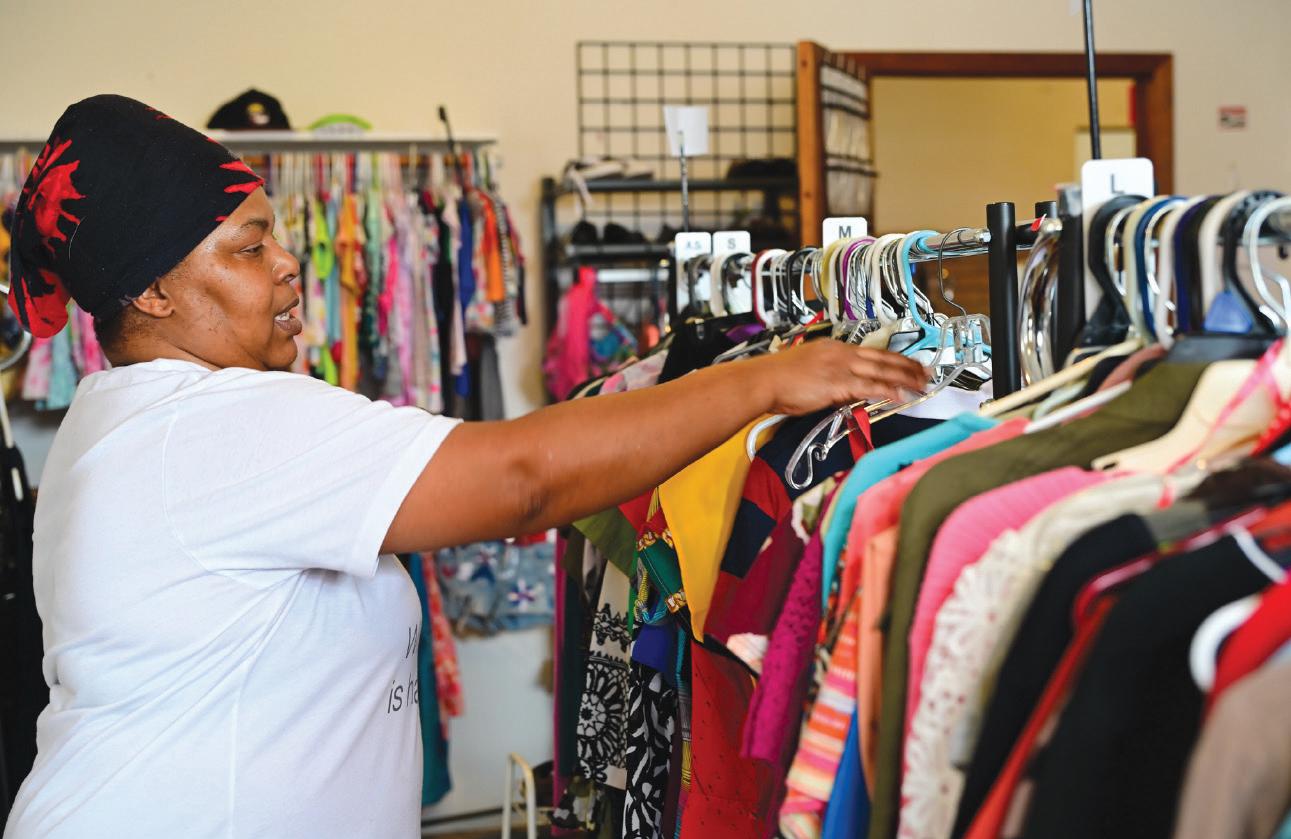
These include resources such as the Muncie HUB, a service that provides necessities to persons who are experiencing homelessness and provides contacts with shelter providers; Attic Window Thrift Store, a store that sells second-hand items where all proceeds support Muncie Mission; and Beauty For Ashes, a “safe place” for women with or without children who are experiencing homelessness.
Along with providing these resources, Edwards
PEOPLE INCLUDED IN THE COUNT
Sheltered Unsheltered
- Emergency shelters
- Transitional housing
- Safe haven for veterans
- Cars - Parks
- Abandoned buildings
- Bus/Train stations
- Streets
- Emcampments
c
- Couch-surfing
- Doubled-up situations
- Hospital stays
- Incarceration PEOPLE NOT INCLUDED IN THE COUNT
- Treatment facilities
- Temporary hotel stays
- People who declined to participate in the count


Informantion provided by Indiana Housing & Community Development Authority
said that Muncie Mission owns 50 properties that are within walking distance of the organization. She said these properties have either been abandoned or were “trap” houses, which they rehabilitate to create “healthy, good, affordable” housing, she said.
“That has been a real[ly] cool thing for us, where we have been able to kind of transition into housing support for our guests as they finish our programs and go out into the world,” Edwards said.
Chief Executive Officer WaTasha Barnes Griffin of the Young Women’s Christian Association (YWCA), a local emergency shelter for women and children in Muncie, voiced similar sentiments to Edwards about rising housing costs contributing to the housing crisis in Muncie.
Griffin explained that homelessness in Delaware County is being “driven” by a combination of rising housing costs, stagnant wages and a “significant” shortage of affordable housing. She said more individuals and families are “one unexpected expense away from being unhoused.”
These families are considered “ALICE families,” which stands for Asset Limited, Income Constrained, Employed, Griffin said, meaning these families are working, but their income is still not enough to “take care of all of the things that they need.”
38 percent of households in Indiana were below the ALICE threshold in 2023, according to United For ALICE. Households below the threshold are “forced to make impossible choices – like deciding whether to pay for utilities or a car repair, whether to buy food or fill a prescription,” according to the website.
“What’s concerning for us is we’re seeing more people experiencing homelessness for the first time,” Griffen said. “These are again working families. These are senior women on fixed incomes and individuals who have never needed assistance before.”
While Edwards said the cost of living is going up, she also said grocery prices are increasing. According to the United States Department of Agriculture (USDA), in a 2026 food price outlook summary, the all-items index under the Consumer Price Index (CPI), a measure of economy-wide inflation, increased 0.5 percent from January to February 2026.
With food prices rising, many individuals in the county are feeling the effects.
In Delaware County, 13,837 individuals were food stamp recipients in 2025, and 8,423 were free and reduced-price lunch recipients in 2024 to 2025, according to the Hoosiers By The Numbers website.
Griffin said the YWCA has seen a “noticeable” increase in demand for emergency shelter and housing services. She also said she has seen seniors utilize these resources as they work low-wage jobs, along with women and children, and individuals who are “navigating mental health or substance abuse challenges.”
“It’s all about us being able to be a resource for those who need housing and housing supports,” Griffin said.
She said that researching what housing options and resources are available is a “wonderful” way to stay informed about what is happening across the “housing landscape.”
“Really keep abreast of what’s trending across not just our state, but across the country,” she said.
Edwards urges individuals to understand the “complexities” of homelessness, saying many are uninformed and hold “simplistic” ideas about how to solve the problem of homelessness.
“I think that is the best way to educate the community. It’s just for them to get involved in some way,” Edwards said.
Contact Linnea Sundquist via email at linnea. sundquist@bsu.edu.



I’ve
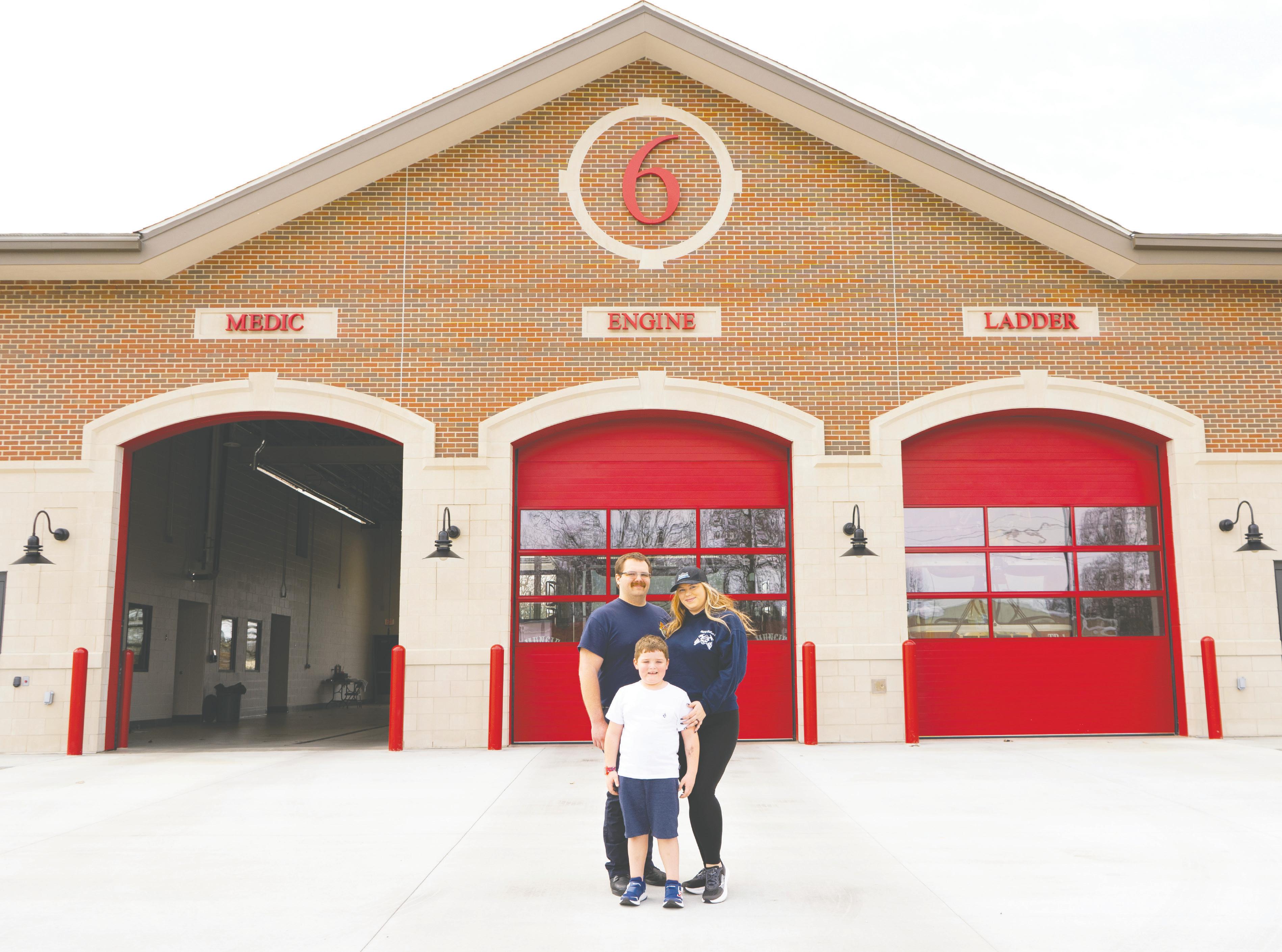
been the first one inside of a burning building multiple times and I think about ‘What if that was my daughter in there?’”
- JACOB SUTTON, Delaware County firefighter




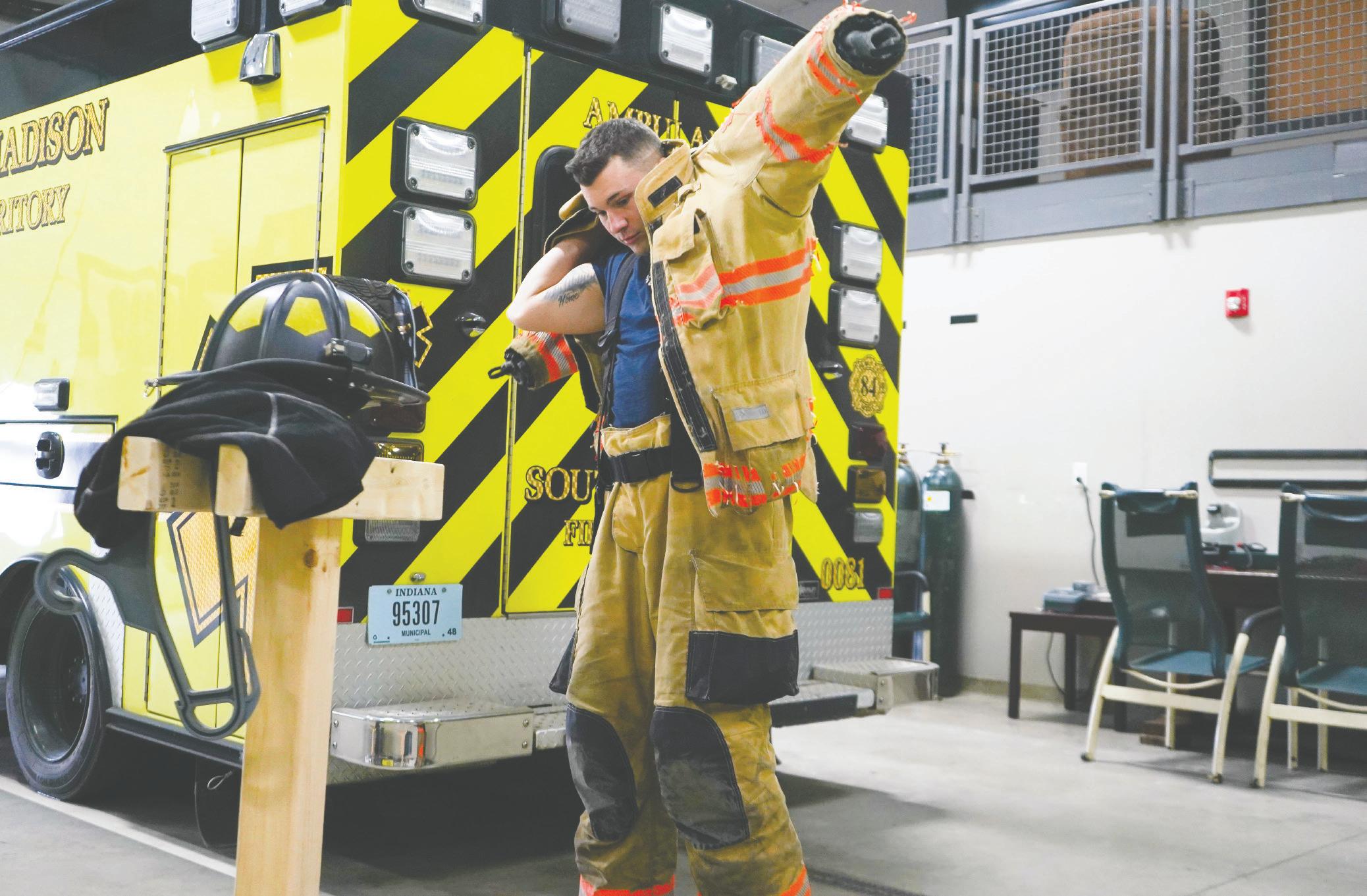
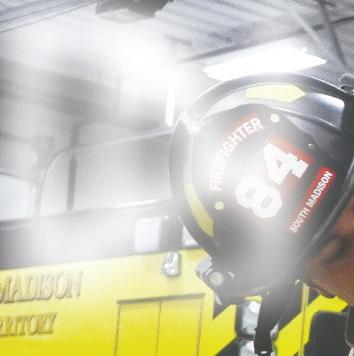
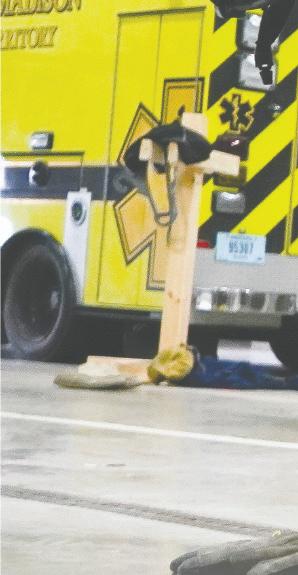
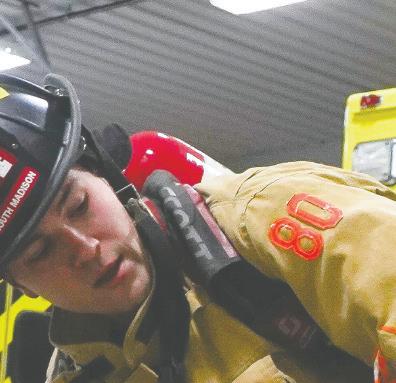
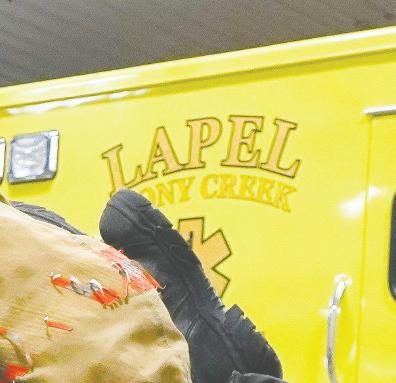
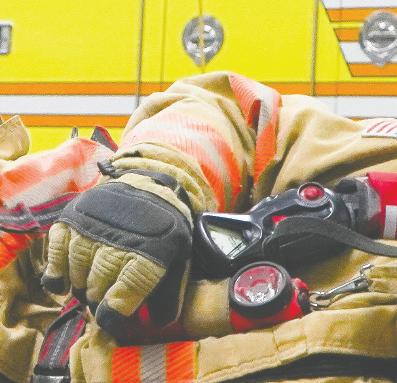
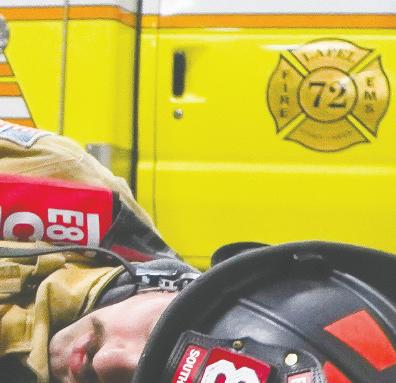
Delaware County’s first responders give insight into their personal and professional lives.
Aker teaches clients coping strategies, as most first responders struggle with coming out of a “fight or flight” state of mind. For example, Aker may focus on an individual therapy session in which the first responder debriefs on a particular critical incident they responded to.
Jacob relies on talking with his colleagues and on mediation and prayer to cope with the mental toll of the job. For both him and Mackenzie, their faith in God helps guide them, as they believe that “the Lord has a reason for everything.”
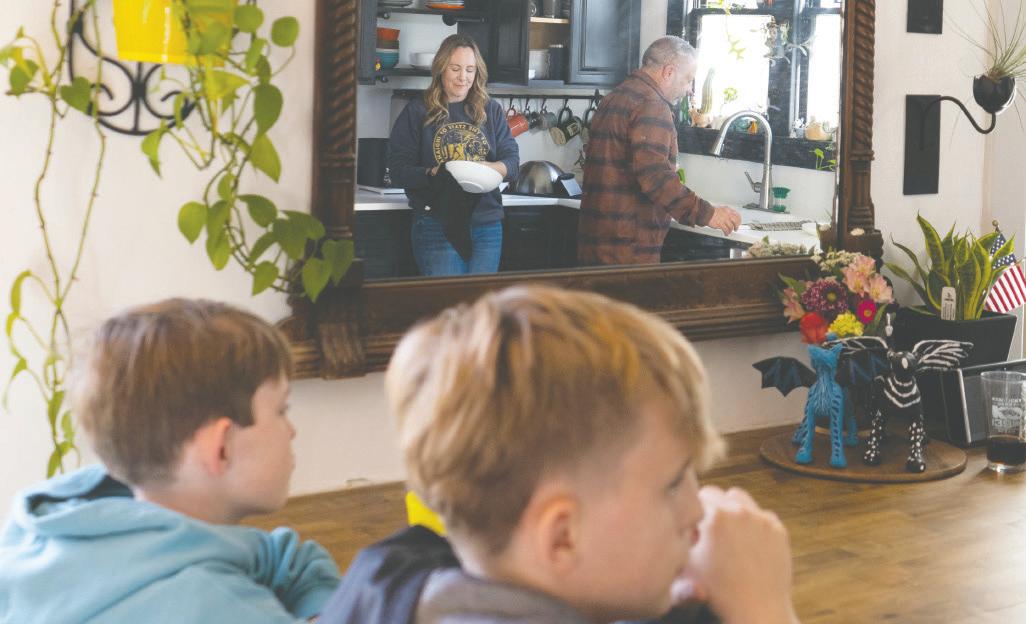
When Jacob gets a call, he usually has enough time to let Mackenzie know he’s responding to a fire. Even if Jacob is on a shift, the family still finds ways to be connected. Mackenzie and Georgia will Facetime Jacob and occasionally visit the station so he can spend more time with their daughter.
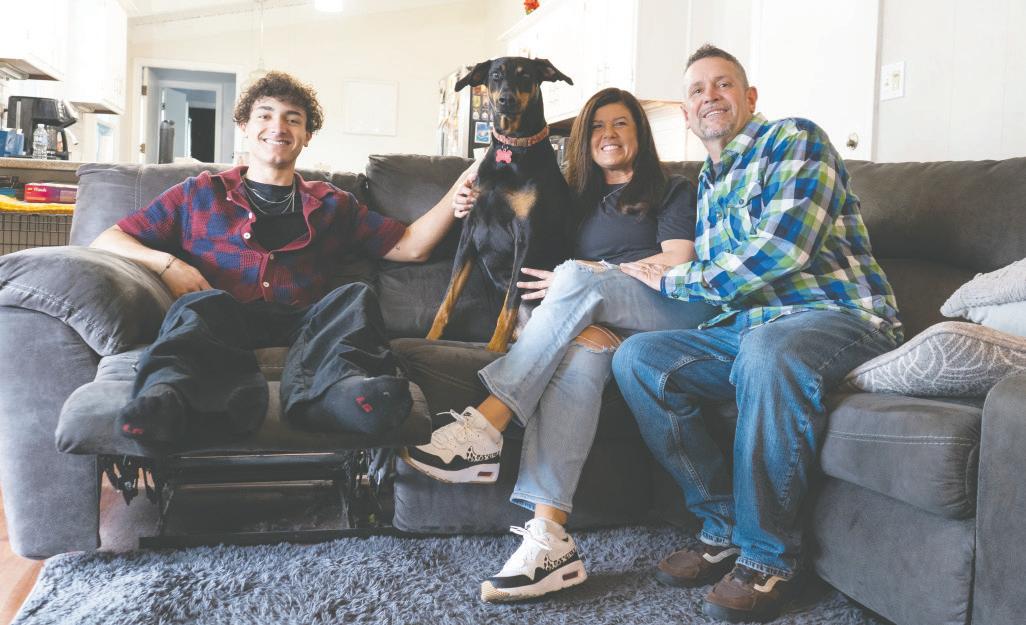
Married for almost 27 years, Rob and Krista Swoboda are both fi rst responders in the medical fi eld.
The two met at IU Health Ball Memorial Hospital in Muncie when Krista was working in the hospital’s triage area, a designated zone in the Emergency Department for quickly assessing patients by severity.
Rob had brought a patient to the hospital, and as he and his partner were finishing, he saw Krista and was “blown away.”
Rob, an advanced emergency medical technician (EMT) and lieutenant with Delaware County Emergency Medical Services (EMS), has been in the field for nearly 34 years. He started in Emergency Medical Services (EMS) at a volunteer
department in Albany, Indiana at 15-years-old, after his family had moved to the town from Detroit, Michigan. He was riding his bike past the ambulance station when he saw a sign saying they were accepting applications for a cadet program. After learning about what the job includes, he knew he wanted to “make a difference.”
At 16 years old, Rob became a trained first responder and knew he wanted to work with Delaware County EMS.
His job has always been about “being there for people in their time of need,” and “making a difference”, explaining that [the job] doesn’t stop when he’s off duty. For example, if he’s driving down the road and someone has a flat tire or their car is broken down, he pulls over to check if they are okay.
“We care about the community. We care about the people. We’re there for them during their time of need,” Rob said.
Rob and Krista’s drive to help people continues to motivate them both in their careers and family life.
After starting at Ball Memorial as a registration clerk in the Emergency Department, just two years out of high school, Krista decided she “wanted more out of her career” as she watched the nurses and EMS work.
“I always admired all the nurses,” Krista said. “Watching them help people, watching them jump into action … I was just so intrigued by it.”
She decided to enroll in nursing school to become a registered nurse (RN). Krista works in the Ball Memorial Emergency Room (ER),

working three 12-hour shifts a week.
With Rob and Krista both working in the medical field, they can support each other in times of need and celebration. They understand one another’s schedules, knowing that sometimes one of them may have to work on a birthday or their anniversary. Rob and Krista frequently interact at the hospital together, and value the importance of teamwork both in their profession and at home.
“[Krista] is really good with taking care of the bills and finances, so that’s one role she takes … and I like to cook,” Rob said. “Teamwork has definitely helped us in our relationship.”
When the two get home for the day, they usually “leave work at work.” Rob shuts off radios and scanners while still staying alert [for calls], and when at home, Krista’s time is spent enjoying her family and winding down.
The two have a 19-year-old son, Kamden, who is currently studying psychology at Ivy Tech
Community College, so that “he can do his part [in] helping people,” like his parents.
When their son was younger, if either parent were at work on Christmas, they would “send a letter to Santa,” asking if Santa could come early since his parents had to work.
The parents said Kamden took pride in the fact that “Santa comes to my house before he comes to somebody else’s.” Kamden grew up knowing what his parents’ jobs entailed, and that sometimes holidays would have to be sacrificed or celebrated on a different day.
Rob and Krista’s shifts can be flexible, as Krista is self-scheduled and Rob can take certain days off. When they were first raising their son, they would schedule opposite shifts so that one parent could be home and present with him. They have always made Kamden’s birthday a priority, and Krista said they make that day special.
Rob, Krista and Kamden always try to do
activities that they all want to do. If Rob and Krista are together and going out to eat, they will intentionally choose a place Kamden doesn’t like.
As Kamden has grown up, the two have always told him that after retirement, “wherever he ends up, is where we’re going to move to.”
“It’s always the three of us, no matter what,” Krista said. “We always try to spend time together. Everything we do, we do together.”
Being there for people who can not be there for themselves is what motivates first responders Brodrick and McKenna Hendrickson.
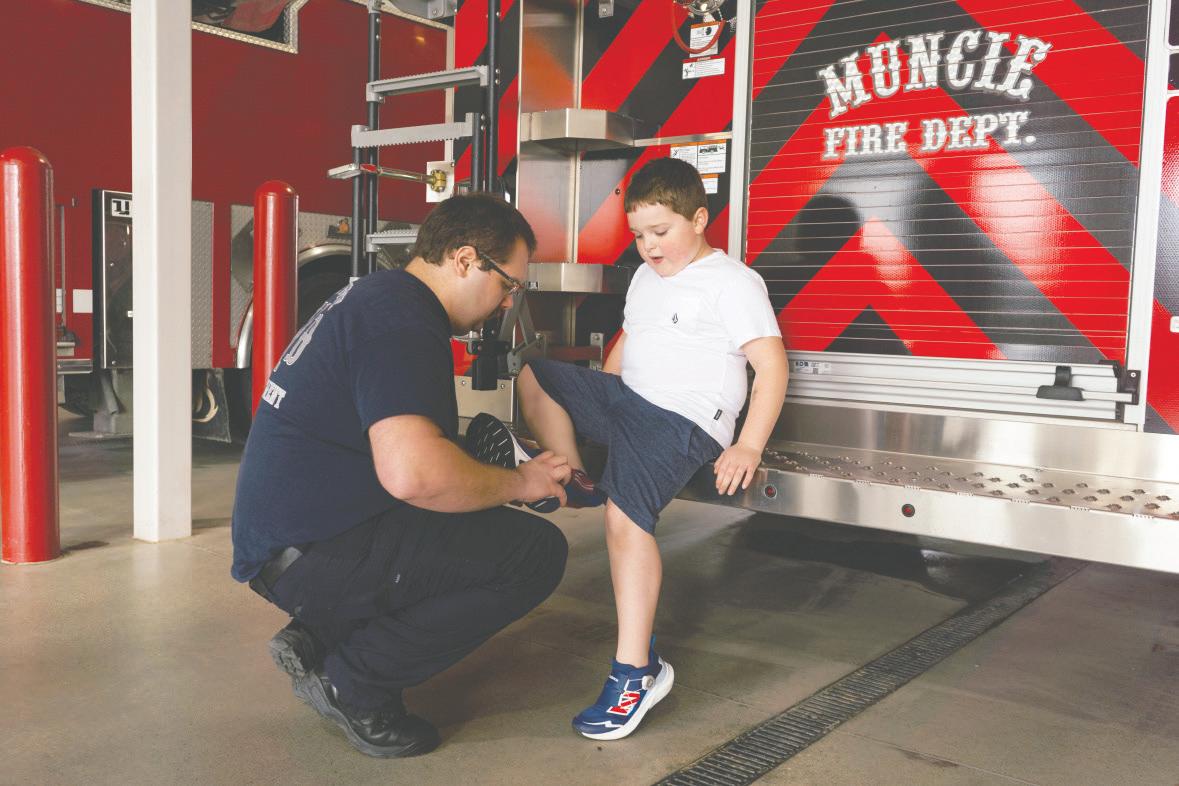
Brodrick Hendrickson is a fifth-generation firefighter and began working in the fire service in 2017, starting as a volunteer firefighter. He began working at the Muncie Fire Department three years ago, and two months ago, became a paramedic. Being a firefighter is all Brodrick ever
wanted in life, and he said he is living his younger self’s dream.
His wife, McKenna, became an EMT firefighter three years ago and worked for two years with pediatric patients at Riley Children’s Hospital, but she is no longer working full-time.
The two have been married for almost three years, and they met when McKenna was in her first year of college. When Brodrick told her he was a firefighter, she replied, “You’re joking.” When she saw him for the first time after he returned from a fire call, she stood in shock at the sight of Brodrick coughing, covered in soot.
To Brodrick and the other firefighters, it was normal, but it was “terrifying” to McKenna. As the years went on and McKenna learned more about the fire service, it’s now “not as scary watching him leave,” and she knows he is with people who will fight to protect him. However, they still “take it day by day.”
We care about the community. We care about the people. We’re there for them during their time of need.”
- ROB SWOBODA, Lieutenant with Delaware County Emergency Medical Services
“When he texts me that he’s on his way home, it’s a breath of fresh air,” McKenna said.
McKenna recalled one day that Brodrick came home with a minor burn on his ear, and seeing the physical injury made “every fear” and “what if” flood her mind. She thought about every conversation she had with their son, Rhett, about the potential of his father not coming home. McKenna explained to Rhett that Brodrick “puts his life in danger to help other people.” When Rhett was younger, and Brodrick would come home from work, he’d ask, “Did you save somebody today?”
“To [Rhett], his daddy is his hero,” McKenna said.
Being in the same field, the two understand each other, especially when it comes to how they deal with the emotional toll of the job. McKenna said that sometimes she closes her eyes and flashes back to things she’s witnessed while in service. They have learned to understand what the other needs after a difficult day.
“We have looked at each other and said, ‘Listen, I know it was an awful day, but you are not okay, and you need to talk, whether it is now or later today, you need to get it off your chest,’” McKenna said.
In college, Andy Payne was a member of a fraternity at Ball State University. After dropping his photojournalism major and moving to England for two years to play rugby, Andy returned to Ball State when he was almost 21. Not wanting to hang out with 18 and 19-year-olds, he would stand by the police officer stationed at the back door of fraternity parties, conversing with him and asking questions. One day, he offered for Andy to come on a ride-along.
His response was, “I don’t want to be a cop.”
The first night he was in the police car, he witnessed a foot chase and the officer fought someone. Andy recalled thinking it was exciting and interesting, ultimately leading him to become a road officer for 16 years.
“I didn’t think when I got into this job that I would see the best part of people, as well as the worst part,” Andy said.
When he was a road officer, he worked the midnight shifts, which were eight hours long. He described the most rewarding calls as those in which he got to help someone.
Today, Andy has transitioned to the office side of the Delaware County Sheriff’s Office and is a lieutenant and the director of their training division, as he has always enjoyed the training aspect of the police force. He still responds to calls at times, but his day-to-day “wouldn’t look that much different than an office job.”
Originally on the path to becoming a history professor, Andy had no idea he wanted to be in the police force until he “saw the value in the community of facilitating and supporting the law.”
Similar to his wife, Heather, he has a goal of “driving the community forward.”
Heather has been working in the Office of Community Engagement at Ball State as the associate director and program manager for Building Better Neighborhoods, Ball State’s effort to engage and support Muncie neighborhoods.
Despite both studying history and playing rugby at Ball State, Andy and Heather never crossed paths during college. In 2021, Andy had just finished helping Delaware County’s statewide SWAT challenge, where SWAT teams from around the country gather for a week-long training and competition, and went to Guardian Brewery in Muncie to grab dinner and go home. Heather’s best friend grew up with Andy, and the two were at the brewery together that night. Andy and Heather sat next to each other, and “just clicked.”
Andy credits meeting Heather and her kids, and becoming a stepdad, for helping him “find more beauty in life.”
However, Andy and Heather’s family extends beyond them and their three children. Heather describes the Sheriff’s Department as a “second support system.”
The Sheriff’s Office used to be a middle school, and in December, Andy and Heather organized a night where they invited the officers and their families to watch Christmas movies together in the old auditorium.
“It sounds cliché, but we’re just people too,” Andy said. “The vast majority of the guys I work with are good-hearted, kind, caring people that just want to make the community a better place.”
These stories represent just a few of the many families and lives in Delaware County that are impacted daily by the duties and responsibilities of being a first responder.
Contact Jessica Bergfors with questions at jessica.bergfors@bsu.edu.











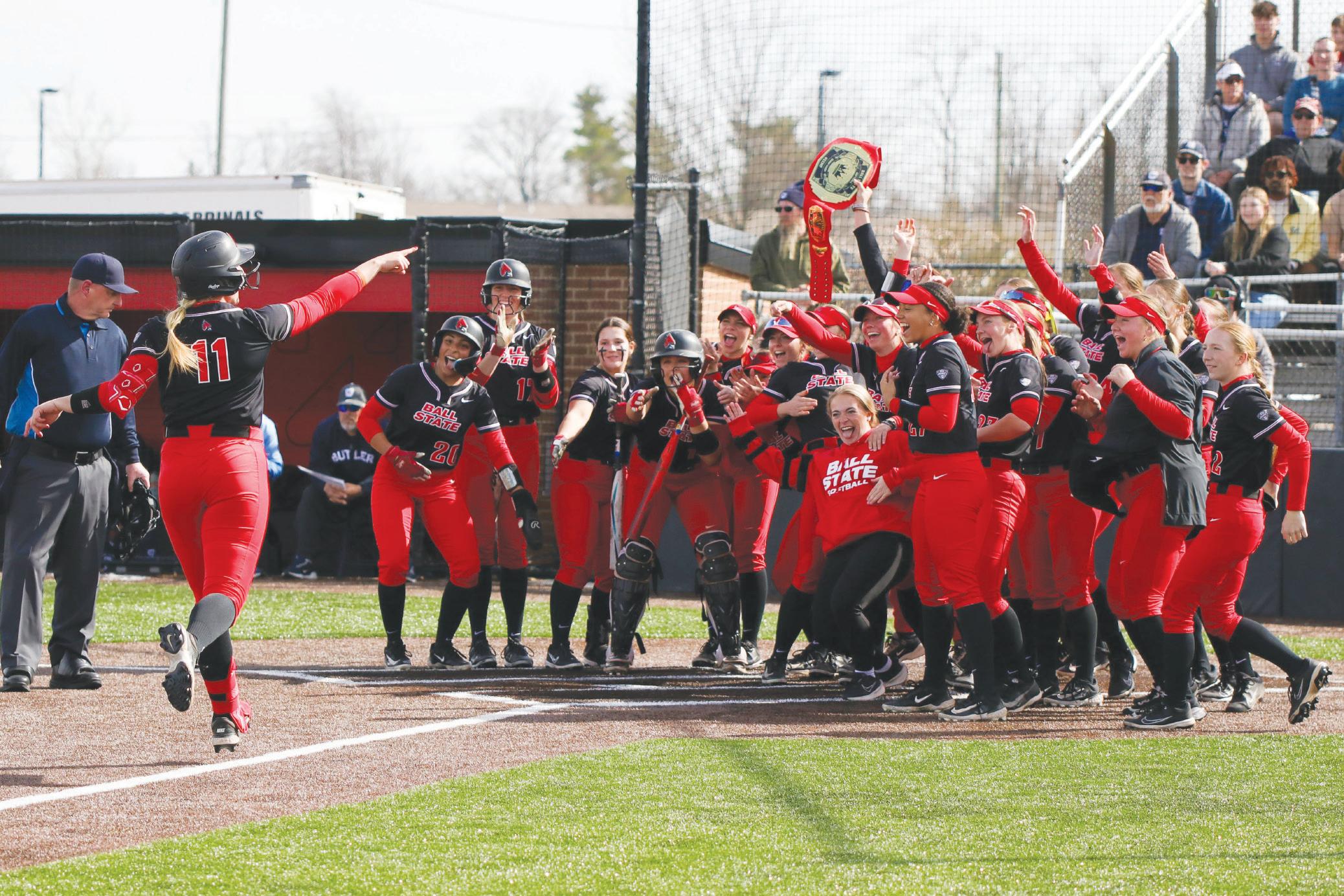
As the Cardinals’ season has not gone to plan, their goal is to end it on the highest possible note. 11





The Cardinals sit in last place in the conference, but look to gain as much momentum as they can moving forward.
Rylan Crum
Associate Sports Editor
Editor’s Note: Rylan Crum is offering some commentary in this article. His views do not necessarily reflect the views of the paper.
As mid-April arrived, the Ball State Softball team was more than halfway through its 2026 campaign, a season that has brought many different emotions to the table.
In their 2025 season, the Cardinals finished with an overall record of 33-18 and a conference record of 16-9, which helped them reach the MidAmerican Conference (MAC) tournament in head coach Helen Peña’s second year.
So far through the 2026 season, Ball State sits at an overall record of 15-23 and a conference record of 3-15.
One key reason for the team’s struggles so far could be the loss of key players from Peña’s previous squads, such as McKenna Mulholland and McKayla Timmons.
But coming into the season with 11 new members on the roster, coach Peña knew this team would have a different makeup than the others.
“It’s a really different team than last year. We’re going to be able to score in a lot of different ways, and we’ve got some speed when it comes to our newcomers, freshmen and even returners,” Peña said. “We’ve got experience when it comes to returners, and then for the newcomers and freshmen, we’ve got some people who are hungry just to get out there and contribute to the team.”
Right out of the gate in preseason and early season tournaments, the Cardinals showed some
the only category in which they have a winning record. But once they reached conference play, the early success they found fizzled out.
With the spot the team is currently in, the main goal is to keep its heads down and finish off the last month of games as well as the team can.
“We had a really, really good preseason, and I know that we’re struggling right now. Some of our mentals are maybe down in the dumps, but just being able to end the season on a high note, like, we don’t know what’s going to happen right now, but being able to go out there and play for our seniors, especially,” redshirt sophomore Allee Noble said.
“Our big team message right now is playing for the seniors, doing everything that we can, showing up to practice and just leaving everything that we can out on our home field.”
Even though the team is primarily made up of new faces, the players have expressed their commitment to being there for their teammates no matter what, and it feels as if the Cardinal Faithful has the same commitment to their team.
“Regardless of our record right now, I love our home crowd — the families, recruits and supporters who show up for these young ladies. Our team and staff have been through a lot this year and when we look at the big picture, and I see families in the stands, it’s much more than a game. It’s what brings us all together and it’s a beautiful thing. I’m grateful for them,” Peña said.
While Peña said she feels the energy and love from the dugout, the players out on the field see it the exact same way.
“Our home crowd has actually been remarkable. Even in years past, this is something like I’ve never
into the crowd, and I saw countless parents. I saw so many alumni, which was so heartwarming, [and] girls that I used to play with and getting to talk to them after the games was just like a giant hug,” Noble said. “Our home crowd, I couldn’t ask for better. Every single seat is packed.”
The fans’ attendance is definitely a positive for the team, but it is not the only one — the team’s pitching group has been relentless all season, with zero quit in them, even in the tough games.
“[The] pitchers have been battling all season long. There’s been games where we’ve kept our offense close and have minimized damage against talented hitters, and other games that have been difficult to piece together. A consistent force and approach is needed out there for the team to get behind. I know we have it, we just need to have a short term memory on what we’re capable of, not what has happened,” Peña said.
As the season begins to slowly wrap up, the Cardinals still have goals for how they want their season to end: on a high note. But it is not just wins and losses; it is also sending the seniors off the way they deserve.
“[The] goals for the rest of the season are how can we continue to find growth and be proud of the way we play the game. Regardless of outcome, how can we compete as our best selves and versus our process, not the scoreboard or record,” Peña said. “I want the seniors to leave their mark, and everyone else to be better tomorrow than what they were today. Growth and the process is never ending, and how we show up everyday is what I’m most focused on.”
As one of Peña’s goals is constant growth in her
players, and them being greater tomorrow than
they are today, her current roster is perfect for that. Ball State currently has 12 underclassmen on its roster, a perfect group for growth. While this season winds down, these underclassmen have a chance to really look around and dial in on what they want their goals to be next year. Whether they have played much at Ball State or not, the players want to improve not only for themselves, but also for their teammates.
“This is my [redshirt sophomore] year and it’s my first time truly ever seeing the field. I am just filled with so much gratitude this season. I’ve had many high moments. I’ve had many low moments, but every single day that I see my first and last name and my number on that lineup card. It’s like, I think back to the girl, freshman year, that would kill just to see the field. So every single time I get an opportunity, I make it a point to take full advantage of that. Being able to play for my teammates, my family and for my coaches, they’ve gotten me to this and just being able to show up for us and do my best,” Noble said.
While the Cardinals have struggled so far this season, currently sitting in last place in the conference, the team still has the pieces and the culture to finish the season on the highest possible note.
Contact Rylan Crum at rylan.crum@bsu.edu or on X @RylanCrum.












Ball State Men’s Volleyball looks to claim its first MIVA tournament title since 2022.




Kyle Stout Sports Editor
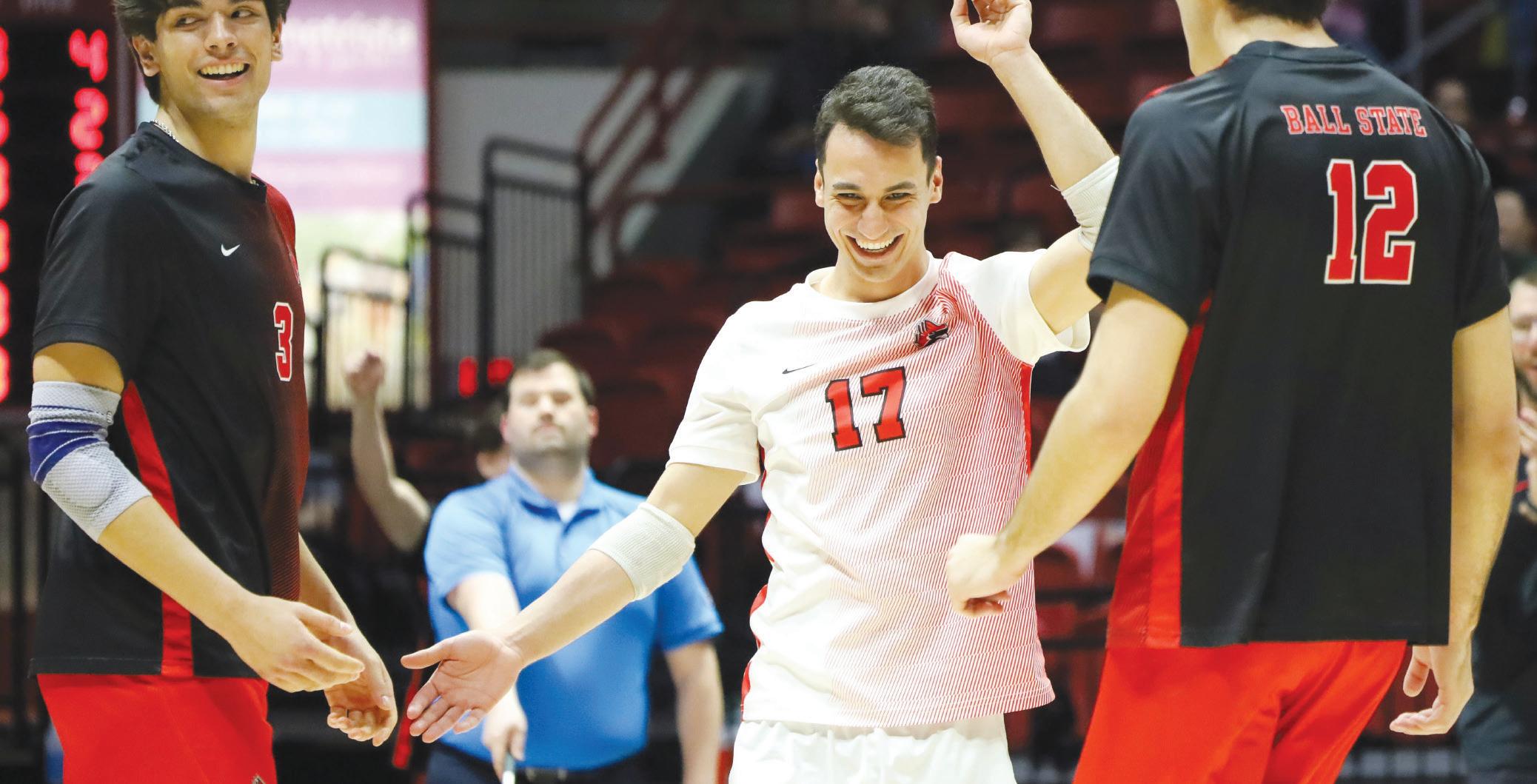
Once the Ball State Men’s Volleyball Senior Day ceremony wrapped up April 12, head coach Mike Iandolo said the fun was just beginning for the Cardinals. The head coach said that after the grind of the regular season concluded, the reward was the team being given the top seed in the Midwestern Intercollegiate Volleyball Association (MIVA).
The Cardinals swept Loyola Chicago at home to capture the MIVA regular season title and secured home court for the entirety of the conference tournament.
“We played one of our best games of the season on Saturday,” Iandolo said. “I think that was a nice little reminder for our guys what level they can play at.”
The dominant win over Loyola Chicago came after the Cardinals’ home loss to Lewis April 10. Sophomore outside hitter Wil Basilio said that although the team suffered a loss to Lewis, it was encouraging how they performed against the Ramblers.
The outside hitter said that while he knows the MIVA tournament is a single-elimination tournament, the team’s ability to turn things around fast gives them confidence moving forward.
“We can have our off days, maybe we have a tough practice before a match,” Basilio said. “But just understanding that one bad day doesn’t mean the next day is gonna be bad too.”














While the MIVA tournament holds weight for the Cardinals, Iandolo does not want much to change with preparation moving forward. The winner of the conference tournament earns an automatic bid to the NCAA tournament, but the head coach said he wants his team to focus on what they can control.
“If we allow ourselves to get distracted and try to hype up or do anything different, then we’re making it something bigger than it needs to be,”
Iandolo said.
Iandolo said the team is taking advantage of the week of practice before the quarterfinals matchup, because it is the last week of the season that the team will have more than two days in a row of practice.
the standard.”



“If we play our standard in any of these games, it’ll turn out to be a success for us,” Rogers said.
He was part of last year’s Ball State team that fell in the MIVA quarterfinals to Lewis, and he said the returners on this year’s squad have learned from last year’s woes. He said the team looked too far ahead last year, which was a big reason for the early exit.
If we play our standard in any of these games, it’ll turn out to be a success for us.”
- PATRICK ROGERS, Senior outside hitter
“We’ve got some time here to get some work in and still get better and try to find ways to get better,” Iandolo said.
Senior outside hitter Patrick Rogers has been in this position before, as he will be playing in his third MIVA tournament. The outside hitter said the biggest thing the team is focusing on in the days leading up to the tournament is “maintaining
“Maybe we were looking a little too far ahead and looked past that game,” Rogers said.
“It’s good we all experienced that, and we’re looking forward to this next quarterfinal.”
The Cardinals have a favorable matchup in their quarterfinal this weekend. Ball State will take on Northern Kentucky, a team they swept in both of their matchups. Iandolo said it was good that the team avoided the “chaos” of the rest of the bracket, as the Cardinals have split matchups with a couple of other conference squads.
“I believe wholeheartedly [that] we are the better team and we’ll show that again,” Iandolo said.
Iandolo said he believes the team is in a good headspace ahead of the tournament, but that a
key factor will be Rogers’ play. The outside hitter is a nominee for MIVA player of the year, which Iandolo expects him to be awarded with soon.
“He has been the best guy front to back of this entire season on the number one team,” Iandolo said.
The head coach said that when Rogers plays at the top of his game, he sees it be infectious for the rest of the team.
“As long as he’s playing at that level and bringing that level of training, it’s easier for the other guys to step in and do what they’re supposed to do,” Iandolo said.
Rogers said he is confident in where the team’s mentality is entering the tournament. The outside hitter said that it can be easy to take things too seriously at times, but he said as long as the team is enjoying each other and having fun, things will go well.
“I don’t think I’ve been a part of a team better at that mental part; they’re all very locked in,” Rogers said.
One of the biggest things for Basilio is bringing hardware back to Ball State. The Cardinals have not won the MIVA tournament since 2022, and the team’s last couple of postseasons have been disappointing.
“We’re fully capable of taking it all the way,” Basilio said. “[To] try and put them back on the pedestal where we know that the program belongs.” Contact Kyle Stout with questions via email at kyle.stout@bsu.edu or on X @kylestoutdailyn.


in journalism is getting more prominent in the media, and it needs to stop.

Kyler Effner is a first-year journalism and psychological science major and writes “Just an Inkling” for the Daily News. Her views do not necessarily reflect those of the newspaper.
I decided to major in journalism in the fall of my third year of high school. Previously, I had toyed with the idea of a variety of other fields that would all lead to no further than teaching in a high school classroom or a future entrenched in the mercenary work that is academia.
However, once exposed to the brutality and beauty that is encoded into every word of journalistic truth, I could not see myself anywhere else. Not even the rigid rules and regulations of the Associated Press (AP) Stylebook could deter me from my new passion.
Then, just a few short weeks before my first semester at Ball State University, I decided to add another major to my course load: psychological science.
As a journalism student, I look upon a shrinking industry that continues to ask more and more of its professionals, and I am faced with one of my worst fears: my future and the laws that protect it have become malleable.
The inception of my career panic began when Stephen Colbert announced that “The Late Show with Stephen Colbert” was ending its last season and would conclude in May 2026 due to decreased ad revenue, a claim backed by an October 2025 article by The Free Speech Project.
However, Colbert’s show was the most-watched late-night show in America, prompting speculation that the cancellation resulted from Colbert’s criticism of Paramount’s settlement with President Trump, as stated in a July 2025 article by the Free Speech Center. Since the show’s cancellation, Colbert has not been the only late-night show host to face removal from broadcast television regarding remarks or opinions deemed offensive by the powers that be.
Sep. 17, 2025, Jimmy Kimmel was faced with indefinite suspension due to comments he made regarding the assassination of conservative activist Charlie Kirk.
Kimmel’s comments stated his personal belief that “the MAGA gang [was] desperately trying to characterize this kid who murdered Charlie Kirk as anything other than one of them and [was] doing everything they [could] to score political points.”
Regardless of the debates over the assassin’s political affiliation, the fact remains that a man stated his opinion, a nonpartisan right protected by the First
Amendment, and was removed from the air for it. Sep. 18, 2025, the Directors Guild of America released a Hollywood Labor Joint statement on the incident, stating, “When a private citizen, business, or television network bows to government intimidation, it strikes at the heart of our First Amendment rights. Creative artists must be free to do their work without fear that their careers or their family’s livelihoods will be disrupted simply for their opinions.”
The trend of censoring late-night talk shows peaked Feb. 16, 2026, when the Federal Communications Commission (FCC) blocked CBS from airing Colbert’s interview segment with Texas politician James Talarico ahead of the Texas Senate primaries.
The FCC cited the equal-time rule, which requires news organizations to provide all candidates with the same level of visibility. This rule has not been enforced on any talk show or used against a talk show host since the 1960s, according to a February 2026 article by Forbes.
Stretching a regulation due to pressure from higherups is highly concerning to me, as it sets a precedent that laws concerning our media can be flexible for those who wish it to be. This past year has also demonstrated that opinions and interviews for entertainment media are no longer 100 percent protected on broadcast television talk shows.
These are rights explicitly protected under the First Amendment, including freedom of the press. Therefore, if one clause is under attack, who is to say that the one protecting my industry will not be the next to get manipulated to the detriment of the American people?
When I decided to double major, many people judged me for being slightly hasty in creating a backup plan. After all, it appeared as if press and media freedoms were not going to be touched, and in theory, they are not supposed to be. Unfortunately, that did not last.
On Oct. 3, 2025, an international journalist, Mario Guevara, was deported to El Salvador after he was arrested and charged for attending a protest in June earlier that year. Guevara was wearing his PRESS vest, identifying himself as the media and livestreaming the protest as part of his coverage of immigration enforcement.
Guevara was charged with minor protest-related violations, and “local law enforcement handed him to agents for deportation proceedings despite having valid authorization to stay in the USA,” according to an October 2025 article published by Amnesty International.
The concept of the right to protest, along with other First Amendment freedoms, is covered at a basic level in university journalism classes. We have the right to report; others have the right to free speech and it is our obligation and duty to report what the American people are saying.
Journalism covers the true and notable events that occur within our country, and as a student of that
discipline, I can not agree with the removal of a story and the punishment of its creator, such as Guevara, because it does not follow the narrative those in power wish to create.
Due to instances like Guevara’s deportation, a new fear is starting to extend beyond the normal anxieties of a shrinking industry. At age 19, I have to ask myself whether I am willing to risk more than just my career stability; I also have to consider my safety after graduation.
Guevara has not been the only journalist affected by a distaste for the stories he told, as the Associated Press was barred from access to the White House due to its refusal to change its stylebook to accommodate Trump’s executive order renaming the Gulf of Mexico to the Gulf of America, according to a March 2025 article by the Associated Press.
Journalists and media professionals from the wire service were denied access to events attended by other news organizations, including a news conference held by Trump with Indian Prime Minister Narendra Modi. In February 2025, The Reporters Committee for the Freedom of the Press filed a friend-of-the-court brief stating that “the AP’s exclusion is not just arbitrary and unjustified but viewpoint-based, an ‘especially invidious’ form of discrimination often described as ‘poison’ to the free flow of information.”
My classes have emphasized the importance of words, but now I am forced to realize that the use of one word over another could cost me my job, a sentiment I feel that we could all find slightly ludicrous.
Additionally, White House press restrictions continue to increase; there are continuous reports of restricted visas for foreign journalists and journalism has now become a dangerous profession both in and outside of conflict areas.
The United Nations found that “journalist imprisonment is at a record high, while online violence, particularly against women journalists, and harassment spurs on selfcensorship and, in some cases, physical attacks.”
I am in my first year of reporting for a student publication, and I have already been harassed for stating that I am studying journalism. The notion of me pursuing a degree in which I seek out the truth in my reporting causes conflict.
I am also reminded every day of what other conflicts I can face in my career: being cast aside for stating my opinion, imprisonment for the act of being present, losing my job due to my word choice and being a war casualty is now an occupational hazard.
Forgive me if the truth I report is not the one you would prefer to see.
Contact Kyler Effner via email at kyler.effner@bsu. edu.
51 students answered a survey in which they provided feedback on parking services at Ball State.
Fifty-one students at Ball State University were surveyed about Parking Services. 76% said they had received a ticket, with responses separated by how many tickets they got (1–5), while 24% reported none. Anonymous student comments were also shared.
“They are annoying and give useless tickets to students who pay thousands to go here, there is very little accessibility for parking available to students who PAY to be here.”
“For the amount of commuting students, there aren’t enough parking areas for them. For how often tickets are handed out, there should be a rule where students get up to 1 ticket appeal per semester.”
“I got a ticket in a lot where my friend who parked next to me at the same time didn’t get one but I did.”
“The parking lots by the rec make it hard to know which one I can and cannot park it. They also are not understanding of situations at all.”