
































Ball State Men’s Rugby Club has revitalized itself on campus, and its members have bonded through it.

































RYAN FLEEK, DN; BRENDEN ROWAN, DN PHOTO ILLUSTRATION

Ball State Men’s Rugby Club has revitalized itself on campus, and its members have bonded through it.

CONTACT THE DN Newsroom: 765-285-8249, editor@bsudailynews.com
EDITORIAL BOARD
Meghan Braddy, Editor-in-Chief
Katherine Hill, Managing Editor and Lifestyles Editor
Linnea Sundquist, News Editor
Kyle Stout, Sports Editor
Rylan Crum, Associate Sports Editor
Jayden Vaughn, Opinion Editor
Charlotte Jons, Associate Opinion Editor
Channing Matha, Copy Editor
Kyle Ingermann, Multimedia Editor
Kadin Bright, Associate Multimedia Editor
Ryan Fleek, Associate Multimedia Editor
Brenden Rowan, Visual Editor
Jessica Bergfors, Associate Visual Editor
Raquel Ruffin, Associate Visual Editor
Corey Ohlenkamp, Adviser
The Ball State Daily News (USPS-144-360), the Ball State student newspaper, is published Thursdays during the academic year except for during semester and summer breaks. The Daily News is supported in part by an allocation from the General Fund of the university and is available free to students at various campus locations.
TO ADVERTISE
• (765) 285-8256 or dailynewsads@bsu.edu
• Hours: 8 a.m.-5 p.m. Mon-Fri.
• ballstatedaily.com/advertise
TO SUBSCRIBE
Call 765-285-8134 between 9 a.m. and 3 p.m. Mon. -Fri.
Subscription rates: $45 for one year. POSTMASTER: Send address changes to Daily News, AJ278, Ball State University, Muncie, IN 47306
JOIN THE DAILY NEWS
Stop by room 278 in the Art and Journalism Building. All undergraduate majors accepted and no prior experience is necessary.

April 6: Gov. Mike Braun took a “victory lap,” according to Indiana Capital Chronicle (ICC), April 6, after he signed legislation meant to help Hoosiers cope with high utility bills. House Enrolled Act 1002 has many major provisions, such as the requirement for utilities to provide assistance programs for low-income customers, prohibiting hot-weather shutoffs for low-income customers during peak heat and the requirement that all residential customers be put on a “levelized” billing plan, where customers can choose to opt out. The new law might lead to lower rates, but it does not mandate them, according to ICC.
In last week’s “Partnership Paper” Edition, the subject in the photos on pages 2 and 3 was misidentified as Jermey Coleman. Those photos are of Conner Polk.
To submit a correction, email editor@bsudailynews.com.

April 8: According to a press release from Ball State Communications Center, the university’s annual Late Nite Carnival is back April 17 and better than ever with a night full of thrilling rides, game booths, live entertainment, carnival food, and so much more. “It’s the perfect way to celebrate the end of the semester with your friends,” according to the release. Students can stop by the Atrium or Scramble Light April 16 and 17 to pre-register for the event. Pre-registration allows students enter the event an hour early at 5 p.m., according to the release

April 8: The Cardinals had a dominant 18-5 win over Manchester University on April 8 at Shebek Stadium. Ball State found themselves back in the win column after a five game losing streak, with three of those losses coming to Mid-American Conference (MAC) opponent Miami (OH). The Cardinals look to create a win streak as they welcome in the Akron Zips for a weekend series starting April 10.

The United States and Iran said they are ready to enter negotiations to end conflict in the Middle East.

Civil defence workers gather near wreckage of a building that was demolished in an Israeli air strike near Beirut seafront. The Israeli military has carried out a large wave of air strikes across Lebanon, after Israeli Prime Minister Netanyahu stressed that the U.S. President Donald Trump’s twoweek ceasefire agreement with Iran did not include Lebanon. MARWAN NAAMANI/DPA/TNS
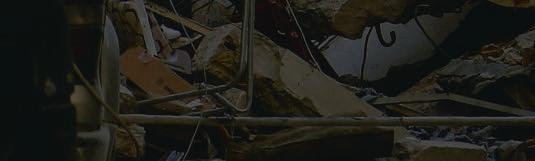




The United States and Iran are willing to begin talks to bring an end to the war in the Middle East amid Israeli strikes on Lebanon.
Iranians hold national flags as they gather in Tehran’s Revolution Square after the United States and Iran agreed to a two-week ceasefire, on April 8, 2026 in Tehran, Iran. The United States and Iran agreed to a two-week ceasefire barely an hour before the US president’s April 8 deadline to obliterate the country, triggering global relief alongside apprehension.
Tribune News Service
This article is republished as part of a collaborative content-sharing agreement between Ball State Unified Media and Tribune News Service, established to expand access to highquality journalism and to better inform and serve the public through trusted, in-depth reporting.
The U.S. and Iran said they are prepared to hold talks to end the war in the Middle East during a proposed two-week pause in hostilities, even as Israeli strikes on Lebanon threatened to derail the fragile truce.
Further adding uncertainty, sporadic fighting continued throughout the region and the Strait of Hormuz remained largely blocked. President Donald Trump has said that reopening the strait was a condition for halting the fighting.
Trump’s announced ceasefire Tuesday night was a retreat from threats to unleash massive devastation on Iran, easing fears of a protracted global energy crisis. Mediator Pakistan has floated negotiations later this week in Islamabad, and Trump said they could start very soon, according to the New York Post.
Yet, there were already signs that the agreement was buckling. Iran said it would withdraw from the deal if Israel kept up attacks in Lebanon, according to the semi-official Tasnim news agency. Passage of oil tankers through the strait were halted after Israel’s attacks, the semi-official Fars news agency reported.
The White House did not immediately respond to a request for comment on whether the president views the war front in Lebanon as included in the ceasefire.
Trump made a series of dubious claims about the terms of the agreement in a social media post on Wednesday morning. He said the Islamic Republic has gone through a “regime change,” even though there have been no signs this week that new leadership had taken hold.
He also indicated the U.S. would use its own 15-point plan as the basis of negotiations with
Tehran, after saying Tuesday the sides would begin discussions off of Iran’s 10-point proposal. Nonetheless, he said the U.S. was prepared to discuss with Iran much-desired sanctions relief.
The shift to diplomacy came as countries including Kuwait, Bahrain and the United Arab Emirates, as well as Israel, reported ongoing missile attacks into Wednesday, sewing confusion about when and how the ceasefire would be enforced. Saudi Arabia’s oil pipeline to the Red Sea was hit by a drone strike, according to a person familiar with the matter.
Further uncertainty surrounded whether the ceasefire includes Israel’s campaign in Lebanon, where the country is waging a parallel war against the Iran-aligned Hezbollah militia.
Pakistani Prime Minister Shehbaz Sharif, a key mediator, said the truce included Lebanon, but Israeli Prime Minister Benjamin Netanyahu disagreed. The Israeli military on Wednesday said it had carried out its largest operation against Hezbollah since the start of the Iran war, targeting more than 100 of the militia’s command centers and military sites within ten minutes.
Still, oil and gas prices plummeted on news of the ceasefire, which paves the way for a potential resumption of energy supplies via the Strait of Hormuz — through which about a fifth of oil and liquefied natural gas supplies typically flows.
Iran Foreign Minister Abbas Araghchi pledged to reopen the critical chokepoint as part of the ceasefire agreement, albeit in coordination with Tehran’s military. Hormuz appeared to remain largely blocked in the early hours of the agreement on Wednesday, as shipowners struggled to understand if they can safely transit the vital waterway.
Brent crude fell as much as 17 percent to $92 a barrel, while European natural gas futures posted their biggest decline in more than two years, shedding as much as 20 percent.
Trump’s ceasefire announcement represented a dramatic climb-down from a warning earlier Tuesday that “a whole civilization will die tonight,



never to be brought back again” if Iran did not give in. His threatened attacks on Iran’s civilian infrastructure, including power plants, may have been considered war crimes if they were carried out. More than 5,300 people have died in the near six-week war.
In a posting on Truth Social, Trump said “there will be no enrichment of uranium” — a reference to longstanding efforts by Washington and Israel to curb Iran’s nuclear program. He also announced plans to impose 50 percent tariffs on U.S. imports from any country that sold weapons to Iran. It is unclear how he would follow through on that threat, since the Supreme Court curbed his authority to impose certain levies unilaterally.
Kuwait’s army on Wednesday said it is still dealing with “intense” attacks. The U.S.expected orders to stand down from strikes would take time to reach Iran’s Islamic Revolutionary Guard Corps, Axios reported. Such lags are typical in conflicts, with hostilities often continuing before gradually tapering off.
Explosions occurred at Iran’s Lavan Refinery after the start of the truce, the semi-official Mehr reported, without saying where it got the information.
U.S. Vice President JD Vance said at an event in Budapest that Trump has achieved Washington’s military objectives in Iran, having set out to “decimate” Iran’s ability to wage conventional war, while describing the truce as “fragile.”
Both the U.S. and Iran are portraying the ceasefire as a “victory,” but significant differences remain between their demands to bring the war to a complete end, according to Mona Yacoubian, a senior adviser with the Middle East Program at the Center for Strategic and International Studies.
“Iran says it will allow free passage for the next two weeks through the Strait of Hormuz, but in coordination with Iran’s armed forces. If the U.S. agrees to that, that is a huge concession to Iran,” she said on Bloomberg Television.
While markets breathed a sigh of relief, the ceasefire addressed a crisis Trump helped create when the U.S. and Israel launched the war in
late February. Although Trump claimed to have stopped Iran’s nuclear program, there has been no mention of its missile or drone programs or support for proxy groups.
Pakistani PM Sharif invited all sides to Islamabad to continue negotiations. Iranian President Masoud Pezeshkian confirmed the Islamic Republic would participate, according to a statement by the Pakistan prime minister’s office.
Vance, U.S. Envoy Steve Witkoff and Jared Kushner are expected to attend potential inperson negotiations between U.S. and Iranian officials in the coming days, CNN reported, citing U.S. officials.
The complete terms of a possible pact were not disclosed. Trump only said the U.S. had received a 10-point proposal from Iran, describing it as “a workable basis on which to negotiate.”
Iran’s demands include its continued control of the Strait of Hormuz, acceptance of its nuclearenrichment activities, the lifting of all primary and secondary sanctions, and a withdrawal of U.S. combat forces from the region, according to a statement by its Supreme National Security Council carried by state media.
The two-week ceasefire can be extended by mutual agreement, though Iran will enter talks with “complete distrust,” its state media said.
The focus will be on Hormuz and whether ships can pass safely through the vital waterway. While some vessels have made it through the strait in recent weeks, they have generally not been from countries Iran views as hostile or having at least tacitly supported the U.S. and Israeli strikes.
More than 800 freighters are stuck inside the Gulf, mostly waiting to leave, and shipowners and insurer groups have warned that more details will be needed to determine if safe transit is possible.
©2026 Bloomberg L.P. Visit bloomberg.com. Distributed by Tribune Content Agency, LLC.






Ball State Men’s Rugby Club has reached new heights, as it has grown from two people to 22 in just two years.06



Men’s Rugby Club has grown exponentially in the past two years.
Kyle Stout Sports Editor
In early 2020, the COVID-19 outbreak caused the Ball State Men’s Rugby Club to disband, as many other clubs on campus were forced to do, leaving a club with a rich history dating back to 1976 with nearly zero members.
Junior Jaxon Bolton is the president of the club, but the club’s numbers were not looking strong when he started college. Bolton went to a callout meeting with club alumni freshman year, and there were only two people other than himself who showed up and were interested in what the club had to offer.
Bolton said he had a really good time at the event despite the lack of student interest. He talked to rugby club alumni and was able to get a feel for what the club was all about, which sparked his interest to try to get the club back on its feet.
“They kept encouraging me, [they] wanted it to keep going,” Bolton said. “It kinda just didn’t happen.”
The process of growing a club from the ground up is tedious. Bolton said it was especially hard to recruit guys to “want to get hit.” But by talking to people on campus and bringing in some freshmen who had rugby experience in high school, Bolton was able to grow the club from two people to 22.
“It’s good when you have a good culture around that people want to be a part of,” Bolton said.
Senior Teo Sanchez was one of the two who wanted to get the club back on its feet with Bolton, and he now serves as the club’s vice president.
“I stepped up because I enjoyed doing it,” Sanchez said. “I enjoyed being with the guys, just being able to help compete, get practices running and stuff like that.”
Sanchez said the team is starting to get “back in the groove of things.” He said that a lot of the early stages of the season were about getting new guys into the sport, as well as getting players with prior rugby experience back in the swing of things.
“A lot of these guys either played rugby in high school, or never [have] played the sport [and] barely knew anything about it,” Sanchez said. “It’s just a learning process, being able to create some brotherhood here.”
The brotherhood that Ball State Men’s Rugby Club happened naturally. Sophomore Eland Savage said the club is not just a place where players hang out for an hour, but a real, competitive sport.
Savage said he has a very busy schedule as it is, but that being able to share a meal with players or work out is what makes it worth it.
“It’s nice to have a different sense of community,” Savage said. “It’s nice to have another friend group inside of Ball State.”
A big difference between the rugby club and a collegiate rugby team is who runs it. Collegiate teams have a long list of coaches, ranging from a head coach to trainers. But for Ball State men’s
rugby, the club is completely run by students.
Bolton said the club had a coach, but not during the spring semester because of other coaching obligations at a local high school. That leaves a big role for Bolton to not only help run the logistics of the club, but also coach and play with his peers.
“It’s my goal to get everyone to keep going.” Bolton said. “I do it because I love it; I love helping these guys.”
Freshman Aidan Hansen played rugby in high school, and with encouragement from his friend and teammate Lucas Primrose, he decided to join the club. Hansen said he was nervous at first, but he felt the brotherhood “right away.”
“I almost wish we had more practices,” Hansen said. “Some nights I’m stressed out, and coming here, it’s so fun to play and [to just let] loose.”
Bolton said it is “amazing” that everyone has bought into the culture he tries to set, and that it makes him feel even more connected to the brotherhood the team possesses.
Primrose is a freshman alongside Hansen, and even though he came into college with a close friend, he said the community he found at Ball State men’s rugby is “comforting.”
“I always got at least 16 or more guys [that] I can always lean on,” Primrose said.
“It makes me want to be here every day,” Bolton said. “I have a busy schedule at work, I have other clubs, but it makes me want to come back and lead these guys.”
He said the men’s rugby club is not funded by the school. Although it is a student-run organization, the funds that allow players to participate in tournaments, have jerseys and pay for food do not come easily.
Bolton said the money they have to spend comes from alumni and fundraising, and he said he is thankful to have it. Even though the current team has not been around for long, Bolton said he still feels the support from alumni and people who want to pitch in.
“We have people who want to see us succeed,” he said.
Bolton said the club has had success in the past, and while he wants to bring that success back, he wants to be able to do it in the club’s own way.
“We really want to succeed and have that kind of success that they’ve had in the past,” Bolton said. “But we want to bring it back and bring it to our own culture.”
Ball State Men’s Rugby Club is for everybody, Bolton explained, because almost everybody on the team is from a different major and has come from different places.
“It’s not just about getting hit and doing all these crazy things,” Bolton said. “It’s about the brotherhood that we have.”
Contact Kyle Stout via email at kyle.stout@bsu. edu or on X @KyleStoutdailyn.



LAUNCHING APRIL 16



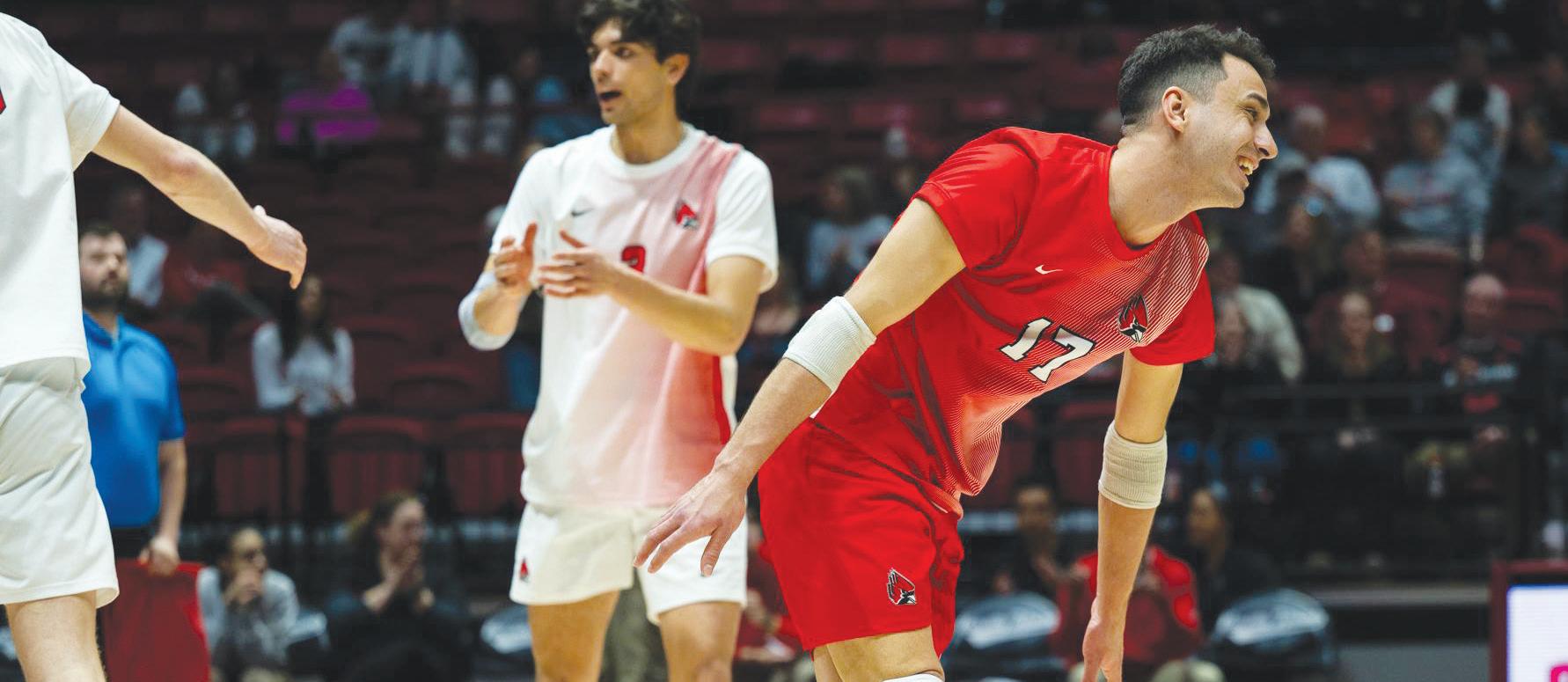





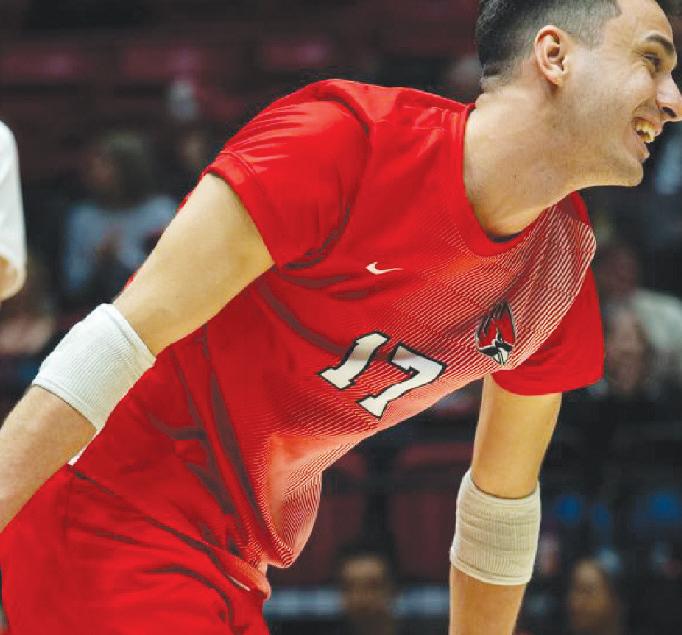
The Cardinals have had a successful first season under Mike Iandolo this school year.
Zachary Kendall Reporter
It has been a successful first season for the Ball State Men’s Volleyball team under first-year head coach Mike Iandolo.
The team has achieved a 20-3 record in the 2026 season. This came just less than a year after former head coach Donan Cruz stepped down and Iandolo was promoted.
The team fell in the first round of the 2025 Midwestern Intercollegiate Volleyball Association (MIVA) against Lewis University. Director of Athletics Jeff Mitchell had a decision to make about who would lead the Cardinals going forward.
He tabbed Iandolo as the man to lead the way.
Iandolo spent four seasons underneath Cruz as an assistant before being promoted to head coach, and success has followed him into the position.
“Attention to detail and accountability [have] made a big difference. We play tighter as a unit and are a little more locked in with our schemes and game plans,” Iandolo said.
Despite the success, Iandolo said he knows the team still needs to tighten things up as the MIVA tournament approaches.
“We need to be better at finishing games. When we have leads at the end, we just [have] to finish a little quicker,” Iandolo said. “We just [have] to keep bringing the defensive intensity for our group. That makes a big difference in how much effort we’re putting into our blocking defense.”
Iandolo was praised for the roster makeover that took place over the prior offseason. The Cardinals added several new players and coaches to what they had been building. However, the expectations


have not changed, and neither has the preparation.
“When we have had some guys that have struggled here and there … we’ve had some guys been able to step up and maintain our level of play and still allow us to win games,” Iandolo said.
“Our seniors and older players are doing a pretty good job of leading the group.”
The Cardinals have two more games left in the regular season before the MIVA tournament kicks off, and Iandolo is not letting the team take these games any more lightly than others. The opportunity is there for the Cardinals to carry momentum into the tournament.
“We don’t get to Loyola [University in Chicago] unless we beat Lewis [University]. It’s how it’s been all season; we’re trying to win every game, and what’s in front of us is Lewis,” Iandolo said.
“That’s what we’ve been talking about doing all year, so the conversation hasn’t changed. It’s just now is the time.”
Sophomore outside hitter Wil Basilio has grown more into a leadership role despite being an underclassman. He said he saw how last season’s results played out and is looking to help lead the Cardinals to a big bounce-back, especially with the end of the season being played at Worthen Arena.
“It’s super nice. It’s always a good thing to be at home,” Basilio said. “Just sleeping in your own bed, you get to serve and pass the morning in your own home gym. It’s also a tough environment for teams to come in, especially big games versus Loyola, so I’m sure we will get a big crowd.”
Over the course of a long season, a team bonds especially well if winning coincides with that. The chemistry building has never been a problem for the Cardinals, and this season has shown that. Playing closer games and having a tighter unit puts

the Cardinals at the top of the MIVA standings late in the year.
“I think the biggest thing is we all genuinely like each other. That just makes it easier to come in and work hard in practice and push through days we don’t really want to,” Basilio said. “It’s the genuine relationships that we’ve built; [it] really helps with all the stuff on the court.”
The record for the Cardinals speaks for itself, but the team’s confidence level shows through each set and each match.
“I think we’re super confident. We’ve had a good series on the road, and we are finishing off two games at home,” Basilio said. “I think the fact that we are able to take care of business on the road puts us in a comfortable and confident spot to win these last two home games. Having a big crowd is always a big help for us, and we’re definitely feeling good, feeling happy going into these games.”
Senior outside hitter Patrick Rogers has been a standout player for the Cardinals all season long. Rogers led the team last year with 363 kills, doing so with 15 or more kills in 11 games. He also totaled 193 digs to a career high of 15 against McKendree, receiving honors such as All-MIVA first team, MIVA Offensive Player of the Week and honorable mention on the American Volleyball Coaches Association All-American Team.
He has continued that play with close to 300 kills this season and he said he has thoroughly enjoyed the team’s success during his final year.
“It’s so awesome to be able to help the team [be the] best while I can, and we’ve all been playing so great,” Rogers said. “So it’s kind of easy for me to play well when everybody else is playing so great.”



Sports move fast, and with the MIVA tournament on the mind, so is the early loss in last year’s tournament for the team and Rogers. However, he is using it to help fuel his play even further to make sure that it does not happen again.
“We learned the most from our losses and we know now we can’t take any team lightly or any game lightly,” Rogers said. “We could just win versus anyone when that’s not the reality like last year. We lost to Lewis in the quarterfinals so we have to stay on the gas and keep moving forward.”
One can learn a lot about their team through the course of a season. It is a journey that Rogers said he is on with all of his teammates, where they want to go to battle with each team and just have fun in the process.
“We’re all just best friends, and we just like each other. So it’s just going out and literally having fun with your best friends,” Rogers said. “Nothing is really better, and being a senior, I’m trying to enjoy it as much as I can while we still have some games left. I’m looking forward to the MIVA and, hopefully, the national tournament with them as well.”
The Cardinals are in a prime position for some home court in the MIVA tournament. Rogers said he knows that is huge for the team, so the Cardinals need to stay focused.
“It’s so important for us. Obviously, we’re undefeated at home and the fans show so much support, and that is huge for us on the court,” Rogers said. “We feel that energy, especially when we’re playing well. So it’s our main focus right now, and Lewis is in the path for that to happen, so we’re excited to play [them] on Thursday.”
Contact Zachary Kendall via email at zachary. kendall@bsu.edu. or on X @ZacharyKendall_.
















Through grief and tragedy, Ball State student Sam Neiger uses his love for music to persevere.












Sean Behling Reporter
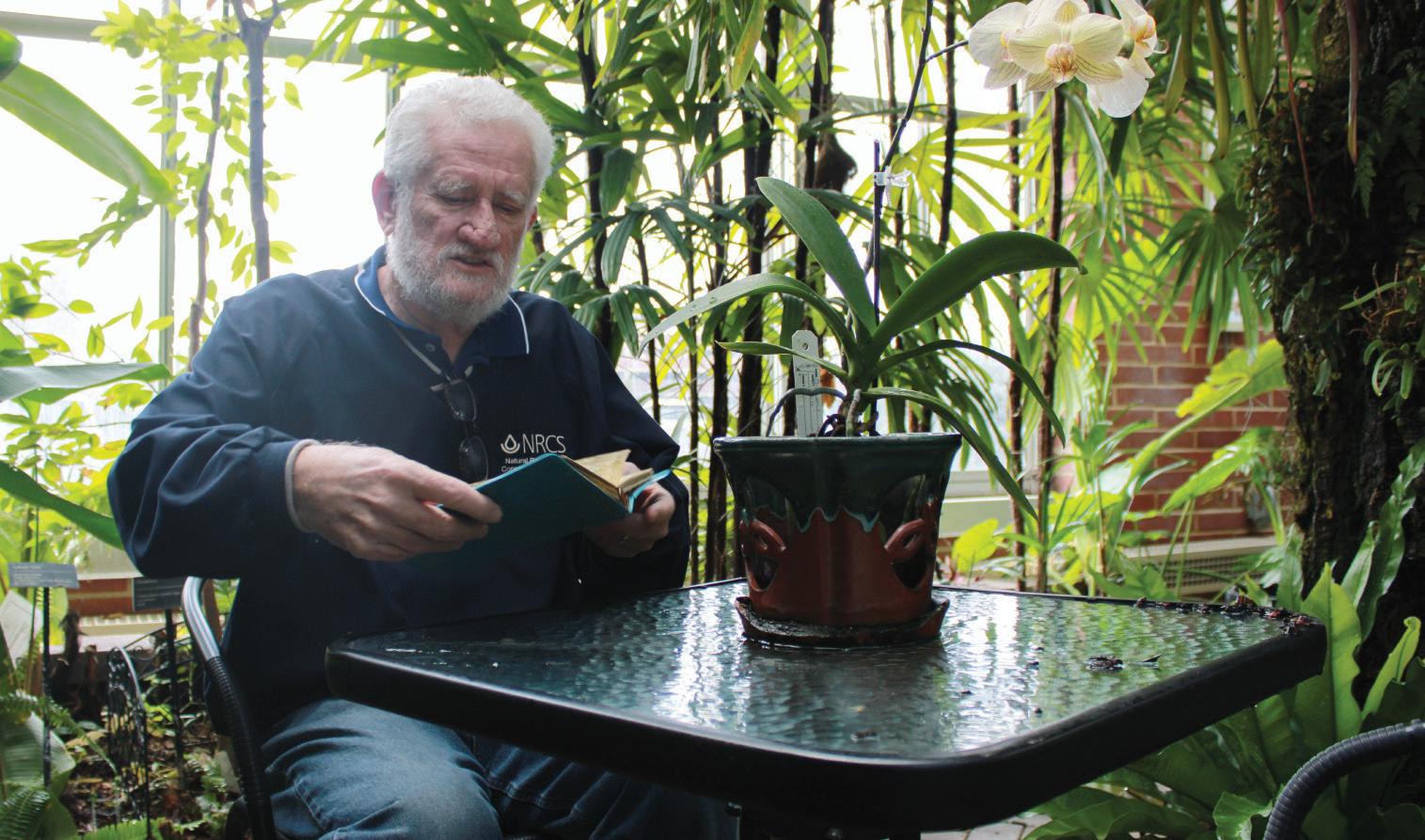
Growing up on a livestock farm in Jennings County, Indiana, Gary Struben initially went to Purdue University for turf management. However, it was not what he expected. It was not until he took a soil science class during his second year that he experienced what he called an “organic connection.”
Struben said he saw the correlation with his own experiences on his family’s farm, and he could also see the application and importance of soils in agriculture as a whole. That class was over 50 years ago. Now, Struben is a retired soil scientist from the United States Department of Agriculture (USDA) and teaches at Ball State University’s School of Earth, Atmosphere, and Sustainability.
After working for two summers as a student trainee soil scientist, Struben graduated from Purdue in 1977 with a bachelor’s degree in soil science and agronomy, which he said is defined as the production of plants in agriculture.
Around that time, the USDA was updating each state’s soil maps as part of a nationwide soil survey. This process took a lot of time and effort, giving him a wonderful opportunity to enter the field and be hired by the USDA. By 1986, the organization had finished surveying the state of Indiana, allowing Struben and other soil scientists to be transferred to other states to help with their surveys.
Struben worked in 22 states throughout his career, giving him significant experience in working with a diverse range of soils.
‘Soil health matters’
These soil maps have been vital for several
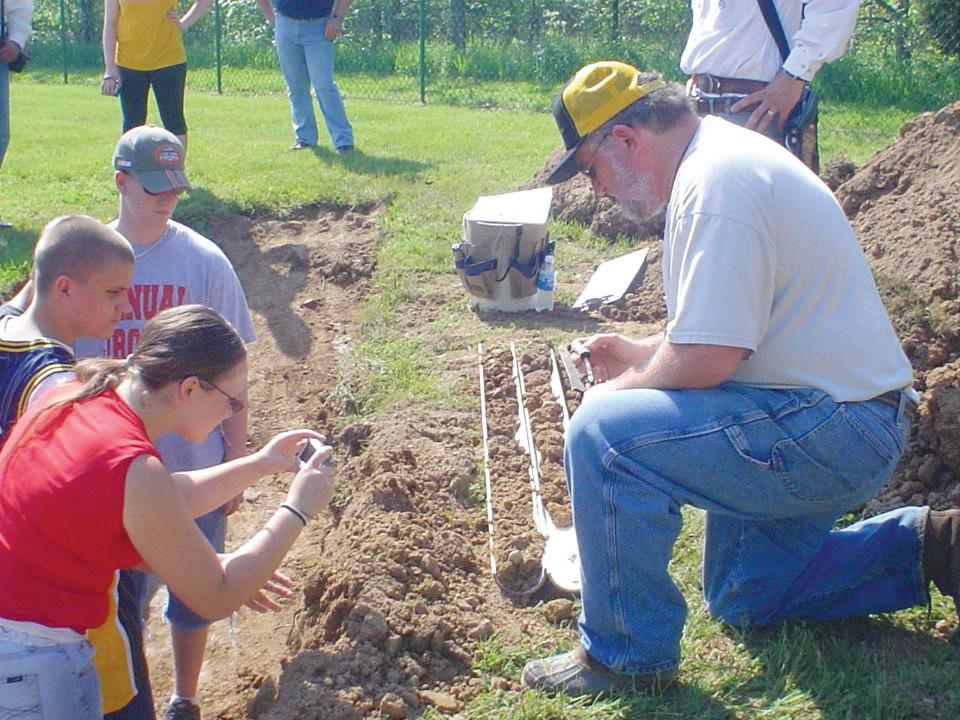
Retired soil scientist Gary Struben is now an adjunct professor at Ball State.
different purposes, allowing for quicker and easier understanding of the complex ways soil types mix and dot across the landscape.
The Natural Resources Conservation Service explains that soil performs five essential functions: regulating water, sustaining plant and animal life, filtering and buffering potential pollutants, cycling nutrients and providing physical stability and necessary support.
These functions are at a growing risk; however, as the International Soil Reference and Information Centre reported that rapid growth of the global population “has put unprecedented pressure on the use of soils,” leaving about a third of all soils in the world “moderately to highly degraded.”
As Struben summed up, “soil health matters,” and the soil surveys allow for a uniform standard with which to assess them.
After all the soils had been mapped, they still needed to be digitized later once the technology became available. One of the biggest changes in soil science that Struben said he has seen over the course of his career is Geographic Information Systems (GIS).
GIS is a digital tool that allows for the mapping of geographic features, including soils, on a precise grid map of the world. It takes a lot of guesswork out of mapping where soil types start and stop and makes these resources immensely easier to read, he said.

Another major change, Struben said he noticed, was the introduction of light detection and ranging (LIDAR) technology to accurately measure the contours of the landscape.
Part of a soil scientist’s job, Struben said, is reading the landscape and looking for areas of runon and run-off. Due to this factor, he said it makes
sense that more accurate sensing that works well with the comprehensive nature of GIS maps would be a game changer.
As his career continued, Struben moved from field work into more administrative management positions, working with at least 50 different state, federal and private organizations. In 2011, he became the state soil scientist for Illinois, and in October 2012, he became the State Soil Scientist for Indiana. This was the position he held until he retired from the USDA in 2018.
When he retired, he also celebrated being cancerfree for a year.
In 2017, Struben had a Neuroendocrine tumor (NET) in his pancreas, which had to be removed via a surgery known as a Whipple procedure. Luckily, the tumor was able to be removed with no chemotherapy or radiotherapy, and he has remained cancer-free ever since.


Zach Carter Reporter















and enjoying each other’s company, some kind of music played in the background.
high school, and at first, he was not sure what to do with them.
Sam Neiger could not believe what he was seeing. It was Oct. 20, 2025, when he stood in Tufts Schildmeyer Funeral Home in Loveland, Ohio. As he watched the number of people who made their way through the doors, something was cemented in his mind.
His mom, Heather, was loved.
“You live, and you go to a couple of funerals. It’s just something that happens,” Neiger said. “ I have never seen a turnout at a funeral like the one that I saw at hers. That was a total testament to her.”
Heather passed away Oct. 16 after a year-long diagnosis with breast cancer. A 15-year teacher at Walnut Hills High School, a travel team soccer head coach and a former soccer player herself at Ohio State University, Sam said his mom found “what she loved” in her life.
At that time, Sam’s interest in music was growing. Though he is a fourth-year broadcasting major and a Sports Link play-by-play announcer, the thought of continuing his talents with his guitar is more prevalent than ever.
He currently posts covers and some originals on social media, and he said it makes him feel something deeper. Something that keeps Heather’s memory with him.
“She’s the reason I still do it,” he said.
‘The door is open’
It all started when Sam was a child.
Living in Cincinnati, Ohio, his aunt and uncle — Laurie and Kirby — lived five minutes down the road. He was at their house nonstop, and Sunday dinners became a regular occurrence. While eating
It did not matter the genre. Whether it was country, rock or something else, music was always there.
“I connected with it in terms that it was very comforting,” Neiger said. “I almost associated it with Sunday dinner itself. Growing up, that stuck with me.”
Laurie said that Kirby, Sam and she will find concerts to attend when he is back home. No matter the location or who is playing, any kind of interest turns into a night full of music for them.
“That’s one of our favorite hobbies or passions that we love,” she said. “We’ve always loved music.”
Though he loved music from a young age, he also enjoyed the thing he is majoring in at Ball State: broadcasting. Sam was the Sportslink’s play-by-play announcer for Ball State Women’s Basketball, and he covered the Cardinals for his entire time in Muncie.
Before eventually calling the last four years of the program — including the 2025 MidAmerican Conference (MAC) championship team — he received his first opportunity during the COVID-19 pandemic. His former soccer coach asked him to announce matches for Facebook livestreams due to limited attendance.
Up to that point, Neiger’s only experience was sitting on the soccer bench and calling games when he was not on the pitch himself.
But after covering more and more games and other sports, he said he was hooked and decided to continue in college. Even when this was going on, Sam was still “addicted” to music. Both of his grandmothers gifted him guitars when he was in
That changed when he brought the two instruments to Muncie.
“I just kind of realized how much I liked [music], and then I was driving my roommates crazy,” Neiger said.
His mindset around songwriting began to change as well. It started as Sam wrote about different things in and around his own life. He said it also helped that he enjoyed reading about writers of the past and how they honed their craft.
Throw in the moment he picks up one of his guitars, and the “freedom” he said he gets from the activity is heightened.
“It feels like a vessel that I can say something, that maybe otherwise I wouldn’t say,” he said. “I don’t necessarily think there’s one emotion attached to it over another, but it’s like the door is open to be able to say and feel whatever I feel like.”
Though Sam joked and said his sister, Claire, was not interested in his playing sessions, Heather was. She would sit down with her son and answer any questions he had about his musical ideas.
He said this is who she was, and it was her number one goal to make sure her children were loved and heard.
“She was unbelievably supportive in everything [my sister and I] ever did,” he said. “To a fault almost, everything she did was for us. I think the reason why I still do music for her is that when I first started, she was the only one who cared to listen.”
When her cancer diagnosis happened in












December 2024, nothing changed. Her love for her children and others never wavered. That included her son’s musical interests, and he played for her every time he was home.
Heather would stop at whatever she was doing and listen — just as long as he played her favorite song first: John Denver’s “Country Roads, Take Me Home.” It was the first song Sam learned to play.
“I would play it every time, and then she didn’t care what I played after that,” Sam said. “Even though my music foundation doesn’t necessarily come from her, some of my fondest memories with music come from hopefully bringing her a little bit of joy in what ended up being the last few months of her life.”
Though the turnout at her funeral inspired Sam, grief came with the inspiration.
Because of that, he said there was a time when he questioned things, including his faith. While he said he never doubted the existence of a higher power, he wrestled with what it really meant.
However, music acted as a crutch for him. When Sam first decided to post some of his jam sessions on social media, the first video was one explaining his background with music. Once again, he used music to relay his feelings.
His first post on his music page via Instagram came Oct. 23, just three days after his mother’s funeral. It was a cover of “Wanna Be Loved”, a song written and recorded by The Red Clay Strays. The lyrics of the main chorus are as follows:
“I just wanna be loved.
I just wanna be loved.
Can you tell me I’m worthy or important?
Am I working hard enough?
Oh, I just wanna be loved.”













Charlotte Jons is a second-year journalism major and writes “The Peanut Gallery” for the Daily News. Her views do not necessarily reflect those of the newspaper.
The term “thrifting” refers to a specific form of shopping in which all of the products are pre-owned or secondhand. These products can be just about anything: clothing, furniture, shoes, stationery, jewelry and knickknacks. Usually, thrifted items are waiting for their future owners in thrift stores, vintage stores or consignment shops.
While thrifting has always existed, recently it feels like it has been everywhere.
When complimenting people on their outfits, you may frequently hear, “Thanks, it is thrifted.” Friends and couples will go on “thrifting dates” looking for new items in filled shops, and people brag in public about the deals they got on their newest furniture, telling everyone who will listen how little they spent on something so incredible.
Yet, it was not always so popular.
There has been a lot of debate about the growing popularity of secondhand shopping and whether we should be shopping secondhand at all. Seemingly, many fall on one side of the spectrum or the other — either adoring thrifting and advocating for it or rejecting it entirely.
Newsweek’s February 2025 article highlights many beats of the debate, telling a story in which a plethora of online influencers referred to thrifting as “gross” or “poor,” and the ensuing argument. Digital creator Medina Colaku instigated the full conversation, defending thrifting against those who saw it negatively.
The ongoing online debate proves the controversial nature of thrifting.
For many, thrifting is solely about wearing used goods, making them “dirty” simply by being previously owned, regardless of their condition, ability to be cleaned or restored, or who their previous owner was. Others see secondhand belongings as “less than” because they are cheaper or lower in quality than brandnew items, even if that is not actually the case.
I have been thrifting for most of my life and will always defend thrift shopping. I spent so many weekends
throughout my childhood hitting every thrift store in town with my mom. Even when I return to my home state and town during college breaks, thrifting is one of the first activities I do with my friends and family.
There are many advantages to vintage shopping, which makes the explosion in thrifting popularity easily explainable.
Savers Value Village explains in their 2024 Thrift Industry Report that nearly 90 percent of consumers have shopped or donated at a thrift store, and nearly one in three have thrifted in the past year. Over 40 percent of Generation Z (Gen Z) are regular thrifters, the report says, with the U.S. secondhand market reaching an estimated $61 billion by 2026, driven by value and sustainability.
Many new enjoyers see thrifting primarily as a political movement.
In a world where overconsumption and fast fashion have become major issues, the ability to give goods that are already created and waiting for a new owner a second life is especially enticing.
Goodwill’s blog applauds this intentional decision that many thrifters are making when shopping secondhand, especially noting Gen Z as a community largely advocating secondhand shopping for environmental and consumer benefits over fast fashion.
“With a keen awareness of what’s wrong with fast fashion, this generation is not just looking for unique pieces but also considering the ethical implications of its purchases,” the blog says. “By choosing secondhand, people in Gen Z are making conscious decisions that align with their values, including fostering a culture that prioritizes community and sustainability over disposable trends.”
Additionally, the unique qualities of vintage items make the thrifting hunt much less predictable than standard shopping trips. In shops filled with donated items, there is no guessing what someone might find when stepping through the door.
I have personally left vintage stores with prom dresses, pricey vintage denim, vintage movie posters, lamps, sweaters, suits and humorous T-shirts — none of which I entered the shops looking for.
The unexpected nature of thrifting can make it especially exciting, adding the thrill of a hunt for something interesting to a shopping trip.
There is also a significant financial benefit to visiting thrift stores for new items because previously owned items are often, by nature, less expensive.
Compared to entering a department store and
purchasing a pair of name-brand jeans for over a hundred dollars, a thrift store could provide several pairs of used jeans, as well as other items, for not even half the price of a new pair.
There is also an inherent privilege to being able to dislike thrifting when, for many who thrift often, it is the only choice because of the lower price tag.
For me, thrifting was an easy way to get new outfits for cheap while my body developed. I also grew up partaking in dance and theater, making secondhand shopping an easy way to put together new performance costumes that tend to run expensive when purchased new. I have always been style-oriented and have placed importance on looking my best, and thrifting has been a great tool for finding unique pieces that fit my style.
Thrifting will always have a special place in my heart because of the culture and community. As a child, being able to pick out and try new looks was crucial in finding my own personality and style.
I have always been able to connect with others through my fashion, and thrifting has always created a unique avenue for conversing with others who find the advantages of secondhand shopping equally valuable. My favorite outfit conversations are usually the ones that begin with me explaining what thrift store a specific piece came from, and then someone else telling me about their own favorite thrifted finds.
Now, as I begin to enter adulthood, thrifting has remained a conscious decision to save my wallet, be environmentally conscious and continue to enjoy my community.
My biggest advice for those hoping to begin thrifting is to simply show up and see what you find. There is no controlling what might be in a store on a given day, but rolling up your sleeves and getting in the room is the right first step to finding something special.
Digging through racks of used clothes or trinkets without any idea what will be found can seem intimidating, but beginning the search is the fun part. Pack hand sanitizer, bring a friend or two and begin the hunt!
Planet Aid also urges readers to join the culture of thrifting, no matter what they are looking for. They close their story with a strong sentiment: “Thrifting culture is more than a trend — it’s a lifestyle shift toward sustainability, creativity, and community.”
Contact Charlotte Jons via email at charlotte.jons@ bsu.edu.
Continued from Page 10
“I worked another year after my surgery because I wanted to prove to myself and other survivors that life could continue at a high level after cancer,” he said.
After a few years of retirement, Struben was called to teach at Ball State University, though it had not been his first time.
In 1996, when the USDA collaborated with scientists at Ball State on a joint project that involved sampling soils to test for an element called Radon, Struben worked as part of the USDA alongside Hugh Brown, a soil scientist and professor at Ball State.
A few years later, in 2000, Brown went on sabbatical and called Struben, asking if he could teach his soils class that semester. Struben agreed and proceeded to teach the class at night since he still had his day job as a soil scientist. He continued to teach on and off for the next few years, including when Brown left Ball State in 2009.
After that, Struben stopped teaching for a while since the position was eventually filled. He was not available between 2011 and 2012 due to his work in Illinois and “there was not really a need or opportunity for me” at Ball State, he said.
It was not until the spring semester of 2020 that Struben returned to Ball State at the request of Department of Biology Chair Tim Carter.
Struben said his time teaching at Ball State has “not been that big of an adjustment.” He said his experience in the field makes him more than qualified to talk about natural resources, and especially soils.
“I don’t think it was really too hard, because of the subject matter. You know, I could talk soils all day because of my experience,” he said. On top of knowing about soils, he is also experienced in talking about them, since he said outreach work to educate people is part of a soil scientist’s job.
That is not to say it was not an adjustment. At first, Struben said he assumed that all students who took classes such as Geology 101 were majoring in related fields. He did not realize that many of the introductory courses included students
of all majors, many of whom were taking it to fulfill a science requirement.
He said he also had trouble structuring class schedules.
“What works one semester with one class, the exact same class and the exact same subject matter, kind of falls flat the next semester,” he said.
Struben said his style of teaching emphasizes the application of concepts learned in class, building off his own observations in the field. In addition, he said he likes to invite guest speakers to present to his classes, making use of the connections he has built over his career.
He also swaps ideas with other professors for help in the classroom.
“I work hard to collaborate with other professors, obviously, as far as teaching methods and stuff. I’m very technically sound, but I don’t feel like I’m always as creative as I’d like to be in the classroom, so I’m always looking for ideas,” he said.
Jessi Haeft, who works alongside Struben, said that Struben is an “absolute legend” in the field of soils.
“He was the state soil scientist for many years and taught a lot of active soil scientists during his career. He also taught my classes when I was on maternity leave and did an incredible job,” she said. “He brings a lifetime of experiences to the table. I consider him an incredible colleague and friend.”
Throughout this lifetime of experience, including his time at the NRCS and his time at Ball State, Struben said his favorite part of both has been the people.
“In the NRCS, we had a family atmosphere, and we still do. Retirees still get together, and I am still involved in soil science associations throughout the state. It is a similar thing with teaching,” Struben said.
Despite this appreciation for the social side of things, Struben recognizes that not everyone he teaches will make the same connections.
“The other thing you realize when teaching is you’ve got 24 students in a class, and you’re not going to have the same effect on all 24. But, if you can really make a significant difference with a handful, you’ve done your job. All 24 aren’t going to leave that class and say, ‘well, this is the best class I’ve ever had’ and that’s not really what you’re after. You want them to learn and hopefully you can help them beyond just the subject matter.”

Continued from Page 14
Neiger said this song helped him find peace, and it validated his love for music while keeping his faith intact.
“If you read the lyrics, it’s a gospel song. The narrator wants to cement his worth in the eyes of God,” Neiger said. “This is a really sad way of putting it, but I wanted to feel whole again. I felt like there was a piece of me that was now missing, and that song is a cry out to God.
“I just felt like it helped contextualize where I was coming from in my life at that time. Like I wanted to feel loved. I wanted to feel whole again. Though the song doesn’t come to an end in a way that provides answers, it doesn’t mean that I can’t find therapy in it. That was what appealed to me about it.”
‘It will give back to you’
It is very common for Sam to be in his room for hours with his guitar.
“I’ve tried to keep it authentic. But I think one of the things as a songwriter where I’ve fallen flat so far is trying to write about my mom,” he said. “I think I’ve done it in an okay way for where I’m at. But it’s hard to tell a 21-year-old to contextualize what losing your mom means.”
Though the interest in doing music after graduation was not something he necessarily considered at the beginning of college, Sam said it continues to grow as his writing gets more in-depth. Yet, there is one defining factor. While he has not made a decision just yet concerning his future, following Heather’s footsteps and living a life he is proud of is at the forefront.
“For the chance to get to a stage like an Al Michaels or a Mike Tirico and to be able to truly contextualize sports how I want to, I’ve had to wrestle with myself,” Sam said. “Do I think it’s worth it to live the life of meaning that I saw my mom live?
Contact Sean Behling at sean.behling@bsu.edu.
“Sometimes I feel like a hermit,” he said. His roommates will listen to his music, and he said sometimes it is voluntary, while at other times it is not. But they enjoy it all the same. If someone who has never been over to the house pays a visit, they will ask Sam to provide the entertainment nine times out of 10.
He laughs, but he said he enjoys it.
“They’ll try and embarrass me,” he said. “They’ll tell me to go grab the guitar and play X, Y and Z songs … Then I’ll go grab it and play the said songs.”
He said the largest crowd he has played for is six to eight people, and he hopes to change that sometime by taking the stage in front of a bigger audience. With his songwriting abilities improving, Sam said he hopes to debut some originals as well. However, he said he wants to tap into his deeper self with some of his own music. This includes Heather’s passing.
“She wasn’t doing anything famous, but she found what she loved in being an inner-city science teacher for seventh grade students.”
Whatever that decision is, the days ahead do not change anything in the way music has aided Sam. That includes the way it has been there for him throughout the last few years, and it has continued to hold him up while navigating the uncertain path that death leaves behind.
Combine that with the way Heather lived her life, and it has made Sam the man he is today.
“Relationships are super important, and when you lose somebody like your mom, who is one of the big-pillar relationships, having those other relationships is really important too,” he said. “When it comes to finding the thing that actually helps you deal with grief, pour into it, because it will give back to you.
Contact Zach Carter via email at zachary. carter@bsu.edu or via X @ZachCarter85.