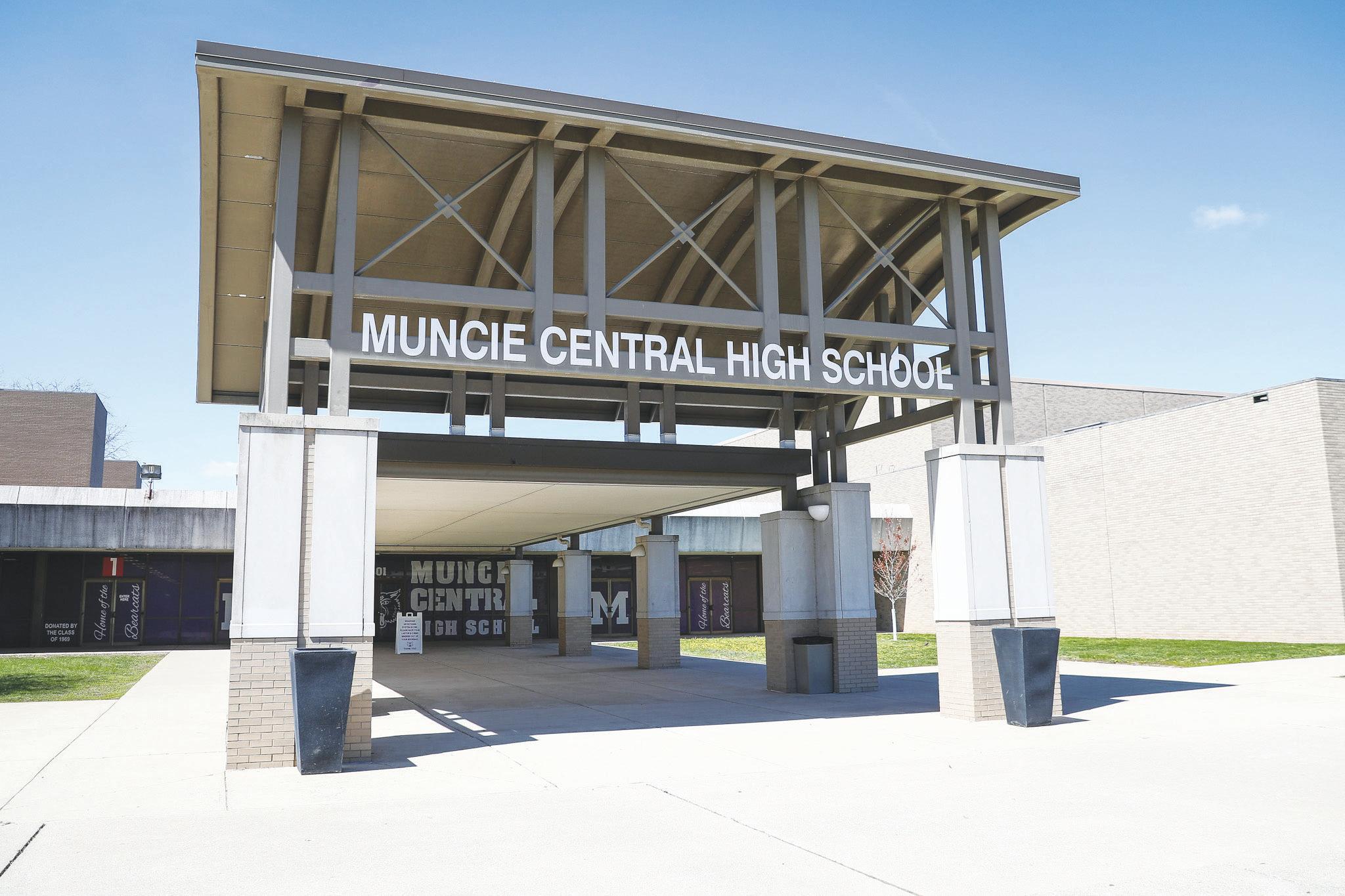
A historical building, the field house at Muncie Central has been under construction, and has added many modern amenities. 08
Ullom’s Delaware County journey
Longtime basketball head coach Justin Ullom has spent 12 seasons in the area, leading three different schools. 06
School Funding
SEA1 negatively affects finances for Indiana schools. 13 DNNews
MCS’s Montessori school, Forest Academy, sees success among students and families during its pilot year. 10
Forest Academy student climbs over a wood pile during recess
31 at Camp Adventure in Muncie, Indiana. KADIN BRIGHT, DN
KYLE INGERMANN, DN
BallStateDailyNews.com
VOL. 105 ISSUE: 28
CONTACT THE DN Newsroom: 765-285-8249, editor@bsudailynews.com
EDITORIAL BOARD
Meghan Braddy, Editor-in-chief
Katherine Hill, Managing Editor and Lifestyles Editor
Linnea Sundquist, News Editor
Kyle Stout, Sports Editor
Rylan Crum, Associate Sports Editor
Jayden Vaughn, Opinion Editor
Charlotte Jons, Associate Opinion Editor
Channing Matha, Copy Editor
Kyle Ingermann, Multimedia
Editor
Kadin Bright, Associate Multimedia Editor
Ryan Fleek, Associate Multimedia Editor
Brenden Rowan, Visual Editor
Jessica Bergfors, Associate Visual Editor
Raquel Ruffin, Associate Visual Editor
Corey Ohlenkamp, Adviser
The Ball State Daily News (USPS-144-360), the Ball State student newspaper, is published Thursdays during the academic year except for during semester and summer breaks. The Daily News is supported in part by an allocation from the General Fund of the university and is available free to students at various campus locations.
Call 765-285-8134 between 9 a.m. and 3 p.m. Mon. -Fri.
Subscription rates: $45 for one year. POSTMASTER: Send address changes to Daily News, AJ278, Ball State University, Muncie, IN 47306
JOIN THE DAILY NEWS
Stop by room 278 in the Art and Journalism Building. All undergraduate majors accepted and no prior experience is necessary.
EDITORS FROM THE A COMMUNITY IN COLLABORATION
The Partnership Paper Edition highlights the shared impact of the relationship between Ball State and Muncie Community Schools.
CORRECTION
The Ball State Daily News is committed to providing accurate news to the community. In the event we need to correct inaccurate information, you will find that printed here.
To submit a correction, email editor@bsudailynews.com.
In spring 2018, Ball State University assumed control and management of the Muncie Community Schools (MCS) District through a historic partnership authorized by the Indiana General Assembly.
Since 2019, The Ball State Daily News has devoted one of its editions every year in late spring to commemorate the partnership and highlight various MCS initiatives and happenings in what we call “The Partnership Paper Edition.” This 2026 edition marks the seventh MCS Partnership Paper Edition produced by our publication.
A number of MCS teachers are Ball State graduates, and many MCS students go on to pursue higher education there. Thus, the stories in this edition underscore the interconnectedness of the Muncie community and the circulatory nature of the education systems.
Beyond just documenting what is happening at the schools, the Partnership Paper also serves as a bridge between the campus and the community. It gives readers a better understanding of the partnership’s real impact through the lived experiences of the MCS community.
This year’s Partnership Paper reflects that mission through a wide range of coverage. Stories in this edition include a look at the Montessori program serving young learners, a profile of a head coach shaping student athletics and updates on the ongoing renovations to Muncie Fieldhouse.
The edition also features a letter from the MCS board president, along with reporting on how property taxes are affecting school funding. In addition, coverage of a master’s program for MCS teachers highlights efforts to invest in educator development and long-term classroom success.
Together, these stories show the many layers of the MCS experience, as well as the understanding that the people, policies and places shape it every day.
For us at The Ball State Daily News, this edition also represents a responsibility. Covering MCS every year in this capacity means reporting on a community that many of our readers are directly connected to. That is why the Partnership Paper is more than just a tradition for us. It is an ongoing commitment that we work our hardest to execute every year, and we will continue to do so for years to come.
As Ball State continues to work with MCS, it is important to us that what forms out of this relationship be shared with the public. This means recognizing all of the progress that has been made, as well as the ongoing challenges that come with it.
Thank you for taking the time to read this year’s Partnership Paper and for engaging with the stories that reflect the ongoing connection between Ball State and Muncie Community Schools.
MEGHAN BRADDY, EDITOR-IN-CHIEF KATHERINE HILL, MANAGING EDITOR
Hinderer, Weather forecaster, Benny Weather
Ball State offers a Master of Arts in Education through the Leadership Pipeline program at Muncie schools.
Jeremy Coleman teaches in the Muncie Career Center March 31 in Muncie, Indiana. KYLE INGERMANN, DN
Kyler Effner Reporter
Ball State University and Muncie Community Schools (MCS) have joined forces to bolster the district’s Leadership Pipeline program.
As a part of the collaboration, Ball State has offered tuition at half price and additional guidance and support for MCS K-12 educators to obtain their Master of Arts in Education (MAE) in Educational Administration and Supervision.
Eric Grim, the assistant superintendent for MCS, expressed that this addition to the Leadership Pipeline emerged from the school corporation’s desire and need to see internal applicants fill leadership positions within the district.
“Out of a need we had seen here in the schools — where we would have some potential assistant principals, some of those entry level, administrative positions open, and a lot of our teachers weren’t applying and really weren’t qualified for those positions through their degrees — we reached out to Ball State to set up this pipeline that we have going now,” he said.
The current program participants take part in online courses taught by Ball State faculty alongside their other cohort members, so that they may foster a leadership community and further build rapport and support postgraduation.
Leadership events are also provided through the program, such as “Team Day” last fall, where members of the educational cohort discovered their leadership styles and compared and contrasted others’ with their own.
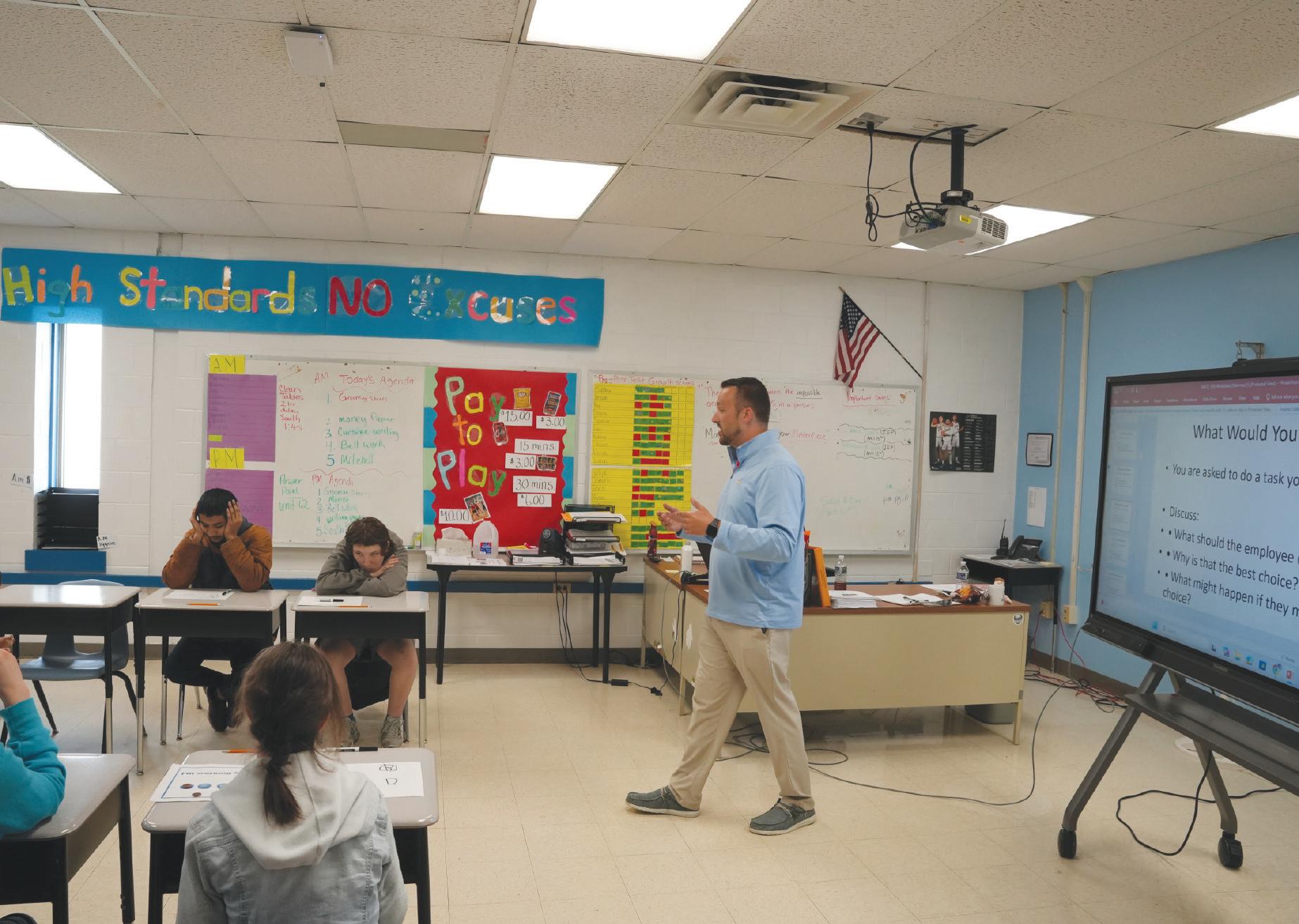
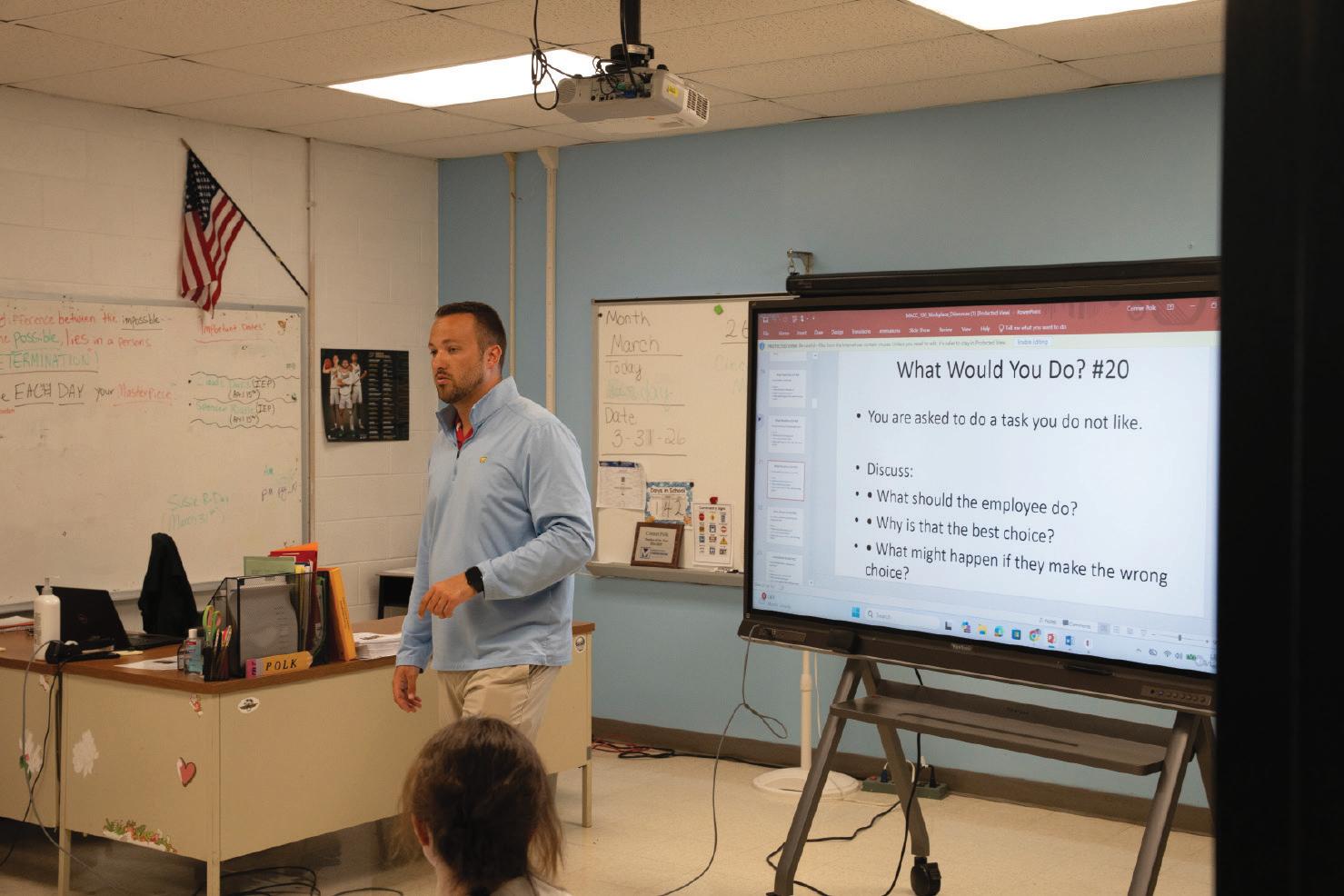
Conner Polk, a special education teacher at the Muncie Area Career Center (MACC) and a member of the initial educational cohort, participated in this event and noted the value of understanding both his own approach to leadership and that of his classmates.
“You are going to have all kinds of different styles of leadership in your building, and it is up to you as the school’s leader to make the puzzle pieces fit together in the best way possible,” Polk said.
Polk was also provided the opportunity to fill in for Muncie administrators during their training day due to his participation in the Leadership Pipeline.
“The experience allowed me to see how quickly administrators must make decisions, communicate with staff and students and balance multiple responsibilities at once. It also helped me build confidence in handling situations that arise throughout the school day and reinforced the importance of being visible, supportive and solution-oriented as a school leader,” he said.
The program also has a set of incentives to encourage those who graduate from Ball State with their MAE to stay within the district and continue to contribute to the Muncie community.
“[We are] just looking for ways to retain teachers. If you send teacher leaders to a pipeline, and they become administrators, you hope that they’re able to serve in your district, whether they stay in the classroom, or whether they become administrators,” Grim said.
According to Ball State’s Aug. 12, 2025 press release regarding the program, these incentives include stipends for year landmarks that the educator stays in the corporation after completing
their MAE.
In addition to both discounted tuition and future pay incentives, MCS and Ball State have also promised further leadership opportunities and mentorship as a continuation of the support they plan to provide during the current cohort’s time in the program.
Jeremy Coleman, the official liaison for the Leadership Pipeline and assistant clinical professor in educational leadership, has had the opportunity to work alongside the Muncie educators during the two classes he taught as a part of the program in the fall.
In addition to Coleman, five members of Ball State’s faculty are consistently available to members of the cohort, so that they may have the best educational experience possible.
In addition to fostering collaboration between its faculty and MCS educators, Ball State has an additional goal of continuing to help the greater Muncie area through its support for its educators’ education.
“Now [leaders] can help teachers, and teachers can help families. So, in a way, it’s a beautiful virtuous cycle of empowerment and support of leaders. Those leaders can empower and support teachers, and hopefully those schools can empower and support those families and those communities inside of Muncie,” Coleman said.
Coleman not only stressed the importance of leadership and its role in the community, but also highlighted key traits that mark a good leader — ones that the program aims to highlight for participating educators.
“I believe a reflective leader is an effective leader,” he said. “So we do get in a lot of reflective activities and prompts in the cohort.”
Polk mentioned the program’s goal to “connect theory to the actual practice of being a school administrator,” which he, along with other educators, was able to learn and reflect on during Team Day. Discussion boards are also a part of the courses, adding to that reflective element.
Coleman also emphasized that “leadership is less of a role and more of a relationship,” especially when a role such as a principal or assistant principal in a building requires constant and consistent communication with both teachers and parents.
“We are interested in helping them discover how people experience them as leaders,” Coleman said. “Intentions are one thing, but how people experience you is really the mark of a true leader.”
The emphasis on creating “reflective and relational” leaders weaves through the program, as educators are surrounded by a support system both on Ball State’s campus and within their own district to better support them throughout their educational journey.
“Having support from both the district and the university has made the experience more meaningful and has helped me grow in confidence as I continue developing my leadership skills,” Polk said.
10 Muncie educators have participated in the first educational cohort that was created for the 20252026 school year and are expected to graduate with their MAE in the spring of 2027.
Contact Kyler Effner via email at kyler.effner@ bsu.edu.
Leadership is less of a role and more of a relationship.”
- JEREMY COLEMAN,
official liaison for Leadership Pipeline and assistant clinical professor in educational leadership
Jeremy Coleman teaches in the Muncie Career Center March 31 in Muncie, Indiana. KYLE INGERMANN, DN
Jeremy Coleman teaches in the Muncie Career Center March 31 in Muncie, Indiana. KYLE INGERMANN, DN
BIGGER BASKETBALL THAN
Justin Ullom has been a head coach in Delaware County for 12 seasons, impacting his players along the way.
Kyle Stout Sports Editor
Justin Ullom has been a high school coach for a long time. He has seen the ups, and he has seen the downs. A couple years ago, when he was a head coach at Muncie Central, one of his junior varsity players’ families had suffered a tragedy.
Ullom saw his team rally around the player, as well as the community, and a couple days later, the Bearcats defeated Richmond in a sectional playoff game.
“We stopped worrying about other things; we all saw each other,” Ullom said.
Those times are a big reason why Ullom got into coaching basketball.
Around the time he was in college, Ullom received a phone call from Paul Keller, his high school coach. He decided to give coaching a shot after Keller offered him the opportunity to coach middle school basketball at Delta. It was a time in his life before he had a wife and kids, and Ullom said he quickly realized how much he loved it.
“Just getting back in the gym and seeing how much fun you can have coaching basketball [and] how much fun you can have investing in young guys’ lives,” Ullom said. “I decided then that I wanted to try and find a way to be involved.”
Ullom played for Keller at Delta, and Keller said he was always a “smart player.” He said that it always felt like having another coach on the floor when Ullom was in the game.
“The fact that he became a coach certainly didn’t surprise me at all,” Keller said.
Even though Ullom was only a middle school coach at the time, Keller said he thought Ullom was “one of the best coaches he had.” So, it was
THE LADDER MOVING UP
Justin
and
no surprise to him how fast Ullom moved up the rankings at Delta after his initial first year coaching middle school.
“I wasn’t the head coach when he made those moves, but I did talk to the incoming head coach and I said, ‘Justin Ullom is one of your best coaches,’” Keller said. “He was more than capable of moving up the ladder.”
Being able to be a role model for high school kids has always been a passion for Ullom. He recalled times where he was able to reach out to his former coaches when “something exploded in life.”
Ullom said that even though years would go by without him talking to those coaches, he knew they were always a call away. He said that is something unique about coaching high school basketball, with the opportunity of helping kids realize the importance of not only basketball, but becoming an adult.
“You’re getting kids at a formative time in their life doing something they love,” he said.
While Ullom wants his players to realize the importance of playing high school basketball at a high level, he also wants to teach them lessons about what really matters in their lives, and he said coaching gives him the opportunity to do so.
“At the end of the day, this is basketball, it’s not who you are,” Ullom said. “It’s something you do and helping it to shape and guide you is okay, but to let it become your identity is not generally a good place to be.”
Ullom spent four years at Delta High School as a freshman and junior varsity coach, and in 2014, he was given the opportunity to begin his head coaching career. He coached with former head coach Stan Daugherty at Delta, and when the Monroe Central job opened,
Daugherty recommended Ullom to the school’s superintendent, saying that Ullom was “ready.”
Even though Ullom said he was not sure if he was ready for the job yet, Monroe Central decided to hire him.
“I don’t know when you are ready,” Ullom said. “But it was a great fit for me.”
Daugherty said he saw Ullom mature the most when he started at Monroe Central. He was not coaching with Ullom at the time, but when he went to Monroe Central games to watch, he noticed Ullom’s “coaching presence.”
“He had a really good coaching presence,” Daugherty said. “He had a good mind for the game [and] he had a plan.”
Daugherty said he saw an exponential amount of growth from Ullom’s first year working with him to his first year as a head coach, and he said he has seen that continue in each year of Ullom’s career.
“Justin [Ullom] was great because he wanted to learn and he was always asking questions [and] observing,” Daugherty said.
“Moving over that one seat” from an assistant coach to head coach was one that Ullom said matured him really quickly. He said that when he was thrown into that big of a change that quickly, the only choice he had was to mature.
Ullom said he realized off the bat how big a shift it was sitting in that head coach seat.
“It’s not just basketball,” Ullom said. “It’s yearround investing in kids, being there, supporting them, helping with any struggles they may have.”
With that shift, Ullom said his first couple of years at Monroe Central were like “drinking out of a fire hose.” He said instead of being someone who dishes out suggestions to the head coach during a game, he was the one making those decisions.
“When you’re in the seat, you’re taking
suggestions from maybe two or three assistant coaches and then having to make a decision, having to explain it, implement it, teach it and then get guys bought in on it,” Ullom said.
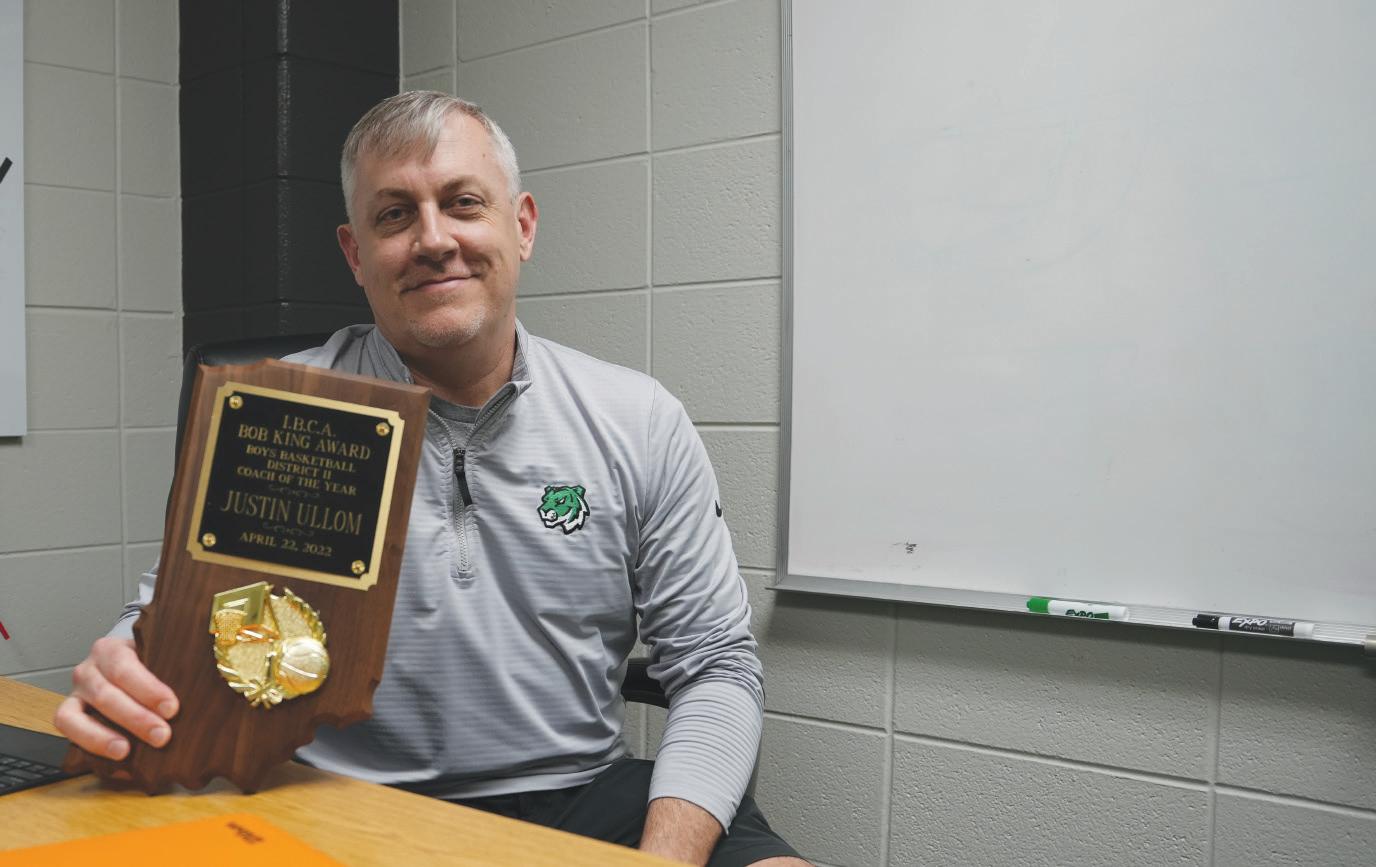
Despite the jump to head coach being a big one, Ullom saw a lot of success at Monroe Central. Ullom had a 25-1 season in 2021-22, and won IBCA district two coach of the year that same season.
He went 119-72 in eight seasons with the Golden Bears, won four Randolph County Tournament titles and took home the school’s first Alexandria sectional trophy since 2010.
After eight years at the school, Ullom decided to move on, taking an opening at Muncie Central to be the Bearcats’ head coach. The decision to move on from a place where he had been for nearly a decade was not easy, and it came with a lot of thought. Ullom has five kids, and three out of five play basketball.
Ullom said he has always had a great relationship with his third son, Justus, but he said he did not know if that would be the case if he continued to coach at Monroe Central. He said their personalities could sometimes clash on the court, and he valued keeping that relationship with his son.
“I had a great relationship with Justus, and I wasn’t sure I was gonna have that if I coached him, and that’s not fair to either one of us,” Ullom said.
Ullom said it was “really hard” for him to make the decision to leave the school knowing he would have to miss some of Justus’ games. He said initially, he thought taking a break from coaching could have been a path for him, but after conversations with his wife and a job opening at Muncie Central, Ullom knew he still wanted to coach.
“My wife really encouraged me to keep doing it, it’s something I love,” Ullom said. “She helped me realize that it’s something we think I’m good at.”
The difference in size between Monroe Central and Muncie Central is vast, and Ullom said he recognized that immediately. The Bearcats have what is called a feeder system into their high school basketball program, with two sixth grade teams, two seventh grade teams and two eighth grade teams.
Muncie Central is a historically good program, and Ullom said there was initial pressure when he first accepted the job.
“[There’s] been some great coaches through there, some great players,” Ullom said. “We wanted to just honor them in trying to do it the right way and get back to winning.”
Ullom had a shaky three years at Muncie
Central, as he led the Bearcats to a 31-41 record in three seasons. The expectations that he and his staff placed on himself were high, and Ullom said he was not sure he could live up to those after his third season there.
He said it was a “long three or four weeks” after the season ended, where he was going back and forth on if he should stay or leave. Once again, Ullom had the idea of maybe taking a break.
Then the head coach position at Yorktown opened.
“[I was thinking] maybe I’ll get back in [to coaching], maybe I won’t,” Ullom said. “The Yorktown job opened the next day.”
With the idea of taking a break from coaching in the back of his head, Ullom always recognized his love for the sport, and his love for coaching and that is what always brought him back.
“I love watching young men grow and become young adults,” Ullom said. “I love the challenge of putting a team together, figuring out what parts we have, where we excel, where our deficiencies are.”
Ullom has been all around Delaware County in his three trips, and he described it as a “basketball community.” Every place he has been, he said, he has felt the support from every community he has been in.
The head coach said he came into Yorktown with a great foundation laid out by previous head coach Matt Moulton, and Ullom is motivated to bring Yorktown championship hardware.
“I think the community is starving to cut down some nets,” Ullom said.
Ullom and the Tigers nearly did that in year one, as the team went 16-9 and fell just
short in the sectional championship to Delta 56-48. Even though the Tigers fell just short this season, Ullom said there is momentum in the community with all their athletic teams, and he knows he can win at Yorktown.
“You don’t have to look very far down the hall to know that it can be done here,” Ullom said.
Ullom said this year’s Yorktown team had “one of the best locker rooms” that he has ever had in his coaching career. He said the buy-in from his players made it easy to perform. Ullom said he noticed the community rallied behind the team when they were losing, and also when they went on an eight-game win streak late in the season.
The head coach said he learned an important thing in year one at Yorktown.
“This is a place I can see being a coach for a long time,” Ullom said.
Ullom said he wants to stay in high school coaching for the rest of his career. He said he knows it is the right spot for him, and he has seen the impact he has been able to have on players at the high school level, and vice versa.
Ullom said he wants his players to not only learn things on the basketball court, but also be able to apply them to their lives.
“I hope that I’ve made it hard enough and yet enjoyable enough for guys to take those lessons with them,” Ullom said.
Contact Kyle Stout with questions via email at kyle.stout@bsu.edu or on X @ kylestoutdailyn.
It’s not just basketball. It’s year-round investing in kids, being there, supporting them, helping with any struggles they may have.”
-
JUSTIN ULLOM
Justin Ullom poses for a picture alongside two of his sons and his wife after winning the sectional championship at Monroe Central in the 2021-22 season. JUSTIN ULLOM, PHOTO PROVIDED
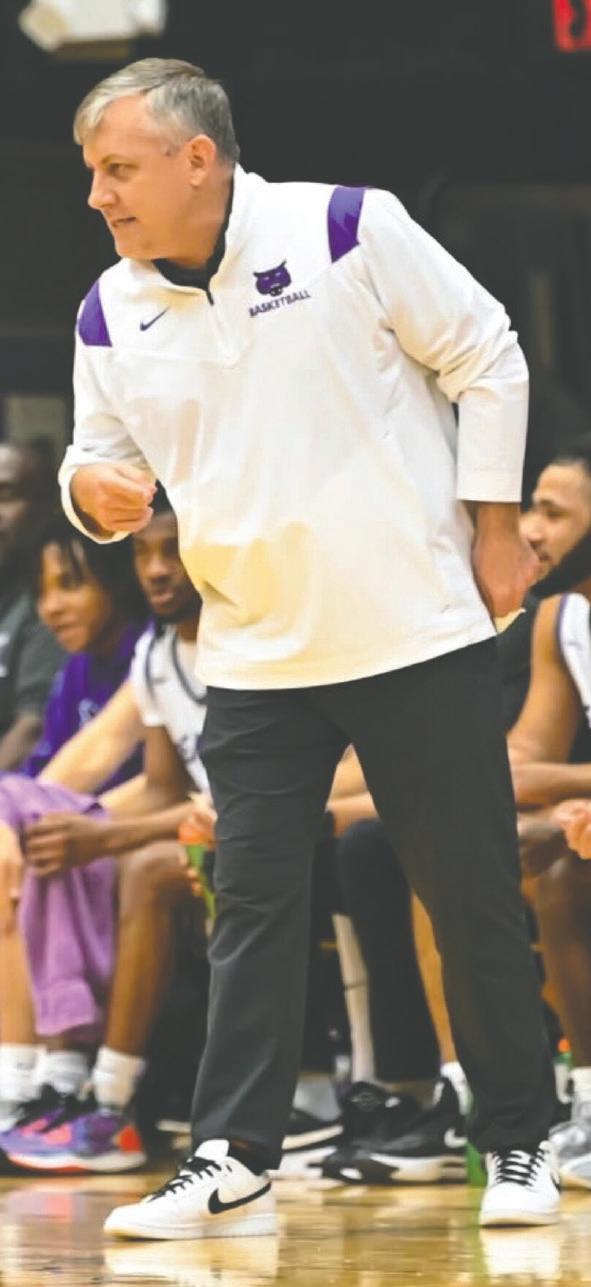
Justin Ullom coaches during a Muncie Central home basketball game. The Bearcats went 31-41 in three years with Ullom at the helm. JUSTIN ULLOM, PHOTO PROVIDED
NEW RENOVATIONS, SAME OLD SPIRIT
Muncie Fieldhouse debuts brand new amenities, with more still to come.
Rylan Crum Associate Sports Editor
In most communities, there is typically a landmark or a center that brings people together for community events. In Muncie, that spot is the Muncie Fieldhouse.
Built in 1928 with a 6,579-person capacity, the Muncie Fieldhouse has been home to the Muncie Central Bearcats since its opening.
However, in November of 2017, the fieldhouse sustained severe damage to the west end of the building, tearing up the gymnasium floor. Though this left the community wondering if that was the end of the fieldhouse, it was far from that.
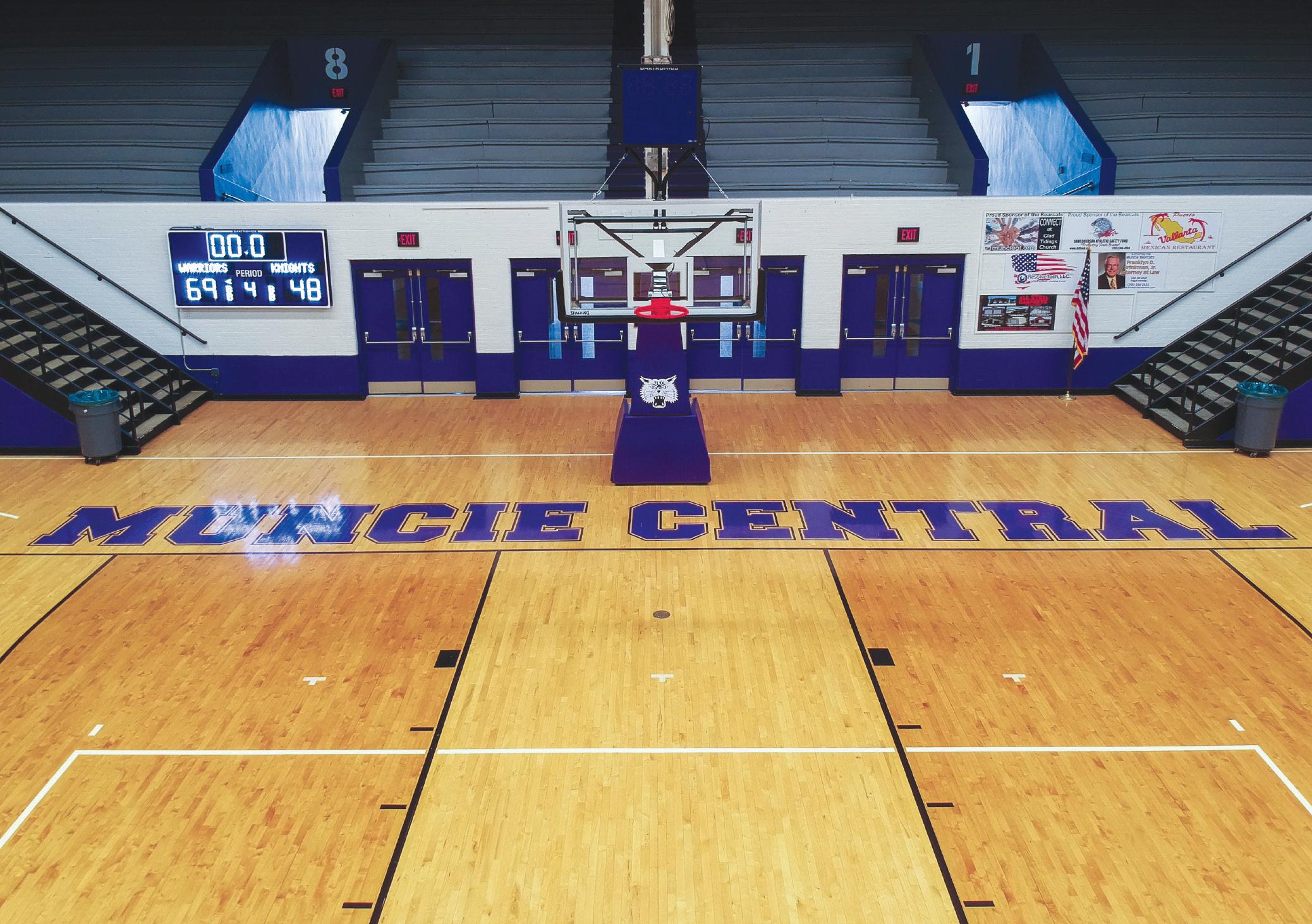
The Bearcats returned home to the Muncie Fieldhouse in 2019 after several upgrades. Even though renovations took time, the fieldhouse ultimately hosted the 2026 Indiana High School Athletic Association (IHSAA) Men’s Basketball Semi-State, during which it showcased its brandnew scoreboard and bleachers.
Chief Communications Officer of Muncie Schools Andy Klotz described the new atmosphere as “more modern.”
“The bleachers have been replaced on the court, the scoreboards are more visible and attractive, and those are just really the superficial changes that people notice right away,” he said. “We received a lot of feedback that people appreciate those upgrades there.”
While the fieldhouse now has updated bleachers and scoreboards, Klotz said the “bigger, more meaningful work” is the addition of air conditioning, as the fieldhouse’s boilers are over 50 years old.
“I’m not an expert on heating, but they were well past their life expectancy, and we’ve actually been having a temporary heating hookup in the building for the last two years,” he said. “Heat has been funneled into the building from these units outside of the building, and that was a short-term patch until we could get to this massive capital project.”
He explained that a new HVAC system will be installed in the building, which will provide air conditioning for the first time since it was built.
With all these new additions, Klotz said the key is to preserve the building’s history, even with all the modern amenities.
“It is very much still the same building. It still has narrow halls, and the outlay of all the seating has not been altered at all, even with the new bleachers,” he said. “They are put in the exact same place as the old bleachers. They’ll just function better, and they really are more attractive. So really there’s not been anything to alter the history of the building at all.”
“When you sell a bond, you are getting money from people who are looking for an investment, and it’s a very common tool that a lot of schools use to improve their facilities, and we’ve done that several times over the years as well,” he said. “ It is a process by which we get these funds from investors, and then we promise to make the payments that give them their return on their investment.”
People were raving about the facility, they were happy to be in there, [in] an exciting atmosphere again.”
- ANDY KLOTZ, MCS Chief Communications Officer
Klotz said the key to renovations like these is investors, since there is still plenty of return for them.
When the new renovations were seen for the first time March 21 during semi-state, Klotz said all of the feedback he heard was positive.
“People were raving about the facility, they were happy to be in there, [in] an exciting atmosphere again, and obviously with brandnew scoreboards to be able to see the scores and the statistics and other things that it displays. It just made it a more enjoyable experience,” he said.
However, Muncie Community Schools is not just renovating its field house; Southside Middle School and Northside are being renovated as well. “We’re going to be doing some other things to the high school [as well]. We’re going to be replacing some doors … we’re going to be resurfacing the tennis courts over at Muncie Central. There’s also
going to be resurfacing of the tennis courts at Southside Middle School, and they’re gonna be doing some other striping and reconstruction on the south side gym floor as well,” Klotz said.
But there is more than just additions for athletics, as heating for Northside is being added not only in the gym, but throughout the school itself.
“Northside needs some work as well. So they’re going to be getting new bleachers. They’re [also] going to be getting new boilers in that building, not just for the gym, but for the whole building,” he said. “So all of those are very expensive jobs that require hundreds of thousands of dollars.”
While the school district has many renovation plans lined up, Klotz said it is more than just making more room for revenue in sports; it is about proving how important sports are to the community and to the history of Muncie Central.
“Muncie Central has a long tradition of athletic success, and people are proud of that, especially being a town of Muncie’s size. Those high school sporting events are still a place where the community comes together. That’s where people talk, catch up, visit and enjoy seeing a quality team be competitive on the field of play,” Klotz said.
Klotz emphasized the importance of providing the Muncie community with high-quality facilities to create a positive experience for student-athletes, as well as for parents and supporters who attend.
“A lot of community members who don’t have kids in our school still want to come out and be part of the action, part of the excitement, because they are proud of the product that goes on out there,” he said.
Contact Rylan Crum with any questions at rylan. crum@bsu.edu or on X @RylanCrum.
Aerial photo of the Muncie Fieldhouse basketball court March 30 in Muncie, Indiana. KYLE INGERMANN, DN
‘PLACE LEARNERS FIRST’
FOREST ACADEMY, THE MUNCIE COMMUNITY SCHOOLS’ MONTESSORI SCHOOL, OFFERS STUDENTS LEARNING OPPORTUNITIES IN A NON-
TRADITIONAL CLASSROOM ENVIRONMENT. 10
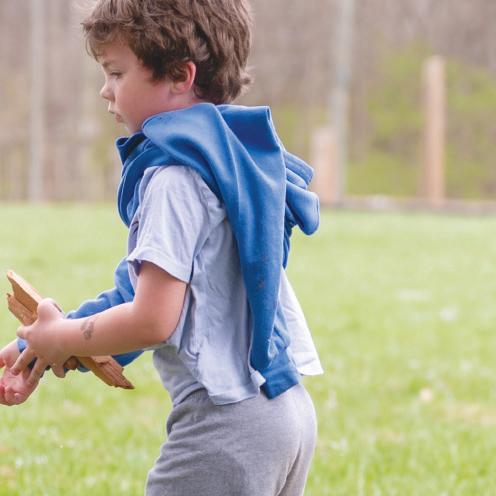
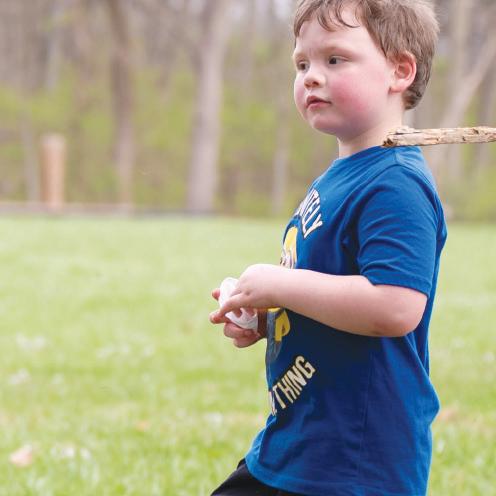
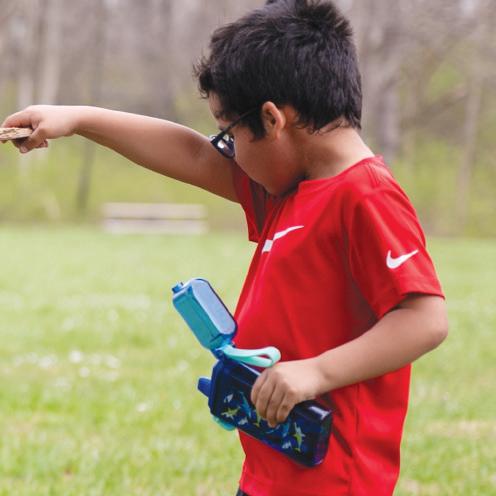
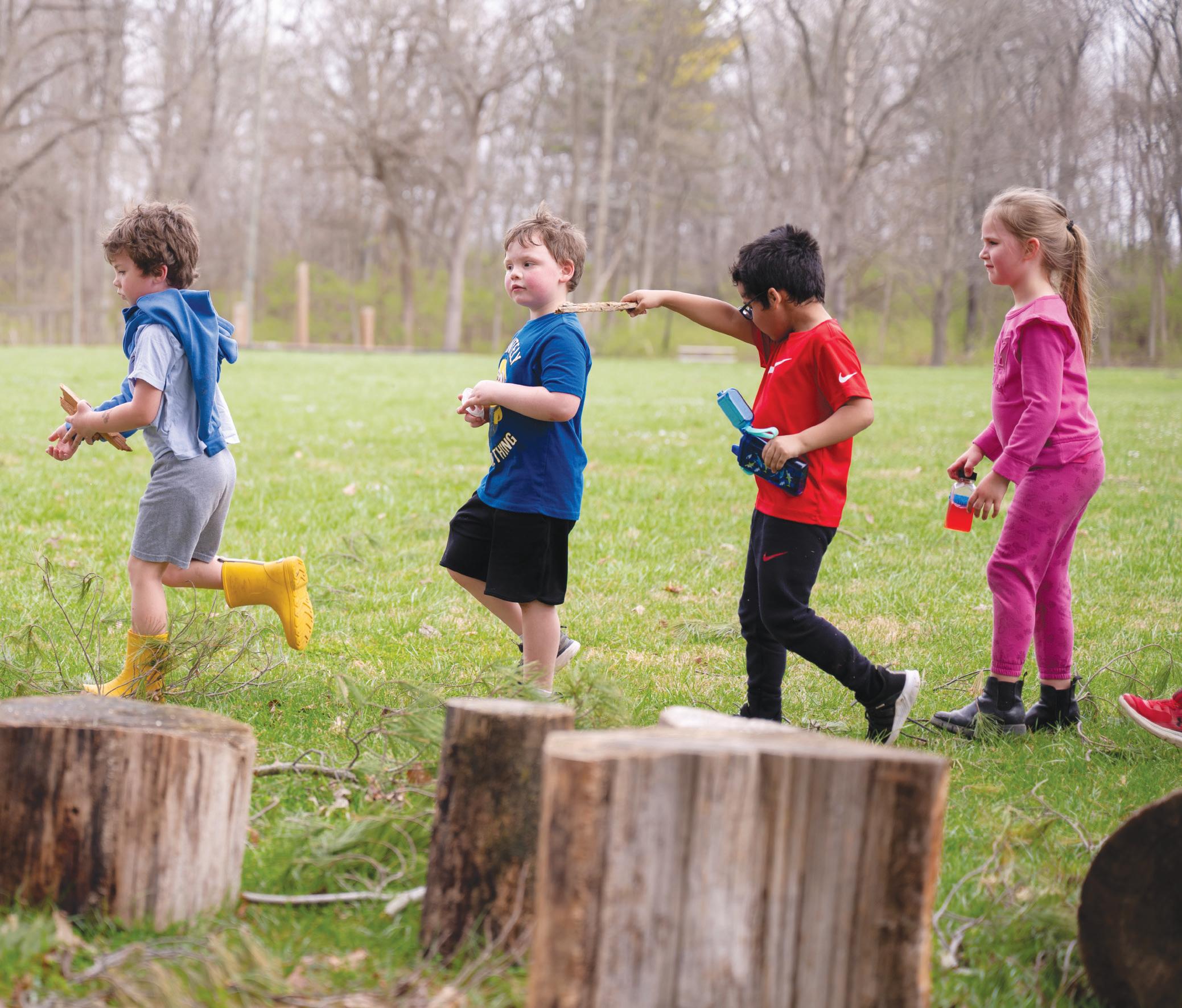
Forest Academy students return to their classroom in line after recess March 31 at Camp Adventure in Muncie, Indiana. KADIN BRIGHT, DN
Katherine Hill Lifestyles & Managing Editor
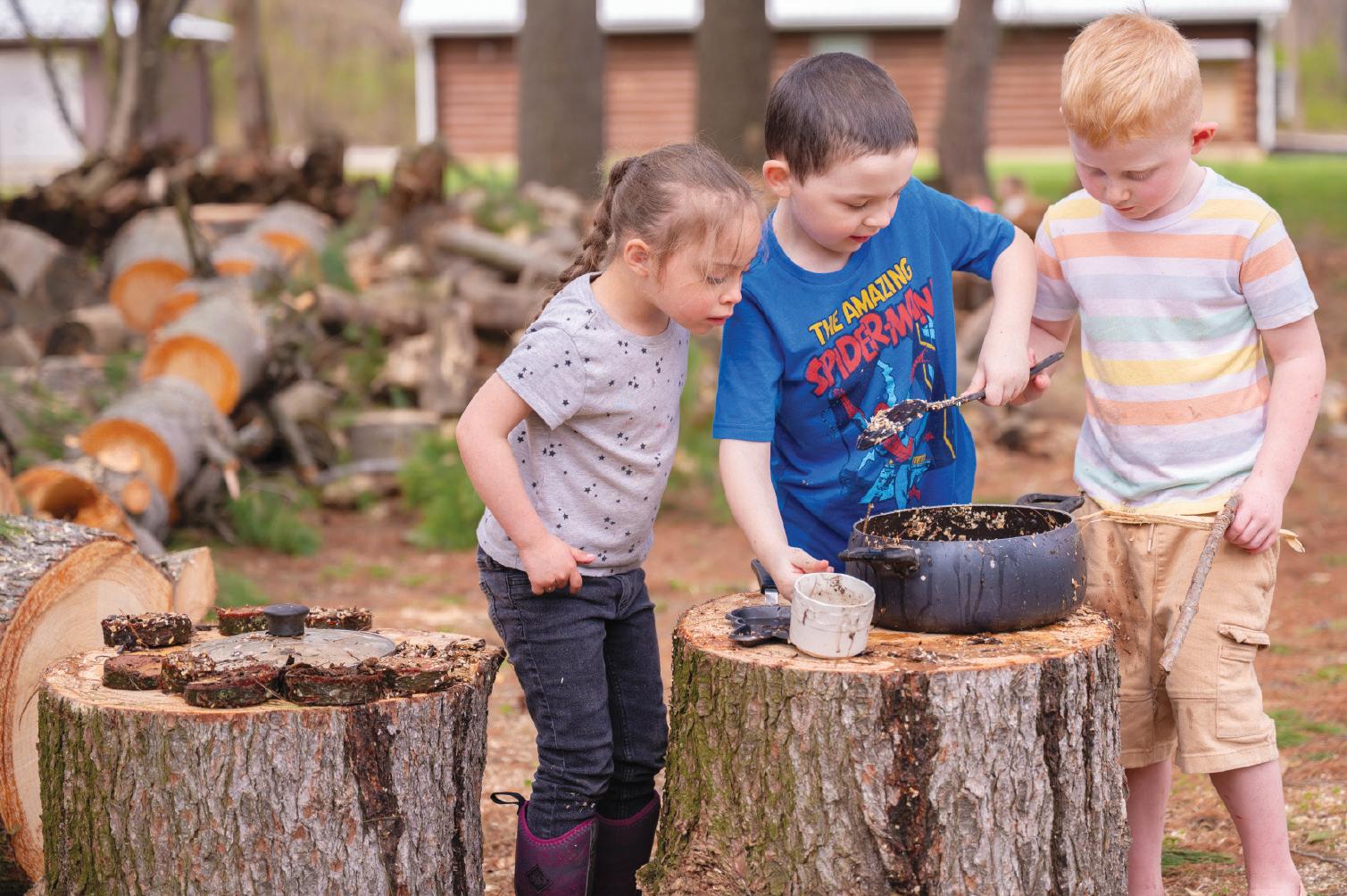
Along the nature trails of Camp Adventure Learning Center in Muncie is a log cabin that functions as the schoolhouse for Forest Academy, Muncie Community Schools’ (MCS) sole Montessori school.
The cabin currently houses 16 pre-K and kindergarten students at a time during the 8:30 a.m. - 2:30 p.m. school day. Though more often than not, the schoolhouse is vacant, as students are receiving hands-on learning opportunities through immersive outdoor activities.
Forest Academy is currently in its pilot year, but has been in development for about three years.
Before the COVID-19 pandemic, Mallory McCullough, the program coordinator at Camp Adventure, had spent a good portion of her career in academia as an upper-elementary school teacher and middle school assistant principal.
While patrolling the halls and making daily connections with students of varying age groups, “I realized there was a huge break in behavior and foundations that those middle schoolers were really missing,” McCullough said.
After the pandemic and the birth of her son, McCullough watched him grow up and knew he would not fit the mold of a standard American classroom.
“All of those things combined really turned me to a non-traditional path, because I was thinking, ‘Sitting in a classroom for six hours a day is just not really working with a majority of these middle
schoolers. They need something new,” she said.
Something had to be done. A solution was out there. McCullough sought to find it — for her son and other young families.
While “deep-diving” for answers across the internet, McCullough was continually pointed toward a scenic route — literally.
“Nature was the answer,” she said. “Get the kids outdoors. More greentime, less screentime.”
A February 2020 study, published in The International Journal of Early Childhood Environmental Education, explored the influence of nature preschools on executive function skills. Those skills, defined as “attention-regulation skills that allow conscious planning and the ability to work toward goals,” are considered a foundation for learning, and thus, a critical component of school readiness.
With the solution out there, the issue became how to bring it to Muncie — and if a naturebased education program would even fit into the community.
“I always believed this would work,” McCullough said. “But I know many other people above me, they were not sure, just because it is so unusual.”
Luckily, there was space for it at Camp Adventure, the city’s hub for outdoor learning, “proving that real learning happens outside the classroom,” according to its website.
Since 1939, the camp has been “an integral part of the Muncie Boys & Girls Club.” A decade later, the leasehold of the land was transferred to the Muncie Optimist Club, which rented the space
to activity centers such as Muncie’s Young Men’s Christian Association (YMCA), according to its website.
With the advent of technology, McCullough said the demand for summer camps has inadvertently diminished to the point that in 2025, the Muncie Optimist Club officially transferred ownership of Camp Adventure to Muncie Community Schools.
She said the land was the ideal place to push Forest Academy past the idea stage and into actuality.
“We wanted to pull students into MCS because we are always trying to place learners first. The goal is always to get the kids outside as much as possible. We blend in a lot of Montessori principles with The Science of Reading and outdoor education,” McCullough said.
According to The American Montessori Society (AMS), “Montessori education is an approach to learning that was developed by an Italian physician and educator, Dr. Maria Montessori, more than a century ago and is now changing the face of education worldwide.”
However, McCullough underscored that “not necessarily everything is about environmentalism or stewardship of the land” because those principles are “organically ingrained” into the curriculum. Instead, the program puts a greater emphasis on the idea that “anytime we’re outdoors, we’re learning.”
The teaching methods honor the human spirit and the physical, social, emotional, and cognitive development of children, while also focusing on caring for oneself, others and the environment,
Nature was the answer. Get the kids outdoors. More greentime, less screentime.”
- MALLORY MCCULLOUGH, Program coordinator at Camp Adventure
[ABOVE] Forest Academy teacher plays a game with the students March 31 at Camp Adventure in Muncie, Indiana. KADIN BRIGHT, DN [LEFT] Forest Academy students pretend to make food in a pot March 31 at Camp Adventure in Muncie, Indiana. KADIN BRIGHT, DN
MCS Assistant Superintendent Eric Grim said offering this teaching approach is “a way to better meet the needs of our students and families that want to learn in a more nontraditional school environment,” akin to online classes or homeschooling.
Learning at Camp Adventure can also happen at any time, and in almost any weather conditions.
“We really strive to go outdoors as much as possible, and we don’t like to have weather be a barrier. The kids do come prepared with all weather gear,” McCullough said.
While the weather itself has not yet posed much of a problem, what was unexpected was just how time-consuming it was to get a classroom full of 4and 5-year-olds bundled up amid chilling, singledigit winter temperatures.
“We thought we were ready for that this year — and we were — we made it work. We realized it does take a lot of time to get those students ready. At the beginning of the year, it took like 45 minutes for all of the students to get all of their things on and out the door.”
While those 45 minutes initially cut into instruction time, toward the end of the winter season, many of the kids were able to get themselves dressed for the weather in under half an hour.
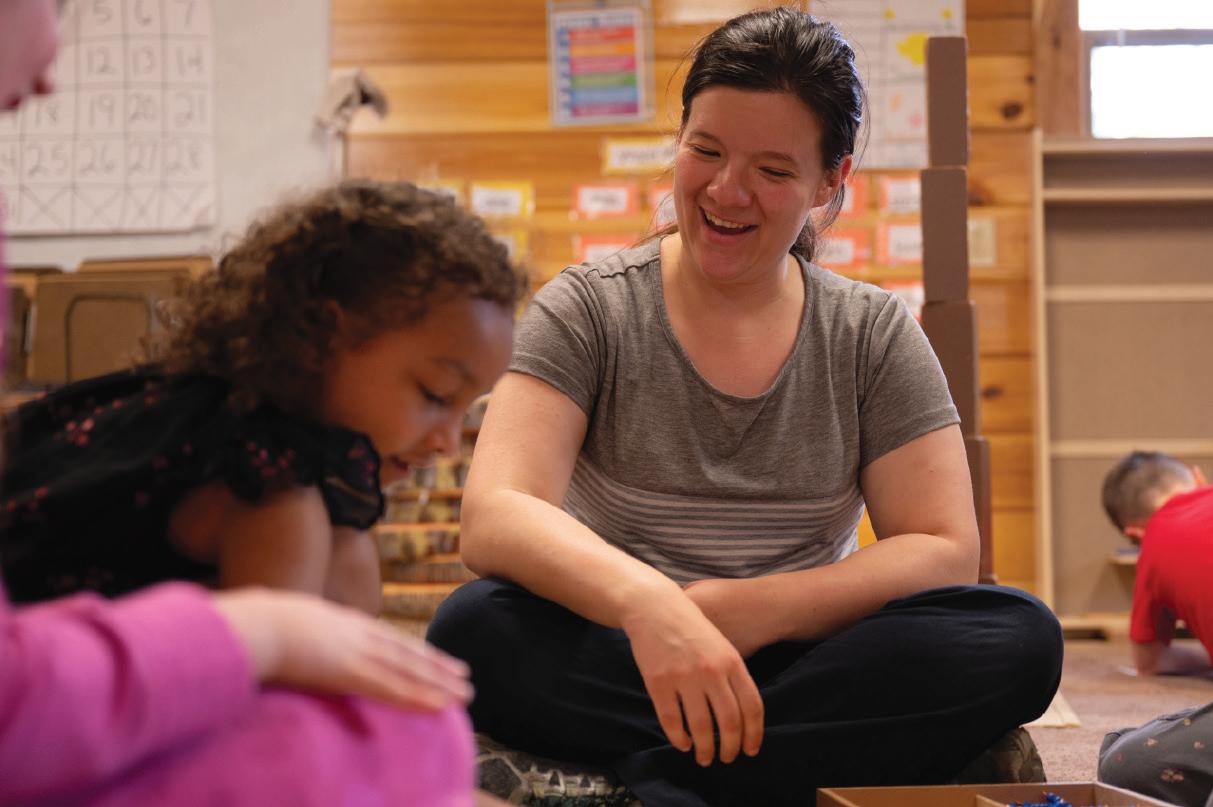
“That is a great part of the Montessori learning process, because many things that you can do for your kids, they can do for themselves. We are all about independent learning, and Montessori is very hands-on — including practical life and living skills — that’s all included in the Montessori
[LEFT] Forest Academy student learns numbers by playing with blocks March 31 in Muncie, Indiana. KADIN BRIGHT, DN [BELOW] Camp Adventure Forest Academy is a Montessori-inspired non-traditional school that provides students with hands-on learning opportunities March 31 in Muncie, Indiana.
method and principles,” McCullough said.
Once outside, she said she enjoys observing the students as they engage in immersive play with the environment and hone social skills with their peers.
“You don’t get to do that in a traditional classroom. It’s so great for the regulation of their nervous systems, because they’re not sitting down all day. They’re moving, which is what our bodies are made to do,” McCullough said. “I really feel like these students will have a one-up on many other students, so I can’t wait to give more students that opportunity.”
She is not the only one excited about expanding Forest Academy’s outreach to more MCS families. Grim said Forest Academy is his “favorite class to go visit because it’s so different.”
“It’s a whole different way of learning, [and] right now, our data shows that [Forest Academy students] are on pace — or even, probably, slightly above other kindergarten and preschool classrooms. So, they’re really learning academics, and the kids are really doing well in the program. We’re very proud to offer this to our students and families,” he said.
Currently, Grim said the program ages with the students. Next year, it will serve kindergarten and first graders. Those interested in applying to the Montessori school can do so online.
Contact Katherine Hill via email at katherine. hill@bsu.edu.
KADIN BRIGHT, DN
ANDY KLOTZ, PHOTOS PROVIDED
SEA1 is having a negative effect on the budgets of most public school districts.
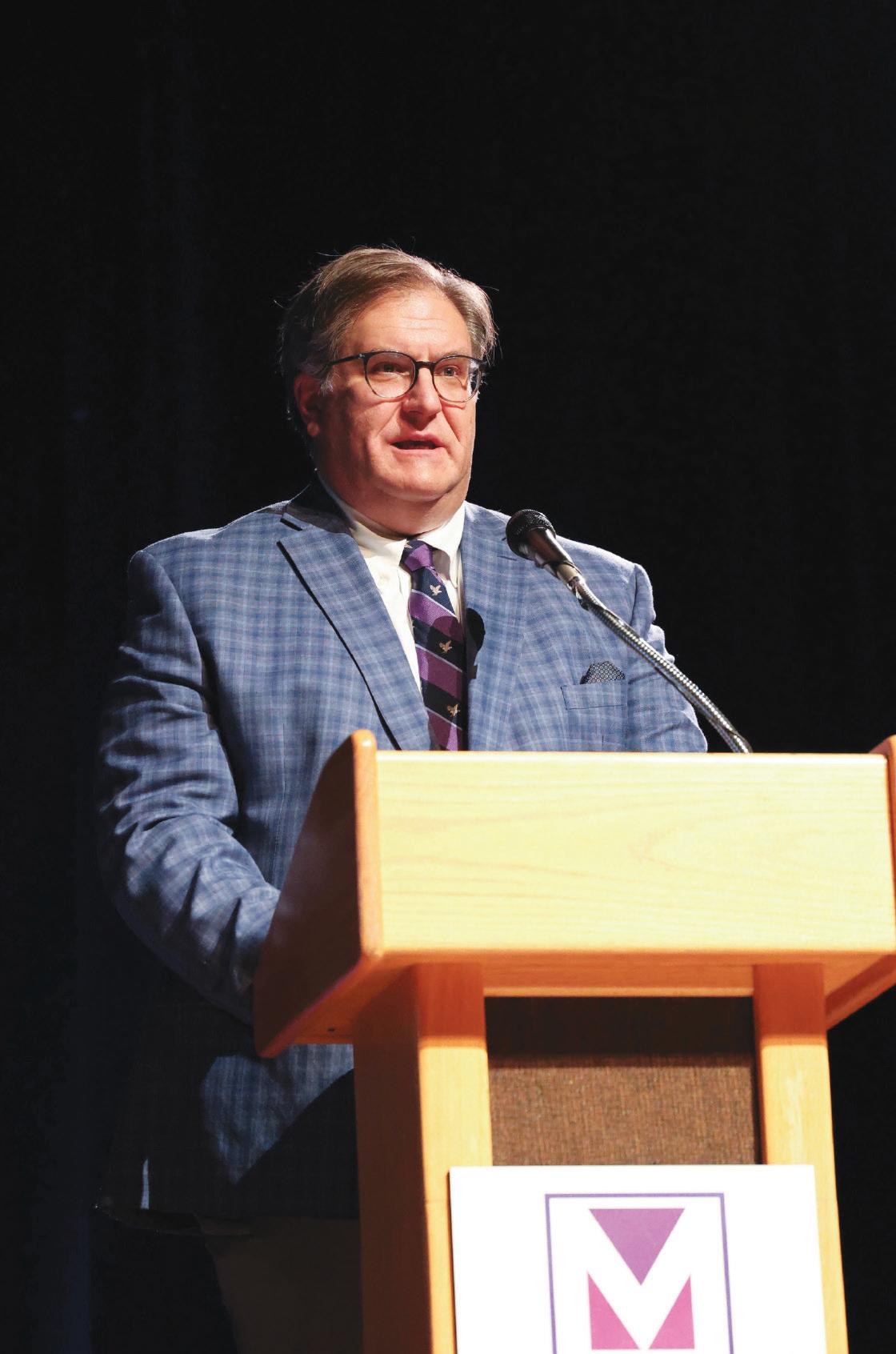
James Williams is the president of Muncie Community Schools and the Board of Trustees. He is writing as a guest for the Daily News. His views do not necessarily reflect those of the newspaper.
School funding in Indiana is complicated. I will try to simplify it in the following paragraphs. What is not complicated is the fact that the new property tax legislation known as SEA1 is having a severely negative effect on the budgets of most public school districts, including Muncie Community Schools (MCS). If something does not change in the next couple of years, there could be catastrophic consequences.
A quick breakdown: there are two main “buckets” for funding schools, an Education Fund and an Operations Fund. The Education Fund, which is funded by the state and is tied to each district’s student enrollment, pays for academic curriculum, teacher and staff salaries and other educationalrelated costs.
The Operations Fund is funded by property tax revenue and is used for annual operational expenses, including student transportation, building upkeep and maintenance, liability and casualty insurance, school security, utilities, custodial services and other expenses necessary to house and teach children in a safe and educationally conducive environment.
Not unlike your grocery bill, operational costs have not gone down in several years and, in most cases, are rising. For example, the annual property and casualty insurance premiums required by law have risen from $350,000 per year in 2023 to over $900,000 per year in 2026.
Because many districts do not receive enough property tax revenue for their Operations Fund to meet all these expenses, the state allows them to transfer up to 15 percent of Education Fund dollars to help. Unfortunately, while this is unavoidable, it diverts money that should be used for the educational benefit of our children to annual capital operating costs.
SEA1 reduces property taxes for homeowners, but also cuts school revenue. These cuts are in addition to those created by what are known as property tax “circuit breakers” that went into effect nearly two decades ago. The combined impact will be that revenue will continue to decrease in the coming years while operational costs continue to increase.
The result will be budget deficits in the millions of dollars for many school corporations throughout Indiana. More specifically, in 2029, MCS is looking at a budget shortfall of roughly $4 million, and that is simply not sustainable. When state legislators passed SEA1, it was clear they wanted all school corporations to “tighten their belts.”
At MCS, we have been doing that for years. Since partnering with Ball State University eight years ago, we have attracted millions of new dollars in grant funding, stopped what was declining enrollment and created efficiencies in many of our buildings. Those efforts took us from a $1.5 million overall budget deficit in 2016 to a positive total cash balance of $40 million in 2025, all while raising teacher salaries 40 percent and keeping class sizes small, two hallmarks of a desirable school district.
More recently, we brought our maintenance services “in-house,” providing roughly $1.2 million in annual savings. We have also outfitted buildings with
modern HVAC and lighting equipment that will cut our utility costs over time. Still, there is no way to make up the deficits created by this legislation without profound changes that will negatively impact educational outcomes. Simply put, resources matter.
A recent survey of statewide school superintendents conducted by the Indiana Coalition for Public Education (ICPE) revealed that SEA1 will negatively affect 99 percent of Indiana districts, and that urban districts, like MCS, will have far fewer ways to absorb the financial hit.
More than 65 percent of districts have started or plan to reduce support staff. Nearly 56 percent have started or expect to reduce teaching staff.
At Muncie Community Schools, we are discussing and implementing strategies to deal with the impending financial changes. Staff reductions may be part of the formula, but we hope that many of these reductions can be done through natural attrition – current employees leaving positions for personal or professional reasons. Regarding transportation, we have a wonderful partnership with MITS that will continue.
We will also continue to work with our busing partner, Auxilio, to see where we can gain some efficiencies in our routing of yellow buses. We are also continuing to leverage our community partnerships to maximize positive impacts for our students. According to the ICPE survey, 90 percent of urban school districts are considering pursuing an operating referendum in their communities.
If voters approve a referendum, it would allow property tax bills to exceed the legislated tax cap and provide funds to help minimize budget deficits. Will we pursue a referendum? That has not been decided, but it certainly must be considered. Muncie schools have come a long way in a short time. IREAD-3 scores have risen dramatically, and the Indiana Department of Education has lauded our progress.
Graduation rates are above 90 percent. Teacher retention is soaring. Our facilities are in good condition. There is much to be proud of with our schools, which is great news for our entire community. None of this would have been possible without the leadership at Ball State and the “buy-in” from individuals and organizations throughout Delaware County. Let’s keep the momentum going!
If Muncie really wants to return to being a thriving city with a robust and growing economy, we must come together and find solutions to this looming financial cliff we are on. If you have specific thoughts on how to help, I would love to hear from you.
Please go to muncieschools.org and sign up to speak at one of our upcoming school board meetings or send an email to MCS CEO Dr. Chuck Reynolds at chuck.reynolds@muncieschools.org.
Thank you for your concern on this incredibly important issue. I look forward to working with you to ensure that we continue to provide the very best education possible for Muncie children. They are certainly worth it!
James Williams, President of Muncie Community Schools and the Board of Trustees
Senate Enrolled Act 1 to impact Muncie Community Schools funding
MCS director of public education reflects on possible funding cuts to schools because of the senate enrolled act.
Editor’s Note: The authors of Senate Bill 1, Sen. Travis Holdman (R-District 19) and Sen. Chris Garten (R-District 45), have declined to give the Ball State Daily News comments regarding the bill. Author Sen. Scott Baldwin (R- District 20) was not able to meet the deadline for a comment. All information that refers to the authors in this article is sourced from other outlets.
Senate Bill 1 was signed into law by Gov. Mike Braun April 15, 2025, to provide $1.3 billion in property tax relief for homeowners over the next three years, according to an April 15 Indiana Senate Republicans news release.
The bill was written by Indiana Sen. Travis Holdman (R-District 19), Sen. Chris Garten (R-District 45) and Sen. Scott Baldwin (R-District 20).
Holdman expressed in the news release his gratitude toward the governor and to “partners” in the House of Representatives for their collaboration and determination, as the bill provides a “fair balance between the needs of local governments and Hoosier homeowners.”
“I believe we have landed on a policy that provides immediate relief and long-term reforms that will promote more transparency for our taxpayers,” Holdman said, in a provided quote from the news release.
The legislation will give every homestead an extra annual property tax credit to reduce their bill by 10 percent, with a maximum of $300, according to the news release, with two-thirds of homeowners expected to see a lower property tax bill in 2026 than in 2025.
Farmers will also see a change because of the bill, saving $116 million by adjusting the agricultural
For businesses, the bill will increase “business personal property tax,” according to the news release. Any business with less than one million in personal property will be exempt from the tax for 2026 property taxes. For 2027 and after, any business with less than two million in personal property will be exempt from the tax, according to the news release.
Unfortunately, the tax benefits for these taxpayers will affect the amount of funding for local units of government.
According to the news release, the state government receives zero property tax dollars, so local units of government will “be held responsible and accountable by their taxpayers for those continued increases.”
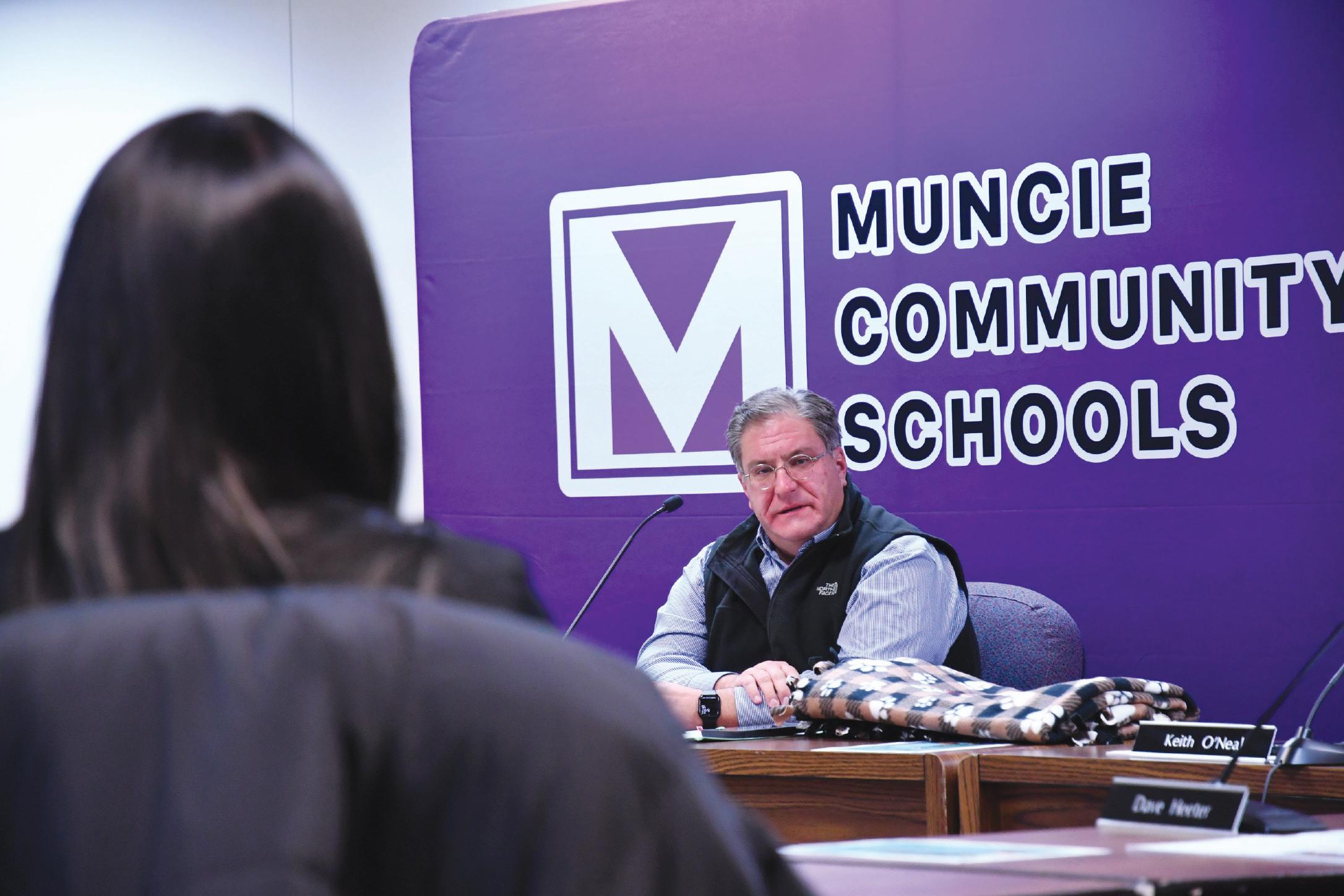
Director of public education and CEO for Muncie Community Schools (MCS), Chuck Reynolds, said the school’s property taxes currently fund everything to operate the school district, such as transportation, maintenance for the building, custodians and MCS’s liability and casualty insurance.
Reynolds explained that there are two buckets of funds: the educational bucket and the operations bucket.
While the educational bucket is not necessarily related to the legislation, he said, the education fund comes from the state budget. The operations bucket is driven by the collection of property taxes, Reynolds said, with the bill putting a “cap” on the increase in appraisal value for personal property.
The operations budget is being directly impacted by the bill, he said.
He explained that over the next six years, those funds toward the school will be reduced “pretty
said there will be minimal changes regarding funding. For the year 2026, losses of 300 to 500,000 could be made, and 500 to 700,000 losses made for 2027. But looking toward the year 2028, the district is at risk for losing an additional $1.7 million, and $3.5 million in 2029.
Reynolds said that Gov. Braun has sent a “pretty clear message” that he wants government units and school districts to “tighten their belts,” and said Braun has been “pretty adamant” about saving taxpayers money through their property taxes.
“We can’t tighten it that much, right?” Reynolds said. “We’ll have to continue to find other ways of not only reducing expenses, but also raising revenue.”
Reducing the number of school safety officers or reducing bus routes might have to be looked at, Reynolds said, along with the possibility of reducing the number of custodial and maintenance staff in the coming years.
“We would have to look at reductions on all those folks,” he said.
In a March 31 statement from State Rep. Sue Errington (D-District 34), she said vital services such as schools, fire departments and emergency services will “suffer” as a result of this bill.
Errington said that the long-term impacts of the bill will force schools to make “even more cuts,” including staff reductions, delaying needed maintenance and could lead to raising operating referendums.
“Senate Enrolled Act 1, which was passed by Indiana Republicans in 2025, was sold to us as a ‘tax plan.’ In reality, it’s a scam,” Errington said in a statement.
MCS is not the only school corporation having
Superintendent of Schools for Yorktown Community Schools Greg Hinshaw said the school will have to evaluate what the school is spending its operations fund money on due to that fund being impacted by the bill.
Hinshaw said that the approved budget for 2026 was $35,031,000. $23 million will go to the education fund, $3.5 million will be in the debt service fund and $7.8 million in the operations fund.
For Yorktown Community Schools, it is transportation, such as bus purchases, maintenance and custodial utilities.
Hinshaw said that the school has already started looking at consolidating up to seven bus routes for the next school year, while possibly eliminating 40 percent of the school’s separate bus drivers, possibly doing that through retirement.
“So we want to be in a position where we can consolidate maybe up to 15 or more bus routes, and then we’ll go a couple [of] years where we won’t buy any new school buses,” Hinshaw said.
Reynolds said MCS is looking at cost savings measures across the school board, recognizing to “tighten our belts” as they prepare for this legislation.
Reynolds encourages members of the community to keep a “close eye” on communications from the school district as the district continues to look at cost savings measures, while also recommending that individuals talk to local legislators and political officials.
“We will communicate that and be transparent with it,” he said.
Contact Linnea Sundquist via email at linnea. sundquist@bsu.edu.
Crossword and Sudoku
Byte is a student-run, multimedia coalition operating out of Ball State University’s Unified Media Lab. Though mostly oriented toward Telecommunications and Journalism majors, Byte draws in students studying all sorts of disciplines ranging from Creative Writing to Computer Science and everything in between. Student staff work closely with student-run editorial board to help refine their skills and improve the quality of content produced for the organization. We are dedicated to providing the best in entertainment and pop culture related content.