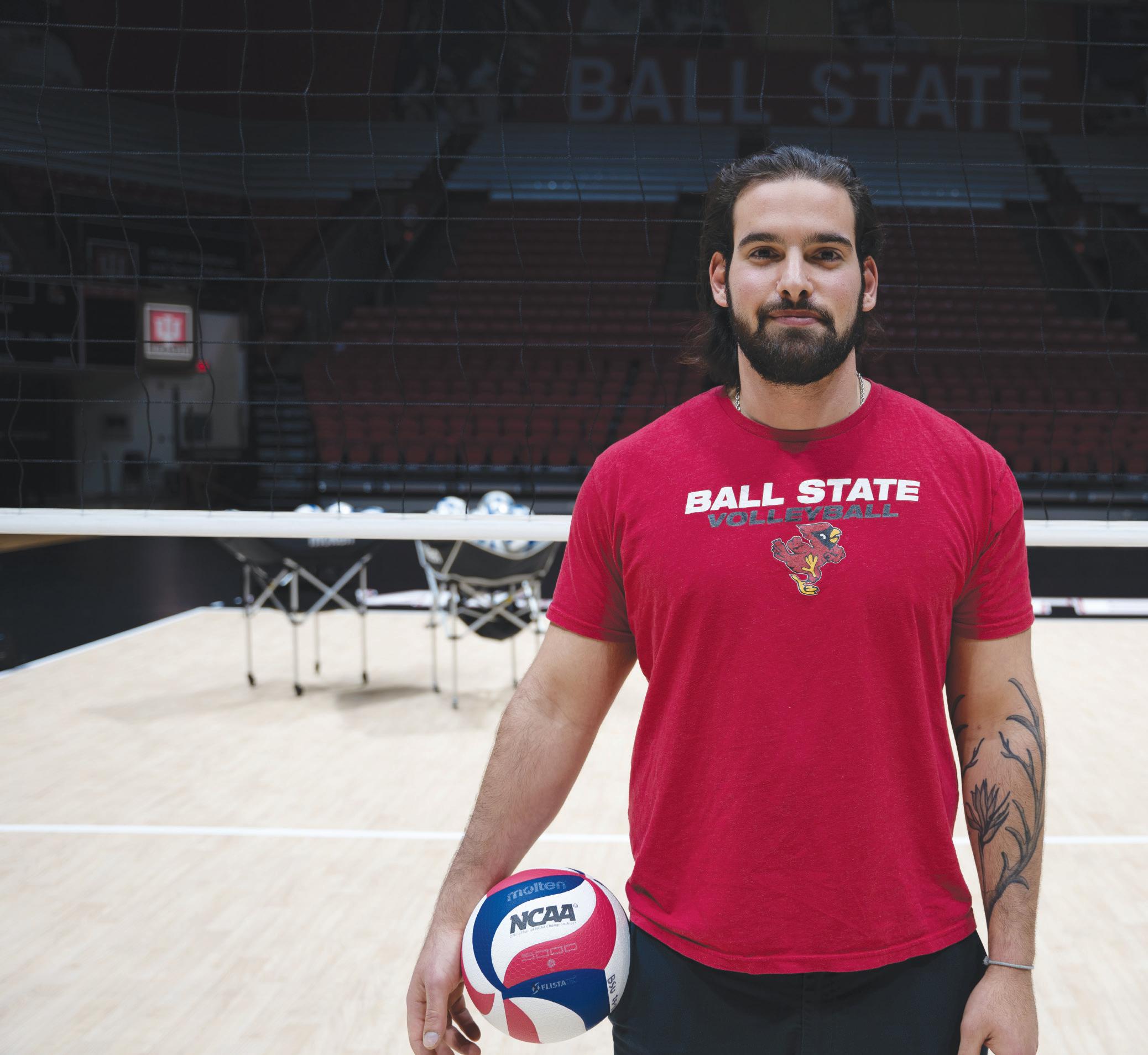












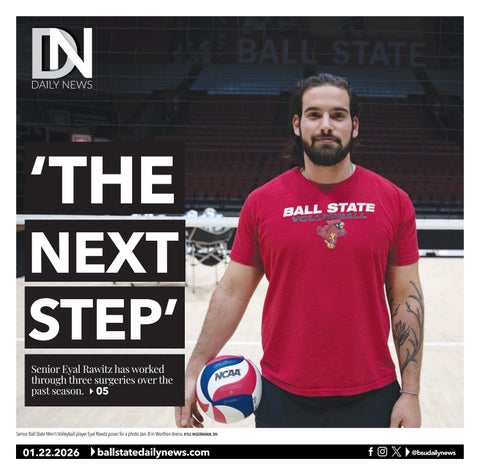
Senior Eyal Rawitz has worked through three surgeries over the past season. 05

VOL. 105 ISSUE: 19
CONTACT THE DN
Newsroom: 765-285-8249
Editor: editor@bsudailynews. com
EDITORIAL BOARD
Meghan Braddy, Editor-in-chief
Katherine Hill, Managing Editor and Lifestyles Editor
Linnea Sundquist, News Editor
Kyle Stout, Sports Editor
Rylan Crum, Associate Sports Editor
Jayden Vaughn, Opinion Editor
Charlotte Jons, Associate Opinion Editor
Channing Matha, Copy Editor
Kyle Ingermann, Multimedia Editor
Kadin Bright, Associate
Multimedia Editor
Ryan Fleek, Associate Multimedia Editor
Brenden Rowan, Visual Editor
Jessica Bergfors, Associate Visual Editor
Raquel Ruffin, Associate Visual Editor
Corey Ohlenkamp, Adviser
The Ball State Daily News (USPS-144-360), the Ball State student newspaper, is published Thursdays during the academic year except for during semester and summer breaks. The Daily News is supported in part by an allocation from the General Fund of the university and is available free to students at various campus locations.
TO ADVERTISE
• (765) 285-8256 or dailynewsads@bsu.edu
• Hours: 8 a.m.-5 p.m. Mon-Fri. • ballstatedaily.com/advertise
TO SUBSCRIBE
Call 765-285-8134 between 9 a.m. and 3 p.m. Mon. -Fri. Subscription rates: $45 for one year. POSTMASTER: Send address changes to Daily News, AJ278, Ball State University, Muncie, IN 47306
JOIN THE DAILY NEWS Stop by room 278 in the Art and Journalism Building. All undergraduate majors accepted and no prior experience is necessary.
The Ball State Daily News is committed to providing accurate news to the community. In the event we need to correct inaccurate information, you will find that printed here.
To submit a correction, email editor@bsudailynews.com.
Elizabeth Myers, Weather forecaster, Benny Weather 4-DAY WEATHER FORECAST
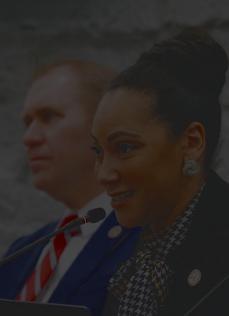
Jan. 16: Indiana Senate’s second-ranking Democrat, Sen. Andrea Hunley, is not seeking reelection this year, according to Indiana Capital Chronicle (ICC), with speculation that she will be running as a 2027 candidate for Indianapolis mayor. Hunley announced Jan. 16 that she would be giving up her seat in the Senate, with her term expiring in November 2026. She is the Senate’s assistant minority leader after winning the 2022 election from a heavily Democratic district covering the majority of Marion County. Hunley will become the fourth state senator to announce this being their final legislative session, according to ICC.

Jan. 20: Rural areas in Indiana have seen a 16 percent increase in people experiencing homelessness between 2023 and 2025, according to Indiana Housing and Community Development Authority data, provided by Indiana Capital Chronicle (ICC). Urban areas have seen a 9.4 percent increase in homelessness as well. The COVID-19 pandemic made housing in rural areas worse with a two-bedroom apartment in Fort Wayne ranging between $1,300 and $1,500 a month. According to ICC, senior citizens who used to be able to rent a one-bedroom apartment with social security cannot afford their homes as rent increases.
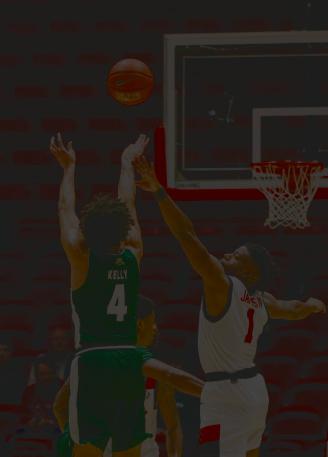
Jan. 20 : Ball State Men’s Basketball went on the road to Central Michigan and defeated the Chippewas 68-67 for their second straight Mid-American Conference (MAC) win of the season. The win improves the Cardinals’ overall record to 6-13, and their MAC record to 2-5. Junior guard Armoni Zeigler led the way for Ball State in the win, scoring 17 points and recording seven rebounds. Zeigler is averaging 17.8 points per game in conference play. With the Cardinals back-to-back wins, pieces are starting to fall in place for Head Coach Michael Lewis’ squad. “First [conference] road win for this group, really happy with that [win],” Lewis said.


May 5 is the primary election day for Indiana. Some of the offices open for election are State Senator, State Representative, United States Representative as well as other local offices. To see all the possible candidates for Delaware County, voters can do so through visiting the official Delaware County website. If Hoosiers want to vote this year, here are five steps to register.

Shelby Anderson Reporter

Visit the Indianavoters.in.gov website. This is where voters can check their registration status to see if they’re already registered. If not, click the box that reads “apply now.”

After clicking “apply now,” another box will appear showing what a voter needs to register.
The list includes owning a valid Indiana driver’s license or Indiana state identification card, being a U.S. citizen and being at least 18 years old.
The voter must also have lived in the precinct they are voting in for at least 30 days prior to the next election, and must not be actively imprisoned after being convicted of a crime.
After reviewing the requirements, voters can register by entering their personal information.

Step 5:
However, if the voter is not in their home precinct for the election, they can request an absentee ballot which allows them to vote by mail. To request a ballot to vote by mail, the voter can visit Indiana’s voter portal online, which will allow them to fill out the form.
If a voter is 17, they “may register and vote in the primary election if the voter turns 18 on or before the next general or municipal election,” according to the Indiana voters website.
Once voters enter their information, the person filling it out will review and acknowledge it to confirm, then wait for approval. The approval process can take five to seven weeks, according to headcount.org, a voting information website.

According to Indiana’s voter information website, once the application is received by the county voter registration office, the office will review it and determine the voter’s eligibility. From there, if the voter is eligible, the county office will send the voter a voter registration acknowledgment card.

Once the voter receives that card, they are officially registered. If an individual is not approved, the voter will receive a notice denying the application or requesting more information.
All of these steps must be completed by the April 6 deadline.
With the state primary election upcoming in
May, here is a step-by-step guide to registering to vote in Indiana.
Editor’s note: The Ball State Daily News reached out to Rick Spangler, Clerk of the Courts, for comment and did not receive a response before the deadline provided of Jan. 13.
In 2022, Ball State’s Center for Economic and Civic Learning, the Office of Student Life and the Office of Community Engagement launched an initiative called Cardinals Vote!
“We [came] up with an effort or initiative to promote student access and information about voting [that is] nonpartisan, just to provide information,” director of the center for economic and civic learning, David Roof, said.
Currently, Roof said the organization is “gearing up” for the upcoming election while also getting the word out to students about registering so that, when they return in the fall, they are ready for the midterms. Cardinals Vote! informs the student population through its website, where voter registration information is available. They also host informational events at the Scramble Light on campus, such as Floats to Votes, where students can show they are registered and receive a rootbeer float.

Roof said he believes it is important for young people to participate in elections because Indiana has one of the lowest turnout rates.
“The 18 to 24-year-old voting rate in Indiana has hovered somewhere between 15 to 20 percent,” Roof said.
Data from The Kaiser Family Foundation supports Roof’s claim. The data shows that just 89,000 Hoosiers aged 18-24 cast votes in 2022, which is only 16 percent of that age group.
However, Roof said he has seen some impact on students registering through his own research for the Indiana Civic Health
Index, which will be presented at the statehouse Jan. 21.
Most importantly, Roof said he hopes his outreach initiatives will educate and motivate students enough to want to register to vote before the April 6 deadline.
“The big thing to me would be to register to vote as soon as possible and to be prepared for the elections,” Roof said.
Second-year Ball State legal studies student, Vincent Cervantes, who is registered to vote, said voting is what “makes our democracy run.”
“I believe voting is the least we can do after so many people have fought and died to defend our country and our rights,” Cervantes said via text message on Snapchat.
Cervantes said he began learning about elections and voting around age 12 or 13, but it wasn’t until high school that he became truly interested in government processes like voting.
He said he is also motivated to vote because of civic service, as he enjoys knowing that he has “a voice in this country.”
“…My vote does make a difference, more so when it’s local or state elections; if it’s more national elections, my vote may not count as much, but to me, it’s my way of making a statement on the national level,” Cervantes said.
He explained how, when he registered to vote, he believed it was “extremely easy.”

Cervantes said he believes the challenges students face when registering for voting stem from either the belief that their vote will not matter or a lack of knowledge about how to register.
He believes colleges should do more to help students understand how to register, because “ it can help boost voter participation, and help inform people on how to get more involved in voting.”

Contact Shelby Anderson via email sanderson9@bsu.edu.

States Mint website.











The cost to produce and distribute a single penny is 3.69 cents, according to the United States Mint 2024 annual report, with the original cost being 1.42 cents. This resulted in the Treasury having a seigniorage loss of $85.3 million from minting more than 3 billion new pennies, according to the Federal Reserve Bank of Richmond.





billion new pennies, according to the Federal campus




The National Penny Shortage has officially reached Ball State’s dining halls.

Linnea Sundquist News Editor


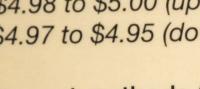
Ball State University’s dining services have posted signs in dining halls across campus explaining that when using cash, certain charges may be rounded up or down, depending on the amount.



Removing the penny will cause cash transactions to be rounded to the nearest nickel, according to the Federal Reserve Bank of Richmond, with purchases ending in three, four, eight or nine rounding up and purchases ending in one, two, six or seven rounding down. Purchases ending in zero or five will not be rounded.

looked into the end of the penny’s production, she said the elimination of the coin will force students to pay more money for certain items by having to bring more physical change with them during check out.
“You would have to find a dime, a nickel [or] another dollar,” Burton said. “So instead of that exact change, you would have to give out those bigger bills for things like that.”
Fourth-year student, majoring in mass communication, Jovi Taylor, explained that “it’s sad” that the penny has reached the end of its course.
Taylor said that this new policy could make students’ purchases either more expensive or cheaper, claiming, “I don’t see the point in getting rid of it.”
Unlike Taylor, a second-year student, majoring in sports media communication, Kennedy Zachary said that the end of the penny ultimately will not affect students.
“I think it’s definitely interesting, and kind of shows the way our society is moving away from physical money and transferring more towards credit cards and debit cards,” Zachary said.
Jarnagin said that since the vast majority of students who pay with meal plans, dining cash or credit cards, there will be no effect on students purchasing their meals. But for cashiers, Jarnagin thinks this will “improve workflow.” He said that it will require more customer service in the short term if students have not been updated on the recent policy or are not aware of recent federal news regarding the penny.


The penny will no longer be produced as a circulating coin, and Ball State’s dining halls are officially seeing the effect.
The famous copper coin ended its 232-year reign after the United States Mint hosted a Nov. 12 ceremonial event, marking the official end of the penny, according to the United States Mint website.
Pennies were first authorized by the Coinage Act of 1792, with the United States Mint being created the same year as the nation’s sole manufacturer of legal tender coinage, according to its website. The United States Mint’s job is to produce circulating coinage for the country to conduct its trade and commerce.
The copper coin was one of the first coins made by the U.S. Mint, with the original design on the penny depicting a woman with flowing hair symbolizing liberty. By 1909, Abraham Lincoln became the first president featured on a coin in honor of the former president’s 100th birthday, according to the United

“We posted signage to be transparent and proactive, annual
Assistant director of university dining purchasing and co-interim director of university dining, Kevin Jarnagin, said the decision to post signs regarding cash transactions was made in early December via email. He explained that this was a direct response to the U.S. Mint officially ending the penny’s production.
Maintaining student affordability was a “top priority,” said Jarnagin, while planning this implementation in dining halls. Jarnagin said that university dining has established clear guidelines to ensure that the process of rounding is “applied equitably across all cash transactions.”





Jarnagin said Ball State notified university dining that the university could no longer guarantee it would have enough pennies to provide exact change for every cash transaction. “We posted signage to be transparent and proactive, ensuring customers weren’t surprised at the register when they saw the new rounding policy in effect,” he said via email.


made in early December via email. He would





The United States is not the first country to eliminate onecent coins. Canada stopped its production of the penny due to “low purchasing power,” according to the Government of Canada’s website, with its penny ceasing production in 2012.
Along with Canada, Australia eliminated its one-cent coin in 1990, with the decision also being due to a “loss of purchasing power” through inflation and the overall cost of minting the coins, according to the Australian Government’s website.




“Our goal is to ensure the process remains neutral over time, preventing the national currency shortage from creating any added financial burden for our students,” Jarnagin said via email.
For students who primarily use cash at dining halls, Jarnagin said students have the option to purchase dining cash with a 10 percent discount on the university’s dining website. The amount of money a student charges on dining cash will be added to their student identification cards with no added fee. This will allow students to pay the exact amounts being charged digitally.
Off-campus students have the option of purchasing a meal plan from the university’s dining website as well.
Editor-in-Chief Meghan Braddy contributed to this story. Contact Linnea Sundquist via email at linnea.sundquist@ bsu.edu.







Fourth-year Ball State student majoring in production, Alexander Swetnam, said it has been “known for a long time” that the penny is a “useless piece of coinage.” He claimed that most coins are “fundamentally not very useful” because most items are not priced under one dollar.




nothing is priced at one dollar anyway. So that’s
“We’re getting to the point where almost nothing is priced at one dollar anyway. So that’s terrifying,” Swetnam said.

will not have a huge economic impact, it will be
He said that while the ending of the penny will not have a huge economic impact, it will be “weird” to have the penny gone.
Second-year Ball State student Emoni Burton shares a similar sentiment. While she has not












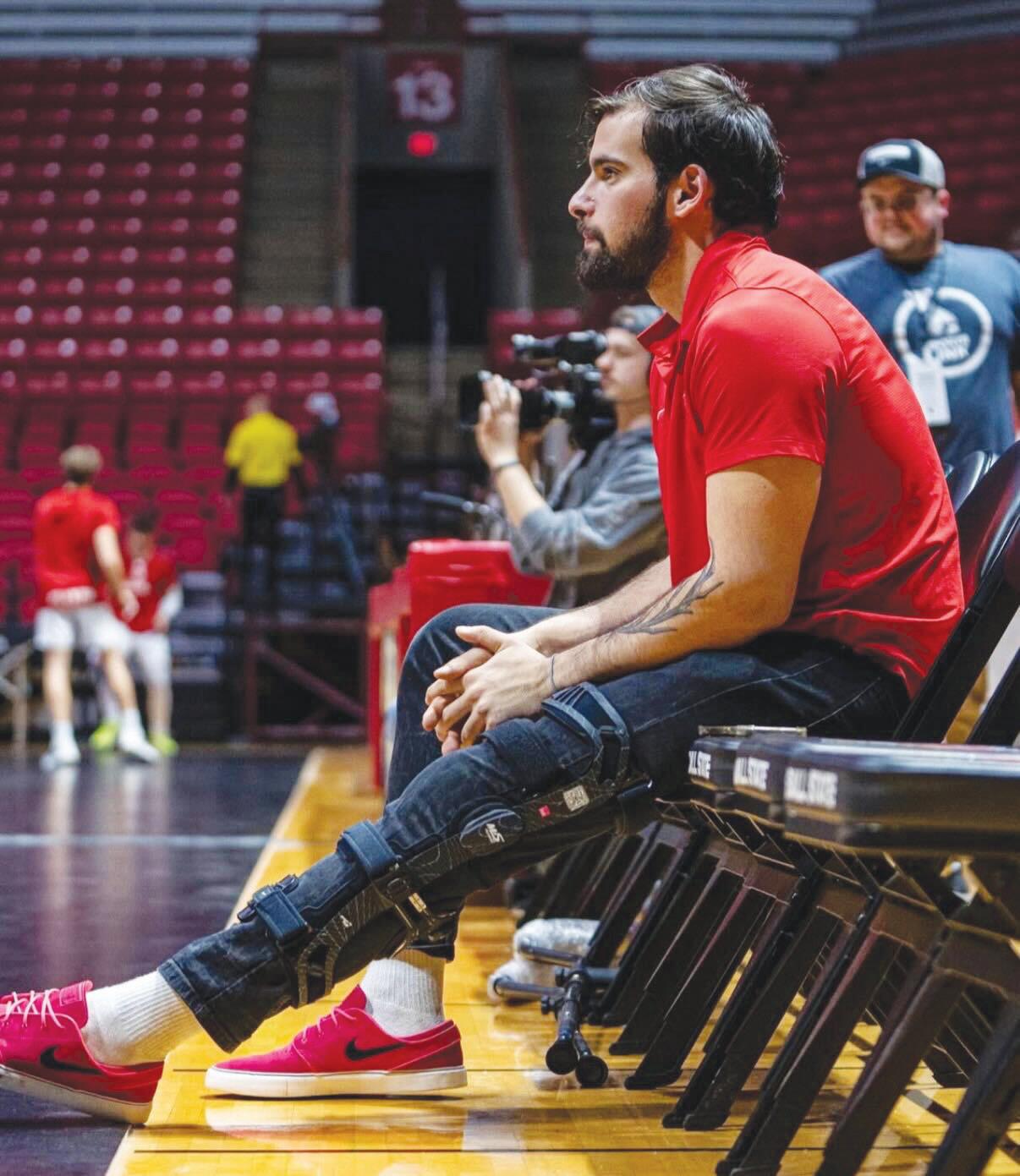
Senior Eyal Rawitz suffered one of the worst injuries in school history last January, but has learned new perspectives along the way.
Kyle Stout Sports Editor
January 2025 was an ordinary game day for Eyal Rawitz. The middle blocker for the men’s volleyball team was having a successful game against Trine University to kick off his junior season. He recorded five kills in the match, contributing to a 3-0 sweep.
But around the end of the second set, Rawitz went down awkwardly on the court.
Five minutes passed, and he was still down. Ten minutes passed, and panic started to set in with Rawitz, as his left leg was filled with pain. 20 minutes passed, and a new reality set in for the middle blocker as he was being loaded up into a stretcher on the court.
Rawitz said he could see that his entire leg was out of place. He “did not know what was going on,” only that he was feeling a lot of pain and disorientation. “My trainer kept telling me, ‘You’re going to be famous, because you are going to go to the hospital,’” Rawitz said.
The middle blocker said he did not know how to take it, because the team had trips to California and Hawaii coming up, and all he wanted to do was go on those trips.
4See EYAL, 06
Continued from Page 05
However, not being able to travel with the team on those trips was an immediate effect of the injury. Rawitz said that in the time from him getting loaded into the stretcher to when he was at the hospital, he was acting on “survival instincts.”
“Not too many thoughts going on, just things [were] happening,” Rawitz said.
After some time on the ground, Rawitz had to have an air cast put on his leg. Then the Emergency Medical Technicians (EMTs) arrived, placed Rawitz on a stretcher and took him to the hospital.
He said there were about 20 nurses in a small room with him while he was still in his Ball State uniform, all trying to figure out what was wrong. His strength coach, trainers, roommates and teammates all came together to rally around him, and Rawitz described it as having a “large net of support.”
“Everyone did such a great job in comforting me and being there for me,” Rawitz said.
One of the people who Rawitz said he really leaned on throughout the whole process was Jason Roberson, who serves as Ball State’s Men’s Volleyball strength and conditioning coach.
To Rawitz, he is more than just a coach.
Rawitz said Roberson is “a father figure” in his life and has helped him through many hardships beyond volleyball, including being away from home and any crises he experiences.
“He’s always there for me,” Rawitz said. “I asked him to come to the hospital when I got injured, like specifically him, because he’s such a great, great guy.”
Roberson said that in his position, he always values connecting with student-athletes at the school. The strength coach described his relationship with Rawitz as unique, noting that he could connect with him on a more personal level.
“Eyal has been a rare student who has opened up his life and life experiences to me,” Roberson said. “It is a rare opportunity in this field to make genuine exceptional human connection with students that I relish the connection as I would a family member.”
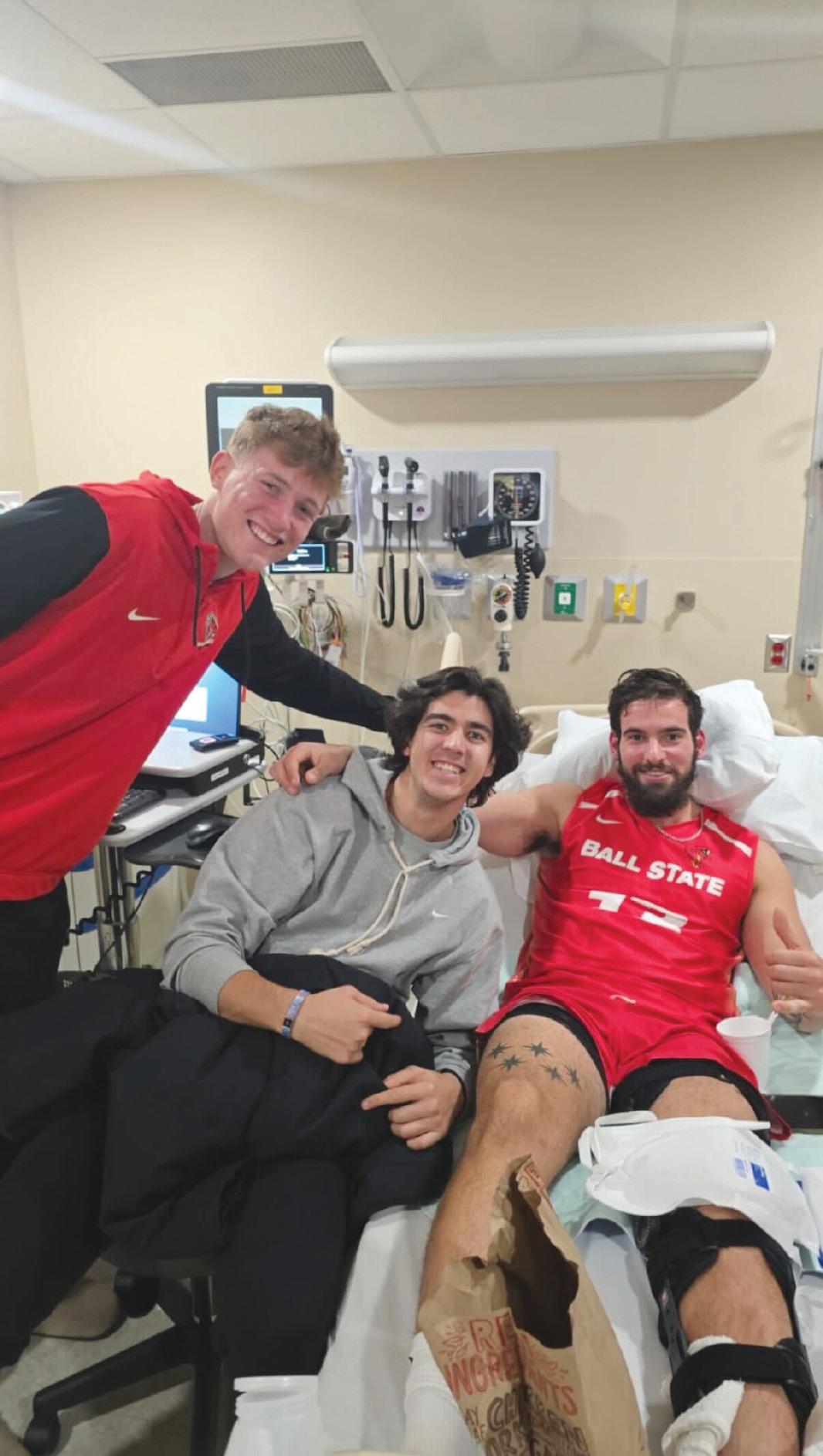
complicated lateral meniscus tear, a medial meniscus tear, a partial PCL tear, a broken tibia, a broken fibula and a burst posterior capsule.
Rawitz said that right off the bat the doctors knew all the injuries were too much to handle in one surgery, and they would have to perform two. The first surgery was a week after the injury, and Rawitz said that the entire first week was cloudy.
But even with Rawitz having to wear a leg brace and use crutches, he was able to be back on the bench attending Ball State games. The middle blocker immediately saw the Ball State community’s support at games.
“So many fans came down from the stands to greet me and wish me well, and say how they’re praying for me,” Rawitz said. “A fan, Tyler Friendship, reached out to me on Facebook, [and] he prays for me every 14th of the month now.”
After Rawitz’s first surgery landed him in a brace and crutches, he said that “emotions were running high.”
Despite many sleepless nights, Rawitz tried to
“Finding a light at the end of the tunnel, that this is gonna fortify some of my mentality or personality,” Rawitz said.
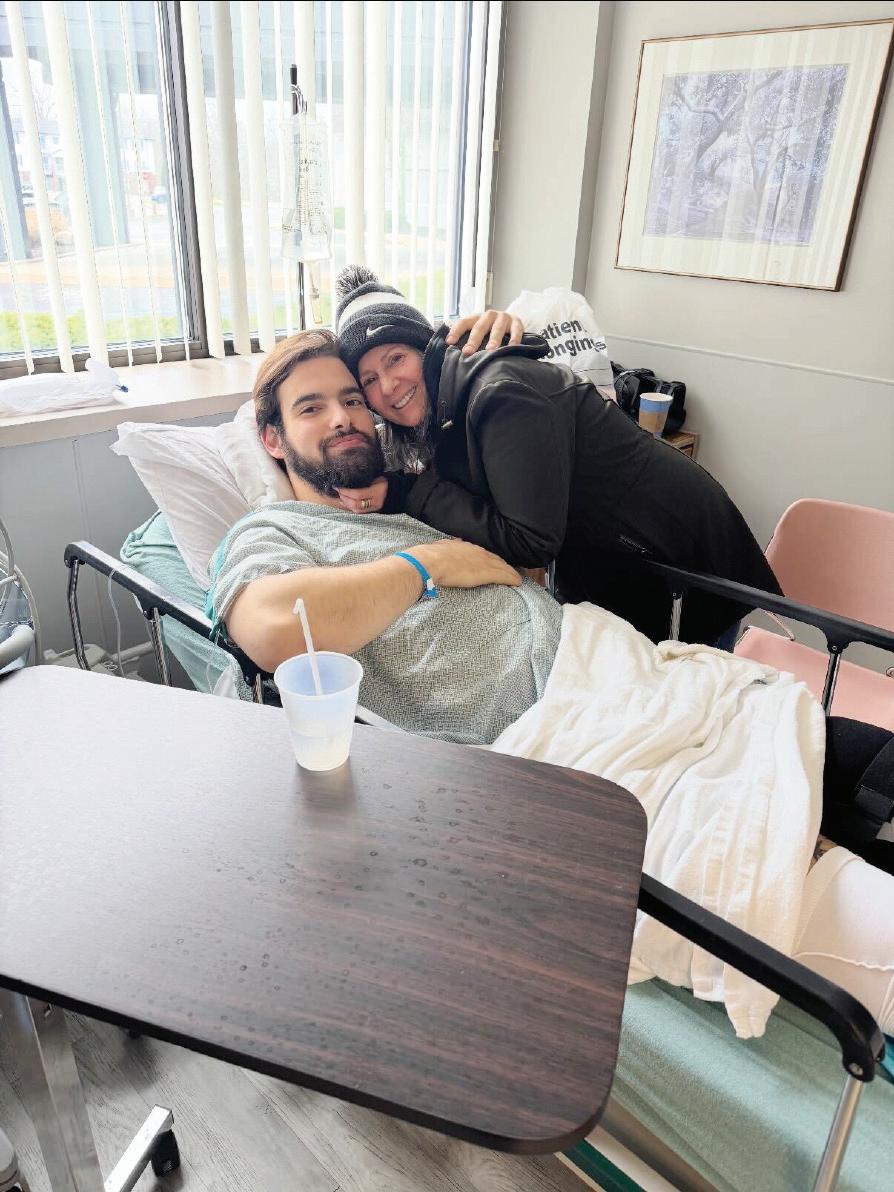
The middle blocker’s mother was able to come up for his second surgery in March 2025, which was focused on his ACL. Rawitz was able to get off crutches and walk for the first time in five months in May.
Rawitz ended up missing all of last season’s play. The middle blocker said he already played a “cheerleader” role for the team, so he leaned on that even more during this time.
“Making sure I [was] doing anything I could in my power to make sure everyone has what they need,” Rawitz said. “Just doing what I can.”
The middle blocker set a standard for the team last season, even though he was not playing on the court with them. Even though Rawitz suffered a complex injury that heavily limited movement in his legs, he still showed up every day to work out and lift weights as hard as he could.
“I would work out every single day, zero excuses,” Rawitz said. “And that kind of set a
that standard within the team this season with how much Rawitz pushes himself through his injury.
“Everytime I go in there and the guys are in there he’s always got a good sweat going on,” Iandolo said. “He’s working, and I know the guys appreciate that and they see that, and it pushes them.”
Rawitz used last summer to go through rehab, making strides to try to get back on the court.
But complications during his rehab led to Rawitz needing a third surgery, which occurred in October. His latest surgery sealed the deal on him playing in his senior season.
The most physical progress that Rawitz saw throughout the process was a small amount of running and very small jumps.
“It’s kind of impossible to see the light at the end of the tunnel, but it’s easy to see your next step,” Rawitz said about the process.
After each of the middle blocker’s surgeries, he had to retrain his quadriceps to be able to move again. Rawitz said his brain would try to signal them to move, but they would not.
muscles.
“I kind of have tree trunks for legs, and now I got a twig,” Rawitz said.
The middle blocker described the process of his three surgeries as a “rigorous grind.”
Despite Rawitz’s latest surgery, the now senior still plays a huge role on the team this season. The middle blocker was chosen as a team captain and is one of three seniors.
Rawitz said he motivates the team through his example, and he said that will be one of his goals this season.
“They see me work as hard as I can even though there’s absolutely zero chance I’m gonna be on the court this season,” Rawitz said. “It kind of pumps them up as well.”
Iandolo said he knows there will be days that Rawitz is not feeling well with his leg, or days that he is angry because he misses being out on the court.
But the head coach still recognizes how much
Roberson has been a catalyst in Rawitz’s past year, helping him as a man as well as a volleyball player. The strength coach said he has learned a lot about Rawitz over the past year.
“In this past year, I have learned that Eyal has no bottom to his ability to accept reality and formulate a plan for how he will overcome it,” Roberson said.
Rawitz said he did not know he could go through constant rehabilitation after his three surgeries. He did not know he would be able to see light at the end of the tunnel.
But the middle blocker said he learned he could persevere. Rawitz underwent one of the worst detailed injuries in Ball State history, but he has learned to accept a new perspective on his personal reality.
The middle blocker is from Tel Aviv, Israel, and with his hometown in the midst of a war, he has learned to still be thankful even in his situation.
“Here I am, I’m alive,” Rawitz said. “Where I’m from, people my age are fighting in a war and
dying, and moms are losing their kids. I kind of
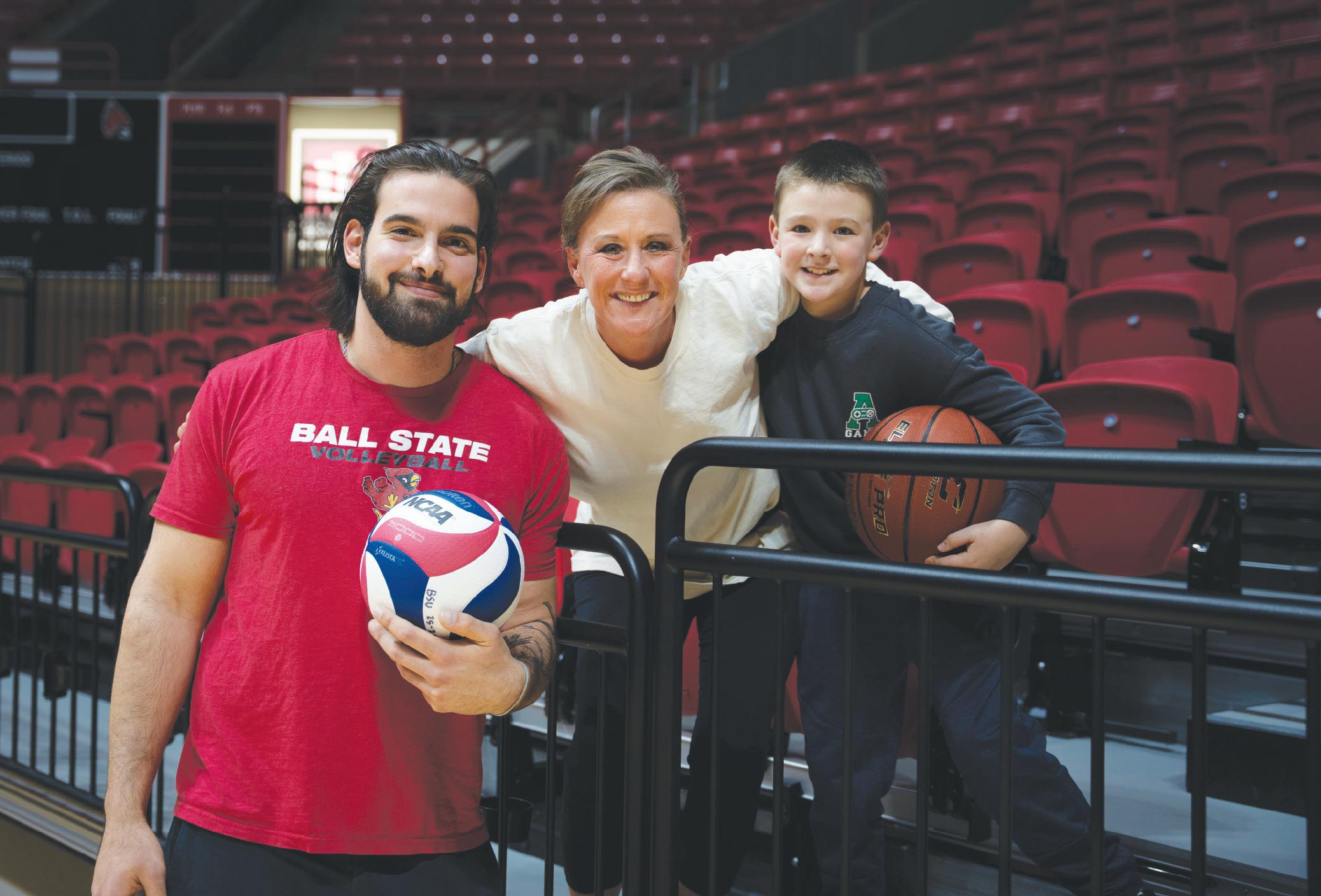
Rawitz has received a lot of support throughout the entire process, and he said he is grateful to everyone, from those who set up the facility to those on campus.
One thing that Rawitz had to learn through the process was to ask for help from some of those people.
“I don’t like to receive help too much,” Rawitz said. “That was really like a brick in my face, [realizing] you’re not doing anything unless you’re getting help.”
In the midst of everything Rawitz has gone through over the past year, Roberson is confident in his will and determination to overcome any obstacle thrown his way.
“I have no doubt Eyal will give this recovery everything he has to get back to the outstanding athlete he has been,” Roberson said.
Contact Kyle Stout with questions via email at kyle.stout@bsu.edu or on X @kylestoutdailyn.
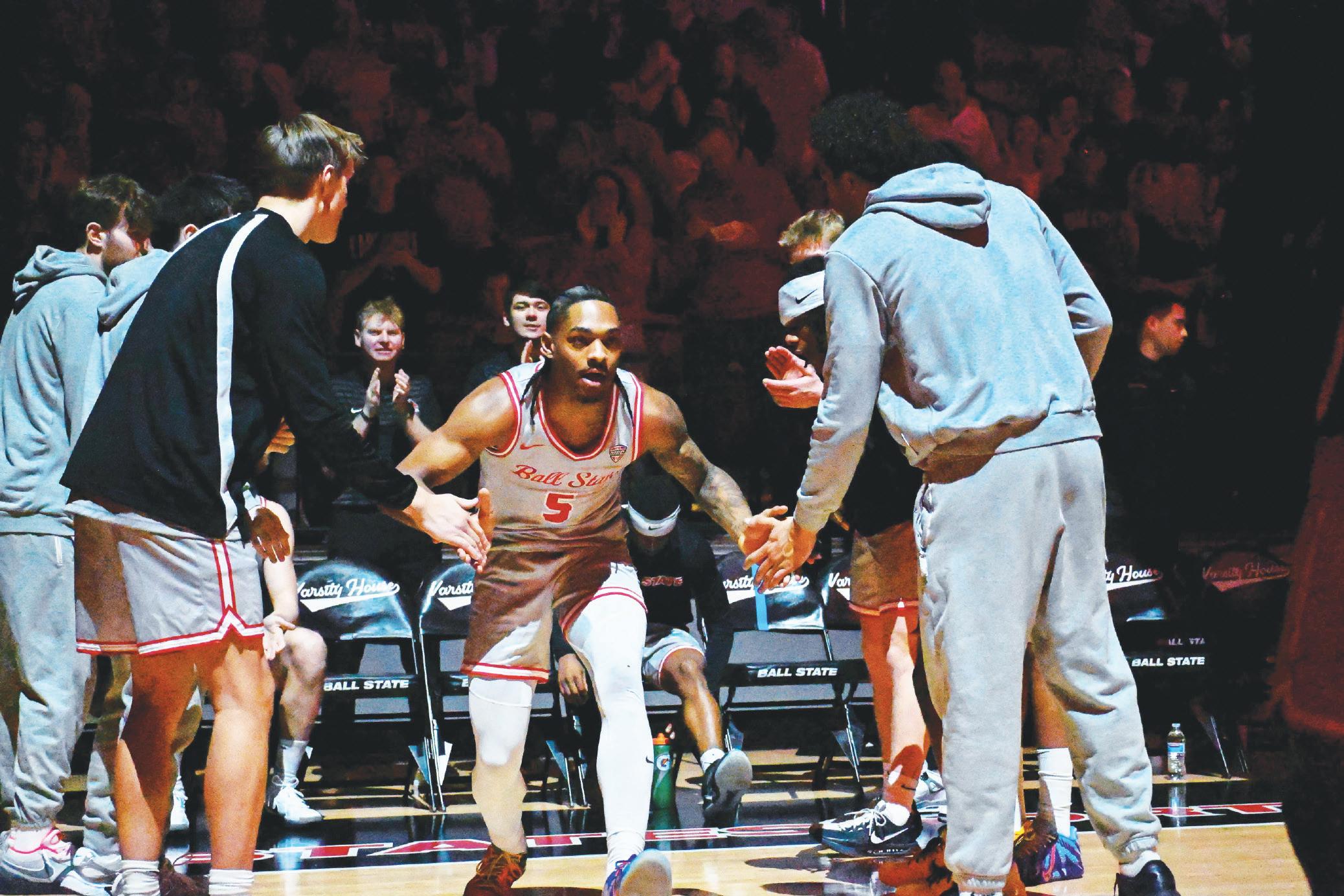
State Men’s Basketball has had a tough start to the 2025-26 season.
Kyle Stout, Rylan Crum Sports Editor, Associate Sports Editor
Editor’s Note: Kyle Stout and Rylan Crum are offering commentary on Ball State Men’s Basketball for The Ball State Daily News. Their views do not necessarily reflect those of the newspaper.
Ball State Men’s Basketball is off to an upand-down start. The team is 6-13 overall, 2-5 in conference play, and has found itself in tenth place of the Mid-American Conference (MAC) standings.
The Cardinals rank very low in the conference’s biggest statistical categories: last in points per game at 68.4, last in field goal percentage at 42.2, tied for last in rebounds per game at 31.8 and tenth in point differential at -2.2.
A bright spot for the Cardinals so far has been their defense, as they are second in the MAC, allowing only 70.6 points per game.
Head Coach Michael Lewis has not been dealt the best hand so far in early conference play, as the head coach has been without three key rotational
pieces in six of seven conference games.
Senior guard Juwan Maxey and junior guard Joey Hart have each only played one conference game, against Miami (OH) on Dec. 20. Sophomore forward Kayden Fish has played in two conference games, against Miami (OH) and against Central Michigan on Jan. 20.
Before the season, junior center Zane Doughty chose to step away from the program, and Doughty was a player expected to get an uptick in minutes.
Lewis has dealt with injuries throughout his tenure in Muncie, but this season has been worse than past seasons. With unexpected offseason roster changes, a batch of injuries and underwhelming play overall, these factors have propelled Ball State to a rocky start in Lewis’ fourth year in Muncie.
Here is what the two beat reporters for the team, Kyle and Rylan, have to say about the team’s rocky start to the season.
In Lewis’ first season with Ball State in 2022-
23, the Cardinals sat at fourth place in the MAC standings with a record of 20-12 while having the second-best field goal and free throw made percentage in the conference. Although the team ended its season on a four-game losing streak, it was the lone MAC tournament appearance for Lewis.
Moving to their current 2025-26 campaign, Ball State sits at the very bottom in field goal percentage and field goals made. Not to mention their lackluster performance on the boards with only 31.9 rebounds per game, which is also last in the MAC.
So what has changed since the 2022-23 campaign?
I would say the overall player performance.
In Lewis’ first season, the Cardinals had four players averaging over 10 points per game, including leading rebounder Payton Sparks, who averaged 8.7 rebounds per game. This year, they only have two players averaging over 10 points a game; junior guard Davion Hill, who averages
12.3 points a game, and sophomore guard Armoni Zeigler, who averages 12.9 points a game. Zeigler leads the team in assists and rebounds as well.
With Sparks’ return last season, Ball State had some stability at the “big man” position, but with the departure of Sparks and Doughty, the tallest player on this year’s roster is 6 ‘9” freshman Preston Copeland, who has only averaged 17.2 minutes a game.
As Zeigler leads the team, averaging 12.9 points and five rebounds per game, it is most likely that a one-man show will not get the job done, but he has been the key piece in helping the Cardinals collect back to back conference wins.
Looking back to last season, the Cardinals’ leading scorer averaged 15.8 points a game, while the leading rebounder averaged 7.7 per game. As this season is still early for Ball State, the statistics are down drastically from last year, when the team went 14-17.
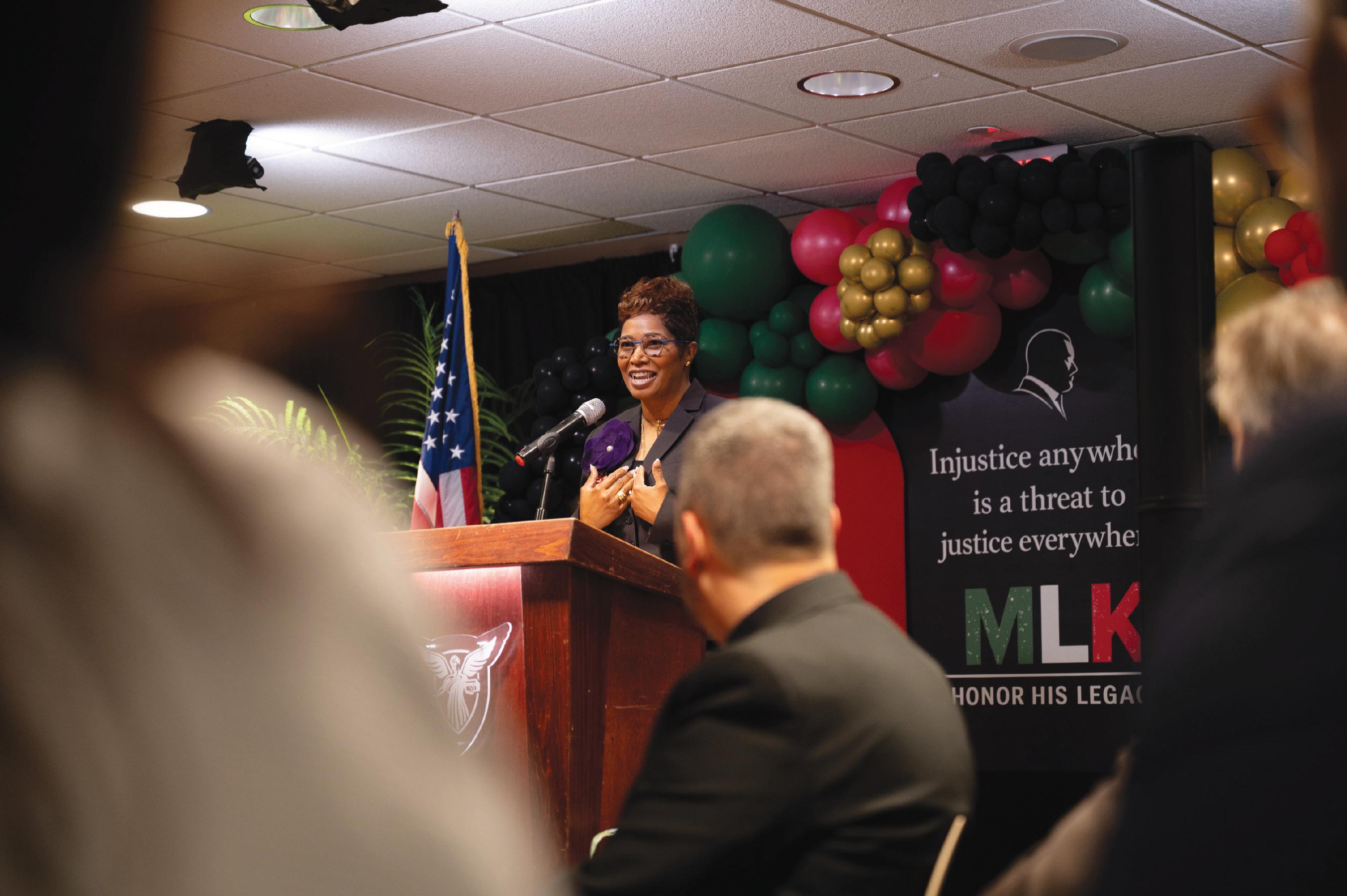
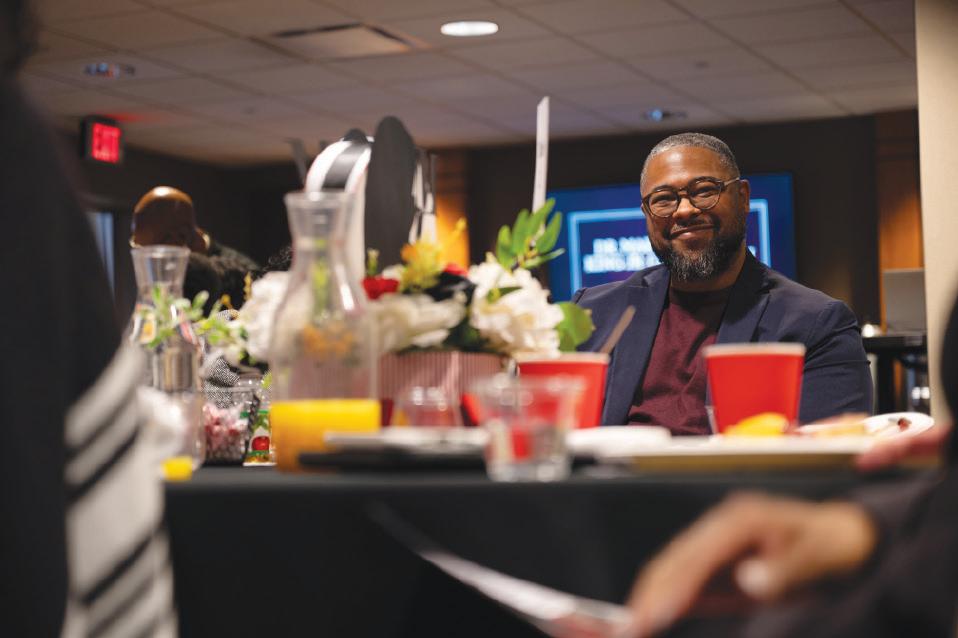


Several members of the Ball State and Muncie communites attended the comunity breakfast to honor MLK’s work with civil rights.
Gracie Parkhurst Reporter
Ball State students, faculty and Muncie community members gathered at the campus’s L.A. Pittenger Student Center for the annual Martin Luther King Jr. Breakfast event, honoring his legacy and contributions to civil rights in the ‘60s.
Since 1983, signed into law by President Reagan, the third Monday in January has been declared MLK Jr. Day, a day of carrying on King’s legacy of equality, justice and non-violent protest to help others, according to The Associated Press (AP).
Though Reagan’s signing did not lead other Republicans to follow. It would be 17 more years until all 50 states observed it, adding to the holiday’s “long struggle” toward establishment, according to AP.
The annual breakfast was held in Cardinal Hall A at the L.A. Pittenger Student Center Jan. 19 from 9 - 11 a.m. and featured several speakers from both Ball State and the Muncie community. It was the first event of Ball State’s Unity Week, and the theme was “having the strength to love,” inspired by King’s 1963 book, “Strength to Love.”
The celebration began with greetings and opening remarks from WaTasha Barnes Griffin, the chief executive officer of Central Indiana’s Young Women’s Christian Association (YWCA), who also gave thanks to certain members and committees that made it possible for the event to take place.
“Today is about remembrance, action and investment in the next generation. It is about living out Dr. King’s call to love, not just in words, but in how we serve,” Griffin said.
Several leaders, pastors and members of the Muncie community, including Muncie Mayor Dan Ridenour, gave speeches before breakfast was served to the attendees by Ball State University catering.
Many of the speakers referenced quotes from King’s “I Had a Dream” speech and what he envisioned for the U.S., the origin of Martin Luther King Jr. Day and more.
Brandon Woods, a Ball State student and employee of the university catering, voiced his thoughts on why he believes this event is important to the university and Muncie community.
“I think [the annual breakfast] recognizes [Ball State’s] support for Black lives and Black history. I think that’s incredibly important just because it shaped the foundation of so many aspects of society in our lives, so showing their support for that is important,” Woods said.
After breakfast was served, a choral ensemble from Muncie Church of God performed musical selections, including “Lift Every Voice and Sing,” which attendees referred to as “The Black National Anthem.”
Keith O’Neal, senior pastor of Destiny Christian Center International, spoke about the importance
of choosing to love, referencing stories and experiences from his past at Ball State, his parents’ experiences, his faith and more.
“[MLK Jr.] made significant sacrifices during his day in hope for us to experience a better America, an America where the color of one’s skin is not the first identifying quality you see in another person,” O’Neal said. “Laws cannot force a person to love. You have to choose to do that.”
Following O’Neal’s speech was the recognition of Muncie Community Schools’ top seniors, acknowledged by Rhonda Ward and Dr. Chuck Reynolds, both directors of Muncie Community Schools. Gabrielle Lloyd, director of the university’s Multicultural Center, also briefly spoke on the history of King’s “I Have a Dream” speech.
The event concluded with acknowledgements and appreciations from Ball State’s Director of Community Support Initiatives, Paris McCurdy, who thanked First Merchants Bank, Indiana University Health, the Concerned Clergy of Muncie and more.
Muncie community member Dan Beard said he decided to come to the MLK breakfast celebration to listen to several of the speakers talk.
“I didn’t want to pass up a chance to hear a speaker speak on social justice, especially in these times,” Beard said. “I think we need a reminder that social justice is on the agenda and that it’s very important. We get wrapped up in current events sometimes, and we can’t forget about it.”
The day was full of activities celebrating King’s life and historical significance, including a programming event at Muncie’s Motivate Our Minds for K-5 students, as well as one for middle school and high school students at the Boys and Girls Club. Union Missionary Baptist Church in Muncie also held a community celebration at 6 p.m.
“Choosing to love is a reflection on your character rather than echoing the sentiment of those who don’t share your commitment,” O’Neal said.
The annual breakfast kicked off Ball State’s Unity Week 2026, Jan. 19-25.
“The weeklong series of programs is designed to celebrate culture and encourage civic engagement across campus and the Muncie community,” according to the university’s multicultural center website.
Various educational workshops, cultural celebrations and service opportunities will be held on campus and throughout the surrounding community all week long, including Disability History Jeopardy, hosted by Ball State’s Office of Disability Services and Asian Student Union Sushi Night.
Visit the Multicultural Center website for a detailed overview of events.
Contact Gracie Parkhurst via email at gracie. parkhurst@bsu.edu.
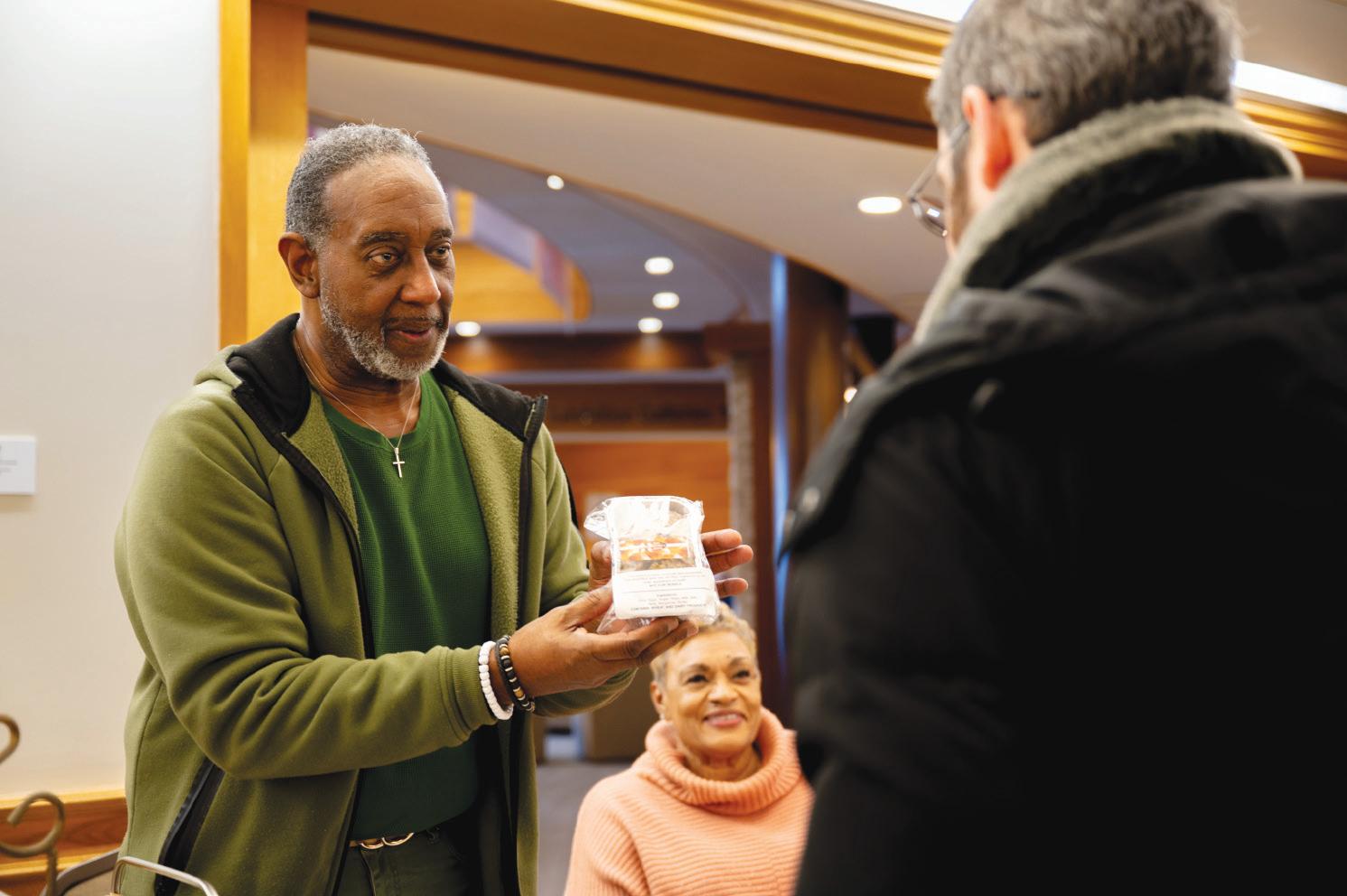
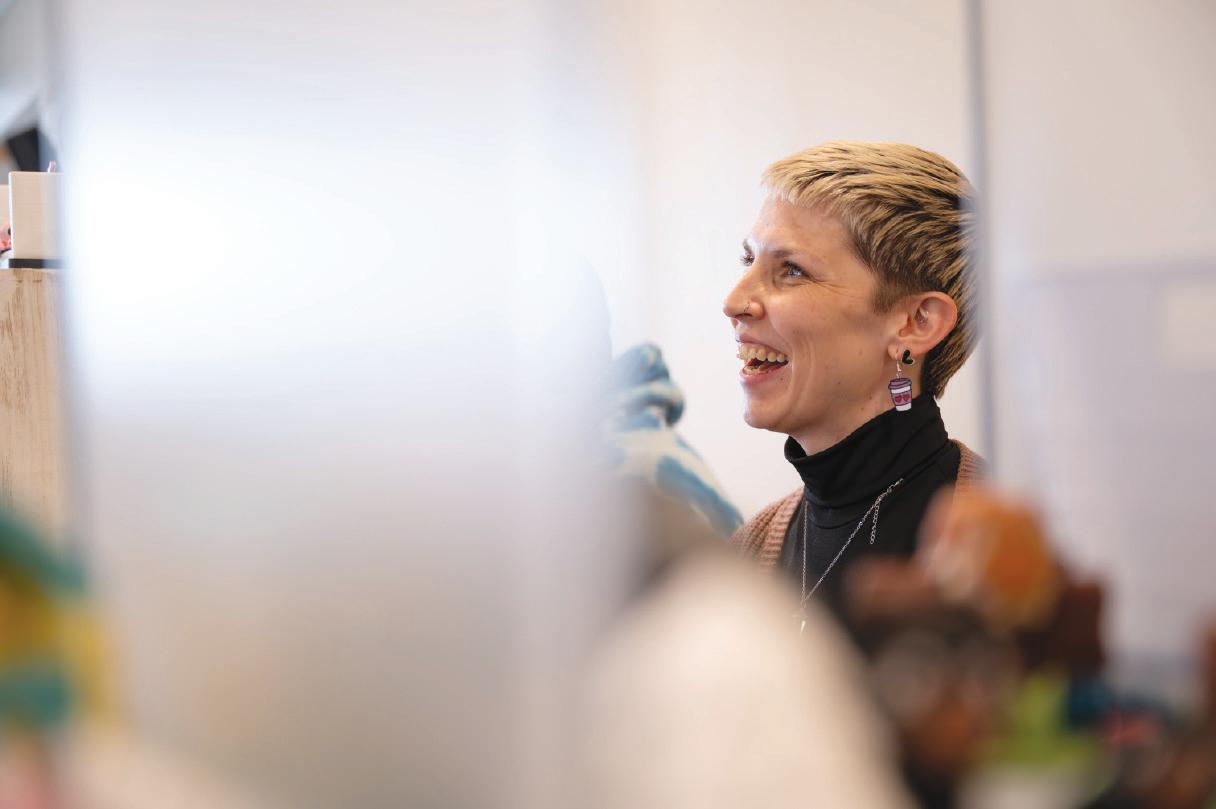
The market was the first since Ball State students returned from the holidays Jan. 5.




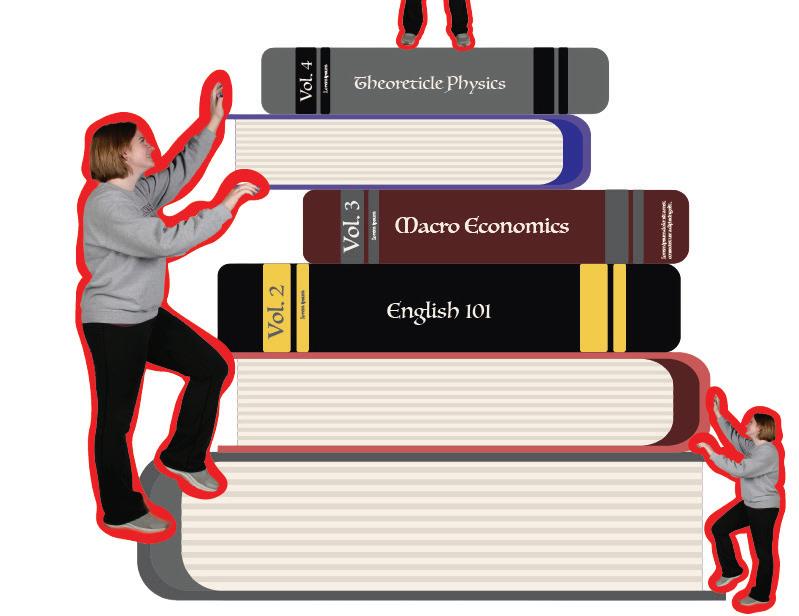
Core curriculum classes are important in order to develop lifelong skills that can be used both in and out of the workplace.
Students should view core clasSes as opportunities to learn important concepts outSide of their major.

Elisabeth Pointer
Columnist, “Peer Reviewed”
Elisabeth Pointer is a first-year genetics major and writes “Peer Reviewed” for The Ball State Daily News. Her views do not necessarily reflect those of the newspaper. Just about everyone dreads the required classes they are forced to take outside of their major. According to Ball State’s academics website, nearly one-third of all students’ coursework comes from the core curriculum classes they are required to take by the university.
This is why science, technology, engineering and mathematics (STEM) majors have to take a history class, or art majors are required to take a math class. To some students, these classes often feel like a waste because it has nothing to do with their future aspirations.
Not only that, but time, energy and money are all factors that may lead students to feel this way. College is already expensive, according to Education Data Initiative, and when it seems pointless to spend more money, it is hard to recognize the benefits of taking extra, generic courses. Personally, I do not want to take out more loans than I have to, and if I could finish my degree in half the time without the core curriculum, I would do it in a heartbeat. However, I know these classes are not going to go away. Therefore, it is important to understand why they are there in the first place.
I have also come to realize that if I go into these classes negatively, then I will not get what I am supposed to get out of them, and then it would genuinely become a waste of my time and money.
Knowing the benefits helps me absorb the material better — focusing on the negative only dims the experience, making it harder to gain anything beneficial from the class.
In reality, according to Ball State’s academics website, core curriculum classes are intended to prepare students for life and future goals by teaching them to “solve problems in any profession by being able to think about them in different ways.”
Many universities agree on this topic. Goodwin University explained in a January 2025 article that these required classes teach students skills needed beyond those that further their knowledge in their specific field of study. Skills such as cultural sensitivity, communication, creativity and critical thinking are taught across a variety of subjects. All such skills are important for employers to see in their future employees, regardless of the field.
Ball State requires a variety of classes for every student,
regardless of their major. Some, but not all, include math, the social sciences and writing — all skills students need to be well-rounded. Chemistry is not going to teach you how to manage your finances, theater is not going to teach you how to write professionally and music is not going to teach you ethics.
There are valuable skills to learn in every college class — ideas that your major may or may not teach you. But even if those concepts do not seem important to you at first, they are still important to everyday life in the future.
Sure, you probably will not be thinking about how to find the circumference of a circle or about ancient wars, but that is not all these required classes teach. They teach you to think in different ways, to be curious about everything
in someone’s future career, graduates will be left without a full education.
The world is not all about careers — it is also about navigating social situations, critical thinking and being creative. You could have an amazing career with your degree, but imagine not being able to identify a logical fallacy someone could use while speaking to you. Not only that, but imagine not being able to understand taxes or investments because it was not a part of your major.
As a STEM major, I know I will never use “The Epic of Gilgamesh” in my future career, but I also know it is beautiful and beneficial to learn about humanity from thousands of years ago.
I am someone who loves to learn, and if I could, I would spend my whole life learning everything there is to know. Maybe that is why I am more inclined to look for something meaningful in these classes.
College is meant to be a place that teaches you not only about the world around you, but also how to navigate it.”
and to understand the world and the people around you. For example, courses in the humanities and social sciences can help broaden a student’s knowledge and outlook on cultures beyond their own.
According to an article from Drexel University’s School of Education, these kinds of classes help people become more empathetic, prepare for a diverse workplace and gain a better understanding of the people around them.
In a world where it seems we lack empathy or cultural awareness, I think not giving people the choice but to take these classes gives more people the opportunity to understand different viewpoints and become more open-minded. These classes can also foster kindness, and we could never have too much of that in this world.
College is meant to be a place that teaches you not only about the world around you, but also how to navigate it. If subjects are not covered because they will not be used
Of course, I have not always felt this way. Some days, when I am a little extra tired or stressed, I feel the opposite. However, nothing good can come from solely focusing on the negative aspects of what you are being forced to do. Finding the good in the boring or time-consuming can add more worth to the college experience.
I think the biggest issue with required classes is most students’ mindsets. I can not say I am perfect — I do not want to attend my finance class most days — but I am able to look past the surface-level thought of “how could this benefit me career-wise” and instead focus on “how could this benefit me in the real world.”
I would be lying if I said that I am not looking forward to taking classes that actually pertain to my major instead of the core curriculum, because I truly cannot wait. However, I have to remember that it is not the only reason I am here.
I am here to find out about everything I possibly can, be curious and ask questions about what makes the world go round. I am here to learn, and that is not limited only to my major in genetics.
I know it is easy to focus on future careers because, realistically, that is why we are here. But it is also important to remember that there is just so much more to know.
Instead of going into this semester dreading the classes that “will not do anything for you,” try to look at them through a different perspective and find ways they can and will benefit you.
After all, you never know when a skill you learned in a class you never wanted to take will become relevant in the future.
Contact Elisabeth Pointer via email at elisabeth. pointer@bsu.edu.
Continued from Page 08
more size, but in a smaller rotational role.
The 6’9” junior center Zane Doughty would have given the Cardinals an extra lengthy big, but his absence from the team leaves a void.
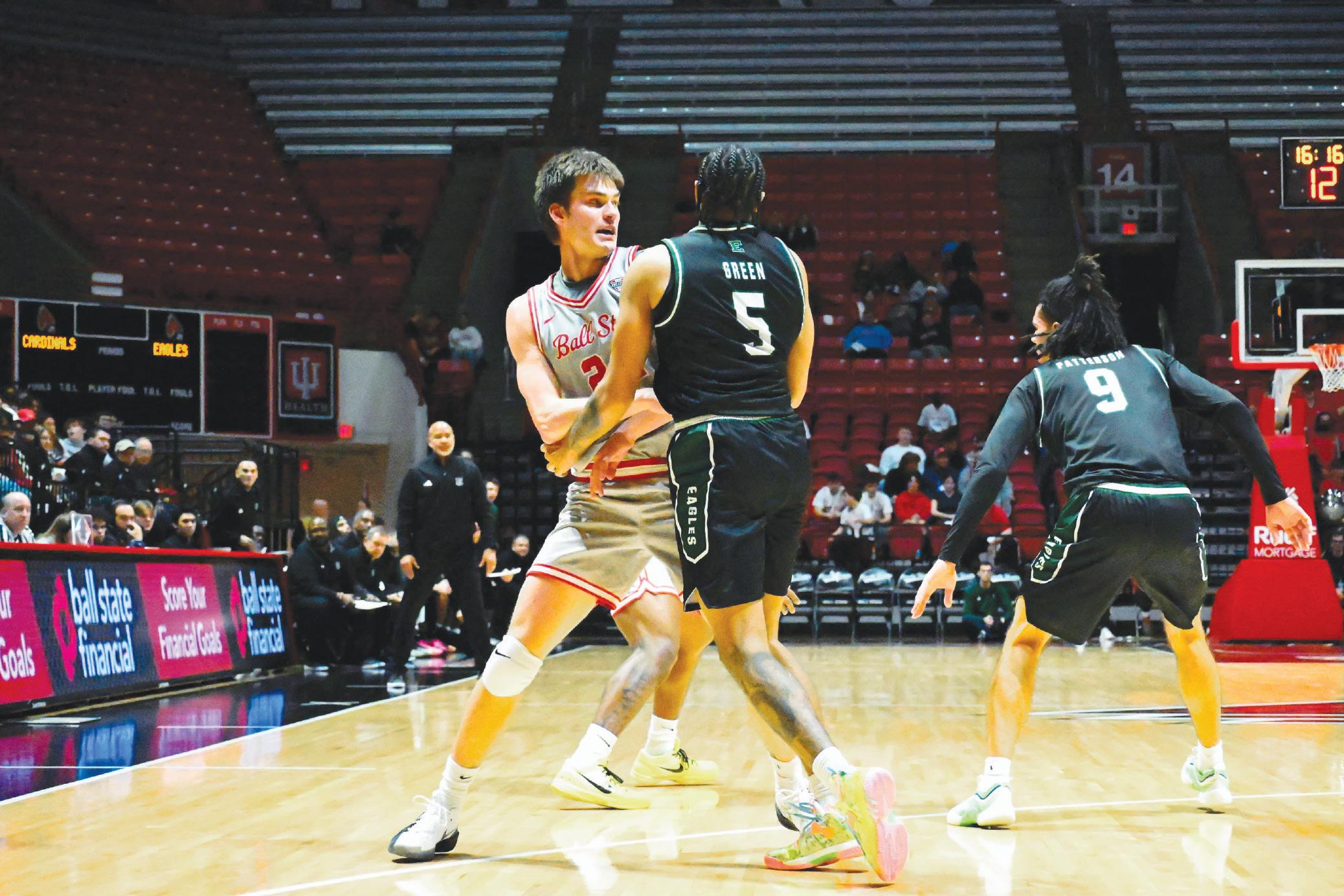
In the six games that featured Jones and Fish starting together, the Cardinals were outrebounded in four of those games. Since Lewis elected to start Copeland over Fish alongside Jones, the Cardinals were outrebounded in five out of six games. In games that Fish has missed due to injury, the Cardinals were outrebounded in six out of seven games.
With Ball State already struggling with rebounding, missing Fish in seven games just adds to that struggle.
That then leads to another big issue for the Cardinals, which is injuries. The Cardinals have been without guard Joey Hart, who was looking to break out in his junior year, in all but four games this season. Hart has proven in a small sample size to be one of the Cardinals’ big pieces, but the guard has unfortunately not been able to stay healthy.
In a loss against San Diego State University on Dec. 9, he played 24 minutes and recorded 18 points on 6-9 shooting and 2-3 shooting from behind the
The guard scored 27 points on 8-17 from the field and recorded five assists in the game.
But missing a piece like this does nothing but hurt the Cardinals.
There have been many struggles this season for Ball State, but injuries, along with the team’s undersized status, have been major contributors to the overall 6-13 record. Despite the overall struggles, things have been looking up for the Lewis-led team.
The Cardinals recently won their first MAC game against the Ohio Bobcats Jan. 16, and followed that up with a road win against Central Michigan Jan. 20. The back-to-back wins have moved Ball State up in the MAC standings, and the Cardinals now only sit one game back from the eighth seed, which is the cutoff to who makes the MAC tournament in March.
The Cardinals will have an opportunity to keep the train rolling when they take on Northern Illinois at Worthen Arena Jan. 24.
Contact Kyle Stout with questions via email at kyle.stout@bsu.edu or on X @kylestoutdailyn and Rylan Crum via email at rylan.crum@bsu.edu or on X @RylanCrum
68.4
31.8 points per game (Last in MAC) (Last in MAC) (Last in MAC) field goal percentage point differential in the MAC rebounds per game
42.2 -2.2



Byte is a student-run, multimedia coalition operating out of Ball State University’s Unified Media Lab. Though mostly oriented toward Telecommunications and Journalism majors, Byte draws in students studying all sorts of disciplines ranging from Creative Writing to Computer Science and everything in between.
Student staff work closely with student-run editorial board to help refine their skills and improve the quality of content produced for the organization. We are dedicated to providing the best in entertainment and pop culture related content.