














By Trinity Rea

By Sidney Miller




By Tatum Harris














Editor-in-Chief
Jessica Bergfors
Executive Editor
Trinity Rea
Artistic Director
Brenden Rowan
Associate Editor
Linnea Sundquist
Photo Editor
Olivia McSpadden
Associate Artistic Director
Antonia Liakas
Copy Editor
Tatum Harris
Designers
Anna Howarth
Antonia Liakas
Ava Bower
Brenden Rowan
Elise Todd
Erica Hartman
Jessica Bergfors
Laila Lewis
Olivia McSpadden
Writers
Aiden Murray
Brooke Follrad
Jessica Bergfors
Katherine Hill
Linnea Sundquist
Naomi Sanford
Radley Richman
Seyla Ray
Sidney Miller
Tatum Harris
Trinity Rea
Photographers
Aiden Murray
Andrew Berger
Isabella Kemper
Kadin Bright
Kyle Ingermann
Olivia McSpadden
Trinity Rea
Adviser
Corey Ohlenkamp
jessica.bergfors@bsu.edu @jesslynn.png
My childhood home didn’t have a pool, despite younger me always begging my mom to install one. However, my childhood best friend, Vanessa, had an in-ground pool at her house.
It was a warm, humid summer night. Fireflies zipped past my head, and I could see the moon’s reflection glimmering on the water. The kitchen light from inside lit the dark backyard through the window. Giggles erupted from Vanessa and me as my dad chased us around the pool.
“She’s a Sox fan!” we would take turns yelling, my dad switching who he’d chase after.
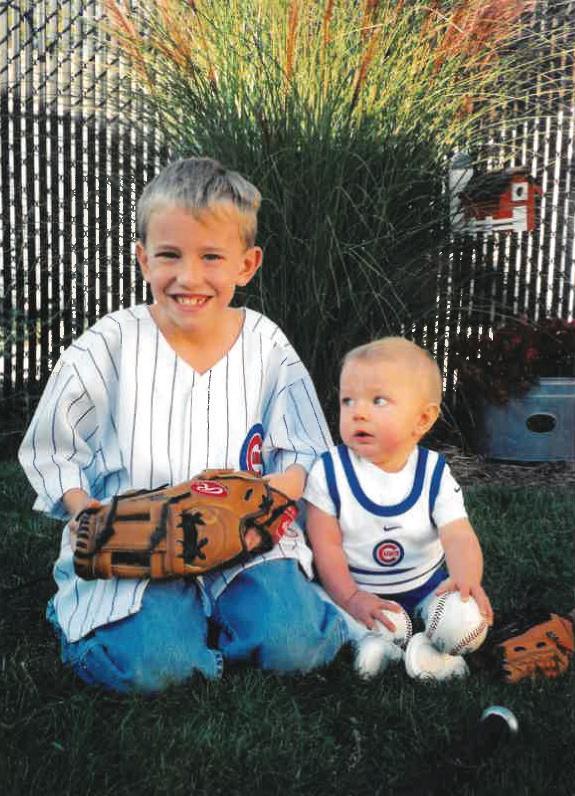
My dad was a massive Cubs fan. In my house sits a framed photo of my older brother and me wearing Cubs jerseys in our backyard, with my tiny hands holding a baseball. Vanessa and her family are White Sox fans. Living near Chicago, I knew about the major, historical Cubs vs. White Sox rivalry from a young age.
The sound of our tiny feet hitting the ground and shreiks echoed throughout the neighborhood, as we attempted not to get caught by my dad. The pool reflected the image of him catching me and swinging my small body around. I couldn’t help a toothy smile from stretching across my face.
The word ‘wave’ has many definitions. According to the Merriam-Webster Dictionary, it can mean “a moving ridge or swell on the surface of a liquid.” It can also mean “a surge of sensation or emotion.”
When the idea of the Waves Edition was originally pitched, my mind went in several different directions. I thought about physical waves in water, but also conceptual waves. I thought about emotional waves, specifically the range of emotions an individual can feel. The wave of falling in love with someone. The way it feels like a wave suddenly crashing onto the shore the moment you realize it. The wave of dealing with grief. It sometimes feels like ripples, and other times it’s a tsunami. The wave of your own life, continuously changing patterns as you change with them.

I wanted the spring edition of the magazine to include more conceptual story ideas, and the Waves Edition gave us that opportunity. This issue holds all kinds of stories. Alongside articles about scuba diving and the Indiana Dunes are features that discuss grief, recovery and addiction. Wherever you may be reading this magazine, whoever you may be reading it with, I hope these stories resonate with you in some way or teach you something new. The Ball Bearings team has put immense work into these stories, and they have never failed to amaze me.
I am constantly inspired by those whom I have worked with in student media.
I have worked with Ball Bearings magazine since my first year at Ball State University, and it’s been a privilege I don’t take for granted. From working past midnight in the Unified Media Lab (UML) on a design to editing articles until my eyes blurred, Ball Bearings has been one of the best parts of my college experience.
Similar to what waves do, this chapter of my life is drawing back and making space for what’s next.”
- JESSICA BERGFORS, Editor-in-Chief
I’m not sure how to say goodbye to waking up early on a Saturday and driving to Starbucks with Brenden, Ball Bearings Artistic Director, before heading into the UML for print night. Or how to say goodbye to adding songs in a Spotify queue with Trinity, Ball Bearings Executive Director, and blaring music in the UML from their speaker.
What I do know is that my experiences with Ball Bearings have shaped me into who I am today. A better writer, a better designer, a better leader and most importantly, a better person. Meeting people who change your perspective will always be one of the greatest gifts of life, and I’m lucky to have experienced that gift during my time at Ball State. At times, I felt the same way I did when my dad chased me around the pool.
In Phoebe Bridgers’ song “I Know The End,” the chorus reads, “But you had to go, I know, I know, I know. Like a wave that crashed and melted on the shore.”
Similar to what waves do, this chapter of my life is drawing back and making space for what’s next. This chaotic, beautiful wave has melted on the shore.
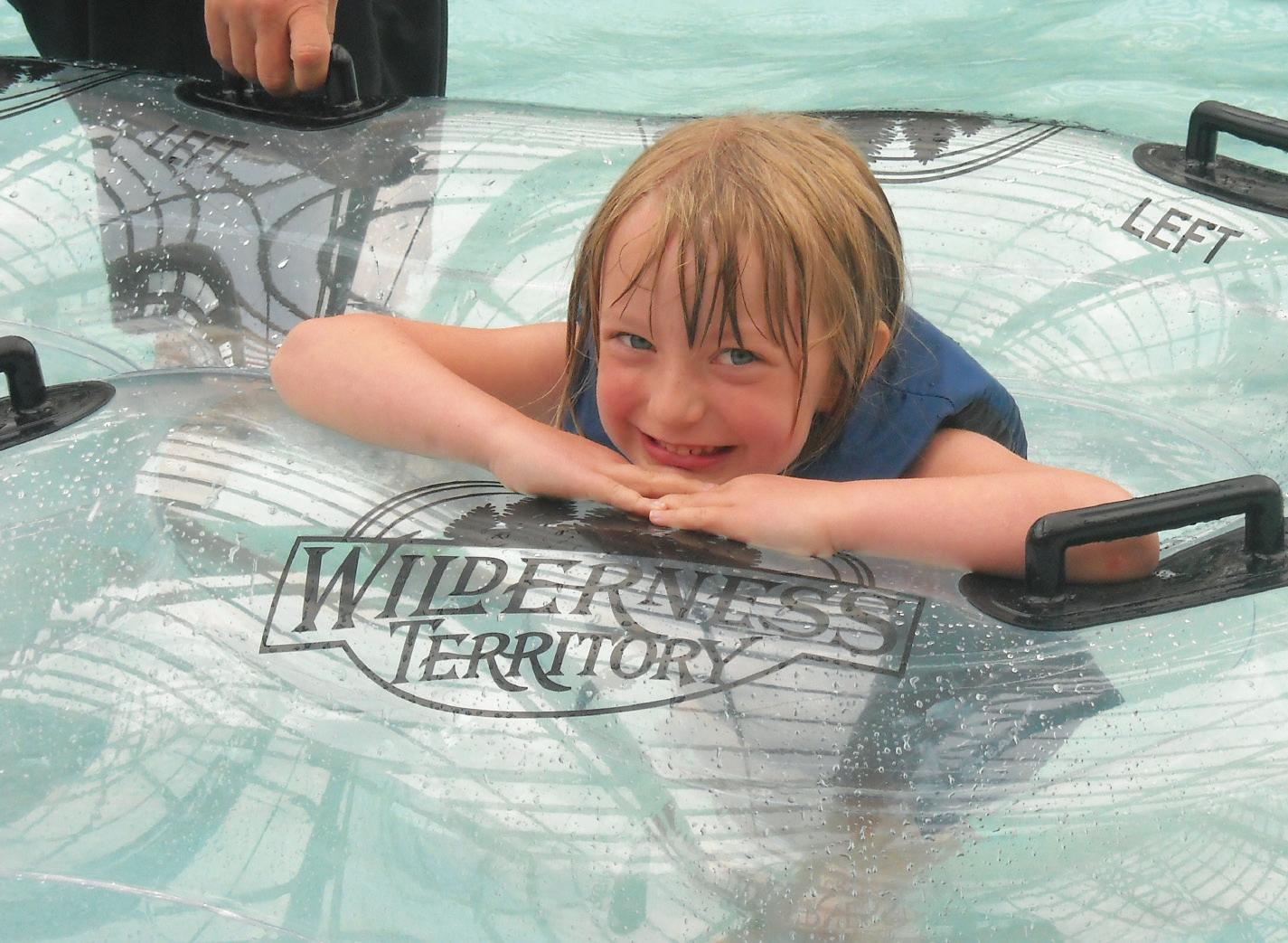
[ABOVE] Jessica Bergfors plays in the pool at a Wilderness Resort in Wisconsin Dells, Wisconsin in 2009. Bergfors’ family would frequently vacation in the Wisconsin Dells during the summer.
Jessica Bergfors, Photo Provided [BELOW] Jessica Bergfors and her brother, Kyle Bergfors, pose for a photo wearing Chicago Cubs jerseys in their childhood backyard in Lansing, Illinois.
Jessica Bergfors, Photo Provided






































BENEATH BALL STATE






UNIVERSITY IS THE LARGEST CLOSED-LOOP GEOTHERMAL SYSTEM IN THE COUNTRY.



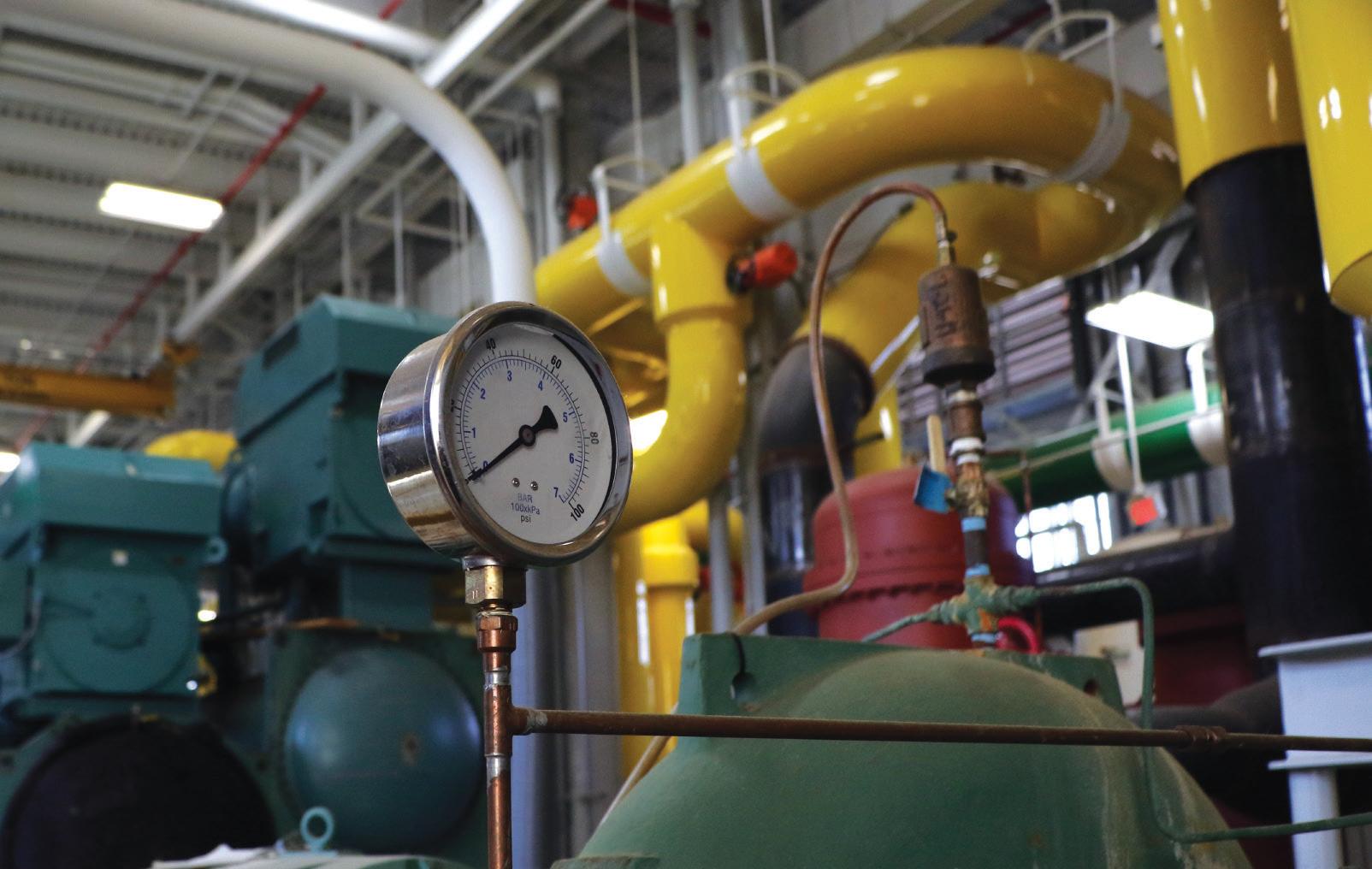
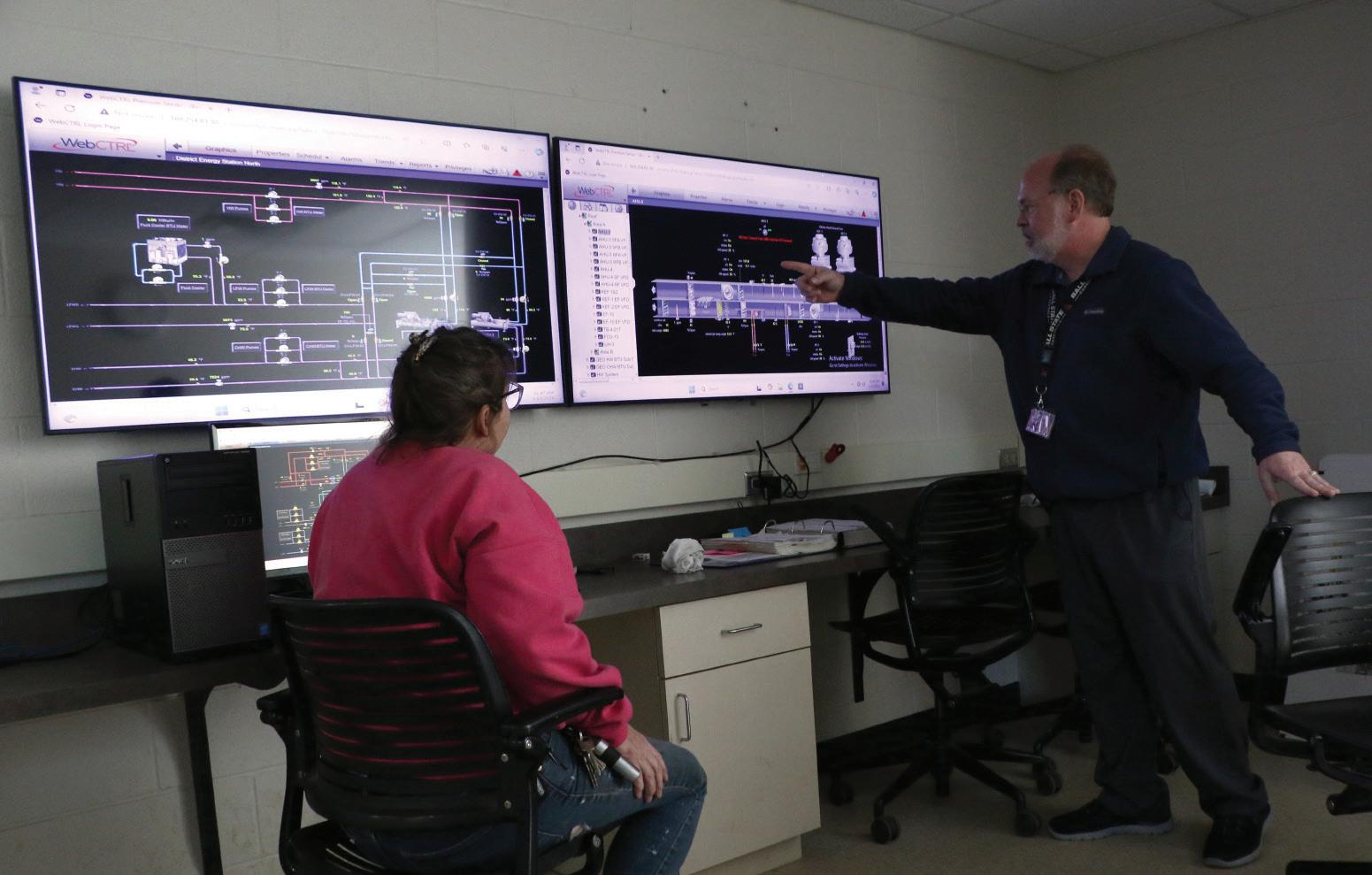
[LEFT] A photo of a PSI meter at the ground floor of the District Energy Station South March 13. Olivia McSpadden, Ball Bearings [BELOW] Jim Lowe explains how the Geothermal System functions inside the control room March 13. Lowe oversaw every phase of construction on the geothermal project Olivia McSpadden, Ball Bearings

By Trinity Rea
Beneath the sidewalks of Ball State University, under North Quad and parking lots just past Beneficence, waves are moving. Not the kinds that crash or foam, but ones that radiate outward, slowly, silently, carrying heat through pipes buried hundreds of feet deep in the earth.
Ball State is home to the nation’s largest ground-source, closed-loop district geothermal energy system, according to its website. With construction beginning in May 2009, the process took nearly six years to complete, with the final stage being wrapped up in 2015. However, by March 2014, there was sufficient geothermal capacity to stop burning coal on campus.
Ball State was burning nearly 10,000 tons of coal a year, using almost 40-year-old equipment. Former Ball State University President, Jo
Ann Gora, watched as the machinery continued to age and environmental regulations tightened. Jo Ann said she knew something had to change.
The “easiest path” would have been natural gas, the most common heating and cooling system practice in the country, according to the U.S. Energy Information Administration, Residential Energy Consumption Survey; however Jo Ann had already signed the Talloires Declaration.
The declaration is “the first official statement made by university presidents, chancellors, and rectors of a commitment to environmental sustainability in higher education.” Its 10-point action plan aims to incorporate sustainability and environmental literacy, and has been signed by over 500 university leaders in over 50 countries.
“If the closed-loop geothermal system worked, it would be a milestone in reducing our carbon footprint and HVAC costs, long term,” Jo Ann said.
The decision did not just have environmental benefits, something Jo Ann said was also on her mind when approaching the project.
Given the fact that the system is one-of-one, visitors were coming from both in and outside of the country to get a better understanding of the system and the construction process. The project also functioned as an immersive learning experience for students on campus.
Professor of Geological Sciences
Klaus Neumann said a few of the boreholes, a hole dug deep into the ground that works within the geothermal sytem, were drilled specifically for the department. This allowed students to observe, monitor and graph different data points.
Jo Ann said that in her 10 years as university president, the geothermal project was one of many ways she tried to set Ball State apart from other universities.

I knew at the end [of construction,] Ball State would have a system they could be proud of for decades to come.”


- Jim Lowe, Associate Vice President for Facilities Planning
“Just [as] introducing immersive learning as the hallmark of our undergraduate education had put us on the map in Indiana and in the country, I knew installing the geothermal system could do the same thing for us,” Jo Ann said.
The benefits of implementing the geothermal system were also financial.
Klaus, who monitored groundwater near the bore fields during construction, noted that natural gas prices were climbing in the early 2000s when the decision to switch to geothermal was being made.
He implied that because Ball State had not known that an increase in national drilling for fracking would soon be made, and completely flip the price of natural gas, the geothermal system was the university’s best option.
Jim Lowe, who served as Ball State’s associate vice president for facilities planning and management, oversaw every phase of construction on the project. He described the system as “a big bank account” for heat, one that sits at a steady 55 degrees year-round.
Jim said that the geothermal system functions by taking advantage of storing thermal energy.
In the summer, excess heat pulled from campus buildings gets deposited into the ground through the geothermal systems’ network of pipes. In the winter, that stored energy is withdrawn and used to warm those same buildings.
Jim said it is the same principle as the refrigerator in your house, moving heat from one place to another, rather than creating cold from scratch, which is why the back of your refrigerator is warm.
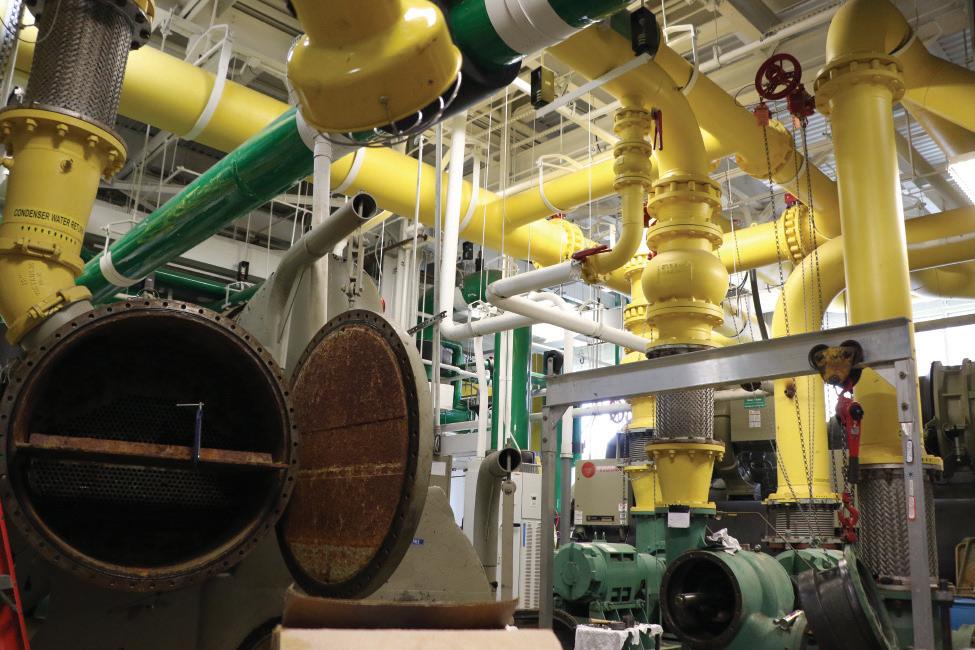
Ball State’s geothermal equipment works as a vertical closedloop system that uses fresh water. 3,600 boreholes make up the system, each 6 inches in diameter and ranging between just 4-500 feet deep, almost five times the height of the university’s Teachers College.
Klaus, who monitored groundwater near the bore fields during construction, explained that the ground beneath the university is made up of three distinct layers, each with their own degree of
difficulty to move water through.
At the top sits glacial drift, a mix of sand, gravel and boulders from retreating glaciers during the last Ice Age, spanning anywhere from just 5 to 50 feet deep. The next layer below is dense shale, tightly packed and somewhat impermeable, meaning water cannot pass through it at all.
Deeper than that, hundreds of feet down, are beds of limestone, fractured and riddled with cracks and small caves, allowing groundwater to flow freely. Water conducts heat more efficiently than dry rock, making the limestone layer an ideal medium for the closedloop pipes.
“Groundwater moves through cracks and crevices down here, and it pretty much freely flows through here, because there’s sand in here,” Klaus said. “... If you want to transfer heat, you love to have water, because within water, you move heat much faster.”
Additionally, each borehole contains piping that combines for a total of 5,280,000 feet, laid traveling down each borehole and back up. These boreholes connect to one another and two oncampus energy stations.
Presently, the soccer field on the north end of campus looks like any other, but during the system’s construction, Klaus described it as looking like a “moon landscape.”
Trucks moved across torn-up parts of the earth, while around ten drilling rigs ran simultaneously, each individual borehole taking days to complete.
“It’s a once-in-a-lifetime opportunity to install a system that large, that big …It was a very daunting, exciting, strategic endeavor,” Jim said. “...I knew at the end, Ball State would have a system they could be proud of for decades to come.”
While geothermal benefits Ball State’s campus, it does not come without complications.
The system was designed to function within a climate that has changed since construction began. Warmer winters mean less heat needs to be pulled from the ground and hotter summers push more heat in. This means the university has to supplement the system with gasdriven equipment to help manage the difference.
The pipes beneath campus have a long life expectancy and equipment inside the plants can be replaced and upgraded. Jim pointed to the original coal boilers, installed in 1941 and used for nearly six decades, as a reference point to how long things can last when they are cared for.
The system, he said, will run until someone comes up with something better.
By Sidney Miller
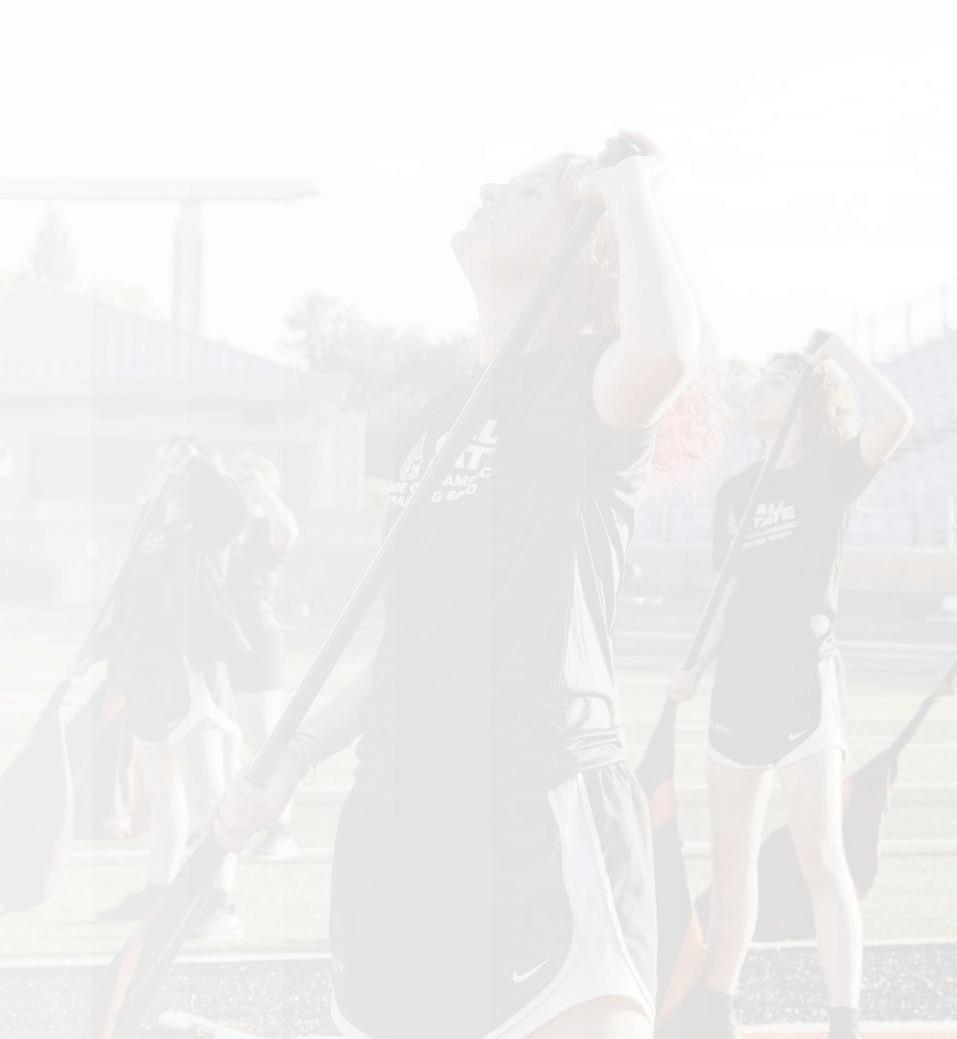
During her sixth-grade band class, Alivia Wolfe had the option to continue with instruction or step out to work with the color guard team instead. She decided to try something different and join the team.
Without expecting it, she fell in love with color guard.
As she approached her first year of college, her friend, Donaji Valdes, convinced her to continue with the color guard team at Ball State University.
“It was one of the best decisions I’ve made,” Alivia said. “I love it so much.”
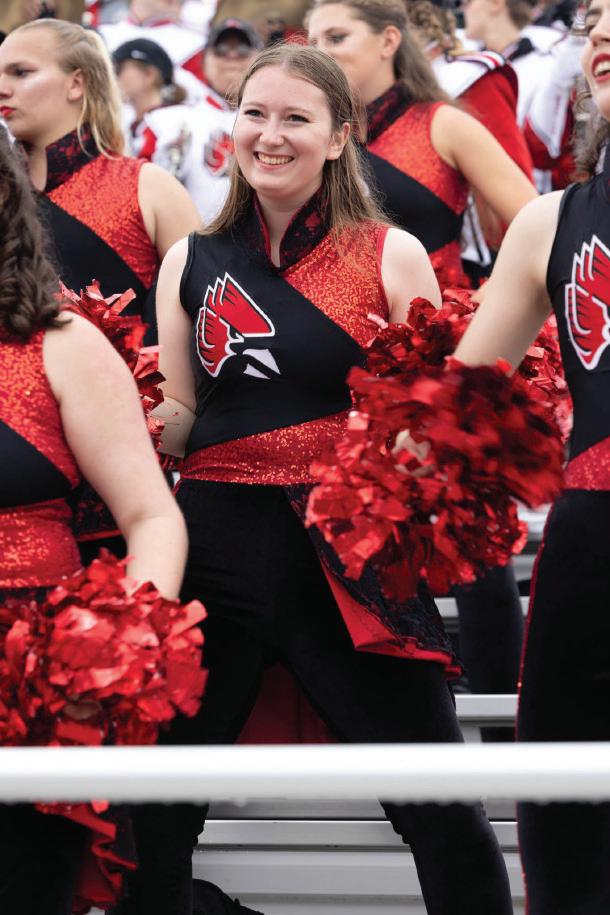
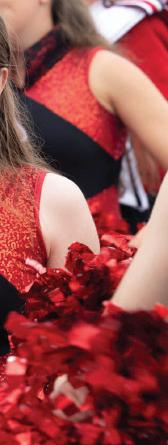
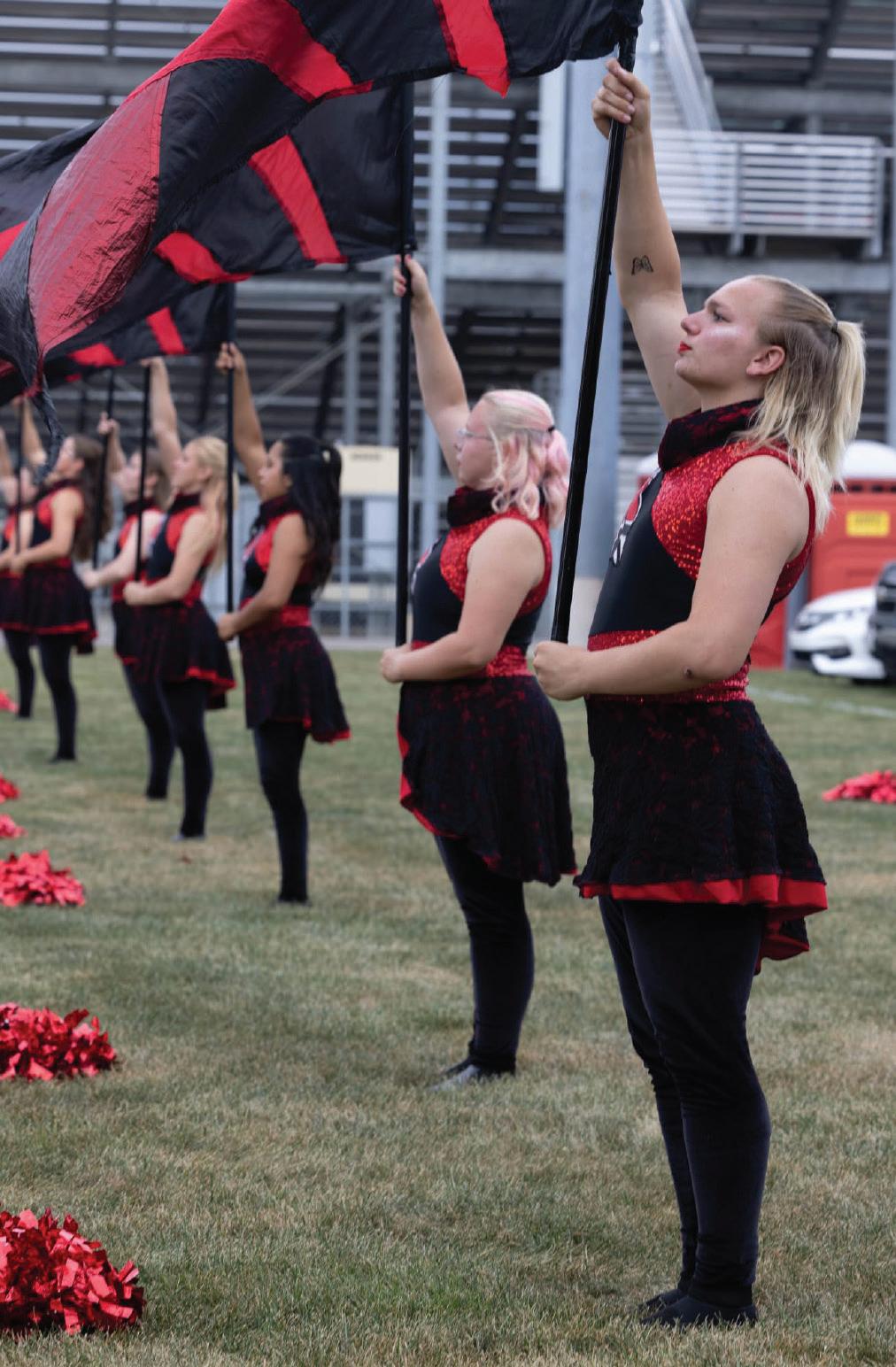
Moving into school early and practicing five days a week starting in early August, Ball State’s color guard is an integral part of the Pride of Mid-America Marching Band (POMA). During the 2025 season, the team practiced and prepared for performances amidst the hot sun or long storm delays on gamedays.
The group spends most of its fall semester seeing each other every day, allowing them to bond with one other.
A lot of adjusting to college was with their help because I already had that family built in before everyone else got here.”
- ALIVIA WOLFE, Color guard member
After Alivia joined the team, she began reaching out to other team members to connect before practices began. The color guard community allowed her to get a head start in adapting to the new environment of a college campus.
“A lot of adjusting to college was with their help because I already had that family built in before everyone else got here,” Alivia said.
The color guard and band move in a week and a half before other students to get an early start on practicing for the season at band camp. This means full days of rehearsal for the band and color guard. They learn the fundamentals of marching, the pregame show and work on their endurance for performances. This extra time allows first-year team members to learn more about campus and make new friends before the school year oficially begins.
Not only did Alivia have to adjust to college life, but also to the differences between her high school color guard and Ball State’s. She was grateful to get guidance from her teammate Donaji, who was starting her junior year at the same time.
“Every time I had a question or needed help, she was always more than willing to help me in any way I needed,” Alivia said.






































































































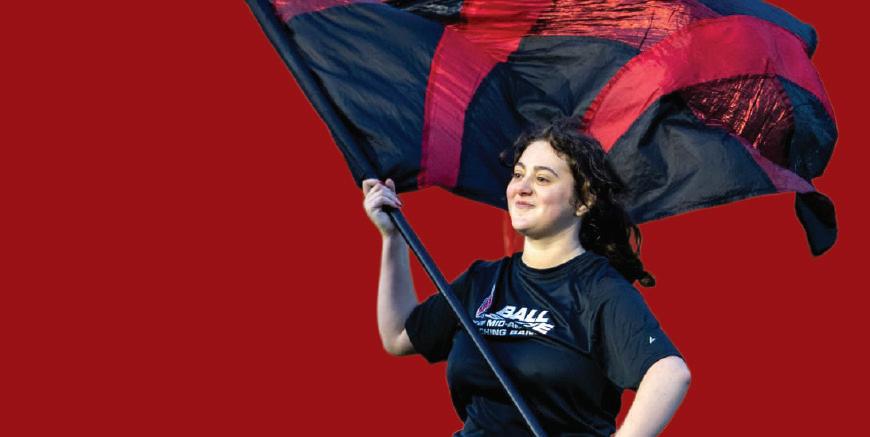




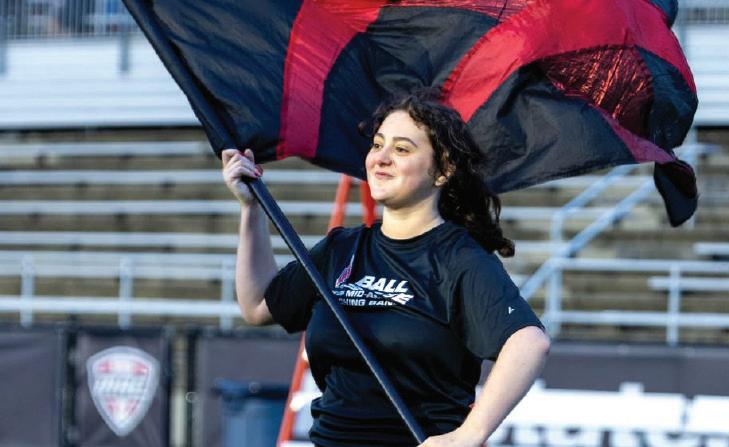


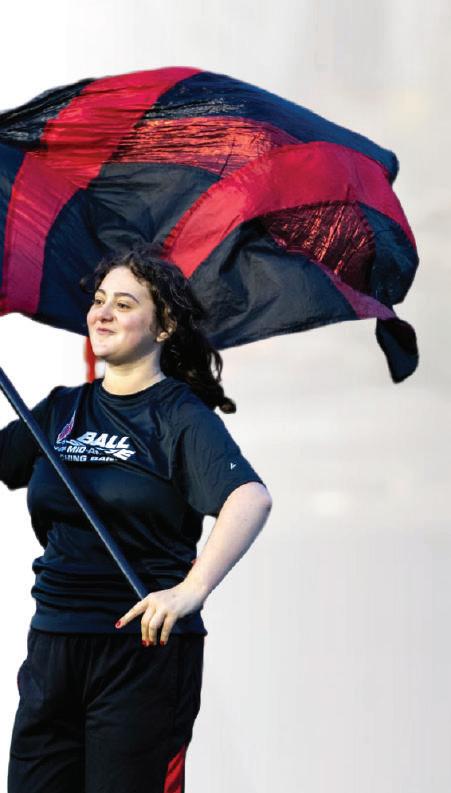





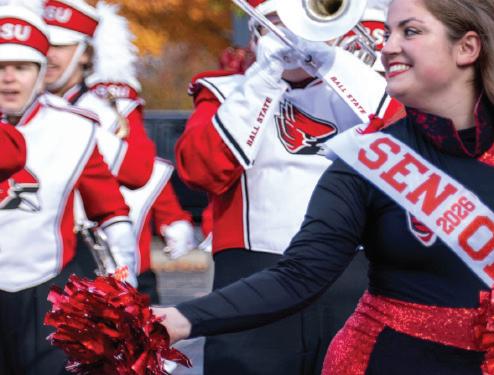






















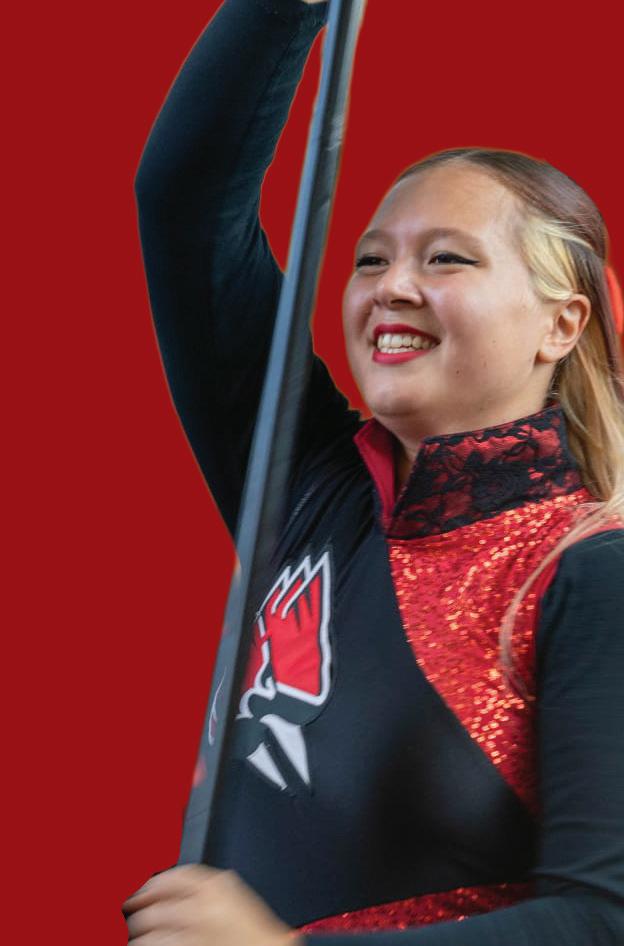











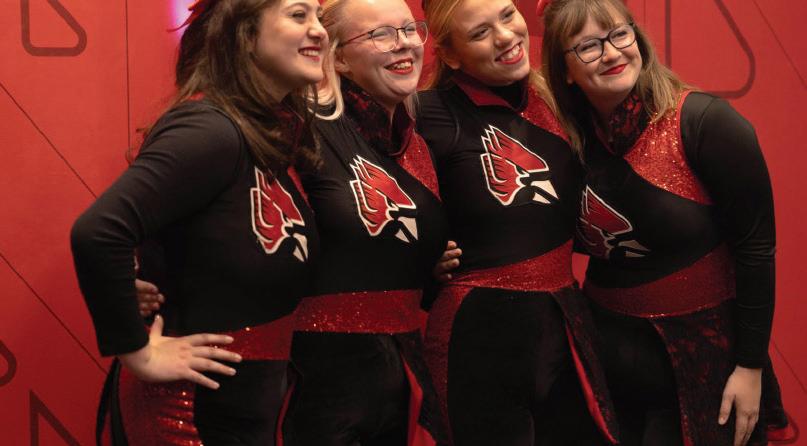





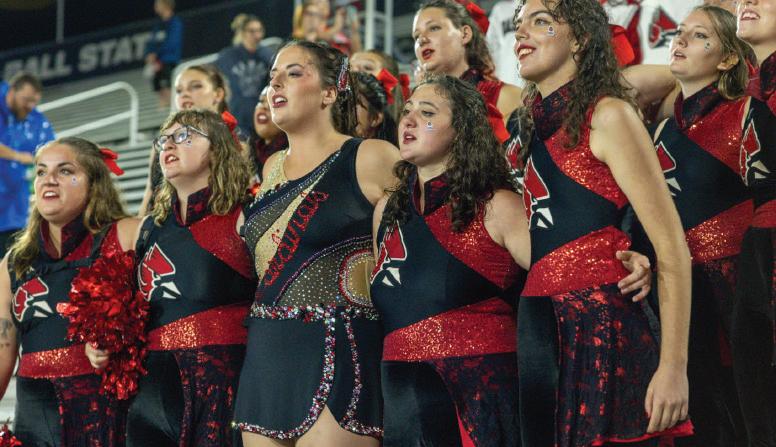

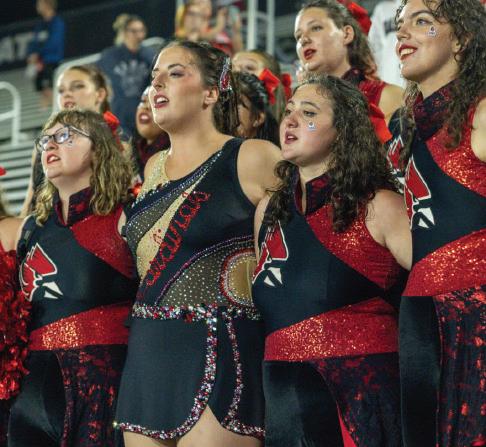


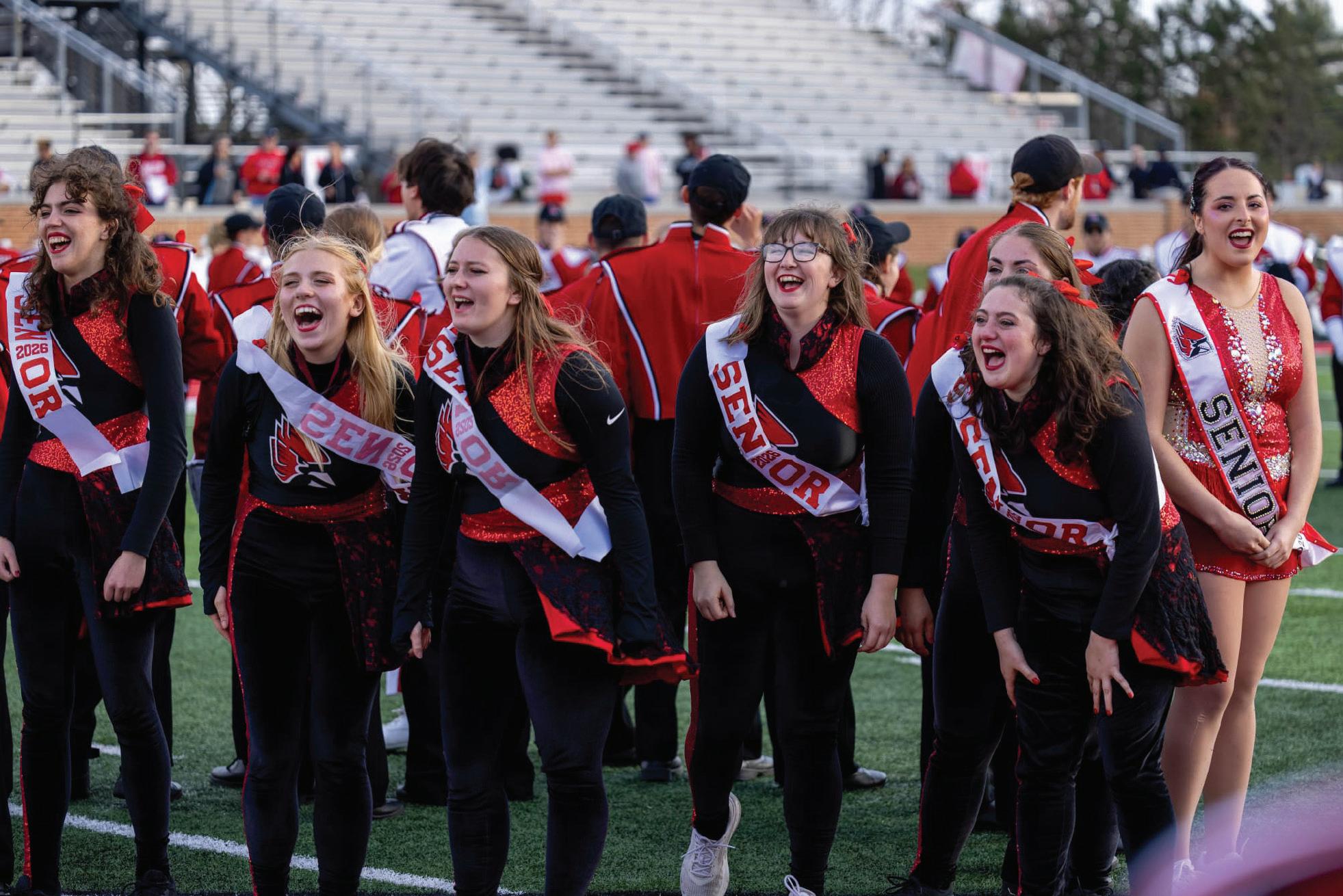
State’s color guard team, as well as a Ball State alumnus and teacher at West View Elementary School. With Kelli’s teaching schedule, she was not always able to make it to practice on time. She allowed the team’s student leaders to take charge before she was able to attend the team’s practices on weeknights.
Color guard Co-Captain Danielle Finicle explained how she and the team’s captain, Caitlin Hummer, led the team before Kelli arrived.
“It would be me and the other captain’s job to take on that role of director, and look over everybody and make sure we’re being productive,” Danielle said. “Until the director comes in and then we kind of take a step back, let her do her thing, and help her if she needs it.”
Now a senior, Danielle has continued color guard since joining her first year at Ball State. The large time commitment while being a biology major has sometimes made her question whether or not to continue.
Because of the friends she made and

with each other and the band to prepare.
“The band, they learn the music and the drill … and the guard has to learn the drill, and they have to wait until we get the music to actually learn the choreography to put with it,” Danielle said.
This past season, the group was able to showcase its skills at the first home football game and family weekend Sept. 13, 2025.
For color guard, game day started nearly eight hours before kickoff. The team practiced their performances before anyone else arrived on the field that day, including the dance team, cheerleading team and the football team.
“We’d have a 6 a.m. call time where we’d have to show up in full hair and makeup, and mostly dressed, and it was a pain,” Alivia said.
After practicing, they’d spend their time performing at the CharlieTown tailgate, the pre-game show and in the stands before doing their halftime show. Each halftime show was different, so


We’re in the pouring rain, we’re in our makeup and uniforms, and we just have to do what we can do. They’re fond memories, like it’s the feeling of ‘We’ll laugh about this later.’”
- DANIELLE FINICLE, Color Guard Co-Captain



the team learned a new routine of three songs between home games.
This past season, there were two back-to-back home games, leaving only 10 days for the team to be performance-ready.
Band Director Jeremy Harmon decides on the music and creates the drill for each show, then Kelli takes over to create the color guard routines. She writes down places, counts and movements as she designs the routine for each song.
“As I’m listening to it, I’m essentially writing specific notes, and I’m trying to find a pattern,” Kelli said. “It’s very poppy tunes, so you’re gonna get the chorus more than once.”
Kelli uses her former music and color guard experience to guide her as director. She spent her time at Ball State in color guard before graduating in spring 2024.
Soon after graduation, former Director Rhonda Reynolds asked Kelli if she wanted to take over the role. Rhonda spent Kelli’s first year still working with color guard before passing it off entirely this past year.
“This was my first year where I was able to have free range of everything, which was pretty amazing, but also very real,” Kelli said. “It hit right away, and I realized how much Rhonda really did for us.”
With the football season extending late into fall, the weather can become less than ideal. For her senior season, Danielle remembered one game where they encountered rain, lightning and a game delay.
“We’re in the pouring rain, we’re in our makeup and uniforms, and we just have to do what we can do,” she said. “They’re fond memories, like it’s the feeling of ‘We’ll laugh about this later.’”
During memorable games and weeks of seeing each other daily, the team created a culture and environment that was unique to them.
Outside of practice, they are friends who continue to stay close
until they are back on the field together come summertime.
Alivia made her first friends in college from the color guard team. Four years prior, Danielle had the same experience, making her closest friends during practices. The students’ passion for the team is not limited to them, but it also extends to their director, who has been in both roles.
To students who are thinking about joining, Kelli said, “It would be the best decision you have ever made in your entire life. I mean, I am still in contact

with people that I spun with.”
Going into the 100th year of the POMA Marching Band in 2026, the color guard team wants to continue improving its craft. Along with celebrating a century of the band, they look forward to the opportunity of traveling to perform at an away game.
For seniors like Danielle, they can look back on their time with the team fondly.
“It definitely was a really good experience,” Danielle said. “There’s a reason I came back all four years."

By Linnea Sundquist
“‘It doesn’t get better, but it does get easier,’” is a phrase former Ball State University student Emmett Bartholomew recalled a member of his grief support group saying aloud during a session.
Emmett has been attending a grief support group through the organization GriefShare, an online network of faithbased support groups, since about two weeks after his grandfather, Michael “Mike” Bartholomew, died. His grandfather died Dec. 5, 2025, from acute myeloid leukemia, commonly referred to as AML, a rapidly progressing blood cancer that starts in the blood and bone marrow, according to the Leukemia Research Foundation.
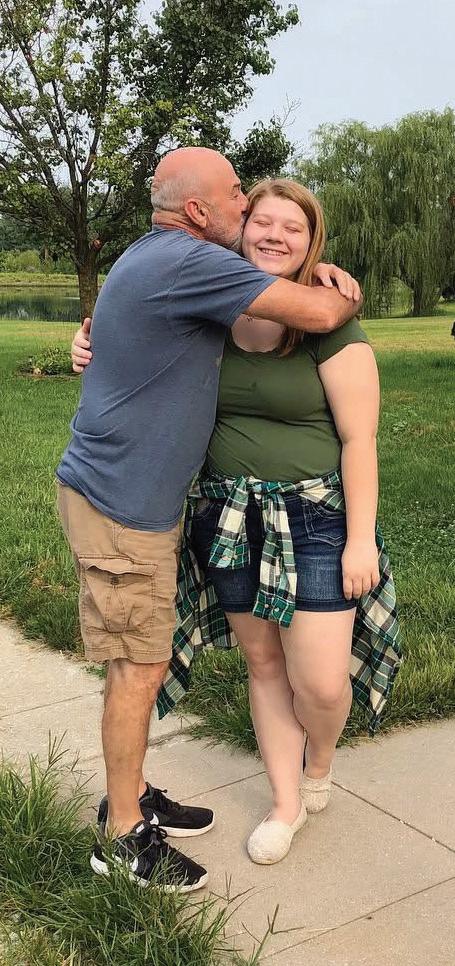
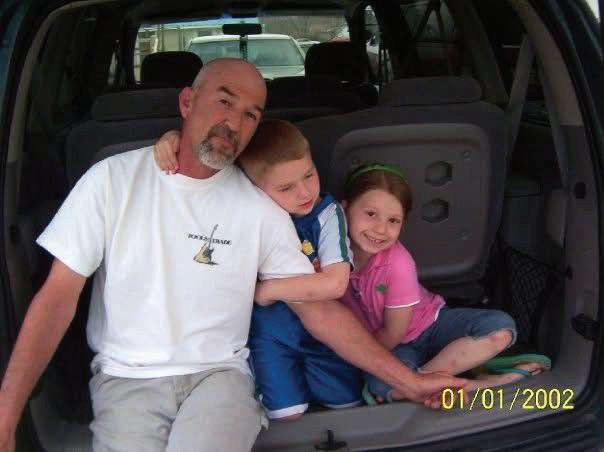
Before his death, Emmett said that Mike was a father figure to him. Emmett explained that his biological father struggled with addiction and has always been “in and out” emotionally. He lived at his grandfather’s house for the first five years of his life, and ended up living with him again during college.
“He was my dad for all intents and purposes,” Emmett said.
In elementary school, Emmett’s grandfather taught him how to play the guitar. Even though at the time Emmett was learning, he was not “really
committed” due to his AttentionDeficit Hyperactivity Disorder (ADHD), but said he wants to get back into the instrument since his grandfather’s guitars are now left unused.
“He’s a musician first and foremost, that’s what he would say,” Emmett said.
Emmett described his grandfather as having a “very strong work ethic,” saying he and his family got their hardworking character traits from him. Along with having a strong work ethic, Emmett said his grandfather was very direct and blunt, often not saying things “in a very nice way.”
“I often say he’s the kindest asshole that you would ever meet,” Emmett said.
His grandfather was very supportive, Emmett said, but “was not good in the emotional support” aspect. He explained that his grandfather would always support the people in his life, describing his house as “open doors.”
For example, Emmett said he had a cousin who was struggling with addiction, and his grandfather took her in to live at his house, along with paying for all of the expenses to put her in a rehabilitation facility.
“But her actually being there, is he gonna be like, ‘How are you doing? Do you need help?’ No. He’s not emotionally gonna be helping, but he’s helping,” Emmett said.
I went a little crazy after he died.”
- EMMETT BARTHOLOMEW, Muncie resident

Following a work-related injury from a fall, his grandfather was left with a severe injury to his shoulder. After receiving his first workers’ compensation check due to his injury, he bought Emmett and his cousins Taylor Swift concert tickets. He said that his grandfather “easily” spent two grand on the tickets, but did not say anything about it.
After his diagnosis with AML, Emmett explained that his family “knew it was coming” when they spoke about his death. He explained that there were many years of uncertainty about what was going to happen to his grandfather as he battled with cancer, but when he died, it still left the family in shock.
Following his death, Emmett said he quit his job and did not work for months. As he grieved, he described the difficulties of having a normal routine. This included what he referred to as “self-care,” such as getting out of bed or brushing his teeth.
“I went a little crazy after he died,” he said.
Grief educator and chancellor at Ivy Tech Community College Anderson, Dr. Mia Johnson, said that while individuals prepare for the sadness that comes along with grief, most individuals are not prepared for the physical components that appear during the grieving process. This can include body aches, headaches and decision fatigue.
According to a Febuary 2024 article from UCLA Health, grief can cause a wide variety of physical symptoms, ranging from bodily pain and a weakened immune system to stomach fatigue.
“We know that the brain and the body are tied together, so I don’t know why we wouldn’t put it together that this is happening when we’re grieving as well,” Mia said.
Along with her research partner, Dr. Julia Porter, Mia started researching grief about a year and a half ago. Both Mia and Julia are certified in grief education, having written a book, “Supporting Others in Times of Loss: Stories of Grief, Trauma, and Leadership,” and hosting a podcast together called “Moving Together with Mia and Julia.”
Mia said she became a grief educator after her father became ill in 2022, dying just three months later. She described this as a “whirlwind” of emotions. She had a full-time job at the time, so she was not able to “reset and regroup” properly after her father’s death.
“It made me start thinking about grief in leadership,” Mia said. “There was a lot of information about collective grieving and what the leaders can do to support their team or their employees [who] were grieving, but there wasn’t much about how the leader gets supported.”
Finally, in 2024, both Mia and Julia put out a call for individuals in leadership positions who were grieving, and both researchers conducted interviews to identify emerging themes with grief in leadership. Mia explained that she found several individuals who left their place of work due to not getting the support they needed as they grieved. Some even left the entire job field.
Mia said she and Julia will help anybody who is looking for help.
“Anybody in between leader, not leader, on your way to lead, we will help,” Mia said.
Emmett said that his grief support group does an exercise called a “grief forecast.” This exercise is to show how each participant is feeling with their grief by using weather terms, such as cloudy or stormy, to depict how they are feeling. He explained that some days have different forecasts, asking himself the question daily of ‘How am I doing on my grief?’
“In the first few weeks, it’s gonna be pretty much stormy, like all the time,” he said. “But now I’m kind of more in the partly cloudy area.”
One misconception about grief and the grieving process that Mia does not agree with is that grief gets better with time. She explained that individuals who are grieving develop a better way of dealing with their feelings and the overall grieving process. She explained that there is no set amount
of time for when someone should not be grieving, saying that individuals will “probably continue to grieve the rest of [their] life.”
“Thinking there’s a time frame on when grief should end or be over, or you shouldn’t be sad anymore, is not real,” Mia said.
School group facilitator at Peter’s Place, Carrie Catone, also expressed similar sentiments to Mia.
comments along the lines of, “We get it, your grandfather died,” and reflected on how not many people want to talk about grief, saying people tend to “shut down” around the word death.
He explained that when he tells the people around him stories of his grandfather, most people do not have a response. Emmett does not want people to tell him “I’m sorry,” because he said it feels like a “weird” thing to say and he does not know how to respond to it.
Emmett said that grief takes a long time and that it is an ongoing process for the individual who has lost somebody.
It’s normal to have grief, and it won’t go away, but it’s something that we can learn to live with, and it’s not a constant thing.”
- CARRIE CATONE, School group facilitator at Peter’s Place
Located in St. Davids, Pennsylvania, Peter’s Place is a nonprofit organization that provides grief support services for children and teenagers who are experiencing grief, Carrie said. The nonprofit takes children as young as five and up to 18-years-old to participate in group sessions. Sessions are divided into three sessions a year: winter, spring and fall, with groups being separated into eightweek sessions.
Carrie recalled a situation in which a student’s parent expressed frustration with their child, that they had not gotten “over it” after the death of their mother. She said there is an “ongoing sense” that grief will go away, but explained that it is not true; it is normal.
“It’s normal to have grief, and it won’t go away, but it’s something that we can learn to live with, and it’s not a constant thing,” Carrie said. “It’s something that comes in waves.”
Emmett said he has gotten
“I think we have a culture of get over it and move on. And that’s unfortunately not how grief works,” Emmett said.
Mia said that Americans are “very grief illiterate.” She said that when people know someone is going to die, they do not spend enough time learning about the process of the dying person or understanding the support system for the family.
“We just got to get better,” Mia said.
Mia said that simple things, such as dropping off groceries or helping them with chores, are ways to help support someone as they grieve. Not comparing situations or having expectations on their grieving process are ways individuals can help people they know as they grieve, she said.
“Just be there and just sit with them in it,” Mia said.
Emmett said the loss of his grandfather was a “big hole” left behind. He has been learning that grief is not something that can “be pushed away.” He explained that his grieving process has taught him how to advocate for himself as he grieves.
With plans to move to Colorado in July, Emmett said that while there is the physical loss of his grandfather, he will still be with him forever.
“It’s gonna be an everyday thing for a while, probably forever, and that’s okay,” Emmett said. g







































“Art means everything. It’s part of my DNA, and my ethos,“ said Muncie Arts and Culture Council Executive Director, Tania Said.
Tania moved with her family from Malaysia to America at just fiveyears-old. They arrived in 1976, the bicentennial anniversary of America. Upon their arrival, the family traveled across the country to learn about their new home’s culture, chasing a deeper understanding of American society through the lens of art.


A 2026 report done by Arts Midwest shows that Indiana has one of the lowest per capita art funding levels across the entire Midwest. At a staggering 47 cents per capita, Indiana does not come close to a state like Minnesota, which provides $7.85 per capita funding for the arts.
“We are making up the gap in some ways: through the city, the federal government, private individuals or corporations,” Tania said. “But there is so much competition for those dollars.”


With other major societal challenges, such as the ongoing recovery from the COVID-19 pandemic, putting stress on the state governments, there has been a reprioritizing of what is important.
“We should be uplifting arts and culture, supporting arts and culture, championing arts and culture, for economic growth, sustainable communities, and health and wellness,” Tania said.
It is Tania’s job to create more opportunities and access for people involved in the arts here in Muncie. She aims to help foster a thriving arts community and change the conversation about the importance of the arts.
“I cannot help but think, you know, ‘What would our community be like if we supported arts and culture more?’” Tania said.

Tania grew up in a family that had her consistently and actively participating in the arts. She enrolled in sports like many other kids her age, but to her and her family, involvement in the arts was the real treasure of childhood.

The fight for representation of the arts in Indiana is an ongoing, uphill battle.
one of

Just like her mother and sister, Tania chose to pursue a career rooted in their deep connection to the arts. Now, she is using her voice and position here in Muncie to advocate for the thing that brings her the most joy.





limited public arts funding and a



Tania said advocacy for the arts has decreased in recent years, especially within the Muncie community. This has led to limited public arts funding and a decline in the quality of education surrounding the arts.







Tania explained that participating and engaging in the arts is one of the best ways to connect with others in the community. This could mean attending live music and theater performances, volunteering for art initiatives and donating to local artists, exploring public art shows and festivals or experimenting with artistic creation of your own.







live music and theater performances,


creation of your own.
This participation can also strengthen and build bonds within the community, as it creates a gathering space for people to tell stories.

build bonds within the



“Where does our empathy come from if not from the arts, right? We don’t know one another’s stories if we don’t actually engage with one another,” Tania said.
One of the greatest outlets for art engagement in Delaware County comes from Ball State University, where students and professors in the College of Fine Arts are working together to shape the future of the arts for Muncie and the world.
Associate professor and Foundations Coordinator for the School of Art, Rachel Cohn, specializes in interdisciplinary arts. Rachel uses her professional fine arts and studio background to encourage and inspire young artists.


problem-solving and repurposing of different materials and ideas.
Though she has a master’s degree in painting from Virginia Commonwealth University, she dabbles in many forms of artistic creation. Rachel said she creates organically by following ideas conceptually and letting them come to life in any number of forms.
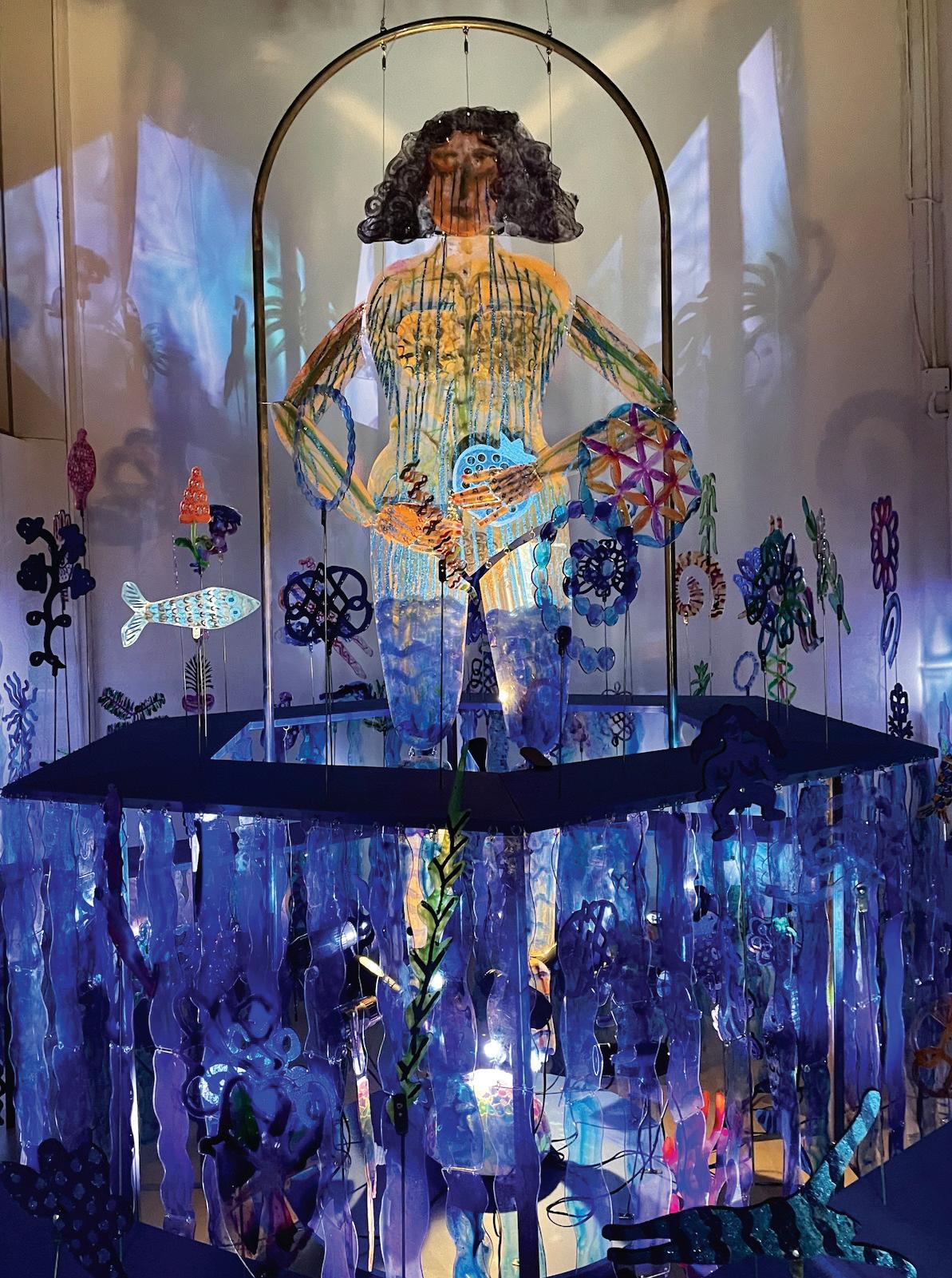
“To Rejoin the Ocean,” her most recent gallery, was displayed in Minneapolis from Feb. 19 to March 28 and showcased a handful of her interdisciplinary works of art. From conception to creation, the collection of mostly commissioned artwork took





Her work as an artist has taken her all over the globe throughout her career, allowing her to explore and experience the influences of many different cultures and people. With a constant change of scenery, Rachel lets her work be driven by improvisation,

































The work in the show is deeply inspired by the intuitive cultural and religious practices that have shaped her identity.



practices that have shaped her identity.

It’s like, ‘Well how do we rebuild connections?’ and it is through things like theatre, dance, art, and people understanding it’s not a solo project, even when it’s a solo show.”
RACHEL
-
COHN,


“It really is ultimately about reconnecting

“It really is ultimately about reconnecting with spiritual practices to help build



Associate Professor and Foundations Coordinator



for the School of Art at Ball State University







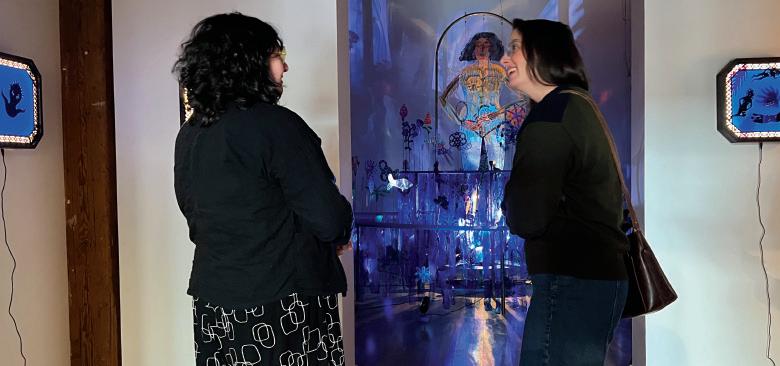











The largest piece in the exhibit paints the image of a woman crying “from every pore” as she bathes herself. Rachel said that this piece of work was specifically inspired by the idea of community saunas and reconnecting with nature through bathing, both of which pertain to central themes of water rituals and regeneration.
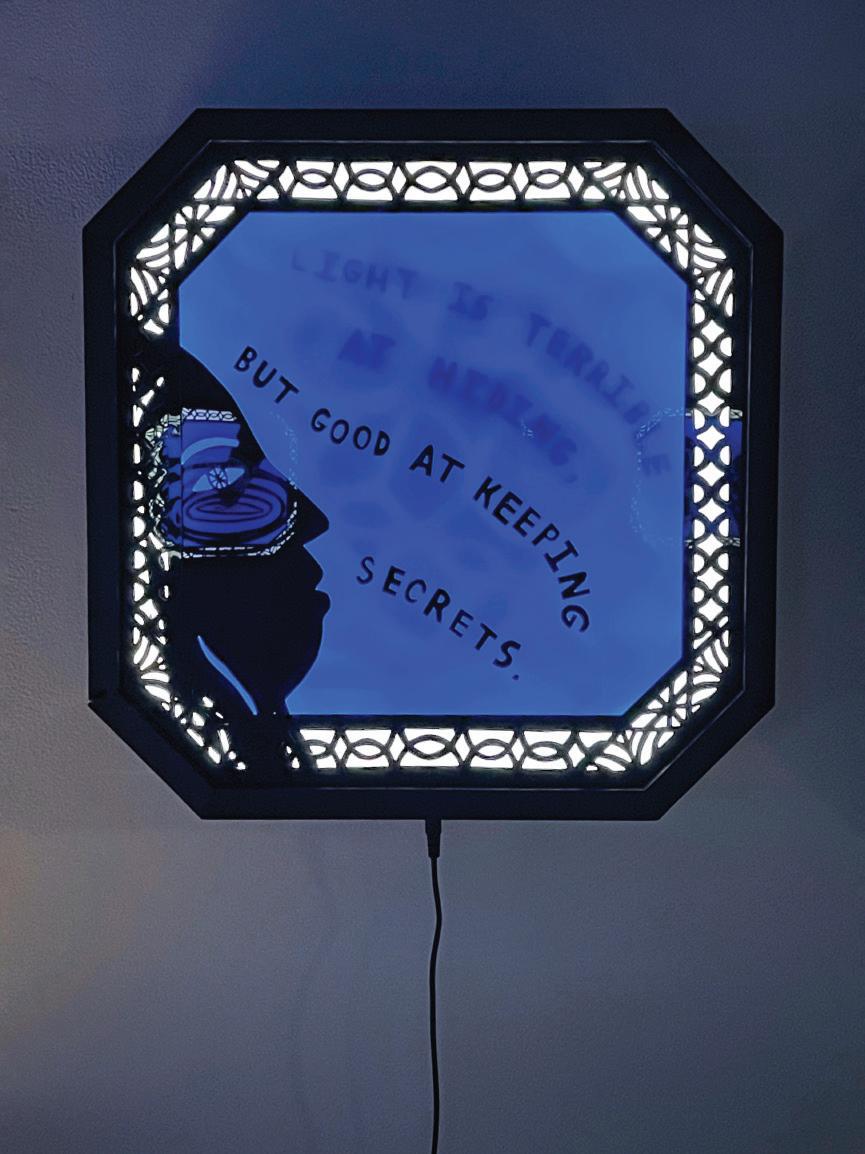
Other unique elements of the show included an ancestral etched copper bowl, designed for audiences to wash their hands in and connect with spirits of the past, and brightly animated light boxes that tell a story inspired by a Jewish transformation ritual called the Michva.
Rachel said the gallery was anything but an independent project and she carries this teamwork attitude into her teaching philosophy at Ball State.
“It’s like, ‘Well, how do we rebuild connections?’ And it is through things like theatre, dance, art, and people understanding it’s not a solo project, even when it’s a solo show,” Rachel said.

She believes that true, authentic art is all about being in tune with yourself and the world around you.
She hopes that her students are always thinking of others, leading with compassion and empathy.
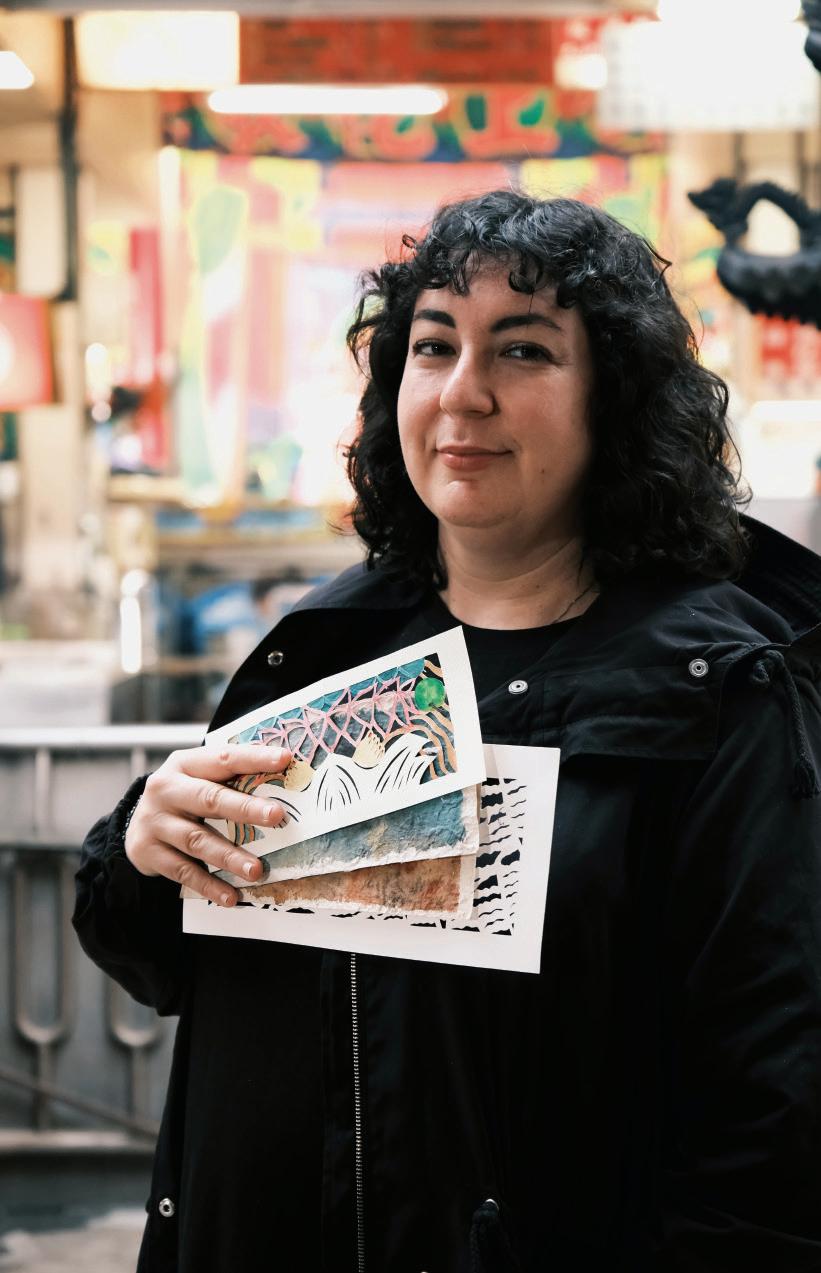
“To me, what’s most important is that [my students] are thinking about creative problem solving and empathy for other people,” Rachel said. “Understanding how to be a person to other people, like what is our social responsibility to other people? It’s all about your awareness of other people in space.”
Rachel believes in the influence and power of the next generation of artists. Though occupational opportunities for artists have changed since she was an art student, Rachel maintains that art education is still just as important as ever. Rachel has seen the way art empowers her students, and she feels inspired by them every day.


“There’s always something interesting or unique that everybody brings into the room, and that’s what’s so cool about getting to talk about art all day,” Rachel said.

Rachel believes that the spirit of all artists is the same, no matter where they come from or when they grew up. She has observed that creativity and talent flow through all of her students similarly. She uses her lived experiences to nurture the virtuosity in the young adults she mentors.
Just like Tania, Rachel believes the future of art can be bright, so long as the community continues to show up for art, engage in art and create art.
“We always talk about this in class: ‘What do you want the world to be like?’ You have to be a part of that,” Rachel said. “Art is a part of that, even if we live in a culture where art isn’t always supported.”











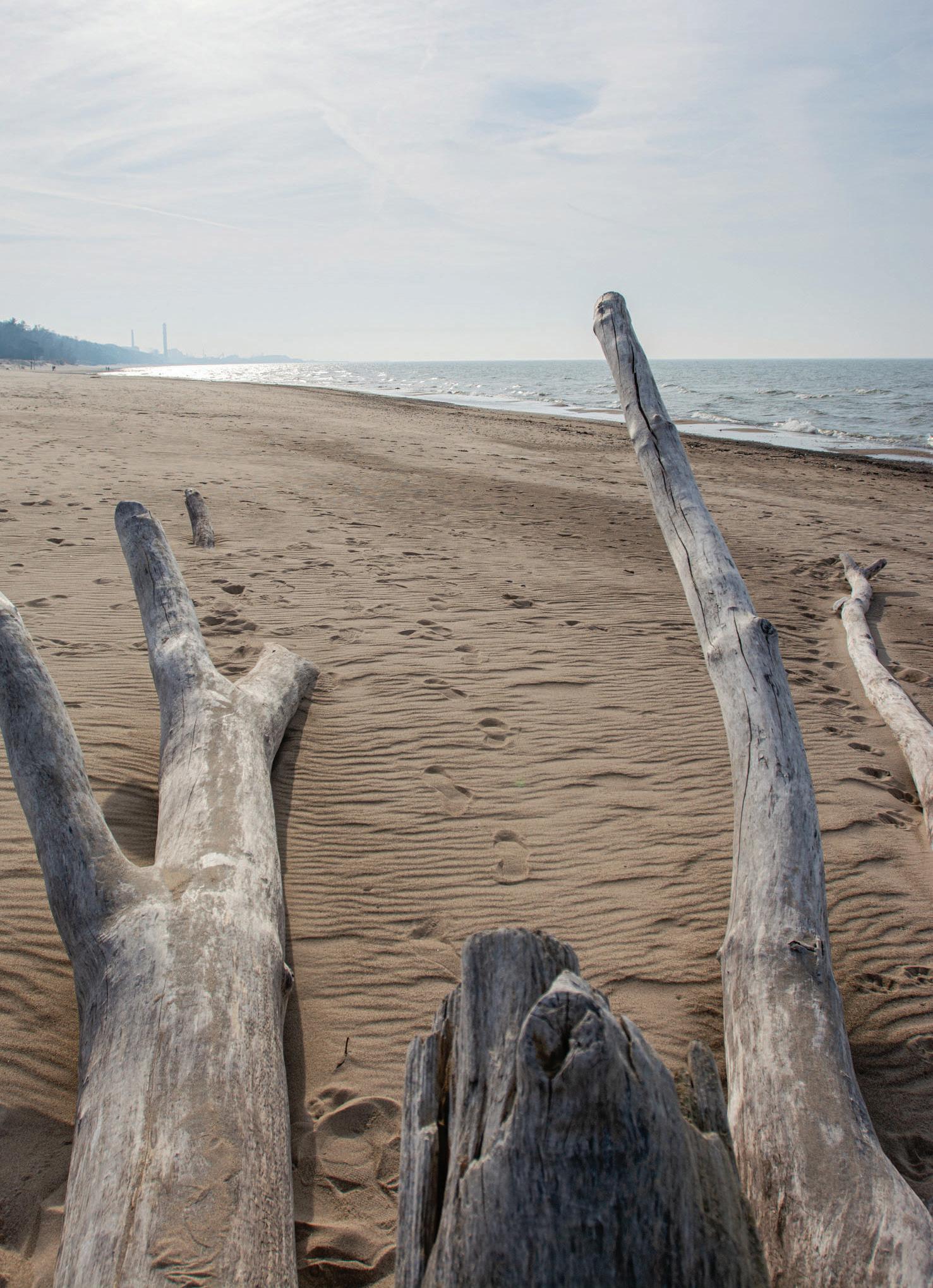
AS THE INDIANA DUNES FACE MULTIPLE THREATS OF COASTAL EROSION, PASSIONATE ORGANIZATIONS ARE WOKING TO COMBAT THE DANGERS AND SAVE THE DUNES.






| Ball Bearings | Spring 2026
By Aiden Murray
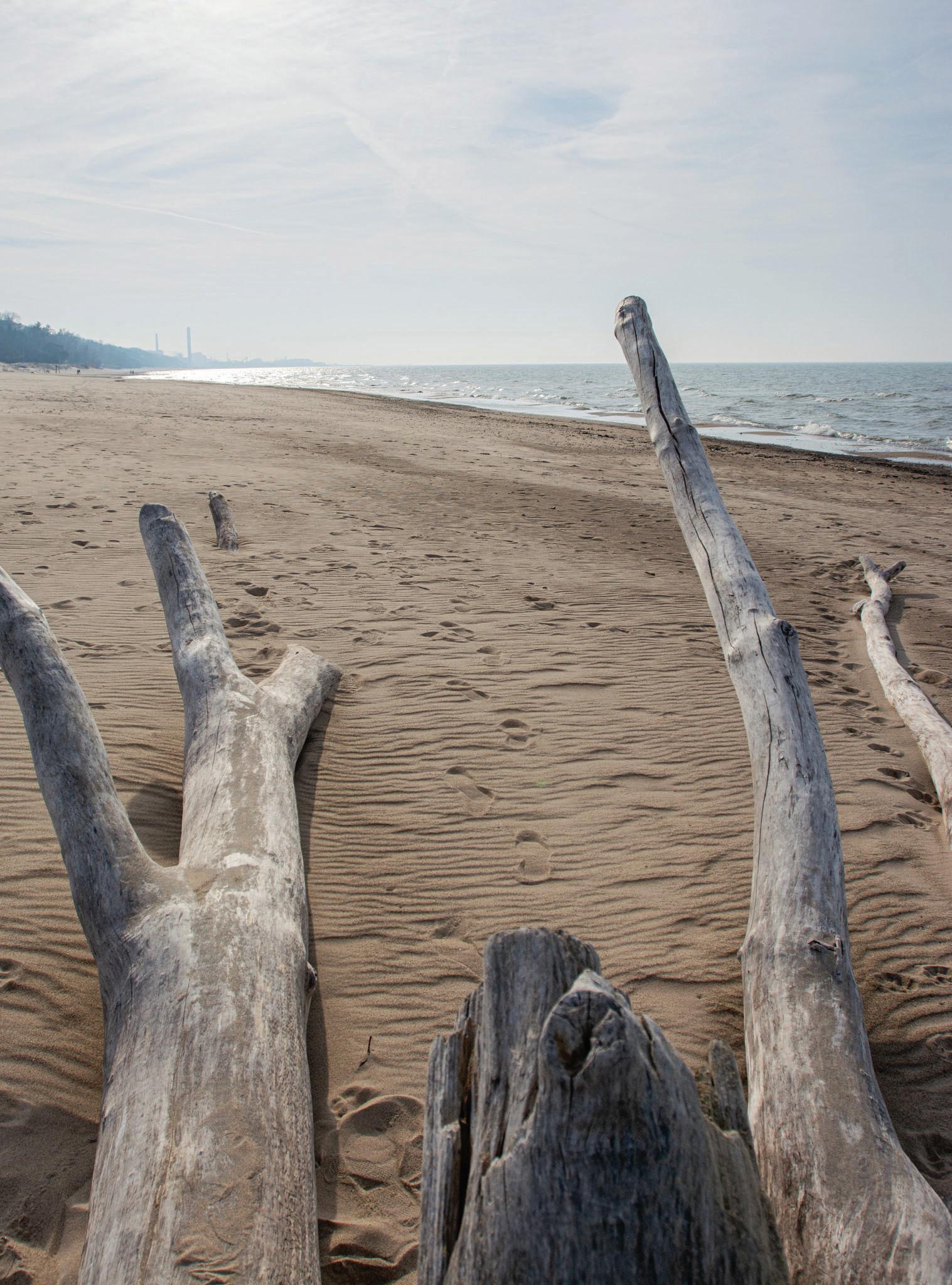
The Indiana Dunes have been a staple for Hoosiers since 1966, when legislation passed by the United States Congress declared the dunes a National Lakeshore. The movement for that legislation began in 1899 through the efforts of Henry C. Cowles, a University of Chicago botanist; Paul H. Douglas, Illinois State Senator; and Dorothy R. Buell, an English teacher who lived near the dunes. Their combined efforts of activism led to 8,330 acres of land being outlined as protected space, with later expansions increasing that number to 15,000 acres of protected land and water. Alongside the protected land, steel mills, which helped contribute materials during the construction of Chicago and provided World War II munitions, add to the Indiana Dunes culture.
The dunes are for everyone, that’s kinda what they’re there for.”
- TIM KOENNING, Midwest Program Manager of The National Parks Conversation Association
But the work done by Henry, Paul and Dorothy, and the dunes culture, are at risk of being swept away by Lake Michigan, due to coastal erosion.
According to the U.S. Climate Resilience Toolkit, coastal erosion is a natural process along the shoreline of bodies of water that washes away sand and sediments from the coast. Since 1919, the National Parks Conservation Association (NPCA) has been working to preserve national parks.
Tim Koenning, the Midwest Program Manager of NPCA, has lived in the Lake Michigan region for much of his life. He said his connection to the Indiana Dunes gives him a unique perspective on some of the factors weighing in on coastal erosion.
“You run into issues where these man-made barriers are built in,” Tim said. “Since man-made structures protrude so far into the lake, it takes a lot of sand to build up in order for sand to move around them.”
Tim said man-made structures are a core agitator for the shore’s natural movement of sand. With man-made structures, sand is unable to form normally along the coast. This disruption in the natural shoreline causes an imbalance within the sediment, as sand is only being pulled out and not brought back in. As sand levels decrease, problems for boats arise.
With shallower areas along the shoreline and ports, boats are cut off from spots that are too shallow to access. In order to fix this, a process known as dredging must happen. Dredging is the process of removing sediments and debris from the bottom of a lake, river or body of water.
For the Indiana Dunes, though, the dredging process primarily aims to relocate sand from one part of the shoreline and patch up weaker areas that may be too shallow for boats. Once the dredging process is complete and weaker areas of the shoreline are patched up, there can often be excess sand.
One organization that works with dredging around the Indiana Dunes is the Army Corps. The Corps mainly handles dredging around the dunes, but without specific federal funding, the Army Corps is not able to help.
“We didn’t have a response in place to replenish sand, and we had to rely on moving legislative processes and administrative processes that just take too much time; when the lake’s [are] not waiting on us,” Tim said.
Lake Michigan has been known to experience periods of higher water levels, which is where Indiana’s Department of Natural Resources (DNR) has stepped in. Joseph Exl is the Coastal Resources Coordinator at the DNR, and has been working on a coastal monitoring program, which tracks changes in the shoreline due to lake levels, waves and other factors.
This program started collecting shoreline imaging in the mid80s, with the data they collect being compiled into the shoreline monitoring program. One recent development made in their data collection comes from light detection and ranging, or LIDAR, imaging. This uses light to measure distances either from drones or satellites, according to the National Ocean Service.
“The program is in a state of evolution,” Joseph said. “We’ll get there eventually, but the program itself has been talked about since the mid-80s.”

Last year, the DNR launched a cooperative program due to a lack of internal resources, in which they have partnered with local universities.
“We have a few grants right now; one at Purdue
University as well as Valparaiso University,” Joseph said. “Those two universities have done topographical surveys for us to get high-quality GPS scans of the beach.”
Purdue has also started collecting bathymetry data, which Joseph said is one of the key missing pieces for their program. Bathymetry data studies the depth and shape of underwater surfaces, according to the National Ocean Service.
While some structures do expedite coastal erosion, Joseph said that there is less to worry about in the Indiana Dunes State Park than in other areas. In fact, one building within the park has become quite an important piece of the park’s history.
Between the Michigan City Harbor and the Port of Indiana at Burns Harbor is the Park Pavilion. The area between the two ports is known as a Littoral Cell, which is where larger deposits of sand are stuck most of the time. Joseph said the Pavilion is a historic structure in the park, and has never shown any reason to be concerned about the effects of coastal erosion.
Joseph said the Littoral Cell diminishes the effects of erosion but causes worry in other areas.
One concern that Joseph has for the shoreline of the Indiana Dunes is the high period of erosion rates starting in mid to late fall and lasting through spring.
During this season of higher erosion rates, winter storms play one of the biggest roles in the erosion of the Indiana Dunes.
Sarah Peterson serves as the Coastal Engineering and Community Resilience Specialist at the IllinoisIndiana Sea Grant.
Through her work on the coastline, Sarah has found that during the colder months, the dunes develop a phenomenon known as ice shelves. These ice shelves create a protective shield for shorelines and come with a wide range of variables, which makes them less predictable.
“When you have high ice coverage in the colder
Trinity Rea, Ball
I’d rather see the problem solved than moved down the shore.”
-
JOE EXL, Coastal Resources Coordinator at the Department of Natural Resources
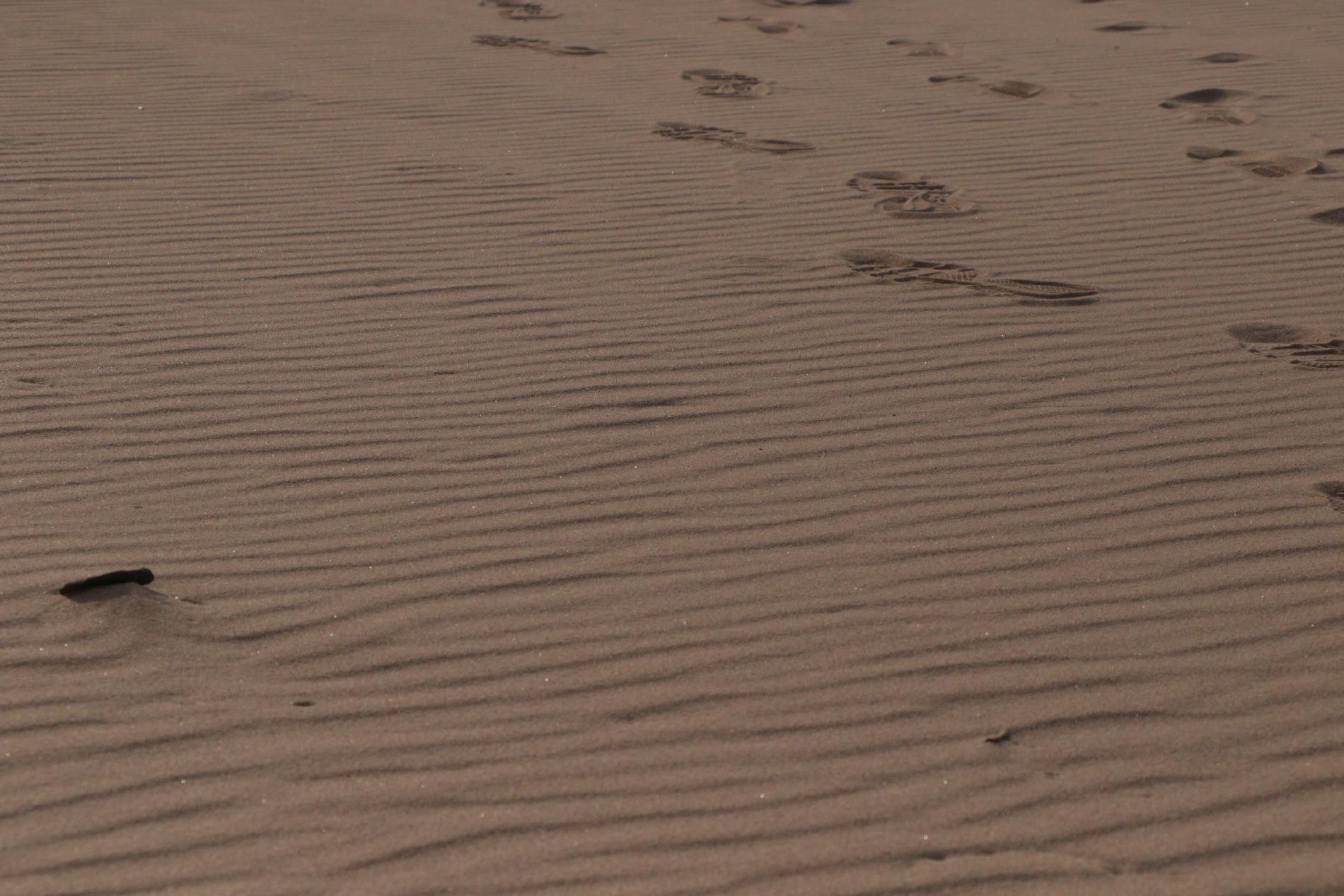
Grounded shelf ice is one of the most effective types of shelf ice along the Lake Michigan shoreline. These variant ice shelves connect more deeply beneath the water, closer to the lakebed. The strength of grounded shelf ice allows it to absorb the greatest amount of wave energy.
Sarah added that some research has shown that ice shelves are not just absorbing wave energy, but redirecting it back into the lake. This movement of energy leads to erosion within the lake below the water’s surface, almost invisible to the naked eye.
While ice shelves relieve some of the burden of intense winter waves, the increase in warmer winters has caused ice shelves to become less reliable, raising the direct risk that winter storms pose to Lake Michigan’s Indiana shoreline.
As temperatures fluctuate in the winter months, patterns appear of thawing and freezing. These patterns create spots of higher vulnerability for the base of the shoreline and risk higher rates of erosion.
Joseph said that data from previous years shows that as the ice disappears, strong waves and wind
recently, is soil saturation. This occurs when areas of sand and sediment become extremely dense through large amounts of water, and as they freeze and expand, it can crack. These cracks create a vulnerable shoreline in the warmer seasons.
The more ice there is, the more that gets evaporated,“ which may lead to increased lake levels during warmer months,” Sarah said.
With a change in lake levels, the waves of Lake Michigan grow more unpredictable. The wave’s patterns have a large spatial variety and depend heavily on the season.
Areas along the southern fetch of Lake Michigan, near the Indiana Dunes, are the most unidirectional. This makes it much more difficult to create a prediction on wave patterns and there is no exact consensus on how waves have changed.
“There have been studies showing that different climatic factors have influenced the frequency and intensity of storms,” Sarah said. “With more storms coming in, that might lead to greater wave heights and greater wave energies compared to more natural scenarios.”
While the DNR and other organizations work to study wave patterns and their correlation with storms, it has become increasingly difficult to highlight specific trends. What the data does show is that coastal erosion is posing a possible threat to existing infrastructure in
“I’d be hesitant to say there’s a long-term trend in one specific wave characteristic, just because it has been shown to vary,” Sarah said.
With storms moving in alongside the warmer season, wind activity increases. Joseph found data proving that as the fall-to-spring erosional period ends, summer winds take shoreline sand and move it back onto beaches.
In the summer, shorelines are affected by both water and wind, and the high summer winds create a phenomenon known as walk dunes. These dunes show consistent movement back into the land over several years; a more well-known walk dune is called Mount Baldy.
Mount Baldy is located near Washington Park beach and is the largest “living” dune in the park, which means the dune has slowly been eating away at a local visitor parking lot for years, Sarah said.
Strong winds coming off the lake often pick up sand found in dunes and move it away from the lakefront. In addition, if there is little or no vegetation to catch the sand, some dunes move greater distances at a quicker speed.
Marram grass is a natural dune grass that helps with the natural order of dunes. It catches sand carried by wind and settles those particles closer to the shoreline than a dune without marram grass.
communities, the NCPA is opposed to the use of stone revetments and finds them unfavorable. The revetments do not necessarily fix the problem of erosion; they delay it by moving the effects of erosion down the shoreline to areas that do not have revetments.
Stone revetments also armors the normally sandy beaches by covering them in layers of large stones.
This is something Tim believes might not be appealing to anyone visiting the beach.
“I’d rather see the problem solved than moved down the shore,” he said.


already set aside one million dollars, and they’ve said we want to be a part of this study,” Tim said.
This fix can also come from the work done by the DNR, as they work on their coastal monitoring program. Their website houses current data and resources, like their coastal atlas, which will evolve to have more information more readily available for people.
“We hope that long term, we’ll be able to come up with these erosional and depositional rates along our coastlines that local decision-makers can utilize to form decisions within their towns,” Joseph said.
When it comes to the coastal erosion of the Indiana Dunes, it is important to stay informed.
Sarah and the Illinois-Indiana Sea Grant has been working on a video series about nature-driven protectors for the shorelines and hybrid solutions as well. This works alongside their Coastal Resilience Program for local communities. The importance of being able to adapt has increased in recent years as wave patterns become more variable.
“It’s important to be aware of extreme wave conditions,” Sarah said. “We might have calm waves, but we are also prone to very high wave energies.”
Local communities are one of the biggest stressors when it comes to coastal erosion, as many have lived near the dunes long before they were recognized as a National Lakeshore. These communities sit outside of park jurisdiction and have invested in stone revetments for coastal erosion protection.
While it may work for local
Alongside the NPCA, Tim said that the mission is to ensure a thriving shoreline for the parks as well as the local landowners.
“The dunes are for everyone, that’s what they’re there for,” Tim said. “But it has to be a balance of the people who live feet from the park.”
When it comes to fixing the coastal erosion and preventing further shoreline losses, there have been multiple proposed fixes. Tim believes the best way to fix the erosion would be through a study done by the Army Corps, funded half by a non-federal party and half by the federal government.
“The state of Indiana has
With uncertainty on the horizon and the winds of change approaching, one thing is certain: just like in the early 60s, people passionate about the preservation of the Indiana Dunes are working non-stop to find a solution for the coastal erosion.
“We need to get this long-term fix into place before the lake levels rise again, because they will,” Tim said. “I don’t know when that’s going to happen, but the lake levels fluctuate on a multi-year level. It’ll shift back to being high at some point, and I’m worried about what’s going to happen to the park and parts of northwest Indiana.”
Time slips away to find a solution just as the coastline slips into Lake Michigan. The search for a permanent solution continues.
We need to get this long-term fix into place before the lake levels rise again, because they will.”
- TIM KOENNING, Midwest Program Manager of The National Parks Conversation Association







































By Naomi Sanford




Muncie, Indiana, a small, landlocked college town, is not known for having large bodies of water, but that did not stop local scuba instructor Tom Leaird from opening an underwater diving shop in the city in 1970.
For decades, Tom Leaird’s Underwater Service in Muncie has fostered a thriving community for local scuba, which stands for selfcontained underwater breathing appartus, divers and students at Ball State University. Leaird’s Underwater Service is Muncie’s only dive shop and has been a hub for local scuba enthusiasts for over 50 years.
Since then, Ball State’s scuba program has offered many opportunities for students to explore the underwater world.




I think it takes a certain person to be a diver, especially in an inland state like this, because you kind of have to see beauty where other people don’t necessarily.”
- MAR NESTER, Third-year student at Ball State University




Tom, now 86-years-old, became an instructor at the Muncie YMCA in 1969, while still working as a full-time photographer.
“[Tom] loved [scuba diving] so much that he figured out how to open a small store,” Leaird’s store manager, Brooke Speedy, said. “Then he turned that small store into a bigger one.”
Leaird’s Underwater Service provides scuba equipment and training to individuals interested in diving and various underwater tools like dive cylinders and dive computers. The dive shop also offers a 7-week course for individuals ages 12 and up who are interested in getting an Open Water Diver certification. Participants do not have to be advanced swimmers in order to apply.
The dive shop does not just serve the general public; it also has a large presence amongst the local public safety community. Brooke explained that Leaird’s sells diving gear and helps train public safety divers who “go down and rescue people.”
Leaird’s has also collaborated with Anderson University and local high schools in Delaware County to teach scuba courses and provide equipment. Similarly, the shop has a strong connection to the Delaware Divers Club, which has existed longer than the dive shop itself.
Members of the club hold various community events and fundraisers. They meet monthly and dive at Phillips Outdoor Center, a local dive facility and quarry owned by Tom.
In the early 1990s, as interest in scuba diving grew in Muncie, Ball State’s swim coach at the time, Bob Thomas, became interested in launching a scuba program.
Brooke explained that after purchasing scuba equipment from Leaird’s, Bob connected with Tom, and together they began building a scuba program at Ball State. Currently, Ball State offers minors in both scuba diving and aquatics.
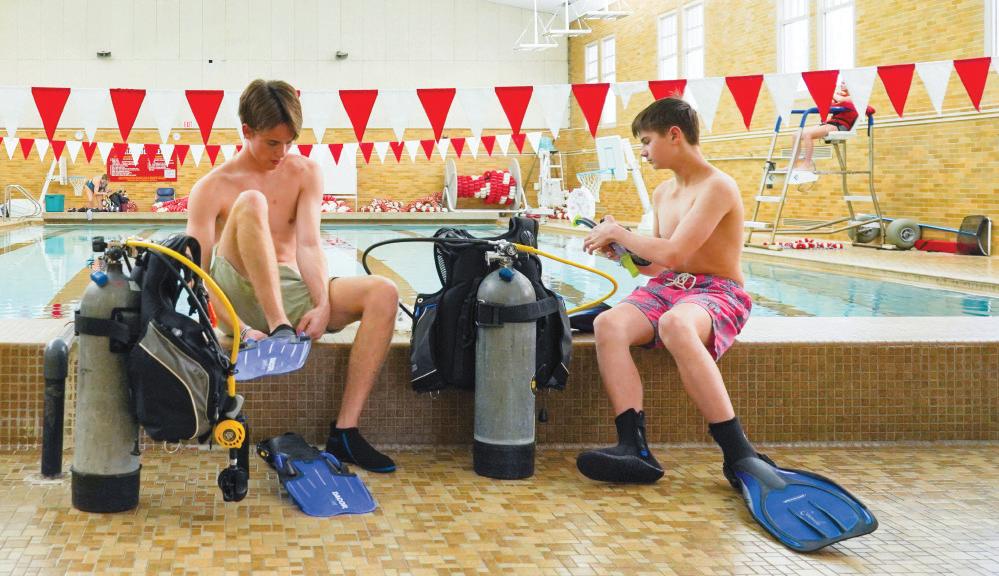
Leaird’s provides Ball State’s scuba program with all its scuba and snorkeling equipment.
After classes, the shop sanitizes the regulators and refills the air tanks. Leaird’s instructors assist Ball State scuba classes with certification exams and training that require additional instructors.
According to Ball State University’s website, Ball State’s scuba minor consists of 18 credits and includes courses in open water scuba, pool management
and aquatics. Students learn how to use specialty equipment, including air tanks, buoyancy control devices and breathing regulators to complete underwater dives.
When the program first began, it was taught by Carole Reed, who received her training from Learid’s. Carol taught scuba for 26 years.
Sheli Plummer, the current instructor of the course, graduated from Ball State and also trained at Leaird’s while she was a student.
Sheli said that to complete their certifications, students must also complete open-water training dives. Students take their certification tests in the quarry at Phillips Outdoor Center.
The highest certification you can get as a scuba diver is a divemaster, though it is not required to complete the minor at Ball State. Sheli explained that a divemaster certification is what divers need in order to “work at a resort” or teach recreational scuba.
The scuba minor at Ball State also requires that students complete an internship. Brooke was an intern at Leaird’s while in college and said the dive shop hires at least two interns each semester.
Leaird’s mission statement reads, “Scuba students are the foundation of our business. Providing services for their continuing needs is the foundation of our success.”
The minute my head is underwater, and all I can hear are bubbles, all stressors are gone.”
- SHELI PLUMMER, Scuba instuctor
“The minute my head is underwater, and all I can hear are bubbles, all stressors are gone,” Sheli said.
Sheli got her first scuba job working as an instructor at a resort in Key Largo, Florida. She explained that Tom referred her for the job, and she worked there for five years.
After moving back to Indiana, she eventually began teaching Physical Fitness and Wellness courses at Ball State. After Carole retired in 2018, Sheli began teaching the scuba courses.
Sheli said scuba minors can receive three different certifications: Open Water, Advanced Diving and Scuba Rescue.
Open Water Scuba is the program’s first class, where students can dive down to roughly 60 feet. The advanced diving and rescue certifications focus on scuba rescue, allowing students to obtain CPR certifications for situations with distressed divers.
Leaird’s impact on scuba students is measurable by the many success stories of former Ball State students, such as Sheli, Brooke and Carol, who all began their diving careers at the shop.
More recently, Leaird’s has influenced the life of Mar Nester, a third-year media production student, also working toward a scuba minor.
Mar learned about the Ball State scuba minor through a promotional flyer they saw during freshman orientation.
“I think it takes a certain person to be a diver, especially in an inland state like this, because you kind of have to see beauty where other people don’t necessarily,” Mar said.
After taking an Aqua Fitness course as a first-year student to fulfill their Physical Fitness and Wellness credit, Sheli, who teaches the course, informed them about the scuba minor.
“[Sheli] showed me her passion for the ocean and her love for underwater life, and it was just really intoxicating. It was very contagious,” Mar said.
Mar began interning at Leaird’s during the spring semester of their second year and credits their experience at Leaird’s with helping shape their future career. They hope to be a documentarian and science communicator.
Mar has received many opportunities as a result of their scuba minor and connection with the Leairds. They have earned three awards from the Women Divers Hall of
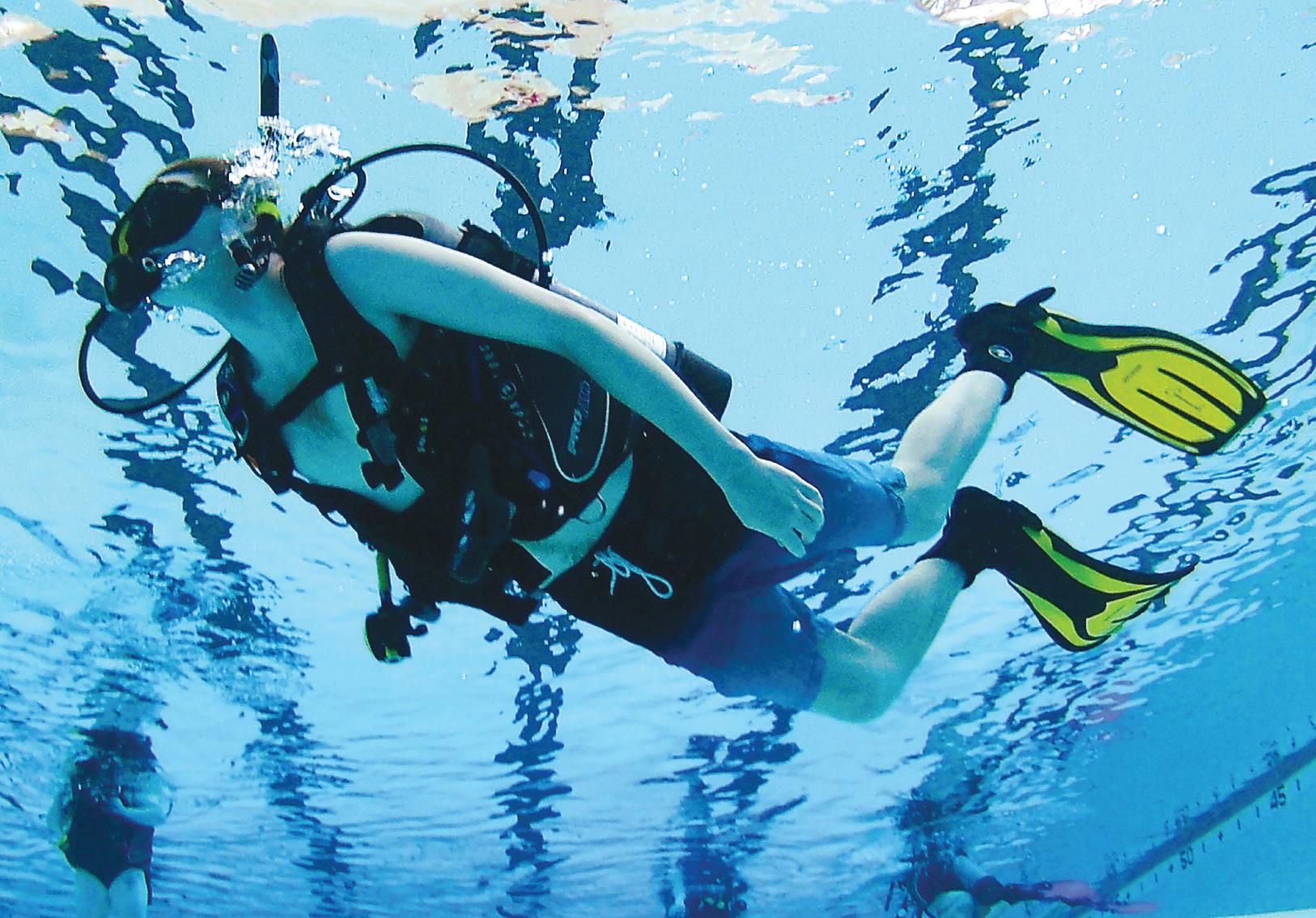
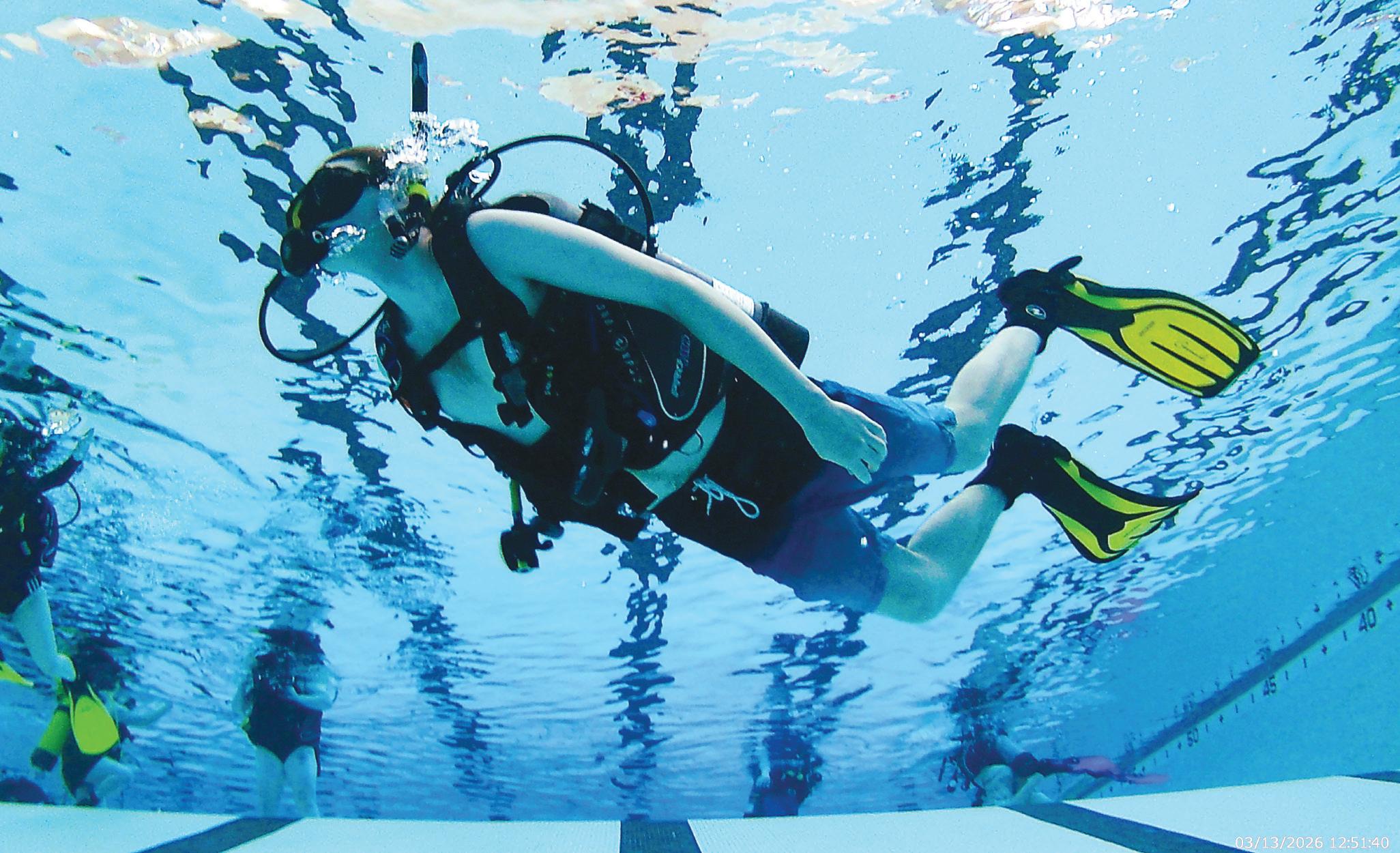
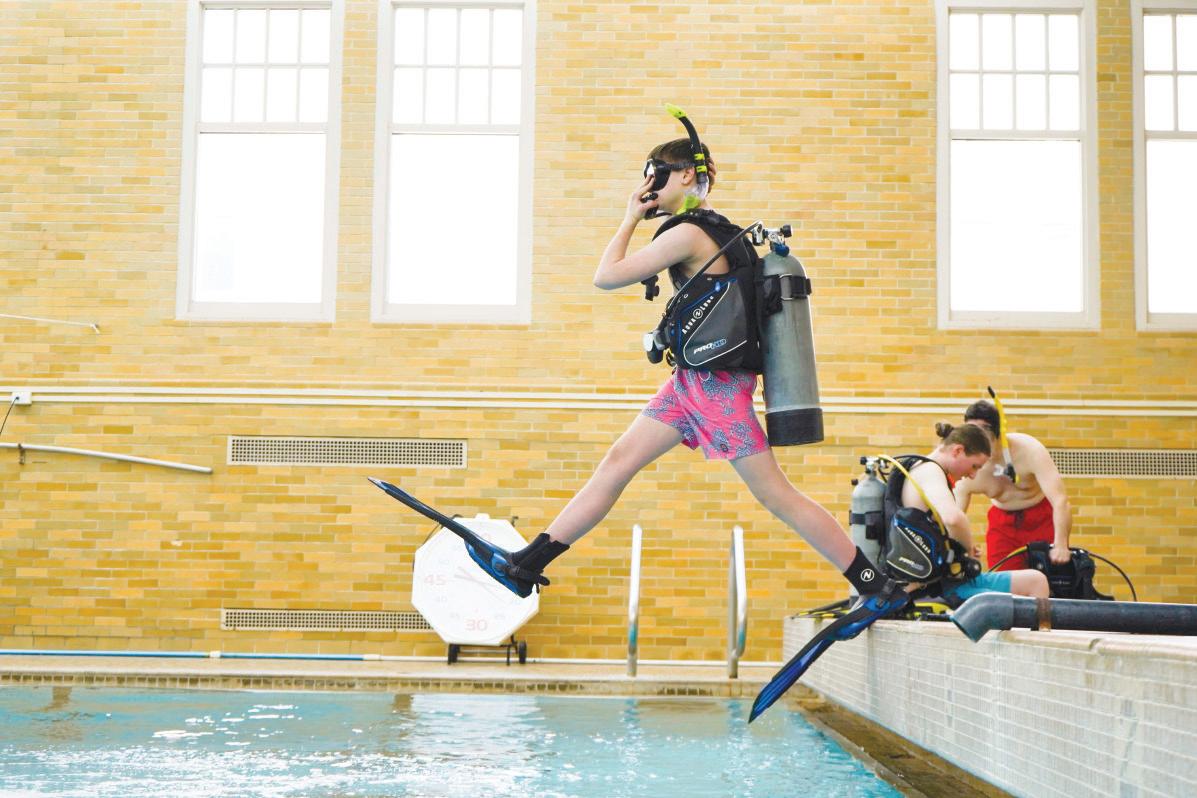
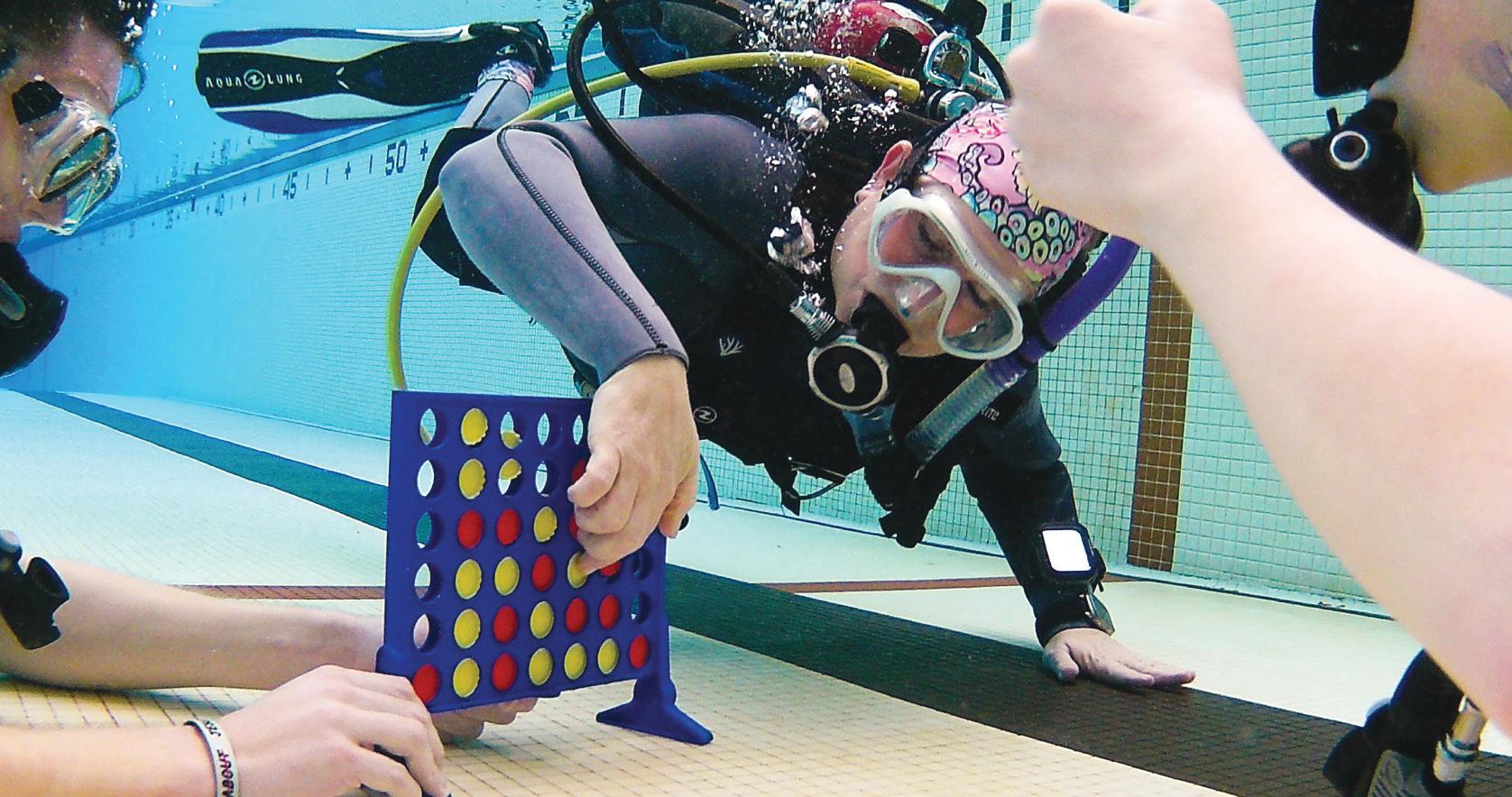
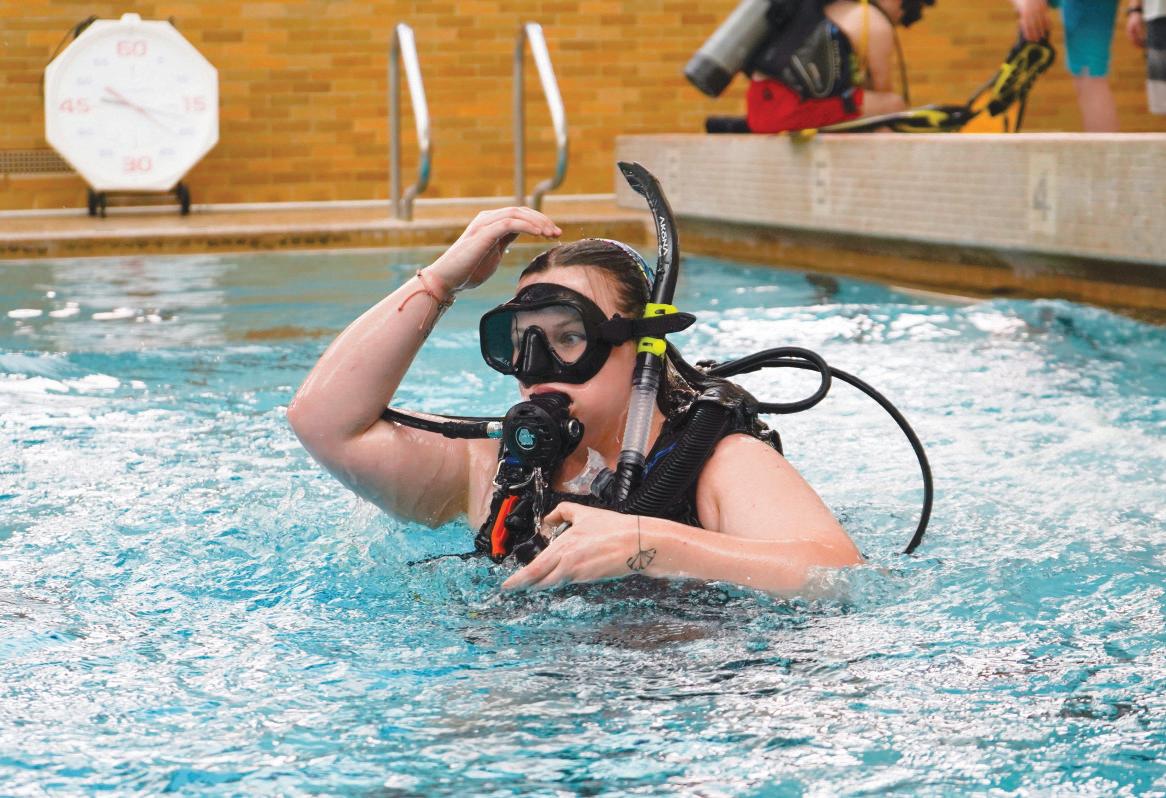
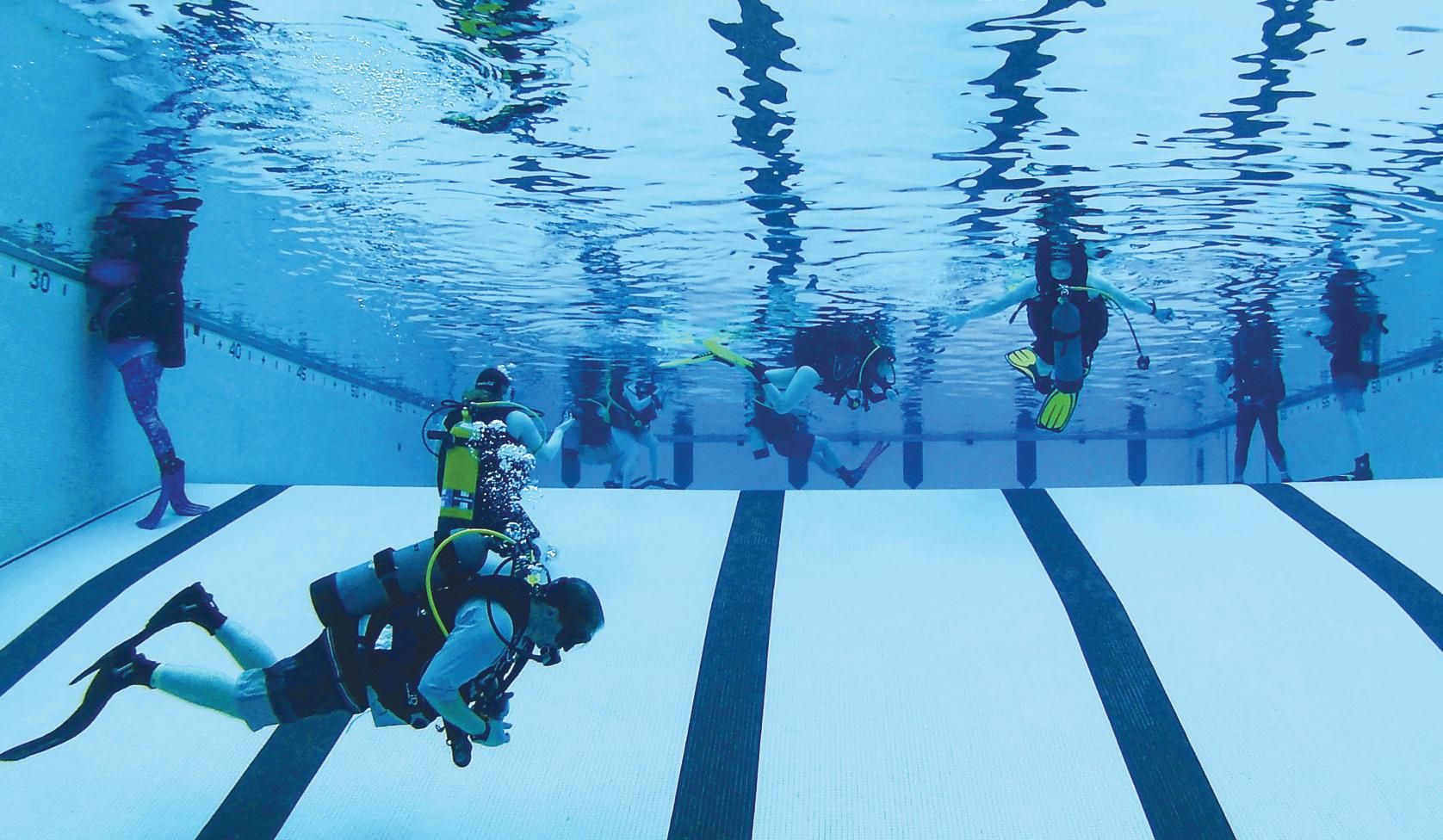
[ABOVE] A member of AQUA 220 at Ball State University swims while scuba diving March 13 at Ball Gymnasium. Isabella Kemper, Ball Bearings [RIGHT] Ball State freshman Mason Cornwell giant strides into the water with all of his SCUBA gear March 13 at Ball Gymnasium. The giant stride is one of the many ways to enter the water with SCUBA gear on including entries like back roll and seated entry. Isabella Kemper, Ball Bearings

Fame, including the Bonnie Cardone Memorial Scholarship and the Underwater Photography Equipment Award. Mar said that they have received over $3,000 worth of scholarships from the organization.
Mar explained that the organization also provided them with camera equipment and a trip to New Jersey for a dive conference. Mar learned about the organization through Sheli, and Brooke wrote Mar a letter of recommendation for the scholarship.
“[Scuba mentors] show you their love for the water, and they show you how it’s changed their life, and they show you a way that it relates to you and your life,” Mar said.
The efforts of Leaird’s Underwater Service have helped to establish a longlasting culture of mentorship and unity amongst the Muncie scuba community. Sheli describes Tom and the other Leaird’s employees as “real, down-to-earth people” who “are not there to make a buck.”
As the dive shop approaches the 56th anniversary of its opening this year, Brooke credits the shop’s multifacetedness as the reason for their longevity. Brooke explained that Leaird’s diverse services,
including selling and repairing scuba gear, training students and going on scuba trips, have helped it thrive and maintain space in the Muncie community.
Brooke said the shop has ”been very active in the Muncie area.” Several times a year, Leaird’s hosts an event called “I Tried Scuba,” where individuals can learn and get an introduction to the world of scuba and the opportunities of open water diving.
is far from over. Brooke, who will one day be taking over the shop, hopes that in 5 to 10 years, Leaird’s Underwater Service’s impact will continue to expand to other communities.
“Our ‘I Tried Scuba’ program is a one-day class, and it’s free, so anyone ages 10 and up can come try scuba,” Brooke said.
Brooke also stated she was excited about the opportunity to host trips that are more “eco-focused” and involve “sustainability” initiatives so that divers can “give back” to the ocean and marine life.
While Leaird’s Underwater Service has inspired and supported the local scuba community for decades, its story
“I hope to see our community kind of grow even bigger and stretch into other parts of not just Indiana, but the world,” Brooke said.
As the scuba community continues to grow and evolve, Leaird’s Underwater Service remains a reminder of how support and mentorship can inspire generations.












By Jessica Bergfors
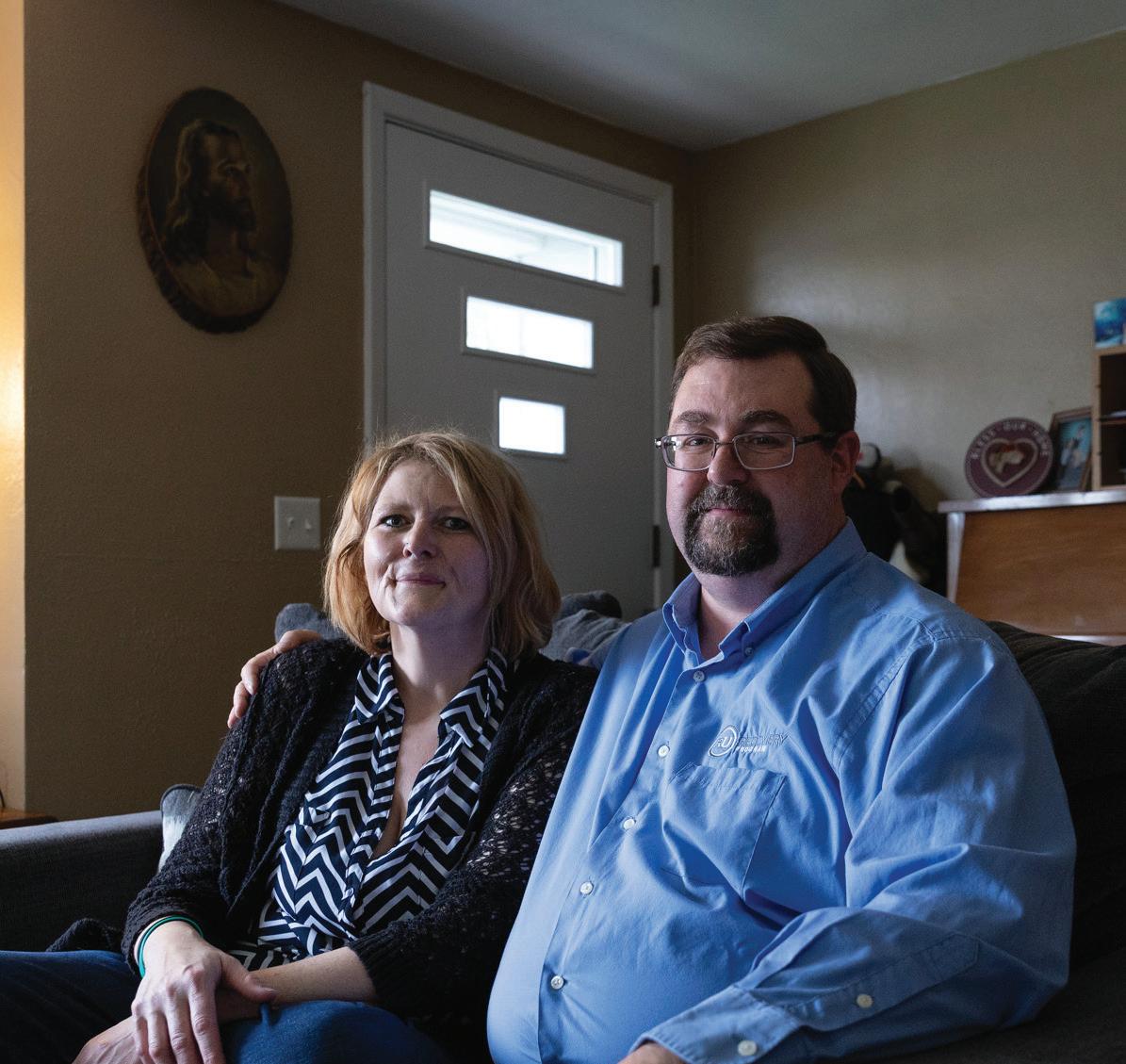
“We were in a car wreck… I couldn’t stop smoking crack, and I could not stop drinking,” Jarrod Hummer said. “I had that car wreck, and we walked away.”
Eight years ago, Jarrod and Mandy walked away from flipping their car changed, but not unscathed.
Before getting behind the wheel, Jarrod had been drinking. At the time, Mandy’s license was suspended, so they decided it would be better if Jarrod drove



despite his intoxication. The car flipped twice, totaling it. Jarrod recalled getting out and seeing a line of blood streaming down from the top to the bottom of the car, but, miraculously, neither he nor Mandy were hurt.
Jarrod spent 23 years of his life in active addiction. Mandy spent 17.
“I couldn’t go without smoking crack, I felt terrible when I wasn’t smoking,” Jarrod said. “But when I smoked, I was so paranoid, and I hated it, and I couldn’t wait to not be high.” AS SUBSTANCE ABUSE REMAINS PREVALENT IN MUNCIE, EFFORTS FOR AWARENESS, PREVENTION AND RECOVERY ARE BEING MADE.















Andrew Berger, Ball Bearings




When Jarrod and Mandy were in active addiction, they worked to support themselves and their addiction, often spending much of their income on drugs.
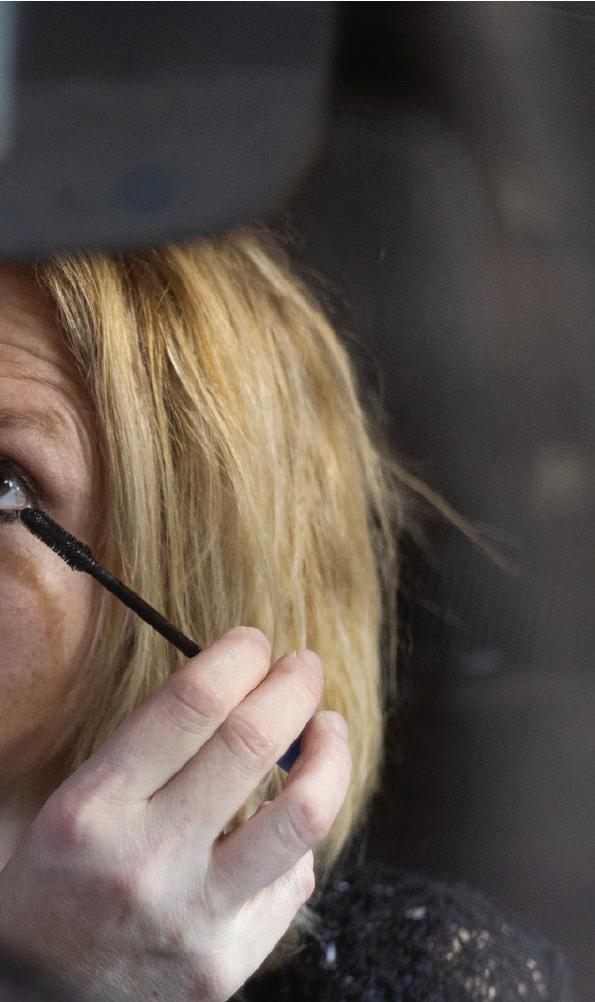
Mandy described the first time she bought makeup as an adult, thinking, “there’s no way real people are working jobs and going into Walmart, and buying [a] $12 foundation.” When she finally had a full supply of makeup, it felt weird, but it was important. Instead of stealing it in her active addiction, she worked for it.
Jarrod and Mandy’s addiction story is just one of many from all across the country.
In 2024, the American Addiction Centers reported that 48.4 million Americans aged 12 and older had substance use disorder. Substance abuse is a disease that affects one’s brain and behavior, leading to an inability to control the use of a drug or medicine, according to Mayo Clinic.
Muncie is within the top 10 cities in Indiana with the worst substance abuse problems, according to Indiana Treatment Centers. In 2024, the Indiana
| Ball Bearings | Spring 2026
Commission to Combat Substance Abuse reported 1,542 deaths in Indiana due to any drug overdose.
48 of those deaths were in Delaware County.
Jarrod and Mandy escaped this fate. After crashing their car in front of a sheriff’s house, Jarrod knew he was going to jail.
“I was there in the jail cell, I didn’t even really know, but I cried out to God. I just told him I couldn’t do it. I just had to give everything over to him. I had to ask [for] help,” Jarrod said.
When Jarrod woke up, he knew that he should not have survived the car wreck and believed that God had saved him from both the wreck and his drug addiction.
“When I woke up, I knew that I wasn’t addicted to drugs,” Jarrod said. “I also know that God doesn’t work that way with everybody, but he worked that way with me, and that’s my story.”
When Mandy picked him up the next day, he told her that he was no longer going to live the same lifestyle they had



been living. Mandy was “unchurched,” but felt that God had saved her.
“Eight minutes ago [before the crash], I was a crackhead, and I was a terrible person. Eight minutes later, I was a believer, and I had worth. I knew that God had a purpose for my life,” Mandy said.
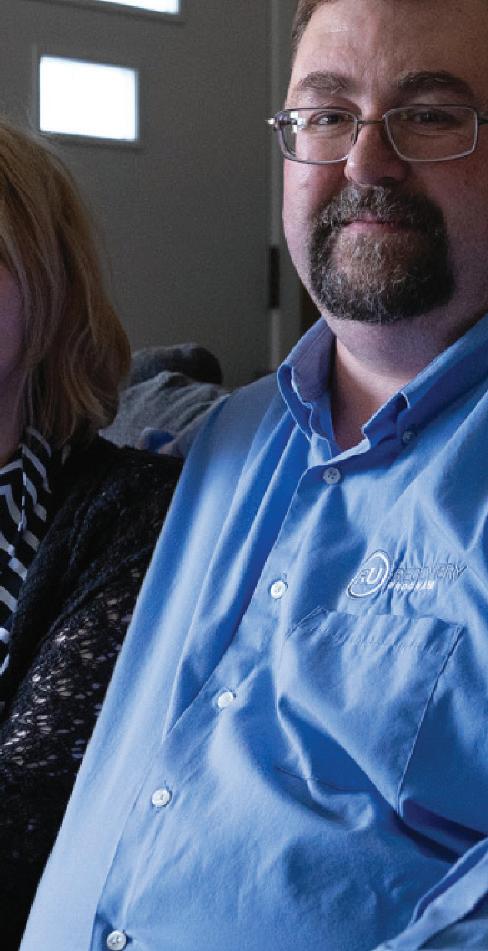
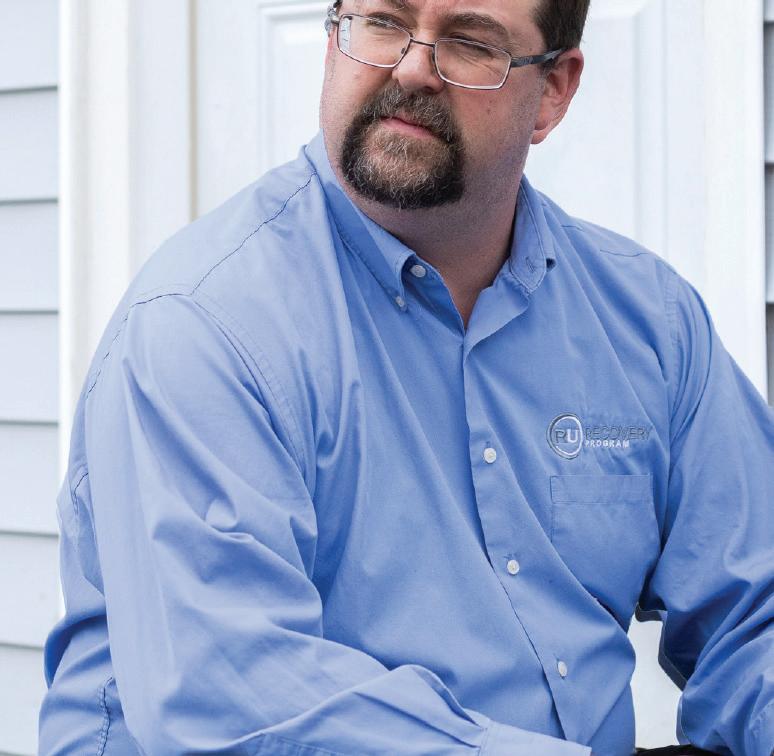
Jarrod and Mandy’s story of substance abuse and recovery is not the only one in Muncie. The two are now over eight years sober, and they serve as leaders at the RU Recovery Program, a faith-based recovery organization, at Grace Baptist Church in Muncie.
Jarrod was first introduced to the program when Grace Baptist Church brought members to a jail, part of RU’s program to help those incarcerated. Jarrod and Mandy attended RU’s meetings a few times before the car accident, but they began going faithfully after.
One of the biggest challenges Mandy faced was how she was going to make a life for her kids that glorified God while making sure that they “don’t go down

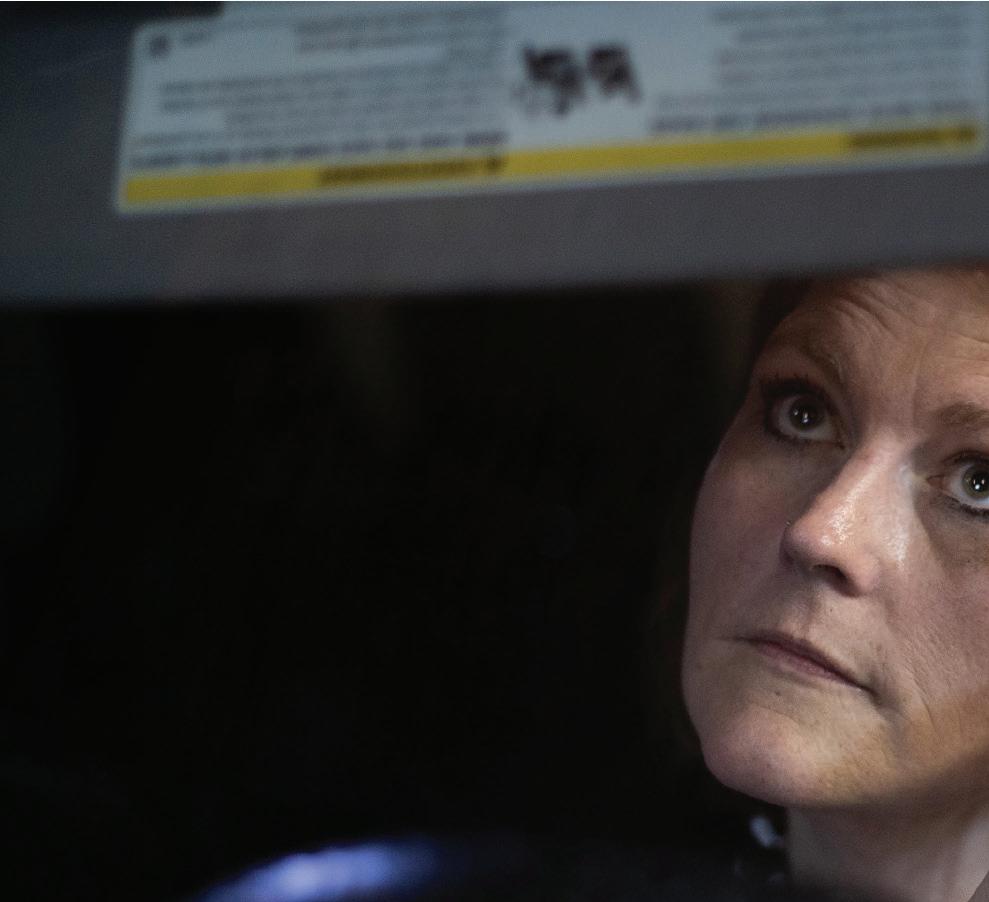

Eight minutes ago [before the crash], I was a crackhead and I was a terrible person. Eight minutes later, I was a believer, and I had worth. I knew that God had a purpose for my life.”
-
MANDY HUMMER RU Recovery leader

the same path [of drugs and addiction].” Mandy struggled with the shame and guilt of the things she had done during her addiction.
For Jarrod, Narcotics Anonymous (NA) and Alcoholics Anonymous (AA) groups felt “self-defeating.” He hated returning after he would relapse and admitting it to everyone, so he quit going out of shame. As Jarrod grew in his faith, he began to understand that he did not “have to remember the last time he made a mistake,” instead, “remembering the day that he was saved.”
One of the first things that people from Grace Baptist Church did was bring Jarrod and Mandy to church and ask if they had food.
He recalled a member of the church telling him, “You help people meet their basic necessities. Because if they’re not going to have their basic necessities met, they’re not going to focus on getting recovered.”
RU Recovery Program meets every Friday night, and is open to “anyone who


needs support.” The group’s meetings include prayer requests, testimonials, weekly challenges and workbook exercises. Challenges can include memorizing Bible verses, service work, writing essays, attending church and more. In the middle of the evening, the group splits off into men’s and women’s challenge groups, where they have character development challenges.
Mandy is the women’s beginner’s leader, meeting with new members to explain the program and challenges.
“We bring people along with us,” Mandy said. “If you’re having the worst day... you’re bummed out and you’re sad, but you still have real joy and peace, and can share that with another human. That’s what this program is.”
As substance abuse remains prevalent in Delaware County, efforts for awareness, prevention and recovery are being made by those in the Muncie community.
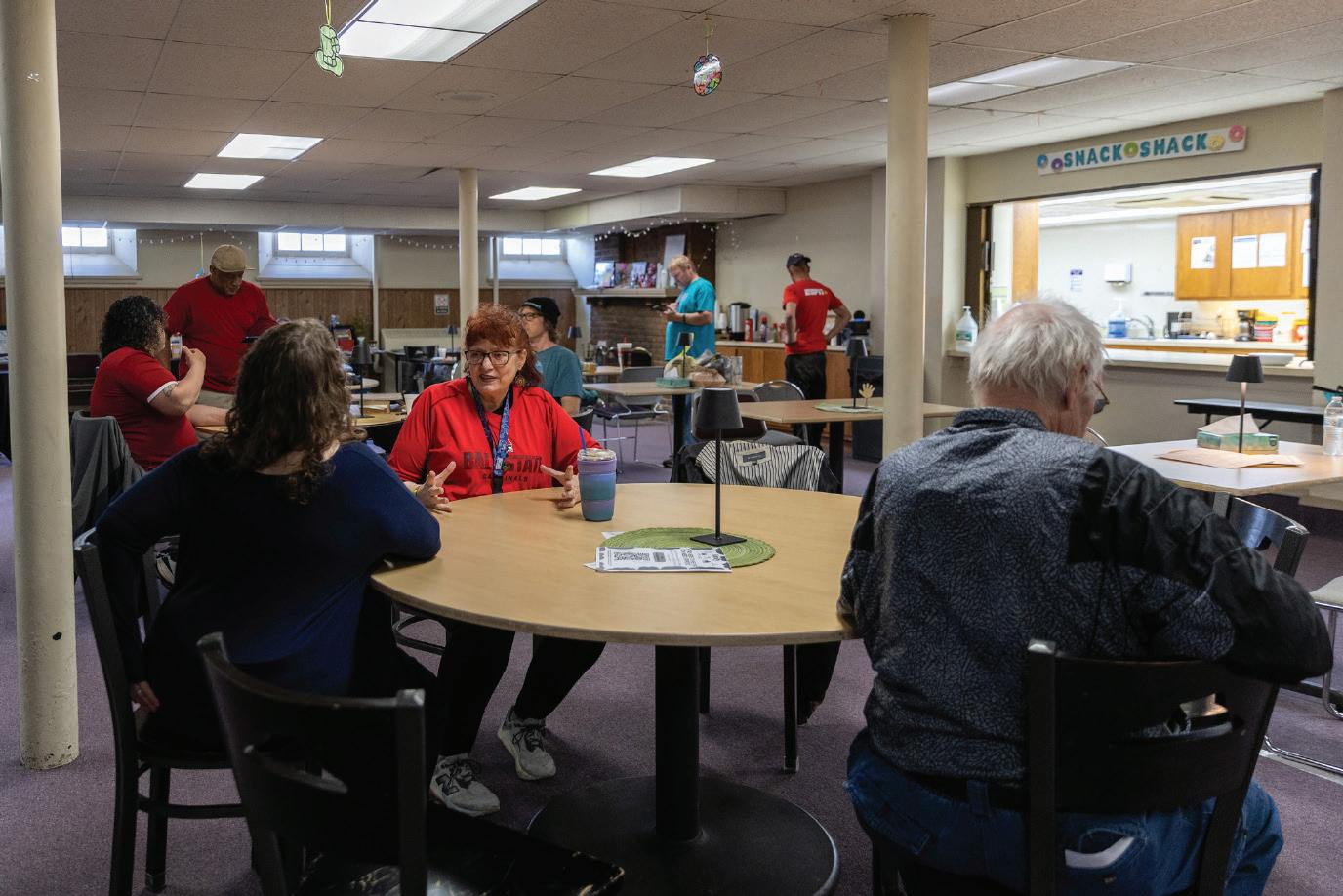
Recovery Cafe, a peer support community in Muncie, welcomes “anyone who is recovering from anything.” Open
four days a week, Executive Director Abby Carpenter said that their main focus is on long-term recovery and stability.
Recovery Cafe models itself in various ways to support long-term recovery, including recovery circles where members meet weekly together. Recovery circles are attendance-based, and members have access to the cafe and resources offered. There is always consistent peer support and accountability, Abby said.
“They’re in this intimate setting where they can be seen and be heard and be loved through all their challenges, while also finding these commonalities that every human goes through,” Abby said.
Recovery Cafe offers various resources, including a food pantry, clothing closet, school for recovery and workshops, for no cost. These resources help remove barriers such as food and clothing necessities, so members are able to focus on recovery.
Whether a person wants to use medication-assisted treatment, is focused on NA or AA groups or is just looking
for a safe community that’s striving for sobriety or harm reduction; Abby said that Recovery Cafe is open to any type of recovery pathway an individual may need.
Similar to Recovery Cafe, Kingdom Recovery House, a non-profit sober-living community for men, provides a resource for those seeking recovery.
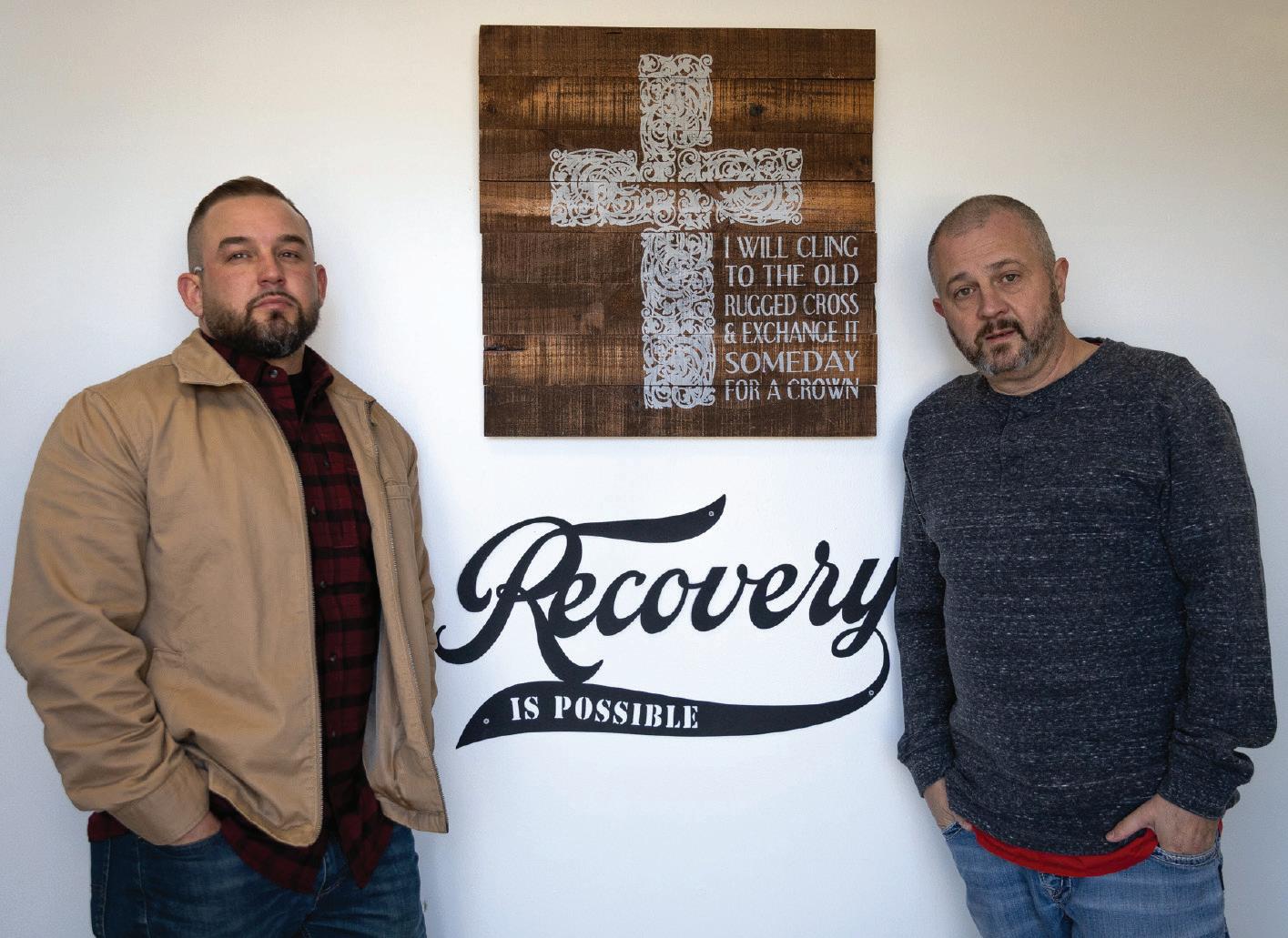
Brian Blevins and Devin Case opened Kingdom Recovery House in January 2026. In December 2025, Brian and Devin bought and began to renovate an old church. A sign that says “Recovery is possible” welcomes people as they walk in.
Brian was addicted to drugs from the time he was a teenager until he was 42-years-old. His recovery journey began a little over 10 years ago, and he started working various jobs and building his relationship with God.
At the beginning of his journey, he would take those who needed help to 28-day rehabilitation centers and began to ask, “Where do they go once they get out, and what do they do?”

Owners Brian Blevins and Devin Case pose for a photo at Kingdom Recovery House March 28 in Muncie, IN. Residents are required to pay rent, attend two meetings weekly and attend church service on Sundays. Andrew Berger, Ball Bearings
So then I’m like, ‘What resources does Muncie have?’ and when they say there’s nothing … well, there’s only one way to fix it. We[‘ve] got to start it.”
- BRIAN BLEVINS Kingdom Recovery
House owner
Brian currently works in Grant County at a free healthcare clinic and has been a sober living house supervisor for five years.
“So then I’m like, ‘What resources does Muncie have?’ and when they say there’s nothing … well, there’s only one way to fix it. We[‘ve] got to start it,” Brian said.
People reach out to Brian, and based on house availability, Brian and his wife, Jamie, conduct background checks on potential residents. Residents are required to pay rent, attend two meetings weekly and attend church service on Sundays. Kingdom Recovery is a yearlong commitment, but residents have the option to leave earlier.
Brian said he tries to go “above and beyond” and meet residents “where they’re at.” He helps with building resumes and finding jobs, obtaining food stamps, expungements and more.
According to the American Bar Association, expungement is the legal process of destroying or sealing a state
or federal record, and it removes certain criminal convictions from a person’s record. This helps individuals pass background checks and build new careers.
Awareness and volunteer efforts are being made on Ball State University’s campus as well.
[LEFT] Members of Recovery Cafe talk over morning coffee and donuts April 3 in Muncie, IN. Recovery Cafe offers complimentary services including a food pantry, clothing closet and educational workshops. Andrew Berger, Ball Bearings [BELOW] A member of Recovery Cafe shows pictures from a recent trip to others April 3 in Muncie, IN. Recovery Cafe models itself in various ways to support long-term recovery. Andrew Berger, Ball Bearings
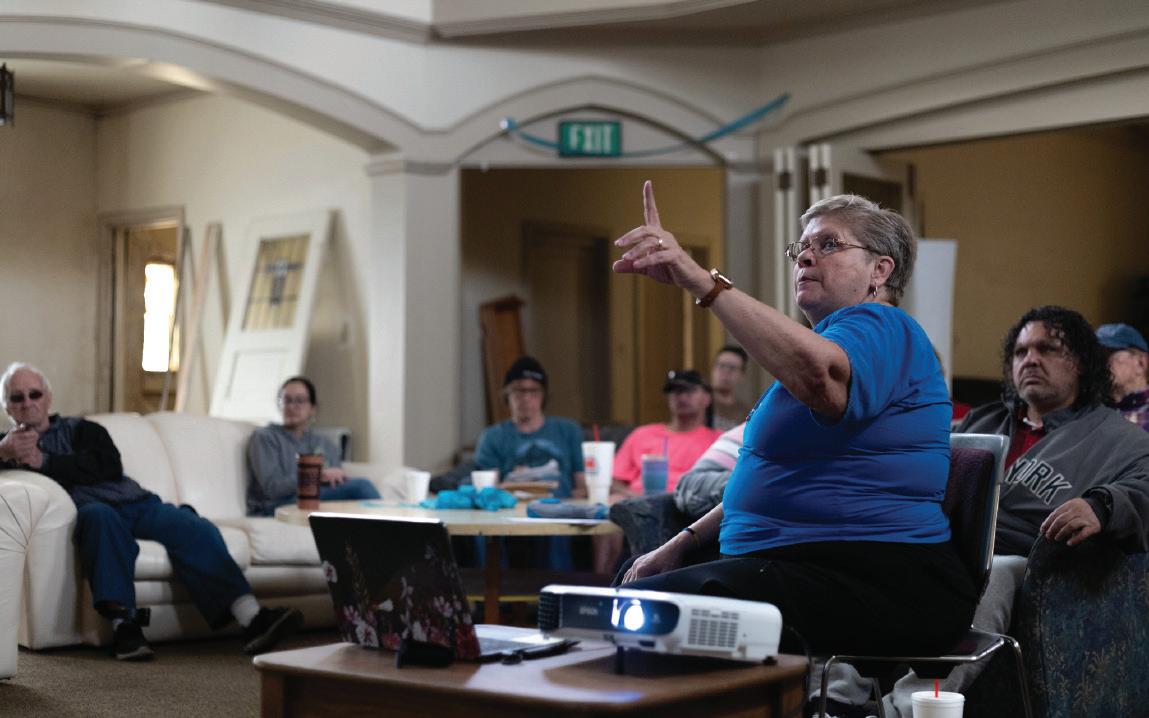
Assistant lecturer of English, Mary Lowry, currently teaches Writing for Change, an immersive learning course where students partner with Muncie community to meet the specific needs of their community partner, while teaching students English 103 and 104 basics.
Mary’s class is paired with the Muncie Mission Ministries, a clinic that offers faithbased homeless shelter, family services and addiction recovery. Students help with volunteer work, and this year, have been focusing on helping with Muncie Mission’s social media.
“It has been so great to see so many people who genuinely care about the community,” Mary said. “When you get into the community, you realize there are so many people here who are working so hard to take care of other people and genuinely care.”
Assistant teaching professor of English, Kathryn Ludwig, is working with her
students on their third year of partnering with the Recovery Cafe. Students build connections with those at the Cafe, and have done “facing projects” for the last two years.
“The more we normalize the issue, the more that we talk about how substance use is a reality in our community, it’s a significant problem in our community, and that we have the power to change it,” Professor of Health Science at Ball State University, Jean Marie Place, said.
Jean Marie is also Director of Community Research and Administration of the Addictions Coalition of Delaware County (ACDC), a partnership that serves as a resource for grant funding to initiate evidence-based programs for prevention, treatment, harm reduction and recovery in Delaware County. The ACDC collaborates with various Muncie organizations, such as Meridian Health Services, IU Addiction Treatment and Recovery Center and Centerstone Health Services.
“I think it’s a misconception that people just wake up one day and they have their first hit [of a drug], and are hopelessly gone,” Jean Marie said.
Today, Mandy and Jarrod let their “lived experiences” guide them through life. The two do work with DCS, child welfare organizations and family advocacy.
Jarrod does not say he is an addict or alcoholic. Now, he views his life as an example of recovery and what recovery can look like. Mandy views her life as being in recovery “from the world.”
Jarrod encourages people not to give up on others and to be there for them.
“To me, it doesn’t mean that it’s an ongoing struggle against drugs and alcohol, but it’s a life where I live by my morals and values. I live by the truth,” he said. g

To me, it doesn’t mean that it’s an ongoing struggle against drugs and alcohol, but it’s a life where I live by my morals and values. I live by the truth.”
- JARROD HUMMER, RU Recovery leader
and
pose their hands over their Bibles at their home April 3 in Farmland, IN. One of the first things that people from Grace Baptist Church did was bring
to church and ask if they had food. Andrew
and




















| Spring 2026















By Katherine Hill
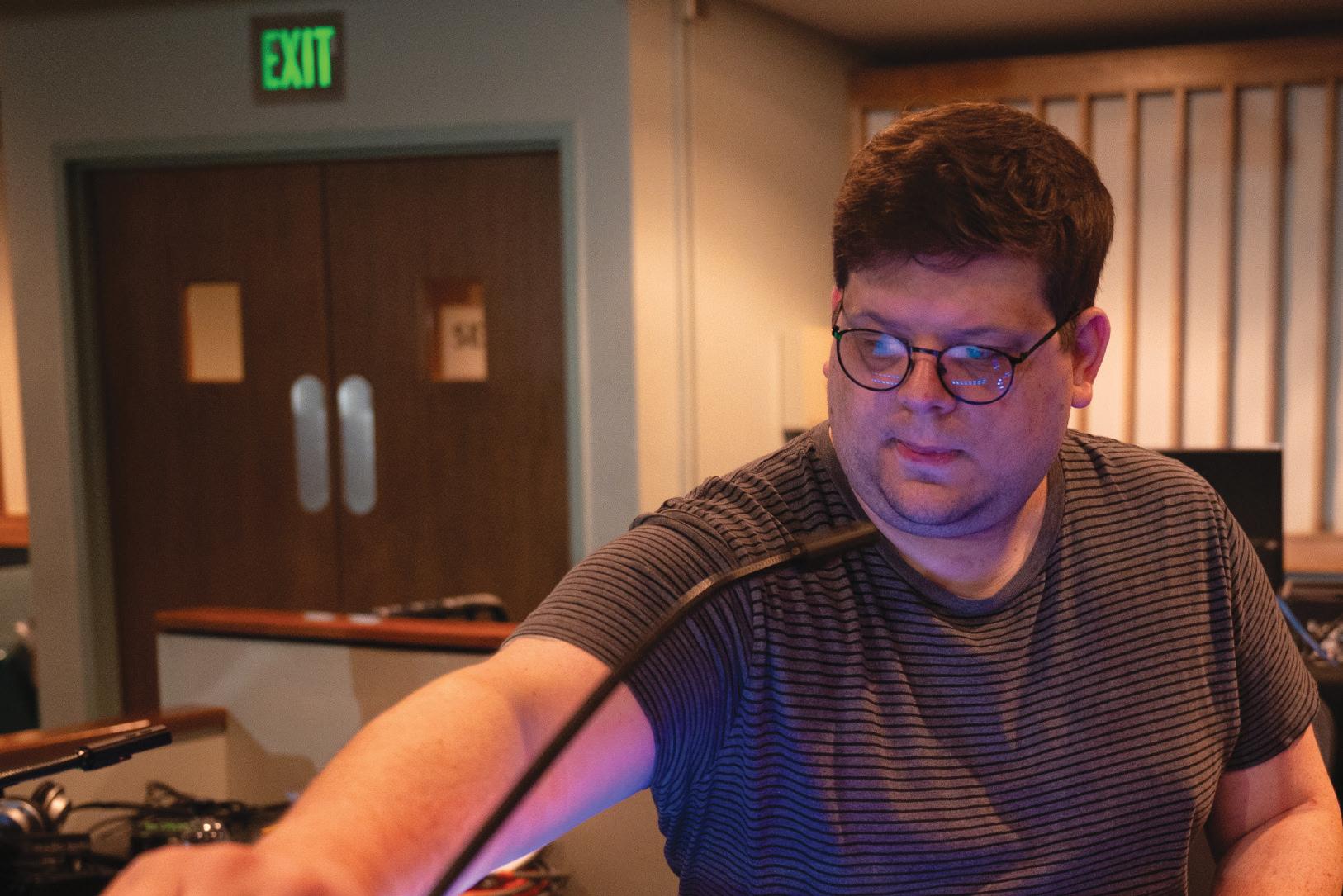
As a child, Brandon Reed, assistant professor of sound design for Ball State University’s Department of Theatre and Dance, loved playing video games, though his reason for such a hobby went beyond just seeking relaxation.
Brandon was “fascinated” by the mechanics that went into creating his favorite mythological and fantasy games, and he remembered being obsessed with recording technology and music.
Brandon said he worked on an array of theatrical productions in high schol as the sound board operator, but the collegiate experience he gained from Ball State was what shaped his understanding of the breadth of the craft.


[Sound design] is not just a technical craft. It’s also an artistic craft.”
- BRANDON REED, Assisstant professor of sound design for the Department of Theatre and Dance at Ball State University































“[Sound design] is not just mixing a board. You can actually create a whole world with soundscapes and write the music for plays,” he said.
As a 2014 Ball State alum, Brandon strives to ignite the same passion for sound design within his cohort of students that the university first sparked within him nearly a quarter of a century ago.
One of Brandon’s students, Ryan Daffron, a thirdyear student at Ball State, is majoring in design and technology with a focus on sound.
Ryan first began working with theater technology and sets in high school while he was still learning the craft.
Technical theater gave him hands-on opportunities and real-world experiences from the get-go, while still offering him the safe-guard of a student environment.
As time went on, though, the stagehand assisting Ryan did felt less like a job and more like he had found a home within the thespian community.

Theater is significantly more team-based and collaborative than a lot of other art mediums, so it’s really important to make sure that your design is cohesive with the other members of your team.”
- Ryan Dafforn, Third-year Ball State student studying theatrical design and technology
“For me, it was the first place I felt really welcome, so I just kept doing it and I’m here now,” Ryan said.
Today, Ryan and Brandon work together on a number of shows at Ball State. Last fall, Ryan worked on the university’s modern-day twist of “Romeo and Juliet” at The Brown Family Amphitheater. Brandon recently wrapped up his technical work as lead sound designer for the university’s production of “Cats,” which premiered in late-March. With each new project, the professor and student have similar approaches toward collaboration. They aim to foster cross-communication between actors, costume designers and all other people involved in the production early on.






| Ball Bearings | Spring 2026




Ryan also highlighted the element of personal accountability that is required within theater.
“[Theater is] working with a lot of other people, but also it does take a lot of time alone with the script and your director to be like, ‘I have these ideas, and I think I want to have these themes [showcased] and [conversations] like that reinforce the moments in the script,’” Ryan said. Those conversations are essential to ensure the director’s vision comes together with costume, lighting and sound designers working as a team. Brandon said it is those conversations that “help construct” a ship for the director to steer. The idea of being open to directorial guidance to shape a production’s sound design is something Brandon and his coworkers within the university’s theatre department have continuously ingrained in their students.
“If you have a really good idea and you really love it, don’t be afraid to let it go and try something else. You should just be open to different stuff,” Ryan said, defining collaboration as “different ways of achieving the same goal.”
The thespian community can rely on collaboration, with the success of each show largely dependent on the trust the cast and crew have in each other to best execute the




director’s vision — even when that means sacrificing initial ideas. Upon receiving a script, Brandon said he reads each one twice through, once to understand the story and character dynamics, and then again, looking for sound cues.
He said he plays a reel in his head, imagining where music, underscoring and sound effects go. He asks what the characters are hearing, even if it is not mentioned in the script.
Brandon then takes the script, outlined with his sound cue annotations, to the director, “knowing most of it’s going to get cut.”
“I throw everything at the wall, and then they tell me what needs to stick,” he said. “I go from there and that helps me understand, ‘Am I on the right path, or am I way off the mark?’”
Research from The Elton B. Stephens Company (EBSCO) in 2023 concluded that quality sound design, in particular, remains “vital” to any theatrical production.
Sound design enhances a production’s ability to be both an immersive and realistic experience for a viewing audience.
“Though they may seem trivial at first, sounds like traffic noise, wind, and background chatter make scenes come alive for audiences in ways that would not otherwise be possible if such

Sound design is not just mixing a board. You can actually create a whole world with soundscapes and write the music for plays.”
- BRANDON REED, Assisstant professor
of sound design for the Department of Theatre and Dance at Ball State
ambient sounds were not included,” according to the study.
Brandon has been a sound designer for 11 years. Despite being in the profession for just over a decade: “I still get nervous the first time we have an audience,” Brandon said. “It’s the first time I go, ‘Is this gonna work?’
Brandon said his job is to help ignite that sense of creativity within all the students who pass through his classroom doors.
“A lot of people in high school don’t realize [sound design] is not just a technical craft. It’s also an artistic craft. The mixer, the microphones, those are just giant paint brushes, and if you don’t know what you’re painting, then it doesn’t matter,” he said.
Though every production is unique, Brandon said each one maintains the same goal: to tell a story through a creative lens. Sound design, specifically, garners the capacity to enhance the quality of a production.
“Every other design discipline you can see. You see the costumes, you see the hair and makeup. You see the lighting, but if you marry the lighting with the sound, it really helps elevate [a production],” he said.


















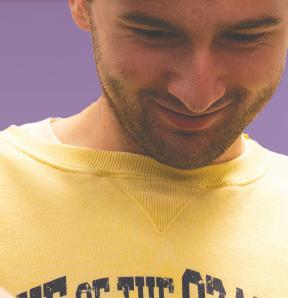
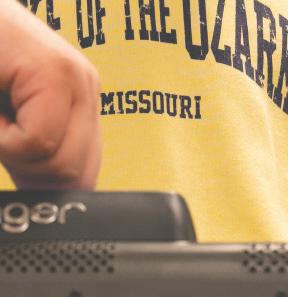












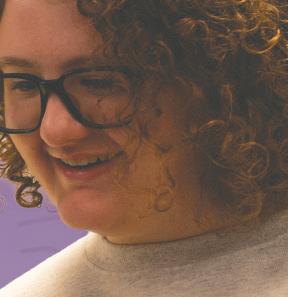








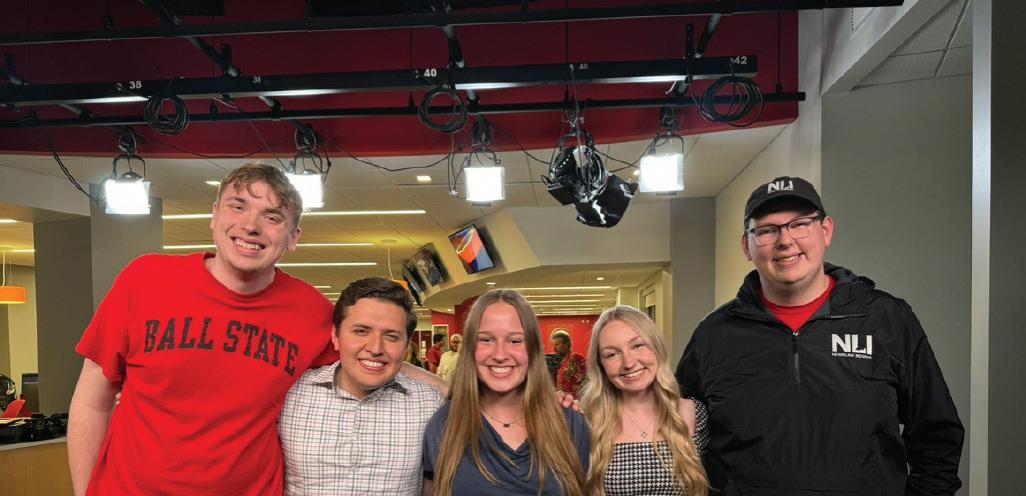


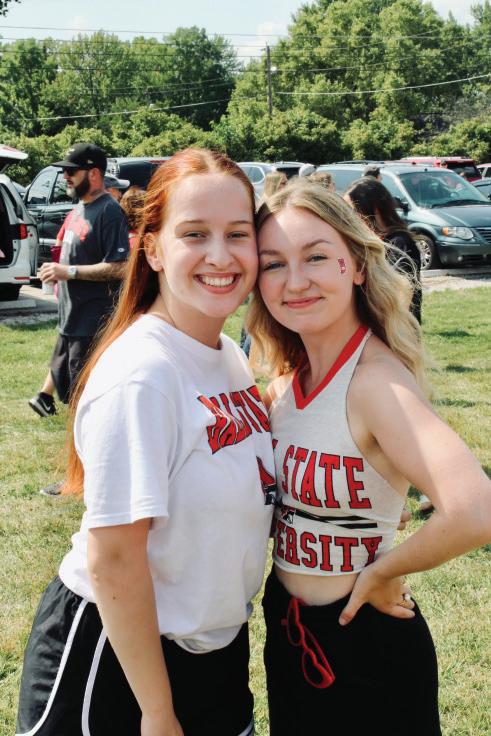

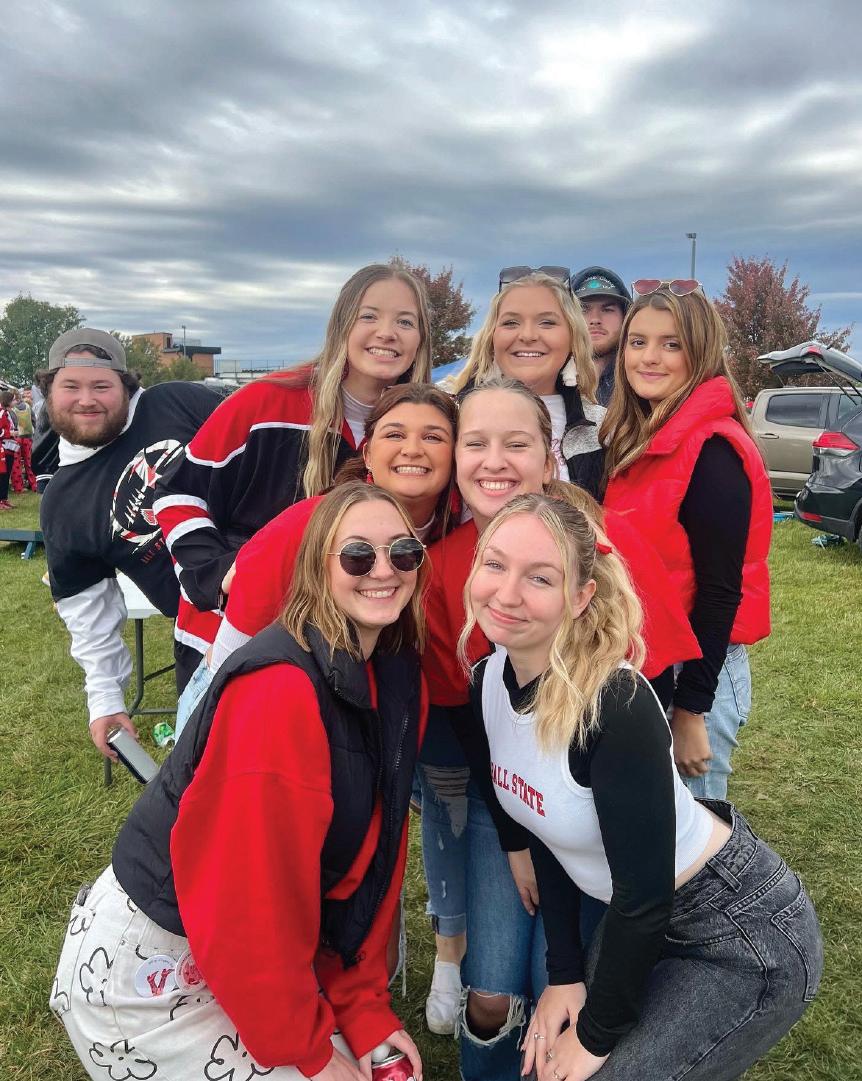































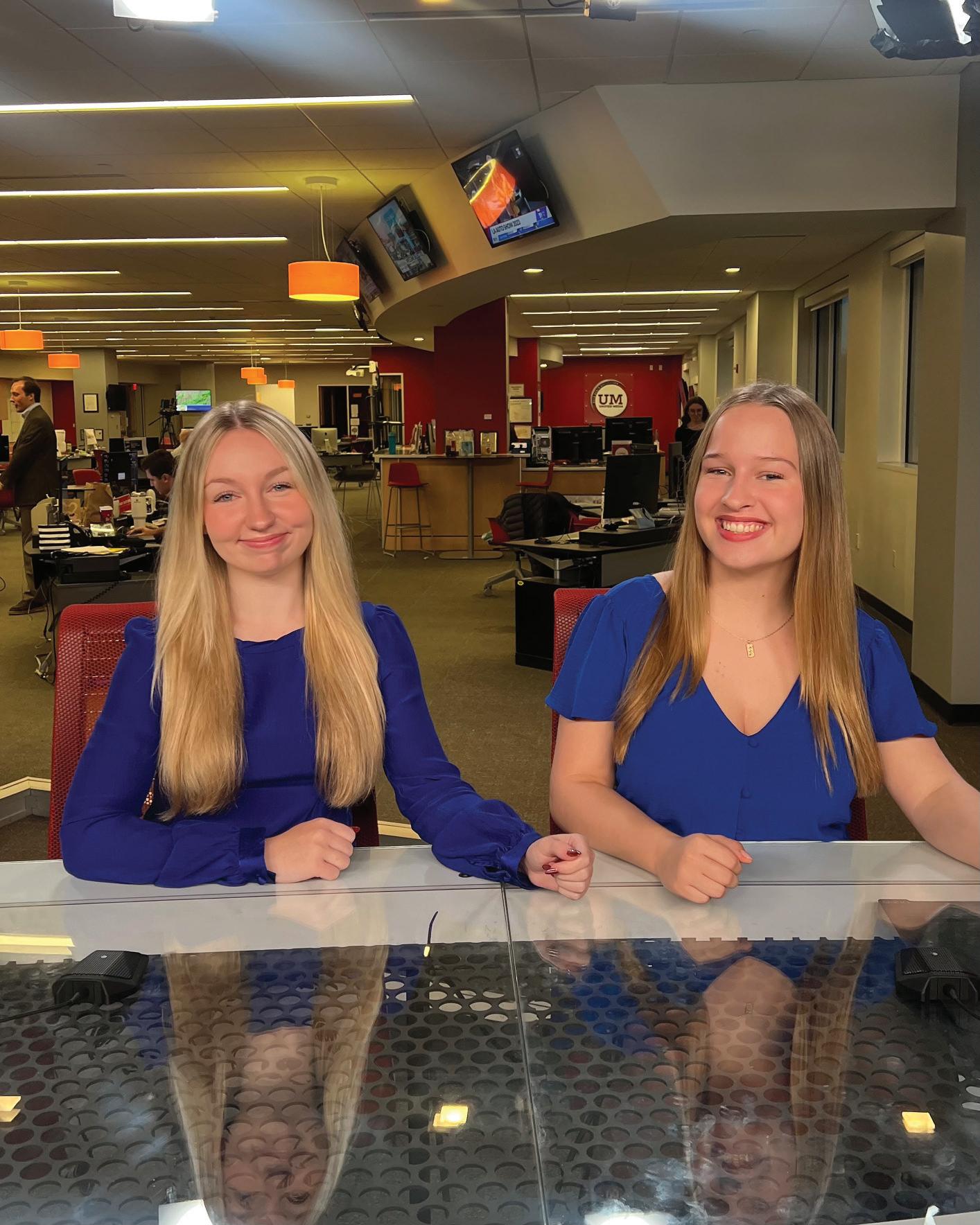

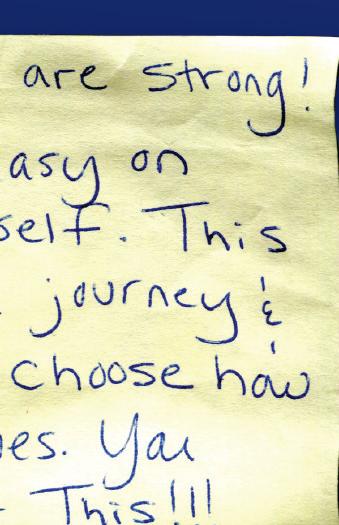







By Brooke Follrad
Losing a loved one can separate your life into “before” and “after” stages. It can feel like your entire world has stopped while everyone else’s keeps moving.
Grieving is often described as “moving on,” but you never move on; you move through it.



As you continue to live in the “after,” you carry grief with you, each step lighter with passing time. Healing is not linear, and grief is love with no place to go.













I would no longer see the life she was supposed to live and the person she was meant to become.”
- BROOKE FOLLRAD


Right now, I am a junior at Ball State University, with the proud role of the news director of NewsLink Indiana, the student-run broadcast television news program on campus. In the newsroom, I not only lead my staff, but I also carry on the legacy of one of my best friends.






Words do not have enough depth for me to properly capture who Grace Bentkowski was. Grace made the people around her glow. She could make a boring room into the place you wanted to be. Knowing and loving Grace made me a better person.
Grace started at Ball State University in the fall of 2020, where she joined NewsLink Indiana. Over her four years spent in the organization, she worked her way up the ranks, ending her senior year as news director in 2024.
While reporting, anchoring, producing and holding multiple executive roles, Grace also worked for Great News Life in Valparaiso. Her schedule was always pushing at the seams, but she made it look like the bare minimum. I remember always asking her how she did it all. Her answer was that she knew what she wanted her life to look like and that she would make it happen.
On July 25, 2024, Grace was on her way home from work when she was struck by a South Shore train at the Hegewisch, Illinois station. She was walking across the tracks on the indicated pedestrian path, with her phone and headphones in her purse.
We had been texting all day about the outfits she was planning to wear at Lollapalooza, a four-day music festival in Chicago. I was waiting for her to get home so we could talk more.
Around 10 p.m. I answered a phone call from her younger brother, Adian, telling me that she had been hit by a train.
My first reaction was that he was joking, because he had to be, right? I remember running downstairs to tell my parents the news. The memory is a mix of gasps and cries, muffled echoes of my own thoughts. We sat outside on our back porch in Alabama, and I stared at the river in our backyard.
I can still recall the way the moon reflected onto the water, casting itself as a glowing image. It felt like a reflection of the greater universe outside of just my own life.
Grace felt a universe away from me in that moment. All I wanted to do was be with her. My soul was broken at the
thought of her being alone and scared.
She was transported to the University of Chicago hospital with fatal injuries. Her family was informed that she was in surgery, where she passed away after hours of doctors trying to save her.
When I got the text that she didn’t make it, I went numb.
The July breeze rolled across my arms, and it was the only thing that I could feel. My backyard felt still, as if it knew that the world was no longer the same.
You cannot reason your way out of grief. It is a constant, stubborn weight that will only hold on tighter the more you try to shake it. There will be a hole where the person once filled, and it is up to you how you refill that void. It sounds condescendingly simpler than it actually is, but you will make it through.
I was not broken; I was adjusting to the new life I was forced into. I wasn’t showing up as well as I had in the “before” part of my life. Things fell through the cracks, I ignored text messages, I often spaced out. Parts of my life began to falter because nothing felt as important as grieving Grace.
Losing Grace will never negate the immense gratitude I feel for knowing and loving her. She changed my life for the better and left an impact I, and so many others, will never forget.”
- BROOKE FOLLRAD
When I opened my phone again, I saw her Snapchat story from hours before. A photo of the Chicago River, where she was planning to move the following month. It felt like the universe was mocking what could have been. I would no longer see the life she was supposed to live and the person she was meant to become.
I think some part of me knew what was going to happen all day. Throughout my shift at work, I kept getting the urge to text her. Something in my soul kept telling me to talk to her as much as I could. Since then, she has never left my thoughts.
When it came time for her memorial, one of the hardest aspects of it was picking out an outfit by myself. Grace was the one who always helped me decide what to wear.
What many people didn’t see was how I processed this great loss. For about a year, I rarely slept, averaging about three hours a night. I would find myself seeing her in my dreams, and waking back up to the reality that she is never coming back. I hated being alone with such a heavy and dark reality. My phone became my distraction. I would burrow myself in anything that wasn’t my own life. Death is such a strange concept: It is confusing how an entire person can be gone in the blink of an eye. To avoid the bottomless pit of grief, I kept my schedule packed, just like Grace used to.
I drove my car around Muncie until I ran out of gas. I blasted music until my ears rang. I leaned on my friends, talking about her until my throat was hoarse. My neck would snap at the sight of any short, blonde girl walking by, thinking it might be Grace.
It was as if I were waiting for her to come back.
I utilized various resources, from a therapist to on-campus counseling. Talking out my emotions has helped me grasp the absolute oddity that is one of the closest people to my heart being killed by a train.
Grace’s mom, Erin, shared a beautiful analogy of how signs from “the beyond” work.
She said, “Believe whatever you will, but souls can communicate after death.”
Erin describes it like tuning into the correct radio station. If you are on the wrong station, like ignoring and pushing away the grief, the radio waves cannot
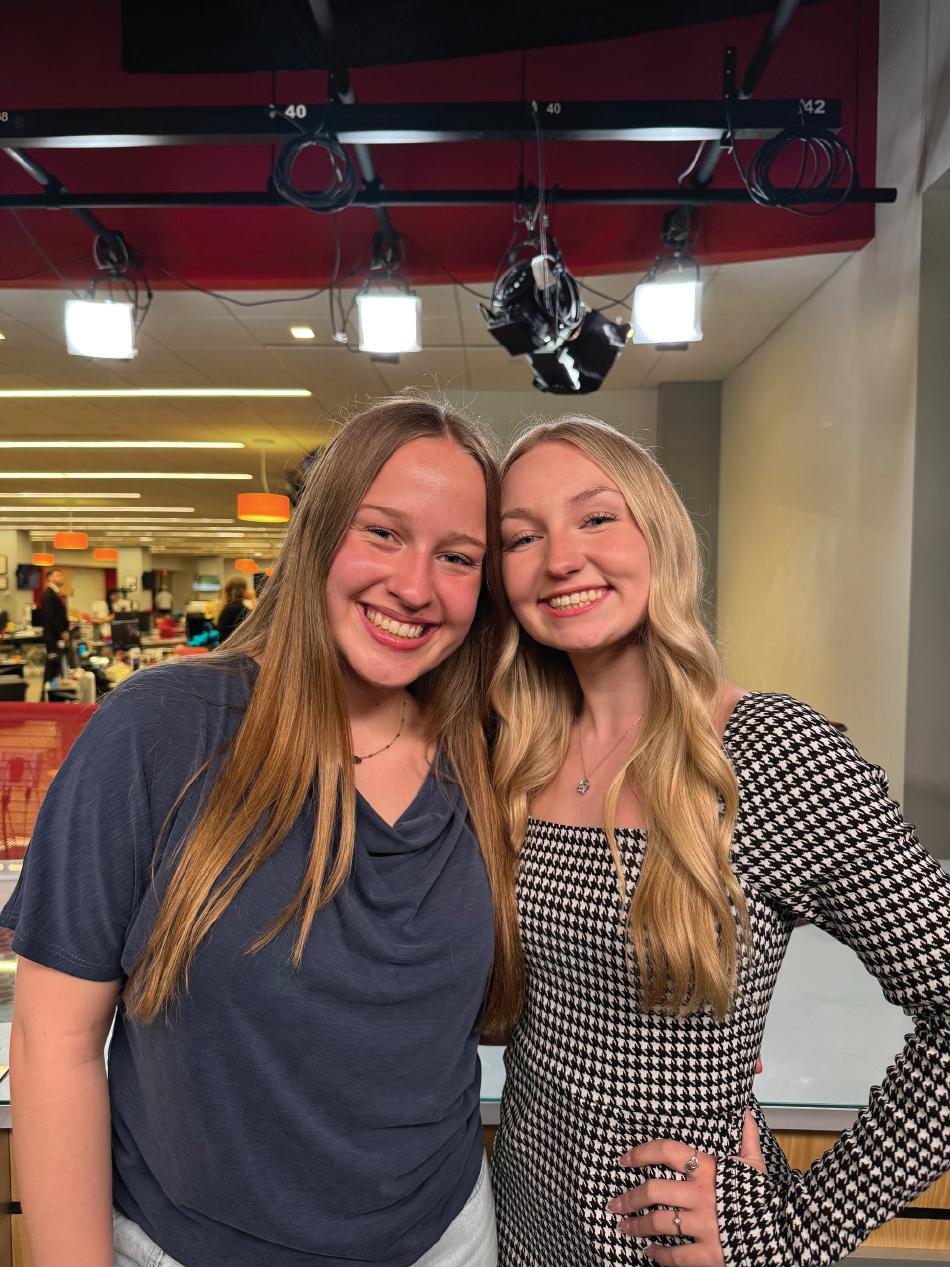
communicate with you. Every time I run away from the pain, I lose the signs she sends me.
Now, in the “after,” I honor her. Everything that I do and push myself for is to make Grace proud. Although she is gone, I see a lot of her in me. Her work ethic and drive were unstoppable, which I feel has been transferred to me after her passing. When it felt like I couldn’t even fill my lungs with air, I was able to run a newsroom with passion in my heart.
I think to myself: “What would Grace do?”
Grace’s memory lives on in me, her family, her friends and in the newsroom. Ball State worked with Nexstar Media Group, Grace’s postgraduation employer, to create the Grace Bentkowski Memorial Scholarship. This money is meant to provide support to fellow media majors, who also devote their time to the field of journalism.
The Media Department at Ball State University also made a plaque in her honor that hangs in the Unified Media Lab, where Newslink Indiana runs its live shows. It reads, “Her Light Shines On.”
Everyone’s grieving process looks different. It can feel as though others are moving on when you are “stuck” in
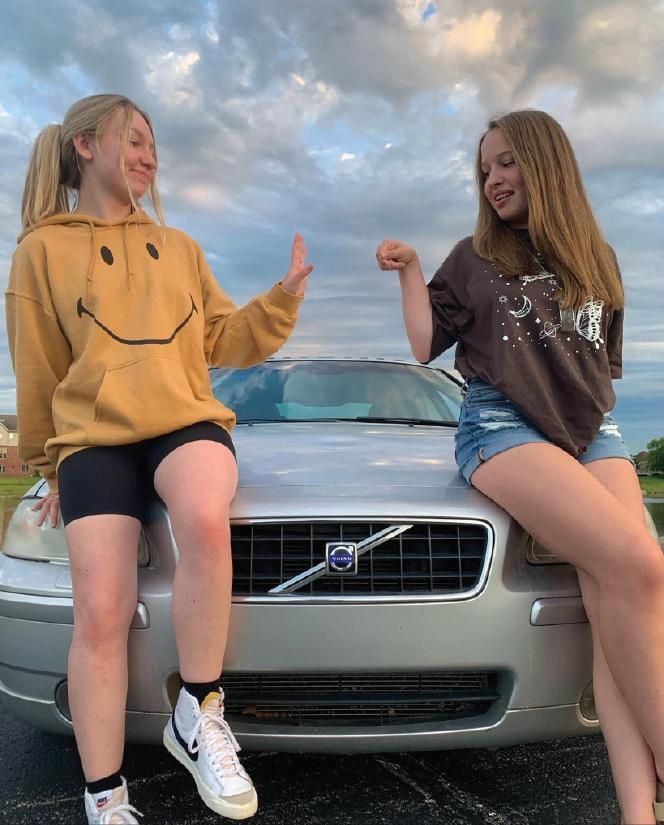
the deepest parts of it. You never know what someone is going through, which is why it is crucial to treat everyone with kindness.
Do not isolate yourself because grief already makes you feel so alone. Taking advantage of tools does not make you weak; it makes you stronger for accepting when you need help.
Losing Grace will never negate the immense gratitude I feel for knowing and loving her. She changed my life for the better and left an impact I, and so many others, will never forget.
Grief may break your life into “before” and “after” stages, but there is beauty in both.
Remember that life is meant to be spent loving and not worrying. Do not spend your life avoiding your emotions, for that feeling is the breath of purpose.
I am not an expert, and I surely am not done grieving, but are we ever done? In a positive, loving way, I hope that it doesn’t. She will be with me forever, as will any passed loved one.
Death is as permanent as the impact Grace Bentkowski had on my life. g













ALMOST A QUARTER OF AMERICANS LIVE WITH A MENTAL ILLNESS.





By Radley Richman
“My most recent depressive state lasted for [four] months, and I just couldn’t pull myself out of it,” Cat Meier, Muncie resident, said.
Cat said her mental illness ebbs and flows. Cat lives with major depressive disorder, bipolar disorder and attention deficit hyperactivity disorder (ADHD).




She describes her mental health as having been a source of turbulence in her life. Throughout her twenties, she experimented with recreational drugs because she was tired of her emotions “constantly going up and down.”
“When I’m in a depressive episode, my mindset is usually always in that ‘Fight, flight, freeze’ mode, that constant survival mode that you just can’t get rid of,” Cat said.
In the winter of 2025, Cat checked herself into the hospital because of a prolonged depressive episode. Her stay lasted 15 days, and her prescriptions were readjusted to better fit her mental state.
“Truth be told, if it weren’t for my parents, my therapists, friends and my whole support system, I really don’t know where I would be right now,” Cat said.

Truth be told, if it weren’t for my parents, my therapists, friends and my whole support system I really don’t know where I would be right now.”
- CAT MEIER, Muncie resident




According to a 2022 survey conducted by the National Institute of Mental Health (NIMH), 23 percent of Americans report living with a mental illness. Mental illnesses, such as major depressive disorder (MDD), general anxiety disorder (GAD) and obsessive-compulsive disorder (OCD), present themselves differently for everyone.
counselor every other Monday, where she explores her struggles through psychotherapy, with a form of therapy called cognitive behavioral therapy.
In addition to therapy and medication, Cat uses creative outlets to cope with her mental health challenges.
informed and way better at catching mental health than they were previously,” James said.
He describes how, in contrast with older forms of psychological treatment, mental health care now often takes place in most major hospitals.
“I would cope with my mental health by journaling, painting, listening to music, going to advocate events and crafting,” Cat said. “To this very day, I still use all of these coping skills to help with my mental health.”



Depending on severity, the symptoms of many mental illnesses can lead to a shutdown of one’s social and professional life. According to NIMH, common symptoms of depression can include irregular sleep habits, loss of interest in daily activities, irregular food habits, potentially causing weight gain or weight loss and difficulty maintaining concentration.

According to a 2022 survey by the Mayo Clinic, 46 percent of hospitals now employ psychologists and psychiatrists in order to be able to directly treat those with mental illness.

Illnesses can intensify and then quiet to a manageable state. These variables and uncertainties are what mental health professionals are working to help people manage.





















All the therapy that I go to has helped me better understand my emotions, boundaries, values, self worth and compassion for myself.”


Dr. James Rankin, Ball State University professor and clinical child psychologist, specializes in neurodiversity. According to Harvard Health Publishing, neurodiversity exists when people “experience and interact with the world around them in many different ways.” In a psychological context, neurodiversity is often used to describe conditions such as autism spectrum disorder and attention deficit hyperactivity disorder (ADHD).
From his research regarding ADHD treatment, James said that the neurodivergent community has a good understanding of what works best: a combination of stimulant medication and psychotherapy.
Illnesses like major depressive disorder and bipolar disorder are aided with similar treatment combinations. A type of medication called selective serotonin reuptake inhibitors (SSRIs) is commonly prescribed to those with illnesses that cause depression and anxiety.
Cat attends therapy with a regular
- CAT MEIER, Muncie resident



Whether it be in the oncology or pulmonology department, the presence of psychologists in hospitals has “helped in building greater awareness among your broader range of healthcare,” James said.
greater awareness among your James said.






James has noticed that the structure of different school systems and the transitions between them can heavily affect those with neurodiverse conditions in different ways.
“A lot of people who are really doing well start to struggle massively,” James said. “You see these kinds of waves and shifts across different periods of time.”
James described how the awareness of mental illness has created a better overall world for those struggling with their mental health.
“Compared to 15-20 years ago, if you go see your primary care physician, they are way more

James finds that there are still spaces where those with mental adults, it can be difficult to get access to the afforded to children. with autistic adults, but with them,” James said. However, progress is
James finds that there are still spaces where those with mental health struggles feel out of place. For neurodivergent adults, it can be difficult to get access to the same treatment that is afforded to children.






























that expand upon the practices learned in one-on-one talk therapy, practicing as part of her routine to
“There’s not only a sharp drop off in how many people specialize in working with autistic adults, but many outpatient therapy providers also will not work with them,” James said. However, progress is still being made. There are support groups and classes that expand upon the practices learned in one-on-one talk therapy, such as dialectical behavior therapy (DBT) , which Cat has begun practicing as part of her routine to help treat her mental health.
After Cat stayed in the hospital, got her prescription adjustment and continued her therapy groups and classes, she said found greater peace.
“All the therapy that I go to has helped me better understand my emotions, boundaries, values, selfworth and compassion for myself,” Cat said.
If you or a loved one needs immediate mental health support, call or text the 988 Suicide & Crisis Hotline or go to your nearest hospital








































































By Seyla Ray
How does a swim team “on lifeline, under threat of being dropped,” grow into a team capable of breaking 12 program records in just one season?
Head Coach of Ball State University Men’s and Women’s Swim and Dive, J Agnew, has helped the program grow for the past eight years. Along with the help of his colleagues, Agnew has helped revitalize the team, a feat that he said he is very proud of.
Agnew said the comeback of the swim program was not a solo endeavor. Former Athletic Director, Beth Goetz, and current Athletic Director, Jeff Mitchell, assisted him in nursing the program. Additionally,
former coach Bob Thomas helped keep the team afloat by assisting with the financial problems that the program was suffering from.
“It’s truly a team effort, including our student athletes, coaching and support staff, and administrators, that has revived our men’s program,” Agnew said.
Agnew was a student at Ball State himself. He swam in high school, but found that he could not keep up with the sport in college. However, he did not want to abandon swimming. It was clear to him that he had to find a new way to get involved.
“I started volunteer coaching at the high school and club, and I noticed that I couldn’t wait to go coach,” Agnew said. “As I was going through the semester, I realized, ‘You









know what? I’m more of a people person.’ I wanted to go into teaching. I wanted to go into coaching.”
After this realization, Agnew found a new joy in just that: coaching the swim and dive team. His passion was further amplified by his students’ drive. His athletes also value the connection they gained through swimming.
For example, second-year student athlete AJ Friend. He began swimming after his mother, a swim coach, introduced him to the sport. He has been swimming for just about as long as he can remember, and estimated that his began at about 4-years-old. Apart from his familial bond with his mother, AJ also met close friends through swimming.




















Swimming has provided me not only lifelong friends but also people I can call family. It has also taught me many lessons growing up, and allowed me to become the best version of myself.”
- AJ FRIEND, Student athlete



Grace began diving in 6th grade, after 10 years of gymnastics wore her body down.
The decision to take up diving changed the course of Grace’s life. After two seasons of diving, Grace attended a dive camp called Ripfest, an Indiana-based diving program. In 8th grade, Grace quit attending school to train full-time. She graduated from high school early and attended the University of Arkansas before transferring to Ball State in 2023.
“I got to do all of these cool things, and it’s because I kept showing up to practice,” Grace said. “It doesn’t matter what you do with your sport, it’s about how it makes you feel. I have been diving for so long because I love flipping and moving my body.”
Grace’s love for her sport is evident in her achievements as well, as she earned the Mid-American Conference (MAC) “Diver of the Week” in November 2025, and then won that same conference she earned her title for. The conference was just one of three event wins for her this season. She also holds two positions in Ball State’s top 10 record charts: Number 4 on a 1 meter board, and number 9 on a 3 meter board.
AJ is a record holder as well, holding program records for both the 400 freestyle relay and the 200 butterfly.
Pleased by the team’s success, Agnew said that he has not yet finished counting all the records the team has set this year. He also stated that this year was a unique year, as the conference championships were on the exact same weekend.
Agnew spent two and a half days with the men’s team and two and a half days with the women’s team during the conference. He found that both teams’ mindsets were very similar.
Since diving was so much of my life, the people around me turned into my friends and family. There [are] great communities in it, and if you surround yourself with those people and if you see the sport through, you’ll end up with a huge family.”
- GRACE WALKER, Student athlete
“What I was so proud of was the energy on the deck that they had for each other,” Agnew said. “They were all in, and they were fearless. They were excited to compete as a team.”
The conference championship ended with the men’s team taking fifth place. The women’s team placed third, which tied the highest finish in the history of the swim program.
As the season came to a close, Grace found that the best part of her career was the people she met along the way.
“I’m really proud of the community I have,” Grace said. “I’m just proud that I have gotten to be a part of the team and finish off my career this year.”
AJ intends to continue swimming and later pursue a career within the sport or as a coach, should the opportunity present itself.
The idea of feeling joy for your sport is something that Agnew values, as he finds that “elite” athletes tend to have “passion, energy and enthusiasm” for what they do.
While winning and succeeding are important aspects of any sport, Agnew said that the most important part is enjoying the journey and appreciating the small steps along the way.
“It’s such a special window that they get... If you can just appreciate that, chase your goal, be proud to compete, and be proud to execute to the best of your ability, then that relieves a lot of the tension,” Agnew said. “... Sometimes we’re so results-oriented that we kind of miss the joy of the moments.”
Anna Howarth, Ball
Bearings



of

March
in their



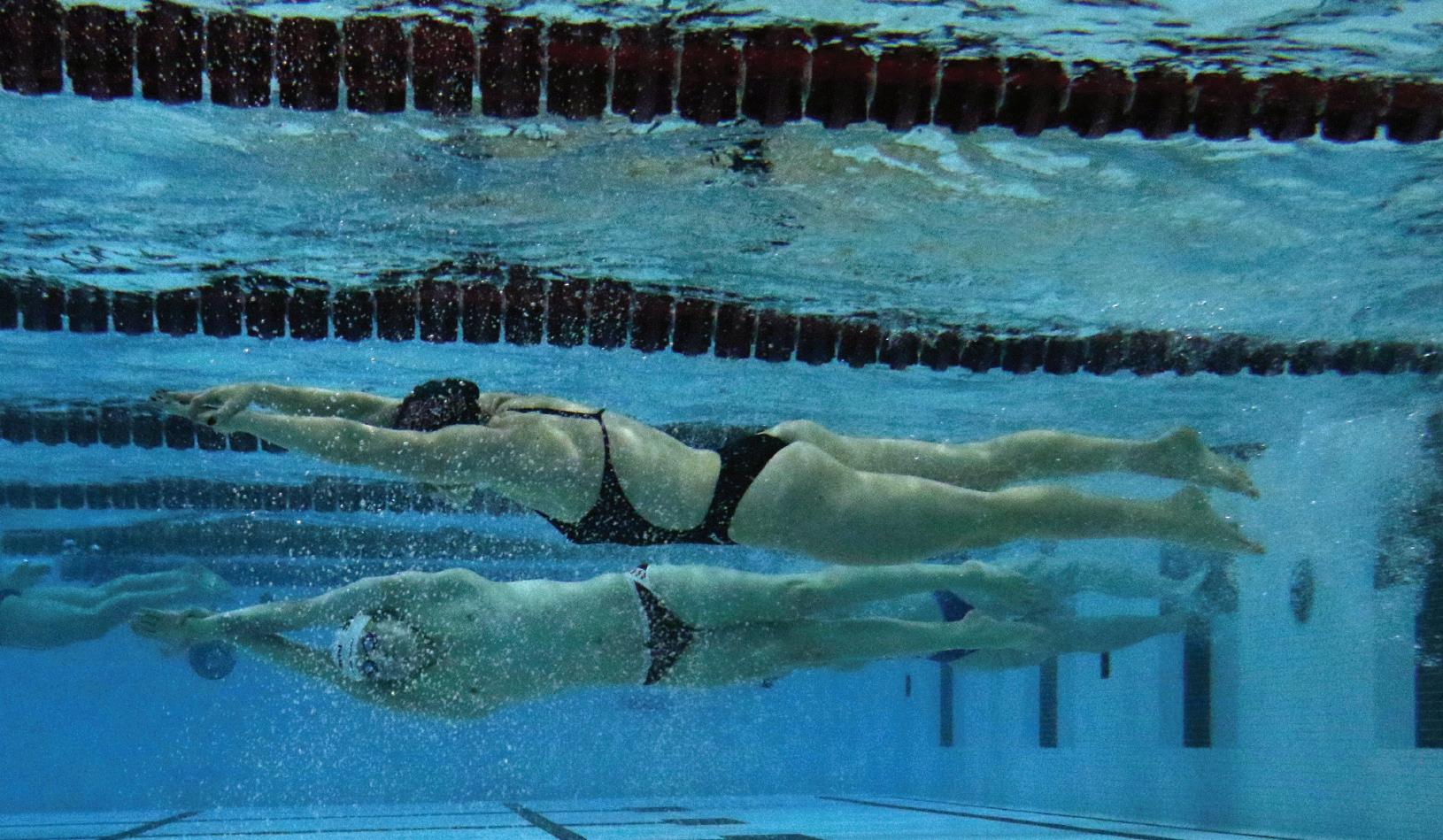

This map acts as a visualization of a guided meditation piece, showcasing how sound waves move throughout Ball State’s campus. Scan the QR code to listen to the meditative track. As you listen, follow along on the map: Can you guess the locations from which the sounds are stemming?

Use headphones for the best experience.