Identity, Reality, and the Rhizomatic Evolution of Meaning
By Lucy Gould
“better” future - a utopian vision of the world. Postmodernism, in contrast, questioned this optimism, embracing complexity, contradiction, and, in many cases, dystopian sensibilities As Lyotard famously states, postmodernism is defined by an “incredulity towards metanarratives” (Lyotard, 1984), meaning a distrust of the big stories that once claimed to explain reality such as religion, science, history and even art itself. Rather than accepting one dominant narrative, postmodernism encourages the existence of many small, personal narratives instead. In art and media, postmodernism is recognisable through its use of fragmentation, parody, intertextuality, pastiche and irony. These terms give context towards the postmodern era so let me define them.
is the deliberate breaking apart of narrative, structure, or form to reflect the idea that reality and meaning are unstable rather than unified.
is the self-aware imitation of a style, genre, or text in an exaggerated way to critique or expose its
is the way a text openly references, borrows from, or depends on other texts for its
is the playful imitation or blending of existing styles without satire or critical intent, celebrating
Irony is the use of distance between what is presented and what is meant, often expressing skepticism toward sincerity or absolute truth.
Postmodern works often mix high and low culture, blurs boundaries between reality and fiction, and frequently references existing texts rather than creating something entirely ‘new’. They are self-aware, and acknowledge their artificial and constructed nature (Barthes, 1977). Meaning is no longer controlled by the artist or the author, but the viewer, who becomes an active participant in interpretation. All these terms, theories and ideas you will come accustomed to by the end of the essay. Don’t worry.
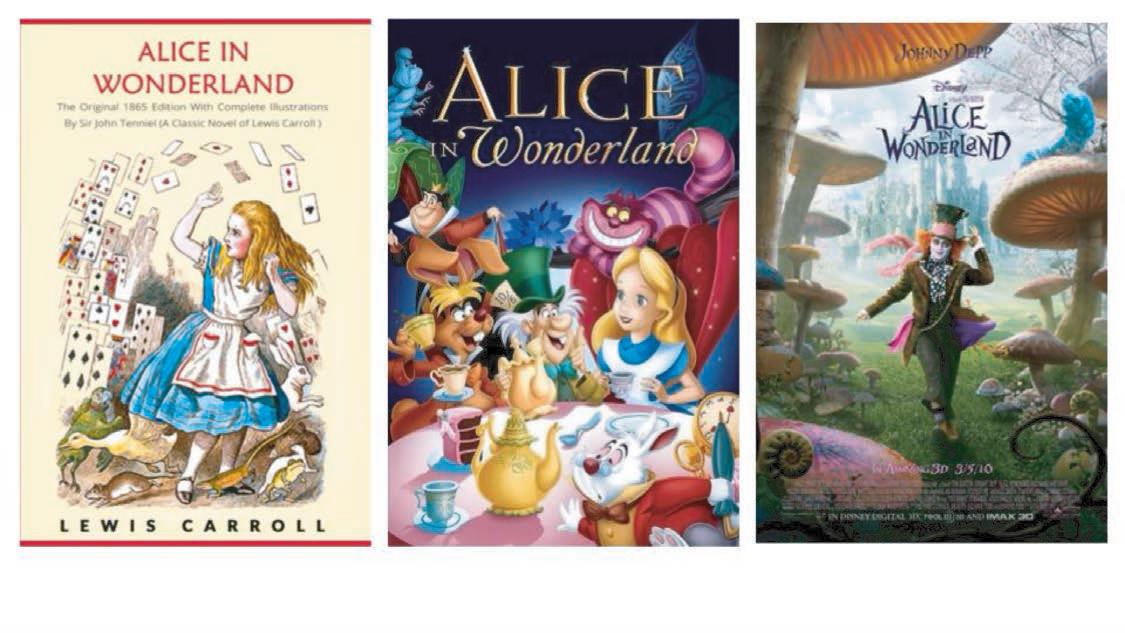
This essay explores postmodernism not just as a theoretical framework, but as a creative lineage. As more of a transformation that can be traced from premodern literature to postmodern visual culture. My chosen focus is Lewis Carroll’s Alice’s Adventures in Wonderland (1865), a Victorian literary text which, despite being created long before postmodernism was formalised, contains elements of absurdity, identity crisis and broken logic that anticipate surrealist and postmodern thinking. From Carroll’s original text, the narrative travels through early cinema, Disney animation, surrealist art and finally Tim Burton’s postmodern reimagining in his 2010 film. I am especially fascinated by how Alice changes across time.
She shifts from a curious Victorian girl to a symbol of fractured identity, rebellion and psychological instability. Through this evolution, Alice in Wonderland becomes more than a story and rather becomes a reflection of the changing fears, values and expectations placed on society, particularly on young women. Drawing on feminist theory, representation theory and hegemony, this essay examines how Alice becomes a postmodern symbol of both control and resistance (Mulvey, 1975; Hall, 1997; Gramsci, 1971).
Ultimately, this essay is not only analytical … It is personal. The transformation of Alice in Wonderland, especially through the surreal and gothic aesthetics of Tim Burton, directly inspires my own creative practice. My final A-Level outcome is a surreal immersive installation that places the viewer inside a distorted mental and physical environment. By drawing on postmodern theory, surrealist influence and Carroll’s narrative legacy, I aim to construct an experience where identity, reality and perception collapse and reform, much like they do for Alice.
CHAPTER I
Postmodernism emerged in the mid-to-late twentieth century as both a cultural movement and a critical response to modernism. Where modernism was rooted in the ideals of progress, truth, originality, and order, postmodernism questions whether such things can truly exist in a complex, fragmented world. Rather than offering certainty, postmodernism embraces ambiguity, contradiction, and multiplicity.
Finally, postmodernism is deeply connected to consumer culture and media saturation. We now live in a digital world where images are constantly reproduced, filtered, edited and consumed. This repeated exposure causes reality to feel simulated rather than authentic. Through my installation, I aim to make the viewer aware of this artificiality and to make them question what is real and what is constructed. The list of features is endless and we could be here for days but as of this essay, these are the ones that are pertinent.
CHAPTER II
To fully grasp postmodernism, it is important to explore the theories that shaped and explained its emergence. These thinkers allow us to analyse artwork, literature and film not just as entertainment, but as products of ideology, psychology and power. When introducing these theories, it is also important to distinguish between related but separate concepts such as simulacra, fragmentation and intertextuality, as each has distinct implications and should not be treated as interchangeable (these technical terms should be briefly defined when first introduced).³
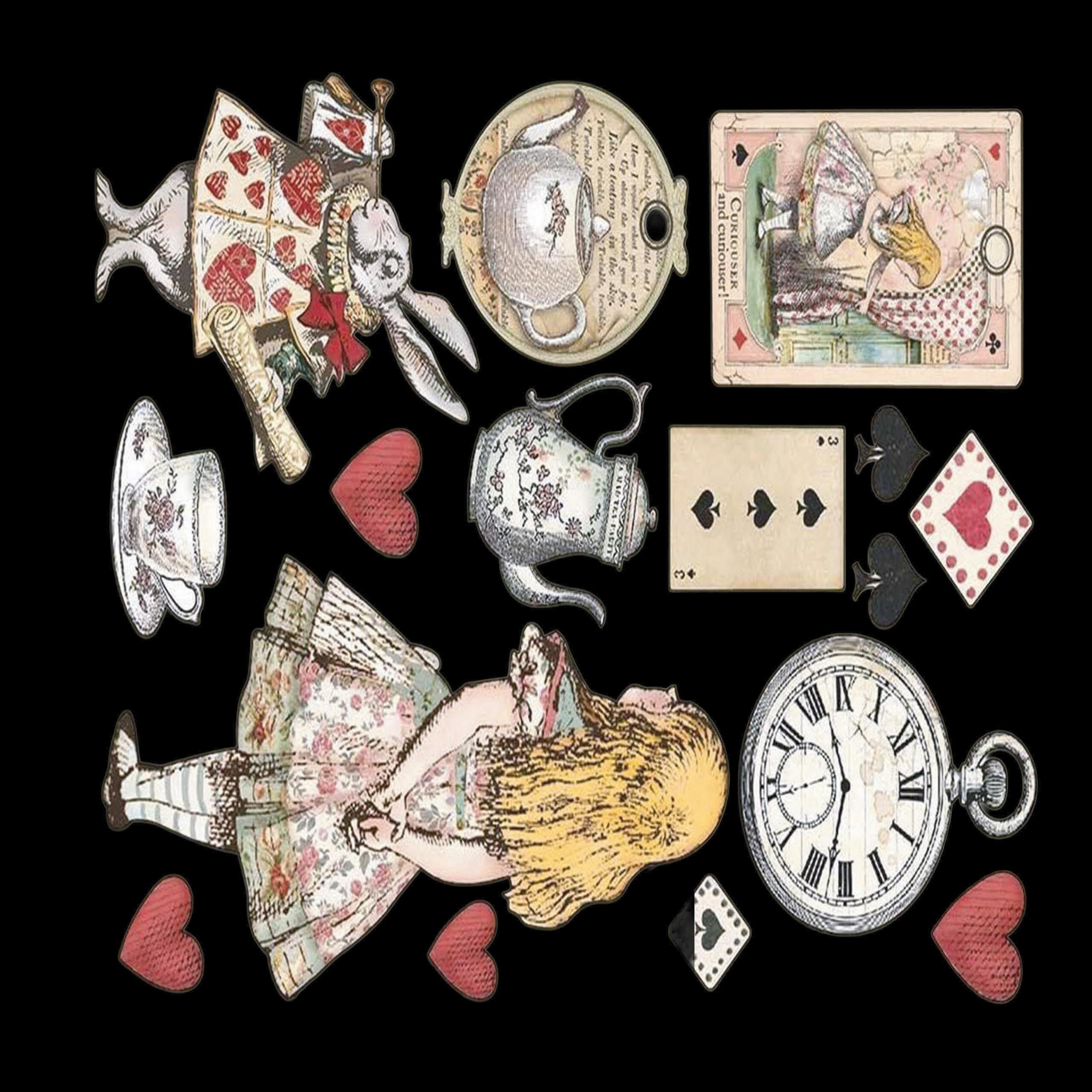
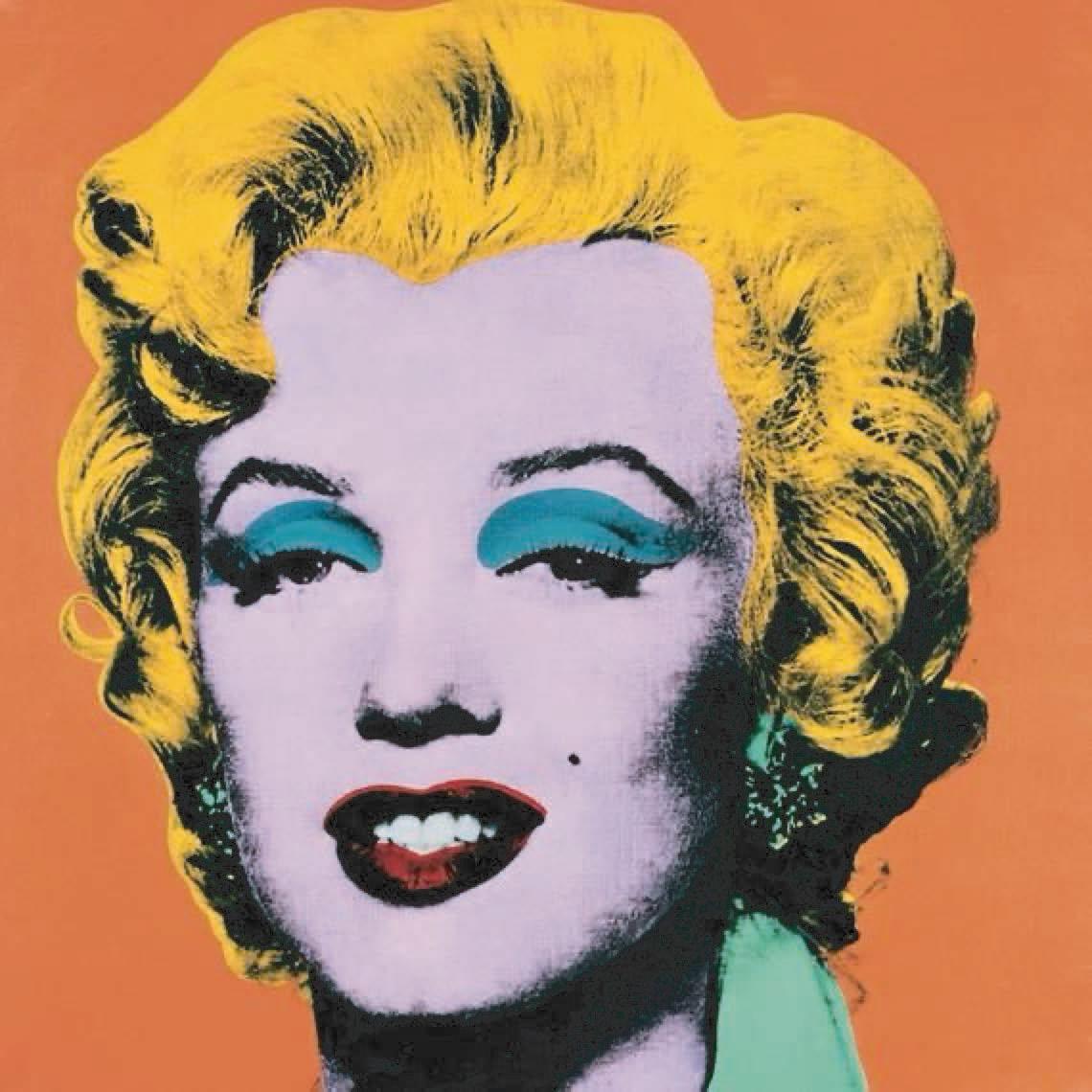
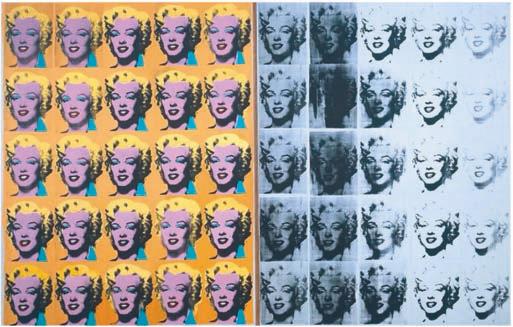
One of the key defining features is intertextuality, meaning that postmodern art and media constantly reference other texts. Films refer to books. Books refer to art. Art refers to film. Film refers to fashion. You get the idea. Nothing exists independently anymore. Postmodern work is self-aware and it often knows that it is a construction and may break the fourth wall, parody older forms, or combine different styles. Fragmentation is also central to postmodernism. Stories are no longer told in neat, linear narratives. Identities are not fixed. This idea has been adapted from Lyotard who was a key in founding the idea and believing meta narratives were dying while non-linear narratives were the new big thing. Another key feature is pastiche and parody. Postmodernism often borrows from past styles such as Victorian fashion, fairy tales, surrealist art and recombines them into something new. This is not always done to mock the past, but to blur boundaries between high culture and pop culture. High culture pertains to works associated with the upper class and aristocracy and is less accessible to all while popular (pop) culture is just that - popular. Unlike high culture, it is accessible to everyone and is more associated with the “ideas, customs, art, and entertainment that are widely shared in a society are popular culture.”2
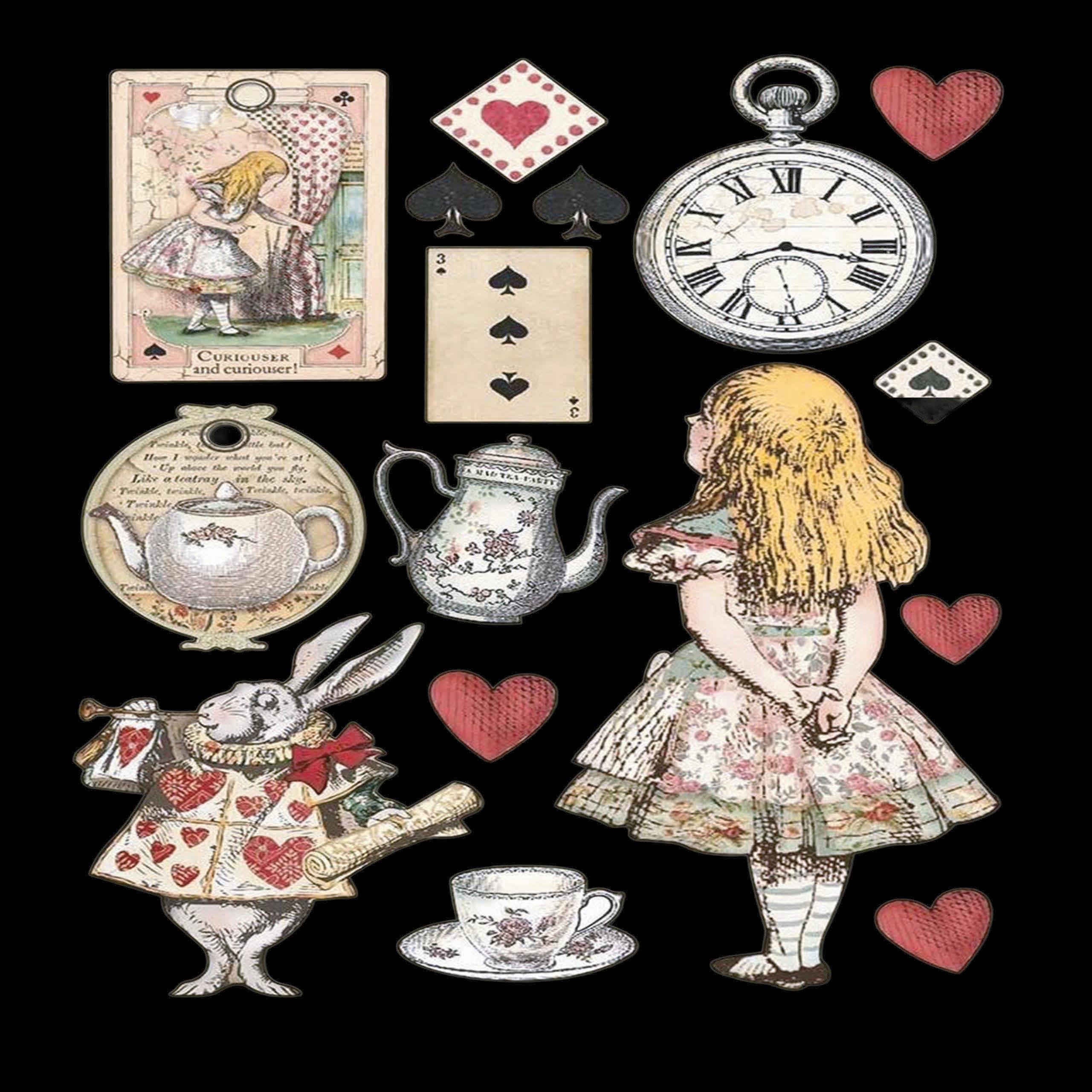
Jean-François Lyotard defined postmodernism as “incredulity toward metanarratives.”4 This means that people no longer trust “big stories” such as religion, science or tradition to explain the world. Instead of one dominant narrative, there are many small, personal narratives. This is significant in Alice in Wonderland, which subverts conventional logic and structure. There is no moral certainty or traditional narrative trajectory, but rather confusion, instability and questioning, reflecting a fragmented experience of reality rather than a single coherent truth.
Roland Barthes introduced the concept of “The Death of the Author.”5 He argued that the creator of a work no longer holds ultimate power over its meaning. Instead, interpretation belongs to the reader or viewer. This is particularly important to my immersive installation. Once the audience enters the space, they are no longer passive spectators; they become participants and interpreters. Each person experiences the world differently, creating their own version of meaning. This relates to postmodern ideas of plurality and subjectivity, rather than a fixed or authoritative interpretation.
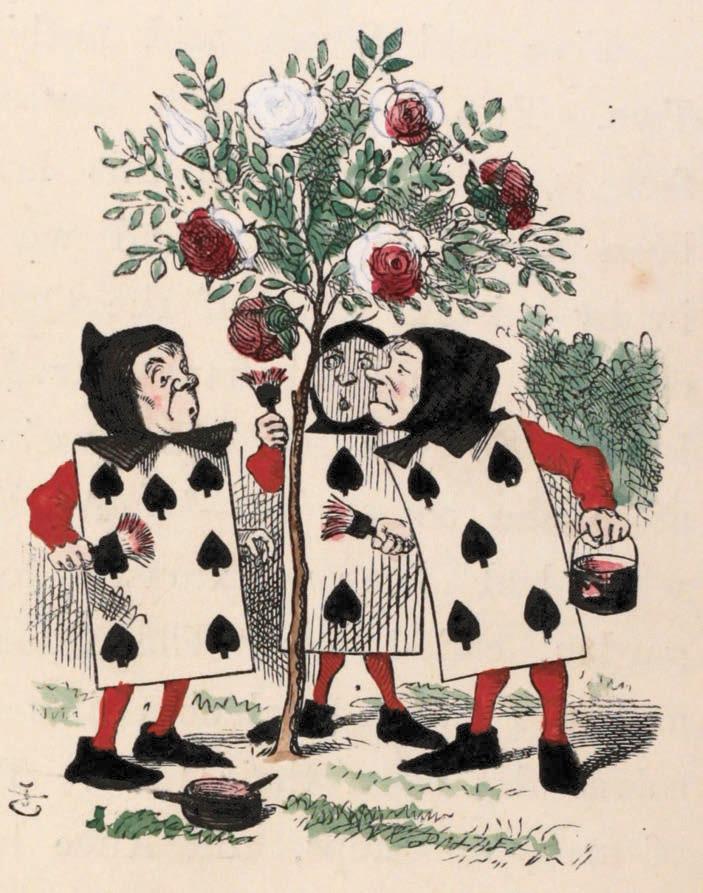

Jean Baudrillard developed the idea of simulacra and simulation,6 suggesting that in postmodern society, representations no longer refer to an original reality, but instead replace it entirely. This is different from fragmentation or intertextuality: rather than simply breaking narratives into pieces or referencing other texts, simulacra describe a condition where copies exist without originals and reality itself becomes hyperreal. In adaptations of Alice, Wonderland can be read as a hyperreal space where logic, identity and reality are unstable, reflecting Baudrillard’s idea that representation overtakes the real.
Stuart Hall’s theory of representation7 also plays a key role, as he believed that meaning is created and exchanged through cultural symbols, language and images rather than simply reflected from reality. From a feminist perspective, Laura Mulvey’s theory of the male gaze8 explains how women in film and art are often presented as passive objects for visual pleasure. Alice was traditionally portrayed as innocent, submissive and childlike. However, postmodern adaptations, particularly Tim Burton’s, reposition her as active, resistant and powerful. This transformation is extremely important to my own work, as I aim to challenge expectations and stereotypes, whether related to gender, perception or colour symbolism, and to deliberately subvert what the audience anticipates.
Antonio Gramsci’s concept of hegemony9 also informs my project. He argued that dominant groups maintain power not only through force, but through cultural control that becomes normalised and accepted. Fairy tales, films and media subtly teach girls how to behave, look and exist. Wonderland, in this sense, becomes a metaphor for society’s hidden rules. Through surreal disruption and role reversal, my project challenges this cultural control and exposes how these expectations are constructed. Together, these theories provide the foundation for understanding how a Victorian children’s book could evolve into a powerful symbol of psychological, social and artistic rebellion.
CHAPTER III
Lewis Carroll’s Alice’s Adventures in Wonderland (1865)9 exists as more than a simple children’s story; it is a premodern text charged with an otherworldly and maddening logic which, in hindsight, anticipates the ideas later formalised by surrealism and postmodernism. It effectively operates as a liminal text and one that occupies the in-between consciousness and dream.
It is within this unstable ground that my own surreal immersive installation finds its roots. I felt this was a prime example of how premodern or even modern texts can inspire and evolve into postmodern ideologies and texts, curating different concepts, art pieces, movements and a plethora of other examples that propel reality. It is in this section that I use the theory and features applied earlier to a historical example.
Surrealism, formally introduced by André Breton in the 1924 Surrealist Manifesto,10 sought to liberate imagination through the unconscious, rejecting the rational order imposed by Enlightenment thinking. Carroll’s world of absurdity, distortions of language, time and identity can therefore be viewed as proto-surrealist. The constant shifting of Alice’s body size, her crisis of self (“Who in the world am I?”), and the disruption of linear narrative all mirror Sigmund Freud’s 11 theories of dreams in which displacement and condensation transform meaning into symbolic imagery. From a psychoanalytic perspective, Alice’s physical and psychological instability reflects a fragmented identity and a characteristic that would later become central in postmodern discourse.
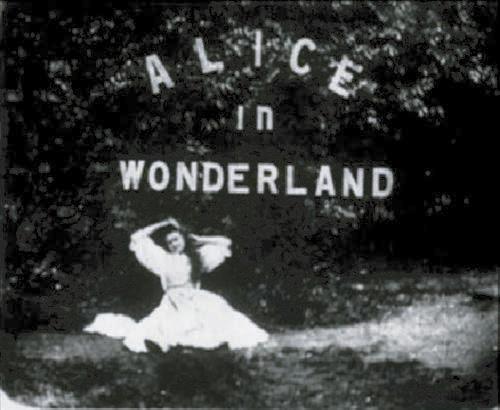
The first major visual reinterpretation of Alice Adventures in Wonderland appeared in 1903 with Cecil Hepworth and Percy Stow’s Alice in Wonderland, one of the earliest narrative films ever made. This marked the transition of Alice from literary text into moving image and, symbolically, from premodern to modern visual culture. The creation of this film aligns with Walter Benjamin’s notion of the “age of mechanical reproduction”, where the aura of the original work is altered, yet its influence is expanded. With Alice now reachable by mass audiences, her dream logic entered the collective imagination and began to mutate.
The surreal nature of Alice was amplified through animation, particularly Disney’s Alice in Wonderland (1951). Here, colour, sound and exaggerated form created a psychedelic atmosphere which, although sanitised, laid the groundwork for fashion, pop culture and avant-garde influence in the 1960s and 70s. Designers such as Vivienne Westwood and later Alexander McQueen drew upon Victorian references and distorted silhouettes, echoing Carroll’s unstable world and twisting it into something politicised and postmodern. Stuart Hall’s theory of representation can be applied here: Alice was no longer just a character, but a sign that could be deconstructed and recorded depending on cultural need.
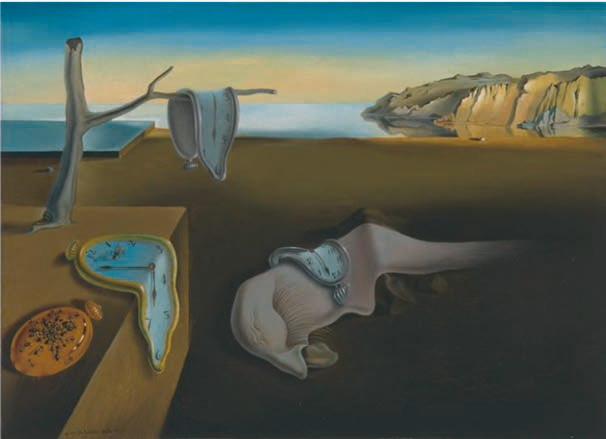
This cycle of reinterpretation finds its most visually direct connection to Surrealist art in the work of Salvador Dalí, who created an Alice in Wonderland illustration series (1969). His melting forms, dreamlike imagery and dislocated perspective affirm Carroll’s narrative as surrealist in essence. Jean Baudrillard’s idea of the simulacrum also becomes relevant here: Alice transforms into a copy of a copy - no longer grounded in an ‘original’ meaning, but existing through endless reinterpretations.
Tim Burton’s 2010 Alice in Wonderland marks a distinctly postmodern moment. Burton does not attempt faithful reproduction; instead, he fragments, reshapes and darkens Carroll’s world. His twisted landscapes, elongated figures and melancholic misfits represent what Julia Kristeva defines as the abject - the beautiful yet disturbing. Burton’s Alice is not merely lost; she is confronting authority, patriarchy and identity. From a feminist perspective (drawing on Laura Mulvey), Burton removes Alice from passive objectification and instead positions her as an agent navigating and resisting a male-dominated world.
CONCLUSION
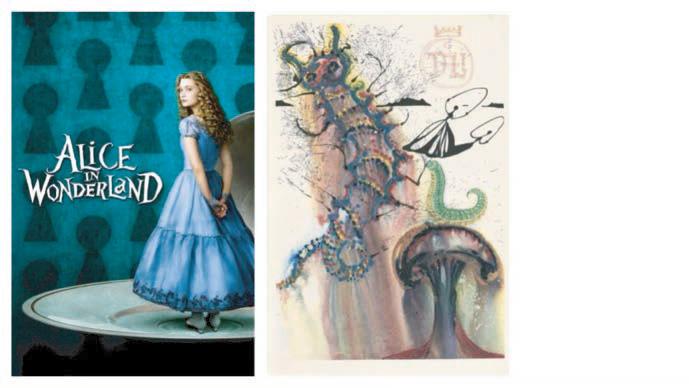
It is here that my surreal immersive installation begins to form. I am not simply inspired by Burton’s aesthetics; I am influenced by the ideological shift his work represents. I aim to create a physical space where the audience must enter a fragmented psychological world which reflects both internal and societal distortions. Much like Alice, the viewer is forced to navigate unfamiliar scales, unsettling sounds and symbolic objects. I manipulate lighting, scale, mirrors and sound to dissolve the boundary between observer and character. This interaction links to Roland Barthes’ Death of the Author – meaning is no longer fixed; it is completed by the viewer’s interpretation. Furthermore, through Antonio Gramsci’s idea of hegemony, I recognise that traditional fairy tales often reinforce submissive, obedient femininity. My installation challenges this by turning the “wonderland” into a commentary on control, expectation, and the absurd pressures placed on young women. The surreal becomes a political language. By tracing Alice in Wonderland from literature to film, art, fashion and ultimately to my own practice, I see that influences are not linear – they are rhizomatic, as Deleuze and Guattari suggest. Alice has not simply “inspired” me; it has been culturally rewritten through time, and my work becomes another revision within that lineage. In this sense, my installation is not a copy, but a continuation.
If postmodernism resists neat definitions and fixed meanings, then maybe the most honest conclusion is that Alice in Wonderland itself becomes a perfect metaphor for postmodern culture: unstable, self-aware, constantly shifting, and endlessly rewritten. This is where the project stops being purely academic and becomes personal. My immersive installation is not about recreating Wonderland, but about translating its psychological instability into a physical experience. I want the viewer to feel disoriented, watched, uncertain of scale and control, mirroring both Alice’s crisis of identity and the pressures placed on young women in contemporary society. By collapsing the boundary between observer and participant, I am deliberately rejecting passive spectatorship and inviting multiple interpretations - a very postmodern move, if you will. Ultimately, this essay has shown that postmodernism is not just a style or a time period, but a way of
BIBLIOGRAPHY
1 Dick Hebdige (1988) Hiding in the Light: On Images and Things. London: Routledge.
2 Vocabulary.com (n.d.) Popular Culture – Definition. Available at: https://www.vocabulary.com/dictionary/popular%20culture.
3 Jean-François Lyotard (1984) The Postmodern Condition: A Report on Knowledge. Manchester: Manchester University Press.
4 Roland Barthes (1977) Image–Music–Text. London: Fontana Press.
5 Jean Baudrillard (1994) Simulacra and Simulation. Ann Arbor: University of Michigan Press.
6 Stuart Hall (1997) Representation: Cultural Representations and Signifying Practices. London: Sage.
7 Laura Mulvey (1975) ‘Visual Pleasure and Narrative Cinema’, Screen, 16(3), pp. 6–18.
8 Antonio Gramsci (1971) Selections from the Prison Notebooks. New York: International Publishers.
9 Lewis Carroll (1865) Alice’s Adventures in Wonderland. London: Macmillan.
10 André Breton (1924) Manifesto of Surrealism. Paris: Éditions du Sagittaire.
11 Sigmund Freud (1900) The Interpretation of Dreams. London: Hogarth Press.
12 Walter Benjamin (1936) ‘The Work of Art in the Age of Mechanical Reproduction’, in Illuminations. London: Pimlico.
13 Cecil Hepworth and Percy Stow (1903) Alice in Wonderland [Film]. United Kingdom.
14 Walt Disney Productions (1951) Alice in Wonderland [Animated film]. USA: Disney.
15 Vivienne Westwood (n.d.) Victorian-inspired fashion collections. United Kingdom.
16 Alexander McQueen (n.d.) Romantic Gothic and Victorian-influenced collections. United Kingdom.
17 Salvador Dalí (1969) Alice in Wonderland Illustrations. New York: Maecenas Press.
18 Tim Burton (2010) Alice in Wonderland [Film]. USA: Walt Disney Pictures.
19 Julia Kristeva (1982) Powers of Horror: An Essay on Abjection. New York: Columbia University Press.
20 Gilles Deleuze and Félix Guattari (1987) A Thousand Plateaus: Capitalism and Schizophrenia. Minneapolis: University of Minnesota Press.
Fig 1: Book - Alice in Wonderland: The Original 1865 Edition With Complete Illustrations By Sir John Tenniel
Fig 2: Disney’s Alice in Wonderland Film Poster (1951 film)
Fig 3: Tim Burton’s Film poster
Fig 4: Cecil Hepworth and Percy Stow’s Alice in Wonderland Film (1903)
Fig 5: Tim Burton’s Alice in Wonderland Film poster
Fig 6: Salvador Dalí’s Rare 1969 Illustrations for “Alice’s Adventures in Wonderland,”
IN CONVERSATION WITH EASA: IN CONVERSATION WITH EASA:
By
Krishnakumar
To gain insight into the work of our Year 13 cohort, we spoke with Deputy Head Boy Easa, a Photography student whose artistic practice spans multiple disciplines and engages closely with postmodern ideas. Alongside Photography, he equally studies Media and English Language, enabling him to express himself across a range of creative and critical forms. In this interview, Easa reflects on his engagement with internet arts, as the focus of his Major Project Two, discussing both its conceptual development as well as the key influences that have shaped his thinking over time.
Tell me a bit about your project. What are you exploring right now?
Currently, for my Major Project Two, I'm exploring internet arts, specifically net art, and how humans experience a digital age. Especially now with the rise of AI and technological advancements, I thought it would be really nice to explore a whole project about the foundations of everything that we've been through.
What prompted your interest in this line of inquiry?
Whenever I see a new website or a new AI advancement, I start to think about what happened before then, what caused AI to even exist, the foundation of technology, everything that came before it. My whole project is exploring that, specifically in an artistic way.
I've always been a geeky person, I've always been into computers and video games and anything technological, and I like that I can be inspired by and explore all of these in my work.
Even though I've never used TouchDesigner in my life, I've seen everything about it, and it is really nice to use something that I have seen in my day to day life in an artistic way. It reminds me what Photography A-level is all about and why I even chose it in the first place.
Your work collapses distinctions between digital and analogue media. How does this layering of technologies allow you to reflect on nostalgia, perception, and the construction of experience?
So far, I have worked on how digitalized media has changed the perception of people. I've been exploring raw formats by taking portraits of my friends or objects, turning them into a raw file, then turning it into an audio file using this app called Audacity. I try to peel back these layers of technological walls and sound like an onion, if that makes sense.
Even though I'm really grateful for all the technological advancements we've been through, I still really like to appreciate the past. I've been doing that, especially with my work with CRTTVs and analog televisions.
I’m portraying my work that is usually displayed on digital apps, such as After Effects, by making it simple and boxed up in an analog TV. It reminds me of my roots, especially since I grew up in the early 2000s. My parents thought OLED TVs were a scam and they were horrible for your eyes, so I only had access to a CRTTV.
To use my past experiences as a source of inspiration is another beautiful thing and another reason why I chose to pursue Photography as an A-Level subject.
You describe your current work as an expansion into an exhibition of televisions, each offering a different experience. How does this format allow you to explore the relationship between technology and human experience?
What I'm currently working on is an expansion of my final piece for my Photography mock exam. I want to create a small exhibition of my TVs, and I want each one to be a different experience. This links back to my Personal Study essay, where I’m going through how net arts demonstrate human experiences. There's a polarity when you talk about technology and humans, and usually when we see the media talk about it, they are kind of pitted against each other, with AI being this evil thing and humans being these saints, but I feel like people forget that machines and technologies are tools. At the end of the day, they are not there to kill or ruin us. Rather, they are there to expand our knowledge.
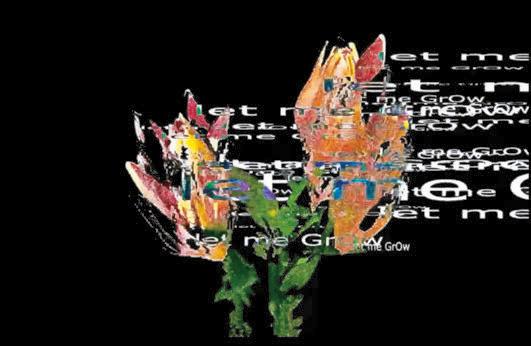
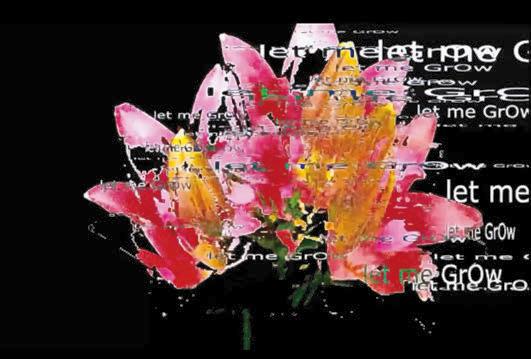
Screenshots from one of Easa’s works, representing the theme of “nature”
How does your work relate to the cultural movement of postmodernism?
I'm actually studying the postmodernist movement as part of my Media A-Level course. It is something I am well versed in as I am fascinated by this topic—-especially when it comes to the existence of it, because theorists, like Noam Chomsky (https://www.openculture.com/2018/02/noam-chomsk y-explains-whats-wrong-with-postmodern-philosophy-f rench-intellectuals.html) disagree with post-modernism. He suggests that it is a buzzword, and people can use it to label anything. You can call a chair post-modern and society will start to eat it up, but I frankly disagree with him, in the sense that there are levels and fields to postmodernism. I really love its characteristics of self-irony and self-awareness. In its simplest form, it's like Deadpool breaking the fourth wall. When I make my art, I'm aware of it and I want it to be commenting on itself. I think my work would be described as postmodern. Most of my final work is in the first person, for instance and my TVs are directly addressing the viewer. In addition to that, I also use personal pronouns to create a self-aware stance.

You mentioned that you’re learning about this movement. Have you consumed any compelling postmodernist literature recently?
I am currently reading this book called 17776 (https://www.sbnation.com/a/17776-football/chapter-1 ). It's this mixed media book about three sentient satellites in a world where humans have stopped aging and are immortalised forever. It’s been 13,000 years since they stopped aging. It is a really insane postmodern text. I think it is a masterpiece. The way the satellites are now self-aware is the basis and the focus on self-awareness is something I like. It is kind of ironic because it is these technological beasts that are sent away to this dark universe, never to be seen again, and they have now become conscious and they're commentating, talking, watching, and viewing—even humans are aware of their existence. They know the satellites are beings, they know that they are conscious. It is a really weird book, but when I was reading it, I was like “wow, this really links to my own work”. It is all about technological beings being conscious and that is what I want to portray in my own work. I want it to be commenting on something, I want it to feel alive in a sense. At the end of the day, I know it won't be, but I think I can create that image and that story around it.
Footnote: Noam Chomsky’s Critique: https://www.openculture.com/2018/02/noam-chomsky-explains-whats-wrong-with-postmodern-philosophy-french-intelle ctuals.html
17776: https://www.sbnation.com/a/17776-football/chapter-1
Cindy Sherman uses her photographic practice to present a sustained critique of representation rather than self-expression itself. Through staged self portraiture, Sherman poses as identities that are not authentic or fixed but dismantles the idea of a stable subject. This exposes identity as a constitution of images, cultural codes and links to power. Sherman’s photographs function as critical sites where originality and visual truth are destabilised. The artist uses her work to push the boundaries of a neutral act; it is a visual encounter with the idea that meaning is fabricated. Rather than documenting lived experiences, Sherman presents pre-existing images. This means that her work aligns closely with postmodern strategies of appropriation as she does not reveal who she ‘is’. Her work exposes that subjectivity is endlessly performed and circulated.
Focusing on Untitled Film Stills (1977-80), Centerfolds (1981) and History Portraits (1988-90), this text explores how Sherman uses visual tropes to reveal the instability of femininity, identity and meaning, at large.
Cindy Sherman and the Postmodern Collapse of Identity
By Izzy Kemal
Untitled Film Stills (1977–80)
Sherman’s Untitled Films Stills provide the clearest presentation of her conceptual methodology. Her photography resembles stills from mid century Hollywood cinema however with no actual reference to real films. This gives the viewer the experience of encountering different, yet familiar archetypes of the femme fatale and the housewife. They have no narrative solution and operate as simulations rather than representations. This aligns closely with Jean Baudrillard’s concept of simulacrum; the use of copies without an original.
Her use of self-portraiture is crucial, not because it reveals her identity but empties the viewer of their interiority. Sherman, therefore, becomes a surface upon which cultural and stereotypical signs are layered, refusing authenticity. She enacts the “death of the author’”, foregrounding the image as a visual site of ideological views. The subject is not the source of importance, but its underlying meaning and effect is.
The performative dimension of the Film Stills presents Judith Butler’s theory of gender performativity. She does not ‘become’ these women, but rather uses them to present the repetition shown in gender stereotypes. Through the poses, gestures, camera angles and narrative tropes, her photography reveals how views on femininity are developed through images as well as how the cinema teaches certain stereotypes on women. Most importantly, Sherman never offers a stable view of identification. Her images move between seduction and ease, forcing the viewer to look at a familiar image yet refusing to give them the whole context or the “happy ending”.
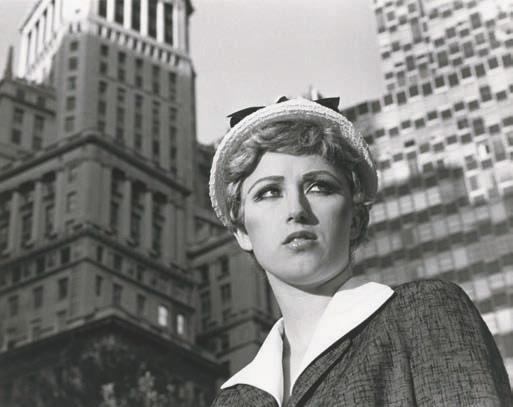
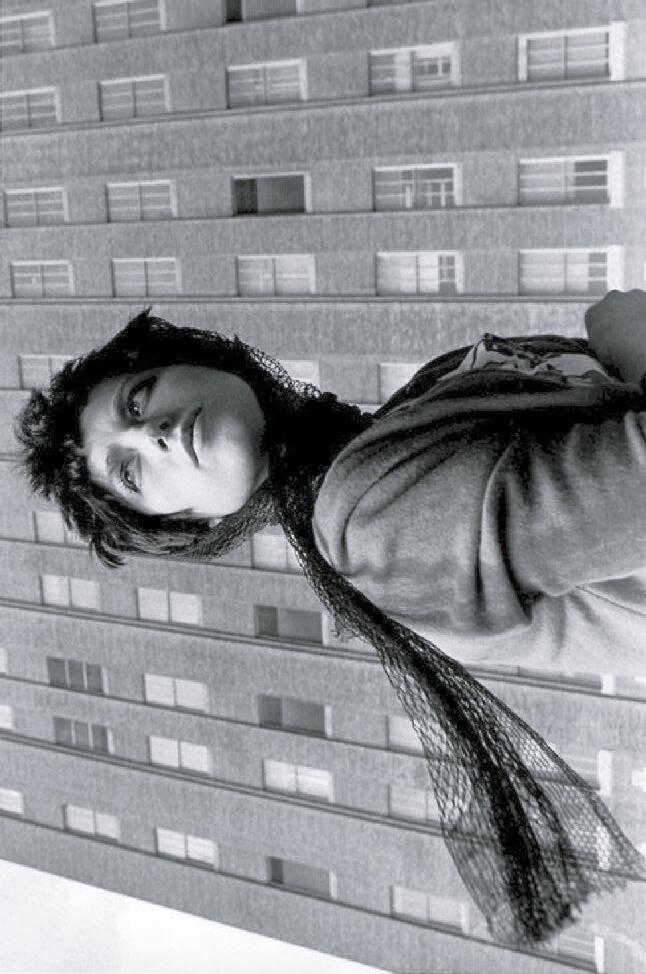
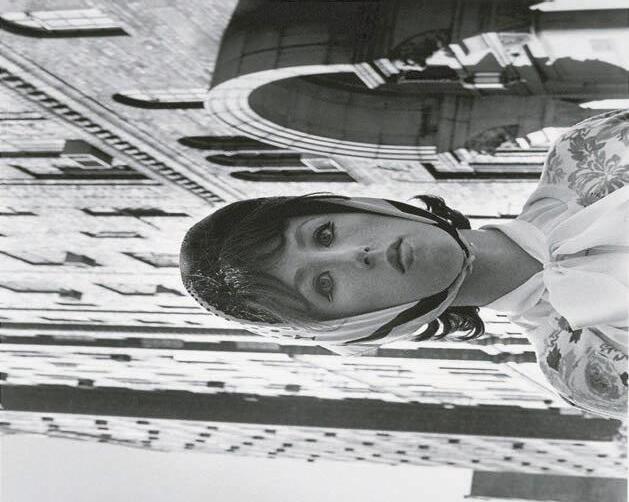
In Untitled Film Still #21, Sherman is positioned in a high rise urban street view, glancing to the side as if caught in movement. The composition is framed, compressing the space around her and also using a low angle. This creates a sense of tension and vulnerability for the viewer looking at the image. The frame is slightly at an angle and her body posture is slightly hunched ; this suggests unease. The use of black and white colouring matches the conventions of mid century cinema but as a traditional part of Sherman’s style, a specific reference is never stated. This emphasises the initial idea that her images are a simulation and not a representation of something, aligning with Baudrillard’s concept of simulacrum.
Centerfolds (1981)
In Centerfolds, Sherman increases her engagement with spectatorship and power. She has shot them in the horizontal form commonly used in magazine photography spreads, with poses of seduction. Sherman subverts this expectation by having the figures appear withdrawn and defensive, leaving the viewer’s desire to understand the image interrupted by the subject's refusal to perform.
Her performative strategy subverts the inner workings of the male gaze rather than submitting to it. The figures appear trapped or pressed against the “space”, which suggests to the viewer psychological constraint. This aligns with the postmodernist concern of representation as a view of domination rather than reflection.
Untitled #21 by Cindy Sherman, 1978
There is instability within the subject which then becomes the central point. The figures are not cohesive identities, but fragmented states presenting vulnerability. Sherman shows this vulnerability as a constructed image, suggesting how emotions can be stylised and modified. The photographs present affect as simulation, being recognisable and legible however hollowed of authenticity.
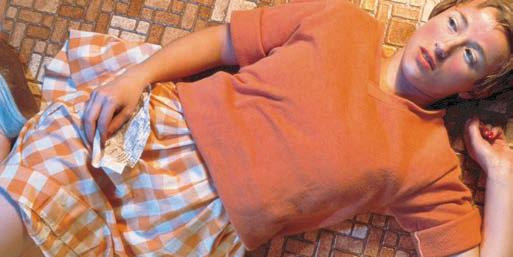
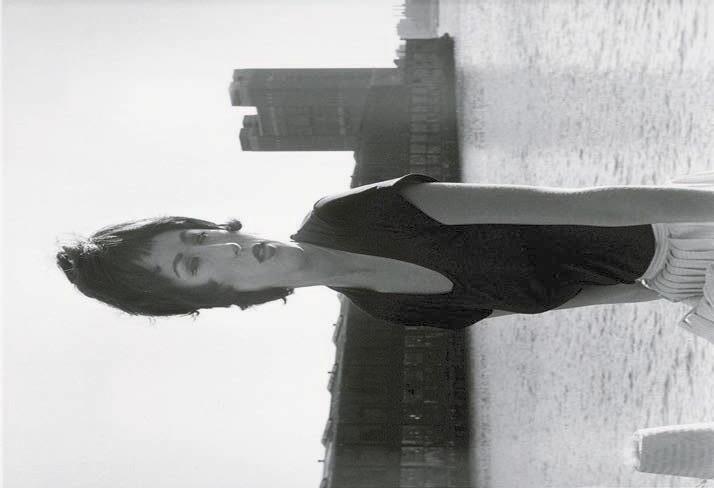
In Untitled #96, Sherman lies across the frame looking away from the camera. This position is equally encountered within magazine spreads designed for editorials. The use of the bright lighting and edited colour emphasise the idea of eroticised imagery. The disruption of this visual idea is in the lack of emotion in her facial expression and her far out gaze. In her position, she avoids eye contact which suggests emotional withdrawal. Sherman is pressed against the frame which limits the visual space in the photo as well as suggesting psychological confinement. Through these visual tropes, Sherman subverts the male gaze and presents vulnerability as constructed rather than an authentic emotional state.
History Portraits (1988–90)
Sherman turns to Western Art History through exaggerated costumes and theatrical lighting, specifically parodying Old Master paintings. Her work dismantles the authority of art historical imagery and exposes them as typical conventions rather than timeless pieces. The use of grotesque artificiality for the bodies such as distorted proportions or fake pieces, refuses illusionism throughout the pieces.
She uses postmodernism’s skepticism towards grand universal narratives of how things work to construct the pieces. Sherman presents Art History as a system of representation that has excluded and objectified women. She does not reclaim the feminine self in these images, but destabilises them. The self-portrait dissolves into the theatrics, becoming a site for critique rather than identity.
Her work aligns with Barthes’ idea that meaning is produced through cultural codes and not authorial intention. The latter gesture lies in exaggeration rather than originality which exposes her ideas of constructed and theatrical works.
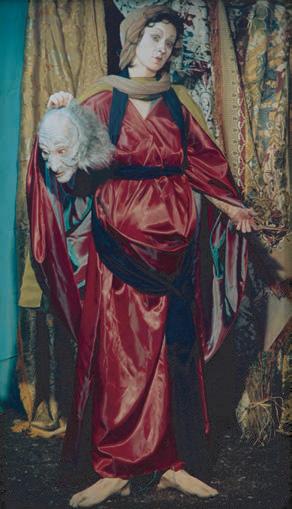
In Untitled #228, Sherman focuses on the visual tropes of historical portraits using dark lighting, front composition, and exaggerated costumes. However, these typical conventions are deliberately exaggerated. The wig held in her hand appears artificial, the costume ill-fitted and her body is distorted slightly. The use of prosthetic elements and off proportions disturb the illusion of a “normal” body—-revealing the image as a performance rather than a timeless historical representation. The use of dark lighting and editing of the image further heightens the theatrical element of the scene rather than emphasising a sense of realism. This draws attention to the image as a construction of identity and power. Sherman undermines the stereotypical authority of art historical portraits, exposing them as coded systems that shaped and prevented real representations of women.
Sherman’s Influence On Postmodernism
Across her oeuvre, Sherman applies the key postmodernist concerns of rejecting authenticity, fragmentation of subjects and the collapsing of distinction between reality and representation. Her photographs stage these ideologies, as well as the theme of identity which is already mediated. By using herself as a view point of endless transformation, Sherman refuses the common mode of self-portraiture. She turns herself into a critical tool, presenting how subjectivity is produced through repetition and cultural codes. Her work aligns with postmodern theory in its idea that meaning is unstable and the act of viewing is always implicated with power.
Overall, Cindy Sherman uses her photographic practices to dismantle the typical ideas of authenticity and identity. She reveals how femininity is produced through representation and visual codes rather than presenting the inner truth. Sherman’s significance in her work to the outer world lies in not fully revealing who she is, but that images teach us how to perceive identity. Sherman’s work does not suggest or ask who she is. Rather, it questions how identities are made and believed, reminding us that representation is not mirroring reality and that to look is always to participate.
Untitled #96 by Cindy Sherman, 1981
Untitled #228 by Cindy Sherman, 1990
Creative subjects can effectively be challenging to grasp. In our previous art newsletter edition, we collaborated to produce a GCSE handbook. This time, we have decided to make an A-Level handbook guide addressed to those who are thinking of or have chosen to pursue creative subjects for their A-Levels.
FINE ART
When I first began A-Level fine art, I was given ample freedom with the execution and planning of my projects. I set things in motion and started generating loads of ideas. However, I quickly fell short and instead of letting them evolve naturally I was instead planning a predetermined outcome at a premature stage. This jumping forward too soon ended up making it much more difficult for me to connect all my ideas and therefore led to changing my intended results entirely. It is precisely in these kinds of hiccups that I could have really used some advice and a way to generate my creative thought process and art more effectively. It is for this reason in particular that I intend to be offering counsel and manners to surmount these challenges.
I always commence my projects or ideas by designing a mindmap. I would place the area I intend to focus on in the centre then string lines from it and jot down all my thoughts, small sketches and subjects I am interested in exploring and pursuing. This method sounds fairly easy, but has effectively proven to be very useful. Furthermore, I would equally use coloured writing instruments to write my ideas down in or highlight the key points. This visual approach has really enabled me to reflect on which direction I would like to take my project. When you begin to create your works, always keep your experimentation sustained with media. What I mean by this is that you should be revisiting materials several times to show your evolution and continuous refinement. If you are unsure how to alter your ideas or to make them more exciting, I always find changing the scale, surface or methods allows me to further push my concepts.
Always keep small sketchbooks with you wherever you go, as you may find yourself walking outside and stumble across something that has triggered an idea. You may even come across some visual inspiration that you can simply dot down or simply draw some observational sketches of your surroundings. I was especially keen on visually documenting my surrounding environment during travel, especially at airports and on planes. Always keep in mind that there are many different ways of sourcing information to sustain your research. For instance, websites can be particularly useful in this regard. I find watching videos, specifically documentaries and visiting museums and other places of interest really helpful. Most importantly, you need to enjoy your work, as if it becomes something of a chore you may need to re-think your approach or try and achieve some other form of inspiration before you may continue.
If would are seeking any help or advice regarding Fine Art and you think I may be able to help you, do not hesitate to contact me, I am in 6th Form year 13 at present and my email is bcebisli11@britishschool.sch.ae
- Belinay Cebisli
PHOTOGRAPHY
Hello! If you’re reading this, you’re probably thinking about taking A-Level Photography, or at the very least curious about what it’s really like. I won’t lie to you, it can be intense. It’s time-consuming, sometimes stressful, and there will be moments where you may seriously doubt yourself. However, it can also be one of the most rewarding subjects you pursue. If you’re passionate, willing to put in the work, and able to stay consistent (with at least some kind of plan), you will be more than okay. In fact, you might actually surprise yourself.
Follow the passion
This is my most important rule: follow what you genuinely enjoy. Your best work will always come from ideas you actually care about, and not from what you think will look “impressive” or what everyone else is doing. When you’re interested in your theme, you’ll naturally want to take more photos, experiment more, and develop your ideas—-which is exactly what A-Level Photography is about. It may seem more convenient to merely choose a theme because it is ostensibly safe or “aesthetic”, but if you cannot connect to it, then your work can start to feel forced. And trust me, when deadlines hit, the only thing that will keep you going is passion. So select themes that mean something to you, whether that’s identity, relationships, power, isolation, confidence, mental health, or even just moments from your own life. Your personal outlook and perspective is what makes your work differ from everyone else’s.
It is not just about pretty photos
A-level isn't about taking one perfect picture - it's about the process you took to get there. You can have the most visually beautiful image, but if it doesn’t link to your theme or demonstrate development, then it won't get you as many marks as you might expect. Examiners are interested in seeing ideas being explored, experiments that lead somewhere and changes in composition, lighting and meaning. Sometimes the photos that matter the most aren't even the “best looking” ones that show risk, emotion and intention. Remember to go outside your comfort zone and be playful as this gets you into better bands.
Research and Contextual Analysis
Research is not an endeavor that you undertake merely because your teacher allocated it to you, but because it actually helps shape your ideas. Start looking into photographers, then expand your research to encompass movements, theories, multi-disciplinary artists and styles. Looking at these different topics provides you with a rich understanding of the theme you are exploring and allows you to gain inspiration from other mediums. It is crucial to keep in mind the formal elements and your personal engagement, which will also help enhance your personal essay. It is equally as important to continue to ask questions, find out their answers and ceaselessly engage with this process.
What is the photographer trying to say? What visual techniques do they use? How can I take inspiration and make it my own? Linking your work to artists shows examiners that you understand photography as an art form, not just as a hobby. And the more specific you are about what you’ve derived from an artist, the stronger your work becomes.
Planning and photoshoots
As boring and tedious as it may sound, planning your photoshoots helps immensely. It makes everything less stressful and gives you a rough idea of what, where, why and how. And although things can result in bad outcomes, that is fine. Not everything has to be perfect and this results in growth and understanding of what works and what does not. This is something I struggled with in the past, but have come to the realization that it is always good to be critical and follow the learning process. Planning can save you so much panic and it does not have to be complicated or have a Hollywood movie level set. Some of the strongest images come from simple setups with clear intentions. What matters most is that every shoot has an intended purpose and links back to your main theme. Shooting “just in case” can help, but intentional shoots will always give you better results and stronger development in general.
Think like an artist, not a student
Avoid pursuing a subject simply because it is "what will get me the marks”. Although that is what you want, you need to think about everything as an artist no matter the final grade. This will, paradoxically, elevate your results more. And remember that your teachers are always there to help. Put differently, do not be afraid to say that you are stuck and have no clue because they are the experts. Remember to also justify everything and ask yourself why? It is okay to doubt yourself as long as you do not let it suspend your progress. Art can have many meanings.
I hope this was useful and if you have any questions or need help with anything I am always available as I am a current Year 13 student. If you need assistance with a project or just want to talk I am always here. My email is: lgould10@britishschool.sch.ae
- Lucy Gould
A very special thanks to all those who made this newsletter happen
ART AMBASSADORS
Akaylia Jackson-Turner
Bel Cebisli
Izzy Kemal
Lucy Gould
Nadine Helal
Nandana Krishnakumar
ART DEPARTMENT
Monica Zakka
Thomas Smith
Ian McDonald
Jayne Newsam