SINCE 1891
THE BROWN DAILY HERALD WEDNESDAY, MARCH 21, 2018
VOLUME CLII, ISSUE 36
WWW.BROWNDAILYHERALD.COM
U. discusses Anderson .Paak, NAO to headline Spring Weekend increasing aid DRAM, Rico Nasty, Rina Sawayama, Whitney for highest complete lineup that aims need students to disrupt hierarchies Preliminary report would increase food, textbook aid for students without parental contributions By SOPHIE CULPEPPER SENIOR STAFF WRITER
On Tuesday, the Brown University Community Council discussed a working proposal to increase food and textbook aid for undergraduate students with the highest financial need. The report, called “Enhancing Support for Students with Highest Financial Need,” was compiled after students approached administrators regarding the “hidden costs” of attendance, Provost Richard Locke P’18 said at the meeting. The proposal aims to “increase the scholarship that we give students who have zero-dollar contribution from parents” in order to reduce the amount » See BUCC, page 2
By CONNOR SULLIVAN ARTS AND CULTURE EDITOR
Anticipation hung palpably in 50 Exchange Terrace’s Narragansett-soaked Stout Irish Sports Pub Tuesday night as students awaited the announcement of the 2018 Spring Weekend lineup. Released at midnight, the roster ranges from hip-hop to avant-garde soul to easygoing pop-rock. NAO and Anderson .Paak will be headlining Friday and Saturday, respectively. The highly variegated lineup of artists remains unified by a singular imperative: disrupt. “Our theme this year is ‘disrupt’ because we’re trying to disrupt hierarchies and underrepresentation in the music industry,” said Allie Tsuchiya ’18, a member of the Brown Concert Agency. BCA is responsible for organizing Spring Weekend and unveiled the lineup announcement with a video that stressed the theme of “distorting norms” and “disrupting
ARTS & CULTURE
hierarchies.” English artist NAO’s music comprises more than the sum of her influences’ parts. English dubstep, deep house and funk contribute to her palette of sounds, which maintains a texture at once sensual and abrasive. NAO, whose real name is Neo Jessica Joshua, released her critically acclaimed debut “For All We Know” in 2016 and is working on a new album. Her set will be preceded by Rico Nasty and DRAM. Saturday’s headliner, Anderson .Paak, is a California-based singer and rapper whose music oscillates seamlessly between mellifluous vocals and hard-hitting trap beats. The artist’s songwriting is complemented by his technical prowess and vocal command, which forge an expansive soundscape. Since releasing his 2016 album “Malibu,” .Paak has appeared on the “Black Panther” soundtrack and has been featured on tracks by SiR and A Tribe Called Quest. Sets by What Cheer? Brigade, Rina Sawayama and Whitney will preface .Paak’s performance. “This lineup is out of this world,” said Udoka Oji ’18. “Anderson .Paak is coming. That’s crazy.” — With additional reporting by Annabelle Woodward
Report explores solutions to encryption debate With input from U. professor, document details ethical, technical issues around police data access SENIOR STAFF WRITER
By GRAYSON LEE CONTRIBUTING WRITER
SCIENCE & RESEARCH
INSIDE
Womxn’s series promotes inclusivity
Events will feature spoken word poets, activists, challenge notions of traditional femininity
By JEFF DEMANCHE
In the wake of the 2015 San Bernardino terror attack, the nation witnessed a new and unfamiliar debate when the FBI — in possession of the shooter’s encrypted iPhone 5c — tried to compel Apple to provide “exceptional access” to the phone’s encrypted contents. While national dialogue surrounding law enforcement’s ability to require access to encrypted evidence has waned since then, a committee of academics and professionals including Seny Kamara, associate professor of computer science, formed in 2016 to discuss what policymakers should bear in mind when developing solutions to the encryption debate. The committee released a report in February that poses questions they believe are critical to the conversation. Encryption — the act of turning understandable “plaintext” data into unintelligible “ciphertext” — is an old
COURTESY OF WIKIMEDIA COMMONS
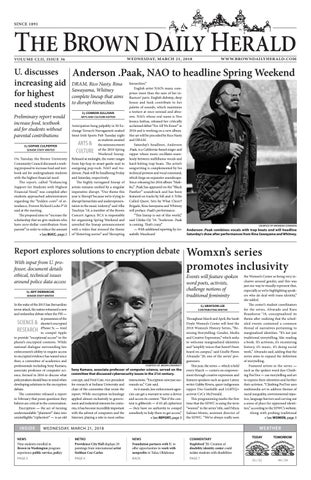
Anderson .Paak combines vocals with trap beats and will headline Saturday’s show after performances from Rina Sawayama and Whitney.
COURTESY OF BROWN UNIVERSITY
Seny Kamara, associate professor of computer science, served on the committee that discussed cybersecurity issues in the 21st century. concept, said Fred Cate, vice president for research at Indiana University and chair of the committee that wrote the report. While encryption technology applied almost exclusively to government and industrial interests for centuries, it has become incredibly important with the advent of computers and the Internet, playing a role in most online
interactions. “Encryption now just surrounds us,” Cate said. As it stands, law enforcement agencies can get a warrant to seize a device and access its content. “But if the content is gibberish — if it’s all ciphertext — they have no authority to compel somebody to help them to get access,” » See REPORT, page 3
Throughout March and April, the Sarah Doyle Women’s Center will host the 2018 Womxn’s History Series, “Remixing Storytelling: Gender, Media and Creative Expression,” which seeks to welcome marginalized identities and “amplify voices that haven’t been heard on campus,” said Giselle Flores Alvarado ’20, one of the series’ progammers. This year, the series — which is held every March — centers on empowerment through creative expression and features speakers such as queer Latinx writer Gabby Rivera, queer indigenous rapper Dio Ganhdih and LGBTQ+ activist CeCe McDonald. This programming marks the first time that the SDWC is using the term “womxn” in the series’ title, said Felicia Salinas-Moniz, assistant director of the SDWC. “We’ve always really seen
the Women’s Center as being very inclusive around gender, and this was just our way to visually represent that, especially as we’re highlighting speakers who do deal with trans identity,” she added. The center’s student coordinators for the series, Alvarado and Kara Roanhorse ’18, conceptualized its theme after realizing that the scheduled events contained a common thread of narratives pertaining to marginalized identities. “It’s not just traditional storytelling, like reading a book. It’s activism, it’s recentering history, it’s music, it’s doing social work,” Alvarado said, adding that the series aims to expand the definition of storytelling. Featured artists in the series — such as the spoken word duo Climbing PoeTree — use storytelling and art to express their identities and further their activism. “Climbing PoeTree uses multimedia art to address themes of racial inequality, environmental injustice, language barriers and carving out a sense of place for oppressed identities,” according to the SDWC’s website. Along with probing traditional » See WOMXN, page 3
WEATHER
WEDNESDAY, MARCH 21, 2018
NEWS Nine students enrolled in Brown in Washington program experience public service, policy
METRO Providence City Hall displays 20 paintings from international artist Siobhan Cox-Carlos
NEWS Foundation partners with U. to offer opportunities to work with nonprofits in Tulsa, Oklahoma
COMMENTARY Stapleford ’21: Creation of disability identity center could isolate students with disabilities
PAGE 3
PAGE 4
BACK
PAGE 7
TODAY
TOMORROW
35 / 32
44 / 29
NEWS
PAGE 2 • WEDNESDAY, MARCH 21, 2018
» BUCC, from page 1 of money students are expected to contribute from their own earnings, Locke said. While many aid packages include a work component, summer earnings expection or both, some students have reported that they send some of these earnings home to their families — a scenario that is not accounted for in financial aid calculations. In certain cases, students then make up the difference by dropping down from the 20 meals a week plan to a lower option, exposing themselves to “issues of food security,” Locke said. In addition, “we heard … that as we shut down cafeterias during the break, a number of students who didn’t go home for a variety of reasons were left without food,” Locke said. Students have also reported using their allocated allowance for books to pay other bills, again due to insufficient aid, the report stated. The proposal would have the 20 meals a week plan be mandatory for all first-year students, “so there won’t be any difference between students on need and not on need,” Locke said. The financial aid for those students would be adjusted to directly cover
the 20 meals a week plan, according to the preliminary report. This proposal would mean that students could no longer drop to a lower meal plan in order to save money for other expenses. To ensure students are able to purchase their textbooks, the University may pilot a prepaid card program for use in the bookstore, he added. “The idea is deal with the textbooks, deal with the food, deal with the anxiety around having this big bill,” Locke said. “We’re reducing the … earnings expectations of students by giving them more financial aid,” . A task force would continue to explore other ways to fine-tune student financial aid, he added. The most recent draft of the proposal will be presented at the Undergraduate Council of Students general body meeting today for discussion. This draft of the proposal has already garnered some student support. “We did hold three focus groups … open to all of our zero-parent-contribution students, and … close to 70 students participated. They were overwhelmingly in support of it and had questions about logistics” but on the whole “felt that it would help them focus even more on being students,
THE BROWN DAILY HERALD especially in these transitionary periods of their first year,” said Vernicia Elie, assistant dean of the college for financial advising. “This was an example of students coming forward, explaining some of their concerns (and) the University trying to work on responding to those concerns. Here’s a proposal, (and) it’s not an insignificant addition to our budget,” Locke said. In light of this expense, the University is collecting widespread feedback and ensuring that the proposal will achieve its objectives before moving forward. “Coming from where I was as a first year, … these changes would be so critical for me,” said UCS president Chelse-Amoy Steele ’18. “A lot of attention should really be placed on low-income students who are underclassmen” specifically, she added. The question of extending a similar proposal to encompass graduate student experiences was also raised. The future task force recommended by the proposal should also address aid for graduate students, said Chief of Staff to the Provost Marisa Quinn. Following the discussion about the financial aid proposal, President Christina Paxson P’19 presented some
data from a 2017 faculty resources survey, about which The Herald previously reported. Paxson described the results as an improvement when compared to responses from the same survey conducted in 2012. The drop in satisfaction with diversity actually represents a positive shift in faculty appreciation for its value, Paxson said. The survey showed “decreasing satisfaction with diversity, of faculty in particular and some of staff,” she added. “That’s really interesting, because we’ve actually made a lot of effort to increase diversity and we’ve made gains, especially among the faculty, also among graduate students and to some degree among staff.” In 2016, the University released its Diversity and Inclusion Action Plan, which aims to increase the percentage of faculty from historically underrepresented groups. “In 2012, non-HUG faculty members were pretty satisfied with the level of diversity, and members of historically underrepresented groups were not, so there was a bigger gap. What’s happened over time is that the non-HUG faculty have become less satisfied, and the HUG faculty have become more
satisfied. In other words, the two groups are converging,” she explained. “I will claim that, not personally, but institutionally, as something of a victory, because I think what it shows is a group that maybe was a little bit more complacent than it should have been has learned something in the last five years, and to me that seems like a very, very good thing,” she added. Paxson also discussed faculty members’ concerns about time management. Since the 2012 survey, the administration has established a post-tenure sabbatical and altered grant administration, among other changes. However, 2017 results reflect that time-shortage continues to be a struggle for faculty. Paxson closed by noting “glowing” University commendations by the New England Association of Schools and Colleges. The accreditor also discussed a need to strengthen PhD programs. The NEASC noted that the University’s economic growth has been fairly “aggressive,” Paxson added. There will be challenges “if there’s a major stock market downturn or something like that … We’ll slow down, but we’re not going to slow down unless we have to,” she said.
NEWS
WEDNESDAY, MARCH 21, 2018 • PAGE 3
THE BROWN DAILY HERALD
U. program provides public service immersion in D.C. Brown in Washington program offers experience, internships in public policy, politics By SABRINA CHEN CONTRIBUTING WRITER
Every semester, a group of students heads down to Washington, where they have the chance to immerse themselves in the world of public service on Capitol Hill and receive credit for their adventures. At the moment, nine students are midway through their internships and coursework as part of the third iteration of the Swearer Center for Public Service’s Brown in Washington program. This program, which is a collaboration between the Swearer Center and the Watson Institute for International and Public Affairs, offers students the opportunity to live, study and intern in Washington. Students this semester are interning at the Brookings Institution, the Democratic National Committee, the Executive Office of the Mayor and the office of U.S. Sen. Elizabeth Warren D-MA, according to a press release from the Swearer Center. In addition to internship experience, students will receive credit for three courses designed for the program — PLCY 1825: “The New National Security: Transnational and CrossBorder Issues,” PLCY 1822: “Brown in Washington, D.C. Reflection Seminar (Policy Analysis)” and PLCY 1823: “Brown in Washington, D.C. Practicum,” said Jennifer Romano, program consultant and associate director of
» WOMXN, from page 1 storytelling, the series’ coordinators wanted to question notions of traditional femininity and womanhood through included programming. “I want to challenge racial boundaries and lines and how different communities of womxn and people in general have been made to feel less than,” Alvarado said. Salinas-Moniz said she wanted to address the role of youth in feminist movements, given that she is currently teaching the American Studies seminar AMST 0170C: “Race, Class and Girlhood.” “We have programs that are not
COURTESY OF MICHAEL FULLER
The Brown in Washington program offers undergraduate students the opportunity to learn more about processes related to public service and policy by studying and interning at organizations like the Brookings Institution and the Democratic National Committee in Washington. academic engagement. develop relationships. Students spent to teach in prison classrooms. His has always been one of my heroes,” The cohort also receives the oppor- their first week exploring the city to- choice to intern at the Justice Policy he said. Warren’s focus on education, tunity to meet with visiting speakers gether, which gave them a sense of Institute was natural and “a way to labor and consumer protection policies such as Ben Rhodes, former deputy community, said Catherine Nacier ’19 propel” his existing interest in public aligns closely with his own interests. national security advisor for strategic MD’23. Because the cohort consists service, he said. Nacier and Fuller seem satisfied communications under Barack Obama, of students with eclectic interests and Both Fuller and Nacier believe that with the program overall and beJeffrey Goldberg, editor-in-chief of the internships, “you really get to see what this program is an excellent alternative lieve that they receive sufficient supAtlantic and Cathy Russell, former U.S. Brown is meant to be,” she added. to studying abroad. “It’s a nice way to port from the University. So far, they ambassador at-large for global women’s Nacier is a Program in Liberal get off campus without a year-long have neither regrets nor complaints. issues, according to the course syllabus. Medical Education student who is in- time commitment or language ability,” Likewise, Peltier recommended the The program does not require that terning at the National Organization Fuller said. program to anyone who is interested. students be public policy concentra- for the Reform of Marijuana Laws. Applying for Brown in Washing- Brown in Washington is a great way tors, Romano said. In fact, they study She chose this internship because she ton was an easy and obvious choice to be “taking what I’ve learned (at the a variety of subjects as diverse as an- is interested in “how one plant can for Timothy Peltier ’19. Previously an University) and putting it into real life.” thropology and geophysics, and all intersect with criminal justice, business intern on Capitol Hill, he “fell in love The program can currently accept share an “interest in public service, and medicine.” with being in D.C.,” not only for its up to 12 students, and the “selection community engagement (and) engaged Michael Fuller ’19 has been inter- location, but also for its “vibrant music process has continued to become more scholarship,” Romano added. ested in criminal justice ever since he scene and amazing history,” he said. and more competitive,” Romano said. The program launched with a week- joined the University’s Petey Greene Peltier interns at Warren’s office. Applications for fall 2018 are open and long orientation that helped the cohort Program, which brings student tutors “I’m from Massachusetts, and Warren the deadline is tomorrow.
just dealing with adults, we have programs that are dealing with youth and gender across age,” she said. As one example, the center is inviting Ruth Nicole Brown, assistant professor of gender and women’s studies at the University of Illinois at UrbanaChampaign, to speak about Saving Our Lives, Hear Our Truths, an organization that is “a practice based, publicly engaged, collectively organized space for Black girls to envision Black girlhood anew,” according to the website for the SDWC. To foster greater community across campus centers, the SDWC collaborated with the LGBTQ Center to organize certain events, such as Climbing
PoeTree’s performance, Alvarado said. “Considering Climbing PoeTree’s intentional feminist approach to their art, the Women’s Center seemed like a natural partner to align with in making the events happen,” wrote Je-Shawna Wholley, assistant director for the LGBTQ Center, in an email to The Herald. Through the series, Salinas-Moniz said she hopes to raise awareness of the SDWC’s ability to be a welcoming space. “It always hurts my heart a little when I meet a senior and they’ve never set foot in the Women’s Center. … We’re really not a space just for students who identify as women, we’re open to the entire campus community.”
TIFFANY DING / HERALD
The Sarah Doyle Women’s Center is hosting events that center on empowerment and feminism throughout March and April. This programming marks the first time the SDWC is using “womxn” in the series’ title.
» REPORT, from page 1 Cate said. While law enforcement can compel someone to unlock their device via fingerprint or facial recognition, they cannot require that person to provide a password, he added. Law enforcement and the intelligence community are concerned with the widespread use of encryption. Members of these communities argue that the Internet is “going dark,” Kamara said. “What this means is that (law enforcement officials are) not able to have access to this end-to-end encrypted data, even though they have a warrant,” he said. It’s not clear, though, whether this increase in encrypted data simply reflects the overall increase in data, he added. The committee’s report, titled “Decrypting the Encryption Debate: A Framework for Decision Makers,” was sanctioned by the National Academies of Sciences, Engineering and Medicine and focuses on the challenges that come with allowing law enforcement special access to plaintext data. It poses relevant questions that any possible policy proposals should consider, including: “What is the impact on cybersecurity going to be?” and “Will it grant access to everybody’s data?” Kamara said. “These are pretty commonsensical questions,” Cate said, offering further examples of questions the framework poses: “How many people will be affected by this solution? ... Who’s going to pay for it? ... If it requires inventing something new, does industry pay for it? Does law enforcement pay for it?”
The report also outlines how encryption works, the challenges associated with granting agencies exceptional access to encrypted data and when granting such access might be needed, Cate said. Cases such as missing children or distribution of child pornography, for instance, are classic instances of when a law enforcement agency would want to defeat encryption, he said. But there are a number of technical and ethical problems surrounding exceptional access. Any solution providing exceptional access to an agency would likely open a point of entry for security threats, said Vasileios Kemerlis, assistant professor of computer science. “It’s not clear whether we can provide that functionality to systems, especially to existing systems, without opening a door to everybody who wants to attack,” he said, adding that he does not think there is a solution that can reconcile access and security. But Kamara acknowledges that future cryptographic research could reveal ways of balancing law enforcement interests with the privacy of ordinary people. “Cryptography is something that is really, really powerful and can do things that we don’t expect, that are very unintuitive,” he said. Both Cate and Kamara said that the public should be more aware of consequences of the debate and sustain the conversation following events such as the San Bernardino attack. “The time to start thinking about these issues is not after the shooting has occurred,” Cate said.
NEWS
PAGE 4 • WEDNESDAY, MARCH 21, 2018
THE BROWN DAILY HERALD
City Hall exhibit brings vibrant Irish art to Providence
DYLAN CLARK / HERALD
A new art exhibit at City Hall featuring work by Irish artist Siobhan Cox-Carlos complements Mayor Jorge Elorza’s long-term plan to revitalize and grow the Providence art scene.
Siobhan Cox-Carlos’ work features landscapes, abstract representations in contemporary exhibit By DYLAN CLARK STAFF WRITER
The Gallery at City Hall unveiled its newest pieces from Irish artist Siobhan Cox-Carlos March 15. Cox-Carlos’ exhibit, “‘GLÁS’ (GREEN): A Contemporary View of the Emerald Isle,” is free and open to the public until May 12. Cox-Carlos’ interest in art began 30 years ago, and her enthusiasm prompted her to eventually return to school. “I got a degree in 2004 from the Limerick (School) of Art and Design. I’ve been
painting ever since,” Cox-Carlos said. The 20 piece exhibit, which is located on the second floor of Providence City Hall, ranges from Irish landscapes to abstracts. Landscapes make up a majority of the pieces on display. “It started in Alaska, and I was just so taken by one particular … house on props going into the water,” she said. Cox-Carlos’ paintings made their way to City Hall due to the collective efforts of the Department of Art, Culture and Tourism and the Ireland West International Trade Centre. Some of Cox-Carlos’ pieces had been displayed in the Trade Centre’s offices in Providence, but “this is the first time (these pieces) have been brought out into a public space,” Cox-Carlos said.
Micah Salkind ’06 PhD’16, special projects manager for the Department of Art, Culture and Tourism, curated the exhibit with help from the Trade Centre. “It’s really important that artists are flexible when they’re working the gallery in City Hall because the space is kind of complex,” he said. “(Cox-Carlos) was a perfect artist for the gallery because her work really pops off the walls … we thought it would be great to have the opening in conjunction with St. Patrick’s Day,” he added. This is not the first time an international artist has been featured at City Hall. The Department of Art, Culture and Tourism worked with the Trade Centre last year to bring in another artist, Yvonne King. “One of the things
we’ve talked about with (Cox-Carlos) and folks at the Trade Centre is how we can do more exchanges so that artists from Providence are also going to Ireland to do either artist residencies or to do shows. This is the beginning of a longer conversation,” Salkind said. Mayor Jorge Elorza expressed his gratitude for Cox-Carlos’ contribution to the space at the opening of the exhibit and presented her with a special citation from the city recognizing her work. Like Salkind, Elorza also recognized the Ireland Trade Centre for its contributions, and praised the Department of Art, Culture and Tourism for its commitment to international cooperation. “We brand ourselves as the creative capital … We use every space available to do that. With hundreds and
thousands of people coming through these halls every single day, we want them to be exposed to it. What better way to do that than to celebrate the arts?” Elorza said. Elorza also elaborated on the Department of Art, Culture and Tourism’s future plans for Providence’s arts scene. “We’re constantly looking to expand and do things bigger and better. The biggest splash that we’ve made over the past couple of years is with PVDFest. … We’re always looking for ways to improve it,” Elorza said. He expressed his desire to turn the annual arts fixture PVDFest into an event like SXSW in Austin, Texas. “We can also make it a driver for economic activity that draws even more attention to Providence and the region,” Elorza added.
TODAY
WEDNESDAY, MARCH 21, 2018 • PAGE 5
THE BROWN DAILY HERALD
snow is spring’s foe
menu SATELLITE DINING ANDREWS COMMONS
Pizza: Spicy Sausage and Garlic, Mushroom’s Revenge, Miss Maple Vegetable Lo Mein, Red Curry Beef and Potatoes JOSIAH’S
BLUE ROOM
Nacho Bar, The Jo’s Burger, Quesadilla Station
Build Your Own Burrito Bowl, Beef Chili with Beans
DINING HALLS SHARPE REFECTORY LUNCH
DINNER
Caribbean Style Grain Bowl, Cobb Salad Bar, Falafel, Asian Style Vegetable Stir Fry
Grilled Lemon and Pepper Chicken, Mushroom with Kale Slaw Wrap, Orange Delight Cake
VERNEY-WOOLLEY LUNCH
DINNER
Colorado Pork Chili, MexicanStyle Succotash, Corn Chowder, Greek Salad Bar
Pork Chops in Tarragon Mustard Sauce, Three Bean Casserole, Eggplant Parmesan HUAYU OUYANG / HERALD
sudoku
As the snow begins to melt, students across campus are bracing themselves for yet another Nor’easter this week. Though spring has arrived, the weather has yet to catch up with the new season.
Q U O T E O F T H E D AY
“It’s not just traditional storytelling, like reading a book. It’s activism, it’s recentering history, it’s music, it’s doing social work.
”
— Giselle Flores Alvarado ’20, 2018 Womxn’s History Series programmer
See womxn on page 1.
RELEASE DATE– Monday, September 29, 2014
Los Angeles Times Daily Crossword Puzzle c rNorris o s sandwJoyce o rNichols d Lewis Edited by Rich ACROSS 1 Headliners 6 Prefix with final or trailer 10 Ward of “CSI: NY” 14 “Wowie!” 15 Frau’s home 16 Medicine cabinet swab 17 Boil out of the pot 19 Sch. near the Rio Grande 20 Old Testament twin 21 Leaves 22 Goethe classic 23 Sun. message 25 Shortening for pie-making 27 Present in lieu of cash 35 Genetics lab subject 36 Mix with a spoon 37 Hard to lift 38 Where serveand-volley tennis players win a lot of points 40 Dict. entry 42 Sturm und __ 43 Attacks 45 Gin flavoring 47 Neither here __ there 48 Doctors doing reconstructive work 51 Verdi opera 52 Turkish bigwig 53 Where to find Houston St. and Penn Sta. 56 Hammer or saw 59 Stadium cheers 63 Hawaii’s “Valley Isle” 64 Director’s “We’re done,” and hint to the starts of 17-, 27- and 48Across 66 Requests 67 Frau’s mate 68 Backyard barbecue site 69 Newsman Huntley 70 Celestial bear 71 Wield DOWN 1 Tea brand with a lizard logo 2 Consequently
3 “Dancing Queen” band 4 Strong and healthy 5 Word segment: Abbr. 6 “Scram, fly!” 7 Roof overhang 8 Rolled oats cereal 9 Jerusalem’s land: Abbr. 10 Cop show wheels 11 Caesar’s disbelieving words 12 Golfers’ concerns 13 Date bk. entry 18 “Snowy” heron 22 Breakfast sandwich item 24 Deliriously happy 26 CIO partner 27 Clutch tightly 28 “__ inside”: chipmaker’s slogan 29 Classic orange soda 30 Get __ of: throw out 31 Rapunzel feature 32 Hersey’s “A Bell for __”
33 Mortise insert 34 Some MIT grads 39 Charles Lamb, notably 41 Winter ailment 44 Three times daily, on an Rx 46 Tough tests 49 Novelist Willa 50 Auditory canal blocker 53 Colorful old Apple
54 “Parsley is gharsley” poet Ogden 55 Microwave 57 Paddles, e.g. 58 Mexican’s “other” 60 Comic Johnson 61 Word with spray or style 62 Laundry challenge 64 Day before Fri. 65 Swinger in the jungle
ANSWER TO PREVIOUS PUZZLE:
xwordeditor@aol.com
calendar
09/29/14
TODAY NOVEMBER MARCH
S
M
T
W
Th
F
S
Meditation and Mental Health 9:00 A.M. J. Walter Wilson, 512
28
29
30
31 1
12
23
34
Down Dog Tech Talk 5:30 P.M. CIT, 477
45
56
67
87
89
10 9
10 11
Workshop: 360 Degree Video 12:00 P.M. Granoff Center, N320 #Me Too and the Animal Rights Movement 8:00 P.M. J. Walter Wilson, 501
TOMORROW
By Matt Skoczen ©2014 Tribune Content Agency, LLC
11 12
12 13
13 14
14 15
15 16
16 17
17 18
18 19
19 20
20 21
21 22
22 23
23 24
24 25
25 26 09/29/14
26 27
27 28
28 29
30
31
How Many Ways Can You Plagiarize? 1:00 P.M. Rockefeller Library
Mini-Lesson Workshop for Aspiring Teachers 1:00 P.M. J. Walter Wilson, 403
Food Studies at Brown, Rachel Herz 5:30 P.M. Petteruti Lounge
Black Panther: Shaping Dynamic Futures 6:30 P.M. MacMillan Hall, 117
COMMENTARY PAGE 6 • WEDNESDAY, MARCH 21, 2018
THE BROWN DAILY HERALD
LETTER TO THE EDITOR
House or no house, U. will celebrate Parks To the Editor: The legal threat that halted the Center for the Study of Slavery and Justice’s planned Rosa Parks exhibit is truly disappointing (“Rosa Parks Exhibition Canceled,” March 15). But as an alumni supporter of CSSJ’s vital work, I am disappointed that The Herald’s coverage and the remarks of those upset with the decision leave readers with a false impression: that the Parks house is all there was to CSSJ’s plans for this topic. In fact, the house was scheduled to be on display alongside a CSSJ-curated exhibition: “The Civil Rights Movement: Unfinished Business,” which would advance similar themes. That exhibition will now be on display in the fall and will broadly examine the black political organizing tradition in the struggle for equal rights. It will serve as an important resource for local schools and the wider community. On the occasion of the Center’s fifth anniversary, the CSSJ will also be organizing a major conference to which the Brown community is invited: “Race, Memorialization and Memory.” This conference, held May 3 to 5, will examine the activism behind the Southern Freedom
Movement and critically question the way the Civil Rights Movement has been represented through memorials and exhibitions. Those in attendance will also explore the question of how to create a memorial/marker/museum to the racial injustices of the present moment. In focusing on the loss of a chance to challenge the dominant narrative of Rosa Parks — one examining her radical legacy and the demands it places on us today — the media and those upset with the University risk, ironically, essentializing that one opportunity and Parks’ sizable contributions. A legal cloud and the specter of family dissension would have sadly hung over the Parks house. Examining the context and legacy of the freedom struggle’s unsung heroes is not a consolation prize but an opportunity to achieve the exact same end. I hope that the Brown community, and those who pledged their financial support for the Parks house exhibit, will move on from this disappointment and support these endeavors just as surely.
ST E P HA N I E W U
Sean Siperstein ’05 Steering Committee, Friends of the Center for the Study of Slavery and Justice
Find us online! facebook.com/browndailyherald
browndailyherald.com
@the_herald
Location: 195 Angell St., Providence, R.I. www.browndailyherald.com
@browndailyherald
youtube.com/browndailyherald
Editorial Leadership
Sections
Multimedia & Production
Editor-in-Chief Elena Renken
Arts & Culture Editors Connor Sullivan Mia Pattillo
Design Editors General Managers Kyle Cui Michael Borrello Eduard Muñoz-Suñé Matilda Lynton Assistants: Julie Wang, Kelvin Yang
Metro Editors Emily Davies Bella Roberts
Photo Editors Sam Berube Anita Sheih
News Editors Anna Kramer Eduard Muñoz-Suñé Priyanka Podugu Sarah Wang
Copy Desk Chief Abby Borges
Managing Editor Kasturi Pananjady Senior Editors Julianne Center Madison Rivlin Alex Skidmore Hattie Xu Features Editor Isabel Gensler Editorial Page Editor Anuj Krishnamurthy
Science & Research Editors Jonathan Douglas Jackson Wells
POST- MAGAZINE Editor Saanya Jain
Sports Editors Alexandra Russell Nicholas Wey COMMENTARY Opinions Editors Connor Cardoso Anuj Krishnamurthy Clare Steinman
Illustrations Editor Pia Mileaf-Patel Video Editors Roland High Celia Hack
Business
Office Manager Diane Silvia Directors Sales: Shreya Raghunandan Finance: Ravi Betzig Strategy: Caroline Ziegler
Editorial contact: 401-351-3372 herald@browndailyherald.com
Advertising contact: 401-351-3372 advertising@browndailyherald.com
Submissions: The Brown Daily Herald publishes submissions in the form of op-eds and letters to the editor. Op-eds are typically between 750 and 1000 words, though we will consider submissions between 500 and 1200 words. Letters to the editor should be around 250 words. While letters to the editor respond to an article or column that has appeared in The Herald, op-eds usually prompt new discussions on campus or frame new arguments about current discourse. All submissions to The Herald cannot have been previously published elsewhere (in print or online — including personal blogs and social media), and they must be exclusive to The Herald. Submissions must include no more than two individual authors. If there are more than two original authors, The Herald can acknowledge the authors in a statement at the end of the letter or op-ed, but the byline can only include up to two names. The Herald will not publish submissions authored by groups. The Herald does not publish anonymous submissions. If you feel your circumstances prevent you from submitting an op-ed or letter with your name, please email herald@browndailyherald.com to explain your situation. You can submit op-eds to opinions@browndailyherald.com and letters to letters@browndailyherald.com. When you email your submission, please include (1) your full name, (2) an evening or mobile phone number in case your submission is chosen for publication and (3) any affiliation with Brown University or any institution or organization relevant to the content of your submission. Please send in submissions at least 24 hours in advance of your desired publication date. The Herald only publishes submissions while it is in print. The Herald reserves the right to edit all submissions. If your piece is considered for publication, an editor will contact you to discuss potential changes to your submission. Commentary: The editorial is the majority opinion of the editorial page board of The Brown Daily Herald. The editorial viewpoint does not necessarily reflect the views of The Brown Daily Herald, Inc. Columns, letters and comics reflect the opinions of their authors only. Corrections: The Brown Daily Herald is committed to providing the Brown University community with the most accurate information possible. Corrections may be submitted up to seven calendar days after publication. Advertising: The Brown Daily Herald, Inc. reserves the right to accept or decline any advertisement at its discretion. The Brown Daily Herald, Inc. is a financially independent, nonprofit media organization bringing you The Brown Daily Herald, BlogDailyHerald and Post- Magazine. The Brown Daily Herald has served the Brown University community daily since 1891. It is published Monday through Friday during the academic year, excluding vacations, once during Commencement and once during Orientation by The Brown Daily Herald, Inc. Single copy free for each member of the community. Subscription prices: $200 one year daily, $100 one semester daily. Copyright 2018 by The Brown Daily Herald, Inc. All rights reserved. Periodicals postage paid at Providence, R.I. Postmaster: Please send corrections to P.O. Box 2538, Providence, RI 02906.
THE BROWN DAILY HERALD
COMMENTARY WEDNESDAY, MARCH 21, 2018 • PAGE 7
Against the disability identity center KRISTA STAPLEFORD op-ed contributor On March 12, 1990, over 60 physically disabled individuals threw themselves out of their wheelchairs, abandoned their crutches and left their walkers behind, dragging themselves up the 78 steps of the capitol building in Washington, D.C., to protest the delay of the long-awaited passage of the Americans with Disabilities Act. The passage of the ADA set in motion a dramatic transformation of the accessibility of institutions like Brown. It is the reason why I, as a wheelchair user, can attend today. It put into law the idea that individuals with disabilities have as much a right to live, work and take part in their communities, without compromise, as their able-bodied peers. This desire — to be fully integrated into an accessible, inclusive community — is one of the reasons why I was drawn to Brown. Upon first reading The Herald’s Feb. 21 article regarding the proposed creation of a disability-focused student-run center, I was initially excited that my peers were addressing an issue that frequently surfaces in my daily life but remains largely undiscussed. However, upon reflection, I have come to the conclusion that I cannot support the creation of the proposed disability identity and cultural center. First, I’d like to make something clear: I cannot speak for anyone other than myself, a physically disabled wheelchair user here at Brown. I cannot speak to the issue of psychological, mental or emotional challenges, which the proposed center focuses heavily on. However, it is my belief that for any disability, emphasizing the creation of a separate space actually exacerbates the social isolation and physical separation that those with disabilities at Brown already struggle to overcome.
To be sure, my experiences with the administration as a disabled student at Brown have been largely positive. I have found that Student and Employee Accessibility Services has done a wonderful job of helping me and many other students access this campus and have been prompt and thoughtful in resolving any issues I have experienced. But many of my experiences with social inclusivity — or rather the lack thereof — have been startling. This campus still has a long ways to go in meeting the ideals of the ADA, and the proposed disability identity and cultural center, while well-intentioned, is not a step
not be able to access the space. The social challenges I face are coupled, inevitably, with the physical challenges of being a wheelchair user. The University has multiple buildings that remain partially or completely inaccessible to me. There are many residential housing complexes in which I can never live or visit a friend. The elevator in my dorm has broken down an average of twice a month since I have lived there, and from the time it breaks down until it is fixed, I cannot go to class, get a meal or do anything, without someone being willing to assist me. When our minority peer counselors hold workshops — which
wider Brown community if we expect Brown to fully achieve the ideal of inclusivity. The only way to break down the social and physical barriers between me and my peers is if they know me, see me and begin to see opportunities to be an ally to me in their spaces. I recognize that most people do not interact with someone in a wheelchair on a daily basis, so sometimes it may seem difficult to know how to help or to even remember to think about being accomodating in the first place. But I firmly believe that the only way people who haven’t had this exposure can develop real consideration
The de facto physical and social segregation that keeps me from accessing this campus like a typical student is profound and is the greatest challenge we need to overcome if we want our community here to be disability inclusive.
forward on this journey. The problem is not that the disabled don’t have a space or a feeling of community. The problem is that the spaces and culture of Brown itself are not living up to what the ADA envisioned: integration and inclusion of the disabled. Before coming to Brown, I never quite understood what it was like to navigate a space like this in a wheelchair. I wish I could explain how it feels to be stuck in the snow in my wheelchair, clearly unable to access the sidewalk, and a dozen students pass me before someone stops to help. I cannot tell you how many times I’ve been invited to attend an event, listen to a speaker or go to a party, only to have to turn the invitation down when I realize I will
first-years like myself are so encouraged to attend — on racism, sexism, ableism and the like, only the ableism talk was held in a wheelchair-accessible space, an irony I have been quietly disturbed by. Many people have been kind and helpful to me in these situations during my time at Brown. But many more have not been, and I point this out not to be accusatory but to express to our community that inclusivity is still just an ideal, not a reality, for the physically disabled on this campus. That is what cements my opposition to the proposed disability center. It is my firm belief that I and my physically disabled peers must remain visible, and have our accommodations remain visible as well, to the
for disabled people is to actively try to understand what their own role is in facilitating my inclusion in public, social and academic spaces. I don’t want to go to a special building to access my community at Brown, because my community is Brown. I want and deserve to be accommodated in the spaces that everybody else can access and to feel just as much a part of the wider community. The letter of the ADA gives me that right, and the spirit of the ADA means that my peers have a responsibility to share the space with me and help me access it when they can. I was also startled to notice that the proposal, as described in The Herald on two separate occasions, primarily focused on psychological
or emotional disability and mental illness and mentioned physical disability either briefly or not at all. As disabled students, we are individual actors with distinctive experiences of disability — and without our individual voices being included in the conversation, I am concerned that our wants and needs will be misidentified or left out of the conversation and inaccurately conflated or labeled. It is my firm belief that a wider culture of inclusivity must be fostered at Brown before any progress can be made and that the proposed center undermines that effort. Before the ADA was enacted, disabled people were often placed in our “own” spaces — separate, designated places to attend school, develop a sense of community and live “safely” without our needed accommodations causing inconveniences to the wider world. I do not believe this model of addressing the needs of disabled people should be revisited. While I have no problem with the resources the center would provide, I strongly encourage the student group to consider providing them in already existing spaces on campus. I stand with those disabled activists who, almost thirty years ago, did the impossible to struggle up the steps of the halls of power in our country. I stand with their belief that access to every space is as much my right as that of an able-bodied person, and that integration, not isolation, is the only dignified and adequate form of accommodation. The de facto physical and social segregation that keeps me from accessing this campus like a typical student is profound and the greatest challenge we need to overcome if we want our community here to be disability inclusive.
Krista Stapleford ’21 can be reached at krista_stapleford@ brown.edu. Please send responses to this opinion to letters@browndailyherald.com and op-eds to opinions@browndailyherald.com.
NEWS THE BROWN DAILY HERALD
WEDNESDAY, MARCH 21, 2018
Swearer Center fellowship focuses on community engagement Two graduate fellows to study how to engage college students in community work By JACK ROSS CONTRIBUTING WRITER
Cadence Willse GS and Prabhdeep Kehal GS are the first graduate fellows to join the Swearer Center for Public Service’s new two-year program in Community Engaged Scholarship. Under the guidance of Georgina Manok MPA’16, the Swearer Center’s program manager for research and assessment, and Mathew Johnson, the Swearer Center’s executive director, they are studying how universities can impact the communities around them. “We’re really thinking about social innovation and community engagement as not two disparate ideas but (rather) how social innovation can be embedded in community engagement,” Willse said. Willse and Kehal study how to form student and community partnerships that go beyond just monthly volunteering, Willse said. Their research examines how the University can build a “sustained partnership” with “community members that is both reciprocal and deep, rather than just spontaneous volunteer efforts,” she added. The fellows — both in their second semester of the program — spent this past fall writing a paper on how knowledge leaves universities for the broader community. “How can we make sure that we’re not just exporting this knowledge without any sort of engagement with the community?”
Kehal said. According to Manok, the fellowship is the only space at the University devoted to the study of higher education. “It’s a great opportunity for students to learn, to do research, to get funding (and) to also be involved in community engagement at Brown and beyond,” she said. The Swearer Center hopes to continue and expand the program over the coming years, Manok said. Willse and Kehal come to the program from different backgrounds but form an excellent team, they said. Kehal is a doctoral student in sociology focusing on higher education while Willse is a doctoral student in political science studying K-12 public education in the United States. Their next project will ask why students in higher education disengage from community work. Many students engage with their communities in high school but stop during college, Kehal said. “It’s a pretty sizable chunk of people who stop,” they said. “What are the main factors that lead to students’ disengagement?” Kehal said they feel it is important to remember that much of academia claims to believe in community engagement but does not practice it. They believe a professor studying social engagement should approach their job with the hope of one day seeing constant and meaningful community engagement. “I don’t think other people have that same thought when they want to be professors or when they study social inequality,” Kehal said. “And I think that’s a problem because that means you’re invested in social inequality.”
ANITA SHEIH / HERALD
Prabhdeep Kehal GS and Cadence Willse GS are participating in a two-year program through the Swearer Center for Public Service to research sustainable relationships between universities and surrounding communities.
Students introduced to policy work in Midwest through U. partnership George Kaiser Family Foundation to match students with Oklahoma nonprofits By JACOB LOCKWOOD SENIOR STAFF WRITER
While internships and other University initiatives send students to many cities around the United States and abroad, few students from coastal colleges like Brown spend their summers living and working in the country’s heartland. In an effort to change this pattern, the Swearer Center for Public Service and the Watson Institute for International and Public Affairs will begin sending students to Tulsa, Oklahoma, for internships in partnership with the George Kaiser Family Foundation, said Ken Levit ’87, executive director of GKFF. Beginning this summer, the Swearer Center will place three to five undergraduate students in service and policy-related internships at Tulsa-based nonprofit partners of GKFF, said Jennifer Romano, a program consultant at the Swearer
Center. The students will receive stipends sponsored by GKFF for their work, Levit said. For this summer, the program received 18 applications, Romano wrote in a follow-up email to The Herald. Starting next fall, GKFF will fund half of the tuition for up to two graduate students to complete the Master of Public Affairs program in exchange for two years of work at a Tulsa-based non-profit organization after graduation, said Carrie Nordlund, associate director of public policy at the Watson Institute and senior administrator of the MPA program. In their spring semester, the two MPA students will also spend their 12-week consultancy — an MPA requirement — working in Tulsa, Nordlund added. GKFF is a philanthropic organization funded by George Kaiser, a businessman active in the Tulsa community, Levit said. The foundation supports a range of initiatives aimed at ensuring “equal opportunity for all children,” including early childhood education, maternal health and community revitalization. Students from the University will work on projects that best suit their interests, Levit added.
Levit raised the idea of a partnership between the University and GKFF when he returned to College Hill last year for a reunion marking the 30th anniversary of his graduation from the University. “I put out my hand and (the University) put out theirs,” Levit said. “Things came to fruition really quickly.” Romano and Nordlund recently traveled to Tulsa to meet with Levit and GKFF’s nonprofit partners. “There wasn’t any part of Tulsa that we drove through that the foundation hadn’t touched in some way,” Nordlund said. “The scope of the work they’re doing — the impact — was unbelievable.” Tulsa “has greater than its fair share of poverty and incarceration and teen pregnancy and poor health,” Levit added. “It is also a very attractive city with a very strong philanthropic and non-profit sector … (as well as) some strong anchor employers and a good number of emerging companies.” Nordlund noted that students interested in doing impactful work may be drawn to a city of Tulsa’s size. “In cities like Providence and Tulsa
and Kansas City, you could have (an) impact there much more quickly … than you could have at the federal level,” Nordlund said. Eric Patashnik, professor of political science and director of the public policy program, similarly described Tulsa as an excellent place for students to launch an impactful career in public service, adding that Washington, D.C., is not the only possible destination. “Some of the most important developments in problem-solving (and) in evidence-based decisionmaking (are) happening in state and local governments around the United States today,” he added. Levit described the partnership as a “win-win-win” for Tulsa, for students from the University and for the country. Tulsa will benefit from the presence of “dynamic and talented” students working on meaningful projects, Levit said. He also emphasized the value of higher education institutions — especially those on the East and West Coasts — developing “deeper relationships with the middle of our country.” “Look at our elections and the divided results between the coasts and
the heartland and the lack of dialogue that takes place between people of different opinions and perspectives,” Levit said. “There is a gulf that needs to be better connected.” “After the 2016 election, there was a recognition that there are too few young professionals who are connected to exciting developments outside the coasts,” Patashnik said. In its new partnership with GKFF, Patashnik said the University is recognizing that students interested in public service should consider living and working in inland cities. “It’s the kind of thing that we need more of in the United States today,” Patashnik added. “Not only will (Tulsa) have the talent of Brown students for several years, but the hope is that some of them will stick.” For students working in Tulsa, “the experience overall will be different than many of the internship opportunities in Providence or in some of the more typical cities where students intern,” Romano said. “In my experience working with students, they often talk about getting out of the ‘Brown Bubble,’ and I think this will provide that to them.”