SINCE 1891
THE BROWN DAILY HERALD WEDNESDAY, SEPTEMBER 20, 2017
VOLUME CLII, ISSUE 69
WWW.BROWNDAILYHERALD.COM
Atlantic editor-in-chief talks Trump, press Reyes ’12 begins tenure as
inaugural FLi Center director Reyes outlines vision to increase visibility of campus center, prioritize access to campus resources By PRIYANKA PODUGU SENIOR STAFF WRITER
SARA RUNKEL / HERALD
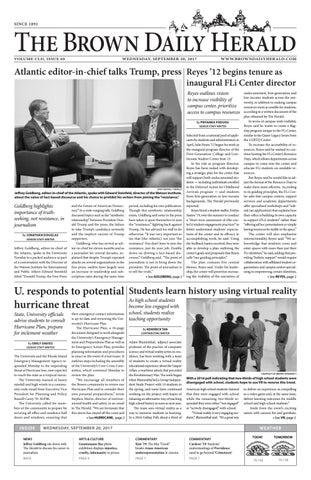
Jeffrey Goldberg, editor-in-chief of the Atlantic, spoke with Edward Steinfeld, director of the Watson Institute, about the value of fact-based discourse and his choice to prohibit his writers from joining the “resistance.”
Goldberg highlights importance of truthseeking, not resistance, in journalism By JONATHAN DOUGLAS SENIOR STAFF WRITER
Jeffrey Goldberg, editor-in-chief of the Atlantic, spoke at the University Tuesday to a packed audience as part of a conversation with the Director of the Watson Institute for International and Public Affairs Edward Steinfeld titled “Donald Trump, the Free Press
and the Future of American Democracy.” In a wide-ranging talk, Goldberg discussed topics such as the “symbiotic relationship” between President Donald Trump and the press, the failure to take Trump’s candidacy seriously and the implicit racism of Trump supporters. Goldberg, who has served as editor-in-chief for eleven months and as a journalist for several decades, explained that despite Trump’s repeated attacks on several organizations in the free press, outlets have largely seen an increase in readership and subscription rates during the same time
period, including his own publication. Though this symbiotic relationship exists, Goldberg said some in the press have taken it upon themselves to join the “resistance,” fighting back against Trump. He has advised his staff to do otherwise: “It was very important to me that (the Atlantic) not join ‘the resistance’. You don’t have to join the resistance, just do your job. Double down on driving a fact-based discourse,” Goldberg said. “The point of journalism is not to bring down the president. The point of journalism is to tell the truth.” » See GOLDBERG, page 2
Selected from a national pool of applicants by students and administrators in April, Julio Reyes ’12 began his work as the inaugural program director of the First-Generation College and LowIncome Student Center June 15. In his role as program director, Reyes has been tasked with developing a strategic plan for the center that will support both undocumented students — including individuals enrolled in the Deferred Action for Childhood Arrivals program — and students from first-generation or low-income backgrounds, The Herald previously reported. Reyes hired a student staffer, Evelyn Santos ’19, over the summer to conduct a “short term assessment of (the center’s) student engagement practices” to better understand students’ expectations of the center and its efficacy in accomplishing work, he said. Using the feedback Santos received, they were able to develop a plan outlining the center’s goals and proposals that Reyes calls “our guiding principles.” The plan contains five central themes, Reyes said. Under his leadership, the center will prioritize increasing the visibility of the narratives of
undocumented, first-generation and low-income students across the university, in addition to making campus resources more accessible for students, according to a written document of the plan obtained by The Herald. In terms of campus-wide visibility, Reyes said he wants to create a flagship program unique to the FLi Center, similar to the Queer Legacy Series from the LGBTQ Center. To increase the accessibility of resources, Reyes said he wanted to continue hosting the FLi Center’s Resource Days, which allows departments across campus to come into the center and educate FLi students on available resources. But Reyes said he would like to adjust the format of the Resource Days to make them more effective. According to its guiding principles, the FLi Center asks that campus centers, support services and academic departments offer specialized workshops and “submit (an application) that explains how their office is building its own capacity to support (FLi) students” rather than “offering ad hoc presentations or simply having resources be visible in the space.” The center will also emphasize intersectionality, Reyes said. “We acknowledge that students come and enter spaces with more than just their FLi identities,” he said, adding that providing “holistic support” would require collaboration with affiliated student organizations and campus centers specializing in empowering certain identities, » See REYES, page 2
U. responds to potential Students learn history using virtual reality As high school students hurricane threat become less engaged with State, University officials advise students to consult Hurricane Plan, prepare for inclement weather By EMILY DAVIES SENIOR STAFF WRITER
The University and the Rhode Island Emergency Management Agency responded Monday to the impending threat of Hurricane Jose, now expected to reach the state as a tropical storm. The University warned of heavy rainfall and high winds in a community-wide email from Executive Vice President for Planning and Policy Russell Carey ’91 MA’06. The University called for members of the community to prepare by securing all office and residence hall doors and windows, ensuring that
INSIDE
their emergency contact information is up-to-date and reviewing the University’s Hurricane Plan. The Hurricane Plan, a 16-page document designed to work alongside the University’s Emergency Management and Preparedness Plan as well as its Emergency Action Plan, provides planning information and procedures to enact in the event of a hurricane. It outlines steps including the assembly of the University’s Core Crisis Committee, which convened Monday to review the plan. “We encourage all members of the Brown community to review our Hurricane Plan and to consider their own personal preparedness,” wrote Stephen Morin, director of environmental health and safety, in an email to The Herald. “We are fortunate that this storm has stayed off the coast and » See HURRICANE, page 2
school, students realize teaching opportunity By KENDRICK TAN CONTRIBUTING WRITER
Adam Blumenthal, adjunct associate professor of the practice of computer science and virtual reality artist-in-residence, has been working with a team of students to create a virtual reality educational experience about the Gaspee Affair, a maritime attack that preceded the Revolutionary War. The work began when Blumenthal led a Group Independent Study Project with 14 students in the spring, and some have continued working on the project with hopes of releasing an alternative way of teaching high school history as soon as next year. The team sees virtual reality as a way to immerse students in learning. In a 2016 Gallup Poll, about a third of
COURTESY OF BROWN UNIVERSITY
With a 2016 poll indicating that two-thirds of high school students were disengaged with school, students hope to use VR to reverse this trend. American high school students claimed that they were engaged with school while the remaining two-thirds responded they were either “not engaged” or “actively disengaged” with school. “Virtual reality is very engaging medium,” Blumenthal said. “It’s a great way
to deliver an experience as compelling as a video game and, at the same time, deliver learning outcomes for middle school and high school students.” Aside from the event’s exciting nature with cannon fire and gunshots, » See VR, page 2
WEATHER
WEDNESDAY, SEPTEMBER 20, 2017
NEWS Jeffrey Goldberg sits down with The Herald to discuss his career in journalism
ARTS & CULTURE Guantanamo Bay photo exhibition displays injustice, cruelty, inhumanity in prison
COMMENTARY Kim ’19: The film “Gook” breaks Asian-American underrepresentation in cinema
COMMENTARY Cardoso ’19: Students’ understandings of Providence need to go beyond ‘Crimetown’
BACK
PAGE 4
PAGE 7
PAGE 7
TODAY
TOMORROW
70 / 66
74 / 58
NEWS
PAGE 2 • WEDNESDAY, SEPTEMBER 20, 2017
» REYES, from page 1 like the Brown Center for Students of Color and the LGBTQ Center. The plan also includes a central goal of increasing support services for undocumented and DACA students and raising awareness of issues impacting their community. “Undocumented and DACA students aren’t necessarily a subset of the FLi Community,” Reyes said. But “they’re also prioritized in our work,” Reyes said. He intends to offer these students co-curricular learning and experiential learning opportunities, he added. “Providing opportunities for advocacy through co-curricular engagement” is the final central theme, Reyes said, recognizing student efforts to push the University to create the FLi Center in 2016. The FLi Center will also hold community days for “FLi students, faculty, staff and administrators” in addition to an intersectional programming series and a leadership retreat for students representing FLi groups on campus, according to the FLi Center’s guiding principles. When supporting communities served by the FLi Center, “we have to stop thinking about it through a deficit model” by suggesting that these students don’t have social capital, he said. First-generation, low-income and
» VR, from page 1 Blumenthal said he decided to focus on the Gaspee Affair due to its significance to the people of Providence. “The story is also very little-known outside of Rhode Island, but was very important in terms of the way that it helped unite the colonies towards the cause of independence,” Blumenthal said, adding that he hopes the Gaspee Project will elevate the story’s publicity on a national level. The Gaspee Project features an interactive virtual exhibit with a collection of items related to different aspects of the Gaspee Affair. Interacting with these objects transports the user to different parts of the virtual experience. For example, one part of the experience involves a small model of the Gaspee, a British ship, on a table. When a user picks up the model, they are transported to Gaspee Point, the site of the event, with the ability to see and experience the burning of the Gaspee. Hannah Seckendorf ’20, a student on the team, said that users are also
THE BROWN DAILY HERALD
» HURRICANE, from page 1
undocumented students “come with their own types of wealth and knowledge that maybe just aren’t legitimized by institutions … (but) if we start to legitimize them at Brown, we may create a very different, unique student experience.” Reyes also stressed that he is available to students as a resource. He added that he plans to attend meetings held by First-Gens@Brown and events organized by other campus centers, like the Welcome Back Series coordinated by the BCSC. Mary Grace Almandrez, associate vice president for campus life and dean of students, said the search committee tasked with finding the inaugural director of the FLi Center looked for someone who could be a “visionary leader and help the community shape that vision.” Reyes has a “very collaborative and inclusive leadership (style). … He truly believes in the power of students,” she added. Maria Ortega GS, the graduate student coordinator at the FLi Center and a member of the search committee, said she could “definitely see how the center and the campus as a whole would benefit from having a full-time, dedicated staff member.” Reyes is “really great at looking back at what we have done (as a center) and learning from that,” Ortega said. “I’m very excited.”
Julio Reyes ’12 intends to promote intersectionality in the programming he will deliver to student communities served by the FLi Center.
given the opportunity to teleport onto the ship’s deck. “That’s one of the powerful things about virtual reality,” she said. “It allows you to view the event through all the different perspectives involved, depending on where you are standing and experiencing the virtual space.” Brown has been committed to the development and research of virtual reality since the 1990s and now has multiple labs on campus dedicated to the technology. David Laidlaw, professor of computer science, has been a central figure of this initiative in recent years. His class, CSCI 1370: “Virtual Reality Design for Science,” gives students an opportunity to design interactive experiences using the virtual reality facilities on campus. “The class focuses on developing good tools for scientists to understand things they don’t understand in big data sets,” Laidlaw said. “Its goal is also for students to understand what (virtual reality) can do, understanding its strengths and weaknesses in communication, education, science and so on. Over time,
students learn subtle yet valuable lessons about the medium.” Though the upward trajectory that virtual reality has experienced in both popularity and development is encouraging for all those involved with this technology, there are still concerns about its potential to impact the masses and change the way we live. “Virtual reality is very much still in its infancy,” said Jarod Boone ’20, another student involved with the Gaspee Project. “Aside from the logistical and technical problems that are still present in (virtual reality), there is still a cultural shift that needs to happen for people to be more accepting of (virtual reality).” While its success in education or other fields remains to be seen, there is a general consensus among all those involved in the project about the engaging facets of virtual reality. “There’s a magic in (virtual reality), and it’s subtle,” Laidlaw said. “I don’t understand it, but we can recognize it when we see it. That’s my favorite part about (virtual reality).”
JASMINE RUIZ / HERALD
» GOLDBERG, from page 1 Goldberg also discussed the failure of the media to handle Trump’s candidacy appropriately. As he pointed out, previous presidential candidates across the political spectrum have not manipulated basic facts in the way that Trump has, forcing the media to re-evaluate their coverage of him. “We were not equipped for a person to do the things that he did and then become more popular,” Goldberg said. Goldberg spoke at length about the implicit racism of Trump supporters. Some people, most notably Ta-Nehisi Coates, a national correspondent for the Atlantic and friend of Goldberg, have been largely negative about Trump’s election, saying that anyone who voted for him implicitly supported racism, even if they are not outwardly racist. Goldberg largely agreed with this outlook, saying, “if you (voted) for Donald Trump, it doesn’t necessarily make you a racist. … To have voted for Donald Trump means that you made a conscious decision (to agree with Trump’s racism) or made a conscious decision not to look at all the things that he had said over the years.” In his talk, Goldberg used the term
has diminished in strength over the past few days, but we know that there will be other storms in the future.” The University conducted its regular test of the emergency siren at noon Tuesday. The Rhode Island Emergency Management Agency also issued a statement Monday. The agency advised locals to avoid activities on R.I. waters, particularly given that state beaches are not staffed by lifeguards after Labor Day. The press release warned of high wind, elevated surf, heavy rains and rip tides on coastal waters, which are most likely to occur along the south coast. Downtown Providence itself is structurally prepared for Hurricane Jose. The city has not suffered from any significant flooding since 1960, when the building of the Fox Point Hurricane Barrier commenced, according to the University’s Hurricane Plan. The Hurricane Barrier obstructs high tides from Narragansett Bay and works to maintain the appropriate level of river flow. The last major hurricane that hit Providence was Hurricane Bob in 1991, which resulted in many fallen trees and an extensive loss of power. The University will provide updates to the community as the storm progresses, Carey wrote. “homeless conservatives,” which he described as “the ones who remain true to their ideals but reject Trump as a false conservative.” During the question-and-answer session following the talk, Ethan Shire ’19 pushed Goldberg to elaborate on that point, asking if he felt that Trump would take “homeless conservative” journalists under his belt. Goldberg’s answer was a resounding no. “President Obama did much more outreach to the leaders of intellectual conservatism than Donald Trump does. Donald Trump has set himself up in opposition to that camp,” he said. Attendees largely enjoyed Goldberg’s event, heavily applauding and laughing at his various jokes, which Steinfeld labelled “acid humor.” Maya Fitzpatrick ’20 said the event was “incredible,” adding that “it was interesting to hear from someone who is more moderate, someone who’s saying that the world’s not ending, especially from someone who’s in a really powerful position right now.” Jonah Shrock ’20 said that he really enjoyed Goldberg’s discussion on the “symbiotic relationship” between the press and Trump. “It’s an issue I’ve been thinking a lot about and he made a lot of intelligent points,” Shrock said.
MEAL PLAN
changes
STEP ONE:
Choose a Meal Plan.
REMINDER:
T DAY THE LASEA L PLAN
TO MAKE M EDNESDAY, CHANGES IS W
SEPT. 27!
VIEW OPTIONS AT BROWN.EDU/FOOD
• You can ADD a new Meal Plan at any time during the year • You can make one CHANGE per semester. Fall deadline is 9/27 • Meal Plan CANCELLATIONS for the whole year are due by 9/27
STEP TWO:
Let us assist you!
EMAIL DINING_SERVICES@BROWN.EDU OR CALL 863-3343 WITH QUESTIONS
• Changes can only be made in person weekdays from 9:00AM to 4:00PM at the Brown Dining office located at 144 Thayer Street (Sharpe Refectory).
brown.edu/food
ARTS & CULTURE WEDNESDAY, SEPTEMBER 20, 2017 • PAGE 3
THE BROWN DAILY HERALD
‘Mount Eerie’ haunts Columbus Theatre with idiosyncratic rhythms Phil Elverum shares anguish through ‘A Crow Looked at Me’ live set list alongside aging hipsters By CONNOR SULLIVAN SENIOR STAFF WRITER
During last Friday night’s sold-out performance, prolific singer-songwriter and multi-instrumentalist Phil Elverum submerged a Columbus Theatre audience under an entrancing and heart-wrenching set of stripped-back sonics. The aging hipsters and stickand-poke-wearing Rhode Island School Design undergraduates who filled the seats were all wholly unprepared for the night’s devastation. Playing under the Mount Eerie monicker, Elverum collated the majority of the set from his latest collection of songs, “A Crow Looked at Me.” One of the year’s most critically-acclaimed releases, the record laments the July 2016 passing of Geneviève Castrée, Elverum’s wife and fellow singer-songwriter, from terminal pancreatic cancer. Understandably, “A Crow Looked at Me” and its accompanying tour could not possibly be divorced from the death narrative surrounding the album. Elverum recorded the LP in his dead wife’s room and uses her guitar, bass and amplifier to exhort his anguish. Castrée inhabits every note of the album. Her spirit haunts every sparse guitar interval and cloaks each of Elverum’s defeated lyrical inscriptions.
COURTESY OF WIKICOMMONS
Phil Elverum performed “A Crow Looked at Me” from his most recent collection of songs, a mournful, elegic lamentation of the passing of his wife in July 2016. His personal lyrics captivated the audience. The album is a multisensory experience — it should not only be heard, but profoundly felt. It is a slow-burning, agonizingly cathartic punch, laden with idiosyncratically devastating documents of Elverum and his young daughter’s increasingly hollow existences. The necessarily personal nature of the record calls into question why Elverum would choose to tour behind it and play his elegies for an audience that, inherently, could never relate the way he can. What if these pained evocations wrenched directly from the
pits of his shriveling heart fall on unsympathetic ears? Such is the principal problem facing the confessional singersongwriter — a dilemma Elverum is more than aware of. “Death is real / … and it’s not for singing about,” begins “Real Death,” the opening track of both “A Crow Looked at Me” and Friday night’s set. The lyric interrogates the effectuality of art as mourning, but the song ultimately moves from hints of creative and philosophical probing to intensely sad descriptions of the empty daily life
Elverum has taken on since his wife’s passing. Right away, it is evident that Elverum is not writing to elicit empathy; he is singing because he physically has to. The music he plays serves as a sort of coping mechanism, one that hinges on songwriting’s dual capacities for temporary liberation from trauma and for a way of obsessively sorting out trauma’s individual parts. Between songs, he vacantly stares into the distance and sighs weakly into the microphone, disrupting his plaintive set only to wipe away sweat and what must
surely be tears from his face. For all he cares, he could be singing into a void. By the end of “Real Death,” Elverum has unequivocally seized the attention of a crowd which, by this point, can only help but to watch with pious intensity. Nobody even has the audacity to interrupt the set with photographs. He launches into other tracks from his 2017 magnum opus, perhaps most notably “Soria Moria,“ which interpolates elements of “The Moon,” a Microphones song that’s inarguably one of the sublime high points of Elverum’s discography. The highlight capably reinterprets the lyrics and melodies of “The Moon” in light of Castrée’s death. Guitar strumming accompanies Elverum’s characteristically gentle cadences, every aspect coupling the gravity of his wife’s death with imagery cradled from sublime Norweigian landscapes. Elverum followed up songs off of “A Crow Looked at Me” with entirely new material. The tracks he debuted similarly mourned Castrée, including “Tintin In Tibet,” which directly addresses her and self-consciously alludes to the fact he released an album written entirely about her death. This tendency of Elverum to continue grieving by way of his music further evidences songwriting’s potential as a generative mode of mourning. Though the show could not have possibly lasted more than an hour and a half, time ostensibly suspended itself as Elverum compressed an entire lifetime’s worth of memories into the set.
‘The Trip to Spain’ follows trite format, falls flat Comedians Steven Coogan, Rob Brydon bring repetitive, ad-libbed authenticity to dinner table By DANIEL WAYLAND ARTS AND CULTURE CRITIC
“The Trip to Spain” runs exactly like one would expect from the third installment of a comedic culinary travelogue — a cheeky but tired retread that cheapens the artistic and gastronomic richness of the series’ first two chapters. Following the format established by their 2010 film “The Trip” and their 2014 sequel, “The Trip to Italy,” comedians Steven Coogan and Rob Brydon next turned their attention toward the Spanish coast, playing lightly fictionalized versions of themselves as they riff impressions over a series of meals sampling the local cuisine. There’s the semblance of a plot — Coogan and
Brydon are in Spain to write food reviews for separate print publications, and both grapple with the occasional jaded familial and career drama — but it largely serves as narrative fluff to allow for the dining comedy that provides the film’s backbone. Ultimately, “The Trip to Spain” suffers from an identity crisis. The film feels stuck somewhere between an irreverent and plotless food feature that defies genre conventions and a more thoughtful story concerned with the kind of existential questions usually reserved for more serious “road trip” movies. In Coogan and Brydon’s capable hands, “The Trip to Spain” teases viewers with occasional flashes of a tighter
and established genre film. Certainly, the “Trip” series is a triumph of the comedians’ collective atmospheric vernacular, which is at turns both academic and improvisational. The pair are most famous for their celebrity impressions, in particular their hilarious Michael Caine parody, and make sure to include an abundance of these sketches throughout the movie. The film’s appeal peaks in the moments when Coogan and Brydon’s characters flit between dinner conversation and impersonations seamlessly, lending an ad-libbed authenticity to the scenes. One brief episode involving impressions of Marlon Brando and Woody Allen against the backdrop of the Spanish Inquisition proves delightful. Brydon especially dazzles, conferring his humor with a learned wit and impishness he has honed over the years as
a veteran of the British late-night quiz show circuit. Too frequently, however, the film falls back on old jokes from its prior two installments. The Michael Caine impression has been wrung of all its comedic potential, but the pair devotes several scenes to replaying that tired masquerade. You would expect a fresher effort from Coogan, Brydon and veteran director Michael Winterbottom — or at the very least an attempt to take the series in a different direction creatively. The germ of that creative idea can be found in the film’s more somber and plot-driven nature. Coogan, in particular, endures several crises that could have been mined for more serious character development. The story lightly dances around its thematic undertones, and the several references
made to Miguel de Cervantes offered a ripe opportunity for the film and its subjects to assume the kind of selfawareness that is largely put on the back burner in favor of comedy. Perhaps Coogan and Brydon should take a cue from “Travel Man,” the British Channel 4 comedy starring Richard Ayoade, who, like Brydon, is a fellow veteran of the quiz show circuit. The show pairs Ayoade with another comedian and follows their exploits over the course of 48 hours, with each new episode featuring adventures in a different major city. “Travel Man” largely eschews plot or thematic intent, instead allowing Ayoade’s carefully crafted absurdity to spin its own creative web. Unlike “Travel Man,” “The Trip to Spain” often doesn’t know what it wants to be, which ultimately ruins the moments when it does.
ARTS & CULTURE PAGE 4 • WEDNESDAY, SEPTEMBER 20, 2017
THE BROWN DAILY HERALD
RISD Museum rethinks fifth floor, allows for immersive experience Renovations bring new organization, life to European, Renaissance, Medieval, other galleries By ELIZABETH TOLEDANO SENIOR STAFF WRITER
Upon stepping onto the fifth floor of the Rhode Island School of Design Museum a year ago, viewers were transported 200 years back to Victorian-era salons. In the main gallery, which focuses on history paintings, artworks originally hung one on top of the other in an overwhelming display notable primarily for its sheer quantity. New fire safety codes in the aftermath of the Station nightclub fire in 2003 meant that the museum had to rework its galleries. Floor by floor, the museum has not only been working to meet codes, but also to very intentionally reinvigorate its spaces. The main gallery on the fifth floor still contains the overwhelming portraits, excessive scenes of feasts and massive representations of religious imagery expected of a salon format. But now each work has an accompanying back story, said Maureen O’Brien, curator of painting and sculpture. The pieces lining the wall at eye level give viewers an opportunity to step closer to the art. With fewer works, observers can engage with each painting. For a moment, the observer can stand before “The Angel of Fame” painted by Giovanni Battista Tiepolo ca. 1750, which once guarded the palazzo of a newly rich family in Italy. Across from the “Angel,” “Thomas Estcourt, Esq.,” painted by Pompeo Girolamo Batoni on Estcourt’s Grand Tour, sits in the richest fashions of 1772, displaying in his portrait his determinacy to present himself as singularly well-read and cultured. Across the room, “Portrait of AntoineGeorges-Francois de Chabaud-Latour and His Family” painted by Jacques-Luc Barbier-Walbonne in 1806 shows a father telling his young daughter about her grandfather’s legacy. The opportunity to become immersed in works like these offers insight into the universal tendencies around image. The subjects, interested in displaying their success, have left a very self-conscious snapshot
of their lifestyle. In the next room, the viewers move away from traditional portraiture. In the 19th century, Paris salons began to give awards to paintings of landscapes. During this time, artists focused more on exhibiting the natural world. The way history was represented changed, O’Brien said. The ruins of monuments strewn across Roman landscapes as in “The Colosseum,” by Giovanni Paolo Pannini, or the hint of people dancing in the countryside as in “Tivoli,” by Jean-Victor Bertin, became the new access point for displaying the human story. In 1830, artists took landscape even further, choosing instead to portray completely untouched sceneries. “The purpose of landscape in art is for you to engage, emotionally, spiritually, intellectually with nature,” O’Brien said. As the viewer continues through the exhibit, they encounter a gallery titled Painting Modern Life. In this room, paintings display both humans and landscapes, but the style has shifted entirely. As the Impressionist movement gained momentum and the works from the Salon des Refusés grew in cultural significance, artists began to experiment with the emotive quality of their style and subjects. In “The Basin at Argenteuil,” Monet recreated a landscape in an effort to capture its essence. The portraiture in this room does not express the same formality of the works in the main gallery. Manet’s painting, “Repose,” of Berthe Morisot depicts his subject resting comfortably on a sofa. “It’s ground-breaking,” O’Brien said. Coming out of the proceeding gallery, the viewer can physically experience the evolution of European art in the late 19th century. They encounter a space incorporating striking works by van Gogh, Berthe Morisot and Paul Cézanne, guiding their experience to the advance of modern art. The Jean di Bona Gallery contains paintings that stray from the representational aspects of the works on the rest of the floor. “I pinch myself every day,” O’Brien said, referencing the collection which features the key players in the development of modern art. The room contains works by Matisse, Picasso and Braques, which, gathered in a single space, carry viewers through the 20th century.
HUAYU OUYANG / HERALD
Overwhelming portraits, excessive scenes of feasts and religious imagery line the walls of the fifth floor, which was reoriented in a way that still preserves the sentiment of being in a Victorian salon.
HUAYU OUYANG / HERALD
Due to fire-safety initiatives, the museum chose to display paintings side-by-side and organize rooms by style. Visitors can look forward to exhibits dedicated to life after death, traditional paintings and more. The Creamer Medieval Gallery, which represents a sharp juxtaposition from the more modern spaces, imitates the setup of a church, displaying religious objects in an attempt to echo the way the pieces might have been used. A chasuble worn by clergy in the 1300s, a pyx from the 1200s and even a Romanesque portal give visitors an opportunity to engage with the objects in a way that feels relevant to their personal experience, O’Brien said. Upon exiting the space devoted to religious art, the viewer enters the Creamer Early Renaissance Gallery, which reveals the more domestic side of historic art items. The gallery no longer contains walls dividing the room,
creating a spacious corridor and contributing to an experience that breaks down the concerted themes of the previous galleries. Though the floor focuses on European art, this section expands these borders, featuring work from different regions, said Brian Pletcher, a security officer on the fifth floor. Works include a plate encouraging fertility featuring the birth of Mary, decorative bowls and a Turkish cushion cover. Though the gallery lacks any particular timeline, the space highlights Venice as a port central to trade and the exchange of ideas. The last gallery, a collection of portraits, returns to the idea of how subjects hoped to be portrayed after
their deaths. Here, statues and paintings showcase ornate hairstyles and suits, expressing the subjects’ cultural values in an attempt at self-preservation. The gallery features the art historical equivalent of a selfie, O’Brien said. “I’m just so impressed that’s a resource that students can have,” said Allison Lackey, a visitor in the gallery. Students can enter the RISD Museum free of charge, which grants them access to an entire chronology of European art and architecture on the fifth floor as well as art from across the world. The spaces are more than just a display: They’re an opportunity to interact closely with the works and just think, O’Brien said.
‘Welcome to Guantanamo: Beyond Gitmo’ exhibit arrives at University Debi Cornwall’s Gitmo-focused exhibit tackles life of inmates, politics of detention camp By CONNOR SULLIVAN SENIOR STAFF WRITER
Playful photographs of Guantanamo Bay gift shop items and plaintive portraits of former inmates are strikingly paired in the John Nicholas Brown Center for Public Humanities and Cultural Heritage’s latest installation, “Welcome to Camp America: Beyond Gitmo.” An exhibition by photographer and former civil rights-lawyer Debi Cornwall ’95, “Welcome to Camp America: Beyond Gitmo” employs these darkly comic contrasts as critical commentary. Cornwall’s photographs explore life within the United States’ Guantanamo Bay detention camp. Welding together politics and aesthetics, the exhibition comes as the next installment in the
John Nicholas Brown Center’s tradition of displaying politically charged art. The exhibit, which seeks to reveal injustice and mistreatment, joins two other public programs focused on investigating the military prison’s history, legacy and future. The center is the second institution in the United States to display Cornwall’s installation. The John Nicholas Brown Center “is really interested in how culture and art intersect to address social activism and social justice issues,” said Marisa Brown, assistant director of programs at the center. “Debi’s work is one of the best examples of how you can use art to address these issues.” Cornwall explicitly centers her art around activism. The photographer spent 12 years working as a civil rights
lawyer, using DNA analysis to free wrongfully imprisoned people. Though Cornwall parted ways with the occupation in 2014, she utilizes her art as a vehicle through which to call into question power structures’ unwarranted assaults on individuals’ civil rights. “After stepping away from the life of a litigator, I was still consumed with the same kind of questions regarding power and its effects on individuals,” Cornwall said. “But I wanted to explore it in a very different way that invited connection and inquiry.” “Guantanamo was an obvious choice for me,” Cornwall said. “The innocent men held for years there without charge are very similar to my exoneree clients in the United States. But unlike those DNA exoneree clients, the men in Guantanamo never receive a piece of paper saying they didn’t commit the crime.”
Reflecting a law that explicitly prohibits taking photographs of current Guantanamo inmates’ faces, Cornwall sticks strictly to photographing her now-released subjects’ backs. For Cornwall, the artistic decision underscores the dehumanizing toil inherent in incarceration at Guantanamo. “One artist that informs my work is Trevor Paglen,” Cornwall said. “He similarly finds way to visualize the inherently not-visual.” The inmates’ anguish is juxtaposed with flippant gift shop items on display, including a stuffed turkey vulture and a bobble head modeled after the likeness of Fidel Castro, creating a jarring effect for the viewer. The bleak back portraits contrast further with photographs that depict the comparatively relaxed lifestyles of military men on duty in Guantanamo. “It’s really interesting work,” said
Esther Whitfield, associate professor of comparative literature and Hispanic studies. “It strikes me as a subtle commentary on the politics of Guantanamo and as a moving tribute to the communities that formed there, as well as to the way people look for home in places that are far from, and very unlike, their homes.” Cornwall credits the development of her artistry to Brown, where she graduated with a double concentration in political science and modern culture and media. “I’m happy to see that Brown has become more of itself since I was last here,” Cornwall said. “The students and professors I’ve spent time with this week are as thoughtful and engaged as ever. And I’m happy to (see) more engagement with communities outside of Brown — engagement that addresses issues of national concern.”
TODAY
WEDNESDAY, SEPTEMBER 20, 2017 • PAGE 5
THE BROWN DAILY HERALD
menu
b a c k g r o u n d s at b r o w n
SATELLITE DINING ANDREWS COMMONS
Pizza: Spicy Sausage and Garlic, Mushroom’s Revenge, Miss Maple JOSIAH’S
BLUE ROOM
Chicken Wings Bar, Grilled Cheese, Bacon Burger
Broccoli and Cheddar Soup, Beef Chili with Beans, Burrito Bowl
DINING HALLS SHARPE REFECTORY LUNCH
DINNER
Cream of Tomato Soup, Chicken Fingers, Falafel Burgers, White Chocolate Chip Cookies
Grilled Pork Chops, Savory Chicken Stew, Basmati Rice Pilaf, Pumpkin Cake
VERNEY-WOOLLEY LUNCH
DINNER
Cream of Broccoli Soup, Tacos, Spanish Strudels, Sunflower Butter Cookie
Rotisserie Style Chicken, Pastito, Creamy Rosemary Polenta, Chocolate Cupcake
sudoku
KAITLYN LEW / HERALD
A speaker at the Multiracial Heritage Series Welcome Back Dinner in Petteruti Lounge. The event aimed to celebrate the multiracial backgrounds of Brown students through celebration, food and performances.
Q U O T E O F T H E D AY
“The point of journalism is not to bring down the
”
president. The point of journalism is to tell the truth.
— Jeffrey Goldberg, Editor-In-Chief of the Atlantic
See GOLDBERG on page 1.
crossword
calendar TODAY SEPTEMBER MARCH
S
M
T
W
Th
F
S
Wellness At Brown: Healing Yoga 12 P.M. Hillel
1
2
13
24
Latinx Welcome Back 5:30 P.M. Sayles Hall Auditorium
35
46
57
86
79
10 8
11 9
10 12
11 13
12 14
13 15
14 16
15 17
16 18
17 19
18 20
19 21
20 22
21 23
22 24
23 25
24 26
25 27
26 28
27 29
28 30
29 31
30
Quaker Meeting for Worship 12 P.M. JWW, 409 Lean In Kickoff 7:30 P.M. Smith-Buonanno, G01
TOMORROW ADHD Support/ conversation group 12 P.M. JWW, 411
How Not to Write 1 P.M. Sharpe Refectory - Chancellors Dining Room
Thursday Night Interfaith Supper 5:30 P.M. Chaplain’s Home
Poetry stands up to support Dreamers 6 P.M. Rochambeau House
COMMENTARY PAGE 6 • WEDNESDAY, SEPTEMBER 20, 2017
THE BROWN DAILY HERALD
A L E X W E S T FA L L
STAY UP-TO-DATE. FOLLOW US ON FACEBOOK. FACEBOOK.COM/BROWNDAILYHERALD
Find us online! facebook.com/browndailyherald
browndailyherald.com
@the_herald
Location: 195 Angell St., Providence, R.I. www.browndailyherald.com
@browndailyherald
youtube.com/browndailyherald
Editorial Leadership
Sections
Multimedia & Production
Business
Editor-in-Chief Lauren Aratani
Arts & Culture Editors Ethel Renia Madison Rivlin
Design Editors Christy Leung Ameer Malik Jessica Yu Assistant: Eduard Muñoz-Suñé
General Managers Henry Ritter Ben Wesner
Managing Editors Matt Brownsword Rebecca Ellis Kate Talerico POST- MAGAZINE Editor Saanya Jain BLOGDAILYHERALD Editor Angelica Cotto
Metro Editor Gwen Everett News Editors Isabel Gensler Alex Skidmore Hattie Xu Science & Research Editor Elena Renken Sports Editors Ben Shumate Nicholas Wey COMMENTARY Opinions Editors Connor Cardoso Anuj Krishnamurthy Mili Mitra
Photo Editors Head: Marianna McMurdock Assistant: Lilly Nguyen Gus Reed Sara Runkel Anita Sheih Copy Desk Chief Abby Borges Multimedia Editor Roland High Illustrations Editor Pia Mileaf-Patel Graphics Editor Laura Felenstein Directors of Web Development Eli White Ivy Wong
Directors Sales: Erin Lueck Sales: Matilda Lynton Finance: Reena Zhan Strategy: William Nober Strategy: Caroline Ziegler Managers Sales: Michael Borello Sales: Elizabeth Doykan Sales: Ariel Shusterman Finance: Austin Lessin Collections: Ravi Betzig
Editorial contact: 401-351-3372 herald@browndailyherald.com
Business contact: 401-351-3260 gm@browndailyherald.com
Submissions: The Brown Daily Herald publishes submissions in the form of op-eds and letters to the editor. Op-eds are typically between 750 and 1000 words, though we will consider submissions between 500 and 1200 words. Letters to the editor should be around 250 words. While letters to the editor respond to an article or column that has appeared in The Herald, op-eds usually prompt new discussions on campus or frame new arguments about current discourse. All submissions to The Herald cannot have been previously published elsewhere (in print or online — including personal blogs and social media), and they must be exclusive to The Herald. Submissions must include no more than two individual authors. If there are more than two original authors, The Herald can acknowledge the authors in a statement at the end of the letter or op-ed, but the byline can only include up to two names. The Herald will not publish submissions authored by groups. The Herald does not publish anonymous submissions. If you feel your circumstances prevent you from submitting an op-ed or letter with your name, please email herald@browndailyherald.com to explain your situation. You can submit op-eds to opinions@browndailyherald.com and letters to letters@browndailyherald.com. When you email your submission, please include (1) your full name, (2) an evening or mobile phone number in case your submission is chosen for publication and (3) any affiliation with Brown University or any institution or organization relevant to the content of your submission. Please send in submissions at least 24 hours in advance of your desired publication date. The Herald only publishes submissions while it is in print. The Herald reserves the right to edit all submissions. If your piece is considered for publication, an editor will contact you to discuss potential changes to your submission. Commentary: The editorial is the majority opinion of the editorial page board of The Brown Daily Herald. The editorial viewpoint does not necessarily reflect the views of The Brown Daily Herald, Inc. Columns, letters and comics reflect the opinions of their authors only. Corrections: The Brown Daily Herald is committed to providing the Brown University community with the most accurate information possible. Corrections may be submitted up to seven calendar days after publication. Advertising: The Brown Daily Herald, Inc. reserves the right to accept or decline any advertisement at its discretion. The Brown Daily Herald, Inc. is a financially independent, nonprofit media organization bringing you The Brown Daily Herald, BlogDailyHerald and Post- Magazine. The Brown Daily Herald has served the Brown University community daily since 1891. It is published Monday through Friday during the academic year, excluding vacations, once during Commencement and once during Orientation by The Brown Daily Herald, Inc. Single copy free for each member of the community. Subscription prices: $200 one year daily, $100 one semester daily. Copyright 2017 by The Brown Daily Herald, Inc. All rights reserved. Periodicals postage paid at Providence, R.I. Postmaster: Please send corrections to P.O. Box 2538, Providence, RI 02906.
COMMENTARY WEDNESDAY, SEPTEMBER 20, 2017 • PAGE 7
THE BROWN DAILY HERALD
We need Asian American representation in Hollywood ZANDER KIM staff columnist In recent years, Hollywood has been pushing for equal representation for all genders, sexualities and ethnicities on-screen. While Hollywood is making progress on these issues, there is clearly more to be made, especially for the Asian American community. Only in the past three years or so have Asian Americans seen an uptick in leading roles. Television comedies such as “Master of None,” starring Aziz Ansari, “Fresh Off the Boat,” starring Randall Park and Constance Wu, and “Dr. Ken,” starring Ken Jeong, have done well with audiences. Now, we may be witnessing that success expanding to feature films. Currently playing in select theaters, “Gook” is a film about two Korean American brothers — Eli, played by Justin Chon, and Daniel, played by David So — and their unlikely relationship with an 11-year-old African American girl, Kamilla, played by Simone Baker. The film follows them in Los Angeles during the first days of the infamous Rodney King riots in 1992. The film won this year’s Sundance NEXT Audience Award — an award whose winner is voted for by the viewers, rather than chosen by
critics. "Gook" is the directorial debut of Chon, who also wrote and directed the film. Throughout the film, we see billowing pillars of black smoke against a muddy-white sky — the film is shot in black and white, and importantly so, as "Gook" explores the tense relationship between Korean Americans and African Americans during this
immigrating to the United States had very little money. Often, they took up residence in these cheaper areas and started small businesses of their own. African Americans felt threatened, and as “Gook” shows, would steal from and vandalize stores owned by Korean Americans. This in turn incited violence from Korean Americans to stop such acts. Ultimately,
these relationships well. Every character gets their turn in the spotlight, and nearly all roles are played by people of color — the only notable white actor in the film, ironically, plays a doctor. As the depiction of the riots brings the film to its climax, viewers enjoy a payoff that taps into our rawest and most fundamental human emotions — fear and love.
Asian Americans have long been out of the spotlight in media. We have long been labeled as timid and shy, but as “Gook” shows, Asian American presence in Hollywood is steadily growing.
riotous period. The term “gook” itself is a derogatory one given to Koreans by Americans. In Korean, “mi gook” means American, so people mistakenly assumed that’s what Koreans called themselves. In the ’90s, Los Angeles was segregated, with African Americans populating impoverished areas. At the same time, Korean Americans
both groups gave in to unpropitious stereotypes, contributing to enduring tensions. Eventually, these businesses brought money into the poorer neighborhoods, which are now thriving economically. These relations in Los Angeles, where Chon grew up and to which he clearly has personal ties, are still improving. “Gook” explains and explores
It’s a fine debut for the 36-year-old Chon and a relevant one considering the political landscape today. It’s a film people should watch. Support for “Gook” should be and deserves to be stronger. Asian Americans have long been out of the spotlight in media. We have long been labeled as timid and shy, but as “Gook” shows, Asian American presence in Holly-
wood is steadily growing. Just a month ago, actor Ed Skrein, who’s white, announced he was leaving his major role in the upcoming reboot of “Hellboy,” because he was unaware the original character in the comics is of Asian descent. The show recently cast Korean American actor Daniel Dae Kim to replace him, demonstrating that it really isn’t too hard to cast appropriately. “Whitewashing” has become a term thrown around almost nonchalantly. Even during the 2015 Academy Awards “Oscars So White” controversy, all the focus was directed on African Americans, with the Asian and Latinx community receiving little support or recognition. Though it was called “Oscars So White,” America treated it as “Oscars Not Black,” with Asians being the butt of a cheap, stereotypical joke from host Chris Rock. In other words, we’re still getting there. What Justin Chon did in “Gook” is rare in Hollywood. He created a strong story in a timely setting, and we should be paying more attention to it. Hopefully, it inspires others to follow his lead. As my 15-year-old brother put it: “It was nice to see an Asian American guy as the lead in a film. I haven’t seen that in a long time. Like, ever.”
Zander Kim ’19 can be reached at alexander_kim@brown.edu.
Beyond College Hill and Crimetown CONNOR CARDOSO opinions editor This summer, a few friends and I decided to drive into Providence, Rhode Island to grab dinner. Our destination was a small, unassuming Mediterranean grill, somewhat out of place among the dozen-plus Italian restaurants on Federal Hill. The food was good, but we weren’t there for that. The place was comfortable, too, and the owners were genial, but we weren’t there for that either. The real reason my friends and I decided to drive into Providence to eat at an anonymous Mediterranean restaurant on Federal Hill? The restaurant is located at the former headquarters of the New England mafia — the third largest Cosa Nostra in the country at the height of its power. This particular aspect of Providence’s history is not well-known to Brown students, the vast majority of whom are not from Rhode Island. The state also has its own incentives to avoid emphasizing its history with organized crime. Yet the surprising popularity of the recent true crime podcast "Crimetown" might change that. Listeners will no doubt have an intimate familiarity with the antics of Providence’s former six-time mayor and Shakespearean tragicomic anti-hero Vincent “Buddy” Cianci. They will know about Raymond Patriarca and the Patriarca crime family, as well as the remarkably humanized personal lives of various “wise guy” enforcers who struggled with everything from muckraking attorney general nuns to wolf-slaying Drug Enforcement Agency officers. Most of all, listeners will know of Federal Hill, the other half of the city, as the heart of the mythical Providence
crafted by the writers. But while "Crimetown" is a remarkable achievement in storytelling, it obfuscates the true conditions of a city that is already very poorly understood by Brown students. If we take such a rich caricature of the city at face value, we overlook the complexities of Providence’s history and might feel less inclined to engage with its community. We often tell each other naïvely, patronizingly, but with good intentions, to get out of the “Brown bubble” and to adventure beyond the East Side to get a fuller u n -
to appreciate it. But this advice is little more than a platitude. Often, whatever exploration we undertake unfolds within a framework of privileged observation rather than constructive community engagement. Generally, even if our perception of Providence includes more than just College Hill, it is colored by our consumption of media like "Crimetown" or brief and infrequent forays downtown and beyond. None of this is to say that there are not students who engage with the community. Despite recent criticism, the Swearer Center for Public Service facilitates responsible community engage-
PHOEBE AYRES
derstanding of the city. This is, fundamentally, good advice. As privileged students at an elite university, it is in part our responsibility to engage constructively with the community and, at the very least, make a good faith effort
ment between Brown students and various local groups. But often, even this exposure is either superficial or tokenized. There is no shortage of community groups criticizing Brown students for their lack of dedica-
tion to community service or for their cavalier attitude toward the groups they are meant to serve. Ultimately, the availability of programs that facilitate community engagement is not enough to ensure that Brown students become active and responsible members of the Providence community. Culturally, we are too content embracing the East Side as the beginning and end of the city, too uninterested in thinking critically about the mythology of Providence constructed by media such as "Crimetown" and too unwilling to actively learn about the community ourselves. There is a responsibility among administrators, faculty and students alike to cultivate a mentality in which we see ourselves not as transient occupants of an ivory tower, extracting what resources and connections we can before we move on, but as active members of a broader community — one wherein we might not vote or volunteer, but at the very least try to appreciate more than just College Hill. There is a line in "Crimetown" that is so topical that it bears repeating in full: “Providence is essentially two hills, on either side of a river. On one side is Federal Hill, Patriarca’s domain. On the other bank is the East Side, where Brown University is, where the doctors and lawyers and professionals live.” This is probably not meant to be a subtle polemic against the privilege of Brown students living in a city with a rich and complex history, but the very fact that the city was characterized this way suggests to me that there is progress to be made.
Connor Cardoso ’19 can be reached at connor_cardoso@brown.edu.
NEWS THE BROWN DAILY HERALD
WEDNESDAY, SEPTEMBER 20, 2017
Atlantic editor-in-chief talks career in journalism Jeffrey Goldberg speaks on personal reporting experiences, advice for aspiring journalists By JONATHAN DOUGLAS SENIOR STAFF WRITER
Jeffrey Goldberg, editor-in-chief of The Atlantic, came to the University to talk about the state of the press in the era of Trump. Goldberg sat down with The Herald to discuss his journalism career and advice he has for budding journalists. Herald: You wrote a popular piece called “The Obama Doctrine” about Obama’s foreign policy, which you based on a number of extensive conversations you had with him throughout his presidency. How did you foster such a close relationship with President Obama compared to other journalists? Jeffrey Goldberg: I like talking to people who have real, articulated, philosophical underpinnings to the way they think. That’s a non-partisan statement; Steve Bannon can do the same thing. President Obama was an unusually thoughtful person. Now that was sometimes considered a positive and sometimes considered a negative. In my experience, he’s bored by the
quotidian discussion of political ups and downs. He’s trying to understand the role of history in policy making. As a magazine feature writer, that’s the way I think as well. Over time, we both came to realize that there were more issues and conversations to be had than just the typical “controversy du jour.” I met him when he was a senator and had a long standing relationship with him. He was unusually willing as president to talk about the way that he thinks about things. He had the rare ability to observe his presidency while it was happening. You have written about topics you had personal experience with, most notably in your book, “Prisoners: A Story of Friendship and Terror,” which focuses on your relationship with a Palestinian prisoner while you were a guard. How would you suggest journalists write about what they don’t know? The topics that you do know very well are probably where you should start. But the problem with doing that too early is that you haven’t let the experience stay with you for a while.
Being transparent with your readers about what you feel, what you thought and what you think is a good thing. I’m also a big fan of throwing people into the deep end of the pool. The skill of a journalist is to land in a place and see how quickly it takes you to figure out what’s going on. You’ll be successful in journalism if you’re a quick study. Journalism is never going to be perfect. It’s too complicated to be perfect. Have you had any experiences where you were “thrown into the deep end?” All the time. Sometimes it’s almost comical. As a young Washington Post reporter, they said to me, “There’s a prison riot. Go cover the prison riot.” I didn’t even know where the prison was, and an hour later, I’m watching buildings burn and trying the hardest I can to not sound like an idiot. I had this experience in Azerbaijan once when I landed in the country, and five hours later, I was interviewing the president of the country just because of a series of strange circumstances. I treated the fact that I didn’t really know anything not as something that scared me but as a challenge. You can always be more prepared about something.
You’ve written stories in several conflict zones; have you ever feared for your safety? Yeah, sure. I’ve been kidnapped, beaten, shot at. Now I just go to meetings. But the truth is I’d rather be beaten, shot at and kidnapped than go to meetings. I mean some meetings are okay, but most I could do without. There were a lot of stupid things that I did when I was younger. I wrote a piece about Daniel Pearl, the Wall Street Journal reporter who was beheaded in Pakistan. The piece was about how, before he was murdered, it was just more fun. As an American foreign correspondent, you felt that you were encased in a kind of protective bubble, no matter who you were dealing with. When Danny happened, it all changed. You wrote multiple pieces about your time with Fidel Castro, who originally reached out to you to discuss your piece on the Iranian nuclear program. He had very definitive thoughts on nuclear proliferation. It might be my favorite moment of all time. It’s a great punch line. There’s a famous letter he wrote during the
middle of the Cuban missile crisis to Khrushchev demanding that he launch a preemptive nuclear attack on the United States, so I said to him, “This letter, how do you feel about it today?” And he said “Ah, it was a bit much.” It was a great moment to talk to a figure from history about what may be the most pivotal week in the history of civilization. Those are the moments that you live for (as a journalist), because how else am I going to meet Fidel Castro? While he was alive, obviously he was one of the top five people you would want to go see for any journalist. What advice would you give to a student aspiring toward a career in journalism? Don’t. Well, let me add to that. I discourage people from looking into journalism. Mine was a more stable era in journalism. It has to be your obsession. You’re never going to make a ton of money. It’s a very unstable business right now. So I discourage people. But if they keep coming back, two or three or four times, then we can talk. This interview was edited for length and clarity.