SINCE 1891
THE BROWN DAILY HERALD WEDNESDAY, OCTOBER 11, 2017
VOLUME CLII, ISSUE 83
WWW.BROWNDAILYHERALD.COM
Teach-in contextualizes end of DACA ‘Gigs on the Grass’ promotes homegrown student music
Second iteration of festival on Wriston Quad draws large crowds, showcases 15 student artists By CONNOR SULLIVAN SENIOR STAFF WRITER
Droves of students convened on Wriston Quadrangle for Saturday’s “Gigs on the Grass” music festival, the second iteration of the University’s exclusively student-centered music festival. Flanked by Wriston’s Georgian architecture and enveloped by the co-mingling scents of Narragansett beer and the last gasps of summer, the event’s 15 artists evinced a breadth of styles and a depth of talent. Student-run music groups can face a problem of visibility, with both little space for rehearsal and a dearth of publicity. Co-organized by the Brown Concert Agency and the Class Coordinating Board, the festival was a means of displaying and promoting the University’s homegrown musicality to a wider audience, organizers said.
ARTS & CULTURE
GUS REED / HERALD
The event, hosted by the Center for the Study of Race and Ethnicity in America, featured a panel of students, faculty and staff involved in community organizing and research projects.
Teach-in stresses importance of supporting all immigrants, preparing for future advocacy work By EMILY DAVIES SENIOR STAFF WRITER
In a discussion titled “UndocuKnowl-
edge: A DACA Teach In and Community Conversation,” a panel of students, faculty and staff highlighted the importance of leaving the “good immigrant bad, immigrant” mentality behind in exchange for a movement that uplifts all 11 million undocumented immigrants currently living in the United States. Moderated by Tricia Rose, associate dean of the
faculty for special initiatives, director of the Center for the Study of Race and Ethnicity in America and professor of Africana studies in the Watson Institute for International and Public Affairs, the panelists touched on the Deferred Action for Childhood Arrival program’s impact on undocumented immigrant com» See TEACH IN, page 3
“The main thing we’re doing with ‘Gigs’ is prioritizing student talent, which creates an environment where students are celebrating each other and their accomplishments,” said Pia Struzzieri ’18, president of CCB 2018. “The music scene here is really supportive and events are happening all the time,” Struzzieri said. “The main places I see people performing are in other students’ basements or backyards,” she added, noting the house shows that take place at such venues as Watermyn and 55 John St. “But (those shows) just generally don’t have a very broad audience,” Struzzieri said, underscoring the selfselecting nature of the people who attend these shows. “‘Gigs’ is an event that tries to bring that same feeling of community and intimacy to an audience that isn’t necessarily connected to the music scene.” In this respect, “Gigs” is successful, attracting at least 1,400 people in its first installment last year. This year, organizers say the festival might have drawn an even larger audience — a phenomenon Struzzieri attributes to the change in venue from Pembroke to Wriston. The latter » See GIGS, page 2
Singh awarded for paper on ethnic diversity Rosanne Cash, John Leventhal teach songwriting Grammy award-winning couple performed original selections Oct. 4 at Granoff Center By LYDIA DEFUSTO CONTRIBUTING WRITER
Most young composers only dream of learning songwriting from a master like Rosanne Cash, daughter of country music legend Johnny Cash. Brown made that a reality on Oct. 4, when Cash and her husband, John Leventhal, taught a songwriting masterclass and performed selections from their Grammy award-winning music at the Granoff Center for the Creative Arts. During this program, the first of the Brown Arts Initiative’s Songwriting Series, Cash and Leventhal critiqued four original songs performed by student songwriters. “The idea of mixing a master class with a concert was so interesting. … It
ARTS & CULTURE
INSIDE
was kind of a magical combination,” said Joseph Butch Rovan, director of the Brown Arts Initiative. “Rosanne herself was very excited and interested in that format. … Afterwards, she said that she had been listening to her own songs in a different way … (after) teaching songwriting.” The concert took place just days after the Las Vegas massacre, which did not go without comment. Before the student songwriters took to the stage, Cash discussed her op-ed for the New York Times published Oct. 3, in which she implored country musicians to oppose the National Rifle Association and to “pull apart the threads of patriotism and lax gun laws that (the NRA) has so subtly and maliciously intertwined.” “This horrific event happened in my shared office space of music festivals,” she remarked. We “have the right to speak out as citizens,” Cash said, defying those who tell her to “shut up and sing” — which, Cash added, is “anatomically impossible.” This dialogue elicited impassioned » See CASH, page 2
COURTESY OF BROWN UNIVERSITY
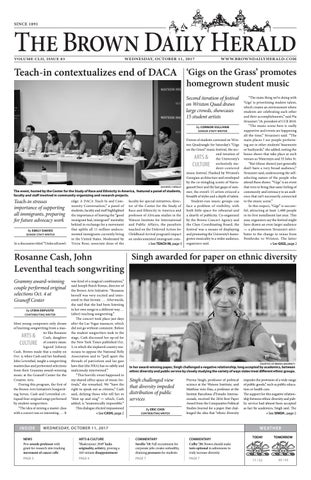
In her award-winning paper, Singh challenged a negative relationship, long accepted by academics, between ethnic diversity and public service by closely studying the variety of ways states treat different ethnic groups.
Singh challenged view that diversity impeded distribution of public services By ERIC CHOI CONTRIBUTING WRITER
Prerna Singh, professor of political science at the Watson Institute, and Matthias vom Hau, a professor at the Institut Barcelona d’Estudis Internacionals, received the 2016 Best Paper Award from the Comparative Political Studies Journal for a paper that challenged the idea that “ethnic diversity
impedes the provision of a wide range of public goods,” such as public education or health care. The support for this negative relationship between ethnic diversity and public service had almost been accepted as fact by academics, Singh said. The » See SINGH , page 2
WEATHER
WEDNESDAY, OC TOBER 11, 2017
NEWS Pew awards professor with grant for research into tracking movement of cancer cells
ARTS & CULTURE ‘Bladerunner 2049’ lacks originality, artistry, proving a 163-minute disappointment
COMMENTARY Savello ’18: Fall recruitment for corporate jobs creates unhealthy, draining pressures for students
COMMENTARY Colby ’20: Brown should make tests optional in admissions to truly increase diversity
PAGE 3
PAGE 4
PAGE 7
PAGE 7
TODAY
TOMORROW
71 / 52
63 / 43
NEWS
PAGE 2 • WEDNESDAY, OCTOBER 11, 2017
» CASH, from page 1 applause from the audience. “I was amazed that so many people knew (the op-ed and) had already read this piece. I mean, it just had happened the day before,” Rovan said. The program returned to the young songwriters — Jamie Atschinow ’20, Madeleine Olson ’18, local musician Anthony Savino and Northampton High School senior Galen Winsor — who performed their original songs and discussed them with Cash and Leventhal. These musicians are all students in a songwriting workshop taught by Julian Saporiti GS. Cash and Leventhal “were so kind to all of us and the feedback was super constructive,” Olson said. “I’m definitely going to use their comments to keep writing (my) song.” “I hadn’t performed an original song for anyone before the workshop.
THE BROWN DAILY HERALD
So to suddenly be singing it in front of a crazy talented, professional performer was pretty intimidating,” Atschinow said. After the workshop portion, Cash and Leventhal performed selections from their repertoire, including “Money Road,” “Etta’s Tune” and “The Sunken Lands.” Cash’s “lyrics are amazing. They’re full of really powerful, succinct details that immediately paint a picture,” Rovan remarked, adding that the masterclass and performance bolstered the initiative’s “goal of connecting across the campus and the community.” “It’s really exciting that the arts initiative is getting these kinds of people to perform here because it’s an amazingly intimate, small environment (in which) to hear this kind of music,” said Jeffrey Brock, an audience member and director of the Data Science Initiative.
» SINGH, from page 1 paper, entitled “Ethnicity in Time: Politics, History and the Relationship between Ethnic Diversity and Public Goods Provision,” presents an alternative argument. “I thought normatively this was just a problematic literature and such a problematic law,” she said. When Singh started working on her book “How Solidarity Works for Welfare: Subnationalism and Social Development in India,” she found positive relationships between ethnic diversity and literacy in regions of India. This spurred her to challenge the existing scholarship.
» GIGS, from page 1
Photo: Casey Kelbaugh
location “made it easier to come to the festival impulsively,” Struzzieri said. “We were really happy we got the event moved to Wriston Quad because in our eyes, it was a way to expose more people to the artists,” said Michael Mills ’20, who, alongside Babette Thomas ’20, was the Brown Concert Agency’s chair for this year’s “Gigs.” “The change was ultimately a positive one and we were pleased with the
Singh and Hau raised two points of contention against the earlier scholarship. The previous research ignored “the role of the state historically” and had a weak understanding of the relationship between ethnic diversity and public services. In the paper, Singh and Hau pointed out that the way states vary their treatment of different ethnic groups can affect the distribution of public goods. “These are historical patterns of nation-building that influence both how public services are provided (and) also levels of ethnic diversity,” Singh said. For example, Japan uses assimilation as a nation-building strategy to
increase access to public goods for different communities, Singh said. “We recognized right away that they were doing something distinct,” said David Samuels, a co-editor of the journal and professor of political science at the University of Minnesota. “Living in America, this is a really pressing issue for us here. How can we deal with diversity?” “I work pretty centrally on questions of nationalism … and ethnic politics, so it’s going to be something I continue working on,” Singh said. “One way or another, it’s going to come back to haunt me.”
turnout,” Mills added. “BCA helped CCB judge auditions and create an exciting lineup,” Mills said. “The concert agency also helped bring in judges from the local music community and made sure the event ran as smoothly as possible the day of.” The festival featured artists across the musical spectrum, from the indie-rock outfit Attic Wood to the neo-soul collective KiwiiSour to rapper Express. According to Mills, the decision to exhibit artists representative of a variety of genres was
a conscious one. “It was definitely something we kept in mind during auditions,” Mills said. “It was really great to see representation from groups comprising people of color, as well as from different genres like funk and hip-hop,” said Nicholas Fah-Sang ’20. “There’s very little to be gained from the kind of cut-and-dry indie rock acts that are prominent on college campuses, so it was cool to see artists like DIASPORA and Express challenging that dominance.”
MA and PhD in Decorative Arts, Design History, Material Culture Students at Bard Graduate Center in New York City study the cultural history of the material world from the arts of antiquity to the twenty-first century. Learn more at one of our fall open houses.
Address 38 West 86th Street, NYC
Open Houses October 15, 11 am October 29, 11 am November 6, 6 pm
For more information admissions@bgc.bard.edu bgc.bard.edu/admissions
TIMOTHY MUELLER-HARDER
Student bands like Now Hiring (pictured above) emerged from their usual basements and took to the sunny Wriston Quad for the afternoon during Saturday’s “Gigs on the Grass.”
NEWS
WEDNESDAY, OCTOBER 11, 2017 • PAGE 3
THE BROWN DAILY HERALD
U. professor to track cancer cells with grant from Pew Research Center Interdisciplinary project aims to track progression of cancer cells to prevent metastasis BY KENDRICK TAN CONTRIBUTING WRITER
Funded by a grant from the Pew Research Center, Gilad Barnea, associate professor of neuroscience, will partner with Ben Stanger, associate professor of medicine at Penn, in an attempt to utilize specialized methods for tracking substances between nerve cells to study how cancer cells move. The two scientists aim to develop an effective way to track the movement of cancer cells and ultimately discover how and when tumors spread. The National Institutes of Health estimates that 90 percent of cancer deaths occur due to metastasis, or the spreading of cancer cells. But very little is known about the nature of their movement, as well as the reasons for why and where they move. “Metastasis is hard to study because it’s hard to see when the cell actually moves. It could happen at any point in time, which creates a black box scenario where we don’t really know what happens when a cell moves from its primary site to metastasis,” Stanger said. Barnea has devoted many years of his life to developing a method that tracks and labels neural circuits through the synapses. Both scientists saw that Barnea’s research, though focused on movement within the nervous system, could have potential applications in studying the nature
of metastasis. “The method that (my team) developed, when stripped down from the specifics of the nervous system, could be a helpful tool in allowing us to study cancer,” Barnea said. Barnea and Stanger learned about each other’s scientific interests and pursuits through the annual meetings that the Pew Research Center organizes for the members of the Pew Scholars Program. Their current project is supported by the Pew Innovation Fund. This round of awards is the first of its kind and targets alums of other Pew awards and grants. Barnea and Stanger are both former awardees of the Pew Scholars Program in the biomedical sciences, which provides four years of funding to young outstanding assistant professors, supporting their independent research and jumpstarting their careers. During the four years, award recipients attend annual meetings as part of the program’s community-building initiative. “These meetings bring together researchers that normally wouldn’t interact because of the many diverse research fields represented,” said Kara Coleman, project director of biomedical programs at the Pew Charitable Trusts. “Researchers are exposed to all different types of research, questions, perspectives and ideas from people outside their fields, which has led to many collaborations between individuals who find complementary ideas, even if they’re studying completely different things.” One of the goals of the Pew 2017 Innovation Grant was to encourage and reward interdisciplinary ideas that had potentially unique medical applications. “Ideally, we look for two
individuals with distinct areas of expertise that don’t really overlap and with an idea that, when put together, can tackle a project no individual lab can do alone,” Coleman said. The grant also targets ideas that are not yet off the ground and which lack other sources of funding because there is not enough evidence to support their potential. Stanger mentioned that the theoretical application of Barnea’s research is simple: “We can use the same toolbox that was developed in Barnea’s research and get tumor cells to mark all the cells that they are in touch with as they metastasize.” That could indicate how cancer cells move through the body, he added. While it may be too early to project the success of this research, both scientists envision many applications. “Assuming that things go well, our research may allow us to intervene medically in the future, with possible therapeutic impact,” Barnea said. “Nevertheless, our research will hopefully deepen our understanding of different aspects of cancer and cancer movement.” Coleman said that Barnea and Stanger’s proposal exemplifies the raw interdisciplinary thinking that the Innovation Fund saw as a possibly impactful project. “This project is one of those things that, if it works, could be completely revolutionary, and that’s exactly the kind of thing that this program is trying to promote,” she added. The grant’s purpose highlights the importance of interdisciplinary research in science. “I’ve seen first-hand how interdisciplinary science can be very valuable,
GUS REED / HERALD
Provost Richard Locke P’18 opened the teach-in with remarks that reiterated the University’s support for its undocumented community. Students were also able to ask panelists questions about the program’s future.
» TEACH IN, from page 1 munities, the uncertainty emerging from its revocation and the activism that influences laws and public opinion. “I remember very clearly being a freshman in high school and not thinking that I was going to go to college — not thinking that was ever a possibility for me, so why try?” said John Lopez-Aldas ’18.5, an undocumented student. Lopez-Aldas was 16 years old
when DACA came out, and its existence gave him the confidence to excel in community college and transfer to Brown, he said. But Lopez-Aldas emphasized that DACA also has adversely affected perception of immigrants. “While DACA allowed for positive change in the lives of many people such as myself, it also further ostracized people who did not qualify for it or were not otherwise able to access it,” he said. Renata Mauriz ’17.5 expanded on
Lopez-Aldas’s assertion, explaining that many public policy advocates rely on categorizing immigrants into positive and negative groups in order to push forward legislation such as the DREAM Act and DACA. “We see mostly advocates in D.C. pushing for the same binary by putting (a Dreamer) as this exceptionally good immigrant who is very ingrained in a national American identity, who has assimilated to the United States, who has no criminal record, who (is American) except for
COURTESY OF BROWN UNIVERSITY
The grant Barnea, pictured, and Stanger received aims to reward innovative science research proposals. They hope to create a method to track tumors. specifically the applications of my postdoctoral work in development biology to my current work in cancer biology,” Stanger said. “While I’ve never done research that spans as great a distance as cancer biology and neuroscience, it is exciting and very cool to think about all the potential work that can be done.”
“The model that I developed in my own research stems from my own unique way of interdisciplinary thinking and expertise,” Barnea said. “The great part about interdisciplinary research is that if you combine two different (areas of) expertise, you are likely to create something that is unique to you.”
the papers,” she said. Mauriz said she understands this classification may at times be politically necessary, but that the time has come to harness the positive association with Dreamers to fight on behalf of all immigrants. “It is not possible under Trump to pass legislation for the 11 million — I’m just being real,” she said. But she added that Dreamers could use their platform to advocate for other immigrants, too. Assistant Professor of American Studies Monica Martinez provided context for Lopez and Mauriz’s discussion of immigrant mobilization and perception. She told the history of push-and-pull migration that created today’s undocumented immigration from Mexico. The historical progression she highlighted included the transition from the United States’ active recruitment of Mexican workers to mass deportation to collaboration between the two countries to the era of undocumented immigration, which culminated with our present state. Assistant Professor of American Studies Kevin Escudero complemented Martinez’s presentation with an overview of the policy activity that led to the DREAM Act, DACA and DACA’s recent rollback. In his oration of this history, Escudero pointed to the importance of inclusivity in advocacy. “The framing of this movement as something that is not for a select few but is for a larger community is really important,” he said.
Assistant Professor of Education Andrea Flores supported the call for a comprehensive movement with a narrative about a protest she attended with Latinx youth in Nashville, Tenn. She ended her remarks with an iteration of a speech from the protest. “I am somebody, and I deserve full equality. Right here, right now. My mother is somebody, she deserves full equality. Right here, right now. My father is somebody, he deserves full equality. Right here, right now,” she said. Panelists also addressed the University’s role in supporting undocumented and DACA students. First-Generation and Low Income Student Center Program Director Julio Reyes ’12 emphasized the mental health challenges that come from the uncertainty of one’s legal status. He expressed the importance of increased financial aid, funding for DACA renewals and a shift in admissions policy, among others. Provost Richard Locke P’18, who opened the discussion, affirmed the University’s commitment to all of its students, regardless of documentation status. “This is a moment where we have to walk the talk and based on our values, make sure we do everything we can to protect our students,” he said. Alexis Roman ’21 told The Herald he was glad he spent his Tuesday evening at Watson. “I’m glad that I’m now equipped with more language to talk about DACA,” he said. “That’s exactly what I wanted.”
ARTS & CULTURE PAGE 4 • WEDNESDAY, OCTOBER 11, 2017
THE BROWN DAILY HERALD
Lengthy ‘Blade Runner 2049’ fails to live up to prestigious original Villeneuve disappoints viewers, fails to impart meaning, artistry of originality into new film By ZACHARY BARNES STAFF WRITER
“Blade Runner 2049” is, first and foremost, a cash grab. That does not mean that it’s a bad movie — it simply means that the film’s raison d’etre is something to overcome as opposed to something to live up to. And “Blade Runner 2049” tries very hard to overcome, with a visual style and deliberate pace that at least suggest a film of serious artistic intention. But it never quite comes up with a satisfying answer to the question, “Why am I not watching ‘Blade Runner’ right now?” Maybe that’s unfair, but the film invites the comparison, conceived as a sequel to Ridley Scott’s 1982 masterpiece. Theoretically, “Blade Runner 2049” deserves to be taken on its own terms, but try and watch it without thinking of — and pining for — the original. “Blade Runner 2049” picks up 30 years after the events of the first film. The Tyrell Corporation has gone bankrupt and has been co-opted by the
Wallace Corporation, which itself has gotten into the replicant game. Some of Tyrell’s old replicants, or bioengineered androids, are still around — the Nexus 8S models, specifically — and these replicants are being retired, i.e. executed, by government agents known as Blade Runners. The film opens on a blade runner, a replicant known as K (Ryan Gosling), tracking down Sapper Morton (Dave Bautista), a rogue Nexus 8S. K travels over depleted landscapes in his flying car — a Peugeot, in a surprising bit of product placement — before landing at an isolated farm where he finds his target. Morton resists retirement, to put it gently, and director Denis Villeneuve shoots the ensuing fight with a bracing physicality. But more important is the box K finds buried beneath a tree outside the house. Upon forensic investigation, the box’s contents are revealed to be the bones of a replicant woman who seems to have given birth. This possibility — a procreating replicant and
the existence of the resulting child — drives the rest of the film. After K completes his mission, he returns to Los Angeles, and the film reveals its vision of the city Scott rendered so strikingly in “Blade Runner.” On all counts, Villeneuve’s version suffers from the comparison. Whereas Scott’s Los Angeles was a marvel of visual texture, a crowded, gritty urban jungle bathed in neon light and constant rain, Villeneuve’s is cold, clean and anonymous — it looks like countless other futuristic cities we’ve seen on screen. Back at K’s apartment, we meet Joi, K’s holographic girlfriend, or servant, or something. Whatever her role is, it’s one of subservience and mindless devotion, and it’s a letdown. In the original film, Deckard — Harrison Ford’s character — had a strange, disturbing relationship with a female replicant, Rachael, in which romance and abuse uneasily commingled. K and Joi’s relationship is fraught with no such complications, and the film never bothers to interrogate or develop it — instead content to make an Oscar play for “Most Interminable Sex Scene of the Year.” Also, without giving
too much away, “Blade Runner 2049” interprets Deckard and Rachael’s relationship in the least interesting way possible, erasing its complications in order to serve the demands of the plot. Other characters soon emerge, including Lieutenant Joshi (Robin Wright), K’s boss at the Los Angeles Police Department and Niander Wallace (Jared Leto), head of the Wallace Corporation. Wallace, who seems to speak only in vaguely biblical expressions, is dissatisfied with the pace of replicant production at his company and sees the replicant child as a potential solution to his problem. He sends Luv (Sylvia Hoeks), his servant and a replicant herself, to find the child. K’s mission, given to him by Lieutenant Joshi, is to destroy the child. Joshi believes the separation between kinds must be maintained, and such a creature threatens that order. Eventually, this mission takes K to Rick Deckard, the former Blade Runner who left the force and ran away with Rachael 30 years ago. Now, he’s living alone in a Las Vegas high-rise. Ford is game as ever, unexpectedly touching but equipped with a powerful snarl. And cinematographer Roger Deakins,
likely to receive his 14th Oscar nomination for this film, conjures some breathtaking images in the empty, orange-hued Las Vegas. As for Gosling, he’s good when the film lets him be, but his role is essentially that of a hot, brooding Pinocchio, and it can only sustain our interest for so long. The film takes familiar questions of humanity, inhumanity and the fine line between the two as its thematic focus, and, though thoughtprovoking, it has little new to say and never feels as profoundly alive as the original “Blade Runner” still does. “Blade Runner 2049,” clocking in at a hefty two hours and 43 minutes, ultimately comes off as a one hundred minute movie stretched beyond its means and turned into a turgid pseudo-epic. What could have been a spare, thoughtful film is instead a ponderous, philosophizing and fitfully-entertaining slog. As Villeneuve struggles to impart meaning and grandeur to his film, and the plot begins to pile up before him, it becomes clearer and clearer that “2049” just doesn’t have the electric, artful genius of “Blade Runner.” But then again, what does?
Housing for 2018 - 2019
2-, 3-, 4- and 5- bedroom apartments.
Combinations in same buildings for 6-, 7-, 8-, 9-, 10- and 13- bedrooms.
Close to campus. Laundry and parking. Call Peter at (401) 575-9981
Got something to say? Leave a comment online! Visit www.browndailyherald.com to comment on opinion and editorial content.
TODAY
WEDNESDAY, OCTOBER 11, 2017 • PAGE 5
THE BROWN DAILY HERALD
‘this is my good angle’ - list art center
menu SATELLITE DINING ANDREWS COMMONS
Pizza: Spicy Sausage and Garlic, Assorted Roasted Mushroom Poke Bowl JOSIAH’S
BLUE ROOM
Chicken Alfredo Bowl, Mushroom Swiss Burger
Grain Bowl, Beef Chili with Beans, Bread Bowl
DINING HALLS SHARPE REFECTORY LUNCH
DINNER
Cream of Broccoli Soup, Steamed Green Beans, Arroz con Pollo, Snickerdoodle Cookies
Anadama Bread, Thai Red Curry Chicken, Curried Carrots, Washington Apple Cakes
VERNEY-WOOLLEY LUNCH
DINNER
Habanero Salsa, Linguine with Tomato Basil, Steak Fries, Snickerdoodle Cookies
Six Bean Soup, Ancho Chili Pulled Pork, Cacciatore Pasta, Chile Verde Enchiladas
sudoku
R
AS
DA
A
S
c r o s s w o rD d
C
Edited by Rich Norris and Joyce Nichols Lewis
ACROSS 1 Installment in a modern series 9 Thing to be cracked 15 Loge 16 Purchase provider 17 Olympic winner 18 Hero with a memorable yell 19 Bird that dines on stingers 20 Bug 21 PC debut of 1981 23 Leans 24 Truffles, e.g. 28 Unit in una zona residencial 30 Most suitable for service 31 In danger of snapping 37 “Whatever” 39 1959 Cornelius Ryan best-seller about the Normandy invasion, with “The” 40 Its Nasdaq symbol is CAR 41 Keister 42 Prepare for a game, as Jenga blocks 43 They may generate interest: Abbr. 46 38-Down option 50 “Hysterical” 52 On balance 57 God wed to his sister 58 Rather wicked 59 Say 60 Not barred 61 Good guys? 62 Many characters on “The L Word” DOWN 1 Place of development 2 It has about a 35inch blade 3 Saint who wrote the earliest history of England
4 Requiem Mass hymn word 5 Sub base? 6 Bye lines? 7 Did a nurse’s job 8 Version’s beginning? 9 One of U.S. banking’s Big Four 10 “It’s hard to tell” 11 Longhaired pet 12 Nut-producing tree 13 Like some change 14 Uses Zipcar, say 22 Milan’s La __ 24 Keep from happening 25 Wreck 26 Light element 27 “Straight Outta Compton” genre 29 She has your back 31 __ Major 32 Modern entertainment 33 Maleficent 34 Vena __ 35 “Fast Food Nation” author Schlosser
36 Work area 38 Top choice 42 Apparel for the slopes 43 Now, in Nogales 44 Checked out badly? 45 Ring 47 Seven-time French Open winner
ANSW R
O
48 Fail to say 49 Simoleons 51 Petitions 53 Answer from the unwilling 54 Medicine Hat’s prov. 55 Homeowner’s burden 56 Some TV screens
R
O S
GUS REED / HERALD
Vibrant sunshine cuts across the facade of the List Art Center, highlighting the structure’s sharp architecture. The List Art Center houses lecture halls, classrooms and a rotating selection of unique artwork.
Q U O T E O F T H E D AY
“The main places I see people performing are in other students’ basements or backyards.” — Pia Struzzieri ’18, president of the 2018 Class Coordinating Board
See gigs on page 1.
calendar TODAY OCTOBER MARCH
By Julian Lim (c)2013 Tribune Media Services, Inc.
S
M
T
W
Th
F
S
1
2
3
14
52
63
74
85
96
10 7
11 8
12 9
10 13
11 14
12 15
13 16
14 17
15 18
16 19
17 20
18 21
19 22
20 23
21 24
22 25
23 26
24 27
25 28
26 29
27 30
28 31
29
30
31
Flu Clinic for Students 9:00 A.M. The Underground
Coming OUT Day on the Main Green! 11:00 A.M. LGBTQ Center, 321
Restorative Yoga 12:00 P.M. 200 Dyer Street, 101
Environmental Justice on the Hill 7:00 P.M. BCSC, Formal Lounge 1
TOMORROW The Legacy of Henrietta Lacks 12:00 P.M. Warren Alpert Medical School
Workshop: Pa’lo Monte 1:00 P.M. Grant Recital Hall
Brown in Washington Program Info Session 5:00 P.M. Watson Institute, Kim Koo Library
Negotiate...Like a Boss! 6:00 P.M. CareerLab, First Floor
COMMENTARY PAGE 6 • WEDNESDAY, OCTOBER 11, 2017
THE BROWN DAILY HERALD
editorial car toon
A L E X W E ST FA L L
Find us online! facebook.com/browndailyherald
browndailyherald.com
@the_herald
Location: 195 Angell St., Providence, R.I. www.browndailyherald.com
@browndailyherald
youtube.com/browndailyherald
Editorial Leadership
Sections
Multimedia & Production
Business
Editor-in-Chief Lauren Aratani
Arts & Culture Editors Ethel Renia Madison Rivlin
Design Editors Christy Leung Ameer Malik Jessica Yu Assistant: Eduard Muñoz-Suñé
General Managers Henry Ritter Ben Wesner
Managing Editors Matt Brownsword Rebecca Ellis Kate Talerico POST- MAGAZINE Editor Saanya Jain BLOGDAILYHERALD Editor Angelica Cotto
Metro Editor Gwen Everett News Editors Isabel Gensler Alex Skidmore Hattie Xu Science & Research Editor Elena Renken Sports Editors Ben Shumate Nicholas Wey COMMENTARY Opinions Editors Connor Cardoso Anuj Krishnamurthy Mili Mitra
Photo Editors Head: Marianna McMurdock Assistant: Lilly Nguyen Gus Reed Sara Runkel Anita Sheih Copy Desk Chief Abby Borges Multimedia Editor Roland High
Directors Sales: Erin Lueck Sales: Matilda Lynton Finance: Reena Zhan Strategy: William Nober Strategy: Caroline Ziegler Managers Sales: Michael Borello Sales: Elizabeth Doykan Sales: Ariel Shusterman Collections: Ravi Betzig
Editorial contact: 401-351-3372 herald@browndailyherald.com
Business contact: 401-351-3260 gm@browndailyherald.com
Submissions: The Brown Daily Herald publishes submissions in the form of op-eds and letters to the editor. Op-eds are typically between 750 and 1000 words, though we will consider submissions between 500 and 1200 words. Letters to the editor should be around 250 words. While letters to the editor respond to an article or column that has appeared in The Herald, op-eds usually prompt new discussions on campus or frame new arguments about current discourse. All submissions to The Herald cannot have been previously published elsewhere (in print or online — including personal blogs and social media), and they must be exclusive to The Herald. Submissions must include no more than two individual authors. If there are more than two original authors, The Herald can acknowledge the authors in a statement at the end of the letter or op-ed, but the byline can only include up to two names. The Herald will not publish submissions authored by groups. The Herald does not publish anonymous submissions. If you feel your circumstances prevent you from submitting an op-ed or letter with your name, please email herald@browndailyherald.com to explain your situation. You can submit op-eds to opinions@browndailyherald.com and letters to letters@browndailyherald.com. When you email your submission, please include (1) your full name, (2) an evening or mobile phone number in case your submission is chosen for publication and (3) any affiliation with Brown University or any institution or organization relevant to the content of your submission. Please send in submissions at least 24 hours in advance of your desired publication date. The Herald only publishes submissions while it is in print. The Herald reserves the right to edit all submissions. If your piece is considered for publication, an editor will contact you to discuss potential changes to your submission. Commentary: The editorial is the majority opinion of the editorial page board of The Brown Daily Herald. The editorial viewpoint does not necessarily reflect the views of The Brown Daily Herald, Inc. Columns, letters and comics reflect the opinions of their authors only. Corrections: The Brown Daily Herald is committed to providing the Brown University community with the most accurate information possible. Corrections may be submitted up to seven calendar days after publication.
Illustrations Editor Pia Mileaf-Patel
Advertising: The Brown Daily Herald, Inc. reserves the right to accept or decline any advertisement at its discretion.
Graphics Editor Laura Felenstein
The Brown Daily Herald, Inc. is a financially independent, nonprofit media organization bringing you The Brown Daily Herald, BlogDailyHerald and Post- Magazine. The Brown Daily Herald has served the Brown University community daily since 1891. It is published Monday through Friday during the academic year, excluding vacations, once during Commencement and once during Orientation by The Brown Daily Herald, Inc. Single copy free for each member of the community. Subscription prices: $200 one year daily, $100 one semester daily.
Directors of Web Development Eli White Ivy Wong
Copyright 2017 by The Brown Daily Herald, Inc. All rights reserved. Periodicals postage paid at Providence, R.I. Postmaster: Please send corrections to P.O. Box 2538, Providence, RI 02906.
COMMENTARY WEDNESDAY, OCTOBER 11, 2017 • PAGE 7
THE BROWN DAILY HERALD
Thinking past fall recruitment SAMANTHA SAVELLO staff columnist
As the fall semester heats up, it has become common to see students running to interviews in formal attire, practicing consulting cases in the basement of the Sciences Library and attending various recruitment events on campus. We all know what this means: Job recruiting is in full swing — and for many fields, it has started this year earlier than ever. Over the years, companies have increasingly intensified campus recruiting efforts. Consulting, finance and technology companies begin recruiting in the fall, subjecting interested students to a rigorous and lengthy application process as early as September. And companies in other fields tend to recruit more heavily in the spring, but many release early applications in the fall, urging students to send in resumes months before they expect to begin work. Given that cover letter writing and interview preparation can take hours upon hours each week, applying to jobs during the semester is a demanding
process comparable to an extra class. This often forces students to sacrifice their senior year experience and forgo other campus opportunities. Many students understand this and see it as a worthy trade-off. But corporate recruiting — with all its financial, social and family pressures — puts too much pressure on students, who may not even find passion in these jobs anyhow. Why is there so much pressure in the first place? For a start, some stu-
is high, securing early career plans is often seen as a sign that a person is responsible and successful, while planning late is generally associated with failure or lack of ambition. There is also the perception that some jobs, such as those in consulting, finance and computer science, are more prestigious than others. While Brown’s student body places more emphasis on creativity and job satisfaction than students at other schools, this attitude is still widespread.
of commentary is stereotypical and unwarranted, but many students unfortunately face similar comments, propagating even more career anxiety. Ultimately, this harmful societal notion creates a rigid dichotomy between success and failure and places unnecessary pressure on students to enter certain fields that happen to recruit early. It also creates unnecessary competition. Under the current system, thousands of students apply to the same few
Ultimately, this harmful societal notion creates a rigid dichotomy between success and failure and places unnecessary pressure on students to enter certain fields that happen to recruit early. dents face financial obligations. Many of us, myself included, will leave Brown strapped down with thousands of dollars of student loans, and, as a result, feel an urgency to secure a comfortable salary before the year ends. But another, more avoidable reason for the growing obsession with corporate recruiting is status. At Ivy League schools, where the pressure to succeed
Finally, family pressure is a real, if unacknowledged, factor in our shifting career priorities. I speak from experience: I can’t describe how many times I have been to a family barbecue and had a relative say, “You go to Brown, so I guess you’ll be buying me dinner pretty soon.” Meanwhile, my parents relentlessly tell me, “All that tuition money better start paying off soon.” This type
positions in coveted fields, pitting them against each other to avoid the insidious concept of “falling behind.” In some ways, this very competition pressures students further because it perpetuates the idea that jobs are scarce and will get filled early. In reality, students can find hundreds of opportunities if they expand their job search outside of the most popular industries.
Of course, it is worth acknowledging that Brown students are more likely to go into careers in nonprofits or pursue other nontraditional fields than students from many of our peer schools. At the same time, far too many students are unaware of the opportunities that lie outside popular career paths. Jobs in communications and media, for example, recruit more heavily in the spring or hire on a rolling basis, yet many students don’t realize this. And this is precisely where Brown can step in. Though promoting fall recruitment for those who are genuinely interested in these careers is important, Brown should also work toward building more awareness about alternative jobs and recruiting cycles. CareerLAB has dedicated considerable attention to promoting nonprofit careers, but more can be done to shed light on other sectors and career paths. At the end of the day, it’s crucial that students dedicate their time toward opportunities that bring them fulfillment, rather than pursuing only a few select fields based on external pressure and imperfect information.
Samantha Savello ’18 can be reached at samantha_savello@brown.edu.
It’s time for Brown to go test-optional OWEN COLBY staff columnist
Brown’s early decision application deadline is fast approaching, with many applicants rushing to submit their SAT and ACT scores. These students are applying in the shadow of Brown Promise, the University’s multi-billion dollar effort to promote diversity and access to a Brown education. However, meaningful improvements to the diversity of Brown’s student body can’t happen with extra funding for financial aid alone. That is, as I and my fellow columnists Quentin Thomas ’21 and Lena Renshaw ’20 have pointed out in the past few weeks, the complicated mission of building a more diverse Brown requires an integrated approach. As such, any serious program of reform must address the systemic inequities faced both by applicants and current students, who must deal with student loans after graduation. Right now, Brown’s continued use of regressive admissions practices, like legacy admissions, inadvertently undercuts its stated goals of diversity. But another regressive practice worth scrutinizing that hasn’t received as much attention is Brown’s use of standardized test scores to evaluate applicants. Standardized tests have long been a staple of Brown’s admissions process; the University suggests applicants take not only the SAT or ACT but also two additional SAT Subject Tests. These standardized exams subvert Brown’s goals of socioeconomic, racial and intellectual diversity on campus, in part by imposing undue burdens on low-income applicants. As such, Brown should seriously reevaluate its use of standardized tests — especially as it pushes to bolster its accessibility to underrepresented students — and go test-optional. The University has already taken some steps to remedy this. Starting with the Class of 2021, applicants no longer need to submit the essay portion of the SAT or
ACT. Measures like these can help low-income students, but Brown needs to do more. In recent years, the University has prioritized diversity in its admissions policies and its development of new programs to help students acclimate to campus life. The administration has recognized that diversity is important for countless reasons — including the fact that diversity enhances the Brown experience by bringing people from different backgrounds together to collaborate and exchange knowledge. Thus far, Brown has devoted more resources to minorities, low-income and first generation students: Last fall, the University opened the First-Generation and Low-Income Student Center in the Sciences Library, and last spring, it moved to waive application fees for low-in-
poll, 42.3 percent of students with no financial aid used professional test tutors, compared to only 14.3 percent of students receiving some grants, and 4 percent of students receiving full aid. Multiple studies have concluded that test preparation has a positive effect on standardized test outcomes. One case study of 21 students compared their performance before and after test preparation and saw 12 students earn “SAT-Math scores that were 70 or more points higher… four increased their scores by 100120 points, and one jumped a whopping 160 points.” But these score improvements are, by and large, concentrated among those who can afford expensive test preparation. SAT preparation materials generally are beyond the reach of poor families: practice books are expensive,
The complicated mission of building a more diverse Brown requires an integrated approach ... any serious program of reform must address the systemic inequities faced both by applicants and current students, who must deal with student loans after graduation. come students. Still, these actions cannot fully help Brown compensate for its discriminatory past and achieve its long-term diversity goals so long as the University employs standardized testing in admissions. As Anthony Carnevale, director of the Georgetown University Center on Education and the Workforce, told the Herald in 2012, “I don’t think (need-blind admission does) any good. Because in the end, it’s the distribution of test scores. You can go need-blind, but if everyone’s got a 1200 SAT, you’re not going to get any low-income kids.” As I’ve written about before, standardized tests unfairly advantage privileged applicants who have the means to afford test preparation tutors and courses. According to a 2016 Herald
Kaplan’s most popular SAT Prep Course costs $899 and private tutoring can easily cost thousands of dollars. The discriminatory effects of standardized tests — which essentially reward wealthier students at the expense of others — may provide one explanation for why over 19 percent of Brown students come from the top 1 percent of the income scale, while only 18.2 percent come from the bottom 60 percent of the income scale. It has been argued that without standardized tests, there is no broad, objective metric that admissions officers can use to easily compare students. This notion ignores the plethora of evidence that already proves that standardized test scores are not an objective met-
ric. Universities that have decreased the weight they place on applicants’ test scores, like Wesleyan University, have found that standardized tests are a poor indicator of college academic success, and that they are better able to attract a “more racially and socio-economically diverse pool of candidates.” It is also worth pushing back against the idea that standardized tests meaningfully measure applicants’ abilities. The use of test scores places a normative value on the ability to test well, and thus the rote analytical skills that come with standardized testtaking. Test scores reward just one type of intelligence, while neglecting all other ways of thinking — which may, in the long run, hinder the diversity of thought and creativity on campus. Moreover, a gradual shift to a test-optional admissions policy does not mean Brown must abolish the use of tests entirely; they may still prove useful when comparing students from similar academic, racial, geographic and economic backgrounds. Many universities have already taken note of the inherently discriminatory nature of the SAT and vowed to apply the test in more equitable ways. Pitzer College, Bowdoin College and Wesleyan all have similar acceptance rates to Brown and are all test-optional. The use of standardized tests does not need to be the norm — there are already over 950 accredited colleges and universities that employ “test optional,” “test flexible” policies or otherwise deemphasize the importance of standardized test scores. These reforms would certainly align with the goals of the University’s BrownTogether and Brown Promise campaigns, which aim to promote a more diverse student body. Ultimately, if Brown really cares about diversity of class, race and thought on campus, it ought to become test-optional as part of a more integrated approach to equity in admissions.
Owen Colby ’20 can be reached at owen_colby@brown.edu.
ARTS & CULTURE THE BROWN DAILY HERALD
WEDNESDAY, OCTOBER 11, 2017
‘American Made’ fitting title for peripheral, historical film DANIEL WAYLAND arts & culture critic “American Made” has a story to tell. It’s quite a story — so long as you don’t ask too many questions and you’re game to laugh your way through its gamboling plot. The film stars Tom Cruise as Barry Seal, a Trans World Airlines pilot who becomes embroiled in the early stage drug war politics of the Iran-contra affair. Initially tapped by the CIA to run airborne reconnaissance over Central America, Seal quickly allows his business acumen — or greed, take your pick — to co-opt his patriotism. Before long, Seal finds himself entangled
in a web spun by the Medellín cartel, the Nicaraguan Contras and even the White House. The story is more than a little surreal, but “American Made” wants you to know that it is in on the joke. Director Doug Liman’s father, Arthur, served as chief counsel to the Senate in its investigation of the Iran-Contra Affair. Liman lived through the scandal, but he seems wholly uninterested in making the kind of conspiratorial thriller that has typically memorialized the post-Watergate era. It’s more “Wolf of Wall Street” than “Three Days of the Condor.” Buoyed by Cruise’s effervescent smile and charming roguishness, Liman’s protagonist offers an affable and wonky lens through which to view an otherwise serious and bloody
international affair. Barry Seal moves between his various worlds like a clueless Danny Ocean, with the United States’ Central American interventions offering a profitable stage for his farcical caper. “American Made” largely turns a blind eye to corruption when dealing with both the Colombian drug lords and intelligence bureaucrats. Indeed, the film appears more concerned with the trappings of wealth and hedonism than it is with political cynicism. Barry Seal makes such a wild profit running drugs and guns that he can’t launder the money flooding into his Arkansas home fast enough. He uses closets, drawers, backyard pits and even the entire vault in his town’s lone bank for storage, but even those are not enough. Once a symbol of his financial
freedom and daring spirit, Seal’s money becomes a crushing weight, haunting him at every turn. Otherwise, “American Made” asks you not to dig too deep. The film offers sparing details regarding the political nature of the scandal. When it indulges in history, it does so through Schoolhouse Rock-style animated vignettes backed by Cruise’s silly narration. Illegality offers a particularly productive site for comedy, as plane crashes caused by cocaine consumption and government drug raids receive an absurdist treatment when seen through Cruise’s permanently wide eyes. “American Made” aims for laughs over serious reflection, but it also evokes nostalgia. Cinematographer César Charlone’s camera adopts a faded and grainy cinematic quality that feels
like memory — unfocused, erratic and ephemeral. It suggests an era during which U.S clandestine operations were more ad hoc and campy and thus prone to individual ‘entrepreneurial’ exploits. It’s not dissimilar to the appeal of a Bond flick, minus the gadgets and Tory politicking. The lone man operating covertly on the world stage, particularly one that allows for reckless improvisation and self-governance, is a relic. It’s also an attractive relic for modern audiences. A more serious movie would have dispensed with such sentimentality and wish fulfillment. A more serious movie also wouldn’t have been as fun. When Cruise or Connery winks at you after cheating death once again, it’s an alluring reminder that life is just a game in the right hands. Aren’t moments like that the reason we go to the movies?