SINCE 1891
THE BROWN DAILY HERALD WEDNESDAY, MARCH 1, 2017
VOLUME CLII, ISSUE 24
WWW.BROWNDAILYHERALD.COM
U. study finds discrepancy in standard blood glucose test Study contextualizes past inaccuracies, finds tests may produce different results for different races By JACKSON WELLS CONTRIBUTING WRITER
COURTESY OF MATT STEINBERG
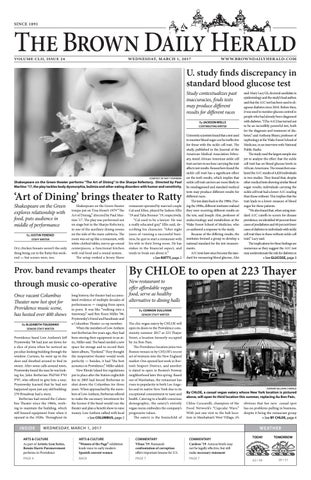
Shakespeare on the Green theater performs “The Art of Dining” in the Sharpe Refectory. Directed by Paul Martino ’17, the play tackles body dysmorphia, bulimia and other eating disorders with humor and sensitivity.
‘Art of Dining’ brings theater to Ratty Shakespeare on the Green explores relationship with food, puts audience in middle of performance By JUSTIN FERENZI STAFF WRITER
Dry chicken breasts weren’t the only thing being cut in the Ratty this weekend — but scenes were, too.
Shakespeare on the Green theater troupe put on Tina Howe’s 1979 “The Art of Dining,” directed by Paul Martino ’17. The play was performed not on stage but in the Sharpe Refectory, in one of the auxiliary dining rooms on the side of the main cafeteria. The room was set up like a restaurant, with white-clothed tables, merry-go-round centerpieces, a functional kitchen with real food and a sound system. The setup evoked a Jersey Shore
Prov. band revamps theater through music co-operative Once vacant Columbus Theater now hot spot for Providence music scene, has hosted over 400 shows By ELIZABETH TOLEDANO SENIOR STAFF WRITER
Providence band Low Anthem’s Jeff Prystowsky ’06 had just sat down for a slice of pizza when he noticed an peculiar-looking building through the window. Curious, he went up to the door and sleuthed around to find its owner. After some calls around town, Prystowsky found the man he was looking for, John Berberian PhD’68 P’93 P’97, who offered to give him a tour. Prystowsky learned that he had not happened upon just any old building: 270 Broadway had a story. Berberian had owned the Columbus Theater since the 1960s, working to maintain the building, which still housed equipment from when it opened in the 1920s. Throughout its
INSIDE
long history, the theater had accumulated evidence of multiple decades of performances — ranging from opera to porn. It was like “walking into a timewarp,” said Ben Knox Miller ’06, Prystowsky’s friend and bandmate and a Columbus Theater co-op member. When the members of Low Anthem met Berberian five years ago, they had been storing their equipment in an attic, Miller said. The band needed a new space for storage and to record their latest album, “Eyeland.” They thought the inoperative theater would work perfectly — besides, it had “the best acoustics in Providence,” Miller added. New Rhode Island fire regulations put in place after the Station nightclub fire in 2003 had forced Berberian to shut down the Columbus for three years. When approached by the members of Low Anthem, Berberian offered to make the necessary investment for the license if the band would run the theater and plan a benefit show to raise money. Low Anthem rallied with local » See COLUMBUS, page 2
restaurant operated by married couple Cal and Ellen, played by Judson Ellis ’19 and Talia Brenner ’19, respectively. “Cal used to be a lawyer. He was a really educated guy,” Ellis said, describing his character. “After eight years of running a successful business, he quit to start a restaurant with his wife in their living room. He has stakes in the financial aspect, and tends to freak out about it.” » See RATTY, page 2
University scientists found that a test used to monitor blood sugar can be ineffective for those with the sickle cell trait. The study, published in the Journal of the American Medical Association February, tested African American sickle cell trait carriers to see how carrying the trait affects test results. Researchers found the sickle cell trait has a significant effect on the test’s results, which implies that sickle cell trait carriers are more likely to be misdiagnosed and standard medical tests may produce different results for different races. The test dates back to the 1980s. During the 1990s, different institutes realized they were receiving different results on the test, said Joseph Aloi, professor of endocrinology and metabolism at the Wake Forest School of Medicine, who co-authored a response to the study. Because of the differing results, the institutes formed a group to develop a national standard for the test measurements. A1C tests have since become the standard for measuring blood glucose, Aloi
said. Mary Lacy GS, doctoral candidate in epidemiology and the study’s lead author, said that the A1C test has been used to diagnose diabetes since 2010. Before then, it was used to monitor glucose control in people who had already been diagnosed with diabetes. “(The A1C) has turned out to be an incredibly powerful test, both for the diagnosis and treatment of diabetes,” said Anthony Bleyer, professor of nephrology at the Wake Forest School of Medicine, in an interview with National Public Radio. The study used the largest sample size yet to analyze the effect that the sickle cell trait has on blood glucose levels in African Americans. The researchers analyzed the A1C results of 4,620 individuals in two studies. They found that, despite other medical tests showing similar blood sugar results, individuals carrying the sickle cell trait had a lower A1C reading than those without. This implies that the trait leads to a lower measure of blood sugar for these patients. “We also found that, when using standard A1C cutoffs to screen for disease prevalence, we identified 40 percent fewer cases of prediabetes and 48 percent fewer cases of diabetes in individuals with sickle cell trait than in those without sickle cell trait,” Lacy said. The implications for these findings are numerous as they suggest the A1C test may underestimate the risk for diabetes in » See GLUCOSE, page 3
By CHLOE to open at 223 Thayer New restaurant to offer affordable vegan food, serve as healthy alternative to dining halls By CONNOR SULLIVAN SENIOR STAFF WRITER
The chic vegan eatery by CHLOE will open its doors to the Providence community summer 2017 at 223 Thayer Street, a location formerly occupied by Au Bon Pain. The Providence location joins two Boston venues in by CHLOE’s recent set of ventures into the New England market: One opened last week in Boston’s Seaport District, and another is slated to open in Boston’s Fenway neighborhood later this spring. Based out of Manhattan, the restaurant has risen to popularity in both Los Angeles and its native New York due to its exceptional commitment to taste and health. Catering to a health-conscious demographic, the eatery’s entirely vegan menu embodies the company’s progressive values. The eatery is the brainchild of
CONNOR SULLIVAN / HERALD
By CHLOE, a casual vegan eatery whose New York location is pictured above, will open its third location this summer, replacing Au Bon Pain. Chloe Coscarelli, champion of the Food Network’s “Cupcake Wars.” With just one visit to the hub location in Manhattan’s West Village, it’s
obvious that her new casual spot has no problems pulling in business, despite it being the restaurant group » See BY CHLOE, page 4
WEATHER
WEDNESDAY, MARCH 1, 2017
ARTS & CULTURE As part of Artistic Icon Series, Rennie Harris Puremovement performs in Providence
ARTS & CULTURE “Women of the Page” exhibition lends voice to early modern Spanish convent women
COMMENTARY Vilsan ’19: Romania’s confrontation of corruption offers important lessons for U.S.
COMMENTARY Cardoso ’19: Amicus briefs may not be legally effective, but still make necessary statement
PAGE 4
BACK
PAGE 7
PAGE 7
TODAY
TOMORROW
62 / 49
59 / 31
NEWS
PAGE 2 • WEDNESDAY, MARCH 1, 2017
THE BROWN DAILY HERALD
COURTESY OF COLUMBUS THEATER
COURTESY OF COLUMBUS THEATER
Low Anthem, a local Providence band founded five years ago, led the way to the restoration of the historic Columbus Theater. Pictured above, Kishi Bashi performs there last April.
» COLUMBUS, from page 1 bands and got members of Providence’s music community involved to raise money for the both the theater and Atraves, a Providence-based nonprofit working for education, health and development in Nicaragua. During the process, they found more volunteers and formed the foundations of a music co-op. The roles for each member came naturally, Prystowsky said, describing
» RATTY, from page 1 Indeed, much of the play’s humor in the early scenes came from the mile-a-minute concurrent diatribes shouted by Cal and Ellen to one another. Cal, preoccupied with paying off the restaurant’s loans, obsesses over getting as many people into the restaurant as possible. Ever the gourmand, Ellen favors quality over quantity and savors each bite of her high-end preparations. In the hilariously awkward opening scene, Cal and Ellen spend several minutes eating poached pears, moaning and contorting their faces in ecstasy. The audience is right in the center of action, seated at tables in the middle of the room. As the restaurant’s patrons arrive, they are seated
the consensus-based process of managing the bar, doing community outreach and working on overall planning. Because of the background many of the co-op members have in music, they have a way of “just being in touch with the artist experience.” Prystowsky noted that when John C. Reilly, known for his role in movies such as “Step Brothers,” “Wreck it Ralph” and “Guardians of the Galaxy,” performed at the theater, he compared the Columbus to “inmates running the asylum.”
“I think the thing that sets us apart is having musicians involved in the operation,” said Tom Weyman, a coop member with a background in management. “There’s a level of understanding when a band comes to the theater.” “The theater means a lot to us. It’s a special place — a lot of historic theaters tend to … get snatched up by a giant company and turned into something else. We want to keep it special,” Weyman said.
The co-op manages without corporate involvement, Prystowsky said. Since 2011, they have put on about 400 shows, in addition to growing as a community resource with student internships and music lessons. Prystowsky, who studied American history and music in his time at Brown, sees the theater as a bridge, creating a space to apply his theoretical studies at Brown to a practical and political platform. “If you put on a show with a political tinge, you might get protestors
and you might get people who are supportive,” he said. Last Sunday, Native American singer-songwriter Buffy Sainte-Marie played at the Columbus, bringing the “No DAPL” movement to center stage. “If you dream it, you can make it come true,” Prystowsky said, describing the five-year endeavor that started with a slice of pizza. “It should have become a … parking lot. If you have people who care about it, put their heart in it, things have a chance to
around the fringe of the room, creating the feeling that the audience and characters are really mingling at adjacent tables at a restaurant. First to arrive are Hannah and Paul Galt, an over-the-top hipster couple played by Kristina Belyakova ’19 and Haley Wong ’20. They compete over who has the best taste in food and, ironically, which of them is able to eat the least and feel satiated. At the heart of the play are the characters’ relationships with food. “The Art of Dining” tackles the topic of eating disorders with a firm but gentle hand, with insinuations that are unsubtle but unostentatious. Characters deal with stress eating, binge eating, bulimia, body dysmorphia and other strained relationships with food. Even Ellen focuses on her
haute cuisine with an unhealthy obsession. The most obvious and heartwrenching depiction of eating disorder comes in the form of Elizabeth Barrow-Colt, a neurotic writer played brilliantly by Ali Murray ’18. Elizabeth comes to the restaurant to meet a publisher who wants to print a collection of her short stories, but her anxiety turns her into a nervous wreck. The show plays the long game with her backstory, revealing bit-bybit how her stressful childhood left her with a fear of food and kitchens. With each revelation, the audience’s hearts break just a little more. After some more funny shenanigans and dramatic pas de deux, the production’s cathartic finale brings all the characters together in the center
of the room for dessert. They share a pan full of crepes suzette — a dish famously and deliciously invented by accident. Notable is the play’s use of real food (and real eating), prepared meticulously by Brenner’s Ellen when the action is elsewhere in the restaurant. Brenner said she drew on her knowledge of cooking shows to prepare herself for the role. “I watch a lot of Food Network,” she said. “Nothing makes a plate look fancier than random condiment smeared on the rim.” Brown Dining restrictions meant that the food the characters were eating was cold, and Brenner was not allowed to use a real knife when preparing the dishes. “I had to use the side of a cheese grater,” she said. Ellis joined the cast late, replacing
the original Cal, who had suffered an injury, and learned his lines and many monologues in just two weeks. “The hardest part was definitely learning all of my lines in such a short span of time,” he said. “But I have a lot of friends in Shakespeare on the Green, and they were all really supportive.” Michael O’Neill ’19 was in attendance. “It’s definitely one of the most dynamic shows I’ve seen at Brown,” he said. “It managed to transition from hilarious to heartbreaking without a hitch, which is something only the best directors, actors and actresses can pull off.” The play also starred Samantha Crausman ’18, Liesl Jaeger ’18, Ani Mack ’17 and Ben Morris ’20, along with Gail, who poked her head in for a bit.
ARTS & CULTURE WEDNESDAY, MARCH 1, 2017 • PAGE 3
THE BROWN DAILY HERALD
Performances reevaluate Western canon by highlighting female authors ‘Explosions from the Other Canon’ creates counter-narratives to male-written plays By ETHEL RENIA SENIOR STAFF WRITER
“Explosions from the Other Canon” burst onto the scene Friday and Saturday night at the Granoff Center for the Creative Arts. The eclectic collection of shows was curated by Kate Bergstrom GS, a graduate student from the Trinity/ Brown program. The performances were consciously alternative, deliberately daring and invariably powerful. Actors or curators themselves chose pieces that stood for something outside the ordinary. This was a show with a mission: to explode the traditional Western cannon with counter-narratives, Bergstrom said. “Male writers have dictated the way that we see and perceive our cultural narrative today,” she said. Bergstrom first thought of the idea of creating “Explosions from the Other Canon” when she read an article by Susan Jones in the American Theater Magazine, which listed a compilation of unproduced plays by women dating from 700 A.D. to the 1970s. As Bergstrom perused this list, she realized she had
never been taught over 80 percent of the pieces. Instead, traditional education systems emphasized male writers such as William Shakespeare, F. Scott Fitzgerald and Ernest Hemingway. “There have been silent voices for hundreds of years of women who made stabs at creating counter-narratives,” Bergstrom said. To give these plays the attention she felt they deserved, Bergstrom commissioned artists from multiple disciplines to study these pieces and voice them in their own particular fashion. The performing artists came from a wide range of backgrounds, including multimedia and electronic music experiments, theater and music. The performances featured a wide range of media, including music, actors, video and spoken word poetry. On stage, fruit was smashed to bits and names of victims of police brutality were solemnly written on a large scroll of paper. A letter by African American playwright Lorraine Hansberry was passionately read aloud. Another piece alluded to cooking shows as a comment on women’s struggle to find their place in the world. “Feminist pedagogy is about standpoint epistemology, which means coming from all different standpoints and perspectives to take a look at an event or a story,” Bergstrom said. “Explosions from the Other Canon”
COURTESY OF ERICA ELSA
“Explosions from the Other Canon,” performed at the Granoff Center this weekend, included an eclectic group of performances, all of which were inspired by a combination of historical pieces and contemporary concerns. not only successfully confronted the viewer with traditionally unheard voices, but also strived to create a new theatrical experience — one that is entirely interdisciplinary and interconnected. Each of the pieces originated from an unproduced play and added to the new canon the show attempted to create. The performances — while all inspired by historical pieces — were
heavily influenced by contemporary concerns and interpretations. The artists seem to have studied and digested the original pieces and performed variations of the works based on their studies. As such, the show paid homage to the written work so long brushed aside by the traditional idea of theater, while still linking the pieces to today’s world such that they remained relevant. The show strove to embrace the
idea of the interdisciplinary. “Explosions from the Other Canon” counters the idea that artists need to restrict themselves to merely being a painter, actor, musician or director. “The eclectic group of artists and audience interacting with one another is in and of itself a counter-narrative to the very rigid forms that we are placed under in an institution,” Bergstrom said.
LAURA FELENSTEIN / HERALD
LAURA FELENSTEIN / HERALD
» GLUCOSE, from page 1
DAPHNE ZHAO
those who carry the sickle cell trait, Lacy said. This could subsequently lead to inaccurate patient information and even misdiagnoses for carriers. Sickle cell trait carriers are at a higher risk for these discrepancies than others, especially African Americans — 8 to 10 percent of whom carry the trait, according to the study. Scientists were aware from numerous studies that the A1C did not measure blood sugar in African Americans as accurately as it did in those of European descent, but researchers have only now put the findings into context, Aloi said. Scientists involved with the study believe that this test will open new doors for more accurate diagnoses for sickle cell trait carriers. Though one in 12 African Americans carry the sickle cell trait, most are not aware they have it, Lacy said. She also urges people to talk with their doctors about their results. “We need to be able to have a measurement that brings in all of these different factors,” Aloi said. Other factors, such as iron deficiency, anemia and liver disease, also subtly change the results of the A1C test. The main message for health care providers is that they need to realize there are pitfalls in the information they are given, Aloi said.
ARTS & CULTURE PAGE 4 • WEDNESDAY, MARCH 1, 2017
THE BROWN DAILY HERALD
COURTESY OF ERIN X SMITHERS
One of the nation’s most celebrated street dance performance groups, Rennie Harris Puremovement, visited Brown’s campus on Feb. 26 to Feb. 27, showcasing genres of dance such as b-boying, krumping and hip-hop. The group is also active in street dance education and outreach through workshops and mentorships across the United States.
Rennie Harris Puremovement takes stage in Providence Renowned street dance company performs at VETS, participates in Rhythm of Change By AMY WANG SENIOR STAFF WRITER
Laughter and talk filled Providence’s Veterans Memorial Auditorium — known as the VETS — last Friday as over a thousand people crowded into the theater to see one of the nation’s most celebrated street dance performance groups: Rennie Harris Puremovement. Founded and led by famed choreographer Lorenzo “Rennie” Harris, the company came to Providence as part of FirstWorks’ Artistic Icons Series, performing a suite of eight works collectively entitled “Nuttin’ But A Word.” The saying “Nuttin’ But A Word” means that “words dissipate (and don’t) mean anything. I’m going to show you some action,” Harris said. The suite is “not really about anything specific, other than showing physically how this movement translates onstage.” Backed by the dramatic lighting
» BY CHLOE, from page 1 ESquared Hospitality’s first quickservice eatery. Like most of the borough the eatery calls home, it’s densely packed. Menus line each inch of the wall and customers trail out the door. Even toddlers seem to delight in scarfing down handfuls of by CHLOE’s sweet potato french fries, a staple of the eatery’s wildly inventive recipes. Chia pudding, kelp noodles and a broad range of veggie burgers fill the menu, satiating customers’ healthy palette and cravings for a varied, nutritious and ultimately affordable meal. And with locally sourced ingredients devoid of
of the VETS stage, 10 members of Puremovement effortlessly glided in and out of complicated configurations, moving in flawless synchronization to a mix of house, funk and R&B music. Though movements varied from languid to frantically energetic, the dancers consistently maintained a powerful intensity. The suite melded various genres of street dance: dancers b-boyed, popped and locked. They executed backflips, spins and freezes. Every so often, after a particularly impressive sequence, the audience would break into cheers. “(My work is) all inspired by my childhood,” Harris said. “My process is really simple. … I create a major phrase of choreography, and then I deal with singing and blocking, and then I deal with character … and then I deal with production last.” He added that the key to any great performance is sincerity. “I’m not going to make a dance about the election just because the election was tumultuous. I’m not going to make a piece about Michael Jackson just because he died,” he said. “I’m not inspired — it’s not sincere. Sincerity means you do it from your heart … your spirit is moved to create.”
Puremovement was founded in 1992 when Harris received a commission request to create 45-minute piece of choreography. Harris, who at the time was studying to become a priest, viewed the request as an excellent opportunity to earn money while also doing something he enjoyed. More people kept booking his performances, and before long, Puremovement had “just … evolved into a company,” Harris said. Contrary to popular belief, “hiphop” is not Puremovement’s only dance style. “(People) usually use ‘hip-hop’ as an umbrella term, but it’s actually wrong,” Harris said. In reality, street dancing has a long and complex history, stretching back into the mid-20th century. Hip-hop is merely one subcategory; others include but are not limited to popping, locking, b-boying or breaking, krumping and turfing, Harris said. “If I was just using hip-hop, I think I would be limited and wouldn’t be able to do what I’m doing,” Harris added. Instead, he pulls from various sectors of street dance’s diverse repertoire to use in his work. Moreover, Puremovement is not purely a performance group; the company is also actively involved in street
dance education and outreach — offering programs such as workshops and mentorships across the nation. Harris visited Brown’s campus Feb. 26 and Feb. 27 to participate in the Rhythm of Change Festival, an annual festival held on campus that celebrates African diasporic dance. The festival, which took place from Feb. 23 through Feb. 26, aimed to “bring together people who are invested and involved in art and social change … people who are stepping outside the normative to bring communities together,” said Michelle Bach-Coulibaly, professor of theatre arts and performance studies and founder and artistic director of Rhythm of Change. This year, the festival focused on hip-hop in particular as a “world-expressive art form that … (permeates) every culture,” BachCoulibaly said. This year’s theme also featured a “subtitle”: “Dancing Difference: Moving Across Our Divides.” Through the festival, participants worked to take responsibility for their own “privilege (and) resources” in order to help bridge national, financial and political divides. Puremovement, along with other recognized individuals and
groups such as Director for the Center for the Study of Race and Ethnicity in America Tricia Rose, Daniel Banks and Ana “Rokafella” Garcia, came to Brown to teach classes, give talks and promote education surrounding African diasporic dance and other forms of performance art. FirstWorks also collaborated with Brown to organize this year’s Rhythm of Change festival. Originally an outgrowth of FirstNight Providence — the city’s annual New Year celebration, FirstWorks was founded to “keep the idea of access of the arts that a festival has … but to also reach youth, and to be doing projects with artists that really affected our whole community,” said Kathleen Pletcher, founder and executive artistic director of FirstWorks. The organization works with artists of all mediums to bring art to the Providence community, in the form of classes, workshops, performances and festivals — similar to Rhythm of Change. “There’s nothing that brings people together quite as much as a shared experience in performance,” Pletcher said, adding that Harris “is an extraordinary artistic voice and vision … (I’m) so inspired by having him here.”
artificial flavors and added preservatives, patrons can be sure to finish their meals with a clean conscience. “By CHLOE has a health-conscious, sustainable values system that’s consistent with what we hope to attract on Thayer,” said John Luipold, the University’s vice president of real estate. Unlike the post office and the building soon to house Insomina Cookies, by CHLOE’s Thayer Street location is not owned by the University. Even so, Luipold lauded its arrival to the University’s closest commercial strip. Many students are also excited about the arrival of by CHLOE and eagerly anticipate its opening.
“It’s nice to have more diverse cuisine on Thayer that’s distinctive from the usual fare of pizza and calzones,” Calista Shang ’20 said. “It’s so refreshing to see something healthy for a change.” Others mentioned how the restaurant will fit with their dietary restrictions. In addition to being vegan and using fresh ingredients, by CHLOE maintains a commitment to supplying a 100 percent Kosher diet. “I’m overjoyed that it’s Koshercertified,” Cameron Chaleff ’20 said. “Now, I finally have a place to eat besides the Ratty.” The restaurant’s offerings similarly cater to gluten-free, nut-free and soy-free diets.
Using locally sourced ingredients devoid of artificial flavors and preservatives, by Chloe offers hit dishes like french fries and kelp noodles.
GUS REED / HERALD
TODAY
WEDNESDAY, MARCH 1, 2017 • PAGE 5
THE BROWN DAILY HERALD
menu
a r t lo o m s l a r g e i n l i s t
SATELLITE DINING ANDREWS COMMONS
Pizza: Mushroom’s Revenge, Spicy Sausage and Garlic, Miss Maple Po’Boys JOSIAH’S
BLUE ROOM
Jambalaya, Sante Fe Salad, The Muffaletta
Beef Chili with Beans, Hearty Country Vegetable Soup
DINING HALLS SHARPE REFECTORY LUNCH
DINNER
Vegetable Pork Stir Fry, Herb Rice, Vegetable Egg Rolls, Raspberry Swirl Cookies
Lo Mein Noodles, Steamed Green Beans, Caribbean Chicken, Chocolate Cream Pie
VERNEY-WOOLLEY LUNCH
DINNER
Pasta Bar with Meatballs, Macaroni Shell Pasta, Curried Chicken Divan, Magic Bars
Beef and Broccoli Szechuan, Sweet and Sour Tofu, Chocolate Cinnamon Cake Rolls
sudoku
R
AS
DA
A
D ELI WHITE / HERALD
C c r o s s w o rD d Edited by Rich Norris and Joyce Nichols Lewis
ACROSS 1 Mascara recipient 5 Lie in store for 10 Naval jail 14 __ rug 15 Swiss capital, to the Swiss 16 One and only 17 Hollywood 19 “My great hope __ laugh as much as I cry”: Angelou 20 Impressive property 21 Dugout leader 23 Mattress make 24 Outdoor seating option 26 Airport screening org. 27 WC 29 Italian three 30 “Stop-__”: UGK hit 31 Classic theater name 33 Ignore socially 34 Festive centerpiece adorned with the starts 17-, 24-, 49- and 57Across 39 Big cat’s cry 40 Ballet bends 41 Flightless Aussie bird 42 Pickle’s place 45 Computer application file extension 46 CBS-owned cable movie sta. 49 All the details, casually 52 Group of eight 54 Not taking sides 55 Pointed abode 56 Gets hitched 57 Venezuelan natural wonder 59 __ above the rest 60 Just right 61 Flower-loving buzzers 62 Peeps from pups 63 Pub game 64 Miss in Mex.
DOWN 1 Most current news, with “the” 2 Crops up 3 Nissan compact 4 Assails 5 Blessed with skills 6 __ behind the ears 7 Yummy smell 8 Needing, with “of” 9 Sawbuck, to a Brit 10 HMS Bounty’s illfated captain 11 ’80s-’90s wisecracking TV mom 12 Cloak-and-dagger doings 13 Former Prizm maker 18 And others, in bibliographies 22 Unhittable serve 24 Crotchety oldster 25 Stick up 28 Drinks in the a.m. 31 “I need a sweater!” 32 Baseball arbiter 33 Yearbook gp. 34 Five-time Olympic gold winner Nadia 35 Called to account
36 “Jeopardy!” host Trebek 37 Common dinner hour 38 Make really mad 39 Civil War soldier 42 Write quickly 43 Frightened 44 Central African country about the size of Massachusetts
ANSW R
O
As part of the 37th Annual Juried Student Art Exhibition, students were encouraged to submit art pieces of any size. Many of the works now hanging in the Bell Gallery evoke a sense of chaos and confusion.
46 Less fresh 47 “To be, or not to be” speaker 48 Ukrainian port 50 Thirsts (for) 51 Alleged Soviet spy Hiss 53 “Deadliest Catch” boatful 55 “__ fair in love ...” 56 Technique 58 “Dig in!”
R
O S
Q U O T E O F T H E D AY
“I watch a lot of Food Network. … Nothing makes a plate look fancier than random condiment smeared on
”
the rim.
— Talia Brenner ’19
See “ratty” on page 1.
calendar TODAY MARCH
S
By Gareth Bain (c)2012 Tribune Media Services, Inc.
M
T
W
Th
F
S
1
2
3
4
5
6
7
8
9
10
11
12
13
14
15
16
17
18
19
20
21
22
23
24
25
26
27
28
29
30
31
Summer Study Abroad Info Session 12:00 P.M. J. Walter Wilson, 440
Ash Wednesday Mass 12:00 P.M. Manning Chapel
BURP Wind Down Wednesday 1:00 P.M. Faunce, 229
The Rise of Populism 4:00 P.M. Joukowsky Forum
TOMORROW Interfaith Supper 5:30 P.M. 58 Keene Street
Palestine-Israel in the Trump Era 5:30 P.M. Joukowsky Forum
Opening Reception for Girl Trouble 6:00 P.M. Sarah Doyle Women’s Center
In The Heights 8:00 P.M. Stuart Theater
COMMENTARY PAGE 6 • WEDNESDAY, MARCH 1, 2017
THE BROWN DAILY HERALD
comic P-Branes and Bosons | Ricky Oliver
STAY UP-TO-DATE. FOLLOW US ON FACEBOOK. FACEBOOK.COM/BROWNDAILYHERALD
Find us online! facebook.com/browndailyherald
browndailyherald.com
@the_herald
Location: 195 Angell St., Providence, R.I. www.browndailyherald.com
@browndailyherald
youtube.com/browndailyherald
Editorial Leadership
Sections
Multimedia & Production
Business
Editor-in-Chief Lauren Aratani
Arts & Culture Editors Julie Center Madison Rivlin
Design Editors Christy Leung Ameer Malik Jessica Yu Assistant: Eduard Muñoz-Suñé
General Managers Henry Ritter Ben Wesner
Managing Editors Matt Brownsword Rebecca Ellis Kate Talerico POST- MAGAZINE Editor Monica Chin
News Editors Kyle Borowski Kasturi Pananjady Suvy Qin Elena Renken Alex Skidmore Hattie Xu
BLOGDAILYHERALD Editor Anica Green
Sports Editors Jackson Chaiken Ben Shumate COMMENTARY Opinions Editors Margaret Hu Anuj Krishnamurthy Mili Mitra
Photo Editors Head: Eli White Assistant: Sam Berube Anita Sheih Sara Runkel Copy Desk Chief Julia Stemmer Multimedia Editor Roland High Illustrations Editor Dorothy Windham Graphics Editor Laura Felenstein Directors of Web Development: Lucy Wei Ivy Wong
Directors Finance: Reena Zhan Sales: Antonia Alvarez Sales: Erin Lueck Strategy: William Nober Strategy: Gianna Jasinski Managers Sales: Elizabeth Doykan Sales: Gabriella Elanbeck Sales: Matilda Lynton Sales: Ariel Shusterman Collections: Ravi Betzig Operations: Gür Ağci
Editorial contact: 401-351-3372 herald@browndailyherald.com
Business contact: 401-351-3260 gm@browndailyherald.com
Submissions: The Brown Daily Herald publishes submissions in the form of op-eds and letters to the editor. Op-eds are typically between 750 and 1000 words, though we will consider submissions between 500 and 1200 words. Letters to the editor should be around 250 words. While letters to the editor respond to an article or column that has appeared in The Herald, op-eds usually prompt new discussions on campus or frame new arguments about current discourse. All submissions to The Herald cannot have been previously published elsewhere (in print or online — including personal blogs and social media), and they must be exclusive to The Herald. Submissions must include no more than two individual authors. If there are more than two original authors, The Herald can acknowledge the authors in a statement at the end of the letter or op-ed, but the byline can only include up to two names. The Herald will not publish submissions authored by groups. The Herald does not publish anonymous submissions. If you feel your circumstances prevent you from submitting an op-ed or letter with your name, please email herald@browndailyherald.com to explain your situation. You can submit op-eds to opinions@browndailyherald.com and letters to letters@browndailyherald.com. When you email your submission, please include (1) your full name, (2) an evening or mobile phone number in case your submission is chosen for publication and (3) any affiliation with Brown University or any institution or organization relevant to the content of your submission. Please send in submissions at least 24 hours in advance of your desired publication date. The Herald only publishes submissions while it is in print. The Herald reserves the right to edit all submissions. If your piece is considered for publication, an editor will contact you to discuss potential changes to your submission. Commentary: The editorial is the majority opinion of the editorial page board of The Brown Daily Herald. The editorial viewpoint does not necessarily reflect the views of The Brown Daily Herald, Inc. Columns, letters and comics reflect the opinions of their authors only. Corrections: The Brown Daily Herald is committed to providing the Brown University community with the most accurate information possible. Corrections may be submitted up to seven calendar days after publication. Advertising: The Brown Daily Herald, Inc. reserves the right to accept or decline any advertisement at its discretion. The Brown Daily Herald, Inc. is a financially independent, nonprofit media organization bringing you The Brown Daily Herald, BlogDailyHerald and Post- Magazine. The Brown Daily Herald has served the Brown University community daily since 1891. It is published Monday through Friday during the academic year, excluding vacations, once during Commencement and once during Orientation by The Brown Daily Herald, Inc. Single copy free for each member of the community. Subscription prices: $200 one year daily, $100 one semester daily. Copyright 2017 by The Brown Daily Herald, Inc. All rights reserved. Periodicals postage paid at Providence, R.I. Postmaster: Please send corrections to P.O. Box 2538, Providence, RI 02906.
COMMENTARY WEDNESDAY, MARCH 1, 2017 • PAGE 7
THE BROWN DAILY HERALD
West doesn’t know best FABIANA VILSAN staff columnist
We’ve all heard the soapbox speech before: The politically precarious governments of Eastern Europe have a lot to learn about organized democracy from established Western states. Throughout the 20th century, Western democracies inserted themselves into the communist bloc like fatherly figures to fix governmental inefficiencies and preach the virtues of political freedom. Yet, as governments across the globe experience political instability, it seems that citizens of the Western world have a lesson or two about democracy to learn from an unlikely teacher: Romania. In the first months of 2017, the Romanian people have proven themselves far more capable of overcoming political allegiances to confront corruption — no matter what side of the aisle it may come from. While the American media was busy analyzing President Trump’s first weeks in office, the new government in Romania unleashed a unique set of scandals. Not unlike the United States, the Romanian governmental transition has had its fair share of turbulence. After officials released an emergency ordinance legalizing small-scale governmental corruption in the middle of the night on Jan. 31, Romanians took to the streets in protest. Political division is a fact of life in Romania, as the public is gener-
ally split into five major political parties with very different visions for the country. Political corruption, unfortunately, is similarly well established, partly as a result of the nation’s tumultuous recovery from its communist past. But, this month, Romanians proved that they can look beyond party lines and unite to move beyond a history of political violence and corruption. While American televisions lit up with images of protests in airports and state houses, Romanian media outlets scrambled to cover one of the nation’s largest revolts since the fall of
creation of future corrupt ordinances. This national uproar has deeper roots than momentary anger at a legislative misstep. Overnight, citizens decided that, above all, they are Romanians with a shared interest in promoting national success and political progress. Put simply, they’re fed up with a system that allows the political elite to take advantage of laws and pull strings when they think no one’s watching. The protests in Romania this month are perhaps the most inspiring examples of modern democracy at work: a people united by a common cause, acting in the interest
As American politicians extend their concerns and best wishes to Romania, they would be well-served to look internally before brushing the Romanian example off as an Eastern European phenomenon. Throughout several administrations and election cycles, the political elites on both sides of the aisle have been able to dismiss suspicious ties and criminally tainted pasts with a sequence of vague press conferences and diversion tactics. It may seem as though politics in the West are consumed entirely by partisan issues and that Westerners have transcended the fundamen-
The protests in Romania this month are perhaps the most inspiring examples of modern democracy at work: a people united by a common cause, acting in the interest of their nation.
communist rule. Citizens organized an inspiring and unifying movement against the abuse of governmental power. It became clear that, regardless of their political affiliations, Romanians are unwilling to let corruption run its course in the dead of night. The emergency ordinance was repealed within days of the large-scale public outrage, and Minister of Justice Florin Iordache resigned from his post. But this reversal did little to appease protesters, who continue to demand governmental accountability and a permanent governmental reorganization that would prohibit the
of their nation. So what can the West learn from the Romanian example? Isn’t this just a case of a formerly communist nation still struggling to expel corruption from its top levels of government? After all, Romanian political analyst Sorin Ionita believes that, unlike the West, “Romanian political cleavage is not left against right, it is corruption versus anti-corruption.” Are the Romanian people lagging behind in internalizing the lesson that nobody is above the law, or is it leading the way in outspoken, fiery demands for accountability? I would argue the latter.
tal flaws of democratic governance. But, upon closer inspection, some issues aren’t subject to ideological opinion — they belong on the right versus wrong spectrum. From the manipulation tactics of the Democratic National Committee in the election of Hillary Clinton to Trump’s undisclosed tax returns, politicians in both major parties have provoked scandals deserving of bipartisan condemnation. In the 2016 Democratic primary, high-level members of the party obviously favored a Clinton win and acted on this preference. Outrage over this med-
dling should not have been limited to supporters of Sen. Bernie Sanders, I-VT. Meanwhile, Trump has admitted to taking advantage of loopholes in tax laws to avoid paying his fair share for years. It is the responsibility of American citizens as a whole to protest this evasion, regardless of political affiliation. Yet, throughout the election, voters and politicians were willing to excuse the indiscretions of their own parties while denouncing the opposition for its oversteps. It is clear, from these examples, that the American democratic system is far from squeaky-clean. Corruption and political dishonesty continue to be a real problem, not a matter of partisan subjectivity, and they should be treated as such. In an increasingly divided political climate, we’ve learned to brand ourselves according to the political niches that separate us. We’ve begun treating issues that should be on the right versus wrong spectrum as matters of personal opinion and party alliance. All is forgotten once the necessary votes are won. It is easy to cast stones across the pond and blame other governments for stepping out of legal bounds, especially when you’re sitting on the Western side. However, before stepping back up on the soapbox, it is worthwhile to reexamine the American political culture and whether political scandals are the partisan phenomena they are made out to be.
Fabiana Vilsan ’19 can be reached at fabiana_vilsan@brown.edu.
Friend of the court, foe of Trumpism CONNOR CARDOSO staff columnist The response to President Trump’s recent executive immigration order was swift and harsh, eliciting opposition from a motley crew of tech corporations, European diplomats and American national security experts, among many others. On Feb. 13, Brown, along with 16 other universities, joined the fray by submitting an amicus curiae brief — a legal document submitted by a non-litigant to an appellate court — in opposition to the ban. And as it should — the ban affects several students and disrupts the University’s efforts to attract scholars from around the world. Of course, the pertinent question here is not the wisdom of Brown’s objection to the ban — it is clearly justified in seeking to protect members of our community from the dangerous and inept policy experimentation of the nascent Trump administration. No, instead, the astute observer might ask whether the brief will actually accomplish anything. Wouldn’t it be inappropriate for the University to wade so deep into the political mire if its participation amounted to little more than grandstanding? In fact, I don’t think so. Amicus briefs are, indeed, of marginal efficacy when it comes to court decisions. Research suggests that while amicus briefs can influence the decisions of the courts, individual briefs themselves often have no substantial impact on the outcome of
a case, and what impact they do have can be counteracted by more briefs on behalf of the other litigant. Additionally, not all briefs are made equally. Data suggests that some amici are more influential than others, and Brown (or any university for that matter) does not sit very high on the ladder. Presumably, on hot button political issues where the ideological composition of the court is on full display, am-
cess in the court — because frankly, the decision won’t be influenced one way or the other by Brown’s brief alone — but rather, whether it can protect the members of our community in the long term. And by taking a public position on the issue, it can. Indeed, taking a public position is more than grandstanding — when powerful institutions like Brown and the other amici that filed briefs aggregate their influence
Taking a public position is more than grandstanding — when powerful institutions like Brown and the other amici that filed briefs aggregate their influence and stake out a position, they are able to influence public opinion.
icus briefs are even less useful in influencing the outcome. Of course, the arguments provided by amici might eventually contribute to the reasoning of the court’s opinion, but not necessarily whether the case will swing in favor of either party. No, the metric by which we should assess the University’s decision to file a brief shouldn’t strictly be whether or not it can expect suc-
and stake out a position, they are able to influence public opinion. The public begins to focus on widespread opposition among tech companies, foreign leaders and universities, which shapes how the public views the issue, and ultimately, this places pressure on the administration to reconsider its policy (at least in theory). The other dimension of the objection to Brown filing an amicus brief — that universi-
ties, like celebrities, should keep their mouths shut about politics — is not only an arbitrary construction meant to stifle the dialogue, but is the exact opposite of what we should expect from those with privilege in society. The notion that universities exist in some political vacuum and that complaints about their involvement in political issues is anything more than partisan bickering is basically nonsense. Influential institutions like Brown have an obligation to insert themselves right into the eye of the political maelstrom to protect their students, faculty and — of equal importance — their principles. Even if the logic of shaping public opinion is unconvincing after the most basic precepts of political behavior seem to have been suspended in the past two years, at the very least, by filing an amicus brief, the University shows solidarity with its affected community members in the most politically engaged way it can. Ultimately, while Brown’s amicus brief will likely be inconsequential in shaping the court’s opinion, its decision to enter the political conversation on behalf of its students is a good call. And of course, Brown hasn’t always used its amicus briefs in the most constructive way, and it should be rightfully held accountable when it strays from what should be its primary goal — protecting its students and faculty. But its decision to file a brief against the travel ban, though legally negligible, is worthy of a nod of approval.
Connor Cardoso ’19 can be reached at connor_cardoso@brown.edu.
ARTS & CULTURE THE BROWN DAILY HERALD
WEDNESDAY, MARCH 1, 2017
MADISON RIVLIN / HERALD
“Women of the Page,” an exhibition currently showing in the John Carter Brown library, features portraits, engravings and manuscripts, pulled primarily from the University’s collection.
Exhibit highlights religious, intellectual life of Spanish convent women ‘Women of the Page’ shows empowering nature of convent culture, breaks from traditional narrative By MADISON RIVLIN ARTS & CULTURE EDITOR
Illuminating the quotidian reality of a dynamically intellectual group, “Women of the Page: Convent Culture in the Early Modern Spanish World”
showcases a collection of portraits, engravings, objects and manuscripts. The exhibition gives voice to devout, early modern Spanish and Latin American women who were often misrepresented as static and inexpressive. On display at the John Carter Brown Library, “Women of the Page” was curated by Tanya Tiffany, associate professor of art history at the University of Wisconsin-Milwaukee and former JCB research fellow. The exhibit opened in early February with
a roundtable discussion and will be on display through mid-April. Tiffany’s work “brings together visual culture and the Hispanic world to reveal the spaces and roles women occupied in convent life,” said Neil Safier ’91, associate professor of history and director and of the JCB. The exhibition is “a great opportunity to peer into a world not only unknown to us but also to those who lived during the period it represents.” Six display cases comprise the
Robots - Improving our Future Or Leading us to Doom? Ayanna Howard The Linda J. and Mark C. Smith Professor of Bioengineering, Georgia Institute of Technology The Robots are coming! The Robots are coming! The Robots are ... Already Here! Despite futuristic Westworldian depictions of a robot apocalypse, robots are already a part of the fabric of our daily lives. Come hear Professor Howard tell of a healthier, less stressful and more equal future for humanity through pervasive and smart robots.
WEDNESDAY, MARCH 1, 2017, 5:30pm 85 WATERMAN STREET, ROOM 130 Online registration is now open at: brown.edu/thinking-out-loud
exhibition: “Representing Nuns,” “Journeys,” “Divine Love,” “Nourishing Body and Soul,” “Sacred Images” and “Wealth and Rank.” Each reflects elements of female empowerment and intellectualism characteristic of the convent environment. One engraving, “The Hieronymite Nun, Sor Juana Inés de la Cruz” (1700), designed by Joseph Caldevilla and engraved by Clemens Puche, captures these qualities. Surrounded by laurel leaves, famed Mexican poet Sor Juana Inés de la Cruz is depicted holding a pen and a book, suggesting her intellectual force and prestige as a writer. As Sor Juana Inés de la Cruz’s portrayal demonstrates, “convents were active spaces of intellectual construction,” Safier said. “Women’s ideas were tested, challenged and created in the course of daily life.” Similarly demonstrating women’s mobility and active intellectual curiosity, “True Portrait of the Venerable Mother Gerónima de la Asunción” by Joseph Mota (1713) captures the likeness of Gerónima de la Asunción, who is famed for her year-and-a-half long journey from Toledo to the Philippines, where she founded the nation’s first women’s convent. The emaciated Gerónima de la Asunción is accompanied by images of a whip, chains and a crown made of thorns, representing the “extreme penitential practices that were praised during this period,”
Tiffany said. Gerónima de la Asunción’s likeness inspired Tiffany when she was writing a book on the artwork of esteemed painter Diego Velázquez. With a background in European art, Tiffany continued her research at Brown as a JCB fellow between 2014 and 2015, working with experts to study nuns from the Spanish world. Other elements of the collection provide more whimsical representations of convent culture. In an inscription in her “Oaxaca Manuscript,” María de San José apologizes for the fact that the pages are stained, as a cup of hot chocolate had been spilled onto the pages. “It’s a neat, novel window into the world of the 17th century,” Tiffany said. With almost all displayed items coming from Brown’s resources, the exhibition has succeeded in showcasing the exceptional depth of the JCB archives, said Tara Kingsley, the JCB’s coordinator of academic programming and public outreach. “This exhibition sheds light on aspects of the JCB’s collection that we don’t usually think of,” Tiffany said. “It’s relevant because it helps us engage with women’s history while thinking broadly about Spanish culture.” It captures “global women’s issues in the 17th century and recognizes a lot of work that is done by women and is not … recognized as it should be,” Safier said.