SINCE 1891
THE BROWN DAILY HERALD WEDNESDAY, MARCH 15, 2017
VOLUME CLII, ISSUE 33
WWW.BROWNDAILYHERALD.COM
Shetterly discusses history of ‘Hidden Figures’ Wong’s Kitchen Author talks motivation behind book, urges audience to rethink image of American scientist
opens on Waterman Adding to trend of Asian eateries on College Hill, Wong’s Kitchen offers wide selection of fares
By UGOCHI IHENATU STAFF WRITER
Margot Lee Shetterly, author of “Hidden Figures: The American Dream and the Untold Story of the Black Women Mathematicians Who Helped Win the Space Race,” gave the keynote address for Women’s History Month at the University March 13. The event was hosted by the Sarah Doyle Women’s Center and the Science Center. “Hidden Figures,” which was recently adapted into a film, tells the story of a group of African-American women who were a part of a larger cohort of women helping to advance the U.S. in the space race. Shetterly was inspired to write the book when she and her husband went to visit her father, a research scientist at NASA, during 2010 in her hometown of Hampton, VA. Her father spoke about some of the women he worked with, such as mathematician Katherine Johnson. Shetterly was amazed that
By AMY WANG SENIOR STAFF WRITER
Attention, Brunonia: The “coming soon” sign at 108 Waterman St. has finally been removed. After over a year of construction, Wong’s Kitchen is now open. The new pan-Asian restaurant opened its doors on Mar. 1, moving in next to popular bubble-tea shop Kung Fu Tea. Once home to a cigar shop, the location has been completely renovated. Now it houses a simple and well-lit dining space with booths and tables flanked by an open kitchen on one side and a view of Waterman on the other. Customers place their orders at the register, where the extensive menu is listed in a colorful font. Restaurant owner
ARTS & CULTURE
KAITLYN LEW / HERALD
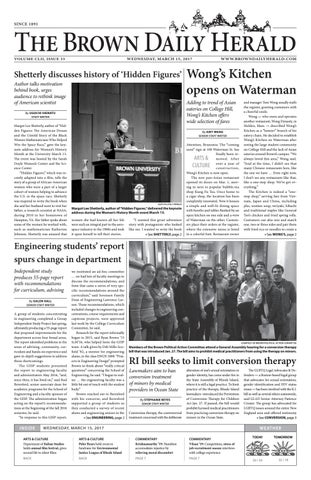
Margot Lee Shetterly, author of “Hidden Figures,” delivered the keynote address during the Women’s History Month event March 13. women she had known all her life were such an integral part to the aerospace industry in the 1960s and took it upon herself to tell their stories.
“I wanted this great adventure story with protagonists who looked like me. I wanted to write the book » See SHETTERLY, page 2
and manager Tom Wong usually staffs the register, greeting customers with a cheerful smile. Wong — who owns and operates another restaurant, Wong Dynasty, in Holden, Mass. — described Wong’s Kitchen as a “homier” branch of his eatery chain. He decided to establish Wong’s Kitchen on Waterman after noting the large student community on College Hill and the lack of Asian eateries around Brown’s campus. “We always loved this area,” Wong said. “And at the time, I didn’t see that many Chinese restaurants here, like the one we have … Even right now, I don’t see any restaurants like that, like a one-stop shop. We’ve got everything.” The Kitchen is indeed a “onestop shop,” serving fare from Vietnam, Japan and China, including pho, wonton soup, teriyaki, hibachi and traditional staples like General Tso’s chicken and fried spring rolls. Customers can also mix and match one, two or three sides and pair them with fried rice or noodles to create a » See WONG’S, page 2
Engineering students’ report spurs change in department Independent study produces 55-page report with recommendations for curriculum, advising By GALEN HALL SENIOR STAFF WRITER
A group of students concentrating in engineering completed a Group Independent Study Project last spring, ultimately producing a 55-page report that proposed improvements for the department across four broad areas. The report identified problems in the areas of advising, community, curriculum and hands-on experience and gave in-depth suggestions to address those shortcomings. The GISP students presented the report to engineering faculty and administrators May 2016, “and, since then, it has lived on,” said Rod Beresford, senior associate dean for academic programs for the School of Engineering and a faculty sponsor of the GISP. The administration began acting on the report’s recommendations at the beginning of the fall 2016 semester, he said. “In response to this GISP report,
INSIDE
we instituted an ad-hoc committee … we had lots of faculty meetings to discuss the recommendations, and from that came a series of very specific recommendations around the curriculum,” said Sorensen Family Dean of Engineering Lawrence Larson. Those recommendations, which included changes to engineering concentrations, course requirements and capstone projects, were approved last week by the College Curriculum Committee, he said. Research for the report informally began in 2015, said Ryan Brown ’15 ScM’16, who helped form the GISP team. A talk given by Deb Mills-Scofield ’82, a mentor for engineering alums, in the class ENGN 1000: “Projects in Engineering Design” prompted Brown to think about “really critical questions” concerning the School of Engineering, he said. “I began to realize … the engineering faculty was a little bit out of touch with the student body.” Brown reached out to Beresford with his concerns, and Beresford supported a group of students as they conducted a survey of recent alums and engineering seniors in the » See ENGINEERING, page 2
COURTESY OF BROWN POLITICAL ACTION COMMITTEE
Members of the Brown Political Action Committee attend a General Assembly hearing for a conversion therapy bill that was introduced Jan. 27. The bill aims to prohibit medical practitioners from using the therapy on minors.
RI bill seeks to limit conversion therapy Lawmakers aim to ban conversion treatment of minors by medical providers in Ocean State By STEPHANIE REYES SENIOR STAFF WRITER
Conversion therapy, the controversial treatment concerned with the deliberate
alteration of one’s sexual orientation or gender identity, has come under fire in the State Assembly of Rhode Island, where it is still a legal practice. To limit practice of the therapy, Rhode Island lawmakers introduced the Prevention of Conversion Therapy for Children Act Jan. 27. If passed, the bill would prohibit licensed medical practitioners from practicing conversion therapy on minors in the Ocean State.
The GLBTQ Legal Advocates & Defenders — a Boston-based legal group that advocates for sexual orientation, gender identification and HIV status issues — has been involved with the R.I. bill as well as several others nationwide, said GLAD Senior Attorney Patience Crozier. The group has advocated for LGBTQ issues around the entire New England area and offered testimony » See CONVERSION, page 3
WEATHER
WEDNESDAY, MARCH 15, 2017
ARTS & CULTURE Department of Italian Studies holds annual film festival, gives second life to silent films
ARTS & CULTURE Poler Bears hold event to fundraise for Environmental Justice League of Rhode Island
COMMENTARY Krishnamurthy ’19: Hamilton accomodates injustice by relieving moral discomfort
COMMENTARY Vilsan ’19: Competition, stress of job recruitment season interferes with college experience
BACK
BACK
PAGE 7
PAGE 7
TODAY
TOMORROW
30 / 20
32 / 18
NEWS
PAGE 2 • WEDNESDAY, MARCH 15, 2017
THE BROWN DAILY HERALD
» WONG’S, from page 1
HUAYU OUYANG / HERALD
Wong’s Kitchen offers a wide selection of Asian fare, ranging from pho to teriyaki to General Tsao’s chicken. The restaurant opened on Waterman on March 1 and now serves many members of Brown’s community.
» SHETTERLY, from page 1 that I wanted to read,” said Shetterly. The number of women of all backgrounds involved in the space program surprised Shetterly when researching information for her book. Computing was seen as “women’s work,” which is why the women of NASA were called “computers.” Though the film adaptation only shows a piece of the story that Shetterly tells in her book, the movie was
» ENGINEERING, from page 1 department. In the survey, they asked for opinions about how the school could improve, Beresford said. The students presented the survey results in spring 2015 and applied for a GISP in the fall to continue work on the report, Brown said. The students used information from the survey and “brought in guest speakers from Brown, other institutions and … (the) industry,” to guide them as they wrote the report, Brown said. One of the GISP students’ first assignments was to “collect data from other (engineering) students (at) other schools” and compare their experiences to those of students at the University, said Margaret Mathieu ’17.5, who worked on the report. Compared to students from other schools, many survey respondents from Brown felt that engineering classes focus too much on theory and not enough on
able to introduce a much wider audience to the women of “Hidden Figures,” whose stories were still widely unknown. “I discovered that there’s a lot of history and knowledge behind ‘Hidden Figures’ that isn’t shown in the movie, so I think there’s definitely value in reading the book in addition to watching the movie,” Ayisha Jackson ’18 said. Shetterly’s book brings together issues of race and gender in the field
of science. The intersectionality of the questions raised in “Hidden Figures” is what led the SDWC to bring the author in as the keynote speaker for Women’s History Month. “We wanted an event that’s inspirational, not only for women who are working in science, but (also) other fields where (women) are underrepresented,” said Felicia Salinas-Moniz MA’06 PhD’13, assistant director of the SDWC. Shetterly’s lecture centered on
hands-on learning. The report proposed changes to lab curricula that aim to address this problem, though those changes “will take a longer time” to implement than some of the other suggestions, Mathieu said. The GISP students also sought to address problems with advising in the department. “We saw the ‘sophomore gap’: In between the end of your freshman year and (sophomore) spring break, there’s really no one assigned to (advise) you,” said Sarah Dugan ’17, who worked on the advising section of the report. And though engineering students “absolutely need an engineering Meiklejohn,” the department had been matching students with Meiklejohns from other departments, she added. The engineering department has “been really awesome about implementing some new things,” Dugan said. The department requested engineering Meiklejohns for all
engineering students and created a new Student Advisory Board, Dugan said. The Student Advisory Board is a group of students that will continue to address other issues raised by the report, such as diversity initiatives and community building, according to a document compiled by the GISP team that tracks changes within the department. The report also recommends that the administration work to establish a stronger identity for the School of Engineering, develop more workspaces and community events, facilitate outreach to prospective minority students and encourage dialogue between students and faculty. In its introduction, the report compares itself to the Magaziner-Maxwell Report, which proposed the New Curriculum to the University in 1968. But, Brown said, “the scope (of the new report) is fundamentally different” from that of the Magaziner-Maxwell
“special.” “It’s like a combination, a fusion” of cuisines, Wong said, adding that the restaurant menu might expand in the future to include other types of food, like sushi. While many of its options are pricier than meals at University dining halls, the restaurant boasts exceptional service and a pleasant atmosphere. Menu items, however, vary in quality: The crab rangoons deliver a delightful crunch and ooze with a warm, tangy cheese. But the stir-fried beef tastes rather bland and watery. The beef pho, perfectly rich and flavorful, comes in a whopping serving size, but the fried rice — while not unappetizing — is only average. Ultimately, as long as customers choose their orders wisely, they are likely to be satisfied with their meal. Providence’s selection of Asian eateries has been historically sparse. Wong’s Kitchen joins the ranks of new restaurants that have recently been capitalizing on this unfilled the fact that there are many people who often get sidelined in history or are shuffled into categories such as “black history” or “women’s history.” Shetterly wanted to put these women at the center of American history, redefining the image that pops into a person’s head when they imagine an “American” or a “scientist.” She wanted to challenge notions of what it meant to be an American, not just show readers what it was like to be a black woman in science at that time.
niche. Between the recent openings of Den Den Café Asiana, Kung Fu Tea, Tom’s Bao Bao — all of which took place over the course of the past three years — and the soon-to-be opened Korean Fried Chicken on Angell Street, Providence seems to be moving toward a greater variety of Asian cuisine — a welcome addition for many Brown students. “We have a lot of Asian people here (in Providence), … and I’m sure they want some Asian tastes,” Wong said. “They don’t want to eat burritos, or sandwiches … or pizza every day.” The restaurant has been popular with the Brown community, Wong said. “Because we have … all different kinds of food, we can cover a lot of bases for the students around here,” he added. “And it’s fast for students, too; when they have tasks, they can come in, (and after) two minutes, three minutes, they can leave.” Despite the restaurant’s recent opening, Wong has been acquainted with multiple returning customers and says he knows “a lot of people already.” “It’s important to always display a variety of people who do science and to make sure they have a voice,” said Gelonia Dent, director of the Science Center. Isabel Scherl ’17 was surprised by how unaware Shetterly seemed of her influence on so many women through “Hidden Figures.” “It just shows that any woman can be inspired by these stories and have an impact,” Scherl said.
HATTIE XU / HERALD
Report — the GISP report proposes solutions to specific problems instead of a sweeping reform. Members of the administration, such as Larson and Beresford, see this report as the beginning of a long
undertaking. The report “gave us a great start to some very fundamental changes,” Larson said. “(But) the process will never end … I look at this as a continuous process of improvement.”
John Keene John Keene is the author of six volumes of fiction and poetry, including the short fiction collection Counternarratives, winner of a 2016 American Book Award and 2016 Lannan Literary Award; a novel, Annotations; the poetry collection Seismosis and poetry chapbook Playland; and an art book, GRIND, in collaboration with photographer Nicholas Muellner. He is also a translator whose works include translations of Brazilian author Hilda Hilst’s The Obscene Madame D and Letters from a Seducer.
Thursday, 16 March 2017 at 7 pm McCormack Family Theater 70 Brown St., Providence [use Fones Alley entrance]
John Keene’s reading is sponsored by Literary Arts, with support from the Brown Arts Initiative and the Geri Braman Hill ’41 Endowed Lectureship Fund.
Follow Sports! twitter.com/bdh_sports
NEWS
WEDNESDAY, MARCH 15, 2017 • PAGE 3
THE BROWN DAILY HERALD
‘The Tsar of Love and Techno’ chosen as First Readings text Novel selected from among 70 nominations, examines cultural stereotyping, engages in setting By MIA PATTILLO SENIOR STAFF WRITER
Chosen for its “brilliant and timely” content and lyrical writing, “The Tsar of Love and Techno” by Anthony Marra will be the summer reading for the incoming class of 2021 as part of the University’s First Readings program, said Dean of the College Maud Mandel. The First Readings committee — composed of Mandel, Dean of the College for Fellowships Linda Dunleavy, four professors across different disciplines and two undergraduates
— began their search in the fall by soliciting recommendations from the community, Mandel said. The collaboration among faculty members is an example of “a university at its best,” Mandel said. Books across different genres — from science to history to literary to graphic novels — were all considered, as well as other media such as movies, she added. This year, the committee received around 70 nominations, said Aliosha Bielenberg ’20, an undergraduate representative for the committee, who is also a staff columnist for The Herald. To narrow down the list, the committee broadly evaluated each book by reading published reviews as well as descriptions provided by those who submitted recommendations. After narrowing down options to
16 books, each member of the committee read four books over winter break, Dunleavy said. From there, the committee selected the top five books, which every committee member read. These five titles were also announced in a community-wide email to allow community members to read the books and offer their own opinions. Around 130 community responses were received this year, Bielenberg said. The entire selection process “engages the Brown community at large to think about what makes an intellectual and meaningful text,” Mandel said. The committee considered a number of factors in each stage of choosing a text. First, the initial “gut feeling of whether it was an engaging read” was important, as well as finding an
appropriate length that would allow students to engage with the text without feeling intimidated by it, Bielenberg said. In addition, the committee had to take into account that First Readings requires a short essay and discussion, Bielenberg said. Mandel added that the committee searched for a book that would allow first-year students to “reflect on themselves and society in some broad context.” “The Tsar of Love and Techno” — set in the Soviet Union in the 1930s — includes stimulating themes that allow students to examine the effects of “reducing a multifaceted individual or culture into some form of a stereotype,” Bielenberg said. Dunleavy added that the book served as an important invitation to
engage with a setting — Russia, under Stalin’s power — that may be foreign to some students. “It’s important to recognize that even if characters and names are from long ago, you can draw lessons from them, and they shouldn’t be viewed as monolithic,” Bielenberg said. “This book wasn’t initially one that people thought was going to be selected, but everyone ended up finding it interesting and provocative,” Dunleavy said. “It was a bit of a sleeper choice that really rose to the top.” She added she hopes the book will have a similarly meaningful impact upon members of the incoming class of 2021 and other readers. “It’s an absolutely stunning book,” Bielenberg said. “If I could give you one piece of advice, it would be: Just read it.”
Exhibition calls attention to dehumanizing aspect of solitary confinement Speakers at ‘Solitary Confinement’ depict inhumane reality of prison practices
By CONNOR SULLIVAN SENIOR STAFF WRITER
“Solitary Confinement,” the Nightingale Brown House Gallery’s latest exhibition on the ills of solitary confinement in the United States, closed to the public with a reception March 11. The main feature of the exhibition, which opened Jan. 30, was a replica of a solitary cell. A bleak and restricted slab of concrete, the piece was a poignant depiction of the stark reality facing those in the throes of the dehumanizing measure of captivity. The replica was accompanied by similar testaments to the egregious mistreatment of the imprisoned. It
» CONVERSION, from page 1 during the Rhode Island House hearing, she added. “Conversion therapy is essentially based on the false claim that being LGBT is a mental illness that needs to be cured,” Crozier said. State Rep. Joseph McNamara, DWarwick — one of the bill’s co-sponsors — said GLAD’s testimony revealed the “barbaric” nature of the practice. State Rep. Moira Walsh, D-Providence, another co-sponsor, noted that more than 80 people were present to testify in favor of the bill during the committee hearing, while only one testified against. The sole testimony in opposition came from a man who said he had gone through reparative therapy himself with other adults in his church. “Change toward a healthy and holy lifestyle that honors God is possible,” he said. “Reparative therapy works and Rhode Island professionals should not be prevented from offering it, especially to concerned parents and their children,” the man who testified said. He added that studies claiming to show negative impacts associated with conversion therapy cannot be taken seriously as they don’t control for all possible variables. “Witnessing the emotional toll that (conversion therapy) takes on people is enough in of itself for me, as a representative, to say I’m going to do whatever
featured multimedia representations that included sketches of special housing units, graphic novel-like panels testifying to poor facility conditions, letters from prisoners once victim to solitary confinement and audio recordings of those currently incarcerated in Rhode Island. “It’s a way of shak(ing) people out of that daily routine way of being and put(ting) them into a headspace where they’re more attentive,” said Assistant Director of the Center for Public Humanities and Cultural Heritage Marisa Brown, who, along with Matthew Branch, Thaddeus Gibson GS and Cherise Morris ’16 GS, was responsible for organizing the installation. “The last couple of years we’ve been doing programs related to the issue of installation,” Brown said. She mentioned “Solitary Confinement” as the Center’s latest effort, following
I can to make sure this isn’t something that kids in my community are subjected to,” Walsh said. Walsh added many have ignored the practice as licensed practitioners are no longer using controversial, “old fashion methods” such as electroshock therapy in conversion. By sponsoring the bill, Walsh hopes to highlight the consequences often faced by those who undergo conversion therapy. “Kids who are subjected to this kind of treatment are statistically more likely to commit suicide, suffer from depression and have really debilitating issues when coming to terms with their sexuality, which is not a particularly easy thing to do in the first place,” Walsh said. Though Walsh aims to prevent Rhode Island’s youth from experiencing conversion therapy, she said lawmakers are inevitably limited to do so based on religious freedom. “Unfortunately, this bill is specific to licensed medical practitioners, which does not solve the problem of churchcoordinated, conversion therapy situations,” Walsh said. “This really does nothing for the religious end of it — you can’t really tell a parent what to do with their child.” If passed, the bill would make Rhode Island something of an exception in the fight against the practice: Conversion therapy as a treatment for minors is currently banned in only five states and the District of Columbia — the only New England state to pass a
a University of Rhode Island gallery and a prison education conference attended by such schools as Cornell, Bard College, Princeton and Brown. Shawn Hesse, head of the Boston branch of the architectural firm emersion DESIGN, and C. Morgan Grefe MA’00 PhD’05 executive director of the Rhode Island Historical Society, led the exhibition’s closing reception. Hesse addressed the obligation architects have to curbing social injustice, while Grefe spoke at length on the narratives of prisons turned into museums. Hesse also serves on the board of directors of Architects/Designers/ Planners for Social Responsibility. Seeking to curtail the design of solitary confinement cells and comparable spaces, the group explores the dynamic role architects occupy in ethical building practices. “As an industry, we have a
responsibility to use our collective voice to speak out against systems that are unjust, including mass incarceration and capital punishment,” Hesse said, speaking on his — and not emersion DESIGN’s — behalf. “It’s a little disappointing and sad when we speak with activists surprised that architects care about human rights. We have to work to elevate the profession so that it’s no longer a surprise to people that we care.” In this vein, Hesse helped curate the architectural half of the exhibit. He is also working with others toward an initiative the urges architects to comment on the current border crisis between the United States and Mexico. “It’s important from an individual perspective to work within the industry, work with immigrants (and) raise the profiles of these issues industrywide,” Hesse said. “One architect refusing to participate in the industry isn’t
going to change anything.” Grefe approached the issue of solitary confinement from a more historical lens. She lectured on the history of solitary confinement and the efforts made by former prisons in documenting its usage. She addressed the function of nowdefunct penitentiaries in educating the public, referencing Philadelphia’s Eastern State Penitentiary as an exceptional example of a prison-turnedmuseum. Grefe mentioned how a quarter of prisons have already been converted into museums, stressing the necessity of curbing the development of additional “awful and inhumane institutions.” “I’m troubled by the monetization of prisons fueled by an obligation to fill beds,” Grefe said. “It’s disturbing to me that there’s some board out there focused on thinking about ways of maximizing space in prisons.”
KYLE BOROWSKI / HERALD
bill limiting the practice is Vermont, which banned conversion therapy last year. Despite public support, Walsh is uncertain of the bill’s passing. The future of the Act will depend on the position of the Speaker of the House — State Rep. Nicholas Mattiello, D-Cranston — as well as other representatives who
could refrain from signing on, Walsh said. Mattiello’s position on the issue is unclear. While he reversed his previous opposition to gay marriage in 2013, he has not been shy in straying from his party on issues like abortion and gun rights, RI Monthly previously reported . “Unfortunately, sometimes it
doesn’t matter how good the bill is or how much support it has, it really is not in your hands,” Walsh said. “We are limited in the ways that we can assist but, by drawing attention to the fact that this is still an ongoing practice — that does a measurable good in and of itself.”
NEWS
PAGE 4 • WEDNESDAY, MARCH 15, 2017
THE BROWN DAILY HERALD
U. researchers analyze revival of for-profit medical schools Comeback of for-profit medical schools brings questions of reputation, quality of education By JACKSON WELLS STAFF WRITER
After nearly a century of dormancy, for-profit medical schools are making a return in the United States. A recent paper by University researchers analyzed the history, reappearance and possible effects that these schools could have on medical education. Though at one time for-profit medical schools existed in the United States, this changed with the publishing of Abraham Flexner’s 1910 report on the state of these schools, according to the paper. There were numerous critiques of these schools in Flexner’s report, particularly of the standards, requirements, teaching and students’ clinical and research exposure. The report led to a renovation of medical teaching and the subsequent disappearance of for-profit institutions. The medical education system accepted nearly all students who could afford to pay tuition prior to 1910, Gruppuso said. “There was no standardized set of requirements for medical schools, and it was creating a real crisis in terms of quality for medical care.” In 1996, the court case United States v. American Bar Association made it possible for for-profit law schools to be established, according to the paper. Though the Liaison Committee on Medical Education had previously been opposed to for-profit medical schools, they slowly began to change their opinions after the court case and eventually allowed for for-profit medical schools to be established in 2013. According to the paper, a number of investor-owned schools, such as the Rocky Vista University College of Osteopathic Medicine, have been accredited, and more have received preliminary and provisional accreditation. Philip Gruppuso, professor of pediatrics and an author of the paper, said the main point of the article was to bring both the existence and establishment of these for-profit schools to public attention. “(This article) sheds light on the fact that not all medical schools in the United States are nonprofit institutions, so I’m not sure that people both in and out of the medical world realize that these institutions are also out to make money for their shareholder and whoever else owns them,” said Paul George, associate professor of medicine, who was unaffiliated with the study. The Flexner report became the basis for most of what is now seen as the contemporary set of standards for admission and accreditation in medical education and the composition of medical school as two years of scientific education and two years of clinical experience, Gruppuso said. The report led to two major developments in the area of for-profit medical schools, said Eli Adashi, professor of medical science and lead author of the paper. Students increasingly stopped enrolling because they were losing confidence in these institutions. Secondly, more nonprofit medical schools were established at the time and were often affiliated with a research university, in
ALISA PUGACHEVA
contrast to for-profit medical schools. “These academic-medical centers educated virtually all American physicians since the Flexner report,” Adashi added. In the paper, the authors delineated a number of challenges that for-profit institutions face, such as poor reputations. Many of these stem from today’s common Flexnerian viewpoints, as well as frequent comparison to other forprofit educational institutions that are often at the center of many legal disputes, according to the paper. While high-profile schools like Harvard and Yale have faculty members and administration who are at the forefront of medicine, “aspects like that are just
not currently possible with the for-profit model,” Krishna said. “It’ll be interesting to see, as the for-profit schools go, if they will be able to develop that same academic profile and bring the same resources to their students.” Another challenge is the widespread notion that for-profit medical schools have significantly lower standards than nonprofit medical schools, according to the paper. To assuage these concerns, these institutions will have to prioritize the ethical and educational aspects above profit, the authors wrote. Though the lenient standards of for-profit schools in the pre-Flexnerian era were a major concern, they are not
for today’s for-profit medical schools, according to the paper. The schools now have more stringent academic requirements, such as mandating clinical rotations and providing scholastic opportunities in the curriculum. The report serves to reassure people that these for-profit schools have to meet the same requirements as nonprofit institutions, George said. “At the end of the day, for many of these students to become physicians, they all have to pass the same board exams and compete on the national level in order to get residency spots,” Krishna said. She added there will always be a demand for medical schools
and she would not be surprised to see more for-profit medical schools being established in the future. For-profit schools could be a significant boon to the shortage of doctors and the easing of medical student debt, according to the paper. Due to their lower cost structure, for-profit medical schools could also provide lower tuition, more scholarships and innovation in medical instruction. “The major point of the paper is that (for-profit medical schools) are being established. We hope that they will be held to a high standard and that there will conceivably be benefits from their establishment,” Gruppuso said.
TODAY
WEDNESDAY, MARCH 15, 2017 • PAGE 5
THE BROWN DAILY HERALD
s n o w d ay , s ( n o ) w s c h o o l
menu SATELLITE DINING ANDREWS COMMONS
Pizza: Mushroom’s Revenge, Miss Maple, Spicy Sausage and Garlic JOSIAH’S
BLUE ROOM
Jambalaya, Sante Fe Salad, The Isabella Burger, The Muffaletta
Beef Chili with Beans, Broccoli and Cheddar Soup, Bread Bowl
DINING HALLS SHARPE REFECTORY LUNCH
DINNER
Meatball Subs, Italiano Potatoes, Chicken and Broccoli Alfredo, Chocolate Chip Cookies
Sweet and Sour Pork, Broccoli Rabe, Clams and Linguine, Washington Apple Cake
VERNEY-WOOLLEY LUNCH
DINNER
Mushroom Barley Soup, Mac and Cheese Bar, Gumbo Casserole, Falafel, Brownies
Egg Foo Young, Sticky Rice, German Vegetable Blend, Washington Apple Cake
sudoku
R
AS
DA
A
A
c r o s s w o rD d
C
Edited by Rich Norris and Joyce Nichols Lewis
ACROSS 1 Least ancient 7 Some TVs 11 This second, briefly 14 Forward, to Fiorello 15 City SW of Buffalo 16 Christian sch. since 1963 17 Extra effort 19 Shoofly __ 20 Skittish NBC show? 21 “That’s rich!” evoker 23 Jellied item in British cuisine 25 “Days of Grace” memoirist 26 Relaxed 27 GRE components 30 Doubter’s question 32 Note promising notes 33 Letter-routing letters 36 Big-eared flier of film 40 Take on responsibility 43 Finish 44 It may be spare 45 “Progress through Technology” automaker 46 “Awesome!” 48 Original Speed Stick maker 50 Awesome, in a way 53 Used to be 56 Giant of note 57 It usually involves rapping 60 Rock’s __ Fighters 63 Maker of SteeL kitchen products 64 Filing option, or what can be found in four long answers? 66 Beret, e.g. 67 __ Accords: 1993 agreement 68 Having trouble 69 Charles V’s domain: Abbr. 70 Light submachine gun 71 Forgetful, maybe
DOWN 1 Murphy’s and Godwin’s, for two 2 Shakespeare’s flower? 3 Carving area 4 It’s bigger than the neg. 5 Unwavering 6 Buster Brown’s dog 7 Causes a stink 8 Collide with 9 Where the slain roll? 10 “I __ beautiful city ...”: Dickens 11 Dad 12 Preserves, in a way 13 Editor’s request 18 Genetic letters 22 Prone to snits 24 Grab a sandwich, perhaps 27 65-Down shade 28 Women 29 __ Miguel: Azores island 31 Suffix with ox34 Like many a brisk 45-minute walk 35 General on a menu
37 View from Tokyo 38 Wished 39 Valhalla chief 41 Reuters competitor 42 “I wonder ...” 47 Breakfast cereal magnate 49 With 50-Down, when modern mammals emerged 50 See 49-Down
ANSW R
O
51 “Brave” studio 52 “Fingers crossed” 54 Bad sentence 55 Round no. 58 Parts of la cara 59 1978 Booker Prize recipient Murdoch 61 Kind of exam 62 “I got it” 65 Darken in a salon
R
O S
ELI WHITE / HERALD
Eerie emptiness settled on Thayer Street after yesterday’s blizzard and the University issued notice canceling school. Students stayed indoors as trees, sidewalks, parked cars and shop awnings were covered with snow.
Q U O T E O F T H E D AY
“It’s a little disappointing and sad when we speak with activists surprised that architects care about human
”
rights. We have to work to elevate the profession.
— Shawn Hesse, head of the Boston branch of emersion DESIGN
See solitary confinement on page 3. calendar TODAY MARCH
S
By Julian Lim (c)2013 Tribune Media Services, Inc.
M
T
W
Th
F
S
1
2
3
4
5
6
7
8
9
10
11
12
13
14
15
16
17
18
19
20
21
22
23
24
25
26
27
28
29
30
31
DEEPS Bake Sale 9:00 A.M. Macmillan Hall Lobby
Financing Your Study Abroad Experience 12:00 P.M. J. Walter Wilson, 440
PASS Class: Vector Graphics with Illustrator 6:00 P.M. Graduate Center E
How Science Points to a Creator 7:30 P.M. Metcalf Research Building, 101
TOMORROW Artist Talk with Sarah Paulsen 12:00 P.M. Nightingale-Brown House
Women Studying Abroad 12:00 P.M. Sarah Doyle Women’s Center
Women, Politics and Turkey 12:00 P.M. Pembroke Hall
The Syrian Refugee Crisis 5:00 P.M. Watson Institute, Joukowsky Forum
COMMENTARY PAGE 6 • WEDNESDAY, MARCH 15, 2017
THE BROWN DAILY HERALD
LETTER TO THE EDITOR
comic
‘Go Bruno’ editorial was timely, but fell short To the Editor: It was my hope that The Brown Daily Herald editorial board would have sent a stronger and more direct message to the Brown administration regarding the dire competitive position Bruno has consistently maintained over the past 15 years in
Comic | Ricky Oliver
Ivy League athletics and insisted on some straight answers about what the University is prepared to do to cure this imbalance going forward. It is certainly not too late. Bill Corrigan ’58
Find us online! facebook.com/browndailyherald
browndailyherald.com
@the_herald
Location: 195 Angell St., Providence, R.I. www.browndailyherald.com
@browndailyherald
youtube.com/browndailyherald
Editorial Leadership
Sections
Multimedia & Production
Business
Editor-in-Chief Lauren Aratani
Arts & Culture Editors Julie Center Madison Rivlin
Design Editors Christy Leung Ameer Malik Jessica Yu Assistant: Eduard Muñoz-Suñé
General Managers Henry Ritter Ben Wesner
Managing Editors Matt Brownsword Rebecca Ellis Kate Talerico POST- MAGAZINE Editor Monica Chin
News Editors Kyle Borowski Kasturi Pananjady Suvy Qin Elena Renken Alex Skidmore Hattie Xu
BLOGDAILYHERALD Editor Anica Green
Sports Editors Jackson Chaiken Ben Shumate COMMENTARY Opinions Editors Anuj Krishnamurthy Mili Mitra Clare Steinman
Photo Editors Head: Eli White Assistant: Sam Berube Anita Sheih Sara Runkel Copy Desk Chief Julia Stemmer Multimedia Editor Roland High Illustrations Editor Dorothy Windham Graphics Editor Laura Felenstein Directors of Web Development: Lucy Wei Ivy Wong
Directors Finance: Reena Zhan Sales: Antonia Alvarez Sales: Erin Lueck Strategy: William Nober Strategy: Gianna Jasinski Managers Sales: Elizabeth Doykan Sales: Gabriella Elanbeck Sales: Matilda Lynton Sales: Ariel Shusterman Collections: Ravi Betzig Operations: Gür Ağci
Editorial contact: 401-351-3372 herald@browndailyherald.com
Business contact: 401-351-3260 gm@browndailyherald.com
Submissions: The Brown Daily Herald publishes submissions in the form of op-eds and letters to the editor. Op-eds are typically between 750 and 1000 words, though we will consider submissions between 500 and 1200 words. Letters to the editor should be around 250 words. While letters to the editor respond to an article or column that has appeared in The Herald, op-eds usually prompt new discussions on campus or frame new arguments about current discourse. All submissions to The Herald cannot have been previously published elsewhere (in print or online — including personal blogs and social media), and they must be exclusive to The Herald. Submissions must include no more than two individual authors. If there are more than two original authors, The Herald can acknowledge the authors in a statement at the end of the letter or op-ed, but the byline can only include up to two names. The Herald will not publish submissions authored by groups. The Herald does not publish anonymous submissions. If you feel your circumstances prevent you from submitting an op-ed or letter with your name, please email herald@browndailyherald.com to explain your situation. You can submit op-eds to opinions@browndailyherald.com and letters to letters@browndailyherald.com. When you email your submission, please include (1) your full name, (2) an evening or mobile phone number in case your submission is chosen for publication and (3) any affiliation with Brown University or any institution or organization relevant to the content of your submission. Please send in submissions at least 24 hours in advance of your desired publication date. The Herald only publishes submissions while it is in print. The Herald reserves the right to edit all submissions. If your piece is considered for publication, an editor will contact you to discuss potential changes to your submission. Commentary: The editorial is the majority opinion of the editorial page board of The Brown Daily Herald. The editorial viewpoint does not necessarily reflect the views of The Brown Daily Herald, Inc. Columns, letters and comics reflect the opinions of their authors only. Corrections: The Brown Daily Herald is committed to providing the Brown University community with the most accurate information possible. Corrections may be submitted up to seven calendar days after publication. Advertising: The Brown Daily Herald, Inc. reserves the right to accept or decline any advertisement at its discretion. The Brown Daily Herald, Inc. is a financially independent, nonprofit media organization bringing you The Brown Daily Herald, BlogDailyHerald and Post- Magazine. The Brown Daily Herald has served the Brown University community daily since 1891. It is published Monday through Friday during the academic year, excluding vacations, once during Commencement and once during Orientation by The Brown Daily Herald, Inc. Single copy free for each member of the community. Subscription prices: $200 one year daily, $100 one semester daily. Copyright 2017 by The Brown Daily Herald, Inc. All rights reserved. Periodicals postage paid at Providence, R.I. Postmaster: Please send corrections to P.O. Box 2538, Providence, RI 02906.
COMMENTARY WEDNESDAY, MARCH 15, 2017 • PAGE 7
THE BROWN DAILY HERALD
Hamilton is meh ANUJ KRISHNAMURTHY opinion editor
Hamilton: An American Musical is, without a doubt, among the 21st century’s most popular pieces of art. Since its Broadway debut in 2015, the musical has been on the receiving end of relentless adulation. Much of this acclaim has to do with Hamilton’s unconventional commitment to Americans left on the margins— actors of color play the roles of America’s white, slave-owning founding fathers, and the genre of hip-hop is deftly wielded as an instrument of history. In this way, the musical resonantly transposes the reality of racial marginalization onto the most primordial story of the American experience: “young, scrappy” people, freshly emancipated from tyranny, who dare to arrange their own form of government, create their own nation and, ultimately, seek out their own fortune. As theater critic Ben Brantley wrote in the New York Times, “‘Hamilton makes us feel the unstoppable, urgent rhythm of a nation being born.” But Hamilton isn’t perfect. Nor, I feel, is it deserving of the sorts of unanimous, uncritical praise that progressive urbanites have hyperactively heaped upon it in the past two years. After all, beneath the musical’s inventive lyrics and feel-good narratives lies a more unsettling truth: Hamilton is less an adroit riposte to injustice as much as it is an accommodation of it — three hours of ahistorical propaganda, faux racial redress and sugarcoated struggle meant only to alleviate the moral discomfort of the haves,
without doing very much for havenots. For one, it doesn’t take years of research to relieve Hamilton of its historical embellishments. The musical portrays Alexander Hamilton, the country’s first Secretary of the Treasury, as a “young, scrappy and hungry” immigrant and consummate republican who exhibits an intimate understanding of the struggles of ordinary folk. But such a depiction is nowhere close to the truth. Hamilton once told the Constitutional Convention that “the mass of the people … seldom judge or determine right” and that society’s most privileged ought to have a “distinct, permanent share in
ly a quarter of Hamilton tickets, resale of the tickets can exceed $5,000. These exorbitant rates are prohibitive; the only people who can actually afford to see revolutionary Americans spit anti-colonial fire are the affluent — mostly white, well-educated and sympathetic to the progressive cause. Close to four-fifths of Broadway audiences are white, so Hamilton’s monochromatic viewership isn’t exactly the fault of its producers. But, for a musical whose primary selling point is the spirited preservation of marginalized perspectives, what good does it do to cast black and Hispanic actors as white guys if black and Hispanic people don’t get to see it? It is wonder-
sives to recuse themselves from the demands of progressivism, from the task of squarely confronting historical injustice. Just as significantly, the musical’s central premise — that representation in casting somehow makes the prejudice that undergirded the founding of America more palatable, even excusable — is disappointing. That Hamilton boasts a cast of color is commendable; that its cast must incarnate the roles of wealthy whites, and ultimately tell a white story, is substantially less meaningful. At the end of the day, Alexander Hamilton, Thomas Jefferson and the Marquis de Lafayette — all utterly indispensable to American inde-
Beneath the musical’s inventive lyrics and feel-good narratives lies a more unsettling truth: Hamilton is less an adroit riposte to injustice as much as it is an accommodation of it — three hours of a historical propaganda, faux racial redress and sugarcoated struggle meant only to alleviate the moral discomfort of the haves, without doing very much for have-nots. government.” A few years later, Hamilton vigorously supported the Alien and Sedition Acts — specifically the articles that permitted the immediate deportation of immigrants and suppression of anti-Federalist dissent. Alexander Hamilton is scarcely the paragon of democratic forbearance that Hamilton fans want him to be. Then there’s the more serious problem of who actually gets to see Hamilton. Premium seats at Richard Rodgers Theater, the Broadway theater which houses the production, cost $849; the remaining thousand or so seats cost around $200. And, thanks to scalpers, who resell near-
ful that white people are able to see talented dramatists of diverse backgrounds excel, but the essential thrust of Hamilton — that black and brown Americans are nonnegotiably integral to American history — will never fully resonate with them. Indeed, as one essayist at HowlRound — the online theater journal — observes, it is not difficult to imagine that many white viewers “walk away from Hamilton thinking that they are on the right side of history simply because they exchanged hundreds of dollars for the opportunity to sit through a racialized song and dance.” For me, Hamilton feels more like an excuse for progres-
pendence — are still white, and actors of color, no matter how phenomenal, cannot change that. If anything, Hamilton simply reaffirms what we already know: At the inception of our republic, white people called the shots. In the end, it’s this ineluctable whiteness that also cheapens the significance of Alexander Hamilton’s immigrant credentials, upon which the musical places appreciable emphasis. It is true that Hamilton did not belong to the hierarchy of colonial privilege; he was a self-made man who, like most immigrants, started with nothing. The musical recounts his early years as an orphan in the British West
Indies, his service in the Continental Army as George Washington’s aidede-camp and his eventual emergence as one of the country’s most influential founders. Perhaps the most famous lyric in the musical is Hamilton’s and Lafayette’s simultaneous declaration, “Immigrants: We get the job done!” Yet, while Hamilton tries very hard to tacitly rebuke xenophobia, it must be noted that he wasn’t any old immigrant. He was white, he spoke English and he was educated at an Ivy League university. In other words, he had everything going for him. As such, Hamilton — in all his gilded refinement and contempt for democracy — doesn’t represent the value of immigration as much as he does the importance of servicing the agenda of the elite. I’m not trying to discredit the inimitable talents of Lin-Manuel Miranda or his co-stars. As a piece of entertainment, Hamilton is unparalleled. In a time when social media can capriciously propel cultural phenomena to popularity and condemn them to obsolescence, the show’s songs and storyline have wielded extraordinary staying power. But it is the transmogrification of Hamilton — from Broadway musical to some sort of salvific opus, at least in the eyes of young liberals — that really bothers me. Sure, Hamilton is wildly entertaining; sure, it has reinvigorated interest in early American history. But to pretend that it does anything more — that it makes a contribution to the project of interracial understanding or even effectively asserts the indispensability of Americans of color — is baselessly wishful.
Anuj Krishnamurthy ’19 can be anuj_krishnamurthy@brown.edu.
The young and the restless FABIANA VILSAN staff columnist With CareerLAB strategically placed in the middle of campus and the name of a leading educational institution on our diplomas, most Brown graduates feel confident stepping out of the comfort of college and into the real world. Brown has consistently been successful in getting its students employed come graduation. But with all this working in our favor, this time of year is infamous for nervous students pacing around campus, weighing internship options and inevitably comparing themselves to others. During the high-stress season of job recruitment and exam stress, students fail to enjoy all that college life has to offer and forget to pat themselves on the back for their success thus far. Instead, we set our sights on the next destination: quick and groundbreaking success, without taking the time to realize that success comes in many forms and follows many timelines. Come recruitment season, lecture halls are packed with sharply dressed and ambitious Brown students hoping to secure a summer internship or job. Brown is known to attract the top names in the business — from McKinsey to Goldman Sachs — allowing students to aim high in their post-graduation careers. Looking from afar, these lecture halls look like trailers for life at an Ivy League — young adults dressed in Brooks Brothers with the twinkle of
a bright future in their eyes. But when you step back, you realize the hall is filled with 20-something year olds with little idea of what they’ll end up pursuing and doubts about whether they’ll make the cut. And the truth is, with only a couple spots up for grabs, most students in the hall won’t. Brown has a reputation of being one of the most laid-back Ivy League schools. We’re supportive of each other, we hate cutthroat competition and we value our passions over our wal-
stretch of the imagination, and it may not even be unique to our generation. The threshold between education and employment is inevitably paved with doubt and insecurity. We all feel like sharply dressed kids auditioning for grown-up roles at some point. The transition isn’t supposed to be easy — if it were, success stories wouldn’t be nearly as inspiring. But our drive to excel can get dangerous when we become so obsessed that a brighter, more profitable future clouds our ability to enjoy the present.
We’ve made it this far, and falling once in a while is exactly what’s supposed to happen. Not starting from the top doesn’t mean we won’t get there. In fact, the climb might be the most rewarding part of our careers. lets. Right? As much as Brown lives up to its supportive reputation, recruitment season jumps out as being the most fidgety, high-strung of the year. With job slots up for grabs, we can’t help but be competitors and compare ourselves to others. A feeling of inadequacy becomes commonplace on campus. So why do we have it in our heads that to win the game of employment, we have to secure the best jobs at top companies? Why don’t we spend more time appreciating how far we’ve come as students and counting our blessings? This phenomenon isn’t limited to Brown by any
In a TED Talk, Harvard graduate Shawn Achor argues that, during a visit to his alma mater, he didn’t notice the level of happiness among students that he was expecting. Jittery students failed to live in the now — they focused on working themselves to the bone in hopes of being happy in the future with their shiny careers and professionally-furnished apartments. But we’ve worked hard to get here. What’s the point if we don’t let ourselves enjoy our time in college? Don’t get me wrong: I’m not arguing that looking to the future and working hard is a
problem. But if we take a step back, we’ll notice we’re expecting a lot from grads in their early twenties. We’re being incredibly hard on ourselves for no real reason: We’ve made it this far, and falling once in a while is exactly what’s supposed to happen. Not starting from the top doesn’t mean we won’t get there. In fact, the climb might be the most rewarding part of our careers. Comparing our GPAs, resumes and internship opportunities to our neighbors doesn’t help anyone — it diminishes our happiness and keeps us from enjoying the institution we worked so hard to be admitted into. Instead of looking at Brown’s reputation for ushering its graduates into employment as a source of comfort, many take it as a pressure to meet certain standards. Instead of grinning at the names of recent Brown graduates in Forbes’ 30 Under 30 list, many students worry they won’t reach that level of success in under ten years. The point is, your career path will inevitably be different from your peers and past Brown graduates. Becoming inspired and impassioned by looking at other’s achievements is what college is all about, but incessantly comparing yourself to others will inevitably lead to a feeling of disappointment. There will always be a child prodigy or overnight success that will make you feel a tinge of jealousy unless you decide, right here and now, not to live in someone’s shadow and instead commit to enjoying the power of now.
Fabiana Vilsan ’19 can be reached at fabiana_vilsan@brown.edu.
ARTS & CULTURE THE BROWN DAILY HERALD
WEDNESDAY, MARCH 15, 2017
COURTESY OF VALERIA FEDERECI
Guy Borlée coordinated the annual Il Cinema Ritrovato festival, which puts a special emphasis on historical film. The event serves as a counterpart to an eight-day film festival in Bologna.
Il Cinema Ritrovato imports Italian films, gelato flavors Department of Italian Studies’ annual film festival mirrors Bologna’s festival of restored films By ETHEL RENIA SENIOR STAFF WRITER
In the early months of spring, Brown students enjoy multiple film festivals of consequence — from the French Film Festival to the much-anticipated Ivy Film Festival. The Department of Italian Studies features its own selection of films annually through its Il Cinema Ritrovato festival. But what distinguishes the films of Il Cinema Ritrovato is the distinctly historical perspective of the festival, which is committed to screening films dating all the way back to the early 20th century.
The Italian film festival serves as the American version of an eightday summer event in Bologna, which is committed to restoring old films and promoting early cinema. Il Cinema Ritrovato’s mission is “to show wonderful films, restored films, forgotten films,” said Guy Borlée, the coordinator of the festival. “We want to give these wonderful films a sort of second life.” “Restoration is so important because an old film is on film stock, and there are no more theaters with print projectors, except for cinematheques,” Borlée said. As such, these movies on film are forgotten and eventually fall into disrepair. “As time goes by, the oldest material deteriorates, so if you have a very old film, the original film might be damaged or lost. So you have to repair it,” Borlée added. The Department of Italian Studies
hosted four days of screening and “wanted to give a space to different genres,” said Massimo Riva, professor of Italian studies. These films ranged from a 1915 silent film titled “A day with Puccini” to an Italian-American 1980s film titled “Once Upon a Time in America.” Each year, the mini-festival at Brown features a silent movie night with live music. This year, Thursday night’s showing was a compilation of silent films from the early twentieth century that shed light on life in Venice and Bologna. The films were accompanied by live piano and mandolin. The festival also makes sure to include “a classic film from the 1960s — the golden age of Italian cinema,” Riva said. This year’s selection was “I knew her well,” directed by Antonio Pietrangeli.
Though the festival primarily focuses on old Italian cinema, international films are frequently featured. This year’s festival featured a Cuban film titled “Memories of Underdevelopment,” since Bologna’s festival restores films from around the world. “There is a historical dimension with (“Memories of Underdevelopment”) — shot four or five years after the revolution; it’s about change. You get to see Havana as it was at the time through the eyes of the main character,” Riva said. “In this way, film is always time-travelling,” he added. The idea to import a sampling of Bologna’s famous film festival came from the long-standing relationship between Brown and the University of Bologna, Riva said. The Department of Italian Studies sponsors a summer program where students can partake in the actual eight-day long Italian
festival. Students in Bologna also have the opportunity to study filmmaking and Italian cinematic culture. “It was only natural … to bring back a piece of the festival to Providence,” Riva said. Though the Brown leg of the festival has only existed for four years, it has garnered an attendance of “approximately 530 people” throughout the four nights, wrote Valeria Federeci GS in an email to The Herald. Brown’s Il Cinema Ritrovato is also accompanied by award-winning gelato — described by the The London Observer as the “Best in Europe” — shipped directly from Bologna’s famous Il Gelatauro. Each year, the gelato-maker creates four specific flavors inspired by the festival’s films. For example, for “Memories of Underdevelopment,” the corresponding gelato featured flavors of chocolate, rum and plantains.
‘Poler Bears for Polar Bears’ raises funds for environmental justice Student group performances range from hip-hop to traditional Okinawan dance By ETHAN ROSENBERG CONTRIBUTING WRITER
Taking an incredibly novel approach to fighting climate change, the Poler Bears, Brown’s pole dancing troupe, hosted “Poler Bears for Polar Bears,” a fundraiser for the Environmental Justice League of Rhode Island March 10 in Alumnae Hall. In addition to pole dancing, the night also featured performances that ranged from hip-hop to traditional Okinawan dance. All the money collected will be donated directly to EJLRI. “We had been toying for a while with the idea of having an event called ‘Poler Bears for the Polar Bears,’” said Sonya Gurwitt ’17, a member of the
troupe. Poler Bears originally wanted to fundraise for organizations involved in wildlife protection, she said. Citing political events and potential environmental policy changes in Washington, Poler Bears “decided we didn’t want to have a benefit show for polar bears because there are so many people in Rhode Island that need it a lot more,” Gurwitt said. The group chose to support a local organization that could directly help marginalized members of the Providence community, Gurwitt added. Nia Galloway ’18, another member of the Poler Bears, described the EJLRI as an organization that does “a lot of community building projects and (focuses) on empowering individuals who are normally left out these discussions about environmentalism.” Gurwitt also noted the organization has worked with Brown students in the past, making the collaboration easier to arrange. It was “important that (the Poler Bears) did
an event to connect students with the Providence community and issues that directly affect them,” Gallway added. The Poler Bears hoped the fundraiser would be successful in helping marginalized communities who would be more adversely affected by climate change. Sophie Sandweiss ’19, a member of the Poler Bears, said she liked the “broad outreach” the organization has in the Rhode Island community. Various student groups performed at the event, including Attitude Dance Co., Gendo Taiko, Mezcla Latinx Dance Troupe, Brown Aerial Arts Society, GBX Dance Crew, Amira Belly Dance Co. and Fusion Dance Company. Jimena Terrazas ’19, co-director of Mezcla troupe, said the group “admires the Poler Bears as dancers and was very excited to collaborate with them.” She added that, though fighting climate change was not the initial reason Mezcla signed on to the event, members later became passionate
about the cause. “(Environmental justice) is not really our area, but we advocate for minorities, and they will be affected more by climate change,” she said. Mezcla’s contingent performed an upbeat and provocative routine to Beyoncé’s “Dance for You,” drawing cheers from the excited crowd. Fusion Dance Company also performed a short routine that featured 14 dancers and was set to “Show Me” by Alina Baraz. The group also has “always been political and connected to social issues,” said Nora Ellmann ’17, Fusion’s co-manager. Ellmann said the group “hasn’t worked specifically on environmental justice before but find(s) it very important.” She described their performance as “fun” and “sensual.” Gendo Taiko performed a traditional Okinawan dance choreographed by Frances Nakachi. It featured two background musicians and four dancers, led by Stephanie Adaniya ’20.
Marley Kirton ’17, director of Gendo Taiko, said the group usually performs traditional music pieces, but chose to perform a dance to stay in line with the event’s theme. The fundraiser also featured nine separate performances by the Poler Bears, who acrobatically climbed, twirled and flipped around the two poles placed onstage. Though the crowd was continuously engaged and cheering, Betty Peng’s ’17 performance, “F— and Leave,” set to “Company” by Tinashe, received a notable standing ovation. Gurwitt also evoked cheers from the crowd, performing a unique routine in a circular hoop suspended from the ceiling, using it as a platform for acrobatic swings and flips. The performance filled Alumnae Hall to capacity, forcing an overflow crowd to stand in the back. “Our goal for Brown was to put on this show and have everybody here enjoy the various talented dancers,” Sandweiss said.