SINCE 1891
THE BROWN DAILY HERALD WEDNESDAY, FEBRUARY 21, 2018
VOLUME CLIII, ISSUE 19
WWW.BROWNDAILYHERALD.COM
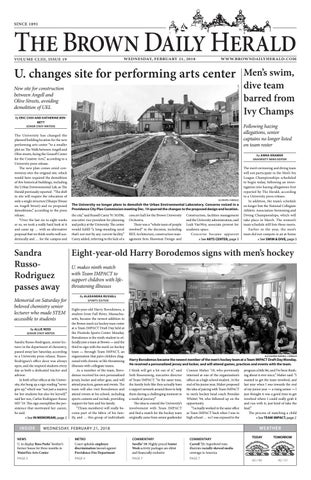
U. changes site for performing arts center Men’s swim,
dive team barred from Ivy Champs
New site for construction between Angell and Olive Streets, avoiding demolition of UEL By ERIC CHOI AND KATHERINE BENNETT
Following hazing allegations, senior captains no longer listed on team roster
SENIOR STAFF WRITERS
The University has changed the planned building location for the new performing arts center “to a smaller plot on The Walk between Angell and Olive streets, facing the Granoff Center for the Creative Arts,” according to a University press release. The new plan comes amid controversy over the original site, which would have required the demolition of five historical buildings, including the Urban Environmental Lab, as The Herald previously reported . “The shift in site will require the relocation of only a single structure (Sharpe House on Angell Street) and no proposed demolitions,” according to the press release. “Over the last six to eight weeks or so, we took a really hard look at it and came up … with an alternative proposal that we think works well academically and … for the campus and
Sandra RussoRodriguez passes away Memorial on Saturday for beloved chemistry senior lecturer who made STEM accessible to students By ALLIE REED SENIOR STAFF WRITER
Sandra Russo-Rodriguez, senior lecturer in the department of chemistry, passed away last Saturday, according to a University press release. RussoRodriguez’s office door was always open, and she inspired students every day as both a dedicated teacher and advisor. In both of her offices at the University, she hung up a sign reading “never give up,” which was “not just a mantra for her students but also for herself,” said her son, Carlos Rodriguez-Russo MD ’18. This sign exemplifies the persistence that motivated her career, he said. » See IN MEMORIAM, page 2
INSIDE
By ANNA KRAMER UNIVERSITY NEWS EDITOR
ELI WHITE / HERALD
The University no longer plans to demolish the Urban Environmental Laboratory. Concerns voiced in a Providence City Plan Commission meeting Dec. 19 spurred the changes to the proposed design and location. the city,” said Russell Carey ’91 MA’06, executive vice president for planning and policy at the University. The center would fulfill “a long-standing need that’s not met by any current facility,” Carey added, referring to the lack of a
concert hall for the Brown University Orchestra. There was a “whole team of people involved” in the decision, including REX Architecture, construction management firm Shawmut Design and
Construction, facilities management and the University administration, said Leah VanWey, associate provost for academic space. Concerns became apparent » See ARTS CENTER, page 3
The men’s swimming and diving team will not participate in the Men’s Ivy League Championships scheduled to begin today, following an investigation into hazing allegations first reported by The Herald, according to a University press release. In addition, the team’s schedule no longer lists the National Collegiate Athletic Association Swimming and Diving Championships, which will take place in March. The women’s team schedule still lists these meets. Earlier in the year, the men’s team did not compete in an at-home » See SWIM & DIVE, page 3
Eight-year-old Harry Borodemos signs with men’s hockey U. makes ninth match with Team IMPACT to support children with lifethreatening illnesses By ALEXANDRA RUSSELL SPORTS EDITOR
Eight-year-old Harry Borodemos, a student from Fall River, Massachusetts, became the newest addition to the Brown men’s ice hockey team roster at a Team IMPACT Draft Day held at the Pizzitola Sports Center Monday. Borodemos is the ninth student to officially join a team at Brown — and the third to sign with the men’s ice hockey team — through Team IMPACT, an organization that pairs children diagnosed with chronic or life-threatening illnesses with collegiate teams. As a member of the team, Borodemos received his own personalized jersey, locker and other gear, and will attend practices, games and events. The team will also visit Borodemos and attend events at his school, including sports contests and recitals, providing support for him and his family. “(Team members) will really become part of the fabric of his family, and … this group of individuals
ALEXANDRA RUSSELL / HERALD
Harry Borodemos became the newest member of the men’s hockey team at a Team IMPACT Draft Day Monday. He received a personalized jersey and locker, and will attend games, practices and events with the team. I think will get a lot out of it,” said Seth Rosenzweig, executive director of Team IMPACT. “At the same time, the family feels like they actually have a support network around them to help them during a challenging moment in a medical journey.” The idea to extend the University’s involvement with Team IMPACT and find a match for the hockey team originally came from senior goaltender
Connor Maher ’18, who previously interned at one of the organization’s offices as a high school student. At the end of his junior year, Maher proposed the idea of pairing with Team IMPACT to men’s hockey head coach Brendan Whittet ’94, who followed up on the opportunity. “I actually worked in the same office as Team IMPACT back when I was in high school … so I was exposed to the
program a little bit, and I’ve been thinking about it ever since,” Maher said. “I wanted to get the team involved, and last year when I was towards the end of my junior year — a rising senior — I just thought it was a good time to get involved where I could really grab it and run with it, just kind of take the lead.” The process of matching a child » See TEAM IMPACT, page 2
WEATHER
WEDNESDAY, FEBRUARY 21, 2018
NEWS U. to display Rosa Parks’ brother’s former house for three months in WaterFire Arts Center
METRO Court upholds employee discrimination lawsuit against Providence Fire Department
COMMENTARY Savello’ 18: Highly priced Senior Week activity packages are elitist and financially exclusive
COMMENTARY Carroll ’21: Superbowl riots illustrate racially-skewed media coverage in America
PAGE 3
PAGE 4
PAGE 7
PAGE 7
TODAY
TOMORROW
65 / 40
42 / 31
NEWS
PAGE 2 • WEDNESDAY, FEBRUARY 21, 2018
THE BROWN DAILY HERALD
»IN MEMORIAM, from page 1
» TEAM IMPACT, from page 1
Russo-Rodriguez earned her bachelor’s degree in chemistry, magna cum laude, at the University of Puerto Rico in 1979. She then studied organic chemistry at the Massachusetts Institute of Technology, where she obtained a PhD in 1983. While at MIT, she met Andres Rodriguez, who would become her husband. “I met her in a party at MIT for students and the Latin American Society. From the get-go, she was very driven, very unassuming but brilliant. Our dates were mainly talking and going for long walks,” Rodriguez said. “She had a very strong drive to help others.” After earning her PhD, RussoRodriguez “had a successful career as a research chemist for nearly two decades. In her positions at Amgen and Polaroid, she authored more than twenty scientific publications and 11 patents,” according to the press release. At Amgen, she worked in medicinal chemistry, inflammation and neurobiology as a supervisor and team member. At Polaroid, she served as a research chemist for digital imaging research, according to her resume. In 2005, Russo-Rodriguez came to the University as a lecturer in chemistry. She was “committed to making STEM fields as accessible and inclusive as possible, and she provided exceptional support and teaching to students from all backgrounds,” the press release stated. She taught a tutorial program for CHEM 330: “Equilibrium, Rate and Structure,” Chem 0100: “Introductory Chemistry”
with a collegiate team begins with Team IMPACT staff outreach, Rosenzweig said. If a child is referred by a local hospital, Team IMPACT will vet the children and their families to ensure that they are a good fit for the organization and are able to make the time commitment. The organization will then find a team that is in close proximity to the family and is enthusiastic about welcoming a Team IMPACT recruit and train the players in preparation for the experience. Borodemos will be an official team member for about two years before graduating in a formal ceremony and joining Team IMPACT’s alumni program. Whittet said that he hopes that the match will be impactful not only for Borodemos, but also for the team. “I want (the team) to understand that there’s a big world out there, there are people that are battling every day and there are things that come up in people’s lives,” Whittet said. “If we in any small way can make (Borodemos’) life at this juncture more positive by having him be a part of our program, that’s a great thing.”
COURTESY OF BROWN UNIVERSITY
Russo-Rodriguez (left) was granted the Student and Employee Accessibility Services award in May 2017 alongside Daniel Crowell ’17 (right). and summer Chem 0100 for web. In July 2017, she was promoted to senior lecturer. Russo-Rodriguez dedicated herself to students both in and outside of the classroom. In 2006, she became an advisor for first-and second-year students. In March 2014, she received a Teaching and Advising Award from the Undergraduate Council of Students for her “demonstrated outstanding commitment to teaching and student mentorship,” the press release stated. Most recently, she received the Student and Employee Accessibility Services Access Ambassador Award in May for her “exceptional awareness, inclusiveness and support for students with disabilities,” according to the press release.
“All I can say is that my mom was just an incredible mother. … I think one of her first educational successes was helping me believe that I deserved to be successful,” Rodriguez-Russo said, adding that she mirrored this practice in her teaching and helped countless students realize that they deserve to meet their goals. RussoRodriguez’s family is “going through a lot of grief,” her son said, but they have been “overwhelmed with support from the Brown community.” Members of the Chemistry Department will gather in remembrance of Russo-Rodriguez today in MacMillan 115. The community will have the opportunity to attend a memorial service at 2 p.m. in Manning Chapel Saturday.
5HćHFWLRQV RQ WKH $YDWDU 'UHDP D. Fox Harrell, Ph.D. 3URIHVVRU RI 'LJLWDO 0HGLD DQG $UWLĆFLDO ,QWHOOLJHQFH Comparative Media Studies Program & &RPSXWHU 6FLHQFH DQG $UWLĆFLDO ,QWHOOLJHQFH /DERUDWRU\ &6$,/ DW WKH 0DVVDFKXVHWWV ,QVWLWXWH RI 7HFKQRORJ\
7KH ê$YDWDU 'UHDPë LV WKH QRWLRQ WKDW XVLQJ FRPSXWHUV SHRSOH FDQ LPDJLQH WKHPVHOYHV DV ZKRPHYHU RU ZKDWHYHU WKH\ ZDQW WR EH +RZHYHU ZH QHHG DSSURDFKHV LQ ZKLFK WKH SRWHQWLDO VRFLDO DQG FXOWXUDO LPSDFWV RI YLUWXDO LGHQWLW\ WHFKQRORJLHV DUH FRQVLGHUHG LQWULQVLF WR WKH HQJLQHHULQJ SUDFWLFHV RI LQYHQWLQJ WKHP &RPH MRLQ )R[ DV KH explores the Ѳblb|-ࢼomv o= |_; -|-u u;-l D VRFLDOO\ ZLGHVSUHDG WHFKQRORJLFDO DVSLUDWLRQ
7KXUVGD\ )HEUXDU\ S P SALOMON CENTER FOR TEACHING, ROOM 001 Online registration is now open at: brown.edu/thinking-out-loud
Having Borodemos around the locker room has already improved spirits, said captain Josh McArdle ’18. “His attitude is incredible and he never seems down,” McArdle said. “To have that around really shows us that any trouble we’re going through really isn’t that bad, and he actually inspires us probably more than we inspire him.” Since its establishment in 2011, Team IMPACT has paired over 1,400 students with teams at more than 500 colleges and universities in 47 states. At Brown, the women’s ice hockey, women’s basketball, men’s basketball, baseball, men’s lacrosse, men’s soccer and men’s tennis teams have signed students through the program. The organization seeks to expand both nationally and internationally in the coming years and has already received interest from Canada and countries in Europe, Rosenzweig said. “We currently have 1,200 teams on a waiting list, so our biggest opportunity is to find as many kids as possible that could benefit,” Rosenzweig said. “The dream would be to have every child that’s living with a serious or chronic illness and every college athlete experience the power of this.”
NEWS
WEDNESDAY, FEBRUARY 21, 2018 • PAGE 3
THE BROWN DAILY HERALD
U. explores life and times of Rosa Parks with new exhibit Rosa Parks’ niece, artist dismantle Parks’ brother’s Detroit house to transport from Berlin to Providence By CELIA HACK SENIOR STAFF WRITER
History froze Rosa Parks in the moment she refused to get up from her seat in Montgomery, Alabama, according to Anthony Bogues, professor of humanities and critical theory, and Jeanne Theoharis, author of “The Rebellious Life of Mrs. Rosa Parks” and professor at Brooklyn College. Despite Parks’ extensive involvement in the civil rights movement, her fame centers almost entirely on the bus boycott. Through the University’s upcoming installation titled “Unfinished Business: The Rosa Parks Exhibition,” the University and its Center for the Study of Slavery and Justice will encapsulate Parks’ “bigger, broader political life” and not just the infamous bus seat refusal — a feat yet to be attempted by any museum or space, Theoharis said. Open to the public from April through June 2018 in the WaterFire Arts Center, the exhibition will center around a house Parks lived in briefly when she moved to Detroit. The house was recently brought to Providence with support from the University. “Rosa Parks was an activist and an advocate for racial justice and social equality long before she refused to get up from the seat and long after,” Bogues said. “The entire arc of her life is around questions of racial justice and equality in the U.S.” Parks’ brother Sylvester McCauley owned the three-bedroom house, and Parks stayed in it intermittently after fleeing from Alabama for Detroit in
1957, according to his daughter Rhea McCauley. The house was on Detroit’s demolition list until Rhea McCauley bought it for $500 in 2008 and then passed it along to artist Ryan Mendoza to restore it in 2016. Mendoza moved it in pieces to his home in Berlin, where he rebuilt it almost entirely on his own and with his own money, Mendoza said. Mendoza and McCauley together decided to move the house to Providence in appreciation of the University’s CSSJ, one of few programs in the country that address a university’s history of slavery, McCauley said. The exhibition will help the University continue to reckon with a past strewn with injustice and slavery, said President Christina Paxson P’19. “You don’t reckon with your past once and wipe your hands and say you’re done with that,” Paxson said. “You have to continue to think about the issues and engage.” The exhibit will dive into Parks’ life in Detroit, which tends to be glossed over in comparison to her work in Montgomery, Theoharis said. When she moved north, Parks continued to experience segregation and inequality, struggling to find housing and work in Detroit, McCauley said. “Auntie Rosa came (to Detroit) homeless, no money,” McCauley said. “Nobody wanted Auntie Rosa. People weren’t running around trying to hire my aunt.” The house asks its viewers to grapple with the narrative of the “northern promised land,” Theoharis said. “It sort of asks us to see (Parks) outside of the South, it asks us to see northern segregation and northern inequality,” she added. Bogues, Mendoza and McCauley all see the house becoming a hub for conversations about the racial issues of today for Brown students as well as Providence locals.
COURTESY OF FABIA MENDOZA
Artist Ryan Mendoza displayed Rosa Parks’ brother’s house in his backyard in Berlin after rebuilding it. The structure will now be featured as “Unfinished Business: The Rosa Parks Exhibition” in the WaterFire Arts Center. In addition to its historical focus, the project looks toward the future, Bogues said. Its title, “Unfinished Business,” points to the continued need for racial progress, he added. The exhibit will end by highlighting present-day activism, including Black Lives Matter and #MeToo, Theoharis said. “All of these movements today are taking on many of the things (Parks) and her comrades and friends worked on for decades,” Theoharis said. Though many are in support of the University’s effort to spotlight the Detroit home, Steven Cohen, attorney at the Rosa and Raymond Parks Institute for Self Development, is less
sure of the house’s authenticity. “The truth is, she didn’t stay there,” he said. “It’s a house which Rosa Parks’ brother and his family used to live in. It’s no more Rosa Parks’ house than it is my house.” Parks’ “actual house” is still standing at its original location, 9336 Wildemere St. in Detroit, Cohen wrote in a follow-up email to The Herald. “Mrs. Parks and her Institute kept the house in good repair all these years, something the brother’s family apparently didn’t manage to do,” he wrote. Theoharis is also unsure about the time period of her stay in the Detroit house, saying that Parks, her husband
and mother “may have stayed there off and on, but they didn’t stay there for any extended period of time.” However, Theoharis and Paxson, among others, believe the house is of great value and worthy of display. “Stepping back, it’s not clear how it would be different if she had lived there for 50 years versus if she stayed there occasionally,” said Steven Lubar, professor of American studies. “It makes it something that connects … back to that moment, that hero.” The Nash Family Foundation, the Hewlett Foundation and the Carnegie Corporation all contributed to the project, which is being funded almost entirely by grants, Paxson said.
»SWIM & DIVE, from page 1 competition scheduled for Jan. 13 against Penn and Harvard. Brown still hosted the meet, and the men’s teams from Penn and Harvard swam against each other. All three women’s teams, including the Bears, competed as planned. Furthermore, the men’s team roster no longer lists the two senior captains. The University plans to release a statement on the results of the hazing investigation in the coming weeks, according to the press release.
» ARTS CENTER, from page 1 following the Dec. 19 Providence City Plan Commission meeting on the University’s original plan, most notably regarding the “size of the building,” “removal of historic buildings” and demolition of the UEL, VanWey said. To address the concerns, REX Architecture suggested putting “part of the program underground,” VanWey said. “It reduces the above-ground volume by 50 percent.” “On this revised site, more of (the center) can go underground,” Carey said. This is possible because Brown has owned Olive Street since “it was purchased from the city a number of
COURTESY OF BROWN ATHLETICS
The men’s swimming and diving team schedule no longer lists the NCAA Championship following a University hazing investigation launched Nov. 29.
years ago,” he added. After the construction of the center, Olive Street will be closed off to public traffic, VanWey said. The street will be declared a “service road and pedestrian area for Brown functions,” she added. But “the building is expected to generate little, if any, additional street traffic or demand for parking,” according to the press release. Many who had protested the demolition of the UEL consider the new plan to be a victory. “I’m personally happy to hear that Brown has taken all these into consideration and has gone forward” with a new plan, said Austen Sharpe ’18. “I was … crying almost in joy that
the community will survive” in addition to the “legacy of environmentalism in Rhode Island,” said Lauren Maunus ’19. “Everyone was texting each other like, ‘Congratulations!’ or, “We did it!’ … Everyone was so excited and supporting each other.” But students “have to remain vocal and be present,” Maunus said. “We can’t just be complacent.” “We have learned a lot from this and we are going to be ready to gather together if it’s ever in jeopardy again,” said Kai Salem ’18. “It’s so much more than just a building,” Maunus added. “This change is really about having a community survive and history maintained.”
NEWS
PAGE 4 • WEDNESDAY, FEBRUARY 21, 2018
THE BROWN DAILY HERALD
U. recognizes staff members for quality work, years of service Thirteen individuals, four teams win excellence awards for leadership, innovation, among others By DYLAN CLARK STAFF WRITER
President Christina Paxson P’19 handed out Brown Employee Appreciation and Recognition awards to staff members Feb. 20. Two types of awards were given out, one to celebrate “years of service” and the other to recognize “performance excellence”; the latter category recognizes either individuals or groups in one of seven areas, including diversity and inclusion, leadership and innovation, according to the University’s Human Resources website. The BEAR Day event brought families, friends and colleagues of staff members to the Salomon Center to celebrate the work of almost three dozen staff members. All of the staff members who received Excellence Awards were nominated before being selected. Chief of Staff to the Provost Marisa Quinn, who sits on the selection committee, wrote in an email to The Herald that a total of 13 individuals and four teams were picked from 113 nominations. Award recipients are picked based on set criteria, including “whether the individual or team has made a measurable impact to advance our goals, progress and
values as a community,” Quinn wrote. A banner celebrating the event hung on the doorway above Salomon. As guests entered, they were greeted with balloons and red pamphlets detailing the accomplishments of the staff members receiving recognition. Salomon 101 was packed with a variety of University community members, some there to collect their awards and others to support their coworkers. For instance, Andrea Goldstein — a coordinator at the Office of Continuing Medical Education — was there to celebrate her boss, Director of Continuing Medical Education Maria Sullivan, for 15 years of service at the University. The awards are “a great way to boost morale and help employees feel appreciated,” Goldstein said. “It’s a great way to showcase the innovations and fantastic staff members that make the University great.” Goldstein, herself a previous recipient of the Excellence Award for Efficiency and a five-year service award, said those receiving special recognition are also awarded a monetary gift for their contributions. The event, which the University began hosting annually in 2005, was kicked off by a brief introduction from Executive Vice President for Finance and Administration Barbara Chernow. A video montage of the teams and individuals who had earned excellence awards, along with the small army of staff members receiving Years of Service Awards, was met with applause and
HUAYU OUYANG / HERALD
Maiyah Gamble-Rivers, manager of programs and outreach in Brown’s Center for the Study of Slavery and Justice, received an Excellence Award for Citizenship from President Christina Paxson P’19. laughter. The playful video highlighted some of the work being done by individuals in areas such as research, admissions, dining services and financial aid. Years of Service Awards were given out to staff members who have worked with the University for five years, with subsequent awards given for every additional five years. Stephen Lawton, production services specialist, was recognized for 50 years of service to the University and was met with roaring applause as he made his way to the stage. Bonnie Buzzell, senior knowledge systems librarian, was recognized for 45 years of service.
Brian Clark, director of news and editorial development, won an Excellence Award for Innovation. Clark, along with five colleagues from the Office of University Communications and Computing and Information Services, received the award for work on the new Today@Brown system. “I was happy that President Paxson pointed out today … that (Today@Brown) is just the first phase in what we’re doing to transform digital communication at Brown. It was a recognition that it was a step forward,” Clark said. Lauren Schlichting, research analyst, received the Excellence Award
for Rising Star for her work at the Hassenfeld Child Health Innovation Institute. When a study conducted at the Women and Infants Hospital required a piece of expensive software to collect data, Schlichting provided an alternative that ensured that the institute would not have to pay for outside software. She was nominated by her boss, Michelle Rogers, senior research analyst at the institute. Paxson, who received a pin for her five years as president, delivered a speech stressing the importance of affirming that work done by employees is vital to the University.
Court upholds ruling against Providence Fire Department Discrimination case based on sex, sexual orientation has potential implications for Title VII By JACK BROOK SENIOR STAFF WRITER
The U.S. First Circuit Court of Appeals upheld a 2016 ruling Jan. 25 in favor of former Providence firefighter Lori Franchina, who had originally sued the Providence Fire Department in 2012 on the grounds that her colleagues had harassed her because of her sexual orientation and gender. According to some legal experts, the case could help expand how Title VII is defined under federal law since it does not currently prohibit discrimination based on sexual orientation. “The abuse Lori Franchina suffered at the hands of the Providence Fire Department is nothing short of abhorrent,” Judge O. Rogeriee Thompson wrote in her decision. “And as this case demonstrates, employers should be cautioned that turning a blind eye to blatant discrimination does not generally fare well under anti-discrimination laws like Title VII.” Title VII of the Civil Rights Act currently prohibits employment discrimination on the basis of “race, color, religion, sex or national origin,” according to federal law. The Court also affirmed the jury’s earlier ruling to award Franchina over $500,000 in “front pay as well as emotionals damages,” which include Post-Traumatic Stress Disorder. Franchina’s lawyer John Martin said he successfully employed the “sex-plus
theory” of discrimination to prove that Franchina had suffered not only from sex discrimination in violation of Title VII, but also from discrimination based on sexual orientation. The Franchina case indicates how sexism and gender-based stereotyping can influence the way in which discrimination based on sexual orientation is expressed, said Gary Busek, legal director of GLBTQ Advocates and Defenders. According to court testimony recounted by Thompson in her decision, Franchina, who identifies as lesbian, began experiencing harassment in 2006 upon being assigned to work with Andre Ferro, a fellow firefighter. When they first met, Ferro immediately asked her whether she liked women. Franchina did not answer. “I don’t normally like to work with women; but, you know, we like the same thing, so I think we’re going to get along,” Ferro told Franchina, according to court records. Soon after their initial meeting, Ferro rubbed his nipples and loudly proclaimed Franchina as his “lesbian lover.” He did so in front of their colleagues and during an ongoing emergency call. Though the station chief later reported the incident, which prompted Ferro’s dismissal in 2007, he was rehired by the department in 2008, according to court records. Similarly, in 2001, while Ferro was “implicated” in a Title VII case for sexually inappropriate behavior toward colleague Julia O’Rourke, he didn’t face any long term disciplinary action and ultimately kept his job, Thompson noted. Ferro was not the only individual to sexually harass Franchina, according to court records. Following Franchina’s
2006 interaction with Ferro and his pending dismissal, a pattern of harassment developed in the station against Franchina in retaliation to Ferro’s punishment, creating a “hostile work environment,” court records indicate. Many of her colleagues openly referred to her as “Frangina,” “cunt” and “bitch” in her presence, according to Franchina’s testimony. In her decision, Thompson also noted that Franchina alleges that the station cook prepared food intended to make her violently sick on multiple occasions. A station white-board contained 21 insulting messages about Franchina, including: “Be careful how you talk to her, she’ll bark at you” and “Frangina leads Team Lesbo to victory.” Following Franchina’s promotion to lieutenant, a colleague approached her and said, “I will never take a … order from you,” Thompson reported. Her subordinates openly ignored or undermined her orders on emergency calls, including the need for a rescue vehicle to help treat a victim of a car crash who later died, she claimed in court documents. “There were folks that showed contempt for women (in the department),” said Chief J. Curtis Varone in testimony from the hearing. Lt. Danielle Masse, a firefighter who identifies as lesbian and is currently suing the department for discrimination, said in her testimony in Franchina’s case that women in the department are viewed as “less competent” and are “spoken to as if they have no authority.” There is a culture that encourages firefighters to resolve issues between themselves and within the fire department, said Lt. Elliot Murphy, who has
twenty years of experience on the job. Even when Franchina reported her situation, the city and her supervisors — some of whom sought to downplay the issue — were less than adequate at responding to her complaints, Martin said. “At the very highest levels of the fire department and the city government there were verified complaints and overwhelming proof of vicious harassment and retaliation that were completely ignored,” Martin said. No individual besides Ferro was fired or formally reprimanded, he added. According to court documents, when Franchina reported to Chief Michael Crawford that a subordinate intentionally sprayed her face with “blood and brain matter” while treating a “suicide-attempt victim,” Crawford wrote in his complaint to the city’s Equal Employment Opportunity Officer that he thought that she was “blowing (the incident) out of proportion.” Following Thompson’s decision supporting Franchina, more LGBTQ+ individuals will likely come forward with discrimination and harassment claims, said Gregory R. Nevins, Counsel and Employment Fairness Project director at Lambda Legal Services. “It’s rare to almost nonexistent to find a circumstance where anti-gay or lesbian harassment does not have some sort of gender-based overtone to it.” Because Franchina’s case was centered on sex discrimination, Thompson did not change the circuit’s current interpretation of sexual orientation. To do so would require a separate legal process and the agreement of all 10 of the First Circuit Court of Appeals’
judges. Only the Seventh Circuit Court of Appeals, which covers Indiana, Illinois and Wisconsin, has included sexual orientation in Title VII protection, Buseck said. Still, Thompson’s strongly-written ruling seems to be hinting that the First Circuit Court of Appeals might be in agreement with the Seventh Circuit, Buseck said. The City will not be appealing the ruling, according to Emily Crowell, director of communications for the Mayor’s Office. In her court testimony, Olayinka Oredugba, the city’s sole Equal Opportunity Officer responsible for 2300 employees, said that she lacked the resources to investigate claims of discrimination to the best of her abilities. “The City of Providence remains committed to maintaining a workplace that is free from harassment and discrimination,” Crowell said in an email statement to The Herald. “The City takes any complaint seriously and investigates each matter.” Franchina acquired injured-on-duty status in 2011 and formally retired from firefighting in 2013, according to her lawyer. She is now working in the medical field and searching for a new career. “It’s going to harm her for the rest of her life,” Martin said. “You can’t undo what’s happened, can’t fix it. She’s always going to have PTSD, she’s never going to be a firefighter again and that’s something the judge can’t fix.” Franchina could not be reached for comment. Firefighters’ Union President Paul Doughty did not respond to a request to comment.
TODAY
WEDNESDAY, FEBRUARY 21, 2018 • PAGE 5
THE BROWN DAILY HERALD
a s s n o w m e lt s , t o u r s h e at u p
menu SATELLITE DINING ANDREWS COMMONS
Pizza: Cheese, Pepperoni, Spicy Sausage and Garlic, Mushroom’s Revenge JOSIAH’S
BLUE ROOM
Quesadillas, Mac and Cheese Bacon Burger
Beef Chili with Beans, Burrito Bowl, Grain Bowl
DINING HALLS SHARPE REFECTORY LUNCH
DINNER
Carne Gizado, Spiced Chicken Thighs, Sancocho de Frijoles, Steamed White Rice
Baked Sesame Chicken, Parsley Potatoes, Italian Beef Noodle Casserole, Spicy Dahl
VERNEY-WOOLLEY LUNCH
DINNER
Saturday Night Jambalaya, Stuffed Red Pepper With Brown Rice, Vegetable Melange
Meatloaf With Mushroom Sauce, Curried Lentil Pancakes With Tzatziki, Mashed Potatoes
sudoku KAITLYN LEW / HERALD
Though many Brown students fled campus for the long weekend, the unseasonally warm weather brought gaggles of high school students to College Hill while remaining students lounged on the Main Green.
Q U O T E O F T H E D AY
“Auntie Rosa came to (Detroit) homeless, no money. Nobody wanted Auntie Rosa. People weren’t running around trying to hire my aunt. crossword
”
— Rhea McCauley, Rosa Parks’ niece
See rosa parks on page 3.
CORRECTION A previous version of the article “R.I. eyes medical marijuana expansion” stated that Nadir Pearson ’19 said that “Cannabis is not physiologically addicting the same way opioids are, and you won’t get physical withdrawal symptoms.” In fact, cannabis habits can produce physical withdrawal symptoms. A previous version of this article also stated that Norman Birenbaum said that “Expanding the availability of medical marijuana could help prevent opioid addictions, since opioid products are often prescribed after surgeries and are addictive after three days.” In fact, there is not clear evidence that opioids are addictive after three days. The Herald regrets the errors.
calendar TODAY FEBRUARY MARCH
S
M
T
W
Th
F
S
28
29
30
31 1
12
23
34
45
56
67
87
89
10 9
10 11
Wellness at Brown: Home Buying 12:00 P.M. 200 Dyer Street, 122
Gathering for Sandra Russo-Rodriguez 4:30 P.M. MacMillan Hall, 115
What Would Jesus (Actually) Do: Racial Justice 6:00 P.M. J. Walter Wilson, 501
Chocolate Night 8:00 P.M. Harkness House
TOMORROW
11 12
12 13
13 14
14 15
15 16
16 17
17 18
18 19
19 20
20 21
21 22
22 23
23 24
24 25
25 26
26 27
27 28
28 29
30
31
Social Media 2018 12:00 P.M. South Street Landing, 498
Talk: Tim Nelson 12:00 P.M. CIT, 368
Muslim Woman Workshop 6:00 P.M. J. Walter Wilson, 411
Kill Bill Double Feature 7:00 P.M. Harkness House
COMMENTARY PAGE 6 • WEDNESDAY, FEBRUARY 21, 2018
THE BROWN DAILY HERALD
ST E P HA N I E W U
Find us online! facebook.com/browndailyherald
browndailyherald.com
@the_herald
Location: 195 Angell St., Providence, R.I. www.browndailyherald.com
@browndailyherald
youtube.com/browndailyherald
Editorial Leadership
Sections
Multimedia & Production
Editor-in-Chief Elena Renken
Arts & Culture Editors Connor Sullivan Elizabeth Toledano
Design Editors General Managers Kyle Cui Michael Borrello Eduard Muñoz-Suñé Matilda Lynton Assistants: Julie Wang, Kelvin Yang
Metro Editors Emily Davies Bella Roberts
Photo Editors Sam Berube Anita Sheih
News Editors Anna Kramer Eduard Muñoz-Suñé Priyanka Podugu Sarah Wang
Copy Desk Chief Abby Borges
Managing Editor Kasturi Pananjady Senior Editors Julianne Center Madison Rivlin Alex Skidmore Hattie Xu POST- MAGAZINE Editor Saanya Jain
Science & Research Editors Jonathan Douglas Jackson Wells Sports Editors Alexandra Russell Nicholas Wey COMMENTARY Opinions Editors Connor Cardoso Anuj Krishnamurthy Clare Steinman
Illustrations Editor Pia Mileaf-Patel Directors of Web Development Eli White
Business
Office Manager Diane Silvia Directors Sales: Shreya Raghunandan Finance: Ravi Betzig Strategy: Caroline Ziegler
Editorial contact: 401-351-3372 herald@browndailyherald.com
Advertising contact: 401-351-3372 advertising@browndailyherald.com
Submissions: The Brown Daily Herald publishes submissions in the form of op-eds and letters to the editor. Op-eds are typically between 750 and 1000 words, though we will consider submissions between 500 and 1200 words. Letters to the editor should be around 250 words. While letters to the editor respond to an article or column that has appeared in The Herald, op-eds usually prompt new discussions on campus or frame new arguments about current discourse. All submissions to The Herald cannot have been previously published elsewhere (in print or online — including personal blogs and social media), and they must be exclusive to The Herald. Submissions must include no more than two individual authors. If there are more than two original authors, The Herald can acknowledge the authors in a statement at the end of the letter or op-ed, but the byline can only include up to two names. The Herald will not publish submissions authored by groups. The Herald does not publish anonymous submissions. If you feel your circumstances prevent you from submitting an op-ed or letter with your name, please email herald@browndailyherald.com to explain your situation. You can submit op-eds to opinions@browndailyherald.com and letters to letters@browndailyherald.com. When you email your submission, please include (1) your full name, (2) an evening or mobile phone number in case your submission is chosen for publication and (3) any affiliation with Brown University or any institution or organization relevant to the content of your submission. Please send in submissions at least 24 hours in advance of your desired publication date. The Herald only publishes submissions while it is in print. The Herald reserves the right to edit all submissions. If your piece is considered for publication, an editor will contact you to discuss potential changes to your submission. Commentary: The editorial is the majority opinion of the editorial page board of The Brown Daily Herald. The editorial viewpoint does not necessarily reflect the views of The Brown Daily Herald, Inc. Columns, letters and comics reflect the opinions of their authors only. Corrections: The Brown Daily Herald is committed to providing the Brown University community with the most accurate information possible. Corrections may be submitted up to seven calendar days after publication. Advertising: The Brown Daily Herald, Inc. reserves the right to accept or decline any advertisement at its discretion. The Brown Daily Herald, Inc. is a financially independent, nonprofit media organization bringing you The Brown Daily Herald, BlogDailyHerald and Post- Magazine. The Brown Daily Herald has served the Brown University community daily since 1891. It is published Monday through Friday during the academic year, excluding vacations, once during Commencement and once during Orientation by The Brown Daily Herald, Inc. Single copy free for each member of the community. Subscription prices: $200 one year daily, $100 one semester daily. Copyright 2017 by The Brown Daily Herald, Inc. All rights reserved. Periodicals postage paid at Providence, R.I. Postmaster: Please send corrections to P.O. Box 2538, Providence, RI 02906.
COMMENTARY WEDNESDAY, FEBRUARY 21, 2018 • PAGE 7
THE BROWN DAILY HERALD
The elitism of Senior Week SAMANTHA SAVELLO staff columnist I remember hearing wonderful things when I was an underclassman about Senior Week, the week of activities that takes place between final exams and graduation. From the Unit Wars to the mixers and dances, everything sounded like a fun way for seniors to kick off their final days at Brown, and for years, I looked forward to attending a Senior Week of my own. But what I wasn’t told was how expensive Senior Week is. A few days ago, I received an email from the Class Coordinating Board listing the prices of the “Senior Week packages,” which are $210 per person for the regular packages and $160 for those who are under 21. The financial aid packages, by comparison, cost half the standard price. However, even $105 is a lot for someone to spend on graduation festivities, and I began to wonder what a student should do if they’re not able to afford any of the packages. According to the CCB website, there are nine free events, including the “Brown’s Finest” talent show, Unit Wars and Pizza Lunch, the Andrew Evans Magic Show and the Ice Cream Social, to name a few. There are also a variety of events you can choose to individually purchase without buying
the whole package. However, many of these events seem overpriced with respect to the activity. For example, Class Day, which involves a barbecue and Dave Binder concert, costs $30 to attend and “Last Meal at the Ratty,” which entails a combination of Ratty dishes, beer options and a DJ, costs $40. Even with the beer and the DJ, anyone who’s eaten at the Ratty knows that its food is not worth anything near $40.
There is a time and place to charge students for activities, such as Gala and formals, which are not something every single student has the desire to go to. But graduation is a universal experience for all students, and they shouldn’t be denied access to the activities because of their financial background. When Senior Week activities are prohibitively priced, seniors will find other activities outside of the planned events, which further
mountains of student loans. Brown is only adding fuel to the fire with these Senior Week packages, forcing students to make decisions based on financial practicality instead of desire. All of this begs the question: Does Brown really want us to remember our last week here as a stressful financial balancing act? Graduation is supposed to be a time to celebrate your achievements and hang out with your peers for the last time — not a time to
Graduation is supposed to be a time to celebrate your achievements and hang out with your peers for the last time — not a time to worry about whether or not you can afford to attend the same events as your friends.
There are also three “classy” events for package holders only: a wine and cheese mixer, a craft beer tasting and a casino night at Mohegan Sun. These events are only for the people who purchased packages, and there is no option for someone to pay for these individual events if they really wanted to go. This is problematic and elitist — it penalizes the non-package holders for not paying the whole price and fosters an exclusive atmosphere surrounding these events. These pricing choices are questionable on many levels and seem to go against Brown’s own stated goal of giving students equal opportunities.
divides the class. During a time when we should be celebrating our collective accomplishment, it is ironic and painful to see our class split along financial lines. On top of these Senior Week activities, graduation is already an expensive time for most Brown students and their families. Between cap and gown prices, senior photos, elevated hotel costs, heightened restaurant prices and travel expenses, the whole experience of graduating can cause financial strain for many. Furthermore, graduation is especially concerning for those who don’t have lucrative jobs lined up or who are faced with
worry about whether or not you can afford to attend the same events as your friends. To combat these issues, Brown should take steps toward making the Senior Week festivities more affordable. There are already many free events available, but for the pricier events, perhaps Brown can work toward reducing prices through fundraising or by soliciting volunteer workers. Freshman Orientation, for example, is run entirely by student volunteers, which significantly reduces labor costs. For some of the activities of Senior Week that are for students over 21, student volunteers
would not be ideal, but it would be worth extending volunteer opportunities to faculty, staff and alumni who are willing to help out. Another idea is to make the three package-holder-only events open to non-package-holders as well. Obviously, students may not want to go to all of these events, but they should at least have the option to go to the ones they want to regardless of whether they can afford the full package. Brown should also consider getting rid of some of the pricier events altogether to help create more equitable opportunities. After all, students can go off and pursue these more expensive activities on their own without the University’s implicit endorsement of class divisions. At the end of the day, graduation is an experience Brown students will remember for the rest of their lives, so Brown should reconsider the opportunities they are providing and what kind of environment these exclusive events create. Perhaps instead of focusing on fancy, exclusive events, the University can focus on creating what really matters: an enjoyable final week well-spent with peers.
Samantha Savello ’18 can be reached at samantha_savello@ brown.edu. Please send responses to this opinion to letters@browndailyherald.com and op-eds to opinions@browndailyherald.com.
What the Super Bowl riots can teach us about race in America JASON CARROLL op-ed contributor On the night of Super Bowl Sunday, football fans took to the streets of Philadelphia after the Eagles pulled off a historic upset in Super Bowl LII, bringing the team their first championship title. However, the fun quickly turned to chaos as fans began to tear through the streets, causing damage in their wake. Videos surfaced online of out-of-control fans flipping cars, setting fires, vandalizing local businesses and even eating horse feces off the ground — yes, you read that right. In spite of the widespread mayhem that ravaged downtown Philadelphia that Sunday night, for some reason the resulting media reaction has been rather tempered. Fox News classified the riots that destroyed parts of Philadelphia as a “celebration” and “rowdy,” and Newsweek reported that the “raucous celebrations” got “out of hand.” However, the story is told rather differently when black Americans take to the streets. Blatant and upfront racism has been replaced by a similarly dangerous, but harder to recognize set of racial double-standards. In recent years, Black Lives Matter protesters have frequently been accused of being “thugs” by media outlets, particularly Fox News. The founders of the Black Lives Matter movement like Patrisse Cullors and its members across the nation more generally have been accused of being literal terrorists. However, TV media outlets largely lost their harsh tone when referring to the majority-white Philadelphia rioters with Fox News referring to the latter as “boisterous fans.” The discrepancy in coverage of predominant-
ly-white and predominantly-black demonstrations is not a new phenomenon. One can point to the many violent riots caused by predominantly-white youth after sporting events and the lack of media response as evidence of prejudice. For example, the Michigan State riots after a loss to Duke in the 1999 NCAA Final Four resulted in over 100 arrests and damage assessments as high as $500,000, and the 2012 University of Kentucky riots saw an estimated 10,000 fans amass in the streets after a win against rival Louisville. The difference in the way that black protesters and white rioters are characterized in society demonstrates the state of racism in America
ous or criminalistic. For example, in 2014, media coverage of the infamous police shooting of African American teenager Mike Brown in Ferguson, Missouri, sparked widespread controversy. Young blacks from all over America chimed in to criticize media outlets’ apparent attempts to portray Brown as a malefactor — the media eschewed flattering photos of Brown with family or at his graduation and instead used rough photos of Brown on the street or with his middle finger raised. These events spurred the “If They Gunned Me Down (What Photo Would They Use)” online campaign in which young black Americans
The discrepancy in coverage of predominantly-white and predominantly-black demonstrations is not a new phenomenon. One can point to the many violent riots caused by predominantly-white youth after sporting events and the lack of media response as evidence of prejudice. today. Consider Fox News suggesting that Black Lives Matter is a “murder movement” in 2015 or comparing Charlottesville Neo-Nazis and white supremacists to Black Lives Matter protesters in 2017. The “N-word” has been replaced by the word “thug.” The explicit denouncement of blacks in America as dangerous has been replaced by cloaked insinuations hidden in the statements of news pundits. In recent years, black Americans have raised questions over the way the mainstream media disproportionately portrays blacks as danger-
contrasted positive and negative photos of themselves and pondered which ones the media would choose to run should they become victims of police brutality or racially-motivated gun violence. One viral post showed a young woman in a military uniform alongside a picture of her holding a bottle of vodka. Another showed a man in a gold chain and a T-shirt juxtaposed with a picture of him walking across the stage at his graduation. Similar allegations of racial bias and subsequent public outcry have arisen. Notably, the public has denounced distorted and tasteless
coverage in moments like the media investigation of 17-year-old Trayvon Martin’s private life after his fatal shooting in 2012, which included speculation about Martin’s academic transcript and school record. Another common practice is to refer to black minors like Martin and 12-yearold police shooting victim Tamir Rice as “men” or “adults,” while older white men who committed atrocities such as mass murders and rape — like Dylann Roof, Nikolas Cruz and Brock Turner — are referred to as “boys.” By contrast, the policeman who shot Rice perceived him not as a 12-year-old playing in a park but as a “maybe 20” year old threat, as he described Rice immediately after fatally shooting him. These media practices are poorly veiled attempts to demonize the victims of racially-motivated violence and police brutality, while giving white perpetrators of violence the benefit of the doubt. Black America needs to keep calling out the racialized media coverage present in this country. The messages that people receive from television and other media surrounding race play an important part in how we interact with society. And as the deaths of Martin and Rice make clear, this distorted coverage has concerning implications for how people of color are viewed in the world. We need to work toward an America where black civil rights protesters aren’t called terrorists and threats to society if white college students destroying cities after a football game are simply “kids” and “boisterous fans.”
Jason Carroll ’21 can be reached at jason_carroll@brown.edu. Please send responses to this opinion to letters@browndailyherald.com and op-eds to opinions@ browndailyherald.com.
NEWS THE BROWN DAILY HERALD
WEDNESDAY, FEBRUARY 21, 2018
Brown drops critical road games to Harvard, Dartmouth Bears fall to Ivy League leader Harvard, lastplace Dartmouth in disappointing weekend By ALEX SMOLAR SENIOR STAFF WRITER
The men’s basketball team’s hopes to make Ivy League playoffs were dashed this weekend, as close losses to Harvard and Dartmouth gave Brown a losing record with just four conference contests remaining in the season. The Bears are still positioned at fourth place in the Ivy League, but are locked in a three-way tie for the final playoff spot with Cornell and Columbia. This weekend’s matchups against the Big Red and the Lions will prove pivotal in deciding Bruno’s postseason fate. “We know it’s a big weekend and we’re hungry to get these wins,” said Travis Fuller ’19. “We started this week off with a great practice and we’ll look to continue to be sharp in preparation.” Brown 58, Harvard 65 The Bears looked strong in the opening half against the Crimson, and were led by Brandon Anderson ’20, who finished the period with eight points. Brown also outshot Harvard in the first half, shooting 34 percent from the field compared to the Crimson’s 30 percent. But the Bears missed all three of their free throw attempts in the first period, and fell to a 27-25 halftime deficit. In the second stanza, Brown
managed to keep up with the highpowered Harvard squad and tied the game off of a tip from Obi Okolie ’19 with four minutes of play remaining. But Harvard forward Seth Towns took over in the final minutes and put the game out of reach for Bruno with a three. He finished with a game-high 24 points. Anderson led all Brown scorers with 17 points, followed by Tamenang Choh ’21 who came off the bench to score 11. Desmond Cambridge ’21 also notched 10. The team shot 38 percent from the field and recorded 33 rebounds. Brown 63, Dartmouth 66 Bruno sought to respond from the loss the night before with a win against last-placed Dartmouth, but the Big Green was hungry for revenge after Zach Hunsaker’s ’20 buzzerbeater gave Brown the victory in their last matchup. In the first half, Dartmouth came out strong, and jumped out to a 3734 lead on hot three-point shooting. The Big Green knocked in six treys, compared to just one from Brown. After half-time, the Bears began to heat up and looked ready to take control of the game. A strong layup from Hunsaker gave Brown a 46-40 lead with 15 minutes remaining in the contest. But the Big Green came all the way back in just four minutes to take a 5150 lead and gain momentum. In a tied game with three minutes remaining, Chris Knight hit two clutch shots to put Dartmouth ahead by four. Anderson managed to get open for a three-point shot to cut the Big Green’s
COURTESY OF BROWN ATHLETICS
Desmond Cambridge ’21 takes a shot while Travis Fuller ’19 waits for the rebound. Cambridge led all Brown scorers with 13 points against Dartmouth, followed by Brandon Anderson ’20 and Tamenang Choh ’21. lead to one with barely a minute left to play. After Dartmouth knocked in a layup, Hunsaker was fouled and made two free throws to once again put the Bears in striking distance. Knight missed a contested shot with 23 seconds to go, and the Bears gained possession with a chance for another miracle victory. Hunsaker broke free from his defender and launched a possible game-winning
three with only four seconds remaining. The shot did not find the bottom of the net, but Cambridge collected the offensive rebound. Cambridge put up a putback layup as time expired but it did not go in, sending the Bears to a brutal loss. Bruno finished the game shooting 38 percent from the field and only 18 percent from beyond the three point arc. Cambridge led all Brown scorers
with 13 points, followed by Anderson and Choh with 11 points each. While Fuller doesn’t “really have an answer” for what the team didn’t do well enough, “I think we’ll be ready to play this weekend,” he said. The Bears will stay on the road this weekend, facing Columbia Friday and Cornell Saturday as the Ivy League season nears a suspenseful conclusion.
U. researchers use drones to study forests, carbon cycle IBES visualizes carbon uptake during photosynthesis, links to climate change By TANUSHRI SUNDAR SENIOR STAFF WRITER
Loren Albert, one of four Voss postdoctoral research associates at the Institute at Brown for Environment and Society, is quite literally taking her research to new heights. By using drones to survey forests from above, Albert hopes to better understand carbon flows and photosynthesis on a large scale. A self-described “biologist at heart,” Albert started studying plants as an undergraduate at Reed College. She found it fascinating that she could measure a plant’s ability to take up carbon from the atmosphere on a “leaf level.” Albert “put a plant in a chamber, measure(d) the gases going in and gases going out” and estimated how much carbon was taken up by the leaves. While earning her PhD at the University of Arizona, she measured the photosynthesis capabilities of individual trees in tropical forests, but one problem remained, Albert explained. “There’s an estimated 16,000 species in Amazonia, and I measured only around six.” Albert knew that this gap would never be closed with
only individuals like her working on the ground, she said. To address this issue, she has partnered with Jim Kellner, assistant professor of ecology and evolutionary biology. Kellner created the Brown Platform for Autonomous Remote Sensing, which built a drone to help the researchers observe forests on a much wider scale. With the platform, the researchers have gained significant control over how and when their data is collected. For example, the team can now fly the drone over forests at times when they anticipate strong environmental stress to target data collection. This advantage provides researchers with dynamic information — they are able to “observe the system in short time scales in which the organism is reacting to the environment,” Kellner said. Essentially, “the system is living,” he said. Technological developments have aided researchers’ capacity to visualize carbon flows in forests and answer important questions regarding how plants facilitate the exchange of carbon from the atmosphere to the land, Kellner explained. Though it is not possible to visually observe that flux, researchers may now use the drone to quantify solar-induced fluorescence, a glow that plants emit while getting rid of excess chemical energy. Researchers hope that glow analysis will inform
COURTESY OF LOREN ALBERT
Loren Albert, Voss postdoctoral research associate at the Institute at Brown for Environment and Society, began her biology career at Reed College before earning her PhD at the University of Arizona. future conclusions about the carbon cycle. William Klimpert ’18, a former member of Kellman’s lab, said he often measures plants in the “hot sun” or on the roof of the Sciences Library for the aforementioned fluorescence study. Both Albert and Kellner said their project poses complicated biological, engineering and statistical challenges.
The team has had to pull knowledge from a variety of academic disciplines in their research. But they stress their work measuring carbon flows is crucial given the role of forests in offsetting human emissions. A 2014 study conducted by NASA estimated that tropical forests absorb 1.4 billion metric tons of carbon dioxide per year, which is roughly 56 percent
of the total carbon absorbed across the world. Albert has received valuable mentorship from Kellner, who strongly encouraged her to apply for the fellowship after seeing her give a talk at conference. Albert brings a different “body of knowledge” to his work, which inspires productive collaboration, Kellner said.