SINCE 1891
THE BROWN DAILY HERALD WEDNESDAY, FEBRUARY 1, 2017
VOLUME CLII, ISSUE 6
WWW.BROWNDAILYHERALD.COM
McKeown remembered for scholarly acumen, K-12 STEM advocacy Beloved professor passed away after 17 years at U., enjoyed celebrated career in biology, genetics By MIA PATTILLO SENIOR STAFF WRITER
COURTESY OF KRIS CAMBRA
Michael McKeown, a professor of medical science, was admired by colleagues for his passion, sense of humor and commitment to the sciences.
After Professor of Medical Science Michael McKeown died Dec. 21, many colleagues reflected on McKeown’s passion for both scholarly pursuits and advocacy that permeated his life’s work. After graduating from Stanford University and the University of California, San Diego, McKeown launched his research on genetics as a Helen Hay Whitney postdoctoral fellow, wrote Dean of Medicine and Biological Sciences Jack Elias in a community-wide email Jan. 20. McKeown’s studies examined the effect of genetics on biological processes in complex organisms, using the sexual behavior of the Drosophilia as a model, according to the University’s website. “He was a bright and engaging mentor and was very passionate about understanding what was going on,” said Barbara Taylor, professor of integrative biology at Oregon State University. Taylor met McKeown while she was a graduate student and he was a post-doctorate at University of California, San Diego, and the two collaborated for many years. Colleagues remembered McKeown’s unparalleled intellect. In a research setting, McKeown was “just
incredibly off-the-scale smart and a very creative, fast thinker,” said Mariana Frederic Wolfner, professor of molecular biology and genetics at Cornell, where she worked in the same postdoctoratal lab as McKeown. “The work he did was absolutely beautiful,” she added. Beyond his scholarly acumen, McKeown also brought his sense of humor wherever he worked. “He was very funny and would play practical jokes not mean ones — just silly jokes on us,” Wolfner said. “He was a lot of fun to be around.” As McKeown was leaving a postdoctoral lab in 1985, Kenneth Burtis, interim provost and professor of genetics at University of California, Davis, was joining that lab, he wrote in an email to The Herald. “He was very kind in helping me to appreciate the nuances of the scientific area I was moving into and in becoming acquainted with the history of the lab,” he added. From 1991 to 1999, McKeown organized and taught the Advanced Genetics course at University of California, San Diego and provided summer research opportunities for underrepresented groups through the Elementary Institute of Science research program, according to the University’s website. Joining Brown’s community in 2000, McKeown became a faculty member in the Department of Molecular Biology, Cell Biology and Biochemistry, Elias wrote. Over the following 16 years, his immense contributions helped further both the
department’s teaching and research missions, said Kimberly Mowry, professor of biomedicine and biology and chair of molecular biology, cell biology and biochemistry. McKeown taught both undergraduate and graduate courses in genetics and molecular biology, including BIOL 0154: “Molecular Genetics” and BIOL 0047: “Genetics,” the main undergraduate genetics course that serves as a key component of premedical training, according to the University’s website. He also taught three graduate seminars and served as the instrumental director of graduate studies for the graduate program in molecular biology, cell biology and biochemistry from 2001 to 2009. “He really embraced the concept of active learning,” Mowry said. “Getting students excited about science was one of the things he loved to do most.” For his large undergraduate genetics course, McKeown himself pioneered a supplemental clinic to work on problem solving and to lend an additional hand to a challenging subject. A research mentor to undergraduates and graduates alike, he also hosted two summer students who were participating in Leadership Alliance, a consortium of academic institutions to promote research among underrepresented students, according to the University’s website. Apart from his academic pursuits, McKeown was deeply passionate about another STEM field — math. Both McKeown and his wife, Erica, » See MCKEOWN, page 3
Insomnia Cookies to Study illustrates U. class disparities struggles to attract Percent of students whose families open on Thayer Street U.low-income students, top come from top 1 percent
Late-night bakery to arrive on campus in April, will deliver until 3 a.m. within two-mile radius By AMY WANG SENIOR STAFF WRITER
Many students may be familiar with the small, inconspicuous gray house just a few blocks up from Pembroke c ampu s an d CVS. Now one of the oldest buildings on Thayer street, 307 Thayer St. was originally built in 1865. For a long time, 307 Thayer was used for auxiliary housing, available to be rented out by students. But now the building will serve as home to a new late-night spot — in a few short months, Insomnia
ARTS & CULTURE
INSIDE
Cookies will be moving in. Founded in 2003 by Seth Berkowitz, then a student at Penn, Insomnia Cookies specializes in the sale and delivery of fresh-baked cookies as well as ice cream and brownies, which are served throughout the day and late into the night — until 3 a.m., to be exact. The decision to bring Insomnia to Thayer was “really related to two events,” said John Luipold, vice-president of real estate at Brown. “The first is the house that we are renovating — we’ve wanted to renovate (it) for a long time. … But we wanted to do it in a way where it made economic sense to the University.” The second event took place while Luipold and his daughter were touring the University of Delaware at Newark, where they came across an » See COOKIES, page 2
1 percent over-represented within student body By ELI BINDER STAFF WRITER
Students from the top 1 percent of the national income distribution attended Brown at roughly the same proportion as students from the bottom 60 percent from 2006 to 2013, according to a new study from the Equality of Opportunity Project titled “Mobility Report Cards: The Role of Colleges in Intergenerational Mobility.” The researchers analyzed “rosters of attendance at all Title IV accredited institutions of higher education in the United States using de-identified data from federal income tax returns” and the National Student Loan Data System, said John Friedman, associate » See MOBILITY, page 3
Source: The Equal Opportunity Project KATE TALERICO / HERALD
WEATHER
WEDNESDAY, FEBRUARY 1, 2017
NEWS High quality faculty, students of CS department lead to significant recognition, awards
ARTS & CULTURE Brown Opera Productions puts on welcome back winter concert in effort to foster musical inclusivity
COMMENTARY Vilsan ’19: Tomi Lahren’s inflammatory discourse substitutes fact with anger
COMMENTARY Krishnamurthy ’19: Feder-Nadal rematch at Australian Open exemplifies decency, respect
PAGE 2
PAGE 4
PAGE 7
PAGE 7
TODAY
TOMORROW
42 / 30
37 / 25
NEWS
PAGE 2 • WEDNESDAY, FEBRUARY 1, 2017
THE BROWN DAILY HERALD
Supportive, intimate community fosters success for CS department Five computer science faculty, alums nurtured at U. granted awards, recognition for research By STEPHANIE ZHANG SENIOR STAFF WRITER
Indicated by the many awards earned by faculty and former students, the computer science department has recently demonstrated its ability to attract high-achieving students and equip them with valuable skills for their work in fields ranging from artificial intelligence to embedded smart vision systems. Assistant Professor of Computer Science George Konidaris received an Air Force of Scientific Research Young Investigator Research Award in November for his research on artificial intelligence. He described his work as “getting robots to think abstractly.” The goal is to allow robots to “hallucinate abstractions of the world that allow them to make very fast, intelligent decisions,” Konidaris said. Konidaris was drawn to artificial intelligence because it seeks to answer “one of the most mysterious things in the world: … What is it that makes intelligence possible?” he said. Robotics particularly appealed to him because it seemed the most natural analogue to human behavior — if the brain acts as a computer, the body can be represented by a robot, he said. “It could add tremendous value to the world,” he added. Foreign Policy Magazine listed Assistant Professor of Computer Science Stefanie Tellex and John Oberlin GS as two of its 2016 Leading Global Thinkers. Placed on the list’s “Innovators” category, Tellex and Oberlin
were recognized for their work in robotic grasping and robot learning. For their research, the pair used an industrial robot named Baxter, which uses cameras and infrared sensors to examine objects and determine the best clutches for them. Tellex also won a NASA Early Career Faculty Award in August for her research in humanrobot collaboration. For his work with reconfigurable computing and smart vision systems embedded in other devices, Associate Professor of Engineering and Computer Science Sherief Reda was named as one of the Providence Journal’s 2017 Rhode Island Innovators. The Rhode Island Innovators “are finding new ways to develop products, devices, applications, computer models, methods and policies that are solving problems in business, education, the arts, government and health care,” the Providence Journal reported. Another success in the field includes Hoon Ik Chang ’13, a computer science alum who currently works for the Korean Minister of National Defense. Chang was recently named a 2018 Schwarzman Scholar, which allows him to participate in a program that provides funding for students to pursue a one-year master’s degree at Tsinghua University in Beijing. Tom Doeppner, vice chair of the computer science department, attributes the department’s success to its focus on undergraduate programs in addition to research. “When we hire new faculty, we want to make sure that our new faculty are not just great researchers but also very interested in teaching,” he said. Likewise, Chair and Professor of Computer Science Ugur Cetintemel said that the goal was to “give the best education to our students, and also …
TIMOTHY MUELLER-HARDER / HERALD
Three faculty members, one graduate student and one alum from the Department of Computer Science recently received recognition for their research, which focused on fields ranging from robotics to smart vision systems. take steps that keep us competitive and at the leading edge of innovation.” Cetintemel identified the people in the department as one of the fundamental factors contributing to its success: “We start with great material — great students and great faculty,” he said. “They are people who care about making an impact.” Cetintemel and Doeppner both pointed to the intimacy of the computer science community and the faculty’s investment in students as additional elements crucial to the department’s strength. The faculty strives to involve students in the department, Doeppner added, specifically highlighting their extensive undergraduate teaching assistant program. “We are close with (our students)
DOROTHY WINDHAM / HERALD
and try to nurture them to the best of our ability,” Cetintemel added. Konidaris joined Brown’s computer science department in Fall 2016. “It’s a tremendous department, really full of enormously supportive people. Everybody tries to help others do their best work,” he said. While Brown and the department itself may be small compared to competing institutions, “every member of the department is truly the best in their field,” Konidaris added. Centintemel emphasized the importance of prioritizing student work and providing an outlet for pushing forward their findings. Not only do faculty members work to identify opportunities for students, but once students have achieved success, Brown faculty work with people in
the computer science community to nominate them for awards, Cetintemel said. “There’s the saying — if you don’t take the shot you’ll always miss it,” Cetintemel said. “It’s one thing to do great work, but it’s also very important to make sure the world recognizes the great work you’ve done.” The computer science department hopes to continue developing, in terms of research, innovation and representation. “Simply in the last couple years, we have grown in the areas of cybersecurity, robotics, computation design and photography,” Cetintemel said, adding that “as is definitely the case in all departments in the University, we are working on getting more faculty from underrepresented minorities.”
» COOKIES, from page 1
a customer in local businesses and families alike.” Community members benefit not only from the cookie shop itself but also the building’s renovation. “From a beautification point, it provides a renovation to a historic structure on Thayer Street. So that benefits not only the Brown community, but the College Hill community (as well),” Luipold said. “We also wanted to identify tenants … that would be appealing and fun, and we think that (Insomnia Cookies) will be all of that.” While retail hours have yet to be decided, the delivery service will run from 10 a.m. to 3 a.m. — perfect hours for late-night snacking. “I love Insomnia Cookies. (In) New York City, they were everywhere … so it was a good late-night snack when you’re in a funk or even just celebrating with friends,” said Eileen Cruz ’20. Some students simply consider Insomnia Cookies a novel addition to the current array of food shops on Thayer. “If I’m going to get a late night dessert, I go to Ben and Jerry’s a lot — so (Insomnia Cookies) is just another option,” said Daniel de Castro ’20.
Insomnia Cookies on Newark’s East Main Street. “(It was) a very small space,” Luipold said. “I thought to myself, ‘Wow, this could fit perfectly at 307 Thayer Street.’ And then I ate their cookies, and I said: ‘I have to bring Insomnia Cookies to Thayer Street.’” When Luipold returned to Providence, he contacted the University’s brokers and asked them to pursue opening an Insomnia Cookies on Thayer. Renovations on the house began in October 2016, and the store is likely to open in April. “The location will deliver one to two miles from our location, covering all of Brown’s campus and much of the off-campus housing and local Providence community,” wrote Courtney Altamura, senior marketing manager at Insomnia, in an email to The Herald. “We decided to open in Providence because the area seems to have a strong sense of community,” Altamura added. “Given that we are open and deliver late, we tend to be a favorite among students on college campuses, but we have found many
Got something to say? Leave a comment online! Visit www.browndailyherald.com to comment on opinion and editorial content.
NEWS
WEDNESDAY, FEBRUARY 1, 2017 • PAGE 3
THE BROWN DAILY HERALD
» MCKEOWN, from page 1 were active in K-12 mathematics and science education issues and cofounded Mathematically Correct, a nationwide math advocacy group, according to the University’s website. McKeown’s death has incalculably affected the many students he taught and worked with, as well as colleagues in the numerous University committees he served on. “Whenever Mike walked into a room, he always had a big smile on his face,” Mowry said. “It was clear
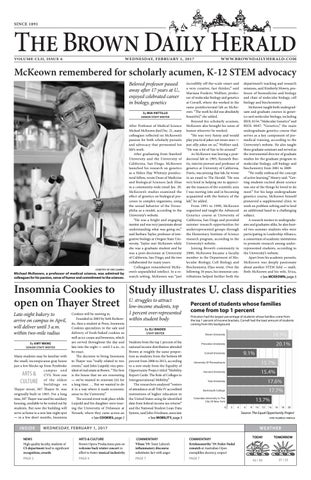
Nearly 20 percent of students come from families in the top 1 percent, which has been, on average, higher than the rate of students in the bottom 60 percent over the past 10 years.
20
15 Top 1%
06
03 004 005 0 2 2 2
20
02
Bottom 60%
20
professor of economics and international and public affairs, as well as one of the study’s investigators. The data covers students born between 1980 and 1991, which roughly corresponds to the graduating classes of 2002 to 2013. Because the University only collects financial information on students receiving financial aid, findings of the study were previously unknown to University administrators, said President Christina Paxson P’19. From roughly the class of 2002 to the class of 2013, the percentage of students from families in the bottom 60 percent of the income distribution increased from 13.2 percent to 18.2 percent, according to the study. Over the same period, the proportion of students from families in the top 1 percent stayed consistent at around 16 to 19 percent. “We thought, 20 years ago, that becoming need-blind was going to solve the problem (of disparity in student income backgrounds),” Paxson said. “I think the problem is more deeply embedded in society. The issue for us is not who we admit among those who are in our pool, but who’s in our pool — who’s applying to Brown.” She added that students’ opportunities are often tied to those of their parents. Friedman said the overwhelming percentage of students from highincome families at Brown “is a statement about the differences in opportunities that kids from different types of families have in the United States.” The goal of the Equality of Opportunity Project is to “understand the pathways for upward mobility for kids from low-income families,” Friedman said. In the study, mobility was measured as the percentage of the student body with parents in the bottom quintile that reach the top income quintile by their early thirties, he added. A little over 53 percent of Brown students with parents in the bottom quintile of the income distribution reached the top quintile, according to data for students born between 1980 and 1982. This is nearly the same rate as Brown students with parents in the top quintile — 59 percent of them also reached the top quintile. But because Brown enrolls such a small proportion of low-income students, the University is not an effective creator of upward mobility, Friedman said. Colleges with higher rates of economic mobility “tend to be mid-tier, selective, public universities,” he said. The California State University, State University of New
York and City University of New York systems have some of the highest mobility rates in the country. “If you think about what’s a scalable national model in how to improve higher education (and increase mobility), trying to make a lot of schools look like Brown … is not going to be a successful model,” Friedman said. “Trying to get a lot of schools to look like Cal State … is more feasible.” Paxson agreed that the University’s model could not be brought to scale. The schools that Friedman finds to create high mobility “are not research universities,” she said. “So our missions are very different.” In recent years, the University has taken some steps to reduce income disparity in the student body and support low-income students. Brown adopted a need-blind admissions policy beginning with the class of 2007. Additionally, the First-Generation and Low-Income Student Center opened in September 2016. Paxson said that the center may help attract more students from low-income families “if Brown continues to build its reputation as a welcoming and supportive place for students from all economic backgrounds.” But Yolanda Rome, co-director of the FLIC and dean of the college, said the focus of the center is to create “community during students’ time at Brown,” rather than to recruit students from low-income backgrounds or participate in admissions. The University is not yet prepared to significantly increase the population of students from low-income backgrounds, Paxson said. Such planning would require more funding for financial aid. While total University scholarships increased from $24.8 million in 1998 to $117 million in 2017, the average scholarship increased from $12,700 — about $37,000 when adjusted for inflation, according to the Bureau of Labor Statistics inflation calculator, to $41,792 this year, according to data given to The Herald by Paxson. The University also does not offer strong financial aid packages for middleincome students, Paxson said. The University is currently trying to raise half a billion dollars to fund financial aid, she added. The findings of the study are a “wake-up call,” Paxson said. “For the most part we’ve gone from being behind our peers (in the Ivy League in terms of economic diversity) to being in line with our peers,” Paxson said. “But that doesn’t mean we are where we need to be. We know we have more work to do.”
Pp ercent
» MOBILITY, from page 1
7
0 20
8
0 20
09 010 011 012 013 0 2 2 2 2 2
Year Source: Equality of Opportunity Project MARLIS FLINN / HERALD
that teaching at Brown was a real love for him, and he was one of the nicest people I ever met.” Wolfner added that McKeown was “someone who would always have something funny to say, no matter what the subject was. I was always amazed at how much he knew — books, science, life — he was always just really fun to talk with.” McKeown is survived by his wife, Erica, and their three children: twins Charles and Rebecca and their second son, Gene. KATE TALERICO / HERALD
ARTS & CULTURE PAGE 4 • WEDNESDAY, FEBRUARY 1, 2017
THE BROWN DAILY HERALD
Q&A: Linda Ford talks recent exhibit ‘Territorialize’ Artist uses fly-fishing tools as a medium through which to explore gender, attraction, women’s issues By HANA PARK STAFF WRITER
ELI WHITE / HERALD
Kaia Sargent ‘17, pictured above, was one of the seven singers who volunteered to be a part of the Brown Opera Productions’ Winter Arias Concert. The concert was free and open to anyone interested.
Brown Opera Productions kicks off semester Winter Arias Concert seeks to attract students, audience of various musical backgrounds By ETHEL RENIA SENIOR STAFF WRITER
The Brown Opera Productions put on its first show of the semester, the Winter Arias Concert, on Friday, Jan. 27. The concert, an informal production, featured 10 singers and accompanying pianists and served as a way to welcome artists and students back to campus. The genre of individual performances varied, ranging from theatrical musicals such as “Light in the Piazza” by Adam Guettel to more classic opera productions such as Mozart’s “The Magic Flute.” Singers were free to perform a piece of their choice. “The Winter Arias Concert is a nice welcome back to Brown but also serves as a celebration of these people that have amazing talents,” said Isabel Thornton ’19, co-chair of the BOP Board. Unlike other BOP projects, the Winter Arias Concert has no audition process. The organization strives to be
as inclusive as possible of all students and singers of diverse musical backgrounds, Thornton said. Though most student performers had worked with BOP in the past, others were newcomers to the student organization. “What we are trying to do with all of the projects we take on is appeal to people who wouldn’t necessarily be interested in something that has the label ‘opera’ on it,” said Sophie Urquhart ’18.5, co-publicity chair of the BOP Board and a performer in the concert. “With the Arias concert, that is particularly effective because people invite their friends who don’t know anything about opera and then experience it through someone that they know personally.” In the past, BOP has sought to put on shows from a wide variety of operatic genres. “Last year we did the Beggar’s Opera, which was more of a folk opera,” said Flannery McIntyre ’19, publicity chair of the BOP Board. The year before that, BOP performed an opera by Astor Piazzolla that had never before premiered in the United States, McIntyre said. This spring the student group is set to perform a rock opera inspired by The
Who’s fourth studio album, “Tommy.” The decision to take on such a nontraditional opera goes hand in hand with BOP’s ambition to widen the Brown student population’s definition of the operatic genre, Thornton said. “A lot of people think that they can only be part of the Brown Opera Productions if they have this classical musical background,” Thornton said. BOP encourages students outside of the organization itself to perform in or direct the production company’s various projects, she added, noting that participants usually come from the music or theater community. Looking forward, BOP hopes to both involve more creative minds and musically inclined students in their productions and grow their audience by reaching students who might not necessarily think of themselves as opera aficionados, Thornton said. “We also have ambitions to do more operas that have been composed by students on Brown’s campus.” Thornton said. “We’re looking into maybe doing a piece that was composed by a student next fall.”
From Dec. 5 to Jan. 27, the Sarah Doyle Women Center Gallery presented “Territorialize,” a solo exhibition by Linda Ford. Using fly-fishing instruments throughout her work, Ford aims to explore the body and how it is used to attract others. The Herald spoke to Ford about her exhibition. Q: Tell me about your art. A: The Sarah Doyle exhibit is a project that I’ve been doing for a few years now that’s exploring the practice of fly-fishing and fly-catching. … My work generally explores issues around the body, psychology and gender. This is a combination of these things in a little bit different way. It explores issues of attraction and display in the practice of fly-fishing and how it plays out in the human world when we think about attraction and what we do to attract a mate or to attract anyone. What inspired this exhibit? I grew up with a father who was an avid fly-fisher and I have two brothers who are still fly-fishers. Part of the experience was that I was the only girl, and so it wasn’t something I did on a regular basis with my father, as opposed to my brothers. I am taking it up again as an adult and exploring it from that perspective of not being included, while engaging with gender as well as other philosophical issues. What message do you hope to extend with your artwork? I hope my work makes people think about why we do some of the things we do. In this particular case, it would be to have people think about what we do in our lives that might be artistic — what animals do to attract other people and display themselves and how that plays out for human beings. I hope people come out of this thinking about the psychology of the things that we do. Why do you think art is a good medium for addressing women’s issues? Art is a good medium for expressing all sorts of issues — especially what’s on people’s minds these days. I think art gets people to think about things differently and exposes people to different kinds of ideas and hopefully different sensations and experiences. It’s political when it opens someone’s mind up to something new to help them see something in a different way.
Why did you choose the Sarah Doyle Women’s Center to exhibit your art? Originally, a friend of mine had a show there a few years ago. I was interested that they were a center for women’s and gender issues. When I moved to Providence, I went to some shows there, and I loved the old 19thcentury house. It’s very domestic. It’s perfect for the work I’m doing right now because it engages gender issues, women’s issues and issues of attraction. How did you get started with art? As a child, I watched my dad draw and paint. He was self-taught and he had very little education, but besides fishing, it was the only other thing he did for enjoyment and relaxation. It was one of the rare times I ever saw him being that way, relaxed and escaping his mental health issues and his addiction issues. So I think that, as a child, I interpreted art as a way to be happy, and I started drawing as a kid. How do you perceive your pieces are representative of your worldview? Most artists make work about what they’re preoccupied with in their lives. I think this series of work about flyfishing is interesting in different ways for me. I think we have a lot in common with animals — in a good way. We’re engaged with our bodies, and I think our strength lies in those sorts of things, but I think bodily knowledge and these other ways of knowing things are really important, and they’re often dismissed in our culture, like being female. What were challenges in engaging with the theme of attraction and display for this particular exhibit? The challenge is getting to push the fly-fishing practice beyond what it is already. So it became apparent for me in this show that I need to think more about where to go with making flies and what they might become. Do you think art speaks for itself? Art speaks really loudly for itself. But I think, as viewers, it’s interesting to have dialogue about art, and it’s necessary to do that. But I do think art speaks for itself because our bodies respond to art, but we have to feel confident enough to pay attention and respond to the sensations and the internal responses we have. It’s just a matter of feeling like you can do it. I think that’s kind of what art is all about, because it’s so visual and it’s not about words. It’s a visual practice — we just have to develop our own way of responding to these things and being okay and comfortable with doing that. This interview has been edited for clarity and length.
TODAY
WEDNESDAY, FEBRUARY 1, 2017 • PAGE 5
THE BROWN DAILY HERALD
bonus baja’s
menu SATELLITE DINING ANDREWS COMMONS
Pizza: Mushroom’s Revenge, Spicy Sausage and Garlic, Miss Maple JOSIAH’S
BLUE ROOM
The Josiah Chicken Panini
Soup: Beef Chili With Beans, Hearty Country Vegetable Soup
DINING HALLS SHARPE REFECTORY LUNCH
DINNER
Korean Teriyaki Beefless Stirfry, Vegetarian Salad Bar, Cream of Tomato Soup, French Toast
Roast Beef Au Jus, Orange Teriyaki Fishless Filet, Grilled Italian Chicken, Apple Squares
VERNEY-WOOLLEY LUNCH
DINNER
New England Cheddar Cheese Pie, Italian Sausage Bar, Tortilla Soup, Cream Cheese Brownies
Roast Pork Loin Jour Ouvert, Rotini Pasta, Mexican Salad Bar, Brazilian Chocolate Cake
sudoku
ANITA SHEIH / HERALD
Upon returning from break students were surprised to find that their favorite burrito staple had multiplied and that, in addition to Baja’s Tex-Mex Grill near Meeting Street, a duplicate had appeared near Angell Street.
Q U O T E O F T H E D AY
“I have to bring Insomnia Cookies to Thayer Street.”
RELEASE DATE– Monday, March 5, 2012
— John Luipold, vice-president of real estate at Brown
Los Angeles Times Daily Crossword Puzzle c rNorris o s sandwJoyce o rNichols d Lewis Edited by Rich
ACROSS 1 Long-necked waders 7 Sgt. Friday’s employer 11 Blow away 14 __ pork: Chinese dish with pancakes 15 Fairy tale villain 16 Betty Crocker product 17 Click-and-drag tool 19 Impersonal pronoun 20 Barnyard brayer 21 Half an Orkan goodbye 22 Enjoyed, as a lollipop 24 Filming locations 26 More out of practice 28 Reunion attendee, briefly 30 Libyan or Liberian, e.g. 34 Tequila plant 37 Kimono sash 38 Hefty volume 39 Learner’s permit prerequisite, often 43 Guitarist Hendrix 44 Reveal, in verse 45 Thick, like fog 46 Step on the gas 48 Jack of late-night TV 50 Legislative period 52 Mex. ladies 56 Samples a bit of 59 Univ. military org. 61 Dada co-founder Jean 62 Actress Gardner 63 Memorable surprise attack site 66 Deafening noise 67 Sprinter’s path 68 “Seinfeld” woman 69 Fruit drink ending 70 Egg foo __ 71 Name associated with the start of 17-, 39- or 63Across
2 Fairy tale Mother 3 Shake awake 4 Superman’s monogram 5 Afterwards 6 Forester automaker 7 Legs-intertwined meditative position 8 Player’s rep. 9 Very productive 10 Naysayer 11 Helter-skelter 12 Rosé or Cabernet 13 Crossed (out) 18 U.S. motto word 23 Animals, casually 25 Most wellinformed 27 Dana’s “forbidden fragrance” 29 Grant wartime foe 31 Nickel or dime 32 “Famous” cookie guy 33 Hawaiian goose 34 Descriptive wds. 35 Golf club part 36 “Je t’__”: French “I love you” 37 Shelley work
40 Philosopher JeanJacques 41 “House” actor Omar 42 Oral health org. 47 With intense feeling 48 Motel amenity 49 “O Canada,” e.g. 51 Discount rack abbr. 53 Former Israeli leader Yitzhak
See Cookies on page 2.
54 “The San Francisco Treat” suffix 55 Shopper’s indulgence 56 “I did it!” 57 Raring to go 58 Of sound mind 60 Colombian city 64 __ Arbor, Michigan 65 Took flight
ANSWER TO PREVIOUS PUZZLE:
xwordeditor@aol.com
calendar
03/05/12
TODAY FEBRUARY
S
DOWN 1 Actresses Watson and Thompson By Ed Sessa
(c)2012 Tribune Media Services, Inc.
T
W
Th
F
S
1
2
3
4
5
6
7
8
9
10
11
12
13
14
15
16
17
18
19
20
21
22
23
24
25
26 03/05/12
M
27
28
Luncheon Lecture: Renato Gnomes 12:00 P.M. 152 George St., 102
Samantha Kleinberg 4:00 P.M. Watson CIT
Laurie Rush: Working with the Military 5:30 P.M. Rhode Island Hall, 108
A Reporter’s Perspective 5:30 P.M. Watson Institute
TOMORROW Paul Taylor’s America 12:00 P.M. Nightingale-Brown House
LingLangLunch 1:00 P.M. Metcalf, 305
Women of the Page: Exhibition Opening 3:00 P.M. John Carter Brown Library
19th Annual Martin Luther King Jr. Lecture 5:30 P.M. Pembroke Hall, 305
COMMENTARY PAGE 6 • WEDNESDAY, FEBRUARY 1, 2017
THE BROWN DAILY HERALD
comic
LETTER TO THE EDITOR
Response to Smith GS “Is graduate student unionization worthwhile?”
P-Branes and Bosons | Ricky Oliver
To the Editor: It was perplexing to see a graduate student list the many ways the University stiffs him and then conclude that unionizing would be a waste of time. My partner (also a Brown alum) is a PhD student at the University of Arizona; this has opened my eyes to how much free labor universities extract from their graduate students. During the recession, Arizona cut its education funding more than any other state, and with no student union, there was no effective resistance. Does Smith not understand the connection between lack of funding for higher education and the dearth of employment opportunities? Who does he think is going to solve this problem, if not the people actually affected by it? Unions are responsible for almost every major historical advance in workers’ rights. Smith has plenty of complaints, but he doesn’t offer any ideas about how to address them. He should learn from history: Workers move forward when they fight together. Time to get off the sidelines. Harpo Jaeger ’14
www.browndailyherald.com
Find us online! facebook.com/browndailyherald
browndailyherald.com
@the_herald
Location: 195 Angell St., Providence, R.I. www.browndailyherald.com
@browndailyherald
youtube.com/browndailyherald
Editorial Leadership
Sections
Multimedia & Production
Business
Editor-in-Chief Lauren Aratani
Arts & Culture Editors Julie Center Madison Rivlin
Design Editors Christy Leung Ameer Malik Jessica Yu Assistant: Eduard Muñoz-Suñé
General Managers Henry Ritter Ben Wesner
Managing Editors Matt Brownsword Rebecca Ellis Kate Talerico POST- MAGAZINE Editor Monica Chin
News Editors Kyle Borowski Kasturi Pananjady Suvy Qin Elena Renken Alex Skidmore Hattie Xu
BLOGDAILYHERALD Editor Anica Green
Sports Editor Jackson Chaiken Ben Shumate COMMENTARY Opinions Editors Margaret Hu Anuj Krishnamurthy Mili Mitra
Photo Editors Head: Eli White Assistant: Sam Berube Marianna McMurdock Lilly Nguyen Copy Desk Chief Julia Stemmer Multimedia Editor Roland High Illustrations Editor Dorothy Windham Graphics Editor Laura Felenstein Directors of Web Development: Lucy Wei Ivy Wong
Directors Finance: Reena Zhan Sales: Antonia Alvarez Sales: Erin Lueck Strategy: William Nober Strategy: Gianna Jasinski Managers Sales: Elizabeth Doykan Sales: Gabriella Elanbeck Sales: Matilda Lynton Sales: Ariel Shusterman Collections: Ravi Betzig Operations: Gür Ağci
Editorial contact: 401-351-3372 herald@browndailyherald.com
Business contact: 401-351-3260 gm@browndailyherald.com
Submissions: The Brown Daily Herald publishes submissions in the form of op-eds and letters to the editor. Op-eds are typically between 750 and 1000 words, though we will consider submissions between 500 and 1200 words. Letters to the editor should be around 250 words. While letters to the editor respond to an article or column that has appeared in The Herald, op-eds usually prompt new discussions on campus or frame new arguments about current discourse. All submissions to The Herald cannot have been previously published elsewhere (in print or online — including personal blogs and social media), and they must be exclusive to The Herald. Submissions must include no more than two individual authors. If there are more than two original authors, The Herald can acknowledge the authors in a statement at the end of the letter or op-ed, but the byline can only include up to two names. The Herald will not publish submissions authored by groups. The Herald does not publish anonymous submissions. If you feel your circumstances prevent you from submitting an op-ed or letter with your name, please email herald@browndailyherald.com to explain your situation. You can submit op-eds to opinions@browndailyherald.com and letters to letters@browndailyherald.com. When you email your submission, please include (1) your full name, (2) an evening or mobile phone number in case your submission is chosen for publication and (3) any affiliation with Brown University or any institution or organization relevant to the content of your submission. Please send in submissions at least 24 hours in advance of your desired publication date. The Herald only publishes submissions while it is in print. The Herald reserves the right to edit all submissions. If your piece is considered for publication, an editor will contact you to discuss potential changes to your submission. Commentary: The editorial is the majority opinion of the editorial page board of The Brown Daily Herald. The editorial viewpoint does not necessarily reflect the views of The Brown Daily Herald, Inc. Columns, letters and comics reflect the opinions of their authors only. Corrections: The Brown Daily Herald is committed to providing the Brown University community with the most accurate information possible. Corrections may be submitted up to seven calendar days after publication. Advertising: The Brown Daily Herald, Inc. reserves the right to accept or decline any advertisement at its discretion. The Brown Daily Herald, Inc. is a financially independent, nonprofit media organization bringing you The Brown Daily Herald, BlogDailyHerald and Post- Magazine. The Brown Daily Herald has served the Brown University community daily since 1891. It is published Monday through Friday during the academic year, excluding vacations, once during Commencement and once during Orientation by The Brown Daily Herald, Inc. Single copy free for each member of the community. Subscription prices: $200 one year daily, $100 one semester daily. Copyright 2017 by The Brown Daily Herald, Inc. All rights reserved. Periodicals postage paid at Providence, R.I. Postmaster: Please send corrections to P.O. Box 2538, Providence, RI 02906.
COMMENTARY WEDNESDAY, FEBRUARY 1, 2017 • PAGE 7
THE BROWN DAILY HERALD
Tomi Lahren: The rightwing princess FABIANA VILSAN staff columnist The rise to stardom of political commentator Tomi Lahren is hard to ignore — her inflammatory statements light up social media and emblazon rightwing millennial voters looking for a fresh face to carry a conservative message. And not unlike President Donald Trump, Lahren knows the power of a tweet. Using as few characters as possible, she has likened the Black Lives Matter movement to the KKK, called liberals “snowflakes” and accused the Obama administration of being sympathetic toward terrorists. There’s no doubt that rightwing princess Tomi Lahren, who has her own show on TheBlaze, has gathered a large millennial following with her passionate approach to politics. But is Lahren truly the spokeswoman for the forgotten men and women of the America heartland as she so proudly claims to be? Or rather, is she a mouthpiece for the same old political forces afraid of change and inclusion? Political debate is a cornerstone of the American democratic system. Lahren is absolutely right to question those in power and demand
more from her elected officials. She is also right to question the mainstream media’s bias throughout the presidential election. But when attacks on people, movements and belief systems are rooted in fundamental misconceptions, Lahren’s thirst for controversy is no longer conducive to engaging conversation and instead fuels misguided anger. As has been painfully obvious throughout this election cycle, po-
so often in this election cycle that it no longer has any meaning and that liberals use the term indiscriminately when their comebacks come up short. But she is completely comfortable throwing around the label “snowflake” whenever she deems fit. On her show, Lahren dismisses the Black Lives Matter movement as a collection of angry snowflakes disrespecting the police force without a legitimate reason. A history
need to care about facts or nuances so long as her fans gobble up her outlandish and controversial claims. She simply basks in the backlash. As a guest on the Daily Show with Trevor Noah, Lahren was asked a legitimate question: What is the right way for black people to protest? Lahren claims to be personally offended by Colin Kaepernick’s decision to exercise his right not to stand during the national anthem. But she also
Lahren doesn’t need to care about facts or nuances so long as her fans gobble up her outlandish and controversial claims. She simply basks in the backlash.
litical discourse is no longer solely about differences of opinion regarding the role of government. It’s personal. Lahren doesn’t consider her liberal counterparts as intellectual equals but rather condescendingly refers to them as “snowflakes.” Apparently, these liberals are too fragile and sensitive to cope with the brutal truths doled out by Trump. Lahren maintains that the label of “racist” has been thrown around
of racism, police brutality and mass incarceration don’t get mentioned. The complexity of the movement — and the history of race in the United States — doesn’t fit well into her simple, angry narrative. When Lahren casually likened the Black Lives Matter movement to the KKK, it led me to believe that Lahren is either unaware of what the KKK stands for or she is simply indifferent to it. But that’s the thing — Lahren doesn’t
claims the Black Lives Matter movement is illegitimate due to several members’ decision to protest violently. Unsurprisingly, the alwayspassionate Lahren was unable to answer the question. She responded instead with a tangential, spirited defense of the flag and skepticism as to whether black people face oppression at all. For a woman who claims to love America for its freedoms, she is oddly bothered by a man’s silent
protest against his oppressor. The biggest problem with Lahren isn’t that she lacks nuance and wellreasoned attacks. Lahren fights opposing arguments with blind outrage and unadmitted privilege. She arms her followers with unfounded and racially charged arguments instead of practicing thoughtful reporting and effectively addressing pressing political concerns. Why should you care? Lahren isn’t simply muttering angry extremist beliefs to herself — she influences millions of viewers, has 585,000 followers on Twitter and is now essentially a part of the mainstream media. To make matters worse, Lahren is an active fearmonger, offering a narrative of exclusion rather than what the country really needs — hope and optimism. Knowing that the rightwing princess hates labels, I’ll refrain from adding one here and put it bluntly instead: I wish Lahren’s only problem were her one-sided arguments. Unfortunately, she possess neither the skills nor the empathy that her platform demands.
Fabiana Vilsan ’19 can be reached at fabiana_vilsan@brown.edu.
One last slam ANUJ KRISHNAMURTHY staff columnist Tennis is the sort of sport, like soccer, that hasn’t quite managed to intoxicate Americans the way, say, football or basketball have. It is, after all, a European import, lacking any of the violent drama or masculine desperation that characterize much of American sports. Indeed, tennis matches feel less like conflicts and more like performances of ballet — graceful, elegant and, without fail, superlatively decent. Last Sunday morning, while most Americans were still asleep, that show of decency and austere pursuit of excellence was on full display during the finals of the Australian Open. Roger Federer and Rafael Nadal — the unforgettable elder statesmen of tennis — had both staged improbable comebacks, overcoming injuries and a slate of healthier opponents to reach the final round. Federer had not won a Grand Slam since Wimbledon in 2012 and was fresh off a six-month break from the tour; Nadal had ended his 2016 season early, thanks to a disappointing recovery (though he managed to make a comeback for the 2016 Summer Olympic Games in Rio de Janeiro). That these two rivals would faceoff once again, perhaps for the last time, in the finals of a Grand Slam tournament was a much-needed miracle. Federer and Nadal are no strangers to
each other. Their careers are intimately entwined; before the final, they had played 34 times, with Nadal leading their head-to-head record 23-11. From 2006 to 2008, they enjoyed a virtual monopoly of the tour, playing in the finals of every French Open and Wimbledon. In January 2017, Federer and Nadal (both above the age of 30) played as if their age and physical decay were mere fictions — as if the clocks could be turned at will back to
in absolute awe. But that isn’t why I found the Australian Open finals so invigorating. Good tennis — good athletics, really — can be found anywhere. The match didn’t just offer a magnificent piece of athletic achievement, it offered something far scarcer: decency. It was this decency, this profound acknowledgement of mutual dependence, that animated the play of archrivals Federer and Nadal and really
Good tennis — good athletics, really — can be found anywhere. The match didn’t just offer a magnificent piece of athletic achievement, it offered something far scarcer: decency.
their glorious primes. The match itself was deserving of the anticipation. Federer effortlessly dished out his famous forehands and Nadal exhibited his ferocious style of play. In the fifth set, Federer found himself down three games to none, and clawed his way back to win the match with a forehand winner. It was classic tennis — the kind that leaves you in sequence, crestfallen, energized, disappointed and, at the very end,
got to me. In his acceptance of the winner’s trophy, Federer said, “Tennis is a tough sport. There are no draws, but if there were, I would have been happy to share it with Rafa.” My heart melted when I heard that. Whose wouldn’t? In moments of crisis and hardship, it is tough to find reasons to believe that humans — endowed with an inexorable fascination with cruelty — are capable of redemption.
www.browndailyherald.com
Our societies are too divided to promote an inclusive vision. Our leaders are too good at marshaling our worst instincts. And, too often, our governments enable us to indulge those instincts, scot-free. In this time of uncertainty and disaffection, the Australian Open provided a short relief: the resplendent resurgence of old champions, battered by their age and competition, yet thoroughly unwilling to yield to the forces that haunt them. There is, of course, a subtle lesson in all this. We may not be perfect; we will stumble and fall and suffer grave disappointments. But the measure of our decency stems not from where we are now, but how humbly we admit our shortcomings, and how scrappily we claw our way to where we wish to go. The match is a telling reminder that we can rise above our differences, rivalries and innate competitiveness with grace and compassion. After winning his semifinal match, Federer told an interviewer that, when he was in Mallorca a couple of months ago for the opening of Nadal’s tennis school, “I was on one leg. (Nadal) had the wrist injury. And we were playing some mini-tennis with some juniors and we’re like, ‘This is the best we can do right now.’” Thank God that wasn’t true.
Anuj Krishnamurthy ’19 can be reached at anuj_krishnamurthy@brown.edu.
ARTS & CULTURE THE BROWN DAILY HERALD
WEDNESDAY, FEBRUARY 1, 2017
RISD Museum names cartoonist as 2017 Artist Fellow Walker Mettling’s comics consortium connects artists across various age demographics By CONNOR SULLIVAN SENIOR STAFF WRITER
The Rhode Island School of Design Museum recently unveiled accomplished cartoonist Walker Mettling as a 2017 Artist Fellow. Mettling is the head of the micropublisher Providence Comics Consortium and the third recipient of the fellowship, which is funded by the Arts Works program, a part of the National Endowment for the Arts. His consortium has been lauded since its 2010 inception for its free comic book making workshops at local libraries across Providence. Facilitated by generative exercises that incorporate creative input from children and adults alike, the Providence Comics Consortium defies any age-based stereotypes and seeks to bridge the gap between artistic age groups. “I see the workshops’ attendees — the adults and kids — as a hive mind of a group and a richer well of creative ideas for the comic or publication being made that day,” Mettling said. Inspired by children unfamiliar with Providence’s prominent art scene, the printmaker feels compelled to create overlap between the two age
COURTESY OF THE RHODE ISLAND SCHOOL OF DESIGN MUSEUM
As a 2017 Artist Fellow, Mettling will receive a $10,000 stipend and access to a variety of RISD resources, courses and mentorship. These will all help further his goals of connecting community members through art. demographics, he said. This sentiment of inclusion is also reflected in the principles lauded by the RISD fellowship initiative program. “(The RISD fellowship) is a more (thoughtful) way of connecting with
community members at large,” said Alexandra Poterack, the museum’s associate educator of public and academic programs. “Kids in town don’t realize they’re in a sort of art hub. There are older people very near at hand in this
community, and adults should feel obliged to share their resources with these kids,” Mettling said. “We should be focused on fostering a community where everyone gets to make art.” As an artist fellow, Mettling will receive “access to research resources
from the RISD Museum collections and RISD Fleet Library,” wrote Sarah Ganz Blythe, the museum’s deputy director of exhibitions, education and programs, in an email to The Herald. In addition, each fellow enjoys a $10,000 stipend, the ability to audit select RISD graduate studies courses and mentorship from both RISD Museum and RISD College staff, Blythe said. Both an extension of extant artistic interests and a cultivation of new ones, the artist’s proposals align clearly with the mission of the fellowship. “Walker’s exciting proposal explores the collection in creative and thought-provoking ways and comes at a critical juncture in his professional development,” Blythe said, noting Mettling’s work with the Providence Comics Consortium as evidence of this innovation. Not only does the creative’s goals for the fellowship facilitate the use of the museum’s veritable wealth of collections by local children and adults, but it also includes space for more personal projects. “Making action figures inspired by the museum’s art is something I’ve been wanting to meditate on,” Mettling said, evidencing a particular interest in figures that depict Roger Williams and Nesmin, Rhode Island’s founder and the museum’s resident mummy, respectively. For Mettling, the action figures help him “facilitate teaching kids about the weird” as they “impart a lot of cultural meaning.”